EP2801604B1 - Chromatographisches Verfahren zur Herstellung von hochreinen, mehrfach ungesättigten Fettsäuren - Google Patents
Chromatographisches Verfahren zur Herstellung von hochreinen, mehrfach ungesättigten Fettsäuren Download PDFInfo
- Publication number
- EP2801604B1 EP2801604B1 EP13305596.2A EP13305596A EP2801604B1 EP 2801604 B1 EP2801604 B1 EP 2801604B1 EP 13305596 A EP13305596 A EP 13305596A EP 2801604 B1 EP2801604 B1 EP 2801604B1
- Authority
- EP
- European Patent Office
- Prior art keywords
- stream
- eluent
- separation
- chromatographic
- fatty acid
- Prior art date
- Legal status (The legal status is an assumption and is not a legal conclusion. Google has not performed a legal analysis and makes no representation as to the accuracy of the status listed.)
- Active
Links
Images




Classifications
-
- B—PERFORMING OPERATIONS; TRANSPORTING
- B01—PHYSICAL OR CHEMICAL PROCESSES OR APPARATUS IN GENERAL
- B01D—SEPARATION
- B01D15/00—Separating processes involving the treatment of liquids with solid sorbents; Apparatus therefor
- B01D15/08—Selective adsorption, e.g. chromatography
- B01D15/10—Selective adsorption, e.g. chromatography characterised by constructional or operational features
- B01D15/18—Selective adsorption, e.g. chromatography characterised by constructional or operational features relating to flow patterns
-
- B—PERFORMING OPERATIONS; TRANSPORTING
- B01—PHYSICAL OR CHEMICAL PROCESSES OR APPARATUS IN GENERAL
- B01D—SEPARATION
- B01D15/00—Separating processes involving the treatment of liquids with solid sorbents; Apparatus therefor
- B01D15/08—Selective adsorption, e.g. chromatography
-
- C—CHEMISTRY; METALLURGY
- C11—ANIMAL OR VEGETABLE OILS, FATS, FATTY SUBSTANCES OR WAXES; FATTY ACIDS THEREFROM; DETERGENTS; CANDLES
- C11B—PRODUCING, e.g. BY PRESSING RAW MATERIALS OR BY EXTRACTION FROM WASTE MATERIALS, REFINING OR PRESERVING FATS, FATTY SUBSTANCES, e.g. LANOLIN, FATTY OILS OR WAXES; ESSENTIAL OILS; PERFUMES
- C11B7/00—Separation of mixtures of fats or fatty oils into their constituents, e.g. saturated oils from unsaturated oils
Definitions
- the present invention relates to a chromatographic process for the production of highly purified polyunsaturated fatty acids and their derivatives.
- Fatty acids and more particularly polyunsaturated fatty acids (PUFAs), as well as their derivatives, are important biological compounds which are components of cellular membranes and which are involved in numerous biological processes, such as the synthesis of hormones (such as prostaglandins) which play a role in platelet aggregation, inflammation, reduction in the triglyceride level, immunological response, etc.
- PUFAs polyunsaturated fatty acids
- compositions comprising EPA and containing less than 0.5% of DHA, preferably less than 0.05% of DHA, even more preferably having no detectable levels of DHA.
- DHA substantially without ARA or comprising ARA substantially without DHA
- highly purified PUFAs with compositions which substantially exclude other PUFAs (or other FAs) to enable the development and commercialization of new medicines based on highly purified individual PUFAs having a more controlled efficacy and fewer side effects.
- EPA is generally purified from fish oils, algae or yeast for instance.
- fish oil and other biomasses also contain a great number of fatty acids, and in particular large amounts of DHA, that need to be separated from EPA.
- DHA may be purified from fish oils, where it is required to separate a large number of other fatty acids including EPA, which is even more abundant than DHA in most oils derived from various fish species.
- DHA may be produced from algae for instance, where ARA is present in sizable quantities, and therefore needs to be separated from ARA.
- ARA when purifying ARA from an algal source, ARA must be separated from DHA.
- Methods of production of purified PUFAs are well known by persons skilled in the art. They generally include one or more of a hydrolysis step to convert triglycerides to free fatty acids or a triglyceride transesterification step to convert fatty acids to alkyl (preferably ethyl) esters, a bleaching step, a urea fractionation step, a molecular distillation step, chromatography steps, etc. While molecular distillation is a widely used technique to enrich long chain PUFAs, it cannot be used to efficiently separate long-chain PUFAs from each other. Furthermore, PUFAs are very fragile molecules prone to oxidation and degradation. When heated, PUFAs are prone to isomerization, oxidation, peroxidation and oligomerization.
- Chromatography processes are efficient means to enrich PUFAs and may be combined with one or more of the purification techniques discussed above.
- the most widely described chromatography processes are single column chromatography processes, including for example high performance liquid chromatography (HPLC) processes or steady-state recycling chromatography processes, as well as multicolumn chromatography techniques such as simulated moving bed (SMB), VARICOLTM or actual moving bed (AMB) processes as well as other processes known by the person skilled in the art. Since PUFAs are generally produced in very complex mixtures, two or three chromatographic steps are generally required to reach high purities.
- US2003/0222024 discloses a method and device for chromatographic separation producing at least two fractions, wherein the solvent is at least partially evaporated from the fractions produced and thus separated and reused.
- US2005/0245405 discloses a method of preparing fatty acid alkyl esters from fatty acids. Use is made of an acidic resin to convert the fatty acids into esters.
- US5,719,302 is directed to a process for recovering a PUFA or mixture of PUFAs from a feed composition, comprising a treatment step based on stationary bed chromatography or multistage countercurrent column fractionation using a fluid at supercritical temperature as a solvent; and then a step of further fractionation by simulated continuous countercurrent moving bed chromatography.
- US4,797,233 is directed to a process for separating monoglycerides from di- and triglycerides using an adsorptive chromatographic process in liquid phase.
- US4,189,442 discloses the separation of a fatty acid ester mixture according to the degree of unsaturation, using particular resin adsorbent and particular solvent.
- WO2013/005051 discloses a chromatographic separation process using an aqueous organic solvent eluent for purifying PUFAs. Part of the raffinate stream can be recycled back to the chromatographic separation unit.
- the invention in particular relates to the following items.
- the present invention enables to overcome the drawbacks of the prior art.
- the invention provides improved processes for the purification of PUFAs to higher degrees of purity (such as processes for the purification of very pure DHA, or of very pure EPA) with a limited consumption of solvents.
- the invention relies on the surprising finding that, during the concentration of the chromatographic fractions containing undesirable FAs (and in particular undesirable PUFAs) separated from a starting PUFA stream by chromatographic separation, which generally involves the evaporation of the eluent, small but non negligible quantities of such undesirable FAs get entrained into the recycled eluent, thereby contaminating said recycled eluent.
- the undesirable FAs can contaminate the chromatographic stream containing the desired PUFA, thereby potentially preventing target specifications for undesirable FAs (in particular undesirable PUFAs) in the end product from being reached.
- FAs have very high boiling points
- the entrainment of said FAs into the vapor phase at the concentration stage was particularly unexpected.
- the present inventors have identified that the FAs (notably PUFAs) are particularly entrained with the water component of the water organic eluent.
- the purpose of the present invention is to reduce or prevent the contamination of the desired PUFA by undesirable FAs upon recycling the eluent(s).
- first, second, third, etc. may be used herein to describe various elements, components, sections or the like, these elements, components, sections or the like should not be limited by these terms. These terms may be only used to distinguish one element, component, section or the like from element, component, section. Terms such as “first,” “second,” and other numerical terms when used herein do not imply a sequence or order unless clearly indicated by the context. Thus, a first element, component, section or the like discussed below could be termed a second element, component, section or the like without departing from the teachings of the example embodiments.
- the process of the invention is a process for recovering a first (desired) PUFA from a feed mixture.
- the feed mixture also comprises at least a second (undesirable) FA (preferably a second, undesirable, PUFA), and preferably comprises a number of other (undesirable) FAs, such as saturated or monounsaturated fatty acids and other PUFAs as well as potentially other impurities.
- the feed mixture can be a mixture of fatty acids which is derived from fish, algae and/or yeast, preferably from fish. It can be a raw material, such as for instance fish oil, or algal oil. It can also be a product derived from the above raw materials, and for instance derived from fish oil, algal oil and/or yeast oil.
- product derived from a raw material is meant a raw material which has been subjected to one or more treatment steps.
- Said treatment steps can include one or more separation or purification steps (such as a fractionation), and/or a hydrolysis step to convert triglycerides to free fatty acids, and/or a triglyceride transesterification step to convert fatty acids to alkyl (preferably ethyl) esters, and/or a bleaching step, and/or a urea fractionation step, and/or a molecular distillation step, and/or one or more chromatographic separation steps, etc.
- separation or purification steps such as a fractionation
- the feed mixture is a product which has been esterified or transesterified, such as a transesterified fish oil, algal oil and/or yeast oil.
- each of the fatty acids (and in particular each of the PUFAs) obtained or used in the process of the invention can be a fatty acid derivative, notably in the form of a mono-, di- or tri-glyceride, ester, phospholipid, amide, lactone, or salt.
- Triglycerides and esters are preferred.
- Esters are more preferred.
- Esters are typically alkyl esters, preferably C1-C6 alkyl esters, more preferably C1-C4 alkyl esters. Examples of esters include methyl and ethyl esters. Ethyl esters are most preferred.
- the process of the invention involves one main step of chromatographic separation.
- a chromatographic separation involves the separation of species entrained in a liquid phase, due to different interactions of some of the species with an adsorbent bed.
- a chromatographic separation can be a continuous, semi-continuous or batch separation.
- Each step of chromatographic separation mentioned in the application is performed in a chromatographic unit.
- the chromatographic unit used for performing the main step of chromatographic separation is referred to as the main chromatographic unit.
- chromatographic unit designates either a single column chromatography system or a multicolumn chromatography system.
- Examples of single column chromatography systems include HPLC or CYCLOJETTM (also referred to as steady-state recycling) systems.
- Examples of multicolumn column chromatography systems include SMB, iSMB, AMB, VARICOLTM, MODICONTM, POWERFEEDTM, MCSGP or GSSR (multicolumn gradient chromatography) systems.
- the CYCLOJETTM system is as described in document US 6,063,284 . It is a single-column, discontinuous chromatographic separation system wherein the separated (i) more retained and then (ii) less retained species are separately collected at the outlet of the column, the non-separated portion of the chromatogram being recycled through the main pump, and the mixture to be separated is periodically injected by means of an injection loop substantially in the middle of the recycled portion of the chromatogram. After several chromatographic cycles, the process reaches a periodical steady-state wherein the quantity of products injected equals the quantity of separated products collected separately at the outlet of the column.
- An SMB system is comprised of a number of individual columns containing adsorbent which are connected together in series. An eluent is passed through the columns in a first direction. The injection points of the feedstock and the eluent, and the separated component collection points in the system, are periodically and simultaneously shifted by means of a series of valves. The overall effect is to simulate the operation of a single column containing a moving bed of the solid adsorbent, the solid adsorbent moving in a countercurrent direction to the flow of eluent.
- an SMB system consists of columns which, as in a conventional stationary bed system, contain stationary beds of solid adsorbent through which eluent is passed, but in an SMB system the operation is such as to simulate a continuous countercurrent moving bed.
- SMB system The most traditional form of SMB system is the four-zone SMB system. Other forms are the three-zone SMB system and the two-zone SMB system (as described in the article Two Section Simulated Moving Bed Process, by Kwangnam Lee, in Separation Science and Technology 35(4):519-534, 2000 , ).
- An iSMB system is as described in documents EP 0342629 and US 5,064,539 . In an iSMB system, there is one step in which the system operates in a closed loop, without any input / output of material.
- SMB systems are: the time variable SMB system and POWERFEEDTM system, as described in document US 5,102,553 and in the article PowerFeed operation of simulated moving bed units: changing flow-rates during the switching interval, by Zhang et al. in Journal of Chromatography A, 1006:87-99, 2003 , the MODICONTM system, as described in document US 7,479,228 , and the SMB system with internal recirculation, as described in document US 8,282,831 .
- An AMB system is similar in operation to an SMB system. However, rather than shifting the injection points of the feed mixture and the eluent, and the separated component collection points by means of a system of valves, instead a series of adsorption units (i.e. columns) are physically moved relative to the feed and draw-off points. Again, operation is such as to simulate a continuous countercurrent moving bed.
- a VARICOLTM chromatography system is as described in documents US 6,136,198 , US 6,375,839 US 6,413,419 and US 6,712,973 .
- a VARICOLTM system is comprised of a number of individual adsorbent-containing columns which are connected together in series. An eluent is passed through the columns in a first direction. Contrary to the SMB system, the injection points of the feedstock and the eluent, and the separated component collection points in the system are periodically but asynchronously shifted by means of a series of valves. The overall effect is to create separation zones of variable length over time, thereby allocating stationary phase dynamically in those zones where it is most needed, and thus enabling similar separation power with less chromatographic units and increasing productivity.
- a VARICOLTM system does not simulate the operation of a single column containing a moving bed of the solid adsorbent, the solid adsorbent moving in a countercurrent direction to the flow of eluent, and thus the VARICOLTM operational principle cannot be implemented in an equivalent AMB system.
- the process of the invention can comprise a single separation step, which is the abovementioned main step of chromatographic separation.
- the other separation step can be performed before the abovementioned main step of chromatographic separation: it can then be referred to as a preliminary step of separation.
- the other separation step can be performed after the abovementioned main step of chromatographic separation: it can then be referred to as a further step of separation.
- the process comprises the successive steps of (i), a preliminary step of separation, (ii), another preliminary step of separation and (iii), the abovementioned main step of chromatographic separation.
- the process comprises the successive steps of (i), a preliminary step of separation, (ii), the abovementioned main step of chromatographic and (iii), a further step of separation.
- the process comprises the successive steps of (i), the abovementioned main step of chromatographic separation, (ii), a further step of separation and (iii), yet a further step of separation.
- Each step of separation is performed in a separation unit.
- the preliminary steps of separation are performed in so-called respective preliminary separation units and the further steps of separation are performed in so-called respective further separation units.
- Each preliminary step of separation and each further step of separation can be (independently of the other separation steps) a step of chromatographic separation of the same type as described above - the preliminary separation unit or further separation unit being in this case a chromatographic unit as described above.
- each preliminary step of separation and each further step of separation can be (independently of the other separation steps) a non-chromatographic step of separation, such as for instance a step of molecular distillation.
- the process includes two (and only two) successive separation steps, which can be AMB, SMB or VARICOLTM separation steps (one of these two steps being the abovementioned main step of chromatographic separation).
- the process includes three (and only three) successive separation steps, which can be AMB, SMB or VARICOLTM separations steps (one of these two steps being the abovementioned main step of chromatographic separation).
- the process includes three (and only three) successive separation steps, namely a (preliminary) VARICOLTM separation step, followed by the abovementioned main step of chromatographic separation (which can be for instance a CYCLOJETTM separation step or an HPLC separation step), followed by a (further) VARICOLTM separation step.
- a (preliminary) VARICOLTM separation step followed by the abovementioned main step of chromatographic separation (which can be for instance a CYCLOJETTM separation step or an HPLC separation step), followed by a (further) VARICOLTM separation step.
- the process includes three (and only three) successive separation steps, namely a (preliminary) VARICOLTM separation step, followed by the abovementioned main step of chromatographic separation (which can be for instance a CYCLOJETTM separation step or an HPLC separation step), followed by a (further) CYCLOJETTM or HPLC separation step.
- a (preliminary) VARICOLTM separation step followed by the abovementioned main step of chromatographic separation (which can be for instance a CYCLOJETTM separation step or an HPLC separation step), followed by a (further) CYCLOJETTM or HPLC separation step.
- the process comprises two or more separation steps
- said steps can be conducted simultaneously by using different separation units, or they can be conducted sequentially, by using different separation units or by using the same separation units.
- two separation steps which are chromatographic steps performed in an SMB or AMB system
- An example of such simultaneous performance on the same apparatus is described in document WO 2011/080503 . Accordingly, some of the separation units used for implementing the above steps of separation can be the same.
- the main chromatographic unit and one preliminary separation unit can be one and the same unit; and/or the main chromatographic unit and one further separation unit can be one and the same unit; and/or one preliminary separation unit and another preliminary separation unit can be one and the same unit; and/or one preliminary separation unit and one further separation unit can be one and the same unit; and/or one further separation unit and another further separation unit can be one and the same unit.
- all separation units can be distinct.
- Each chromatographic separation step (including the main step of chromatographic separation) can be performed on a reverse phase.
- adsorbents based on weakly polar resins or silica-based stationary phases chemically modified with organic residues such as alkyl (notably C4, C8, C18, C24, C30), phenyl, or other suitable residues as determined by the skilled in the art.
- the main step of chromatographic separation is performed using a water organic eluent.
- a water organic eluent is a mixture of an organic solvent or several organic solvents and water.
- steps of chromatographic separation are present in the process, they are also performed using respective water organic eluents.
- steps of chromatographic separation can be performed using a substantially pure organic solvent or a substantially pure mixture of organic solvents.
- Organic solvents which can be used in the present invention are for instance alcohols such as ethanol, propanol, isopropanol and more preferably methanol; ketones such as acetone or methylethyl ketone; nitriles such as acetonitrile; esters such as methylacetate or ethylacetate; furans such as tetrahydrofuran; ethers such as diethylethers or methylethyl ether; and combinations of two or more of the above.
- Preferred organic solvents are methanol and acetone.
- Each water organic eluent is characterized by a water-to-organic ratio, which is the weight ratio of the water component relative to the organic solvent(s) component of the eluent.
- the water-to-organic ratio of each water organic eluent can preferably vary between 0.01:99.99 and 30:70, more preferably between 5:95 and 25:75.
- these steps of chromatographic separation can be performed using eluents having the same composition or different compositions. It is preferred to use eluents having different compositions, and in particular having different water-to-organic ratios, as this makes it possible to adjust the eluting force of the eluent at each separation step and therefore to achieve the separation of different compounds at each step. It may also be preferred to use eluents composed of different organic solvents in the different steps, as this makes it possible to adjust the chromatographic selectivity between certain species to be separated at each separation step and therefore to achieve the separation of different compounds at each step.
- the final product obtained owing to the process of the invention contains the purified first PUFA, together with residual impurities.
- the amount of first PUFA in the final product may for example be greater than or equal to about 80%, preferably greater than or equal to about 90%, or greater than or equal to about 95%, or greater than or equal to about 97%, or greater than or equal to about 98%, or greater than or equal to about 99% (relative to the total amount of fatty acids).
- the final product may contain EPA in an amount of greater than or equal to about 80%, or greater than or equal to about 95%, or greater than or equal to about 97%, or greater than or equal to about 98%, or greater than or equal to about 99% (relative to the total amount of fatty acids); as well as DHA in an amount of less than or equal to about 1%, or less than or equal to about 0.1 %, or less than or equal to about 0.05%, or less than or equal to about 0.03%, or less than or equal to about 0.01%.
- EPA in an amount of greater than or equal to about 80%, or greater than or equal to about 95%, or greater than or equal to about 97%, or greater than or equal to about 98%, or greater than or equal to about 99% (relative to the total amount of fatty acids); as well as DHA in an amount of less than or equal to about 1%, or less than or equal to about 0.1 %, or less than or equal to about 0.05%, or less than or equal to about 0.0
- a stabilizer such as tocopherol or the like, can be added to this final product.
- the first stream can be a raffinate and the second stream can be an extract, or vice versa.
- the process of the invention comprises at least one concentration step which is performed on the second stream, in a concentration unit.
- This concentration step provides on the one hand a stream of concentrated FAs, and on the other hand a depleted second stream of eluent.
- depleted refers to the fact that the second FA (as well as any other fatty acids) has been substantially removed from the eluent.
- stream of concentrated FAs designates a composition comprising a higher concentration of FAs, and in particular of the second FA, than the second stream of eluent before the concentration step.
- the composition may comprise other fatty acids, and in particular other undesirable fatty acids, as well as some water and/or solvent.
- the depleted second stream of eluent is then recycled in the process, in a manner which will be detailed below.
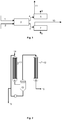
- the main chromatographic unit 3 is fed by an incoming eluent stream 1 and by an incoming feed stream 2.
- the feed stream 2 can be a stream of the (initial) feed mixture if the main step of chromatographic separation is the first step of the process; otherwise, it can be a stream of an intermediate product if one or more treatment steps such as separation steps have already been performed.
- a first stream of eluent enriched in first PUFA 4 and a second stream of eluent enriched in second FA 5 are collected.
- the first stream of eluent enriched in first PUFA 4 is fed to a first concentration unit 6, while the second stream of eluent enriched in second FA 5 is fed to a second concentration unit 7.
- each concentration unit 6, 7 the eluent is evaporated and then condensed; it is thereby substantially separated from the all fatty acids. Therefore, a stream of concentrated FAs 9 (containing in particular the first PUFA in concentrated form) is obtained at the outlet of the first concentration unit 6 while another stream of concentrated FAs 8 (containing in particular the second FA in concentrated form) is obtained at the outlet of the second concentration unit 7.
- a depleted first stream of eluent 11 i.e ., depleted in first PUFA and other FAs
- a depleted second stream of eluent 10 i.e ., depleted in the second FA as well as other FAs
- the depleted first stream of eluent 11 can be partially or totally recycled to the main chromatographic unit 3 or to any other separation unit used in the process.
- the depleted first stream of eluent 11 can be partially or totally recycled to the main chromatographic unit 3 or to any other separation unit used in the process.
- There is no issue of contamination for this depleted first stream of eluent since, if the stream is contaminated by any residual PUFA, it will be mainly by the first (desired) PUFA, which will not negatively impact the purity of the final product (first PUFA in purified form).
- the depleted second stream of eluent 10 can be partially or totally recycled as well.
- particular steps are taken, according to the invention, to avoid negatively impacting the purity of the final product (first PUFA in purified form) due to some residual second (undesirable) FA being entrained into the depleted second stream of eluent. These particular steps will be detailed below.
- the concentration unit used to perform any concentration step can for instance be a falling film evaporator with forced recirculation, a rising evaporator, a flash evaporator, or another type of evaporator known in the art, enabling the evaporation of the eluent components and leaving concentrated fatty acids at the bottom of the device.
- a concentration unit comprises a multi-tubular evaporator 11 with forced recirculation, connected to a phase separator 13 and to a condenser 12.
- a stream of eluent 14 to be concentrated is fed to the evaporator 11.
- the heated stream exits the evaporator 11 and enters the phase separator 13.
- a stream of concentrated FAs 15 is recovered, and the evaporated eluent is collected and passed to the condenser 12.
- the eluent vapor is condensed to a liquid form in the condenser 12.
- the depleted stream of eluent is collected via a recovery line 16.
- Evaporative techniques may be implemented with means known in the art to optimize the level of energy consumption, such as the use of two or more effects, vapor recompression techniques, or for example the use of an evaporated chromatographic stream as a heating fluid for another chromatographic stream.
- the first concentration unit comprises a first evaporator 21 linked to a first phase separator 22 and to a first condenser 23.
- the first stream of eluent 26 is fed to the first evaporator 21.
- a stream of concentrated fatty acids 27 is recovered at the outlet of the first phase separator 22.
- a vapor phase is also recovered at the outlet of the first phase separator 22 and passed to the first condenser 23.
- the second concentration unit comprises a second evaporator 23 which is the same device as the first condenser 23.
- This second evaporator 23 is linked to a second phase separator 24 and to a second condenser 25.
- the second stream of eluent 28 is fed to the second evaporator 23.
- the evaporation of the second stream of eluent 28 is effected (at least partly) owing to the condensation of the vapor phase from the first concentration unit.
- a stream of concentrated fatty acids 29 is recovered at the outlet of the second phase separator 24.
- a vapor phase is also recovered at the outlet of the second phase separator 24 and passed to the second condenser 25.
- One or two depleted streams of eluent 30 are recovered respectively at the outlet of the first condenser 23 and of the second condenser 25.
- an evaporator with forced circulation may be coupled to a batch or continuous stripping column to remove residual eluent in a stream of concentrated fatty acids.
- a concentration unit may comprise an evaporator 31 coupled on the one hand to a condenser 32 and on the other hand to a stripping column 33.
- a stream of eluent 38 is fed to the evaporator 31.
- the vapor phase generated in the evaporator 31 is passed to the condenser 32, and a depleted stream of eluent 37 is recovered at the outlet of the condenser 32.
- the liquid phase generated in the evaporator 31 is passed to the stripping column 33.
- a gaseous stream 34 (such as a nitrogen stream) is also fed to the stripping column 33.
- a stream of concentrated fatty acids 36 as well as a gaseous stream 35 containing residual eluent vapors are collected at respective outlets of the stripping column 33.
- the concentration step may also comprise a distillation step, in which case the concentration unit comprises at least one distillation column.
- the concentration unit may comprise a distillation column 41 coupled to a condenser 42.
- a stream of eluent 43 is fed to the distillation column.
- a vapor phase is recovered at the top of the column and passed to the condenser 42.
- a depleted stream of eluent 44 is collected at the outlet of the condenser 42.
- a stream of concentrated fatty acids 45 is collected at the bottom of the distillation column 41.
- the concentration step may also comprise a membrane filtration step, such as a nanofiltration step.
- the concentration unit may comprise a nanofiltration system 51.
- a stream of eluent 52 is fed to the nanofiltration system 51.
- a depleted stream of eluent 54 is recovered as the permeate stream.
- Part of the retentate stream is recycled to the nanofiltration system 51 and part of it is recovered as a stream of concentrated fatty acids 53.
- the concentration unit may comprise a first nanofiltration system 61 and a second nanofiltration system 62.
- a stream of eluent 63 is fed to the first nanofiltration system 61.
- Part of the retentate stream from the first nanofiltration system 61 is recycled to the first nanofiltration system 61 and part of it is recovered as a stream of concentrated fatty acids 64.
- the permeate stream from the first nanofiltration system 61 is mixed with the retentate stream from the second nanofiltration system 62. Part of this mixed stream is fed to the second nanofiltration system 62 and part of it is mixed with the retentate stream from the first nanofiltration system 61.
- a depleted stream of eluent 65 is recovered as the permeate stream from the second nanofiltration system 62.
- the concentration unit may comprise an evaporator 71 coupled to a condenser 72 and a liquid-liquid extractor 73.
- a stream of eluent 74 is fed to the evaporator 71.
- the vapor phase from the evaporator 71 is passed to the condenser 72.
- a depleted stream of eluent 75 is recovered at the outlet of the condenser 72.
- the liquid phase from the evaporator 71 is partly recycled to the evaporator 71 and partly passed to the liquid-liquid extractor 73.
- a stream of concentrated fatty acids 76 is recovered at one outlet of the liquid-liquid extractor 73, and a stream of residual water 77 is recovered at the other outlet of the liquid-liquid extractor 73.
- the evaporator 71 may be replaced by a distillation column.
- the concentration unit may comprise an evaporator 81 coupled to a condenser 82 and a nanofiltration system 83.
- a stream of eluent 84 is fed to the nanofiltration system 83.
- a stream of concentrated fatty acids 85 is recovered as part of the retentate stream from the nanofiltration system 83.
- the other part of the retentate stream from the nanofiltration system 83 is recycled to the nanofiltration system 83.
- the permeate stream from the nanofiltration system 83 is passed to the evaporator 81.
- the vapor phase from the evaporator 81 is passed to the condenser 82.
- a depleted stream of eluent 86 is recovered at the outlet of the condenser 82. Part of the liquid phase from the evaporator 81 is recycled to the evaporator 81, and part of the liquid phase from the evaporator 81 is mixed with the retentate stream from the nanofiltration system 83.
- the concentration unit may comprise an evaporator 91 coupled to a condenser 93 and a nanofiltration system 92.
- a stream of eluent 94 is fed to the nanofiltration system 92.
- a depleted stream of eluent 95 is recovered as the permeate stream from the nanofiltration system 92.
- Part of the retentate stream from the nanofiltration system 92 is recycled to the nanofiltration system 92 and part of it is further concentrated by being passed to the evaporator 91.
- the vapor phase from the evaporator 91 is passed to the condenser 93.
- Another depleted stream of eluent 97 is recovered at the outlet of the condenser 93.
- Part of the liquid phase from the evaporator 91 is recycled to the evaporator 91, and part of it is collected to form a stream of concentrated fatty acids 96.
- a first stream of eluent enriched in the first (desired) PUFA and a second stream of eluent enriched in the second (undesirable) FA are obtained at the main step of chromatographic separation.
- at least the second stream of eluent is concentrated and recycled.
- the first stream of eluent may also be concentrated (as shown in Figure 1 ) and recycled. At least 90%, preferably at least 99% and even more preferably at least 99.9% of this first stream of eluent can be recycled (notably to the main chromatographic unit), using any of the concentration techniques described above, or any other concentration technique known in the art (in view of the high boiling point of fatty acids such as PUFAs).
- the first solution of the invention is to perform the concentration step in such a way that the water-to-organic ratio in the depleted second stream of eluent ( i.e. after the concentration) is less than the water-to-organic ratio in the second stream of eluent ( i.e. before the concentration).
- the concentration stage can be adjusted by adjusting the parameters of the concentration stage, since water has a different boiling point from that of the organic solvent(s) present in the eluent.
- the evaporation or distillation or other concentration method is performed only partially and not totally, so as to produce a vapor phase which is enriched in organic solvent and depleted in water (as well as in fatty acids) and is then collected to form the depleted second stream of eluent.
- the water-to-organic ratio of the depleted second stream of eluent is reduced by about 1 to about 10% relative to the water-to-organic ratio of the second stream of eluent.
- the water-to-organic ratio of the depleted second stream of eluent is reduced by about 10 to about 20% relative to the water-to-organic ratio of the second stream of eluent.
- the water-to-organic ratio of the depleted second stream of eluent is reduced by about 20 to about 30% relative to the water-to-organic ratio of the second stream of eluent.
- the water-to-organic ratio of the depleted second stream of eluent is reduced by about 30 to about 40% relative to the water-to-organic ratio of the second stream of eluent.
- the water-to-organic ratio of the depleted second stream of eluent is reduced by about 40 to about 50% relative to the water-to-organic ratio of the second stream of eluent.
- the water-to-organic ratio of the depleted second stream of eluent is reduced by about 50 to about 60% relative to the water-to-organic ratio of the second stream of eluent.
- the water-to-organic ratio of the depleted second stream of eluent is reduced by about 60 to about 70% relative to the water-to-organic ratio of the second stream of eluent.
- the water-to-organic ratio of the depleted second stream of eluent is reduced by about 70 to about 80% relative to the water-to-organic ratio of the second stream of eluent.
- the water-to-organic ratio of the depleted second stream of eluent is reduced by about 80 to about 90% relative to the water-to-organic ratio of the second stream of eluent.
- the water-to-organic ratio of the depleted second stream of eluent is reduced by about 90 to about 95% relative to the water-to-organic ratio of the second stream of eluent.
- the water-to-organic ratio of the depleted second stream of eluent is reduced by more than about 95% relative to the water-to-organic ratio of the second stream of eluent.
- the depleted second stream of eluent contains less than or equal to about 20% water, optionally less than or equal to about 10% water, preferably less than or equal to about 5% water, or less than or equal to about 2% water, or less than or equal to about 1 % water, or less than or equal to about 0.5% water, or less than or equal to about 0.1 % water, or less than or equal to about 0.05% water, or less than or equal to about 0.01%, or less than or equal to about 0.005% water, or less than or equal to about 0.001% water.
- the debit rate of the depleted second stream of eluent is reduced by about 1 to about 5% relative to the debit rate of the second stream of eluent.
- the debit rate of the depleted second stream of eluent is reduced by about 5 to about 10% relative to the debit rate of the second stream of eluent.
- the debit rate of the depleted second stream of eluent is reduced by about 10 to about 20% relative to the debit rate of the second stream of eluent.
- the debit rate of the depleted second stream of eluent is reduced by about 20 to about 30% relative to the debit rate of the second stream of eluent.
- the debit rate of the depleted second stream of eluent is reduced by about 30 to about 40% relative to the debit rate of the second stream of eluent.
- the debit rate of the depleted second stream of eluent is reduced by about 40 to about 50% relative to the debit rate of the second stream of eluent.
- the debit rate of the depleted second stream of eluent is reduced by more than about 50% relative to the debit rate of the second stream of eluent.
- the depleted second stream of eluent owing to the reduction in its water-to-organic ratio relative to the second stream of eluent, contains a minimal or low level of entrained undesirable second FA, and preferably no entrained undesirable second FA.
- This depleted second stream of eluent can thus be recycled in part, or preferably totally, to the main chromatographic unit, for implementing the main step of chromatographic separation.
- a make-up of (fresh) water may be provided in order to compensate for the depletion in water.
- Such addition of water may take place anywhere between the concentration step and the return of the stream to the main chromatographic unit. It may in particular take place before the depleted second stream of eluent in vapor form is condensed, or, preferably, after it is condensed.
- the addition of water may bring the water-to-organic ratio of the stream back to the original value before the concentration step, or it may bring it to a different value.
- An optional make-up of (fresh) organic solvent(s) may be provided as well.
- the depleted second stream of eluent may be subjected to other sorts of treatment before being recycled and used in the main step of chromatographic separation.
- the second solution of the invention consists in not recycling all of the depleted second stream of eluent to use it in the main chromatographic unit. According to this second solution, part of the depleted second stream of eluent is recycled to be used in another process step, for instance either as an eluent or as a fuel.
- none of the depleted second stream of eluent is recycled and used in the main step of chromatographic separation. Most preferably, all of it is recycled and used in another process step.
- the depleted second stream of eluent can be recycled and used in another step of the same process, or in a step of a different process, e.g . for producing a different product.
- This different process can be performed in the same installation or in a different installation (in which case the depleted second stream of eluent is stored and transported from one installation to the other).
- the depleted second stream of eluent can be used to regenerate pure organic solvent from the stream in the same installation or in a remote location, such pure organic solvent being used partly or totally to feed the main chromatographic step, so that the overall cost of the process is not substantially affected.
- the process of the invention comprises recycling part or all of the depleted second stream of eluent to another separation unit upstream of the main chromatographic unit (to implement a preliminary separation step performed before the main step of chromatographic separation).
- the concentration step becomes optional.
- the concentration step becomes optional.
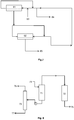
- the process comprises a main step of chromatographic separation, which comprises treating an incoming stream 103 containing the first (desired) PUFA and the second (undesirable) FA in a main chromatographic unit 101, using a stream of eluent 104.
- a first stream of eluent 105 enriched in the first PUFA and a second stream of eluent 106 enriched in the second FA are collected at the outlet of the main chromatographic unit 101.
- the first stream of eluent 105 is passed to a first concentration unit 107, and the second stream of eluent 106 is passed to a second concentration unit 102.
- a first stream of concentrated fatty acids 108 (containing concentrated first PUFA and possibly further components) and a depleted first stream of eluent 111 are respectively collected.
- the depleted first stream of eluent 111 is recycled to the main chromatographic unit 101. Up to substantially all of the eluent contained in the first stream of eluent 104 can be recycled as the depleted first stream of eluent 111, and the water-to-organic ratio of the depleted first stream of eluent 111 can be substantially identical to the water-to-organic ratio of the first stream of eluent 104, since there is no contamination issue.
- a second stream of concentrated fatty acids 109 (containing concentrated second FA and possibly further components) and a depleted second stream of eluent 110 are respectively collected.
- the depleted second stream of eluent 110 is recycled to the main chromatographic unit 101.
- the water-to-organic ratio of the depleted second stream of eluent 110 is lower than the water-to-organic ratio of the second stream of eluent 106.
- the second stream of concentrated fatty acids 109 contains residual eluent, having a water-to-organic ratio which is greater than the water-to-organic ratio of the second stream of eluent 106.
- the second stream of concentrated fatty acids 109 may contain residual water and substantially no organic solvent.
- a make-up of water 112 is provided to compensate for the depletion of the recycled eluent in water.
- a make-up of organic solvent can be provided as well (not shown).
- the incoming stream 103 may be the feed mixture, in case the process comprises one single separation step, or in case the process comprises several separation steps of which the main step of chromatographic separation illustrated here is the first one.
- the first stream of concentrated fatty acids 108 can be the final product of the process. Or, if the chromatographic separation step illustrated in Figure 11 is followed by further separation steps, this stream is passed to the next separation stage, in order to separate the first PUFA from other components present in the stream.
- Figure 12 illustrates one variant not according to the invention, which implements the second solution of the invention. Numerals similar to those of Figure 11 have the same meaning. The difference between this variant and the above-described embodiment of Figure 11 is that the depleted second stream of eluent 110 is not recycled to the main chromatographic unit 101. Instead, this depleted second stream of eluent 110 is recycled to another separation unit upstream of the main chromatographic unit 101 (not shown).
- the water-to-organic ratio of the depleted second stream of eluent 110 may be identical (or not) to the water-to-organic ratio of the second stream of eluent 106; and the second stream of concentrated fatty acids 109 may contain substantially no eluent and in particular no water.
- make-up of fresh organic solvent 113 is necessary to compensate for the absence of recycling of the depleted second stream of eluent 110 to the main chromatographic unit 101.
- the make-up of water 112 and the make-up of organic solvent 113 can be replaced by a single make-up of eluent.
- Figure 13 illustrates another variant, which implements the second solution of the invention. Numerals similar to those of Figure 11 have the same meaning. The difference between this variant and the above-described embodiment of Figure 11 is that the depleted second stream of eluent 110 is divided into two parts. The first part 114 is recycled to the main chromatographic unit 101, while the second part 115 is not recycled to the main chromatographic unit 101. Instead, this second part 115 is recycled to another separation unit upstream of the main chromatographic unit 101 (not shown).
- the water-to-organic ratio of the depleted second stream of eluent 110 may be identical (or not) to the water-to-organic ratio of the second stream of eluent 106; and the second stream of concentrated fatty acids 109 may contain substantially no eluent and in particular no water.
- make-up of fresh organic solvent 113 is necessary to compensate for the absence of total recycling of the depleted second stream of eluent 110 to the main chromatographic unit 101.
- the make-up of water 112 and the make-up of organic solvent 113 can be replaced by a single make-up of eluent.
- this variant is also an embodiment of the first solution of the invention.
- the depleted second stream of eluent can be recycled to a pool of eluent which feeds several separation units, notably several chromatographic units.
- the process of the invention can be implemented in a single installation, or in two or more distinct installations. Any streams described herein can then be stored and transported from one installation to the other so as to enable the process to be performed in its entirety.
- the separation unit(s) may be provided in one installation, while the concentration unit(s) (including e.g. one or more distillation columns) can be provided in another, distinct, installation.
- composition of various streams and in particular the composition of the recycled eluent streams, such as the depleted second stream, may be analyzed on-line or off-line by adequate methods or devices, and re-adjusted batchwise or continuously using means known in the art.
- one or several chromatography steps are used to purify a first PUFA (e.g . EPA) from a mixture of fatty acids.
- a first PUFA e.g . EPA
- the amount of a second FA e.g . DHA
- At least one of the chromatographic steps is aimed at separating the first PUFA from the second FA and preferably uses a mixture of water and methanol as eluent.
- the target fraction contains the first PUFA and contains reduced amounts of the second FA.
- the target fraction collected is concentrated by means of an evaporative or membrane technique such as a nanofiltration system, an evaporator, a distillation column or other appropriate means involving one technique or a combination of techniques known to those skilled in the art, such that the maximum amount of organic solvent is recycled into the chromatography process.
- the preferred evaporative means is a falling film evaporator with forced circulation, operated under reduced pressure.
- the process also produces at least one waste fraction containing the second FA.
- evaporative means are chosen and evaporation parameters are set such that a significant portion of water remains in the bottoms of the evaporator with the concentrated second FA.
- the distilled solvent mixture is enriched in the organic solvent compared to water, and the entrainment of the second FA in the solvent vapors is reduced to an acceptable level, enabling the recycling of the distillate in the same chromatographic unit.
- Preferred means include a distillation column or a combination of a distillation column and a falling film evaporator with forced circulation.
- a membrane technique can be used to concentrate the second FA in the waste stream, and may be coupled with evaporative techniques to recycle a portion of the solvent mixture into the chromatography process.
- one or several chromatography steps are used to purify a first PUFA (e.g . EPA) from a mixture of fatty acids.
- a first PUFA e.g . EPA
- the amount of a second FA e.g . DHA
- the purified stream containing the first PUFA is reduced to less than or equal to about 2%, preferably less than or equal to about 0.5%, preferably less than or equal to about 0.05%, preferably less than or equal to about 0.03%, more preferably to non-detectable levels.
- At least one of the chromatographic steps is aimed at separating the first PUFA from the second FA and preferably uses a mixture of water and methanol as eluent.
- the target fraction contains the first PUFA and contains reduced amounts of the second FA.
- the target fraction is directly re-injected into a subsequent chromatography step to further purify the first PUFA.
- the process also produces at least one waste fraction containing the second FA.
- evaporative means are chosen and evaporation parameters are set such that a significant portion of water remains in the bottoms of the evaporator with the concentrated second FA.
- the distilled solvent mixture is enriched in the organic solvent compared to water, and the entrainment of the second FA in the solvent vapors is reduced to an acceptable level, enabling the recycling of the distillate in the same chromatographic unit.
- Preferred means include a combination of a distillation column and a falling film evaporator with forced circulation.
- a membrane technique can be used to concentrate the second FA in the waste stream, and may be coupled with evaporative techniques to recycle a portion of the solvent mixture into the chromatography process.
- one or several chromatography steps are used to purify a first PUFA (e.g . EPA) from a mixture of fatty acids.
- a first PUFA e.g . EPA
- the amount of a second FA e.g . DHA
- the amount of a second FA is reduced in the purified stream containing the first PUFA to less than or equal to about 2%, preferably less than or equal to about 0.5%, preferably less than or equal to about 0.05%, preferably less than or equal to about 0.03%, more preferably to non-detectable levels.
- At least one of the chromatographic steps is aimed at separating the first PUFA from the second FA and preferably uses a mixture of water and methanol as eluent.
- the target fraction contains the first PUFA and contains reduced amounts of the second FA.
- the target fraction collected is concentrated by means of an evaporative or membrane technique such as a nanofiltration system, an evaporator, a distillation column or other appropriate means involving one technique or a combination of techniques known to those skilled in the art, such that the maximum amount of organic solvent is recycled into the chromatography process.
- the preferred evaporative means is a falling film evaporator with forced circulation, operated under reduced pressure.
- the process also produces at least one waste fraction containing the second FA. Solvent from that waste fraction is not recycled to that chromatographic step aimed at separating the first PUFA from the second FA.
- one or several chromatography steps are used to purify a first PUFA (e.g . EPA) from a mixture of fatty acids.
- a first PUFA e.g . EPA
- the amount of a second FA e.g . DHA
- the amount of a second FA is reduced in the purified stream containing the first PUFA to less than or equal to about 2%, preferably less than or equal to about 0.5%, preferably less than or equal to about 0.05%, preferably less than or equal to about 0.03%, more preferably to non-detectable levels.
- At least one of the chromatographic steps is aimed at separating the first PUFA from the second FA and preferably uses a mixture of water and methanol as eluent.
- the target fraction contains the first PUFA and contains reduced amounts of the second FA.
- the target fraction is directly re-injected into a subsequent chromatography step without concentration to further purify the first PUFA.
- the process also produces at least one waste fraction containing the second FA. Solvent from that waste fraction is not recycled to that chromatographic step aimed at separating the first PUFA from the second FA.
- a mixture of fatty acid ethyl esters obtained from fish oil (4 g) was dissolved in a 93/7 v/v mixture of methanol (144 g) and water (14.5 g), and then subjected to evaporation in a stirred reactor at 60°C.
- Two fractions of distillate F1 and F2 with a mass of 33.1 g and 45.1 g respectively were collected during evaporation at 0.6 bar abs, one fraction F3 with a mass of 32.9 g was collected during evaporation at 0.55 bar abs, and one fraction F4 with a mass of 18.9 g was collected during evaporation at 0.05 bar abs.
- Table 1 Analysis of the water content and the fatty acid ester content of the evaporated fractions is provided in table 1 below.
- Table 1 evaporation of a mixture of methanol and water in the presence of a fatty acid ester mixture Fraction Temperature (°C) Pressure (bar) Mass recovered Water % (w/w) Fatty acid ester content (ppm) F1 60 0.6 33.1 1.78 Not detected F2 60 0.6 45.1 3.25 Not detected F3 60 0.55 32.9 5.09 Not detected F4 60 0.05 18.9 19.99 27 bottoms 6.4 41.26 Not determined
- Table 1 shows that no detectable amounts of fatty acids are entrained with low amounts of water (less or equal to 5% w/w) in the distillate, and that substantial entrainment (27 ppm) occurs with higher water content in the distillate (20% w/w).
- Table 2 shows that the composition of the entrained oil in F4 is enriched in shorter chain fatty acids compared with longer chain fatty acids, demonstrating that a thermodynamic entrainment occurs when increasing amounts of water are evaporated.
- a mixture of pre-purified omega-3 PUFAs containing approx. 70% EPA and approximately 10% DHA was obtained using a VARICOLTM multicolumn chromatography apparatus whose columns were packed with C18 20 ⁇ m reversed phase silica, at a total concentration of 62 g/l in a mobile phase containing approximately 90% of acetone and 10% of water (volume per volume).
- This mixture was concentrated continuously in a single evaporation step using a multi-tube evaporator with forced recirculation as described in Figure 2 :
- the PUFA mixture was injected into the evaporation device, comprising the multi-tube evaporator with forced recirculation 11.
- the concentrated PUFA mixture was collected via line 15, while the evaporated solvents were condensed in the condenser 12 and collected via line 16.
- the concentrated PUFA mixture exiting the evaporator contained approx. 0.2 % of water and 1 % of acetone.
- the mixture of evaporated solvents recovered in line 16 contained 30 to 100 ppm of fatty acid esters. More than 99% of solvent was recovered and recycled in the same purification step in the process.
- a mixture of pre-purified omega-3 PUFAs containing approx. 70% EPA and approximately 10% DHA was purified using a VARICOLTM multicolumn chromatography apparatus equipped with 5 columns of 20.2 cm internal diameter and 8.5 cm length packed with C18 20 ⁇ m reversed phase silica with a mobile phase containing approximately 93% of methanol and 7% of water (volume per volume), and residual amount of DHA in the eluent was approx. 0.1 ppm. Operating conditions were as follows:
- the target raffinate stream contained purified EPA at a GC purity of approx. 92% and less than 0.03% DHA, at a total concentration of 19 g/l. This mixture was concentrated continuously in a single continuous evaporator using a multi-tube evaporator with forced recirculation as described in Figure 2 . Operating conditions were as follows:
- the concentrated PUFA mixture exiting the evaporator contained approx. 0.04 % of water and 0.6 % of methanol. More than 99% of solvent from the raffinate stream was recovered and was recycled in the same purification step in the process of the invention.
- the concentrated mixture exiting the evaporator contained approx. 40% water and 60 % of methanol. Only approx. 82% of solvent from the extract stream was recovered and was recycled in the same purification step in the process of the invention.
- the distilled eluent collected from both extract and raffinate evaporators contained approx. 93.2% of methanol, approx. 12 ppm of fatty acid esters and only 0.1 ppm of DHA, and was recycled in the chromatography process.
- the target raffinate stream contained purified EPA at a GC purity of approx. 92% and approx. 0.12% DHA, at a total concentration of 19 g/l.
- the impact of 20 ppm of DHA in an eluent stream obtained from complete concentration of both extract and raffinate streams is approx. 0.1% DHA in the purified EPA stream.
Landscapes
- Chemical & Material Sciences (AREA)
- Chemical Kinetics & Catalysis (AREA)
- Analytical Chemistry (AREA)
- Life Sciences & Earth Sciences (AREA)
- Engineering & Computer Science (AREA)
- Oil, Petroleum & Natural Gas (AREA)
- Wood Science & Technology (AREA)
- Organic Chemistry (AREA)
- Organic Low-Molecular-Weight Compounds And Preparation Thereof (AREA)
- Treatment Of Liquids With Adsorbents In General (AREA)
Claims (9)
- Verfahren zur Rückgewinnung einer ersten mehrfach ungesättigten Fettsäure oder eines mehrfach ungesättigten Fettsäurederivats davon von einer Materialdurchsatzmischung, wobei die Materialdurchsatzmischung zusätzlich zu der ersten mehrfach ungesättigten Fettsäure oder dem mehrfach ungesättigten Fettsäurederivat davon wenigstens eine zweite Fettsäure oder ein Fettsäurederivat davon umfasst, wobei das Verfahren Folgendes umfasst:- Durchführen eines Hauptschritts der chromatographischen Abscheidung unter Verwendung eines wässrigen, organischen Eluents und somit das Aufsammeln eines ersten Eluentstroms, der mit der ersten mehrfach ungesättigten Fettsäure oder dem mehrfach ungesättigtem Fettsäurederivat davon angereichert ist und eines zweiten Eluentstroms, der in der zweiten Fettsäure oder dem Fettsäurederivat davon angereichert ist;- Aussetzen des zweiten Eluentstroms an einen unvollständigen Konzentrationsschritt, um einen Strom aus konzentrierten Fettsäuren oder Fettsäurederivaten davon einerseits und einen aufgebrauchten zweiten Eluentstrom andererseits zu erhalten, wobei das Wasser-zu-organischem Gewichtsverhältnis des aufgebrauchten zweiten Eluentstroms niedriger liegt, als das Wasser-zu-organischem Gewichtsverhältnis des zweiten Eluentstroms;- Rückgewinnung wenigstens eines Teils des aufgebrauchten zweiten Eluentstroms zur Verwendung in dem Hauptschritt der chromatographischen Abscheidung.
- Verfahren nach Anspruch 1, wobei das Wasser-zu-organischem Gewichtsverhältnis des aufgebrauchten zweiten Eluentstroms niedriger als 0,95 Mal des Wasser-zu-organischem Gewichtsverhältnisses des zweiten Eluentstroms, bevorzugt niedriger als 0,9 Mal oder weniger als 0,8 Mal oder weniger als 0,7 Mal oder niedriger als 0,6 Mal oder niedriger als 0,5 Mal oder niedriger als 0,4 Mal oder niedriger als 0,3 Mal oder niedriger als 0,2 Mal oder niedriger als 0,1 Mal des Wasser-zu-organischem Gewichtsverhältnis des zweiten Eluentstroms liegt.
- Verfahren nach Anspruch 1 oder 2, umfassend:- Aussetzen des ersten Eluentstroms an einen Konzentrationsschritt, um einen Storm konzentrierter Fettsäuren oder Fettsäurederivaten davon einerseits und einen aufgebrauchten zweiten Eluentstrom andererseits zu erhalten und- Rückgewinnung wenigstens eines Teils des aufgebrauchten zweiten Eluentstroms oder die Gesamtmenge davon, bevorzugt zur Verwendung in dem Hauptschritt der chromatographischen Abscheidung.
- Verfahren nach einem der Ansprüche 1 bis 3, umfassend einen einzigen Schritt der Abscheidung, nämlich den Hauptschritt der chromatographischen Abscheidung.
- Verfahren nach einem der Ansprüche 1 bis 3, umfassend einen einzigen Vorbereitungsschritt vor dem Hauptschritt der chromatographischen Abscheidung, wobei der einzige Vorbereitungsschritt der Abscheidung bevorzugt ein Vorbereitungsschritt der chromatographischen Abscheidung ist, wobei der einzige Vorbereitungsschritt der chromatographischen Abscheidung und der Hauptschritt der chromatographischen Abscheidung entweder in derselben Chromatographievorrichtung oder in verschiedenen Chromatographievorrichtungen durchgeführt werden.
- Verfahren nach einem der Ansprüche 1 bis 3 oder 5, umfassend einen einzigen weiteren Schritt der Abscheidung nach dem Hauptschritt der chromatographischen Abscheidung, wobei der einzige weitere Schritt der Abscheidung bevorzugt ein weiterer Schritt der chromatographischen Abscheidung ist, wobei der einzige weitere Schritt der chromatographischen Abscheidung und der Hauptschritt der chromatographischen Abscheidung entweder in derselben Chromatographievorrichtung oder in verschiedenen Chromatographievorrichtungen durchgeführt werden.
- Verfahren nach einem der Ansprüche 1 bis 3, bestehend im Wesentlichen aus drei oder mehr Schritten von chromatographischen Abscheidungen, bevorzugt aus drei Schritten von chromatographischen Abscheidungen, wobei die Schritte der chromatographischen Abscheidungen in verschiedenen Chromatographievorrichtungen oder zumindest teilweise in einer gleichen Chromatographievorrichtung durchgeführt werden.
- Verfahren nach einem der Ansprüche 1 bis 7, umfassend das Zusetzen von frischem Wasser zu dem aufgebrauchten zweiten Eluentstrom vor der Wiedergewinnung und die Verwendung desselben in dem Hauptschritt der chromatographischen Abscheidung.
- Verfahren nach einem der vorgehenden Ansprüche, wobei:- die erste mehrfach ungesättigte Fettsäure oder das mehrfach ungesättigte Fettsäurederivat davon am Ende des Verfahrens als eine Zusammensetzung rückgewonnen wird, die weniger als 1 Gew.-%, bevorzugt weniger als 0,5 Gew.-% oder weniger als 0,1 Gew.-% oder weniger als 0,05 Gew.-% oder weniger als 0,03 Gew.-% oder weniger als 0,01 Gew.-% der zweiten Fettsäure oder des Fettsäurederivats davon relativ zum Gesamtgewicht von Fettsäuren oder Fettsäurederivaten davon in der Zusammensetzung rückgewonnen wird; und/oder- die erste mehrfach ungesättigte Fettsäure oder das mehrfach ungesättigte Fettsäurederivat davon Eicosapentansäure oder ein Derivat davon ist und die zweite Fettsäure oder das Fettsäurederivat davon Docosahexansäure oder ein Derivat davon ist.
Priority Applications (14)
| Application Number | Priority Date | Filing Date | Title |
|---|---|---|---|
| EP13305596.2A EP2801604B1 (de) | 2013-05-07 | 2013-05-07 | Chromatographisches Verfahren zur Herstellung von hochreinen, mehrfach ungesättigten Fettsäuren |
| PE2024002632A PE20251531A1 (es) | 2013-05-07 | 2014-04-23 | Proceso cromatografico para la produccion de acidos grasos poliinsaturados altamente purificados |
| PE2019002696A PE20200389A1 (es) | 2013-05-07 | 2014-04-23 | Proceso cromatografico para la produccion de acidos grasos poliinsaturados altamente purificados |
| EP14720547.0A EP2994523B1 (de) | 2013-05-07 | 2014-04-23 | Chromatographisches verfahren zur herstellung von hochreinen, mehrfach ungesättigten fettsäuren |
| CN201480029096.2A CN105229131A (zh) | 2013-05-07 | 2014-04-23 | 用于生产高度纯化的多不饱和脂肪酸的色谱方法 |
| CN201811593375.8A CN109679768A (zh) | 2013-05-07 | 2014-04-23 | 用于生产高度纯化的多不饱和脂肪酸的色谱方法 |
| KR1020157032878A KR102263760B1 (ko) | 2013-05-07 | 2014-04-23 | 고도 정제된 다가 불포화 지방산의 제조를 위한 크로마토그래피 방법 |
| PCT/EP2014/058166 WO2014180654A1 (en) | 2013-05-07 | 2014-04-23 | Chromatographic process for the production of highly purified polyunsaturated fatty acids |
| CA2911273A CA2911273C (en) | 2013-05-07 | 2014-04-23 | Chromatographic process for the production of highly purified polyunsaturated fatty acids |
| GB1520373.0A GB2528618B (en) | 2013-05-07 | 2014-04-23 | Chromatographic process for the production of highly purified polyunsaturated fatty acids |
| JP2016512267A JP6546911B2 (ja) | 2013-05-07 | 2014-04-23 | 高度に精製したポリ不飽和脂肪酸を生成するクロマトグラフプロセス |
| CL2015003247A CL2015003247A1 (es) | 2013-05-07 | 2015-11-05 | Proceso cromatográfico para la producción de ácidos grasos poliinsaturados altamente purificados |
| JP2018095751A JP2018141168A (ja) | 2013-05-07 | 2018-05-17 | 高度に精製したポリ不飽和脂肪酸を生成するクロマトグラフプロセス |
| JP2020012727A JP6867524B2 (ja) | 2013-05-07 | 2020-01-29 | 高度に精製したポリ不飽和脂肪酸を生成するクロマトグラフプロセス |
Applications Claiming Priority (1)
| Application Number | Priority Date | Filing Date | Title |
|---|---|---|---|
| EP13305596.2A EP2801604B1 (de) | 2013-05-07 | 2013-05-07 | Chromatographisches Verfahren zur Herstellung von hochreinen, mehrfach ungesättigten Fettsäuren |
Publications (2)
| Publication Number | Publication Date |
|---|---|
| EP2801604A1 EP2801604A1 (de) | 2014-11-12 |
| EP2801604B1 true EP2801604B1 (de) | 2017-04-12 |
Family
ID=48470874
Family Applications (1)
| Application Number | Title | Priority Date | Filing Date |
|---|---|---|---|
| EP13305596.2A Active EP2801604B1 (de) | 2013-05-07 | 2013-05-07 | Chromatographisches Verfahren zur Herstellung von hochreinen, mehrfach ungesättigten Fettsäuren |
Country Status (1)
| Country | Link |
|---|---|
| EP (1) | EP2801604B1 (de) |
Families Citing this family (2)
| Publication number | Priority date | Publication date | Assignee | Title |
|---|---|---|---|---|
| EP2883860B1 (de) * | 2013-12-11 | 2016-08-24 | Novasep Process | Chromatografisches Verfahren zur Herstellung von mehrfach ungesättigten Fettsäuren |
| JP6303017B2 (ja) | 2014-01-07 | 2018-03-28 | ノヴァセプ プロセスNovasep Process | 芳香族アミノ酸を精製する方法 |
Citations (18)
| Publication number | Priority date | Publication date | Assignee | Title |
|---|---|---|---|---|
| US3103470A (en) | 1960-01-21 | 1963-09-10 | Eastman Kodak Co | process for recovering dry methanol in the manufacture of dymethyl ter-ephthalate |
| GB1048902A (en) | 1963-01-07 | 1966-11-23 | Celanese Corp | Recovery of trioxane and volatile alcohols |
| US3434937A (en) | 1966-10-06 | 1969-03-25 | Allied Chem | Distillation purification of crude synthetic methanol |
| US4402832A (en) | 1982-08-12 | 1983-09-06 | Uop Inc. | High efficiency continuous separation process |
| EP0531785A1 (de) | 1991-08-28 | 1993-03-17 | Mitsubishi Chemical Corporation | Verfahren zur distillativen Trennung einer Mischung von Phenolkomponenten |
| US5225580A (en) | 1990-08-16 | 1993-07-06 | Uop | Process for separating fatty acids and triglycerides |
| EP0563388A1 (de) | 1991-08-22 | 1993-10-06 | Daicel Chemical Industries, Ltd. | Wiedergewinnung von optischen isomeren und lösungsmittel bei einer optischen auflösung, wiederbenutzung des lösungsmittels und optischen isomers nach recycling |
| EP0610506A1 (de) | 1991-10-28 | 1994-08-17 | Nippon Suisan Kabushiki Kaisha | Verfahren zur herstellung hochreiner eicosapentaensäure oder ester davon |
| WO1994025552A1 (en) | 1993-04-29 | 1994-11-10 | Norsk Hydro A.S | Processes for chromatographic fractionation of fatty acids and their derivatives |
| JPH08169872A (ja) | 1994-12-16 | 1996-07-02 | Lion Corp | α−スルホ脂肪酸アルキルエステル塩製造における回収溶媒の精留方法 |
| JPH08169871A (ja) | 1994-12-16 | 1996-07-02 | Lion Corp | α−スルホ脂肪酸アルキルエステル塩製造における回収溶媒の精製方法およびα−スルホ脂肪酸アルキルエステル塩の製造方法 |
| EP0592962B1 (de) | 1992-10-14 | 1997-07-16 | Eisai Chemical Co., Ltd. | Reinigungsmethode von Rohprodukt |
| WO2006096394A2 (en) | 2005-03-03 | 2006-09-14 | Uop Llc | Improving product recovery from simulated-moving-bed adsorption |
| EP1383854B1 (de) | 2001-04-20 | 2007-03-14 | Dow Global Technologies Inc. | Trennung von mischungen aus pflanzenöl-triglyceriden durch festbettadsorption |
| WO2009009271A2 (en) | 2007-07-06 | 2009-01-15 | Dow Global Technologies Inc. | Purification of hydroformylated and hydrogenated fatty alkyl ester compositions |
| WO2010097318A1 (de) | 2009-02-26 | 2010-09-02 | Basf Se | Verfahren zur destillativen aufarbeitung eines methanol/wasser-gemischs sowie verfahren zur herstellung von alkalimethylaten |
| WO2011080503A2 (en) | 2009-12-30 | 2011-07-07 | Equateq Limited | Simulated moving bed chromatographic separation process |
| WO2013005051A1 (en) | 2011-07-06 | 2013-01-10 | Basf Pharma (Callanish) Limited | New smb process |
Family Cites Families (16)
| Publication number | Priority date | Publication date | Assignee | Title |
|---|---|---|---|---|
| US4189442A (en) * | 1978-10-18 | 1980-02-19 | The Procter & Gamble Company | Separation of fatty acid esters |
| US4797233A (en) * | 1986-08-20 | 1989-01-10 | Uop Inc. | Process for separating mono-, di- and triglycerides |
| JPH0746097B2 (ja) | 1988-05-17 | 1995-05-17 | 三菱化成エンジニアリング株式会社 | クロマト分離法 |
| US5102553A (en) | 1988-12-16 | 1992-04-07 | The Amalgamated Sugar Company | Time variable simulated moving bed process |
| US5630943A (en) | 1995-11-30 | 1997-05-20 | Merck Patent Gesellschaft Mit Beschrankter Haftung | Discontinuous countercurrent chromatographic process and apparatus |
| US6063284A (en) | 1997-05-15 | 2000-05-16 | Em Industries, Inc. | Single column closed-loop recycling with periodic intra-profile injection |
| FR2785196B1 (fr) | 1998-10-29 | 2000-12-15 | Inst Francais Du Petrole | Procede et dispositif de separation avec des zones chromatographiques a longueur variable |
| US6413419B1 (en) | 1998-10-29 | 2002-07-02 | Institut Francais Du Petrole | Process and device for separation with variable-length chromatographic |
| US6375839B1 (en) | 1998-10-29 | 2002-04-23 | Institut Francais Du Petrole | Process and device for separation with variable-length chromatographic zones |
| FR2836396B1 (fr) * | 2002-02-22 | 2004-06-18 | Novasep | Procede et dispositif de chromatographie avec recuperation de solvant |
| DE10235385B4 (de) | 2002-08-02 | 2006-10-05 | MAX-PLANCK-Gesellschaft zur Förderung der Wissenschaften e.V. | Verfahren zur chromatographischen Trennung von Komponenten |
| MY150129A (en) * | 2004-04-09 | 2013-11-29 | Archer Daniels Midland Co | Method of preparing fatty acid alkyl esters from waste or recycled fatty acid stock |
| ATE478718T1 (de) | 2007-04-17 | 2010-09-15 | Max Planck Gesellschaft | Verfahren und vorrichtung zur chromatographischen trennung von komponenten mit teilweiser rückführung von gemischfraktionen |
| KR101357298B1 (ko) | 2008-06-20 | 2014-01-28 | 에이케이 앤 엠엔 바이오팜 주식회사 | 오메가-3계 고도불포화 지방산의 고순도 정제방법 |
| GB201111591D0 (en) | 2011-07-06 | 2011-08-24 | Equateq Ltd | Further new process |
| GB201111595D0 (en) | 2011-07-06 | 2011-08-24 | Equateq Ltd | Improved process |
-
2013
- 2013-05-07 EP EP13305596.2A patent/EP2801604B1/de active Active
Patent Citations (18)
| Publication number | Priority date | Publication date | Assignee | Title |
|---|---|---|---|---|
| US3103470A (en) | 1960-01-21 | 1963-09-10 | Eastman Kodak Co | process for recovering dry methanol in the manufacture of dymethyl ter-ephthalate |
| GB1048902A (en) | 1963-01-07 | 1966-11-23 | Celanese Corp | Recovery of trioxane and volatile alcohols |
| US3434937A (en) | 1966-10-06 | 1969-03-25 | Allied Chem | Distillation purification of crude synthetic methanol |
| US4402832A (en) | 1982-08-12 | 1983-09-06 | Uop Inc. | High efficiency continuous separation process |
| US5225580A (en) | 1990-08-16 | 1993-07-06 | Uop | Process for separating fatty acids and triglycerides |
| EP0563388A1 (de) | 1991-08-22 | 1993-10-06 | Daicel Chemical Industries, Ltd. | Wiedergewinnung von optischen isomeren und lösungsmittel bei einer optischen auflösung, wiederbenutzung des lösungsmittels und optischen isomers nach recycling |
| EP0531785A1 (de) | 1991-08-28 | 1993-03-17 | Mitsubishi Chemical Corporation | Verfahren zur distillativen Trennung einer Mischung von Phenolkomponenten |
| EP0610506A1 (de) | 1991-10-28 | 1994-08-17 | Nippon Suisan Kabushiki Kaisha | Verfahren zur herstellung hochreiner eicosapentaensäure oder ester davon |
| EP0592962B1 (de) | 1992-10-14 | 1997-07-16 | Eisai Chemical Co., Ltd. | Reinigungsmethode von Rohprodukt |
| WO1994025552A1 (en) | 1993-04-29 | 1994-11-10 | Norsk Hydro A.S | Processes for chromatographic fractionation of fatty acids and their derivatives |
| JPH08169871A (ja) | 1994-12-16 | 1996-07-02 | Lion Corp | α−スルホ脂肪酸アルキルエステル塩製造における回収溶媒の精製方法およびα−スルホ脂肪酸アルキルエステル塩の製造方法 |
| JPH08169872A (ja) | 1994-12-16 | 1996-07-02 | Lion Corp | α−スルホ脂肪酸アルキルエステル塩製造における回収溶媒の精留方法 |
| EP1383854B1 (de) | 2001-04-20 | 2007-03-14 | Dow Global Technologies Inc. | Trennung von mischungen aus pflanzenöl-triglyceriden durch festbettadsorption |
| WO2006096394A2 (en) | 2005-03-03 | 2006-09-14 | Uop Llc | Improving product recovery from simulated-moving-bed adsorption |
| WO2009009271A2 (en) | 2007-07-06 | 2009-01-15 | Dow Global Technologies Inc. | Purification of hydroformylated and hydrogenated fatty alkyl ester compositions |
| WO2010097318A1 (de) | 2009-02-26 | 2010-09-02 | Basf Se | Verfahren zur destillativen aufarbeitung eines methanol/wasser-gemischs sowie verfahren zur herstellung von alkalimethylaten |
| WO2011080503A2 (en) | 2009-12-30 | 2011-07-07 | Equateq Limited | Simulated moving bed chromatographic separation process |
| WO2013005051A1 (en) | 2011-07-06 | 2013-01-10 | Basf Pharma (Callanish) Limited | New smb process |
Non-Patent Citations (5)
| Title |
|---|
| CERMAK, STEVEN C. ET AL: "Distillation of Natural Fatty Acids and Their Chemical Derivatives", DISTILLATION - ADVANCES FROM MODELING TO APPLICATIONS, 31 March 2012 (2012-03-31) * |
| DAPREMONT, OLIVIER: "Evolution of Continuous Chromatography: Moving Beyond Chiral Separations", CPHL/ICSE SUPPLEMENT: API SYNTHESIS, FORMULATION DEVELOPMENT, AND MANUFACTURING, 30 September 2010 (2010-09-30) * |
| MITTEN, JEFF: "Large-Scale Chromatography: The Green Paradox", 30 May 2008, NOVASEP PROCESS, New Haven, CT, USA * |
| STEPNOWSKI P ET AL: "Total recycling of chromatographic solvents-applied management of methanol and acetonitrile waste", RESOURCES CONSERVATION AND RECYCLING, ELSEVIER SCIENCE PUBLISHER, AMSTERDAM, NL, vol. 35, no. 3, 1 May 2002 (2002-05-01), pages 163 - 175, XP004349741, ISSN: 0921-3449, DOI: 10.1016/S0921-3449(01)00119-7 * |
| YAMAMURA ET AL.: "Industrial High-Performance Liquid Chromatography Purifi- cation of Docosahexaenoic Acid Ethyl Ester and Docosapentaenoic Acid Ethyl Ester from Single- Cell Oil", JAOCS, vol. 74, no. 11, 30 July 1997 (1997-07-30), pages 1435 - 1440, XP002166746 |
Also Published As
| Publication number | Publication date |
|---|---|
| EP2801604A1 (de) | 2014-11-12 |
Similar Documents
| Publication | Publication Date | Title |
|---|---|---|
| US9695382B2 (en) | SMB process for producing highly pure EPA from fish oil | |
| KR101782701B1 (ko) | 다-단 분리 공정 | |
| EP2613859B1 (de) | Erwärmtes chromatographie-trennverfahren | |
| US20140200360A1 (en) | SMB Process | |
| CN103796724A (zh) | 新型smb方法 | |
| CN105848747B (zh) | 色谱方法纯化脂肪酸 | |
| US8802880B1 (en) | Chromatographic process for the production of highly purified polyunsaturated fatty acids | |
| JP6867524B2 (ja) | 高度に精製したポリ不飽和脂肪酸を生成するクロマトグラフプロセス | |
| CN105848748B (zh) | 脂肪酸的色谱纯化方法 | |
| US9428711B2 (en) | Chromatographic process for the production of highly purified polyunsaturated fatty acids | |
| EP2801604A1 (de) | Chromatographisches Verfahren zur Herstellung von hochreinen, mehrfach ungesättigten Fettsäuren |
Legal Events
| Date | Code | Title | Description |
|---|---|---|---|
| PUAI | Public reference made under article 153(3) epc to a published international application that has entered the european phase |
Free format text: ORIGINAL CODE: 0009012 |
|
| 17P | Request for examination filed |
Effective date: 20140320 |
|
| AK | Designated contracting states |
Kind code of ref document: A1 Designated state(s): AL AT BE BG CH CY CZ DE DK EE ES FI FR GB GR HR HU IE IS IT LI LT LU LV MC MK MT NL NO PL PT RO RS SE SI SK SM TR |
|
| AX | Request for extension of the european patent |
Extension state: BA ME |
|
| 17Q | First examination report despatched |
Effective date: 20150211 |
|
| TPAC | Observations filed by third parties |
Free format text: ORIGINAL CODE: EPIDOSNTIPA |
|
| GRAP | Despatch of communication of intention to grant a patent |
Free format text: ORIGINAL CODE: EPIDOSNIGR1 |
|
| GRAS | Grant fee paid |
Free format text: ORIGINAL CODE: EPIDOSNIGR3 |
|
| INTG | Intention to grant announced |
Effective date: 20170206 |
|
| GRAA | (expected) grant |
Free format text: ORIGINAL CODE: 0009210 |
|
| AK | Designated contracting states |
Kind code of ref document: B1 Designated state(s): AL AT BE BG CH CY CZ DE DK EE ES FI FR GB GR HR HU IE IS IT LI LT LU LV MC MK MT NL NO PL PT RO RS SE SI SK SM TR |
|
| REG | Reference to a national code |
Ref country code: GB Ref legal event code: FG4D |
|
| REG | Reference to a national code |
Ref country code: CH Ref legal event code: EP |
|
| REG | Reference to a national code |
Ref country code: IE Ref legal event code: FG4D |
|
| REG | Reference to a national code |
Ref country code: AT Ref legal event code: REF Ref document number: 883861 Country of ref document: AT Kind code of ref document: T Effective date: 20170515 |
|
| REG | Reference to a national code |
Ref country code: DE Ref legal event code: R096 Ref document number: 602013019695 Country of ref document: DE |
|
| REG | Reference to a national code |
Ref country code: FR Ref legal event code: PLFP Year of fee payment: 5 |
|
| REG | Reference to a national code |
Ref country code: NL Ref legal event code: MP Effective date: 20170412 |
|
| REG | Reference to a national code |
Ref country code: LT Ref legal event code: MG4D |
|
| REG | Reference to a national code |
Ref country code: NO Ref legal event code: T2 Effective date: 20170412 |
|
| REG | Reference to a national code |
Ref country code: AT Ref legal event code: MK05 Ref document number: 883861 Country of ref document: AT Kind code of ref document: T Effective date: 20170412 |
|
| PG25 | Lapsed in a contracting state [announced via postgrant information from national office to epo] |
Ref country code: NL Free format text: LAPSE BECAUSE OF FAILURE TO SUBMIT A TRANSLATION OF THE DESCRIPTION OR TO PAY THE FEE WITHIN THE PRESCRIBED TIME-LIMIT Effective date: 20170412 |
|
| PG25 | Lapsed in a contracting state [announced via postgrant information from national office to epo] |
Ref country code: FI Free format text: LAPSE BECAUSE OF FAILURE TO SUBMIT A TRANSLATION OF THE DESCRIPTION OR TO PAY THE FEE WITHIN THE PRESCRIBED TIME-LIMIT Effective date: 20170412 Ref country code: GR Free format text: LAPSE BECAUSE OF FAILURE TO SUBMIT A TRANSLATION OF THE DESCRIPTION OR TO PAY THE FEE WITHIN THE PRESCRIBED TIME-LIMIT Effective date: 20170713 Ref country code: ES Free format text: LAPSE BECAUSE OF FAILURE TO SUBMIT A TRANSLATION OF THE DESCRIPTION OR TO PAY THE FEE WITHIN THE PRESCRIBED TIME-LIMIT Effective date: 20170412 Ref country code: AT Free format text: LAPSE BECAUSE OF FAILURE TO SUBMIT A TRANSLATION OF THE DESCRIPTION OR TO PAY THE FEE WITHIN THE PRESCRIBED TIME-LIMIT Effective date: 20170412 Ref country code: LT Free format text: LAPSE BECAUSE OF FAILURE TO SUBMIT A TRANSLATION OF THE DESCRIPTION OR TO PAY THE FEE WITHIN THE PRESCRIBED TIME-LIMIT Effective date: 20170412 Ref country code: HR Free format text: LAPSE BECAUSE OF FAILURE TO SUBMIT A TRANSLATION OF THE DESCRIPTION OR TO PAY THE FEE WITHIN THE PRESCRIBED TIME-LIMIT Effective date: 20170412 |
|
| PG25 | Lapsed in a contracting state [announced via postgrant information from national office to epo] |
Ref country code: RS Free format text: LAPSE BECAUSE OF FAILURE TO SUBMIT A TRANSLATION OF THE DESCRIPTION OR TO PAY THE FEE WITHIN THE PRESCRIBED TIME-LIMIT Effective date: 20170412 Ref country code: LV Free format text: LAPSE BECAUSE OF FAILURE TO SUBMIT A TRANSLATION OF THE DESCRIPTION OR TO PAY THE FEE WITHIN THE PRESCRIBED TIME-LIMIT Effective date: 20170412 Ref country code: SE Free format text: LAPSE BECAUSE OF FAILURE TO SUBMIT A TRANSLATION OF THE DESCRIPTION OR TO PAY THE FEE WITHIN THE PRESCRIBED TIME-LIMIT Effective date: 20170412 Ref country code: BG Free format text: LAPSE BECAUSE OF FAILURE TO SUBMIT A TRANSLATION OF THE DESCRIPTION OR TO PAY THE FEE WITHIN THE PRESCRIBED TIME-LIMIT Effective date: 20170712 Ref country code: PL Free format text: LAPSE BECAUSE OF FAILURE TO SUBMIT A TRANSLATION OF THE DESCRIPTION OR TO PAY THE FEE WITHIN THE PRESCRIBED TIME-LIMIT Effective date: 20170412 Ref country code: IS Free format text: LAPSE BECAUSE OF FAILURE TO SUBMIT A TRANSLATION OF THE DESCRIPTION OR TO PAY THE FEE WITHIN THE PRESCRIBED TIME-LIMIT Effective date: 20170812 |
|
| REG | Reference to a national code |
Ref country code: DE Ref legal event code: R026 Ref document number: 602013019695 Country of ref document: DE |
|
| PLBI | Opposition filed |
Free format text: ORIGINAL CODE: 0009260 |
|
| PG25 | Lapsed in a contracting state [announced via postgrant information from national office to epo] |
Ref country code: DK Free format text: LAPSE BECAUSE OF FAILURE TO SUBMIT A TRANSLATION OF THE DESCRIPTION OR TO PAY THE FEE WITHIN THE PRESCRIBED TIME-LIMIT Effective date: 20170412 Ref country code: RO Free format text: LAPSE BECAUSE OF FAILURE TO SUBMIT A TRANSLATION OF THE DESCRIPTION OR TO PAY THE FEE WITHIN THE PRESCRIBED TIME-LIMIT Effective date: 20170412 Ref country code: MC Free format text: LAPSE BECAUSE OF FAILURE TO SUBMIT A TRANSLATION OF THE DESCRIPTION OR TO PAY THE FEE WITHIN THE PRESCRIBED TIME-LIMIT Effective date: 20170412 Ref country code: SK Free format text: LAPSE BECAUSE OF FAILURE TO SUBMIT A TRANSLATION OF THE DESCRIPTION OR TO PAY THE FEE WITHIN THE PRESCRIBED TIME-LIMIT Effective date: 20170412 Ref country code: CZ Free format text: LAPSE BECAUSE OF FAILURE TO SUBMIT A TRANSLATION OF THE DESCRIPTION OR TO PAY THE FEE WITHIN THE PRESCRIBED TIME-LIMIT Effective date: 20170412 Ref country code: EE Free format text: LAPSE BECAUSE OF FAILURE TO SUBMIT A TRANSLATION OF THE DESCRIPTION OR TO PAY THE FEE WITHIN THE PRESCRIBED TIME-LIMIT Effective date: 20170412 |
|
| 26 | Opposition filed |
Opponent name: BASF SE Effective date: 20180112 |
|
| REG | Reference to a national code |
Ref country code: IE Ref legal event code: MM4A |
|
| PG25 | Lapsed in a contracting state [announced via postgrant information from national office to epo] |
Ref country code: IT Free format text: LAPSE BECAUSE OF FAILURE TO SUBMIT A TRANSLATION OF THE DESCRIPTION OR TO PAY THE FEE WITHIN THE PRESCRIBED TIME-LIMIT Effective date: 20170412 Ref country code: SM Free format text: LAPSE BECAUSE OF FAILURE TO SUBMIT A TRANSLATION OF THE DESCRIPTION OR TO PAY THE FEE WITHIN THE PRESCRIBED TIME-LIMIT Effective date: 20170412 |
|
| PLAX | Notice of opposition and request to file observation + time limit sent |
Free format text: ORIGINAL CODE: EPIDOSNOBS2 |
|
| PG25 | Lapsed in a contracting state [announced via postgrant information from national office to epo] |
Ref country code: LU Free format text: LAPSE BECAUSE OF NON-PAYMENT OF DUE FEES Effective date: 20170507 |
|
| REG | Reference to a national code |
Ref country code: BE Ref legal event code: MM Effective date: 20170531 |
|
| PG25 | Lapsed in a contracting state [announced via postgrant information from national office to epo] |
Ref country code: IE Free format text: LAPSE BECAUSE OF NON-PAYMENT OF DUE FEES Effective date: 20170507 |
|
| REG | Reference to a national code |
Ref country code: FR Ref legal event code: PLFP Year of fee payment: 6 |
|
| PG25 | Lapsed in a contracting state [announced via postgrant information from national office to epo] |
Ref country code: SI Free format text: LAPSE BECAUSE OF FAILURE TO SUBMIT A TRANSLATION OF THE DESCRIPTION OR TO PAY THE FEE WITHIN THE PRESCRIBED TIME-LIMIT Effective date: 20170412 |
|
| PLBB | Reply of patent proprietor to notice(s) of opposition received |
Free format text: ORIGINAL CODE: EPIDOSNOBS3 |
|
| PG25 | Lapsed in a contracting state [announced via postgrant information from national office to epo] |
Ref country code: BE Free format text: LAPSE BECAUSE OF NON-PAYMENT OF DUE FEES Effective date: 20170531 |
|
| PG25 | Lapsed in a contracting state [announced via postgrant information from national office to epo] |
Ref country code: MT Free format text: LAPSE BECAUSE OF NON-PAYMENT OF DUE FEES Effective date: 20170507 |
|
| PLBD | Termination of opposition procedure: decision despatched |
Free format text: ORIGINAL CODE: EPIDOSNOPC1 |
|
| PLBP | Opposition withdrawn |
Free format text: ORIGINAL CODE: 0009264 |
|
| PG25 | Lapsed in a contracting state [announced via postgrant information from national office to epo] |
Ref country code: HU Free format text: LAPSE BECAUSE OF FAILURE TO SUBMIT A TRANSLATION OF THE DESCRIPTION OR TO PAY THE FEE WITHIN THE PRESCRIBED TIME-LIMIT; INVALID AB INITIO Effective date: 20130507 |
|
| REG | Reference to a national code |
Ref country code: DE Ref legal event code: R100 Ref document number: 602013019695 Country of ref document: DE |
|
| PLBM | Termination of opposition procedure: date of legal effect published |
Free format text: ORIGINAL CODE: 0009276 |
|
| PG25 | Lapsed in a contracting state [announced via postgrant information from national office to epo] |
Ref country code: CY Free format text: LAPSE BECAUSE OF FAILURE TO SUBMIT A TRANSLATION OF THE DESCRIPTION OR TO PAY THE FEE WITHIN THE PRESCRIBED TIME-LIMIT Effective date: 20170412 |
|
| 27C | Opposition proceedings terminated |
Effective date: 20190701 |
|
| PG25 | Lapsed in a contracting state [announced via postgrant information from national office to epo] |
Ref country code: MK Free format text: LAPSE BECAUSE OF FAILURE TO SUBMIT A TRANSLATION OF THE DESCRIPTION OR TO PAY THE FEE WITHIN THE PRESCRIBED TIME-LIMIT Effective date: 20170412 |
|
| PG25 | Lapsed in a contracting state [announced via postgrant information from national office to epo] |
Ref country code: TR Free format text: LAPSE BECAUSE OF FAILURE TO SUBMIT A TRANSLATION OF THE DESCRIPTION OR TO PAY THE FEE WITHIN THE PRESCRIBED TIME-LIMIT Effective date: 20170412 |
|
| PG25 | Lapsed in a contracting state [announced via postgrant information from national office to epo] |
Ref country code: PT Free format text: LAPSE BECAUSE OF FAILURE TO SUBMIT A TRANSLATION OF THE DESCRIPTION OR TO PAY THE FEE WITHIN THE PRESCRIBED TIME-LIMIT Effective date: 20170412 |
|
| PG25 | Lapsed in a contracting state [announced via postgrant information from national office to epo] |
Ref country code: AL Free format text: LAPSE BECAUSE OF FAILURE TO SUBMIT A TRANSLATION OF THE DESCRIPTION OR TO PAY THE FEE WITHIN THE PRESCRIBED TIME-LIMIT Effective date: 20170412 |
|
| P01 | Opt-out of the competence of the unified patent court (upc) registered |
Effective date: 20230525 |
|
| REG | Reference to a national code |
Ref country code: CH Ref legal event code: R17 Free format text: ST27 STATUS EVENT CODE: U-0-0-R10-R17 (AS PROVIDED BY THE NATIONAL OFFICE) Effective date: 20260130 Ref country code: CH Ref legal event code: R18 Free format text: ST27 STATUS EVENT CODE: U-0-0-R10-R18 (AS PROVIDED BY THE NATIONAL OFFICE) Effective date: 20260130 |
|
| REG | Reference to a national code |
Ref country code: DE Ref legal event code: R081 Ref document number: 602013019695 Country of ref document: DE Owner name: GROUPE NOVASEP, FR Free format text: FORMER OWNER: GROUPE NOVASEP, POMPEY, FR |
|
| PGFP | Annual fee paid to national office [announced via postgrant information from national office to epo] |
Ref country code: GB Payment date: 20260306 Year of fee payment: 14 |
|
| REG | Reference to a national code |
Ref country code: CH Ref legal event code: U11 Free format text: ST27 STATUS EVENT CODE: U-0-0-U10-U11 (AS PROVIDED BY THE NATIONAL OFFICE) Effective date: 20260601 |
|
| PGFP | Annual fee paid to national office [announced via postgrant information from national office to epo] |
Ref country code: DE Payment date: 20260522 Year of fee payment: 14 |
|
| PGFP | Annual fee paid to national office [announced via postgrant information from national office to epo] |
Ref country code: NO Payment date: 20260522 Year of fee payment: 14 |
|
| PGFP | Annual fee paid to national office [announced via postgrant information from national office to epo] |
Ref country code: CH Payment date: 20260601 Year of fee payment: 14 |
|
| PGFP | Annual fee paid to national office [announced via postgrant information from national office to epo] |
Ref country code: FR Payment date: 20260526 Year of fee payment: 14 |