EP2801974A2 - Aktivierung niedriger Leistung einer sprachaktivierten Vorrichtung - Google Patents
Aktivierung niedriger Leistung einer sprachaktivierten Vorrichtung Download PDFInfo
- Publication number
- EP2801974A2 EP2801974A2 EP14167581.9A EP14167581A EP2801974A2 EP 2801974 A2 EP2801974 A2 EP 2801974A2 EP 14167581 A EP14167581 A EP 14167581A EP 2801974 A2 EP2801974 A2 EP 2801974A2
- Authority
- EP
- European Patent Office
- Prior art keywords
- sensor
- voice
- speech recognition
- circuit
- audio
- Prior art date
- Legal status (The legal status is an assumption and is not a legal conclusion. Google has not performed a legal analysis and makes no representation as to the accuracy of the status listed.)
- Withdrawn
Links
Images






Classifications
-
- G—PHYSICS
- G10—MUSICAL INSTRUMENTS; ACOUSTICS
- G10L—SPEECH ANALYSIS TECHNIQUES OR SPEECH SYNTHESIS; SPEECH RECOGNITION; SPEECH OR VOICE PROCESSING TECHNIQUES; SPEECH OR AUDIO CODING OR DECODING
- G10L15/00—Speech recognition
- G10L15/20—Speech recognition techniques specially adapted for robustness in adverse environments, e.g. in noise, of stress induced speech
-
- G—PHYSICS
- G06—COMPUTING OR CALCULATING; COUNTING
- G06F—ELECTRIC DIGITAL DATA PROCESSING
- G06F1/00—Details not covered by groups G06F3/00 - G06F13/00 and G06F21/00
- G06F1/26—Power supply means, e.g. regulation thereof
- G06F1/32—Means for saving power
- G06F1/3203—Power management, i.e. event-based initiation of a power-saving mode
- G06F1/3234—Power saving characterised by the action undertaken
- G06F1/325—Power saving in peripheral device
- G06F1/3265—Power saving in display device
-
- G—PHYSICS
- G06—COMPUTING OR CALCULATING; COUNTING
- G06F—ELECTRIC DIGITAL DATA PROCESSING
- G06F3/00—Input arrangements for transferring data to be processed into a form capable of being handled by the computer; Output arrangements for transferring data from processing unit to output unit, e.g. interface arrangements
- G06F3/16—Sound input; Sound output
- G06F3/167—Audio in a user interface, e.g. using voice commands for navigating, audio feedback
-
- G—PHYSICS
- G10—MUSICAL INSTRUMENTS; ACOUSTICS
- G10L—SPEECH ANALYSIS TECHNIQUES OR SPEECH SYNTHESIS; SPEECH RECOGNITION; SPEECH OR VOICE PROCESSING TECHNIQUES; SPEECH OR AUDIO CODING OR DECODING
- G10L15/00—Speech recognition
- G10L15/28—Constructional details of speech recognition systems
-
- G—PHYSICS
- G10—MUSICAL INSTRUMENTS; ACOUSTICS
- G10L—SPEECH ANALYSIS TECHNIQUES OR SPEECH SYNTHESIS; SPEECH RECOGNITION; SPEECH OR VOICE PROCESSING TECHNIQUES; SPEECH OR AUDIO CODING OR DECODING
- G10L25/00—Speech or voice analysis techniques not restricted to a single one of groups G10L15/00 - G10L21/00
- G10L25/78—Detection of presence or absence of voice signals
Definitions
- This invention relates to the field of Voice Trigger (VT) as used in many mobile electronic devices associated with the use of Automatic Speech Recognition (ASR) for the entering of voice input commands and control.
- VT Voice Trigger
- ASR Automatic Speech Recognition
- ASR Automatic Speech Recognition
- users may operate the Internet browser on their mobile device by speaking audio commands.
- the voice activation includes a Voice Trigger (VT) detection process and an ASR process.
- VT Voice Trigger
- Voice trigger is used to detect that a specific audio command may have been uttered and then the ASR process the speech.
- the ASR engine In order to respond to the user command or request, the ASR engine needs to be always active which is an issue as power consumption is a critical parameter in mobile devices.
- the ASR engine will be activated to analyze the user's commands and then, if recognized, follow the predefined action.
- a major issue with the ASR engine is that it is continuously active, waiting for a user's vocal command.
- the ASR process may be executed by the ASR engine only upon a positive output from the VT process but because it is always active, the Voice Trigger (VT) process can consume significant processing power and thus negatively impact battery life and power consumption.
- VT Voice Trigger
- a second issue with the ASR is that it can generate significant false detections by detecting a second talker or ambient noise.
- VT There are many techniques for VT and most of them simply detect the presence of audio. This audio is not necessarily the user's speech and can be ambient noise or a second talker that is nearby, for examples. These other audio signals can generate false detection causing excessive power consumption and poor user experience.
- the VT process it is common practice for the VT process to use the same input voice channel as used by the ASR process, for example the voice microphone and amplification circuitry. Having the voice channel active and running simply to serve the VT process requires significant power consumption, almost the same level that is required for running the speech recognition. This is especially true for very low power systems where the digital signal processor (DSP) processing power has been optimized. Power consumption of mobile devices is a very important part of the design and this present invention seeks to provide superior power saving while also maintaining and improving the performance. For example, when used in a noisy environment, the use of the microphone circuitry results in many spurious triggers of the speech recognition process and results in excessive use of power consumption.
- DSP digital signal processor
- a voice activated device may include a voice trigger circuit, an automatic speech recognition circuit; wherein the voice trigger circuit may be arranged to receive first detection signals from a first sensor and to trigger an activation of the automatic speech recognition circuit in response to a detection of a voice trigger, while the automatic speech recognition device is in a first power mode; wherein the automatic speech recognition circuit may be arranged to detect, while operating in a second power mode, an audio activation command; wherein a power consumption of the automatic speech recognition circuit when operating in the second power mode exceeds a power consumption of the automatic speech recognition when operating in the first power mode; and wherein the first sensor is a bone conduction sensor or a vibration sensor.
- the voice activated device may include the first sensor.
- the automatic speech recognition circuit may be arranged to be idle or deactivated when in the first power mode.
- the voice activated device may include a display, wherein the first sensor is a vibration sensor that is connected to the display.
- the voice activated device may include a buffer that may be arranged to receive audio samples from an audio sensor and to store the audio samples, wherein the automatic speech recognition circuit, after being activated, may be arranged to retrieve the audio samples; wherein at least some audio samples are received by the buffer when the automatic speech recognition device is in the first power mode.
- the activated device may include the audio sensor.
- the automatic speech recognition circuit may be arranged to detect the audio activation command in response to audio samples provided by an audio sensor and in response to the first detection signals.
- the voice trigger circuit is further arranged to receive audio samples from an audio sensor and to detect the voice trigger in response to the first detection signals and the audio samples.
- the voice trigger circuit may be arranged to activate an audio sensor if the first detection signals are indicative of a potential voice trigger; and to verify the voice trigger if audio samples generated by the audio sensor are indicative of the voice trigger.
- the voice activated device may include a bone conduction sound generator that may be arranged to feed the bone conductor sensor with sound signals to be converted to vibrations by the bone conductor sensor.
- the voice activated device may include a second sensor, wherein the first and second sensors may include the vibration sensor and the bone conduction sensor.
- the voice activated device may include a controller and a set of detectors, wherein the set of detectors may include the first detector, wherein the controller may be arranged to determine which sub-set of detector to activate when the automatic speech recognition device is in the first power mode, in response to an expected power consumption associated with an activation of the sub-set of detectors.
- the voice activated device wherein the controller may be arranged to determine which sub-set of detectors to activate in response to a previous voice trigger detections and automatic speech recognition detections.
- a voice activated device may include a first sensor; a signal processor; wherein the signal processor may be arranged to receive first detection signals from the first sensor and to detect a voice trigger when operating in a first power mode; upon a detection of the voice trigger enter a second power mode and detect, by applying automatic speech recognition, an audio activation command; wherein a power consumption of the signal processor when operating in the second power mode exceeds a power consumption of the signal processor when operating in the first power mode; and wherein the first sensor is a bone conduction sensor or a vibration sensor.
- a method for activating a voice activated device may include generating by a first sensor first detection signals; wherein the first sensor is a bone conduction sensor or a vibration sensor; detecting a voice trigger in response to the first detection signals; triggering an automatic speech recognition process in response to the detecting of the voice trigger; detecting, by the automatic speech recognition process, an audio activation command; and deactivating the speech recognition process; wherein a power consumption associated with the automatic speech recognition process exceeds a power consumption associated with the detecting of the voice trigger.
- The is executed by a voice trigger circuit while an automatic speech recognition circuit is in a first power mode; the detecting of the audio activation command is executed by the automatic speech recognition when operating in a second power mode; and a power consumption of the automatic speech recognition circuit when operating in the second power mode exceeds a power consumption of the automatic speech recognition when operating in the first power mode.
- the method may include buffering audio samples from an audio sensor; wherein at least some audio samples are buffer prior to the triggering of the automatic speech recognition process; and processing the audio samples by the automatic speech recognition process.
- the method wherein the automatic speech recognition process is responsive to audio samples provided by an audio sensor and to the first detection signals.
- the voice trigger circuit is further arranged to receive audio samples from an audio sensor and to detect the voice trigger in response to the first detection signals and the audio samples.
- the voice trigger circuit may be arranged to activate an audio sensor if the first detection signals are indicative of a potential issuance of a voice trigger; and to verify the voice trigger if audio samples generated by the audio sensor are indicative of the voice trigger.
- a kit may include a voice trigger circuit and an automatic speech recognition circuit.
- the voice trigger circuit may be arranged to receive first detection signals from a first sensor and to trigger an activation of the automatic speech recognition circuit in response to a detection of a voice trigger, while the automatic speech recognition device is in a first power mode; wherein the automatic speech recognition circuit may be arranged to detect, while operating in a second power mode, an audio activation command; wherein a power consumption of the automatic speech recognition circuit when operating in the second power mode exceeds a power consumption of the automatic speech recognition when operating in the first power mode; and wherein the first sensor is a bone conduction sensor or a vibration sensor.
- a kit is any combination of the voice trigger circuit and the automatic speech recognition circuit. Both circuits can be integrated with each other.
- VT schemes there are provided two VT schemes - one that is based on a bone conduction sensor and another that uses a vibration sensor. Both VT schemes are able to detect speech from the user of the device and differentiate it from other surrounding sounds. This enables ultra-low-power implementations of the VT mechanism by the use of devices that independently react to speech vibrations by the user and reject speech signals that may arrive through the air from external sources. This also provides implementations of the VT that are insensitive to the speech of another person or surrounding ambient noise.
- a bone conduction sensor microphone is used that touches the user's skull.
- the sound generated by the user vibrates the skull of the user and these vibrations are captured by the bone conduction sensor.
- a vibration sensor is used to capture the user's speech, for example when the mobile device is held in front of the user's mouth where the sound pressure waves of the user's speech can still be detected. Attaching the vibration sensor to the display of the device, for example, can improve the sensitivity of the vibration sensor in this application. It should be noted that because both the bone conduction sensor and the vibration sensor detect either the bone vibration or the direct sound pressure waves of the user over a short distance, they are both inherently insensitive to the speech of other persons or surrounding ambient noise.
- a bone conduction sensor or a vibration sensor for VT purposes may allow to not using the audio components of the host device.
- the bone conduction sensor (or the vibration sensor) may be the only sensor that is used by the device.
- the speech recognition algorithm and process once triggered by the VT, may turn-on alternative hardware audio channel sensors, such as the microphone and audio circuitry.
- the bone conduction sensor or the vibration sensor may be used as a simple user speech detector but it may also be used by the speech recognition algorithm for recognition enhancement as an optional audio input path in addition to its main audio path.
- the VT can use, in addition to the bone conduction sensor or the vibration sensor, one or more microphones of the device.
- the vibration sensor (or bone conduction sensor) is first used to detect if the user is talking and, if so, then the audio microphone or audio microphones are activated, together with processing circuitry such that the speech can be processed accurately using, for example, DSP techniques, and thus provide an analysis of the phrase that was spoken,
- the vibration sensor or the bone conduction microphone
- one or more microphones may be used in parallel for VT purposes. This increases the power consumption but may increase the accuracy of the VT process.
- noise cancelation techniques can be used to further provide good analysis of the user's speech in the presence of high background noise.
- a bone conduction sensor or a vibration sensor as the input for the VT process allows the microphone and amplification circuitry associated with the voice functions of the device to be kept in an unpowered state until required while allowing the use of an independent, low power circuit for the VT process.
- the bone conduction sensor or the vibration sensor will only react to the user's voice and not cause the VT to be activated by other surrounding sounds. This overcomes the problems of using the voice microphone circuitry in a noisy environment, where the VT is continuously being activated by sounds other than the user's voice.
- the output (detection signals) of low power VT circuit can be used to wake up the device from a sleep mode.
- the independent bone conduction or vibration sensor fed low power VT circuit may only react to the user's voice and this ultra-low power independent circuit can be kept active allowing the host device to enter its sleep state.
- the vibration sensor can be used to quickly detect the presence of user speech, and then activate an ASR circuit that uses audio microphones, that may or may not be part of the host device, such that the total phrase spoken by the user can be accurately recognized.
- the audio microphone and ASR circuit may be active either all the time, or under selected operational conditions.
- a bone conduction sensor or a vibration sensor is used to capture the user's voice and to produce detection signals such as a voltage signal. This voltage signal is then used as the input for a voice trigger circuit which, in turn, is used to activate the ASR circuit.
- the bone conduction sensor may touch the user's skin, normally above or in front of the ear.
- the bond conduction sensor may be embedded in the device that touches the skill. In all cases the body conduction sensor captures the acoustic bone vibrations when the user speaks.
- a vibration sensor mounted in the device may be used to detect the direct sound pressure waves of the user. Attaching the vibration sensor to the display of the host device, for example, can improve the sensitivity of the sensor in this application.
- the detection signal from the bone conduction or vibration sensor can be processed in either an analog or digital VT circuit and if, for example, the signal energy exceeds a certain level it is then used to trigger the ASR part of the host device and may also be used to wake up other components of the device from a low power mode (such as a sleep mode).
- a low power mode such as a sleep mode
- Both analog and digital components of the VT circuit that can be designed for ultra-low power. They can operate at relatively low clock frequencies (but sufficient for adequate sampling - for example operating at a sample rate that equals or is slightly about the Nyquist frequency), may include few power consuming components.
- the vibration sensor when using the vibration sensor, if the detected signal energy exceeds a certain level, it may be used to activate other microphones (such as one or more audio microphones, one or more bone conduction microphone) in the device together with ASR circuit that can accurately process the speech and determine if a certain word or phrase has been spoken.
- other microphones such as one or more audio microphones, one or more bone conduction microphone
- noise cancellation techniques can additionally be applied to further improve the speech analysis in the presence of high background noise.
- the microphone and processing circuitry may be active together and this condition could be selected for selected operational conditions.
- Figures 1 shows a user 10 with a wearable computer which has a head mounted display 12 according to an embodiment of the invention.
- a bone conduction sensor 11 touches the user's skull for speech vibration capture.
- the head mounted display 12 may include the VT and ASR circuits (not shown).
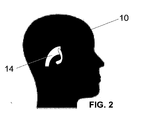
- FIG 2 shows a user 10 wearing a wireless headset 14 according to an embodiment of the invention.
- a bone conduction element is integral to the headset which is worn such that the body of the headset 14 touches the skull of the user and captures the speech vibrations of the user.
- the headset may include the VT and ASR circuits (not shown).
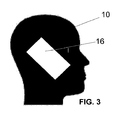
- Figure 3 shows a user 10 holding a mobile phone 16 to the head against the ear and/or face according to an embodiment of the invention.
- a bone conduction sensor or a vibration sensor acting as a bone conduction element is integral to the phone 16.
- speech vibrations of the user are captured.
- it can be mounted behind but attached to the display of the mobile phone.
- the display touches the skill of the user and the speech vibrations of the user are propagated via the display glass to the vibration sensor.
- the phone may include the VT and ASR circuits (not shown).
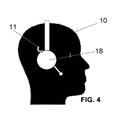
- Figure 4 shows a user 10 wearing wireless headphones and microphone 18 according to an embodiment of the invention.
- a bone conduction element 11 that touches the user's skin is used for speech vibration capture.
- the wireless headphones and microphone 18 may include the VT and ASR circuits (not shown).
- Figure 5 shows a user 10 holding a mobile phone 20 directly in front of the mouth according to an embodiment of the invention.
- a vibration sensor integral to the phone, detects and captures sound pressure vibrations from the user's speech.
- the sensor can be mounted behind and attached to the display of the mobile phone.
- the sound pressure waves from the user's speech can be detected, via the display glass, by the vibration sensor.
- the mobile phone 20 may include the VT and ASR circuits (not shown).
- Figures 1 to 5 are provided as examples and are not intended to be the complete range of uses of the bone conduction sensor or vibration sensor. Such sensors can be fitted to any electronic device that is used for speech.
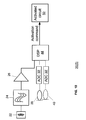
- Figure 6 shows an analog implementation of an ultra-low power circuit 20(1) that uses the speech vibrations of the user as shown in the examples Figures 1 to 5 according to an embodiment of the invention.
- Speech vibrations are detected by a first sensor 22 that may act either as a bone conductor sensor (examples FIG. 1 to 4 ) or as a vibration sensor (example FIG 5 .
- the physical details of the first sensor may vary for the various applications for which it is used.
- Filter 24 may be a bandpass filter and may include passive components.
- the filter 24 is optional but is intended to be used for filtering out unwanted local and environmental noise and selecting the desired speech frequencies.
- An amplifier 26 (that may be an ultra-low power amplifier) may amplify filtered signals from filter 24 thereby increasing the detected speech voltage amplitude to levels that enable energy detection.
- Amplified signals from amplifier 26 are fed to energy detector 28 (that may include a diode detector and an ultra-low energy voltage comparator). If the energy detected exceeds a certain threshold, then the output from energy detector 28 is used to trigger the ASR circuit that is integral to the device in use.
- energy detector 28 that may include a diode detector and an ultra-low energy voltage comparator. If the energy detected exceeds a certain threshold, then the output from energy detector 28 is used to trigger the ASR circuit that is integral to the device in use.
- Filter 24, amplifier 26, and energy detector 28 may form a VT circuit 21(1).
- the VT circuit 21(1) using the bone conduction or vibration sensor output, can be made such that it will consume ultra-low power in the area of tens of micro-watts.
- VT voice trigger
- Figure 7 shows a digital implementation of an ultra-low power circuit 20(2) that uses the speech vibrations of the user as shown in the examples Figures 1 to 5 according to an embodiment of the invention.
- the speech vibration is detected by the first sensor 22, acting either as a bone conductor sensor (example FIG. 1 to 4 ) or as a vibration sensor (example Figure 5 ).
- the physically details of the sensor itself may vary for the various applications for which it may be used.
- Digital samples of the first detection signals outputted by the first sensor 22 are produced by analog to digital converter (ADC) 30. These digital samples are then filtered using a digital filter 32 (such as a digital band pass filter) and then passed to the energy detector 34.
- ADC analog to digital converter
- ADC 30, filter 32 and energy detector 34 may form a VT circuit 21(2).
- a digital implementation of the VT circuit 21(2) does not necessarily require digital signal processing and can be designed to use very low power logic. Although this digital implementation may consume more power than the analog implementation FIG. 6 , the advantage is that it lends itself to integration and smaller size.
- VT voice trigger
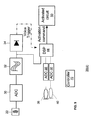
- Figure 8 shows an analog implementation, similar to FIG. 6 , of an ultra-low power circuit 20(3) that uses the speech vibrations of the user, but where the output from the energy detector 26 is used to power on an ASR circuit 42 such as a digital signal processor (DSP) according to an embodiment of the invention.
- an ASR circuit 42 such as a digital signal processor (DSP) according to an embodiment of the invention.
- DSP digital signal processor
- the ASR circuit can be a dedicated hardware and not implemented by a DSP.
- the first sensor 22 may be a vibration sensor.
- Figure 8 also shows that amplified signals from amplifier 26 are fed to ASR circuit 42 and can be processed during speech recognition.
- Figure 9 shows a digital implementation, similar to figure 7 , of a low power circuit 20(4) that uses the speech vibrations of the user, but where the output from the energy detector 34 is used to power on a processing circuit 44 according to an embodiment of the invention.
- the first sensor 22 is a vibration sensor.
- the processing circuit 42 Connected to the processing circuit 42 are one or more microphones 38 and 40.
- the microphones 38 and 40 may be audio microphones.
- Signals outputted by ADC 32 are provided to the ASR circuit 42 (such as but not limited to DSP 42).
- the output signals 36 from the energy detector 34 power up the ASR circuit 42 immediately when speech energy exceeds a preset threshold. This action is fast and the ASR circuit 42 is activated quickly enough such that enough of the spoken command can be analyzed and recognized.
- the ASR circuit 42 may be kept low power as it need only detect a restricted range of user input commands, such as wake up calls for various functions within the host device. If the ASR circuit 42, using the inputs from the vibration sensor circuit determines that the speech detected is a predetermined phrase, such as a wake up command, then an output is activated in order to activate the automatic speech recognition circuit such that further spoken instructions can be analyzed,
- ADC 30, filter 32 and energy detector 34 may form a VT circuit 21(4).
- an activation command signal (indicative of a detection of an audio activation command) is sent from DSP 44 to an activated circuit 50. It is noted that such a signal can activate a process, either executed by the digital processor or not.
- Figure 10 shows a voice activated device 20(5) that includes a signal processor 44 (such as DSP), first sensor 22, filter 24 and amplifier 26 and microphones 38 and 40 according to an embodiment of the invention.
- a signal processor 44 such as DSP
- the signal processor 44 may participates in VT detection and may output a VT detection signal. According to an embodiment of the invention the signal processor may performs an ASR process. According to another embodiment of the invention the ASR process, may be implemented by a circuit that differs from the signal processor 44.
- One or more microphones 38 and 40 are connected to the signal processor 44.
- the signal processor 42 may be kept (until detecting a VT) at a low power mode as it need only detect a restricted range of user input commands, such as wake up calls for various functions within the host device.
- processing circuit 44 using the inputs from the vibration sensor circuit and the microphones 38 and 40, determines that the speech detected is a predetermined phrase, such as a phrase that may be included in a wake up command, then an output is set in order to activate the automatic speech recognition circuit (or to initiate an ASR process by the signal processor itself) such that further spoken instructions can be analyzed.
- a predetermined phrase such as a phrase that may be included in a wake up command
- an activation command signal (indicative of a detection of an audio activation command) is sent from DSP 44 to an activated circuit 50, It is noted that such a signal can activate a process, either executed by the digital processor or not.
- Figure 11 shows a voice activated device 20(6) that includes a signal processor 44 (such as DSP), first sensor 22, ADC 30, filter 32 and microphones 38 and 40 according to an embodiment of the invention.
- a signal processor 44 such as DSP
- Voice activated device 20(6) of figure 11 differs from voice activated device 20(5) of figure 10 by having a digital detection path that include ADC 24 and filter 32 instead of filter 24 and amplifier 28.
- an activation command signal (indicative of a detection of an audio activation command) is sent from DSP 44 to an activated circuit 50. It is noted that such a signal can activate a process, either executed by the digital processor or not.
- buffering may be used for buffering detection signals from the first detector and/or an audio detector before the ASR circuit is triggered.
- the detection signals may be the output of a VT circuit or any signals generated by any components (filter, amplifier, ADC, power detector) of the VT circuit.
- the ASR circuit may then fetch and process the detection signals in order to apply the ASR process even on sound signals detected before it (the ASR circuit) was triggered. This can assist in detecting voice activation commands that were started before the ASR circuit was triggered.
- the buffer can store detection signals for a period that will suffice to detect one or more syllables. Sampling rate of few tens of kilohertz per second may be applied (for example 40Khz) and the delay provided by the buffer may be 100Milliseconds, more than 100 Millisecond or less than 100 Millisecond.
- one or more buffers for buffering detection signals from one or more VT circuits, for one or more pre-processors (such as samplers, ADC circuits and the like) and/or from one or more sensor such as a bone conduction sensor, a vibration sensor, audio sensor and the like.
- pre-processors such as samplers, ADC circuits and the like
- sensor such as a bone conduction sensor, a vibration sensor, audio sensor and the like.
- Figure 12 illustrates a voice activated device 20(7) according to an embodiment of the invention.
- the voice activated device 20(7) includes a VT circuit 21(7) that is fed by a first sensor 22 such as a vibration sensor or a bone conduction sensor, an audio microphone 38, a sampler 27 for sampling the outputs signals of the audio microphone 38, a buffer 29 for storing the samples from sample 27 and a ASR circuit 25.
- a first sensor 22 such as a vibration sensor or a bone conduction sensor
- an audio microphone 38 for sampling the outputs signals of the audio microphone 38
- a buffer 29 for storing the samples from sample 27
- ASR circuit 25 Once the ASR circuit 25 is triggered it may retrieve buffers samples. The samples may be fed to the buffer even after the ASR circuit 25 is triggered.
- signals from the VT circuit 21(7) or the first sensor 22 may be buffered by a buffer and the ASR circuit 25 may be arranged to apply and ASR process based on these signals.
- Figure 13 illustrates a voice activated device 20(8) according to an embodiment of the invention.
- the voice activated device 20(8) of figure 13 differs from the voice activated device 20(7) of figure 12 by frustrating a second buffer 29' for buffering signals from VT circuit 21(7).
- Figure 14 illustrates a voice activated device 20(9) according to an embodiment of the invention.
- the voice activated device 20(8) of figure 14 includes first sensor 22, ADC 30, audio sensor 38, second ADC 30', buffer 29, a signal processor 44 (such as DSP), activated circuit 50.
- a signal processor 44 such as DSP
- Audio samples from audio sensor 38 are fed to second ADC 30' that sends digital signals to buffer 29. Audio samples may be any type of representation of the audio received by the audio sensor 38.
- the signal processor 44 may fetch the buffered signals from buffer 30, when triggered to do so - after detecting a voice trigger.
- the signal processor 44 may activate an activated circuit 50 or an activated process or both.
- FIG 14 also shows a controlled 70.
- Controller 70 may be arranged to control he voice activated circuit. It may, for examples, determine if digital signals from second ADC 30' should be fed to the signal processor 44 even during a VT process. It can set operation parameters of the signal processor 44.
- the controller can be include in any of the voice activated devise illustrated in figures 6-13 .
- the signal processor 44 may perform the VT process when operating in a first power mode in which the signals processor is almost idle - it may consume a relatively low amount of power and consume a relatively low amount of MIPs.
- the MIPS consumed and the power consumption may dramatically increase. For example- VT may consume 0.15 MIPS while ASR may consume 8 MIPS.
- the signal processor may operate at different frequencies (different clock rates) when performing VT and ASR.
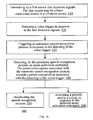
- Figure 15 illustrates a method 100 according to an embodiment of the invention.
- Method 100 may start by stage 110 of generating by a first sensor first detection signals.
- the first sensor may be a bone conduction sensor or a vibration sensor.
- Stage 110 may be followed by stage 120 of detecting a voice trigger in response to the first detection signals.
- Stage 120 may be followed by stage 130 of triggering an automatic speech recognition process in response to the detecting of the voice trigger.
- Stage 130 may be followed by stage 140 of detecting, by the automatic speech recognition process, an audio activation command.
- the power consumption associated with the automatic speech recognition process exceeds a power consumption associated with the detecting of the voice trigger.
- Stage 140 may be followed by stages 150 and 160.
- Stage 150 may include deactivating the speech recognition process.
- Stage 160 may include activating a process and/or a circuit in response to the detected audio activation command.
- Method 100 may be executed by any of the one of the voice activated devices of any of the previous figures.
- stage 120 may be executed by a voice trigger circuit while an ASR circuit is at a first power mode.
- Stage 140 may be executed by an automatic speech recognition circuit when operating in a second power mode. A power consumption of the automatic speech recognition circuit when operating in the second power mode exceeds a power consumption of the automatic speech recognition when operating in the first power mode.
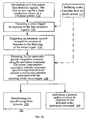
- Figure 16 illustrates a method 101 according to an embodiment of the invention.
- Method 101 may differ from method 100 by including stage 111.
- Method 101 may start by stage 111 and 110.
- Stage 111 includes buffering audio samples from an audio sensor. The audio samples may be buffered even before the beginning of stage 140. Therefore at least some audio samples are buffered prior to the triggering of the automatic speech recognition process.
- Stage 140 of detecting the audio activation command may be responsive to the buffered audio samples.
- Figure 17 illustrates a method 102 according to an embodiment of the invention.
- Method 102 may differs from method 100 by including stage 112 of receiving or generating audio samples.
- the audio samples may be used during stage 120 and/or during stage 140 - as illustrated by dashed lines connecting box 112 to boxes 120 and 140.
- Stage 120 may include, for example, generating and/or processing of the audio samples in parallel to the generating and/or processing of the first detection signals.
- the generating and/or processing of the audio samples can follow the generating and/or processing of the first detection signals.
- a voice trigger circuit may be arranged to activate an audio sensor if the first detection signals are indicative of a potential issuance of a voice trigger; and to verify the voice trigger if audio samples generated by the audio sensor are indicative of the voice trigger.
- connections as discussed herein may be any type of connection suitable to transfer signals from or to the respective nodes, units or devices, for example via intermediate devices. Accordingly, unless implied or stated otherwise, the connections may for example be direct connections or indirect connections.
- the connections may be illustrated or described in reference to being a single connection, a plurality of connections, unidirectional connections, or bidirectional connections. However, different embodiments may vary the implementation of the connections. For example, separate unidirectional connections may be used rather than bidirectional connections and vice versa.
- plurality of connections may be replaced with a single connection that transfers multiple signals serially or in a time multiplexed manner. Likewise, single connections carrying multiple signals may be separated out into various different connections carrying subsets of these signals. Therefore, many options exist for transferring signals.
- Each signal described herein may be designed as positive or negative logic.
- the signal In the case of a negative logic signal, the signal is active low where the logically true state corresponds to a logic level zero.
- the signal In the case of a positive logic signal, the signal is active high where the logically true state corresponds to a logic level one.
- any of the signals described herein may be designed as either negative or positive logic signals. Therefore, in alternate embodiments, those signals described as positive logic signals may be implemented as negative logic signals, and those signals described as negative logic signals may be implemented as positive logic signals.
- assert or “set” and “negate” (or “deassert” or “clear”) are used herein when referring to the rendering of a signal, status bit, or similar apparatus into its logically true or logically false state, respectively. If the logically true state is a logic level one, the logically false state is a logic level zero. And if the logically true state is a logic level zero, the logically false state is a logic level one.
- logic blocks are merely illustrative and that alternative embodiments may merge logic blocks or circuit elements or impose an alternate decomposition of functionality upon various logic blocks or circuit elements.
- architectures depicted herein are merely exemplary, and that in fact many other architectures may be implemented which achieve the same functionality.
- any arrangement of components to achieve the same functionality is effectively “associated” such that the desired functionality is achieved.
- any two components herein combined to achieve a particular functionality may be seen as “associated with” each other such that the desired functionality is achieved, irrespective of architectures or intermedial components.
- any two components so associated can also be viewed as being “operable connected,” or “operably coupled,” to each other to achieve the desired functionality.
- the illustrated examples may be implemented as circuitry located on a single integrated circuit or within a same device.
- the examples may be implemented as any number of separate integrated circuits or separate devices interconnected with each other in a suitable manner.
- any reference signs placed between parentheses shall not be construed as limiting the claim.
- the word 'comprising' does not exclude the presence of other elements or steps then those listed in a claim.
- the terms "a” or "an,” as used herein, are defined as one or more than one.
Landscapes
- Engineering & Computer Science (AREA)
- Physics & Mathematics (AREA)
- Health & Medical Sciences (AREA)
- Audiology, Speech & Language Pathology (AREA)
- Human Computer Interaction (AREA)
- Multimedia (AREA)
- Computational Linguistics (AREA)
- Acoustics & Sound (AREA)
- Theoretical Computer Science (AREA)
- General Engineering & Computer Science (AREA)
- General Physics & Mathematics (AREA)
- Signal Processing (AREA)
- General Health & Medical Sciences (AREA)
- Telephone Function (AREA)
- Details Of Audible-Bandwidth Transducers (AREA)
Applications Claiming Priority (1)
| Application Number | Priority Date | Filing Date | Title |
|---|---|---|---|
| US201361821244P | 2013-05-09 | 2013-05-09 |
Publications (2)
| Publication Number | Publication Date |
|---|---|
| EP2801974A2 true EP2801974A2 (de) | 2014-11-12 |
| EP2801974A3 EP2801974A3 (de) | 2015-02-18 |
Family
ID=50678065
Family Applications (1)
| Application Number | Title | Priority Date | Filing Date |
|---|---|---|---|
| EP14167581.9A Withdrawn EP2801974A3 (de) | 2013-05-09 | 2014-05-08 | Aktivierung niedriger Leistung einer sprachaktivierten Vorrichtung |
Country Status (3)
| Country | Link |
|---|---|
| US (1) | US9043211B2 (de) |
| EP (1) | EP2801974A3 (de) |
| CN (1) | CN104144377B9 (de) |
Cited By (74)
| Publication number | Priority date | Publication date | Assignee | Title |
|---|---|---|---|---|
| EP2947561A1 (de) * | 2014-05-22 | 2015-11-25 | LG Electronics Inc. | Brillenartiges Endgerät und Verfahren zu seiner Steuerung |
| EP3028111A4 (de) * | 2013-09-03 | 2017-04-05 | Amazon Technologies, Inc. | Intelligenter kreisförmiger audiopuffer |
| CN110830866A (zh) * | 2019-10-31 | 2020-02-21 | 歌尔科技有限公司 | 一种语音助手唤醒方法、装置及无线耳机和存储介质 |
| US10747498B2 (en) | 2015-09-08 | 2020-08-18 | Apple Inc. | Zero latency digital assistant |
| US10978090B2 (en) | 2013-02-07 | 2021-04-13 | Apple Inc. | Voice trigger for a digital assistant |
| US10984798B2 (en) | 2018-06-01 | 2021-04-20 | Apple Inc. | Voice interaction at a primary device to access call functionality of a companion device |
| US11009970B2 (en) | 2018-06-01 | 2021-05-18 | Apple Inc. | Attention aware virtual assistant dismissal |
| US11037565B2 (en) | 2016-06-10 | 2021-06-15 | Apple Inc. | Intelligent digital assistant in a multi-tasking environment |
| EP3848930A1 (de) * | 2020-01-07 | 2021-07-14 | Samsung Electronics Co., Ltd. | Spracherkennungssystem und anzeigevorrichtung damit |
| US11070949B2 (en) | 2015-05-27 | 2021-07-20 | Apple Inc. | Systems and methods for proactively identifying and surfacing relevant content on an electronic device with a touch-sensitive display |
| US11087759B2 (en) | 2015-03-08 | 2021-08-10 | Apple Inc. | Virtual assistant activation |
| US11120372B2 (en) | 2011-06-03 | 2021-09-14 | Apple Inc. | Performing actions associated with task items that represent tasks to perform |
| US11133008B2 (en) | 2014-05-30 | 2021-09-28 | Apple Inc. | Reducing the need for manual start/end-pointing and trigger phrases |
| US11152002B2 (en) | 2016-06-11 | 2021-10-19 | Apple Inc. | Application integration with a digital assistant |
| US11169616B2 (en) | 2018-05-07 | 2021-11-09 | Apple Inc. | Raise to speak |
| US11237797B2 (en) | 2019-05-31 | 2022-02-01 | Apple Inc. | User activity shortcut suggestions |
| US11257504B2 (en) | 2014-05-30 | 2022-02-22 | Apple Inc. | Intelligent assistant for home automation |
| US11321116B2 (en) | 2012-05-15 | 2022-05-03 | Apple Inc. | Systems and methods for integrating third party services with a digital assistant |
| US11348582B2 (en) | 2008-10-02 | 2022-05-31 | Apple Inc. | Electronic devices with voice command and contextual data processing capabilities |
| US11380310B2 (en) | 2017-05-12 | 2022-07-05 | Apple Inc. | Low-latency intelligent automated assistant |
| US11388291B2 (en) | 2013-03-14 | 2022-07-12 | Apple Inc. | System and method for processing voicemail |
| US11405466B2 (en) | 2017-05-12 | 2022-08-02 | Apple Inc. | Synchronization and task delegation of a digital assistant |
| US11423886B2 (en) | 2010-01-18 | 2022-08-23 | Apple Inc. | Task flow identification based on user intent |
| US11431642B2 (en) | 2018-06-01 | 2022-08-30 | Apple Inc. | Variable latency device coordination |
| US11467802B2 (en) | 2017-05-11 | 2022-10-11 | Apple Inc. | Maintaining privacy of personal information |
| US11500672B2 (en) | 2015-09-08 | 2022-11-15 | Apple Inc. | Distributed personal assistant |
| US20220365736A1 (en) * | 2021-05-11 | 2022-11-17 | Creedon Technologies Hk Limited | Electronic display |
| US11516537B2 (en) | 2014-06-30 | 2022-11-29 | Apple Inc. | Intelligent automated assistant for TV user interactions |
| US11526368B2 (en) | 2015-11-06 | 2022-12-13 | Apple Inc. | Intelligent automated assistant in a messaging environment |
| US11532306B2 (en) | 2017-05-16 | 2022-12-20 | Apple Inc. | Detecting a trigger of a digital assistant |
| US11580990B2 (en) | 2017-05-12 | 2023-02-14 | Apple Inc. | User-specific acoustic models |
| US11599331B2 (en) | 2017-05-11 | 2023-03-07 | Apple Inc. | Maintaining privacy of personal information |
| US11657813B2 (en) | 2019-05-31 | 2023-05-23 | Apple Inc. | Voice identification in digital assistant systems |
| US11671920B2 (en) | 2007-04-03 | 2023-06-06 | Apple Inc. | Method and system for operating a multifunction portable electronic device using voice-activation |
| US11670289B2 (en) | 2014-05-30 | 2023-06-06 | Apple Inc. | Multi-command single utterance input method |
| US11675829B2 (en) | 2017-05-16 | 2023-06-13 | Apple Inc. | Intelligent automated assistant for media exploration |
| US11675491B2 (en) | 2019-05-06 | 2023-06-13 | Apple Inc. | User configurable task triggers |
| US11696060B2 (en) | 2020-07-21 | 2023-07-04 | Apple Inc. | User identification using headphones |
| US11705130B2 (en) | 2019-05-06 | 2023-07-18 | Apple Inc. | Spoken notifications |
| US11710482B2 (en) | 2018-03-26 | 2023-07-25 | Apple Inc. | Natural assistant interaction |
| US11727219B2 (en) | 2013-06-09 | 2023-08-15 | Apple Inc. | System and method for inferring user intent from speech inputs |
| US11755276B2 (en) | 2020-05-12 | 2023-09-12 | Apple Inc. | Reducing description length based on confidence |
| US11765209B2 (en) | 2020-05-11 | 2023-09-19 | Apple Inc. | Digital assistant hardware abstraction |
| US11783815B2 (en) | 2019-03-18 | 2023-10-10 | Apple Inc. | Multimodality in digital assistant systems |
| US11790914B2 (en) | 2019-06-01 | 2023-10-17 | Apple Inc. | Methods and user interfaces for voice-based control of electronic devices |
| US11798547B2 (en) | 2013-03-15 | 2023-10-24 | Apple Inc. | Voice activated device for use with a voice-based digital assistant |
| US11809483B2 (en) | 2015-09-08 | 2023-11-07 | Apple Inc. | Intelligent automated assistant for media search and playback |
| US11809783B2 (en) | 2016-06-11 | 2023-11-07 | Apple Inc. | Intelligent device arbitration and control |
| US11838734B2 (en) | 2020-07-20 | 2023-12-05 | Apple Inc. | Multi-device audio adjustment coordination |
| US11854539B2 (en) | 2018-05-07 | 2023-12-26 | Apple Inc. | Intelligent automated assistant for delivering content from user experiences |
| US11853536B2 (en) | 2015-09-08 | 2023-12-26 | Apple Inc. | Intelligent automated assistant in a media environment |
| US11853647B2 (en) | 2015-12-23 | 2023-12-26 | Apple Inc. | Proactive assistance based on dialog communication between devices |
| US11886805B2 (en) | 2015-11-09 | 2024-01-30 | Apple Inc. | Unconventional virtual assistant interactions |
| US11888791B2 (en) | 2019-05-21 | 2024-01-30 | Apple Inc. | Providing message response suggestions |
| US11893992B2 (en) | 2018-09-28 | 2024-02-06 | Apple Inc. | Multi-modal inputs for voice commands |
| US11914848B2 (en) | 2020-05-11 | 2024-02-27 | Apple Inc. | Providing relevant data items based on context |
| US11947873B2 (en) | 2015-06-29 | 2024-04-02 | Apple Inc. | Virtual assistant for media playback |
| US12001933B2 (en) | 2015-05-15 | 2024-06-04 | Apple Inc. | Virtual assistant in a communication session |
| US12010262B2 (en) | 2013-08-06 | 2024-06-11 | Apple Inc. | Auto-activating smart responses based on activities from remote devices |
| US12014118B2 (en) | 2017-05-15 | 2024-06-18 | Apple Inc. | Multi-modal interfaces having selection disambiguation and text modification capability |
| US12051413B2 (en) | 2015-09-30 | 2024-07-30 | Apple Inc. | Intelligent device identification |
| US12067985B2 (en) | 2018-06-01 | 2024-08-20 | Apple Inc. | Virtual assistant operations in multi-device environments |
| US12073147B2 (en) | 2013-06-09 | 2024-08-27 | Apple Inc. | Device, method, and graphical user interface for enabling conversation persistence across two or more instances of a digital assistant |
| US12087308B2 (en) | 2010-01-18 | 2024-09-10 | Apple Inc. | Intelligent automated assistant |
| EP4379712A4 (de) * | 2021-08-30 | 2024-10-09 | Huawei Technologies Co., Ltd. | Aufweck-zu-stimm-verfahren und -vorrichtung, vorrichtung, speichermedium und programmprodukt |
| US12197817B2 (en) | 2016-06-11 | 2025-01-14 | Apple Inc. | Intelligent device arbitration and control |
| US12223282B2 (en) | 2016-06-09 | 2025-02-11 | Apple Inc. | Intelligent automated assistant in a home environment |
| US12254887B2 (en) | 2017-05-16 | 2025-03-18 | Apple Inc. | Far-field extension of digital assistant services for providing a notification of an event to a user |
| US12260234B2 (en) | 2017-01-09 | 2025-03-25 | Apple Inc. | Application integration with a digital assistant |
| US12301635B2 (en) | 2020-05-11 | 2025-05-13 | Apple Inc. | Digital assistant hardware abstraction |
| US12424218B2 (en) | 2022-05-27 | 2025-09-23 | Apple Inc. | Digital assistant response framework |
| US12525241B2 (en) | 2022-02-01 | 2026-01-13 | Apple Inc. | Keyword detection using motion sensing |
| US12556890B2 (en) | 2011-06-03 | 2026-02-17 | Apple Inc. | Active transport based notifications |
| US12619452B2 (en) | 2023-07-20 | 2026-05-05 | Apple Inc. | Intelligent automated assistant in a messaging environment |
Families Citing this family (157)
| Publication number | Priority date | Publication date | Assignee | Title |
|---|---|---|---|---|
| US8677377B2 (en) | 2005-09-08 | 2014-03-18 | Apple Inc. | Method and apparatus for building an intelligent automated assistant |
| US8682667B2 (en) | 2010-02-25 | 2014-03-25 | Apple Inc. | User profiling for selecting user specific voice input processing information |
| US9467785B2 (en) | 2013-03-28 | 2016-10-11 | Knowles Electronics, Llc | MEMS apparatus with increased back volume |
| US9503814B2 (en) | 2013-04-10 | 2016-11-22 | Knowles Electronics, Llc | Differential outputs in multiple motor MEMS devices |
| US20180317019A1 (en) | 2013-05-23 | 2018-11-01 | Knowles Electronics, Llc | Acoustic activity detecting microphone |
| US9711166B2 (en) | 2013-05-23 | 2017-07-18 | Knowles Electronics, Llc | Decimation synchronization in a microphone |
| JP2016526331A (ja) | 2013-05-23 | 2016-09-01 | ノールズ エレクトロニクス,リミテッド ライアビリティ カンパニー | Vad検出マイク及びその動作方法 |
| US10020008B2 (en) | 2013-05-23 | 2018-07-10 | Knowles Electronics, Llc | Microphone and corresponding digital interface |
| US9633655B1 (en) | 2013-05-23 | 2017-04-25 | Knowles Electronics, Llc | Voice sensing and keyword analysis |
| US10028054B2 (en) | 2013-10-21 | 2018-07-17 | Knowles Electronics, Llc | Apparatus and method for frequency detection |
| US20140358552A1 (en) * | 2013-05-31 | 2014-12-04 | Cirrus Logic, Inc. | Low-power voice gate for device wake-up |
| US20150031416A1 (en) | 2013-07-23 | 2015-01-29 | Motorola Mobility Llc | Method and Device For Command Phrase Validation |
| US9386370B2 (en) | 2013-09-04 | 2016-07-05 | Knowles Electronics, Llc | Slew rate control apparatus for digital microphones |
| KR102155482B1 (ko) * | 2013-10-15 | 2020-09-14 | 삼성전자 주식회사 | 디스플레이장치 및 그 제어방법 |
| US9502028B2 (en) | 2013-10-18 | 2016-11-22 | Knowles Electronics, Llc | Acoustic activity detection apparatus and method |
| US9147397B2 (en) | 2013-10-29 | 2015-09-29 | Knowles Electronics, Llc | VAD detection apparatus and method of operating the same |
| WO2015094369A1 (en) * | 2013-12-20 | 2015-06-25 | Intel Corporation | Transition from low power always listening mode to high power speech recognition mode |
| US9430463B2 (en) | 2014-05-30 | 2016-08-30 | Apple Inc. | Exemplar-based natural language processing |
| US9831844B2 (en) | 2014-09-19 | 2017-11-28 | Knowles Electronics, Llc | Digital microphone with adjustable gain control |
| US9668121B2 (en) | 2014-09-30 | 2017-05-30 | Apple Inc. | Social reminders |
| US10127911B2 (en) | 2014-09-30 | 2018-11-13 | Apple Inc. | Speaker identification and unsupervised speaker adaptation techniques |
| US20160133255A1 (en) * | 2014-11-12 | 2016-05-12 | Dsp Group Ltd. | Voice trigger sensor |
| US9712915B2 (en) | 2014-11-25 | 2017-07-18 | Knowles Electronics, Llc | Reference microphone for non-linear and time variant echo cancellation |
| CN105718019B (zh) * | 2014-12-01 | 2020-04-24 | 联想(北京)有限公司 | 一种信息处理方法及电子设备 |
| FR3030177B1 (fr) * | 2014-12-16 | 2016-12-30 | Stmicroelectronics Rousset | Dispositif electronique comprenant un module de reveil d'un appareil electronique distinct d'un coeur de traitement |
| CN107112012B (zh) | 2015-01-07 | 2020-11-20 | 美商楼氏电子有限公司 | 用于音频处理的方法和系统及计算机可读存储介质 |
| WO2016118480A1 (en) * | 2015-01-21 | 2016-07-28 | Knowles Electronics, Llc | Low power voice trigger for acoustic apparatus and method |
| US10121472B2 (en) | 2015-02-13 | 2018-11-06 | Knowles Electronics, Llc | Audio buffer catch-up apparatus and method with two microphones |
| US9866938B2 (en) | 2015-02-19 | 2018-01-09 | Knowles Electronics, Llc | Interface for microphone-to-microphone communications |
| GB2535766B (en) * | 2015-02-27 | 2019-06-12 | Imagination Tech Ltd | Low power detection of an activation phrase |
| US20160253996A1 (en) * | 2015-02-27 | 2016-09-01 | Lenovo (Singapore) Pte. Ltd. | Activating voice processing for associated speaker |
| US10152299B2 (en) | 2015-03-06 | 2018-12-11 | Apple Inc. | Reducing response latency of intelligent automated assistants |
| US9721566B2 (en) | 2015-03-08 | 2017-08-01 | Apple Inc. | Competing devices responding to voice triggers |
| US9799349B2 (en) * | 2015-04-24 | 2017-10-24 | Cirrus Logic, Inc. | Analog-to-digital converter (ADC) dynamic range enhancement for voice-activated systems |
| US10291973B2 (en) | 2015-05-14 | 2019-05-14 | Knowles Electronics, Llc | Sensor device with ingress protection |
| DE112016002183T5 (de) | 2015-05-14 | 2018-01-25 | Knowles Electronics, Llc | Mikrophon mit eingesenktem Bereich |
| US10083688B2 (en) | 2015-05-27 | 2018-09-25 | Apple Inc. | Device voice control for selecting a displayed affordance |
| US9578173B2 (en) | 2015-06-05 | 2017-02-21 | Apple Inc. | Virtual assistant aided communication with 3rd party service in a communication session |
| CN104954925B (zh) * | 2015-07-11 | 2018-04-20 | 贵州大学 | 一种头戴式耳机 |
| US9478234B1 (en) | 2015-07-13 | 2016-10-25 | Knowles Electronics, Llc | Microphone apparatus and method with catch-up buffer |
| US11874716B2 (en) | 2015-08-05 | 2024-01-16 | Suunto Oy | Embedded computing device management |
| US10045104B2 (en) | 2015-08-24 | 2018-08-07 | Knowles Electronics, Llc | Audio calibration using a microphone |
| US10021494B2 (en) * | 2015-10-14 | 2018-07-10 | Sonion Nederland B.V. | Hearing device with vibration sensitive transducer |
| CN106653010B (zh) | 2015-11-03 | 2020-07-24 | 络达科技股份有限公司 | 电子装置及其透过语音辨识唤醒的方法 |
| US11137820B2 (en) | 2015-12-01 | 2021-10-05 | Amer Sports Digital Services Oy | Apparatus and method for presenting thematic maps |
| US11144107B2 (en) | 2015-12-01 | 2021-10-12 | Amer Sports Digital Services Oy | Apparatus and method for presenting thematic maps |
| US11215457B2 (en) | 2015-12-01 | 2022-01-04 | Amer Sports Digital Services Oy | Thematic map based route optimization |
| US11210299B2 (en) | 2015-12-01 | 2021-12-28 | Amer Sports Digital Services Oy | Apparatus and method for presenting thematic maps |
| US9998817B1 (en) | 2015-12-04 | 2018-06-12 | Google Llc | On head detection by capacitive sensing BCT |
| GB2545668B (en) | 2015-12-21 | 2020-05-20 | Suunto Oy | Sensor based context management |
| US11541280B2 (en) | 2015-12-21 | 2023-01-03 | Suunto Oy | Apparatus and exercising device |
| US11587484B2 (en) | 2015-12-21 | 2023-02-21 | Suunto Oy | Method for controlling a display |
| DE102016015065A1 (de) | 2015-12-21 | 2017-06-22 | Suunto Oy | Aktivitätsintensitätspegel-Bestimmungsfeld |
| US11284807B2 (en) | 2015-12-21 | 2022-03-29 | Amer Sports Digital Services Oy | Engaging exercising devices with a mobile device |
| US11838990B2 (en) | 2015-12-21 | 2023-12-05 | Suunto Oy | Communicating sensor data in wireless communication systems |
| EP3185244B1 (de) * | 2015-12-22 | 2019-02-20 | Nxp B.V. | Sprachaktivierungssystem |
| US9978397B2 (en) * | 2015-12-22 | 2018-05-22 | Intel Corporation | Wearer voice activity detection |
| US9894437B2 (en) * | 2016-02-09 | 2018-02-13 | Knowles Electronics, Llc | Microphone assembly with pulse density modulated signal |
| US10079027B2 (en) * | 2016-06-03 | 2018-09-18 | Nxp B.V. | Sound signal detector |
| US11227589B2 (en) | 2016-06-06 | 2022-01-18 | Apple Inc. | Intelligent list reading |
| US10499150B2 (en) | 2016-07-05 | 2019-12-03 | Knowles Electronics, Llc | Microphone assembly with digital feedback loop |
| US20180025731A1 (en) * | 2016-07-21 | 2018-01-25 | Andrew Lovitt | Cascading Specialized Recognition Engines Based on a Recognition Policy |
| US10621992B2 (en) * | 2016-07-22 | 2020-04-14 | Lenovo (Singapore) Pte. Ltd. | Activating voice assistant based on at least one of user proximity and context |
| US10257616B2 (en) | 2016-07-22 | 2019-04-09 | Knowles Electronics, Llc | Digital microphone assembly with improved frequency response and noise characteristics |
| US10474753B2 (en) | 2016-09-07 | 2019-11-12 | Apple Inc. | Language identification using recurrent neural networks |
| US10566007B2 (en) * | 2016-09-08 | 2020-02-18 | The Regents Of The University Of Michigan | System and method for authenticating voice commands for a voice assistant |
| FR3056813B1 (fr) * | 2016-09-29 | 2019-11-08 | Dolphin Integration | Circuit audio et procede de detection d'activite |
| US11703938B2 (en) | 2016-10-17 | 2023-07-18 | Suunto Oy | Embedded computing device |
| DE102017009171B4 (de) | 2016-10-17 | 2025-05-22 | Suunto Oy | Eingebettete rechenvorrichtung |
| CN110024281B (zh) | 2016-10-28 | 2024-05-07 | 三星电子株式会社 | 换能器组件和方法 |
| WO2018083511A1 (zh) * | 2016-11-03 | 2018-05-11 | 北京金锐德路科技有限公司 | 一种音频播放装置及方法 |
| KR102591413B1 (ko) * | 2016-11-16 | 2023-10-19 | 엘지전자 주식회사 | 이동단말기 및 그 제어방법 |
| WO2018097969A1 (en) * | 2016-11-22 | 2018-05-31 | Knowles Electronics, Llc | Methods and systems for locating the end of the keyword in voice sensing |
| CN110100259A (zh) | 2016-12-30 | 2019-08-06 | 美商楼氏电子有限公司 | 具有认证的麦克风组件 |
| US10210866B2 (en) | 2017-01-20 | 2019-02-19 | Essential Products, Inc. | Ambient assistant device |
| US20180224923A1 (en) * | 2017-02-08 | 2018-08-09 | Intel Corporation | Low power key phrase detection |
| US20180235540A1 (en) | 2017-02-21 | 2018-08-23 | Bose Corporation | Collecting biologically-relevant information using an earpiece |
| CN106851013A (zh) * | 2017-03-07 | 2017-06-13 | 广东欧珀移动通信有限公司 | 终端状态判断方法、装置及终端 |
| US10121494B1 (en) * | 2017-03-30 | 2018-11-06 | Amazon Technologies, Inc. | User presence detection |
| CN108663942B (zh) * | 2017-04-01 | 2021-12-07 | 青岛有屋科技有限公司 | 一种语音识别设备控制方法、语音识别设备和中控服务器 |
| US10748531B2 (en) * | 2017-04-13 | 2020-08-18 | Harman International Industries, Incorporated | Management layer for multiple intelligent personal assistant services |
| TWI643123B (zh) * | 2017-05-02 | 2018-12-01 | 瑞昱半導體股份有限公司 | 具有語音喚醒功能的電子裝置及其操作方法 |
| DK201770383A1 (en) | 2017-05-09 | 2018-12-14 | Apple Inc. | USER INTERFACE FOR CORRECTING RECOGNITION ERRORS |
| US10395654B2 (en) | 2017-05-11 | 2019-08-27 | Apple Inc. | Text normalization based on a data-driven learning network |
| US11301477B2 (en) | 2017-05-12 | 2022-04-12 | Apple Inc. | Feedback analysis of a digital assistant |
| US10213157B2 (en) * | 2017-06-09 | 2019-02-26 | Bose Corporation | Active unipolar dry electrode open ear wireless headset and brain computer interface |
| US10360909B2 (en) | 2017-07-27 | 2019-07-23 | Intel Corporation | Natural machine conversing method and apparatus |
| US10204624B1 (en) * | 2017-08-14 | 2019-02-12 | Lenovo (Singapore) Pte. Ltd. | False positive wake word |
| US11025356B2 (en) | 2017-09-08 | 2021-06-01 | Knowles Electronics, Llc | Clock synchronization in a master-slave communication system |
| US11093554B2 (en) | 2017-09-15 | 2021-08-17 | Kohler Co. | Feedback for water consuming appliance |
| US11314214B2 (en) | 2017-09-15 | 2022-04-26 | Kohler Co. | Geographic analysis of water conditions |
| US10887125B2 (en) * | 2017-09-15 | 2021-01-05 | Kohler Co. | Bathroom speaker |
| US11099540B2 (en) | 2017-09-15 | 2021-08-24 | Kohler Co. | User identity in household appliances |
| US11061642B2 (en) | 2017-09-29 | 2021-07-13 | Knowles Electronics, Llc | Multi-core audio processor with flexible memory allocation |
| CN107948865B (zh) * | 2017-12-29 | 2024-03-08 | 华景传感科技(无锡)有限公司 | 低功耗麦克风 |
| US10455324B2 (en) | 2018-01-12 | 2019-10-22 | Intel Corporation | Apparatus and methods for bone conduction context detection |
| CN108281142A (zh) * | 2018-02-05 | 2018-07-13 | 北京唱吧科技股份有限公司 | 一种歌曲点播方法及系统 |
| US10592604B2 (en) | 2018-03-12 | 2020-03-17 | Apple Inc. | Inverse text normalization for automatic speech recognition |
| CN108469894A (zh) * | 2018-03-13 | 2018-08-31 | 深圳阿凡达智控有限公司 | 语音识别芯片控制方法、装置以及系统 |
| DE102018207280A1 (de) * | 2018-05-09 | 2019-11-14 | Robert Bosch Gmbh | Verfahren und Vorrichtung zur luftschallakustischen Überwachung eines Außen- und/oder eines Innenraums eines Fahrzeugs, Fahrzeug sowie computerlesbares Speichermedium |
| CN108882087A (zh) * | 2018-06-12 | 2018-11-23 | 歌尔科技有限公司 | 一种智能语音检测方法、无线耳机、tws耳机及终端 |
| WO2019238061A1 (zh) * | 2018-06-12 | 2019-12-19 | 华为技术有限公司 | 通过人体振动识别用户语音的方法和设备 |
| CN108766468B (zh) * | 2018-06-12 | 2021-11-02 | 歌尔科技有限公司 | 一种智能语音检测方法、无线耳机、tws耳机及终端 |
| CN109346075A (zh) * | 2018-10-15 | 2019-02-15 | 华为技术有限公司 | 通过人体振动识别用户语音以控制电子设备的方法和系统 |
| CN110634189B (zh) * | 2018-06-25 | 2023-11-07 | 苹果公司 | 用于在沉浸式混合现实体验期间用户警报的系统和方法 |
| WO2020034104A1 (zh) * | 2018-08-14 | 2020-02-20 | 华为技术有限公司 | 一种语音识别方法、可穿戴设备及系统 |
| CN109240639A (zh) * | 2018-08-30 | 2019-01-18 | Oppo广东移动通信有限公司 | 音频数据的获取方法、装置、存储介质及终端 |
| CN109215647A (zh) * | 2018-08-30 | 2019-01-15 | 出门问问信息科技有限公司 | 语音唤醒方法、电子设备及非暂态计算机可读存储介质 |
| US11726324B2 (en) | 2018-08-31 | 2023-08-15 | Apple Inc. | Display system |
| US11438682B2 (en) | 2018-09-11 | 2022-09-06 | Knowles Electronics, Llc | Digital microphone with reduced processing noise |
| US11010561B2 (en) | 2018-09-27 | 2021-05-18 | Apple Inc. | Sentiment prediction from textual data |
| US10839159B2 (en) | 2018-09-28 | 2020-11-17 | Apple Inc. | Named entity normalization in a spoken dialog system |
| US11170166B2 (en) | 2018-09-28 | 2021-11-09 | Apple Inc. | Neural typographical error modeling via generative adversarial networks |
| US10908880B2 (en) | 2018-10-19 | 2021-02-02 | Knowles Electronics, Llc | Audio signal circuit with in-place bit-reversal |
| CN111081235A (zh) * | 2018-10-19 | 2020-04-28 | 峰范(北京)科技有限公司 | 作为语音交互终端的耳机 |
| US11475898B2 (en) | 2018-10-26 | 2022-10-18 | Apple Inc. | Low-latency multi-speaker speech recognition |
| CN109412544B (zh) * | 2018-12-20 | 2022-07-08 | 歌尔科技有限公司 | 一种智能穿戴设备的语音采集方法、装置及相关组件 |
| KR102899629B1 (ko) * | 2019-01-03 | 2025-12-15 | 삼성전자주식회사 | 전자 장치 및 이의 제어 방법 |
| US11638059B2 (en) | 2019-01-04 | 2023-04-25 | Apple Inc. | Content playback on multiple devices |
| CN109949822A (zh) * | 2019-03-31 | 2019-06-28 | 联想(北京)有限公司 | 信号处理方法和电子设备 |
| US11368783B2 (en) * | 2019-04-12 | 2022-06-21 | Knowles Electronics, Llc | Prevention of buzz noise in smart microphones |
| US11423908B2 (en) | 2019-05-06 | 2022-08-23 | Apple Inc. | Interpreting spoken requests |
| US11475884B2 (en) | 2019-05-06 | 2022-10-18 | Apple Inc. | Reducing digital assistant latency when a language is incorrectly determined |
| US11496600B2 (en) | 2019-05-31 | 2022-11-08 | Apple Inc. | Remote execution of machine-learned models |
| CN110191387A (zh) * | 2019-05-31 | 2019-08-30 | 深圳市荣盛智能装备有限公司 | 耳机的自动启动控制方法、装置、电子设备及存储介质 |
| US11289073B2 (en) | 2019-05-31 | 2022-03-29 | Apple Inc. | Device text to speech |
| US11360641B2 (en) | 2019-06-01 | 2022-06-14 | Apple Inc. | Increasing the relevance of new available information |
| CN110262767B (zh) * | 2019-06-03 | 2022-03-11 | 交互未来(北京)科技有限公司 | 基于靠近嘴部检测的语音输入唤醒装置、方法和介质 |
| CN110265036A (zh) * | 2019-06-06 | 2019-09-20 | 湖南国声声学科技股份有限公司 | 语音唤醒方法、系统、电子设备及计算机可读存储介质 |
| CN110265029A (zh) * | 2019-06-21 | 2019-09-20 | 百度在线网络技术(北京)有限公司 | 语音芯片和电子设备 |
| US11360567B2 (en) * | 2019-06-27 | 2022-06-14 | Dsp Group Ltd. | Interacting with a true wireless headset |
| CN110347260B (zh) * | 2019-07-11 | 2023-04-14 | 歌尔科技有限公司 | 一种增强现实装置及其控制方法、计算机可读存储介质 |
| CN112216277A (zh) * | 2019-07-12 | 2021-01-12 | Oppo广东移动通信有限公司 | 通过耳机进行语音识别的方法、耳机、语音识别装置 |
| US11488406B2 (en) | 2019-09-25 | 2022-11-01 | Apple Inc. | Text detection using global geometry estimators |
| EP4068281A4 (de) | 2019-11-26 | 2023-07-12 | LG Electronics Inc. | Anzeigevorrichtung |
| US11064294B1 (en) | 2020-01-10 | 2021-07-13 | Synaptics Incorporated | Multiple-source tracking and voice activity detections for planar microphone arrays |
| EP4104168B1 (de) * | 2020-04-08 | 2024-12-11 | Google LLC | Kaskadenarchitektur zur geräuschrobusten schlüsselworterkennung |
| CN113672889A (zh) | 2020-05-14 | 2021-11-19 | 华为技术有限公司 | 设备使能方法及装置、存储介质 |
| US11778361B1 (en) * | 2020-06-24 | 2023-10-03 | Meta Platforms Technologies, Llc | Headset activation validation based on audio data |
| CN112017639B (zh) | 2020-09-10 | 2023-11-07 | 歌尔科技有限公司 | 语音信号的检测方法、终端设备及存储介质 |
| CN112286289A (zh) * | 2020-10-30 | 2021-01-29 | 刘啸 | 一种口含式可穿戴设备、处理方法和存储介质 |
| KR102917737B1 (ko) * | 2021-01-07 | 2026-01-26 | 삼성전자주식회사 | 전자 장치 및 전자 장치에서 사용자 발화 처리 방법 |
| CN112929777B (zh) * | 2021-02-05 | 2023-03-28 | 英华达(上海)科技有限公司 | 音频信号的处理方法、装置及电子设备 |
| CN112995833B (zh) * | 2021-03-04 | 2023-01-24 | 歌尔科技有限公司 | 耳机的语音收集方法、耳机及可读存储介质 |
| CN113132859A (zh) * | 2021-05-10 | 2021-07-16 | 北京乐界乐科技有限公司 | 一种产品声音拾取装置 |
| US12531082B2 (en) * | 2021-05-19 | 2026-01-20 | Cirrus Logic Inc. | Natural speech detection |
| US12323160B2 (en) | 2021-05-19 | 2025-06-03 | Cirrus Logic Inc. | Filters |
| CN113225662B (zh) * | 2021-05-28 | 2022-04-29 | 杭州国芯科技股份有限公司 | 一种带G-sensor的TWS耳机唤醒测试方法 |
| EP4322556A4 (de) * | 2021-05-31 | 2024-10-09 | Samsung Electronics Co., Ltd. | Elektronische vorrichtung mit integriertem trägheitssensor und verfahren zum betrieb davon |
| CN115457949B (zh) * | 2021-06-09 | 2025-09-16 | 北京嘀嘀无限科技发展有限公司 | 语音识别设备的唤醒方法、语音识别设备及其运载设备 |
| US11848019B2 (en) * | 2021-06-16 | 2023-12-19 | Hewlett-Packard Development Company, L.P. | Private speech filterings |
| US12254896B1 (en) | 2021-07-19 | 2025-03-18 | Renesas Design Netherlands B.V. | Audio signal detector |
| EP4131256A1 (de) * | 2021-08-06 | 2023-02-08 | STMicroelectronics S.r.l. | Spracherkennungssystem und -verfahren unter verwendung von beschleunigungsmessern zur erfassung der knochenleitung |
| CN113727242B (zh) * | 2021-08-30 | 2022-11-04 | 歌尔科技有限公司 | 一种在线拾音主电单元、方法及可穿戴设备 |
| CN113810819B (zh) * | 2021-09-23 | 2022-06-28 | 中国科学院软件研究所 | 一种基于耳腔振动的静默语音采集处理方法及设备 |
| US12057138B2 (en) * | 2022-01-10 | 2024-08-06 | Synaptics Incorporated | Cascade audio spotting system |
| CN115547312B (zh) * | 2022-11-30 | 2023-03-21 | 深圳时识科技有限公司 | 带活动检测的预处理器、芯片和电子设备 |
Family Cites Families (11)
| Publication number | Priority date | Publication date | Assignee | Title |
|---|---|---|---|---|
| US6070140A (en) * | 1995-06-05 | 2000-05-30 | Tran; Bao Q. | Speech recognizer |
| JP3674990B2 (ja) * | 1995-08-21 | 2005-07-27 | セイコーエプソン株式会社 | 音声認識対話装置および音声認識対話処理方法 |
| US7519703B1 (en) * | 2001-03-09 | 2009-04-14 | Ek3 Technologies, Inc. | Media content display system with presence and damage sensors |
| US6756700B2 (en) * | 2002-03-13 | 2004-06-29 | Kye Systems Corp. | Sound-activated wake-up device for electronic input devices having a sleep-mode |
| US7720683B1 (en) * | 2003-06-13 | 2010-05-18 | Sensory, Inc. | Method and apparatus of specifying and performing speech recognition operations |
| US7464029B2 (en) * | 2005-07-22 | 2008-12-09 | Qualcomm Incorporated | Robust separation of speech signals in a noisy environment |
| EP2731358A1 (de) * | 2008-02-11 | 2014-05-14 | Bone Tone Communications Ltd. | Schallsystem und Verfahren zur Erzeugung von Schall |
| US8768489B2 (en) * | 2008-06-13 | 2014-07-01 | Gil Thieberger | Detecting and using heart rate training zone |
| US8452597B2 (en) * | 2011-09-30 | 2013-05-28 | Google Inc. | Systems and methods for continual speech recognition and detection in mobile computing devices |
| US9117449B2 (en) * | 2012-04-26 | 2015-08-25 | Nuance Communications, Inc. | Embedded system for construction of small footprint speech recognition with user-definable constraints |
| KR102179811B1 (ko) * | 2012-12-03 | 2020-11-17 | 엘지전자 주식회사 | 포터블 디바이스 및 음성 인식 서비스 제공 방법 |
-
2014
- 2014-05-08 US US14/272,544 patent/US9043211B2/en active Active
- 2014-05-08 EP EP14167581.9A patent/EP2801974A3/de not_active Withdrawn
- 2014-05-09 CN CN201410195974.XA patent/CN104144377B9/zh active Active
Non-Patent Citations (1)
| Title |
|---|
| None |
Cited By (134)
| Publication number | Priority date | Publication date | Assignee | Title |
|---|---|---|---|---|
| US11671920B2 (en) | 2007-04-03 | 2023-06-06 | Apple Inc. | Method and system for operating a multifunction portable electronic device using voice-activation |
| US12477470B2 (en) | 2007-04-03 | 2025-11-18 | Apple Inc. | Method and system for operating a multi-function portable electronic device using voice-activation |
| US11979836B2 (en) | 2007-04-03 | 2024-05-07 | Apple Inc. | Method and system for operating a multi-function portable electronic device using voice-activation |
| US11900936B2 (en) | 2008-10-02 | 2024-02-13 | Apple Inc. | Electronic devices with voice command and contextual data processing capabilities |
| US11348582B2 (en) | 2008-10-02 | 2022-05-31 | Apple Inc. | Electronic devices with voice command and contextual data processing capabilities |
| US12361943B2 (en) | 2008-10-02 | 2025-07-15 | Apple Inc. | Electronic devices with voice command and contextual data processing capabilities |
| US11423886B2 (en) | 2010-01-18 | 2022-08-23 | Apple Inc. | Task flow identification based on user intent |
| US12431128B2 (en) | 2010-01-18 | 2025-09-30 | Apple Inc. | Task flow identification based on user intent |
| US12165635B2 (en) | 2010-01-18 | 2024-12-10 | Apple Inc. | Intelligent automated assistant |
| US12087308B2 (en) | 2010-01-18 | 2024-09-10 | Apple Inc. | Intelligent automated assistant |
| US11120372B2 (en) | 2011-06-03 | 2021-09-14 | Apple Inc. | Performing actions associated with task items that represent tasks to perform |
| US12556890B2 (en) | 2011-06-03 | 2026-02-17 | Apple Inc. | Active transport based notifications |
| US12613730B2 (en) | 2012-05-15 | 2026-04-28 | Apple Inc. | Systems and methods for integrating third party services with a digital assistant |
| US11321116B2 (en) | 2012-05-15 | 2022-05-03 | Apple Inc. | Systems and methods for integrating third party services with a digital assistant |
| US10978090B2 (en) | 2013-02-07 | 2021-04-13 | Apple Inc. | Voice trigger for a digital assistant |
| US11557310B2 (en) | 2013-02-07 | 2023-01-17 | Apple Inc. | Voice trigger for a digital assistant |
| US12009007B2 (en) | 2013-02-07 | 2024-06-11 | Apple Inc. | Voice trigger for a digital assistant |
| US12277954B2 (en) | 2013-02-07 | 2025-04-15 | Apple Inc. | Voice trigger for a digital assistant |
| US11636869B2 (en) | 2013-02-07 | 2023-04-25 | Apple Inc. | Voice trigger for a digital assistant |
| US11862186B2 (en) | 2013-02-07 | 2024-01-02 | Apple Inc. | Voice trigger for a digital assistant |
| US11388291B2 (en) | 2013-03-14 | 2022-07-12 | Apple Inc. | System and method for processing voicemail |
| US11798547B2 (en) | 2013-03-15 | 2023-10-24 | Apple Inc. | Voice activated device for use with a voice-based digital assistant |
| US12073147B2 (en) | 2013-06-09 | 2024-08-27 | Apple Inc. | Device, method, and graphical user interface for enabling conversation persistence across two or more instances of a digital assistant |
| US11727219B2 (en) | 2013-06-09 | 2023-08-15 | Apple Inc. | System and method for inferring user intent from speech inputs |
| US12010262B2 (en) | 2013-08-06 | 2024-06-11 | Apple Inc. | Auto-activating smart responses based on activities from remote devices |
| EP3028111A4 (de) * | 2013-09-03 | 2017-04-05 | Amazon Technologies, Inc. | Intelligenter kreisförmiger audiopuffer |
| US9633669B2 (en) | 2013-09-03 | 2017-04-25 | Amazon Technologies, Inc. | Smart circular audio buffer |
| US9503800B2 (en) | 2014-05-22 | 2016-11-22 | Lg Electronics Inc. | Glass-type terminal and method of controlling the same |
| EP2947561A1 (de) * | 2014-05-22 | 2015-11-25 | LG Electronics Inc. | Brillenartiges Endgerät und Verfahren zu seiner Steuerung |
| US12067990B2 (en) | 2014-05-30 | 2024-08-20 | Apple Inc. | Intelligent assistant for home automation |
| US11810562B2 (en) | 2014-05-30 | 2023-11-07 | Apple Inc. | Reducing the need for manual start/end-pointing and trigger phrases |
| US11257504B2 (en) | 2014-05-30 | 2022-02-22 | Apple Inc. | Intelligent assistant for home automation |
| US11699448B2 (en) | 2014-05-30 | 2023-07-11 | Apple Inc. | Intelligent assistant for home automation |
| US12118999B2 (en) | 2014-05-30 | 2024-10-15 | Apple Inc. | Reducing the need for manual start/end-pointing and trigger phrases |
| US11670289B2 (en) | 2014-05-30 | 2023-06-06 | Apple Inc. | Multi-command single utterance input method |
| US11133008B2 (en) | 2014-05-30 | 2021-09-28 | Apple Inc. | Reducing the need for manual start/end-pointing and trigger phrases |
| US11516537B2 (en) | 2014-06-30 | 2022-11-29 | Apple Inc. | Intelligent automated assistant for TV user interactions |
| US12200297B2 (en) | 2014-06-30 | 2025-01-14 | Apple Inc. | Intelligent automated assistant for TV user interactions |
| US11838579B2 (en) | 2014-06-30 | 2023-12-05 | Apple Inc. | Intelligent automated assistant for TV user interactions |
| US11087759B2 (en) | 2015-03-08 | 2021-08-10 | Apple Inc. | Virtual assistant activation |
| US12236952B2 (en) | 2015-03-08 | 2025-02-25 | Apple Inc. | Virtual assistant activation |
| US11842734B2 (en) | 2015-03-08 | 2023-12-12 | Apple Inc. | Virtual assistant activation |
| US12001933B2 (en) | 2015-05-15 | 2024-06-04 | Apple Inc. | Virtual assistant in a communication session |
| US12154016B2 (en) | 2015-05-15 | 2024-11-26 | Apple Inc. | Virtual assistant in a communication session |
| US12333404B2 (en) | 2015-05-15 | 2025-06-17 | Apple Inc. | Virtual assistant in a communication session |
| US11070949B2 (en) | 2015-05-27 | 2021-07-20 | Apple Inc. | Systems and methods for proactively identifying and surfacing relevant content on an electronic device with a touch-sensitive display |
| US11947873B2 (en) | 2015-06-29 | 2024-04-02 | Apple Inc. | Virtual assistant for media playback |
| US12204932B2 (en) | 2015-09-08 | 2025-01-21 | Apple Inc. | Distributed personal assistant |
| US11550542B2 (en) | 2015-09-08 | 2023-01-10 | Apple Inc. | Zero latency digital assistant |
| US10747498B2 (en) | 2015-09-08 | 2020-08-18 | Apple Inc. | Zero latency digital assistant |
| US11500672B2 (en) | 2015-09-08 | 2022-11-15 | Apple Inc. | Distributed personal assistant |
| US11954405B2 (en) | 2015-09-08 | 2024-04-09 | Apple Inc. | Zero latency digital assistant |
| US11853536B2 (en) | 2015-09-08 | 2023-12-26 | Apple Inc. | Intelligent automated assistant in a media environment |
| US12608171B2 (en) | 2015-09-08 | 2026-04-21 | Apple Inc. | Zero latency digital assistant |
| US12386491B2 (en) | 2015-09-08 | 2025-08-12 | Apple Inc. | Intelligent automated assistant in a media environment |
| US11126400B2 (en) | 2015-09-08 | 2021-09-21 | Apple Inc. | Zero latency digital assistant |
| US11809483B2 (en) | 2015-09-08 | 2023-11-07 | Apple Inc. | Intelligent automated assistant for media search and playback |
| US12051413B2 (en) | 2015-09-30 | 2024-07-30 | Apple Inc. | Intelligent device identification |
| US11526368B2 (en) | 2015-11-06 | 2022-12-13 | Apple Inc. | Intelligent automated assistant in a messaging environment |
| US11809886B2 (en) | 2015-11-06 | 2023-11-07 | Apple Inc. | Intelligent automated assistant in a messaging environment |
| US11886805B2 (en) | 2015-11-09 | 2024-01-30 | Apple Inc. | Unconventional virtual assistant interactions |
| US11853647B2 (en) | 2015-12-23 | 2023-12-26 | Apple Inc. | Proactive assistance based on dialog communication between devices |
| US12223282B2 (en) | 2016-06-09 | 2025-02-11 | Apple Inc. | Intelligent automated assistant in a home environment |
| US11037565B2 (en) | 2016-06-10 | 2021-06-15 | Apple Inc. | Intelligent digital assistant in a multi-tasking environment |
| US11657820B2 (en) | 2016-06-10 | 2023-05-23 | Apple Inc. | Intelligent digital assistant in a multi-tasking environment |
| US12175977B2 (en) | 2016-06-10 | 2024-12-24 | Apple Inc. | Intelligent digital assistant in a multi-tasking environment |
| US11152002B2 (en) | 2016-06-11 | 2021-10-19 | Apple Inc. | Application integration with a digital assistant |
| US12293763B2 (en) | 2016-06-11 | 2025-05-06 | Apple Inc. | Application integration with a digital assistant |
| US11809783B2 (en) | 2016-06-11 | 2023-11-07 | Apple Inc. | Intelligent device arbitration and control |
| US12197817B2 (en) | 2016-06-11 | 2025-01-14 | Apple Inc. | Intelligent device arbitration and control |
| US11749275B2 (en) | 2016-06-11 | 2023-09-05 | Apple Inc. | Application integration with a digital assistant |
| US12260234B2 (en) | 2017-01-09 | 2025-03-25 | Apple Inc. | Application integration with a digital assistant |
| US11467802B2 (en) | 2017-05-11 | 2022-10-11 | Apple Inc. | Maintaining privacy of personal information |
| US11599331B2 (en) | 2017-05-11 | 2023-03-07 | Apple Inc. | Maintaining privacy of personal information |
| US11837237B2 (en) | 2017-05-12 | 2023-12-05 | Apple Inc. | User-specific acoustic models |
| US11580990B2 (en) | 2017-05-12 | 2023-02-14 | Apple Inc. | User-specific acoustic models |
| US11380310B2 (en) | 2017-05-12 | 2022-07-05 | Apple Inc. | Low-latency intelligent automated assistant |
| US11538469B2 (en) | 2017-05-12 | 2022-12-27 | Apple Inc. | Low-latency intelligent automated assistant |
| US11405466B2 (en) | 2017-05-12 | 2022-08-02 | Apple Inc. | Synchronization and task delegation of a digital assistant |
| US11862151B2 (en) | 2017-05-12 | 2024-01-02 | Apple Inc. | Low-latency intelligent automated assistant |
| US12014118B2 (en) | 2017-05-15 | 2024-06-18 | Apple Inc. | Multi-modal interfaces having selection disambiguation and text modification capability |
| US11675829B2 (en) | 2017-05-16 | 2023-06-13 | Apple Inc. | Intelligent automated assistant for media exploration |
| US12254887B2 (en) | 2017-05-16 | 2025-03-18 | Apple Inc. | Far-field extension of digital assistant services for providing a notification of an event to a user |
| US11532306B2 (en) | 2017-05-16 | 2022-12-20 | Apple Inc. | Detecting a trigger of a digital assistant |
| US12026197B2 (en) | 2017-05-16 | 2024-07-02 | Apple Inc. | Intelligent automated assistant for media exploration |
| US11710482B2 (en) | 2018-03-26 | 2023-07-25 | Apple Inc. | Natural assistant interaction |
| US12211502B2 (en) | 2018-03-26 | 2025-01-28 | Apple Inc. | Natural assistant interaction |
| US11907436B2 (en) | 2018-05-07 | 2024-02-20 | Apple Inc. | Raise to speak |
| US11487364B2 (en) | 2018-05-07 | 2022-11-01 | Apple Inc. | Raise to speak |
| US11169616B2 (en) | 2018-05-07 | 2021-11-09 | Apple Inc. | Raise to speak |
| US11854539B2 (en) | 2018-05-07 | 2023-12-26 | Apple Inc. | Intelligent automated assistant for delivering content from user experiences |
| US11900923B2 (en) | 2018-05-07 | 2024-02-13 | Apple Inc. | Intelligent automated assistant for delivering content from user experiences |
| US11360577B2 (en) | 2018-06-01 | 2022-06-14 | Apple Inc. | Attention aware virtual assistant dismissal |
| US12386434B2 (en) | 2018-06-01 | 2025-08-12 | Apple Inc. | Attention aware virtual assistant dismissal |
| US12067985B2 (en) | 2018-06-01 | 2024-08-20 | Apple Inc. | Virtual assistant operations in multi-device environments |
| US11630525B2 (en) | 2018-06-01 | 2023-04-18 | Apple Inc. | Attention aware virtual assistant dismissal |
| US12080287B2 (en) | 2018-06-01 | 2024-09-03 | Apple Inc. | Voice interaction at a primary device to access call functionality of a companion device |
| US10984798B2 (en) | 2018-06-01 | 2021-04-20 | Apple Inc. | Voice interaction at a primary device to access call functionality of a companion device |
| US11009970B2 (en) | 2018-06-01 | 2021-05-18 | Apple Inc. | Attention aware virtual assistant dismissal |
| US12061752B2 (en) | 2018-06-01 | 2024-08-13 | Apple Inc. | Attention aware virtual assistant dismissal |
| US11431642B2 (en) | 2018-06-01 | 2022-08-30 | Apple Inc. | Variable latency device coordination |
| US11893992B2 (en) | 2018-09-28 | 2024-02-06 | Apple Inc. | Multi-modal inputs for voice commands |
| US12367879B2 (en) | 2018-09-28 | 2025-07-22 | Apple Inc. | Multi-modal inputs for voice commands |
| US11783815B2 (en) | 2019-03-18 | 2023-10-10 | Apple Inc. | Multimodality in digital assistant systems |
| US12136419B2 (en) | 2019-03-18 | 2024-11-05 | Apple Inc. | Multimodality in digital assistant systems |
| US11675491B2 (en) | 2019-05-06 | 2023-06-13 | Apple Inc. | User configurable task triggers |
| US12154571B2 (en) | 2019-05-06 | 2024-11-26 | Apple Inc. | Spoken notifications |
| US12216894B2 (en) | 2019-05-06 | 2025-02-04 | Apple Inc. | User configurable task triggers |
| US11705130B2 (en) | 2019-05-06 | 2023-07-18 | Apple Inc. | Spoken notifications |
| US11888791B2 (en) | 2019-05-21 | 2024-01-30 | Apple Inc. | Providing message response suggestions |
| US11657813B2 (en) | 2019-05-31 | 2023-05-23 | Apple Inc. | Voice identification in digital assistant systems |
| US11237797B2 (en) | 2019-05-31 | 2022-02-01 | Apple Inc. | User activity shortcut suggestions |
| US11790914B2 (en) | 2019-06-01 | 2023-10-17 | Apple Inc. | Methods and user interfaces for voice-based control of electronic devices |
| CN110830866A (zh) * | 2019-10-31 | 2020-02-21 | 歌尔科技有限公司 | 一种语音助手唤醒方法、装置及无线耳机和存储介质 |
| CN113160829A (zh) * | 2020-01-07 | 2021-07-23 | 三星电子株式会社 | 语音识别系统和使用该系统的显示设备 |
| CN113160829B (zh) * | 2020-01-07 | 2025-09-16 | 三星电子株式会社 | 语音识别系统和使用该系统的显示设备 |
| US11587565B2 (en) | 2020-01-07 | 2023-02-21 | Samsung Electronics Co., Ltd. | Voice recognition system and display device using the same |
| US11961520B2 (en) | 2020-01-07 | 2024-04-16 | Samsung Electronics Co., Ltd. | Voice recognition system and display device using the same |
| EP3848930A1 (de) * | 2020-01-07 | 2021-07-14 | Samsung Electronics Co., Ltd. | Spracherkennungssystem und anzeigevorrichtung damit |
| US12301635B2 (en) | 2020-05-11 | 2025-05-13 | Apple Inc. | Digital assistant hardware abstraction |
| US11765209B2 (en) | 2020-05-11 | 2023-09-19 | Apple Inc. | Digital assistant hardware abstraction |
| US11914848B2 (en) | 2020-05-11 | 2024-02-27 | Apple Inc. | Providing relevant data items based on context |
| US12197712B2 (en) | 2020-05-11 | 2025-01-14 | Apple Inc. | Providing relevant data items based on context |
| US11924254B2 (en) | 2020-05-11 | 2024-03-05 | Apple Inc. | Digital assistant hardware abstraction |
| US11755276B2 (en) | 2020-05-12 | 2023-09-12 | Apple Inc. | Reducing description length based on confidence |
| US11838734B2 (en) | 2020-07-20 | 2023-12-05 | Apple Inc. | Multi-device audio adjustment coordination |
| US11696060B2 (en) | 2020-07-21 | 2023-07-04 | Apple Inc. | User identification using headphones |
| US11750962B2 (en) | 2020-07-21 | 2023-09-05 | Apple Inc. | User identification using headphones |
| US12219314B2 (en) | 2020-07-21 | 2025-02-04 | Apple Inc. | User identification using headphones |
| US20220365736A1 (en) * | 2021-05-11 | 2022-11-17 | Creedon Technologies Hk Limited | Electronic display |
| EP4379712A4 (de) * | 2021-08-30 | 2024-10-09 | Huawei Technologies Co., Ltd. | Aufweck-zu-stimm-verfahren und -vorrichtung, vorrichtung, speichermedium und programmprodukt |
| US12525241B2 (en) | 2022-02-01 | 2026-01-13 | Apple Inc. | Keyword detection using motion sensing |
| US12424218B2 (en) | 2022-05-27 | 2025-09-23 | Apple Inc. | Digital assistant response framework |
| US12619452B2 (en) | 2023-07-20 | 2026-05-05 | Apple Inc. | Intelligent automated assistant in a messaging environment |
Also Published As
| Publication number | Publication date |
|---|---|
| CN104144377A (zh) | 2014-11-12 |
| US9043211B2 (en) | 2015-05-26 |
| CN104144377B9 (zh) | 2019-08-20 |
| EP2801974A3 (de) | 2015-02-18 |
| CN104144377B (zh) | 2019-04-23 |
| US20140337036A1 (en) | 2014-11-13 |
Similar Documents
| Publication | Publication Date | Title |
|---|---|---|
| US9043211B2 (en) | Low power activation of a voice activated device | |
| US11683632B2 (en) | Automatic speech recognition triggering system | |
| EP3185244B1 (de) | Sprachaktivierungssystem | |
| US10313796B2 (en) | VAD detection microphone and method of operating the same | |
| US10403279B2 (en) | Low-power, always-listening, voice command detection and capture | |
| EP3219109B1 (de) | Reduzierte mikrofoneinschaltlatenz | |
| EP3028111B1 (de) | Intelligenter kreisförmiger audiopuffer | |
| CN106030706B (zh) | 话音命令触发的语音增强 | |
| CN105704300B (zh) | 具数字麦克风的声音唤醒侦测装置及相关方法 | |
| US20190087153A1 (en) | Audio User Interface Apparatus And Method | |
| CN109346075A (zh) | 通过人体振动识别用户语音以控制电子设备的方法和系统 | |
| CN205051764U (zh) | 电子设备 | |
| KR20160099639A (ko) | 스피치 프로세스의 활성화 | |
| CN113647083B (zh) | 用于电子设备的个性化说话检测器 | |
| US11533574B2 (en) | Wear detection | |
| CN112216277A (zh) | 通过耳机进行语音识别的方法、耳机、语音识别装置 | |
| CN113628616A (zh) | 音频采集设备、无线耳机以及电子设备系统 | |
| GB2553040A (en) | Sensor input recognition | |
| US11776538B1 (en) | Signal processing | |
| HK40011248A (en) | Low-power, always-listening, voice-command detection and capture |
Legal Events
| Date | Code | Title | Description |
|---|---|---|---|
| PUAI | Public reference made under article 153(3) epc to a published international application that has entered the european phase |
Free format text: ORIGINAL CODE: 0009012 |
|
| 17P | Request for examination filed |
Effective date: 20140508 |
|
| AK | Designated contracting states |
Kind code of ref document: A2 Designated state(s): AL AT BE BG CH CY CZ DE DK EE ES FI FR GB GR HR HU IE IS IT LI LT LU LV MC MK MT NL NO PL PT RO RS SE SI SK SM TR |
|
| AX | Request for extension of the european patent |
Extension state: BA ME |
|
| PUAL | Search report despatched |
Free format text: ORIGINAL CODE: 0009013 |
|
| AK | Designated contracting states |
Kind code of ref document: A3 Designated state(s): AL AT BE BG CH CY CZ DE DK EE ES FI FR GB GR HR HU IE IS IT LI LT LU LV MC MK MT NL NO PL PT RO RS SE SI SK SM TR |
|
| AX | Request for extension of the european patent |
Extension state: BA ME |
|
| RIC1 | Information provided on ipc code assigned before grant |
Ipc: G10L 25/78 20130101AFI20150114BHEP Ipc: G10L 15/28 20130101ALI20150114BHEP Ipc: G06F 1/32 20060101ALI20150114BHEP Ipc: G10L 15/20 20060101ALI20150114BHEP Ipc: G06F 3/16 20060101ALI20150114BHEP |
|
| STAA | Information on the status of an ep patent application or granted ep patent |
Free format text: STATUS: THE APPLICATION IS DEEMED TO BE WITHDRAWN |
|
| 18D | Application deemed to be withdrawn |
Effective date: 20150819 |