EP2802899B1 - Parametrierung einer geologischen unterirdischen eigenschaft - Google Patents
Parametrierung einer geologischen unterirdischen eigenschaft Download PDFInfo
- Publication number
- EP2802899B1 EP2802899B1 EP13736094.7A EP13736094A EP2802899B1 EP 2802899 B1 EP2802899 B1 EP 2802899B1 EP 13736094 A EP13736094 A EP 13736094A EP 2802899 B1 EP2802899 B1 EP 2802899B1
- Authority
- EP
- European Patent Office
- Prior art keywords
- level set
- subsurface
- function
- geometry
- gradient
- Prior art date
- Legal status (The legal status is an assumption and is not a legal conclusion. Google has not performed a legal analysis and makes no representation as to the accuracy of the status listed.)
- Not-in-force
Links
Images







Classifications
-
- G—PHYSICS
- G01—MEASURING; TESTING
- G01V—GEOPHYSICS; GRAVITATIONAL MEASUREMENTS; DETECTING MASSES OR OBJECTS; TAGS
- G01V1/00—Seismology; Seismic or acoustic prospecting or detecting
- G01V1/28—Processing seismic data, e.g. for interpretation or for event detection
-
- G—PHYSICS
- G01—MEASURING; TESTING
- G01V—GEOPHYSICS; GRAVITATIONAL MEASUREMENTS; DETECTING MASSES OR OBJECTS; TAGS
- G01V2210/00—Details of seismic processing or analysis
- G01V2210/60—Analysis
- G01V2210/67—Wave propagation modeling
Definitions
- Full-waveform inversion is a method that may be used to build, for example, a high resolution seismic velocity model from the nonlinear, iterative minimization of the misfit between observed and synthetic data.
- US 2011/115787 proposes a unified approach in the form of an Interactive "Violation" (simultaneous visualization and simulation) Environment (IVE) designed to efficiently segment geologic features with high accuracy.
- IVE Interactive "Violation” (simultaneous visualization and simulation) Environment
- the IVE unifies image structure analysis and implicit surface modeling as a surface-driven solution that assists analysts, such as geoscientists, in the segmentation and modeling of faults, channels, and other geobodies in 3-D data, such as 3-D seismic data.
- a method includes: receiving, by a system including a processor, acquired data corresponding to a subsurface, geological formation, wherein the acquired data includes data corresponding to a subsurface body having a certain geometry and a subsurface region; and directly inverting, by the system, into an inversion domain at least part of the subsurface body geometry, wherein the direct inverting includes partitioning the inversion domain into a first partitioned region, corresponding at least in part to the subsurface body, and a second partitioned region, using a level set representation to parameterize the subsurface body geometry defining an implicit model using a level set function; generating an objective function; determining a gradient of the objective function; at an iteration, perturbing the level set boundary by evolving the level set function; and stopping the evolution of the level set function when the step length (time step) along the time dimension meets one or more predetermined conditions.
- a computing system includes at least one processor, at least one memory, and one or more programs stored in the at least one memory, wherein the one or more programs are configured to be executed by the one or more processors, the one or more programs including instructions for: acquiring data corresponding to a subsurface, geological formation, wherein the acquired data includes data corresponding to a subsurface body having a certain geometry and a subsurface region; and directly inverting into an inversion domain at least part of the subsurface body geometry, wherein the direct inverting includes partitioning the inversion domain into a first partitioned region, corresponding at least in part to the subsurface body, and a second partitioned region, and using a level set representation to parameterize the subsurface body geometry.
- a computer readable storage medium may be provided, the medium having a set of one or more programs including instructions that when executed by a computing system cause the computing system to: acquire data corresponding to a subsurface, geological formation, wherein the acquired data includes data corresponding to a subsurface body having a certain geometry and a subsurface region; and directly invert into an inversion domain at least part of the subsurface body geometry, wherein the direct inverting includes partitioning the inversion domain into a first partitioned region, corresponding at least in part to the subsurface body, and a second partitioned region, and using a level set representation to parameterize the subsurface body geometry.
- a computing system includes at least one processor, at least one memory, and one or more programs stored in the at least one memory; wherein the programs comprise instructions, which when executed by the at least one processor, are configured to perform a method of the invention.
- An information processing apparatus for use in a computing system may further be provided, and includes means for acquiring data corresponding to a subsurface, geological formation, wherein the acquired data includes data corresponding to a subsurface body having a certain geometry and a subsurface region; and means for directly inverting into an inversion domain at least part of the subsurface body geometry, wherein the direct inverting includes partitioning the inversion domain into a first partitioned region, corresponding at least in part to the subsurface body, and a second partitioned region, and using a level set representation to parameterize the subsurface body geometry.
- Another method includes: acquiring data corresponding to a subsurface, geological formation, wherein the acquired data includes data corresponding to a subsurface body having a certain geometry and a subsurface region; and performing a full waveform inversion using a level set representation to parameterize the subsurface body geometry.
- Another computing system includes at least one processor, at least one memory, and one or more programs stored in the at least one memory, wherein the one or more programs are configured to be executed by the one or more processors, the one or more programs including instructions for: acquiring data corresponding to a subsurface, geological formation, wherein the acquired data includes data corresponding to a subsurface body having a certain geometry and a subsurface region; and performing a full waveform inversion using a level set representation to parameterize the subsurface body geometry.
- Another computer readable storage medium has a set of one or more programs including instructions that when executed by a computing system cause the computing system to: acquire data corresponding to a subsurface, geological formation, wherein the acquired data includes data corresponding to a subsurface body having a certain geometry and a subsurface region; and perform a full waveform inversion using a level set representation to parameterize the subsurface body geometry.
- Another computing system includes at least one processor, at least one memory, and one or more programs stored in the at least one memory; and means for acquiring data corresponding to a subsurface, geological formation, wherein the acquired data includes data corresponding to a subsurface body having a certain geometry and a subsurface region; and means for performing a full waveform inversion using a level set representation to parameterize the subsurface body geometry.
- Another information processing apparatus for use in a computing system includes means for acquiring data corresponding to a subsurface, geological formation, wherein the acquired data includes data corresponding to a subsurface body having a certain geometry and a subsurface region; and means for performing a full waveform inversion using a level set representation to parameterize the subsurface body geometry.
- Another method includes: acquiring data corresponding to a subsurface, geological formation, wherein the acquired data includes data corresponding to a subsurface body having a certain geometry and a subsurface region; and using a level set representation to parameterize the subsurface body geometry.
- Another computing system includes at least one processor, at least one memory, and one or more programs stored in the at least one memory, wherein the one or more programs are configured to be executed by the one or more processors, the one or more programs including instructions for acquiring data corresponding to a subsurface, geological formation, wherein the acquired data includes data corresponding to a subsurface body having a certain geometry and a subsurface region; and using a level set representation to parameterize the subsurface body geometry.
- Another computer readable storage medium has a set of one or more programs including instructions that when executed by a computing system cause the computing system to: acquire data corresponding to a subsurface, geological formation, wherein the acquired data includes data corresponding to a subsurface body having a certain geometry and a subsurface region; and use a level set representation to parameterize the subsurface body geometry.
- Another computing system includes at least one processor, at least one memory, and one or more programs stored in the at least one memory; and means for acquiring data corresponding to a subsurface, geological formation, wherein the acquired data includes data corresponding to a subsurface body having a certain geometry and a subsurface region; and means for using a level set representation to parameterize the subsurface body geometry.
- Another information processing apparatus for use in a computing system includes means for acquiring data corresponding to a subsurface, geological formation, wherein the acquired data includes data corresponding to a subsurface body having a certain geometry and a subsurface region; and means for using a level set representation to parameterize the subsurface body geometry.
- an aspect of the invention includes that the subsurface body comprises a salt body and the subsurface region comprises a sediment region, and the first partitioned region corresponds at least in part to the salt body and the second partitioned region corresponds at least in part to the sediment region.
- an aspect of the invention includes that the direct inverting further comprises mapping the implicit model onto a grid.
- an aspect of the invention includes that a direction for the determined time step is determined using a technique selected from the group consisting of a steepest descent direction, a conjugate gradient direction, a Newton direction, and a quasi-Newton direction.
- the direction for the determined time step is determined using a steepest descent technique and an aspect of the invention includes that the direct inverting further comprises using a negative of the gradient as a force acting on the level set boundary to evolve the level set function.
- an aspect of the invention includes that a zero level set of the level set function represents the boundary of the domain being inverted.
- the gradient is defined only on the level set boundary and an aspect of the invention involves providing a continuous extension of the gradient off of the level set boundary.
- the gradient is defined only on the level set boundary and a level set evolution equation is used to evolve the level set function
- the direct inverting further comprises, choosing the level set function to be a signed distance function; constructing the signed distance function; and computing a constant extrapolation of the gradient along a direction normal to the boundary.
- an aspect of the invention includes that the evolving the level set function comprises using an equation of motion.
- an aspect of the invention includes that the objective function is a least-squares formulation.
- an aspect of the invention includes that the direct inversion further comprises determining the misfit between the acquired data and synthetic data.
- an aspect of the invention includes that the level set representation is positive if representing the first partitioned region and negative if representing the second partitioned region.
- an aspect of the invention includes that the direct inversion comprises a full waveform inversion.
- an aspect of the invention involves determining the geometry of the subsurface body.
- an aspect of the invention involves plotting velocity profiles of the subsurface body.
- first, second, etc. may be used herein to describe various elements, these elements should not be limited by these terms. These terms are only used to distinguish one element from another.
- a first object or step could be termed a second object or step, and, similarly, a second object or step could be termed a first object or step, without departing from the scope of the invention.
- the first object or step, and the second object or step are both objects or steps, respectively, but they are not to be considered the same object or step.
- the term “if” may be construed to mean “when” or “upon” or “in response to determining” or “in response to detecting,” depending on the context.
- the phrase “if it is determined” or “if [a stated condition or event] is detected” may be construed to mean “upon determining” or “in response to determining” or “upon detecting [the stated condition or event]” or “in response to detecting [the stated condition or event],” depending on the context.
- a system and method to parameterize the geometry of a subsurface feature are disclosed. While this disclosure involves the procedure to accomplish full waveform inversion (FWI) using a level set approach to parameterize salt geometry and recover salt geometry from observed seismic data, those of ordinary skill in the art will recognize that the various disclosed embodiments may be applied in many contexts for many types of collected data to image features in a subsurface region.
- FWI full waveform inversion
- one may directly invert the geometry of subsurface features using FWI.
- Salt bodies for example, are subsurface features for which the method disclosed herein may be used.
- Providing better definition of the salt geometry (e.g., boundary) improves the imaging in the subsalt sedimentary regions.
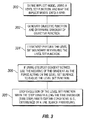
- the FWI technique may include partitioning the inversion domain into first (e.g., salt) and second (e.g., sediment) regions, and using a level set representation to parameterize the first body (salt) geometry. This is illustrated in a flowchart format in Figure 1 , which shows that data corresponding to a subsurface, geological formation is acquired, wherein the acquired data includes data corresponding to a subsurface body having a certain geometry and a subsurface region (200).
- At least part of the subsurface body geometry is directly inverted into an inversion domain, wherein the direct inversion includes: (1) partitioning the inversion domain into a first partitioned region corresponding at least in part to the subsurface body, and a second partitioned region; and (2) using a level set representation to parameterize the subsurface body geometry (202).
- F is the function or forward modeling operator F : M ⁇ R m that maps the property model (e.g., velocity, density, etc.) x ⁇ M ⁇ R n , defined over the inversion domain D using a gridded representation, to the data domain, d , where d ⁇ R m is the observed data.
- F is the function or forward modeling operator F : M ⁇ R m that maps the property model (e.g., velocity, density, etc.) x ⁇ M ⁇ R n , defined over the inversion domain D using a gridded representation, to the data domain, d , where d ⁇ R m is the observed data.
- F is the function or forward modeling operator F : M ⁇ R m that maps the property model (e.g., velocity, density, etc.) x ⁇ M ⁇ R n , defined over the inversion domain D using a gridded representation, to the data domain, d , where d ⁇ R m is the observed
- the level set representation involves constructing a function, ⁇ , which maps into such that its zero level set, ⁇ (0), is the boundary, ⁇ , of the domain, ⁇ , that we wish to represent and invert, as schematically illustrated in Figure 2 .
- the level set function ⁇ is made positive in ⁇ (e.g., the salt) and negative in ⁇ c (e.g., the sediment).
- ⁇ e.g., the salt
- ⁇ c e.g., the sediment
- the level set approach may be adapted to solve for the salt geometry such that it requires minimal changes to the FWI algorithm and does not add significantly to the computational expense.
- Using the level set representation to parameterize the salt geometry one may reformulate the inversion as follows.
- the perturbations to the level set boundary are made by evolving the level set function ⁇ .
- This inversion workflow is shown in a flowchart in Figure 3 and summarized here: define implicit model using a level set function, and map the implicit model onto a grid (300); generate objective function and determine gradient of objective function (302); iteratively perturb the level set boundary by evolving the level set function (304); if using steepest descent method, use the negative of the gradient as the force acting on the level set surface to evolve the level set function (306); stop evolution of the level set function when the step length along the time dimension (time step) meets certain conditions (e.g., determined by a line search procedure) (308).
- define implicit model using a level set function and map the implicit model onto a grid (300); generate objective function and determine gradient of objective function (302); iteratively perturb the level set boundary by evolving the level set function (304); if using steepest descent method, use the negative of the gradient as the force acting on the level set surface to evolve the level set function (306); stop evolution of the level set function when the step length along the time dimension (time step) meets certain conditions (e.g
- the gradient ⁇ ⁇ k ( x ⁇ k ) is defined only on the boundary, ⁇ .
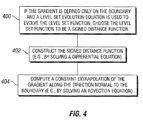
- This extrapolation workflow is shown in a flowchart in Figure 4 and summarized here: if the gradient is defined only on the boundary and a level set evolution equation is used to evolve the level set function, choose the level set function to be a signed distance function (400); construct the signed distance function (e.g., by solving a differential equation) (402); and compute a constant extrapolation of the gradient along the direction normal to the boundary (e.g., by solving an advection equation) (404).
- This model has a linearly increasing velocity in the sediment region and has two salt bodies with geometries derived from the subsalt multiples attenuation and reduction technology (SMAART) Pluto 1.5 model.
- the velocity model is defined on a 5,000 (in X) by 800 (in depth) grid with a grid interval of 25 feet in both dimensions.
- the salt velocity is chosen to be constant at 14,800 ft./s.
- the observed data were synthetically generated using an acoustic propagator with true velocity and constant density.
- a fixed-spread acquisition geometry was used with a source interval of 75 feet and a receiver interval of 25 feet, with a record length of 8 seconds. The source depth was the same as the receiver depth: 25 feet.
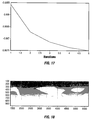
- the behavior of the objective function as the salt geometry is shrunk (negative axis) or expanded (positive axis) can be seen in Figure 11 .
- the objective function is minimum at the true geometry (i.e., at zero) and increases as the geometry is shrunk or expanded.
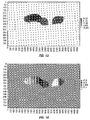
- the steepest descent force acting on the level set boundary in both cases can be seen in Figures 12-15 , where Figures 12 and 13 show the expanded case for the X and Z components, respectively, and Figures 14 and 15 show the shrunk case for the X and Z components, respectively. It can be observed that forces of opposite polarity act on the salt boundary when the salt is expanded, as compared to when the salt body is shrunk.
- the entire salt boundary was expanded by a normal force to the surface.
- the background sediment velocity and density was assumed to be known and kept unchanged throughout the inversion.
- the inversion using the level set approach was run starting with the expanded salt model with a 3-Hz low-pass filter applied to both the predicted and observed data.
- both the velocity model and the density model were updated with the new salt geometries using the exact values (or substantially similar or equivalent values) of velocity and density for the salt bodies.
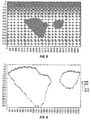
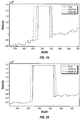
- Figure 17 shows the locations from which the depth profiles were extracted.
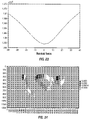
- the behavior of the objective function as the salt geometry is shrunk (negative axis) or expanded (positive axis) can be seen in Figure 23 .
- the objective function is minimum at the true geometry (at zero) and increases as the geometry is shrunk or expanded.
- the steepest descent force acting on the level set boundary when the salt geometry is expanded can be seen in Figures 24 and 25 (X and Z components, respectively). As can be seen, the forces act in the right direction with respect to the geometry of the salt bodies.
- the computing system 100 shown in Figure 26 can be an individual computer system 101A or an arrangement of distributed computer systems.
- the computer system 101A includes one or more analysis modules 102 that are configured to perform various tasks according to some embodiments, such as one or more methods disclosed herein (e.g., any of the steps, methods, techniques, and/or processes, and/or combinations and/or variations and/or equivalents thereof).
- analysis module 102 executes independently, or in coordination with, one or more processors 104, which is (or are) connected to one or more storage media 106.
- the processor(s) 104 is (or are) also connected to a network interface 108 to allow the computer system 101A to communicate over a data network 110 with one or more additional computer systems and/or computing systems, such as 101B, 101C, and/or 101D (note that computer systems 101B, 101C and/or 101D may or may not share the same architecture as computer system 101A, and may be located in different physical locations, e.g., computer systems 101A and 101B may be on a ship underway on the ocean, while in communication with one or more computer systems such as 101C and/or 101D that are located in one or more data centers on shore, on other ships, and/or located in varying countries on different continents).
- additional computer systems and/or computing systems such as 101B, 101C, and/or 101D
- computer systems 101A and 101B may be on a ship underway on the ocean, while in communication with one or more computer systems such as 101C and/or 101D that are located in one or more data centers on shore, on other ships, and/or located in
- a processor can include a microprocessor, microcontroller, processor module or subsystem, programmable integrated circuit, programmable gate array, or another control or computing device.
- the storage media 106 can be implemented as one or more computer-readable or machine-readable storage media. Note that while in the example embodiment of Figure 26 storage media 106 is depicted as within computer system 101A, in some embodiments, storage media 106 may be distributed within and/or across multiple internal and/or external enclosures of computing system 101A and/or additional computing systems.
- Storage media 106 may include one or more different forms of memory including semiconductor memory devices such as dynamic or static random access memories (DRAMs or SRAMs), erasable and programmable read-only memories (EPROMs), electrically erasable and programmable read-only memories (EEPROMs) and flash memories; magnetic disks such as fixed, floppy and removable disks; other magnetic media including tape; optical media such as compact disks (CDs) or digital video disks (DVDs); or other types of storage devices.
- semiconductor memory devices such as dynamic or static random access memories (DRAMs or SRAMs), erasable and programmable read-only memories (EPROMs), electrically erasable and programmable read-only memories (EEPROMs) and flash memories
- magnetic disks such as fixed, floppy and removable disks
- other magnetic media including tape optical media such as compact disks (CDs) or digital video disks (DVDs); or other types of storage devices.
- CDs compact disks
- DVDs digital video disks
- Such computer-readable or machine-readable storage medium or media is (are) considered to be part of an article (or article of manufacture).
- An article or article of manufacture can refer to any manufactured single component or multiple components.
- the storage medium or media can be located either in the machine running the machine-readable instructions, or located at a remote site from which machine-readable instructions can be downloaded over a network for execution.
- computing system 100 is only one example of a computing system, and that computing system 100 may have more or fewer components than shown, may combine additional components not depicted in the example embodiment of Figure 26 , and/or computing system 100 may have a different configuration or arrangement of the components depicted in Figure 26 .
- computing system 100 would generally include input and output devices such as a keyboard, a mouse, a display monitor, and a printer and/or plotter.
- the various components shown in Figure 26 may be implemented in hardware, software, or a combination of both hardware and software, including one or more signal processing and/or application specific integrated circuits.
- steps in the processing methods described above may be implemented by running one or more functional modules in information processing apparatus such as general purpose processors or application specific chips, such as ASICs, FPGAs, PLDs, or other appropriate devices.
- information processing apparatus such as general purpose processors or application specific chips, such as ASICs, FPGAs, PLDs, or other appropriate devices.
- a nail and a screw may not be structural equivalents in that a nail employs a cylindrical surface to secure wooden parts together, whereas a screw employs a helical surface, in the environment of fastening wooden parts, a nail and a screw may be equivalent structures. It is the express intention of the applicant not to invoke 35 U.S.C. ⁇ 112, paragraph 6 for any limitations of any of the claims herein, except for those in which the claim expressly uses the words 'means for' together with an associated function.
Landscapes
- Engineering & Computer Science (AREA)
- Remote Sensing (AREA)
- Physics & Mathematics (AREA)
- Life Sciences & Earth Sciences (AREA)
- Acoustics & Sound (AREA)
- Environmental & Geological Engineering (AREA)
- Geology (AREA)
- General Life Sciences & Earth Sciences (AREA)
- General Physics & Mathematics (AREA)
- Geophysics (AREA)
- Geophysics And Detection Of Objects (AREA)
Claims (16)
- Verfahren, umfassend:Empfangen von erfassten Daten, die einer unterirdischen geologischen Formation entsprechen, durch ein System, welches einen Prozessor einschließt, wobei die erfassten Daten Daten einschließen, die einem unterirdischen Körper mit einer bestimmten Geometrie und einer unterirdischen Region entsprechen; unddirektes Umkehren (202) von mindestens einem Teil der Geometrie des unterirdischen Körpers zu einer Umkehrdomäne durch das System, wobei das direkte Umkehren einschließt:Partitionieren der Umkehrdomäne in eine erste partitionierte Region, die mindestens teilweise dem unterirdischen Körper entspricht, und eine zweite partitionierte Region unter Verwendung einer Levelmengendarstellung, um die Geometrie des unterirdischen Körpers zu parametrisieren;Definieren (300) eines impliziten Modells unter Verwendung einer Levelmengenfunktion;Generieren (302) einer Zielfunktion;Bestimmen (302) eines Gradienten der Zielfunktion;Stören (304) des Levelmengenrands in einer Iteration durch Entwickeln der Levelmengenfunktion;und Stoppen (308) der Entwicklung der Levelmengenfunktion, wenn die Schrittlänge (Zeitschritt) entlang der Zeitdimension einen oder mehrere vorbestimmte Bedingungen erfüllt.
- Verfahren nach Anspruch 1, wobei der unterirdische Körper einen Salzkörper umfasst und die unterirdische Region eine Sedimentregion umfasst, und wobei die erste partitionierte Region mindestens teilweise dem Salzkörper entspricht und die zweite partitionierte Region mindestens teilweise der Sedimentregion entspricht.
- Verfahren nach Anspruch 1, wobei das direkte Umkehren ferner das Abbilden des impliziten Modells auf einem Gitter umfasst.
- Verfahren nach Anspruch 1, wobei eine Richtung des vorbestimmten Zeitschritts unter Verwenden einer Technik ausgewählt aus der Gruppe bestehend aus einer steilsten Abstiegsrichtung, einer konjugierten Gradientenrichtung, einer Newton-Richtung und einer Quasi-Newton-Richtung bestimmt wird.
- Verfahren nach Anspruch 3, wobei die Richtung für den bestimmten Zeitschritt unter Verwendung einer Technik des steilsten Abstiegs bestimmt wird und das direkte Umkehren ferner das Verwenden einer Negativen des Gradienten als Kraft umfasst, die auf den Levelmengenrand einwirkt, um die Levelmengenfunktion zu entwickeln.
- Verfahren nach Anspruch 3, wobei eine Nulllevelmenge der Levelmengenfunktion den Rand der Domäne repräsentiert, welche umgekehrt wird.
- Verfahren nach Anspruch 3, wobei der Gradient nur auf dem Levelmengenrand definiert ist, wobei das Verfahren ferner das Bereitstellen einer kontinuierlichen Fortsetzung des Gradienten außerhalb des Levelmengenrandes umfasst.
- Verfahren nach Anspruch 3, wobei der Gradient nur auf dem Levelmengenrand definiert ist und eine Levelmengenentwicklungsgleichung zur Entwicklung der Levelmengenfunktion verwendet wird, und wobei das direkte Umkehren ferner umfasst:Auswählen (400) der Levelmengenfunktion als mit Vorzeichen versehene Abstandsfunktion;Konstruieren (400) der mit Vorzeichen versehenen Abstandsfunktion; undBerechnen (404) einer konstanten Extrapolation des Gradienten entlang einer Richtung, die senkrecht zu dem Rand ist.
- Verfahren nach Anspruch 3, wobei das Entwickeln der Levelmengenfunktion das Verwenden einer Bewegungsgleichung umfasst.
- Verfahren nach Anspruch 3, wobei die Zielfunktion eine Ausarbeitung der kleinsten Quadrate ist.
- Verfahren nach Anspruch 1, wobei die direkte Umkehrung ferner das Bestimmen der fehlenden Übereinstimmung zwischen den erfassten Daten und den synthetischen Daten umfasst.
- Verfahren nach Anspruch 1, wobei die Levelmengendarstellung positiv ist, wenn die erste partitionierte Region dargestellt wird, und negativ ist, wenn die zweite partitionierte Region dargestellt wird.
- Verfahren nach Anspruch 1, wobei die direkte Umkehrung eine vollständige Wellenformumkehrung ist.
- Verfahren nach Anspruch 1, ferner umfassend das Bestimmen der Geometrie des unterirdischen Körpers.
- Verfahren nach Anspruch 1, ferner umfassend Auftragen von Geschwindigkeitsprofilen des unterirdischen Körpers.
- Rechensystem (101A), umfassend mindestens einen Prozessor (104), mindestens einen Speicher (106) und ein oder mehrere Programme, die in dem mindestens einen Speicher gespeichert sind, wobei die Programme Anweisungen umfassen, die bei Ausführung durch den mindestens einen Prozessor konfiguriert sind, um ein Verfahren wie in einem der Ansprüche 1 bis 15 definiert auszuführen.
Applications Claiming Priority (3)
| Application Number | Priority Date | Filing Date | Title |
|---|---|---|---|
| US201261586659P | 2012-01-13 | 2012-01-13 | |
| US13/619,508 US9121964B2 (en) | 2012-01-13 | 2012-09-14 | Parameterizing a geological subsurface feature |
| PCT/US2013/021289 WO2013106750A1 (en) | 2012-01-13 | 2013-01-11 | Parameterizing a geological subsurface feature |
Publications (3)
| Publication Number | Publication Date |
|---|---|
| EP2802899A1 EP2802899A1 (de) | 2014-11-19 |
| EP2802899A4 EP2802899A4 (de) | 2016-01-20 |
| EP2802899B1 true EP2802899B1 (de) | 2016-11-30 |
Family
ID=48780596
Family Applications (1)
| Application Number | Title | Priority Date | Filing Date |
|---|---|---|---|
| EP13736094.7A Not-in-force EP2802899B1 (de) | 2012-01-13 | 2013-01-11 | Parametrierung einer geologischen unterirdischen eigenschaft |
Country Status (3)
| Country | Link |
|---|---|
| US (1) | US9121964B2 (de) |
| EP (1) | EP2802899B1 (de) |
| WO (1) | WO2013106750A1 (de) |
Families Citing this family (13)
| Publication number | Priority date | Publication date | Assignee | Title |
|---|---|---|---|---|
| US9158017B2 (en) * | 2011-03-22 | 2015-10-13 | Seoul National University R&Db Foundation | Seismic imaging apparatus utilizing macro-velocity model and method for the same |
| JP6195377B2 (ja) * | 2014-01-29 | 2017-09-13 | 株式会社奥村組 | 汚染物質の移流拡散解析方法 |
| US10416348B2 (en) | 2016-05-20 | 2019-09-17 | Exxonmobil Research And Engineering Company | Shape-based geophysical parameter inversion |
| CN106707337B (zh) * | 2016-11-15 | 2018-08-21 | 西安石油大学 | 基于分频地震反射能量地层切片进行沉积体系解释的方法 |
| WO2019060298A1 (en) | 2017-09-19 | 2019-03-28 | Neuroenhancement Lab, LLC | METHOD AND APPARATUS FOR NEURO-ACTIVATION |
| US11717686B2 (en) | 2017-12-04 | 2023-08-08 | Neuroenhancement Lab, LLC | Method and apparatus for neuroenhancement to facilitate learning and performance |
| US12280219B2 (en) | 2017-12-31 | 2025-04-22 | NeuroLight, Inc. | Method and apparatus for neuroenhancement to enhance emotional response |
| US11478603B2 (en) | 2017-12-31 | 2022-10-25 | Neuroenhancement Lab, LLC | Method and apparatus for neuroenhancement to enhance emotional response |
| US11364361B2 (en) | 2018-04-20 | 2022-06-21 | Neuroenhancement Lab, LLC | System and method for inducing sleep by transplanting mental states |
| US11055908B2 (en) * | 2018-08-27 | 2021-07-06 | Exxonmobil Research And Engineering Company | Inversion of large, nearly-homogeneous geobodies via ultra low-dimensional shape representation using orthogonal basis functions |
| US11452839B2 (en) | 2018-09-14 | 2022-09-27 | Neuroenhancement Lab, LLC | System and method of improving sleep |
| CN112307641B (zh) * | 2020-11-13 | 2024-05-21 | 中国科学院新疆生态与地理研究所 | 地表温度冷热极值点的识别方法、终端及可读存储介质 |
| CN116485218B (zh) * | 2022-12-23 | 2024-06-25 | 中煤科工开采研究院有限公司 | 沉陷区稳定性区域划分方法及治理时间规划方法 |
Family Cites Families (9)
| Publication number | Priority date | Publication date | Assignee | Title |
|---|---|---|---|---|
| US6018499A (en) * | 1997-11-04 | 2000-01-25 | 3Dgeo Development, Inc. | Three-dimensional seismic imaging of complex velocity structures |
| GB0305315D0 (en) | 2003-03-07 | 2003-04-09 | Weber Martin | Image processing system |
| CA2721008A1 (en) | 2008-04-11 | 2009-10-15 | Terraspark Geosciences, Llc | Visulation of geologic features using data representations thereof |
| US8213261B2 (en) | 2008-05-22 | 2012-07-03 | Exxonmobil Upstream Research Company | Method for geophysical and geological interpretation of seismic volumes in the domains of depth, time, and age |
| MY164574A (en) * | 2008-05-22 | 2018-01-15 | Exxonmobil Upstream Res Co | Seismic horizon skeletonization |
| US8472685B2 (en) | 2009-08-12 | 2013-06-25 | The Regents Of The University Of California | Apparatus and method for surface capturing and volumetric analysis of multidimensional images |
| US9244181B2 (en) | 2009-10-19 | 2016-01-26 | Westerngeco L.L.C. | Full-waveform inversion in the traveltime domain |
| WO2011056347A1 (en) * | 2009-11-05 | 2011-05-12 | Exxonmobil Upstream Research Company | Method for creating a hierarchically layered earth model |
| AU2011339017B2 (en) * | 2010-12-08 | 2016-09-08 | Exxonmobil Upstream Research Company | Constructing geologic models from geologic concepts |
-
2012
- 2012-09-14 US US13/619,508 patent/US9121964B2/en not_active Expired - Fee Related
-
2013
- 2013-01-11 WO PCT/US2013/021289 patent/WO2013106750A1/en not_active Ceased
- 2013-01-11 EP EP13736094.7A patent/EP2802899B1/de not_active Not-in-force
Non-Patent Citations (1)
| Title |
|---|
| None * |
Also Published As
| Publication number | Publication date |
|---|---|
| EP2802899A4 (de) | 2016-01-20 |
| US9121964B2 (en) | 2015-09-01 |
| US20130185040A1 (en) | 2013-07-18 |
| WO2013106750A1 (en) | 2013-07-18 |
| EP2802899A1 (de) | 2014-11-19 |
Similar Documents
| Publication | Publication Date | Title |
|---|---|---|
| EP2802899B1 (de) | Parametrierung einer geologischen unterirdischen eigenschaft | |
| EP3073296B1 (de) | Vollwellenforminversionsverfahren zur verarbeitung von seismischen daten mit amplitudenerhaltender umkehrzeitmigration | |
| US8095345B2 (en) | Stochastic inversion of geophysical data for estimating earth model parameters | |
| US10578755B2 (en) | System and method for reconstructed wavefield inversion | |
| US10310138B2 (en) | Accelerated Occam inversion using model remapping and Jacobian matrix decomposition | |
| EP3063562B1 (de) | Verfahren zur untergrunderkundung, computerprogrammprodukt und computerlesbares speichermedium | |
| EP2810101B1 (de) | Verbesserung der effizienz pixelbasierter inversionsalgorithmen | |
| US9829592B2 (en) | Seismic imaging with visco-acoustic reverse-time migration using pseudo-analytical method | |
| EP2240803B1 (de) | Aktualisieren eines modells einer unterirdischen struktur unter verwendung von zerlegung | |
| CA2683618C (en) | Inverse-vector method for smoothing dips and azimuths | |
| EP3358376B1 (de) | Verfahren und vorrichtung zur eindeutigen schätzung seismischer anisotropieparameter | |
| EP2943816B1 (de) | Verarbeitung von vermessungsdaten zur bestimmung eines wellenfeldes | |
| US10234581B2 (en) | System and method for high resolution seismic imaging | |
| WO2012170090A1 (en) | System and method for data inversion with phase unwrapping | |
| AU2012268720A1 (en) | System and method for data inversion with phase extrapolation | |
| CN109073772B (zh) | 利用光流确定在地震图像之间的位移 | |
| US12436307B2 (en) | Method and apparatus for implementing a high-resolution seismic pseudo-reflectivity image | |
| Meju et al. | Structural coupling approaches in integrated geophysical imaging | |
| WO2021002761A1 (en) | Improved inversions of geophysical data | |
| EP4488724A1 (de) | System und verfahren zur kleinquadratischen migration von seismischen zeitrafferdaten | |
| Alemie | Time-lapse full waveform inversion methods | |
| Roberts et al. | Investigation into the use of 2D elastic waveform inversion from look‐ahead walk‐away VSP surveys | |
| Taillandier et al. | Refraction traveltime tomography based on adjoint state techniques | |
| US20240219596A1 (en) | Method and apparatus for estimating uncertainty of a velocity model of a subsurface region | |
| US20240295666A1 (en) | Joint preconditioning for time-lapse full waveform inversion method and system |
Legal Events
| Date | Code | Title | Description |
|---|---|---|---|
| PUAI | Public reference made under article 153(3) epc to a published international application that has entered the european phase |
Free format text: ORIGINAL CODE: 0009012 |
|
| 17P | Request for examination filed |
Effective date: 20140722 |
|
| AK | Designated contracting states |
Kind code of ref document: A1 Designated state(s): AL AT BE BG CH CY CZ DE DK EE ES FI FR GB GR HR HU IE IS IT LI LT LU LV MC MK MT NL NO PL PT RO RS SE SI SK SM TR |
|
| DAX | Request for extension of the european patent (deleted) | ||
| RA4 | Supplementary search report drawn up and despatched (corrected) |
Effective date: 20151218 |
|
| RIC1 | Information provided on ipc code assigned before grant |
Ipc: G01V 1/30 20060101ALI20151214BHEP Ipc: G01V 1/28 20060101AFI20151214BHEP Ipc: G06F 19/00 20110101ALI20151214BHEP |
|
| 17Q | First examination report despatched |
Effective date: 20160112 |
|
| GRAP | Despatch of communication of intention to grant a patent |
Free format text: ORIGINAL CODE: EPIDOSNIGR1 |
|
| INTG | Intention to grant announced |
Effective date: 20160915 |
|
| GRAS | Grant fee paid |
Free format text: ORIGINAL CODE: EPIDOSNIGR3 |
|
| GRAA | (expected) grant |
Free format text: ORIGINAL CODE: 0009210 |
|
| AK | Designated contracting states |
Kind code of ref document: B1 Designated state(s): AL AT BE BG CH CY CZ DE DK EE ES FI FR GB GR HR HU IE IS IT LI LT LU LV MC MK MT NL NO PL PT RO RS SE SI SK SM TR |
|
| REG | Reference to a national code |
Ref country code: CH Ref legal event code: EP Ref country code: GB Ref legal event code: FG4D |
|
| REG | Reference to a national code |
Ref country code: AT Ref legal event code: REF Ref document number: 850323 Country of ref document: AT Kind code of ref document: T Effective date: 20161215 |
|
| REG | Reference to a national code |
Ref country code: IE Ref legal event code: FG4D |
|
| REG | Reference to a national code |
Ref country code: DE Ref legal event code: R096 Ref document number: 602013014750 Country of ref document: DE |
|
| PG25 | Lapsed in a contracting state [announced via postgrant information from national office to epo] |
Ref country code: LV Free format text: LAPSE BECAUSE OF FAILURE TO SUBMIT A TRANSLATION OF THE DESCRIPTION OR TO PAY THE FEE WITHIN THE PRESCRIBED TIME-LIMIT Effective date: 20161130 |
|
| REG | Reference to a national code |
Ref country code: FR Ref legal event code: PLFP Year of fee payment: 5 |
|
| REG | Reference to a national code |
Ref country code: LT Ref legal event code: MG4D |
|
| REG | Reference to a national code |
Ref country code: NL Ref legal event code: MP Effective date: 20161130 |
|
| REG | Reference to a national code |
Ref country code: NO Ref legal event code: FC2A |
|
| REG | Reference to a national code |
Ref country code: AT Ref legal event code: MK05 Ref document number: 850323 Country of ref document: AT Kind code of ref document: T Effective date: 20161130 |
|
| PG25 | Lapsed in a contracting state [announced via postgrant information from national office to epo] |
Ref country code: GR Free format text: LAPSE BECAUSE OF FAILURE TO SUBMIT A TRANSLATION OF THE DESCRIPTION OR TO PAY THE FEE WITHIN THE PRESCRIBED TIME-LIMIT Effective date: 20170301 Ref country code: SE Free format text: LAPSE BECAUSE OF FAILURE TO SUBMIT A TRANSLATION OF THE DESCRIPTION OR TO PAY THE FEE WITHIN THE PRESCRIBED TIME-LIMIT Effective date: 20161130 Ref country code: LT Free format text: LAPSE BECAUSE OF FAILURE TO SUBMIT A TRANSLATION OF THE DESCRIPTION OR TO PAY THE FEE WITHIN THE PRESCRIBED TIME-LIMIT Effective date: 20161130 |
|
| PGFP | Annual fee paid to national office [announced via postgrant information from national office to epo] |
Ref country code: NO Payment date: 20170306 Year of fee payment: 5 Ref country code: FR Payment date: 20170310 Year of fee payment: 5 |
|
| PG25 | Lapsed in a contracting state [announced via postgrant information from national office to epo] |
Ref country code: PL Free format text: LAPSE BECAUSE OF FAILURE TO SUBMIT A TRANSLATION OF THE DESCRIPTION OR TO PAY THE FEE WITHIN THE PRESCRIBED TIME-LIMIT Effective date: 20161130 Ref country code: AT Free format text: LAPSE BECAUSE OF FAILURE TO SUBMIT A TRANSLATION OF THE DESCRIPTION OR TO PAY THE FEE WITHIN THE PRESCRIBED TIME-LIMIT Effective date: 20161130 Ref country code: PT Free format text: LAPSE BECAUSE OF FAILURE TO SUBMIT A TRANSLATION OF THE DESCRIPTION OR TO PAY THE FEE WITHIN THE PRESCRIBED TIME-LIMIT Effective date: 20170330 Ref country code: FI Free format text: LAPSE BECAUSE OF FAILURE TO SUBMIT A TRANSLATION OF THE DESCRIPTION OR TO PAY THE FEE WITHIN THE PRESCRIBED TIME-LIMIT Effective date: 20161130 Ref country code: BE Free format text: LAPSE BECAUSE OF NON-PAYMENT OF DUE FEES Effective date: 20170131 Ref country code: ES Free format text: LAPSE BECAUSE OF FAILURE TO SUBMIT A TRANSLATION OF THE DESCRIPTION OR TO PAY THE FEE WITHIN THE PRESCRIBED TIME-LIMIT Effective date: 20161130 Ref country code: RS Free format text: LAPSE BECAUSE OF FAILURE TO SUBMIT A TRANSLATION OF THE DESCRIPTION OR TO PAY THE FEE WITHIN THE PRESCRIBED TIME-LIMIT Effective date: 20161130 Ref country code: HR Free format text: LAPSE BECAUSE OF FAILURE TO SUBMIT A TRANSLATION OF THE DESCRIPTION OR TO PAY THE FEE WITHIN THE PRESCRIBED TIME-LIMIT Effective date: 20161130 |
|
| PGFP | Annual fee paid to national office [announced via postgrant information from national office to epo] |
Ref country code: GB Payment date: 20170322 Year of fee payment: 5 |
|
| PG25 | Lapsed in a contracting state [announced via postgrant information from national office to epo] |
Ref country code: NL Free format text: LAPSE BECAUSE OF FAILURE TO SUBMIT A TRANSLATION OF THE DESCRIPTION OR TO PAY THE FEE WITHIN THE PRESCRIBED TIME-LIMIT Effective date: 20161130 |
|
| PG25 | Lapsed in a contracting state [announced via postgrant information from national office to epo] |
Ref country code: EE Free format text: LAPSE BECAUSE OF FAILURE TO SUBMIT A TRANSLATION OF THE DESCRIPTION OR TO PAY THE FEE WITHIN THE PRESCRIBED TIME-LIMIT Effective date: 20161130 Ref country code: SK Free format text: LAPSE BECAUSE OF FAILURE TO SUBMIT A TRANSLATION OF THE DESCRIPTION OR TO PAY THE FEE WITHIN THE PRESCRIBED TIME-LIMIT Effective date: 20161130 Ref country code: RO Free format text: LAPSE BECAUSE OF FAILURE TO SUBMIT A TRANSLATION OF THE DESCRIPTION OR TO PAY THE FEE WITHIN THE PRESCRIBED TIME-LIMIT Effective date: 20161130 Ref country code: DK Free format text: LAPSE BECAUSE OF FAILURE TO SUBMIT A TRANSLATION OF THE DESCRIPTION OR TO PAY THE FEE WITHIN THE PRESCRIBED TIME-LIMIT Effective date: 20161130 Ref country code: CZ Free format text: LAPSE BECAUSE OF FAILURE TO SUBMIT A TRANSLATION OF THE DESCRIPTION OR TO PAY THE FEE WITHIN THE PRESCRIBED TIME-LIMIT Effective date: 20161130 Ref country code: NO Free format text: LAPSE BECAUSE OF THE APPLICANT RENOUNCES Effective date: 20170330 |
|
| REG | Reference to a national code |
Ref country code: DE Ref legal event code: R119 Ref document number: 602013014750 Country of ref document: DE |
|
| PG25 | Lapsed in a contracting state [announced via postgrant information from national office to epo] |
Ref country code: BG Free format text: LAPSE BECAUSE OF FAILURE TO SUBMIT A TRANSLATION OF THE DESCRIPTION OR TO PAY THE FEE WITHIN THE PRESCRIBED TIME-LIMIT Effective date: 20170228 Ref country code: SM Free format text: LAPSE BECAUSE OF FAILURE TO SUBMIT A TRANSLATION OF THE DESCRIPTION OR TO PAY THE FEE WITHIN THE PRESCRIBED TIME-LIMIT Effective date: 20161130 Ref country code: IT Free format text: LAPSE BECAUSE OF FAILURE TO SUBMIT A TRANSLATION OF THE DESCRIPTION OR TO PAY THE FEE WITHIN THE PRESCRIBED TIME-LIMIT Effective date: 20161130 Ref country code: BE Free format text: LAPSE BECAUSE OF FAILURE TO SUBMIT A TRANSLATION OF THE DESCRIPTION OR TO PAY THE FEE WITHIN THE PRESCRIBED TIME-LIMIT Effective date: 20161130 |
|
| REG | Reference to a national code |
Ref country code: CH Ref legal event code: PL |
|
| PG25 | Lapsed in a contracting state [announced via postgrant information from national office to epo] |
Ref country code: MC Free format text: LAPSE BECAUSE OF FAILURE TO SUBMIT A TRANSLATION OF THE DESCRIPTION OR TO PAY THE FEE WITHIN THE PRESCRIBED TIME-LIMIT Effective date: 20161130 |
|
| PLBE | No opposition filed within time limit |
Free format text: ORIGINAL CODE: 0009261 |
|
| STAA | Information on the status of an ep patent application or granted ep patent |
Free format text: STATUS: NO OPPOSITION FILED WITHIN TIME LIMIT |
|
| PG25 | Lapsed in a contracting state [announced via postgrant information from national office to epo] |
Ref country code: LI Free format text: LAPSE BECAUSE OF NON-PAYMENT OF DUE FEES Effective date: 20170131 Ref country code: CH Free format text: LAPSE BECAUSE OF NON-PAYMENT OF DUE FEES Effective date: 20170131 |
|
| REG | Reference to a national code |
Ref country code: IE Ref legal event code: MM4A |
|
| 26N | No opposition filed |
Effective date: 20170831 |
|
| PG25 | Lapsed in a contracting state [announced via postgrant information from national office to epo] |
Ref country code: SI Free format text: LAPSE BECAUSE OF FAILURE TO SUBMIT A TRANSLATION OF THE DESCRIPTION OR TO PAY THE FEE WITHIN THE PRESCRIBED TIME-LIMIT Effective date: 20161130 Ref country code: DE Free format text: LAPSE BECAUSE OF NON-PAYMENT OF DUE FEES Effective date: 20170801 Ref country code: LU Free format text: LAPSE BECAUSE OF NON-PAYMENT OF DUE FEES Effective date: 20170111 |
|
| PG25 | Lapsed in a contracting state [announced via postgrant information from national office to epo] |
Ref country code: IE Free format text: LAPSE BECAUSE OF NON-PAYMENT OF DUE FEES Effective date: 20170111 |
|
| GBPC | Gb: european patent ceased through non-payment of renewal fee |
Effective date: 20180111 |
|
| PG25 | Lapsed in a contracting state [announced via postgrant information from national office to epo] |
Ref country code: MT Free format text: LAPSE BECAUSE OF NON-PAYMENT OF DUE FEES Effective date: 20170111 |
|
| PG25 | Lapsed in a contracting state [announced via postgrant information from national office to epo] |
Ref country code: FR Free format text: LAPSE BECAUSE OF NON-PAYMENT OF DUE FEES Effective date: 20180131 |
|
| REG | Reference to a national code |
Ref country code: FR Ref legal event code: ST Effective date: 20180928 |
|
| PG25 | Lapsed in a contracting state [announced via postgrant information from national office to epo] |
Ref country code: GB Free format text: LAPSE BECAUSE OF NON-PAYMENT OF DUE FEES Effective date: 20180111 |
|
| PG25 | Lapsed in a contracting state [announced via postgrant information from national office to epo] |
Ref country code: HU Free format text: LAPSE BECAUSE OF FAILURE TO SUBMIT A TRANSLATION OF THE DESCRIPTION OR TO PAY THE FEE WITHIN THE PRESCRIBED TIME-LIMIT; INVALID AB INITIO Effective date: 20130111 |
|
| PG25 | Lapsed in a contracting state [announced via postgrant information from national office to epo] |
Ref country code: CY Free format text: LAPSE BECAUSE OF FAILURE TO SUBMIT A TRANSLATION OF THE DESCRIPTION OR TO PAY THE FEE WITHIN THE PRESCRIBED TIME-LIMIT Effective date: 20161130 |
|
| PG25 | Lapsed in a contracting state [announced via postgrant information from national office to epo] |
Ref country code: MK Free format text: LAPSE BECAUSE OF FAILURE TO SUBMIT A TRANSLATION OF THE DESCRIPTION OR TO PAY THE FEE WITHIN THE PRESCRIBED TIME-LIMIT Effective date: 20161130 |
|
| PG25 | Lapsed in a contracting state [announced via postgrant information from national office to epo] |
Ref country code: TR Free format text: LAPSE BECAUSE OF FAILURE TO SUBMIT A TRANSLATION OF THE DESCRIPTION OR TO PAY THE FEE WITHIN THE PRESCRIBED TIME-LIMIT Effective date: 20161130 |
|
| PG25 | Lapsed in a contracting state [announced via postgrant information from national office to epo] |
Ref country code: AL Free format text: LAPSE BECAUSE OF FAILURE TO SUBMIT A TRANSLATION OF THE DESCRIPTION OR TO PAY THE FEE WITHIN THE PRESCRIBED TIME-LIMIT Effective date: 20161130 Ref country code: IS Free format text: LAPSE BECAUSE OF FAILURE TO SUBMIT A TRANSLATION OF THE DESCRIPTION OR TO PAY THE FEE WITHIN THE PRESCRIBED TIME-LIMIT Effective date: 20170330 |