EP2803232B1 - Procédés et appareil de gestion de mesures d'appareils récepteurs pendant une réception discontinue - Google Patents
Procédés et appareil de gestion de mesures d'appareils récepteurs pendant une réception discontinue Download PDFInfo
- Publication number
- EP2803232B1 EP2803232B1 EP13707935.6A EP13707935A EP2803232B1 EP 2803232 B1 EP2803232 B1 EP 2803232B1 EP 13707935 A EP13707935 A EP 13707935A EP 2803232 B1 EP2803232 B1 EP 2803232B1
- Authority
- EP
- European Patent Office
- Prior art keywords
- measurements
- radio measurements
- radio
- discontinuous reception
- measurement
- Prior art date
- Legal status (The legal status is an assumption and is not a legal conclusion. Google has not performed a legal analysis and makes no representation as to the accuracy of the status listed.)
- Active
Links
Images


Classifications
-
- H—ELECTRICITY
- H04—ELECTRIC COMMUNICATION TECHNIQUE
- H04W—WIRELESS COMMUNICATION NETWORKS
- H04W52/00—Power management, e.g. Transmission Power Control [TPC] or power classes
- H04W52/02—Power saving arrangements
-
- H—ELECTRICITY
- H04—ELECTRIC COMMUNICATION TECHNIQUE
- H04W—WIRELESS COMMUNICATION NETWORKS
- H04W24/00—Supervisory, monitoring or testing arrangements
- H04W24/10—Scheduling measurement reports ; Arrangements for measurement reports
-
- H—ELECTRICITY
- H04—ELECTRIC COMMUNICATION TECHNIQUE
- H04B—TRANSMISSION
- H04B17/00—Monitoring; Testing
- H04B17/30—Monitoring; Testing of propagation channels
- H04B17/309—Measuring or estimating channel quality parameters
- H04B17/346—Noise values
-
- H—ELECTRICITY
- H04—ELECTRIC COMMUNICATION TECHNIQUE
- H04W—WIRELESS COMMUNICATION NETWORKS
- H04W24/00—Supervisory, monitoring or testing arrangements
- H04W24/08—Testing, supervising or monitoring using real traffic
-
- H—ELECTRICITY
- H04—ELECTRIC COMMUNICATION TECHNIQUE
- H04W—WIRELESS COMMUNICATION NETWORKS
- H04W52/00—Power management, e.g. Transmission Power Control [TPC] or power classes
- H04W52/02—Power saving arrangements
- H04W52/0209—Power saving arrangements in terminal devices
- H04W52/0212—Power saving arrangements in terminal devices managed by the network, e.g. network or access point is leader and terminal is follower
- H04W52/0216—Power saving arrangements in terminal devices managed by the network, e.g. network or access point is leader and terminal is follower using a pre-established activity schedule, e.g. traffic indication frame
-
- H—ELECTRICITY
- H04—ELECTRIC COMMUNICATION TECHNIQUE
- H04W—WIRELESS COMMUNICATION NETWORKS
- H04W76/00—Connection management
- H04W76/20—Manipulation of established connections
- H04W76/28—Discontinuous transmission [DTX]; Discontinuous reception [DRX]
-
- Y—GENERAL TAGGING OF NEW TECHNOLOGICAL DEVELOPMENTS; GENERAL TAGGING OF CROSS-SECTIONAL TECHNOLOGIES SPANNING OVER SEVERAL SECTIONS OF THE IPC; TECHNICAL SUBJECTS COVERED BY FORMER USPC CROSS-REFERENCE ART COLLECTIONS [XRACs] AND DIGESTS
- Y02—TECHNOLOGIES OR APPLICATIONS FOR MITIGATION OR ADAPTATION AGAINST CLIMATE CHANGE
- Y02D—CLIMATE CHANGE MITIGATION TECHNOLOGIES IN INFORMATION AND COMMUNICATION TECHNOLOGIES [ICT], I.E. INFORMATION AND COMMUNICATION TECHNOLOGIES AIMING AT THE REDUCTION OF THEIR OWN ENERGY USE
- Y02D30/00—Reducing energy consumption in communication networks
- Y02D30/70—Reducing energy consumption in communication networks in wireless communication networks
Definitions
- the present disclosure relates generally to the field of wireless communication and data networks. More particularly, in one exemplary aspect, the disclosure is directed to methods and apparatus for managing radio measurements during discontinuous reception (DRX).
- DRX discontinuous reception
- LTE Long Term Evolution
- UEs User Equipment
- LTE networks While enhancing data capability, LTE networks also place additional demands on mobile wireless device power consumption. Accordingly, mechanisms exist within LTE-enabled devices to mitigate power consumption, and hence enhance user experience by not draining the user's battery at an undesirable rate.
- One such mechanism within LTE is known as discontinuous reception, or "DRX", and another is discontinuous transmission or "DTX".
- DRX discontinuous reception
- DTX discontinuous transmission
- the base station Enhanced NodeB, or "eNB" controls DRX operations using various timers and/or parameters that are communicated to the UE.
- LTE communications are further conducted according to a time schedule that includes frames, subframes, and slots.
- the UE can be allocated one or more time slots for communication.
- RRC radio resource connection
- the UE will wake-up and sleep in accordance with its resource allocations.
- RRC idle mode the UE does not have a radio resource connection. The UE will periodically wake-up to see if it is being paged within a frame of data. If the frame does not have a page for the UE, the UE will go back to sleep.
- Measurement Gap and DRX interaction discusses a UE continuing to use measurement gaps while coming out of the DRX as long as the serving quality is below a certain threshold.
- US 2009/092056 A1 discloses systems and methods that manage measurement behaviour of a UE in corrected mode and while in discontinuous operation.
- Measurements in LTE E-UTRAN discusses various LTE E-UTRAN measurements to be performed by a UE for mobility.
- DRX functionality utilize a complete set of measurements (e.g., cell measurements) during each DRX cycle.
- a complete set of measurements on each cycle is not always required, and accordingly additional resources (including battery power) are expended in performing these unnecessarily complete measurements on each cycle.
- the present disclosure provides, inter alia, improved apparatus and methods for managing radio measurements during discontinuous reception.
- a method for reducing energy consumption by a user equipment (UE) wireless communications device operating in discontinuous reception includes: determining one or more radio measurements that must be performed within a plurality of discontinuous reception cycles, each of the one or more radio measurements having a minimum periodicity associated therewith; determining a schedule for performing the one or more radio measurements within the plurality of discontinuous reception cycles; and executing the one or more radio measurements according to the determined schedule.
- UE user equipment
- Computer readable apparatus comprising a storage medium and having a plurality of computer readable instructions stored thereon is disclosed.
- the computer readable instructions are configured to, when executed cause a mobile wireless device to: determine one or more radio measurements to be performed within a plurality of discontinuous reception cycles; schedule performance of the one or more radio measurements relative to the plurality of discontinuous reception cycles; and execute the one or more radio measurements according to the schedule.
- execution of the one or more radio measurements according to the determined schedule effectuates an energy saving within the mobile device by at least reducing the number of measurements that would otherwise be made within a single one of the plurality of cycles.
- a user equipment, UE, device comprises means for determining one or more radio measurements to be performed within individual ones of a plurality of discontinuous reception cycles, individual ones of the one or more radio measurements having a minimum periodicity associated therewith; means for determining a schedule for performing the one or more radio measurements within the plurality of discontinuous reception cycles; and means for executing the one or more radio measurements according to the determined schedule, wherein the one or more radio measurements are distributed over the plurality of discontinuous reception.
- Exemplary embodiments of the present disclosure are now described in detail. While these embodiments are primarily discussed in the context of cellular networks including without limitation, third generation (3G) Universal Mobile Telecommunications System (UMTS) wireless networks, Long Term Evolution (LTE) wireless networks and other fourth generation (4G) or LTE-Advanced (LTE-A) wireless networks, it will be recognized by those of ordinary skill that the present disclosure is not so limited. In fact, the various aspects of the disclosure are useful in and readily adapted to any wireless network that can benefit from the adaptive or scheduled wake-up procedures described herein.
- 3G Universal Mobile Telecommunications System
- LTE Long Term Evolution
- 4G fourth generation
- LTE-A LTE-Advanced
- a user equipment (UE) device which is configured to "stagger" or distribute the distribution of DRX measurements across multiple DRX cycles (which may be contiguous or non-contiguous) so as to, inter alia, reduce the transceiver activity and power consumption during each individual DRX cycle.
- the UE of the exemplary embodiment only performs a subset of measurements during each DRX cycle. By staggering cell measurements over multiple DRX cycles, the UE can improve power consumption, while still conforming to measurement requirements.
- the staggered/distributed measurements may also be handled differently in different conditions.
- Various schemes are disclosed for staggering or distributing measurements based on a multitude of considerations including without limitation: (i) the type of measurement, (ii) network conditions, (iii) user preferences, (iv) network preferences, (v) application preferences, (vi) network capabilities, (vii) device capabilities, (viii) measurement utility, and (ix) device mode.
- a UE distributes measurements across multiple DRX cycles based on physical layer (PHY) key performance indicators (KPI).
- KPI include for example, signal to noise ratio (SNR) for synchronization signals (which is determined during initial searching), frequency error, power control states, etc.
- SNR signal to noise ratio
- the UE has an increased probability of misinterpreting a neighbor cell (i.e., mistakenly identifying a neighbor cell); whereas at high SNR values, the UE can reliably and accurately perform cell measurements.
- a high power/low power capable UE staggers cell measurements in accordance with the power modes of the UE. For example, if the reception conditions are good, more neighbor measurements can be done during the DRX cycles using low power mode. Conversely, if the reception is poor, the neighbor cell measurements need to be in high power mode to ensure that the neighbor cell measurements are accurate.
- FIG. 1 illustrates one embodiment of a generalized method 100 for managing radio measurements during discontinuous reception according to the present disclosure.
- a user equipment (UE) device staggers or otherwise distributes radio measurements over multiple discontinuous or non-contiguous reception (DRX) cycles.
- UE user equipment
- UE or other device can intelligently perform a greater or fewer number of radio measurements during a DRX cycle or group of cycles, so as to reduce the average number of measurements performed, and also to reduce the overall device power consumption.
- a user equipment determines one or more radio measurements that can be performed, and a staggered periodicity or other distribution scheme for each.
- a Long Term Evolution (LTE) cellular network specifies a minimum periodicity for cell measurement information. The minimum periodicity ensures that the UE and network can make reasonable decisions as to mobility management (e.g., when to perform cell re-selection, and/or handover to another base station).
- LTE Long Term Evolution
- the UE identifies one or more measurements which have a minimum periodicity that is greater than the DRX cycle periodicity (i.e., the minimum periodicity requirement of the network for the measurement can be satisfied without performing the measurement at each DRX cycle). For each identified measurement, the UE determines a staggered periodicity.
- the staggered periodicity can be based on multiple factors including for example: the type of measurement, network conditions, user preferences, network preferences, application preferences, network capabilities, device capabilities, measurement utility, device mode, etc.
- a staggered periodicity may be shortened to increase measurement granularity, or alternately lengthened to reduce power consumption.
- the UE determines a schedule for performing the one or more radio measurements across multiple DRX according to the staggered periodicities.
- the UE schedules the staggered periodicities so as to maximally distribute the measurements over a time interval. For example, the UE may distribute the measurements over a number of DRX cycles, such that each DRX cycle has an equal (or nearly equal) number of measurements (i.e., if the number of measurements is not cleanly divisible into the number of DRX cycles, then a few of the DRX cycles may be only slightly more heavily loaded than the other).
- the schedule may be adjusted to compensate for such discrepancies.
- inter-frequency and intra-frequency cellular measurements have different overhead costs (i.e., inter-frequency measurements require additional search time, etc.), thus the schedule may took to evenly spread (to the extent reasonable) the overhead costs over each of the DRX cycles.
- the UE may distribute measurements across multiple DRX cycles based on network conditions.
- the network conditions are physical layer (PHY) key performance indicators (KPI).
- KPI include for example, signal to noise ratio (SNR) for synchronization signals (which is determined during initial searching), frequency error, power control states, etc.
- SNR signal to noise ratio
- the UE may opt to perform a greater number of measurements, whereas during periods of low reception quality the UE may opt to forego measurements, rather than consume power for measurements of dubious quality.
- the UE may distribute measurements across multiple DRX cycles based on UE specific operation. For example, for a UE that has a high power and a low power capability, the UE may leverage its power modes to maximize the most benefit of measurements. In one example scenario, during low power capability the UE reduces its cell measurements, whereas during high power capability the UE increases its number of cell measurements.
- the UE executes the one or more radio measurements according to the determined schedule.
- a cellular radio system includes a network of radio cells each served by a transmitting station, known as a cell site or base station (BS).
- the radio network provides wireless communications service for a plurality of user equipment (UE) transceivers.
- UE user equipment
- the network of BSs working in collaboration allows for wireless service which is greater than the radio coverage provided by a single serving BS.
- the individual BSs are connected to a Core Network, which includes additional controllers for resource management and in some cases access to other network systems (such as the Internet, other cellular networks, etc.).
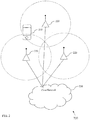
- FIG. 2 illustrates one exemplary Long Term Evolution (LTE) cellular network 200, with user equipment (UEs) 210, operating within the coverage of the Radio Access Network (RAN) provided by a number of base stations (BSs) 220.
- LTE base stations are commonly referred to as "Enhanced NodeBs" (eNBs).
- eNBs Enhanced NodeBs
- the Radio Access Network (RAN) is the collective body of eNBs along with the Radio Network Controllers (RNC).
- RNC Radio Network Controllers
- the user interfaces to the RAN via the UE, which in many typical usage cases is a cellular phone or smartphone.
- the terms “UE”, “client device”, and “user device” may include, but are not limited to, cellular telephones, smartphones (such as for example an iPhone TM manufactured by the Assignee hereof), personal computers (PCs), such as for example an iMac TM , Mac Pro TM , Mac Mini TM or MacBook TM , and minicomputers, whether desktop, laptop, or otherwise, as well as mobile devices such as handheld computers, PDAs, personal media devices (PMDs), such as for example an iPod TM , or any combinations of the foregoing.
- smartphones such as for example an iPhone TM manufactured by the Assignee hereof
- PCs personal computers
- PMDs personal media devices
- iPod TM any combinations of the foregoing.
- Each of the eNBs 220 are directly coupled to the Core Network 230 e.g., via broadband access. Additionally, in some networks the eNBs may coordinate with one another, via secondary access.
- the Core Network provides both routing and service capabilities. For example, a first UE connected to a first eNB can communicate with a second UE connected to a second eNB, via routing through the Core Network. Similarly, a UE can access other types of services e.g., the Internet, via the Core Network.
- DRX discontinuous reception
- DTX discontinuous transmission
- the UE monitors for control and traffic packets of interest, and also performs measurement of neighboring cells. Neighboring cell measurements are important for cell re-selection and handover decisions. Neighbor cell measurements are used by the network to optimize mobility management in wireless networks using the same wireless technology, or for handovers to different wireless technologies. For example, one common measurement is the received signal power (both pilot signals and data signals) of neighboring cells. When the neighboring cell received signal power is equivalent or exceeds the current serving cell, the device or network may trigger a handover or cell re-selection.
- the UE performs its radio measurements each time the UE powers on in its DRX cycle.
- the radio transceiver consumes a significant amount of power during neighbor cell measurements. This additional radio transceiver activity reduces the power savings of DRX operation that would otherwise be achievable. Accordingly, improved schemes for managing radio measurements during discontinuous reception are needed.
- a user equipment (UE) device staggers the distribution of DRX measurements across multiple DRX cycles to reduce the transceiver activity and power consumption during each individual DRX cycle. Staggering neighbor cell measurements improves overall power consumption by reducing the length of time that the user equipment remains in the DRX ON state. Specifically, rather than performing all cell measurements at each DRX ON state, the UE only performs a subset of the measurements. During each DRX cycle, the UE measures a different subset of measurements, such that the cumulative measurements encompass all DRX measurements required by the network.
- the staggered measurements may also be handled differently in different conditions. For example, measurements may be staggered differently when the UE operates in different DRX operating modes (e.g., low-power DRX mode and high-power DRX mode). Similarly, measurements may be staggered differently based on physical layer (PHY) key performance indicators (KPI) such as: signal to noise ratios (SNR) of synchronization signals, frequency errors, or gain control state for neighbor cells, etc.
- PHY physical layer
- KPI key performance indicators
- LTE Long Term Evolution
- eNB Enhanced NodeB
- UE user equipment
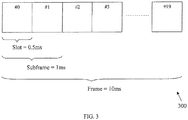
- LTE communications are conducted according to a time schedule that includes frames, subframes, and slots.
- a time schedule that includes frames, subframes, and slots.
- FIG. 3 One such exemplary LTE frame 300 is illustrated in FIG. 3 .
- the UE When the UE has a radio resource connection, the UE can be allocated one or more time slots for communication. If a UE is enabled for DRX operation in RRC connected mode, the UE will wake-up and sleep in accordance with its resource allocations. During RRC idle mode, the UE does not have a radio resource connection. The UE will periodically wake-up to see if it is being paged within a frame of data. If the frame does not have a page for the UE, the UE will go back to sleep.
- a DRX inactivity timer indicates the time in number of consecutive subframes to wait before enabling DRX. Additionally, DRX operation is split into short cycles and long cycles. Short DRX cycles and long DRX cycles allow the eNB to adjust the DRX cycles based on ongoing application activity. For example, a UE may initially be placed in a short DRX cycle during brief lulls in activity. A DRX short cycle timer determines when to transition to the long DRX cycle; i.e., if the DRX short cycle timer expires without any UE activity, the UE transitions to the long DRX cycle which further reduces power consumption.
- the eNB may release the RRC connection. Once the UE transitions into RRC IDLE state, idle mode DRX is enabled.
- an ON duration timer determines the number of frames (each frame lasts 10ms) the UE can sleep through before reading the downlink (DL) control channel. Commonly used values for the ON duration timer are 1, 2, 3, 4, 5, 6, 8, 10, 20, 30, 40, 50, 60, 80, 100, and 200.
- the UE only needs to monitor one paging occasion (PO) per DRX cycle, which is one subframe. It is of particular note, that the DRX ON duration is distinct from cellular measurement requirements. In other words, changing a DRX ON duration does not affect the required periodicity for cell measurements (as described hereinafter).
- the UE can also perform radio cell measurements.
- the radio cell measurements are reported by the UE to the radio access network (RAN); the RAN uses measurement data for mobility capabilities (e.g., cell re-selection, and handovers).
- mobility capabilities e.g., cell re-selection, and handovers.
- Accurate measurement data ensures that the UE is continuously being serviced by the optimal cell.
- Serving cell measurements measure the signal strength of the serving cell that the UE is camped on. Serving cell measurements are generally measured more often and used in comparisons with other measurements as a baseline.
- Intra-frequency cell measurements are performed on neighbor cells that are within the same frequency as the serving cell.
- the UE can initiate measurements of intra-frequency neighbor cells when the serving cell's received reference signal power (RSRP) or received signal quality (RSRQ) falls below pre-determined thresholds. Because intra-frequency cell measurements occur in the same frequency as the serving cell, the radio transceiver does not need to be tuned to a different frequency.
- RSRP received reference signal power
- RSSQ received signal quality
- Inter-frequency cell measurements are performed in frequencies that differ from the UE's serving cell. For this reason, UEs must tune away from the serving cell to perform inter-frequency cell measurements.
- inter-frequency cell measurements may also be performed where timing is not synchronized for inter-frequency cells; this may require some "overhead" time for the UE to search the inter-frequency cell to synchronize timing, and then measure the received signal power and quality.
- Inter-RAT cell measurements are performed between different radio access technologies (e.g., between Global Standard for Mobile Communications (GSM), Universal Mobile Telecommunications System (UMTS), and Long Term Evolution (LTE), Code Division Multiple Access (CDMA) 2000, etc.).
- GSM Global Standard for Mobile Communications
- UMTS Universal Mobile Telecommunications System
- LTE Long Term Evolution
- CDMA Code Division Multiple Access 2000, etc.
- the quality of the serving cell is above a certain threshold (e.g., S NonIntraSearch in LTE)
- the UE if the serving cell quality is less than the threshold ( S NonIntraSearch ), then the UE searches and measures all inter-RAT cells.
- Inter-RAT measurements are the most complex measurements; inter-RAT measurements require a radio frequency search and a baseband cell-search.
- the overhead for an inter-RAT cell measurement is generally higher than the overhead time of either intra-frequency measurements, or inter-frequency measurements.
- a user equipment (UE) device staggers its discontinuous reception (DRX) measurements for power saving. Specifically, the UE adaptively distributes one or more measurements into multiple DRX cycles so as to both satisfy the measurement requirements and also distribute the measurement cost (e.g., measurement time and overhead) for each individual DRX cycle.
- DRX discontinuous reception
- the UE has a minimum periodicity threshold that requires that all measurements are made at least once within a time period (e.g., 1.28 seconds), where the time period spans multiple DRX cycles (e.g., a DRX cycle having an ON duration timer stipulates wake-up for 10 ms and sleep for 30 ms, with a periodicity of 40ms).
- a DRX cycle having an ON duration timer stipulates wake-up for 10 ms and sleep for 30 ms, with a periodicity of 40ms.
- the UE can perform cell measurements more frequently to get better measurement granularity, and/or assign a DRX measurement to a specific DRX cycle.
- FIG. 4 one scenario for distributing measurements across multiple DRX cycles is depicted. As shown, eight (8) intra-frequency measurements are distributed over two (2) DRX cycles which reduce the power consumption of each individual DRX cycle. While intra-frequency measurements are shown (which do not require any additional overhead for cell search and RF tuning), it is appreciated that other measurements (and their associated overhead timing costs) may be readily substituted by one of ordinary skill in the related arts, given the contents of the present disclosure.
- FIG. 5 depicts a second scenario for distributing measurements across multiple DRX cycles. Unlike the scenario of FIG. 4, FIG. 5 distributes measurements based on physical layer (PHY) key performance indicators (KPI).
- PHY physical layer
- KPI key performance indicators
- the PHY is a low level software abstraction layer that handles the interface to the physical medium (i.e., the air interface). Examples of PHY layer interactions include for example, modulation and coding schemes, power control, etc. Common examples of KPI include for example, signal to noise ratio (SNR) for synchronization signals (which is determined during initial searching), frequency error, power control states, etc.
- SNR signal to noise ratio
- the UE At low SNR values, the UE has an increased probability of misinterpreting a neighbor cell (i.e., mistakenly identifying a neighbor cell); at high SNR values, the UE can reliably and accurately perform cell measurements. As shown in FIG. 5 , the number of neighbor cell measurements is adaptively scheduled for DRX cycles according to the overall signal quality (e.g., the quality of the KPIs).
- the UE may include an optimization engine, dynamically determining the optimal distribution of measurements to DRX cycles. Such embodiments may optimize the DRX cycle for making cell measurements based on e.g., type of measurement, network conditions, user preferences, network preferences, application preferences, network capabilities, device capabilities, measurement utility, device mode, etc.
- the UE may store a pre-determined mapping table to simplify distribution of measurements to DRX cycles. While a mapping table may not provide a perfectly optimized assignment of measurements to DRX cycles, mapping tables can be simply implemented within memory and do not add any substantial processing burden. For example, one such mapping table may receive the number and type of measurement operation, and based on KPI index values, map the measurements to a number of DRX cycles.
- a UE may include multiple power modes that consume different levels of power with different processing capabilities.
- the UE can operate in two power modes during DRX cycles: a high power mode, and a low power mode.
- the UE powers all the circuitry including the RF, analog components, baseband, clocks and processors, etc.
- the UE can perform signal processing for all the receiver algorithms, thus the UE consumes more power but has improved receiver capabilities and better measurement accuracy for neighbor cell measurements
- the UE's low power mode only enables transceiver circuitry for a short amount time to receive data for baseband processing. After the received data is captured and stored in sample buffers, the RF and analog parts are turned off and the receiving algorithms will be applied onto the captured samples in an offline mode.
- low power mode there is less power consumption, however receiver algorithms can only be applied to a limited number of data, thus the results of the modulation and decoding of the received signals is less reliable compared to the high power mode.
- cell measurements during DRX cycles can additionally be staggered in accordance with the power modes of the UE. For example, if the physical layer (PHY) key performance indicators (KPIs) are good, more neighbor measurements can be done during the DRX cycles using low power mode so as to maximize power savings with good DL reception. Conversely, if the PHY KPIs are bad, the neighbor measurements need to be in high power mode to ensure that the neighbor measurements are accurate.
- PHY physical layer
- KPIs key performance indicators
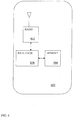
- FIG. 6 an exemplary user device apparatus 600 for managing radio measurements during discontinuous reception is illustrated. While one specific device configuration and layout is shown and discussed herein, it is recognized that many other configurations may be readily implemented by one of ordinary skill given the present disclosure, the apparatus 600 of FIG. 6 being merely illustrative of the broader principles of the disclosure.
- the apparatus 600 of FIG. 6 includes one or more radio transceivers 602, a computer readable memory 604, and a processing subsystem 606.
- the processing subsystem 606 includes one or more of central processing units (CPU) or digital processors, such as a microprocessor, digital signal processor, field-programmable gate array, RISC core, or plurality of processing components mounted on one or more substrates.
- the processing subsystem is coupled to computer readable memory 604, which may include for example SRAM, FLASH, SDRAM, and/or HDD (Hard Disk Drive) components.
- computer readable memory 604 may include for example SRAM, FLASH, SDRAM, and/or HDD (Hard Disk Drive) components.
- the term "memory” includes any type of integrated circuit or other storage device adapted for storing digital data including, without limitation, ROM. PROM, EEPROM, DRAM, SDRAM, DDR/2 SDRAM, EDO/FPMS, RLDRAM, SRAM, "flash” memory (e.g., NAND/NOR), and PSRAM.
- the processing subsystem may also comprise additional co-processors, such as a dedicated graphics accelerator, network processor (NP), or audio/video processor.
- processing subsystem 606 includes discrete components; however, it is understood that in some embodiments they may be consolidated or fashioned in a SoC (system-on-chip) configuration.
- the processing subsystem 606 is adapted to receive one or more data streams from a radio transceiver 602.
- the radio transceiver in this exemplary embodiment generally comprises a cellular radio transceiver configured to perform radio measurements during discontinuous reception.
- the radio measurements are performed so as to minimize measurement loading during each DRX cycle.
- the radio measurements are performed for example according to a schedule determined based on one or more physical layer (PHY) key performance indicators (KPI).
- PHY physical layer
- KPI key performance indicators
- the radio measurements are performed according to a schedule determined based on device operation mode.
- the foregoing scheduling logic for the DRX cycles is implemented in the storage device 604 as a computer program that "intelligently" manages and schedules cell measurements, although it will be appreciated that the scheduling functionality may be implemented in hardware (logic) or firmware, or as combinations of the foregoing.
Landscapes
- Engineering & Computer Science (AREA)
- Computer Networks & Wireless Communication (AREA)
- Signal Processing (AREA)
- Quality & Reliability (AREA)
- Physics & Mathematics (AREA)
- Electromagnetism (AREA)
- Mobile Radio Communication Systems (AREA)
Claims (11)
- Un procédé de fonctionnement d'un dispositif d'équipement utilisateur, UE, (210), le procédé comprenant :la détermination d'une ou plusieurs mesures radio à réaliser (102) dans une pluralité de cycles de réception discontinus, les mesures individuelles des une ou plusieurs mesures radio ayant une périodicité minimale qui leur est associée ;la détermination d'une planification (104) pour réaliser les une ou plusieurs mesures radio dans la pluralité de cycles de réception discontinus ; etl'exécution des une ou plusieurs mesures radio (106) en fonction de la planification déterminée, dans lequel :les une ou plusieurs mesures radio sont distribuées sur la pluralité de cycles de réception discontinus ;les mesures individuelles des une ou plusieurs mesures radio comprennent une mesure partielle, la mesure partielle étant caractérisée par une énergie réduite consommée par le dispositif d'UE par rapport à une mesure radio complète ;la réalisation des une ou plusieurs mesures radio fournit des données de mesure pouvant être obtenues avec la mesure radio complète ; etl'exécution des une ou plusieurs mesures radio en fonction de la planification déterminée réduit l'énergie consommée par le dispositif d'UE pendant l'obtention des données de mesure.
- Le procédé de la revendication 1, dans lequel :
les une ou plusieurs mesures radio (106) qui sont exécutées en fonction de la planification déterminée sont basées au moins en partie sur un ou plusieurs indicateurs de performance, PI. - Le procédé de la revendication 2, dans lequel :le dispositif d'UE (210) est utilisable dans un mode de forte puissance d'émission, HP, et un mode de faible puissance d'émission, le mode HP étant caractérisé par une consommation de puissance qui est supérieure à celle du mode LP ; etla distribution des une ou plusieurs mesures radio sur la base des un ou plusieurs indicateurs de performance comprend :
quand l'un ou plusieurs PI est au-dessus d'un seuil, une planification d'une pluralité de mesures successives des une ou plusieurs mesures radio dans le mode LP ; et quand l'un ou plusieurs PI est au-dessous du seuil, une planification de la pluralité de mesures successives des une ou plusieurs mesures radio dans le mode HP. - Le procédé de la revendication 3, dans lequel le PI comprend un ou plusieurs parmi i) un rapport signal/bruit, SNR, pour un signal de synchronisation ; ii) une erreur de fréquence ; et iii) un état de contrôle de puissance attribué par une station de base (220) à l'UE (210).
- Le procédé de la revendication 2, dans lequel la distribution des une ou plusieurs mesures radio sur la pluralité de cycles de réception discontinus comprend :la distribution des une ou plusieurs mesures radio sur un premier nombre de la pluralité de cycles de réception discontinus sur la base du fait qu'un ou plusieurs PI dépassent un seuil ;la distribution des une ou plusieurs mesures radio sur un deuxième nombre de la pluralité de cycles de réception discontinus sur la base du fait qu'un ou plusieurs PI sont au-dessous du seuil ; etdans lequel le premier nombre est supérieur au deuxième nombre.
- Le procédé de la revendication 1, dans lequel les une ou plusieurs mesures radio comprennent une ou plusieurs parmi : des mesures de cellule de desserte, des mesures de cellule intra-fréquence, des mesures de cellule inter-fréquence et/ou des mesures de cellule inter-technologie d'accès radio, inter-RAT.
- Le procédé de la revendication 1, dans lequel les une ou plusieurs mesures radio sont distribuées uniformément sur la pluralité de cycles de réception discontinus.
- Le procédé de la revendication 7, dans lequel les une ou plusieurs mesures radio sont distribuées uniformément sur la pluralité de cycles de réception discontinus sur la base d'un mode de fonctionnement de l'UE.
- Le procédé de la revendication 1, dans lequel le procédé de fonctionnement réduit une consommation d'énergie par l'UE (210) associée à la détermination des une ou plusieurs mesures radio.
- Appareil lisible par ordinateur comprenant un moyen de stockage et ayant une pluralité d'instructions lisibles par ordinateur stockées dessus, moyennant quoi un ou plusieurs dispositifs d'équipement utilisateur, UE, (210) sont utilisables dans un réseau de communications sans fil cellulaire d'évolution à long terme, LTE, pour économiser une énergie associée à une pluralité de cycles de réception discontinus, les instructions lisibles par ordinateur, quand elles sont exécutées, amènent les un ou plusieurs dispositifs d'UE à :déterminer une ou plusieurs mesures radio à réaliser dans des cycles individuels de la pluralité de cycles de réception discontinus ;déterminer une planification pour réaliser les une ou plusieurs mesures radio dans la pluralité de cycles de réception discontinus ; etexécuter les une ou plusieurs mesures radio en fonction de la planification déterminée, dans lequel :les une ou plusieurs mesures radio sont distribuées sur la pluralité de cycles de réception discontinus ;les mesures individuelles des une ou plusieurs mesures radio comprennent une mesure partielle, la mesure partielle étant caractérisée par une énergie réduite consommée par le dispositif d'UE par rapport à une mesure radio complète ;la réalisation des une ou plusieurs mesures radio fournit des données de mesure pouvant être obtenues avec la mesure radio complète ; etl'exécution des une ou plusieurs mesures radio en fonction de la planification déterminée réduit l'énergie consommée par le dispositif d'UE pendant l'obtention des données de mesure.
- Un dispositif d'équipement utilisateur, UE, le dispositif d'UE (210) comprenant :des moyens pour déterminer une ou plusieurs mesures radio à réaliser dans des cycles individuels d'une pluralité de cycles de réception discontinus, les mesures individuelles des une ou plusieurs mesures radio ayant une périodicité minimale qui leur est associée ;des moyens pour déterminer une planification pour réaliser les une ou plusieurs mesures radio dans la pluralité de cycles de réception discontinus ; etdes moyens pour exécuter les une ou plusieurs mesures radio en fonction de la planification déterminée, dans lequel :les une ou plusieurs mesures radio sont distribuées sur la pluralité de cycles de réception discontinus ;les mesures individuelles des une ou plusieurs mesures radio comprennent une mesure partielle, la mesure partielle étant caractérisée par une énergie réduite consommée par le dispositif d'UE par rapport à une mesure radio complète ;la réalisation des une ou plusieurs mesures radio fournit des données de mesure pouvant être obtenues avec la mesure radio complète ; etl'exécution des une ou plusieurs mesures radio en fonction de la planification déterminée réduit l'énergie consommée par le dispositif d'UE pendant de l'obtention des données de mesure.
Applications Claiming Priority (3)
| Application Number | Priority Date | Filing Date | Title |
|---|---|---|---|
| US201261585209P | 2012-01-10 | 2012-01-10 | |
| US13/627,936 US9066261B2 (en) | 2012-01-10 | 2012-09-26 | Methods and apparatus for managing radio measurements during discontinuous reception |
| PCT/US2013/020889 WO2013106473A1 (fr) | 2012-01-10 | 2013-01-09 | Procédés et appareil de gestion de mesures d'appareils récepteurs pendant une réception discontinue |
Publications (2)
| Publication Number | Publication Date |
|---|---|
| EP2803232A1 EP2803232A1 (fr) | 2014-11-19 |
| EP2803232B1 true EP2803232B1 (fr) | 2019-10-23 |
Family
ID=47833334
Family Applications (1)
| Application Number | Title | Priority Date | Filing Date |
|---|---|---|---|
| EP13707935.6A Active EP2803232B1 (fr) | 2012-01-10 | 2013-01-09 | Procédés et appareil de gestion de mesures d'appareils récepteurs pendant une réception discontinue |
Country Status (7)
| Country | Link |
|---|---|
| US (2) | US9066261B2 (fr) |
| EP (1) | EP2803232B1 (fr) |
| JP (1) | JP5843977B2 (fr) |
| KR (2) | KR101978544B1 (fr) |
| CN (1) | CN104160754B (fr) |
| TW (1) | TWI482513B (fr) |
| WO (1) | WO2013106473A1 (fr) |
Families Citing this family (24)
| Publication number | Priority date | Publication date | Assignee | Title |
|---|---|---|---|---|
| US9479955B2 (en) * | 2012-03-30 | 2016-10-25 | Qualcomm Incorporated | Dynamic measurement rates to speed up cell reselections |
| CN104285391B (zh) * | 2012-05-04 | 2018-05-15 | 瑞典爱立信有限公司 | 用于控制干扰的方法和基站 |
| US20160044541A1 (en) * | 2013-04-05 | 2016-02-11 | Nokia Technologies Oy | Relaxed performance requirements for offloading measurements |
| CN105453638B (zh) | 2013-08-07 | 2019-03-22 | 瑞典爱立信有限公司 | 针对包括自主封闭订户组csg小区搜索和重选的小区重选过程的对测量时间的要求的配置 |
| WO2015144258A1 (fr) | 2014-03-24 | 2015-10-01 | Telefonaktiebolaget L M Ericsson (Publ) | Procédé et terminal pour des recherches de cellules du système gsm |
| US9301257B2 (en) | 2014-05-15 | 2016-03-29 | Apple Inc. | Adaptive physical layer warm-up for LTE TDD C-DRX power optimization |
| US9804664B2 (en) | 2014-05-27 | 2017-10-31 | Qualcomm Incorporated | Adaptive control of RF low power modes in a multi-rate wireless system using MCS value |
| US9781673B2 (en) | 2014-05-27 | 2017-10-03 | Qualcomm Incorporated | Adaptive control of RF low power modes in a multi-rate wireless system using device mode |
| US9998934B2 (en) | 2014-05-29 | 2018-06-12 | Apple Inc. | Device and method for idle mode power saving |
| US10412651B2 (en) * | 2014-08-28 | 2019-09-10 | Apple Inc. | User equipment triggered handover with long connected-discontinuous-reception cycle in connected mode |
| US9462600B2 (en) * | 2014-09-08 | 2016-10-04 | Qualcomm Incorporated | Time budget management for WLAN and WWAN processing for inter-frequency/inter-rat measurements for LTE |
| US10356839B2 (en) | 2014-11-04 | 2019-07-16 | Qualcomm Incorporated | Low power discontinuous reception with a second receiver |
| US20160295636A1 (en) * | 2015-04-01 | 2016-10-06 | Qualcomm Incorporated | User equipment based connected discontinuous reception inter radio access technology measurement |
| US20170026948A1 (en) * | 2015-07-20 | 2017-01-26 | Qualcomm Incorporated | Inter-radio access technology measurement scheduling during connected mode discontinuous reception duration |
| US20170026861A1 (en) * | 2015-07-20 | 2017-01-26 | Mediatek Inc. | Measurement Enhancements for LTE Systems |
| CN106658541B (zh) * | 2015-10-30 | 2019-07-02 | 展讯通信(上海)有限公司 | 移动终端及其小区测量方法 |
| CN106658553B (zh) * | 2015-10-30 | 2020-03-20 | 展讯通信(上海)有限公司 | 移动终端及其异系统小区测量方法 |
| DE102015122184B4 (de) * | 2015-12-18 | 2022-06-09 | Apple Inc. | Verfahren zum Lösen von Konflikten in der Planung von Zellen-Rundsendenachrichtenempfang und Leerlaufbetriebsartaufgaben einer mobilen Vorrichtung |
| CN109952788B (zh) * | 2016-09-30 | 2022-03-29 | 诺基亚通信公司 | 基于机器类型通信物理下行链路控制信道监测的增强型机器类型通信无线电资源管理要求 |
| US10327170B2 (en) | 2017-03-13 | 2019-06-18 | Qualcomm Incorporated | Radio link monitoring without always-on reference signals |
| CN109246826B (zh) * | 2017-06-16 | 2021-06-22 | 华为技术有限公司 | Drx配置方法、终端设备、网络设备和通信系统 |
| US11252669B2 (en) * | 2018-07-25 | 2022-02-15 | Qualcomm Incorporated | Selective extension of an active period of a DRX cycle for reselection |
| CN114616869B (zh) * | 2019-11-08 | 2024-08-30 | 中兴通讯股份有限公司 | 省电技术 |
| US20250159606A1 (en) | 2022-02-18 | 2025-05-15 | Continental Automotive Technologies GmbH | Inter-drx assistance method for operating a user equipment (ue) |
Citations (1)
| Publication number | Priority date | Publication date | Assignee | Title |
|---|---|---|---|---|
| US20100130214A1 (en) * | 2007-07-24 | 2010-05-27 | Jagdeep Singh Ahluwalia | Drx configuration |
Family Cites Families (9)
| Publication number | Priority date | Publication date | Assignee | Title |
|---|---|---|---|---|
| TW411690B (en) | 1998-02-20 | 2000-11-11 | Koninkl Philips Electronics Nv | A power consumption reduction method in a digital mobile radio system and a mobile radio station |
| US8451803B2 (en) | 2007-10-05 | 2013-05-28 | Qualcomm Incorporated | Methods and apparatus for managing measurement behavior of DRX mode UE |
| MX2010008406A (es) * | 2008-01-31 | 2010-11-30 | Interdigital Patent Holdings | Metodo y aparato para llevar a cabo la recepcion discontinua y medidas de tecnologia de acceso a inter-radio e inter-frecuencia de enlace descendente en estado cell_fach. |
| US8824347B2 (en) * | 2008-10-17 | 2014-09-02 | Telefonaktiebolaget L M Ericsson (Publ) | Method for improving battery life and HARQ retransmissions in wireless communications systems |
| WO2010122771A1 (fr) * | 2009-04-20 | 2010-10-28 | パナソニック株式会社 | Dispositif de terminal de communication sans fil, dispositif de station de base de communication sans fil et procédé de communication sans fil |
| CN102036348B (zh) * | 2009-09-30 | 2014-01-01 | 中兴通讯股份有限公司 | 一种不连续接收配置方法及系统 |
| US9693299B2 (en) * | 2009-11-30 | 2017-06-27 | Nokia Technology Oy | Method and apparatus for power saving operations in wireless network elements |
| CN103748833B (zh) * | 2011-08-01 | 2017-10-03 | 英特尔公司 | 对于网络接入控制的方法和系统 |
| EP2745550B1 (fr) * | 2011-08-15 | 2017-06-28 | Telefonaktiebolaget LM Ericsson (publ) | Procédés et noeuds permettant de gérer des mesures dans un système de communication sans fil |
-
2012
- 2012-09-26 US US13/627,936 patent/US9066261B2/en active Active
-
2013
- 2013-01-09 KR KR1020167015331A patent/KR101978544B1/ko not_active Expired - Fee Related
- 2013-01-09 CN CN201380012646.5A patent/CN104160754B/zh active Active
- 2013-01-09 WO PCT/US2013/020889 patent/WO2013106473A1/fr not_active Ceased
- 2013-01-09 JP JP2014552271A patent/JP5843977B2/ja not_active Expired - Fee Related
- 2013-01-09 KR KR1020147022315A patent/KR101631782B1/ko not_active Expired - Fee Related
- 2013-01-09 EP EP13707935.6A patent/EP2803232B1/fr active Active
- 2013-01-10 TW TW102100957A patent/TWI482513B/zh not_active IP Right Cessation
-
2015
- 2015-06-08 US US14/733,351 patent/US9572062B2/en active Active
Patent Citations (1)
| Publication number | Priority date | Publication date | Assignee | Title |
|---|---|---|---|---|
| US20100130214A1 (en) * | 2007-07-24 | 2010-05-27 | Jagdeep Singh Ahluwalia | Drx configuration |
Also Published As
| Publication number | Publication date |
|---|---|
| TWI482513B (zh) | 2015-04-21 |
| JP5843977B2 (ja) | 2016-01-13 |
| US9066261B2 (en) | 2015-06-23 |
| JP2015507427A (ja) | 2015-03-05 |
| WO2013106473A1 (fr) | 2013-07-18 |
| US20150271697A1 (en) | 2015-09-24 |
| KR101978544B1 (ko) | 2019-05-14 |
| CN104160754A (zh) | 2014-11-19 |
| TW201342963A (zh) | 2013-10-16 |
| KR20140112070A (ko) | 2014-09-22 |
| CN104160754B (zh) | 2018-02-27 |
| KR20160069525A (ko) | 2016-06-16 |
| KR101631782B1 (ko) | 2016-06-17 |
| EP2803232A1 (fr) | 2014-11-19 |
| US9572062B2 (en) | 2017-02-14 |
| US20130279353A1 (en) | 2013-10-24 |
Similar Documents
| Publication | Publication Date | Title |
|---|---|---|
| EP2803232B1 (fr) | Procédés et appareil de gestion de mesures d'appareils récepteurs pendant une réception discontinue | |
| US9980225B2 (en) | Methods and apparatus for power saving in discontinuous reception-adaptive neighbor cell search duration | |
| CN114339868B (zh) | Rrm测量方法及用户设备 | |
| CN104081834B (zh) | 用于改善无线网络中功率消耗的方法及装置 | |
| WO2020029230A1 (fr) | Configuration dynamique de c-drx pour un équilibre entre économies d'énergie et rendement de communication, et utilisation de dci pour activer des composantes porteuses | |
| EP3145097A1 (fr) | Gestion de puissance dans une transmission multiporteuse | |
| CN106465276A (zh) | 使用设备模式对多速率无线系统中的rf低功率模式进行自适应控制 | |
| US20170094713A1 (en) | Aligning measurement gap with drx wakeup period | |
| CN117099388A (zh) | Rrm测量活动报告和使用 | |
| US20140204772A1 (en) | Background public land mobile network search | |
| WO2023173310A1 (fr) | Mécanisme de positionnement amélioré | |
| US20260059449A1 (en) | Cell re-selection enhancements | |
| US20150071089A1 (en) | Devices and methods for decreasing awake state durations in access terminals operating in a slotted idle mode | |
| KR20250136182A (ko) | 다중 네트워크 환경 무선 자원 모니터링 장치 및 방법 |
Legal Events
| Date | Code | Title | Description |
|---|---|---|---|
| PUAI | Public reference made under article 153(3) epc to a published international application that has entered the european phase |
Free format text: ORIGINAL CODE: 0009012 |
|
| 17P | Request for examination filed |
Effective date: 20140617 |
|
| AK | Designated contracting states |
Kind code of ref document: A1 Designated state(s): AL AT BE BG CH CY CZ DE DK EE ES FI FR GB GR HR HU IE IS IT LI LT LU LV MC MK MT NL NO PL PT RO RS SE SI SK SM TR |
|
| DAX | Request for extension of the european patent (deleted) | ||
| STAA | Information on the status of an ep patent application or granted ep patent |
Free format text: STATUS: EXAMINATION IS IN PROGRESS |
|
| 17Q | First examination report despatched |
Effective date: 20170411 |
|
| RAP1 | Party data changed (applicant data changed or rights of an application transferred) |
Owner name: APPLE INC. |
|
| GRAP | Despatch of communication of intention to grant a patent |
Free format text: ORIGINAL CODE: EPIDOSNIGR1 |
|
| STAA | Information on the status of an ep patent application or granted ep patent |
Free format text: STATUS: GRANT OF PATENT IS INTENDED |
|
| RIC1 | Information provided on ipc code assigned before grant |
Ipc: H04B 17/30 20150101ALN20190627BHEP Ipc: H04W 52/02 20090101AFI20190627BHEP |
|
| INTG | Intention to grant announced |
Effective date: 20190717 |
|
| GRAS | Grant fee paid |
Free format text: ORIGINAL CODE: EPIDOSNIGR3 |
|
| GRAA | (expected) grant |
Free format text: ORIGINAL CODE: 0009210 |
|
| STAA | Information on the status of an ep patent application or granted ep patent |
Free format text: STATUS: THE PATENT HAS BEEN GRANTED |
|
| AK | Designated contracting states |
Kind code of ref document: B1 Designated state(s): AL AT BE BG CH CY CZ DE DK EE ES FI FR GB GR HR HU IE IS IT LI LT LU LV MC MK MT NL NO PL PT RO RS SE SI SK SM TR |
|
| REG | Reference to a national code |
Ref country code: GB Ref legal event code: FG4D |
|
| REG | Reference to a national code |
Ref country code: CH Ref legal event code: EP |
|
| REG | Reference to a national code |
Ref country code: IE Ref legal event code: FG4D |
|
| REG | Reference to a national code |
Ref country code: DE Ref legal event code: R096 Ref document number: 602013061950 Country of ref document: DE |
|
| REG | Reference to a national code |
Ref country code: AT Ref legal event code: REF Ref document number: 1195113 Country of ref document: AT Kind code of ref document: T Effective date: 20191115 |
|
| REG | Reference to a national code |
Ref country code: NL Ref legal event code: MP Effective date: 20191023 |
|
| REG | Reference to a national code |
Ref country code: LT Ref legal event code: MG4D |
|
| PG25 | Lapsed in a contracting state [announced via postgrant information from national office to epo] |
Ref country code: LV Free format text: LAPSE BECAUSE OF FAILURE TO SUBMIT A TRANSLATION OF THE DESCRIPTION OR TO PAY THE FEE WITHIN THE PRESCRIBED TIME-LIMIT Effective date: 20191023 Ref country code: ES Free format text: LAPSE BECAUSE OF FAILURE TO SUBMIT A TRANSLATION OF THE DESCRIPTION OR TO PAY THE FEE WITHIN THE PRESCRIBED TIME-LIMIT Effective date: 20191023 Ref country code: SE Free format text: LAPSE BECAUSE OF FAILURE TO SUBMIT A TRANSLATION OF THE DESCRIPTION OR TO PAY THE FEE WITHIN THE PRESCRIBED TIME-LIMIT Effective date: 20191023 Ref country code: NL Free format text: LAPSE BECAUSE OF FAILURE TO SUBMIT A TRANSLATION OF THE DESCRIPTION OR TO PAY THE FEE WITHIN THE PRESCRIBED TIME-LIMIT Effective date: 20191023 Ref country code: LT Free format text: LAPSE BECAUSE OF FAILURE TO SUBMIT A TRANSLATION OF THE DESCRIPTION OR TO PAY THE FEE WITHIN THE PRESCRIBED TIME-LIMIT Effective date: 20191023 Ref country code: GR Free format text: LAPSE BECAUSE OF FAILURE TO SUBMIT A TRANSLATION OF THE DESCRIPTION OR TO PAY THE FEE WITHIN THE PRESCRIBED TIME-LIMIT Effective date: 20200124 Ref country code: NO Free format text: LAPSE BECAUSE OF FAILURE TO SUBMIT A TRANSLATION OF THE DESCRIPTION OR TO PAY THE FEE WITHIN THE PRESCRIBED TIME-LIMIT Effective date: 20200123 Ref country code: PL Free format text: LAPSE BECAUSE OF FAILURE TO SUBMIT A TRANSLATION OF THE DESCRIPTION OR TO PAY THE FEE WITHIN THE PRESCRIBED TIME-LIMIT Effective date: 20191023 Ref country code: PT Free format text: LAPSE BECAUSE OF FAILURE TO SUBMIT A TRANSLATION OF THE DESCRIPTION OR TO PAY THE FEE WITHIN THE PRESCRIBED TIME-LIMIT Effective date: 20200224 Ref country code: BG Free format text: LAPSE BECAUSE OF FAILURE TO SUBMIT A TRANSLATION OF THE DESCRIPTION OR TO PAY THE FEE WITHIN THE PRESCRIBED TIME-LIMIT Effective date: 20200123 Ref country code: FI Free format text: LAPSE BECAUSE OF FAILURE TO SUBMIT A TRANSLATION OF THE DESCRIPTION OR TO PAY THE FEE WITHIN THE PRESCRIBED TIME-LIMIT Effective date: 20191023 |
|
| PG25 | Lapsed in a contracting state [announced via postgrant information from national office to epo] |
Ref country code: HR Free format text: LAPSE BECAUSE OF FAILURE TO SUBMIT A TRANSLATION OF THE DESCRIPTION OR TO PAY THE FEE WITHIN THE PRESCRIBED TIME-LIMIT Effective date: 20191023 Ref country code: IS Free format text: LAPSE BECAUSE OF FAILURE TO SUBMIT A TRANSLATION OF THE DESCRIPTION OR TO PAY THE FEE WITHIN THE PRESCRIBED TIME-LIMIT Effective date: 20200224 Ref country code: RS Free format text: LAPSE BECAUSE OF FAILURE TO SUBMIT A TRANSLATION OF THE DESCRIPTION OR TO PAY THE FEE WITHIN THE PRESCRIBED TIME-LIMIT Effective date: 20191023 |
|
| PG25 | Lapsed in a contracting state [announced via postgrant information from national office to epo] |
Ref country code: AL Free format text: LAPSE BECAUSE OF FAILURE TO SUBMIT A TRANSLATION OF THE DESCRIPTION OR TO PAY THE FEE WITHIN THE PRESCRIBED TIME-LIMIT Effective date: 20191023 |
|
| REG | Reference to a national code |
Ref country code: DE Ref legal event code: R097 Ref document number: 602013061950 Country of ref document: DE |
|
| PG2D | Information on lapse in contracting state deleted |
Ref country code: IS |
|
| PG25 | Lapsed in a contracting state [announced via postgrant information from national office to epo] |
Ref country code: RO Free format text: LAPSE BECAUSE OF FAILURE TO SUBMIT A TRANSLATION OF THE DESCRIPTION OR TO PAY THE FEE WITHIN THE PRESCRIBED TIME-LIMIT Effective date: 20191023 Ref country code: CZ Free format text: LAPSE BECAUSE OF FAILURE TO SUBMIT A TRANSLATION OF THE DESCRIPTION OR TO PAY THE FEE WITHIN THE PRESCRIBED TIME-LIMIT Effective date: 20191023 Ref country code: EE Free format text: LAPSE BECAUSE OF FAILURE TO SUBMIT A TRANSLATION OF THE DESCRIPTION OR TO PAY THE FEE WITHIN THE PRESCRIBED TIME-LIMIT Effective date: 20191023 Ref country code: DK Free format text: LAPSE BECAUSE OF FAILURE TO SUBMIT A TRANSLATION OF THE DESCRIPTION OR TO PAY THE FEE WITHIN THE PRESCRIBED TIME-LIMIT Effective date: 20191023 Ref country code: IS Free format text: LAPSE BECAUSE OF FAILURE TO SUBMIT A TRANSLATION OF THE DESCRIPTION OR TO PAY THE FEE WITHIN THE PRESCRIBED TIME-LIMIT Effective date: 20200223 |
|
| REG | Reference to a national code |
Ref country code: DE Ref legal event code: R119 Ref document number: 602013061950 Country of ref document: DE |
|
| REG | Reference to a national code |
Ref country code: AT Ref legal event code: MK05 Ref document number: 1195113 Country of ref document: AT Kind code of ref document: T Effective date: 20191023 |
|
| PLBE | No opposition filed within time limit |
Free format text: ORIGINAL CODE: 0009261 |
|
| STAA | Information on the status of an ep patent application or granted ep patent |
Free format text: STATUS: NO OPPOSITION FILED WITHIN TIME LIMIT |
|
| PG25 | Lapsed in a contracting state [announced via postgrant information from national office to epo] |
Ref country code: SK Free format text: LAPSE BECAUSE OF FAILURE TO SUBMIT A TRANSLATION OF THE DESCRIPTION OR TO PAY THE FEE WITHIN THE PRESCRIBED TIME-LIMIT Effective date: 20191023 Ref country code: IT Free format text: LAPSE BECAUSE OF FAILURE TO SUBMIT A TRANSLATION OF THE DESCRIPTION OR TO PAY THE FEE WITHIN THE PRESCRIBED TIME-LIMIT Effective date: 20191023 Ref country code: SM Free format text: LAPSE BECAUSE OF FAILURE TO SUBMIT A TRANSLATION OF THE DESCRIPTION OR TO PAY THE FEE WITHIN THE PRESCRIBED TIME-LIMIT Effective date: 20191023 Ref country code: MC Free format text: LAPSE BECAUSE OF FAILURE TO SUBMIT A TRANSLATION OF THE DESCRIPTION OR TO PAY THE FEE WITHIN THE PRESCRIBED TIME-LIMIT Effective date: 20191023 |
|
| REG | Reference to a national code |
Ref country code: CH Ref legal event code: PL |
|
| GBPC | Gb: european patent ceased through non-payment of renewal fee |
Effective date: 20200123 |
|
| 26N | No opposition filed |
Effective date: 20200724 |
|
| REG | Reference to a national code |
Ref country code: BE Ref legal event code: MM Effective date: 20200131 |
|
| PG25 | Lapsed in a contracting state [announced via postgrant information from national office to epo] |
Ref country code: LU Free format text: LAPSE BECAUSE OF NON-PAYMENT OF DUE FEES Effective date: 20200109 Ref country code: GB Free format text: LAPSE BECAUSE OF NON-PAYMENT OF DUE FEES Effective date: 20200123 Ref country code: FR Free format text: LAPSE BECAUSE OF NON-PAYMENT OF DUE FEES Effective date: 20200131 Ref country code: DE Free format text: LAPSE BECAUSE OF NON-PAYMENT OF DUE FEES Effective date: 20200801 |
|
| PG25 | Lapsed in a contracting state [announced via postgrant information from national office to epo] |
Ref country code: CH Free format text: LAPSE BECAUSE OF NON-PAYMENT OF DUE FEES Effective date: 20200131 Ref country code: SI Free format text: LAPSE BECAUSE OF FAILURE TO SUBMIT A TRANSLATION OF THE DESCRIPTION OR TO PAY THE FEE WITHIN THE PRESCRIBED TIME-LIMIT Effective date: 20191023 Ref country code: BE Free format text: LAPSE BECAUSE OF NON-PAYMENT OF DUE FEES Effective date: 20200131 Ref country code: AT Free format text: LAPSE BECAUSE OF FAILURE TO SUBMIT A TRANSLATION OF THE DESCRIPTION OR TO PAY THE FEE WITHIN THE PRESCRIBED TIME-LIMIT Effective date: 20191023 Ref country code: LI Free format text: LAPSE BECAUSE OF NON-PAYMENT OF DUE FEES Effective date: 20200131 |
|
| PG25 | Lapsed in a contracting state [announced via postgrant information from national office to epo] |
Ref country code: IE Free format text: LAPSE BECAUSE OF NON-PAYMENT OF DUE FEES Effective date: 20200109 |
|
| PG25 | Lapsed in a contracting state [announced via postgrant information from national office to epo] |
Ref country code: TR Free format text: LAPSE BECAUSE OF FAILURE TO SUBMIT A TRANSLATION OF THE DESCRIPTION OR TO PAY THE FEE WITHIN THE PRESCRIBED TIME-LIMIT Effective date: 20191023 Ref country code: MT Free format text: LAPSE BECAUSE OF FAILURE TO SUBMIT A TRANSLATION OF THE DESCRIPTION OR TO PAY THE FEE WITHIN THE PRESCRIBED TIME-LIMIT Effective date: 20191023 Ref country code: CY Free format text: LAPSE BECAUSE OF FAILURE TO SUBMIT A TRANSLATION OF THE DESCRIPTION OR TO PAY THE FEE WITHIN THE PRESCRIBED TIME-LIMIT Effective date: 20191023 |
|
| PG25 | Lapsed in a contracting state [announced via postgrant information from national office to epo] |
Ref country code: MK Free format text: LAPSE BECAUSE OF FAILURE TO SUBMIT A TRANSLATION OF THE DESCRIPTION OR TO PAY THE FEE WITHIN THE PRESCRIBED TIME-LIMIT Effective date: 20191023 |