EP2803281A2 - Veste avec ventilateur - Google Patents
Veste avec ventilateur Download PDFInfo
- Publication number
- EP2803281A2 EP2803281A2 EP14167100.8A EP14167100A EP2803281A2 EP 2803281 A2 EP2803281 A2 EP 2803281A2 EP 14167100 A EP14167100 A EP 14167100A EP 2803281 A2 EP2803281 A2 EP 2803281A2
- Authority
- EP
- European Patent Office
- Prior art keywords
- jacket
- air
- heat
- wearer
- area
- Prior art date
- Legal status (The legal status is an assumption and is not a legal conclusion. Google has not performed a legal analysis and makes no representation as to the accuracy of the status listed.)
- Withdrawn
Links
- 238000005192 partition Methods 0.000 claims abstract description 19
- 238000011068 loading method Methods 0.000 claims abstract description 17
- 238000012546 transfer Methods 0.000 claims abstract description 6
- 239000012528 membrane Substances 0.000 claims description 17
- 230000004044 response Effects 0.000 claims description 2
- 230000003213 activating effect Effects 0.000 claims 1
- 239000000463 material Substances 0.000 description 45
- 238000003860 storage Methods 0.000 description 33
- 239000004744 fabric Substances 0.000 description 30
- 230000032258 transport Effects 0.000 description 18
- 238000004146 energy storage Methods 0.000 description 14
- 239000000126 substance Substances 0.000 description 14
- 239000011810 insulating material Substances 0.000 description 11
- 230000000694 effects Effects 0.000 description 10
- 239000007788 liquid Substances 0.000 description 10
- 210000004705 lumbosacral region Anatomy 0.000 description 9
- 230000008859 change Effects 0.000 description 8
- 239000010408 film Substances 0.000 description 8
- XLYOFNOQVPJJNP-UHFFFAOYSA-N water Chemical compound O XLYOFNOQVPJJNP-UHFFFAOYSA-N 0.000 description 8
- 238000009413 insulation Methods 0.000 description 7
- 230000005855 radiation Effects 0.000 description 7
- 239000007787 solid Substances 0.000 description 7
- 230000036760 body temperature Effects 0.000 description 6
- 230000015654 memory Effects 0.000 description 6
- 210000004243 sweat Anatomy 0.000 description 6
- 230000002776 aggregation Effects 0.000 description 5
- 238000004220 aggregation Methods 0.000 description 5
- 239000002775 capsule Substances 0.000 description 5
- 210000000038 chest Anatomy 0.000 description 5
- 238000005516 engineering process Methods 0.000 description 5
- 230000006870 function Effects 0.000 description 5
- 239000003094 microcapsule Substances 0.000 description 5
- 230000002411 adverse Effects 0.000 description 4
- XAGFODPZIPBFFR-UHFFFAOYSA-N aluminium Chemical compound [Al] XAGFODPZIPBFFR-UHFFFAOYSA-N 0.000 description 4
- 229910052782 aluminium Inorganic materials 0.000 description 4
- 230000005540 biological transmission Effects 0.000 description 4
- 238000010276 construction Methods 0.000 description 4
- 238000009826 distribution Methods 0.000 description 4
- 230000002195 synergetic effect Effects 0.000 description 4
- 239000004753 textile Substances 0.000 description 4
- 229920001410 Microfiber Polymers 0.000 description 3
- 230000015572 biosynthetic process Effects 0.000 description 3
- 230000005670 electromagnetic radiation Effects 0.000 description 3
- 239000011888 foil Substances 0.000 description 3
- 238000004519 manufacturing process Methods 0.000 description 3
- 230000035699 permeability Effects 0.000 description 3
- 239000012782 phase change material Substances 0.000 description 3
- 238000009423 ventilation Methods 0.000 description 3
- 239000002250 absorbent Substances 0.000 description 2
- 230000009056 active transport Effects 0.000 description 2
- 210000000481 breast Anatomy 0.000 description 2
- 239000000969 carrier Substances 0.000 description 2
- 238000005338 heat storage Methods 0.000 description 2
- 230000003993 interaction Effects 0.000 description 2
- 239000003658 microfiber Substances 0.000 description 2
- 238000013021 overheating Methods 0.000 description 2
- 230000035515 penetration Effects 0.000 description 2
- 238000011160 research Methods 0.000 description 2
- 238000010792 warming Methods 0.000 description 2
- 239000001993 wax Substances 0.000 description 2
- 208000027418 Wounds and injury Diseases 0.000 description 1
- 230000002745 absorbent Effects 0.000 description 1
- 238000010521 absorption reaction Methods 0.000 description 1
- 230000009471 action Effects 0.000 description 1
- 230000003044 adaptive effect Effects 0.000 description 1
- 238000005273 aeration Methods 0.000 description 1
- 238000004378 air conditioning Methods 0.000 description 1
- 230000008901 benefit Effects 0.000 description 1
- 239000011248 coating agent Substances 0.000 description 1
- 238000000576 coating method Methods 0.000 description 1
- 238000001816 cooling Methods 0.000 description 1
- 230000008878 coupling Effects 0.000 description 1
- 238000010168 coupling process Methods 0.000 description 1
- 238000005859 coupling reaction Methods 0.000 description 1
- 230000006378 damage Effects 0.000 description 1
- 230000003247 decreasing effect Effects 0.000 description 1
- 230000001419 dependent effect Effects 0.000 description 1
- 238000000151 deposition Methods 0.000 description 1
- 238000013461 design Methods 0.000 description 1
- 238000011161 development Methods 0.000 description 1
- 230000018109 developmental process Effects 0.000 description 1
- UODXSCCNACAPCE-UHFFFAOYSA-N draft:flumetramide Chemical compound C1=CC(C(F)(F)F)=CC=C1C1OCC(=O)NC1 UODXSCCNACAPCE-UHFFFAOYSA-N 0.000 description 1
- 238000001035 drying Methods 0.000 description 1
- 230000009977 dual effect Effects 0.000 description 1
- 230000007613 environmental effect Effects 0.000 description 1
- 230000001747 exhibiting effect Effects 0.000 description 1
- 239000000835 fiber Substances 0.000 description 1
- 208000014674 injury Diseases 0.000 description 1
- 239000012774 insulation material Substances 0.000 description 1
- 239000012212 insulator Substances 0.000 description 1
- 238000005259 measurement Methods 0.000 description 1
- 238000000034 method Methods 0.000 description 1
- 238000002156 mixing Methods 0.000 description 1
- 239000000203 mixture Substances 0.000 description 1
- 239000004745 nonwoven fabric Substances 0.000 description 1
- 239000012188 paraffin wax Substances 0.000 description 1
- 239000002245 particle Substances 0.000 description 1
- 239000004033 plastic Substances 0.000 description 1
- 229920003023 plastic Polymers 0.000 description 1
- 229920000728 polyester Polymers 0.000 description 1
- 229920000642 polymer Polymers 0.000 description 1
- 230000008569 process Effects 0.000 description 1
- 230000003304 psychophysiological effect Effects 0.000 description 1
- 238000004080 punching Methods 0.000 description 1
- 230000008929 regeneration Effects 0.000 description 1
- 238000011069 regeneration method Methods 0.000 description 1
- 239000005871 repellent Substances 0.000 description 1
- 238000012827 research and development Methods 0.000 description 1
- 238000000926 separation method Methods 0.000 description 1
- 230000008093 supporting effect Effects 0.000 description 1
- 239000010409 thin film Substances 0.000 description 1
- 230000007704 transition Effects 0.000 description 1
- 230000036642 wellbeing Effects 0.000 description 1
Images


Classifications
-
- A—HUMAN NECESSITIES
- A41—WEARING APPAREL
- A41D—OUTERWEAR; PROTECTIVE GARMENTS; ACCESSORIES
- A41D27/00—Details of garments or of their making
- A41D27/28—Means for ventilation
-
- A—HUMAN NECESSITIES
- A41—WEARING APPAREL
- A41D—OUTERWEAR; PROTECTIVE GARMENTS; ACCESSORIES
- A41D13/00—Professional, industrial or sporting protective garments, e.g. surgeons' gowns or garments protecting against blows or punches
- A41D13/002—Professional, industrial or sporting protective garments, e.g. surgeons' gowns or garments protecting against blows or punches with controlled internal environment
- A41D13/0025—Professional, industrial or sporting protective garments, e.g. surgeons' gowns or garments protecting against blows or punches with controlled internal environment by means of forced air circulation
-
- A—HUMAN NECESSITIES
- A41—WEARING APPAREL
- A41D—OUTERWEAR; PROTECTIVE GARMENTS; ACCESSORIES
- A41D13/00—Professional, industrial or sporting protective garments, e.g. surgeons' gowns or garments protecting against blows or punches
- A41D13/002—Professional, industrial or sporting protective garments, e.g. surgeons' gowns or garments protecting against blows or punches with controlled internal environment
- A41D13/005—Professional, industrial or sporting protective garments, e.g. surgeons' gowns or garments protecting against blows or punches with controlled internal environment with controlled temperature
-
- A—HUMAN NECESSITIES
- A41—WEARING APPAREL
- A41D—OUTERWEAR; PROTECTIVE GARMENTS; ACCESSORIES
- A41D31/00—Materials specially adapted for outerwear
- A41D31/04—Materials specially adapted for outerwear characterised by special function or use
- A41D31/12—Hygroscopic; Water retaining
-
- A—HUMAN NECESSITIES
- A41—WEARING APPAREL
- A41D—OUTERWEAR; PROTECTIVE GARMENTS; ACCESSORIES
- A41D31/00—Materials specially adapted for outerwear
- A41D31/04—Materials specially adapted for outerwear characterised by special function or use
- A41D31/14—Air permeable, i.e. capable of being penetrated by gases
- A41D31/145—Air permeable, i.e. capable of being penetrated by gases using layered materials
-
- A—HUMAN NECESSITIES
- A41—WEARING APPAREL
- A41D—OUTERWEAR; PROTECTIVE GARMENTS; ACCESSORIES
- A41D3/00—Overgarments
Definitions
- the invention relates to a garment for outerwear in the form of a jacket, in particular a cold or winter jacket.
- Jackets especially cold or winter jackets, have the task of protecting the wearer from the cold.
- a jacket is usually for a certain temperature range of the ambient temperature, e.g. -15 ° C to -25 ° C, designed. In this temperature range, the jacket usually provides the wearer with a comfortable wearing climate for heat and moisture inside the jacket. In other words, the wearer is then neither too cold nor too warm, and he remains warm and dry, i. does not sweat in the jacket.
- the object of the present invention is to specify an improved jacket which is better suited, in particular, for the abovementioned purpose of use.
- a jacket according to claim 1, which has an inner skin and an outer skin. Between inner skin and outer skin, a food area is enclosed.
- the jacket has at least one partition. Each partition wall extends between the outer skin and the inner skin. The extension takes place in such a way that each dividing wall separates the feed area into respective chambers, generally two, located on either side of the dividing wall. In other words, the respective chambers are completely separated by the partitions, a direct connection between the chambers does not exist.
- the jacket also contains at least one fan. Each of the fans is arranged either in the outer skin, in the inner skin or in one of the partitions.
- each fan With respect to its conveying direction for air, each fan is oriented in such a way that it conveys air through the respective outer skin, inner skin or dividing wall in which it is arranged.
- the air is not conveyed through the partition itself, etc., but rather through the parting plane or outer or inner surface of the jacket stretched by the partition, etc., at the location of the ventilator.
- the fan is arranged, for example, in the outer skin, it promotes air between the outer space of the jacket and the respective, located on the inside of the fan chamber of the jacket.
- a fan is located in a dividing wall, it conveys air between the two chambers, which adjoin the dividing wall at the location of the ventilator.
- the fans serve to produce a desired microclimate in each of the chambers conveyed by the fans with air (in or out).
- the fans perform a variety of functions, such as excess warm air of the jacket to be transported away from one of the chambers to the outside or to transport the heat distribution in the jacket warm air from one of the chambers in an adjacent chamber.
- moisture for drying moisture (humid air) can be discharged from a chamber into the outer space or cold air to be introduced from the outer space into a chamber for cooling.
- all the fans are individually and independently operable with variable, ie desired rotational speed or delivery rate.
- the jacket includes a control unit which is suitable for controlling the fans.
- a control unit which is suitable for controlling the fans.
- all fans in the jacket can be centrally or jointly and yet individually controlled with regard to their functionality and operated in particular synergistically in order to be able to produce a desired micro-climate in all ventilated chambers which are ventilated by the fans.
- the synergistic effect is achieved that different microclimatic conditions can be produced in different chambers, which is why a targeted microclimatic control is produced in the entire jacket or in all ventilatable chambers.
- the jacket also contains at least one sensor which communicates with the control unit.
- the control unit is then designed such that it can perform its control tasks in response to an output signal from the sensor.
- the sensor can detect measurements inside the jacket or outdoors.
- Conceivable sensors are, for example, heat, humidity, light or radiation sensors, eg for determining the strength of the solar radiation.
- regulation in the controller can also be realized via feedback, i. the corresponding microclimate in the chamber in question is then e.g. adjusted to a setpoint.
- a sufficient number of fans are placed in suitably selected locations of the jacket so that all of the chambers of the jacket are ventilated, i. be vented or vented by at least one of the fans.
- all chambers of the jacket are ventilated.
- this is achieved, for example, in that there is at least one ventilatorically operated connection between in each case two different chambers. This can either exist directly between the chambers or via the detour of an interposed third or more further chambers.
- the microclimate of all chambers of the jacket and thus the entire jacket can be influenced by the fans.
- At least one of the partitions is at least partially formed as a membrane.
- Membranes are characterized by the fact that in their two directions of penetration directed perpendicularly to their flat side, they have certain selective, partly also direction-dependent, different permeabilities for different media, for example water vapor. As a result, for example, a preferred direction for the transport of a certain medium between two adjacent chambers created and thus accomplished a targeted microclimate control in the chambers.
- the membrane functionality does not result in a complete climatic separation between the chambers adjacent to the membrane, but a functional coupling in the sense of the membrane. For example, then steam can pass from a first chamber through the membrane in a second chamber, but without passing water vapor in the opposite direction.
- fundamentally different climatic conditions in adjacent chambers already by the Membrane functionality can be designed without the additional use of a fan, with the use of a fan in the membrane-containing partition corresponding membrane functionalities can be enhanced, supported or supplemented.
- the membrane is a membrane based on nanotechnology. Such membranes are particularly effective to make different microclimatic conditions in adjacent chambers.
- the jacket contains a rechargeable energy store for the fans and / or possibly the controller or sensors.
- a rechargeable energy store for the fans and / or possibly the controller or sensors.
- such energy storage can be recharged when needed with electrical energy and does not need to be replaced.
- the chargeability offers the possibility to completely integrate the energy store in the interior of the jacket and to realize a charge contactless, for example by RF transmission.
- the jacket outer and inner skin must not be interspersed with electrical contacts or cables or the like so.
- the energy storage For charging the energy storage, it is generally e.g. known to remove this from the respective destination device, here the jacket, and place it in an external charger. Also, e.g. generally known to connect via a plug-socket connection a connectable to the mains charger with power supply to the energy storage. From the equipment of the jacket with a rechargeable energy storage is therefore still the task of designing the charging of the energy storage particularly advantageous.
- the jacket can be placed relative to the charging station in a loading position.
- the loading position is usually included Non-use of the jacket taken, but can also be taken, for example, by suitably sitting a jacket wearer relative to a car seat.
- an energy source of the charging station can be connected to the energy store for energy transfer.
- the jacket system thus makes it possible, for example, to place the jacket after being worn or while being carried while driving in the loading position to the charging station and thereby to charge its energy store. Until the next time you wear the jacket or get out of the energy storage is then at least partially recharged or fully charged and the jacket thus again in terms of their electrical functionality operational.
- the charging station and jacket therefore have corresponding electrical contacts or devices which, when the jacket is placed in the loading position, are in contact for a possible transfer of energy.
- the loading position can be characterized, for example, in that electrical contacts of the jacket and the charging station come into contact with each other in a touching manner.
- the charging station has an energy transmitter for contactless energy transmission to the jacket and the jacket on a corresponding energy receiver. When placing the jacket in the loading position of the energy receiver is connected to the energy transmitter for energy transmission or connectable or is within reach of an energy transmitter (power source) of the charging station.
- the charging station in the form of a garment holder, in particular hangers, mute servant (also gentlemen), clothes rack, etc., executed.
- hangers, mute servants, etc. are usually designed so that jackets always rest in a defined position on them, as they usually support the jackets from the inside in the shoulder area or on a jacket hanger (usually a sewn into the jacket collar loop , Band or similar).
- the above-mentioned contact between the charging station and the jacket can then take place, for example, in the shoulder or collar region of the jacket.
- the loading position is achieved, for example, when the jacket with the shoulder area rests on the hanger or dumb servant.
- the invention is applied to a jacket which, according to a parallel, not yet published on the present filing date European patent application of the present applicant (file reference EP 131 75 608.2 filed on 8 July 2013 ) is executed.
- the jacket then also has the following components, which act synergistically together in the sense of an active climate control:
- active storage element heat storage
- the storage element can absorb excess body heat of the wearer when it enters warm environment.
- the wearer returns to the cold, the storage element gives heat back to the wearer.
- Temperature differences can be compensated.
- the lining region of the jacket also typically includes a heat-insulating material, e.g. Down or plastics. Air duct and storage element replace at appropriate locations or at least a portion of the insulating material or are additionally present there.
- At least part of the feed area is designed as an air channel.
- air can circulate along the food area.
- the air channel is continuous, ie designed as a single air channel, so that air can circulate freely within the jacket along its entire extension length.
- Circulating "along" the food area means circulating air in parallel between the inner and outer skin, but not perpendicular thereto, ie, through the inner or outer skin.
- the storage element is fluidly connected to the air duct in such a way that so that air can circulate between air duct and storage element.
- the storage element is at least partially disposed in the air duct.
- the synergistic effect is that air can be exchanged between different areas of the jacket covered by the air duct and so can exchange heat with the storage element.
- excess body heat from all regions of the jacket detected by the air duct can be transported to the storage element and stored there, or heat given off by the storage element can be transported into all corresponding jacket regions.
- a heat balance by the memory element is not only at the location of the memory element, but in all jacket areas, which are detected by the air duct.
- a fan in the jacket can further improve thermal regulation. This happens especially when the fan is arranged in the flow path of the air duct, that is, the air duct passes through the fan. The fan then supports or influences the delivery of air through the air duct active, for example, by increasing or decreasing the airflow. The climate control will be further improved.
- a plurality of fans may be provided along the air duct to ensure safe and effective air transport along the entire length of the air duct. Additional fans can therefore not only in the inner and outer skin and partitions, but also in other structural elements of the jacket described here. as may be provided, for example, the air duct to support their respective air transport functionality.
- a heat reflector is arranged on that side of the lining region which faces the outer skin, which reflects heat toward the inner skin.
- the shoulder portion of the jacket is that portion that covers the upper portion of the back and chest of a wearer of the jacket.
- This aspect of the invention is based on the realization that the heat radiation of persons in the shoulder area is greatest. Due to the heat reflector, heat emitted by the body is reflected back to the body in this area and thus remains inside the jacket.
- the synergy effect consists in the fact that the reflector in cold outside temperatures causes an additional heat effect, since the radiated heat as soon as it reaches the area of an air duct, distributed in the jacket and can be used to warm the body.
- the reflected heat does not result in local overheating and therefore e.g. Moisture formation, since body heat from the shoulder area, as soon as it reaches the air duct, transported to the storage element and can be recorded there. This can also be improved by the use of a fan when the body heat is actively transported as hot air from the shoulder area to the storage element.
- the inner skin is designed as an active transport element.
- the active transport element transports moisture, which is present in the interior of the jacket or arises there during wear, into the feed area.
- the middle lumbar region is the jacket area in which when carrying the lumbar spine of the wearer is.
- the underarm area is the area of the jacket that is located in the area of the wearers armpits when worn. The invention is based in this regard on the knowledge that the underarm and lumbar region is that region of the jacket on which perspiration first occurs at the wearer when it becomes too warm. However, moisture in the jacket reduces its thermal insulation property in the cold.
- the synergy effect is that the resulting moisture in the jacket at the critical points mentioned inside the jacket is removed and as soon as it reaches the air duct, is distributed along with the circulating air over a large area in the jacket. This allows moisture to diffuse out of the jacket over a large area.
- the wearer stays dry when it is in (too) warm environment.
- the next change to the cold the jacket still has its full insulating effect against the cold due to the dryness.
- This measure also promotes a pleasant wearing comfort of the jacket in the warm area, as resulting body moisture is dissipated and can form any damp spots on the jacket or underwear of the wearer.
- the next change to the cold area so remain no damp and thus unpleasant cold spots where the heat insulation properties would be lost.
- this function can be improved or enhanced by using a fan by the fan supports the moisture transport by active removal of moist air.
- the jacket according to the invention is based on the finding that different human body parts, ie body parts of the wearer react differently to high and low ambient temperatures or a corresponding temperature change. For this reason, in the development of the lining of the jacket, which is arranged in the feed area, and the inner skin and outer skin advanced modern fabrics were used. In addition, it was considered to position the materials with regard to their climate-functional technologies so that different thermal zones of the body are served differently.
- the climate control in the jacket is thus based on the principle to create an air volume in the air duct and this circulate.
- the storage element serves as a "motor" for air circulation. Through the use of fans, the air circulation is further improved or strengthened, which enhances the effect of the described synergetic effects.
- the storage element contains a storage medium whose heat storage properties are based on a change in its state of aggregation.
- a storage medium whose heat storage properties are based on a change in its state of aggregation.
- An example of this is e.g. Waxes exhibiting phase transitions in the range of body temperature of a wearer (e.g., in the range of between 20 ° C and 40 ° C) where the state of aggregation is changed.
- the waxes mentioned melt or solidify at these temperatures.
- Such memory elements are particularly suitable for garments and therefore easy to integrate in a jacket.
- Such storage media or storage elements are also commercially available.
- the heat reflector contains a perforated, heat-reflecting film, in particular an aluminum foil.
- the perforated film has good heat-reflecting properties, but the perforation also allows body moisture of the wearer to diffuse away from the body, so that the formation of moisture in the jacket is also reduced in the area of application of the heat reflector.
- the lining region of the jacket is at least partially filled with an insulating material which allows air circulation in its interior, at least in one direction parallel to the inner and outer skin.
- the insulating material then fulfills a dual purpose, namely on the one hand the actual heat insulation and on the other hand the formation of at least part of the air duct.
- the entire feed area if it is filled with the insulating material, can be used as an air channel for air circulation.
- Such an insulating material is, for example, an insulating material formed from air-filled microcells. Just for this embodiment, it lends itself, as described above, sufficient To provide many fans in the jacket to actively ventilate the entire food area.
- the air duct extends from the storage element into the shoulder area and / or as far as the transport elements.
- the reflected heat thus reaches the air duct directly and can be distributed in the jacket as described above.
- the expansion of the air channel to the transport elements out causes the moisture transported away directly reaches the air duct and is dissipated or distributed over this together with circulating air particularly fast and effective as described above.
- the inner skin is additionally designed as a transport element at least in a part of the back region of the jacket and / or in the flank region of the jacket.
- further jacket areas are provided with transport elements to effectively transport body moisture secreted by the wearer into the interior of the jacket.
- the back and flank area are also areas where there is usually an increased production of moisture. It is particularly advantageous if the air duct then extends to the relevant jacket areas in which the transport elements are located. Then again a particularly effective removal of body moisture, as explained above.
- a ventilator arranged at the relevant point of the inner skin here supports or improves the removal of body moisture from the body through the inner skin to the interior of the jacket.
- the food area in the shoulder region of the jacket is made with a greater thickness than in the remaining areas of the jacket.
- the thickness here is the distance between the inner and outer skin transversely to the expansion or extension surface. This creates a supporting effect for the heat reflector.
- a particularly thick heat-insulating food area counteracts heat loss radiation here again.
- the food area in the arm region of the jacket is made smaller in thickness than in the remaining areas of the jacket.
- This embodiment in particular favors the use of the jacket for motor vehicle drivers, which require particularly great flexibility on the arms. Since, according to the invention, the heat radiation of the body is also comparatively low on the arms, hardly any negative effect on the thermal properties of the jacket occurs here.
- the storage element is arranged in the middle and / or lower back region (middle and lower back region of the wearer) and / or in the middle chest region of the jacket (wearer's breast).
- the arrangement of particularly large-area storage elements is possible in the areas mentioned, since these jacket areas are generally nearly flat and have a large surface area.
- these areas of the jacket thus cover much of the hull of the jacket wearer with active storage elements.
- the storage element can interact directly with the body there to ensure effective heat transfer.
- the air channel is formed by a 3D-structured, dimensionally stable material, which in particular has cavities open towards the inside of the jacket.
- 3D-strukuriert and “dimensionally stable” is to be understood here in terms of clothing fabrics: The material has at least such a strength that this deforms only slightly in the usual state of load when wearing a jacket and at least not nearly disappearing volume of material.
- the moisture-critical regions namely the armpit and lumbar spine regions of the wearer
- the moisture can be effectively transported away in a voluminous air duct and, for example, the air duct is not deformed even if the jacket wearer is in a motor vehicle a corresponding one Seat takes a seat.
- the end of the air duct open towards the inside of the jacket thus forms the above-mentioned transport element for moisture.
- a fan may therefore also be provided in the 3D-structured material in order to improve its air transportability.
- the outer skin of the jacket is wind and water-repellent and vapor-permeable to the outside.
- the additional function of the jacket in addition to the climate control to provide wind and weather protection and still be breathable.
- a temperature measuring device is provided in the jacket, which measures the temperature at at least one point in the interior of the jacket.
- the temperature measuring device is a thermometer mounted in the region of the inner skin, in particular a flexible strip thermometer.
- strip thermometers are commercially available, can be easily used in garments and form because of their flexibility no source of danger for injury to the wearer.
- the jacket contains at least one pocket, wherein an electromagnetic shielding element is arranged between the pocket and the interior of the jacket. If a device which emits electromagnetic radiation, for example a mobile telephone, is located in the pocket, the screen element keeps the electromagnetic radiation away from the wearer of the jacket and thus protects it from the radiation.
- an electromagnetic shielding element is arranged between the pocket and the interior of the jacket.
- the jacket has at least one pocket in which at least one parallelepiped article having a flat side diagonal of at least about 12 cm, preferably at least about 26 cm and further preferably at least about 33 cm [measures approximately 5, 10 and 13 inches], is fully absorbable at a sheet aspect ratio between 3: 4 and 16:10 and a thickness of at least about 1 cm, preferably at least about 3cm, ie Takes place.
- the dimensions correspond to commercially available smartphones and / or tablet PCs, which are thus completely in the pocket receivable. In particular, people working in the above industries (courier / delivery service, etc.) frequently carry such equipment as work equipment and can thus fit into the jacket.
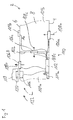
- FIG. 1 shows a cross section of a section of a jacket 2, which has an inner skin 4 and an outer skin 6.
- Inner skin 4 and outer skin 6 enclose a food area 8 between them.
- the jacket 2 also includes a dividing wall 102 which extends between the inner skin 4 and the outer skin 6 and thereby separates the food area 8 into two chambers 104a, 104b located on either side of the dividing wall 102.
- a first fan 106a is arranged, which is suitable to convey air. Its conveying direction 108a (indicated by an arrow) points from the outer space 110 to the chamber 104b. In other words, during operation, the fan 106a conveys air from the outer space 110 into the chamber 104b.
- a fan 106b is also included. Whose conveying direction 108b leads from the chamber 104a to the outer space 110.
- a third fan 106c is included in the partition wall 102. Its delivery direction 108c is switchably directed from chamber 104a into chamber 104b or from chamber 104b into chamber 104a. Thus, optionally, air can be transported from one chamber to the other in the desired directions.
- a control unit 112 which is electrically connected to the respective fans 106a-c to control them as needed, i. put into operation.
- the jacket 2 also includes a sensor 114, which communicates with the control unit 112 via an electrical connection line. Via the connecting line, it transmits its output signal Aa to the control unit 112. The same applies to a second sensor 114b and its output signal Ab.
- jacket 2 shown with two chambers 104a, 104b are therefore sufficiently many fans 106a-c integrated, that all chambers 104a, b are ventilated, that are targeted besström with air.
- the jacket 2 also includes an energy storage 116 which supplies power to both fans 106a-c and sensors 114a, b and controller 112 for operation thereof.
- a charging station 118 is indicated, in FIG. 1 the jacket 2 is arranged in a loading position L relative to the loading station 118.
- An energy source 120 of the charging station 118 is in the Charging position L connected to the energy storage 116 for power transmission, so that the energy storage 116 can be charged.
- the connection is indicated by dashed lines to symbolize a contacted or contactless connection.
- Jacket 2 and charging station 118 thus form a jacket system 122.
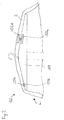
- FIG. 2 shows an alternative jacket system 122, in which the charging station 118 in the form of a garment, here a hanger or dumb servant (each indicated by dashed lines) formed on which the jacket 2 - here when not in use - can be stored.
- the jacket By essentially independently aligning the jacket shoulders on the counterparts of the clothes holder, the jacket “automatically” gets into the loading position L shown when depositing or can be easily adjusted by a user in this.
- FIG. 2 shows two alternative embodiments for charging the energy accumulator 116, not shown: In a first alternative, mutually corresponding contacts 124a, b are provided on the jacket 2 and on the charging station 118, respectively, which contact each other in the loading position L shown.
- FIG. 2 alternatively or additionally shows a non-contact alternative with an energy transmitter 126a in the charging station 118, which leads back to the energy source 120 and a power receiver 126b in the jacket 2, which leads to the energy storage 116.
- the two components are arranged such that they are in the loading position L for non-contact energy transfer in operative connection, in FIG. 2 indicated by curved lines.
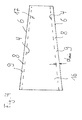
- Fig. 3 shows the interior of a partially separated jacket 2, wherein the sleeves 16 of the jacket 2 in Fig. 4 are shown.
- the jacket 2 has an in Fig. 3 visible, when wearing the wearer facing inner skin 4 and a in Fig. 3 invisible, when wearing the outer space 110 facing outer skin 6. Between the inner skin 4 and the outer skin 6, there is a food area 8 extending over the entire jacket, of which in Fig. 3 only two sections through two transparent windows 10 in the inner skin 4 visible are.
- the jacket 2 or the design of the lining was developed with findings from anthropological, hygienic and psycho-physiological research.
- the aim was to give the wearer (representative of a wearer) the jacket maximum protection against adverse weather conditions and against rapid temperature fluctuations, as they occur, for example, when getting out of a warm motor vehicle in cold outdoor temperatures, eg in winter.
- Another goal was to provide an optimal microclimate between the clothing in the form of the jacket 2 and the body of the wearer, ie by the jacket 2 to provide the necessary heat regulation and uphold.
- the jacket 2 should also provide comfort and freedom of movement for the wearer and allow their daily use without hesitation.
- Clothing can only be considered comfortable if it protects the wearer against external adverse factors (rain, snow, wind and cold) and balances internal adverse factors such as excess heat and moisture that must be transported to the outside.
- the material "Valtherm®” is arranged as insulating material 9 or main thermal insulation material. Air is the best heat insulator. Following this physical principle, an Italian research laboratory developed “Valtherm®” in its own research and development laboratories. "Valtherm®” is a wadding with honeycomb structure and differentiated density. “Valtherm®” is thus a new-generation heat-insulating material. Micropores, which consist of thousands of small boxes or particles, represent the main structure of the substance. Thanks to this technology, this substance receives the function of air-filled feed. The structure of the warming fabric allows unlimited flow of water vapor and sweat of a wearer, without changing the state of the fabric, which advantageously distinguishes the textiles thus produced from down textiles.
- Valtherm® is a nonwoven made from thousands of microscopic cells. Their cavities form an “air chamber” inside the fabric for thermal insulation. For the physical well being, the breathability of the Clothing as important as the thermal insulation capacity. Water vapor could settle between the body and the garment and reduce the effectiveness of the insulation.
- the honeycomb structure of the "Valtherm®” padding ensures immediate transport of the water vapors to the outside. From ultrafine fibers, the manufacturer of "Valtherm®” developed extremely functional wadding with reduced thickness, ie material thickness, to reconcile high performance and aesthetic appeal.
- the padding “Valtherm®” is resistant, non-deformable and tested according to Oeko-Tex Standard 100. "Valtherm®” wraps are lightweight, soft and provide an excellent fit. "Thanks to the rapid dissipation of moisture to the outside, the body temperature remains constant.
- the thickness d of the material "Valtherm®” at different points of the jacket 2 is executed differently.
- the thickness d is adapted to the physical heat regulation zones.
- the material “Valtherm®” reaches its maximum thickness d max in the shoulder region 12, ie at the shoulders of the wearer and in the lower region 14 of the jacket, because maximum heat losses occur there.
- "Valtherm®” with minimum thickness d min is placed on the sleeves 16 to give the wearer of jacket 2 more freedom of movement.
- the sleeves 16 form the arm region 17 of the jacket 2.
- the thermal insulation of the jacket 2 is based on a structure of the lining of the jacket 2 according to a zone principle, based on the distribution of the insulating material ("Valtherm®”) in the jacket 2.
- This concept is called “warm save”: Considering several heat loss zones. In the back and chest area (which have the most heat loss) “Valtherm®” is supplemented by the heat reflector 20. In the arm area “Valtherm®” of lesser thickness d min is used to provide mobility. Whether in the car or on the road, “warm save” guarantees maximum thermal protection.
- the "Warm save” concept based on “Valtherm®” fulfills the task of making jacket 2 as light and warm as possible.
- the material “Valtherm®” fulfills the following functionality and creates the following synergies with other fabrics: “Valtherm®” is first processed evenly on the entire feed in the feed area 8, in the shoulder area 12 and in the lower area 14 of the jacket 2 additional layers of "Valtherm®” attached. Thus, the necessary, sufficient thickness or density of the lining is achieved, in which the functionality of the jacket 2, i. whose climate control comes into play.
- the material "Valtherm®” interacts with additional materials: From the inner side of the lining in the back area 18 and in the shoulder area 12, "Valtherm®” is specifically brought together with additional substances. The synergistic effect with the substances used ensures the guarantee of a continuous temperature (climate) inside the jacket 2.
- a heat reflector 20 is mounted in the shoulder region 12. This is formed by a film-coated fabric.
- a so-called "Gamtagstoff” is a non-woven fabric made of 100% polyester reinforced with aluminum (in the form of an aluminum foil).
- a thin film layer is applied to the top layer of the material and perforated. The film reflects the heat radiated to the outside from the shoulders of the wearer back to the wearer. At the same time moisture can pass through the perforation in the film (for example, by punching the film web) pass the film to the outside, creating no greenhouse effect.
- a storage element 22 is arranged as a further substance in the feed area.
- the storage element 22 in this case covers the lower back region 14 and the middle region 23 of the back and breast regions of the jacket 2.
- the storage element 22 has the goal of actively compensating temperature fluctuations and is embodied here as material "Schoeller®-PCM TM". This material actively balances temperatures.
- "Schoeller®-PCM TM” are specialty textiles containing millions of microcapsules filled with so-called “phase change materials” (PCM). They balance too warm and too cold temperatures for a personal comfort climate. The details are as follows: Textiles with "Schoeller®-PCM TM” contain countless tiny microcapsules filled with Phase Change Materials (PCM).
- microcapsules respond to temperature differences by changing their state of aggregation from solid to liquid and vice versa.
- the PCM in the capsules is set to a specific temperature range at which the phase change or change of the state of matter takes place, e.g. a temperature range between 20 ° C and 40 ° C. If the body temperature of the wearer or the temperature inside the jacket, or the ambient temperature, increases, the capsules store excess heat. When the temperature drops again, they return the stored heat to the body of the wearer.
- “Schoeller®-PCM TM” offers the benefit of actively balancing warm and too cold temperatures, always providing a personal comfort climate. "Schoeller®-PCM TM” thus supports the normal insulating ability of a piece of clothing. Because even at very low ambient temperatures and at rest of the wearer whose body is kept warm for a much longer period than without using a memory element 22. In the opposite case, with strong heat influence from the outside, the body of the wearer is cooled because the incoming heat first is absorbed by the storage element 22 and so does not reach the carrier. For example, overheating inside the jacket during physical exertion is prevented.
- ComfortTemp This is a novel material developed by the Swiss company "Schoeller”. These are based on NASA's proprietary technologies designed to protect against rapid temperature changes during spacewalks. This substance consists of microcapsules. These capsules are made with a special substance, including paraffin. Parafin begins to melt as the body temperature rises, changing its state from solid to liquid. A lot of energy is processed, so that "ComfortTemp” when used in the jacket 2 e.g. acts as follows: If the wearer is in a warm vehicle, superfluous body heat is stored in the material. As the wearer leaves the vehicle and enters a cold environment, the material releases the heat. The wearer senses significantly less cold or heat, as appropriate amounts of heat are buffered by the material.
- the integrated "mPCM capsules” are therefore substances that can change their state of aggregation.
- the most famous PCM is water. Depending on the temperature, it changes the state of matter from solid to liquid to gaseous, absorbing heat or releasing heat.
- the body's temperature changes the integrated mPCM from solid to liquid and from liquid to solid. And again and again, without consuming.
- the technology dates back to the 1960s, when space suits from NASA were to be optimized. Meanwhile mPCM are used in many industrial areas. During activities or in stress situations, the body heat of persons increases. This excess heat is stored by the mPCM capsules embedded in Comfortemp®.
- the above-mentioned substances work as follows:
- the heat-reflecting or film-coated material belongs to its function to heat substances, it differs by on its surface mounted perforated aluminum foil. When wearing the jacket 2, this fabric covers the shoulder area 12 and thus also the upper part of the wearer's back and chest. These body zones are particularly sensitive to cold, so the heat reflector 20 provides optimum protection against cold.
- storage elements 22 in the form of "Schoeller® PCM TM" fabrics are attached at one or more locations. These cover the lumbar spine and the middle part of the wearer's chest when wearing the jacket 2.
- the optimal heat-functionality of the lining or jacket 2 is produced at approx. -15 ° C to -25 ° C.
- the additional substances explained below offer a well-being effect even at significantly higher or lower ambient temperatures.
- a warm environment e.g., when boarding a car, subway, or tram
- the inside of the jacket begins to rise in minutes, and the wearer experiences excessive heat and begins to sweat.
- additional sweat and moisture-wicking fabrics come into play.
- Another object to be achieved by the jacket 2 is to absorb excess moisture from the body of the wearer, e.g. forms when the wearer is in a warm motor vehicle.
- the mesh structure has the ability to quickly absorb moisture and drain it from the wearer of the jacket into the feed area 10.
- the material "Omnipel” eg its absorption capacity for moisture is about 35 times its own weight.
- the net material 24 here forms a section of the inner skin 4.
- a fleece material 26, e.g. "Aquatrans” is used in the flank region 28, i. attached laterally in the lining of the jacket 2 where e.g. the hand of the wearer presses the food to his body.
- the fleece material 26 is soft, breathable and moisture absorbent.
- “Aquatrans” consists of microfibers with capillary action and absorbs moisture and dissipates it to the outside significantly better than other comparable materials.
- the lining, in particular the inner skin 4 of the jacket 2 remains dry and therefore functional.
- the fleece 26 forms a portion of the inner skin 4.
- “Aquatrans” is a moisture wicking and breathable fabric.
- the tri-level system consisting of microfibers, thanks to a capillary effect, absorbs moisture (sweat) emitted by the body of the wearer and brings it to the surface of the jacket 2.
- moisture sweat
- Hydroplus This is a water-absorbent, high-tech polymer developed by Japanese fiber researchers. It has a special network structure and shows the ability to absorb liquid quickly and remove moisture. Its absorbency is 35 times higher than its weight.
- a transport element 33 In the armpit region 30 and in the middle lumbar region 32 of the jacket 2, ie in the region of the armpits and in the lumbar region of the wearer, another material is processed which forms part of the inner skin 4. This is a transport element 33.
- the task is to transport moisture into the feed area 8, but also to initiate heat gained in the feed area 8 in order to distribute this evenly in the lining of the jacket 2.
- This is, for example, a 3D-structured dimensionally stable 3D material 34, for example the material "Spacetec". This ensures a better air circulation inside the jacket 2, ie in the food area 8 and serves as a Remove excess heat and moisture to the outside.
- this fabric has the following multiple functional properties:
- the 3-D construction ensures good air circulation and therefore promotes the air permeability of the inner skin 4 to the food area 8.
- the 3-D structure ensures a good dimensional stability of the 3D material 34, also a shape regeneration after deformation.
- the 3D material 34 forms a kind of dimensionally stable air inlet from the interior of the jacket to the food area 8.
- the material is washable.
- the fabric does not tear and does not decompose on machine wash.
- the material is also environmentally friendly, manufactured according to ISO 14001 and can be recycled. Thanks to the construction of the 3D material 34 and the temperature differences in the jacket 2, the air circulates in all layers of the lining, thus providing optimal and even heat distribution in the jacket 2.
- an air channel 36 is formed in the jacket 2, in which air can circulate between the different areas of the jacket 2.
- the air duct is in FIG. 3 indicated only schematically by dashes, the actual course of the air duct 36 can vary as desired and extend over any jacket areas, as long as air circulation is possible. Due to the temperature difference in the upper and lower parts of the jacket, a mixture of warm and cold air in the feed area 8. The substances used and their interaction ensure by free circulation of air in the air duct 36 for aeration of the feed.
- This system may also be referred to as the "Back Ventilation System (BVS)" because air circulation occurs primarily along the back of the wearer.
- BVS Back Ventilation System
- climate control The targeted distribution of the various substances and components mentioned in jacket 2 is also referred to as climate control or "climate control”. In particular, this means the interaction of the systems “ComforTemp”, “Aquatrans”, “WarmSave” and “Back Ventilation System” meant. "Climate Control” is a kind of "air conditioning” for a jacket 2.
- the "Back Ventilation System (BVS)" acts e.g. with an increase in temperature we shall conclude:
- the area of the wearer's armpits (underarm area 30 of Jacket 2) is the highest temperature area.
- the special inserts of 3D material 34 i. 3D net-shaped fabric provided.
- the excess heat is conducted into the interior of the jacket 2, ie the food area 8.
- the circulating air impinges on the storage element 22, which either absorbs heat as needed or heats the circulating air. Excess warm air rises in the uppermost layers of the jacket 2, i. in the direction of the outer skin 6 out, and is successfully derived from the jacket by the outer fabric, so the outer skin 6.
- This is preferably formed as a membrane.
- a warming in the jacket 2 is also accompanied by increased sweat production of the wearer. Since moisture is absorbed in the lower part of the back thanks to the net material 24, a permanently dry state of the wearer's back is ensured.
- the food area 8 in the lower region of the back is separated from the remaining food area 8 of the jacket by a partition wall 102.
- a fan 106a with conveying direction 108 (two opposite directions as required) is introduced into the dividing wall.
- the circulation of air in the jacket 2 is assisted by the operation of the fan 106a in each desired conveying direction 108.
- Energy storage, sensors and control for the fan 106a are in Fig. 3 for the sake of clarity not shown.
- the outer skin 6 is formed of a functional fabric, which should provide protection against external adverse factors.
- This is eg the substance "Nano-Lite". This is one of the lightest (about 135gr / m2) and most functional three-layer fabrics.
- the three-layer construction is a top-quality product of today's fabric industry, where three different layers of fabric are glued together.
- a first layer is made of a high-density fabric. This fabric is impregnated with the special nano liquid "DWR", thanks to which water rolls off, without getting into the fabric.
- a second layer consists of a highly breathable membrane with an air permeability of more than 15000 gr./m2/24. This creates additional protection against wind and water.
- a third layer is a lightweight net that provides stability throughout the construction without reducing the air-permeable area.
- the "Nano-Lite" fabric is lightweight, highly breathable and provides protection against wind, snow and rain.
- STRONGTEX WICKING is a very tear-resistant fabric (with a tear resistance of more than 500t) with a special “WICKING” coating that absorbs body moisture and transports the liquid into the upper layers of the jacket. In addition, the fabric allows the air through the material to the body.
- a temperature gauge 37 here in the form of a thermometer 38, measures the internal temperature in the jacket 2.
- Fig. 5 shows the placed on the window 10 thermometer 38 as a flexible strip thermometer in detail. Only in each case about one of the fields 40 with respective temperature data "16 ° C” to “38 ° C” is readable in operation, when the thermometer 38 measures a corresponding temperature.
- An area 42 marks the area of a comfort temperature "COMFORT" for the interior temperature of the jacket 2.
- the jacket 2 also has anatomically shaped sleeves 16. At the collar of the jacket 2, an unillustrated, removable fur can be attached. Alternatively or additionally, there is also a removable hood attachable.
- the jacket has unspecified pockets for papers and purse.
- Another pocket 44 has a screen element 46, which in Fig. 3 only indicated schematically by dashed lines. This is arranged on the side of the pocket 44 facing the carrier.
- the bag 44 is therefore suitable, for example, as a mobile phone pocket, as radiated from the mobile phone electromagnetic radiation is kept away from the carrier by the shielding element 46.
- a sleeve 16 In the front area of a sleeve 16 is a in the Figures 3-5 not shown key pocket.
- a particularly large pocket 48 (“big pocket”) is used to hold a standard smartphone or tablet PC.
- this bag can be provided with a screen element 46, for example, to shield electromagnetic WLAN or Bluetooth radiation of the tablet PC from the wearer of the jacket 2.
- a set of tearing-resistant accessories e.g. "DURAFLEX” be provided.
- Unillustrated light reflectors offer e.g. Safety on traffic routes.
- inner cuffs at the ends of the sleeves 16 prevent the penetration of cold or snow in the sleeve 16th
- the jacket 2 is further provided with a plurality of zippers 50 and labels 52, e.g. label the manufacturer of the jacket or fabrics used in the jacket 2 or their brand names.
Landscapes
- Engineering & Computer Science (AREA)
- Textile Engineering (AREA)
- Environmental & Geological Engineering (AREA)
- Health & Medical Sciences (AREA)
- General Health & Medical Sciences (AREA)
- Physical Education & Sports Medicine (AREA)
- Professional, Industrial, Or Sporting Protective Garments (AREA)
- Purses, Travelling Bags, Baskets, Or Suitcases (AREA)
- Packages (AREA)
Priority Applications (1)
| Application Number | Priority Date | Filing Date | Title |
|---|---|---|---|
| EP14167100.8A EP2803281A3 (fr) | 2013-05-17 | 2014-05-06 | Veste avec ventilateur |
Applications Claiming Priority (3)
| Application Number | Priority Date | Filing Date | Title |
|---|---|---|---|
| DE102013105088 | 2013-05-17 | ||
| EP13175608.2A EP2803279B1 (fr) | 2013-05-17 | 2013-07-08 | Veste avec climatisation |
| EP14167100.8A EP2803281A3 (fr) | 2013-05-17 | 2014-05-06 | Veste avec ventilateur |
Publications (2)
| Publication Number | Publication Date |
|---|---|
| EP2803281A2 true EP2803281A2 (fr) | 2014-11-19 |
| EP2803281A3 EP2803281A3 (fr) | 2015-03-25 |
Family
ID=48782939
Family Applications (2)
| Application Number | Title | Priority Date | Filing Date |
|---|---|---|---|
| EP13175608.2A Not-in-force EP2803279B1 (fr) | 2013-05-17 | 2013-07-08 | Veste avec climatisation |
| EP14167100.8A Withdrawn EP2803281A3 (fr) | 2013-05-17 | 2014-05-06 | Veste avec ventilateur |
Family Applications Before (1)
| Application Number | Title | Priority Date | Filing Date |
|---|---|---|---|
| EP13175608.2A Not-in-force EP2803279B1 (fr) | 2013-05-17 | 2013-07-08 | Veste avec climatisation |
Country Status (1)
| Country | Link |
|---|---|
| EP (2) | EP2803279B1 (fr) |
Families Citing this family (1)
| Publication number | Priority date | Publication date | Assignee | Title |
|---|---|---|---|---|
| ES2571442B9 (es) | 2014-11-25 | 2017-12-26 | Mat Product & Technology, S.L. | Prenda transpirable |
Family Cites Families (9)
| Publication number | Priority date | Publication date | Assignee | Title |
|---|---|---|---|---|
| WO2003061412A2 (fr) * | 2002-01-23 | 2003-07-31 | The Manchester Metropolitan University | Vetements permettant de rechauffer ou de refroidir des parties du corps |
| WO2004006699A1 (fr) * | 2002-07-10 | 2004-01-22 | Seft Development Laboratory Co.,Ltd. | Vetements maintenant le corps au frais |
| US20070000008A1 (en) * | 2005-06-29 | 2007-01-04 | Jack Sawicki | Personal air-cooled garment apparatus |
| DE102006060990B4 (de) * | 2006-12-20 | 2010-01-07 | Entrak Energie- Und Antriebstechnik Gmbh & Co. Kg | Kleidungsstück zur Personenklimatisierung |
| US20090271917A1 (en) * | 2008-05-01 | 2009-11-05 | Lloyd Richardson | Force ventilated and heated garment |
| US20110041230A1 (en) * | 2009-08-21 | 2011-02-24 | Tex-Ray Industrial Co., Ltd. | Clothing and cloth structure thereof |
| WO2011063472A1 (fr) * | 2009-11-30 | 2011-06-03 | Brian Conolly | Matériau composite étirable, perméable à l'air et imperméable à l'eau |
| JP2014531347A (ja) * | 2011-09-23 | 2014-11-27 | コロンビア・スポーツウェア・ノース・アメリカ・インコーポレーテッド | ゾーンに分けられた機能的な布 |
| NO334690B1 (no) * | 2011-11-08 | 2014-05-12 | Hansen Helly As | Pustende klesplagg |
-
2013
- 2013-07-08 EP EP13175608.2A patent/EP2803279B1/fr not_active Not-in-force
-
2014
- 2014-05-06 EP EP14167100.8A patent/EP2803281A3/fr not_active Withdrawn
Also Published As
| Publication number | Publication date |
|---|---|
| EP2803279A3 (fr) | 2015-05-13 |
| EP2803279B1 (fr) | 2017-09-13 |
| EP2803279A2 (fr) | 2014-11-19 |
| EP2803281A3 (fr) | 2015-03-25 |
Similar Documents
| Publication | Publication Date | Title |
|---|---|---|
| ES2961607T3 (es) | Material no tejido transpirable y absorbente | |
| DE102009045931B4 (de) | Bekleidung | |
| DE69811915T2 (de) | Wasserbeständiges atmungsfähiges bekleidungsstück | |
| DE102014105487A1 (de) | Kleidungsstücke mit integriertem Mikroklima-System | |
| DE602004013226T2 (de) | Kleidungstück zum Schutz des Oberkörpers | |
| US7735149B2 (en) | Microclimate regulating garment and composite structure | |
| CN104053373A (zh) | 多层衣服 | |
| DE202010013913U1 (de) | Umhüllung mit Einfüllvorrichtung | |
| EP1280440B1 (fr) | Dispositif d'isolation thermique en surface, en particulier pour le corps humain | |
| WO2007121987A2 (fr) | Gant ventilé | |
| US8938816B2 (en) | Female pants | |
| EP1994840B1 (fr) | Vêtement avec un dispositif d'aération | |
| EP2803279B1 (fr) | Veste avec climatisation | |
| EP1555489A2 (fr) | Vêtement pour un dispositif de climatisation individuelle | |
| DE102011016482B4 (de) | Schutztextil | |
| EP2560591B1 (fr) | Dispositif de refroidissement | |
| WO2007085214A1 (fr) | Vêtement combiné pour la régulation du microclimat corporel | |
| EP2210511B1 (fr) | Guêtre ou textile à respiration active dotés d'éléments structurels répartis sur une couche de support et procédé de fabrication correspondant | |
| DE102020215713B3 (de) | Kühlvorrichtung und Kühleinheit mit mindestens einer Kühlvorrichtung | |
| DE10303152A1 (de) | Rucksack | |
| EP1350452A9 (fr) | Garniture de lit réglant la température et l'humidité | |
| DE202004008166U1 (de) | Trageband mit Temperaturspeichermedium | |
| EP2874581B1 (fr) | Enveloppement chauffant, en particulier pour chauffer des parties du corps | |
| CA2370620A1 (fr) | Chemise sport absorbant la transpiration et a tissu meche | |
| DE102024101189A1 (de) | Bekleidungssystem für einen technisch sauberen Raum |
Legal Events
| Date | Code | Title | Description |
|---|---|---|---|
| PUAI | Public reference made under article 153(3) epc to a published international application that has entered the european phase |
Free format text: ORIGINAL CODE: 0009012 |
|
| 17P | Request for examination filed |
Effective date: 20140506 |
|
| AK | Designated contracting states |
Kind code of ref document: A2 Designated state(s): AL AT BE BG CH CY CZ DE DK EE ES FI FR GB GR HR HU IE IS IT LI LT LU LV MC MK MT NL NO PL PT RO RS SE SI SK SM TR |
|
| AX | Request for extension of the european patent |
Extension state: BA ME |
|
| PUAL | Search report despatched |
Free format text: ORIGINAL CODE: 0009013 |
|
| AK | Designated contracting states |
Kind code of ref document: A3 Designated state(s): AL AT BE BG CH CY CZ DE DK EE ES FI FR GB GR HR HU IE IS IT LI LT LU LV MC MK MT NL NO PL PT RO RS SE SI SK SM TR |
|
| AX | Request for extension of the european patent |
Extension state: BA ME |
|
| RIC1 | Information provided on ipc code assigned before grant |
Ipc: A41D 27/28 20060101ALI20150213BHEP Ipc: A41D 3/00 20060101ALN20150213BHEP Ipc: A41D 13/005 20060101ALI20150213BHEP Ipc: A41D 13/002 20060101AFI20150213BHEP |
|
| STAA | Information on the status of an ep patent application or granted ep patent |
Free format text: STATUS: THE APPLICATION IS DEEMED TO BE WITHDRAWN |
|
| 18D | Application deemed to be withdrawn |
Effective date: 20150926 |