EP2803480A2 - Procédé de production de matériau plaqué multicouche - Google Patents
Procédé de production de matériau plaqué multicouche Download PDFInfo
- Publication number
- EP2803480A2 EP2803480A2 EP20140166614 EP14166614A EP2803480A2 EP 2803480 A2 EP2803480 A2 EP 2803480A2 EP 20140166614 EP20140166614 EP 20140166614 EP 14166614 A EP14166614 A EP 14166614A EP 2803480 A2 EP2803480 A2 EP 2803480A2
- Authority
- EP
- European Patent Office
- Prior art keywords
- plate
- thickness
- metallic
- laminated
- rolling
- Prior art date
- Legal status (The legal status is an assumption and is not a legal conclusion. Google has not performed a legal analysis and makes no representation as to the accuracy of the status listed.)
- Granted
Links
Images


Classifications
-
- B—PERFORMING OPERATIONS; TRANSPORTING
- B23—MACHINE TOOLS; METAL-WORKING NOT OTHERWISE PROVIDED FOR
- B23K—SOLDERING OR UNSOLDERING; WELDING; CLADDING OR PLATING BY SOLDERING OR WELDING; CUTTING BY APPLYING HEAT LOCALLY, e.g. FLAME CUTTING; WORKING BY LASER BEAM
- B23K20/00—Non-electric welding by applying impact or other pressure, with or without the application of heat, e.g. cladding or plating
- B23K20/04—Non-electric welding by applying impact or other pressure, with or without the application of heat, e.g. cladding or plating by means of a rolling mill
-
- B—PERFORMING OPERATIONS; TRANSPORTING
- B32—LAYERED PRODUCTS
- B32B—LAYERED PRODUCTS, i.e. PRODUCTS BUILT-UP OF STRATA OF FLAT OR NON-FLAT, e.g. CELLULAR OR HONEYCOMB, FORM
- B32B15/00—Layered products comprising a layer of metal
- B32B15/01—Layered products comprising a layer of metal all layers being exclusively metallic
-
- C—CHEMISTRY; METALLURGY
- C04—CEMENTS; CONCRETE; ARTIFICIAL STONE; CERAMICS; REFRACTORIES
- C04B—LIME, MAGNESIA; SLAG; CEMENTS; COMPOSITIONS THEREOF, e.g. MORTARS, CONCRETE OR LIKE BUILDING MATERIALS; ARTIFICIAL STONE; CERAMICS; REFRACTORIES; TREATMENT OF NATURAL STONE
- C04B37/00—Joining burned ceramic articles with other burned ceramic articles or other articles by heating
- C04B37/02—Joining burned ceramic articles with other burned ceramic articles or other articles by heating with metallic articles
- C04B37/021—Joining burned ceramic articles with other burned ceramic articles or other articles by heating with metallic articles in a direct manner, e.g. direct copper bonding [DCB]
-
- C—CHEMISTRY; METALLURGY
- C04—CEMENTS; CONCRETE; ARTIFICIAL STONE; CERAMICS; REFRACTORIES
- C04B—LIME, MAGNESIA; SLAG; CEMENTS; COMPOSITIONS THEREOF, e.g. MORTARS, CONCRETE OR LIKE BUILDING MATERIALS; ARTIFICIAL STONE; CERAMICS; REFRACTORIES; TREATMENT OF NATURAL STONE
- C04B37/00—Joining burned ceramic articles with other burned ceramic articles or other articles by heating
- C04B37/02—Joining burned ceramic articles with other burned ceramic articles or other articles by heating with metallic articles
- C04B37/023—Joining burned ceramic articles with other burned ceramic articles or other articles by heating with metallic articles characterised by the interlayer used
- C04B37/026—Joining burned ceramic articles with other burned ceramic articles or other articles by heating with metallic articles characterised by the interlayer used consisting of metals or metal salts
-
- B—PERFORMING OPERATIONS; TRANSPORTING
- B21—MECHANICAL METAL-WORKING WITHOUT ESSENTIALLY REMOVING MATERIAL; PUNCHING METAL
- B21B—ROLLING OF METAL
- B21B1/00—Metal-rolling methods or mills for making semi-finished products of solid or profiled cross-section; Sequence of operations in milling trains; Layout of rolling-mill plant, e.g. grouping of stands; Succession of passes or of sectional pass alternations
- B21B1/38—Metal-rolling methods or mills for making semi-finished products of solid or profiled cross-section; Sequence of operations in milling trains; Layout of rolling-mill plant, e.g. grouping of stands; Succession of passes or of sectional pass alternations for rolling sheets of limited length, e.g. folded sheets, superimposed sheets, pack rolling
- B21B2001/383—Cladded or coated products
-
- B—PERFORMING OPERATIONS; TRANSPORTING
- B23—MACHINE TOOLS; METAL-WORKING NOT OTHERWISE PROVIDED FOR
- B23K—SOLDERING OR UNSOLDERING; WELDING; CLADDING OR PLATING BY SOLDERING OR WELDING; CUTTING BY APPLYING HEAT LOCALLY, e.g. FLAME CUTTING; WORKING BY LASER BEAM
- B23K2103/00—Materials to be soldered, welded or cut
- B23K2103/16—Composite materials
- B23K2103/166—Multilayered materials
-
- C—CHEMISTRY; METALLURGY
- C04—CEMENTS; CONCRETE; ARTIFICIAL STONE; CERAMICS; REFRACTORIES
- C04B—LIME, MAGNESIA; SLAG; CEMENTS; COMPOSITIONS THEREOF, e.g. MORTARS, CONCRETE OR LIKE BUILDING MATERIALS; ARTIFICIAL STONE; CERAMICS; REFRACTORIES; TREATMENT OF NATURAL STONE
- C04B2237/00—Aspects relating to ceramic laminates or to joining of ceramic articles with other articles by heating
- C04B2237/02—Aspects relating to interlayers, e.g. used to join ceramic articles with other articles by heating
- C04B2237/12—Metallic interlayers
- C04B2237/121—Metallic interlayers based on aluminium
-
- C—CHEMISTRY; METALLURGY
- C04—CEMENTS; CONCRETE; ARTIFICIAL STONE; CERAMICS; REFRACTORIES
- C04B—LIME, MAGNESIA; SLAG; CEMENTS; COMPOSITIONS THEREOF, e.g. MORTARS, CONCRETE OR LIKE BUILDING MATERIALS; ARTIFICIAL STONE; CERAMICS; REFRACTORIES; TREATMENT OF NATURAL STONE
- C04B2237/00—Aspects relating to ceramic laminates or to joining of ceramic articles with other articles by heating
- C04B2237/30—Composition of layers of ceramic laminates or of ceramic or metallic articles to be joined by heating, e.g. Si substrates
- C04B2237/32—Ceramic
- C04B2237/36—Non-oxidic
- C04B2237/366—Aluminium nitride
-
- C—CHEMISTRY; METALLURGY
- C04—CEMENTS; CONCRETE; ARTIFICIAL STONE; CERAMICS; REFRACTORIES
- C04B—LIME, MAGNESIA; SLAG; CEMENTS; COMPOSITIONS THEREOF, e.g. MORTARS, CONCRETE OR LIKE BUILDING MATERIALS; ARTIFICIAL STONE; CERAMICS; REFRACTORIES; TREATMENT OF NATURAL STONE
- C04B2237/00—Aspects relating to ceramic laminates or to joining of ceramic articles with other articles by heating
- C04B2237/30—Composition of layers of ceramic laminates or of ceramic or metallic articles to be joined by heating, e.g. Si substrates
- C04B2237/40—Metallic
- C04B2237/402—Aluminium
-
- C—CHEMISTRY; METALLURGY
- C04—CEMENTS; CONCRETE; ARTIFICIAL STONE; CERAMICS; REFRACTORIES
- C04B—LIME, MAGNESIA; SLAG; CEMENTS; COMPOSITIONS THEREOF, e.g. MORTARS, CONCRETE OR LIKE BUILDING MATERIALS; ARTIFICIAL STONE; CERAMICS; REFRACTORIES; TREATMENT OF NATURAL STONE
- C04B2237/00—Aspects relating to ceramic laminates or to joining of ceramic articles with other articles by heating
- C04B2237/50—Processing aspects relating to ceramic laminates or to the joining of ceramic articles with other articles by heating
- C04B2237/70—Forming laminates or joined articles comprising layers of a specific, unusual thickness
- C04B2237/708—Forming laminates or joined articles comprising layers of a specific, unusual thickness of one or more of the interlayers
-
- H—ELECTRICITY
- H01—ELECTRIC ELEMENTS
- H01J—ELECTRIC DISCHARGE TUBES OR DISCHARGE LAMPS
- H01J2237/00—Discharge tubes exposing object to beam, e.g. for analysis treatment, etching, imaging
- H01J2237/32—Processing objects by plasma generation
- H01J2237/33—Processing objects by plasma generation characterised by the type of processing
- H01J2237/334—Etching
-
- H—ELECTRICITY
- H10—SEMICONDUCTOR DEVICES; ELECTRIC SOLID-STATE DEVICES NOT OTHERWISE PROVIDED FOR
- H10W—GENERIC PACKAGES, INTERCONNECTIONS, CONNECTORS OR OTHER CONSTRUCTIONAL DETAILS OF DEVICES COVERED BY CLASS H10
- H10W40/00—Arrangements for thermal protection or thermal control
- H10W40/20—Arrangements for cooling
- H10W40/25—Arrangements for cooling characterised by their materials
- H10W40/255—Arrangements for cooling characterised by their materials having a laminate or multilayered structure, e.g. direct bond copper [DBC] ceramic substrates
Definitions
- the present invention relates to a method of producing a multilayer clad material which is preferably used as, for example, a multilayered material for insulating substrates used for heat dissipation, etc., of a semiconductor element.
- multilayer denotes a “multiple layer having three or more layers.”
- nickel plate is used so as to include a Ni plate and a Ni alloy plate
- titanium plate is used so as to include a Ti plate and a Ti alloy plate
- aluminum plate is used so as to include an Al plate and an Al alloy plate.
- metallic plate is used so as to include metallic plates made of single metal and an alloy plate.
- plate such as a nickel plate is used so as to include a plate, a sheet, a foil, etc., and those having a thickness of 4 ⁇ m to 10 mm are collectively called “plate.”
- the term "dissimilar metallic materials” are used so as to include not only metallic materials different in constituent metallic element (for example, one is a Ni plate and the other is a Ti plate) but also metallic materials same in constituent metallic element but different in composition ratio (for example, one is an Al-Si alloy material in which the Si content rate is 10 mass% and the Al content rate is 90 mass%, and the other is an Al-Si alloy material in which the Si content rate is 15 mass% and the Al content rate is 85 mass%).
- a semiconductor module such as a power semiconductor module, etc., is equipped with a head dissipation member (e.g., a heat sink, a cooler) for releasing heat generated from a semiconductor element by the operation of the semiconductor element.
- a heat dissipation insulating substrate for transmitting the heat generated by the semiconductor to the heat dissipation member is arranged between the semiconductor element and the heat dissipation member.
- This insulating substrate functions as a conductor thermally and as an insulating material electrically, and is concretely provided with a ceramic layer as an electric insulation layer and a metallic layer including a wiring layer (circuit layer) joined to one surface of the ceramic layer (see, e.g., Patent Documents 1 to 4).
- a semiconductor element is joined to a metallic layer of an insulating substrate by soldering.
- an aluminum layer made of Al or Al alloy is used as a layer constituting a metallic layer.
- the reasons are that an aluminum layer is excellent in electric characteristics and thermal characteristics, and that using an aluminum layer enables weight saving as compared with a conventional insulating substrate using Cu and also enables production cost reduction of the insulating substrate.
- an aluminum layer is poor in solder joining property. Therefore, it is performed to form a Ni plated layer on a surface of an aluminum layer so that a semiconductor element can be joined thereto by soldering. In this case, however, an alloy layer poor in strength is formed at a joint interface between the aluminum layer and the Ni plated layer. As a result, by the thermal stress (thermal strain) generated by the cold heat cycle, there arise problems that cracks and/or separations readily occur in the alloy layer and deformation (unevenness) readily occurs on the surface of the Ni plated layer.
- the present inventors have conceived a strategy of using a material as a wiring layer material in which a nickel layer made of Ni or Ni alloy having a surface on which a semiconductor element is joined, a titanium layer made of Ti or Ti alloy, and an aluminum layer made of Al or Al alloy are laminated in this order by a clad rolling method or a discharge plasma sintering method.
- the multilayer clad material obtained by a clad rolling method is excellent in mass productivity.
- a layer to be arranged in the middle thereof has a limitation in the structural thickness ratio acceptable by the difference of the physical properties (strength, elongation, etc.) between the layer to be arranged in the middle and the material to be arranged on the outer side thereof.
- the layer (titanium layer in the aforementioned multilayer clad material) arranged in the middle breaks or even if no breakage occurs, the thickness cannot be controlled to have a desired thickness with a high degree of accuracy.
- desired thermal characteristics cannot be obtained.
- a clad rolling method it is required to perform a diffusion heat treatment to increase a joint strength of the joint interface.
- performing a heat treatment to a clad material in which two or more layers in which dissimilar metallic materials are joined causes curves and/or undulations in the material (especially, in a wide material, curves and/or undulations occur notably) due to the difference of raw material, which makes it difficult to roll up the clad material into a coil form.
- curves and/or undulations occur notably in the material, which prevents the multilayer clad material from being rolled up into a coil form. For this reason, it is practically difficult to produce it.
- the present invention was made in view of the aforementioned technical background, and aims to provide a production method of a multilayer clad material capable of mass-producing a multilayer clad material of three or more layers at low cost, wherein the multilayer clad material has no curve, a thickness of each constituent layer is controlled with a high degree of accuracy and no crack and/or separation occurs in the constituent layer even if a cold heat is applied.
- At least a joint scheduled surface of the laminated plate (hereinafter, the metallic plate of the laminated plate to be joined will be referred to as "second metallic plate") and at least a joint scheduled surface of a third metallic plate are subjected to a surface activation treatment.
- the laminated plate and the third metallic plate are superposed and cold pressure welded by and between a pair of pressure rolls so that the rolling reduction becomes as low as 0.1 % to 15 %. Therefore, even in cases where a thickness of the third metallic plate and a thickness of the second metallic plate differ significantly (for example, the thickness of the third metallic plate is two or more times or less than 0.5 times the thickness of the second metallic plate), it is possible to obtain a multilayer clad material in which the thickness of the thinner metallic plate is controlled with a high degree of accuracy.
- the cold pressure welding is performed so that the rolling reduction becomes as low as 0.1 % to 15 %, there are advantages that the joint interface of the third metallic plate and the second metallic plate becomes excellent in flatness and no alloy layer (the alloy layer causes negative effects on mechanical characteristics such as joint strength, etc., and/or electric characteristics) will be formed at the joint interface of the third metallic plate and the second metallic plate. Further, the cold pressure welding is performed so that the rolling reduction becomes as low as 0.1 % to 15 % and no diffusion heat treatment is required thereafter (a diffusion heat treatment can be omitted). Therefore, even in the case of using a wide width material, a multilayer clad material with no curve can be obtained.
- the thickness of the third metallic plate is over 2.0 times or less than 0.5 times the thickness of the second metallic plate and the thicknesses of both the plates differ significantly, it is possible to obtain a multilayer clad material in which the thickness of the thinner metallic plate is controlled with a high degree of accuracy.
- At least one of metallic plates between the first metallic plate and the second metallic plate is a thin plate having a thickness of 100 ⁇ m or less, it is possible to obtain a multilayer clad material in which the thickness of the thinner metallic plate is controlled with a high degree of accuracy.
- At least the surface of the titanium plate of the laminated plate and at least the joint scheduled surface of the aluminum plate are subjected to a surface activation treatment. Therefore, oxides, absorbed substances, etc., on these joint scheduled surfaces can be removed to expose the cleaned surfaces, which in turn can improve the joint strength.
- the cold pressure welding step in vacuum, the laminated plate and the aluminum plate are superposed, and these plates are cold pressure welded by and between a pair of pressure rolls so that the rolling reduction becomes as low as 0.1 % to 15 %. Therefore, even in cases where, for example, the thickness of the aluminumplate and the thickness of the titaniumplate differ significantly (e.g., the thickness of the aluminum plate is over 2.0 times or less than 0.5 times the thickness of the titanium plate), it is possible to obtain a multilayer clad material in which the thickness of the thinner metallic plate is controlled with a high degree of accuracy. Further, the cold pressure welding is performed so that the rolling reduction becomes as low as 0.1 % to 15 %.
- the joint interface of the aluminum plate and the titanium plate becomes excellent in flatness and no alloy layer (the alloy layer causes negative effects on mechanical characteristics such as joint strength, etc., and/or electric characteristics) is formed at the joint interface of the aluminum plate and the titanium plate. Further, the cold pressure welding is performed so that the rolling reduction becomes as low as 0.1 % to 15 % and no diffusion heat treatment is required thereafter (a diffusion heat treatment can be omitted). Therefore, even in the case of using a wide width material, a multilayer clad material with no curve can be obtained.
- the thickness of the aluminum plate is over 2.0 times or less than 0.5 times the thickness of the titanium plate and the thicknesses of both the plates differ greatly, it is possible to obtain a multilayer clad material in which the thickness of the thinner metallic plate is controlled with a high degree of accuracy.
- the thickness of the nickel plate is 10 ⁇ m to 100 ⁇ m
- the thickness of the titanium plate is 5 ⁇ m to 30 ⁇ m
- the thickness of the aluminum plate is within a range of over 60 ⁇ m to 10 mm or less.
- the first metallic plate and the second metallic plate are superposed and clad rolled at a rolling reduction of 25 % to 85 %. Therefore, it is possible to obtain a first laminated plate in which the first metallic plate and the second metallic plate are laminated at low cost.
- the third metallic plate and the fourth metallic plate are superposed and clad rolled at a rolling reduction of 25 % to 85 %. Therefore, it is possible to obtain a second laminated plate in which the third metallic plate and the fourth metallic plate are laminated at low cost.
- At least the joint scheduled surface of the first laminated plate (hereinafter, the metallic plate of the first laminated plate to be joined will be referred to as "second metallic plate”) and at least the joint scheduled surface of the second laminated plate (hereinafter, the metallic plate of the second laminated plate to be joined will be referred to as "third metallic plate”) are subjected to a surface activation treatment. Therefore, it is possible to remove oxides, absorbed substances, etc., on these joint scheduled surfaces to expose the cleaned surfaces, which in turn can improve the joint strength.
- the first laminated plate and the second laminated plate are superposed and cold rolled by and between the pair of pressure rolls so that the rolling reduction becomes as low as 0.1% to 15 %. Therefore, even in cases where the thickness of the third metallic plate and the thickness of the second metallic plate differ greatly (for example, the thickness of the third metallic plate is over 2.0 times or less than 0.5 times the thickness of the second metallic plate), it is possible to obtain a multilayer clad material in which the thickness of the thinner metallic plate is controlled with a high degree of accuracy.
- the cold pressure welding is performed so that the rolling reduction becomes as low as 0.1 % to 15 %, and therefore there are advantages that the joint interface of the third metallic plate and the second metallic plate becomes excellent in flatness and no alloy layer (the alloy layer causes negative effects on mechanical characteristics such as joint strength, etc., and/or electric characteristics) is formed at the joint interface of the third metallic plate and the second metallic plate. Further, the cold pressure welding is performed so that the rolling reduction becomes as low as 0.1 % to 15 % and no diffusion heat treatment is required thereafter (a diffusion heat treatment can be omitted). Therefore, even in the case of using a wide width material, a multilayer clad material with no curve can be obtained.
- the nickel plate and the titanium plate are superposed and clad rolled at a rolling reduction of 25 % to 85 %. Therefore, it is possible to obtain a first laminated plate in which the nickel plate and the titanium plate are laminated at low cost.
- the aluminum plate and the brazing plate are superposed and clad rolled at a rolling reduction of 25 % to 85 %. Therefore, it is possible to obtain a second laminated plate in which the aluminum plate and the brazing plate are laminated at low cost.
- the first laminated plate and the second laminated plate are superposed and both plates are cold pressure welded by and between the pair of pressure rolls so that the rolling reduction becomes as low as 0.1 % to 15 %. Therefore, for example, even in cases where the thickness of the aluminum plate and the thickness of the titanium plate differ greatly (for example, the thickness of the aluminum plate is over 2.0 times or less than 0.5 times the thickness of the titanium plate), it is possible to obtain a multilayer clad material in which the thickness of the thinner metallic plate is controlled with a high degree of accuracy. Further, the cold pressure welding is performed so that the rolling reduction becomes as low as 0.1 % to 15 %.
- the joint interface of the aluminum plate and the titanium plate becomes excellent in flatness and no alloy layer (the alloy layer causes negative effects on mechanical characteristics such as joint strength, etc., and/or electric characteristics) is formed at the joint interface of the aluminum plate and the titanium plate. Further, the cold pressure welding is performed so that the rolling reduction becomes as low as 0.1 % to 15 % and no diffusion heat treatment is required thereafter (the treatment can be omitted), and therefore even in the case of using a wide width material, a multilayer clad material with no curve can be obtained.
- the thickness of the aluminum plate is over 2.0 times or less than 0.5 times the thickness of the titanium plate and the thicknesses of both the plates differ greatly, it is possible to obtain a multilayer clad material in which the thickness of the thinner metallic plate is controlled with a high degree of accuracy.
- the thickness of the nickel plate is 10 ⁇ m to 100 ⁇ m
- the thickness of the titanium plate is 5 ⁇ m to 30 ⁇ m
- the thickness of the aluminum plate is within the range of over 60 ⁇ m to 10 mm or less
- the thickness of the brazing plate is 10 ⁇ m to 60 ⁇ m
- at least the thickness of the titanium plate is thin.
- a first production method of a multilayer clad material according to the present invention will be explained with reference to Fig. 3 .
- a laminated plate 20 is obtained.
- a nickel plate is used as the first metallic plate 1 and a titanium plate is used as the second metallic plate 2. That is, for example, by superposing the nickel plate 1 and the titanium plate 2 and clad rolling them at the rolling reduction of 25 % to 85 %, a laminated plate 20 is obtained. The obtained laminated plate 20 is rolled up on a first supply roll 51.
- the first metallic plate 1 and the second metallic plate 2 are superposed and clad rolled, and therefore the laminated plate 20 in which the first metallic plate 1 and the second metallic plate 2 are laminated can be obtained at low cost.
- the clad rolling in the rolling step is preferably performed by cold clad rolling.
- the temperature of the reduction roll at the time of the cold clad rolling is preferably set within a range of 10 °C to 120 °C.
- the mechanical polishing a method of polishing with a wire brush, for example, is exemplified. But the method is not specifically limited as long as it can mechanically remove a surface oxide layer of the joint scheduled surface. By performing such mechanical polishing (providing a mechanical polishing step), even by the clad rolling at the rolling reduction of, e.g., 25 % to 70 %, joining with sufficient joint strength can be attained.
- the laminated plate 20 obtained by the clad rolling can be subjected to a diffusion heat treatment at a heat treatment temperature of 500 °C to 700 °C.
- a diffusion heat treatment at a heat treatment temperature of 500 °C to 700 °C.
- the first supply roll 51 on which the laminated plate 20 is wound is arranged in a vacuum chamber 49 of the production apparatus 40, and the other second supply roll 52 on which a third metallic plate 3 is wound is arranged in the vacuum chamber 49.
- the third metallic plate 3 for example, an aluminum plate is used.
- the vacuum chamber 49 is configured so that the interior space can be made into a vacuum state by a not-illustrated vacuum apparatus.
- a first electrode roll 53, a surface activation treatment apparatus 42A arranged apart from the first electrode roll 53 at a position close to the first electrode roll 53, a second electrode roll 54, a surface activation treatment apparatus 42B arranged apart from the second electrode roll 54 at a position closed to the second electrode roll 54, a pair of pressure rolls 44 and 44, and a wind-up roll 55 are arranged.
- the surface activation treatment apparatus 42A is configured to perform plasma etching processing of the surface of the metallic plate fitted on the outer peripheral surface of the first electrode roll 53 by applying a high-frequency voltage having a frequency of 10 MHz to 50 MHz between an electrode in the apparatus 42A and the first electrode roll 53 to irradiate plasma onto the surface of the metallic plate.
- the surface activation treatment apparatus 42B is configured to perform plasma etching processing of the surface of the metallic plate fitted on the outer peripheral surface of the second electrode roll 54 by applying a high-frequency voltage having a frequency of 10 MHz to 50 MHz between an electrode in the apparatus 42B and the second electrode roll 54 to irradiate plasma onto the surface of the metallic plate.
- the inside of the vacuum chamber 49 is maintained in a vacuum state. It is preferable that the degree of vacuum in the vacuum chamber 49 is set to 1 x 10 -4 Pa to 1 Pa. Further, it is also preferable that the inside of the vacuum chamber 49 is filled with inert gas such as nitrogen, argon, etc. , into an inert gas atmosphere and then the degree of vacuum is set to 1 x 10 -4 Pa to 1 Pa by raising the degree of vacuum.
- inert gas such as nitrogen, argon, etc.
- the laminated plate 20 unwound from the first supply roll 51 is brought into contact with the outer peripheral surface of the first electrode roll 53 along the outer peripheral surface thereof, plasma is irradiated from the surface activation treatment apparatus 42A onto the surface of the second metallic plate (e. g. , titanium plate) 2 of the laminated plate 20 in contact with the first electrode roll 53, and thereafter the laminated plate 20 is fed between a pair of pressure rolls 44 and 44 (see Fig. 3 ).
- the plasma etching processing it is possible to remove oxides, absorbed substances, etc., on the surface of the second metallic plate (e.g., titanium plate) 2 which is a joint scheduled surface of the laminated plate 20 and expose the cleaned surface.
- the third metallic plate (e.g., aluminum plate) 3 unwound from the second supply roll 52 is brought into contact with the outer peripheral surface of the second electrode roll 54 along the outer peripheral surface thereof, plasma is irradiated from the surface activation treatment apparatus 42B onto the surface (joint scheduled surface) of the third metallic plate (e.g., aluminum plate) 3 in contact with the second electrode roll 54, and thereafter the third metallic plate (e.g., aluminum plate) 3 is fed between the pair of pressure rolls 44 and 44 (see Fig. 3 ).
- the plasma etching processing it is possible to remove oxides, absorbed substances, etc., on the joint scheduled surface of the third metallic plate (e.g., aluminum plate) 3 and expose the cleaned surface.
- the laminated plate 20 and the third metallic plate 3 are superposed so that the surface of the second metallic plate (e. g. , titanium plate) 2 which is a joint scheduled surface of the laminated plate 20 and the joint scheduled surface (one surface) of the third metallic plate (e.g., aluminum plate) 3 are brought into contact with each other and cold pressure welded by and between the pair of pressure rolls 44 and 44 so that the rolling reduction becomes as low as 0.1 % to 15 % (see Fig. 3 ).
- the multilayer clad material 10 obtained by the cold pressure welding is wound up on the wind-up roll 55 (see Fig. 3 ).
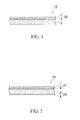
- the obtained multilayer clad material 10, as shown in Fig. 1 has a three-layer laminated structure in which the first metallic plate (e.g., nickel plate) 1 is laminated on one surface of the second metallic plate (e. g. , titanium plate) 2 and the third metallic plate (e.g., aluminum plate) 3 is laminated on the other surface of the second metallic plate (e.g., titanium plate) 2.
- the first metallic plate e.g., nickel plate
- the third metallic plate e.g., aluminum plate
- the multilayer clad material 10 having the three-layer laminated structure of the nickel plate 1/ titanium plate 2 / aluminum plate 3 can be used by being brazed to the semiconductor element joining surface side of a DBA substrate (cooler integrated insulating substrate) 95 with a brazing foil 99 (see Fig. 6 ) or by being brazed directly to a ceramic plate.
- Fig. 6 is a schematic cross-sectional view showing an example of a cooler integrated insulating substrate in an exploded state before lamination. In Fig.
- the reference symbol "91” denotes an aluminum plate as a heat dissipation member
- "92” denotes an aluminum brazing foil
- "93” denotes an aluminum punching plate
- "94” denotes an aluminum brazing foil
- "95” denotes a DBA (Al layer 96 / AlN layer (aluminum nitride layer) 97 / Al layer 98)
- "99" denotes an aluminum brazing foil.
- a brazing material is hard and not suitable for rolling, a special foil rolling apparatus will be required to make a brazing material into a foil having a thickness of 250 ⁇ m or less, and that the yield is not good enough. Further, a brazing foil is not good in handling characteristics. Under the circumstances, it is preferable to obtain a multilayer clad material 10 having a four-layer laminated structure of nickel plate 1 / titanium plate 2 / aluminum plate 3 / aluminum brazing plate 4 by applying a second production method which will be detailed later.
- the rolling reduction is set to 0.1 % to 15 %.
- the rolling reduction is set to the range, it is possible to further improve the flatness of the joint interface of the third metallic plate and the second metallic plate, and also possible to obtain a multilayer clad material in which no alloy layer is formed at the joint interface of the third metallic plate and the second metallic plate and the thickness of the thinner metallic plate is controlled with a higher degree of accuracy.
- the rolling reduction is less than 0.1 %, a sufficient joint strength cannot be obtained between the third metallic plate and the second metallic plate.
- the rolling reduction exceeds 15 %, there arise problems that the flatness of the joint interface cannot be obtained and cracks occur at the joint interface in the case of a combined metallic material forming a brittle alloy layer.
- the rolling reduction is set to 0.1 % to 10 %, more preferably 0.1 % to 5.0 %.
- the temperature of the pressure rolls 44 at the time of executing the cold pressure welding in the cold pressure welding step is set within a range of 10 °C to 80 °C, and in this case, it is possible to obtain a multilayer clad material 10 in which the thickness of the thinner metallic plate is controlled with a higher degree of accuracy.
- the first metallic plate, second metallic plate and third metallic plate are structured such that these three plates are made of dissimilar metallic materials, which is a major example but not limited to it.
- the surface activation treatment is executed before the cold pressure welding and therefore oxides, absorbed substances, etc., on the joint scheduled surfaces are removed by the surface activation treatment to expose the cleaned surfaces, in the following cold pressure welding step, sufficient joint strength can be secured even at a low rolling reduction (0.1 % to 15 %). Therefore, in the first production method, no diffusion heat treatment (to improve the joint strength) is required after the cold pressure welding step, and therefore a diffusion heat treatment (normally, a heat treatment at 300 °C or above) is not executed after the cold pressure welding step. Therefore, according to the first production method, even in the case of using a wide width material, a multilayer clad material with no curve can be obtained.
- a first laminated plate 21 is obtained.
- a nickel plate is used as the first metallic plate 1 and a titanium plate is used as the second metallic plate 2. That is, for example, by superposing the nickel plate 1 and the titanium plate 2 and clad rolling them at the rolling reduction of 25 % to 85 %, the first laminated plate 21 is obtained. The obtained first laminated plate 21 is rolled up on a first supply roll 51.
- the first metallic plate 1 and the second metallic plate 2 are superposed and clad rolled, and therefore the first laminated plate 21 in which the first metallic plate 1 and the second metallic plate 2 are laminated can be obtained at low cost.
- the clad rolling in the first rolling step is preferably performed by cold clad rolling.
- the temperature of the reduction roll at the time of the cold clad rolling is preferably set within a range of 10 °C to 120 °C.
- the first rolling step it is preferable to preliminarily perform mechanical polishing of the joint scheduled surface of the first metallic plate 1 and the joint scheduled surface of the second metallic plate 2.
- the mechanical polishing a method of polishing with a wire brush, for example, is exemplified, but the method is not specifically limited as long as it can mechanically remove a surface oxide layer of the joint scheduled surface.
- the first laminated plate 21 obtained by the clad rolling can be subjected to a diffusion heat treatment at a heat treatment temperature of 500 °C to 700°C.
- a diffusion heat treatment at a heat treatment temperature of 500 °C to 700°C.
- a second laminated plate 22 is obtained.
- an aluminum plate is used as the third metallic plate 3 and an aluminum brazing plate is used as the fourth metallic plate 4. That is, for example, by superposing the aluminum plate 3 and the aluminum brazing plate 4 and clad rolling them at the rolling reduction of 25 % to 85 %, the second laminated plate 22 is obtained. The obtained second laminated plate 22 is rolled up on a second supply roll 52.
- the third metallic plate 3 and the fourth metallic plate 4 are superposed and clad rolled, and therefore the second laminated plate 22 in which the third metallic plate 3 and the fourth metallic plate 4 are laminated can be obtained at low cost.
- the clad rolling in the second rolling step is preferably performed by cold clad rolling.
- the temperature of the reduction roll at the time of the cold clad rolling is preferably set within a range of 10 °C to 120 °C.
- the mechanical polishing a method of polishing with a wire brush, for example, is exemplified, but the method is not specifically limited as long as it can mechanically remove a surface oxide layer of the joint scheduled surface.
- the second laminated plate 22 obtained by the clad rolling can be subjected to a diffusion heat treatment at a heat treatment temperature of 500 °C to 700 °C.
- a diffusion heat treatment at a heat treatment temperature of 500 °C to 700 °C.
- the order of performing the first rolling step and the second rolling step is not specifically limited.
- the first rolling step can be performed initially, the second rolling step can be performed initially, or the first rolling step and the second rolling step can be performed simultaneously in parallel.
- a surface activation treatment step is performed.
- the first supply roll 51 on which the first laminated plate 21 is wound is arranged in the vacuum chamber 49 of the production apparatus 40, and the other second supply roll 52 on which the second laminated plate 22 is wound is arranged in the vacuum chamber 49.
- the vacuum chamber 49 is configured so that the interior space can be made into a vacuum state by a not-illustrated vacuum apparatus.
- the first electrode roll 53, a surface activation treatment apparatus 42A arranged apart from the first electrode roll 53 at a position close to the first electrode roll 53, a second electrode roll 54, a surface activation treatment apparatus 42B arranged apart from the second electrode roll 54 at a position closed to the second electrode roll 54, a pair of pressure rolls 44 and 44, and a wind-up roll 55 are arranged.
- the surface activation treatment apparatus 42A is configured to perform plasma etching processing of the surface of the metallic plate fitted on the outer peripheral surface of the first electrode roll 53 by applying a high-frequency voltage having a frequency of 10 MHz to 50 MHz between an electrode in the apparatus 42A and the first electrode roll 53 to irradiate plasma onto the surface of the metallic plate.
- the surface activation treatment apparatus 42B is configured to perform plasma etching processing of the surface of the metallic plate fitted on the outer peripheral surface of the second electrode roll 54 by applying a high-frequency voltage having a frequency of 10 MHz to 50 MHz between an electrode in the apparatus 42B and the second electrode roll 54 to irradiate plasma onto the surface of the metallic plate.
- the inside of the vacuum chamber 49 is maintained in a vacuum state. It is preferable that the degree of vacuum in the vacuum chamber 49 is set to 1 x 10 -4 Pa to 1 Pa. Further, it is also preferable that the inside of the vacuum chamber 49 is filled with inert gas such as nitrogen, argon, etc., into an inert gas atmosphere and then the degree of vacuum is set to 1 x 10 -4 Pa to 1 Pa by raising the degree of vacuum.
- inert gas such as nitrogen, argon, etc.
- the first laminated plate 21 unwound from the first supply roll 51 is brought into contact with the outer peripheral surface of the first electrode roll 53 along the outer peripheral surface, plasma is irradiated from the surface activation treatment apparatus 42A onto the surface of the second metallic plate (e.g., titanium plate) 2 of the first laminated plate 21 in contact with the first electrode roll 53, and thereafter the laminated plate 21 is fed between the pair of pressure rolls 44 and 44 (see Fig. 4 ).
- the plasma etching processing it is possible to remove oxides, absorbed substances, etc., on the surface of the second metallic plate (e.g., titanium plate) 2 which is a joint scheduled surface of the first laminated plate 21 and expose the cleaned surface.
- the second laminated plate 22 unwound from the second supply roll 52 is brought into contact with the outer peripheral surface of the second electrode roll 54 along the outer peripheral surface, plasma is irradiated from the surface activation treatment apparatus 42B onto the surface (joint scheduled surface) of the third metallic plate (e.g., aluminum plate) 3 of the second laminated plate 22 in contact with the second electrode roll 54 to perform plasma etching processing of the third metallic plate (e. g. , aluminumplate) 3, and thereafter the second laminated plate 22 is fed between the pair of pressure rolls 44 and 44 (see Fig. 4 ).
- the plasma etching processing it is possible to remove oxides, absorbed substances, etc., on the surface of the second metallic plate (e. g. , aluminum plate) 3 which is a joint scheduled surface of the second laminated plate 22 and expose the cleaned surface.
- the first laminated plate 21 and the second metallic plate 22 are superposed so that the surface of the second metallic plate (e.g., titanium plate) 2 which is a joint scheduled surface of the first laminated plate 21 and the surface of the third metallic plate (e. g. , aluminum plate) 3 which is a joint scheduled surface of the second laminated plate 22 are brought into contact with each other and cold pressure welded by and between the pair of pressure rolls 44 and 44 so that the rolling reduction becomes as low as 0.1 % to 15 % (see Fig. 4 ).
- the second metallic plate e.g., titanium plate
- the multilayer clad material 10 obtained by the cold pressure welding is wound on the wind-up roll 55 (see Fig. 4 ).
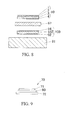
- the obtained multilayer clad material 10 is, as shown in Fig. 2 , provided with a four-layer laminated structure in which the first metallic plate (e.g., nickel plate) 1 is laminated on the upper surface of the second metallic plate (e.g., titanium plate) 2, the third metallic plate (e.g., aluminum plate) 3 is laminated on the lower surface of the second metallic plate (e.g., titanium plate) 2, and the fourth metallic plate (e.g., aluminum brazing plate) 4 is laminated on the lower surface of the third metallic plate (e.g., aluminum plate) 3.
- the first metallic plate e.g., nickel plate
- the third metallic plate e.g., aluminum plate
- the fourth metallic plate e.g., aluminum brazing plate
- the multilayer clad material 10 having a four-layer laminated structure of the nickel plate 1 / titanium plate 2 / aluminum plate 3 / aluminum brazing plate 4 can be used by being brazed directly to a semiconductor element joining surface side of a DBA substrate (cooler integrated insulating substrate) 95 (see Fig. 7 ) or by being brazed directly to a ceramic plate 97 (see Fig. 8 ).
- Fig. 7 is a schematic cross-sectional view showing an example of a cooler integrated insulating substrate in an exploded state before lamination.
- the reference symbol "91” denotes an aluminum plate as a heat dissipation member
- "92” denotes an aluminum brazing foil
- "93” denotes an aluminum punching plate
- "94” denotes an aluminum brazing foil
- "95” denotes a DBA (Al layer 96 / AlN layer (aluminum nitride layer) 97 / Al layer 98).
- Fig. 8 is a schematic cross-sectional view showing another example of a cooler integrated insulating substrate in an exploded state before lamination.
- the reference symbol "91" denotes an aluminum plate as a heat dissipation member
- "100” denotes a clad material (aluminum brazing material 92 / aluminum plate 93Z / aluminum brazing material 94)
- "97” denotes a ceramic plate (Aluminum nitride layer layer).
- the titanium plate 2 functions as a barrier layer which prevents a brittle alloy layer from being created due to the contact of the nickel plate 1 and the aluminum plate 3.
- Ti is 21.9 W/m ⁇ K in thermal conductivity, and the thermal conductivity is remarkably low as compared with Ni of 90.7 W/m ⁇ K, or Al of 236 W/m ⁇ K. Therefore, in the use of an insulating substrate which requires high heat dissipation characteristics, it is preferable that the titanium plate 2 is set to be thin, specifically 3 ⁇ m to 30 ⁇ m.
- the thickness design differs substantially between the case of joining to a DBA ⁇ heat sink ⁇ cooler and the case of using as a wiring layer by directly joining to a ceramic plate.
- the thickness of the aluminum plate 3 of the multilayer clad material 10 having a four-layer laminated structure is set to 200 ⁇ m to 800 ⁇ m to control increase of electric resistance.
- the thickness of the aluminum plate 3 in the multilayer clad material 10 having a four-layer laminated structure is 40 ⁇ m or more.
- the rolling reduction is set to 0.1 % to 15 %.
- the rolling reduction is set to the range, it is possible to further improve the flatness of the joint interface of the third metallic plate and the second metallic plate, and also possible to obtain a multilayer clad material 10 in which no alloy layer is formed at the joint interface of the third metallic plate and the second metallic plate and the thickness of the thinner metallic plate is controlled with a higher degree of accuracy.
- the rolling reduction is less than 0.1 %, a sufficient joint strength cannot be obtained between the third metallic plate and the second metallic plate.
- the rolling reduction exceeds 15 %, there arise problems that the flatness of the joint interface cannot be obtained and cracks occur at the joint interface in the case of a combined metallic material forming a brittle alloy layer.
- the rolling reduction is set to 0.1 % to 10 %, more preferably 0.1 % to 5.0 %.
- the temperature of the pressure rolls 44 at the time of executing the cold pressure welding in the cold pressure welding step is set within a range of 10 °C to 80 °C. In this case, it is possible to obtain a multilayer clad material 10 in which the thickness of the thinner metallic plate is controlled with a higher degree of accuracy.
- the first metallic plate, second metallic plate, third metallic plate and fourth metallic plate are structured such that these four plates are made of dissimilar metallic materials, which is a major example but not limited to it.
- the surface activation treatment is executed before the cold pressure welding and therefore oxides, absorbed substances, etc., on the joint scheduled surfaces are removed by the surface activation treatment to expose the cleaned surfaces, in the following cold pressure welding step, sufficient joint strength can be secured even at a low rolling reduction (0.1 % to 15 %). Therefore, in the second production method, no diffusion heat treatment (to improve the joint strength) is required after the cold pressure welding step, and therefore a diffusion heat treatment (normally, a heat treatment at 300 °C or above) is not executed after the cold pressure welding step. Therefore, according to the second production method, even in the case of using a wide width material, a multilayer clad material with no curve can be obtained.
- the first metallic plate, second metallic plate and third metallic plate are not specifically limited, but for example, a nickel plate, a titanium plate, an aluminum plate, etc., can be exemplified.
- the fourth metallic plate it is not specifically limited, but for example, a nickel plate, a titanium plate, an aluminum plate, an aluminum brazing plate, etc., can be exemplified.
- a multilayer clad material having a five-layer laminated structure, a six-layer laminated structure, or a seven or more layer laminated structure can be produced, and it should be noted that the production method of the present invention includes such production methods.
- FIG. 9 An example of a semiconductor module 70 produced by using the multilayer clad material 10 produced by the production method of the present invention as a part of the constituent material is shown in Fig. 9 .
- a semiconductor element 71 is joined on the upper surface of the nickel layer (nickel plate) 1 of the insulating substrate 60 having the structure shown in Fig. 5 , and the heat dissipation member 72 is joined to the lower surface of the ceramic layer 61 of the insulating substrate 60.
- the semiconductor element 71 is joined to the nickel layer 1 of the insulating substrate 60 by soldering.
- the semiconductor element 71 it is not specifically limited, but for example, an IGBT chip, a MOSFET chip, a thyristor chip, a diode chip, etc., can be exemplified.
- the heat dissipation member 72 it is not specifically limited, but, for example, a heat sink, a cooler, etc., can be exemplified.
- the insulating substrate 60 is to transfer the heat generated from the semiconductor element 71 in accordance with the operation of the semiconductor element 71 to the heat dissipation member 72, and is a conductor thermally but functions as an insulating material electrically.
- the nickel plate 1 and the titanium plate 2 were superposed and cold clad rolled (the temperature of the reduction roll: 25 °C) at a rolling reduction of 50 %, to thereby obtain a laminated plate 20 having a thickness of 50 ⁇ m and a width of 200 mm in which the nickel plate 1 and the titanium plate 2 were laminated (Rolling Step). Then, the laminated plate 20 was subjected to a diffusion heat treatment at 600 °C.
- the laminated plate 20 and the aluminum plate 3 were superposed so that the surface (etching processed surface) of the titanium plate 2 of the laminated plate 20 and the surface (etching processed surface) of the aluminum plate 3 were brought into contact with each other, and both these plates were cold pressure welded by and between a pair of pressure rolls 44 and 44 at 25 °C (room temperature), to thereby obtain a multilayer clad material 10 having a thickness of 130 ⁇ m and a width of 200 mm (Cold Pressure Welding Step).
- the rolling reduction was 3.7 % from the above calculation formula.
- the nickel plate 1 and the titanium plate 2 were superposed and cold clad rolled (the temperature of the reduction roll: 25 °C) at a rolling reduction of 50 %, to thereby obtain a laminated plate 20 having a thickness of 50 ⁇ m and a width of 200 mm in which the nickel plate 1 and the titanium plate 2 were laminated (Rolling Step). Then, the laminated plate 20 was subjected to a diffusion heat treatment at 600 °C.
- the laminated plate 20 and the aluminum plate 3 were superposed so that the surface (etching processed surface) of the titanium plate 2 of the laminated plate 20 and the surface (etching processed surface) of the aluminum plate 3 were brought into contact with each other, and both these plates were cold pressure welded by and between a pair of pressure rolls 44 and 44 at 25 °C (room temperature), to thereby obtain a multilayer clad material 10 having a thickness of 650 ⁇ m and a width of 200 mm (Cold Pressure Welding Step).
- the rolling reduction was 1.5 % from the above calculation formula.
- the nickel plate 1 and the titanium plate 2 were superposed and cold clad rolled (the temperature of the reduction roll: 25 °C) at a rolling reduction of 50 %, to thereby obtain a first laminated plate 21 having a thickness of 50 ⁇ m and a width of 200 mm in which the nickel plate 1 and the titanium plate 2 were laminated (First Rolling Step). Then, the first laminated plate 21 was subjected to a diffusion heat treatment at 600 °C.
- the first laminated plate 21 and the second laminated plate 22 were superposed so that the surface (etching processed surface) of the titanium plate 2 of the first laminated plate 21 and the surface (etching processed surface) of the aluminum plate 3 of the second laminated plate 22 were brought into contact with each other, and both these plates were cold pressure welded by and between a pair of pressure rolls 44 and 44 at 25 °C (room temperature), to thereby obtain a multilayer clad material 10 having a thickness of 150 ⁇ m and a width of 200 mm (Cold Pressure Welding Step).
- the rolling reduction was 3.2 % from the above calculation formula.
- the nickel plate 1 and the titanium plate 2 were superposed and cold clad rolled (the temperature of the reduction roll: 25 °C) at a rolling reduction of 50 %, to thereby obtain a first laminated plate 21 having a thickness of 50 ⁇ m and a width of 200 mm in which the nickel plate 1 and the titanium plate 2 were laminated (First Rolling Step). Then, the first laminated plate 21 was subjected to a diffusion heat treatment at 600 °C.
- the first laminated plate 21 and the second laminated plate 22 were superposed so that the surface (etching processed surface) of the titanium plate 2 of the first laminated plate 21 and the surface (etching processed surface) of the aluminum plate 3 of the second laminated plate 22 were brought into contact with each other, and both these plates were cold pressure welded by and between a pair of pressure rolls 44 and 44 at 25 °C (room temperature), to thereby obtain a multilayer clad material 10 having a thickness of 670 ⁇ m and a width of 200 mm (Cold Pressure Welding Step).
- the rolling reduction is 1.5 % from the above calculation formula.
- the nickel plate and the titanium plate were superposed and cold clad rolled (the temperature of the reduction roll: 25 °C) at a rolling reduction of 50 %, to thereby obtain a laminated plate having a thickness of 100 ⁇ m and a width of 200 mm in which the nickel plate and the titanium plate were laminated (First Rolling Step). Then, the laminated plate was subjected to a diffusion heat treatment at 600 °C.
- the nickel plate and the titanium plate were superposed and cold clad rolled (the temperature of the reduction roll: 25 °C) at a rolling reduction of 50 %, to thereby obtain a laminated plate having a thickness of 100 ⁇ m and a width of 30 mm in which the nickel plate and the titanium plate were laminated (First Rolling Step). Then, the laminated plate was subjected to a diffusion heat treatment at 600 °C.
- the cross-section of the obtained multilayer clad material was observed with an electron microscope, and the observation found that the titanium plate (titanium layer) was broken.
- the nickel plate and the titanium plate were superposed and cold clad rolled (the temperature of the reduction roll: 25 °C) at a rolling reduction of 50 %, to thereby obtain a laminated plate having a thickness of 50 ⁇ m and a width of 200 mm in which the nickel plate and the titanium plate were laminated (First Rolling Step). Then, the laminated plate was subjected to a diffusion heat treatment at 600 °C.
- the laminated plate and the aluminum plate were superposed and cold clad rolled (the temperature of the reduction roll: 25 °C) at a rolling reduction of 2 % (Second Rolling Step), to try to obtain a multilayer clad material, but the laminated plate and the aluminum plate could not be joined.
- a production of a multilayer clad material was attempted in the same manner as in Example 1 except that the rolling reduction in the cold pressure welding step was set so as to become 0.05 %, but the laminated plate and the aluminum plate were not joined.
- a multilayer clad material having a thickness of 130 ⁇ m and a width of 200 mm was obtained in the same manner as in Example 1 except that the rolling reduction in the cold pressure welding step was set so as to become 25 %.
- the thickness of one of metallic plates to be laminated in the cold pressure welding differs significantly from the thickness of the other metallic plate (over 2.0 times or less than 0.5 times). Nevertheless, the thickness of the thinner metallic plate was controlled with a high degree of accuracy, and that no curves or undulations were generated and no breakage of constituent layer occurred. Further, in the multilayer clad material of Examples 1 to 4, although the width was as wide as 200 mm, no curve or undulation occurred.
- Comparative Example 1 curves and undulations were generated by the diffusion heat treatment to improve the joint strength of the joint interface, it was difficult to roll up the clad material, which prevented an actual production. Further, in Comparative Example 2, in the second rolling step, since the difference between the thicknesses of plates to be superposed was significant (one was 100 ⁇ m, and the other was 600 ⁇ m), the thinner titanium layer (titanium plate) was broken. In Comparative Example 3, in the second rolling step, since the cold clad rolling was performed at the rolling reduction of 2 %, the laminated plate and the aluminum plate could not be joined.
- Comparative Example 4 since the rolling reduction in the cold pressure welding was smaller than the range defined by the present invention, the laminated plate and the aluminum plate could not be joined in a good manner. Further, in Comparative Example 5, since the rolling reduction in the cold pressure welding step was larger than the range defied by the present invention, cracks were generated in the interface of the laminated plate and the aluminum plate.
- the multilayer clad material produced by the production method of a multilayer clad material according to the present invention can be preferably used as, for example, a multilayered material for insulating substrates to release heat of a semiconductor element, but not limited to it.
- the multilayer clad material produced by the production method of the present invention is used as a part of a constituent material to produce, for example, an insulating substrate, a semiconductor module, etc.
Landscapes
- Chemical & Material Sciences (AREA)
- Engineering & Computer Science (AREA)
- Ceramic Engineering (AREA)
- Materials Engineering (AREA)
- Structural Engineering (AREA)
- Organic Chemistry (AREA)
- Mechanical Engineering (AREA)
- Pressure Welding/Diffusion-Bonding (AREA)
- Laminated Bodies (AREA)
- Metal Rolling (AREA)
Applications Claiming Priority (1)
| Application Number | Priority Date | Filing Date | Title |
|---|---|---|---|
| JP2013104698A JP6100605B2 (ja) | 2013-05-17 | 2013-05-17 | 多層クラッド材の製造方法 |
Publications (3)
| Publication Number | Publication Date |
|---|---|
| EP2803480A2 true EP2803480A2 (fr) | 2014-11-19 |
| EP2803480A3 EP2803480A3 (fr) | 2015-12-09 |
| EP2803480B1 EP2803480B1 (fr) | 2018-08-15 |
Family
ID=50735834
Family Applications (1)
| Application Number | Title | Priority Date | Filing Date |
|---|---|---|---|
| EP14166614.9A Not-in-force EP2803480B1 (fr) | 2013-05-17 | 2014-04-30 | Procédé de production de matériau plaqué multicouche |
Country Status (4)
| Country | Link |
|---|---|
| US (1) | US20140339288A1 (fr) |
| EP (1) | EP2803480B1 (fr) |
| JP (1) | JP6100605B2 (fr) |
| CN (1) | CN104163029B (fr) |
Cited By (2)
| Publication number | Priority date | Publication date | Assignee | Title |
|---|---|---|---|---|
| EP3285950A4 (fr) * | 2015-04-24 | 2018-10-10 | Engineered Materials Solutions LLC | Matériau auto-brasant et procédé de fabrication de ce matériau |
| EP3734654A1 (fr) * | 2016-06-23 | 2020-11-04 | Mitsubishi Materials Corporation | Procédé de fabrication d'une carte de circuit imprimé isolée, carte de circuit imprimé isolée et module de conversion thermoélectrique |
Families Citing this family (18)
| Publication number | Priority date | Publication date | Assignee | Title |
|---|---|---|---|---|
| KR20160091921A (ko) * | 2013-11-28 | 2016-08-03 | 도요 알루미늄 가부시키가이샤 | 회로 기판의 제조 방법 및 회로 기판 |
| JP6396703B2 (ja) * | 2014-07-08 | 2018-09-26 | トヨタ自動車株式会社 | 半導体素子用放熱部品の製造方法 |
| CN105058914B (zh) * | 2015-07-13 | 2017-09-01 | 西安建筑科技大学 | 一种层状Ti‑Ni形状记忆复合材料及其制备方法 |
| JP6658756B2 (ja) * | 2015-07-29 | 2020-03-04 | 日本製鉄株式会社 | チタン複合材および熱間圧延用チタン材 |
| DE102016125599A1 (de) * | 2016-12-23 | 2018-06-28 | Newfrey Llc | Verfahren und Vorrichtung zum Fügen von Fügeelementen auf Bauteile |
| CN117798187A (zh) * | 2017-02-07 | 2024-04-02 | 东洋钢钣株式会社 | 轧制接合体及其制造方法 |
| DE102017205117A1 (de) * | 2017-03-27 | 2018-09-27 | Bayerische Motoren Werke Aktiengesellschaft | Verfahren zum Herstellen eines wenigstens zwei Bauteile umfassenden Bauteilverbunds sowie Bauteilverbund |
| JP6438562B1 (ja) | 2017-06-13 | 2018-12-12 | 東洋鋼鈑株式会社 | 圧延接合体及びその製造方法 |
| JP6377833B1 (ja) * | 2017-03-29 | 2018-08-22 | 東洋鋼鈑株式会社 | 圧延接合体及びその製造方法 |
| CN108688256B (zh) * | 2017-03-29 | 2022-03-18 | 东洋钢钣株式会社 | 轧压接合体及其制造方法 |
| JP7085419B2 (ja) * | 2018-03-14 | 2022-06-16 | 東洋鋼鈑株式会社 | 圧延接合体及びその製造方法 |
| WO2019176937A1 (fr) * | 2018-03-14 | 2019-09-19 | 東洋鋼鈑株式会社 | Corps colaminé et son procédé de production |
| JP7162960B2 (ja) * | 2018-08-06 | 2022-10-31 | 東洋鋼鈑株式会社 | 圧延接合体及びその製造方法、並びに電子機器用の放熱補強部材 |
| WO2020031956A1 (fr) * | 2018-08-06 | 2020-02-13 | 東洋鋼鈑株式会社 | Corps colaminé, son procédé de production et élément de renforcement de dissipation de chaleur pour dispositifs électroniques |
| US11614289B2 (en) * | 2020-01-21 | 2023-03-28 | Dana Canada Corporation | Aluminum heat exchanger with solderable outer surface layer |
| CN112845590B (zh) * | 2021-03-10 | 2024-10-01 | 宁夏东方钽业股份有限公司 | 一种金属箔及其制备方法 |
| JP2023069881A (ja) * | 2021-11-08 | 2023-05-18 | Maアルミニウム株式会社 | アルミニウム合金多層材の製造方法 |
| JP7734607B2 (ja) * | 2022-02-21 | 2025-09-05 | 株式会社オーク製作所 | 放電ランプ |
Citations (4)
| Publication number | Priority date | Publication date | Assignee | Title |
|---|---|---|---|---|
| JP2004235503A (ja) | 2003-01-31 | 2004-08-19 | Mitsubishi Materials Corp | 回路基板の製造方法及び回路基板 |
| JP2004328012A (ja) | 2004-07-16 | 2004-11-18 | Dowa Mining Co Ltd | セラミックス配線基板の製造方法 |
| JP2006303346A (ja) | 2005-04-25 | 2006-11-02 | Kiyohito Ishida | 半導体モジュール |
| JP2009147123A (ja) | 2007-12-14 | 2009-07-02 | Fuji Electric Device Technology Co Ltd | 半導体装置及びその製造方法 |
Family Cites Families (21)
| Publication number | Priority date | Publication date | Assignee | Title |
|---|---|---|---|---|
| US4141482A (en) * | 1977-04-25 | 1979-02-27 | Reynolds Metals Company | Laminated compacted particle aluminum sheet |
| DE2909418C3 (de) * | 1978-03-10 | 1982-04-08 | Furukawa Aluminium Co., Ltd., Tokyo | Verfahren zur Herstellung von mit Aluminium oder Aluminiumlegierungen plattiertem Stahlblech |
| JPH0755384B2 (ja) * | 1988-03-02 | 1995-06-14 | 東洋鋼板株式会社 | クラッド金属板の製造法及びその装置 |
| US4896813A (en) * | 1989-04-03 | 1990-01-30 | Toyo Kohan Co., Ltd. | Method and apparatus for cold rolling clad sheet |
| US5316599A (en) * | 1989-11-20 | 1994-05-31 | Nippon Yakin Kogyo Co., Ltd. | Method of producing Ni-Ti intermetallic compounds |
| US5268043A (en) * | 1991-08-02 | 1993-12-07 | Olin Corporation | Magnetic sensor wire |
| US5316863A (en) * | 1992-05-18 | 1994-05-31 | Alcan International Limited | Self-brazing aluminum laminated structure |
| US5643371A (en) * | 1995-06-07 | 1997-07-01 | Reynolds Metals Company | Method and apparatus for continuously cladding and hot working cast material |
| JPH1099976A (ja) * | 1996-09-27 | 1998-04-21 | Daido Steel Co Ltd | Ti被覆クラッド板の製造方法 |
| CN1089046C (zh) * | 1998-06-03 | 2002-08-14 | 住友特殊金属株式会社 | 包覆材料及其制造方法 |
| TW585813B (en) * | 1998-07-23 | 2004-05-01 | Toyo Kohan Co Ltd | Clad board for printed-circuit board, multi-layered printed-circuit board, and the fabrication method |
| TW446627B (en) * | 1998-09-30 | 2001-07-21 | Toyo Kohan Co Ltd | A clad sheet for lead frame, a lead frame using thereof and a manufacturing method thereof |
| KR20000071383A (ko) * | 1999-02-26 | 2000-11-25 | 마쯔노고오지 | 배선층 전사용 복합재와 그 제조방법 및 장치 |
| JP2002069545A (ja) * | 2000-08-31 | 2002-03-08 | Nippon Metal Ind Co Ltd | 積層圧延によるTiAl系金属間化合物の製造方法 |
| JP4447762B2 (ja) * | 2000-10-18 | 2010-04-07 | 東洋鋼鈑株式会社 | 多層金属積層板及びその製造方法 |
| US8059785B2 (en) * | 2007-09-06 | 2011-11-15 | Varian Medical Systems, Inc. | X-ray target assembly and methods for manufacturing same |
| US8196958B2 (en) * | 2009-07-27 | 2012-06-12 | International Truck Intellectual Property Company, Llc | Light-weight, roll-bonded heavy duty truck frame member |
| JP5829403B2 (ja) * | 2010-05-18 | 2015-12-09 | 昭和電工株式会社 | 放熱用絶縁基板及びその製造方法 |
| JP5705506B2 (ja) * | 2010-11-08 | 2015-04-22 | 昭和電工株式会社 | 絶縁基板用クラッド材 |
| JP5666372B2 (ja) * | 2011-04-20 | 2015-02-12 | 昭和電工株式会社 | 絶縁基板用積層材 |
| JP5918008B2 (ja) * | 2012-05-08 | 2016-05-18 | 昭和電工株式会社 | 冷却器の製造方法 |
-
2013
- 2013-05-17 JP JP2013104698A patent/JP6100605B2/ja active Active
-
2014
- 2014-04-16 US US14/254,146 patent/US20140339288A1/en not_active Abandoned
- 2014-04-25 CN CN201410171427.8A patent/CN104163029B/zh not_active Expired - Fee Related
- 2014-04-30 EP EP14166614.9A patent/EP2803480B1/fr not_active Not-in-force
Patent Citations (4)
| Publication number | Priority date | Publication date | Assignee | Title |
|---|---|---|---|---|
| JP2004235503A (ja) | 2003-01-31 | 2004-08-19 | Mitsubishi Materials Corp | 回路基板の製造方法及び回路基板 |
| JP2004328012A (ja) | 2004-07-16 | 2004-11-18 | Dowa Mining Co Ltd | セラミックス配線基板の製造方法 |
| JP2006303346A (ja) | 2005-04-25 | 2006-11-02 | Kiyohito Ishida | 半導体モジュール |
| JP2009147123A (ja) | 2007-12-14 | 2009-07-02 | Fuji Electric Device Technology Co Ltd | 半導体装置及びその製造方法 |
Cited By (3)
| Publication number | Priority date | Publication date | Assignee | Title |
|---|---|---|---|---|
| EP3285950A4 (fr) * | 2015-04-24 | 2018-10-10 | Engineered Materials Solutions LLC | Matériau auto-brasant et procédé de fabrication de ce matériau |
| US10259082B2 (en) | 2015-04-24 | 2019-04-16 | EMS Engineered Materials Solution, LLC | Self brazing material and a method of making the material |
| EP3734654A1 (fr) * | 2016-06-23 | 2020-11-04 | Mitsubishi Materials Corporation | Procédé de fabrication d'une carte de circuit imprimé isolée, carte de circuit imprimé isolée et module de conversion thermoélectrique |
Also Published As
| Publication number | Publication date |
|---|---|
| EP2803480B1 (fr) | 2018-08-15 |
| CN104163029A (zh) | 2014-11-26 |
| CN104163029B (zh) | 2017-11-28 |
| JP2014223657A (ja) | 2014-12-04 |
| JP6100605B2 (ja) | 2017-03-22 |
| US20140339288A1 (en) | 2014-11-20 |
| EP2803480A3 (fr) | 2015-12-09 |
Similar Documents
| Publication | Publication Date | Title |
|---|---|---|
| EP2803480A2 (fr) | Procédé de production de matériau plaqué multicouche | |
| US8772926B2 (en) | Production method of cooler | |
| US8987895B2 (en) | Clad material for insulating substrates | |
| KR102324373B1 (ko) | 방열판 및 그 제조 방법 | |
| JP5759902B2 (ja) | 積層材およびその製造方法 | |
| KR20180059437A (ko) | 금속 적층재 및 그 제조 방법 | |
| US12002732B2 (en) | Copper/ceramic assembly, insulated circuit board, method for producing copper/ceramic assembly, and method for producing insulated circuit board | |
| JP2023523085A (ja) | 金属-セラミック基板を製造する方法及びこのような方法によって製造された金属-セラミック基板 | |
| JP5989465B2 (ja) | 絶縁基板の製造方法 | |
| WO2018066413A1 (fr) | Plaque d'alliage de cuivre pour composant de dissipation de chaleur, et composant de dissipation de chaleur ainsi que procédé de fabrication de celui-ci | |
| US11845700B2 (en) | Method for producing a semi-finished metal product, method for producing a metal-ceramic substrate, and metal-ceramic substrate | |
| JP5947090B2 (ja) | 絶縁基板の製造方法 | |
| JP7119268B2 (ja) | 銅/セラミックス接合体、および、絶縁回路基板 | |
| JP2013227194A (ja) | 金属−セラミックス接合基板の製造方法 | |
| EP3960722B1 (fr) | Corps assemblé cuivre/céramique, substrat de circuit isolant, procédé de production de corps assemblé cuivre/céramique et procédé de production de substrat de circuit isolant | |
| JP5739179B2 (ja) | 積層材およびその製造方法 | |
| JP6008544B2 (ja) | 絶縁基板の製造方法 | |
| JP5869781B2 (ja) | 絶縁基板用積層材の製造方法 | |
| JP5666372B2 (ja) | 絶縁基板用積層材 | |
| EP4159704B1 (fr) | Corps lié en cuivre/céramique et substrat de circuit isolé | |
| WO2023188670A1 (fr) | Carte de circuit imprimé et son procédé de fabrication | |
| WO2024176598A1 (fr) | Carte de circuit imprimé et module de puissance | |
| KR20170018568A (ko) | 전자부품 패키지용 브레이징 클래드 스트립의 제조방법 |
Legal Events
| Date | Code | Title | Description |
|---|---|---|---|
| PUAI | Public reference made under article 153(3) epc to a published international application that has entered the european phase |
Free format text: ORIGINAL CODE: 0009012 |
|
| 17P | Request for examination filed |
Effective date: 20140430 |
|
| AK | Designated contracting states |
Kind code of ref document: A2 Designated state(s): AL AT BE BG CH CY CZ DE DK EE ES FI FR GB GR HR HU IE IS IT LI LT LU LV MC MK MT NL NO PL PT RO RS SE SI SK SM TR |
|
| AX | Request for extension of the european patent |
Extension state: BA ME |
|
| PUAL | Search report despatched |
Free format text: ORIGINAL CODE: 0009013 |
|
| AK | Designated contracting states |
Kind code of ref document: A3 Designated state(s): AL AT BE BG CH CY CZ DE DK EE ES FI FR GB GR HR HU IE IS IT LI LT LU LV MC MK MT NL NO PL PT RO RS SE SI SK SM TR |
|
| AX | Request for extension of the european patent |
Extension state: BA ME |
|
| RIC1 | Information provided on ipc code assigned before grant |
Ipc: B23K 20/14 20060101ALI20151105BHEP Ipc: H01L 23/14 20060101ALI20151105BHEP Ipc: B21B 9/00 20060101ALN20151105BHEP Ipc: B23K 20/04 20060101ALI20151105BHEP Ipc: H01J 37/32 20060101ALI20151105BHEP Ipc: B23K 20/00 20060101ALI20151105BHEP Ipc: B32B 15/01 20060101ALI20151105BHEP Ipc: B21B 1/38 20060101ALN20151105BHEP Ipc: B32B 15/00 20060101AFI20151105BHEP |
|
| R17P | Request for examination filed (corrected) |
Effective date: 20160531 |
|
| RBV | Designated contracting states (corrected) |
Designated state(s): AL AT BE BG CH CY CZ DE DK EE ES FI FR GB GR HR HU IE IS IT LI LT LU LV MC MK MT NL NO PL PT RO RS SE SI SK SM TR |
|
| STAA | Information on the status of an ep patent application or granted ep patent |
Free format text: STATUS: EXAMINATION IS IN PROGRESS |
|
| 17Q | First examination report despatched |
Effective date: 20170320 |
|
| GRAP | Despatch of communication of intention to grant a patent |
Free format text: ORIGINAL CODE: EPIDOSNIGR1 |
|
| STAA | Information on the status of an ep patent application or granted ep patent |
Free format text: STATUS: GRANT OF PATENT IS INTENDED |
|
| RIC1 | Information provided on ipc code assigned before grant |
Ipc: B23K 20/04 20060101ALI20180219BHEP Ipc: C04B 37/02 20060101ALI20180219BHEP Ipc: H01L 23/14 20060101ALI20180219BHEP Ipc: B32B 15/00 20060101AFI20180219BHEP Ipc: B23K 20/00 20060101ALI20180219BHEP Ipc: B21B 9/00 20060101ALN20180219BHEP Ipc: B23K 20/14 20060101ALI20180219BHEP Ipc: B21B 1/38 20060101ALN20180219BHEP Ipc: H01L 23/373 20060101ALI20180219BHEP Ipc: B23K 103/16 20060101ALI20180219BHEP Ipc: B32B 15/01 20060101ALI20180219BHEP Ipc: H01J 37/32 20060101ALI20180219BHEP |
|
| INTG | Intention to grant announced |
Effective date: 20180307 |
|
| GRAS | Grant fee paid |
Free format text: ORIGINAL CODE: EPIDOSNIGR3 |
|
| GRAA | (expected) grant |
Free format text: ORIGINAL CODE: 0009210 |
|
| STAA | Information on the status of an ep patent application or granted ep patent |
Free format text: STATUS: THE PATENT HAS BEEN GRANTED |
|
| AK | Designated contracting states |
Kind code of ref document: B1 Designated state(s): AL AT BE BG CH CY CZ DE DK EE ES FI FR GB GR HR HU IE IS IT LI LT LU LV MC MK MT NL NO PL PT RO RS SE SI SK SM TR |
|
| REG | Reference to a national code |
Ref country code: CH Ref legal event code: EP Ref country code: GB Ref legal event code: FG4D Ref country code: AT Ref legal event code: REF Ref document number: 1029284 Country of ref document: AT Kind code of ref document: T Effective date: 20180815 |
|
| REG | Reference to a national code |
Ref country code: IE Ref legal event code: FG4D |
|
| REG | Reference to a national code |
Ref country code: DE Ref legal event code: R096 Ref document number: 602014030315 Country of ref document: DE |
|
| REG | Reference to a national code |
Ref country code: NL Ref legal event code: MP Effective date: 20180815 |
|
| REG | Reference to a national code |
Ref country code: LT Ref legal event code: MG4D |
|
| REG | Reference to a national code |
Ref country code: AT Ref legal event code: MK05 Ref document number: 1029284 Country of ref document: AT Kind code of ref document: T Effective date: 20180815 |
|
| PG25 | Lapsed in a contracting state [announced via postgrant information from national office to epo] |
Ref country code: NO Free format text: LAPSE BECAUSE OF FAILURE TO SUBMIT A TRANSLATION OF THE DESCRIPTION OR TO PAY THE FEE WITHIN THE PRESCRIBED TIME-LIMIT Effective date: 20181115 Ref country code: GR Free format text: LAPSE BECAUSE OF FAILURE TO SUBMIT A TRANSLATION OF THE DESCRIPTION OR TO PAY THE FEE WITHIN THE PRESCRIBED TIME-LIMIT Effective date: 20181116 Ref country code: SE Free format text: LAPSE BECAUSE OF FAILURE TO SUBMIT A TRANSLATION OF THE DESCRIPTION OR TO PAY THE FEE WITHIN THE PRESCRIBED TIME-LIMIT Effective date: 20180815 Ref country code: FI Free format text: LAPSE BECAUSE OF FAILURE TO SUBMIT A TRANSLATION OF THE DESCRIPTION OR TO PAY THE FEE WITHIN THE PRESCRIBED TIME-LIMIT Effective date: 20180815 Ref country code: RS Free format text: LAPSE BECAUSE OF FAILURE TO SUBMIT A TRANSLATION OF THE DESCRIPTION OR TO PAY THE FEE WITHIN THE PRESCRIBED TIME-LIMIT Effective date: 20180815 Ref country code: LT Free format text: LAPSE BECAUSE OF FAILURE TO SUBMIT A TRANSLATION OF THE DESCRIPTION OR TO PAY THE FEE WITHIN THE PRESCRIBED TIME-LIMIT Effective date: 20180815 Ref country code: IS Free format text: LAPSE BECAUSE OF FAILURE TO SUBMIT A TRANSLATION OF THE DESCRIPTION OR TO PAY THE FEE WITHIN THE PRESCRIBED TIME-LIMIT Effective date: 20181215 Ref country code: AT Free format text: LAPSE BECAUSE OF FAILURE TO SUBMIT A TRANSLATION OF THE DESCRIPTION OR TO PAY THE FEE WITHIN THE PRESCRIBED TIME-LIMIT Effective date: 20180815 Ref country code: BG Free format text: LAPSE BECAUSE OF FAILURE TO SUBMIT A TRANSLATION OF THE DESCRIPTION OR TO PAY THE FEE WITHIN THE PRESCRIBED TIME-LIMIT Effective date: 20181115 Ref country code: NL Free format text: LAPSE BECAUSE OF FAILURE TO SUBMIT A TRANSLATION OF THE DESCRIPTION OR TO PAY THE FEE WITHIN THE PRESCRIBED TIME-LIMIT Effective date: 20180815 |
|
| PG25 | Lapsed in a contracting state [announced via postgrant information from national office to epo] |
Ref country code: AL Free format text: LAPSE BECAUSE OF FAILURE TO SUBMIT A TRANSLATION OF THE DESCRIPTION OR TO PAY THE FEE WITHIN THE PRESCRIBED TIME-LIMIT Effective date: 20180815 Ref country code: LV Free format text: LAPSE BECAUSE OF FAILURE TO SUBMIT A TRANSLATION OF THE DESCRIPTION OR TO PAY THE FEE WITHIN THE PRESCRIBED TIME-LIMIT Effective date: 20180815 Ref country code: HR Free format text: LAPSE BECAUSE OF FAILURE TO SUBMIT A TRANSLATION OF THE DESCRIPTION OR TO PAY THE FEE WITHIN THE PRESCRIBED TIME-LIMIT Effective date: 20180815 |
|
| PG25 | Lapsed in a contracting state [announced via postgrant information from national office to epo] |
Ref country code: ES Free format text: LAPSE BECAUSE OF FAILURE TO SUBMIT A TRANSLATION OF THE DESCRIPTION OR TO PAY THE FEE WITHIN THE PRESCRIBED TIME-LIMIT Effective date: 20180815 Ref country code: PL Free format text: LAPSE BECAUSE OF FAILURE TO SUBMIT A TRANSLATION OF THE DESCRIPTION OR TO PAY THE FEE WITHIN THE PRESCRIBED TIME-LIMIT Effective date: 20180815 Ref country code: IT Free format text: LAPSE BECAUSE OF FAILURE TO SUBMIT A TRANSLATION OF THE DESCRIPTION OR TO PAY THE FEE WITHIN THE PRESCRIBED TIME-LIMIT Effective date: 20180815 Ref country code: CZ Free format text: LAPSE BECAUSE OF FAILURE TO SUBMIT A TRANSLATION OF THE DESCRIPTION OR TO PAY THE FEE WITHIN THE PRESCRIBED TIME-LIMIT Effective date: 20180815 Ref country code: RO Free format text: LAPSE BECAUSE OF FAILURE TO SUBMIT A TRANSLATION OF THE DESCRIPTION OR TO PAY THE FEE WITHIN THE PRESCRIBED TIME-LIMIT Effective date: 20180815 Ref country code: EE Free format text: LAPSE BECAUSE OF FAILURE TO SUBMIT A TRANSLATION OF THE DESCRIPTION OR TO PAY THE FEE WITHIN THE PRESCRIBED TIME-LIMIT Effective date: 20180815 |
|
| REG | Reference to a national code |
Ref country code: DE Ref legal event code: R097 Ref document number: 602014030315 Country of ref document: DE |
|
| PG25 | Lapsed in a contracting state [announced via postgrant information from national office to epo] |
Ref country code: SM Free format text: LAPSE BECAUSE OF FAILURE TO SUBMIT A TRANSLATION OF THE DESCRIPTION OR TO PAY THE FEE WITHIN THE PRESCRIBED TIME-LIMIT Effective date: 20180815 Ref country code: SK Free format text: LAPSE BECAUSE OF FAILURE TO SUBMIT A TRANSLATION OF THE DESCRIPTION OR TO PAY THE FEE WITHIN THE PRESCRIBED TIME-LIMIT Effective date: 20180815 Ref country code: DK Free format text: LAPSE BECAUSE OF FAILURE TO SUBMIT A TRANSLATION OF THE DESCRIPTION OR TO PAY THE FEE WITHIN THE PRESCRIBED TIME-LIMIT Effective date: 20180815 |
|
| PLBE | No opposition filed within time limit |
Free format text: ORIGINAL CODE: 0009261 |
|
| STAA | Information on the status of an ep patent application or granted ep patent |
Free format text: STATUS: NO OPPOSITION FILED WITHIN TIME LIMIT |
|
| 26N | No opposition filed |
Effective date: 20190516 |
|
| PG25 | Lapsed in a contracting state [announced via postgrant information from national office to epo] |
Ref country code: SI Free format text: LAPSE BECAUSE OF FAILURE TO SUBMIT A TRANSLATION OF THE DESCRIPTION OR TO PAY THE FEE WITHIN THE PRESCRIBED TIME-LIMIT Effective date: 20180815 |
|
| REG | Reference to a national code |
Ref country code: CH Ref legal event code: PL |
|
| REG | Reference to a national code |
Ref country code: BE Ref legal event code: MM Effective date: 20190430 |
|
| GBPC | Gb: european patent ceased through non-payment of renewal fee |
Effective date: 20190430 |
|
| PG25 | Lapsed in a contracting state [announced via postgrant information from national office to epo] |
Ref country code: MC Free format text: LAPSE BECAUSE OF FAILURE TO SUBMIT A TRANSLATION OF THE DESCRIPTION OR TO PAY THE FEE WITHIN THE PRESCRIBED TIME-LIMIT Effective date: 20180815 Ref country code: LU Free format text: LAPSE BECAUSE OF NON-PAYMENT OF DUE FEES Effective date: 20190430 |
|
| PG25 | Lapsed in a contracting state [announced via postgrant information from national office to epo] |
Ref country code: CH Free format text: LAPSE BECAUSE OF NON-PAYMENT OF DUE FEES Effective date: 20190430 Ref country code: LI Free format text: LAPSE BECAUSE OF NON-PAYMENT OF DUE FEES Effective date: 20190430 Ref country code: GB Free format text: LAPSE BECAUSE OF NON-PAYMENT OF DUE FEES Effective date: 20190430 |
|
| PG25 | Lapsed in a contracting state [announced via postgrant information from national office to epo] |
Ref country code: FR Free format text: LAPSE BECAUSE OF NON-PAYMENT OF DUE FEES Effective date: 20190430 Ref country code: BE Free format text: LAPSE BECAUSE OF NON-PAYMENT OF DUE FEES Effective date: 20190430 |
|
| PG25 | Lapsed in a contracting state [announced via postgrant information from national office to epo] |
Ref country code: TR Free format text: LAPSE BECAUSE OF FAILURE TO SUBMIT A TRANSLATION OF THE DESCRIPTION OR TO PAY THE FEE WITHIN THE PRESCRIBED TIME-LIMIT Effective date: 20180815 |
|
| PG25 | Lapsed in a contracting state [announced via postgrant information from national office to epo] |
Ref country code: IE Free format text: LAPSE BECAUSE OF NON-PAYMENT OF DUE FEES Effective date: 20190430 |
|
| PG25 | Lapsed in a contracting state [announced via postgrant information from national office to epo] |
Ref country code: PT Free format text: LAPSE BECAUSE OF FAILURE TO SUBMIT A TRANSLATION OF THE DESCRIPTION OR TO PAY THE FEE WITHIN THE PRESCRIBED TIME-LIMIT Effective date: 20181215 |
|
| PG25 | Lapsed in a contracting state [announced via postgrant information from national office to epo] |
Ref country code: CY Free format text: LAPSE BECAUSE OF FAILURE TO SUBMIT A TRANSLATION OF THE DESCRIPTION OR TO PAY THE FEE WITHIN THE PRESCRIBED TIME-LIMIT Effective date: 20180815 |
|
| PG25 | Lapsed in a contracting state [announced via postgrant information from national office to epo] |
Ref country code: MT Free format text: LAPSE BECAUSE OF FAILURE TO SUBMIT A TRANSLATION OF THE DESCRIPTION OR TO PAY THE FEE WITHIN THE PRESCRIBED TIME-LIMIT Effective date: 20180815 Ref country code: HU Free format text: LAPSE BECAUSE OF FAILURE TO SUBMIT A TRANSLATION OF THE DESCRIPTION OR TO PAY THE FEE WITHIN THE PRESCRIBED TIME-LIMIT; INVALID AB INITIO Effective date: 20140430 |
|
| PGFP | Annual fee paid to national office [announced via postgrant information from national office to epo] |
Ref country code: DE Payment date: 20210408 Year of fee payment: 8 |
|
| PG25 | Lapsed in a contracting state [announced via postgrant information from national office to epo] |
Ref country code: MK Free format text: LAPSE BECAUSE OF FAILURE TO SUBMIT A TRANSLATION OF THE DESCRIPTION OR TO PAY THE FEE WITHIN THE PRESCRIBED TIME-LIMIT Effective date: 20180815 |
|
| REG | Reference to a national code |
Ref country code: DE Ref legal event code: R119 Ref document number: 602014030315 Country of ref document: DE |
|
| PG25 | Lapsed in a contracting state [announced via postgrant information from national office to epo] |
Ref country code: DE Free format text: LAPSE BECAUSE OF NON-PAYMENT OF DUE FEES Effective date: 20221103 |