EP2803683B1 - Élastomère fonctionnalisé et procédé de fabrication d'un tel élastomère - Google Patents
Élastomère fonctionnalisé et procédé de fabrication d'un tel élastomère Download PDFInfo
- Publication number
- EP2803683B1 EP2803683B1 EP14167944.9A EP14167944A EP2803683B1 EP 2803683 B1 EP2803683 B1 EP 2803683B1 EP 14167944 A EP14167944 A EP 14167944A EP 2803683 B1 EP2803683 B1 EP 2803683B1
- Authority
- EP
- European Patent Office
- Prior art keywords
- monomer
- polymer
- group
- functionalized
- rubber
- Prior art date
- Legal status (The legal status is an assumption and is not a legal conclusion. Google has not performed a legal analysis and makes no representation as to the accuracy of the status listed.)
- Not-in-force
Links
- 229920001971 elastomer Polymers 0.000 title claims description 112
- 239000000806 elastomer Substances 0.000 title claims description 55
- 238000004519 manufacturing process Methods 0.000 title claims description 3
- 229920000642 polymer Polymers 0.000 claims description 86
- 239000000178 monomer Substances 0.000 claims description 85
- 239000005060 rubber Substances 0.000 claims description 57
- 150000001993 dienes Chemical class 0.000 claims description 32
- -1 poly(N-isopropylacrylamide) Polymers 0.000 claims description 30
- 238000006116 polymerization reaction Methods 0.000 claims description 30
- PPBRXRYQALVLMV-UHFFFAOYSA-N Styrene Natural products C=CC1=CC=CC=C1 PPBRXRYQALVLMV-UHFFFAOYSA-N 0.000 claims description 27
- KAKZBPTYRLMSJV-UHFFFAOYSA-N Butadiene Chemical compound C=CC=C KAKZBPTYRLMSJV-UHFFFAOYSA-N 0.000 claims description 26
- 229920001577 copolymer Polymers 0.000 claims description 25
- 239000001257 hydrogen Substances 0.000 claims description 25
- 229910052739 hydrogen Inorganic materials 0.000 claims description 25
- 125000000217 alkyl group Chemical group 0.000 claims description 24
- RRHGJUQNOFWUDK-UHFFFAOYSA-N Isoprene Chemical group CC(=C)C=C RRHGJUQNOFWUDK-UHFFFAOYSA-N 0.000 claims description 22
- 239000003999 initiator Substances 0.000 claims description 22
- 125000004432 carbon atom Chemical group C* 0.000 claims description 21
- 238000000034 method Methods 0.000 claims description 20
- 229920001194 natural rubber Polymers 0.000 claims description 20
- 229920002554 vinyl polymer Polymers 0.000 claims description 18
- 229920003048 styrene butadiene rubber Polymers 0.000 claims description 16
- 229910052717 sulfur Inorganic materials 0.000 claims description 14
- 239000005062 Polybutadiene Substances 0.000 claims description 13
- NINIDFKCEFEMDL-UHFFFAOYSA-N Sulfur Chemical compound [S] NINIDFKCEFEMDL-UHFFFAOYSA-N 0.000 claims description 13
- 125000000753 cycloalkyl group Chemical group 0.000 claims description 12
- 239000011593 sulfur Substances 0.000 claims description 12
- 125000002887 hydroxy group Chemical group [H]O* 0.000 claims description 11
- 229920003051 synthetic elastomer Polymers 0.000 claims description 11
- 239000000839 emulsion Substances 0.000 claims description 10
- 229920002857 polybutadiene Polymers 0.000 claims description 10
- 229910052744 lithium Inorganic materials 0.000 claims description 7
- NGNBDVOYPDDBFK-UHFFFAOYSA-N 2-[2,4-di(pentan-2-yl)phenoxy]acetyl chloride Chemical compound CCCC(C)C1=CC=C(OCC(Cl)=O)C(C(C)CCC)=C1 NGNBDVOYPDDBFK-UHFFFAOYSA-N 0.000 claims description 5
- WHXSMMKQMYFTQS-UHFFFAOYSA-N Lithium Chemical compound [Li] WHXSMMKQMYFTQS-UHFFFAOYSA-N 0.000 claims description 5
- 125000003118 aryl group Chemical group 0.000 claims description 5
- 150000002430 hydrocarbons Chemical group 0.000 claims description 5
- 229910052760 oxygen Inorganic materials 0.000 claims description 5
- 230000000379 polymerizing effect Effects 0.000 claims description 5
- 229920003213 poly(N-isopropyl acrylamide) Polymers 0.000 claims description 4
- QVGXLLKOCUKJST-UHFFFAOYSA-N atomic oxygen Chemical compound [O] QVGXLLKOCUKJST-UHFFFAOYSA-N 0.000 claims description 3
- 125000000962 organic group Chemical group 0.000 claims description 3
- 239000001301 oxygen Substances 0.000 claims description 3
- 125000003011 styrenyl group Chemical group [H]\C(*)=C(/[H])C1=C([H])C([H])=C([H])C([H])=C1[H] 0.000 claims description 3
- SDENQAIPKIPKCA-UHFFFAOYSA-N [Li]CCCO[Si](C)(C)C(C)(C)C Chemical compound [Li]CCCO[Si](C)(C)C(C)(C)C SDENQAIPKIPKCA-UHFFFAOYSA-N 0.000 claims description 2
- 125000002947 alkylene group Chemical group 0.000 claims description 2
- 125000000732 arylene group Chemical group 0.000 claims description 2
- 125000002993 cycloalkylene group Chemical group 0.000 claims description 2
- 229920001195 polyisoprene Polymers 0.000 description 29
- OKKJLVBELUTLKV-UHFFFAOYSA-N Methanol Chemical compound OC OKKJLVBELUTLKV-UHFFFAOYSA-N 0.000 description 27
- 244000043261 Hevea brasiliensis Species 0.000 description 21
- 239000000203 mixture Substances 0.000 description 21
- 229920003052 natural elastomer Polymers 0.000 description 17
- YMWUJEATGCHHMB-UHFFFAOYSA-N Dichloromethane Chemical compound ClCCl YMWUJEATGCHHMB-UHFFFAOYSA-N 0.000 description 14
- WYURNTSHIVDZCO-UHFFFAOYSA-N Tetrahydrofuran Chemical compound C1CCOC1 WYURNTSHIVDZCO-UHFFFAOYSA-N 0.000 description 14
- 230000015572 biosynthetic process Effects 0.000 description 14
- ZMANZCXQSJIPKH-UHFFFAOYSA-N Triethylamine Chemical compound CCN(CC)CC ZMANZCXQSJIPKH-UHFFFAOYSA-N 0.000 description 12
- 239000003921 oil Substances 0.000 description 12
- 235000019198 oils Nutrition 0.000 description 12
- VYPSYNLAJGMNEJ-UHFFFAOYSA-N Silicium dioxide Chemical compound O=[Si]=O VYPSYNLAJGMNEJ-UHFFFAOYSA-N 0.000 description 9
- 238000006243 chemical reaction Methods 0.000 description 9
- 238000005227 gel permeation chromatography Methods 0.000 description 9
- 239000002174 Styrene-butadiene Substances 0.000 description 8
- 238000004458 analytical method Methods 0.000 description 8
- SIPUZPBQZHNSDW-UHFFFAOYSA-N diisobutylaluminium hydride Substances CC(C)C[Al]CC(C)C SIPUZPBQZHNSDW-UHFFFAOYSA-N 0.000 description 8
- VLKZOEOYAKHREP-UHFFFAOYSA-N n-Hexane Chemical compound CCCCCC VLKZOEOYAKHREP-UHFFFAOYSA-N 0.000 description 8
- 238000003786 synthesis reaction Methods 0.000 description 8
- FPGGTKZVZWFYPV-UHFFFAOYSA-M tetrabutylammonium fluoride Chemical compound [F-].CCCC[N+](CCCC)(CCCC)CCCC FPGGTKZVZWFYPV-UHFFFAOYSA-M 0.000 description 8
- MZRVEZGGRBJDDB-UHFFFAOYSA-N N-Butyllithium Chemical compound [Li]CCCC MZRVEZGGRBJDDB-UHFFFAOYSA-N 0.000 description 7
- 239000003795 chemical substances by application Substances 0.000 description 7
- 239000002086 nanomaterial Substances 0.000 description 7
- 125000001979 organolithium group Chemical group 0.000 description 7
- YLQBMQCUIZJEEH-UHFFFAOYSA-N tetrahydrofuran Natural products C=1C=COC=1 YLQBMQCUIZJEEH-UHFFFAOYSA-N 0.000 description 7
- KFZMGEQAYNKOFK-UHFFFAOYSA-N Isopropanol Chemical compound CC(C)O KFZMGEQAYNKOFK-UHFFFAOYSA-N 0.000 description 6
- PEEHTFAAVSWFBL-UHFFFAOYSA-N Maleimide Chemical compound O=C1NC(=O)C=C1 PEEHTFAAVSWFBL-UHFFFAOYSA-N 0.000 description 6
- 239000000945 filler Substances 0.000 description 6
- 238000010528 free radical solution polymerization reaction Methods 0.000 description 6
- 230000001939 inductive effect Effects 0.000 description 6
- 239000000463 material Substances 0.000 description 6
- 229910052751 metal Inorganic materials 0.000 description 6
- 239000002184 metal Substances 0.000 description 6
- 238000012545 processing Methods 0.000 description 6
- 238000004073 vulcanization Methods 0.000 description 6
- 238000005160 1H NMR spectroscopy Methods 0.000 description 5
- SDJHPPZKZZWAKF-UHFFFAOYSA-N 2,3-dimethylbuta-1,3-diene Chemical compound CC(=C)C(C)=C SDJHPPZKZZWAKF-UHFFFAOYSA-N 0.000 description 5
- KEVNEIPRCIYVOT-UHFFFAOYSA-N 2-methyl-4-phenyl-1,3-dihydroisoquinolin-4-ol Chemical compound C1N(C)CC2=CC=CC=C2C1(O)C1=CC=CC=C1 KEVNEIPRCIYVOT-UHFFFAOYSA-N 0.000 description 5
- NLHHRLWOUZZQLW-UHFFFAOYSA-N Acrylonitrile Chemical compound C=CC#N NLHHRLWOUZZQLW-UHFFFAOYSA-N 0.000 description 5
- XDTMQSROBMDMFD-UHFFFAOYSA-N Cyclohexane Chemical compound C1CCCCC1 XDTMQSROBMDMFD-UHFFFAOYSA-N 0.000 description 5
- 238000013459 approach Methods 0.000 description 5
- 239000012986 chain transfer agent Substances 0.000 description 5
- 150000001875 compounds Chemical class 0.000 description 5
- 238000007720 emulsion polymerization reaction Methods 0.000 description 5
- 238000002156 mixing Methods 0.000 description 5
- 150000002900 organolithium compounds Chemical class 0.000 description 5
- 125000003396 thiol group Chemical group [H]S* 0.000 description 5
- HEDRZPFGACZZDS-UHFFFAOYSA-N Chloroform Chemical compound ClC(Cl)Cl HEDRZPFGACZZDS-UHFFFAOYSA-N 0.000 description 4
- LFQSCWFLJHTTHZ-UHFFFAOYSA-N Ethanol Chemical compound CCO LFQSCWFLJHTTHZ-UHFFFAOYSA-N 0.000 description 4
- XLOMVQKBTHCTTD-UHFFFAOYSA-N Zinc monoxide Chemical compound [Zn]=O XLOMVQKBTHCTTD-UHFFFAOYSA-N 0.000 description 4
- 239000000654 additive Substances 0.000 description 4
- 239000006229 carbon black Substances 0.000 description 4
- 235000019241 carbon black Nutrition 0.000 description 4
- 150000003961 organosilicon compounds Chemical class 0.000 description 4
- 238000001556 precipitation Methods 0.000 description 4
- 238000012712 reversible addition−fragmentation chain-transfer polymerization Methods 0.000 description 4
- 239000000377 silicon dioxide Substances 0.000 description 4
- 239000002904 solvent Substances 0.000 description 4
- 239000005061 synthetic rubber Substances 0.000 description 4
- 229920001897 terpolymer Polymers 0.000 description 4
- 230000000930 thermomechanical effect Effects 0.000 description 4
- PMJHHCWVYXUKFD-SNAWJCMRSA-N (E)-1,3-pentadiene Chemical group C\C=C\C=C PMJHHCWVYXUKFD-SNAWJCMRSA-N 0.000 description 3
- OXBLVCZKDOZZOJ-UHFFFAOYSA-N 2,3-Dihydrothiophene Chemical compound C1CC=CS1 OXBLVCZKDOZZOJ-UHFFFAOYSA-N 0.000 description 3
- 238000006596 Alder-ene reaction Methods 0.000 description 3
- UHOVQNZJYSORNB-UHFFFAOYSA-N Benzene Chemical compound C1=CC=CC=C1 UHOVQNZJYSORNB-UHFFFAOYSA-N 0.000 description 3
- 239000004215 Carbon black (E152) Substances 0.000 description 3
- 229920005683 SIBR Polymers 0.000 description 3
- YXFVVABEGXRONW-UHFFFAOYSA-N Toluene Chemical compound CC1=CC=CC=C1 YXFVVABEGXRONW-UHFFFAOYSA-N 0.000 description 3
- 150000003926 acrylamides Chemical class 0.000 description 3
- 238000010539 anionic addition polymerization reaction Methods 0.000 description 3
- 239000003963 antioxidant agent Substances 0.000 description 3
- MTAZNLWOLGHBHU-UHFFFAOYSA-N butadiene-styrene rubber Chemical compound C=CC=C.C=CC1=CC=CC=C1 MTAZNLWOLGHBHU-UHFFFAOYSA-N 0.000 description 3
- 229920003193 cis-1,4-polybutadiene polymer Polymers 0.000 description 3
- 229920003211 cis-1,4-polyisoprene Polymers 0.000 description 3
- 239000012990 dithiocarbamate Substances 0.000 description 3
- HQQADJVZYDDRJT-UHFFFAOYSA-N ethene;prop-1-ene Chemical group C=C.CC=C HQQADJVZYDDRJT-UHFFFAOYSA-N 0.000 description 3
- 238000013467 fragmentation Methods 0.000 description 3
- 238000006062 fragmentation reaction Methods 0.000 description 3
- 238000007306 functionalization reaction Methods 0.000 description 3
- 229930195733 hydrocarbon Natural products 0.000 description 3
- 239000000049 pigment Substances 0.000 description 3
- PMJHHCWVYXUKFD-UHFFFAOYSA-N piperylene Natural products CC=CC=C PMJHHCWVYXUKFD-UHFFFAOYSA-N 0.000 description 3
- 239000011347 resin Substances 0.000 description 3
- 229920005989 resin Polymers 0.000 description 3
- 238000010058 rubber compounding Methods 0.000 description 3
- 238000003756 stirring Methods 0.000 description 3
- 239000000126 substance Substances 0.000 description 3
- 238000009864 tensile test Methods 0.000 description 3
- 150000003573 thiols Chemical class 0.000 description 3
- 238000012546 transfer Methods 0.000 description 3
- 239000012989 trithiocarbonate Substances 0.000 description 3
- 125000000391 vinyl group Chemical group [H]C([*])=C([H])[H] 0.000 description 3
- RCJMVGJKROQDCB-UHFFFAOYSA-N 2-methylpenta-1,3-diene Chemical compound CC=CC(C)=C RCJMVGJKROQDCB-UHFFFAOYSA-N 0.000 description 2
- ZGHFDIIVVIFNPS-UHFFFAOYSA-N 3-Methyl-3-buten-2-one Chemical compound CC(=C)C(C)=O ZGHFDIIVVIFNPS-UHFFFAOYSA-N 0.000 description 2
- HGINCPLSRVDWNT-UHFFFAOYSA-N Acrolein Chemical compound C=CC=O HGINCPLSRVDWNT-UHFFFAOYSA-N 0.000 description 2
- IJGRMHOSHXDMSA-UHFFFAOYSA-N Atomic nitrogen Chemical compound N#N IJGRMHOSHXDMSA-UHFFFAOYSA-N 0.000 description 2
- YNQLUTRBYVCPMQ-UHFFFAOYSA-N Ethylbenzene Chemical compound CCC1=CC=CC=C1 YNQLUTRBYVCPMQ-UHFFFAOYSA-N 0.000 description 2
- IAYPIBMASNFSPL-UHFFFAOYSA-N Ethylene oxide Chemical compound C1CO1 IAYPIBMASNFSPL-UHFFFAOYSA-N 0.000 description 2
- ZRALSGWEFCBTJO-UHFFFAOYSA-N Guanidine Chemical compound NC(N)=N ZRALSGWEFCBTJO-UHFFFAOYSA-N 0.000 description 2
- VEXZGXHMUGYJMC-UHFFFAOYSA-N Hydrochloric acid Chemical compound Cl VEXZGXHMUGYJMC-UHFFFAOYSA-N 0.000 description 2
- FYYHWMGAXLPEAU-UHFFFAOYSA-N Magnesium Chemical compound [Mg] FYYHWMGAXLPEAU-UHFFFAOYSA-N 0.000 description 2
- 238000005481 NMR spectroscopy Methods 0.000 description 2
- OFBQJSOFQDEBGM-UHFFFAOYSA-N Pentane Chemical compound CCCCC OFBQJSOFQDEBGM-UHFFFAOYSA-N 0.000 description 2
- 241000341871 Taraxacum kok-saghyz Species 0.000 description 2
- HEDRZPFGACZZDS-MICDWDOJSA-N Trichloro(2H)methane Chemical compound [2H]C(Cl)(Cl)Cl HEDRZPFGACZZDS-MICDWDOJSA-N 0.000 description 2
- 150000001253 acrylic acids Chemical class 0.000 description 2
- 150000001336 alkenes Chemical group 0.000 description 2
- XYLMUPLGERFSHI-UHFFFAOYSA-N alpha-Methylstyrene Chemical compound CC(=C)C1=CC=CC=C1 XYLMUPLGERFSHI-UHFFFAOYSA-N 0.000 description 2
- IMJGQTCMUZMLRZ-UHFFFAOYSA-N buta-1,3-dien-2-ylbenzene Chemical compound C=CC(=C)C1=CC=CC=C1 IMJGQTCMUZMLRZ-UHFFFAOYSA-N 0.000 description 2
- RTACIUYXLGWTAE-UHFFFAOYSA-N buta-1,3-diene;2-methylbuta-1,3-diene;styrene Chemical compound C=CC=C.CC(=C)C=C.C=CC1=CC=CC=C1 RTACIUYXLGWTAE-UHFFFAOYSA-N 0.000 description 2
- 229920005549 butyl rubber Polymers 0.000 description 2
- 238000001460 carbon-13 nuclear magnetic resonance spectrum Methods 0.000 description 2
- 239000003054 catalyst Substances 0.000 description 2
- 239000004568 cement Substances 0.000 description 2
- 239000003153 chemical reaction reagent Substances 0.000 description 2
- 239000000470 constituent Substances 0.000 description 2
- 238000002425 crystallisation Methods 0.000 description 2
- 238000010511 deprotection reaction Methods 0.000 description 2
- YMWUJEATGCHHMB-DICFDUPASA-N dichloromethane-d2 Chemical compound [2H]C([2H])(Cl)Cl YMWUJEATGCHHMB-DICFDUPASA-N 0.000 description 2
- 235000014113 dietary fatty acids Nutrition 0.000 description 2
- 150000004659 dithiocarbamates Chemical class 0.000 description 2
- 238000005516 engineering process Methods 0.000 description 2
- FJKIXWOMBXYWOQ-UHFFFAOYSA-N ethenoxyethane Chemical compound CCOC=C FJKIXWOMBXYWOQ-UHFFFAOYSA-N 0.000 description 2
- 150000002170 ethers Chemical class 0.000 description 2
- 239000000194 fatty acid Substances 0.000 description 2
- 229930195729 fatty acid Natural products 0.000 description 2
- 150000004665 fatty acids Chemical class 0.000 description 2
- 239000011521 glass Substances 0.000 description 2
- 238000010438 heat treatment Methods 0.000 description 2
- 239000004615 ingredient Substances 0.000 description 2
- 239000011777 magnesium Substances 0.000 description 2
- 229910052749 magnesium Inorganic materials 0.000 description 2
- 125000005439 maleimidyl group Chemical group C1(C=CC(N1*)=O)=O 0.000 description 2
- 230000007246 mechanism Effects 0.000 description 2
- FQPSGWSUVKBHSU-UHFFFAOYSA-N methacrylamide Chemical class CC(=C)C(N)=O FQPSGWSUVKBHSU-UHFFFAOYSA-N 0.000 description 2
- 125000005395 methacrylic acid group Chemical class 0.000 description 2
- QNILTEGFHQSKFF-UHFFFAOYSA-N n-propan-2-ylprop-2-enamide Chemical compound CC(C)NC(=O)C=C QNILTEGFHQSKFF-UHFFFAOYSA-N 0.000 description 2
- 239000003960 organic solvent Substances 0.000 description 2
- 239000012071 phase Substances 0.000 description 2
- 229920001084 poly(chloroprene) Polymers 0.000 description 2
- 239000005077 polysulfide Substances 0.000 description 2
- 229920001021 polysulfide Polymers 0.000 description 2
- 150000008117 polysulfides Polymers 0.000 description 2
- 230000001376 precipitating effect Effects 0.000 description 2
- 239000002243 precursor Substances 0.000 description 2
- 239000010734 process oil Substances 0.000 description 2
- 238000000425 proton nuclear magnetic resonance spectrum Methods 0.000 description 2
- 238000000746 purification Methods 0.000 description 2
- 230000002441 reversible effect Effects 0.000 description 2
- 238000010074 rubber mixing Methods 0.000 description 2
- 229910052710 silicon Inorganic materials 0.000 description 2
- 239000010703 silicon Substances 0.000 description 2
- 125000003808 silyl group Chemical group [H][Si]([H])([H])[*] 0.000 description 2
- 238000010561 standard procedure Methods 0.000 description 2
- 125000000999 tert-butyl group Chemical group [H]C([H])([H])C(*)(C([H])([H])[H])C([H])([H])[H] 0.000 description 2
- CZDYPVPMEAXLPK-UHFFFAOYSA-N tetramethylsilane Chemical compound C[Si](C)(C)C CZDYPVPMEAXLPK-UHFFFAOYSA-N 0.000 description 2
- HIZCIEIDIFGZSS-UHFFFAOYSA-L trithiocarbonate Chemical group [S-]C([S-])=S HIZCIEIDIFGZSS-UHFFFAOYSA-L 0.000 description 2
- 239000001993 wax Substances 0.000 description 2
- 239000012991 xanthate Substances 0.000 description 2
- 239000011787 zinc oxide Substances 0.000 description 2
- PCCCQOGUVCNYOI-FNORWQNLSA-N (3e)-2,3-dimethylpenta-1,3-diene Chemical compound C\C=C(/C)C(C)=C PCCCQOGUVCNYOI-FNORWQNLSA-N 0.000 description 1
- CORMBJOFDGICKF-UHFFFAOYSA-N 1,3,5-trimethoxy 2-vinyl benzene Natural products COC1=CC(OC)=C(C=C)C(OC)=C1 CORMBJOFDGICKF-UHFFFAOYSA-N 0.000 description 1
- WJNKJKGZKFOLOJ-UHFFFAOYSA-N 1-dodecyl-4-ethenylbenzene Chemical compound CCCCCCCCCCCCC1=CC=C(C=C)C=C1 WJNKJKGZKFOLOJ-UHFFFAOYSA-N 0.000 description 1
- YHOMZMOAUNOPCN-UHFFFAOYSA-N 1-ethenyl-2,3,4,5-tetraethylbenzene Chemical compound CCC1=CC(C=C)=C(CC)C(CC)=C1CC YHOMZMOAUNOPCN-UHFFFAOYSA-N 0.000 description 1
- HVOKBODBWQEEGI-UHFFFAOYSA-N 1-ethenyl-3,5-diethylbenzene Chemical compound CCC1=CC(CC)=CC(C=C)=C1 HVOKBODBWQEEGI-UHFFFAOYSA-N 0.000 description 1
- XSHXURIGVYRXAD-UHFFFAOYSA-N 1-ethenyl-3,5-diphenylbenzene Chemical compound C=1C(C=C)=CC(C=2C=CC=CC=2)=CC=1C1=CC=CC=C1 XSHXURIGVYRXAD-UHFFFAOYSA-N 0.000 description 1
- XTUJFEHBYGQMFD-UHFFFAOYSA-N 1-ethenyl-3-hexyl-5-methylbenzene Chemical compound CCCCCCC1=CC(C)=CC(C=C)=C1 XTUJFEHBYGQMFD-UHFFFAOYSA-N 0.000 description 1
- JZHGRUMIRATHIU-UHFFFAOYSA-N 1-ethenyl-3-methylbenzene Chemical compound CC1=CC=CC(C=C)=C1 JZHGRUMIRATHIU-UHFFFAOYSA-N 0.000 description 1
- VVTGQMLRTKFKAM-UHFFFAOYSA-N 1-ethenyl-4-propylbenzene Chemical compound CCCC1=CC=C(C=C)C=C1 VVTGQMLRTKFKAM-UHFFFAOYSA-N 0.000 description 1
- CBXRMKZFYQISIV-UHFFFAOYSA-N 1-n,1-n,1-n',1-n',2-n,2-n,2-n',2-n'-octamethylethene-1,1,2,2-tetramine Chemical compound CN(C)C(N(C)C)=C(N(C)C)N(C)C CBXRMKZFYQISIV-UHFFFAOYSA-N 0.000 description 1
- HECLRDQVFMWTQS-RGOKHQFPSA-N 1755-01-7 Chemical compound C1[C@H]2[C@@H]3CC=C[C@@H]3[C@@H]1C=C2 HECLRDQVFMWTQS-RGOKHQFPSA-N 0.000 description 1
- LLMLGZUZTFMXSA-UHFFFAOYSA-N 2,3,4,5,6-pentachlorobenzenethiol Chemical compound SC1=C(Cl)C(Cl)=C(Cl)C(Cl)=C1Cl LLMLGZUZTFMXSA-UHFFFAOYSA-N 0.000 description 1
- OVSKIKFHRZPJSS-UHFFFAOYSA-N 2,4-D Chemical compound OC(=O)COC1=CC=C(Cl)C=C1Cl OVSKIKFHRZPJSS-UHFFFAOYSA-N 0.000 description 1
- SMZOUWXMTYCWNB-UHFFFAOYSA-N 2-(2-methoxy-5-methylphenyl)ethanamine Chemical compound COC1=CC=C(C)C=C1CCN SMZOUWXMTYCWNB-UHFFFAOYSA-N 0.000 description 1
- LOVYCUYJRWLTSU-UHFFFAOYSA-N 2-(3,4-dichlorophenoxy)-n,n-diethylethanamine Chemical compound CCN(CC)CCOC1=CC=C(Cl)C(Cl)=C1 LOVYCUYJRWLTSU-UHFFFAOYSA-N 0.000 description 1
- NIXOWILDQLNWCW-UHFFFAOYSA-N 2-Propenoic acid Natural products OC(=O)C=C NIXOWILDQLNWCW-UHFFFAOYSA-N 0.000 description 1
- SBYMUDUGTIKLCR-UHFFFAOYSA-N 2-chloroethenylbenzene Chemical compound ClC=CC1=CC=CC=C1 SBYMUDUGTIKLCR-UHFFFAOYSA-N 0.000 description 1
- PDELBHCVXBSVPJ-UHFFFAOYSA-N 2-ethenyl-1,3,5-trimethylbenzene Chemical compound CC1=CC(C)=C(C=C)C(C)=C1 PDELBHCVXBSVPJ-UHFFFAOYSA-N 0.000 description 1
- KBKNKFIRGXQLDB-UHFFFAOYSA-N 2-fluoroethenylbenzene Chemical compound FC=CC1=CC=CC=C1 KBKNKFIRGXQLDB-UHFFFAOYSA-N 0.000 description 1
- ROGIWVXWXZRRMZ-UHFFFAOYSA-N 2-methylbuta-1,3-diene;styrene Chemical compound CC(=C)C=C.C=CC1=CC=CC=C1 ROGIWVXWXZRRMZ-UHFFFAOYSA-N 0.000 description 1
- OCTVDLUSQOJZEK-UHFFFAOYSA-N 4,5-diethylocta-1,3-diene Chemical compound CCCC(CC)C(CC)=CC=C OCTVDLUSQOJZEK-UHFFFAOYSA-N 0.000 description 1
- DXFURPHVJQITAC-UHFFFAOYSA-N 4-benzyl-1-ethenyl-2-ethylbenzene Chemical compound C1=C(C=C)C(CC)=CC(CC=2C=CC=CC=2)=C1 DXFURPHVJQITAC-UHFFFAOYSA-N 0.000 description 1
- RNTXYZIABJIFKQ-UHFFFAOYSA-N 4-cyano-4-dodecylsulfanylcarbothioylsulfanylpentanoic acid Chemical compound CCCCCCCCCCCCSC(=S)SC(C)(C#N)CCC(O)=O RNTXYZIABJIFKQ-UHFFFAOYSA-N 0.000 description 1
- UGWOAPBVIGCNOV-UHFFFAOYSA-N 5-ethenyldec-5-ene Chemical compound CCCCC=C(C=C)CCCC UGWOAPBVIGCNOV-UHFFFAOYSA-N 0.000 description 1
- ZCYVEMRRCGMTRW-UHFFFAOYSA-N 7553-56-2 Chemical compound [I] ZCYVEMRRCGMTRW-UHFFFAOYSA-N 0.000 description 1
- 101000734334 Arabidopsis thaliana Protein disulfide isomerase-like 1-1 Proteins 0.000 description 1
- 101000609815 Caenorhabditis elegans Protein disulfide-isomerase 1 Proteins 0.000 description 1
- 101000609840 Caenorhabditis elegans Protein disulfide-isomerase 2 Proteins 0.000 description 1
- OKTJSMMVPCPJKN-UHFFFAOYSA-N Carbon Chemical compound [C] OKTJSMMVPCPJKN-UHFFFAOYSA-N 0.000 description 1
- BWGNESOTFCXPMA-UHFFFAOYSA-N Dihydrogen disulfide Chemical compound SS BWGNESOTFCXPMA-UHFFFAOYSA-N 0.000 description 1
- 239000012988 Dithioester Substances 0.000 description 1
- 241000196324 Embryophyta Species 0.000 description 1
- DGAQECJNVWCQMB-PUAWFVPOSA-M Ilexoside XXIX Chemical compound C[C@@H]1CC[C@@]2(CC[C@@]3(C(=CC[C@H]4[C@]3(CC[C@@H]5[C@@]4(CC[C@@H](C5(C)C)OS(=O)(=O)[O-])C)C)[C@@H]2[C@]1(C)O)C)C(=O)O[C@H]6[C@@H]([C@H]([C@@H]([C@H](O6)CO)O)O)O.[Na+] DGAQECJNVWCQMB-PUAWFVPOSA-M 0.000 description 1
- VQTUBCCKSQIDNK-UHFFFAOYSA-N Isobutene Chemical group CC(C)=C VQTUBCCKSQIDNK-UHFFFAOYSA-N 0.000 description 1
- NHTMVDHEPJAVLT-UHFFFAOYSA-N Isooctane Chemical compound CC(C)CC(C)(C)C NHTMVDHEPJAVLT-UHFFFAOYSA-N 0.000 description 1
- 241000254043 Melolonthinae Species 0.000 description 1
- CERQOIWHTDAKMF-UHFFFAOYSA-N Methacrylic acid Chemical compound CC(=C)C(O)=O CERQOIWHTDAKMF-UHFFFAOYSA-N 0.000 description 1
- VVQNEPGJFQJSBK-UHFFFAOYSA-N Methyl methacrylate Chemical compound COC(=O)C(C)=C VVQNEPGJFQJSBK-UHFFFAOYSA-N 0.000 description 1
- UTGQNNCQYDRXCH-UHFFFAOYSA-N N,N'-diphenyl-1,4-phenylenediamine Chemical compound C=1C=C(NC=2C=CC=CC=2)C=CC=1NC1=CC=CC=C1 UTGQNNCQYDRXCH-UHFFFAOYSA-N 0.000 description 1
- CHJJGSNFBQVOTG-UHFFFAOYSA-N N-methyl-guanidine Natural products CNC(N)=N CHJJGSNFBQVOTG-UHFFFAOYSA-N 0.000 description 1
- 229910052779 Neodymium Inorganic materials 0.000 description 1
- 239000006057 Non-nutritive feed additive Substances 0.000 description 1
- CTQNGGLPUBDAKN-UHFFFAOYSA-N O-Xylene Chemical compound CC1=CC=CC=C1C CTQNGGLPUBDAKN-UHFFFAOYSA-N 0.000 description 1
- 241001495453 Parthenium argentatum Species 0.000 description 1
- ZLMJMSJWJFRBEC-UHFFFAOYSA-N Potassium Chemical compound [K] ZLMJMSJWJFRBEC-UHFFFAOYSA-N 0.000 description 1
- XUIMIQQOPSSXEZ-UHFFFAOYSA-N Silicon Chemical compound [Si] XUIMIQQOPSSXEZ-UHFFFAOYSA-N 0.000 description 1
- 229920002472 Starch Polymers 0.000 description 1
- 235000021355 Stearic acid Nutrition 0.000 description 1
- ATJFFYVFTNAWJD-UHFFFAOYSA-N Tin Chemical compound [Sn] ATJFFYVFTNAWJD-UHFFFAOYSA-N 0.000 description 1
- 229920010741 Ultra High Molecular Weight Polyethylene (UHMWPE) Polymers 0.000 description 1
- YMOONIIMQBGTDU-VOTSOKGWSA-N [(e)-2-bromoethenyl]benzene Chemical compound Br\C=C\C1=CC=CC=C1 YMOONIIMQBGTDU-VOTSOKGWSA-N 0.000 description 1
- 230000009102 absorption Effects 0.000 description 1
- 238000010521 absorption reaction Methods 0.000 description 1
- QTBSBXVTEAMEQO-UHFFFAOYSA-N acetic acid Substances CC(O)=O QTBSBXVTEAMEQO-UHFFFAOYSA-N 0.000 description 1
- 239000002253 acid Substances 0.000 description 1
- 150000007513 acids Chemical class 0.000 description 1
- 230000009471 action Effects 0.000 description 1
- 239000012190 activator Substances 0.000 description 1
- 230000000996 additive effect Effects 0.000 description 1
- 150000001299 aldehydes Chemical class 0.000 description 1
- 150000001338 aliphatic hydrocarbons Chemical class 0.000 description 1
- 125000005370 alkoxysilyl group Chemical group 0.000 description 1
- 125000005234 alkyl aluminium group Chemical group 0.000 description 1
- 150000001412 amines Chemical class 0.000 description 1
- 238000007098 aminolysis reaction Methods 0.000 description 1
- 125000000129 anionic group Chemical group 0.000 description 1
- 150000004945 aromatic hydrocarbons Chemical class 0.000 description 1
- 229910052788 barium Inorganic materials 0.000 description 1
- DSAJWYNOEDNPEQ-UHFFFAOYSA-N barium atom Chemical compound [Ba] DSAJWYNOEDNPEQ-UHFFFAOYSA-N 0.000 description 1
- 229920001222 biopolymer Polymers 0.000 description 1
- AZWXAPCAJCYGIA-UHFFFAOYSA-N bis(2-methylpropyl)alumane Chemical compound CC(C)C[AlH]CC(C)C AZWXAPCAJCYGIA-UHFFFAOYSA-N 0.000 description 1
- 229920005557 bromobutyl Polymers 0.000 description 1
- VLLYOYVKQDKAHN-UHFFFAOYSA-N buta-1,3-diene;2-methylbuta-1,3-diene Chemical compound C=CC=C.CC(=C)C=C VLLYOYVKQDKAHN-UHFFFAOYSA-N 0.000 description 1
- WFYPICNXBKQZGB-UHFFFAOYSA-N butenyne Chemical group C=CC#C WFYPICNXBKQZGB-UHFFFAOYSA-N 0.000 description 1
- DKVNPHBNOWQYFE-UHFFFAOYSA-N carbamodithioic acid Chemical compound NC(S)=S DKVNPHBNOWQYFE-UHFFFAOYSA-N 0.000 description 1
- 239000011203 carbon fibre reinforced carbon Substances 0.000 description 1
- 229920005556 chlorobutyl Polymers 0.000 description 1
- 239000002131 composite material Substances 0.000 description 1
- 238000013329 compounding Methods 0.000 description 1
- 238000007334 copolymerization reaction Methods 0.000 description 1
- 239000007822 coupling agent Substances 0.000 description 1
- 230000008025 crystallization Effects 0.000 description 1
- 125000000113 cyclohexyl group Chemical group [H]C1([H])C([H])([H])C([H])([H])C([H])(*)C([H])([H])C1([H])[H] 0.000 description 1
- 230000003111 delayed effect Effects 0.000 description 1
- 230000001419 dependent effect Effects 0.000 description 1
- 125000000118 dimethyl group Chemical group [H]C([H])([H])* 0.000 description 1
- CJSBUWDGPXGFGA-UHFFFAOYSA-N dimethyl-butadiene Natural products CC(C)=CC=C CJSBUWDGPXGFGA-UHFFFAOYSA-N 0.000 description 1
- JVSWJIKNEAIKJW-UHFFFAOYSA-N dimethyl-hexane Natural products CCCCCC(C)C JVSWJIKNEAIKJW-UHFFFAOYSA-N 0.000 description 1
- SWSQBOPZIKWTGO-UHFFFAOYSA-N dimethylaminoamidine Natural products CN(C)C(N)=N SWSQBOPZIKWTGO-UHFFFAOYSA-N 0.000 description 1
- 230000008034 disappearance Effects 0.000 description 1
- 238000006073 displacement reaction Methods 0.000 description 1
- 238000004821 distillation Methods 0.000 description 1
- 150000002019 disulfides Chemical class 0.000 description 1
- 125000005022 dithioester group Chemical group 0.000 description 1
- 238000001035 drying Methods 0.000 description 1
- 238000004945 emulsification Methods 0.000 description 1
- 125000005677 ethinylene group Chemical class [*:2]C#C[*:1] 0.000 description 1
- 230000001747 exhibiting effect Effects 0.000 description 1
- 150000004673 fluoride salts Chemical class 0.000 description 1
- 125000000524 functional group Chemical group 0.000 description 1
- 239000007789 gas Substances 0.000 description 1
- 239000000499 gel Substances 0.000 description 1
- 229920000578 graft copolymer Polymers 0.000 description 1
- 150000002357 guanidines Chemical class 0.000 description 1
- 229920005555 halobutyl Polymers 0.000 description 1
- 125000004968 halobutyl group Chemical group 0.000 description 1
- 229920001519 homopolymer Polymers 0.000 description 1
- 125000004356 hydroxy functional group Chemical group O* 0.000 description 1
- 239000012535 impurity Substances 0.000 description 1
- 229940030980 inova Drugs 0.000 description 1
- 229910052740 iodine Inorganic materials 0.000 description 1
- 239000011630 iodine Substances 0.000 description 1
- 229920003049 isoprene rubber Polymers 0.000 description 1
- 150000002576 ketones Chemical class 0.000 description 1
- 239000004816 latex Substances 0.000 description 1
- 229920000126 latex Polymers 0.000 description 1
- 239000007788 liquid Substances 0.000 description 1
- 239000007791 liquid phase Substances 0.000 description 1
- DLEDOFVPSDKWEF-UHFFFAOYSA-N lithium butane Chemical compound [Li+].CCC[CH2-] DLEDOFVPSDKWEF-UHFFFAOYSA-N 0.000 description 1
- FPYJFEHAWHCUMM-UHFFFAOYSA-N maleic anhydride Chemical compound O=C1OC(=O)C=C1 FPYJFEHAWHCUMM-UHFFFAOYSA-N 0.000 description 1
- 150000002739 metals Chemical class 0.000 description 1
- 239000004200 microcrystalline wax Substances 0.000 description 1
- 235000019808 microcrystalline wax Nutrition 0.000 description 1
- QEFYFXOXNSNQGX-UHFFFAOYSA-N neodymium atom Chemical compound [Nd] QEFYFXOXNSNQGX-UHFFFAOYSA-N 0.000 description 1
- 229910052757 nitrogen Inorganic materials 0.000 description 1
- 239000012038 nucleophile Substances 0.000 description 1
- 230000000269 nucleophilic effect Effects 0.000 description 1
- QIQXTHQIDYTFRH-UHFFFAOYSA-N octadecanoic acid Chemical compound CCCCCCCCCCCCCCCCCC(O)=O QIQXTHQIDYTFRH-UHFFFAOYSA-N 0.000 description 1
- OQCDKBAXFALNLD-UHFFFAOYSA-N octadecanoic acid Natural products CCCCCCCC(C)CCCCCCCCC(O)=O OQCDKBAXFALNLD-UHFFFAOYSA-N 0.000 description 1
- JRZJOMJEPLMPRA-UHFFFAOYSA-N olefin Natural products CCCCCCCC=C JRZJOMJEPLMPRA-UHFFFAOYSA-N 0.000 description 1
- HDBWAWNLGGMZRQ-UHFFFAOYSA-N p-Vinylbiphenyl Chemical compound C1=CC(C=C)=CC=C1C1=CC=CC=C1 HDBWAWNLGGMZRQ-UHFFFAOYSA-N 0.000 description 1
- 230000037361 pathway Effects 0.000 description 1
- 239000003208 petroleum Substances 0.000 description 1
- 238000013031 physical testing Methods 0.000 description 1
- 239000004014 plasticizer Substances 0.000 description 1
- 239000011414 polymer cement Substances 0.000 description 1
- 229920006254 polymer film Polymers 0.000 description 1
- 229910052700 potassium Inorganic materials 0.000 description 1
- 239000011591 potassium Substances 0.000 description 1
- 125000006239 protecting group Chemical group 0.000 description 1
- 239000003586 protic polar solvent Substances 0.000 description 1
- 230000001698 pyrogenic effect Effects 0.000 description 1
- 238000007342 radical addition reaction Methods 0.000 description 1
- 150000003254 radicals Chemical group 0.000 description 1
- 239000011541 reaction mixture Substances 0.000 description 1
- 229920006395 saturated elastomer Polymers 0.000 description 1
- 229910052708 sodium Inorganic materials 0.000 description 1
- 239000011734 sodium Substances 0.000 description 1
- 239000008107 starch Substances 0.000 description 1
- 235000019698 starch Nutrition 0.000 description 1
- 239000007858 starting material Substances 0.000 description 1
- 239000008117 stearic acid Substances 0.000 description 1
- 238000006467 substitution reaction Methods 0.000 description 1
- QAZLUNIWYYOJPC-UHFFFAOYSA-M sulfenamide Chemical group [Cl-].COC1=C(C)C=[N+]2C3=NC4=CC=C(OC)C=C4N3SCC2=C1C QAZLUNIWYYOJPC-UHFFFAOYSA-M 0.000 description 1
- 230000002194 synthesizing effect Effects 0.000 description 1
- 229920001059 synthetic polymer Polymers 0.000 description 1
- 125000001981 tert-butyldimethylsilyl group Chemical group [H]C([H])([H])[Si]([H])(C([H])([H])[H])[*]C(C([H])([H])[H])(C([H])([H])[H])C([H])([H])[H] 0.000 description 1
- 238000012360 testing method Methods 0.000 description 1
- 150000003557 thiazoles Chemical class 0.000 description 1
- 150000003568 thioethers Chemical class 0.000 description 1
- 150000003585 thioureas Chemical class 0.000 description 1
- 229960002447 thiram Drugs 0.000 description 1
- VTHOKNTVYKTUPI-UHFFFAOYSA-N triethoxy-[3-(3-triethoxysilylpropyltetrasulfanyl)propyl]silane Chemical compound CCO[Si](OCC)(OCC)CCCSSSSCCC[Si](OCC)(OCC)OCC VTHOKNTVYKTUPI-UHFFFAOYSA-N 0.000 description 1
- 235000015112 vegetable and seed oil Nutrition 0.000 description 1
- 239000008158 vegetable oil Substances 0.000 description 1
- 229920001567 vinyl ester resin Polymers 0.000 description 1
- XLYOFNOQVPJJNP-UHFFFAOYSA-N water Substances O XLYOFNOQVPJJNP-UHFFFAOYSA-N 0.000 description 1
- 239000008096 xylene Substances 0.000 description 1
Images

Classifications
-
- C—CHEMISTRY; METALLURGY
- C08—ORGANIC MACROMOLECULAR COMPOUNDS; THEIR PREPARATION OR CHEMICAL WORKING-UP; COMPOSITIONS BASED THEREON
- C08G—MACROMOLECULAR COMPOUNDS OBTAINED OTHERWISE THAN BY REACTIONS ONLY INVOLVING UNSATURATED CARBON-TO-CARBON BONDS
- C08G85/00—General processes for preparing compounds provided for in this subclass
- C08G85/002—Post-polymerisation treatment
-
- C—CHEMISTRY; METALLURGY
- C08—ORGANIC MACROMOLECULAR COMPOUNDS; THEIR PREPARATION OR CHEMICAL WORKING-UP; COMPOSITIONS BASED THEREON
- C08C—TREATMENT OR CHEMICAL MODIFICATION OF RUBBERS
- C08C19/00—Chemical modification of rubber
- C08C19/04—Oxidation
-
- C—CHEMISTRY; METALLURGY
- C08—ORGANIC MACROMOLECULAR COMPOUNDS; THEIR PREPARATION OR CHEMICAL WORKING-UP; COMPOSITIONS BASED THEREON
- C08C—TREATMENT OR CHEMICAL MODIFICATION OF RUBBERS
- C08C19/00—Chemical modification of rubber
- C08C19/30—Addition of a reagent which reacts with a hetero atom or a group containing hetero atoms of the macromolecule
- C08C19/42—Addition of a reagent which reacts with a hetero atom or a group containing hetero atoms of the macromolecule reacting with metals or metal-containing groups
- C08C19/44—Addition of a reagent which reacts with a hetero atom or a group containing hetero atoms of the macromolecule reacting with metals or metal-containing groups of polymers containing metal atoms exclusively at one or both ends of the skeleton
Definitions
- Polyisoprene is a key material for producing a broad range of consumer and industrial products.
- the two most common forms for polyisoprene are "natural rubber” and "synthetic polyisoprene".
- Natural rubber typically is derived from latex produced by Hevea brasiliensis (i.e., the common rubber tree), although a broad range of other plants (e.g., guayule and Taraxacum kok-Saghyz (aka Russian dandelion)) also are known to produce stoichiometrically similar, rubber-like materials.
- synthetic polyisoprene is actually produced by large-scale, industrial polymerization of isoprene monomer.
- PI polyisoprene
- NR natural rubber
- the present invention is directed to a copolymer in accordance with claim 1 and to a method in accordance with claim 9.
- a copolymer comprising: a polymeric backbone chain derived from a monomer comprising at least one conjugated diolefin monomer and optionally at least one vinyl aromatic monomer; and a polymeric side-chain bonded exclusively to a terminal end of the backbone chain, the side-chain comprising a polymer derived from a monomer having a hydrogen bond donor moiety and a hydrogen bond acceptor moiety.
- the copolymer comprises the structure I X-R-O-R'-S-Z (I) where X is a polymer derived from a monomer comprising at least one conjugated diolefin monomer and optionally at least one vinyl aromatic monomer; S is sulfur; Z is a polymer derived from a monomer having a hydrogen bond donor moiety and a hydrogen bond acceptor moiety; R is a covalent bond or an alkanediyl group of 1 to 12 carbon atoms bonded to the terminal end of X; O is oxygen; and R' is a divalent organic group comprising a maleimido group linked to the S.
- I X-R-O-R'-S-Z
- PI functionalized polyisoprene
- NR natural rubber
- One objective is to use polyisoprenic polymers with high cis-content which would enable the strain induced crystallization as observed in NR.
- Ziegler-Natta and anionic polymerization could typically be used to synthesize the precursor to the desired end-functionalized polymer.
- Anionic approach is the preferred way to synthesize hydroxyl-end-functionalized PI (PI-OH), which served as a precursor for the synthesis of the nanostructured elastomer.
- the polymerization employed in making the hydroxyl-end functionalized elastomer is typically initiated by adding an organolithium initiator to an organic polymerization medium that contains the monomers. Such polymerizations can be carried out utilizing continuous or batch polymerization techniques.
- Suitable polymerization methods are known in the art, for example as disclosed in US-A- 4,843,120 ; US-A- 5,137,998 ; US-A- 5,047,483 ; US-A- 5,272,220 ; US-A-5,239,009 ; US-A- 5,061,765 ; US-A- 5,405,927 ; US-A- 5,654,384 ; US-A- 5,620,939 ; US-A- 5,627,237 ; US-A- 5,677,402 ; US-A- 6,103,842 ; and US-A- 6,559,240 ; all of which are fully incorporated herein by reference.
- the functionalized elastomers usable in accordance with this invention can be made by the homopolymerization of a conjugated diolefin monomer or by the random copolymerization of a conjugated diolefin monomer with a vinyl aromatic monomer. It is, of course, also possible to make living polymers by polymerizing a mixture of conjugated diolefin monomers with one or more ethylenically unsaturated monomers, such as vinyl aromatic monomers.
- the conjugated diolefin monomers which can be utilized in the synthesis of functionalized elastomer generally contain from 4 to 12 carbon atoms. Those containing from 4 to 8 carbon atoms are generally preferred for commercial purposes.
- 1,3-butadiene and isoprene are the most commonly utilized conjugated diolefin monomers.
- Some additional conjugated diolefin monomers that can be utilized include 2,3-dimethyl-1,3-butadiene, piperylene, 3-butyl-1,3-octadiene, 2-phenyl-1,3-butadiene, alone or in admixture.
- Elastomeric or functionalized elastomers can be synthesized by polymerizing diene monomers utilizing this type of metal initiator system.
- the diene monomers that can be polymerized into synthetic functionalized elastomers can be either conjugated or nonconjugated diolefins. Conjugated diolefin monomers containing from 4 to 8 carbon atoms are generally preferred.
- Vinyl-substituted aromatic monomers can also be copolymerized with one or more diene monomers into functionalized elastomers, for example styrene-butadiene rubber (SBR).
- SBR styrene-butadiene rubber
- vinyl-substituted aromatic monomers that can be utilized in the synthesis of functionalized elastomers include styrene, 1-vinylnapthalene, 3-methylstyrene, 3,5-diethylstyrene, 4-propylstyrene, 2,4,6-trimethylstyrene, 4-dodecylstyrene, 3-methyl-5-normal-hexylstyrene, 4-phenylstyrene, 2-ethyl-4-benzylstyrene, 3,5-diphenylstyrene, 2,3,4,5-tetraethylstyrene, 3-ethyl-1-vinylnapthalene, 6-isopropyl-1-vinylnapthalene, 6-cyclohexyl-1-vinylnapthalene, 7-dodecyl-2-vinylnapthalene, ⁇ -methylstyrene, and
- Vinyl aromatic monomers are probably the most important group of ethylenically unsaturated monomers which are commonly incorporated into polydienes. Such vinyl aromatic monomers are, of course, selected so as to be copolymerizable with the conjugated diolefin monomers being utilized. Generally, any vinyl aromatic monomer which is known to polymerize with organolithium initiators can be used. Such vinyl aromatic monomers typically contain from 8 to 20 carbon atoms. Usually, the vinyl aromatic monomer will contain from 8 to 14 carbon atoms. The most widely used vinyl aromatic monomer is styrene.
- ethylenically unsaturated monomers that can potentially be synthesized into functionalized elastomers usable in accordance with this invention include vinyl aromatics such as styrene, ⁇ -methylstyrene, bromostyrene, chlorostyrene, fluorostyrene and the like, alone or in admixture.
- Elastomers which are copolymers of one or more diene monomers with one or more other ethylenically unsaturated monomers will normally contain from 50 weight percent to 99 weight percent conjugated diolefin monomers and from 1 weight percent to 50 weight percent of the other ethylenically unsaturated monomers in addition to the conjugated diolefin monomers.
- copolymers of conjugated diolefin monomers with vinylaromatic monomers, such as styrene-butadiene rubbers which contain from 50 to 95 weight percent conjugated diolefin monomers and from 5 to 50 weight percent vinylaromatic monomers, are useful in many applications.
- the functionalized elastomers produced in accordance with this invention are generally prepared by solution polymerizations that utilize inert organic solvents, such as saturated aliphatic hydrocarbons, aromatic hydrocarbons, or ethers.
- the solvents used in such solution polymerizations will normally contain from 4 to 10 carbon atoms per molecule and will be liquids under the conditions of the polymerization.
- suitable organic solvents include pentane, isooctane, cyclohexane, normal-hexane, benzene, toluene, xylene, ethylbenzene, tetrahydrofuran, and the like, alone or in admixture.
- the solvent can be a mixture of different hexane isomers.
- Such solution polymerizations result in the formation of a polymer cement (a highly viscous solution of the polymer).
- Some representative examples of functionalized elastomers usable in accordance with this invention include functionalized versions of polyisoprene (IR), polybutadiene (BR), styrene-isoprene-butadiene rubber (SIBR), styrene-isoprene rubber (SIR), isoprene-butadiene rubber (IBR).
- IR polyisoprene
- BR polybutadiene
- SIBR styrene-isoprene-butadiene rubber
- SIR styrene-isoprene rubber
- IBR isoprene-butadiene rubber
- the functionalized elastomer is comprised of repeat units that are derived from two or more monomers, the repeat units which are derived from the different monomers will normally be distributed in an essentially random manner.
- the initiator used to initiate the polymerization employed in synthesizing the living functionalized elastomer that is functionalized in accordance with this invention is typically selected from the group consisting of barium, lithium, magnesium, sodium, and potassium.
- Lithium and magnesium are the metals that are most commonly utilized in the synthesis of such metal terminated polymers (living polymers). Normally, lithium initiators are more preferred.
- Organolithium compounds are the preferred initiators for utilization in such polymerizations.
- the organolithium compounds which are utilized as initiators are normally organo monolithium compounds.
- the organolithium compounds which may be used as initiators are commonly known in the art, including alkyl lithium compounds such as n-butyl lithium and the like.
- the hydroxyl-end functionalized elastomer is obtained using ethylene oxide termination of the polymerization reaction.
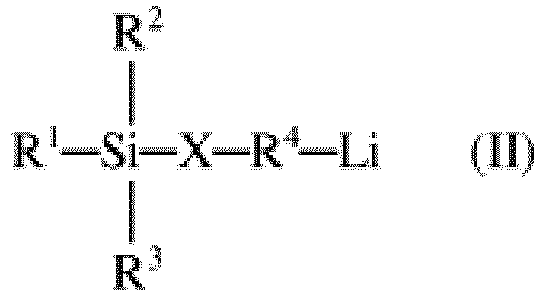
- the organolithium compounds which may be used as initiators are monofunctional compounds which can be represented by the formula (II) where R 1 , R 2 , R 3 can all be the same or different and are selected from the group consisting of alkyls having from 1 to 8 carbon atoms, cycloalkyls having from 3 to 11 carbon atoms, or aryls having from 6 to 14 carbon atoms, R 4 is an alkylene having from 1 to 8 carbon atoms, a cycloalkylene having from 3 to 11 carbon atoms, or an arylene having from 6 to 14 carbon atoms, X is S, O or NH, and Li is lithium.
- formation of a metal terminated living polyisoprene polymer is depicted in Scheme 1, wherein the initiator of formula II is t-butyldimethylsiloxypropyl lithium.
- organolithium initiator utilized will vary depending upon the molecular weight which is desired for the functionalized elastomer being synthesized as well as the precise polymerization temperature which will be employed.
- the precise amount of organolithium compound required to produce a polymer of a desired molecular weight can be easily ascertained by persons skilled in the art. However, as a general rule from 0.01 to 1 phm (parts per 100 parts by weight of monomer) of an organolithium initiator will be utilized. In most cases, from 0.01 to 0.1 phm of an organolithium initiator will be utilized with it being preferred to utilize 0.025 to 0.07 phm of the organolithium initiator.
- the polymerization temperature utilized can vary over a broad range of from -20°C to 180°C. In most cases, a polymerization temperature within the range of 30°C to 125°C will be utilized. It is typically preferred for the polymerization temperature to be within the range of 45°C to 100°C. It is typically most preferred for the polymerization temperature to be within the range of 60°C to 85°C.
- the pressure used will normally be sufficient to maintain a substantially liquid phase under the conditions of the polymerization reaction.
- the rubber polymers which are prepared by anionic polymerization may be coupled with a suitable coupling agent, such as a tin halide or a silicon halide, to improve desired properties.
- a suitable coupling agent such as a tin halide or a silicon halide
- the metal terminated living functionalized elastomers utilized in the practice of this invention can be of virtually any molecular weight.
- the number average molecular weight of the living functionalized elastomer will typically be within the range of 10,000 to 1,000,000. In one embodiment, the number average molecular weight of the living functionalized elastomer will be within the range of a 50,000 to 500,000. In one embodiment, the living functionalized elastomers have a number average molecular weight within the range of 100,000 to 250,000.
- polymerization After the polymerization reaction is completed, it will normally be desirable to "kill" any living polydiene chains which remain. Polymerization may be terminated in the usual manner, using an excess of a short chain alcohol such as methanol, ethanol, isopropanol, or the like.
- a short chain alcohol such as methanol, ethanol, isopropanol, or the like.
- the protected end-group functionalized polydiene elastomer can then be recovered from the solution utilizing standard techniques. Deprotection of the protected-end-group functionalized polymer is carried out to produce the hydroxyl-end functionalized polydiene.
- the hydroxyl end-functionalized polymer may be converted to a "thiolophile" conducive to reactive in a thiol-ene reaction.
- the hydroxyl-end functionalized polymer is reacted with a maleimido acid chloride of formula III where R 5 is a linear or branch alkanediyl, cycloalkanediyl, or combination thereof.
- a maleimide-terminated polymer through reaction of the hydroxyl end-functionalized elastomer with a maleimido acid chloride is depicted in Scheme 2, where R 5 is cyclohexyl and the hydroxyl end-functionalized elastomer is the unprotected form of the elastomer from Scheme 1.
- the maleimide-terminated polymer is combined with a thiol-terminated version of the polymer Z to obtain the copolymer.
- the polymer Z derived from a monomer having a hydrogen bond donor moiety and a hydrogen bond acceptor moiety includes homopolymers and copolymers of various monomers, including but not limited to polymers of: acrylamides and substituted acrylamides, methacrylamides and substituted methacrylamides, acrylic acids and substituted acrylic acids, methacrylic acids and substituted methacrylic acids.
- hydrophilicity is used herein in the same manner as would be understood by one of ordinary skill in the art.
- hydrogen bond acceptor moiety and “hydrogen bond donor moiety” are defined herein as moieties that are capable of forming a hydrogen bond when at least one acceptor moiety and at least one donor moiety are present.
- the polymer Z is a polymer of a monomer of formula IV where R 6 is selected from the group consisting of C2 to C6 linear alkyl, C2 to C6 branched alkyl, and C3 to C6 cycloalkyl.
- Z is of formula (V) where R 7 is selected from the group consisting of C2 to C6 linear alkyl, C2 to C6 branched alkyl, and C3 to C6 cycloalkyl.
- the polymer Z is a polymer of an N-substituted monoalkyl acrylamide derivative.
- the polymer Z is a polymer of N-isopropylacrylamide.
- the polymer Z has a weight average molecular weight ranging from 500 to 20000 g/mol.
- the copolymer comprises from 1 to 20 weight percent Z.
- the copolymer of formula I may be produced by various methods.
- the copolymer may be produced by terminally functionalizing the polymer X with the polymer Z to produce a graft copolymer with an elastomer backbone X and a terminal Z.
- a convenient way for the functionalization of a variety of elastomers is the thiol-ene reaction during which alkene moiety being present in the maleimide group of the maleimide terminated polymer is transformed into a thioether by reaction with a thiol.
- a thiol-terminated version of the polymer Z is used.
- the thiol moiety can be introduced by reaction of thiocarbonylthio endgroups with nucleophilic agents.
- Polymers exhibiting thiocarbonylthio end groups can be produced by reversible addition-fragmentation chain transfer (RAFT) polymerization.
- RAFT reversible addition-fragmentation chain transfer
- One reaction scheme describes the use of PNIPAM as polymer Z, however, this invention is not limited to that as any polymer derived from a monomer having a hydrogen bond donor moiety and a hydrogen bond acceptor moiety, which for example can be produced by RAFT polymerization, can be used for the functionalization of the elastomer.
- the thiol-terminated polymer Z is obtained by polymerizing a monomer having hydrogen bond donor and acceptor moieties in the presence of a thiocarbonylthio RAFT chain transfer agent to form a polymer comprising a terminal thiocarbonylthio group; and cleaving the terminal thiocarbonylthio group to a thiol group to form the polymer Z comprising a terminal thiol group.
- the terminal thiol group of the polymer Z is incorporated in the polymer during polymerization through the mechanism of reversible addition-fragmentation chain transfer (RAFT). More details of the RAFT polymerization mechanism may be found by reference to Moad et al., Aust. J. Chem. 2005, 58, 379-410 .
- RAFT polymerization of free-radical polymerizable monomers is accomplished in the presence of a thiocarbonylthio RAFT chain transfer agent of general formula (VI) where R 8 is a free radical leaving group able to reinitiate polymerization, and Q is a functional group that influences the rate of radical addition and fragmentation.
- Suitable thiocarbonylthio RAFT chain transfer agents include dithioesters, trithiocarbonates, dithiocarbamates, and xanthates.
- the thiocarbonylthio chain transfer agent is a trithiocarbonate.
- the thiocarbonylthio chain transfer agent is selected from the group consisting of S-1-dodecyl-S-( ⁇ '-dimethyl- ⁇ "-acetic acid) trithiocarbonate and 4-cyano-4-dodecylsulfanylthiocarbonylsulfanyl-4-methyl butyric acid.
- the chain-terminated polymer Upon RAFT polymerization in the presence of a suitable thiocarbonylthio chain transfer agent, the chain-terminated polymer has the general formula (VII) where Z represents the polymer chain derived from monomers having a hydrogen bond donor moiety and a hydrogen bond acceptor moiety.
- the chain terminated polymer of formula VI is then reacted with a suitable nucleophile to cleave the C-S linkage to obtain a second polymer of formula (VII) having a terminal thiol group H-S-Z (VIII)
- the chain terminated polymer of formula VII is treated by aminolysis to obtain the thiol-terminated polymer of formula VIII.
- the polymer Z having a terminal thiol group may be reacted with the maleimide terminated polymer in a thiol-ene reaction to form the copolymer as illustrated in Scheme 3, where the polymer Z is shown as PNIPAM, poly (N-isopropylacrylamide).
- the end-functionalized copolymer of formula I may be compounded into a rubber composition.
- the rubber composition may optionally include, in addition to the functionalized polymer, one or more rubbers or elastomers containing olefinic unsaturation.
- the phrases "rubber or elastomer containing olefinic unsaturation” or “diene based elastomer” are intended to include both natural rubber and its various raw and reclaim forms as well as various synthetic rubbers. In the description of this invention, the terms “rubber” and “elastomer” may be used interchangeably, unless otherwise prescribed.
- the terms “rubber composition,” “compounded rubber” and “rubber compound” are used interchangeably to refer to rubber which has been blended or mixed with various ingredients and materials and such terms are well known to those having skill in the rubber mixing or rubber compounding art.
- Representative synthetic polymers are the homopolymerization products of butadiene and its homologues and derivatives, for example, methylbutadiene, dimethylbutadiene and pentadiene as well as copolymers such as those formed from butadiene or its homologues or derivatives with other unsaturated monomers.
- acetylenes for example, vinyl acetylene
- olefins for example, isobutylene, which copolymerizes with isoprene to form butyl rubber
- vinyl compounds for example, acrylic acid, acrylonitrile (which polymerize with butadiene to form NBR), methacrylic acid and styrene, the latter compound polymerizing with butadiene to form SBR, as well as vinyl esters and various unsaturated aldehydes, ketones and ethers, e.g., acrolein, methyl isopropenyl ketone and vinylethyl ether.
- synthetic rubbers include neoprene (polychloroprene), polybutadiene (including cis 1,4 polybutadiene), polyisoprene (including cis 1,4 polyisoprene), butyl rubber, halobutyl rubber such as chlorobutyl rubber or bromobutyl rubber, styrene/isoprene/butadiene rubber, copolymers of 1,3 butadiene or isoprene with monomers such as styrene, acrylonitrile and methyl methacrylate, as well as ethylene/propylene terpolymers, also known as ethylene/propylene/diene monomer (EPDM), and in particular, ethylene/propylene/ dicyclopentadiene terpolymers.
- neoprene polychloroprene
- polybutadiene including cis 1,4 polybutadiene
- polyisoprene including cis 1,4 poly
- rubbers which may be used include alkoxy-silyl end functionalized solution polymerized polymers (SBR, PBR, IBR and SIBR), silicon-coupled and tin-coupled star-branched polymers.
- SBR alkoxy-silyl end functionalized solution polymerized polymers
- PBR polybutadiene
- SIBR silicon-coupled and tin-coupled star-branched polymers.
- the preferred rubber or elastomers are polyisoprene (natural or synthetic), polybutadiene and SBR.
- the at least one additional rubber is preferably of at least two of diene based rubbers.
- a combination of two or more rubbers is preferred such as cis 1,4-polyisoprene rubber (natural or synthetic, although natural is preferred), 3,4-polyisoprene rubber, styrene/isoprene/butadiene rubber, emulsion and solution polymerization derived styrene/butadiene rubbers, cis 1,4-polybutadiene rubbers and emulsion polymerization prepared butadiene/acrylonitrile copolymers.
- an emulsion polymerization derived styrene/butadiene might be used having a relatively conventional styrene content of 20 to 28 percent bound styrene or, for some applications, an E SBR having a medium to relatively high bound styrene content, namely, a bound styrene content of 30 to 45 percent.
- E-SBR emulsion polymerization prepared E-SBR
- styrene and 1,3 butadiene are copolymerized as an aqueous emulsion.
- the bound styrene content can vary, for example, from 5 to 50 percent.
- the E-SBR may also contain acrylonitrile to form a terpolymer rubber, as E-SBAR, in amounts, for example, of 2 to 30 weight percent bound acrylonitrile in the terpolymer.
- Emulsion polymerization prepared styrene/butadiene/acrylonitrile copolymer rubbers containing 2 to 40 weight percent bound acrylonitrile in the copolymer are also contemplated as diene based rubbers for use in this invention.
- S-SBR solution polymerization prepared SBR
- S-SBR typically has a bound styrene content in a range of 5 to 50, preferably 9 to 36, percent.
- the S-SBR can be conveniently prepared, for example, by organo lithium catalyzation in the presence of an organic hydrocarbon solvent.
- cis 1,4-polybutadiene rubber may be used.
- BR cis 1,4-polybutadiene rubber
- Such BR can be prepared, for example, by organic solution polymerization of 1,3-butadiene.
- the BR may be conveniently characterized, for example, by having at least a 90 percent cis 1,4-content.
- the rubber composition may also include up to 70 phr of processing oil.
- Processing oil may be included in the rubber composition as extending oil typically used to extend elastomers. Processing oil may also be included in the rubber composition by addition of the oil directly during rubber compounding.
- the processing oil used may include both extending oil present in the elastomers, and process oil added during compounding.
- Suitable process oils include various oils as are known in the art, including aromatic, paraffinic, naphthenic, vegetable oils, and low PCA oils, such as MES, TDAE, SRAE and heavy naphthenic oils.
- Suitable low PCA oils include those having a polycyclic aromatic content of less than 3 percent by weight as determined by the IP346 method. Procedures for the IP346 method may be found in Standard Methods for Analysis & Testing of Petroleum and Related Products and British Standard 2000 Parts, 2003, 62nd edition, published by the Institute of Petroleum, United Kingdom .
- the rubber composition may include from 10 to 150 phr of silica. In another embodiment, from 20 to 80 phr of silica may be used.
- siliceous pigments which may be used in the rubber compound include conventional pyrogenic and precipitated siliceous pigments (silica). In one embodiment, precipitated silica is used.
- silicas such as, only for example herein, silicas commercially available from PPG Industries under the Hi-Sil trademark with designations 210 and 243; silicas available from Rhodia, with, for example, designations of Z1165MP and Z165GR and silicas available from Degussa AG with, for example, designations VN2 and VN3.
- Commonly employed carbon blacks can be used as a conventional filler in an amount ranging from 10 to 150 phr. In another embodiment, from 20 to 80 phr of carbon black may be used.
- Representative examples of such carbon blacks include N110, N121, N134, N220, N231, N234, N242, N293, N299, N315, N326, N330, N332, N339, N343, N347, N351, N358, N375, N539, N550, N582, N630, N642, N650, N683, N754, N762, N765, N774, N787, N907, N908, N990 and N991.
- These carbon blacks have iodine absorptions ranging from 9 to 145 g/kg and DBP number ranging from 34 to 150 cm3/100 g.
- fillers may be used in the rubber composition including, but not limited to, particulate fillers including ultra high molecular weight polyethylene (UHMWPE), crosslinked particulate polymer gels including but not limited to those disclosed in US-A- 6,242,534 ; US-A- 6,207,757 ; US-A- 6,133,364 ; US-A- 6,372,857 ; US-A-5,395,891 ; or US-A- 6,127,488 , and plasticized starch composite filler including that disclosed in U.S. Patent No. 5,672,639 .
- Such other fillers may be used in an amount ranging from 1 to 30 phr.
- the rubber composition may contain a conventional sulfur containing organosilicon compound.
- the sulfur containing organosilicon compounds are the 3,3'- bis(trimethoxy or triethoxy silylpropyl) polysulfides.
- the sulfur containing organosilicon compounds are 3,3'-bis(triethoxysilylpropyl) disulfide and/or 3,3'- bis(triethoxysilylpropyl) tetrasulfide.
- the amount of the sulfur containing organosilicon compound in a rubber composition will vary depending on the level of other additives that are used. Generally speaking, the amount of the compound will range from 0.5 to 20 phr. In one embodiment, the amount will range from 1 to 10 phr.
- the rubber composition would be compounded by methods generally known in the rubber compounding art, such as mixing the various sulfur-vulcanizable constituent rubbers with various commonly used additive materials such as, for example, sulfur donors, curing aids, such as activators and retarders and processing additives, such as oils, resins including tackifying resins and plasticizers, fillers, pigments, fatty acid, zinc oxide, waxes, antioxidants and antiozonants and peptizing agents.
- additives mentioned above are selected and commonly used in conventional amounts.
- sulfur donors include elemental sulfur (free sulfur), an amine disulfide, polymeric polysulfide and sulfur olefin adducts.
- the sulfur-vulcanizing agent is elemental sulfur.
- the sulfur-vulcanizing agent may be used in an amount ranging from 0.5 to 8 phr.
- Typical amounts of tackifier resins, if used, comprise 0.5 to 10 phr.
- Typical amounts of processing aids comprise 1 to 50 phr.
- Typical amounts of antioxidants comprise 1 to 5 phr.
- Representative antioxidants may be, for example, diphenyl-p-phenylenediamine and others, such as, for example, those disclosed in The Vanderbilt Rubber Handbook (1978), Pages 344 through 346 .
- Typical amounts of antiozonants comprise 1 to 5 phr.
- Typical amounts of fatty acids, if used, which can include stearic acid comprise 0.5 to 3 phr.
- Typical amounts of zinc oxide comprise 1 to 5 phr.
- Typical amounts of waxes comprise 1 to 5 phr. Often microcrystalline waxes are used.
- Typical amounts of peptizers comprise 0.1 to 1 phr. Typical peptizers may be, for example, pentachlorothiophenol and dibenzamidodiphenyl disulfide.
- Accelerators are used to control the time and/or temperature required for vulcanization and to improve the properties of the vulcanizate.
- a single accelerator system may be used, i.e., primary accelerator.
- the primary accelerator(s) may be used in total amounts ranging from 0.5 to 4.
- combinations of a primary and a secondary accelerator might be used with the secondary accelerator being used in smaller amounts, such as from 0.05 to 3 phr, in order to activate and to improve the properties of the vulcanizate.
- delayed action accelerators may be used which are not affected by normal processing temperatures but produce a satisfactory cure at ordinary vulcanization temperatures.
- Vulcanization retarders might also be used.
- Suitable types of accelerators that may be used in the present invention are amines, disulfides, guanidines, thioureas, thiazoles, thiurams, sulfenamides, dithiocarbamates and xanthates.
- the primary accelerator is a sulfenamide.
- the secondary accelerator may be a guanidine, dithiocarbamate or thiuram compound.
- the mixing of the rubber composition can be accomplished by methods known to those having skill in the rubber mixing art.
- the ingredients are typically mixed in at least two stages, namely, at least one non-productive stage followed by a productive mix stage.
- the final curatives including sulfur-vulcanizing agents are typically mixed in the final stage which is conventionally called the "productive" mix stage in which the mixing typically occurs at a temperature, or ultimate temperature, lower than the mix temperature(s) than the preceding non-productive mix stage(s).
- the rubber composition may be subjected to a thermomechanical mixing step.
- the thermomechanical mixing step generally comprises a mechanical working in a mixer or extruder for a period of time suitable in order to produce a rubber temperature between 140°C and 190°C.
- the appropriate duration of the thermomechanical working varies as a function of the operating conditions, and the volume and nature of the components.
- the thermomechanical working may be from 1 to 20 minutes.
- the rubber composition may be incorporated in a variety of rubber components of the tire.
- the rubber component may be a tread (including tread cap and tread base), sidewall, apex, chafer, sidewall insert, wirecoat or innerliner.
- the component is a tread.
- the pneumatic tire of the present invention may be a race tire, passenger tire, aircraft tire, agricultural, earthmover, off-the-road, or truck tire.
- the tire is a passenger or truck tire.
- the tire may also be a radial or bias.
- Vulcanization of the pneumatic tire of the present invention is generally carried out at conventional temperatures ranging from 100°C to 200 °C. In one embodiment, the vulcanization is conducted at temperatures ranging from 110°C to 180 °C. Any of the usual vulcanization processes may be used such as heating in a press or mold, heating with superheated steam or hot air. Such tires can be built, shaped, molded and cured by various methods which are known and will be readily apparent to those having skill in such art.
- DCM Dichloromethane
- THF tetrahydrofuran
- MeOH methanol
- Et3N triethylamine
- nBuLi n-Butyllithium
- TBAF tetra-n-butylammonium fluoride
- DIBAL-H diisobutylaluminum hydride
- Hydroxyl-terminated polyisoprene of various molecular weights was produced following a similar procedure.
- Example 2 the polymerization procedure was similar to Example 1 except for using the tert-butyldimethylsiloxypropyllithium (tBDMSPrLi) functional initiator.
- tBDMSPrLi tert-butyldimethylsiloxypropyllithium
- a 4oz. Boston round glass bottle was charged with isoprene (15% by weight in cyclohexane) (9.1 g monomer, 133 mmol) and the 0.47 M tBDMSPrLi/cyclohexane initiator (2.06e-2 mmol) was added all at once and the bottle was placed in a polymerization bath pre-set at 65 °C. The bottle was tumbled at that temperature for 2 hours. At the end of that time, the bottle was taken out of the polymerization bath and quenched with isopropanol.
- tBDMSPrLi tert-butyldimethylsiloxypropyllithium
- the polymer was purified by precipitating the cement in MeOH at room temperature under vigorous stirring. GPC analysis indicated the Mn of the polymer to be 458 kDa and a PDI of 1.04. 1 H NMR analysis indicated the polymer contains the protected chain-end-groups. Characteristic 1 H NMR resonances were observed: a singlet at ⁇ ⁇ 0.47 corresponding to the dimethyl groups and another singlet at ⁇ ⁇ 0.89 ppm corresponding to the tert-butyl group. The dried polymer was stored in a vial under nitrogen.
- DIBAL-H diisobutylaluminum hydride/hexane
- PI-OH Hydroxyl-end functionalized polyisoprene
- Example 2 The hydroxyl-end functionalized polyisoprene of Example 2 was converted to a maleimide terminated polyisoprene following the route in Scheme 5.
- the maleimido acid chloride was produced following the synthetic pathway as shown in Scheme 6.
- the maleimide end-functionalized polyisoprene of Example 3 was converted to a PNIPAM end-functionalized polyisoprene.
- Emulsification of the PNIPAM end-functionalized elastomer of Example 4 was accomplished by shaking of a mixture of water, and chloroform solution. It resulted in an emulsion which remained stable for more than 12 hours ( Figure 1 ). In contrast, no stable emulsion formed when a) only the maleimido end-functionalized PI or b) only the PNIPAM-SH was attempted. The former sample formed an emulsion which was stable only for few minutes whereas the later sample did not form any emulsion at all.
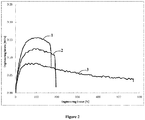
- the control for comparison of the tensile strength was the 450 kDa hydroxyl end-functionalized (3 in Figure 2 ).
- the nanostructure-inducing polyisoprene (1 in Figure 2 ) has a tensile strength significantly higher than the control unfunctionalized PI (3). It is also found to have higher tensile properties compared to ⁇ 1 MM very high-cis Neodymium-PI (2 in Figure 2 ).
- the poor elongation-at-break of the nanostructure-inducing elastomer (1) was likely due to flaws developed in the film during drying of the solution-cast film.
Landscapes
- Chemical & Material Sciences (AREA)
- Health & Medical Sciences (AREA)
- Chemical Kinetics & Catalysis (AREA)
- Medicinal Chemistry (AREA)
- Polymers & Plastics (AREA)
- Organic Chemistry (AREA)
- General Chemical & Material Sciences (AREA)
- Addition Polymer Or Copolymer, Post-Treatments, Or Chemical Modifications (AREA)
Claims (15)
- Copolymère comprenant : une chaîne polymère principale qui dérive d'un monomère comprenant au moins un monomère diénique conjugué et, de manière facultative, au moins un monomère vinylaromatique ; et une chaîne polymère latérale liée de manière exclusive à une extrémité terminale de la chaîne principale, la chaîne latérale comprenant un polymère qui dérive d'un monomère possédant un site donneur de liaison hydrogène et un site accepteur de liaison hydrogène, ou qui dérive d'un monoalkylacrylamide substitué sur l'atome d'azote.
- Copolymère selon la revendication 1, comprenant la structure :
X-R-O-R'-S-Z (I)
dans laquelle X représente un polymère qui dérive d'un monomère comprenant au moins un monomère diénique conjugué et de manière facultative au moins un monomère vinylaromatique ; S représente un atome de soufre ; Z représente un polymère qui dérive d'un monomère possédant un site donneur de liaison hydrogène et un site accepteur de liaison hydrogène ; R représente une liaison covalente ou un groupe alkyle contenant de 1 à 12 atomes de carbone lié à une extrémité terminale de X ; O représente un atome d'oxygène ; et R' représente un groupe organique divalent comprenant un groupe maléimido lié à l'atome de soufre. - Copolymère selon la revendication 1 ou 2, dans lequel ledit au moins un monomère diénique conjugué est choisi parmi le groupe constitué par l'isoprène et le butadiène et/ou dans lequel le monomère vinylaromatique est le styrène.
- Copolymère selon la revendication 3 ou 2, dans lequel X est choisi parmi le groupe constitué par un caoutchouc de styrène-butadiène polymérisé en solution, un caoutchouc de styrène-butadiène polymérisé en émulsion, du polybutadiène, du caoutchouc de polyisoprène naturel et du caoutchouc de polyisoprène synthétique.
- Copolymère selon la revendication 2, 3 ou 4, dans lequel Z dérive d'un monomère répondant à la formule :

- Copolymère selon au moins une des revendications précédentes 2 à 5, dans lequel le polymère Z possède un poids moléculaire moyen en poids qui se situe dans la plage de 500 à 20.000 g/mol.
- Copolymère selon au moins une des revendications précédentes 2 à 6, comprenant de 1 à 20 % en poids de Z.
- Copolymère selon la revendication 2, dans lequel Z répond à la formule

- Procédé de préparation d'un élastomère fonctionnalisé, le procédé comprenant les étapes dans lesquelles :on polymérise au moins un monomère diénique et de manière facultative un monomère vinylaromatique en présence d'un initiateur répondant à la formule (II) afin d'obtenir un polymère dont l'extrémité terminale hydroxyle est protégée
 on déprotège l'élastomère dont l'extrémité terminale hydroxyle est protégée afin d'obtenir un polymère dont l'extrémité possède une fonctionnalité hydroxyle ;on fait réagir le polymère dont l'extrémité possède une fonctionnalité hydroxyle avec un chlorure de maléimido acide pour obtenir un polymère dont l'extrémité possède une fonction maléimido ; eton fait réagir le polymère dont l'extrémité possède une fonctionnalité maléimido avec un polymère à terminaison thiol qui dérive d'un monomère possédant un site donneur de liaison hydrogène et un site accepteur de liaison hydrogène afin d'obtenir l'élastomère fonctionnalisé.
 - Procédé selon la revendication 9, dans lequel ledit au moins un monomère diénique est choisi parmi le groupe constitué par l'isoprène et le butadiène et/ou dans lequel le monomère vinylaromatique est le styrène.
- Procédé selon la revendication 9 ou 10, dans lequel l'élastomère fonctionnalisé comprend :une chaîne polymère principale qui dérive du monomère comprenant au moins un monomère diénique conjugué et, de manière facultative, au moins un monomère vinylaromatique ; etune chaîne polymère latérale liée de manière exclusive à une extrémité terminale de la chaîne principale, la chaîne latérale comprenant le polymère qui dérive d'un monomère possédant un site donneur de liaison hydrogène et un site accepteur de liaison hydrogène.
- Procédé selon la revendication 9 ou 10, dans lequel l'élastomère fonctionnalisé comprend :une chaîne polymère principale comprenant un élastomère à base diénique choisi parmi le groupe constitué par un caoutchouc de styrène-butadiène polymérisé en solution, un caoutchouc de styrène-butadiène polymérisé en émulsion, du caoutchouc de polyisoprène naturel, du caoutchouc de polyisoprène synthétique, et du polybutadiène ;une chaîne polymère latérale liée de manière exclusive à une extrémité terminale de la chaîne principale, la chaîne latérale comprenant un polymère qui dérive d'un monoalkylacrylamide substitué sur l'atome d'azote.
- Procédé selon au moins une des revendications 9 à 12, dans lequel l'élastomère fonctionnalisé comprend la structure :
X-R-O-R'-S-Z (I)
dans laquelle X représente un polymère qui dérive du monomère comprenant au moins un monomère diénique conjugué tel que l'isoprène ou le butadiène, et de manière facultative au moins un monomère vinylaromatique tel que le styrène ; ou dans lequel X est choisi parmi le groupe constitué par un caoutchouc de styrène-butadiène polymérisé en solution, un caoutchouc de styrène-butadiène polymérisé en émulsion, du polybutadiène, du caoutchouc de polyisoprène naturel et du caoutchouc de polyisoprène synthétique ; S représente un atome de soufre ; Z représente le polymère qui dérive d'un monomère possédant un site donneur de liaison hydrogène et un site accepteur de liaison hydrogène ; R représente une liaison covalente ou un groupe alkyle contenant de 1 à 12 atomes de carbone lié à une extrémité terminale de X ; O représente un atome d'oxygène ; et R' représente un groupe organique divalent comprenant un groupe maléimido lié à l'atome de soufre. - Procédé selon la revendication 13, dans lequel :(i) Z dérive d'un monomère répondant à la formule :
 (ii) Z représente un groupe poly(N-isopropylacrylamide) ; ou(iii) Z répond à la formule
- Procédé selon la revendication 9, dans lequel l'initiateur répondant à la formule (II) et le t-butyldiméthylsiloxypropyl lithium.
Applications Claiming Priority (2)
| Application Number | Priority Date | Filing Date | Title |
|---|---|---|---|
| US201413894790A | 2013-05-15 | 2013-05-15 | |
| US13/894,796 US8816009B1 (en) | 2013-05-15 | 2013-05-15 | Method of making functionalized elastomer |
Publications (2)
| Publication Number | Publication Date |
|---|---|
| EP2803683A1 EP2803683A1 (fr) | 2014-11-19 |
| EP2803683B1 true EP2803683B1 (fr) | 2017-02-22 |
Family
ID=50735878
Family Applications (1)
| Application Number | Title | Priority Date | Filing Date |
|---|---|---|---|
| EP14167944.9A Not-in-force EP2803683B1 (fr) | 2013-05-15 | 2014-05-12 | Élastomère fonctionnalisé et procédé de fabrication d'un tel élastomère |
Country Status (1)
| Country | Link |
|---|---|
| EP (1) | EP2803683B1 (fr) |
Families Citing this family (1)
| Publication number | Priority date | Publication date | Assignee | Title |
|---|---|---|---|---|
| LU100867B1 (en) * | 2018-06-29 | 2019-12-30 | Apollo Tyres Global R & D Bv | Rubber composition for tires with good wet grip and rolling resistance properties |
Family Cites Families (20)
| Publication number | Priority date | Publication date | Assignee | Title |
|---|---|---|---|---|
| US4843120A (en) | 1986-09-29 | 1989-06-27 | The Goodyear Tire & Rubber Company | Rubber composition |
| US5047483A (en) | 1988-06-29 | 1991-09-10 | The Goodyear Tire & Rubber Company | Pneumatic tire with tread of styrene, isoprene, butadiene rubber |
| US5061765A (en) | 1990-10-22 | 1991-10-29 | The Goodyear Tire & Rubber Company | Process for the synthesis of a high vinyl isoprene-butadiene copolymer |
| CA2035229A1 (fr) | 1990-10-22 | 1992-04-23 | Wen-Liang Hsu | Procede pour la preparation d'un terpolymere caoutchouteux du styrene, de l'isoprene et du butadiene |
| US5239009A (en) | 1991-10-16 | 1993-08-24 | The Goodyear Tire & Rubber Company | High performance segmented elastomer |
| DE4220563A1 (de) | 1992-06-24 | 1994-01-13 | Bayer Ag | Kautschukmischungen enthaltend Polybutadien-Gel |
| US5272220A (en) | 1992-09-14 | 1993-12-21 | The Goodyear Tire & Rubber Company | Process for preparing styrene-isoprene-butadiene rubber |
| US5405927A (en) | 1993-09-22 | 1995-04-11 | The Goodyear Tire & Rubber Company | Isoprene-butadiene rubber |
| US5677402A (en) | 1995-09-22 | 1997-10-14 | The Goodyear Tire & Rubber Company | Process for preparing 3,4-polyisoprene rubber |
| US5534592A (en) | 1995-09-22 | 1996-07-09 | The Goodyear Tire & Rubber Company | High performance blend for tire treads |
| US5672639A (en) | 1996-03-12 | 1997-09-30 | The Goodyear Tire & Rubber Company | Starch composite reinforced rubber composition and tire with at least one component thereof |
| US5627237A (en) | 1996-05-06 | 1997-05-06 | The Goodyear Tire & Rubber Company | Tire tread containing 3.4-polyisoprene rubber |
| DE19701488A1 (de) | 1997-01-17 | 1998-07-23 | Bayer Ag | SBR-Kautschukgele enthaltende Kautschukmischungen |
| EP0877034A1 (fr) | 1997-05-05 | 1998-11-11 | The Goodyear Tire & Rubber Company | SBR statistique à haute teneur en trans et à basse teneur en vinyl |
| DE19834802A1 (de) | 1998-08-01 | 2000-02-03 | Continental Ag | Kautschukmischung |
| DE19834804A1 (de) | 1998-08-01 | 2000-02-03 | Continental Ag | Kautschukmischung |
| DE19834803A1 (de) | 1998-08-01 | 2000-02-03 | Continental Ag | Kautschukmischung |
| DE19942620A1 (de) | 1999-09-07 | 2001-03-08 | Bayer Ag | Mikrogelhaltige Kautschukmischungen mit verkappten bifunktionellen Mercaptanen und hieraus hergestellte Vulkanisate |
| US6559240B2 (en) | 2000-11-22 | 2003-05-06 | The Goodyear Tire & Rubber Company | Process for tin/silicon coupling functionalized rubbers |
| US9133333B2 (en) * | 2012-11-27 | 2015-09-15 | The Goodyear Tire & Rubber Company | Blend of a graft copolymer and a second polymer miscible with sidechains of the graft copolymer |
-
2014
- 2014-05-12 EP EP14167944.9A patent/EP2803683B1/fr not_active Not-in-force
Non-Patent Citations (1)
| Title |
|---|
| None * |
Also Published As
| Publication number | Publication date |
|---|---|
| EP2803683A1 (fr) | 2014-11-19 |
Similar Documents
| Publication | Publication Date | Title |
|---|---|---|
| EP2607102B1 (fr) | Procédé de fabrication de polymère greffé, polymère greffé obtenu grâce à ce procédé et pneumatique | |
| US8865829B2 (en) | Functionalized polymer, rubber composition and pneumatic tire | |
| KR101955041B1 (ko) | 작용화된 중합체, 고무 조성물 및 공기압 타이어 | |
| EP2875967B1 (fr) | Élastomère fonctionnalisé et composition de caoutchouc le comprenant | |
| EP2719549B1 (fr) | Polymère fonctionnalisé, composition de caoutchouc et pneu | |
| US9212239B2 (en) | Method of making functionalized elastomer | |
| US9035005B2 (en) | Functionalized elastomer | |
| EP2860199B1 (fr) | Polymère fonctionnalisé, composition de caoutchouc et pneu | |
| US8962759B2 (en) | Functionalized elastomer | |
| EP3663101B1 (fr) | Polymère fonctionnalisé, composition de caoutchouc et pneu | |
| US9416212B1 (en) | Pneumatic tire with block copolymer | |
| EP2803683A1 (fr) | Élastomère fonctionnalisé et procédé de fabrication d'un tel élastomère | |
| JP7566486B2 (ja) | 鎖中官能化エラストマー、ゴム組成物、および空気入りタイヤ | |
| US12258474B2 (en) | Functionalized polymer, rubber composition and pneumatic tire | |
| EP3915808B1 (fr) | Initiateur fonctionnalisé, procédé de fabrication d'un initiateur et élastomère fonctionnalisé | |
| EP3670542B1 (fr) | Polymère fonctionnalisé, composition de caoutchouc et pneu | |
| EP3666801B1 (fr) | Polymère fonctionnalisé, composition de caoutchouc et pneu | |
| US10947380B2 (en) | Functionalized polymer, rubber composition and pneumatic tire | |
| KR20250153115A (ko) | 용액 점도가 감소된 폴리디엔 |
Legal Events
| Date | Code | Title | Description |
|---|---|---|---|
| PUAI | Public reference made under article 153(3) epc to a published international application that has entered the european phase |
Free format text: ORIGINAL CODE: 0009012 |
|
| 17P | Request for examination filed |
Effective date: 20140512 |
|
| AK | Designated contracting states |
Kind code of ref document: A1 Designated state(s): AL AT BE BG CH CY CZ DE DK EE ES FI FR GB GR HR HU IE IS IT LI LT LU LV MC MK MT NL NO PL PT RO RS SE SI SK SM TR |
|
| AX | Request for extension of the european patent |
Extension state: BA ME |
|
| R17P | Request for examination filed (corrected) |
Effective date: 20150519 |
|
| RBV | Designated contracting states (corrected) |
Designated state(s): AL AT BE BG CH CY CZ DE DK EE ES FI FR GB GR HR HU IE IS IT LI LT LU LV MC MK MT NL NO PL PT RO RS SE SI SK SM TR |
|
| 17Q | First examination report despatched |
Effective date: 20150907 |
|
| REG | Reference to a national code |
Ref country code: DE Ref legal event code: R079 Ref document number: 602014006853 Country of ref document: DE Free format text: PREVIOUS MAIN CLASS: C08F0297000000 Ipc: C08G0081020000 |
|
| GRAP | Despatch of communication of intention to grant a patent |
Free format text: ORIGINAL CODE: EPIDOSNIGR1 |
|
| RIC1 | Information provided on ipc code assigned before grant |
Ipc: C08L 9/00 20060101ALI20160907BHEP Ipc: C08G 81/02 20060101AFI20160907BHEP |
|
| INTG | Intention to grant announced |
Effective date: 20160929 |
|
| GRAS | Grant fee paid |
Free format text: ORIGINAL CODE: EPIDOSNIGR3 |
|
| GRAA | (expected) grant |
Free format text: ORIGINAL CODE: 0009210 |
|
| AK | Designated contracting states |
Kind code of ref document: B1 Designated state(s): AL AT BE BG CH CY CZ DE DK EE ES FI FR GB GR HR HU IE IS IT LI LT LU LV MC MK MT NL NO PL PT RO RS SE SI SK SM TR |
|
| REG | Reference to a national code |
Ref country code: GB Ref legal event code: FG4D |
|
| REG | Reference to a national code |
Ref country code: CH Ref legal event code: EP |
|
| REG | Reference to a national code |
Ref country code: AT Ref legal event code: REF Ref document number: 869226 Country of ref document: AT Kind code of ref document: T Effective date: 20170315 |
|
| REG | Reference to a national code |
Ref country code: IE Ref legal event code: FG4D |
|
| REG | Reference to a national code |
Ref country code: DE Ref legal event code: R096 Ref document number: 602014006853 Country of ref document: DE |
|
| REG | Reference to a national code |
Ref country code: FR Ref legal event code: PLFP Year of fee payment: 4 |
|
| REG | Reference to a national code |
Ref country code: LT Ref legal event code: MG4D |
|
| REG | Reference to a national code |
Ref country code: NL Ref legal event code: MP Effective date: 20170222 |
|
| REG | Reference to a national code |
Ref country code: AT Ref legal event code: MK05 Ref document number: 869226 Country of ref document: AT Kind code of ref document: T Effective date: 20170222 |
|
| PG25 | Lapsed in a contracting state [announced via postgrant information from national office to epo] |
Ref country code: FI Free format text: LAPSE BECAUSE OF FAILURE TO SUBMIT A TRANSLATION OF THE DESCRIPTION OR TO PAY THE FEE WITHIN THE PRESCRIBED TIME-LIMIT Effective date: 20170222 Ref country code: NO Free format text: LAPSE BECAUSE OF FAILURE TO SUBMIT A TRANSLATION OF THE DESCRIPTION OR TO PAY THE FEE WITHIN THE PRESCRIBED TIME-LIMIT Effective date: 20170522 Ref country code: LT Free format text: LAPSE BECAUSE OF FAILURE TO SUBMIT A TRANSLATION OF THE DESCRIPTION OR TO PAY THE FEE WITHIN THE PRESCRIBED TIME-LIMIT Effective date: 20170222 Ref country code: GR Free format text: LAPSE BECAUSE OF FAILURE TO SUBMIT A TRANSLATION OF THE DESCRIPTION OR TO PAY THE FEE WITHIN THE PRESCRIBED TIME-LIMIT Effective date: 20170523 Ref country code: HR Free format text: LAPSE BECAUSE OF FAILURE TO SUBMIT A TRANSLATION OF THE DESCRIPTION OR TO PAY THE FEE WITHIN THE PRESCRIBED TIME-LIMIT Effective date: 20170222 |
|
| PG25 | Lapsed in a contracting state [announced via postgrant information from national office to epo] |
Ref country code: PT Free format text: LAPSE BECAUSE OF FAILURE TO SUBMIT A TRANSLATION OF THE DESCRIPTION OR TO PAY THE FEE WITHIN THE PRESCRIBED TIME-LIMIT Effective date: 20170622 Ref country code: NL Free format text: LAPSE BECAUSE OF FAILURE TO SUBMIT A TRANSLATION OF THE DESCRIPTION OR TO PAY THE FEE WITHIN THE PRESCRIBED TIME-LIMIT Effective date: 20170222 Ref country code: SE Free format text: LAPSE BECAUSE OF FAILURE TO SUBMIT A TRANSLATION OF THE DESCRIPTION OR TO PAY THE FEE WITHIN THE PRESCRIBED TIME-LIMIT Effective date: 20170222 Ref country code: AT Free format text: LAPSE BECAUSE OF FAILURE TO SUBMIT A TRANSLATION OF THE DESCRIPTION OR TO PAY THE FEE WITHIN THE PRESCRIBED TIME-LIMIT Effective date: 20170222 Ref country code: RS Free format text: LAPSE BECAUSE OF FAILURE TO SUBMIT A TRANSLATION OF THE DESCRIPTION OR TO PAY THE FEE WITHIN THE PRESCRIBED TIME-LIMIT Effective date: 20170222 Ref country code: BG Free format text: LAPSE BECAUSE OF FAILURE TO SUBMIT A TRANSLATION OF THE DESCRIPTION OR TO PAY THE FEE WITHIN THE PRESCRIBED TIME-LIMIT Effective date: 20170522 Ref country code: LV Free format text: LAPSE BECAUSE OF FAILURE TO SUBMIT A TRANSLATION OF THE DESCRIPTION OR TO PAY THE FEE WITHIN THE PRESCRIBED TIME-LIMIT Effective date: 20170222 Ref country code: LU Free format text: LAPSE BECAUSE OF NON-PAYMENT OF DUE FEES Effective date: 20170531 |
|
| PG25 | Lapsed in a contracting state [announced via postgrant information from national office to epo] |
Ref country code: SK Free format text: LAPSE BECAUSE OF FAILURE TO SUBMIT A TRANSLATION OF THE DESCRIPTION OR TO PAY THE FEE WITHIN THE PRESCRIBED TIME-LIMIT Effective date: 20170222 Ref country code: RO Free format text: LAPSE BECAUSE OF FAILURE TO SUBMIT A TRANSLATION OF THE DESCRIPTION OR TO PAY THE FEE WITHIN THE PRESCRIBED TIME-LIMIT Effective date: 20170222 Ref country code: EE Free format text: LAPSE BECAUSE OF FAILURE TO SUBMIT A TRANSLATION OF THE DESCRIPTION OR TO PAY THE FEE WITHIN THE PRESCRIBED TIME-LIMIT Effective date: 20170222 Ref country code: CZ Free format text: LAPSE BECAUSE OF FAILURE TO SUBMIT A TRANSLATION OF THE DESCRIPTION OR TO PAY THE FEE WITHIN THE PRESCRIBED TIME-LIMIT Effective date: 20170222 |
|
| REG | Reference to a national code |
Ref country code: DE Ref legal event code: R097 Ref document number: 602014006853 Country of ref document: DE |
|
| PG25 | Lapsed in a contracting state [announced via postgrant information from national office to epo] |
Ref country code: DK Free format text: LAPSE BECAUSE OF FAILURE TO SUBMIT A TRANSLATION OF THE DESCRIPTION OR TO PAY THE FEE WITHIN THE PRESCRIBED TIME-LIMIT Effective date: 20170222 Ref country code: PL Free format text: LAPSE BECAUSE OF FAILURE TO SUBMIT A TRANSLATION OF THE DESCRIPTION OR TO PAY THE FEE WITHIN THE PRESCRIBED TIME-LIMIT Effective date: 20170222 Ref country code: SM Free format text: LAPSE BECAUSE OF FAILURE TO SUBMIT A TRANSLATION OF THE DESCRIPTION OR TO PAY THE FEE WITHIN THE PRESCRIBED TIME-LIMIT Effective date: 20170222 |
|
| PLBE | No opposition filed within time limit |
Free format text: ORIGINAL CODE: 0009261 |
|
| REG | Reference to a national code |
Ref country code: CH Ref legal event code: PL |
|
| STAA | Information on the status of an ep patent application or granted ep patent |
Free format text: STATUS: NO OPPOSITION FILED WITHIN TIME LIMIT |
|
| 26N | No opposition filed |
Effective date: 20171123 |
|
| PG25 | Lapsed in a contracting state [announced via postgrant information from national office to epo] |
Ref country code: MC Free format text: LAPSE BECAUSE OF FAILURE TO SUBMIT A TRANSLATION OF THE DESCRIPTION OR TO PAY THE FEE WITHIN THE PRESCRIBED TIME-LIMIT Effective date: 20170222 |
|
| REG | Reference to a national code |
Ref country code: IE Ref legal event code: MM4A |
|
| PG25 | Lapsed in a contracting state [announced via postgrant information from national office to epo] |
Ref country code: SI Free format text: LAPSE BECAUSE OF FAILURE TO SUBMIT A TRANSLATION OF THE DESCRIPTION OR TO PAY THE FEE WITHIN THE PRESCRIBED TIME-LIMIT Effective date: 20170222 Ref country code: CH Free format text: LAPSE BECAUSE OF NON-PAYMENT OF DUE FEES Effective date: 20170531 Ref country code: LI Free format text: LAPSE BECAUSE OF NON-PAYMENT OF DUE FEES Effective date: 20170531 |
|
| PG25 | Lapsed in a contracting state [announced via postgrant information from national office to epo] |
Ref country code: LU Free format text: LAPSE BECAUSE OF NON-PAYMENT OF DUE FEES Effective date: 20170512 |
|
| REG | Reference to a national code |
Ref country code: FR Ref legal event code: PLFP Year of fee payment: 5 |
|
| REG | Reference to a national code |
Ref country code: BE Ref legal event code: MM Effective date: 20170531 |
|
| PG25 | Lapsed in a contracting state [announced via postgrant information from national office to epo] |
Ref country code: IE Free format text: LAPSE BECAUSE OF NON-PAYMENT OF DUE FEES Effective date: 20170512 |
|
| PGFP | Annual fee paid to national office [announced via postgrant information from national office to epo] |
Ref country code: DE Payment date: 20180502 Year of fee payment: 5 |
|
| PG25 | Lapsed in a contracting state [announced via postgrant information from national office to epo] |
Ref country code: BE Free format text: LAPSE BECAUSE OF NON-PAYMENT OF DUE FEES Effective date: 20170531 |
|
| PGFP | Annual fee paid to national office [announced via postgrant information from national office to epo] |
Ref country code: FR Payment date: 20180411 Year of fee payment: 5 Ref country code: IT Payment date: 20180522 Year of fee payment: 5 |
|
| PG25 | Lapsed in a contracting state [announced via postgrant information from national office to epo] |
Ref country code: MT Free format text: LAPSE BECAUSE OF NON-PAYMENT OF DUE FEES Effective date: 20170512 |
|
| GBPC | Gb: european patent ceased through non-payment of renewal fee |
Effective date: 20180512 |
|
| PG25 | Lapsed in a contracting state [announced via postgrant information from national office to epo] |
Ref country code: GB Free format text: LAPSE BECAUSE OF NON-PAYMENT OF DUE FEES Effective date: 20180512 |
|
| PG25 | Lapsed in a contracting state [announced via postgrant information from national office to epo] |
Ref country code: HU Free format text: LAPSE BECAUSE OF FAILURE TO SUBMIT A TRANSLATION OF THE DESCRIPTION OR TO PAY THE FEE WITHIN THE PRESCRIBED TIME-LIMIT; INVALID AB INITIO Effective date: 20140512 |
|
| PG25 | Lapsed in a contracting state [announced via postgrant information from national office to epo] |
Ref country code: ES Free format text: LAPSE BECAUSE OF NON-PAYMENT OF DUE FEES Effective date: 20170222 |
|
| PG25 | Lapsed in a contracting state [announced via postgrant information from national office to epo] |
Ref country code: CY Free format text: LAPSE BECAUSE OF FAILURE TO SUBMIT A TRANSLATION OF THE DESCRIPTION OR TO PAY THE FEE WITHIN THE PRESCRIBED TIME-LIMIT Effective date: 20170222 |
|
| PG25 | Lapsed in a contracting state [announced via postgrant information from national office to epo] |
Ref country code: MK Free format text: LAPSE BECAUSE OF FAILURE TO SUBMIT A TRANSLATION OF THE DESCRIPTION OR TO PAY THE FEE WITHIN THE PRESCRIBED TIME-LIMIT Effective date: 20170222 |
|
| REG | Reference to a national code |
Ref country code: DE Ref legal event code: R119 Ref document number: 602014006853 Country of ref document: DE |
|
| PG25 | Lapsed in a contracting state [announced via postgrant information from national office to epo] |
Ref country code: TR Free format text: LAPSE BECAUSE OF FAILURE TO SUBMIT A TRANSLATION OF THE DESCRIPTION OR TO PAY THE FEE WITHIN THE PRESCRIBED TIME-LIMIT Effective date: 20170222 |
|
| PG25 | Lapsed in a contracting state [announced via postgrant information from national office to epo] |
Ref country code: IT Free format text: LAPSE BECAUSE OF NON-PAYMENT OF DUE FEES Effective date: 20190512 Ref country code: DE Free format text: LAPSE BECAUSE OF NON-PAYMENT OF DUE FEES Effective date: 20191203 |
|
| PG25 | Lapsed in a contracting state [announced via postgrant information from national office to epo] |
Ref country code: FR Free format text: LAPSE BECAUSE OF NON-PAYMENT OF DUE FEES Effective date: 20190531 |
|
| PG25 | Lapsed in a contracting state [announced via postgrant information from national office to epo] |
Ref country code: AL Free format text: LAPSE BECAUSE OF FAILURE TO SUBMIT A TRANSLATION OF THE DESCRIPTION OR TO PAY THE FEE WITHIN THE PRESCRIBED TIME-LIMIT Effective date: 20170222 Ref country code: IS Free format text: LAPSE BECAUSE OF FAILURE TO SUBMIT A TRANSLATION OF THE DESCRIPTION OR TO PAY THE FEE WITHIN THE PRESCRIBED TIME-LIMIT Effective date: 20170622 |