EP2804150A1 - Bouchons de filtre de rejet de mode d'adressage de texture - Google Patents
Bouchons de filtre de rejet de mode d'adressage de texture Download PDFInfo
- Publication number
- EP2804150A1 EP2804150A1 EP14159857.3A EP14159857A EP2804150A1 EP 2804150 A1 EP2804150 A1 EP 2804150A1 EP 14159857 A EP14159857 A EP 14159857A EP 2804150 A1 EP2804150 A1 EP 2804150A1
- Authority
- EP
- European Patent Office
- Prior art keywords
- texture
- address
- page
- color
- destination address
- Prior art date
- Legal status (The legal status is an assumption and is not a legal conclusion. Google has not performed a legal analysis and makes no representation as to the accuracy of the status listed.)
- Withdrawn
Links
Images



Classifications
-
- G—PHYSICS
- G06—COMPUTING OR CALCULATING; COUNTING
- G06T—IMAGE DATA PROCESSING OR GENERATION, IN GENERAL
- G06T15/00—Three-dimensional [3D] image rendering
- G06T15/04—Texture mapping
Definitions
- This relates generally to graphics processing and specifically to texture address modes.
- Texture is data mapped to a surface of a shape.
- the texture data is made up of color values.
- Each pixel in a texture is called a texel.
- a texel in a color map then is a color value.
- Texture filtering is the way that values are read and combined from a source and then made available to a shader in a graphics pipeline. For example, anisotropic filtering involves trilinearly sampling in a trapezoidal area. However, there are many other texture filtering techniques.
- Texture coordinates are specified in a range of 0.0 to 1.0 for each dimension.
- a texture address mode specifies how to handle filter taps or coordinates outside this range. Like the texture filtering technology, there are many texture address modes.
- D3D11_TEXTURE_ADDRESS_CLAMP provides for taps to be contained within a texture. A smudged edge biased to one side can result. This method can result in poor image quality.
- FIG. 2 Another method involves use of a guard band to the texture. This method is illustrated in Figure 2 .
- the method allocates a larger texture surface (called a guard band) to accommodate the filter width near the texture edges, and duplicate, the adjacent texture's data into the border regions.
- the texture filter kernel considers adjacent textures in addition to the texture actually being sampled. This is usually acceptable and may result in improved quality in low-quality rendering scenarios.
- this method requires significantly more memory and bandwidth due to the duplication of data.
- the shader program must be used to compute some quantities usually computed by the hardware texture sampler. If two fragments are different colors, then resulting samples cause color blend of two fragments. An acceptable color result may occur but at the cost of memory accesses and storage for guard bands and performance of additional computation.
- a number of texture taps with individual coordinates (called t i ) are weighted using weights (called w i ) and summed together for each texture tap.
- Value i is an integer from 1 to N.
- the color at each tap's coordinates is determined by the texture address mode function (called F), which is either the texture color at the given coordinate, or the texture color at a modified coordinate as determined by the texture address mode, or a constant border color.
- F texture address mode function
- Various embodiments provide for a new texture address mode that excludes any texture filter taps (i.e. coordinates) that fall outside the texture domain from the filtering process. Taps outside a texture domain are not considered in one embodiment. Also, various embodiments provide flexibility as to the texture coordinate locations t i and values of weights w i . The tap weight can be modified as a function of tap location and in particular whether a tap is within a texture.
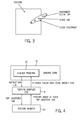
- Figure 3 provides an example of 3 taps within a texture and 2 taps outside of a texture.
- the final color value is modified by division by H because the total of the weights might not be 1.
- weights for the N taps can be defined so that they sum to one. For example, three taps can be used with weights 0.25, 0.5, and 0.25. If a footprint is an oval and samples are made along a line in the oval, the samples in the middle of the oval could get more weight than those towards the end points. Referring back to the example where taps have weights of 0.25, 0.5, and 0.25, a sample in a middle of an oval could be weighted 0.5. If the weights add to one, so long as taps never get rejected (by having their weights changed to zero or multiplied by zero), there is no need to normalize by dividing by total weight, because total weight will be one.
- Whether normalization is used depends on the particular implementation. It would be possible for an implementation to divide the filtered color by the total weight in the texture sampler (TS) and only return the filtered color to the shader.
- TS texture sampler
- value C' can be determined in one of following manners in some embodiments:
- C ⁇ F t v
- the clamp texture address mode for F can be used here, but it is conceivable to use other address modes. If there is a texture border, then that could be respected even evaluation f(t v ). Accordingly C' can be a color in the texture closest to the texture filter footprint center.
- the alpha channel In the case where a texture has an unused alpha channel, it would be possible to set the alpha channel to one everywhere within the texture, define a constant border color with zero color and alpha, and then use a texture address function that returns the border color for taps that are outside the textures. In this case, the desired color result could be obtained by dividing the color components of the filtered result by the alpha component to renormalize.
- Mip 0 : 128 + 0 * 128 + 0 16384
- 2 + 0 * 2 + 0 4
- the TS can perform a normalization.
- a TS does not perform normalization and instead provides both the un-normalized summed filtered color and the total weight back to the shader. This is useful in the case of implementing Ptex texturing mapping system without multi-sampled anti-aliasing (MSAA), because weights across multiple sampling requests can be combined using shader code before normalizing.
- MSAA multi-sampled anti-aliasing
- a texture sampling sequence 40 shown in Figure 7 , may be implemented in software, firmware and/or hardware.
- software and firmware embodiments it may be implemented by computer executed instructions stored in one or more non-transitory computer readable media such as magnetic, optical, or semiconductor storage.
- the sequence may begin by accessing a request to perform texture sampling as indicated in block 42. Then a footprint location and size for the sampling are determined as indicated in block 44. Thereafter one or more filter tap locations and a weight for each filter tap associated with the footprint may be determined as indicated in block 46. Next, the weight of any tap that is located outside of texture image is selectively modified as indicated in block 48.
- any tap that is located outside the texture image is also selectively modified as indicated in block 50.
- a color value in the texture image is requested (block 54).
- Each color for a tap is multiplied by its weight (block 56).
- the sum of the weighted colors are determined to generate a filtered color as shown in block 58.
- the final filtered color the final color based on the filtered color is produced as indicated in block 60.
- GPU graphic processing unit
- Ptex texturing is described on the Internet at Ptex.us.
- Other versions are available from NVIDIA.
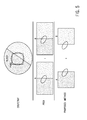
- the objective depiction is shown at the top followed by the PTEX depiction and the result with one embodiment of the techniques described herein is shown at the bottom.
- the pixel in the center but it is partially covered by two fragments, but the center of the pixel is situated in the upper fragment.
- the pixel in the PTEX depiction, the pixel is shown as spanning the fragments along their border.
- the result of the disclosed techniques in one embodiment, is a combination of the fragment that includes the pixel center and the fragment that does not include the pixel center as shown in the bottom depiction.
- the final color is a good approximation of the ideal integral over the oval footprint shown in the PTEX depiction and the proposed method's depiction.
- the total weight for each request depends on the proportion of the filter footprint, shown in the top depiction in Figure 5 , that falls in each texture.
- the contribution of the final fragment color from each of the two fragments is proportional to the extent to which each primitive covers the pixel, which is the ideal result.
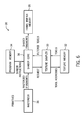
- Figure 6 provides a system 30 that can use embodiments in connection with multi-sample anti-aliasing (MSAA).
- MSAA multi-sample anti-aliasing
- taps which translate to addresses inside of unmapped memory pages might be rejected by setting the weight for those taps to zero. In some cases this could avoid the performance cost that would be associated with a page fault.
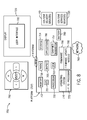
- Figure 8 illustrates an embodiment of a system 700.
- system 700 may be a media system although system 700 is not limited to this context.
- system 700 may be incorporated into a personal computer (PC), laptop computer, ultra-laptop computer, tablet, touch pad, portable computer, handheld computer, palmtop computer, personal digital assistant (PDA), cellular telephone, combination cellular telephone/PDA, television, smart device (e.g., smart phone, smart tablet or smart television), mobile internet device (MID), messaging device, data communication device, and so forth.
- PC personal computer
- PDA personal digital assistant
- cellular telephone combination cellular telephone/PDA
- television smart device (e.g., smart phone, smart tablet or smart television), mobile internet device (MID), messaging device, data communication device, and so forth.
- smart device e.g., smart phone, smart tablet or smart television
- MID mobile internet device
- system 700 comprises a platform 702 coupled to a display 720.
- Platform 702 may receive content from a content device such as content services device(s) 730 or content delivery device(s) 740 or other similar content sources.
- a navigation controller 750 comprising one or more navigation features may be used to interact with, for example, platform 702 and/or display 720. Each of these components is described in more detail below.
- platform 702 may comprise any combination of a chipset 705, processor 710, memory 712, storage 714, graphics subsystem 715, applications 716 and/or radio 718.
- Chipset 705 may provide intercommunication among processor 710, memory 712, storage 714, graphics subsystem 715, applications 716 and/or radio 718.
- chipset 705 may include a storage adapter (not depicted) capable of providing intercommunication with storage 714.
- Processor 710 may be implemented as Complex Instruction Set Computer (CISC) or Reduced Instruction Set Computer (RISC) processors, x86 instruction set compatible processors, multi-core, or any other microprocessor or central processing unit (CPU).
- processor 710 may comprise dual- core processor(s), dual-core mobile processor(s), and so forth. The processor may implement the sequence of Figure 7 together with memory 712.
- Memory 712 may be implemented as a volatile memory device such as, but not limited to, a Random Access Memory (RAM), Dynamic Random Access Memory (DRAM), or Static RAM (SRAM).
- RAM Random Access Memory
- DRAM Dynamic Random Access Memory
- SRAM Static RAM
- Storage 714 may be implemented as a non-volatile storage device such as, but not limited to, a magnetic disk drive, optical disk drive, tape drive, an internal storage device, an attached storage device, flash memory, battery backed-up SDRAM (synchronous DRAM), and/or a network accessible storage device.
- storage 714 may comprise technology to increase the storage performance enhanced protection for valuable digital media when multiple hard drives are included, for example.
- Graphics subsystem 715 may perform processing of images such as still or video for display.
- Graphics subsystem 715 may be a graphics processing unit (GPU) or a visual processing unit (VPU), for example.
- An analog or digital interface may be used to communicatively couple graphics subsystem 715 and display 720.
- the interface may be any of a High-Definition Multimedia Interface, DisplayPort, wireless HDMI, and/or wireless HD compliant techniques.
- Graphics subsystem 715 could be integrated into processor 710 or chipset 705.
- Graphics subsystem 715 could be a stand-alone card communicatively coupled to chipset 705.
- graphics and/or video processing techniques described herein may be implemented in various hardware architectures.
- graphics and/or video functionality may be integrated within a chipset.
- a discrete graphics and/or video processor may be used.
- the graphics and/or video functions may be implemented by a general purpose processor, including a multi-core processor.
- the functions may be implemented in a consumer electronics device.
- Radio 718 may include one or more radios capable of transmitting and receiving signals using various suitable wireless communications techniques. Such techniques may involve communications across one or more wireless networks. Exemplary wireless networks include (but are not limited to) wireless local area networks (WLANs), wireless personal area networks (WPANs), wireless metropolitan area network (WMANs), cellular networks, and satellite networks. In communicating across such networks, radio 718 may operate in accordance with one or more applicable standards in any version.
- WLANs wireless local area networks
- WPANs wireless personal area networks
- WMANs wireless metropolitan area network
- cellular networks and satellite networks.
- display 720 may comprise any television type monitor or display.
- Display 720 may comprise, for example, a computer display screen, touch screen display, video monitor, television-like device, and/or a television.
- Display 720 may be digital and/or analog.
- display 720 may be a holographic display.
- display 720 may be a transparent surface that may receive a visual projection.
- projections may convey various forms of information, images, and/or objects.
- such projections may be a visual overlay for a mobile augmented reality (MAR) application.
- MAR mobile augmented reality
- platform 702 may display user interface 722 on display 720.
- MAR mobile augmented reality
- content services device(s) 730 may be hosted by any national, international and/or independent service and thus accessible to platform 702 via the Internet, for example.
- Content services device(s) 730 may be coupled to platform 702 and/or to display 720.
- Platform 702 and/or content services device(s) 730 may be coupled to a network 760 to communicate (e.g., send and/or receive) media information to and from network 760.
- Content delivery device(s) 740 also may be coupled to platform 702 and/or to display 720.
- content services device(s) 730 may comprise a cable television box, personal computer, network, telephone, Internet enabled devices or appliance capable of delivering digital information and/or content, and any other similar device capable of unidirectionally or bidirectionally communicating content between content providers and platform 702 and/display 720, via network 760 or directly. It will be appreciated that the content may be communicated unidirectionally and/or bidirectionally to and from any one of the components in system 700 and a content provider via network 760. Examples of content may include any media information including, for example, video, music, medical and gaming information, and so forth.
- Content services device(s) 730 receives content such as cable television programming including media information, digital information, and/or other content.
- content providers may include any cable or satellite television or radio or Internet content providers. The provided examples are not meant to limit the scope of included embodiments.
- platform 702 may receive control signals from navigation controller 750 having one or more navigation features.
- the navigation features of controller 750 may be used to interact with user interface 722, for example.
- navigation controller 750 may be a pointing device that may be a computer hardware component (specifically human interface device) that allows a user to input spatial (e.g., continuous and multidimensional) data into a computer.
- GUI graphical user interfaces
- Many systems such as graphical user interfaces (GUI), and televisions and monitors allow the user to control and provide data to the computer or television using physical gestures, facial expressions, or sounds.
- Movements of the navigation features of controller 750 may be echoed on a display (e.g., display 720) by movements of a pointer, cursor, focus ring, or other visual indicators displayed on the display.
- a display e.g., display 720
- the navigation features located on navigation controller 750 may be mapped to virtual navigation features displayed on user interface 722, for example.
- controller 750 may not be a separate component but integrated into platform 702 and/or display 720. Embodiments, however, are not limited to the elements or in the context shown or described herein.
- drivers may comprise technology to enable users to instantly turn on and off platform 702 like a television with the touch of a button after initial boot-up, when enabled, for example.
- Program logic may allow platform 702 to stream content to media adaptors or other content services device(s) 730 or content delivery device(s) 740 when the platform is turned "off.”
- chip set 705 may comprise hardware and/or software support for 5.1 surround sound audio and/or high definition 7.1 surround sound audio, for example.
- Drivers may include a graphics driver for integrated graphics platforms.
- the graphics driver may comprise a peripheral component interconnect (PCI) Express graphics card.
- PCI peripheral component interconnect
- any one or more of the components shown in system 700 may be integrated.
- platform 702 and content services device(s) 730 may be integrated, or platform 702 and content delivery device(s) 740 may be integrated, or platform 702, content services device(s) 730, and content delivery device(s) 740 may be integrated, for example.
- platform 702 and display 720 may be an integrated unit. Display 720 and content service device(s) 730 may be integrated, or display 720 and content delivery device(s) 740 may be integrated, for example. These examples are not meant to limit the invention.
- system 700 may be implemented as a wireless system, a wired system, or a combination of both.
- system 700 may include components and interfaces suitable for communicating over a wireless shared media, such as one or more antennas, transmitters, receivers, transceivers, amplifiers, filters, control logic, and so forth.
- a wireless shared media may include portions of a wireless spectrum, such as the RF spectrum and so forth.
- system 700 may include components and interfaces suitable for communicating over wired communications media, such as input/output (I/O) adapters, physical connectors to connect the I/O adapter with a corresponding wired communications medium, a network interface card (NIC), disc controller, video controller, audio controller, and so forth.
- wired communications media may include a wire, cable, metal leads, printed circuit board (PCB), backplane, switch fabric, semiconductor material, twisted-pair wire, co-axial cable, fiber optics, and so forth.
- Platform 702 may establish one or more logical or physical channels to communicate information.
- the information may include media information and control information.
- Media information may refer to any data representing content meant for a user. Examples of content may include, for example, data from a voice conversation, videoconference, streaming video, electronic mail ("email") message, voice mail message, alphanumeric symbols, graphics, image, video, text and so forth. Data from a voice conversation may be, for example, speech information, silence periods, background noise, comfort noise, tones and so forth.
- Control information may refer to any data representing commands, instructions or control words meant for an automated system. For example, control information may be used to route media information through a system, or instruct a node to process the media information in a predetermined manner. The embodiments, however, are not limited to the elements or in the context shown or described in Figure 8 .
- system 700 may be embodied in varying physical styles or form factors.
- Figure 9 illustrates embodiments of a small form factor device 800 in which system 700 may be embodied.
- device 800 may be implemented as a mobile computing device having wireless capabilities.
- a mobile computing device may refer to any device having a processing system and a mobile power source or supply, such as one or more batteries, for example.
- examples of a mobile computing device may include a personal computer (PC), laptop computer, ultra-laptop computer, tablet, touch pad, portable computer, handheld computer, palmtop computer, personal digital assistant (PDA), cellular telephone, combination cellular telephone/PDA, television, smart device (e.g., smart phone, smart tablet or smart television), mobile internet device (MID), messaging device, data communication device, and so forth.
- PC personal computer
- laptop computer ultra-laptop computer
- tablet touch pad
- portable computer handheld computer
- palmtop computer personal digital assistant
- PDA personal digital assistant
- cellular telephone e.g., cellular telephone/PDA
- television smart device (e.g., smart phone, smart tablet or smart television), mobile internet device (MID), messaging device, data communication device, and so forth.
- smart device e.g., smart phone, smart tablet or smart television
- MID mobile internet device
- Examples of a mobile computing device also may include computers that are arranged to be worn by a person, such as a wrist computer, finger computer, ring computer, eyeglass computer, belt-clip computer, arm-band computer, shoe computers, clothing computers, and other wearable computers.
- a mobile computing device may be implemented as a smart phone capable of executing computer applications, as well as voice communications and/or data communications.
- voice communications and/or data communications may be described with a mobile computing device implemented as a smart phone by way of example, it may be appreciated that other embodiments may be implemented using other wireless mobile computing devices as well. The embodiments are not limited in this context.
- the processor 710 may communicate with a camera 722 and a global positioning system sensor 720, in some embodiments.
- a memory 712, coupled to the processor 710, may store computer readable instructions for implementing the sequences shown in Figure 7 in software and/or firmware embodiments.
- device 800 may comprise a housing 802, a display 804, an input/output (I/O) device 806, and an antenna 808.
- Device 800 also may comprise navigation features 812.
- Display 804 may comprise any suitable display unit for displaying information appropriate for a mobile computing device.
- I/O device 806 may comprise any suitable I/O device for entering information into a mobile computing device. Examples for I/O device 806 may include an alphanumeric keyboard, a numeric keypad, a touch pad, input keys, buttons, switches, rocker switches, microphones, speakers, voice recognition device and software, and so forth. Information also may be entered into device 800 by way of microphone. Such information may be digitized by a voice recognition device. The embodiments are not limited in this context.
- Various embodiments may be implemented using hardware elements, software elements, or a combination of both.
- hardware elements may include processors, microprocessors, circuits, circuit elements (e.g., transistors, resistors, capacitors, inductors, and so forth), integrated circuits, application specific integrated circuits (ASIC), programmable logic devices (PLD), digital signal processors (DSP), field programmable gate array (FPGA), logic gates, registers, semiconductor device, chips, microchips, chip sets, and so forth.
- Examples of software may include software components, programs, applications, computer programs, application programs, system programs, machine programs, operating system software, middleware, firmware, software modules, routines, subroutines, functions, methods, procedures, software interfaces, application program interfaces (API), instruction sets, computing code, computer code, code segments, computer code segments, words, values, symbols, or any combination thereof. Determining whether an embodiment is implemented using hardware elements and/or software elements may vary in accordance with any number of factors, such as desired computational rate, power levels, heat tolerances, processing cycle budget, input data rates, output data rates, memory resources, data bus speeds and other design or performance constraints.
- One example embodiment may be at least one computer-readable medium comprising instructions stored thereon, that, if executed by a computer, cause the computer to exclude from filtering any texture filter tap that falls outside a texture domain.
- the computer-readable medium may further store instructions that if executed by a computer, cause the computer to access a request to perform texture sampling, determine a footprint location and size for the sampling, determine one or more filter tap locations and weight for each filter tap associated with the footprint, selectively modify a weight of any tap that is located outside a texture image, selectively modify a location of any tap that is located outside the texture image, for each filter tap location within the texture image and with a non-zero weight, request a color value in the texture image, multiply each color for a tap by its weight, sum the weighted colors to generate a filtered color, and provide a final filtered color, the final color based on the filtered color.
- the computer-readable medium may further store instructions that if executed by a computer, cause the computer to divide the filtered color by a total weight, wherein the final filtered color comprises the filtered color divided by the total weight and provide the total weight.
- the computer-readable medium may further store instructions that if executed by a computer, cause the computer to divide the filtered color by a total weight, wherein the final filtered color comprises the filtered color divided by the total weight.
- the computer-readable medium may further store instructions wherein the final filtered color comprises the filtered color and further comprising instructions stored thereon, that if executed by a computer, cause the computer to provide a total weight.
- the computer-readable medium may further store instructions wherein the request comprises the texture image to be sampled, the sampler state to be used, and the (u,v) texture coordinates to sample the texture.
- the computer-readable medium may further store instructions wherein each tap represents a (u,v) location and a weight, such that a weighted sum of color values at the taps approximates an integral over the entire footprint.
- the computer-readable medium may further store instructions wherein to selectively modify a weight of any tap that is located outside a texture image, the computer is to set the weight to zero.
- the computer-readable medium may further store instructions wherein to selectively modify a location of any tap that is located outside a texture image, the computer is to select a closest point in the texture to the any tap that is located outside a texture image in terms of linear distance.
- the computer-readable medium may further store instructions further comprising instructions stored thereon, that if executed by a computer, cause the computer to selectively modify a weight of any tap that is located outside a second texture image, selectively modify a location of any tap that is located outside the second texture image, for each filter tap location within the second texture image and with a non-zero weight, request color value in the second texture image, multiply each tap color within the second texture image by its weight, sum the weighted colors used for the second texture image to provide a second filtered color, and provide a second final filtered color, the second final filtered color based on the second filtered color.
- the computer-readable medium may further store instructions comprising instructions stored thereon, that if executed by a computer, cause the computer to generate a fragment color based at least in part on a blend of the final filtered color and the second final filtered color.
- the computer-readable medium may further store instructions further comprising instructions stored thereon, that if executed by a computer, cause the computer to store the fragment color into a buffer, generate a pixel color based at least in part on the fragment color; and cause display of the pixel color.
- the computer-readable medium may further store instructions comprising instructions stored thereon, that if executed by a computer, cause the computer to in response to the total weight equaling zero, set the filtered color to a color in the texture closest to the footprint center or a pre-defined value.
- a method comprising excluding from filtering in a graphics processor any texture filter tap that falls outside a texture domain.
- the method may also include accessing a request to perform texture sampling, determining a footprint location and size for the sampling, determining one or more filter tap locations and weight for each filter tap associated with the footprint, selectively modifying a weight of any tap that is located outside a texture image, selectively modifying a location of any tap that is located outside the texture image, for each filter tap location within the texture image and with a non-zero weight, requesting a color value in the texture image, multiplying each color for a tap by its weight, summing the weighted colors to generate a filtered color, and providing a final filtered color, the final color based on the filtered color.
- the method may also include dividing the filtered color by a total weight, wherein the final filtered color comprises the filtered color divided by the total weight and provide the total weight.
- the method may also include dividing the filtered color by a total weight, wherein the final filtered color comprises the filtered color divided by the total weight.
- the method may also include wherein the final filtered color comprises the filtered color and providing a total weight.
- Another example embodiment may be an apparatus comprising a processor to exclude from filtering any texture filter tap that falls outside a texture domain and a storage coupled to said processor.
- the apparatus may include said processor to access a request to perform texture sampling, determine a footprint location and size for the sampling, determine one or more filter tap locations and weight for each filter tap associated with the footprint, selectively modify a weight of any tap that is located outside a texture image, selectively modify a location of any tap that is located outside the texture image, for each filter tap location within the texture image and with a non-zero weight, request a color value in the texture image, multiply each color for a tap by its weight, sum the weighted colors to generate a filtered color, and provide a final filtered color, the final color based on the filtered color.
- the apparatus may include said processor to divide the filtered color by a total weight, wherein the final filtered color comprises the filtered color divided by the total weight and provide the total weight.
- the apparatus may include said processor to divide the filtered color by a total weight, wherein the final filtered color comprises the filtered color divided by the total weight.
- the apparatus may include wherein the final filtered color comprises the filtered color and said processor to provide a total weight.
- the apparatus may include wherein the request comprises the texture image to be sampled, the sampler state to be used, and the (u,v) texture coordinates to sample the texture.
- each tap represents a (u,v) location and a weight, such that a weighted sum of color values at the taps approximates an integral over the entire footprint.
- the apparatus may include wherein to selectively modify a weight of any tap that is located outside a texture image, the processor is to set the weight to zero.
- the apparatus may include wherein to selectively modify a location of any tap that is located outside a texture image, the processor to select a closest point in the texture to the any tap that is located outside a texture image in terms of linear distance.
- the apparatus may include an operating system, a battery and firmware and a module to update said firmware.
- graphics processing techniques described herein may be implemented in various hardware architectures. For example, graphics functionality may be integrated within a chipset. Alternatively, a discrete graphics processor may be used. As still another embodiment, the graphics functions may be implemented by a general purpose processor, including a multicore processor.
- references throughout this specification to "one embodiment” or “an embodiment” mean that a particular feature, structure, or characteristic described in connection with the embodiment is included in at least one implementation encompassed within the present disclosure. Thus, appearances of the phrase “one embodiment” or “in an embodiment” are not necessarily referring to the same embodiment. Furthermore, the particular features, structures, or characteristics may be instituted in other suitable forms other than the particular embodiment illustrated and all such forms may be encompassed within the claims of the present application.
Landscapes
- Engineering & Computer Science (AREA)
- Computer Graphics (AREA)
- Physics & Mathematics (AREA)
- General Physics & Mathematics (AREA)
- Theoretical Computer Science (AREA)
- Image Generation (AREA)
- Multimedia (AREA)
- Signal Processing (AREA)
- Computer Security & Cryptography (AREA)
Applications Claiming Priority (1)
| Application Number | Priority Date | Filing Date | Title |
|---|---|---|---|
| US201361789870P | 2013-03-15 | 2013-03-15 |
Publications (1)
| Publication Number | Publication Date |
|---|---|
| EP2804150A1 true EP2804150A1 (fr) | 2014-11-19 |
Family
ID=50624361
Family Applications (1)
| Application Number | Title | Priority Date | Filing Date |
|---|---|---|---|
| EP14159857.3A Withdrawn EP2804150A1 (fr) | 2013-03-15 | 2014-03-14 | Bouchons de filtre de rejet de mode d'adressage de texture |
Country Status (6)
| Country | Link |
|---|---|
| US (1) | US10152820B2 (fr) |
| EP (1) | EP2804150A1 (fr) |
| JP (1) | JP2014182831A (fr) |
| KR (2) | KR101587439B1 (fr) |
| CN (1) | CN104050634B (fr) |
| TW (1) | TWI514314B (fr) |
Families Citing this family (10)
| Publication number | Priority date | Publication date | Assignee | Title |
|---|---|---|---|---|
| US9799087B2 (en) | 2013-09-09 | 2017-10-24 | Apple Inc. | Shader program profiler |
| US11838851B1 (en) | 2014-07-15 | 2023-12-05 | F5, Inc. | Methods for managing L7 traffic classification and devices thereof |
| US10182013B1 (en) * | 2014-12-01 | 2019-01-15 | F5 Networks, Inc. | Methods for managing progressive image delivery and devices thereof |
| US11895138B1 (en) | 2015-02-02 | 2024-02-06 | F5, Inc. | Methods for improving web scanner accuracy and devices thereof |
| US10235811B2 (en) | 2016-12-29 | 2019-03-19 | Intel Corporation | Replicating primitives across multiple viewports |
| US10310830B2 (en) | 2017-06-02 | 2019-06-04 | Apple Inc. | Shader profiler |
| US10424074B1 (en) | 2018-07-03 | 2019-09-24 | Nvidia Corporation | Method and apparatus for obtaining sampled positions of texturing operations |
| US10628910B2 (en) | 2018-09-24 | 2020-04-21 | Intel Corporation | Vertex shader with primitive replication |
| US11257277B2 (en) * | 2019-06-26 | 2022-02-22 | Qualcomm Incorporated | Methods and apparatus to facilitate adaptive texture filtering |
| CN113487542B (zh) * | 2021-06-16 | 2023-08-04 | 成都唐源电气股份有限公司 | 一种接触网导线磨耗区域的提取方法 |
Citations (1)
| Publication number | Priority date | Publication date | Assignee | Title |
|---|---|---|---|---|
| US5920495A (en) * | 1997-05-14 | 1999-07-06 | Cirrus Logic, Inc. | Programmable four-tap texture filter |
Family Cites Families (27)
| Publication number | Priority date | Publication date | Assignee | Title |
|---|---|---|---|---|
| US5268928A (en) * | 1991-10-15 | 1993-12-07 | Racal-Datacom, Inc. | Data modem with remote firmware update |
| JP3213584B2 (ja) * | 1997-09-19 | 2001-10-02 | シャープ株式会社 | 画像符号化装置及び画像復号装置 |
| WO1999041706A1 (fr) | 1998-02-17 | 1999-08-19 | Sun Microsystems, Inc. | Systeme graphique avec super-echantillonnage a resolution variable |
| US6094232A (en) * | 1998-11-25 | 2000-07-25 | Kabushiki Kaisha Toshiba | Method and system for interpolating a missing pixel using a motion vector |
| KR100283413B1 (ko) * | 1998-12-15 | 2001-04-02 | 김영환 | 텍스처 매핑시스템 |
| JP3367509B2 (ja) * | 1999-12-16 | 2003-01-14 | 株式会社セガ | 画像生成方法及びこれを用いた画像生成装置 |
| US6724396B1 (en) * | 2000-06-01 | 2004-04-20 | Hewlett-Packard Development Company, L.P. | Graphics data storage in a linearly allocated multi-banked memory |
| US7324116B2 (en) * | 2002-06-20 | 2008-01-29 | Microsoft Corporation | Systems and methods for providing controllable texture sampling |
| US20040012610A1 (en) * | 2002-07-22 | 2004-01-22 | Taneja Nimita J. | Anti-aliasing interlaced video formats for large kernel convolution |
| EP1489560A1 (fr) | 2003-06-17 | 2004-12-22 | Koninklijke Philips Electronics N.V. | Préfiltrage primitif des bords |
| US6989838B2 (en) * | 2003-06-26 | 2006-01-24 | Intel Corporation | Methods, systems, and data structures for generating a rasterizer |
| US7027062B2 (en) | 2004-02-27 | 2006-04-11 | Nvidia Corporation | Register based queuing for texture requests |
| US7091983B1 (en) * | 2004-05-26 | 2006-08-15 | Nvidia Corporation | Coordinate wrapping for anisotropic filtering of non-power of two textures |
| KR20060116916A (ko) * | 2005-05-11 | 2006-11-16 | 삼성전자주식회사 | 텍스쳐 캐쉬 및 이를 구비한 3차원 그래픽 시스템, 그리고그것의 제어 방법 |
| US8253751B2 (en) * | 2005-06-30 | 2012-08-28 | Intel Corporation | Memory controller interface for micro-tiled memory access |
| US8675007B2 (en) * | 2005-10-06 | 2014-03-18 | Ati Technologies Ulc | System and method for higher level filtering by combination of bilinear results |
| KR100818289B1 (ko) * | 2007-02-02 | 2008-03-31 | 삼성전자주식회사 | 비디오 영상 트레킹 방법 및 장치 |
| US8824831B2 (en) * | 2007-05-25 | 2014-09-02 | Qualcomm Technologies, Inc. | Advanced noise reduction in digital cameras |
| EP2044987B1 (fr) * | 2007-10-03 | 2013-05-22 | Sony Computer Entertainment Europe Ltd. | Appareil et procédé d'un rapport en ligne |
| JP2010097334A (ja) * | 2008-10-15 | 2010-04-30 | Panasonic Corp | 描画装置 |
| JP5670456B2 (ja) * | 2009-08-25 | 2015-02-18 | アイピーリンク・リミテッド | カラー画像のノイズを低減すること |
| JP5464435B2 (ja) | 2010-04-09 | 2014-04-09 | ソニー株式会社 | 画像復号装置および方法 |
| TWI408618B (zh) | 2010-05-27 | 2013-09-11 | Univ Nat Taiwan | 具有可設定化濾波模組之繪圖處理器及其運算方法 |
| TW201209759A (en) | 2010-08-24 | 2012-03-01 | Chunghwa Telecom Co Ltd | Image flame detection method |
| JP5725818B2 (ja) * | 2010-12-01 | 2015-05-27 | 富士フイルム株式会社 | 透明導電シートの製造方法、透明導電シート及びプログラム |
| JP2012221105A (ja) * | 2011-04-06 | 2012-11-12 | Sony Corp | 画像処理装置、画像処理方法およびプログラム |
| US20130135364A1 (en) * | 2011-11-30 | 2013-05-30 | Qualcomm Mems Technologies, Inc. | Methods and apparatus for interpolating colors |
-
2013
- 2013-12-17 US US14/108,569 patent/US10152820B2/en not_active Expired - Fee Related
-
2014
- 2014-03-13 TW TW103109083A patent/TWI514314B/zh not_active IP Right Cessation
- 2014-03-14 CN CN201410183145.XA patent/CN104050634B/zh not_active Expired - Fee Related
- 2014-03-14 JP JP2014051869A patent/JP2014182831A/ja active Pending
- 2014-03-14 EP EP14159857.3A patent/EP2804150A1/fr not_active Withdrawn
- 2014-03-14 KR KR1020140030561A patent/KR101587439B1/ko not_active Expired - Fee Related
-
2015
- 2015-05-26 KR KR1020150073288A patent/KR101993949B1/ko active Active
Patent Citations (1)
| Publication number | Priority date | Publication date | Assignee | Title |
|---|---|---|---|---|
| US5920495A (en) * | 1997-05-14 | 1999-07-06 | Cirrus Logic, Inc. | Programmable four-tap texture filter |
Non-Patent Citations (2)
| Title |
|---|
| BRENT BURLEY ET AL: "Ptex: Per-Face Texture Mapping for Production Rendering", COMPUTER GRAPHICS FORUM, vol. 27, no. 4, 1 June 2008 (2008-06-01), pages 1155 - 1164, XP055045582, ISSN: 0167-7055, DOI: 10.1111/j.1467-8659.2008.01253.x * |
| THE MATHWORKS INC: "Image Processing Toolbox - Filtering Using imfilter", 2006, pages 1 - 7, XP002730786, Retrieved from the Internet <URL:http://pages.cs.wisc.edu/~dyer/cs766/hw/hw2/filter.pdf> [retrieved on 20141008] * |
Also Published As
| Publication number | Publication date |
|---|---|
| KR20140113559A (ko) | 2014-09-24 |
| KR101587439B1 (ko) | 2016-01-21 |
| TW201506844A (zh) | 2015-02-16 |
| JP2014182831A (ja) | 2014-09-29 |
| KR20150065642A (ko) | 2015-06-15 |
| CN104050634A (zh) | 2014-09-17 |
| US20140267345A1 (en) | 2014-09-18 |
| CN104050634B (zh) | 2019-10-01 |
| KR101993949B1 (ko) | 2019-06-27 |
| US10152820B2 (en) | 2018-12-11 |
| TWI514314B (zh) | 2015-12-21 |
Similar Documents
| Publication | Publication Date | Title |
|---|---|---|
| US10970917B2 (en) | Decoupled shading pipeline | |
| US10152820B2 (en) | Texture address mode discarding filter taps | |
| US10164459B2 (en) | Selective rasterization | |
| US9904977B2 (en) | Exploiting frame to frame coherency in a sort-middle architecture | |
| US10134160B2 (en) | Anti-aliasing for graphics hardware | |
| US9626795B2 (en) | Reducing shading by merging fragments from the adjacent primitives | |
| EP2831837B1 (fr) | Détermination de centroïde basse puissance et optimisation d'empreinte de texture pour pipelines de rendu faisant appel à un échantillonnage découplé | |
| US9959643B2 (en) | Variable rasterization order for motion blur and depth of field | |
| US9741154B2 (en) | Recording the results of visibility tests at the input geometry object granularity | |
| US9218679B2 (en) | Reduced bitcount polygon rasterization | |
| US9262841B2 (en) | Front to back compositing | |
| US9153008B2 (en) | Caching for reduced depth and/or color buffer bandwidth |
Legal Events
| Date | Code | Title | Description |
|---|---|---|---|
| PUAI | Public reference made under article 153(3) epc to a published international application that has entered the european phase |
Free format text: ORIGINAL CODE: 0009012 |
|
| 17P | Request for examination filed |
Effective date: 20140314 |
|
| AK | Designated contracting states |
Kind code of ref document: A1 Designated state(s): AL AT BE BG CH CY CZ DE DK EE ES FI FR GB GR HR HU IE IS IT LI LT LU LV MC MK MT NL NO PL PT RO RS SE SI SK SM TR |
|
| AX | Request for extension of the european patent |
Extension state: BA ME |
|
| R17P | Request for examination filed (corrected) |
Effective date: 20150123 |
|
| RBV | Designated contracting states (corrected) |
Designated state(s): AL AT BE BG CH CY CZ DE DK EE ES FI FR GB GR HR HU IE IS IT LI LT LU LV MC MK MT NL NO PL PT RO RS SE SI SK SM TR |
|
| STAA | Information on the status of an ep patent application or granted ep patent |
Free format text: STATUS: EXAMINATION IS IN PROGRESS |
|
| 17Q | First examination report despatched |
Effective date: 20170818 |
|
| STAA | Information on the status of an ep patent application or granted ep patent |
Free format text: STATUS: THE APPLICATION IS DEEMED TO BE WITHDRAWN |
|
| 18D | Application deemed to be withdrawn |
Effective date: 20211001 |