EP2804391A1 - Moyeu d'interface commune - Google Patents
Moyeu d'interface commune Download PDFInfo
- Publication number
- EP2804391A1 EP2804391A1 EP13167671.0A EP13167671A EP2804391A1 EP 2804391 A1 EP2804391 A1 EP 2804391A1 EP 13167671 A EP13167671 A EP 13167671A EP 2804391 A1 EP2804391 A1 EP 2804391A1
- Authority
- EP
- European Patent Office
- Prior art keywords
- cam
- data
- unit
- connection
- virtual host
- Prior art date
- Legal status (The legal status is an assumption and is not a legal conclusion. Google has not performed a legal analysis and makes no representation as to the accuracy of the status listed.)
- Withdrawn
Links
Images



Classifications
-
- H—ELECTRICITY
- H04—ELECTRIC COMMUNICATION TECHNIQUE
- H04N—PICTORIAL COMMUNICATION, e.g. TELEVISION
- H04N21/00—Selective content distribution, e.g. interactive television or video on demand [VOD]
- H04N21/40—Client devices specifically adapted for the reception of or interaction with content, e.g. set-top-box [STB]; Operations thereof
- H04N21/43—Processing of content or additional data, e.g. demultiplexing additional data from a digital video stream; Elementary client operations, e.g. monitoring of home network or synchronising decoder's clock; Client middleware
- H04N21/436—Interfacing a local distribution network, e.g. communicating with another STB or one or more peripheral devices inside the home
- H04N21/43607—Interfacing a plurality of external cards, e.g. through a DVB Common Interface [DVB-CI]
-
- H—ELECTRICITY
- H04—ELECTRIC COMMUNICATION TECHNIQUE
- H04N—PICTORIAL COMMUNICATION, e.g. TELEVISION
- H04N21/00—Selective content distribution, e.g. interactive television or video on demand [VOD]
- H04N21/40—Client devices specifically adapted for the reception of or interaction with content, e.g. set-top-box [STB]; Operations thereof
- H04N21/41—Structure of client; Structure of client peripherals
- H04N21/418—External card to be used in combination with the client device, e.g. for conditional access
- H04N21/4181—External card to be used in combination with the client device, e.g. for conditional access for conditional access
-
- H—ELECTRICITY
- H04—ELECTRIC COMMUNICATION TECHNIQUE
- H04N—PICTORIAL COMMUNICATION, e.g. TELEVISION
- H04N21/00—Selective content distribution, e.g. interactive television or video on demand [VOD]
- H04N21/40—Client devices specifically adapted for the reception of or interaction with content, e.g. set-top-box [STB]; Operations thereof
- H04N21/41—Structure of client; Structure of client peripherals
- H04N21/426—Internal components of the client ; Characteristics thereof
- H04N21/42607—Internal components of the client ; Characteristics thereof for processing the incoming bitstream
- H04N21/42623—Internal components of the client ; Characteristics thereof for processing the incoming bitstream involving specific decryption arrangements
-
- H—ELECTRICITY
- H04—ELECTRIC COMMUNICATION TECHNIQUE
- H04N—PICTORIAL COMMUNICATION, e.g. TELEVISION
- H04N21/00—Selective content distribution, e.g. interactive television or video on demand [VOD]
- H04N21/40—Client devices specifically adapted for the reception of or interaction with content, e.g. set-top-box [STB]; Operations thereof
- H04N21/43—Processing of content or additional data, e.g. demultiplexing additional data from a digital video stream; Elementary client operations, e.g. monitoring of home network or synchronising decoder's clock; Client middleware
- H04N21/436—Interfacing a local distribution network, e.g. communicating with another STB or one or more peripheral devices inside the home
- H04N21/4367—Establishing a secure communication between the client and a peripheral device or smart card
-
- H—ELECTRICITY
- H04—ELECTRIC COMMUNICATION TECHNIQUE
- H04N—PICTORIAL COMMUNICATION, e.g. TELEVISION
- H04N21/00—Selective content distribution, e.g. interactive television or video on demand [VOD]
- H04N21/40—Client devices specifically adapted for the reception of or interaction with content, e.g. set-top-box [STB]; Operations thereof
- H04N21/43—Processing of content or additional data, e.g. demultiplexing additional data from a digital video stream; Elementary client operations, e.g. monitoring of home network or synchronising decoder's clock; Client middleware
- H04N21/438—Interfacing the downstream path of the transmission network originating from a server, e.g. retrieving encoded video stream packets from an IP network
- H04N21/4385—Multiplex stream processing, e.g. multiplex stream decrypting
- H04N21/43853—Multiplex stream processing, e.g. multiplex stream decrypting involving multiplex stream decryption
-
- H—ELECTRICITY
- H04—ELECTRIC COMMUNICATION TECHNIQUE
- H04N—PICTORIAL COMMUNICATION, e.g. TELEVISION
- H04N21/00—Selective content distribution, e.g. interactive television or video on demand [VOD]
- H04N21/40—Client devices specifically adapted for the reception of or interaction with content, e.g. set-top-box [STB]; Operations thereof
- H04N21/43—Processing of content or additional data, e.g. demultiplexing additional data from a digital video stream; Elementary client operations, e.g. monitoring of home network or synchronising decoder's clock; Client middleware
- H04N21/44—Processing of video elementary streams, e.g. splicing a video clip retrieved from local storage with an incoming video stream or rendering scenes according to encoded video stream scene graphs
- H04N21/4405—Processing of video elementary streams, e.g. splicing a video clip retrieved from local storage with an incoming video stream or rendering scenes according to encoded video stream scene graphs involving video stream decryption
-
- H—ELECTRICITY
- H04—ELECTRIC COMMUNICATION TECHNIQUE
- H04N—PICTORIAL COMMUNICATION, e.g. TELEVISION
- H04N21/00—Selective content distribution, e.g. interactive television or video on demand [VOD]
- H04N21/40—Client devices specifically adapted for the reception of or interaction with content, e.g. set-top-box [STB]; Operations thereof
- H04N21/43—Processing of content or additional data, e.g. demultiplexing additional data from a digital video stream; Elementary client operations, e.g. monitoring of home network or synchronising decoder's clock; Client middleware
- H04N21/44—Processing of video elementary streams, e.g. splicing a video clip retrieved from local storage with an incoming video stream or rendering scenes according to encoded video stream scene graphs
- H04N21/4408—Processing of video elementary streams, e.g. splicing a video clip retrieved from local storage with an incoming video stream or rendering scenes according to encoded video stream scene graphs involving video stream encryption, e.g. re-encrypting a decrypted video stream for redistribution in a home network
-
- H—ELECTRICITY
- H04—ELECTRIC COMMUNICATION TECHNIQUE
- H04N—PICTORIAL COMMUNICATION, e.g. TELEVISION
- H04N21/00—Selective content distribution, e.g. interactive television or video on demand [VOD]
- H04N21/40—Client devices specifically adapted for the reception of or interaction with content, e.g. set-top-box [STB]; Operations thereof
- H04N21/43—Processing of content or additional data, e.g. demultiplexing additional data from a digital video stream; Elementary client operations, e.g. monitoring of home network or synchronising decoder's clock; Client middleware
- H04N21/443—OS processes, e.g. booting an STB, implementing a Java virtual machine in an STB or power management in an STB
-
- H—ELECTRICITY
- H04—ELECTRIC COMMUNICATION TECHNIQUE
- H04N—PICTORIAL COMMUNICATION, e.g. TELEVISION
- H04N21/00—Selective content distribution, e.g. interactive television or video on demand [VOD]
- H04N21/40—Client devices specifically adapted for the reception of or interaction with content, e.g. set-top-box [STB]; Operations thereof
- H04N21/45—Management operations performed by the client for facilitating the reception of or the interaction with the content or administrating data related to the end-user or to the client device itself, e.g. learning user preferences for recommending movies, resolving scheduling conflicts
- H04N21/462—Content or additional data management e.g. creating a master electronic programme guide from data received from the Internet and a Head-end or controlling the complexity of a video stream by scaling the resolution or bit-rate based on the client capabilities
- H04N21/4623—Processing of entitlement messages, e.g. ECM [Entitlement Control Message] or EMM [Entitlement Management Message]
Definitions
- the invention relates to a Common Interface hub for connecting to a Conditional Access Module, CAM.
- CI Common Interface
- CI Plus Common Interface plus
- the CI or CI Plus system comprises a Content Access Module (CAM or CAM) which, when inserted into the corresponding Common Interface slot of a compatible TV set (typically called the CI host), allows a user to subscribe and watch a pay TV service from a pay TV service operator, without requiring an additional set-top-box.
- the CAM typically has a slot for inserting a smartcard that is issued by the service operator. The smart card, inserted into or embedded in the CI Plus-CAM, controls the decrypting of those TV programs to which the user is allowed access.
- CI Plus a trusted channel is formed between the CAM and television receiver, so that the decrypted content can be re-encrypted, using a key that is known at both ends of the trusted channel, before it is sent back from the CAM to the receiver. That makes it harder for third parties to "steal" the CAM-decrypted content by sampling the out-going signal from the CAM.
- a typical household nowadays has a plurality of devices that are capable of decoding and displaying or recording audio/video streams.
- the CAM is physically connected to the display/recording device. This makes it difficult, if not impossible, to use a single CAM for a plurality of devices
- the invention provides a Common Interface, CI, hub comprising a
- the CI host may initiate the SAC set-up, while the module opens the session on the CC resource.
- the host may have only one CC session.
- the host can have more than one CC session simultaneously.
- the data received from the CAM via the SAC may be content data, for example data representing audio/video or multimedia content.
- the Secure Authenticated Channel (SAC) connection may refer to all communications between CI unit and CAM, that is, not just control traffic (messages over a control channel, which is typically called the SAC) but also CA encrypted content (e.g. transferred from CI unit to CAM), and CC encrypted content (e.g. from CAM to CI unit).
- the term SAC connection thus can comprise all communications between a CI host and a CAM for decrypting CA encrypted (Audio/Video) content, including the encrypted and decrypted content.
- SAC connection can also be interpreted as a SAC-based (content) data connection, that is a (content) data connection controlled via a SAC.
- the at least one virtual host unit comprises a virtual CAM for setting up a connection with the respective peripheral.
- the at least one virtual host unit is configured for setting up a connection to each of a plurality of peripheral devices.
- the at least one virtual host unit comprises a distribution unit for distributing data received via the SAC connection to at least one peripheral device.
- the distribution unit is configured to decrypt the data received via the SAC connection and to re-encrypt said data prior to distribution to the at least one peripheral device.
- the CI hub comprises a plurality of virtual host units.
- the CI unit is configured to maintain one Secure Authenticated Channel with the CAM and is comprises a demultiplexing layer for selectively transmitting data received from the CAM to a corresponding virtual host unit.
- the CI unit is configured to maintain for a Secure Authenticated Channel with the CAM for each virtual host unit.
- the data represents a broadcasting program, such as a Transport Stream or an ISO BMFF file
- the CAM is connected to the CI unit via a USB connection.
- the USB connection comprises a bidirectional control pipe for control traffic related to the data.
- the USB connection comprises one bidirectional control pipe for control traffic related to the data for each SAC connection between the CI unit and the CAM.
- the USB connection comprises for each peripheral device two unidirectional data pipes, one for transmitting CA encrypted data to the CAM and one for receiving CA decrypted data from the CAM.
- the invention further provides a method for distributing CA decrypted data from a CAM to a peripheral device , the method comprising:
- Common Interface comprises both "plain” CI (that is, without “Content Control” (CC) re-encryption of the "Conditional Access” (CA) decrypted data) and more secure CI variants, such as CI Plus.
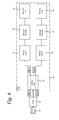
- Figure 1 schematically shows a system of a CAM 20 and a digital TV receiver or host 10 according to an embodiment of the invention.
- the host 10 is a consumer electronics device that is used to receive and navigate the broadcast digital media.
- the host includes one or more slots which accept CAMs.
- the CAM slot of the host has the form of a Universal Serial Bus (USB) connector.
- USB Universal Serial Bus
- the slot is configured to receive a Type A USB connector.
- other USB forms e.g. mini-USB or micro-USB may also be used.
- the host device typically contains some form of tuner 11, a demodulator 12, a demultiplexer (Demux) 14 and media decoders (not shown). These are the usual pre-requisites for the reception of digital TV.
- DVB CAMs that comply with the CI standard EN 50221 have no Content Control system 23, 24 to protect the descrambled content. In CI systems, content where the CA system protection has been removed is passed to the host unprotected.
- CI Plus host interoperates with the CAM to provide a secure content control system 13, 23, 24 to protect high value content which has been CA decrypted.
- the CAM contains the consumer end of the CA system. It comprises a CA decryption module 21 for decrypting secure content, a CA key calculation module 22 for calculating keys based in part on data from a smart card 25, and a smart card interface 26 (see figure 2 ) for receiving the smart card.
- CI Plus CAMS also include Content Control (CC) modules for re-encrypting the CA decrypted signal.
- the Content Control encryption module 23 re-encrypts the content using a key that has been agreed on a shared secure channel between the CAM and the host.
- the CC system crypto tools module 24 facilitates in generating keys and setting up a secure channel with the host. Module 24 also contains cryptographic tools and features which enable the CAM and CI host to mutually authenticate each other's trustworthiness.
- FIG. 2 schematically shows a perspective view of CAM 20 according to an embodiment of the invention.
- the CAM 20 has a slot 26 for receiving a module 25 which functions as smart card 25.
- the module 25 can have the form factor of a mini-SIM (Subscriber Identity Module) as is known from mobile telephone applications.
- a micro-SIM form factor may also be used.
- the CAM 20 has a male Type A USB (Universal Serial Bus) connector 27 for insertion into a corresponding female USB connector of a host (not shown).
- USB Universal Serial Bus
- a CI over USB connection is formed.
- the CA encrypted content is transmitted
- the upstream direction defined as the direction from the CAM to the host
- the decrypted content CI standard
- CC encrypted content CI Plus standard
- FIG 3A schematically shows a CI hub 30 according to an embodiment of the invention.
- the CI hub 30 comprises a CI Plus unit 33 which can connect to an external CAM 20.
- the external CAM 20 is typically provided by a digital video broadcasting operator.
- the CI hub also provides at least one (in the present example two, but any number is in principle possible) virtual host 31, 32.
- the virtual hosts 31, 32 are called virtual since they look, from the point of view of the CAM, like a regular CI host.
- Each virtual host 31, 32 is configured to setup a Secure Authenticated Channel (SAC) connection with the CAM (in cooperation with the CC system crypto tools 24 of the CAM 20) for secure (CC encrypted) reception of CA decrypted content.
- SAC Secure Authenticated Channel
- first virtual host 31 sets up connection SAC1 to CI Plus unit 33
- second virtual host 32 sets up second connection SAC2 to unit 33.
- Each virtual host 31, 32 can also be configured to transmit CA encrypted Transport Stream (TS) packets through the CI Plus unit 33 for CA decryption by the CAM 20.
- TS Transport Stream
- connection between CI Plus unit 33 and CAM 20 can be made via a USB connection, for example as described in reference to figures 1 , 2 , and 6 .
- a USB 2.0 or USB 3.0 connection has sufficient bandwidth to allow simultaneous communication, both downstream of CA encrypted content and upstream of CA decrypted, CC encrypted content, of multiple transport streams (multi-stream mode).
- the direction from the CI Plus unit to the CAM is called downstream and the reverse direction is called upstream.
- the CA encrypted content will typically be provided by each of the peripheral devices 36, 37, 38, which may receive it through for example a tuner connection 39.
- one or more of the virtual hosts has a connection 39 (dashed line in figure 3a ) for receiving CA encrypted content.
- the peripheral devices serve more like simple displays, in the sense that they play no role in providing the content that is to be descrambled by the CAM.
- the CA encrypted content is provided to the CAM via the SAC connections.
- a virtual host 31, 32 can set up one SAC connection with the CAM 20. However, a virtual host 31, 32 may serve a plurality of peripheral devices 36, 37, 38.
- first virtual host 31 receives CC encrypted transport stream data via SAC1, and transmits said data via a data network 34 to a first peripheral device 36 (for example a television in a different room).
- the data network 34 can be any wired or wireless network.
- the second virtual host 32 receives a first CC encrypted transport stream data via SAC2 and provides it to second peripheral 37, and receives a further, second, CC encrypted transport stream data via SAC2 and provides it to third peripheral 38.
- Second virtual host 32 thus serves a plurality of peripheral devices 37, 38 simultaneously, with first and second CC encrypted transport streams (which may or may not be the same).
- the CC encrypted transport streams received by the virtual hosts 31, 32 via respectively SAC1 and SAC2 from the CAM 20, are transmitted in encrypted form to the peripheral devices 36, 37, 38.
- the decryption key must be made known to the peripheral device.
- the virtual host simply forwards the encrypted packets from the SAC connection to the peripheral device, and, via a further (preferably encrypted) channel with the peripheral device, signals the CC decryption key to the peripheral device.
- the virtual host 31, 32 can decrypt the TS packets and transmit the decrypted packets to the peripheral device using any suitable secured or unsecured protocol.
- FIG. 3B shows an alternative embodiment of a CI hub 30 according the invention.
- the features in common with the embodiment of figure 3a need not be described again.
- SAC1 SAC1
- the CI plus unit 33 serves as a (de)multiplexer, distributing the content received via SAC1 from CAM 20 to the virtual hosts 31, 32 through respective SAC1a and SAC1b.
- first virtual host 31 may supply, via SAC1a, a first CA encrypted TS to the CI plus unit 33 and second virtual host may supply, via SAC1b, a second CA encrypted TS to the CI plus unit 33.
- the CI plus unit 33 sends both transport streams to the CAM, along with control messages from the respective virtual hosts to the CAM, to cause it to decrypt the streams.
- the returned CC encrypted (in the case of a CI Plus CAM) or decrypted (plain CI) streams are then distributed by the CI plus unit to the corresponding virtual host 31, 32.
- the peripheral devices 37, 38 are also able to set up SAC connections, for example because the peripheral devices 37, 38 have a Common Interface unit.
- the virtual host 32 has two virtual CAMs (VCAMs), 321, 322.
- VCAMs virtual CAMs
- the virtual host can have one or more VCAMs.
- Each VCAM 321, 322 is able to set up a SAC connection with a peripheral device.
- Virtual host 32 effectively servers as a CAM bridge, connecting CI peripherals 37, 38 with CAM 20.
- the connections between the virtual host 32 and the peripheral devices 37, 38 may be USB connections, but any physical or wireless connection between virtual host 32 and peripheral devices 37, 38 suitable for setting up a SAC connection is possible.
- VCAM 321 sets up connection SAC2a with peripheral device 37
- VCAM 322 sets up connection SAC2b with peripheral device 38.
- the virtual host 32 further comprises a distribution unit 320 which is configured to switch and convert packets coming in via SAC2 from a "real" CAM 20 to either VCAM 321 or VCAM 322, for further transmission over SAC2a or SAC2b, respectively, to peripheral devices 37 or 38, respectively.
- VCAMs 321 and/or 322 are configured to setup a SAC2a, SAC2b with a peripheral device 37, 38 using the same keys as SAC2. In that case, the packets coming in from SAC2 do not need to be decrypted and re-encrypted for transmission over SAC2a and SAC2b.
- the distribution unit 320 may be configured to decrypt all packets incoming via SAC2 and re-encrypt them according to the encryption requirements of SAC2a or SAC2b, depending on where the packet is headed.
- FIG 4 schematically shows a television 40 according to an embodiment of the invention.
- the television 40 has a CI Plus unit 33 and virtual hosts 31, 32 as described in reference to figure 3A .
- the CA encrypted transport streams are provided via from one or more of the TV's tuners (not shown) to the CI Plus hosts 31, 32, which sends them on to the CAM 20.
- the exemplary television 40 has two "consumers" of transport streams.
- One is a recording unit 43, and the other is a display unit 44, and each unit 43, 44 may request and receive a different transport stream.
- Both units 43, 44 may be equipped with a decryption and decoding block 41, 42, for decrypting the CC encrypted stream and for decoding the transport streams into, for example, uncompressed video and audio data for rendering.
- the recording unit 43 may also be configured to record the data in the original encrypted and/or encoded form, so decryption and decoding block 41 is not always necessary.
- the connection between the virtual host 31, 32 and the "consumers" 41-44 can be any suitable connection.
- connection may be configured so that the virtual hosts 31, 32 can signal, in a secure manner, the required CC decryption key to the consumers 41-44.
- the connection may be configured so that the virtual hosts 31, 32 can signal, in a secure manner, the required CC decryption key to the consumers 41-44.
- decrypt the signal in the virtual hosts and transmit the transport streams to the consumers in unencrypted form, but this is not preferred as it goes against the goal of the CI Plus system, which is to prevent interception of unencrypted transport streams.
- Figure 5 schematically shows a method for setting up connections with two peripheral devices according to an embodiment of the invention.
- the steps in figure 5 are not necessarily in chronological order; it will be clear to a skilled person which of the steps can for example be executed in parallel or can be interchanged with other steps.
- a CAM 20 is connected to a CI Plus unit 33.
- the CI Plus unit is connected to a first and second virtual host 31, 32 as described in reference to figures 3 and 4 .
- a first and second Secure Authenticated Channel connection (SAC1 and SAC2) is set up between the CAM 20 and the first and second virtual host 31, 32 respectively.
- first virtual host 31 sets up a secure connection with a first peripheral device 36.
- second virtual host 32 sets up secure connections with second and third peripheral devices 37 and 38. This may be done as described in reference to figure 3B .
- step 55 the first virtual host 31 transmits the decryption key corresponding to the CC encryption of SAC1 to first peripheral device 36.
- step 57 the first virtual host 31 starts forwarding CC encrypted transport packets, corresponding to a first transport stream and received via SAC1, to first peripheral device 36.
- step 56 the second virtual host 32 transmits the decryption key corresponding to the CC encryption of the content transmitted from the CAM via SAC2 to the second and third peripheral devices 37, 38.
- step 58 the second virtual host 32 starts forwarding CC encrypted transport packets, corresponding to a second transport stream and received via SAC2, to second peripheral device 37.
- step 59 the second virtual host 32 starts forwarding CC encrypted transport packets, corresponding to a third transport stream and also received via SAC2, to third peripheral device 38.
- a method according to an embodiment of the invention only comprises steps 50, 51, 53, 55, and 57. Another method comprises the steps 50, 52, 54, 56, 58 and 59.
- USB was originally designed as a standard for connecting peripheral devices to computers. In recent years, it has become commonly used in all sorts of (consumer) electronics devices. USB standard 1.0 offered 1.5 Mbit/s transfer speed. Later versions increased this speed, with USB 2.0 offering 480 Mbit/s over 4 physical wires. The wires are typically labelled Vcc (5 Volt), GND (ground), D-, and D+, with the latter two wires forming a twisted-pair for data.
- Vcc Volt
- GND ground
- D- D+
- USB 3.0 described in the USB 3.0 Specification Revision 1.0 dated June 6, 2011, is similar to earlier versions of USB in that it is a cable bus supporting data exchange between a host computer and a wide range of simultaneously accessible peripherals. The attached peripherals share bandwidth through a host-scheduled protocol. The bus allows peripherals to be attached, configured, used, and detached while the host and other peripherals are in operation. However, in contrast to USB 2.0 and earlier versions, USB 3.0 utilizes 10 wires. In addition to the 4 wires of previous USB standards, six wires for three additional twisted pairs are added.
- USB 3.0 utilizes a dual-bus architecture that provides backward compatibility with USB 2.0. It provides for simultaneous operation of SuperSpeed and non-SuperSpeed (USB 2.0 speeds) information exchanges.
- USB device communication is based on logical channels called "pipes" between a host controller (in one device) to a logical entity called the endpoint, on another device.
- pipes There are two types of pipes: stream (or data) and message pipes.
- a message pipe is bi-directional and is used for control transfers. Message pipes use the control transfer type, and are typically used for command traffic from the host to the device and vice versa.
- a stream pipe is a uni-directional pipe connected to a uni-directional endpoint that transfers data using one of three other transfer types: isochronous, interrupt, or bulk transfer.
- Isochronous transfers take place at some guaranteed data rate, with possible occasional data loss. Interrupt transfers are suitable for quick responses, for example for mice and keyboard peripherals. Bulk transfers are large sporadic transfers using all remaining available bandwidth, but with no guarantees on bandwidth or latency.
- USB 3.0 In USB 3.0, most pipes come into existence when the device is configured by system software. However, one message pipe, the Default Control Pipe, always exists once a device has been powered and is in the default state, to provide access to the device's configuration, status, and control information.
- the bulk transfer type has an extension for SuperSpeed called Streams.
- Streams provide inband, protocol-level support for multiplexing multiple independent logical data streams through a standard bulk pipe.
- USB 3.0 can be said to be a full-duplex protocol
- the logical pipes are still considered to be uni-directional. That is, for bi-direction data communication (data exchange), two logical pipes must be created (see e.g. section 4.4.6 on Bulk Transfers of the USB 3.0 Specification Rev 1.0 dated June 6, 2011). While it is sometimes said that USB 3.0 supports bi-directional data pipes, these bi-directional data pipes in fact consist of two logical pipes, one for upstream and one for downstream data communications. If a future USB version defines true bi-directional data pipes (using e.g. a bulk transfer type), then the invention may be practiced using such a bi-directional pipe. Such a bi-directional pipe can then be considered to embody two uni-directional data pipes as described in this disclosure.
- bulk transfer type as the exemplary and preferred transfer type for data transfer over USB, both in USB 2.0 and USB 3.0 systems.
- USB 3.0 bulk transfer types are also called stream or SuperSpeed transfer types.
- the invention can also be applied using isochronous transfer type or even interrupt transfer type for data transfer.
- bulk transfer type is considered the most practical type.
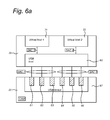
- Figure 6a shows a schematic view of logical pipes between a CAM device 20 connected to a USB controller 60 of a CI hub 30 as described in reference to figure 3A .
- the CI hub 30 is thus a host in both the sense of the CI and CI Plus standard, and also a host (controller) in the sense of the USB standard, so that the hub includes the USB host controller 60.
- the CAM device plays the role of the USB host.
- the USB device 67 in the CAM device 20 has six logical endpoints 61-66. Each endpoint corresponds one-to-one with a USB pipe.
- Endpoint 61 is connected to the message pipe, for bi-directionally transmitting control traffic to and from the CAM device using a control transfer type.
- pipe 61 is the default control pipe (also known as "pipe 0").
- Endpoint 62 is connected to a downstream pipe for receiving (at the CAM device) CA encrypted video data from first virtual host 31. As mentioned previously, in an embodiment, this pipe uses the bulk transfer type.
- Endpoint 63 is connected to an upstream pipe for transmitting (from the CAM device) CC encrypted video data to the first virtual host 31. In an embodiment, this pipe also uses the bulk transfer type.
- the data pipes can be any USB data pipes, including USB 3.0 (or later) SuperSpeed pipes. Pipes 61, 62, 63 belong to connection SAC1.
- Endpoints 64 and 65 are connected to downstream and upstream pipes respectively, which are connected via the USB controller 60 to the second virtual host 32.
- the control messages related to the second virtual host are exchanged via endpoint 66 of a bidirectional message pipe.
- Pipes 64, 65, 66 belong to connection SAC2.
- the CI host 33 (not shown in figure 6a ) which includes the USB host 60 simply directs the traffic to and from the endpoints 61-63 to first virtual host 31 and the traffic to and from endpoints 64-66 to second virtual host 32.
- control traffic is transmitted over a pipe with hardware checks to ensure the integrity of the control data.
- some data transfer types allow a small possibility of transmission errors. For video signals, this is generally not a critical issue, since a small error in video data will likely go unnoticed.
- the USB bulk transfer type is used, which has, at the built-in error checking. That way, the control layer on top of the USB connection layer does not need to implement its own error checking (the result from the USB layer can be used).
- the link layer on top of the USB layer implements audio/video stream clock recovery (which USB does not provide) but not error detection and correction.
- the CA encrypted and CA decrypted data can in principle be in any (streaming) format.
- Transport Streams (TS) and ISO BMFF are the most common carriers of the type of data (audio/video) transmitted between CI and CAM.
- Figure 6b shows a schematic view of logical pipes between a CAM device 20 connected to a USB controller 60 of a CI hub 30 as described in reference to figure 3A .
- the main difference is that in this embodiment, there is only a single bidirectional message pipe 61.
- the pipes 61-65 together form a single SAC connection (SAC1).
- SAC1 SAC1
- the CI plus host 33 (not shown) has an additional layer 60' for (de)multiplexing the traffic to and from the virtual hosts 31, 32 as described in reference to figure 3b .
- the data sent over the USB data pipes of figures 6a and 6b is organized in USB chunks.
- TS input a straightforward way would be to map each TS packet to a single USB chunk.
- TS chunks are typically several kiloBytes (kB) in size.
- kB kiloBytes
- a possible way would be to package items at a higher abstraction layer than the packet layer in separate chunks. For example, TS tables, which are split up and transmitted over several TS packets, can be re-assembled in the CI host and then sent as a single "table chunk" over the USB interface to the CICAM.
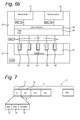
- Figure 7 shows an example data chunk 70 for transmission over a USB interface (either upstream or downstream).
- the chunk 70 has a data or payload part 72 and a header 71.
- the header 71 can be used to indicate the type of contents of the chunk. For example, it may indicate which table or TS packet is included in the payload.
- the header 71 has a type field 73 for characterising the payload.
- the header 71 may comprise a time field 74 indicating a time stamp of the payload, for example the time stamp of the first TS packet of a transport stream payload.
- the header 71 may comprise a duration field 75 indicating a duration of the payload. the time field 74 and duration field 75 can be used for clock recovery in the CICAM system.
- the payload can comprise N packets P 1 , P 2 , P 3 , ..., P N .
- the size s of the packets may be 188 Bytes (B), while the total size L of the chunk including header and payload may be of the order of 64 kiloByte (kB).
- kB 64 kiloByte
- Bundling N packets into a single chunk with a single header 71 advantageously prevents overhead compared to known variants in which each packet is encapsulated.
- the incoming (to be CA decrypted) TS or ISO BMFF stream (or any other suitable stream that is to be decrypted in the CICAM) can thus be converted by the CI host to a stream of USB data chunks.
- the receiving CICAM can reconstruct the TS or ISO BMFF stream, so that the CA encrypted signal can be decrypted. It may not be necessary to fully convert the chunks back to TS or ISO BMFF format - it is sufficient if the CICAM can identify which parts of the incoming data it needs to decrypt.
- the CA decrypted data is converted again to USB chunks (if needed), and transmitted from the CICAM back to the CI over the USB link, using a suitable logical pipe.
- the CI host then recreates the original TS or ISO BMFF format as needed for further processing in the digital receiver or television.
- control messages In an embodiment, the default PIPE of the USB device is reserved exclusively for the control-layer of CI/CI PLUS.
- One or more additional pipes are used to transfer the content. As shown in reference to figure 5 , multiple control pipes may be defined. However, for now we assume a single pipe exists.
- the control-layer of CI/CI PLUS should be interpreted as the "session layer” and all higher layers in the Command Interfaces Layers stack as shown in figure 4 of CI standard EN 50221 (1997).
- traffic generated by the control-layer of CI/CI PLUS is considered control traffic that will be transmitted over the dedicated bidirectional message or control pipe, such as pipe 0.
- the data pipes transmit chunks with a "tag-length-value" format.
- the data transmitted over the data pipe is transmitted as chunks, each chunk having a header.
- the data thus consists of "descriptors" (header) and "payload".
- descriptors are time-stamped. Either or both a duration or a second time stamp to mark the end of the data may also be added.
- the content format should be described. There may be two different content formats, TS (Transport Stream) and ISO BMFF (Base Media File Format).
- each packet in the default PIPE has the same "tag-length-value" format as in the common interface. It starts with the protocol objects as defined in EN 50221 7.1.2.
- CI Plus CI Plus
- the invention of providing a CI hub can also be used in connection with a "plain" CI system, on in general with any interface system for connecting to a CAM, with or without re-encryption of the data after CA decryption in the CAM.
- the exemplary embodiments show systems with two or three peripheral devices.
- the skilled person will understand that more devices may be connected. Even a system with just one peripheral device may be advantageous.
- the CI hub can act as a bridge or converter unit for the peripheral device.
Landscapes
- Engineering & Computer Science (AREA)
- Multimedia (AREA)
- Signal Processing (AREA)
- Databases & Information Systems (AREA)
- Software Systems (AREA)
- Theoretical Computer Science (AREA)
- Two-Way Televisions, Distribution Of Moving Picture Or The Like (AREA)
Priority Applications (1)
| Application Number | Priority Date | Filing Date | Title |
|---|---|---|---|
| EP13167671.0A EP2804391A1 (fr) | 2013-05-14 | 2013-05-14 | Moyeu d'interface commune |
Applications Claiming Priority (1)
| Application Number | Priority Date | Filing Date | Title |
|---|---|---|---|
| EP13167671.0A EP2804391A1 (fr) | 2013-05-14 | 2013-05-14 | Moyeu d'interface commune |
Publications (1)
| Publication Number | Publication Date |
|---|---|
| EP2804391A1 true EP2804391A1 (fr) | 2014-11-19 |
Family
ID=48325532
Family Applications (1)
| Application Number | Title | Priority Date | Filing Date |
|---|---|---|---|
| EP13167671.0A Withdrawn EP2804391A1 (fr) | 2013-05-14 | 2013-05-14 | Moyeu d'interface commune |
Country Status (1)
| Country | Link |
|---|---|
| EP (1) | EP2804391A1 (fr) |
Cited By (2)
| Publication number | Priority date | Publication date | Assignee | Title |
|---|---|---|---|---|
| EP2963932A1 (fr) * | 2014-07-01 | 2016-01-06 | Rabbit Labs SAS | Système de distribution de télévision compatible standard |
| DE102016122982A1 (de) | 2016-11-29 | 2018-05-30 | genua GmbH | Multiplexer zum Steuern eines Zugriffs einer Datenverarbeitungsvorrichtung auf eine Smartcard |
Citations (3)
| Publication number | Priority date | Publication date | Assignee | Title |
|---|---|---|---|---|
| GB2336742A (en) * | 1998-04-24 | 1999-10-27 | Sony Uk Ltd | A method of transmitting a transport stream over an IEEE 1394 Bus |
| EP1781032A2 (fr) * | 2005-10-27 | 2007-05-02 | Advanced Digital Broadcast S.A. | Système et procédé de contrôle d'accès conditionnel dans un décodeur de télévision numérique recevant une pluralité de trains de données |
| US20100263059A1 (en) * | 2009-04-14 | 2010-10-14 | Curtis William A | Virtualization Based Conditional Access Tuner Module For Providing Secure Linear And Non-Linear Content Services |
-
2013
- 2013-05-14 EP EP13167671.0A patent/EP2804391A1/fr not_active Withdrawn
Patent Citations (3)
| Publication number | Priority date | Publication date | Assignee | Title |
|---|---|---|---|---|
| GB2336742A (en) * | 1998-04-24 | 1999-10-27 | Sony Uk Ltd | A method of transmitting a transport stream over an IEEE 1394 Bus |
| EP1781032A2 (fr) * | 2005-10-27 | 2007-05-02 | Advanced Digital Broadcast S.A. | Système et procédé de contrôle d'accès conditionnel dans un décodeur de télévision numérique recevant une pluralité de trains de données |
| US20100263059A1 (en) * | 2009-04-14 | 2010-10-14 | Curtis William A | Virtualization Based Conditional Access Tuner Module For Providing Secure Linear And Non-Linear Content Services |
Non-Patent Citations (2)
| Title |
|---|
| "CI Plus Specification - Content Security Extensions to the Common Interface", no. V1.3.1, 1 September 2011 (2011-09-01), pages 1 - 312, XP002703340, Retrieved from the Internet <URL:http://www.ci-plus.com/data/ci-plus_specification_v1.3.1.pdf> * |
| DVB ORGANIZATION: "TM-CI-Plus0089.ANGA Cable 2012.pdf", DVB, DIGITAL VIDEO BROADCASTING, C/O EBU - 17A ANCIENNE ROUTE - CH-1218 GRAND SACONNEX, GENEVA - SWITZERLAND, 17 September 2012 (2012-09-17), XP017840031 * |
Cited By (4)
| Publication number | Priority date | Publication date | Assignee | Title |
|---|---|---|---|---|
| EP2963932A1 (fr) * | 2014-07-01 | 2016-01-06 | Rabbit Labs SAS | Système de distribution de télévision compatible standard |
| DE102016122982A1 (de) | 2016-11-29 | 2018-05-30 | genua GmbH | Multiplexer zum Steuern eines Zugriffs einer Datenverarbeitungsvorrichtung auf eine Smartcard |
| DE102016122982A8 (de) | 2016-11-29 | 2018-08-09 | genua GmbH | Multiplexer zum Steuern eines Zugriffs einer Datenverarbeitungsvorrichtung auf eine Smartcard |
| DE102016122982B4 (de) | 2016-11-29 | 2022-12-22 | genua GmbH | Multiplexer zum Steuern eines Zugriffs einer Datenverarbeitungsvorrichtung auf eine Smartcard |
Similar Documents
| Publication | Publication Date | Title |
|---|---|---|
| CN100568870C (zh) | 一种通用串行数据双向传输接口系统 | |
| US9647997B2 (en) | USB interface for performing transport I/O | |
| JP4394833B2 (ja) | 通信ネットワーク | |
| US10382816B2 (en) | Systems and methods for performing transport I/O | |
| US7590242B2 (en) | Selective multimedia data encryption | |
| US6963590B1 (en) | Apparatus for delivery of multiple media data streams, and method therefor | |
| EP2245853B1 (fr) | Système de chiffrage pour une télévision distribuée par satellite | |
| CN101416483A (zh) | 传输流的消除抖动 | |
| EP2437194A1 (fr) | Système et procédé pour prévenir la manipulation de données vidéo transmises par lien HDMI. | |
| WO2012139481A1 (fr) | Terminal basé sur une technologie d'accès conditionnel | |
| EP2974331B1 (fr) | Systèmes et procédés de rassemblement et d'extraction de données d'instruction et de commande | |
| US8355504B2 (en) | AV communication control circuit for realizing copyright protection with respect to radio LAN | |
| EP2942725B1 (fr) | Hôte d'interface commune et module d'accès conditionnel d'interface commune | |
| EP2804388A1 (fr) | Hôte d'interface commune et module d'accès conditionnel d'interface commune | |
| EP2804391A1 (fr) | Moyeu d'interface commune | |
| US20160191965A1 (en) | Broadcast receiving apparatus and method for controlling the same | |
| CN101489095A (zh) | 条件访问系统 | |
| CN105446926B (zh) | 用于执行传输i/o的usb接口 | |
| CN102231854A (zh) | 多媒体广播节目录制方法及数据卡设备 | |
| KR20080065068A (ko) | 디지털 방송 수신기와 데이터 전송방법 | |
| KR20080106389A (ko) | 케이블카드 | |
| KR20080065440A (ko) | 네트워크 인터페이스 유닛 | |
| KR20150004997A (ko) | 외장 저장 장치에서 인증 방법 |
Legal Events
| Date | Code | Title | Description |
|---|---|---|---|
| PUAI | Public reference made under article 153(3) epc to a published international application that has entered the european phase |
Free format text: ORIGINAL CODE: 0009012 |
|
| 17P | Request for examination filed |
Effective date: 20130514 |
|
| AK | Designated contracting states |
Kind code of ref document: A1 Designated state(s): AL AT BE BG CH CY CZ DE DK EE ES FI FR GB GR HR HU IE IS IT LI LT LU LV MC MK MT NL NO PL PT RO RS SE SI SK SM TR |
|
| AX | Request for extension of the european patent |
Extension state: BA ME |
|
| STAA | Information on the status of an ep patent application or granted ep patent |
Free format text: STATUS: THE APPLICATION IS DEEMED TO BE WITHDRAWN |
|
| 18D | Application deemed to be withdrawn |
Effective date: 20150520 |