EP2804445A1 - Steuerungsvorrichtung und verfahren zum automatischen ein- und ausschalten von strassenleuchten - Google Patents
Steuerungsvorrichtung und verfahren zum automatischen ein- und ausschalten von strassenleuchten Download PDFInfo
- Publication number
- EP2804445A1 EP2804445A1 EP12865366.4A EP12865366A EP2804445A1 EP 2804445 A1 EP2804445 A1 EP 2804445A1 EP 12865366 A EP12865366 A EP 12865366A EP 2804445 A1 EP2804445 A1 EP 2804445A1
- Authority
- EP
- European Patent Office
- Prior art keywords
- illuminance
- turn
- period
- street light
- external
- Prior art date
- Legal status (The legal status is an assumption and is not a legal conclusion. Google has not performed a legal analysis and makes no representation as to the accuracy of the status listed.)
- Withdrawn
Links
- 238000000034 method Methods 0.000 title claims abstract description 44
- 238000012423 maintenance Methods 0.000 claims description 54
- 238000005070 sampling Methods 0.000 claims description 16
- 238000004891 communication Methods 0.000 claims description 9
- 238000001914 filtration Methods 0.000 claims description 4
- 230000000737 periodic effect Effects 0.000 abstract description 5
- 238000005286 illumination Methods 0.000 abstract 5
- 230000002354 daily effect Effects 0.000 description 51
- 238000010586 diagram Methods 0.000 description 6
- 230000007613 environmental effect Effects 0.000 description 6
- 238000012545 processing Methods 0.000 description 6
- 230000004044 response Effects 0.000 description 5
- WUPHOULIZUERAE-UHFFFAOYSA-N 3-(oxolan-2-yl)propanoic acid Chemical compound OC(=O)CCC1CCCO1 WUPHOULIZUERAE-UHFFFAOYSA-N 0.000 description 4
- 229910052980 cadmium sulfide Inorganic materials 0.000 description 4
- 230000000903 blocking effect Effects 0.000 description 2
- 230000003203 everyday effect Effects 0.000 description 2
- 238000009825 accumulation Methods 0.000 description 1
- 239000013078 crystal Substances 0.000 description 1
- 230000007423 decrease Effects 0.000 description 1
- 230000001419 dependent effect Effects 0.000 description 1
- 238000001514 detection method Methods 0.000 description 1
- 230000000694 effects Effects 0.000 description 1
- 230000001747 exhibiting effect Effects 0.000 description 1
- 230000001939 inductive effect Effects 0.000 description 1
- 239000004973 liquid crystal related substance Substances 0.000 description 1
- 238000005259 measurement Methods 0.000 description 1
- 230000010355 oscillation Effects 0.000 description 1
- 208000017983 photosensitivity disease Diseases 0.000 description 1
- 231100000434 photosensitization Toxicity 0.000 description 1
- 238000012876 topography Methods 0.000 description 1
Images


Classifications
-
- H—ELECTRICITY
- H05—ELECTRIC TECHNIQUES NOT OTHERWISE PROVIDED FOR
- H05B—ELECTRIC HEATING; ELECTRIC LIGHT SOURCES NOT OTHERWISE PROVIDED FOR; CIRCUIT ARRANGEMENTS FOR ELECTRIC LIGHT SOURCES, IN GENERAL
- H05B47/00—Circuit arrangements for operating light sources in general, i.e. where the type of light source is not relevant
- H05B47/10—Controlling the light source
- H05B47/16—Controlling the light source by timing means
-
- H—ELECTRICITY
- H05—ELECTRIC TECHNIQUES NOT OTHERWISE PROVIDED FOR
- H05B—ELECTRIC HEATING; ELECTRIC LIGHT SOURCES NOT OTHERWISE PROVIDED FOR; CIRCUIT ARRANGEMENTS FOR ELECTRIC LIGHT SOURCES, IN GENERAL
- H05B47/00—Circuit arrangements for operating light sources in general, i.e. where the type of light source is not relevant
- H05B47/10—Controlling the light source
- H05B47/105—Controlling the light source in response to determined parameters
- H05B47/11—Controlling the light source in response to determined parameters by determining the brightness or colour temperature of ambient light
-
- Y—GENERAL TAGGING OF NEW TECHNOLOGICAL DEVELOPMENTS; GENERAL TAGGING OF CROSS-SECTIONAL TECHNOLOGIES SPANNING OVER SEVERAL SECTIONS OF THE IPC; TECHNICAL SUBJECTS COVERED BY FORMER USPC CROSS-REFERENCE ART COLLECTIONS [XRACs] AND DIGESTS
- Y02—TECHNOLOGIES OR APPLICATIONS FOR MITIGATION OR ADAPTATION AGAINST CLIMATE CHANGE
- Y02B—CLIMATE CHANGE MITIGATION TECHNOLOGIES RELATED TO BUILDINGS, e.g. HOUSING, HOUSE APPLIANCES OR RELATED END-USER APPLICATIONS
- Y02B20/00—Energy efficient lighting technologies, e.g. halogen lamps or gas discharge lamps
- Y02B20/40—Control techniques providing energy savings, e.g. smart controller or presence detection
-
- Y—GENERAL TAGGING OF NEW TECHNOLOGICAL DEVELOPMENTS; GENERAL TAGGING OF CROSS-SECTIONAL TECHNOLOGIES SPANNING OVER SEVERAL SECTIONS OF THE IPC; TECHNICAL SUBJECTS COVERED BY FORMER USPC CROSS-REFERENCE ART COLLECTIONS [XRACs] AND DIGESTS
- Y02—TECHNOLOGIES OR APPLICATIONS FOR MITIGATION OR ADAPTATION AGAINST CLIMATE CHANGE
- Y02B—CLIMATE CHANGE MITIGATION TECHNOLOGIES RELATED TO BUILDINGS, e.g. HOUSING, HOUSE APPLIANCES OR RELATED END-USER APPLICATIONS
- Y02B20/00—Energy efficient lighting technologies, e.g. halogen lamps or gas discharge lamps
- Y02B20/72—Energy efficient lighting technologies, e.g. halogen lamps or gas discharge lamps in street lighting
Definitions
- the present invention relates, in general, to an apparatus and method for automatically controlling the turning-on/off of a street light and, more particularly, to an apparatus and method for automatically controlling the turning-on/off of a street light, which analyze periodic records of external illuminance and actively control the street light based on the results of the analysis.
- a conventional photoelectric switch is composed of a cadmium sulfide (CDS) sensor and a logic circuit, and is configured such that a turn-on threshold and a turn-off threshold are set to references and such that if the receiving level of light incident on the CDS decreases below the turn-on threshold, a street light is turned on, and if the receiving level increases above the turn-off threshold, the street light is turned off.
- CDS cadmium sulfide
- a conventional timer-type automatic switch which is a scheme dependent on the operation of a clock, generally uses a crystal oscillator or the like having an oscillation error depending on temperature change, and thus if operation is maintained for a long period of time in an outdoor environment having temperature change, errors are accumulated.
- An object of the present invention is to provide an apparatus and method for automatically controlling the turning- on/off of a street light, which analyze continuous records of external illuminance, calculate reference illuminances and time limits for turning-on and off of the street light, and automatically control the output of the street light, thus autonomously solving timer error and light interference.
- An apparatus for automatically controlling turning on/off of a street light includes a photometric unit for measuring external illuminance from surroundings of a street light in real time; an illuminance collection unit for recording the measured external illuminance at intervals of a predetermined period and periodically updating the external illuminance; a reference illuminance calculation unit for analyzing the external illuminance recorded at intervals of the predetermined period, and calculating turn-on illuminance and turn-off illuminance that are references for control of turn-on output and turn-off output of the street light; and an output control unit for comparing the turn-on illuminance, the turn-off illuminance, and the external illuminance with each other and controlling output power of the street light.
- the apparatus of the present invention may further include a time limit calculation unit for analyzing the external illuminance recorded at intervals of the predetermined period, and calculating, for the street light, time limits including at least one of a turn-on maintenance time for which turning-on is maintained, a turn-off maintenance time for which turning-off is maintained, a turn-on waiting time for which switching to turning-on is performed, and a turn-off waiting time for which switching to turning-off is performed
- the output control unit may control the output power of the street light using the time limits.
- the illuminance collection unit may sample the external illuminance, records the external illuminance at regular periods, and calculate daily illuminance updated depending on a variation in the external illuminance for at least one recent day.
- the reference illuminance calculation unit may analyze the daily illuminance calculated by the illuminance collection unit, and update the turn-on illuminance and the turn-off illuminance that are the references for control of turn-on output and turn-off output of the street light.
- the time limit calculation unit may divide a variation period of daily illuminance according to a rate of illuminance, calculate a period for which the external illuminance exceeds daytime period reference illuminance as a daytime period for the street light, calculate illuminance variation periods present before and after the daytime period as a morning period and an evening period, and calculate a residual period as a nighttime period.
- the time limit calculation unit may calculate the turn-off maintenance time, the turn-off waiting time, the turn-on waiting time, and the turn-on maintenance time from the daytime period, the morning period, the evening period, and the nighttime period, respectively.
- the output control unit may be configured to, if the external illuminance becomes greater than the turn-off illuminance in the morning period, turn off the street light, and if the external illuminance does not become greater than the turn-off illuminance in the morning period and the turn-off waiting time has elapsed, turn off the street light.
- the output control unit may be configured to, if the external illuminance becomes less than the turn-on illuminance in the evening period, turn on the street light, and if the external illuminance does not become less than the turn-on illuminance in the evening period and the turn-on waiting time has elapsed, turn on the street light.
- the illuminance collection unit may sample the external illuminance measured by the photometric unit, and filter a variation in illuminance equal to or greater than a reference value and external interference.
- the apparatus may further include a communication unit for receiving an external command from a remote management device or transmitting operating states of the street light to outside of the apparatus.
- a method of automatically controlling turning-on/off of a street light includes a photometric step of measuring external illuminance from surroundings of a street light in real time; an illuminance collection step of recording the measured external illuminance at intervals of a predetermined period and periodically updating the external illuminance; a reference illuminance calculation step of analyzing the external illuminance recorded at intervals of the predetermined period, and calculating turn-on illuminance and turn-off illuminance that are references for control of turn-on output and turn-off output of the street light; and an output control step of comparing the turn-on illuminance, the turn-off illuminance, and the external illuminance with each other and controlling output power of the street light.
- the present invention may further include, before the output control step, a time limit calculation step of analyzing the external illuminance recorded at intervals of the predetermined period, and calculating time limits including at least one of a turn-on maintenance time for which turning-on of the street light is maintained, a turn-off maintenance time for which turning-off of the street light is maintained, a turn-on waiting time for which the street lamp switches to turning-on, and a turn-off waiting time during which the street light switches to turning-off.
- the illuminance collection step may include sampling the external illuminance, recording the external illuminance at regular periods, and calculating daily illuminance updated depending on a variation in the external illuminance for at least one recent day.
- the reference illuminance calculation step may include analyzing the daily illuminance calculated at the daily illuminance calculation step, and updating the turn-on illuminance and the turn-off illuminance that are the references for control of turn-on output and turn-off output of the street light.
- the time limit calculation step may include dividing a variation period of daily illuminance according to a rate of illuminance, calculating a period for which the external illuminance exceeds daytime period reference illuminance as a daytime period for the street light, calculating illuminance variation periods present before and after the daytime period as a morning period and an evening period, and calculating a residual period as a nighttime period.
- the time limit calculation step may be configured to calculate the turn-off maintenance time, the turn-off waiting time, the turn-on waiting time, and the turn-on maintenance time from the daytime period, the morning period, the evening period, and the nighttime period, respectively.
- the output control step may be configured to, if the external illuminance becomes greater than the turn-off illuminance in the morning period, turn off the street light.
- the output control step may be configured to, if the external illuminance does not become greater than the turn-off illuminance in the morning period and the turn-off waiting time has elapsed, turn off the street light.
- the output control step may be configured to, if the external illuminance becomes less than the turn-on illuminance in the evening period, turn on the street light.
- the output control step may be configured to, if the external illuminance does not become less than the turn-on illuminance in the evening period and the turn-on waiting time has elapsed, turn on the street light.
- the illuminance collection step may include sampling the external illuminance measured at the photometric step, and filtering a variation in illuminance equal to or greater than a reference value and external interference.
- the present invention may further include a communication step of receiving an external command from a remote management device or transmitting operating states of the street light to outside.
- time spans for inductive control by a sensor are limited to morning and evening time spans calculated based on the intensity of light detected in real time, there is an advantage in that a light interference section is limited. Since references for turning-on and off of a street light are calculated in association with each other via the analysis of records of external light intensity, the present invention is advantageous in that it is actively adapted for usage environment such as weather changes, thus providing optimal turn-on and turn-off conditions.
- the present invention is advantageous in that times corresponding to night and day are obtained based on external illuminance measured in real time, so that external light disturbance is prevented by a timer which maintains turning-off in the daytime and maintains turning-on in the nighttime, thus solving malfunctioning in which daytime and nighttime operations are switched due to the interference of external light and accumulative error of a clock.
- Fig. 1 is a block diagram showing the configuration of an apparatus for automatically controlling the turning-on/off of a street light according to the present invention.
- the automatic street light turning-on/off control apparatus includes a control unit 10, a photometric unit 20, an input unit 30, a display unit 40, a storage unit 50, a communication unit 60, an illuminance collection unit 70, a time limit calculation unit 80, a reference illuminance calculation unit 90, an output control unit 100, and a power output unit 110.
- the control unit 10 controls the operations of respective components of the automatic street light turning-on/off control apparatus by running a management program. Further, the control unit 10 controls the operations of the automatic street light turning-on/off control apparatus in a start mode and an operation mode. When the automatic street light turning-on/off control apparatus is initially operated, the control unit 10 operates the apparatus in the start mode. If a predetermined time has elapsed from the operation in the start mode, the control unit 10 operates the apparatus in the operation mode. A detailed description of individual mode operations will be described in detail later with reference to a description of Figs. 4 to 9 .
- the photometric unit 20 is configured such that external illuminance is sensed by a photometric sensor arranged to be exposed to external light, and sensed illuminance information is measured by a photometric means for outputting the illuminance information as digital values.
- the photometric unit 20 which is a digital photometric means for measuring light in a sufficiently wide band so that daily changes occurring in the daytime and nighttime in at least one day may be continuously measured, may preferably be implemented as any one of an illuminometer, a photometer, and a luminance meter.
- the photometric unit 20 is operated such that external illuminance is sensed by the photometric sensor arranged to be exposed to external light, and the external illuminance [Lx] is measured by the illuminometer for outputting the sensed illuminance information as digital illuminance values.
- the input unit 30 receives external commands, variables, etc., and transfers them to the control unit 10.
- the display unit 40 displays the operating states of the street light and the automatic turning-on/off control apparatus.
- the display unit 40 may display the management states of the street light and the automatic street light turning-on/off control apparatus on a display means such as a Liquid Crystal Display (LCD), and may output operating states via the communication unit 60 and an output means such as a Light Emitting Diode (LED).
- LCD Liquid Crystal Display
- LED Light Emitting Diode
- the initial values of management variables for initial operation, together with the management program are stored.
- the initial values include management variables such as reference illuminances, and these are preferably stored in flash memory or Electrically Erasable Programmable Read-Only Memory (EEPROM) so that they are not initialized in the start mode against a reset operation or a power failure.
- EEPROM Electrically Erasable Programmable Read-Only Memory
- Variables such as application illuminance, daily illuminance, and time limits which vary in real time depending on a variation in external illuminance, are preferably stored in Random Access Memory (RAM) enabling updating to be freely performed.
- RAM Random Access Memory
- pieces of data such as reference illuminances, that is, turn-on illuminance and turn-off illuminance, and the time limits which are updated depending on the variation in external illuminance, are calculated according to the daily variation of external illuminance, and thus they may be updated with new data at least every 24 hours.
- the communication unit 60 transmits and receives data while communicating with a remote management device.
- the communication unit 60 receives external commands from the remote management device, and transmits the results of processing or a resulting operating state based on the external commands to the remote management device or the outside of the apparatus.
- the illuminance collection unit 70 samples external illuminance measured by the photometric unit 20 at a predetermined sampling period, records the external illuminance in the form of continuous data for a predetermined time period, and updates the continuous data in real time.
- the records of illuminance collected by the illuminance collection unit 70 are formed by collecting the distribution of illuminance at intervals of 24 hours so that illuminance variation having a period of at least a day may be analyzed.
- the illuminances collected in this way are updated by real-time sampling of external illuminance, and thus daily illuminance of at least one recent day is calculated.
- the time limit calculation unit 80 analyzes the illuminance distribution appearing in the daily illuminance, calculates a turn-on maintenance time from a nighttime period for which the street light is maintained in a turn-on state, a turn-off waiting time from a morning period for which the street light switches from the turn-on state to a turn-off state, a turn-off maintenance time from a daytime period for which the street light is maintained in the turn-off state, and a turn-on waiting time from an evening period for which the street light switches from the turn-off state to the turn-on state, at least one or more times every day, updates the calculated times, and sets the updated times to management variables.
- the reference illuminance calculation unit 90 calculates turn-on illuminance that is a reference for turning on the street light and turn-off illuminance that is a reference for turning off the street light, from daily illuminance.
- the output control unit 100 compares the turn-on maintenance time, the turn-off maintenance time, the turn-on waiting time, the turn-off waiting time, the turn-on illuminance, and the turn-off illuminance with the external illuminance, controls the output of the street light, and also controls the output even in response to external signals.
- the illuminance collection unit 70 may calculate application illuminance as a mean value obtained by sampling illuminance obtained from an illuminance sensor for a predetermined period of time, summing sampled illuminance values, and dividing the summed illuminance value by the number of samples, and may also calculate registration illuminance as a mean value obtained by sampling illuminance obtained from the illuminance sensor for a predetermined period of time, summing sampled illuminance values, and dividing the summed illuminance value by the number of samples.
- a difference between the application illuminance and the registration illuminance is that the application illuminance is an instantaneously filtered illuminance value which makes a recognition delay time shorter by filtering temporary variation and external interference from the external illuminance measured in real time, and the registration illuminance is an illuminance value obtained by producing the tendency of daily illuminance variations in the nighttime, morning, daytime, and evening from the external illuminance measured in real time, wherein the recognition time may be relatively long.
- the registration illuminance may be applied by sampling the external illuminance, but it is more preferable to perform sampling based on application illuminance in which a temporary variation in external illuminance sampled by the illuminance collection unit 70 is mitigated and external interference is filtered.
- the output control unit 100 can control the output of the street light by using external illuminance that is varying in real time, but it is more preferable to control the output of the street light based on the application illuminance so that the turning-on and turning-off of the street light are stabilized by filtering the temporary variation in external illuminance and external light interference.
- the time limit calculation unit 80 may calculate the range of illuminance, which is calculated from daily illuminance collected by the illuminance collection unit 70 and which is greater than illuminance at sunrise in the distribution of continuous daily illuminance, as a daytime period.
- the illuminance at sunrise is about 3% compared to the maximum illuminance of the daily illuminance distribution, and a period after sunrise is typically regarded as daytime
- the illuminance of the daytime period corresponds to the top 97% of the daily illuminance.
- the daytime period is set based on a fact that illuminance at sunrise in the daily illuminance distribution on a clear day is about 3% of the daily illuminance, but the maximum photometric value may differ depending on the measurement range and the implementation form of a measuring device, and thus a designated percentage is only a preferred example of an index for determining the daytime period and is not limited thereto.
- intervals for which illuminance changes before and after the daytime period are set to a morning period and an evening period, respectively, and they each typically occupy about 72 minutes.
- the remaining period of one day other than the daytime period, the morning period, and the evening period may be calculated as a nighttime period.
- the morning period and the evening period each having a length of 72 minutes, denote a period ranging from the time immediately before dawn to the time of sunrise and a period from the time of sunset to the time at which it is completely dark, respectively, wherein the length of 72 minutes corresponds to the astronomical twilight time at which a magnetic dip is between 12 and 18 degrees below the horizon according to the altitude of the sun, wherein the longest time thereof is obtained by converting the largest angle of 18 degrees into time.
- the astronomical twilight time refers to a phenomenon in which as the daytime is longer, the astronomical twilight time is closer to 48 minutes, and in which, as the daytime becomes shorter in a direction toward polar regions, the astronomical twilight time is approximate to 72 minutes, and thus the astronomical twilight time changes in inverse proportion to the length of the daytime.
- such a time not only differs in individual regions according to the latitude and topography, but also is influenced by weather. Illuminances at times of sunrise and sunset on a cloudy day are less than those on a clear day, and as weather becomes cloudier, the daytime period becomes shorter, and the morning period and the evening period become longer proportionally, thus exhibiting daily illuminance similar to the characteristics of daily variation at high latitude.
- a maximum of about 102 minutes may be set to valid time for each of the morning period and the evening period.
- the length variations in the length of the morning period and the evening period are in inverse proportion to the length of the daytime calculated based on daily illuminance, the length variations may be calculated in association with the length of the daytime period.
- the calculation of these length variations may be a useful means enabling a low illuminance band to be identified under a condition in which the inference of surrounding light may occur in a band of illuminance less than that of the daytime period.
- the turn-on maintenance time acts as the time for which the turn-on state of the street light is maintained in the nighttime period after the street light has been turned on in the evening period
- the turn-off maintenance time acts as the time for which the turn-off state of the street light is maintained in the daytime period after the street light has been turned off in the morning period.
- a predetermined rate of the time length of the daytime period calculated as described above may be calculated as the turn-off maintenance time
- a predetermined rate of the time length of the nighttime period may be calculated as the turn-on maintenance time
- the length of the turn-off maintenance time may be shorter than that of the daytime period
- the length of the turn-on maintenance time may be shorter than that of the nighttime period
- times corresponding to the lengths of the nighttime period and daytime period, reduced in this way are proportionally distributed to the morning period and the evening period.
- the predetermined rate applied here is previously set to an environmental variable and may correspond to a time length of about 30 minutes in which the influence of weather is taken into consideration, but, upon actual application, it is preferable to apply the rate by adding or subtracting a time of about 1 hour in consideration of the topographical condition, the interference of surrounding light, etc.
- the calculation of the time limits may be performed by multiplying a sampling period by the number of samples of daily illuminance included in each set period of the daily illuminance, and converting resulting values into time values.
- the program running mode switches from the start mode to an operation mode, and in this switching procedure, a time point in the daily illuminance at which the current time point is located is calculated.
- the daytime period, the nighttime period, the morning period, the evening period, and the current time point need to be periodically updated one or more times every day, but they are preferably updated based on time at which at least one period starts or ends.
- the current time point may be calculated by multiplying a sampling period by the number of samples of registration illuminance from the start point of the period during which the recent registration illuminance is located.
- the storage unit 50 stores illuminance values and variables calculated by the illuminance collection unit 70, the time limit calculation unit 80, and the reference illuminance calculation unit 90, and allow the values stored therein to be periodically updated with the lapse of time due to the periodic sampling of external illuminance.
- the turn-off illuminance calculated by the reference illuminance calculation unit 90 is an illuminance value that is a reference for the determination of a turn-off state, and may be calculated using the following procedure on the basis of daily illuminance obtained for a predetermined period of about 60 minutes before the turn-off waiting time so that the turn-off illuminance is calculated from nighttime illuminance immediately before the turn-off waiting period close to dawn in the range of daily illuminance in order to reduce a difference between the turn-off waiting section and weather changes.
- These may reflect recent weather changes upon calculating turn-off illuminance based on the recent nighttime illuminance close to the turn-on waiting section and may make a difference with turn-off illuminance so that a variation in illuminance is clarified from the nighttime illuminance, thus reducing the influence of interference of external instantaneous light.
- the turn-on illuminance is an illuminance that is a reference for the determination of a turn-on state, and is preferably set to a value equal to or less than the turn-off illuminance.
- the turn-off waiting time is a band in which the nighttime period is terminated and external illuminance is compared with the turn-off illuminance to output a turn-off state in the operation mode
- the turn-on waiting time is a band in which the daytime period is terminated and the external illuminance is compared with the turn-on illuminance to output a turn-on state in the operation mode
- the turn-off and turn-on waiting times are calculation sections in which output switches between the turn-on output and the turn-off output depending on the variation in measured external illuminance.
- the daytime period in which a turn-off state must be maintained may be shorter than the turn-off maintenance time.
- the time for which the turn-off state must be maintained is called a residual turn-off time
- the time for which a turn-on state must be maintained when the time at which the mode switches to the operation mode is present in the nighttime period is a residual turn-on maintenance time
- the calculation of the residual turn-on maintenance time and the residual turn-off maintenance time may be performed such that, if current time at which daily illuminance has been completed belongs to the daytime period, the time [min] obtained by subtracting time, obtained by multiplying the sampling period by the number of samples of daily illuminance from the start point of the daytime period up to the current time, from the turn-on maintenance time may be calculated as the residual turn-off maintenance time, and such that, if the current time belongs to the nighttime period, time [min] obtained by
- the output control unit 100 outputs turn-on/off control signals required to control the output power of the street light by calculating the variation in external illuminance, the reference illuminances, the turn-on maintenance time, and the turn-off maintenance time set by the time limit calculation unit 70 in association with each other.
- the output control unit 100 controls the turning-on/off of the street light in the start mode until a management program is initiated and the daily illuminance is completed.
- Control in the start mode is performed via illuminance control depending on the variation in external illuminance such that, until the external illuminance becomes greater than the turn-off illuminance, the street light is maintained in a turn-on state and such that, if the external illuminance becomes greater than turn-off illuminance, the street light switches from the turn-on state to a turn-off state and is maintained in the turn-off state until the external illuminance becomes less than the turn-on illuminance.
- external illuminance that is input in real time may be used, but it is preferable to use application illuminance to stabilize the control of the turning-on and turning-off of the street light because the external illuminance may be sensitive to real-time variation in external light.
- the output control unit 100 may output a dimming control signal required to control the magnitude of output current in response to the value of dimming control by the automatic street light turning-on/off control apparatus.
- the output control unit 100 may further include a current detection unit and may be configured to detect and analyze current that is supplied to the street light, and determine a fault from the results of the analysis.
- the power output unit 110 controls power that is output to the street light in response to a turn-on/off control signal received from the communication unit 60 as an external signal and a turn-on/off control signal received from the output control unit 100.
- the power output unit 110 controls the supply of power to the street light and the blocking of the supply of power through a relay means or a Pulse Width Modulation (PWM) means.
- PWM Pulse Width Modulation
- the power output unit 110 may perform turn-on and turn-off operations, together with a dimming operation, by outputting current having a designated magnitude in response to a dimming control signal output from the output control unit 100.
- the power output unit 110 may control the supply of power to the street light and the blocking of the supply of power by driving a relay in response to the turn-on/off control signal.
- the automatic street light turning-on/off control apparatus may calculate variables required for management based on external illuminance values collected in real time from the surroundings of a typical street light, and apply those variables to the turning-on/off control and the dimming control, thus enabling a variation in external illuminance to be reflected in real time in the turning-on/off control and the dimming control.
- Fig. 2 is a reference diagram illustrating a turn-on and turn-off section setting operation in the automatic street light turning-on/off control apparatus according to the present invention.
- sections operated by the automatic street light turning-on/off control apparatus according to the present invention in the operation mode may be chiefly divided into A: turn-on section, B: turn-off waiting section, C: turn-off section, and D: turn-on waiting section. Further, in Fig. 2 , since time intervals corresponding to the respective sections are updated and managed with valid sections in one day, they are indicated based on 24 hours.
- a section from 0 o'clock to time P1 is a turn-on section, and corresponds to a nighttime period and a turn-on maintenance time for which turning-off is blocked.
- the nighttime period that is, the turn-on maintenance time
- a current state switches to a turn-off state due to turn-off illuminance until time P2 passes.
- a section from time P1 to P2 is the turn-off waiting section, that is, a morning period, for which if the external illuminance becomes greater than the turn-off illuminance, the current state switches to the turn-off state, otherwise the turn-on state is maintained.
- the termination of the turn-off waiting time acts prior to the variation in the external illuminance, and thus the current state switches to the turn-off state.
- the turn-off state is maintained during the daytime period, that is, a section from time P2 to time P3, which corresponds to the turn-off maintenance time for which the turn-off state is maintained.
- the daytime period that is, the turn-off maintenance time
- the turn-on waiting section that is, the evening period
- the termination of the turn-off waiting time acts prior to the variation in the external illuminance, and thus the current state switches to the turn-on state.
- the turn-on state is maintained during the nighttime period, that is, a section from time P4 to 24 o'clock, and is also maintained until the next time P1.
- the reason for limiting the turn-on waiting section and the turn-off waiting section is that it is preferable to limit actual times, at which turn-on and turn-off operations are determined based on the control of illuminance, to morning and evening, and that variations in the illuminance of the nighttime and daytime periods correspond to sections which do not require changes in turning-on and turning-off control, thus eliminating external interference while actively reflecting weather changes by merely maintaining an output state using a timer.
- the turn-on illuminance and the turn-off illuminance are not fixed values, and references for turning-on and turning-off are periodically updated based on daily illuminance collected for one recent day, the turning-on/off of the street light may be actively controlled based on the surrounding environment.
- times P1, P2, P3, and P4 are not fixed times, but are values updated together in accordance with the periodic update of daily illuminance, thus enabling the turning-on and turning-off of the street light to be realistically controlled based on the surrounding environment.
- Fig. 3 is a diagram illustrating the log graph of daily illuminance applied to the automatic street light turning-on/off control apparatus according to the present invention.
- a brimmed hat-shaped daily illuminance graph such as that of Fig. 3 , may be represented.
- a section of registration illuminance distribution exceeding a second reference value corresponding to a predetermined upper rate based on the daily illuminance may be classified as a daytime period C.
- the reason for identifying the daytime period C using the predetermined upper rate of the daily illuminance of the daytime period C is that the intensity of illuminance is much greater than that of a nighttime period A, and that, when daily illuminance varies depending on weather changes and surrounding conditions, the daytime period C may change according to the rate, and thus the nighttime period A may also change.
- a morning period B and an evening period D may be performed by calculating a section of illuminance distribution below a first reference value corresponding to a predetermined lower rate of the daily illuminance.
- a predetermined section before the start point of the daytime period C may be calculated as the morning period B
- a predetermined section from the end point of the daytime period may be calculated as the evening period D
- the residual section may be calculated as the nighttime period A.
- the turn-off illuminance and the turn-on illuminance may be set in association with the periodic variation in external illuminance.
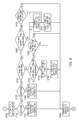
- Fig. 4 is a flowchart showing the operation flow of an automatic street light turning-on/off control method according to the present invention.
- the automatic street light turning-on/off control apparatus starts to run a program if power has been supplied to the apparatus (S100), samples external illuminance measured by an illuminometer (S110), calculates application illuminance via the sampling (S110) of the external illuminance (S120), calculates registration illuminance, records the calculated registration illuminance as daily illuminance, updates the daily illuminance (S130), and waits for the input of an external signal.
- the apparatus monitors output (S150), and analyzes a fault (S170).
- the apparatus determines whether a control mode is an 'operation mode' (S230), and if the control mode is the 'operation mode', performs a procedure subsequent to D, otherwise the apparatus proceeds to a procedure subsequent to E to operate in a 'switch mode.
- Fig. 5 is a flowchart showing the operation flow of the automatic street light turning-on/off control method in the external signal processing mode according to the present invention.
- the automatic street light turning-on/off control apparatus is configured to, when operating in the external signal processing mode
- S300 determine whether an input external signal is a dimming signal (S310). If it is determined that the external signal is the dimming signal, the apparatus performs dimming (S320), and updates a dimming value (S330).
- the apparatus determines whether the external signal is an environmental variable (S340). If it is determined that the external signal is the environmental variable, the apparatus updates preset management variables depending on the input environmental variable (S350). If the external signal is not an environmental variable, the apparatus determines, based on a comparison, whether the external signal is a turn-on/off control signal (S360), and if it is determined that the external signal is the on/off control signal, the apparatus temporarily performs output control, and outputs an operating state (S370).
- S340 determines whether the external signal is an environmental variable
- the apparatus updates preset management variables depending on the input environmental variable (S350). If the external signal is not an environmental variable, the apparatus determines, based on a comparison, whether the external signal is a turn-on/off control signal (S360), and if it is determined that the external signal is the on/off control signal, the apparatus temporarily performs output control, and outputs an operating state (S370).
- Fig. 6 is a flowchart showing the operation flow of the automatic street light turning-on/off control method in a start mode according to the present invention.
- the automatic street light turning-on/off control apparatus of the present invention is configured to, when operating in the start mode (S400), determine, based on a comparison, whether external illuminance is greater than turn-off illuminance (S410). In this case, if it is determined that the external illuminance is greater than the turn-off illuminance, the apparatus starts to turn off the street light (S420), otherwise (S410) the apparatus determines whether the external illuminance is equal to or less than the turn-on illuminance (S430). If the external illuminance is equal to or less than the turn-on illuminance (S430), the apparatus starts to turn on the street light (S440), otherwise (S430) the apparatus terminates the operation in the 'start mode.'
- Fig. 7 is a flowchart showing the operation flow of the automatic street light turning-on/off control method in an operation mode according to the present invention.
- the automatic street light turning-on/off control apparatus is configured to, when a current state is a turn-on state among the operating states of the operation mode (S500), determine whether a current time is a turn-on maintenance time, and if the current time is the turn-on maintenance time (S510), determine whether the current time is a dimming time. If the current time is the dimming time (S570), the apparatus controls dimming output (S580), whereas if the current time is not a dimming time (S570), the apparatus completes the process.
- the apparatus waits for turning-off (S520). Thereafter, if application illuminance becomes greater than the turn-off illuminance (S530), the apparatus terminates waiting for turning-off (S540), and starts to turn off the street light (S560). In this case, the apparatus maintains the street light in the turn-off state for a turn-off maintenance time, and returns to A (S560).
- the apparatus determines whether the turn-off waiting time has been terminated, and if it is determined that the turn-off waiting time has been terminated (S550), starts to turn off the street light, and maintains the street light in the turn-off state (S560).
- the apparatus determines whether the current time is a turn-on waiting time (S590). If the current time is the turn-on waiting time, the apparatus waits for turning-on (S600). Further, if the external illuminance is equal to or less than the turn-on illuminance (S610), the apparatus terminates waiting for turning-on (S620), and starts to turn on the street light (S640). In this case, for the turn-on maintenance time, the turn-on state is maintained.
- the apparatus determines whether the turn-on waiting time has been terminated (S630). If the turn-on waiting time has been terminated, the apparatus starts to turn on the street light, and maintains the street light in a turn-on state for the turn-on maintenance time.
- Fig. 8 is a flowchart showing the operation flow of the automatic street light turning-on/off control method in a switch mode according to the present invention.
- the automatic street light turning-on/off control apparatus is configured to, when operating in the 'switch mode' (S700), sense a current time and determine whether the current time is daytime (S710). If the current time is daytime (S710), the apparatus turns off the street light, and maintains the street light in a turn-off state for a residual turn-off maintenance time (S720).
- the apparatus determines whether the current time is nighttime (S730). If the current time is nighttime (S730), the apparatus turns on the street light, and maintains the street light in a turn-on state for a residual turn-on maintenance time (S740).
- the apparatus determines whether the current time corresponds to a turn-on waiting time (S750), and if the current time corresponds to the turn-on waiting time (S750), compares the application illuminance with turn-on illuminance. If the application illuminance is equal or less than the turn-on illuminance (S760), the apparatus terminates waiting for turning-on (S770), and starts to turn on the street light (S790). In this case, the street light is maintained in the turn-on state for the turn-on maintenance time.
- the apparatus determines whether the turn-on waiting time has been terminated (S780), and if the turn-on waiting time has been terminated (S780), starts to turn on the street light, and maintains the street light in the turn-on state for the turn-on maintenance time (S790).
- the apparatus determines that the current time is a turn-off waiting time and compares the external illuminance with the turn-on illuminance (S800), and if the external illuminance is greater than the turn-on illuminance (S800), terminates waiting for turning-off (S810), and starts to turn off the street light (S830). In this case, the street light is maintained in the turn-off state for the turn-off maintenance time.
- the apparatus determines whether the turn-off waiting time has been terminated
- the apparatus switches the control mode to the 'operation mode' (S840), and proceeds to A of Fig. 4 to perform the subsequent procedure.
Landscapes
- Circuit Arrangement For Electric Light Sources In General (AREA)
Applications Claiming Priority (2)
| Application Number | Priority Date | Filing Date | Title |
|---|---|---|---|
| KR1020120002753A KR101255840B1 (ko) | 2012-01-10 | 2012-01-10 | 가로등 자동 점멸 제어장치 및 그 방법 |
| PCT/KR2012/010078 WO2013105732A1 (ko) | 2012-01-10 | 2012-11-27 | 가로등 자동 점멸 제어장치 및 그 방법 |
Publications (2)
| Publication Number | Publication Date |
|---|---|
| EP2804445A1 true EP2804445A1 (de) | 2014-11-19 |
| EP2804445A4 EP2804445A4 (de) | 2015-11-18 |
Family
ID=48443373
Family Applications (1)
| Application Number | Title | Priority Date | Filing Date |
|---|---|---|---|
| EP12865366.4A Withdrawn EP2804445A4 (de) | 2012-01-10 | 2012-11-27 | Steuerungsvorrichtung und verfahren zum automatischen ein- und ausschalten von strassenleuchten |
Country Status (6)
| Country | Link |
|---|---|
| US (1) | US20140117856A1 (de) |
| EP (1) | EP2804445A4 (de) |
| JP (1) | JP2015503192A (de) |
| KR (1) | KR101255840B1 (de) |
| CN (1) | CN103931274A (de) |
| WO (1) | WO2013105732A1 (de) |
Cited By (1)
| Publication number | Priority date | Publication date | Assignee | Title |
|---|---|---|---|---|
| CN108307575A (zh) * | 2018-02-07 | 2018-07-20 | 江西电力职业技术学院 | 自动报修系统及方法 |
Families Citing this family (17)
| Publication number | Priority date | Publication date | Assignee | Title |
|---|---|---|---|---|
| KR101991029B1 (ko) * | 2012-08-16 | 2019-06-19 | 엘지이노텍 주식회사 | 조명 제어 시스템 |
| KR102126507B1 (ko) * | 2013-12-09 | 2020-06-24 | 삼성전자주식회사 | 센서 데이터 스트림을 처리하는 단말기, 시스템 및 방법 |
| KR101489234B1 (ko) * | 2014-02-03 | 2015-02-04 | 대한라이팅 주식회사 | 램프 제어 장치 및 방법 |
| CN105101520A (zh) * | 2014-05-22 | 2015-11-25 | 中兴通讯股份有限公司 | 一种灯具控制方法、装置和控制系统 |
| WO2015192475A1 (zh) * | 2014-06-17 | 2015-12-23 | 深圳市海骏电子科技有限公司 | 一种带关断lux功能的微波感应器 |
| US9538611B2 (en) * | 2014-06-17 | 2017-01-03 | Hytronik Electronics Co., Ltd | Sensor with LUX off function and method for switching off |
| JP6677971B2 (ja) * | 2015-03-19 | 2020-04-08 | かがつう株式会社 | 照明装置の管理制御装置および管理制御方法 |
| WO2017030085A1 (ja) * | 2015-08-14 | 2017-02-23 | 崇 中尾 | 照度センサー信号処理装置と照度センサー信号判定装置 |
| JP6986198B2 (ja) * | 2016-07-08 | 2021-12-22 | サバント システムズ インコーポレイテッドSavant Systems, Inc. | インテリジェント照明制御システムの自動調節装置、システム及び方法 |
| CN107072002A (zh) * | 2017-04-07 | 2017-08-18 | 深圳市银河风云网络系统股份有限公司 | 灯的开关控制方法和系统 |
| CN110392473B (zh) * | 2018-04-17 | 2021-06-29 | 广州市番禺奥莱照明电器有限公司 | 一种光控照明灯具的信号处理方法 |
| CN109618444B (zh) * | 2018-11-02 | 2020-09-15 | 临海市谊诚灯饰股份有限公司 | 一种声控彩灯 |
| CN114576840B (zh) * | 2021-11-25 | 2023-06-23 | 珠海格力电器股份有限公司 | 基于wifi信道状态检测进行关机的方法、电子设备和介质 |
| KR102717200B1 (ko) * | 2022-02-08 | 2024-10-15 | 계명대학교 산학협력단 | 조도센서를 이용한 자동 온/오프 빛 살균기 장치 및 그 작동 방법 |
| CN114828341B (zh) * | 2022-04-18 | 2025-06-20 | 深圳鹏达信能源科技有限公司 | 一种采用路灯控制器对路灯运行监测分析的方法 |
| CN115515284B (zh) * | 2022-09-29 | 2024-11-05 | 歌尔股份有限公司 | 机床照明灯的控制方法、装置、电子设备及存储介质 |
| CN115379629B (zh) * | 2022-10-25 | 2023-01-17 | 徐州华宝能源科技有限公司 | 一种加气站用自动照明系统 |
Family Cites Families (15)
| Publication number | Priority date | Publication date | Assignee | Title |
|---|---|---|---|---|
| US5808294A (en) * | 1997-01-14 | 1998-09-15 | Kenco Automatic Feeders | Electronic controller for scheduling device activation by sensing daylight |
| JP3885328B2 (ja) * | 1997-12-26 | 2007-02-21 | 松下電工株式会社 | 照明装置 |
| KR100427951B1 (ko) * | 2001-07-24 | 2004-05-10 | 공재영 | 적외선 센서를 이용한 점소등 제어장치 및 방법 |
| US7339471B1 (en) * | 2004-12-30 | 2008-03-04 | Cordelia Lighting, Inc. | Nighttime-controlled lighting system |
| KR100654373B1 (ko) * | 2005-02-15 | 2006-12-05 | 올라이트라이프주식회사 | 실외밝기에 따라 가변하는 자동 조정 조명방법 |
| JP4207022B2 (ja) * | 2005-06-10 | 2009-01-14 | パナソニック電工株式会社 | 照明制御装置およびそれを用いる照明システム |
| US7828463B1 (en) * | 2007-04-25 | 2010-11-09 | Anton Michael Willis | Lunar resonant lighting |
| CN201297559Y (zh) * | 2008-07-11 | 2009-08-26 | 上海信德太阳能科技发展有限公司 | 一种太阳能控制器 |
| KR101011452B1 (ko) * | 2008-10-08 | 2011-01-28 | 주식회사 삼창에스씨 | 자동 점멸 가로등 |
| WO2010135577A2 (en) * | 2009-05-20 | 2010-11-25 | Express Imaging Systems, Llc | Apparatus and method of energy efficient illumination |
| CN201418180Y (zh) * | 2009-05-21 | 2010-03-03 | 西安建筑科技大学 | 钟控节能路灯的控制电路 |
| CN201430707Y (zh) * | 2009-06-25 | 2010-03-24 | 孙杰 | 微电脑节能路灯全自动控制器 |
| EP2578060A1 (de) * | 2010-05-28 | 2013-04-10 | Honeywell International Inc. | Synchronisierung von lichtquellen |
| KR20110136223A (ko) * | 2010-06-14 | 2011-12-21 | (주) 액츠에너텍 | 조명기기 자동 제어 방법 및 이를 이용한 조명기기 시스템 |
| KR100997539B1 (ko) | 2010-11-04 | 2010-11-30 | (주)신담엔지니어링 | 에너지 절약형 가로등 |
-
2012
- 2012-01-10 KR KR1020120002753A patent/KR101255840B1/ko active Active
- 2012-11-27 EP EP12865366.4A patent/EP2804445A4/de not_active Withdrawn
- 2012-11-27 JP JP2014543433A patent/JP2015503192A/ja active Pending
- 2012-11-27 CN CN201280055750.8A patent/CN103931274A/zh active Pending
- 2012-11-27 WO PCT/KR2012/010078 patent/WO2013105732A1/ko not_active Ceased
-
2014
- 2014-01-08 US US14/150,186 patent/US20140117856A1/en not_active Abandoned
Cited By (1)
| Publication number | Priority date | Publication date | Assignee | Title |
|---|---|---|---|---|
| CN108307575A (zh) * | 2018-02-07 | 2018-07-20 | 江西电力职业技术学院 | 自动报修系统及方法 |
Also Published As
| Publication number | Publication date |
|---|---|
| US20140117856A1 (en) | 2014-05-01 |
| CN103931274A (zh) | 2014-07-16 |
| JP2015503192A (ja) | 2015-01-29 |
| KR101255840B1 (ko) | 2013-04-17 |
| EP2804445A4 (de) | 2015-11-18 |
| WO2013105732A1 (ko) | 2013-07-18 |
Similar Documents
| Publication | Publication Date | Title |
|---|---|---|
| EP2804445A1 (de) | Steuerungsvorrichtung und verfahren zum automatischen ein- und ausschalten von strassenleuchten | |
| EP3723457B1 (de) | Verfahren, systeme und vorrichtung für intelligente beleuchtung | |
| EP2781824B1 (de) | Ansteuerung für eine Lichtquelle | |
| CN106507536A (zh) | 一种依托环境数据分时段模糊控制路灯的照明系统和方法 | |
| WO2011149473A1 (en) | Synchronization of light sources | |
| US20170055324A1 (en) | Apparatus, retrofit kit, and method of energy efficient illumination using adjustment schedules | |
| KR100927745B1 (ko) | 기준 조도값을 자동으로 설정하여 제어하는 단계별 조명등 자동 점등장치 및 방법 | |
| CN121001225A (zh) | 一种公路隧道节能照明智能管控方法、系统和计算机程序 | |
| JP7147746B2 (ja) | 映像監視システム、映像監視方法および映像監視プログラム | |
| KR20150019122A (ko) | 조명 제어 장치, 조명 제어 시스템 및 조명 제어 방법 | |
| KR101082218B1 (ko) | 가로등 원격 제어 시스템 | |
| KR20040063873A (ko) | 조도감지식 조명 자동 제어장치 및 방법 | |
| JP2008016283A (ja) | 照明制御装置 | |
| KR101011452B1 (ko) | 자동 점멸 가로등 | |
| Pachamanov et al. | Management of street lighting by relative value of the rate of change of natural light | |
| KR20110050006A (ko) | 태양광 가로등 | |
| KR20150017953A (ko) | 조명 제어 장치, 조명 제어 시스템 및 조명 제어 방법 | |
| KR200320856Y1 (ko) | 지피에스신호수신 및 양방향 원격통신을 이용한 가로등관리장치 | |
| CN120166613B (zh) | 智慧城市采用直流照明的智能控制方法及系统 | |
| CN121604231B (zh) | 基于外界可视条件的高寒隧道防雪棚照明调控方法 | |
| JP4506531B2 (ja) | 照明装置 | |
| JP5893480B2 (ja) | 照明装置及びそれを備えた照明システム | |
| CN121487080A (zh) | 一种太阳能照明控制系统、控制方法及太阳能照明灯 | |
| CN121553033A (zh) | 车灯控制方法、设备、车辆及存储介质 | |
| AU2018371374B2 (en) | Light adjustment system of lighting devices |
Legal Events
| Date | Code | Title | Description |
|---|---|---|---|
| PUAI | Public reference made under article 153(3) epc to a published international application that has entered the european phase |
Free format text: ORIGINAL CODE: 0009012 |
|
| 17P | Request for examination filed |
Effective date: 20140530 |
|
| AK | Designated contracting states |
Kind code of ref document: A1 Designated state(s): AL AT BE BG CH CY CZ DE DK EE ES FI FR GB GR HR HU IE IS IT LI LT LU LV MC MK MT NL NO PL PT RO RS SE SI SK SM TR |
|
| DAX | Request for extension of the european patent (deleted) | ||
| RA4 | Supplementary search report drawn up and despatched (corrected) |
Effective date: 20151015 |
|
| RIC1 | Information provided on ipc code assigned before grant |
Ipc: H05B 37/02 20060101AFI20151009BHEP |
|
| STAA | Information on the status of an ep patent application or granted ep patent |
Free format text: STATUS: THE APPLICATION IS DEEMED TO BE WITHDRAWN |
|
| 18D | Application deemed to be withdrawn |
Effective date: 20160514 |