EP2805431B1 - Verfahren und vorrichtung zur bereitstellung räumlich auswählbarer kommunikation mit dekonstruierten und verzögerten datenströmen - Google Patents
Verfahren und vorrichtung zur bereitstellung räumlich auswählbarer kommunikation mit dekonstruierten und verzögerten datenströmen Download PDFInfo
- Publication number
- EP2805431B1 EP2805431B1 EP12816549.5A EP12816549A EP2805431B1 EP 2805431 B1 EP2805431 B1 EP 2805431B1 EP 12816549 A EP12816549 A EP 12816549A EP 2805431 B1 EP2805431 B1 EP 2805431B1
- Authority
- EP
- European Patent Office
- Prior art keywords
- data
- substreams
- target volume
- transmitter
- data stream
- Prior art date
- Legal status (The legal status is an assumption and is not a legal conclusion. Google has not performed a legal analysis and makes no representation as to the accuracy of the status listed.)
- Active
Links
Images




Classifications
-
- H—ELECTRICITY
- H04—ELECTRIC COMMUNICATION TECHNIQUE
- H04B—TRANSMISSION
- H04B7/00—Radio transmission systems, i.e. using radiation field
- H04B7/02—Diversity systems; Multi-antenna system, i.e. transmission or reception using multiple antennas
- H04B7/04—Diversity systems; Multi-antenna system, i.e. transmission or reception using multiple antennas using two or more spaced independent antennas
- H04B7/06—Diversity systems; Multi-antenna system, i.e. transmission or reception using multiple antennas using two or more spaced independent antennas at the transmitting station
- H04B7/0613—Diversity systems; Multi-antenna system, i.e. transmission or reception using multiple antennas using two or more spaced independent antennas at the transmitting station using simultaneous transmission
- H04B7/0615—Diversity systems; Multi-antenna system, i.e. transmission or reception using multiple antennas using two or more spaced independent antennas at the transmitting station using simultaneous transmission of weighted versions of same signal
- H04B7/0617—Diversity systems; Multi-antenna system, i.e. transmission or reception using multiple antennas using two or more spaced independent antennas at the transmitting station using simultaneous transmission of weighted versions of same signal for beam forming
-
- H—ELECTRICITY
- H04—ELECTRIC COMMUNICATION TECHNIQUE
- H04B—TRANSMISSION
- H04B11/00—Transmission systems employing ultrasonic, sonic or infrasonic waves
-
- H—ELECTRICITY
- H04—ELECTRIC COMMUNICATION TECHNIQUE
- H04B—TRANSMISSION
- H04B7/00—Radio transmission systems, i.e. using radiation field
- H04B7/02—Diversity systems; Multi-antenna system, i.e. transmission or reception using multiple antennas
- H04B7/04—Diversity systems; Multi-antenna system, i.e. transmission or reception using multiple antennas using two or more spaced independent antennas
- H04B7/06—Diversity systems; Multi-antenna system, i.e. transmission or reception using multiple antennas using two or more spaced independent antennas at the transmitting station
- H04B7/0602—Diversity systems; Multi-antenna system, i.e. transmission or reception using multiple antennas using two or more spaced independent antennas at the transmitting station using antenna switching
- H04B7/0604—Diversity systems; Multi-antenna system, i.e. transmission or reception using multiple antennas using two or more spaced independent antennas at the transmitting station using antenna switching with predefined switching scheme
-
- H—ELECTRICITY
- H04—ELECTRIC COMMUNICATION TECHNIQUE
- H04B—TRANSMISSION
- H04B7/00—Radio transmission systems, i.e. using radiation field
- H04B7/02—Diversity systems; Multi-antenna system, i.e. transmission or reception using multiple antennas
- H04B7/04—Diversity systems; Multi-antenna system, i.e. transmission or reception using multiple antennas using two or more spaced independent antennas
- H04B7/06—Diversity systems; Multi-antenna system, i.e. transmission or reception using multiple antennas using two or more spaced independent antennas at the transmitting station
- H04B7/0613—Diversity systems; Multi-antenna system, i.e. transmission or reception using multiple antennas using two or more spaced independent antennas at the transmitting station using simultaneous transmission
- H04B7/0667—Diversity systems; Multi-antenna system, i.e. transmission or reception using multiple antennas using two or more spaced independent antennas at the transmitting station using simultaneous transmission of delayed versions of same signal
- H04B7/0671—Diversity systems; Multi-antenna system, i.e. transmission or reception using multiple antennas using two or more spaced independent antennas at the transmitting station using simultaneous transmission of delayed versions of same signal using different delays between antennas
Definitions
- the present disclosure relates generally to wireless communications and, in particular, to a method and apparatus for providing spatially selectable communications using deconstructed and delayed data streams.
- EP 2028782 A2 discloses a method of data processing that includes the steps of: dividing user terminals into groups based on channel attributes and service requirements of the user terminals and setting a precoding code word and a cyclic delay for each of the groups; and determining which group a user terminal corresponding to the data to be processed belongs to and processing the data to be processed by the Cyclic Delay Diversity (CDD) precoding based on the precoding code word and the cyclic delay of the group.
- CDD Cyclic Delay Diversity
- a data processing apparatus includes a grouping module and a CDD precoding module.
- Transmitted data (e.g., voice, video, or text data) over a wireless carrier is represented by signals that travel from a sender to a receiver.
- intermediary devices such as repeaters and base stations, that relay the signals from the sender to the receiver.
- Signals are generated by and propagated from a sender, such as a radio station that transmits radio broadcasts via electromagnetic waves with frequencies below those of visible light.
- the broadcast signals are received by compatible receiving devices that are in proximity to the sender or an intermediary device relaying the signals.
- an amplitude modulation (AM) radio station broadcasts radio signals to AM radios. Within the vicinity of the AM radio station, where the signals are strong enough, AM radios are capable of receiving the radio signals and allowing listeners to tune in to the AM radio station.
- AM amplitude modulation
- SMS Short Message Service
- text message e.g., text message
- the SMS message can be embedded with security features (such as identification and encryption) so that the SMS message is properly routed to the intended receiver, and only the intended receiver is able to access and decipher the message.
- Spatially dependent communication is especially useful when the identification of intended receivers within a defined spatial volume (also interchangeably referred to herein as "target volume”) is not known, or the intended receivers are mobile devices that may only be within a target volume for a short period of time.
- a method is performed by a sending device apparatus that includes a plurality of transmitters, and a non-transient computer-readable storage element having computer readable code stored thereon programs a computer within the sending device to perform the method.
- a plurality means more than one.
- the method includes receiving a data stream into the sending device from a data source, and receiving an indication of a target point for the data stream and a target volume around the target point.
- the method further includes deconstructing the data stream into a plurality of data substreams.
- Each of the plurality of data substreams is sent by a different one of the transmitters.
- the method includes determining a corresponding transmitter delay for each transmitter used to send one of the data substreams.
- the transmitter delay is based on a spatial relationship between the target point and the corresponding transmitter.
- the method includes determining, based on the target volume, a data interval spacing to apply between each data substream at transmission. The applied data interval spacing and the transmitter delays prevent reconstruction of the data substreams back into the original data stream in all areas in space except within the target volume.
- the method further includes sending, from the transmitters, the corresponding data substreams using the corresponding transmitter delays and with the data interval spacing between each data substream.
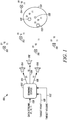
- System 100 comprises a sending device 102 having three transmitters 104-108, and seven receiving devices 110-122. Only a limited number of system elements 104 to 122 are shown for ease of illustration; but additional such elements may be included in the communication system 100. Moreover, other components needed for a commercial embodiment of the system 100 are omitted from the drawing for clarity in describing the enclosed embodiments.
- wireless communication system 100 is a sound communication system meaning that the transmission carrier between the sending and receiving devices is sound energy (existing as acoustic waves).
- the teachings herein are applicable to other types of transmission carriers, such as radio frequency energy (existing as radio or electromagnetic waves) and light energy (existing as light waves).
- the sending device 102 includes a wireless network interface to receive a data stream 128 from a data source (not shown). Alternatively, the sending device 102 can use a Universal Serial Bus (USB) wired interface or other types of wired or wireless interfaces to receive the data stream 128 from a data source.
- the sending device 102 further includes a plurality of transmitters 104-108. Each transmitter includes a digital-to-analog converter, an amplifier, and a speaker (not shown).
- the transmitters 104-108 send energy (for example, in this case, in the form of analog signals) to the receiving devices 110-122.
- the sending device 102 includes a microprocessor (not shown) and a memory component (not shown).
- the sending device 102 is a Radio Frequency Identification (RFID) reader that includes a microprocessor, I/O component, a plurality of transmitters, an antenna, etc.
- the transmitters 104-108 and the receiving devices 110-122 are located at various locations in three dimensional space.
- Each receiving device in this case, includes an analog signal receiving component (such as an antenna), an analog-to-digital converter, and a processing device (not shown).
- the receiving devices 110-122 use the analog-to-digital converter (such as analog-to-digital converters or diode detectors) to convert received analog signals into digital signals.
- the receiving devices 110-122 use diode detectors or other types of analog signal converting components to convert received analog signals into digital signals.
- the sending device 102 and the receiving devices 110-122 or their hardware being “configured” or “adapted” means that such elements are implemented using one or more (although not shown) memory devices, network interfaces, modulating devices, digital to analog converters, analog to digital converters, transceivers, amplifiers, and/or processing devices that are operatively coupled, and which, when programmed, form the means for these system elements to implement their desired functionality, for example, as illustrated by reference to the methods shown in figures 2-8 .
- the network interfaces are used for passing signaling also referred to herein as messaging (e.g., messages, packets, datagrams, frames, superframes, data streams, and the like) containing control information between the elements of the system 100.
- the network interfaces comprise elements including processing, modulating, and transceiver elements that are operable in accordance with any one or more standard or proprietary wired or wireless interfaces.
- Some of the functionality of the processing, modulating, digital to analog converting, analog to digital converting, transceivers, and amplifiers elements may be performed by means of the processing device through programmed logic such as software applications or firmware stored on the memory device of the system element or through hardware.
- the processing devices utilized by the elements of system 100 may be partially implemented in hardware and, thereby, programmed with software or firmware logic or code for performing functionality described by reference to figures 2-8 ; and/or the processing devices may be completely implemented in hardware, for example, as a state machine or ASIC (application specific integrated circuit).
- the memory implemented by these system elements can include short-term and/or long-term storage of various information needed for the functioning of the respective elements.
- the memory may further store software or firmware for programming the processing device with the logic or code needed to perform its functionality.
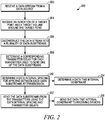
- FIG. 2 is a logical flowchart illustrating a method 200, performed by the sending device 102, for providing spatially selectable communications using deconstructed and delayed data streams in accordance with some embodiments.
- the sending device 102 receives a data stream from a data source.
- a data stream can be a command or any other type of data, and comprises a sequence of digital data elements or items.
- a data element can be a bit, a byte, a decimal digit, a hexadecimal (i.e., hex) digit, two bits, 128 bytes, eight bytes, and the like.
- a data stream 128 includes three data elements 01, 10, and 11, each of which is a two-bit data element.
- the source or provider of a data stream is herein termed as a data source.
- a data source can be, but is not limited to, a database, an application server, a computer file, and an electronic device.
- the sending device 102 receives an indication of a target point in space and an indication of a target volume around the target point.
- a target point is a point in three dimensional space, which can be indicated and expressed as a Cartesian coordinate tuple, (x, y, z), in a Cartesian coordinate system.
- an indication of a target point is a coordinate tuple (x, y, z) indicating the target point in three dimensional space.
- a target volume is defined as a spatial volume around a target point in three dimensional space.
- the target volume can be any geometric volume shape such as a sphere, ovoid, rectangular prism, a cube, etc, around the target point.
- an indication of a target volume is a radius indicating the target volume as a sphere centered on the target point.
- the sending device 102 deconstructs the received data stream into a plurality of modulated data substreams based on modulation scheme.
- Example modulation schemes include, but are not limited to, amplitude and frequency modulations.
- the data stream is divided into a plurality of data substreams, and each of the plurality of data substreams is converted into a modulated data substream using a modulation scheme.
- a data substream of a data stream includes a subset (meaning some, but not all) data elements of the data stream, while a modulated data substream is a digitally encoded representations of a data substream based on a modulation scheme.
- Each modulated data substream is a sequence of digital data elements (such as bits) that is an abstract and digital representation of the shape and form of a signal such as a wave moving in a physical medium.
- the sending device 102 determines a transmitter delay for the each transmitter.
- a spatial relationship specifies how one point or object is located in space in relation (such as physical distance and relative coordinates) to another point or object.
- a physical distance between a transmitter and a target point is used to determine transmitter delays.
- the sending device 102 can control the data substreams to arrive at the target point at the same or approximately the same time.
- Proper receiving and decoding a data stream by a receiving device means the data elements of the data stream are received in the same order as they appear in the data stream before transmission. Additionally, proper receiving and decoding a data stream by a receiving device means that data time intervals of the received data elements satisfy a data time interval constraint. In such a case, the received elements are termed to be in a proper time alignment.
- a data time interval is a time span between moments in time when two consecutive data elements are received. Where a data time interval is very small, such as zero, or is negative, the corresponding two consecutive received data elements are said to collide with each other. Consequently, the two consecutive received data elements cannot be properly received, decoded, and used to reconstruct the data stream by the receiving device.
- a data time interval constraint includes a minimum time limit and a maximum time limit. A data time interval satisfies a data time interval constraint when the data time interval is greater than (i.e., exceeds) the minimum time limit and is less than the maximum time limit of the constraint.
- a data interval spacing needs to be applied between the plurality of data substreams at transmission time from the transmitters.
- the sending device determines a data interval spacing such that data elements received by the receiving devices within, but not outside, the target volume are in proper time alignments.
- Each transmitter delay and the data interval spacing are a time span and often measured in, for example, milliseconds (ms) or microseconds ( ⁇ s).
- the sending device 102 sends the plurality of modulated data substreams and, thereby, the corresponding plurality of data substreams, using the transmitter delays and the data interval spacing.
- the sending device 102 determines a data time interval constraint.
- the data time interval constraint is dependent on the target volume.
- the range of the data time interval constraint bears a direct relationship with the size of the target volume.
- the direct relationship is implemented as a lookup table.
- the sending device 102 determines a data time interval constraint by locating it in the lookup table with the size of the target volume as input.
- the sending device 102 sends the data time interval constraint to one or more receiving devices.
- the receiving devices can be preconfigured with the data time interval constraint.
- the microprocessor 302 causes modulated data substreams in the memory buffers 310-314 to be passed to the corresponding digital-to-analog converters 316-320, starting from locations indicated by corresponding ring pointers 334-338.
- the microprocessor 302 adjusts the values of three ring pointers 334-338 based on corresponding transmitter delays and data interval spacing. For example, the microprocessor 302 reads data from the memory buffers 310-314 and writes the data to the corresponding digital to analog converters 316-320, respectively. Alternatively, the microprocessor 302 passes data to the digital to analog converters 316-320 using Direct Memory Access.
- the digital-to-analog converters 316-320 convert modulated data substreams stored in the memory buffers 310-314 into analog signals.
- the amplifiers 322-326 drive the three speakers 328-332 respectively. Each of the amplifiers 322-326 increases the power or strength of corresponding analog signals before sending the analog signals to the corresponding speakers.
- the speakers 328-332 produce acoustic waves that travel through the space.
- FIG. 4 a logical flowchart illustrating a method 400, performed by the sending device 102, for providing spatially selectable communications using deconstructed and delayed data streams in accordance with some embodiments is shown.
- the sending device 102 receives the data stream 128.
- the sending device 102 deconstructs or divides the data stream 128 into three data substreams.
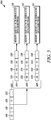
- the sending device 102 converts the three data substreams into three modulated data substreams placed in the memory buffers 310-314. The conversion is based on a modulation scheme, such as an amplitude modulation scheme. Deconstructing the data stream and generating the three modulated data substreams are further illustrated by reference to a method 500 shown as a block diagram in FIG. 5 .
- a data stream 502 includes a sequence of two-bit data elements starting with 01 in field 516, 10 in field 518, and 11 in field 520. The remaining data elements of the data stream 502 are represented by field 522.
- the sending device 102 divides the data stream 502 into three data substreams 504-508. Each data substream includes some, but not all, data elements of the data stream 502. Additionally, the data substreams 504-508 contain other data. For example, data elements in fields 516-520 are placed in fields 524, 534, and 544 of the data substreams 504-508, respectively. Furthermore, a special data element xx (meaning there is no sound) is placed in fields 526-528, 532, 536, 540-542.
- Fields 530, 538, and 546 include data elements stored in field 522 and additional special data elements.
- the sending device 102 using a modulation scheme, converts the data substreams 504-508 into modulated data substreams and places them into the corresponding memory buffers 310-314.
- the sending device 102 determines the transmission speed of the transmission carrier used to send the data stream.
- sound energy is the transmission carrier having a transmission speed of about 1126 feet per second (ft/s) (343.2 m/s).
- the sending device 102 determines three transmitter delays for the three transmitters 104-108 based on the transmission speed and the distances between each of the transmitters 104-108 and the target point 126.
- analog signals sent from the three example transmitters 104-108 can be controlled to arrive at the target point 126 at the same or approximately the same time. Accordingly, compared to the data substream sent by the transmitter 108, data substreams, sent by the transmitters 106-108 are delayed and, thereby, termed herein as delayed data streams.
- a data interval spacing is further determined at 414.
- the size of a target volume bears a direct relationship with the corresponding data interval spacing.
- this relationship is implemented as a lookup table.
- a data interval spacing is determined by retrieving it from the lookup table using the corresponding target volume as input.
- the lookup table can also be implemented to reflect the relationship between the receiving devices within a target volume and the corresponding data interval spacing.
- a data interval spacing can be determined using mathematical formulas.
- a transmission delay for a transmitter is a combination of a data interval spacing and a transmitter delay for the transmitter. With application of the combined transmission delays, consecutive data elements sent from the three example transmitters can be controlled to be received, by receiving devices at or near the target point, 0.01ms or approximately 0.01ms apart.
- the sending device 102 applies the transmission delays by adjusting the values of three ring pointers 334-338 for the three memory buffers 310-314 containing the modulated data substreams. In other words, the sending device 102 adjusts the values of the three ring pointers 334-338 to reflect the respective transmission delays. For example, where adjacent values in the memory buffer 310 are 1 ⁇ s apart and the transmission delay for the transmitter 104 is 2.573ms, 2573 is subtracted from the ring pointer 334.
- the sending device 102 causes the modulated data substreams in the memory buffers 310-314 to be passed to the corresponding digital-to-analog converters 316-320, starting from locations indicated by the respective ring pointers 334-338.
- the sending device 102 keeps filling (such as by running a separate thread) the memory buffers 316-320 in a circular manner.
- the three digital-to-analog converters 316-320 convert corresponding modulated data substreams to analog signals.
- the sending device 102 using the three transmitters 104-108, transmits the converted analog signals to receiving devices. Accordingly, the three transmitters 104-108 send the three data substreams generated at 404, respectively.
- the receiving devices Upon reception of analog signals, the receiving devices convert them back into digital data elements. Reception of the data elements is further illustrated by reference to a method 600 shown as a flowchart in FIG. 6 .
- a receiving device such as the receiving devices 110-122, at 602, receives the analog signals sent by each of the three transmitters 104-108. At 604, using an analog-to-digital converter, the receiving device converts the received analog signals to digital data elements. When the receiving device is within the target volume 124, it should be able to properly receive and decode the data elements. In other words, the received data elements are in a proper time alignment. Conversely, when the receiving device is outside of the target volume 124, it should not be able to properly receive and decode the data elements.
- the receiving devices 116, 120, and 122 receive the data elements, 01, 10, and 11, in the same order as they appear in the data stream 128.
- the data time intervals between consecutive received data elements for both receiving devices 120 and 122 satisfy a data time interval constraint. Accordingly, the receiving devices 120-122 properly receive the data stream 128 and can decode the received data stream.
- the data time interval, between the received data elements 10 and 11 in the receiving device 116 is greater than the maximum time limit of the data time interval constraint and, thereby, fails to satisfy the data time interval constraint. Accordingly, the receiving device 116 cannot properly decode the received data stream of data elements 01, 10, and 11.
- the receiving device 118 receives the data element 11 before the data element 10. Accordingly, the receiving device 118 receives the data elements, 01, 10, and 11, in a different order from the order they appear in the data stream 128. Therefore, the receiving device 118 fails to properly receive the data stream and cannot properly decode the received data stream of data elements 01, 11, and 10.
- the receiving device 110 receives the data elements 01 and 10 in the same order as they appear in the data stream 128. However, the data time interval between the two consecutive received data elements 01 and 10 is less than zero and, thereby, data elements 01 and 10 collide. Accordingly, the receiving device 110 fails to properly receive the data stream and cannot properly decode the received data stream of data elements 01, 11, and 10.
- the receiving device determines a data time interval between every two consecutive received data elements by calculating the time span between moments in time when the two data elements are received.
- the receiving device determines a data time interval constraint by retrieving it from, for example, an internal memory, file, or a database. Generally, the data time interval constraint is either received from a transmitter inside a sending device, or provisioned as part of a system or device setup.
- the receiving device applies the data time interval constraint against the data time intervals determined at 606. If the data time intervals satisfy the data time interval constraint, the receiving device accepts and processes the received data elements at 612.
- the receiving device properly receives and decodes the received data stream comprising the received data elements. Otherwise, the receiving device, at 614, drops or ignores the received data elements. Accordingly, the receiving device, at 610, decides an acceptability of the received data elements based on the data time interval constraint.
- Example wireless communication systems implementing the present teachings are illustrated by reference to Figures 7 and 8 .
- three audio transmitters 702-706 inside an audio sending device send a data stream to audio receiving devices 716-744 using sound waves as a transmission carrier.
- Audio receiving devices 716-744 are attached to shopping products or other objects.
- the audio receiving devices 726-734 are carried by a shopping cart 714, the audio receiving devices 716-724 are carried by a shopping cart 710, and the audio receiving devices 736-744 are carried by a shopping cart 712.
- the audio receiving devices 716-744 are moved on a conveyor belt.
- only audio receiving devices inside a target volume 708 are able to properly receive and decode received data stream.
- the audio receiving devices 726-734 are within the target volume 708 and are, thereby, able to receive data streams from the audio transmitters 702-706 properly.
- the time alignment of received data elements inside each of the audio receiving devices 726-734 is proper.
- the time alignment of received data elements inside each of the audio receiving devices 716-724 and 736-744 is not proper, and these receiving devices, thereby, cannot utilize the received data elements.
- the audio receiving devices carried by it are then able to properly receive data streams from the audio transmitters 702-706.
- a target volume 810 is a selected area on or a sphere above the surface of the Earth 802.
- receiving devices at all other locations on the Earth 802 or in space are unable to properly receive the data streams.
- receiving devices inside spatial volumes 812 and 814 are unable to properly receive the data streams.
- the transmission carrier is radio frequency energy.
- the receiving devices 110-122 operate in a low power consumption state (e.g., sleep mode) when they are not busy with receiving, decoding, and processing data streams from the sending device 102. They wake up from the sleep mode (meaning transition from one state to another state) and then operate in a normal operating state when a data stream with proper time alignment is received. Accordingly, the sending device 102 can use a data stream to wake up all receiving devices within a target volume, while keeps other receiving device outside of the target volume in sleep mode.
- a low power consumption state e.g., sleep mode
- relational terms such as first and second, top and bottom, and the like may be used solely to distinguish one entity or action from another entity or action without necessarily requiring or implying any actual such relationship or order between such entities or actions.
- the terms “comprises,” “comprising,” “has”, “having,” “includes”, “including,” “contains”, “containing” or any other variation thereof, are intended to cover a non-exclusive inclusion, such that a process, method, article, or apparatus that comprises, has, includes, contains a list of elements does not include only those elements but may include other elements not expressly listed or inherent to such process, method, article, or apparatus.
- processors such as microprocessors, digital signal processors, customized processors and field programmable gate arrays (FPGAs) and unique stored program instructions (including both software and firmware) that control the one or more processors to implement, in conjunction with certain non-processor circuits, some, most, or all of the functions of the method and apparatus for providing spatially selectable communications using deconstructed and delayed data stream as described herein.
- the non-processor circuits may include, but are not limited to, a radio receiver, a radio transmitter, signal drivers, clock circuits, power source circuits, and user input devices.
- these functions may be interpreted as steps of a method to perform the providing spatially selectable communications described herein.
- some or all functions could be implemented by a state machine that has no stored program instructions, or in one or more application specific integrated circuits (ASICs), in which each function or some combinations of certain of the functions are implemented as custom logic.
- ASICs application specific integrated circuits
- Both the state machine and ASIC are considered herein as a "processing device" for purposes of the foregoing discussion and claim language.
- an embodiment can be implemented as a non-transient computer-readable storage element or medium having computer readable code stored thereon for programming a computer (e.g., comprising a processing device) to perform a method as described and claimed herein.
- Examples of such computer-readable storage elements include, but are not limited to, a hard disk, a CD-ROM, an optical storage device, a magnetic storage device, a ROM (Read Only Memory), a PROM (Programmable Read Only Memory), an EPROM (Erasable Programmable Read Only Memory), an EEPROM (Electrically Erasable Programmable Read Only Memory) and a Flash memory.
Landscapes
- Engineering & Computer Science (AREA)
- Computer Networks & Wireless Communication (AREA)
- Signal Processing (AREA)
- Mobile Radio Communication Systems (AREA)
Claims (9)
- Verfahren zum Bereitstellen von räumlich wählbarer Kommunikation unter Verwendung von geteilten und verzögerten Datenströmen, wobei das Verfahren durch eine Sendevorrichtung durchgeführt wird, wobei das Verfahren umfasst:Empfangen (202) eines Datenstroms durch die Sendevorrichtung von einer Datenquelle, wobei die Sendevorrichtung eine Vielzahl von Übertragungsgeräten umfasst;Empfangen (204) einer Angabe eines Zielpunkts für den Datenstrom und eines Zielvolumens um den Zielpunkt herum;Teilen (206) des Datenstroms in eine Mehrzahl von Daten-Teilströmen, wobei jeder Daten-Teilstrom von einem anderen der mehreren Übertragungsgeräte gesendet wird;Bestimmen (208) einer entsprechenden Übertragungsverzögerung für jedes Übertragungsgerät, das zum Senden eines der Vielzahl von Daten-Teilströmen verwendet wird, wobei die Übertragungsverzögerung linear von einer Entfernung zwischen dem Zielpunkt und dem entsprechenden Übertragungsgerät zum Übertragen des einen der Vielzahl von Daten-Teilströmen abhängt;Bestimmen (210), basierend auf dem Zielvolumen, eines Datenintervallabstands, der zwischen jedem Daten-Teilstrom bei der Übertragung anzuwenden ist, wobei der angewendete Datenintervallabstand und die Übertragungsverzögerungen die Rekonstruktion der Vielzahl von Daten-Teilströmen zurück in den Datenstrom in allen Raumbereichen außer innerhalb des Zielvolumens verhindern; undSenden (212) der entsprechenden Vielzahl von Daten-Teilströmen aus der Vielzahl von Übertragungsgeräten unter Verwendung entsprechender Übertragungsverzögerungen und mit dem Datenintervall-Abstand zwischen jedem Daten-Teilstrom.
- Verfahren nach Anspruch 1, wobei jeder Daten-Teilstrom über denselben Übertragungsträger gesendet wird, wobei weiter jede entsprechende Übertragungsverzögerung basierend auf dem Übertragungsträger bestimmt wird.
- Verfahren nach Anspruch 2, wobei der Übertragungsträger Schallenergie ist.
- Verfahren nach Anspruch 1, ferner umfassend:
Umwandeln (406) der Mehrzahl von Daten-Teilströmen in die Mehrzahl von modulierten Daten-Teilströmen unter Verwendung eines Modulationsschemas. - Verfahren nach Anspruch 1, das ferner das Bestimmen (214) einer Datenzeitintervallbeschränkung auf der Grundlage des Zielvolumens umfasst, wobei die Datenzeitintervallbeschränkung ferner die Rekonstruktion der Datenunterströme zurück in den Datenstrom in allen Raumbereichen mit Ausnahme des Zielvolumens verhindert.
- Verfahren nach Anspruch 5, ferner umfassend das Senden (216) der Datenzeitintervallbeschränkung an mindestens eine Empfangsvorrichtung.
- Verfahren nach Anspruch 1, wobei der Datenstrom verwendet wird, um alle empfangenden Geräte innerhalb des Zieldatenträgers aufzuwecken.
- Vorrichtung zum Bereitstellen von räumlich auswählbarer Kommunikation unter Verwendung von unterteilten und verzögerten Datenströmen, wobei die Vorrichtung aufweist:eine Vielzahl von Übertragungsgeräten, von denen jedes ausgebildet ist, um Daten-Teilströme unter Verwendung desselben Übertragungsträgers zu senden;eine Schnittstelle, die ausgebildet ist, um einen Datenstrom von einer Datenquelle zu empfangen und um eine Angabe eines Zielpunkts für den Datenstrom und eines Zielvolumens um den Zielpunkt herum zu empfangen; undeine Verarbeitungsvorrichtung, die ausgebildet ist zum:Aufteilen des Datenstroms in mehrere Daten-Teilströme;Modulieren der Vielzahl von Daten-Teilströmen, um eine entsprechende Vielzahl von modulierten Daten-Teilströmen zu erzeugen, wobei jeder modulierte Daten-Teilstrom von einem anderen der Vielzahl von Übertragungsgeräten gesendet wird; Bestimmen einer entsprechenden Übertragungsverzögerung für jedes Übertragungsgerät, wobei die Übertragungsverzögerung linear von einer Entfernung zwischen dem Zielpunkt und dem entsprechenden Übertragungsgerät und von dem Übertragungsträger abhängt;Bestimmeneines Datenintervallabstands zum Anwenden zwischen jedem modulierten Datensubstrom bei der Übertragung und einer Datenzeitintervallbeschränkung basierend auf dem Zielvolumen, wobei der Datenintervallabstand und die Datenzeitintervallbeschränkung die Rekonstruktion der Daten-Teilströme in den Datenstrom zurück in einem Bereich innerhalb des Zielvolumens eingrenzen; undSteuern der Übertragungsgeräte, um entsprechende modulierte Daten-Teilströme unter Verwendung entsprechender Übertragungsverzögerungen und mit dem Datenintervallabstand zwischen jedem modulierten Daten-Teilstrom zu senden.
- Nicht-flüchtiges computerlesbares Speicherelement mit darauf gespeichertem computerlesbarem Code zum Programmieren eines Computers innerhalb einer Sendevorrichtung mit mehreren Übertragungsgeräten zum Durchführen eines Verfahrens zum Bereitstellen von räumlich auswählbarer Kommunikation unter Verwendung von geteilten und verzögerten Datenströmen, wobei das Verfahren umfasst:Empfangen (202) eines Datenstroms von einer Datenquelle;Empfangen (204) einer Angabe eines Zielpunkts für den Datenstrom und eines Zielvolumens um den Zielpunkt herum;Erzeugen (206) mehrerer Daten-Teilströme aus dem Datenstrom zum Senden jedes Daten-Teilstroms unter Verwendung eines anderen der mehreren Übertragungsgeräte;Bestimmen (208) einer entsprechenden Übertragungsverzögerung für jedes Übertragungsgerät, das zum Senden eines der Vielzahl von Daten-Teilströmen verwendet wird, wobei die Übertragungsverzögerung linear von einer Entfernung zwischen dem Zielpunkt und dem entsprechenden Übertragungsgerät zum Senden des einen der Vielzahl von Daten-Teilströmen abhängt;Bestimmen (210) eines Datenintervallabstands zum Anwenden zwischen jedem Daten-Teilstrom bei der Übertragung und einer Datenzeitintervalleinschränkung, basierend auf dem Zielvolumen, wobei der angewendete Datenintervallabstand und dieDatenzeitintervallbeschränkung eine Rekonstruktion der Vielzahl von Daten-Teilströmen zurück in den Datenstrom in allen Bereichen im Raum außer innerhalb des Zielvolumens verhindern; undSenden (212) der entsprechenden Mehrzahl von Daten-Teilströmen unter Verwendung der entsprechenden Übertragungsverzögerungen und mit dem Datenintervallabstand zwischen jedem Daten-Teilstrom.
Applications Claiming Priority (2)
| Application Number | Priority Date | Filing Date | Title |
|---|---|---|---|
| US13/325,216 US8553722B2 (en) | 2011-12-14 | 2011-12-14 | Method and apparatus for providing spatially selectable communications using deconstructed and delayed data streams |
| PCT/US2012/067941 WO2013090089A1 (en) | 2011-12-14 | 2012-12-05 | Method and apparatus for providing spatially selectable communications using deconstructed and delayed data streams |
Publications (2)
| Publication Number | Publication Date |
|---|---|
| EP2805431A1 EP2805431A1 (de) | 2014-11-26 |
| EP2805431B1 true EP2805431B1 (de) | 2018-10-24 |
Family
ID=47594981
Family Applications (1)
| Application Number | Title | Priority Date | Filing Date |
|---|---|---|---|
| EP12816549.5A Active EP2805431B1 (de) | 2011-12-14 | 2012-12-05 | Verfahren und vorrichtung zur bereitstellung räumlich auswählbarer kommunikation mit dekonstruierten und verzögerten datenströmen |
Country Status (5)
| Country | Link |
|---|---|
| US (1) | US8553722B2 (de) |
| EP (1) | EP2805431B1 (de) |
| CN (1) | CN104160634B (de) |
| CA (1) | CA2858849C (de) |
| WO (1) | WO2013090089A1 (de) |
Families Citing this family (4)
| Publication number | Priority date | Publication date | Assignee | Title |
|---|---|---|---|---|
| US9253800B2 (en) | 2012-09-17 | 2016-02-02 | Intel Corporation | Apparatuses, systems, and methods for access configurations |
| US9351241B2 (en) * | 2013-09-30 | 2016-05-24 | Qualcomm Incorporated | Indicating a busy period in a wireless network |
| EP3190730A1 (de) * | 2016-01-06 | 2017-07-12 | Nxp B.V. | Empfangene weg verzögerung mechanismus |
| CN113760979B (zh) * | 2020-11-12 | 2025-02-21 | 北京沃东天骏信息技术有限公司 | 用于生成信息的方法和装置 |
Family Cites Families (15)
| Publication number | Priority date | Publication date | Assignee | Title |
|---|---|---|---|---|
| US6765531B2 (en) * | 1999-01-08 | 2004-07-20 | Trueposition, Inc. | System and method for interference cancellation in a location calculation, for use in a wireless location system |
| US7242964B1 (en) * | 2000-09-28 | 2007-07-10 | Lucent Technologies Inc. | Shaping of EM field for transmission to multiple terminals |
| US6438367B1 (en) * | 2000-11-09 | 2002-08-20 | Magis Networks, Inc. | Transmission security for wireless communications |
| US7609608B2 (en) | 2001-09-26 | 2009-10-27 | General Atomics | Method and apparatus for data transfer using a time division multiple frequency scheme with additional modulation |
| DE10355146A1 (de) * | 2003-11-26 | 2005-07-07 | Fraunhofer-Gesellschaft zur Förderung der angewandten Forschung e.V. | Vorrichtung und Verfahren zum Erzeugen eines Tieftonkanals |
| JP2006023267A (ja) | 2004-06-09 | 2006-01-26 | Ntt Docomo Inc | マルチパス遅延成分を用いた位置測定装置および位置測定方法 |
| US7436903B2 (en) * | 2004-09-29 | 2008-10-14 | Intel Corporation | Multicarrier transmitter and method for transmitting multiple data streams with cyclic delay diversity |
| DE102005033238A1 (de) * | 2005-07-15 | 2007-01-25 | Fraunhofer-Gesellschaft zur Förderung der angewandten Forschung e.V. | Vorrichtung und Verfahren zum Ansteuern einer Mehrzahl von Lautsprechern mittels eines DSP |
| EP1821116B1 (de) | 2006-02-15 | 2013-08-14 | Sony Deutschland Gmbh | Relative 3D-Positionierung in einem Ad-hoc-Netzwerk auf Distanzbasis |
| US7809337B2 (en) * | 2006-03-02 | 2010-10-05 | Motorola, Inc. | System and method for adjusting transmission phasing in a point-to-point communication link |
| CN101374033B (zh) * | 2007-08-23 | 2013-03-27 | 株式会社Ntt都科摩 | 一种多输入多输出系统中的数据处理方法及装置 |
| JP5026207B2 (ja) | 2007-09-27 | 2012-09-12 | 株式会社エヌ・ティ・ティ・ドコモ | 基地局装置及びユーザ装置並びに通信制御方法 |
| WO2009105418A1 (en) | 2008-02-20 | 2009-08-27 | Hobbit Wave | Beamforming devices and methods |
| US7970359B2 (en) * | 2008-07-29 | 2011-06-28 | Alvarion Ltd. | Delay diversity in antenna arrays |
| JP5135282B2 (ja) * | 2009-05-14 | 2013-02-06 | 株式会社日立製作所 | 無線基地局装置 |
-
2011
- 2011-12-14 US US13/325,216 patent/US8553722B2/en active Active
-
2012
- 2012-12-05 WO PCT/US2012/067941 patent/WO2013090089A1/en not_active Ceased
- 2012-12-05 CN CN201280062039.5A patent/CN104160634B/zh active Active
- 2012-12-05 EP EP12816549.5A patent/EP2805431B1/de active Active
- 2012-12-05 CA CA2858849A patent/CA2858849C/en active Active
Non-Patent Citations (1)
| Title |
|---|
| None * |
Also Published As
| Publication number | Publication date |
|---|---|
| WO2013090089A1 (en) | 2013-06-20 |
| EP2805431A1 (de) | 2014-11-26 |
| US20130156049A1 (en) | 2013-06-20 |
| CN104160634A (zh) | 2014-11-19 |
| CN104160634B (zh) | 2017-11-14 |
| CA2858849A1 (en) | 2013-06-20 |
| CA2858849C (en) | 2018-01-09 |
| US8553722B2 (en) | 2013-10-08 |
Similar Documents
| Publication | Publication Date | Title |
|---|---|---|
| CN110838903B (zh) | 一种上行传输指示的方法、终端、基站及计算机存储介质 | |
| CN103931112B (zh) | 用于在波束形成无线通信系统中进行波束选择的装置和方法 | |
| US20230209478A1 (en) | Emission restricted transmission of reference signals | |
| EP2805431B1 (de) | Verfahren und vorrichtung zur bereitstellung räumlich auswählbarer kommunikation mit dekonstruierten und verzögerten datenströmen | |
| ATE297082T1 (de) | Kompensation für diagrammoptimierung einer antenne | |
| IN2014KN02668A (de) | ||
| AU2003270776A1 (en) | Mobile communications system and method for providing mobile unit handover in wireless communication systems that employ beamforming antennas | |
| NZ603875A (en) | Methods and arrangements for reducing the signalling overhead in a wireless communication system using carrier aggregation | |
| JP2014175800A5 (ja) | 無線基地局、ユーザ端末、無線通信方法及び無線通信システム | |
| WO2014157929A3 (ko) | 무선 통신 시스템에서 NCT를 고려한 CoMP 지원 방법 및 그 장치 | |
| CN103187999A (zh) | 信息传输方法及装置、移动终端 | |
| CN114424653B (zh) | 物理下行共享信道传输方法及通信装置 | |
| EP3514977A1 (de) | Drahtlosnetzwerkvorrichtung | |
| US20220338026A1 (en) | Apparatus, system, and method of communicating a beamformed transmission | |
| CN111512682A (zh) | 一种被用于无线通信的用户设备、基站中的方法和装置 | |
| CN108347777B (zh) | 一种数据发送方法、装置、网络侧和终端 | |
| CN104753658B (zh) | 一种同时同频全双工系统中的数据传输方法和装置 | |
| CN104378737B (zh) | 一种增强型定位方法、装置及系统 | |
| US8744460B2 (en) | Radio communication system, terminal apparatus, and radio communication method in radio communication system | |
| EP4595256A1 (de) | Verfahren, verstärker, infrastrukturausrüstung und systeme | |
| CN109859534A (zh) | 基于四单元定向天线的应答机 | |
| WO2023288156A8 (en) | Signaling for aperiodic sounding reference signals for positioning | |
| CN105406886A (zh) | 一种数字信号无线传输设备 | |
| KR101585846B1 (ko) | 직교 주파수 분할 듀플렉싱을 이용한 무선 송수신 장치 및 방법 | |
| US20190319761A1 (en) | Uplink Transmission Method, Apparatus, and System |
Legal Events
| Date | Code | Title | Description |
|---|---|---|---|
| PUAI | Public reference made under article 153(3) epc to a published international application that has entered the european phase |
Free format text: ORIGINAL CODE: 0009012 |
|
| 17P | Request for examination filed |
Effective date: 20140603 |
|
| AK | Designated contracting states |
Kind code of ref document: A1 Designated state(s): AL AT BE BG CH CY CZ DE DK EE ES FI FR GB GR HR HU IE IS IT LI LT LU LV MC MK MT NL NO PL PT RO RS SE SI SK SM TR |
|
| DAX | Request for extension of the european patent (deleted) | ||
| RAP1 | Party data changed (applicant data changed or rights of an application transferred) |
Owner name: SYMBOL TECHNOLOGIES, LLC |
|
| GRAP | Despatch of communication of intention to grant a patent |
Free format text: ORIGINAL CODE: EPIDOSNIGR1 |
|
| STAA | Information on the status of an ep patent application or granted ep patent |
Free format text: STATUS: GRANT OF PATENT IS INTENDED |
|
| INTG | Intention to grant announced |
Effective date: 20180531 |
|
| GRAS | Grant fee paid |
Free format text: ORIGINAL CODE: EPIDOSNIGR3 |
|
| GRAA | (expected) grant |
Free format text: ORIGINAL CODE: 0009210 |
|
| STAA | Information on the status of an ep patent application or granted ep patent |
Free format text: STATUS: THE PATENT HAS BEEN GRANTED |
|
| AK | Designated contracting states |
Kind code of ref document: B1 Designated state(s): AL AT BE BG CH CY CZ DE DK EE ES FI FR GB GR HR HU IE IS IT LI LT LU LV MC MK MT NL NO PL PT RO RS SE SI SK SM TR |
|
| REG | Reference to a national code |
Ref country code: CH Ref legal event code: EP |
|
| REG | Reference to a national code |
Ref country code: IE Ref legal event code: FG4D |
|
| REG | Reference to a national code |
Ref country code: AT Ref legal event code: REF Ref document number: 1057916 Country of ref document: AT Kind code of ref document: T Effective date: 20181115 |
|
| REG | Reference to a national code |
Ref country code: DE Ref legal event code: R096 Ref document number: 602012052673 Country of ref document: DE |
|
| REG | Reference to a national code |
Ref country code: NL Ref legal event code: MP Effective date: 20181024 |
|
| REG | Reference to a national code |
Ref country code: LT Ref legal event code: MG4D |
|
| REG | Reference to a national code |
Ref country code: AT Ref legal event code: MK05 Ref document number: 1057916 Country of ref document: AT Kind code of ref document: T Effective date: 20181024 |
|
| PG25 | Lapsed in a contracting state [announced via postgrant information from national office to epo] |
Ref country code: NL Free format text: LAPSE BECAUSE OF FAILURE TO SUBMIT A TRANSLATION OF THE DESCRIPTION OR TO PAY THE FEE WITHIN THE PRESCRIBED TIME-LIMIT Effective date: 20181024 |
|
| PG25 | Lapsed in a contracting state [announced via postgrant information from national office to epo] |
Ref country code: IS Free format text: LAPSE BECAUSE OF FAILURE TO SUBMIT A TRANSLATION OF THE DESCRIPTION OR TO PAY THE FEE WITHIN THE PRESCRIBED TIME-LIMIT Effective date: 20190224 Ref country code: FI Free format text: LAPSE BECAUSE OF FAILURE TO SUBMIT A TRANSLATION OF THE DESCRIPTION OR TO PAY THE FEE WITHIN THE PRESCRIBED TIME-LIMIT Effective date: 20181024 Ref country code: BG Free format text: LAPSE BECAUSE OF FAILURE TO SUBMIT A TRANSLATION OF THE DESCRIPTION OR TO PAY THE FEE WITHIN THE PRESCRIBED TIME-LIMIT Effective date: 20190124 Ref country code: PL Free format text: LAPSE BECAUSE OF FAILURE TO SUBMIT A TRANSLATION OF THE DESCRIPTION OR TO PAY THE FEE WITHIN THE PRESCRIBED TIME-LIMIT Effective date: 20181024 Ref country code: HR Free format text: LAPSE BECAUSE OF FAILURE TO SUBMIT A TRANSLATION OF THE DESCRIPTION OR TO PAY THE FEE WITHIN THE PRESCRIBED TIME-LIMIT Effective date: 20181024 Ref country code: LV Free format text: LAPSE BECAUSE OF FAILURE TO SUBMIT A TRANSLATION OF THE DESCRIPTION OR TO PAY THE FEE WITHIN THE PRESCRIBED TIME-LIMIT Effective date: 20181024 Ref country code: AT Free format text: LAPSE BECAUSE OF FAILURE TO SUBMIT A TRANSLATION OF THE DESCRIPTION OR TO PAY THE FEE WITHIN THE PRESCRIBED TIME-LIMIT Effective date: 20181024 Ref country code: LT Free format text: LAPSE BECAUSE OF FAILURE TO SUBMIT A TRANSLATION OF THE DESCRIPTION OR TO PAY THE FEE WITHIN THE PRESCRIBED TIME-LIMIT Effective date: 20181024 Ref country code: ES Free format text: LAPSE BECAUSE OF FAILURE TO SUBMIT A TRANSLATION OF THE DESCRIPTION OR TO PAY THE FEE WITHIN THE PRESCRIBED TIME-LIMIT Effective date: 20181024 Ref country code: NO Free format text: LAPSE BECAUSE OF FAILURE TO SUBMIT A TRANSLATION OF THE DESCRIPTION OR TO PAY THE FEE WITHIN THE PRESCRIBED TIME-LIMIT Effective date: 20190124 |
|
| PG25 | Lapsed in a contracting state [announced via postgrant information from national office to epo] |
Ref country code: AL Free format text: LAPSE BECAUSE OF FAILURE TO SUBMIT A TRANSLATION OF THE DESCRIPTION OR TO PAY THE FEE WITHIN THE PRESCRIBED TIME-LIMIT Effective date: 20181024 Ref country code: PT Free format text: LAPSE BECAUSE OF FAILURE TO SUBMIT A TRANSLATION OF THE DESCRIPTION OR TO PAY THE FEE WITHIN THE PRESCRIBED TIME-LIMIT Effective date: 20190224 Ref country code: GR Free format text: LAPSE BECAUSE OF FAILURE TO SUBMIT A TRANSLATION OF THE DESCRIPTION OR TO PAY THE FEE WITHIN THE PRESCRIBED TIME-LIMIT Effective date: 20190125 Ref country code: RS Free format text: LAPSE BECAUSE OF FAILURE TO SUBMIT A TRANSLATION OF THE DESCRIPTION OR TO PAY THE FEE WITHIN THE PRESCRIBED TIME-LIMIT Effective date: 20181024 Ref country code: SE Free format text: LAPSE BECAUSE OF FAILURE TO SUBMIT A TRANSLATION OF THE DESCRIPTION OR TO PAY THE FEE WITHIN THE PRESCRIBED TIME-LIMIT Effective date: 20181024 |
|
| REG | Reference to a national code |
Ref country code: DE Ref legal event code: R097 Ref document number: 602012052673 Country of ref document: DE |
|
| PG25 | Lapsed in a contracting state [announced via postgrant information from national office to epo] |
Ref country code: CZ Free format text: LAPSE BECAUSE OF FAILURE TO SUBMIT A TRANSLATION OF THE DESCRIPTION OR TO PAY THE FEE WITHIN THE PRESCRIBED TIME-LIMIT Effective date: 20181024 Ref country code: IT Free format text: LAPSE BECAUSE OF FAILURE TO SUBMIT A TRANSLATION OF THE DESCRIPTION OR TO PAY THE FEE WITHIN THE PRESCRIBED TIME-LIMIT Effective date: 20181024 Ref country code: DK Free format text: LAPSE BECAUSE OF FAILURE TO SUBMIT A TRANSLATION OF THE DESCRIPTION OR TO PAY THE FEE WITHIN THE PRESCRIBED TIME-LIMIT Effective date: 20181024 |
|
| REG | Reference to a national code |
Ref country code: CH Ref legal event code: PL |
|
| PG25 | Lapsed in a contracting state [announced via postgrant information from national office to epo] |
Ref country code: EE Free format text: LAPSE BECAUSE OF FAILURE TO SUBMIT A TRANSLATION OF THE DESCRIPTION OR TO PAY THE FEE WITHIN THE PRESCRIBED TIME-LIMIT Effective date: 20181024 Ref country code: SM Free format text: LAPSE BECAUSE OF FAILURE TO SUBMIT A TRANSLATION OF THE DESCRIPTION OR TO PAY THE FEE WITHIN THE PRESCRIBED TIME-LIMIT Effective date: 20181024 Ref country code: SK Free format text: LAPSE BECAUSE OF FAILURE TO SUBMIT A TRANSLATION OF THE DESCRIPTION OR TO PAY THE FEE WITHIN THE PRESCRIBED TIME-LIMIT Effective date: 20181024 Ref country code: MC Free format text: LAPSE BECAUSE OF FAILURE TO SUBMIT A TRANSLATION OF THE DESCRIPTION OR TO PAY THE FEE WITHIN THE PRESCRIBED TIME-LIMIT Effective date: 20181024 Ref country code: LU Free format text: LAPSE BECAUSE OF NON-PAYMENT OF DUE FEES Effective date: 20181205 Ref country code: RO Free format text: LAPSE BECAUSE OF FAILURE TO SUBMIT A TRANSLATION OF THE DESCRIPTION OR TO PAY THE FEE WITHIN THE PRESCRIBED TIME-LIMIT Effective date: 20181024 |
|
| PLBE | No opposition filed within time limit |
Free format text: ORIGINAL CODE: 0009261 |
|
| STAA | Information on the status of an ep patent application or granted ep patent |
Free format text: STATUS: NO OPPOSITION FILED WITHIN TIME LIMIT |
|
| REG | Reference to a national code |
Ref country code: IE Ref legal event code: MM4A |
|
| 26N | No opposition filed |
Effective date: 20190725 |
|
| REG | Reference to a national code |
Ref country code: BE Ref legal event code: MM Effective date: 20181231 |
|
| PG25 | Lapsed in a contracting state [announced via postgrant information from national office to epo] |
Ref country code: SI Free format text: LAPSE BECAUSE OF FAILURE TO SUBMIT A TRANSLATION OF THE DESCRIPTION OR TO PAY THE FEE WITHIN THE PRESCRIBED TIME-LIMIT Effective date: 20181024 Ref country code: IE Free format text: LAPSE BECAUSE OF NON-PAYMENT OF DUE FEES Effective date: 20181205 Ref country code: FR Free format text: LAPSE BECAUSE OF NON-PAYMENT OF DUE FEES Effective date: 20181224 |
|
| PG25 | Lapsed in a contracting state [announced via postgrant information from national office to epo] |
Ref country code: BE Free format text: LAPSE BECAUSE OF NON-PAYMENT OF DUE FEES Effective date: 20181231 |
|
| PG25 | Lapsed in a contracting state [announced via postgrant information from national office to epo] |
Ref country code: CH Free format text: LAPSE BECAUSE OF NON-PAYMENT OF DUE FEES Effective date: 20181231 Ref country code: LI Free format text: LAPSE BECAUSE OF NON-PAYMENT OF DUE FEES Effective date: 20181231 |
|
| PG25 | Lapsed in a contracting state [announced via postgrant information from national office to epo] |
Ref country code: MT Free format text: LAPSE BECAUSE OF NON-PAYMENT OF DUE FEES Effective date: 20181205 |
|
| PG25 | Lapsed in a contracting state [announced via postgrant information from national office to epo] |
Ref country code: TR Free format text: LAPSE BECAUSE OF FAILURE TO SUBMIT A TRANSLATION OF THE DESCRIPTION OR TO PAY THE FEE WITHIN THE PRESCRIBED TIME-LIMIT Effective date: 20181024 |
|
| PG25 | Lapsed in a contracting state [announced via postgrant information from national office to epo] |
Ref country code: MK Free format text: LAPSE BECAUSE OF NON-PAYMENT OF DUE FEES Effective date: 20181024 Ref country code: HU Free format text: LAPSE BECAUSE OF FAILURE TO SUBMIT A TRANSLATION OF THE DESCRIPTION OR TO PAY THE FEE WITHIN THE PRESCRIBED TIME-LIMIT; INVALID AB INITIO Effective date: 20121205 Ref country code: CY Free format text: LAPSE BECAUSE OF FAILURE TO SUBMIT A TRANSLATION OF THE DESCRIPTION OR TO PAY THE FEE WITHIN THE PRESCRIBED TIME-LIMIT Effective date: 20181024 |
|
| P01 | Opt-out of the competence of the unified patent court (upc) registered |
Effective date: 20230416 |
|
| PGFP | Annual fee paid to national office [announced via postgrant information from national office to epo] |
Ref country code: DE Payment date: 20251126 Year of fee payment: 14 |
|
| PGFP | Annual fee paid to national office [announced via postgrant information from national office to epo] |
Ref country code: GB Payment date: 20251119 Year of fee payment: 14 |