EP2805632A1 - Dispositif de soutien d'articles à fumer en forme de tige et procédé d'adaptation du dispositif - Google Patents
Dispositif de soutien d'articles à fumer en forme de tige et procédé d'adaptation du dispositif Download PDFInfo
- Publication number
- EP2805632A1 EP2805632A1 EP14168294.8A EP14168294A EP2805632A1 EP 2805632 A1 EP2805632 A1 EP 2805632A1 EP 14168294 A EP14168294 A EP 14168294A EP 2805632 A1 EP2805632 A1 EP 2805632A1
- Authority
- EP
- European Patent Office
- Prior art keywords
- arm
- rod
- carrier
- shaped smoking
- arms
- Prior art date
- Legal status (The legal status is an assumption and is not a legal conclusion. Google has not performed a legal analysis and makes no representation as to the accuracy of the status listed.)
- Withdrawn
Links
Images


Classifications
-
- A—HUMAN NECESSITIES
- A24—TOBACCO; CIGARS; CIGARETTES; SIMULATED SMOKING DEVICES; SMOKERS' REQUISITES
- A24C—MACHINES FOR MAKING CIGARS OR CIGARETTES
- A24C5/00—Making cigarettes; Making tipping materials for, or attaching filters or mouthpieces to, cigars or cigarettes
- A24C5/14—Machines of the continuous-rod type
- A24C5/28—Cutting-off the tobacco rod
Definitions
- the invention relates to a device for supporting rod-shaped smoking articles during a separation process with a support having a rotation axis, with at least one arranged on the support, in operation around the axis of rotation, adjustable in its radial position arm and with a arranged on the arm and to the rod-shaped smoking article adapted support area.
- the invention further relates to a method for adapting a device according to the invention to different geometries of the rod-shaped smoking article.
- the tobacco is first fed manually or mechanically to a distributor unit. Therein, the tobacco is treated and loosened and then usually fed via a Saugstrang reduceer, which transports the tobacco flow band-like in the form of an endless tobacco rod, a Strangeinheit.
- the string unit ensures that the open tobacco rod is wrapped in paper, usually in a cylindrical shape and the paper is glued. This creates an endless, guided tobacco rod. This tobacco rod is then cut during transport through the strand unit into individual cylindrical tobacco rods, which usually have twice the length of the later finished tobacco rods in the product.
- the tobacco rod and the tobacco rods are transported in their or their longitudinal direction due to production, ie in the direction of the longitudinal axis of the rod-shaped smoking article.
- the tobacco sticks are cut again in the middle, so that they have the desired length of the final product.
- a double-length filter can then be placed between the two severed tobacco stems and also cut. In this way, the finished rod-shaped smoking article, such as cigarettes, then arise in the desired length.
- rod-shaped smoking articles are understood to mean not only the finished product, such as a cigarette, but for the sake of simplicity, the tobacco rod, which as a rule is still twice as long, or the closed tobacco rod designed as a "continuous" rod.
- the aforementioned cutting or cutting of the continuous conveyed tobacco rod into individual tobacco sticks is realized, for example, by means of one or more knives, which are mounted on a rotating drum, a so-called Knife carrier, can be positioned and sever the tobacco rod in a corresponding cycle.
- the tobacco rod for the cutting process must be stabilized when it is divided into the individual tobacco sticks.
- tubes are used in the prior art, which support the tobacco rod or the tobacco sticks at the moment of dicing.
- the tubes may in this case be located on a rotating tube wheel which is adapted to the movement of the knives for severing the tobacco rod or is synchronized therewith.
- the tobacco rod is cut by an interaction of the rotating knives with the tubes of the tube wheel.
- the tobacco rod In order to obtain sufficient flexibility in the production of rod-shaped smoking articles, the tobacco rod must also be cut into tobacco rods of different geometries, for example different lengths, in order to be able to produce cigarettes of different geometries. This is done by means of a so-called format change.
- the knife carrier for severing the tobacco rod and the tube unit for supporting the tobacco rod during the cutting are adapted such that they produce, for example, longer or shorter tobacco sticks. Accordingly, the speed of the transfer unit has to be adapted, for example.
- the adaptation can not be achieved merely by adjusting the rotational speeds of the knife carrier and the tube wheel, since the blades or tubes must be carried along with the tobacco rod or tobacco rod during cutting. In this respect, in particular, the distance between the tubes must be changed with each other.
- the present invention is therefore based on the object of specifying a device and a method, whereby a simple, precise and rapid adaptation of the device to different geometries of the rod-shaped smoking article is made possible.
- the object is achieved by a generic device in that an interchangeable gauge for defining a predetermined radial position for the at least one arm is provided.
- a teaching is understood to mean a device or an object which embodies a physical measure. As a result, one or more predetermined radial positions are then defined, in which the arm or the arms are transferred.
- a radial position is understood to be a position at a specific distance from the axis of rotation perpendicular to the axis of rotation.
- the teaching allows a high repeatability, since this embodies a set level directly and in particular no moving parts are provided. This allows accurate positioning of the arm or arms, even if, for example, a transmission is used, or for some other reason, some clearance must be accepted in the device. This inaccuracy is compensated by the use of the teaching. Since a doctrine alone dictates the position of the at least one arm by virtue of its geometry, it is usually only necessary for the objects to be positioned to rest directly or indirectly against the jig in order to ensure that the desired position has been reached. This also makes a particularly safe and precise adaptation possible. In addition, a fast adaptation of the device is made possible by the use of the teaching, since, for example, complex adjustment work accounts, which are necessary due to the game through the transmission or are required because all or much of the device has been replaced.
- any number of teachings may be provided. It is advantageous if a gauge is provided for each format to be set. In this case, the use of the teachings is particularly safe because only one format can be set with a jig.
- a doctrine may for example be designed so that for the production of double-length tobacco sticks, the at least one arm is adjusted so that the support area at a distance of, for example, about 100 mm interacts with the tobacco rod to then finally 50 mm long tobacco sticks in further steps to obtain.
- the support area disposed on the at least one arm is adapted to the rod-shaped smoking articles, essentially means that the support area supports the corresponding rod-shaped smoking article during the separation process.
- This can already be achieved by a simple planar surface, which stabilizes the rod-shaped smoking article from one side by holding back, while the rod-shaped smoking article is severed from the other side, for example by means of a knife transversely to its longitudinal direction.
- the support region forms a kind of receptacle, in particular a trough-shaped receptacle, which allows a more effective support of the rod-shaped smoking article.
- the rod-shaped smoking articles are guided in some way by the support area during the separation process and held by this.
- the device has more than one, in particular three, adjustable arms.
- the replaceable gauge defines in this case each a predetermined radial position for the arms.
- the number of arms is particularly suitable to ensure a sufficiently rapid processing of the rod-shaped smoking articles at low rotational speed about the axis of rotation and at the same time To keep the effort in a format change low because only three arms must be repositioned.
- the use of the teaching is simplified by this number of arms, since the teaching can be brought so without obstruction by a plurality of arms in the intended position.
- the teaching is such that, in cooperation with the carrier, the arms in the predetermined, second position have substantially the same distance from the axis of rotation.
- the same distance of the arms from the axis of rotation is usually necessary to produce uniform tobacco sticks from the tobacco rod. This can be achieved, in particular, without rotating or realigning the gauge for the positioning of the individual arms.
- the teaching also represents a lesson for each individual arm.
- this has a holder which allows the radial positioning. If several arms are provided, preferably each arm has such a holder.
- a holder can in particular be constructed of rails which are aligned in the radial direction, so that the at least one arm can be moved in the radial direction on the rails.
- a fixation of the at least one arm with respect to the radial position can be achieved by positive engagement, adhesion or material bond, in particular screws or pins.
- the gauge limits the minimum distance of the at least one arm, preferably of all arms, in the predetermined position to the axis of rotation, a particularly simple adaptation of the device can be achieved and a particularly compact gauge can be designed.
- the gauge can be designed, for example, as an essentially disc-shaped gauge which limits the movement of the at least one arm inwards, ie in the direction of the axis of rotation and thus predetermines the minimum distance of the at least one arm from the axis of rotation.
- the at least one arm several arms are provided, a part of the arms or all arms, for example, be brought into an outer position, then the corresponding gauge is used or applied, which then forms a stop for the arms in their inward movement in the direction of the axis of rotation and in this way the respective predetermined radial position the at least one arm is defined.
- the gauge limits the maximum distance of the at least one arm, preferably of all arms, in the predetermined position to the axis of rotation and in this way a stop for the at least one arm in the outward movement, ie away from the Rotation axis, forms.
- a predetermined radial position is also defined.
- the teaching can be fixed to the carrier.
- the handling during positioning is improved.
- the axis of rotation can be specified.
- the jig can not move and the user can concentrate on the positioning of the at least one arm.
- Under fixation can be both a fixation in all translational and rotational directions. However, it is also possible to fix the gauge, for example, only translationally in directions perpendicular to the axis of rotation, ie, transversely, so that removal of the gauge in the direction of the axis of rotation is still possible.
- the fixation can be done by positive engagement, adhesion or material closure, for example by pins, pressure pins or screws.
- the jig is attached to the carrier only for the radial positioning of the at least one arm and, when the at least one arm is radially fixed, the jig is then removed again for the operation of the device. This results in a lower weight of the carrier to be rotated. It is however, it is preferred if the jig is also fixed to the carrier during operation of the device. This results in even less effort in the adjustment of the device, since a removal of the teaching is not necessary before a new format change.
- the teaching is preferably balanced according to, so that no or only small imbalances arise during operation by the teaching.
- the teaching can be fixed to at least one arm.
- the teaching several arms are provided, can be fixed to any arms, the doctrine, however, need not be fixed simultaneously on all arms, but only and preferably on one arm.
- the arm may in particular have a holder on which the jig can be fixed.
- this holder can also serve to radially displace the at least one arm and / or to fix it in relation to a radial movement. In this way, a fixation of the teaching with respect to the position of at least one arm can be achieved, so that then particularly easy more arms can be positioned by means of the teaching, without having to worry about the correct orientation or position of the teaching.
- the carrier can then be aligned particularly simply on the jig, if this should not yet be in the correct position.
- the teaching may, for example, have a pressure pin, which engages in the correct positioning of the carrier in these and optionally fixes the doctrine simultaneously with respect to the carrier.
- the jig has a cutout adapted to the at least one arm, the positioning of the at least one arm at the predetermined radial position can be made particularly simple and secure. If several arms are provided, the jig preferably has a recess for each arm. Through the recesses are the predetermined radial positions for the at least defines an arm more precisely and further reduces possible positioning inaccuracies due to a possible game.
- the position of the carrier is adjustable transversely to the axis of rotation.
- the support area in the form of a U-shaped receptacle, the support area must always comprise the rod-shaped smoking article at the moment of severing in order to be able to support it, even if the radial position of the at least one arm or the support area has been changed.
- the position of the carrier is adjustable in the direction which is both transverse to its axis of rotation and transverse to the path of the rod-shaped smoking article.
- the adjustment of the position of the carrier can be performed manually or automatically, for example, by means of a crank and realized by means of a threaded rod which adjusts the position of the carrier transversely to its axis of rotation.
- the path of the rod-shaped smoking article is adapted to the new position of the at least one arm or support region or that the support region can be repositioned on the at least one arm so that the support region relative to the path of the rod-shaped Smoking article has positions suitable for supporting.
- the adaptation of the device can be further simplified and accelerated, so that the adaptation of the device is easier for the user to handle.
- the fixation of the arm is in this case, in particular, a stationary fixation, since the path of the rod-shaped smoking article extending transversely to the axis of rotation is likewise stationary.
- an arm can be brought into a position of its orbit circulating about the axis of rotation, so that the corresponding support region of the arm is located straight in the region of the arm Path of the rod-shaped smoking article is located in the supporting takes place.
- the position can be adjusted by means of the fixing unit, for example in the form of a swivel arm partially embracing the arm, which transmits and optionally rotates the arm or support area fixed, be held.
- the carrier can be moved without the adjustment of the fixed arm relative to the path of the rod-shaped smoking article changes, so this adjustment does not need to be performed yet again.
- the arm fixed relative to the path of the rod-shaped smoking article can be brought into the predetermined radial position, although the arm itself can not move due to the fixing unit relative to the path of the rod-shaped smoking article.
- the fixed arm can be brought into the radial position prescribed by the teaching relative to the axis of rotation of the carrier. Further arms can then be brought by means of the teaching in the predetermined radial position. An alignment of the at least one arm relative to the path of the rod-shaped smoking article is thus eliminated.
- the position of the carrier can also be specified by the teaching, which increases the accuracy in the positioning of the carrier, for example, compared to the use of a scale.
- the object indicated above is also achieved by a method for adapting a device according to the invention for supporting rod-shaped smoking articles to different geometries of the rod-shaped smoking articles, wherein the at least one arm is radially released in a first position which radially positions at least one arm using the gauge and at least one arm is radially fixed in the predetermined second position.
- rod-shaped smoking article Under a geometry of the rod-shaped smoking article is understood in cylindrical smoking articles in particular their length. However, one too Adaptation to another diameter or to understand another cross-sectional shapes below.
- a radial release or radial fixing of an arm is understood to mean that after the release or fixing of the arm in or against the radial direction, that is transversely to the axis of rotation of the carrier, is movable or no longer movable.
- all arms can first be released so that they are moved radially out of their original position or first position, then radially positioned by means of the gage and then all arms are fixed again in the respective predetermined second position, so that the radial movement is inhibited and can not change during operation.
- the arms can be radially detached, positioned and fixed independently of one another, that is, for example successively. Likewise, at first only a part of the arms can be released radially, positioned and fixed, before the remaining arms pass through the steps of the method according to the invention.
- the doctrine can either remain fixed to the arm or arms and / or on the support, which disables disassembly of the teaching, or the teaching can be disassembled again, so that they are not in operation on the Device is fixed.
- the jig is fixed to an arm.
- the teaching can be fixed to any arm, if several arms are provided, the doctrine, however, need not be fixed simultaneously on all arms, but only and preferably on an arm.
- the arm for attaching the jig to an arm, the arm can in particular have a holder to which the jig is more firmly fixed. In this way, a fixation of the teaching with respect to the position of an arm can be achieved, so that then particularly easy more arms can be positioned by means of the teaching, without having to worry about the correct orientation or position of the teaching.
- the carrier can then be aligned particularly simply on the jig, if this should not yet be in the correct position.
- the teaching is preferably fixed to a holder of a still radially fixed arm. After the radial release of the still radially fixed arm, the gauge is then moved together with the corresponding arm.
- the jig can then be fixed with proper relative positioning of the jig and carrier, for example, by snapping a push pin relative to the carrier.
- the carrier is moved transaxially.
- transverse axial movement is meant a movement transverse to the axis of rotation of the carrier.
- the carrier By the movement of the carrier, a simple and precise adjustment of the position of the support areas due to the newly set radial positions of the at least one arm can be achieved transversely to the axis of rotation.
- the support area in the case of a support area in the form of a U-shaped receptacle, the support area must always comprise the rod-shaped smoking article at the moment of severing in order to be able to support it, even if the radial position of the at least one arm or the support area has been changed.
- the position of the carrier is adjustable in the direction which is both transverse to its axis of rotation and transverse to the path of the rod-shaped smoking article.
- the adjustment of the position of the carrier can for example be carried out by means of a crank and be realized by means of a threaded rod which adjusts the position of the carrier transversely to its axis of rotation.
- the movement of the carrier takes place in particular after the radial release of the arm, to which the jig is fixed.
- the fixation of the arm can be realized by means of a fixing unit.
- the fixation relative to the path of the rod-shaped smoking article is, in particular, a stationary fixation, since the path of the rod-shaped smoking article extending transversely to the axis of rotation is likewise stationary.
- an arm can be brought into a position on its orbit circulating about the axis of rotation, so that the corresponding support region of the arm is located just in the region of the path of the rod-shaped smoking article in which the support takes place. Since the corresponding arm must support the rod-shaped smoking article at this point even after an adjustment of its radial position, the Position by means of the fixing unit, for example in the form of the arm at least partially comprehensive pivot arm, which fixes the translational and optionally the rotational movement of the arm or support area, are held.
- the arm can be released radially and the carrier can be moved relative to the corresponding arm, without the relative to the path of the rod-shaped smoking article fixed arm is misaligned, so this adjustment does not need to be performed again. Any remaining arms may be released and / or fixed radially before or later.
- the arm fixed relative to the trajectory of the rod-shaped smoking articles is in the predetermined radial position and the carrier has been properly positioned relative to this arm, the arm can be radially fixed to the carrier again. The fixation of the arm relative to the path of the rod-shaped smoking article can then be removed again.
- further arms can be brought into the predetermined radial position by means of the jig.
- the position of the carrier can also be dictated by the gauge, which increases the accuracy in positioning the carrier, for example, compared to a scale.
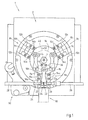
- Fig. 1 shows a front perspective view of the device 1, which is adapted to a first format.
- the device has a carrier 2, which has a rotation axis 4.
- the carrier in this case comprises a planetary gear (not shown), whereby a particularly compact design of the device 1 and the carrier 2 can be achieved.
- the arms 8 are identical in this embodiment. However, it is also conceivable, the arms differently shape. In particular, a different number of arms may be provided, for example, only a single or two or even more than three.
- the arms 8 each have a holder 10a, 10b, 10c, via which the arms are connected to the carrier 2.
- the brackets 10 are formed so that they each interact with rails 12a, 12b, 12c on the carrier 2 rail-like and are radially adjustable in this manner in relation to the axis of rotation 4.
- the fixing means designed as screws 14a, 14b, 14c
- the holders 10 can be fixed relative to the guides 12 so that a radial movement of the arms 8 is no longer possible.
- fixatives such as pins or catches can be used.
- the arms 8 are moved on a circular path 16 about the axis of rotation 4, in the present case in a clockwise direction.
- the arms 8 each have an axis 9a, 9b, 9c and each axis 9 arranged support portion 18a, 18b, 18c. These are presently designed as U-shaped receptacles. In this way, the support areas 18 are adapted to the rod-shaped smoking articles, which are transported in the form of a continuous tobacco rod 20 or in the form of double-length tobacco sticks 22 along the track 24 by means of guide rails 26, 28.
- the blade carrier 30 is formed as a rotating drum, on the outer surface of which plates 34 rotatably mounted blades 32 are positioned, which sever the tobacco rod 20.
- the slight inclination of the axis of rotation of the knife carrier 30 compared to the web 24 of the rod-shaped smoking articles 20, 22 and the provision of the rotatability of the knife 32 on the plates 34 is used to adjust the movement of the blades 32 to the continuously moving smoking articles 20, 22nd
- the support portions 18 of the arms 8 are formed for at least partially embracing the rod-shaped smoking articles 20, 22, particularly efficient support of the rod-shaped smoking articles 20, 22 during a severing operation is achieved because the rod-shaped smoking articles 20, 22 are supported in multiple directions .
- the supporting areas 18, which are designed as substantially U-shaped receptacles, furthermore have a cutout adapted to the knives 32, so that the separating operation can be carried out during the envelopment.
- the knife 32 can engage exactly in the intended recording of the support portion 18, the device 1 must be particularly precisely synchronized with the blade carrier 30.
- the synchronization can be done both by mechanical means, so for example via shafts, gears and / or belts, as well as electronically, for example by means of an electric wave.
- the device 1 may also be synchronized with other devices, such as the transfer device.
- the support portions 18 Due to the rotational movement of the arms 8, the support portions 18 also move on a circular path 36. Due to the eccentric arrangement of the support portions 18 on the axes 9 of the arms 8, the circular path 36 of the support portions 18 relative to the circular path 16 of the axis 9 of the arms 8 is moved. As a result, the carrier 2 can be arranged at a greater distance from the knife carrier 30. However, a non-eccentric arrangement can also be provided.
- the movement of the support regions 18 on the circular path 36 is just adapted to the movement of the rod-shaped smoking articles 20, 22 along the path 24 or to the movement of the blades 32 that the support portions 18 can efficiently support the rod-shaped smoking articles 20, 22 in the separation process without hindering the cutting operation by the knives 32.
- the support regions 18 in this case engage around the rod-shaped smoking articles 20, 22 from above.
- the blades 32 then move simultaneously through a centrally located recess in the U-shaped receptacle.
- the support regions 18 are always aligned parallel to one another or to the path 24 of the rod-shaped smoking articles 20, 22 during the rotation of the arms 8 about the rotation axis 4. This is accomplished by connecting the axles 9 of the arms 8 to planetary gears (not shown) of the planetary gear located in the carrier 2 and driving them. In this way, the axes 9 of the arms 8 compensate for the rotation of the arms 8 about the axis of rotation 4 by a rotation, in this case counterclockwise, to itself.
- the device 1 furthermore has an exchangeable jig 40.
- the jig 40 is formed substantially disc-shaped and mounted coaxially on the device 1.
- other geometric embodiments of the teaching are conceivable, for example, oval, rectangular, or rod-like teachings.
- the coaxial alignment of the jig 40 with the axis of rotation 4 of the carrier 2 is realized in the illustrated embodiment by a centrally disposed on the jig 40 push button 44, which can engage in a corresponding groove in the carrier 2 with proper positioning.
- the jig 40 predetermined radial positions for the three arms 8 are defined.
- the jig 40 in each case has a recess 42a, 42b, 42c for the arms 8.
- the recesses 42 are adapted to the axes 9 of the arms 8 and each form a stop for the axes 9 of the arms 8, which limits the minimum distance of the respective arm 8 to the axis of rotation 4 when the arms 8 are positioned radially.
- the predetermined position of the arms 8 is given, since the user needs to move the arms by their radial movement in the recesses 42 and as close as possible to the axis of rotation 4 and then fix the arms 8 in this predetermined position via the screws 14.
- the jig 40 is further fixed via connecting means 46 in the form of screws 46 with the holder 10a of the arm 8a. If screws are provided as connecting means 46, the holder 10a has corresponding threads (not shown). The remaining holders 10b, 10c may also have corresponding threads, so that the jig 40 can be fixed to any holder 10. In this way, the jig 40 is fixedly connected to the carrier 2 via the holder 10 and does not have to be removed from the carrier 2 before the device 1 is put into operation.
- the jig 40 defines the predetermined radial positions of the arms 8 so that the arms at a distance of 100 mm apart on the circular path support the tobacco rod 20 and thus twice long tobacco sticks 22 of length 100 mm can be separated by the blade carrier 30 and in the end Cigarettes are produced with a tobacco rod of length 50 mm.
- the device 1 furthermore has an optional fixing unit 60 in the form of a fixing arm, which serves to fix one of the arms 8.
- the fixing unit 60 and its operation are particularly in connection with the Fig. 2 and 3 explained in more detail.
- the device 1 is adapted to support double-length rod-shaped smoking articles 20, 22 having a length of. 180 mm is suitable.
- the finished cigarettes then have a tobacco rod of length 90mm.
- adaptation which relate to other geometries of the rod-shaped smoking articles 20, 22, for example their diameter or their cross-section.
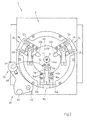
- Fig. 2 shows the device 1 from Fig. 1 now during a format change.
- the fixing 14b, 14c of the brackets 10b, 10c of the arms 8b, 8c have been solved.
- the arms 8b, 8c are movable radially along the guides 12b and 12c, respectively.
- the axes 9b, 9c of the arms 8b, 8c can be brought out of the recesses 42b, 42c by a radial movement.
- the screws 46 can be solved, which connects the jig 40 fixed to the bracket 10a of the arm 8a.
- the jig 40 is then held only by the pressure pin 44 on the device 1. If the pressure pin 44 is pulled out, for example, via a handle 44a in the direction of the axis of rotation 4, the gauge 40, which predetermines the predetermined radial positions of the arms 8 for the previous first format, can be separated forwards or upwards from the device 1 and thus replaced ,
- the arm 8a Before replacing the jig 40, however, the arm 8a is fixed by means of the fixing unit 60. Because by a radial movement of the arm 8a, the orientation of the arm 8a relative to the web 24 of the rod-shaped smoking article 20, 22 get lost. For this reason, the arm 8a with the fixing unit 60 is fixed relative to the web 24 of the rod-shaped smoking articles 20, 22. This fixation is in this case also a fixed fixation.
- the fixing unit 60 is pivotable about the axis 62 at one end of the fixing unit when the pin 64 is released. At the other end, the fixing unit 60 has a clamping or gripping device 66.
- Fig. 3 the device 1 is off Fig. 2 to see with the swung down fixing unit 60 in a perspective view.
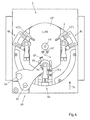
- the device 1 is off Fig. 2 with a second jig 40 'defining the predetermined radial positions for the arms 8 for the second format to be adjusted.
- the jig 40 ' was pushed into the area between the arms 8 instead of the jig 40.
- the teaching 40 corresponding features of the teaching 40 'are denoted by the same, but painted reference numerals.
- the receptacle 42'a and the position of the connecting means 46 'with respect to the receptacle 42'a is identical to that of the teaching 40.
- the teaching 40' can be positioned so that the axis 9a are brought into the receptacle 42'a can and then the screws 46 'can be connected to the bracket 10 a.
- the pressure pin 44 ' Due to the now different distance of the centrally arranged pressure pin 44 'of the receptacles 42', the pressure pin 44 ', however, can not yet intervene in the designated groove in the carrier 2. This is due to the disintegration of the positions of pressure pin 44 'and the indicated coaxial with the axis of rotation 4 lying groove in Fig. 4 to recognize.
- the with the teaching 40th 'connected arm 8a are moved.
- the orientation of the arm relative to the track 24 of the rod-shaped smoking articles 20, 22 would be lost.
- the arm 8a with the fixing unit 60 is already fixed relative to the track 24 of the rod-shaped smoking articles 20, 22. It is also conceivable first to change the teaching, and only then to fix the arm 8a by the fixing unit 60, as long as the arm 8a has not changed its position relative to the track 24 of the rod-shaped smoking articles 20, 22.
- the fixing means 14a can be released without changing the position of the arm 8a.
- the support 2 can be raised in height in the direction of the arrow 74 in FIG Fig. 4 be adjusted, so both transverse to the web 24 of the rod-shaped smoking article 20, 22 and transverse to its axis of rotation 4.
- the carrier 2 is moved upward.
- the movement of the carrier 2 can be performed manually, for example via a crank, through which a threaded rod is rotated, which in turn change the position of the carrier 2.
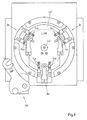
- the carrier 2 is displaced in the direction of the arrow 74 until the pressure pin 44 'engages in the corresponding groove in the carrier 2. Then it is ensured that the carrier 2 is in the desired position. Any inaccuracies due to the manual positioning of the carrier 2 are compensated by the fact that the position of the carrier 2 is determined by means of the jig 40 'and is precisely defined by the engagement of the pressure pin 44'. This position, in which the pressure pin 44 'engages in the corresponding groove on the carrier 2, is in Fig. 5 shown.
- the screws 14a may be used to again fix the position of the arm 8a radially in its second position and to remove the fixing unit 60 from the axis 9a of the arm 8a.
- the screws 14a are accessible via recesses in the jig 40 '.
- the axes 9b, 9c of the arms 8b, 8c are brought into the desired respective second position of the format to be set by means of corresponding radial movement of the arms 8b, 8c by means of the receptacles 42'b, 42'c of the jig 40 '.
- the device 1 with a fuselage unit 60 that has been removed and pivoted back is in Fig. 6 shown. If this is not yet in the Fig. 5 has been done, now the screws 14b, 14c can be tightened to fix the arms 8b, 8c radially.
- the device 1 is now adapted to a format which allows tobacco sticks with a length of 180 mm and cigarettes with a tobacco stick of a length of 90 mm.
- An alignment of the support regions 18 in relation to the web 24 of the rod-shaped smoking article is not necessary, since this adjustment is retained in particular by the fixing unit 60.
- the jig 40 ' remains fixed to the carrier 2 or the holder 10a during operation of the device 1 with the newly set format.
- the method described above can also be carried out with a device according to the invention which has a different number of arms, for example only one arm 8a. If, for example, the arms 8b, 8c are not present, the method can be carried out as described above, eliminating the radial detachment, positioning and fixing of the arms 8b, 8c. Accordingly, then the gauges 40, 40 'must allow only the positioning of the one arm 8a.
Landscapes
- Manufacturing Of Cigar And Cigarette Tobacco (AREA)
Applications Claiming Priority (1)
| Application Number | Priority Date | Filing Date | Title |
|---|---|---|---|
| DE201310105279 DE102013105279B3 (de) | 2013-05-23 | 2013-05-23 | Vorrichtung zum Stützen von stabförmigen Rauchartikeln und Verfahren zum Anpassen der Vorrichtung |
Publications (1)
| Publication Number | Publication Date |
|---|---|
| EP2805632A1 true EP2805632A1 (fr) | 2014-11-26 |
Family
ID=50693544
Family Applications (1)
| Application Number | Title | Priority Date | Filing Date |
|---|---|---|---|
| EP14168294.8A Withdrawn EP2805632A1 (fr) | 2013-05-23 | 2014-05-14 | Dispositif de soutien d'articles à fumer en forme de tige et procédé d'adaptation du dispositif |
Country Status (2)
| Country | Link |
|---|---|
| EP (1) | EP2805632A1 (fr) |
| DE (1) | DE102013105279B3 (fr) |
Citations (5)
| Publication number | Priority date | Publication date | Assignee | Title |
|---|---|---|---|---|
| US3850065A (en) * | 1970-10-20 | 1974-11-26 | Molins Ltd | Rod making machines |
| GB1387419A (en) * | 1971-10-14 | 1975-03-19 | Molins Ltd | Cut-off devices for continuous rod making machines |
| DE102004013972A1 (de) | 2004-03-19 | 2005-10-06 | Focke & Co.(Gmbh & Co. Kg) | Vorrichtung zum Herstellen von Zigaretten |
| EP2106707A2 (fr) | 2008-03-31 | 2009-10-07 | Hauni Maschinenbau Aktiengesellschaft | Dispositif de transport et de support dans la direction de transport T d'articles en forme de tronçons alimentés en continu, procédé d'adaptation d'un tel dispositif aux différentes longueurs de coupe ainsi qu'essieu tubulaire |
| DE102012100757B3 (de) * | 2012-01-31 | 2013-03-28 | Hauni Maschinenbau Ag | Vorrichtung zum Führen und Halten eines in Transportrichtung T kontinuierlich geförderten Strangs der Tabak verarbeitenden Industrie sowie Tubenradsatz |
Family Cites Families (2)
| Publication number | Priority date | Publication date | Assignee | Title |
|---|---|---|---|---|
| GB1332689A (en) * | 1970-10-20 | 1973-10-03 | Molins Ltd | Rod-making machines |
| GB9615678D0 (en) * | 1996-07-25 | 1996-09-04 | Molins Plc | Ledger for cigarette making machine cut-off |
-
2013
- 2013-05-23 DE DE201310105279 patent/DE102013105279B3/de not_active Expired - Fee Related
-
2014
- 2014-05-14 EP EP14168294.8A patent/EP2805632A1/fr not_active Withdrawn
Patent Citations (5)
| Publication number | Priority date | Publication date | Assignee | Title |
|---|---|---|---|---|
| US3850065A (en) * | 1970-10-20 | 1974-11-26 | Molins Ltd | Rod making machines |
| GB1387419A (en) * | 1971-10-14 | 1975-03-19 | Molins Ltd | Cut-off devices for continuous rod making machines |
| DE102004013972A1 (de) | 2004-03-19 | 2005-10-06 | Focke & Co.(Gmbh & Co. Kg) | Vorrichtung zum Herstellen von Zigaretten |
| EP2106707A2 (fr) | 2008-03-31 | 2009-10-07 | Hauni Maschinenbau Aktiengesellschaft | Dispositif de transport et de support dans la direction de transport T d'articles en forme de tronçons alimentés en continu, procédé d'adaptation d'un tel dispositif aux différentes longueurs de coupe ainsi qu'essieu tubulaire |
| DE102012100757B3 (de) * | 2012-01-31 | 2013-03-28 | Hauni Maschinenbau Ag | Vorrichtung zum Führen und Halten eines in Transportrichtung T kontinuierlich geförderten Strangs der Tabak verarbeitenden Industrie sowie Tubenradsatz |
Also Published As
| Publication number | Publication date |
|---|---|
| DE102013105279B3 (de) | 2014-10-23 |
Similar Documents
| Publication | Publication Date | Title |
|---|---|---|
| EP2696708B1 (fr) | Transport d'articles en forme de tige de l'industrie de travail du tabac | |
| DE102012208604A1 (de) | Einrichtung zum Schneiden von Filterstäben | |
| DE2809160A1 (de) | Vorrichtung zum herstellen von kombinierten filterstopfen fuer filterzigaretten oder andere stabfoermige gegenstaende der tabakverarbeitenden industrie | |
| EP2659792B1 (fr) | Procédé et dispositif de rassemblement de groupes de segments de filtre | |
| EP2688431A1 (fr) | Fabrication de bouts filtres ou de cigarettes à bout filtre | |
| EP2364603A2 (fr) | Machine à tronçons de tabac pour la fabrication de tiges de tabac, machine de fixation de filtre pour relier des filtres aux tiges de tabac et machine de fabrication de cigarettes | |
| EP1595463B1 (fr) | Tambour de transport pour des articles en forme de tige dans l'industrie du tabac | |
| EP1679010B1 (fr) | Production de bouchons filtrants ou cigarette à filtre | |
| DE3445575C2 (de) | Vorrichtung zum Beabstanden und Umwenden von zwei koaxialen Zigarettenlängenabschnitten in einer Filterbestückungsmaschine | |
| DE2162295B2 (de) | Verfahren und Vorrichtung zum Herstellen von Mundstückzigaretten | |
| DE102004013972A1 (de) | Vorrichtung zum Herstellen von Zigaretten | |
| EP2241204A1 (fr) | Dispositif d'ébarbage du tabac pour une machine à fabriquer les cigarettes | |
| EP1597979B1 (fr) | Production de bouchons filtrants ou cigarette à filtre | |
| EP1516547A1 (fr) | Dispositif et procédé pour transférer articles en forme de tige | |
| DE102013105279B3 (de) | Vorrichtung zum Stützen von stabförmigen Rauchartikeln und Verfahren zum Anpassen der Vorrichtung | |
| EP1213105B1 (fr) | Dispostif ainsi que procédé pour changer d'outil de coupe | |
| EP2641485A2 (fr) | Dispositif de formatage d'une machine de fabrication de tiges de lýindustrie de traitement du tabac | |
| DE102011007430B4 (de) | Förderung von stabförmigen Artikeln der Tabak verarbeitenden Industrie | |
| EP2696707B1 (fr) | Transport d'articles en forme de tige de l'industrie de transformation du tabac | |
| DE102005051525B4 (de) | Filterzuführeinrichtung | |
| EP1516546B1 (fr) | Dispositif et procédé pour transférer articles en forme de tige | |
| EP2604131A1 (fr) | Fonctionnement d'une machine de placement de filtre | |
| EP1629735B1 (fr) | Dispositif d'alimentation de filtres | |
| EP2891411A2 (fr) | Unité d'alimentation en filtre pour un dispositif destiné à la fabrication de tubes à cigarette | |
| DE425655C (de) | Maschine zum Herstellen von Zigarren |
Legal Events
| Date | Code | Title | Description |
|---|---|---|---|
| PUAI | Public reference made under article 153(3) epc to a published international application that has entered the european phase |
Free format text: ORIGINAL CODE: 0009012 |
|
| 17P | Request for examination filed |
Effective date: 20140514 |
|
| AK | Designated contracting states |
Kind code of ref document: A1 Designated state(s): AL AT BE BG CH CY CZ DE DK EE ES FI FR GB GR HR HU IE IS IT LI LT LU LV MC MK MT NL NO PL PT RO RS SE SI SK SM TR |
|
| AX | Request for extension of the european patent |
Extension state: BA ME |
|
| R17P | Request for examination filed (corrected) |
Effective date: 20150522 |
|
| RBV | Designated contracting states (corrected) |
Designated state(s): AL AT BE BG CH CY CZ DE DK EE ES FI FR GB GR HR HU IE IS IT LI LT LU LV MC MK MT NL NO PL PT RO RS SE SI SK SM TR |
|
| RAP1 | Party data changed (applicant data changed or rights of an application transferred) |
Owner name: MTS TOBACCO S.A. |
|
| STAA | Information on the status of an ep patent application or granted ep patent |
Free format text: STATUS: REQUEST FOR EXAMINATION WAS MADE |
|
| 19U | Interruption of proceedings before grant |
Effective date: 20150304 |
|
| 19W | Proceedings resumed before grant after interruption of proceedings |
Effective date: 20211001 |
|
| PUAJ | Public notification under rule 129 epc |
Free format text: ORIGINAL CODE: 0009425 |
|
| 32PN | Public notification |
Free format text: MITTEILUNG GEMAESS REGEL 142 EPUE (WIEDERAUFNAHME DES VERFAHRENS NACH REGEL 142 (2) EPUE VOM 06.04.2021) |
|
| PUAJ | Public notification under rule 129 epc |
Free format text: ORIGINAL CODE: 0009425 |
|
| 32PN | Public notification |
Free format text: FESTSTELLUNG EINES RECHTSVERLUSTS NACH REGEL 112(1) EPUE (EPA FORM 2524 VOM 29/06/2022) |
|
| STAA | Information on the status of an ep patent application or granted ep patent |
Free format text: STATUS: THE APPLICATION IS DEEMED TO BE WITHDRAWN |
|
| 18D | Application deemed to be withdrawn |
Effective date: 20220402 |