EP2805830B1 - Support de transfert intermédiaire - Google Patents
Support de transfert intermédiaire Download PDFInfo
- Publication number
- EP2805830B1 EP2805830B1 EP13755141.2A EP13755141A EP2805830B1 EP 2805830 B1 EP2805830 B1 EP 2805830B1 EP 13755141 A EP13755141 A EP 13755141A EP 2805830 B1 EP2805830 B1 EP 2805830B1
- Authority
- EP
- European Patent Office
- Prior art keywords
- protective layer
- coating liquid
- parts
- binder resin
- layer
- Prior art date
- Legal status (The legal status is an assumption and is not a legal conclusion. Google has not performed a legal analysis and makes no representation as to the accuracy of the status listed.)
- Active
Links
Images
Classifications
-
- B—PERFORMING OPERATIONS; TRANSPORTING
- B41—PRINTING; LINING MACHINES; TYPEWRITERS; STAMPS
- B41M—PRINTING, DUPLICATING, MARKING, OR COPYING PROCESSES; COLOUR PRINTING
- B41M5/00—Duplicating or marking methods; Sheet materials for use therein
- B41M5/26—Thermography ; Marking by high energetic means, e.g. laser otherwise than by burning, and characterised by the material used
- B41M5/40—Thermography ; Marking by high energetic means, e.g. laser otherwise than by burning, and characterised by the material used characterised by the base backcoat, intermediate, or covering layers, e.g. for thermal transfer dye-donor or dye-receiver sheets; Heat, radiation filtering or absorbing means or layers; combined with other image registration layers or compositions; Special originals for reproduction by thermography
- B41M5/42—Intermediate, backcoat, or covering layers
- B41M5/44—Intermediate, backcoat, or covering layers characterised by the macromolecular compounds
-
- B—PERFORMING OPERATIONS; TRANSPORTING
- B41—PRINTING; LINING MACHINES; TYPEWRITERS; STAMPS
- B41M—PRINTING, DUPLICATING, MARKING, OR COPYING PROCESSES; COLOUR PRINTING
- B41M5/00—Duplicating or marking methods; Sheet materials for use therein
- B41M5/025—Duplicating or marking methods; Sheet materials for use therein by transferring ink from the master sheet
- B41M5/0256—Duplicating or marking methods; Sheet materials for use therein by transferring ink from the master sheet the transferable ink pattern being obtained by means of a computer driven printer, e.g. an ink jet or laser printer, or by electrographic means
-
- B—PERFORMING OPERATIONS; TRANSPORTING
- B41—PRINTING; LINING MACHINES; TYPEWRITERS; STAMPS
- B41M—PRINTING, DUPLICATING, MARKING, OR COPYING PROCESSES; COLOUR PRINTING
- B41M5/00—Duplicating or marking methods; Sheet materials for use therein
- B41M5/26—Thermography ; Marking by high energetic means, e.g. laser otherwise than by burning, and characterised by the material used
- B41M5/382—Contact thermal transfer or sublimation processes
- B41M5/38257—Contact thermal transfer or sublimation processes characterised by the use of an intermediate receptor
-
- B—PERFORMING OPERATIONS; TRANSPORTING
- B41—PRINTING; LINING MACHINES; TYPEWRITERS; STAMPS
- B41M—PRINTING, DUPLICATING, MARKING, OR COPYING PROCESSES; COLOUR PRINTING
- B41M5/00—Duplicating or marking methods; Sheet materials for use therein
- B41M5/26—Thermography ; Marking by high energetic means, e.g. laser otherwise than by burning, and characterised by the material used
- B41M5/40—Thermography ; Marking by high energetic means, e.g. laser otherwise than by burning, and characterised by the material used characterised by the base backcoat, intermediate, or covering layers, e.g. for thermal transfer dye-donor or dye-receiver sheets; Heat, radiation filtering or absorbing means or layers; combined with other image registration layers or compositions; Special originals for reproduction by thermography
- B41M5/42—Intermediate, backcoat, or covering layers
-
- B—PERFORMING OPERATIONS; TRANSPORTING
- B41—PRINTING; LINING MACHINES; TYPEWRITERS; STAMPS
- B41M—PRINTING, DUPLICATING, MARKING, OR COPYING PROCESSES; COLOUR PRINTING
- B41M2205/00—Printing methods or features related to printing methods; Location or type of the layers
- B41M2205/02—Dye diffusion thermal transfer printing (D2T2)
-
- B—PERFORMING OPERATIONS; TRANSPORTING
- B41—PRINTING; LINING MACHINES; TYPEWRITERS; STAMPS
- B41M—PRINTING, DUPLICATING, MARKING, OR COPYING PROCESSES; COLOUR PRINTING
- B41M2205/00—Printing methods or features related to printing methods; Location or type of the layers
- B41M2205/06—Printing methods or features related to printing methods; Location or type of the layers relating to melt (thermal) mass transfer
-
- B—PERFORMING OPERATIONS; TRANSPORTING
- B41—PRINTING; LINING MACHINES; TYPEWRITERS; STAMPS
- B41M—PRINTING, DUPLICATING, MARKING, OR COPYING PROCESSES; COLOUR PRINTING
- B41M2205/00—Printing methods or features related to printing methods; Location or type of the layers
- B41M2205/10—Post-imaging transfer of imaged layer; transfer of the whole imaged layer
-
- B—PERFORMING OPERATIONS; TRANSPORTING
- B41—PRINTING; LINING MACHINES; TYPEWRITERS; STAMPS
- B41M—PRINTING, DUPLICATING, MARKING, OR COPYING PROCESSES; COLOUR PRINTING
- B41M2205/00—Printing methods or features related to printing methods; Location or type of the layers
- B41M2205/40—Cover layers; Layers separated from substrate by imaging layer; Protective layers; Layers applied before imaging
-
- B—PERFORMING OPERATIONS; TRANSPORTING
- B41—PRINTING; LINING MACHINES; TYPEWRITERS; STAMPS
- B41M—PRINTING, DUPLICATING, MARKING, OR COPYING PROCESSES; COLOUR PRINTING
- B41M5/00—Duplicating or marking methods; Sheet materials for use therein
- B41M5/26—Thermography ; Marking by high energetic means, e.g. laser otherwise than by burning, and characterised by the material used
- B41M5/382—Contact thermal transfer or sublimation processes
- B41M5/38207—Contact thermal transfer or sublimation processes characterised by aspects not provided for in groups B41M5/385 - B41M5/395
- B41M5/38214—Structural details, e.g. multilayer systems
-
- B—PERFORMING OPERATIONS; TRANSPORTING
- B41—PRINTING; LINING MACHINES; TYPEWRITERS; STAMPS
- B41M—PRINTING, DUPLICATING, MARKING, OR COPYING PROCESSES; COLOUR PRINTING
- B41M7/00—After-treatment of prints, e.g. heating, irradiating, setting of the ink, protection of the printed stock
- B41M7/0027—After-treatment of prints, e.g. heating, irradiating, setting of the ink, protection of the printed stock using protective coatings or layers by lamination or by fusion of the coatings or layers
Definitions
- the present invention relates to an intermediate transfer medium. More particularly, the present invention relates to an intermediate transfer medium which excels in foil tearing on transferring a receiving layer to an transcription receiving article, wherein the receiving layer has received a colorant of the thermal transfer sheet, and which can provide a printed article of high durability with ease.
- Thermal transfer method is an image forming method wherein a thermal transfer sheet which is provided with a colorant layer formed on a surface of a substrate sheet thereof is superposed on a thermal transfer image-receiving sheet which is optionally provided with an image receiving layer, then the back side of the thermal transfer sheet is heated by a heating means such as a thermal head with a shape of an intended image, and thereby the colorant included in the colorant layer is selectively transferred onto the thermal transfer image-receiving sheet to form the image on the thermal transfer image-receiving sheet.
- a heating means such as a thermal head with a shape of an intended image
- the thermal transfer method may be divided into two methods, i.e., melt-transfer method and sublimation transfer method.
- the melt-transfer method is an image forming method wherein a thermal transfer sheet, in which a thermally fusible ink layer comprising a colorant, such as a pigment, and a binder for dissolving or dispersing the colorant, such as a thermally fusible wax or resin, is carried on a substrate sheet such as a PET film, is used; then, an energy in accordance with image information is applied to the thermal transfer sheet by a heating means such as a thermal head; and thereby the colorant is transferred onto the thermal transfer image-receiving sheet, such as a plastic sheet or paper, together with the binder.
- the image formed by the melt-transfer method is suitable for recording binary images such as characters, since the image has excellent sharpness and high concentration.
- the sublimation transfer method is another image forming method wherein a thermal transfer sheet, in which a dye layer comprising a dye which is able to be transferred thermally principally by sublimation, and a resin binder for dissolving or dispersing the dye, is carried on a substrate sheet such as a PET film, is used; then, an energy in accordance with image information is applied to the thermal transfer sheet by a heating means such as a thermal head; and thereby only the dye is transferred onto a substrate sheet, such as a plastic sheet or paper (a thermal transfer image-receiving sheet which is optionally provided with a dye receiving layer) .
- a thermal transfer sheet in which a dye layer comprising a dye which is able to be transferred thermally principally by sublimation, and a resin binder for dissolving or dispersing the dye, is carried on a substrate sheet such as a PET film, is used; then, an energy in accordance with image information is applied to the thermal transfer sheet by a heating means such as a thermal head;
- the transferring amount of dye can be controlled by the amount of energy applied, it is possible to form a gray-scale image in which image density of every dot of the thermal head is controlled.
- the colorants used are dyes, the image formed has transparency.
- the reproducibility of neutral tints becomes excellent. Therefore, when using thermal transfer sheets of different colors such as yellow, magenta, cyan, black or the like, and transferring dye of each color on the thermal transfer image-receiving sheet so as to superpose the dyes each other, it is possible to form a photographic full-color image of high quality in which reproducibility of neutral tints is excellent.
- thermal transfer image-receiving sheet according to the thermal transfer method includes a wide range of concrete applications.
- proof printing As typical examples, proof printing; image output; output of plan or design, such as those drawn by CAD / CAM, etc.; output use for various medical analytical or measuring instruments such as CT scan, endoscopic camera, etc.; and a substitute for instant photos; as well as, output of picture of face to an identification paper or ID card, credit card, or other cards; and applications as composite photograph or souvenir picture at an amusement facilities such as amusement park, amusement arcade, museum, and aquarium, etc., can be mentioned.
- Patent literature 1 discloses an intermediate transfer medium in which the receiving layer is provided on the substrate so that the receiving layer can be peeled off from the substrate.
- the intermediate transfer medium by transferring the dye of the dye layer to the receiving layer so as to form an image, and then heating the intermediate transfer medium, it is possible to transfer the receiving layer onto which the dye has been transferred to an arbitrary transcription receiving article. Thus, it becomes possible to form a thermal transfer image without concern for the constraints about the kind of transcription receiving article.
- the thermal transfer image which is formed by using the intermediate transfer medium mentioned above, suffers with a problem of lack of durability including weather resistance, abrasion resistance, chemical resistance, etc., since the receiving layer onto which an image is formed is positioned on the outermost surface.
- Patent literature 2 an intermediate transfer medium in which a release layer, a protective layer, and a layer functioned both as receiving layer and adhesive layer is provided on a substrate has been proposed.
- the protective layer is formed on the surface of the thermal transfer image, it is possible to impart durability to the thermal transfer image.
- An intermediate transfer sheet is known from, e.g., US 2007/0031616 A1 .
- the known intermediate transfer sheet for use in an intermediate transfer type thermal transfer recording method comprises a support, and at least a protective layer and a receptive/adhesive layer laminated on the support in this order, the protective layer comprising, as a main component by weight an acryl-silic a hybrid resin curable by irradiation with an ionizing radiation.
- a product having an image formed thereon is known from, e.g., EP 1 316 437 A1 .
- the foil tearing is mentioned in conjunction with the above mentioned durability.
- durability there is a trade-off relationship between the durability and the foil tearing.
- the foil tearing of the protective layer has deteriorated. Therefore, it is impossible to satisfy both the durability and the foil tearing in one protective layer up to the present.
- the present invention has been made in view of the above-mentioned circumstances, and the present invention aims principally to provide an intermediate transfer medium which excels in the foil tearing on transferring a receiving layer to an transcription receiving article, wherein the receiving layer has received a colorant of the thermal transfer sheet, and which can provide a printed article of high durability with ease.
- the present invention provides an intermediate transfer medium according to claim 1. Further embodiments are described in the dependent claims.
- the present invention for solving the above-mentioned problems is an intermediate transfer medium which comprises a substrate, a protective layer and a receiving layer which are layered on a surface of the substrate; wherein the protective layer comprises two or more kinds of binder resins and a filler; wherein a mixed binder resin which consists of the above mentioned two or more kinds of binder resins has a storage elastic modulus G' of not less than 1.0 x 10 5 Pa and not more than 1.0 x 10 9 Pa at 70 °C - 90 ° C, and the storage elastic modulus G' of more than 1.0 x 10 9 Pa at 35 °C; wherein the mixed binder resin includes a binder resin having a number average molecular weight (Mn) of not less than 8,000 and not more than 30,000, and a glass transition temperature (Tg) of not less than 36 ° C and not more than 60 ° C; and wherein the filler has a particle diameter of not less than 1 nm and not more than 200 nm.
- the filler may be included in an amount of not less than 1 % by weight and not more than 35 % by weight on a base of total solid content of the protective layer.
- the binder resin having the number average molecular weight (Mn) of not less than 8,000 and not more than 30,000, and the glass transition temperature (Tg) of not less than 36 ° C and not more than 60 ° C may be included in an amount of not less than 10 % by weight on a base of total solid content of the mixed binder resin.
- an intermediate transfer medium which excels in the foil tearing on transferring a receiving layer to an transcription receiving article, wherein the receiving layer has received a colorant of the thermal transfer sheet, and which can provide a printed article of high durability with ease.
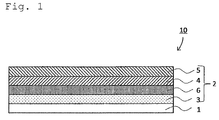
- FIG. 1 is a schematic sectional view which illustrates a layered constriction of the intermediate transfer medium according to the present invention.
- the intermediate transfer medium 10 comprises a substrate 1, and a protective layer 4 and a receiving layer 5 which are formed on one surface side of the substrate 1 (the upper side surface of the substrate 1 in the case shown in Fig. 1 ).
- the protective layer 4 and the receiving layer 5 are the layers which are transferred to a transcription receiving article at the time of thermal transfer.
- the layers which are transferred to a transcription receiving article at the time of thermal transfer may be collectively called a transfer layer 2 in places.
- the transfer layer consists of an exfoliate layer 3, a plasticizer - resistive layer 6, the protective layer 4 and the receiving layer 5.
- the exfoliate layer 3, and the plasticizer - resistive layer 6 are optional constituents in the intermediate transfer medium 10 according to the present invention. Respective constituents of the present invention will be described more concretely below.
- the substrate 1 is essential constituent of the intermediate transfer medium 10 of the present invention, and is provided to hold the transfer layer 2.
- the substrate 1 there is no particular limitation on the substrate 1, and as the substrate, unstretched or stretched plastic films, for instance, polyesters having high heat resistance such as polyethylene terephthalate and polyethylene naphthalate; polypropylene; polycarbonate; cellulose acetate; polyethylene derivatives; polyamides, and polymethylpentene, etc., can be exemplified. Composite films obtained by laminating two or more of these materials can be also used.
- the thickness of the substrate 1 may be appropriately selected depending on the kind of the material used, so that the strength, heat resistance and the like of the substrate lie in appropriate ranges. Usually, about 1 - 100 ⁇ m in thickness is preferably used.
- the transfer layer 2 is formed so that it is able to be separated from the substrate 1 at the time of heat transfer.
- This transfer layer 2 comprises at least the protective layer 4 and the receiving layer 5, both of which are essential constituents of the intermediate transfer medium 10 of the present invention.
- the transfer layer 2 is exfoliated from the substrate 1 and is transferred to a transcription receiving article during the thermal transfer.
- the foil tearing of the protective layer 4 is greatly influenced by the glass transition temperature (Tg) of the binder resin which is included in the protective layer 4. Regardless of the degree of the number average molecular weight (Mn), when a binder resin having a glass transition temperature (Tg) of more than 60 °C is only used as the resin which constitutes the protective layer, the foil tearing of the protective layer is degraded. On the other hand, when a binder resin having a glass transition temperature (Tg) of less than 36 °C is used, the foil tearing of the protective layer is improved.
- the binder resin having the glass transition temperature (Tg) of less than 36 ° C is only used as the resin which constitutes the protective layer, the protective layer softens even at a constant temperature and cause sticky feel, and thus the durability and the preservability of the protective layer 4 are degraded.
- the durability of the protective layer 4 is greatly influenced by the degree of the number average molecular weight (Mn) of the binder resin which is included in the protective layer 4. Regardless of the degree of the glass transition temperature (Tg), when a binder resin having the number average molecular weight (Mn) of less than 8,000 is only used as the resin which constitutes the protective layer, the durability of the protective layer cannot reach a satisfied level.
- the protective layer 4 of the first embodiment includes a binder resin having a number average molecular weight (Mn) of not less than 8, 000 and not more than 30, 000, and a glass transition temperature (Tg) of not less than 36 °C and not more than 60 °C.
- Mn number average molecular weight
- Tg glass transition temperature
- the binder resin having a number average molecular weight (Mn) of not less than 8,000 and not more than 30,000, and a glass transition temperature (Tg) of not less than 36 °C and not more than 60 °C is referred to as the "specific binder resin" in places.
- the number average molecular weight (Mn) used herein denotes a number average molecular weight measured by GPC in terms of polystyrene standard.
- the glass transition temperature (Tg) used herein denotes a temperature calculated from measurement of a change of calorie (DSC method) in accordance with the DSC (differential scanning calorimetry).
- the important point of the present invention is to contain the binder resin, both the number average molecular weight (Mn) and the glass transition temperature (Tg)of which fulfill the above mentioned conditions, into the protective layer 4.
- a binder resin, the number average molecular weight (Mn) of which is out from the above mentioned range and the glass transition temperature (Tg) of which is in the range of not less than 36 ° C and not more than 60 ° C, and another binder resin, the number average molecular weight (Mn) of which is in the range of not less than 8,000 and not more than 30,000 and the glass transition temperature (Tg) of which is out from the above mentioned range are included in the protective layer, it is impossible to satisfy both the foil tearing and the durability.
- the containing amount of the "specific binder resin” is less than 20 % by weight on a base of the total solid content of the protective layer 4, however, there may be a tendency for the foil tearing and the durability to decrease. Thus, in view of this point, it is preferable that the "specific binder resin” is contained in an amount of not less than 20 % by weight, more particularly, an amount of not less than 30 % by weight, on a base of the total solid content of the protective layer 4.
- the upper limit of the containing amount of the "specific binder resin” is not particularly limited, and the upper limit is 100 % by weight on a base of the total solid content of the protective layer 4.
- the “specific binder resin” there is no particular limitation, and it is possible to select arbitrarily any resin component which satisfy the conditions, that is, the number average molecular weight (Mn) being of not less than 8,000 and not more than 30,000, and a glass transition temperature (Tg) being of not less than 36 °C and not more than 60 °C.
- polyester resins may be enumerated, as long as the number average molecular weight (Mn) and the glass transition temperature (Tg) of which resins satisfy the above mentioned conditions.
- Mn number average molecular weight
- Tg glass transition temperature
- the polyester resins and the polyester urethane resins are used suitably.
- the polyester resins and the polyester urethane resins may be copolymer type resins which are copolymerized with other thermoplastic resin.
- Commercially available polyester resins and polyester urethane resins, the number average molecular weight (Mn) and the glass transition temperature (Tg) of which resins satisfy the above mentioned conditions may be used as-is in the present invention.
- VYLON 600 (polyester, manufactured by TOYOBO Co., Ltd., number average molecular weight (Mn): 16000, glass transition temperature (Tg): 47 ° C)
- VYLON GK-110 (polyester, manufactured by TOYOBO Co., Ltd., number average molecular weight (Mn) : 16000, glass transition temperature (Tg) : 52 ° C)
- VYLON GK-780 polyyester, manufactured by TOYOBO Co., Ltd., number average molecular weight (Mn): 11000, glass transition temperature (Tg): 36 ° C)
- UR-1350 polyyester urethane, manufactured by UNITIKA, Ltd., number average molecular weight (Mn) : 30000, glass transition temperature (Tg) : 42 ° C), etc., may be enumerated.
- the ionizing radiation - curable resins are suitable as the "specific binder resin" in view of their superior plasticizer resistance and superior abrasion resistance.
- the ionizing radiation - curable resin there is no particular limitation with respect to the ionizing radiation - curable resin, and thus it can be suitably selected from among the ionizing radiation - curable resins known in the art, and, for instance, it is possible to use the one in which a radically polymerizable polymer or oligomer is cross-linked and cured by irradiation of ionizing radiation, and optionally polymerized and cross-linked by electron beam or ultraviolet light with using a photo-polymerization initiator additively.
- the ultraviolet ray absorbing resins, the number average molecular weight (Mn) and the glass transition temperature (Tg) of which satisfy the above mentioned conditions are suitable as the "specific binder resin" in view of giving light resistance to the printed matter.
- the ultraviolet ray absorbing resin for instance, a resin which is prepared by reacting and linking a reactive ultraviolet ray absorbing agent to a thermoplastic resin or an ionizing radiation - curable resin mentioned above can be used. More concretely, those which prepared by introducing a reactive group such as an addition-polymerizable double bond (for instance, vinyl group, acryloyl group, methacryloyl group, etc.), alcoholic hydroxyl group, amino group, carboxyl group, epoxy group, isocyanate group, etc., into a non-reactive organic ultraviolet absorbing agent known in the art such as salicylate series, benzophenon series, benzotriazole series, substituted acrylonitrile series, nikkel-chelate series, hindered amine series, etc., can be exemplified.
- a reactive group such as an addition-polymerizable double bond
- alcoholic hydroxyl group for instance, vinyl group, acryloyl group, methacryloyl group, etc.
- the protective layer 4 may contain any other binder resin in addition to the "specific binder resin” .
- the protective layer 4 contains a binder resin, the number average molecular weight (Mn) of which is more than 3000, in addition to the "specific binder resin", by regulating the containing amount of the "specific binder resin” so as to fall into the above mentioned preferable range, it is possible to improve further the durability while the improving effect for the foil tearing is maintained.
- Mn number average molecular weight of which is more than 3000
- any additive for example, various fillers, fluorescent whitener, UV absorbers for improving the durability, etc., in addition to the "specific binder resin".
- the filler mentioned below in the third embodiment or the like it is possible to improve further the foil tearing.
- a preferable containing amount of the filler it is the same with the range described in the third embodiment. Similar respect also applies to the protective layer of the second embodiment in the containing amount.
- the foil tearing of the protective layer 4 is excellent, it is possible to thicken the thickness of the protective layer as compared with the thickness of the conventional protective layers.
- an improvement in the durability due to the enhancement of the thickness can be also expected.
- the thickness of the protective layer 4 is in the range of not less than 2 ⁇ m and not more than 30 ⁇ m. Similar respect also applies to the protective layers of the second embodiment to the fourth embodiment in the thickness of the protective layer.
- the method for forming the protective layer 4 of the first embodiment such a procedure in which the "specific binder resin", and optionally added other binder resin and/or various material is dissolved or dispersed in an appropriate solvent in order to prepare a coating liquid for protective layer, and the coating liquid thus prepared is coated on the substrate 1, (or on the exfoliate layer 3 which is optionally provided on the substrate 1), in accordance with a known procedure such as gravure printing method, screen printing method, or reverse-coating method using a gravure plate, etc., and then the coated film is dried, may be applicable.
- the foil tearing of the protective layer 4 is affected closely by the glass transition temperature (Tg) of the binder resin which is included in the protective layer 4, and the durability of the protective layer 4 is affected closely by the thickness of the protective layer and the molecular weight of the binder resin which is included in the protective layer 4.
- Tg glass transition temperature
- Tg glass transition temperature
- the durability and the preservability of the protective layer 4 are improved, without causing sticky feel on the surface of a printed matter to which the transfer layer 2 has been transferred, when the binder resin further satisfies the condition that the storage elastic modulus G' is more than 1.0 x 10 9 Pa at 35 °C.
- the storage elastic modulus G' at 35 ° C falls into the above mentioned range, it is possible to satisfy the durability and the preservability of the protective layer 4 sufficiently, even if the ambient temperature during the preservation of the printed matter to which the transfer layer 2 has been transferred rises up to about 35 ° C from about the constant room temperature.
- the protective layer 4 of the second embodiment includes a binder resin which is regulated so as to have a storage elastic modulus G' of not less than 1.0 x 10 5 Pa and not more than 1. 0 x 10 9 Pa at 70 ° C - 90 ° C, and the storage elastic modulus G' of more than 1.0 x 10 9 Pa at 35 °C.
- the intermediate transfer medium which is provided with the protective layer 4 having the above mentioned characteristics, it is possible to provide an intermediate transfer medium which excels in the foil tearing on transferring a receiving layer to an transcription receiving article, wherein the receiving layer has received a colorant of the thermal transfer sheet, and to provide a printed article of high durability with ease, regardless of the ingredient of the binder resin or the various physical properties other than the storage elastic modulus G' .
- the storage elastic modulus G' at 70 ° C - 90 ° C being in the above mentioned range is adequate for the second embodiment, it is more preferable that the storage elastic modulus G' at this temperature range is in the range of not less than 1.0 x 10 5 Pa and not more than 1.0 x 10 8 Pa. Further, it is preferable that the storage elastic modulus G' at 120 °C is in the range of not more than 1.0 x 10 9 Pa.
- the binder resin contained in the protective layer 4 it is possible to use any resin as long as the storage elastic modulus G' thereof is regulated so as to be within the above mentioned range.
- the storage elastic modulus G' can be regulated by mixing two or more kinds of resin so as to satisfy the above mentioned range.
- the storage elastic modulus G' can be regulated by adding one of more of various additives into one or more kinds of resins so as to satisfy the above mentioned range. If the storage elastic modulus G' of a certain resin is within the above mentioned range, it is possible to use the resin singly as it is.
- the binder resin which storage elastic modulus G' when saying that the binder resin which storage elastic modulus G' is regulated so as to fall within the above mentioned range, it includes not only single resins each of which storage elastic modulus G' is within the above mentioned range, but also includes mixed resins each of which storage elastic modulus G' is regulated to be within the above mentioned range by means of mixing two or more of different resins; copolymers of various resins; and resins each of which storage elastic modulus G' is regulated by adding one of more of various additives into one or more kinds of resins so as to satisfy the above mentioned range.
- the resin for regulating the storage elastic modulus G' for example, polyester resins, polycarbonate resins, acrylic resins, ultraviolet absorbing resins, epoxy resins, polystyrene resins, polyester urethane resins, acrylic urethane resins, silicone modified resins of the above mentioned resins, mixture of any combination of the above mentioned resins, ionizing radiation - curable resins, ultraviolet ray absorbing resins, etc., may be enumerated.
- a polyester resin or polyester urethane resin which storage elastic modulus G' is within the above mentioned range, or a copolymer of one of these resins and another thermoplastic resin or to include, as the resin for regulating the storage elastic modulus G' within the above mentioned range, polyester resin, polyester urethane resin, or a copolymer of one of these resins and another thermoplastic resin.
- the polyester resin, the polyester urethane resin, and the copolymer of one of these resins and another thermoplastic resin are easy in regulating the storage elastic modulus G', and are expected to improve further the foil tearing and the durability.
- the ionizing radiation - curable resins are suitable as the binder resin for regulating the storage elastic modulus G' within the above mentioned range in view of their superior plasticizer resistance and superior abrasion resistance.
- the ultraviolet ray absorbing resins are suitable as the binder resin for regulating the storage elastic modulus G' within the above mentioned range in view of giving light resistance to the printed matter.
- the storage elastic modulus G' of the binder resin is a value that is measured by a dynamic viscoelasticity measuring instrument in accordance with JIS K7244-6.
- a dynamic viscoelasticity measuring instrument it is possible to use the ARES dynamic viscoelasticity measurement instrument, manufactured by TA Instrument, Japan (Advanced Rheometric Expansion System), and so on.
- the storage elastic modulus G' of a binder resin in which two or more kinds of resin are mixed is a value that is determined by measuring values of the storage elastic modulus G' of individual resins to be mixed, and calculating from the values in consideration of their mixing ratio.
- the storage elastic modulus G' of the mixed type binder resin in which two or more kinds of resins are mixed will be explained.
- G'(A) represents the storage elastic modulus G' of the resin A
- G' (B) represents the storage elastic modulus G' of the resin B
- G'(C) represents the storage elastic modulus G' of the resin C, respectively.
- G' represents the storage elastic modulus G' of the mixed type binder resin.
- G ′ 10 ( log G ′ A ⁇ a / 100 + ( log G ′ B ⁇ b / 100 + log G ′ C ⁇ c / 100 wherein, (log(G'(A)) X a/100 + (log(G'(B)) X b/100 + (log(G'(C))X c/100) represent an index.
- the protective layer 4 may contain any other binder resin which storage elastic modulus G' is out of the above mentioned range, in addition to the binder resin which storage elastic modulus G' is regulated to be within the above mentioned range. In this case, it is necessary that the storage elastic modulus G' which is calculated by the above mentioned equation is within the range of the present invention. More concretely, the storage elastic modulus G' of the whole of the resins which include the binder resin which storage elastic modulus G' and the binder resin which storage elastic modulus G' is out of the above mentioned range should be within the range of the present invention.
- any additive for example, various fillers, fluorescent whitener, UV absorbers for improving the durability, etc., in addition to the binder resin which storage elastic modulus G' is regulated so as to fall within the above mentioned range.
- the method for forming the protective layer 4 of the second embodiment such a procedure in which the binder resin which storage elastic modulus G' is regulated so as to fall within the above mentioned range, and optionally added other binder resin and/or various material is dissolved or dispersed in an appropriate solvent in order to prepare a coating liquid for protective layer, and the coating liquid thus prepared is coated on the substrate 1, (or on the exfoliate layer 3 which is optionally provided on the substrate 1), in accordance with a known procedure such as gravure printing method, screen printing method, or reverse-coating method using a gravure plate, etc., and then the coated film is dried, may be applicable.
- the protective layer 4 of the third embodiment comprises a binder resin and a filler which has a particle diameter of not less than 1 nm and not more than 200 nm.
- the intermediate transfer medium 10 of the present invention which is provided with a protective layer 4 which contains the filler having a particle diameter of not less than 1 nm and not more than 200 nm, it is possible to improve the foil tearing on transferring this protective layer, and the durability of the image to which the protective layer is transferred, without deteriorating the glossiness of the protective layer 4.
- the shearing of the protective layer 4 may be improved by addition of the filler having a particle diameter within the above mentioned range into the protective layer 4, and the improvement in the shearing would contribute to the improvement in the foil tearing.
- the particle diameter of the filler to be contained in the protective layer 4 is very small as it is not less than 1nm and not more than 200nm, it is expected that the filler would be less likely to cause deterioration in the glossiness of the protective layer 4, and also be less likely to cause a decrease in durability.
- the aspect that the particle diameter of the filler has close relationships with the glossiness, the foil tearing, and the durability, of the protective layer 4, is obvious from the results of Examples and Comparative examples described below.
- the particle diameter of the filler used herein means volume average particle diameter.
- the particle diameter of the filler can be measured by the BET method, or analyzing results of the electron microscopic observation image with an image analysis type particle size distribution measuring software.
- any of organic fillers, inorganic fillers, and organic-inorganic hybrid type fillers can be used preferably.
- These fillers may be in powder form or in a sol form.
- acrylic particles such as non-cross linked acrylic particles and cross linked acrylic particles; polyamide type particles; fluorine-contained resin type particles; polyethylene waxes, etc.
- powdery inorganic filler for instance, calcium carbonate particles, and metal oxide particles such as silica particles and titanium oxide, etc., can be enumerated.
- the filler in which silica particles are hybridized with acrylic resin, etc. can be enumerated.
- the sol type filler for instance, silica sol type, organosol type, etc.
- These fillers may be used solely on an individual basis, or may be used as a mixture of two or more of them in combination. Further, as long as the particle diameters of the fillers interested are within the above mentioned range, it is possible to contain fillers having different particle diameters.
- the present invention is characterized in that the filler having a particle diameter within the above mentioned range is contained in the protective layer 4, but the present invention does not exclude any embodiment in which the filler having a particle diameter out of the above mentioned range is contained in part into the protective layer 4. As long as it does not deviate from the scope and spirit of the present invention, it is possible that the filler having a particle diameter out of the above mentioned range is contained in part.
- the filler to be contained in the protective layer 4 satisfies the above mentioned condition for the range of particle diameter, it is possible to improve the foil tearing property and the durability. If it is intended to further improve the durability, however, the use of organic filler is preferred.
- the organic filler the acrylic particles are particularly preferred. This is considered to be relevant to good compatibility of the organic filler. Concretely, the organic filler has an excellent compatibility than inorganic filler. Therefore, it is considered that a protective layer 4 which is formed by using an organic filler can enjoy a higher improvement effect on the adhesiveness of the protective layer 4, as compared with the case of another protective layer 4 which is formed by using an inorganic filler. Further, it is expected that this improvement on the adhesiveness contributes to a further improvement on the durability.
- the filler it is possible to use a powdery form one, or use a sol form one.
- the powdery form filler has a wide choice of options for the solvent to be used for preparing a coating solution for forming the protective layer 4, and also excels in coating compatibility, the powdery form filler is desirable.
- the filler content there is no particular limitation about the filler content.
- the filler content is less than 10 % by weight on a basis of the total solid content of the protective layer 4, it may not be able to satisfy fully the foil tearing property.
- it exceeds 40 % by weight there is a tendency that durability and transparency of the protective layer 4 is reduced. Therefore, considering this point, it is desirable that the filler is contained in the range of not less than 10 % by weight and not more than 40 % by weight on a basis of the total solid content of the protective layer 4.
- binder resin contained in the protective layer 4 there is no particular limitation on the binder resin contained in the protective layer 4.
- the binder resin for example, polyester resins, polycarbonate resins, acrylic resins, ultraviolet absorbing resins, epoxy resins, polystyrene resins, polyurethane resins, acrylic urethane resins, silicone modified forms of these thermoplastic resins, mixtures of any combination of the above mentioned resins, ionizing radiation - curable resins, ultraviolet ray absorbing resins, etc., may be usable.
- the binder resin those which have a number average molecular weight (Mn) in the range of about 8, 000 - about 30, 000 are preferable.
- the number average molecular weight (Mn) used herein denotes a number average molecular weight measured by GPC in terms of polystyrene standard.
- Mn number average molecular weight measured by GPC in terms of polystyrene standard.
- the filler by containing the filler the particle diameter of which fulfills the above mentioned range, it is possible to improve the durability and the foil tearing property.
- the binder resin the one which has an average molecular weight (Mn) being out of the above preferred range is used, it is possible to provide a protective layer 4, the durability and the foil tearing property of which are amply improved as compared with the conventional protective layer.
- preferred binder resins for example, polyester resins having a number average molecular weight (Mn)of about 10,000 to about 20,000, etc., may be enumerated.
- the ionizing radiation - curable resins can be used suitably as the binder resin of the protective layer 4 in view of their superior plasticizer resistance and superior abrasion resistance.
- the ultraviolet ray absorbing resins are suitable as the binder resin of the protective layer in view of giving light resistance to the printed matter.
- the method for forming the protective layer 4 of the third embodiment such a procedure in which one or more kinds of the above mentioned binder resins, and a filler is dissolved or dispersed in an appropriate solvent in order to prepare a coating liquid for protective layer, and the coating liquid thus prepared is coated on the substrate 1 (or on the exfoliate layer 3 which is optionally provided on the substrate 1), in accordance with a known procedure such as gravure printing method, screen printing method, or reverse-coating method using a gravure plate, etc., and then the coated film is dried, may be applicable.
- the protective layer 4 of the fourth embodiment is the one which includes features of the protective layers according to the first embodiment to the third embodiment. According to the protective layer 4 of the fourth embodiment, it is possible to give extremely excellent foil tearing and durability to the protective layer, by a synergistic effect of the features in the first embodiment to the third embodiment. Further, the protective layer 4 of the fourth embodiment also excels in the glossiness and the plasticizer resistance.
- two or more kinds of binder resins, and a filler are contained as essential components.
- the protective layer 4 of the fourth embodiment is characterized in that it contains two or more kinds of binder resins, which includes the binder resin having a number average molecular weight (Mn) of not less than 8, 000 and not more than 30, 000, and a glass transition temperature (Tg) of not less than 36 °C and not more than 60 °C, that is, the "specific binder resin” as described in the above mentioned first embodiment; and in that the binder resin which is prepared by mixing the aforementioned, two or more kinds of binder resins (Hereinafter, the mixed binder resin which is prepared by mixing two or more kinds of binder resins is referred to as "mixed type binder resin" in places.) has the storage elastic modulus G' which satisfies the following conditions 1 and 2.
- Mn number average molecular weight
- Tg glass transition temperature
- the intermediate transfer medium which is provided with the protective layer of this embodiment which satisfies these features, it is possible to attain further improvements in the foil tearing and durability by a synergistic effect of the "specific binder resin” and the “mixed type binder resin” the storage elastic modulus G' of which satisfies the following conditions 1 and 2, even if compared with the protective layer which contains the "specific binder resin” merely.
- the “specific binder resin” of the fourth embodiment the “specific binder resin” which has described above in the first embodiment, that is, the binder resin having a number average molecular weight (Mn) of not less than 8,000 and not more than 30,000, and a glass transition temperature (Tg) of not less than 36 ° C and not more than 60 ° C, can be used as-is.
- Mn number average molecular weight
- Tg glass transition temperature
- the condition 1 is the storage elastic modulus G' which is focused the temperature at which the transfer layer 2 which includes the protective layer 4 is peeled off from the substrate 1, and when the storage elastic modulus G' at 70 ° C - 90 ° C of the "mixed type binder resin" falls in the range of not less than 1.0 x 10 5 Pa and not more than 1.0 x 10 9 Pa, it is possible to give further improvement in the foil tearing and the durability.
- the condition 2 is the storage elastic modulus G' which is focused to the durability and the and preservability, and when the storage elastic modulus G' at 35 ° C of the "mixed type binder resin" is more than 1.0 x 10 9 Pa, the durability and the preservability of the protective layer 4 are improved, without causing sticky feel on the surface of a printed matter to which the transfer layer 2 has been transferred. Further, when the "mixed type binder resin" which satisfies the condition 2 is used, it is possible to satisfy the durability and the preservability of the protective layer 4 sufficiently, even if the ambient temperature during the preservation of the printed matter to which the transfer layer 2 has been transferred rises up to about 35 °C from about the constant room temperature.
- the "mixed type binder resin” which is prepared by mixing two or more kind of binder resins with including the "specific binder resin” is designed so that the storage elastic modulus G' of the "mixed type binder resin” satisfies the above mentioned conditions 1 and 2.
- the binder resin (s) which is other than the “specific binder resin” and is included in the protective layer 4 plays a role to adjust the storage elastic modulus G' so as to satisfy the above conditions 1 and 2.
- the binder resin which serves to adjust the storage elastic modulus G' so as to satisfy the above conditions 1 and 2 the one which has a relatively high glass transition temperature (Tg), concretely, has a glass transition temperature (Tg) of not less than 65 °C is used, it is possible to further improve the preservability and durability.
- the one which has a relatively low glass transition temperature (Tg) concretely, has a glass transition temperature (Tg) of not less than 10 °C and not more than 35 ° C is used, it is possible to further improve the transferability of the protective layer, while maintaining the preservability.
- the binder resin which is used for regulating the storage elastic modulus G' so as to satisfy the conditions 1 and 2 the resins for regulating the storage elastic modulus G' of the protective layer 4 of the above mentioned second embodiment can be used as-is, and thus, the explanation thereof is omitted here.
- the storage elastic modulus G' of the "mixed type binder resin” can satisfy the above mentioned conditions 1 and 2 ultimately, there is no particular limitation for the value of the storage elastic modulus G' of each individual binder resin contained in the protective layer 4, and it is not necessary to satisfy the above mentioned conditions 1 and 2. Further, it is possible that all of the binder resins included in the "mixed type binder resin” are of the "specific binder resins”. That is, without using a binder resin other than the "specific binder resin", and with using two or more of the "specific binder resins", it is possible to regulate the storage elastic modulus G' so as to satisfy the above mentioned conditions 1 and 2.
- binder resin(s) other than the "specific binder resin” it is possible to use one or more of binder resin(s) other than the "specific binder resin", in combination with two or more of the "specific binder resins”. It is also possible to use two or more of binder resins other than the "specific binder resin”, in combination with a single "specific binder resin”.
- the storage elastic modulus G' of the "mixed type binder resin" used herein is a value that is measured by a dynamic viscoelasticity measuring instrument in accordance with JIS K7244-6. Namely, the procedure described for the protective layer 4 of the above mentioned second embodiment can be used as-is, and thus, the explanation thereof is omitted here.
- the storage elastic modulus G' of the "mixed type binder resin" used herein can be determined by using the equation which has been described in the explanation about the "storage elastic modulus G' of the mixed type binder resin in which two or more kinds of resin are mixed" in the protective layer 4 of the above mentioned second embodiment.
- the content of the "mixed type binder resin” there is no particular limitation for the content of the "mixed type binder resin".
- the content of the "mixed type binder resin” is less than 65 % by weight on a base of the total solid content of the protective layer, however, there is a tendency that the foil tearing and the durability may become lower.
- the content of the "mixed type binder resin” is more than 99 % by weight on a base of the total solid content of the protective layer, since the content of the filler described later becomes lower, there is a tendency that the effect of improving the foil tearing due to the inclusion of the filler is reduced. Therefore, considering these points, it is desirable that the "mixed type binder resin" is contained in the range of not less than 65 % by weight and not more than 99 % by weight on a base of the total solid content of the protective layer.
- the content of the "specific binder resin” to the total solid content of the "mixed type binder resin” there is no particular limitation for the content of the "specific binder resin” to the total solid content of the “mixed type binder resin".
- the content of the "specific binder resin” to the total solid content of the “mixed type binder resin” is less than 10 % by weight, there is a tendency that the effect of improving the foil tearing and durability due to the inclusion of the "specific binder resin” is reduced.
- the content of the "specific binder resin” is in the range of not less than 10 % by weight on the base of the total solid content of the "mixed type binder resin".
- the upper limit of the content of the "specific binder resin” it may be contained within a range that allows the storage elastic modulus G' satisfies the conditions 1 and 2.
- the content of the "specific binder resins” to the total solid content of the "mixed type binder resin” becomes 100 % by weight. In other words, the upper limit is 100% by weight.
- the binder resin (s) other than the "specific binder resin” is contained in the “mixed type binder resin", in other words, in the case that the storage elastic modulus G' is regulated with using binder resin(s) other than the "specific binder resin", in addition to the "specific binder resin(s)", an example of the upper limit of the content of the "specific binder resins” to the total solid content of the "mixed type binder resin” may be about 80 % by weight.
- the fourth embodiment has been discussed with a particular emphasis on the point that the improvement on the foil tearing and the durability of the protective layer can be attained by containing the "mixed type binder resin", the storage elastic modulus G' of which satisfies the above mentioned conditions 1 and 2, and which contain the "specific binder resin", in the protective layer.
- the protective layer 4 of the fourth embodiment not only the above mentioned point, but also another approach from the aspect of the filler, a further improvement on the foil tearing is conceived.
- a filler having a particle diameter of not less than 1 nm and not more than 200 nm is contained in the protective layer 4.
- the protective layer 4 which contains the filler having a particle diameter of not less than 1 nm and not more than 200 nm, it is possible to improve the foil tearing on transferring this protective layer, and the durability of the image to which the protective layer is transferred, without deteriorating the glossiness of the protective layer 4.
- the particle diameter of the filler to be contained in the protective layer 4 is very small as it is not less than 1nm and not more than 200nm, it is expected that the filler would be less likely to cause deterioration in the glossiness of the protective layer 4, and would be improve further the foil tearing and the durability which are exerted by the above mentioned “specific binder resin” and the above mentioned “mixed type binder resin” the storage elastic modulus G' of which is defined within the prescribed range.
- the filler as described above in the explanation for the protective layer 4 of the third embodiment can be used as-is. Thus, the detailed explanation thereof is omitted here.
- the filler content there is no particular limitation about the filler content.
- the filler content is less than 1 % by weight on a basis of the total solid content of the protective layer 4, it may not be able to satisfy fully the foil tearing property.
- it exceeds 35 % by weight there is a tendency that durability and transparency of the protective layer 4 is reduced. Therefore, considering these points, it is desirable that the filler is contained in the range of not less than 1 % by weight and not more than 35 % by weight on a basis of the total solid content of the protective layer 4.
- the protective layer 4 may includes, optionally, any additive, for example, fluorescent whitener, UV absorbers for improving the durability, etc., in addition to the "mixed type binder resin", the storage elastic modulus G' of which is regulated so as to be in the above mentioned ranges, and which contain the "specific binder resin", and the filler having a particle diameter within the above mentioned range..
- any additive for example, fluorescent whitener, UV absorbers for improving the durability, etc.
- a receiving layer 5 which constitutes the transfer layer 2 is provided on the protective layer 4.
- an image will be formed by thermal transfer from a thermal transfer sheet having a coloring agent layer in accordance with the thermal transfer method.
- the transfer layer 2 of the intermediate transfer medium, on which the image have been thus formed is transferred onto a transcription receiving article.
- a printed matter is produced. Therefore, as a material for forming the receiving layer 5, it is possible to adopt any resin material which is known as the one that can easily receive thermally-transferable colorants such as subliming dyes or thermally-fusible inks.
- polyolefin resins such as polypropylene; halogenated resins such as polyvinyl chloride and polyvinylidene chloride; vinyl resins such as polyvinyl acetate, vinyl chloride - vinyl acetate copolymer, ethylene - vinyl acetate copolymer and polyacrylic ester; polyester resins such as polyethylene terephthalate and polybutylene terephthalate; polystyrene resins; polyamide resins; copolymer type resins of an olefin such as ethylene or propylene and another vinyl polymer; ionomer or cellulose-based resins such as cellulose diastase; polycarbonate; etc., are exemplified.
- vinyl chloride resin, acryl - styrene resin or a polyester resin is preferred.
- the receiving layer 5 When the receiving layer 5 is transferred to the transcription receiving article via an adhesive layer, adhesiveness for the receiving layer 5 itself is not necessarily required. However, if the receiving layer 5 is transferred to the transcription receiving article without the adhesive layer, it is preferable that the receiving layer 5 comprises a resin material having adhesive property, such as a vinyl chloride - vinyl acetate copolymer.
- the receiving layer 5 can be formed by dissolving or dispersing a material or plural materials selected from the above-mentioned materials, and optionally in combination with various additives, into an appropriate solvent such as water or an organic solvent in order to prepare a coating liquid for the receiving layer, coating thus prepared coating liquid for the receiving layer in accordance with a known procedure such as gravure printing method, screen printing method, or reverse-coating method using a gravure plate, etc., and then drying the coated film.
- the receiving layer 5 is usually about 1 g/m 2 - 10 g/m 2 in thickness in dried state.
- exfoliate layer 3 between the substrate 1 and the protective layer 4, optionally, in order to improve the exfoliation of the transfer layer 2 from the substrate 1.
- This exfoliate layer 3 is an optional constituent of the transfer layer 2, and it is transferred onto the transcription receiving article at the thermal transfer.
- the exfoliate layer 3 it is possible to improve the exfoliation of transfer layer 2, and also possible to improve further the durability of the printed article due to an additive effect of this exfoliate layer 3 and the above mentioned protective layer 4. Therefore, it is preferable to provide the exfoliate layer 3.
- the exfoliate layer 3 may be appropriately selected and used from conventionally known materials. Usually, it may be formed by using a thermoplastic resin which includes cellulose derivatives such as ethyl cellulose, nitro cellulose, and cellulose acetate, acrylic resins such as polymethyl methacrylate, polyethyl methacrylate, polybutyl metacrylate, a polyvinyl chloride or a vinyl copolymers such as vinyl chloride - vinyl acetate copolymer, and polyvinyl butyral; or a thermosetting resin which includes saturated or unsaturated polyester resins, polyurethane resins, thermally cross-linkable epoxy - amino resins, and amino alkyd resins; or silicone wax, silicone resin, modified silicone resin, fluorine resin, modified fluorine resins, or polyvinyl alcohol.
- a thermoplastic resin which includes cellulose derivatives such as ethyl cellulose, nitro cellulose, and cellulose acetate, acrylic resins such as polymethyl methacrylate, poly
- the exfoliate layer 3 contains a filler such as micro-silica and polyethylene wax.
- the exfoliate layer 3 may be made of one kind of resin, or may be made of two or more kinds of resins.
- the exfoliate layer 3 may be formed by using a cross-linking agent such as isocyanate, a catalyst such as tin-based catalyst, aluminum-based catalyst, in addition to the resin (s) mentioned above.
- the exfoliate layer 3 which is optionally provided may be formed by coating a coating liquid, which has prepared by dispersing or dissolving the above-mentioned resin into a solvent in advance, onto at least a part of the surface of the substrate 1 in accordance with a known coating procedure such as roll coating, gravure coating, and bar coating, and drying it.
- a coating liquid which has prepared by dispersing or dissolving the above-mentioned resin into a solvent in advance
- the thickness of the exfoliate layer 3 it may be generally in the range of about 0.1 ⁇ m - 5 ⁇ m, and preferably in the range of about 0.5 ⁇ m - 2 ⁇ m.
- a plasticizer resistive layer 6 may be provided between the exfoliate layer 3 and the protective layer 4.
- a substance which repels the plasticizer component, or a substance which gives the plasticizer component difficulties in reaching the printed image can be preferably used.
- the above-mentioned substance which repels the plasticizer component for instance, polyvinyl alcohol resin, polyvinyl butyral resin, polyvinyl acetal resin, polyvinyl pyrrolidone resin, etc., can be enumerated.
- cationic resins such as cationic urethane emulsion, etc., can be enumerated.
- polyvinyl alcohol resin polyvinyl butyral resin, and polyvinyl acetal resin, which has been exemplified as the substance which repels the plasticizer component
- the polyvinyl alcohol resin, polyvinyl butyral resin, or polyvinyl acetal resin which has a saponification degree in the above-mentioned range, is contained in the plasticizer resistive layer 6, it can be expected to improve further the plasticizer resistance of the transfer layer 2.
- the "saponification degree" used in the present invention refers to the value obtained by dividing the number of moles of vinyl alcohol structures in the polymer by the number of moles of all monomers in the polymer. Further, it is preferable that the substance which repels the plasticizer component, or the substance which gives the plasticizer component difficulties in reaching the printed image is contained in the plasticizer resistive layer 6 so that the weight of the substance is in the range of 20 - 100 % by weight on a base of the total weight of the plasticizer resistive layer 6.
- any additives for example, lubricants, plasticizers, fillers, antistatic agents, anti-blocking agents, cross-linking agents, antioxidants, UV absorbers, light stabilizers, colorants such as dyes and pigments, fluorescent whitening agents, etc.
- the plasticizer resistive layer 6 As the method for forming the plasticizer resistive layer 6 which is optionally provided if necessary, such a procedure in which one or more members of the substances exemplified as above, and optionally, any various material which are added if necessary, are dissolved or dispersed in an appropriate solvent in order to prepare a coating liquid for plasticizer resistive layer, and the coating liquid thus prepared is coated on the substrate 1, or on the exfoliate layer 3 which is optionally provided if necessary, and then the coated film is dried, may be applicable.
- the thickness of the plasticizer resistive layer the plasticizer resistive layer is usually about 0.1 - 50 ⁇ m in thickness after drying, and preferably, about 1 - 20 ⁇ m in thickness after drying.
- the transfer layer 2 of the above-mentioned intermediate transfer medium, in which the thermal transfer image has been formed, is transferred.
- the intermediate transfer medium according to the present invention there is no particular limitation, and for instance, any of vinyl chloride - vinyl acetate copolymer, polyethylene terephthalate (PET), polycarbonate, natural fiber paper, coated paper, tracing paper, glass, metal, ceramics, wood, cloth, and so on, may be utilized.
- thermal transfer image-receiving of the present invention With respect to a method for forming an image onto a receiving layer by using the thermal transfer image-receiving of the present invention, there is no particular limitation, and it is possible to form it in accordance with any conventionally known thermal transfer method.
- thermal transfer sheet to be used on the above mentioned image formation it is possible to use any conventionally known thermal transfer sheet, for instance, which comprises a substrate such as polyester film, and a thermal transferable color material layer which is provided on one surface of the substrate, and a back face layer which is provided on the other surface of the substrate. Now, the thermal transfer sheet will be explained.
- the substrate it is not particularly limited, as long as it is the one which has a known certain degree of heat resistance and a known certain degree of strength, and it is possible to select one arbitrarily from materials known in the art.
- a resin film such as polyethylene terephthalate film, 1,4-polycyclohexylene dimethylene terephthalate film, polyethylene naphthalate film, polyphenylene sulfide film, polystyrene film, polypropylene film, polysulfone film, aramide film, polycarbonate film, polyvinyl alcohol film, cellulose derivatives such as cellophane and cellulose acetate, polyethylene film, polyvinyl chloride film, nylon film, polyimide film, ionomer film, etc.; and a paper such as condenser paper, paraffin paper, synthetic paper, etc.; and a complex such as complex of paper or nonwoven fabric and resin, etc., can be enumerated.
- the thickness of the substrate is not particularly limited, it is usually about 0.5 - 50 ⁇ m, and preferably, about 1.5 - 10 ⁇ m.
- the substrate may undergo surface treatment in order to improve its adhesiveness to the adjacent layer.
- surface treatment it is possible to apply any resin surface reforming technique known in the art, such as corona discharge treatment, flame treatment, ozone treatment, ultraviolet ray treatment, radiation treatment, roughening treatment, chemical agent's treatment, plasma treatment, grafting treatment, etc. These surface treatments may be applied singly or in combination of two or more kinds of them.
- the one side or both sides of the substrate may be optionally provided with an under coating layer (primer layer).
- the thermal transfer sheet is a sublimation type thermal transfer sheet
- sublimable dye-containing color material layers are formed as the thermal transferable color material layer.
- the color material layer comprises a heat-fusion composition which contains coloring agent, and becomes a color material layer containing heat-fusion ink.
- a color material layer containing a sublimable dye and another color material layer containing a heat-fusion type ink which comprises a heat-fusion type composition with a dye may be provided on one continuous substrate as being frame sequentially.
- sublimable dye for instance, diarylmethane dyes; triarylmethane dyes; thiazole dyes; merocyanine dyes; pyrazolone dyes; methine dyes; indoaniline dyes; azomethine dyes such as acetophenone azomethine dyes, pyrazolo azomethine dyes, imidazol eazomethine dyes, imidazo azomethine dyes, and pyridone azomethine dyes; xanthene dyes; oxazine dyes; cyanostyrene dyes such as dicyanostyrene dyes and tricyanostyrene dyes; thiazine dyes; azine dyes; acridine dyes; benzeneazo dyes; azo dyes such as, pyridoneazo dyes, thiopheneazo dyes, isothiazoleazo dyes, pyrroleazo dyes, azo
- the content of the sublimable dye is not less than 5 % by weight and not more than 90 % by weight, more preferably, not less than 10 % by weight and not more than 70 % by weight, on a base of the total solid content of the thermal transferable color material layer.
- the print density may decrease in some cases, and when the content of the sublimable dye exceeds to the above mentioned ranges, the reservation property may decrease in some cases.
- binder resin for supporting such a dye for instance, cellulosic resins such as ethylcellulose, hydroxyethylcellulose, ethylhydroxycellose, hydroxypropylcellulose, methylcellulose, cellulose acetate, and cellulose tributyrate; vinyl resins such as polyvinylalcohol, polyvinyl acetate, polyvinylbutyral, polyvinylacetoacetal, and polyvinylpyrrolidone; acrylic resins such as poly(meth)acrylate and poly(meta)acrylamide; polyurethane resins, polyamide resins, polyester resins, and the like.
- cellulosic, vinyl, acrylic, urethane, and polyester resins are preferable from the points of heat resistance and dye-transfer efficiency.
- the thermal transferable color material layer may contain optionally additives such as release agent, inorganic fine particles, organic fine particles, etc.
- release agent include silicone oils, polyethylene waxes, phosphate esters, etc.
- silicone oils straight silicone oils, and modified silicone oils and their hardened forms, etc.
- the silicone oils may be reactive ones or non-reactive ones.
- inorganic fine particles include carbon black, silica, molybdenum disulfide, etc.
- the modified silicone oils may be classified into the reactive silicone oils and the non-reactive silicone oils.
- the reactive silicone oils for instance, amino modified-, epoxy modified-, carboxy modified-, hydroxy modified-, methacryl modified-, mercapt modified-, phenol modified-, one terminal reactive- hetero functional group modified-, etc.
- the non-reactive silicone oils for instance, polyether modified-, methylstyryl modified-, alkyl modified-, higher fatty acid ester modified-, hydrophilic special modified-, higher alkoxy modified-, fluorine modified-,etc.
- adding amount of the silicone oil it is preferable to be 0.1 - 15 % by weight, and more desirably, 0.3 - 10% by weight, on a base of weight of the binder.
- the organic fine particles as mentioned above include polyethylene waxes, etc.
- the thermal transferable color material layer may be formed, for instance, by dissolving or dispersing the sublimable dye and the binder resin, and optionally, various additives if necessary, in a suitable solvent, to prepare a coating liquid for thermal transferable color material layer; coating the coating liquid on the substrate by a conventional coating method; and drying the coated liquid.
- a coating liquid for thermal transferable color material layer for instance, gravure printing, reverse roll coating using a gravure plate, roll coater, bar-coater, etc. may be enumerated.
- the solvent for instance, toluene, methyl ethyl ketone, ethanol, isopropyl alcohol, cyclohexanone, dimethylformamide (DMF), etc., maybe enumerated.
- the thickness of the thermal transferable color material layer is in the range of 0.2 - 0.5 ⁇ m.
- a back face layer may be provided on the other surface of the substrate.
- the back face layer may be formed by selecting and using resin(s) from the conventionally known thermoplastic resin appropriately.
- the thermoplastic resin to be included in the back face layer for instance, polyester type resins, polyacrylic ester type resins, polyvinyl acetate type resins, styrene acrylate type resins, polyurethane type resins, polyolefin type resins such as polyethylene type resins and polypropylene type resins, polystyrene type resins, polyvinyl chloride type resin, polyether type resin, polyamide type resins, polyimide type resins, polyamide imide type resin, polycarbonate type resin, polyacrylamide type resins, polyvinyl chloride type resin, polyvinyl butyral type resins, polyvinyl acetal type resins such as polyvinyl acetoacetal type resins, etc.; and silicone modified forms of these thermoplastic resins, may be enumerated.
- polyamide imide type resin and silicone modified form thereof are preferably used
- the back face layer contains various additives for improving slipping property, for instance, release agent such as waxes, higher fatty acid amides, phosphoric ester compounds, metal soaps, silicone oils, surfactants, etc; organic powder such as fluorine-containing resin, etc; and inorganic powder such as silica, clay, talc, calcium carbonate; in addition to the thermoplastic resin as mentioned above.
- release agent such as waxes, higher fatty acid amides, phosphoric ester compounds, metal soaps, silicone oils, surfactants, etc
- organic powder such as fluorine-containing resin, etc
- inorganic powder such as silica, clay, talc, calcium carbonate
- the back face layer may be formed by dissolving or dispersing the above mentioned the thermoplastic resin, and optionally, various additives if necessary, into a suitable solvent in order to prepare a coating liquid; coating thus prepared coating liquid onto the substrate, in accordance with a known coating procedure such as the gravure printing method, the screen printing method, the reverse roll coating method using a gravure plate, or the like; and then drying the coated liquid.
- a known coating procedure such as the gravure printing method, the screen printing method, the reverse roll coating method using a gravure plate, or the like. It is preferable that the thickness of the back face layer is in the range of not more than 2 ⁇ m, and more desirably, in the range of 0.1 ⁇ m - 1.0 ⁇ m.
- a polyethylene terephthalate film manufactured by Toray, Industries, Inc., Lumirror
- a coating liquid for exfoliate layer having the following composition onto one side of the substrate so as to obtain a film thickness of 1.0 g/m 2 in dried state, and then drying, an exfoliate layer was formed.
- coating a coating liquid for protective layer 1 having the following composition onto thus formed exfoliate layer so as to obtain a film thickness of 10.0 g/m 2 in dried state, and then drying, a protective layer was formed.
- Example 1 coating a coating liquid for receiving layer 1 having the following composition onto thus formed protective layer so as to obtain a film thickness of 2.0 g/m 2 in dried state, and then drying, a receiving layer was formed.
- the intermediate transfer medium of Example 1 was prepared.
- all the coatings of the coating liquid for exfoliate layer, the coating liquid for protective layer 1, and the coating liquid for receiving layer were performed in accordance with gravure coating.
- polyester resin (Mn: 16,000, Tg: 47°C) 20 parts (Vylon 600, manufactured by TOYOBO Co., Ltd.) toluene 40 parts MEK 40 parts
- vinyl chloride - vinyl acetate copolymer 95 parts (CNL, manufactured by Nissin Chemical Industry Co., Ltd.) epoxy modified silicone oil 5 parts (KP-1800U, manufactured by Shin-Etsu Chemical Co., Ltd.) toluene 200 parts MEK 200 parts
- Example 2 The same procedure as described in Example 1 was repeated, except for replacing the coating liquid for protective layer 1 with a coating liquid for protective layer 2 having the following composition, in order to prepare an intermediate transfer medium of Example 2.
- polyester resin Mn: 16,000, Tg: 52°C
- Vylon GK-110 manufactured by TOYOBO Co., Ltd.
- Example 3 The same procedure as described in Example 1 was repeated, except for replacing the coating liquid for protective layer 1 with a coating liquid for protective layer 3 having the following composition, in order to prepare an intermediate transfer medium of Example 3.
- polyester resin (Mn: 11,000, Tg: 36°C) 20 parts (Vylon GK-780, manufactured by TOYOBO Co., Ltd.) toluene 40 parts MEK 40 parts
- Example 4 The same procedure as described in Example 1 was repeated, except for replacing the coating liquid for protective layer 1 with a coating liquid for protective layer 4 having the following composition, in order to prepare an intermediate transfer medium of Example 4.
- polyester resin Mn: 23,000, Tg: 47°C 20 parts (Vylon 103, manufactured by TOYOBO Co., Ltd.) toluene 40 parts MEK 40 parts
- Example 5 The same procedure as described in Example 1 was repeated, except for replacing the coating liquid for protective layer 1 with a coating liquid for protective layer 5 having the following composition, in order to prepare an intermediate transfer medium of Example 5.
- polyester resin (Mn: 10,000, Tg: 60°C) 20 parts (Vylon GK-250, manufactured by TOYOBO Co., Ltd.) toluene 40 parts MEK 40 parts
- Example 6 The same procedure as described in Example 1 was repeated, except for replacing the coating liquid for protective layer 1 with a coating liquid for protective layer 6 having the following composition, in order to prepare an intermediate transfer medium of Example 6.
- polyester resin Mn: 20,000, Tg: 60°C 20 parts (UE3203, manufactured by UNITIKA, Ltd.) toluene 40 parts MEK 40 parts
- Example 7 The same procedure as described in Example 1 was repeated, except for replacing the coating liquid for protective layer 1 with a coating liquid for protective layer 7 having the following composition, in order to prepare an intermediate transfer medium of Example 7.
- polyester resin Mn: 18,000, Tg: 40°C 20 parts (UE3240, manufactured by UNITIKA, Ltd.) toluene 40 parts MEK 40 parts
- Example 8 The same procedure as described in Example 1 was repeated, except for replacing the coating liquid for protective layer 1 with a coating liquid for protective layer 8 having the following composition, in order to prepare an intermediate transfer medium of Example 8.
- polyester resin (Mn: 16,000, Tg: 47°C) 15 parts (Vylon 600, manufactured by TOYOBO Co., Ltd.) polyester resin (Mn: 17,000, Tg: 67°C) 5 parts (Vylon 200, manufactured by TOYOBO Co., Ltd.) toluene 40 parts MEK 40 parts
- Example 9 The same procedure as described in Example 1 was repeated, except for replacing the coating liquid for protective layer 1 with a coating liquid for protective layer 9 having the following composition, in order to prepare an intermediate transfer medium of Example 9.
- polyester resin (Mn: 16,000, Tg: 47°C) 10 parts (Vylon 600, manufactured by TOYOBO Co., Ltd.) polyester resin (Mn: 17,000, Tg: 67°C) 10 parts (Vylon 200, manufactured by TOYOBO Co., Ltd.) toluene 40 parts MEK 40 parts
- Example 10 The same procedure as described in Example 1 was repeated, except for replacing the coating liquid for protective layer 1 with a coating liquid for protective layer 10 having the following composition, in order to prepare an intermediate transfer medium of Example 10.
- polyester resin (Mn: 16,000, Tg: 47°C) 5 parts (Vylon 600, manufactured by TOYOBO Co., Ltd.) polyester resin (Mn: 17,000, Tg: 67°C) 15 parts (Vylon 200, manufactured by TOYOBO Co., Ltd.) toluene 40 parts MEK 40 parts
- Example 11 The same procedure as described in Example 1 was repeated, except for replacing the coating liquid for protective layer 1 with a coating liquid for protective layer 11 having the following composition, in order to prepare an intermediate transfer medium of Example 11.
- polyester urethane resin (Mn: 30,000, Tg: 46 °C, Solid content: 33 %) 60.6 parts (UR-1350, manufactured by TOYOBO Co., Ltd.) toluene 40 parts MEK 40 parts
- Example 12 The same procedure as described in Example 1 was repeated, except for replacing the coating liquid for protective layer 1 with a coating liquid for protective layer 12 having the following composition, in order to prepare an intermediate transfer medium of Example 12.
- polyester resin (Mn: 16,000, Tg: 47°C) 2 parts (Vylon 600, manufactured by TOYOBO Co., Ltd.) polyester resin (Mn: 17,000, Tg: 67°C) 18 parts (Vylon 200, manufactured by TOYOBO Co., Ltd.) toluene 40 parts MEK 40 parts
- Example 1 The same procedure as described in Example 1 was repeated, except for replacing the coating liquid for protective layer 1 with a coating liquid for protective layer A having the following composition, in order to prepare an intermediate transfer medium of Comparative example 1.
- polyester resin Mn: 17,000, Tg: 67°C 20 parts (Vylon 200, manufactured by TOYOBO Co., Ltd.) toluene 40 parts MEK 40 parts
- Example 2 The same procedure as described in Example 1 was repeated, except for replacing the coating liquid for protective layer 1 with a coating liquid for protective layer B having the following composition, in order to prepare an intermediate transfer medium of Comparative example 2.
- polyester resin Mn: 23,000, Tg: 67°C 20 parts (Vylon 270, manufactured by TOYOBO Co., Ltd.) toluene 40 parts MEK 40 parts
- Example 3 The same procedure as described in Example 1 was repeated, except for replacing the coating liquid for protective layer 1 with a coating liquid for protective layer C having the following composition, in order to prepare an intermediate transfer medium of Comparative example 3.
- polyester resin Mn: 13,000, Tg: 79°C 20 parts (Vylon GK-640, manufactured by TOYOBO Co., Ltd.) toluene 40 parts MEK 40 parts
- Example 4 The same procedure as described in Example 1 was repeated, except for replacing the coating liquid for protective layer 1 with a coating liquid for protective layer D having the following composition, in order to prepare an intermediate transfer medium of Comparative example 4.
- polyester resin Mn: 23,000, Tg: 4 °C 20 parts (Vylon 500, manufactured by TOYOBO Co., Ltd.) toluene 40 parts MEK 40 parts
- Example 2 The same procedure as described in Example 1 was repeated, except for replacing the coating liquid for protective layer 1 with a coating liquid for protective layer E having the following composition, in order to prepare an intermediate transfer medium of Comparative example 5.
- polyester resin Mn: 28,000, Tg: -15°C 20 parts (Vylon 550, manufactured by TOYOBO Co., Ltd.) toluene 40 parts MEK 40 parts
- Example 6 The same procedure as described in Example 1 was repeated, except for replacing the coating liquid for protective layer 1 with a coating liquid for protective layer F having the following composition, in order to prepare an intermediate transfer medium of Comparative example 6.
- polyester resin Mn: 6,000, Tg: 46°C
- Vylon GK-810 manufactured by TOYOBO Co., Ltd.
- Example 7 The same procedure as described in Example 1 was repeated, except for replacing the coating liquid for protective layer 1 with a coating liquid for protective layer G having the following composition, in order to prepare an intermediate transfer medium of Comparative example 7.
- polyester resin Mn: 6,000, Tg: 85°C 20 parts (UE-9885, manufactured by UNITIKA, Ltd.) toluene 40 parts MEK 40 parts
- Example 8 The same procedure as described in Example 1 was repeated, except for replacing the coating liquid for protective layer 1 with a coating liquid for protective layer H having the following composition, in order to prepare an intermediate transfer medium of Comparative example 8.
- polyester urethane resin (Mn: 40, 000, Tg: 83 °C, Solid content: 30 %) 66.7 parts (UR-1400, manufactured by TOYOBO Co., Ltd.) toluene 40 parts MEK 40 parts
- Example 1 The same procedure as described in Example 1 was repeated, except for replacing the coating liquid for protective layer 1 with a coating liquid for protective layer I having the following composition, in order to prepare an intermediate transfer medium of Comparative example 9.
- polyester urethane resin (Mn: 40, 000, Tg: -3 °C, Solid content: 30 %) 66.7 parts (UR-3200, manufactured by TOYOBO Co., Ltd.) toluene 40 parts MEK 40 parts
- Example 1 The same procedure as described in Example 1 was repeated, except for replacing the coating liquid for protective layer 1 with a coating liquid for protective layer J having the following composition, in order to prepare an intermediate transfer medium of Comparative example 10.
- Example 1 The same procedure as described in Example 1 was repeated, except for replacing the coating liquid for protective layer 1 with a coating liquid for protective layer K having the following composition, in order to prepare an intermediate transfer medium of Comparative example 11.
- polyester resin Mn: 13,000, Tg: 20°C
- GK-140 manufactured by TOYOBO Co., Ltd.
- toluene 40 parts MEK 40 parts
- Example 2 The same procedure as described in Example 1 was repeated, except for replacing the coating liquid for protective layer 1 with a coating liquid for protective layer L having the following composition, in order to prepare an intermediate transfer medium of Comparative example 12.
- polyester resin (Mn: 17,000, Tg: 67°C) 15 parts (Vylon 200, manufactured by TOYOBO Co., Ltd.) polyester resin (Mn: 6,000, Tg: 46°C) 5 parts (Vylon GK-810, manufactured by TOYOBO Co., Ltd.) toluene 40 parts MEK 40 parts
- Example 13 The same procedure as described in Example 1 was repeated, except for replacing the coating liquid for protective layer 1 with a coating liquid for protective layer M having the following composition, in order to prepare an intermediate transfer medium of Comparative example 13.
- polyester resin (Mn: 17,000, Tg: 67°C) 10 parts (Vylon 200, manufactured by TOYOBO Co., Ltd.) polyester resin (Mn: 6,000, Tg: 46°C) 10 parts (Vylon GK-810, manufactured by TOYOBO Co., Ltd.) toluene 40 parts MEK 40 parts
- Example 14 The same procedure as described in Example 1 was repeated, except for replacing the coating liquid for protective layer 1 with a coating liquid for protective layer N having the following composition, in order to prepare an intermediate transfer medium of Comparative example 14.
- polyester resin (Mn: 17,000, Tg: 67°C) 5 parts (Vylon 200, manufactured by TOYOBO Co., Ltd.) polyester resin (Mn: 6,000, Tg: 46°C) 15 parts (Vylon GK-810, manufactured by TOYOBO Co., Ltd.) toluene 40 parts MEK 40 parts
- the printed matters underwent wearing wherein a wear ring CS-10F was used under a load of 500 gf and was run for 1500 revolutions in total while the wear ring was grinded per 250 revolutions. After wearing, the conditions of the surfaces were observed by visually, and evaluation of this test was done under the following evaluation criteria. The evaluation test results are shown in table 1.
- polyethylene terephthalate film which underwent easy-adhesive treatment in advance, and has 4.5 ⁇ m in thickness was used.
- a liquid for forming heat resistant active layer having the following composition was coated so as to obtain a thickness of 0.8 g/m 2 in the dried state and then the coated liquid was dried to form a heat resistant active layer.
- a liquid for forming yellow dye layer having the following composition, a liquid for forming magenta dye layer having the following composition, and a liquid for forming cyan dye layer having the following composition were coated so as to obtain each individual thickness of 0.6 g/m 2 in the dried state, and then the coated liquids were dried through a repeated face-by-face operation for each color in this order in order to form the respective dye layers.
- a thermal transfer sheet was prepared.
- the foil tearing (blooming) of the printed matters of Examples 1 - 12 and Comparative examples 1 -14 were observed by visually, and evaluation of this test was done under the following evaluation criteria.
- the evaluation test results are shown in table 1.
- the blooming means the length of the transfer layer which protruded from the boundary between the non-transferred region and the transferred region of the transfer layer, as the starting point, to the non-transferred region side.
- Example 13 The same procedure as described in Example 1 was repeated, except for replacing the coating liquid for protective layer 1 with a coating liquid for protective layer 13 having the following composition, in order to prepare an intermediate transfer medium of Example 13.
- values of the storage elastic modulus G' for the binder resins in Examples 13 - 24 and Comparative examples 15 - 19 are those shown in Table 2, and the storage elastic modulus G' was calculated by using the following measurement instrument.
- the storage elastic modulus G' of mixed type binder resins were calculated according to the above mentioned equation for calculating the storage elastic modulus G' of mixed type binder resin.
- ARES dynamic viscoelasticity measurement instrument manufactured by TA Instrument, Japan (Advanced Rheometric Expansion System)
- Example 14 The same procedure as described in Example 13 was repeated, except for replacing the coating liquid for protective layer 13 with a coating liquid for protective layer 14 having the following composition, in order to prepare an intermediate transfer medium of Example 14.
- A) polyester resin GK880, manufactured by TOYOBO Co., Ltd.
- B) polyester resin Vylon 600, manufactured by TOYOBO Co., Ltd. toluene 40 parts
- Example 15 The same procedure as described in Example 13 was repeated, except for replacing the coating liquid for protective layer 13 with a coating liquid for protective layer 15 having the following composition, in order to prepare an intermediate transfer medium of Example 15.
- Example 16 The same procedure as described in Example 13 was repeated, except for replacing the coating liquid for protective layer 13 with a coating liquid for protective layer 16 having the following composition, in order to prepare an intermediate transfer medium of Example 16.
- Example 13 The same procedure as described in Example 13 was repeated, except for replacing the coating liquid for protective layer 13 with a coating liquid for protective layer 17 having the following composition, in order to prepare an intermediate transfer medium of Example 17.
- Example 18 The same procedure as described in Example 13 was repeated, except for replacing the coating liquid for protective layer 13 with a coating liquid for protective layer 18 having the following composition, in order to prepare an intermediate transfer medium of Example 18.
- A) polyester resin (Vylon 200, manufactured by TOYOBO Co., Ltd.)
- B) polyester resin (Vylon 600, manufactured by TOYOBO Co., Ltd.)
- C) polycarbonate resin (Tg: 130 °C) (FPC-2136, manufactured by Mitsubishi Gas Chemical Company, Inc.) toluene 40 parts
- Example 13 The same procedure as described in Example 13 was repeated, except for replacing the coating liquid for protective layer 13 with a coating liquid for protective layer 19 having the following composition, in order to prepare an intermediate transfer medium of Example 19.
- binder resin polymer resin 20 parts (GK250, manufactured by TOYOBO Co., Ltd.) toluene 40 parts MEK 40 parts
- Example 13 The same procedure as described in Example 13 was repeated, except for replacing the coating liquid for protective layer 13 with a coating liquid for protective layer 20 having the following composition, in order to prepare an intermediate transfer medium of Example 20.
- binder resin polymer resin 20 parts (Vylon 103, manufactured by TOYOBO Co., Ltd.) toluene 40 parts MEK 40 parts
- Example 21 The same procedure as described in Example 13 was repeated, except for changing the coating amount of the coating liquid for protective layer 13 to be 4.0 g/m 2 in thickness, in order to prepare an intermediate transfer medium of Example 21.
- Example 13 The same procedure as described in Example 13 was repeated, except for changing the coating amount of the coating liquid for protective layer 13 to be 18.0 g/m 2 in thickness, in order to prepare an intermediate transfer medium of Example 22.
- Example 13 The same procedure as described in Example 13 was repeated, except for changing the coating amount of the coating liquid for protective layer 13 to be 30.0 g/m 2 in thickness, in order to prepare an intermediate transfer medium of Example 23.
- Example 24 The same procedure as described in Example 13 was repeated, except for replacing the coating liquid for protective layer 13 with a coating liquid for protective layer 21 having the following composition, in order to prepare an intermediate transfer medium of Example 24.
- Example 13 The same procedure as described in Example 13 was repeated, except for replacing the coating liquid for protective layer 13 with a coating liquid for protective layer O having the following composition, in order to prepare an intermediate transfer medium of Comparative example 15.
- Example 13 The same procedure as described in Example 13 was repeated, except for replacing the coating liquid for protective layer 13 with a coating liquid for protective layer P having the following composition, in order to prepare an intermediate transfer medium of Comparative example 16.
- Example 13 The same procedure as described in Example 13 was repeated, except for replacing the coating liquid for protective layer 13 with a coating liquid for protective layer Q having the following composition, in order to prepare an intermediate transfer medium of Comparative example 18.
- polyester resin Mn: 30,000, Tg: 105 °C 20 parts (UE-3500, manufactured by UNITIKA, Ltd.) toluene 40 parts MEK 40 parts
- Example 13 The same procedure as described in Example 13 was repeated, except for replacing the coating liquid for protective layer 13 with a coating liquid for protective layer R having the following composition, in order to prepare an intermediate transfer medium of Comparative example 19.
- A) polyester resin Vylon 200, manufactured by TOYOBO Co., Ltd.
- B) polycarbonate resin FPC-2136, manufactured by Mitsubishi Gas Chemical Company, Inc.
- Polyvinyl chloride sheet (ARUTRON # 430, manufactured by Mitsubishi Plastics, Inc.) was cut into 5cm ⁇ 5cm in size, and the cut sheets were superposed on the printed matters of Examples 13 - 24 and Comparative Examples 15 - 19, respectively , the superposed materials were kept for 8 hours under an environment of 82 °C while applying a load of 1750g onto the individual superposed materials. After the time elapsed, test pieces were observed by visually whether the image of the printed matter migrated to the polyvinyl chloride sheet or not. Evaluation of plasticizer resistance was done under the following evaluation criteria. The evaluation results are shown in Table 2.
- Example 25 the intermediate transfer medium of Example 25 was prepared.
- all the coatings of the coating liquid for exfoliate layer, the coating liquid for protective layer, and the coating liquid for receiving layer were performed in accordance with gravure coating.
- polyester resin (Mn: 17,000) 80 parts (Vylon 200, manufactured by TOYOBO Co., Ltd.) Acrylic particles 20 parts (MP300, particle diameter: 100 nm, manufactured by Soken Chemical & Engineering Co., Ltd.) MEK 400 parts
- Example 25 The same procedure as described in Example 25 was repeated, except for replacing the coating liquid for protective layer 22 with a coating liquid for protective layer 23 having the following composition, in order to prepare an intermediate transfer medium of Example 26.
- polyester resin (Mn: 17,000) 80 parts (Vylon 200, manufactured by TOYOBO Co., Ltd.) Colloidal calcium carbonate 20 parts (Neolight SP, particle diameter: 80 nm, manufactured by Takehara Kagaku Kogyo Co.,Ltd.) MEK 400 parts
- Example 25 The same procedure as described in Example 25 was repeated, except for replacing the coating liquid for protective layer 22 with a coating liquid for protective layer 24 having the following composition, in order to prepare an intermediate transfer medium of Example 27.
- polyester resin (Mn: 17,000) 80 parts (Vylon 200, manufactured by TOYOBO Co., Ltd.) Colloidal calcium carbonate 20 parts (Neolight SS, particle diameter: 40 nm, manufactured by Takehara Kagaku Kogyo Co.,Ltd.) MEK 400 parts
- Example 25 The same procedure as described in Example 25 was repeated, except for replacing the coating liquid for protective layer 22 with a coating liquid for protective layer 25 having the following composition, in order to prepare an intermediate transfer medium of Example 28.
- polyester resin (Mn: 17,000) 80 parts (Vylon 200, manufactured by TOYOBO Co., Ltd.) Silica 20 parts (637238, particle diameter: 10 - 20 nm, manufactured by SIGMA-ALDRICH Corp.) MEK 400 parts
- Example 29 The same procedure as described in Example 25 was repeated, except for replacing the coating liquid for protective layer 22 with a coating liquid for protective layer 26 having the following composition, in order to prepare an intermediate transfer medium of Example 29.
- polyester resin (Mn: 17,000) 80 parts (Vylon 200, manufactured by TOYOBO Co., Ltd.) Silica 20 parts (634182, particle diameter: ⁇ 160 nm, manufactured by SIGMA-ALDRICH Corp.) MEK 400 parts
- Example 30 The same procedure as described in Example 25 was repeated, except for replacing the coating liquid for protective layer 22 with a coating liquid for protective layer 27 having the following composition, in order to prepare an intermediate transfer medium of Example 30.
- polyester resin (Mn: 17,000) 80 parts (Vylon 200, manufactured by TOYOBO Co., Ltd.) titanium oxide 20 parts (TTO-51, particle diameter: 10 nm - 30 nm, manufactured by Ishihara Sangyo Kaisha, Ltd.) MEK 400 parts
- Example 25 The same procedure as described in Example 25 was repeated, except for replacing the coating liquid for protective layer 22 with a coating liquid for protective layer 28 having the following composition, in order to prepare an intermediate transfer medium of Example 31.
- polyester resin (Mn: 17,000) 95 parts (Vylon 200, manufactured by TOYOBO Co., Ltd.) Acrylic particles 5 parts (MP300, particle diameter: 100 nm, manufactured by Soken Chemical & Engineering Co., Ltd.) MEK 400 parts
- Example 25 The same procedure as described in Example 25 was repeated, except for replacing the coating liquid for protective layer 22 with a coating liquid for protective layer 29 having the following composition, in order to prepare an intermediate transfer medium of Example 32.
- polyester resin (Mn: 17,000) 90 parts (Vylon 200, manufactured by TOYOBO Co., Ltd.) Acrylic particles 10 parts (MP300, particle diameter: 100 nm, manufactured by Soken Chemical & Engineering Co., Ltd.) MEK 400 parts
- Example 25 The same procedure as described in Example 25 was repeated, except for replacing the coating liquid for protective layer 22 with a coating liquid for protective layer 30 having the following composition, in order to prepare an intermediate transfer medium of Example 33.
- polyester resin Mn: 17,000
- Acrylic particles 40 parts (MP300, particle diameter: 100 nm, manufactured by Soken Chemical & Engineering Co., Ltd.)
- Example 25 The same procedure as described in Example 25 was repeated, except for replacing the coating liquid for protective layer 22 with a coating liquid for protective layer 31 having the following composition, in order to prepare an intermediate transfer medium of Example 34.
- polyester resin (Mn: 17,000) 99 parts (Vylon 200, manufactured by TOYOBO Co., Ltd.) Acrylic particles 1 parts (MP300, particle diameter: 100 nm, manufactured by Soken Chemical & Engineering Co., Ltd.) MEK 400 parts
- Example 25 The same procedure as described in Example 25 was repeated, except for replacing the coating liquid for protective layer 22 with a coating liquid for protective layer 32 having the following composition, in order to prepare an intermediate transfer medium of Example 35.
- polyester resin Mn: 17,000
- Vinyl 200 manufactured by TOYOBO Co., Ltd.
- Acrylic particles 50 parts MP300, particle diameter: 100 nm, manufactured by Soken Chemical & Engineering Co., Ltd.
- Example 25 The same procedure as described in Example 25 was repeated, except for replacing the coating liquid for protective layer 22 with a coating liquid for protective layer 33 having the following composition, in order to prepare an intermediate transfer medium of Example 36.
- polyester resin (Mn: 23,000) 80 parts (Vylon 103, manufactured by TOYOBO Co., Ltd.) Acrylic particles 20 parts (MP300, particle diameter: 100 nm, manufactured by Soken Chemical & Engineering Co., Ltd.) MEK 400 parts
- Example 25 The same procedure as described in Example 25 was repeated, except for replacing the coating liquid for protective layer 22 with a coating liquid for protective layer 34 having the following composition, in order to prepare an intermediate transfer medium of Example 37.
- polyester resin (Mn: 6,000) 80 parts (UE-9885, manufactured by UNITIKA, Ltd.) Acrylic particles 20 parts (MP300, particle diameter: 100 nm, manufactured by Soken Chemical & Engineering Co., Ltd.) MEK 400 parts
- Example 25 The same procedure as described in Example 25 was repeated, except for replacing the coating liquid for protective layer 22 with a coating liquid for protective layer 35 having the following composition, in order to prepare an intermediate transfer medium of Example 38.
- polyester resin (Mn: 17,000) 80 parts (Vylon 200, manufactured by TOYOBO Co., Ltd.) Acrylic particles 20 parts (MP1451, particle diameter: 150 nm, manufactured by Soken Chemical & Engineering Co., Ltd.) MEK 400 parts
- Example 25 The same procedure as described in Example 25 was repeated, except for replacing the coating liquid for protective layer 22 with a coating liquid for protective layer S having the following composition, in order to prepare an intermediate transfer medium of Comparative example 20.
- polyester resin (Mn: 17,000) 100 parts (Vylon 200, manufactured by TOYOBO Co., Ltd.) MEK 400 parts
- Example 25 The same procedure as described in Example 25 was repeated, except for replacing the coating liquid for protective layer 22 with a coating liquid for protective layer T having the following composition, in order to prepare an intermediate transfer medium of Comparative example 21.
- polyester resin (Mn: 17,000) 80 parts (Vylon 200, manufactured by TOYOBO Co., Ltd.) Acrylic particles 20 parts (MP-2200, particle diameter: 350 nm, manufactured by Soken Chemical & Engineering Co., Ltd.) MEK 400 parts
- Example 39 The same procedure as described in Example 1 was repeated, except for replacing the coating liquid for protective layer 1 with a coating liquid for protective layer 36 having the following composition, in order to prepare an intermediate transfer medium of Example 39.
- values of the storage elastic modulus G' for the "mixed type binder resins" in Examples 39 - 47 and Referential example 1 are those shown in Table 4, and the storage elastic modulus G' was calculated by the same procedure as used for Examples 13 - 24 and Comparative examples 15 - 19.
- Example 39 The same procedure as described in Example 39 was repeated, except for replacing the coating liquid for protective layer 36 with a coating liquid for protective layer 37 having the following composition and coating the coating liquid for protective layer 37 so as to obtain a thickness of 5.0 g/m 2 in the dried state, in order to prepare an intermediate transfer medium of Example 40.
- Example 39 The same procedure as described in Example 39 was repeated, except for replacing the coating liquid for protective layer 36 with a coating liquid for protective layer 38 having the following composition in order to prepare an intermediate transfer medium of Example 41.
- Example 39 The same procedure as described in Example 39 was repeated, except for replacing the coating liquid for protective layer 36 with a coating liquid for protective layer 39 having the following composition in order to prepare an intermediate transfer medium of Example 42.
- Example 39 The same procedure as described in Example 39 was repeated, except for replacing the coating liquid for protective layer 36 with a coating liquid for protective layer 40 having the following composition in order to prepare an intermediate transfer medium of Example 43.
- Example 39 The same procedure as described in Example 39 was repeated, except for replacing the coating liquid for protective layer 36 with a coating liquid for protective layer 41 having the following composition in order to prepare an intermediate transfer medium of Example 44.
- A) polyester resin (Mn: 23,000, Tg: 67 °C) (Vylon 270, manufactured by TOYOBO Co., Ltd.)
- B) polyester resin (Mn: 16,000, Tg: 47 °C) (Vylon 600, manufactured by TOYOBO Co., Ltd.)
- Filler (Acrylic particles) 2.22 parts (MP300, particle diameter: 100 nm, manufactured by Soken Chemical & Engineering Co., Ltd.) toluene 40 parts MEK 40 parts
- Example 39 The same procedure as described in Example 39 was repeated, except for replacing the coating liquid for protective layer 36 with a coating liquid for protective layer 42 having the following composition in order to prepare an intermediate transfer medium of Example 45.
- Example 39 The same procedure as described in Example 39 was repeated, except for replacing the coating liquid for protective layer 36 with a coating liquid for protective layer 43 having the following composition in order to prepare an intermediate transfer medium of Example 46.
- Example 39 The same procedure as described in Example 39 was repeated, except for replacing the coating liquid for protective layer 36 with a coating liquid for protective layer 44 having the following composition in order to prepare an intermediate transfer medium of Example 47.
- Example 39 The same procedure as described in Example 39 was repeated, except for replacing the coating liquid for protective layer 36 with a coating liquid for protective layer 45 having the following composition in order to prepare an intermediate transfer medium of Example 48.
- Example 39 The same procedure as described in Example 39 was repeated, except for replacing the coating liquid for protective layer 36 with a coating liquid for protective layer B1 having the following composition in order to prepare an intermediate transfer medium of Referential example 1.
Landscapes
- Physics & Mathematics (AREA)
- Optics & Photonics (AREA)
- Engineering & Computer Science (AREA)
- General Engineering & Computer Science (AREA)
- Thermal Transfer Or Thermal Recording In General (AREA)
- Laminated Bodies (AREA)
- Decoration By Transfer Pictures (AREA)
Claims (3)
- Support de transfert intermédiaire qui comprend un substrat, une couche de protection et une couche de réception qui sont placées sur une surface du substrat ;
dans lequel la couche de protection comprend deux types de résines liantes ou plus et une charge ;
dans lequel une résine liante mixte qui se compose desdits deux types de résine liante ou plus possède un module de conservation élastique G' non inférieur à 1 x 10⁵ Pa et non supérieur à 1 x 10⁹ Pa à 70°C - 90°C, et le module de conservation élastique G' est supérieur à 1 x 10⁹ Pa à 35°C ;
dans lequel la résine liante mixte comprend une résine liante qui possède un poids moléculaire moyen (Mn) non inférieur à 8000 et non supérieur à 30000, et une température de transition vitreuse (Tg) non inférieure à 36°C et non supérieure à 60°C ; et
dans lequel la charge possède un diamètre de particules non inférieur à 1 nm et non supérieur à 200 nm. - Support de transfert intermédiaire selon la revendication 1, dans lequel la charge est incluse selon une quantité non inférieure à 1% en poids et non supérieure à 35% en poids sur la base de la teneur totale en solides de la couche de protection.
- Support de transfert intermédiaire selon la revendication 1 ou 2, dans lequel la résine liante qui possède un poids moléculaire moyen (Mn) non inférieur à 8000 et non supérieur à 30000, et une température de transition vitreuse (Tg) non inférieure à 36°C et non supérieure à 60°C, est incluse selon une quantité non inférieure à 10% en poids sur la base de la teneur totale en solides de la résine liante mixte.
Priority Applications (3)
| Application Number | Priority Date | Filing Date | Title |
|---|---|---|---|
| EP15182501.5A EP2977221B1 (fr) | 2012-02-29 | 2013-02-26 | Support de transfert intermédiaire |
| EP15182498.4A EP2977220B1 (fr) | 2012-02-29 | 2013-02-26 | Support de transfert intermédiaire |
| EP15182502.3A EP2977222B1 (fr) | 2012-02-29 | 2013-02-26 | Support de transfert intermédiaire |
Applications Claiming Priority (4)
| Application Number | Priority Date | Filing Date | Title |
|---|---|---|---|
| JP2012044527A JP5370517B2 (ja) | 2012-02-29 | 2012-02-29 | 中間転写媒体 |
| JP2012044526A JP5370516B2 (ja) | 2012-02-29 | 2012-02-29 | 中間転写媒体 |
| JP2012044528A JP5370518B2 (ja) | 2012-02-29 | 2012-02-29 | 中間転写媒体 |
| PCT/JP2013/054996 WO2013129415A1 (fr) | 2012-02-29 | 2013-02-26 | Support de transfert intermédiaire |
Related Child Applications (6)
| Application Number | Title | Priority Date | Filing Date |
|---|---|---|---|
| EP15182498.4A Division EP2977220B1 (fr) | 2012-02-29 | 2013-02-26 | Support de transfert intermédiaire |
| EP15182498.4A Division-Into EP2977220B1 (fr) | 2012-02-29 | 2013-02-26 | Support de transfert intermédiaire |
| EP15182501.5A Division EP2977221B1 (fr) | 2012-02-29 | 2013-02-26 | Support de transfert intermédiaire |
| EP15182501.5A Division-Into EP2977221B1 (fr) | 2012-02-29 | 2013-02-26 | Support de transfert intermédiaire |
| EP15182502.3A Division EP2977222B1 (fr) | 2012-02-29 | 2013-02-26 | Support de transfert intermédiaire |
| EP15182502.3A Division-Into EP2977222B1 (fr) | 2012-02-29 | 2013-02-26 | Support de transfert intermédiaire |
Publications (3)
| Publication Number | Publication Date |
|---|---|
| EP2805830A1 EP2805830A1 (fr) | 2014-11-26 |
| EP2805830A4 EP2805830A4 (fr) | 2015-01-21 |
| EP2805830B1 true EP2805830B1 (fr) | 2016-05-18 |
Family
ID=49082612
Family Applications (4)
| Application Number | Title | Priority Date | Filing Date |
|---|---|---|---|
| EP15182501.5A Active EP2977221B1 (fr) | 2012-02-29 | 2013-02-26 | Support de transfert intermédiaire |
| EP15182502.3A Active EP2977222B1 (fr) | 2012-02-29 | 2013-02-26 | Support de transfert intermédiaire |
| EP15182498.4A Active EP2977220B1 (fr) | 2012-02-29 | 2013-02-26 | Support de transfert intermédiaire |
| EP13755141.2A Active EP2805830B1 (fr) | 2012-02-29 | 2013-02-26 | Support de transfert intermédiaire |
Family Applications Before (3)
| Application Number | Title | Priority Date | Filing Date |
|---|---|---|---|
| EP15182501.5A Active EP2977221B1 (fr) | 2012-02-29 | 2013-02-26 | Support de transfert intermédiaire |
| EP15182502.3A Active EP2977222B1 (fr) | 2012-02-29 | 2013-02-26 | Support de transfert intermédiaire |
| EP15182498.4A Active EP2977220B1 (fr) | 2012-02-29 | 2013-02-26 | Support de transfert intermédiaire |
Country Status (3)
| Country | Link |
|---|---|
| US (1) | US9393825B2 (fr) |
| EP (4) | EP2977221B1 (fr) |
| WO (1) | WO2013129415A1 (fr) |
Families Citing this family (6)
| Publication number | Priority date | Publication date | Assignee | Title |
|---|---|---|---|---|
| US10106643B2 (en) * | 2015-03-31 | 2018-10-23 | 3M Innovative Properties Company | Dual-cure nanostructure transfer film |
| JP6579457B1 (ja) * | 2018-06-29 | 2019-09-25 | 大日本印刷株式会社 | 中間転写媒体 |
| JP6924428B1 (ja) * | 2019-09-13 | 2021-08-25 | 大日本印刷株式会社 | 熱転写シートと中間転写媒体との組合せ、及び該組合せを用いた印画物の製造方法 |
| DE102019132787A1 (de) | 2019-12-03 | 2021-06-10 | Leonhard Kurz Stiftung & Co. Kg | Dekorfolie, Verfahren zur Herstellung einer Dekorfolie und Verfahren zur Dekoration eines Zielsubstrats |
| KR102594719B1 (ko) * | 2020-09-04 | 2023-10-27 | 에스케이마이크로웍스솔루션즈 주식회사 | 폴리아마이드계 복합 필름 및 이를 포함한 디스플레이 장치 |
| WO2025206307A1 (fr) * | 2024-03-29 | 2025-10-02 | 大日本印刷株式会社 | Support de transfert intermédiaire, matière imprimée et procédé de production de matière imprimée |
Family Cites Families (13)
| Publication number | Priority date | Publication date | Assignee | Title |
|---|---|---|---|---|
| JP2655538B2 (ja) | 1986-04-11 | 1997-09-24 | 大日本印刷株式会社 | 物品の装飾方法 |
| JPH07149062A (ja) | 1993-11-30 | 1995-06-13 | Dainippon Printing Co Ltd | 熱転写シート |
| US5798161A (en) * | 1995-01-20 | 1998-08-25 | Dai Nippon Printing Co., Ltd. | Optical disk, method of forming image on optical disk, image forming apparatus and adhesive layer transfer sheet |
| GB9614898D0 (en) | 1996-07-16 | 1996-09-04 | Ici Plc | Retransfer intermediate sheet |
| US5932319A (en) * | 1997-06-30 | 1999-08-03 | Avery Dennison Corporation | Heat-transfer label |
| JP2002036795A (ja) | 2000-07-28 | 2002-02-06 | Toppan Printing Co Ltd | 転写絵付方法 |
| JP3923793B2 (ja) * | 2001-11-30 | 2007-06-06 | 大日本印刷株式会社 | 画像形成方法及び画像形成物 |
| JP2004351656A (ja) | 2003-05-27 | 2004-12-16 | Fujicopian Co Ltd | 溶融熱転写画像記録用の中間転写シート |
| JP4334991B2 (ja) * | 2003-12-17 | 2009-09-30 | 大日本印刷株式会社 | 中間転写記録媒体 |
| WO2006074245A2 (fr) | 2005-01-07 | 2006-07-13 | Zih Corp. | Support de thermotransfert a piece de protection et couche de reception collante et son procede d'utilisation |
| US7413783B2 (en) | 2005-08-08 | 2008-08-19 | Fujicopian Co., Ltd. | Intermediate transfer sheet |
| JP2009137255A (ja) | 2007-12-10 | 2009-06-25 | Dainippon Printing Co Ltd | 中間転写記録媒体を用いた保護層形成方法 |
| JP5703636B2 (ja) | 2010-08-31 | 2015-04-22 | 大日本印刷株式会社 | 中間転写媒体 |
-
2013
- 2013-02-26 EP EP15182501.5A patent/EP2977221B1/fr active Active
- 2013-02-26 WO PCT/JP2013/054996 patent/WO2013129415A1/fr not_active Ceased
- 2013-02-26 EP EP15182502.3A patent/EP2977222B1/fr active Active
- 2013-02-26 EP EP15182498.4A patent/EP2977220B1/fr active Active
- 2013-02-26 EP EP13755141.2A patent/EP2805830B1/fr active Active
- 2013-02-26 US US14/380,379 patent/US9393825B2/en active Active
Non-Patent Citations (1)
| Title |
|---|
| None * |
Also Published As
| Publication number | Publication date |
|---|---|
| EP2805830A1 (fr) | 2014-11-26 |
| EP2977222A1 (fr) | 2016-01-27 |
| EP2977221A1 (fr) | 2016-01-27 |
| US20150328913A1 (en) | 2015-11-19 |
| EP2977222B1 (fr) | 2020-03-04 |
| EP2805830A4 (fr) | 2015-01-21 |
| EP2977221B1 (fr) | 2020-02-19 |
| EP2977220A1 (fr) | 2016-01-27 |
| WO2013129415A1 (fr) | 2013-09-06 |
| EP2977220B1 (fr) | 2020-02-19 |
| US9393825B2 (en) | 2016-07-19 |
Similar Documents
| Publication | Publication Date | Title |
|---|---|---|
| EP3409496B1 (fr) | Support de transfert intermédiaire | |
| EP1338433B1 (fr) | Feuille de transfert thermique | |
| EP2979890B1 (fr) | Feuille de transfert de couche protectrice et milieu de transfert intermédiaire | |
| EP2805830B1 (fr) | Support de transfert intermédiaire | |
| EP2902213B1 (fr) | Support de transfert intermédiaire | |
| EP3348413B1 (fr) | Feuille de transfert | |
| EP2937222B1 (fr) | Feuille de transfert thermique | |
| WO2020067278A1 (fr) | Feuille de transfert thermique | |
| EP2987642B1 (fr) | Feuille de transfert de couche de protection et agent de transfert intermédiaire | |
| JP6024513B2 (ja) | 中間転写媒体 | |
| GB2562015A (en) | Combination of thermal transfer sheet and intermediate transfer medium, and method for forming printed matter | |
| EP3798014B1 (fr) | Feuille de transfert thermique | |
| AU2017202523B2 (en) | Intermediate transfer medium | |
| JP2005313619A (ja) | 熱転写シート |
Legal Events
| Date | Code | Title | Description |
|---|---|---|---|
| PUAI | Public reference made under article 153(3) epc to a published international application that has entered the european phase |
Free format text: ORIGINAL CODE: 0009012 |
|
| 17P | Request for examination filed |
Effective date: 20140822 |
|
| AK | Designated contracting states |
Kind code of ref document: A1 Designated state(s): AL AT BE BG CH CY CZ DE DK EE ES FI FR GB GR HR HU IE IS IT LI LT LU LV MC MK MT NL NO PL PT RO RS SE SI SK SM TR |
|
| A4 | Supplementary search report drawn up and despatched |
Effective date: 20150105 |
|
| RIC1 | Information provided on ipc code assigned before grant |
Ipc: B41M 5/50 20060101ALI20141218BHEP Ipc: B41M 7/00 20060101ALN20141218BHEP Ipc: B41M 5/52 20060101ALI20141218BHEP Ipc: B41M 5/382 20060101AFI20141218BHEP |
|
| DAX | Request for extension of the european patent (deleted) | ||
| GRAP | Despatch of communication of intention to grant a patent |
Free format text: ORIGINAL CODE: EPIDOSNIGR1 |
|
| RIC1 | Information provided on ipc code assigned before grant |
Ipc: B41M 5/382 20060101AFI20151029BHEP Ipc: B41M 7/00 20060101ALN20151029BHEP |
|
| INTG | Intention to grant announced |
Effective date: 20151120 |
|
| GRAS | Grant fee paid |
Free format text: ORIGINAL CODE: EPIDOSNIGR3 |
|
| GRAR | Information related to intention to grant a patent recorded |
Free format text: ORIGINAL CODE: EPIDOSNIGR71 |
|
| GRAA | (expected) grant |
Free format text: ORIGINAL CODE: 0009210 |
|
| RIC1 | Information provided on ipc code assigned before grant |
Ipc: B41M 7/00 20060101ALN20160323BHEP Ipc: B41M 5/382 20060101AFI20160323BHEP |
|
| INTG | Intention to grant announced |
Effective date: 20160330 |
|
| AK | Designated contracting states |
Kind code of ref document: B1 Designated state(s): AL AT BE BG CH CY CZ DE DK EE ES FI FR GB GR HR HU IE IS IT LI LT LU LV MC MK MT NL NO PL PT RO RS SE SI SK SM TR |
|
| REG | Reference to a national code |
Ref country code: GB Ref legal event code: FG4D |
|
| REG | Reference to a national code |
Ref country code: CH Ref legal event code: EP |
|
| REG | Reference to a national code |
Ref country code: IE Ref legal event code: FG4D Ref country code: AT Ref legal event code: REF Ref document number: 800084 Country of ref document: AT Kind code of ref document: T Effective date: 20160615 |
|
| REG | Reference to a national code |
Ref country code: DE Ref legal event code: R096 Ref document number: 602013007736 Country of ref document: DE |
|
| REG | Reference to a national code |
Ref country code: NL Ref legal event code: MP Effective date: 20160518 |
|
| REG | Reference to a national code |
Ref country code: LT Ref legal event code: MG4D |
|
| PG25 | Lapsed in a contracting state [announced via postgrant information from national office to epo] |
Ref country code: FI Free format text: LAPSE BECAUSE OF FAILURE TO SUBMIT A TRANSLATION OF THE DESCRIPTION OR TO PAY THE FEE WITHIN THE PRESCRIBED TIME-LIMIT Effective date: 20160518 Ref country code: NL Free format text: LAPSE BECAUSE OF FAILURE TO SUBMIT A TRANSLATION OF THE DESCRIPTION OR TO PAY THE FEE WITHIN THE PRESCRIBED TIME-LIMIT Effective date: 20160518 Ref country code: LT Free format text: LAPSE BECAUSE OF FAILURE TO SUBMIT A TRANSLATION OF THE DESCRIPTION OR TO PAY THE FEE WITHIN THE PRESCRIBED TIME-LIMIT Effective date: 20160518 Ref country code: NO Free format text: LAPSE BECAUSE OF FAILURE TO SUBMIT A TRANSLATION OF THE DESCRIPTION OR TO PAY THE FEE WITHIN THE PRESCRIBED TIME-LIMIT Effective date: 20160818 |
|
| REG | Reference to a national code |
Ref country code: AT Ref legal event code: MK05 Ref document number: 800084 Country of ref document: AT Kind code of ref document: T Effective date: 20160518 |
|
| PG25 | Lapsed in a contracting state [announced via postgrant information from national office to epo] |
Ref country code: ES Free format text: LAPSE BECAUSE OF FAILURE TO SUBMIT A TRANSLATION OF THE DESCRIPTION OR TO PAY THE FEE WITHIN THE PRESCRIBED TIME-LIMIT Effective date: 20160518 Ref country code: LV Free format text: LAPSE BECAUSE OF FAILURE TO SUBMIT A TRANSLATION OF THE DESCRIPTION OR TO PAY THE FEE WITHIN THE PRESCRIBED TIME-LIMIT Effective date: 20160518 Ref country code: RS Free format text: LAPSE BECAUSE OF FAILURE TO SUBMIT A TRANSLATION OF THE DESCRIPTION OR TO PAY THE FEE WITHIN THE PRESCRIBED TIME-LIMIT Effective date: 20160518 Ref country code: HR Free format text: LAPSE BECAUSE OF FAILURE TO SUBMIT A TRANSLATION OF THE DESCRIPTION OR TO PAY THE FEE WITHIN THE PRESCRIBED TIME-LIMIT Effective date: 20160518 Ref country code: SE Free format text: LAPSE BECAUSE OF FAILURE TO SUBMIT A TRANSLATION OF THE DESCRIPTION OR TO PAY THE FEE WITHIN THE PRESCRIBED TIME-LIMIT Effective date: 20160518 Ref country code: PT Free format text: LAPSE BECAUSE OF FAILURE TO SUBMIT A TRANSLATION OF THE DESCRIPTION OR TO PAY THE FEE WITHIN THE PRESCRIBED TIME-LIMIT Effective date: 20160919 Ref country code: GR Free format text: LAPSE BECAUSE OF FAILURE TO SUBMIT A TRANSLATION OF THE DESCRIPTION OR TO PAY THE FEE WITHIN THE PRESCRIBED TIME-LIMIT Effective date: 20160819 |
|
| PG25 | Lapsed in a contracting state [announced via postgrant information from national office to epo] |
Ref country code: IT Free format text: LAPSE BECAUSE OF FAILURE TO SUBMIT A TRANSLATION OF THE DESCRIPTION OR TO PAY THE FEE WITHIN THE PRESCRIBED TIME-LIMIT Effective date: 20160518 |
|
| PG25 | Lapsed in a contracting state [announced via postgrant information from national office to epo] |
Ref country code: DK Free format text: LAPSE BECAUSE OF FAILURE TO SUBMIT A TRANSLATION OF THE DESCRIPTION OR TO PAY THE FEE WITHIN THE PRESCRIBED TIME-LIMIT Effective date: 20160518 Ref country code: CZ Free format text: LAPSE BECAUSE OF FAILURE TO SUBMIT A TRANSLATION OF THE DESCRIPTION OR TO PAY THE FEE WITHIN THE PRESCRIBED TIME-LIMIT Effective date: 20160518 Ref country code: EE Free format text: LAPSE BECAUSE OF FAILURE TO SUBMIT A TRANSLATION OF THE DESCRIPTION OR TO PAY THE FEE WITHIN THE PRESCRIBED TIME-LIMIT Effective date: 20160518 Ref country code: SK Free format text: LAPSE BECAUSE OF FAILURE TO SUBMIT A TRANSLATION OF THE DESCRIPTION OR TO PAY THE FEE WITHIN THE PRESCRIBED TIME-LIMIT Effective date: 20160518 Ref country code: RO Free format text: LAPSE BECAUSE OF FAILURE TO SUBMIT A TRANSLATION OF THE DESCRIPTION OR TO PAY THE FEE WITHIN THE PRESCRIBED TIME-LIMIT Effective date: 20160518 |
|
| REG | Reference to a national code |
Ref country code: FR Ref legal event code: PLFP Year of fee payment: 5 |
|
| REG | Reference to a national code |
Ref country code: DE Ref legal event code: R097 Ref document number: 602013007736 Country of ref document: DE |
|
| PG25 | Lapsed in a contracting state [announced via postgrant information from national office to epo] |
Ref country code: AT Free format text: LAPSE BECAUSE OF FAILURE TO SUBMIT A TRANSLATION OF THE DESCRIPTION OR TO PAY THE FEE WITHIN THE PRESCRIBED TIME-LIMIT Effective date: 20160518 Ref country code: PL Free format text: LAPSE BECAUSE OF FAILURE TO SUBMIT A TRANSLATION OF THE DESCRIPTION OR TO PAY THE FEE WITHIN THE PRESCRIBED TIME-LIMIT Effective date: 20160518 Ref country code: BE Free format text: LAPSE BECAUSE OF FAILURE TO SUBMIT A TRANSLATION OF THE DESCRIPTION OR TO PAY THE FEE WITHIN THE PRESCRIBED TIME-LIMIT Effective date: 20160518 Ref country code: SM Free format text: LAPSE BECAUSE OF FAILURE TO SUBMIT A TRANSLATION OF THE DESCRIPTION OR TO PAY THE FEE WITHIN THE PRESCRIBED TIME-LIMIT Effective date: 20160518 |
|
| PLBE | No opposition filed within time limit |
Free format text: ORIGINAL CODE: 0009261 |
|
| STAA | Information on the status of an ep patent application or granted ep patent |
Free format text: STATUS: NO OPPOSITION FILED WITHIN TIME LIMIT |
|
| 26N | No opposition filed |
Effective date: 20170221 |
|
| PG25 | Lapsed in a contracting state [announced via postgrant information from national office to epo] |
Ref country code: SI Free format text: LAPSE BECAUSE OF FAILURE TO SUBMIT A TRANSLATION OF THE DESCRIPTION OR TO PAY THE FEE WITHIN THE PRESCRIBED TIME-LIMIT Effective date: 20160518 |
|
| PG25 | Lapsed in a contracting state [announced via postgrant information from national office to epo] |
Ref country code: MC Free format text: LAPSE BECAUSE OF FAILURE TO SUBMIT A TRANSLATION OF THE DESCRIPTION OR TO PAY THE FEE WITHIN THE PRESCRIBED TIME-LIMIT Effective date: 20160518 |
|
| REG | Reference to a national code |
Ref country code: CH Ref legal event code: PL |
|
| PG25 | Lapsed in a contracting state [announced via postgrant information from national office to epo] |
Ref country code: CH Free format text: LAPSE BECAUSE OF NON-PAYMENT OF DUE FEES Effective date: 20170228 Ref country code: LI Free format text: LAPSE BECAUSE OF NON-PAYMENT OF DUE FEES Effective date: 20170228 |
|
| REG | Reference to a national code |
Ref country code: IE Ref legal event code: MM4A |
|
| PG25 | Lapsed in a contracting state [announced via postgrant information from national office to epo] |
Ref country code: LU Free format text: LAPSE BECAUSE OF NON-PAYMENT OF DUE FEES Effective date: 20170226 |
|
| REG | Reference to a national code |
Ref country code: FR Ref legal event code: PLFP Year of fee payment: 6 |
|
| PG25 | Lapsed in a contracting state [announced via postgrant information from national office to epo] |
Ref country code: IE Free format text: LAPSE BECAUSE OF NON-PAYMENT OF DUE FEES Effective date: 20170226 |
|
| PG25 | Lapsed in a contracting state [announced via postgrant information from national office to epo] |
Ref country code: MT Free format text: LAPSE BECAUSE OF NON-PAYMENT OF DUE FEES Effective date: 20170226 |
|
| PG25 | Lapsed in a contracting state [announced via postgrant information from national office to epo] |
Ref country code: AL Free format text: LAPSE BECAUSE OF FAILURE TO SUBMIT A TRANSLATION OF THE DESCRIPTION OR TO PAY THE FEE WITHIN THE PRESCRIBED TIME-LIMIT Effective date: 20160518 |
|
| PG25 | Lapsed in a contracting state [announced via postgrant information from national office to epo] |
Ref country code: HU Free format text: LAPSE BECAUSE OF FAILURE TO SUBMIT A TRANSLATION OF THE DESCRIPTION OR TO PAY THE FEE WITHIN THE PRESCRIBED TIME-LIMIT; INVALID AB INITIO Effective date: 20130226 |
|
| PG25 | Lapsed in a contracting state [announced via postgrant information from national office to epo] |
Ref country code: BG Free format text: LAPSE BECAUSE OF FAILURE TO SUBMIT A TRANSLATION OF THE DESCRIPTION OR TO PAY THE FEE WITHIN THE PRESCRIBED TIME-LIMIT Effective date: 20160518 |
|
| PG25 | Lapsed in a contracting state [announced via postgrant information from national office to epo] |
Ref country code: CY Free format text: LAPSE BECAUSE OF FAILURE TO SUBMIT A TRANSLATION OF THE DESCRIPTION OR TO PAY THE FEE WITHIN THE PRESCRIBED TIME-LIMIT Effective date: 20160518 |
|
| PG25 | Lapsed in a contracting state [announced via postgrant information from national office to epo] |
Ref country code: MK Free format text: LAPSE BECAUSE OF FAILURE TO SUBMIT A TRANSLATION OF THE DESCRIPTION OR TO PAY THE FEE WITHIN THE PRESCRIBED TIME-LIMIT Effective date: 20160518 |
|
| PG25 | Lapsed in a contracting state [announced via postgrant information from national office to epo] |
Ref country code: TR Free format text: LAPSE BECAUSE OF FAILURE TO SUBMIT A TRANSLATION OF THE DESCRIPTION OR TO PAY THE FEE WITHIN THE PRESCRIBED TIME-LIMIT Effective date: 20160518 |
|
| PG25 | Lapsed in a contracting state [announced via postgrant information from national office to epo] |
Ref country code: IS Free format text: LAPSE BECAUSE OF FAILURE TO SUBMIT A TRANSLATION OF THE DESCRIPTION OR TO PAY THE FEE WITHIN THE PRESCRIBED TIME-LIMIT Effective date: 20160918 |
|
| P01 | Opt-out of the competence of the unified patent court (upc) registered |
Effective date: 20230524 |
|
| PGFP | Annual fee paid to national office [announced via postgrant information from national office to epo] |
Ref country code: GB Payment date: 20260219 Year of fee payment: 14 |
|
| PGFP | Annual fee paid to national office [announced via postgrant information from national office to epo] |
Ref country code: DE Payment date: 20260218 Year of fee payment: 14 |
|
| PGFP | Annual fee paid to national office [announced via postgrant information from national office to epo] |
Ref country code: FR Payment date: 20260218 Year of fee payment: 14 |