EP2805961A1 - Nouveaux inhibiteurs 3-triazolyl-galactoside de galectines - Google Patents
Nouveaux inhibiteurs 3-triazolyl-galactoside de galectines Download PDFInfo
- Publication number
- EP2805961A1 EP2805961A1 EP14174953.1A EP14174953A EP2805961A1 EP 2805961 A1 EP2805961 A1 EP 2805961A1 EP 14174953 A EP14174953 A EP 14174953A EP 2805961 A1 EP2805961 A1 EP 2805961A1
- Authority
- EP
- European Patent Office
- Prior art keywords
- galectin
- compound
- triazol
- group
- deoxy
- Prior art date
- Legal status (The legal status is an assumption and is not a legal conclusion. Google has not performed a legal analysis and makes no representation as to the accuracy of the status listed.)
- Withdrawn
Links
- 102000007563 Galectins Human genes 0.000 title claims abstract description 69
- 108010046569 Galectins Proteins 0.000 title claims abstract description 69
- 239000003112 inhibitor Substances 0.000 title description 45
- 102000000802 Galectin 3 Human genes 0.000 claims abstract description 69
- 108010001517 Galectin 3 Proteins 0.000 claims abstract description 69
- 150000001875 compounds Chemical class 0.000 claims abstract description 46
- 241000124008 Mammalia Species 0.000 claims abstract description 16
- 150000001720 carbohydrates Chemical class 0.000 claims description 23
- 206010028980 Neoplasm Diseases 0.000 claims description 16
- 239000008194 pharmaceutical composition Substances 0.000 claims description 15
- -1 nitro, sulfo, amino, hydroxy Chemical group 0.000 claims description 13
- 201000011510 cancer Diseases 0.000 claims description 12
- 239000003814 drug Substances 0.000 claims description 11
- WQZGKKKJIJFFOK-SVZMEOIVSA-N (+)-Galactose Chemical class OC[C@H]1OC(O)[C@H](O)[C@@H](O)[C@H]1O WQZGKKKJIJFFOK-SVZMEOIVSA-N 0.000 claims description 10
- 206010061218 Inflammation Diseases 0.000 claims description 8
- 208000037265 diseases, disorders, signs and symptoms Diseases 0.000 claims description 8
- 229930182830 galactose Natural products 0.000 claims description 8
- 230000004054 inflammatory process Effects 0.000 claims description 8
- 206010040070 Septic Shock Diseases 0.000 claims description 7
- 208000035475 disorder Diseases 0.000 claims description 7
- 230000036303 septic shock Effects 0.000 claims description 7
- 239000002671 adjuvant Substances 0.000 claims description 6
- 125000003277 amino group Chemical group 0.000 claims description 6
- 239000003085 diluting agent Substances 0.000 claims description 6
- 125000003545 alkoxy group Chemical group 0.000 claims description 5
- 125000003118 aryl group Chemical group 0.000 claims description 5
- 229910052717 sulfur Inorganic materials 0.000 claims description 5
- 125000002915 carbonyl group Chemical group [*:2]C([*:1])=O 0.000 claims description 4
- 150000002016 disaccharides Chemical class 0.000 claims description 4
- 229910052760 oxygen Inorganic materials 0.000 claims description 4
- 125000001424 substituent group Chemical group 0.000 claims description 4
- 208000023275 Autoimmune disease Diseases 0.000 claims description 3
- OVRNDRQMDRJTHS-UHFFFAOYSA-N N-acelyl-D-glucosamine Natural products CC(=O)NC1C(O)OC(CO)C(O)C1O OVRNDRQMDRJTHS-UHFFFAOYSA-N 0.000 claims description 3
- OVRNDRQMDRJTHS-FMDGEEDCSA-N N-acetyl-beta-D-glucosamine Chemical compound CC(=O)N[C@H]1[C@H](O)O[C@H](CO)[C@@H](O)[C@@H]1O OVRNDRQMDRJTHS-FMDGEEDCSA-N 0.000 claims description 3
- MBLBDJOUHNCFQT-LXGUWJNJSA-N N-acetylglucosamine Natural products CC(=O)N[C@@H](C=O)[C@@H](O)[C@H](O)[C@H](O)CO MBLBDJOUHNCFQT-LXGUWJNJSA-N 0.000 claims description 3
- 239000004480 active ingredient Substances 0.000 claims description 3
- WQZGKKKJIJFFOK-PHYPRBDBSA-N alpha-D-galactose Chemical compound OC[C@H]1O[C@H](O)[C@H](O)[C@@H](O)[C@H]1O WQZGKKKJIJFFOK-PHYPRBDBSA-N 0.000 claims description 2
- PYMYPHUHKUWMLA-UHFFFAOYSA-N arabinose Natural products OCC(O)C(O)C(O)C=O PYMYPHUHKUWMLA-UHFFFAOYSA-N 0.000 claims description 2
- 229910052736 halogen Inorganic materials 0.000 claims description 2
- 150000002367 halogens Chemical class 0.000 claims description 2
- 229950006780 n-acetylglucosamine Drugs 0.000 claims description 2
- 229920001542 oligosaccharide Polymers 0.000 claims description 2
- 150000002482 oligosaccharides Chemical class 0.000 claims description 2
- 150000003214 pyranose derivatives Chemical group 0.000 claims description 2
- 125000003107 substituted aryl group Chemical group 0.000 claims description 2
- SRBFZHDQGSBBOR-IOVATXLUSA-N D-xylopyranose Chemical compound O[C@@H]1COC(O)[C@H](O)[C@H]1O SRBFZHDQGSBBOR-IOVATXLUSA-N 0.000 claims 2
- IAJILQKETJEXLJ-UHFFFAOYSA-N Galacturonsaeure Natural products O=CC(O)C(O)C(O)C(O)C(O)=O IAJILQKETJEXLJ-UHFFFAOYSA-N 0.000 claims 2
- AEMOLEFTQBMNLQ-YMDCURPLSA-N D-galactopyranuronic acid Chemical compound OC1O[C@H](C(O)=O)[C@H](O)[C@H](O)[C@H]1O AEMOLEFTQBMNLQ-YMDCURPLSA-N 0.000 claims 1
- SHZGCJCMOBCMKK-UHFFFAOYSA-N D-mannomethylose Natural products CC1OC(O)C(O)C(O)C1O SHZGCJCMOBCMKK-UHFFFAOYSA-N 0.000 claims 1
- WQZGKKKJIJFFOK-QTVWNMPRSA-N D-mannopyranose Chemical compound OC[C@H]1OC(O)[C@@H](O)[C@@H](O)[C@@H]1O WQZGKKKJIJFFOK-QTVWNMPRSA-N 0.000 claims 1
- 229930091371 Fructose Natural products 0.000 claims 1
- RFSUNEUAIZKAJO-ARQDHWQXSA-N Fructose Chemical compound OC[C@H]1O[C@](O)(CO)[C@@H](O)[C@@H]1O RFSUNEUAIZKAJO-ARQDHWQXSA-N 0.000 claims 1
- 239000005715 Fructose Substances 0.000 claims 1
- PNNNRSAQSRJVSB-SLPGGIOYSA-N Fucose Natural products C[C@H](O)[C@@H](O)[C@H](O)[C@H](O)C=O PNNNRSAQSRJVSB-SLPGGIOYSA-N 0.000 claims 1
- WQZGKKKJIJFFOK-GASJEMHNSA-N Glucose Natural products OC[C@H]1OC(O)[C@H](O)[C@@H](O)[C@@H]1O WQZGKKKJIJFFOK-GASJEMHNSA-N 0.000 claims 1
- SHZGCJCMOBCMKK-DHVFOXMCSA-N L-fucopyranose Chemical compound C[C@@H]1OC(O)[C@@H](O)[C@H](O)[C@@H]1O SHZGCJCMOBCMKK-DHVFOXMCSA-N 0.000 claims 1
- AEMOLEFTQBMNLQ-HNFCZKTMSA-N L-idopyranuronic acid Chemical compound OC1O[C@@H](C(O)=O)[C@@H](O)[C@H](O)[C@H]1O AEMOLEFTQBMNLQ-HNFCZKTMSA-N 0.000 claims 1
- OVRNDRQMDRJTHS-CBQIKETKSA-N N-Acetyl-D-Galactosamine Chemical compound CC(=O)N[C@H]1[C@@H](O)O[C@H](CO)[C@H](O)[C@@H]1O OVRNDRQMDRJTHS-CBQIKETKSA-N 0.000 claims 1
- MBLBDJOUHNCFQT-UHFFFAOYSA-N N-acetyl-D-galactosamine Natural products CC(=O)NC(C=O)C(O)C(O)C(O)CO MBLBDJOUHNCFQT-UHFFFAOYSA-N 0.000 claims 1
- 239000002253 acid Substances 0.000 claims 1
- SRBFZHDQGSBBOR-UHFFFAOYSA-N beta-D-Pyranose-Lyxose Natural products OC1COC(O)C(O)C1O SRBFZHDQGSBBOR-UHFFFAOYSA-N 0.000 claims 1
- WQZGKKKJIJFFOK-VFUOTHLCSA-N beta-D-glucose Chemical compound OC[C@H]1O[C@@H](O)[C@H](O)[C@@H](O)[C@@H]1O WQZGKKKJIJFFOK-VFUOTHLCSA-N 0.000 claims 1
- SQVRNKJHWKZAKO-UHFFFAOYSA-N beta-N-Acetyl-D-neuraminic acid Natural products CC(=O)NC1C(O)CC(O)(C(O)=O)OC1C(O)C(O)CO SQVRNKJHWKZAKO-UHFFFAOYSA-N 0.000 claims 1
- 239000008103 glucose Substances 0.000 claims 1
- SQVRNKJHWKZAKO-OQPLDHBCSA-N sialic acid Chemical compound CC(=O)N[C@@H]1[C@@H](O)C[C@@](O)(C(O)=O)OC1[C@H](O)[C@H](O)CO SQVRNKJHWKZAKO-OQPLDHBCSA-N 0.000 claims 1
- 238000000034 method Methods 0.000 abstract description 29
- 239000003446 ligand Substances 0.000 abstract description 13
- VYPSYNLAJGMNEJ-UHFFFAOYSA-N Silicium dioxide Chemical compound O=[Si]=O VYPSYNLAJGMNEJ-UHFFFAOYSA-N 0.000 description 46
- OKKJLVBELUTLKV-UHFFFAOYSA-N Methanol Chemical compound OC OKKJLVBELUTLKV-UHFFFAOYSA-N 0.000 description 42
- YMWUJEATGCHHMB-UHFFFAOYSA-N Dichloromethane Chemical compound ClCCl YMWUJEATGCHHMB-UHFFFAOYSA-N 0.000 description 32
- HEDRZPFGACZZDS-MICDWDOJSA-N Trichloro(2H)methane Chemical compound [2H]C(Cl)(Cl)Cl HEDRZPFGACZZDS-MICDWDOJSA-N 0.000 description 32
- 125000002496 methyl group Chemical group [H]C([H])([H])* 0.000 description 31
- QSLPNSWXUQHVLP-UHFFFAOYSA-N $l^{1}-sulfanylmethane Chemical compound [S]C QSLPNSWXUQHVLP-UHFFFAOYSA-N 0.000 description 29
- XEKOWRVHYACXOJ-UHFFFAOYSA-N Ethyl acetate Chemical compound CCOC(C)=O XEKOWRVHYACXOJ-UHFFFAOYSA-N 0.000 description 23
- 229910052681 coesite Inorganic materials 0.000 description 23
- 229910052906 cristobalite Inorganic materials 0.000 description 23
- 239000000377 silicon dioxide Substances 0.000 description 23
- 229910052682 stishovite Inorganic materials 0.000 description 23
- 229910052905 tridymite Inorganic materials 0.000 description 23
- 238000005160 1H NMR spectroscopy Methods 0.000 description 22
- YXFVVABEGXRONW-UHFFFAOYSA-N Toluene Chemical compound CC1=CC=CC=C1 YXFVVABEGXRONW-UHFFFAOYSA-N 0.000 description 21
- 238000001644 13C nuclear magnetic resonance spectroscopy Methods 0.000 description 20
- IMNFDUFMRHMDMM-UHFFFAOYSA-N N-Heptane Chemical compound CCCCCCC IMNFDUFMRHMDMM-UHFFFAOYSA-N 0.000 description 20
- KFEUJDWYNGMDBV-LODBTCKLSA-N N-acetyllactosamine Chemical compound O[C@@H]1[C@@H](NC(=O)C)[C@H](O)O[C@H](CO)[C@H]1O[C@H]1[C@H](O)[C@@H](O)[C@@H](O)[C@@H](CO)O1 KFEUJDWYNGMDBV-LODBTCKLSA-N 0.000 description 20
- 229910052739 hydrogen Inorganic materials 0.000 description 19
- HESSGHHCXGBPAJ-UHFFFAOYSA-N N-acetyllactosamine Natural products CC(=O)NC(C=O)C(O)C(C(O)CO)OC1OC(CO)C(O)C(O)C1O HESSGHHCXGBPAJ-UHFFFAOYSA-N 0.000 description 16
- BAVYZALUXZFZLV-UHFFFAOYSA-N Methylamine Chemical compound NC BAVYZALUXZFZLV-UHFFFAOYSA-N 0.000 description 15
- GUBGYTABKSRVRQ-QKKXKWKRSA-N Lactose Natural products OC[C@H]1O[C@@H](O[C@H]2[C@H](O)[C@@H](O)C(O)O[C@@H]2CO)[C@H](O)[C@@H](O)[C@H]1O GUBGYTABKSRVRQ-QKKXKWKRSA-N 0.000 description 14
- 239000008101 lactose Substances 0.000 description 14
- OKKJLVBELUTLKV-VMNATFBRSA-N methanol-d1 Chemical compound [2H]OC OKKJLVBELUTLKV-VMNATFBRSA-N 0.000 description 14
- 229910001868 water Inorganic materials 0.000 description 13
- 239000000203 mixture Substances 0.000 description 12
- 235000019439 ethyl acetate Nutrition 0.000 description 11
- KFEUJDWYNGMDBV-UHFFFAOYSA-N (N-Acetyl)-glucosamin-4-beta-galaktosid Natural products OC1C(NC(=O)C)C(O)OC(CO)C1OC1C(O)C(O)C(O)C(CO)O1 KFEUJDWYNGMDBV-UHFFFAOYSA-N 0.000 description 10
- GRVDJDISBSALJP-UHFFFAOYSA-N methyloxidanyl Chemical compound [O]C GRVDJDISBSALJP-UHFFFAOYSA-N 0.000 description 10
- 125000004432 carbon atom Chemical group C* 0.000 description 9
- 238000004440 column chromatography Methods 0.000 description 9
- 238000001727 in vivo Methods 0.000 description 9
- 239000011734 sodium Substances 0.000 description 9
- 150000003852 triazoles Chemical class 0.000 description 9
- XLYOFNOQVPJJNP-UHFFFAOYSA-N water Substances O XLYOFNOQVPJJNP-UHFFFAOYSA-N 0.000 description 9
- 108010001498 Galectin 1 Proteins 0.000 description 8
- 102100021736 Galectin-1 Human genes 0.000 description 8
- 230000015572 biosynthetic process Effects 0.000 description 8
- 230000000694 effects Effects 0.000 description 8
- 230000002401 inhibitory effect Effects 0.000 description 8
- 239000000243 solution Substances 0.000 description 8
- 238000003786 synthesis reaction Methods 0.000 description 8
- 125000004005 formimidoyl group Chemical group [H]\N=C(/[H])* 0.000 description 7
- 229960003082 galactose Drugs 0.000 description 7
- 239000002904 solvent Substances 0.000 description 7
- WEVYAHXRMPXWCK-UHFFFAOYSA-N Acetonitrile Chemical compound CC#N WEVYAHXRMPXWCK-UHFFFAOYSA-N 0.000 description 6
- 241000699670 Mus sp. Species 0.000 description 6
- JGFZNNIVVJXRND-UHFFFAOYSA-N N,N-Diisopropylethylamine (DIPEA) Chemical compound CCN(C(C)C)C(C)C JGFZNNIVVJXRND-UHFFFAOYSA-N 0.000 description 6
- GBRBMTNGQBKBQE-UHFFFAOYSA-L copper;diiodide Chemical compound I[Cu]I GBRBMTNGQBKBQE-UHFFFAOYSA-L 0.000 description 6
- 230000005764 inhibitory process Effects 0.000 description 6
- 210000000440 neutrophil Anatomy 0.000 description 6
- 239000000047 product Substances 0.000 description 6
- 108090000623 proteins and genes Proteins 0.000 description 6
- 230000004044 response Effects 0.000 description 6
- WFDIJRYMOXRFFG-UHFFFAOYSA-N Acetic anhydride Chemical compound CC(=O)OC(C)=O WFDIJRYMOXRFFG-UHFFFAOYSA-N 0.000 description 5
- RWSOTUBLDIXVET-UHFFFAOYSA-N Dihydrogen sulfide Chemical compound S RWSOTUBLDIXVET-UHFFFAOYSA-N 0.000 description 5
- 150000000475 acetylene derivatives Chemical class 0.000 description 5
- 125000000217 alkyl group Chemical group 0.000 description 5
- 150000001413 amino acids Chemical class 0.000 description 5
- 238000006243 chemical reaction Methods 0.000 description 5
- 125000000113 cyclohexyl group Chemical group [H]C1([H])C([H])([H])C([H])([H])C([H])(*)C([H])([H])C1([H])[H] 0.000 description 5
- 238000002875 fluorescence polarization Methods 0.000 description 5
- 230000006870 function Effects 0.000 description 5
- 125000001072 heteroaryl group Chemical group 0.000 description 5
- 238000004519 manufacturing process Methods 0.000 description 5
- 238000001840 matrix-assisted laser desorption--ionisation time-of-flight mass spectrometry Methods 0.000 description 5
- IMAKHNTVDGLIRY-UHFFFAOYSA-N methyl prop-2-ynoate Chemical compound COC(=O)C#C IMAKHNTVDGLIRY-UHFFFAOYSA-N 0.000 description 5
- 102000004169 proteins and genes Human genes 0.000 description 5
- SYKYBMOFPMXDRQ-SOIZYFOBSA-N thiodigalactoside Chemical compound O[C@@H]1[C@@H](O)[C@H](O)[C@@H](CO)O[C@H]1S[C@@H]1[C@@H](O)[C@H](O)[C@@H](O)[C@H](CO)O1 SYKYBMOFPMXDRQ-SOIZYFOBSA-N 0.000 description 5
- QTBSBXVTEAMEQO-UHFFFAOYSA-N Acetic acid Chemical compound CC(O)=O QTBSBXVTEAMEQO-UHFFFAOYSA-N 0.000 description 4
- GUBGYTABKSRVRQ-XLOQQCSPSA-N Alpha-Lactose Chemical compound O[C@@H]1[C@@H](O)[C@@H](O)[C@@H](CO)O[C@H]1O[C@@H]1[C@@H](CO)O[C@H](O)[C@H](O)[C@H]1O GUBGYTABKSRVRQ-XLOQQCSPSA-N 0.000 description 4
- PAYRUJLWNCNPSJ-UHFFFAOYSA-N Aniline Chemical compound NC1=CC=CC=C1 PAYRUJLWNCNPSJ-UHFFFAOYSA-N 0.000 description 4
- CSNNHWWHGAXBCP-UHFFFAOYSA-L Magnesium sulfate Chemical compound [Mg+2].[O-][S+2]([O-])([O-])[O-] CSNNHWWHGAXBCP-UHFFFAOYSA-L 0.000 description 4
- 206010027476 Metastases Diseases 0.000 description 4
- 241001465754 Metazoa Species 0.000 description 4
- ISWSIDIOOBJBQZ-UHFFFAOYSA-N Phenol Chemical compound OC1=CC=CC=C1 ISWSIDIOOBJBQZ-UHFFFAOYSA-N 0.000 description 4
- WQDUMFSSJAZKTM-UHFFFAOYSA-N Sodium methoxide Chemical compound [Na+].[O-]C WQDUMFSSJAZKTM-UHFFFAOYSA-N 0.000 description 4
- 239000012190 activator Substances 0.000 description 4
- 125000003342 alkenyl group Chemical group 0.000 description 4
- 230000001093 anti-cancer Effects 0.000 description 4
- 125000001769 aryl amino group Chemical group 0.000 description 4
- 125000004104 aryloxy group Chemical group 0.000 description 4
- 238000003556 assay Methods 0.000 description 4
- 230000014509 gene expression Effects 0.000 description 4
- 230000009401 metastasis Effects 0.000 description 4
- QQWGOEVIBVGMRG-HNLJFRNMSA-N methyl 1-[(2r,3r,4s,5r,6s)-3,5-diacetyloxy-2-(acetyloxymethyl)-6-methylsulfanyloxan-4-yl]triazole-4-carboxylate Chemical compound N1=NC(C(=O)OC)=CN1[C@@H]1[C@@H](OC(C)=O)[C@H](SC)O[C@H](COC(C)=O)[C@@H]1OC(C)=O QQWGOEVIBVGMRG-HNLJFRNMSA-N 0.000 description 4
- BXGNCMNGDGUSTO-YBEMZLNNSA-N methyl 1-[(2r,3r,4s,5r,6s)-3,5-dihydroxy-2-(hydroxymethyl)-6-methylsulfanyloxan-4-yl]triazole-4-carboxylate Chemical compound N1=NC(C(=O)OC)=CN1[C@@H]1[C@@H](O)[C@H](SC)O[C@H](CO)[C@@H]1O BXGNCMNGDGUSTO-YBEMZLNNSA-N 0.000 description 4
- 125000001997 phenyl group Chemical group [H]C1=C([H])C([H])=C(*)C([H])=C1[H] 0.000 description 4
- 108020003175 receptors Proteins 0.000 description 4
- 102000005962 receptors Human genes 0.000 description 4
- WFLPBKKVJHMKHK-CHUNWDLHSA-N (2r,3r,4s,5r,6s)-2-(hydroxymethyl)-4-[4-(4-methylphenyl)sulfonyltriazol-1-yl]-6-methylsulfanyloxane-3,5-diol Chemical compound O[C@H]1[C@H](SC)O[C@H](CO)[C@H](O)[C@@H]1N1N=NC(S(=O)(=O)C=2C=CC(C)=CC=2)=C1 WFLPBKKVJHMKHK-CHUNWDLHSA-N 0.000 description 3
- HJMZJOPXJWWZSK-FQKPHLNHSA-N (2r,3r,4s,5r,6s)-2-(hydroxymethyl)-6-methylsulfanyl-4-(4-phenyltriazol-1-yl)oxane-3,5-diol Chemical compound O[C@H]1[C@H](SC)O[C@H](CO)[C@H](O)[C@@H]1N1N=NC(C=2C=CC=CC=2)=C1 HJMZJOPXJWWZSK-FQKPHLNHSA-N 0.000 description 3
- CSCPPACGZOOCGX-UHFFFAOYSA-N Acetone Chemical compound CC(C)=O CSCPPACGZOOCGX-UHFFFAOYSA-N 0.000 description 3
- WSFSSNUMVMOOMR-UHFFFAOYSA-N Formaldehyde Chemical compound O=C WSFSSNUMVMOOMR-UHFFFAOYSA-N 0.000 description 3
- QAOWNCQODCNURD-UHFFFAOYSA-N Sulfuric acid Chemical compound OS(O)(=O)=O QAOWNCQODCNURD-UHFFFAOYSA-N 0.000 description 3
- 238000006640 acetylation reaction Methods 0.000 description 3
- 125000003282 alkyl amino group Chemical group 0.000 description 3
- 210000004369 blood Anatomy 0.000 description 3
- 239000008280 blood Substances 0.000 description 3
- 235000014633 carbohydrates Nutrition 0.000 description 3
- 210000004027 cell Anatomy 0.000 description 3
- 230000021164 cell adhesion Effects 0.000 description 3
- 210000000172 cytosol Anatomy 0.000 description 3
- 239000003480 eluent Substances 0.000 description 3
- 239000002158 endotoxin Substances 0.000 description 3
- 150000008195 galaktosides Chemical class 0.000 description 3
- 210000001035 gastrointestinal tract Anatomy 0.000 description 3
- 125000000623 heterocyclic group Chemical group 0.000 description 3
- 229910000037 hydrogen sulfide Inorganic materials 0.000 description 3
- 229920006008 lipopolysaccharide Polymers 0.000 description 3
- 210000002540 macrophage Anatomy 0.000 description 3
- ZTVQONSJMFJAGN-FQKPHLNHSA-N methyl 1-[(2r,3r,4s,5r,6r)-3,5-diacetyloxy-2-(acetyloxymethyl)-6-bromooxan-4-yl]triazole-4-carboxylate Chemical compound N1=NC(C(=O)OC)=CN1[C@H]1[C@@H](OC(C)=O)[C@@H](COC(C)=O)O[C@H](Br)[C@@H]1OC(C)=O ZTVQONSJMFJAGN-FQKPHLNHSA-N 0.000 description 3
- 229940021182 non-steroidal anti-inflammatory drug Drugs 0.000 description 3
- 230000003389 potentiating effect Effects 0.000 description 3
- 238000002360 preparation method Methods 0.000 description 3
- 108090000765 processed proteins & peptides Proteins 0.000 description 3
- 150000003384 small molecules Chemical class 0.000 description 3
- 239000000126 substance Substances 0.000 description 3
- 235000000346 sugar Nutrition 0.000 description 3
- SZUVGFMDDVSKSI-WIFOCOSTSA-N (1s,2s,3s,5r)-1-(carboxymethyl)-3,5-bis[(4-phenoxyphenyl)methyl-propylcarbamoyl]cyclopentane-1,2-dicarboxylic acid Chemical compound O=C([C@@H]1[C@@H]([C@](CC(O)=O)([C@H](C(=O)N(CCC)CC=2C=CC(OC=3C=CC=CC=3)=CC=2)C1)C(O)=O)C(O)=O)N(CCC)CC(C=C1)=CC=C1OC1=CC=CC=C1 SZUVGFMDDVSKSI-WIFOCOSTSA-N 0.000 description 2
- PIWQODSKVOVSJH-YBEMZLNNSA-N 1-[(2r,3r,4s,5r,6s)-3,5-dihydroxy-2-(hydroxymethyl)-6-methylsulfanyloxan-4-yl]-n-methyltriazole-4-carboxamide Chemical compound N1=NC(C(=O)NC)=CN1[C@@H]1[C@@H](O)[C@H](SC)O[C@H](CO)[C@@H]1O PIWQODSKVOVSJH-YBEMZLNNSA-N 0.000 description 2
- BSYNRYMUTXBXSQ-UHFFFAOYSA-N Aspirin Chemical compound CC(=O)OC1=CC=CC=C1C(O)=O BSYNRYMUTXBXSQ-UHFFFAOYSA-N 0.000 description 2
- 206010006187 Breast cancer Diseases 0.000 description 2
- 208000026310 Breast neoplasm Diseases 0.000 description 2
- UEXCJVNBTNXOEH-UHFFFAOYSA-N Ethynylbenzene Chemical group C#CC1=CC=CC=C1 UEXCJVNBTNXOEH-UHFFFAOYSA-N 0.000 description 2
- YLQBMQCUIZJEEH-UHFFFAOYSA-N Furan Chemical compound C=1C=COC=1 YLQBMQCUIZJEEH-UHFFFAOYSA-N 0.000 description 2
- 108010001515 Galectin 4 Proteins 0.000 description 2
- 102000000805 Galectin 4 Human genes 0.000 description 2
- 102000044465 Galectin-7 Human genes 0.000 description 2
- 102100031351 Galectin-9 Human genes 0.000 description 2
- 101710121810 Galectin-9 Proteins 0.000 description 2
- 101000608772 Homo sapiens Galectin-7 Proteins 0.000 description 2
- 238000006736 Huisgen cycloaddition reaction Methods 0.000 description 2
- 241000699666 Mus <mouse, genus> Species 0.000 description 2
- OPFJDXRVMFKJJO-ZHHKINOHSA-N N-{[3-(2-benzamido-4-methyl-1,3-thiazol-5-yl)-pyrazol-5-yl]carbonyl}-G-dR-G-dD-dD-dD-NH2 Chemical compound S1C(C=2NN=C(C=2)C(=O)NCC(=O)N[C@H](CCCN=C(N)N)C(=O)NCC(=O)N[C@H](CC(O)=O)C(=O)N[C@H](CC(O)=O)C(=O)N[C@H](CC(O)=O)C(N)=O)=C(C)N=C1NC(=O)C1=CC=CC=C1 OPFJDXRVMFKJJO-ZHHKINOHSA-N 0.000 description 2
- 101710195703 Oxygen-dependent coproporphyrinogen-III oxidase Proteins 0.000 description 2
- 101710200437 Oxygen-dependent coproporphyrinogen-III oxidase, mitochondrial Proteins 0.000 description 2
- 239000004793 Polystyrene Substances 0.000 description 2
- JUJWROOIHBZHMG-UHFFFAOYSA-N Pyridine Chemical compound C1=CC=NC=C1 JUJWROOIHBZHMG-UHFFFAOYSA-N 0.000 description 2
- KAESVJOAVNADME-UHFFFAOYSA-N Pyrrole Chemical compound C=1C=CNC=1 KAESVJOAVNADME-UHFFFAOYSA-N 0.000 description 2
- UIIMBOGNXHQVGW-UHFFFAOYSA-M Sodium bicarbonate Chemical compound [Na+].OC([O-])=O UIIMBOGNXHQVGW-UHFFFAOYSA-M 0.000 description 2
- FAPWRFPIFSIZLT-UHFFFAOYSA-M Sodium chloride Chemical compound [Na+].[Cl-] FAPWRFPIFSIZLT-UHFFFAOYSA-M 0.000 description 2
- 229960001138 acetylsalicylic acid Drugs 0.000 description 2
- 238000005903 acid hydrolysis reaction Methods 0.000 description 2
- 150000001345 alkine derivatives Chemical class 0.000 description 2
- 238000010640 amide synthesis reaction Methods 0.000 description 2
- 150000001412 amines Chemical class 0.000 description 2
- 230000006907 apoptotic process Effects 0.000 description 2
- 239000007864 aqueous solution Substances 0.000 description 2
- 150000008430 aromatic amides Chemical class 0.000 description 2
- 150000001540 azides Chemical class 0.000 description 2
- JPYQFYIEOUVJDU-UHFFFAOYSA-N beclamide Chemical compound ClCCC(=O)NCC1=CC=CC=C1 JPYQFYIEOUVJDU-UHFFFAOYSA-N 0.000 description 2
- WGQKYBSKWIADBV-UHFFFAOYSA-N benzylamine Chemical group NCC1=CC=CC=C1 WGQKYBSKWIADBV-UHFFFAOYSA-N 0.000 description 2
- WQZGKKKJIJFFOK-FPRJBGLDSA-N beta-D-galactose Chemical compound OC[C@H]1O[C@@H](O)[C@H](O)[C@@H](O)[C@H]1O WQZGKKKJIJFFOK-FPRJBGLDSA-N 0.000 description 2
- 239000000969 carrier Substances 0.000 description 2
- 230000015556 catabolic process Effects 0.000 description 2
- 238000006555 catalytic reaction Methods 0.000 description 2
- 239000003795 chemical substances by application Substances 0.000 description 2
- 229940126543 compound 14 Drugs 0.000 description 2
- 229940126086 compound 21 Drugs 0.000 description 2
- 230000001086 cytosolic effect Effects 0.000 description 2
- 238000006731 degradation reaction Methods 0.000 description 2
- 238000001212 derivatisation Methods 0.000 description 2
- 238000013461 design Methods 0.000 description 2
- 238000011156 evaluation Methods 0.000 description 2
- 238000001704 evaporation Methods 0.000 description 2
- 230000008020 evaporation Effects 0.000 description 2
- 238000002474 experimental method Methods 0.000 description 2
- 230000002349 favourable effect Effects 0.000 description 2
- 238000003818 flash chromatography Methods 0.000 description 2
- 239000007850 fluorescent dye Substances 0.000 description 2
- 239000012634 fragment Substances 0.000 description 2
- 238000007429 general method Methods 0.000 description 2
- 229920000550 glycopolymer Polymers 0.000 description 2
- 125000005842 heteroatom Chemical group 0.000 description 2
- 239000001257 hydrogen Substances 0.000 description 2
- 125000004435 hydrogen atom Chemical class [H]* 0.000 description 2
- 230000003301 hydrolyzing effect Effects 0.000 description 2
- 125000001841 imino group Chemical group [H]N=* 0.000 description 2
- 230000006872 improvement Effects 0.000 description 2
- 230000006698 induction Effects 0.000 description 2
- 230000002757 inflammatory effect Effects 0.000 description 2
- 230000028709 inflammatory response Effects 0.000 description 2
- AWJUIBRHMBBTKR-UHFFFAOYSA-N isoquinoline Chemical compound C1=NC=CC2=CC=CC=C21 AWJUIBRHMBBTKR-UHFFFAOYSA-N 0.000 description 2
- 229910052943 magnesium sulfate Inorganic materials 0.000 description 2
- 239000003550 marker Substances 0.000 description 2
- UUMREADSUXKQRX-LBFDXBLBSA-N methyl 1-[(3r,4s,5r,6r)-2,3,5-triacetyloxy-6-(acetyloxymethyl)oxan-4-yl]triazole-4-carboxylate Chemical compound N1=NC(C(=O)OC)=CN1[C@@H]1[C@@H](OC(C)=O)C(OC(C)=O)O[C@H](COC(C)=O)[C@@H]1OC(C)=O UUMREADSUXKQRX-LBFDXBLBSA-N 0.000 description 2
- 150000004702 methyl esters Chemical class 0.000 description 2
- 125000000250 methylamino group Chemical group [H]N(*)C([H])([H])[H] 0.000 description 2
- MGJXBDMLVWIYOQ-UHFFFAOYSA-N methylazanide Chemical compound [NH-]C MGJXBDMLVWIYOQ-UHFFFAOYSA-N 0.000 description 2
- 239000002808 molecular sieve Substances 0.000 description 2
- 210000001616 monocyte Anatomy 0.000 description 2
- 239000000178 monomer Substances 0.000 description 2
- 238000010172 mouse model Methods 0.000 description 2
- 210000004493 neutrocyte Anatomy 0.000 description 2
- 239000012074 organic phase Substances 0.000 description 2
- 230000001575 pathological effect Effects 0.000 description 2
- 229920002223 polystyrene Polymers 0.000 description 2
- 239000000843 powder Substances 0.000 description 2
- 230000008569 process Effects 0.000 description 2
- 239000000376 reactant Substances 0.000 description 2
- 239000011541 reaction mixture Substances 0.000 description 2
- 108010038196 saccharide-binding proteins Proteins 0.000 description 2
- URGAHOPLAPQHLN-UHFFFAOYSA-N sodium aluminosilicate Chemical compound [Na+].[Al+3].[O-][Si]([O-])=O.[O-][Si]([O-])=O URGAHOPLAPQHLN-UHFFFAOYSA-N 0.000 description 2
- 239000007787 solid Substances 0.000 description 2
- 210000002784 stomach Anatomy 0.000 description 2
- 230000008685 targeting Effects 0.000 description 2
- 210000001519 tissue Anatomy 0.000 description 2
- 230000004614 tumor growth Effects 0.000 description 2
- YSIURXAFBSFDDL-DPYQTVNSSA-N (2R,3S,4S,5R)-3-azido-2,3,4,5,6-pentahydroxyhexanal Chemical class OC[C@@H](O)[C@H](O)[C@@](O)(N=[N+]=[N-])[C@@H](O)C=O YSIURXAFBSFDDL-DPYQTVNSSA-N 0.000 description 1
- BDJLMNAHVITKNE-PHYPRBDBSA-N (2r,3r,4s,5r,6r)-2-bromo-6-(hydroxymethyl)oxane-3,4,5-triol Chemical compound OC[C@H]1O[C@H](Br)[C@H](O)[C@@H](O)[C@H]1O BDJLMNAHVITKNE-PHYPRBDBSA-N 0.000 description 1
- BPLPAEXIUKSCIA-IIRVCBMXSA-N (2r,3r,4s,5r,6s)-2-(hydroxymethyl)-6-methylsulfanyl-4-(4-propyltriazol-1-yl)oxane-3,5-diol Chemical compound N1=NC(CCC)=CN1[C@@H]1[C@@H](O)[C@H](SC)O[C@H](CO)[C@@H]1O BPLPAEXIUKSCIA-IIRVCBMXSA-N 0.000 description 1
- KEBDERXISZOBBI-FQKPHLNHSA-N (2r,3r,4s,5r,6s)-4-[4-(2-fluorophenyl)triazol-1-yl]-2-(hydroxymethyl)-6-methylsulfanyloxane-3,5-diol Chemical compound O[C@H]1[C@H](SC)O[C@H](CO)[C@H](O)[C@@H]1N1N=NC(C=2C(=CC=CC=2)F)=C1 KEBDERXISZOBBI-FQKPHLNHSA-N 0.000 description 1
- WWTBZEKOSBFBEM-SPWPXUSOSA-N (2s)-2-[[2-benzyl-3-[hydroxy-[(1r)-2-phenyl-1-(phenylmethoxycarbonylamino)ethyl]phosphoryl]propanoyl]amino]-3-(1h-indol-3-yl)propanoic acid Chemical compound N([C@@H](CC=1C2=CC=CC=C2NC=1)C(=O)O)C(=O)C(CP(O)(=O)[C@H](CC=1C=CC=CC=1)NC(=O)OCC=1C=CC=CC=1)CC1=CC=CC=C1 WWTBZEKOSBFBEM-SPWPXUSOSA-N 0.000 description 1
- QYLFHLNFIHBCPR-UHFFFAOYSA-N 1-ethynylcyclohexan-1-ol Chemical group C#CC1(O)CCCCC1 QYLFHLNFIHBCPR-UHFFFAOYSA-N 0.000 description 1
- IBXNCJKFFQIKKY-UHFFFAOYSA-N 1-pentyne Chemical group CCCC#C IBXNCJKFFQIKKY-UHFFFAOYSA-N 0.000 description 1
- QBWKPGNFQQJGFY-QLFBSQMISA-N 3-[(1r)-1-[(2r,6s)-2,6-dimethylmorpholin-4-yl]ethyl]-n-[6-methyl-3-(1h-pyrazol-4-yl)imidazo[1,2-a]pyrazin-8-yl]-1,2-thiazol-5-amine Chemical compound N1([C@H](C)C2=NSC(NC=3C4=NC=C(N4C=C(C)N=3)C3=CNN=C3)=C2)C[C@H](C)O[C@H](C)C1 QBWKPGNFQQJGFY-QLFBSQMISA-N 0.000 description 1
- UZEFHQIOSJWWSB-UHFFFAOYSA-N 4-azidobenzenesulfonamide Chemical compound NS(=O)(=O)C1=CC=C(N=[N+]=[N-])C=C1 UZEFHQIOSJWWSB-UHFFFAOYSA-N 0.000 description 1
- IOKUUTLXZULUQO-UHFFFAOYSA-N 5-ethynyl-2-(4-ethynyl-4-methylcyclohexa-1,5-dien-1-yl)sulfonyl-5-methylcyclohexa-1,3-diene Chemical group C1=CC(C)(C#C)CC=C1S(=O)(=O)C1=CCC(C)(C#C)C=C1 IOKUUTLXZULUQO-UHFFFAOYSA-N 0.000 description 1
- 0 C*(C1C2*)([C@]1OC(C*)[C@@]2O)[C@@]1OC(C(*)*2)[C@]2C(*)C1* Chemical compound C*(C1C2*)([C@]1OC(C*)[C@@]2O)[C@@]1OC(C(*)*2)[C@]2C(*)C1* 0.000 description 1
- OKTJSMMVPCPJKN-UHFFFAOYSA-N Carbon Chemical compound [C] OKTJSMMVPCPJKN-UHFFFAOYSA-N 0.000 description 1
- 229920000858 Cyclodextrin Polymers 0.000 description 1
- KCXVZYZYPLLWCC-UHFFFAOYSA-N EDTA Chemical compound OC(=O)CN(CC(O)=O)CCN(CC(O)=O)CC(O)=O KCXVZYZYPLLWCC-UHFFFAOYSA-N 0.000 description 1
- 241000196324 Embryophyta Species 0.000 description 1
- 241000588724 Escherichia coli Species 0.000 description 1
- 102000044464 Galectin-12 Human genes 0.000 description 1
- 229940126043 Galectin-3 inhibitor Drugs 0.000 description 1
- 101710121821 Galectin-6 Proteins 0.000 description 1
- 102000044445 Galectin-8 Human genes 0.000 description 1
- 102100025614 Galectin-related protein Human genes 0.000 description 1
- 108010015899 Glycopeptides Proteins 0.000 description 1
- 102000002068 Glycopeptides Human genes 0.000 description 1
- 102000003886 Glycoproteins Human genes 0.000 description 1
- 108090000288 Glycoproteins Proteins 0.000 description 1
- 241000282412 Homo Species 0.000 description 1
- 101001051083 Homo sapiens Galectin-12 Proteins 0.000 description 1
- 101000608757 Homo sapiens Galectin-3 Proteins 0.000 description 1
- 101000608769 Homo sapiens Galectin-8 Proteins 0.000 description 1
- 101001004750 Homo sapiens Galectin-related protein Proteins 0.000 description 1
- 102000009438 IgE Receptors Human genes 0.000 description 1
- 108010073816 IgE Receptors Proteins 0.000 description 1
- 208000020060 Increased inflammatory response Diseases 0.000 description 1
- 108010002352 Interleukin-1 Proteins 0.000 description 1
- 102000007547 Laminin Human genes 0.000 description 1
- 108010085895 Laminin Proteins 0.000 description 1
- OVRNDRQMDRJTHS-RTRLPJTCSA-N N-acetyl-D-glucosamine Chemical compound CC(=O)N[C@H]1C(O)O[C@H](CO)[C@@H](O)[C@@H]1O OVRNDRQMDRJTHS-RTRLPJTCSA-N 0.000 description 1
- 229910019142 PO4 Inorganic materials 0.000 description 1
- 241000139306 Platt Species 0.000 description 1
- WUGQZFFCHPXWKQ-UHFFFAOYSA-N Propanolamine Chemical group NCCCO WUGQZFFCHPXWKQ-UHFFFAOYSA-N 0.000 description 1
- 102000004005 Prostaglandin-endoperoxide synthases Human genes 0.000 description 1
- 108090000459 Prostaglandin-endoperoxide synthases Proteins 0.000 description 1
- 206010060862 Prostate cancer Diseases 0.000 description 1
- 208000000236 Prostatic Neoplasms Diseases 0.000 description 1
- 108010076504 Protein Sorting Signals Proteins 0.000 description 1
- 230000005867 T cell response Effects 0.000 description 1
- 210000001744 T-lymphocyte Anatomy 0.000 description 1
- YTPLMLYBLZKORZ-UHFFFAOYSA-N Thiophene Chemical group C=1C=CSC=1 YTPLMLYBLZKORZ-UHFFFAOYSA-N 0.000 description 1
- 208000024770 Thyroid neoplasm Diseases 0.000 description 1
- 241000251539 Vertebrata <Metazoa> Species 0.000 description 1
- 238000010521 absorption reaction Methods 0.000 description 1
- 230000010933 acylation Effects 0.000 description 1
- 238000005917 acylation reaction Methods 0.000 description 1
- 235000016127 added sugars Nutrition 0.000 description 1
- 239000000443 aerosol Substances 0.000 description 1
- 125000000304 alkynyl group Chemical group 0.000 description 1
- HSFWRNGVRCDJHI-UHFFFAOYSA-N alpha-acetylene Natural products C#C HSFWRNGVRCDJHI-UHFFFAOYSA-N 0.000 description 1
- 150000001408 amides Chemical class 0.000 description 1
- 230000033115 angiogenesis Effects 0.000 description 1
- SMWDFEZZVXVKRB-UHFFFAOYSA-N anhydrous quinoline Natural products N1=CC=CC2=CC=CC=C21 SMWDFEZZVXVKRB-UHFFFAOYSA-N 0.000 description 1
- 150000001448 anilines Chemical class 0.000 description 1
- 230000002424 anti-apoptotic effect Effects 0.000 description 1
- 230000000259 anti-tumor effect Effects 0.000 description 1
- 238000003491 array Methods 0.000 description 1
- XRWSZZJLZRKHHD-WVWIJVSJSA-N asunaprevir Chemical compound O=C([C@@H]1C[C@H](CN1C(=O)[C@@H](NC(=O)OC(C)(C)C)C(C)(C)C)OC1=NC=C(C2=CC=C(Cl)C=C21)OC)N[C@]1(C(=O)NS(=O)(=O)C2CC2)C[C@H]1C=C XRWSZZJLZRKHHD-WVWIJVSJSA-N 0.000 description 1
- 125000004429 atom Chemical group 0.000 description 1
- 230000001580 bacterial effect Effects 0.000 description 1
- 125000001797 benzyl group Chemical group [H]C1=C([H])C([H])=C(C([H])=C1[H])C([H])([H])* 0.000 description 1
- 230000007321 biological mechanism Effects 0.000 description 1
- 230000037396 body weight Effects 0.000 description 1
- 230000031709 bromination Effects 0.000 description 1
- 238000005893 bromination reaction Methods 0.000 description 1
- MSZJEPVVQWJCIF-UHFFFAOYSA-N butylazanide Chemical compound CCCC[NH-] MSZJEPVVQWJCIF-UHFFFAOYSA-N 0.000 description 1
- 210000004899 c-terminal region Anatomy 0.000 description 1
- 239000002775 capsule Substances 0.000 description 1
- 229910052799 carbon Inorganic materials 0.000 description 1
- 230000022131 cell cycle Effects 0.000 description 1
- 230000024245 cell differentiation Effects 0.000 description 1
- 230000005754 cellular signaling Effects 0.000 description 1
- 230000003399 chemotactic effect Effects 0.000 description 1
- 230000035605 chemotaxis Effects 0.000 description 1
- 229940040387 citrus pectin Drugs 0.000 description 1
- 239000009194 citrus pectin Substances 0.000 description 1
- 229940125810 compound 20 Drugs 0.000 description 1
- 229940126208 compound 22 Drugs 0.000 description 1
- 229940125961 compound 24 Drugs 0.000 description 1
- 229940125846 compound 25 Drugs 0.000 description 1
- 238000005100 correlation spectroscopy Methods 0.000 description 1
- 230000008878 coupling Effects 0.000 description 1
- 238000010168 coupling process Methods 0.000 description 1
- 238000005859 coupling reaction Methods 0.000 description 1
- 238000004132 cross linking Methods 0.000 description 1
- 239000013078 crystal Substances 0.000 description 1
- 230000003247 decreasing effect Effects 0.000 description 1
- 230000002939 deleterious effect Effects 0.000 description 1
- 238000012217 deletion Methods 0.000 description 1
- 238000010511 deprotection reaction Methods 0.000 description 1
- 230000001066 destructive effect Effects 0.000 description 1
- 238000001514 detection method Methods 0.000 description 1
- 238000011161 development Methods 0.000 description 1
- 230000018109 developmental process Effects 0.000 description 1
- MHDVGSVTJDSBDK-UHFFFAOYSA-N dibenzyl ether Chemical class C=1C=CC=CC=1COCC1=CC=CC=C1 MHDVGSVTJDSBDK-UHFFFAOYSA-N 0.000 description 1
- 230000004069 differentiation Effects 0.000 description 1
- 238000010790 dilution Methods 0.000 description 1
- 239000012895 dilution Substances 0.000 description 1
- 239000000539 dimer Substances 0.000 description 1
- 201000010099 disease Diseases 0.000 description 1
- VDQVEACBQKUUSU-UHFFFAOYSA-M disodium;sulfanide Chemical compound [Na+].[Na+].[SH-] VDQVEACBQKUUSU-UHFFFAOYSA-M 0.000 description 1
- 238000004821 distillation Methods 0.000 description 1
- 229940079593 drug Drugs 0.000 description 1
- 230000002708 enhancing effect Effects 0.000 description 1
- 230000007515 enzymatic degradation Effects 0.000 description 1
- 230000007071 enzymatic hydrolysis Effects 0.000 description 1
- 238000006047 enzymatic hydrolysis reaction Methods 0.000 description 1
- 150000002148 esters Chemical class 0.000 description 1
- 125000001301 ethoxy group Chemical group [H]C([H])([H])C([H])([H])O* 0.000 description 1
- 125000002534 ethynyl group Chemical group [H]C#C* 0.000 description 1
- GNBHRKFJIUUOQI-UHFFFAOYSA-N fluorescein Chemical compound O1C(=O)C2=CC=CC=C2C21C1=CC=C(O)C=C1OC1=CC(O)=CC=C21 GNBHRKFJIUUOQI-UHFFFAOYSA-N 0.000 description 1
- 108010065785 galectin 5 Proteins 0.000 description 1
- 150000004676 glycans Chemical class 0.000 description 1
- JAXFJECJQZDFJS-XHEPKHHKSA-N gtpl8555 Chemical compound OC(=O)C[C@H](N)C(=O)N[C@@H](CCC(O)=O)C(=O)N[C@@H](C(C)C)C(=O)N[C@@H](C(C)C)C(=O)N1CCC[C@@H]1C(=O)N[C@H](B1O[C@@]2(C)[C@H]3C[C@H](C3(C)C)C[C@H]2O1)CCC1=CC=C(F)C=C1 JAXFJECJQZDFJS-XHEPKHHKSA-N 0.000 description 1
- 125000002795 guanidino group Chemical group C(N)(=N)N* 0.000 description 1
- 238000010438 heat treatment Methods 0.000 description 1
- 238000004128 high performance liquid chromatography Methods 0.000 description 1
- 230000001744 histochemical effect Effects 0.000 description 1
- 102000048551 human LGALS3 Human genes 0.000 description 1
- 230000007062 hydrolysis Effects 0.000 description 1
- 238000006460 hydrolysis reaction Methods 0.000 description 1
- 230000002209 hydrophobic effect Effects 0.000 description 1
- 239000005457 ice water Substances 0.000 description 1
- 210000002865 immune cell Anatomy 0.000 description 1
- 230000028993 immune response Effects 0.000 description 1
- 230000002055 immunohistochemical effect Effects 0.000 description 1
- 230000001506 immunosuppresive effect Effects 0.000 description 1
- 238000000338 in vitro Methods 0.000 description 1
- 239000004615 ingredient Substances 0.000 description 1
- 238000002347 injection Methods 0.000 description 1
- 239000007924 injection Substances 0.000 description 1
- 102000006495 integrins Human genes 0.000 description 1
- 108010044426 integrins Proteins 0.000 description 1
- 230000003993 interaction Effects 0.000 description 1
- 230000003834 intracellular effect Effects 0.000 description 1
- 238000007912 intraperitoneal administration Methods 0.000 description 1
- 238000001990 intravenous administration Methods 0.000 description 1
- 238000011813 knockout mouse model Methods 0.000 description 1
- 238000001819 mass spectrum Methods 0.000 description 1
- 238000005259 measurement Methods 0.000 description 1
- 230000001404 mediated effect Effects 0.000 description 1
- 125000000956 methoxy group Chemical group [H]C([H])([H])O* 0.000 description 1
- 230000004048 modification Effects 0.000 description 1
- 238000012986 modification Methods 0.000 description 1
- 150000002772 monosaccharides Chemical class 0.000 description 1
- 210000000663 muscle cell Anatomy 0.000 description 1
- RWIVICVCHVMHMU-UHFFFAOYSA-N n-aminoethylmorpholine Chemical group NCCN1CCOCC1 RWIVICVCHVMHMU-UHFFFAOYSA-N 0.000 description 1
- MXYUMBCDPIFURO-LARJDALCSA-N n-butyl-1-[(2r,3r,4s,5r,6s)-3,5-dihydroxy-2-(hydroxymethyl)-6-methylsulfanyloxan-4-yl]triazole-4-carboxamide Chemical compound N1=NC(C(=O)NCCCC)=CN1[C@@H]1[C@@H](O)[C@H](SC)O[C@H](CO)[C@@H]1O MXYUMBCDPIFURO-LARJDALCSA-N 0.000 description 1
- 125000001624 naphthyl group Chemical group 0.000 description 1
- 229930014626 natural product Natural products 0.000 description 1
- 230000006654 negative regulation of apoptotic process Effects 0.000 description 1
- 210000002569 neuron Anatomy 0.000 description 1
- 238000000655 nuclear magnetic resonance spectrum Methods 0.000 description 1
- 238000005457 optimization Methods 0.000 description 1
- 238000006053 organic reaction Methods 0.000 description 1
- 230000011164 ossification Effects 0.000 description 1
- 230000002018 overexpression Effects 0.000 description 1
- 239000001301 oxygen Substances 0.000 description 1
- 229940094443 oxytocics prostaglandins Drugs 0.000 description 1
- 230000001717 pathogenic effect Effects 0.000 description 1
- 230000007170 pathology Effects 0.000 description 1
- 230000037361 pathway Effects 0.000 description 1
- 229920001277 pectin Polymers 0.000 description 1
- 235000010987 pectin Nutrition 0.000 description 1
- 239000001814 pectin Substances 0.000 description 1
- 230000000144 pharmacologic effect Effects 0.000 description 1
- 239000012071 phase Substances 0.000 description 1
- 150000002989 phenols Chemical class 0.000 description 1
- 239000010452 phosphate Substances 0.000 description 1
- 238000013081 phylogenetic analysis Methods 0.000 description 1
- 230000010287 polarization Effects 0.000 description 1
- 229920000962 poly(amidoamine) Polymers 0.000 description 1
- 229920001282 polysaccharide Polymers 0.000 description 1
- 239000005017 polysaccharide Substances 0.000 description 1
- 239000002243 precursor Substances 0.000 description 1
- 150000003140 primary amides Chemical class 0.000 description 1
- 150000003141 primary amines Chemical class 0.000 description 1
- 230000037452 priming Effects 0.000 description 1
- 102000004196 processed proteins & peptides Human genes 0.000 description 1
- 230000000770 proinflammatory effect Effects 0.000 description 1
- UORVCLMRJXCDCP-UHFFFAOYSA-N propynoic acid Chemical group OC(=O)C#C UORVCLMRJXCDCP-UHFFFAOYSA-N 0.000 description 1
- 150000003180 prostaglandins Chemical class 0.000 description 1
- 230000001681 protective effect Effects 0.000 description 1
- 238000000159 protein binding assay Methods 0.000 description 1
- UMJSCPRVCHMLSP-UHFFFAOYSA-N pyridine Natural products COC1=CC=CN=C1 UMJSCPRVCHMLSP-UHFFFAOYSA-N 0.000 description 1
- 125000002943 quinolinyl group Chemical group N1=C(C=CC2=CC=CC=C12)* 0.000 description 1
- 230000009467 reduction Effects 0.000 description 1
- 230000008929 regeneration Effects 0.000 description 1
- 238000011069 regeneration method Methods 0.000 description 1
- 230000001105 regulatory effect Effects 0.000 description 1
- 230000008844 regulatory mechanism Effects 0.000 description 1
- 239000013557 residual solvent Substances 0.000 description 1
- 239000011347 resin Substances 0.000 description 1
- 229920005989 resin Polymers 0.000 description 1
- 230000019254 respiratory burst Effects 0.000 description 1
- 210000002345 respiratory system Anatomy 0.000 description 1
- 210000003705 ribosome Anatomy 0.000 description 1
- 238000002390 rotary evaporation Methods 0.000 description 1
- 229920006395 saturated elastomer Polymers 0.000 description 1
- HFHDHCJBZVLPGP-UHFFFAOYSA-N schardinger α-dextrin Chemical compound O1C(C(C2O)O)C(CO)OC2OC(C(C2O)O)C(CO)OC2OC(C(C2O)O)C(CO)OC2OC(C(O)C2O)C(CO)OC2OC(C(C2O)O)C(CO)OC2OC2C(O)C(O)C1OC2CO HFHDHCJBZVLPGP-UHFFFAOYSA-N 0.000 description 1
- 210000002966 serum Anatomy 0.000 description 1
- 229910000030 sodium bicarbonate Inorganic materials 0.000 description 1
- 239000011780 sodium chloride Substances 0.000 description 1
- 229910052979 sodium sulfide Inorganic materials 0.000 description 1
- 229940048181 sodium sulfide nonahydrate Drugs 0.000 description 1
- WMDLZMCDBSJMTM-UHFFFAOYSA-M sodium;sulfanide;nonahydrate Chemical compound O.O.O.O.O.O.O.O.O.[Na+].[SH-] WMDLZMCDBSJMTM-UHFFFAOYSA-M 0.000 description 1
- 239000007790 solid phase Substances 0.000 description 1
- 238000002764 solid phase assay Methods 0.000 description 1
- 241000894007 species Species 0.000 description 1
- 239000007858 starting material Substances 0.000 description 1
- 238000007920 subcutaneous administration Methods 0.000 description 1
- 125000005017 substituted alkenyl group Chemical group 0.000 description 1
- 125000005415 substituted alkoxy group Chemical group 0.000 description 1
- 125000000547 substituted alkyl group Chemical group 0.000 description 1
- 125000004426 substituted alkynyl group Chemical group 0.000 description 1
- 239000000829 suppository Substances 0.000 description 1
- 230000001629 suppression Effects 0.000 description 1
- 239000012622 synthetic inhibitor Substances 0.000 description 1
- 239000003826 tablet Substances 0.000 description 1
- 238000012360 testing method Methods 0.000 description 1
- 150000004044 tetrasaccharides Chemical class 0.000 description 1
- 230000001225 therapeutic effect Effects 0.000 description 1
- 201000002510 thyroid cancer Diseases 0.000 description 1
- 230000036964 tight binding Effects 0.000 description 1
- 208000037816 tissue injury Diseases 0.000 description 1
- 230000000699 topical effect Effects 0.000 description 1
- 125000002088 tosyl group Chemical group [H]C1=C([H])C(=C([H])C([H])=C1C([H])([H])[H])S(*)(=O)=O 0.000 description 1
- 231100000331 toxic Toxicity 0.000 description 1
- 230000002588 toxic effect Effects 0.000 description 1
- 210000004881 tumor cell Anatomy 0.000 description 1
- 229910052727 yttrium Inorganic materials 0.000 description 1
- DGVVWUTYPXICAM-UHFFFAOYSA-N β‐Mercaptoethanol Chemical compound OCCS DGVVWUTYPXICAM-UHFFFAOYSA-N 0.000 description 1
Images

Classifications
-
- C—CHEMISTRY; METALLURGY
- C07—ORGANIC CHEMISTRY
- C07H—SUGARS; DERIVATIVES THEREOF; NUCLEOSIDES; NUCLEOTIDES; NUCLEIC ACIDS
- C07H19/00—Compounds containing a hetero ring sharing one ring hetero atom with a saccharide radical; Nucleosides; Mononucleotides; Anhydro-derivatives thereof
- C07H19/02—Compounds containing a hetero ring sharing one ring hetero atom with a saccharide radical; Nucleosides; Mononucleotides; Anhydro-derivatives thereof sharing nitrogen
- C07H19/04—Heterocyclic radicals containing only nitrogen atoms as ring hetero atom
- C07H19/056—Triazole or tetrazole radicals
-
- A—HUMAN NECESSITIES
- A61—MEDICAL OR VETERINARY SCIENCE; HYGIENE
- A61P—SPECIFIC THERAPEUTIC ACTIVITY OF CHEMICAL COMPOUNDS OR MEDICINAL PREPARATIONS
- A61P19/00—Drugs for skeletal disorders
- A61P19/02—Drugs for skeletal disorders for joint disorders, e.g. arthritis, arthrosis
-
- A—HUMAN NECESSITIES
- A61—MEDICAL OR VETERINARY SCIENCE; HYGIENE
- A61P—SPECIFIC THERAPEUTIC ACTIVITY OF CHEMICAL COMPOUNDS OR MEDICINAL PREPARATIONS
- A61P29/00—Non-central analgesic, antipyretic or antiinflammatory agents, e.g. antirheumatic agents; Non-steroidal antiinflammatory drugs [NSAID]
-
- A—HUMAN NECESSITIES
- A61—MEDICAL OR VETERINARY SCIENCE; HYGIENE
- A61P—SPECIFIC THERAPEUTIC ACTIVITY OF CHEMICAL COMPOUNDS OR MEDICINAL PREPARATIONS
- A61P35/00—Antineoplastic agents
Definitions
- the present invention relates to novel compounds, the use of said compounds as medicament and for the manufacture of a medicament for the treatment of any disorder relating to the binding of a galectin receptor in mammals.
- the invention also relates to pharmaceutical compositions comprising of said novel compounds.
- Galectins are proteins with a characteristic carbohydrate recognition domain (CRD) (Barondes et al., 1994; Leffler et al., 2004) ( Fig. 1a ). This is a tightly folded ⁇ -sandwich of about 130 aa (about 15 kDa) with the two defining features 1) a ⁇ -galactose binding site (C in Fig. 1a ) and 2 ) sufficient similarity in a sequence motif of about seven amino acids, most of which (about six residues) make up the ⁇ -galactose binding site. However, adjacent sites (A,B,D,E in Fig. 1a ) are required for tight binding of natural saccharides and different preferences of these give galectins different fine specificity for natural saccharides.
- CCD carbohydrate recognition domain
- Galectin subunits can contain either one or two CRDs within a single peptide chain.
- the first category, mono-CRDs galectins can occur as monomers or dimers (two types) in vertebrates.
- the by far best studied galectins are the dimeric galectin-1, and galectin-3 that is a monomer in solution but may aggregate and become multimeric upon encounter with ligands (Leffler et al., 2004; Ahmad et al., 2004). These were the first discovered galectins and are abundant in many tissues.
- our recent phylogenetic analysis Fig.
- bi-CRD galectins suggest that galectins with two CRDs within a peptide chain, bi-CRD galectins, appear to be more ancient and more central to the family than previously thought and that most of mammalian mono-CRD galectins may have descended from one or the other CRD of a bi-CRD galectin.
- galectins-1 and -3 There are now over 1200 publications on galectins in PubMed, with most, as mentioned above, about galectins-1 and -3. Strong evidence suggests roles for galectins in e.g. inflammation, cancer, and development recently reviewed in a special issue (Leffler (editor), 2004b) but a unifying model of the "basic function" of galectins at the cellular-molecular level is lacking.
- Galectins are synthesized as cytosolic proteins, without a signal peptide on free ribosomes. Their N-terminus is acetylated, a typical modification of cytosolic proteins, and they reside in the cytosol for a long time (not typical of secreted proteins). From there they can be targeted to the nucleus, specific cytososlic sites, or secreted (induced or constitutively) by a non-classical (non-ER-Golgi) pathway, as yet unknown, but possibly similar to the export of e.g. IL-1 (Leffler et al., 2004).
- Galectin-7 and -12 also act in the cytosol by enhancing apoptosis and regulating the cell cycle and differentiation in certain cells (Hsu and Liu in Leffler (editor), 2004b).
- galectins act also extracellularly by cross-linking glycoproteins (e.g. laminin, integrins, and IgE receptors) possibly forming supramolecular ordered arrays (Brewer et al., 2002) and may thereby modulate cell adhesion and induce intracellular signals.
- cross-linking glycoproteins e.g. laminin, integrins, and IgE receptors
- the present invention relates mainly to galectin-3, but its principles may be applicable also to other galectins.
- Galectin-3 inhibitors have been implicated in diverse phenomena and, hence, inhibitors may have multiple uses. It is easy to perceive this as a lack of specificity or lack of scientific focus. Therefore, the analogy with aspirin and the cyclooxygenases (COX-I and II) is useful.
- the COXs produce the precursor of a wide variety of prostaglandins and, hence, are involved in a diverse array of biological mechanisms.
- Their inhibitors, aspirin and other NSAIDs non-steroid antiinflammatory drugs
- these inhibitors are very useful medically, and they have several different specific utilities.
- galectins like COXs, are part of some basic biological regulatory mechanism (as yet unknown), they are likely to be 'used by nature' for different purpose in different contexts. Galectin inhibitors, like NSAIDs, are not expected to wipe out the whole system, but to tilt the balance a bit.
- galectin-3 A pro-inflammatory role of galectin-3 is indicated by its induction in cells at inflammatory sites, a variety of effects on immune cells (e.g. oxidative burst in neutrophils, chemotaxis in monocytes), and decrease of the inflammatory response, mainly in neutrophils and macrophages, in null mutant mice (chapters by Rabinovich et al., Sato et al., and Almkvist et al. in Leffler (editor), 2004b). Moreover, knockout mice of Mac-2BP, a galectin-3 ligand, have increased inflammatory responses (Trahey et al., 1999). Inflammation is a protective response of the body to invading organisms and tissue injury.
- galectin-3 inhibitor is expected to provide an important addition to the arsenal available for this.
- septic shock involves dissemination of bacterial lipopolysaccharide into the blood stream, and that the pathological effects of this are mediated via neutrophil leukocytes (Karima et al., 1999). LPS does not activate the tissue-damaging response of the neutrophil. Instead, it primes the neutrophil, so that it is converted from unresponsive to responsive to other, presumably endogenous, activators. In septic shock, this priming happens prematurely in the blood stream. Endogenous activators could then induce the tissue damaging response in the wrong place and time.
- galectin-3 is a good candidate for being an endogenous activator of primed neutrophils (Almquist et al., 2001), galectin-3 inhibitors may be very useful in septic shock.
- Galectin-3 is now an established histochemical marker of thyroid cancer, and neoexpression of galectin-4 is a promising marker of early breast cancer (Huflejt and Leffler, 2004).
- the direct evidence for a role of galectin-3 in cancer comes from mouse models, mainly by Raz et al , but also others (Takenaka et al. in Leffler (editor), 2004b).
- galectin-3 In paired tumor cell lines (with decreased or increased expression of galectin-3), the induction of galectin-3 gives more tumors and metastasis and suppression of galectin-3 gives less tumors and metastasis.
- Galectin-3 has been proposed to enhance tumor growth by being anti-apoptotic, promote angiogenesis, or to promote metastasis by affecting cell adhesion. From the above it is clear that inhibitors of galectin-3 might have valuable anti-cancer effects. Indeed, saccharides claimed but not proven to inhibit galectin-3 have been reported to have anti-cancer effects. In our own study a fragment of galectin-3 containing the CRD inhibited breast cancer in a mouse model by acting as a dominant negative inhibitor (John et al., 2003).
- galectin-1 is frequently over-expressed in low differentiated cancer cells, and galectin-9 or its relatives galectin-4 and galectin-8 may be induced in specific cancer types (Huflejt and Leffler, 2004; Leffler (editor), 2004b).
- Galectin-1 induces apoptosis in activated T-cells and has a remarkable immunosuppressive effect on autoimmune disease in vivo (Rabinovich et al; and Pace et al. in Leffler (editor), 2004b. Therefore, the over-expression of these galectins in cancers might help the tumor to defend itself against the T-cell response raised by the host (Rubinstein et al., 2004).
- Null mutant mice for galectins-1 and -3 have been established many years ago (Poirier, 2002). These are healthy and reproduce apparently normally in animal house conditions. However recent studies have revealed subtle phenotypes in function of neutrophils and macrophages (as described above) and in bone formation for galectin-3 null mutants, and in nerve and muscle cell regeneration/differentiation for the galectin-1 null mutants (Leffler et al ., 2004; Poirier, 2002; Watt in Leffler (editor), 2004b). Recently galectin-7 and galectin-9 null mutant mice have been generated and are also grossly healthy in animal house conditions, but have not yet been analysed in detail.
- Solid phase binding assays and inhibition assays have identified a number of saccharides and glycoconjugates with the ability to bind galectins (reviewed by Leffler, 2001 and Leffler et al., 2004). All galectins bind lactose with a K d of 0.5 - 1 mM. The affinity of D-galactose is 50 - 100 times lower. N -Acetyllactosamine and related disaccharides bind about as well as lactose, but for certain galectins, they can bind either worse or up to 10 times better.
- galectin-3 The best small saccharide ligands for galectin-3 were those carrying blood group A-determinants attached to lactose or lacNAc-residues and were found to bind up to about 50 times better than lactose. Galectin-1 shows no preference for these saccharides.
- natural saccharides that have been identified as galectin-3 ligands are not suitable for use as active components in pharmaceutical compositions, because they are susceptible to acidic hydrolysis in the stomach and to enzymatic degradation.
- natural saccharides are hydrophilic in nature, and are not readily absorbed from the gastrointestinal tract following oral administration.
- Saccharides coupled to amino acids with anti-cancer activity were first identified as natural compounds in serum, but subsequently, synthetic analogues have been made (Glinsky et al., 1996). Among them, those with lactose or Gal coupled to the amino acid inhibit galectins, but only with about the same potency as the corresponding underivatized sugar.
- a chemically modified form of citrus pectin (Platt and Raz, 1992) that inhibits galectin-3 shows anti-tumor activity in vivo (Pienta et al. , 1995; Nangia-Makker et al., 2002).
- a divalent form of a lactosyl-amino acid had higher potency in a solid phase assay (Naidenko et al., 2000; Huflejt et al., 2001; Huflejt and Leffler, 2004) and clusters having up to four lactose moieties showed a strong multivalency effect when binding to galectin-3, but not to galectin-1 and -5 (Vrasidas et al., 2003).
- Natural oligosaccharides, glycoclusters, glycodendrimers, and glycopolymers described above are too polar and too large to be absorbed and in some cases are large enough to produce immune responses in patients. Furthermore, they are susceptible to acidic hydrolysis in the stomach and to enzymatic hydrolysis. Thus, there is a need for small synthetic molecules
- Thiodigalactoside is known to be a synthetic and hydrolytically stable, yet polar inhibitor, approximately as efficient as N-acetyllactosamine (Leffler and Barondes, 1986).
- a library of pentapeptides provided inhibitors against galectin-1 and -3, but only with low affinities, similar to that of galactose (Arnusch et al., 2004).
- peptides are not ideal agents for targeting galectins in vi vo, as they are susceptible to hydrolysis and are typically polar.
- N -Acetyllactosamine derivatives carrying aromatic amides or substituted benzyl ethers at C-3' have been demonstrated to be highly efficient inhibitors of galectin-3, with unprecedented IC 50 values as low as 4.8 ⁇ M, which is a 20-fold improvement in comparison with the natural N- acetyllactosamine disaccharide (Sörme et al., 2002; Sörme et al., 2003b). These derivatives are less polar overall, due to the presence of the aromatic amido moieties and are thus more suitable as agents for the inhibition of galectins in vivo.
- said 3'-amido-derivatised compounds are still susceptible to hydrolytic degradation in vivo, due to the presence of a glycosidic bond in the N -acetyllactosamine disaccharide moiety and, although they are the best reported small molecule inhibitors of galectin-3, even further improved affinity is desirable.
- the present invention relates to a compound having the general formula (I): wherein the configuration of the pyranose ring is D-galacto; X is selected from the group consisting of 0, S, NH, CH 2 , and NR 4 , or is a bond; Y is selected from the group consisting of CH 2 , CO, SO 2 , SO, PO 2 and PO, phenyl, or is a bond; R 1 is selected from the group consisting of;
- the present invention also relates to a compound according to the above-mentioned formula for use as a medicament.
- the present invention relates to the use of a compound according to the above-mentioned formula for the manufacture of a medicament for the treatment of any disorder relating to the binding of a galectin to ligands in a mammal.
- the present invention relates to a pharmaceutical composition
- a pharmaceutical composition comprising a compound according to the above-mentioned formula as active ingredient together with a pharmaceutically acceptable adjuvant, diluent, excepient or carrier.
- the present invention relates to a method for inhibiting conditions associated with the binding of galectin to ligands in a mammal, which method comprises administering to said mammal an effective amount of a compound according to the above-mentioned formula.
- the present invention relates to a method for inhibiting conditions associated with the binding of galectin to ligands in a mammal, which method comprises administering to said mammal an effective amount of a pharmaceutical composition mentioned above.
- galectin specificity using inhibition by small natural saccharides mentioned above indicated that all galectins bound lactose, LacNAc and related disaccharides, but that galectin-3 bound certain longer saccharides much better (Leffler and Barondes, 1986). These longer saccharides were characterized by having an additional sugar residue added to the C-3 position of Gal in lactose or LacNAc.
- the X-ray crystal structures of galectins-1, -2, and -3 demonstrated a highly conserved core binding site for lactose and LacNAc with features in agreement with the specificity studies (Lobsanov and Rini, 1997; Seetharaman et al., 1998).
- 1,3-dipolar cycloaddition reactions of acetylenes with 3'-azido- N- acetyllactosamine derivative would provide even further improved inhibitors potentially interacting with the three subsites B, C, and D ( Figure 1 ) as the N-acetylglucosamine residue of N-acetyllactosamine is located in subsite D.
- thiodigalactoside is a known inhibitor with affinity for of galectin-3 similar to that of N-acetyllactosamine.
- One galactose unit of thiodigalactoside binds subsite C (the galactose site) of galectins, while the other binds subsite D (the N-acetylglucosamine site).
- subsite C the galactose site
- subsite D the N-acetylglucosamine site
- derivatization of thiodigalactose at both C3 carbons (C3 and C3') with [1,2,3]-triazol-1-yl moieties would provide bis-3,3'-[1,2,3]-triazol-1-yl-thiodigalactosides potentially interacting interacting with all four subsites B-E, which can lead to inhibitors of galectins with even better affinities.
- thiodigalactosides are straight-forward and economical in comparison to the synthesis of N-acetyllactosamine derivatives, and that the thio-glycosidic linkage of thiodigalactosides is more hydrolytically stable than O-glycosidic linkages resulting in longer half-life in vivo.
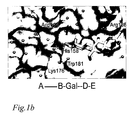
- Fig. 1. Schematic of the galectin carbohydrate recognition domain (CRD)(left) and carbohydrate binding sites (right)(Barondes et al., 1994; Leffler et al., 2004).
- the CRD is shown in face and side view with bound disaccharide symbolized by arrow or dot (left). It consists of two ß-sheets named S and F.
- S and F The concave side of the S-sheets forms a groove that can hold about a tetrasaccharide and has four subsites (A-D) with the defining galactose binding site as C, and a fifth subsite (E) outside the groove (top right).
- a bound LacNAc is shown on the S-beta sheet (bottom right) with extensions into subsite B and E.
- Pertinent amino acids in galectin-3 around subsite B are indicated in one letter code (grey).
- the subsites described in Fig. 1a are indicated below figure with Gal in site C.
- the arrows indicate spaces in site B targeted by derivatization on position 3 of the Gal (Sörme et al., 2002). Selected amino acids are named.
- the GlcNAc of the LacNAc is in site D.
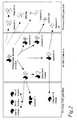
- Fig. 2 Mammalian galectins and their phylogeny from a prechordate ancestor (Houzelstein et al., 2004). All the CRDs are of either of two types (F4 and F3, black and grey respectively) defined by corresponding gene structure (intron-exon boundaries) and supported by their respective sequence relationships.
- the ancestral prechordate galectins include a bi-CRD galectin with one of each CRD type (most likely derived in much earlier evolution from duplication of a mono-CRD galectin). Large scale duplication of genome fragments in early chordate-vertebrate evolution give rise to the four major bi-CRD galectins found in mammals.
- X is S or O and Y is a phenyl or a carbonyl group.
- alkyl group is meant to comprise from 1 to 12 carbon atoms.
- Said alkyl group may be straight- or branched-chain.
- Said alkyl group may also form a cycle comprising from 3 to 12 carbon atoms.
- alkenyl group is meant to comprise from 2 to 12 carbon atoms. Said alkenyl group comprises at least one double bond.
- aryl group is meant to comprise from 4 to 18 carbon atoms.
- Said aryl group may be a phenyl group or a naphthyl group.
- alkoxy group is meant to comprise from 1 to 12 carbon atoms. Said alkoxy group may be a methoxy group or an ethoxy group.
- alkylamino group is meant to comprise from 1 to 12 carbon atoms.
- arylamino group is meant to comprise from 4 to 12 carbon atoms.
- Said “arylamino group” may be aniline, carboxylated aniline or halogenated aniline.
- aryloxy group is meant to comprise from 4 to 12 carbon atoms.
- Said “aryloxy group” may be phenol, carboxylated phenol or halogenated phenol.
- heteroaryl group is meant to comprise from 4 to 18 carbon atoms, wherein at least one atom of the ring is a heteroatom, i.e. not a carbon.
- said heteroatom is N, O or S.
- Said heteroaryl group may be a quinoline, isoquinoline, pyridine, a pyrrole, a furan or a thiophene group.
- the above-mentioned groups may naturally be substituted with any other known substituents within the art of organic chemistry.
- the groups may also be substituted with two or more of the substituents.
- substituents are halogen, alkoxy, nitro, sulfo, amino, hydroxy, and carbonyl groups.
- said compound is methyl 3-deoxy-3-(1 H -[1,2,3]-triazol-1-yl)-1-thio-ß-D-galactopyranoside (8), methyl 3-deoxy-3-(4-propyl-1 H -[1,2,3]-triazol-1-yl)-1-thio-ß-D-galactopyranoside (9), methyl 3-(4-methoxycarbonyl-1 H -[1,2,3]-triazol-1-yl)-3-deoxy-1-thio-ß-D-galactopyranoside (10), methyl 3-deoxy-3-(4-(1-hydroxy-1-cyclohexyl)-1 H -[1,2,3]-triazol-l-yl)-1-thio-ß-D-galactopyranoside (11), methyl 3-deoxy-3-(4-phenyl-1 H -[1,2,3]-triazol-1-yl)-1-thio-ß-D-galactopyr
- the present invention relates to the use of a compound according to the above-mentioned formula for the manufacture of a medicament for the treatment of any disorder relating to the binding of a galectin to receptors in a mammal.
- said galectin is galectin-3.
- the invention relates to the use of a compound according to the above-mentioned formula for the manufacture of a medicament for the treatment of a disorder being selected from the group consisting of inflammation, septic shock, cancer, and autoimmune diseases such as reumatoid artrit and multipel schlerosis.
- a disorder being selected from the group consisting of inflammation, septic shock, cancer, and autoimmune diseases such as reumatoid artrit and multipel schlerosis.
- said compound is for the manufacture of a medicament for the treatment of cancer.
- the present invention relates to a pharmaceutical composition
- a pharmaceutical composition comprising a compound according to the above-mentioned formula as active ingredient together with a pharmaceutically acceptable adjuvant, diluent, excepient or carrier.
- a pharmaceutical composition of the invention comprises from 1 to 99 weight % of a pharmaceutically acceptable adjuvant, diluent, excepient or carrier and from 1 to 99 weight % of a compound according to above mentioned formula.
- the invention relates to a method for inhibiting conditions associated with the binding of galectin to receptors in a mammal which method comprises administering to said mammal, an effective amount of a compound according to the above-mentioned formula.
- said galectin is galectin-3.
- the invention in another aspect, relates to a method for inhibiting conditions associated with the binding of galectin to receptors in a mammal, which method comprises administering to said mammal an effective amount of a pharmaceutical composition according to the above.
- said galectin is galectin-3.
- the pharmaceutical composition according to the present invention comprising a compound of the invention may be adapted for oral, intravenous, topical, intraperitoneal, nasal, buccal, sublingual, or subcutaneous administration, or for administration via the respiratory tract in the form of, for example, an aerosol or an air-suspended fine powder. Therefore, the pharmaceutical composition of the present invention may be in the form of, for example, tablets, capsules, powders, solutions, transdermal patches or suppositories.
- the pharmaceutical composition of the present invention may optionally comprise two or more compounds of the present invention.
- the composition may also be used together with other medicaments within the art for the treatment of related disorders.
- the typical dosages of the compounds of the present invention vary within a wide range and depend on many factors, such as the route of administration, the requirement of the individual in need of treatment, the individual's body weight, age and general condition.
- the adjuvants, diluents, excepients and/or carriers that may be used in the composition of the invention must be pharmaceutically acceptable in the sense of being compatible with the compounds and the other ingredients of the pharmaceutical composition, and not deleterious to the recipient thereof.
- the adjuvants, diluents, excepients and carriers that may be used in the pharmaceutical composition of the invention are well known to a person within the art.
- the 3-azido-galactoside derivative 1 was converted to the triazoles 2 and 7 by heating with the corresponding alkyne in toluene.
- Triazoles 3-6 were synthesized under Cu + catalysis (Torn ⁇ e et al., 2002), where the azide 1 was reacted with the appropriate alkynes in the presence of copper iodide (Scheme 1).
- Compounds 2-7 were deprotected by treatment with methanolic sodium methoxide or with methylamine in water to give the triazole inhibitors 8-13.
- the methyl ester 3 could simultaneously be de-O-acetylated and transformed into primary amides 14-18 by treatment with the corresponding primary amine in water or methanol (Scheme 2).
- a 3'-deoxy-3'-triazol-1-yl derivative of N -acetyllactosamine 21 was synthesized by reacting the corresponding 3'-azido derivative 19 with methyl propiolate under copper iodide catalysis to give the methyl ester 20, followed by simultaneous de- O -acetylation and methyl amide formation by treatment with methylamine in water.
- Scheme 3 :
- a 3,3'-bis-triazol-1-yl derivative of thiodigalactoside 26 was synthesized from the acetylated 3-azido-3-deoxy galactose 22 (Lowary and Hindsgaul, 1994). Compound 22 was subjected to methyl propiolate in the presence of copper iodide to give the triazole derivative 23. Bromination of 23 gave the labile ⁇ -D-galactopyranosyl bromide 24, which was immediately dimerized to the protected 3,3'-bis-triazol-1-yl thiodigalactoside derivative 25. Simultaneous de- O- acetylation and methyl amide formation of 25 by treatment with methylamine in water gave 26.
- phenyl (12), tosyl (13), butylamide (15), and benzyl amide (16) derivatives were unexpectedly powerful inhibitors with K d of 107-147 ⁇ M, which is 50-fold improvement in comparison with the reference inhibitor 27 and unprecedented within the field of monosaccharide-derived inhibitors of galectins.
- N-Acetyllactosamine is a better natural ligand to galectin-3 than galactose is.
- the 3'-triazol-1-yl N- acetyllactosamine compound 21 (K d 5.8 ⁇ M) was clearly better than the corresponding galactose compound 14 and than the standard reference inhibitor N -acetyllactosamine derivative 28.
- Compound 21 is as good inhibitor of galectin-3 as the reported best inhibitors (Sörme et al., 2002).
- Thiodigalactoside 29 is a well-known inhibitor with affinity for galectin-3 similar to that of N -acetyllactosamine. Hence, the 3,3'-bis-triazol-1-yl thiodigalactoside 26 (K d 150 nM) was also much better than the corresponding galactose compound 14 and than the standard reference inhibitors N- acetyllactosamine derivative 28 and thiodigalactoside 29.
- the unexpectedly high inhibitor potency of 21 and 26 against galectin-3 renders them suitable to be active components in pharmaceutical compositions targeting conditions where galectin-3 plays a pathogenic role.
- the bis-3,3'-[1,2,3]-triazol-1-yl-thiodigalactoside 26 is a valuable inhibitor in view of its unprecedented high affinity, efficient and economical synthesis, and expected longer in vivo half-life.
- the compounds of this invention may be prepared by the following general methods and procedures.
- the galectin-3 assays of this invention may be performed by the following general methods and procedures. It should be appreciated that where typical or preferred process conditions (e.g. reaction temperatures, times, molar ratios of reactants, solvents, pressures, pH etc) are given, other process conditions may also be used unless otherwise stated. Optimum reaction conditions may vary with the particular reactants, solvents used and pH etc., but such conditions can be determined by one skilled in the art by routine optimization procedures.
- NMR-spectra were recorded with a Bruker DRX-400 instrument. Chemical shifts are given in ppm, with reference to internal residual solvent peaks. Chemical shifts and coupling constants were obtained from 1 H-NMR and proton resonances were assigned from COSY experiments.
- High-resolution FAB mass spectra (HRMS) were recorded with a JEOL SX-120 instrument. Fluorescence polarization experiments were performed on a PolarStar instrument (BMG, Offenburg; Germany). Column chromatography was performed on SiO 2 (Matrex, 60 ⁇ , 35-70 ⁇ m, Grace Amicon) and TLC was carried out on SiO 2 60 F 254 (Merck) with detection under UV light and developed with aqueous sulfuric acid.
- Method A A mixture of methyl 2,4,6-tri-O-acetyl-3-azido-3-deoxy-1-thio-ß-D-galactopyranoside (Sörme et al., 2002) (10 mg, 0.028 mmol) and the corresponding acetylene (4 eq.) in toluene (1.5 mL) were heated at 100 °C for 12 h. After evaporation of the solvent, the product was purified by column chromatography using the eluent indicated.
- Method B A mixture of methyl 2,4,6-tri-O-acetyl-3-azido-3-deoxy-1-thio-ß-D-galactopyranoside (Sörme et al., 2002) (10 mg, 0.028 mmol), the acetylene derivative (1 eq.), copper iodide (0.5 mg, 0.1 eq.), diisopropylethylamine (1 eq.) and toluene (1 mL) were stirred for (t) time at (T) temperature. The solvent was evaporated and the product was purified by column chromatography using the eluent indicated.
- the protected sugar (10 mg) was dissolved in methylamine (40% solution in water, 2 mL) and stirred overnight. After this time, the mixture was evaporated and the product was purified by column chromatography.
- the ester 4 (10 mg, 0.023 mmol) was stirred with the amine (x, 0.25 mL) in water or methanol (1.0 mL) for (t) time and at (T) temperature.
- the residue obtained after the evaporation of the solvent was purified by column chromatography using the eluent indicated.
- the fluorescence was measured from above in 96 well microtiter plates (black polystyrene, Costar, Corning, NY) using a PolarStar instrument (BMG, Offenburg; Germany). Control wells containing only fluorescent probe or fluorescein were included. All dilutions and measurements were done in PBS.
- galectin-3 in enhancement of the inflammatory response.
- galectin-3 was found to be chemotactic to macrophages and monocytes, both in vitro and in vivo.
- lactose or the isolated CRD of galectin-3 able to bind the same saccharide receptor as galectin-3 but not cross link it (see below), acted as inhibitors of this response.
- the substances described in the present invention would be much more effective as inhibitors of the above mentioned responses than lactose because they are much more potent galectin-3 inhibitors. They would also be much more useful in vivo than lactose and the galectin-3C because they are small molecules, more hydrophobic and probably more stable to degradation.
- galectin-3 results in faster tumor growth and more metastasis (Bresalier et al., 1998; reviewed by Leffler, 2001 and Takenaka et al in Leffler (editor), 2004b). Injection of a saccharide with inhibitory potency to galectin-3, but perhaps also other proteins, was reported to diminish prostate cancer in rat (Pienta et al., 1995). Hence, potent small-molecule inhibitors of galectin-3 are expected to have similar anticancer effects as galectin-3C (John et al. , 2003).
Landscapes
- Health & Medical Sciences (AREA)
- Chemical & Material Sciences (AREA)
- Organic Chemistry (AREA)
- General Health & Medical Sciences (AREA)
- Life Sciences & Earth Sciences (AREA)
- Veterinary Medicine (AREA)
- Nuclear Medicine, Radiotherapy & Molecular Imaging (AREA)
- Pharmacology & Pharmacy (AREA)
- Medicinal Chemistry (AREA)
- Animal Behavior & Ethology (AREA)
- General Chemical & Material Sciences (AREA)
- Public Health (AREA)
- Chemical Kinetics & Catalysis (AREA)
- Engineering & Computer Science (AREA)
- Rheumatology (AREA)
- Biochemistry (AREA)
- Biotechnology (AREA)
- Genetics & Genomics (AREA)
- Molecular Biology (AREA)
- Pain & Pain Management (AREA)
- Immunology (AREA)
- Orthopedic Medicine & Surgery (AREA)
- Bioinformatics & Cheminformatics (AREA)
- Physical Education & Sports Medicine (AREA)
- Pharmaceuticals Containing Other Organic And Inorganic Compounds (AREA)
Applications Claiming Priority (2)
| Application Number | Priority Date | Filing Date | Title |
|---|---|---|---|
| SE0401301A SE0401301D0 (sv) | 2004-05-21 | 2004-05-21 | Novel 3-triazolyl-galactoside inhibitors of galectins |
| EP05741932.7A EP1751172B1 (fr) | 2004-05-21 | 2005-05-23 | Nouveaux inhibiteurs de galectines contenant 3-triazolyl-galactoside |
Related Parent Applications (1)
| Application Number | Title | Priority Date | Filing Date |
|---|---|---|---|
| EP05741932.7A Division EP1751172B1 (fr) | 2004-05-21 | 2005-05-23 | Nouveaux inhibiteurs de galectines contenant 3-triazolyl-galactoside |
Publications (1)
| Publication Number | Publication Date |
|---|---|
| EP2805961A1 true EP2805961A1 (fr) | 2014-11-26 |
Family
ID=32589764
Family Applications (2)
| Application Number | Title | Priority Date | Filing Date |
|---|---|---|---|
| EP14174953.1A Withdrawn EP2805961A1 (fr) | 2004-05-21 | 2005-05-23 | Nouveaux inhibiteurs 3-triazolyl-galactoside de galectines |
| EP05741932.7A Expired - Lifetime EP1751172B1 (fr) | 2004-05-21 | 2005-05-23 | Nouveaux inhibiteurs de galectines contenant 3-triazolyl-galactoside |
Family Applications After (1)
| Application Number | Title | Priority Date | Filing Date |
|---|---|---|---|
| EP05741932.7A Expired - Lifetime EP1751172B1 (fr) | 2004-05-21 | 2005-05-23 | Nouveaux inhibiteurs de galectines contenant 3-triazolyl-galactoside |
Country Status (6)
| Country | Link |
|---|---|
| US (1) | US7700763B2 (fr) |
| EP (2) | EP2805961A1 (fr) |
| CA (2) | CA2567700C (fr) |
| ES (1) | ES2512501T3 (fr) |
| SE (1) | SE0401301D0 (fr) |
| WO (1) | WO2005113569A1 (fr) |
Families Citing this family (57)
| Publication number | Priority date | Publication date | Assignee | Title |
|---|---|---|---|---|
| JP5289757B2 (ja) * | 2007-12-13 | 2013-09-11 | ルネサスエレクトロニクス株式会社 | 液晶表示装置、データ駆動ic、及び液晶表示パネル駆動方法 |
| US8697862B2 (en) | 2008-05-16 | 2014-04-15 | Galecto Biotech Ab | Synthesis of galactoside inhibitors |
| ES2652488T3 (es) * | 2009-04-28 | 2018-02-02 | Galecto Biotech Ab | Nuevos inhibidores de galactósidos de galectinas |
| US9243021B2 (en) | 2012-10-31 | 2016-01-26 | Galecto Biotech Ab | Galactoside inhibitor of galectins |
| CN102276673B (zh) * | 2011-06-21 | 2014-12-24 | 中国科学院成都生物研究所 | 一种2-脱氧-β-D-吡喃葡萄糖基三唑类化合物的制备方法 |
| EP2620443A1 (fr) | 2012-01-25 | 2013-07-31 | Galecto Biotech AB | Nouveaux inhibiteurs de galectines au galactoside |
| FR2990208A1 (fr) * | 2012-05-07 | 2013-11-08 | Centre Nat Rech Scient | Derives de nucleosides, produits et compositions les comprenant, leurs utilisations therapeutiques et leurs procedes de synthese |
| JP6415437B2 (ja) | 2012-09-17 | 2018-10-31 | ガレクティン・セラピューティクス・インコーポレイテッドGalectin Therapeutics, Inc. | 癌の処置における特異的免疫療法を向上する方法 |
| KR102231732B1 (ko) | 2012-10-10 | 2021-03-23 | 갈렉틴 테라퓨틱스, 인크. | 당뇨병성 신장병증 및 관련 질환의 치료를 위한 갈락토스 갈래의 탄수화물 화합물 |
| IN2015DN02573A (fr) | 2012-10-31 | 2015-09-11 | Galecto Biotech Ab | |
| EP2919802A4 (fr) * | 2012-11-15 | 2016-09-14 | Univ Tufts | Méthodes, compositions et kits de traitement, de modulation ou de prévention de l'angiogenèse ou de la fibrose oculaire chez un sujet utilisant un inhibiteur de galectine |
| JP2016507503A (ja) | 2012-12-20 | 2016-03-10 | ヘンリー フォード ヘルス システム | ガレクチン−3を阻害することによる拡張期心不全を治療する方法 |
| US12390486B2 (en) | 2012-12-20 | 2025-08-19 | Henry Ford Health System | Method for treating diastolic heart failure by inhibiting galectin-3 |
| JP6735680B2 (ja) * | 2014-07-09 | 2020-08-05 | ガレクト バイオテック エービー | ガレクチンの新規ハイブリッドガラクトシド阻害剤 |
| CN104530163B (zh) * | 2014-12-08 | 2017-08-22 | 华东理工大学 | 三氮唑糖脂类衍生物及其协同抗耐药菌的用途 |
| WO2016113335A1 (fr) | 2015-01-16 | 2016-07-21 | Galecto Biotech Ab | Nouvel inhibiteur galactoside de galectines |
| CA2970062C (fr) * | 2015-01-30 | 2023-02-28 | Galecto Biotech Ab | Inhibiteurs alpha-d-galactoside de galectines |
| CN104817605B (zh) * | 2015-04-14 | 2017-09-08 | 湖北工程学院 | 2‑(1’,2’,3’‑三氮唑‑4’‑氧苄基)‑1,3,4,6‑o‑乙酰基‑d‑葡萄糖及其制备方法和应用 |
| CN104945456B (zh) * | 2015-06-04 | 2018-01-05 | 湖北工程学院 | 2‑(1’,2’,3’‑三氮唑‑4’‑氧亚甲基吡啶)‑1,3,4,6‑o‑乙酰基‑d‑葡萄糖及其制备方法和应用 |
| CN104945457B (zh) * | 2015-06-10 | 2018-03-23 | 湖北工程学院 | 1‑(1’,3’,4’,6’–四‑O‑ 乙酰基‑α/β‑D‑葡萄吡喃糖)‑4‑对位取代芳基‑[1, 2, 3]‑三唑及其制备方法和应用 |
| CA3000924A1 (fr) * | 2015-11-09 | 2017-05-18 | Galecto Biotech Ab | Nouveaux inhibiteurs galactosides de galectines |
| US20190367552A1 (en) * | 2016-03-04 | 2019-12-05 | Galectin Sciences, Llc | Selenogalactoside compounds for the prevention and treatment of diseases associated with galectin and the use thereof |
| CN109563120B (zh) * | 2016-07-12 | 2022-12-02 | 格莱克特生物技术公司 | 半乳糖凝集素的α-D-半乳糖苷抑制剂 |
| CN109563119A (zh) * | 2016-07-12 | 2019-04-02 | 格莱克特生物技术公司 | 半乳糖凝集素的α-D-半乳糖苷抑制剂 |
| KR102626669B1 (ko) * | 2017-05-12 | 2024-01-17 | 갈랙틴 사이언시즈, 엘엘씨 | 질환의 예방 및 치료를 위한 화합물 및 이의 용도 |
| CA3062649A1 (fr) * | 2017-05-12 | 2018-11-15 | Galectin Sciences, Llc | Composes pour le traitement de troubles de la resistance systemique a l'insuline et leur utilisation |
| US11267811B2 (en) | 2017-09-27 | 2022-03-08 | Bristol-Myers Squibb Company | Small molecule inhibitors of galectin-3 |
| WO2019075045A1 (fr) | 2017-10-11 | 2019-04-18 | Bristol-Myers Squibb Company | Inhibiteurs à petites molécules de galectine-3 |
| US11548908B2 (en) | 2017-12-29 | 2023-01-10 | Glycomimetics, Inc. | Heterobifunctional inhibitors of E-selectin and galectin-3 |
| CN111699193A (zh) | 2018-01-10 | 2020-09-22 | 格莱克特生物技术公司 | 新型半乳糖苷类半乳凝素抑制剂 |
| EP3807290B1 (fr) | 2018-06-15 | 2022-03-30 | Bristol-Myers Squibb Company | Mimétiques de thiodisaccharides à base de tétrahydropyrane en tant qu'inhibiteurs de galectine-3 |
| CA3102155A1 (fr) | 2018-06-29 | 2020-01-02 | Glykos Biomedical Oy | Conjugues |
| CN113366007A (zh) | 2018-10-15 | 2021-09-07 | 格莱克特生物技术公司 | 半乳糖凝集素的半乳糖苷抑制剂 |
| CN113286632A (zh) | 2018-10-15 | 2021-08-20 | 格莱克特生物技术公司 | 半乳糖凝集素的半乳糖苷抑制剂前药 |
| US11447517B2 (en) | 2018-11-21 | 2022-09-20 | Galecto Biotech Ab | Galactoside inhibitor of galectins |
| WO2020117883A1 (fr) | 2018-12-06 | 2020-06-11 | Bristol-Myers Squibb Company | Inhibiteurs à petites molécules de la galectine-3 |
| US11845771B2 (en) | 2018-12-27 | 2023-12-19 | Glycomimetics, Inc. | Heterobifunctional inhibitors of E-selectin and galectin-3 |
| JP7547345B2 (ja) | 2018-12-27 | 2024-09-09 | グリコミメティクス, インコーポレイテッド | ガレクチン-3阻害性c-グリコシド |
| EP3947407B1 (fr) | 2019-03-26 | 2024-06-12 | Bristol-Myers Squibb Company | Inhibiteurs molecules petites de la galectin-3 |
| US12269819B2 (en) | 2019-04-10 | 2025-04-08 | Bristol-Myers Squibb Company | Small molecule inhibitors of Galectin-3 |
| EP3983423A4 (fr) | 2019-06-14 | 2023-07-19 | Université Laval | Synthèse de 3-azido-3-désoxy-d-galactopyranose |
| JP2022537737A (ja) * | 2019-06-24 | 2022-08-29 | ガレクト バイオテック エービー | 3,3’-ジデオキシ-3,3’-ビス-[4-(3-フルオロフェニル)-1h-1,2,3-トリアゾル-1-イル]-1,1’-スルファンジイル-ジ-ベータ-d-ガラクトピラノシドの大規模方法 |
| JP7674276B2 (ja) * | 2019-07-03 | 2025-05-09 | ガレクト バイオテック エービー | ガレクチンの新規なガラクトシド阻害剤 |
| WO2021001538A1 (fr) | 2019-07-03 | 2021-01-07 | Galecto Biotech Ab | Nouvel inhibiteur de galectines du type galactoside |
| CA3143078A1 (fr) | 2019-07-05 | 2021-01-14 | Galecto Biotech Ab | Nouvel inhibiteur galactoside de galectines |
| US12404295B2 (en) | 2019-08-09 | 2025-09-02 | Idorsia Pharmaceuticals Ltd | (Hetero)aryl-methyl-thio-beta-D-galactopyranoside derivatives |
| KR102863667B1 (ko) | 2019-08-09 | 2025-09-23 | 이도르시아 파마슈티컬스 리미티드 | (2-아세트아미딜)티오-베타-d-갈락토피라노시드 유도체 |
| MA56883B1 (fr) | 2019-08-15 | 2025-04-30 | Idorsia Pharmaceuticals Ltd | Dérivés de 2-hydroxycycloalcane-1-carbamoyle |
| CN114585619B (zh) | 2019-08-29 | 2024-09-27 | 爱杜西亚药品有限公司 | α-D-吡喃半乳糖苷衍生物 |
| US20230038373A1 (en) | 2019-12-18 | 2023-02-09 | Glykos Biomedical Oy | Stabile conjugate |
| US12275720B2 (en) | 2020-05-05 | 2025-04-15 | Bristol-Myers Squibb Company | Small molecule inhibitors of galectin-3 |
| WO2021231243A1 (fr) | 2020-05-11 | 2021-11-18 | Bristol-Myers Squibb Company | Inhibiteurs à petites molécules de galectine-3 |
| CN115768768A (zh) | 2020-05-28 | 2023-03-07 | 百时美施贵宝公司 | 半乳凝素-3抑制剂 |
| WO2022073969A1 (fr) | 2020-10-06 | 2022-04-14 | Idorsia Pharmaceuticals Ltd | Dérivés spiro d'alpha-d-galactopyranosides |
| US12291520B2 (en) | 2020-11-02 | 2025-05-06 | Idorsia Pharmaceuticals Ltd | Galectin-3 inhibiting 2-hydroxycycloalkane-1-carbamoyl derivatives |
| JP7844491B2 (ja) | 2021-02-09 | 2026-04-13 | イドルシア・ファーマシューティカルズ・リミテッド | ヒドロキシヘテロシクロアルカン-カルバモイル誘導体 |
| WO2022184755A1 (fr) | 2021-03-03 | 2022-09-09 | Idorsia Pharmaceuticals Ltd | Dérivés d'alpha-d-galactopyranoside substitués par triazolyl-méthyle |
Citations (1)
| Publication number | Priority date | Publication date | Assignee | Title |
|---|---|---|---|---|
| WO2002057284A1 (fr) * | 2001-01-22 | 2002-07-25 | Ulf Nilsson | Nouveaux inhibiteurs contre la galectine |
Family Cites Families (4)
| Publication number | Priority date | Publication date | Assignee | Title |
|---|---|---|---|---|
| JPH05247078A (ja) * | 1992-03-03 | 1993-09-24 | Japan Tobacco Inc | 糖化合物、シアル酸含有糖鎖類生合成阻害剤、その製造方法、並びに新規な中間体 |
| AU5065399A (en) * | 1998-08-06 | 2000-02-28 | Teijin Limited | Pharmaceutical composition having inhibitory effect on overproduction and accumulation of extracellular matrix |
| US20060148712A1 (en) * | 2000-03-13 | 2006-07-06 | Fu-Tong Liu | Monocyte chemoattractant activity of galectin-3 |
| US7186681B2 (en) * | 2000-03-13 | 2007-03-06 | La Jolla Institute For Allergy And Immunology | Methods of modulating cell migration using galectin-3 |
-
2004
- 2004-05-21 SE SE0401301A patent/SE0401301D0/xx unknown
-
2005
- 2005-05-23 EP EP14174953.1A patent/EP2805961A1/fr not_active Withdrawn
- 2005-05-23 CA CA2567700A patent/CA2567700C/fr not_active Expired - Fee Related
- 2005-05-23 CA CA2826538A patent/CA2826538A1/fr not_active Abandoned
- 2005-05-23 EP EP05741932.7A patent/EP1751172B1/fr not_active Expired - Lifetime
- 2005-05-23 ES ES05741932.7T patent/ES2512501T3/es not_active Expired - Lifetime
- 2005-05-23 WO PCT/SE2005/000766 patent/WO2005113569A1/fr not_active Ceased
-
2006
- 2006-11-20 US US11/561,465 patent/US7700763B2/en not_active Expired - Fee Related
Patent Citations (1)
| Publication number | Priority date | Publication date | Assignee | Title |
|---|---|---|---|---|
| WO2002057284A1 (fr) * | 2001-01-22 | 2002-07-25 | Ulf Nilsson | Nouveaux inhibiteurs contre la galectine |
Non-Patent Citations (40)
| Title |
|---|
| "Glycoconj. J.", vol. 19, 2004, article "Special Issue on Galectins", pages: 433 - 638 |
| AHMAD, N.; GABIUS, H. J.; ANDRE, S.; KALTNER, H.; SABESAN, S.; ROY, R.; LIU, B.; MACALUSO, F.; BREWER, C. F.: "Galectin-3 precipitates as a pentamer with synthetic multivalent carbohydrates and forms heterogeneous cross-linked complexes", J. BIOL. CHEM., vol. 279, 2004, pages 10841 - 10847 |
| ALMKVIST, J.; FALDT, J.; DAHLGREN, C.; LEFFLER, H.; KARLSSON, A.: "Lipopolysaccharide- induced gelatinase granule mobilization primes neutrophils for activation by galectin-3 and f-Met-Leu-Phe", INFECT. IMMUN., vol. 69, 2001, pages 832 - 837 |
| ANDRE, S.; KALTNER, H.; FURUIKE, T.; NISHIMURA, S.-I.; GABIUS, H.-J.: "Persubstituted Cyclodextrin-Based Glycoclusters as Inhibitors of Protein-Carbohydrate Recognition Using Purified Plant and Mammalian Lectins and Wild-Type and Lectin-Gene-Transfected Tumor Cells as Targets", BIOCONJ. CHEM., vol. 15, 2004, pages 87 - 98 |
| ANDRE, S.; ORTEGA, P. J. C.; PEREZ, M. A.; ROY, R.; GABIUS, H.-J.: "Lactose-containing starburst dendrimers: influence of dendrimer generation and binding-site orientation of receptors (plant/animal -lectins and immunoglobulins) on binding properties", GLYCOBIOLOGY, vol. 11, 1999, pages 1253 - 1262 |
| ARNUSCH, C. J.; ANDRÉ, S.; VALENTINI, P.; LENSCH, M.; RUSSWURM, R.; SIEBERT, H.-C.; FISCHER, M. J. E.; GABIUS, H.-J.; PIETERS, R.: "Interference of the galactose-dependent binding of lectins by novel pentapeptide ligands", BIOORG. MED. CHEM. LETT., vol. 14, 2004, pages 1437 - 1440 |
| BARONDES, S. H.; COOPER, D. N. W.; GITT, M. A.; LEFFLER, H.: "Galectins. Structure and function of a large family of animal lectins", J. BIOL. CHEM., vol. 269, 1994, pages 20807 - 20810 |
| BRESALIER, R. S.; MAZUREK, N.; STERNBERG, L. R.; BYRD, J. C.; YUNKER, C. K.; NANGIA-MAKKER, P.; RAZ, A.: "Metastasis of human colon cancer is altered by modifying expression of the beta-galactoside-binding protein galectin 3", GASTROENTEROLOGY, vol. 115, 1998, pages 287 - 296 |
| BREWER, C. F.; MICELI, M. C.; BAUM, L. G.: "Clusters, bundles, arrays and lattices: novel mechanisms for lectin-saccharide-mediated cellular interactions", CURR. OPIN. STRUCT. BIOL., vol. 12, 2002, pages 616 - 623 |
| DAVID, A.; KOPECKOVÁ, P.; MINKO, T.; RUBINSTEIN, A.; KOPECEK, J.: "Design of a multivalent galactoside ligand for selective targeting of HPMA copolymer-doxorubicin conjugates to human colon cancer cells", EUR. J. CANCER, vol. 40, 2004, pages 148 - 157 |
| GLINSKY, G. V.; PRICE, J. E.; GLINSKY, V. V.; MOSSINE, V. V.; KIRIAKOVA, G.; METCALF, J. B.: "Inhibition of human breast cancer metastasis in nude mice by synthetic glycoamines", CANCER RES., vol. 56, 1996, pages 5319 - 5324 |
| HOUZELSTEIN, D.; GONCALVES, I. R.; FADDEN, A. J.; SIDHU, S. S.; COOPER, D. N.; DRICKAMER, K.; LEFFLER, H.; POIRIER, F.: "Phylogenetic Analysis of the Vertebrate Galectin Family", MOL. BIOL. EVOL., 2004 |
| HSU, D. K.; YANG, R. Y.; PAN, Z.; YU, L.; SALOMON, D. R.; FUNG-LEUNG, W. P.; LIU, F. T.: "Targeted disruption of the galectin-3 gene results in attenuated peritoneal inflammatory responses", AM. J. PATHOL., vol. 156, 2000, pages 1073 - 1083 |
| HUFLEJT ME; MOSSINE VV; NAIDENKO 0; JAZAYERI M; ROGERS P; TINARI N; IACOBELLI S; ELLIOT, M.; LUSTGARTEN J; CROFT, M.: "Synthetic lactulose amines bind tumor-promoting galectins -1 and -4, and inhibit breast cancers in Her-2/neu transgenic mice.", 24TH ANNUAL SAN ANTONIO BREAST CANCER SYMPOSIUM, 2001 |
| HUFLEJT, M. E.; LEFFLER, H.: "Galectin-4 in normal tissues and cancer", GLYCOCONJ. J., vol. 20, 2004, pages 247 - 255 |
| JOHN, C. M.; LEFFLER, H.; KAHL-KNUTSSON, B.; SVENSSON, I.; JARVIS, G. A.: "Truncated Galectin-3 Inhibits Tumor Growth and Metastasis in Orthotopic Nude Mouse Model of Human Breast Cancer", CLIN. CANCER RES., vol. 9, 2003, pages 2374 - 2383 |
| KARIMA, R.; MATSUMOTO, S.; HIGAHSI, H.; MATSUSHIMA, K.: "The molecular pathogenesis of Endotoxic Shock and Organ Failure", MOLECULAR MEDICINE TODAY, vol. 5, 1999, pages 123 - 132 |
| KARLSSON, A.; FOLLIN, P; LEFFLER, H.; DAHLGREN, C.: "Galectin-3 activates the NADPH-oxidase in exudated but not peripheral blood neutrophils", BLOOD, vol. 91, 1998, pages 3430 - 3438 |
| LEFFLER, H.: "Galectins Structure and_Function -- A Synopsis in Mammalian Carbohydrate Recognition Systems", 2001, SPRINGER VERLAG, pages: 57 - 83 |
| LEFFLER, H.; BARONDES, S. H.: "Specificity of binding of three soluble rat lung lectins to substituted and unsubstituted mammalian beta-galactosides", J. BIOL. CHEM., vol. 261, 1986, pages 10119 - 10126 |
| LEFFLER, H.; CARLSSON, S.; HEDLUND, M.; QIAN, Y.; POIRIER, F.: "Introduction to galectins", GLYCOCONJ. J., vol. 19, 2004, pages 433 - 440 |
| LOBSANOV, Y. D.; RINI, J. M.: "Galectin Structure", TRENDS. GLYCOSCI. GLYCOTECH., vol. 45, 1997, pages 145 - 154 |
| LOWARY, T. L.; HINDSGAUL, 0.: "Recognition of synthetic O-methyl, epimeric, and amino analogues of the acceptor ?-L-Fucp-(1-2)-?-D-Galp-OR by the blood-group A and B gene-specified glycosyltransferases", CARBOHYDR. RES., vol. 251, 1994, pages 33 - 67 |
| MASSA, S. M.; COOPER, D. N. W.; LEFFLER, H.; BARONDES, S. H.: "L-29, an endogenous lectin, binds to glycoconjugate ligands with positive cooperativity", BIOCHEMISTRY, vol. 32, 1993, pages 260 - 267 |
| NAIDENKO, 0.; KRONENBERG, M.; GLINSKY, G.; HUFLEJT, M.E.: "Interaction of galectins with low molecular weight lactosylaminoconjugates", GLYCOBIOLOGY 10:ABSTRACT 60, 2000 |
| NANGIA-MAKKER, P.; HOGAN, V.; HONJO, Y.; BACCARINI, S.; TAIT, L.; BRESALIER, R.; RAZ, A.: "Inhibition of human cancer cell growth and metastasis in nude mice by oral intake of modified citrus pectin", J. NATL. CANCER INST., vol. 94, 2002, pages 1854 - 1862 |
| PIENTA, K. J.; NAIK, H.; AKHTAR, A.; YAMAZAKI, K.; REPLOGLE, T. S.; LEHR, J.; DONAT, T. L.; TAIT, L.; HOGAN, V.; RAZ, A.: "Inhibition of spontaneous metastasis in a rat prostate cancer model by oral administration of modified citrus pectin", J. NATL. CANCER INST., vol. 87, 1995, pages 348 - 353 |
| PLATT, D.; RAZ, A., J. NATL. CANCER. INST., vol. 84, 1992, pages 438 - 442 |
| POHL, N. L.; KIESSLING, L. L.: "Scope of multivalent ligand function: Lactose-bearing neoglycopolymers by ring-opening metathesis polymerization", SYNTHESIS, 1999, pages 1515 - 1519 |
| POIRIER, F.: "Roles of galectins in vivo", BIOCHEM. SOC. SYMP., vol. 69, 2002, pages 95 - 103 |
| RUBINSTEIN, N.; ALVAREZ, M.; ZWIRNER, N. W.; TOSCANO, M. A.; ILARREGUI, J. M.; BRAVO, A.; MORDOH, J.; FAINBOIM, L.; PODHAJCER, 0.: "Targeted inhibition of galectin-1 gene expression in tumor cells results in heightened T cell-mediated rejection; A potential mechanism of tumor-immune privilege", CANCER CELL, vol. 5, 2004, pages 241 - 251 |
| SANO, H.; HSU, D. K.; YU, L.; APGAR, J. R.; KUWABARA, I.; YAMANAKA, T.; HIRASHIMA, M.; LIU, F. T.: "Human galectin-3 is a novel chemoattractant for monocytes and macrophages", J. IMMUNOL., vol. 165, 2000, pages 2156 - 2164 |
| SEETHARAMAN, J.; KANIGSBERG, A.; SLAABY, R.; LEFFLER, H.; BARONDES, S. H.; RINI, J. M.: "X-ray crystal structure of the human galectin-3 carbohydrate recognition domain at 2.1-A resolution", J. BIOL. CHEM., vol. 273, 1998, pages 13047 - 13052 |
| SÖRME, P.; KAHL-KNUTSSON, B.; HUFLEJT, M.; NILSSON, U. J.; LEFFLER H.: "Fluorescence polarization as an analytical tool to evaluate galectin-ligand interactions", ANAL. BIOCHEM., 2004 |
| SÖRME, P.; KAHL-KNUTSSON, B.; WELLMAR, U.; MAGNUSSON, B.-G.; LEFFLER H.; NILSSON, U. J.: "Design and synthesis of galectin inhibitors", METH. ENZYMOL., vol. 363, 2003, pages 157 - 169 |
| SORME, P.; KAHL-KNUTSSON, B.; WELLMAR, U.; NILSSON, U. J.; LEFFLER H.: "Fluorescence polarization to study galectin-ligand interactions", METH. ENZYMOL., vol. 362, 2003, pages 504 - 512 |
| SORME, P.; QIAN, Y.; NYHOLM, P.-G.; LEFFLER, H.; NILSSON, U. J.: "Low micromolar inhibitors of galectin-3 based on 3'-derivatization of N-acetyllactosamine", CHEMBIOCHEM, vol. 3, 2002, pages 183 - 189 |
| TORNOE, C. W.; CHRISTENSEN, C.; MELDAL, M.: "Peptidotriazoles on solid phase: [1,2,3]-Triazoles by regiospecific copper(I)-catalyzed 1,3-dipolar cycloaddition of terminal alkynes to azides", J. ORG. CHEM., vol. 67, 2002, pages 3057 - 3064 |
| TRAHEY, M.; WEISSMAN, I. L.: "Cyclophilin C-associated protein: a normal secreted glycoprotein that down-modulates endotoxin and proinflammatory responses in vivo", PROC. NATL. ACAD. SCI. U S A, vol. 96, 1999, pages 3006 - 3011 |
| VRASIDAS, I.; ANDRE, S.; VALENTINI, P.; BOCK, C.; LENSCH, M.; KALTNER, H.; LISKAMP, R. M. J.; GABIUS, H.-J.; PIETERS, R. J.: "Rigidified multivalent lactose molecules and their interactions with mammalian galectins: a route to selective inhibitors", ORG. BIOMOL. CHEM., vol. 1, 2003, pages 803 - 810 |
Also Published As
| Publication number | Publication date |
|---|---|
| CA2567700C (fr) | 2013-10-15 |
| EP1751172B1 (fr) | 2014-07-09 |
| ES2512501T3 (es) | 2014-10-24 |
| CA2567700A1 (fr) | 2005-12-01 |
| EP1751172A1 (fr) | 2007-02-14 |
| CA2826538A1 (fr) | 2005-12-01 |
| US7700763B2 (en) | 2010-04-20 |
| US20070185041A1 (en) | 2007-08-09 |
| SE0401301D0 (sv) | 2004-05-21 |
| WO2005113569A1 (fr) | 2005-12-01 |
Similar Documents
| Publication | Publication Date | Title |
|---|---|---|
| EP1751172B1 (fr) | Nouveaux inhibiteurs de galectines contenant 3-triazolyl-galactoside | |
| EP1751171B1 (fr) | Nouveaux inhibiteurs galactosides de galectines | |
| EP2424873B1 (fr) | Nouveaux inhibiteurs galactosides de galectines | |
| AU2002225564B2 (en) | New inhibitors against galectins | |
| EP2297174B1 (fr) | Synthèse inédite d'inhibiteurs à base de galactoside | |
| US10800804B2 (en) | Hybrid galactoside inhibitor of galectins | |
| EP2620443A1 (fr) | Nouveaux inhibiteurs de galectines au galactoside | |
| AU2002225564A1 (en) | New inhibitors against galectins |
Legal Events
| Date | Code | Title | Description |
|---|---|---|---|
| PUAI | Public reference made under article 153(3) epc to a published international application that has entered the european phase |
Free format text: ORIGINAL CODE: 0009012 |
|
| 17P | Request for examination filed |
Effective date: 20140630 |
|
| AC | Divisional application: reference to earlier application |
Ref document number: 1751172 Country of ref document: EP Kind code of ref document: P |
|
| AK | Designated contracting states |
Kind code of ref document: A1 Designated state(s): AT BE BG CH CY CZ DE DK EE ES FI FR GB GR HU IE IS IT LI LT LU MC NL PL PT RO SE SI SK TR |
|
| AX | Request for extension of the european patent |
Extension state: AL BA HR LV MK YU |
|
| R17P | Request for examination filed (corrected) |
Effective date: 20150518 |
|
| RBV | Designated contracting states (corrected) |
Designated state(s): AT BE BG CH CY CZ DE DK EE ES FI FR GB GR HU IE IS IT LI LT LU MC NL PL PT RO SE SI SK TR |
|
| 17Q | First examination report despatched |
Effective date: 20151124 |
|
| STAA | Information on the status of an ep patent application or granted ep patent |
Free format text: STATUS: THE APPLICATION IS DEEMED TO BE WITHDRAWN |
|
| 18D | Application deemed to be withdrawn |
Effective date: 20160607 |