EP2806576B1 - Verfahren und System für mehrfachen Zugriff auf drahtlose zellulare OFDM-Systeme unter Berücksichtigung von Raum und Frequenzbereichen - Google Patents
Verfahren und System für mehrfachen Zugriff auf drahtlose zellulare OFDM-Systeme unter Berücksichtigung von Raum und Frequenzbereichen Download PDFInfo
- Publication number
- EP2806576B1 EP2806576B1 EP13382186.8A EP13382186A EP2806576B1 EP 2806576 B1 EP2806576 B1 EP 2806576B1 EP 13382186 A EP13382186 A EP 13382186A EP 2806576 B1 EP2806576 B1 EP 2806576B1
- Authority
- EP
- European Patent Office
- Prior art keywords
- users
- frequency
- exp
- domain
- grid
- Prior art date
- Legal status (The legal status is an assumption and is not a legal conclusion. Google has not performed a legal analysis and makes no representation as to the accuracy of the status listed.)
- Active
Links
Images


Classifications
-
- H—ELECTRICITY
- H04—ELECTRIC COMMUNICATION TECHNIQUE
- H04B—TRANSMISSION
- H04B7/00—Radio transmission systems, i.e. using radiation field
- H04B7/02—Diversity systems; Multi-antenna system, i.e. transmission or reception using multiple antennas
- H04B7/04—Diversity systems; Multi-antenna system, i.e. transmission or reception using multiple antennas using two or more spaced independent antennas
- H04B7/0413—MIMO systems
-
- H—ELECTRICITY
- H01—ELECTRIC ELEMENTS
- H01Q—ANTENNAS, i.e. RADIO AERIALS
- H01Q1/00—Details of, or arrangements associated with, antennas
- H01Q1/12—Supports; Mounting means
- H01Q1/22—Supports; Mounting means by structural association with other equipment or articles
- H01Q1/24—Supports; Mounting means by structural association with other equipment or articles with receiving set
- H01Q1/241—Supports; Mounting means by structural association with other equipment or articles with receiving set used in mobile communications, e.g. GSM
- H01Q1/246—Supports; Mounting means by structural association with other equipment or articles with receiving set used in mobile communications, e.g. GSM specially adapted for base stations
-
- H—ELECTRICITY
- H01—ELECTRIC ELEMENTS
- H01Q—ANTENNAS, i.e. RADIO AERIALS
- H01Q21/00—Antenna arrays or systems
- H01Q21/06—Arrays of individually energised antenna units similarly polarised and spaced apart
- H01Q21/061—Two dimensional planar arrays
-
- H—ELECTRICITY
- H04—ELECTRIC COMMUNICATION TECHNIQUE
- H04B—TRANSMISSION
- H04B7/00—Radio transmission systems, i.e. using radiation field
- H04B7/02—Diversity systems; Multi-antenna system, i.e. transmission or reception using multiple antennas
- H04B7/04—Diversity systems; Multi-antenna system, i.e. transmission or reception using multiple antennas using two or more spaced independent antennas
- H04B7/0413—MIMO systems
- H04B7/0452—Multi-user MIMO systems
-
- H—ELECTRICITY
- H04—ELECTRIC COMMUNICATION TECHNIQUE
- H04B—TRANSMISSION
- H04B7/00—Radio transmission systems, i.e. using radiation field
- H04B7/02—Diversity systems; Multi-antenna system, i.e. transmission or reception using multiple antennas
- H04B7/04—Diversity systems; Multi-antenna system, i.e. transmission or reception using multiple antennas using two or more spaced independent antennas
- H04B7/06—Diversity systems; Multi-antenna system, i.e. transmission or reception using multiple antennas using two or more spaced independent antennas at the transmitting station
- H04B7/0613—Diversity systems; Multi-antenna system, i.e. transmission or reception using multiple antennas using two or more spaced independent antennas at the transmitting station using simultaneous transmission
- H04B7/0615—Diversity systems; Multi-antenna system, i.e. transmission or reception using multiple antennas using two or more spaced independent antennas at the transmitting station using simultaneous transmission of weighted versions of same signal
- H04B7/0617—Diversity systems; Multi-antenna system, i.e. transmission or reception using multiple antennas using two or more spaced independent antennas at the transmitting station using simultaneous transmission of weighted versions of same signal for beam forming
-
- H—ELECTRICITY
- H04—ELECTRIC COMMUNICATION TECHNIQUE
- H04L—TRANSMISSION OF DIGITAL INFORMATION, e.g. TELEGRAPHIC COMMUNICATION
- H04L27/00—Modulated-carrier systems
- H04L27/26—Systems using multi-frequency codes
- H04L27/2601—Multicarrier modulation systems
-
- H—ELECTRICITY
- H04—ELECTRIC COMMUNICATION TECHNIQUE
- H04L—TRANSMISSION OF DIGITAL INFORMATION, e.g. TELEGRAPHIC COMMUNICATION
- H04L5/00—Arrangements affording multiple use of the transmission path
- H04L5/0001—Arrangements for dividing the transmission path
- H04L5/0003—Two-dimensional division
Definitions
- the present invention generally relates to the field of multi-antenna technology in wireless cellular systems, and more particularly to a method and system for performing multiple access in wireless OFDM cellular systems considering both space and frequency domains.
- LTE Long-Term Evolution
- 3G systems which represents basically an evolution of the actual mobile communications standards, such as UMTS and GSM [1]. It is a 3GPP standard that provides throughputs up to 50 Mbps in uplink and up to 100 Mbps in downlink. It uses scalable bandwidth from 1.4 to 20 MHz in order to suit the needs of network operators that have different bandwidth allocations. LTE is also expected to improve spectral efficiency in networks, allowing carriers to provide more data and voice services over a given bandwidth.
- LTE-A LTE-Advanced
- IMT-Advanced an evolution of LTE, is being standardized in LTE Release 10 and beyond. It is aimed at fulfilling IMT-Advanced requirements, whose capabilities go beyond those of IMT-2000 and include enhanced peak data rates to support advanced services and applications (100 Mbps for high mobility, and 1 Gbps for low mobility) [2].
- MIMO multiple antenna technology
- LTE-Advanced foresees the use of up to eight transmit antennas at the base stations.
- massive MIMO systems are currently being investigated as future extensions of LTE-Advanced beyond Release 12 [5]. These systems comprise several hundreds of low-power antennas, where the degrees of freedom in excess allow for a variety of signal processing possibilities in transmission and reception. These large MIMO systems are currently subject to intense research.
- TRBF Time Reversal Beamforming
- TRBF techniques suffer the drawback of requiring a two-steps procedure comprising a probe mechanism followed by a time-reversal signal generation, thus requiring computationally expensive time-domain processing. Given the short time intervals currently present in modern cellular systems (as in LTE, with scheduling intervals of only 1 ms), beamforming procedures should not involve costly operations in time and processing power.
- US-A1-2009/232240 discloses a wireless communication mechanism for beamforming of a transmission signal.
- the method proposed by said US patent application generally includes receiving training signals transmitted from a device using a first set of transmit directions, deriving, from the first set of transmit directions, a preferred transmit direction, and providing, as feedback to the device, an indication of the preferred transmit direction to the device, wherein the feedback is provided by sweeping through a second set of transmit directions.
- CN-A-102412885 discloses a three-dimensional wave beam forming method in a Long Term evolution network comprising in which a base station adopts an array antenna structure, each antenna in the vertical direction having a port for wave beam forming; and a terminal receives a signal, performs channel estimation to acquire a three-dimensional (3D) channel matrix H and selects a horizontal-dimension precoding matrix and a vertical-dimension precoding matrix according to the H.
- 3D three-dimensional
- the terminal feeds a sequence numbers corresponding to a precoding matrixes to the base station, and the base station recovers the corresponding horizontal/vertical-dimension precoding matrixes according to the fed sequence numbers, and generates a 3D precoding matrix which is used to precode the sent signal to perform a 3D wave beam forming on the sent signal.
- EP-A2-2557700 discloses a transmission method and apparatus using a codebook in a wireless communication system supporting multiple antennas.
- Said method comprises transmitting, by a base station, a downlink signal using a plurality of transmission antennas comprises the steps of: receiving a PMI from a terminal; applying a precoding matrix indicated by the PMI in a codebook to a plurality of layers, and performing a precoding; and transmitting the precoded signal to the terminal through a plurality of transmission antennas.
- An object of the present invention is to provide a new mechanism to achieve orthogonal multiplexing of users in space and frequency domains through three-dimensional Discrete Fourier Transforms (DFT), by using large antenna arrays at the base stations and a proposed orthogonal space-frequency multiplexing technique, such that it is possible to address as many users as antennas are at the base station without suffering from undesired inter-user interference.
- DFT Discrete Fourier Transforms
- a method for performing multiple access in wireless OFDM cellular systems considering both space and frequency domains comprising at least one base station equipped with a large number of antennas according to a two-dimensional rectangular array and a number M of cell users, said rectangular array comprising N 1 antenna elements along one axis with a regular spacing d x and N 2 antenna elements along a perpendicular axis with a regular spacing d y , said cell users being characterized by angles ( ⁇ , ⁇ ) in a spherical coordinate system.
- the method of the first aspect comprises using an orthogonal space-frequency processing unit for:
- a scheduling strategy comprising assigning unused space and/or frequency resources to each one of the M cell users is performed by a combined space-frequency scheduler unit. According to some embodiments, preferably four different alternatives for performing said scheduling strategy can be carried out.
- the scheduling strategy can be performed by assigning orthogonal time-frequency resources to beams which are close to each other to avoid said interferences between the users' beams.
- the scheduling strategy can be performed by reserving guard beams in the (u, v) domain at some of the grid points between the cell coordinates of two or more cell users, in order to keep said interferences between the users' beams to a minimum.
- the scheduling strategy can be performed by assigning the same transmit signal to a plurality of grid points enclosing the cell user coordinates in the (u, v) domain and a number of guard beams for reduced interference in order to account inaccuracies when estimating the cell users' spherical angles ( ⁇ , ⁇ )
- the scheduling strategy can be performed by modifying the shape of the beam reconstruction functions by applying a windowing technique to the excitation coefficients in order to control the beams' decay rate and hence alleviate interference between the users' beams.
- the resolution of the grid in the (u, v) domain can be dynamically adjusted, by a grid resolution unit, so as to maximize the illumination, by considering only a subset of active antenna elements in the array. In this case, the spacing between antenna elements is maintained and the angular coverage of the antenna array is also kept.
- a system for performing multiple access in wireless OFDM cellular systems considering both space and frequency domains comprising at least one base station equipped with a large number of antennas according to a two-dimensional rectangular array and a number M of cell users, said rectangular array comprising N 1 antenna elements along one axis with a regular spacing d x and N 2 antenna elements along a perpendicular axis with a regular spacing d y , said cell users being characterized by suitable angles ( ⁇ , ⁇ ) in a spherical coordinate system.
- the system of the second aspect comprises an orthogonal space-frequency processing unit to achieve orthogonal multiple access comprising:
- the system of the second aspect comprises a combined space-frequency scheduler unit to perform space-frequency resource allocation strategies for each one of the M cell users.
- an angle detection unit related to said combined space-frequency scheduler unit is prepared for analyzing the signals received from said two-dimensional rectangular array in order to estimate the angles of arrival of said received signals.
- the system further comprises a grid resolution unit to adjust the resolution of the grid in the (u, v) domain according to a desired resolution angle by considering only a subset of active antenna elements in the array, in order to ensure orthogonality of a plurality of beams while maintaining the spacing between antenna elements and the angular coverage of the antenna array.
- Figure 1 illustrates the proposed idea of the present invention according to an aspect.
- a base station comprising a large number of antennas (in the form of a two-dimensional array) is aimed at transmitting a given number of signals to a set of M users, so that each user receives its intended signal (or set of intended signals) without interference to/from the other users.
- the proposed technique achieves orthogonality of the received beams at specific directions in space given by the angles ( ⁇ , ⁇ ) in a spherical coordinate system.
- the present invention is capable of generating a combined field with the fundamental property that no inter-user interference is ideally present, provided that the users preferably are located at known sampling points in a space grid.
- a combined space-time-frequency scheduler can allocate resources in the three orthogonal dimensions, and a unit providing a proposed orthogonal space-frequency processing technique provides the required excitations in downlink to a number of antennas at each time instant. Similarly, this technique can achieve orthogonal separation of users in uplink.
- a combined space-frequency orthogonal multiplexing technique generates a set of excitation amplitudes to the antenna elements in the array, with the property that all the radiated signals from the antennas are combined in such a way that each user receives the desired signals with ideally no interference from the other users.
- an inverse space-frequency processing technique achieves orthogonal separation of users in the uplink so that they can be scheduled the same time-frequency resources.
- Traditional beamforming techniques employ a given number of antennas in order to shape the desired radiation pattern intended for each user.
- the number of users than can be simultaneously served is thus limited by the fraction of the total number of antennas that each user requires for beamforming purposes. Inter-user interference will appear unless very sharp beams are generated, and this usually involves a large number of antennas per user therefore limiting the maximum number of simultaneous users to be addressed.
- this invention proposes a new technique capable of addressing as many users in the cell as antennas are in the base station, given that they are located at defined sampling points in a space grid.
- the attainable spectrum efficiency is therefore the maximum possible with a given number of antennas, as no other technique can yield higher spectrum efficiency per unit area.
- the proposed processing technique can be performed very efficiently through use of three-dimensional Fast Fourier Transforms (FFTs).
- FFTs Fast Fourier Transforms
- combined space-frequency resource allocation strategies can be integrated into the base station scheduler, therefore maximizing the cell spectrum efficiency per unit area.
- sampling grid can be dynamically adjusted through selection of a subset of the active antenna elements in the array, therefore varying the beam width and resolution according to the interests in each scenario. Moving users can be better served with a lower space resolution than users in static conditions, and the system can dynamically adapt to the general situation in the cell.
- FIG. 2 illustrates the scenario for the proposed invention.
- a cell site in a wireless cellular system comprises a base station equipped with a large number of identical transmit antennas, in the form of a two-dimensional antenna array with N antenna elements, and M users (each having a single antenna) willing to simultaneously transmit/receive at certain time-frequency resources allocated by the base station.
- OFDM Orthogonal Frequency-Division Multiplexing
- angles can be estimated in different ways through appropriate processing of uplink signals coming from the users, by exploiting the long-term reciprocity characteristics of uplink and downlink. Long-term channel reciprocity can be exploited in both Time Division Duplex (TDD) and Frequency Division Duplex (FDD) systems.
- TDD Time Division Duplex
- FDD Frequency Division Duplex
- AOA Angle of Arrival
- AOD Angle of Departure
- the AOA can be estimated through uplink sounding and used later as a measure of AOD.
- An aim of the present invention is to address the desired number of users by employing the minimum set of time-frequency resources, through appropriate excitation of the transmit antennas at the base station. Contrary to traditional beamforming techniques, where different spatial beams are independently generated so as to favour specific directions in space, the present invention proposes a space-frequency signal processing technique whereby the combined reception of the signals coming from all the transmit antennas will yield the desired results at particular points in space. Rather than generating independent beams in several directions, a combined field pattern will yield the desired signals when sampled at the particular directions in space where the users are supposed to be located.
- the users may have more than one receive antenna for increased receive diversity, but for the purpose of the present invention this will be equivalent to a single-antenna scenario as additional receive antennas will be transparent to the system.
- Figure 3 illustrates the antenna array configuration at the base station for applicability of the present invention.
- the antenna array is located in an XY plane; those skilled in the art will easily apply the results described here to any other coordinate axes.
- a number of N 1 x N 2 identical antenna elements are arranged in a rectangular grid, with N 1 elements along the x axis and N 2 elements along the y axis, each of the elements having a defined radiation pattern as usually employed in cellular systems for sector coverage.
- the physical separation between antennas is denoted as d x along the X dimension and d y along the Y dimension.
- Each antenna element will be excited by a different signal a nm which in general will be a function of time and frequency.
- the above equation has the form of a Fourier transform of the sequence of excitation elements a nm (with a sign reversal), where the role of the time domain is played by the normalized dimensions x / ⁇ and y / ⁇ , and the role of the frequency domain is played by the angles ⁇ , ⁇ .
- the visible margins will comprise those (u, v) values included within the circumferences for each value of ⁇ .
- the Array Factor is a continuous function of the variables u and v , in this invention it is proposed to sample it in the (u, v) domain for suitable digital processing while attaining the fundamental characteristics of the radiation pattern.
- sampling periods in u and v are chosen such that the Nyquist sampling criterion is obeyed.
- the Nyquist criterion dictates that the sampling period in one domain must be at most equal to the inverse of the overall "length" in the other domain [4].
- IDFT Inverse Discrete Fourier Transform
- the visible region will additionally comprise the (u, v) values inside the unit circle, as illustrated in Figure 4 .
- the proposed method allows for obtaining suitable time-domain signals to be applied over a number of antennas, giving rise to orthogonal space-frequency multiplexing of users. It also provides the frequency contents of the signals transmitted in uplink with ideally no inter-user interference.
- the users are perfectly located (and known) at positions given by a set of angles ( ⁇ , ⁇ ), and corresponding directional cosines (u, v), that coincide with a pre-defined grid.
- the users will not be located precisely at those coordinates and some inter-beam interference will appear.
- a suitable joint scheduling strategy involving space and frequency resources can be exploited in such a way that inter-user interference is minimized, at the cost of introducing unused space-frequency resources that serve as guard beams.
- massive MIMO systems comprising a large number of antennas this can be considered a minor drawback, as usually not all space-frequency resources will be exploited.
- the sampling at points other than the centre of the beams results in inter-beam interference and therefore inter-user interference.
- four solutions are proposed to cope with it: For instance, according to the first alternative, if there are several users whose (u, v) beams are close to each other, the scheduler in the base station can avoid inter-user interference by allocating different time-frequency resources to each of them.
- the reconstruction formula in the ( ⁇ , ⁇ ) domain will comprise a set of sinc-shaped beams with a (1/x) decay profile (more exactly, Dirichlet-shaped [4]), which after a number of guard beams will result in negligible interference.
- the same desired signal to a set of grid points enclosing the intended user coordinates, in addition to a number of guard beams for reduced interference, in order to account for inaccuracies in the angle estimation.
- the received beam will essentially contain the desired symbol with no interference if the nearest beam intended for a different user is located several (u, v) points apart, with an attenuation and phase shift caused by sampling at a point other than the beam centre. As illustrated in Figure 9 , this attenuation and phase shift can be estimated at the receiver with the aid of suitable pilot subcarriers which will experience the same attenuation and phase shifts as the desired signals.
- FIG. 10 illustrates the application of a generic windowing technique for alleviating inter-user interference and hence the need for guard beams.
- the physical arrangement of the antenna array determines the grid resolution in the (u, v) domain.
- Figure 11 illustrates the scenario where the number of active antenna elements is halved while keeping the same inter-antenna distance, which results in doubling the grid separation in the (u, v) domain and hence the beam width.
- E ⁇ global t ⁇ ⁇ E individual t ⁇ ⁇ ⁇ AF ⁇ ⁇ ,
- each base station is intended to cover a number of sectors (usually three), each sector comprising an azimuth angle spread ⁇ ⁇ of, say 120°.
- the individual antennas can have the desired radiation pattern across ⁇ so as to limit radiation outside the sector area.
- pilot subcarriers interspersed with data allow for estimation of the channel amplitudes and phases. These pilots will include the effects of the individual antenna patterns as well as channel impairments, and therefore can be compensated at the receiver by means of any suitable equalization technique.
- FIG. 12 shows a preferred embodiment for the present invention, where the new blocks proposed within the base station are illustrated in solid lines, in contrast to prior art blocks depicted in dashed lines.
- a massive-MIMO base station 121 in an OFDM wireless cellular system comprises a number (N1xN2) of antennas in a two-dimensional array, and M users in the cell are to be served simultaneously in certain time-frequency resources.
- the scheduler 122 assigns appropriate resources in time, frequency and space for each of the M users, where space resources correspond to different line-of-sight angles of vision. These angles are input to the scheduler as detected by block 126 through analysis of the transmitted signals in the uplink, which are received by the two-dimensional antenna array 125.
- the orthogonal space-frequency processing unit 128 performs the main procedures proposed in this invention, and comprises two blocks, 123 and 124.
- the sampling grid in the (u, v) domain is chosen by block 123 according to the desired angle resolution, in order to ensure orthogonality of the received beams, following the principles described in the present invention.
- the proposed orthogonal space-frequency division multiplexing technique provides the required excitations for the antenna elements in block 124, therefore giving rise to a set of (N1xN2) radiated signals. These signals are affected by the radio channel, after which a set of M orthogonal beams are received by M users in the cell (one of which is depicted as block 127). Each of the users will receive different signals in certain time-frequency resources by means of the M orthogonal beams, without experiencing any interference from the other beams, and with no need for tailoring the radiation patterns to each of the users.
- the proposed orthogonal space-frequency multiplexing technique allows for obtaining the frequency contents of the signals transmitted by the M users in the uplink, with ideally no inter-user interference.
- the proposed mechanism can be implemented as a collection of software elements, hardware elements, firmware elements, or any combinations of them.
- the present invention introduces a new orthogonal multiplexing technique for OFDM wireless systems based on a large number of antennas at their base stations.
- an orthogonal space-frequency multiplexing technique is proposed whereas multiple users can be addressed at the same time-frequency resources with no interference from the others, provided that the base station can discriminate their line-of-sight angles of vision.
- a discrete grid of space-frequency resources is introduced such that each user can receive a given set of subcarriers in the frequency domain and different radiated beams in the space domain, with no need to tailor the radiation patterns intended for each user.
- the proposed invention automatically delivers the intended signals to each of the users, with no inter-user interference, by means of DFT-like space-frequency processing that can be efficiently performed through FFTs.
- the proposed invention does not deal with beamforming in a classical way, but devises a procedure to simultaneously address the intended users so that each point in space receives the required set of frequency resources, by making inter-user interference ideally zero.
- This scheme can exploit the multi-antenna concept to a maximum as orthogonal space-frequency multiplexing can get the most out of the antenna array, with a DFT-like processing that extends traditional OFDM techniques.
- Classical beamforming techniques synthesize different array patterns for each of the users, with significant inter-user interference from secondary lobes which, to be minimized, requires a large number of antennas per user.
- the proposed invention seeks the antenna excitations so that precise signal values are obtained at the sampling points defined by the grid in the (u, v) space. This approach has the advantage of addressing as many users as antennas are at the base station.
Landscapes
- Engineering & Computer Science (AREA)
- Computer Networks & Wireless Communication (AREA)
- Signal Processing (AREA)
- Mobile Radio Communication Systems (AREA)
Claims (11)
- Verfahren für mehrfachen Zugriff auf drahtlose zellulare OFDM-Systeme unter Berücksichtigung von Raum und Frequenzbereichen, mindestens umfassend eine Basisstation, welche mit einer großen Anzahl von Antennen gemäß einer zweidimensionalen rechteckigen Matrix und einer Anzahl M von Zellbenutzern ausgerüstet ist, wobei die genannte rechteckige Matrix N1 Antennenelemente entlang einer Achse mit einem regelmäßigen Abstand dx und N 2 Antennenelemente entlang einer senkrechten Achse mit einem regelmäßigen Abstand dy umfasst, wobei die genannte Zellbenutzer durch Winkel (θ, ϕ) in einem sphärischen Koordinatensystem gekennzeichnet ist, dadurch gekennzeichnet, dass um einen orthogonalen Mehrfachzugriff zu erreichen, das Verfahren die Verwendung einer orthogonalen Raum-Frequenz-Verarbeitungseinheit umfasst, zum:- Auswählen eines Rasterabstandes (Δu, Δv) in der (u, v)-Domäne durch die Gleichungen:

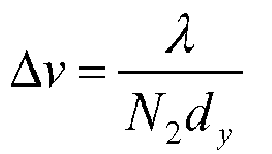

 - Diskretisieren der (u, v)-Domäne gemäß den folgenden Ausdrücken:

 - Erstellen eines Satzes von Signalen ST [k,l,f] gemäß dem folgenden Ausdruck:
 - Berechnen der Zeit-Domäne-Erregungen AT [n,m,t] für die Antennenelemente in der durch Koordinaten (ndx,mdy ) gegebenen Matrix, zur Erzeugung der Abwärtsstrecke-Sendesignale gemäß dem folgenden Ausdruck:
 - Erhalten der Frequenzgehalte SR [k,l,f] des komplexen von den M Benutzern in der Aufwärtsstrecke empfangenen Basisbandsignals, durch die Anwendung der folgenden Umwandlung auf einen Satz von empfangenen Signalen AR [n,m,t], welche jedem der Antennenelemente entsprechen:
- Verfahren nach Anspruch 1, zusätzlich umfassend das Durchführen, mittels einer kombinierten Raum-Frequenz-Planungseinheit, einer Planungsstrategie durch das Zuordnen von unbenutzten Raum- und/oder Frequenzressourcen jedem der M Zellbenutzern, sodass Störungen zwischen den Benutzerstrahlen minimiert werden.
- Verfahren nach Anspruch 2, wobei die genannte Planungsstrategie das Zuordnen von orthogonalen Zeit-Frequenz-Ressourcen den Strahlen, welche nah beieinander liegen, umfasst, um die genannten Störungen zwischen den Benutzerstrahlen zu vermeiden.
- Verfahren nach Anspruch 2, wobei die genannte Planungsstrategie das Vorbehalten von Schutzstrahlen in der (u, v)-Domäne in manchen der Rasterpunkte zwischen den Zellkoordinaten von zwei oder mehr Zellbenutzern umfasst, um die genannten Störungen zwischen den Benutzerstrahlen bei einem Mindestwert zu halten.
- Verfahren nach Anspruch 2, wobei die genannte Planungsstrategie das Zuordnen des gleichen Sendesignals einer Vielzahl von Rasterpunkten, welche die Zellbenutzerkoordinaten in der (u, v)-Domäne einschließen, und einer Anzahl von Schutzstrahlen für eine verringerte Störung umfasst, um Ungenauigkeiten zu berücksichtigen, wenn sphärische Winkel (θ, ϕ) der Zellbenutzer geschätzt werden.
- Verfahren nach Anspruch 2, wobei die genannte Planungsstrategie das Modifizieren der Form der Strahlwiederaufbaufunktionen unter Anwendung einer Fenstertechnik auf Erregungskoeffizienten umfasst, um die Zerfallsrate der Strahlen zu steuern und somit die Störung zwischen den Benutzerstrahlen zu mindern.
- Verfahren nach den Ansprüchen 1 oder 2, zusätzlich umfassend das dynamische Einstellen, mittels einer Rasterauflösungseinheit, der Auflösung des Rasters in der (u, v)-Domäne gemäß einem gewünschten Auflösungswinkel unter Berücksichtigung nur eines Teilsatzes von aktiven Antennenelementen in der Matrix, und umfassend das Aufrechterhalten des Abstands zwischen Antennenelementen und der Winkelabdeckung der Antennenmatrix.
- System für mehrfachen Zugriff auf drahtlose zellulare OFDM-Systeme unter Berücksichtigung von Raum und Frequenzbereichen, mindestens umfassend eine Basisstation (121), welche mit einer großen Anzahl von Antennen gemäß einer zweidimensionalen rechteckigen Matrix (125) und einer Anzahl M von Zellbenutzern (127) ausgerüstet ist, wobei die genannte rechteckigen Matrix (125) N1 Antennenelemente entlang einer Achse mit einem regelmäßigen Abstand dx und N 2 Antennenelemente entlang einer senkrechten Achse mit einem regelmäßigen Abstand dy umfasst, wobei die genannten Zellbenutzern (127) durch geeignete Winkel (θ, ϕ) in einem sphärischen Koordinatensystem gekennzeichnet sind, dadurch gekennzeichnet, dass das System eine orthogonale Raum-Frequenz-Verarbeitungseinheit (128) zum Erreichen des orthogonalen Mehrfachzugriffes umfasst, umfassend:- das Auswählen eines Rasterabstandes (Δu,Δv) in der (u, v)-Domäne durch die Gleichungen:


 - das Diskretisieren der (u, v)-Domäne gemäß den folgenden Ausdrücken:
 - das Erstellen eines Satzes von Signalen ST [k,l,f] gemäß dem folgenden Ausdruck:
 - das Berechnen der Zeit-Domäne-Erregungen AT [n,m,t] für die Antennenelemente in der durch Koordinate (ndx,mdy ) gegebenen Matrix, zur Erzeugung der Abwärtsstrecke-Sendesignale gemäß dem folgenden Ausdruck:
 - das Erhalten der Frequenzgehalte SR [k,l,f] des komplexen von den M Benutzern in der Aufwärtsstrecke empfangenen Basisbandsignals unter Anwendung der folgenden Umwandlung auf einen Satz von empfangenen Signalen AR [n,m,t], welche jedem der Antennenelemente entsprechen:
- System nach Anspruch 8, zusätzlich umfassend eine kombinierte Raum-Frequenz-Planungseinheit (122), um Raum-Frequenz-Ressourcenzuteilungsstrategien für jeden der M Zellbenutzern (127) durchzuführen.
- System nach Anspruch 9, wobei eine Winkelerkennungseinheit (126), welche mit der genannten kombinierten Raum-Frequenz-Planungseinheit (122) verbunden ist, zum Analysieren der von der genannten zweidimensionalen rechteckigen Matrix (125) empfangenen Signale vorbereitet ist, um die Einfallswinkel der genannten empfangenen Signale zu schätzen.
- System nach den Ansprüchen 8 oder 10, zusätzlich umfassend eine Rasterauflösungseinheit (123), um die Auflösung des Rasters in der (u, v)-Domäne gemäß einem gewünschten Auflösungswinkel unter Berücksichtigung nur eines Teilsatzes von aktiven Antennenelemente in der Matrix einzustellen, um Orthogonalität einer Vielzahl von Strahlen zu gewährleisten, während der Abstand zwischen Antennenelementen und der Winkelabdeckung der Antennenmatrix aufrechterhalten wird.
Priority Applications (3)
| Application Number | Priority Date | Filing Date | Title |
|---|---|---|---|
| ES13382186T ES2748046T3 (es) | 2013-05-21 | 2013-05-21 | Procedimiento y sistema para realizar accesos múltiples en sistemas celulares de OFDM inalámbricos considerando ambos dominios del espacio y de la frecuencia |
| EP13382186.8A EP2806576B1 (de) | 2013-05-21 | 2013-05-21 | Verfahren und System für mehrfachen Zugriff auf drahtlose zellulare OFDM-Systeme unter Berücksichtigung von Raum und Frequenzbereichen |
| US14/282,227 US9276648B2 (en) | 2013-05-21 | 2014-05-20 | Method and system for performing multiple access in wireless OFDM cellular systems considering both space and frequency domains |
Applications Claiming Priority (1)
| Application Number | Priority Date | Filing Date | Title |
|---|---|---|---|
| EP13382186.8A EP2806576B1 (de) | 2013-05-21 | 2013-05-21 | Verfahren und System für mehrfachen Zugriff auf drahtlose zellulare OFDM-Systeme unter Berücksichtigung von Raum und Frequenzbereichen |
Publications (2)
| Publication Number | Publication Date |
|---|---|
| EP2806576A1 EP2806576A1 (de) | 2014-11-26 |
| EP2806576B1 true EP2806576B1 (de) | 2019-07-24 |
Family
ID=48576332
Family Applications (1)
| Application Number | Title | Priority Date | Filing Date |
|---|---|---|---|
| EP13382186.8A Active EP2806576B1 (de) | 2013-05-21 | 2013-05-21 | Verfahren und System für mehrfachen Zugriff auf drahtlose zellulare OFDM-Systeme unter Berücksichtigung von Raum und Frequenzbereichen |
Country Status (3)
| Country | Link |
|---|---|
| US (1) | US9276648B2 (de) |
| EP (1) | EP2806576B1 (de) |
| ES (1) | ES2748046T3 (de) |
Families Citing this family (15)
| Publication number | Priority date | Publication date | Assignee | Title |
|---|---|---|---|---|
| EP2883321A1 (de) * | 2012-08-09 | 2015-06-17 | Telefonaktiebolaget L M Ericsson (Publ) | Mikrowellenverbindungssteuerung |
| ES2643714T3 (es) | 2014-12-23 | 2017-11-24 | Telefónica, S.A. | Método para realizar acceso múltiple en sistemas celulares de OFDM inalámbricos a través de canales inalámbricos multitrayectoria considerando tanto los dominios de espacio como de frecuencia, estación base y programas informáticos de los mismos |
| WO2016141954A1 (en) * | 2015-03-06 | 2016-09-15 | Telefonaktiebolaget Lm Ericsson (Publ) | A method, control system and communication system for adapting beam patterns |
| ES2764390T3 (es) * | 2015-04-10 | 2020-06-03 | Huawei Tech Co Ltd | Método y dispositivo de transmisión de datos |
| US11191097B2 (en) * | 2015-08-17 | 2021-11-30 | Qualcomm Incorporated | Reception of multiple uplink control messages at a same time slot |
| US10205491B2 (en) * | 2015-09-28 | 2019-02-12 | Futurewei Technologies, Inc. | System and method for large scale multiple input multiple output communications |
| EP3322104A1 (de) | 2016-11-14 | 2018-05-16 | Telefonica, S.A. | Verfahren, system und vorrichtung zur kompensation von doppler- beeinträchtigungen in ofdm-drahtloskommunikationsnetzwerken |
| US10326508B2 (en) * | 2017-05-11 | 2019-06-18 | Samsung Electonics Co., Ltd. | Beam forming method for a transmitting antenna and a device thereof |
| KR102528589B1 (ko) | 2018-04-18 | 2023-05-04 | 주식회사 엘엑스세미콘 | 터치센싱장치 |
| ES2910261T3 (es) | 2019-09-26 | 2022-05-12 | Telefonica Sa | Procedimiento y dispositivo para generar haces de difusión en sistemas MIMO masivos |
| US11171698B2 (en) * | 2019-10-25 | 2021-11-09 | Samsung Electronics Co., Ltd. | Method and apparatus for antenna parameter configuration for cellular communication systems |
| CN110971285B (zh) * | 2019-12-06 | 2022-09-23 | 西安电子科技大学 | 适用于共形天线阵的波束赋形方法 |
| CN113613268B (zh) * | 2021-06-29 | 2023-07-21 | 重庆邮电大学 | 下行时间反转非正交多址接入系统的设计与优化方法 |
| CN114966239B (zh) * | 2022-07-29 | 2022-10-28 | 陕西拾贝通讯技术有限公司 | 基于激励系数变量可分离的准远场测量方法 |
| CN115589241B (zh) * | 2022-09-22 | 2024-03-26 | 电子科技大学 | 一种基于相位调制的四维天线多波束形成方法及系统 |
Family Cites Families (14)
| Publication number | Priority date | Publication date | Assignee | Title |
|---|---|---|---|---|
| WO2003043245A1 (en) * | 2001-11-10 | 2003-05-22 | Samsung Electronics Co., Ltd. | Stfbc coding/decoding apparatus and method in an ofdm mobile communication system |
| US6940917B2 (en) * | 2002-08-27 | 2005-09-06 | Qualcomm, Incorporated | Beam-steering and beam-forming for wideband MIMO/MISO systems |
| ATE549802T1 (de) * | 2005-09-30 | 2012-03-15 | Huawei Tech Co Ltd | Betriebsmittelzuteilungsverfahren für mimo-ofdm von mehrbenutzer-zugangssystemen |
| US20070280175A1 (en) * | 2006-06-01 | 2007-12-06 | Fang-Chen Cheng | Coordinating transmission scheduling among multiple base stations |
| US7928896B2 (en) | 2007-07-09 | 2011-04-19 | Carnegie Mellon University | Application of time reversal to synthetic aperture imaging |
| US9100068B2 (en) * | 2008-03-17 | 2015-08-04 | Qualcomm, Incorporated | Multi-resolution beamforming in MIMO systems |
| WO2010015121A1 (en) * | 2008-08-05 | 2010-02-11 | Huawei Technologies Co., Ltd. | Method, apparatus and product of ofdm transmission |
| US8948289B2 (en) * | 2010-01-12 | 2015-02-03 | Lg Electronics Inc. | Method and device for codebook generation and downlink signal transmission in a wireless communication system supporting multiple antennas |
| CN103039014B (zh) * | 2010-04-08 | 2015-07-08 | Lg电子株式会社 | 在支持多天线的无线通信系统中使用码本的信号传输方法和装置 |
| US8929473B2 (en) | 2011-07-28 | 2015-01-06 | Samsung Electronics Co., Ltd. | Combining baseband processing and radio frequency beam steering in wireless communication systems |
| CN102938688B (zh) * | 2011-08-15 | 2015-05-27 | 上海贝尔股份有限公司 | 用于多维天线阵列的信道测量和反馈的方法和设备 |
| CN102412885B (zh) * | 2011-11-25 | 2015-05-06 | 西安电子科技大学 | Lte中的三维波束赋形方法 |
| CN105027461B (zh) * | 2013-03-29 | 2019-06-28 | 英特尔Ip公司 | 用于多用户多输入多输出(mu-mimo)的正交波束成形 |
| US9806926B2 (en) * | 2013-11-04 | 2017-10-31 | Samsung Electronics Co., Ltd. | Multistage beamforming of multiple-antenna communication system |
-
2013
- 2013-05-21 EP EP13382186.8A patent/EP2806576B1/de active Active
- 2013-05-21 ES ES13382186T patent/ES2748046T3/es active Active
-
2014
- 2014-05-20 US US14/282,227 patent/US9276648B2/en active Active
Non-Patent Citations (1)
| Title |
|---|
| None * |
Also Published As
| Publication number | Publication date |
|---|---|
| EP2806576A1 (de) | 2014-11-26 |
| US9276648B2 (en) | 2016-03-01 |
| US20140348255A1 (en) | 2014-11-27 |
| ES2748046T3 (es) | 2020-03-12 |
Similar Documents
| Publication | Publication Date | Title |
|---|---|---|
| EP2806576B1 (de) | Verfahren und System für mehrfachen Zugriff auf drahtlose zellulare OFDM-Systeme unter Berücksichtigung von Raum und Frequenzbereichen | |
| US11558157B2 (en) | Fixed wireless access using orthogonal time frequency space modulation | |
| CN110114982B (zh) | 基于逐波束信号同步的无线通信系统及方法 | |
| US20230379735A1 (en) | Beam direction of ue-based sensing signal request | |
| EP3035556B1 (de) | Verfahren und vorrichtung zur übertragung eines gemeinsamen signals in hybrider strahlformung | |
| KR102039535B1 (ko) | 무선 자원 할당 방법 및 장치 | |
| JP6441243B2 (ja) | 無線通信システムにおいてチャネル状態情報報告方法及び装置 | |
| Liyanaarachchi et al. | Joint MIMO communications and sensing with hybrid beamforming architecture and OFDM waveform optimization | |
| US9425870B2 (en) | Method for performing multiple access in wireless OFDM cellular systems over multipath wireless channels considering both space and frequency domains, base station and computer programs thereof | |
| US10205491B2 (en) | System and method for large scale multiple input multiple output communications | |
| CN102868477B (zh) | 一种基于分组波束的多用户预编码方法和装置 | |
| CN116648862A (zh) | 感测辅助mimo中的移动性管理 | |
| CN116746197A (zh) | 感测辅助mimo中的波束切换 | |
| WO2019158189A1 (en) | Methods and apparatus for signal transmission and reception in a wireless communication network | |
| EP3035620B1 (de) | Verfahren und Vorrichtung zur Verringerung der Pilotleistungsverunreinigung in großen skalierbaren Antennensystemen | |
| WO2017076311A1 (en) | System and method for large scale multiple input multiple output beamforming | |
| US11916638B2 (en) | Spatial multiplexing of different radio technologies | |
| Zhou et al. | Full-dimensional beamforming for multi-user MIMO-OFDM ISAC for low-altitude UAV with zero sensing resource allocation | |
| EP2987351A2 (de) | Zweistufiges drahtloskommunikationssystem | |
| WO2024174246A1 (en) | Devices, methods, and apparatuses for joint communication and sensing | |
| KR20160136128A (ko) | 2차원 안테나를 사용하는 무선 통신 시스템에서 피드백 신호 제공 방법 및 장치 | |
| CN109120321A (zh) | 一种波束赋形的方法、装置、基站及计算机可读存储介质 | |
| Shi et al. | Joint frame structure and beamforming design for integrated localization and communication network | |
| Arnold et al. | Evaluating massive MIMO precoding based on 3D-channel measurements with a spider antenna | |
| Moon et al. | Fingerprint-Based Millimeter-Wave Beam Selection for Interference Mitigation in Beamspace Multi-User MIMO Communications. |
Legal Events
| Date | Code | Title | Description |
|---|---|---|---|
| PUAI | Public reference made under article 153(3) epc to a published international application that has entered the european phase |
Free format text: ORIGINAL CODE: 0009012 |
|
| 17P | Request for examination filed |
Effective date: 20130521 |
|
| AK | Designated contracting states |
Kind code of ref document: A1 Designated state(s): AL AT BE BG CH CY CZ DE DK EE ES FI FR GB GR HR HU IE IS IT LI LT LU LV MC MK MT NL NO PL PT RO RS SE SI SK SM TR |
|
| AX | Request for extension of the european patent |
Extension state: BA ME |
|
| R17P | Request for examination filed (corrected) |
Effective date: 20150520 |
|
| RBV | Designated contracting states (corrected) |
Designated state(s): AL AT BE BG CH CY CZ DE DK EE ES FI FR GB GR HR HU IE IS IT LI LT LU LV MC MK MT NL NO PL PT RO RS SE SI SK SM TR |
|
| STAA | Information on the status of an ep patent application or granted ep patent |
Free format text: STATUS: EXAMINATION IS IN PROGRESS |
|
| 17Q | First examination report despatched |
Effective date: 20171206 |
|
| GRAP | Despatch of communication of intention to grant a patent |
Free format text: ORIGINAL CODE: EPIDOSNIGR1 |
|
| STAA | Information on the status of an ep patent application or granted ep patent |
Free format text: STATUS: GRANT OF PATENT IS INTENDED |
|
| INTG | Intention to grant announced |
Effective date: 20190312 |
|
| GRAS | Grant fee paid |
Free format text: ORIGINAL CODE: EPIDOSNIGR3 |
|
| GRAA | (expected) grant |
Free format text: ORIGINAL CODE: 0009210 |
|
| STAA | Information on the status of an ep patent application or granted ep patent |
Free format text: STATUS: THE PATENT HAS BEEN GRANTED |
|
| AK | Designated contracting states |
Kind code of ref document: B1 Designated state(s): AL AT BE BG CH CY CZ DE DK EE ES FI FR GB GR HR HU IE IS IT LI LT LU LV MC MK MT NL NO PL PT RO RS SE SI SK SM TR |
|
| REG | Reference to a national code |
Ref country code: GB Ref legal event code: FG4D |
|
| REG | Reference to a national code |
Ref country code: CH Ref legal event code: EP |
|
| REG | Reference to a national code |
Ref country code: DE Ref legal event code: R096 Ref document number: 602013058125 Country of ref document: DE |
|
| REG | Reference to a national code |
Ref country code: AT Ref legal event code: REF Ref document number: 1159454 Country of ref document: AT Kind code of ref document: T Effective date: 20190815 |
|
| REG | Reference to a national code |
Ref country code: IE Ref legal event code: FG4D |
|
| REG | Reference to a national code |
Ref country code: NL Ref legal event code: MP Effective date: 20190724 |
|
| REG | Reference to a national code |
Ref country code: LT Ref legal event code: MG4D |
|
| REG | Reference to a national code |
Ref country code: AT Ref legal event code: MK05 Ref document number: 1159454 Country of ref document: AT Kind code of ref document: T Effective date: 20190724 |
|
| PG25 | Lapsed in a contracting state [announced via postgrant information from national office to epo] |
Ref country code: BG Free format text: LAPSE BECAUSE OF FAILURE TO SUBMIT A TRANSLATION OF THE DESCRIPTION OR TO PAY THE FEE WITHIN THE PRESCRIBED TIME-LIMIT Effective date: 20191024 Ref country code: NL Free format text: LAPSE BECAUSE OF FAILURE TO SUBMIT A TRANSLATION OF THE DESCRIPTION OR TO PAY THE FEE WITHIN THE PRESCRIBED TIME-LIMIT Effective date: 20190724 Ref country code: PT Free format text: LAPSE BECAUSE OF FAILURE TO SUBMIT A TRANSLATION OF THE DESCRIPTION OR TO PAY THE FEE WITHIN THE PRESCRIBED TIME-LIMIT Effective date: 20191125 Ref country code: HR Free format text: LAPSE BECAUSE OF FAILURE TO SUBMIT A TRANSLATION OF THE DESCRIPTION OR TO PAY THE FEE WITHIN THE PRESCRIBED TIME-LIMIT Effective date: 20190724 Ref country code: LT Free format text: LAPSE BECAUSE OF FAILURE TO SUBMIT A TRANSLATION OF THE DESCRIPTION OR TO PAY THE FEE WITHIN THE PRESCRIBED TIME-LIMIT Effective date: 20190724 Ref country code: AT Free format text: LAPSE BECAUSE OF FAILURE TO SUBMIT A TRANSLATION OF THE DESCRIPTION OR TO PAY THE FEE WITHIN THE PRESCRIBED TIME-LIMIT Effective date: 20190724 Ref country code: NO Free format text: LAPSE BECAUSE OF FAILURE TO SUBMIT A TRANSLATION OF THE DESCRIPTION OR TO PAY THE FEE WITHIN THE PRESCRIBED TIME-LIMIT Effective date: 20191024 Ref country code: FI Free format text: LAPSE BECAUSE OF FAILURE TO SUBMIT A TRANSLATION OF THE DESCRIPTION OR TO PAY THE FEE WITHIN THE PRESCRIBED TIME-LIMIT Effective date: 20190724 Ref country code: SE Free format text: LAPSE BECAUSE OF FAILURE TO SUBMIT A TRANSLATION OF THE DESCRIPTION OR TO PAY THE FEE WITHIN THE PRESCRIBED TIME-LIMIT Effective date: 20190724 |
|
| PG25 | Lapsed in a contracting state [announced via postgrant information from national office to epo] |
Ref country code: GR Free format text: LAPSE BECAUSE OF FAILURE TO SUBMIT A TRANSLATION OF THE DESCRIPTION OR TO PAY THE FEE WITHIN THE PRESCRIBED TIME-LIMIT Effective date: 20191025 Ref country code: RS Free format text: LAPSE BECAUSE OF FAILURE TO SUBMIT A TRANSLATION OF THE DESCRIPTION OR TO PAY THE FEE WITHIN THE PRESCRIBED TIME-LIMIT Effective date: 20190724 Ref country code: IS Free format text: LAPSE BECAUSE OF FAILURE TO SUBMIT A TRANSLATION OF THE DESCRIPTION OR TO PAY THE FEE WITHIN THE PRESCRIBED TIME-LIMIT Effective date: 20191124 Ref country code: AL Free format text: LAPSE BECAUSE OF FAILURE TO SUBMIT A TRANSLATION OF THE DESCRIPTION OR TO PAY THE FEE WITHIN THE PRESCRIBED TIME-LIMIT Effective date: 20190724 Ref country code: LV Free format text: LAPSE BECAUSE OF FAILURE TO SUBMIT A TRANSLATION OF THE DESCRIPTION OR TO PAY THE FEE WITHIN THE PRESCRIBED TIME-LIMIT Effective date: 20190724 |
|
| REG | Reference to a national code |
Ref country code: ES Ref legal event code: FG2A Ref document number: 2748046 Country of ref document: ES Kind code of ref document: T3 Effective date: 20200312 |
|
| PG25 | Lapsed in a contracting state [announced via postgrant information from national office to epo] |
Ref country code: TR Free format text: LAPSE BECAUSE OF FAILURE TO SUBMIT A TRANSLATION OF THE DESCRIPTION OR TO PAY THE FEE WITHIN THE PRESCRIBED TIME-LIMIT Effective date: 20190724 |
|
| PG25 | Lapsed in a contracting state [announced via postgrant information from national office to epo] |
Ref country code: IT Free format text: LAPSE BECAUSE OF FAILURE TO SUBMIT A TRANSLATION OF THE DESCRIPTION OR TO PAY THE FEE WITHIN THE PRESCRIBED TIME-LIMIT Effective date: 20190724 Ref country code: RO Free format text: LAPSE BECAUSE OF FAILURE TO SUBMIT A TRANSLATION OF THE DESCRIPTION OR TO PAY THE FEE WITHIN THE PRESCRIBED TIME-LIMIT Effective date: 20190724 Ref country code: EE Free format text: LAPSE BECAUSE OF FAILURE TO SUBMIT A TRANSLATION OF THE DESCRIPTION OR TO PAY THE FEE WITHIN THE PRESCRIBED TIME-LIMIT Effective date: 20190724 Ref country code: DK Free format text: LAPSE BECAUSE OF FAILURE TO SUBMIT A TRANSLATION OF THE DESCRIPTION OR TO PAY THE FEE WITHIN THE PRESCRIBED TIME-LIMIT Effective date: 20190724 Ref country code: PL Free format text: LAPSE BECAUSE OF FAILURE TO SUBMIT A TRANSLATION OF THE DESCRIPTION OR TO PAY THE FEE WITHIN THE PRESCRIBED TIME-LIMIT Effective date: 20190724 |
|
| PG25 | Lapsed in a contracting state [announced via postgrant information from national office to epo] |
Ref country code: CZ Free format text: LAPSE BECAUSE OF FAILURE TO SUBMIT A TRANSLATION OF THE DESCRIPTION OR TO PAY THE FEE WITHIN THE PRESCRIBED TIME-LIMIT Effective date: 20190724 Ref country code: SK Free format text: LAPSE BECAUSE OF FAILURE TO SUBMIT A TRANSLATION OF THE DESCRIPTION OR TO PAY THE FEE WITHIN THE PRESCRIBED TIME-LIMIT Effective date: 20190724 Ref country code: IS Free format text: LAPSE BECAUSE OF FAILURE TO SUBMIT A TRANSLATION OF THE DESCRIPTION OR TO PAY THE FEE WITHIN THE PRESCRIBED TIME-LIMIT Effective date: 20200224 Ref country code: SM Free format text: LAPSE BECAUSE OF FAILURE TO SUBMIT A TRANSLATION OF THE DESCRIPTION OR TO PAY THE FEE WITHIN THE PRESCRIBED TIME-LIMIT Effective date: 20190724 |
|
| REG | Reference to a national code |
Ref country code: DE Ref legal event code: R097 Ref document number: 602013058125 Country of ref document: DE |
|
| PLBE | No opposition filed within time limit |
Free format text: ORIGINAL CODE: 0009261 |
|
| STAA | Information on the status of an ep patent application or granted ep patent |
Free format text: STATUS: NO OPPOSITION FILED WITHIN TIME LIMIT |
|
| PG2D | Information on lapse in contracting state deleted |
Ref country code: IS |
|
| 26N | No opposition filed |
Effective date: 20200603 |
|
| PG25 | Lapsed in a contracting state [announced via postgrant information from national office to epo] |
Ref country code: SI Free format text: LAPSE BECAUSE OF FAILURE TO SUBMIT A TRANSLATION OF THE DESCRIPTION OR TO PAY THE FEE WITHIN THE PRESCRIBED TIME-LIMIT Effective date: 20190724 |
|
| PG25 | Lapsed in a contracting state [announced via postgrant information from national office to epo] |
Ref country code: CH Free format text: LAPSE BECAUSE OF NON-PAYMENT OF DUE FEES Effective date: 20200531 Ref country code: LI Free format text: LAPSE BECAUSE OF NON-PAYMENT OF DUE FEES Effective date: 20200531 Ref country code: MC Free format text: LAPSE BECAUSE OF FAILURE TO SUBMIT A TRANSLATION OF THE DESCRIPTION OR TO PAY THE FEE WITHIN THE PRESCRIBED TIME-LIMIT Effective date: 20190724 |
|
| REG | Reference to a national code |
Ref country code: BE Ref legal event code: MM Effective date: 20200531 |
|
| PG25 | Lapsed in a contracting state [announced via postgrant information from national office to epo] |
Ref country code: LU Free format text: LAPSE BECAUSE OF NON-PAYMENT OF DUE FEES Effective date: 20200521 |
|
| PG25 | Lapsed in a contracting state [announced via postgrant information from national office to epo] |
Ref country code: IE Free format text: LAPSE BECAUSE OF NON-PAYMENT OF DUE FEES Effective date: 20200521 Ref country code: FR Free format text: LAPSE BECAUSE OF NON-PAYMENT OF DUE FEES Effective date: 20200531 |
|
| PG25 | Lapsed in a contracting state [announced via postgrant information from national office to epo] |
Ref country code: BE Free format text: LAPSE BECAUSE OF NON-PAYMENT OF DUE FEES Effective date: 20200531 |
|
| PG25 | Lapsed in a contracting state [announced via postgrant information from national office to epo] |
Ref country code: MT Free format text: LAPSE BECAUSE OF FAILURE TO SUBMIT A TRANSLATION OF THE DESCRIPTION OR TO PAY THE FEE WITHIN THE PRESCRIBED TIME-LIMIT Effective date: 20190724 Ref country code: CY Free format text: LAPSE BECAUSE OF FAILURE TO SUBMIT A TRANSLATION OF THE DESCRIPTION OR TO PAY THE FEE WITHIN THE PRESCRIBED TIME-LIMIT Effective date: 20190724 |
|
| PG25 | Lapsed in a contracting state [announced via postgrant information from national office to epo] |
Ref country code: MK Free format text: LAPSE BECAUSE OF FAILURE TO SUBMIT A TRANSLATION OF THE DESCRIPTION OR TO PAY THE FEE WITHIN THE PRESCRIBED TIME-LIMIT Effective date: 20190724 |
|
| PGFP | Annual fee paid to national office [announced via postgrant information from national office to epo] |
Ref country code: DE Payment date: 20250529 Year of fee payment: 13 |
|
| PGFP | Annual fee paid to national office [announced via postgrant information from national office to epo] |
Ref country code: ES Payment date: 20250602 Year of fee payment: 13 Ref country code: GB Payment date: 20250527 Year of fee payment: 13 |