EP2807171B1 - Composés hétérocycliques et leurs procédés d'utilisation - Google Patents
Composés hétérocycliques et leurs procédés d'utilisation Download PDFInfo
- Publication number
- EP2807171B1 EP2807171B1 EP13741412.4A EP13741412A EP2807171B1 EP 2807171 B1 EP2807171 B1 EP 2807171B1 EP 13741412 A EP13741412 A EP 13741412A EP 2807171 B1 EP2807171 B1 EP 2807171B1
- Authority
- EP
- European Patent Office
- Prior art keywords
- phenyl
- mmol
- compound
- mixture
- diphenylacetyl
- Prior art date
- Legal status (The legal status is an assumption and is not a legal conclusion. Google has not performed a legal analysis and makes no representation as to the accuracy of the status listed.)
- Active
Links
- 0 *C1C(*)C(*)N(*)C(*)C1 Chemical compound *C1C(*)C(*)N(*)C(*)C1 0.000 description 4
- ROHLQPZIUYTLGR-VIFPVBQESA-N CC(C)(C)OC(N(CCC(C1)=O)[C@@H]1C(OC)=O)=O Chemical compound CC(C)(C)OC(N(CCC(C1)=O)[C@@H]1C(OC)=O)=O ROHLQPZIUYTLGR-VIFPVBQESA-N 0.000 description 2
- NQRYJNQNLNOLGT-UHFFFAOYSA-N C1CCNCC1 Chemical compound C1CCNCC1 NQRYJNQNLNOLGT-UHFFFAOYSA-N 0.000 description 1
- SWLBACIBRHZVNN-RPWUZVMVSA-N CC(C)(C)C#CCN(C)[C@H](CC1)C[C@@H](C(O)=O)N1C(C(c1ccccc1)c1ccccc1)=O Chemical compound CC(C)(C)C#CCN(C)[C@H](CC1)C[C@@H](C(O)=O)N1C(C(c1ccccc1)c1ccccc1)=O SWLBACIBRHZVNN-RPWUZVMVSA-N 0.000 description 1
- JHRBMSGQUHGAKQ-RPBOFIJWSA-N CC(C)(C)C#CCN(C)[C@H](CC1)C[C@@H](C(OC)=O)N1C(C(c1ccccc1)c1ccccc1)=O Chemical compound CC(C)(C)C#CCN(C)[C@H](CC1)C[C@@H](C(OC)=O)N1C(C(c1ccccc1)c1ccccc1)=O JHRBMSGQUHGAKQ-RPBOFIJWSA-N 0.000 description 1
- SOLQVNPJGHTWEZ-IRXDYDNUSA-N CC(C)(C)OC(N(CC[C@@H](C1)N(C)Cc2ccccc2)[C@@H]1C(OC)=O)=O Chemical compound CC(C)(C)OC(N(CC[C@@H](C1)N(C)Cc2ccccc2)[C@@H]1C(OC)=O)=O SOLQVNPJGHTWEZ-IRXDYDNUSA-N 0.000 description 1
- LXWXOOZBYGUKKA-UFYCRDLUSA-N CC(C)(C)OC(N(CC[C@@H](C1)N(CCC2)C[C@H]2c2ccccc2)[C@@H]1C(OC)=O)=O Chemical compound CC(C)(C)OC(N(CC[C@@H](C1)N(CCC2)C[C@H]2c2ccccc2)[C@@H]1C(OC)=O)=O LXWXOOZBYGUKKA-UFYCRDLUSA-N 0.000 description 1
- SOLQVNPJGHTWEZ-TZHYSIJRSA-N CC(C)(C)OC(N(CC[C@H](C1)N(C)Cc2ccccc2)C1C(OC)=O)=O Chemical compound CC(C)(C)OC(N(CC[C@H](C1)N(C)Cc2ccccc2)C1C(OC)=O)=O SOLQVNPJGHTWEZ-TZHYSIJRSA-N 0.000 description 1
- LXWXOOZBYGUKKA-ZCNNSNEGSA-N CC(C)(C)OC(N(CC[C@H](C1)N(CCC2)C[C@H]2c2ccccc2)[C@@H]1C(OC)=O)=O Chemical compound CC(C)(C)OC(N(CC[C@H](C1)N(CCC2)C[C@H]2c2ccccc2)[C@@H]1C(OC)=O)=O LXWXOOZBYGUKKA-ZCNNSNEGSA-N 0.000 description 1
- ZIFOARANCPCKEI-RPWUZVMVSA-N CC(C)C#CCN(C)[C@H](CC1)C[C@@H](C(O)=O)N1C(C(c1ccccc1)c1ccccc1)=O Chemical compound CC(C)C#CCN(C)[C@H](CC1)C[C@@H](C(O)=O)N1C(C(c1ccccc1)c1ccccc1)=O ZIFOARANCPCKEI-RPWUZVMVSA-N 0.000 description 1
- XHWYQITXNJGZHI-SXOMAYOGSA-N CN(CC#Cc(cc1)ccc1F)[C@H](CC1)C[C@@H](C(O)=O)N1C(C(c1ccccc1)c1ccccc1)=O Chemical compound CN(CC#Cc(cc1)ccc1F)[C@H](CC1)C[C@@H](C(O)=O)N1C(C(c1ccccc1)c1ccccc1)=O XHWYQITXNJGZHI-SXOMAYOGSA-N 0.000 description 1
- WUIYFUWWVXNISU-IZLXSDGUSA-N CN(CC#Cc(cc1)ccc1F)[C@H](CC1)C[C@@H](C(OC)=O)N1C(C(c1ccccc1)c1ccccc1)=O Chemical compound CN(CC#Cc(cc1)ccc1F)[C@H](CC1)C[C@@H](C(OC)=O)N1C(C(c1ccccc1)c1ccccc1)=O WUIYFUWWVXNISU-IZLXSDGUSA-N 0.000 description 1
- IDOXHXMNKNWEFT-SXOMAYOGSA-N CN(CC#Cc1ccccc1)[C@H](CC1)C[C@@H](C(N)=O)N1C(C(c1ccccc1)c1ccccc1)=O Chemical compound CN(CC#Cc1ccccc1)[C@H](CC1)C[C@@H](C(N)=O)N1C(C(c1ccccc1)c1ccccc1)=O IDOXHXMNKNWEFT-SXOMAYOGSA-N 0.000 description 1
- MMMWMXOYMKIWIY-SXOMAYOGSA-N CN(CC#Cc1ccccc1)[C@H](CC1)C[C@@H](C(O)=O)N1C(C(c1ccccc1)c1ccccc1)=O Chemical compound CN(CC#Cc1ccccc1)[C@H](CC1)C[C@@H](C(O)=O)N1C(C(c1ccccc1)c1ccccc1)=O MMMWMXOYMKIWIY-SXOMAYOGSA-N 0.000 description 1
- XYDFSCGFCFYWNY-RITPCOANSA-N COC([C@H](C1)NCC[C@H]1O)=O Chemical compound COC([C@H](C1)NCC[C@H]1O)=O XYDFSCGFCFYWNY-RITPCOANSA-N 0.000 description 1
- DVVYIQDTHWMKQD-MSOLQXFVSA-N COC([C@H](C[C@@H](CC1)O)N1C(C(c1ccccc1)c1ccccc1)=O)=O Chemical compound COC([C@H](C[C@@H](CC1)O)N1C(C(c1ccccc1)c1ccccc1)=O)=O DVVYIQDTHWMKQD-MSOLQXFVSA-N 0.000 description 1
- ZMFOEVHVGISEAX-UHFFFAOYSA-N Cc1c(C)nccc1OCc1ccccc1 Chemical compound Cc1c(C)nccc1OCc1ccccc1 ZMFOEVHVGISEAX-UHFFFAOYSA-N 0.000 description 1
- XALFKNJHPVYOOZ-UHFFFAOYSA-N N=C(C(Cl)(Cl)Cl)OCC#Cc(cc1)ccc1F Chemical compound N=C(C(Cl)(Cl)Cl)OCC#Cc(cc1)ccc1F XALFKNJHPVYOOZ-UHFFFAOYSA-N 0.000 description 1
- MSYLETHDEIJMAF-UHFFFAOYSA-N O=C(C(c1ccccc1)c1ccccc1)Cl Chemical compound O=C(C(c1ccccc1)c1ccccc1)Cl MSYLETHDEIJMAF-UHFFFAOYSA-N 0.000 description 1
- VGXXTSVPPQJQIT-NSHDSACASA-N OC([C@H](C1)NCc(cc2)c1c1c2Oc2ccccc2O1)=O Chemical compound OC([C@H](C1)NCc(cc2)c1c1c2Oc2ccccc2O1)=O VGXXTSVPPQJQIT-NSHDSACASA-N 0.000 description 1
- UFZZQNOSFLXWCD-QHCPKHFHSA-N OC([C@H](Cc1c2Oc3ccccc3Oc2ccc1C1)N1C(C(c1ccccc1)c1ccccc1)=O)=O Chemical compound OC([C@H](Cc1c2Oc3ccccc3Oc2ccc1C1)N1C(C(c1ccccc1)c1ccccc1)=O)=O UFZZQNOSFLXWCD-QHCPKHFHSA-N 0.000 description 1
- ZROXSIPANMVWHB-UHFFFAOYSA-N OCC#Cc(cc1)ccc1F Chemical compound OCC#Cc(cc1)ccc1F ZROXSIPANMVWHB-UHFFFAOYSA-N 0.000 description 1
Classifications
-
- C—CHEMISTRY; METALLURGY
- C07—ORGANIC CHEMISTRY
- C07D—HETEROCYCLIC COMPOUNDS
- C07D491/00—Heterocyclic compounds containing in the condensed ring system both one or more rings having oxygen atoms as the only ring hetero atoms and one or more rings having nitrogen atoms as the only ring hetero atoms, not provided for by groups C07D451/00 - C07D459/00, C07D463/00, C07D477/00 or C07D489/00
- C07D491/02—Heterocyclic compounds containing in the condensed ring system both one or more rings having oxygen atoms as the only ring hetero atoms and one or more rings having nitrogen atoms as the only ring hetero atoms, not provided for by groups C07D451/00 - C07D459/00, C07D463/00, C07D477/00 or C07D489/00 in which the condensed system contains two hetero rings
- C07D491/04—Ortho-condensed systems
- C07D491/056—Ortho-condensed systems with two or more oxygen atoms as ring hetero atoms in the oxygen-containing ring
-
- A—HUMAN NECESSITIES
- A61—MEDICAL OR VETERINARY SCIENCE; HYGIENE
- A61P—SPECIFIC THERAPEUTIC ACTIVITY OF CHEMICAL COMPOUNDS OR MEDICINAL PREPARATIONS
- A61P19/00—Drugs for skeletal disorders
- A61P19/08—Drugs for skeletal disorders for bone diseases, e.g. rachitism, Paget's disease
-
- A—HUMAN NECESSITIES
- A61—MEDICAL OR VETERINARY SCIENCE; HYGIENE
- A61P—SPECIFIC THERAPEUTIC ACTIVITY OF CHEMICAL COMPOUNDS OR MEDICINAL PREPARATIONS
- A61P25/00—Drugs for disorders of the nervous system
-
- A—HUMAN NECESSITIES
- A61—MEDICAL OR VETERINARY SCIENCE; HYGIENE
- A61P—SPECIFIC THERAPEUTIC ACTIVITY OF CHEMICAL COMPOUNDS OR MEDICINAL PREPARATIONS
- A61P25/00—Drugs for disorders of the nervous system
- A61P25/02—Drugs for disorders of the nervous system for peripheral neuropathies
-
- A—HUMAN NECESSITIES
- A61—MEDICAL OR VETERINARY SCIENCE; HYGIENE
- A61P—SPECIFIC THERAPEUTIC ACTIVITY OF CHEMICAL COMPOUNDS OR MEDICINAL PREPARATIONS
- A61P25/00—Drugs for disorders of the nervous system
- A61P25/04—Centrally acting analgesics, e.g. opioids
-
- A—HUMAN NECESSITIES
- A61—MEDICAL OR VETERINARY SCIENCE; HYGIENE
- A61P—SPECIFIC THERAPEUTIC ACTIVITY OF CHEMICAL COMPOUNDS OR MEDICINAL PREPARATIONS
- A61P29/00—Non-central analgesic, antipyretic or antiinflammatory agents, e.g. antirheumatic agents; Non-steroidal antiinflammatory drugs [NSAID]
-
- A—HUMAN NECESSITIES
- A61—MEDICAL OR VETERINARY SCIENCE; HYGIENE
- A61P—SPECIFIC THERAPEUTIC ACTIVITY OF CHEMICAL COMPOUNDS OR MEDICINAL PREPARATIONS
- A61P35/00—Antineoplastic agents
-
- C—CHEMISTRY; METALLURGY
- C07—ORGANIC CHEMISTRY
- C07D—HETEROCYCLIC COMPOUNDS
- C07D211/00—Heterocyclic compounds containing hydrogenated pyridine rings, not condensed with other rings
- C07D211/04—Heterocyclic compounds containing hydrogenated pyridine rings, not condensed with other rings with only hydrogen or carbon atoms directly attached to the ring nitrogen atom
- C07D211/06—Heterocyclic compounds containing hydrogenated pyridine rings, not condensed with other rings with only hydrogen or carbon atoms directly attached to the ring nitrogen atom having no double bonds between ring members or between ring members and non-ring members
- C07D211/36—Heterocyclic compounds containing hydrogenated pyridine rings, not condensed with other rings with only hydrogen or carbon atoms directly attached to the ring nitrogen atom having no double bonds between ring members or between ring members and non-ring members with hetero atoms or with carbon atoms having three bonds to hetero atoms with at the most one bond to halogen, e.g. ester or nitrile radicals, directly attached to ring carbon atoms
- C07D211/60—Carbon atoms having three bonds to hetero atoms with at the most one bond to halogen, e.g. ester or nitrile radicals
-
- C—CHEMISTRY; METALLURGY
- C07—ORGANIC CHEMISTRY
- C07D—HETEROCYCLIC COMPOUNDS
- C07D401/00—Heterocyclic compounds containing two or more hetero rings, having nitrogen atoms as the only ring hetero atoms, at least one ring being a six-membered ring with only one nitrogen atom
- C07D401/02—Heterocyclic compounds containing two or more hetero rings, having nitrogen atoms as the only ring hetero atoms, at least one ring being a six-membered ring with only one nitrogen atom containing two hetero rings
- C07D401/04—Heterocyclic compounds containing two or more hetero rings, having nitrogen atoms as the only ring hetero atoms, at least one ring being a six-membered ring with only one nitrogen atom containing two hetero rings directly linked by a ring-member-to-ring-member bond
-
- C—CHEMISTRY; METALLURGY
- C07—ORGANIC CHEMISTRY
- C07D—HETEROCYCLIC COMPOUNDS
- C07D471/00—Heterocyclic compounds containing nitrogen atoms as the only ring hetero atoms in the condensed system, at least one ring being a six-membered ring with one nitrogen atom, not provided for by groups C07D451/00 - C07D463/00
- C07D471/02—Heterocyclic compounds containing nitrogen atoms as the only ring hetero atoms in the condensed system, at least one ring being a six-membered ring with one nitrogen atom, not provided for by groups C07D451/00 - C07D463/00 in which the condensed system contains two hetero rings
- C07D471/04—Ortho-condensed systems
-
- C—CHEMISTRY; METALLURGY
- C07—ORGANIC CHEMISTRY
- C07D—HETEROCYCLIC COMPOUNDS
- C07D491/00—Heterocyclic compounds containing in the condensed ring system both one or more rings having oxygen atoms as the only ring hetero atoms and one or more rings having nitrogen atoms as the only ring hetero atoms, not provided for by groups C07D451/00 - C07D459/00, C07D463/00, C07D477/00 or C07D489/00
- C07D491/02—Heterocyclic compounds containing in the condensed ring system both one or more rings having oxygen atoms as the only ring hetero atoms and one or more rings having nitrogen atoms as the only ring hetero atoms, not provided for by groups C07D451/00 - C07D459/00, C07D463/00, C07D477/00 or C07D489/00 in which the condensed system contains two hetero rings
- C07D491/04—Ortho-condensed systems
- C07D491/044—Ortho-condensed systems with only one oxygen atom as ring hetero atom in the oxygen-containing ring
- C07D491/048—Ortho-condensed systems with only one oxygen atom as ring hetero atom in the oxygen-containing ring the oxygen-containing ring being five-membered
-
- C—CHEMISTRY; METALLURGY
- C07—ORGANIC CHEMISTRY
- C07D—HETEROCYCLIC COMPOUNDS
- C07D495/00—Heterocyclic compounds containing in the condensed system at least one hetero ring having sulfur atoms as the only ring hetero atoms
- C07D495/02—Heterocyclic compounds containing in the condensed system at least one hetero ring having sulfur atoms as the only ring hetero atoms in which the condensed system contains two hetero rings
- C07D495/04—Ortho-condensed systems
Definitions
- the present invention relates generally to compounds that are useful in antagonizing the angiotensin II type 2 (AT 2 ) receptor. More particularly, the invention relates to heterocyclic compounds of formula (I) and their use as AT 2 receptor antagonists. Pharmaceutical compositions comprising the compounds and their use in modulating the AT 2 receptor and therapies that require modulation of the AT 2 receptor are described.
- AT 2 receptor has been known since the 1980s, much less is known about its biological function than the angiotensin II type 1 (AT 1 ) receptor, which has been studied for its functional effects on vasoconstriction, aldosterone release and cardiovascular growth [Wexler et al., 1996].
- AT 1 angiotensin II type 1
- the AT 2 receptor has been implicated in the differentiation and regeneration of neuronal tissue [Steckelings et al., 2005; Chakrabarty et al., 2008], cell proliferation and angiogenesis [Clere et al., 2010] and maintenance of bone mass [Izu et al., 2009].
- AT 2 receptor antagonists have also recently been associated with the treatment of pain, particularly inflammatory pain [ WO 2007/106938 ] and neuropathic pain [ WO 2006/066361 ], two types of pain which are difficult to treat or relieve.
- Impaired nerve conduction velocity is also associated with nerve damage and has been implicated in peripheral neuropathies, Carpel Tunnel Syndrome, ulnar neuropathy, Guillian-Barré Syndrome, fascioscapulohumeral muscular dystrophy and spinal disc herneation. Impaired nerve conduction velocity can result in diminished reflex responses and altered peripheral sensation such as parathesia and in some cases pain and AT 2 receptor antagonists have been shown to restore nerve conduction velocity [ WO 2011/088504 ].
- Cell proliferation and angiogenesis are important biological functions in normal tissue. However, uncontrolled cell proliferation and angiogenesis can lead to tumors and other proliferative disorders. While there are some effective chemotherapies available for tumors, many result in unpleasant side effects and/or have high toxicity for normal cells. Further therapies for reducing or preventing abnormal cell proliferation in a controlled manner are required and AT 2 receptor antagonists have been shown to have antiproliferative activity [Clere et al., 2010].
- Osteoporosis is a significant problem in older populations, especially in post-menopausal women.
- Current therapies for osteoporosis rely on calcium supplementation.
- the control of bone formation and bone resorption is complex and further therapies for improving bone mass are required and AT 2 receptor antagonists have been shown to increase bone mass [Izu et al., 2009].
- AT 2 receptor antagonists may be useful therapeutics in diseases characterized by aberrant nerve regeneration [Chakrabarty et al., 2008].
- the present invention is predicated in part on the discovery of heterocyclic azetidine and pyrrolidine compounds that have AT 2 receptor antagonist activity.
- the present invention provides a pharmaceutical composition
- a pharmaceutical composition comprising the compounds of formula (I) or a pharmaceutically acceptable salt thereof and a pharmaceutically acceptable carrier.
- a compound of formula (I) or a pharmaceutically acceptable salt thereof for use in treating or preventing neuropathic pain.
- a compound of formula (I) or a pharmaceutically acceptable salt thereof for use in treating or preventing a condition characterized by neuronal hypersensitivity.
- the present invention provides a compound of formula (I) or a pharmaceutically acceptable salt thereof for use in treating or preventing impaired nerve conduction velocity.
- a compound of formula (I) or a pharmaceutically acceptable salt thereof for use in treating or preventing a cell proliferative disorder.
- the present invention provides a compound of formula (I) or a pharmaceutically acceptable salt thereof for use in treating or preventing a disorder associated with an imbalance between bone resorption and bone formation.
- the present invention provides a compound of formula (I) or a pharmaceutically acceptable salt thereof for use in treating a disorder associated with aberrant nerve regeneration.
- an element means one element or more than one element.
- the term "about” refers to a quantity, level, value, dimension, size, or amount that varies by as much as 30%, 25%, 20%, 15% or 10% to a reference quantity, level, value, dimension, size, or amount.
- AT 2 receptor means an angiotensin II type 2 (AT 2 ) receptor polypeptide that can bind angiotensin II and/or one or more other ligands.
- AT 2 receptor encompasses vertebrate homologs of AT 2 receptor family members, including, but not limited to, mammalian, reptilian and avian homologs. Representative mammalian homologs of AT 2 receptor family members include, but are not limited to, murine and human homologs.
- antagonist refers to a compound that decreases or inhibits the biological activity and/or function of an AT 2 receptor, including binding to the AT 2 receptor and blocking access to angiotensin II, inhibiting a gene that expresses AT 2 receptor, or inhibiting an expression product of that gene.
- selective is meant that the compound binds to and/or inhibits AT 2 receptor activity to a greater extent than binding and inhibition of the AT 1 receptor. In some instances, selective refers to binding and/or inhibition of the AT 2 receptor with little or no binding at the AT 1 receptor.
- allodynia refers to the pain that results from a non-noxious stimulus i.e. pain due to a stimulus that does not normally provoke pain.
- examples of allodynia include, but are not limited to, cold allodynia, tactile allodynia (pain due to light pressure or touch), and the like.
- analgesia is used herein to describe states of reduced pain perception, including absence from pain sensations as well as states of reduced or absent sensitivity to noxious stimuli. Such states of reduced or absent pain perception are induced by the administration of a pain-controlling agent or agents and occur without loss of consciousness, as is commonly understood in the art.
- analgesia encompasses the term “antinociception”, which is used in the art as a quantitative measure of analgesia or reduced pain sensitivity in animal models.
- anti-allodynia is used herein to describe states of reduced pain perception, including absence from pain sensations as well as states of reduced or absent sensitivity to non-noxious stimuli. Such states of reduced or absent pain perception are induced by the administration of a pain-controlling agent or agents and occur without loss of consciousness, as is commonly understood in the art.
- causalgia refers to the burning pain, allodynia, and hyperpathia after a traumatic nerve lesion, often combined with vasomotor and sudomotor dysfunction and later trophic changes.
- complex regional pain syndromes is meant the pain that includes, but is not limited to, reflex sympathetic dystrophy, causalgia, sympathetically maintained pain, and the like.
- condition characterized by neuronal hypersensitivity is meant conditions that have symptoms of pain related to neuronal hypersensitivity and/or allodynia. Examples of this type of condition include fibromyalgia and irritable bowel syndrome.
- disorder associated with aberrant nerve regeneration disorders in which there is abnormal axon outgrowth in neurons. This abnormal outgrowth may be associated with painful conditions including breast pain, interstitial cystitis, vulvodynia and cancer chemotherapy-induced neuropathies.
- hyperalgesia an increased response to a stimulus that is normally painful.
- a hyperalgesia condition is one that is associated with pain caused by a stimulus that is not normally painful.
- neuropathic pain is meant any pain syndrome initiated or caused by a primary lesion or dysfunction in the peripheral or central nervous system.
- Examples of neuropathic pain include, but are not limited to, thermal or mechanical hyperalgesia, thermal or mechanical allodynia, diabetic pain, entrapment pain, and the like.
- nociceptive pain refers to the normal, acute pain sensation evoked by activation of nociceptors located in non-damaged skin, viscera and other organs in the absence of sensitization.
- inflammatory pain refers to pain induced by inflammation.
- Such types of pain may be acute or chronic and can be due to any number of conditions characterized by inflammation including, without limitation, burns including chemical, frictional or thermal burns, autoimmune diseases such as rheumatoid arthritis, osteoarthritis and inflammatory bowel disease including Crohn's disease and colitis, as well as other inflammatory diseases including carditis, dermatitis, myositis, neuritis and collagen vascular diseases.
- pain as used herein is given its broadest sense and includes an unpleasant sensory and emotional experience associated with actual or potential tissue damage, or described in terms of such damage and includes the more or less localized sensation of discomfort, distress, or agony, resulting from the stimulation of specialized nerve endings.
- pain There are many types of pain, including, but not limited to, lightning pains, phantom pains, shooting pains, acute pain, inflammatory pain, neuropathic pain, complex regional pain, neuralgia, neuropathy, and the like ( Dorland's Illustrated Medical Dictionary, 28th Edition, W. B. Saunders Company, Philadelphia, Pa .).
- the goal of treatment of pain is to reduce the degree of severity of pain perceived by a treatment subject.
- impaired NCV or “impaired nerve conduction velocity” and the like is meant any nerve conduction demonstrably abnormal in any one of the parameters assessed for normal nerve signal conduction. Whether the various parameters of NCV are normal is typically an assessment made by the relevant trained clinician. General background, terminology and procedures known to those in the art for evaluating NCV are described in " Proper performance and interpretation of electrodiagnostic studies' Muscle Nerve. (2006) 33(3):436-439 and " Electrodiagnostic medicine listing of sensory, motor, and mixed nerves.” Appendix J of Current Procedural Terminology (CPT) 2007 , authored by The American Association of Neuromuscular & Electrodiagnostic Medicine and published by the American Medical Association .
- CPT Current Procedural Terminology
- Impaired or abnormal nerve conduction velocity is a symptom of nerve dysfunction or damage and may be causal to or a symptom of a large number of diseases or disorders, particularly diseases or disorders that exhibit diminished reflex responses and altered peripheral sensation including paresthesia.
- paresthesia refers to a sensation of tingling, prickling, weakness or numbness in a subject's skin. It is also known as “pins and needles” or a limb “falling asleep”. Paresthesia may be transient, acute or chronic and may occur alone or be accompanied by other symptoms such as pain.
- cell proliferative disorder refers to diseases or conditions where unwanted or damaged cells are not removed by normal cellular process, or diseases or conditions in which cells undergo aberrant, unwanted or inappropriate proliferation.
- Disorders characterized by inappropriate cell proliferation include, for example, inflammatory conditions such as inflammation arising from acute tissue injury including, for example, acute lung injury, cancer including cancers characterized by tumors, autoimmune disorders, tissue hypertrophy and the like.
- disorder associated with an imbalance between bone resorption and bone formation includes disorders where there is insufficient development of bone mass, excessive bone resorption and insufficient bone formation during remodelling.
- An exemplary disorder associated with an imbalance between bone resorption and bone formation is osteoporosis.
- alkyl refers to a straight chain or branched saturated hydrocarbon group having 1 to 10 carbon atoms. Where appropriate, the alkyl group may have a specified number of carbon atoms, for example, C 1-6 alkyl which includes alkyl groups having 1, 2, 3, 4, 5 or 6 carbon atoms in a linear or branched arrangement.
- alkyl groups include, but are not limited to, methyl, ethyl, n-propyl, i -propyl, n -butyl, i -butyl, t -butyl, n -pentyl, 2-methylbutyl, 3-methylbutyl, 4-methylbutyl, n -hexyl, 2-methylpentyl, 3-methylpentyl, 4-methylpentyl, 5-methylpentyl, 2-ethylbutyl, 3-ethylbutyl, heptyl, octyl, nonyl and decyl.
- alkenyl refers to a straight-chain or branched hydrocarbon group having one or more double bonds between carbon atoms and having 2 to 10 carbon atoms. Where appropriate, the alkenyl group may have a specified number of carbon atoms. For example, C 2 -C 6 as in "C 2 -C 6 alkenyl” includes groups having 2, 3, 4, 5 or 6 carbon atoms in a linear or branched arrangement.
- alkenyl groups include, but are not limited to, ethenyl, propenyl, isopropenyl, butenyl, butadienyl, pentenyl, pentadienyl, hexenyl, hexadienyl, heptenyl, octenyl, nonenyl and decenyl.
- alkynyl refers to a straight-chain or branched hydrocarbon group having one or more triple bonds and having 2 to 10 carbon atoms. Where appropriate, the alkynyl group may have a specified number of carbon atoms.
- C 2 -C 6 as in "C 2 -C 6 alkynyl” includes groups having 2, 3, 4, 5 or 6 carbon atoms in a linear or branched arrangement.
- suitable alkynyl groups include, but are not limited to ethynyl, propynyl, butynyl, pentynyl and hexynyl.
- cycloalkyl refers to a saturated cyclic hydrocarbon.
- the cycloalkyl ring may include a specified number of carbon atoms.
- a 3 to 8 membered cycloalkyl group includes 3, 4, 5, 6, 7 or 8 carbon atoms.
- suitable cycloalkyl groups include, but are not limited to, cyclopropyl, cyclobutyl, cyclopentyl, cyclohexyl, cycloheptyl and cyclooctyl.
- cycloalkenyl refers to an unsaturated cyclic hydrocarbon.
- the cycloalkenyl ring may include a specified number of carbon atoms.
- a 5 to 8 membered cycloalkenyl group includes 5, 6, 7 or 8 carbon atoms.
- the cycloalkenyl group has one or more double bonds and when more than one double bond is present, the double bonds may be unconjugated or conjugated, however the cycloalkenyl group is not aromatic.
- Suitable cycloalkenyl groups include, but are not limited to, cyclopentenyl, cyclohexenyl, cyclohexadienyl, cycloheptenyl, cycloheptadienyl, cycloheptatrienyl, cyclooctenyl, cyclooctadienyl and cyclooctatrienyl rings.
- aryl is intended to mean any stable, monocyclic, bicyclic or tricyclic carbon ring system of up to 7 atoms in each ring, wherein at least one ring is aromatic.
- aryl groups include, but are not limited to, phenyl, naphthyl, tetrahydronaphthyl, indanyl, fluorenyl, phenanthrenyl, biphenyl and binaphthyl.
- alkylene refers to a divalent saturated hydrocarbon chain having 1 to 8 carbon atoms.
- the alkylene group may have a specified number of carbon atoms, for example, C 1 - 6 alkylene includes alkylene groups having 1, 2, 3, 4, 5 or 6 carbon atoms in a linear arrangement.
- suitable alkylene groups include, but are not limited to, -CH 2 -, -CH 2 CH 2 -, -CH 2 CH 2 CH 2 -, -CH 2 CH 2 CH 2 CH 2 -, -CH 2 CH 2 CH 2 CH 2 - and -CH 2 CH 2 CH 2 CH 2 CH 2 CH 2 -.
- alkenylene refers to a divalent unsaturated hydrocarbon chain having 2 to 8 carbon atoms and at least one double bond.
- the alkenylene group may have a specified number of carbon atoms, for example, C 2 - 6 alkenylene includes alkenylene groups having 2, 3, 4, 5 or 6 carbon atoms in a linear arrangement.
- the double bonds may be in either E or Z configuration.
- alkynylene refers to a divalent unsaturated hydrocarbon chain having 2 to 8 carbon atoms and at least one triple bond.
- the alkynylene group may have a specified number of carbon atoms, for example, C 2-6 alkynylene includes alkynylene groups having 2, 3, 4, 5 or 6 carbon atoms in a linear arrangement.
- alkynylene groups include, but are not limited to, -C ⁇ C-, -C ⁇ CCH 2 -, -CH 2 C ⁇ C-, -C ⁇ CCH 2 CH 2 -, -CH 2 C ⁇ CCH 2 -, -CH 2 CH 2 C ⁇ C-, -C ⁇ CCH 2 CH 2 CH 2 -, -CH 2 C ⁇ CCH 2 CH 2 -, -CH 2 CH 2 C ⁇ CCH 2 -, -CH 2 CH 2 C ⁇ CCH 2 -, -CH 2 CH 2 CH 2 C ⁇ C-, -C ⁇ CCH 2 CH 2 CH 2 CH 2 - -CH 2 C ⁇ CCH 2 CH 2 CH 2 -, -CH 2 CH 2 C ⁇ CCH 2 CH 2 -, -CH 2 CH 2 C ⁇ CCH 2 CH 2 -, -CH 2 CH 2 CH 2 C ⁇ CCH 2 - and -CH 2 CH 2 CH 2 CH 2 C ⁇ C-.
- benzyl where used herein refers to a phenylmethylene group, C 6 H 5 CH 2 -.
- halogen refers to fluorine (fluoro), chlorine (chloro), bromine (bromo) and iodine (iodo).
- heterocyclic refers to a cyclic hydrocarbon in which one to four carbon atoms have been replaced by heteroatoms independently selected from the group consisting of N, N(R), S, S(O), S(O) 2 and O.
- a heterocyclic ring may be saturated or unsaturated but not aromatic.
- a heterocyclic group may also be part of a spirocyclic group containing 1, 2 or 3 rings, two of which are in a "spiro" arrangement.
- heterocyclyl groups include azetidine, tetrahydrofuranyl, tetrahydrothiophenyl, pyrrolidinyl, 2-oxopyrrolidinyl, pyrrolinyl, pyranyl, dioxolanyl, piperidinyl, 2-oxopiperidinyl, pyrazolinyl, imidazolinyl, thiazolinyl, dithiolyl, oxathiolyl, dioxanyl, dioxinyl, dioxazolyl, oxathiozolyl, oxazolonyl, piperazinyl, morpholino, thiomorpholinyl, 3-oxomorpholinyl, dithianyl, trithianyl and oxazinyl.
- heteroaryl represents a stable monocyclic, bicyclic or tricyclic ring of up to 7 atoms in each ring, wherein at least one ring is aromatic and at least one ring contains from 1 to 4 heteroatoms selected from the group consisting of O, N and S.
- Heteroaryl groups within the scope of this definition include, but are not limited to, acridinyl, carbazolyl, cinnolinyl, quinoxalinyl, quinazolinyl, pyrazolyl, indolyl, isoindolyl, 1H,3H-1-oxoisoindolyl, benzotriazolyl, furanyl, thienyl, thiophenyl, benzothienyl, benzofuranyl, benzodioxane, benzodioxin, quinolinyl, isoquinolinyl, oxazolyl, isoxazolyl, imidazolyl, pyrazinyl, pyridazinyl, pyridinyl, pyrimidinyl, pyrrolyl, tetrahydroquinolinyl, thiazolyl, isothiazolyl, 1,2,3-triazolyl, 1,2,4-
- heteroaryl groups have 5- or 6-membered rings, such as pyrazolyl, furanyl, thienyl, oxazolyl, indolyl, isoindolyl, 1H,3H-1-oxoisoindolyl, isoxazolyl, imidazolyl, pyrazinyl, pyridazinyl, pyridinyl, pyrimidinyl, pyrrolyl, thiazolyl, isothiazolyl, 1,2,3-triazolyl, 1,2,4-triazolyl and 1,2,4-oxadiazolyl and 1,2,4-thiadiazolyl.
- substituents include, but are not limited to, methyl, ethyl, propyl, isopropyl, butyl, sec -butyl, tert -butyl, vinyl, methoxy, ethoxy, propoxy, isopropoxy, butoxy, methylthio, ethylthio, propylthio, isopropylthio, butylthio, hydroxy, hydroxymethyl, hydroxyethyl, hydroxypropyl, hydroxybutyl, fluoro, chloro, bromo, iodo, cyano, nitro, -CO 2 H, -CO 2 CH 3 , trifluoromethyl, trifluoromethoxy, trifluoromethylthio, difluoromethyl, difluoromethoxy, difluoromethylthio, morpholino, amino, methylamino, dimethylamino, phenyl, phenoxy, phenylcarbonyl, benzyl and
- carboxylic acid bioisotere refers to a group which is physiochemically or topologically similar to carboxylic acid or carboxylate group.
- suitable carboxylic acid or carboxylate isosteres include, but are not limited to, tetrazole, tetrazolate, -CONH-tetrazole, oxadiazole, phosphate (-PO 3 H 2 ), -C(OH)(CF 3 ) 2 , N-(aryl or heteroaryl)-sulfonamides, acylsulfonamides and sulfonic acid (-SO 3 H) [See Patani and LaVoie, 1996].
- the compounds of the invention may be in the form of pharmaceutically acceptable salts. It will be appreciated however that non-pharmaceutically acceptable salts also fall within the scope of the invention since these may be useful as intermediates in the preparation of pharmaceutically acceptable salts or may be useful during storage or transport.
- Suitable pharmaceutically acceptable salts include, but are not limited to, salts of pharmaceutically acceptable inorganic acids such as hydrochloric, sulphuric, phosphoric, nitric, carbonic, boric, sulfamic, and hydrobromic acids, or salts of pharmaceutically acceptable organic acids such as acetic, propionic, butyric, tartaric, maleic, hydroxymaleic, fumaric, citric, lactic, mucic, gluconic, benzoic, succinic, oxalic, phenylacetic, methanesulphonic, toluenesulphonic, benezenesulphonic, salicylic sulphanilic, aspartic, glutamic, edetic, stearic, palmitic, oleic, lauric, pantothenic, tannic, ascorbic and valeric acids.
- pharmaceutically acceptable inorganic acids such as hydrochloric, sulphuric, phosphoric, nitric, carbonic
- Base salts include, but are not limited to, those formed with pharmaceutically acceptable cations, such as sodium, potassium, lithium, calcium, magnesium, ammonium and alkylammonium.
- Basic nitrogen-containing groups may be quaternized with such agents as lower alkyl halide, such as methyl, ethyl, propyl, and butyl chlorides, bromides and iodides; dialkyl sulfates like dimethyl and diethyl sulfate; and others.
- lower alkyl halide such as methyl, ethyl, propyl, and butyl chlorides, bromides and iodides
- dialkyl sulfates like dimethyl and diethyl sulfate; and others.
- compounds of the invention may possess asymmetric centres and are therefore capable of existing in more than one stereoisomeric form.
- the invention thus also relates to compounds in substantially pure isomeric form at one or more asymmetric centres eg., greater than about 90% ee, such as about 95% or 97% ee or greater than 99% ee, as well as mixtures, including racemic mixtures, thereof.
- Such isomers may be prepared by asymmetric synthesis, for example using chiral intermediates, or by chiral resolution.
- the compounds of the invention may exist as geometric isomers.
- the invention also relates to compounds in substantially pure cis (Z) or trans (E) or mixtures thereof.
- R 3a especially when R 3a a carboxylic acid, R 3a has an S stereochemistry.
- Particular compounds include compounds Reference 1, Reference 9, 26, 30, 32, 35, 40, 41, 44, 45, 46, 52, 54, 55, Reference 56 and 58, especially 30, 35, Reference 41 and 54.
- the compounds of formula (I) are selective AT 2 receptor antagonists.
- the selective AT 2 receptor antagonists have an IC 50 at the AT 2 receptor of ⁇ 100 nM and an IC 50 at the AT 1 receptor of >100,000 nM (10 ⁇ M) using the assay methodologies described in Biological Examples 1 and 2.
- the compounds of the invention are made by methods known in the art from commercially available starting materials.
- the nitrogen atom of the piperidine ring together with the carboxylic acid group may be introduced by reaction of the aldehyde with a suitable phosphoronic or phosphonate ylide using a Wittig reaction or Horner-Emmons reaction.
- the resulting double bond may be stereoselectively reduced using chiral catalysts in the presence of hydrogen.
- Suitable chiral ligands and catalysts include BoPhozTM, P-Phos, Xylyl-P-Phos, Xylyl-phanePhos, Me-BoPhoz, which are available in both R and S configurations, Rh(COD) 2 BF 4 , ( S )-paraphos RuCl 2 ( R , R )-DPEN, ( R )-Xylyl-P-Phos RuCl 2 (R,R)-DPEN, [( S )-Paraphos Rh(NBD)]BF 4 and ( R )-P-Phos Ru (acac) 2 . Selection of an appropriate chiral ligand and catalyst can be used to determine the stereochemistry of the carboxylic acid group on the piperidine ring.
- the piperidine ring may be formed from a salt of the amino group by reaction with formaldehyde in acidic solution, for example, in the presence of phosphoric acid. This reaction inserts a -CH2- group between the piperidine nitrogen atom and the heterocyclyl or heteroaryl group.
- Substituted piperidines may be prepared from suitably protected substituted piperidines that are commercially available or synthesized by known literature procedures. For example, a 4-oxo substituted 2-carboxymethyl N-Boc-piperidine may be prepared and the keto group used to introduce R 2 or R 4 .
- the keto group can be reduced to a hydroxy group and subsequently arylated or alkylated by methods known in the art.
- alkyl or aryl groups may be introduced at R 2 or R 4 by reaction of the hydroxy group with a suitable alcohol such as phenol, in the presence of triphenylphosphine (PPh 3 ) and DBAD.
- the hydroxy group may be activated, such as by formation of a mesylate or the hydroxy group may be replaced with a halide atom and reaction with a suitable alkyl or aryl group is undertaken.
- silver oxide mediated alkylation may be used.
- the keto group can be treated with phosphorus or phosphonate ylids to introduce a functionalized group attached to the ring with a double bond, which may be optionally reduced.
- Amino substituents may be introduced by formation of an imine, iminium salt, oxime or hydrazone from the keto group and subsequent reaction to provide an amino group, substituted amino group, amide, sulphonamide and the like.
- R 1 may be introduced either before the introduction of R 2 or R 4 or after the introduction of R 2 or R 4 , or after formation of the fused piperidinyl ring. If R 2 is introduced prior to the introduction of R 1 , it may be necessary to protect the ring nitrogen during the alkylation reaction.
- Suitable nitrogen protecting groups are known in the art, for example, in Greene & Wutz, Protective Groups in Organic Synthesis, Third Edition, John Wiley & Sons, 1999 .
- a suitable nitrogen protecting group is t -butoxycarbonyl (Boc).
- R 1 may be introduced by amide formation with a suitable carboxylic acid and the ring nitrogen.
- Amide formation is well known in the art and may involve the activation of the carboxylic acid, for example, the carboxy group is activated by formation of an acid chloride, carbodiimide, triazole or a uronium or phosphonium salt of a non-nucleophilic anion.
- Suitable activating groups are well known in the art including dicyclohexylcarbodiimide (DCC), diisopropylcarbodiimide (DIC), 1-ethyl-3-(dimethylaminopropyl)carbodiimide (EDCI), 1-hydroxybenzotriazole (HOBt), 1-hydroxy-7-aza-benzotriazole (HOAt), ethyl-2-cyano-2-cyano-2-(hydroxyimino)acetate (Oxyma Pure), 0-benzotriazole-N,N,N',N'-tetramethyluronium hexafluorophosphate (HBTU), O-(7-azabenzotriazol-1-yl)-N,N,N',N'-tetramethyluronium hexafluorophosphate (HATU), O-(6-chloro-1H-benzotriazol-1 -yl)-1,1,3,3 -tetramethyluronium tetraflu
- reactive functional groups may require protecting to avoid unwanted reaction and to ensure reaction at a specified site.
- Suitable protecting groups are known in the art and may be found in Greene & Wutz, ibid.
- a compound of formula (I) or a pharmaceutically acceptable salt thereof for use in treating or preventing the symptoms of a neuropathic condition.
- the compounds of formula (I) are effective in the prevention or attenuation of the symptoms of neuropathic conditions including primary and secondary neuropathic conditions.
- the compounds of formula (I) can act to treat, prevent or attenuate one or more symptoms associated with neuropathic conditions including, but not limited to, hyperesthesia, hyperalgesia, allodynia and/or spontaneous burning pain.
- the compound of formula (I) is used to prevent or attenuate one or more symptoms associated with peripheral neuropathic conditions, illustrative examples of which include numbness, weakness, burning pain, shooting pain, and loss of reflexes. The pain may be severe and disabling.
- the symptom which is the subject of the prevention and/or attenuation, is neuropathic pain.
- the invention provides a compound for use in preventing and/or attenuating neuropathic pain in an individual, comprising administering to the individual a pain-preventing or -attenuating effective amount of an AT 2 receptor antagonist, which is suitably in the form of a pharmaceutical composition.
- the neuropathic conditions are a result of diseases of the nerves (primary neuropathy) and neuropathy that is caused by systemic disease (secondary neuropathy) such as but not limited to: diabetic neuropathy; Herpes Zoster (shingles)-related neuropathy; uremia-associated neuropathy; amyloidosis neuropathy; HIV sensory neuropathies; hereditary motor and sensory neuropathies (HMSN); hereditary sensory neuropathies (HSNs); hereditary sensory and autonomic neuropathies; hereditary neuropathies with ulcero-mutilation; nitrofurantoin neuropathy; tomaculous neuropathy; neuropathy caused by nutritional deficiency, neuropathy caused by kidney failure and complex regional pain syndrome.
- secondary neuropathy such as but not limited to: diabetic neuropathy; Herpes Zoster (shingles)-related neuropathy; uremia-associated neuropathy; amyloidosis neuropathy; HIV sensory neuropathies; hereditary motor and sensory neuropathies (HMSN); hereditary sensory neuropathies (HSNs); her
- neuropathic condition is a peripheral neuropathic condition, which is suitably pain secondary to mechanical nerve injury or painful diabetic neuropathy (PDN) or related condition.
- PDN painful diabetic neuropathy
- the neuropathic condition may be acute or chronic and, in this connection, it will be understood by persons of skill in the art that the time course of a neuropathy will vary, based on its underlying cause. With trauma, the onset of symptoms may be acute, or sudden; however, the most severe symptoms may develop over time and persist for years. Inflammatory and some metabolic neuropathies have a subacute course extending over days to weeks. A chronic course over weeks to months usually indicates a toxic or metabolic neuropathy. A chronic, slowly progressive neuropathy over many years such as occurs with painful diabetic neuropathy or with most hereditary neuropathies or with a condition termed chronic inflammatory demyelinating polyradiculoneuropathy (CIDP). Neuropathic conditions with symptoms that relapse and remit include the Guillian-Barré syndrome.
- CIDP chronic inflammatory demyelinating polyradiculoneuropathy
- a compound of formula (I) or a pharmaceutically acceptable salt thereof for use in treating or preventing a condition characterized by neuronal hypersensitivity.
- the condition characterized by neuronal hypersensitivity is a hyperalgesic condition such as fibromyalgia.
- the condition is irritable bowel syndrome which is characterized by neuronal hypersensitivity in the gut.
- a compound of formula (I) or a pharmaceutically acceptable salt thereof for use in treating or preventing a disorder associated with aberrant nerve regeneration.
- the disorder associated with aberrant nerve regeneration also includes neuronal hypersensitivity.
- disorders associated with aberrant nerve regeneration are breast pain, interstitial cystitis and vulvodynia.
- the disorder is a cancer chemotherapy-induced neuropathy.
- a compound of formula (I) or a pharmaceutically acceptable salt thereof for use in treating or preventing inflammatory pain is provided.
- Pain related to inflammation may be acute or chronic and can be due to a number of conditions that are characterized by inflammation including, without limitation, burns such as chemical, frictional or chemical burns, autoimmune diseases such as rheumatoid arthritis and osteoarthritis, inflammatory bowel disease such as Crohn's disease and colitis, and other inflammatory diseases such as inflammatory bowel disease, carditis, dermatitis, myositis, neuritis and collagen vascular diseases.
- burns such as chemical, frictional or chemical burns
- autoimmune diseases such as rheumatoid arthritis and osteoarthritis
- inflammatory bowel disease such as Crohn's disease and colitis
- other inflammatory diseases such as inflammatory bowel disease, carditis, dermatitis, myositis, neuritis and collagen vascular diseases.
- the present invention provides a compound of formula (I) or a pharmaceutically acceptable salt thereof for use in treating or preventing impaired nerve conduction velocity.
- Impaired neuronal conduction velocity is a symptom of nerve dysfunction or damage and may be present as a symptom of a large number of diseases or disorders, particularly diseases or disorders that exhibit paresthesia as a symptom.
- the impaired nerve conduction velocity is associated with a neuropathic condition as described above.
- the impaired nerve conduction velocity is associated with Carpel Tunnel Syndrome, ulnar neuropathy, Guillian-Barré Syndrome, fascioscapulohumeral muscular dystrophy and spinal disc herneation.
- Nerve conduction velocity is assessed by evaluating the electrical conduction of motor and sensory nerves in the body.
- Motor nerve conduction velocity is measured by stimulation of a peripheral nerve and measuring the time taken for the electrical impulse to be detected in the muscle associated with the nerve. The time taken is measured in milliseconds and is converted to a velocity (m/s) by taking into account the distance travelled.
- Sensory nerve conduction is assessed in a similar manner with stimulation of a peripheral nerve and recording at a sensory site such as a finger or paw pad.
- a compound of formula (I) or a pharmaceutically acceptable salt thereof for use in producing analgesia in a subject comprising administering a compound of formula (I) or a pharmaceutically acceptable salt thereof.
- the subject is a subject having a neuropathic condition, an inflammatory condition, impaired nerve conduction velocity, a condition characterized by neuronal hypersensitivity or a disorder associated with aberrant nerve regeneration.
- the subject is a subject at risk of developing neuropathic pain, inflammatory pain, pain related to impaired nerve conduction velocity, a condition characterized by neuronal hypersensitivity or a disorder associated with aberrant nerve regeneration.
- a compound of formula (I) or a pharmaceutically acceptable salt thereof for use in treating or preventing a cell proliferative disorder.
- the cell proliferative disorder is a cancer, especially where the cancer is selected from leukaemia, melanoma, prostate cancer, breast cancer, ovarian cancer, basal cell carcinoma, squamous cell carcinoma, sarquoides, fibrosarcoma, colon cancer, lung cancer and other solid tumour cancers.
- the cell proliferative disorder is a non-cancerous proliferative disorder.
- non-cancerous proliferative disorders include dermatological disorders such as warts, keloids, psoriasis, proud flesh disorder and also the reduction in scar tissue and cosmetic remodelling.
- the present invention provides a compound of formula (I) or a pharmaceutically acceptable salt thereof for use in treating or preventing a disorder associated with an imbalance between bone resorption and bone formation.
- the disorder associated with an imbalance between bone resorption and bone formation is osteoporosis.
- the subjects, individuals or patients to be treated are mammalian subjects including but not limited to humans, primates, livestock animals such as sheep, cattle, pigs, horses, donkeys and goats; laboratory test animals such as mice, rats, rabbits and guinea pigs; companion animals such as cats and dogs or captive wild animals such as those kept in zoos.
- the subject is a human.
- an "effective amount” means an amount necessary at least partly to attain the desired response, or to delay the onset or inhibit progression or halt altogether, the onset or progression of a particular condition being treated.
- the amount varies depending upon the health and physical condition of the individual to be treated, the taxonomic group of individual to be treated, the degree of protection desired, the formulation of the composition, the assessment of the medical situation, and other relevant factors. It is expected that the amount will fall in a relatively broad range that can be determined through routine trials.
- An effective amount in relation to a human patient may lie in the range of about 0.1 ng per kg of body weight to 1 g per kg of body weight per dosage.
- the dosage is preferably in the range of 1 ⁇ g to 1 g per kg of body weight per dosage, such as is in the range of 1mg to 1g per kg of body weight per dosage. In one embodiment, the dosage is in the range of 1 mg to 500 mg per kg of body weight per dosage. In another embodiment, the dosage is in the range of 1 mg to 250 mg per kg of body weight per dosage. In yet another embodiment, the dosage is in the range of 1 mg to 100 mg per kg of body weight per dosage, such as up to 50 mg per kg of body weight per dosage. In yet another embodiment, the dosage is in the range of 1 ⁇ g to 1 mg per kg of body weight per dosage. Dosage regimes may be adjusted to provide the optimum therapeutic response. For example, several divided doses may be administered daily, weekly, monthly or other suitable time intervals, or the dose may be proportionally reduced as indicated by the exigencies of the situation.
- treatment does not necessarily imply that a subject is treated until total recovery. “Treatment” may also reduce the severity of an existing condition.
- prevention does not necessarily mean that the subject will not eventually contract a disease condition.
- prevention may be considered to include delaying the onset of a particular condition. Accordingly, treatment and prevention include amelioration of the symptoms of a particular condition or preventing or otherwise reducing the risk of developing a particular condition.
- the compounds of formula (I) or their pharmaceutically acceptable salts thereof may be administered together with another therapy. Administration may be in a single composition or in separate compositions simultaneously or sequentially such that both compounds or therapies are active at the same time in the body.
- the compounds of formula (I) or their pharmaceutically acceptable salts are administered together with another therapy to treat neuropathic or inflammatory pain or the underlying condition that is causing the neuropathic or inflammatory pain or another therapy to treat conditions characterized by neuronal hypersensitivity, disorders associated with aberrant nerve regeneration, proliferative disorders or disorders associated with an imbalance between bone resorption and bone formation.
- the amount of the second drug may be reduced when administration is together with a compound of formula (I) or a pharmaceutically acceptable salt thereof.
- Suitable additional drugs to treat pain include opiates such as morphine, codeine, dihydrocodeine, hydrocodone, acetyldihydrocodeine, oxycodone, oxymorphone and buprenorphine, and non-steroidal anti-inflammatory drugs (NSAIDs) such as aspirin, ibuprofen, naproxen, acetaminophen, diflunisal, salsalate, phenacetin, fenoprofen, ketoprofen, flurbiprofen, oxaprozin, loxoprofen, indomethacin, sulindac, etodolac, ketorolac, diclofenac, nabumetone, mefenamic acid, meclofenamic acid, flufenamic acid, tolfenamic acid, celecoxib, parecoxib, lumaricoxib, etoricoxib, firocoxib, rimesulide and
- drugs to treat neuropathies include duloxetine, pregabalin, gabapentin, phenytoin, carbamazebine, levocarnitine, tricyclic antidepressants such as amitryptiline and sodium channel blockers such as lidocaine.
- chemotherapy drugs for proliferative disorders include cisplatin, carboplatin, camptothecin, carmustine, cyclophosphamide, dactinomycin, daunorubicin, dexamethasone, docetaxel, doxorubicin, etoposide, epirubicin, everolimus, gemcitibine, goserelin, trastuzumab (Herceptin®), idarubicin, interferon-alfa, irinotecan, methotrexate, mitomycin, oxaliplatin, paclitaxel, raloxifene, streptozocin, tamoxifen, topotecan, vinblastine, vincristine, abiraterone, fluorouracil, denosumab, imatinib, geftinib, lapatinib, pazopanib, rituximab, sunitinib, erlotin
- Examples of drugs to treat disorders associated with an imbalance between bone formation and bone resorption include bisphosphonates such as sodium alendronate, risedronate and ibandronate, raloxifene, calcitonin, teriparatide, strontium ranelate or calcium supplements.
- Examples of drugs used to treat conditions characterized by neuronal hypersensitivity, such as irritable bowel syndrome, include 5HT 3 receptor antagonists such as alosetron (Lotronex®).
- the AT 2 receptor antagonists of the invention are also useful in combination with radiotherapy in cancer patients.
- a compound of the invention may be administered as a neat chemical, it is preferable to present the active ingredient as a pharmaceutical composition.
- a pharmaceutical composition comprising a compound of formula (I) or a pharmaceutically acceptable salt thereof and at least one pharmaceutically acceptable carrier.
- the carrier(s) must be "acceptable” in the sense of being compatible with the other ingredients of the composition and not deleterious to the recipient thereof.
- compositions include those suitable for oral, rectal, nasal, topical (including buccal and sub-lingual), vaginal or parenteral (including intramuscular, sub-cutaneous and intravenous) administration or in a form suitable for administration by inhalation or insufflation.
- the compounds of the invention may thus be placed into the form of pharmaceutical compositions and unit dosages thereof, and in such form may be employed as solids, such as tablets or filled capsules, or liquids such as solutions, suspensions, emulsions, elixirs, or capsules filled with the same, all for oral use, in the form of suppositories for rectal administration; or in the form of sterile injectable solutions for parenteral (including subcutaneous) use.
- Such pharmaceutical compositions and unit dosage forms thereof may comprise conventional ingredients in conventional proportions, with or without additional active compounds or principles, and such unit dosage forms may contain any suitable effective amount of the active ingredient commensurate with the intended daily dosage range to be employed.
- Formulations containing ten (10) milligrams of active ingredient or, more broadly, 0.1 to two hundred (200) milligrams, per tablet, are accordingly suitable representative unit dosage forms.
- the compounds of the present invention can be administered in a wide variety of oral and parenteral dosage forms. It will be obvious to those skilled in the art that the following dosage forms may comprise, as the active component, either a compound of the invention or a pharmaceutically acceptable salt or derivative of the compound of the invention.
- pharmaceutically acceptable carriers can be either solid or liquid.
- Solid form preparations include powders, tablets, pills, capsules, cachets, suppositories, and dispersible granules.
- a solid carrier can be one or more substances which may also act as diluents, flavouring agents, solubilizers, lubricants, suspending agents, binders, preservatives, tablet disintegrating agents, or an encapsulating material.
- the carrier is a finely divided solid which is in a mixture with the finely divided active component.
- the active component is mixed with the carrier having the necessary binding capacity in suitable proportions and compacted in the shape and size desired.
- the powders and tablets preferably contain from five or ten to about seventy percent of the active compound.
- Suitable carriers are magnesium carbonate, magnesium stearate, talc, sugar, lactose, pectin, dextrin, starch, gelatin, tragacanth, methylcellulose, sodium carboxymethylcellulose, a low melting wax, cocoa butter, and the like.
- the term "preparation" is intended to include the formulation of the active compound with encapsulating material as carrier providing a capsule in which the active component, with or without carriers, is surrounded by a carrier, which is thus in association with it.
- cachets and lozenges are included. Tablets, powders, capsules, pills, cachets, and lozenges can be used as solid forms suitable for oral administration.
- a low melting wax such as admixture of fatty acid glycerides or cocoa butter
- the active component is dispersed homogeneously therein, as by stirring.
- the molten homogenous mixture is then poured into convenient sized molds, allowed to cool, and thereby to solidify.
- Formulations suitable for vaginal administration may be presented as pessaries, tampons, creams, gels, pastes, foams or sprays containing in addition to the active ingredient such carriers as are known in the art to be appropriate.
- Liquid form preparations include solutions, suspensions, and emulsions, for example, water or water-propylene glycol solutions.
- parenteral injection liquid preparations can be formulated as solutions in aqueous polyethylene glycol solution.
- the compounds according to the present invention may thus be formulated for parenteral administration (e.g. by injection, for example bolus injection or continuous infusion) and may be presented in unit dose form in ampoules, pre-filled syringes, small volume infusion or in multi-dose containers with an added preservative.
- the compositions may take such forms as suspensions, solutions, or emulsions in oily or aqueous vehicles, and may contain formulatory agents such as suspending, stabilizing and/or dispersing agents.
- the active ingredient may be in powder form, obtained by aseptic isolation of sterile solid or by lyophilization from solution, for constitution with a suitable vehicle, e.g. sterile, pyrogen-free water, before use.
- Aqueous solutions suitable for oral use can be prepared by dissolving the active component in water and adding suitable colorants, flavours, stabilizing and thickening agents, as desired.
- Aqueous suspensions suitable for oral use can be made by dispersing the finely divided active component in water with viscous material, such as natural or synthetic gums, resins, methylcellulose, sodium carboxymethylcellulose, or other well known suspending agents.
- viscous material such as natural or synthetic gums, resins, methylcellulose, sodium carboxymethylcellulose, or other well known suspending agents.
- solid form preparations which are intended to be converted, shortly before use, to liquid form preparations for oral administration.
- liquid forms include solutions, suspensions, and emulsions.
- These preparations may contain, in addition to the active component, colorants, flavours, stabilizers, buffers, artificial and natural sweeteners, dispersants, thickeners, solubilizing agents, and the like.
- the compounds according to the invention may be formulated as ointments, creams or lotions, or as a transdermal patch.
- Ointments and creams may, for example, be formulated with an aqueous or oily base with the addition of suitable thickening and/or gelling agents.
- Lotions may be formulated with an aqueous or oily base and will in general also contain one or more emulsifying agents, stabilizing agents, dispersing agents, suspending agents, thickening agents, or colouring agents.
- Formulations suitable for topical administration in the mouth include lozenges comprising active agent in a flavoured base, usually sucrose and acacia or tragacanth; pastilles comprising the active ingredient in an inert base such as gelatin and glycerin or sucrose and acacia; and mouthwashes comprising the active ingredient in a suitable liquid carrier.
- Solutions or suspensions are applied directly to the nasal cavity by conventional means, for example with a dropper, pipette or spray.
- the formulations may be provided in single or multidose form. In the latter case of a dropper or pipette, this may be achieved by the patient administering an appropriate, predetermined volume of the solution or suspension. In the case of a spray, this may be achieved for example by means of a metering atomizing spray pump.
- the compounds according to the invention may be encapsulated with cyclodextrins, or formulated with their agents expected to enhance delivery and retention in the nasal mucosa.
- Administration to the respiratory tract may also be achieved by means of an aerosol formulation in which the active ingredient is provided in a pressurised pack with a suitable propellant such as a chlorofluorocarbon (CFC) for example, dichlorodifluoromethane, trichlorofluoromethane, or dichlorotetrafluoroethane, carbon dioxide, or other suitable gas.
- a suitable propellant such as a chlorofluorocarbon (CFC) for example, dichlorodifluoromethane, trichlorofluoromethane, or dichlorotetrafluoroethane, carbon dioxide, or other suitable gas.
- CFC chlorofluorocarbon
- the aerosol may conveniently also contain a surfactant such as lecithin.
- the dose of drug may be controlled by provision of a metered valve.
- the active ingredients may be provided in the form of a dry powder, for example a powder mix of the compound in a suitable powder base such as lactose, starch, starch derivatives such as hydroxypropylmethyl cellulose and polyvinylpyrrolidone (PVP).
- a suitable powder base such as lactose, starch, starch derivatives such as hydroxypropylmethyl cellulose and polyvinylpyrrolidone (PVP).
- the powder carrier will form a gel in the nasal cavity.
- the powder composition may be presented in unit dose form for example in capsules or cartridges of, e.g., gelatin, or blister packs from which the powder may be administered by means of an inhaler.
- the compound In formulations intended for administration to the respiratory tract, including intranasal formulations, the compound will generally have a small particle size for example of the order of 1 to 10 microns or less. Such a particle size may be obtained by means known in the art, for example by micronization.
- formulations adapted to give sustained release of the active ingredient may be employed.
- the pharmaceutical preparations are preferably in unit dosage forms.
- the preparation is subdivided into unit doses containing appropriate quantities of the active component.
- the unit dosage form can be a packaged preparation, the package containing discrete quantities of preparation, such as packeted tablets, capsules, and powders in vials or ampoules.
- the unit dosage form can be a capsule, tablet, cachet, or lozenge itself, or it can be the appropriate number of any of these in packaged form.
- compositions of the invention may comprise further active ingredients such as therapies for treating neuropathic or inflammatory pain or the underlying condition causing the neuropathic or inflammatory pain or therapies for treating impaired nerve conduction velocity, conditions characterized by neuronal hypersensitivity, disorders associated with aberrant nerve regeneration, proliferation disorders or disorder associated with an imbalance between bone resorption and bone formation.
- LC Agilent Technologies 1200 series, Binary Pump, Diode Array Detector. Ultimate AQ-C18, 3 ⁇ m, 2.1x50 mm column.
- Mobile phase B (MeOH) and A (0.07% HCOOH aqueous solution).
- Flow Rate 0.4 mL/min at 25°C.
- Detector 214 nm, 254 nm.
- Gradient stop time 5 min.
- Timetable T (min) B(%) A(%) 0 10 90 0.2 10 90 1.2 95 5 2.8 95 5 3 10 90 5 10 90 2.
- MS G6110A, Quadrupole LC/MS, Ion Source: ES-API, TIC: 50 ⁇ 900 m/z, Fragmentor: 60, Drying gas flow: 10 L/min, Nebulizer pressure: 35 psi, Drying gas temperature: 350°C, Vcap: 3500V. 3. Sample preparation: samples were dissolved in methanol at 1 ⁇ 10 ⁇ g/mL, then filtered through a 0.22 ⁇ m filter membrane. Injection volume: 1 ⁇ 10 ⁇ L.
- LC Waters 2695, Quaternary Pump, Waters 2996 Photodiode Array Detector. Xbridge-C18, 3.5 ⁇ m, 2.1 ⁇ 50mm column.
- Mobile Phase B (MeOH) and A (0.07% HCOOH aqueous solution).
- Flow Rate 0.3 mL/min at 30°C.
- Detector 214 nm, 254 nm.
- Gradient stop time 10 min.
- Timetable T (min) B(%) A(%) 0 10 90 2.5 75 25 5.0 95 5 7.5 95 5 7.6 10 90 10 10 90 2.
- MS Micromass QZ, TIC: 100 ⁇ 900 m/z
- Ion Source ES
- Capillary 3kV
- Cone 3V
- Extractor 3V
- Drying gas flow 600 L/hr
- cone 50 L/hr
- Desolvation temperature 300°C
- Source temperature 100°C. 3.
- Sample preparation samples were dissolved in methanol at 1 ⁇ 10 ⁇ g/mL, then filtered through a 0.22 ⁇ m filter membrane. Injection volume: 1 ⁇ 10 ⁇ L.
- LC-MS (Agilent, P-2) (Positive Ion mode) or LC-MS (Agilent, N-2) (Negative Ion Mode):
- LC Agilent Technologies 1200 series, Binary Pump, Diode Array Detector. Xbridge-C18, 2.5 ⁇ m, 2.1x30 mm column.
- Mobile phase B (MeOH) and A (0.07% HCOOH aqueous solution).
- Flow Rate 0.5 mL/min at 30 °C.
- Detector 214 nm, 254 nm. Gradient stop time, 5 min.
- Timetable T (min) B(%) A(%) 0 80 20 0.2 80 20 0.8 5 95 2.8 5 95 3 80 20 5 80 20 4.
- MS G6110A, Quadrupole LC/MS, Ion Source: ES-API, TIC: 50 ⁇ 900 m/z, Fragmentor: 60, Drying gas flow: 10 L/min, Nebulizer pressure: 35 psi, Drying gas temperature: 350 °C, Vcap: 3500V. 5.
- Sample preparation samples were dissolved in methanol at 1 ⁇ 10 ⁇ g/mL, then filtered through a 0.22 ⁇ m filter membrane. Injection volume: 1 ⁇ 10 ⁇ L.
- LC-MS (Agilent, P-1) (Positive Ion mode) or LC-MS (Agilent, N-1) (Negative Ion mode) (low polarity samples):
- LC Agilent Technologies 1200 series, Binary Pump, Diode Array Detector. Xbridge-C18, 2.5 ⁇ m, 2.1x30 mm column.
- Mobile phase B (MeOH) and A (0.07% HCOOH aqueous solution).
- Flow Rate 0.4 mL/min at 30 °C.
- Detector 214 nm, 254 nm. Gradient stop time, 6 min.
- Timetable T (min) B(%) A(%) 0 80 20 0.2 80 20 0.8 5 95 3.8 5 95 4 80 20 6 80 20 2.
- MS G6110A, Quadrupole LC/MS, Ion Source: ES-API, TIC: 50 ⁇ 900 m/z, Fragmentor: 60, Drying gas flow: 10 L/min, Nebulizer pressure: 35 psi, Drying gas temperature: 350 °C, Vcap: 3500V. 3. Sample preparation: samples were dissolved in methanol at 1 ⁇ 10 ⁇ g/mL, then filtered through a 0.22 ⁇ m filter membrane. Injection volume: 1 ⁇ 10 ⁇ L.
- Timetables Method name: SYN-001 (high polarity) T (min) C(%) D(%) 0 5 95 2 5 95 5 12 88 6 40 60 7 95 5 10 95 5 12 60 40 13 5 95 15 5 95
- Sample preparation samples were dissolved in methanol at ⁇ 1 mg/mL, then filtered through a 0.22 ⁇ m filter membrane. Injection volume: 1 ⁇ 10 ⁇ L.
- Reference Example 1 Reference Compound 1 ( S )-5-benzyl-2-(2,2-diphenylacetyl)-2,3,4,5-tetrahydro-1H-pyrido[3,4-b]indole-3-carboxylic acid
- Reference Example 2 Reference Compound 9 ( S )-3-(2,2-diphenylacetyl)-1,2,3,4-tetrahydrobenzo[5,6][1,4]dioxino[2,3-f]isoquinoline-2-carboxylic acid
- Example 3 Compound 26 (2 S )-4-(benzyloxy)-1-(2,2-diphenylacetyl)piperidine-2-carboxylic acid
- Ketopiperidine 26a was made according to Tetrahedron, 1997, 53(46), 15671-15680 .
- THF THF
- NaBH 4 80 mg, 2.13 mmol
- TLC TLC
- the reaction was quenched with a saturated aqueous NH 4 Cl solution (10 mL) followed by a 0.5 M aqueous HCl solution (5 mL) and extracted with EA (20 mL x 2).
- the combined organic extracts were washed with brine, dried over Na 2 SO 4 , filtered and concentrated in vacuo to give 26b (450 mg, 90%) as a colorless oil, which was used directly in next step.
- Example 4 Compound 30 (2 S ,4 S )-4-benzyloxy-1-(2,2-diphenylacetyl)piperidine-2-carboxylic acid (major isomer)
- Example 5 Compound 31 (2 S ,4 R )-1-(2,2-diphenylacetyl)-4-(methyl(phenylpropyl)amino)piperidine-2-carboxylic acid
- Example 6 Compound 32 (2 S ,4 R )-4-(2,2-diphenylacetyl)-4-(methyl(3-phenylprop-2-yn-1-yl)amino)piperidine-2-carboxylic acid
- Example 7 Compound 33 (2 S ,4 S )-1-(2,2-diphenylacetyl)-4-(methyl(3-phenylprop-2-yn-lyl)amino)piperidine-2-carboxylic acid
- Example 8 Compound 34 (2 S ,4 R )-1-(2,2-diphenylacetyl)-4-(methyl(3-phenethyl)amino)piperidine-2-carboxylic acid
- Example 9 Compound 35 (2 S ,4 S )-1-(2,2-diphenylacetyl)-4-(methyl(3-phenethyl)amino)piperidine-2-carboxylic acid
- Example 10 Compound 38 (2 S ,4 R )-4-(benzyl(methyl)amino)-1-(2,2-diphenylacetyl)piperidine-2-carboxylic acid
- Example 11 Compound 39 (2 S ,4 S )-4-(benzyl(methyl)amino)-1-(2,2-diphenylacetyl)piperidine-2-carboxylic acid
- Example 12 Compound 40 (2 S ,4 R )-1-(2,2-diphenylacetyl)-4-((3-phenylprop-2-yn-yl)oxy)piperidine-2-carboxylic acid
- aqueous layer was acidified to pH 4 ⁇ 5 with a 4 M aqueous HC1 solution, extracted with DCM (10 mL x 2) and the combined organic extracts were washed with brine, dried over Na 2 SO 4 , filtered and concentrated in vacuo, The residue was purified by preparative HPLC to give 40 (15 mg, 29%) as a white solid.
- Analytical HPLC and NMR analysis revealed the presence of a ⁇ 87:13 mixture of cis/trans isomers.
- Example 13 Compound 41 (2 S ,4 R )-1-(2,2-diphenylacetyl)-4-((3-henlroloxieridine-2-carboxlic acid
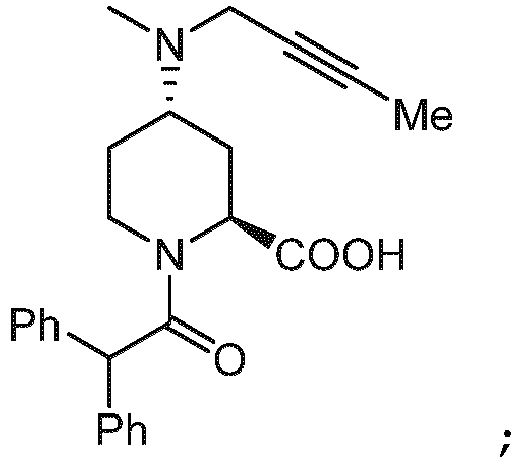
- Example 14 Compound 42 (2 S ,4 R )-4-((but-2-yn-1-yl)methyl)amino)-1-(2,2-diphenylacetyl)piperidine-2-carboxylic acid
- Example 15 Compound 43 (2 S ,4 S )-4-((but-2-yn-1-yl)methyl)amino)-1-(2,2-diphenylacetyl)piperidine-2-carboxylic acid
- Example 16 Compound 44 (2 S ,4 R )-1-(2,2-diphenylacetyl)-4-((methyl(4-methylpent-2-yn-1-yl)amino)piperidine-2-carboxylic acid
- Example 17 Compound 45 (2 S ,4 S )-1-(2,2-diphenylacetyl)-4-((methyl(4-methylpent-2-yn-1-yl)amino)piperidine-2-carboxylic acid
- Example 18 Compound 47 (2 S ,4 S )-1-(2,2-diphenylacetyl)-4-((3-(4-fluorophenyl)prop-2-yn-1-yl)(methyl)amino)piperidine-2-carboxylic acid
- Example 19 Compound 46 ((2 S ,4 R )-1-(2,2-diphenylacetyl)-4-((3-(4-fluorophenyl)prop-2-yn-1-yl)(methyl)amino)piperidine-2-carboxylic acid
- Example 20 Compound 52 (2 S, 4 R )-1-(2,2-diphenylacetyl)-4-((3-(4-fluorophenyl)prop-2-yn-1-yl)oxy)piperidine-2-carboxylic acid
- Example 21 Compound 57 (2' S ,3 S ,4' R )-1'-(2,2-diphenylacetyl)-3-phenyl-[1,4'-bipiperidine]-2'-carboxylic acid
- Example 22 Compound 58 (2' S ,3 S ,4' S )-1'-(2,2-diphenylacetyl)-3-phenyl-[1,4'-bipiperidine]-2'-carboxylic acid
- Example 23 Compound 54 (2 S ,4 R )-4-((4,4-dimethylpent-2-yn-l-yl)(methyl)amino)-1-(2,2-diphenylacetyl)piperidine-2-carboxylic acid
- Example 24 Compound 55 (2' S ,3 R ,4' R )-1'-(2,2-diphenylacetyl)-3-phenyl-[1,4'-bipiperidine]-2'-carboxylic acid
- Reference Example 25 Reference Compound 56 (2' S ,3 R ,4' R )-1'-(2,2-diphenylacetyl)-3-phenyl-[1,4'-bipiperidine]-2'-carboxylic acid
- Reference Example 26 Reference Compound 59 (2 S ,4 R )-1-(2,2-diphenylacetyl)-4-(methyl(3-phenylprop-2-yn-1-yl)amino)piperidine-2-carboxamide
- Reference Example 27 Reference Compound 60 (2 S ,4 R )-1-(2,2-diphenylacetyl)-4-(methyl(3-phenylprop-2-yn-1-yl)amino)piperidine-2-carbonitrile
- Reference Example 28 Reference Compound 61 (2 S ,4 R )-4-(methyl(3-phenylprop-2-yn-1-yl)amino)-2-(1H-tetrazol-5-yl)piperidin-1-yl)-2,2-diphenylethanone
- Reference Example 29 Reference Compound 62 (2 S ,4 R )-N-(N,N-dimethylsufamoyl)-1-22-dihenlacetvl-4-3-henylprop-2-n-1-yl)aminopiperidine-2-carboxamide
- Trypsin-EDTA (for preparation of 100 mL) Trypsin 0.25 g 2% EDTA 2 mL PBS 98 mL Dissolve trypsin in 2% EDTA and PBS completely; sterilize the solution by passing through a 0.20 ⁇ M membrane filter; store at 4°C. 2.
- DMEM medium (for preparation of 1L) The powder was dissolved into 950 mL of distilled water with gentle stirring until the solution becomes clear. Add NaHCO 3 1.176 g forDMEM medium. Adjust pH of medium to 0.2-0.3 below final working pH using 1 M NaOH or 1 M HC1. Add slowly with stirring. Dilute to 1 liter with ddH 2 O. Sterilize the medium immediately by filtration. Store at 4°C. 3.
- TE buffer for preparation of 100 mL
- Step 1 Dose plate preparation (96 well plate)
- Step 2 Working plate preparation (96 well plate)
- Step 3 Assay plate preparation (96 well plate)
- Cell membrane homogenates (8 ⁇ g protein) were incubated for 120 min at 37°C with 0.005 nM [121] [Sarl-Ile8]angiotensin-II in the absence or presence of the test compound in a buffer containing 50 mM Tris-HCl (pH 7.4), 5 mM MgCl 2 , 1 mM EDTA and 0.1% BSA. Nonspecific binding was determined in the presence of 10 mM angiotensin-II.
- the samples were filtered rapidly under vacuum through glass fibre filters (GF/B, Packard) presoaked with 0.3% PEI and rinsed several times with ice-cold 50 mM Tris-HCl using a 96-sample cell harvester (Unifilter, Packard).
- the filters were dried then counted for radioactivity in a scintillation counter (Topcount, Packard) using a scintillation cocktail (Microscint 0, Packard). The results were expressed as a percent inhibition of the control radioligand specific binding.
- the standard reference compound was saralasin, which was tested in each experiment at several concentrations to obtain a competition curve from which its IC50 was calculated.
- test compounds used were compounds 26, 30, 32 and 33.
Landscapes
- Organic Chemistry (AREA)
- Chemical & Material Sciences (AREA)
- Health & Medical Sciences (AREA)
- Veterinary Medicine (AREA)
- Nuclear Medicine, Radiotherapy & Molecular Imaging (AREA)
- General Chemical & Material Sciences (AREA)
- Pharmacology & Pharmacy (AREA)
- Life Sciences & Earth Sciences (AREA)
- Animal Behavior & Ethology (AREA)
- General Health & Medical Sciences (AREA)
- Public Health (AREA)
- Chemical Kinetics & Catalysis (AREA)
- Medicinal Chemistry (AREA)
- Engineering & Computer Science (AREA)
- Bioinformatics & Cheminformatics (AREA)
- Neurosurgery (AREA)
- Biomedical Technology (AREA)
- Neurology (AREA)
- Rheumatology (AREA)
- Pain & Pain Management (AREA)
- Physical Education & Sports Medicine (AREA)
- Orthopedic Medicine & Surgery (AREA)
- Pharmaceuticals Containing Other Organic And Inorganic Compounds (AREA)
- Plural Heterocyclic Compounds (AREA)
- Nitrogen Condensed Heterocyclic Rings (AREA)
- Hydrogenated Pyridines (AREA)
Claims (9)
- Composé de formule (I) :
 R1 étant -C(=O)CH(aryl)(aryle), -C(=O)CH(aryle)(cycloalkyle), -C(=O)CH(cycloalkyle)(cycloalkyle), -C(=O)N(aryle)(aryle), -C(=O)N(aryle)(cycloalkyle) ou -C(=O)N(cycloalkyle)(cycloalkyle) ;R2 étant -CH2phényle, -CH2CH2phényle, -CH2CH2CH2phényle, -OCH2phényle, -OCH2CH2phényle, -OCH2CH2CH2phényle, -CH2CH=CHphényle, -OCH2CH=CHphényle, -OCH2C≡Cphényle, -CH2C≡Cphényle, -CH2OCH2phényle, -CH2Ophényle, -N(CH3)(2-phénylpropyle), -N(CH3)(3-phénylpropyn-1-yle), -N(CH3)(phénéthyle), -3-benzylmorpholine, -N(CH3)(benzyle), -N(CH3)(CH2C≡CCH3), -N(CH3)(CH2C≡CCH(CH3)2, -N(CH3)(CH2C≡C-4-fluorophényle), -N(CH3)(CH2-4-phényl-5-tétrazolyle), -N(CH3)(CH2-2-phényl-1-cyclopent-1-ényle), -OCH2C≡C-4-fluorophényle, -N(CH3)(CH2C≡CCF3), -N(CH3)(CH2C≡C-C(CH3)3, -3-phénylpipéridine, -N(CH3)(CH2C≡Cphényle);oxazolyle substitué par aryle ou alkylaryle tel que 2-(5-phényl)oxazolyle et 2-(5-benzyl)oxazolyle ;R3b étant hydrogène ;R3a étant -CO2H ;R4 étant hydrogène ;
etchaque cycloalkyle et aryle pouvant être éventuellement substitué ;ou sel pharmaceutiquement acceptable correspondant. - Composé selon la revendication 1, R1 étant -C(=O)CH(phényle) (phényle), -C(=O)CH(phényle)(cyclohexyle), -C(=O)CH(cyclohexyle)(cyclohexyle), -C(=O)N(phényle)(phényle), -C(=O)N(phényle)(cyclohexyle) ou -C(=O)N(cyclohexyle)(cyclohexyle), chaque phényle ou cyclohexyle étant éventuellement substitué par un ou plusieurs substituants choisis parmi -C1-3alkyle, -OC1-3alkyle et halogéno ;
ou sel pharmaceutiquement acceptable correspondant. - Composé selon la revendication 1, ou sel pharmaceutiquement acceptable correspondant, le composé étant choisi parmi :acide (2S)-4-(benzyloxy)-1-(2,2-diphénylacétyl)pipéridine-2-carboxylique ;acide (2S,4S)-4-benzyloxy-1-(2,2-diphénylacétyl)pipéridine-2-carboxylique ;acide (2S,4R)-1-(2,2-diphénylacétyl)-4-(méthyl(phénylpropyl)amino)pipéridine-2-carboxylique ;


 acide (2S,4R)-4-(benzyl(méthyl)amino)-1-(2,2-diphénylacétyl)pipéridine-2-carboxylique ;acide (2S,4S)-4-(benzyl(méthyl)amino)-1-(2,2-diphénylacétyl)pipéridine-2-carboxylique ;acide (2S,4R)-1-(2,2-diphénylacétyl)-4-((3-phénylprop-2-yn-yl)oxy)pipéridine-2-carboxylique ;acide (2S,4R)-1-(2,2-diphénylacétyl)-4-((3-phénylpropyl)oxy)pipéridine-2-carboxylique ;

 acide (2S,4R)-1-(2,2-diphénylacétyl)-4-((3-(4-fluorophényl)prop-2-yn-1-yl)(méthyl)amino)pipéridine-2-carboxylique ;acide (2S,4S)-1-(2,2-diphénylacétyl)-4-((3-(4-fluorophényl)prop-2-yn-1-yl)(méthyl)amino)pipéridine-2-carboxylique ;acide (2S,4R)-1-(2,2-diphénylacétyl)-4-((3-(4-fluorophényl)prop-2-yn-1-yl)oxy)pipéridine-2-carboxylique ;acide (2S,4R)-4-((4,4-diméthylpent-2-yn-1-yl)(méthyl)amino)-1-(2,2-diphénylacétyl)pipéridine-2-carboxylique ;acide (2'S,3R,4'R)-1'-(2,2-diphénylacétyl)-3-phényl-[1,4'-bipipéridine]-2'-carboxylique ;acide (2'S,3S,4'R)-1'-(2,2-diphénylacétyl)-3-phényl-[1,4'-bipipéridine]-2'-carboxylique ; etacide (2'S,3S,4'S)-1'-(2,2-diphénylacétyl)-3-phényl-[1,4'-bipipéridine]-2'-carboxylique.
 - Composition pharmaceutique comprenant un composé de formule (I) selon l'une quelconque des revendications 1 à 3, ou un sel pharmaceutiquement acceptable correspondant et un support pharmaceutiquement acceptable.
- Composé de formule (I) selon l'une quelconque des revendications 1 à 3, ou sel pharmaceutiquement acceptable correspondant, pour une utilisation dans le traitement ou la prévention d'une douleur neuropathique.
- Composé de formule (I) selon l'une quelconque des revendications 1 à 3, ou sel pharmaceutiquement acceptable correspondant, pour une utilisation dans le traitement ou la prévention de la vitesse de conduction nerveuse altérée, pour une utilisation dans le traitement ou la prévention d'une affection caractérisée par une hypersensibilité neuronale, pour une utilisation dans le traitement ou la prévention d'un trouble cellulaire prolifératif, pour une utilisation dans le traitement ou la prévention d'un trouble associé à un déséquilibre entre une résorption osseuse et une formation osseuse, ou pour une utilisation dans le traitement ou la prévention d'un trouble associé à une régénération nerveuse aberrante.
- Composé de formule (I) selon l'une quelconque des revendications 1 à 3, ou sel pharmaceutiquement acceptable correspondant, pour une utilisation dans le traitement ou la prévention d'une douleur inflammatoire.
- Composé de formule (I) selon l'une quelconque des revendications 1 à 3, ou sel pharmaceutiquement acceptable correspondant, pour une utilisation dans la production d'une analgésie.
- Composé de formule (I) selon l'une quelconque des revendications 1 à 3, ou sel pharmaceutiquement acceptable correspondant, pour une utilisation selon la revendication 5, le composé de formule (I), ou sel pharmaceutiquement acceptable correspondant, étant administré conjointement avec une autre thérapie.
Priority Applications (1)
| Application Number | Priority Date | Filing Date | Title |
|---|---|---|---|
| PL13741412T PL2807171T3 (pl) | 2012-01-25 | 2013-01-25 | Związki heterocykliczne i sposoby ich stosowania |
Applications Claiming Priority (2)
| Application Number | Priority Date | Filing Date | Title |
|---|---|---|---|
| AU2012900285A AU2012900285A0 (en) | 2012-01-25 | Methods of treatment or prophylaxis | |
| PCT/AU2013/000062 WO2013110135A1 (fr) | 2012-01-25 | 2013-01-25 | Composés hétérocycliques et leurs procédés d'utilisation |
Publications (3)
| Publication Number | Publication Date |
|---|---|
| EP2807171A1 EP2807171A1 (fr) | 2014-12-03 |
| EP2807171A4 EP2807171A4 (fr) | 2015-10-21 |
| EP2807171B1 true EP2807171B1 (fr) | 2020-08-12 |
Family
ID=48872833
Family Applications (1)
| Application Number | Title | Priority Date | Filing Date |
|---|---|---|---|
| EP13741412.4A Active EP2807171B1 (fr) | 2012-01-25 | 2013-01-25 | Composés hétérocycliques et leurs procédés d'utilisation |
Country Status (12)
| Country | Link |
|---|---|
| US (1) | US9624234B2 (fr) |
| EP (1) | EP2807171B1 (fr) |
| JP (1) | JP6073926B2 (fr) |
| CN (1) | CN104470930B (fr) |
| AU (1) | AU2013202978B2 (fr) |
| CA (1) | CA2861233C (fr) |
| ES (1) | ES2830023T3 (fr) |
| NZ (1) | NZ627558A (fr) |
| PL (1) | PL2807171T3 (fr) |
| PT (1) | PT2807171T (fr) |
| WO (1) | WO2013110135A1 (fr) |
| ZA (1) | ZA201405257B (fr) |
Families Citing this family (14)
| Publication number | Priority date | Publication date | Assignee | Title |
|---|---|---|---|---|
| ES2802251T3 (es) | 2012-01-06 | 2021-01-18 | Novartis Ag | Compuestos heterocíclicos y métodos para su uso |
| ES2798289T3 (es) | 2012-01-25 | 2020-12-10 | Novartis Ag | Compuestos heterocíclicos y métodos para su uso |
| ES2883155T3 (es) | 2013-07-08 | 2021-12-07 | Novartis Ag | Compuestos heterocíclicos y métodos para su uso |
| JP6667551B2 (ja) * | 2015-01-13 | 2020-03-18 | ノバルティス アーゲー | アンジオテンシンii2型拮抗薬としてのピロリジン誘導体 |
| US10308628B2 (en) | 2015-03-12 | 2019-06-04 | Novartis Ag | Heterocyclic compounds and methods for their use |
| CN105021735B (zh) * | 2015-07-21 | 2017-09-19 | 中国科学院西北高原生物研究所 | 白刺种子或其提取物中ss和rsMTCA的检测方法 |
| US9650338B1 (en) | 2016-07-29 | 2017-05-16 | VDM Biochemicals, Inc. | Opioid antagonist compounds and methods of making and using |
| IL302184B2 (en) | 2017-04-18 | 2024-12-01 | Breakthrough Tech Llc | Sulfur production |
| WO2019040105A2 (fr) * | 2017-08-21 | 2019-02-28 | Acadia Pharmaceuticals Inc. | Composés, sels de ces composés et procédés pour le traitement de maladies |
| CN117645606A (zh) | 2018-03-23 | 2024-03-05 | 北京泰德制药股份有限公司 | 受体抑制剂、包含其的药物组合物及其用途 |
| CN112313222B (zh) * | 2018-06-19 | 2024-01-26 | 浙江海正药业股份有限公司 | 四氢异喹啉类衍生物、其制备方法及其用途 |
| WO2020228436A1 (fr) | 2019-05-10 | 2020-11-19 | 浙江海正药业股份有限公司 | Dérivés de cycle aromatique ou de cycle hétéroaromatique, méthode de préparation associée et utilisation associée |
| CN110128393B (zh) * | 2019-06-21 | 2022-09-30 | 华侨大学 | 一种取代异香豆素衍生物的制备方法 |
| CN113880825B (zh) | 2020-07-01 | 2025-03-14 | 浙江海正药业股份有限公司 | 四氢异喹啉类衍生物的盐、其制备方法及其医药应用 |
Citations (1)
| Publication number | Priority date | Publication date | Assignee | Title |
|---|---|---|---|---|
| EP0018104A2 (fr) * | 1979-03-26 | 1980-10-29 | Takeda Chemical Industries, Ltd. | Dérivés de la tétrahydro-isoquinoléine, leur préparation, dérivés et compositions pharmaceutiques les contenant pour utilisation dans la prévention et dans le traitement de l'hypertension |
Family Cites Families (16)
| Publication number | Priority date | Publication date | Assignee | Title |
|---|---|---|---|---|
| FR2487829A2 (fr) | 1979-12-07 | 1982-02-05 | Science Union & Cie | Nouveaux imino acides substitues, leurs procedes de preparation et leur emploi comme inhibiteur d'enzyme |
| FR2470767A1 (fr) | 1979-12-07 | 1981-06-12 | Science Union & Cie | Nouveaux iminoacides substitues, leurs procedes de preparation et leur emploi comme inhibiteur d'enzymes |
| DE3134933A1 (de) | 1981-09-03 | 1983-03-31 | Hoechst Ag, 6230 Frankfurt | "harnstoffderivate, verfahren zu ihrer herstellung und diese enthaltende medikamente sowie deren verwendung" |
| DE3302126A1 (de) | 1983-01-22 | 1984-07-26 | Boehringer Ingelheim KG, 6507 Ingelheim | Aminosaeure-derivate, verfahren zu ihrer herstellung und verwendung |
| JPS6216466A (ja) | 1985-07-16 | 1987-01-24 | Iwaki Seiyaku Kk | テトラヒドロピリジン誘導体 |
| US5612360A (en) | 1992-06-03 | 1997-03-18 | Eli Lilly And Company | Angiotensin II antagonists |
| US5236934A (en) | 1992-08-26 | 1993-08-17 | E. I. Du Pont De Nemours And Company | 1,2,3,4-tetrahydroisoquinolines useful in the treatment of CNS disorders |
| US5610165A (en) | 1994-02-17 | 1997-03-11 | Merck & Co., Inc. | N-acylpiperidine tachykinin antagonists |
| JPH0892207A (ja) | 1994-07-26 | 1996-04-09 | Sankyo Co Ltd | ピロリジン誘導体 |
| BE1012622A3 (fr) | 1999-04-21 | 2001-01-09 | Solvay | Procede pour la separation d'enantiomeres et reactif enantiopur. |
| JP4827821B2 (ja) | 2004-05-26 | 2011-11-30 | エーザイ・アール・アンド・ディー・マネジメント株式会社 | シンナミド化合物 |
| RU2361872C2 (ru) | 2004-05-26 | 2009-07-20 | Эйсай Ар Энд Ди Менеджмент Ко., Лтд. | Циннамидное соединение |
| WO2006055951A2 (fr) | 2004-11-19 | 2006-05-26 | Portola Pharmaceuticals, Inc. | Tetrahydroisoquinolines comme inhibiteurs du facteur xa |
| WO2006066361A1 (fr) | 2004-12-24 | 2006-06-29 | The University Of Queensland | Procede de traitement ou prophylaxie |
| CA2866540A1 (fr) | 2006-03-20 | 2007-09-27 | Spinifex Pharmaceuticals Pty Ltd. | Methode de traitement prophylactique ou therapeutique |
| NZ601383A (en) * | 2010-01-19 | 2014-07-25 | Spinifex Pharm Pty Ltd | Methods and compositions for improved nerve conduction velocity |
-
2013
- 2013-01-25 PT PT137414124T patent/PT2807171T/pt unknown
- 2013-01-25 AU AU2013202978A patent/AU2013202978B2/en active Active
- 2013-01-25 WO PCT/AU2013/000062 patent/WO2013110135A1/fr not_active Ceased
- 2013-01-25 CN CN201380016332.2A patent/CN104470930B/zh active Active
- 2013-01-25 JP JP2014553582A patent/JP6073926B2/ja active Active
- 2013-01-25 NZ NZ627558A patent/NZ627558A/en unknown
- 2013-01-25 ES ES13741412T patent/ES2830023T3/es active Active
- 2013-01-25 PL PL13741412T patent/PL2807171T3/pl unknown
- 2013-01-25 EP EP13741412.4A patent/EP2807171B1/fr active Active
- 2013-01-25 US US14/373,357 patent/US9624234B2/en active Active
- 2013-01-25 CA CA2861233A patent/CA2861233C/fr active Active
-
2014
- 2014-07-17 ZA ZA2014/05257A patent/ZA201405257B/en unknown
Patent Citations (1)
| Publication number | Priority date | Publication date | Assignee | Title |
|---|---|---|---|---|
| EP0018104A2 (fr) * | 1979-03-26 | 1980-10-29 | Takeda Chemical Industries, Ltd. | Dérivés de la tétrahydro-isoquinoléine, leur préparation, dérivés et compositions pharmaceutiques les contenant pour utilisation dans la prévention et dans le traitement de l'hypertension |
Also Published As
| Publication number | Publication date |
|---|---|
| ES2830023T3 (es) | 2021-06-02 |
| AU2013202978B2 (en) | 2016-05-19 |
| HK1201531A1 (en) | 2015-09-04 |
| ZA201405257B (en) | 2016-10-26 |
| US9624234B2 (en) | 2017-04-18 |
| WO2013110135A1 (fr) | 2013-08-01 |
| EP2807171A1 (fr) | 2014-12-03 |
| CA2861233C (fr) | 2021-05-04 |
| CA2861233A1 (fr) | 2013-08-01 |
| PT2807171T (pt) | 2020-11-03 |
| US20150218180A1 (en) | 2015-08-06 |
| EP2807171A4 (fr) | 2015-10-21 |
| CN104470930A (zh) | 2015-03-25 |
| JP6073926B2 (ja) | 2017-02-01 |
| JP2015504901A (ja) | 2015-02-16 |
| PL2807171T3 (pl) | 2021-01-25 |
| NZ627558A (en) | 2016-07-29 |
| CN104470930B (zh) | 2017-02-22 |
Similar Documents
| Publication | Publication Date | Title |
|---|---|---|
| EP2807171B1 (fr) | Composés hétérocycliques et leurs procédés d'utilisation | |
| EP2807153B1 (fr) | Composés hétérocycliques et leurs procédés d'utilisation | |
| EP2800738B1 (fr) | Composés hétérocycliques et procédés pour leur utilisation | |
| EP3019477B1 (fr) | Composés hétérocycliques et leurs procédés d'utilisation | |
| AU2013202978A1 (en) | Heterocyclic compounds and methods for their use | |
| AU2013202973A1 (en) | Heterocyclic compounds and methods for their use | |
| EP3268356B1 (fr) | Composés hétérocycliques et leurs procédés d'utilisation | |
| HK1201531B (en) | Heterocyclic compounds and methods for their use | |
| HK1201533B (en) | Heterocyclic compounds and methods for their use | |
| HK1201521B (en) | Heterocyclic compounds and methods for their use |
Legal Events
| Date | Code | Title | Description |
|---|---|---|---|
| PUAI | Public reference made under article 153(3) epc to a published international application that has entered the european phase |
Free format text: ORIGINAL CODE: 0009012 |
|
| 17P | Request for examination filed |
Effective date: 20140721 |
|
| AK | Designated contracting states |
Kind code of ref document: A1 Designated state(s): AL AT BE BG CH CY CZ DE DK EE ES FI FR GB GR HR HU IE IS IT LI LT LU LV MC MK MT NL NO PL PT RO RS SE SI SK SM TR |
|
| DAX | Request for extension of the european patent (deleted) | ||
| REG | Reference to a national code |
Ref country code: HK Ref legal event code: DE Ref document number: 1201531 Country of ref document: HK |
|
| RA4 | Supplementary search report drawn up and despatched (corrected) |
Effective date: 20150917 |
|
| RIC1 | Information provided on ipc code assigned before grant |
Ipc: A61P 25/04 20060101ALI20150911BHEP Ipc: A61P 25/02 20060101ALI20150911BHEP Ipc: C07D 491/048 20060101ALI20150911BHEP Ipc: C07D 211/66 20060101ALI20150911BHEP Ipc: C07D 211/60 20060101ALI20150911BHEP Ipc: A61P 35/00 20060101ALI20150911BHEP Ipc: A61K 31/437 20060101ALI20150911BHEP Ipc: A61K 31/4355 20060101ALI20150911BHEP Ipc: A61K 31/436 20060101ALI20150911BHEP Ipc: A61K 31/4365 20060101ALI20150911BHEP Ipc: A61K 31/519 20060101ALI20150911BHEP Ipc: C07D 495/04 20060101AFI20150911BHEP Ipc: C07D 491/056 20060101ALI20150911BHEP Ipc: A61K 31/4375 20060101ALI20150911BHEP Ipc: C07D 471/04 20060101ALI20150911BHEP |
|
| RAP1 | Party data changed (applicant data changed or rights of an application transferred) |
Owner name: NOVARTIS AG |
|
| STAA | Information on the status of an ep patent application or granted ep patent |
Free format text: STATUS: EXAMINATION IS IN PROGRESS |
|
| 17Q | First examination report despatched |
Effective date: 20170420 |
|
| GRAP | Despatch of communication of intention to grant a patent |
Free format text: ORIGINAL CODE: EPIDOSNIGR1 |
|
| STAA | Information on the status of an ep patent application or granted ep patent |
Free format text: STATUS: GRANT OF PATENT IS INTENDED |
|
| INTG | Intention to grant announced |
Effective date: 20190926 |
|
| GRAJ | Information related to disapproval of communication of intention to grant by the applicant or resumption of examination proceedings by the epo deleted |
Free format text: ORIGINAL CODE: EPIDOSDIGR1 |
|
| STAA | Information on the status of an ep patent application or granted ep patent |
Free format text: STATUS: EXAMINATION IS IN PROGRESS |
|
| GRAP | Despatch of communication of intention to grant a patent |
Free format text: ORIGINAL CODE: EPIDOSNIGR1 |
|
| STAA | Information on the status of an ep patent application or granted ep patent |
Free format text: STATUS: GRANT OF PATENT IS INTENDED |
|
| INTC | Intention to grant announced (deleted) | ||
| INTG | Intention to grant announced |
Effective date: 20200221 |
|
| GRAS | Grant fee paid |
Free format text: ORIGINAL CODE: EPIDOSNIGR3 |
|
| GRAA | (expected) grant |
Free format text: ORIGINAL CODE: 0009210 |
|
| STAA | Information on the status of an ep patent application or granted ep patent |
Free format text: STATUS: THE PATENT HAS BEEN GRANTED |
|
| AK | Designated contracting states |
Kind code of ref document: B1 Designated state(s): AL AT BE BG CH CY CZ DE DK EE ES FI FR GB GR HR HU IE IS IT LI LT LU LV MC MK MT NL NO PL PT RO RS SE SI SK SM TR |
|
| REG | Reference to a national code |
Ref country code: CH Ref legal event code: EP |
|
| REG | Reference to a national code |
Ref country code: IE Ref legal event code: FG4D |
|
| REG | Reference to a national code |
Ref country code: DE Ref legal event code: R096 Ref document number: 602013071558 Country of ref document: DE |
|
| REG | Reference to a national code |
Ref country code: AT Ref legal event code: REF Ref document number: 1301464 Country of ref document: AT Kind code of ref document: T Effective date: 20200915 |
|
| REG | Reference to a national code |
Ref country code: PT Ref legal event code: SC4A Ref document number: 2807171 Country of ref document: PT Date of ref document: 20201103 Kind code of ref document: T Free format text: AVAILABILITY OF NATIONAL TRANSLATION Effective date: 20201028 |
|
| REG | Reference to a national code |
Ref country code: NL Ref legal event code: FP |
|
| REG | Reference to a national code |
Ref country code: LT Ref legal event code: MG4D |
|
| REG | Reference to a national code |
Ref country code: GR Ref legal event code: EP Ref document number: 20200403109 Country of ref document: GR Effective date: 20201215 |
|
| PG25 | Lapsed in a contracting state [announced via postgrant information from national office to epo] |
Ref country code: SE Free format text: LAPSE BECAUSE OF FAILURE TO SUBMIT A TRANSLATION OF THE DESCRIPTION OR TO PAY THE FEE WITHIN THE PRESCRIBED TIME-LIMIT Effective date: 20200812 Ref country code: FI Free format text: LAPSE BECAUSE OF FAILURE TO SUBMIT A TRANSLATION OF THE DESCRIPTION OR TO PAY THE FEE WITHIN THE PRESCRIBED TIME-LIMIT Effective date: 20200812 Ref country code: BG Free format text: LAPSE BECAUSE OF FAILURE TO SUBMIT A TRANSLATION OF THE DESCRIPTION OR TO PAY THE FEE WITHIN THE PRESCRIBED TIME-LIMIT Effective date: 20201112 Ref country code: NO Free format text: LAPSE BECAUSE OF FAILURE TO SUBMIT A TRANSLATION OF THE DESCRIPTION OR TO PAY THE FEE WITHIN THE PRESCRIBED TIME-LIMIT Effective date: 20201112 Ref country code: LT Free format text: LAPSE BECAUSE OF FAILURE TO SUBMIT A TRANSLATION OF THE DESCRIPTION OR TO PAY THE FEE WITHIN THE PRESCRIBED TIME-LIMIT Effective date: 20200812 Ref country code: HR Free format text: LAPSE BECAUSE OF FAILURE TO SUBMIT A TRANSLATION OF THE DESCRIPTION OR TO PAY THE FEE WITHIN THE PRESCRIBED TIME-LIMIT Effective date: 20200812 |
|
| PG25 | Lapsed in a contracting state [announced via postgrant information from national office to epo] |
Ref country code: IS Free format text: LAPSE BECAUSE OF FAILURE TO SUBMIT A TRANSLATION OF THE DESCRIPTION OR TO PAY THE FEE WITHIN THE PRESCRIBED TIME-LIMIT Effective date: 20201212 Ref country code: RS Free format text: LAPSE BECAUSE OF FAILURE TO SUBMIT A TRANSLATION OF THE DESCRIPTION OR TO PAY THE FEE WITHIN THE PRESCRIBED TIME-LIMIT Effective date: 20200812 Ref country code: LV Free format text: LAPSE BECAUSE OF FAILURE TO SUBMIT A TRANSLATION OF THE DESCRIPTION OR TO PAY THE FEE WITHIN THE PRESCRIBED TIME-LIMIT Effective date: 20200812 |
|
| PG25 | Lapsed in a contracting state [announced via postgrant information from national office to epo] |
Ref country code: DK Free format text: LAPSE BECAUSE OF FAILURE TO SUBMIT A TRANSLATION OF THE DESCRIPTION OR TO PAY THE FEE WITHIN THE PRESCRIBED TIME-LIMIT Effective date: 20200812 Ref country code: EE Free format text: LAPSE BECAUSE OF FAILURE TO SUBMIT A TRANSLATION OF THE DESCRIPTION OR TO PAY THE FEE WITHIN THE PRESCRIBED TIME-LIMIT Effective date: 20200812 Ref country code: CZ Free format text: LAPSE BECAUSE OF FAILURE TO SUBMIT A TRANSLATION OF THE DESCRIPTION OR TO PAY THE FEE WITHIN THE PRESCRIBED TIME-LIMIT Effective date: 20200812 Ref country code: RO Free format text: LAPSE BECAUSE OF FAILURE TO SUBMIT A TRANSLATION OF THE DESCRIPTION OR TO PAY THE FEE WITHIN THE PRESCRIBED TIME-LIMIT Effective date: 20200812 Ref country code: SM Free format text: LAPSE BECAUSE OF FAILURE TO SUBMIT A TRANSLATION OF THE DESCRIPTION OR TO PAY THE FEE WITHIN THE PRESCRIBED TIME-LIMIT Effective date: 20200812 |
|
| REG | Reference to a national code |
Ref country code: DE Ref legal event code: R097 Ref document number: 602013071558 Country of ref document: DE |
|
| PG25 | Lapsed in a contracting state [announced via postgrant information from national office to epo] |
Ref country code: AL Free format text: LAPSE BECAUSE OF FAILURE TO SUBMIT A TRANSLATION OF THE DESCRIPTION OR TO PAY THE FEE WITHIN THE PRESCRIBED TIME-LIMIT Effective date: 20200812 |
|
| REG | Reference to a national code |
Ref country code: ES Ref legal event code: FG2A Ref document number: 2830023 Country of ref document: ES Kind code of ref document: T3 Effective date: 20210602 |
|
| PLBE | No opposition filed within time limit |
Free format text: ORIGINAL CODE: 0009261 |
|
| STAA | Information on the status of an ep patent application or granted ep patent |
Free format text: STATUS: NO OPPOSITION FILED WITHIN TIME LIMIT |
|
| PG25 | Lapsed in a contracting state [announced via postgrant information from national office to epo] |
Ref country code: SK Free format text: LAPSE BECAUSE OF FAILURE TO SUBMIT A TRANSLATION OF THE DESCRIPTION OR TO PAY THE FEE WITHIN THE PRESCRIBED TIME-LIMIT Effective date: 20200812 |
|
| 26N | No opposition filed |
Effective date: 20210514 |
|
| PG25 | Lapsed in a contracting state [announced via postgrant information from national office to epo] |
Ref country code: SI Free format text: LAPSE BECAUSE OF FAILURE TO SUBMIT A TRANSLATION OF THE DESCRIPTION OR TO PAY THE FEE WITHIN THE PRESCRIBED TIME-LIMIT Effective date: 20200812 Ref country code: MC Free format text: LAPSE BECAUSE OF FAILURE TO SUBMIT A TRANSLATION OF THE DESCRIPTION OR TO PAY THE FEE WITHIN THE PRESCRIBED TIME-LIMIT Effective date: 20200812 |
|
| PG25 | Lapsed in a contracting state [announced via postgrant information from national office to epo] |
Ref country code: LU Free format text: LAPSE BECAUSE OF NON-PAYMENT OF DUE FEES Effective date: 20210125 |
|
| PG25 | Lapsed in a contracting state [announced via postgrant information from national office to epo] |
Ref country code: IE Free format text: LAPSE BECAUSE OF NON-PAYMENT OF DUE FEES Effective date: 20210125 |
|
| PG25 | Lapsed in a contracting state [announced via postgrant information from national office to epo] |
Ref country code: HU Free format text: LAPSE BECAUSE OF FAILURE TO SUBMIT A TRANSLATION OF THE DESCRIPTION OR TO PAY THE FEE WITHIN THE PRESCRIBED TIME-LIMIT; INVALID AB INITIO Effective date: 20130125 |
|
| P01 | Opt-out of the competence of the unified patent court (upc) registered |
Effective date: 20230514 |
|
| PG25 | Lapsed in a contracting state [announced via postgrant information from national office to epo] |
Ref country code: CY Free format text: LAPSE BECAUSE OF FAILURE TO SUBMIT A TRANSLATION OF THE DESCRIPTION OR TO PAY THE FEE WITHIN THE PRESCRIBED TIME-LIMIT Effective date: 20200812 |
|
| REG | Reference to a national code |
Ref country code: AT Ref legal event code: UEP Ref document number: 1301464 Country of ref document: AT Kind code of ref document: T Effective date: 20200812 |
|
| PG25 | Lapsed in a contracting state [announced via postgrant information from national office to epo] |
Ref country code: MK Free format text: LAPSE BECAUSE OF FAILURE TO SUBMIT A TRANSLATION OF THE DESCRIPTION OR TO PAY THE FEE WITHIN THE PRESCRIBED TIME-LIMIT Effective date: 20200812 |
|
| PG25 | Lapsed in a contracting state [announced via postgrant information from national office to epo] |
Ref country code: MT Free format text: LAPSE BECAUSE OF FAILURE TO SUBMIT A TRANSLATION OF THE DESCRIPTION OR TO PAY THE FEE WITHIN THE PRESCRIBED TIME-LIMIT Effective date: 20200812 |
|
| PGFP | Annual fee paid to national office [announced via postgrant information from national office to epo] |
Ref country code: GB Payment date: 20251218 Year of fee payment: 14 |
|
| PGFP | Annual fee paid to national office [announced via postgrant information from national office to epo] |
Ref country code: FR Payment date: 20251222 Year of fee payment: 14 Ref country code: NL Payment date: 20251225 Year of fee payment: 14 |
|
| PGFP | Annual fee paid to national office [announced via postgrant information from national office to epo] |
Ref country code: GR Payment date: 20251230 Year of fee payment: 14 |
|
| PGFP | Annual fee paid to national office [announced via postgrant information from national office to epo] |
Ref country code: PL Payment date: 20251229 Year of fee payment: 14 |
|
| REG | Reference to a national code |
Ref country code: CH Ref legal event code: U11 Free format text: ST27 STATUS EVENT CODE: U-0-0-U10-U11 (AS PROVIDED BY THE NATIONAL OFFICE) Effective date: 20260201 |
|
| PGFP | Annual fee paid to national office [announced via postgrant information from national office to epo] |
Ref country code: ES Payment date: 20260206 Year of fee payment: 14 |
|
| PGFP | Annual fee paid to national office [announced via postgrant information from national office to epo] |
Ref country code: DE Payment date: 20251216 Year of fee payment: 14 |
|
| PGFP | Annual fee paid to national office [announced via postgrant information from national office to epo] |
Ref country code: AT Payment date: 20251230 Year of fee payment: 14 |
|
| PGFP | Annual fee paid to national office [announced via postgrant information from national office to epo] |
Ref country code: BE Payment date: 20260106 Year of fee payment: 14 Ref country code: IT Payment date: 20251230 Year of fee payment: 14 |
|
| PGFP | Annual fee paid to national office [announced via postgrant information from national office to epo] |
Ref country code: TR Payment date: 20260122 Year of fee payment: 14 |
|
| PGFP | Annual fee paid to national office [announced via postgrant information from national office to epo] |
Ref country code: PT Payment date: 20260123 Year of fee payment: 14 Ref country code: CH Payment date: 20260201 Year of fee payment: 14 |