EP2808304A1 - Procédé et installation de traitement de résidus aqueux, organiques - Google Patents
Procédé et installation de traitement de résidus aqueux, organiques Download PDFInfo
- Publication number
- EP2808304A1 EP2808304A1 EP20140170033 EP14170033A EP2808304A1 EP 2808304 A1 EP2808304 A1 EP 2808304A1 EP 20140170033 EP20140170033 EP 20140170033 EP 14170033 A EP14170033 A EP 14170033A EP 2808304 A1 EP2808304 A1 EP 2808304A1
- Authority
- EP
- European Patent Office
- Prior art keywords
- vapor
- scrubber
- acid
- ammonia
- ammonium
- Prior art date
- Legal status (The legal status is an assumption and is not a legal conclusion. Google has not performed a legal analysis and makes no representation as to the accuracy of the status listed.)
- Withdrawn
Links
Images


Classifications
-
- C—CHEMISTRY; METALLURGY
- C02—TREATMENT OF WATER, WASTE WATER, SEWAGE, OR SLUDGE
- C02F—TREATMENT OF WATER, WASTE WATER, SEWAGE, OR SLUDGE
- C02F1/00—Treatment of water, waste water, or sewage
- C02F1/66—Treatment of water, waste water, or sewage by neutralisation; pH adjustment
-
- B—PERFORMING OPERATIONS; TRANSPORTING
- B01—PHYSICAL OR CHEMICAL PROCESSES OR APPARATUS IN GENERAL
- B01D—SEPARATION
- B01D1/00—Evaporating
- B01D1/26—Multiple-effect evaporating
-
- C—CHEMISTRY; METALLURGY
- C01—INORGANIC CHEMISTRY
- C01C—AMMONIA; CYANOGEN; COMPOUNDS THEREOF
- C01C1/00—Ammonia; Compounds thereof
- C01C1/24—Sulfates of ammonium
- C01C1/242—Preparation from ammonia and sulfuric acid or sulfur trioxide
-
- C—CHEMISTRY; METALLURGY
- C01—INORGANIC CHEMISTRY
- C01C—AMMONIA; CYANOGEN; COMPOUNDS THEREOF
- C01C1/00—Ammonia; Compounds thereof
- C01C1/28—Methods of preparing ammonium salts in general
-
- C—CHEMISTRY; METALLURGY
- C02—TREATMENT OF WATER, WASTE WATER, SEWAGE, OR SLUDGE
- C02F—TREATMENT OF WATER, WASTE WATER, SEWAGE, OR SLUDGE
- C02F1/00—Treatment of water, waste water, or sewage
- C02F1/02—Treatment of water, waste water, or sewage by heating
- C02F1/04—Treatment of water, waste water, or sewage by heating by distillation or evaporation
- C02F1/048—Purification of waste water by evaporation
-
- C—CHEMISTRY; METALLURGY
- C02—TREATMENT OF WATER, WASTE WATER, SEWAGE, OR SLUDGE
- C02F—TREATMENT OF WATER, WASTE WATER, SEWAGE, OR SLUDGE
- C02F1/00—Treatment of water, waste water, or sewage
- C02F1/20—Treatment of water, waste water, or sewage by degassing, i.e. liberation of dissolved gases
-
- C—CHEMISTRY; METALLURGY
- C02—TREATMENT OF WATER, WASTE WATER, SEWAGE, OR SLUDGE
- C02F—TREATMENT OF WATER, WASTE WATER, SEWAGE, OR SLUDGE
- C02F2101/00—Nature of the contaminant
- C02F2101/10—Inorganic compounds
- C02F2101/16—Nitrogen compounds, e.g. ammonia
-
- C—CHEMISTRY; METALLURGY
- C02—TREATMENT OF WATER, WASTE WATER, SEWAGE, OR SLUDGE
- C02F—TREATMENT OF WATER, WASTE WATER, SEWAGE, OR SLUDGE
- C02F2103/00—Nature of the water, waste water, sewage or sludge to be treated
- C02F2103/20—Nature of the water, waste water, sewage or sludge to be treated from animal husbandry
-
- C—CHEMISTRY; METALLURGY
- C02—TREATMENT OF WATER, WASTE WATER, SEWAGE, OR SLUDGE
- C02F—TREATMENT OF WATER, WASTE WATER, SEWAGE, OR SLUDGE
- C02F2209/00—Controlling or monitoring parameters in water treatment
- C02F2209/14—NH3-N
-
- C—CHEMISTRY; METALLURGY
- C02—TREATMENT OF WATER, WASTE WATER, SEWAGE, OR SLUDGE
- C02F—TREATMENT OF WATER, WASTE WATER, SEWAGE, OR SLUDGE
- C02F3/00—Biological treatment of water, waste water, or sewage
- C02F3/28—Anaerobic digestion processes
-
- Y—GENERAL TAGGING OF NEW TECHNOLOGICAL DEVELOPMENTS; GENERAL TAGGING OF CROSS-SECTIONAL TECHNOLOGIES SPANNING OVER SEVERAL SECTIONS OF THE IPC; TECHNICAL SUBJECTS COVERED BY FORMER USPC CROSS-REFERENCE ART COLLECTIONS [XRACs] AND DIGESTS
- Y02—TECHNOLOGIES OR APPLICATIONS FOR MITIGATION OR ADAPTATION AGAINST CLIMATE CHANGE
- Y02E—REDUCTION OF GREENHOUSE GAS [GHG] EMISSIONS, RELATED TO ENERGY GENERATION, TRANSMISSION OR DISTRIBUTION
- Y02E50/00—Technologies for the production of fuel of non-fossil origin
- Y02E50/30—Fuel from waste, e.g. synthetic alcohol or diesel
Definitions
- the present invention relates to a process for the treatment of aqueous, organic, ammonia and / or ammonium-containing residues from anaerobic processes and to a plant for carrying out the process.
- One approach is to evaporate the residues to a concentrate.
- the concentrate can be dried to the extent that it can be applied as dry fertilizer, which greatly simplifies storage. In addition, depending on the starting material, the storage volumes are greatly reduced.
- a vapor laden with ammonia is formed during the evaporation. The ammonia is after cooling the Vapors contained in the condensate.
- the condensate from the evaporation process can not be introduced into surface waters such as streams or rivers. Particularly high is the liquid content in biogas plants, which are operated mainly based on manure or waste fermentation.
- German patent application DE 10 2010 017 334 A1 the applicant has already addressed this problem in 2010.
- the invention described therein provides a post-treatment of the condensate by stripping the ammonia from the condensate.
- aqueous organic residues from anaerobic processes containing ammonia and / or ammonium ions are thickened by evaporation.
- the residues come, for example, from biogas production, from digestion towers of sewage treatment plants or from livestock farming. Often, such residues are also referred to as fermentation residues.
- Evaporation results in a concentrate, which is also referred to as residue or digestate concentrate, which can be used as farm fertilizer.
- the vapor phase is a vapor laden with ammonia; in other words -
- this ammonia-containing vapor is introduced without intervening condensation step in a vapor scrubber and passed therethrough.
- the ammonia present in the vapor reacts with the acid.
- the ammonia acts as a base, which is appropriately salified with the acid.
- the vapor leaving the vapor scrubber is substantially free of ammonia.
- the ammonium nitrogen content (NH 4 -N) is ⁇ 10 mg / l.
- the resulting after carrying out the process according to the invention condensate thus has an ammonium nitrogen content, which usually allows a direct discharge into surface waters.
- the value of ⁇ 10 mg / l complies with the legal requirements for the operation of municipal sewage treatment plants in Bavaria.
- the vapor coming from the evaporator is not first condensed and then treated so that the ammonia is removed from the condensate, but the ammonia-containing vapor is directly, d. H. Still in the vapor phase, reacted with acid. The vapor does not undergo a state of aggregate change before it is introduced into the vapor scrubber, but remains in the gas phase, also referred to as the vapor phase. This results in a great simplification of the process with the same effectiveness.
- the present process is more economical than known processes. It eliminates a step, the step of condensing before the step of removing the nitrogen. This results in a reduced energy requirement and a reduced need for chemicals or reagents.
- the vapor condensate heat must be supplied as is stripped at about 60 ° C.
- electrical energy for a fan and the subsequent cooling is needed.
- To adjust the pH for the stripping lye is such.
- the pH must be neutralized for discharge into water again, for which again chemicals are to be used.
- a concentrate also known as digestate concentrate, ammonium solution and, after condensation of the Brüden maybescher leaving the washed vapors, a condensate, which is virtually free of ammonium ions.
- a reduction of the ammonium nitrogen content in the condensate is possible to the extent that it can be introduced directly into surface waters.
- the acid additive used is preferably sulfuric acid, phosphoric acid and / or nitric acid.
- ammonium sulfate solution, ammonium phosphate solution and ammonium nitrate solution are obtained as the ammonium solution. All are usable as farm fertilizer.
- sulfuric acid since the resulting ammonium sulfate solution is used very often as farmyard manure.
- Acid consumed by the reaction is replaced by adding new acid. For example, this happens as soon as the pH reaches a predetermined value, for example a pH of> 2.
- the aim is to achieve as complete as possible a conversion of the ammonia contained in the vapor.
- both the acid concentration in the vapor scrubber kept as constant as possible, and the concentration of the withdrawn ammonium solution. It would be particularly preferable if the substance concentration of the ammonium solution could be determined, d. H. that it could be determined, for example, that a 15% ammonium solution or a 30% ammonium solution is taken.
- the acid concentration can be kept constant, as described above, by measuring the pH and adding it accordingly.
- the vapor flows through the vapor scrubber from bottom to top, d. H. the vapor inlet is located in the lower area of the vapor scrubber and the outlet of the scrubbed vapor in the upper area. In this way, a countercurrent principle is realized because acidic solution can be trickled from above over the packing.
- the acidic wash medium is preferably introduced and distributed at the top in the vapor scrubber by means of a circulation pump.
- the condensate is purified via a biological filter stage in order to purify or decompose any organic constituents that may be present.
- it may be necessary to further reduce the ammonia / ammonium content in the condensate.
- the evaporation can be carried out under vacuum, for example at a temperature of between 45 ° C and 65 ° C and at a pressure between 100 and 250 mbar (10 - 25 kPa) absolute.
- vacuum pressure for example at a temperature of about 100 ° C and a pressure of about 1,000 mbar (100 kPa) absolute.
- a particular advantage of the method is that it can be easily operated in multiple stages. Accordingly, a preferred further embodiment provides the series connection of several stages, each having evaporator and Brüden Reginascher before.
- the evaporator of each stage is added fresh residue, which is evaporated there.
- the ammonia-laden vapor of each evaporator is washed as previously described.
- the washed vapor is used in the next stage to heat the evaporator.
- the next steps are heated by the washed vapor of the respective precursor.
- the washed vapor of the last stage is preferably fed to a condenser and condensed there.
- the system according to the invention has at least one evaporator, in which the organic, ammonia and / or ammonium ions containing organic residues from anaerobic processes can be introduced.
- the at least one evaporator is heatable, so that the residues can be thickened, resulting in a concentrate and a laden with ammonia vapors.
- the system has at least one vapor scrubber, which adjoins the evaporator, so that the ammonia-containing vapors produced in the evaporator can be introduced into the vapor scrubber.
- a means for adding acid to the vapor scrubber is provided.
- the acid added to the vapor scrubber reacts with the ammonia of the vapor to form an ammonium solution so that the vapor leaving the vapor scrubber is substantially free of ammonia.
- a capacitor may be provided, which adjoins the Brüdenhescher. In the condenser emerging from the vapor scrubber washed vapors is condensable.
- a mechanical vapor compressor can be provided, which compresses the vapor emerging from the evaporator and in turn makes it usable in the evaporation process.
- fillers are present, which are overflowed by the vapor.
- Plastic filler bodies are provided as preferred filling bodies.
- a discharge container is provided, which is connected to the vapor scrubber.
- the discharge container has a fixed volume. In it, ammonium solution from the vapor scrubber can be introduced and again derived from it. By this measure, it is possible that repeatedly the same volume of ammonium solution from the vapor scrubber can be discharged. It is the discharge tank filled with ammonium solution, which is the removal of a fixed volume of ammonium solution results in the vapor scrubber. The ammonium solution is removed from the discharge container and the discharge container is refilled.
- the ammonium solution discharge can be carried out in a controlled manner.
- the nitrogen content of the ammonium solution can be kept constant by this measure.
- a plurality of unit units consisting of evaporator and vapor scrubber can be operated in series. Fermentation residue is evaporated at each stage and the resulting ammonia-containing vapor is washed in a vapor scrubber.
- a heat exchanger is provided in each case, so that the vapor emerging from the vapor scrubber can be used to heat the evaporator of the next stage in each case.
- FIG. 1 shows a first embodiment of the method according to the invention, wherein the method is operated in one stage.
- An evaporator 1 is aqueous, organic, ammonium and / or ammonia-containing residue 2, for example, supplied from biogas plants, sewage treatment plants or from animal husbandry, for example, a digestate.
- the process vessel 3 of the evaporator 1 is heated via a heat exchanger 4 with an external heating 5, which is, for example, by waste heat from a combined heat and power plant such as a biogas plant or electrically operable.
- the residue 2 is heated in the evaporator 1, whereby the water contained therein evaporates.
- the result is a so-called vapor, ie a water vapor containing at least one other substance.
- ammonia is released by the evaporation process, ie, the water vapor is loaded with ammonia - it produces an ammonia-containing vapor. 6
- a concentrate 7 is formed from the thickened residues 2.
- the concentrate 7 is discharged from the evaporator 1 and is either directly usable as organic fertilizer or can be dried, whereby a storable manure is produced.
- a defoamer 8 is provided, which adjoins the evaporator 1.
- the vapor 6 is passed therethrough and is still in the gas phase in the vapor scrubber 50.
- acid 9 is added.
- the acid 9 reacts with the ammonia contained in the vapor 6, whereby the ammonia is removed from the vapor 6.
- the reaction of acid 9 and ammonia produces a solution of ammonium salt and water, referred to as ammonium solution 10, which is removed from the vapor scrubber 50.
- washed vapor 16 is removed and fed to a condenser 11, which condenses the vapor using an external cooling 12.
- washed vapor in the context of the present invention is also spoken by "leaving the Brüdenhescher vapors”.
- From the condenser 11 is correspondingly a condensate 13, also referred to as distillate removed.
- Concentrate 7 and ammonium solution 10 can each be used as farm fertilizer.
- the condensate 13 is essentially ammonia and ammonium-free, ie it has an ammonium nitrogen content of ⁇ 10 mg / l, and can be introduced according to a preferred embodiment without further treatment in surface waters.
- the process shown can be operated, for example, with a mass flow of 1,000 kg / h, at a temperature between 45 ° C and 65 ° C and at a pressure of about 100-200 mbar absolute. The evaporation takes place in this embodiment under vacuum.
- the volume of residues 2 used is greatly reduced insofar as the resources passportden or optionally to be stored products concentrate 7 and ammonium 10 have a much lower volume than the supplied residues 2.
- the particular in volume operated biogas plants volume-determining proportion of residues 2 Water is contained in the product condensate 13, which can be discharged into surface waters.
- the total volume reduction of the process of the invention is dependent on the solids content of the residue 2, as will be apparent to one skilled in the art.
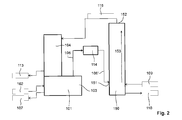
- FIG. 2 is a further embodiment of the method according to the invention shown as a graph. Related plant components and substances are compared with FIG. 1 denoted by the number 100 increased reference numerals.
- Residue 102 is added to the evaporator 101; a concentrate is removed 107th Unlike the execution according to FIG. 1
- the process container 103 of the evaporator 101 is not heated with an external heating, but instead the heat energy of the washed vapor 116 is used.
- the washed vapor 116 is fed to a heat exchanger 104.
- the heat released is used to heat the process tank 103.
- the washed vapor 116 is condensed by the heat release and accordingly a condensate 113 is removed from the heat exchanger 104.
- the advantage over the method according to FIG. 1 This is because the thermal energy contained in the vapor can be used to heat the evaporator. A separate capacitor with its own cooling is eliminated.
- the vapors leaving the evaporator 101 106 is fed to a vapor compressor 114 and fed as a corresponding vapor 106 'a vapor scrubber 150.
- the inlet 151 is preferably, as schematically indicated in the illustration of FIG. 2 , in the lower part of the vapor scrubber 150.
- the vapor 106 or the compressed vapor 106 ' Consequently, it flows in at the bottom of the vapor scrubber 150, flows through it from bottom to top, as shown by the arrow 153, and leaves the vapor scrubber through the outlet 152, which is mounted in the upper region of the vapor scrubber 150, as shown schematically in FIG FIG. 2 shown.
- acid 109 is added to the vapor scrubber.
- the acid reacts with the ammonia contained in the vapor 106 or 106 'to form an ammonium solution 110, which is removed from the vapor scrubber 150.
- Exemplary data for the in FIG. 2 illustrated method according to the invention are a mass flow of 320 kg / h, an operating temperature of about 100 ° C and an operation at atmospheric pressure, ie at about 1,000 mbar absolute.
- FIG. 3 an embodiment of a multi-stage process and a multi-stage system are shown. There are a total of three stages provided, designated level 1, level 2 and level 3. For the sake of clarity of illustration, evaporator and vapor scrubber are each shown as a unit, referred to as evaporator-vapor scrubber unit and designated by the reference numeral 80 in stage 1, 85 in stage 2 and 90 in stage 3.
- the washed vapor 216 or 216 'or 216 "respectively leaves the vapor scrubber of the evaporator-vapor scrubber unit 80, 85 and 90, respectively. After condensation, the scrubber leaving the vapor scrubber has an ammonium-derived nitrogen content of not more than 10 mg / l As another product, ammonium solution 210, 210 'or 210 "is produced at each stage. Furthermore, concentrates on each stage concentrate, as based on the FIGS. 1 and 2 described and illustrated. For the sake of clarity, however, this is in FIG. 3 not shown.
- An advantage of the method according to the invention is that it is very simple to connect several stages one behind the other without necessitating an equipment outlay beyond the respective stage. It is simply fed to each stage of new residue, which is evaporated at the respective stage. The washed vapor of the respective precursor is introduced directly into the heat exchanger of the next stage and serves there to heat the evaporator.
- the evaporation step in the multi-stage process can be carried out both in a vacuum, as described FIG. 1 described as well as at atmospheric pressure, as described by FIG. 2 described.
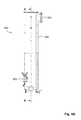
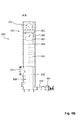
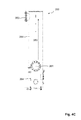
- FIG. 4 shows various views of an embodiment of a vapor scrubber 350 according to the invention
- FIG. 4A a side view is shown
- FIG. 4B shows a section along the line AA in FIG. 4A
- FIG. 4C finally shows a front view and in Figure 4D a detail is shown enlarged.
- the vapor scrubber 350 has an inlet 351, via which the vapor from the evaporator (see, for example, vapor 6 from the evaporator 1 in FIG FIG. 1 and vapors 106 from the vaporizer 101 in FIG. 2 ) is supplied.
- the inlet 351 is located in the lower tank area 356 of the vapor scrubber 350. The vapor flows through the vapor scrubber 350 from bottom to top, as indicated by the arrow 353 in FIG FIG. 4C ,
- a so-called packing 355 is provided, over which packing of the vapor flows and flows around it on its way from the inlet 351 to the outlet 352.
- a water mask 358 is provided in the lower tank area 356, a water mask 358 is provided. Acid is added to the water in it.
- the acid is supplied to the tank 354 by means of an acid metering unit 359.
- the volume of the acid introduced is measured by means of a flowmeter (not shown).
- a circulation pump 361 is guided externally of the vapor scrubber 350 lines that in FIG. 4 are not shown, the water mask 358 circulated and fed in the upper tank area 357 via the circulation port 360 to the vapor scrubber 350 again.
- a drop distributor 362 the water mask 358 pumped into the upper tank area 357 is distributed; it is rained over the filler 355, so to speak.
- a pH sensor 364 for example a pH probe, is provided. About this is preferably continuously or at certain intervals, a control of prevailing in the water mask 358 pH. If the pH has risen above a certain value, for example above a pH of 2, then acid is metered in via the acid dosing unit 359. This is preferably done automatically, d. H. a regulation is provided which, at a certain pH value, results in actuation of the acid metering unit 359 and the supply of acid to the vapor scrubber 350.
- Ammonium solution is removed in the illustrated preferred embodiment by means of a discharge container 365 the vapor scrubber 350.
- the discharge container 365 has, as in Figure 4D it can be seen, a fixed volume. With each discharge via the discharge container 365, the same volume of ammonium solution is always discharged.
- the inlet valve 366 is usually open, as is the pressure balance valve 370, ie the container of the discharge container 369 runs full. If the contents of the discharge container 365 are to be discharged, the inlet valve 366 and the pressure compensation valve 370 are closed and the outlet valve 367 is opened. In parallel, the compressed air supply 368 is opened, compressed air is supplied to the container 369 and the ammonium solution contained therein is pushed out of this. Finally, the valves 367 and 368 are closed and the valves 366 and 370 are opened again, so that the container 369 is refilled.
- the advantage of using a discharge container according to the invention is that a defined volume of ammonium solution is removed, which makes it possible to produce a Make ammonium solution with constant concentration. If the volume and concentration of the added acid are known, it is possible to keep the ammonium concentration in the ammonium solution constant by always dissipating the constant volume of ammonium solution at a constant interval of time. If ammonium solution is removed more frequently than in a comparative example, ammonium in the ammonium solution can only concentrate to a lower concentration than if it is discharged comparatively seldom. This procedure is particularly preferably supported by a pH measurement in order to ensure an always constant acid concentration in the vapor scrubber.
Landscapes
- Chemical & Material Sciences (AREA)
- Organic Chemistry (AREA)
- Life Sciences & Earth Sciences (AREA)
- Hydrology & Water Resources (AREA)
- Engineering & Computer Science (AREA)
- Environmental & Geological Engineering (AREA)
- Water Supply & Treatment (AREA)
- Inorganic Chemistry (AREA)
- Chemical Kinetics & Catalysis (AREA)
- Vaporization, Distillation, Condensation, Sublimation, And Cold Traps (AREA)
- Treating Waste Gases (AREA)
- Heat Treatment Of Water, Waste Water Or Sewage (AREA)
Applications Claiming Priority (1)
| Application Number | Priority Date | Filing Date | Title |
|---|---|---|---|
| DE201310105396 DE102013105396A1 (de) | 2013-05-27 | 2013-05-27 | Verfahren und Anlage zur Behandlung von wässrigen, organischen Rückständen |
Publications (1)
| Publication Number | Publication Date |
|---|---|
| EP2808304A1 true EP2808304A1 (fr) | 2014-12-03 |
Family
ID=50942027
Family Applications (1)
| Application Number | Title | Priority Date | Filing Date |
|---|---|---|---|
| EP20140170033 Withdrawn EP2808304A1 (fr) | 2013-05-27 | 2014-05-27 | Procédé et installation de traitement de résidus aqueux, organiques |
Country Status (2)
| Country | Link |
|---|---|
| EP (1) | EP2808304A1 (fr) |
| DE (1) | DE102013105396A1 (fr) |
Cited By (3)
| Publication number | Priority date | Publication date | Assignee | Title |
|---|---|---|---|---|
| EP3441454A1 (fr) * | 2017-08-11 | 2019-02-13 | Biogastechnik Süd GmbH | Dispositif de concentration des substrats organiques pourvu d'échangeur de chaleur externe |
| DE102018120720A1 (de) * | 2018-08-24 | 2020-02-27 | Biogastechnik Süd GmbH | Vorrichtung und Verfahren zur Neutralisierung einer Ammoniumsulfatlösung |
| EP3705458A1 (fr) * | 2019-03-04 | 2020-09-09 | Steffen Hartmann Recyclingtechnologien GmbH | Procédé de traitement de liquides contenant l'ammoniaque et installation de mise en uvre du procédé |
Families Citing this family (1)
| Publication number | Priority date | Publication date | Assignee | Title |
|---|---|---|---|---|
| CN111514599A (zh) * | 2020-06-01 | 2020-08-11 | 江苏泰特联合环保科技有限公司 | 一种食品级废磷酸的二段式负压蒸发浓缩净化处理工艺及装置 |
Citations (5)
| Publication number | Priority date | Publication date | Assignee | Title |
|---|---|---|---|---|
| WO2001012548A1 (fr) * | 1999-08-11 | 2001-02-22 | Hadwaco Ltd Oy | Procede permettant l'evaporation d'une solution aqueuse contenant de l'ammoniac |
| WO2010136046A1 (fr) * | 2009-05-28 | 2010-12-02 | N.E.S. Aps | Procédé et système pour la séparation d'une boue animale |
| US20110289846A1 (en) * | 2010-05-25 | 2011-12-01 | Hpd, Llc | Process of Scrubbing Volatiles from Evaporator Water Vapor |
| DE102010017334A1 (de) | 2010-06-11 | 2011-12-15 | Mkr Metzger Gmbh Recyclingsysteme | Verfahren zur Behandlung von organischen Rückständen aus anaeroben Prozessen |
| WO2012109737A1 (fr) | 2011-02-17 | 2012-08-23 | Anaergia Inc. | Récupération de matières organiques et de nutriments des résidus d'un digesteur anaérobie |
-
2013
- 2013-05-27 DE DE201310105396 patent/DE102013105396A1/de not_active Withdrawn
-
2014
- 2014-05-27 EP EP20140170033 patent/EP2808304A1/fr not_active Withdrawn
Patent Citations (5)
| Publication number | Priority date | Publication date | Assignee | Title |
|---|---|---|---|---|
| WO2001012548A1 (fr) * | 1999-08-11 | 2001-02-22 | Hadwaco Ltd Oy | Procede permettant l'evaporation d'une solution aqueuse contenant de l'ammoniac |
| WO2010136046A1 (fr) * | 2009-05-28 | 2010-12-02 | N.E.S. Aps | Procédé et système pour la séparation d'une boue animale |
| US20110289846A1 (en) * | 2010-05-25 | 2011-12-01 | Hpd, Llc | Process of Scrubbing Volatiles from Evaporator Water Vapor |
| DE102010017334A1 (de) | 2010-06-11 | 2011-12-15 | Mkr Metzger Gmbh Recyclingsysteme | Verfahren zur Behandlung von organischen Rückständen aus anaeroben Prozessen |
| WO2012109737A1 (fr) | 2011-02-17 | 2012-08-23 | Anaergia Inc. | Récupération de matières organiques et de nutriments des résidus d'un digesteur anaérobie |
Non-Patent Citations (1)
| Title |
|---|
| "Environmental Engineers' Handbook, Second Edition", 29 August 1997, CRC PRESS, article BELA G. LIPTAK ET AL: "Environmental Engineers' Handbook, Second Edition", pages: 434 - 435, XP055421543 * |
Cited By (5)
| Publication number | Priority date | Publication date | Assignee | Title |
|---|---|---|---|---|
| EP3441454A1 (fr) * | 2017-08-11 | 2019-02-13 | Biogastechnik Süd GmbH | Dispositif de concentration des substrats organiques pourvu d'échangeur de chaleur externe |
| DE102018120720A1 (de) * | 2018-08-24 | 2020-02-27 | Biogastechnik Süd GmbH | Vorrichtung und Verfahren zur Neutralisierung einer Ammoniumsulfatlösung |
| WO2020038518A1 (fr) | 2018-08-24 | 2020-02-27 | Biogastechnik Süd GmbH | Dispositif et procédé de neutralisation d'une solution de sulfate d'ammonium |
| DE102018120720B4 (de) | 2018-08-24 | 2022-06-23 | Biogastechnik Süd GmbH | Vorrichtung und Verfahren zur Neutralisierung einer Ammoniumsulfatlösung |
| EP3705458A1 (fr) * | 2019-03-04 | 2020-09-09 | Steffen Hartmann Recyclingtechnologien GmbH | Procédé de traitement de liquides contenant l'ammoniaque et installation de mise en uvre du procédé |
Also Published As
| Publication number | Publication date |
|---|---|
| DE102013105396A1 (de) | 2014-11-27 |
Similar Documents
| Publication | Publication Date | Title |
|---|---|---|
| EP2407230A1 (fr) | Procédé de séchage de sorption utilisant des sels de potassium, dispositif d'exécution du procédé et traitement supplémentaire des produits de procédé obtenus | |
| EP2566947B1 (fr) | Procédé et dispositif de fabrication de biogaz à partir d'un substrat de fermentation | |
| DE102011106066A1 (de) | Energieeffieziente Sorptionstrocknungsverfahren auf der Basis von dampfdrucksenkenden, konzentrierten Kaliumcarbonatlösungen unter Nutzung selektiver Chemiesorption mit Niedertemperatur-Wärmequellen | |
| DE102013105396A1 (de) | Verfahren und Anlage zur Behandlung von wässrigen, organischen Rückständen | |
| EP1318105A1 (fr) | Procédé et dispositif pour l'élimination d'ammoniaque des eaux usées et pour la récupération de matières utiles | |
| DE102010005253B4 (de) | Verfahren und Vorrichtung zum Behandeln und/oder Aufbereiten von flüssigem Gärrest aus einem Nachgärer und/oder Fermenter einer Biogasanlage | |
| WO2006105875A2 (fr) | Procede et dispositif de production d'engrais azotes a partir de dechets organiques, de suppression de phosphates de dechets organiques et de limitation de la teneur en potassium | |
| DE102010017334A1 (de) | Verfahren zur Behandlung von organischen Rückständen aus anaeroben Prozessen | |
| DE102009027274A1 (de) | Chemisch-physikalisches Verfahren zur Weiterverarbeitung von Gärrest aus Biogasanlagen zu Düngemittel und Einrichtung zur Realisierung des Verfahrens | |
| DE3603739A1 (de) | Verfahren zur verarbeitung von jauche aus exkrementen von nutzvieh | |
| DE69411333T2 (de) | Verfahren zur Rückgewinnung von verbrauchten Metallätzlösungen | |
| EP3186194A1 (fr) | Procédé pour la séparation de l'eau d'un mélange contenant de l'eau et au moins une substance volatile acide et/ou basique | |
| DE102016211664A1 (de) | Verfahren und Anlage zur Abtrennung und/oder Rückgewinnung von Stickstoffverbindungen aus einem Flüssig- oder Schlammsubstrat | |
| EP3581640A1 (fr) | Procédé et dispositif de préparation des substances biologiques, en particulier d'origine végétale et d'origine animale de fermentation, en particulier des installations de biogaz, à partir du lisier ou d'autres produits de déchets organiques | |
| EP2585780B1 (fr) | Procédé de récupération de composants volatils émanant d'un solide | |
| EP0508986B1 (fr) | Procede d'epuration d'eaux residuaires chargees de matieres organiques | |
| DE102004005907B4 (de) | Anlage zur Herstellung von biuretarmem harnstoffhaltigem Düngemittelgranulat | |
| EP3012007A1 (fr) | Méthode et procédé pour évaporer un substrat liquide | |
| EP2404887A1 (fr) | Procédé de production d'engrais à partir de résidus de fermentation survenant sur des installations de biogaz et dispositif de réalisation du procédé | |
| EP0000515B1 (fr) | Procédé pour enlever le gaz sulfureux d'un courant gazeux et installation pour la mise en oeuvre du procédé | |
| EP4058168A1 (fr) | Dispositifs de séparation et procédé de séparation pour séparer des mélanges de matériaux biogènes, semi-synthétiques et/ou synthétiques en composants solides, liquides et gazeux de ceux-ci, tout en récupérant la chaleur | |
| DE102016118761B4 (de) | Verfahren und Vorrichtung zur Aufbereitung von biologisch abbaubaren Materialien | |
| EP3705458B1 (fr) | Procédé de traitement de liquides contenant l'ammoniaque et installation de mise en oeuvre du procédé | |
| EP3653583B1 (fr) | Procédé de traitement des matériaux biodégradables et dispositif de mise en uvre dudit procédé | |
| DE10221505A1 (de) | Verfahren zur Vergärung von biogenen Substraten und zur Phasentrennung des anfallenden Gärrückstandes |
Legal Events
| Date | Code | Title | Description |
|---|---|---|---|
| PUAI | Public reference made under article 153(3) epc to a published international application that has entered the european phase |
Free format text: ORIGINAL CODE: 0009012 |
|
| 17P | Request for examination filed |
Effective date: 20140527 |
|
| AK | Designated contracting states |
Kind code of ref document: A1 Designated state(s): AL AT BE BG CH CY CZ DE DK EE ES FI FR GB GR HR HU IE IS IT LI LT LU LV MC MK MT NL NO PL PT RO RS SE SI SK SM TR |
|
| AX | Request for extension of the european patent |
Extension state: BA ME |
|
| R17P | Request for examination filed (corrected) |
Effective date: 20150527 |
|
| RBV | Designated contracting states (corrected) |
Designated state(s): AL AT BE BG CH CY CZ DE DK EE ES FI FR GB GR HR HU IE IS IT LI LT LU LV MC MK MT NL NO PL PT RO RS SE SI SK SM TR |
|
| 17Q | First examination report despatched |
Effective date: 20160125 |
|
| STAA | Information on the status of an ep patent application or granted ep patent |
Free format text: STATUS: THE APPLICATION HAS BEEN WITHDRAWN |
|
| 18W | Application withdrawn |
Effective date: 20180206 |