EP2808358B1 - Polyphosphate d'ammonium revêtu, son utilisation et fabrication - Google Patents
Polyphosphate d'ammonium revêtu, son utilisation et fabrication Download PDFInfo
- Publication number
- EP2808358B1 EP2808358B1 EP13002805.3A EP13002805A EP2808358B1 EP 2808358 B1 EP2808358 B1 EP 2808358B1 EP 13002805 A EP13002805 A EP 13002805A EP 2808358 B1 EP2808358 B1 EP 2808358B1
- Authority
- EP
- European Patent Office
- Prior art keywords
- ammonium polyphosphate
- coated
- water
- alumina
- app
- Prior art date
- Legal status (The legal status is an assumption and is not a legal conclusion. Google has not performed a legal analysis and makes no representation as to the accuracy of the status listed.)
- Not-in-force
Links
- 229920001276 ammonium polyphosphate Polymers 0.000 title claims description 70
- 239000004114 Ammonium polyphosphate Substances 0.000 title claims description 30
- 235000019826 ammonium polyphosphate Nutrition 0.000 title claims description 30
- 238000004519 manufacturing process Methods 0.000 title description 4
- VYPSYNLAJGMNEJ-UHFFFAOYSA-N Silicium dioxide Chemical compound O=[Si]=O VYPSYNLAJGMNEJ-UHFFFAOYSA-N 0.000 claims description 105
- XLYOFNOQVPJJNP-UHFFFAOYSA-N water Substances O XLYOFNOQVPJJNP-UHFFFAOYSA-N 0.000 claims description 55
- 238000000576 coating method Methods 0.000 claims description 42
- 239000002245 particle Substances 0.000 claims description 41
- PNEYBMLMFCGWSK-UHFFFAOYSA-N aluminium oxide Inorganic materials [O-2].[O-2].[O-2].[Al+3].[Al+3] PNEYBMLMFCGWSK-UHFFFAOYSA-N 0.000 claims description 35
- 239000000377 silicon dioxide Substances 0.000 claims description 35
- 239000003973 paint Substances 0.000 claims description 32
- 239000011248 coating agent Substances 0.000 claims description 29
- 239000000203 mixture Substances 0.000 claims description 23
- 238000000034 method Methods 0.000 claims description 18
- 239000008119 colloidal silica Substances 0.000 claims description 17
- 239000000725 suspension Substances 0.000 claims description 16
- 239000000843 powder Substances 0.000 claims description 15
- 229920000877 Melamine resin Polymers 0.000 claims description 14
- 239000013078 crystal Substances 0.000 claims description 11
- 238000001704 evaporation Methods 0.000 claims description 10
- 238000009826 distribution Methods 0.000 claims description 8
- 230000008020 evaporation Effects 0.000 claims description 8
- 238000004898 kneading Methods 0.000 claims description 7
- 238000002156 mixing Methods 0.000 claims description 7
- 239000002904 solvent Substances 0.000 claims description 5
- 229920005989 resin Polymers 0.000 claims description 3
- 239000011347 resin Substances 0.000 claims description 3
- 238000009423 ventilation Methods 0.000 claims description 3
- VXAUWWUXCIMFIM-UHFFFAOYSA-M aluminum;oxygen(2-);hydroxide Chemical compound [OH-].[O-2].[Al+3] VXAUWWUXCIMFIM-UHFFFAOYSA-M 0.000 claims description 2
- 150000001282 organosilanes Chemical class 0.000 claims description 2
- 125000005375 organosiloxane group Chemical group 0.000 claims description 2
- 239000000463 material Substances 0.000 description 24
- QGZKDVFQNNGYKY-UHFFFAOYSA-N Ammonia Chemical compound N QGZKDVFQNNGYKY-UHFFFAOYSA-N 0.000 description 10
- 230000001965 increasing effect Effects 0.000 description 10
- 239000012071 phase Substances 0.000 description 9
- 125000000129 anionic group Chemical group 0.000 description 8
- 125000002091 cationic group Chemical group 0.000 description 8
- 230000007062 hydrolysis Effects 0.000 description 7
- 238000006460 hydrolysis reaction Methods 0.000 description 7
- RNFJDJUURJAICM-UHFFFAOYSA-N 2,2,4,4,6,6-hexaphenoxy-1,3,5-triaza-2$l^{5},4$l^{5},6$l^{5}-triphosphacyclohexa-1,3,5-triene Chemical class N=1P(OC=2C=CC=CC=2)(OC=2C=CC=CC=2)=NP(OC=2C=CC=CC=2)(OC=2C=CC=CC=2)=NP=1(OC=1C=CC=CC=1)OC1=CC=CC=C1 RNFJDJUURJAICM-UHFFFAOYSA-N 0.000 description 6
- 0 CON(OC)O* Chemical compound CON(OC)O* 0.000 description 6
- 238000006243 chemical reaction Methods 0.000 description 6
- 239000003063 flame retardant Substances 0.000 description 6
- 230000008569 process Effects 0.000 description 6
- FAHBNUUHRFUEAI-UHFFFAOYSA-M hydroxidooxidoaluminium Chemical compound O[Al]=O FAHBNUUHRFUEAI-UHFFFAOYSA-M 0.000 description 5
- 150000002500 ions Chemical class 0.000 description 5
- 238000003860 storage Methods 0.000 description 5
- VHUUQVKOLVNVRT-UHFFFAOYSA-N Ammonium hydroxide Chemical compound [NH4+].[OH-] VHUUQVKOLVNVRT-UHFFFAOYSA-N 0.000 description 4
- GWEVSGVZZGPLCZ-UHFFFAOYSA-N Titan oxide Chemical compound O=[Ti]=O GWEVSGVZZGPLCZ-UHFFFAOYSA-N 0.000 description 4
- 239000007900 aqueous suspension Substances 0.000 description 4
- 239000008199 coating composition Substances 0.000 description 4
- 229910052593 corundum Inorganic materials 0.000 description 4
- 230000000694 effects Effects 0.000 description 4
- JDSHMPZPIAZGSV-UHFFFAOYSA-N melamine Chemical compound NC1=NC(N)=NC(N)=N1 JDSHMPZPIAZGSV-UHFFFAOYSA-N 0.000 description 4
- 238000007873 sieving Methods 0.000 description 4
- -1 siloxanes Chemical class 0.000 description 4
- 238000003756 stirring Methods 0.000 description 4
- 229910001845 yogo sapphire Inorganic materials 0.000 description 4
- OKKJLVBELUTLKV-UHFFFAOYSA-N Methanol Chemical compound OC OKKJLVBELUTLKV-UHFFFAOYSA-N 0.000 description 3
- HEMHJVSKTPXQMS-UHFFFAOYSA-M Sodium hydroxide Chemical compound [OH-].[Na+] HEMHJVSKTPXQMS-UHFFFAOYSA-M 0.000 description 3
- 229910021529 ammonia Inorganic materials 0.000 description 3
- 230000003247 decreasing effect Effects 0.000 description 3
- 239000013530 defoamer Substances 0.000 description 3
- 238000009472 formulation Methods 0.000 description 3
- 239000007791 liquid phase Substances 0.000 description 3
- 125000000962 organic group Chemical group 0.000 description 3
- 239000000047 product Substances 0.000 description 3
- LHCPRYRLDOSKHK-UHFFFAOYSA-N 7-deaza-8-aza-adenine Chemical compound NC1=NC=NC2=C1C=NN2 LHCPRYRLDOSKHK-UHFFFAOYSA-N 0.000 description 2
- QGZKDVFQNNGYKY-UHFFFAOYSA-O Ammonium Chemical compound [NH4+] QGZKDVFQNNGYKY-UHFFFAOYSA-O 0.000 description 2
- 229920002134 Carboxymethyl cellulose Polymers 0.000 description 2
- DGAQECJNVWCQMB-PUAWFVPOSA-M Ilexoside XXIX Chemical compound C[C@@H]1CC[C@@]2(CC[C@@]3(C(=CC[C@H]4[C@]3(CC[C@@H]5[C@@]4(CC[C@@H](C5(C)C)OS(=O)(=O)[O-])C)C)[C@@H]2[C@]1(C)O)C)C(=O)O[C@H]6[C@@H]([C@H]([C@@H]([C@H](O6)CO)O)O)O.[Na+] DGAQECJNVWCQMB-PUAWFVPOSA-M 0.000 description 2
- NBIIXXVUZAFLBC-UHFFFAOYSA-N Phosphoric acid Chemical compound OP(O)(O)=O NBIIXXVUZAFLBC-UHFFFAOYSA-N 0.000 description 2
- XTXRWKRVRITETP-UHFFFAOYSA-N Vinyl acetate Chemical compound CC(=O)OC=C XTXRWKRVRITETP-UHFFFAOYSA-N 0.000 description 2
- 230000004913 activation Effects 0.000 description 2
- 230000002776 aggregation Effects 0.000 description 2
- 229910052782 aluminium Inorganic materials 0.000 description 2
- 229910000147 aluminium phosphate Inorganic materials 0.000 description 2
- LFVGISIMTYGQHF-UHFFFAOYSA-N ammonium dihydrogen phosphate Chemical compound [NH4+].OP(O)([O-])=O LFVGISIMTYGQHF-UHFFFAOYSA-N 0.000 description 2
- 239000000908 ammonium hydroxide Substances 0.000 description 2
- 229940043379 ammonium hydroxide Drugs 0.000 description 2
- 235000011114 ammonium hydroxide Nutrition 0.000 description 2
- 230000008901 benefit Effects 0.000 description 2
- 239000011230 binding agent Substances 0.000 description 2
- 239000001768 carboxy methyl cellulose Substances 0.000 description 2
- 235000010948 carboxy methyl cellulose Nutrition 0.000 description 2
- 239000008112 carboxymethyl-cellulose Substances 0.000 description 2
- 238000000354 decomposition reaction Methods 0.000 description 2
- 239000002270 dispersing agent Substances 0.000 description 2
- 239000006185 dispersion Substances 0.000 description 2
- 238000001035 drying Methods 0.000 description 2
- 238000000227 grinding Methods 0.000 description 2
- 231100001261 hazardous Toxicity 0.000 description 2
- 239000002105 nanoparticle Substances 0.000 description 2
- 231100000252 nontoxic Toxicity 0.000 description 2
- 230000003000 nontoxic effect Effects 0.000 description 2
- 239000003960 organic solvent Substances 0.000 description 2
- WXZMFSXDPGVJKK-UHFFFAOYSA-N pentaerythritol Chemical compound OCC(CO)(CO)CO WXZMFSXDPGVJKK-UHFFFAOYSA-N 0.000 description 2
- 238000005191 phase separation Methods 0.000 description 2
- 238000002360 preparation method Methods 0.000 description 2
- 230000009467 reduction Effects 0.000 description 2
- 239000006254 rheological additive Substances 0.000 description 2
- 239000011734 sodium Substances 0.000 description 2
- 229910052708 sodium Inorganic materials 0.000 description 2
- 239000007787 solid Substances 0.000 description 2
- 239000000126 substance Substances 0.000 description 2
- 239000010409 thin film Substances 0.000 description 2
- 229940117958 vinyl acetate Drugs 0.000 description 2
- 229910019670 (NH4)H2PO4 Inorganic materials 0.000 description 1
- VEXZGXHMUGYJMC-UHFFFAOYSA-M Chloride anion Chemical compound [Cl-] VEXZGXHMUGYJMC-UHFFFAOYSA-M 0.000 description 1
- 239000005696 Diammonium phosphate Substances 0.000 description 1
- KKCBUQHMOMHUOY-UHFFFAOYSA-N Na2O Inorganic materials [O-2].[Na+].[Na+] KKCBUQHMOMHUOY-UHFFFAOYSA-N 0.000 description 1
- 229910008051 Si-OH Inorganic materials 0.000 description 1
- BLRPTPMANUNPDV-UHFFFAOYSA-N Silane Chemical compound [SiH4] BLRPTPMANUNPDV-UHFFFAOYSA-N 0.000 description 1
- 229910006358 Si—OH Inorganic materials 0.000 description 1
- 230000002378 acidificating effect Effects 0.000 description 1
- 238000005054 agglomeration Methods 0.000 description 1
- 238000004220 aggregation Methods 0.000 description 1
- 239000004411 aluminium Substances 0.000 description 1
- XAGFODPZIPBFFR-UHFFFAOYSA-N aluminium Chemical compound [Al] XAGFODPZIPBFFR-UHFFFAOYSA-N 0.000 description 1
- 239000005030 aluminium foil Substances 0.000 description 1
- ILRRQNADMUWWFW-UHFFFAOYSA-K aluminium phosphate Chemical compound O1[Al]2OP1(=O)O2 ILRRQNADMUWWFW-UHFFFAOYSA-K 0.000 description 1
- 229940001007 aluminium phosphate Drugs 0.000 description 1
- FOJJCOHOLNJIHE-UHFFFAOYSA-N aluminum;azane Chemical compound N.[Al+3] FOJJCOHOLNJIHE-UHFFFAOYSA-N 0.000 description 1
- 229910000387 ammonium dihydrogen phosphate Inorganic materials 0.000 description 1
- 238000004458 analytical method Methods 0.000 description 1
- 239000012298 atmosphere Substances 0.000 description 1
- IUTYMBRQELGIRS-UHFFFAOYSA-N boric acid;1,3,5-triazine-2,4,6-triamine Chemical compound OB(O)O.NC1=NC(N)=NC(N)=N1 IUTYMBRQELGIRS-UHFFFAOYSA-N 0.000 description 1
- 238000005119 centrifugation Methods 0.000 description 1
- 230000008859 change Effects 0.000 description 1
- 238000012512 characterization method Methods 0.000 description 1
- 229910052681 coesite Inorganic materials 0.000 description 1
- 239000000084 colloidal system Substances 0.000 description 1
- 230000000052 comparative effect Effects 0.000 description 1
- 150000001875 compounds Chemical class 0.000 description 1
- 238000001816 cooling Methods 0.000 description 1
- 239000011258 core-shell material Substances 0.000 description 1
- 229910052906 cristobalite Inorganic materials 0.000 description 1
- 235000015142 cultured sour cream Nutrition 0.000 description 1
- MNNHAPBLZZVQHP-UHFFFAOYSA-N diammonium hydrogen phosphate Chemical compound [NH4+].[NH4+].OP([O-])([O-])=O MNNHAPBLZZVQHP-UHFFFAOYSA-N 0.000 description 1
- 229910000388 diammonium phosphate Inorganic materials 0.000 description 1
- 235000019838 diammonium phosphate Nutrition 0.000 description 1
- 239000010408 film Substances 0.000 description 1
- 238000001914 filtration Methods 0.000 description 1
- 239000000499 gel Substances 0.000 description 1
- 239000011521 glass Substances 0.000 description 1
- 238000010438 heat treatment Methods 0.000 description 1
- 230000003301 hydrolyzing effect Effects 0.000 description 1
- 230000002209 hydrophobic effect Effects 0.000 description 1
- 230000001939 inductive effect Effects 0.000 description 1
- 238000002329 infrared spectrum Methods 0.000 description 1
- 229910010272 inorganic material Inorganic materials 0.000 description 1
- 239000011147 inorganic material Substances 0.000 description 1
- 229910017053 inorganic salt Inorganic materials 0.000 description 1
- 238000009413 insulation Methods 0.000 description 1
- 238000002844 melting Methods 0.000 description 1
- 230000008018 melting Effects 0.000 description 1
- 235000019837 monoammonium phosphate Nutrition 0.000 description 1
- 239000006012 monoammonium phosphate Substances 0.000 description 1
- 230000007935 neutral effect Effects 0.000 description 1
- 150000002894 organic compounds Chemical class 0.000 description 1
- 239000011368 organic material Substances 0.000 description 1
- XFZRQAZGUOTJCS-UHFFFAOYSA-N phosphoric acid;1,3,5-triazine-2,4,6-triamine Chemical compound OP(O)(O)=O.NC1=NC(N)=NC(N)=N1 XFZRQAZGUOTJCS-UHFFFAOYSA-N 0.000 description 1
- 239000000049 pigment Substances 0.000 description 1
- 239000004033 plastic Substances 0.000 description 1
- 229920003023 plastic Polymers 0.000 description 1
- 231100000614 poison Toxicity 0.000 description 1
- 229920000137 polyphosphoric acid Polymers 0.000 description 1
- 239000011148 porous material Substances 0.000 description 1
- 230000002035 prolonged effect Effects 0.000 description 1
- 239000011541 reaction mixture Substances 0.000 description 1
- 238000001953 recrystallisation Methods 0.000 description 1
- 238000010992 reflux Methods 0.000 description 1
- 229910000077 silane Inorganic materials 0.000 description 1
- 150000004756 silanes Chemical class 0.000 description 1
- SCPYDCQAZCOKTP-UHFFFAOYSA-N silanol Chemical compound [SiH3]O SCPYDCQAZCOKTP-UHFFFAOYSA-N 0.000 description 1
- 125000005372 silanol group Chemical group 0.000 description 1
- 239000000741 silica gel Substances 0.000 description 1
- 229910002027 silica gel Inorganic materials 0.000 description 1
- 239000007790 solid phase Substances 0.000 description 1
- 230000006641 stabilisation Effects 0.000 description 1
- 238000011105 stabilization Methods 0.000 description 1
- 239000003381 stabilizer Substances 0.000 description 1
- 229910052682 stishovite Inorganic materials 0.000 description 1
- 239000000758 substrate Substances 0.000 description 1
- 239000006228 supernatant Substances 0.000 description 1
- 239000004753 textile Substances 0.000 description 1
- 239000004408 titanium dioxide Substances 0.000 description 1
- 239000003440 toxic substance Substances 0.000 description 1
- 230000009466 transformation Effects 0.000 description 1
- 229910052905 tridymite Inorganic materials 0.000 description 1
- 238000009827 uniform distribution Methods 0.000 description 1
Images
Classifications
-
- C—CHEMISTRY; METALLURGY
- C09—DYES; PAINTS; POLISHES; NATURAL RESINS; ADHESIVES; COMPOSITIONS NOT OTHERWISE PROVIDED FOR; APPLICATIONS OF MATERIALS NOT OTHERWISE PROVIDED FOR
- C09D—COATING COMPOSITIONS, e.g. PAINTS, VARNISHES OR LACQUERS; FILLING PASTES; CHEMICAL PAINT OR INK REMOVERS; INKS; CORRECTING FLUIDS; WOODSTAINS; PASTES OR SOLIDS FOR COLOURING OR PRINTING; USE OF MATERIALS THEREFOR
- C09D5/00—Coating compositions, e.g. paints, varnishes or lacquers, characterised by their physical nature or the effects produced; Filling pastes
- C09D5/18—Fireproof paints including high temperature resistant paints
- C09D5/185—Intumescent paints
-
- C—CHEMISTRY; METALLURGY
- C09—DYES; PAINTS; POLISHES; NATURAL RESINS; ADHESIVES; COMPOSITIONS NOT OTHERWISE PROVIDED FOR; APPLICATIONS OF MATERIALS NOT OTHERWISE PROVIDED FOR
- C09D—COATING COMPOSITIONS, e.g. PAINTS, VARNISHES OR LACQUERS; FILLING PASTES; CHEMICAL PAINT OR INK REMOVERS; INKS; CORRECTING FLUIDS; WOODSTAINS; PASTES OR SOLIDS FOR COLOURING OR PRINTING; USE OF MATERIALS THEREFOR
- C09D7/00—Features of coating compositions, not provided for in group C09D5/00; Processes for incorporating ingredients in coating compositions
- C09D7/40—Additives
- C09D7/60—Additives non-macromolecular
- C09D7/61—Additives non-macromolecular inorganic
- C09D7/62—Additives non-macromolecular inorganic modified by treatment with other compounds
-
- C—CHEMISTRY; METALLURGY
- C09—DYES; PAINTS; POLISHES; NATURAL RESINS; ADHESIVES; COMPOSITIONS NOT OTHERWISE PROVIDED FOR; APPLICATIONS OF MATERIALS NOT OTHERWISE PROVIDED FOR
- C09D—COATING COMPOSITIONS, e.g. PAINTS, VARNISHES OR LACQUERS; FILLING PASTES; CHEMICAL PAINT OR INK REMOVERS; INKS; CORRECTING FLUIDS; WOODSTAINS; PASTES OR SOLIDS FOR COLOURING OR PRINTING; USE OF MATERIALS THEREFOR
- C09D7/00—Features of coating compositions, not provided for in group C09D5/00; Processes for incorporating ingredients in coating compositions
- C09D7/40—Additives
- C09D7/66—Additives characterised by particle size
- C09D7/69—Particle size larger than 1000 nm
-
- C—CHEMISTRY; METALLURGY
- C08—ORGANIC MACROMOLECULAR COMPOUNDS; THEIR PREPARATION OR CHEMICAL WORKING-UP; COMPOSITIONS BASED THEREON
- C08K—Use of inorganic or non-macromolecular organic substances as compounding ingredients
- C08K2201/00—Specific properties of additives
- C08K2201/002—Physical properties
- C08K2201/003—Additives being defined by their diameter
-
- C—CHEMISTRY; METALLURGY
- C08—ORGANIC MACROMOLECULAR COMPOUNDS; THEIR PREPARATION OR CHEMICAL WORKING-UP; COMPOSITIONS BASED THEREON
- C08K—Use of inorganic or non-macromolecular organic substances as compounding ingredients
- C08K9/00—Use of pretreated ingredients
- C08K9/02—Ingredients treated with inorganic substances
Definitions
- the present invention according to claims 1 to 15 relates to a coated ammonium polyphosphate, to a coating process, to the use of the coated ammonium polyphosphate and to intumescent compositions comprising the coated ammonium polyphosphate.
- Ammonium polyphosphate (abbreviated APP) is the inorganic salt of polyphosphoric acid and ammonia and has the sum formula (NH 4 PO 3 ) n and the following structure:
- APP is a crystalline compound which exists in various polymorphous forms. There are two main polymorphs: crystal phase I and crystal phase II.
- Ammonium polyphosphate in crystal phase I (APP-I) is characterized by a variable linear chain length with "n" values less than 100, possesses a low decomposition temperature (approximately 2000°C) and a high water solubility (up to 20 %).
- the molecular weight of ammonium polyphosphate in crystal phase II (APP-II) is much higher, with "n” values of much more than 100.
- APP-II has a higher thermal stability (decomposition starts at approximately 280°C) and a lower water solubility than APP-I (4 - 5 % vs. 20 %).
- APP is generally a non-toxic, environmentally friendly material. When heated it emits ammonia and phosphoric acid and may launch intumescent process. An intumescent system swells as a result of heat exposure, thus increasing in volume and decreasing in density. Intumescent systems are typically used in passive fire protection. They can be roughly divided into intumescents producing soft char and such producing hard char. Soft char protects against fire due to its low density providing some insulation. It also fills gaps that are either present from the beginning or form due to melting of other materials. Hard char additionally exerts pressure e.g. enabling a closing of pipes. Besides the volume expansion a content of water (as hydrate) is often part of the composition that provides cooling upon evaporation. The reaction/expansion can also be an endothermic process consuming some heat in itself.
- APP is applied as a component of halogen-free fire retardants e.g. in plastics, textiles and paints, including water-based paints.
- APP crystals can be modified or coated with an inert material to prevent contact with water.
- DE 35 31 500 A1 is one example for APP type materials coated with a melamine formaldyde resin to render the surface hydrophobic.
- a surface modified flame retardant comprises encapsulating the flame retardant with a coating agent being an organo functional silane or a mixture of organo functional silanes or organo functional siloxanes.
- a coating agent being an organo functional silane or a mixture of organo functional silanes or organo functional siloxanes.
- ammonium orthophosphate, ammonium polyphosphate, melamine phosphate, melamine borate are mentioned in US 2010/163420 , EP 0 180 795 and WO 02/072713 other aqueous coating compositions based on silica or coated APP are disclosed.
- ammonium polyphosphate with inorganic materials selected from silica and alumina providing protection from hydrolysis.
- a coated ammonium polyphosphate in the crystal phase II shows superior properties when used in water based paints and coatings like increased solubility and reduced viscosity of the water based formulation.
- ammonium polyphosphate in the crystal phase II coated with silica or alumina its use as flame retardant in paints and coatings and to intumescent compositions like paints and coatings comprising it.
- the invention further provides a method for coating ammonium polyphosphate comprising the steps of: providing ammonium polyphosphate particles, mixing them with a suspension of colloidal silica or alumina powder, and kneading the mixture while evaporating the water at a maximum temperature of 110 °C.
- the coated ammonium polyphosphate in the crystal phase II has an increased solubility in water (typically 11 - 16 %) but does not undergo hydrolysis. It is completely compatible with water-soluble intumescent paints, significantly reducing their viscosity. This coated material does not contain hazardous organic materials.
- the new coating method with alumina and silica renders the coated APP suitable for a lot of applications e.g. in the paint industry.
- US 2012/0207660 A1 describes a method for manufacturing APP II from H-type P 2 O 5 and diammoniumphosphate in an atmosphere comprising ammonia gas. Other methods are known and suitable.
- the APP II should have a particle size distribution as desired for the intended use.
- APP suitable to be used as flame retardant should preferably have at least 85 % of the particles smaller than 45 ⁇ m, a preferred particle size distribution is D 0.9 ⁇ 40 ⁇ m, D 0.5 ⁇ 20 ⁇ m, D 0.1 ⁇ 6 ⁇ m, and D AV from 20 to 25 ⁇ m, preferably about 22 ⁇ m, all determined via laser diffraction on a dispersed particulate sample, e.g. with a MALVERN Mastersizer 2000 of Malvern Instruments, USA. If the particle size of the APP is not as desired it has to be adjusted before coating.
- the desired particle size can be achieved in any manner known per se, e.g. sieving, grinding, grinding and sieving, recrystallization and many more.
- aqueous suspensions of colloidal silica e.g. Ludox®-series produced by Grace & Co. Conn.
- alumina powder e.g. highly dispersible boehmite alumina powder Disperal® P2, produced by Sasol
- colloidal silica e.g. Ludox®-series produced by Grace & Co. Conn.
- alumina powder e.g. highly dispersible boehmite alumina powder Disperal® P2, produced by Sasol
- colloidal silica particles are roughly spherical, non-porous and dispersible in water. They are typically very small silica particles in the low nanometre size range and have a dense silica core and a surface covered by silanol (Si-OH) groups as illustrated below:
- silanol groups interact strongly with various substrates, to afford a coating of high strength and durability.
- the free colloidal silica particles are very unstable and tend to react with each other to form large settling agglomerates of silica gel.
- the silica particles in suspension are stabilized immediately after manufacture by inducing a charge on the surface to make the particles repel each other.
- the colloidal silicas are divided into grades depending on the stabilization process.
- the alkaline grade silica is stabilized by treatment with bases (usually NaOH or NH 4 OH) to provide a negatively charged surface, leaving the counter ions (Na + or NH 4 + ) in solution to balance the charge on the surface as illustrated below:
- the anionic grade colloidal silica particles lack a sufficient charge for remaining stable.
- the coating formulation has to be maintained in the acidic to neutral pH region, it is possible to modify a small part of the silica particles with an aluminate compound to form a so called "pH stable grade" with the following structure
- the stability range is extended to from about 4 to 10.5. Since only a small amount of the particle surface is modified, the particle chemistry is predominately that of the negatively charged silica surface.
- the silica particles are fully coated with alumina such that the net particle charge is positive.
- the particles may be considered to be a core-shell structure in which the core is composed of the silica particle and the aluminum compound is the shell as shown below:
- the counter ion is mostly a chloride and the pH stability is in the range from pH 3.5 to 6.0.
- Table 1 Name Grade Counter ion Average particle size Specific surface area SiO 2 pH TMA pH stable - 22 nm 140 m 2 /g 34% 4-7 HS-40 Anionic Na + 12 nm 220 m 2 /g 40 % 9.7 AS-30 Anionic NH 4 + 7 nm 350 m 2 /g 30 % 9.6 CL Cationic Cl - 7 nm 350 m 2 /g 30 % 4
- Suitable alumina powders are e.g. the Disperal® type aluminas which are nano-sized in the dispersed phase and recommended for a wide range of applications including surface coating as well as paint detackyfication (reduction of paint viscosity).
- Properties of Disperal® P2 are as follows: Chemical composition: 72 % Al 2 O 3 , 4.0 % NO 3 , 0.002 % Na 2 O, loose bulk density: 850 g/l, average particle size for powder: 45 ⁇ m, specific surface area (after activation at 550°C for 3 h): 260 m 2 /g, pore volume (after activation at 550°C for 3 h): 0.5 ml/g and water dispersibility 97 %.
- Disperal® alumina powder, mixed with water or an organic solvent results in a gel of varying viscosity (depending on the pH and the amount of water) which is a colloidal system with nano-sized alumina particles.
- APP particles are blended with suspensions of silica or alumina followed by removal of water under stirring/kneading, preferably at an elevated temperature. It can be useful to apply a ventilation to assist evaporation of the water.
- the obtained particles are typically sieved using e.g. a 125 ⁇ m sieve. Thereby the desired particle size distribution is ensured.
- the particle size distribution of the initial APP particles has to lie in the desired range or below, since the method according to the invention does not diminish the particle size. A reduction of the particle size after coating would damage the coating and is not feasible.
- the mixing usually takes place at ambient temperature.
- the temperature during kneading is typically set to 90 - 110 °C, preferably to 95 - 105 °C.
- the temperature has to be kept below 110 °C, preferably to below 100 °C, to avoid a reaction partly exchanging ammonium with aluminium.
- the temperature is adjusted to provide a compromise between stability of the components and particles and the rate of evaporation of water. Ventilation, e.g. using a vacuum pump, can be applied to enhance the evaporation rate.
- the ratio of water to solids (w/w) in the mixture of APP and silica or alumina should lie within the range from 0.1 to 1.0, preferably from 0.2 to 0.7, and most preferred from 0.25 to 0.35. Coating is usually not feasible when the water content is less then 0.1 w/w because of problems with uniform distribution of the coating agent on the surface of the APP.
- the use of water in amount of more than 1.0 w/w is possible but not advantageous. More time is required to evaporate the water without benefit for the processing.
- the solubility depends on the type of coating material and its amount.
- the solubility of APP-II coated with "pH stable" grade silica provides the maximum solubility (e.g. up to 16 %) while the "anionic" grade silica with the ammonium counter ion and the "cationic” grade silica give material with a lower solubility (e.g. around 8 %).
- the effect of the amount of silica on the solubility within the same grade was less distinguished.
- a silica/APP ratio of 0.01 - 0.1 w/w the solubility varied irregularly between 11.0 and 16.0 % for coatings with "pH stable" grade silica.
- the acidity of the material coated with "pH stable" grade silica e.g. pH 4.6 - 5.1
- the starting APP e.g. pH 5.3
- the cationic and anionic grade silicas afforded products with lower acidity (e.g. pH 5.8 - 6.3).
- APP coated according to the invention and with any other known coating material either below or above the silica or alumina coating also falls within the scope.
- the known coatings with melamine formaldehyde resin or other organic resins as well as with organo silanes or organo siloxanes are less preferred as additional coatings.
- the coated APP-II according to the invention is particularly suitable as flame retardant in intumescent paints and coatings.
- the invention also relates to the use of APP-II coated with silica or alumina as component in water based intumescent compositions such as paints, coatings and so on.
- a preferred composition is a water based intumescent paint, especially a water based solvent free intumescent paint.
- a typical intumescent paint mainly contains: water, a binding agent, e.g. a vinyl-acetate dispersion and pentaerythritol, melamine and APP-II as part of the intumescent system.
- a rheological additive like carboxymethylcellulose, a pH stabilizer, e.g. ammoniumhydroxide, a dispersant, a defoamer, and a pigment, e.g. titanium dioxide. All the components are used in the usual amounts, e.g. water 25 %, binding agent 23 % and APP 15 to 35 %.
- the coated APP-II according to the invention has several advantages. It does not require hazardous organic substances, it is stable against hydrolysis, and paint or coating formulations are stable during storage. Specifically, the viscosity does not increase unduly, changes in colour or opacity or phase separation due to hydrolysis of APP are prevented and there is no loss of intumescence.
- the invention further includes all combinations of described and especially of preferred features that do not exclude each other.
- a characterization as “approximately”, “about”, “around” and similar expression in relation to a numerical value means that up to 10 % higher and lower values are included, preferably up to 5 % higher and lower values, and in any case at least up to 1 % higher and lower values, the exact value being the most preferred value or limit.
- the temperature of the kneader was set at 85°C and the mixture was blended for 1 h, the internal temperature gradually increased to 67°C.
- a vacuum pump was activated at this stage to support the removal of water vapour, whereby the system was not sealed and the pump only created a weak flow of air that carried away the water vapour, which was then condensed in a water separator placed before the pump.
- the heating was continued for 2.5 h.
- water was released and the initial suspension was transformed to a wet powder via stages of a gum-like paste.
- the temperature was set at 100°C and the blending was continued for an additional 1.5 h until the inner temperature increased to 82°C, the water ceased to evolve and the material converted into a fine powder.
- the powder was cooled to 35°C under stirring, removed from the kneader and sieved through a 125 ⁇ m sieve to afford an off-white fine powder.
- the conditions, materials used and yields are shown in table 2.
- the used silica and alumina suspensions are abbreviated as follows :
- the coating of APP-II with the Ludox® silicas was conducted in a liquid phase using a 1L glass reactor. Suspensions of APP-II and Ludox® TMA (at ratio of 0.041 w/w) in water or aqueous methanol were stirred at room temperature or under reflux, followed by filtration and drying. The properties of the material obtained show that the coating of APP in a liquid phase proceeded to a low extent, if at all. Material with the same properties as the starting APP-II was recovered. The kneading and evaporation step according to the method of the invention is required to obtain a suitable inorganic coating.
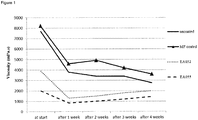
- silica coated APP-II provides paints with lower viscosity than uncoated APP-II and than the melamine formaldehyde resin coated APP-II according to the prior art.
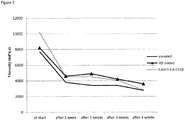
- APP-II coated with a thin film of alumina to afford hydrophilic materials with an increased solubility was tested in the paint formulation listed in table 3.
- the viscosities of the paints manufactured with different APP-II were measured one day after the preparation of the paints and then every week during four weeks storage time at a temperature of 50°C.
- the viscosity was measured at 20 turns per minute using a spindle No 6 of a Brookfield Viscosimeter device DV-E. Data on the viscosities are summarized in table 5 and illustrated in Figure 2 .
- the alumina coated APP-II provides paints with viscosity comparable to uncoated APP-II and melamine formaldehyde resin coated APP-II according to the prior art.
- the viscosity of the paint decreased significantly during the first week of storage, while during the final 3 weeks the change was much more moderate.
- the alumina coating is as good as the prior art in view of viscosity. But the solubility was increased.
Landscapes
- Chemical & Material Sciences (AREA)
- Engineering & Computer Science (AREA)
- Life Sciences & Earth Sciences (AREA)
- Materials Engineering (AREA)
- Wood Science & Technology (AREA)
- Organic Chemistry (AREA)
- Inorganic Chemistry (AREA)
- Nanotechnology (AREA)
- Paints Or Removers (AREA)
Claims (15)
- Polyphosphate d'ammonium de formule (NH4PO3)n, dans laquelle n ≥ 100, dans la phase cristalline II, revêtu par de la silice ou de l'alumine.
- Polyphosphate d'ammonium selon la revendication 1, caractérisé en ce qu'il est revêtu par de la silice colloïdale.
- Polyphosphate d'ammonium selon la revendication 1, caractérisé en ce qu'il est revêtu par de la poudre d'alumine de type boehmite hautement dispersible.
- Polyphosphate ammonium selon l'une quelconque des revendications 1 à 3, caractérisé en ce que 85% des particules sont plus petits que 45 µm, de préférence, la distribution des grosseurs des particules (telle que déterminée par diffraction laser sur un échantillon particulaire dispersé) est D0,9 < 40 µm, D0,5 < 20 µm, D0,1 < 6 µm, et DMOY est de 20 à 25 µm, de préférence de 22 µm.
- Polyphosphate d'ammonium selon l'une quelconque des revendications 1 à 4, caractérisé en ce qu'il est revêtu par de la silice et, au-dessus ou sous celle-ci, par de l'alumine.
- Polyphosphate d'ammonium selon l'une quelconque des revendications 1 à 4, caractérisé en ce qu'il est revêtu par de la silice ou de l'alumine et, au-dessus ou sous celle-ci, par un deuxième revêtement choisi parmi les résines organiques, de préférence une résine de mélamine-formaldéhyde, les organosilanes et les organosiloxanes.
- Procédé pour revêtir du polyphosphate d'ammonium par de la silice ou de l'alumine, comprenant les étapes de:mise à disposition de particules de polyphosphate d'ammonium,leur mélange avec une suspension de silice colloïdale ou de poudre d'alumine etle malaxage du mélange tout en évaporant l'eau ce qui permet d'obtenir le polyphosphate d'ammonium revêtu.
- Procédé selon la revendication 7, caractérisé en ce que le polyphosphate d'ammonium revêtu est tamisé, de préférence à travers un tamis de 125 µm.
- Procédé selon la revendication 7 ou 8, caractérisé en ce que la grosseur de particule des particules de polyphosphate d'ammonium est adaptée avant leur mélange avec une suspension de silice colloïdale ou de poudre d'alumine.
- Procédé selon la revendication 9, caractérisé en ce que les particules de polyphosphate d'ammonium sont tamisées, broyées, broyées et tamisées ou recristallisées avant le mélange.
- Procédé selon l'une quelconque des revendications 7 à 10, caractérisé en ce que la température est réglée à 90-110°C, de préférence à 95-105°C, pendant le malaxage pour l'évaporation de l'eau.
- Procédé selon l'une quelconque des revendications 7 à 11, caractérisé en ce qu'une ventilation est appliquée pendant le malaxage pour soutenir l'évaporation de l'eau.
- Procédé selon l'une quelconque des revendications 7 à 13, caractérisé en ce que la silice colloïdale est choisie parmi la silice colloïdale stabilisée par des bases ou la silice colloïdale stabilisée par de l'alumine ou la silice colloïdale stabilisée par des bases et de l'alumine.
- Utilisation d'un polyphosphate d'ammonium de formule (NH4PO3)n, dans laquelle n ≥ 100, dans la phase cristalline II, revêtu selon au moins l'une quelconque des revendications 1 à 6 comme constituant dans des compositions intumescentes à base d'eau, de préférence dans une peinture ou un revêtement, plus préférablement une peinture ou un revêtement à base d'eau, exempt(e) de solvant.
- Composition intumescente comprenant de l'eau et un polyphosphate d'ammonium selon au moins l'une quelconque des revendications 1 à 6, la composition étant de préférence une peinture ou un revêtement, plus préférablement une peinture ou un revêtement à base d'eau, exempt(e) de solvant.
Priority Applications (1)
| Application Number | Priority Date | Filing Date | Title |
|---|---|---|---|
| EP13002805.3A EP2808358B1 (fr) | 2013-05-31 | 2013-05-31 | Polyphosphate d'ammonium revêtu, son utilisation et fabrication |
Applications Claiming Priority (1)
| Application Number | Priority Date | Filing Date | Title |
|---|---|---|---|
| EP13002805.3A EP2808358B1 (fr) | 2013-05-31 | 2013-05-31 | Polyphosphate d'ammonium revêtu, son utilisation et fabrication |
Publications (2)
| Publication Number | Publication Date |
|---|---|
| EP2808358A1 EP2808358A1 (fr) | 2014-12-03 |
| EP2808358B1 true EP2808358B1 (fr) | 2019-04-24 |
Family
ID=48655937
Family Applications (1)
| Application Number | Title | Priority Date | Filing Date |
|---|---|---|---|
| EP13002805.3A Not-in-force EP2808358B1 (fr) | 2013-05-31 | 2013-05-31 | Polyphosphate d'ammonium revêtu, son utilisation et fabrication |
Country Status (1)
| Country | Link |
|---|---|
| EP (1) | EP2808358B1 (fr) |
Families Citing this family (2)
| Publication number | Priority date | Publication date | Assignee | Title |
|---|---|---|---|---|
| CN105504879A (zh) * | 2016-01-19 | 2016-04-20 | 王虹 | 基于反相微乳法制备核壳型二氧化硅包覆磷酸铵盐的方法 |
| CN106832414B (zh) * | 2016-12-22 | 2019-04-12 | 杭州捷尔思阻燃化工有限公司 | 一种纳米二氧化硅改性多聚磷酸铵的制备方法及其应用 |
Family Cites Families (5)
| Publication number | Priority date | Publication date | Assignee | Title |
|---|---|---|---|---|
| DE3531500A1 (de) | 1984-10-26 | 1986-05-07 | Hoechst Ag, 6230 Frankfurt | Verfahren zur herstellung von hydrolysestabilen, feinteiligen flammschutzmitteln auf der basis von ammoniumpolyphosphat |
| DE19830128A1 (de) | 1998-07-06 | 2000-02-10 | Degussa | Oberflächenmodifizierte Flammschutzmittel, Verfahren zu deren Herstellung sowie deren Verwendung |
| US7045079B2 (en) * | 2001-03-09 | 2006-05-16 | 3M Innovative Properties Company | Aqueous intumescent fire barrier composition |
| DE102006051893A1 (de) * | 2006-10-31 | 2008-05-08 | Eckart Gmbh & Co. Kg | Metalleffektpigmente für den Einsatz in der kathodischen Elektrotauchlackierung, Verfahren zu deren Herstellung und Verwendung derselben sowie Elektrotauchlack |
| CN102167304B (zh) | 2011-02-16 | 2013-01-16 | 清远市普塞呋磷化学有限公司 | 一种高纯度高聚合度水不溶性结晶ⅱ型聚磷酸铵的制备方法 |
-
2013
- 2013-05-31 EP EP13002805.3A patent/EP2808358B1/fr not_active Not-in-force
Non-Patent Citations (1)
| Title |
|---|
| None * |
Also Published As
| Publication number | Publication date |
|---|---|
| EP2808358A1 (fr) | 2014-12-03 |
Similar Documents
| Publication | Publication Date | Title |
|---|---|---|
| CN103237850B (zh) | 具有防腐蚀性能的涂料组合物 | |
| CN101157770B (zh) | 增强的氮化硼组合物和用其制备的组合物 | |
| JP3584293B2 (ja) | 揮発水分量の少ない二酸化チタンとその製法およびこれを含有するマスターバッチ | |
| KR102417125B1 (ko) | 개별화된 무기 입자들 | |
| CN111132931B (zh) | 覆氢氧化铝的碳化硅颗粒粉体的制造方法、以及包含该粉体和分散介质的分散体的制造方法 | |
| CN102892840B (zh) | 包含金属阳离子和含磷和/或硫的阴离子的效果颜料、制造所述金属效果颜料的方法及其用途 | |
| HUP0101147A2 (hu) | Porbevonat-készítmény | |
| EP4491929B1 (fr) | Liquide de revêtement, procédé de production de film de revêtement et film de revêtement | |
| JP2011515307A (ja) | ナノ分散可能なベーマイトの製造方法および難燃性合成樹脂におけるその使用方法 | |
| JPWO1997024289A1 (ja) | 揮発水分量の少ない二酸化チタンとその製法およびこれを含有するマスターバッチ | |
| EP2808358B1 (fr) | Polyphosphate d'ammonium revêtu, son utilisation et fabrication | |
| WO2022171406A1 (fr) | Poudre de silice pyrogénée à densité réduite de groupes silanol | |
| KR20240054278A (ko) | 전자재료용 실리카 및 그 제조방법 | |
| CN107614436A (zh) | 含有氧化锌的复合粒子、紫外线屏蔽用组合物、以及化妆品 | |
| KR20160137530A (ko) | 포르스테라이트 미립자의 제조 방법 | |
| JP6587070B2 (ja) | β−ユークリプタイト微粒子の製造方法 | |
| EP3425086B1 (fr) | Sol de silice contenant de l'acide phénylphosphonique, et son utilisation | |
| EP4043515A1 (fr) | Résine synthétique composite organique/inorganique utilisant un silicate organiquement modifié hautement ignifuge et son procédé de préparation | |
| JP2016044263A (ja) | 難燃性合成樹脂エマルジョン | |
| JP2005154714A (ja) | ヘクトライト組成物を含有する改良された塗料調合品 | |
| US20240239679A1 (en) | Fumed alumina powder with reduced moisture content | |
| JP2024518918A5 (fr) | ||
| TW202408938A (zh) | 含有被覆粒子之無機金屬氧化物粉末之製造方法 | |
| CZ20002580A3 (cs) | Prášková nátěrová hmota | |
| JPH09142836A (ja) | 高分散性及び高可塑性アルミナ粒子 |
Legal Events
| Date | Code | Title | Description |
|---|---|---|---|
| PUAI | Public reference made under article 153(3) epc to a published international application that has entered the european phase |
Free format text: ORIGINAL CODE: 0009012 |
|
| 17P | Request for examination filed |
Effective date: 20130531 |
|
| AK | Designated contracting states |
Kind code of ref document: A1 Designated state(s): AL AT BE BG CH CY CZ DE DK EE ES FI FR GB GR HR HU IE IS IT LI LT LU LV MC MK MT NL NO PL PT RO RS SE SI SK SM TR |
|
| AX | Request for extension of the european patent |
Extension state: BA ME |
|
| R17P | Request for examination filed (corrected) |
Effective date: 20150528 |
|
| RBV | Designated contracting states (corrected) |
Designated state(s): AL AT BE BG CH CY CZ DE DK EE ES FI FR GB GR HR HU IE IS IT LI LT LU LV MC MK MT NL NO PL PT RO RS SE SI SK SM TR |
|
| GRAP | Despatch of communication of intention to grant a patent |
Free format text: ORIGINAL CODE: EPIDOSNIGR1 |
|
| STAA | Information on the status of an ep patent application or granted ep patent |
Free format text: STATUS: GRANT OF PATENT IS INTENDED |
|
| INTG | Intention to grant announced |
Effective date: 20181119 |
|
| GRAS | Grant fee paid |
Free format text: ORIGINAL CODE: EPIDOSNIGR3 |
|
| GRAA | (expected) grant |
Free format text: ORIGINAL CODE: 0009210 |
|
| STAA | Information on the status of an ep patent application or granted ep patent |
Free format text: STATUS: THE PATENT HAS BEEN GRANTED |
|
| AK | Designated contracting states |
Kind code of ref document: B1 Designated state(s): AL AT BE BG CH CY CZ DE DK EE ES FI FR GB GR HR HU IE IS IT LI LT LU LV MC MK MT NL NO PL PT RO RS SE SI SK SM TR |
|
| REG | Reference to a national code |
Ref country code: GB Ref legal event code: FG4D |
|
| REG | Reference to a national code |
Ref country code: CH Ref legal event code: EP |
|
| REG | Reference to a national code |
Ref country code: AT Ref legal event code: REF Ref document number: 1124094 Country of ref document: AT Kind code of ref document: T Effective date: 20190515 Ref country code: IE Ref legal event code: FG4D |
|
| REG | Reference to a national code |
Ref country code: DE Ref legal event code: R096 Ref document number: 602013054176 Country of ref document: DE |
|
| REG | Reference to a national code |
Ref country code: NL Ref legal event code: FP |
|
| REG | Reference to a national code |
Ref country code: LT Ref legal event code: MG4D |
|
| PG25 | Lapsed in a contracting state [announced via postgrant information from national office to epo] |
Ref country code: AL Free format text: LAPSE BECAUSE OF FAILURE TO SUBMIT A TRANSLATION OF THE DESCRIPTION OR TO PAY THE FEE WITHIN THE PRESCRIBED TIME-LIMIT Effective date: 20190424 Ref country code: PT Free format text: LAPSE BECAUSE OF FAILURE TO SUBMIT A TRANSLATION OF THE DESCRIPTION OR TO PAY THE FEE WITHIN THE PRESCRIBED TIME-LIMIT Effective date: 20190824 Ref country code: ES Free format text: LAPSE BECAUSE OF FAILURE TO SUBMIT A TRANSLATION OF THE DESCRIPTION OR TO PAY THE FEE WITHIN THE PRESCRIBED TIME-LIMIT Effective date: 20190424 Ref country code: LT Free format text: LAPSE BECAUSE OF FAILURE TO SUBMIT A TRANSLATION OF THE DESCRIPTION OR TO PAY THE FEE WITHIN THE PRESCRIBED TIME-LIMIT Effective date: 20190424 Ref country code: NO Free format text: LAPSE BECAUSE OF FAILURE TO SUBMIT A TRANSLATION OF THE DESCRIPTION OR TO PAY THE FEE WITHIN THE PRESCRIBED TIME-LIMIT Effective date: 20190724 Ref country code: HR Free format text: LAPSE BECAUSE OF FAILURE TO SUBMIT A TRANSLATION OF THE DESCRIPTION OR TO PAY THE FEE WITHIN THE PRESCRIBED TIME-LIMIT Effective date: 20190424 Ref country code: SE Free format text: LAPSE BECAUSE OF FAILURE TO SUBMIT A TRANSLATION OF THE DESCRIPTION OR TO PAY THE FEE WITHIN THE PRESCRIBED TIME-LIMIT Effective date: 20190424 Ref country code: FI Free format text: LAPSE BECAUSE OF FAILURE TO SUBMIT A TRANSLATION OF THE DESCRIPTION OR TO PAY THE FEE WITHIN THE PRESCRIBED TIME-LIMIT Effective date: 20190424 |
|
| PG25 | Lapsed in a contracting state [announced via postgrant information from national office to epo] |
Ref country code: PL Free format text: LAPSE BECAUSE OF FAILURE TO SUBMIT A TRANSLATION OF THE DESCRIPTION OR TO PAY THE FEE WITHIN THE PRESCRIBED TIME-LIMIT Effective date: 20190424 Ref country code: RS Free format text: LAPSE BECAUSE OF FAILURE TO SUBMIT A TRANSLATION OF THE DESCRIPTION OR TO PAY THE FEE WITHIN THE PRESCRIBED TIME-LIMIT Effective date: 20190424 Ref country code: GR Free format text: LAPSE BECAUSE OF FAILURE TO SUBMIT A TRANSLATION OF THE DESCRIPTION OR TO PAY THE FEE WITHIN THE PRESCRIBED TIME-LIMIT Effective date: 20190725 Ref country code: LV Free format text: LAPSE BECAUSE OF FAILURE TO SUBMIT A TRANSLATION OF THE DESCRIPTION OR TO PAY THE FEE WITHIN THE PRESCRIBED TIME-LIMIT Effective date: 20190424 Ref country code: BG Free format text: LAPSE BECAUSE OF FAILURE TO SUBMIT A TRANSLATION OF THE DESCRIPTION OR TO PAY THE FEE WITHIN THE PRESCRIBED TIME-LIMIT Effective date: 20190724 |
|
| REG | Reference to a national code |
Ref country code: CH Ref legal event code: PL |
|
| PG25 | Lapsed in a contracting state [announced via postgrant information from national office to epo] |
Ref country code: IS Free format text: LAPSE BECAUSE OF FAILURE TO SUBMIT A TRANSLATION OF THE DESCRIPTION OR TO PAY THE FEE WITHIN THE PRESCRIBED TIME-LIMIT Effective date: 20190824 |
|
| REG | Reference to a national code |
Ref country code: DE Ref legal event code: R097 Ref document number: 602013054176 Country of ref document: DE |
|
| PG25 | Lapsed in a contracting state [announced via postgrant information from national office to epo] |
Ref country code: MC Free format text: LAPSE BECAUSE OF FAILURE TO SUBMIT A TRANSLATION OF THE DESCRIPTION OR TO PAY THE FEE WITHIN THE PRESCRIBED TIME-LIMIT Effective date: 20190424 Ref country code: SK Free format text: LAPSE BECAUSE OF FAILURE TO SUBMIT A TRANSLATION OF THE DESCRIPTION OR TO PAY THE FEE WITHIN THE PRESCRIBED TIME-LIMIT Effective date: 20190424 Ref country code: RO Free format text: LAPSE BECAUSE OF FAILURE TO SUBMIT A TRANSLATION OF THE DESCRIPTION OR TO PAY THE FEE WITHIN THE PRESCRIBED TIME-LIMIT Effective date: 20190424 Ref country code: CZ Free format text: LAPSE BECAUSE OF FAILURE TO SUBMIT A TRANSLATION OF THE DESCRIPTION OR TO PAY THE FEE WITHIN THE PRESCRIBED TIME-LIMIT Effective date: 20190424 Ref country code: DK Free format text: LAPSE BECAUSE OF FAILURE TO SUBMIT A TRANSLATION OF THE DESCRIPTION OR TO PAY THE FEE WITHIN THE PRESCRIBED TIME-LIMIT Effective date: 20190424 Ref country code: CH Free format text: LAPSE BECAUSE OF NON-PAYMENT OF DUE FEES Effective date: 20190531 Ref country code: LI Free format text: LAPSE BECAUSE OF NON-PAYMENT OF DUE FEES Effective date: 20190531 Ref country code: EE Free format text: LAPSE BECAUSE OF FAILURE TO SUBMIT A TRANSLATION OF THE DESCRIPTION OR TO PAY THE FEE WITHIN THE PRESCRIBED TIME-LIMIT Effective date: 20190424 |
|
| PG25 | Lapsed in a contracting state [announced via postgrant information from national office to epo] |
Ref country code: LU Free format text: LAPSE BECAUSE OF NON-PAYMENT OF DUE FEES Effective date: 20190531 Ref country code: SM Free format text: LAPSE BECAUSE OF FAILURE TO SUBMIT A TRANSLATION OF THE DESCRIPTION OR TO PAY THE FEE WITHIN THE PRESCRIBED TIME-LIMIT Effective date: 20190424 |
|
| PLBE | No opposition filed within time limit |
Free format text: ORIGINAL CODE: 0009261 |
|
| STAA | Information on the status of an ep patent application or granted ep patent |
Free format text: STATUS: NO OPPOSITION FILED WITHIN TIME LIMIT |
|
| PG25 | Lapsed in a contracting state [announced via postgrant information from national office to epo] |
Ref country code: TR Free format text: LAPSE BECAUSE OF FAILURE TO SUBMIT A TRANSLATION OF THE DESCRIPTION OR TO PAY THE FEE WITHIN THE PRESCRIBED TIME-LIMIT Effective date: 20190424 |
|
| 26N | No opposition filed |
Effective date: 20200127 |
|
| PG25 | Lapsed in a contracting state [announced via postgrant information from national office to epo] |
Ref country code: IE Free format text: LAPSE BECAUSE OF NON-PAYMENT OF DUE FEES Effective date: 20190531 |
|
| PG25 | Lapsed in a contracting state [announced via postgrant information from national office to epo] |
Ref country code: SI Free format text: LAPSE BECAUSE OF FAILURE TO SUBMIT A TRANSLATION OF THE DESCRIPTION OR TO PAY THE FEE WITHIN THE PRESCRIBED TIME-LIMIT Effective date: 20190424 |
|
| PGFP | Annual fee paid to national office [announced via postgrant information from national office to epo] |
Ref country code: DE Payment date: 20200525 Year of fee payment: 8 Ref country code: FR Payment date: 20200519 Year of fee payment: 8 Ref country code: NL Payment date: 20200518 Year of fee payment: 8 |
|
| PGFP | Annual fee paid to national office [announced via postgrant information from national office to epo] |
Ref country code: BE Payment date: 20200518 Year of fee payment: 8 Ref country code: GB Payment date: 20200522 Year of fee payment: 8 Ref country code: IT Payment date: 20200528 Year of fee payment: 8 |
|
| PGFP | Annual fee paid to national office [announced via postgrant information from national office to epo] |
Ref country code: AT Payment date: 20200515 Year of fee payment: 8 |
|
| PG25 | Lapsed in a contracting state [announced via postgrant information from national office to epo] |
Ref country code: CY Free format text: LAPSE BECAUSE OF FAILURE TO SUBMIT A TRANSLATION OF THE DESCRIPTION OR TO PAY THE FEE WITHIN THE PRESCRIBED TIME-LIMIT Effective date: 20190424 |
|
| PG25 | Lapsed in a contracting state [announced via postgrant information from national office to epo] |
Ref country code: MT Free format text: LAPSE BECAUSE OF FAILURE TO SUBMIT A TRANSLATION OF THE DESCRIPTION OR TO PAY THE FEE WITHIN THE PRESCRIBED TIME-LIMIT Effective date: 20190424 Ref country code: HU Free format text: LAPSE BECAUSE OF FAILURE TO SUBMIT A TRANSLATION OF THE DESCRIPTION OR TO PAY THE FEE WITHIN THE PRESCRIBED TIME-LIMIT; INVALID AB INITIO Effective date: 20130531 |
|
| REG | Reference to a national code |
Ref country code: DE Ref legal event code: R119 Ref document number: 602013054176 Country of ref document: DE |
|
| REG | Reference to a national code |
Ref country code: NL Ref legal event code: MM Effective date: 20210601 |
|
| REG | Reference to a national code |
Ref country code: AT Ref legal event code: MM01 Ref document number: 1124094 Country of ref document: AT Kind code of ref document: T Effective date: 20210531 |
|
| GBPC | Gb: european patent ceased through non-payment of renewal fee |
Effective date: 20210531 |
|
| PG25 | Lapsed in a contracting state [announced via postgrant information from national office to epo] |
Ref country code: AT Free format text: LAPSE BECAUSE OF NON-PAYMENT OF DUE FEES Effective date: 20210531 |
|
| REG | Reference to a national code |
Ref country code: BE Ref legal event code: MM Effective date: 20210531 |
|
| PG25 | Lapsed in a contracting state [announced via postgrant information from national office to epo] |
Ref country code: GB Free format text: LAPSE BECAUSE OF NON-PAYMENT OF DUE FEES Effective date: 20210531 Ref country code: DE Free format text: LAPSE BECAUSE OF NON-PAYMENT OF DUE FEES Effective date: 20211201 |
|
| PG25 | Lapsed in a contracting state [announced via postgrant information from national office to epo] |
Ref country code: NL Free format text: LAPSE BECAUSE OF NON-PAYMENT OF DUE FEES Effective date: 20210601 Ref country code: FR Free format text: LAPSE BECAUSE OF NON-PAYMENT OF DUE FEES Effective date: 20210531 |
|
| PG25 | Lapsed in a contracting state [announced via postgrant information from national office to epo] |
Ref country code: MK Free format text: LAPSE BECAUSE OF FAILURE TO SUBMIT A TRANSLATION OF THE DESCRIPTION OR TO PAY THE FEE WITHIN THE PRESCRIBED TIME-LIMIT Effective date: 20190424 |
|
| PG25 | Lapsed in a contracting state [announced via postgrant information from national office to epo] |
Ref country code: BE Free format text: LAPSE BECAUSE OF NON-PAYMENT OF DUE FEES Effective date: 20210531 |
|
| REG | Reference to a national code |
Ref country code: AT Ref legal event code: UEP Ref document number: 1124094 Country of ref document: AT Kind code of ref document: T Effective date: 20190424 |
|
| PG25 | Lapsed in a contracting state [announced via postgrant information from national office to epo] |
Ref country code: IT Free format text: LAPSE BECAUSE OF NON-PAYMENT OF DUE FEES Effective date: 20200531 |