EP2808376B1 - Verfahren zur herstellung einer zusammensetzung - Google Patents
Verfahren zur herstellung einer zusammensetzung Download PDFInfo
- Publication number
- EP2808376B1 EP2808376B1 EP13873138.5A EP13873138A EP2808376B1 EP 2808376 B1 EP2808376 B1 EP 2808376B1 EP 13873138 A EP13873138 A EP 13873138A EP 2808376 B1 EP2808376 B1 EP 2808376B1
- Authority
- EP
- European Patent Office
- Prior art keywords
- group
- composition
- general formula
- compound
- raw material
- Prior art date
- Legal status (The legal status is an assumption and is not a legal conclusion. Google has not performed a legal analysis and makes no representation as to the accuracy of the status listed.)
- Active
Links
- 0 CCCc(cc1)ccc1-c(cc1*C)cc(ClC)c1O Chemical compound CCCc(cc1)ccc1-c(cc1*C)cc(ClC)c1O 0.000 description 3
- QCRXXWNFJYKLHB-UHFFFAOYSA-N CCCC(CC1)CCC1C(CC1)CCC1C(Oc(cc1F)cc(F)c1F)(F)F Chemical compound CCCC(CC1)CCC1C(CC1)CCC1C(Oc(cc1F)cc(F)c1F)(F)F QCRXXWNFJYKLHB-UHFFFAOYSA-N 0.000 description 1
- VIAHFPWVESXWIL-UHFFFAOYSA-N CCCC(CC1)CCC1c(c(F)c1F)cc([F]c(c(F)c(cc2)-c3ccc(CCC)cc3)c2OCC)c1OCC Chemical compound CCCC(CC1)CCC1c(c(F)c1F)cc([F]c(c(F)c(cc2)-c3ccc(CCC)cc3)c2OCC)c1OCC VIAHFPWVESXWIL-UHFFFAOYSA-N 0.000 description 1
- JIDMVMUKWQXAEW-UHFFFAOYSA-N CCCC(CC1)COC1C(CC1)CCC1c(cc1F)cc(F)c1F Chemical compound CCCC(CC1)COC1C(CC1)CCC1c(cc1F)cc(F)c1F JIDMVMUKWQXAEW-UHFFFAOYSA-N 0.000 description 1
- NNVLHRPSKHATHG-UHFFFAOYSA-N CCCC1CCC(COc(ccc(OCC(CC2)CCC2C=C)c2F)c2F)CC1 Chemical compound CCCC1CCC(COc(ccc(OCC(CC2)CCC2C=C)c2F)c2F)CC1 NNVLHRPSKHATHG-UHFFFAOYSA-N 0.000 description 1
Classifications
-
- C—CHEMISTRY; METALLURGY
- C09—DYES; PAINTS; POLISHES; NATURAL RESINS; ADHESIVES; COMPOSITIONS NOT OTHERWISE PROVIDED FOR; APPLICATIONS OF MATERIALS NOT OTHERWISE PROVIDED FOR
- C09K—MATERIALS FOR MISCELLANEOUS APPLICATIONS, NOT PROVIDED FOR ELSEWHERE
- C09K19/00—Liquid crystal materials
- C09K19/04—Liquid crystal materials characterised by the chemical structure of the liquid crystal components, e.g. by a specific unit
- C09K19/06—Non-steroidal liquid crystal compounds
- C09K19/08—Non-steroidal liquid crystal compounds containing at least two non-condensed rings
- C09K19/30—Non-steroidal liquid crystal compounds containing at least two non-condensed rings containing saturated or unsaturated non-aromatic rings, e.g. cyclohexane rings
- C09K19/3001—Cyclohexane rings
- C09K19/3066—Cyclohexane rings in which the rings are linked by a chain containing carbon and oxygen atoms, e.g. esters or ethers
-
- C—CHEMISTRY; METALLURGY
- C09—DYES; PAINTS; POLISHES; NATURAL RESINS; ADHESIVES; COMPOSITIONS NOT OTHERWISE PROVIDED FOR; APPLICATIONS OF MATERIALS NOT OTHERWISE PROVIDED FOR
- C09K—MATERIALS FOR MISCELLANEOUS APPLICATIONS, NOT PROVIDED FOR ELSEWHERE
- C09K19/00—Liquid crystal materials
- C09K19/04—Liquid crystal materials characterised by the chemical structure of the liquid crystal components, e.g. by a specific unit
- C09K19/0403—Liquid crystal materials characterised by the chemical structure of the liquid crystal components, e.g. by a specific unit the structure containing one or more specific, optionally substituted ring or ring systems
-
- C—CHEMISTRY; METALLURGY
- C09—DYES; PAINTS; POLISHES; NATURAL RESINS; ADHESIVES; COMPOSITIONS NOT OTHERWISE PROVIDED FOR; APPLICATIONS OF MATERIALS NOT OTHERWISE PROVIDED FOR
- C09K—MATERIALS FOR MISCELLANEOUS APPLICATIONS, NOT PROVIDED FOR ELSEWHERE
- C09K19/00—Liquid crystal materials
- C09K19/04—Liquid crystal materials characterised by the chemical structure of the liquid crystal components, e.g. by a specific unit
- C09K19/06—Non-steroidal liquid crystal compounds
- C09K19/08—Non-steroidal liquid crystal compounds containing at least two non-condensed rings
- C09K19/10—Non-steroidal liquid crystal compounds containing at least two non-condensed rings containing at least two benzene rings
- C09K19/20—Non-steroidal liquid crystal compounds containing at least two non-condensed rings containing at least two benzene rings linked by a chain containing carbon and oxygen atoms as chain links, e.g. esters or ethers
-
- C—CHEMISTRY; METALLURGY
- C09—DYES; PAINTS; POLISHES; NATURAL RESINS; ADHESIVES; COMPOSITIONS NOT OTHERWISE PROVIDED FOR; APPLICATIONS OF MATERIALS NOT OTHERWISE PROVIDED FOR
- C09K—MATERIALS FOR MISCELLANEOUS APPLICATIONS, NOT PROVIDED FOR ELSEWHERE
- C09K19/00—Liquid crystal materials
- C09K19/04—Liquid crystal materials characterised by the chemical structure of the liquid crystal components, e.g. by a specific unit
- C09K19/06—Non-steroidal liquid crystal compounds
- C09K19/08—Non-steroidal liquid crystal compounds containing at least two non-condensed rings
- C09K19/30—Non-steroidal liquid crystal compounds containing at least two non-condensed rings containing saturated or unsaturated non-aromatic rings, e.g. cyclohexane rings
- C09K19/3001—Cyclohexane rings
- C09K19/3003—Compounds containing at least two rings in which the different rings are directly linked (covalent bond)
-
- C—CHEMISTRY; METALLURGY
- C09—DYES; PAINTS; POLISHES; NATURAL RESINS; ADHESIVES; COMPOSITIONS NOT OTHERWISE PROVIDED FOR; APPLICATIONS OF MATERIALS NOT OTHERWISE PROVIDED FOR
- C09K—MATERIALS FOR MISCELLANEOUS APPLICATIONS, NOT PROVIDED FOR ELSEWHERE
- C09K19/00—Liquid crystal materials
- C09K19/52—Liquid crystal materials characterised by components which are not liquid crystals, e.g. additives with special physical aspect: solvents, solid particles
- C09K19/54—Additives having no specific mesophase characterised by their chemical composition
-
- C—CHEMISTRY; METALLURGY
- C09—DYES; PAINTS; POLISHES; NATURAL RESINS; ADHESIVES; COMPOSITIONS NOT OTHERWISE PROVIDED FOR; APPLICATIONS OF MATERIALS NOT OTHERWISE PROVIDED FOR
- C09K—MATERIALS FOR MISCELLANEOUS APPLICATIONS, NOT PROVIDED FOR ELSEWHERE
- C09K19/00—Liquid crystal materials
- C09K19/04—Liquid crystal materials characterised by the chemical structure of the liquid crystal components, e.g. by a specific unit
- C09K2019/0444—Liquid crystal materials characterised by the chemical structure of the liquid crystal components, e.g. by a specific unit characterized by a linking chain between rings or ring systems, a bridging chain between extensive mesogenic moieties or an end chain group
- C09K2019/0466—Liquid crystal materials characterised by the chemical structure of the liquid crystal components, e.g. by a specific unit characterized by a linking chain between rings or ring systems, a bridging chain between extensive mesogenic moieties or an end chain group the linking chain being a -CF2O- chain
-
- C—CHEMISTRY; METALLURGY
- C09—DYES; PAINTS; POLISHES; NATURAL RESINS; ADHESIVES; COMPOSITIONS NOT OTHERWISE PROVIDED FOR; APPLICATIONS OF MATERIALS NOT OTHERWISE PROVIDED FOR
- C09K—MATERIALS FOR MISCELLANEOUS APPLICATIONS, NOT PROVIDED FOR ELSEWHERE
- C09K19/00—Liquid crystal materials
- C09K19/04—Liquid crystal materials characterised by the chemical structure of the liquid crystal components, e.g. by a specific unit
- C09K19/06—Non-steroidal liquid crystal compounds
- C09K19/08—Non-steroidal liquid crystal compounds containing at least two non-condensed rings
- C09K19/30—Non-steroidal liquid crystal compounds containing at least two non-condensed rings containing saturated or unsaturated non-aromatic rings, e.g. cyclohexane rings
- C09K19/3001—Cyclohexane rings
- C09K19/3003—Compounds containing at least two rings in which the different rings are directly linked (covalent bond)
- C09K2019/3004—Cy-Cy
-
- C—CHEMISTRY; METALLURGY
- C09—DYES; PAINTS; POLISHES; NATURAL RESINS; ADHESIVES; COMPOSITIONS NOT OTHERWISE PROVIDED FOR; APPLICATIONS OF MATERIALS NOT OTHERWISE PROVIDED FOR
- C09K—MATERIALS FOR MISCELLANEOUS APPLICATIONS, NOT PROVIDED FOR ELSEWHERE
- C09K19/00—Liquid crystal materials
- C09K19/04—Liquid crystal materials characterised by the chemical structure of the liquid crystal components, e.g. by a specific unit
- C09K19/06—Non-steroidal liquid crystal compounds
- C09K19/08—Non-steroidal liquid crystal compounds containing at least two non-condensed rings
- C09K19/30—Non-steroidal liquid crystal compounds containing at least two non-condensed rings containing saturated or unsaturated non-aromatic rings, e.g. cyclohexane rings
- C09K19/3001—Cyclohexane rings
- C09K19/3003—Compounds containing at least two rings in which the different rings are directly linked (covalent bond)
- C09K2019/3009—Cy-Ph
-
- C—CHEMISTRY; METALLURGY
- C09—DYES; PAINTS; POLISHES; NATURAL RESINS; ADHESIVES; COMPOSITIONS NOT OTHERWISE PROVIDED FOR; APPLICATIONS OF MATERIALS NOT OTHERWISE PROVIDED FOR
- C09K—MATERIALS FOR MISCELLANEOUS APPLICATIONS, NOT PROVIDED FOR ELSEWHERE
- C09K19/00—Liquid crystal materials
- C09K19/04—Liquid crystal materials characterised by the chemical structure of the liquid crystal components, e.g. by a specific unit
- C09K19/06—Non-steroidal liquid crystal compounds
- C09K19/08—Non-steroidal liquid crystal compounds containing at least two non-condensed rings
- C09K19/30—Non-steroidal liquid crystal compounds containing at least two non-condensed rings containing saturated or unsaturated non-aromatic rings, e.g. cyclohexane rings
- C09K19/3001—Cyclohexane rings
- C09K19/3003—Compounds containing at least two rings in which the different rings are directly linked (covalent bond)
- C09K2019/301—Cy-Cy-Ph
-
- C—CHEMISTRY; METALLURGY
- C09—DYES; PAINTS; POLISHES; NATURAL RESINS; ADHESIVES; COMPOSITIONS NOT OTHERWISE PROVIDED FOR; APPLICATIONS OF MATERIALS NOT OTHERWISE PROVIDED FOR
- C09K—MATERIALS FOR MISCELLANEOUS APPLICATIONS, NOT PROVIDED FOR ELSEWHERE
- C09K19/00—Liquid crystal materials
- C09K19/04—Liquid crystal materials characterised by the chemical structure of the liquid crystal components, e.g. by a specific unit
- C09K19/06—Non-steroidal liquid crystal compounds
- C09K19/08—Non-steroidal liquid crystal compounds containing at least two non-condensed rings
- C09K19/30—Non-steroidal liquid crystal compounds containing at least two non-condensed rings containing saturated or unsaturated non-aromatic rings, e.g. cyclohexane rings
- C09K19/3001—Cyclohexane rings
- C09K19/3003—Compounds containing at least two rings in which the different rings are directly linked (covalent bond)
- C09K2019/3016—Cy-Ph-Ph
-
- C—CHEMISTRY; METALLURGY
- C09—DYES; PAINTS; POLISHES; NATURAL RESINS; ADHESIVES; COMPOSITIONS NOT OTHERWISE PROVIDED FOR; APPLICATIONS OF MATERIALS NOT OTHERWISE PROVIDED FOR
- C09K—MATERIALS FOR MISCELLANEOUS APPLICATIONS, NOT PROVIDED FOR ELSEWHERE
- C09K2219/00—Aspects relating to the form of the liquid crystal [LC] material, or by the technical area in which LC material are used
Definitions
- the present invention relates to a method for producing a composition.
- Liquid crystal display devices have become widely used for consumer application to industrial application, such as liquid crystal televisions, cellular phones, personal computers, etc. These products have a relatively long lifetime of several years to several tens years, and liquid crystal materials used in liquid crystal display devices are required to have high stability in order that the display devices normally operate for the lifetime.
- a typical index for stability of liquid crystal materials is a resistivity value.
- a typical example thereof relates to a method of bringing a liquid crystal material into contact with silica gel or alumina to remove moisture, organic ions, inorganic ions, and the like from the liquid crystal material, thereby enhancing a resistivity value (Patent Literatures 1 and 2).
- some compounds constituting liquid crystal materials may cause reaction such as dimerization or decomposition by contact with silica gel or the like, resulting in a decrease in purity and a decrease in resistivity value with the decrease in purity.
- This tendency is particularly high in compounds having an alkenyl group or a polymerizable group in a side chain. Therefore, there is desire for a simple practical method for achieving a high resistivity value without deterioration in compounds constituting liquid crystal materials, but a specific solving method has not yet been reported.
- JP H07 225369 A relates to the problem to improve the voltage holding rate characteristic and to expand the application range by incorporating an antioxidant or active alumina into polymer dispersion type liquid crystals.
- the document describes that the antioxidant or active alumina is incorporated into a display element formed by using the polymer dispersion type liquid crystals consisting of small drops of a polymer and the liquid crystals dispersed in this polymer.
- Phenolic antioxidants such as 2,6-di-tert-butyl-p-cresol and 2,6-di-tert-butyl phenol
- amine antioxidant such as phenonyl-beta-naphthylamine and ⁇ -naphthyl amine
- sulfur antioxidants such as dilauryl thiopropionate
- phosphorus antioxidants such as triphenyl phosphite
- JP H10 8057 A relates to the problem to obtain a liquid crystal composition for a liquid crystal element which is driven by active matrix having a high electric resistance, excellent in contrast and a high voltage retention by contacting the specific liquid crystal composition with water and then separating from the water.
- a liquid crystal composition containing dichromatic pigments is contacted with water, preferably with acidic aqueous solution, practically hydrochloric acid or nitric acid, and then separated from the water.
- the composition is preferably contacted with water after dissolving in an organic solvent (e.g. benzene, etc.) immiscible with water, and a pigment having ⁇ 0.7 of order parameter (S), practically a pigment having azo based structure is preferred as the dichromatic pigment.
- JP 2007 246534 A relates to the problem to provide new antioxidants in which preparation is easy, cost is low, handling and composition are easy, and which are effective at low concentration.
- the document describes 2,6-di-tert-butylphenols which are represented by the following formula I in which R, A 1 , A 2 , Z 1 , Z 2 , m and n have special definitions. These compounds are used as antioxidants or stabilizers.
- the present invention has been achieved in consideration of the above-described situation, and an object of the present invention is to provide a simple practical method for producing a compound or composition constituting a liquid crystal material.
- a compound or composition constituting a liquid crystal material can be produced by a simple practical method.
- the present invention provides a method for producing a compound or composition as defined in claim 1, the method including preparing a raw material composition containing at least one compound which is a hindered phenol having a specified structure, and at least one compound constituting a liquid crystal material, and purifying at least one compound constituting the liquid crystal composition through a series of purification steps starting from the raw material composition.
- the series of purification steps include at least a step of bringing the raw material composition (including a composition or mixture further containing another substance added to the raw material composition) into contact with a purifying agent composed of one or a mixture of silica gel, alumina, and an ion exchange resin, and then a step of removing the purifying agent.
- the raw material composition may be either a homogeneous composition or an inhomogeneous composition, but is preferably a homogeneous composition.
- the raw material composition may contain an organic solvent or not contain an organic solvent.
- the step of bringing the raw material composition into contact with the purifying agent may be a step of dissolving the raw material composition and bringing the resultant solution into contact with the purifying agent or a step of bringing the raw material composition into contact with the purifying agent without adding an organic solvent to the raw material composition.
- the raw material composition When the raw material composition is a solid at room temperature, it is preferred to dissolve the raw material composition in an organic solvent and bring the resultant solution into contact with the purifying agent.
- the raw material composition When the raw material composition is a liquid crystal at room temperature, it is possible to dissolve the raw material composition in an organic solvent and bring the resultant solution into contact with the purifying agent, but the raw material composition in a liquid crystal state is preferably directly brought into contact with the purifying agent.
- the raw material composition When the raw material composition is a liquid at room temperature, it is possible to dissolve the raw material composition in an organic solvent and bring the resultant solution into contact with the purifying agent, but the raw material composition in a liquid state is preferably directly brought into contact with the purifying agent.
- composition after the purifying agent is removed does not contain the organic solvent
- the composition is provided as a target composition
- the composition after the purifying agent is removed contains the organic solvent
- the organic solvent is distilled off to provide a target composition.
- the raw material composition contains one or two or more compounds selected from the compound group consisting of compounds represented by general formula (I) and compounds represented by general formula (III) described below. These compounds correspond to the hindered phenols.
- the total content of the compound represented by the general formula (I) and the compound represented by the general formula (III) is preferably 0.001% by mass to 10% by mass relative to the weight of the raw material composition.
- the raw material composition may contain one or two or more of either the compounds represented by the general formula (I) or the compounds represented by the general formula (III), and may contain one or two or more of the compounds represented by the general formula (I) and one or two or more of the compounds represented by the general formula (III).
- the raw material composition preferably contains a compound represented by the general formula (I) below.
- a 0, 1, or 2.
- M 1 represents a group selected from the group consisting of
- R 1 is a linear alkyl group or branch alkyl group having 1 to 11 carbon atoms.
- R 1 is more preferably a linear alkyl group having 2 to 9 carbon atoms, and when a represents 1 or 2, R 1 is more preferably a linear alkyl group having 1 to 5 carbon atoms.
- M 1 represents a trans-1,4-cyclohexylene group or a 1,4-phenylene group (one or two or more hydrogen atoms contained in the group may be each substituted by a fluorine atom or a chlorine atom).
- a group represented by a general formula below (the right and left sides of the formula are the same as in the general formula (I)), such as a trans-1,4-cyclohexylene group, a 1,4-phenylene group, a 2-fluoro-1,4-phenylene group, or a 3-fluoro-1,4-phenylene group, is preferred, and a trans-1,4-cyclohexylene group or a 1,4-phenylene group is more preferred.
- R 1 represents a linear alkyl group or branch alkyl group having 1 to 11 carbon atoms
- M 1 represents a trans-1,4-cyclohexylene group or a 1,4-phenylene group
- Z 1 represents a single bond
- a represents 0 or 1.
- the raw material composition preferably contains a compound represented by the general formula (III) below.
- the compound represented by the general formula (III) preferably includes at least one compound in which M 2 in the general formula (III) represents an alkylene group having 1 to 15 carbon atoms.
- the raw material composition contains a compound represented by the general formula (II) below.
- R 2 represents an alkyl group having 1 to 8 carbon atoms, an alkenyl group having 2 to 8 carbon atoms, an alkoxy group having 1 to 8 carbon atoms, or an alkenyloxy group having 2 to 8 carbon atoms.
- b represents 1, 2, 3, or 4.
- a 1 and A 2 each independently represent a group selected from the group consisting of
- b represents 2, 3, or 4 and a plurality of Z 2 are present, the plurality of Z 2 present may be the same or different.
- Y 1 represents a hydrogen atom, a fluorine atom, a chlorine atom, a trifluoromethyl group, a trifluoromethoxy group, an alkyl group having 1 to 6 carbon atoms, an alkenyl group having 2 to 6 carbon atoms, an alkoxy group having 1 to 6 carbon atoms, or an alkenyloxy group having 2 to 6 carbon atoms.
- the compound represented by the general formula (II) preferably contains at least one compound in which R 2 in the general formula (II) represents an alkenyl group having 2 to 6 carbon atoms.
- the compound represented by the general formula (II) may be a p-type liquid crystal compound having a dielectric anisotropy of ⁇ > 0 and a large absolute value of ⁇ .
- the compound represented by the general formula (II) preferably includes at least one compound in which at least one of A 1 and A 2 in the general formula (II) represents any one selected from formulae below (the right and left sides of each of the formulae are the same as in the general formula (II)).
- Y 1 is preferably a fluorine atom, a chlorine atom, a trifluoromethyl group, or a trifluoromethoxy group, and Y 1 more preferably represents a fluorine atom.
- R 2 preferably represents a methyl group, an ethyl group, a propyl group, a butyl group, or a pentyl group, and Z 1 preferably represents a single bond, - CH 2 CH 2 -, -CF 2 O-, or -OCF 2 -.
- the compound preferably includes at least one compound in which R 2 is an alkenyl group having 2 to 6 carbon atoms.
- the compound represented by the general formula (II) may be a n-type liquid crystal compound having a dielectric anisotropy of ⁇ ⁇ 0 and a large absolute value of ⁇ .
- the compound represented by the general formula (II) preferably includes at least one compound in which at least one of A 1 and A 2 in the general formula (II) represents any one selected from formulae below (the right and left sides of each of the formulae are the same as in the general formula (II)), and more preferably includes at least one compound in which at least one of A 1 and A 2 represents the following.
- R 2 and Y 1 preferably each independently represent a methyl group, an ethyl group, a propyl group, a butyl group, a pentyl group, a vinyl group, a methoxy group, an ethoxy group, a propoxy group, a butoxy group, a pentoxy group, a 3-butenyloxy group, or a 4-pentenyloxy group
- Z 1 preferably represents a single bond, -CH 2 CH 2 -, -CH 2 O-, -OCH 2 -, -CF 2 O-, or -OCF 2 -.
- the compound preferably contains at least one compound in which R 2 is an alkenyl group having 2 to 6 carbon atoms.
- the compound represented by the general formula (II) may be a non-polar liquid crystal compound having a relatively small absolute value of dielectric anisotropy ⁇ .
- a 1 and A 2 preferably each independently represent a trans-1,4-cyclohexylene group or a 1,4-phenylene group.
- R 2 and Y 1 each independently represent an alkyl group having 1 to 6 carbon atoms, an alkenyl group having 2 to 6 carbon atoms, an alkoxy group having 1 to 6 carbon atoms, or an alkenyloxy group having 2 to 6 carbon atoms, and Z 2 represents a single bond or -CH 2 CH 2 -.
- the compound preferably includes at least one compound in which R 2 is an alkenyl group having 2 to 6 carbon atoms.
- the raw material composition preferably contains a compound represented by general formula (IV) below.
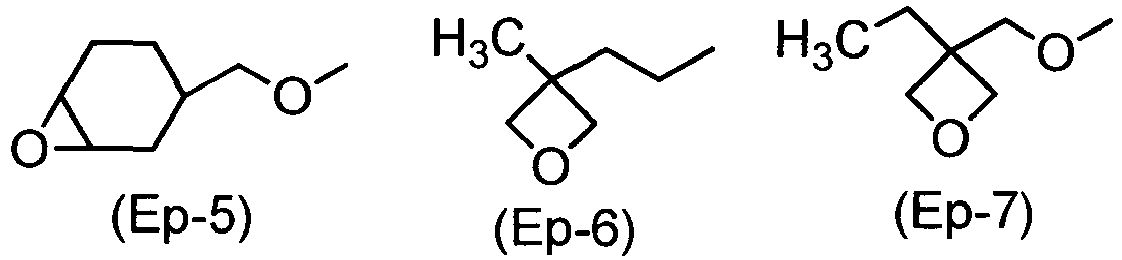
- P 1 and P 2 each independently represent an acryloyloxy group, a methacryloyloxy group, a vinyl group, a vinyloxy group, or a monovalent group represented by any one of formulae (Ep-1) to (Ep-7) below.
- a group represented by each of the formulae (Ep-1) to (Ep-7) is bonded at the end of an upper right bond.
- (Ep-1) represents a glycidyloxy group
- (Ep-3) represents an oxiranyl group.
- n 0, 1, or 2.
- a 3 and A 4 each independently represent a 1,4-phenylene group or a naphthalene-2,6-diyl group (one or two or more hydrogen atoms contained in the groups may be each substituted by a fluorine atom).
- n represents 2 and a plurality of A 4 are present, the plurality of A 4 present may be the same or different.
- Z 3 represents -COO-, -OCO-, - CH 2 CH 2 COO-, -OCOCH 2 CH 2 -, -CH 2 CH 2 OCO-, -COOCH 2 CH 2 -, -(CH 2 ) 4 -, - (-CH 2 ) 3 O-, -O(CH 2 ) 3 -, -CH 2 CH 2 OCH 2 -, -CH 2 OCH 2 CH 2 -, or a single bond.
- n represents 2 and a plurality of Z 3 are present, the plurality of Z 3 present may be the same or different.
- P 1 and P 2 preferably each independently represent an acryloyloxy group or a methacryloyloxy group.
- a 3 and A 4 each independently represent a 1,4-phenylene group (one or two or more hydrogen atoms contained in the group may be each substituted by a fluorine atom).
- silica gel, alumina, and an ion exchange resin is used as the purifying agent.
- One or a mixture of silica gel and alumina is preferred.
- Silica gel or alumina may be chemically modified with a hydrophobic group, a hydrophilic group, a functional group, or the like.
- the amount of the purifying agent used relative to 100 parts by mass of the raw material composition is preferably 0.1 parts by mass or more, preferably 0.5 parts by mass or more, preferably 1 part by mass or more, preferably 5 parts by mass or more, preferably 10 parts by mass or more, and preferably 30 parts by mass or more, and preferably 1000 parts by mass or less, preferably 500 parts by mass or less, preferably 300 parts by mass or less, preferably 200 parts by mass or less, preferably 100 parts by mass or less, and more preferably 50 parts by mass or less, and may be 10 parts by mass or less.
- a method of bringing the raw material composition into contact with the purifying agent is not particularly limited, but, for example, any one of methods (A) to (C) below can be used.
- the amount of the purifying agent used is preferably 0.1 parts by mass to 100 parts by mass, more preferably 0.5 parts by mass to 50 parts by mass, and particularly preferably 0.5 parts by mass to 10 parts by mass relative to 100 parts by mass of the raw material composition.
- the total content of one or two or more compounds selected from the compound group consisting of compounds represented by the general formula (I) and compounds represented by the general formula (III) is preferably 0.001% by mass to 1% by mass and more preferably 0.01% by mass to 0.5% by mass relative to the mass of the raw material composition.
- the purifying agent can be added to the raw material composition not containing the organic solvent, and thus the organic solvent need not be distilled off.
- the organic solvent when the raw material composition is dissolved in the organic solvent, is preferably a saturated or aromatic hydrocarbon having 6 to 9 carbon atoms, and preferably does not contain a carbon-carbon unsaturated bond other than a benzene ring.
- examples thereof include alkanes, cycloalkanes, alkylcycloalkanes, benzene, alkylbenzene, dialkylbenzene, and the like.
- hydrocarbon solvents include hexane and structural isomers thereof (noncyclic saturated hydrocarbons having 6 carbon atoms), heptane and structural isomers thereof (noncyclic saturated hydrocarbons having 7 carbon atoms), octane and structural isomers thereof (noncyclic saturated hydrocarbons having 8 carbon atoms), petroleum ether, benzene, toluene, xylene, and cumene, and a single solvent selected from these hydrocarbon solvents or a mixed solvent containing one or two or more of these solvents is preferred, and a single solvent selected from hexane and structural isomers thereof, heptane and structural isomers thereof, and toluene or a mixed solvent containing one or two or more of these solvents is more preferred.
- the term "single solvent” represents an organic solvent including substantially one compound selected from the hydrocarbon solvents described above.
- the mixed solvent may be a mixed solvent containing two or more hydrocarbon solvents or a mixed solvent containing one or more hydrocarbon solvents and one or more other solvents.
- an organic solvent containing small amounts of inevitable impurities for example, homologues which differ by about 1 or 2 carbon atoms, etc.
- Petroleum ether is a mixed solvent containing hexane and a structural isomer thereof as main components, but may further contain pentane or a structural isomer thereof.
- Xylene may be a mixture of ortho-, meta-, and para-isomers and arbitrarily may or may not contain ethylbenzene.
- Undesired impurities, such as moisture, sulfur compounds, heavy metals, etc. are preferably removed as much as possible from the organic solvent used, and is the organic solvent is preferably properly selected according to the required cost and purification level.
- a polar solvent for example, methanol, ethanol, 1-propanol, 2-propanol, acetone, 2-butanone, ethyl acetate, diethyl ether, tetrahydrofuran, methyl-tert-butyl ether, acetonitrile, or propionitrile, is preferably added as a solvent other than hydrocarbon solvents in order to prevent the occurrence of static electricity.
- the total content of a polar solvent is preferably 50% by volume or less, preferably 30% by volume or less, preferably 10% by volume or less, and preferably 5% by volume or less, and preferably 0.1% by volume or more, preferably 0.5% by volume or more, and preferably 1% by volume or more.
- the target composition (hereinafter referred to as the "target substance") obtained by the purification step is changed in composition from the raw material composition by partially or entirely removing unnecessary impurities.
- the target substance is required to contain at least the compounds constituting the liquid crystal material.
- the target substance is a composition containing one or two or more compounds selected from the compound group represented by the general formula (II).
- the target substance is preferably a composition further containing one or two or more compounds selected from the compound group represented by the general formula (IV).
- the target substance is preferably a compound or composition containing at least one compound in which R 2 in the general formula (II) is an alkenyl group having 2 to 6 carbon atoms. Also, the target substance is preferably a compound or composition containing at least one compound represented by the general formula (IV).
- the compound constituting the liquid crystal material (one or two or more compounds selected from the compound group represented by the general formula (II) and the general formula (IV)) preferably has as high a rate as possible of recovery before and after the purification step.
- the rate of recovery refers to a percentage (%) determined by 100 ⁇ (m 1 /m 0 ) wherein mo represents the mass of the compound contained in the raw material composition, and m 1 represents the mass of the compound contained in the target composition.
- hindered phenols (one or two or more compounds selected from the compound group represented by the general formula (I) and the general formula (III)) need not necessarily have a high rate of recovery and need not necessarily have low rate of recovery.
- a predetermined amount or more of the hindered phenol remaining in in the target composition can be desirably continuously used as an antioxidant of the liquid crystal material.
- a composition ratio between compounds represented by the general formulae (I) to (IV) may be changed before and after contact with the purifying agent. This is because the compounds have different adsorption powers to the purifying agent.
- the contents of the compound represented by the general formula (I) and the compound represented by the general formula (III) may be decreased or disappear before and after contact with the purifying agent, and in this case, the resultant composition may be directly used as a liquid crystal material or, if required, the compound represented by the general formula (I) or the compound represented by the general formula (III) may be added.
- the compound represented by the general formula (I) or the compound represented by the general formula (III) is preferably added before the solvent is distilled off.
- the resultant target composition may be directly used.
- the composition of the necessary liquid crystal material may be adjusted by mixing two or more resultant target compositions.
- the compounds used in the present invention preferably do not have a peroxide (-00-, -CO-OO-) structure such as peracid in its molecule, that is, oxygen atoms are not directly adjacent to each other.
- a compound having a carbonyl group is preferably not used.
- UV irradiation stability is regarded as important, a compound substituted by a chlorine atom is preferably not used.
- the liquid crystal composition of the present invention can contain a polymerizable compound in order to manufacture a liquid crystal display device of a polymer stabilized (PS) mode, a polymer sustained alignment (PSA) mode, a horizontal electric field-type PSVA (polymer stabilized vertical alignment) mode, or the like.
- a polymerizable compound which can be used include photopolymerizable monomers subjected to polymerization that proceeds by energy rays such as light, and polymerizable compounds having as a structure a liquid crystal skeleton in which a plurality of six-member rings are connected to each other, such as biphenyl derivatives, terphenyl derivatives, and the like.
- polymerization proceeds even in the absence of a polymerization initiator, but the polymerization initiator may be added for accelerating polymerization.
- the polymerization initiator include benzoin ethers, benzophenones, acetophenones, benzylketals, acylphosphine oxides, and the like.
- the liquid crystal composition containing the polymerizable compound of the present invention is imparted with a liquid crystal alignment ability when the polymerizable compound contained is polymerized by irradiation with ultraviolet light, and is used for a liquid crystal display device in which a quantity of light transmitted is controlled by using birefringence of the liquid crystal composition.
- the liquid crystal composition is useful for liquid crystal display devices, such as AM-LCD (active matrix liquid crystal display device), TN (twisted nematic liquid crystal display device), STN-LCD (super twisted nematic liquid crystal display device), OCB-LCD, IPS-LCD (in-plane switching liquid crystal display device), and FFS (fringe field switching-mode liquid crystal display device), particularly useful for AM-LCD having an active matrix address device, and can be used for transmissive or reflective liquid crystal display devices.
- AM-LCD active matrix liquid crystal display device
- TN twisted nematic liquid crystal display device
- STN-LCD super twisted nematic liquid crystal display device
- OCB-LCD OCB-LCD
- IPS-LCD in-plane switching liquid crystal display device
- FFS field switching-mode liquid crystal display device
- Two substrates of a liquid crystal cell used in a liquid crystal display device can be formed by using a transparent material with flexibility, such as glass or plastic, and one of the two substrates may be made of an opaque material such as silicon or the like.
- a transparent substrate including a transparent electrode layer can be formed by, for example, sputtering indium tin oxide (ITO) on a transparent substrate such as a glass plate or the like.
- a color filter can be formed by, for example, a pigment dispersion method, a printing method, an electrodeposition method, a dyeing method, or the like.
- the method for forming a color filter by the pigment dispersion method is described as an example.
- a curable colored composition for a color filter is applied on the transparent substrate, patterned, and then cured by heating or light irradiation. This process is performed for each of the three colors of red, green, and blue, thereby forming a pixel portion for a color filter.
- a pixel electrode provided with an active element such as TFT, a thin-film diode, a metal-insulator-metal-resistivity element, or the like may be installed on the substrate.
- the substrates are opposed to each other so that the transparent electrode layers face inward.
- the gap between the substrates may be adjusted through spacers.
- the resulting light control layer is preferably adjusted to have a thickness of 1 to 100 ⁇ m.
- the thickness is more preferably 1.5 to 10 ⁇ m, and when a polarizing plate is used, the product of refractive index anisotropy ⁇ n of a liquid crystal and cell thickness d is preferably adjusted to maximize contrast.
- a retardation film can be used for widening the angle of view.
- the spacers include glass particles, plastic particles, alumina particles, columnar spacers made of a photoresist material, and the like. Then, a sealing agent such as an epoxy-based heat-curable composition or the like is screen-printed in a form having a liquid crystal inlet on each of the substrates, the substrates are bonded together, and then the sealing agent is thermally cured by heating.
- a sealing agent such as an epoxy-based heat-curable composition or the like is screen-printed in a form having a liquid crystal inlet on each of the substrates, the substrates are bonded together, and then the sealing agent is thermally cured by heating.
- a usual vacuum injection method or one drop fill (ODF) method can be used as a method for holding the liquid crystal composition containing the polymerizable compound between the substrates.
- the vacuum injection method has the problem of leaving injection marks, in spite of causing no dropping marks.
- the present invention can preferably use the ODF method in a process for manufacturing a liquid crystal display device.
- the liquid crystal display device can be manufactured by applying an epoxy-based light/heat curable sealing agent on a substrate of either a back plane or a front plane by using a dispenser to draw a closed loop bank-like shape, dropping a predetermined amount of the liquid crystal composition in the shape under deaeration, and then bonding together the front plane and the back plane.
- the liquid crystal composition of the present invention can be stably dropped in the ODF step and thus can be preferably used.
- a preferred method of polymerizing the polymerizable compound is a polymerization method in which the compound is polymerized by irradiation with one or combination of two or more of active energy rays such as ultraviolet light, electron beams, and the like, or by sequential irradiation with these active energy rays.
- active energy rays such as ultraviolet light, electron beams, and the like
- ultraviolet light either a polarized light source or an unpolarized light source may be used.
- the liquid crystal composition containing the polymerizable compound is polymerized in a state of being held between the two substrates, at least the substrate on the irradiation surface side must be imparted with proper transparency to the active energy rays.
- a method in which only a specified portion is polymerized by using a mask during light irradiation, and then the alignment state of an unpolymerized portion is changed by changing a condition such as an electric field, a magnetic field, or a temperature, followed by further polymerization by irradiation with active energy rays.
- ultraviolet exposure is preferably performed by applying an alternating-current electric field to the liquid crystal composition containing the polymerizable compound.
- the alternating-current electric field is preferably applied with an alternating current at a frequency of 10 Hz to 10 kHz, more preferably a frequency of 60 Hz to 10 kHz, and a voltage selected depending on a desired pre-tilt angle of the liquid crystal display device.
- the pre-tilt angle of the liquid crystal display device can be controlled by the voltage applied.
- the pre-tilt angle is preferably controlled to 80 degrees to 89.9 degrees from the viewpoint of alignment stability and contrast.
- the temperature during irradiation preferably falls in a temperature range in which the liquid crystal state of the liquid crystal composition of the present invention can be maintained.
- Polymerization is preferably performed at a temperature close to room temperature, typically a temperature of 15°C to 35°C.
- a metal halide lamp, a highpressure mercury lamp, a superhigh-pressure mercury lamp, or the like can be used as a lamp which generates ultraviolet light.
- a wavelength of irradiating ultraviolet light irradiation with ultraviolet light within a wavelength region which is not an absorption wavelength region of the liquid crystal composition is preferred, and if required, ultraviolet light is preferably partially cut off.
- the intensity of irradiating ultraviolet light is preferably 0.1 mW/cm 2 to 100 W/cm 2 and more preferably 2 mW/cm 2 to 50 W/cm 2 .
- a quantity of irradiating ultraviolet light energy can be appropriately adjusted, but it is preferably 10 mJ/cm 2 to 500 J/cm 2 , and more preferably 100 mJ/cm 2 to 200 J/cm 2 .
- the intensity may be changed.
- the time required for ultraviolet irradiation is appropriately selected according to the intensity of irradiating ultraviolet light, but is preferably 10 seconds to 3600 seconds and more preferably 10 seconds to 600 seconds.
- the liquid crystal display device using the liquid crystal composition of the present invention satisfies both fast response and the suppression of display defects and is useful, particularly useful for liquid crystal display devices for active matrix driving, and can be used for liquid crystal display devices for a VA mode, a PSVA mode, a PSA-mode, an IPS mode, a FFS (fringe field switching) mode, or an ECB mode.
- % in a composition represents “% by mass”. Purity was calculated from an area ratio according to gas chromatography (column: DB-1, carrier gas: helium).
- composition (C-1) 1 g of compound represented by formula (I-1) below was added to prepare a composition (C-1).
- composition (C-1) As a result of measurement of purity of the composition (C-1), 0.014% of impurities other than constituent components of the composition (C-1) were detected.
- the composition (C-1) was dissolved in 400 mL of hexane, poured into a chromatography column (filled with 50 g of silica gel as a purifying agent), and flowed until the surface of the solution coincided with the upper surface of a purifying agent layer. Further, 300 mL of hexane as a developing solvent was added to elute compounds adsorbed on the purifying agent. The solvent was distilled off from the resultant solution under reduced pressure. As a result of measurement of purity of the resultant composition, 0.013% of impurities other than constituent components of the composition (C-1) were detected. Also, a liquid crystal composition prepared by adding 20% of the resultant composition to a composition having a resistivity value of 1.0 ⁇ 10 13 ⁇ m and represented by formula (II-2) below had a resistivity value of 2.0 ⁇
- liquid crystal display device manufactured using the liquid crystal composition exhibited good characteristics without causing display defects.
- Example 3 1 g of the compound represented by the above formula (I-1) was added to 100 g of the compound represented by the formula (II-4) to prepare a composition (C-3), 101 g of the composition (C-3) was dissolved by adding 400 mL of hexane, and 1 g of silica gel was added to the solution, followed by stirring for 1 hour. The silica gel was removed by filtration, and the solvent was distilled off from the filtrate under reduced pressure. As a result of measurement of purity of the resultant composition, 0.008% of impurities other than constituent components of the composition (C-3) were detected.
- a liquid crystal composition prepared by adding 20% of the resultant composition to a composition represented by the above formula (II-2) had a resistivity value of 9.0 ⁇ 10 12 ⁇ m. Further, a liquid crystal display device manufactured using the composition exhibited good characteristics without causing display defects.
- a composition represented by formula (LC-1) below was prepared, and 1 g of the compound represented by the above formula (I-1) was added to 100 g of the composition to prepare a composition (C-5).
- a composition (C-5) As a result of measurement of purity of the composition (C-5), 0.014% of impurities other than constituent components of the composition (C-5) were detected.
- the composition (C-5) was dissolved in 400 mL of hexane, poured into a chromatography column (filled with 50 g of silica gel as a purifying agent), and flowed until the surface of the solution coincided with the upper surface of a purifying agent layer. Further, 300 mL of hexane as a developing solvent was added to elute compounds adsorbed on the purifying agent.
- the solvent was distilled off from the resultant solution under reduced pressure.
- 0.013% of impurities other than constituent components of the composition (C-5) were detected.
- the resultant composition had a resistivity value of 2.0 ⁇ 10 12 ⁇ m. Further, a liquid crystal display device manufactured using the composition exhibited good characteristics without causing display defects.
- Example 5 1 g of the compound represented by the above formula (I-1) was added to 100 g of the composition represented by the formula (LC-1) to prepare a composition (C-5), and 1 g of silica gel was added to 101 g of the composition (C-5), followed by stirring for 1 hour. The silica gel was removed by filtration, and measurement of purity of the resultant composition showed 0.011% of impurities other than constituent components of the composition (C-5). Also, the resultant composition had a resistivity value of 1.6 ⁇ 10 12 ⁇ m. Further, a liquid crystal display device manufactured using the composition exhibited good characteristics without causing display defects.
- Example 2 The same operations as in Example 1 were performed except that in Example 1, a compound represented by formula (I-2) below was used instead of the compound represented by the above formula (I-1).
- a liquid crystal composition prepared by adding 20% of the resultant composition to the composition represented by the formula (II-2) had a resistivity value of 2.2 ⁇ 10 12 ⁇ m. Further, a liquid crystal display device manufactured using the composition exhibited good characteristics without causing display defects.
- Example 5 1 g of the compound represented by the above formula (I-2) was added to 100 g of the composition represented by the formula (LC-1) to prepare a composition (C-9). As a result of measurement of purity of the resultant composition (C-9), 0.014% of impurities other than constituent components of the composition (C-9) were detected.
- the composition (C-9) was dissolved in 400 mL of hexane, and 1 g of silica gel was added to the resultant solution, followed by stirring for 1 hour. The silica gel was removed by filtration, and the solvent was distilled off from the filtrate under reduced pressure. Measurement of purity of the resultant composition showed 0.013% of impurities other than the constituent components of the composition (C-9). Also, the resultant composition had a resistivity value of 2.0 ⁇ 10 12 ⁇ m. Further, a liquid crystal display device manufactured using the composition exhibited good characteristics without causing display defects.
- Example 6 1 g of the compound represented by the above formula (I-1) was added to 100 g of the composition represented by the formula (LC-2) to prepare a composition (C-6), and 1 g of silica gel was added to 101 g of the resultant composition (C-6), followed by stirring for 1 hour. The silica gel was removed by filtration, and measurement of purity of the resultant composition showed 0.021% of impurities other than the constituent components of the composition (C-6). Also, the resultant composition had a resistivity value of 1.8 ⁇ 10 12 ⁇ m. Further, a liquid crystal display device manufactured using the composition exhibited good characteristics without causing display defects.
- Example 1 The same operations as in Example 1 were performed except that in Example 1, a compound represented by formula (III-1) below was used instead of the compound represented by the above formula (I-1).
- Example 2 The same operations as in Example 1 were performed except that in Example 1, 100 g of alumina was used instead of 50 g of silica gel. Measurement of purity of the resultant composition showed 0.014% of impurities other than constituent components of the composition. Also, a liquid crystal composition prepared by adding 20% of the resultant composition to a composition represented by the formula (II-2) had a resistivity value of 1.8 ⁇ 10 12 ⁇ m. Further, a liquid crystal display device manufactured using the composition exhibited good characteristics without causing display defects.
- compound (II-3) represented by the formula (II-3)
- 0.014% of impurities were detected.
- 100 g of the compound (II-3) was dissolved in 400 mL of hexane, poured into a chromatography column (filled with 50 g of silica gel as a purifying agent), and flowed until the surface of the solution coincided with the upper surface of a purifying agent layer.
- 300 mL of hexane as a developing solvent was added to elute compounds adsorbed on the purifying agent. The solvent was distilled off from the resultant solution under reduced pressure.
- a liquid crystal composition prepared by adding 20% of the resultant compound (II-3) to a composition represented by the formula (II-2) had a resistivity value of 5.6 ⁇ 10 11 ⁇ m. Further, a liquid crystal display device manufactured using the composition exhibited good characteristics without causing display defects.
- composition (LC-1) a composition represented by the formula (LC-1) was prepared, and as a result of measurement of purity, 0.014% of impurities other than the constituent components of the composition (LC-1) were detected. Then, 100 g of the composition (LC-1) was dissolved in 400 mL of hexane, poured into a chromatography column (filled with 50 g of silica gel as a purifying agent), and flowed until the surface of the solution coincided with the upper surface of a purifying agent layer. Further, 300 mL of hexane as a developing solvent was added to elute compounds adsorbed on the purifying agent.
- LC-1 composition represented by the formula (LC-1)
- the solvent was distilled off from the resultant solution under reduced pressure. Measurement of purity of the resultant composition showed 0.016% of impurities other than the constituent components of the composition (LC-1). Also, the resultant composition prepared had a resistivity value of 4.2 ⁇ 10 11 ⁇ m.
- composition (LC-2) As in Example 6, 100 g of a composition (hereinafter referred to as a "composition (LC-2)") represented by the formula (LC-2) was prepared, and as a result of measurement of purity, 0.022% of impurities other than the constituent components of the composition (LC-2) were detected. Then, 100 g of the composition (LC-2) was dissolved in 400 mL of hexane and 1 g of silica gel was added to the resultant solution, followed by stirring for 1 hour. The silica gel was removed by filtration and the solvent was distilled off from the filtrate under reduced pressure. Measurement of purity of the resultant composition showed 0.024% of impurities other than the constituent components of the composition (LC-2). Also, the resultant composition had a resistivity value of 5.8 ⁇ 10 11 ⁇ m. Further, a liquid crystal display device manufactured using the resultant composition exhibited good characteristics without causing display defects.
- LC-2 composition represented by the formula (LC-2)
- composition (LC-2) represented by the formula (LC-2) was prepared, and as a result of measurement of purity, 0.022% of impurities other than the constituent components of the composition (LC-2) were detected.
- 1 g of silica gel was added to 100 g of the composition (LC-2), followed by stirring for 1 hour.
- the silica gel was removed by filtration and measurement of purity of the resultant composition showed 0.025% of impurities other than the constituent components of the composition (LC-2).
- the resultant composition had a resistivity value of 4.6 ⁇ 10 11 ⁇ m. Further, a liquid crystal display device manufactured using the resultant composition exhibited good characteristics without causing display defects.
- the present invention can be used as, for example, a method for producing a compound constituting a liquid crystal material.
Landscapes
- Chemical & Material Sciences (AREA)
- Crystallography & Structural Chemistry (AREA)
- Engineering & Computer Science (AREA)
- Materials Engineering (AREA)
- Organic Chemistry (AREA)
- Organic Low-Molecular-Weight Compounds And Preparation Thereof (AREA)
- Liquid Crystal Substances (AREA)
- Heterocyclic Carbon Compounds Containing A Hetero Ring Having Oxygen Or Sulfur (AREA)
Claims (17)
- Verfahren zur Herstellung einer Zusammensetzung, wobei das Verfahren umfasst:Herstellen einer Rohmaterialzusammensetzung, enthaltend eine oder zwei oder mehrere Verbindung(en), ausgewählt aus einer Verbindungsgruppe der allgemeinen Formel (I),
 a 0, 1 oder 2 ist,M1 eine Gruppe ist, ausgewählt aus der Gruppe, bestehend aus(a) einer trans-1,4-Cyclohexylengruppe (ein -CH2- oder zwei oder mehr nicht-benachbarte -CH2- in der Gruppe können substituiert sein durch -O- oder -S-),(b) einer 1,4-Phenylengruppe (ein -CH= oder zwei oder mehr nicht-benachbarte -CH= in der Gruppe können substituiert sein durch -N=) und(c) einer 1,4-Bicyclo(2.2.2)octylengruppe, einer Naphtalin-2,6-diylgruppe, einer Decahydronaphthalin-2,6-diylgruppe, einer 1,2,3,4-Tetrahydronaphthalin-2,6-diylgruppe oder einer Chroman-2,6-diylgruppe, ein oder zwei oder mehr Wasserstoffatom(e), enthalten in der Gruppe (a), Gruppe (b) oder Gruppe (c), kann/können jeweils substituiert sein durch ein Fluoratom, eine Trifluormethylgruppe, eine Trifluormethoxygruppe oder ein Chloratom, und wenn a 2 ist und mehrere M1 vorliegen, können die mehreren vorliegenden M1 gleich oder verschieden sein,Z1 ist eine Einfachbindung, -CH2CH2-, -CH=CH-, -C≡C-, -CH2O-, -OCH2-, -CF2O-, -OCF2-, -COO- oder -OCO-, und wenn a 2 ist und mehrere Z1 vorliegen, können die mehreren vorliegenden Z1 gleich oder verschieden sein), und der allgemeinen Formel (III),
 b ist 1, 2, 3 oder 4,A1 und A2 sind jeweils unabhängig eine Gruppe, ausgewählt aus der Gruppe, bestehend aus(a) einer trans-1,4-Cyclohexylengruppe (ein -CH2- oder zwei oder mehrere nicht-benachbarte -CH2- in der Gruppe können substituiert sein durch -O- oder -S-),(b) einer 1,4-Phenylengruppe (ein -CH= oder zwei oder mehrere nicht-benachbarte -CH= in der Gruppe können substituiert sein durch -N=), und(c) einer 1,4-Bicyclo(2.2.2)octylengruppe, einer Naphthalin-2,6-diylgruppe, einer Decahydronaphthalin-2,6-diylgruppe, einer 1,2,3,4-Tetrahydronaphthalin-2,6-diylgruppe oder einer Chroman-2,6-diylgruppe, ein oder zwei oder mehrere Wasserstoffatom(e), enthalten in der Gruppe (a), Gruppe (b) oder Gruppe (c), können jeweils substituiert sein durch ein Fluoratom, eine Trifluormethylgruppe, eine Trifluormethoxygruppe oder ein Chloratom, und wenn b 2, 3 oder 4 ist und mehrere A1 vorliegen, können die mehreren vorliegenden A1 gleich oder verschieden sein,Z2 ist eine Einfachbindung, -CH2CH2-, -CH=CH-, -C≡C-, -CH2O-, -OCH2-, -CF2O-, -OCF2-, -COO- oder -OCO-, und wenn b 2, 3 oder 4 ist und mehrere Z2 vorliegen, können die mehreren vorliegenden Z2 gleich oder verschieden sein, undY1 ist ein Wasserstoffatom, ein Fluoratom, ein Chloratom, eine Trifluormethylgruppe, eine Trifluormethoxygruppe, eine Alkylgruppe mit 1 bis 6 Kohlenstoffatomen, eine Alkenylgruppe mit 2 bis 6 Kohlenstoffatomen, eine Alkoxygruppe mit 1 bis 6 Kohlenstoffatomen oder eine Alkenyloxygruppe mit 2 bis 6 Kohlenstoffatomen);Inkontaktbringen der Rohmaterialzusammensetzung mit einem Reinigungsmittel, zusammengesetzt aus einem oder einem Gemisch von Silicagel, Aluminiumoxid und einem Ionenaustauscher-Harz nach Auflösung der Rohmaterialzusammensetzung in einem organischen Lösungsmittel oder ohne Zugabe eines organischen Lösungsmittels zu der Rohmaterialzusammensetzung, und anschließende Entfernung des Reinigungsmittels; undwenn eine Zusammensetzung nach der Entfernung des Reinigungsmittels kein organisches Lösungsmittel enthält, Bereitstellung der Zusammensetzung als Zielzusammensetzung, und wenn die Zusammensetzung nach der Entfernung des Reinigungsmittels organisches Lösungsmittel enthält, Abdestillieren des organischen Lösungsmittels, um eine Zielzusammensetzung bereitzustellen.
 - Verfahren zur Herstellung einer Zusammensetzung gemäß Anspruch 1, wobei die. Rohmaterialzusammensetzung und die Zielzusammensetzung mindestens eine Verbindung enthalten, in der in der allgemeinen Formel (I) R1 eine lineare Alkylgruppe oder verzweigtkettige Alkylgruppe mit 1 bis 11 Kohlenstoffatomen ist, M1 eine trans-1,4-Cyclohexylengruppe oder eine 1,4-Phenylengruppe ist, Z1 eine Einfachbindung ist und a 0 oder 1 ist.
- Verfahren zur Herstellung einer Zusammensetzung gemäß Anspruch 1, wobei die Rohmaterialzusammensetzung und die Zielzusammensetzung mindestens eine Verbindung enthalten, in der in der allgemeinen Formel (III) M2 eine Alkylengruppe mit 1 bis 15 Kohlenstoffatomen ist.
- Verfahren zur Herstellung einer Zusammensetzung gemäß Anspruch 1, wobei der Gesamtgehalt einer Verbindung der allgemeinen Formel (I) und einer Verbindung der allgemeinen Formel (III) 0,001 Massen-% bis 10 Massen-% beträgt, bezogen auf die Masse der Rohmaterialzusammensetzung.
- Verfahren zur Herstellung einer Zusammensetzung gemäß Anspruch 1, wobei die Rohmaterialzusammensetzung und die Zielzusammensetzung mindestens eine Verbindung enthalten, in der mindestens eines von A1 und A2 in der allgemeinen Formel (II) eine Gruppe ist, ausgewählt aus den nachstehenden

- Verfahren zur Herstellung einer Zusammensetzung gemäß Anspruch 5, wobei die Rohmaterialzusammensetzung und die Zielzusammensetzung mindestens eine Verbindung enthalten, in der Y1 in der allgemeinen Formel (II) ein Fluoratom ist.
- Verfahren zur Herstellung einer Zusammensetzung gemäß Anspruch 5, wobei die Rohmaterialzusammensetzung und die Zielzusammensetzung mindestens eine Verbindung enthalten, in der in der allgemeinen Formel (II) R2 eine Methylgruppe, eine Ethylgruppe, eine Propylgruppe, eine Butylgruppe oder eine Pentylgruppe ist, und Z1 eine Einfachbindung, -CH2CH2-, -CF2O- oder -OCF2- ist.
- Verfahren zur Herstellung einer Zusammensetzung gemäß Anspruch 1, wobei die Rohmaterialzusammensetzung und die Zielzusammensetzung mindestens eine Verbindung enthalten, in der mindestens eines von A1 und A2 in der allgemeinen Formel (II) eine Gruppe ist, ausgewählt aus den nachstehenden:


- Verfahren zur Herstellung einer Zusammensetzung gemäß Anspruch 8, wobei die Rohmaterialzusammensetzung und die Zielzusammensetzung mindestens eine Verbindung enthalten, in der R2 und Y1 in der allgemeinen Formel (II) jeweils unabhängig eine Methylgruppe, eine Ethylgruppe, eine Propylgruppe, eine Butylgruppe, eine Pentylgruppe, eine Vinylgruppe, eine Methoxygruppe, eine Ethoxygruppe, eine Propoxygruppe, eine Butoxygruppe, eine Pentoxygruppe, eine 3-Butenyloxygruppe oder eine 4-Pentenyloxygruppe sind, und Z1 eine Einfachbindung, -CH2CH2-, -CH2O- -OCH2-, -CF2O- oder -OCF2- ist.
- Verfahren zur Herstellung einer Zusammensetzung gemäß Anspruch 8, wobei die Rohmaterialzusammensetzung und die Zielzusammensetzung mindestens eine Verbindung enthalten, in der mindestens eines von A1 und A2 in der allgemeinen Formel (II) die nachstehende Gruppe ist:

- Verfahren zur Herstellung einer Zusammensetzung gemäß Anspruch 1, wobei die Rohmaterialzusammensetzung und die Zielzusammensetzung mindestens eine Verbindung enthalten, in der R2 und Y1 in der allgemeinen Formel (II) jeweils unabhängig eine Alkylgruppe mit 1 bis 6 Kohlenstoffatomen, eine Alkenylgruppe mit 2 bis 6 Kohlenstoffatomen, eine Alkoxygruppe mit 1 bis 6 Kohlenstoffatomen oder eine Alkenyloxygruppe mit 2 bis 6 Kohlenstoffatomen sind, A1 und A2 jeweils unabhängig eine trans-1,4-Cyclohexylengruppe oder eine 1,4-Phenylengruppe sind und Z2 eine Einfachbindung oder -CH2CH2- ist.
- Verfahren zur Herstellung einer Zusammensetzung gemäß Anspruch 1, wobei die Rohmaterialzusammensetzung und die Zielzusammensetzung des Weiteren enthalten eine oder zwei oder mehrere Verbindung(en), ausgewählt aus einer Verbindungsgruppe der allgemeinen Formel (IV),


 n 0, 1 oder 2 ist,A3 und A4 jeweils unabhängig eine 1,4-Phenylengruppe oder eine Naphthalin-2,6-diylgruppe sind (ein oder zwei oder mehrere in der Gruppe enthaltene Wasserstoffatom(e) können jeweils substituiert sein durch ein Fluoratom), und wenn n 2 ist und mehrere A4 vorliegen, können die mehreren vorliegenden A4 gleich oder verschieden sein, undZ3 ist -COO-, -OCO-, -CH2CH2COO-, -OCOCH2CH2-, -CH2CH2OCO-, -COOCH2CH2-, -(CH2)4-, -(CH2)3O-, -O(CH2)3-, -CH2CH2OCH2-, -CH2OCH2CH2- oder eine Einfachbindung, und wenn n 2 ist und mehrere Z3 vorliegen, können die mehreren vorliegenden Z3 gleich oder verschieden sein).
 - Verfahren zur Herstellung einer Zusammensetzung gemäß Anspruch 12, wobei die Rohmaterialzusammensetzung und die Zielzusammensetzung mindestens eine Verbindung enthalten, in der in der allgemeinen Formel (IV) P1 und P2 jeweils unabhängig eine Acryloyloxygruppe oder eine Methacryloyloxygruppe sind, und A3 und A4 jeweils unabhängig eine 1,4-Phenylengruppe sind (in der Gruppe enthaltene Wasserstoffatome können jeweils substituiert sein durch ein Fluoratom).
- Verfahren zur Herstellung einer Zusammensetzung gemäß Anspruch 1, wobei die Rohmaterialzusammensetzung und die Zielzusammensetzung mindestens eine Verbindung enthalten, in der R2 in der allgemeinen Formel (II) eine Alkenylgruppe mit 2 bis 6 Kohlenstoffatomen ist.
- Verfahren zur Herstellung einer Zusammensetzung gemäß Anspruch 1, wobei eines oder ein Gemisch von Silicagel und Aluminiumoxid verwendet wird als das Reinigungsmittel.
- Verfahren zur Herstellung einer Zusammensetzung gemäß Anspruch 1, wobei die Menge des verwendeten Reinigungsmittels 0,1 Massenteile bis 1000 Massenteile beträgt, bezogen auf 100 Massenteile der Rohmaterialzusammensetzung.
- Verfahren zur Herstellung einer Zusammensetzung gemäß Anspruch 1, wobei das organische Lösungsmittel ein einzelnes Lösungsmittel ist, ausgewählt aus Hexan und dessen Strukturisomeren, Heptan und dessen Strukturisomeren, Octan und dessen Strukturisomeren, Petrolether, Benzol, Toluol, Xylol und Cumol oder ein gemischtes Lösungsmittel, enthaltend ein oder zwei oder mehrere dieser Lösungsmittel.
Applications Claiming Priority (1)
| Application Number | Priority Date | Filing Date | Title |
|---|---|---|---|
| PCT/JP2013/060452 WO2014162587A1 (ja) | 2013-04-05 | 2013-04-05 | 組成物の製造方法 |
Publications (3)
| Publication Number | Publication Date |
|---|---|
| EP2808376A1 EP2808376A1 (de) | 2014-12-03 |
| EP2808376A4 EP2808376A4 (de) | 2015-11-11 |
| EP2808376B1 true EP2808376B1 (de) | 2017-09-20 |
Family
ID=51175638
Family Applications (1)
| Application Number | Title | Priority Date | Filing Date |
|---|---|---|---|
| EP13873138.5A Active EP2808376B1 (de) | 2013-04-05 | 2013-04-05 | Verfahren zur herstellung einer zusammensetzung |
Country Status (6)
| Country | Link |
|---|---|
| US (1) | US9441159B2 (de) |
| EP (1) | EP2808376B1 (de) |
| JP (1) | JP5522319B1 (de) |
| KR (1) | KR101495129B1 (de) |
| CN (1) | CN104114674B (de) |
| WO (1) | WO2014162587A1 (de) |
Families Citing this family (7)
| Publication number | Priority date | Publication date | Assignee | Title |
|---|---|---|---|---|
| US10400168B2 (en) * | 2014-10-09 | 2019-09-03 | Dic Corporation | Composition and liquid crystal display device using the same |
| US10584284B2 (en) * | 2014-11-10 | 2020-03-10 | Jnc Corporation | Antioxidant having difluoromethoxy group, liquid crystal composition, and liquid crystal display device |
| JPWO2016076192A1 (ja) * | 2014-11-14 | 2017-04-27 | Dic株式会社 | 混合物、液晶組成物、及び液晶表示素子 |
| JP6564495B1 (ja) * | 2018-05-14 | 2019-08-21 | Jnc株式会社 | 液晶組成物および液晶表示素子 |
| CN115725304A (zh) * | 2021-08-31 | 2023-03-03 | 石家庄诚志永华显示材料有限公司 | 一种负介电各向异性液晶组合物及其应用 |
| CN115651668A (zh) * | 2022-10-31 | 2023-01-31 | 重庆汉朗精工科技有限公司 | 向列相液晶组合物及其应用 |
| CN115960613A (zh) * | 2022-10-31 | 2023-04-14 | 重庆汉朗精工科技有限公司 | 一种介电正性液晶组合物及其应用 |
Family Cites Families (17)
| Publication number | Priority date | Publication date | Assignee | Title |
|---|---|---|---|---|
| JPS581774A (ja) | 1981-06-25 | 1983-01-07 | Casio Comput Co Ltd | 液晶表示装置 |
| JPS62210420A (ja) | 1986-03-12 | 1987-09-16 | Fujitsu Ltd | 液晶の注入法 |
| JPS62210419A (ja) * | 1986-03-12 | 1987-09-16 | Fujitsu Ltd | 液晶表示素子の製法 |
| JPS6487685A (en) * | 1987-09-29 | 1989-03-31 | Seimi Chem Kk | Production of liquid crystal composition of high resistivity |
| JPH05214342A (ja) * | 1991-11-01 | 1993-08-24 | Merck Patent Gmbh | ネマチック液晶組成物 |
| JPH07225369A (ja) * | 1994-02-16 | 1995-08-22 | Hitachi Cable Ltd | ポリマ分散型液晶を用いた表示素子 |
| DE19539141B4 (de) * | 1995-10-20 | 2016-07-07 | Merck Patent Gmbh | 2,6-Di-tert.-butylphenole |
| JPH108057A (ja) * | 1996-06-27 | 1998-01-13 | Mitsubishi Chem Corp | 液晶組成物及び液晶素子 |
| JP5235262B2 (ja) | 2004-06-28 | 2013-07-10 | Jnc株式会社 | 液晶組成物および液晶表示素子 |
| JP2006169472A (ja) * | 2004-12-20 | 2006-06-29 | Chisso Corp | 液晶組成物および液晶表示素子 |
| JP4972888B2 (ja) * | 2005-07-13 | 2012-07-11 | Jnc株式会社 | 液晶組成物および液晶表示素子 |
| JP5040400B2 (ja) * | 2007-03-30 | 2012-10-03 | Dic株式会社 | 高分子安定化液晶組成物および高分子安定化液晶表示素子 |
| JP5376272B2 (ja) * | 2011-04-18 | 2013-12-25 | Dic株式会社 | 末端環構造にラテラル置換基を有する重合性化合物 |
| US20140327862A1 (en) * | 2011-11-15 | 2014-11-06 | Dic Corporation | Ferroelectric liquid crystal composition and ferroelectric liquid crystal display device |
| JP5505566B2 (ja) * | 2011-11-18 | 2014-05-28 | Dic株式会社 | 液晶表示素子 |
| KR101316708B1 (ko) | 2012-04-26 | 2013-10-10 | 디아이씨 가부시끼가이샤 | 네마틱 액정 조성물 및 이를 사용한 액정 표시 소자 |
| US9255055B2 (en) * | 2013-04-05 | 2016-02-09 | Dic Corporation | Method for producing compound |
-
2013
- 2013-04-05 JP JP2013544890A patent/JP5522319B1/ja active Active
- 2013-04-05 KR KR20147011722A patent/KR101495129B1/ko not_active Expired - Fee Related
- 2013-04-05 WO PCT/JP2013/060452 patent/WO2014162587A1/ja not_active Ceased
- 2013-04-05 EP EP13873138.5A patent/EP2808376B1/de active Active
- 2013-04-05 CN CN201380005771.3A patent/CN104114674B/zh active Active
- 2013-04-05 US US14/369,574 patent/US9441159B2/en active Active
Non-Patent Citations (1)
| Title |
|---|
| None * |
Also Published As
| Publication number | Publication date |
|---|---|
| JP5522319B1 (ja) | 2014-06-18 |
| KR20140130417A (ko) | 2014-11-10 |
| EP2808376A4 (de) | 2015-11-11 |
| JPWO2014162587A1 (ja) | 2017-02-16 |
| US20160102252A1 (en) | 2016-04-14 |
| CN104114674A (zh) | 2014-10-22 |
| WO2014162587A1 (ja) | 2014-10-09 |
| CN104114674B (zh) | 2015-10-07 |
| US9441159B2 (en) | 2016-09-13 |
| EP2808376A1 (de) | 2014-12-03 |
| KR101495129B1 (ko) | 2015-02-24 |
Similar Documents
| Publication | Publication Date | Title |
|---|---|---|
| EP2808376B1 (de) | Verfahren zur herstellung einer zusammensetzung | |
| EP2977428B1 (de) | Flüssigkristallzusammensetzung mit einer polymerisierbaren verbindung und flüssigkristallanzeigeelement damit | |
| KR101978993B1 (ko) | 중합성 화합물을 함유하는 액정 조성물 및 그것을 사용한 액정 표시 소자 | |
| KR101542128B1 (ko) | 액정 조성물 및 이를 사용한 액정 표시 소자 | |
| EP2843027A1 (de) | Flüssigkristallzusammensetzung mit einer polymerisierbaren verbindung und flüssigkristallanzeigeelement damit | |
| KR101603152B1 (ko) | 액정 조성물, 액정 표시 소자 및 액정 디스플레이 | |
| CN111770909B (zh) | 聚合性化合物以及使用其的液晶组合物和液晶显示元件 | |
| KR20120104207A (ko) | 중합성 화합물 함유 액정 조성물 및 그를 사용한 액정 표시 소자 | |
| JP2020076012A (ja) | 液晶組成物及び液晶表示素子 | |
| JP2014162752A (ja) | 化合物、液晶組成物、及び表示装置 | |
| JP7472606B2 (ja) | 液晶組成物及び液晶表示素子 | |
| EP2837670B1 (de) | Fluorbiphenylhaltige zusammensetzung | |
| EP2902465B1 (de) | Flüssigkristallzusammensetzung und flüssigkristallanzeigevorrichtung damit | |
| JP5500325B1 (ja) | 化合物の製造方法 | |
| JPWO2017090384A1 (ja) | 液晶性化合物、液晶組成物および表示素子 | |
| TWI568836B (zh) | 組成物之製造方法 | |
| WO2016076192A1 (ja) | 混合物、液晶組成物、及び液晶表示素子 | |
| JP7472607B2 (ja) | 液晶組成物及び液晶表示素子 | |
| TWI551342B (zh) | 化合物之製造方法 | |
| KR20140112468A (ko) | 액정 조성물, 액정 표시 소자 및 액정 디스플레이 |
Legal Events
| Date | Code | Title | Description |
|---|---|---|---|
| PUAI | Public reference made under article 153(3) epc to a published international application that has entered the european phase |
Free format text: ORIGINAL CODE: 0009012 |
|
| 17P | Request for examination filed |
Effective date: 20140805 |
|
| AK | Designated contracting states |
Kind code of ref document: A1 Designated state(s): AL AT BE BG CH CY CZ DE DK EE ES FI FR GB GR HR HU IE IS IT LI LT LU LV MC MK MT NL NO PL PT RO RS SE SI SK SM TR |
|
| RA4 | Supplementary search report drawn up and despatched (corrected) |
Effective date: 20151014 |
|
| RIC1 | Information provided on ipc code assigned before grant |
Ipc: C09K 19/54 20060101AFI20151008BHEP Ipc: C09K 19/20 20060101ALI20151008BHEP Ipc: C09K 19/04 20060101ALI20151008BHEP Ipc: C09K 19/30 20060101ALI20151008BHEP |
|
| DAX | Request for extension of the european patent (deleted) | ||
| 17Q | First examination report despatched |
Effective date: 20161010 |
|
| STAA | Information on the status of an ep patent application or granted ep patent |
Free format text: STATUS: EXAMINATION IS IN PROGRESS |
|
| GRAP | Despatch of communication of intention to grant a patent |
Free format text: ORIGINAL CODE: EPIDOSNIGR1 |
|
| STAA | Information on the status of an ep patent application or granted ep patent |
Free format text: STATUS: GRANT OF PATENT IS INTENDED |
|
| INTG | Intention to grant announced |
Effective date: 20170413 |
|
| GRAS | Grant fee paid |
Free format text: ORIGINAL CODE: EPIDOSNIGR3 |
|
| GRAA | (expected) grant |
Free format text: ORIGINAL CODE: 0009210 |
|
| STAA | Information on the status of an ep patent application or granted ep patent |
Free format text: STATUS: THE PATENT HAS BEEN GRANTED |
|
| AK | Designated contracting states |
Kind code of ref document: B1 Designated state(s): AL AT BE BG CH CY CZ DE DK EE ES FI FR GB GR HR HU IE IS IT LI LT LU LV MC MK MT NL NO PL PT RO RS SE SI SK SM TR |
|
| REG | Reference to a national code |
Ref country code: GB Ref legal event code: FG4D |
|
| REG | Reference to a national code |
Ref country code: CH Ref legal event code: EP |
|
| REG | Reference to a national code |
Ref country code: AT Ref legal event code: REF Ref document number: 930117 Country of ref document: AT Kind code of ref document: T Effective date: 20171015 |
|
| REG | Reference to a national code |
Ref country code: IE Ref legal event code: FG4D |
|
| REG | Reference to a national code |
Ref country code: DE Ref legal event code: R096 Ref document number: 602013027002 Country of ref document: DE |
|
| REG | Reference to a national code |
Ref country code: NL Ref legal event code: MP Effective date: 20170920 |
|
| PG25 | Lapsed in a contracting state [announced via postgrant information from national office to epo] |
Ref country code: NO Free format text: LAPSE BECAUSE OF FAILURE TO SUBMIT A TRANSLATION OF THE DESCRIPTION OR TO PAY THE FEE WITHIN THE PRESCRIBED TIME-LIMIT Effective date: 20171220 Ref country code: LT Free format text: LAPSE BECAUSE OF FAILURE TO SUBMIT A TRANSLATION OF THE DESCRIPTION OR TO PAY THE FEE WITHIN THE PRESCRIBED TIME-LIMIT Effective date: 20170920 Ref country code: SE Free format text: LAPSE BECAUSE OF FAILURE TO SUBMIT A TRANSLATION OF THE DESCRIPTION OR TO PAY THE FEE WITHIN THE PRESCRIBED TIME-LIMIT Effective date: 20170920 Ref country code: FI Free format text: LAPSE BECAUSE OF FAILURE TO SUBMIT A TRANSLATION OF THE DESCRIPTION OR TO PAY THE FEE WITHIN THE PRESCRIBED TIME-LIMIT Effective date: 20170920 Ref country code: HR Free format text: LAPSE BECAUSE OF FAILURE TO SUBMIT A TRANSLATION OF THE DESCRIPTION OR TO PAY THE FEE WITHIN THE PRESCRIBED TIME-LIMIT Effective date: 20170920 |
|
| REG | Reference to a national code |
Ref country code: LT Ref legal event code: MG4D |
|
| REG | Reference to a national code |
Ref country code: AT Ref legal event code: MK05 Ref document number: 930117 Country of ref document: AT Kind code of ref document: T Effective date: 20170920 |
|
| PG25 | Lapsed in a contracting state [announced via postgrant information from national office to epo] |
Ref country code: GR Free format text: LAPSE BECAUSE OF FAILURE TO SUBMIT A TRANSLATION OF THE DESCRIPTION OR TO PAY THE FEE WITHIN THE PRESCRIBED TIME-LIMIT Effective date: 20171221 Ref country code: BG Free format text: LAPSE BECAUSE OF FAILURE TO SUBMIT A TRANSLATION OF THE DESCRIPTION OR TO PAY THE FEE WITHIN THE PRESCRIBED TIME-LIMIT Effective date: 20171220 Ref country code: LV Free format text: LAPSE BECAUSE OF FAILURE TO SUBMIT A TRANSLATION OF THE DESCRIPTION OR TO PAY THE FEE WITHIN THE PRESCRIBED TIME-LIMIT Effective date: 20170920 Ref country code: RS Free format text: LAPSE BECAUSE OF FAILURE TO SUBMIT A TRANSLATION OF THE DESCRIPTION OR TO PAY THE FEE WITHIN THE PRESCRIBED TIME-LIMIT Effective date: 20170920 |
|
| PG25 | Lapsed in a contracting state [announced via postgrant information from national office to epo] |
Ref country code: NL Free format text: LAPSE BECAUSE OF FAILURE TO SUBMIT A TRANSLATION OF THE DESCRIPTION OR TO PAY THE FEE WITHIN THE PRESCRIBED TIME-LIMIT Effective date: 20170920 |
|
| PG25 | Lapsed in a contracting state [announced via postgrant information from national office to epo] |
Ref country code: CZ Free format text: LAPSE BECAUSE OF FAILURE TO SUBMIT A TRANSLATION OF THE DESCRIPTION OR TO PAY THE FEE WITHIN THE PRESCRIBED TIME-LIMIT Effective date: 20170920 Ref country code: ES Free format text: LAPSE BECAUSE OF FAILURE TO SUBMIT A TRANSLATION OF THE DESCRIPTION OR TO PAY THE FEE WITHIN THE PRESCRIBED TIME-LIMIT Effective date: 20170920 Ref country code: PL Free format text: LAPSE BECAUSE OF FAILURE TO SUBMIT A TRANSLATION OF THE DESCRIPTION OR TO PAY THE FEE WITHIN THE PRESCRIBED TIME-LIMIT Effective date: 20170920 Ref country code: RO Free format text: LAPSE BECAUSE OF FAILURE TO SUBMIT A TRANSLATION OF THE DESCRIPTION OR TO PAY THE FEE WITHIN THE PRESCRIBED TIME-LIMIT Effective date: 20170920 |
|
| PG25 | Lapsed in a contracting state [announced via postgrant information from national office to epo] |
Ref country code: IT Free format text: LAPSE BECAUSE OF FAILURE TO SUBMIT A TRANSLATION OF THE DESCRIPTION OR TO PAY THE FEE WITHIN THE PRESCRIBED TIME-LIMIT Effective date: 20170920 Ref country code: IS Free format text: LAPSE BECAUSE OF FAILURE TO SUBMIT A TRANSLATION OF THE DESCRIPTION OR TO PAY THE FEE WITHIN THE PRESCRIBED TIME-LIMIT Effective date: 20180120 Ref country code: SM Free format text: LAPSE BECAUSE OF FAILURE TO SUBMIT A TRANSLATION OF THE DESCRIPTION OR TO PAY THE FEE WITHIN THE PRESCRIBED TIME-LIMIT Effective date: 20170920 Ref country code: SK Free format text: LAPSE BECAUSE OF FAILURE TO SUBMIT A TRANSLATION OF THE DESCRIPTION OR TO PAY THE FEE WITHIN THE PRESCRIBED TIME-LIMIT Effective date: 20170920 Ref country code: EE Free format text: LAPSE BECAUSE OF FAILURE TO SUBMIT A TRANSLATION OF THE DESCRIPTION OR TO PAY THE FEE WITHIN THE PRESCRIBED TIME-LIMIT Effective date: 20170920 Ref country code: AT Free format text: LAPSE BECAUSE OF FAILURE TO SUBMIT A TRANSLATION OF THE DESCRIPTION OR TO PAY THE FEE WITHIN THE PRESCRIBED TIME-LIMIT Effective date: 20170920 |
|
| REG | Reference to a national code |
Ref country code: DE Ref legal event code: R097 Ref document number: 602013027002 Country of ref document: DE |
|
| PLBE | No opposition filed within time limit |
Free format text: ORIGINAL CODE: 0009261 |
|
| STAA | Information on the status of an ep patent application or granted ep patent |
Free format text: STATUS: NO OPPOSITION FILED WITHIN TIME LIMIT |
|
| PG25 | Lapsed in a contracting state [announced via postgrant information from national office to epo] |
Ref country code: DK Free format text: LAPSE BECAUSE OF FAILURE TO SUBMIT A TRANSLATION OF THE DESCRIPTION OR TO PAY THE FEE WITHIN THE PRESCRIBED TIME-LIMIT Effective date: 20170920 |
|
| 26N | No opposition filed |
Effective date: 20180621 |
|
| PG25 | Lapsed in a contracting state [announced via postgrant information from national office to epo] |
Ref country code: SI Free format text: LAPSE BECAUSE OF FAILURE TO SUBMIT A TRANSLATION OF THE DESCRIPTION OR TO PAY THE FEE WITHIN THE PRESCRIBED TIME-LIMIT Effective date: 20170920 Ref country code: MC Free format text: LAPSE BECAUSE OF FAILURE TO SUBMIT A TRANSLATION OF THE DESCRIPTION OR TO PAY THE FEE WITHIN THE PRESCRIBED TIME-LIMIT Effective date: 20170920 |
|
| REG | Reference to a national code |
Ref country code: CH Ref legal event code: PL |
|
| REG | Reference to a national code |
Ref country code: BE Ref legal event code: MM Effective date: 20180430 |
|
| GBPC | Gb: european patent ceased through non-payment of renewal fee |
Effective date: 20180405 |
|
| REG | Reference to a national code |
Ref country code: IE Ref legal event code: MM4A |
|
| PG25 | Lapsed in a contracting state [announced via postgrant information from national office to epo] |
Ref country code: LU Free format text: LAPSE BECAUSE OF NON-PAYMENT OF DUE FEES Effective date: 20180405 |
|
| PG25 | Lapsed in a contracting state [announced via postgrant information from national office to epo] |
Ref country code: BE Free format text: LAPSE BECAUSE OF NON-PAYMENT OF DUE FEES Effective date: 20180430 Ref country code: GB Free format text: LAPSE BECAUSE OF NON-PAYMENT OF DUE FEES Effective date: 20180405 Ref country code: LI Free format text: LAPSE BECAUSE OF NON-PAYMENT OF DUE FEES Effective date: 20180430 Ref country code: CH Free format text: LAPSE BECAUSE OF NON-PAYMENT OF DUE FEES Effective date: 20180430 |
|
| PG25 | Lapsed in a contracting state [announced via postgrant information from national office to epo] |
Ref country code: FR Free format text: LAPSE BECAUSE OF NON-PAYMENT OF DUE FEES Effective date: 20180430 Ref country code: IE Free format text: LAPSE BECAUSE OF NON-PAYMENT OF DUE FEES Effective date: 20180405 |
|
| PG25 | Lapsed in a contracting state [announced via postgrant information from national office to epo] |
Ref country code: MT Free format text: LAPSE BECAUSE OF NON-PAYMENT OF DUE FEES Effective date: 20180405 |
|
| PG25 | Lapsed in a contracting state [announced via postgrant information from national office to epo] |
Ref country code: TR Free format text: LAPSE BECAUSE OF FAILURE TO SUBMIT A TRANSLATION OF THE DESCRIPTION OR TO PAY THE FEE WITHIN THE PRESCRIBED TIME-LIMIT Effective date: 20170920 |
|
| PG25 | Lapsed in a contracting state [announced via postgrant information from national office to epo] |
Ref country code: HU Free format text: LAPSE BECAUSE OF FAILURE TO SUBMIT A TRANSLATION OF THE DESCRIPTION OR TO PAY THE FEE WITHIN THE PRESCRIBED TIME-LIMIT; INVALID AB INITIO Effective date: 20130405 Ref country code: PT Free format text: LAPSE BECAUSE OF FAILURE TO SUBMIT A TRANSLATION OF THE DESCRIPTION OR TO PAY THE FEE WITHIN THE PRESCRIBED TIME-LIMIT Effective date: 20170920 |
|
| PG25 | Lapsed in a contracting state [announced via postgrant information from national office to epo] |
Ref country code: CY Free format text: LAPSE BECAUSE OF FAILURE TO SUBMIT A TRANSLATION OF THE DESCRIPTION OR TO PAY THE FEE WITHIN THE PRESCRIBED TIME-LIMIT Effective date: 20170920 Ref country code: MK Free format text: LAPSE BECAUSE OF NON-PAYMENT OF DUE FEES Effective date: 20170920 |
|
| PG25 | Lapsed in a contracting state [announced via postgrant information from national office to epo] |
Ref country code: AL Free format text: LAPSE BECAUSE OF FAILURE TO SUBMIT A TRANSLATION OF THE DESCRIPTION OR TO PAY THE FEE WITHIN THE PRESCRIBED TIME-LIMIT Effective date: 20170920 |
|
| P01 | Opt-out of the competence of the unified patent court (upc) registered |
Effective date: 20230324 |
|
| REG | Reference to a national code |
Ref country code: DE Ref legal event code: R082 Ref document number: 602013027002 Country of ref document: DE Representative=s name: WEIDNER STERN JESCHKE PATENTANWAELTE PARTNERSC, DE Ref country code: DE Ref legal event code: R081 Ref document number: 602013027002 Country of ref document: DE Owner name: SHIJIAZHUANG CHENGZHI YONGHUA DISPLAY MATERIAL, CN Free format text: FORMER OWNER: DIC CORPORATION, TOKYO, JP |
|
| PGFP | Annual fee paid to national office [announced via postgrant information from national office to epo] |
Ref country code: DE Payment date: 20250320 Year of fee payment: 13 |