EP2808704A1 - Detektion des Standorts einer mobilen Vorrichtung - Google Patents
Detektion des Standorts einer mobilen Vorrichtung Download PDFInfo
- Publication number
- EP2808704A1 EP2808704A1 EP14165756.9A EP14165756A EP2808704A1 EP 2808704 A1 EP2808704 A1 EP 2808704A1 EP 14165756 A EP14165756 A EP 14165756A EP 2808704 A1 EP2808704 A1 EP 2808704A1
- Authority
- EP
- European Patent Office
- Prior art keywords
- location
- mobile device
- sound
- dataset
- sounds
- Prior art date
- Legal status (The legal status is an assumption and is not a legal conclusion. Google has not performed a legal analysis and makes no representation as to the accuracy of the status listed.)
- Withdrawn
Links
Images


Classifications
-
- H—ELECTRICITY
- H04—ELECTRIC COMMUNICATION TECHNIQUE
- H04W—WIRELESS COMMUNICATION NETWORKS
- H04W4/00—Services specially adapted for wireless communication networks; Facilities therefor
- H04W4/02—Services making use of location information
- H04W4/025—Services making use of location information using location based information parameters
-
- G—PHYSICS
- G01—MEASURING; TESTING
- G01S—RADIO DIRECTION-FINDING; RADIO NAVIGATION; DETERMINING DISTANCE OR VELOCITY BY USE OF RADIO WAVES; LOCATING OR PRESENCE-DETECTING BY USE OF THE REFLECTION OR RERADIATION OF RADIO WAVES; ANALOGOUS ARRANGEMENTS USING OTHER WAVES
- G01S19/00—Satellite radio beacon positioning systems; Determining position, velocity or attitude using signals transmitted by such systems
- G01S19/38—Determining a navigation solution using signals transmitted by a satellite radio beacon positioning system
- G01S19/39—Determining a navigation solution using signals transmitted by a satellite radio beacon positioning system the satellite radio beacon positioning system transmitting time-stamped messages, e.g. GPS [Global Positioning System], GLONASS [Global Orbiting Navigation Satellite System] or GALILEO
- G01S19/42—Determining position
- G01S19/45—Determining position by combining measurements of signals from the satellite radio beacon positioning system with a supplementary measurement
-
- G—PHYSICS
- G01—MEASURING; TESTING
- G01S—RADIO DIRECTION-FINDING; RADIO NAVIGATION; DETERMINING DISTANCE OR VELOCITY BY USE OF RADIO WAVES; LOCATING OR PRESENCE-DETECTING BY USE OF THE REFLECTION OR RERADIATION OF RADIO WAVES; ANALOGOUS ARRANGEMENTS USING OTHER WAVES
- G01S5/00—Position-fixing by co-ordinating two or more direction or position line determinations; Position-fixing by co-ordinating two or more distance determinations
- G01S5/18—Position-fixing by co-ordinating two or more direction or position line determinations; Position-fixing by co-ordinating two or more distance determinations using ultrasonic, sonic or infrasonic waves
Definitions
- the present invention generally relates to the field of localization of devices and/or users.
- the invention deals with the identification of a particular environment in which a mobile device is located.
- the invention concerns a method of detection of a mobile device location. It also concerns a corresponding detection apparatus and a computer program implementing the detection method of the invention.
- these personalized assistants are Google Now ( http://en.wikipedia.org/wiki/Google Now ) or Siri ( http://en.wikipedia.org/wiki/Siri software)) . They are based on context awareness and more particularly on the geolocalization of the end user, generally using GPS (Global Positioning System) and Wifi services which are the most popular features available on a smartphone.
- GPS Global Positioning System
- Wifi services which are the most popular features available on a smartphone.
- GPS localization accuracy does not exceed 10 to 20 meters. Besides, it necessitates a prohibitive acquisition time of the location coordinates that can reach several seconds, thus increasing the response time of the Personal Assistant service and degrading the end user Quality of Experience (QoE).
- GPS localization is generally not operational in an indoor environment, as it requires satellite signals reception. As a consequence, GPS is not able to distinguish between rooms or floors, for instance.
- the document US2012/0083285 describes a method for obtaining enhanced location information for a mobile device combining the use of a GPS receiver and of additional data providing context information for the mobile device.
- the method disclosed in this document does not permit accurate identification of the environment in which the mobile device is located. For instance, this method is not able to detect if the mobile device is in the user's home or in a friend's home.
- the present invention proposes a solution for improving the situation.
- the present invention provides a method of detection of a mobile device location, comprising:
- the candidate locations are locations in which the mobile device is likely to be, as for instance the home or the office of the user of said mobile device.
- the present invention provides a unique characterization of each location on the basis of already captured sounds within said location.
- the user may share the built dataset with linked users, for instance a community of friends.
- the datasets associated with the community members homes are shared between said members, so that a personal assistant system can propose services to community members separately or together when they are in a same location.
- This sharing thus enables a location to be automatically identified for other linked users and also enables the detection of more than one linked users in one shared location.
- the present invention's solution is simple to implement and non costly.
- the mobile device comprises a microphone.
- the mobile device is a user terminal, particularly a smartphone or a tablet.
- the mobile device can also be a connected watch.
- the detection of the mobile device location may be used as a means to detect the user's location.
- the mobile device location is a fixed location or a moving location.
- Examples of fixed locations comprise a user's home, a friend's home or a particular room in a given home, such as the kitchen.
- Examples of moving locations comprise a car, a subway, a bus, etc.
- the number of stored sounds in each dataset is at least equal to six, and preferably equal to ten.
- the identified mobile device location is the location whose associated dataset stores the highest number of captured surrounding sounds, said number being at least equal to a threshold.
- the value of the threshold is set in such a way to ensure that the detected location is the real one, i.e. to reduce the occurrence of false positives.
- the candidate locations are determined after a step of preliminary localization.
- the step of preliminary localization uses a satellite positioning system.
- GPS Global Positioning System
- the GPS may provide the address in which the mobile device is located.
- a plurality of candidate locations may correspond to this address, such as the user's home or his neighbour's home, different rooms or floors of the user's home, etc.
- the step of preliminary localization uses a WiFi positioning system.
- the method comprises uploading at least one built sound dataset on a remote server.
- the remote server is a cloud storage server.
- the invention also provides an apparatus of detection of a mobile device location, comprising:
- the apparatus comprises a microphone.
- the apparatus is the mobile device.
- the apparatus is a smartphone or a tablet or a gateway or a connected TV.
- the method according to the invention may be implemented in software on a programmable apparatus. It may be implemented solely in hardware or in software, or in a combination thereof.
- a carrier medium may comprise a storage medium such as a floppy disk, a CD-ROM, a hard disk drive, a magnetic tape device or a solid state memory device and the like.
- the invention thus provides a computer-readable program comprising computer-executable instructions to enable a computer to perform the detection method of the invention.
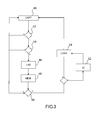
- the diagrams of figures 3 and 4 illustrate examples of the general algorithm for such computer program.
- FIG. 1 there is shown therein a schematic view of an apparatus 2 of detection of a mobile device location according to an embodiment of the invention.
- the mobile device is for instance a user terminal, particularly a smartphone, tablet or any device equipped with a microphone.
- the detection of the mobile device location is used as a means to detect the user's location.
- the detection apparatus 2 comprises a connection module 3 for connecting to the Internet network.
- the detection apparatus 2 can be the mobile device itself. It may also be a fixed connected device of the user's home, such as a gateway or a set-top box or a connected TV.
- the detection apparatus 2 further comprises a storage module 4 for storing sound datasets associated with different locations in which the mobile device is likely to be, for example different rooms of the user's home.
- Each dataset stores a plurality of sounds already captured in its associated location.
- the stored sounds may be audio files or audio data files containing information characterizing uniquely the sounds, such as sound signatures obtained by audio fingerprinting for example.
- each dataset associated with a given location has an identifier characterizing uniquely said dataset.
- the detection apparatus 2 further comprises a sensor module 6 for capturing a plurality of surrounding sounds recorded by a microphone 8 linked to the sensor module 6 through a transmission link 10.
- the microphone 8 is a microphone attached to the mobile device, for example the smartphone's or the tablet's microphone.
- the transmission link 10 is preferably a wireless radio link, such as a WiFi or a 3G link, between the mobile device and the apparatus 2.
- the microphone 8 is its own microphone.
- the sensor module 6 is able to capture the recorded sounds in the form of audio files or of signatures generated from the recorded sounds, for example using an audio fingerprinting technique.
- the stored sounds within the storage module 4 are preferably captured by the sensor module 6.
- the detection apparatus 2 is used to build the sound datasets.
- some or all the sounds within the storage module 4 are captured remotely and received, in the form of audio files or signatures, by the detection apparatus 2 in order to be stored and used for the detection.
- the detection apparatus 2 comprises a processing module 12.
- the processing module 12 comprises a comparison sub-module 14 for comparing sounds captured near the mobile device by the sensor module 6 with the stored sounds within the sound datasets in the storage module 4 in order to identify the mobile device location on the basis of the comparison result.
- the processing module 12 further comprises an identifier generation sub-module 16 which is able to generate for each stored dataset in the storage module 4 an identifier characterizing uniquely said dataset.
- the detection apparatus 2 further comprises a user interface 18.
- the user interface 18 permits to the detection apparatus 2 to interact with the user, for example to prompt the user to name or ignore a newly captured sound by the sensor module 6, for example in order to build a new dataset associated with a new location.
- the user interface 18 may also be used to provide to the user the detection result, for example a screen displaying the detected dataset identifier.
- the user interface 18 is not part of the detection apparatus 2 but is part of a user's device connected to said detection apparatus 2.
- the user interface may be on the mobile device whose localisation is being detected.
- the location detection result provided by the detection apparatus 2 is advantageously used by a user's Personal Assistant service implemented on the mobile device. For example if the user, i.e. more exactly said mobile device, is at home, the Personal Assistant will recommend to the user to watch on the living room big screen a personalized media content entertainment program. However, if the user is out of home, the personal assistant will limit the entertainment experience according to the user's mobile device capability.
- Figure 2 shows an example of a service deployment architecture using the detection apparatus of Figure 1 .
- the detection apparatus 2 is the user's mobile device, for instance the user's smartphone.
- a first sound dataset having an identifier ID1 has already been stored. This first sound dataset contains sounds captured from the user's home H1.
- a user's friend has also a detection apparatus (not represented) in which a second sound dataset having an identifier ID2 has already been stored.
- This second sound dataset contains sounds captured from the friend's home H2.
- the datasets corresponding to both homes are uploaded on a remote server 30, for example a cloud storage server shared by both the user and the friend.
- This remote server 30 constitutes a database storing the datasets associated with different locations.
- the remote server 30 and the detection apparatus 2 are connected through the Internet network 32.
- the second sound dataset is downloaded by the detection apparatus 2.
- a Personal Assistant service of the user implemented in the mobile device 2 may suggest suitable services to the user, such as recommending watching media content that would be of interest to both the user and the friend on the friend's big screen.
- the new sound dataset may be associated with a fixed location, such as the user's home or more precisely the bedroom, the living room, the kitchen,.., the user's office, the market, the beach, the stadium, etc.
- the new sound dataset may be also associated with a moving location, such as the user's car, the bus, the subway, etc.
- the goal of building a sound dataset is to give a unique characterization of the considered location environment.
- the sounds may comprise a door bell, mobile/fix phone rings, alarm clock ring, user's baby cry, a pet's sounds (i.e.: barking, mewing, tweeting, etc).
- the sounds may comprise the door and the engine sounds.
- the sounds may comprise the fridge sound, the oven ring, etc.
- Voice sounds may be also used in order to detect who is in the location and refine the location detection, for example to distinguish the user's office from a colleague's office.
- residential surrounding sounds can be considered to indicate if the location is near a train station, an airport, a noisy area, etc.
- a sound is captured by the sensor module 6.
- the processing module 12 checks if the captured sound is already present in the considered dataset. If the captured sound is already present, it is ignored and the process returns to step 40.
- the processing module 12 interacts with the user interface 18, at step 44, to ask the user if he wants to keep the sound or to ignore it. If the user chooses to ignore the sound, the process returns to step 40. If the user wants to keep the sound, he is requested, at step 46, to label said new sound. For example, when the dataset is associated with the kitchen, the new sound may correspond to the fridge sound and the user may label this sound "fridge" at step 46.
- the new sound is stored with its name in the considered dataset in the storage module 4.
- the number of sounds already stored within the considered dataset is compared to a threshold, for instance comprised between six and fifteen, preferably equal to ten. If the number of stored sounds is at least equal to the threshold, and the considered dataset does not have been allocated an identifier yet, the identifier generation sub-module 16 generates, at step 52, an identifier of said dataset.
- This identifier is generated, for instance, by using a pseudo-random mechanism or with a fingerprint based on a suitable combination of the sounds within the dataset.
- the dataset identifier may also be a name chosen by the user, for example "kitchen".
- the user is invited, through the user interface 18, to upload the newly built dataset to the remote server 30 of the cloud storage service.
- the user may advantageously be invited to upload the dataset on the mobile device also in order to permit an easy retrieval in case of off-line access.
- the user may be also invited to share the dataset with his community of friends.
- step 50 If, at step 50, the number of sounds in the dataset is still less than the threshold, the process returns to step 40.
- the flowchart of Figure 4 details the steps implemented by the detection apparatus 2 in order to detect a current location of the mobile device.
- a list of candidate places in which the mobile device is likely to be is initialized.
- This list may comprise all the places referenced in the storage module 4 or may comprise only some selected places. For instance, it may be determined, thanks to the GPS for example, that the mobile device is within a given area without being able to determine precisely the place. For instance, the exact location may correspond to one of several homes in a building or to one of adjoining houses or to one of different rooms of a home, etc. Thus, the candidate list will comprise only these first selected places.
- a sound surrounding the mobile device is captured by the sensor module 6.
- the comparison sub-module 14 checks if the captured sound is present in at least one dataset of the candidate places.
- step 62 If the captured sound is not present in any dataset, it is discarded and the process returns to step 62.
- the detection apparatus 2 saves, at step 66, said sound in the storage module 4.
- the comparison sub-module 14 compares the captured surrounding sounds at step 62 with the stored sounds in the datasets associated with the candidate places. It determines then which candidate place has the more similar sounds stored in its associated dataset.
- this highest number of common sounds is compared to a threshold.
- This threshold is set in such a way that it ensures that the found candidate place is indeed the real location of the mobile device. Thus, the number of false positives is reduced.
- the threshold is for example equal to four.
- step 62 If said highest number of common sounds is less than the threshold, the process returns to step 62.
- the location of the mobile device is identified, at step 72, as the determined candidate place at step 68.
- the present invention may be advantageously used in the purpose of detecting the position of the mobile device itself independently of the user, for example to find a lost mobile device.
Landscapes
- Engineering & Computer Science (AREA)
- Radar, Positioning & Navigation (AREA)
- Remote Sensing (AREA)
- Computer Networks & Wireless Communication (AREA)
- Physics & Mathematics (AREA)
- General Physics & Mathematics (AREA)
- Signal Processing (AREA)
- Telephonic Communication Services (AREA)
- Telephone Function (AREA)
- Information Retrieval, Db Structures And Fs Structures Therefor (AREA)
Priority Applications (1)
| Application Number | Priority Date | Filing Date | Title |
|---|---|---|---|
| EP14165756.9A EP2808704A1 (de) | 2013-04-30 | 2014-04-24 | Detektion des Standorts einer mobilen Vorrichtung |
Applications Claiming Priority (2)
| Application Number | Priority Date | Filing Date | Title |
|---|---|---|---|
| EP13305575.6A EP2799909A1 (de) | 2013-04-30 | 2013-04-30 | Detektion des Standorts einer mobilen Vorrichtung |
| EP14165756.9A EP2808704A1 (de) | 2013-04-30 | 2014-04-24 | Detektion des Standorts einer mobilen Vorrichtung |
Publications (1)
| Publication Number | Publication Date |
|---|---|
| EP2808704A1 true EP2808704A1 (de) | 2014-12-03 |
Family
ID=48446214
Family Applications (2)
| Application Number | Title | Priority Date | Filing Date |
|---|---|---|---|
| EP13305575.6A Withdrawn EP2799909A1 (de) | 2013-04-30 | 2013-04-30 | Detektion des Standorts einer mobilen Vorrichtung |
| EP14165756.9A Withdrawn EP2808704A1 (de) | 2013-04-30 | 2014-04-24 | Detektion des Standorts einer mobilen Vorrichtung |
Family Applications Before (1)
| Application Number | Title | Priority Date | Filing Date |
|---|---|---|---|
| EP13305575.6A Withdrawn EP2799909A1 (de) | 2013-04-30 | 2013-04-30 | Detektion des Standorts einer mobilen Vorrichtung |
Country Status (2)
| Country | Link |
|---|---|
| US (1) | US9544733B2 (de) |
| EP (2) | EP2799909A1 (de) |
Families Citing this family (3)
| Publication number | Priority date | Publication date | Assignee | Title |
|---|---|---|---|---|
| US9712940B2 (en) * | 2014-12-15 | 2017-07-18 | Intel Corporation | Automatic audio adjustment balance |
| US10157333B1 (en) | 2015-09-15 | 2018-12-18 | Snap Inc. | Systems and methods for content tagging |
| US12216702B1 (en) * | 2015-12-08 | 2025-02-04 | Snap Inc. | Redirection to digital content based on image-search |
Citations (4)
| Publication number | Priority date | Publication date | Assignee | Title |
|---|---|---|---|---|
| WO2010015854A1 (en) * | 2008-08-06 | 2010-02-11 | Geotate Bv | Robust location estimation |
| EP2284574A2 (de) * | 2009-08-13 | 2011-02-16 | Palo Alto Research Center Incorporated | Veranstaltungsortsbestimmung mittels von mobilen Vorrichtungen gemessenen Daten |
| US20120083285A1 (en) | 2010-10-04 | 2012-04-05 | Research In Motion Limited | Method, device and system for enhancing location information |
| US20120142378A1 (en) * | 2010-12-03 | 2012-06-07 | Qualcommm Incorporated | Method and apparatus for determining location of mobile device |
Family Cites Families (2)
| Publication number | Priority date | Publication date | Assignee | Title |
|---|---|---|---|---|
| US8606293B2 (en) | 2010-10-05 | 2013-12-10 | Qualcomm Incorporated | Mobile device location estimation using environmental information |
| KR101853819B1 (ko) * | 2011-09-14 | 2018-06-15 | 삼성전자주식회사 | 정보 제공 방법 및 장치, 디바이스와 컴퓨터로 읽을 수 있는 기록 매체 |
-
2013
- 2013-04-30 EP EP13305575.6A patent/EP2799909A1/de not_active Withdrawn
-
2014
- 2014-04-17 US US14/255,266 patent/US9544733B2/en not_active Expired - Fee Related
- 2014-04-24 EP EP14165756.9A patent/EP2808704A1/de not_active Withdrawn
Patent Citations (4)
| Publication number | Priority date | Publication date | Assignee | Title |
|---|---|---|---|---|
| WO2010015854A1 (en) * | 2008-08-06 | 2010-02-11 | Geotate Bv | Robust location estimation |
| EP2284574A2 (de) * | 2009-08-13 | 2011-02-16 | Palo Alto Research Center Incorporated | Veranstaltungsortsbestimmung mittels von mobilen Vorrichtungen gemessenen Daten |
| US20120083285A1 (en) | 2010-10-04 | 2012-04-05 | Research In Motion Limited | Method, device and system for enhancing location information |
| US20120142378A1 (en) * | 2010-12-03 | 2012-06-07 | Qualcommm Incorporated | Method and apparatus for determining location of mobile device |
Non-Patent Citations (2)
| Title |
|---|
| A. OFFSTAD, E. NICHOLAS, R. SZCODRONSKI, R. CHOUDHURY: "AAMPL: Accelerometer Augmented Mobile Phone Localization", 21 September 2008 (2008-09-21), XP002711187, Retrieved from the Internet <URL:http://synrg.ee.duke.edu/papers/aampl.pdf> [retrieved on 20130812] * |
| M. AZIZYAN, R. CHOUDHURY: "SurroundSense: Mobile Phone Localization Using Ambient Sound and Light", 22 September 2008 (2008-09-22), XP002711188, Retrieved from the Internet <URL:http://synrg.ee.duke.edu/papers/surroundsense-poster.pdf> [retrieved on 20130812] * |
Also Published As
| Publication number | Publication date |
|---|---|
| US9544733B2 (en) | 2017-01-10 |
| US20140323156A1 (en) | 2014-10-30 |
| EP2799909A1 (de) | 2014-11-05 |
Similar Documents
| Publication | Publication Date | Title |
|---|---|---|
| US9389308B1 (en) | Proximity detection via audio | |
| US9942711B2 (en) | Apparatus and method for determining co-location of services using a device that generates an audio signal | |
| US9571606B2 (en) | Social media viewing system | |
| CN103841190B (zh) | 信息获取方法、信息分享方法、装置和系统 | |
| US9854315B1 (en) | Systems and methods for broadcast audience interaction and participation | |
| EP3127097B1 (de) | System und verfahren zur ausgabeanzeigeerzeugung auf basis von umgebungsbedingungen | |
| US9792488B2 (en) | Adjacent person specifying apparatus, adjacent person specifying method, adjacent person specifying program, and adjacent person specifying system | |
| US20200184963A1 (en) | Virtual assistant augmentation system | |
| US10231067B2 (en) | Hearing aid adjustment via mobile device | |
| EP2715652A1 (de) | Vorrichtung zur spezifizierung benachbarter personen | |
| CN106231355B (zh) | 电视与移动终端的互动方法及系统 | |
| US20140325354A1 (en) | Enabling an interactive program associated with a live broadcast on a mobile device | |
| JP2016516979A (ja) | Gpsフィックス利用分布の解析によるジオフェンスの生成 | |
| WO2017092360A1 (zh) | 多媒体播放时的交互方法及装置 | |
| GB2515563A (en) | Media sharing | |
| US9544733B2 (en) | Detection of a mobile device location | |
| US10516746B2 (en) | Correlating media consumption data with user profiles | |
| US10460698B2 (en) | Method for rendering an electronic content on a rendering device | |
| CN104485110A (zh) | 点歌系统、方法、服务器及移动终端 | |
| CN103957502A (zh) | 位置服务程序选择方法、装置及终端 | |
| JP7579809B2 (ja) | アプリケーション内メッセージングを提供するシステム及び方法 | |
| US10162888B2 (en) | System and method for audio identification | |
| JP5989822B2 (ja) | 音声システム | |
| US9710220B2 (en) | Context-sensitive media classification | |
| WO2023245014A2 (en) | Systems and methods for uwb multi-static radar |
Legal Events
| Date | Code | Title | Description |
|---|---|---|---|
| PUAI | Public reference made under article 153(3) epc to a published international application that has entered the european phase |
Free format text: ORIGINAL CODE: 0009012 |
|
| 17P | Request for examination filed |
Effective date: 20140424 |
|
| AK | Designated contracting states |
Kind code of ref document: A1 Designated state(s): AL AT BE BG CH CY CZ DE DK EE ES FI FR GB GR HR HU IE IS IT LI LT LU LV MC MK MT NL NO PL PT RO RS SE SI SK SM TR |
|
| AX | Request for extension of the european patent |
Extension state: BA ME |
|
| R17P | Request for examination filed (corrected) |
Effective date: 20150505 |
|
| RBV | Designated contracting states (corrected) |
Designated state(s): AL AT BE BG CH CY CZ DE DK EE ES FI FR GB GR HR HU IE IS IT LI LT LU LV MC MK MT NL NO PL PT RO RS SE SI SK SM TR |
|
| 17Q | First examination report despatched |
Effective date: 20160414 |
|
| STAA | Information on the status of an ep patent application or granted ep patent |
Free format text: STATUS: THE APPLICATION IS DEEMED TO BE WITHDRAWN |
|
| 18D | Application deemed to be withdrawn |
Effective date: 20181023 |