EP2808714A1 - Élément de couplage optique et connecteur optique - Google Patents
Élément de couplage optique et connecteur optique Download PDFInfo
- Publication number
- EP2808714A1 EP2808714A1 EP12866702.9A EP12866702A EP2808714A1 EP 2808714 A1 EP2808714 A1 EP 2808714A1 EP 12866702 A EP12866702 A EP 12866702A EP 2808714 A1 EP2808714 A1 EP 2808714A1
- Authority
- EP
- European Patent Office
- Prior art keywords
- ball lens
- optical fiber
- optical
- ball
- coupling member
- Prior art date
- Legal status (The legal status is an assumption and is not a legal conclusion. Google has not performed a legal analysis and makes no representation as to the accuracy of the status listed.)
- Withdrawn
Links
- 230000003287 optical effect Effects 0.000 title claims abstract description 133
- 230000008878 coupling Effects 0.000 title claims abstract description 76
- 238000010168 coupling process Methods 0.000 title claims abstract description 76
- 238000005859 coupling reaction Methods 0.000 title claims abstract description 76
- 239000013307 optical fiber Substances 0.000 claims abstract description 101
- 238000003780 insertion Methods 0.000 claims abstract description 22
- 230000037431 insertion Effects 0.000 claims abstract description 22
- 239000000463 material Substances 0.000 claims description 22
- 230000002040 relaxant effect Effects 0.000 abstract description 6
- 238000000034 method Methods 0.000 description 10
- 239000011347 resin Substances 0.000 description 10
- 229920005989 resin Polymers 0.000 description 10
- 230000008569 process Effects 0.000 description 8
- 239000011521 glass Substances 0.000 description 6
- 238000000465 moulding Methods 0.000 description 4
- 230000001902 propagating effect Effects 0.000 description 4
- 238000005253 cladding Methods 0.000 description 3
- 230000002708 enhancing effect Effects 0.000 description 3
- 239000000835 fiber Substances 0.000 description 3
- -1 polypropylene Polymers 0.000 description 3
- 239000004697 Polyetherimide Substances 0.000 description 2
- 239000004743 Polypropylene Substances 0.000 description 2
- MCMNRKCIXSYSNV-UHFFFAOYSA-N Zirconium dioxide Chemical compound O=[Zr]=O MCMNRKCIXSYSNV-UHFFFAOYSA-N 0.000 description 2
- XECAHXYUAAWDEL-UHFFFAOYSA-N acrylonitrile butadiene styrene Chemical compound C=CC=C.C=CC#N.C=CC1=CC=CC=C1 XECAHXYUAAWDEL-UHFFFAOYSA-N 0.000 description 2
- 239000004676 acrylonitrile butadiene styrene Substances 0.000 description 2
- 229920000122 acrylonitrile butadiene styrene Polymers 0.000 description 2
- 238000001125 extrusion Methods 0.000 description 2
- 238000001746 injection moulding Methods 0.000 description 2
- 239000007769 metal material Substances 0.000 description 2
- 230000002093 peripheral effect Effects 0.000 description 2
- 239000013308 plastic optical fiber Substances 0.000 description 2
- 229920001707 polybutylene terephthalate Polymers 0.000 description 2
- 229920001601 polyetherimide Polymers 0.000 description 2
- 229920000139 polyethylene terephthalate Polymers 0.000 description 2
- 239000005020 polyethylene terephthalate Substances 0.000 description 2
- 229920006324 polyoxymethylene Polymers 0.000 description 2
- 229920001955 polyphenylene ether Polymers 0.000 description 2
- 229920001155 polypropylene Polymers 0.000 description 2
- 230000009467 reduction Effects 0.000 description 2
- RYGMFSIKBFXOCR-UHFFFAOYSA-N Copper Chemical compound [Cu] RYGMFSIKBFXOCR-UHFFFAOYSA-N 0.000 description 1
- 229920012266 Poly(ether sulfone) PES Polymers 0.000 description 1
- 229930182556 Polyacetal Natural products 0.000 description 1
- 229910052581 Si3N4 Inorganic materials 0.000 description 1
- 239000000853 adhesive Substances 0.000 description 1
- PNEYBMLMFCGWSK-UHFFFAOYSA-N aluminium oxide Inorganic materials [O-2].[O-2].[O-2].[Al+3].[Al+3] PNEYBMLMFCGWSK-UHFFFAOYSA-N 0.000 description 1
- 230000008901 benefit Effects 0.000 description 1
- 239000000919 ceramic Substances 0.000 description 1
- 229910010293 ceramic material Inorganic materials 0.000 description 1
- 229910052802 copper Inorganic materials 0.000 description 1
- 239000010949 copper Substances 0.000 description 1
- 230000000694 effects Effects 0.000 description 1
- 239000000945 filler Substances 0.000 description 1
- 238000012986 modification Methods 0.000 description 1
- 230000004048 modification Effects 0.000 description 1
- 229920002312 polyamide-imide Polymers 0.000 description 1
- 239000004417 polycarbonate Substances 0.000 description 1
- 229920000515 polycarbonate Polymers 0.000 description 1
- 239000011112 polyethylene naphthalate Substances 0.000 description 1
- 229920001296 polysiloxane Polymers 0.000 description 1
- 238000007493 shaping process Methods 0.000 description 1
- HBMJWWWQQXIZIP-UHFFFAOYSA-N silicon carbide Chemical compound [Si+]#[C-] HBMJWWWQQXIZIP-UHFFFAOYSA-N 0.000 description 1
- 229910010271 silicon carbide Inorganic materials 0.000 description 1
- HQVNEWCFYHHQES-UHFFFAOYSA-N silicon nitride Chemical compound N12[Si]34N5[Si]62N3[Si]51N64 HQVNEWCFYHHQES-UHFFFAOYSA-N 0.000 description 1
- 239000000243 solution Substances 0.000 description 1
- 125000006850 spacer group Chemical group 0.000 description 1
Images



Classifications
-
- G—PHYSICS
- G02—OPTICS
- G02B—OPTICAL ELEMENTS, SYSTEMS OR APPARATUS
- G02B6/00—Light guides; Structural details of arrangements comprising light guides and other optical elements, e.g. couplings
- G02B6/24—Coupling light guides
- G02B6/26—Optical coupling means
- G02B6/32—Optical coupling means having lens focusing means positioned between opposed fibre ends
-
- G—PHYSICS
- G02—OPTICS
- G02B—OPTICAL ELEMENTS, SYSTEMS OR APPARATUS
- G02B6/00—Light guides; Structural details of arrangements comprising light guides and other optical elements, e.g. couplings
- G02B6/24—Coupling light guides
- G02B6/26—Optical coupling means
- G02B6/32—Optical coupling means having lens focusing means positioned between opposed fibre ends
- G02B6/322—Optical coupling means having lens focusing means positioned between opposed fibre ends and having centering means being part of the lens for the self-positioning of the lightguide at the focal point, e.g. holes, wells, indents, nibs
-
- G—PHYSICS
- G02—OPTICS
- G02B—OPTICAL ELEMENTS, SYSTEMS OR APPARATUS
- G02B6/00—Light guides; Structural details of arrangements comprising light guides and other optical elements, e.g. couplings
- G02B6/24—Coupling light guides
- G02B6/36—Mechanical coupling means
- G02B6/38—Mechanical coupling means having fibre to fibre mating means
- G02B6/3807—Dismountable connectors, i.e. comprising plugs
- G02B6/3833—Details of mounting fibres in ferrules; Assembly methods; Manufacture
- G02B6/3853—Lens inside the ferrule
-
- G—PHYSICS
- G02—OPTICS
- G02B—OPTICAL ELEMENTS, SYSTEMS OR APPARATUS
- G02B6/00—Light guides; Structural details of arrangements comprising light guides and other optical elements, e.g. couplings
- G02B6/24—Coupling light guides
- G02B6/42—Coupling light guides with opto-electronic elements
- G02B6/4201—Packages, e.g. shape, construction, internal or external details
- G02B6/4204—Packages, e.g. shape, construction, internal or external details the coupling comprising intermediate optical elements, e.g. lenses, holograms
- G02B6/4206—Optical features
-
- G—PHYSICS
- G02—OPTICS
- G02B—OPTICAL ELEMENTS, SYSTEMS OR APPARATUS
- G02B6/00—Light guides; Structural details of arrangements comprising light guides and other optical elements, e.g. couplings
- G02B6/24—Coupling light guides
- G02B6/42—Coupling light guides with opto-electronic elements
- G02B6/4201—Packages, e.g. shape, construction, internal or external details
- G02B6/4256—Details of housings
- G02B6/4262—Details of housings characterised by the shape of the housing
- G02B6/4263—Details of housings characterised by the shape of the housing of the transisitor outline [TO] can type
-
- G—PHYSICS
- G02—OPTICS
- G02B—OPTICAL ELEMENTS, SYSTEMS OR APPARATUS
- G02B6/00—Light guides; Structural details of arrangements comprising light guides and other optical elements, e.g. couplings
- G02B6/24—Coupling light guides
- G02B6/36—Mechanical coupling means
- G02B6/38—Mechanical coupling means having fibre to fibre mating means
- G02B6/3807—Dismountable connectors, i.e. comprising plugs
- G02B6/381—Dismountable connectors, i.e. comprising plugs of the ferrule type, e.g. fibre ends embedded in ferrules, connecting a pair of fibres
- G02B6/3818—Dismountable connectors, i.e. comprising plugs of the ferrule type, e.g. fibre ends embedded in ferrules, connecting a pair of fibres of a low-reflection-loss type
- G02B6/382—Dismountable connectors, i.e. comprising plugs of the ferrule type, e.g. fibre ends embedded in ferrules, connecting a pair of fibres of a low-reflection-loss type with index-matching medium between light guides
Definitions
- the present invention relates to an optical coupling member and an optical connector using the same, the optical coupling member being for gathering light from a light-emitting element to input into an optical fiber or gathering light output from the optical fiber into a light-receiving element.
- an optical connector for example, connects an optical fiber to an optical device to transmit optical signals.
- an optical connector if there is an axial misalignment between a lens and the optical fiber, the coupling efficiency is reduced. Therefore, in order to increase the coupling efficiency, it is necessary to position the lens and the optical fiber with high accuracy. Such highly-accurate positioning is realized by highly accurate assembly work of the optical connector.
- Patent Literature 1 Japanese Patent Application Publication No. H1-128013
- the present invention was carried out in view of the foregoing, and has an object to provide an optical coupling member and an optical connector using the optical coupling member, which enable highly accurate positioning between the lens and the optical fiber while relaxing the assembly accuracy requirements.
- the present invention provides an optical coupling member comprising: an optical fiber; a holding member having an insertion hole formed at an end and being configured to hold the optical fiber inserted via the insertion hole; and a plurality of ball lenses being housed along an optical axis in a housing part formed at an opposite end of the holding member, wherein the ball lenses are arranged in contact with each other and the optical fiber is arranged in contact with a ball lens that faces the optical fiber out of the ball lenses.
- the ball lenses are arranged in contact with each other and the optical fiber is arranged in contact with the ball lens that faces the optical fiber, it is possible to use one ball lens as a reference to position the optical fiber and the other ball lens, thereby enhancing the efficiency of the assembly work and facilitating the positioning of the ball lenses and the optical fiber. Accordingly, it is possible to position the optical fiber and the ball lenses with high accuracy while relaxing the accuracy requirements of the assembly work.
- the ball lenses can include a first ball lens and a second ball lens, and the optical fiber, the first ball lens and the second ball lens can be arranged in sequence from the insertion hole.
- the second ball lens and the optical fiber can be arranged in contact with the first ball lens, it is possible to position the second ball lens and the optical fiber with reference to the first ball lens. It is also possible to make the configuration around the optical coupling member compact.
- the first ball lens and the second ball lens can have a same diameter.
- the first and second ball lenses of same diameter are used, it is possible to house the first and second ball lens without the need to provide a complicated structure for the holding member, thereby suppressing an increase in cost of the optical coupling member as a whole.
- the first ball lens can have a smaller diameter than the second ball lens. In this case, it is possible to facilitate the assembly process without losing the accuracy of axis alignment and also possible to control a state of beams by the diameter of the first ball lens.
- a refractive index matching material can be charged around the ball lenses.
- the present invention also provides an optical connector configured to connect the optical coupling member of any of the above-described aspects.
- light emitted from the optical fiber is directly inserted into the first ball lens, thereby enhancing the coupling efficiency.
- light emitted from a light-emitting element at the optical device side is inserted from the first ball lens directly to the optical fiber, thereby enhancing the coupling efficiency.
- the present invention it is possible to position the lens and the optical fiber with high accuracy while relaxing the accuracy requirements in the assembly work.
- Fig. 1A is a side view of an optical coupling member 10 according to the first embodiment of the present invention and Fig. 1B is a cross sectional view of the optical coupling member 10.
- the optical coupling member 10 has a holding 11, as a holding member, approximately in a cylindrical shape, a ball lens set 12 held at an end of this holder 11, and an optical fiber 13 that is inserted via an insertion hole 11a formed at the other end of the holder 11.
- the ball lens set 12 is composed of a ball lens 12a as a first ball lens and a ball lens 12b as a second ball lens.
- the holder 11 is made, for example, by forming of a metal material, a resin material or a ceramics material.
- the metal material to form the holder 11 may be, for example, stainless, copper base material or the like.
- the resin material to form the holder 11 may be, for example, polypropylene (PP), acrylonitrile butadiene styrene copolymer (ABS), polyacetal (POM), polycarbonate (PC), polybutylene terephthalate (PBT), polyethylene terephthalate (PET), polyethylene naphthalate (PEN), polyethersulfone (PES), polyphenyleneether (PPE), polyamide imide (PAI), polyether imide (PEI) or the like.
- the holder 11 is formed by subjecting such a material to injection molding, extrusion molding, press molding or any other molding.
- the ceramic material to form the holder 11 may be, for example, zirconia, alumina, silicon nitride, silicon carbide or the like.
- the holder 11 is formed by subjecting such a material to injection molding, extrusion molding, press molding or any other molding.
- the material to form the holder 11 may be glass or crystallized glass.
- a housing part 11c is provided for housing the ball lens set 12.
- This housing part 11c is formed to have a smaller diameter than the ball lenses 12a and 12b that make up the ball lens set 12 so that the ball lenses 12a and 12b can be pressed into the housing part 11c.
- a through hole 11d that has an approximately same diameter as the outer diameter of the optical fiber 13.
- This through hole lid is provided to be connected to the insertion hole 11a and also to the housing part 11c.
- the ball lenses 12a and 12b that make up the ball lens set 12 are formed, for example, by shaping of a glass material.
- the ball lenses 12a and 12b according to the first embodiment are formed to have approximately identical diameters.
- the ball lenses 12a and 12b are housed inside the housing part 11c in such a state that they are in contact with each other.
- the ball lens 12a is arranged such that a part of the ball lens 12a is in contact with a tip end of the optical fiber 13 inserted in the through hole 11d.
- the ball lens 12b is arranged with a part exposed from the opening 11b, however, the ball lens 12b may be arranged with the part unexposed.
- the optical fiber 13 may be formed of a conventionally known glass optical fiber, plastic optical fiber or H-PCF, without limitation.
- the optical fiber 13 is a plastic optical fiber
- the optical fiber has a core 13a that is formed through its center and a cladding 13b that covers the core 13a.
- the core 13a and the cladding 13b flush with each other. That is, in the end surface of the optical fiber 13 that is in contact with the ball lens 12a, the core 13a and the cladding 13b are aligned with each other.
- the optical fiber 13 is inserted via the insertion hole 11a into the through hole lid and is fixed such that an tip end of the optical fiber 13 is in contact with the ball lens 12a.
- the optical fiber 13 is, for example, fixed to the holder 11 with use of an adhesive agent applied between the optical fiber 13 and the inner peripheral surface of the through hole 11d. Note that fixation of the optical fiber 13 to the holder 11 is not limited to this but may be performed by any other method.
- Fig. 1C is an enlarged view of a part circled by the chain double-dashed line shown in Fig. 1B .
- a step part 11e is formed at the boundary between a part which size is slightly smaller than the diameter of the ball lenses 12a and 12b and a part which diameter is approximately identical to the outer diameter of the optical fiber 13.
- the ball lens 12a that is pressed in the opening 11b is stopped by being partially in contact with the step part 11e and is positioned at a predetermined position.
- the ball lens 12b pressed in the opening 11b is stopped by being partially in contact with the ball lens 12a and is positioned at a predetermined position.
- the optical fiber 13 that is inserted via the insertion hole 11a is stopped with a tip end in contact with the ball lens 12a and is positioned at the predetermined position. In this way, the ball lens set 12 and the optical fiber 13 are positioned at the respective predetermined positions in the holder 11 in such a state that the ball lens 12a, the ball lens 12b and the optical fiber 13 are in contact with each other.
- the assembly process of the optical coupling member 10 includes a step (a) of pressing the ball lens 12a into the holder 11, a step (b) of pressing the ball lens 12b into the holder 11, and a step (c) of inserting the optical fiber 13. Each of these steps will be described in detail below.
- the ball lens 12a is pressed via the opening 11b into the housing part 11c of the holder 11.
- the pressed-in ball lens 12a is stopped when a part of the ball lens 12a comes into contact with the step part 11e.
- the pressing-in work is completed.
- the ball lens 12a used is a lens with no orientation and therefore, there is no need to adjust the orientation in pressing into the holder 11 and the assembly work is made easy.
- a part of the ball lens 12a is in contact with the inner wall that defines the housing part 11c in the holder 11.
- the housing part 11c is formed slightly smaller than the diameter of the ball lenses 12a and 12b that make up the ball lens set 12
- the ball lens 12a is fixed by exertion of pressure by the inner wall that defines the housing part 11c. In this way, the ball lens 12a is positioned at the predetermined position and fixed.
- the ball lens 12b is inserted via the opening 11b of the holder 11 into the housing part 11c.
- the pressed-in ball lens 12b is stopped when an end thereof comes into contact with the ball lens 12a.
- the pressing-in work is completed.
- the ball lens 12b used is a lens with no orientation and therefore, there is no need to adjust the orientation in pressing into the holder 11 and the assembly work is made easy.
- the center axis of the ball lens 12b comes into conformity with the center axis of the ball lens 12a.
- a part of the ball lens 12b is in contact with the inner wall that defines the housing part 11c in the holder 11.
- the housing part 11c is formed slightly smaller than the diameter of the ball lenses 12a and 12b that make up the ball lens set 12
- the ball lens 12b is fixed by exertion of pressure by the inner wall that defines the housing part 11c. In this way, the ball lens 12b is fixed at the predetermined position and fixed.
- the optical fiber 13 is inserted via the insertion hole 11a of the holder 11, into the through hole 11d.
- the optical fiber 13 is guided by the inner wall that defines the through hole 11d and reaches the ball lens 12a.
- the insertion work is completed.
- the optical fiber 13 is positioned at the predetermined position.
- the center axis of the optical fiber 13 is in conformity with the center axis of each of the ball lenses 12a and 12b.
- the optical fiber 13 and the ball lens set 12 can be axis-aligned easily.
- the ball lens 12a is fixed by pressure by the holder 11 and it is further sandwiched between the step part 11e and the fixed ball lens 12b. Therefore, the ball lens 12a is not displaced even when the optical fiber 13 is pushed to the ball lens 12a.
- the optical coupling member 10 illustrated in Fig. 1 can be assembled.
- the optical coupling member 10 since the optical coupling member 10 according to the present embodiment is configured to have the ball lens 12a, the ball lens 12b and the optical fiber 13 in contact with each other, it is possible to position the ball lens 12b and the optical fiber 13 with reference to the ball lens 12a, thereby making it possible to improve the working efficiency and facilitate positioning of the ball lens set 12 and the optical fiber 13. Accordingly, it is possible to position the optical fiber 13 and the ball lens set 12 with high accuracy while relaxing the accuracy requirements of the assembly work.
- the ball lens 12b and the optical fiber 13 are configured to be in contact with the ball lens 12a, the structure around the lenses of the optical coupling member 10 is allowed to be compact.
- the ball lens 12a serves as a spacer for positioning the ball lens 12a and the optical fiber 13.
- two ball lenses of approximately same diameter are used as the ball lenses 12a and 12b that make up the ball lens set 12, it is possible to eliminate the necessity to provide any complicated structure in the holder 11 and suppress increase of the cost of the optical coupling member 10 as a whole.
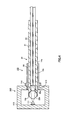
- FIG. 2 is a cross sectional view schematically illustrating a state of the optical connector 100 according to the present embodiment which is connected to the optical device 110. Note that Fig. 2 is used to describe the optical device 110 equipped with a light-receiving and light-emitting element for convenience of explanation, however, the structure of the optical device 110 is not limited to this and may be modified appropriately.
- the optical connector 100 is configured to have a resin joint 14 mounted on the optical coupling member 10.
- the optical device 110 is configured such that the light-receiving/light-emitting element is arranged inside a case 112. Further, in a side surface of the case 112 in the optical device 110, an opening 113 is provided for inserting the optical connector 100.
- the resin joint 14 takes an approximately cylindrical shape and has an insertion hole 14a formed at an end for inserting the holder 11 and also has an opening 14b formed at the other end for making the holder 11 jut therefrom.
- a through hole 14c linking from the insertion hole 14a to the opening 14b is provided to have an approximately same diameter as the outer diameter of the holder 11. Further, in an outer peripheral surface around the opening 14b, an annular collar portion 14d is formed
- the holder 11 is inserted via the insertion hole 14a of the resin joint 14 into the through hole 14c and is fixed with its tip end jutting from the opening 14b. Fixation of the holder 11 is performed, for example, by a plurality of fixing parts provided on the same circumference near the collar portion 14d of the resin joint 14. These fixing parts are formed by first, inserting the holder 11 into the resin joint 14 to position the holder 11 at the predetermined position of the resin joint 14 and then, pressing the resin joint 14 inwardly from the outside with use of a tool.
- the outer diameter of the collar portion 14d is formed to be larger than the inner diameter of an opening 113 in the optical device 110 to which the optical connector 100 is connected. Accordingly, when inserting the optical connector 100 into the optical device 110, the optical connector 100 is always inserted until the collar portion 14d abuts to the optical device 110 so that the optical connector 100 can be positioned at the predetermined position inside the case 112.
- the optical device 110 In the optical device 110, light emitting from the light-receiving/light-emitting element 111 passes in the ball lens 12b and is gathered at the end part of the fiber 13. The thus inserted light propagates in the optical fiber 13.
- the optical device 110 is configured such that when the optical connector 100 is inserted at the predetermined position in the case 112, light propagating between the light-receiving/light-emitting element 111 and the optical fiber 13 can be input or output via the ball lens set 12 appropriately.
- optical connector 100 of this embodiment it is possible to relax the assembly accuracy requirements for axis alignment.
- optical coupling member 20 of a different structure from the optical coupling member 10 according to the first embodiment.
- the optical coupling member 20 is different from the optical coupling member 10 according to the first embodiment in use of two ball lenses of different diameters, that is, a ball lens 22a as a first ball lens and a ball lens 22b as a second ball lens that make up a ball lens set 22, and the structure of a holder 21 where the ball lens set 22 is housed.
- Fig. 3A is a side view of the optical coupling member 20 according to the second embodiment of the present invention
- Fig. 3B is a cross sectional view of the optical coupling member 20
- Fig. 3C is an enlarged view of a part circled by the chain double-dashed line shown in Fig. 3B .
- same parts as those of the optical coupling member 10 according to the first embodiment are denoted by like reference numerals and their explanation is omitted here.
- the ball lenses 22a and 22b that make up the ball lens set 22 are made, for example, by forming of a glass material. As illustrated in Figs. 3B and 3C , the ball lenses 22a and 22b are formed such that the diameter of the ball lens 22a is smaller than the diameter of the ball lens 22b. The diameter of the ball lens 22a may be determined appropriately in accordance with the setting distances from the ball lens 22b and the end surface of the optical fiber 13.
- the holder 21 is different from the holder 11 according to the first embodiment in that the holder 21 has a housing part 21a for housing the ball lenses 22a and 22b.
- This housing par 21a has a small-diameter part which size is slightly smaller than the diameter of the ball lens 22a and also has a small-diameter part which size is slightly smaller than the diameter of the ball lens 22b.
- a step part 21b At the boundary position between the small-diameter part which size is slightly smaller than the diameter of the ball lens 22a and a part which size is approximately same as the outer diameter of the optical fiber 13, there is formed a step part 21b.
- a step part 21c At the boundary position between the small-diameter part which size is slightly smaller than the diameter of the ball lens 22b and the small-diameter part which size is slightly smaller than the diameter of the ball lens 22a.
- the ball lens 22a pressed in the opening 11b is stopped by partially coming into contact with the step part 21b and is positioned at the predetermined position. Further, the ball lens 22b pressed in the opening 11b is positioned at the predetermined position by partially coming into contact with the ball lens 22a.
- the optical fiber 13 inserted via the insertion hole 11a is stopped when its tip end comes into contact with the ball lens 22a and is positioned at the predetermined position. In this way, the ball lens set 22 and the optical fiber 13 are positioned at the respective predetermined positions in a state where the ball lens 22a, the ball lens 22b and the optical fiber 13 are in contact with each other.
- the assembly process of the optical coupling member 20 includes a step (d) of pressing the ball lens 22a into the holder 21, a step (e) of pressing the ball lens 22b into the holder 21 and a step (f) of inserting the optical fiber 13. Each of these steps is described in detail below.
- the ball lens 22a is pressed into the housing part 21a via the opening 11b of the holder 21.
- the pressed-in ball lens 22a is stopped when it partially gets in contact with the step part 21b. Once the ball lens 22a is in contact with the step 21b, the pressing work is completed.
- the optical coupling member 20 as the ball lens 22a used is a ball lens with no orientation as a lens, there is no need to adjust the orientation of the lens when pressing into the holder 21, thereby facilitating the assembly work.
- a part of the ball lens 22a is in contact with the inner wall that defines the housing part 21a in the holder 21.
- a part positioned between the step part 21b and the step part 21c is formed to have a diameter slightly smaller than the diameter of the ball lens 22a. Therefore, the ball lens 22a is fixed by a pressure that is exerted by the inner wall defining the housing part 21a. In this way, the ball lens 22a is positioned at the predetermined position and fixed.
- the ball lens 22b is pressed into the housing part 21a via the opening lib of the holder 21.
- the pressed-in ball lens 22b is stopped when it partially gets in contact with the ball lens 22a.
- the pressing work is completed.
- the optical coupling member 20 as the ball lens 22b used is a ball lens with no orientation, there is no need to adjust the orientation in pressing into the holder 21, thereby facilitating the assembly work.
- the center axis of the ball lens 22b comes into conformity with the center axis of the ball lens 22a.
- a part of the ball lens 22b is in contact with the inner wall that defines the housing part 21a in the holder 21.
- a part positioned between the step 21c and the opening 11b is formed to have a diameter slightly smaller than the diameter of the ball lens 22b, and therefore, the ball lens 22b is fixed by a pressure that is exerted by the inner wall defining the housing part 21a. In this way, the ball lens 22b is positioned at the predetermined position and fixed.
- the optical fiber 13 is inserted into the through hole lid via the insertion hole 11a of the holder 21.
- the optical fiber 13 is guided by the inner wall defining the through hole 11d and reaches the ball lens 22a.
- the insertion work is completed.
- the optical fiber 13 comes into a state that it is positioned at the predetermined position.
- the center axis of the optical fiber 13 comes into conformity with the center axis of each of the ball lenses 22a and 22b that form the ball lens set 22. In this way, it is possible to perform axis alignment for the optical fiber 13 and the ball lens set 22 easily.
- the ball lens 22a is fixed by pressure by the holder 21 and also is sandwiched between the step part 21b and the fixed ball lens 22b, it never goes out of alignment even when the optical fiber 13 is pressed against the ball lens 22a.
- the ball lens 22a, the ball lens 22b and the optical fiber 13 are brought into contact with each other.
- FIG. 4 is a cross sectional view schematically illustrating a state of the optical connector 120 according to the present embodiment being connected to the optical device 110.
- the optical connector 120 according to the present embodiment is configured with a resin joint 14 mounted on the optical coupling member 20.
- the optical device 110 is not limited to this structure and may be modified appropriately.
- the optical device 110 In the optical device 110, light emitted from the light-receiving/light-emitting element 111 goes inside the ball lens 22b and is gathered at the end of the optical fiber 13. Then, the thus inserted light propagates in the optical fiber 13.
- the optical device 110 light emitted from the optical fiber 13 goes inside the ball lens 22a and then propagates in the ball lens 22b.
- the outgoing beam from the ball lens 22b is gathered on the light-receiving/light-emitting element 111 placed at the position where light is gathered by the ball lens 22b.
- the optical connector 120 is preferably formed such that the diameter of the ball lens in contact with the optical fiber 13 is smaller. Therefore, it is possible to control the state of a beam by the diameter of the ball lens 22a that is in contact with the optical fiber 13.
- the optical device 110 is configured such that, when the optical connector 120 is inserted up to the predetermined position inside the case 112, light propagating between the light-receiving/light-emitting element 111 and the optical fiber 13 can be input or output appropriately via the ball lens set 22.
- optical connector 120 of the present embodiment it is possible to relax the assembly accuracy requirements for axis alignment.
- optical coupling member 30 that has a different structure from the optical coupling member 20 illustrated in the second embodiment.
- the optical coupling member 30 is different from the optical coupling member 20 in that a refractive index matching material 23 is added around the ball lens set 22 in the housing part 21a.
- Fig. 5 is a cross sectional view of around the housing part 21a in the optical coupling member 30. Note that, in the third embodiment, like parts to those of the optical coupling member 20 according to the second embodiment are denoted by same reference numerals and their explanation is omitted here.
- the refractive index matching material 23 is charged around a contact point between the ball lens 22b and the ball lens 22a and around a contact surface between the ball lens 22a and the optical fiber 13.
- the refractive index matching material 23 is made of, for example, a well-known material that is a silicone base material mixed with glass filler.
- the refractive index matching material 23 can be charged into the housing part 21a, for example, by pressing the ball lens 22b partially coated with the refractive index matching material 23 into the housing part 21a and also inserting the optical fiber 13 with the tip end coated with the refractive index matching material 23 into the through hole 11d.
- the refractive index matching material 23 is charged around the contact point between the ball lens 22b and the ball lens 22a and around the contact surface between the ball lens 22a and the optical fiber 13.
- each of the holders 11 and 21 has an approximately cylindrical form.
- the holders 11 and 21 may take any form as far as housing parts 11c and 21a for housing the ball lens sets 12, 22 are formed at an end and the insertion hole 11a for the optical fiber 13 is formed at the opposite end.
- each holder may take a square tube form (that is, such a tube form that a cross section orthogonal to the insertion direction of the optical fiber 13 is a square).
- the ball lens set 22 is made up of two ball lenses.
- the configuration of the ball lens set is not limited to this and may be modified appropriately.
- the ball lens set may be made of three or more ball lenses.
- the assembly process of the optical coupling member 10 is explained in the order of the steps (a) to (c).
- the assembly process is not limited to this and may be modified appropriately.
- the optical coupling member 10 may be assembled in the order of the steps (a), (c) and (b).
- the assembly process of the optical coupling member 20 is explained in the order to the steps (d) to (f), but the optical coupling member 20 may be assembled in the order of the steps (d), (f) and (e).
- the refractive index matching material 23 is charged around the ball lens set 22 in the housing part 21a of the optical coupling member 20 according to the second embodiment.
- the structure of the optical coupling member 30 is not limited to this and may be modified appropriately.
- the optical coupling member 30 may be configured such that the refractive index matching material 23 is charged around the ball lens set 12 in the housing part 11c of the optical coupling member 10 according to the first embodiment.
Landscapes
- Physics & Mathematics (AREA)
- General Physics & Mathematics (AREA)
- Optics & Photonics (AREA)
- Optical Couplings Of Light Guides (AREA)
Applications Claiming Priority (2)
| Application Number | Priority Date | Filing Date | Title |
|---|---|---|---|
| JP2012015281A JP2013156337A (ja) | 2012-01-27 | 2012-01-27 | 光結合部材および光コネクタ |
| PCT/JP2012/076653 WO2013111398A1 (fr) | 2012-01-27 | 2012-10-16 | Élément de couplage optique et connecteur optique |
Publications (2)
| Publication Number | Publication Date |
|---|---|
| EP2808714A1 true EP2808714A1 (fr) | 2014-12-03 |
| EP2808714A4 EP2808714A4 (fr) | 2015-11-25 |
Family
ID=48873144
Family Applications (1)
| Application Number | Title | Priority Date | Filing Date |
|---|---|---|---|
| EP12866702.9A Withdrawn EP2808714A4 (fr) | 2012-01-27 | 2012-10-16 | Élément de couplage optique et connecteur optique |
Country Status (7)
| Country | Link |
|---|---|
| US (1) | US20140376860A1 (fr) |
| EP (1) | EP2808714A4 (fr) |
| JP (1) | JP2013156337A (fr) |
| KR (1) | KR20140119083A (fr) |
| CN (1) | CN104094144A (fr) |
| TW (1) | TW201331651A (fr) |
| WO (1) | WO2013111398A1 (fr) |
Families Citing this family (6)
| Publication number | Priority date | Publication date | Assignee | Title |
|---|---|---|---|---|
| WO2016170838A1 (fr) * | 2015-04-23 | 2016-10-27 | オリンパス株式会社 | Système d'endoscope |
| US9941965B2 (en) * | 2015-07-15 | 2018-04-10 | Flextronics Ap, Llc | Laser and optical charging and communications device and method of use |
| WO2018229992A1 (fr) * | 2017-06-16 | 2018-12-20 | 京セラ株式会社 | Module de connecteur optique |
| US11467351B2 (en) | 2019-12-27 | 2022-10-11 | Panduit Corp. | Expanded beam connector |
| CN113050227A (zh) * | 2021-03-12 | 2021-06-29 | 深圳市启翔光电技术有限公司 | 一种光纤准直器 |
| JP2024059490A (ja) * | 2022-10-18 | 2024-05-01 | 株式会社タムロン | 信号光伝達部材 |
Family Cites Families (15)
| Publication number | Priority date | Publication date | Assignee | Title |
|---|---|---|---|---|
| JPS57155513U (fr) * | 1981-03-24 | 1982-09-30 | ||
| CA1272626A (fr) * | 1985-12-16 | 1990-08-14 | Stephen D. Fantone | Connecteur a relais pour fibre optique |
| JPS63194210A (ja) * | 1987-02-06 | 1988-08-11 | Hamai Denkyu Kogyo Kk | 光フアイバ−用接触型ボ−ルレンズランプ |
| JPH01128013A (ja) * | 1987-11-13 | 1989-05-19 | Hitachi Ltd | 光モジュール用ファイバコリメータ |
| JP2836583B2 (ja) * | 1996-05-31 | 1998-12-14 | 日本電気株式会社 | 受光素子と光ファイバの光学的結合構造 |
| US5940564A (en) * | 1997-08-05 | 1999-08-17 | Picolight, Inc. | Device for coupling a light source or receiver to an optical waveguide |
| JP2004118223A (ja) * | 2000-03-22 | 2004-04-15 | Matsushita Electric Ind Co Ltd | 光学デバイス、光通信部品および光伝送装置 |
| CN1571935A (zh) * | 2001-10-19 | 2005-01-26 | 奥普蒂莱恩股份公司 | 光学子组件 |
| JP2007241094A (ja) * | 2006-03-10 | 2007-09-20 | Tyco Electronics Amp Kk | 光ファイバコリメータ |
| EP1884809B1 (fr) * | 2006-07-31 | 2018-02-14 | TE Connectivity Corporation | Connecteur à faisceau élargi |
| EP1903361B1 (fr) * | 2006-09-22 | 2020-04-01 | Nippon Electric Glass Co., Ltd. | Composant optique et dispositif électroluminescent l'utilisant |
| US7775725B2 (en) * | 2008-10-29 | 2010-08-17 | Tyco Electronics Corporation | Single-channel expanded beam connector |
| JP4866961B2 (ja) * | 2010-04-16 | 2012-02-01 | 三菱鉛筆株式会社 | 光コリメータ及びこれを用いた光コネクタ、並びに、光コリメータ用保持部材 |
| US8827567B2 (en) * | 2011-08-10 | 2014-09-09 | Tyco Electronics Corporation | Field-installable expanded beam connector system |
| US9588302B2 (en) * | 2012-06-01 | 2017-03-07 | Te Connectivity Corporation | Expanded-beam connector with molded lens |
-
2012
- 2012-01-27 JP JP2012015281A patent/JP2013156337A/ja active Pending
- 2012-10-16 CN CN201280068187.8A patent/CN104094144A/zh active Pending
- 2012-10-16 EP EP12866702.9A patent/EP2808714A4/fr not_active Withdrawn
- 2012-10-16 WO PCT/JP2012/076653 patent/WO2013111398A1/fr not_active Ceased
- 2012-10-16 KR KR1020147021598A patent/KR20140119083A/ko not_active Ceased
- 2012-10-16 US US14/371,695 patent/US20140376860A1/en not_active Abandoned
- 2012-10-31 TW TW101140409A patent/TW201331651A/zh unknown
Also Published As
| Publication number | Publication date |
|---|---|
| TW201331651A (zh) | 2013-08-01 |
| US20140376860A1 (en) | 2014-12-25 |
| WO2013111398A1 (fr) | 2013-08-01 |
| CN104094144A (zh) | 2014-10-08 |
| EP2808714A4 (fr) | 2015-11-25 |
| JP2013156337A (ja) | 2013-08-15 |
| KR20140119083A (ko) | 2014-10-08 |
Similar Documents
| Publication | Publication Date | Title |
|---|---|---|
| EP2808714A1 (fr) | Élément de couplage optique et connecteur optique | |
| CN107995953B (zh) | 包括光纤对准装置的光纤连接系统 | |
| CN107111069A (zh) | 插座连接器及光耦合构造 | |
| EP3049839B1 (fr) | Système de connexions optiques et méthodes de positionnement d'une fibre optique dans un dispositif d'alignement | |
| US12306446B2 (en) | Ferrule and optical connector | |
| JP2015500517A (ja) | 光モジュール | |
| CN101156100A (zh) | 具有透镜的光纤连接器 | |
| US20150205053A1 (en) | Multi-core Fiber Connection Member, Structure for Connecting Multi-Core Fibers, and Method for Connecting Multi-Core Fibers | |
| CN219609286U (zh) | 套管、光连接器及光连接器模块 | |
| EP2717078A1 (fr) | Connecteur optique | |
| JP2023136053A (ja) | フェルール、光コネクタ、光コネクタモジュール | |
| US10451822B2 (en) | Optical module manufacturing method, optical module receptacle and optical module | |
| US9897770B2 (en) | Fibre stub device and method using butt coupling for receptacled photonic devices | |
| KR101760156B1 (ko) | 광 콜리메이터 및 이를 이용한 광 커넥터 | |
| US6817783B2 (en) | Optical subassembly with replaceable optical sleeve | |
| US20120020626A1 (en) | Optical Fiber Connector | |
| JP2014038303A (ja) | 光コネクタ、及び嵌合ユニット | |
| JP5697347B2 (ja) | 光ファイバモジュール及びその製造方法 | |
| EP2762934A1 (fr) | Élément optiquement couplant, connecteur optique utilisant celui-ci et élément pour maintenir un élément optiquement couplant | |
| JP2006126535A (ja) | 光軸合わせ構造 | |
| JP5657944B2 (ja) | レンズ付き光コネクタ | |
| JP2011197018A (ja) | 光学素子モジュール | |
| US20210181431A1 (en) | Optical connecting component | |
| CN115704940A (zh) | 光插座、光模块及光插座的制造方法 | |
| JP2014010186A (ja) | 光コネクタ |
Legal Events
| Date | Code | Title | Description |
|---|---|---|---|
| PUAI | Public reference made under article 153(3) epc to a published international application that has entered the european phase |
Free format text: ORIGINAL CODE: 0009012 |
|
| 17P | Request for examination filed |
Effective date: 20140813 |
|
| AK | Designated contracting states |
Kind code of ref document: A1 Designated state(s): AL AT BE BG CH CY CZ DE DK EE ES FI FR GB GR HR HU IE IS IT LI LT LU LV MC MK MT NL NO PL PT RO RS SE SI SK SM TR |
|
| DAX | Request for extension of the european patent (deleted) | ||
| RA4 | Supplementary search report drawn up and despatched (corrected) |
Effective date: 20151023 |
|
| RIC1 | Information provided on ipc code assigned before grant |
Ipc: G02B 6/32 20060101AFI20151019BHEP Ipc: G02B 6/42 20060101ALI20151019BHEP Ipc: G02B 6/02 20060101ALI20151019BHEP Ipc: G02B 6/38 20060101ALI20151019BHEP |
|
| STAA | Information on the status of an ep patent application or granted ep patent |
Free format text: STATUS: THE APPLICATION HAS BEEN WITHDRAWN |
|
| 18W | Application withdrawn |
Effective date: 20171012 |