EP2809767B1 - Vorrichtung zur nucleinsäureamplifikation und -erkennung - Google Patents
Vorrichtung zur nucleinsäureamplifikation und -erkennung Download PDFInfo
- Publication number
- EP2809767B1 EP2809767B1 EP13743047.6A EP13743047A EP2809767B1 EP 2809767 B1 EP2809767 B1 EP 2809767B1 EP 13743047 A EP13743047 A EP 13743047A EP 2809767 B1 EP2809767 B1 EP 2809767B1
- Authority
- EP
- European Patent Office
- Prior art keywords
- derivative
- nucleic acid
- support
- detection apparatus
- acid amplification
- Prior art date
- Legal status (The legal status is an assumption and is not a legal conclusion. Google has not performed a legal analysis and makes no representation as to the accuracy of the status listed.)
- Active
Links
Images




Classifications
-
- C—CHEMISTRY; METALLURGY
- C12—BIOCHEMISTRY; BEER; SPIRITS; WINE; VINEGAR; MICROBIOLOGY; ENZYMOLOGY; MUTATION OR GENETIC ENGINEERING
- C12Q—MEASURING OR TESTING PROCESSES INVOLVING ENZYMES, NUCLEIC ACIDS OR MICROORGANISMS; COMPOSITIONS OR TEST PAPERS THEREFOR; PROCESSES OF PREPARING SUCH COMPOSITIONS; CONDITION-RESPONSIVE CONTROL IN MICROBIOLOGICAL OR ENZYMOLOGICAL PROCESSES
- C12Q1/00—Measuring or testing processes involving enzymes, nucleic acids or microorganisms; Compositions therefor; Processes of preparing such compositions
- C12Q1/68—Measuring or testing processes involving enzymes, nucleic acids or microorganisms; Compositions therefor; Processes of preparing such compositions involving nucleic acids
- C12Q1/6844—Nucleic acid amplification reactions
- C12Q1/6851—Quantitative amplification
-
- G—PHYSICS
- G01—MEASURING; TESTING
- G01N—INVESTIGATING OR ANALYSING MATERIALS BY DETERMINING THEIR CHEMICAL OR PHYSICAL PROPERTIES
- G01N21/00—Investigating or analysing materials by the use of optical means, i.e. using sub-millimetre waves, infrared, visible or ultraviolet light
- G01N21/62—Systems in which the material investigated is excited whereby it emits light or causes a change in wavelength of the incident light
- G01N21/63—Systems in which the material investigated is excited whereby it emits light or causes a change in wavelength of the incident light optically excited
- G01N21/64—Fluorescence; Phosphorescence
- G01N21/645—Specially adapted constructive features of fluorimeters
- G01N21/6452—Individual samples arranged in a regular 2D-array, e.g. multiwell plates
-
- B—PERFORMING OPERATIONS; TRANSPORTING
- B01—PHYSICAL OR CHEMICAL PROCESSES OR APPARATUS IN GENERAL
- B01L—CHEMICAL OR PHYSICAL LABORATORY APPARATUS FOR GENERAL USE
- B01L7/00—Heating or cooling apparatus; Heat insulating devices
- B01L7/52—Heating or cooling apparatus; Heat insulating devices with provision for submitting samples to a predetermined sequence of different temperatures, e.g. for treating nucleic acid samples
Definitions
- the present invention relates to a nucleic acid amplification and detection apparatus and method.
- nucleic acids are amplified by one of two methods: polymerase chain reaction (PCR) or isothermal amplification, both of which are described below.
- PCR polymerase chain reaction
- PCR is used to amplify a specific region of a DNA strand (the DNA target). Most PCR methods typically amplify DNA fragments of up to -10 kilo base pairs (kb), although some techniques allow for amplification of fragments up to 40 kb in size.
- a basic PCR set up requires several components and reagents. These components include:
- the PCR is commonly carried out in a reaction volume of 10-200 pl in small , reaction tubes (0.2-0.5 ml volumes) in a thermal cycler.
- the thermal cycler heats and cools the reaction tubes to achieve the temperatures required at each step of the reaction (see below).
- Many modern thermal cyclers make use of the Peltier effect, which permits both heating and cooling of the block holding the PCR tubes simply by reversing the electric current.
- Thin-walled reaction tubes permit favorable thermal conductivity to allow for rapid thermal equilibration.
- Most thermal cyclers have heated lids to prevent condensation at the top of the reaction tube. Older thermocyclers lacking a heated lid require a layer of oil on top of the reaction mixture or a ball of wax inside the tube.
- PCR consists of a series of 20-40 repeated temperature changes, called cycles, with each cycle commonly consisting of 2-3 discrete temperature steps, usually three...
- the cycling is often preceded by a single temperature step (called hold) at a high temperature (>90°C), and followed by one hold at the end for final product extension or brief storage.
- the temperatures used and the length of, time they are applied in each cycle depend on a variety of parameters. These include the enzyme used for DNA synthesis, the concentration of divalent ions and dNTPs in the reaction, and the melting temperature (Tm) of the primers.
- agarose gel electrophoresis is employed for size separation of the PCR products.
- the size(s) of PCR products is determined by comparison with a DNA ladder (a molecular weight marker), which contains DNA fragments of known size, run on the gel alongside the PCR products...
- the PCR process can be divided into three stages:
- Exponential amplification At every cycle, the amount of product is doubled (assuming 100% reaction efficiency). The reaction is very sensitive: only minute quantities of DNA need to be present.
- Leveling off stage The reaction slows as the DNA polymerase loses activity and as consumption of reagents such as dNTPs and primers causes them to become limiting.
- Plateau No more product accumulates due to exhaustion of reagents and enzyme.
- PCR can fail for various reasons, in part due to its sensitivity to contamination causing amplification of spurious DNA products. Because of this, a number of techniques and procedures have been developed for optimizing PCR conditions. Contamination with extraneous DNA is addressed with lab protocols and procedures that separate pre-PCR mixtures from potential DNA contaminants. This usually involves spatial separation of PCR-setup areas from areas for analysis or purification of PCR products, use of disposable plasticware, and thoroughly cleaning the work surface between reaction setups. Primer-design techniques are important in improving PCR product yield and in avoiding the formation of spurious products, and the usage of alternate buffer components or polymerase enzymes can help with amplification of long or otherwise problematic regions of DNA. Addition of reagents, such as formamide, in buffer systems may increase the specificity and yield of PCR.
- PCR amplifies the regions of DNA that it targets, PCR can be used to analyze extremely small amounts of sample. This is often critical for forensic analysis, when only a trace amount of DNA is available as evidence. PCR may also be used in the analysis of ancient DNA that is tens of thousands of years old. These PCR-based techniques have been successfully used on animals, such as a forty-thousand-year-old mammoth, and also on human DNA, in applications ranging from the analysis of Egyptian mummies to the identification of a Russian tsar.
- Quantitative PCR methods allow the estimation of the amount of a given sequence present in a sample-a technique often applied to quantitatively determine levels of gene expression.
- Real-time PCR is an established tool for DNA quantification that measures the accumulation of DNA product after each round of PCR amplification.
- PCR permits early diagnosis of malignant diseases such as leukemia and lymphomas, which is currently the highest-developed in cancer research and is already being used routinely.
- malignant diseases such as leukemia and lymphomas
- PCR assays can be performed directly on genomic DNA samples to detect translocation-specific malignant cells at a sensitivity that is at least 10,000-fold higher than that of other methods.
- PCR also permits identification of non-cultivatable or slow-growing microorganisms such as mycobacteria, anaerobic bacteria, or viruses from tissue culture assays and animal models.
- non-cultivatable or slow-growing microorganisms such as mycobacteria, anaerobic bacteria, or viruses from tissue culture assays and animal models.
- the basis for PCR diagnostic applications in microbiology is the detection of infectious agents and the discrimination of non-pathogenic from pathogenic strains by virtue of specific genes.
- Viral DNA can likewise be detected by PCR.
- the primers used need to be specific to the targeted sequences in the DNA of a virus, and the PCR can be used for diagnostic analyses or DNA sequencing of the viral genome.
- the high sensitivity of PCR permits virus detection soon after infection and even before the onset of disease. Such early detection may give physicians a significant lead in treatment.
- the amount of virus ("viral load") in a patient can also be quantified by PCR-based DNA quantitation techniques (see below).
- WO-A-2007/005077 discloses an instrument for carrying out real-time multiplex PCR by detection of fluorescence. Different fluorescent dyes can be detected by different optical modules coupled to a a photomultiplier tube.
- the device contains a temperature control capable of modulating the temperature of the reaction vessels individually or as a group.
- the rotating platform which rotates the disk containing the vessels is under the control of an actuator, a slot sensor trigger provides a signal to the control unit which allows the control unit to synchronise the position of a well with the optical measurement during rotation.
- a barcode reader which identifies the type of disk and may identify the actual disk to assist a technician in tracking data to specific samples from multiple disks.
- the vessels are heated by light emitted by a heating element.
- the optical measurements are used in analysing the content of nucleic acid in the sample. It is desired to provide a nucleic acid amplification and detection apparatus and method that alleviate one or more difficulties of the prior art, or that at least provide a useful alternative.
- nucleic acid amplification and detection apparatus as defined in the claims, including:
- the measurement components include one or more optical measurement components configured to measure respective optical characteristics including optical absorption, reflection, luminance output, and/or fluorescence.
- the optical measurement components include optical measurement components configured to measure multiple channels of fluorescence, reflectance or transmission, or combinations thereof.
- the sample position controller is configured to selectively cause the actuator to rotate the support about the axis of rotation in an oscillatory manner to cause mixing of the contents of the reaction vessels.
- the nucleic acid amplification and detection apparatus includes an ultrasonic transducer component configured for selective coupling to a selected one of the reaction vessels to cause mixing of the contents of the selected reaction vessel.
- the ultrasonic transducer component is configured to support the selected reaction vessel in a spaced arrangement relative to the support to inhibit the coupling of ultrasonic energy to the support.
- the nucleic acid amplification and detection apparatus includes a sample identification component configured to identify a selected sample based on an identifier associated with the corresponding reaction vessel.
- the sample identification component includes at least one of a barcode reader, an RFID sensor, and an imaging device. In some embodiments, the sample identification component includes an imaging device, and the sample identification component is further configured to acquire an image of the contents of the reaction vessel and to process the acquired image to confirm the reagents therein.
- the temperature control component is thermally coupled to the support across a gap therebetween. In some embodiments, the gap includes a thermally conductive fluid therebetween. In some embodiments, the thermally conductive fluid is a magnetic fluid retained within the gap by one or more magnets.
- the nucleic acid amplification and detection apparatus includes one or more magnets arranged about the support at respective different heights, such that when the support is rotated, paramagnetic beads within a reaction vessel in the support move past the magnets, causing the beads to oscillate correspondingly within the reaction vessel.
- the nucleic acid amplification and detection apparatus includes a processing component configured to process sensor data representing the measured characteristics to determine an assay result for the nucleic acids within the reaction vessels.
- the processing component is configured to:
- the processing component is configured to:
- nucleic acid detection apparatus configured to execute any one of the above method is disclosed.
- the described embodiments of the present invention include a nucleic acid amplification and detection apparatus, as defined in the claims, that combines, in a single integrated instrument, nucleic acid amplification with measurement of the resulting amplification products during and/or following amplification.
- the apparatus provides temperature control suitable for a DNA amplification reaction within removable reaction vessels using isothermal and/or thermo-cycled protocols, together with diagnostic or measurement components that are used to measure characteristics of the samples while still contained within the same removable reaction vessels.
- the apparatus allows the optical and/or electromagnetic characteristics of amplified nucleic acid samples to be measured while the controlled temperature environment is maintained such that it can be used as biomedical, environmental, food safety, or veterinary applications.
- the apparatus includes a support configured to receive a plurality of reaction vessels containing respective samples of one or more nucleic acids to be amplified.
- the support is configured to receive a disposable component that supports or otherwise includes or incorporates the reaction vessels.
- the reaction vessels are in the form of standard sample tubes such as those used for PCR, but this need not be the case in other embodiments.
- the support is rotatable about an axis of rotation and the reaction vessels are supported at respective receiving locations distributed about the axis of rotation.
- a temperature control component thermally coupled to the support is configured to control the, temperature of the support and hence the samples contained in the reaction vessels, thereby allowing the nucleic acids contained in the reaction vessels to be amplified.
- the apparatus includes measurement components configured to measure one or more characteristics of the nucleic acids within the reaction vessels at respective measurement locations distributed about the axis of rotation.
- the measurement components arranged in this manner are thus also referred to herein as 'measurement stations'.
- This arrangement allows any one of the reactions vessels to be moved to any one of the measurement locations by simply rotating the support so that the selected reaction vessel is positioned at the selected measurement location.
- the apparatus including a sample position controller and associated actuator configured to rotate the support about the axis of rotation so as to move the selected reaction vessel to the selected measurement location. This allows the corresponding measurement component to measure one or more characteristics of the nucleic acids within the reaction vessel.
- a sample of interest can be divided into one or more reaction vessels so that the apparatus can be used to amplify the nucleic acids(s) in the divided sample and to measure multiple test and control reactions, displaying the results of these multiple tests to a user.
- fluorescence as a detection signal can provide good sensitivity, and where the measurement components include multiple fluorescence detectors configured to detect respective non-overlapping wavelength ranges so as not to interfere with one another, multiple channels of test and/or control reactions can be incorporated within a single reaction vessel.
- the measurement components can be configured to measure optical absorption, reflection, luminance output, and/or fluorescence.
- the rotatable support arrangement allows measurement components configured to perform different sample measurements to be arranged around the support so that any of the reaction vessels in the support can be moved into position for a selected measurement on demand. These measurements may include, for example and inter alia, multiple channels of fluorescence, reflectance or transmission, combinations of these. Other measurements can be additionally or alternatively included, if required. Thus multiple measurement stations can access each sample, allowing a combination of measurements to be provided for each reaction vessel.
- the supporting of the consumable or reaction vessels in the rotatable support also allows the contents of the reaction vessels to be mixed by rapid oscillatory rotation of the support under control of the samples position controller and associated actuator.
- the rotary oscillation induces mixing flows and disruption to the fluid within each reaction vessel, thereby improving the degree of reaction, reaction times and uniformity of measurements within the apparatus.
- the mixing can be enhanced by including magnetic beads and/or other forms of disruptive features within each reaction vessel.
- permanent magnets are fixed at locations just beyond the outer periphery of the support and arranged circumferentially about the rotation axis and at different alternating heights, so that when the support is rotated, paramagnetic beads within a reaction vessel move past the magnets at alternating heights, causing the beads to oscillate correspondingly up and down within the reaction vessel.
- Figures 1 to 3 show an assembly 100 of an embodiment in which the apparatus includes three optical measurement stations 102, 104, 106 arranged about a support 108 that includes two openings 110 configured to receive respective reaction vessels.
- the support 108 is cylindrically symmetric about its axis of rotation, and is composed of a material having a high thermal conductivity such as aluminium or copper, for example.
- the heating and temperature control of the support is achieved using electrical heating elements such as resistors, and at least one temperature sensor embedded in or otherwise attached to the support. Electrical connections to these heating elements and temperature sensor are by way of cable connections or slip rings. In embodiments with cable connections, the rotation of the support is limited in angular travel.
- the embodiment shown in Figures 1 to 4 uses non-contact means to control the temperature of the support 108.
- the assembly 100 includes a printed circuit board (PCB) 302 having resistive heater elements 402 mounted thereon in a circular arrangement to provide heating to a metallic annular ring 304 rigidly mounted to the PCB 302.
- PCB printed circuit board
- the ring 304 is mounted within a complementary and generally annular cavity in a generally circular lower portion or skirt of the support 108 with a small gap therebetween.
- the ring 304 and the lower portion of the support 108 are in close mutual proximity over a large common surface area of the gap to improve the thermal transfer from the ring 304 to the support 108.
- this thermal transfer can be achieved by a thermal gap similar to that described above but with different shapes (e.g., as a flat plate with a gap to a flat underside of the support), or alternatively by a sliding thermally conductive contact.
- the thermal coupling is such that a desired amplification temperature in the range of about 35-65°C can be reached within a period of about ten minutes or less from a starting temperature around room temperature or, in the case of PCR, from one of the PCR operating temperatures.
- this gap may be filled with air or a thermally conductive fluid such as a thermally conductive grease or silicon oil retained within the gap by a seal.
- a magnetic fluid is retained within this gap using magnets disposed on either or both sides of the gap.
- the cut away view of Figure 3 also shows a non-contact temperature sensor 306 mounted on the printed circuit board (PCB) 302 to provide feedback to a standard temperature control circuit, which can also be on the PCB 302 or alternatively external to the assembly 100.
- the temperature sensor 306 measures the temperature of the rotating support 108 but is mounted to the fixed printed circuit board (PCB) 302.
- the temperature sensor 306 is connected to an annular member or vane 308 that is disposed within an annular channel in the lower portion of the support 108 with a small gap therebetween. This arrangement provides good thermal coupling to the sensor 306 from the support 108 across the small gap into the metallic vane 308 attached to the sensor 306.
- both the heater elements 402 and the feedback temperature sensor 306 are connected to electronic circuits and additionally the heater elements 402 are controlled by a microprocessor or analogue control circuit, accurate temperature control strategies can be implemented.
- proportional, integral, differential, (PID) control can be used to accurately drive and stabilise the support 108 and the sensor 306 to a desired temperature set point.
- non-contact temperature sensors can be used.
- a non-contact optical or infra-red temperature sensor such as the Melexis MLX90615 Infra Red Thermometer sensor are used in some embodiments.
- multiple temperature sensors with different characteristics are used to optimise the temperature control strategy for rapid heat up and transitions combined with good steady state temperature accuracy.
- air flow and/or Peltier cell elements are used to actively cool the support 108 to provide a rapid temperature transition to lower temperatures.
- additional openings in the support are provided to receive calibration or reference samples with specific optical characteristics. This allows a stepper motor/actuator 112 coupled to the support 108 to be controlled so that a sample to be measured or a reference target is positioned at a measurement station location. This can be used to self-calibrate or self-test the apparatus during power up or measurement cycles by comparing the measured reference values against know values for the reference target.
- the support can also be coupled to a vibrating mechanism or actuator such as an electromagnetic coil and slug. Actuation of this component can induce vibration in the reaction vessels mounted in the support.
- the excitation frequency can be in the range of Hz up to kHz. Where the excitation is above 20 kHz, it can be referred to as ultrasonic mixing. For high frequency or ultrasonic mixing, a piezoelectric actuator can be used.
- the apparatus includes an ultrasonic transducer configured so that the support can rotate the reaction vessel so that the ultrasonic transducer can contact it through an opening in the support, with the ultrasonic transducer slightly lifting the reaction vessel so that it is not fully supported by the support. This allows efficient ultrasonic excitation of each reaction vessel only ( i.e., without exciting the support itself) while otherwise allowing the reaction vessel to be seated in good thermal contact at other rotation positions and associated measurement stations.
- the apparatus includes a barcode reader, RFID reader or an image sensor, and the support can be rotated to position a selected reaction vessel or associated disposable plastic assembly carrying or forming the vessel such that an attached label or feature is positioned in front of the barcode reader, RFID reader or image sensor.
- a barcode reader RFID reader
- an image sensor this can also be employed to confirm that the sample and reaction vessel or the disposable assembly that carries the reaction vessels have the correct reagents added, are assembled correctly, and are functional.
- the apparatus includes a processing component that uses the measured outputs from a sample over time to determine a diagnostic test result.
- Figure 5 is a schematic illustration of a typical assay measurement (such as fluorescence) over time during nucleic acid amplification within the apparatus.
- existing instruments use simple approaches such as a gradient threshold, a fixed or variable threshold for the assay at particular times in the amplification process.
- these prior art approaches are prone to error.
- the apparatus uses an improved detection method that is more reliable than the standard methods used today.
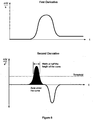
- the method involves receiving a signal (or, equivalently, signal data representing the signal) representing assay measurements of a sample during nucleic acid amplification, and generating second derivative data representing successive values of the second derivative of the signal (or signal data) with respect to time.
- the assay test is considered to be asserted only if:
- an assay curve is asserted if a positive going peak in the second derivative is present and has a height above a given threshold and a width or integrated area under its curve that exceeds a corresponding predetermined threshold value, as shown schematically in the lower part of Figure 6 .
- Suitable characteristics include the positive peak height, the area under the second derivative curve for the positive and negative going curves or the width of a peak in the second derivative curve, as shown in the lower part of Figure 6 .
- An advantage of using a second derivative as an analysis method for determining a nucleic acid amplification diagnostic result is that it provides sensitivity to the essential exponential nature of some amplification methods and provides a reliable method to discriminate this within a test result.
- Figure 7 provides an illustration of this. This method has particular application to (but is not limited to) isothermal nucleic acid reactions.
- the assay methods described above can be implemented by the processing component in a number of different ways.
- the methods are implemented in the form of programming instructions of one or more software modules or components 802 stored on non-volatile (e.g., solid-state or hard disk) storage 804 associated with the processing component 800, as shown in Figure 8 .
- non-volatile e.g., solid-state or hard disk
- the processing component 800 includes standard computer components, including random access memory (RAM) 806, at least one processor 808, and interfaces 810, 812, 814, all interconnected by a bus 816.
- the interfaces typically include universal serial bus (USB) interfaces 810, at least one of which may be connected to a keypad or keyboard 818 and optionally also a pointing device such as a mouse, a network interface connector (NIC) 812 which can be used to connect the processing component 800 to a communications network 820, if desired.
- the processing component 800 also includes a display adapter 814, which is connected to a display device such as an LCD panel display 822, and an operating system 824 such as Linux or Microsoft Windows.
- the methods can be stored in a PROM, EEPROM, or the like, or alternatively may be implemented in the form of configuration data for a field programmable gate arrays (FPGAs).
- FPGAs field programmable gate arrays
- the methods may be implemented, either in part or in their entirety, in the form of one or more dedicated hardware components, such as application-specific integrated circuits (ASICs), for example.
- ASICs application-specific integrated circuits
- diagnostic testing particularly relating to a compact portable test instrument suitable for use in medical diagnostics at the Point-of-Care (POC) and in Physician's Office Laboratories (POL).
- POC Point-of-Care
- POL Physician's Office Laboratories
- the described embodiments of the present invention include nucleic acid amplification and detection apparatus that are configured to receive only two measurement tubes contained within a single consumable assembly and are therefore suitable for portable, point of care, or other field applications.
- the described heated support/rotor arrangements enable multiple measurements, self-calibration and mixing functions to be performed with respect to a small number of reaction vessels or test tubes that are contained within in or are part of a disposable cartridge or vessel assembly. These features allow reduced complexity and make possible a compact, portable, and relatively low cost apparatus. Notwithstanding the above, it will be apparent that in other embodiments a nucleic acid amplification and detection apparatus can in general be configured to receive any practical number of reaction vessels. Many modifications will be apparent to those skilled in the art without departing from the scope of the present invention.
Landscapes
- Chemical & Material Sciences (AREA)
- Life Sciences & Earth Sciences (AREA)
- Health & Medical Sciences (AREA)
- Organic Chemistry (AREA)
- Engineering & Computer Science (AREA)
- Zoology (AREA)
- Wood Science & Technology (AREA)
- Proteomics, Peptides & Aminoacids (AREA)
- Biochemistry (AREA)
- Immunology (AREA)
- General Health & Medical Sciences (AREA)
- Physics & Mathematics (AREA)
- Analytical Chemistry (AREA)
- Bioinformatics & Cheminformatics (AREA)
- Molecular Biology (AREA)
- General Engineering & Computer Science (AREA)
- Microbiology (AREA)
- Biotechnology (AREA)
- Genetics & Genomics (AREA)
- Chemical Kinetics & Catalysis (AREA)
- Biophysics (AREA)
- General Physics & Mathematics (AREA)
- Pathology (AREA)
- Nuclear Medicine, Radiotherapy & Molecular Imaging (AREA)
- Measuring Or Testing Involving Enzymes Or Micro-Organisms (AREA)
- Apparatus Associated With Microorganisms And Enzymes (AREA)
- Algebra (AREA)
- Bioinformatics & Computational Biology (AREA)
- Mathematical Analysis (AREA)
- Mathematical Optimization (AREA)
- Mathematical Physics (AREA)
- Pure & Applied Mathematics (AREA)
Claims (15)
- Nukleinsäureamplifikations- und Nukleinsäurenachweisvorrichtung, die umfasst:einen Träger, der so konfiguriert ist, dass er eine Mehrzahl von Reaktionsgefäßen aufnimmt, die jeweilige Proben einer oder mehrerer zu amplifizierender Nukleinsäuren enthält, wobei der Träger um eine Drehachse drehbar ist und die Reaktionsgefäße an jeweiligen Aufnahmestellen, die um die Drehachse verteilt sind, im Träger aufgenommen werden;eine Temperaturreglungskomponente, die mit dem Träger thermisch verbunden und so konfiguriert ist, dass sie die Temperatur des Trägers regelt, um die in den Reaktionsgefäßen enthaltenen Nukleinsäuren zu amplifizieren, während diese im Träger aufgenommen sind;eine Mehrzahl von Messkomponenten, die so konfiguriert sind, dass sie jeweilige Charakteristika der Nukleinsäuren innerhalb der Reaktionsgefäße an jeweiligen Messstellen, die um die Drehachse verteilt sind, messen;einen Aktuator, der mit dem Träger verbunden und so konfiguriert ist, dass er den Träger um die Drehachse dreht; undeine Probenpositionssteuereinheit, die mit dem Aktuator verbunden und so konfiguriert ist, dass sie:(i) den Aktuator selektiv dazu veranlasst, den Träger oszillierend um die Drehachse zu drehen, um ein Mischen des Inhalts der Reaktionsgefäße zu bewirken; und(ii) den Träger um die Drehachse dreht, um ein ausgewähltes der Mehrzahl von Reaktionsgefäßen an einer ausgewählten der Mehrzahl von Messstellen positioniert, um zu ermöglichen, dass eine entsprechende der Mehrzahl von Messkomponenten eine entsprechende Messung an der entsprechenden Probe durchführt.
- Nukleinsäureamplifikations- und Nukleinsäurenachweisvorrichtung nach Anspruch 1, wobei die Messkomponenten ein oder mehrere optische Messkomponenten umfassen, die so konfiguriert sind, dass sie jeweilige optische Charakteristika, die optische Absorption, Reflexion, Luminanzausgabe und/oder Fluoreszenz umfassen, messen.
- Nukleinsäureamplifikations- und Nukleinsäurenachweisvorrichtung nach Anspruch 2, wobei die optischen Messkomponenten optische Messkomponenten umfassen, die so konfiguriert sind, dass sie mehrere Kanäle von Fluoreszenz, Reflexionsgrad oder Transmission oder Kombinationen davon messen.
- Nukleinsäureamplifikations- und Nukleinsäurenachweisvorrichtung nach einem der Ansprüche 1 bis 3, die eine Ultraschallwandlerkomponente umfasst, die so konfiguriert ist, dass sie sich selektiv mit einem ausgewählten der Reaktionsgefäße verbindet, um ein Mischen des Inhalts des ausgewählten Reaktionsgefäßes zu bewirken.
- Nukleinsäureamplifikations- und Nukleinsäurenachweisvorrichtung nach Anspruch 4, wobei die Ultraschallwandlerkomponente so konfiguriert ist, dass sie das ausgewählte Reaktionsgefäß zum Träger beabstandet angeordnet trägt, um zu hemmen, dass sich Ultraschallenergie mit dem Träger verbindet.
- Nukleinsäureamplifikations- und Nukleinsäurenachweisvorrichtung nach einem der Ansprüche 1 bis 5, die eine Probenidentifikationskomponente umfasst, die so konfiguriert ist, dass sie eine ausgewählte Probe auf Basis eines mit dem entsprechenden Reaktionsgefäß assoziierten Identifikators identifiziert.
- Nukleinsäureamplifikations- und Nukleinsäurenachweisvorrichtung nach Anspruch 6, wobei die Probenidentifikationskomponente zumindest eines von einem Strichcodeleser, einem RFID-Sensor und einer Bildgebungseinrichtung umfasst.
- Nukleinsäureamplifikations- und Nukleinsäurenachweisvorrichtung nach Anspruch 6, wobei die Probenidentifikationskomponente eine Bildgebungseinrichtung umfasst und die Probenidentifikationskomponente ferner so konfiguriert ist, dass sie ein Bild des Inhalts des Reaktionsgefäßes erfasst und das erfasste Bild verarbeitet, um die Reagenzien darin zu bestätigen.
- Nukleinsäureamplifikations- und Nukleinsäurenachweisvorrichtung nach einem der Ansprüche 1 bis 8, wobei die Temperaturregelungskomponente über eine Lücke dazwischen mit dem Träger thermisch verbunden ist.
- Nukleinsäureamplifikations- und Nukleinsäurenachweisvorrichtung nach Anspruch 9, wobei die Lücke ein thermisch leitfähiges Fluid dazwischen umfasst.
- Nukleinsäureamplifikations- und Nukleinsäurenachweisvorrichtung nach Anspruch 10, wobei das thermisch leitfähige Fluid ein magnetisches Fluid ist, das von einem oder mehreren Magneten innerhalb der Lücke gehalten wird.
- Nukleinsäureamplifikations- und Nukleinsäurenachweisvorrichtung nach einem der Ansprüche 1 bis 11, die einen oder mehrere Magnete umfasst, die in jeweiligen unterschiedlichen Höhen um den Träger angeordnet sind, so dass, wenn der Träger gedreht wird, paramagnetische Perlen innerhalb eines Reaktionsgefäßes im Träger sich an den Magneten vorbeibewegen, wodurch bewirkt wird, dass die Perlen innerhalb des Reaktionsgefäßes entsprechend oszillieren.
- Nukleinsäureamplifikations- und Nukleinsäurenachweisvorrichtung nach einem der Ansprüche 1 bis 11, die eine Verarbeitungskomponente umfasst, die so konfiguriert ist, dass sie Sensordaten verarbeitet, die die gemessenen Charakteristika darstellen, um ein Assayergebnis für die Nukleinsäuren innerhalb der Reaktionsgefäße zu ermitteln.
- Nukleinsäureamplifikations- und Nukleinsäurenachweisvorrichtung nach Anspruch 13, wobei die Verarbeitungskomponente so konfiguriert ist, dass sie:Signaldaten empfängt, die Assaymessungen einer Probe, die zumindest eine Nukleinsäure enthält, zu jeweiligen Zeitpunkten während der Amplifikation der zumindest einen Nukleinsäure darstellen;die Signaldaten verarbeitet, um Daten einer zweiten Ableitung zu generieren, die Werte einer zweiten Ableitung der Signaldaten in Bezug auf Zeit darstellen;die Daten der zweiten Ableitung verarbeitet, um zu ermitteln, ob zumindest einer der Werte der zweiten Ableitung einen vordefinierten Schwellenwert der zweiten Ableitung überschreitet;die Daten der zweiten Ableitung verarbeitet, um einen Kreuzungszeitpunkt zu ermitteln, an dem die zweite Ableitung der Signaldaten null kreuzt, nachdem sie den Schwellenwert der zweiten Ableitung überschritten hat;die Signaldaten verarbeitet, um Daten der ersten Ableitung zu generieren, die eine erste Ableitung der Signaldaten in Bezug auf den Kreuzungszeitpunkt darstellen; undAssayergebnisdaten generiert, die ein Ergebnis des Assays darstellen, wobei das Ergebnis auf Basis dessen, (i) ob der vordefinierte Schwellenwert der zweiten Ableitung überschritten wurde, und (ii) der ersten Ableitung des Signals in Bezug auf den Kreuzungszeitpunkt ermittelt wird.
- Nukleinsäureamplifikations- und Nukleinsäurenachweisvorrichtung nach Anspruch 13, wobei die Verarbeitungskomponente so konfiguriert ist, dass sie:Signaldaten empfängt, die Assaymessungen einer Probe, die zumindest eine Nukleinsäure enthält, zu jeweiligen Zeitpunkten während der Amplifikation der zumindest einen Nukleinsäure darstellen;die Signaldaten verarbeitet, um Daten der zweiten Ableitung zu generieren, die Werte einer zweiten Ableitung der Signaldaten in Bezug auf Zeit darstellen;die Daten der zweiten Ableitung verarbeitet, um zu ermitteln, ob zumindest einer der Werte der zweiten Ableitung einen vordefinierten Schwellenwert der zweiten Ableitung überschreitet;die Daten der zweiten Ableitung verarbeitet, um zu ermitteln, ob die zweite Ableitung der Signaldaten null kreuzt, nachdem sie den Schwellenwert der zweiten Ableitung überschritten hat;die Daten der zweiten Ableitung verarbeitet, um zu ermitteln, welche der Daten der zweiten Ableitung positiv sind;einen Breiten- oder integrierten Bereich der positiven Werte der zweiten Ableitung ermittelt;den Breiten- oder integrierten Bereich der positiven Werte der zweiten Ableitung mit einem weiteren vordefinierten Schwellenwert vergleicht; undAssayergebnisdaten generiert, die ein Ergebnis des Assays darstellen, wobei das Ergebnis auf Basis dessen ermittelt wird, (i) ob der vordefinierte Schwellenwert der zweiten Ableitung überschritten wurde, (iii) ob die zweite Ableitung des Signals null kreuzt, nachdem sie den Schwellenwert der zweiten Ableitung überschritten hat, und (iii) ob der Breiten- oder integrierte Bereich der positiven Werte der zweiten Ableitung den weiteren vordefinierten Schwellenwert überschreitet.
Priority Applications (1)
| Application Number | Priority Date | Filing Date | Title |
|---|---|---|---|
| EP16183619.2A EP3231861B1 (de) | 2012-02-03 | 2013-02-01 | Vorrichtung und verfahren zur nukleinsäureamplifikation und -detektion |
Applications Claiming Priority (2)
| Application Number | Priority Date | Filing Date | Title |
|---|---|---|---|
| US201261594870P | 2012-02-03 | 2012-02-03 | |
| PCT/AU2013/000092 WO2013113072A1 (en) | 2012-02-03 | 2013-02-01 | Nucleic acid amplification and detection apparatus and method |
Related Child Applications (2)
| Application Number | Title | Priority Date | Filing Date |
|---|---|---|---|
| EP16183619.2A Division-Into EP3231861B1 (de) | 2012-02-03 | 2013-02-01 | Vorrichtung und verfahren zur nukleinsäureamplifikation und -detektion |
| EP16183619.2A Division EP3231861B1 (de) | 2012-02-03 | 2013-02-01 | Vorrichtung und verfahren zur nukleinsäureamplifikation und -detektion |
Publications (3)
| Publication Number | Publication Date |
|---|---|
| EP2809767A1 EP2809767A1 (de) | 2014-12-10 |
| EP2809767A4 EP2809767A4 (de) | 2016-02-17 |
| EP2809767B1 true EP2809767B1 (de) | 2017-11-08 |
Family
ID=48904312
Family Applications (2)
| Application Number | Title | Priority Date | Filing Date |
|---|---|---|---|
| EP16183619.2A Active EP3231861B1 (de) | 2012-02-03 | 2013-02-01 | Vorrichtung und verfahren zur nukleinsäureamplifikation und -detektion |
| EP13743047.6A Active EP2809767B1 (de) | 2012-02-03 | 2013-02-01 | Vorrichtung zur nucleinsäureamplifikation und -erkennung |
Family Applications Before (1)
| Application Number | Title | Priority Date | Filing Date |
|---|---|---|---|
| EP16183619.2A Active EP3231861B1 (de) | 2012-02-03 | 2013-02-01 | Vorrichtung und verfahren zur nukleinsäureamplifikation und -detektion |
Country Status (4)
| Country | Link |
|---|---|
| US (2) | US10428375B2 (de) |
| EP (2) | EP3231861B1 (de) |
| AU (1) | AU2013203281A1 (de) |
| WO (1) | WO2013113072A1 (de) |
Families Citing this family (16)
| Publication number | Priority date | Publication date | Assignee | Title |
|---|---|---|---|---|
| USD753311S1 (en) | 2011-10-12 | 2016-04-05 | Alere Switzerland Gmbh | Isothermal nucleic acid amplification meter |
| US10428375B2 (en) | 2012-02-03 | 2019-10-01 | Axxin Pty Ltd | Nucleic acid amplification and detection apparatus and method |
| WO2014000037A1 (en) | 2012-06-26 | 2014-01-03 | Axxin Pty Ltd | Nucleic acid amplification and detection kit |
| WO2016074046A1 (en) | 2014-11-14 | 2016-05-19 | Axxin Pty Ltd | Biological sample collection and storage assembly |
| WO2017011862A1 (en) | 2015-07-17 | 2017-01-26 | Axxin Pty Ltd | Diagnostic test assembly, apparatus, method |
| CA3076836A1 (en) | 2017-09-27 | 2019-04-04 | Axxin Pty Ltd | Diagnostic test system and method |
| AU2018360737A1 (en) | 2017-10-31 | 2020-06-04 | Alberta Biophotonics Inc. | Optical measurement method and system |
| CN107739710B (zh) * | 2017-11-08 | 2024-02-23 | 西安天隆科技有限公司 | 一种快速核酸扩增系统 |
| CN111098192A (zh) * | 2020-01-14 | 2020-05-05 | 谭登富 | 一种钻孔攻牙机 |
| CN112816446B (zh) * | 2020-12-24 | 2022-02-01 | 四川长虹电器股份有限公司 | 一种基于荧光光谱检测荧光轮粉体衰变的方法 |
| NL2028003B1 (en) * | 2021-04-16 | 2022-10-31 | Micronit Holding B V | Method for providing a detection output which is representative for the presence of a molecule of interest |
| TWI812941B (zh) * | 2021-04-16 | 2023-08-21 | 財桂生物股份有限公司 | 螢光偵測恆溫振盪混勻儀 |
| CN115236039A (zh) * | 2021-04-23 | 2022-10-25 | 财桂生物股份有限公司 | 荧光侦测恒温振荡混匀仪 |
| CN114166768B (zh) * | 2022-02-14 | 2022-05-20 | 四川大学华西医院 | 不同设备检测同一指标同质化换算方法、装置、电子设备 |
| WO2023151286A1 (zh) * | 2022-02-14 | 2023-08-17 | 四川大学华西医院 | 不同设备检测同一指标同质化换算方法、装置、电子设备 |
| USD1069156S1 (en) | 2023-04-10 | 2025-04-01 | Becton, Dickinson And Company | Dispensing device |
Family Cites Families (100)
| Publication number | Priority date | Publication date | Assignee | Title |
|---|---|---|---|---|
| US3913562A (en) | 1974-01-16 | 1975-10-21 | Moore Perk Corp | Disposable package for collecting and transporting cultures for laboratory analysis |
| US4234540A (en) * | 1979-08-24 | 1980-11-18 | Coulter Electronics, Inc. | Apparatus for monitoring chemical reactions and employing moving photometer means |
| US4250266A (en) * | 1979-12-19 | 1981-02-10 | Honeywell Inc. | Automated micro-organism culture growth and detection instrument |
| US4376634A (en) | 1980-05-30 | 1983-03-15 | Mallinckrodt, Inc. | Assay kit having syringe, dilution device and reagents within sealed container |
| US4580577A (en) | 1981-01-12 | 1986-04-08 | Brien Joseph O | Method and apparatus for collecting saliva |
| US4353868A (en) | 1981-05-29 | 1982-10-12 | Sherwood Medical Industries Inc. | Specimen collecting device |
| FR2590673B1 (fr) | 1985-11-05 | 1988-09-16 | Bally Philippe | Dispositif de test autonome miniaturise a usage unique |
| US4770853A (en) | 1986-12-03 | 1988-09-13 | New Horizons Diagnostics Corporation | Device for self contained solid phase immunodiffusion assay |
| US5169789A (en) | 1986-12-03 | 1992-12-08 | New Horizons Diagnostics Corporation | Device and method for self contained solid phase immunodiffusion assay |
| US4912034A (en) | 1987-09-21 | 1990-03-27 | Biogenex Laboratories | Immunoassay test device and method |
| US4813432A (en) | 1987-10-13 | 1989-03-21 | Saint-Amand Manufacturing, Inc. | Swab transport system |
| US5266266A (en) | 1988-02-09 | 1993-11-30 | Nason Frederic L | Specimen test unit |
| US5152965A (en) | 1989-06-02 | 1992-10-06 | Abbott Laboratories | Two-piece reagent container assembly |
| US5435970A (en) | 1989-12-18 | 1995-07-25 | Environmental Diagnostics, Inc. | Device for analysis for constituents in biological fluids |
| FR2669428B1 (fr) | 1990-11-16 | 1993-04-23 | Alcyon Analyzer Sa | Analyseur automatique d'echantillons par colorimetrie. |
| JP3285451B2 (ja) | 1994-08-01 | 2002-05-27 | 富士写真フイルム株式会社 | 全血試料の分析方法および分析要素 |
| DK0832430T3 (da) | 1995-05-09 | 2006-11-20 | Beckman Coulter Inc | Anordninger og metoder til at separere cellulære blodkomponenter fra den flydende del af blodet |
| US5827675A (en) | 1995-07-12 | 1998-10-27 | Charm Sciences, Inc. | Test apparatus, system and method for the detection of test samples |
| EP0861330B1 (de) | 1995-07-12 | 2003-08-20 | Charm Sciences Inc. | Testvorrichtung, sytem und verfahren zum nachweis von testproben |
| US6153425A (en) | 1995-07-13 | 2000-11-28 | Xtrana, Inc. | Self-contained device integrating nucleic acid extraction, amplification and detection |
| WO1997003348A1 (en) | 1995-07-13 | 1997-01-30 | Immunological Associates Of Denver | Self-contained device integrating nucleic acid extraction, amplification and detection |
| GB9526204D0 (en) | 1995-12-21 | 1996-02-21 | Biotrace Ltd | Sampling and assay device |
| GB9626101D0 (en) | 1996-12-16 | 1997-02-05 | Celsis Int Plc | Assay device |
| US5917592A (en) | 1997-02-28 | 1999-06-29 | Charm Sciences, Inc. | Photometer, and test sample holder for use therein, method and system |
| JP2000146957A (ja) | 1997-10-13 | 2000-05-26 | Kikkoman Corp | 検体採取具及び拭取検査用器具 |
| AU1569299A (en) | 1997-12-16 | 1999-07-05 | Celsis International Plc | Sample-collecting and assay device |
| ES2286750T3 (es) * | 1998-05-01 | 2007-12-01 | Gen-Probe Incorporated | Dispositivo para agitar el contenido liquido de un contenedor. |
| US6171870B1 (en) | 1998-08-06 | 2001-01-09 | Spectral Diagnostics, Inc. | Analytical test device and method for use in medical diagnoses |
| EP1167968A4 (de) | 1999-03-30 | 2006-05-03 | Kikkoman Corp | Vorrichtung zur probenanalyse und zum reinigen |
| US6387621B1 (en) * | 1999-04-27 | 2002-05-14 | University Of Utah Research Foundation | Automated analysis of real-time nucleic acid amplification |
| US6548018B2 (en) | 2000-03-31 | 2003-04-15 | Neogen Corporation | Apparatus for chemiluminescent assays |
| AU2001249874A1 (en) | 2000-04-27 | 2001-11-12 | Medtronic, Inc. | System and method for assessing transmurality of ablation lesions |
| US6783934B1 (en) * | 2000-05-01 | 2004-08-31 | Cepheid, Inc. | Methods for quantitative analysis of nucleic acid amplification reaction |
| US6641782B1 (en) | 2000-11-15 | 2003-11-04 | Polaroid Corporation | Apparatus for performing diagnostic testing |
| IL146776A (en) | 2001-11-27 | 2010-11-30 | Yoram Alroy | Device for blood sampling under vacuum conditions |
| AU2002359648A1 (en) * | 2001-12-07 | 2003-06-23 | Dyax Corporation | Method and apparatus for washing magnetically responsive particles |
| US7691326B2 (en) | 2002-01-04 | 2010-04-06 | Sorenson Genomics, L.L.C. | System for non-invasive extraction, secure handling and storage and facile processing and facile processing of a specimen |
| US7225689B2 (en) | 2002-01-14 | 2007-06-05 | Rapid Medical Diagnostic Corporation | Sample testing device with funnel collector |
| US7201881B2 (en) | 2002-07-26 | 2007-04-10 | Applera Corporation | Actuator for deformable valves in a microfluidic device, and method |
| US7186383B2 (en) | 2002-09-27 | 2007-03-06 | Ast Management Inc. | Miniaturized fluid delivery and analysis system |
| US7238520B2 (en) | 2002-12-04 | 2007-07-03 | Smiths Detection Inc. | PCR sample preparation holder and method |
| CA2515075C (en) | 2003-02-05 | 2012-10-02 | Iquum, Inc. | Sample processing |
| JP2004294388A (ja) | 2003-03-10 | 2004-10-21 | Arkray Inc | 成分分析装置 |
| JP4193566B2 (ja) * | 2003-05-06 | 2008-12-10 | 東ソー株式会社 | 自動分析装置 |
| US7090803B1 (en) | 2003-10-28 | 2006-08-15 | American Bio Medica Corporation | Lateral flow immunoassay device |
| GB0401288D0 (en) | 2004-01-21 | 2004-02-25 | Orion Diagnostica Oy | Sampling and assay device |
| US7238322B2 (en) | 2004-01-28 | 2007-07-03 | Dnt Scientific Research, Llc | Delayed and diffused flow rapid confirmatory immunological testing apparatus and method |
| JP4401845B2 (ja) | 2004-04-06 | 2010-01-20 | 株式会社札幌イムノ・ダイアグノスティック・ラボラトリー | 検体試験容器セット及び検体試験キット |
| WO2005118772A1 (ja) | 2004-06-02 | 2005-12-15 | Arkray, Inc. | 核酸増幅用容器、核酸調製キット、および核酸分析装置 |
| US20060030790A1 (en) | 2004-08-06 | 2006-02-09 | Braig James R | Sample element with barrier material and vacuum |
| AU2005299590B2 (en) | 2004-10-27 | 2010-09-16 | Cepheid | Closed-system multi-stage nucleic acid amplification reactions |
| US20060135953A1 (en) | 2004-12-22 | 2006-06-22 | Wlodzimierz Kania | Tissue ablation system including guidewire with sensing element |
| US20060166367A1 (en) | 2005-01-27 | 2006-07-27 | Neogen Corporation | Protein assay method and test device |
| US7709249B2 (en) * | 2005-04-01 | 2010-05-04 | 3M Innovative Properties Company | Multiplex fluorescence detection device having fiber bundle coupling multiple optical modules to a common detector |
| US20060270027A1 (en) * | 2005-05-27 | 2006-11-30 | Irm Llc | High throughput incubation devices and systems |
| US20060275852A1 (en) | 2005-06-06 | 2006-12-07 | Montagu Jean I | Assays based on liquid flow over arrays |
| US7507374B2 (en) | 2005-06-28 | 2009-03-24 | American Bio Medica Corp. | Saliva sample testing device |
| US20070009382A1 (en) * | 2005-07-05 | 2007-01-11 | William Bedingham | Heating element for a rotating multiplex fluorescence detection device |
| CA2659773A1 (en) | 2006-02-21 | 2007-08-30 | Nanogen, Inc. | Methods and compositions for analyte detection |
| ES2393758T3 (es) | 2006-03-15 | 2012-12-27 | Micronics, Inc. | Ensayos integrados de ácidos nucleicos |
| US8476064B2 (en) | 2006-05-09 | 2013-07-02 | Charm Sciences, Inc. | Inhibition assay method and device for detection of antibiotics |
| WO2008005248A2 (en) * | 2006-06-30 | 2008-01-10 | Canon U.S. Life Sciences, Inc. | Real-time pcr in micro-channels |
| US7625746B2 (en) * | 2006-07-24 | 2009-12-01 | Nanosphere, Inc. | Method of denaturing and fragmenting DNA or RNA using ultrasound |
| US7695953B2 (en) | 2007-01-09 | 2010-04-13 | American Bio Medica Corporation | Apparatus for high-sensitivity body fluid testing device |
| US9376704B2 (en) | 2007-02-12 | 2016-06-28 | Charm Sciences, Inc. | Test kit and method for detecting bacteriophage |
| AU2013202899B2 (en) | 2007-05-17 | 2015-02-05 | Advance Dx, Inc. | Method of processing a fluid sample using a fluid separator collection card |
| US8200440B2 (en) * | 2007-05-18 | 2012-06-12 | Affymetrix, Inc. | System, method, and computer software product for genotype determination using probe array data |
| US7981054B2 (en) | 2007-07-16 | 2011-07-19 | Phuong Nguyen | All-in-one biological specimen collecting, transporting and analyzing device |
| US8200308B2 (en) | 2007-07-18 | 2012-06-12 | Siemens Medical Solutions Usa, Inc. | Continuous measurement and mapping of physiological data |
| US8415141B2 (en) | 2007-08-17 | 2013-04-09 | Qimin You | Enclosed unit for rapid detection of a target nucleic acid amplification product |
| DE102007062441A1 (de) | 2007-12-20 | 2009-06-25 | Aj Innuscreen Gmbh | Mobiles Schnelltestsystem für die Nukleinsäureanalytik |
| KR20090076765A (ko) | 2008-01-09 | 2009-07-13 | 삼성전자주식회사 | 방송 모바일 통합 서비스 시스템에서의 전자 서비스 가이드발견 방법 및 장치 |
| JP2011517417A (ja) | 2008-03-18 | 2011-06-09 | サーカ・サイエンティフィック,エルエルシー | 大表面積温度感知装置 |
| US20100077843A1 (en) | 2008-03-31 | 2010-04-01 | Doraisamy Loganathan | Substance identification apparatus and methods of using |
| CN102046807B (zh) * | 2008-04-24 | 2014-11-26 | 3M创新有限公司 | 利用小波变换分析核酸扩增曲线 |
| EP2123360A1 (de) * | 2008-05-20 | 2009-11-25 | F.Hoffmann-La Roche Ag | Thermozyklierungsvorrichtung mit Thermozyklermodul mit Wärmeschutzschalter, Verfahren zur Kühlung eines Heizblocks in einem Thermozyklermodul einer Thermozyklierungsvorrichtung und Analysegerät |
| WO2010030686A1 (en) * | 2008-09-09 | 2010-03-18 | Bio-Rad Laboratories, Inc. | Multi-stage, regression-based pcr analysis system |
| US8219324B2 (en) * | 2008-09-12 | 2012-07-10 | Roche Molecular Systems, Inc. | Real-time PCR elbow calling by equation-less algorithm |
| CN102245755B (zh) | 2008-09-30 | 2013-11-06 | 3M创新有限公司 | 生物检测制品 |
| JP5279481B2 (ja) * | 2008-12-25 | 2013-09-04 | 株式会社日立ハイテクノロジーズ | 核酸分析装置 |
| AU2010210666C1 (en) | 2009-02-03 | 2016-01-28 | Ande Corporation | Nucleic acid purification |
| US8453525B2 (en) | 2009-02-09 | 2013-06-04 | Healthpoint Diagnostix, Inc. | Plasma sample collection device |
| EP2406614A1 (de) | 2009-03-10 | 2012-01-18 | Agency For Science, Technology And Research | Vorrichtung zur verarbeitung einer biologischen und/oder chemischen probe |
| EP2425246A4 (de) | 2009-04-27 | 2012-10-17 | Axxin Pty Ltd | Kapillarfluss-testanordnung |
| WO2010129728A2 (en) | 2009-05-06 | 2010-11-11 | 3M Innovative Properties Company | Articles with shell structures including a cell extractant and biodetection methods thereof |
| EP2519355B1 (de) | 2009-12-30 | 2017-01-25 | 3M Innovative Properties Company | Nachweis von lebender bioladung mit mikropartikeln |
| US10865440B2 (en) | 2011-10-21 | 2020-12-15 | IntegenX, Inc. | Sample preparation, processing and analysis systems |
| MX353148B (es) | 2012-02-03 | 2017-12-19 | Pyrobett Pte Ltd | Plataforma giratoria para realizar secuenciacion de acidos nucleicos. |
| US10428375B2 (en) | 2012-02-03 | 2019-10-01 | Axxin Pty Ltd | Nucleic acid amplification and detection apparatus and method |
| WO2013159117A1 (en) | 2012-04-20 | 2013-10-24 | SlipChip, LLC | Fluidic devices and systems for sample preparation or autonomous analysis |
| WO2014000037A1 (en) | 2012-06-26 | 2014-01-03 | Axxin Pty Ltd | Nucleic acid amplification and detection kit |
| US9446406B2 (en) | 2012-06-29 | 2016-09-20 | Biocontrol Systems, Inc. | Sample collection and bioluminescent analysis system |
| AU2013334189B2 (en) | 2012-10-24 | 2018-08-02 | Genmark Diagnostics, Inc. | Integrated multiplex target analysis |
| JP6498125B2 (ja) | 2012-12-21 | 2019-04-10 | マイクロニクス, インコーポレイテッド | 流体回路および関連する製造方法 |
| US11096736B2 (en) | 2013-12-09 | 2021-08-24 | Biosense Webster (Israel) Ltd. | Pericardial catheter with temperature sensing array |
| US9145581B1 (en) | 2014-10-17 | 2015-09-29 | Daniel Lai | Rapid nucleic acid extraction method and apparatus |
| WO2016074046A1 (en) | 2014-11-14 | 2016-05-19 | Axxin Pty Ltd | Biological sample collection and storage assembly |
| US10751119B2 (en) | 2015-07-15 | 2020-08-25 | Texas Heart Institute | Method and device for detection of arrhythmias and myocardial injury |
| WO2017011862A1 (en) | 2015-07-17 | 2017-01-26 | Axxin Pty Ltd | Diagnostic test assembly, apparatus, method |
| US12426945B2 (en) | 2019-09-18 | 2025-09-30 | Biosense Webster (Israel) Ltd. | Catheter with thin-film electrodes on expandable mechanical structure |
-
2013
- 2013-02-01 US US14/376,185 patent/US10428375B2/en active Active
- 2013-02-01 AU AU2013203281A patent/AU2013203281A1/en not_active Abandoned
- 2013-02-01 WO PCT/AU2013/000092 patent/WO2013113072A1/en not_active Ceased
- 2013-02-01 EP EP16183619.2A patent/EP3231861B1/de active Active
- 2013-02-01 EP EP13743047.6A patent/EP2809767B1/de active Active
-
2019
- 2019-08-22 US US16/548,643 patent/US11634758B2/en active Active
Non-Patent Citations (1)
| Title |
|---|
| None * |
Also Published As
| Publication number | Publication date |
|---|---|
| EP3231861A1 (de) | 2017-10-18 |
| US20190376129A1 (en) | 2019-12-12 |
| AU2013203281A1 (en) | 2013-08-22 |
| US20140377766A1 (en) | 2014-12-25 |
| EP2809767A4 (de) | 2016-02-17 |
| EP3231861B1 (de) | 2020-01-08 |
| US11634758B2 (en) | 2023-04-25 |
| WO2013113072A1 (en) | 2013-08-08 |
| EP2809767A1 (de) | 2014-12-10 |
| US10428375B2 (en) | 2019-10-01 |
Similar Documents
| Publication | Publication Date | Title |
|---|---|---|
| US11634758B2 (en) | Nucleic acid amplification and detection apparatus and method | |
| JP7542834B2 (ja) | 核酸増幅装置、核酸増幅方法及び核酸増幅用チップ | |
| Dong et al. | Rapid PCR powered by microfluidics: A quick review under the background of COVID-19 pandemic | |
| US20240304283A1 (en) | Method and device for digital high resolution melt | |
| Matsubara et al. | Microchamber array based DNA quantification and specific sequence detection from a single copy via PCR in nanoliter volumes | |
| İnce et al. | Micro-polymerase chain reaction for point-of-care detection and beyond: a review microfluidics and nanofluidics | |
| US12351866B2 (en) | Nucleic acid amplification method | |
| US12186757B2 (en) | Devices and methods for monitoring and quantifying nucleic acid amplification | |
| EP4150109A2 (de) | Vorrichtung und verfahren zum schnellen nukleinsäurenachweis | |
| AU2015275310B2 (en) | Nucleic acid amplification and detection apparatus and method | |
| Irfan et al. | Droplet Digital PCR in Fungal Pathogen Detection | |
| WO2014113663A1 (en) | In-line polymerase chain reaction | |
| JP2017201954A (ja) | 蛍光標識プローブ、核酸増幅反応用試薬、および核酸増幅反応方法 | |
| JP2018000049A (ja) | 蛍光標識プローブ、核酸増幅反応用試薬、および核酸増幅反応方法 |
Legal Events
| Date | Code | Title | Description |
|---|---|---|---|
| PUAI | Public reference made under article 153(3) epc to a published international application that has entered the european phase |
Free format text: ORIGINAL CODE: 0009012 |
|
| 17P | Request for examination filed |
Effective date: 20140812 |
|
| AK | Designated contracting states |
Kind code of ref document: A1 Designated state(s): AL AT BE BG CH CY CZ DE DK EE ES FI FR GB GR HR HU IE IS IT LI LT LU LV MC MK MT NL NO PL PT RO RS SE SI SK SM TR |
|
| AX | Request for extension of the european patent |
Extension state: BA ME |
|
| DAX | Request for extension of the european patent (deleted) | ||
| RIC1 | Information provided on ipc code assigned before grant |
Ipc: B03C 3/017 20060101ALI20150907BHEP Ipc: C12M 1/34 20060101AFI20150907BHEP Ipc: C12Q 1/68 20060101ALI20150907BHEP Ipc: G01N 21/64 20060101ALI20150907BHEP |
|
| RA4 | Supplementary search report drawn up and despatched (corrected) |
Effective date: 20160114 |
|
| RIC1 | Information provided on ipc code assigned before grant |
Ipc: G01N 21/64 20060101ALI20160108BHEP Ipc: C12M 1/34 20060101AFI20160108BHEP Ipc: B03C 3/017 20060101ALI20160108BHEP Ipc: C12Q 1/68 20060101ALI20160108BHEP |
|
| GRAP | Despatch of communication of intention to grant a patent |
Free format text: ORIGINAL CODE: EPIDOSNIGR1 |
|
| INTG | Intention to grant announced |
Effective date: 20170111 |
|
| GRAJ | Information related to disapproval of communication of intention to grant by the applicant or resumption of examination proceedings by the epo deleted |
Free format text: ORIGINAL CODE: EPIDOSDIGR1 |
|
| GRAL | Information related to payment of fee for publishing/printing deleted |
Free format text: ORIGINAL CODE: EPIDOSDIGR3 |
|
| GRAS | Grant fee paid |
Free format text: ORIGINAL CODE: EPIDOSNIGR3 |
|
| INTC | Intention to grant announced (deleted) | ||
| GRAJ | Information related to disapproval of communication of intention to grant by the applicant or resumption of examination proceedings by the epo deleted |
Free format text: ORIGINAL CODE: EPIDOSDIGR1 |
|
| GRAP | Despatch of communication of intention to grant a patent |
Free format text: ORIGINAL CODE: EPIDOSNIGR1 |
|
| GRAJ | Information related to disapproval of communication of intention to grant by the applicant or resumption of examination proceedings by the epo deleted |
Free format text: ORIGINAL CODE: EPIDOSDIGR1 |
|
| GRAP | Despatch of communication of intention to grant a patent |
Free format text: ORIGINAL CODE: EPIDOSNIGR1 |
|
| GRAR | Information related to intention to grant a patent recorded |
Free format text: ORIGINAL CODE: EPIDOSNIGR71 |
|
| GRAA | (expected) grant |
Free format text: ORIGINAL CODE: 0009210 |
|
| RAP1 | Party data changed (applicant data changed or rights of an application transferred) |
Owner name: AXXIN PTY LTD |
|
| INTG | Intention to grant announced |
Effective date: 20170928 |
|
| AK | Designated contracting states |
Kind code of ref document: B1 Designated state(s): AL AT BE BG CH CY CZ DE DK EE ES FI FR GB GR HR HU IE IS IT LI LT LU LV MC MK MT NL NO PL PT RO RS SE SI SK SM TR |
|
| REG | Reference to a national code |
Ref country code: GB Ref legal event code: FG4D |
|
| REG | Reference to a national code |
Ref country code: CH Ref legal event code: EP Ref country code: AT Ref legal event code: REF Ref document number: 944158 Country of ref document: AT Kind code of ref document: T Effective date: 20171115 |
|
| REG | Reference to a national code |
Ref country code: IE Ref legal event code: FG4D |
|
| REG | Reference to a national code |
Ref country code: DE Ref legal event code: R096 Ref document number: 602013029096 Country of ref document: DE |
|
| REG | Reference to a national code |
Ref country code: FR Ref legal event code: PLFP Year of fee payment: 6 |
|
| REG | Reference to a national code |
Ref country code: NL Ref legal event code: MP Effective date: 20171108 |
|
| REG | Reference to a national code |
Ref country code: LT Ref legal event code: MG4D |
|
| REG | Reference to a national code |
Ref country code: AT Ref legal event code: MK05 Ref document number: 944158 Country of ref document: AT Kind code of ref document: T Effective date: 20171108 |
|
| PG25 | Lapsed in a contracting state [announced via postgrant information from national office to epo] |
Ref country code: NO Free format text: LAPSE BECAUSE OF FAILURE TO SUBMIT A TRANSLATION OF THE DESCRIPTION OR TO PAY THE FEE WITHIN THE PRESCRIBED TIME-LIMIT Effective date: 20180208 Ref country code: FI Free format text: LAPSE BECAUSE OF FAILURE TO SUBMIT A TRANSLATION OF THE DESCRIPTION OR TO PAY THE FEE WITHIN THE PRESCRIBED TIME-LIMIT Effective date: 20171108 Ref country code: NL Free format text: LAPSE BECAUSE OF FAILURE TO SUBMIT A TRANSLATION OF THE DESCRIPTION OR TO PAY THE FEE WITHIN THE PRESCRIBED TIME-LIMIT Effective date: 20171108 Ref country code: ES Free format text: LAPSE BECAUSE OF FAILURE TO SUBMIT A TRANSLATION OF THE DESCRIPTION OR TO PAY THE FEE WITHIN THE PRESCRIBED TIME-LIMIT Effective date: 20171108 Ref country code: LT Free format text: LAPSE BECAUSE OF FAILURE TO SUBMIT A TRANSLATION OF THE DESCRIPTION OR TO PAY THE FEE WITHIN THE PRESCRIBED TIME-LIMIT Effective date: 20171108 Ref country code: SE Free format text: LAPSE BECAUSE OF FAILURE TO SUBMIT A TRANSLATION OF THE DESCRIPTION OR TO PAY THE FEE WITHIN THE PRESCRIBED TIME-LIMIT Effective date: 20171108 |
|
| PG25 | Lapsed in a contracting state [announced via postgrant information from national office to epo] |
Ref country code: IS Free format text: LAPSE BECAUSE OF FAILURE TO SUBMIT A TRANSLATION OF THE DESCRIPTION OR TO PAY THE FEE WITHIN THE PRESCRIBED TIME-LIMIT Effective date: 20180308 Ref country code: BG Free format text: LAPSE BECAUSE OF FAILURE TO SUBMIT A TRANSLATION OF THE DESCRIPTION OR TO PAY THE FEE WITHIN THE PRESCRIBED TIME-LIMIT Effective date: 20180208 Ref country code: GR Free format text: LAPSE BECAUSE OF FAILURE TO SUBMIT A TRANSLATION OF THE DESCRIPTION OR TO PAY THE FEE WITHIN THE PRESCRIBED TIME-LIMIT Effective date: 20180209 Ref country code: LV Free format text: LAPSE BECAUSE OF FAILURE TO SUBMIT A TRANSLATION OF THE DESCRIPTION OR TO PAY THE FEE WITHIN THE PRESCRIBED TIME-LIMIT Effective date: 20171108 Ref country code: RS Free format text: LAPSE BECAUSE OF FAILURE TO SUBMIT A TRANSLATION OF THE DESCRIPTION OR TO PAY THE FEE WITHIN THE PRESCRIBED TIME-LIMIT Effective date: 20171108 Ref country code: AT Free format text: LAPSE BECAUSE OF FAILURE TO SUBMIT A TRANSLATION OF THE DESCRIPTION OR TO PAY THE FEE WITHIN THE PRESCRIBED TIME-LIMIT Effective date: 20171108 Ref country code: HR Free format text: LAPSE BECAUSE OF FAILURE TO SUBMIT A TRANSLATION OF THE DESCRIPTION OR TO PAY THE FEE WITHIN THE PRESCRIBED TIME-LIMIT Effective date: 20171108 |
|
| PG25 | Lapsed in a contracting state [announced via postgrant information from national office to epo] |
Ref country code: EE Free format text: LAPSE BECAUSE OF FAILURE TO SUBMIT A TRANSLATION OF THE DESCRIPTION OR TO PAY THE FEE WITHIN THE PRESCRIBED TIME-LIMIT Effective date: 20171108 Ref country code: CY Free format text: LAPSE BECAUSE OF FAILURE TO SUBMIT A TRANSLATION OF THE DESCRIPTION OR TO PAY THE FEE WITHIN THE PRESCRIBED TIME-LIMIT Effective date: 20171108 Ref country code: CZ Free format text: LAPSE BECAUSE OF FAILURE TO SUBMIT A TRANSLATION OF THE DESCRIPTION OR TO PAY THE FEE WITHIN THE PRESCRIBED TIME-LIMIT Effective date: 20171108 Ref country code: SK Free format text: LAPSE BECAUSE OF FAILURE TO SUBMIT A TRANSLATION OF THE DESCRIPTION OR TO PAY THE FEE WITHIN THE PRESCRIBED TIME-LIMIT Effective date: 20171108 Ref country code: DK Free format text: LAPSE BECAUSE OF FAILURE TO SUBMIT A TRANSLATION OF THE DESCRIPTION OR TO PAY THE FEE WITHIN THE PRESCRIBED TIME-LIMIT Effective date: 20171108 |
|
| REG | Reference to a national code |
Ref country code: DE Ref legal event code: R097 Ref document number: 602013029096 Country of ref document: DE |
|
| PG25 | Lapsed in a contracting state [announced via postgrant information from national office to epo] |
Ref country code: PL Free format text: LAPSE BECAUSE OF FAILURE TO SUBMIT A TRANSLATION OF THE DESCRIPTION OR TO PAY THE FEE WITHIN THE PRESCRIBED TIME-LIMIT Effective date: 20171108 Ref country code: IT Free format text: LAPSE BECAUSE OF FAILURE TO SUBMIT A TRANSLATION OF THE DESCRIPTION OR TO PAY THE FEE WITHIN THE PRESCRIBED TIME-LIMIT Effective date: 20171108 Ref country code: RO Free format text: LAPSE BECAUSE OF FAILURE TO SUBMIT A TRANSLATION OF THE DESCRIPTION OR TO PAY THE FEE WITHIN THE PRESCRIBED TIME-LIMIT Effective date: 20171108 Ref country code: SM Free format text: LAPSE BECAUSE OF FAILURE TO SUBMIT A TRANSLATION OF THE DESCRIPTION OR TO PAY THE FEE WITHIN THE PRESCRIBED TIME-LIMIT Effective date: 20171108 |
|
| PLBE | No opposition filed within time limit |
Free format text: ORIGINAL CODE: 0009261 |
|
| STAA | Information on the status of an ep patent application or granted ep patent |
Free format text: STATUS: NO OPPOSITION FILED WITHIN TIME LIMIT |
|
| PG25 | Lapsed in a contracting state [announced via postgrant information from national office to epo] |
Ref country code: MC Free format text: LAPSE BECAUSE OF FAILURE TO SUBMIT A TRANSLATION OF THE DESCRIPTION OR TO PAY THE FEE WITHIN THE PRESCRIBED TIME-LIMIT Effective date: 20171108 |
|
| 26N | No opposition filed |
Effective date: 20180809 |
|
| REG | Reference to a national code |
Ref country code: BE Ref legal event code: MM Effective date: 20180228 |
|
| PG25 | Lapsed in a contracting state [announced via postgrant information from national office to epo] |
Ref country code: SI Free format text: LAPSE BECAUSE OF FAILURE TO SUBMIT A TRANSLATION OF THE DESCRIPTION OR TO PAY THE FEE WITHIN THE PRESCRIBED TIME-LIMIT Effective date: 20171108 Ref country code: LU Free format text: LAPSE BECAUSE OF NON-PAYMENT OF DUE FEES Effective date: 20180201 |
|
| PG25 | Lapsed in a contracting state [announced via postgrant information from national office to epo] |
Ref country code: BE Free format text: LAPSE BECAUSE OF NON-PAYMENT OF DUE FEES Effective date: 20180228 |
|
| PG25 | Lapsed in a contracting state [announced via postgrant information from national office to epo] |
Ref country code: MT Free format text: LAPSE BECAUSE OF NON-PAYMENT OF DUE FEES Effective date: 20180201 |
|
| PG25 | Lapsed in a contracting state [announced via postgrant information from national office to epo] |
Ref country code: TR Free format text: LAPSE BECAUSE OF FAILURE TO SUBMIT A TRANSLATION OF THE DESCRIPTION OR TO PAY THE FEE WITHIN THE PRESCRIBED TIME-LIMIT Effective date: 20171108 |
|
| PG25 | Lapsed in a contracting state [announced via postgrant information from national office to epo] |
Ref country code: HU Free format text: LAPSE BECAUSE OF FAILURE TO SUBMIT A TRANSLATION OF THE DESCRIPTION OR TO PAY THE FEE WITHIN THE PRESCRIBED TIME-LIMIT; INVALID AB INITIO Effective date: 20130201 Ref country code: PT Free format text: LAPSE BECAUSE OF FAILURE TO SUBMIT A TRANSLATION OF THE DESCRIPTION OR TO PAY THE FEE WITHIN THE PRESCRIBED TIME-LIMIT Effective date: 20171108 |
|
| PG25 | Lapsed in a contracting state [announced via postgrant information from national office to epo] |
Ref country code: MK Free format text: LAPSE BECAUSE OF NON-PAYMENT OF DUE FEES Effective date: 20171108 |
|
| PG25 | Lapsed in a contracting state [announced via postgrant information from national office to epo] |
Ref country code: AL Free format text: LAPSE BECAUSE OF FAILURE TO SUBMIT A TRANSLATION OF THE DESCRIPTION OR TO PAY THE FEE WITHIN THE PRESCRIBED TIME-LIMIT Effective date: 20171108 |
|
| P01 | Opt-out of the competence of the unified patent court (upc) registered |
Effective date: 20230510 |
|
| REG | Reference to a national code |
Ref country code: CH Ref legal event code: U11 Free format text: ST27 STATUS EVENT CODE: U-0-0-U10-U11 (AS PROVIDED BY THE NATIONAL OFFICE) Effective date: 20260301 |
|
| PGFP | Annual fee paid to national office [announced via postgrant information from national office to epo] |
Ref country code: GB Payment date: 20260128 Year of fee payment: 14 |
|
| PGFP | Annual fee paid to national office [announced via postgrant information from national office to epo] |
Ref country code: DE Payment date: 20260121 Year of fee payment: 14 Ref country code: IE Payment date: 20260123 Year of fee payment: 14 |
|
| PGFP | Annual fee paid to national office [announced via postgrant information from national office to epo] |
Ref country code: FR Payment date: 20260121 Year of fee payment: 14 |
|
| PGFP | Annual fee paid to national office [announced via postgrant information from national office to epo] |
Ref country code: CH Payment date: 20260301 Year of fee payment: 14 |