EP2810488B1 - Verfahren und anordnung in einem telekommunikationssystem - Google Patents
Verfahren und anordnung in einem telekommunikationssystem Download PDFInfo
- Publication number
- EP2810488B1 EP2810488B1 EP12730054.9A EP12730054A EP2810488B1 EP 2810488 B1 EP2810488 B1 EP 2810488B1 EP 12730054 A EP12730054 A EP 12730054A EP 2810488 B1 EP2810488 B1 EP 2810488B1
- Authority
- EP
- European Patent Office
- Prior art keywords
- random access
- value
- cell
- pcell
- scell
- Prior art date
- Legal status (The legal status is an assumption and is not a legal conclusion. Google has not performed a legal analysis and makes no representation as to the accuracy of the status listed.)
- Not-in-force
Links
Images




Classifications
-
- H—ELECTRICITY
- H04—ELECTRIC COMMUNICATION TECHNIQUE
- H04W—WIRELESS COMMUNICATION NETWORKS
- H04W48/00—Access restriction; Network selection; Access point selection
- H04W48/08—Access restriction or access information delivery, e.g. discovery data delivery
- H04W48/14—Access restriction or access information delivery, e.g. discovery data delivery using user query or user detection
-
- H—ELECTRICITY
- H04—ELECTRIC COMMUNICATION TECHNIQUE
- H04W—WIRELESS COMMUNICATION NETWORKS
- H04W74/00—Wireless channel access
- H04W74/08—Non-scheduled access, e.g. ALOHA
- H04W74/0833—Random access procedures, e.g. with 4-step access
-
- H—ELECTRICITY
- H04—ELECTRIC COMMUNICATION TECHNIQUE
- H04W—WIRELESS COMMUNICATION NETWORKS
- H04W72/00—Local resource management
- H04W72/04—Wireless resource allocation
- H04W72/044—Wireless resource allocation based on the type of the allocated resource
-
- H—ELECTRICITY
- H04—ELECTRIC COMMUNICATION TECHNIQUE
- H04W—WIRELESS COMMUNICATION NETWORKS
- H04W72/00—Local resource management
- H04W72/04—Wireless resource allocation
- H04W72/044—Wireless resource allocation based on the type of the allocated resource
- H04W72/0446—Resources in time domain, e.g. slots or frames
-
- H—ELECTRICITY
- H04—ELECTRIC COMMUNICATION TECHNIQUE
- H04W—WIRELESS COMMUNICATION NETWORKS
- H04W74/00—Wireless channel access
- H04W74/002—Transmission of channel access control information
- H04W74/006—Transmission of channel access control information in the downlink, i.e. towards the terminal
-
- H—ELECTRICITY
- H04—ELECTRIC COMMUNICATION TECHNIQUE
- H04W—WIRELESS COMMUNICATION NETWORKS
- H04W74/00—Wireless channel access
- H04W74/08—Non-scheduled access, e.g. ALOHA
- H04W74/0833—Random access procedures, e.g. with 4-step access
- H04W74/0838—Random access procedures, e.g. with 4-step access using contention-free random access [CFRA]
-
- H—ELECTRICITY
- H04—ELECTRIC COMMUNICATION TECHNIQUE
- H04W—WIRELESS COMMUNICATION NETWORKS
- H04W8/00—Network data management
- H04W8/26—Network addressing or numbering for mobility support
Definitions
- the present invention relates to avoiding preamble collisions when performing random access on a secondary cell.
- LTE Long Term Evolution
- OFDM orthogonal frequency division multiplexing
- DFT discrete Fourier Transform
- resource allocation in LTE is typically described in terms of resource blocks (RB), where a resource block corresponds to one slot (0.5 ms) in the time domain and 12 contiguous subcarriers in the frequency domain.
- RB resource blocks
- a pair of two adjacent resource blocks in time direction (1.0 ms) is known as a resource block pair.
- Resource blocks are numbered in the frequency domain, starting with 0 from one end of the system bandwidth.
- VRB virtual resource blocks
- PRB physical resource blocks
- the notion of virtual resource blocks (VRB) and physical resource blocks (PRB) has been introduced in LTE.
- the actual resource allocation to a user equipment (UE) is made in terms of VRB pairs.
- a VRB pair is directly mapped to a PRB pair, hence two consecutive and localized VRB are also placed as consecutive PRBs in the frequency domain.
- the distributed VRBs are not mapped to consecutive PRBs in the frequency domain; thereby providing frequency diversity for data channel transmitted using these distributed VRBs.
- Downlink transmissions are dynamically scheduled, i.e., in each subframe the base station transmits control information about which UEs data is transmitted and upon which resource blocks the data is transmitted, in the current downlink subframe.
- CFI Control Format Indicator
- the downlink subframe also contains common reference symbols (CRS), which are known to the receiver and used for coherent demodulation of, e.g., the control information.
- CRS Common reference symbols
- the LTE Rel-10 specifications have recently been standardized, supporting Component Carrier (CC) bandwidths up to 20 MHz (which is the maximal LTE Rel-8 carrier bandwidth). Hence, an LTE Rel-10 operation wider than 20 MHz is possible and appears as a number of LTE carriers to an LTE Rel-10 UE.
- CC Component Carrier
- CA Carrier Aggregation
- the Rel-10 standard supports up to 5 aggregated carriers where each carrier is limited in the radio frequency (RF) specifications to have a one of six bandwidths namely 6, 15, 25, 50, 75 or 100 RBs (corresponding to 1.4, 3, 5, 10, 15, and 20 MHz respectively).
- RF radio frequency
- the number of aggregated CCs as well as the bandwidth of the individual CC may be different for uplink and downlink.
- a symmetric configuration refers to the case where the number of CCs in downlink and uplink is the same whereas an asymmetric configuration refers to the case that the number of CCs is different. It is important to note that the number of CCs configured in the network may be different from the number of CCs seen by a UE.
- a UE may, for example, support more downlink CCs than uplink CCs, even though the network offers the same number of uplink and downlink CCs.
- a LTE Rel-10 UE behaves similarly to a LTE Rel-8 UE.
- a UE may, depending on its own capabilities and the network, be configured with additional CCs in the UL and DL. Configuration is based on radio resource control (RRC). Due to the heavy signaling, and the rather slow speed of RRC signaling, it is envisioned that a UE may be configured with multiple CCs even though not all of them are currently used. If a UE is activated on multiple CCs this would imply it has to monitor all downlink (DL) CCs for physical downlink control channel (PDCCH) and physical downlink shared channel (PDSCH). This implies a wider receiver bandwidth, higher sampling rates, etc., resulting in high power consumption.
- DL downlink
- PDSCH physical downlink shared channel
- the user equipment will be configured with one UL/DL pair of component carriers, on which it made the initial random access. These component carriers are together called the Primary Cell (PCell).
- PCell Primary Cell
- the uplink (UL) PCell is configured with Physical Uplink Control Channel (PUCCH) and used for transmission of Layer 1 (L1) uplink control information. This also includes (Channel State Information) CSI for the DL transmission on the activated SCells.
- PUCCH Physical Uplink Control Channel
- L1 Layer 1
- This also includes (Channel State Information) CSI for the DL transmission on the activated SCells.
- the base station may configure the user equipment with additional serving cells, so called “Secondary Cells” (SCells) as extra resources when needed.
- SCells Secondary Cells
- the user equipment may be configured with one or more, up to four SCells.
- a UE may need to contact the network (via the eNodeB) without having a dedicated resource in the Uplink (from UE to base station).
- a random access procedure is available where a UE that does not have a dedicated UL resource may transmit a signal to the base station.
- the first message of this procedure is typically transmitted on a special resource reserved for random access, a physical random access channel (PRACH).
- PRACH physical random access channel
- This channel can for instance be limited in time and/or frequency (as in LTE).
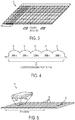
- Figure 5 illustrates random access preamble transmission 14 including uplink resources used for data transmission 16 and uplink resources reserved for random access preamble transmission 18.
- the resources available for PRACH transmission are provided to the UEs as part of the broadcasted system information (or as part of dedicated RRC signaling in case of, e.g., handover).
- the random access procedure can be used for a number of different reasons including:
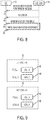
- the contention-based random access procedure 20 used between a UE 22 and an LTE RAN 24 in LTE is illustrated in Figure 6 .
- the UE 22 receives system information for random access 26 from the LTE RAN 24.
- the UE 22 starts the random access procedure by randomly selecting one of the preambles available for contention-based random access as shown in block 27.
- the UE 22 then transmits the selected random access preamble on the PRACH to an eNode B in the LTE RAN 24 in step 28.
- the RAN acknowledges any preamble it detects by transmitting a random access response (MSG2) 30 including an initial grant to be used on the uplink shared channel, a temporary cell-radio network temporary identifier (C-RNTI), and a time alignment (TA) update based on the timing offset of the preamble measured by the eNodeB on the PRACH.
- MSG2 30 is transmitted in the DL to the UE 22 and its corresponding PDCCH message CRC is scrambled with the RA-RNTI.
- the UE 22 uses the grant to transmit a message (MSG3) 32 that in part is used to trigger the establishment of radio resource control and in part to uniquely identify the UE 22 on the common channels of the cell.
- MSG3 message
- the timing alignment command provided in the random access response is applied in the UL transmission in MSG3 32.
- the eNB can change the resources blocks that are assigned for a MSG3 32 transmission by sending an UL grant the CRC of which can be scrambled with the temporary cell-radio network temporary identifier (TC-RNTI).
- TC-RNTI temporary cell-radio network temporary identifier
- the MSG4 34 which is then contention resolution has its PDCCH CRC scrambled with the C-RNTI if the UE previously has a C-RNTI assigned. If the UE does not have a C-RNTI previously assigned its PDCCH CRC is scrambled with the TC-RNTI.
- the procedure ends with the LTE RAN 24 solving any preamble contention that may have occurred for the case where multiple UEs transmitted the same preamble at the same time. This can occur since each UE randomly selects when to transmit and which preamble to use. If multiple UEs select the same preamble for the transmission on the RACH, there will be contention between these UEs that needs to be resolved through the contention resolution message (MSG4) 34.
- MSG4 contention resolution message
- the case when contention occurs is illustrated in Figure 7 , where two UEs, UE1 22 and UE2 36, transmit the same preamble, p 5 38, at the same time.
- a third UE, UE3 40 also transmits at the same RACH, but since it transmits with a different preamble, p 1 42, there is no contention between UE3 40 and the other two UEs (UE1 22 and UE2 36).
- the UE 22 can also perform non-contention based random access.
- a non-contention based random access or contention free random access can, e.g., be initiated by the eNB to get the UE 22 to achieve synchronisation in UL.
- the eNB initiates a non-contention based random access either by sending a PDCCH order or indicating it in an RRC message. The latter of the two is used in case of handover (HO).
- the eNB can also order the UE 22 through a PDCCH message to perform a contention based random access, the procedure for this is illustrated in Figure 7 .
- the procedure for the UE 22 to perform contention free random access is illustrated as shown in Figure 8 .
- the UE 22 receives system information for random access 44 and a random access order 46 from the LTE RAN 24.
- the UE 22 then transmits a random access preamble to the LTE RAN 24. Similar to the contention based random access the MSG2 30 is transmitted in the DL to the UE 22 and its corresponding PDCCH message CRC is scrambled with the RA-RNTI.
- the UE 22 considers the contention resolution successfully completed after it has received MSG2 50 successfully.
- the MSG2 50 contains a timing alignment value. This enables the eNB to set the initial/updated timing according to the UEs transmitted preamble.
- the random access procedure is limited to the primary cell only. This implies that the UE 22 can only send a preamble on the primary cell. Further MSG2 30 and MSG3 32 is only received and transmitted on the primary cell. MSG4 34 can however in Rel-10 be transmitted on any DL cell.
- RAN WG2 no San Francisco, USA; 20111114-20111118, 8 November 2011 (2011-11-08), XP050564312 ), and " Considerations on CBRA on SCell and Msg2 for SCell RA" (3GPP Draft; R2-1115817 CONSIDERATIONS ON CBRA ON SCELL AND MSG2 FOR SCELL, 3rd Generation Partnership project (3GPP), Mobile Competence centre, 650, Routes des Lucioles; F-06921 Sophia-Antipolis Cedex; France, vol. RAN WG2, no San Francisco, USA; 20111114-20111118, 6 November 2011 (2011-11-06), XP050564015 ) methods for handling random access in a radio communication system are disclosed.
- a first cell e.g., their PCell
- UEs performing random access on a second cell e.g., one of their SCell(s)
- a method for handling random access in a radio communication system comprising: transmitting, by a network node, a random access response to a User Equipment (UE) performing a random access on a first cell or a second cell, wherein the random access response comprises a Radio Network Temporary Identifier (RNTI) which has a first value if the random access is associated with the first cell being a primary cell (PCell), or a second value if the random access is associated with the second cell being a secondary cell (SCell), wherein the first value is different than the second value and the first cell is different from the second cell.
- RNTI Radio Network Temporary Identifier
- the above-described network node method can be implemented in a network node having a transceiver which is configured to perform the method.
- a network node capable of handling random access in a radio communication system comprising: a processor configured to generate a random access response to a User Equipment (UE) performing a random access on a first cell or a second cell, wherein the random access response comprises a Radio Network Temporary Identifier (RNTI) which has a first value if the random access is associated with the first cell being a primary cell (PCell), or a second value if the random access is associated with the second cell being a secondary cell (SCell), wherein the first value is different than the second value and the first cell is different from the second cell; and a transceiver configured to transmit the random access response.
- RNTI Radio Network Temporary Identifier
- Embodiments of the present invention are described within the context of Evolved-Universal Mobile Telecommunications System Terrestrial Radio Access Network (E-UTRAN), also referred to as Long Term Evolution (LTE).
- E-UTRAN Evolved-Universal Mobile Telecommunications System Terrestrial Radio Access Network
- LTE Long Term Evolution
- UEs user-equipments
- LTE is used as an example technology where the invention is suitable, and using LTE in the description therefore is particularly useful for understanding the problem and solutions solving the problem and the use of LTE terminology should not be seen as limiting to this particular technology.
- this solution means that the MSG2 is always scheduled and sent on the PCell, even in case the random access preamble message was sent on an SCell.
- the MSG2 message is scheduled and sent on another cell than the cell on which the random access is performed and where the random access preamble message is sent.
- This handling of MSG2 for an SCell has the problem that the preamble number sent on the SCell must also be unique in the PCell, since the random access response message is sent on the PCell. For example, if two UEs, UE1 22 and UE2 36, were to be configured with the same cells as PCell and UE1 22 performs a random access procedure on its PCell while UE2 36 performs a random access procedure on one of its SCells, then UE1 22 and UE2 36 cannot use the same preamble since they both will receive their MSG2 30 on their PCell. This is different from the normal case when the preamble only needs to be unique within one cell, because both the preamble and the MSG2 30 message are sent on the same cell.
- This problem means that the eNB must coordinate preamble numbers between different cells, and not just within the same cell, and which makes it more difficult to use the maximum number of preambles efficiently in the system.
- C-RNTI cell-radio network temporary identifier
- 3GPP 3 rd Generation Partnership Project
- FIG. 9 An example of this is shown Figure 9 where a Rel-10 UE (UE1 22) is configured to use Cell X 52 as its PCell and Cell Z 54 as an SCell and a Rel-11 UE (UE2 36) is configured to use Cell X 52 as its PCell and Cell Y 56 as an SCell. It is assumed that MSG2 will be sent on the PCell also for a random access procedure performed on an SCell and hence the MSG2 for any random access procedure performed by UE2 36 will be sent by the eNB on Cell X 52.
- UE1 22 and UE2 36 cannot use the same preamble at the same time for a random access procedure even if UE1 22 performs the random access procedure on Cell X 52 and UE2 36 performs random access procedure on Cell Y 56.
- the problem that arises from this example is that the UE performing random access on an SCell is sending the MSG2 message on the same cell as the legacy UE is performing its random access on, and since the preamble is included in the random access response in MSG2, it is not possible to distinguish between these two UEs based only on the preamble, if both UEs are using the same preamble number. Therefore it is still necessary to coordinate the preambles between legacy UEs performing random access on their PCell, and Rel-11 UEs performing random access on an SCell using the same cell as the legacy UE as their PCell.
- an exemplary method can, for example, distinguish between random access response messages scheduled on PDCCH intended for a UE performing random access on a first cell, e.g., the UE's PCell, and UEs performing random access on a second cell (which is different from the first cell), e.g., one of their SCell(s).
- the method will use different RA-RNTI values when scheduling the random access response messages for the two cases:
- UEs that are performing random access on their PCell will only receive (i.e., in the sense of reading or decoding) those random access response messages that have been scheduled with an RA-RNTI intended for a PCell, in the first group above; and UEs that are performing random access on one of their SCell will only receive (i.e., in the sense of reading or decoding) those random access response messages intended for an SCell, in the second group above.
- UEs in one group will not receive (i.e., in the sense of reading or decoding) the random access response messages in the other group.
- Exemplary systems and methods which perform random access can be performed in various environments, e.g., contention free or contention based random access.
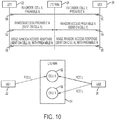
- Figure 10 is a signaling diagram showing when the method described in these embodiments can be applied.
- UE1 22 and UE2 36 are performing random access on different cells while using the same cell as their PCell, i.e., Cell X 52, and are using the same preamble (N). This can be seen in messages 58 and 60.
- UE1 22 transmits message 62 on Cell X 52 including the random access preamble N
- UE2 36 transmits message 64 on Cell Y 54 including the random access preamble N.
- the UEs When the MSG2 66 is received by the UEs on the same cell, the UEs cannot know which of the two random access responses they should act on, if two random access responses will be included in the MSG2 66 with the same preamble number. If one random access response is included in the MSG2 66 in this example both UEs will act on the one random access response which will be incorrect for one of the UEs. Alternatively, for another example, an eNB in the LTE RAN 24 can send only one random access response for which both UEs 22 and 36 would act on the random access response.
- Figure 11 shows in more detail how the MSG2 66 is both scheduled and sent to the UEs which were depicted in Figure 10 .
- the diagram shows an example which uses the current, conventional method of how to calculate the RA-RNTI when scheduling MSG2 on PDCCH.
- MSG2 is scheduled, by the LTE RAN 24, on PDCCH on Cell X 52 for both UEs as shown in step 68.
- the MSG2 is then sent, by the LTE RAN 24, on PDSCH on Cell X 52 with the preamble N to both UE1 22 and UE2 36 as shown by message 70. It can be seen in the diagram of Figure 11 that the RA-RNTI values for both UEs will be the same in this case.
- the t_id and the f_id where t_id is the index of the first subframe of the specified PRACH and f_id is the index of the specified PRACH within that subframe for both UE1 22 and UE2 36 are the same and therefore the RA-RNTI values for both UEs will be the same.
- the RA-RNTI values are calculated using conventional methods as described in chapter 5.1.4 of 3GPP TS 36.321, e.g., equation (1) which is described in more detail later in the specification.
- a purpose of the proposed method is to distinguish between UEs performing random access on a PCell and UEs performing random access on one of their SCell(s), by using different encodings of the RA-RNTI value.
- the RA-RNTI value is used when scheduling the random access response message (MSG2).
- MSG2 random access response message
- the same general method is used as in the embodiment above, but the calculation of the RA-RNTI when performing random access on an SCell is done in any other way that makes the value different from a value used when performing random access on a PCell. That is, any method that produces an RA-RNTI value for an SCell access which is non-overlapping with the range used for a PCell access, e.g., 1 .. 60, is considered in this embodiment.
- these "new" RA-RNTI values can be an extension of currently RA-RNTI values. This can be done by extending the RA-RNTI size by a bit, with the extra bit having a flag which indicates if the RA was performed on a PCell or an SCell.
- Figure 12 illustrates in more detail how the MSG2 is both scheduled and sent to the UEs, allowing for successful random access for both UEs, which were depicted in Figure 10 according to an embodiment.
- the diagram shows the method of how to calculate the RA-RNTI described in the first embodiment used when scheduling MSG2 on PDCCH. While Figure 12 appears similar to Figure 11 , there are differences in how the RA-RNTI is determined which allows for the successful random access for both UEs.
- MSG2 is scheduled, by the LTE RAN 24, on PDCCH on Cell X 52 for both UEs as shown in step 72.
- the MSG2 is then sent, by the LTE RAN 24, on PDSCH on Cell X 52 with the preamble N to both UE1 22 and UE2 36 as shown by message 74.
- the RA-RNTI values for both UEs will be different in this case. More specifically, in this example which uses equation (2) described above, the t_id and the f_id for both UE1 22 and UE2 36 are the same but the is_SCell parameter is different with UE1 22 setting the parameter to 0 and UE2 36 setting the parameter to 1. Thus the RA-RNTI values for both UEs will be different.
- the method steps performed by the UE can be performed by functional elements of the processing circuitry. In some embodiments these functions are carried out by appropriately programmed microprocessors or microcontrollers, alone or in conjunction with other digital hardware, which may include digital signal processors (DSPs), special-purpose digital logic, and the like. Either or both of the microprocessors and digital hardware (generally illustrated as a "processor” 78 in Figure 13 ) may be configured to execute program code stored in memory. Since the various details and engineering tradeoffs associated with the design of baseband processing circuitry for mobile devices and wireless base stations are well known and are unnecessary to a full understanding of the invention, additional details are not shown here.
- the UE 76 will also typically include a transceiver 80, as seen in Figure 13 , for transmitting and receiving signals, e.g., random access responses including RNTIs whose values may vary as described above.
- Figure 13 also depicts the functional elements as related to embodiments described herein for a network node 82, e.g., an E-NodeB or another network node in an LTE system, can include a processor 78 and, potentially, a transceiver 80 and memory circuit (not shown).
- a network node 82 e.g., an E-NodeB or another network node in an LTE system
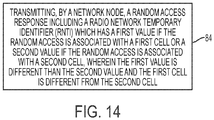
- the method includes: at step 84, transmitting, by a network node, a random access response including a Radio Network Temporary Identifier (RNTI) which has a first value if the random access is associated with a first cell or a second value if the random access is associated with a second cell, wherein the first value is different than the second value and the first cell is different from the second cell.
- RNTI Radio Network Temporary Identifier
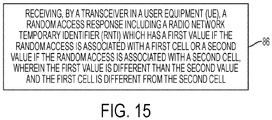
- the method includes: at step 86, receiving, by a transceiver in a user equipment (UE), a random access response including a Radio Network Temporary Identifier (RNTI) which has a first value if the random access is associated with a first cell or a second value if the random access is associated with a second cell, wherein the first value is different than the second value and the first cell is different from the second cell.
- UE user equipment
- RNTI Radio Network Temporary Identifier
- a method for random access in a radio communication system comprising: transmitting, by a network node, a random access response including a Radio Network Temporary Identifier (RNTI) which has a first value if the random access is associated with a primary cell (PCell) and a second value if the random access is associated with a secondary cell (SCell), the first value being different than the second value.
- RNTI Radio Network Temporary Identifier
- the first or second value can be generated by the network node in any desired manner, e.g., using one of the equations described below in the detailed description.
- the above-described network node method can be implemented in a network node having a transceiver which is configured to perform the method.
- a method for random access in a radio communication system comprises: receiving, by a user equipment (UE), a random access response including a Radio Network Temporary Identifier (RNTI) which has a first value if the random access is associated with a primary cell (PCell) and a second value if the random access is associated with a secondary cell (SCell), the first value being different than the second value.
- UE user equipment
- RNTI Radio Network Temporary Identifier
- the above-described UE method can be implemented in a UE having a transceiver which is configured to perform the method.
- Program code stored in the memory circuit may comprise one or several types of memory such as read-only memory (ROM), random-access memory, cache memory, flash memory devices, optical storage devices, etc., and includes program instructions for executing one or more telecommunications and/or data communications protocols, as well as instructions for carrying out one or more of the techniques described herein, in several embodiments.
- ROM read-only memory
- RAM random-access memory
- cache memory cache memory
- flash memory devices optical storage devices
- Program code stored in the memory circuit may comprise one or several types of memory such as read-only memory (ROM), random-access memory, cache memory, flash memory devices, optical storage devices, etc.
- program instructions for executing one or more telecommunications and/or data communications protocols as well as instructions for carrying out one or more of the techniques described herein, in several embodiments.
Landscapes
- Engineering & Computer Science (AREA)
- Computer Networks & Wireless Communication (AREA)
- Signal Processing (AREA)
- Computer Security & Cryptography (AREA)
- Mobile Radio Communication Systems (AREA)
Claims (12)
- Verfahren zum Handhaben von Direktzugriff in einem Funkkommunikationssystem, Folgendes umfassend:
durch einen Netzknoten (82) das Übertragen (84) einer Direktzugriffs-Reaktion an ein Benutzergerät, UE, (76), das einen Direktzugriff auf eine erste Zelle oder eine zweite Zelle ausführt, worin die Direktzugriffs-Reaktion einen temporären Funknetzidentifikator, RNTI, umfasst, der einen ersten Wert hat, falls der Direktzugriff mit der ersten Zelle assoziiert ist, oder einen zweiten Wert, falls der Direktzugriff mit der zweiten Zelle assoziiert ist, worin der erste Wert vom zweiten Wert verschieden ist und die erste Zelle von der zweiten Zelle verschieden ist, dadurch gekennzeichnet, dass:der erste Wert oder der zweite Wert aus der Gleichung RNTI=1+t_id+10*f_id+(60*is_SCell) erzeugt wird, wo t_id ein Index eines ersten Unterrahmens eines spezifizierten physikalischen Direktzugriffs-Steuerkanals, PRACH, ist, sodass 0≤t_id<10, wo f_id ein Index des spezifizierten PRACH ist innerhalb dieses Unterrahmens in aufsteigender Reihenfolge der Frequenzdomäne, sodass 0≤f_id<6, und is_SCell gleich null ist, wenn das UE (76) Direktzugriff auf die erste Zelle ausführt, die eine Primärzelle, PCell, ist, oder gleich eins, wenn das UE (76) Direktzugriff auf die zweite Zelle ausführt, die eine Sekundärzelle, SCell, ist, oderder erste Wert oder der zweite Wert aus der Gleichung RNTI=1+t_id+10*f_id+(60*is_PCell) erzeugt wird, wo t_id ein Index eines ersten Unterrahmens eines spezifizierten PRACH ist, sodass 0≤t_id<10, f_id ein Index des spezifizierten PRACH ist innerhalb dieses Unterrahmens in aufsteigender Reihenfolge der Frequenzdomäne ist, sodass 0≤f_id<6 und is_PCell gleich null ist, wenn das UE (76) Direktzugriff auf die erste Zelle ausführt, die die PCell ist, oder gleich null, wenn das UE (76) Direktzugriff auf die zweite Zelle ausführt, die die SCell ist. - Verfahren nach Anspruch 1, außerdem umfassend:durch den Netzknoten (82) den ersten Wert oder den zweiten Wert erzeugen,worin der erste Wert oder der zweite Wert erzeugt wird, sodass der erste Wert aus einem ersten Wertebereich kommt und der zweite Wert aus einem zweiten Wertebereich kommt, wo der erste Wertebereich und der zweite Wertebereich nicht überlappen.
- Verfahren nach Anspruch 2, worin der erste Wertebereich von 1 bis einschließlich 60 geht.
- Verfahren nach den Ansprüchen 2-3, worin der zweite Wertebereich von 61 bis einschließlich 120 geht.
- Verfahren nach den Ansprüchen 1-4, worin der erste Wert oder der zweite Wert in einer Direktzugriffsreaktion übertragen wird.
- Verfahren nach den Ansprüchen 1-5, worin der Netzknoten (82) ein evolvierter Knoten B, eNB, ist.
- Netzknoten (82), befähigt zum Handhaben von Direktzugriff in einem Funkkommunikationssystem, gekennzeichnet durch:einen Prozessor (78), konfiguriert zum Erzeugen einer Direktzugriffs-Reaktion an ein Benutzergerät, UE, (76), das einen Direktzugriff auf eine erste Zelle oder eine zweite Zelle ausführt, worin die Direktzugriffs-Reaktion einen temporären Funknetzidentifikator, RNTI, umfasst, der einen ersten Wert hat, falls der Direktzugriff damit assoziiert ist, dass die erste Zelle eine Primärzelle, PCell, ist, oder einen zweiten Wert, falls der Direktzugriff damit assoziiert ist, dass die zweite Zelle eine Sekundärzelle, SCell, ist, worin der erste Wert vom zweiten Wert verschieden ist und die erste Zelle von der zweiten Zelle verschieden ist, undworin der erste Wert oder der zweite Wert aus der Gleichung RNTI=1+t_id+10*f_id+(60*is_SCell) erzeugt wird, wo t_id ein Index eines ersten Unterrahmens eines spezifizierten physikalischen Direktzugriffs-Steuerkanals, PRACH, ist, sodass 0≤t_id<10, wo f_id ein Index eines spezifizierten PRACH innerhalb dieses Unterrahmens in aufsteigender Reihenfolge der Frequenzdomäne ist, sodass 0≤f_id<6 und is_SCell gleich null ist, wenn das UE (76) Direktzugriff auf die erste Zelle ausführt, die die PCell, ist, oder gleich eins, wenn das UE (76) Direktzugriff auf die zweite Zelle ausführt, die die SCell, ist; undworin der erste Wert oder der zweite Wert aus der Gleichung RNTI=1+t_id+10*f_id+(60*is_PCell) erzeugt wird, wo t_id ein Index eines ersten Unterrahmens eines spezifizierten PRACH ist, sodass 0≤t_id<10, wo f_id ein Index des spezifizierten PRACH ist innerhalb dieses Unterahmens in aufsteigender Reihenfolge der Frequenzdomäne, sodass 0≤f_id<6, und is PCell gleich eins ist, wenn das UE (76) Direktzugriff auf die erste Zelle ausführt, die die PCell ist, oder null, wenn das UE (76) Direktzugriff auf die zweite Zelle ausführt, die die SCell ist; undeinen Transceiver (80), konfiguriert zum Übertragen der Direktzugriffs-Reaktion.
- Netzknoten (82) nach Anspruch 7, außerdem umfassend:den Netzknoten, dazu konfiguriert, den ersten Wert oder den zweiten Wert zu erzeugen,worin der erste Wert oder der zweite Wert erzeugt wird, sodass der erste Wert aus einem ersten Wertebereich ist und der zweite Wert aus einem zweiten Wertebereich ist, wo der erste Wertebereich und der zweite Wertebereich nicht überlappen.
- Netzknoten (82) nach Anspruch 8, worin der erste Wertebereich von 1 bis einschließlich 60 geht.
- Netzknoten (82) nach den Ansprüchen 8-9, worin der zweite Wertebereich von 61 bis einschließlich 120 geht.
- Netzknoten (82) nach den Ansprüchen 7-10, worin der erste Wert oder der zweite Wert in einer Direktzugriffs-Reaktion übertragen wird.
- Netzknoten (82) nach den Ansprüchen 7-11, worin der Netzknoten (82) ein evolvierter Knoten B, eNB, ist.
Applications Claiming Priority (2)
| Application Number | Priority Date | Filing Date | Title |
|---|---|---|---|
| US201261592740P | 2012-01-31 | 2012-01-31 | |
| PCT/SE2012/050610 WO2013115691A1 (en) | 2012-01-31 | 2012-06-07 | Method and arrangement in a telecommunication system |
Publications (2)
| Publication Number | Publication Date |
|---|---|
| EP2810488A1 EP2810488A1 (de) | 2014-12-10 |
| EP2810488B1 true EP2810488B1 (de) | 2018-08-08 |
Family
ID=46384445
Family Applications (1)
| Application Number | Title | Priority Date | Filing Date |
|---|---|---|---|
| EP12730054.9A Not-in-force EP2810488B1 (de) | 2012-01-31 | 2012-06-07 | Verfahren und anordnung in einem telekommunikationssystem |
Country Status (3)
| Country | Link |
|---|---|
| US (1) | US9681439B2 (de) |
| EP (1) | EP2810488B1 (de) |
| WO (1) | WO2013115691A1 (de) |
Families Citing this family (10)
| Publication number | Priority date | Publication date | Assignee | Title |
|---|---|---|---|---|
| WO2012041422A2 (en) * | 2010-09-30 | 2012-04-05 | Panasonic Corporation | Timing advance configuration for multiple uplink component carriers |
| US9713032B2 (en) * | 2013-04-22 | 2017-07-18 | Telefonaktiebolaget Lm Ericsson (Publ) | Transmission of a random access response message |
| US9253692B1 (en) * | 2014-04-22 | 2016-02-02 | Sprint Spectrum L.P. | Reuse of identifiers for contention-free random access requests to a network |
| BR112017000996A2 (pt) * | 2014-07-18 | 2018-07-24 | Huawei Tech Co Ltd | atribuição de identificadores temporários de rede de rádio múltiplos para um dispositivo de usuário |
| JP6437104B2 (ja) * | 2014-09-24 | 2018-12-12 | ノキア ソリューションズ アンド ネットワークス オサケ ユキチュアNokia Solutions and Networks Oy | ランダムアクセス応答のためのスケジューリング割当ての反復送信 |
| CN117377115A (zh) * | 2017-06-07 | 2024-01-09 | 三星电子株式会社 | 识别随机接入响应的方法和装置 |
| CN110536441A (zh) * | 2019-03-29 | 2019-12-03 | 中兴通讯股份有限公司 | 数据加扰方法、装置及用户设备 |
| CN121037999A (zh) * | 2019-04-30 | 2025-11-28 | 中兴通讯股份有限公司 | 一种无线通信方法、装置及计算机可读介质 |
| US11464051B2 (en) * | 2020-10-30 | 2022-10-04 | Qualcomm Incorporated | Aperiodic random access procedures |
| CN118120329A (zh) * | 2021-10-21 | 2024-05-31 | 上海诺基亚贝尔股份有限公司 | 对辅小区的随机接入 |
Family Cites Families (2)
| Publication number | Priority date | Publication date | Assignee | Title |
|---|---|---|---|---|
| US8280391B2 (en) * | 2009-08-21 | 2012-10-02 | Samsung Electronics Co., Ltd. | Method and apparatus for identifying downlink message responsive to random access preambles transmitted in different uplink channels in mobile communication system supporting carrier aggregation |
| US8705467B2 (en) * | 2011-04-29 | 2014-04-22 | Nokia Corporation | Cross-carrier preamble responses |
-
2012
- 2012-06-07 WO PCT/SE2012/050610 patent/WO2013115691A1/en not_active Ceased
- 2012-06-07 US US13/635,557 patent/US9681439B2/en active Active
- 2012-06-07 EP EP12730054.9A patent/EP2810488B1/de not_active Not-in-force
Non-Patent Citations (1)
| Title |
|---|
| None * |
Also Published As
| Publication number | Publication date |
|---|---|
| US20130195030A1 (en) | 2013-08-01 |
| EP2810488A1 (de) | 2014-12-10 |
| US9681439B2 (en) | 2017-06-13 |
| WO2013115691A1 (en) | 2013-08-08 |
Similar Documents
| Publication | Publication Date | Title |
|---|---|---|
| US12543059B2 (en) | Method and apparatus for supporting multiple message a sizes and uplink coverage for two step random access procedure | |
| EP4088542B1 (de) | Verfahren und vorrichtung für direktzugriffsprozeduren in einem drahtlosen kommunikationssystem | |
| US9681439B2 (en) | Method and arrangement in a telecommunication system | |
| EP3369285B1 (de) | Zweistufiger konfliktbasierter direktzugriff über funkressourcen in laa | |
| EP2745602B1 (de) | Steuerung eines fehlgeschlagenen direktzugriffs auf eine sekundärzelle | |
| EP3105988B1 (de) | Benutzergerät, netzwerkknoten und verfahren darin zur handhabung von präambelübertragungen auf einem direktzugriffkanal in einem funkkommunikationsnetzwerk | |
| CN107690173B (zh) | 一种随机接入方法和设备 | |
| CN108605338B (zh) | 使用窄带的通信方法和mtc设备 | |
| EP3351047B1 (de) | Zufallszugriffsverfahren zur latenzreduzierung | |
| EP2288220B1 (de) | Verfahren und Vorrichtung zur Identifizierung von Abwärtsstreckennachrichten mit Reaktion auf in verschiedenen Aufwärtsstreckenkanälen in einem mobilen Kommunikationssystem mit Trägeraggregationsunterstützung übertragenen Direktzugriffspräambeln | |
| US20130010711A1 (en) | Random Access with Primary and Secondary Component Carrier Communications | |
| US20140079032A1 (en) | Uplink Synchronization Method and User Equipment | |
| KR20220115938A (ko) | 2-스텝 및 4-스텝 랜덤 액세스 간의 전환을 처리하는 방법 및 장치 | |
| CN102548015A (zh) | 一种随机接入及其控制方法、装置和系统 | |
| EP3440876A1 (de) | Uplink-leistungssteuerung auf unlizenzierten trägern | |
| EP3864926B1 (de) | Verfahren und vorrichtung zur freigabe von für den direktzugriff in einem drahtloskommunikationssystem zugewiesenen pusch-ressourcen | |
| WO2013024423A1 (en) | Cross-scheduled random access order transmitting and receiving methods, devices and systems | |
| CN111869305B (zh) | 在无线通信系统中执行随机接入的装置和方法 | |
| US9179480B2 (en) | Apparatus and method for dynamically selecting a random access response window value for use with random access procedures in a network | |
| EP2810499B1 (de) | Benutzervorrichtung, funkbasisstation und verfahren zur steuerung eines zeitsynchronisierungszeitgebers | |
| EP2764742B1 (de) | Verfahren, benutzervorrichtung und e-node b zur inaktivierung von uplink-übertragungen |
Legal Events
| Date | Code | Title | Description |
|---|---|---|---|
| PUAI | Public reference made under article 153(3) epc to a published international application that has entered the european phase |
Free format text: ORIGINAL CODE: 0009012 |
|
| 17P | Request for examination filed |
Effective date: 20140805 |
|
| AK | Designated contracting states |
Kind code of ref document: A1 Designated state(s): AL AT BE BG CH CY CZ DE DK EE ES FI FR GB GR HR HU IE IS IT LI LT LU LV MC MK MT NL NO PL PT RO RS SE SI SK SM TR |
|
| AX | Request for extension of the european patent |
Extension state: BA ME |
|
| DAX | Request for extension of the european patent (deleted) | ||
| STAA | Information on the status of an ep patent application or granted ep patent |
Free format text: STATUS: EXAMINATION IS IN PROGRESS |
|
| 17Q | First examination report despatched |
Effective date: 20161129 |
|
| REG | Reference to a national code |
Ref country code: DE Ref legal event code: R079 Ref document number: 602012049446 Country of ref document: DE Free format text: PREVIOUS MAIN CLASS: H04W0048140000 Ipc: H04W0074000000 |
|
| GRAP | Despatch of communication of intention to grant a patent |
Free format text: ORIGINAL CODE: EPIDOSNIGR1 |
|
| STAA | Information on the status of an ep patent application or granted ep patent |
Free format text: STATUS: GRANT OF PATENT IS INTENDED |
|
| RIC1 | Information provided on ipc code assigned before grant |
Ipc: H04W 74/00 20090101AFI20180301BHEP Ipc: H04W 74/08 20090101ALN20180301BHEP Ipc: H04W 8/26 20090101ALN20180301BHEP Ipc: H04W 48/14 20090101ALI20180301BHEP |
|
| RIC1 | Information provided on ipc code assigned before grant |
Ipc: H04W 8/26 20090101ALN20180308BHEP Ipc: H04W 74/08 20090101ALN20180308BHEP Ipc: H04W 74/00 20090101AFI20180308BHEP Ipc: H04W 48/14 20090101ALI20180308BHEP |
|
| INTG | Intention to grant announced |
Effective date: 20180326 |
|
| GRAS | Grant fee paid |
Free format text: ORIGINAL CODE: EPIDOSNIGR3 |
|
| GRAA | (expected) grant |
Free format text: ORIGINAL CODE: 0009210 |
|
| STAA | Information on the status of an ep patent application or granted ep patent |
Free format text: STATUS: THE PATENT HAS BEEN GRANTED |
|
| AK | Designated contracting states |
Kind code of ref document: B1 Designated state(s): AL AT BE BG CH CY CZ DE DK EE ES FI FR GB GR HR HU IE IS IT LI LT LU LV MC MK MT NL NO PL PT RO RS SE SI SK SM TR |
|
| REG | Reference to a national code |
Ref country code: GB Ref legal event code: FG4D |
|
| REG | Reference to a national code |
Ref country code: CH Ref legal event code: EP Ref country code: AT Ref legal event code: REF Ref document number: 1028573 Country of ref document: AT Kind code of ref document: T Effective date: 20180815 |
|
| REG | Reference to a national code |
Ref country code: IE Ref legal event code: FG4D |
|
| REG | Reference to a national code |
Ref country code: DE Ref legal event code: R096 Ref document number: 602012049446 Country of ref document: DE |
|
| REG | Reference to a national code |
Ref country code: NL Ref legal event code: MP Effective date: 20180808 |
|
| REG | Reference to a national code |
Ref country code: LT Ref legal event code: MG4D |
|
| REG | Reference to a national code |
Ref country code: AT Ref legal event code: MK05 Ref document number: 1028573 Country of ref document: AT Kind code of ref document: T Effective date: 20180808 |
|
| PG25 | Lapsed in a contracting state [announced via postgrant information from national office to epo] |
Ref country code: FI Free format text: LAPSE BECAUSE OF FAILURE TO SUBMIT A TRANSLATION OF THE DESCRIPTION OR TO PAY THE FEE WITHIN THE PRESCRIBED TIME-LIMIT Effective date: 20180808 Ref country code: PL Free format text: LAPSE BECAUSE OF FAILURE TO SUBMIT A TRANSLATION OF THE DESCRIPTION OR TO PAY THE FEE WITHIN THE PRESCRIBED TIME-LIMIT Effective date: 20180808 Ref country code: NL Free format text: LAPSE BECAUSE OF FAILURE TO SUBMIT A TRANSLATION OF THE DESCRIPTION OR TO PAY THE FEE WITHIN THE PRESCRIBED TIME-LIMIT Effective date: 20180808 Ref country code: AT Free format text: LAPSE BECAUSE OF FAILURE TO SUBMIT A TRANSLATION OF THE DESCRIPTION OR TO PAY THE FEE WITHIN THE PRESCRIBED TIME-LIMIT Effective date: 20180808 Ref country code: SE Free format text: LAPSE BECAUSE OF FAILURE TO SUBMIT A TRANSLATION OF THE DESCRIPTION OR TO PAY THE FEE WITHIN THE PRESCRIBED TIME-LIMIT Effective date: 20180808 Ref country code: RS Free format text: LAPSE BECAUSE OF FAILURE TO SUBMIT A TRANSLATION OF THE DESCRIPTION OR TO PAY THE FEE WITHIN THE PRESCRIBED TIME-LIMIT Effective date: 20180808 Ref country code: GR Free format text: LAPSE BECAUSE OF FAILURE TO SUBMIT A TRANSLATION OF THE DESCRIPTION OR TO PAY THE FEE WITHIN THE PRESCRIBED TIME-LIMIT Effective date: 20181109 Ref country code: LT Free format text: LAPSE BECAUSE OF FAILURE TO SUBMIT A TRANSLATION OF THE DESCRIPTION OR TO PAY THE FEE WITHIN THE PRESCRIBED TIME-LIMIT Effective date: 20180808 Ref country code: BG Free format text: LAPSE BECAUSE OF FAILURE TO SUBMIT A TRANSLATION OF THE DESCRIPTION OR TO PAY THE FEE WITHIN THE PRESCRIBED TIME-LIMIT Effective date: 20181108 Ref country code: NO Free format text: LAPSE BECAUSE OF FAILURE TO SUBMIT A TRANSLATION OF THE DESCRIPTION OR TO PAY THE FEE WITHIN THE PRESCRIBED TIME-LIMIT Effective date: 20181108 Ref country code: IS Free format text: LAPSE BECAUSE OF FAILURE TO SUBMIT A TRANSLATION OF THE DESCRIPTION OR TO PAY THE FEE WITHIN THE PRESCRIBED TIME-LIMIT Effective date: 20181208 |
|
| PG25 | Lapsed in a contracting state [announced via postgrant information from national office to epo] |
Ref country code: LV Free format text: LAPSE BECAUSE OF FAILURE TO SUBMIT A TRANSLATION OF THE DESCRIPTION OR TO PAY THE FEE WITHIN THE PRESCRIBED TIME-LIMIT Effective date: 20180808 Ref country code: HR Free format text: LAPSE BECAUSE OF FAILURE TO SUBMIT A TRANSLATION OF THE DESCRIPTION OR TO PAY THE FEE WITHIN THE PRESCRIBED TIME-LIMIT Effective date: 20180808 Ref country code: AL Free format text: LAPSE BECAUSE OF FAILURE TO SUBMIT A TRANSLATION OF THE DESCRIPTION OR TO PAY THE FEE WITHIN THE PRESCRIBED TIME-LIMIT Effective date: 20180808 |
|
| PG25 | Lapsed in a contracting state [announced via postgrant information from national office to epo] |
Ref country code: ES Free format text: LAPSE BECAUSE OF FAILURE TO SUBMIT A TRANSLATION OF THE DESCRIPTION OR TO PAY THE FEE WITHIN THE PRESCRIBED TIME-LIMIT Effective date: 20180808 Ref country code: EE Free format text: LAPSE BECAUSE OF FAILURE TO SUBMIT A TRANSLATION OF THE DESCRIPTION OR TO PAY THE FEE WITHIN THE PRESCRIBED TIME-LIMIT Effective date: 20180808 Ref country code: RO Free format text: LAPSE BECAUSE OF FAILURE TO SUBMIT A TRANSLATION OF THE DESCRIPTION OR TO PAY THE FEE WITHIN THE PRESCRIBED TIME-LIMIT Effective date: 20180808 Ref country code: IT Free format text: LAPSE BECAUSE OF FAILURE TO SUBMIT A TRANSLATION OF THE DESCRIPTION OR TO PAY THE FEE WITHIN THE PRESCRIBED TIME-LIMIT Effective date: 20180808 Ref country code: CZ Free format text: LAPSE BECAUSE OF FAILURE TO SUBMIT A TRANSLATION OF THE DESCRIPTION OR TO PAY THE FEE WITHIN THE PRESCRIBED TIME-LIMIT Effective date: 20180808 |
|
| REG | Reference to a national code |
Ref country code: DE Ref legal event code: R097 Ref document number: 602012049446 Country of ref document: DE |
|
| PG25 | Lapsed in a contracting state [announced via postgrant information from national office to epo] |
Ref country code: DK Free format text: LAPSE BECAUSE OF FAILURE TO SUBMIT A TRANSLATION OF THE DESCRIPTION OR TO PAY THE FEE WITHIN THE PRESCRIBED TIME-LIMIT Effective date: 20180808 Ref country code: SK Free format text: LAPSE BECAUSE OF FAILURE TO SUBMIT A TRANSLATION OF THE DESCRIPTION OR TO PAY THE FEE WITHIN THE PRESCRIBED TIME-LIMIT Effective date: 20180808 Ref country code: SM Free format text: LAPSE BECAUSE OF FAILURE TO SUBMIT A TRANSLATION OF THE DESCRIPTION OR TO PAY THE FEE WITHIN THE PRESCRIBED TIME-LIMIT Effective date: 20180808 |
|
| PLBE | No opposition filed within time limit |
Free format text: ORIGINAL CODE: 0009261 |
|
| STAA | Information on the status of an ep patent application or granted ep patent |
Free format text: STATUS: NO OPPOSITION FILED WITHIN TIME LIMIT |
|
| 26N | No opposition filed |
Effective date: 20190509 |
|
| PG25 | Lapsed in a contracting state [announced via postgrant information from national office to epo] |
Ref country code: SI Free format text: LAPSE BECAUSE OF FAILURE TO SUBMIT A TRANSLATION OF THE DESCRIPTION OR TO PAY THE FEE WITHIN THE PRESCRIBED TIME-LIMIT Effective date: 20180808 |
|
| PG25 | Lapsed in a contracting state [announced via postgrant information from national office to epo] |
Ref country code: MC Free format text: LAPSE BECAUSE OF FAILURE TO SUBMIT A TRANSLATION OF THE DESCRIPTION OR TO PAY THE FEE WITHIN THE PRESCRIBED TIME-LIMIT Effective date: 20180808 |
|
| REG | Reference to a national code |
Ref country code: CH Ref legal event code: PL |
|
| REG | Reference to a national code |
Ref country code: BE Ref legal event code: MM Effective date: 20190630 |
|
| PG25 | Lapsed in a contracting state [announced via postgrant information from national office to epo] |
Ref country code: TR Free format text: LAPSE BECAUSE OF FAILURE TO SUBMIT A TRANSLATION OF THE DESCRIPTION OR TO PAY THE FEE WITHIN THE PRESCRIBED TIME-LIMIT Effective date: 20180808 |
|
| PG25 | Lapsed in a contracting state [announced via postgrant information from national office to epo] |
Ref country code: IE Free format text: LAPSE BECAUSE OF NON-PAYMENT OF DUE FEES Effective date: 20190607 |
|
| PG25 | Lapsed in a contracting state [announced via postgrant information from national office to epo] |
Ref country code: LI Free format text: LAPSE BECAUSE OF NON-PAYMENT OF DUE FEES Effective date: 20190630 Ref country code: BE Free format text: LAPSE BECAUSE OF NON-PAYMENT OF DUE FEES Effective date: 20190630 Ref country code: LU Free format text: LAPSE BECAUSE OF NON-PAYMENT OF DUE FEES Effective date: 20190607 Ref country code: CH Free format text: LAPSE BECAUSE OF NON-PAYMENT OF DUE FEES Effective date: 20190630 |
|
| PG25 | Lapsed in a contracting state [announced via postgrant information from national office to epo] |
Ref country code: PT Free format text: LAPSE BECAUSE OF FAILURE TO SUBMIT A TRANSLATION OF THE DESCRIPTION OR TO PAY THE FEE WITHIN THE PRESCRIBED TIME-LIMIT Effective date: 20181208 |
|
| PG25 | Lapsed in a contracting state [announced via postgrant information from national office to epo] |
Ref country code: CY Free format text: LAPSE BECAUSE OF FAILURE TO SUBMIT A TRANSLATION OF THE DESCRIPTION OR TO PAY THE FEE WITHIN THE PRESCRIBED TIME-LIMIT Effective date: 20180808 |
|
| PG25 | Lapsed in a contracting state [announced via postgrant information from national office to epo] |
Ref country code: HU Free format text: LAPSE BECAUSE OF FAILURE TO SUBMIT A TRANSLATION OF THE DESCRIPTION OR TO PAY THE FEE WITHIN THE PRESCRIBED TIME-LIMIT; INVALID AB INITIO Effective date: 20120607 Ref country code: MT Free format text: LAPSE BECAUSE OF FAILURE TO SUBMIT A TRANSLATION OF THE DESCRIPTION OR TO PAY THE FEE WITHIN THE PRESCRIBED TIME-LIMIT Effective date: 20180808 |
|
| PGFP | Annual fee paid to national office [announced via postgrant information from national office to epo] |
Ref country code: FR Payment date: 20210625 Year of fee payment: 10 |
|
| PG25 | Lapsed in a contracting state [announced via postgrant information from national office to epo] |
Ref country code: MK Free format text: LAPSE BECAUSE OF FAILURE TO SUBMIT A TRANSLATION OF THE DESCRIPTION OR TO PAY THE FEE WITHIN THE PRESCRIBED TIME-LIMIT Effective date: 20180808 |
|
| PGFP | Annual fee paid to national office [announced via postgrant information from national office to epo] |
Ref country code: GB Payment date: 20220628 Year of fee payment: 11 |
|
| PGFP | Annual fee paid to national office [announced via postgrant information from national office to epo] |
Ref country code: DE Payment date: 20220629 Year of fee payment: 11 |
|
| PG25 | Lapsed in a contracting state [announced via postgrant information from national office to epo] |
Ref country code: FR Free format text: LAPSE BECAUSE OF NON-PAYMENT OF DUE FEES Effective date: 20220630 |
|
| REG | Reference to a national code |
Ref country code: DE Ref legal event code: R119 Ref document number: 602012049446 Country of ref document: DE |
|
| GBPC | Gb: european patent ceased through non-payment of renewal fee |
Effective date: 20230607 |
|
| PG25 | Lapsed in a contracting state [announced via postgrant information from national office to epo] |
Ref country code: DE Free format text: LAPSE BECAUSE OF NON-PAYMENT OF DUE FEES Effective date: 20240103 Ref country code: GB Free format text: LAPSE BECAUSE OF NON-PAYMENT OF DUE FEES Effective date: 20230607 |