EP2811702A1 - Système de réseau et procédé de gestion de topologie - Google Patents
Système de réseau et procédé de gestion de topologie Download PDFInfo
- Publication number
- EP2811702A1 EP2811702A1 EP13743795.0A EP13743795A EP2811702A1 EP 2811702 A1 EP2811702 A1 EP 2811702A1 EP 13743795 A EP13743795 A EP 13743795A EP 2811702 A1 EP2811702 A1 EP 2811702A1
- Authority
- EP
- European Patent Office
- Prior art keywords
- packet
- switches
- flow entry
- topology
- switch
- Prior art date
- Legal status (The legal status is an assumption and is not a legal conclusion. Google has not performed a legal analysis and makes no representation as to the accuracy of the status listed.)
- Withdrawn
Links
Images



Classifications
-
- H—ELECTRICITY
- H04—ELECTRIC COMMUNICATION TECHNIQUE
- H04L—TRANSMISSION OF DIGITAL INFORMATION, e.g. TELEGRAPHIC COMMUNICATION
- H04L43/00—Arrangements for monitoring or testing data switching networks
- H04L43/50—Testing arrangements
-
- H—ELECTRICITY
- H04—ELECTRIC COMMUNICATION TECHNIQUE
- H04L—TRANSMISSION OF DIGITAL INFORMATION, e.g. TELEGRAPHIC COMMUNICATION
- H04L43/00—Arrangements for monitoring or testing data switching networks
- H04L43/20—Arrangements for monitoring or testing data switching networks the monitoring system or the monitored elements being virtualised, abstracted or software-defined entities, e.g. SDN or NFV
-
- H—ELECTRICITY
- H04—ELECTRIC COMMUNICATION TECHNIQUE
- H04L—TRANSMISSION OF DIGITAL INFORMATION, e.g. TELEGRAPHIC COMMUNICATION
- H04L43/00—Arrangements for monitoring or testing data switching networks
- H04L43/08—Monitoring or testing based on specific metrics, e.g. QoS, energy consumption or environmental parameters
- H04L43/0805—Monitoring or testing based on specific metrics, e.g. QoS, energy consumption or environmental parameters by checking availability
- H04L43/0811—Monitoring or testing based on specific metrics, e.g. QoS, energy consumption or environmental parameters by checking availability by checking connectivity
-
- H—ELECTRICITY
- H04—ELECTRIC COMMUNICATION TECHNIQUE
- H04L—TRANSMISSION OF DIGITAL INFORMATION, e.g. TELEGRAPHIC COMMUNICATION
- H04L43/00—Arrangements for monitoring or testing data switching networks
- H04L43/10—Active monitoring, e.g. heartbeat, ping or trace-route
-
- H—ELECTRICITY
- H04—ELECTRIC COMMUNICATION TECHNIQUE
- H04L—TRANSMISSION OF DIGITAL INFORMATION, e.g. TELEGRAPHIC COMMUNICATION
- H04L45/00—Routing or path finding of packets in data switching networks
- H04L45/18—Loop-free operations
-
- H—ELECTRICITY
- H04—ELECTRIC COMMUNICATION TECHNIQUE
- H04L—TRANSMISSION OF DIGITAL INFORMATION, e.g. TELEGRAPHIC COMMUNICATION
- H04L1/00—Arrangements for detecting or preventing errors in the information received
- H04L1/22—Arrangements for detecting or preventing errors in the information received using redundant apparatus to increase reliability
-
- Y—GENERAL TAGGING OF NEW TECHNOLOGICAL DEVELOPMENTS; GENERAL TAGGING OF CROSS-SECTIONAL TECHNOLOGIES SPANNING OVER SEVERAL SECTIONS OF THE IPC; TECHNICAL SUBJECTS COVERED BY FORMER USPC CROSS-REFERENCE ART COLLECTIONS [XRACs] AND DIGESTS
- Y02—TECHNOLOGIES OR APPLICATIONS FOR MITIGATION OR ADAPTATION AGAINST CLIMATE CHANGE
- Y02D—CLIMATE CHANGE MITIGATION TECHNOLOGIES IN INFORMATION AND COMMUNICATION TECHNOLOGIES [ICT], I.E. INFORMATION AND COMMUNICATION TECHNOLOGIES AIMING AT THE REDUCTION OF THEIR OWN ENERGY USE
- Y02D30/00—Reducing energy consumption in communication networks
Definitions
- the present invention is related to a network system, and especially to a method of managing a physical topology of switches of a network system.
- a CD (C: control plane / D: data plane) separation type network is proposed which controls a node apparatus (data plane) by an external control system (control plane), as one of control systems of the network system.
- an open flow network is exemplified which uses an open flow (OpenFlow) technique which carries out a route control of the network by controlling switches by a controller.
- OpenFlow open flow
- the detail of the open flow technique is described in Non-Patent Literature 1 (OpenFlow Switch Specification Version 1.1.0). Note that the open flow network is only an example.
- an open flow controller controls the conduct of an open flow switch (OFS: OpenFlow Switch) by operating a flow table of the switch.
- the controller and the switch are connected by a secure channel which is used to control the switch by the controller with an open flow message (OpenFlow Message) as a control message conformed to an open flow protocol.
- OpenFlow Message open flow message
- the open flow controller (OFC) is referred to as a “controller (OFC)” and an open flow switch (OFS) is referred to as a “switch (OFS)".
- the network of the controller and the switches which are connected by the secure channels is called a "secure channel network”.
- the switches configure the open flow network and each of the switches (OFS) is an edge switch or a core switch under the control of the controller (OFC).
- a series of packets from the reception of a packet in the edge switch on an input side to the transmission of the packet in the edge switch on an output side is called a flow in the open flow network.
- the packet may be read as a frame.
- a difference between the packet and the frame is only a difference of the unit of data (PDU: Protocol Data Unit) handled by the protocol.
- the packet is a PDU of "TCP/IP” (Transmission Control Protocol/Internet Protocol).
- the frame is a PDU of the "Ethernet” (registered trademark).
- the flow table is a table in which a flow entry defining a predetermined operation (action) to be carried out to a packet (communication data) which satisfies a predetermined match condition (rule) is registered.
- the rule of the flow entry is defined based on various combinations of all or part of a destination address (dst), a source address (src), a destination port, and a source port, which are contained in a header region of each protocol hierarchy of the packet, and is identifiable.
- the addresses contain a MAC (Media Access Control) address and an IP (Internet Protocol) address.
- Data of an input port (Ingress Port) is usable for the rule of the flow entry.
- a normal expression and an expression using wildcard "*" of a part (or all) of a value of the header region of the packet showing a flow may be set.
- the action of the flow entry shows one of operations such as "outputting to a specific port”, “discarding”, or "rewriting a header". For example, if identification data of the output port (output port number and so on) is shown in the action of the flow entry, the switch (OFS) outputs a packet corresponding to this to the port, and if no identification data of the output port is not shown, the packet is discarded. Or, if the header data is shown in the action of the flow entry, the switch (OFS) rewrites the header of the packet based on the header data.
- the switch executes the action of the flow entry to a packet group (a packet sequence) which complies with the rule of the flow entry.
- the controller (OFC) holds a copy of the flow entry on the switch (OFS) side to grasp and manage the flow entry on the switch (OFS) side.
- the controller (OFC) holds the same flow table as that of the switch (OFS).
- the controller uses topology discovery protocol such as LLDP (Link Layer Discovery Protocol) and OFDP (OpenFlow Discovery Protocol) to collect connection data between neighbor switches (OFSs).
- LLDP Link Layer Discovery Protocol
- OFDP OpenFlow Discovery Protocol
- OFDP is the topology detection protocol in the open flow network for the extended LLDP.
- the controller detects the topology of the whole open flow network based on the collected connection data between the neighbor switches (OFSs).
- the connection data between switches (OFSs) and data of the port for the connection and so on are exemplified.
- the controller realizes communication in the open flow network by setting an appropriate flow entry to an interconnection port between switches (OFSs) and a connection port of each switch (OFS) and a communication terminal unit (host) based on the detected connection data of switches (OFSs).
- the controller instructs each switch (OFS) to regularly transmit a topology discovery packet (TDP) in LLDP and OFDP.
- Each switch transmits a port status message (PSM) to the controller (OFC).
- PSM port status message
- the controller receives a notice of the port status message (PSM) transmitted from each switch (OFS).
- PSM port status message
- the controller holds and updates the detected open flow network topology.
- the existing open flow network contains a controller (OFC) 10 and a switch (OFS) 20-1 and a switch (OFS) 20-2.
- the controller (OFC) 10 is connected with the switch (OFS) 20-1 and the switch (OFS) 20-2 through a secure channel network 100.
- a control signal between the controller (OFC) and the switch (OFS) is transmitted through the secure channel network 100.
- One of the control signals is an open flow message.
- the controller (OFC) 10 stores a topology discovery packet (TDP) 30-2 in a packet-out message (POM) 30-1 and transmits the packet-out message (POM) 30-1 to the switch (OFS) 20-1 through the secure channel network 100.
- TDP topology discovery packet
- POM packet-out message
- the packet-out message (POM) 30-1 is one of the open flow messages.
- the switch (OFS) 20-1 is provided with a connection port 21-1
- the switch (OFS) 20-2 is provided with a connection port 21-2.
- the connection port 21-1 and the connection port 21-2 are connection ports between the switches (OFSs).
- the connection port 21-1 and the connection port 21-2 connect the switch (OFS) 20-1 and the switch (OFS) 20-2.
- the switch (OFS) 20-1 acquires the topology discovery packet (TDP) 30-2 stored in the packet-out message (POM) 30-1 and transmits the topology discovery packet (TDP) 30-2 to the connection port 21-1.
- the topology discovery packet (TDP) 30-2 reaches the connection port 21-2 of the switch (OFS) 20-2 from the connection port 21-1 of the switch (OFS) 20-1.
- the switch (OFS) 20-2 stores the received topology discovery packet (TDP) 30-2 in a packet-in message (PIM) 30-3 and transmits the packet-in message (PIM) 30-3 to the controller (OFC) 10 through the secure channel network 100.
- PIM packet-in message
- the packet-in message (PIM) 30-3 is one of the open flow messages.
- the controller (OFC) 10 sets a flow entry for the topology discovery packet (TDP) to each switch (OFS) .
- the controller (OFC) 10 specifies a match value (MV) to which the topology discovery packet (TDP) 30-2 matches, in a match field (MF) of this flow entry. That is, the match value (MV) of the match field (MF) becomes a rule of the flow entry.
- the controller (OFC) 10 specifies an action of "transmit a packet-in message (PIM) of a topology discovery packet (TDP) to the controller (OFC) 10" in an action field (AF) of this flow entry. That is, the action in the action field (AF) becomes the action of the flow entry.
- PIM packet-in message
- TDP topology discovery packet
- each switch (OFS) transmits the packet-in message (PIM) 30-3 of the topology discovery packet (TDP) 30-2 to the controller (OFC) 10 when the received topology discovery packet (TDP) 30-2 matches the above-mentioned flow entry.
- PIM packet-in message
- each switch stores the topology discovery packet (TDP) 30-2 in a data field (DF) of the packet-in message (PIM) 30-3.
- each switch stores a "DPID” (Delivery Point Identifier) and a "Port” of this switch (OFS) in the packet-in message (PIM) 30-3.
- DPID Delivery Point Identifier
- PIM packet-in message
- the "DPID" is an identifier data of the switch (OFS).
- the "DPID" of the switch (OFS) 20-1 is supposed to be “OFS1-DPID”. Also, the "DPID" of the switch (OFS) 20-2 is supposed to be "OFS2-DPID”.
- the "Port” is identifier data of the connection port of the switch (OFS).
- the "Port” of the connection port 21-1 of the switch (OFS) 20-1 is supposed to be “Port1”. Also, the "Port” of the connection port 21-2 of the switch (OFS) 20-2 is supposed to be “Port2”.
- the controller (OFC) 10 transmits the packet-out message (POM) 30-1 of the topology discovery packet (TDP) 30-2 as the open flow message to the port linked with each switch (OFS), through the secure channel network.
- POM packet-out message
- TDP topology discovery packet
- the controller (OFC) 10 specifies the action of "transmit the topology discovery packet (TDP) from the port linked" in the action field (AF) of the packet-out message (POM) 30-1 to be transmitted.
- controller (OFC) 10 specifies "DPID" and "Port” of the switch (OFS) as a destination of the packet-out message (POM) 30-1 and as a source of the topology discovery packet (TDP) 30-2 for the topology discovery packet (TDP) 30-2.
- the switch (OFS) 20-1 is the destination of the packet-out message (POM) 30-1 and a switch (OFS) is the source of the topology discovery packet (TDP) 30-2.
- POM packet-out message
- TDP topology discovery packet
- the controller (OFC) 10 transmits the packet-out message (POM) 30-1 of the topology discovery packet (TDP) 30-2 to the switch (OFS) 20-1.
- POM packet-out message
- the controller (OFC) 10 stores the topology discovery packet (TDP) 30-2 in the data field (DF) of the packet-out message (POM) 30-1.
- controller (OFC) 10 specifies that the phrase of "transmits the topology discovery packet (TDP) 30-2 from the connection port 21-1 of the switch (OFS) 20-1" as an action in the action field (AF) of the packet-out message (POM) 30-1.
- the controller (OFC) 10 stores "OFS1-DPID” and "Port1" in the topology discovery packet (TDP) 30-2 as "DPID” and "Port” of the switch (OFS) 20-1.
- "OFS1-DPID” is identifier data of the switch (OFS) 20-1.
- the switch (OFS) 20-1 is a switch (OFS) as the source of the topology discovery packet (TDP) 30-2.
- "Port1" is identifier data of the connection port 21-1.
- the connection port 21-1 is a transmission port of the topology discovery packet (TDP) 30-2.
- the switch (OFS) 20-1 receives the above-mentioned packet-out message (POM) 30-1 from the controller (OFC) 10.
- POM packet-out message
- the switch (OFS) 20-1 acquires the topology discovery packet (TDP) 30-2 stored in the data field (DF) of the packet-out message (POM) 30-1.
- the switch (OFS) 20-1 transmits the topology discovery packet (TDP) 30-2 from the connection port 21-1 based on the action specified in the action field (AF) of the packet-out message (POM) 30-1.
- connection port 21-1 of the switch (OFS) 20-1 is connected with the connection port 21-2 of the switch (OFS) 20-2. Therefore, the topology discovery packet (TDP) 30-2 which has been transmitted from the connection port 21-1 of the switch (OFS) 20-1 reaches the connection port 21-2 of the switch (OFS) 20-2.
- TDP topology discovery packet
- the switch (OFS) 20-2 receives the topology discovery packet (TDP) 30-2 by the connection port 21-2.
- the switch (OFS) 20-2 transmits a packet-in message (PIM) 30-3 of the topology discovery packet (TDP) 30-2 to the controller (OFC) 10 when the received topology discovery packet (TDP) 30-2 matches the flow entry set in an initial setting process.
- PIM packet-in message
- the switch (OFS) 20-2 stores "OFS2-DPID” and "Port2" in the packet-in message (PIM) 30-3 as "DPID” and "Port” of the switch (OFS) 20-2.
- "OFS2-DPID” is identifier data of the switch (OFS) 20-2.
- the switch (OFS) 20-2 is a switch (OFS) as a source of the packet-in message (PIM) 30-3.
- "Port2" is identifier data of the connection port 21-2.
- the connection port 21-2 is a reception port of the topology discovery packet (TDP) 30-2.
- the switch (OFS) 20-2 stores the topology discovery packet (TDP) 30-2 in the data field (DF) of the packet-in message (PIM) 30-3.
- the controller (OFC) 10 receives the above-mentioned packet-in message (PIM) 30-3.
- the controller (OFC) 10 acquires "OFS2-DPID” and "Port2" of the switch (OFS) 20-2 as the source stored in this packet-in message (PIM) 30-3.
- controller (OFC) 10 acquires the topology discovery packet (TDP) 30-2 stored in the data field (DF) of this packet-in message (PIM) 30-3, and acquires "OFS1-DPID" and "Port1" of the switch (OFS) 20-1 stored in the topology discovery packet (TDP) 30-2.
- the controller (OFC) 10 detects that the connection port 21-1 of the switch (OFS) 20-1 has been connected with the connection port 21-2 of the switch (OFS) 20-2.
- the controller (OFC) 10 detects that the connection port 21-2 of the switch (OFS) 20-2 ha been connected with the connection port 21-1 of the switch (OFS) 20-1 by flowing the topology discovery packet (TDP) 30-2 in a reverse direction in a mechanism similar to the above mechanism.
- TDP topology discovery packet
- controller (OFC) 10 uses the above-mentioned topology discovery packet (TDP) 30-2 and the above-mentioned mechanism at a constant interval/number of times of retry during the operation, to maintain and update the detected topology.
- TDP topology discovery packet
- Non-Patent Literature 1 OpenFlow Switch Specification Version 1.1.0
- the controller needs to transmit a topology discovery packet (TDP) onto the secure channel network regularly to the ports linked all the links of each switch (OFS) to maintain and update the detected topology.
- TDP topology discovery packet
- each switch needs to transmit the received topology discovery packet (TDP) to the controller (OFC) through the secure channel network.
- TDP topology discovery packets
- controller (OFC) scan method is used to maintain and update the detected topology, it takes time to detect the change when there is a topology change.
- the timing when detecting the topology change depends on an interval time during which the controller (OFC) outputs the topology discovery packet (TDP) during the operation and a reply timeout of the topology discovery packet (TDP) from the switch (OFS).
- the switch is realized in software by using a general-purpose processor of the conventional legacy switch to a processing part except for the processing part of "searching a flow entry to which a packet matches and processing the packet according to an action specified in the matched flow entry" in the processing of the open flow message.
- a routing bridge system is disclosed in Patent Literature 1 ( JP 2003-143169A ).
- a transmission route of data is determined by using an address of a data link layer of a ring network, in which a plurality of nodes are connected in a ring through a plurality of connection nodes.
- Each node is provided with a node tree producing section which produces a spanning tree between the nodes on the ring to which it belongs.
- Each connection node is provided with a node tree producing section which produces a spanning tree between the nodes on the ring to which it belongs, and an inter-ring tree producing section which produces an inter-ring spanning tree between the rings which are regarded as a logical link.
- Patent Literature 2 JP 2006-340361A .
- the method of determining the connection topology of the home network can determine the connection topology of the home network which includes a multiple hub and a plurality of nodes disposed around a switch.
- This method has a step of transmitting topology determination messages one by one in a random sequence by the plurality of nodes, determining all the connection topologies one by one based on the reception of the topology determination message, and generating and updating a list of local nodes for all the local nodes.
- the topology determination message contains two continuing packets.
- a first packet is a broadcast packet which has a previously set payload which distinguishes it from the topology determination packet.
- the second packet is a unicast packet which has a same content and a non-existing destination MAC address.
- Patent Literature 3 JP 2008-172449A .
- a communication unit records transfer data in which a port number and a source MAC (Media Access Control) address correspond to.
- TTL time to live
- a management unit transmits to the communication unit, a trace request which contains the TTL.
- the management unit acquires the transfer data from the received trace response and derives a port topology in a unit topology of the network.
- a configuration and optimization of a radio mesh-type network are disclosed in Patent Literature 4 ( JP 2009-111976A ).
- a network design tool provides a conversation-type graphic interface for addition, removal and positioning of a node and an equipment in the radio network, and a menu which contains a plurality of conversational-type screens to specify a threshold values, a network topology selection, a route setting and other configuration parameters related to the generation and optimization of a communication route and a schedule in the radio mesh-type network.
- the network design tool automatically applies a set of optimization rules to a network model together with parameters inputted from the user and generates a network configuration data in a high efficiency.
- Non-Patent Literature 1 OpenFlow Switch Specification, Version 1.1.0 Implemented", [online] February 28, 2011, the Internet (URL: http://www. openflowswitch.org/documents/openflow-spec-v1.1.0pdf )
- An object of the present invention is to provide a network system such as an open flow network in which a controller can carry out the maintenance and update of a physical topology of switches in the state that a heavy delay has occurred in the network among the switches.
- the network system contains a plurality of switches, each of which executes processing of a reception packet according to a flow entry having a rule and an action defined to uniformly control packets as a flow, and a controller which sets the flow entry to each of the plurality of switches.
- the controller sets a circulation flow entry to be deleted when the circulation packet which is mutually transmitted and received among the plurality of switches gets not to arrive, to each of the plurality of switches.
- the controller detects a failure among the plurality of switches.
- the controller includes a mechanism that sets a flow entry having a rule and an action defined to each of a plurality of switches to uniformly control packets as a flow, a mechanism that sets a circulation flow entry to be deleted when a circulation packet which is mutually transmitted and received among the plurality of switches gets not to arrive, to each of the plurality of switches, a mechanism that detects a failure among the plurality of switches when receiving a notice indicating that the circulation flow entry has been deleted, from each switch.
- a topology managing method implemented by a computer includes setting a flow entry having a rule and an action defined to uniformly control packets as a flow, to each of a plurality of switches as a controller, setting a circulation flow entry to be deleted when a circulation packet which is mutually transmitted and received among the plurality of switches gets not to arrive, to each of the plurality of switches, and detecting a failure among the plurality of switches when receiving a notice indicating that the circulation flow entry has deleted, from each switch.
- a program according to the present invention is a program to make a computer which is used as the controller, execute the processing of the above-mentioned topology managing method. Note that the program according to the present invention can be stored in a storage and a recording medium.
- a load of the switch on a secure channel network can be reduced when maintaining and updating the topology in the open flow network and so on.
- the present invention targets a CD separation type network.
- an open flow network as one of the CD separation type networks will be described, using it as an example.
- the present invention is not limited to the open flow network.
- TKAFE topology KeepAlive flow entry
- TKAP topology keepAlive packet
- the topology KeepAlive packet (TKAP) is a circulation packet which is previously prescribed to maintain and update the detected topology and is a packet which matches the topology KeepAlive flow entry (TKAFE).
- TKAFE topology KeepAlive flow entry
- TKAP topology KeepAlive packet
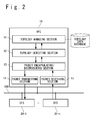
- FIG. 2 a configuration example of the network system according to the present invention will be described.
- controller OFC
- switches OFSs
- the controller (OFC) 10 is connected with each switch (OFS) 20 through a secure channel network 100.
- a control signal between the controller (OFC) and the switch (OFS) is transmitted through the secure channel network 100.
- each switch (OFS) 20 compares the flow entry set from the controller (OFC) 10 and the received packet. When the value of a header field (HF) of the received packet matches a match value (MV) of a match field (MF) of the flow entry, the switch (OFS) 20 executes an action specified in the action field (AF) of the flow entry.
- HF header field
- MV match value
- MF match field
- the controller (OFC) 10 has a topology managing section 11, a topology detecting section 12, a packet encapsulating/distributing section 13, a packet transmitting section 14 and a packet receiving section 15.
- the topology managing section 11 manages a topology data database and preserves the topology data of the open flow network detected by the controller (OFC) 10 in a topology data database. Also, when an instruction is issued from the topology detecting section 12 to update the topology data, the topology managing section 11 updates the topology data which has been preserved in the topology data database in response to the instruction.
- the topology detecting section 12 has an existing topology detection function and carries out the detection, maintenance and updating of the topology. That is, the topology detecting section 12 can generates the topology discovery packet (TDP) as in convention and can detect, maintain and update the topology. Also, the topology detecting section 12 generates the topology KeepAlive flow entry (TKAFE) and the topology KeepAlive packet (TKAP) prescribed in the present exemplary embodiment in order to maintain and update the detected topology. The topology detecting section 12 transfers the generated data to the packet encapsulating/distributing section 13. Moreover, the topology detecting section 12 analyzes a topology change notice message received from the packet encapsulating/distributing section 13 and instructs the topology managing section 11 to update the topology data preserved in the topology data database.
- TDP topology discovery packet
- TKAFE topology KeepAlive flow entry
- TKAP topology KeepAlive packet
- the packet encapsulating/distributing section 13 encapsulates an actual packet by using the data received from the topology detecting section 12 to transfer to the packet transmitting section 14. For example, the packet encapsulating/distributing section 13 generates a "modify flow entry message (MFEM)" for adding (registering) the topology KeepAlive flow entry (TKAFE) to each switch (OFS) 20 and transfers the flow entry change message (MFEM) to the packet transmitting section 14. Or, the packet encapsulating/distributing section 13 stores the topology KeepAlive packet (TKAP) received from the topology detecting section 12 in a packet-out message (POM), and transfers the packet-out message (POM) to the packet transmitting section 14.
- MFEM modify flow entry message
- TKAP packet-out message
- POM packet-out message
- the packet encapsulating/distributing section 13 analyzes the packet received from the packet receiving section 15 to distribute to an appropriate module. For example, the packet encapsulating/distributing section 13 analyzes the packet-in message (PIM) received from the packet receiving section 15 and acquires or generates the topology change notice message to transfer the topology change notice message to the topology detecting section 12.
- PIM packet-in message
- the packet transmitting section 14 transmits the packet received from the packet encapsulating/ distributing section 13 to each switch (OFS) 20 through the secure channel network 100. For example, the packet transmitting section 14 transmits the packet-out message (POM) to each switch (OFS) 20.
- POM packet-out message
- the packet receiving section 15 receives a packet from each switch (OFS) 20 through the secure channel network 100 and transfers the received packet to the packet encapsulating/distributing section 13. For example, the packet receiving section 15 receives the packet-in message (PIM) from each switch (OFS) 20 and transfers the packet-in message (PIM) to the packet encapsulating/distributing section 13.
- PIM packet-in message
- TKAP topology KeepAlive packet
- TKAP topology KeepAlive packet
- a simple MAC header frame (Ether Header Frame) is used to make the overhead of the packet small.
- the description of the field other than the MAC header (Ether Header) field is omitted.
- the topology detecting section 12 specifies the following value for each of a MAC source (Ether src) field, a MAC destination (Ether dst) field of the MAC header (Ether Header) field and a frame-type (Ether Type) field.
- the topology detecting section 12 specifies "*" of wildcard for the MAC source (Ether src) field.
- the topology detecting section 12 specifies a "MAC address other than broadcast (BC) and multicast (MC)" (Not BC/MC) for the MAC destination (Ether dst) field.
- the topology detecting section 12 specifies "0x1111" of "Experimental Type” prescribed in IANA (Internet Assigned Number Authority) for the frame-type (Ether Type) field.
- POM packet-out message
- the packet-out message has a header field (HF), an action field (AF) and a data field (DF).
- the header field is a field used to store data indicating that this message is a packet-out message (POM).
- the action field (AF) is a field used to specify a transmission port which sends out the packet stored in the data field (DF).
- the data field is a field used to store the topology KeepAlive packet (TKAP).
- the controller (OFC) 10 specifies "Type is Packet Out” in the header field (HF) of the packet-out message (POM). "Type is Packet Out” is data indicating that this message is a packet-out message (POM).
- each switch (OFS) 20 When receiving the packet-out message (POM), each switch (OFS) 20 sends out the topology KeepAlive packet (TKAP) stored in the data field (DF) of the packet-out message (POM) from the transmission port specified in the action field (AF).
- TKAP topology KeepAlive packet
- TKAFE topology KeepAlive flow entry
- TKAFE topology KeepAlive flow entry
- MF match field
- CF cookie field
- AF action field
- the match field (MF) is a field indicating an entry item which is used for matching of the packet.
- the entry item is a subfield of the match field (MF).
- the controller (OFC) 10 specifies a match value (MV) for every entry item shown in the match field (MF).
- MF match field
- MF includes an input port (Ingress Port), meta data, a MAC source (Ether src), a MAC destination (Ether dst), a frame type (Ether type), a virtual LAN identifier (VLAN id), a virtual LAN priority (VLAN priority), a MPLS label (MPLS label), a MPLS traffic class (MPLS traffic class), an IP source (IP src), an IP destination (IP dst), an IP protocol, an IP service type (IP ToS bits), a source port (TCP/UDP src Port) and a destination port (TCP/UDP dst Port), and so on.
- IP id virtual LAN identifier
- MPLS label MPLS label
- MPLS traffic class MPLS traffic class
- IP src IP source
- IP dst IP protocol
- IP ToS bits IP ToS bits
- TCP/UDP src Port IP service type
- the input port shows a port which has first received this packet.
- the meta data shows data about this packet.
- the MAC source (Ether src), the MAC destination (Ether dst), and the frame type (Ether type) show a source MAC address, a destination MAC address, and 16-bit data to identify a protocol in an upper layer, respectively.
- the MPLS Multi-Protocol Label switching
- the MPLS label shows an identifying sign of a fixed length which is used instead of the IP header.
- the MPLS traffic class shows a different class or data to carry out specification and identification of a priority level.
- IP source IP src
- IP dst IP protocol
- IP service type IP ToS bits
- the TOS octet is used to specify a priority of processing for purpose to control the service quality (QoS) of communication.
- the source port (TCP/UDP src Port) and the destination port (TCP/UDP dst Port) show a source port number, and a destination port number, respectively.
- the controller (OFC) 10 specifies "ANY” as a match value (MV) of the entry item of the match field (MF) other than the input port (Ingress Port) and the frame type (Ether type) when setting the topology KeepAlive flow entry (TKAFE) to each switch (OFS) 20.
- ANY a match value of the entry item of the match field (MF) other than the input port (Ingress Port) and the frame type (Ether type) when setting the topology KeepAlive flow entry (TKAFE) to each switch (OFS) 20.
- each switch (OFS) 20 compares the received packet and the topology KeepAlive flow entry (TKAFE), and determines that the received packet and the topology KeepAlive flow entry (TKAFE) matches each other, when both of the values match each other with respect to the input port (Ingress Port) and the frame type (Ether type).
- the controller (OFC) 10 specifies a specified port as the match value (MV) of the input port (Ingress Port).
- the specified port shows a port which is connected with another switch (OFS) 20, of the ports of switches (OFSs) 20 detected by the controller (OFC) 10.
- controller (OFC) 10 specifies "0x1111" as the match value (MV) of the frame type (Ether type).
- "0x1111” shows a frame type (Ether type) of the topology KeepAlive packet (TKAP) in the present exemplary embodiment.
- the cookie field is a field showing a cookie to temporarily save additional data and so on.
- a cookie value is specified in the cookie.
- the controller (OFC) 10 specifies a 64-bit identifier as the cookie value (CV) of the cookie.
- the identifier of 64 bits is an identifier to specify the flow entry internally managed by the controller (OFC) 10 which sets the topology KeepAlive flow entry (TKAFE).
- the controller (OFC) 10 holds a copy of the flow entry on the side of each switch (OFS) 20 to grasp and manage the flow entries on the side of the switch (OFS) 20.
- the action field (AF) is a field indicating a property item (property) of the characteristic of the flow entry.
- the property item is a subfield of the action field (AF).
- the controller (OFC) 10 specifies a value (characteristic value) showing a characteristic for every property item shown in the action field (AF).
- the controller (OFC) 10 specifies "0xffff" for a priority level (Entry Priority).
- the priority level (Entry Priority) shows a priority level of a flow entry itself.
- "0xffff” shows the highest priority level. That is, the topology KeepAlive flow entry (TKAFE) becomes the flow entry having the highest priority level.
- each switch (OFS) 20 compares the topology KeepAlive flow entry (TKAFE) and the received packet with the highest priority, and when matching, executes the action of the topology KeepAlive flow entry (TKAFE).
- the controller (OFC) 10 specifies "0x0003" as the idle time and specifies "0x0000” as the fixation time (Hard time). In case of specification of the time, "0x0003" shows "3 seconds”.
- each switch (OFS) 20 determines that the topology KeepAlive flow entry (TKAFE) has been expired (termination of a term, invalidation), and deletes (ages out) the topology KeepAlive flow entry (TKAFE) from the flow table.
- each switch (OFS) 20 deletes the expired topology KeepAlive flow entry (TKAFE) and then transmits an open flow message showing the deletion of the expired topology KeepAlive flow entry (TKAFE) to the controller (OFC) 10.
- each switch (OFS) 20 transmits a flow entry deleted message (FERM: Flow Entry Removed Message) to be described later after deleting the expired topology KeepAlive flow entry (TKAFE) to the controller (OFC) 10.
- the controller (OFC) 10 specifies an "operation of sending back a matched packet to the reception port" (Send to in-port) as the action.
- the "operation of sending back a matched packet to the reception port” shows the operation of sending back the packet to a connection port when the packet received from the connection port matches the flow entry.
- each switch (OFS) 20 sends back the topology KeepAlive packet (TKAP) matched with the topology KeepAlive flow entry (TKAFE) to the reception port. Therefore, the topology KeepAlive packet (TKAP) is mutually connected and circulates among the switches (OFS) 20 to which the topology KeepAlive flow entry (TKAFE) has been set.
- the flow entry change message has a header field (HF), a match field (MF), a cookie field (CF) and an action field (AF).
- the header field is a field to store data showing that the message is the flow entry change message (MFEM).
- the controller (OFC) 10 specifies "Type is Modify State” in the header field (HF) of the flow entry change message (MFEM). "Type is Modify State” is data showing that the message is the flow entry change message (MFEM).
- the match field (MF), the cookie field (CF) and the action field (AF) are basically the same as those of the topology KeepAlive flow entry (TKAFE) described in FIG. 5 .
- a command is added to the property item of the action field (AF).
- the controller (OFC) 10 specifies "addition of a flow entry” (Add Flow entry) as a command when adding a new topology KeepAlive flow entry (TKAFE). Also, the controller (OFC) 10 specifies "change of a flow entry” (Modify Flow entry) as the command when correcting the existing topology KeepAlive flow entry (TKAFE).
- controller (OFC) 10 specifies a set value to each item of the match field (MF), the cookie field (CF) and the action field (AF).
- Each switch (OFS) 20 confirms the command in the action field (AF) when receiving the flow entry change message (MFEM).
- each switch (OFS) 20 refers to each item of the match field (MF), the cookie field (CF) and the action field (AF) to confirm whether or not a corresponding topology KeepAlive flow entry (TKAFE) exists.
- MF match field
- CF cookie field
- AF action field
- each switch (OFS) 20 adds a new topology KeepAlive flow entry (TKAFE) based on the value specified in each item of the match field (MF), the cookie field (CF) and the action field (AF) of the flow entry change message (MFEM).
- each switch (OFS) 20 When a corresponding topology KeepAlive flow entry (TKAFE) exists, each switch (OFS) 20 reflects the value specified in each item of the match field (MF), the cookie field (CF) and the action field (AF) of the flow entry change message (MFEM), onto the topology KeepAlive flow entry (TKAFE). That is, each switch (OFS) 20 overwrites the specified value in the corresponding field of the topology KeepAlive flow entry (TKAFE) in each field of flow entry change message (MFEM).
- MF match field
- CF cookie field
- AF action field of the flow entry change message
- controller (OFC) 10 can set the generated/corrected topology KeepAlive flow entry (TKAFE) on the side of each switch (OFS) 20.
- the header field is a field to store data showing that the message is a flow entry deletion message (FERM).
- each switch (OFS) 20 specifies "Type is Flow Removed” in the header field (HF) of flow entry deleted message (FERM). "Type is Flow Removed” is data showing that the message is a flow entry deletion message (FERM).
- the match field (MF), the cookie field (CF) and the action field (AF) are basically the same as those of the flow entry change message (MFEM) described in FIG. 6 .
- Each switch (OFS) 20 specifies "deletion of a flow entry" (Delete Flow entry) in the command.
- each switch (OFS) 20 specifies a value (fixation value) which is specified in each time of the match field (MF), the cookie field (CF) and the action field (AF) to the topology KeepAlive flow entry (TKAFE) to be deleted.
- MF match field
- CF cookie field
- AF action field
- the controller (OFC) 10 confirms at least one of the header field (HF) and the command in the action field (AF) when receiving the flow entry deletion message (FERM).
- the controller (OFC) 10 refers to the 64-bit identifier stored in the cookie in cookie field (CF), or, refers to each item of the match field (MF), the cookie field (CF) and the action field (AF), and confirms whether or not the corresponding topology KeepAlive flow entry (TKAFE) exists.
- the controller (OFC) 10 ignores and discards the flow entry deletion message (FERM) when the corresponding topology KeepAlive flow entry (TKAFE) does not exist.
- FERM flow entry deletion message
- the controller (OFC) 10 deletes the topology KeepAlive flow entry (TKAFE) when the corresponding topology KeepAlive flow entry (TKAFE) exists.
- each switch (OFS) 20 can reflect the deletion of the expired topology KeepAlive flow entry (TKAFE) on the side of the controller (OFC) 10.
- FIG. 8 an example of the network system according to the present invention will be described.
- an open flow network has one controller (OFC) 10 and four switches (OFSs) 20.
- the controller (OFC) 10 is connected with each of the four switches (OFS) 20 through the secure channel network 100.
- a control signal between the controller (OFC) and the switch (OFS) is transmitted through the secure channel network 100.
- the four switches (OFSs) 20 are a switch (OFS) 20-1, a switch (OFS) 20-2, a switch (OFS) 20-3 and a switch (OFS) 20-4.
- DPID of the switch (OFS) 20-1 is supposed to be “OFS1-DPID”.
- DPID of the switch (OFS) 20-2 is supposed to be “OFS2-DPID”.
- DPID of the switch (OFS) 20-3 is supposed to be “OFS3-DPID”.
- DPID of the switch (OFS) 20-4 is supposed to be "OFS4-DPID”.
- the topology detecting section 12 of the controller (OFC) 10 collects the interconnection relation data of the switches (OFSs) 20 by using the existing topology detection function and detects the topology of the open flow network.
- the topology detecting section 12 stores the detected topology data in the topology data database of the topology managing section 11 as follows.
- the topology detecting section 12 sequentially takes out combinations of each switch (OFS) and port (Port) to have stored in the topology data database of the topology managing section 11 after detecting the topology in an initial stage, and generates the topology KeepAlive flow entry (TKAFE) based on the combination of the switch (OFS) and port (Port).
- OFS switch
- Port port
- TKAFE topology KeepAlive flow entry
- the topology detecting section 12 generates a cookie to identify the topology KeepAlive flow entry (TKAFE) simultaneously with generation of the topology KeepAlive flow entry (TKAFE).
- the topology detecting section 12 first generates the topology KeepAlive flow entry (TKAFE) based on "Port1" of "OFS1-DPID".
- TKAFE topology KeepAlive flow entry
- the topology detecting section 12 specifies the following value to each entry item of the match field (MF) of the generated topology KeepAlive flow entry (TKAFE).
- the topology detecting section 12 specifies "Port1" as the match value (MV) of the input port (Ingress Port).
- the topology detecting section 12 specifies "0x1111" as the match value (MV) of the frame type (Ether type).
- the topology detecting section 12 specifies "0xffff" as a priority level (Entry Priority).
- the topology detecting section 12 specifies "0x0003" as an idle time.
- the topology detecting section 12 specifies "0x0000" as a fixation time (Hard time).
- the topology detecting section 12 generates the cookie simultaneously with the above-mentioned specification and specifies a 64-bit identifier to specify the flow entry to the cookie value (CV) of the cookie.
- the topology detecting section 12 transfers data of the generated topology KeepAlive flow entry (TKAFE), the cookie value (CV), "DPID" of the destination switch (OFS) 20-1 and so on to the packet encapsulating/ distributing section 13.
- the topology detecting section 12 issues an instruction to encapsulate the flow entry change message (MFEM) to add a new flow entry.
- MFEM flow entry change message
- the packet encapsulating/distributing section 13 generates the flow entry change message (MFEM) described with reference to FIG. 6 based on the data and the instruction which are received from the topology detecting section 12. Also, the packet encapsulating/distributing section 13 transfers the IP address of the destination switch (OFS) of the generated flow entry change message (MFEM) and the port number of the secure channel port to the packet transmitting section 14.
- MFEM flow entry change message
- the packet transmitting section 14 transmits the flow entry change message (MFEM) to the destination switch (OFS) from the secure channel port based on the data received from the packet encapsulating/distributing section 13.
- MFEM flow entry change message
- the packet transmitting section 14 transmits the flow entry change message (MFEM) to the switch (OFS) 20-1.
- MFEM flow entry change message
- the topology detecting section 12 knows that the addition of the topology KeepAlive flow entry (TKAFE) to the switch (OFS) 20-1 is successful in a mechanism for the synchronization of "Barrier Request/Reply" which is prescribed in Non-Patent Literature 1(OpenFlow switch Specification Version 1.1.0), and adds a cookie value (CV) of the topology KeepAlive flow entry (TKAFE) to have succeeded in the addition to the topology data database.
- TKAFE topology KeepAlive flow entry
- the topology detecting section 12 adds the cookie value (CV) to the topology data database of the topology managing section 11 as follows. (Connection (OFS1-DPID: Port1 to OFS2-DPID: Port2), KeepAlive Flow Entry Cookie (0x0000000000000001))
- the topology detecting section 12 adds the topology KeepAlive flow entry (TKAFE) to "Port2" of "OFS2-DPID” which is interconnected to "Port1" of "OFS1-DPID” in the same way as the above procedure and sets the cookie value (CV) to the topology data database.
- TKAFE topology KeepAlive flow entry
- the topology detecting section 12 adds the following cookie value (CV) to the topology data database of the topology managing section 11. (Connection (OFS2-DPID: Port2 to OFS1-DPID: Port1), KeepAlive Flow Entry Cookie (0x0000000000000002))
- the topology detecting section 12 transfers an instruction to transmit the topology KeepAlive packet (TKAP) and the packet-out message (POM) described with reference to FIG. 4 to both of the switches (OFSs), to the packet encapsulating/ distributing section 13.
- TKAP topology KeepAlive packet
- POM packet-out message
- the packet encapsulating/distributing section 13 stores the topology KeepAlive packet (TKAP) in the data field (DF) of the packet-out message (POM) based on the data and the instruction received from the topology detecting section 12.
- TKAP topology KeepAlive packet
- DF data field
- POM packet-out message
- the operation is specified in which a packet in the data field (DF) is transmitted from the interconnection port between the switches (OFSs) to the action field (AF) of the packet-out message (POM).
- the packet encapsulating/distributing section 13 generates the packet-out message (POM) which specifies the "operation to transmit a packet from Port1" in the action field (AF) to the switch (OFS) 20-1. Also, the packet encapsulating/distributing section 13 generates the packet-out message (POM) which specifies the "operation to transmit a packet from Port2" in the action field (AF) to the switch (OFS) 20-2.
- POM packet-out message
- the packet encapsulating/distributing section 13 transfers the packet-out messages (POM), the IP addresses of the destination switches (OFSs) and the port numbers of the secure channel ports to the packet transmitting section 14.
- POM packet-out messages
- OFSs IP addresses of the destination switches
- port numbers of the secure channel ports to the packet transmitting section 14.
- the packet transmitting section 14 transmits the packet-out messages (POM) to the destination switches (OFSs) based on the data received from the packet encapsulating/distributing section 13.
- POM packet-out messages
- OFSs destination switches
- the packet transmitting section 14 transmits the packet-out message (POM) which specifies the "operation to transmit a packet from Port1" in the action field (AF) to the switch (OFS) 20-1. Also, the packet transmitting section 14 transmits the packet-out message (POM) which specifies the "operation to transmit a packet from Port2" to the action field (AF) to the switch (OFS) 20-2.
- POM packet-out message
- the switch (OFS) 20-1 transmits the topology KeepAlive packet (TKAP) described with reference to FIG. 3 from the "Port1" according to the received packet-out message (POM).
- TKAP topology KeepAlive packet
- the switch (OFS) 20-2 transmits the topology KeepAlive packet (TKAP) described with reference to FIG. 3 from the "Port2" according to the received packet-out message (POM).
- TKAP topology KeepAlive packet
- TKAP topology KeepAlive packet
- TKAFE topology KeepAlive flow entry
- the controller (OFC) 10 carries out the registration of the topology KeepAlive flow entry (TKAFE) and the transmission of the topology KeepAlive packet (TKAP) to a combination of all the detected switches (OFSs) and the ports.
- TKAFE topology KeepAlive flow entry
- TKAP topology KeepAlive packet
- the topology KeepAlive packet (TKAP) cannot arrive at the interconnection port between the switches (OFSs) correctly. That is, the packet which matches the topology KeepAlive flow entry (TKAFE) in the switch (OFS) gets not to arrive.
- TKAFE topology KeepAlive flow entry
- the switch After deleting the expired topology KeepAlive flow entry (TKAFE), the switch (OFS) transmits the flow entry deletion message (FERM) described with reference to FIG. 7 to the controller (OFC) 10.
- FAM flow entry deletion message
- the topology detecting section 12 of the controller (OFC) 10 knows that the topology KeepAlive flow entry (TKAFE) of which port (Port) of which switch (OFS) has expired, by searching the topology data stored in the topology data database by using the cookie value (CV) of the flow entry deletion message (FERM) which has been transmitted from the switch (OFS), and deletes the topology data from the database.
- TKAFE topology KeepAlive flow entry
- CV cookie value
- FERM flow entry deletion message
- the topology KeepAlive packet (TKAP) between the "Port1" of the switch (OFS) 20-1 and the "Port2" of the switch (OFS) 20-2 gets not to reach the switch (OFS) 20-1 and the switch (OFS) 20-2.
- each of the switch (OFS) 20-1 and the switch (OFS) 20-2 determines that the topology KeepAlive flow entry (TKAFE) has expired and deletes the topology KeepAlive flow entry (TKAFE).
- Each of the switch (OFS) 20-1 and the switch (OFS) 20-2 transmits the flow entry deletion message (FERM) to the controller (OFC) 10 after deleting the topology KeepAlive flow entry (TKAFE).
- FAM flow entry deletion message
- the controller (OFC) 10 receives the flow entry deletion message (FERM) from each of the switch (OFS) 20-1 and the switch (OFS) 20-2.
- FERM flow entry deletion message
- the controller (OFC) 10 determines based on the cookie value (CV) stored in the flow entry deleted message (FERM) that the interconnection gets to be not present, and updates a topology change by deleting interconnection data from the topology data database.
- cookie value (CV) stored in the flow entry deleted message (FERM) which has been received from the switch (OFS) 20-1 is "0x0000000000000001".
- cookie value (CV) stored in the flow entry deleted message (FERM) which has been received from the switch (OFS) 20-2 is "0x0000000000000002".
- the controller (OFC) 10 updates the topology change by deleting the following interconnection data from the topology data database.
- the topology test is carried out for the number of times of retry by using the LLDP packet without determining that the failure has occurred in the interconnection port immediately.
- the network system according to the present invention relates to the open flow network in which the controller (OFC) carries out the maintenance and update of the physical topology of the switches in the situation that the network between the switches (OFSs) are under a great delay.
- the controller OFC
- the controller carries out the maintenance and update of the physical topology of the switches in the situation that the network between the switches (OFSs) are under a great delay.
- the controller set to the interconnection port of each switch (OFS), a circulation flow entry in which "the operation of transferring a packet to a port from the packet has entered" (Send to in-port) is specified in the action field (AF) and an idle time is specified in an idle timeout field.
- AF action field
- an idle time is specified in an idle timeout field.
- TKAFE topology KeepAlive flow entry
- the controller sends a previously prescribed circulation packet to the interconnection port of each switch (OFS) by using the packet-out message (POM).
- POM packet-out message
- TKAP topology KeepAlive packet
- the circulation packet matches the circulation flow entry in which "Send to in-port" is specified in the action field (AF) and goes and returns among the interconnection ports of the switches (OFSs).
- Each switch deletes (Ages out) the circulation flow entry after the elapse of the idle time which is specified in the idle timeout field of the circulation flow entry.
- the switch notifies an Ages out message indicating that the circulation flow entry is deleted (Aged out), to the controller (OFC).
- the controller determines that the failure has occurred in the interconnection port among the switches (OFSs) based on the Ages out message of the circulation flow entry notified from the switch (OFS).
- each switch (OFS) independently notifies a topology change to the controller (OFC) in the open flow network, without using a mechanism in which the controller (OFC) maintains a detected topology, and transmits a scanning packet frequently in order to detect the topology change. Therefore, the load to the switch (OFS) on the secure channel network can be reduced.
- a mechanism using an idle time of the topology KeepAlive flow entry (TKAFE), an expiration and a flow entry deleted message (FERM) is employed. Therefore, it is possible to adjust to quickly detect the topology change without imposing a load to the switch (OFS) on the secure channel network.
- a packet transmitted onto the secure channel to notify the topology change is only one to one interconnection port among the switches (OFSs). Therefore, in the secure channel in the state of high load, a possibility that the detection of the topology change is missed becomes lower than that of the existing topology detection technique.
- the switch processes the topology KeepAlive packet (TKAP) by use of an LSI other than a general-purpose processor. Therefore, a possibility that a not-occurring change of a physical topology is erroneously detected due to a lack of resources of the general-purpose processor of the switch (OFS) can be reduced.
- TKAP topology KeepAlive packet
- controller As an example of the controller (OFC), computers such as a PC (personal computer), an appliance, a thin client server, a workstation, a mainframe, a supercomputer are supposed. Note that the controller (OFC) may be a relay unit and a peripheral unit in addition to a terminal and a server. Also, the controller (OFC) may be an extension board mounted on a computer and a virtual machine (VM) built on a physical machine.
- PC personal computer
- appliance a thin client server
- workstation a workstation
- mainframe mainframe
- supercomputer As an example of the controller (OFC), computers such as a PC (personal computer), an appliance, a thin client server, a workstation, a mainframe, a supercomputer are supposed. Note that the controller (OFC) may be a relay unit and a peripheral unit in addition to a terminal and a server. Also, the controller (OFC) may be an extension board mounted on a computer and a virtual machine (VM) built on a physical machine.
- VM
- the switch As an example of the switch (OFS), a network switch, a router, a proxy, a gateway, a firewall, a load balancer (load distribution unit), a band control system (packet shaper), a security monitoring and controlling equipment (SCADA: Supervisory Control And Data Acquisition), a gatekeeper, a base station, an access point (AP), a communication satellite (CS) or a computer which has a plurality of communication ports and so on are exemplified. Also, it may be a virtual switch which is realized by a virtual machine (VM) built on the physical machine.
- VM virtual machine
- Each of the controller (OFC) and the switch (OFS) may be installed in moving vehicles such as a car, a ship, and an aircraft.
- Each of the controller (OFC) and the switch (OFS) is realized by a processor driven based on a program and executing processing, a memory storing the program and data of various kinds, and an interface used for communication with the network, although being not shown.
- a CPU Central Processing Unit
- NP network processor
- microprocessor microcontroller
- LSI semiconductor integrated circuit
- a semiconductor memory device such as a RAM (Random Access Memory), a ROM (Read Only Memory), an EEPROM (Electrically Erasable and Programmable Read Only Memory) and a flash memory, an auxiliary storage such as an HDD (Hard Disk Drive) and an SSD (Solid State Drive), a removable disk such as a DVD (Digital Versatile Disk) and a recording medium such as a SD memory card (Secure Digital Memory Card) and so on are exemplified.
- the memory may be a buffer and a register and so on.
- the memory may be a storage unit using a DAS (Direct Attached Storage), a FC-SAN (Fibre Channel - Storage Area Network), a NAS (Network Attached Storage), an IP-SAN (IP - Storage Area Network).
- DAS Direct Attached Storage
- FC-SAN Fibre Channel - Storage Area Network
- NAS Network Attached Storage
- IP-SAN IP - Storage Area Network
- above-mentioned processor and above-mentioned memory may be unified.
- one chip microcomputer and so on is moving ahead. Therefore, the case that the 1 chip microcomputer which is loaded into the electronic equipment and so on has above-mentioned processor and above-mentioned memory, too, can be thought of.
- a substrate a motherboard, an I/O board
- a semiconductor integrated circuit such as a chip
- a network adapter such as NIC (Network Interface Card)
- communication ports such as a similar expansion card
- the communication devices such as an antenna, a connection mouth (a connector) and so on are exemplified.
- the Internet a LAN (Local Area Network), a wireless LAN (Wireless LAN), a WAN (Wide Area Network), a backbone, a CATV line, a fixation telephone network, a mobile phone network, a WiMAX (IEEE 802.16a), a 3G unit (3rd Generation), a dedicated line (lease line), IrDA (Infrared Data Association), Bluetooth (registered trademark), a serial communication line, a data bus and so on are exemplified
- a LAN Local Area Network
- a wireless LAN Wireless LAN
- a WAN Wide Area Network
- CATV line a fixation telephone network
- mobile phone network a WiMAX (IEEE 802.16a)
- WiMAX IEEE 802.16a
- 3G unit 3rd Generation
- a dedicated line laease line
- IrDA Infrared Data Association
- Bluetooth registered trademark
- components of the controller may be modules, components, exclusive use devices and these start-up (call) programs.
Landscapes
- Engineering & Computer Science (AREA)
- Computer Networks & Wireless Communication (AREA)
- Signal Processing (AREA)
- Environmental & Geological Engineering (AREA)
- Health & Medical Sciences (AREA)
- Cardiology (AREA)
- General Health & Medical Sciences (AREA)
- Data Exchanges In Wide-Area Networks (AREA)
Applications Claiming Priority (2)
| Application Number | Priority Date | Filing Date | Title |
|---|---|---|---|
| JP2012016225 | 2012-01-30 | ||
| PCT/JP2013/051889 WO2013115177A1 (fr) | 2012-01-30 | 2013-01-29 | Système de réseau et procédé de gestion de topologie |
Publications (2)
| Publication Number | Publication Date |
|---|---|
| EP2811702A1 true EP2811702A1 (fr) | 2014-12-10 |
| EP2811702A4 EP2811702A4 (fr) | 2015-08-26 |
Family
ID=48905212
Family Applications (1)
| Application Number | Title | Priority Date | Filing Date |
|---|---|---|---|
| EP13743795.0A Withdrawn EP2811702A4 (fr) | 2012-01-30 | 2013-01-29 | Système de réseau et procédé de gestion de topologie |
Country Status (6)
| Country | Link |
|---|---|
| US (1) | US9467363B2 (fr) |
| EP (1) | EP2811702A4 (fr) |
| JP (1) | JP5846221B2 (fr) |
| CN (1) | CN104081731B (fr) |
| IN (1) | IN2014DN05741A (fr) |
| WO (1) | WO2013115177A1 (fr) |
Cited By (1)
| Publication number | Priority date | Publication date | Assignee | Title |
|---|---|---|---|---|
| WO2017078948A1 (fr) | 2015-11-02 | 2017-05-11 | Google Inc. | Système et procédé pour gérer une perte de liaison dans un réseau |
Families Citing this family (35)
| Publication number | Priority date | Publication date | Assignee | Title |
|---|---|---|---|---|
| CN103259728B (zh) * | 2013-05-24 | 2016-03-30 | 华为技术有限公司 | 一种ofs带内通信方法及ofs |
| US9374308B2 (en) * | 2013-08-30 | 2016-06-21 | Lenovo Enterprise Solutions (Singapore) Pte. Ltd. | Openflow switch mode transition processing |
| US10284347B2 (en) | 2013-09-20 | 2019-05-07 | Telefonaktiebolaget Lm Ericsson (Publ) | In band control channels of a communication network |
| US9356855B2 (en) * | 2013-10-10 | 2016-05-31 | Ixia | Methods, systems, and computer readable media for providing for specification or autodiscovery of device under test (DUT) topology information |
| US9628356B2 (en) * | 2013-10-10 | 2017-04-18 | Ixia | Methods, systems, and computer readable media for providing user interfaces for specification of system under test (SUT) and network tap topology and for presenting topology specific test results |
| WO2015114714A1 (fr) * | 2014-02-03 | 2015-08-06 | 日本電気株式会社 | Système, procédé et programme de détection de topologie de réseau, et appareil de commande |
| US9743367B2 (en) * | 2014-09-18 | 2017-08-22 | Lenovo Enterprise Solutions (Singapore) Pte. Ltd. | Link layer discovery protocol (LLDP) on multiple nodes of a distributed fabric |
| US10015048B2 (en) | 2014-12-27 | 2018-07-03 | Intel Corporation | Programmable protocol parser for NIC classification and queue assignments |
| CN105871964B (zh) | 2015-01-23 | 2020-08-07 | 中兴通讯股份有限公司 | 用户设备ue处理方法及装置 |
| WO2016128051A1 (fr) * | 2015-02-12 | 2016-08-18 | Telefonaktiebolaget Lm Ericsson (Publ) | Découverte de liaisons entre des domaines d'exploitation dans un réseau de communication |
| JP2016181819A (ja) * | 2015-03-24 | 2016-10-13 | 富士通株式会社 | ネットワークの制御装置及び制御方法、並びに、ネットワークスイッチ |
| NO3073701T3 (fr) * | 2015-03-27 | 2018-03-03 | ||
| US9826071B2 (en) | 2015-08-26 | 2017-11-21 | Barefoot Networks, Inc. | Configuring a switch for extracting packet header fields |
| US9825862B2 (en) | 2015-08-26 | 2017-11-21 | Barefoot Networks, Inc. | Packet header field extraction |
| CN106559325B (zh) | 2015-09-25 | 2020-06-09 | 华为技术有限公司 | 路径检测方法和装置 |
| US9912774B2 (en) | 2015-12-22 | 2018-03-06 | Intel Corporation | Accelerated network packet processing |
| CN105634817A (zh) * | 2016-01-08 | 2016-06-01 | 广州西麦科技股份有限公司 | 一种基于sdn的网络故障自动检测的系统及方法 |
| US10484282B2 (en) | 2016-01-12 | 2019-11-19 | International Business Machines Corporation | Interconnecting multiple separate openflow domains |
| US10063407B1 (en) | 2016-02-08 | 2018-08-28 | Barefoot Networks, Inc. | Identifying and marking failed egress links in data plane |
| CN107204924B (zh) * | 2016-03-18 | 2020-09-25 | 华为技术有限公司 | 链路发现方法及装置 |
| KR20180041977A (ko) * | 2016-10-17 | 2018-04-25 | 숭실대학교산학협력단 | 링크 검출 서비스에 대한 인증을 지원하는 소프트웨어 정의 네트워크 및 이에 포함되는 컨트롤러 |
| US20180175772A1 (en) * | 2016-12-21 | 2018-06-21 | Rockwell Automation Technologies, Inc. | Motor drive with multi-function high speed communications interface |
| US11296640B2 (en) * | 2016-12-21 | 2022-04-05 | Rockwell Automation Technologies, Inc. | Motor drive with dynamic interval communication |
| US11139768B2 (en) * | 2016-12-21 | 2021-10-05 | Rockwell Automation Technologies, Inc. | Motor drive with independent physical backplane communication |
| US11223520B1 (en) | 2017-01-31 | 2022-01-11 | Intel Corporation | Remote control plane directing data plane configurator |
| US20180234407A1 (en) * | 2017-02-14 | 2018-08-16 | Quanta Computer Inc. | Method for securely exchanging link discovery information |
| CN106982169B (zh) * | 2017-03-30 | 2020-01-03 | 新华三技术有限公司 | 报文转发方法及装置 |
| US10355939B2 (en) * | 2017-04-13 | 2019-07-16 | International Business Machines Corporation | Scalable data center network topology on distributed switch |
| US10757028B1 (en) | 2017-04-23 | 2020-08-25 | Barefoot Networks, Inc. | Configurable forwarding element deparser |
| CN109104339A (zh) | 2017-06-21 | 2018-12-28 | 富士通株式会社 | 信息传输方法、装置及电子设备 |
| US10523578B1 (en) | 2017-07-23 | 2019-12-31 | Barefoot Networks, Inc. | Transmission of traffic management data to processing pipeline |
| US10594630B1 (en) | 2017-09-28 | 2020-03-17 | Barefoot Networks, Inc. | Expansion of packet data within processing pipeline |
| US11563722B2 (en) * | 2019-08-22 | 2023-01-24 | Hewlett Packard Enterprise Development Lp | Firewall coordination in a network |
| US10917326B1 (en) | 2019-08-23 | 2021-02-09 | Keysight Technologies, Inc. | Methods, systems, and computer readable media for debugging test traffic generation |
| CN112887756B (zh) * | 2021-01-11 | 2023-02-07 | 上海七牛信息技术有限公司 | 一种多媒体微服务的多输入多输出通信系统及方法 |
Family Cites Families (11)
| Publication number | Priority date | Publication date | Assignee | Title |
|---|---|---|---|---|
| JP2003143169A (ja) | 2001-11-01 | 2003-05-16 | Nec Corp | ルーティングブリッジシステム、ノード、接続ノード、及びルーティングプログラム |
| EP1729458A1 (fr) | 2005-06-01 | 2006-12-06 | Thomson Licensing | Procédé pour la détermination de la topologie des connexions d'un réseau domestique |
| US7782793B2 (en) * | 2005-09-15 | 2010-08-24 | Alcatel Lucent | Statistical trace-based methods for real-time traffic classification |
| US8717911B2 (en) * | 2006-06-30 | 2014-05-06 | Centurylink Intellectual Property Llc | System and method for collecting network performance information |
| JP4873556B2 (ja) | 2007-01-10 | 2012-02-08 | Kddi株式会社 | ネットワークの論理トポロジを検出するトポロジ検出方法、通信装置、管理装置及びプログラム |
| US9730078B2 (en) | 2007-08-31 | 2017-08-08 | Fisher-Rosemount Systems, Inc. | Configuring and optimizing a wireless mesh network |
| US8005012B1 (en) * | 2009-01-30 | 2011-08-23 | Juniper Networks, Inc. | Traffic analysis of data flows |
| WO2010103909A1 (fr) | 2009-03-09 | 2010-09-16 | 日本電気株式会社 | SYSTÈME DE COMMUNICATION OpenFlow ET PROCÉDÉ DE COMMUNICATION OpenFlow |
| JP5429697B2 (ja) | 2009-06-08 | 2014-02-26 | 日本電気株式会社 | 通信ネットワーク管理システム、方法、及び管理計算機 |
| EP2572473B1 (fr) * | 2010-05-19 | 2014-02-26 | Telefonaktiebolaget L M Ericsson (PUBL) | Procédés et appareil destinés à être utilisés dans un réseau openflow |
| JP5310662B2 (ja) | 2010-07-02 | 2013-10-09 | オムロン株式会社 | 電圧変換回路、および電子機器 |
-
2013
- 2013-01-29 US US14/371,717 patent/US9467363B2/en active Active
- 2013-01-29 CN CN201380007322.2A patent/CN104081731B/zh not_active Expired - Fee Related
- 2013-01-29 EP EP13743795.0A patent/EP2811702A4/fr not_active Withdrawn
- 2013-01-29 JP JP2013556411A patent/JP5846221B2/ja not_active Expired - Fee Related
- 2013-01-29 WO PCT/JP2013/051889 patent/WO2013115177A1/fr not_active Ceased
-
2014
- 2014-07-10 IN IN5741DEN2014 patent/IN2014DN05741A/en unknown
Cited By (3)
| Publication number | Priority date | Publication date | Assignee | Title |
|---|---|---|---|---|
| WO2017078948A1 (fr) | 2015-11-02 | 2017-05-11 | Google Inc. | Système et procédé pour gérer une perte de liaison dans un réseau |
| US10868708B2 (en) | 2015-11-02 | 2020-12-15 | Google Llc | System and method for handling link loss in a network |
| EP3371940B1 (fr) * | 2015-11-02 | 2022-06-15 | Google LLC | Système et procédé pour gérer une perte de liaison dans un réseau |
Also Published As
| Publication number | Publication date |
|---|---|
| EP2811702A4 (fr) | 2015-08-26 |
| US20150003259A1 (en) | 2015-01-01 |
| CN104081731A (zh) | 2014-10-01 |
| US9467363B2 (en) | 2016-10-11 |
| CN104081731B (zh) | 2017-06-23 |
| WO2013115177A1 (fr) | 2013-08-08 |
| JPWO2013115177A1 (ja) | 2015-05-11 |
| JP5846221B2 (ja) | 2016-01-20 |
| IN2014DN05741A (fr) | 2015-04-10 |
Similar Documents
| Publication | Publication Date | Title |
|---|---|---|
| US9467363B2 (en) | Network system and method of managing topology | |
| US9515868B2 (en) | System and method for communication | |
| US9215175B2 (en) | Computer system including controller and plurality of switches and communication method in computer system | |
| KR101501397B1 (ko) | 네트워크 시스템, 스위치 및 접속 단말기 검지 방법 | |
| US9124517B2 (en) | Network system and network redundancy method | |
| US9686199B2 (en) | Method and system for implementing ethernet OAM in a software-defined networking (SDN) system | |
| US10623314B2 (en) | Switch system, and monitoring centralized control method | |
| US9584409B2 (en) | Network system and method of improving resource utilization | |
| CN113364610B (zh) | 网络设备的管理方法、装置及系统 | |
| US12301441B2 (en) | Method and apparatus for updating route information, computer device, and storage medium | |
| US9246815B2 (en) | Load reducing system and load reducing method | |
| EP2731313A1 (fr) | Système de traitement de groupe distribué et procédé associé de traitement de message | |
| JP5679343B2 (ja) | クラウドシステム、ゲートウェイ装置、通信制御方法、及び通信制御プログラム | |
| WO2017038188A1 (fr) | Dispositif passerelle et dispositif informatique | |
| EP2553870B1 (fr) | Mandataire d'exploitation, d'administration et de gestion, et procédé pour traiter des messages d'exploitation, d'administration et de gestion | |
| EP3297245A1 (fr) | Procédé, appareil, et système de collecte de liste de contrôle d'accès | |
| JP5673057B2 (ja) | 輻輳制御プログラム、情報処理装置および輻輳制御方法 | |
| EP3817341B1 (fr) | Configuration en vrac de dispositifs derrière un dispositif de traduction d'adresses de réseau | |
| WO2013168207A1 (fr) | Système de communications, procédé de communications et programme | |
| EP3224997B1 (fr) | Appareil de commutation de chemin de communication, procédé de commande d'appareil de commutation de chemin de communication, et produit programme d'ordinateur | |
| JP2013115733A (ja) | ネットワークシステム、及びネットワーク制御方法 | |
| JP2015511097A (ja) | 通信システム、制御装置、通信方法、及びプログラム | |
| CN107360075A (zh) | 网络设备环保护方法及其装置、网络系统 | |
| JP2016171469A (ja) | 転送システム、転送装置、転送方法、およびプログラム |
Legal Events
| Date | Code | Title | Description |
|---|---|---|---|
| PUAI | Public reference made under article 153(3) epc to a published international application that has entered the european phase |
Free format text: ORIGINAL CODE: 0009012 |
|
| 17P | Request for examination filed |
Effective date: 20140709 |
|
| AK | Designated contracting states |
Kind code of ref document: A1 Designated state(s): AL AT BE BG CH CY CZ DE DK EE ES FI FR GB GR HR HU IE IS IT LI LT LU LV MC MK MT NL NO PL PT RO RS SE SI SK SM TR |
|
| AX | Request for extension of the european patent |
Extension state: BA ME |
|
| DAX | Request for extension of the european patent (deleted) | ||
| RA4 | Supplementary search report drawn up and despatched (corrected) |
Effective date: 20150729 |
|
| RIC1 | Information provided on ipc code assigned before grant |
Ipc: H04L 12/705 20130101AFI20150723BHEP Ipc: H04L 1/22 20060101ALN20150723BHEP Ipc: H04L 12/26 20060101ALI20150723BHEP |
|
| STAA | Information on the status of an ep patent application or granted ep patent |
Free format text: STATUS: THE APPLICATION HAS BEEN WITHDRAWN |
|
| 18W | Application withdrawn |
Effective date: 20180706 |