EP2811763A1 - Générateur de composante d'ambiance - Google Patents
Générateur de composante d'ambiance Download PDFInfo
- Publication number
- EP2811763A1 EP2811763A1 EP13743492.4A EP13743492A EP2811763A1 EP 2811763 A1 EP2811763 A1 EP 2811763A1 EP 13743492 A EP13743492 A EP 13743492A EP 2811763 A1 EP2811763 A1 EP 2811763A1
- Authority
- EP
- European Patent Office
- Prior art keywords
- output
- surround
- surround component
- generation device
- signals
- Prior art date
- Legal status (The legal status is an assumption and is not a legal conclusion. Google has not performed a legal analysis and makes no representation as to the accuracy of the status listed.)
- Ceased
Links
- 230000005236 sound signal Effects 0.000 claims abstract description 39
- 230000014509 gene expression Effects 0.000 description 12
- 238000010586 diagram Methods 0.000 description 4
- 230000003111 delayed effect Effects 0.000 description 3
- 238000000034 method Methods 0.000 description 3
- 230000000694 effects Effects 0.000 description 2
- 230000003044 adaptive effect Effects 0.000 description 1
- 230000001755 vocal effect Effects 0.000 description 1
Images



Classifications
-
- H—ELECTRICITY
- H04—ELECTRIC COMMUNICATION TECHNIQUE
- H04S—STEREOPHONIC SYSTEMS
- H04S1/00—Two-channel systems
-
- H—ELECTRICITY
- H04—ELECTRIC COMMUNICATION TECHNIQUE
- H04S—STEREOPHONIC SYSTEMS
- H04S1/00—Two-channel systems
- H04S1/002—Non-adaptive circuits, e.g. manually adjustable or static, for enhancing the sound image or the spatial distribution
-
- H—ELECTRICITY
- H04—ELECTRIC COMMUNICATION TECHNIQUE
- H04S—STEREOPHONIC SYSTEMS
- H04S2420/00—Techniques used stereophonic systems covered by H04S but not provided for in its groups
- H04S2420/07—Synergistic effects of band splitting and sub-band processing
Definitions
- the present invention relates to a surround component generation device for generating surround signals for multichannel reproduction based on two-channel audio signals.
- a stereo reproduction device having two signals of L and R signals as its signal source.
- the stereo reproduction device emits an L signal from a first speaker and an R signal from a second speaker in proportion to a degree of mismatch between the L and R signals, emits an (L+R) signal from a third speaker or an imaginary sound source speaker arranged between the first speaker and the second speaker in proportion to a degree of match between the L and R signals, and, to acquire the degree of mismatch and the degree of match, calculates a difference or correlation coefficient between the L and R signals or both thereof (see, for example, Patent Literature 1).
- an audio device for generating surround signals for a plurality of channels based on two-channel audio signals as input signals.
- the audio device includes an adaptive correlation eliminating device including: a correlation eliminating filter for dividing the input signal of one of the channels by a multi-stage delay processing device, superimposing a predetermined coefficient on each of the divided multi-stage outputs by a coefficient processing device to generate multi-stage output components, and adding the multi-stage output components, thereby extracting signal components having a high correlation with the input signal of another of the channels from components of the input signal of the one of the channels; and a coefficient updating processing device for constantly varying characteristics of the correlation eliminating filter based on an error signal obtained with use of the output signal of the correlation eliminating filter and the input signal of the another of the channels, the input signal of the one of the channels, and a step size parameter for controlling an update rate for a filter coefficient.
- the audio device calculates a difference between the output of the correlation eliminating filter and the input signal of the another of the channels to output
- the present invention has been made in order to solve the related-art problem, and has an object to provide a surround component generation device capable of generating a surround component with a small amount of arithmetic operation.
- the surround component generation device includes: multipliers for changing amplitudes of two-channel audio signals; and coefficient updaters for updating coefficients of the multipliers based on a difference between the audio signals. With this configuration, it is possible to generate the surround component in accordance with the coefficient of the multiplier.
- the surround component generation device capable of generating the surround component with a small amount of arithmetic operation by generating the surround component in accordance with the updated coefficient of the multiplier.
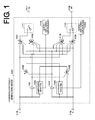
- FIG. 1 illustrates the surround component generation device according to the first embodiment of the present invention.
- the surround component generation device which is denoted by 100, is connected to an audio signal generation device (not shown), such as a CD, at input terminals 115 and 116.
- the surround component generation device 100 is also connected to amplifiers and speakers (not shown) at output terminals 117 and 118.
- the surround component generation device 100 includes multipliers 101 and 102, coefficient updaters 103 and 104 for updating coefficients of the multipliers 101 and 102, subtractors 105 and 106 for calculating differences between input signals and output signals of the multipliers 101 and 102, subtractors 107, 108, 109, and 110 for calculating output signals based on the input signals and the output signals of the multipliers 101 and 102, output switches 111 and 112 for selecting signals to be output from among the output signals of the subtractors 107, 108, 109, and 110, and output switching controllers 113 and 114 for controlling the output switches 111 and 112.
- the surround component generation device 100 may be realized with use of a digital signal processor (DSP), a microcomputer, or the like capable of digital signal processing.
- DSP digital signal processor
- microcomputer or the like capable of digital signal processing.
- an Lch signal of an audio signal is input to the input terminal 115 and an Rch signal thereof is input to the input terminal 116.
- An operation of the surround component generation device 100 relating to the Lch signal and an operation thereof relating to the Rch signal are the same, and hence the operation relating to the Lch signal is described.
- the Lch signal input to the input terminal 115 has its amplitude changed by the multiplier 101.
- the signal whose amplitude is changed by the multiplier 101 is to be inputs of the subtractor 106 and the subtractors 107, 108, 109, and 110.
- the other input of the subtractor 106 is the Rch signal input from the input terminal 116.
- the subtractor 106 subtracts the output signal of the multiplier 101 from the Rch signal and outputs the resultant signal.
- the output signal of the subtractor 106 is to be one input of the coefficient updater 103.
- the other input of the coefficient updater 103 is the Lch signal input to the input terminal 115.
- the coefficient updater 103 calculates the coefficient of the multiplier 101 based on the Lch signal and the output signal of the subtractor 106 and updates the coefficient of the multiplier 101.
- k(n+1) represents a coefficient of the multiplier 101 at the next time (when the next sample signal is input)
- k(n) represents a current coefficient of the multiplier 101
- XL represents the Lch signal input to the input terminal 115
- XR represents the Rch signal input to the input terminal 116
- ⁇ represents a constant for determining a coefficient update rate.
- (XR-k(n) ⁇ XL) is the output signal of the subtractor 106.
- the above-mentioned expression is an expression for sequentially updating the coefficient k of the multiplier 101 in order to minimize a square value of the output signal of the subtractor 106.
- a correlation between XL and XR is high, as the coefficient k of the multiplier 101 becomes closer to 1, the square value of the output signal (XR-k ⁇ XL) of the subtractor 106 becomes smaller.
- the correlation between XL and XR is low, as the coefficient k becomes closer to 0, the square value of the output signal of the subtractor 106 becomes smaller. In other words, depending on how the correlation between XL and XR is high or low, the coefficient k assumes the value of from approximately 0 to 1.
- FIGS. 5 each show an example of the value of k, which is calculated based on the above-mentioned expression by changing the correlation value between the input signals XL and XR.
- FIG. 5(a) shows a result obtained when the correlation between XL and XR is low.
- the calculated value of k is approximately 0.
- FIG. 5(b) shows a result obtained when the correlation between XL and XR is high. Similarly, the calculated value of k is approximately 1.
- FIG. 5(c) shows a result obtained when the correlation between XL and XR is changed from a high one to a low one. In this case, the value of k changes from approximately 0 to approximately 1.
- the coefficient updater 103 updates the coefficient with use of the above-mentioned expression
- the coefficient k of the multiplier 101 can be changed in accordance with the correlation between the input signals XL and XR.
- the subtractor 107 subtracts, from the Lch signal input to the input terminal 115, the output signal of the multiplier 101 and the output signal of the multiplier 102.
- the subtractor 109 subtracts, from a signal obtained by adding the Lch signal input to the input terminal 115 and the output signal of the multiplier 102, the Rch signal input to the input terminal 116 and the output signal of the multiplier 101.
- a signal SL2 calculated by the subtractor 109 is, similarly, as follows.
- SL ⁇ 2 1 - k ⁇ XL - 1 - k ⁇ XR
- the output switch 111 selects one of the output signals of the subtractors 107 and 109 and outputs the selected one to the output terminal 117.
- the output switch 111 is controlled by the output switching controller 113.
- the output switching controller 113 inputs the value of the coefficient of the multiplier 101 updated by the coefficient updater 103 and, depending on the value of the coefficient, notifies the output switch 111 of one of the output signals of the subtractors 107 and 108 to be output.
- the control of the output switching controller 113 is performed as follows.
- the control is performed so that the output signal (SL1) of the subtractor 107 is selected when k is smaller than 0.5, which is a predetermined value, and the output signal (SL2) of the subtractor 109 is selected when k is larger than 0.5, which is the predetermined value.
- the surround component is output when the correlation between XL and XR is low and the surround component is inhibited from being output when the correlation between XL and XR is high.
- the surround component is inhibited from being output when the correlation is high because, for example, when sounds having the same component are input to Lch and Rch as the input signals (monaural sound), an unnatural sound may be produced if the surround component is added to the sound.
- a reverberation component and the like are recorded in a monaural vocal component in some cases with the correlation between Lch and Rch being low, and in such cases, only the reverberation component may unnaturally be output from SL2.
- the above-mentioned expression for SL2 is used to calculate the output signal and the output signal is switched from one to another based on the value of k, which is a value determined depending on the correlation between XL and XR.
- the output signal is switched from one to another based on whether the coefficient k is larger than "0.5" as the predetermined value because the range that the coefficient k can assume is from 0 to 1 as described above and 0.5 is a median of the range, and because when the coefficient k is 0.5, the above-mentioned values of SL1 and SL2 are the same and the output signal can thus be switched from one to another in an acoustically smooth manner.
- the value of the coefficient k may be set as appropriate as long as the value of the coefficient k falls within such a range that the output signal can be switched from one to another in an acoustically smooth manner.
- the signal output to the output terminal 117 is amplified by the amplifier (not shown) connected to the output terminal 117 and output as a sound by the speaker (not shown).
- a recording device such as a hard disk recorder, may be connected to the output terminal 117.
- the output signals of the surround component generation device 100 may be used as surround L (SL) and surround R (SR) signals
- the input two-channel signals (L and R) may be output as they are as a front L (FL) signal and a front R (FR) signal
- a center (CT) signal and a woofer (WF) output may be generated separately based on the input two-channel signals.
- the (L+R) signal is output as the CT signal and the (L+R) signal subjected to a low pass filter (LPF) is output as the WF signal, it is possible to generate the CT and WF signals.
- LPF low pass filter
- the surround component generation device of the first embodiment of the present invention described above which includes the multipliers for changing the amplitudes of the 2-channel audio signals, the coefficient updaters for updating the coefficients of the multipliers based on the difference between the audio signals, the plurality of subtractors for generating the surround components based on the audio signals and the output signals of the multipliers, the output switches for selecting the surround output signals from among the outputs of the plurality of subtractors, and the output switching controllers for controlling the output switches, it is possible to calculate the value related to the correlation between the channels of the audio signals with a small amount of arithmetic operation by updating the coefficient of the multiplier, and by switching the output switch based on the coefficient of the multiplier, it is also possible to output the surround component when the correlation between the channels of the audio signals is low and inhibit the surround component from being output when the correlation is high.
- FIG. 2 illustrates a surround component generation device according to a second embodiment of the present invention.
- the surround component generation device which is denoted by 200, includes multipliers 201 and 202, coefficient updaters 203 and 204 for updating coefficients of the multipliers 201 and 202, subtractors 205 and 206 for calculating differences between input signals and output signals of the multipliers 201 and 202, a subtractor 207 for calculating a difference between the input signal input from an input terminal 209 and an output signal of the multiplier 202, and a subtractor 208 for calculating a difference between the signal input from an input terminal 210 and an output signal of the multiplier 201.
- the subtractor 207 subtracts the output of the multiplier 202 from the Lch signal input to the input terminal 209.
- the subtractor 208 subtracts the output of the multiplier 201 from the Rch signal input to the input terminal 210.
- a signal SL calculated by the subtractor 207 and a signal SR calculated by the subtractor 208 are as follows.
- This embodiment is effective in a case where, for example, when the correlation between XL and XR is high but the reverberation component with a low correlation is included in XL and XR, the reverberation component is generated as the surround component.
- the outputs of the subtractors 207 and 208 are output to output terminals 211 and 212, respectively.
- the surround component generation device of the second embodiment of the present invention described above which includes the multipliers for changing the amplitudes of the 2-channel audio signals, the coefficient updaters for updating the coefficients of the multipliers based on the difference between the audio signals, and the plurality of subtractors for generating the surround components based on the audio signals and the output signals of the multipliers, it is possible to calculate the value related to the correlation between the channels of the audio signals with a small amount of arithmetic operation by updating the coefficient of the multiplier and also possible to generate the surround components in accordance with each of the coefficients of the multipliers.
- FIG. 3 illustrates a surround component generation device according to a third embodiment of the present invention.
- the surround component generation device which is denoted by 300, includes multipliers 301 and 302, coefficient updaters 303 and 304 for updating coefficients of the multipliers 301 and 302, subtractors 305 and 306 for calculating differences between input signals and output signals of the multipliers 301 and 302, a subtractor 307 for calculating a difference between the input signal input from an input terminal 309 and an output signal of the multiplier 301, and a subtractor 308 for calculating a difference between the signal input from an input terminal 310 and an output signal of the multiplier 302.
- the subtractor 307 subtracts the output of the multiplier 301 from the Lch signal input to the input terminal 309.
- the subtractor 308 subtracts the output of the multiplier 302 from the Rch signal input to the input terminal 310.
- a signal SL calculated by the subtractor 307 and a signal SR calculated by the subtractor 308 are as follows.
- SL XL - kXL
- SR XR - kXR
- the outputs of the subtractors 307 and 308 are output to output terminals 311 and 312, respectively.
- the surround component generation device of the third embodiment of the present invention described above which includes the multipliers for changing the amplitudes of the 2-channel audio signals, the coefficient updaters for updating the coefficients of the multipliers based on the difference between the audio signals, and the plurality of subtractors for generating the surround components based on the audio signals and the output signals of the multipliers, it is possible to calculate the value related to the correlation between the channels of the audio signals with a small amount of arithmetic operation by updating the coefficient of the multiplier and also possible to generate the acoustically natural surround components in accordance with each of the coefficients of the multipliers.
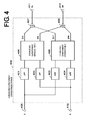
- FIG. 4 illustrates a surround component generation device according to a fourth embodiment of the present invention.
- the surround component generation device which is denoted by 400, includes LPFs 401 and 402, high pass filters (HPFs) 403 and 404, a first surround component generator 405, a second surround component generator 406, and adders 407 and 408.
- an Lch signal from the audio signal generation device (not shown), such as a CD, is input to an input terminal 409 and an Rch signal from the audio signal generation device is input to an input terminal 410.
- the Lch signal input to the input terminal 409 has its low-frequency component extracted by the LPF 401 and has its high-frequency component extracted by the HPF 403.
- the Lch signal input to the input terminal 310 has its low-frequency component extracted by the LPF 402 and has its high-frequency component extracted by the HPF 404.
- Output signals of the LPFs 401 and 402 are input to the first surround component generator 405.
- output signals of the HPFs 403 and 404 are input to the second surround component generator 406.
- Types of filters of the LPFs 401 and 402 and the HPFs 403 and 404 and cutoff frequencies (fc) thereof are selected so that a signal obtained by adding the input signal subjected to the LPF and the input signal subjected to the HPF is the original input signal.
- the signals obtained after the addition are the signals before being passed through the filters.
- any one of the surround generation devices of the first to third embodiments of the present invention is used as each of the first surround component generator 405 and the second surround component generator 406.
- the surround generation methods of the first surround component generator 405 and the second surround component generator 406 may be the same or differ from each other.
- An Lch surround component (SLL: Surround L-Low) for a low frequency band generated by the first surround component generator 405 is to be one of inputs to the adder 407.
- an Rch surround component (SRL: Surround R-Low) for a low frequency band generated by the first surround component generator 405 is to be one of inputs to the adder 408.
- an Lch surround component (SLH: Surround L-High) for a high frequency band generated by the second surround component generator 406 is to be another of the inputs to the adder 408.
- an Rch surround component (SRH: Surround R-High) for a high frequency band generated by the second surround component generator 406 is to be another of the inputs to the adder 408.
- the adder 407 adds SLL to SRL and the adder 408 adds SLH to SRH so that the resultant signals are the surround components of Lch and Rch, respectively.
- Outputs of the adders 407 and 408 are output to output terminals 411 and 412, respectively.
- the input signals are each divided into signals having different frequency bands in this manner to perform surround component generation processing because the audio signal often has a correlation different for each frequency band.
- each of the coefficients of the multipliers updated within the first surround component generator 405 or the second surround component generator 406 is a value different for each frequency band, and hence it is possible to generate the surround component in accordance with a value closer to an actual correlation value of the audio signals.
- an in-phase bass sound may be recorded in the two-channel audio signals in a low frequency band, and in a high frequency band, sounds of musical instruments that are different between left and right audio signals may be recorded.
- the audio signal is divided into signals having different frequency bands to generate the surround components, it is possible to generate the surround components utilizing such characteristics of the audio signal, and it is thus possible to generate more acoustically natural surround components.
- the surround component generation device of the fourth embodiment of the present invention described above which includes the filters for dividing the two-channel audio signals into the signals having the plurality of frequency bands, the surround component generators for updating the coefficients of the multipliers for each of the frequency bands and generating the surround components in accordance with each of the coefficients of the multipliers, and the adders for adding the surround components for each frequency band, it is possible to calculate the value related to the correlation between the channels of the audio signals with a small amount of arithmetic operation by updating the coefficient of the multiplier, and it is also possible to generate acoustically natural surround components by using the surround component generation methods different for each of the divided frequency bands.
- the surround component generation device includes: the multipliers; and the coefficient updaters for updating the coefficients of the multipliers, and generates the surround components based on the updated coefficients of the multipliers.
- the surround component generation device has such an effect that it is possible to generate the surround component with a small amount of arithmetic operation, and is useful as the surround component generation device and the like for generating the surround signals for multichannel reproduction based on the two-channel audio signals.
Landscapes
- Physics & Mathematics (AREA)
- Engineering & Computer Science (AREA)
- Acoustics & Sound (AREA)
- Signal Processing (AREA)
- Stereophonic System (AREA)
Applications Claiming Priority (2)
| Application Number | Priority Date | Filing Date | Title |
|---|---|---|---|
| JP2012021921 | 2012-02-03 | ||
| PCT/JP2013/052144 WO2013115297A1 (fr) | 2012-02-03 | 2013-01-31 | Générateur de composante d'ambiance |
Publications (2)
| Publication Number | Publication Date |
|---|---|
| EP2811763A1 true EP2811763A1 (fr) | 2014-12-10 |
| EP2811763A4 EP2811763A4 (fr) | 2015-06-17 |
Family
ID=48905329
Family Applications (1)
| Application Number | Title | Priority Date | Filing Date |
|---|---|---|---|
| EP13743492.4A Ceased EP2811763A4 (fr) | 2012-02-03 | 2013-01-31 | Générateur de composante d'ambiance |
Country Status (4)
| Country | Link |
|---|---|
| US (1) | US9538306B2 (fr) |
| EP (1) | EP2811763A4 (fr) |
| JP (1) | JP6124143B2 (fr) |
| WO (1) | WO2013115297A1 (fr) |
Families Citing this family (3)
| Publication number | Priority date | Publication date | Assignee | Title |
|---|---|---|---|---|
| US8524239B2 (en) * | 2010-07-09 | 2013-09-03 | The United States of America as represented by the Secrectary, Department of Health and Human Services | Photosensitizing antibody-fluorophore conjugates |
| CA2954463C (fr) | 2014-08-08 | 2023-11-07 | The United States Of America, As Represented By The Secretary, Department Of Health And Human Services | Elimination photo-controlee de cibles in vitro et in vivo |
| JP6905411B2 (ja) * | 2017-08-07 | 2021-07-21 | 日本放送協会 | チャンネル数変換装置及びプログラム |
Family Cites Families (17)
| Publication number | Priority date | Publication date | Assignee | Title |
|---|---|---|---|---|
| JPS5570000A (en) | 1978-11-21 | 1980-05-27 | Iwasaki Electric Co Ltd | Device for firing discharge lamp |
| JPS5770000A (en) | 1980-10-20 | 1982-04-30 | Matsushita Electric Ind Co Ltd | Stereo playback device |
| JPH05236599A (ja) | 1992-02-21 | 1993-09-10 | Clarion Co Ltd | 3スピーカの音響再生装置 |
| JP3682032B2 (ja) | 2002-05-13 | 2005-08-10 | 株式会社ダイマジック | オーディオ装置並びにその再生用プログラム |
| US7490044B2 (en) | 2004-06-08 | 2009-02-10 | Bose Corporation | Audio signal processing |
| JP4335752B2 (ja) | 2004-06-15 | 2009-09-30 | 三菱電機株式会社 | 擬似ステレオ信号生成装置および擬似ステレオ信号生成プログラム |
| JP4402636B2 (ja) * | 2005-09-20 | 2010-01-20 | アルパイン株式会社 | オーディオ装置 |
| JP4940671B2 (ja) | 2006-01-26 | 2012-05-30 | ソニー株式会社 | オーディオ信号処理装置、オーディオ信号処理方法及びオーディオ信号処理プログラム |
| JP4835298B2 (ja) * | 2006-07-21 | 2011-12-14 | ソニー株式会社 | オーディオ信号処理装置、オーディオ信号処理方法およびプログラム |
| JP4804376B2 (ja) | 2007-01-30 | 2011-11-02 | アルパイン株式会社 | オーディオ装置 |
| JP5213339B2 (ja) * | 2007-03-12 | 2013-06-19 | アルパイン株式会社 | オーディオ装置 |
| US8588427B2 (en) * | 2007-09-26 | 2013-11-19 | Frauhnhofer-Gesellschaft Zur Foerderung Der Angewandten Forschung E.V. | Apparatus and method for extracting an ambient signal in an apparatus and method for obtaining weighting coefficients for extracting an ambient signal and computer program |
| US20120045065A1 (en) * | 2009-04-17 | 2012-02-23 | Pioneer Corporation | Surround signal generating device, surround signal generating method and surround signal generating program |
| JP5430263B2 (ja) * | 2009-07-15 | 2014-02-26 | アルパイン株式会社 | オーディオ装置 |
| JP2011151633A (ja) | 2010-01-22 | 2011-08-04 | Panasonic Corp | マルチチャンネル音響再生装置 |
| WO2012035612A1 (fr) * | 2010-09-14 | 2012-03-22 | パイオニア株式会社 | Dispositif de génération de signaux ambiophoniques, procédé de génération de signaux ambiophoniques et programme de génération de signaux ambiophoniques |
| US9088858B2 (en) * | 2011-01-04 | 2015-07-21 | Dts Llc | Immersive audio rendering system |
-
2013
- 2013-01-31 US US14/373,820 patent/US9538306B2/en active Active
- 2013-01-31 WO PCT/JP2013/052144 patent/WO2013115297A1/fr not_active Ceased
- 2013-01-31 JP JP2013556489A patent/JP6124143B2/ja not_active Expired - Fee Related
- 2013-01-31 EP EP13743492.4A patent/EP2811763A4/fr not_active Ceased
Also Published As
| Publication number | Publication date |
|---|---|
| WO2013115297A1 (fr) | 2013-08-08 |
| CN104081794A (zh) | 2014-10-01 |
| JPWO2013115297A1 (ja) | 2015-05-11 |
| JP6124143B2 (ja) | 2017-05-10 |
| EP2811763A4 (fr) | 2015-06-17 |
| US20150304788A1 (en) | 2015-10-22 |
| US9538306B2 (en) | 2017-01-03 |
Similar Documents
| Publication | Publication Date | Title |
|---|---|---|
| AU2017208916B2 (en) | Audio enhancement for head-mounted speakers | |
| KR101651419B1 (ko) | 머리 전달 함수들의 선형 믹싱에 의한 머리 전달 함수 생성을 위한 방법 및 시스템 | |
| US20090180626A1 (en) | Signal processing apparatus, signal processing method, and storage medium | |
| CN108886650A (zh) | 用于音频再现的子带空间和串扰消除 | |
| JP2005354695A (ja) | オーディオ信号処理 | |
| US9538307B2 (en) | Audio signal reproduction device and audio signal reproduction method | |
| JP7370415B2 (ja) | 空間オーディオ信号のクロストーク処理のためのスペクトル欠陥補償 | |
| AU2012257865B2 (en) | Apparatus and method and computer program for generating a stereo output signal for providing additional output channels | |
| KR20220080146A (ko) | 스펙트럼적 직교 오디오 성분들을 사용하는 부대역 공간 및 크로스토크 처리 | |
| CN1863416B (zh) | 音频装置和环绕声生成方法 | |
| JP2008301427A (ja) | マルチチャンネル音声再生装置 | |
| US9538306B2 (en) | Surround component generator | |
| US9794717B2 (en) | Audio signal processing apparatus and audio signal processing method | |
| JP4970174B2 (ja) | ナレーション音声制御装置 | |
| TWI692256B (zh) | 次頻帶空間音訊增強 | |
| US20230085013A1 (en) | Multi-channel decomposition and harmonic synthesis | |
| JPWO2007129517A1 (ja) | オーディオ信号処理装置及びサラウンド信号生成方法等 | |
| CN104081794B (zh) | 环绕分量生成装置 |
Legal Events
| Date | Code | Title | Description |
|---|---|---|---|
| PUAI | Public reference made under article 153(3) epc to a published international application that has entered the european phase |
Free format text: ORIGINAL CODE: 0009012 |
|
| 17P | Request for examination filed |
Effective date: 20140818 |
|
| AK | Designated contracting states |
Kind code of ref document: A1 Designated state(s): AL AT BE BG CH CY CZ DE DK EE ES FI FR GB GR HR HU IE IS IT LI LT LU LV MC MK MT NL NO PL PT RO RS SE SI SK SM TR |
|
| AX | Request for extension of the european patent |
Extension state: BA ME |
|
| RAP1 | Party data changed (applicant data changed or rights of an application transferred) |
Owner name: PANASONIC INTELLECTUAL PROPERTY MANAGEMENT CO., LT |
|
| RAP1 | Party data changed (applicant data changed or rights of an application transferred) |
Owner name: PANASONIC INTELLECTUAL PROPERTY MANAGEMENT CO., LT |
|
| DAX | Request for extension of the european patent (deleted) | ||
| RA4 | Supplementary search report drawn up and despatched (corrected) |
Effective date: 20150520 |
|
| RIC1 | Information provided on ipc code assigned before grant |
Ipc: H04S 5/02 20060101AFI20150513BHEP |
|
| 17Q | First examination report despatched |
Effective date: 20160429 |
|
| REG | Reference to a national code |
Ref country code: DE Ref legal event code: R003 |
|
| STAA | Information on the status of an ep patent application or granted ep patent |
Free format text: STATUS: THE APPLICATION HAS BEEN REFUSED |
|
| 18R | Application refused |
Effective date: 20171215 |