EP2812573B1 - Pompe a disques avec actionneur avancé - Google Patents
Pompe a disques avec actionneur avancé Download PDFInfo
- Publication number
- EP2812573B1 EP2812573B1 EP13705539.8A EP13705539A EP2812573B1 EP 2812573 B1 EP2812573 B1 EP 2812573B1 EP 13705539 A EP13705539 A EP 13705539A EP 2812573 B1 EP2812573 B1 EP 2812573B1
- Authority
- EP
- European Patent Office
- Prior art keywords
- cavity
- pump
- actuator
- walls
- isolator
- Prior art date
- Legal status (The legal status is an assumption and is not a legal conclusion. Google has not performed a legal analysis and makes no representation as to the accuracy of the status listed.)
- Active
Links
Images








Classifications
-
- F—MECHANICAL ENGINEERING; LIGHTING; HEATING; WEAPONS; BLASTING
- F04—POSITIVE - DISPLACEMENT MACHINES FOR LIQUIDS; PUMPS FOR LIQUIDS OR ELASTIC FLUIDS
- F04B—POSITIVE-DISPLACEMENT MACHINES FOR LIQUIDS; PUMPS
- F04B19/00—Machines or pumps having pertinent characteristics not provided for in, or of interest apart from, groups F04B1/00 - F04B17/00
- F04B19/006—Micropumps
-
- F—MECHANICAL ENGINEERING; LIGHTING; HEATING; WEAPONS; BLASTING
- F04—POSITIVE - DISPLACEMENT MACHINES FOR LIQUIDS; PUMPS FOR LIQUIDS OR ELASTIC FLUIDS
- F04B—POSITIVE-DISPLACEMENT MACHINES FOR LIQUIDS; PUMPS
- F04B43/00—Machines, pumps, or pumping installations having flexible working members
- F04B43/02—Machines, pumps, or pumping installations having flexible working members having plate-like flexible members, e.g. diaphragms
- F04B43/04—Pumps having electric drive
- F04B43/043—Micropumps
- F04B43/046—Micropumps with piezoelectric drive
Definitions
- the illustrative embodiments of the invention relate generally to a pump for fluid and, more specifically, to a pump in which each pumping cavity is substantially a disc-shaped, cylindrical cavity having substantially circular end walls and a side wall and which operates via acoustic resonance of fluid within the cavity. More specifically again, the illustrative embodiments of the invention relate to a pump in which the pump actuator embodies an advanced construction bringing substantial benefit to the pump in its construction, integration into products, and operation.
- acoustic resonance it is known to use acoustic resonance to achieve fluid pumping from defined inlets and outlets. This can be achieved using a long cylindrical cavity with an acoustic driver at one end, which drives a longitudinal acoustic standing wave. In such a cylindrical cavity, the acoustic pressure wave has limited amplitude. Varying cross-section cavities, such as cone, horn-cone, bulb have been used to achieve higher amplitude pressure oscillations thereby significantly increasing the pumping effect. In such higher amplitude waves nonlinear mechanisms which result in energy dissipation are suppressed by careful cavity design. However, high amplitude acoustic resonance has not been employed within disc-shaped cavities in which radial pressure oscillations are excited until recently. International Patent Application No.
- PCT/GB2006/001487 published as WO 2006/11 1775 (the '487 Application), discloses a pump having a substantially disc-shaped cavity with a high aspect ratio, i.e., the ratio of the radius of the cavity to the height of the cavity.
- pumps described in the '487 application and the related applications listed above operates on a different physical principle to the majority of pumps described in the prior art.
- many pumps known in the art are displacement pumps, i.e. pumps in which the volume of the pumping chamber is made smaller in order to compress and expel fluids therefrom through an outlet valve and is increased in size so as to draw fluid therein through an inlet valve.
- An example of such a pump is described in DE4422743 ("Gerlach "), and further examples of displacement pumps may be found in US2004000843 , WO2005001287 , DE19539020 , and US6203291 .
- the '487 application describes a pump which operates on the principle of acoustic resonance.
- a pump in operation, pressure oscillations within the pump cavity such that the fluid is compressed within one part of the cavity while the fluid is simultaneously expanded in another part of the cavity.
- a pump does not require a change in the cavity volume in order to achieve pumping operation. Instead, its design is adapted to efficiently create, maintain, and rectify the acoustic pressure oscillations within the cavity.
- an acoustic resonance pump which has a substantially cylindrical cavity comprising a side wall closed at each end by end walls, one or more of which is a driven end wall.
- the pump also comprises an actuator that causes an oscillatory motion of the driven end wall ("displacement oscillations") in a direction substantially perpendicular to the end wall or substantially parallel to the longitudinal axis of the cylindrical cavity, referred to hereinafter as "axial oscillations" of the driven end wall.
- the axial oscillations of the driven end wall generate substantially proportional "pressure oscillations" of fluid within the cavity creating a radial pressure distribution approximating that of a Bessel function of the first kind as described in the '487 Application, such oscillations referred to hereinafter as "radial oscillations" of the fluid pressure within the cavity.
- Such a pump requires one or more valves for controlling the flow of fluid through the pump and, more specifically, valves being capable of operating at high frequencies, as it is preferable to operate the pump at frequencies beyond the range of human hearing.
- a valve is described in International Patent Application No. PCT/GB2009/050614 .
- the pump of the '613 Application comprises a pump body having a substantially cylindrical shape defining a cavity formed by a side wall closed at both ends by substantially circular end walls, at least one of the end walls being a driven end wall having a central portion and a peripheral portion adjacent the side wall, wherein the cavity contains a fluid when in use.
- the pump further comprises an actuator operatively associated with the central portion of the driven end wall to cause an oscillatory motion of the driven end wall in a direction substantially perpendicular thereto.
- the pump further comprises an isolator operatively associated with the peripheral portion of the driven end wall to reduce dampening of the displacement oscillations caused by the end wall's connection to the side wall of the cavity.
- the pump further comprises a first aperture disposed at about the centre of one of the end walls, and a second aperture disposed at any other location in the pump body, whereby the displacement oscillations generate radial oscillations of fluid pressure within the cavity of said pump body causing fluid flow through said apertures.
- the illustrative embodiment of a single-cavity pump shown in Figure 1A of the '613 Application may generate a net pressure difference across its actuator, putting stress on the bond between the isolator and the pump body and on the bond between the isolator and the actuator component. It is possible that these stresses may lead to failure of one or more of these bonds and it is therefore desirable that they should be strong in order to ensure that the pump delivers a long operational lifetime.
- the single-cavity pump shown in Figure 1A of the '613 Application requires robust electrical connection to be made to its actuator.
- a resonant acoustic pump of this kind may also be designed such that two pump cavities are driven by a common driven end wall.
- Such a two-cavity pump is advantageous as it may deliver increased flow and/or pressure when compared with a single-cavity design, and may deliver increased space, power, or cost efficiency.
- soldered wires or spring contacts may disrupt the acoustic resonance of the cavity in which they are present.
- a pump construction which achieves a strong bond between the actuator and the isolator, and which facilitates robust electrical connection to the actuator without adversely affecting the resonance of either of the cavities of a two-cavity pump is desirable.
- the invention described herein describes a combined actuator and isolator assembly which achieves these objectives.
- WO 2010/139916 discloses an acoustic resonance pump comprising an oscillating end wall.
- US 2006/0147324 A1 discloses a diaphragm pump in which a piezoelectric element causes the diaphragm to be displaced.
- the design of a combined actuator and isolator is disclosed, suitable for operation with two-cavity resonant acoustic pump designs as described herein and facilitating electrical connection to the actuator.
- the combined actuator and isolator overcomes the aforementioned limitations of the prior art while also providing improved manufacturability.
- the present invention provides a pump comprising:
- the isolator may alternatively be joined to an outer side of any of the layers of the pump.
- Fig 1A is a schematic cross-section of a two-cavity pump 10 according to the present invention.
- pump 10 comprises a first pump body having a substantially cylindrical shape including a cylindrical wall 11 closed at one end by a base 12 and closed at the other end by an end plate 41 and a ring-shaped isolator 30 disposed between the end plate 41 and the other end of the cylindrical wall 11 of the first pump body.
- the cylindrical wall 11 and base 12 may be a single component comprising the first pump body.
- Pump 10 also comprises a second pump body having a substantially cylindrical shape including a cylindrical wall 18 closed at one end by a base 19 and closed at the other end by a piezoelectric disc 42 and the ring-shaped isolator 30 disposed between the end plate 42 and the other end of the cylindrical wall 18 of the second pump body.
- the cylindrical wall 18 and base 19 may be a single component comprising the second pump body.
- the first and second pump bodies may be mounted to other components or systems.
- the internal surfaces of the cylindrical wall 11, the base 12, the end plate 41, and the isolator 30 form a first cavity 16 within the pump 10 wherein said first cavity 16 comprises a side wall 15 closed at both ends by end walls 13 and 14.
- the end wall 13 is the internal surface of the base 12 and the side wall 15 is the inside surface of the cylindrical wall 11.
- the end wall 14 comprises a central portion corresponding to a surface of the end plate 41 and a peripheral portion corresponding to a first surface of the isolator 30.
- the first cavity 16 is substantially circular in shape, the first cavity 16 may also be elliptical or other suitable shape.
- the internal surfaces of the cylindrical wall 18, the base 19, the piezoelectric disc 42, and the isolator 30 form a second cavity 23 within the pump 10 wherein said second cavity 23 comprises a side wall 22 closed at both ends by end walls 20 and 21.
- the end wall 20 is the internal surface of the base 19 and the side wall 22 is the inside surface of the cylindrical wall 18.
- the end wall 21 comprises a central portion corresponding to the inside surface of the piezoelectric disc 42 and a peripheral portion corresponding to a second surface of the isolator 30.
- the second cavity 23 is substantially circular in shape, the second cavity 23 may also be elliptical or other suitable shape.
- the cylindrical walls 11, 18 and the bases 12, 19 of the first and second pump bodies may be formed from any suitable rigid material including, without limitation, metal, ceramic, glass, or plastic.
- the pump 10 also comprises a piezoelectric disc 42 operatively connected to the end plate 41 to form an actuator 40 that is operatively associated with the central portion of the end walls 14 and 21 via the end plate 41 and the piezoelectric disc 42.
- the piezoelectric disc 42 is not required to be formed of a piezoelectric material, but may be formed of any electrically active material such as, for example, an electrostrictive or magnetostrictive material. As such, the term "piezoelectric disc” is intended to cover electrostrictive or magnetostrictive discs as well.
- the end plate 41 preferably possesses a bending stiffness similar to the piezoelectric disc 42 and may be formed of an electrically inactive material such as a metal or ceramic.
- the end plate 41 alternatively may also be formed from an electrically active material such as, for example, a piezoelectric, magnetostrictive, or electrostrictive material.
- the actuator 40 may be replaced by a single plate in force-transmitting relation with an actuation device, for example, a mechanical, magnetic or electrostatic device, wherein said plate forms the end walls 14, 21 and said plate may be formed as an electrically inactive or passive layer of material driven into oscillation by such device (not shown) in the same manner as described above.
- an actuation device for example, a mechanical, magnetic or electrostatic device, wherein said plate forms the end walls 14, 21 and said plate may be formed as an electrically inactive or passive layer of material driven into oscillation by such device (not shown) in the same manner as described above.
- the pump 10 further comprises at least two apertures extending from the first cavity 16 to the outside of the pump 10, wherein at least a first one of the apertures may contain a valve to control the flow of fluid through the aperture.
- the aperture containing a valve may be located at any position in the cavity 16 where the actuator 40 generates a pressure differential as described below in more detail
- one preferred embodiment of the pump 10 comprises an aperture with a valve located at approximately the centre of the end wall 13.
- the pump 10 shown in Figures 1A and 1B comprises a primary aperture 25 extending from the cavity 16 through the base 12 of the pump body at about the centre of the end wall 13 and containing a valve 35.
- the valve 35 is mounted within the primary aperture 25 and permits the flow of fluid in one direction as indicated by the arrow so that it functions as an outlet for the pump 10.
- the second aperture 27 may be located at any position within the cavity 11 other than the location of the aperture 25 with the valve 35. In one preferred embodiment of the pump 10, the second aperture is disposed between the centre of the end wall 13 and the side wall 15.
- the embodiment of the pump 10 shown in Figures 1A and 1B comprises two secondary apertures 27 extending from the cavity 11 through the base 12 that are disposed between the centre of the end wall 13 and the side wall 15.
- the pump 10 further comprises at least two apertures extending from the cavity 23 to the outside of the pump 10, wherein at least a first one of the apertures may contain a valve to control the flow of fluid through the aperture.
- the aperture containing a valve may be located at any position in the cavity 23 where the actuator 40 generates a pressure differential as described below in more detail
- one preferred embodiment of the pump 10 comprises an aperture with a valve located at approximately the centre of the end wall 20.
- the pump 10 shown in Figures 1A and 1B comprises a primary aperture 26 extending from the cavity 23 through the base 19 of the pump body at about the centre of the end wall 20 and containing a valve 36.
- the valve 36 is mounted within the primary aperture 26 and permits the flow of fluid in one direction as indicated by the arrow so that it functions as an outlet for the pump 10.
- the second aperture 28 may be located at any position within the cavity 23 other than the location of the aperture 26 with the valve 36. In one preferred embodiment of the pump 10, the second aperture is disposed between the centre of the end wall 20 and the side wall 22.
- the embodiment of the pump 10 shown in Figures 1A and 1B comprises two secondary apertures 28 extending from the cavity 23 through the base 19 that are disposed between the centre of the end wall 20 and the side wall 22.
- the secondary apertures 27, 28 are not valved in this embodiment of the pump 10, they may also be valved to improve performance if necessary.
- the primary apertures 25, 26 are valved so that the fluid is drawn into the cavities 16, 23 of the pump 10 through the secondary apertures 27, 28 and pumped out of the cavities 16, 23 through the primary aperture 25, 26 as indicated by the arrows.
- the valves 35 and 36 allow fluid to flow through in substantially one direction as described above.
- the valves 35 and 36 may be a ball valve, a diaphragm valve, a swing valve, a duck-bill valve, a clapper valve, a lift valve, or any other type of check valve or any other valve that allows fluid to flow substantially in only one direction.
- Some valve types may regulate fluid flow by switching between an open and closed position.
- the valves 35 and 36 must have an extremely fast response time such that they are able to open and close on a timescale significantly shorter than the timescale of the pressure variation.
- One embodiment of the valves 35 and 36 achieves this by employing an extremely light flap valve which has low inertia and consequently is able to move rapidly in response to changes in relative pressure across the valve structure.
- FIG. 2A a schematic cross-section view of one embodiment of a flap valve 50 is shown mounted within the aperture 25.
- the flap valve 50 comprises a flap 51 disposed between a retention plate 52 and a sealing plate 53 and biased against the sealing plate 53 in a "closed" position which seals the flap valve 50 when not in use, i.e., the flap valve 50 is normally closed.
- the valve 50 is mounted within the aperture 25 so that the upper surface of the retention plate 52 is preferably flush with the inner surface of the end wall 13 to maintain the resonant quality of the cavity 16.
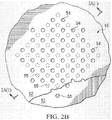
- the retention plate 52 and the sealing plate 53 both have vent holes 54 and 55 respectively that extend from one side of the plate to the other as represented by the dashed and solid circles, respectively, in Figure 2B which is a top view of the flap valve 50 of Figure 2A .
- the flap 51 also has vent holes 56 which are generally aligned with the vent holes 54 of the retention plate 52 to provide a passage through which fluid may flow as indicated by the dashed arrows in Figure 2A (1).
- the vent holes 54 of the retention plate 52 and the vent holes 56 of the flap 51 are not in alignment with the vent holes 55 of the sealing plate 53 which are blocked by the flap 51 when in the "closed" position as shown so that fluid cannot flow through the flap valve 50.
- the operation of the flap valve 50 is a function of the change in direction of the differential pressure ( ⁇ P) of the fluid across the flap valve 50.
- the differential pressure has been assigned a negative value (- ⁇ P) as indicated by the downward pointing arrow.
- This negative differential pressure (- ⁇ P) drives the flap 51 into the fully closed position as described above wherein the flap 51 is sealed against the sealing plate 53 to block the vent holes 55 and prevent the flow of fluid through the flap valve 50.
- the differential pressure across the flap valve 50 reverses to become a positive differential pressure (+ ⁇ P) as indicated by the upward pointing arrow in Figure 2A (1), the biased flap 51 is motivated away from the sealing plate 53 against the retention plate 52 into an "open" position.
- FIG. 3 the pump 10 of Figure 1 is shown with alternative configurations of its apertures.
- Figure 3A shows the pump 10 of Figure 1 in outline schematic form, indicating the locations of the inlet apertures 27 and 28 and outlet apertures 25 and 26 of the two cavities 15 and 23, together with the valves 35 and 36 located in the apertures 25 and 26 respectively.
- Figure 3B shows an alternative configuration in which the valves 35' and 36' in the primary apertures 25' and 26' of pump 60 are reversed so that the fluid is drawn into the cavities 16 and 23 through the primary apertures 25' and 26' and expelled out of the cavities 16 and 23 through the secondary apertures 27 and 28 as indicated by the arrows, thereby providing suction or a source of reduced pressure at the primary apertures 25' and 26'.
- reduced pressure generally refers to a pressure less than the ambient pressure where the pump 10 is located.
- vacuum and “negative pressure” may be used to describe the reduced pressure, the actual pressure reduction may be significantly less than the pressure reduction normally associated with a complete vacuum.
- the pressure is "negative” in the sense that it is a gauge pressure, i.e., the pressure is reduced below ambient atmospheric pressure. Unless otherwise indicated, values of pressure stated herein are gauge pressures. References to increases in reduced pressure typically refer to a decrease in absolute pressure, while decreases in reduced pressure typically refer to an increase in absolute pressure.
- Figure 3C shows a further alternative configuration in which both the primary and secondary apertures in the cavities 16 and 23 of the pump 70 are located close to the centers of the end walls of the cavities.
- both the primary and secondary apertures are valved as shown so that the fluid is drawn into the cavities 16 and 23 through the primary apertures 25" and 26" and expelled out of the cavities 16 and 23 through the secondary apertures 27" and 28".
- the two-valve configuration shown schematically in Figure 3C can enable full-wave rectification of the pressure oscillations in the cavities 16 and 23, whereas the designs shown in Figures 3A and 3B are able to deliver only half-wave rectification.
- the pump of Figure 3C is therefore able to deliver a higher differential pressure than the pumps of Figures 3A and 3B under the same drive conditions.
- Figure 3D shows a further alternative configuration in which the primary apertures in the cavities 16 and 23 of the pump 80 are located close to the centers of the end walls of the cavities and the secondary apertures 29 connect cavities 16 and 23.
- This configuration provides a convenient method of connecting the two cavities of the pump 80 in series.
- the two cavities may be considered as separate pumping units, albeit driven by the same actuator and therefore not independently controllable. These two units may be connected in series or parallel in order to deliver increased pressure or increased flow respectively through the use of an appropriate manifold.
- manifold may be incorporated into the pump body components 11, 12, 18 and 19 to facilitate assembly and to reduce the number of parts required in order to assemble the pump.
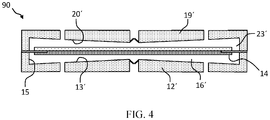
- a pump 90 according to another illustrative embodiment of the invention is shown.
- the pump 90 is substantially similar to the pump 10 of Figure 1 except that the pump body has a base 12' having an upper surface forming the end wall 13' which is frusto-conical in shape. Consequently, the height of the cavity 16' varies from the height at the side wall 15 to a smaller height between the end walls 13', 14 at the centre of the end walls 13', 14.
- the frusto-conical shape of the end wall 13' intensifies the pressure at the centre of the cavity 16' where the height of the cavity 16' is smaller relative to the pressure at the side wall 15 of the cavity 16' where the height of the cavity 16' is larger.
- the frusto-conical cavity 16' will generally have a smaller pressure amplitude at positions away from the centre of the cavity 16': the increasing height of the cavity 16' acts to reduce the amplitude of the pressure wave.
- the efficiency of the pump 90 it is advantageous to the efficiency of the pump 90 to reduce the amplitude of the pressure oscillations away from the centre of the cavity 16' by employing a frusto-conical cavity 16' design.
- the height of the cavity 16' at the side wall 15 is approximately 1.0 mm tapering to a height at the centre of the end wall 13' of approximately 0.3 mm.
- Either one of the end walls 13' or 20' may have a frusto-conical shape.
- the dimensions of the pumps described herein should preferably satisfy certain inequalities with respect to the relationship between the height (h) of the cavities 16 and 23 and the radius (a) of the cavities 16 and 23 which is the distance from the longitudinal axis of the cavity to its respective side wall 15, 22. These equations are as follows: a / h > 1.2 ; and h 2 / a > 4 ⁇ 10 ⁇ 10 meters .
- the ratio of the cavity radius to the cavity height is between about 10 and about 50 when the fluid within the cavities 16, 23 is a gas.
- the volume of the cavities 16, 23 may be less than about 10 ml.
- the ratio of h 2 /a is preferably within a range between about 10 -3 and about 10 -6 meters where the working fluid is a gas as opposed to a liquid.
- the secondary apertures 27, 28 are located where the amplitude of the pressure oscillations within the cavities 16, 23 is close to zero, i.e., the "nodal" points 19 of the pressure oscillations as indicated in Figure 1A(2) .
- the radial dependence of the pressure oscillation may be approximated by a Bessel function of the first kind and the radial node of the lowest-order pressure oscillation within the cavity occurs at a distance of between approximately 0.43a and 0.83a, and more usually close to 0.63a from the centre of the end walls 13, 20 or the longitudinal axis of the cavities 16, 23.
- the secondary apertures 27, 28 are preferably located at a radial distance (r) from the centre of the end walls 13, 20, where (r) is between approximately 0.43a and 0.83a, and more preferably close to 0.63a, i.e., close to the nodal points of the pressure oscillations.
- the pumps disclosed herein should preferably satisfy the following inequality relating the cavity radius (a) and operating frequency (f) which is the frequency at which the actuator 40 vibrates to generate the axial displacement of the end walls 14, 21.
- the frequency of the oscillatory motion of the actuator 40 is preferably about equal to the lowest resonant frequency of radial pressure oscillations in the cavities 16, 23, but may be within 20% therefrom.
- the lowest resonant frequency of radial pressure oscillations in the cavities 16, 23 is preferably greater than 500Hz.
- the piezoelectric disc 42 is excited to expand and contract in a radial direction against the end plate 41 which causes the actuator 40 to bend, thereby inducing an axial displacement of the driven end walls 14, 21 in a direction substantially perpendicular to the driven end walls 14, 21.
- the actuator 40 is operatively associated with the central portion of the end walls 14, 21 as described above so that the axial displacement oscillations of the actuator 40 cause axial displacement oscillations along the surface of the end walls 14, 21 with maximum amplitudes of oscillations, i.e., anti-node displacement oscillations, at about the centre of the end walls 14, 21.
- Figure 1A(1) shows one possible displacement profile illustrating the axial oscillation of the driven end walls 14, 21 of the cavities 16, 23.
- the solid curved line and arrows represent the displacement of the driven end walls 14, 21 at one point in time, and the dashed curved line represents the displacement of the driven end walls 14, 21 one half-cycle later.
- the displacement as shown in this figure and the other figures is exaggerated.
- the actuator 40 is not rigidly mounted at its perimeter, but rather suspended by the isolator 30, the actuator 40 is free to oscillate about its centre of mass in its fundamental mode. In this fundamental mode, the amplitude of the displacement oscillations of the actuator 40 is substantially zero at an annular displacement node 47 located between the centre of the end walls 14, 21 and the corresponding side walls 15, 22.
- a central displacement anti-node 48 exists near the centre of the actuator 40 and peripheral displacement anti-node 48' exists near the perimeter of the actuator 40.
- Figure 1A(2) shows one possible pressure oscillation profile illustrating the pressure oscillations within the cavities 16, 23 resulting from the axial displacement oscillations shown in Figure 1A(1) .
- the solid curved line and arrows represent the pressure at one point in time, and the dashed curved line represents the pressure one half-cycle later.
- the amplitude of the pressure oscillations has a central pressure anti-node 58 near the centre of the cavities 16, 23 and a peripheral pressure anti-node 58' near the side walls 15, 22 of the cavities 16, 23.
- the amplitude of the pressure oscillations is substantially zero at the annular pressure node 57 between the pressure anti-nodes 58 and 58'.
- radial dependence of the amplitude of the pressure oscillations in the cavities 16, 23 may be approximated by a Bessel function of the first kind.
- the pressure oscillations described above result from the radial movement of the fluid in the cavities 16, 23, and so will be referred to as "radial pressure oscillations" of the fluid within the cavities 16, 23 as distinguished from the axial displacement oscillations of the actuator 40.
- the radial dependence of the amplitude of the axial displacement oscillations of the actuator 40 should approximate a Bessel function of the first kind so as to match more closely the radial dependence of the amplitude of the desired pressure oscillations in the cavities 16, 23 (the “mode-shape” of the pressure oscillation).
- the mode-shape of the displacement oscillations substantially matches the mode-shape of the pressure oscillations in the cavities 16, 23, thus achieving mode-shape matching or, more simply, mode-matching.
- the axial displacement oscillations of the actuator 40 and the corresponding pressure oscillations in the cavities 16, 23 have substantially the same relative phase across the full surface of the actuator 40 wherein the radial position of the annular pressure node 57 of the pressure oscillations in the cavities 16, 23 and the radial position of the annular displacement node 47 of the axial displacement oscillations of actuator 40 are substantially coincident.
- each cavity may vary with temperature, and thus that the resonant frequency of each cavity may also vary with temperature. It may therefore be preferable to arrange for the two cavities to be of different diameters such that each cavity performs optimally at a different temperature. In this way the performance of the pump as a whole may be made more stable as a function of temperature, providing a wider useful operating temperature range.
- Figure 5A shows a schematic cross-section view of a combined actuator and isolator according to the present invention.
- the isolator 30 is sandwiched between the piezoelectric disc 42 and the end plate 41 to form a subassembly.
- the bonds between the isolator 30, end plate 41 and piezoelectric disc 42 may be formed by any suitable method including without limitation gluing.
- the fact that the isolator 30 is held between the piezoelectric disc 42 and the end plate 41 makes the connection between the isolator and these two parts extremely strong, which is important where there may be a pressure difference across the assembly as described earlier herein.
- FIG. 6 shows a schematic exploded cross-section view of a combined actuator and isolator according to the present invention which includes provision for electrical connection to be made to the actuator.
- the piezoelectric disc 420 has metal electrodes 421 and 422 on its upper and lower surfaces and the upper electrode 421 is "wrapped" around the edge of the actuator in at least one location around its circumference to bring a portion of the upper electrode 421 onto the lower surface of the piezoelectric disc 420.
- a voltage is applied across the electrodes 421 and 422 resulting in an electric field being set up between the upper electrode 421 and the lower electrode 422 in a substantially axial direction.
- the piezoelectric disc 420 is polarized such that the axial electric field causes the piezoelectric disc 420 to expand or contract in a radial direction depending on the sign of the electric field applied.
- the wrap electrode 423 is present on the lower surface of the piezoelectric disc 420 no such axial field will be created and the effectiveness of the actuator is reduced. For this reason the wrap electrode 423 should not extend over a significant part of the lower surface of the piezoelectric disc 420.
- the isolator 300 is comprised of a flexible, electrically non-conductive core 303 with conductive electrodes 301 and 302 on its upper and lower surfaces.
- the upper electrode 301 connects with the wrap electrode 423 and thereby with the upper electrode 421 of the piezoelectric disc 420.
- the lower electrode 302 connects with the end plate 410 and thereby with the lower electrode 422 of the piezoelectric disc 420.
- the end plate 410 should be formed from an electrically conductive material.
- the actuator 40 comprises a steel or aluminium end plate 410 of between 5 mm and 20 mm radius and between 0.1 mm and 3 mm thickness bonded to a piezoceramic disc 420 of similar dimensions
- the isolator core 303 is a formed from polyimide with a thickness of between 5 microns and 200 microns and the upper and lower isolator electrodes are formed from copper having a thickness of between 3 microns and 50 microns.
- the actuator 40 comprises a steel or aluminium end plate 410 of around 10 mm radius and around 0.5 mm thickness bonded to a piezoceramic disc 420 of similar dimensions
- the isolator core 303 is a formed from polyimide with a thickness of around 25 microns and the upper and lower isolator electrodes are formed from copper having a thickness of around 9 microns. Further “capping" layers of polyimide (not shown) may be applied selectively to the isolator to insulate the electrodes and to provide robustness.
- Figure 7A shows a plan view of the isolator included in Figure 6 , showing a possible configuration of its upper electrode.
- the upper electrode 301 is patterned such to leave windows 311 in the electrode layer where the isolator flexes between the outside edge of the actuator 40 and the side walls 15 and 22. These windows locally reduce the stiffness of the isolator, enabling it to bend more readily and thereby reducing any damping effect that the electrode layer might otherwise have on the motion of the actuator 40.
- An inner ring element 313 of the electrode 301 enables connection to the piezoelectric disc wrap electrode 423.
- the inner ring 313 is connected to an outer ring 314 by four sections 312.
- a further part 315 of the electrode 301 extends along a "tail" 310 to facilitate connection of the pump to a drive circuit.
- the lower electrode 302 may be similarly configured and the electrode patterns 302 and 301 may in fact be the same.
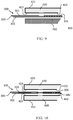
- Figures 7B and 7C show cross-sections through the combined actuator and isolator assembly shown in Figure 6 , including mounting of the isolator between the pump body components 11 and 18.
- Figure 7B shows a section through a region including a window 311.
- Figure 7C shows a section through a region including electrode sections 312. Note that, as indicated in Figure 7C , the equivalent sections on the lower electrode have been offset azimuthally, for example by 45°, such that the isolator is not made stiffer by the presence of both at the same azimuthal position.
- the isolator 30 may be glued, welded, clamped, or otherwise attached to the pump body components 11 and 18. All such methods are included in the terms "retained", "bonded” or “bond” used in the specification.
- Figure 8A shows a plan view of an alternative isolator according to the present invention sowing both upper and lower electrodes.
- the electrodes are again patterned such to leave windows in the electrode layers where the isolator flexes between the outside edge of the actuator and the side walls of the cavity.
- the inner ring element 313 of the upper electrode is offset from the inner ring element 313' of the lower electrode.
- the flexing of the isolator between the outside edge of the actuator and the side walls of the cavity is nowhere impeded by electrodes layers being present simultaneously on both sides of the isolator.
- Figure 8B shows a further advantage of the isolator design shown in Figure 8A .
- the height of the step in the plate 41 may be reduced such that the isolator is forced to flex as indicated when the plates 41 and 42 are glued together. This may be advantageous to ensuring the intimate contact of and good electrical connection between the various electrodes.
- the isolator 300 comprising core 303 and upper and lower electrodes 301 and 302 and further "capping" layers (not shown) may be conveniently formed using conventional flexible printed circuit board manufacturing techniques in which copper (or other conductive material) tracks are formed on a polyimide (such as Kapton) or other flexible non-conductive substrate material. Such conventional processes are capable of producing parts with the preferred dimensions listed above.
- the diameter of the piezoelectric disc 42 and the end plate 41 may be 1-2 mm less than the diameter of the cavities 16 and 23 such that the isolator 30 spans the peripheral portion of the end walls 14 and 21.
- the peripheral portion may be an annular gap of 0.5-1.0 mm between the edge of the actuator 40 and the side walls 15 and 22 of the cavities 16 and 23.
- the annular width of this gap should be relatively small compared to the cavity radius (a) such that the actuator diameter is close to the cavity diameter so that the diameter of the annular displacement node 47 is approximately equal to the diameter of the annular pressure node 57, while being large enough to facilitate and not restrict the vibrations of the actuator 40.
- FIG. 9 An alternative embodiment of the present invention is shown in Figure 9 .
- the isolator 300 extends fully between the piezoelectric disc 42 and the end plate 41.
- the isolator 300 is again comprised of a flexible, electrically non-conductive core 303 with conductive electrodes 301 and 302 on its upper and lower surfaces.
- the upper electrode 301 again connects with the wrap electrode 423 and thereby with the upper electrode 421 of the piezoelectric disc 420.
- the lower electrode 302 connects, for example by using vias (as indicated by the short black vertical lines in the Figure linking electrodes 302 and 304), through the isolator core 303 with an electrode 304 on the upper surface of the isolator and thereby with the lower electrode 422 of the piezoelectric disc 420.
- the end plate 410 there is no need for the end plate 410 to be formed from an electrically conductive material. This construction has the advantages that the design of the end plate 410 is simplified, and connection between the electrode 302 and the lower piezoelectric disc electrode 422 may be more reliably achieved.
- Figure 10 shows a further embodiment of the present invention in which a combined actuator and isolator assembly comprises two piezoelectric elements and an isolator.
- the upper electrode 421 of the upper piezoelectric disc 420 is electrically connected to the electrode 301 via wrap electrode 423.
- the lower electrode 431 of the lower piezoelectric disc 430 is electrically connected to the electrode 302 via wrap electrode 433.
- the lower electrode 422 of the upper piezoelectric disc 420 is connected to the upper electrode 432 of the lower piezoelectric disc 432 by electrodes 307 and 306 which form part of the isolator part 300 and are connected together through the isolator core 303 by electrically conductive "vias".
- the two piezoelectric discs are connected electrically in series and their polarizations must be opposite in order for the actuator to operate in the desired mode.
- the isolator design is it possible to extend the electrode 306 and 307 along the tail 310 so as to enable electrical connection to a drive circuit and thereby to enable the two piezoelectric discs 420 and 430 to be driven in parallel. This configuration may be advantageous in requiring a lower drive voltage for the same amplitude of motion of the actuator.
- the side walls 15, 22 extend continuously between the end walls 13, 20 of the cavities 16, 23, and the radius of the actuator 40 (a act ) is less than the radius of the cavities 16, 23 (a).
- the side walls 15, 22 define uninterrupted surfaces from which the radial acoustic standing waves formed in the cavities 16, 23 are reflected during operation.
- the radius of the actuator 40 (a act ) it may be desirable for the radius of the actuator 40 (a act ) to extend all the way to the side walls 15, 22 making it about equal to the radius of the cavity (r) to ensure that the annular displacement node 47 of the displacement oscillations is more closely aligned with the annular pressure node 57 of the pressure oscillations so as to maintain more closely the mode-matching condition described above.
- the actuator 40 has a similar radius to the diameter of the cavities 16, 23 and is supported by an isolator 30. Because the isolator 30 must enable the edge of the actuator 40 to move freely as it bends in response to the vibration of the actuator 40, the cylindrical walls 11' and 18' of the pump body comprise annular steps 111 and 181 in the surfaces of the cylindrical walls 11' and 18' extending radially outward from the side walls 15, 22 to annular edges 112 and 182.
- the annular steps 111 and 181 are cut sufficiently deep into the surfaces of the cylindrical walls 11' and 18' so as not to interfere with the bending of the isolator 30 to enable the actuator 40 to vibrate freely, but not so deep as to significantly diminish the resonant quality of the cavities 16, 23 referred to above.
- the depth of the steps 111 and 181 are preferably minimized.
- the depth of the steps 111 and 181 may be sized to maintain so far as possible the resonant qualities of the pump cavities 16 and 23.
- the depth of the steps 111 and 181 may be less than or equal to 10% of the height of the cavities 16 and 23.
- Figure 12 shows yet another embodiment of the present invention in which the pump has just one cavity.
- the combined actuator and isolator construction continues to provide the benefits of forming a strong bond between the actuator and the isolator, and of facilitating electrical connection to the actuator.
- Figure 13 shows yet another embodiment of the present invention in which the isolator 30 is no longer sandwiched between the piezoelectric plate 42 and the end plate 41, but instead bonded to the other, outer, side of the end plate 41.
- isolator 30 may additionally or alternatively be bonded to an outer side of the piezoelectric plate 42. While this construction may provide reduced strength of the isolator to actuator bond, it may facilitate electrical connection to the actuator in the manner described above where the piezoelectric disc includes an appropriately designed wrap electrode.
Landscapes
- Engineering & Computer Science (AREA)
- Mechanical Engineering (AREA)
- General Engineering & Computer Science (AREA)
- Reciprocating Pumps (AREA)
Claims (15)
- Pompe comprenant:un corps de pompe ayant des parois de pompe (11, 12, 18, 19) avec une première cavité de forme sensiblement cylindrique (23) ayant une paroi latérale (22) fermée par deux parois d'extrémité (20, 21) pour contenir un fluide, la première cavité (23) ayant une hauteur (h) et un rayon (a), dans laquelle le rapport entre le rayon a et la hauteur h satisfait l'inégalité a/h > 1,2 ;un actionneur (40) associé opérationnellement à une portion centrale d'une première (21) des deux parois d'extrémité de la première cavité (23) et adapté pour provoquer un mouvement oscillatoire de ladite première paroi d'extrémité (21) à une fréquence (f) générant ainsi des oscillations de pression radiales du fluide au sein de la première cavité (23) comportant au moins un noeud de pression annulaire en réponse à un signal d'attaque appliqué audit actionneur (40) ;une première ouverture (26) disposée à un emplacement dans l'une des deux parois d'extrémité de la première cavité (23) et s'étendant à travers l'une des parois de pompe (11, 12, 18, 19) ;une seconde ouverture (28) disposée à tout emplacement dans l'une des deux parois d'extrémité ou l'une des parois de côté (22) de la première cavité (23) autre que l'emplacement de la première ouverture (26) et s'étendant à travers l'une des parois de pompe ; etune première soupape (36) disposée dans l'une des première (26) et seconde (28) ouvertures pour permettre au fluide de s'écouler à travers la première cavité (23) en utilisation ; etcaractérisée par :un isolateur (30) formant au moins une portion de ladite première paroi d'extrémité (21) entre l'actionneur (40) et la paroi latérale (22) et comportant des pistes conductrices (301, 302)dans laquelle une connexion électrique est réalisée avec l'actionneur (40) via lesdites pistes conductrices (301, 302).
- Pompe selon la revendication 1, comprenant en outre :une seconde cavité de forme sensiblement cylindrique (16) ayant une paroi latérale (15) fermée par deux parois d'extrémité (13, 14) pour contenir un fluide, la seconde cavité (16) ayant une hauteur (h) et un rayon (a), dans laquelle un rapport entre le rayon (a) et la hauteur (h) est supérieur à environ 1,2 ;une première ouverture (25) disposée à un emplacement dans l'une des deux parois d'extrémité de la seconde cavité (16) et s'étendant à travers l'une des parois de pompe (11, 12, 18, 19) ;une seconde ouverture (27) disposée à tout emplacement dans l'une des deux parois d'extrémité ou l'une des parois latérales (15) de la seconde cavité (16) autre que l'emplacement de la première ouverture et s'étendant à travers l'une des parois de pompe (11, 12, 18, 19) ; etune première soupape (35) disposée dans l'une des première (25) et seconde (27) ouvertures pour permettre au fluide de s'écouler à travers la seconde cavité (16) en utilisation ; etun isolateur (30) formant au moins une portion de la première paroi d'extrémité (14) entre l'actionneur (40) et la paroi de côté (15) et comportant des pistes conductrices (301, 302)dans laquelle l'actionneur (40) est associé opérationnellement à une portion centrale d'une première (14) des deux parois d'extrémité de la seconde cavité et adapté pour provoquer un mouvement oscillatoire de ladite première paroi d'extrémité (14) à une fréquence (f) générant ainsi des oscillations de pression radiales du fluide au sein de la seconde cavité (16) comportant au moins un noeud de pression annulaire en réponse à un signal d'attaque appliqué audit actionneur (40).
- Pompe selon l'une quelconque des revendications précédentes, dans laquelle l'actionneur (40) comprend deux couches (41, 42).
- Pompe selon la revendication 3, dans laquelle la pompe comporte une première couche (41) qui est active et une seconde couche (42) qui est passive.
- Pompe selon la revendication 3, dans laquelle les deux couches sont des couches actives (41, 42).
- Pompe selon l'une quelconque des revendications précédentes, dans laquelle l'isolateur (30) est retenu entre les première (41) et seconde (42) couches, ou dans laquelle l'isolateur (30) est assemblé à un côté externe de l'une ou l'autre des première (41) et seconde (42) couches.
- Pompe selon la revendication 3, dans laquelle les couches (41, 42) sont un disque piézoélectrique et soit une plaque d'extrémité soit un autre disque piézoélectrique.
- Pompe selon la revendication 7, dans laquelle le disque piézoélectrique est formé à partir de l'un d'un matériau piézoélectrique ou d'un matériau électrostrictif ou magnétostrictif.
- Pompe selon l'une quelconque des revendications précédentes, dans laquelle le diamètre de l'actionneur (40) est inférieur au(x) diamètre(s) de cavité, et où la ou les parois latérales de cavité s'étendent en continu entre les parois d'extrémité de cavité.
- Pompe selon la revendication 1, dans laquelle un évidement ou des évidements sont prévus dans le corps de pompe de sorte que l'isolateur (30) soit libre de se déplacer entre le bord externe de l'actionneur (40) et son raccordement à la paroi latérale.
- Pompe selon l'une quelconque des revendications précédentes, dans laquelle, en utilisation, le mouvement de la paroi ou des parois d'extrémité entraînées (14, 21) et les oscillations de pression dans la cavité ou les cavités sont adaptés en forme de mode et la fréquence du mouvement oscillatoire est dans la limite de 20 % de la fréquence résonante la plus faible d'oscillations de pression radiales dans chaque cavité.
- Pompe selon l'une quelconque des revendications précédentes, dans laquelle, en utilisation, la fréquence du mouvement oscillatoire est égale à la fréquence résonante la plus faible d'oscillations de pression radiales dans chaque cavité (23, 16).
- Pompe selon l'une quelconque des revendications précédentes, dans laquelle, en utilisation, la fréquence résonante la plus faible d'oscillations de pression de fluide radiales dans chaque cavité (23, 16) est supérieure à 500 Hz.
- Pompe selon l'une quelconque des revendications précédentes, dans laquelle le mouvement de paroi d'extrémité est adapté en forme de mode à l'oscillation de pression dans chaque cavité (23, 16).
- Pompe selon l'une quelconque des revendications précédentes, dans laquelle toutes les ouvertures sans soupape dans les parois de cavité sont situées à une distance entre 0,43 a et 0,83 a, de manière davantage préférée à 0,63 a du centre de chaque cavité, où a est le rayon de cavité de cette cavité (23, 16).
Applications Claiming Priority (2)
| Application Number | Priority Date | Filing Date | Title |
|---|---|---|---|
| GBGB1202346.1A GB201202346D0 (en) | 2012-02-10 | 2012-02-10 | Disc pump with advanced actuator |
| PCT/GB2013/050306 WO2013117945A1 (fr) | 2012-02-10 | 2013-02-11 | Pompe à disque avec actionneur avancé |
Publications (2)
| Publication Number | Publication Date |
|---|---|
| EP2812573A1 EP2812573A1 (fr) | 2014-12-17 |
| EP2812573B1 true EP2812573B1 (fr) | 2017-08-23 |
Family
ID=45929946
Family Applications (1)
| Application Number | Title | Priority Date | Filing Date |
|---|---|---|---|
| EP13705539.8A Active EP2812573B1 (fr) | 2012-02-10 | 2013-02-11 | Pompe a disques avec actionneur avancé |
Country Status (4)
| Country | Link |
|---|---|
| US (1) | US10087923B2 (fr) |
| EP (1) | EP2812573B1 (fr) |
| GB (1) | GB201202346D0 (fr) |
| WO (1) | WO2013117945A1 (fr) |
Families Citing this family (31)
| Publication number | Priority date | Publication date | Assignee | Title |
|---|---|---|---|---|
| US7553295B2 (en) | 2002-06-17 | 2009-06-30 | Iradimed Corporation | Liquid infusion apparatus |
| US7753894B2 (en) | 2004-04-27 | 2010-07-13 | Smith & Nephew Plc | Wound cleansing apparatus with stress |
| US8105282B2 (en) | 2007-07-13 | 2012-01-31 | Iradimed Corporation | System and method for communication with an infusion device |
| HUE043133T2 (hu) | 2007-11-21 | 2019-07-29 | Smith & Nephew | Sebkötözés |
| US9084845B2 (en) | 2011-11-02 | 2015-07-21 | Smith & Nephew Plc | Reduced pressure therapy apparatuses and methods of using same |
| EP2836711A1 (fr) | 2012-03-07 | 2015-02-18 | KCI Licensing, Inc. | Pompe à disques avec actionneur avancé |
| CN104507513B (zh) | 2012-03-20 | 2017-04-12 | 史密夫及内修公开有限公司 | 基于动态占空比阈值确定的减压治疗系统的控制操作 |
| US9427505B2 (en) | 2012-05-15 | 2016-08-30 | Smith & Nephew Plc | Negative pressure wound therapy apparatus |
| GB201322103D0 (en) * | 2013-12-13 | 2014-01-29 | The Technology Partnership Plc | Fluid pump |
| CN106062364B (zh) * | 2014-02-21 | 2018-03-13 | 株式会社村田制作所 | 鼓风机 |
| WO2015125843A1 (fr) * | 2014-02-21 | 2015-08-27 | 株式会社村田製作所 | Dispositif de commande de fluide et pompe |
| JP6065160B2 (ja) * | 2014-05-20 | 2017-01-25 | 株式会社村田製作所 | ブロア |
| JPWO2016063711A1 (ja) * | 2014-10-23 | 2017-07-27 | 株式会社村田製作所 | バルブ、流体制御装置 |
| SG11201704255WA (en) | 2014-12-22 | 2017-07-28 | Smith & Nephew | Negative pressure wound therapy apparatus and methods |
| JP6183574B2 (ja) * | 2015-04-27 | 2017-08-23 | 株式会社村田製作所 | ポンプ |
| JP6269907B1 (ja) * | 2016-07-29 | 2018-01-31 | 株式会社村田製作所 | バルブ、気体制御装置 |
| CN109899327B (zh) * | 2017-12-07 | 2021-09-21 | 昆山纬绩资通有限公司 | 气流产生装置 |
| US11268506B2 (en) | 2017-12-22 | 2022-03-08 | Iradimed Corporation | Fluid pumps for use in MRI environment |
| WO2019138675A1 (fr) | 2018-01-10 | 2019-07-18 | 株式会社村田製作所 | Pompe et dispositif de régulation de fluide |
| WO2019230159A1 (fr) * | 2018-05-31 | 2019-12-05 | 株式会社村田製作所 | Pompe |
| GB2575829B (en) * | 2018-07-24 | 2020-11-25 | Ttp Ventus Ltd | Fluid pump assembly |
| GB2577710B (en) | 2018-10-03 | 2022-12-14 | Lee Ventus Ltd | Methods and devices for driving a piezoelectric pump |
| CN112789407B (zh) | 2018-11-27 | 2023-02-03 | 株式会社村田制作所 | 泵 |
| EP3891398B1 (fr) | 2018-12-07 | 2023-01-04 | Lee Ventus Limited | Vanne améliorée |
| GB2576796B (en) | 2018-12-07 | 2020-10-07 | Ttp Ventus Ltd | Improved valve |
| WO2020195036A1 (fr) | 2019-03-27 | 2020-10-01 | 株式会社村田製作所 | Pompe piézoélectrique |
| GB2594826B (en) * | 2019-03-27 | 2022-10-12 | Murata Manufacturing Co | Piezoelectric pump |
| GB2595783B (en) * | 2019-03-27 | 2022-10-12 | Murata Manufacturing Co | Piezoelectric pump |
| GB2583880A (en) | 2020-07-31 | 2020-11-11 | Ttp Ventus Ltd | Actuator for a resonant acoustic pump |
| GB2597942B (en) * | 2020-08-10 | 2022-08-03 | Ttp Ventus Ltd | Pump for microfluidic device |
| CN116576146B (zh) * | 2023-05-22 | 2026-02-24 | 吉林大学 | 多腔圆盘型压电气泵 |
Family Cites Families (19)
| Publication number | Priority date | Publication date | Assignee | Title |
|---|---|---|---|---|
| SE508435C2 (sv) | 1993-02-23 | 1998-10-05 | Erik Stemme | Förträngningspump av membranpumptyp |
| DE4422743A1 (de) | 1994-06-29 | 1996-01-04 | Torsten Gerlach | Mikropumpe |
| DE19539020C2 (de) | 1995-10-19 | 1999-04-22 | Siemens Ag | Pumpe zur Förderung gasförmiger oder flüssiger Medien |
| GB9710530D0 (en) * | 1997-05-23 | 1997-07-16 | Xaar Ltd | Droplet deposition apparatus and methods of manufacture thereof |
| US7198250B2 (en) | 2000-09-18 | 2007-04-03 | Par Technologies, Llc | Piezoelectric actuator and pump using same |
| US7889877B2 (en) * | 2003-06-30 | 2011-02-15 | Nxp B.V. | Device for generating a medium stream |
| WO2005001287A1 (fr) | 2003-06-30 | 2005-01-06 | Koninklijke Philips Electronics N.V. | Dispositif pour produire un flux de milieu |
| US7258533B2 (en) | 2004-12-30 | 2007-08-21 | Adaptivenergy, Llc | Method and apparatus for scavenging energy during pump operation |
| GB0508194D0 (en) | 2005-04-22 | 2005-06-01 | The Technology Partnership Plc | Pump |
| WO2007030750A1 (fr) * | 2005-09-09 | 2007-03-15 | Board Of Trustees Of The University Of Illinois | Micropompe mems sans clapet double enceinte |
| JP2008038829A (ja) * | 2006-08-09 | 2008-02-21 | Alps Electric Co Ltd | 圧電ポンプ及び圧電振動子 |
| GB0804739D0 (en) | 2008-03-14 | 2008-04-16 | The Technology Partnership Plc | Pump |
| WO2010139917A1 (fr) | 2009-06-03 | 2010-12-09 | The Technology Partnership Plc | Soupape |
| EP2438302B1 (fr) * | 2009-06-03 | 2015-09-23 | The Technology Partnership PLC | Pompe a cavite en forme de disque |
| RU2011154213A (ru) | 2009-06-03 | 2013-07-20 | ДЗЕ ТЕКНОЛОДЖИ ПАРТНЕРШИП ПиЭлСи | Гидравлический дисковый насос |
| FR2952628A1 (fr) * | 2009-11-13 | 2011-05-20 | Commissariat Energie Atomique | Procede de fabrication d'au moins une micropompe a membrane deformable et micropompe a membrane deformable |
| US8371829B2 (en) | 2010-02-03 | 2013-02-12 | Kci Licensing, Inc. | Fluid disc pump with square-wave driver |
| GB201001740D0 (en) | 2010-02-03 | 2010-03-24 | The Technology Partnership Plc | Disc pump and valve structure |
| EP2836711A1 (fr) * | 2012-03-07 | 2015-02-18 | KCI Licensing, Inc. | Pompe à disques avec actionneur avancé |
-
2012
- 2012-02-10 GB GBGB1202346.1A patent/GB201202346D0/en not_active Ceased
-
2013
- 2013-02-11 US US14/377,366 patent/US10087923B2/en active Active
- 2013-02-11 WO PCT/GB2013/050306 patent/WO2013117945A1/fr not_active Ceased
- 2013-02-11 EP EP13705539.8A patent/EP2812573B1/fr active Active
Non-Patent Citations (1)
| Title |
|---|
| None * |
Also Published As
| Publication number | Publication date |
|---|---|
| US10087923B2 (en) | 2018-10-02 |
| GB201202346D0 (en) | 2012-03-28 |
| WO2013117945A1 (fr) | 2013-08-15 |
| EP2812573A1 (fr) | 2014-12-17 |
| US20150023821A1 (en) | 2015-01-22 |
Similar Documents
| Publication | Publication Date | Title |
|---|---|---|
| EP2812573B1 (fr) | Pompe a disques avec actionneur avancé | |
| US10900480B2 (en) | Disc pump with advanced actuator | |
| US12331759B2 (en) | Method of making an actuator for a resonant acoustic pump | |
| EP2438301B1 (fr) | Pompe a disques | |
| AU2009347422B2 (en) | Pump with disc-shaped cavity | |
| EP2670982B1 (fr) | Pompe | |
| US8821134B2 (en) | Fluid disc pump | |
| US8297947B2 (en) | Fluid disc pump | |
| WO2011095795A1 (fr) | Pompe à membrane et structure de valve |
Legal Events
| Date | Code | Title | Description |
|---|---|---|---|
| PUAI | Public reference made under article 153(3) epc to a published international application that has entered the european phase |
Free format text: ORIGINAL CODE: 0009012 |
|
| 17P | Request for examination filed |
Effective date: 20140806 |
|
| AK | Designated contracting states |
Kind code of ref document: A1 Designated state(s): AL AT BE BG CH CY CZ DE DK EE ES FI FR GB GR HR HU IE IS IT LI LT LU LV MC MK MT NL NO PL PT RO RS SE SI SK SM TR |
|
| AX | Request for extension of the european patent |
Extension state: BA ME |
|
| DAX | Request for extension of the european patent (deleted) | ||
| GRAP | Despatch of communication of intention to grant a patent |
Free format text: ORIGINAL CODE: EPIDOSNIGR1 |
|
| INTG | Intention to grant announced |
Effective date: 20170322 |
|
| RAP1 | Party data changed (applicant data changed or rights of an application transferred) |
Owner name: THE TECHNOLOGY PARTNERSHIP PLC |
|
| GRAS | Grant fee paid |
Free format text: ORIGINAL CODE: EPIDOSNIGR3 |
|
| GRAA | (expected) grant |
Free format text: ORIGINAL CODE: 0009210 |
|
| AK | Designated contracting states |
Kind code of ref document: B1 Designated state(s): AL AT BE BG CH CY CZ DE DK EE ES FI FR GB GR HR HU IE IS IT LI LT LU LV MC MK MT NL NO PL PT RO RS SE SI SK SM TR |
|
| REG | Reference to a national code |
Ref country code: GB Ref legal event code: FG4D |
|
| REG | Reference to a national code |
Ref country code: CH Ref legal event code: EP |
|
| REG | Reference to a national code |
Ref country code: AT Ref legal event code: REF Ref document number: 921642 Country of ref document: AT Kind code of ref document: T Effective date: 20170915 |
|
| REG | Reference to a national code |
Ref country code: IE Ref legal event code: FG4D |
|
| REG | Reference to a national code |
Ref country code: DE Ref legal event code: R096 Ref document number: 602013025403 Country of ref document: DE |
|
| REG | Reference to a national code |
Ref country code: NL Ref legal event code: MP Effective date: 20170823 |
|
| REG | Reference to a national code |
Ref country code: LT Ref legal event code: MG4D |
|
| REG | Reference to a national code |
Ref country code: AT Ref legal event code: MK05 Ref document number: 921642 Country of ref document: AT Kind code of ref document: T Effective date: 20170823 |
|
| PG25 | Lapsed in a contracting state [announced via postgrant information from national office to epo] |
Ref country code: HR Free format text: LAPSE BECAUSE OF FAILURE TO SUBMIT A TRANSLATION OF THE DESCRIPTION OR TO PAY THE FEE WITHIN THE PRESCRIBED TIME-LIMIT Effective date: 20170823 Ref country code: SE Free format text: LAPSE BECAUSE OF FAILURE TO SUBMIT A TRANSLATION OF THE DESCRIPTION OR TO PAY THE FEE WITHIN THE PRESCRIBED TIME-LIMIT Effective date: 20170823 Ref country code: NO Free format text: LAPSE BECAUSE OF FAILURE TO SUBMIT A TRANSLATION OF THE DESCRIPTION OR TO PAY THE FEE WITHIN THE PRESCRIBED TIME-LIMIT Effective date: 20171123 Ref country code: FI Free format text: LAPSE BECAUSE OF FAILURE TO SUBMIT A TRANSLATION OF THE DESCRIPTION OR TO PAY THE FEE WITHIN THE PRESCRIBED TIME-LIMIT Effective date: 20170823 Ref country code: LT Free format text: LAPSE BECAUSE OF FAILURE TO SUBMIT A TRANSLATION OF THE DESCRIPTION OR TO PAY THE FEE WITHIN THE PRESCRIBED TIME-LIMIT Effective date: 20170823 Ref country code: NL Free format text: LAPSE BECAUSE OF FAILURE TO SUBMIT A TRANSLATION OF THE DESCRIPTION OR TO PAY THE FEE WITHIN THE PRESCRIBED TIME-LIMIT Effective date: 20170823 Ref country code: AT Free format text: LAPSE BECAUSE OF FAILURE TO SUBMIT A TRANSLATION OF THE DESCRIPTION OR TO PAY THE FEE WITHIN THE PRESCRIBED TIME-LIMIT Effective date: 20170823 |
|
| REG | Reference to a national code |
Ref country code: FR Ref legal event code: PLFP Year of fee payment: 6 |
|
| PG25 | Lapsed in a contracting state [announced via postgrant information from national office to epo] |
Ref country code: ES Free format text: LAPSE BECAUSE OF FAILURE TO SUBMIT A TRANSLATION OF THE DESCRIPTION OR TO PAY THE FEE WITHIN THE PRESCRIBED TIME-LIMIT Effective date: 20170823 Ref country code: PL Free format text: LAPSE BECAUSE OF FAILURE TO SUBMIT A TRANSLATION OF THE DESCRIPTION OR TO PAY THE FEE WITHIN THE PRESCRIBED TIME-LIMIT Effective date: 20170823 Ref country code: GR Free format text: LAPSE BECAUSE OF FAILURE TO SUBMIT A TRANSLATION OF THE DESCRIPTION OR TO PAY THE FEE WITHIN THE PRESCRIBED TIME-LIMIT Effective date: 20171124 Ref country code: RS Free format text: LAPSE BECAUSE OF FAILURE TO SUBMIT A TRANSLATION OF THE DESCRIPTION OR TO PAY THE FEE WITHIN THE PRESCRIBED TIME-LIMIT Effective date: 20170823 Ref country code: IS Free format text: LAPSE BECAUSE OF FAILURE TO SUBMIT A TRANSLATION OF THE DESCRIPTION OR TO PAY THE FEE WITHIN THE PRESCRIBED TIME-LIMIT Effective date: 20171223 Ref country code: LV Free format text: LAPSE BECAUSE OF FAILURE TO SUBMIT A TRANSLATION OF THE DESCRIPTION OR TO PAY THE FEE WITHIN THE PRESCRIBED TIME-LIMIT Effective date: 20170823 Ref country code: BG Free format text: LAPSE BECAUSE OF FAILURE TO SUBMIT A TRANSLATION OF THE DESCRIPTION OR TO PAY THE FEE WITHIN THE PRESCRIBED TIME-LIMIT Effective date: 20171123 |
|
| PG25 | Lapsed in a contracting state [announced via postgrant information from national office to epo] |
Ref country code: DK Free format text: LAPSE BECAUSE OF FAILURE TO SUBMIT A TRANSLATION OF THE DESCRIPTION OR TO PAY THE FEE WITHIN THE PRESCRIBED TIME-LIMIT Effective date: 20170823 Ref country code: CZ Free format text: LAPSE BECAUSE OF FAILURE TO SUBMIT A TRANSLATION OF THE DESCRIPTION OR TO PAY THE FEE WITHIN THE PRESCRIBED TIME-LIMIT Effective date: 20170823 Ref country code: RO Free format text: LAPSE BECAUSE OF FAILURE TO SUBMIT A TRANSLATION OF THE DESCRIPTION OR TO PAY THE FEE WITHIN THE PRESCRIBED TIME-LIMIT Effective date: 20170823 |
|
| REG | Reference to a national code |
Ref country code: DE Ref legal event code: R097 Ref document number: 602013025403 Country of ref document: DE |
|
| PG25 | Lapsed in a contracting state [announced via postgrant information from national office to epo] |
Ref country code: IT Free format text: LAPSE BECAUSE OF FAILURE TO SUBMIT A TRANSLATION OF THE DESCRIPTION OR TO PAY THE FEE WITHIN THE PRESCRIBED TIME-LIMIT Effective date: 20170823 Ref country code: SK Free format text: LAPSE BECAUSE OF FAILURE TO SUBMIT A TRANSLATION OF THE DESCRIPTION OR TO PAY THE FEE WITHIN THE PRESCRIBED TIME-LIMIT Effective date: 20170823 Ref country code: SM Free format text: LAPSE BECAUSE OF FAILURE TO SUBMIT A TRANSLATION OF THE DESCRIPTION OR TO PAY THE FEE WITHIN THE PRESCRIBED TIME-LIMIT Effective date: 20170823 Ref country code: EE Free format text: LAPSE BECAUSE OF FAILURE TO SUBMIT A TRANSLATION OF THE DESCRIPTION OR TO PAY THE FEE WITHIN THE PRESCRIBED TIME-LIMIT Effective date: 20170823 |
|
| PLBE | No opposition filed within time limit |
Free format text: ORIGINAL CODE: 0009261 |
|
| STAA | Information on the status of an ep patent application or granted ep patent |
Free format text: STATUS: NO OPPOSITION FILED WITHIN TIME LIMIT |
|
| 26N | No opposition filed |
Effective date: 20180524 |
|
| PG25 | Lapsed in a contracting state [announced via postgrant information from national office to epo] |
Ref country code: SI Free format text: LAPSE BECAUSE OF FAILURE TO SUBMIT A TRANSLATION OF THE DESCRIPTION OR TO PAY THE FEE WITHIN THE PRESCRIBED TIME-LIMIT Effective date: 20170823 |
|
| REG | Reference to a national code |
Ref country code: CH Ref legal event code: PL |
|
| PG25 | Lapsed in a contracting state [announced via postgrant information from national office to epo] |
Ref country code: MC Free format text: LAPSE BECAUSE OF FAILURE TO SUBMIT A TRANSLATION OF THE DESCRIPTION OR TO PAY THE FEE WITHIN THE PRESCRIBED TIME-LIMIT Effective date: 20170823 |
|
| REG | Reference to a national code |
Ref country code: IE Ref legal event code: MM4A |
|
| REG | Reference to a national code |
Ref country code: BE Ref legal event code: MM Effective date: 20180228 |
|
| PG25 | Lapsed in a contracting state [announced via postgrant information from national office to epo] |
Ref country code: LI Free format text: LAPSE BECAUSE OF NON-PAYMENT OF DUE FEES Effective date: 20180228 Ref country code: CH Free format text: LAPSE BECAUSE OF NON-PAYMENT OF DUE FEES Effective date: 20180228 Ref country code: LU Free format text: LAPSE BECAUSE OF NON-PAYMENT OF DUE FEES Effective date: 20180211 |
|
| PG25 | Lapsed in a contracting state [announced via postgrant information from national office to epo] |
Ref country code: IE Free format text: LAPSE BECAUSE OF NON-PAYMENT OF DUE FEES Effective date: 20180211 |
|
| PG25 | Lapsed in a contracting state [announced via postgrant information from national office to epo] |
Ref country code: BE Free format text: LAPSE BECAUSE OF NON-PAYMENT OF DUE FEES Effective date: 20180228 |
|
| PG25 | Lapsed in a contracting state [announced via postgrant information from national office to epo] |
Ref country code: MT Free format text: LAPSE BECAUSE OF NON-PAYMENT OF DUE FEES Effective date: 20180211 |
|
| PG25 | Lapsed in a contracting state [announced via postgrant information from national office to epo] |
Ref country code: TR Free format text: LAPSE BECAUSE OF FAILURE TO SUBMIT A TRANSLATION OF THE DESCRIPTION OR TO PAY THE FEE WITHIN THE PRESCRIBED TIME-LIMIT Effective date: 20170823 |
|
| PG25 | Lapsed in a contracting state [announced via postgrant information from national office to epo] |
Ref country code: HU Free format text: LAPSE BECAUSE OF FAILURE TO SUBMIT A TRANSLATION OF THE DESCRIPTION OR TO PAY THE FEE WITHIN THE PRESCRIBED TIME-LIMIT; INVALID AB INITIO Effective date: 20130211 Ref country code: PT Free format text: LAPSE BECAUSE OF FAILURE TO SUBMIT A TRANSLATION OF THE DESCRIPTION OR TO PAY THE FEE WITHIN THE PRESCRIBED TIME-LIMIT Effective date: 20170823 |
|
| PG25 | Lapsed in a contracting state [announced via postgrant information from national office to epo] |
Ref country code: CY Free format text: LAPSE BECAUSE OF FAILURE TO SUBMIT A TRANSLATION OF THE DESCRIPTION OR TO PAY THE FEE WITHIN THE PRESCRIBED TIME-LIMIT Effective date: 20170823 Ref country code: MK Free format text: LAPSE BECAUSE OF NON-PAYMENT OF DUE FEES Effective date: 20170823 |
|
| PG25 | Lapsed in a contracting state [announced via postgrant information from national office to epo] |
Ref country code: AL Free format text: LAPSE BECAUSE OF FAILURE TO SUBMIT A TRANSLATION OF THE DESCRIPTION OR TO PAY THE FEE WITHIN THE PRESCRIBED TIME-LIMIT Effective date: 20170823 |
|
| REG | Reference to a national code |
Ref country code: DE Ref legal event code: R081 Ref document number: 602013025403 Country of ref document: DE Owner name: TTP VENTUS LIMITED, ROYSTON, GB Free format text: FORMER OWNER: THE TECHNOLOGY PARTNERSHIP PLC, MELBOURN, ROYSTON, HERTFORDSHIRE, GB |
|
| REG | Reference to a national code |
Ref country code: GB Ref legal event code: 732E Free format text: REGISTERED BETWEEN 20210715 AND 20210721 |
|
| P01 | Opt-out of the competence of the unified patent court (upc) registered |
Effective date: 20230523 |
|
| PGFP | Annual fee paid to national office [announced via postgrant information from national office to epo] |
Ref country code: GB Payment date: 20251218 Year of fee payment: 14 |
|
| PGFP | Annual fee paid to national office [announced via postgrant information from national office to epo] |
Ref country code: FR Payment date: 20251208 Year of fee payment: 14 |
|
| PGFP | Annual fee paid to national office [announced via postgrant information from national office to epo] |
Ref country code: DE Payment date: 20251216 Year of fee payment: 14 |