EP2814932B1 - Sulfopolymer-haltiges flüssiges reinigungsmittel mit geringem wassergehalt - Google Patents
Sulfopolymer-haltiges flüssiges reinigungsmittel mit geringem wassergehalt Download PDFInfo
- Publication number
- EP2814932B1 EP2814932B1 EP12781091.9A EP12781091A EP2814932B1 EP 2814932 B1 EP2814932 B1 EP 2814932B1 EP 12781091 A EP12781091 A EP 12781091A EP 2814932 B1 EP2814932 B1 EP 2814932B1
- Authority
- EP
- European Patent Office
- Prior art keywords
- cleaning agent
- acid
- propylene glycol
- water
- weight
- Prior art date
- Legal status (The legal status is an assumption and is not a legal conclusion. Google has not performed a legal analysis and makes no representation as to the accuracy of the status listed.)
- Active
Links
Classifications
-
- C—CHEMISTRY; METALLURGY
- C11—ANIMAL OR VEGETABLE OILS, FATS, FATTY SUBSTANCES OR WAXES; FATTY ACIDS THEREFROM; DETERGENTS; CANDLES
- C11D—DETERGENT COMPOSITIONS; USE OF SINGLE SUBSTANCES AS DETERGENTS; SOAP OR SOAP-MAKING; RESIN SOAPS; RECOVERY OF GLYCEROL
- C11D3/00—Other compounding ingredients of detergent compositions covered in group C11D1/00
- C11D3/16—Organic compounds
- C11D3/20—Organic compounds containing oxygen
- C11D3/2003—Alcohols; Phenols
- C11D3/2065—Polyhydric alcohols
-
- C—CHEMISTRY; METALLURGY
- C11—ANIMAL OR VEGETABLE OILS, FATS, FATTY SUBSTANCES OR WAXES; FATTY ACIDS THEREFROM; DETERGENTS; CANDLES
- C11D—DETERGENT COMPOSITIONS; USE OF SINGLE SUBSTANCES AS DETERGENTS; SOAP OR SOAP-MAKING; RESIN SOAPS; RECOVERY OF GLYCEROL
- C11D17/00—Detergent materials or soaps characterised by their shape or physical properties
- C11D17/0039—Coated compositions or coated components in the compositions, (micro)capsules
-
- C—CHEMISTRY; METALLURGY
- C11—ANIMAL OR VEGETABLE OILS, FATS, FATTY SUBSTANCES OR WAXES; FATTY ACIDS THEREFROM; DETERGENTS; CANDLES
- C11D—DETERGENT COMPOSITIONS; USE OF SINGLE SUBSTANCES AS DETERGENTS; SOAP OR SOAP-MAKING; RESIN SOAPS; RECOVERY OF GLYCEROL
- C11D17/00—Detergent materials or soaps characterised by their shape or physical properties
- C11D17/0047—Detergents in the form of bars or tablets
- C11D17/0065—Solid detergents containing builders
- C11D17/0073—Tablets
- C11D17/0091—Dishwashing tablets
-
- C—CHEMISTRY; METALLURGY
- C11—ANIMAL OR VEGETABLE OILS, FATS, FATTY SUBSTANCES OR WAXES; FATTY ACIDS THEREFROM; DETERGENTS; CANDLES
- C11D—DETERGENT COMPOSITIONS; USE OF SINGLE SUBSTANCES AS DETERGENTS; SOAP OR SOAP-MAKING; RESIN SOAPS; RECOVERY OF GLYCEROL
- C11D17/00—Detergent materials or soaps characterised by their shape or physical properties
- C11D17/04—Detergent materials or soaps characterised by their shape or physical properties combined with or containing other objects
- C11D17/041—Compositions releasably affixed on a substrate or incorporated into a dispensing means
- C11D17/042—Water soluble or water disintegrable containers or substrates containing cleaning compositions or additives for cleaning compositions
- C11D17/043—Liquid or thixotropic (gel) compositions
-
- C—CHEMISTRY; METALLURGY
- C11—ANIMAL OR VEGETABLE OILS, FATS, FATTY SUBSTANCES OR WAXES; FATTY ACIDS THEREFROM; DETERGENTS; CANDLES
- C11D—DETERGENT COMPOSITIONS; USE OF SINGLE SUBSTANCES AS DETERGENTS; SOAP OR SOAP-MAKING; RESIN SOAPS; RECOVERY OF GLYCEROL
- C11D3/00—Other compounding ingredients of detergent compositions covered in group C11D1/00
- C11D3/16—Organic compounds
- C11D3/20—Organic compounds containing oxygen
- C11D3/2003—Alcohols; Phenols
- C11D3/2041—Dihydric alcohols
-
- C—CHEMISTRY; METALLURGY
- C11—ANIMAL OR VEGETABLE OILS, FATS, FATTY SUBSTANCES OR WAXES; FATTY ACIDS THEREFROM; DETERGENTS; CANDLES
- C11D—DETERGENT COMPOSITIONS; USE OF SINGLE SUBSTANCES AS DETERGENTS; SOAP OR SOAP-MAKING; RESIN SOAPS; RECOVERY OF GLYCEROL
- C11D3/00—Other compounding ingredients of detergent compositions covered in group C11D1/00
- C11D3/16—Organic compounds
- C11D3/20—Organic compounds containing oxygen
- C11D3/2003—Alcohols; Phenols
- C11D3/2041—Dihydric alcohols
- C11D3/2048—Dihydric alcohols branched
-
- C—CHEMISTRY; METALLURGY
- C11—ANIMAL OR VEGETABLE OILS, FATS, FATTY SUBSTANCES OR WAXES; FATTY ACIDS THEREFROM; DETERGENTS; CANDLES
- C11D—DETERGENT COMPOSITIONS; USE OF SINGLE SUBSTANCES AS DETERGENTS; SOAP OR SOAP-MAKING; RESIN SOAPS; RECOVERY OF GLYCEROL
- C11D3/00—Other compounding ingredients of detergent compositions covered in group C11D1/00
- C11D3/16—Organic compounds
- C11D3/37—Polymers
-
- C—CHEMISTRY; METALLURGY
- C11—ANIMAL OR VEGETABLE OILS, FATS, FATTY SUBSTANCES OR WAXES; FATTY ACIDS THEREFROM; DETERGENTS; CANDLES
- C11D—DETERGENT COMPOSITIONS; USE OF SINGLE SUBSTANCES AS DETERGENTS; SOAP OR SOAP-MAKING; RESIN SOAPS; RECOVERY OF GLYCEROL
- C11D3/00—Other compounding ingredients of detergent compositions covered in group C11D1/00
- C11D3/16—Organic compounds
- C11D3/37—Polymers
- C11D3/3746—Macromolecular compounds obtained by reactions only involving carbon-to-carbon unsaturated bonds
- C11D3/378—(Co)polymerised monomers containing sulfur, e.g. sulfonate
Definitions
- the present invention relates to liquid detergents in a water-soluble packaging containing at least one sulfopolymer and at least one polyhydric alcohol as defined herein, a process for its preparation and a process for the use of automatic dishwashing detergents.
- EP 2 399 979 A1 discloses a product in unit dosage form containing a nonaqueous composition comprising a cationic polymer and a fatty acid or salt trapped in stable and rapidly dissolving capsules.
- a so-called "3 in 1" product is disclosed WO 03/006593 A2 .
- the non-aqueous machine dishwashing detergent contains a composition of a) 1-60% by weight of non-aqueous solvents, b) 0.1-70% by weight of copolymers of (i) unsaturated carboxylic acids, ii) monomers containing sulfonic acid groups and iv) optionally further ionic or nonionic monomers and c) 5 to 30 wt .-% of nonionic surfactants.
- a first subject of the present application is therefore a liquid detergent in a water-soluble packaging, comprising at least one sulfopolymer, which was used in the preparation of the agent in solid form, and at least one polyhydric alcohol, wherein a mixture of 1-10 wt .-% Glycerol and 15-35 wt .-% 1,2-propylene glycol is used and the total amount of glycerol and 1,2-propylene glycol 25 to 45 wt .-%. is, and at most 25 wt .-% water, based on the total weight of the composition;
- the cleaning agent according to the invention is preferably a dishwasher detergent, in particular a machine dishwashing detergent.
- Another object of the present invention is also a machine dishwashing process in which a detergent according to the invention is used.
- the amount of polyhydric alcohol or polyhydric alcohols used in detergents according to the invention is preferably at least 20% by weight, in particular at least 25% by weight, more preferably at least 28% by weight, especially at least 30% by weight.
- Preferred Quilth Kunststoffe here are 20 to 50 wt .-%, in particular 25 to 45 wt .-%, especially 28 to 40 wt .-%.
- the polyhydric alcohols are preferably selected from glycerol, ethylene glycol, 1,2-propylene glycol, 1,3-propylene glycol and mixtures thereof.
- a mixture of at least two polyhydric alcohols is used.
- An inventively used polyhydric alcohol is 1,2-propylene glycol.
- 1,2-Propylene glycol is used in inventive "means in an amount of 15 to 35 wt .-%, preferably in an amount of 20 to 30 wt .-%.
- Glycerol is used in inventive compositions in an amount of 1 to 10 wt .-%, preferably in an amount of 3 to 7 wt .-%.
- a mixture of glycerol and 1,2-propylene glycol is used as a polyhydric alcohol in the detergent.
- the glycerol is in this case in an amount of 1 to 10 Wt .-%, preferably in an amount of 3 to 7 wt .-%, used.
- the 1,2-propylene glycol is used here in an amount of 15 to 35 wt .-%, preferably in an amount of 20 to 30 wt .-%, each based on the total amount of the cleaning agent, wherein the total amount of glycerol and 1, 2-propylene glycol 25 to 45 wt .-%, in particular 28 to 40 wt .-%, especially 28.5 to 32.0 wt .-%, is.
- the liquid cleaning agent is preferably a hydrous composition.
- the water content of the composition according to the invention is at most 25 wt .-%, preferably below 20 wt .-%. Preferred amount ranges here are 5 to 20 wt .-%, in particular 15 to 20 wt .-%, especially 18 to 19.8 wt .-%.
- the proportion by weight of the sulfopolymer in the total weight of the cleaning agent according to the invention is preferably from 0.1 to 20 wt .-%, in particular from 0.5 to 18 wt .-%, particularly preferably 1.0 to 15 wt .-%, in particular from 4 to 14 wt .-%, especially from 6 to 12 wt .-%.
- the sulfopolymer used is preferably a copolymeric polysulfonate, preferably a hydrophobically modified copolymeric polysulfonate.
- the copolymers may have two, three, four or more different monomer units.
- Preferred copolymeric polysulfonates contain not only sulfonic acid group-containing monomer (s) but also at least one monomer selected from the group consisting of unsaturated carboxylic acids.
- unsaturated carboxylic acids are acrylic acid, methacrylic acid, ethacrylic acid, ⁇ -chloroacrylic acid, ⁇ -cyanoacrylic acid, crotonic acid, ⁇ -phenyl-acrylic acid, maleic acid, maleic anhydride, fumaric acid, itaconic acid, citraconic acid, methylenemalonic acid, sorbic acid, Cinnamic acid or mixtures thereof. It goes without saying that it is also possible to use the unsaturated dicarboxylic acids.
- Particularly preferred sulfonic acid group-containing monomers are 1-acrylamido-1-propanesulfonic acid, 2-acrylamido-2-propanesulfonic acid, 2-acrylamido-2-methyl-1-propanesulfonic acid, 2-methacrylamido-2-methyl-1-propanesulfonic acid, 3 Methacrylamido-2-hydroxypropanesulfonic acid, allylsulfonic acid, methallylsulfonic acid, allyloxybenzenesulfonic acid, methallyloxybenzenesulfonic acid, 2-hydroxy-3- (2-propenyloxy) propanesulfonic acid, 2-methyl-2-propene-1-sulfonic acid, styrenesulfonic acid, vinylsulfonic acid, 3-sulfopropyl acrylate, 3-sulfopropyl methacrylate , Sulfomethacrylamide, sulfomethylmethacrylamide and mixtures of said acids or their water-soluble
- the sulfonic acid groups may be wholly or partially in neutralized form, that is, the acidic acid of the sulfonic acid group in some or all of them Sulfonic acid groups can be exchanged for metal ions, preferably alkali metal ions and in particular against sodium ions.
- metal ions preferably alkali metal ions and in particular against sodium ions.
- the monomer distribution of the copolymers preferably used according to the invention in the case of copolymers containing only monomers containing carboxylic acid groups and monomers containing sulfonic acid groups is preferably from 5 to 95% by weight, more preferably from 50 to 90% by weight of the sulfonic acid group-containing monomer. % and the proportion of the carboxylic acid group-containing monomer 10 to 50 wt .-%, the monomers are hereby preferably selected from the aforementioned.
- the molar mass of the sulfo copolymers preferably used according to the invention can be varied in order to adapt the properties of the polymers to the desired end use.
- Preferred cleaning agents are characterized in that the copolymers have molar masses of 2000 to 200,000 gmol -1 , preferably from 4000 to 25,000 gmol -1 and in particular from 5000 to 15,000 gmol -1 .
- the copolymers in addition to the carboxyl group-containing monomer and the monomer containing the sulfonic acid group, the copolymers further comprise at least one nonionic, preferably hydrophobic monomer.
- the use of these hydrophobically modified polymers has made it possible in particular to improve the rinse aid performance of automatic dishwashing detergents according to the invention.
- the monomer distribution of the hydrophobically modified copolymers preferably used according to the invention is preferably in each case from 5 to 80% by weight, with respect to the sulfonic acid group-containing monomer, the hydrophobic monomer and the carboxylic acid group-containing monomer, particularly preferably the proportion of the sulfonic acid group-containing monomer and of the monomer each hydrophobic monomer 5 to 30 wt .-% and the proportion of the carboxylic acid-group-containing monomer 60 to 80 wt .-%, the monomers are hereby preferably selected from the aforementioned.
- the liquid and water-containing cleaning agent according to the invention contains water to a maximum of 20 wt .-% in combination with sulfopolymer, which was used in the preparation of the agent in solid form. It has been found that the homogeneous and stable incorporation of solid sulfopolymer succeeds when a mixture of 1-10 wt .-% glycerol and 15-35 wt .-% 1,2-propylene glycol is used.
- the cleaning agent according to the invention is preferably contained in a water-soluble packaging.
- the water-soluble packaging allows a portioning of the cleaning agent.
- the amount of detergent in the sachet is preferably -5 to 50 g, more preferably 10 to 30 g, especially 15 to 25 g.
- the water-soluble packaging preferably comprises a water-soluble polymer.
- Some preferred water-soluble polymers which are preferably used as water-soluble packaging are polyvinyl alcohols, acetalated polyvinyl alcohols, polyvinylpyrrolidones, Polyethylene oxides, celluloses and gelatin, wherein polyvinyl alcohols and acetalated polyvinyl alcohols are particularly preferably used.
- Polyvinyl alcohols (abbreviated PVAL, occasionally PVOH) is the name for polymers of the general structure in small proportions (about 2%) also structural types of the type contain.
- Commercially available polyvinyl alcohols which are available as white-yellowish powders or granules with degrees of polymerization in the range of about 100 to 2500 (molar masses of about 4000 to 100,000 g / mol), have degrees of hydrolysis of 87-99 mol%, that is, contain one more Residual content of acetyl groups.
- the water-soluble packaging at least partially comprises a polyvinyl alcohol whose degree of hydrolysis is preferably 70 to 100 mol%, in particular 80 to 90 mol%, particularly preferably 81 to 89 mol% and especially 82 to 88 mole%.
- the water-soluble packaging consists of at least 20 wt .-%, more preferably at least 40 wt .-%, most preferably at least 60 wt .-% and in particular at least 80 wt .-% of a polyvinyl alcohol, the Hydrolysis degree 70 to 100 mol%, preferably 80 to 90 mol%, particularly preferably 81 to 89 mol% and in particular 82 to 88 mol%, is.
- Polyvinyl alcohols of a specific molecular weight range are preferably used as materials for the packaging, it being preferred according to the invention that the packaging material comprises a polyvinyl alcohol whose molecular weight is in the range from 5,000 to 100,000 gmol-1, preferably from 10,000 to 90,000 gmol-1, particularly preferably 12,000 to 80,000 gmol-1 and in particular from 15,000 to 70,000 gmol-1.
- the degree of polymerization of such preferred polyvinyl alcohols is between about 200 to about 2100, preferably between about 220 to about 1890, more preferably between about 240 to about 1680, and more particularly between about 260 to about 1500.
- the water solubility of polyvinyl alcohol can be altered by post-treatment with aldehydes (acetalization) or ketones (ketalization).
- aldehydes acetalization
- ketones ketalization
- polyvinyl alcohols have been found to be acetalated or ketalized with the aldehyde or keto groups of saccharides or polysaccharides or mixtures thereof.
- reaction products of polyvinyl alcohol and starch are also be changed by complexing with Ni or Cu salts or by treatment with dichromates, boric acid, borax and thus set specifically to desired values.
- the water-soluble packaging preferably has a thickness of 10 .mu.m to 500 .mu.m, in particular from 20 .mu.m to 400 .mu.m, more preferably from 30 .mu.m to 300 .mu.m, especially from 40 .mu.m to 200 .mu.m, in particular from 50 .mu.m to 150 .mu.m.
- polyvinyl alcohol is available, for example, under the trade name M8630 (Monosol).
- the viscosity of cleaning agents according to the invention is preferably above 4000 mPas (Brookfield Viscometer DV-II + Pro, spindle 25, 30 rpm, 20 ° C.), in particular between 4000 and 7000 mPas, more preferably between 4500 and 6500 mPas, especially between 5000 and 6000 mPas.
- the pH of cleaning agents according to the invention is preferably between 6 and 10, more preferably between 7 and 9, especially between 7 and 8.
- Detergents according to the invention preferably also contain at least one hichtionic surfactant.
- nonionic surfactants it is possible to use all nonionic surfactants known to the person skilled in the art.
- Low-foaming nonionic surfactants are preferably used, in particular alkoxylated, especially ethoxylated, low-foaming nonionic surfactants.
- nonionic surfactants of the general formula R 1 -CH (OH) CH 2 O- (AO) w - (A'O) x - (A "O) y - (A" O) z -R 2 , Also referred to below as "hydroxy mixed ethers", surprisingly, the cleaning performance of inventive preparations can be significantly improved, both compared to surfactant-free system and compared to systems containing alternative nonionic surfactants, for example from the group of polyalkoxylated fatty alcohols.
- nonionic surfactants having one or more free hydroxyl groups on one or both terminal alkyl radicals can markedly improve the stability of the enzymes contained in the cleaning detergent preparations according to the invention.
- end-capped poly (oxyalkylated) nonionic surfactants which, in accordance with the formula R 1 O [CH 2 CH 2 O] x CH 2 CH (OH) R 2 , in addition to a radical R 1 , which is linear or branched, saturated or unsaturated, aliphatic or aromatic hydrocarbon radicals having from 2 to 30 carbon atoms, preferably having from 4 to 22 carbon atoms, furthermore having a linear or branched, saturated or unsaturated, aliphatic or aromatic hydrocarbon radical R 2 having from 1 to 30 carbon atoms, where x is from 1 to 30 carbon atoms 90, preferably for values between 30 and 80 and in particular for values between 30 and 60.
- surfactants of the formula R 1 O [CH 2 CH (CH 3 ) O] x [CH 2 CH 2 O] y CH 2 CH (OH) R 2 , in which R 1 is a linear or branched aliphatic hydrocarbon radical with 4 R 2 is a linear or branched hydrocarbon radical having 2 to 26 carbon atoms or mixtures thereof and x is values between 0.5 and 1.5 and y is a value of at least 15.
- the group of these nonionic surfactants includes, for example, the C 2-26 fatty alcohol (PO) 1 - (EO) 15-40 -2-hydroxyalkyl ethers, in particular also the C 8-10 fatty alcohol (PO) 1 - (EO) 22 - 2-hydroxydecylether.
- nonionic surfactants are the end-capped poly (oxyalkylated) nonionic surfactants of the formula R 1 O [CH 2 CH (R 3 ) O] x [CH 2 ] k CH (OH) [CH 2 ] j OR 2 in which R 1 and R 2 is linear or branched, saturated or unsaturated, aliphatic or aromatic hydrocarbon radicals having 1 to 30 carbon atoms, R 3 is H or a methyl, ethyl, n-propyl, iso-propyl, n-butyl, 2 X is butyl or 2-methyl-2-butyl radical, x are values between 1 and 30, k and j are values between 1 and 12, preferably between 1 and 5.
- each R 3 in the above formula R 1 O [CH 2 CH (R 3 ) O] x [CH 2 ] k CH (OH) [CH 2 ] j OR 2 may be different.
- R 1 and R 2 are preferably linear or branched, saturated or unsaturated, aliphatic or aromatic hydrocarbon radicals having 6 to 22 carbon atoms, with radicals having 8 to 18 carbon atoms being particularly preferred.
- R 3 H, -CH 3 or -CH 2 CH 3 are particularly preferred.
- Particularly preferred values for x are in the range from 1 to 20, in particular from 6 to 15.
- each R 3 in the above formula may be different if x ⁇ 2.
- the alkylene oxide unit in the square bracket can be varied.
- the value 3 for x has been selected here by way of example and may well be greater, with the variation width increasing with increasing x values and including, for example, a large number (EO) groups combined with a small number (PO) groups, or vice versa ,
- R 1 , R 2 and R 3 are as defined above and x is from 1 to 30, preferably from 1 to 20 and in particular from 6 to 18.
- Particularly preferred are surfactants in which the radicals R 1 and R 2 has 9 to 14 C atoms, R 3 is H and x assumes values of 6 to 15.
- nonionic surfactants include, for example, the C 4-22 fatty alcohol (EO) 10-80 -2-hydroxyalkyl ethers, in particular also the C 8-12 fatty alcohol (EO) 22 -2-hydroxydecyl ethers and the C 4-22 fatty alcohol (EO) 40-80 -2-hydroxyalkyl ether.
- Preferred liquid cleaning agents are characterized in that the cleaning agent contains at least one nonionic surfactant, preferably a nonionic surfactant from the group of hydroxy mixed ethers, wherein the weight fraction of the nonionic surfactant in the total weight of the cleaning agent preferably 0.5 to 10 wt .-%, preferably 1 , 0 to 8.0 wt .-% and in particular 2.0 to 6.0 wt .-% is.
- compositions according to the invention preferably contain one or more builder (s).
- the proportion by weight of these builders in the total weight of compositions according to the invention is preferably from 15 to 80% by weight and in particular from 20 to 70% by weight.
- These builders include in particular carbonates, phosphates, citrates, phosphonates, MGDA, GLDA, EDDS, organic cobuilders and silicates.
- phosphate Preference is also the use of phosphate.
- alkali metal phosphates have, with particular preference of pentasodium or.
- Pentakaliumtriphosphat sodium or potassium tripolyphosphate
- the detergents and cleaning agents industry the greatest importance.
- Alkalimetallphosphate is the summary term for the alkali metal (especially sodium and potassium) salts of various phosphoric acids in which one
- the phosphates combine several advantages. They act as alkali carriers, prevent calf deposits on machine parts or lime incrustations in fabrics and also contribute to the cleaning performance.
- Particularly preferred phosphates according to the invention are the pentasodium triphosphate, Na 5 P 3 O 10 (sodium tripolyphosphate) and the corresponding potassium salt pentapotassium triphosphate, K 5 P 3 O 10 (potassium tripolyphosphate).
- the sodium-potassium tripolyphosphates are also preferably used according to the invention.
- phosphates are used as cleaning-active substances in the cleaning agents in the context of the present application, these contain phosphate (s), preferably alkali metal phosphate (s), particularly preferably pentasodium or pentapotassium triphosphate (sodium or potassium tripolyphosphate), in amounts of from 5 to 60 Wt .-%, preferably from 15 to 45% by weight and in particular from 20 to 40 wt .-%, each based on the weight of the cleaning agent.
- phosphate preferably alkali metal phosphate (s), particularly preferably pentasodium or pentapotassium triphosphate (sodium or potassium tripolyphosphate)
- the use of phosphates is largely or completely omitted.
- the agent in this embodiment preferably contains less than 5% by weight, more preferably less than 3% by weight, in particular less than 1% by weight of phosphate (s).
- the agent is completely phosphate-free in this embodiment.
- organic co-builders are polycarboxylates / polycarboxylic acids, polymeric carboxylates, aspartic acid, polyacetals, dextrins and organic cobuilders. These classes of substances are described below.
- Useful organic builders are, for example, the polycarboxylic acids which can be used in the form of the free acid and / or their sodium salts, polycarboxylic acids meaning those carboxylic acids which carry more than one acid function. These are, for example, citric acid, adipic acid, succinic acid, glutaric acid, malic acid, tartaric acid, maleic acid, fumaric acid, sugar acids, aminocarboxylic acids, nitrilotriacetic acid (NTA), if such use is not objectionable for ecological reasons, and mixtures of these.
- the free acids typically also have the property of an acidifying component and thus also serve for setting a lower and milder pH of cleaning agents.
- citric acid, succinic acid, glutaric acid, adipic acid, gluconic acid and any desired mixtures of these can be mentioned here.
- Particularly preferred cleaning agents according to the invention contain citrate as one of their essential builders.
- Detergents characterized in that they contain 2 to 40 wt .-%, preferably 5 to 30 wt .-% and in particular 5 to 20 wt .-% citrate, are inventively preferred.
- Particularly preferred cleaning agents according to the invention are characterized in that the cleaning agent contains at least two builders from the group of phosphates, carbonates and citrates, wherein the proportion by weight of these builders, based on the total weight of the cleaning agent according to the invention, preferably 5 to 60 wt .-%, preferably 15 to 50 wt .-% and in particular 25 to 40 wt .-% is.
- the combination of two or more builders from the above-mentioned group has proved to be advantageous for the cleaning and rinsing performance of automatic dishwashing agents according to the invention.
- a mixture of phosphate and citrate or a mixture of GLDA and citrate is used, the amount of phosphate or GLDA preferably being from 10 to 35% by weight and the amount of citrate preferably from 2 to 10% by weight .-%, in each case based on the total amount of the cleaning agent, is, wherein the total amount of these builders is preferably 20 to 35 wt .-%, in particular 25 to 35 wt .-%, is.
- polymeric polycarboxylates for example the alkali metal salts of polyacrylic acid or polymethacrylic acid, for example those having a relative molecular mass of 500 to 70,000 g / mol.
- Suitable polymers are, in particular, polyacrylates which preferably have a molecular weight of 2,000 to 20,000 g / mol. Because of their superior solubility, the short-chain polyacrylates, which have molar masses of from 2000 to 10000 g / mol, and particularly preferably from 3000 to 5000 g / mol, may again be preferred from this group.
- the content of (homo) polymeric polycarboxylates according to the invention is preferably from 0.5 to 20% by weight and in particular from 3 to 10% by weight.
- the cleaning agents according to the invention may contain in particular phosphonates as further builder.
- the phosphonate compound used is preferably a hydroxyalkane and / or aminoalkane phosphonate.
- hydroxyalkane phosphonates 1-hydroxyethane-1,1-diphosphonate (HEDP) is of particular importance.
- Preferred aminoalkanephosphonates are ethylenediamine tetramethylenephosphonate (EDTMP), diethylenetriaminepentamethylenephosphonate (DTPMP) and their higher homologs.
- Phosphonates are in agents according to the invention preferably in amounts of 0.1 to 10 wt .-%, in particular in amounts of 0.5 to 8 wt .-%, each based on the total weight of the cleaning agent.
- At least one compound selected from MGDA, GLDA and EDDS is preferably used, in particular in phosphate-reduced and phosphate-free compositions.
- MGDA methylglycinediacetic acid
- GLDA glutamic acid-N, N-diacetic acid
- EDDS ethylenediamine-N, N'-disuccinic acid
- Compositions according to the invention can furthermore comprise, as builder, crystalline layered silicates of the general formula NaMSi x O 2x + 1 .yH 2 O, where M is sodium or hydrogen, x is a number from 1.9 to 22, preferably from 1.9 to 4, Particularly preferred values for x are 2, 3 or 4, and y is a number from 0 to 33, preferably from 0 to 20. It is also possible to use amorphous sodium silicates with a Na 2 O: SiO 2 modulus of from 1: 2 to 1: 3.3, preferably from 1: 2 to 1: 2.8 and in particular from 1: 2 to 1: 2.6, which preferably delayed release and have secondary washing properties.
- amorphous sodium silicates with a Na 2 O: SiO 2 modulus of from 1: 2 to 1: 3.3, preferably from 1: 2 to 1: 2.8 and in particular from 1: 2 to 1: 2.6, which preferably delayed release and have secondary washing properties.
- the content of silicates is limited to amounts below 10% by weight, preferably below 5% by weight and in particular below 2% by weight.
- Particularly preferred cleaning agents according to the invention are silicate-free.
- the agents according to the invention may contain alkali metal hydroxides.
- These alkali carriers are preferred in the cleaning agents only in small amounts, preferably in amounts below 10 wt .-%, preferably below 6 wt .-%, preferably below 5 wt .-%, particularly preferably between 0, 1 and 5 wt .-% and in particular between 0.5 and 5 wt .-%, each based on the total weight of the cleaning agent used.
- Alternative cleaning agents according to the invention are free of alkali metal hydroxides.
- cleaning agents preferably contain enzyme (s). These include in particular proteases, amylases, lipases, hemicellulases, cellulases, perhydrolases or oxidoreductases, and preferably mixtures thereof. These enzymes are basically of natural origin; Based on the natural molecules, improved variants are available for use in cleaning agents, which are correspondingly preferred be used.
- Detergents according to the invention preferably contain enzymes in total amounts of from 1 ⁇ 10 -6 to 5% by weight, based on active protein. The protein concentration can be determined by known methods, for example the BCA method or the biuret method.
- subtilisin type those of the subtilisin type are preferable.
- these are the subtilisins BPN 'and Carlsberg and their further developed forms, the protease PB92, the subtilisins 147 and 309, the alkaline protease from Bacillus lentus, subtilisin DY and the enzymes thermitase which can no longer be assigned to the subtilisins in the narrower sense, Proteinase K and the proteases TW3 and TW7.
- amylases which can be used according to the invention are the ⁇ -amylases from Bacillus licheniformis, B. amyloliquefaciens, B. stearothermophilus, Aspergillus niger and A. orizae, as well as the further developments of the abovementioned amylases which are improved for use in cleaning agents. Furthermore, for this purpose, the ⁇ -amylase from Bacillus sp. A 7-7 (DSM 12368) and the cyclodextrin glucanotransferase (CGTase) from B. agaradherens (DSM 9948).
- DSM 12368 Bacillus sp. A 7-7
- CTTase cyclodextrin glucanotransferase
- lipases or cutinases are also usable according to the invention, in particular because of their triglyceride-splitting activities, but also in order to generate in situ peracids from suitable precursors.
- lipases or cutinases include, for example, the lipases originally obtainable from Humicola lanuginosa ( Thermomyces lanuginosus ) or further developed, in particular those with the amino acid exchange D96L.
- oxidoreductases such as oxidases, oxygenases, catalases, Peroxidäsen, such as halo, chloro, bromo, lignin, glucose or manganese peroxidases, dioxygenases or laccases (Phenöloxidasen, Polyphenoloxidasen) can be used.
- organic, particularly preferably aromatic, compounds which interact with the enzymes in order to enhance the activity of the relevant oxidoreductases (enhancers) or to ensure the flow of electrons (mediators) at greatly varying redox potentials between the oxidizing enzymes and the soils.
- a protein and / or enzyme may be particularly protected during storage against damage such as inactivation, denaturation or degradation, such as by physical influences, oxidation or proteolytic cleavage.
- damage such as inactivation, denaturation or degradation, such as by physical influences, oxidation or proteolytic cleavage.
- inhibition of proteolysis is particularly preferred, especially if the agents also contain proteases.
- Detergents may contain stabilizers for this purpose; the provision of such means constitutes a preferred embodiment of the present invention.
- Cleaning-active proteases and amylases are generally not provided in the form of the pure protein but rather in the form of stabilized, storage and transportable preparations.
- These prefabricated preparations include, for example, the solid preparations obtained by granulation, extrusion or lyophilization or, especially in the case of liquid or gel-form, solutions of the enzymes, advantageously as concentrated as possible, sparing with water and / or mixed with stabilizers or further auxiliaries.
- the enzymes may be encapsulated for both the solid and liquid dosage forms, for example by spray-drying or extruding the enzyme solution together with a preferably natural polymer or in the form of capsules, for example those in which the enzymes are entrapped as in a solidified gel or in those of the core-shell type, in which an enzyme-containing core is coated with a water, air and / or chemical impermeable protective layer.
- further active ingredients for example stabilizers, emulsifiers, pigments, bleaches or dyes, may additionally be applied.
- Such capsules are applied according to methods known per se, for example by shaking or rolling granulation or in fluid-bed processes.
- such granules for example by applying polymeric film-forming agent, low in dust and storage stable due to the coating.
- the enzyme protein forms only a fraction of the total weight of conventional enzyme preparations.
- Protease and amylase preparations preferably used according to the invention contain between 0.1 and 40% by weight, preferably between 0.2 and 30% by weight, more preferably between 0.4 and 20% by weight and in particular between 0, 8 and 10 wt .-% of the enzyme protein.
- detergents which, based in each case on their total weight, contain 0.1 to 12% by weight, preferably 0.2 to 10% by weight and in particular 0.5 to 8% by weight, of enzyme preparations.
- Compositions according to the invention preferably comprise at least one further constituent, preferably selected from the group consisting of anionic, cationic and ampholytic surfactants, bleaching agents, bleach activators, bleach catalysts, further solvents, thickeners, sequestering agents, electrolytes, corrosion inhibitors, in particular silver protectants, glass corrosion inhibitors, foam inhibitors, dyes, fragrances and antimicrobial agents.
- at least one further constituent preferably selected from the group consisting of anionic, cationic and ampholytic surfactants, bleaching agents, bleach activators, bleach catalysts, further solvents, thickeners, sequestering agents, electrolytes, corrosion inhibitors, in particular silver protectants, glass corrosion inhibitors, foam inhibitors, dyes, fragrances and antimicrobial agents.
- solvent agents according to the invention preferably contain at least one alkanolamine.
- the alkanolamine is here, preferably selected from the group consisting of mono-, di-, triethanol- and -propanolamine and mixtures thereof.
- the alkanolamine is preferably contained in agents according to the invention in an amount of from 0.5 to 10% by weight, in particular in an amount of from 1 to 6% by weight.
- Zinc salts are preferably used as glass corrosion inhibitors.
- Glass corrosion inhibitors are preferably present in compositions according to the invention in an amount of from 0.05 to 5% by weight, in particular in an amount of from 0.1 to 2% by weight.
Landscapes
- Chemical & Material Sciences (AREA)
- Life Sciences & Earth Sciences (AREA)
- Engineering & Computer Science (AREA)
- Chemical Kinetics & Catalysis (AREA)
- Oil, Petroleum & Natural Gas (AREA)
- Wood Science & Technology (AREA)
- Organic Chemistry (AREA)
- Health & Medical Sciences (AREA)
- Emergency Medicine (AREA)
- Dispersion Chemistry (AREA)
- Detergent Compositions (AREA)
Description
- Die vorliegende Erfindung betrifft flüssige Reinigungsmittel in einer wasserlöslichen Verpackung, enthaltend mindestens ein Sulfopolymer sowie mindestens einen mehrwertigen Alkohol, wie hierin definiert, ein Verfahren zu seiner Herstellung und ein Anwendungsverfahren für maschinelle Geschirrspülmittel.
- Die Verbraucher haben sich an bequemes Dosieren von vorportionierten maschinellen Geschirrspülmitteln gewöhnt und nützen diese Produkte vor allem in Form von Tabletten. Auf der anderen Seite setzen sich flüssige Angebotsformen in Form von Multifunktionsgelen mehr und mehr am Markt durch. Vor allem die schnelle Löslichkeit und die damit verbundene schnelle Verfügbarkeit der aktiven Inhaltsstoffe bietet Vorteile insbesondere in zeitverkürzten Spülprogrammen. Aus Sicht der Verbraucher ist es wünschenswert, die Vorteile beider Angebotsformen zu kombinieren und ein vorportioniertes Flüssigprodukt anzubieten.
- Um ein flüssiges Geschirrspülmittel in eine vorportionierte Angebotsform zu bringen, ist die Verwendung von kaltwasserlöslichen Folien in der Form von Beuteln üblich. Der-Formelentwicklung sind damit jedoch Grenzen gesetzt, da nur eine begrenzte Menge Wasser in das Produkt eingearbeitet werden kann. Eine Überschreitung der tolerierbaren Wassermenge führt zu einem vorzeitigen Auflösen der umhüllenden wasserlöslichen Folie.
-
EP 2 399 979 A1 offenbart beispielsweise ein Produkt in Einzeldosierungsform, das eine nichtwässrige Zusammensetzung enthält, umfassend ein kationisches Polymer und eine Fettsäure oder ein Salz, die in stabilen und sich schnell auflösenden Kapseln eingeschlossen ist. Ein sogenanntes "3 in 1"-Produkt offenbartWO 03/006593 A2 - Insbesondere das Einarbeiten von Polymeren, die essentiell für die gute Leistung eines Multifunktionsproduktes sind, bereitet bei Formulierungen, die nur geringe Mengen Wasser aufweisen dürfen, erhebliche Schwierigkeiten.
- Überraschenderweise wurde nun jedoch gefunden, dass die Einarbeitung von Sulfopolymeren in eine Reinigungsmittelformulierung auch noch bei geringer Wassermenge, insbesondere bei einer Begrenzung der Wassermenge auf maximal 25 Gew.-% möglich ist, wenn eine Mischung aus 1-10 Gew.-% Glycerin und 15-35 Gew.-% 1,2-Propylenglykol, wobei die Gesamtmenge an Glycerin und 1,2-Propylenglykol 25 bis 45 Gew.-% beträgt, in der Zusammensetzung eingesetzt wird.
- Ein erster Gegenstand der vorliegenden Anmeldung ist daher ein flüssiges Reinigungsmittel in einer wasserlöslichen Verpackung, enthaltend mindestens ein Sulfopolymer, welches bei der Herstellung des Mittels in fester Form eingesetzt wurde, sowie mindestens einen mehrwertigen Alkohol, wobei eine Mischung aus 1-10 Gew.-% Glycerin und 15-35 Gew.-% 1,2-Propylenglykol eingesetzt wird und die Gesamtmenge an Glycerin und 1,2-Propylenglykol 25 bis 45 Gew.-%. beträgt, und maximal 25 Gew.-% Wasser, bezogen auf das Gesamtgewicht des Mittels;
- Bei dem erfindungsgemäßen Reinigungsmittel handelt es sich vorzugsweise um ein Geschirrspülmittel, insbesondere um ein maschinelles Geschirrspülmittel.
- Ein weiterer Gegenstand der vorliegenden Erfindung ist ebenso ein maschinelles Geschirrspülverfahren, bei welchem ein erfindungsgemäßes Reinigungsmittel zum Einsatz kommt.
- Die Menge an in erfindungsgemäßen Reinigungsmitteln eingesetzten mehrwertigem Alkohol oder mehrwertigen Alkoholen liegt Vorzugsweise bei mindestens 20 Gew.-%, insbesondere bei mindestens 25 Gew.-%, besonders bevorzugt bei mindestens 28 Gew.-%, vor allem bei mindestens 30 Gew.-%. Bevorzugte Mengehbereiche sind hierbei 20 bis 50 Gew.-%, insbesondere 25 bis 45 Gew.-%, vor allem 28 bis 40 Gew.-%.
- Die mehrwertigen Alkohole sind vorzugsweise ausgewählt aus Glycerin, Ethylenglykol, 1,2-Propylenglykol, 1,3-Propylenglykol und Mischungen daraus.
- Erfindungsgemäß wird eine Mischung aus mindestens zwei mehrwertigen Alkoholen eingesetzt.
- Ein erfindungsgemäß eingesetzter mehrwertiger Alkohol ist das 1,2-Propylenglykol. 1,2-Propylenglykol wird in erfindungsgemäßen "Mitteln in einer Menge von 15 bis 35 Gew.-%, bevorzugt in einer Menge von 20 bis 30 Gew.-%, eingesetzt.
- Ein weiterer erfindungsgemäß eingesetzter mehrwertiger Alkohol ist das Glycerin. Glycerin wird in erfindungsgemäßen Mitteln in einer Menge von 1 bis 10 Gew.-%, bevorzugt in einer Menge von 3 bis 7 Gew.-%, eingesetzt.
- Erfindungsgemäß wird als ein mehrwertiger Alkohol in dem Reinigungsmittel eine Mischung aus Glycerin und 1,2-Propylenglykol eingesetzt. Das Glycerin wird hierbei in einer Menge von 1 bis 10 Gew.-%, bevorzugt in einer Menge von 3 bis 7 Gew.-%, eingesetzt. Das 1,2-Propylenglykolwird hierbei in einer Menge von 15 bis 35 Gew.-%, bevorzugt in einer Menge von 20 bis 30 Gew.-%, jeweils bezogen auf die Gesamtmenge des Reinigungsmittels, eingesetzt, wobei die Gesamtmenge an Glycerin und 1,2-Propylenglykol 25 bis 45 Gew.-%, insbesondere 28 bis 40 Gew.-%, vor allem 28,5 bis 32,0 Gew.-%, beträgt.
- Bei dem flüssigen Reinigungsmittel handelt es sich vorzugsweise um eine wasserhaltige Zusammensetzung. Der Wassergehalt der erfindungsgemäßen Zusammensetzung liegt bei maximal 25 Gew.-%, vorzugsweise unterhalb 20 Gew.-%. Bevorzugte Mengenbereiche sind hierbei 5 bis 20 Gew.-%, insbesondere 15 bis 20 Gew.-%, vor allem 18 bis 19,8 Gew.-%.
- Der Gewichtsanteil des Sulfopolymers am Gesamtgewicht des erfindungsgemäßen Reinigungsmittels beträgt vorzugsweise von 0,1 bis 20 Gew.-%, insbesondere von 0,5 bis 18 Gew.-%, besonders bevorzugt 1,0 bis 15 Gew.-%, insbesondere von 4 bis 14 Gew.-%, vor allem von 6 bis 12 Gew.-%.
- Als Sulfopolymer wird vorzugsweise ein copolymeres Polysulfonat, vorzugsweise ein hydrophob modifiziertes copolymeres Polysulfonat, eingesetzt.
- Die Copolymere können zwei, drei, vier oder mehr unterschiedliche Monomereinheiten aufweisen.
- Bevorzugte copolymere Polysulfonate enthalten neben Sulfonsäuregruppen-haltigem(n) Monomer(en) wenigstens ein Monomer aus der Gruppe der ungesättigten Carbonsäuren.
- Als ungesättigte Carbonsäure(n) wird/werden mit besonderem Vorzug ungesättigte Carbonsäuren der Formel R1(R2)C=C(R3)COOH eingesetzt, in der R1 bis R3 unabhängig voneinander für-H,-CH3, einen geradkettigen öder verzweigten gesättigten Alkylrest mit 2 bis 12 Kohlenstoffatomen, einen geradkettigen öder verzweigten, ein- oder mehrfach ungesättigten Alkenylrest mit 2 bis 12 Kohlenstoffatomen, mit -NH2, -OH oder -COOH substituierte Alkyl- oder Alkenylreste wie vorstehend definiert öder für -COOH oder -COOR4 steht, wobei R4 ein gesättigter oder ungesättigter, geradkettigter öder verzweigter Kohlenwasserstoffrest mit 1 bis 12 Kohlenstoffatomen ist.
- Besonders bevorzugte ungesättigte Carbonsäuren sind Acrylsäure, Methacrylsäure, Ethacrylsäure, α-Chloroacrylsäure, α-Cyanoacrylsäure, Crotonsäure, α-Phenyl-Acrylsäure, Maleinsäure, Maleinsäureanhydrid, Fumarsäure, Itaconsäure, Citraconsäure, Methylenmalonsäure, Sorbinsäure, Zimtsäure oder deren Mischungen. Einsetzbar sind selbstverständlich auch die ungesättigten Dicarbonsäuren.
- Bei den Sulfonsäuregruppen-haltigen Monomeren sind solche der Formel
R5(R6)C=C(R7)-X-SO3H
bevorzugt, in der R5 bis R7 unabhängig Voneinander für -H, -CH3, einen geradkettigen oder verzweigten gesättigten Alkylrest mit 2 bis 12 Kohlenstoffatomen, einen geradkettigen oder verzweigten, ein- oder mehrfach ungesättigten Alkenylrest mit 2 bis 12 Kohlenstoffatomen, mit-NH2, -OH oder -COOH substituierte Alkyl- oder Alkenylreste oder für -COÖH öder -COOR4 steht, wobei R4 ein gesättigter oder ungesättigter, geradkettigter oder verzweigter Kohlenwasserstoffrest mit 1 bis 12 Kohlenstoffatomen ist, und X für eine optional Vorhandene Spacergruppe steht, die ausgewählt ist aus -(CH2)n- mit n = 0 bis 4, -COO-(CH2)k- mit k = 1 bis 6, -C(O)-NH-C(CH3)2-, -C(O)-NH-C(CH3)2-CH2- und -C(O)-NH-CH(CH3)-CH2-. - Unter diesen Monomeren bevorzugt sind solche der Formeln
H2C=CH-X-SO3H
H2C=C(CH3)-X-SO3H
HO3S-X-(R6)C=C(R7)-X-SO3H,
in denen R6 und R7 unabhängig voneinander ausgewählt sind aus -H, -CH3, -CH2CH3,-CH2CH2CH3 und -CH(CH3)2 und X für eine optional vorhandene Spacergruppe steht, die ausgewählt ist aus -(CH2)n- mit n = 0 bis 4, -COO-(CH2)k- mit k = 1 bis 6, -C(O)-NH-C(CH3)2-, -C(O)-NH=C(CH3)2-CH2- und -C(O)-NH-CH(CH3)-CH2-. - Besonders bevorzugte Sulfonsäüregruppen-haltige Monomere sind dabei 1-Acrylamido-1-propansulfonsäure, 2-Acrylamido-2-propansulfonsäure, 2-Acrylamido-2-methyl-1-propansülfonsäure, 2-Methacrylamido-2-methyl-1-propansulfonsäure, 3-Methacrylamido-2-hydroxy-propansulfohsäure, Allylsulfonsäure, Methallylsulfonsäure, Allyloxybenzolsulfonsäure, Methallyloxybenzolsulfonsäure, 2-Hydroxy-3-(2-propenyloxy)propansulfonsäure, 2-Methyl-2-propen1-sulfonsäure, Styrolsulfonsäure, Vinylsulfonsäure, 3-Sulfopropylacrylat, 3-Sulfopropylmethacrylat, Sulfomethacrylamid, Sulfomethylmethacrylamid sowie Mischungen der genannten Säuren oder deren wasserlösliche Salze.
- In den Polymeren können die Sulfonsäuregruppen ganz oder teilweise in neutralisierter Form vorliegen, d.h. dass das acide Wasserstoffatom der Sulfonsäuregruppe in einigen oder allen Sulfonsäuregruppen gegen Metallionen, vorzugsweise Alkalimetallionen und insbesondere gegen Natriumionen, ausgetauscht sein kann. Der Einsatz von teil- oder vollneutralisierten sutfonsäuregruppenhaltigen Copolymeren ist erfindungsgemäß bevorzugt.
- Die Monomerenverteilung der erfindungsgemäß bevorzugt eingesetzten Copolymere beträgt bei Copolymeren, die nur Carbonsäuregruppen-haltige Monomere und Sulfonsäuregruppen-haltige Monomere enthalten, vorzugsweise jeweils 5 bis 95 Gew.-%, besonders bevorzugt beträgt der Anteil des Sulfonsäuregruppen-haltigen Monomers 50 bis 90 Gew.-% und der Anteil des Carbonsäuregruppen-haltigen Monomers 10 bis 50 Gew.-%, die Monomere sind hierbei vorzugsweise ausgewählt aus den zuvor genannten.
- Die Molmasse der erfindungsgemäß bevorzugt eingesetzten Sulfo-Copolymere kann variiert werden, um die Eigenschaften der Polymere dem gewünschten Verwendungszweck anzupassen. Bevorzugte Reinigungsmittel sind dadurch gekennzeichnet, dass die Copolymere Molmassen von 2000 bis 200.000 gmol-1, vorzugsweise von 4000 bis 25.000 gmol-1 und insbesondere von 5000 bis 15.000 gmol-1 aufweisen.
- In einer weiteren bevorzugten Ausführungsform umfassen die Copolymere neben Carboxylgruppen-haltigem Monomer und Sulfonsäuregruppen-haltigem Monomer weiterhin wenigstens ein nichtionisches, vorzugsweise hydrophobes Monomer. Durch den Einsatz dieser hydrophob modifizierten Polymere konnte insbesondere die Klarspülleistung erfindungsgemäßer maschineller Geschirrspülmittel verbessert werden.
- Reinigungsmittel, dadurch gekennzeichnet, dass das Mittel als anionisches Copolymer ein Cupolymer, umfassend
- i) Carbonsäuregruppen-haltige Monomere
- ii) Sulfonsäuregruppen-haltige Monomere
- iii) nichtionische Monomere, insbesondere hydrophobe Monomere
- Als nichtionische Monomere werden vorzugsweise Monomere der allgemeinen Formel R1(R2)C=C(R3)-X-R4 eingesetzt, in der R1 bis R3 unabhängig voneinander für -H, -CH3 oder -C2H5 steht, X für eine optional vorhandene Spacergruppe steht, die ausgewählt ist aus -CH2-, -C(O)O-ünd -C(O)-NH-, und R4 für einen geradkettigen oder verzweigten gesättigten Alkylrest mit 2 bis 22 Kohlenstoffatomen oder für einen ungesättigten, vorzugsweise aromatischen Rest mit 6 bis 22 kohlenstoffatomen steht.
- Besonders bevorzugte nichtionische Monomere sind Buten, Isobuten, Penten, 3-Methylbuten, 2-Methylbuten, Cyclopenten, Hexen, Hexen-1, 2-Methlypenten-1, 3-Methtypenten-1, Cyclohexen, Methylcyclopenten, Cyclohepten, Methylcyclohexen, 2,4,4-Trimethylpenten-1, 2,4,4-Trimethylpenten-2, 2,3-Dimethylhexen-1, 2,4-Diemthylhexen=1, 2,5-Dimethlyhexen-1, 3,5-Dimethylhexen-1, 4,4-Dimehtyhexan-1, Ethylcyclohexyn, 1-Octen, α-Olefine mit 10 oder mehr Kohlenstoffatomen wie beispielsweise 1-Decen, 1-Dodecen, 1-Hexadecen, 1-Oktadecen und C22-α-Olefin, 2-Styrol, α-Methylstyrol, 3-Methylstyrol, 4-Propylstryol, 4-Cyclohexylstyrol, 4-Dodecylstyrol, 2-Ethyl-4-Benzylstyrol, 1-Vinylnaphthalin, 2,Vinylnaphthalin, Acrylsäuremethylester, Acrylsäureethylester, Acrylsäurepropylester, Acrylsäürebutylester, Acrylsäurepentylester, Acrylsäurehexylester, Methacrylsäuremethylester, N-(Methyl)acrylamid, Acrylsäure-2-Ethylhexylester, Methacrylsäure-2-Ethylhexylester, N-(2-Ethylhexyl)acrymid, Acrylsäureoctylester, Methacrylsäureoctylester, N-(Octyl)acrylamid, Acrylsäurelaurylester, Methacrylsäurelaurylester, N-(Lauryl)acrylamid, Acrylsäurestearylester, Methacrylsäurestearylester, N-(Stearyl)acrylamid, Acrylsäurebehenylester, Methacrylsäurebehenylester und N-(Behenyl)acrylamid oder deren Mischungen.
- Die Monomerenverteilung der erfindungsgemäß bevorzugt eingesetzten hydrophob modifizierten Copolymere beträgt in Bezug auf das Sulfonsäuregruppen-haltige Monomer, das hydrophobe Monomer und das Carbonsäuregruppen-haltige Monomer vorzugsweise jeweils 5 bis 80 Gew.-%, besonders bevorzugt beträgt der Anteil des Sulfonsäuregruppen-haltigen Monomers und des hydrophoben Monomers jeweils 5 bis 30 Gew.-% und der Anteil des Carbonsäuregruppen-hattigen Monomers 60 bis 80 Gew.-%, die Monomere sind hierbei vorzugsweise ausgewählt aus den zuvor genannten.
- Das erfindungsgemäße flüssige und wasserhaltige Reinigungsmittel enthält Wasser bis maximal 20 Gew.-% in Kombination mit Sulfopolymer, welches bei der Herstellung des Mittels in fester Form eingesetzt wurde. Es wurde festgestellt, dass die homogene und stabile Einarbeitung von festem Sulfopolymer dann gelingt, wenn eine Mischung aus 1-10 Gew.-% Glycerin und 15-35 Gew.-% 1,2-Propylenglykol eingesetzt wird.
- Das erfindungsgemäße Reinigungsmittel ist vorzugsweise in einer wasserlöslichen Verpackung enthalten. Die wasserlösliche Verpackung erlaubt eine Portionierung des Reinigungsmittels. Die Menge an Reinigungsmittel in der Portionspackung beträgt vorzugsweise-5 bis 50 g, besonders bevorzugt 10 bis 30 g, vor allem 15 bis 25 g.
- Die wasserlösliche Verpackung umfasst vorzugsweise ein wasserlösliches Polymer. Einige bevorzugte wasserlösliche Polymere, welche vorzugsweise als wasserlösliche Verpackung eingesetzt werden, sind Polyvinylalkohole, acetalisierte Polyvinylalkohole, Polyvinylpyrrolidone, Polyethylenoxide, Cellulosen und Gelatine, wobei Polyvinylalkohole und acetalisierte Polyvinylalkohole besonders bevorzugt eingesetzt werden.
- "Polyvinylalkohole" (Kurzzeichen PVAL, gelegentlich auch PVOH) ist dabei die Bezeichnung für Polymere der allgemeinen Struktur

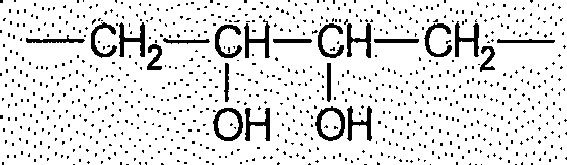
Handelsübliche Polyvinylalkohole, die als weiß-gelbliche Pulver oder Granulate mit Polymerisationsgraden im Bereich von ca. 100 bis 2500 (Molmassen von ca. 4000 bis 100.000 g/mol) angeboten werden, haben Hydrolysegrade von 87-99 Möl-%, enthalten also noch einen Restgehalt an Acetyl-Gruppen. - Im Rahmen der vorliegenden Erfindung ist es bevorzugt, dass die wasserlösliche Verpackung wenigstens anteilsweise einen Polyvinylalkohol umfasst, dessen Hydrolysegrad vorzugsweise 70 bis 100 Mol-%, insbesondere 80 bis 90 Möl-%, besonders bevorzugt 81 bis 89 Mol-% und vor allem 82 bis 88 Mol-% beträgt. In einer bevorzugten Ausführungsform besteht die wasserlösliche Verpackung zu mindestens 20 Gew.-%, besonders bevorzugt zu mindestens 40 Gew.-%, ganz besonders bevorzugt zu mindestens 60 Gew.-% und insbesondere zu mindestens 80 Gew.-% aus einem Polyvinylalkohol, dessen Hydrolysegrad 70 bis 100 Mol-%, vorzugsweise 80 bis 90 Mol-%, besonders bevorzugt 81 bis 89 Mol-% und insbesondere 82 bis 88 Mol-%, beträgt.
- Vorzugsweise werden als Materialien für die Verpackung Polyvinylalkohole eines bestimmten Molekulargewichtsbereichs eingesetzt, wobei erfindungsgemäß bevorzugt ist, dass das Verpackungsmaterial einen Polyvinylalkohol umfasst, dessen Molekulargewicht im Bereich von 5.000 bis 100.000 gmol-1, vorzugsweise von 10.000 bis 90.000 gmol-1, besonders bevorzugt von 12.000 bis 80.000 gmol-1 und insbesondere von 15.000 bis 70.000 gmol-1 liegt.
- Der Polymerisationsgrad solcher bevorzugten Polyvinylalkohole liegt zwischen ungefähr 200 bis ungefähr 2100, vorzugsweise zwischen ungefähr 220 bis ungefähr 1890, besonders bevorzugt zwischen uhgefähr 240 bis ungefähr 1680 und insbesondere zwischen ungefähr 260 bis ungefähr 1500.
- Die Wasserlöslichkeit von Polyvinylalkohol kann durch Nachbehandlung mit Aldehyden (Acetalisierung) öder Ketonen (Ketalisierung) verändert werden. Als besonders bevorzugt und aufgrund ihrer ausgesprochen guten Kaltwasserlöslichkeit besonders vorteilhaft haben sich hierbei Polyvinylalkohole herausgestellt, die mit den Aldehyd- bzw. Ketogruppen von Sacchariden oder Polysacchariden oder Mischungen hiervon acetalisiert bzw. ketalisiert werden. Als äußerst vorteilhaft einzusetzen sind die Reaktionsprodukte aus Polyvinylalkohol und Stärke. Weiterhin lässt sich die Wasserlöslichkeit durch Komplexierung mit Ni- oder Cu-Salzen oder durch Behandlung mit Dichromaten, Borsäure, Borax verändern und so gezielt auf gewünschte Werte einstellen.
- Die wasserlösliche Verpackung hat vorzugsweise eine Dicke von 10 µm bis 500 µm, insbesondere von 20 µm bis 400 µm, besonders bevorzugt von 30 µm bis 300 µm, vor allem von 40 µm bis 200 µm, insbesondere von 50 µm bis 150 µm.
- Ein besonders bevorzugt eingesetzter Polyvinylalkohol ist beispielsweise unter dem Handelsnamen M8630 (Monosol) erhältlich..
- Die Viskosität erfindungsgemäßer Reinigungsmittel liegt vorzugsweise oberhalb 4000 mPas (Brookfield Viscometer DV-II+Pro, Spindel 25, 30 rpm, 20°C), insbesondere zwischen 4000 und 7000 mPas, besonders bevorzugt zwischen 4500 und 6500 mPas, vor allem zwischen 5000 und 6000 mPas.
- Der pH-Wert erfindungsgemäßer Reinigungsmittel liegt vorzugsweise zwischen 6 und 10, besonders bevorzugt zwischen 7 und 9, vor allem zwischen 7 und 8.
- Erfindungsgemäße Reinigungsmittel enthalten vorzugsweise weiterhin mindestens ein hichtionisches Tensid. Als nichtionische Tenside können alle dem Fachmann bekannten nichtionischen Tenside eingesetzt werden. Bevorzugt werden schwachschäumende nichtionische Tenside eingesetzt, insbesondere alkoxylierte, vor allem ethoxylierte, schwachschäumende nichtionische Tenside.
- Bevorzugte nichtionische Tenside sind hierbei solche der allgemeinen Formel R1-CH(OH)CH2O-(AO)w-(A'O)x-(A"O)y-(A"'O)z-R2, in der
- R1 für einen geradkettigen oder verzweigten, gesättigten oder ein- bzw. mehrfach ungesättigten C6-24-Alkyl- oder-Alkenylrest steht;
- R2 für Wasserstoff oder einen linearen oder verzweigten Kohlenwasserstoffrest mit 2 bis 26 Kohlenstoffatomen steht;
- A, A', A" und A"' unabhängig voneinander für einen Rest aus der Gruppe -CH2CH2, -CH2CH2-CH2, -CH2-CH(CH3), -CH2-CH2-CH2-CH2, -CH2-CH(CH3)-CH2-, -CH2-CH(CH2-CH3) stehen,
- w, x, y und z für Werte zwischen 0,5 und 120 stehen, wobei x, y Und/oder z auch 0 sein können,
- Durch den Zusatz der vorgenannten nichtionischen Tenside der allgemeinen Formel R1-CH(OH)CH2O-(AO)w-(A'O)x-(A"O)y-(A"O)z-R2, nachfolgend auch als "Hydroxymischether" bezeichnet, kann überraschenderweise die Reinigungsleistung erfindungsgemäßer Zubereitungen deutlich verbessert werden und zwar sowohl im Vergleich zu Tensid-freien System wie auch im Vergleich zu Systemen, die alternative nichtionischen Tenside, beispielsweise aus der Gruppe der polyalkoxylierten Fettalkohole enthalten.
- Durch den Einsatz dieser nichtionischen Tenside mit einer oder mehreren freien Hydroxylgruppe an einem oder beiden endständigen Alkylresten kann die Stabilität der in den erfindungsgemäßen Reinigungsmitfelzubereitungen enthaltenen Enzyme deutlich verbessert werden.
- Bevorzugt werden insbesondere solche endgruppenverschlossene poly(oxyalkylierten) Niotenside, die, gemäß der Formel R1O[CH2CH2O]xCH2CH(OH)R2, neben einem Rest R1, welcher für lineare oder verzweigte, gesättigte oder ungesättigte, aliphatische oder aromatische Kohlenwasserstoffreste mit 2 bis 30 Kohlenstoffatomen, vorzugsweise mit 4 bis 22 Kohlenstoffatomen steht, weiterhin einen linearen oder verzweigten, gesättigten oder ungesättigten, aliphatischen oder aromatischen Kohlenwasserstoffrest R2 mit 1 bis 30 Kohlenstoffatomen aufweisen, wobei x für Werte zwischen 1 und 90, vorzugsweise für Werte zwischen 30 und 80 und insbesondere für Werte zwischen 30 und 60 steht.
- Besonders bevorzugt sind Tenside der Formel R1O[CH2CH(CH3)O]x[CH2CH2O]yCH2CH(OH)R2, in der R1 für einen linearen oder verzweigten aliphatischen Kohlenwasserstoffrest mit 4 bis 18 Kohlenstoffatomen oder Mischungen hieraus steht, R2 einen linearen oder verzweigten Kohlenwasserstoffrest mit 2 bis 26 Kohlenstoffatomen oder Mischungen hieraus bezeichnet und x für Werte zwischen 0,5 und 1,5 sowie y für einen Wert von mindestens 15 steht.
Zur Gruppe dieser nichtionischen Tenside zählen beispielsweise die "C2-26 Fettalkohol-(PO)1-(EO)15-40-2-hydroxyalkylether, insbesondere auch die C8-10 Fettalkohol-(PO)1-(EO)22-2-hydroxydecylether. - Besonders bevorzugt werden weiterhin solche endgruppenverschlossene poly(oxyalkylierten)-Niotenside der Formel R1O[CH2CH2O]x[CH2CH(R3)O]yCH2CH(OH)R2, in der R1 und R2 unabhängig voneinander für einen linearen oder verzweigten, gesättigten oder ein- bzw. mehrfach ungesättigten Kohlenwasserstoffrest mit 2 bis 26 Kohlenstoffatomen steht, R3 unabhängig voneinander ausgewählt ist aus -CH3, -CH2CH3, -CH2CH2-CH3, =CH(CH3)2, vorzugsweise jedoch für -CH3 steht, und x und y unabhängig voneinander für Werte zwischen 1 und 32 stehen, wobei Niotenside mit R3 = -CH3 und Werten für x von 15 bis 32 und y von 0,5 und 1,5 ganz besonders bevorzugt sind.
- Weitere bevorzugt einsetzbare Niotenside sind die endgruppenverschlossenen poly(oxyalkylierten) Niotenside der Formel R1O[CH2CH(R3)O]x[CH2]kCH(OH)[CH2]jOR2, in der R1 und R2 für lineare oder verzweigte, gesättigte oder ungesättigte, aliphatische oder aromatische Kohlenwasserstoffreste mit 1 bis 30 Kohlenstoffatomen stehen, R3 für H oder einen Methyl-, Ethyl-, n-Propyl-, iso-Propyl-, n-Butyl-, 2-Butyl- oder 2-Methyl-2-Butylrest steht, x für Werte zwischen 1 und 30, k und j für Werte zwischen 1 und 12, vorzugsweise zwischen 1 und 5 stehen. Wenn der Wert x ≥ 2 ist, kann jedes R3 in der oben stehenden Formel R1O[CH2CH(R3)O]x[CH2]kCH(OH)[CH2]jOR2 unterschiedlich sein. R1 und R2 sind vorzugsweise lineare oder verzweigte, gesättigte oder ungesättigte, aliphatische oder aromatische Kohlenwasserstoffreste mit 6 bis 22 Kohlenstoffatomen, wobei Reste mit 8 bis 18 C-Atomen besonders bevorzugt sind. Für den Rest R3 sind H, -CH3 oder -CH2CH3 besonders bevorzugt. Besonders bevorzugte Werte für x liegen im Bereich von 1 bis 20, insbesondere von 6 bis 15.
- Wie vorstehend beschrieben, kann jedes R3 in der oben stehenden Formel unterschiedlich sein, falls x ≥ 2 ist. Hierdurch kann die Alkylenoxideinheit in der eckigen Klammer variiert werden. Steht x beispielsweise für 3, kann der Rest R3 ausgewählt werden, um Ethylenoxid- (R3 = H) oder Propylenoxid- (R3 = CH3) Einheiten zu bilden, die in jedweder Reihenfolge aneinandergefügt sein können, beispielsweise (EO)(PO)(EO), (EO)(EO)(PO), (EO)(EO)(EO), (PO)(EO)(PO), (PO)(PO)(EO) und (PO)(PO)(PO). Der Wert 3 für x ist hierbei beispielhaft gewählt worden und kann durchaus größer sein, wobei die Variationsbreite mit steigenden x-Werten zunimmt und beispielsweise eine große Anzahl (EO)-Gruppen, kombiniert mit einer geringen Anzahl (PO)-Gruppen einschließt, oder umgekehrt.
- Besonders bevorzugte endgruppenverschlossene poly(oxyalkylierte) Alkohole der oben stehenden Formel weisen Werte von k = 1 und j = 1 auf, so dass sich die vorstehende Formel zu R1O[CH2CH(R3)O]xCH2CH(OH)CH2OR2 vereinfacht. In der letztgenannten Formel sind R1, R2 und R3 wie oben definiert und x steht für Zahlen von 1 bis 30, vorzugsweise von 1 bis 20 und insbesondere von 6 bis 18. Besonders bevorzugt sind Tenside, bei denen die Reste R1 und R2 9 bis 14 C-Atome aufweisen, R3 für H steht und x Werte von 6 bis 15 annimmt.
- Als besonders wirkungsvoll haben sich schließlich die nichtionischen Tenside der allgemeine Formel R1-CH(OH)CH2O-(AO)w-R2 erwiesen, in der
- R1 für einen geradkettigen oder verzweigten, gesättigten oder ein- bzw. mehrfach ungesättigten C6-24-Alkyl- oder -Alkenylrest steht;
- R2 für einen linearen oder verzweigten Kohlenwasserstoffrest mit 2 bis 26 Kohlenstoffatomen steht;
- A für einen Rest aus der Gruppe CH2CH2, CH2CH2CH2, CH2CH(CH3), vorzugsweise für CH2CH2 steht, und
- w für Werte zwischen 1 und 120, vorzugsweise 10 bis 80, insbesondere 20 bis 40 steht.
- Zur Gruppe dieser nichtionischen Tenside zählen beispielsweise die C4-22 Fettalkohol-(EO)10-80-2-hydroxyalkylether, insbesondere auch die C8-12 Fettalkohol-(EO)22-2-hydroxydecylether und die C4-22 Fettalkohol-(EO)40-80-2-hydroxyalkylether.
- Bevorzugte flüssige Reinigungsmittel sind dadurch gekennzeichnet, dass das Reinigungsmittel mindestens ein nichtionisches Tensid, vorzugsweise ein nichtionisches Tensid aus der Gruppe der Hydroxymischether, enthält, wobei der Gewichtsanteil des nichtionischen Tensids am Gesamtgewicht des Reinigungsmittels vorzugsweise 0,5 bis 10 Gew.-%, bevorzugt 1,0 bis 8,0 Gew.-% und insbesondere 2,0 bis 6,0 Gew.-% beträgt.
- Als weiteren Bestandteil enthalten erfindungsgemäße Reinigungsmittel vorzugsweise einen oder mehrere Gerüststoff(e). Der Gewichtsanteil dieser Gerüststoffe am Gesamtgewicht erfindungsgemäßer Mittel beträgt vorzugsweise 15 bis 80 Gew.-% und insbesondere 20 bis 70 Gew.-%. Zu diesen Gerüststoffen zählen insbesondere Carbonate, Phosphate, Citrate, Phosphonate, MGDA, GLDA, EDDS, organische Cobuilder und Silikate.
- Bevorzugt ist der Einsatz von Carbonat(en) und/oder Hydrogencarbonat(en), vorzugsweise Alkalicarbonat(en), besonders bevorzugt Natriumcarbonat, in Mengen von 2 bis 30 Gew.-%, vorzugsweise von 4 bis 28 Gew.-% und insbesondere von 8 bis 24 Gew.-%, jeweils bezogen auf das Gewicht des Reinigungsmittels.
- Bevorzugt ist weiterhin der Einsatz von Phosphat. Unter der Vielzahl der kommerziell erhältlichen Phosphate haben die Alkalimetallphosphate unter besonderer Bevorzugung von Pentanatrium-bzw. Pentakaliumtriphosphat (Natrium- bzw. Kaliumtripolyphosphat) in der Wasch- und Reinigungsmittel-Industrie die größte Bedeutung.
- Alkalimetallphosphate ist dabei die summarische Bezeichnung für die Alkalimetall- (insbesondere Natrium- und Kalium-) Salze der verschiedenen Phosphorsäuren, bei denen man
- Metaphosphorsäuren (HPO3)n und Orthophosphorsäure H3PO4 neben höhermolekularen Vertretern unterscheiden kann. Die Phosphate vereinen dabei mehrere Vorteile in.sich: Sie wirken als Alkaliträger, verhindern Kälkbeläge auf Maschinenteilen bzw. Kalkinkrustationen in Geweben und tragen überdies zur Reinigungsleistung bei.
- Erfindungsgemäß besonders bevorzugte Phosphate sind das Pentanatriumtriphosphat, Na5P3O10 (Natriumtripolyphosphat) sowie das entsprechende Kaliumsalz Pentakaliumtriphosphat, K5P3O10 (Kaliumtripolyphosphat). Erfindungsgemäß bevorzugt eingesetzt werden weiterhin die Natrium-Kaliumtripolyphosphate.
- Werden im Rahmen der vorliegenden Anmeldung Phosphate als reinigungsaktive Substanzen in den Reinigungsmitteln eingesetzt, so enthalten diese Phosphat(e), vorzugsweise Alkalimetallphosphät(e), besonders bevorzugt Pentanatrium- bzw. Pentakaliumtriphosphat (Natrium- bzw. Kaliumtripolyphosphat), in Mengen von 5 bis 60 Gew.-%, vorzugsweise von 15 bis 45 Gew-% und insbesondere von 20 bis 40 Gew.-%, jeweils bezogen auf das Gewicht des Reinigungsmittels.
- In einer erfindungsgemäß bevorzugten Ausführungsform wird auf den Einsatz von Phosphaten weitgehend oder vollständig verzichtet. Das Mittel enthält in dieser Ausführungsform vorzugsweise weniger als 5 Gew.-%, besonders bevorzugt weniger als 3 Gew-%, insbesondere weniger als 1 Gew.-% Phosphat(e). Besonders bevorzugt ist das Mittel in dieser Ausführungsform völlig phosphatfrei.
- Als organische Cobuilder sind insbesondere Polycarboxylate / Polycarbonsäuren, polymere Carboxylate, Asparaginsäure, Polyacetale, Dextrine und organische Cobuilder zu nennen. Diese Stoffklassen werden nachfolgend beschrieben.
- Brauchbare organische Gerüstsubstanzen sind beispielsweise die in Form der freien Säure und/oder ihrer Natriumsalze einsetzbaren Polycarbonsäuren, wobei unter Polycarbonsäuren solche Carbonsäuren verstanden werden, die mehr als eine Säurefunktion tragen. Beispielsweise sind dies Citronensäure, Adipinsäure, Bernsteinsäure, Glutarsäure, Äpfelsäure, Weinsäure, Maleinsäure, Fumarsäure, Zuckersäuren, Aminocarbonsäuren, Nitrilotriessigsäure (NTA), sofern ein derartiger Einsatz aus ökologischen Gründen nicht zu beanstanden ist, sowie Mischungen aus diesen. Die freien Säuren besitzen neben ihrer Builderwirkung typischerweise auch die Eigenschaft einer Säuerungskomponente und dienen somit auch zur Einstellung eines niedrigeren und milderen pH-Wertes von Reinigungsmitteln. Insbesondere sind hierbei Citronensäure, Bernsteinsäure, Glutarsäure, Adipinsäure, Gluconsäure und beliebige Mischungen aus diesen zu nennen.
- Besonders bevorzugte erfindungsgemäße Reinigungsmittel enthalten als einen ihrer wesentlichen Gerüststoffe Citrat. Reinigungsmittel, dadurch gekennzeichnet, dass sie 2 bis 40 Gew.-%, vorzugsweise 5 bis 30 Gew.-% und insbesondere 5 bis 20 Gew.-% Citrat enthalten, sind erfindungsgemäß bevorzugt.
- Besonders bevorzugte erfindungsgemäße Reinigungsmittel sind dadurch gekennzeichnet, dass das Reinigungsmittel mindestens zwei Gerüststoffe aus der Gruppe der Phosphate, Carbonate und Citräte enthält, wobei der Gewichtsanteil dieser Gerüststoffe, bezogen auf das Gesamtgewicht des erfindungsgemäßen Reinigungsmittels, bevorzugt 5 bis 60 Gew.-%, vorzugsweise 15 bis 50 Gew.-% und insbesondere 25 bis 40 Gew.-% beträgt. Die Kombination von zwei oder mehr Gerüststoffen aus der oben genannten Gruppe hat sich für die Reiniguhgs- und Klarspülleistung erfindungsgemäßer maschineller Geschirrspülmittel als vorteilhaft erwiesen.
- In einer erfindungsgemäß ganz besonders bevorzugten Ausführungsform wird eine Mischung aus Phosphat und Citrat oder eine Mischung aus GLDA und Citrat eingesetzt, wobei die Menge an Phosphat oder GLDA vorzugsweise von 10 bis 35 Gew.-% und die Menge an Citrat vorzugsweise von 2 bis 10 Gew.-%, jeweils bezogen auf die Gesamtmenge des Reinigungsmittels, beträgt, wobei die Gesamtmenge dieser Gerüststoffe vorzugsweise 20 bis 35 Gew.-%, insbesondere 25 bis 35 Gew.-%, beträgt.
- Als Gerüststoffe sind weiterhin polymere Polycarboxylate geeignet, dies sind beispielsweise die Alkalimetallsalze der Polyacrylsäure oder der Polymethacrylsäure, beispielsweise solche mit einer relativen Molekülmasse von 500 bis 70000 g/mol.
- Geeignete Polymere sind insbesondere Polyacrylate, die bevorzugt eine Molekülmasse von 2000 bis 20000 g/mol aufweisen. Aufgrund ihrer überlegenen Lösfichkeit können aus dieser Gruppe wiederum die kurzkettigen Polyacrylate, die Molmassen von 2000 bis 10000 g/mol, und besonders bevorzugt von 3000 bis 5000 g/mol, aufweisen, bevorzugt sein.
- Der Gehalt der erfindungsgemäßen Reinigungsmittel an (homo)polymeren Polycarboxylaten beträgt vorzugsweise 0,5 bis 20 Gew.-% und insbesondere 3 bis 10 Gew.-%.
- Die erfindungsgemäßen Reinigungsmittel können als weiteren Gerüststoff insbesondere Phosphonate enthalten. Als Phosphonat-Verbindung Wird vorzugsweise ein Hydroxyalkan-und/oder Aminoalkanphosphonat eingesetzt. Unter den Hydroxyalkanphosphonaten ist das 1-Hydroxyethan-1,1-diphosphonat (HEDP) von besonderer Bedeutung. Als Aminoalkanphosphonate kommen vorzugsweise Ethylendiamintetramethylenphosphonat (EDTMP), Diethylentriaminpentamethylenphosphonat (DTPMP) sowie deren höhere Homologe in Frage. Phosphonate sind in erfindungsgemäßen Mitteln vorzugsweise in Mengen von 0,1 bis 10 Gew.-%, insbesondere in Mengen von 0,5 bis 8 Gew.-%, jeweils bezogen auf das Gesamtgewicht des Reinigungsmittels, enthalten.
- Bevorzugt wird, insbesondere in phosphatreduzierten und phosphatfreien Mitteln, mindestens eine Verbindung ausgewählt aus MGDA, GLDA und EDDS eingesetzt.
- MGDA (Methylglycindiessigsäure), GLDA (Glutaminsäure-N,N-diessigsäure) und EDDS (Ethylendiamin-N,N'-dibernsteinsäure) werden in erfindungsgemäßen Reinigungsmitteln vorzugsweise in Mengen von 5 bis 60 Gew.-%, insbesondere in Mengen von 10 bis 40 Gew.-%, eingesetzt.
- Erfindungsgemäße Mittel können als Gerüststoff weiterhin kristalline schichtförmige Silikate der allgemeinen Formel NaMSixO2x+1 · y H2O, worin M Natrium oder Wasserstoff darstellt, x eine Zahl von 1,9 bis 22, vorzugsweise von 1,9 bis 4, wobei besonders bevorzugte Werte für x 2, 3 oder 4 sind, und y für eine Zahl von 0 bis 33, vorzugsweise von 0 bis 20 steht. Einsetzbar sind auch amorphe Natriumsilikate mit einem Modul Na2O : SiO2 von 1:2 bis 1:3,3, vorzugsweise von 1:2 bis 1:2,8 und insbesondere von 1:2 bis 1:2,6, welche vorzugsweise löseverzögert sind und Sekundärwascheigenschaften aufweisen.
- In bevorzugten erfindungsgemäßen Reinigungsmitteln wird der Gehalt an Silikaten, bezogen auf das Gesamtgewicht des Reinigungsmittels, auf Mengen unterhalb 10 Gew.-%, vorzugsweise unterhalb 5 Gew.-% und insbesondere unterhalb 2 Gew.-% begrenzt. Besonders bevorzugte erfindungsgemäße Reinigungsmittel sind Silikat-frei.
- In Ergänzung zu den vorgenannten Gerüststoffen können die erfindungsgemäßen Mittel Alkalimetallhydroxide enthalten. Diese Alkaliträger werden in den Reinigungsmitteln bevorzugt nur in geringen Mengen, vorzugsweise in Mengen unterhalb 10 Gew.-%, bevorzugt unterhalb 6 Gew.-%, vorzugsweise unterhalb 5 Gew.-%, besonders bevorzugt zwischen 0, 1 und 5 Gew.-% und insbesondere zwischen 0,5 und 5 Gew.-%, jeweils bezogen auf das Gesamtgewicht des Reinigungsmittels eingesetzt. Alternative erfindungsgemäße Reinigungsmittel sind frei von Alkalimetallhydroxiden.
- Als weiteren Bestandteil enthalten erfindungsgemäße Reinigungsmittel vorzugsweise Enzym(e). Hierzu gehören insbesondere Proteasen, Amylasen, Lipasen, Hemicellulasen, Cellulasen, Perhydrolasen oder Oxidoreduktasen, sowie vorzugsweise deren Gemische. Diese Enzyme sind im Prinzip natürlichen Ursprungs; ausgehend von den natürlichen Molekülen stehen für den Einsatz in Reinigungsmitteln verbesserte Varianten zur Verfügung, die entsprechend bevorzugt eingesetzt werden. Erfindungsgemäße Reinigungsmittel enthalten Enzyme vorzugsweise in Gesamtmengen von 1 x 10⁻⁶ bis 5 Gew.-% bezogen auf aktives Protein. Die Proteinkonzentration kann mit Hilfe bekannter Methoden, zum Beispiel dem BCA-Verfahren oder dem Biuret-Verfahren bestimmt werden.
- Unter den Proteasen sind solche vom Subtilisin-Typ bevorzugt. Beispiele hierfür sind die Subtilisine BPN' und Carlsberg sowie deren weiterentwickelte Formen, die Protease PB92, die Subtilisine 147 und 309, die Alkalische Protease aus Bacillus lentus, Subtilisin DY und die den Subtilasen, nicht mehr jedoch den Subtilisinen im engeren Sinne zuzuordnenden Enzyme Thermitase, Proteinase K und die Proteasen TW3 und TW7.
- Beispiele für erfindungsgemäß einsetzbare Amylaseh sind die α-Amylasen aus Bacillus licheniformis, aus B. amyloliquefaciens, aus B. stearothermophilus, aus Aspergillus niger und A. orizae sowie die für den Einsatz in Reinigungsmitteln verbesserten Weiterentwicklungen der vorgenannten Amylasen. Des Weiteren sind für diesen Zweck die α-Amylase aus Bacillus sp. A 7-7 (DSM 12368) und die Cyclodextrin-Glucanotransferase (CGTase) aus B. agaradherens (DSM 9948) hervorzuheben.
- Erfindungsgemäß einsetzbar sind weiterhin Lipasen oder Cutinasen, insbesondere wegen ihrer Triglycerid-spaltenden Aktivitäten, aber auch, um aus geeigneten Vorstufen in situ Persäuren zu erzeugen. Hierzu gehören beispielsweise die ursprünglich aus Humicola lanuginosa (Thermomyces lanuginosus) erhältlichen, beziehungsweise weiterentwickelten Lipasen, insbesondere solche mit dem Aminosäureaustausch D96L.
- Weiterhin können Enzyme eingesetzt werden, die unter dem Begriff Hemicellulasen zusammengefasst werden. Hierzu gehören beispielsweise Mannanasen, Xanthanlyasen, Pektinlyasen (=Pektinasen), Pektinesterasen, Pektatlyasen, Xyloglucanasen (=Xylanasen), Pullulanasen und β-Glucanasen.
- Zur Erhöhung der bleichenden Wirkung können erfindungsgemäß Oxidoreduktasen, beispielsweise Oxidasen, Oxygenasen, Katalasen, Peroxidäsen, wie Halo-, Chloro-, Bromo-, Lignin-, Glucose-oder Mangan-Peroxidasen, Dioxygenasen oder Laccasen (Phenöloxidasen, Polyphenoloxidasen) eingesetzt werden. Vorteilhafterweise werden zusätzlich vorzugsweise organische, besonders bevorzugt aromatische, mit den Enzymen wechselwirkende Verbindungen zugegeben, um die Aktivität der betreffenden Oxidoreduktasen zu verstärken (Enhancer) oder um bei stark unterschiedlichen Redoxpotentialen zwischen den oxidierenden Enzymen und den Anschmutzungen den Elektronenfluss zu gewährleisten (Mediatoren).
- Ein Protein und/oder Enzym kann besonders während der Lagerung gegen Schädigungen wie beispielsweise Inaktivierung, Denaturierung oder Zerfall etwa durch physikalische Einflüsse, Oxidation oder proteolytische Spaltung geschützt werden. Bei mikrobieller Gewinnung der Proteine und/oder Enzyme ist eine Inhibierung der Proteolyse besonders bevorzugt, insbesondere wenn auch die Mittel Proteasen enthalten. Reinigungsmittel können zu diesem Zweck Stabilisatoren enthalten; die Bereitstellung derartiger Mittel stellt eine bevorzugte Ausführungsform der Vorliegenden Erfindung dar.
- Reinigungsaktive Proteasen und Amylasen werden in der Regel nicht in Form des reinen Proteins sondern vielmehr in Form stabilisierter, lager- und transportfähiger Zubereitungen bereitgestellt. Zu diesen vorkonfektionierten Zubereitungen zählen beispielsweise die durch Granulation, Extrusion oder Lyophilisierung erhaltenen festen Präparationen oder, insbesondere bei flüssigen oder gelförmigen Mitteln, Lösungen der Enzyme, vorteilhafterweise möglichst konzentriert, wasserarm und/öder mit Stabilisatoren oder weiteren Hilfsmitteln versetzt.
- Alternativ können die Enzyme sowohl für die feste als auch für die flüssige Darreichungsform verkapselt werden, beispielsweise durch Sprühtrocknung oder Extrusion der Enzymlösung zusammen mit einem vorzugsweise natürlichen Polymer oder in Form von Kapseln, beispielsweise solchen, bei denen die Enzyme wie in einem erstarrten Gel eingeschlossen sind oder in solchen vom Kern-Schale-Typ, bei dem ein enzymhaltiger Kern mit einer Wasser-, Luft- und/oder Chemikalien-undurchlässigen Schutzschicht überzogen ist. In aufgelagerten Schichten können zusätzlich weitere Wirkstoffe, beispielsweise Stabilisatoren, Emulgatoren, Pigmente, Bleich- oder Farbstoffe aufgebracht werden. Derartige Kapseln werden nach an sich bekannten Methoden, beispielsweise durch Schüttel- oder Rollgranulation öder In Fluid-bed-Prozessen aufgebracht. Vorteilhafterweise sind derartige Granulate, beispielsweise durch Aufbringen polymerer Filmbildner, staubarm und aufgrund der Beschichtung lagerstabil.
- Weiterhin ist es möglich, zwei oder mehrere Enzyme zusammen zu konfektionieren, so dass ein einzelnes Granulat mehrere Enzymaktivitäten aufweist.
- Wie aus der vorherigen Ausführungen ersichtlich, bildet das Enzym-Protein nur einen Bruchteil des Gesamtgewichts üblicher Enzym-Zubereitungen. Erfindungsgemäß bevorzugt eingesetzte Protease- und Amylase-Zubereitungen enthalten zwischen 0,1 und 40 Gew.-%, bevorzugt zwischeh 0,2 und 30 Gew.-%, besonders bevorzugt zwischen 0,4 und 20 Gew.-% und insbesondere zwischen 0,8 und 10 Gew.-% des Enzymproteins.
- Bevorzugt werden insbesondere solche Reinigungsmittel, die, jeweils bezogen auf ihr Gesamtgewicht, 0,1 bis 12 Gew.-%, vorzugsweise 0,2 bis 10 Gew.-% und insbesondere 0,5 bis 8 Gew.-% Enzym-Zubereitungen enthalten.
- Erfindungsgemäße Mittel enthalten vorzugsweise mindestens einen weiteren Bestandteil, vorzugsweise ausgewählt aus der Gruppe bestehend aus anionischen, kationischen und amphöteren Tensiden, Bleichmitteln, Bleichaktivatoren, Bleichkatalysatoren, weiteren Lösungsmitteln, Verdickern, Sequestrierungsmitteln, Elektrolyten, Korrosionsinhibitoren, insbesondere Silberschutzmitteln, Glaskorrosionsinhibitoren, Schauminhibitoren, Farbstoffen, Duftstoffen und antimikrobiellen Wirkstoffen.
- Als weiteres Lösungsmittel enthalten erfindungsgemäße Mittel vorzugsweise mindestens ein Alkanolamin. Das Alkanolamin ist hierbei, vorzugsweise ausgewählt aus der Gruppe bestehend aus Mono-, Di-, Triethanol- und -Propanolamin und deren Mischungen. Das Alkanolamin ist in erfindungsgemäßen Mitteln vorzugsweise in einer Menge von 0,5 bis 10 Gew.-%, insbesondere in einer Menge von 1 bis 6 Gew.-%, enthalten.
- Als Glaskorrosionsinhibitoren werden vorzugsweise Zinksalze eingesetzt. Glaskorrosionsinhibitoren sind in erfindungsgemäßen Mitteln vorzugsweise in einer Menge von 0,05 bis 5 Gew.-%, insbesondere in einer Menge von 0,1 bis 2 Gew.-%, enthalten.
- Es wurden 3 flüssige Reinigungsmittel mit Wassergehalten unter 20 Gew.-% hergestellt (E1 sowie V1 und V2), wobei Wasser bzw. eine wässerige Phosphat-Lösung vorgelegt und das Sulfopolymer jeweils in fester Form in die flüssige Mischung gegeben wurde.
Tabelle 1: Mengenangaben in Gew.-% Zusammensetzung E1 V1 V2 Kalium-/ NatriumTripolyphosphat 21 21 21 Natriurricitrat-Dihydrat 5 5 5 Phosphonat 2 2 2 Kationtensid 1 1 1 Nichtionisches Tensid 4 4 4 Ethanolamin 3 3 3 Glycerin 5 --- --- Propylenglykol 25 --- --- Paraffinöl --- 30 --- Polyethylenglykol (PEG 1500) --- --- 30 Enzym-Zubereitungen (Protease, Amylase) 4 4 4 Cumolsulfonat 1 1 1 Sulfopolymer (fest) 10 10 10 Parfüm, Farbstoffe, Korrosionsinhibitoren < 0,5 < 0,5 < 0,5 Wasser Ad 100 Ad 100 Ad 100 - Nur das erfindungsgemäße Mittel E1 ließ sich ohne Schwierigkeiten und stabil herstellen, während bei V1 und V2 bereits die Einarbeitung des festen Sulfopolymers misslang.
Claims (11)
- Flüssiges Reinigungsmittel in einer wasserlöslichen Verpackung, enthaltend mindestens ein Sulfopolymer, welches bei der Herstellung des Mittels in fester Form eingesetzt wurde, sowie mindestens einen mehrwertigen Alkohol, wobei eine Mischung aus 1 - 10 Gew.-% Glycerin und 15 - 35 Gew.-% 1,2-Propylenglykol eingesetzt wird und die Gesamtmenge an Glycerin und 1,2-Propylenglykol 25 bis 45 Gew.-% beträgt, und maximal 25 Gew.-% Wasser, bezogen auf das Gesamtgewicht des Mittels.
- Reinigungsmittel nach Anspruch 1, dadurch gekennzeichnet, dass es 20 bis 50 Gew.-%, insbesondere 25 bis 45 Gew.-%, vor allem 28 bis 40 Gew.-%, mehrwertige Alkohole enthält, insbesondere ausgewählt aus Glycerin, Ethylenglykol, 1,2-Propylenglykol, 1,3-Propylenglykol und Mischungen daraus.
- Reinigungsmittel nach Anspruch 1 oder 2, dadurch gekennzeichnet, dass es als mehrwertigen Alkohol 1,2-Propylenglykol in einer Menge von 20 bis 30 Gew.-% enthält.
- Reinigungsmittel nach Anspruch 1 oder 2, dadurch gekennzeichnet, dass das Glycerin in einer Menge von 1 bis 10 Gew.-%, vorzugsweise 3 bis 7 Gew.-%, und das 1,2-Propylenglykol in einer Menge von 15 bis 35 Gew.-%, vorzugsweise 20 bis 30 Gew.-%, jeweils bezogen auf die Gesamtmenge des Reinigungsmittels, eingesetzt wird, wobei die Gesamtmenge an Glycerin und 1,2-Propylenglykol 28 bis 40 Gew.-%, vor allem 28,5 bis 32,0 Gew.-%, beträgt.
- Reinigungsmittel nach einem der vorhergehenden Ansprüche, dadurch gekennzeichnet, dass die Zusammensetzung maximal 20 Gew.-%, insbesondere 15 bis 20 Gew.-%, und bevorzugt 18 bis 19,8 Gew.-% Wasser, enthält.
- Reinigungsmittel nach einem der vorhergehenden Ansprüche, dadurch gekennzeichnet, dass es sich bei der wasserlöslichen Verpackung um eine Polyvinylalkohol-haltige Folie handelt.
- Reinigungsmittel nach einem der vorhergehenden Ansprüche, dadurch gekennzeichnet, dass als Sulfopolymer ein Polymer umfassendi) Carbonsäuregruppen-haltige Monomere,ii) Sulfonsäuregruppen-haltige Monomere,iii) optional nichtionische, insbesondere hydrophobe, Monomere
eingesetzt wird, wobei die Gesamtmenge an Sulfopolymer vorzugsweise 1 bis 15 Gew.-%, insbesondere 4 bis 14 Gew.-%, vor allem 6 bis 12 Gew.-% beträgt. - Reinigungsmittel nach einem der vorhergehenden Ansprüche, dadurch gekennzeichnet, dass es mindestens einen Hydroxymischether enthält, wobei die Gesamtmenge an Hydroxymischether vorzugsweise 0,5 bis 10 Gew.-%, insbesondere 1,0 bis 8,0 Gew.-%, besonders bevorzugt 2,0 bis 6,0 Gew.-%, beträgt.
- Reinigungsmittel nach einem der vorhergehenden Ansprüche, dadurch gekennzeichnet, dass es eine Viskosität oberhalb 4000 mPas (Brookfield Viscometer DV-II+Pro, Spindel 25, 30 rpm, 20°C), insbesondere zwischen 4000 und 7000 mPas, besonders bevorzugt zwischen 4500 und 6500 mPas, vor allem zwischen 5000 und 6000 mPas, aufweist.
- Verfahren zur Herstellung eines flüssigen Reinigungsmittels in einer wasserlöslichen Verpackung nach einem der Ansprüche 1 bis 9, dadurch gekennzeichnet, dass das Sulfopolymer in fester Form eingesetzt wird.
- Maschinelles Geschirrspülverfahren, dadurch gekennzeichnet, dass ein Reinigungsmittel nach einem der Ansprüche 1 bis 9 zum Einsatz kommt.
Priority Applications (1)
| Application Number | Priority Date | Filing Date | Title |
|---|---|---|---|
| PL12781091T PL2814932T3 (pl) | 2012-02-14 | 2012-11-02 | Płynny środek czyszczący o niskiej zawartości wody zawierający suifopolimer |
Applications Claiming Priority (2)
| Application Number | Priority Date | Filing Date | Title |
|---|---|---|---|
| DE102012202176A DE102012202176A1 (de) | 2012-02-14 | 2012-02-14 | Sulfopolymer-haltiges flüssiges Reinigungsmittel mit geringem Wassergehalt |
| PCT/EP2012/071716 WO2013120550A1 (de) | 2012-02-14 | 2012-11-02 | Sulfopolymer-haltiges flüssiges reinigungsmittel mit geringem wassergehalt |
Publications (2)
| Publication Number | Publication Date |
|---|---|
| EP2814932A1 EP2814932A1 (de) | 2014-12-24 |
| EP2814932B1 true EP2814932B1 (de) | 2019-01-02 |
Family
ID=47137712
Family Applications (1)
| Application Number | Title | Priority Date | Filing Date |
|---|---|---|---|
| EP12781091.9A Active EP2814932B1 (de) | 2012-02-14 | 2012-11-02 | Sulfopolymer-haltiges flüssiges reinigungsmittel mit geringem wassergehalt |
Country Status (5)
| Country | Link |
|---|---|
| US (1) | US20140349905A1 (de) |
| EP (1) | EP2814932B1 (de) |
| DE (1) | DE102012202176A1 (de) |
| PL (1) | PL2814932T3 (de) |
| WO (1) | WO2013120550A1 (de) |
Families Citing this family (7)
| Publication number | Priority date | Publication date | Assignee | Title |
|---|---|---|---|---|
| EP2929008A1 (de) * | 2012-12-05 | 2015-10-14 | Henkel AG & Co. KGaA | Dimensionsstabile, geschirrspülmittel enthaltende einmalportion |
| DE102012222266A1 (de) * | 2012-12-05 | 2014-06-05 | Henkel Ag & Co. Kgaa | Verfahren zur Herstellung wasserarmer bis wasserfreier flüssiger Wasch- oder Reinigungsmittel |
| DE102012222268A1 (de) * | 2012-12-05 | 2014-06-05 | Henkel Ag & Co. Kgaa | Wasserarme bis wasserfreie flüssige Reinigungsmittel |
| BR112015029557A2 (pt) * | 2013-05-27 | 2020-03-10 | Basf Se | solução aquosa, processo para fabricação de uma solução aquosa, e, uso de uma solução aquosa |
| DE102013226301A1 (de) * | 2013-12-17 | 2015-06-18 | Henkel Ag & Co. Kgaa | Flüssige Geschirrspülmittel mit optimierter Viskosität |
| CN109477044B (zh) | 2016-07-19 | 2021-10-08 | 艺康美国股份有限公司 | 用于去除口香糖和其它粘性食物的方法和清洁溶液 |
| DE102019132402A1 (de) * | 2019-11-28 | 2021-06-02 | Henkel Ag & Co. Kgaa | Verfahren zur erhöhung der stabilität von reinigungsmitteln |
Citations (1)
| Publication number | Priority date | Publication date | Assignee | Title |
|---|---|---|---|---|
| GB2355269A (en) * | 2000-08-08 | 2001-04-18 | Procter & Gamble | Liquid cleaning composition |
Family Cites Families (11)
| Publication number | Priority date | Publication date | Assignee | Title |
|---|---|---|---|---|
| DE10004677A1 (de) * | 2000-02-03 | 2001-08-09 | Cognis Deutschland Gmbh | Tensidmischung mit Fettalkoholalkoxylaten aus pflanzlichen Rohstoffen |
| US6995125B2 (en) * | 2000-02-17 | 2006-02-07 | The Procter & Gamble Company | Detergent product |
| US6492312B1 (en) * | 2001-03-16 | 2002-12-10 | Unilever Home & Personal Care Usa, Division Of Conopco, Inc. | Water soluble sachet with a dishwashing enhancing particle |
| DE10153553A1 (de) * | 2001-07-07 | 2003-06-12 | Henkel Kgaa | Nichtwäßrige "3in1"-Geschirrspülmittel II |
| EP1444318B1 (de) * | 2001-11-14 | 2009-07-01 | The Procter & Gamble Company | Maschinelle geschirrspülmittel in form einer einmaldosis enthaltend ein verkrustung inhibierendes polymer |
| WO2004085599A1 (de) * | 2003-03-25 | 2004-10-07 | Henkel Kommanditgesellschaft Auf Aktien | Formstabile reinignungsmittelportion |
| GB0507069D0 (en) * | 2005-04-07 | 2005-05-11 | Reckitt Benckiser Nv | Detergent body |
| US20080021167A1 (en) * | 2006-07-21 | 2008-01-24 | National Starch And Chemical Investment Holding Co | Sulfonated graft copolymers |
| CA2734878C (en) * | 2008-09-01 | 2014-10-21 | The Procter & Gamble Company | Laundry detergent or cleaning composition comprising sulfonate group-containing copolymers and manufacturing method thereof |
| DE102009046240A1 (de) * | 2009-10-30 | 2011-05-12 | Henkel Ag & Co. Kgaa | Maschinelles Geschirrspülverfahren |
| EP2399979B2 (de) * | 2010-06-24 | 2021-12-29 | The Procter & Gamble Company | Lösliche Einmaldosierartikel enthaltend ein kationisches Polymer |
-
2012
- 2012-02-14 DE DE102012202176A patent/DE102012202176A1/de not_active Withdrawn
- 2012-11-02 WO PCT/EP2012/071716 patent/WO2013120550A1/de not_active Ceased
- 2012-11-02 PL PL12781091T patent/PL2814932T3/pl unknown
- 2012-11-02 EP EP12781091.9A patent/EP2814932B1/de active Active
-
2014
- 2014-08-13 US US14/458,379 patent/US20140349905A1/en not_active Abandoned
Patent Citations (1)
| Publication number | Priority date | Publication date | Assignee | Title |
|---|---|---|---|---|
| GB2355269A (en) * | 2000-08-08 | 2001-04-18 | Procter & Gamble | Liquid cleaning composition |
Also Published As
| Publication number | Publication date |
|---|---|
| DE102012202176A1 (de) | 2013-08-14 |
| US20140349905A1 (en) | 2014-11-27 |
| EP2814932A1 (de) | 2014-12-24 |
| PL2814932T3 (pl) | 2019-07-31 |
| WO2013120550A1 (de) | 2013-08-22 |
Similar Documents
| Publication | Publication Date | Title |
|---|---|---|
| EP2366010B1 (de) | Maschinelles geschirrspülmittel | |
| EP2366007B1 (de) | Maschinelles geschirrspülmittel | |
| EP2367920B1 (de) | Maschinelles geschirrspülmittel | |
| EP2814932B1 (de) | Sulfopolymer-haltiges flüssiges reinigungsmittel mit geringem wassergehalt | |
| WO2015086761A1 (de) | Phosphatfreies flüssiges geschirrspülmittel | |
| EP2929001B1 (de) | Verfahren zur herstellung wasserarmer bis wasserfreier flüssiger wasch- oder reinigungsmittel | |
| EP3102660B1 (de) | Mehrphasiges vorportioniertes reinigungsmittel | |
| EP3102658B2 (de) | Mehrphasiges vorportioniertes reinigungsmittel | |
| DE102017201097A1 (de) | Wasch- oder Reinigungsmittel umfassend wenigstens zwei Phasen | |
| EP2576753B1 (de) | Maschinelles geschirrspülmittel | |
| EP3194552B1 (de) | Reinigungsmittel | |
| EP2814930B1 (de) | Enzymhaltiges reinigungsmittel mit mehrwertigen alkoholen | |
| EP3102657B1 (de) | Vorportioniertes reinigungsmittel | |
| DE102016212248A1 (de) | Geschirrspülmittel enthaltend Zuckersäure und Aminocarbonsäure | |
| EP2943560B1 (de) | Wasserarme bis wasserfreie flüssige reinigungsmittel | |
| DE102012222268A1 (de) | Wasserarme bis wasserfreie flüssige Reinigungsmittel | |
| DE102012222267A1 (de) | Wasserarme bis wasserfreie flüssige Reinigungsmittel | |
| DE102014202226A1 (de) | Verwendung von mindestens einem Polyalkylenglycol mit einem mittleren Molekulargewicht zwischen 1500 und 8000, insbesondere zwischen 2000 und 6000, insbesondere zwischen 3000 und 4500 zur Verbesserung der Brillianz von flüssigen, wasserarmen Wasch- oder Reinigungsmitteln | |
| DE102014202223A1 (de) | Verwendung von Aminocarbonsäuren zur Stabilisierung von wasserarmen flüssigen Wasch- oder Reinigungsmittelkomponenten |
Legal Events
| Date | Code | Title | Description |
|---|---|---|---|
| PUAI | Public reference made under article 153(3) epc to a published international application that has entered the european phase |
Free format text: ORIGINAL CODE: 0009012 |
|
| 17P | Request for examination filed |
Effective date: 20140310 |
|
| AK | Designated contracting states |
Kind code of ref document: A1 Designated state(s): AL AT BE BG CH CY CZ DE DK EE ES FI FR GB GR HR HU IE IS IT LI LT LU LV MC MK MT NL NO PL PT RO RS SE SI SK SM TR |
|
| AX | Request for extension of the european patent |
Extension state: BA ME |
|
| DAX | Request for extension of the european patent (deleted) | ||
| STAA | Information on the status of an ep patent application or granted ep patent |
Free format text: STATUS: EXAMINATION IS IN PROGRESS |
|
| 17Q | First examination report despatched |
Effective date: 20170125 |
|
| GRAP | Despatch of communication of intention to grant a patent |
Free format text: ORIGINAL CODE: EPIDOSNIGR1 |
|
| STAA | Information on the status of an ep patent application or granted ep patent |
Free format text: STATUS: GRANT OF PATENT IS INTENDED |
|
| INTG | Intention to grant announced |
Effective date: 20180620 |
|
| GRAS | Grant fee paid |
Free format text: ORIGINAL CODE: EPIDOSNIGR3 |
|
| GRAA | (expected) grant |
Free format text: ORIGINAL CODE: 0009210 |
|
| STAA | Information on the status of an ep patent application or granted ep patent |
Free format text: STATUS: THE PATENT HAS BEEN GRANTED |
|
| AK | Designated contracting states |
Kind code of ref document: B1 Designated state(s): AL AT BE BG CH CY CZ DE DK EE ES FI FR GB GR HR HU IE IS IT LI LT LU LV MC MK MT NL NO PL PT RO RS SE SI SK SM TR |
|
| REG | Reference to a national code |
Ref country code: GB Ref legal event code: FG4D Free format text: NOT ENGLISH |
|
| REG | Reference to a national code |
Ref country code: CH Ref legal event code: EP Ref country code: AT Ref legal event code: REF Ref document number: 1084375 Country of ref document: AT Kind code of ref document: T Effective date: 20190115 |
|
| REG | Reference to a national code |
Ref country code: DE Ref legal event code: R096 Ref document number: 502012014106 Country of ref document: DE |
|
| REG | Reference to a national code |
Ref country code: IE Ref legal event code: FG4D Free format text: LANGUAGE OF EP DOCUMENT: GERMAN |
|
| REG | Reference to a national code |
Ref country code: NL Ref legal event code: MP Effective date: 20190102 |
|
| REG | Reference to a national code |
Ref country code: LT Ref legal event code: MG4D |
|
| PG25 | Lapsed in a contracting state [announced via postgrant information from national office to epo] |
Ref country code: NL Free format text: LAPSE BECAUSE OF FAILURE TO SUBMIT A TRANSLATION OF THE DESCRIPTION OR TO PAY THE FEE WITHIN THE PRESCRIBED TIME-LIMIT Effective date: 20190102 |
|
| PG25 | Lapsed in a contracting state [announced via postgrant information from national office to epo] |
Ref country code: ES Free format text: LAPSE BECAUSE OF FAILURE TO SUBMIT A TRANSLATION OF THE DESCRIPTION OR TO PAY THE FEE WITHIN THE PRESCRIBED TIME-LIMIT Effective date: 20190102 Ref country code: PT Free format text: LAPSE BECAUSE OF FAILURE TO SUBMIT A TRANSLATION OF THE DESCRIPTION OR TO PAY THE FEE WITHIN THE PRESCRIBED TIME-LIMIT Effective date: 20190502 Ref country code: FI Free format text: LAPSE BECAUSE OF FAILURE TO SUBMIT A TRANSLATION OF THE DESCRIPTION OR TO PAY THE FEE WITHIN THE PRESCRIBED TIME-LIMIT Effective date: 20190102 Ref country code: LT Free format text: LAPSE BECAUSE OF FAILURE TO SUBMIT A TRANSLATION OF THE DESCRIPTION OR TO PAY THE FEE WITHIN THE PRESCRIBED TIME-LIMIT Effective date: 20190102 Ref country code: SE Free format text: LAPSE BECAUSE OF FAILURE TO SUBMIT A TRANSLATION OF THE DESCRIPTION OR TO PAY THE FEE WITHIN THE PRESCRIBED TIME-LIMIT Effective date: 20190102 Ref country code: NO Free format text: LAPSE BECAUSE OF FAILURE TO SUBMIT A TRANSLATION OF THE DESCRIPTION OR TO PAY THE FEE WITHIN THE PRESCRIBED TIME-LIMIT Effective date: 20190402 |
|
| PG25 | Lapsed in a contracting state [announced via postgrant information from national office to epo] |
Ref country code: BG Free format text: LAPSE BECAUSE OF FAILURE TO SUBMIT A TRANSLATION OF THE DESCRIPTION OR TO PAY THE FEE WITHIN THE PRESCRIBED TIME-LIMIT Effective date: 20190402 Ref country code: HR Free format text: LAPSE BECAUSE OF FAILURE TO SUBMIT A TRANSLATION OF THE DESCRIPTION OR TO PAY THE FEE WITHIN THE PRESCRIBED TIME-LIMIT Effective date: 20190102 Ref country code: GR Free format text: LAPSE BECAUSE OF FAILURE TO SUBMIT A TRANSLATION OF THE DESCRIPTION OR TO PAY THE FEE WITHIN THE PRESCRIBED TIME-LIMIT Effective date: 20190403 Ref country code: IS Free format text: LAPSE BECAUSE OF FAILURE TO SUBMIT A TRANSLATION OF THE DESCRIPTION OR TO PAY THE FEE WITHIN THE PRESCRIBED TIME-LIMIT Effective date: 20190502 Ref country code: LV Free format text: LAPSE BECAUSE OF FAILURE TO SUBMIT A TRANSLATION OF THE DESCRIPTION OR TO PAY THE FEE WITHIN THE PRESCRIBED TIME-LIMIT Effective date: 20190102 Ref country code: RS Free format text: LAPSE BECAUSE OF FAILURE TO SUBMIT A TRANSLATION OF THE DESCRIPTION OR TO PAY THE FEE WITHIN THE PRESCRIBED TIME-LIMIT Effective date: 20190102 |
|
| REG | Reference to a national code |
Ref country code: DE Ref legal event code: R097 Ref document number: 502012014106 Country of ref document: DE |
|
| PG25 | Lapsed in a contracting state [announced via postgrant information from national office to epo] |
Ref country code: RO Free format text: LAPSE BECAUSE OF FAILURE TO SUBMIT A TRANSLATION OF THE DESCRIPTION OR TO PAY THE FEE WITHIN THE PRESCRIBED TIME-LIMIT Effective date: 20190102 Ref country code: IT Free format text: LAPSE BECAUSE OF FAILURE TO SUBMIT A TRANSLATION OF THE DESCRIPTION OR TO PAY THE FEE WITHIN THE PRESCRIBED TIME-LIMIT Effective date: 20190102 Ref country code: CZ Free format text: LAPSE BECAUSE OF FAILURE TO SUBMIT A TRANSLATION OF THE DESCRIPTION OR TO PAY THE FEE WITHIN THE PRESCRIBED TIME-LIMIT Effective date: 20190102 Ref country code: SK Free format text: LAPSE BECAUSE OF FAILURE TO SUBMIT A TRANSLATION OF THE DESCRIPTION OR TO PAY THE FEE WITHIN THE PRESCRIBED TIME-LIMIT Effective date: 20190102 Ref country code: AL Free format text: LAPSE BECAUSE OF FAILURE TO SUBMIT A TRANSLATION OF THE DESCRIPTION OR TO PAY THE FEE WITHIN THE PRESCRIBED TIME-LIMIT Effective date: 20190102 Ref country code: EE Free format text: LAPSE BECAUSE OF FAILURE TO SUBMIT A TRANSLATION OF THE DESCRIPTION OR TO PAY THE FEE WITHIN THE PRESCRIBED TIME-LIMIT Effective date: 20190102 Ref country code: DK Free format text: LAPSE BECAUSE OF FAILURE TO SUBMIT A TRANSLATION OF THE DESCRIPTION OR TO PAY THE FEE WITHIN THE PRESCRIBED TIME-LIMIT Effective date: 20190102 |
|
| PLBE | No opposition filed within time limit |
Free format text: ORIGINAL CODE: 0009261 |
|
| STAA | Information on the status of an ep patent application or granted ep patent |
Free format text: STATUS: NO OPPOSITION FILED WITHIN TIME LIMIT |
|
| PG25 | Lapsed in a contracting state [announced via postgrant information from national office to epo] |
Ref country code: SM Free format text: LAPSE BECAUSE OF FAILURE TO SUBMIT A TRANSLATION OF THE DESCRIPTION OR TO PAY THE FEE WITHIN THE PRESCRIBED TIME-LIMIT Effective date: 20190102 |
|
| 26N | No opposition filed |
Effective date: 20191003 |
|
| PG25 | Lapsed in a contracting state [announced via postgrant information from national office to epo] |
Ref country code: SI Free format text: LAPSE BECAUSE OF FAILURE TO SUBMIT A TRANSLATION OF THE DESCRIPTION OR TO PAY THE FEE WITHIN THE PRESCRIBED TIME-LIMIT Effective date: 20190102 |
|
| PG25 | Lapsed in a contracting state [announced via postgrant information from national office to epo] |
Ref country code: TR Free format text: LAPSE BECAUSE OF FAILURE TO SUBMIT A TRANSLATION OF THE DESCRIPTION OR TO PAY THE FEE WITHIN THE PRESCRIBED TIME-LIMIT Effective date: 20190102 |
|
| REG | Reference to a national code |
Ref country code: CH Ref legal event code: PL |
|
| PG25 | Lapsed in a contracting state [announced via postgrant information from national office to epo] |
Ref country code: CH Free format text: LAPSE BECAUSE OF NON-PAYMENT OF DUE FEES Effective date: 20191130 Ref country code: MC Free format text: LAPSE BECAUSE OF FAILURE TO SUBMIT A TRANSLATION OF THE DESCRIPTION OR TO PAY THE FEE WITHIN THE PRESCRIBED TIME-LIMIT Effective date: 20190102 Ref country code: LU Free format text: LAPSE BECAUSE OF NON-PAYMENT OF DUE FEES Effective date: 20191102 Ref country code: LI Free format text: LAPSE BECAUSE OF NON-PAYMENT OF DUE FEES Effective date: 20191130 |
|
| REG | Reference to a national code |
Ref country code: BE Ref legal event code: MM Effective date: 20191130 |
|
| PG25 | Lapsed in a contracting state [announced via postgrant information from national office to epo] |
Ref country code: IE Free format text: LAPSE BECAUSE OF NON-PAYMENT OF DUE FEES Effective date: 20191102 |
|
| PG25 | Lapsed in a contracting state [announced via postgrant information from national office to epo] |
Ref country code: BE Free format text: LAPSE BECAUSE OF NON-PAYMENT OF DUE FEES Effective date: 20191130 |
|
| REG | Reference to a national code |
Ref country code: AT Ref legal event code: MM01 Ref document number: 1084375 Country of ref document: AT Kind code of ref document: T Effective date: 20191102 |
|
| PG25 | Lapsed in a contracting state [announced via postgrant information from national office to epo] |
Ref country code: AT Free format text: LAPSE BECAUSE OF NON-PAYMENT OF DUE FEES Effective date: 20191102 |
|
| PGFP | Annual fee paid to national office [announced via postgrant information from national office to epo] |
Ref country code: FR Payment date: 20201120 Year of fee payment: 9 |
|
| PG25 | Lapsed in a contracting state [announced via postgrant information from national office to epo] |
Ref country code: CY Free format text: LAPSE BECAUSE OF FAILURE TO SUBMIT A TRANSLATION OF THE DESCRIPTION OR TO PAY THE FEE WITHIN THE PRESCRIBED TIME-LIMIT Effective date: 20190102 |
|
| PG25 | Lapsed in a contracting state [announced via postgrant information from national office to epo] |
Ref country code: HU Free format text: LAPSE BECAUSE OF FAILURE TO SUBMIT A TRANSLATION OF THE DESCRIPTION OR TO PAY THE FEE WITHIN THE PRESCRIBED TIME-LIMIT; INVALID AB INITIO Effective date: 20121102 Ref country code: MT Free format text: LAPSE BECAUSE OF FAILURE TO SUBMIT A TRANSLATION OF THE DESCRIPTION OR TO PAY THE FEE WITHIN THE PRESCRIBED TIME-LIMIT Effective date: 20190102 |
|
| PG25 | Lapsed in a contracting state [announced via postgrant information from national office to epo] |
Ref country code: MK Free format text: LAPSE BECAUSE OF FAILURE TO SUBMIT A TRANSLATION OF THE DESCRIPTION OR TO PAY THE FEE WITHIN THE PRESCRIBED TIME-LIMIT Effective date: 20190102 |
|
| PG25 | Lapsed in a contracting state [announced via postgrant information from national office to epo] |
Ref country code: FR Free format text: LAPSE BECAUSE OF NON-PAYMENT OF DUE FEES Effective date: 20211130 |
|
| P01 | Opt-out of the competence of the unified patent court (upc) registered |
Effective date: 20230530 |
|
| PGFP | Annual fee paid to national office [announced via postgrant information from national office to epo] |
Ref country code: GB Payment date: 20231123 Year of fee payment: 12 |
|
| PGFP | Annual fee paid to national office [announced via postgrant information from national office to epo] |
Ref country code: DE Payment date: 20231121 Year of fee payment: 12 |
|
| PGFP | Annual fee paid to national office [announced via postgrant information from national office to epo] |
Ref country code: PL Payment date: 20231020 Year of fee payment: 12 |
|
| REG | Reference to a national code |
Ref country code: DE Ref legal event code: R119 Ref document number: 502012014106 Country of ref document: DE |
|
| GBPC | Gb: european patent ceased through non-payment of renewal fee |
Effective date: 20241102 |
|
| PG25 | Lapsed in a contracting state [announced via postgrant information from national office to epo] |
Ref country code: DE Free format text: LAPSE BECAUSE OF NON-PAYMENT OF DUE FEES Effective date: 20250603 |
|
| PG25 | Lapsed in a contracting state [announced via postgrant information from national office to epo] |
Ref country code: GB Free format text: LAPSE BECAUSE OF NON-PAYMENT OF DUE FEES Effective date: 20241102 |