EP2815617B1 - Procédé de gestion de ressources dans un réseau de communication cellulaire tdd et système de gestion de ressources - Google Patents
Procédé de gestion de ressources dans un réseau de communication cellulaire tdd et système de gestion de ressources Download PDFInfo
- Publication number
- EP2815617B1 EP2815617B1 EP12710452.9A EP12710452A EP2815617B1 EP 2815617 B1 EP2815617 B1 EP 2815617B1 EP 12710452 A EP12710452 A EP 12710452A EP 2815617 B1 EP2815617 B1 EP 2815617B1
- Authority
- EP
- European Patent Office
- Prior art keywords
- base stations
- coverage areas
- cell
- overlapping coverage
- base station
- Prior art date
- Legal status (The legal status is an assumption and is not a legal conclusion. Google has not performed a legal analysis and makes no representation as to the accuracy of the status listed.)
- Active
Links
Images


Classifications
-
- H—ELECTRICITY
- H04—ELECTRIC COMMUNICATION TECHNIQUE
- H04W—WIRELESS COMMUNICATION NETWORKS
- H04W72/00—Local resource management
- H04W72/50—Allocation or scheduling criteria for wireless resources
- H04W72/52—Allocation or scheduling criteria for wireless resources based on load
-
- H—ELECTRICITY
- H04—ELECTRIC COMMUNICATION TECHNIQUE
- H04L—TRANSMISSION OF DIGITAL INFORMATION, e.g. TELEGRAPHIC COMMUNICATION
- H04L5/00—Arrangements affording multiple use of the transmission path
- H04L5/14—Two-way operation using the same type of signal, i.e. duplex
-
- H—ELECTRICITY
- H04—ELECTRIC COMMUNICATION TECHNIQUE
- H04W—WIRELESS COMMUNICATION NETWORKS
- H04W36/00—Hand-off or reselection arrangements
- H04W36/0005—Control or signalling for completing the hand-off
- H04W36/0055—Transmission or use of information for re-establishing the radio link
- H04W36/0064—Transmission or use of information for re-establishing the radio link of control information between different access points
-
- H—ELECTRICITY
- H04—ELECTRIC COMMUNICATION TECHNIQUE
- H04W—WIRELESS COMMUNICATION NETWORKS
- H04W36/00—Hand-off or reselection arrangements
- H04W36/0005—Control or signalling for completing the hand-off
- H04W36/0055—Transmission or use of information for re-establishing the radio link
- H04W36/0069—Transmission or use of information for re-establishing the radio link in case of dual connectivity, e.g. decoupled uplink/downlink
- H04W36/00692—Transmission or use of information for re-establishing the radio link in case of dual connectivity, e.g. decoupled uplink/downlink using simultaneous multiple data streams, e.g. cooperative multipoint [CoMP], carrier aggregation [CA] or multiple input multiple output [MIMO]
-
- H—ELECTRICITY
- H04—ELECTRIC COMMUNICATION TECHNIQUE
- H04W—WIRELESS COMMUNICATION NETWORKS
- H04W36/00—Hand-off or reselection arrangements
- H04W36/16—Performing reselection for specific purposes
- H04W36/22—Performing reselection for specific purposes for handling the traffic
-
- H—ELECTRICITY
- H04—ELECTRIC COMMUNICATION TECHNIQUE
- H04W—WIRELESS COMMUNICATION NETWORKS
- H04W92/00—Interfaces specially adapted for wireless communication networks
- H04W92/16—Interfaces between hierarchically similar devices
- H04W92/20—Interfaces between hierarchically similar devices between access points
Definitions
- the present invention relates to a method for resource management in a cellular communication network, wherein said network includes at least one base station per cell for a plurality of cells that operates in TDD (Time Division Duplex) transmission mode, each base station having a respective coverage area.
- TDD Time Division Duplex
- the present invention relates to a resource management system for use in a cellular communication network, wherein said network includes at least one base station per cell for a plurality of cells that operates in TDD (Time Division Duplex) transmission mode, each base station having a respective coverage area.
- TDD Time Division Duplex
- Time Division Duplex is a transmission mode supported both in 3GPP UMTS, LTE (Long Term Evolution) and IEEE 802.16 that utilizes the same radio access scheme as the Frequency Division Duplex (FDD), i.e. in case of LTE OFDMA (Orthogonal Frequency-Division Multiple Access) in the downlink and the SC-FDMA (Single Carrier Frequency-Division Multiple Access) in the uplink, CDMA in case of UMTS and OFDMA in case of IEEE 802.16 in both uplink and downlink.
- FDD Frequency Division Duplex
- FDD Frequency Division Duplex
- LTE OFDMA Orthogonal Frequency-Division Multiple Access
- SC-FDMA Single Carrier Frequency-Division Multiple Access
- TDD macro cellular base stations or evolved Node B (eNBs) in 3GPP terminology, support an unpaired frequency band, where downlink and uplink are separated in time domain, with each frame being composed by downlink (DL), uplink (UL) and special (S) sub-frames.
- eNBs evolved Node B
- Special sub-frames are used to switch from downlink to uplink and they are included at least once within each frame.
- the special sub-frame consists of the following three special fields, a downlink part (DwPTS), a guard period (GP), and an uplink part (UpPTS).
- DwPTS downlink part
- GP guard period
- UpPTS uplink part
- the UL/DL portion of each frame may be configured according to the specification provided in document 3GPP TS 36.300, Technical Specification Group Radio Access Network; Evolved Universal Terrestrial Radio Access (E-UTRA) and Evolved Universal Terrestrial Radio Access Network (E-UTRAN); Overall description; Stage 2 (Rel 10), April 2011, which defines 7 different UL/DL configuration modes as shown in the following table: Uplink-downlink allocations Configuration Switch-point periodicity Subframe number 0 1 2 3 4 5 6 7 8 9 0 5 ms DL S UL UL DL S UL UL UL 1 5 ms DL S UL UL DL DL S UL UL DL 2 5 ms DL S UL DL DL DL S UL DL DL 3 10 ms DL S UL UL UL DL DL DL DL 4 10 ms DL S UL UL DL DL DL DL 5 10
- FIG. 1 A simple example to demonstrate "pseudo congestion" is illustrated in Fig. 1 , where User Equipment UE A, served by eNB A, with high DL demand creates and experiences congestion due to the restricted availability of DL resources of eNB A, while the same situation accounts for UE B, served by eNB B, with high UL demands due to low UL resource availability of eNB B. It should be noted that in both cases the associated eNBs are not fully overloaded since they have available resources, eNB A in the uplink and eNB B in the downlink.
- CAC Call Admission Control
- TDD specific load balancing shares similarities with conventional cell breathing, as described, e.g., in US 2009/0323530 A1 .
- Cell breathing refers to the process which regulates the number of serving users per cell by increasing or decreasing cell size or coverage area.
- TDD load balancing also adopts cell size and traffic concentration regulation concepts but is based on UL and DL separately compared to conventional cell-breathing.
- the non-separated treatment of UL and DL is the main cause of the "pseudo congestion" problem. Therefore, the load balancing problem in TDD has two dimensions, named the load variation among neighboring cells and the variation among UL and DL or other levels of asymmetry, as described in M. Peng, W. Wang, "A Framework for Investigating Radio Resource Management Algorithms in TD-SCDMA Systems", IEEE Communication Magazine,Vol.43, No.6, Jun 2005 .
- a user assigning algorithm identifies the appropriate base station or access point with the resource availability closer to the particular application characteristics in terms of UL/DL demand.
- the CAC algorithm chooses the attachment point or network that produces the smallest imbalance distance between its UL and DL resource availability.
- eNB A accommodates, compared to eNB B, a higher density of DL users than UL users.
- US 2007/161389 A1 discloses techniques for supporting communication with disjoint links and common links, where a base station coverage, in order to improve system capacity, is partitioned into multiple smaller areas, denoted sectors, wherein each sector is served by a respective base transceiver subsystem (BTS).
- BTS base transceiver subsystem
- a terminal may communicate using either disjoint links, where a forward link (FL) serving sector and a reverse link (RL) serving sector are selected independently for the terminal, or non-disjoint (common) links, where a single sector is both the FL serving sector and the RL serving sector for the terminal.
- FL forward link
- RL reverse link
- WO 2011/162656 A1 discloses a timeslot allocation method and arrangement in a wireless TDD network. More specifically, the document describes a scenario where a serving base station serves one (or more) and where the UEs might be in some area where interference signals may come from at least one other base station, namely a neighbor base station.
- the document proposes a mechanism in which the serving base station instructs the UE to report the ratio between the signal strength sensed by the serving base station and the one sensed by the neighboring base station. If this ratio is below a predetermined threshold, the base station allocates to the respective UE (only) those TTIs that have the same link direction, uplink or downlink, in both base stations.
- US 6,907,014 B1 discloses an apparatus and a method for TDMA-TDD based transmission/reception.
- the document addresses state transitions of time slot assignments in execution of soft handovers, wherein a mobile station utilizes resources from two base stations with overlapping coverage areas.
- the aforementioned object is accomplished by a method comprising the features of claim 1. Furthermore, the aforementioned object is accomplished by a system comprising the features of claim 12.
- mobile users within an overlap area may utilize UL and DL resources from different base stations.
- a UE may utilize the DL resources of one base station and the UL resource of another base station to match better its traffic demand and the network resource availability. This may be particularly useful in cases in which individual base stations are not capable of satisfying both UL and DL user requirements at the same time.
- base stations with overlapping coverage areas employ different UL/DL-patterns.
- Mobile users can then benefit from these different UL/DL-patterns by generating an individualized UL/DL utilization pattern in which they utilize single slots from different base stations.
- an individual TDD frame may be customized for a UE by utilizing single slots of a TDD base station frame from different base stations.
- the base stations inform the UEs about their UL/DL configuration, for instance by broadcasting appropriate signaling messages on a regular basis. Mobile users can use this information to synchronize their transmit/receive modes accordingly.
- the proposed method requires additional signaling and controlling overhead as UEs may be assigned to multiple base stations.
- "super-cells” may be implemented where adjacent cooperating base stations appear as one base station (a "super-cell") but still provide different physical configurations.
- a UE may utilize UL and/or DL frame slots from different base stations of the super-cell within a frame. More specifically, UEs may use UL or DL resource units from more than one base station within one UL-DL-periodicity-frame. In this way the use of network resources may be even more flexible and efficient, providing the opportunity to support more diverse applications.
- two or more regions are created within an overlapping area, wherein theses regions support different traffic demands offering a different set of UL/DL slots to residing UEs.
- deployment is expected to become more diverse as the cell sizes become smaller and the number of neighboring cells increases.
- the creation of a super-cell among neighboring eNBs may be implemented as a process that is carried out on demand based on network resource availability and/or on UE resource requirements within different geographical areas. Consequently, this process exhibits a dynamic behavior that suits best the paradigm of Self-Organized Networks (SON), as described in document 3GPP TR 36.902, Evolved Universal Terrestrial Radio Access Network (E-UTRAN); Self-configuring and self-optimizing network (SON) use cases and solutions, Apr 2011 .
- the aim of such a SON function is to monitor the resource utilization in order to change the coverage parameters of certain cells or eNBs accordingly. This can be achieved by reconfiguring the transmission power and the antenna tilt/pilot pattern. In this way, it creates different types of overlapping area in terms of size and location.
- a monitoring mechanism in which the base stations monitor traffic load in the UL and/or in the DL for locations within their respective coverage areas.
- This monitoring mechanism may be carried out using UE positioning techniques, e.g., the ones described in document 3GPP TS. 25.111, Technical Specification Group RAN; LMU performance specification; UE positioning in UTRAN, (Rel 9), Dec 2009 .
- base stations may be configured to regularly exchange load information related to the UL and DL resources. In 3GPP cases such an exchange of load information could be carried out using the X2 interface, for which certain extensions are needed.
- coverage alternations i.e.
- coverage extension or shrinking may be performed based on pre-determined steps that determine the antenna tilt, transmission power, etc.
- more flexible coverage adjustments are possible as documented for instance in M. Amirijoo, L. Jorgu ⁇ eski, R. Litjens, R. Nascimento, "Effectiveness of cell outage compensation in LTE networks", CCNC 2011, Las Vegas, Jan 2011 .
- this SON function has similarities with the equivalent load balancing SON one for FDD but the main differences rely on the fact that the present approach considers cooperation among neighboring base stations creating in this way the notion of a super-cell that treats UL and DL separately on a slot basis.
- the creation of super-cells and multiple regions with different UL/DL characteristics may be accomplished using different power levels within each slot of each particular eNB, e.g. as specified in EP 11 006 118 (not yet published). The combination of such multiple power levels may also create specific regions with different UL/DL utilization.
- Algorithms to implement the power control may include:
- the UL-DL ratio not only depends on the data demand but also channel condition and therefore the UL-DL ratio may vary depending on location and geographical characteristics.
- the process of transmission and reception via multiple base stations may be coordinated conforming certain synchronization targets with the objective that the data towards and from a mobile terminal appears as a single stream.
- this may be achieved by transmitting duplicated data to all participating base station, or by transferring data towards the transmitting base stations using the X2 interface.
- data sessions may be split in the PDN-Gateway (P-GW) or in the Serving-Gateway (S-GW) before reaching the appropriate base stations.
- Prior CoMP Coordinatd Multi-Point according to 3GPP TR 36.819) methods including the joint transmission and the coordinated scheduling may also be employed to successfully satisfy such requirements.
- Such mechanisms may also be SON based and they may be responsible for two processes. One involves continuous monitoring and performing coverage adjustments, while the other one is related to the management of the current formation.
- the maintenance process is analogous to the super-cell creation, while the management mostly embraces mechanisms that aim to maintain the current super-cell formation as long as possible in order to control the transition overhead.
- the management mechanism mainly involves handover decision processes that aim to assign UEs, residing at the edge among different UL/DL regions, to the appropriate region or cell. It takes into account the user UL/DL demand as well as the region resources and its UL/DL frame structure. Beside the target cell or region selection the handover decisions should avoid ping-pong effects and for this reason hysteresis mechanisms are also essential.
- An embodiment of the super-cell concept may focus on overlaid cells that provide capacity increase at specific hot-spots to enhance and customize the resource usage for residing users.
- Another embodiment includes scenarios of small cell deployments with diverse traffic demands.
- embodiments of the present invention described hereinafter in connection with Figs. 3-7 aim to provide a load balancing solution for TDD systems by introducing areas where the neighbor cells or eNBs may overlap giving the opportunity to certain mobile users to utilize resources from more than a single cell during a short time-slot, e.g. 3GPP LTE frame.
- a short time-slot e.g. 3GPP LTE frame.
- Such a scheme brings a higher degree of flexibility allowing users to handover to neighboring cells in order to improve the UL/DL load ratio or to use UL and DL resources from different cells at the same time.
- specific embodiments of the present invention employ the concept of a "super-cell", where mobile users may utilize specific slots in either UL or DL direction from different cells within the same UL-DL-periodicity-frame.
- the mobile user ability to utilize resources from more than a single base station is also supported by the 3GPP Coordinated Multi-Point (CoMP), as described in document 3GPP TR 36.819, Technical Specification Group Radio Access Network; Coordinated multi-point operation for LTE physical layer aspects, (Rel. 11), Sep. 2011.
- CoMP 3GPP Coordinated Multi-Point
- the objective of CoMP is to improve the radio performance of both FDD and TDD and enhance the cell edge throughput by improving data rates via joint processing or coordinated scheduling and beamforming methods. Similarities to CoMP are restricted to the necessity to identify those base stations that are involved in the cooperation procedure.
- CoMP requires coherent transmission and detection at physically separated base stations. These base stations jointly process the transmit/receive signal in order to gain from array and diversity gains.
- conventional CoMP still relies on the fundamental requirement to align UL and DL resources of multiple cells.
- CoMP can still be applied to embodiments of the present invention.
- conventional CoMP does not provide any means to counteract pseudo-congestion as the applied UL-DL-subframe-pattern is assumed to be fixed for all cells.
- the present invention focuses on load balancing and the resolution of "pseudo-congestion" rather than the improvement of radio conditions.
- its objective concentrates on customizing the TDD subframe according to the user resource demand, which is beyond the use of conventional CoMP and cooperative communication.
- an operation and management (OAM) process is envisioned with the responsibility to utilize eNB resources efficiently through load balancing in an asymmetric UL/DL configuration.
- OAM operation and management
- such an autonomous process may follow the framework of Self-Organized Network (SON) functions, described for instance in document3GPP TS 36.300, Technical Specification Group Radio Access Network; Evolved Universal Terrestrial Radio Access (E-UTRA) and Evolved Universal Terrestrial Radio Access Network (E-UTRAN); Overall description; Stage 2 (Rel 10), April 2011, that aim to provide network management operations.
- SON Self-Organized Network
- Fig. 3 schematically illustrates a part of cellular communication network including two cells, each being served by an eNB, denoted eNB A and eNB B, respectively.
- the coverage area of the respective cells is indicated by the elliptic curves.
- Two UEs, denoted UE A and UE B, respectively, are residing within the overlapping area of the two cells.
- the present invention may assist the UEs within the overlapping region having particular traffic demands to be assigned to the appropriate eNB, which is depicted in Fig. 3 .
- UE B with a high UL and a low DL demand is associated with eNB A, which provides high UL and adequate DL resources, while UE A is served by eNB B accordingly.
- Fig. 4 illustrates an example where a UE - UE A - utilizes the (high) DL resources of eNB B and the (high) UL resource of eNB A to match better its traffic demand and the network resource availability.
- Fig. 4 provides the means of creating more flexible frame configurations for UEs that utilize specific slots from both eNB A and eNB B. Such a property creates a high flexibility of frame construction especially in cases where neighboring eNBs use different UL/DL configuration.
- Fig. 5 illustrates an example where eNB B uses a different UL/DL-pattern than eNB A such that there are overlapping regions with one eNB being in UL while the second one is in DL.
- a UE residing in the overlap area is assigned, for instance, to both eNBs and utilizes resources of both eNBs.
- the UE utilizes the shaded UL slots from eNB A and the shaded DL slots from the eNB B, thereby creating its individualized UE frame, which best matches the UE's current traffic demand.
- UE needs to be informed about the usage of UL/DL configuration from the different eNBs in order to be able to synchronize its transmit/receive mode accordingly.
- additional signaling and controlling overhead is required as UEs may be assigned to multiple eNBs. This may be implemented by "super-cells" where adjacent cooperating eNBs appear as one logical eNB (a "super-cell”) but still provide different physical configurations.
- a UE may utilize frame slots from different eNBs at the same time. In this way, the use of network resources may be even more flexible and efficient, providing the opportunity to support more diverse applications.
- the UE utilizes the first and sixth DL slots of eNB A and eNB B at the same time, the third, fourth and tenth UL slots of eNB A and the fifth, seventh, eighth and ninth DL slot of eNB B.
- the overlapping areas could also be divided into different regions that support different traffic demands offering a different set of UL/DL slots to residing UEs.
- the UL/DL of a mobile host may be used to associate the UL and DL resource demand within a particular area for the purpose of load balancing and efficient resource usage.
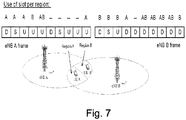
- Fig. 7 illustrates an example where the overlapping area among two neighboring eNBs is divided into two regions named region A and region B. Each of these regions utilizes a different set of UL and DL slots from eNB A and eNB B, respectively. In this way, the frame available within each cell and among the different regions is different.
- region A utilizes the first, second, third, fifth and last slot of the eNB A frame and the fourth, sixth, seventh, eighth and ninth slot of the eNB B frame, while region B utilizes the fourth and fifth slots of eNB A and the remaining slots are utilized from eNB B.
- This super-cell deployment is expected to become more diverse as the cell sizes become smaller and the number of neighboring cells increases.
Landscapes
- Engineering & Computer Science (AREA)
- Signal Processing (AREA)
- Computer Networks & Wireless Communication (AREA)
- Mobile Radio Communication Systems (AREA)
Claims (14)
- Procédé de gestion de ressources dans un réseau de communication cellulaire, dans lequel ledit réseau inclut au moins une station de base par cellule pour une pluralité de cellules qui fonctionne en mode de transmission par TDD, duplex à répartition dans le temps, chaque station de base ayant une zone de couverture respective,
dans lequel lesdites stations de base fonctionnent de sorte que des zones spatiales existent - zones de chevauchement - dans lesquelles les zones de couverture d'au moins deux desdites stations de base se chevauchent,
dans lequel un UE, équipement utilisateur, à l'intérieur d'une zone de chevauchement utilise des ressources de liaison montante, UL, et/ou de liaison descendante, DL, provenant desdites au moins deux stations de base ayant des zones de couverture qui se chevauchent, sur la base des demandes de trafic particulières de l'UE dans l'UL et/ou dans la DL, et
dans lequel l'UE, à l'intérieur d'une trame d'UE unique, utilise des créneaux d'UL provenant des deux stations parmi lesdites au moins deux stations de base ayant des zones de couverture qui se chevauchent, et/ou utilise des créneaux de DL provenant des deux stations parmi lesdites au moins deux stations de base ayant des zones de couverture qui se chevauchent,
caractérisé en ce que lesdites au moins deux stations de base ayant des zones de couverture qui se chevauchent coopèrent l'une avec l'autre d'une manière telle qu'elles apparaissent comme une unique station de base logique - une super-cellule - vers l'UE. - Procédé selon la revendication 1, dans lequel lesdites au moins deux stations de base ayant des zones de couverture qui se chevauchent utilisent différents modèles d'UL/de DL.
- Procédé selon la revendication 1 ou 2, dans lequel des trames TDD individuelles sont personnalisées pour des UE particuliers en utilisant des créneaux uniques d'une trame de station de base TDD provenant de différentes stations de base.
- Procédé selon l'une quelconque des revendications 1 à 3, dans lequel lesdites au moins deux stations de base ayant des zones de couverture qui se chevauchent sont configurées pour informer l'UE de la configuration d'UL/de DL qui est utilisée par chaque station de base respective, de préférence par une signalisation de diffusion de façon régulière.
- Procédé selon l'une quelconque des revendications 1 à 4, dans lequel des UE situés à l'intérieur d'une super-cellule utilisent des créneaux de trame d'UL et/ou de DL provenant de différentes stations de base de ladite super-cellule à l'intérieur d'une trame unique.
- Procédé selon l'une quelconque des revendications 1 à 5, dans lequel lesdites super-cellules sont divisées d'une manière telle que deux régions ou plus ayant différentes caractéristiques d'UL/de DL sont fournies à l'intérieur d'une zone de chevauchement.
- Procédé selon l'une quelconque des revendications 1 à 6, dans lequel la création de super-cellules est réalisée à la demande sur la base d'une disponibilité de ressources du réseau et/ou d'exigences de ressources d'UE.
- Procédé selon l'une quelconque des revendications 1 à 7, dans lequel lesdites au moins deux stations de base ayant des zones de couverture qui se chevauchent sont configurées pour surveiller une charge de trafic dans l'UL et dans la DL pour des emplacements particuliers à l'intérieur de leur zone de couverture, en particulier en utilisant des techniques de positionnement d'UE.
- Procédé selon l'une quelconque des revendications 1 à 8, dans lequel lesdites au moins deux stations de base ayant des zones de couverture qui se chevauchent sont configurées pour échanger régulièrement des informations de charge associées aux ressources d'UL et/ou de DL, en particulier en utilisant l'interface X2.
- Procédé selon l'une quelconque des revendications 1 à 9, dans lequel l'émission et/ou la réception de données via de multiples stations de base est coordonnée en émettant des données destinées à un certain UE sous la forme de données dupliquées vers toutes les stations de base auxquelles l'UE respectif est connecté, et/ou
dans lequel l'émission et/ou la réception de données via de multiples stations de base est coordonnée en transférant des données destinées à un certain UE vers toutes les stations de base auxquelles l'UE respectif est connecté à l'aide de l'interface X2. - Procédé selon l'une quelconque des revendications 1 à 10, dans lequel des sessions de données sont divisées dans la passerelle de desserte S-GW ou dans la passerelle PDN, de réseau public de données, P-GW, et/ou
dans lequel un mécanisme de transfert intercellulaire est fourni, lequel assigne des UE résidant dans une zone de chevauchement à une station de base ou une région appropriée. - Système de gestion de ressources pour une utilisation dans un réseau de communication cellulaire, dans lequel ledit réseau inclut au moins une station de base par cellule pour une pluralité de cellules qui fonctionne en mode de transmission par TDD, duplex à répartition dans le temps, chaque station de base ayant une zone de couverture respective, le système comprenant un mécanisme de gestion qui est configuré
pour faire fonctionner des stations de base d'une manière telle que des zones spatiales existent - zones de chevauchement - dans lesquelles les zones de couverture d'au moins deux desdites stations de base se chevauchent, et
pour aider un UE à l'intérieur d'une zone de chevauchement à utiliser des ressources d'UL et/ou de DL provenant desdites au moins deux stations de base ayant des zones de couverture qui se chevauchent sur la base des demandes de trafic particulières de l'UE dans l'UL et/ou dans la DL, et
pour aider l'UE à utiliser, à l'intérieur d'une trame d'UE unique, des créneaux d'UL provenant des deux stations parmi lesdites au moins deux stations de base ayant des zones de couverture qui se chevauchent, et/ou à utiliser, à l'intérieur d'une trame d'UE unique, des créneaux de DL provenant des deux stations parmi lesdites au moins deux stations de base ayant des zones de couverture qui se chevauchent,
caractérisé en ce que le mécanisme de gestion est en outre configuré pour faire fonctionner des stations de base d'une manière telle que lesdites au moins deux stations de base ayant des zones de couverture qui se chevauchent coopèrent l'une avec l'autre d'une manière telle qu'elles apparaissent comme une unique station de base logique - une super-cellule - vers l'UE. - Système de gestion de ressources selon la revendication 12, dans lequel ledit mécanisme de gestion est configuré pour réaliser des processus de décision de transfert intercellulaire en fonction de demandes d'UL/de DL d'UE et de la structure de trame d'UL/de DL disponible dans la zone de chevauchement respective dans laquelle ledit UE réside.
- Système de gestion de ressources selon la revendication 12 ou 13, comprenant en outre un mécanisme de surveillance pour lesdites au moins deux stations de base ayant des zones de couverture qui se chevauchent, le mécanisme de surveillance étant configuré pour surveiller une charge de trafic dans l'UL et/ou dans la DL pour des emplacements à l'intérieur de leurs zones de couverture respectives.
Applications Claiming Priority (1)
| Application Number | Priority Date | Filing Date | Title |
|---|---|---|---|
| PCT/EP2012/052574 WO2013120517A1 (fr) | 2012-02-15 | 2012-02-15 | Procédé de gestion de ressources dans un réseau de communication cellulaire tdd et système de gestion de ressources |
Publications (2)
| Publication Number | Publication Date |
|---|---|
| EP2815617A1 EP2815617A1 (fr) | 2014-12-24 |
| EP2815617B1 true EP2815617B1 (fr) | 2019-09-04 |
Family
ID=45878905
Family Applications (1)
| Application Number | Title | Priority Date | Filing Date |
|---|---|---|---|
| EP12710452.9A Active EP2815617B1 (fr) | 2012-02-15 | 2012-02-15 | Procédé de gestion de ressources dans un réseau de communication cellulaire tdd et système de gestion de ressources |
Country Status (4)
| Country | Link |
|---|---|
| US (1) | US9485779B2 (fr) |
| EP (1) | EP2815617B1 (fr) |
| CN (1) | CN104145517B (fr) |
| WO (1) | WO2013120517A1 (fr) |
Families Citing this family (16)
| Publication number | Priority date | Publication date | Assignee | Title |
|---|---|---|---|---|
| US9832652B1 (en) * | 2013-11-12 | 2017-11-28 | Sprint Spectrum L.P. | Methods and systems for managing coverage area changes using base station signaling |
| US9918258B2 (en) | 2013-11-26 | 2018-03-13 | At&T Intellectual Property I, L.P. | Anomaly correlation mechanism for analysis of handovers in a communication network |
| US10117255B2 (en) * | 2014-11-12 | 2018-10-30 | Nokia Technologies Oy | Neighboring cell load information |
| CN107155189B (zh) * | 2016-03-03 | 2021-02-12 | 华为技术有限公司 | 应用于超级小区的通信方法和装置 |
| CN108024352A (zh) * | 2016-11-03 | 2018-05-11 | 索尼公司 | 用于资源管理装置、数据库和对象的电子设备和方法 |
| EP3404985A1 (fr) | 2017-05-18 | 2018-11-21 | Fraunhofer-Gesellschaft zur Förderung der angewandten Forschung e.V. | Duplex intégral des directions de liaison montante et de liaison descendante |
| CN111357346B (zh) * | 2017-11-16 | 2023-09-01 | 诺基亚通信公司 | 蜂窝网络中的自适应传输方向选择 |
| CN109068390B (zh) * | 2018-09-19 | 2022-08-12 | 中国联合网络通信集团有限公司 | 双连接建立方法及网络设备 |
| US12120060B2 (en) * | 2018-09-19 | 2024-10-15 | Qualcomm Incorporated | Acknowledgement codebook design for multiple transmission reception points |
| WO2020222107A1 (fr) * | 2019-05-02 | 2020-11-05 | Telefonaktiebolaget Lm Ericsson (Publ) | Détermination de capacité disponible par partition cellulaire |
| US11477787B2 (en) * | 2019-09-13 | 2022-10-18 | Aalyria Technologies, Inc. | Dynamic spectrum sharing between coverage types |
| CN112996060B (zh) * | 2019-12-02 | 2022-10-04 | 中国移动通信集团浙江有限公司 | 载波关闭方法、装置及服务器 |
| US11463843B2 (en) * | 2020-05-07 | 2022-10-04 | Qualcomm Incorporated | Methods and apparatus for concurrent operation of SPS receiver and wireless transmitter |
| EP4197242A1 (fr) * | 2020-08-11 | 2023-06-21 | Telefonaktiebolaget LM Ericsson (publ) | Adaptation de couverture de cellule de noeud iab (integrated access and backhaul) |
| US12231376B2 (en) | 2022-04-11 | 2025-02-18 | Dell Products, L.P. | Time division duplex pattern configuration for cellular networks |
| CN117498910B (zh) * | 2023-12-29 | 2024-03-22 | 深圳市佳贤通信科技股份有限公司 | 基于tdd小基站的信号交叠区覆盖增强系统及方法 |
Citations (2)
| Publication number | Priority date | Publication date | Assignee | Title |
|---|---|---|---|---|
| US6907014B1 (en) * | 1999-10-29 | 2005-06-14 | Matsushita Electric Industrial Co., Ltd. | Apparatus and method for TDMA-TDD based transmission/reception |
| WO2011162656A1 (fr) * | 2010-06-24 | 2011-12-29 | Telefonaktiebolaget Lm Eriksson (Publ) | Procédé d'allocation de créneaux temporels dans un réseau hertzien en tdd |
Family Cites Families (9)
| Publication number | Priority date | Publication date | Assignee | Title |
|---|---|---|---|---|
| SE513233C2 (sv) * | 1998-01-23 | 2000-08-07 | Ericsson Telefon Ab L M | TDMA-TDD/FDD Radiokommunikationssystem samt kanalvalsförfarande och -anordning för ett sådant system |
| DE19835186A1 (de) | 1998-08-04 | 2000-02-10 | Buehler Ag | Verfahren zur Reinigung eines Gasstromes |
| KR100871219B1 (ko) * | 2002-04-24 | 2008-12-01 | 삼성전자주식회사 | 이동 통신 시스템에서 멀티 탐색을 제공하는 셀 탐색 장치및 방법 |
| WO2006004968A2 (fr) * | 2004-06-30 | 2006-01-12 | Neocific, Inc. | Procedes et appareil de commande de puissance dans des systemes sans fil multiporteuse |
| US8135026B2 (en) * | 2006-01-05 | 2012-03-13 | Qualcomm, Incorporated | Disjoint and common link operation in a wireless communication system |
| CN101291168A (zh) * | 2008-05-28 | 2008-10-22 | 京信通信系统(中国)有限公司 | 基于射频拉远单元的覆盖增强系统及其方法 |
| US8498207B2 (en) | 2008-06-26 | 2013-07-30 | Reverb Networks | Dynamic load balancing |
| US8750887B2 (en) * | 2010-07-16 | 2014-06-10 | Texas Instruments Incorporated | Multi-cell signaling of channel state information-reference signal and physical downlink shared channel muting |
| KR101835326B1 (ko) * | 2010-09-26 | 2018-03-07 | 엘지전자 주식회사 | 다중 안테나 지원 무선 통신 시스템에서 효율적인 피드백 방법 및 장치 |
-
2012
- 2012-02-15 CN CN201280068779.XA patent/CN104145517B/zh active Active
- 2012-02-15 US US14/375,493 patent/US9485779B2/en active Active
- 2012-02-15 WO PCT/EP2012/052574 patent/WO2013120517A1/fr not_active Ceased
- 2012-02-15 EP EP12710452.9A patent/EP2815617B1/fr active Active
Patent Citations (2)
| Publication number | Priority date | Publication date | Assignee | Title |
|---|---|---|---|---|
| US6907014B1 (en) * | 1999-10-29 | 2005-06-14 | Matsushita Electric Industrial Co., Ltd. | Apparatus and method for TDMA-TDD based transmission/reception |
| WO2011162656A1 (fr) * | 2010-06-24 | 2011-12-29 | Telefonaktiebolaget Lm Eriksson (Publ) | Procédé d'allocation de créneaux temporels dans un réseau hertzien en tdd |
Also Published As
| Publication number | Publication date |
|---|---|
| EP2815617A1 (fr) | 2014-12-24 |
| CN104145517B (zh) | 2018-08-31 |
| CN104145517A (zh) | 2014-11-12 |
| WO2013120517A1 (fr) | 2013-08-22 |
| US9485779B2 (en) | 2016-11-01 |
| US20150055517A1 (en) | 2015-02-26 |
Similar Documents
| Publication | Publication Date | Title |
|---|---|---|
| EP2815617B1 (fr) | Procédé de gestion de ressources dans un réseau de communication cellulaire tdd et système de gestion de ressources | |
| US10404510B2 (en) | Systems and methods for configuring carriers using overlapping sets of candidate numerologies | |
| KR102435887B1 (ko) | 자원 관리 방법 및 장치 | |
| US8982765B2 (en) | Method and apparatus for transmitting data on relay communication system | |
| EP2949166B1 (fr) | Allocation de ressources dans un réseau de radiocommunication | |
| US9049714B2 (en) | Inter-cell interference coordination method and apparatus for an OFDM-based heterogeneous cellular system | |
| EP2737758B1 (fr) | Procédé de gestion des ressources dans un réseau de communication cellulaire et système de gestion des ressources | |
| US9247479B2 (en) | Resource allocation in a mobile communication system | |
| US20080075178A1 (en) | Communication System Using Relay Base Stations with Asymmetric Data Links | |
| US20120281657A1 (en) | Method for downlink multi-antenna multi-base station interference coordination and base station | |
| EP3804436B1 (fr) | Partage de porteuse de sdma | |
| US20210226751A1 (en) | Serving cell with distinct pci index per rrh for dl tci state, spatial relation, and ul tci state | |
| US11588560B2 (en) | Adaptation of transmit and receive antennas | |
| KR102000093B1 (ko) | 무선 통신 시스템에서 데이터를 송수신하는 방법 및 장치 | |
| JP2013502806A (ja) | 協調型マルチアンテナ送受信システムにおける群特異的情報を送受信する方法及びシステム | |
| EP2611230A1 (fr) | Procédé de déploiement d'un réseau de communication cellulaire | |
| WO2018008975A1 (fr) | Procédé de mise à jour de csi hybrides dans un système de communication à antennes multiples, et dispositif associé | |
| US9100985B2 (en) | Coordinated multi-point communications system and methods for controlling coordinated multi-point transmission and reception | |
| US20190238304A1 (en) | Apparatus and method for interference management in wireless communication system | |
| Samdanis et al. | Virtual cells: Enhancing the resource allocation efficiency for TD-LTE | |
| US10177955B2 (en) | In and relating to communication network resourcing | |
| US12375133B2 (en) | Enhancements for non-collocated intra-band deployments | |
| KR100846520B1 (ko) | 비대칭적 데이터 링크들을 통해 중계 기지국들을 이용하는통신 시스템 | |
| EP4573669A1 (fr) | Améliorations de déploiements intra-bandes non colocalisés | |
| JP5775706B2 (ja) | 無線基地局及び通信制御方法 |
Legal Events
| Date | Code | Title | Description |
|---|---|---|---|
| PUAI | Public reference made under article 153(3) epc to a published international application that has entered the european phase |
Free format text: ORIGINAL CODE: 0009012 |
|
| 17P | Request for examination filed |
Effective date: 20140709 |
|
| AK | Designated contracting states |
Kind code of ref document: A1 Designated state(s): AL AT BE BG CH CY CZ DE DK EE ES FI FR GB GR HR HU IE IS IT LI LT LU LV MC MK MT NL NO PL PT RO RS SE SI SK SM TR |
|
| AX | Request for extension of the european patent |
Extension state: BA ME |
|
| DAX | Request for extension of the european patent (deleted) | ||
| RAP1 | Party data changed (applicant data changed or rights of an application transferred) |
Owner name: NEC LABORATORIES EUROPE GMBH |
|
| STAA | Information on the status of an ep patent application or granted ep patent |
Free format text: STATUS: EXAMINATION IS IN PROGRESS |
|
| 17Q | First examination report despatched |
Effective date: 20180205 |
|
| REG | Reference to a national code |
Ref country code: DE Ref legal event code: R079 Ref document number: 602012063593 Country of ref document: DE Free format text: PREVIOUS MAIN CLASS: H04W0072040000 Ipc: H04W0072120000 |
|
| GRAP | Despatch of communication of intention to grant a patent |
Free format text: ORIGINAL CODE: EPIDOSNIGR1 |
|
| STAA | Information on the status of an ep patent application or granted ep patent |
Free format text: STATUS: GRANT OF PATENT IS INTENDED |
|
| RIC1 | Information provided on ipc code assigned before grant |
Ipc: H04W 36/00 20090101ALN20190318BHEP Ipc: H04W 72/12 20090101AFI20190318BHEP Ipc: H04L 5/14 20060101ALI20190318BHEP |
|
| INTG | Intention to grant announced |
Effective date: 20190417 |
|
| GRAS | Grant fee paid |
Free format text: ORIGINAL CODE: EPIDOSNIGR3 |
|
| GRAA | (expected) grant |
Free format text: ORIGINAL CODE: 0009210 |
|
| STAA | Information on the status of an ep patent application or granted ep patent |
Free format text: STATUS: THE PATENT HAS BEEN GRANTED |
|
| AK | Designated contracting states |
Kind code of ref document: B1 Designated state(s): AL AT BE BG CH CY CZ DE DK EE ES FI FR GB GR HR HU IE IS IT LI LT LU LV MC MK MT NL NO PL PT RO RS SE SI SK SM TR |
|
| RAP1 | Party data changed (applicant data changed or rights of an application transferred) |
Owner name: NEC CORPORATION |
|
| REG | Reference to a national code |
Ref country code: GB Ref legal event code: FG4D |
|
| REG | Reference to a national code |
Ref country code: CH Ref legal event code: EP |
|
| REG | Reference to a national code |
Ref country code: AT Ref legal event code: REF Ref document number: 1177216 Country of ref document: AT Kind code of ref document: T Effective date: 20190915 |
|
| REG | Reference to a national code |
Ref country code: DE Ref legal event code: R096 Ref document number: 602012063593 Country of ref document: DE |
|
| REG | Reference to a national code |
Ref country code: IE Ref legal event code: FG4D |
|
| REG | Reference to a national code |
Ref country code: NL Ref legal event code: MP Effective date: 20190904 |
|
| REG | Reference to a national code |
Ref country code: LT Ref legal event code: MG4D |
|
| PG25 | Lapsed in a contracting state [announced via postgrant information from national office to epo] |
Ref country code: BG Free format text: LAPSE BECAUSE OF FAILURE TO SUBMIT A TRANSLATION OF THE DESCRIPTION OR TO PAY THE FEE WITHIN THE PRESCRIBED TIME-LIMIT Effective date: 20191204 Ref country code: NO Free format text: LAPSE BECAUSE OF FAILURE TO SUBMIT A TRANSLATION OF THE DESCRIPTION OR TO PAY THE FEE WITHIN THE PRESCRIBED TIME-LIMIT Effective date: 20191204 Ref country code: FI Free format text: LAPSE BECAUSE OF FAILURE TO SUBMIT A TRANSLATION OF THE DESCRIPTION OR TO PAY THE FEE WITHIN THE PRESCRIBED TIME-LIMIT Effective date: 20190904 Ref country code: LT Free format text: LAPSE BECAUSE OF FAILURE TO SUBMIT A TRANSLATION OF THE DESCRIPTION OR TO PAY THE FEE WITHIN THE PRESCRIBED TIME-LIMIT Effective date: 20190904 Ref country code: HR Free format text: LAPSE BECAUSE OF FAILURE TO SUBMIT A TRANSLATION OF THE DESCRIPTION OR TO PAY THE FEE WITHIN THE PRESCRIBED TIME-LIMIT Effective date: 20190904 Ref country code: SE Free format text: LAPSE BECAUSE OF FAILURE TO SUBMIT A TRANSLATION OF THE DESCRIPTION OR TO PAY THE FEE WITHIN THE PRESCRIBED TIME-LIMIT Effective date: 20190904 |
|
| PG25 | Lapsed in a contracting state [announced via postgrant information from national office to epo] |
Ref country code: ES Free format text: LAPSE BECAUSE OF FAILURE TO SUBMIT A TRANSLATION OF THE DESCRIPTION OR TO PAY THE FEE WITHIN THE PRESCRIBED TIME-LIMIT Effective date: 20190904 Ref country code: LV Free format text: LAPSE BECAUSE OF FAILURE TO SUBMIT A TRANSLATION OF THE DESCRIPTION OR TO PAY THE FEE WITHIN THE PRESCRIBED TIME-LIMIT Effective date: 20190904 Ref country code: AL Free format text: LAPSE BECAUSE OF FAILURE TO SUBMIT A TRANSLATION OF THE DESCRIPTION OR TO PAY THE FEE WITHIN THE PRESCRIBED TIME-LIMIT Effective date: 20190904 Ref country code: RS Free format text: LAPSE BECAUSE OF FAILURE TO SUBMIT A TRANSLATION OF THE DESCRIPTION OR TO PAY THE FEE WITHIN THE PRESCRIBED TIME-LIMIT Effective date: 20190904 Ref country code: GR Free format text: LAPSE BECAUSE OF FAILURE TO SUBMIT A TRANSLATION OF THE DESCRIPTION OR TO PAY THE FEE WITHIN THE PRESCRIBED TIME-LIMIT Effective date: 20191205 |
|
| REG | Reference to a national code |
Ref country code: AT Ref legal event code: MK05 Ref document number: 1177216 Country of ref document: AT Kind code of ref document: T Effective date: 20190904 |
|
| PG25 | Lapsed in a contracting state [announced via postgrant information from national office to epo] |
Ref country code: PT Free format text: LAPSE BECAUSE OF FAILURE TO SUBMIT A TRANSLATION OF THE DESCRIPTION OR TO PAY THE FEE WITHIN THE PRESCRIBED TIME-LIMIT Effective date: 20200106 Ref country code: IT Free format text: LAPSE BECAUSE OF FAILURE TO SUBMIT A TRANSLATION OF THE DESCRIPTION OR TO PAY THE FEE WITHIN THE PRESCRIBED TIME-LIMIT Effective date: 20190904 Ref country code: PL Free format text: LAPSE BECAUSE OF FAILURE TO SUBMIT A TRANSLATION OF THE DESCRIPTION OR TO PAY THE FEE WITHIN THE PRESCRIBED TIME-LIMIT Effective date: 20190904 Ref country code: EE Free format text: LAPSE BECAUSE OF FAILURE TO SUBMIT A TRANSLATION OF THE DESCRIPTION OR TO PAY THE FEE WITHIN THE PRESCRIBED TIME-LIMIT Effective date: 20190904 Ref country code: AT Free format text: LAPSE BECAUSE OF FAILURE TO SUBMIT A TRANSLATION OF THE DESCRIPTION OR TO PAY THE FEE WITHIN THE PRESCRIBED TIME-LIMIT Effective date: 20190904 Ref country code: RO Free format text: LAPSE BECAUSE OF FAILURE TO SUBMIT A TRANSLATION OF THE DESCRIPTION OR TO PAY THE FEE WITHIN THE PRESCRIBED TIME-LIMIT Effective date: 20190904 Ref country code: NL Free format text: LAPSE BECAUSE OF FAILURE TO SUBMIT A TRANSLATION OF THE DESCRIPTION OR TO PAY THE FEE WITHIN THE PRESCRIBED TIME-LIMIT Effective date: 20190904 |
|
| PG25 | Lapsed in a contracting state [announced via postgrant information from national office to epo] |
Ref country code: CZ Free format text: LAPSE BECAUSE OF FAILURE TO SUBMIT A TRANSLATION OF THE DESCRIPTION OR TO PAY THE FEE WITHIN THE PRESCRIBED TIME-LIMIT Effective date: 20190904 Ref country code: SK Free format text: LAPSE BECAUSE OF FAILURE TO SUBMIT A TRANSLATION OF THE DESCRIPTION OR TO PAY THE FEE WITHIN THE PRESCRIBED TIME-LIMIT Effective date: 20190904 Ref country code: SM Free format text: LAPSE BECAUSE OF FAILURE TO SUBMIT A TRANSLATION OF THE DESCRIPTION OR TO PAY THE FEE WITHIN THE PRESCRIBED TIME-LIMIT Effective date: 20190904 Ref country code: IS Free format text: LAPSE BECAUSE OF FAILURE TO SUBMIT A TRANSLATION OF THE DESCRIPTION OR TO PAY THE FEE WITHIN THE PRESCRIBED TIME-LIMIT Effective date: 20200224 |
|
| REG | Reference to a national code |
Ref country code: DE Ref legal event code: R097 Ref document number: 602012063593 Country of ref document: DE |
|
| PLBE | No opposition filed within time limit |
Free format text: ORIGINAL CODE: 0009261 |
|
| STAA | Information on the status of an ep patent application or granted ep patent |
Free format text: STATUS: NO OPPOSITION FILED WITHIN TIME LIMIT |
|
| PG2D | Information on lapse in contracting state deleted |
Ref country code: IS |
|
| PG25 | Lapsed in a contracting state [announced via postgrant information from national office to epo] |
Ref country code: DK Free format text: LAPSE BECAUSE OF FAILURE TO SUBMIT A TRANSLATION OF THE DESCRIPTION OR TO PAY THE FEE WITHIN THE PRESCRIBED TIME-LIMIT Effective date: 20190904 Ref country code: IS Free format text: LAPSE BECAUSE OF FAILURE TO SUBMIT A TRANSLATION OF THE DESCRIPTION OR TO PAY THE FEE WITHIN THE PRESCRIBED TIME-LIMIT Effective date: 20200105 |
|
| 26N | No opposition filed |
Effective date: 20200605 |
|
| PG25 | Lapsed in a contracting state [announced via postgrant information from national office to epo] |
Ref country code: SI Free format text: LAPSE BECAUSE OF FAILURE TO SUBMIT A TRANSLATION OF THE DESCRIPTION OR TO PAY THE FEE WITHIN THE PRESCRIBED TIME-LIMIT Effective date: 20190904 |
|
| REG | Reference to a national code |
Ref country code: CH Ref legal event code: PL |
|
| GBPC | Gb: european patent ceased through non-payment of renewal fee |
Effective date: 20200215 |
|
| REG | Reference to a national code |
Ref country code: BE Ref legal event code: MM Effective date: 20200229 |
|
| PG25 | Lapsed in a contracting state [announced via postgrant information from national office to epo] |
Ref country code: LU Free format text: LAPSE BECAUSE OF NON-PAYMENT OF DUE FEES Effective date: 20200215 Ref country code: MC Free format text: LAPSE BECAUSE OF FAILURE TO SUBMIT A TRANSLATION OF THE DESCRIPTION OR TO PAY THE FEE WITHIN THE PRESCRIBED TIME-LIMIT Effective date: 20190904 |
|
| PG25 | Lapsed in a contracting state [announced via postgrant information from national office to epo] |
Ref country code: LI Free format text: LAPSE BECAUSE OF NON-PAYMENT OF DUE FEES Effective date: 20200229 Ref country code: CH Free format text: LAPSE BECAUSE OF NON-PAYMENT OF DUE FEES Effective date: 20200229 |
|
| PG25 | Lapsed in a contracting state [announced via postgrant information from national office to epo] |
Ref country code: FR Free format text: LAPSE BECAUSE OF NON-PAYMENT OF DUE FEES Effective date: 20200229 Ref country code: IE Free format text: LAPSE BECAUSE OF NON-PAYMENT OF DUE FEES Effective date: 20200215 Ref country code: GB Free format text: LAPSE BECAUSE OF NON-PAYMENT OF DUE FEES Effective date: 20200215 |
|
| PG25 | Lapsed in a contracting state [announced via postgrant information from national office to epo] |
Ref country code: BE Free format text: LAPSE BECAUSE OF NON-PAYMENT OF DUE FEES Effective date: 20200229 |
|
| PG25 | Lapsed in a contracting state [announced via postgrant information from national office to epo] |
Ref country code: TR Free format text: LAPSE BECAUSE OF FAILURE TO SUBMIT A TRANSLATION OF THE DESCRIPTION OR TO PAY THE FEE WITHIN THE PRESCRIBED TIME-LIMIT Effective date: 20190904 Ref country code: MT Free format text: LAPSE BECAUSE OF FAILURE TO SUBMIT A TRANSLATION OF THE DESCRIPTION OR TO PAY THE FEE WITHIN THE PRESCRIBED TIME-LIMIT Effective date: 20190904 Ref country code: CY Free format text: LAPSE BECAUSE OF FAILURE TO SUBMIT A TRANSLATION OF THE DESCRIPTION OR TO PAY THE FEE WITHIN THE PRESCRIBED TIME-LIMIT Effective date: 20190904 |
|
| PG25 | Lapsed in a contracting state [announced via postgrant information from national office to epo] |
Ref country code: MK Free format text: LAPSE BECAUSE OF FAILURE TO SUBMIT A TRANSLATION OF THE DESCRIPTION OR TO PAY THE FEE WITHIN THE PRESCRIBED TIME-LIMIT Effective date: 20190904 |
|
| PGFP | Annual fee paid to national office [announced via postgrant information from national office to epo] |
Ref country code: DE Payment date: 20260218 Year of fee payment: 15 |