EP2816144B1 - Fibres de carbone et leur procédé de production - Google Patents
Fibres de carbone et leur procédé de production Download PDFInfo
- Publication number
- EP2816144B1 EP2816144B1 EP13826710.9A EP13826710A EP2816144B1 EP 2816144 B1 EP2816144 B1 EP 2816144B1 EP 13826710 A EP13826710 A EP 13826710A EP 2816144 B1 EP2816144 B1 EP 2816144B1
- Authority
- EP
- European Patent Office
- Prior art keywords
- resin
- fiber
- graphenes
- carbon
- carbon fiber
- Prior art date
- Legal status (The legal status is an assumption and is not a legal conclusion. Google has not performed a legal analysis and makes no representation as to the accuracy of the status listed.)
- Active
Links
Images






Classifications
-
- C—CHEMISTRY; METALLURGY
- C01—INORGANIC CHEMISTRY
- C01B—NON-METALLIC ELEMENTS; COMPOUNDS THEREOF; METALLOIDS OR COMPOUNDS THEREOF NOT COVERED BY SUBCLASS C01C
- C01B32/00—Carbon; Compounds thereof
- C01B32/15—Nano-sized carbon materials
- C01B32/182—Graphene
- C01B32/184—Preparation
-
- D—TEXTILES; PAPER
- D01—NATURAL OR MAN-MADE THREADS OR FIBRES; SPINNING
- D01F—CHEMICAL FEATURES IN THE MANUFACTURE OF ARTIFICIAL FILAMENTS, THREADS, FIBRES, BRISTLES OR RIBBONS; APPARATUS SPECIALLY ADAPTED FOR THE MANUFACTURE OF CARBON FILAMENTS
- D01F9/00—Artificial filaments or the like of other substances; Manufacture thereof; Apparatus specially adapted for the manufacture of carbon filaments
- D01F9/08—Artificial filaments or the like of other substances; Manufacture thereof; Apparatus specially adapted for the manufacture of carbon filaments of inorganic material
- D01F9/12—Carbon filaments; Apparatus specially adapted for the manufacture thereof
- D01F9/14—Carbon filaments; Apparatus specially adapted for the manufacture thereof by decomposition of organic filaments
- D01F9/20—Carbon filaments; Apparatus specially adapted for the manufacture thereof by decomposition of organic filaments from polyaddition, polycondensation or polymerisation products
- D01F9/21—Carbon filaments; Apparatus specially adapted for the manufacture thereof by decomposition of organic filaments from polyaddition, polycondensation or polymerisation products from macromolecular compounds obtained by reactions only involving carbon-to-carbon unsaturated bonds
-
- D—TEXTILES; PAPER
- D01—NATURAL OR MAN-MADE THREADS OR FIBRES; SPINNING
- D01F—CHEMICAL FEATURES IN THE MANUFACTURE OF ARTIFICIAL FILAMENTS, THREADS, FIBRES, BRISTLES OR RIBBONS; APPARATUS SPECIALLY ADAPTED FOR THE MANUFACTURE OF CARBON FILAMENTS
- D01F9/00—Artificial filaments or the like of other substances; Manufacture thereof; Apparatus specially adapted for the manufacture of carbon filaments
- D01F9/08—Artificial filaments or the like of other substances; Manufacture thereof; Apparatus specially adapted for the manufacture of carbon filaments of inorganic material
- D01F9/12—Carbon filaments; Apparatus specially adapted for the manufacture thereof
-
- C—CHEMISTRY; METALLURGY
- C01—INORGANIC CHEMISTRY
- C01B—NON-METALLIC ELEMENTS; COMPOUNDS THEREOF; METALLOIDS OR COMPOUNDS THEREOF NOT COVERED BY SUBCLASS C01C
- C01B32/00—Carbon; Compounds thereof
- C01B32/05—Preparation or purification of carbon not covered by groups C01B32/15, C01B32/20, C01B32/25, C01B32/30
-
- C—CHEMISTRY; METALLURGY
- C01—INORGANIC CHEMISTRY
- C01B—NON-METALLIC ELEMENTS; COMPOUNDS THEREOF; METALLOIDS OR COMPOUNDS THEREOF NOT COVERED BY SUBCLASS C01C
- C01B32/00—Carbon; Compounds thereof
- C01B32/15—Nano-sized carbon materials
- C01B32/182—Graphene
- C01B32/194—After-treatment
-
- C—CHEMISTRY; METALLURGY
- C01—INORGANIC CHEMISTRY
- C01B—NON-METALLIC ELEMENTS; COMPOUNDS THEREOF; METALLOIDS OR COMPOUNDS THEREOF NOT COVERED BY SUBCLASS C01C
- C01B32/00—Carbon; Compounds thereof
- C01B32/15—Nano-sized carbon materials
- C01B32/182—Graphene
- C01B32/194—After-treatment
- C01B32/196—Purification
-
- C—CHEMISTRY; METALLURGY
- C09—DYES; PAINTS; POLISHES; NATURAL RESINS; ADHESIVES; COMPOSITIONS NOT OTHERWISE PROVIDED FOR; APPLICATIONS OF MATERIALS NOT OTHERWISE PROVIDED FOR
- C09D—COATING COMPOSITIONS, e.g. PAINTS, VARNISHES OR LACQUERS; FILLING PASTES; CHEMICAL PAINT OR INK REMOVERS; INKS; CORRECTING FLUIDS; WOODSTAINS; PASTES OR SOLIDS FOR COLOURING OR PRINTING; USE OF MATERIALS THEREFOR
- C09D1/00—Coating compositions, e.g. paints, varnishes or lacquers, based on inorganic substances
-
- C—CHEMISTRY; METALLURGY
- C09—DYES; PAINTS; POLISHES; NATURAL RESINS; ADHESIVES; COMPOSITIONS NOT OTHERWISE PROVIDED FOR; APPLICATIONS OF MATERIALS NOT OTHERWISE PROVIDED FOR
- C09D—COATING COMPOSITIONS, e.g. PAINTS, VARNISHES OR LACQUERS; FILLING PASTES; CHEMICAL PAINT OR INK REMOVERS; INKS; CORRECTING FLUIDS; WOODSTAINS; PASTES OR SOLIDS FOR COLOURING OR PRINTING; USE OF MATERIALS THEREFOR
- C09D11/00—Inks
- C09D11/02—Printing inks
- C09D11/03—Printing inks characterised by features other than the chemical nature of the binder
-
- C—CHEMISTRY; METALLURGY
- C09—DYES; PAINTS; POLISHES; NATURAL RESINS; ADHESIVES; COMPOSITIONS NOT OTHERWISE PROVIDED FOR; APPLICATIONS OF MATERIALS NOT OTHERWISE PROVIDED FOR
- C09D—COATING COMPOSITIONS, e.g. PAINTS, VARNISHES OR LACQUERS; FILLING PASTES; CHEMICAL PAINT OR INK REMOVERS; INKS; CORRECTING FLUIDS; WOODSTAINS; PASTES OR SOLIDS FOR COLOURING OR PRINTING; USE OF MATERIALS THEREFOR
- C09D11/00—Inks
- C09D11/52—Electrically conductive inks
-
- C—CHEMISTRY; METALLURGY
- C09—DYES; PAINTS; POLISHES; NATURAL RESINS; ADHESIVES; COMPOSITIONS NOT OTHERWISE PROVIDED FOR; APPLICATIONS OF MATERIALS NOT OTHERWISE PROVIDED FOR
- C09D—COATING COMPOSITIONS, e.g. PAINTS, VARNISHES OR LACQUERS; FILLING PASTES; CHEMICAL PAINT OR INK REMOVERS; INKS; CORRECTING FLUIDS; WOODSTAINS; PASTES OR SOLIDS FOR COLOURING OR PRINTING; USE OF MATERIALS THEREFOR
- C09D5/00—Coating compositions, e.g. paints, varnishes or lacquers, characterised by their physical nature or the effects produced; Filling pastes
- C09D5/24—Electrically-conducting paints
-
- C—CHEMISTRY; METALLURGY
- C09—DYES; PAINTS; POLISHES; NATURAL RESINS; ADHESIVES; COMPOSITIONS NOT OTHERWISE PROVIDED FOR; APPLICATIONS OF MATERIALS NOT OTHERWISE PROVIDED FOR
- C09K—MATERIALS FOR MISCELLANEOUS APPLICATIONS, NOT PROVIDED FOR ELSEWHERE
- C09K5/00—Heat-transfer, heat-exchange or heat-storage materials, e.g. refrigerants; Materials for the production of heat or cold by chemical reactions other than by combustion
- C09K5/08—Materials not undergoing a change of physical state when used
-
- C—CHEMISTRY; METALLURGY
- C09—DYES; PAINTS; POLISHES; NATURAL RESINS; ADHESIVES; COMPOSITIONS NOT OTHERWISE PROVIDED FOR; APPLICATIONS OF MATERIALS NOT OTHERWISE PROVIDED FOR
- C09K—MATERIALS FOR MISCELLANEOUS APPLICATIONS, NOT PROVIDED FOR ELSEWHERE
- C09K5/00—Heat-transfer, heat-exchange or heat-storage materials, e.g. refrigerants; Materials for the production of heat or cold by chemical reactions other than by combustion
- C09K5/08—Materials not undergoing a change of physical state when used
- C09K5/14—Solid materials, e.g. powdery or granular
-
- D—TEXTILES; PAPER
- D01—NATURAL OR MAN-MADE THREADS OR FIBRES; SPINNING
- D01F—CHEMICAL FEATURES IN THE MANUFACTURE OF ARTIFICIAL FILAMENTS, THREADS, FIBRES, BRISTLES OR RIBBONS; APPARATUS SPECIALLY ADAPTED FOR THE MANUFACTURE OF CARBON FILAMENTS
- D01F9/00—Artificial filaments or the like of other substances; Manufacture thereof; Apparatus specially adapted for the manufacture of carbon filaments
- D01F9/08—Artificial filaments or the like of other substances; Manufacture thereof; Apparatus specially adapted for the manufacture of carbon filaments of inorganic material
- D01F9/12—Carbon filaments; Apparatus specially adapted for the manufacture thereof
- D01F9/14—Carbon filaments; Apparatus specially adapted for the manufacture thereof by decomposition of organic filaments
-
- D—TEXTILES; PAPER
- D01—NATURAL OR MAN-MADE THREADS OR FIBRES; SPINNING
- D01F—CHEMICAL FEATURES IN THE MANUFACTURE OF ARTIFICIAL FILAMENTS, THREADS, FIBRES, BRISTLES OR RIBBONS; APPARATUS SPECIALLY ADAPTED FOR THE MANUFACTURE OF CARBON FILAMENTS
- D01F9/00—Artificial filaments or the like of other substances; Manufacture thereof; Apparatus specially adapted for the manufacture of carbon filaments
- D01F9/08—Artificial filaments or the like of other substances; Manufacture thereof; Apparatus specially adapted for the manufacture of carbon filaments of inorganic material
- D01F9/12—Carbon filaments; Apparatus specially adapted for the manufacture thereof
- D01F9/14—Carbon filaments; Apparatus specially adapted for the manufacture thereof by decomposition of organic filaments
- D01F9/32—Apparatus therefor
-
- H—ELECTRICITY
- H01—ELECTRIC ELEMENTS
- H01B—CABLES; CONDUCTORS; INSULATORS; SELECTION OF MATERIALS FOR THEIR CONDUCTIVE, INSULATING OR DIELECTRIC PROPERTIES
- H01B1/00—Conductors or conductive bodies characterised by the conductive materials; Selection of materials as conductors
- H01B1/20—Conductive material dispersed in non-conductive organic material
- H01B1/24—Conductive material dispersed in non-conductive organic material the conductive material comprising carbon-silicon compounds, carbon or silicon
-
- H—ELECTRICITY
- H01—ELECTRIC ELEMENTS
- H01M—PROCESSES OR MEANS, e.g. BATTERIES, FOR THE DIRECT CONVERSION OF CHEMICAL ENERGY INTO ELECTRICAL ENERGY
- H01M4/00—Electrodes
- H01M4/02—Electrodes composed of, or comprising, active material
- H01M4/62—Selection of inactive substances as ingredients for active masses, e.g. binders, fillers
- H01M4/624—Electric conductive fillers
- H01M4/625—Carbon or graphite
-
- B—PERFORMING OPERATIONS; TRANSPORTING
- B82—NANOTECHNOLOGY
- B82Y—SPECIFIC USES OR APPLICATIONS OF NANOSTRUCTURES; MEASUREMENT OR ANALYSIS OF NANOSTRUCTURES; MANUFACTURE OR TREATMENT OF NANOSTRUCTURES
- B82Y40/00—Manufacture or treatment of nanostructures
-
- Y—GENERAL TAGGING OF NEW TECHNOLOGICAL DEVELOPMENTS; GENERAL TAGGING OF CROSS-SECTIONAL TECHNOLOGIES SPANNING OVER SEVERAL SECTIONS OF THE IPC; TECHNICAL SUBJECTS COVERED BY FORMER USPC CROSS-REFERENCE ART COLLECTIONS [XRACs] AND DIGESTS
- Y02—TECHNOLOGIES OR APPLICATIONS FOR MITIGATION OR ADAPTATION AGAINST CLIMATE CHANGE
- Y02E—REDUCTION OF GREENHOUSE GAS [GHG] EMISSIONS, RELATED TO ENERGY GENERATION, TRANSMISSION OR DISTRIBUTION
- Y02E60/00—Enabling technologies; Technologies with a potential or indirect contribution to GHG emissions mitigation
- Y02E60/10—Energy storage using batteries
-
- Y—GENERAL TAGGING OF NEW TECHNOLOGICAL DEVELOPMENTS; GENERAL TAGGING OF CROSS-SECTIONAL TECHNOLOGIES SPANNING OVER SEVERAL SECTIONS OF THE IPC; TECHNICAL SUBJECTS COVERED BY FORMER USPC CROSS-REFERENCE ART COLLECTIONS [XRACs] AND DIGESTS
- Y10—TECHNICAL SUBJECTS COVERED BY FORMER USPC
- Y10T—TECHNICAL SUBJECTS COVERED BY FORMER US CLASSIFICATION
- Y10T442/00—Fabric [woven, knitted, or nonwoven textile or cloth, etc.]
- Y10T442/30—Woven fabric [i.e., woven strand or strip material]
-
- Y—GENERAL TAGGING OF NEW TECHNOLOGICAL DEVELOPMENTS; GENERAL TAGGING OF CROSS-SECTIONAL TECHNOLOGIES SPANNING OVER SEVERAL SECTIONS OF THE IPC; TECHNICAL SUBJECTS COVERED BY FORMER USPC CROSS-REFERENCE ART COLLECTIONS [XRACs] AND DIGESTS
- Y10—TECHNICAL SUBJECTS COVERED BY FORMER USPC
- Y10T—TECHNICAL SUBJECTS COVERED BY FORMER US CLASSIFICATION
- Y10T442/00—Fabric [woven, knitted, or nonwoven textile or cloth, etc.]
- Y10T442/60—Nonwoven fabric [i.e., nonwoven strand or fiber material]
Definitions
- the present invention relates to a carbon fiber suitably usable for transparent conductive materials for forming transparent flexible conductive films; high heat-release and heat-transfer materials for forming heat-release sheets for, for example, smartphone; conductive inks for printable electronics; conductive materials and semiconductor materials for forming semiconductor inks; conductive additive materials for adding to electrodes for lithium-ion batteries, lithium-ion capacitors, fuel cell batteries, other primary and secondary batteries, and the like; gas diffusion layers of fuel cell batteries; catalyst materials used for, for example, reduction of active oxygen; electrodes for, for example, field emission displays (FED) and X-ray tubes; needles of tunneling microscopes, and the like, and more particularly, to a carbon fiber comprising graphenes, and to a method for producing the same.
- FED field emission displays
- Conventional methods for producing carbon materials comprising graphenes include various methods such as tape removal method (non-patent documents 1 and 2), solvent extraction method (non-patent document 3), substrate method (non-patent documents 4 and 5), and sublimation method (non-patent documents 6, 7, and 8).
- Thin sheet graphite is extracted by applying an adhesive tape to graphite and peeling the tape. When the tape is removed, only thin sheet graphite adheres to a surface of the tape.
- the graphite adhered to the surface of the tape has at least several dozen layers, is in black ash color, and does not transmit light.
- a small fraction of the thin sheet graphite is transferred to the surface of the thermally-oxidized film as graphenes having various numbers of layers.
- the method is suitable for preparing a sample to analyze crystal structures, electronic natures, and the like of graphene.
- productivity is significantly low as a method for producing graphenes industrially.
- Graphite materials such as natural graphite and artificial graphite are basically polycrystalline materials, and in the structures thereof, graphite structures with various numbers of layers exist in connection with many material defects.
- the solvent extraction method is to extract graphenes in the materials through applying an ultrasonic wave in an organic solvent.
- various forms of graphene-like thin sheets can be obtained. Most of them are detached or separated thin sheet crystallites. Those in micron order in shape mostly have 20 or more layers, while those having several layers are in submicron order. Therefore, it is less likely to extract a large graphene with a small number of layers.
- Substrate method is similar to a method for producing a carbon nanotube, and uses a eutectic reaction in which carbons are made solid-soluble and precipitated in metal by employing a transition metal as a catalyst in a thermal CVD reaction.
- a substrate made of Ni, Fe, or the like By subjecting a substrate made of Ni, Fe, or the like to a thermal CVD reaction at around 1000°C, graphenes can be precipitated on a surface of the substrate.
- substrates made of Ni were mainly used, but currently substrates made of Cu, which can adsorb carbons onto the surface almost without dissolving carbons thereinto, are often used for the synthesis.
- an acrylic resin is coated thereon and cured to fix graphenes on the back surface of the acrylic resin. Then the Cu foil is dissolved completely in acid to form an acrylic resin film with many graphene fragments fixed thereto.
- the base material is laminated onto the graphenes fixed to the acrylic resin film, a laminated product of acrylic resin film/graphenes/base material is formed by heating and pressing by hot pressing, and then the acrylic resin is removed by acetone or the like.
- Si atoms are sublimed selectively from a surface of the wafer and C atoms are rearranged to form a graphene layer. Since graphenes can be directly formed on a surface of an insulating substrate, and band gap formation can be achieved by controlling the number of layers and doping, this method is considered to be used as a graphene formation technology in device architecture such as sensors and high-speed switching devices. On the other hand, it is difficult to separate graphenes formed, and thus the method is not suitable for producing a graphene material itself.
- the edge and surface of graphene have characteristic functions that other carbon materials cannot exhibit, for example, a catalytic function to accelerate a chemical reaction in a fuel cell battery reaction, and a catalytic function to reduce active oxygen.
- a catalytic function to accelerate a chemical reaction in a fuel cell battery reaction
- a catalytic function to reduce active oxygen.
- EP 2537801 A1 and EP 2567938 A1 disclose a method of hot isostatic pressing treatment (HIP treatment) to produce a cluster of thin sheet graphite crystals.
- the starting material therein is a powder of phenol-formaldehyde resin or waste PCT bottle particles pulverized by a stainless steel mortar or the like.
- EP 2392701 A1 discloses pitch-based graphitized short fibers. It mentions in Example 1, para. [0065], that the graphene sheets are closed on the end surface of the pitch-based fibers, whereas the main surface is still substantially flat.
- WO2012/058553 A2 mentions a method of forming a carbon fiber covered in graphene, comprising suspending oxidized graphite in water to form a colloidal suspension, binding the oxidized graphite to the fiber component, and then forming a layer of graphene surrounding a fiber component core.
- the present invention provides a carbon fiber having a novel structure in which very thin graphenes are fixed three-dimensionally in a space and a method for producing the same.
- the inventors of the present invention have made intensive study and as a result, have found that the above problems can be solved by pre-baking a fiber an organic compound so as to contain remaining hydrogen and then subjecting the pre-baked fiber to hot isostatic pressing treatment (HIP treatment) under predetermined conditions, and have conducted further studies to complete the present invention.
- HIP treatment hot isostatic pressing treatment
- the present invention relates to a method for producing a carbon fiber having an outermost surface composed of edges of graphenes, as specified in present claims.
- the production method comprises steps of pre-baking a fiber of an organic compound so as to contain remaining hydrogen, putting the pre-baked fiber of an organic compound in a closed vessel made of a heat resistant material and subjecting the pre-baked fiber together with the vessel to hot isostatic pressing treatment using a compressed gas atmosphere, wherein a maximum ultimate temperature in the hot isostatic pressing treatment is 1000 to 2000°C.
- the remaining hydrogen is preferably 500 ppm or more.
- a pre-baking temperature is preferably 1000°C or lower.
- the fiber of an organic compound is in the form of yarn, woven fabric, non-woven fabric, blended yarn with other fiber, or woven fabric or non-woven fabric made of the blended yarn.
- a mean diameter of the fiber of an organic compound before the pre-baking is preferably 500 ⁇ m or less.
- the closed vessel made of a heat resistant material is preferably a graphite closed vessel.
- the graphite closed vessel preferably has an open pore ratio of less than 20% and is of triangular screw type.
- the organic compound is preferably one or more selected from the group consisting of starch, cellulose, protein, collagen, alginic acid, dammar, rosin, gutta-percha, natural rubber, cellulose resin, cellulose acetate, cellulose nitrate, cellulose acetate butyrate, casein plastic, soybean protein plastic, phenol resin, urea resin, melamine resin, benzoguanamine resin, epoxy resin, diallyl phthalate resin, unsaturated polyester resin, a bisphenol A type epoxy resin, Novolac type epoxy resin, polyfunctional epoxy resin, alicyclic epoxy resin, alkyd resin, urethane resin, polyester resin, vinyl chloride resin, polyethylene, polypropylene, polystyrene, polyisoprene, butadiene, nylon, vinylon, acrylic fiber, rayon, polyvinyl acetate, ABS resin, AS resin, acrylic resin, polyacetal, polyimide, polycarbonate, modified polyphenylene ether, polyarylate, polysulfate, cellulose
- the hot isostatic pressing treatment is preferably carried out in such a state that a part or the whole around the pre-baked fiber of an organic compound charged in the closed vessel made of graphite is covered with a spacer and a sleeve.
- the spacer and the sleeve is preferably made of one or more selected from the group consisting of glassy carbon, diamond-like carbon, and amorphous carbon.
- the present invention further relates to a carbon fiber having an outermost surface composed of edges of graphenes in the form of yarn, woven fabric, or non-woven fabric.
- the present invention further relates to a method for producing a graphene dispersion comprising graphenes and a solvent, comprising:
- an aspect ratio of the carbon fiber is preferably 2.5 or more.
- a mean diameter of the carbon fiber is preferably within a range from 0.1 to 500 ⁇ m.
- the solvent preferably further comprises a dispersant.
- a carbon fiber having an outermost surface composed of edges of graphenes can be produced by HIP treatment being a simple treatment method using chemical vapor deposition (CVD) reaction, and such a carbon fiber can be produced easily at low-cost, as well as in a short period of time and in large amounts.
- HIP treatment being a simple treatment method using chemical vapor deposition (CVD) reaction
- the thus obtained carbon fiber of the present invention has edges of graphenes at the outermost surface, which means broad surface areas of graphenes formed by three dimensional network structure of graphenes exist inside the fiber. Therefore, the carbon fiber of the present invention enables the edges and surface areas of the graphenes to be contacted with various gases and liquids efficiently.
- the carbon fiber of the present invention can be suitably used for transparent conductive materials for forming transparent flexible conductive films; high heat-release and heat-transfer materials for forming heat-release sheets for, for example, smartphone; conductive inks for printable electronics; conductive materials and semiconductor materials for forming semiconductor inks; conductive additive materials for adding to electrodes for lithium-ion batteries, lithium-ion capacitors, fuel cell batteries, other primary and secondary batteries, and the like; gas diffusion layers of fuel cell batteries; catalyst materials used for, for example, reduction of active oxygen; electrodes for, for example, Field Emission Displays and X-ray tubes; needles of tunneling microscopes, and the like.
- a woven fabric or non-woven fabric comprising carbon fibers having an outermost surface structure composed of edges of graphenes.
- a woven fabric or non-woven fabric comprising carbon fibers having an outermost surface structure composed of edges of graphenes.
- it can, if necessary, be put into a large-sized, a sheet-like, or a curved form or into a variety of forms for, for example, lining an inner surface of a vessel, covering a cylindrical part, using it as mat consisting of multilayered lamination, or using it in a roll shape by rolling, it can be fixed to and filled at various sites.
- graphenes which are expected to be put into practical use for various applications, can be provided as an ideal material suitable for multiple applications.
- carbon fibers of the present invention by blending fibers of an organic compound being starting material with other fibers (for example, carbon fiber) to obtain blended yarns and making the blended yarns into a woven fabric or non-woven fabric beforehand, a woven fabric or non-woven fabric being a composite material with other yarns can be produced.
- other fibers for example, carbon fiber
- a graphene dispersion in which graphenes are dispersed in a solvent can be obtained easily by using the carbon fiber of the present invention.
- the method for producing a carbon fiber having an outermost surface composed of edges of graphenes of the present invention that is, steps of pre-baking a fiber of an organic compound so as to contain a predetermined amount of remaining hydrogen, putting the pre-baked fiber of an organic compound in a closed vessel made of a heat resistant material and subjecting the pre-baked fiber together with the vessel to hot isostatic pressing treatment using a compressed gas atmosphere will be described below.
- Examples of usable organic compound are those mentioned below.
- natural organic polymers such as starch, cellulose, protein, collagen, alginic acid, dammar, rosin, gutta-percha, and natural rubber
- semisynthetic polymers such as cellulose resin, cellulose acetate, cellulose nitrate, cellulose acetate butyrate, casein plastic, and soybean protein plastic
- synthetic polymers such as thermosetting reins such as phenol resin, urea resin, melamine resin, benzoguanamine resin, epoxy resin, diallyl phthalate resin, unsaturated polyester resin, bisphenol A type epoxy resin, Novolac type epoxy resin, polyfunctional epoxy resin, alicyclic epoxy resin, alkyd resin, and urethane resin
- thermoplastic resins such as polyester resins (polyethylene terephthalate (PET) resin, polytrimethylene terephthalate resin, polybutylene terephthalate resin, polyethylene naphthalate resin, polybutylene naphthalate
- the above organic compounds can be used alone or in combination of two or more thereof.
- an organic compound used in the present invention is one in the form of fiber.
- fiber refers to one in the form of long and fine yarn.
- the length of the fiber is not particularly limited, and for example, may be about 1 ⁇ m, or about 1 km.
- the mean fiber diameter is preferably 0.1 ⁇ m or more, more preferably 1 ⁇ m or more. If the mean fiber diameter is less than 0.1 ⁇ m, the strength for maintaining the form of fiber is insufficient and the fiber tends to be pulverized to fine powder easily.
- the mean fiber diameter is preferably 500 ⁇ m or less, more preferably 200 ⁇ m or less, further preferably 100 ⁇ m or less. If the mean fiber diameter is over 500 ⁇ m, the fiber tends to have an increased stiffness and lack flexibility as a fiber.
- the aspect ratio is 2.5 or more, more preferably 3.0 or more.
- the reason why the organic compound used as a starting material has such an aspect ratio is such that as explained infra, when a graphene dispersion is prepared from the carbon fiber of the present invention, a high-purity graphene dispersion tends to be obtained easily only by soaking the carbon fiber of the present invention in a solvent, carrying out ultrasonic wave treatment and filteration, without pulverization of the carbon fiber or centrifugation for separating the graphene dispersion.
- the upper limit of the aspect ratio is not particularly limited, and, for example, can be about 10000000.
- the fiber of the organic compound used in the present invention is in the form of yarn (for example, long fiber, short fiber, twisted yarn, hollow yarn), and the yarn can also be converted to various forms, specifically, for example, woven fabrics (for example, plain-woven fabric, satin fabric, twill fabric) or non-woven fabrics.
- the fiber of the organic compound used in the present invention may be in the form of blended yarn with other fiber (for example, carbon fiber), and the blended yarn may also be converted towoven fabric (for example, plain-woven fabric, satin fabric, twill fabric) or non-woven fabric.
- pre-baking is a step of heating and baking fibers of an organic compound being a starting material and adjusting the amount of remaining hydrogen contained therein within a predetermined range.
- the pre-baking is carried out at a specified pre-baking temperature in an inert atmosphere, such as mainly in a nitrogen gas stream.
- an electric heating or gas heating type externally heating batch oven, continuous multi-tubular oven, internal heating rotary kiln, rocking kiln, or the like is used.
- a pre-baking temperature is about 1000°C or lower, preferably about 950°C or lower, more preferably about 850°C or lower, further preferably about 800°C or lower, particularly preferably about 700°C or lower. If the pre-baking temperature is over about 1000°C, gases such as hydrogen, hydrocarbon, carbon monoxide, and water required for CVD reaction tend not to be generated sufficiently in the HIP treatment. Meanwhile, the lower limit of the pre-baking temperature is about 300°C, preferably about 400°C.
- the lower limit is less than about 300°C, oxygen, nitrogen, and hydrogen atoms contained in an organic compound do not become thermodynamically unstable and are not released enough to a certain extent, whereby a certain degree of polymerization and carbonization of the organic compound which is necessary as a pre-baked starting material tends not to proceed.
- the amount of the remaining hydrogen is a value correlating with the pre-baking temperature, that is, as the pre-baking temperature increases, the amount of the remaining hydrogen tends to decrease. From the viewpoint of production of the target product of the present invention, it is necessary that the amount of the remaining hydrogen is enough to generate sufficient amounts of gases such as hydrogen, hydrocarbon, carbon monoxide, and water necessary for the CVD reaction at the time of HIP treatment.
- the amount of hydrogen is usually about 500 ppm or more, preferably about 1000 ppm or more, more preferably about 5000 ppm or more, further preferably about 6500 ppm or more, particularly preferably about 10000 ppm or more, still more particularly preferably about 20000 ppm or more.
- the closed vessel (for example, graphite crucible) made of a heat-resistant material relating to the present invention functions as a reaction vessel for causing the CVD reaction with gases such as hydrogen, hydrocarbon, carbon monoxide, and water generated from the pre-baked starting material during the HIP treatment. It is necessary to properly select material of the vessel and closing structure thereof for causing a chemical reaction without scattering the generated reaction gas outside the vessel while keeping isotropic high pressure by a gas pressure. If the material is too dense, a difference in pressure between the inside and the outside of the vessel (for example, crucible) arises, which results in an explosive breakdown of the vessel. On the other hand, if the material is too porous, the reaction gas generated inside the vessel is easily scattered outside the vessel and efficiency of the chemical reaction is lowered.
- gases such as hydrogen, hydrocarbon, carbon monoxide, and water generated from the pre-baked starting material during the HIP treatment.
- the material and structure of the vessel are also properly selected in consideration of necessity of taking a HIP-treated product out of the vessel and closing the vessel (for example, crucible) as easily as possible in view of facilitating charging of the starting material before the HIP treatment, exposure to high temperature of about 1000°C or more during the HIP treatment, and necessity of maintaining strength of the vessel at high temperature so as to be capable of withstanding the inside pressure caused by generation of the reaction gas from the pre-baked starting material.
- Examples of the heat resistant materials constituting the reaction vessel are graphite and in addition, ceramics such as alumina, magnesia, and zirconia, and metals such as iron, nickel, zirconium, and platinum.
- Graphite material is suitable as a material for the vessel (for example, crucible).
- the graphite vessel can specifically be made of artificial graphite materials prepared by extrusion molding, CIP molding, squeeze molding, vibration molding, or rammer molding, hard carbon materials including glassy carbon prepared mainly by thermosetting resin molding, carbon fiber-reinforced carbon materials, or composite materials thereof.
- the porosity of the graphite material is important for efficiently causing the chemical reaction in the vessel (for example, crucible), and therefore, a material having an open pore ratio of less than 20% can be used suitably.
- the reaction gases are diffused outside the vessel (for example, crucible), and therefore, a concentration of the gases necessary for generating the graphite cannot be kept.
- a screw-capped graphite crucible can be used so that charging of the pre-baked starting material in the vessel and discharging of the product after the HIP treatment can be carried out efficiently.
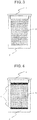
- the inner wall 2a at the top of the crucible body 2 and the outer periphery 1a of the crucible cap 1 have thread-cutting by specified tap processing, and thereby the crucible can be closed by turning the cap 1 to the thread after charging of the pre-baked starting material 3.
- the pre-baked starting material 3 or by covering the whole (or a part) around the pre-baked starting material 3 with spacers 4 and a sleeve 5 ( Fig. 6 ).
- the carbon material for the spacer and the sleeve are glassy carbon, diamond-like carbon, amorphous carbon and the like, and one of them can be used alone, or two or more thereof can be used together.
- the open pore ratio of the carbon material is usually less than 0.5%. Even if the pre-baked starting material is covered with spacers and a sleeve having an open pore ratio of 0%, there is a gap between the spacers and the sleeve. Therefore, the pre-baked starting material cannot be closed completely with the spacers and the sleeve.
- Examples of the screw of the screw-capped graphite crucible are a triangular screw (having a cross-section of screw thread in the form like equilateral triangle), a square screw, a trapezoid screw, and the like, and among these, a triangular screw is preferred.
- the thus obtained pre-baked starting material (fiber of an organic compound) containing remaining hydrogen is subjected to HIP treatment under predetermined conditions.
- the maximum ultimate temperature at the HIP treatment is from about 1000°C to about 2000°C, preferably from about 1200°C to about 1900°C, more preferably from about 1400°C to about 1800°C. If the maximum ultimate temperature is less than about 1000°C, there is a tendency that thermal excitation of gases generated from the pre-baked starting material is difficult to occur and CVD reaction is difficult to proceed. On the other hand, if the maximum ultimate temperature is over about 2000°C, the target product tends to be damaged by etching with the exciting hydrogen.
- the maximum ultimate temperature at the HIP treatment is higher than the pre-baking temperature, and is preferably higher by 400°C or more.
- the temperature elevating rate at the HIP treatment is from about 100°C/h to about 1000°C/h, preferably from about 300°C/h to about 800°C/h. If the temperature elevating rate is less than about 100°C/h, the reaction gases such as hydrogen generated from the pre-baked starting material are diffused into treatment media such as argon gas, and CVD reaction tends not to occur sufficiently. Meanwhile, if the temperature elevating rate is over about 1000°C/h, the heater capacity of treatment equipment needs to be increased considerably, and thus, the equipment cost tends to increase significantly.
- the maximum ultimate pressure at the HIP treatment varies with a mean fiber diameter of the pre-baked starting material, and is usually within the range from about 1 MPa to about 300 MPa, preferably from about 10 MPa to about 200 MPa, more preferably from about 30 MPa to about 200 MPa. For example, in the case of a large mean fiber diameter, a higher pressure is required as the maximum ultimate pressure, and in the case of a small mean fiber diameter, a lower pressure suffices.
- the mean fiber diameter is about 10 ⁇ m or more
- the maximum ultimate pressure is preferably 40 MPa or more, and when the mean fiber diameter is about 5 ⁇ m or less, the HIP treatment can be suitably carried out at the maximum ultimate pressure of about 20 MPa.
- the pressure is first elevated to a specified pressure before the temperature reaches the approximate pre-baking temperature (pressure-preceding pattern), so that the reaction gases generated from the pre-baked starting material are not diffused too much, and then, the temperature is elevated to the approximate pre-baking temperature, and thereafter, the temperature and pressure are elevated to the maximum ultimate temperature and the maximum ultimate pressure, as needed.
- Example of the above specified pressure is about 40 MPa.
- the pressure-preceding pattern as mentioned above is not necessary particularly, and HIP treatment can be carried out efficiently.
- a carbon fiber having an outermost surface composed of edges of graphenes according to the present invention can be obtained.
- Form of the carbon fiber to be obtained varies depending on form of a fiber of an organic compound used as the starting material. Size of the carbon fiber is shrunk slightly through the HIP treatment.
- a carbon fiber in the form of yarn can be obtained, and with the use of a fiber of an organic compound in the form of woven fabric or non-woven fabric, a carbon fiber in the form of woven fabric or non-woven fabric can be obtained.
- a fiber of an organic compound is in the form of blended yarn with other fiber (for example, carbon fiber)
- the corresponding carbon fiber in the form of yarn, woven fabric, or non-woven fabric, respectively that is, the carbon fiber of the present invention as a composite material with other fiber in the form of yarn, woven fabric or non-woven fabric
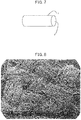
- the outermost surface of the carbon fiber refers to a surface being in parallel with the fiber axis of the carbon fiber and recognized as the outermost part of the fiber ( Fig. 7 ).
- a graphene dispersion can be prepared easily with a carbon fiber of the present invention. Namely, with the carbon fiber of the present invention, particularly a carbon fiber having an aspect ratio of a predetermined value or more according to the present invention, a high-purity graphene dispersion can be obtained easily only by soaking the carbon fiber of the present invention into a solvent, carrying out ultrasonic wave treatment, and filtration, without pulverization of the carbon fiber or centrifugation for separating the graphene dispersion.
- the graphene dispersion refers to one wherein many graphene fragments are dispersed in a solvent.
- the aspect ratio thereof is preferably 2.5 or more, more preferably 3.0 or more. If the aspect ratio is less than 2.5, the purity of the graphene dispersion obtained by filtration tends to be lowered. Meanwhile, the upper limit of the aspect ratio is not particularly limited, and, for example, may be about 10000000.
- the pressurized medium gas may be removed by subjecting the carbon fiber to heat treatment in advance (for example, at a temperature of 100°C or more) or the crystallinity of the graphene may be increased, if necessary, and then, the subsequent steps may follow.
- the carbon fiber of the present invention may be soaked into a solvent by a conventional method, for example, by putting the carbon fiber into a solvent and allowing the solvent to stand. At this time, the solvent may be stirred to such an extent not to pulverize the carbon fiber.
- solvent examples include 1,2-dichloroethane, benzene, thionyl chloride, acetyl chloride, tetrachloroethylene carbonate, dichloroethylene carbonate, benzoyl fluoride, benzoyl chloride, nitromethane, nitrobenzene, acetic anhydride, phosphorus oxychloride, benzonitrile, selenium oxychloride, acetonitrile, tetramethylsulfone, dioxane, 1,2-propanediol carbonate, benzyl cyanide, ethylene sulfite, isobutyronitrile, propionitrile, a carbonic acid ester such as dimethyl carbonate, propylene carbonate, ethyl methyl carbonate, diethyl carbonate, and ethylene carbonate; phenyl phosphoric acid difluoride, methyl acetate, n-butyronitrile, acetone, ethyl
- a dispersant can be added to these solvents in order to increase an amount of graphenes to be dispersed or to prevent agglomeration of the graphenes in a solvent.
- a dispersant are surfactants and, in addition, those having a weak binding force to graphene and an electric attracting force such as a Coulomb's force and having a hydrophilic functional group such as hydroxyl and carboxyl in a structure thereof.
- Examples of the latter dispersants are monomers such as phenols such as phenol and a naphthol having hydroxyl bonded to benzene nucleus and polymers thereof, monomers such as styrene, propylene, acrylonitrile and vinyl acetate having carbon double bond and polymers thereof, proteins such as collagen, keratin, actin, myosin, casein, albumin, GFP and RFP, amino acids such as glycine, tyrosine, threonine and glutamine, and the like.
- monomers such as phenols such as phenol and a naphthol having hydroxyl bonded to benzene nucleus and polymers thereof, monomers such as styrene, propylene, acrylonitrile and vinyl acetate having carbon double bond and polymers thereof, proteins such as collagen, keratin, actin, myosin, casein, albumin, GFP and RFP, amino acids such as glycine, tyrosine
- suitably usable surfactants are: anion based surfactants (anionic surfactants) such as fatty acid salts (for example, sodium dodecanoate), cholic acid salts (for example, sodium cholate), monoalkyl sulfates (for example, sodium lauryl sulfate), alkyl polyoxyethylene sulfate, alkyl benzene sulfonates (for example, sodium dodecyl benzene sulfonate), and monoalkyl phosphate; cation based surfactants (cationic surfactants) such as alkyl trimethyl ammonium salts (for example, cetyl trimethyl ammonium bromide), dialkyl dimethyl ammonium salts (for example, didecyl dimethyl ammonium chloride), and alkyl benzyl dimethyl ammonium salts (for example, alkyl benzyl dimethyl ammonium chloride); amphoteric surfactants (Gemini surfactants)
- dimethylformamide water to which a dispersant (preferably a surfactant) is added, 2-methoxyethanol, 2-propanol, and the like.
- An amount of a dispersant is within a range from 0.001 to 10% by weight, preferably from 0.02 to 5% by weight based on the weight of a solvent, but it is not always limited to these ranges if a film such as a transparent conductive film or a conductive film that is formed is to be washed up.
- An amount of carbon fibers of the present invention is within a range from 0.001 to 50% by weight, preferably from 0.01 to 10% by weight based on the weight of a solvent.
- a means for applying an ultrasonic wave is not particularly limited, and application of an ultrasonic wave can be carried out by using, for example, an ultrasonic cleaner.
- a frequency of an ultrasonic wave to be applied is within a range from 20 to 120 kHz, preferably from 20 to 40 kHz.
- Time required for applying an ultrasonic wave is from about 1 to about 1200 minutes, preferably from about 20 to about 600 minutes.
- a means for filtration is also not particularly limited, and the filtration can be carried out by using, for example, a stainless-steel mesh.
- the sieve openings of the mesh may be suitably selected according to the size of carbon fibers to be filtered. For example, if a stainless-steel mesh is used, the sieve openings is preferably 1 to 3000 ⁇ m, more preferably 5 to 100 ⁇ m.
- the thus obtained graphene dispersion can be used, for example, as an ink to be used for forming a circuit and a thin film for printable electronic products.
- a circuit and the like can be formed by printing the dispersion on a surface of a substrate by various printing methods such as flexographic printing (letterpress printing), offset printing (planographic printing), gravure printing (intaglio printing), screen printing, ink jet printing, electrophotography, heat transfer, and laser transfer.
- a desired circuit can be obtained by applying the dispersion on a substrate by wet coating such as spin coating, slit coating, bar coating, blade coating or spray coating and then carrying out patterning on the coated substrate by using a patterning technique such as nano-micro contact printing, dip-pen lithography, nano-micro transfer, nanoimprinting, electron beam lithography, or photolithography.
- wet coating such as spin coating, slit coating, bar coating, blade coating or spray coating
- a patterning technique such as nano-micro contact printing, dip-pen lithography, nano-micro transfer, nanoimprinting, electron beam lithography, or photolithography.
- various high functional films such as a transparent conductive film, a highly conductive film, and a high thermal conduction film containing the graphenes can be obtained by dispersing or mixing the graphene dispersion obtained above in a starting resin such as a PET film, an ionomer film (IO film), a polyethylene film made of high density polyethylene (HDPE), medium-density polyethylene (MDPE), low-density polyethylene (LDPE), linear low-density polyethylene (L-LDPE), or metallocene catalyst type linear low-density polyethylene (mL-LDPE), hard, semi-hard or soft polyvinyl chloride film (PVC film), polyvinylidene chloride film (PVDC film), polyvinyl alcohol film (PVA film), polypropylene film (PP film), polyester film, polycarbonate film (PC film), polystyrene film (PS film), polyacrylonitrile film (PAN film), ethylene-vinyl alcohol copolymer film (EVOH film
- resin composite materials such as molded resin articles and fiber-reinforced plastics (FRP) containing the graphenes and having improved electric conductivity, thermal conductivity, heat resistance, strength, fracture toughness and flexibility
- FRP fiber-reinforced plastics
- natural resins derived from plants such as rosin, dammar, mastic, copal, amber, balsam and natural rubber
- natural resins derived from animals such as shellac, glue, tortoiseshell and casein
- thermosetting resins such as phenol resin, epoxy resin, melamine resin, urea resin, unsaturated polyester resin, alkyd resin, polyurethane and thermosetting polyimide
- thermoplastic resins such as polyethylene, high density polyethylene, medium-density polyethylene, low-density polyethylene, polypropylene, polyvinyl chloride, polyvinylidene chloride, polystyrene, polyvinyl acetate, polytetrafluoroethylene, ABS resin, AS resin
- rubbers and rubber composite materials containing the graphenes and having improved electric conductivity, thermal conductivity, heat resistance, strength, and flexibility can be obtained by dispersing or mixing the obtained graphene dispersion in or with synthetic rubbers such as acrylic rubber, nitrile rubber, isoprene rubber, urethane rubber, ethylene propylene rubber, epichlorohydrine rubber, chloroprene rubber, silicone rubber, styrene-butadiene rubber, butadiene rubber, fluorine-containing rubber, and polyisobutylene rubber, and then, kneading, drying, and molding.
- synthetic rubbers such as acrylic rubber, nitrile rubber, isoprene rubber, urethane rubber, ethylene propylene rubber, epichlorohydrine rubber, chloroprene rubber, silicone rubber, styrene-butadiene rubber, butadiene rubber, fluorine-containing rubber, and polyisobutylene rubber
- various composite materials containing the graphenes and having improved electric conductivity, thermal conductivity, heat resistance, strength, fracture toughness, and electromagnetic wave shielding property can be obtained by dispersing or mixing the obtained graphene dispersion in or with ceramic materials such as oxides such as pottery, glass, cement, mortar, gypsum, enamel, alumina and zirconia, hydroxides such as hydroxyapatite, carbides such as silicon carbide and boron carbide, carbonates, nitrides such as silicon nitride, boron nitride, aluminum nitride and GaN, halides such as fluophosphate, phosphate, barium titanate, high temperature superconductive ceramics, ferrite, lead zirconium titanate, steatite, zinc oxide, and GaAs, and then, kneading, drying, molding, baking, and sintering.
- ceramic materials such as oxides such as pottery, glass, cement, mortar, gypsum, enamel, a
- various materials containing the graphenes and having improved electric conductivity, thermal conductivity, heat resistance, magnetic properties, strength, elasticity, and fracture toughness can be obtained by dispersing or mixing the obtained graphene dispersion in or with elements such as tungsten, rhenium, osmium, tantalum, molybdenum, niobium, iridium, ruthenium, hafnium, technetium, boron, rhodium, vanadium, chromium, zirconium, platinum, thorium, lutecium, titanium, palladium, protactinium, thulium, scandium, iron, steel, cast iron, yttrium, erbium, cobalt, holmium, nickel, dysprosium, silicon, terbium, curium, gadolinium, beryllium, manganese, americium, promethium, uranium, copper, samarium, gold, actinium,
- a graphene refers to a single-layer or multi-layer (up to several-layer, for example, about 10-layer) graphene.
- edges refer to edges of carbon hexagonal planes forming the graphene. If thickness of a graphene is very thin, the edge may be rolled by Van der Waals force of itself, and edges of the graphenes of the present invention also include the edges in such a state.
- an amount of hydrogen is measured in accordance with General Rules for Determination of Hydrogen in Metallic Materials (JIS Z 2614: 1990. Determination is carried out by an inert gas heating method which is a condition for "steel". The measurement is concretely conducted by heating a sample up to 2000°C under argon gas atmosphere and measuring an integrated amount of generated hydrogen by gas chromatograph.).
- the open pore ratio is a ratio of a volume of a (open) cavity into which a liquid or gas can invade to a volume obtained from an outer shape of a material .
- a material having a high open pore ratio has continuous pores and has air permeability.
- the open pore ratio is obtained from the following equation.
- Open pore ration % Apparent specific gravity ⁇ Bulk specific gravity / Apparent specific gravity ⁇ 100
- Apparent specific gravity A value measured using a sample before pulverization by a helium gas substitution pycnometer method with a densimeter AccuPyc 1330-PCW available from Shimadzu Corporation.
- Bulk specific gravity A value obtained by dividing a sample weight by a volume calculated from outer dimensions of the sample.
- the total pore ratio is a ratio of a volume of a total cavity (including closed pores in addition to open pores) to a volume calculated from an outer shape of a sample.
- the total pore ratio is obtained from the following equation.
- Total pore ration % True specific gravity ⁇ Bulk specific gravity / True specific gravity ⁇ 100
- the true specific gravity is a specific gravity measured using a target material in a state of being pulverized into a fine powder in order to minimize an effect attributable to a cavity contained in the target material, and in this specification, the true specific gravity is measured using a powder sample having passed through a 74 ⁇ m filter.
- An apparent specific gravity, a bulk specific gravity, and a true specific gravity are synonymous with an apparent density, a bulk density, and a true density, respectively.
- a spacer and a sleeve are used being placed inside a closed vessel made of graphite and are inserted between inner wall of the vessel and a pre-baked starting material so that the both do not come into direct contact with each other.
- the spacer is one covering a pre-baked starting material mainly from the top and bottom thereof, and the sleeve is one covering a pre-baked starting material from the side thereof.
- distinction between the spacer and the sleeve is meaningless depending on a shape of vessel.
- a mean fiber diameter is a value measured with scanning electron microscope (SEM), and is a mean value of randomly selected 30 fibers.
- a mean fiber length is a value measured in the same manner.
- a numerical range shown, for example, by from 1200 to 1900 means a range of 1200 or more and 1900 or less unless it is inconsistent with the rest of the specification.
- Yarns of phenol resin having a mean fiber diameter of 20 ⁇ m were woven in plain weave, and a fabric having a weight per unit area of 200 g/m 2 and a thickness of 600 ⁇ m was made and cut into 50 mm wide and 300 mm long. After that, each of the fabrics was pre-baked at the maximum ultimate temperatures of 500°C, 600°C, 700°C, 900°C, 1000°C, or 1200°C under an inert gas atmosphere. Amounts of hydrogen remaining in the starting materials after the pre-baking were analyzed in accordance with General Rules for Determination of Hydrogen in Metallic Materials (JIS Z 2614: 1990). The results are shown in Table 1.
- the pre-baked starting material fabric which was pre-baked at each temperature was charged in a screw-capped (triangular screw) graphite crucible made of a graphite having a bulk density of 1.80 and an open pore ratio of 10%, and a threaded top cover was turned to be closed, and thus the crucible containing the pre-baked starting material was closed.
- a temperature and pressure inside the equipment were increased to 600°C and 70 MPa, respectively in one hour using argon gas, and thereafter, heating at a temperature elevating rate of 500°C per hour and pressurizing were continued to reach a maximum ultimate pressure of 190 MPa and a maximum ultimate temperature of 1500°C.
- the surfaces of the resultant carbon fibers were observed with a scanning electron microscope (SEM) and a transmission electron microscope to examine appearances of generated graphenes.
- SEM scanning electron microscope
- Table 1 As shown in Table 1, in the case where the pre-baking temperature was 500°C and the remaining hydrogen was 18500 ppm, generation of graphene was most remarkable. As the pre-baking temperature increased, generation of graphene was smaller. In the case where the pre-baking temperature was 1200°C and the remaining hydrogen was 220 ppm, graphene was hardly generated.
- Fig. 8 is a photograph by SEM showing a surface of Sample No. 1-(1). It is seen that the sample was converted to a woven fabric of carbon fiber while maintaining the form of a woven fabric of phenol resin fiber.
- Fig. 9 is an enlarged SEM photograph of fibers in the woven fabric of Fig. 8 .
- Fig. 10 is an further enlarged SEM photograph of the surface of the fibers. It is observed that graphenes grow thick uniformly on the surface of the carbon fiber constituting the woven fabric, and the outermost surface of the carbon fiber is composed of edges of graphenes.
- Fig. 11 is an enlarged SEM photograph of graphenes in Fig. 10 showing that each graphene is grown radially from the surface of the fiber independently without contacting with one another.
- Fig. 12 is an enlarged photograph of Fig. 11 using a high-resolution electron micrograph.
- Fig. 13 is a photograph with a high-resolution electron micrograph wherein graphenes shown in Fig.
- Fig. 12 are further enlarged at 300,000-fold magnification.
- Fig. 12 shows thin tips of a graphene rolled as a cigar and looking like a needle, whereby it is seen that the graphene has a large Van der Waals force.
- Fig. 13 electron beams of an accelerating voltage of 2 kv penetrate through the graphene, whereby it is seen that the graphene is very thin.
- TEM transmission electron microscope
- the sample was soaked in an isopropyl alcohol and subjected to ultrasonic wave treatment at the frequency of 24 kHz for 20 minutes to detach the graphenes from the carbon fibers.
- the resultant graphene dispersion was dropped into a microgrid for TEM observation to prepare a sample for observation.
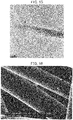
- Fig. 14 is a TEM photograph of graphenes at a low magnification showing thin graphenes and the tips being rolled like a cigar, which look like a thick needle.
- Fig. 15 is a TEM photograph wherein the cigar-like tip of the graphene is enlarged. The lattice image of the tip of the graphene in Fig.
- each of the fabrics was pre-baked at the maximum ultimate temperature of 600°C under an inert gas atmosphere.
- the pre-baked starting material fabrics were subjected to HIP treatment in the same manner as in Example 1 except that the maximum ultimate temperature was changed to 1200°C or 1300°C and the maximum ultimate pressure was changed to 90 MPa in the HIP treatment to obtain target products of Sample Nos. 2-(1) and 2-(2).
- Pre-baking Hot isostatic pressing treatment Appearance of generated graphene Pre- baking temp. (°C) Amount of remaining hydrogen (ppm) Maximum ultimate temp. (°C) Maximum ultimate pressure (MPa) 2-(1) 600 10100 1200 190 Minute graphenes were generated. 2-(2) 600 10100 1300 190 Minute graphenes were generated remarkably.
- Example 2 After a woven fabric prepared in the same manner as in Example 1 was cut into 50 mm wide and 300 mm long, each of the fabrics was pre-baked at the maximum ultimate temperature of 600°C under an inert gas atmosphere. The pre-baked starting material fabrics were subjected to HIP treatment in the same manner as in Example 1 except that the maximum ultimate temperature was changed to 1400°C to obtain a target product of Sample No. 3-(1).
- Example 3 The same treatment as in Example 3 was carried out by using various resin fibers shown in Table 4 (that is, long fiber, short fiber, twisted yarn, plain-woven fabric, satin fabric, twill fabric, non-woven fabric, as well as plain-woven fabric made of blended yarn of one of the resin fibers and a carbon fiber).
- Table 4 that is, long fiber, short fiber, twisted yarn, plain-woven fabric, satin fabric, twill fabric, non-woven fabric, as well as plain-woven fabric made of blended yarn of one of the resin fibers and a carbon fiber.
- the carbon fibers of the present invention having an outermost surface composed of edges of graphenes were generated, while maintaining the form of phenol resin being a starting material.
- TABLE 4 Sample No. Starting material Mean fiber diameter ( ⁇ m Mean fiber length (mm) Appearance of generated graphene Organic compound Form 4-(1) Phenol resin Long fiber 18 100 Generated. 4-(2) Phenol resin Long fiber 30 200 Generated. 4-(3) Phenol resin Short fiber 18 0.2 Generated. 4-(4) Phenol resin Short fiber 25 0.5 Generated. 4-(5) Phenol resin Short fiber 35 0.4 Generated. 4-(6) Phenol resin Twisted yarn (Number of twists: 100) 14 1000 Generated.
- Phenol resin Plain-woven fabric (Width: 100 mm, Length: 300 mm) (Weight per unit area: 220 g/m 2 ) 35 Generated.
- 4-(8) Phenol resin Satin fabric (Width: 100 mm, Length: 300 mm) (Weight per unit area: 290 g/m 2 14 Generated.
- 4-(9) Phenol resin Twill fabric (Width: 100 mm, Length: 300 mm) (Weight per unit area: 300 g/m 2 ) 14 Generated.
- 4-(10) Phenol resin Non-woven fabric (Width: 100 mm, Length: 200 mm) (Weight per unit area: 120 g/m 2 ) 20 Generated.
- “Infusibilization” in the starting material of Sample No. 4-(11) refers to a process in which a polyacrylonitrile resin is heated at a temperature of 200 to 300°C in the atmosphere beforehand to introduce oxygen groups and the like into the chemical structure of the polyacrylonitrile resin so that the resin may not be melted at the step of pre-baking.
- the carbon fibers of the present invention obtained from Sample No. 4-(7) in Example 4 were subjected to the same treatment as described above except that a stainless-steel mesh with sieve openings of 102 ⁇ m was used, and a graphene dispersion (2) was obtained as a filtrate. It took about 3 minutes to filter by using the stainless-steel mesh.
- Fig. 22 is an FE-SEM photograph showing carbon fibers remaining on the stainless-steel mesh with sieve openings of 25 ⁇ m in the preparation step of the graphene dispersion (1). The figure shows that the carbon fibers from which graphenes were separated remain on the mesh by effective filtration.
- Fig. 23 is an FE-SEM photograph showing graphene residues after the evaporation of the solvent in the graphene dispersion (1).
- Fig. 24 is an enlarged view of the above figure. Whereas the carbon fibers from which graphenes were separated or by-products such as amorphous carbon were not observed, only graphenes after evaporation to dryness were observed. Thus, it was confirmed the purity of the graphenes was good.
- carbon fibers (Sample Nos. 6-(1) to 6-(3)) were produced in the same manner as in Sample No. 4-(3) in Example 4 except that the lengths of the short fibers of the phenol resin being a starting material were changed so that the aspect ratio is 5.6, 2.8, and 1.7, respectively.
- Graphene dispersions (3) to (5) were prepared in the same manner as in Example 5 by using the obtained carbon fibers.
- the amount of dispersed graphenes is 0.005 mg/ml, which is very small. Therefore, it is desirable that the aspect ratio of an organic compound used as a starting material is about 2.5 or more.
- Carbon fibers obtained by the production method of the present invention can be suitably used for transparent conductive materials for forming transparent flexible conductive films; high heat-release and heat-transfer materials for forming heat-release sheets for, for example, smartphone; conductive inks for printable electronics; conductive materials and semiconductor materials for forming semiconductor inks; conductive additive materials for adding to electrodes for lithium-ion batteries, lithium-ion capacitors, fuel cell batteries, other primary and secondary batteries, and the like; gas diffusion layers of fuel cell batteries; catalyst materials used for, for example, reduction of active oxygen; electrodes for, for example, field emission displays and X-ray tubes; needles of tunneling microscopes, and the like.
Landscapes
- Chemical & Material Sciences (AREA)
- Engineering & Computer Science (AREA)
- Organic Chemistry (AREA)
- Materials Engineering (AREA)
- Chemical Kinetics & Catalysis (AREA)
- General Chemical & Material Sciences (AREA)
- Inorganic Chemistry (AREA)
- Physics & Mathematics (AREA)
- Textile Engineering (AREA)
- Nanotechnology (AREA)
- Wood Science & Technology (AREA)
- Life Sciences & Earth Sciences (AREA)
- Combustion & Propulsion (AREA)
- Thermal Sciences (AREA)
- Spectroscopy & Molecular Physics (AREA)
- Dispersion Chemistry (AREA)
- Manufacturing & Machinery (AREA)
- Electrochemistry (AREA)
- Carbon And Carbon Compounds (AREA)
- Inorganic Fibers (AREA)
Claims (12)
- Méthode de fabrication d'une fibre de carbone ayant une surface la plus extérieure composée d'arêtes de graphènes, comprenant les étapes consistant à
précuire une fibre d'un composé organique de manière à ce que l'hydrogène restant soit en quantité égale ou supérieure à 500 ppm, mesurée conformément aux Règles Générales de Détermination d'Hydrogène dans des Matériaux Métalliques de la nonne JIS Z 2614: 1990, la fibre du composé organique ayant un rapport d'aspect de 2,5 ou plus, et la fibre du composé organique ayant la forme d'un fil, d'un tissu tissé, d'un tissu non tissé, d'un fil mélangé avec une autre fibre, d'un tissu tissé ou d'un tissu non tissé constitué du fil mélangé,
mettre la fibre précuite d'un composé organique dans un récipient fermé constitué d'un matériau résistant à la chaleur, et
soumettre la fibre précuite ensemble avec le récipient à un traitement de compression isostatique à chaud utilisant une atmosphère de gaz comprimé, une température ultime maximale lors du traitement de compression isostatique à chaud étant comprise entre 1 000 et 2 000 °C. - Méthode de production selon la revendication 1, dans laquelle la température de pré-cuisson est de 1 000 °C ou moins.
- Méthode de production selon l'une quelconque des revendications 1 à 2, dans laquelle un diamètre moyen de la fibre d'un composé organique avant la pré-cuisson est de 500 µm ou moins.
- Méthode de production selon l'une quelconque des revendications 1 à 3, dans laquelle le récipient fermé constitué d'un matériau résistant à la chaleur est un récipient fermé en graphite.
- Méthode de production selon la revendication 4, dans laquelle le récipient fermé en graphite a un rapport de pores ouverts inférieur à 20 % et le récipient fermé en graphite est fermé par bouchon à vis par l'intermédiaire de filetages triangulaires.
- Méthode de production selon l'une quelconque des revendications 1 à 5, dans laquelle le composé organique est l'un ou plusieurs choisis parmi le groupe constitué d'amidon, de cellulose, de protéine, de collagène, d'acide alginique, de gomme dammar, de colophane, de gutta-percha, de caoutchouc naturel, de résine de cellulose, d'acétate de cellulose, de nitrate de cellulose, d'acétate butyrate de cellulose, de plastique de caséine, de plastique de protéine de soja, de résine de phénol, de résine d'urée, de résine de mélamine, de résine de benzoguanamine, de résine époxy, de résine de phtalate de diallyle, de résine de polyester insaturé, d'une résine époxy de type bisphénol A, de résine époxy de type Novolac, de résine époxy polyfonctionnelle, de résine époxy alicyclique, de résine alkyde, de résine uréthane, de résine polyester, de résine de chlorure de vinyle, de polyéthylène, de polypropylène, de polystyrène, de polyisoprène, de butadiène, de nylon, de vinylon, de fibre acrylique, de rayonne, d'acétate de polyvinyle, de résine ABS, de résine AS, de résine acrylique, de polyacétal, de polyimide, de polycarbonate, d'éther de polyphénylène modifié, de polyarylate, de polysulfone, de sulfure de polyphénylène, de polyétheréther cétone, de résine fluorée, de polyamide imide, de résine de silicium, de brai de pétrole, de brai de charbon, de déchets plastiques, de déchets de bouteille en PET, de déchets de bois et déchets végétaux.
- Méthode de production selon l'une quelconque des revendications 1 à 6, dans laquelle le traitement de compression isostatique à chaud est effectué dans un état tel qu'une partie ou la totalité autour de la fibre précuite du composé organique chargé dans le récipient fermé constitué de graphite est recouverte d'un élément d'espacement et d'un manchon.
- Méthode de production selon la revendication 7, dans laquelle l'élément d'espacement et le manchon sont constitués d'un ou plusieurs éléments choisis parmi le groupe constitué de carbone vitreux, de carbone de type diamant, et de carbone amorphe.
- Fibre de carbone sous forme de fil, de tissu tissé, ou de tissu non-tissé ayant une surface la plus extérieure composée d'arêtes de graphènes, dans laquelle la fibre de carbone a un rapport d'aspect de 2,5 ou plus.
- Méthode de production d'une dispersion de graphènes comprenant des graphènes et un solvant, comprenant de :tremper la fibre de carbone ayant une surface la plus extérieure composée d'arêtes de graphènes et préparée par la méthode de production selon la revendication 1 dans le solvant ; etsoumettre le mélange à un traitement par ondes ultrasonores, puis filtrer le mélange,dans lequel un rapport d'aspect de la fibre de carbone est de 2,5 ou plus.
- Méthode de production d'une dispersion de graphènes selon la revendication 10, dans laquelle un diamètre moyen de la fibre de carbone est compris dans la page de 0,1 à 500 µm.
- Méthode de production d'une dispersion de graphènes selon l'une quelconque des revendications 10 à 11, dans laquelle le solvant comprend en outre un agent dispersant.
Applications Claiming Priority (2)
| Application Number | Priority Date | Filing Date | Title |
|---|---|---|---|
| JP2013088359 | 2013-04-19 | ||
| PCT/JP2013/080403 WO2014171030A1 (fr) | 2013-04-19 | 2013-11-11 | Fibres de carbone et leur procédé de production |
Publications (3)
| Publication Number | Publication Date |
|---|---|
| EP2816144A1 EP2816144A1 (fr) | 2014-12-24 |
| EP2816144A4 EP2816144A4 (fr) | 2015-12-09 |
| EP2816144B1 true EP2816144B1 (fr) | 2019-01-02 |
Family
ID=51730997
Family Applications (1)
| Application Number | Title | Priority Date | Filing Date |
|---|---|---|---|
| EP13826710.9A Active EP2816144B1 (fr) | 2013-04-19 | 2013-11-11 | Fibres de carbone et leur procédé de production |
Country Status (8)
| Country | Link |
|---|---|
| US (2) | US9546294B2 (fr) |
| EP (1) | EP2816144B1 (fr) |
| JP (1) | JP5841658B2 (fr) |
| KR (1) | KR101599820B1 (fr) |
| CN (1) | CN104246031B (fr) |
| SG (1) | SG11201508546WA (fr) |
| TW (1) | TWI508916B (fr) |
| WO (1) | WO2014171030A1 (fr) |
Families Citing this family (16)
| Publication number | Priority date | Publication date | Assignee | Title |
|---|---|---|---|---|
| CN105476126A (zh) * | 2015-12-07 | 2016-04-13 | 刘传新 | 一种功能性服装面料及其生产方法 |
| CN107734722B (zh) * | 2015-12-31 | 2021-04-06 | 白德旭 | 一种石墨烯发热片及其制备方法 |
| CN106009984A (zh) * | 2016-05-25 | 2016-10-12 | 中国科学院宁波材料技术与工程研究所 | 一种石墨烯/丙烯酸导静电涂料及其制备方法 |
| CN106948165B (zh) * | 2017-04-28 | 2019-06-21 | 浙江大学 | 一种自融合石墨烯纤维及其制备方法 |
| WO2018230638A1 (fr) * | 2017-06-16 | 2018-12-20 | 株式会社Kri | Nitrure de bore modifié par du carbone, procédé pour sa production et composition de résine hautement thermoconductrice |
| JP6803874B2 (ja) * | 2017-06-16 | 2020-12-23 | 株式会社Kri | カーボン修飾窒化ホウ素、その製造方法および高熱伝導性樹脂組成物 |
| CN108315877B (zh) * | 2018-03-09 | 2020-05-08 | 广州市三泰汽车内饰材料有限公司 | 一种石墨烯无纺布制造工艺 |
| KR102178630B1 (ko) * | 2018-12-20 | 2020-11-13 | 한화토탈 주식회사 | 프로필렌 중합용 고체 촉매 및 이를 이용한 블록 공중합체의 제조방법 |
| CN109698361B (zh) * | 2018-12-28 | 2021-09-21 | 成都新柯力化工科技有限公司 | 一种燃料电池气体扩散层用柔性石墨烯碳膜及制备方法 |
| CN109786118B (zh) * | 2019-01-05 | 2021-03-26 | 淄博职业学院 | 一种大规模制备粒径可控的氮氧掺杂碳微球及其制备方法和应用 |
| CN112190756B (zh) * | 2020-09-28 | 2022-04-22 | 湖南碳康生物科技有限公司 | 一种碳纤维复合材料仿形人工骨的制备方法 |
| CN112366288A (zh) * | 2020-10-30 | 2021-02-12 | 蜂巢能源科技(无锡)有限公司 | 一种电解质膜、其制备方法及其用途 |
| CN113307253A (zh) * | 2021-05-24 | 2021-08-27 | 盐城金麦穗科技发展有限公司 | 一种石墨烯碳纤维复合体城轨受电工碳滑条及制造方法 |
| CN114656879B (zh) * | 2022-03-22 | 2023-03-03 | 河北志盛威华特种涂料有限公司 | 一种渗透性防氧化涂料及其制备方法 |
| CN115679709B (zh) * | 2022-11-04 | 2023-10-03 | 苏州铂韬新材料科技有限公司 | 一种纤维吸波材料 |
| KR102893545B1 (ko) * | 2022-11-04 | 2025-12-02 | 한국과학기술연구원 | 탄소복합섬유의 제조 방법 및 탄소나노섬유 |
Family Cites Families (11)
| Publication number | Priority date | Publication date | Assignee | Title |
|---|---|---|---|---|
| BE549181A (fr) * | 1955-06-30 | |||
| JP3556270B2 (ja) * | 1994-06-15 | 2004-08-18 | 株式会社東芝 | リチウム二次電池 |
| US7700064B2 (en) | 2004-03-11 | 2010-04-20 | Teijin Limited | Carbon fiber |
| US7824651B2 (en) * | 2007-05-08 | 2010-11-02 | Nanotek Instruments, Inc. | Method of producing exfoliated graphite, flexible graphite, and nano-scaled graphene platelets |
| JPWO2010087371A1 (ja) * | 2009-01-30 | 2012-08-02 | 帝人株式会社 | 黒鉛化短繊維およびその組成物 |
| ES2606284T3 (es) * | 2009-05-06 | 2017-03-23 | Incubation Alliance Inc | Método de fabricación de un material de carbono |
| JP5629681B2 (ja) * | 2009-05-26 | 2014-11-26 | 株式会社インキュベーション・アライアンス | 炭素材料及びその製造方法 |
| SG10201500043YA (en) * | 2010-02-19 | 2015-03-30 | Incubation Alliance Inc | Carbon material and method for producing same |
| EP2632854A2 (fr) * | 2010-10-28 | 2013-09-04 | University Of Central Florida Research Foundation, Inc. | Graphite oxydé et fibre de carbone |
| CA2800269A1 (fr) * | 2011-02-09 | 2012-08-16 | Incubation Alliance, Inc. | Procede pour produire un substrat revetu de graphene multicouche |
| JP2012188790A (ja) * | 2011-03-14 | 2012-10-04 | Toray Ind Inc | 極細炭素繊維およびその製造方法 |
-
2013
- 2013-11-11 SG SG11201508546WA patent/SG11201508546WA/en unknown
- 2013-11-11 CN CN201380002736.6A patent/CN104246031B/zh active Active
- 2013-11-11 KR KR1020147004135A patent/KR101599820B1/ko active Active
- 2013-11-11 EP EP13826710.9A patent/EP2816144B1/fr active Active
- 2013-11-11 JP JP2014506672A patent/JP5841658B2/ja active Active
- 2013-11-11 US US14/238,968 patent/US9546294B2/en active Active
- 2013-11-11 WO PCT/JP2013/080403 patent/WO2014171030A1/fr not_active Ceased
- 2013-11-19 TW TW102142004A patent/TWI508916B/zh active
-
2016
- 2016-12-06 US US15/369,945 patent/US10006153B2/en active Active
Also Published As
| Publication number | Publication date |
|---|---|
| US9546294B2 (en) | 2017-01-17 |
| US20170081788A1 (en) | 2017-03-23 |
| EP2816144A1 (fr) | 2014-12-24 |
| CN104246031A (zh) | 2014-12-24 |
| US20140315460A1 (en) | 2014-10-23 |
| KR20140128934A (ko) | 2014-11-06 |
| EP2816144A4 (fr) | 2015-12-09 |
| TW201441149A (zh) | 2014-11-01 |
| TWI508916B (zh) | 2015-11-21 |
| KR101599820B1 (ko) | 2016-03-04 |
| SG11201508546WA (en) | 2015-11-27 |
| CN104246031B (zh) | 2016-05-25 |
| WO2014171030A1 (fr) | 2014-10-23 |
| US10006153B2 (en) | 2018-06-26 |
| JP5841658B2 (ja) | 2016-01-13 |
| JPWO2014171030A1 (ja) | 2017-02-16 |
Similar Documents
| Publication | Publication Date | Title |
|---|---|---|
| US10006153B2 (en) | Carbon fiber and method for producing same | |
| CN102791628B (zh) | 碳材料及其制造方法 | |
| CN103201215B (zh) | 新型碳纳米管及其制造方法 | |
| Levchenko et al. | Low-temperature plasmas in carbon nanostructure synthesis | |
| TW201628715A (zh) | 奈米碳管與其之製造方法、及使用奈米碳管之鋰離子二次電池 |
Legal Events
| Date | Code | Title | Description |
|---|---|---|---|
| PUAI | Public reference made under article 153(3) epc to a published international application that has entered the european phase |
Free format text: ORIGINAL CODE: 0009012 |
|
| 17P | Request for examination filed |
Effective date: 20140210 |
|
| AK | Designated contracting states |
Kind code of ref document: A1 Designated state(s): AL AT BE BG CH CY CZ DE DK EE ES FI FR GB GR HR HU IE IS IT LI LT LU LV MC MK MT NL NO PL PT RO RS SE SI SK SM TR |
|
| AX | Request for extension of the european patent |
Extension state: BA ME |
|
| RA4 | Supplementary search report drawn up and despatched (corrected) |
Effective date: 20151106 |
|
| RIC1 | Information provided on ipc code assigned before grant |
Ipc: D01F 9/14 20060101AFI20151102BHEP Ipc: C01B 31/02 20060101ALI20151102BHEP Ipc: B82Y 30/00 20110101ALI20151102BHEP Ipc: C01B 31/04 20060101ALI20151102BHEP |
|
| DAX | Request for extension of the european patent (deleted) | ||
| GRAP | Despatch of communication of intention to grant a patent |
Free format text: ORIGINAL CODE: EPIDOSNIGR1 |
|
| STAA | Information on the status of an ep patent application or granted ep patent |
Free format text: STATUS: GRANT OF PATENT IS INTENDED |
|
| RIC1 | Information provided on ipc code assigned before grant |
Ipc: B82Y 30/00 20110101ALI20180611BHEP Ipc: D01F 9/14 20060101AFI20180611BHEP |
|
| INTG | Intention to grant announced |
Effective date: 20180709 |
|
| GRAS | Grant fee paid |
Free format text: ORIGINAL CODE: EPIDOSNIGR3 |
|
| RIN1 | Information on inventor provided before grant (corrected) |
Inventor name: MURAMATSU, KAZUO |
|
| RAP1 | Party data changed (applicant data changed or rights of an application transferred) |
Owner name: INCUBATION ALLIANCE, INC. |
|
| GRAA | (expected) grant |
Free format text: ORIGINAL CODE: 0009210 |
|
| STAA | Information on the status of an ep patent application or granted ep patent |
Free format text: STATUS: THE PATENT HAS BEEN GRANTED |
|
| AK | Designated contracting states |
Kind code of ref document: B1 Designated state(s): AL AT BE BG CH CY CZ DE DK EE ES FI FR GB GR HR HU IE IS IT LI LT LU LV MC MK MT NL NO PL PT RO RS SE SI SK SM TR |
|
| REG | Reference to a national code |
Ref country code: GB Ref legal event code: FG4D |
|
| REG | Reference to a national code |
Ref country code: CH Ref legal event code: EP Ref country code: AT Ref legal event code: REF Ref document number: 1084501 Country of ref document: AT Kind code of ref document: T Effective date: 20190115 |
|
| REG | Reference to a national code |
Ref country code: IE Ref legal event code: FG4D |
|
| REG | Reference to a national code |
Ref country code: DE Ref legal event code: R096 Ref document number: 602013049318 Country of ref document: DE |
|
| REG | Reference to a national code |
Ref country code: CH Ref legal event code: NV Representative=s name: ING. MARCO ZARDI C/O M. ZARDI AND CO. S.A., CH |
|
| REG | Reference to a national code |
Ref country code: NL Ref legal event code: MP Effective date: 20190102 |
|
| REG | Reference to a national code |
Ref country code: LT Ref legal event code: MG4D |
|
| REG | Reference to a national code |
Ref country code: AT Ref legal event code: MK05 Ref document number: 1084501 Country of ref document: AT Kind code of ref document: T Effective date: 20190102 |
|
| PG25 | Lapsed in a contracting state [announced via postgrant information from national office to epo] |
Ref country code: NL Free format text: LAPSE BECAUSE OF FAILURE TO SUBMIT A TRANSLATION OF THE DESCRIPTION OR TO PAY THE FEE WITHIN THE PRESCRIBED TIME-LIMIT Effective date: 20190102 |
|
| PG25 | Lapsed in a contracting state [announced via postgrant information from national office to epo] |
Ref country code: PL Free format text: LAPSE BECAUSE OF FAILURE TO SUBMIT A TRANSLATION OF THE DESCRIPTION OR TO PAY THE FEE WITHIN THE PRESCRIBED TIME-LIMIT Effective date: 20190102 Ref country code: FI Free format text: LAPSE BECAUSE OF FAILURE TO SUBMIT A TRANSLATION OF THE DESCRIPTION OR TO PAY THE FEE WITHIN THE PRESCRIBED TIME-LIMIT Effective date: 20190102 Ref country code: LT Free format text: LAPSE BECAUSE OF FAILURE TO SUBMIT A TRANSLATION OF THE DESCRIPTION OR TO PAY THE FEE WITHIN THE PRESCRIBED TIME-LIMIT Effective date: 20190102 Ref country code: SE Free format text: LAPSE BECAUSE OF FAILURE TO SUBMIT A TRANSLATION OF THE DESCRIPTION OR TO PAY THE FEE WITHIN THE PRESCRIBED TIME-LIMIT Effective date: 20190102 Ref country code: NO Free format text: LAPSE BECAUSE OF FAILURE TO SUBMIT A TRANSLATION OF THE DESCRIPTION OR TO PAY THE FEE WITHIN THE PRESCRIBED TIME-LIMIT Effective date: 20190402 Ref country code: PT Free format text: LAPSE BECAUSE OF FAILURE TO SUBMIT A TRANSLATION OF THE DESCRIPTION OR TO PAY THE FEE WITHIN THE PRESCRIBED TIME-LIMIT Effective date: 20190502 Ref country code: ES Free format text: LAPSE BECAUSE OF FAILURE TO SUBMIT A TRANSLATION OF THE DESCRIPTION OR TO PAY THE FEE WITHIN THE PRESCRIBED TIME-LIMIT Effective date: 20190102 |
|
| PG25 | Lapsed in a contracting state [announced via postgrant information from national office to epo] |
Ref country code: GR Free format text: LAPSE BECAUSE OF FAILURE TO SUBMIT A TRANSLATION OF THE DESCRIPTION OR TO PAY THE FEE WITHIN THE PRESCRIBED TIME-LIMIT Effective date: 20190403 Ref country code: RS Free format text: LAPSE BECAUSE OF FAILURE TO SUBMIT A TRANSLATION OF THE DESCRIPTION OR TO PAY THE FEE WITHIN THE PRESCRIBED TIME-LIMIT Effective date: 20190102 Ref country code: BG Free format text: LAPSE BECAUSE OF FAILURE TO SUBMIT A TRANSLATION OF THE DESCRIPTION OR TO PAY THE FEE WITHIN THE PRESCRIBED TIME-LIMIT Effective date: 20190402 Ref country code: IS Free format text: LAPSE BECAUSE OF FAILURE TO SUBMIT A TRANSLATION OF THE DESCRIPTION OR TO PAY THE FEE WITHIN THE PRESCRIBED TIME-LIMIT Effective date: 20190502 Ref country code: HR Free format text: LAPSE BECAUSE OF FAILURE TO SUBMIT A TRANSLATION OF THE DESCRIPTION OR TO PAY THE FEE WITHIN THE PRESCRIBED TIME-LIMIT Effective date: 20190102 Ref country code: LV Free format text: LAPSE BECAUSE OF FAILURE TO SUBMIT A TRANSLATION OF THE DESCRIPTION OR TO PAY THE FEE WITHIN THE PRESCRIBED TIME-LIMIT Effective date: 20190102 |
|
| REG | Reference to a national code |
Ref country code: DE Ref legal event code: R097 Ref document number: 602013049318 Country of ref document: DE |
|
| PG25 | Lapsed in a contracting state [announced via postgrant information from national office to epo] |
Ref country code: AL Free format text: LAPSE BECAUSE OF FAILURE TO SUBMIT A TRANSLATION OF THE DESCRIPTION OR TO PAY THE FEE WITHIN THE PRESCRIBED TIME-LIMIT Effective date: 20190102 Ref country code: AT Free format text: LAPSE BECAUSE OF FAILURE TO SUBMIT A TRANSLATION OF THE DESCRIPTION OR TO PAY THE FEE WITHIN THE PRESCRIBED TIME-LIMIT Effective date: 20190102 Ref country code: EE Free format text: LAPSE BECAUSE OF FAILURE TO SUBMIT A TRANSLATION OF THE DESCRIPTION OR TO PAY THE FEE WITHIN THE PRESCRIBED TIME-LIMIT Effective date: 20190102 Ref country code: IT Free format text: LAPSE BECAUSE OF FAILURE TO SUBMIT A TRANSLATION OF THE DESCRIPTION OR TO PAY THE FEE WITHIN THE PRESCRIBED TIME-LIMIT Effective date: 20190102 Ref country code: DK Free format text: LAPSE BECAUSE OF FAILURE TO SUBMIT A TRANSLATION OF THE DESCRIPTION OR TO PAY THE FEE WITHIN THE PRESCRIBED TIME-LIMIT Effective date: 20190102 Ref country code: RO Free format text: LAPSE BECAUSE OF FAILURE TO SUBMIT A TRANSLATION OF THE DESCRIPTION OR TO PAY THE FEE WITHIN THE PRESCRIBED TIME-LIMIT Effective date: 20190102 Ref country code: SK Free format text: LAPSE BECAUSE OF FAILURE TO SUBMIT A TRANSLATION OF THE DESCRIPTION OR TO PAY THE FEE WITHIN THE PRESCRIBED TIME-LIMIT Effective date: 20190102 Ref country code: CZ Free format text: LAPSE BECAUSE OF FAILURE TO SUBMIT A TRANSLATION OF THE DESCRIPTION OR TO PAY THE FEE WITHIN THE PRESCRIBED TIME-LIMIT Effective date: 20190102 |
|
| PLBE | No opposition filed within time limit |
Free format text: ORIGINAL CODE: 0009261 |
|
| STAA | Information on the status of an ep patent application or granted ep patent |
Free format text: STATUS: NO OPPOSITION FILED WITHIN TIME LIMIT |
|
| PG25 | Lapsed in a contracting state [announced via postgrant information from national office to epo] |
Ref country code: SM Free format text: LAPSE BECAUSE OF FAILURE TO SUBMIT A TRANSLATION OF THE DESCRIPTION OR TO PAY THE FEE WITHIN THE PRESCRIBED TIME-LIMIT Effective date: 20190102 |
|
| 26N | No opposition filed |
Effective date: 20191003 |
|
| PG25 | Lapsed in a contracting state [announced via postgrant information from national office to epo] |
Ref country code: SI Free format text: LAPSE BECAUSE OF FAILURE TO SUBMIT A TRANSLATION OF THE DESCRIPTION OR TO PAY THE FEE WITHIN THE PRESCRIBED TIME-LIMIT Effective date: 20190102 |
|
| PG25 | Lapsed in a contracting state [announced via postgrant information from national office to epo] |
Ref country code: TR Free format text: LAPSE BECAUSE OF FAILURE TO SUBMIT A TRANSLATION OF THE DESCRIPTION OR TO PAY THE FEE WITHIN THE PRESCRIBED TIME-LIMIT Effective date: 20190102 |
|
| PGFP | Annual fee paid to national office [announced via postgrant information from national office to epo] |
Ref country code: CH Payment date: 20191107 Year of fee payment: 7 |
|
| PG25 | Lapsed in a contracting state [announced via postgrant information from national office to epo] |
Ref country code: LU Free format text: LAPSE BECAUSE OF NON-PAYMENT OF DUE FEES Effective date: 20191111 Ref country code: MC Free format text: LAPSE BECAUSE OF FAILURE TO SUBMIT A TRANSLATION OF THE DESCRIPTION OR TO PAY THE FEE WITHIN THE PRESCRIBED TIME-LIMIT Effective date: 20190102 |
|
| REG | Reference to a national code |
Ref country code: BE Ref legal event code: MM Effective date: 20191130 |
|
| PG25 | Lapsed in a contracting state [announced via postgrant information from national office to epo] |
Ref country code: IE Free format text: LAPSE BECAUSE OF NON-PAYMENT OF DUE FEES Effective date: 20191111 |
|
| PG25 | Lapsed in a contracting state [announced via postgrant information from national office to epo] |
Ref country code: BE Free format text: LAPSE BECAUSE OF NON-PAYMENT OF DUE FEES Effective date: 20191130 |
|
| PG25 | Lapsed in a contracting state [announced via postgrant information from national office to epo] |
Ref country code: CY Free format text: LAPSE BECAUSE OF FAILURE TO SUBMIT A TRANSLATION OF THE DESCRIPTION OR TO PAY THE FEE WITHIN THE PRESCRIBED TIME-LIMIT Effective date: 20190102 |
|
| REG | Reference to a national code |
Ref country code: CH Ref legal event code: PL |
|
| PG25 | Lapsed in a contracting state [announced via postgrant information from national office to epo] |
Ref country code: HU Free format text: LAPSE BECAUSE OF FAILURE TO SUBMIT A TRANSLATION OF THE DESCRIPTION OR TO PAY THE FEE WITHIN THE PRESCRIBED TIME-LIMIT; INVALID AB INITIO Effective date: 20131111 Ref country code: MT Free format text: LAPSE BECAUSE OF FAILURE TO SUBMIT A TRANSLATION OF THE DESCRIPTION OR TO PAY THE FEE WITHIN THE PRESCRIBED TIME-LIMIT Effective date: 20190102 |
|
| PG25 | Lapsed in a contracting state [announced via postgrant information from national office to epo] |
Ref country code: LI Free format text: LAPSE BECAUSE OF NON-PAYMENT OF DUE FEES Effective date: 20201130 Ref country code: CH Free format text: LAPSE BECAUSE OF NON-PAYMENT OF DUE FEES Effective date: 20201130 |
|
| PG25 | Lapsed in a contracting state [announced via postgrant information from national office to epo] |
Ref country code: MK Free format text: LAPSE BECAUSE OF FAILURE TO SUBMIT A TRANSLATION OF THE DESCRIPTION OR TO PAY THE FEE WITHIN THE PRESCRIBED TIME-LIMIT Effective date: 20190102 |
|
| PGFP | Annual fee paid to national office [announced via postgrant information from national office to epo] |
Ref country code: DE Payment date: 20251119 Year of fee payment: 13 |
|
| PGFP | Annual fee paid to national office [announced via postgrant information from national office to epo] |
Ref country code: GB Payment date: 20251110 Year of fee payment: 13 |
|
| PGFP | Annual fee paid to national office [announced via postgrant information from national office to epo] |
Ref country code: FR Payment date: 20251127 Year of fee payment: 13 |