EP2816284B1 - Recyclage de matière avec du métal électropositif - Google Patents
Recyclage de matière avec du métal électropositif Download PDFInfo
- Publication number
- EP2816284B1 EP2816284B1 EP14003134.5A EP14003134A EP2816284B1 EP 2816284 B1 EP2816284 B1 EP 2816284B1 EP 14003134 A EP14003134 A EP 14003134A EP 2816284 B1 EP2816284 B1 EP 2816284B1
- Authority
- EP
- European Patent Office
- Prior art keywords
- combustion
- nitrogen
- electropositive metal
- energy
- power plant
- Prior art date
- Legal status (The legal status is an assumption and is not a legal conclusion. Google has not performed a legal analysis and makes no representation as to the accuracy of the status listed.)
- Not-in-force
Links
- 229910052751 metal Inorganic materials 0.000 title claims description 51
- 239000002184 metal Substances 0.000 title claims description 51
- 239000000463 material Substances 0.000 title claims description 12
- 238000004064 recycling Methods 0.000 title description 11
- IJGRMHOSHXDMSA-UHFFFAOYSA-N Atomic nitrogen Chemical compound N#N IJGRMHOSHXDMSA-UHFFFAOYSA-N 0.000 claims description 130
- 238000002485 combustion reaction Methods 0.000 claims description 95
- 238000000034 method Methods 0.000 claims description 71
- 229910052757 nitrogen Inorganic materials 0.000 claims description 60
- 238000006243 chemical reaction Methods 0.000 claims description 38
- WHXSMMKQMYFTQS-UHFFFAOYSA-N Lithium Chemical compound [Li] WHXSMMKQMYFTQS-UHFFFAOYSA-N 0.000 claims description 29
- 238000011084 recovery Methods 0.000 claims description 29
- 229910052744 lithium Inorganic materials 0.000 claims description 27
- QVGXLLKOCUKJST-UHFFFAOYSA-N atomic oxygen Chemical compound [O] QVGXLLKOCUKJST-UHFFFAOYSA-N 0.000 claims description 15
- 239000001301 oxygen Substances 0.000 claims description 15
- 229910052760 oxygen Inorganic materials 0.000 claims description 15
- 238000000926 separation method Methods 0.000 claims description 14
- 150000003839 salts Chemical class 0.000 claims description 4
- CURLTUGMZLYLDI-UHFFFAOYSA-N Carbon dioxide Chemical compound O=C=O CURLTUGMZLYLDI-UHFFFAOYSA-N 0.000 description 90
- QGZKDVFQNNGYKY-UHFFFAOYSA-N Ammonia Chemical compound N QGZKDVFQNNGYKY-UHFFFAOYSA-N 0.000 description 68
- 239000001569 carbon dioxide Substances 0.000 description 45
- 229910002092 carbon dioxide Inorganic materials 0.000 description 45
- 239000000047 product Substances 0.000 description 36
- 229910021529 ammonia Inorganic materials 0.000 description 34
- OKKJLVBELUTLKV-UHFFFAOYSA-N Methanol Chemical compound OC OKKJLVBELUTLKV-UHFFFAOYSA-N 0.000 description 21
- XLYOFNOQVPJJNP-UHFFFAOYSA-N water Substances O XLYOFNOQVPJJNP-UHFFFAOYSA-N 0.000 description 16
- 238000004519 manufacturing process Methods 0.000 description 15
- 229910001868 water Inorganic materials 0.000 description 15
- 238000012545 processing Methods 0.000 description 14
- 239000002803 fossil fuel Substances 0.000 description 12
- 239000007789 gas Substances 0.000 description 10
- JCXJVPUVTGWSNB-UHFFFAOYSA-N nitrogen dioxide Inorganic materials O=[N]=O JCXJVPUVTGWSNB-UHFFFAOYSA-N 0.000 description 10
- 230000014075 nitrogen utilization Effects 0.000 description 10
- UGFAIRIUMAVXCW-UHFFFAOYSA-N Carbon monoxide Chemical compound [O+]#[C-] UGFAIRIUMAVXCW-UHFFFAOYSA-N 0.000 description 9
- WMFOQBRAJBCJND-UHFFFAOYSA-M Lithium hydroxide Chemical compound [Li+].[OH-] WMFOQBRAJBCJND-UHFFFAOYSA-M 0.000 description 9
- 239000002699 waste material Substances 0.000 description 9
- 239000003337 fertilizer Substances 0.000 description 7
- 230000007062 hydrolysis Effects 0.000 description 7
- 238000006460 hydrolysis reaction Methods 0.000 description 7
- 150000002739 metals Chemical class 0.000 description 7
- 150000004767 nitrides Chemical class 0.000 description 7
- 239000000126 substance Substances 0.000 description 7
- 230000015572 biosynthetic process Effects 0.000 description 6
- 239000000428 dust Substances 0.000 description 6
- 238000004146 energy storage Methods 0.000 description 6
- 239000003546 flue gas Substances 0.000 description 6
- 239000000446 fuel Substances 0.000 description 6
- IDBFBDSKYCUNPW-UHFFFAOYSA-N lithium nitride Chemical compound [Li]N([Li])[Li] IDBFBDSKYCUNPW-UHFFFAOYSA-N 0.000 description 6
- 239000000203 mixture Substances 0.000 description 6
- 238000003786 synthesis reaction Methods 0.000 description 6
- 239000002028 Biomass Substances 0.000 description 5
- UFHFLCQGNIYNRP-UHFFFAOYSA-N Hydrogen Chemical compound [H][H] UFHFLCQGNIYNRP-UHFFFAOYSA-N 0.000 description 5
- 239000003245 coal Substances 0.000 description 5
- 239000001257 hydrogen Substances 0.000 description 4
- 229910052739 hydrogen Inorganic materials 0.000 description 4
- 238000003860 storage Methods 0.000 description 4
- OKTJSMMVPCPJKN-UHFFFAOYSA-N Carbon Chemical compound [C] OKTJSMMVPCPJKN-UHFFFAOYSA-N 0.000 description 3
- 229910052799 carbon Inorganic materials 0.000 description 3
- 229910002091 carbon monoxide Inorganic materials 0.000 description 3
- 238000004140 cleaning Methods 0.000 description 3
- 229910052808 lithium carbonate Inorganic materials 0.000 description 3
- FUJCRWPEOMXPAD-UHFFFAOYSA-N lithium oxide Chemical compound [Li+].[Li+].[O-2] FUJCRWPEOMXPAD-UHFFFAOYSA-N 0.000 description 3
- 229910001947 lithium oxide Inorganic materials 0.000 description 3
- 239000002994 raw material Substances 0.000 description 3
- DGAQECJNVWCQMB-PUAWFVPOSA-M Ilexoside XXIX Chemical compound C[C@@H]1CC[C@@]2(CC[C@@]3(C(=CC[C@H]4[C@]3(CC[C@@H]5[C@@]4(CC[C@@H](C5(C)C)OS(=O)(=O)[O-])C)C)[C@@H]2[C@]1(C)O)C)C(=O)O[C@H]6[C@@H]([C@H]([C@@H]([C@H](O6)CO)O)O)O.[Na+] DGAQECJNVWCQMB-PUAWFVPOSA-M 0.000 description 2
- FYYHWMGAXLPEAU-UHFFFAOYSA-N Magnesium Chemical compound [Mg] FYYHWMGAXLPEAU-UHFFFAOYSA-N 0.000 description 2
- 229910052783 alkali metal Inorganic materials 0.000 description 2
- 150000001340 alkali metals Chemical class 0.000 description 2
- 239000007795 chemical reaction product Substances 0.000 description 2
- 230000001419 dependent effect Effects 0.000 description 2
- 238000011161 development Methods 0.000 description 2
- 230000018109 developmental process Effects 0.000 description 2
- 239000012467 final product Substances 0.000 description 2
- 239000007788 liquid Substances 0.000 description 2
- XGZVUEUWXADBQD-UHFFFAOYSA-L lithium carbonate Chemical compound [Li+].[Li+].[O-]C([O-])=O XGZVUEUWXADBQD-UHFFFAOYSA-L 0.000 description 2
- 229910000103 lithium hydride Inorganic materials 0.000 description 2
- 229910052749 magnesium Inorganic materials 0.000 description 2
- 239000011777 magnesium Substances 0.000 description 2
- 238000004886 process control Methods 0.000 description 2
- 238000012958 reprocessing Methods 0.000 description 2
- 229910052708 sodium Inorganic materials 0.000 description 2
- 239000011734 sodium Substances 0.000 description 2
- 239000007858 starting material Substances 0.000 description 2
- VHUUQVKOLVNVRT-UHFFFAOYSA-N Ammonium hydroxide Chemical compound [NH4+].[OH-] VHUUQVKOLVNVRT-UHFFFAOYSA-N 0.000 description 1
- OYPRJOBELJOOCE-UHFFFAOYSA-N Calcium Chemical compound [Ca] OYPRJOBELJOOCE-UHFFFAOYSA-N 0.000 description 1
- BVKZGUZCCUSVTD-UHFFFAOYSA-L Carbonate Chemical compound [O-]C([O-])=O BVKZGUZCCUSVTD-UHFFFAOYSA-L 0.000 description 1
- VEXZGXHMUGYJMC-UHFFFAOYSA-M Chloride anion Chemical compound [Cl-] VEXZGXHMUGYJMC-UHFFFAOYSA-M 0.000 description 1
- MYMOFIZGZYHOMD-UHFFFAOYSA-N Dioxygen Chemical compound O=O MYMOFIZGZYHOMD-UHFFFAOYSA-N 0.000 description 1
- 238000009620 Haber process Methods 0.000 description 1
- 229910018068 Li 2 O Inorganic materials 0.000 description 1
- ZLMJMSJWJFRBEC-UHFFFAOYSA-N Potassium Chemical compound [K] ZLMJMSJWJFRBEC-UHFFFAOYSA-N 0.000 description 1
- HCHKCACWOHOZIP-UHFFFAOYSA-N Zinc Chemical compound [Zn] HCHKCACWOHOZIP-UHFFFAOYSA-N 0.000 description 1
- 229910052788 barium Inorganic materials 0.000 description 1
- DSAJWYNOEDNPEQ-UHFFFAOYSA-N barium atom Chemical compound [Ba] DSAJWYNOEDNPEQ-UHFFFAOYSA-N 0.000 description 1
- 239000006227 byproduct Substances 0.000 description 1
- 229910052791 calcium Inorganic materials 0.000 description 1
- 239000011575 calcium Substances 0.000 description 1
- 125000004432 carbon atom Chemical group C* 0.000 description 1
- 238000012993 chemical processing Methods 0.000 description 1
- 230000009977 dual effect Effects 0.000 description 1
- 230000005611 electricity Effects 0.000 description 1
- 150000004679 hydroxides Chemical class 0.000 description 1
- AFRJJFRNGGLMDW-UHFFFAOYSA-N lithium amide Chemical compound [Li+].[NH2-] AFRJJFRNGGLMDW-UHFFFAOYSA-N 0.000 description 1
- 230000007774 longterm Effects 0.000 description 1
- 229910021645 metal ion Inorganic materials 0.000 description 1
- 230000007935 neutral effect Effects 0.000 description 1
- 230000003647 oxidation Effects 0.000 description 1
- 238000007254 oxidation reaction Methods 0.000 description 1
- 229910052700 potassium Inorganic materials 0.000 description 1
- 239000011591 potassium Substances 0.000 description 1
- 230000009919 sequestration Effects 0.000 description 1
- 229910052712 strontium Inorganic materials 0.000 description 1
- CIOAGBVUUVVLOB-UHFFFAOYSA-N strontium atom Chemical compound [Sr] CIOAGBVUUVVLOB-UHFFFAOYSA-N 0.000 description 1
- 239000004032 superbase Substances 0.000 description 1
- 150000007525 superbases Chemical class 0.000 description 1
- 230000002123 temporal effect Effects 0.000 description 1
- 229910052725 zinc Inorganic materials 0.000 description 1
- 239000011701 zinc Substances 0.000 description 1
Images
Classifications
-
- F—MECHANICAL ENGINEERING; LIGHTING; HEATING; WEAPONS; BLASTING
- F23—COMBUSTION APPARATUS; COMBUSTION PROCESSES
- F23J—REMOVAL OR TREATMENT OF COMBUSTION PRODUCTS OR COMBUSTION RESIDUES; FLUES
- F23J7/00—Arrangement of devices for supplying chemicals to fire
-
- B—PERFORMING OPERATIONS; TRANSPORTING
- B01—PHYSICAL OR CHEMICAL PROCESSES OR APPARATUS IN GENERAL
- B01D—SEPARATION
- B01D53/00—Separation of gases or vapours; Recovering vapours of volatile solvents from gases; Chemical or biological purification of waste gases, e.g. engine exhaust gases, smoke, fumes, flue gases, aerosols
- B01D53/34—Chemical or biological purification of waste gases
- B01D53/46—Removing components of defined structure
- B01D53/62—Carbon oxides
-
- C—CHEMISTRY; METALLURGY
- C01—INORGANIC CHEMISTRY
- C01B—NON-METALLIC ELEMENTS; COMPOUNDS THEREOF; METALLOIDS OR COMPOUNDS THEREOF NOT COVERED BY SUBCLASS C01C
- C01B21/00—Nitrogen; Compounds thereof
- C01B21/06—Binary compounds of nitrogen with metals, with silicon, or with boron, or with carbon, i.e. nitrides; Compounds of nitrogen with more than one metal, silicon or boron
- C01B21/0607—Binary compounds of nitrogen with metals, with silicon, or with boron, or with carbon, i.e. nitrides; Compounds of nitrogen with more than one metal, silicon or boron with alkali metals
- C01B21/061—Binary compounds of nitrogen with metals, with silicon, or with boron, or with carbon, i.e. nitrides; Compounds of nitrogen with more than one metal, silicon or boron with alkali metals with lithium
-
- C—CHEMISTRY; METALLURGY
- C01—INORGANIC CHEMISTRY
- C01C—AMMONIA; CYANOGEN; COMPOUNDS THEREOF
- C01C1/00—Ammonia; Compounds thereof
- C01C1/02—Preparation, purification or separation of ammonia
- C01C1/026—Preparation of ammonia from inorganic compounds
-
- C—CHEMISTRY; METALLURGY
- C07—ORGANIC CHEMISTRY
- C07C—ACYCLIC OR CARBOCYCLIC COMPOUNDS
- C07C1/00—Preparation of hydrocarbons from one or more compounds, none of them being a hydrocarbon
- C07C1/02—Preparation of hydrocarbons from one or more compounds, none of them being a hydrocarbon from oxides of a carbon
-
- C—CHEMISTRY; METALLURGY
- C07—ORGANIC CHEMISTRY
- C07C—ACYCLIC OR CARBOCYCLIC COMPOUNDS
- C07C29/00—Preparation of compounds having hydroxy or O-metal groups bound to a carbon atom not belonging to a six-membered aromatic ring
- C07C29/15—Preparation of compounds having hydroxy or O-metal groups bound to a carbon atom not belonging to a six-membered aromatic ring by reduction of oxides of carbon exclusively
- C07C29/151—Preparation of compounds having hydroxy or O-metal groups bound to a carbon atom not belonging to a six-membered aromatic ring by reduction of oxides of carbon exclusively with hydrogen or hydrogen-containing gases
- C07C29/1516—Multisteps
- C07C29/1518—Multisteps one step being the formation of initial mixture of carbon oxides and hydrogen for synthesis
-
- F—MECHANICAL ENGINEERING; LIGHTING; HEATING; WEAPONS; BLASTING
- F23—COMBUSTION APPARATUS; COMBUSTION PROCESSES
- F23B—METHODS OR APPARATUS FOR COMBUSTION USING ONLY SOLID FUEL
- F23B99/00—Subject matter not provided for in other groups of this subclass
-
- F—MECHANICAL ENGINEERING; LIGHTING; HEATING; WEAPONS; BLASTING
- F23—COMBUSTION APPARATUS; COMBUSTION PROCESSES
- F23G—CREMATION FURNACES; CONSUMING WASTE PRODUCTS BY COMBUSTION
- F23G7/00—Incinerators or other apparatus for consuming industrial waste, e.g. chemicals
- F23G7/06—Incinerators or other apparatus for consuming industrial waste, e.g. chemicals of waste gases or noxious gases, e.g. exhaust gases
-
- F—MECHANICAL ENGINEERING; LIGHTING; HEATING; WEAPONS; BLASTING
- F23—COMBUSTION APPARATUS; COMBUSTION PROCESSES
- F23J—REMOVAL OR TREATMENT OF COMBUSTION PRODUCTS OR COMBUSTION RESIDUES; FLUES
- F23J15/00—Arrangements of devices for treating smoke or fumes
-
- F—MECHANICAL ENGINEERING; LIGHTING; HEATING; WEAPONS; BLASTING
- F23—COMBUSTION APPARATUS; COMBUSTION PROCESSES
- F23L—SUPPLYING AIR OR NON-COMBUSTIBLE LIQUIDS OR GASES TO COMBUSTION APPARATUS IN GENERAL ; VALVES OR DAMPERS SPECIALLY ADAPTED FOR CONTROLLING AIR SUPPLY OR DRAUGHT IN COMBUSTION APPARATUS; INDUCING DRAUGHT IN COMBUSTION APPARATUS; TOPS FOR CHIMNEYS OR VENTILATING SHAFTS; TERMINALS FOR FLUES
- F23L7/00—Supplying non-combustible liquids or gases, other than air, to the fire, e.g. oxygen, steam
-
- F—MECHANICAL ENGINEERING; LIGHTING; HEATING; WEAPONS; BLASTING
- F25—REFRIGERATION OR COOLING; COMBINED HEATING AND REFRIGERATION SYSTEMS; HEAT PUMP SYSTEMS; MANUFACTURE OR STORAGE OF ICE; LIQUEFACTION SOLIDIFICATION OF GASES
- F25J—LIQUEFACTION, SOLIDIFICATION OR SEPARATION OF GASES OR GASEOUS OR LIQUEFIED GASEOUS MIXTURES BY PRESSURE AND COLD TREATMENT OR BY BRINGING THEM INTO THE SUPERCRITICAL STATE
- F25J3/00—Processes or apparatus for separating the constituents of gaseous or liquefied gaseous mixtures involving the use of liquefaction or solidification
- F25J3/02—Processes or apparatus for separating the constituents of gaseous or liquefied gaseous mixtures involving the use of liquefaction or solidification by rectification, i.e. by continuous interchange of heat and material between a vapour stream and a liquid stream
- F25J3/04—Processes or apparatus for separating the constituents of gaseous or liquefied gaseous mixtures involving the use of liquefaction or solidification by rectification, i.e. by continuous interchange of heat and material between a vapour stream and a liquid stream for air
- F25J3/04521—Coupling of the air fractionation unit to an air gas-consuming unit, so-called integrated processes
- F25J3/04527—Integration with an oxygen consuming unit, e.g. glass facility, waste incineration or oxygen based processes in general
- F25J3/04533—Integration with an oxygen consuming unit, e.g. glass facility, waste incineration or oxygen based processes in general for the direct combustion of fuels in a power plant, so-called "oxyfuel combustion"
-
- F—MECHANICAL ENGINEERING; LIGHTING; HEATING; WEAPONS; BLASTING
- F25—REFRIGERATION OR COOLING; COMBINED HEATING AND REFRIGERATION SYSTEMS; HEAT PUMP SYSTEMS; MANUFACTURE OR STORAGE OF ICE; LIQUEFACTION SOLIDIFICATION OF GASES
- F25J—LIQUEFACTION, SOLIDIFICATION OR SEPARATION OF GASES OR GASEOUS OR LIQUEFIED GASEOUS MIXTURES BY PRESSURE AND COLD TREATMENT OR BY BRINGING THEM INTO THE SUPERCRITICAL STATE
- F25J3/00—Processes or apparatus for separating the constituents of gaseous or liquefied gaseous mixtures involving the use of liquefaction or solidification
- F25J3/02—Processes or apparatus for separating the constituents of gaseous or liquefied gaseous mixtures involving the use of liquefaction or solidification by rectification, i.e. by continuous interchange of heat and material between a vapour stream and a liquid stream
- F25J3/04—Processes or apparatus for separating the constituents of gaseous or liquefied gaseous mixtures involving the use of liquefaction or solidification by rectification, i.e. by continuous interchange of heat and material between a vapour stream and a liquid stream for air
- F25J3/04521—Coupling of the air fractionation unit to an air gas-consuming unit, so-called integrated processes
- F25J3/04563—Integration with a nitrogen consuming unit, e.g. for purging, inerting, cooling or heating
-
- B—PERFORMING OPERATIONS; TRANSPORTING
- B01—PHYSICAL OR CHEMICAL PROCESSES OR APPARATUS IN GENERAL
- B01D—SEPARATION
- B01D2251/00—Reactants
- B01D2251/30—Alkali metal compounds
- B01D2251/302—Alkali metal compounds of lithium
-
- B—PERFORMING OPERATIONS; TRANSPORTING
- B01—PHYSICAL OR CHEMICAL PROCESSES OR APPARATUS IN GENERAL
- B01D—SEPARATION
- B01D2252/00—Absorbents, i.e. solvents and liquid materials for gas absorption
- B01D2252/20—Organic absorbents
- B01D2252/204—Amines
- B01D2252/20478—Alkanolamines
- B01D2252/20484—Alkanolamines with one hydroxyl group
-
- B—PERFORMING OPERATIONS; TRANSPORTING
- B01—PHYSICAL OR CHEMICAL PROCESSES OR APPARATUS IN GENERAL
- B01D—SEPARATION
- B01D2256/00—Main component in the product gas stream after treatment
- B01D2256/20—Carbon monoxide
-
- B—PERFORMING OPERATIONS; TRANSPORTING
- B01—PHYSICAL OR CHEMICAL PROCESSES OR APPARATUS IN GENERAL
- B01D—SEPARATION
- B01D2257/00—Components to be removed
- B01D2257/50—Carbon oxides
- B01D2257/504—Carbon dioxide
-
- B—PERFORMING OPERATIONS; TRANSPORTING
- B01—PHYSICAL OR CHEMICAL PROCESSES OR APPARATUS IN GENERAL
- B01D—SEPARATION
- B01D2258/00—Sources of waste gases
- B01D2258/02—Other waste gases
- B01D2258/0283—Flue gases
-
- B—PERFORMING OPERATIONS; TRANSPORTING
- B01—PHYSICAL OR CHEMICAL PROCESSES OR APPARATUS IN GENERAL
- B01D—SEPARATION
- B01D53/00—Separation of gases or vapours; Recovering vapours of volatile solvents from gases; Chemical or biological purification of waste gases, e.g. engine exhaust gases, smoke, fumes, flue gases, aerosols
- B01D53/14—Separation of gases or vapours; Recovering vapours of volatile solvents from gases; Chemical or biological purification of waste gases, e.g. engine exhaust gases, smoke, fumes, flue gases, aerosols by absorption
- B01D53/1456—Removing acid components
- B01D53/1475—Removing carbon dioxide
-
- C—CHEMISTRY; METALLURGY
- C21—METALLURGY OF IRON
- C21C—PROCESSING OF PIG-IRON, e.g. REFINING, MANUFACTURE OF WROUGHT-IRON OR STEEL; TREATMENT IN MOLTEN STATE OF FERROUS ALLOYS
- C21C2100/00—Exhaust gas
- C21C2100/02—Treatment of the exhaust gas
-
- C—CHEMISTRY; METALLURGY
- C21—METALLURGY OF IRON
- C21C—PROCESSING OF PIG-IRON, e.g. REFINING, MANUFACTURE OF WROUGHT-IRON OR STEEL; TREATMENT IN MOLTEN STATE OF FERROUS ALLOYS
- C21C2100/00—Exhaust gas
- C21C2100/06—Energy from waste gas used in other processes
-
- F—MECHANICAL ENGINEERING; LIGHTING; HEATING; WEAPONS; BLASTING
- F23—COMBUSTION APPARATUS; COMBUSTION PROCESSES
- F23B—METHODS OR APPARATUS FOR COMBUSTION USING ONLY SOLID FUEL
- F23B2900/00—Special features of, or arrangements for combustion apparatus using solid fuels; Combustion processes therefor
- F23B2900/00003—Combustion devices specially adapted for burning metal fuels, e.g. Al or Mg
-
- F—MECHANICAL ENGINEERING; LIGHTING; HEATING; WEAPONS; BLASTING
- F23—COMBUSTION APPARATUS; COMBUSTION PROCESSES
- F23J—REMOVAL OR TREATMENT OF COMBUSTION PRODUCTS OR COMBUSTION RESIDUES; FLUES
- F23J2215/00—Preventing emissions
- F23J2215/10—Nitrogen; Compounds thereof
-
- F—MECHANICAL ENGINEERING; LIGHTING; HEATING; WEAPONS; BLASTING
- F23—COMBUSTION APPARATUS; COMBUSTION PROCESSES
- F23J—REMOVAL OR TREATMENT OF COMBUSTION PRODUCTS OR COMBUSTION RESIDUES; FLUES
- F23J2215/00—Preventing emissions
- F23J2215/50—Carbon dioxide
-
- Y—GENERAL TAGGING OF NEW TECHNOLOGICAL DEVELOPMENTS; GENERAL TAGGING OF CROSS-SECTIONAL TECHNOLOGIES SPANNING OVER SEVERAL SECTIONS OF THE IPC; TECHNICAL SUBJECTS COVERED BY FORMER USPC CROSS-REFERENCE ART COLLECTIONS [XRACs] AND DIGESTS
- Y02—TECHNOLOGIES OR APPLICATIONS FOR MITIGATION OR ADAPTATION AGAINST CLIMATE CHANGE
- Y02C—CAPTURE, STORAGE, SEQUESTRATION OR DISPOSAL OF GREENHOUSE GASES [GHG]
- Y02C20/00—Capture or disposal of greenhouse gases
- Y02C20/40—Capture or disposal of greenhouse gases of CO2
-
- Y—GENERAL TAGGING OF NEW TECHNOLOGICAL DEVELOPMENTS; GENERAL TAGGING OF CROSS-SECTIONAL TECHNOLOGIES SPANNING OVER SEVERAL SECTIONS OF THE IPC; TECHNICAL SUBJECTS COVERED BY FORMER USPC CROSS-REFERENCE ART COLLECTIONS [XRACs] AND DIGESTS
- Y02—TECHNOLOGIES OR APPLICATIONS FOR MITIGATION OR ADAPTATION AGAINST CLIMATE CHANGE
- Y02E—REDUCTION OF GREENHOUSE GAS [GHG] EMISSIONS, RELATED TO ENERGY GENERATION, TRANSMISSION OR DISTRIBUTION
- Y02E20/00—Combustion technologies with mitigation potential
- Y02E20/12—Heat utilisation in combustion or incineration of waste
-
- Y—GENERAL TAGGING OF NEW TECHNOLOGICAL DEVELOPMENTS; GENERAL TAGGING OF CROSS-SECTIONAL TECHNOLOGIES SPANNING OVER SEVERAL SECTIONS OF THE IPC; TECHNICAL SUBJECTS COVERED BY FORMER USPC CROSS-REFERENCE ART COLLECTIONS [XRACs] AND DIGESTS
- Y02—TECHNOLOGIES OR APPLICATIONS FOR MITIGATION OR ADAPTATION AGAINST CLIMATE CHANGE
- Y02E—REDUCTION OF GREENHOUSE GAS [GHG] EMISSIONS, RELATED TO ENERGY GENERATION, TRANSMISSION OR DISTRIBUTION
- Y02E20/00—Combustion technologies with mitigation potential
- Y02E20/32—Direct CO2 mitigation
-
- Y—GENERAL TAGGING OF NEW TECHNOLOGICAL DEVELOPMENTS; GENERAL TAGGING OF CROSS-SECTIONAL TECHNOLOGIES SPANNING OVER SEVERAL SECTIONS OF THE IPC; TECHNICAL SUBJECTS COVERED BY FORMER USPC CROSS-REFERENCE ART COLLECTIONS [XRACs] AND DIGESTS
- Y02—TECHNOLOGIES OR APPLICATIONS FOR MITIGATION OR ADAPTATION AGAINST CLIMATE CHANGE
- Y02E—REDUCTION OF GREENHOUSE GAS [GHG] EMISSIONS, RELATED TO ENERGY GENERATION, TRANSMISSION OR DISTRIBUTION
- Y02E20/00—Combustion technologies with mitigation potential
- Y02E20/34—Indirect CO2mitigation, i.e. by acting on non CO2directly related matters of the process, e.g. pre-heating or heat recovery
-
- Y—GENERAL TAGGING OF NEW TECHNOLOGICAL DEVELOPMENTS; GENERAL TAGGING OF CROSS-SECTIONAL TECHNOLOGIES SPANNING OVER SEVERAL SECTIONS OF THE IPC; TECHNICAL SUBJECTS COVERED BY FORMER USPC CROSS-REFERENCE ART COLLECTIONS [XRACs] AND DIGESTS
- Y02—TECHNOLOGIES OR APPLICATIONS FOR MITIGATION OR ADAPTATION AGAINST CLIMATE CHANGE
- Y02P—CLIMATE CHANGE MITIGATION TECHNOLOGIES IN THE PRODUCTION OR PROCESSING OF GOODS
- Y02P10/00—Technologies related to metal processing
- Y02P10/10—Reduction of greenhouse gas [GHG] emissions
- Y02P10/122—Reduction of greenhouse gas [GHG] emissions by capturing or storing CO2
-
- Y—GENERAL TAGGING OF NEW TECHNOLOGICAL DEVELOPMENTS; GENERAL TAGGING OF CROSS-SECTIONAL TECHNOLOGIES SPANNING OVER SEVERAL SECTIONS OF THE IPC; TECHNICAL SUBJECTS COVERED BY FORMER USPC CROSS-REFERENCE ART COLLECTIONS [XRACs] AND DIGESTS
- Y02—TECHNOLOGIES OR APPLICATIONS FOR MITIGATION OR ADAPTATION AGAINST CLIMATE CHANGE
- Y02P—CLIMATE CHANGE MITIGATION TECHNOLOGIES IN THE PRODUCTION OR PROCESSING OF GOODS
- Y02P10/00—Technologies related to metal processing
- Y02P10/20—Recycling
-
- Y—GENERAL TAGGING OF NEW TECHNOLOGICAL DEVELOPMENTS; GENERAL TAGGING OF CROSS-SECTIONAL TECHNOLOGIES SPANNING OVER SEVERAL SECTIONS OF THE IPC; TECHNICAL SUBJECTS COVERED BY FORMER USPC CROSS-REFERENCE ART COLLECTIONS [XRACs] AND DIGESTS
- Y02—TECHNOLOGIES OR APPLICATIONS FOR MITIGATION OR ADAPTATION AGAINST CLIMATE CHANGE
- Y02P—CLIMATE CHANGE MITIGATION TECHNOLOGIES IN THE PRODUCTION OR PROCESSING OF GOODS
- Y02P10/00—Technologies related to metal processing
- Y02P10/32—Technologies related to metal processing using renewable energy sources
-
- Y—GENERAL TAGGING OF NEW TECHNOLOGICAL DEVELOPMENTS; GENERAL TAGGING OF CROSS-SECTIONAL TECHNOLOGIES SPANNING OVER SEVERAL SECTIONS OF THE IPC; TECHNICAL SUBJECTS COVERED BY FORMER USPC CROSS-REFERENCE ART COLLECTIONS [XRACs] AND DIGESTS
- Y02—TECHNOLOGIES OR APPLICATIONS FOR MITIGATION OR ADAPTATION AGAINST CLIMATE CHANGE
- Y02P—CLIMATE CHANGE MITIGATION TECHNOLOGIES IN THE PRODUCTION OR PROCESSING OF GOODS
- Y02P20/00—Technologies relating to chemical industry
- Y02P20/151—Reduction of greenhouse gas [GHG] emissions, e.g. CO2
-
- Y—GENERAL TAGGING OF NEW TECHNOLOGICAL DEVELOPMENTS; GENERAL TAGGING OF CROSS-SECTIONAL TECHNOLOGIES SPANNING OVER SEVERAL SECTIONS OF THE IPC; TECHNICAL SUBJECTS COVERED BY FORMER USPC CROSS-REFERENCE ART COLLECTIONS [XRACs] AND DIGESTS
- Y02—TECHNOLOGIES OR APPLICATIONS FOR MITIGATION OR ADAPTATION AGAINST CLIMATE CHANGE
- Y02P—CLIMATE CHANGE MITIGATION TECHNOLOGIES IN THE PRODUCTION OR PROCESSING OF GOODS
- Y02P20/00—Technologies relating to chemical industry
- Y02P20/50—Improvements relating to the production of bulk chemicals
-
- Y—GENERAL TAGGING OF NEW TECHNOLOGICAL DEVELOPMENTS; GENERAL TAGGING OF CROSS-SECTIONAL TECHNOLOGIES SPANNING OVER SEVERAL SECTIONS OF THE IPC; TECHNICAL SUBJECTS COVERED BY FORMER USPC CROSS-REFERENCE ART COLLECTIONS [XRACs] AND DIGESTS
- Y02—TECHNOLOGIES OR APPLICATIONS FOR MITIGATION OR ADAPTATION AGAINST CLIMATE CHANGE
- Y02W—CLIMATE CHANGE MITIGATION TECHNOLOGIES RELATED TO WASTEWATER TREATMENT OR WASTE MANAGEMENT
- Y02W30/00—Technologies for solid waste management
- Y02W30/50—Reuse, recycling or recovery technologies
Definitions
- the present invention relates to the industrial recycling of substances that are incurred in particular in power plant operation as waste products.
- the invention is particularly but not exclusively for the processing of carbon dioxide or nitrogen.
- the process is known in which coal is burned with pure oxygen and recirculated flue gas, in contrast to the conventional combustion of coal with air.
- nitrogen and oxygen are separated from the air before the combustion step. It is achieved by enrichment or concentration of CO 2 in the flue gas.
- This process can be found in the prior art under the term oxyfuel process.
- the CO 2 produced during combustion can then be collected in a highly concentrated manner.
- the CO 2 is produced in such a high-density manner that it can subsequently be sequestered, ie stored, for example, in underground chambers.
- the oxyfuel process is often referred to as "emission-free".
- Emission-free in this context means only that the CO 2 is not released into the atmosphere. It is saved but not avoided. It is also from the DE102008031437 A1 Known to utilize nitrogen with an electropositive metal such as lithium and produce ammonia. It is an object of the present invention to provide a method and a device, with which materials, in particular waste products, can be utilized and further processed. In particular, the CO 2 emission is to be reduced and a CO 2 sequestration avoided.
- the industrial recycling process comprises a combustion step and a reaction step.
- the reaction step the reaction of at least one combustion product of the combustion step takes place.
- the combustion step comprises a reaction of an electropositive metal with the material to be recycled, in particular an exothermic reaction.
- at least one combustion product of the combustion step is further reacted.
- the reaction step can be followed directly by the combustion step. Alternatively, the combustion products may be collected and / or stored and / or transported before being sent to the reaction step. Combustion and reaction step can therefore be independent of place and time.
- the process utilizes nitrogen.
- the material for recycling can be liquid or gaseous.
- the process of substance utilization of nitrogen, or gas mixtures containing nitrogen and carbon dioxide, possibly contaminated, can be used independently of a process for generating electrical energy.
- the recovery process for nitrogen or carbon dioxide is used everywhere, where nitrogen and carbon dioxide in sufficiently high concentration, ie in particular also sufficient purity.
- Such a carbon dioxide recovery process can be used, for example, in previous carbon dioxide storage or in any combustion of fossil fuels, resulting in low CO 2 entropy.
- CO 2 low entropy means highly concentrated. Not every combustion reaction with fossil fuels delivers highly concentrated CO 2 , eg not when burning takes place with air, since in this case the CO 2 would be diluted with the nitrogen of the air.
- the method for material utilization can be combined with a method for generating electrical energy, in which the power plant technically usable thermal energy generated in the combustion step is converted into electrical energy.
- a separation of oxygen and nitrogen from the air is carried out.
- a combustion of a fuel can be carried out with the oxygen.
- the nitrogen which has been separated from the air and / or the resulting carbon dioxide are preferably fed to the utilization process. This involves the processing of the carbon dioxide and nitrogen or only the nitrogen or mixtures thereof.
- the recovery takes place via a reaction with an electropositive metal. This results in the advantage that the CO 2 is almost completely worked up, leaving only environmentally harmless or usable end products.
- the method has the advantage of generating electrical energy and to ensure a nearly complete recovery of by-products and waste products such as electrical energy production.
- the carbon dioxide recovery offers the advantage of being able to realize a CO 2 emission-free power plant.
- the process of carbon dioxide utilization can be connected to the process of generating electrical energy by a power plant.
- the carbon dioxide leaving the power plant can be converted to methanol through the CO 2 recovery process.
- the nitrogen utilization process can be connected to a process for generating electrical energy, eg by a power plant.
- the nitrogen separated from the air is then removed, e.g. further processed according to the invention.
- a reaction of the electropositive metal with the nitrogen is conducted so as to form a nitride of the electropositive metal, and wherein in the reaction step, hydrolysis is carried out, wherein ammonia is produced from the nitride by adding water.
- the utilization of the nitrogen comprises a process step in which the nitrogen and the water are converted directly into ammonia by means of the electropositive metal.
- the utilization of the nitrogen comprises a process step in which the nitrogen and the water are reacted directly sequentially into ammonia by means of the electropositive metal.
- Ammonia production has the advantage that it can replace other ammonia production processes.
- ammonia is one of the most important raw materials of the fertilizer industry. So far, ammonia is produced according to the Haber-Bosch process.
- An inventive method for the utilization of nitrogen thus has the advantage of producing one of the most important starting materials, which is necessary for today's energy and chemical industry, since it is based on fossil fuels.
- the nitrogen recovery process is used as the ammonia synthesis process.
- Nitrogen can be bound from the air with the nitrogen utilization process according to the invention and made available for food and biomass production, without having to provide fossil fuels for this purpose.
- the oxyfuel process is an example of a process for generating electrical energy in which nitrogen and carbon dioxide are available in sufficient quantity, purity and concentration.
- the utilization process according to the invention is preferably connected to the oxyfuel process.
- Recycling process in the sense of a post-oxyfuel process an emission-free power plant concept is created.
- the method comprises the processing of nitrogen, wherein in a combustion step with an exothermic reaction of the electropositive metal with the nitrogen, a nitride of the electropositive metal is formed and wherein in a hydrolysis step from the nitride by the addition of water ammonia is prepared.
- the processing of the nitrogen can also be carried out so that the nitrogen and the water are converted directly into ammonia in a single process step by means of the electropositive metal.
- the processing of the nitrogen can also be carried out so that in a single process step by means of the electropositive metal, the nitrogen and the water are reacted immediately after one another to ammonia.
- a reaction step may be, for example, that in the combustion step water vapor is added, so that ammonia is formed in direct reaction.
- the nitride is formed only as an intermediate.
- ammonia is one of the most important raw materials for the fertilizer industry. Especially with regard to the future demand for biomass, an increased demand for fertilizers can be expected. This requirement can then be covered by means of the nitrogen utilization process according to the invention, in particular in combination with a process for generating electrical energy, for example an oxyfuel process.
- the recycling process according to the invention can be used as a post-oxyfuel process and applied to carbon dioxide and to nitrogen.
- ammonia and methanol are produced. It is therefore a chemical processing of waste products, which is used for the production of valuable recyclable commodity chemicals.
- a heat transfer is performed in the method, the thermal energy, which is particularly free in the combustion step with an exothermic reaction of the electropositive metal, a step for generating electrical energy.
- the recovery process taken by itself, generates energy in the combustion step in the form of high temperature heat necessary for the generation of electrical energy, e.g. via a steam turbine, can be used.
- the recycling process is connected to a process for generating electrical energy. The additional high-temperature heat generated during the combustion of the electropositive metal with nitrogen or with carbon dioxide is additionally supplied to the generation of electrical energy.
- the method comprises a recovery process.
- a recovery process In this recovery step, an oxide and / or a salt of the electropositive metal is converted back into the metal.
- Such a reprocessing of the reacted electropositive metal has the advantage that the entire cycle can be closed.
- Such reprocessing can be, for example, an electrochemical reduction.
- oxides, hydroxides or salts of the electropositive metal can be converted back into the metal.
- electrochemical reduction of the metal ion M may return to the metal M.
- electrical energy is necessary, which can be obtained for example from photovoltaic energy.
- such a process of recycling the electropositive metal may be considered as an energy storage for photovoltaic energy. It is particularly advantageous to carry out a recovery process for electropositive metals that are subject to a natural occurrence limit such as lithium.
- an electropositive metal having a normal potential of less than zero volts is used.
- an electropositive metal of the first or the second main group is used.
- lithium is used.
- electropositive metals such as sodium, potassium, calcium, strontium, barium, magnesium or zinc can also be used.
- the natural resources of sodium and magnesium, for example, are not subject to any occurrence limit. Although the amount of lithium available worldwide is limited, a shortage is only expected in about 40 years. Here again, the recovery method has the advantage of making the process independent of a natural limitation of lithium.
- photovoltaic energy is used for the recovery of the electropositive metal for a process with recovery process.
- any other form of regeneratively obtained electrical energy can be used for the electrochemical recovery process.
- the recovery process may be dependent on the process of generating electrical energy, e.g. the oxyfuel process and the utilization processes for nitrogen and carbon dioxide, e.g. take place spatially and temporally separated in the form of a post-oxyfuel process.
- a device comprising a combustion chamber with an electropositive metal.
- the combustion chamber serves to burn the electropositive metal in the substance.
- the combustion chamber is preferably designed so that the substance, a gas or a liquid can be introduced into the combustion chamber and that a combustion step with an exothermic reaction of an electropositive metal is feasible.
- the device for material utilization is arranged with a reaction chamber which serves for the further conversion of at least one combustion product.
- the reaction chamber is designed so that a combustion product from the combustion chamber into the reaction chamber can be introduced and an implementation of the combustion product is feasible. It is obtained from a nitrogen recovery, such as ammonia, and from a carbon dioxide recovery, such as methanol.
- an arrangement comprises a utilization device and an air separation plant.
- the air separation plant e.g. Oxygen and nitrogen are separated from the air.
- the utilization device comprises a power plant for generating electrical energy.
- a steam turbine is included.
- the arrangement comprises e.g. further a combustion chamber, which is designed for combustion of a fuel with the oxygen.
- a combustion chamber which is designed for combustion of a fuel with the oxygen.
- the carbon dioxide formed during combustion is discharged via a separation device. It may also include a separator for the discharge of the separated nitrogen.
- the utilization device is connected to the power plant such that the separated nitrogen can be introduced into the combustion chamber.
- a second utilization device is advantageously connected to the power plant such that the carbon dioxide discharged via the separation device can be introduced into the combustion chamber.
- the advantage of nitrogen utilization is that in the combustion step, energy is generated in the combustion chamber in the form of high temperature heat used to generate electrical energy can be.
- a device for nitrogen utilization is coupled to a power plant.
- the energy generated in the combustion chamber in the combustion step can be additionally supplied in the form of high-temperature heat to the power plant, in particular the steam generator in the power plant, and serve to generate electrical energy.
- Another advantage of nitrogen recovery is that a waste product such as ammonia can be produced, which is one of the most important raw materials of the fertilizer industry.
- the advantage of the invention is that the value chain for the power plant builder and power plant operator is extended.
- the combustion chamber is designed, for example, for a combustion step with an exothermic reaction of an electropositive metal with the nitrogen.
- a nitride of the electropositive metal can arise or occur as an intermediate.
- the reaction chamber is configured to produce ammonia therein by hydrolysis of the nitride of the electropositive metal with the addition of water.
- a hydrolysis chamber is mounted adjacent to the reaction chamber.
- the invention is designed so that the device for the production of ammonia from the nitrogen provides a recovery device which is designed with only one combined combustion and reaction chamber.
- Process control is expediently possible in this combined combustion and reaction chamber, so that nitrogen and water can be converted directly into ammonia by means of the electropositive metal.
- the electropositive metal lithium can be used for the conversion or utilization of nitrogen.
- the combustion of lithium in nitrogen gives an energy release value of 16 kcal mol ⁇ electron ,
- This information is therefore normalized to the number of converted electrons in the reaction.
- burning carbon in oxygen there is a value for the energy release of 24 kcal mol ⁇ electron . which is only slightly higher than that for the combustion of lithium in nitrogen.
- the lithium nitride formed in this combustion reaction need not be a waste product.
- the lithium nitride can be further reacted.
- the lithium nitride for example, reacts exothermically with water to form ammonia.
- Another final product of this reaction is lithium hydroxide, which can be reduced again to lithium in a recovery reaction according to the invention.
- ammonia is produced by means of fossil fuels.
- the nitrogen recovery process of the present invention is an alternative ammonia production process.
- For the production of ammonia 3% of the total fossil energy costs are consumed. This shows the great advantage of the nitrogen utilization according to the invention.
- the process control in the combustion chamber can be designed so that it can be converted directly into ammonia by means of lithium, nitrogen and water.
- the binding of the oxygen contained in the water molecule can be carried out by lithium to lithium oxide, which can increase the overall heat of reaction.
- lithium nitride can also react as a superbase with molecular hydrogen to form lithium amide and lithium hydride.
- Lithium hydride represents a potential high-temperature hydrogen storage that reversibly releases its hydrogen at 270 ° C again.
- the utilization device is arranged with a power plant (A) for generating electrical energy.
- a steam turbine is advantageously included. It may also be included in each steam turbine in the utilization device or in the power plant.
- An arrangement of power plant and two nitrogen and carbon dioxide recovery devices may comprise up to three steam generators.
- the arrangement comprises a heat transport device which connects the power plant with the combustion chamber of one of the utilization devices.
- a heat transport device may be included, which connects the power plant with both combustion chambers of the nitrogen and carbon dioxide utilization device.
- the heat transport device is designed such that thermal energy, which is released in particular by a combustion step in one of the combustion chambers, can be transported and made available to the power plant.
- the heat transfer can reach a combustion chamber in the power plant.
- the steam generator in the power plant additional high-temperature heat from the combustion chambers of the utilization facilities for the nitrogen and the carbon dioxide is supplied to generate electrical energy.
- This embodiment has the advantage of a dual use of the original waste products nitrogen and carbon dioxide.
- the apparatus for carbon dioxide utilization has the advantage in particular to provide methanol as starting material.
- the device for nitrogen utilization has the same advantage from the combustion reaction to provide additional high-temperature heat available, in addition to the important starting product ammonia.
- the central element for nitrogen utilization is an electropositive metal, especially lithium. This is not consumed even in the process, but only changes the oxidation state. By means of a recovery process, the cycle can be closed. Solar energy is used in particular for the recovery process. Electro-positive metals, which are suitable for the post-oxyfuel process, thus also form solar energy storage.
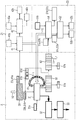
- the FIGURE shows a flowchart which depicts the entire process sequence or schematically illustrates the necessary devices for a power plant according to the invention.
- the central process steps are represented by large boxes or rectangles, small boxes represent the input and output products of the process steps. With reference to a power plant, the boxes can also be exemplary for various devices and chambers.
- the arrows between the Boxes indicate the process flow, in particular the temporal process flow. With regard to input and output products of the different process steps, the arrows also indicate the infeed and discharge of the products. For entering, leaving and forwarding of products or the substance are simple arrows.
- the hollow thick arrows represent an energy input, output or transport.
- the air separation plant 20 requires a certain amount of energy input 10 to separate the air.
- Nitrogen 20a exits from the air separation plant on one side.
- oxygen 20b exits.
- the nitrogen 20a is further processed in the first further processing device Z1.
- it is discharged from the power plant A, from the air separation plant 20 and represents a first input product 41a for the recycling device Z1.
- the oxygen 20b, which exits the air separation plant 20 is introduced as input product 31b in the steam generator 31.
- coal or generally a fossil fuel 31 a are introduced into the steam generator 31 and further oxygen 61 b, carbon dioxide 61 c and water 61 d, which is introduced again into the steam generator 31 by means of a flue gas recirculation process 70.
- the combustion of the fossil fuel 31a in particular the coal takes place under an oxygen atmosphere.
- a generator 33 is driven by means of which electrical energy can be generated.
- the combustion products first pass into the dust separator 61 after combustion in the steam generator 31. Dust 61a is discharged from the power plant via this dust separator 61. Furthermore, carbon dioxide 61c, oxygen 61b and 61d are recirculated in water, ie returned to the combustion chamber of the steam generator 31. Thus, the not yet consumed oxygen 61b is used for the combustion one more time and ensures that at the end highly concentrated carbon dioxide is available as a starting product, which is no longer returned to the steam generator. About the flue gas cleaning device 62, the starting products are discharged water 62a and highly concentrated carbon dioxide 62b. Furthermore, 62 low-temperature heat 11 is discharged from the flue gas cleaning device.
- the dust separation 61 and the flue gas cleaning 62 together form the separation device.
- the starting product carbon dioxide 62b from the separator is introduced into the second utilization device for the carbon dioxide Z2 for further processing.
- the carbon dioxide 51a forms a first input product into the combustion chamber 51 of the further processing device Z2.
- the further processing devices Z1 / Z2 are attached directly to the oxyfuel power plant A, so that nitrogen 20a / 41a and carbon dioxide 51a / 62b can be discharged directly from the power plant and introduced into the further processing devices Z1 / Z2. More specifically, the nitrogen 20a / 41a and the carbon dioxide 51a / 62b are directly introduced into the respective combustion chambers 41/51 of the further processing devices Z1 / Z2.
- the carbon dioxide 41a is burned in the combustion chamber 41 together with lithium 41b. This creates high-temperature heat 12, which in addition to the heat generated in the power plant for steam generation 31 can be recycled and used.
- the starting product of the combustion chamber 41 is lithium nitride, which is forwarded into the hydrolysis chamber 42. The resulting lithium nitride is far from a waste product. It reacts exothermically with water to form ammonia 42b.
- Ammonia is one of the most important starting products of fertilizer production. In the current state of the art, ammonia is produced by means of fossil fuels. This accounts for 3% of the total fossil energy expenditure on the production of ammonia. Without fertilizer, no economical production of biomass is possible.
- the combustion chamber is designed so that Li 3 N is generated in the upper or front part. Then the dust flies at high speed along a pipe. In the lower and rear part of the combustion chamber then steam is introduced. At the end, a gas-dust mixture of Li 2 O, ammonia and excess H 2 O is obtained.
- the starting products ammonia 42b and lithium hydroxide 42c exit from the hydrolysis chamber 42.
- the lithium hydroxide can be recycled to lithium by electrochemical reduction.
- a required input product for the hydrolysis step is water 42a.
- the further processing of nitrogen and the carbon dioxide 62b / 51a for further processing in the combustion chamber 51 of the further processing device, or recovery device Z2 is initiated. Further, lithium 51b is introduced into the combustion chamber 51. The lithium 51b is burned under a carbon dioxide atmosphere. This in turn results in high-temperature heat 12, which can be supplied to the power plant, in particular the steam generation process 31.
- the reaction of lithium with CO 2 is highly exothermic.
- the starting products of combustion reaction 51 are carbon monoxide 51c, lithium oxide and lithium carbonate 51d / e.
- the lithium oxide and carbonate can be reduced electrochemically and thus recycled to lithium. This happens, for example, via intermediate steps such as chloride.
- the carbon monoxide 51c also represents the input product 52a for the following synthesis step.
- Methanol 52c is thus one of the starting products of the synthesis gas reactor 52 or of the synthesis step.
- An oxyfuel power plant A is a modern plant for generating electrical energy. This carbon dioxide accumulates in highly concentrated form. Furthermore, relatively pure nitrogen is produced. If these gases continue to be used, the effectiveness of the overall system increases. The process chain is extended by the reduction of carbon dioxide and nitrogen. About the starting products, e.g. Ammonia may be restructured in the fertilizer market. The starting product methanol is important for fuel production, since these are no longer produced from fossil fuels as energy sources, but environmentally and climate friendly by means of the solar energy storage lithium. Lithium is therefore referred to as solar energy storage, since it can be obtained by means of photovoltaically generated electrical energy from its oxides or salts.
- the fossil fuel market can deliver volumes to the growing alkali metal or lithium market.
- the carbon atoms needed for the production of fuels are derived from low entropy carbon dioxide, ie highly concentrated carbon dioxide. During combustion in the motor vehicle, it becomes carbon dioxide with high entropy and can then only be recycled by plants.
- the fuel market will be comparable to fuels from biomass carbon neutral.
- the alkali metal or lithium market will grow strongly. At the same time, markets will develop in the development of a lithium infrastructure. On the one hand these are the production of lithium and on the other hand its recycling.
Landscapes
- Engineering & Computer Science (AREA)
- Chemical & Material Sciences (AREA)
- Organic Chemistry (AREA)
- Mechanical Engineering (AREA)
- General Engineering & Computer Science (AREA)
- Thermal Sciences (AREA)
- Environmental & Geological Engineering (AREA)
- Physics & Mathematics (AREA)
- Combustion & Propulsion (AREA)
- Analytical Chemistry (AREA)
- Inorganic Chemistry (AREA)
- Health & Medical Sciences (AREA)
- Chemical Kinetics & Catalysis (AREA)
- General Chemical & Material Sciences (AREA)
- Oil, Petroleum & Natural Gas (AREA)
- Materials Engineering (AREA)
- General Health & Medical Sciences (AREA)
- Biomedical Technology (AREA)
- Treating Waste Gases (AREA)
- Engine Equipment That Uses Special Cycles (AREA)
- Organic Low-Molecular-Weight Compounds And Preparation Thereof (AREA)
- Physical Or Chemical Processes And Apparatus (AREA)
- Fuel Cell (AREA)
- Carbon And Carbon Compounds (AREA)
Claims (5)
- Installation (Z1/Z2) de valorisation industrielle d'une substance, qui comporte de l'azote, comprenant :- une chambre de combustion (41), constituée pour brûler un métal électropositif avec la substance qui comporte de l'azote;- une chambre (42) de réaction, constituée pour continuer à faire réagir, dans un stade de réaction, un produit de combustion du stade de combustion et
comprenant une installation (20) de fractionnement de l'air, constituée pour séparer de l'azote et de l'oxygène de l'air, et communiquant avec la chambre de combustion (41), de manière à pouvoir envoyer l'azote séparé à la chambre de combustion (41); et comprenant une centrale (A) de production d'énergie électrique, l'installation étant conformée de manière à produire, au stade de combustion, de l'énergie utilisable en technique de centrale électrique et à la transformer en énergie électrique; et comprenant un dispositif (12) de transport de chaleur, par lequel la centrale (A) est, pour la valorisation, reliée à la chambre de combustion (41), de manière à transporter de l'énergie thermique produite dans la chambre de combustion (41) par le stade de combustion d'un métal électropositif et à la mettre à disposition supplémentairement de la centrale (A). - Procédé, en utilisant l'installation suivant la revendication 1, de valorisation industrielle d'une substance, dans lequel on fait réagir la substance, dans un stade de combustion, sur un métal électropositif et on fait réagir davantage, dans un stade de réaction, au moins un produit de combustion du stade de combustion, la substance comportant de l'azote, dans lequel, avant le stade de combustion, on effectue un stade de séparation de l'azote de l'air et on envoie l'azote au stade de combustion et, dans lequel le métal électropositif est un métal du premier ou du deuxième groupe principal ou un métal ayant un potentiel normal plus petit que zéro volt.
- Procédé suivant la revendication 2, dans lequel on produit, dans le stade de combustion, de l'énergie thermique utilisable en technique de centrale électrique et on la transforme en énergie électrique.
- Procédé suivant l'une des revendications précédentes 2 à 3, dans lequel le métal électropositif est le lithium.
- Procédé suivant l'une des revendications précédentes 2 à 4, dans lequel on effectue au moins une opération de récupération, dans laquelle on transforme un oxyde et/ou un sel du métal électropositif en le métal, de l'énergie, notamment photovoltaïque, étant utilisée pour l'opération de récupération.
Priority Applications (1)
| Application Number | Priority Date | Filing Date | Title |
|---|---|---|---|
| EP15001258.1A EP2947387B1 (fr) | 2010-09-20 | 2011-09-16 | Recyclage de gaz carbonique et d'azote avec du métal électropositif |
Applications Claiming Priority (2)
| Application Number | Priority Date | Filing Date | Title |
|---|---|---|---|
| DE201010041033 DE102010041033A1 (de) | 2010-09-20 | 2010-09-20 | Stoffverwertung mit elektropositivem Metall |
| EP11760755.6A EP2603737A2 (fr) | 2010-09-20 | 2011-09-16 | Recyclage de matière avec du métal électropositif |
Related Parent Applications (1)
| Application Number | Title | Priority Date | Filing Date |
|---|---|---|---|
| EP11760755.6A Division EP2603737A2 (fr) | 2010-09-20 | 2011-09-16 | Recyclage de matière avec du métal électropositif |
Related Child Applications (2)
| Application Number | Title | Priority Date | Filing Date |
|---|---|---|---|
| EP15001258.1A Division-Into EP2947387B1 (fr) | 2010-09-20 | 2011-09-16 | Recyclage de gaz carbonique et d'azote avec du métal électropositif |
| EP15001258.1A Division EP2947387B1 (fr) | 2010-09-20 | 2011-09-16 | Recyclage de gaz carbonique et d'azote avec du métal électropositif |
Publications (3)
| Publication Number | Publication Date |
|---|---|
| EP2816284A2 EP2816284A2 (fr) | 2014-12-24 |
| EP2816284A3 EP2816284A3 (fr) | 2015-02-25 |
| EP2816284B1 true EP2816284B1 (fr) | 2018-03-21 |
Family
ID=44675576
Family Applications (4)
| Application Number | Title | Priority Date | Filing Date |
|---|---|---|---|
| EP11760755.6A Withdrawn EP2603737A2 (fr) | 2010-09-20 | 2011-09-16 | Recyclage de matière avec du métal électropositif |
| EP14003134.5A Not-in-force EP2816284B1 (fr) | 2010-09-20 | 2011-09-16 | Recyclage de matière avec du métal électropositif |
| EP11763889.0A Not-in-force EP2603756B1 (fr) | 2010-09-20 | 2011-09-16 | Procédé et système de conversion de dioxyde de carbone en matières de départ chimiques |
| EP15001258.1A Not-in-force EP2947387B1 (fr) | 2010-09-20 | 2011-09-16 | Recyclage de gaz carbonique et d'azote avec du métal électropositif |
Family Applications Before (1)
| Application Number | Title | Priority Date | Filing Date |
|---|---|---|---|
| EP11760755.6A Withdrawn EP2603737A2 (fr) | 2010-09-20 | 2011-09-16 | Recyclage de matière avec du métal électropositif |
Family Applications After (2)
| Application Number | Title | Priority Date | Filing Date |
|---|---|---|---|
| EP11763889.0A Not-in-force EP2603756B1 (fr) | 2010-09-20 | 2011-09-16 | Procédé et système de conversion de dioxyde de carbone en matières de départ chimiques |
| EP15001258.1A Not-in-force EP2947387B1 (fr) | 2010-09-20 | 2011-09-16 | Recyclage de gaz carbonique et d'azote avec du métal électropositif |
Country Status (6)
| Country | Link |
|---|---|
| US (2) | US10151481B2 (fr) |
| EP (4) | EP2603737A2 (fr) |
| CN (2) | CN103354887B (fr) |
| DE (1) | DE102010041033A1 (fr) |
| ES (1) | ES2599411T3 (fr) |
| WO (2) | WO2012038329A2 (fr) |
Families Citing this family (37)
| Publication number | Priority date | Publication date | Assignee | Title |
|---|---|---|---|---|
| DE102010041033A1 (de) | 2010-09-20 | 2012-03-22 | Siemens Aktiengesellschaft | Stoffverwertung mit elektropositivem Metall |
| DE102011077819A1 (de) * | 2011-06-20 | 2012-12-20 | Siemens Aktiengesellschaft | Kohlendioxidreduktion in Stahlwerken |
| US8728425B2 (en) * | 2012-04-17 | 2014-05-20 | Siemens Aktiengesellschaft | Method and an apparatus for performing an energy efficient desulphurization and decarbonisation of a flue gas |
| WO2013164172A1 (fr) * | 2012-05-02 | 2013-11-07 | Haldor Topsøe A/S | Procédé de production de composés chimiques à partir de dioxyde de carbone |
| CN104411843B (zh) * | 2012-07-05 | 2018-06-29 | 西门子公司 | 由金属碳酸盐回收正电性金属的方法 |
| WO2015011566A2 (fr) * | 2013-07-23 | 2015-01-29 | Carbon Clean Solutions Pvt. Ltd | Système de ligne dédoublée, procédé et traitement pour récupération du co2 |
| DE102013224709A1 (de) | 2013-12-03 | 2015-06-03 | Siemens Aktiengesellschaft | Prozessanlage zur kontinuierlichen Verbrennung eines elektropositiven Metalls |
| DE102013225419A1 (de) * | 2013-12-10 | 2015-06-11 | Siemens Aktiengesellschaft | Sequestrierung von Kohlendioxid durch Bindung als Alkalicarbonat |
| DE102014202591A1 (de) * | 2014-02-13 | 2015-08-13 | Siemens Aktiengesellschaft | Umwandlung von Metallcarbonat in Metallchlorid |
| DE102014202593A1 (de) | 2014-02-13 | 2015-08-13 | Siemens Aktiengesellschaft | Umwandlung von Metallcarbonat in Metallchlorid |
| DE102014209529A1 (de) * | 2014-05-20 | 2015-11-26 | Siemens Aktiengesellschaft | Verbrennung von Lithium bei unterschiedlichen Temperaturen, Drücken und Gasüberschüssen mit porösen Rohren als Brenner |
| DE102014209527A1 (de) * | 2014-05-20 | 2015-11-26 | Siemens Aktiengesellschaft | Verfahren zum Verbrennen einer Legierung eines elektropositiven Metalls |
| DE102014210402A1 (de) | 2014-06-03 | 2015-12-03 | Siemens Aktiengesellschaft | Pumpenfreie Metall-Verdüsung und -Verbrennung mittels Unterdruckerzeugung und geeignete Materialflusskontrolle |
| DE102014219275A1 (de) | 2014-09-24 | 2016-03-24 | Siemens Aktiengesellschaft | Zündung von Flammen eines elektropositiven Metalls durch Plasmatisierung des Reaktionsgases |
| DE102014219274A1 (de) | 2014-09-24 | 2016-03-24 | Siemens Aktiengesellschaft | Kraftwerk zur Herstellung von Energie und Ammoniak |
| DE102014219276A1 (de) * | 2014-09-24 | 2016-03-24 | Siemens Aktiengesellschaft | Gas und Dampfkraftwerksanlage (GUD) auf der Basis von elektropositiven Metallen mit optional angeschlossenem Fischer-Tropsch Prozess |
| DE102014222919A1 (de) | 2014-11-11 | 2016-05-12 | Siemens Aktiengesellschaft | Verbrennung von elektropositivem Metall in einer Flüssigkeit |
| WO2016172144A1 (fr) * | 2015-04-23 | 2016-10-27 | University Of Florida Research Foundation, Inc. | Procédé de génération d'énergie |
| US9701593B1 (en) * | 2016-05-05 | 2017-07-11 | BB&G Environmental, LLC | Carbon dioxide conversion system |
| CN106076084A (zh) * | 2016-09-29 | 2016-11-09 | 马鞍山市顺达环保设备有限公司 | 一种化学反应废气处理机构 |
| WO2018065078A1 (fr) | 2016-10-04 | 2018-04-12 | Siemens Aktiengesellschaft | Procédé et ensemble de récupération d'énergie |
| CA3047845C (fr) | 2016-12-21 | 2023-04-11 | Isca Management Ltd. | Elimination de gaz a effet de serre et de metaux lourds a partir d'un flux d'emission |
| US10337357B2 (en) | 2017-01-31 | 2019-07-02 | General Electric Company | Steam turbine preheating system with a steam generator |
| US10174639B2 (en) * | 2017-01-31 | 2019-01-08 | General Electric Company | Steam turbine preheating system |
| US10374230B2 (en) | 2017-03-31 | 2019-08-06 | Arya Mangesh Bairat | Method of providing electricity to a vehicle |
| DE102018210304A1 (de) * | 2018-06-25 | 2020-01-02 | Siemens Aktiengesellschaft | Hochstromtaugliches Verfahren zur Herstellung von Ammoniak |
| US11885031B2 (en) | 2018-10-30 | 2024-01-30 | Ohio University | Modular electrocatalytic processing for simultaneous conversion of carbon dioxide and wet shale gas |
| CN111173580A (zh) * | 2020-02-28 | 2020-05-19 | 西安热工研究院有限公司 | 一种基于金属燃料锂储能、燃烧、电解再生的发电系统 |
| US12327854B2 (en) | 2020-05-30 | 2025-06-10 | Solomon Alema Asfha | Apparatuses and methods for carbon dioxide capturing and electrical energy producing system |
| CN113266818A (zh) * | 2020-12-26 | 2021-08-17 | 西安西热控制技术有限公司 | 一种火电厂掺烧生物燃料乙醇稳燃及碳减排系统 |
| JP2024016750A (ja) * | 2022-07-26 | 2024-02-07 | 株式会社エスイー | 発電方法及び発電設備 |
| JP7788727B2 (ja) * | 2022-07-26 | 2025-12-19 | 株式会社エスイー | 火力発電方法 |
| JP7751299B2 (ja) * | 2022-07-26 | 2025-10-08 | 株式会社エスイー | 火力発電方法 |
| WO2024145203A1 (fr) * | 2022-12-27 | 2024-07-04 | Dehestani Ahmad | Procédé de conversion simultanée d'halogénures d'hydrogène en halogènes et de carbone en hydrocarbures |
| JP2025115227A (ja) * | 2024-01-25 | 2025-08-06 | 株式会社エスイー | ボイラ装置の運転方法、ボイラ装置、及び発電システム |
| JP2025115209A (ja) * | 2024-01-25 | 2025-08-06 | 株式会社エスイー | 発電方法、ボイラ装置の運転方法、ボイラ装置、及び発電システム |
| JP2025115223A (ja) * | 2024-01-25 | 2025-08-06 | 株式会社エスイー | 発電方法、ボイラ装置の運転方法、ボイラ装置、及び発電システム |
Family Cites Families (25)
| Publication number | Priority date | Publication date | Assignee | Title |
|---|---|---|---|---|
| US2138122A (en) * | 1935-05-21 | 1938-11-29 | Jr Ovid E Roberts | Process for the synthesis of ammonia |
| US3101592A (en) * | 1961-01-16 | 1963-08-27 | Thompson Ramo Wooldridge Inc | Closed power generating system |
| US3759036A (en) * | 1970-03-01 | 1973-09-18 | Chevron Res | Power generation |
| US3857920A (en) | 1971-07-29 | 1974-12-31 | Department Of Health Education | Recovery of lithium carbonate |
| US4698974A (en) | 1984-12-13 | 1987-10-13 | The Garrett Corporation | Internal combustion closed rankine cycle steam engine |
| DE3615027A1 (de) * | 1986-05-02 | 1987-11-05 | Dietrich Dipl Ing Dr Radke | Verfahren zur zerstoerung organischer halogenverbindungen insbesondere von chlorierten biphenylen, polychlorierten dioxinen und polychlorierten furanen |
| US5232793A (en) | 1989-09-19 | 1993-08-03 | Ishikawajima-Harima Heavy Industries Co., Ltd. | Method of and apparatus for utilizing and recovering co2 in combustion exhaust gas |
| JPH06114238A (ja) * | 1991-02-05 | 1994-04-26 | Mitsubishi Heavy Ind Ltd | 二酸化炭素分解方法 |
| JP3288164B2 (ja) * | 1993-12-28 | 2002-06-04 | 株式会社東芝 | 廃プラスチックの熱分解装置 |
| DE4334257A1 (de) * | 1993-10-07 | 1995-04-13 | Linde Ag | Verfahren zum Gewinnen von Ammoniak |
| JP2000120447A (ja) | 1998-10-12 | 2000-04-25 | Toshiba Corp | 火力発電プラント |
| US6387845B1 (en) * | 1999-03-23 | 2002-05-14 | Kabushiki Kaisha Toshiba | Carbon dioxide gas absorbent containing lithium silicate |
| US6206685B1 (en) * | 1999-08-31 | 2001-03-27 | Ge Energy And Environmental Research Corporation | Method for reducing NOx in combustion flue gas using metal-containing additives |
| US7674947B2 (en) | 2004-12-13 | 2010-03-09 | James A Barends | Recirculating combustion system |
| WO2008013844A2 (fr) | 2006-07-25 | 2008-01-31 | General Vortex Energy, Inc. | Système, appareil et procédé de combustion d'un métal et autres combustibles |
| CA2710702A1 (fr) | 2006-09-08 | 2008-03-13 | Signa Chemistry, Inc. | Compositions d'oxyde de metal poreux et de lithium et compositions de metal poreux et de reactif a base de lithium |
| US20090016948A1 (en) * | 2007-07-12 | 2009-01-15 | Young Edgar D | Carbon and fuel production from atmospheric CO2 and H2O by artificial photosynthesis and method of operation thereof |
| EP2040323A3 (fr) * | 2007-08-07 | 2010-10-27 | Florian Dr. Krass | Procédé de préparation d'accumulateurs d'énergie à l'hydrogène à base d'azote |
| US8343445B2 (en) * | 2008-03-21 | 2013-01-01 | Alstom Technology Ltd | System and method for enhanced removal of CO2 from a mixed gas stream |
| DE102008031437A1 (de) | 2008-07-04 | 2010-01-07 | Siemens Aktiengesellschaft | Mobiler Energieträger und Energiespeicher |
| CN101618292A (zh) * | 2008-11-10 | 2010-01-06 | 李元胜 | 一种对工业三废进行综合利用的系统 |
| DE102009014026A1 (de) * | 2008-12-03 | 2010-06-10 | Ernest Stangl | Verfahren zur Erzeugung thermischer Energie |
| WO2010118127A1 (fr) * | 2009-04-10 | 2010-10-14 | University Of Southern California | Transformation du charbon en carburant neutre vis-à-vis de l'environnement en ce qui concerne le dioxyde de carbone et source régénérative de carbone |
| AU2010282714B2 (en) | 2009-08-10 | 2013-11-14 | David Randolph Smith | Method and apparatus to sequester CO2 gas |
| DE102010041033A1 (de) | 2010-09-20 | 2012-03-22 | Siemens Aktiengesellschaft | Stoffverwertung mit elektropositivem Metall |
-
2010
- 2010-09-20 DE DE201010041033 patent/DE102010041033A1/de not_active Ceased
-
2011
- 2011-09-16 US US13/825,211 patent/US10151481B2/en not_active Expired - Fee Related
- 2011-09-16 ES ES11763889.0T patent/ES2599411T3/es active Active
- 2011-09-16 CN CN201180055809.9A patent/CN103354887B/zh not_active Expired - Fee Related
- 2011-09-16 US US13/825,232 patent/US9285116B2/en not_active Expired - Fee Related
- 2011-09-16 CN CN201180055778.7A patent/CN103221745B/zh not_active Expired - Fee Related
- 2011-09-16 EP EP11760755.6A patent/EP2603737A2/fr not_active Withdrawn
- 2011-09-16 EP EP14003134.5A patent/EP2816284B1/fr not_active Not-in-force
- 2011-09-16 WO PCT/EP2011/066066 patent/WO2012038329A2/fr not_active Ceased
- 2011-09-16 WO PCT/EP2011/066073 patent/WO2012038330A2/fr not_active Ceased
- 2011-09-16 EP EP11763889.0A patent/EP2603756B1/fr not_active Not-in-force
- 2011-09-16 EP EP15001258.1A patent/EP2947387B1/fr not_active Not-in-force
Non-Patent Citations (1)
| Title |
|---|
| None * |
Also Published As
| Publication number | Publication date |
|---|---|
| EP2603756B1 (fr) | 2016-07-20 |
| US20130196271A1 (en) | 2013-08-01 |
| ES2599411T3 (es) | 2017-02-01 |
| DE102010041033A1 (de) | 2012-03-22 |
| CN103221745B (zh) | 2016-05-04 |
| WO2012038330A3 (fr) | 2013-05-23 |
| WO2012038329A2 (fr) | 2012-03-29 |
| US9285116B2 (en) | 2016-03-15 |
| EP2816284A2 (fr) | 2014-12-24 |
| WO2012038330A2 (fr) | 2012-03-29 |
| CN103354887A (zh) | 2013-10-16 |
| US10151481B2 (en) | 2018-12-11 |
| EP2603756A2 (fr) | 2013-06-19 |
| US20130178677A1 (en) | 2013-07-11 |
| CN103354887B (zh) | 2015-11-25 |
| EP2603737A2 (fr) | 2013-06-19 |
| EP2947387B1 (fr) | 2018-03-21 |
| WO2012038329A3 (fr) | 2013-05-02 |
| EP2816284A3 (fr) | 2015-02-25 |
| EP2947387A1 (fr) | 2015-11-25 |
| CN103221745A (zh) | 2013-07-24 |
Similar Documents
| Publication | Publication Date | Title |
|---|---|---|
| EP2816284B1 (fr) | Recyclage de matière avec du métal électropositif | |
| DE102012214907B4 (de) | Dampfkraftanlage zur Erzeugung von elektrischer Energie nach dem Oxyfuel-Verfahren | |
| DE69815762T2 (de) | Vorrichtung zum Fixieren von Kohlendioxid | |
| DE102011077819A1 (de) | Kohlendioxidreduktion in Stahlwerken | |
| EP2892983A2 (fr) | Séquestration écologique de dioxyde de carbone/augmentation de la quantité de bioénergie pouvant être obtenue à partir d'une biomasse | |
| EP2836575A1 (fr) | Centrale de stockage | |
| DE102012103458A1 (de) | Anlage und Verfahren zur ökologischen Erzeugung und Speicherung von Strom | |
| WO2011101209A2 (fr) | Procédé et dispositif de valorisation d'émissions d'une centrale électrique | |
| EP3156519B1 (fr) | Procédé et appareil de production d'un hydrocarbure | |
| WO2011120706A1 (fr) | Procédé et dispositif pour le stockage d'énergie | |
| DE102014219276A1 (de) | Gas und Dampfkraftwerksanlage (GUD) auf der Basis von elektropositiven Metallen mit optional angeschlossenem Fischer-Tropsch Prozess | |
| EP2367752A1 (fr) | Silicium ou métaux élémentaires comme sources d'énergie | |
| WO2010069385A1 (fr) | Procédé de préparation d'un vecteur d'énergie | |
| WO2016206669A1 (fr) | Réaction de boudouard en association avec l'hydrolyse de l'eau pour la production de méthane | |
| DE69925659T2 (de) | Apparat zur Kohlenstoffherstellung unter Verwendung von Biomasse | |
| DE102014213987B4 (de) | Solare Ammoniakproduktion | |
| DE102015213484A1 (de) | Dekarbonisierung der Kohleverstromung durch zweimalige Verbrennung von Kohlenstoff | |
| WO2001018151A1 (fr) | Procede d'accumulation d'energie solaire | |
| DE102016208938A1 (de) | Verfahren und Anlage zur Erzeugung eines Kohlenwasserstoffs | |
| DE102022210053A1 (de) | Anlage und Verfahren zur Erzeugung von grünem Harnstoff | |
| WO2018059706A1 (fr) | Procédé pour l'accumulation et/ou la production d'énergie à base de calcium et/ou de magnésium et centrale électrique pourvue d'une turbine à vapeur | |
| LU103015B1 (de) | Anlage und Verfahren zur Erzeugung von grünem Harnstoff | |
| DE19528681C2 (de) | Verfahren zur Speicherung und Nutzbarmachung von Solar-, Wind- oder Wasserkraftenergie | |
| Roeb et al. | Hydrogen as a foundation of the energy transition. Pt. 1: Technologies and perspectives for a sustainable and economical hydrogen supply | |
| EP3722462A1 (fr) | Installation et procédé d'accumulation d'énergie électrique |
Legal Events
| Date | Code | Title | Description |
|---|---|---|---|
| PUAI | Public reference made under article 153(3) epc to a published international application that has entered the european phase |
Free format text: ORIGINAL CODE: 0009012 |
|
| 17P | Request for examination filed |
Effective date: 20140910 |
|
| AC | Divisional application: reference to earlier application |
Ref document number: 2603737 Country of ref document: EP Kind code of ref document: P |
|
| AK | Designated contracting states |
Kind code of ref document: A2 Designated state(s): AL AT BE BG CH CY CZ DE DK EE ES FI FR GB GR HR HU IE IS IT LI LT LU LV MC MK MT NL NO PL PT RO RS SE SI SK SM TR |
|
| PUAL | Search report despatched |
Free format text: ORIGINAL CODE: 0009013 |
|
| AK | Designated contracting states |
Kind code of ref document: A3 Designated state(s): AL AT BE BG CH CY CZ DE DK EE ES FI FR GB GR HR HU IE IS IT LI LT LU LV MC MK MT NL NO PL PT RO RS SE SI SK SM TR |
|
| RIC1 | Information provided on ipc code assigned before grant |
Ipc: C07C 1/02 20060101ALI20150120BHEP Ipc: C01B 31/18 20060101ALI20150120BHEP Ipc: C07C 29/151 20060101ALI20150120BHEP Ipc: C01B 21/06 20060101ALI20150120BHEP Ipc: F23G 7/06 20060101ALI20150120BHEP Ipc: B01D 53/62 20060101ALI20150120BHEP Ipc: F23B 99/00 20060101AFI20150120BHEP Ipc: F23L 7/00 20060101ALI20150120BHEP Ipc: B01D 53/14 20060101ALI20150120BHEP Ipc: F23J 7/00 20060101ALI20150120BHEP Ipc: F23J 15/00 20060101ALI20150120BHEP Ipc: F25J 3/04 20060101ALI20150120BHEP Ipc: C01C 1/02 20060101ALI20150120BHEP |
|
| R17P | Request for examination filed (corrected) |
Effective date: 20150902 |
|
| RBV | Designated contracting states (corrected) |
Designated state(s): AL AT BE BG CH CY CZ DE DK EE ES FI FR GB GR HR HU IE IS IT LI LT LU LV MC MK MT NL NO PL PT RO RS SE SI SK SM TR |
|
| 17Q | First examination report despatched |
Effective date: 20160311 |
|
| RAP1 | Party data changed (applicant data changed or rights of an application transferred) |
Owner name: SIEMENS AKTIENGESELLSCHAFT |
|
| GRAP | Despatch of communication of intention to grant a patent |
Free format text: ORIGINAL CODE: EPIDOSNIGR1 |
|
| RIC1 | Information provided on ipc code assigned before grant |
Ipc: C01B 21/06 20060101ALI20170901BHEP Ipc: C07C 1/02 20060101ALI20170901BHEP Ipc: F23J 7/00 20060101ALI20170901BHEP Ipc: F23G 7/06 20060101ALI20170901BHEP Ipc: F23L 7/00 20060101ALI20170901BHEP Ipc: F23J 15/00 20060101ALI20170901BHEP Ipc: F23B 99/00 20060101AFI20170901BHEP Ipc: B01D 53/14 20060101ALI20170901BHEP Ipc: C01C 1/02 20060101ALI20170901BHEP Ipc: B01D 53/62 20060101ALI20170901BHEP Ipc: C07C 29/151 20060101ALI20170901BHEP Ipc: F25J 3/04 20060101ALI20170901BHEP |
|
| INTG | Intention to grant announced |
Effective date: 20171005 |
|
| GRAS | Grant fee paid |
Free format text: ORIGINAL CODE: EPIDOSNIGR3 |
|
| GRAA | (expected) grant |
Free format text: ORIGINAL CODE: 0009210 |
|
| AC | Divisional application: reference to earlier application |
Ref document number: 2603737 Country of ref document: EP Kind code of ref document: P |
|
| AK | Designated contracting states |
Kind code of ref document: B1 Designated state(s): AL AT BE BG CH CY CZ DE DK EE ES FI FR GB GR HR HU IE IS IT LI LT LU LV MC MK MT NL NO PL PT RO RS SE SI SK SM TR |
|
| REG | Reference to a national code |
Ref country code: GB Ref legal event code: FG4D Free format text: NOT ENGLISH |
|
| REG | Reference to a national code |
Ref country code: CH Ref legal event code: EP |
|
| REG | Reference to a national code |
Ref country code: AT Ref legal event code: REF Ref document number: 981500 Country of ref document: AT Kind code of ref document: T Effective date: 20180415 |
|
| REG | Reference to a national code |
Ref country code: IE Ref legal event code: FG4D Free format text: LANGUAGE OF EP DOCUMENT: GERMAN |
|
| REG | Reference to a national code |
Ref country code: DE Ref legal event code: R096 Ref document number: 502011013936 Country of ref document: DE |
|
| REG | Reference to a national code |
Ref country code: NL Ref legal event code: MP Effective date: 20180321 |
|
| PG25 | Lapsed in a contracting state [announced via postgrant information from national office to epo] |
Ref country code: HR Free format text: LAPSE BECAUSE OF FAILURE TO SUBMIT A TRANSLATION OF THE DESCRIPTION OR TO PAY THE FEE WITHIN THE PRESCRIBED TIME-LIMIT Effective date: 20180321 Ref country code: LT Free format text: LAPSE BECAUSE OF FAILURE TO SUBMIT A TRANSLATION OF THE DESCRIPTION OR TO PAY THE FEE WITHIN THE PRESCRIBED TIME-LIMIT Effective date: 20180321 Ref country code: CY Free format text: LAPSE BECAUSE OF FAILURE TO SUBMIT A TRANSLATION OF THE DESCRIPTION OR TO PAY THE FEE WITHIN THE PRESCRIBED TIME-LIMIT Effective date: 20180321 Ref country code: FI Free format text: LAPSE BECAUSE OF FAILURE TO SUBMIT A TRANSLATION OF THE DESCRIPTION OR TO PAY THE FEE WITHIN THE PRESCRIBED TIME-LIMIT Effective date: 20180321 Ref country code: NO Free format text: LAPSE BECAUSE OF FAILURE TO SUBMIT A TRANSLATION OF THE DESCRIPTION OR TO PAY THE FEE WITHIN THE PRESCRIBED TIME-LIMIT Effective date: 20180621 |
|
| REG | Reference to a national code |
Ref country code: LT Ref legal event code: MG4D |
|
| PG25 | Lapsed in a contracting state [announced via postgrant information from national office to epo] |
Ref country code: SE Free format text: LAPSE BECAUSE OF FAILURE TO SUBMIT A TRANSLATION OF THE DESCRIPTION OR TO PAY THE FEE WITHIN THE PRESCRIBED TIME-LIMIT Effective date: 20180321 Ref country code: LV Free format text: LAPSE BECAUSE OF FAILURE TO SUBMIT A TRANSLATION OF THE DESCRIPTION OR TO PAY THE FEE WITHIN THE PRESCRIBED TIME-LIMIT Effective date: 20180321 Ref country code: RS Free format text: LAPSE BECAUSE OF FAILURE TO SUBMIT A TRANSLATION OF THE DESCRIPTION OR TO PAY THE FEE WITHIN THE PRESCRIBED TIME-LIMIT Effective date: 20180321 Ref country code: BG Free format text: LAPSE BECAUSE OF FAILURE TO SUBMIT A TRANSLATION OF THE DESCRIPTION OR TO PAY THE FEE WITHIN THE PRESCRIBED TIME-LIMIT Effective date: 20180621 Ref country code: GR Free format text: LAPSE BECAUSE OF FAILURE TO SUBMIT A TRANSLATION OF THE DESCRIPTION OR TO PAY THE FEE WITHIN THE PRESCRIBED TIME-LIMIT Effective date: 20180622 |
|
| REG | Reference to a national code |
Ref country code: FR Ref legal event code: PLFP Year of fee payment: 8 |
|
| PG25 | Lapsed in a contracting state [announced via postgrant information from national office to epo] |
Ref country code: MT Free format text: LAPSE BECAUSE OF FAILURE TO SUBMIT A TRANSLATION OF THE DESCRIPTION OR TO PAY THE FEE WITHIN THE PRESCRIBED TIME-LIMIT Effective date: 20180321 |
|
| PG25 | Lapsed in a contracting state [announced via postgrant information from national office to epo] |
Ref country code: ES Free format text: LAPSE BECAUSE OF FAILURE TO SUBMIT A TRANSLATION OF THE DESCRIPTION OR TO PAY THE FEE WITHIN THE PRESCRIBED TIME-LIMIT Effective date: 20180321 Ref country code: NL Free format text: LAPSE BECAUSE OF FAILURE TO SUBMIT A TRANSLATION OF THE DESCRIPTION OR TO PAY THE FEE WITHIN THE PRESCRIBED TIME-LIMIT Effective date: 20180321 Ref country code: RO Free format text: LAPSE BECAUSE OF FAILURE TO SUBMIT A TRANSLATION OF THE DESCRIPTION OR TO PAY THE FEE WITHIN THE PRESCRIBED TIME-LIMIT Effective date: 20180321 Ref country code: PL Free format text: LAPSE BECAUSE OF FAILURE TO SUBMIT A TRANSLATION OF THE DESCRIPTION OR TO PAY THE FEE WITHIN THE PRESCRIBED TIME-LIMIT Effective date: 20180321 Ref country code: EE Free format text: LAPSE BECAUSE OF FAILURE TO SUBMIT A TRANSLATION OF THE DESCRIPTION OR TO PAY THE FEE WITHIN THE PRESCRIBED TIME-LIMIT Effective date: 20180321 Ref country code: IT Free format text: LAPSE BECAUSE OF FAILURE TO SUBMIT A TRANSLATION OF THE DESCRIPTION OR TO PAY THE FEE WITHIN THE PRESCRIBED TIME-LIMIT Effective date: 20180321 Ref country code: AL Free format text: LAPSE BECAUSE OF FAILURE TO SUBMIT A TRANSLATION OF THE DESCRIPTION OR TO PAY THE FEE WITHIN THE PRESCRIBED TIME-LIMIT Effective date: 20180321 |
|
| PGFP | Annual fee paid to national office [announced via postgrant information from national office to epo] |
Ref country code: FR Payment date: 20180924 Year of fee payment: 8 |
|
| PG25 | Lapsed in a contracting state [announced via postgrant information from national office to epo] |
Ref country code: SK Free format text: LAPSE BECAUSE OF FAILURE TO SUBMIT A TRANSLATION OF THE DESCRIPTION OR TO PAY THE FEE WITHIN THE PRESCRIBED TIME-LIMIT Effective date: 20180321 Ref country code: SM Free format text: LAPSE BECAUSE OF FAILURE TO SUBMIT A TRANSLATION OF THE DESCRIPTION OR TO PAY THE FEE WITHIN THE PRESCRIBED TIME-LIMIT Effective date: 20180321 Ref country code: CZ Free format text: LAPSE BECAUSE OF FAILURE TO SUBMIT A TRANSLATION OF THE DESCRIPTION OR TO PAY THE FEE WITHIN THE PRESCRIBED TIME-LIMIT Effective date: 20180321 |
|
| PGFP | Annual fee paid to national office [announced via postgrant information from national office to epo] |
Ref country code: GB Payment date: 20180911 Year of fee payment: 8 |
|
| PG25 | Lapsed in a contracting state [announced via postgrant information from national office to epo] |
Ref country code: PT Free format text: LAPSE BECAUSE OF FAILURE TO SUBMIT A TRANSLATION OF THE DESCRIPTION OR TO PAY THE FEE WITHIN THE PRESCRIBED TIME-LIMIT Effective date: 20180723 |
|
| REG | Reference to a national code |
Ref country code: DE Ref legal event code: R097 Ref document number: 502011013936 Country of ref document: DE |
|
| PLBE | No opposition filed within time limit |
Free format text: ORIGINAL CODE: 0009261 |
|
| STAA | Information on the status of an ep patent application or granted ep patent |
Free format text: STATUS: NO OPPOSITION FILED WITHIN TIME LIMIT |
|
| PG25 | Lapsed in a contracting state [announced via postgrant information from national office to epo] |
Ref country code: DK Free format text: LAPSE BECAUSE OF FAILURE TO SUBMIT A TRANSLATION OF THE DESCRIPTION OR TO PAY THE FEE WITHIN THE PRESCRIBED TIME-LIMIT Effective date: 20180321 |
|
| PGFP | Annual fee paid to national office [announced via postgrant information from national office to epo] |
Ref country code: DE Payment date: 20181119 Year of fee payment: 8 |
|
| 26N | No opposition filed |
Effective date: 20190102 |
|
| PG25 | Lapsed in a contracting state [announced via postgrant information from national office to epo] |
Ref country code: MC Free format text: LAPSE BECAUSE OF FAILURE TO SUBMIT A TRANSLATION OF THE DESCRIPTION OR TO PAY THE FEE WITHIN THE PRESCRIBED TIME-LIMIT Effective date: 20180321 |
|
| REG | Reference to a national code |
Ref country code: CH Ref legal event code: PL |
|
| PG25 | Lapsed in a contracting state [announced via postgrant information from national office to epo] |
Ref country code: SI Free format text: LAPSE BECAUSE OF FAILURE TO SUBMIT A TRANSLATION OF THE DESCRIPTION OR TO PAY THE FEE WITHIN THE PRESCRIBED TIME-LIMIT Effective date: 20180321 |
|
| REG | Reference to a national code |
Ref country code: BE Ref legal event code: MM Effective date: 20180930 |
|
| REG | Reference to a national code |
Ref country code: IE Ref legal event code: MM4A |
|
| PG25 | Lapsed in a contracting state [announced via postgrant information from national office to epo] |
Ref country code: LU Free format text: LAPSE BECAUSE OF NON-PAYMENT OF DUE FEES Effective date: 20180916 |
|
| PG25 | Lapsed in a contracting state [announced via postgrant information from national office to epo] |
Ref country code: IE Free format text: LAPSE BECAUSE OF NON-PAYMENT OF DUE FEES Effective date: 20180916 |
|
| PG25 | Lapsed in a contracting state [announced via postgrant information from national office to epo] |
Ref country code: BE Free format text: LAPSE BECAUSE OF NON-PAYMENT OF DUE FEES Effective date: 20180930 Ref country code: CH Free format text: LAPSE BECAUSE OF NON-PAYMENT OF DUE FEES Effective date: 20180930 Ref country code: LI Free format text: LAPSE BECAUSE OF NON-PAYMENT OF DUE FEES Effective date: 20180930 |
|
| REG | Reference to a national code |
Ref country code: AT Ref legal event code: MM01 Ref document number: 981500 Country of ref document: AT Kind code of ref document: T Effective date: 20180916 |
|
| PG25 | Lapsed in a contracting state [announced via postgrant information from national office to epo] |
Ref country code: AT Free format text: LAPSE BECAUSE OF NON-PAYMENT OF DUE FEES Effective date: 20180916 |
|
| PG25 | Lapsed in a contracting state [announced via postgrant information from national office to epo] |
Ref country code: TR Free format text: LAPSE BECAUSE OF FAILURE TO SUBMIT A TRANSLATION OF THE DESCRIPTION OR TO PAY THE FEE WITHIN THE PRESCRIBED TIME-LIMIT Effective date: 20180321 |
|
| REG | Reference to a national code |
Ref country code: DE Ref legal event code: R119 Ref document number: 502011013936 Country of ref document: DE |
|
| PG25 | Lapsed in a contracting state [announced via postgrant information from national office to epo] |
Ref country code: HU Free format text: LAPSE BECAUSE OF FAILURE TO SUBMIT A TRANSLATION OF THE DESCRIPTION OR TO PAY THE FEE WITHIN THE PRESCRIBED TIME-LIMIT; INVALID AB INITIO Effective date: 20110916 |
|
| PG25 | Lapsed in a contracting state [announced via postgrant information from national office to epo] |
Ref country code: MK Free format text: LAPSE BECAUSE OF NON-PAYMENT OF DUE FEES Effective date: 20180321 |
|
| PG25 | Lapsed in a contracting state [announced via postgrant information from national office to epo] |
Ref country code: DE Free format text: LAPSE BECAUSE OF NON-PAYMENT OF DUE FEES Effective date: 20200401 Ref country code: IS Free format text: LAPSE BECAUSE OF FAILURE TO SUBMIT A TRANSLATION OF THE DESCRIPTION OR TO PAY THE FEE WITHIN THE PRESCRIBED TIME-LIMIT Effective date: 20180721 |
|
| GBPC | Gb: european patent ceased through non-payment of renewal fee |
Effective date: 20190916 |
|
| PG25 | Lapsed in a contracting state [announced via postgrant information from national office to epo] |
Ref country code: GB Free format text: LAPSE BECAUSE OF NON-PAYMENT OF DUE FEES Effective date: 20190916 Ref country code: FR Free format text: LAPSE BECAUSE OF NON-PAYMENT OF DUE FEES Effective date: 20190930 |