EP2816628A2 - Composant organique luminescent et agencement avec plusieurs composants organiques luminescents - Google Patents
Composant organique luminescent et agencement avec plusieurs composants organiques luminescents Download PDFInfo
- Publication number
- EP2816628A2 EP2816628A2 EP14184883.8A EP14184883A EP2816628A2 EP 2816628 A2 EP2816628 A2 EP 2816628A2 EP 14184883 A EP14184883 A EP 14184883A EP 2816628 A2 EP2816628 A2 EP 2816628A2
- Authority
- EP
- European Patent Office
- Prior art keywords
- electrode
- comb electrode
- organic
- comb
- light
- Prior art date
- Legal status (The legal status is an assumption and is not a legal conclusion. Google has not performed a legal analysis and makes no representation as to the accuracy of the status listed.)
- Granted
Links
Images




Classifications
-
- H—ELECTRICITY
- H10—SEMICONDUCTOR DEVICES; ELECTRIC SOLID-STATE DEVICES NOT OTHERWISE PROVIDED FOR
- H10K—ORGANIC ELECTRIC SOLID-STATE DEVICES
- H10K50/00—Organic light-emitting devices
- H10K50/80—Constructional details
- H10K50/805—Electrodes
-
- H—ELECTRICITY
- H10—SEMICONDUCTOR DEVICES; ELECTRIC SOLID-STATE DEVICES NOT OTHERWISE PROVIDED FOR
- H10K—ORGANIC ELECTRIC SOLID-STATE DEVICES
- H10K50/00—Organic light-emitting devices
- H10K50/80—Constructional details
- H10K50/805—Electrodes
- H10K50/81—Anodes
- H10K50/813—Anodes characterised by their shape
-
- H—ELECTRICITY
- H10—SEMICONDUCTOR DEVICES; ELECTRIC SOLID-STATE DEVICES NOT OTHERWISE PROVIDED FOR
- H10K—ORGANIC ELECTRIC SOLID-STATE DEVICES
- H10K50/00—Organic light-emitting devices
- H10K50/80—Constructional details
- H10K50/805—Electrodes
- H10K50/82—Cathodes
- H10K50/822—Cathodes characterised by their shape
-
- H—ELECTRICITY
- H10—SEMICONDUCTOR DEVICES; ELECTRIC SOLID-STATE DEVICES NOT OTHERWISE PROVIDED FOR
- H10K—ORGANIC ELECTRIC SOLID-STATE DEVICES
- H10K50/00—Organic light-emitting devices
- H10K50/80—Constructional details
- H10K50/85—Arrangements for extracting light from the devices
-
- H—ELECTRICITY
- H10—SEMICONDUCTOR DEVICES; ELECTRIC SOLID-STATE DEVICES NOT OTHERWISE PROVIDED FOR
- H10K—ORGANIC ELECTRIC SOLID-STATE DEVICES
- H10K59/00—Integrated devices, or assemblies of multiple devices, comprising at least one organic light-emitting element covered by group H10K50/00
- H10K59/80—Constructional details
- H10K59/86—Series electrical configurations of multiple OLEDs
-
- H—ELECTRICITY
- H10—SEMICONDUCTOR DEVICES; ELECTRIC SOLID-STATE DEVICES NOT OTHERWISE PROVIDED FOR
- H10K—ORGANIC ELECTRIC SOLID-STATE DEVICES
- H10K71/00—Manufacture or treatment specially adapted for the organic devices covered by this subclass
- H10K71/861—Repairing
Definitions
- the invention relates to a light-emitting organic component and an arrangement having a plurality of light-emitting organic components.
- OLEDs organic light-emitting diodes
- white light Light-emitting organic components in the form of organic light-emitting diodes (OLEDs), which emit colored light, in particular white light, have gained increased attention in recent years. It is generally accepted that the technology of organic light-emitting devices has great potential for possible applications in the field of lighting technology. Organic light emitting diodes now achieve power efficiencies which are in the range of conventional electric light bulbs (cf. Forrest et al., Adv. Mat. 7 (2004) 624 ).
- Organic light-emitting diodes are usually formed by means of a layer structure which is arranged on a substrate.
- an organic layer arrangement is arranged between an electrode and a counterelectrode, so that an electrical voltage can be applied to the organic layer arrangement via the electrode and the counterelectrode.
- the organic layer assembly is made of organic materials and includes a light emitting region. In the light-emitting region, charge carriers, namely electrons and holes, which are injected into the organic layer arrangement when the electrical voltage is applied to the electrode and the counterelectrode are recombined and transported there to the light-emitting region.
- a significant increase in the efficiency of light generation could be achieved by integrating electrically doped layers into the organic layer arrangement.
- Organic lighting components can be used in a variety of applications to produce light of any color, including in particular display devices, lighting devices and signaling devices include.
- the organic lighting devices may be configured to emit white light.
- Such devices have the potential to be a significant alternative to the lighting technologies currently dominant in the market, such as incandescent, halogen, low voltage fluorescent, or the like.
- OLED devices to generate large amounts of light needed for general lighting applications.
- the amount of light emitted by an OLED device is determined by two factors. These are the brightness in the area of the luminous area of the component and the size of the luminous area.
- the brightness of an organic light-emitting device can not be increased arbitrarily.
- the lifetime of organic components is significantly influenced by the brightness. If, for example, the brightness of an OLED component is doubled, its lifetime is reduced by a factor of two to four.
- the service life defined here is the time that elapses until, during operation, the OLED component has dropped to its half output brightness with a constant current.
- the luminous area of an OLED device for lighting applications must be selected according to a desired amount of emitted light. It is desirable that it ranges from a few square centimeters to a size of over one square meter.
- OLED devices are typically operated as an electrical device at low voltage in the range of about 2V to about 20V.
- the current flowing through the OLED device is determined by the illuminated area. Even with a relatively small luminous area of the OLED component of approximately 100 cm 2 , a current of 1A would be required given an assumed current efficiency of 50 cd / A and an application brightness of 5000 cd / m 2 .
- a further advantage that results from the use of the series connection of OLED components is that, in the case of a short circuit between the two electrodes, namely the cathode and the anode, one of the OLED components is indeed a part of the luminous area of the organic luminous component fails, but overall the luminous component continues to emit light and the total amount of emitted light remains largely unchanged even due to the now increased operating voltage for the remaining non-failed OLED components.
- a lighting component with a series circuit of OLED devices can also be used even after a short circuit of one of the OLED devices.
- an organic lighting device which has only a single OLED device, is useless in a short circuit between the anode and cathode.
- a suitable method of patterning is vapor deposition using shadow masks.
- Further methods are for example the application by means of LITI ( "Laser Induced Thermal Imaging” ), in which a carrier film, which is loaded with organic material, at least a part of the organic material is transferred to the substrate, in which the carrier film is precisely laser-heated becomes.
- LITI "Laser Induced Thermal Imaging”
- the LITI method can only be used for structuring the organic layer arrangement of the OLED components.
- the cover electrode which in turn usually consists of metals such as silver, aluminum or magnesium or a conductive transparent oxide such as indium tin oxide (ITO), a different structuring method must be used.
- the structuring methods have a considerable expense in the context of the production of the organic light emitting device result, resulting in high costs.
- there is the problem of limited resolution that is, the distance between each series-connected OLED device is limited by the dimensions of the ridges of the shadow mask. It should be noted that, depending on the size of the recesses between the webs of the shadow mask, a certain web width of the shadow mask is required in order to ensure the mechanical stability of the shadow mask.
- the use of shadow masks is a limiting factor with regard to the achievable processing times, since a fine adjustment of the shadow masks has a non-negligible share of the total process time.
- the process times associated with positioning can be reduced.
- the appearance of the device is of course crucial to commercial success. It is in the nature of the OLED that the light emission on larger surfaces is not completely homogeneous, since above all the transparent electrode has a comparatively low conductivity, typically between 1 ohm / sq and 3000hm / sq. That is, due to the current flowing through the OLED, there is a voltage drop across the transparent electrode that causes certain areas of the OLED to glow darker than others. This problem is particularly striking in OLEDs with particularly steep current-voltage characteristics. This is particularly true of pin-type OLEDs, which are considered particularly suitable for lighting applications due to their high power efficiency.
- Various proposals have been made to improve the homogeneity of the OLED. Widely used are so-called metal grids, ie thin metal lines, which are in contact with the transparent electrode and take over a large part of the current transport. This solution is technically complicated because it is associated with several coating and photolithography steps.
- the document US 2006/0209225 A1 discloses a lighting device with a first light-transmitting electrode layer and a second light-transmitting electrode layer between which a luminescent layer is arranged. At least one of the first and second light-transmissive electrode layers comprises a first conductive part and a second conductive part. The first conductive part and the second conductive part are formed with different layout patterns.
- WO 2008/040323 A2 discloses an organic lamp and a lighting device with a lighting means.
- the object of the invention is to provide a light-emitting organic component and an arrangement with a series connection of a plurality of light-emitting organic components, with which the device reliability is improved, in particular even when short circuits occur.
- the luminous properties should be improved.
- a light-emitting organic component in particular a light-emitting organic diode, having an electrode and a counterelectrode and an organic region arranged between the electrode and the counterelectrode, which has its areal extent between the electrode and the counterelectrode with a uniform material composition is formed, wherein the electrode is formed by mutually electrically short-circuited Kammteilelektroden for the projecting from a respective comb electrode connection portion comb electrode sections are arranged at least in an overlapping region with the organic region interlocking.
- the protruding comb electrode portions are formed with non-parallel side edges.
- an arrangement, in particular lighting device or display device, with a series connection of a plurality of light-emitting organic components of the aforementioned type is provided.
- an electrode structure for an electronic component in particular an organic light emitting device, having an electrode formed by comb partial electrodes electrically shorted together, wherein comb electrode portions projecting from a respective comb electrode connection portion are interdigitated at least in the comb member electrodes are.
- the electrode may be made of ITO.
- the invention includes, in connection with the component, the idea of forming one of the electrodes encompassed by the associated pair of electrodes in the light-emitting organic component by means of a plurality of comb-part electrodes electrically short-circuited with one another, which means that the electrode thus formed consists of the comb-part electrodes.
- comb electrode portions projecting from a respective comb electrode connecting portion engage with the organic region at least in an overlapping area.
- the meshing can be carried out in a preferred embodiment such that protruding comb electrode sections are arranged alternately from the comb part electrodes opposite one another.
- the protruding comb electrode portions formed on a comb electrode connecting portion are electrically short-circuited by means of the comb electrode connecting portion, which forms a kind of terminal for the protruding comb electrode portions.
- the comb-like formation of the electrode with the comb-part electrodes can be produced during production, for example by means of photolithography. Such fine structuring is possible without any problems and without additional costs and requires no additional effort.
- the distance between the interlocking protruding comb electrode sections can be kept very low in this way.
- a simple shadow mask technique can be used for the formation of the organic region and a cover electrode to which no special requirements with regard to the positioning accuracy are to be set.
- a further advantage is that the proposed light-emitting organic component has a better failure behavior when short circuits occur in the electrode region. Even if individual protruding comb electrode sections fail due to a short circuit, the observer still has an essentially homogeneous illuminated field during operation. Here, the preservation of the power efficiency of the device is better the farther the location of a short circuit occurring in the region of a protruding comb electrode portion is removed from the associated comb electrode connection portion. In general, a short circuit in the region of a projecting comb electrode section does not lead to total failure of the light-emitting organic component. Rather, it remains limited to the area of the affected protruding comb electrode portion.
- the proposed electrode structure as such contributes to the formation of the advantages described above.
- this behavior results from the fact that ITO has a comparatively high sheet resistance, resulting in a high aspect ratio for the protruding comb electrode sections, for example an aspect ratio of 10: 1, also results in a high resistance of the ITO sections. Since during normal operation of the component in which the proposed electrode structure can then be used, however, only a very small current flows over the individual sections due to the parallel connection of the many protruding comb electrode sections, the efficiency of the component remains high. Only at the moment of the short circuit between the electrode and the counter electrode results in a locally higher current, which is limited by the large resistance in the above comb electrode sections.
- the invention therefore on the one hand creates the possibility of keeping the power efficiency of the light-emitting organic component high even in the case of a local short circuit.
- the optical appearance of the device with the proposed electrode structure remains essentially undisturbed during operation even in the case of a local short circuit for the viewer.
- a preferred embodiment of the invention provides that the protruding comb electrode sections are arranged complementary to one another in an intermeshing manner.
- the base surface shapes of the intermeshing protruding comb electrode sections are usually complementary to the shape, so that the greatest possible overlap between the electrode and the organic region can be achieved.
- the protruding comb electrode sections are formed with a base surface form selected from the following group of base shapes: base surface tapering away from the respective comb electrode connection portion, base surface shape, triangle and trapezoid widening away from the respective comb electrode connection portion.
- base surface shapes are thus characterized by a tapered in one direction form, wherein, depending on the embodiment, the tapering of the base surface shape of the protruding comb electrode sections either from or to the associated comb electrode connection section.
- the tapered shape on the projecting comb electrode section only begins at a distance from the comb electrode connection section, so that a supply section having substantially parallel edges is formed between the tapered comb electrode section and the associated comb electrode connection section.
- the overlap region begins at the transition between the feed section and the taper section of the projecting comb electrode sections.
- a development of the invention provides that the projecting comb electrode sections are formed with a uniform base surface shape. It may be provided that the comb-part electrodes are all formed the same with respect to their base surface shape. However, it can also be provided that the comb-part electrodes are wholly or partially designed differently with respect to their base surface shape, for example in order to achieve an individual adaptation to different light-emitting organic components.
- the projecting comb electrode sections are electrically short-circuited to each other outside the organic region by means of the respective comb electrode connection section.
- a further development of the invention can provide that the counterelectrode is formed within the areal extent of the organic area and with a smaller areal extent in comparison thereto.
- a preferred development of the invention provides that an end of the projecting comb electrode sections which is distal to the respective comb electrode connection section terminates with an edge of the organic region. In other words, this means that the projecting comb electrode section does not project beyond the organic region in the region of the distal end.
- a proximal end of the protruding comb electrode sections to the respective comb electrode connection section has a length A up to the edge of the organic region and the projecting comb electrode sections with an aspect ratio A: D of at least 1, preferably at least 3 and more preferably at least 10 are formed, where D is the width of the protruding comb electrode portion.
- the electrode formed by the comb-part electrodes is a substrate-side electrode.
- the substrate-side electrode which is also referred to as the bottom electrode
- the top or cover electrode may be formed with the comb-part electrodes.
- a development of the invention provides that in an engagement region, a lateral distance between adjacent protruding comb electrode sections is less than approximately 10 ⁇ m. This ensures that with the naked eye, the presence of non-luminous areas between the protruding comb electrode sections are no longer resolvable.
- a at least with the organic region areal overlapping scattering element is formed.
- the scattering element can be designed, for example, as a diffusing screen or a scattering film. Not only in the normal operation of the component but also in particular during partial failure of parts of the component as a result of a short circuit, the areal overlapping scattering element contributes to an improved luminous appearance of the component for the viewer.
- a further development of the invention can provide that an electric fuse structure is assigned to each of the protruding comb electrode sections of the comb part electrodes.
- the electrical fuse structure which may be, for example, a fuse, may include a plurality of individual fuse structures, each associated with one of the protruding comb electrode sections, or a fuse structure formed in common for a plurality of projected comb electrode sections.
- the respective fuse structure is designed in its design to independently trigger electrical insulation when an increased operating current occurs. In this way, affected sections of the Electrode separated from other sections when a short circuit occurs, so that remaining portions of the device can continue to operate.
- the electrical security structure comprises a layer of organic material.
- the organic layer may be an electrically doped layer.
- the embodiment takes place as a p-doped or nondoped semiconductor layer.
- the electrical fuse structure may be formed completely or partially with the electrically doped layer.
- the electrically doped layer is formed in its material composition equal to one of the layers of the organic region, which has the advantage that the electrically doped layer of the securing structure created simultaneously with the same executed layer in the organic region during manufacture as long as it can be integrated into the production process.
- the electrically doped layer is preferably formed with a layer thickness between about 10 nm and about 100 microns. A layer thickness of about 10 nm is considered to be a thickness that is at least needed to safely form a closed organic layer with conventional manufacturing equipment. 100 ⁇ m is a layer thickness that can still be realized in an appropriate process engineering framework.
- a layer of organic material may be provided which is not electrically doped.
- the layer thickness of the non-doped organic layer the preceding statements apply correspondingly to the doped organic layer.
- the electrical safety structure has a metal layer.
- the electrical fuse structure may be wholly or partially formed by the metal layer so that in one embodiment it consists of the metal layer.
- the electrical fuse structure consists of the metal layer and the layer of organic material.
- the metal layer may be combined with at least one of the following layers, namely the electrically doped organic layer and the organic layer that is not doped.
- the metal layer may be the organic layer in partial areas or completely cover. In this case, it can be provided in one embodiment that the metal layer covers the layer of organic material in sections or completely.
- the organic layer, whether electrically doped or not, may be formed in contact with the associated electrode sections or the further electrode sections or without contact therewith. In the various embodiments, the metal layer may be in electrical contact only with the associated electrode sections, only with the one or more further electrode sections, or with both.
- the organic layer has a layer thickness of between about 10 nm and about 50 ⁇ m.
- the metal layer is preferably formed with a layer thickness between about 10 nm and about 10 ⁇ m.
- the layer thicknesses are selected such that in the case of a short circuit in the region of the electrode sections and the associated increased current flow, the electrically doped layer heats up so strongly that it becomes electrically insulating, for example by melting.
- the organic material of the electrically doped layer and the substrate surface on which the light-emitting organic component is formed are selected so that the electrically doped layer wears on melting. When combined with the metal layer, it is thin enough to rupture in the event of dewetting. In addition, the metal layer is so thin that, in the event of a short circuit, sufficiently high heat is generated by the ohmic resistance to cause melting of the electrically doped layer of organic material.
- the combination of metal layer and electrically doped layer of organic material has the advantage that the temperature at which the electrical insulation effect is triggered by the fuse structure, can be selected exactly.
- the electrical fuse structure can be adapted to individual application purposes via the parameters melting temperature of the electrically doped layer, thickness of the metal layer and design of the light-emitting organic component and the subsequent current flow.
- the organic layer of the fuse structure is made of a liquid crystalline material.
- a further advantage of the combination of an organic layer, which is optionally electrically doped, and a metal layer for the electrical fuse structure is that the metal layer can be made comparatively thick, since in the case of a short circuit it does not have to heat as high as in the case of a pure Metallic security structure is the case. This reduces the ohmic losses on the fuse structure during normal operation. However, care must be taken that the metal layer is thin enough to break through one of the layers of organic material.
- the electrical fuse structure comprises a layer of a material selected from the following materials: conductive oxide and conductive ceramic.
- the electrical fuse structure is designed as a fuse structure.
- the electrical fuse structure responds due to an increased current, melting occurs, resulting in electrical insulation.
- the design possibilities for the electrode described above in connection with a component can be provided individually or in any combination also in conjunction with the electrode structure as such, wherein the electrode structure can be manufactured as an independent product or semifinished product, as well as an electrode fabrication integrated with the component fabrication can be, be it an organic light emitting device or other electronic device.
- Separate production of the electrode structure with the electrode in the different embodiments can be achieved, for example, simply by stopping the described production processes after the electrode has been formed, without proceeding with the formation of the organic region.
- the electrode structure thus produced can then be used for fibrous electronic components. These include in particular organic solar cells.
- a preferred embodiment of the invention provides that in the case of the electrode structure, the projecting comb electrode sections are arranged in complementary shape in a complementary manner.
- protruding comb electrode sections are formed with non-parallel side edges.
- an advantageous embodiment of the invention provides that in the electrode structure the protruding comb electrode sections are formed with a base surface form selected from the following group of surface shapes: base surface tapering away from the respective comb electrode connection section, base surface shape, triangle and trapezium widening away from the respective comb electrode connection section.
- a further development of the invention provides that in the case of the electrode structure the protruding comb electrode sections are formed with a uniform base surface shape.
- the projecting comb electrode sections are electrically short-circuited with each other by means of the respective comb electrode connection section.
- an advantageous embodiment of the invention provides that the electrode formed by the comb partial electrodes is formed for a substrate-side electrode.
- the substrate-side electrode which is also referred to as the bottom electrode
- the top or cover electrode may be formed with the comb-part electrodes.
- a further development of the invention provides that in the case of the electrode structure in an engagement region, a lateral distance between adjacent ones of the protruding comb electrode sections is less than approximately 10 ⁇ m.
- a further development of the invention can provide that in the case of the electrode structure, in each case an electrical safety structure is assigned to the protruding comb electrode sections of the comb part electrodes.
- the electrical safety structure has a layer of organic material.
- a layer of organic material may be provided which is not electrically doped.
- the layer thickness of the non-doped organic layer the preceding statements apply correspondingly to the doped organic layer.
- a development of the invention can provide that in the case of the electrode structure the electrical safety structure has a metal layer.
- the electrical fuse structure comprises a layer of a material selected from the following materials: conductive oxide and conductive ceramic.
- the electrical safety structure is designed as a fuse structure.
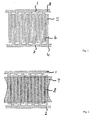
- Fig. 1 shows a portion of an electrode for a light-emitting organic device in which comb partial electrodes 1, 2 are arranged intermeshing and forming an electrode of the device.
- the comb-part electrodes 1, 2 each have a comb-electrode connection section 3, 4, on which protruding comb-electrode sections 5, 6 are formed.
- Fig. 2 Fig. 12 shows the portion of the electrode for the organic light-emitting device Fig. 1 with an organic region 7 arranged above it, which overlaps in an overlapping region 8 with the meshing comb electrode sections 5, 6 in engagement.
- Fig. 3 shows a light image for a light-emitting organic device with intermeshing Kammteilelektroden.
- Fig. 3 shows an orange light emission through the glass substrate and recognizes to the naked eye that the component is divided into strips which emit light alternately alternately from both sides.
- the thus emitting device can already be used in this form.
- the striking light emission can be used as a design element, for example for a car taillight.
- a scattering film can be applied to the component thus formed, whereby the Impression of a completely homogeneous light emission is achieved. This would not be the case if all the strips were contacted from the same direction, ie no intermeshing Kammteilelektroden would be formed, because then even when using a scattering film is still clearly distinguish the brightness gradient.
- Fig. 4 shows a portion of an electrode for a light-emitting organic device in which comb part electrodes with trapezoidal protruding comb electrode portions 40, 41 of two comb-part electrodes 1, 2 interlock.
- Fig. 4 schematically, a case is shown in which the protruding comb electrode portions 40, 41 tapered from the connection point (comb electrode connection portion) ago.
- Such a geometry reduces Ohmic losses and increases the performance efficiency of the component.
- Triangles, trapezoids, but also differently shaped structures come into question. All taper in these embodiments but from the junction ago.
- Fig. 5 Fig. 12 shows the portion of the electrode for the organic light-emitting device Fig. 4 with an organic region 7 arranged above it.
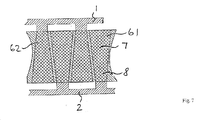
- FIG. 12 shows a portion of an electrode for a light-emitting organic device in which comb-part electrodes intermesh, wherein trapezoidal projecting comb electrode sections 60, 61 are complementarily arranged and connected to comb-electrode connection sections 3, 4 via a lead-in section 62.
- trapezoidal projecting comb electrode sections 60, 61 are complementarily arranged and connected to comb-electrode connection sections 3, 4 via a lead-in section 62.
- Fig. 7 Fig. 12 shows the portion of the electrode for the organic light-emitting device Fig. 6 with an organic region 7 arranged above it.
- Fig. 8 shows a schematic detail of the portion of the electrode for the organic light emitting device in Fig. 1 , Shown are the following parameters: A - length of the proximal end of the protruding comb electrode section to the edge of the organi Service Area, B - length of the projected comb electrode portion from the associated comb electrode connection portion, C distance between adjacent comb electrode portions, and D width of the projected comb electrode portion.
- FIG. 2 shows the portion of the electrode for the organic light-emitting component with the organic region 7 arranged above it Fig. 7 wherein fuse structures 90 are shown schematically associated with the protruding comb electrode sections, which are, for example, a respective fuse.
- five light-emitting organic components connected in series are applied to a glass substrate (not shown). Together they form an arrangement of light-emitting organic components.
- a respective ground electrode made of ITO is photolithographically structured in a comb-like manner with projecting comb electrode portions formed on a comb electrode connection portion.
- the length B of the protruding comb electrode portions is 20mm; their width D is 1mm each.
- the sheet resistance of ITO is 200hm / square.
- a green light-emitting organic layer region is vapor-deposited for the components over a large area with a current efficiency E of 60 cd / A.
- an organic layer stack known as such is used with the green light emitting, phosphorescent emitter material Ir (ppy) 3 (cf. He et al., Appl. Phys. Lett., 85 (2004) 3911 )).
- Ir (ppy) 3 green light emitting, phosphorescent emitter material
- a brightness H of 6000 cd / m 2 is applied at a voltage U of 4V and a current density of about 10mA / cm 2 reached.
- the distance A between the metallic cover or top electrodes of adjacent components is 3mm.
- the current through the OLED component formed in the region of this section is limited only by the track resistance of the ITO supply line to the component.
- the lead resistance in this specific case is S * (B / 2D), ie 200 ohms.
- the factor 1 ⁇ 2 is due to the fact that the short circuit lies in the middle of the section.
- the OLED devices formed in the remaining protruding comb electrode section are all still functional. Their total resistance, including the ITO track resistance, is about 20 ohms, as can be easily calculated from the operating voltage, the area and the current density. Here it is approximately assumed that the OLED components illuminate with a homogeneous brightness over the entire illuminated area. In fact, the areas of the OLED devices glow slightly darker, in which due to the power supply through the electrode, a certain voltage drop comes into play.
- the most unfavorable position for a short circuit lies in the region of the projecting comb electrode sections adjacent to the comb electrode connection section. Then, only a protruding comb electrode portion of 3 mm becomes effective (corresponding to the distance between the comb electrode connecting portion and the edge of the organic region), that is, a lead resistance of 60 ohms. This means that the affected Component continues to glow with about 75% brightness, the whole arrangement even still with 95%. It follows that even in the worst case of a short circuit, the organic device is still very well functioning.
- the ratio A: D is desirably greater than 1, preferably greater than 3, and more preferably greater than 10.
- a ratio A: D of 1 a device having, for example, 100 protruding comb electrode portions in the case of a short circuit near the comb electrode connecting portion by using a scattering film appears Viewer with sufficient distance still homogeneously bright when viewed with the naked eye, d. H. without special magnifying agent, for example a magnifying glass. If the ratio A: D is three in this case, a homogeneous appearance would also be achievable without a scattering film. At a ratio of 10, a homogenous brightness could still be perceived by a viewer at a sufficient distance by means of a scattering film even at a strip number of 10.
- a variant of making the individual component more efficient even in the event of a short circuit is to make the protruding comb electrode sections even thinner. Then the ratio of the current through the short circuit and the current through the remaining area of the component can be further improved. However, it is not expedient to make the strip-shaped electrode sections thinner than the typical lateral extent of a short circuit. Protruding electrode sections thinner than 10 ⁇ m are therefore rather not useful.
- the invention makes it possible, in particular, to significantly increase the production yield, since components can still be used even if isolated short circuits have formed.
- the substrate-side electrode but the cover or top electrode, in particular in strips. This can be done for example by means of laser treatment of a flat cover electrode, which is then cut into strips. In this case, even the areas of the organic layer stack located under the areas of the cover electrode to be removed can be damaged without impairing the functionality of the overall component, since the areas treated in this way do not shine anyway.
- the proposed arrangement of components can also be used in displays to form pixel elements, in particular for displays with very large pixel elements with a size of several square centimeters, for example in stadium screens or similar.
- pixel elements in particular for displays with very large pixel elements with a size of several square centimeters, for example in stadium screens or similar.
- the light elements that in the case of a short circuit equal an entire pixel fails. Instead, the viewer sees only a slightly reduced brightness of a pixel, which does not matter anymore.
- the efficiency loss of the component is particularly low if the components formed in the region of the strip electrodes themselves have a low ohmic resistance at the operating brightness. This is the case in particular in the case of OLED components with electrically doped regions in the organic layer stack.
- the light emission of the component is particularly homogeneous if the luminance-voltage characteristic in the region of the operating brightness is not too steep. This is the case, for example, when a voltage difference of 0.4 V causes a brightness difference of not more than 40%, preferably not more than 20%.
- V U * e / M * N * B * H * S * K ,
- M denotes the number of connected components
- H the operating brightness
- S the sheet resistance of ITO.
- the product of S and B is considered separately.
- S the shorter B must be, otherwise the Ohmic losses in normal operation above the ITO will become too large and thus the device would be too inefficient.
- Good results are achieved when the product S * B is between 10 and 1000 mm * ohms / square, preferably between 100 and 1000 mm * ohms / square.
- 10V is the approximate operating voltage of a simple iii-type organic light-emitting device.
- 6V corresponds to the approximate operating voltage of a more elaborate iii-type organic light-emitting device known as such in the prior art.
- 4V is the approximate operating voltage of an organic light-emitting device A pin-type device as it is known in the art.
- 10V, 6V and 4V can also be considered as the approximate operating voltages for single, double stacked and triple stacked pin OLEDs.
- the value of a brightness of 500 cd / m 2 represents a brightness limit, from which the use of the present invention in the lighting technology is considered particularly useful. If a lighting component has a luminous total area of 1 square meter, the light output at a brightness of 500 cd / m 2 corresponds to about half the light output of a 100W incandescent bulb. The brightness of 1000 cd / m 2 corresponds approximately to the threshold at which a lighting element is just not perceived as dazzling by the viewer, if it is used, for example, in a lighting situation as a ceiling light.
- 5000 cd / m 2 corresponds to a brightness which is considered to be a favorable value for maximizing the light output per luminous surface of the luminous component and the lifetime of the luminous component.
Landscapes
- Physics & Mathematics (AREA)
- Optics & Photonics (AREA)
- Engineering & Computer Science (AREA)
- Manufacturing & Machinery (AREA)
- Electroluminescent Light Sources (AREA)
Applications Claiming Priority (3)
| Application Number | Priority Date | Filing Date | Title |
|---|---|---|---|
| DE200810019049 DE102008019049B4 (de) | 2008-04-15 | 2008-04-15 | Lichtemittierendes organisches Bauelement und Anordnung |
| EP08784193.8A EP2272116B8 (fr) | 2008-04-15 | 2008-06-13 | Composant organique luminescent et agencement avec plusieurs composants organiques luminescents |
| PCT/DE2008/000957 WO2009127175A1 (fr) | 2008-04-15 | 2008-06-13 | Composant organique luminescent, agencement avec plusieurs composants organiques luminescents et structure d'électrodes |
Related Parent Applications (2)
| Application Number | Title | Priority Date | Filing Date |
|---|---|---|---|
| EP08784193.8A Division EP2272116B8 (fr) | 2008-04-15 | 2008-06-13 | Composant organique luminescent et agencement avec plusieurs composants organiques luminescents |
| EP08784193.8A Division-Into EP2272116B8 (fr) | 2008-04-15 | 2008-06-13 | Composant organique luminescent et agencement avec plusieurs composants organiques luminescents |
Publications (3)
| Publication Number | Publication Date |
|---|---|
| EP2816628A2 true EP2816628A2 (fr) | 2014-12-24 |
| EP2816628A3 EP2816628A3 (fr) | 2015-03-04 |
| EP2816628B1 EP2816628B1 (fr) | 2018-10-24 |
Family
ID=40104895
Family Applications (2)
| Application Number | Title | Priority Date | Filing Date |
|---|---|---|---|
| EP08784193.8A Not-in-force EP2272116B8 (fr) | 2008-04-15 | 2008-06-13 | Composant organique luminescent et agencement avec plusieurs composants organiques luminescents |
| EP14184883.8A Not-in-force EP2816628B1 (fr) | 2008-04-15 | 2008-06-13 | Composant organique luminescent et agencement avec plusieurs composants organiques luminescents |
Family Applications Before (1)
| Application Number | Title | Priority Date | Filing Date |
|---|---|---|---|
| EP08784193.8A Not-in-force EP2272116B8 (fr) | 2008-04-15 | 2008-06-13 | Composant organique luminescent et agencement avec plusieurs composants organiques luminescents |
Country Status (5)
| Country | Link |
|---|---|
| US (1) | US8466457B2 (fr) |
| EP (2) | EP2272116B8 (fr) |
| JP (1) | JP5520288B2 (fr) |
| DE (1) | DE102008019049B4 (fr) |
| WO (1) | WO2009127175A1 (fr) |
Families Citing this family (14)
| Publication number | Priority date | Publication date | Assignee | Title |
|---|---|---|---|---|
| KR101084266B1 (ko) * | 2009-09-23 | 2011-11-16 | 삼성모바일디스플레이주식회사 | 유기 발광 조명 장치 |
| GB2482110B (en) * | 2010-07-05 | 2014-08-27 | Cambridge Display Tech Ltd | Lighting elements |
| DE102010061013B4 (de) | 2010-12-03 | 2019-03-21 | Novaled Gmbh | Organisches elektro-optisches Bauelement |
| US8552440B2 (en) * | 2010-12-24 | 2013-10-08 | Semiconductor Energy Laboratory Co., Ltd. | Lighting device |
| GB2505499B (en) | 2012-09-03 | 2017-03-08 | Dst Innovations Ltd | Electroluminescent displays and lighting |
| GB201314793D0 (en) * | 2013-08-19 | 2013-10-02 | Cambridge Display Tech Ltd | Lighting tiles |
| WO2015137771A1 (fr) * | 2014-03-14 | 2015-09-17 | 주식회사 엘지화학 | Dispositif électroluminescent organique |
| DE102014117225A1 (de) | 2014-11-25 | 2016-05-25 | Miele & Cie. Kg | Besteckteilablage für eine Geschirrspülmaschine |
| CN104900677A (zh) * | 2015-05-14 | 2015-09-09 | 信利半导体有限公司 | 有机电致发光器件、显示装置及照明装置 |
| CN106910761B (zh) * | 2015-12-22 | 2019-12-13 | 昆山工研院新型平板显示技术中心有限公司 | 一种具有较长发光寿命的显示装置 |
| DE102018210487A1 (de) * | 2018-06-27 | 2020-01-02 | Robert Bosch Gmbh | Elektrodenanordnung für ein mikroelektromechanisches System, mikroelektromechanisches System, Verfahren zum Betrieb eines mikroelektromechanischen Systems |
| CN111244299A (zh) * | 2018-11-29 | 2020-06-05 | 机光科技股份有限公司 | 去定位器及使用该去定位器的发光装置 |
| US11189555B2 (en) * | 2019-01-30 | 2021-11-30 | Delta Electronics, Inc. | Chip packaging with multilayer conductive circuit |
| KR20230078262A (ko) * | 2021-11-26 | 2023-06-02 | 엘지디스플레이 주식회사 | 투명 표시 장치 |
Citations (3)
| Publication number | Priority date | Publication date | Assignee | Title |
|---|---|---|---|---|
| GB2392023A (en) | 2002-08-05 | 2004-02-18 | Gen Electric | Series connected oled structure and fabrication method |
| US20060209225A1 (en) | 2005-03-15 | 2006-09-21 | Fujitsu Limited | Lighting apparatus and a display apparatus therewith |
| WO2008040323A2 (fr) | 2006-09-29 | 2008-04-10 | Osram Opto Semiconductors Gmbh | Dispositif organique luminescent et dispositif d'éclairage |
Family Cites Families (11)
| Publication number | Priority date | Publication date | Assignee | Title |
|---|---|---|---|---|
| JPH11354279A (ja) * | 1998-06-09 | 1999-12-24 | Idemitsu Kosan Co Ltd | 有機エレクトロルミネッセンス素子 |
| US6713955B1 (en) * | 1998-11-20 | 2004-03-30 | Agilent Technologies, Inc. | Organic light emitting device having a current self-limiting structure |
| JP2004095388A (ja) * | 2002-08-30 | 2004-03-25 | Pioneer Electronic Corp | 有機el素子 |
| JP2005158483A (ja) * | 2003-11-26 | 2005-06-16 | Konica Minolta Holdings Inc | 照明装置および照明装置の駆動方法 |
| TWI371866B (en) * | 2003-12-12 | 2012-09-01 | Luminus Devices Inc | Electronic device contact structures |
| JP4086303B2 (ja) | 2004-03-31 | 2008-05-14 | 株式会社東芝 | 発光表示装置及びその駆動方法 |
| US7242141B2 (en) * | 2004-09-27 | 2007-07-10 | Osram Opto Semiconductor Gmbh | Integrated fuses for OLED lighting device |
| JP4774787B2 (ja) * | 2005-03-31 | 2011-09-14 | Tdk株式会社 | 表示装置 |
| EP1729346A1 (fr) * | 2005-06-01 | 2006-12-06 | Novaled AG | Dispositif électroluminescent comprenant un arrangement d'électrodes |
| DE102006013408A1 (de) * | 2006-03-17 | 2007-09-20 | Fraunhofer-Gesellschaft zur Förderung der angewandten Forschung e.V. | Leuchtdiodenelement |
| DE102006052029B4 (de) * | 2006-09-22 | 2020-01-09 | Osram Oled Gmbh | Lichtemittierende Vorrichtung |
-
2008
- 2008-04-15 DE DE200810019049 patent/DE102008019049B4/de not_active Expired - Fee Related
- 2008-06-13 EP EP08784193.8A patent/EP2272116B8/fr not_active Not-in-force
- 2008-06-13 US US12/937,969 patent/US8466457B2/en not_active Expired - Fee Related
- 2008-06-13 JP JP2011504306A patent/JP5520288B2/ja not_active Expired - Fee Related
- 2008-06-13 WO PCT/DE2008/000957 patent/WO2009127175A1/fr not_active Ceased
- 2008-06-13 EP EP14184883.8A patent/EP2816628B1/fr not_active Not-in-force
Patent Citations (3)
| Publication number | Priority date | Publication date | Assignee | Title |
|---|---|---|---|---|
| GB2392023A (en) | 2002-08-05 | 2004-02-18 | Gen Electric | Series connected oled structure and fabrication method |
| US20060209225A1 (en) | 2005-03-15 | 2006-09-21 | Fujitsu Limited | Lighting apparatus and a display apparatus therewith |
| WO2008040323A2 (fr) | 2006-09-29 | 2008-04-10 | Osram Opto Semiconductors Gmbh | Dispositif organique luminescent et dispositif d'éclairage |
Non-Patent Citations (2)
| Title |
|---|
| FORREST ET AL., ADV. MAT., vol. 7, 2004, pages 624 |
| HE ET AL., APPL. PHYS. LETT., vol. 85, 2004, pages 3911 |
Also Published As
| Publication number | Publication date |
|---|---|
| JP2011517048A (ja) | 2011-05-26 |
| JP5520288B2 (ja) | 2014-06-11 |
| US20110204343A1 (en) | 2011-08-25 |
| KR20110008233A (ko) | 2011-01-26 |
| EP2816628A3 (fr) | 2015-03-04 |
| US8466457B2 (en) | 2013-06-18 |
| EP2272116B8 (fr) | 2014-10-29 |
| DE102008019049A1 (de) | 2009-10-29 |
| DE102008019049B4 (de) | 2013-12-24 |
| EP2272116A1 (fr) | 2011-01-12 |
| EP2816628B1 (fr) | 2018-10-24 |
| WO2009127175A1 (fr) | 2009-10-22 |
| EP2272116B1 (fr) | 2014-09-17 |
Similar Documents
| Publication | Publication Date | Title |
|---|---|---|
| EP2272116B1 (fr) | Composant organique luminescent et agencement avec plusieurs composants organiques luminescents | |
| EP1933400B1 (fr) | Composant d'éclairage organique | |
| DE102018121100B4 (de) | Organische lichtemittierende anzeigevorrichtungen | |
| DE102008019048B4 (de) | Lichtemittierendes organisches Bauelement und Verfahren zum Herstellen sowie Anordnung mit mehreren lichtemittierenden organischen Bauelementen | |
| EP1982362B1 (fr) | Composant optoélectronique organique | |
| DE112012003937T5 (de) | Organisches elektrolumineszentes Element | |
| EP1739765A1 (fr) | Diode organoluminescent et empilement des OLEDs | |
| DE102013107529A1 (de) | Verfahren zum Betrieb eines organischen Licht emittierenden Bauelements | |
| WO2013053508A1 (fr) | Diode électroluminescente organique | |
| DE102008049057A1 (de) | Organisches opto-elektrisches Bauelement und ein Verfahren zur Herstellung eines organischen opto-elektrischen Bauelements | |
| DE102004022004B4 (de) | Schichtanordnung für eine organische lichtemittierende Diode | |
| WO2010012276A2 (fr) | Dispositif électroluminescent | |
| EP2165378A1 (fr) | Composant organique émettant verticalement une lumière blanche | |
| DE112015005367B4 (de) | Lichtemittierendes Bauelement | |
| DE102014103675B4 (de) | Organisches lichtemittierendes Bauelement | |
| DE102012203466B4 (de) | Organisches licht emittierendes bauelement | |
| DE102013109822A1 (de) | Strahlungsemittierende Vorrichtung und Verfahren zur Herstellung derselben | |
| DE102014112879B4 (de) | Strahlungsemittierende Vorrichtung und Verfahren zur Herstellung derselben | |
| DE102015114167B4 (de) | Leuchtdiode und Verfahren zur Herstellung einer Leuchtdiode | |
| DE102010061013B4 (de) | Organisches elektro-optisches Bauelement | |
| WO2014067919A1 (fr) | Module lumineux doté d'une mise en contact électrique optimisée | |
| DE102014112618B4 (de) | Organisches Licht emittierendes Bauelement | |
| DE102012113044A1 (de) | Verfahren zur nachträglichen Leuchtflächenstrukturierung eines organischen lichtemittierenden Bauelementes und organisches lichtemittierendes Bauelement |
Legal Events
| Date | Code | Title | Description |
|---|---|---|---|
| PUAI | Public reference made under article 153(3) epc to a published international application that has entered the european phase |
Free format text: ORIGINAL CODE: 0009012 |
|
| 17P | Request for examination filed |
Effective date: 20140916 |
|
| AC | Divisional application: reference to earlier application |
Ref document number: 2272116 Country of ref document: EP Kind code of ref document: P |
|
| AK | Designated contracting states |
Kind code of ref document: A2 Designated state(s): AT BE BG CH CY CZ DE DK EE ES FI FR GB GR HR HU IE IS IT LI LT LU LV MC MT NL NO PL PT RO SE SI SK TR |
|
| PUAL | Search report despatched |
Free format text: ORIGINAL CODE: 0009013 |
|
| AK | Designated contracting states |
Kind code of ref document: A3 Designated state(s): AT BE BG CH CY CZ DE DK EE ES FI FR GB GR HR HU IE IS IT LI LT LU LV MC MT NL NO PL PT RO SE SI SK TR |
|
| RIC1 | Information provided on ipc code assigned before grant |
Ipc: H01L 51/52 20060101AFI20150129BHEP |
|
| R17P | Request for examination filed (corrected) |
Effective date: 20150828 |
|
| RBV | Designated contracting states (corrected) |
Designated state(s): AT BE BG CH CY CZ DE DK EE ES FI FR GB GR HR HU IE IS IT LI LT LU LV MC MT NL NO PL PT RO SE SI SK TR |
|
| GRAP | Despatch of communication of intention to grant a patent |
Free format text: ORIGINAL CODE: EPIDOSNIGR1 |
|
| STAA | Information on the status of an ep patent application or granted ep patent |
Free format text: STATUS: GRANT OF PATENT IS INTENDED |
|
| INTG | Intention to grant announced |
Effective date: 20180503 |
|
| GRAS | Grant fee paid |
Free format text: ORIGINAL CODE: EPIDOSNIGR3 |
|
| GRAA | (expected) grant |
Free format text: ORIGINAL CODE: 0009210 |
|
| STAA | Information on the status of an ep patent application or granted ep patent |
Free format text: STATUS: THE PATENT HAS BEEN GRANTED |
|
| AC | Divisional application: reference to earlier application |
Ref document number: 2272116 Country of ref document: EP Kind code of ref document: P |
|
| AK | Designated contracting states |
Kind code of ref document: B1 Designated state(s): AT BE BG CH CY CZ DE DK EE ES FI FR GB GR HR HU IE IS IT LI LT LU LV MC MT NL NO PL PT RO SE SI SK TR |
|
| RIN1 | Information on inventor provided before grant (corrected) |
Inventor name: BIRNSTOCK, JAN Inventor name: LANGGUTH, OLIVER Inventor name: MURANO, SVEN |
|
| REG | Reference to a national code |
Ref country code: CH Ref legal event code: EP |
|
| REG | Reference to a national code |
Ref country code: IE Ref legal event code: FG4D Free format text: LANGUAGE OF EP DOCUMENT: GERMAN |
|
| REG | Reference to a national code |
Ref country code: DE Ref legal event code: R096 Ref document number: 502008016419 Country of ref document: DE Ref country code: AT Ref legal event code: REF Ref document number: 1057733 Country of ref document: AT Kind code of ref document: T Effective date: 20181115 |
|
| REG | Reference to a national code |
Ref country code: NL Ref legal event code: MP Effective date: 20181024 |
|
| REG | Reference to a national code |
Ref country code: LT Ref legal event code: MG4D |
|
| PG25 | Lapsed in a contracting state [announced via postgrant information from national office to epo] |
Ref country code: NL Free format text: LAPSE BECAUSE OF FAILURE TO SUBMIT A TRANSLATION OF THE DESCRIPTION OR TO PAY THE FEE WITHIN THE PRESCRIBED TIME-LIMIT Effective date: 20181024 |
|
| PG25 | Lapsed in a contracting state [announced via postgrant information from national office to epo] |
Ref country code: LV Free format text: LAPSE BECAUSE OF FAILURE TO SUBMIT A TRANSLATION OF THE DESCRIPTION OR TO PAY THE FEE WITHIN THE PRESCRIBED TIME-LIMIT Effective date: 20181024 Ref country code: HR Free format text: LAPSE BECAUSE OF FAILURE TO SUBMIT A TRANSLATION OF THE DESCRIPTION OR TO PAY THE FEE WITHIN THE PRESCRIBED TIME-LIMIT Effective date: 20181024 Ref country code: PL Free format text: LAPSE BECAUSE OF FAILURE TO SUBMIT A TRANSLATION OF THE DESCRIPTION OR TO PAY THE FEE WITHIN THE PRESCRIBED TIME-LIMIT Effective date: 20181024 Ref country code: BG Free format text: LAPSE BECAUSE OF FAILURE TO SUBMIT A TRANSLATION OF THE DESCRIPTION OR TO PAY THE FEE WITHIN THE PRESCRIBED TIME-LIMIT Effective date: 20190124 Ref country code: NO Free format text: LAPSE BECAUSE OF FAILURE TO SUBMIT A TRANSLATION OF THE DESCRIPTION OR TO PAY THE FEE WITHIN THE PRESCRIBED TIME-LIMIT Effective date: 20190124 Ref country code: LT Free format text: LAPSE BECAUSE OF FAILURE TO SUBMIT A TRANSLATION OF THE DESCRIPTION OR TO PAY THE FEE WITHIN THE PRESCRIBED TIME-LIMIT Effective date: 20181024 Ref country code: ES Free format text: LAPSE BECAUSE OF FAILURE TO SUBMIT A TRANSLATION OF THE DESCRIPTION OR TO PAY THE FEE WITHIN THE PRESCRIBED TIME-LIMIT Effective date: 20181024 Ref country code: IS Free format text: LAPSE BECAUSE OF FAILURE TO SUBMIT A TRANSLATION OF THE DESCRIPTION OR TO PAY THE FEE WITHIN THE PRESCRIBED TIME-LIMIT Effective date: 20190224 Ref country code: FI Free format text: LAPSE BECAUSE OF FAILURE TO SUBMIT A TRANSLATION OF THE DESCRIPTION OR TO PAY THE FEE WITHIN THE PRESCRIBED TIME-LIMIT Effective date: 20181024 |
|
| PG25 | Lapsed in a contracting state [announced via postgrant information from national office to epo] |
Ref country code: GR Free format text: LAPSE BECAUSE OF FAILURE TO SUBMIT A TRANSLATION OF THE DESCRIPTION OR TO PAY THE FEE WITHIN THE PRESCRIBED TIME-LIMIT Effective date: 20190125 Ref country code: SE Free format text: LAPSE BECAUSE OF FAILURE TO SUBMIT A TRANSLATION OF THE DESCRIPTION OR TO PAY THE FEE WITHIN THE PRESCRIBED TIME-LIMIT Effective date: 20181024 Ref country code: PT Free format text: LAPSE BECAUSE OF FAILURE TO SUBMIT A TRANSLATION OF THE DESCRIPTION OR TO PAY THE FEE WITHIN THE PRESCRIBED TIME-LIMIT Effective date: 20190224 |
|
| RAP2 | Party data changed (patent owner data changed or rights of a patent transferred) |
Owner name: NOVALED GMBH |
|
| REG | Reference to a national code |
Ref country code: DE Ref legal event code: R097 Ref document number: 502008016419 Country of ref document: DE |
|
| PG25 | Lapsed in a contracting state [announced via postgrant information from national office to epo] |
Ref country code: DK Free format text: LAPSE BECAUSE OF FAILURE TO SUBMIT A TRANSLATION OF THE DESCRIPTION OR TO PAY THE FEE WITHIN THE PRESCRIBED TIME-LIMIT Effective date: 20181024 Ref country code: IT Free format text: LAPSE BECAUSE OF FAILURE TO SUBMIT A TRANSLATION OF THE DESCRIPTION OR TO PAY THE FEE WITHIN THE PRESCRIBED TIME-LIMIT Effective date: 20181024 Ref country code: CZ Free format text: LAPSE BECAUSE OF FAILURE TO SUBMIT A TRANSLATION OF THE DESCRIPTION OR TO PAY THE FEE WITHIN THE PRESCRIBED TIME-LIMIT Effective date: 20181024 |
|
| PG25 | Lapsed in a contracting state [announced via postgrant information from national office to epo] |
Ref country code: RO Free format text: LAPSE BECAUSE OF FAILURE TO SUBMIT A TRANSLATION OF THE DESCRIPTION OR TO PAY THE FEE WITHIN THE PRESCRIBED TIME-LIMIT Effective date: 20181024 Ref country code: EE Free format text: LAPSE BECAUSE OF FAILURE TO SUBMIT A TRANSLATION OF THE DESCRIPTION OR TO PAY THE FEE WITHIN THE PRESCRIBED TIME-LIMIT Effective date: 20181024 Ref country code: SK Free format text: LAPSE BECAUSE OF FAILURE TO SUBMIT A TRANSLATION OF THE DESCRIPTION OR TO PAY THE FEE WITHIN THE PRESCRIBED TIME-LIMIT Effective date: 20181024 |
|
| PLBE | No opposition filed within time limit |
Free format text: ORIGINAL CODE: 0009261 |
|
| STAA | Information on the status of an ep patent application or granted ep patent |
Free format text: STATUS: NO OPPOSITION FILED WITHIN TIME LIMIT |
|
| 26N | No opposition filed |
Effective date: 20190725 |
|
| PG25 | Lapsed in a contracting state [announced via postgrant information from national office to epo] |
Ref country code: SI Free format text: LAPSE BECAUSE OF FAILURE TO SUBMIT A TRANSLATION OF THE DESCRIPTION OR TO PAY THE FEE WITHIN THE PRESCRIBED TIME-LIMIT Effective date: 20181024 |
|
| PG25 | Lapsed in a contracting state [announced via postgrant information from national office to epo] |
Ref country code: MC Free format text: LAPSE BECAUSE OF FAILURE TO SUBMIT A TRANSLATION OF THE DESCRIPTION OR TO PAY THE FEE WITHIN THE PRESCRIBED TIME-LIMIT Effective date: 20181024 |
|
| REG | Reference to a national code |
Ref country code: CH Ref legal event code: PL |
|
| GBPC | Gb: european patent ceased through non-payment of renewal fee |
Effective date: 20190613 |
|
| REG | Reference to a national code |
Ref country code: BE Ref legal event code: MM Effective date: 20190630 |
|
| PG25 | Lapsed in a contracting state [announced via postgrant information from national office to epo] |
Ref country code: TR Free format text: LAPSE BECAUSE OF FAILURE TO SUBMIT A TRANSLATION OF THE DESCRIPTION OR TO PAY THE FEE WITHIN THE PRESCRIBED TIME-LIMIT Effective date: 20181024 |
|
| PG25 | Lapsed in a contracting state [announced via postgrant information from national office to epo] |
Ref country code: IE Free format text: LAPSE BECAUSE OF NON-PAYMENT OF DUE FEES Effective date: 20190613 Ref country code: GB Free format text: LAPSE BECAUSE OF NON-PAYMENT OF DUE FEES Effective date: 20190613 |
|
| PG25 | Lapsed in a contracting state [announced via postgrant information from national office to epo] |
Ref country code: LI Free format text: LAPSE BECAUSE OF NON-PAYMENT OF DUE FEES Effective date: 20190630 Ref country code: BE Free format text: LAPSE BECAUSE OF NON-PAYMENT OF DUE FEES Effective date: 20190630 Ref country code: CH Free format text: LAPSE BECAUSE OF NON-PAYMENT OF DUE FEES Effective date: 20190630 Ref country code: LU Free format text: LAPSE BECAUSE OF NON-PAYMENT OF DUE FEES Effective date: 20190613 |
|
| PG25 | Lapsed in a contracting state [announced via postgrant information from national office to epo] |
Ref country code: FR Free format text: LAPSE BECAUSE OF NON-PAYMENT OF DUE FEES Effective date: 20190630 |
|
| REG | Reference to a national code |
Ref country code: AT Ref legal event code: MM01 Ref document number: 1057733 Country of ref document: AT Kind code of ref document: T Effective date: 20190613 |
|
| PG25 | Lapsed in a contracting state [announced via postgrant information from national office to epo] |
Ref country code: AT Free format text: LAPSE BECAUSE OF NON-PAYMENT OF DUE FEES Effective date: 20190613 |
|
| PG25 | Lapsed in a contracting state [announced via postgrant information from national office to epo] |
Ref country code: CY Free format text: LAPSE BECAUSE OF FAILURE TO SUBMIT A TRANSLATION OF THE DESCRIPTION OR TO PAY THE FEE WITHIN THE PRESCRIBED TIME-LIMIT Effective date: 20181024 |
|
| PG25 | Lapsed in a contracting state [announced via postgrant information from national office to epo] |
Ref country code: HU Free format text: LAPSE BECAUSE OF FAILURE TO SUBMIT A TRANSLATION OF THE DESCRIPTION OR TO PAY THE FEE WITHIN THE PRESCRIBED TIME-LIMIT; INVALID AB INITIO Effective date: 20080613 Ref country code: MT Free format text: LAPSE BECAUSE OF FAILURE TO SUBMIT A TRANSLATION OF THE DESCRIPTION OR TO PAY THE FEE WITHIN THE PRESCRIBED TIME-LIMIT Effective date: 20181024 |
|
| REG | Reference to a national code |
Ref country code: DE Ref legal event code: R079 Ref document number: 502008016419 Country of ref document: DE Free format text: PREVIOUS MAIN CLASS: H01L0051520000 Ipc: H10K0050800000 |
|
| P01 | Opt-out of the competence of the unified patent court (upc) registered |
Effective date: 20230515 |
|
| PGFP | Annual fee paid to national office [announced via postgrant information from national office to epo] |
Ref country code: DE Payment date: 20230418 Year of fee payment: 16 |
|
| REG | Reference to a national code |
Ref country code: DE Ref legal event code: R119 Ref document number: 502008016419 Country of ref document: DE |
|
| PG25 | Lapsed in a contracting state [announced via postgrant information from national office to epo] |
Ref country code: DE Free format text: LAPSE BECAUSE OF NON-PAYMENT OF DUE FEES Effective date: 20250101 |