EP2817831B1 - Rahmenstruktur für ein solarpaneel - Google Patents
Rahmenstruktur für ein solarpaneel Download PDFInfo
- Publication number
- EP2817831B1 EP2817831B1 EP13706499.4A EP13706499A EP2817831B1 EP 2817831 B1 EP2817831 B1 EP 2817831B1 EP 13706499 A EP13706499 A EP 13706499A EP 2817831 B1 EP2817831 B1 EP 2817831B1
- Authority
- EP
- European Patent Office
- Prior art keywords
- acid
- framing structure
- composition
- polyamide
- aromatic
- Prior art date
- Legal status (The legal status is an assumption and is not a legal conclusion. Google has not performed a legal analysis and makes no representation as to the accuracy of the status listed.)
- Not-in-force
Links
Images


Classifications
-
- H—ELECTRICITY
- H10—SEMICONDUCTOR DEVICES; ELECTRIC SOLID-STATE DEVICES NOT OTHERWISE PROVIDED FOR
- H10F—INORGANIC SEMICONDUCTOR DEVICES SENSITIVE TO INFRARED RADIATION, LIGHT, ELECTROMAGNETIC RADIATION OF SHORTER WAVELENGTH OR CORPUSCULAR RADIATION
- H10F19/00—Integrated devices, or assemblies of multiple devices, comprising at least one photovoltaic cell covered by group H10F10/00, e.g. photovoltaic modules
-
- F—MECHANICAL ENGINEERING; LIGHTING; HEATING; WEAPONS; BLASTING
- F24—HEATING; RANGES; VENTILATING
- F24S—SOLAR HEAT COLLECTORS; SOLAR HEAT SYSTEMS
- F24S25/00—Arrangement of stationary mountings or supports for solar heat collector modules
- F24S25/10—Arrangement of stationary mountings or supports for solar heat collector modules extending in directions away from a supporting surface
- F24S25/11—Arrangement of stationary mountings or supports for solar heat collector modules extending in directions away from a supporting surface using shaped bodies, e.g. concrete elements, foamed elements or moulded box-like elements
-
- B—PERFORMING OPERATIONS; TRANSPORTING
- B29—WORKING OF PLASTICS; WORKING OF SUBSTANCES IN A PLASTIC STATE IN GENERAL
- B29C—SHAPING OR JOINING OF PLASTICS; SHAPING OF MATERIAL IN A PLASTIC STATE, NOT OTHERWISE PROVIDED FOR; AFTER-TREATMENT OF THE SHAPED PRODUCTS, e.g. REPAIRING
- B29C45/00—Injection moulding, i.e. forcing the required volume of moulding material through a nozzle into a closed mould; Apparatus therefor
- B29C45/0001—Injection moulding, i.e. forcing the required volume of moulding material through a nozzle into a closed mould; Apparatus therefor characterised by the choice of material
-
- F—MECHANICAL ENGINEERING; LIGHTING; HEATING; WEAPONS; BLASTING
- F24—HEATING; RANGES; VENTILATING
- F24S—SOLAR HEAT COLLECTORS; SOLAR HEAT SYSTEMS
- F24S25/00—Arrangement of stationary mountings or supports for solar heat collector modules
- F24S25/20—Peripheral frames for modules
-
- H—ELECTRICITY
- H02—GENERATION; CONVERSION OR DISTRIBUTION OF ELECTRIC POWER
- H02S—GENERATION OF ELECTRIC POWER BY CONVERSION OF INFRARED RADIATION, VISIBLE LIGHT OR ULTRAVIOLET LIGHT, e.g. USING PHOTOVOLTAIC [PV] MODULES
- H02S30/00—Structural details of PV modules other than those related to light conversion
- H02S30/10—Frame structures
-
- H—ELECTRICITY
- H10—SEMICONDUCTOR DEVICES; ELECTRIC SOLID-STATE DEVICES NOT OTHERWISE PROVIDED FOR
- H10F—INORGANIC SEMICONDUCTOR DEVICES SENSITIVE TO INFRARED RADIATION, LIGHT, ELECTROMAGNETIC RADIATION OF SHORTER WAVELENGTH OR CORPUSCULAR RADIATION
- H10F19/00—Integrated devices, or assemblies of multiple devices, comprising at least one photovoltaic cell covered by group H10F10/00, e.g. photovoltaic modules
- H10F19/90—Structures for connecting between photovoltaic cells, e.g. interconnections or insulating spacers
-
- B—PERFORMING OPERATIONS; TRANSPORTING
- B29—WORKING OF PLASTICS; WORKING OF SUBSTANCES IN A PLASTIC STATE IN GENERAL
- B29K—INDEXING SCHEME ASSOCIATED WITH SUBCLASSES B29B, B29C OR B29D, RELATING TO MOULDING MATERIALS OR TO MATERIALS FOR MOULDS, REINFORCEMENTS, FILLERS OR PREFORMED PARTS, e.g. INSERTS
- B29K2077/00—Use of PA, i.e. polyamides, e.g. polyesteramides or derivatives thereof, as moulding material
-
- B—PERFORMING OPERATIONS; TRANSPORTING
- B29—WORKING OF PLASTICS; WORKING OF SUBSTANCES IN A PLASTIC STATE IN GENERAL
- B29K—INDEXING SCHEME ASSOCIATED WITH SUBCLASSES B29B, B29C OR B29D, RELATING TO MOULDING MATERIALS OR TO MATERIALS FOR MOULDS, REINFORCEMENTS, FILLERS OR PREFORMED PARTS, e.g. INSERTS
- B29K2105/00—Condition, form or state of moulded material or of the material to be shaped
- B29K2105/06—Condition, form or state of moulded material or of the material to be shaped containing reinforcements, fillers or inserts
- B29K2105/16—Fillers
-
- B—PERFORMING OPERATIONS; TRANSPORTING
- B29—WORKING OF PLASTICS; WORKING OF SUBSTANCES IN A PLASTIC STATE IN GENERAL
- B29L—INDEXING SCHEME ASSOCIATED WITH SUBCLASS B29C, RELATING TO PARTICULAR ARTICLES
- B29L2012/00—Frames
-
- F—MECHANICAL ENGINEERING; LIGHTING; HEATING; WEAPONS; BLASTING
- F24—HEATING; RANGES; VENTILATING
- F24S—SOLAR HEAT COLLECTORS; SOLAR HEAT SYSTEMS
- F24S80/00—Details, accessories or component parts of solar heat collectors not provided for in groups F24S10/00-F24S70/00
- F24S2080/01—Selection of particular materials
- F24S2080/015—Plastics
-
- Y—GENERAL TAGGING OF NEW TECHNOLOGICAL DEVELOPMENTS; GENERAL TAGGING OF CROSS-SECTIONAL TECHNOLOGIES SPANNING OVER SEVERAL SECTIONS OF THE IPC; TECHNICAL SUBJECTS COVERED BY FORMER USPC CROSS-REFERENCE ART COLLECTIONS [XRACs] AND DIGESTS
- Y02—TECHNOLOGIES OR APPLICATIONS FOR MITIGATION OR ADAPTATION AGAINST CLIMATE CHANGE
- Y02B—CLIMATE CHANGE MITIGATION TECHNOLOGIES RELATED TO BUILDINGS, e.g. HOUSING, HOUSE APPLIANCES OR RELATED END-USER APPLICATIONS
- Y02B10/00—Integration of renewable energy sources in buildings
- Y02B10/10—Photovoltaic [PV]
-
- Y—GENERAL TAGGING OF NEW TECHNOLOGICAL DEVELOPMENTS; GENERAL TAGGING OF CROSS-SECTIONAL TECHNOLOGIES SPANNING OVER SEVERAL SECTIONS OF THE IPC; TECHNICAL SUBJECTS COVERED BY FORMER USPC CROSS-REFERENCE ART COLLECTIONS [XRACs] AND DIGESTS
- Y02—TECHNOLOGIES OR APPLICATIONS FOR MITIGATION OR ADAPTATION AGAINST CLIMATE CHANGE
- Y02B—CLIMATE CHANGE MITIGATION TECHNOLOGIES RELATED TO BUILDINGS, e.g. HOUSING, HOUSE APPLIANCES OR RELATED END-USER APPLICATIONS
- Y02B10/00—Integration of renewable energy sources in buildings
- Y02B10/20—Solar thermal
-
- Y—GENERAL TAGGING OF NEW TECHNOLOGICAL DEVELOPMENTS; GENERAL TAGGING OF CROSS-SECTIONAL TECHNOLOGIES SPANNING OVER SEVERAL SECTIONS OF THE IPC; TECHNICAL SUBJECTS COVERED BY FORMER USPC CROSS-REFERENCE ART COLLECTIONS [XRACs] AND DIGESTS
- Y02—TECHNOLOGIES OR APPLICATIONS FOR MITIGATION OR ADAPTATION AGAINST CLIMATE CHANGE
- Y02E—REDUCTION OF GREENHOUSE GAS [GHG] EMISSIONS, RELATED TO ENERGY GENERATION, TRANSMISSION OR DISTRIBUTION
- Y02E10/00—Energy generation through renewable energy sources
- Y02E10/40—Solar thermal energy, e.g. solar towers
- Y02E10/47—Mountings or tracking
-
- Y—GENERAL TAGGING OF NEW TECHNOLOGICAL DEVELOPMENTS; GENERAL TAGGING OF CROSS-SECTIONAL TECHNOLOGIES SPANNING OVER SEVERAL SECTIONS OF THE IPC; TECHNICAL SUBJECTS COVERED BY FORMER USPC CROSS-REFERENCE ART COLLECTIONS [XRACs] AND DIGESTS
- Y02—TECHNOLOGIES OR APPLICATIONS FOR MITIGATION OR ADAPTATION AGAINST CLIMATE CHANGE
- Y02E—REDUCTION OF GREENHOUSE GAS [GHG] EMISSIONS, RELATED TO ENERGY GENERATION, TRANSMISSION OR DISTRIBUTION
- Y02E10/00—Energy generation through renewable energy sources
- Y02E10/50—Photovoltaic [PV] energy
-
- Y—GENERAL TAGGING OF NEW TECHNOLOGICAL DEVELOPMENTS; GENERAL TAGGING OF CROSS-SECTIONAL TECHNOLOGIES SPANNING OVER SEVERAL SECTIONS OF THE IPC; TECHNICAL SUBJECTS COVERED BY FORMER USPC CROSS-REFERENCE ART COLLECTIONS [XRACs] AND DIGESTS
- Y10—TECHNICAL SUBJECTS COVERED BY FORMER USPC
- Y10T—TECHNICAL SUBJECTS COVERED BY FORMER US CLASSIFICATION
- Y10T29/00—Metal working
- Y10T29/49—Method of mechanical manufacture
- Y10T29/49826—Assembling or joining
-
- Y—GENERAL TAGGING OF NEW TECHNOLOGICAL DEVELOPMENTS; GENERAL TAGGING OF CROSS-SECTIONAL TECHNOLOGIES SPANNING OVER SEVERAL SECTIONS OF THE IPC; TECHNICAL SUBJECTS COVERED BY FORMER USPC CROSS-REFERENCE ART COLLECTIONS [XRACs] AND DIGESTS
- Y10—TECHNICAL SUBJECTS COVERED BY FORMER USPC
- Y10T—TECHNICAL SUBJECTS COVERED BY FORMER US CLASSIFICATION
- Y10T29/00—Metal working
- Y10T29/49—Method of mechanical manufacture
- Y10T29/49826—Assembling or joining
- Y10T29/49863—Assembling or joining with prestressing of part
Definitions
- the invention pertains to a framing structure for a solar panel made from a polymer composition, and to a solar panel assembly comprising the same
- the present application discloses a method for manufacturing said framing structure, a method for assembly a solar panel into said framing structure and a method for fixing said solar panel assembly onto a support (e.g. a roof).
- Solar modules or panels
- PV solar photovoltaic
- solar PV modules structures are typically constructed as an assembly of PV individual modules having layered structure including a packed interconnected assembly of photovoltaic elements, also known as solar PV cells.
- Said layered structure generally includes a substrate that can be for example made of metal or glass or possibly flexible supports, a semiconductor active layer disposed on said substrate, and a transparent and/or conductive layer disposed on said semiconductor active layer.
- Protective means are also generally needed in a PV module, to protect it from heat, humidity and from any possible environmental exposure or risk during transport.
- the solar thermal modules structures comprise typically a flow inlet and a flow outlet and ducts for circulating a diathermic fluid (water or other fluid) ensuring a well-determined heat-exchange surface exposed to the incident solar radiation.
- US 4123570 6/2/1979 discloses a support for solar cell array made from a lightweight high strength plastic material, and more particularly from a polyester or a polyepoxide reinforced with fibers including glass, boron and carbon fibers. Nevertheless, these supports might not be appropriate for complying with the requirements of maintaining properties in a wide range of operating temperatures, like those which a PV modules arrays can be exposed when mounted outdoor, during both winter cold periods (with temperatures well below 0°C) and sunny summer periods (with peak temperatures possibly reaching 85 °C).
- US 20110030767 2/10/2011 discloses frames for PV modules made of particular polyurethane elastomers, possibly filled with reinforcing fillers and comprising fire retardants.
- EP1842879 shows a polyamide resin composition comprising a polyamide resin, a glass fiber (B), a polyacrylonitrile.(PAN)-based carbon fiber (C) and conductive carbon (D).
- the invention thus pertains to a framing structure for a solar panel module made from a polymer composition (C) comprising at least one polyamide polymer [polyamide (A)], and at least one reinforcing filler [filler (F)], the framing structure being as defined in Claim 1.
- a framing structure for a solar panel module made from a polymer composition (C) comprising at least one polyamide polymer [polyamide (A)], and at least one reinforcing filler [filler (F)], the framing structure being characterized by having a top surface and a bottom surface, said top surface having a depressed central portion sized for receiving a solar module, characterized in that the aromatic polyamide polymer (A) comprises recurring units (R PXA ) deriving from the poly-condensation reaction of:
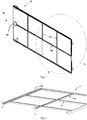
- the framing structure might possess whichever shape, it is generally understood that the frame will possess a rectangular shape as shown in FIG. 1 , adapted to receive a rectangular solar module, which is the standard shape of commercially available solar modules.
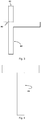
- the depressed central portion being sized to form a rectangular rim 100 as shown in Fig. 2 can have a perimeter wall at the top surface 201, as shown in Fig. 3 with a thickness ranging in general from 1 to 4 mm, preferably from 1 to 3 mm and more preferably from 1 to 2 mm.
- the thickness of said perimeter wall at the bottom surface 202 is generally advantageously in a range from 1 to 6 mm, preferably from 1 to 4 mm and more preferably from 1 to 3 mm.
- the frame structure of the invention can be designed with such reduced thickness, as described above, resulting them in lightweight and a higher solar surface of the solar module.
- the frame structure of the invention can be designed with such reduced thickness, as described above, resulting them in lightweight and a higher solar surface of the solar module.
- the framing structure of the invention generally comprises at least one type of supporting means. Due to the fact that the composition (C) is easily gluable, these supporting means, as well as the overall framing structure, can be advantageously glued to the components to be mounted upon, including not only the solar module, but also any other element, like covers, electronic packages, junction boxes, etc....
- supporting means mention can be notably made of supporting ribs, which might be longitudinal 102 when parallel to longer dimension of the rectangular frame, or lateral supporting ribs 101, when parallel to the shorter dimension of the rectangular frame, or angular supporting ribs, in any other direction.
- supporting ribs which might be longitudinal 102 when parallel to longer dimension of the rectangular frame, or lateral supporting ribs 101, when parallel to the shorter dimension of the rectangular frame, or angular supporting ribs, in any other direction.
- longitudinal ribs 102 which are spaced apart in parallel relationship and are connected to each other by lateral ribs 101.
- Said ribs typically extend downwardly 204, as shown in Fig. 4 , in a distance similar to the perimeter skirt 203. Said distance is generally in the range of about 2 to 20 cm; the skilled in the art will arrange this distance as a function of the overall design of the frame.
- the framing structure of the invention usually not only serves for sealing the solar module towards the exterior and for increasing its rigidity and its stability; rather the framing structure affects also the attachment of the solar module to the respective substrate to which it should be affixed.
- the framing structure of the invention can additionally comprise at least one type of fixing means, including, but not limited to, recesses, holes, screw holdings and the like. While embodiments wherein said fixing means are made of said composition (C), embodiments wherein these fixing means are provided as inserts (metal inserts or inserts of material other than the composition (C)), are within the scope of the invention. An example thereof is shown in Fig. 5 .
- the framing structure of the invention is advantageously suited for being mounted on mounting systems fixed onto the substrate.
- Said mounting systems might have any type of shape. They are advantageously composed of profiles fixed in orthogonal directions in a plane which can be parallel to the surface of the substrate or which can form with such surface an angle a, being understood that this angle a is generally selected in the range from 0 to 45° for ensuring maximum exposure to incident radiation.
- such mounting systems which is another object of the invention can be made of composition (C), as detailed above.
- the framing structure of the invention can comprise means for bolting a number of framing structures (possibly including the solar panel) together.
- At least a fraction of the perimeter of the perimeter skirt 203 may be provided with a plurality of fastening means, as illustrated in Fig. 6 , including notably holes, protrusions with holes 206, protrusions 205 and matching recesses, screw holdings and the like.
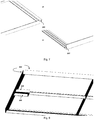
- the left side of the perimeter wall 20 can be extended by a left interlocking portion 207 and a the right side of the perimeter wall 30 can be extended to form a right interlocking portion 208 and both interlocking portions can be engaged with one another as shown in Fig. 7 .
- the framing structure of the invention in particular for framing PV modules, can comprise at least one junction box 103 ( Fig. 1 ); multiple junction boxes can also be comprised in the framing structure of the invention, in particular when multiple connections (series, parallel) are desired.
- a junction box is molded on the bottom surface.
- junction box 103 as shown in Fig. 8 , is provided along one lateral end of the framing structure.
- the junction box 103 is formed by a plurality of downwardly extending walls 209.
- posts can be provided at the corners of the junction box 103 to which a cover, if desired, can be mounted.
- the framing structure of the invention can comprise at least one type of holding means, for example for holding notably control equipments, including, but not limited to, flow controls, temperature sensor, pressure release valves and the like.
- the framing structure of the invention can comprise means for cable routing, for example in the form of a U-shaped channel as shown in Fig. 9 and/or inlet/outlet tubings. If desired, the U-shaped channel 210 can be covered to protect the cables.
- Other examples of cable routing means are notably flexible clips, recesses and other type of means can be mentioned.
- the framing structure of the invention can comprise receptacles for collecting surface water and or rain water.
- at least a fraction of the perimeter wall of the framing structure can be provided with a side elongated frame element, as illustrated in Fig. 9 .
- Said side elongated frame element can be situated anywhere between the top surface and the bottom surface, as illustrated in Fig. 10 .
- Receptacles for collecting surface or rain water may be provided as gutters; each frame can be equipped with completely formed gutters around its periphery or the structural frame can be provided with elongated frame elements which upon assembly with the adjacent structural frame in an array will provide the entire gutter design; with these regards, the framing structure of the invention is generally conceived as an asymmetrical structure, predisposed to be assemble with upper, lower left and right positions, with different slopes and shapes of elongated frames at each edge.
- the framing structure can be construed by assembling one or more of the elements as above described by known assembling techniques, including gluing, soldering, etc.., due to the easy moldability of the composition (C), the framing structure may be provided as an unitary-bodied structure, which can be advantageously obtained by injection molding techniques.
- composition (C) can comprise one or more than one polyamide polymer [polyamide (A)].
- polyamide polymer should be understood as defining any polymer which comprises recurring units (R PA ) which are derived from the polycondensation of at least one dicarboxylic acid component, or derivative thereof, and at least one diamine component, and/or from the polycondensation of aminocarboxylic acids and/or lactams.
- amide-forming derivatives include a mono- or dialkyl ester, such as a mono- or di-methyl, ethyl or propyl ester, of such carboxylic acid; a mono- or di-aryl ester thereof; a mono- or di-acid halide thereof; and a mono-or di-acid amide thereof, a mono- or di-carboxylate salt.
- the dicarboxylic acid component and the diamine component are generally comprised in substantially equimolecular amount in the polyamide (A); this means that the molar ratio between the overall number of -COOH groups of the dicarboxylic acid component and the overall number of -NH 2 groups of the diamine component is of 1.1:1 to 0.9:1, preferably of 1.075:1 to 1:0.925.
- the polymer composition (C) may comprise a polyamide (A) which is an aliphatic polyamide polymer and/or an aromatic polyamide polymer.
- the polymer composition (C) comprises at least one aromatic polyamide polymer.
- aromatic polyamide polymer is intended to denote a polyamide that comprises recurring units (R PA ) as above detailed, more than 35 mol % of said recurring units, preferably more than 45 mol %, more preferably more than 55 mol %, still more preferably more than 65 mol % and most preferably more than 75 mol % being aromatic recurring units.
- aromatic recurring unit is intended to denote any recurring unit that comprises at least one aromatic group.
- the aromatic recurring units may be formed by the polycondensation of at least one aromatic dicarboxylic acid with a diamine or by the polycondensation of at least one dicarboxylic acid with an aromatic diamine, or by the polyaddition of aromatic aminocarboxylic acids and/or aromatic lactams.
- aromatic polyamide comprising recurring units [recurring units (R PPA )] deriving from the polycondensation reaction of:
- Recurring units can thus be obtained from the polycondensation of an acid component (AA), a diamine component (NN), optionally in the presence of an aminoacid component (ArN), or can be obtained from the polycondensation of an aminoacid component (ArN), being understood that additional components, including end-capping, branch-point monomers or other non-aromatic monomers can be further used.
- the acid component (AA) may comprise in addition to said at least one aromatic dicarboxylic acid [acid (AR)], one or more than one non-aromatic dicarboxylic acid [acid (AL)].
- a dicarboxylic acid is considered as "aromatic" when it comprises one or more than one aromatic group.
- Non limitative examples of acids (AR) are notably phthalic acids [acids (PA)],, including isophthalic acid (IA), terephthalic acid (TA) and orthophthalic acid (OA), 2,5-pyridinedicarboxylic acid, 2,4-pyridinedicarboxylic acid, 3,5-pyridinedicarboxylic acid, 2,2-bis(4-carboxyphenyl)propane, bis(4-carboxyphenyl)methane, 2,2-bis(4-carboxyphenyl)hexafluoropropane, 2,2-bis(4-carboxyphenyl)ketone, 4,4'-bis(4-carboxyphenyl)sulfone, 2,2-bis(3-carboxyphenyl)propane, bis(3-carboxyphenyl)methane, 2,2-bis(3-carboxyphenyl)hexafluoropropane, 2,2-bis(3-carboxyphenyl)ketone, bis(3-car
- oxalic acid [HOOC-COOH], malonic acid [HOOC-CH 2 -COOH], adipic acid [HOOC-(CH 2 ) 4 -COOH], succinic acid [HOOC-(CH 2 ) 2 -COOH], glutaric acid [HOOC-(CH 2 ) 3 -COOH], 2,2-dimethyl-glutaric acid [HOOC-C(CH 3 ) 2 -(CH 2 ) 2 -COOH], 2,4,4-trimethyl-adipic acid [HOOC-CH(CH 3 )-CH 2 -C(CH 3 ) 2 - CH 2 -COOH], pimelic acid [HOOC-(CH 2 ) 5 -COOH], suberic acid [HOOC-(CH 2 ) 6 -COOH], azelaic acid [HOOC-(CH 2 ) 7 -COOH], sebacic acid [HOOC-(CH 2 ) 8 -COOH], undecane
- the acid component (AA) comprises at least one phthalic acid selected from the group consisting of isophthalic acid (IA), and terephthalic acid (TA). Isophthalic acid and terephthalic acid can be used alone or in combination.
- the phthalic acid is preferably terephthalic acid, optionally in combination with isophthalic acid.
- the acid component (AA) comprises said phthalic acid in an amount of at least 35 % moles, preferably at least 50 % moles, based on the all components of the acid component (AA).
- Said amines are typically aliphatic alkylene diamines having 2 to18 carbon atoms.
- Said amine (AL) is advantageously selected from the group consisting of 1,2-diaminoethane, 1,2-diaminopropane, propylene-1,3-diamine, 1,3-diaminobutane, 1,4-diaminobutane, 1,5-diaminopentane, 1,4-diamino-1,1-dimethylbutane, 1,4-diamino-1-ethylbutane, 1,4-diamino-1,2-dimethylbutane, 1,4-diamino-1,3-dimethylbutane, 1,4-diamino-1,4-dimethylbutane, 1,4-diamino-2,3-dimethylbutane, 1,2-diamino-1-butylethane, 1,6-diaminohexane (also called hexamethylene diamine), 1,7-diaminoheptane, 1,8-dia
- a first group of known polyamides (A) are those consisting essentially of recurring units formed by the polycondensation reaction between at least one phthalic acid, chosen among isophthalic acid (IA), terephthalic acid (TA) and orthophthalic acid (OA) or derivative thereof, and at least one aliphatic alkylene-diamine.
- this first group of polyamides (A) is named, for the purposes of the invention, as polyphthalamides.
- Suitable polyphthalamides are notably available as AMODEL® polyphthalamides from Solvay Specialty Polymers USA, L.L.C.
- the amine component (NN) can further comprise at least one diamine different from said aliphatic alkylene-diamine;
- Said additional diamine can notably be an aromatic diamine [amine (AR)], or a cycloaliphatic diamine [amine (CAL)].
- Non limitative examples of amine (AR) are notably selected from the group consisting of m -phenylene diamine (MPD), p -phenylene diamine (PPD), 3,4'-diaminodiphenyl ether (3,4'-ODA), 4,4'-diaminodiphenyl ether (4,4'-ODA), m -xylylenediamine (MXDA), and p -xylylenediamine (PXDA).
- MPD m -phenylene diamine
- PPD p -phenylene diamine
- 3,4'-ODA 3,4'-diaminodiphenyl ether
- 4,4'-ODA 4,4'-diaminodiphenyl ether
- MXDA m -xylylenediamine
- PXDA p -xylylenediamine
- Non limitative examples of amine are notably selected from the group consisting of isophoronediamine (also known as 5-amino-(1-aminomethyl)-1,3,3-trimethylcyclohexane), 1,3-cyclohexanebis(methylamine) (1,3-BAMC), 1,4-cyclohexanebis(methylamine) (1,4-BAMC), 4,4-diaminodicyclohexylmethane (PACM), and bis(4-amino-3-methylcyclohexyl)methane.
- isophoronediamine also known as 5-amino-(1-aminomethyl)-1,3,3-trimethylcyclohexane
- 1,3-cyclohexanebis(methylamine) (1,3-BAMC
- 1,4-cyclohexanebis(methylamine) (1,4-BAMC
- PAM 4,4-diaminodicyclohexylmethane
- the aromatic aminoacid component (ArN) comprises at least one aromatic aminoacid or derivative thereof; said aromatic amino-acid is generally selected from the group consisting of 4-(aminomethyl)benzoic acid and 4-aminobenzoic acid.
- the aromatic polyamide can comprise recurring units different from recurring units (R PPA ) as above described derived from polycondensation of monomers listed under paragraphs (i-1) [acid component (AA)], (i-2) [amine component (NN)] and (i-3) [aminoacid component (ArN)]; said additional recurring units (R PA ) are generally recurring units derived from polycondensation of an aliphatic or cycloaliphatic aminoacid component, including notably 6-aminohexanoic acid, 1-aza-2-cyclononanone, 1-aza-2-cyclododecanone, 11-aminoundecanoic acid, 12-aminododecanoic acid, 4-(aminomethyl)benzoic acid, cis-4- (aminomethyl)cyclohexanecarboxylic acid, trans-4- (aminomethyl)cyclohexanecarboxylic acid, cis-4-aminocyclohexan
- the aromatic polyamide comprises recurring units (R PXA ) deriving from polycondensation reaction of:
- the acid component (AA') may comprise in addition to said at least one non-aromatic dicarboxylic acid [acid (AL')], one or more than one aromatic dicarboxylic acid [acid (AR')].
- Acids (AL'), acids (AR') and amine (AR') suitable for being used in the aromatic polyamides of this second embodiment are the same as those above described respectively as acids (AL), acids (AR) and amine (AR) herein above, and are hereby described with reference to what specified above.
- Said acid (AL') is preferably selected from the group consisting of oxalic acid [HOOC-COOH, malonic acid (HOOC-CH 2 -COOH), adipic acid [HOOC-(CH 2 ) 4 -COOH], succinic acid [HOOC-(CH 2 ) 2 -COOH], glutaric acid [HOOC-(CH 2 ) 3 -COOH], 2,2-dimethyl-glutaric acid [HOOC-C(CH 3 ) 2 -(CH 2 ) 2 -COOH], 2,4,4-trimethyl-adipic acid [HOOC-CH(CH 3 )-CH 2 -C(CH 3 ) 2 - CH 2 -COOH], pimelic acid [HOOC-(CH 2 ) 5 -COOH], suberic acid [HOOC-(CH 2 ) 6 -COOH], azelaic acid [HOOC-(CH 2 ) 7 -COOH], sebacic acid [HOOC-(CH 2 ) 8 -CO
- Said acid (AL') is more preferably adipic acid.
- the acid component (AA') comprises said adipic acid in an amount of at least 35 %, preferably at least 50 % moles, based on the all components of the acid component (AA ').
- AR' Known amines are notably m -phenylene diamine (MPD), p-phenylene diamine (PPD), 3,4'-diaminodiphenyl ether (3,4'-ODA), 4,4'-diaminodiphenyl ether (4,4'-ODA), m -xylylenediamine (MXDA), and p-xylylenediamine (PXDA).
- Said amine (AR') according to the present invention is m -xylylenediamine (MXDA).
- the amine component (NN') according to these preferred embodiments comprises said meta-xylylene diamine in an amount of at least 50 % moles, based on the all components of the amine component (NN').
- the amine component (NN') can comprise, in addition to said amine (AR'), one or more than one non-aromatic diamines, preferably selected from the group consisting of aliphatic alkylene-diamines [amine (AL)], as above detailed with reference to first embodiment, and cycloaliphatic diamines [amine (CAL)], said cycloaliphatic diamines being preferably selected from the group consisting of isophoronediamine (also known as 5-amino-(1-aminomethyl)-1,3,3-trimethylcyclohexane), 1,3-cyclohexanebis(methylamine) (1,3-BAMC), 1,4-cyclohexanebis(methylamine) (1,4-BAMC), 4,4-diaminodicyclohexylmethane (PACM), and bis(4-amino-3-methylcyclohexyl)methane.
- isophoronediamine also known as 5-amino-(1-aminomethyl)
- a second group of known polyamides (A) are those consisting essentially of recurring units formed by polycondensation reaction between adipic acid and meta-xylylene diamine. In the rest of the text, this second group of polyamides (A) is named, for the purposes of the invention, as PAMXD6 polymers.
- PAMXD6 polymers are notably commercially available as IXEF® polyamides from Solvay Specialty Polymers USA, L.L.C.
- the molecular weight of the PAMXD6 polymer is not particularly limited.
- the PAMXD6 has advantageously a number average molecular weight (M n ) of at least 2,500, more preferably of at least 5,000, more preferably of at least 10,000 and still more preferably of at least 13,000.
- the PAMxD.6 has advantageously a number average molecular weight (M n ) of at most 60,000, more preferably of at most 50,000 and still more preferably of at most 30,000.
- aromatic polyamides according to the present invention are:
- composition (C) may comprise at least one aliphatic polyamide polymer.
- aliphatic polyamide polymer is intended to denote a polyamide that comprises aliphatic recurring units exclusively and said aliphatic recurring units are derived from at least one acid (AL), as mentioned above, and at least one amine (AL) and/or at least one cycloaliphatic diamine [amine (CAL)], as mentioned above and/or said aliphatic recurring units are derived from aliphatic aminocarboxylic acids and/or aliphatic lactams.
- the aliphatic groups are generally simple unsubstituted straight chains of methylene groups, but they may be substituted or branched.
- Non limitative examples of aliphatic lactams are notably selected from the group consisting of caprolactam and lauryl lactam.
- adipic acid [HOOC-(CH 2 ) 4 -COOH]
- succinic acid [HOOC-(CH 2 ) 2 -COOH]
- suberic acid [HOOC-(CH 2 ) 6 -COOH]
- azelaic acid [HOOC-(CH 2 ) 7 -COOH]
- sebacic acid [HOOC-(CH 2 ) 8 -COOH]
- undecanedioic acid [HOOC-(CH 2 ) 9 -COOH]
- dodecandioic acid [HOOC-(CH 2 ) 10 -COOH]
- cis- and/or trans-cyclohexane-1,4-dicarboxylic acid and cis- and/or trans-cyclohexane-1,3-dicarboxylic acid (CHDA).
- amines a preference is given to the following ones : 1,5-diaminopentane, 1,6-diaminohexane, 1,8-diamino-octane, 1,6-diamino-2,2,4-trimethylhexane, 1,6-diamino-2,4,4-trimethylhexane, 1,9-diaminononane, 1,10-diaminodecane, 1,9-diamino-5-methylnonane, 1,11-diaminoundecane and 1,12-diaminododecane.
- 1,5-diaminopentane 1,6-diaminohexane
- 1,8-diamino-octane 1,6-diamino-2,2,4-trimethylhexane
- 1,6-diamino-2,4,4-trimethylhexane 1,9-diaminononane
- CAL Among the above listed amine (CAL), a preference is given to the following ones : isophoronediamine, 1,4-cyclohexanebis(methylamine) (1,4-BAMC), 4,4-diaminodicyclohexylmethane (PACM), and bis(4-amino-3-methylcyclohexyl)methane.
- Examples of aliphatic polyamides according to the present invention are: the polymer of decamethylenediamine with 1,4-cyclohexanedicarboxylic acid, the copolymer of 1,4-cyclohexanedicarboxylic acid with decamethylenediamine and 2-methylpentamethylenediamine, the polymer of hexamethylenediamine with sebacic acid, the polymer of 1,10-diaminodecane with sebacic acid, the polymer of caprolactam, the polymer of hexamethylenediamine with adipic acid, the polymer of 11-aminoundecanoic acid, the polymer of laurolactam, the polymer of hexamethylenediamine with sebacic acid and the polymer of 1,10-diaminodecane with sebacic acid.
- the aliphatic polyamide polymer may be a polyamide obtained by a process of polymerization of the above described monomers of polyamide, further in the presence of branch-point monomers, i.e. difunctional compounds comprising carboxylic acid or amine functional groups and/or polyfunctional compound exhibiting at least 3 carboxylic acid or amine functional groups.
- branch-point monomers i.e. difunctional compounds comprising carboxylic acid or amine functional groups and/or polyfunctional compound exhibiting at least 3 carboxylic acid or amine functional groups.
- the aliphatic polyamide comprises aliphatic recurring units derived from :
- the difunctional compounds are different from the above described acid (AL), amine (AL), amine (CAL) and aliphatic aminocarboxylic acids.
- 0.05 to 0.5 mol% preferably of 0.2 to 0.5 mol%, more preferably of 0.25 to 0.4 mol%, of difunctional compounds and/or polyfunctional compounds, with respect to the sum of the number of moles of constituent monomers of the polyamide, in particular 0.25, 0.5, 0.1, 0.15, 0.2, 0.25, 0.3, 0.35 and 0.4 mol%.
- difunctional and/or polyfunctional compounds have amine or carboxylic acid functional groups capable of reacting with the monomers of the polyamide.
- the difunctional compounds may have the same amine or carboxylic acid functionality.
- the amine functional groups may be primary and/or secondary amine functional groups.
- aliphatic or aromatic dicarboxylic acids having from 4 to 12 carbon atoms, such as adipic acid, terephthalic acid, isophthalic acid, oxalic acid, malonic acid, succinic acid, sebacic acid, azelaic acid, suberic acid, glutaric acid, pimelic acid, decanedioic acid or dodecanedioic acid.
- difunctional compounds of aliphatic, optionally cycloaliphatic, or aromatic diamines having from 4 to 12 carbon atoms, such as hexamethylenediamine, butanediamine, 5-methylpentamethylenediamine, m-xylylenediamine, isophoronediamine, 1,4-diaminocyclohexane and 3,3',5-trimethylhexamethylenediamine .
- the polyfunctional compound comprises at least 3, preferably between 3 and 10, more preferably 3 or 4, functional groups X1; X1 being a carboxylic acid functional group or an amine functional group capable of reacting with the constituent monomers of the polyamide and of forming an amide bond.
- the functional group X1 is preferably a carboxylic acid functional group or a primary or secondary amine functional group, of their salts.
- polyfunctional compounds which may be suitable are mentioned in particular in US 5 346 984 , US 5 959 069 , WO 96/35739 and EP 672 703 .
- nitrilotrialkylamines in particular nitrotriethylamine
- dialkylenetriamines in particular diethylenetriamine, bishexamethylenetriamine, trialkylenetetramines and tetraalkylenepentamines
- the alkylene preferably being ethylene, 4-aminoethyl-1,
- the aliphatic polyamide polymer may be a polyamide of PA 6,6 type obtained by a process of polymerization of monomers of polyamide PA 6,6, that is to say adipic acid and hexamethylenediamine (or salts thereof such as hexamethylenediamine adipate), in the presence, in addition, of the above described difunctional and/or polyfunctional compounds.
- the proportion of terminal acid groups is different from the proportion of terminal amine groups, in particular at least two times higher or lower.
- the amounts of terminal amine groups (TAG) and/or terminal acid groups (TCG) are determined by potentiometric assays after dissolution of the polyamide. One method is, for example, described in " Encyclopedia of Industrial Chemical Analysis", volume 17, page 293, 1973 .
- composition (C) may comprise at least one aliphatic polyamide polymer and at least one aromatic polyamide polymer.
- mixtures of more than one aromatic polyamide comprising recurring units (R PXA ), mixtures of more than one aromatic polyamide comprising recurring units (R PPA ), mixtures of more than one aliphatic polyamide, and mixtures comprising at least one aliphatic polyamide in combination with at least one aromatic polyamide comprising recurring units (R PXA ), and/or at least one aromatic polyamide comprising recurring units (R PPA ) can be used in the composition (C).
- the following mixtures comprising at least one aliphatic polyamide polymer and at least one aromatic polyamide polymer are suitable for the polyamide (A) of the composition (C) : blends of aromatic polyamides such as PA 9T, PA 10T, PMXD6, PA 6T/6I, PA 6T/10T, and PA 10T/101 with aliphatic polyamides such as PA 6, PA 6,6, PA 10,10, PA11, PA12, PA 6,12 and PA 6,10.
- the polyamide (A) can further comprise an end capping agent [agent (M)] selected from the group consisting of an acid comprising only one reactive carboxylic acid group [acid (MA)] and an amine comprising only one reactive amine group [agent (MN)].
- agent (M) selected from the group consisting of an acid comprising only one reactive carboxylic acid group [acid (MA)] and an amine comprising only one reactive amine group [agent (MN)].
- the expression 'acid comprising only one reactive carboxylic acid group' is intended to encompass not only mono-carboxylic acids but also acids comprising more than one carboxylic acid group or derivative thereof, but wherein only one of said carboxylic acid group has reactivity in polycondensation reaction with component (NN).
- said acid (MA) comprises only one carboxylic acid group.
- acid (MA) is preferably selected from the group consisting of acetic acid, propionic acid, butyric acid, valeric acid, caproic acid, caprylic acid, lauric acid, stearic acid, cyclohexanecarboxylic acid, benzoic acid, preferably from acetic acid and benzoic acid.
- the expression 'amine comprising only one reactive amine group' is intended to encompass not only mono-amine but also amines comprising more than one amine group or derivative thereof, but wherein only one of said amine group has reactivity in polycondensation reaction with component (AA).
- said amine (MN) comprises only one amine group.
- agent M % moles moles of agent MA total moles of acid component AA + moles of agent MN total moles of amine component NN ⁇ 100 is comprised between 0 and 6 % moles, being understood that the agent (M) might advantageously be agent (MA) alone, agent (MN) alone or a combination thereof.
- the amount of agent (MA) with respect to the total moles of acid component (AA) can be from 0 to 6 % moles
- the amount of agent (MN) with respect to the total moles of amine component (NN) can be from 0 to 6 % moles.
- the polyamide (A) is an aliphatic polyamide, it has a relative viscosity of less than 2.50, preferably less than 2.45, more preferably less than 2.40 when measured in 96% H 2 SO 4 according to ASTM D4878.
- the aliphatic polyamide has a melt flow index (MFI) greater than or equal to 10 g/10 min according to the standard ISO 1133 measured at a temperature of 275°C with a load of 325 g, preferably between 10 and 50 g/10 min, more preferably between 15 and 50 g/10 min and more preferably still between 20 and 40 g/10 min.
- MFI melt flow index
- the polyamide (A) when the polyamide (A) is an aromatic polyamide, it has advantageously an intrinsic viscosity of less than 0.95, preferably less than 0.90, more preferably less than 0.85, still more preferably less than 0.80, and most preferably less than 0.75 when measured in a phenol/tetrachloroethane 60/40 (wt/wt) mixture at a temperature of Tm+15°C, Tm being the melting temperature of the aromatic polyamide.
- the nature of the polyamide (A) of the composition (C) will be selected by the one skilled in the art to best fit the requirements of the frame depending on where and how the solar panel is to be mounted. For example, solar panels suitable for rooftop applications are not necessarily suitable for ground mounted applications. Moreover, other factors such as the climate, the inclination of the solar panel and the maximum weight requirement also influence the choice of the polyamide(s) (A) to be used in the composition (C).
- the weight percent of the polyamide (A) in the composition (C) is generally of at least 25 wt. %, preferably of at least 35 wt. %, more preferably of at least 40 wt. % and most preferably of at least 45 wt. %, based on the total weight of composition (C).
- the weight percent of the filler (F) is generally of at most 80 wt. %, preferably of at most 70 wt. % and most preferably of at most 60 wt. %, based on the total weight of the composition (C). Good results were obtained when about 50 wt. % of the polyamide (A) was present, based on the total weight of the composition (C).
- fillers (F) which are suitable to be used in the composition (C) of the invention are well known by the skilled in the art.
- the filler (F) of the composition (C) is generally selected from the group consisting of fibrous fillers and particulate fillers.
- the filler (F) is selected from the group consisting of mineral fillers (such as talc, mica, kaolin, calcium carbonate, calcium silicate, magnesium carbonate), glass fiber, carbon fibers, synthetic polymeric fiber, aramid fiber, aluminum fiber, titanium fiber, magnesium fiber, boron carbide fibers, rock wool fiber, steel fiber, wollastonite, inorganic whiskers. Still more preferably, it is selected from mica, kaolin, calcium silicate, magnesium carbonate, inorganic whiskers, glass fiber and wollastonite.
- a particular class of fibrous fillers which are advantageously usable in the composition (C) consists of whiskers, i.e. single crystal fibers made from various raw materials, such as Al 2 O 3 , SiC, BC, Fe and Ni.
- the filler (F) is selected from the group consisting of fibrous fillers.
- fibrous fillers glass fibers are preferred; non limitative examples of glass fibers include notably chopped strand A-, E-, C-, D-, S- and R-glass fibers, as described in chapter 5.2.3, p. 43-48 of Additives for Plastics Handbook, 2nd edition, John Murphy , the whole content of which is herein incorporated by reference.
- Glass fibers fillers useful in composition (C) may have a round cross-section or a non-circular cross-section.
- the filler (F) is selected from the group consisting of wollastonite fillers and glass fiber fillers. Excellent results were obtained when wollastonite and/or glass fibers were used.
- Glass fibers optionally comprised in composition (C) may have a circular cross-section or a non-circular cross-section (such as an oval or rectangular cross-section). Excellent results were obtained when glass fibers with a non-circular cross-section were used in the composition (C).
- the weight percent of the filler (F) in the composition (C) is of at least 5 wt. %, preferably of at least 10 wt. %, more preferably of at least 20 wt. % and most preferably of at least 40 wt. %, based on the total weight of composition (C) and of at most 80 wt. %, preferably of at most 70 wt. % and most preferably of at most 60 wt. %, based on the total weight of the composition (C).
- Good result were obtained at about 50 wt. % of the filler (F), based on the total weight of the composition (C).
- composition (C) can optionally comprise additional components which serve to improve the stability, in particular stabilizing additives, including notably mould release agents, plasticizers, lubricants, thermal stabilizers, light stabilizers and antioxidants etc.; to improve the flammability resistance (FR), to improve the chemical resistance to Heat Transfer Fluid (HTF, such as notably Glycol,...), and to allow to tune the color of the framing structure of the present invention.
- stabilizing additives including notably mould release agents, plasticizers, lubricants, thermal stabilizers, light stabilizers and antioxidants etc.
- FR flammability resistance
- HMF Heat Transfer Fluid
- HALS hindered amine light stabilizers
- one or more of the group of hindered amines selected from the group bis(2,2,6,6- tetramethylpiperidin-4-yl)sebacate, bis(1,2,2,6,6-pentamethyl piperidin-4-yl)sebacate, di(1,2,2,6,6-pentamethylpiperidin-4-yl) (3,5-di-tert- butyl-4-hydroxybenzyl)butylmalonate, the polycondensation product of 1-(2-hydroxyethyl)-2,2,6,6-tetramethyl-4-hydroxypiperidine and succinic acid, the polycondensation product of 2,4-dichloro-6-tert-octylamino-s-triazine and 4,4'- hexamethylenebis(amino-2,2,6,6-tetramethylpiperidine), N,N',N",N"'-
- Suitable UV stabilizers may notably selected from the group consisting of s-triazines, oxanilides, hydroxybenzophenones, benzoates and ⁇ -cyanoacrylates.
- thermal stabilizers commonly used in polyamide compositions are well known in the art. They can typically be one or more selected from, 3,9-bis[1,1-dimethyl-2-[(3-tert-butyl-4-hydroxy-5-methylphenyl)propionyloxy]ethyl]-2,4,8,10-tetraoxaspiro[5.5]undecane, pentaerythritol tetrakis(3-(3,5-di-tert-butyl-4-hydroxyphenyl)propionate), 3,3'-bis(3,5-di-tert-butyl-4-hydroxyphenyl)-N,N'-hexamethylenedipropionamide, 1,3,5-tris(3,5-di-(tert)-butyl-4-hydroxybenzyl)-1,3,5-triazine-2,4,6(1H,3H,5H)-trione, 1,3,5-triazine-2,4,6(1H,3H,5H
- Suitable flame resistant or flame retardants include, but are not limited to organic compounds (especially halogenated, phosphor-containing, such as tricresyl phosphate, tris(2-chloroethyl) phosphate, tris(chloropropyl) phosphate and tris(2,3-dibromopropyl) phosphate, and nitrogen-containing organic compounds) and inorganic phosphorus compounds (for example, red phosphor, ammonium polyphosphate), inorganic metal hydroxides (for example, aluminum trihydroxide, aluminum oxide hydrate, ammonium polyphosphate, sodium polymetaphosphate or amine phosphates, such as melamine phosphates) and inorganic boron compounds (for example, boric acid, borax).
- organic compounds especially halogenated, phosphor-containing, such as tricresyl phosphate, tris(2-chloroethyl) phosphate, tris(chloropropyl) phosphate and tris
- the weight percent of the additional components in the composition (C) is generally of at least 1 wt. %, preferably of at least 2 wt. %, more preferably of at least 5 wt. % and most preferably of at least 10 wt. %, based on the total weight of composition (C).
- the weight percent of the additional components is generally of at most 30 wt. %, preferably of at most 20 wt. % and most preferably of at most 15 wt. %, based on the total weight of the composition (C).
- the frame of the present invention shows excellent colorability and retention of color after exposure to UV irradiation.
- coloring agents for the coloring of the framing structure made from the composition (C) mention can be notably made of per se known dyes and/or color pigments, organically and/or inorganically based.
- Suitable inorganic pigments may be selected from carbon black, zinc sulfide, azurite, p-malachite, ⁇ -malachite, pseudo-malachite, jarosite, massicot, orpiment, natrojarosite, realgar, vermillion, cinnabar, zinc sulfide, zinc sulfide crystallized in the cubic system, zinc sulfide crystallized in the hexagonal system, wurtzite, matraite, sphalerite, blende, cleiophane, cramerite, sachtolith, lithopone, red seal lithopone, silver seal lithopone, lead carbonate, cerussite, white lead, lead sulfate, lead silicate, zinc oxide, iron oxide,
- the frame structure (including all its structural parts) made from the composition (C) of the present invention advantageously meets the wet leakage current and/or high potential standards as defined in UL 1703, Article 690 of the 2005 NEC and UL 1703, edition 3, as revised April 2008 , which are incorporated by reference herein.
- composition (C) can be prepared by a variety of methods involving intimate admixing of the polymer materials with any optional ingredient, as detailed above, desired in the formulation, for example by melt mixing or a combination of dry blending and melt mixing.
- dry blending of the polyamide (A), the filler (F) and all other optional ingredients, as above details is carried out by using high intensity mixers, such as notably Henschel-type mixers and ribbon mixers.
- So obtained powder mixture can be suitably used as such, or can be a concentrated mixture to be used as masterbatch and diluted in further amounts of the polyamide (A) and the filler (F), in subsequent processing steps.
- composition (C) of the invention by further melt compounding the powder mixture as above described.
- melt compounding can be effected on the powder mixture as above detailed, or directly on the polyamide (A) and the filler (F) and any other possible ingredient.
- Conventional melt compounding devices such as corotating and counter-rotating extruders, single screw extruders, co-kneaders, disc-pack processors and various other types of extrusion equipment can be used.
- extruders more preferably twin screw extruders can be used.
- composition (C) of the invention.
- Such strand extrudates can be chopped by means e.g. of a rotating cutting knife aligned downwards the die plate, generally with an underwater device, which assures perfect cutting knife to die plate alignment, and collected under the form of pellets or beads.
- composition (C) which can be provided in the form of pellets or beads can then be further used for the manufacture of a framing structure for a solar module.
- a framing structure for a solar module made from a polymer composition (C) comprising at least one polyamide polymer [polyamide (A)], and at least one reinforcing filler [filler (F)], as detailed above, the framing structure being characterized by having a top surface and a bottom surface, said top surface having a depressed central portion sized for receiving a solar module.
- the process for manufacturing the framing structure of the invention can be realized by any convention technique known for the processing of thermoplastics, as well as combination thereof.
- the process can comprise molding straight profiles and cutting, machining and assembling the same by any suitable technique, including gluing, fastening, welding and the like.
- Adhesives which have been found particularly advantageous for assembling solar panel onto the structural frame of the invention are notably polyurethane adhesives.
- the process comprises molding the framing structure as unitary assembly.
- Preferred technique for molding such unitary assembly will be generally injection molding techniques, wherein the composition (C) is injected in a mold at a temperature beyond melting temperature of the polyamide (A).
- injection molding techniques may be used. Generally, in all those techniques, the mold will be equipped with multiple injection units. Critical variables such as draft and mold temperature must be considered when using either of these processes. One skilled in the art will recognize the factors influencing injection moldability including the material's stress relaxation properties and the temperature dependence of melt viscosity and exact conditions may be determined by trial and error molding of small samples.
- Powders, pellets, beads, flakes, reground material or other forms of the composition (C) may be molded, with or without liquid or other additives, premixed or fed separately.
- the process will comprise molding the composition (C) in a mold hosting said inserts, so that the same are stably and securely embedded in the structural frame.
- the present application further discloses a method for assembly a solar panel into said framing structure.
- Said method can comprise deforming the framing structure from its initial shape for enabling introduction of the solar panel in its depressed central portion, introducing said solar panel in said depressed central portion, and restoring the framing structure to its initial shape. Thanks to the inherent low deformation elasticity of the composition (C), this technique can be advantageously applied to the assembling of solar panels into framing structure. It is generally understood that the deformation required is generally limited and will not go beyond 2 %, within which limits, the frame structure made from the composition (C) advantageously possesses an elastic behaviour.
- the assembling process of the invention may comprise additional techniques for safely fastening the solar panel to the framing structure, including, but not limited to, gluing, fastening with any fastening means and the like.
- the present application discloses a method for assembling a solar panel into the framing structure according to the present invention, said method comprising gluing the framing structure to at least one other components of the solar panel.
- Adhesives which have been found particularly advantageous for assembling solar panel onto the structural frame of the invention are notably polyurethane and silicone adhesives.
- the invention further pertains to a solar panel assembly comprising the framing structure as above detailed.
- the present application discloses a method for fixing said solar panel assembly onto a support.
- Such support can be a self-standing support conceived only to hold and possibly move following incident radiation direction the solar panels or can be a non-moving support on which the solar panels can be affixed, like a roof or a wall of an existing building.
- the method will comprise fastening the structural frame onto the mounting systems, as described above, fixed onto the substrate.
Landscapes
- Engineering & Computer Science (AREA)
- Mechanical Engineering (AREA)
- Life Sciences & Earth Sciences (AREA)
- Sustainable Development (AREA)
- Chemical & Material Sciences (AREA)
- Thermal Sciences (AREA)
- Physics & Mathematics (AREA)
- Combustion & Propulsion (AREA)
- Sustainable Energy (AREA)
- General Engineering & Computer Science (AREA)
- Manufacturing & Machinery (AREA)
- Polyamides (AREA)
- Compositions Of Macromolecular Compounds (AREA)
- Photovoltaic Devices (AREA)
Claims (9)
- Rahmenstruktur für ein Solarpaneel, hergestellt aus einer Polymerzusammensetzung (C), die wenigstens ein aromatisches Polyamidpolymer (A) und wenigstens einen Verstärkungsfüllstoff (F) umfasst, wobei die Rahmenstruktur dadurch gekennzeichnet ist, dass sie eine obere Oberfläche und eine untere Oberfläche aufweist, wobei die obere Oberfläche einen vertieften Mittelteil aufweist, der zum Aufnehmen eines Solarpaneels bemessen ist,
wobei
das aromatische Polyamidpolymer (A) Wiederholungseinheiten (RPXA) umfasst, die aus der Polykondensationsreaktion von:(i-1') einer Dicarbonsäurekomponente (AA'), wobei die Dicarbonsäurekomponente (AA') wenigstens eine nichtaromatische Dicarbonsäure oder ein Derivat davon (AL') umfasst; und(i-2') einer Diaminkomponente (NN'), die wenigstens aromatisches m-Xylylendiamin in einer Menge von wenigstens 35 mol-%, bezogen auf alle Komponenten der Diaminkomponente (NN'), umfasst;abgeleitet sind;
und dadurch gekennzeichnet, dass
die Gewichtsprozent an dem Füllstoff (F) in der Polymerzusammensetzung (C) wenigstens 5 Gew.-% und höchstens 80 Gew.-%, bezogen auf das Gesamtgewicht der Zusammensetzung (C), betragen. - Rahmenstruktur gemäß Anspruch 1, die einen einstückigen Körper aufweist.
- Rahmenstruktur gemäß einem der Ansprüche 1 bis 2, umfassend wenigstens einen Typ von Stützeinrichtung.
- Rahmenstruktur gemäß Anspruch 3, wobei die Stützeinrichtung Stützrippen sind.
- Rahmenstruktur gemäß einem der Ansprüche 1 bis 4, umfassend wenigstens einen Typ von Befestigungseinrichtung, einschließlich, aber nicht darauf beschränkt, Vertiefungen, Löcher, Schraubbefestigungen und dergleichen.
- Rahmenstruktur gemäß einem der Ansprüche 1 bis 5, umfassend Einrichtungen zum Verschrauben mehrerer Rahmenstrukturen (gegebenenfalls einschließlich des Solarpaneels) miteinander.
- Rahmenstruktur gemäß einem der Ansprüche 1 bis 6, umfassend wenigstens einen Verteilerkasten.
- Rahmenstruktur gemäß einem der Ansprüche 1 bis 7, umfassend Einrichtungen zur Kabelführung und/oder Behälter zum Sammeln von Oberflächenwasser und/oder Regenwasser.
- Solarpaneelbaugruppe, umfassend die Rahmenstruktur gemäß einem der Ansprüche 1 bis 8.
Applications Claiming Priority (2)
| Application Number | Priority Date | Filing Date | Title |
|---|---|---|---|
| US201261602924P | 2012-02-24 | 2012-02-24 | |
| PCT/EP2013/053601 WO2013124440A2 (en) | 2012-02-24 | 2013-02-22 | A framing structure for a solar panel |
Publications (2)
| Publication Number | Publication Date |
|---|---|
| EP2817831A2 EP2817831A2 (de) | 2014-12-31 |
| EP2817831B1 true EP2817831B1 (de) | 2020-12-23 |
Family
ID=47754489
Family Applications (1)
| Application Number | Title | Priority Date | Filing Date |
|---|---|---|---|
| EP13706499.4A Not-in-force EP2817831B1 (de) | 2012-02-24 | 2013-02-22 | Rahmenstruktur für ein solarpaneel |
Country Status (5)
| Country | Link |
|---|---|
| US (1) | US10079323B2 (de) |
| EP (1) | EP2817831B1 (de) |
| JP (2) | JP6470972B2 (de) |
| CN (1) | CN104247254A (de) |
| WO (1) | WO2013124440A2 (de) |
Families Citing this family (6)
| Publication number | Priority date | Publication date | Assignee | Title |
|---|---|---|---|---|
| TWI614290B (zh) * | 2016-02-01 | 2018-02-11 | 常州乾元碳素科技有限公司 | 一種以高固態碳含量的高分子複合顆粒製成的太陽能面板框架及其方法 |
| CN108923739A (zh) * | 2018-10-16 | 2018-11-30 | 苏州金山太阳能科技有限公司 | 一种太阳能跟踪器的光伏板的锚固结构 |
| US20220049053A1 (en) * | 2019-02-19 | 2022-02-17 | Solvay Specialty Polymers Usa, Llc | Polyamide, compositions and corresponding mobile electronic device components |
| CN113677740A (zh) * | 2019-04-03 | 2021-11-19 | 索尔维特殊聚合物美国有限责任公司 | 聚酰胺和对应的聚合物组合物及制品 |
| CN113698594B (zh) * | 2021-09-08 | 2023-08-04 | 湖南工业大学 | 一种聚酰胺树脂及其制备方法 |
| KR20240174417A (ko) * | 2023-06-08 | 2024-12-17 | 한화솔루션 주식회사 | 태양전지 모듈 |
Citations (5)
| Publication number | Priority date | Publication date | Assignee | Title |
|---|---|---|---|---|
| US4892927A (en) * | 1987-05-01 | 1990-01-09 | Bayer Aktiengesellschaft | α-amino-ε-caprolactam-modified polyamide of dicarboxylic acids/diamines |
| WO1992012194A1 (en) * | 1991-01-10 | 1992-07-23 | Du Pont Canada Inc. | Polyamide compositions |
| EP1186634A1 (de) * | 2000-09-12 | 2002-03-13 | Kuraray Co., Ltd. | Polyamidharz-Zusammensetzung |
| EP1552965A1 (de) * | 2002-07-12 | 2005-07-13 | Daicel-Degussa Ltd. | Kautschukverstärkte konstruktion |
| EP1842879A1 (de) * | 2005-01-26 | 2007-10-10 | Mitsubishi Engineering-Plastics Corporation | Polyamidharz-zusammensetzung sowie stabförmiges und leitendes formteil |
Family Cites Families (32)
| Publication number | Priority date | Publication date | Assignee | Title |
|---|---|---|---|---|
| GB1564225A (en) | 1976-07-02 | 1980-04-02 | Cie Ne Erlandaise De L Azote | Preparation of ureaform |
| US4139399A (en) * | 1978-01-18 | 1979-02-13 | Solarex Corporation | Solar panel with removable cell matrix, and method of making same |
| JPS5851147U (ja) * | 1981-09-30 | 1983-04-06 | 松下電工株式会社 | 太陽熱コレクタ−の屋根への取付構造 |
| JP3355612B2 (ja) | 1992-04-14 | 2002-12-09 | 株式会社豊田中央研究所 | 星型ナイロンとその製造方法、及び、四置換カルボン酸とその製造方法 |
| BE1008134A3 (nl) | 1994-03-16 | 1996-01-23 | Dsm Nv | Bereiding van stervormig vertakte polymeren. |
| DE69609417T2 (de) | 1995-05-03 | 2001-03-15 | Dsm N.V., Heerlen | Verzweigtes sternförmiges polyamid |
| DE19654179A1 (de) | 1996-12-23 | 1998-06-25 | Basf Ag | H-förmige Polyamide |
| JPH11116799A (ja) | 1997-09-30 | 1999-04-27 | E I Du Pont De Nemours & Co | 溶着用ポリアミド組成物 |
| US6855755B1 (en) | 1999-08-04 | 2005-02-15 | Mitsubishi Engineering-Plastics Corporation | Polyamide resin composition having improved weathering resistance and its molded products |
| JP3722691B2 (ja) * | 2000-11-16 | 2005-11-30 | ミサワホーム株式会社 | 太陽熱コレクタの設置構造 |
| US7514147B2 (en) * | 2003-01-14 | 2009-04-07 | Sabic Innovative Plastics Ip B.V. | Formable thermoplastic multi-layer laminate, a formed multi-layer laminate, an article, and a method of making an article |
| WO2005068303A2 (en) | 2004-01-07 | 2005-07-28 | Dow Global Technologies Inc. | Impact-resistant case with sealable opening |
| JP2005263950A (ja) * | 2004-03-18 | 2005-09-29 | Mitsubishi Gas Chem Co Inc | ポリアミドの製造方法 |
| JP2008508401A (ja) * | 2004-07-29 | 2008-03-21 | ソルヴェイ アドバンスド ポリマーズ リミテッド ライアビリティ カンパニー | 衝撃改良ポリアミド組成物 |
| US20060293435A1 (en) * | 2005-06-10 | 2006-12-28 | Marens Marvin M | Light-emitting diode assembly housing comprising high temperature polyamide compositions |
| CA2647458A1 (fr) | 2006-03-31 | 2007-10-11 | Rhodia Operations | Polyamide de haute fluidite |
| US7726301B2 (en) * | 2006-05-12 | 2010-06-01 | Atomic Energy Council | Solar energy base-body structure |
| EP2099985A1 (de) * | 2006-12-27 | 2009-09-16 | Dow Corning Corporation | Strukturelle befestigung von pv-modulen an rahmen mittels verglasung |
| US9567462B2 (en) * | 2006-12-28 | 2017-02-14 | Ems-Chemie Ag | Polyamide molding materials reinforced with glass fibers and injection molded parts thereof |
| US20100147362A1 (en) * | 2007-03-07 | 2010-06-17 | Greenrey, Inc. | Multi-function frame and integrated mounting system for photovoltaic power generating laminates |
| FR2922553B1 (fr) | 2007-10-19 | 2009-12-18 | Rhodia Operations | Composition polymere thermoplastique a base de polyamide |
| US20100275977A1 (en) * | 2007-12-21 | 2010-11-04 | E. I. Du Pont De Nemours And Company | Photovoltaic array and methods |
| KR20100131426A (ko) * | 2008-02-08 | 2010-12-15 | 바스프 에스이 | 하나 이상의 압출 또는 사출 성형된 몰딩을 포함하는 시스템, 이의 제조 방법, 및 이의 용도 |
| CN102057498A (zh) | 2008-04-04 | 2011-05-11 | 拜尔材料科学股份公司 | 光伏太阳能模块 |
| US8220210B2 (en) * | 2008-06-27 | 2012-07-17 | Sunpower Corporation | Photovoltaic module and module arrays |
| FR2945609B1 (fr) * | 2009-05-12 | 2013-03-29 | Avancis Gmbh & Co Kg | Dispositif de fixation et procede de montage de modules solaires. |
| US20110039470A1 (en) * | 2009-07-30 | 2011-02-17 | E.I. Du Pont De Nemours And Company | Overmolded heat resistant polyamide composite structures and processes for their preparation |
| JP5687626B2 (ja) * | 2009-09-07 | 2015-03-18 | 株式会社クラレ | Led用反射板およびそれを備える発光装置 |
| FR2950626B1 (fr) | 2009-09-30 | 2013-11-08 | Rhodia Operations | Polyamides a fluidite elevee |
| WO2011062946A1 (en) * | 2009-11-17 | 2011-05-26 | Madico, Inc. | Blast mitigation safety glass system |
| TW201137071A (en) | 2010-03-05 | 2011-11-01 | Fuller H B Co | Thermally resistant hot melt moisture cure polyurethane adhesive composition, methods of using the same, and solar panel assembly including the same |
| CN103997927B (zh) * | 2011-12-27 | 2017-06-09 | Ykk株式会社 | 拉链用成型部件及具备该部件的拉链 |
-
2013
- 2013-02-22 EP EP13706499.4A patent/EP2817831B1/de not_active Not-in-force
- 2013-02-22 US US14/380,116 patent/US10079323B2/en active Active
- 2013-02-22 CN CN201380021282.7A patent/CN104247254A/zh active Pending
- 2013-02-22 WO PCT/EP2013/053601 patent/WO2013124440A2/en not_active Ceased
- 2013-02-22 JP JP2014558128A patent/JP6470972B2/ja not_active Expired - Fee Related
-
2017
- 2017-10-05 JP JP2017195195A patent/JP2018033310A/ja active Pending
Patent Citations (5)
| Publication number | Priority date | Publication date | Assignee | Title |
|---|---|---|---|---|
| US4892927A (en) * | 1987-05-01 | 1990-01-09 | Bayer Aktiengesellschaft | α-amino-ε-caprolactam-modified polyamide of dicarboxylic acids/diamines |
| WO1992012194A1 (en) * | 1991-01-10 | 1992-07-23 | Du Pont Canada Inc. | Polyamide compositions |
| EP1186634A1 (de) * | 2000-09-12 | 2002-03-13 | Kuraray Co., Ltd. | Polyamidharz-Zusammensetzung |
| EP1552965A1 (de) * | 2002-07-12 | 2005-07-13 | Daicel-Degussa Ltd. | Kautschukverstärkte konstruktion |
| EP1842879A1 (de) * | 2005-01-26 | 2007-10-10 | Mitsubishi Engineering-Plastics Corporation | Polyamidharz-zusammensetzung sowie stabförmiges und leitendes formteil |
Also Published As
| Publication number | Publication date |
|---|---|
| US20150020871A1 (en) | 2015-01-22 |
| EP2817831A2 (de) | 2014-12-31 |
| CN104247254A (zh) | 2014-12-24 |
| US10079323B2 (en) | 2018-09-18 |
| WO2013124440A3 (en) | 2014-01-23 |
| WO2013124440A2 (en) | 2013-08-29 |
| JP6470972B2 (ja) | 2019-02-13 |
| JP2015516560A (ja) | 2015-06-11 |
| JP2018033310A (ja) | 2018-03-01 |
Similar Documents
| Publication | Publication Date | Title |
|---|---|---|
| EP2817831B1 (de) | Rahmenstruktur für ein solarpaneel | |
| KR101986986B1 (ko) | 플라스틱 캐리어 및 광발전 모듈을 포함하는 루프에 설치하기 위한 광발전 시스템 | |
| CN102597097B (zh) | 具有注射模塑组件的建筑物一体化光伏装置 | |
| US20220278245A1 (en) | Method For Manufacturing Of A Photovoltaic Module | |
| CN105308115B (zh) | 塑料光伏模块框架和托架,以及用于制备其的组合物 | |
| EP3252832B1 (de) | Co-extrudierte einmal geformte solarzellenmodulrückwand in dreischichtiger struktur | |
| US8530737B2 (en) | Arrangement for securing elongated solar cells | |
| US8912426B2 (en) | Photovoltaic device | |
| WO2008060538A2 (en) | Arrangement for securing elongated solar cells | |
| US20100324207A1 (en) | Photovoltaic module mono-backsheet, method for the production thereof, and the use thereof in the production of photovoltaic modules | |
| US20190214516A1 (en) | Photovoltaic modules and methods for making and using the same | |
| US20120110932A1 (en) | Pan tile/roofing tile/facade element with integrated solar module | |
| US9398712B2 (en) | Connector and electronic circuit assembly for improved wet insulation resistance | |
| WO2013119113A1 (en) | Encapsulated photovoltaic module | |
| EP2592117A1 (de) | Polyamidzusammensetzung und Artikel hergestellt aus dieser Polyamidzusammensetzung | |
| KR20160083011A (ko) | 실내 조명용 난연성 led | |
| KR20140147714A (ko) | 봉지재 시트 | |
| KR20220089363A (ko) | 롤투롤 공정을 이용한 경량화된 태양전지 모듈의 제조방법 | |
| EP3591837A1 (de) | Solarmodul mit reduziertem pid-effekt | |
| KR20110058189A (ko) | 태양 전지 모듈용 보호 시트 및 이를 이용한 태양 전지 모듈 | |
| KR20150052116A (ko) | 연료 전지 구성요소 |
Legal Events
| Date | Code | Title | Description |
|---|---|---|---|
| PUAI | Public reference made under article 153(3) epc to a published international application that has entered the european phase |
Free format text: ORIGINAL CODE: 0009012 |
|
| 17P | Request for examination filed |
Effective date: 20140924 |
|
| AK | Designated contracting states |
Kind code of ref document: A2 Designated state(s): AL AT BE BG CH CY CZ DE DK EE ES FI FR GB GR HR HU IE IS IT LI LT LU LV MC MK MT NL NO PL PT RO RS SE SI SK SM TR |
|
| AX | Request for extension of the european patent |
Extension state: BA ME |
|
| RIN1 | Information on inventor provided before grant (corrected) |
Inventor name: DESIO, GLENN P. Inventor name: BRASSEUR, PHILIPPE Inventor name: MEUNIER, VINCENT, PIERRE Inventor name: HRIVNAK, JEFFREY A. |
|
| DAX | Request for extension of the european patent (deleted) | ||
| STAA | Information on the status of an ep patent application or granted ep patent |
Free format text: STATUS: EXAMINATION IS IN PROGRESS |
|
| 17Q | First examination report despatched |
Effective date: 20170609 |
|
| RIC1 | Information provided on ipc code assigned before grant |
Ipc: F24S 25/20 20180101ALI20200708BHEP Ipc: H01L 31/048 20140101ALI20200708BHEP Ipc: H01L 31/042 20140101AFI20200708BHEP |
|
| GRAP | Despatch of communication of intention to grant a patent |
Free format text: ORIGINAL CODE: EPIDOSNIGR1 |
|
| STAA | Information on the status of an ep patent application or granted ep patent |
Free format text: STATUS: GRANT OF PATENT IS INTENDED |
|
| INTG | Intention to grant announced |
Effective date: 20200828 |
|
| GRAS | Grant fee paid |
Free format text: ORIGINAL CODE: EPIDOSNIGR3 |
|
| GRAA | (expected) grant |
Free format text: ORIGINAL CODE: 0009210 |
|
| STAA | Information on the status of an ep patent application or granted ep patent |
Free format text: STATUS: THE PATENT HAS BEEN GRANTED |
|
| AK | Designated contracting states |
Kind code of ref document: B1 Designated state(s): AL AT BE BG CH CY CZ DE DK EE ES FI FR GB GR HR HU IE IS IT LI LT LU LV MC MK MT NL NO PL PT RO RS SE SI SK SM TR |
|
| REG | Reference to a national code |
Ref country code: GB Ref legal event code: FG4D |
|
| REG | Reference to a national code |
Ref country code: DE Ref legal event code: R096 Ref document number: 602013074855 Country of ref document: DE |
|
| REG | Reference to a national code |
Ref country code: AT Ref legal event code: REF Ref document number: 1348560 Country of ref document: AT Kind code of ref document: T Effective date: 20210115 |
|
| REG | Reference to a national code |
Ref country code: IE Ref legal event code: FG4D |
|
| PG25 | Lapsed in a contracting state [announced via postgrant information from national office to epo] |
Ref country code: FI Free format text: LAPSE BECAUSE OF FAILURE TO SUBMIT A TRANSLATION OF THE DESCRIPTION OR TO PAY THE FEE WITHIN THE PRESCRIBED TIME-LIMIT Effective date: 20201223 Ref country code: RS Free format text: LAPSE BECAUSE OF FAILURE TO SUBMIT A TRANSLATION OF THE DESCRIPTION OR TO PAY THE FEE WITHIN THE PRESCRIBED TIME-LIMIT Effective date: 20201223 Ref country code: NO Free format text: LAPSE BECAUSE OF FAILURE TO SUBMIT A TRANSLATION OF THE DESCRIPTION OR TO PAY THE FEE WITHIN THE PRESCRIBED TIME-LIMIT Effective date: 20210323 Ref country code: GR Free format text: LAPSE BECAUSE OF FAILURE TO SUBMIT A TRANSLATION OF THE DESCRIPTION OR TO PAY THE FEE WITHIN THE PRESCRIBED TIME-LIMIT Effective date: 20210324 |
|
| REG | Reference to a national code |
Ref country code: AT Ref legal event code: MK05 Ref document number: 1348560 Country of ref document: AT Kind code of ref document: T Effective date: 20201223 |
|
| REG | Reference to a national code |
Ref country code: NL Ref legal event code: MP Effective date: 20201223 |
|
| PG25 | Lapsed in a contracting state [announced via postgrant information from national office to epo] |
Ref country code: BG Free format text: LAPSE BECAUSE OF FAILURE TO SUBMIT A TRANSLATION OF THE DESCRIPTION OR TO PAY THE FEE WITHIN THE PRESCRIBED TIME-LIMIT Effective date: 20210323 Ref country code: SE Free format text: LAPSE BECAUSE OF FAILURE TO SUBMIT A TRANSLATION OF THE DESCRIPTION OR TO PAY THE FEE WITHIN THE PRESCRIBED TIME-LIMIT Effective date: 20201223 Ref country code: LV Free format text: LAPSE BECAUSE OF FAILURE TO SUBMIT A TRANSLATION OF THE DESCRIPTION OR TO PAY THE FEE WITHIN THE PRESCRIBED TIME-LIMIT Effective date: 20201223 |
|
| PG25 | Lapsed in a contracting state [announced via postgrant information from national office to epo] |
Ref country code: HR Free format text: LAPSE BECAUSE OF FAILURE TO SUBMIT A TRANSLATION OF THE DESCRIPTION OR TO PAY THE FEE WITHIN THE PRESCRIBED TIME-LIMIT Effective date: 20201223 Ref country code: NL Free format text: LAPSE BECAUSE OF FAILURE TO SUBMIT A TRANSLATION OF THE DESCRIPTION OR TO PAY THE FEE WITHIN THE PRESCRIBED TIME-LIMIT Effective date: 20201223 |
|
| REG | Reference to a national code |
Ref country code: LT Ref legal event code: MG9D |
|
| PG25 | Lapsed in a contracting state [announced via postgrant information from national office to epo] |
Ref country code: PT Free format text: LAPSE BECAUSE OF FAILURE TO SUBMIT A TRANSLATION OF THE DESCRIPTION OR TO PAY THE FEE WITHIN THE PRESCRIBED TIME-LIMIT Effective date: 20210423 Ref country code: RO Free format text: LAPSE BECAUSE OF FAILURE TO SUBMIT A TRANSLATION OF THE DESCRIPTION OR TO PAY THE FEE WITHIN THE PRESCRIBED TIME-LIMIT Effective date: 20201223 Ref country code: SK Free format text: LAPSE BECAUSE OF FAILURE TO SUBMIT A TRANSLATION OF THE DESCRIPTION OR TO PAY THE FEE WITHIN THE PRESCRIBED TIME-LIMIT Effective date: 20201223 Ref country code: LT Free format text: LAPSE BECAUSE OF FAILURE TO SUBMIT A TRANSLATION OF THE DESCRIPTION OR TO PAY THE FEE WITHIN THE PRESCRIBED TIME-LIMIT Effective date: 20201223 Ref country code: EE Free format text: LAPSE BECAUSE OF FAILURE TO SUBMIT A TRANSLATION OF THE DESCRIPTION OR TO PAY THE FEE WITHIN THE PRESCRIBED TIME-LIMIT Effective date: 20201223 Ref country code: CZ Free format text: LAPSE BECAUSE OF FAILURE TO SUBMIT A TRANSLATION OF THE DESCRIPTION OR TO PAY THE FEE WITHIN THE PRESCRIBED TIME-LIMIT Effective date: 20201223 Ref country code: SM Free format text: LAPSE BECAUSE OF FAILURE TO SUBMIT A TRANSLATION OF THE DESCRIPTION OR TO PAY THE FEE WITHIN THE PRESCRIBED TIME-LIMIT Effective date: 20201223 |
|
| PG25 | Lapsed in a contracting state [announced via postgrant information from national office to epo] |
Ref country code: PL Free format text: LAPSE BECAUSE OF FAILURE TO SUBMIT A TRANSLATION OF THE DESCRIPTION OR TO PAY THE FEE WITHIN THE PRESCRIBED TIME-LIMIT Effective date: 20201223 Ref country code: AT Free format text: LAPSE BECAUSE OF FAILURE TO SUBMIT A TRANSLATION OF THE DESCRIPTION OR TO PAY THE FEE WITHIN THE PRESCRIBED TIME-LIMIT Effective date: 20201223 |
|
| REG | Reference to a national code |
Ref country code: DE Ref legal event code: R097 Ref document number: 602013074855 Country of ref document: DE |
|
| PG25 | Lapsed in a contracting state [announced via postgrant information from national office to epo] |
Ref country code: IS Free format text: LAPSE BECAUSE OF FAILURE TO SUBMIT A TRANSLATION OF THE DESCRIPTION OR TO PAY THE FEE WITHIN THE PRESCRIBED TIME-LIMIT Effective date: 20210423 Ref country code: MC Free format text: LAPSE BECAUSE OF FAILURE TO SUBMIT A TRANSLATION OF THE DESCRIPTION OR TO PAY THE FEE WITHIN THE PRESCRIBED TIME-LIMIT Effective date: 20201223 |
|
| REG | Reference to a national code |
Ref country code: BE Ref legal event code: MM Effective date: 20210228 |
|
| PG25 | Lapsed in a contracting state [announced via postgrant information from national office to epo] |
Ref country code: IT Free format text: LAPSE BECAUSE OF FAILURE TO SUBMIT A TRANSLATION OF THE DESCRIPTION OR TO PAY THE FEE WITHIN THE PRESCRIBED TIME-LIMIT Effective date: 20201223 Ref country code: CH Free format text: LAPSE BECAUSE OF NON-PAYMENT OF DUE FEES Effective date: 20210228 Ref country code: AL Free format text: LAPSE BECAUSE OF FAILURE TO SUBMIT A TRANSLATION OF THE DESCRIPTION OR TO PAY THE FEE WITHIN THE PRESCRIBED TIME-LIMIT Effective date: 20201223 Ref country code: LU Free format text: LAPSE BECAUSE OF NON-PAYMENT OF DUE FEES Effective date: 20210222 Ref country code: LI Free format text: LAPSE BECAUSE OF NON-PAYMENT OF DUE FEES Effective date: 20210228 |
|
| PLBE | No opposition filed within time limit |
Free format text: ORIGINAL CODE: 0009261 |
|
| STAA | Information on the status of an ep patent application or granted ep patent |
Free format text: STATUS: NO OPPOSITION FILED WITHIN TIME LIMIT |
|
| PG25 | Lapsed in a contracting state [announced via postgrant information from national office to epo] |
Ref country code: ES Free format text: LAPSE BECAUSE OF FAILURE TO SUBMIT A TRANSLATION OF THE DESCRIPTION OR TO PAY THE FEE WITHIN THE PRESCRIBED TIME-LIMIT Effective date: 20201223 Ref country code: DK Free format text: LAPSE BECAUSE OF FAILURE TO SUBMIT A TRANSLATION OF THE DESCRIPTION OR TO PAY THE FEE WITHIN THE PRESCRIBED TIME-LIMIT Effective date: 20201223 |
|
| 26N | No opposition filed |
Effective date: 20210924 |
|
| PG25 | Lapsed in a contracting state [announced via postgrant information from national office to epo] |
Ref country code: IE Free format text: LAPSE BECAUSE OF NON-PAYMENT OF DUE FEES Effective date: 20210222 |
|
| PG25 | Lapsed in a contracting state [announced via postgrant information from national office to epo] |
Ref country code: SI Free format text: LAPSE BECAUSE OF FAILURE TO SUBMIT A TRANSLATION OF THE DESCRIPTION OR TO PAY THE FEE WITHIN THE PRESCRIBED TIME-LIMIT Effective date: 20201223 |
|
| PG25 | Lapsed in a contracting state [announced via postgrant information from national office to epo] |
Ref country code: IS Free format text: LAPSE BECAUSE OF FAILURE TO SUBMIT A TRANSLATION OF THE DESCRIPTION OR TO PAY THE FEE WITHIN THE PRESCRIBED TIME-LIMIT Effective date: 20210423 |
|
| PG25 | Lapsed in a contracting state [announced via postgrant information from national office to epo] |
Ref country code: BE Free format text: LAPSE BECAUSE OF NON-PAYMENT OF DUE FEES Effective date: 20210228 |
|
| PGFP | Annual fee paid to national office [announced via postgrant information from national office to epo] |
Ref country code: GB Payment date: 20221230 Year of fee payment: 11 |
|
| PGFP | Annual fee paid to national office [announced via postgrant information from national office to epo] |
Ref country code: FR Payment date: 20230110 Year of fee payment: 11 |
|
| PG25 | Lapsed in a contracting state [announced via postgrant information from national office to epo] |
Ref country code: HU Free format text: LAPSE BECAUSE OF FAILURE TO SUBMIT A TRANSLATION OF THE DESCRIPTION OR TO PAY THE FEE WITHIN THE PRESCRIBED TIME-LIMIT; INVALID AB INITIO Effective date: 20130222 |
|
| PGFP | Annual fee paid to national office [announced via postgrant information from national office to epo] |
Ref country code: DE Payment date: 20221230 Year of fee payment: 11 |
|
| PG25 | Lapsed in a contracting state [announced via postgrant information from national office to epo] |
Ref country code: CY Free format text: LAPSE BECAUSE OF FAILURE TO SUBMIT A TRANSLATION OF THE DESCRIPTION OR TO PAY THE FEE WITHIN THE PRESCRIBED TIME-LIMIT Effective date: 20201223 |
|
| PG25 | Lapsed in a contracting state [announced via postgrant information from national office to epo] |
Ref country code: MK Free format text: LAPSE BECAUSE OF FAILURE TO SUBMIT A TRANSLATION OF THE DESCRIPTION OR TO PAY THE FEE WITHIN THE PRESCRIBED TIME-LIMIT Effective date: 20201223 |
|
| REG | Reference to a national code |
Ref country code: DE Ref legal event code: R119 Ref document number: 602013074855 Country of ref document: DE |
|
| PG25 | Lapsed in a contracting state [announced via postgrant information from national office to epo] |
Ref country code: MT Free format text: LAPSE BECAUSE OF FAILURE TO SUBMIT A TRANSLATION OF THE DESCRIPTION OR TO PAY THE FEE WITHIN THE PRESCRIBED TIME-LIMIT Effective date: 20201223 |
|
| GBPC | Gb: european patent ceased through non-payment of renewal fee |
Effective date: 20240222 |
|
| PG25 | Lapsed in a contracting state [announced via postgrant information from national office to epo] |
Ref country code: DE Free format text: LAPSE BECAUSE OF NON-PAYMENT OF DUE FEES Effective date: 20240903 |
|
| PG25 | Lapsed in a contracting state [announced via postgrant information from national office to epo] |
Ref country code: GB Free format text: LAPSE BECAUSE OF NON-PAYMENT OF DUE FEES Effective date: 20240222 |
|
| PG25 | Lapsed in a contracting state [announced via postgrant information from national office to epo] |
Ref country code: FR Free format text: LAPSE BECAUSE OF NON-PAYMENT OF DUE FEES Effective date: 20240229 |
|
| PG25 | Lapsed in a contracting state [announced via postgrant information from national office to epo] |
Ref country code: GB Free format text: LAPSE BECAUSE OF NON-PAYMENT OF DUE FEES Effective date: 20240222 Ref country code: FR Free format text: LAPSE BECAUSE OF NON-PAYMENT OF DUE FEES Effective date: 20240229 Ref country code: DE Free format text: LAPSE BECAUSE OF NON-PAYMENT OF DUE FEES Effective date: 20240903 |
|
| PG25 | Lapsed in a contracting state [announced via postgrant information from national office to epo] |
Ref country code: TR Free format text: LAPSE BECAUSE OF FAILURE TO SUBMIT A TRANSLATION OF THE DESCRIPTION OR TO PAY THE FEE WITHIN THE PRESCRIBED TIME-LIMIT Effective date: 20201223 |