EP2818326B1 - Substrat de sécurité - Google Patents
Substrat de sécurité Download PDFInfo
- Publication number
- EP2818326B1 EP2818326B1 EP14002147.8A EP14002147A EP2818326B1 EP 2818326 B1 EP2818326 B1 EP 2818326B1 EP 14002147 A EP14002147 A EP 14002147A EP 2818326 B1 EP2818326 B1 EP 2818326B1
- Authority
- EP
- European Patent Office
- Prior art keywords
- rutile
- anatase
- security
- sub
- region
- Prior art date
- Legal status (The legal status is an assumption and is not a legal conclusion. Google has not performed a legal analysis and makes no representation as to the accuracy of the status listed.)
- Not-in-force
Links
Images



Classifications
-
- B—PERFORMING OPERATIONS; TRANSPORTING
- B42—BOOKBINDING; ALBUMS; FILES; SPECIAL PRINTED MATTER
- B42D—BOOKS; BOOK COVERS; LOOSE LEAVES; PRINTED MATTER CHARACTERISED BY IDENTIFICATION OR SECURITY FEATURES; PRINTED MATTER OF SPECIAL FORMAT OR STYLE NOT OTHERWISE PROVIDED FOR; DEVICES FOR USE THEREWITH AND NOT OTHERWISE PROVIDED FOR; MOVABLE-STRIP WRITING OR READING APPARATUS
- B42D25/00—Information-bearing cards or sheet-like structures characterised by identification or security features; Manufacture thereof
- B42D25/30—Identification or security features, e.g. for preventing forgery
- B42D25/36—Identification or security features, e.g. for preventing forgery comprising special materials
- B42D25/378—Special inks
- B42D25/387—Special inks absorbing or reflecting ultraviolet light
-
- G—PHYSICS
- G07—CHECKING-DEVICES
- G07D—HANDLING OF COINS OR VALUABLE PAPERS, e.g. TESTING, SORTING BY DENOMINATIONS, COUNTING, DISPENSING, CHANGING OR DEPOSITING
- G07D7/00—Testing specially adapted to determine the identity or genuineness of valuable papers or for segregating those which are unacceptable, e.g. banknotes that are alien to a currency
- G07D7/06—Testing specially adapted to determine the identity or genuineness of valuable papers or for segregating those which are unacceptable, e.g. banknotes that are alien to a currency using wave or particle radiation
- G07D7/12—Visible light, infrared or ultraviolet radiation
- G07D7/121—Apparatus characterised by sensor details
-
- B—PERFORMING OPERATIONS; TRANSPORTING
- B42—BOOKBINDING; ALBUMS; FILES; SPECIAL PRINTED MATTER
- B42D—BOOKS; BOOK COVERS; LOOSE LEAVES; PRINTED MATTER CHARACTERISED BY IDENTIFICATION OR SECURITY FEATURES; PRINTED MATTER OF SPECIAL FORMAT OR STYLE NOT OTHERWISE PROVIDED FOR; DEVICES FOR USE THEREWITH AND NOT OTHERWISE PROVIDED FOR; MOVABLE-STRIP WRITING OR READING APPARATUS
- B42D25/00—Information-bearing cards or sheet-like structures characterised by identification or security features; Manufacture thereof
- B42D25/20—Information-bearing cards or sheet-like structures characterised by identification or security features; Manufacture thereof characterised by a particular use or purpose
- B42D25/29—Securities; Bank notes
-
- B—PERFORMING OPERATIONS; TRANSPORTING
- B42—BOOKBINDING; ALBUMS; FILES; SPECIAL PRINTED MATTER
- B42D—BOOKS; BOOK COVERS; LOOSE LEAVES; PRINTED MATTER CHARACTERISED BY IDENTIFICATION OR SECURITY FEATURES; PRINTED MATTER OF SPECIAL FORMAT OR STYLE NOT OTHERWISE PROVIDED FOR; DEVICES FOR USE THEREWITH AND NOT OTHERWISE PROVIDED FOR; MOVABLE-STRIP WRITING OR READING APPARATUS
- B42D25/00—Information-bearing cards or sheet-like structures characterised by identification or security features; Manufacture thereof
- B42D25/30—Identification or security features, e.g. for preventing forgery
- B42D25/36—Identification or security features, e.g. for preventing forgery comprising special materials
- B42D25/378—Special inks
-
- G—PHYSICS
- G07—CHECKING-DEVICES
- G07D—HANDLING OF COINS OR VALUABLE PAPERS, e.g. TESTING, SORTING BY DENOMINATIONS, COUNTING, DISPENSING, CHANGING OR DEPOSITING
- G07D7/00—Testing specially adapted to determine the identity or genuineness of valuable papers or for segregating those which are unacceptable, e.g. banknotes that are alien to a currency
- G07D7/06—Testing specially adapted to determine the identity or genuineness of valuable papers or for segregating those which are unacceptable, e.g. banknotes that are alien to a currency using wave or particle radiation
- G07D7/12—Visible light, infrared or ultraviolet radiation
- G07D7/1205—Testing spectral properties
-
- B42D2033/20—
Definitions
- the present invention relates to a security substrate for security papers and documents of value, such as banknotes, passports, identity documents or the like, having at least a first subarea and at least a second subarea, the first subarea having hollow spheres and no mixture of rutile and anatase and the second subarea rutile and / or or anatase, but does not include hollow globules.
- the invention further relates to a value document comprising a security substrate, an associated production method and a method for checking the authenticity.
- security substrate is understood below to mean a substrate which is used as security paper.
- a security paper is equipped with security elements, such as watermarks, security thread, hologram patch, etc., but not yet fit and intermediate in the production of the value document.
- security substrate is understood as a security element with which security papers, value documents, etc. are equipped.
- value document is meant the product that can be run, that is, e.g. the printed banknote.
- Value documents such as banknotes, shares, bonds, certificates, vouchers, checks, as well as other forgery-prone securities, such as passports, cards or other identity documents, are equipped with various security elements to increase their security against counterfeiting.
- Data carriers such as valuables or identity documents, but also other valuables, such as branded articles, are often provided with security features for security purposes, which allow a verification of the authenticity of the data carrier and at the same time as protection against unauthorized reproduction serve.
- the security features can be present, for example, in the form of separately produced security elements which are inserted or applied to the data carriers, for example in the form of a security thread embedded in a banknote, a covering sheet for a banknote with a hole, an applied security strip or a self-supporting transfer element that is in accordance with his Production is applied to a document of value.
- Some of the security features are also printed directly on the value document to be protected or incorporated into the volume of the value document substrate.
- the security features can be visible to the naked eye or even be machine-readable only by means of appropriate sensors.
- the publication EP 0 942 031 A1 relates to a white polyester film which may have a multi-layered structure.
- a film having a rutile-containing layer and an anatase-containing layer is disclosed.
- the object of the present invention is to further improve security substrates for security papers and documents of value of the type mentioned above with regard to their security against imitation and to produce them cost-effectively.
- the substrate comprises at least a first portion and at least a second portion, wherein the first portion comprises hollow beads and no mixture of rutile and anatase and the second portion of rutile and / or anatase, but no hollow beads ,
- the first portion comprises hollow beads, but no anatase and no rutile
- the second portion comprises a mixture of rutile and anatase, but no hollow beads.
- the first portion comprises hollow beads and neither anatase nor rutile and the second portion comprises anatase and neither rutile nor hollow beads.
- the first subregion comprises hollow beads and neither anatase nor rutile
- the second subregion comprises rutile and neither anatase nor hollow beads.
- the substrate comprises at least a third portion which comprises rutile and / or anatase and optionally hollow beads and which differs from the first and second portions with respect to the presence of rutile, anatase and the hollow beads. This means that the first, second and third subareas are distinguishable with respect to anatase, rutile and the hollow beads.
- the first portion comprises hollow beads but no rutile and no anatase
- the second portion comprises rutile, but no anatase and no hollow beads
- the third portion comprises a mixture of rutile and anatase, but no hollow beads.
- the first portion comprises hollow beads, but no rutile and no anatase
- the second portion comprises anatase, but no rutile and no hollow beads
- the third portion comprises a mixture of rutile and anatase, but no hollow beads.
- the first portion comprises a mixture of hollow beads and rutile, but no anatase
- the second portion comprises rutile, but no anatase and no hollow beads
- the third portion comprises a mixture of hollow beads and anatase but no rutile.
- the first portion comprises a mixture of hollow beads and rutile, but no anatase
- the second portion comprises anatase, but no rutile and no hollow beads
- the third portion comprises a mixture of hollow beads and anatase, but no rutile.
- Rutile, anatase and the hollow spherules are characterized by the fact that they have opaque properties, have different transmission / remission in the UV range and in the visible region of the spectrum have almost no body color / color.
- the hollow spheres are plastic-based hollow spheres which scatter light and are therefore suitable as an opaque coating. Particularly suitable are polystyrene (PES) hollow beads or sintered polytetrafluoroethylene (PTFE) beads.
- PES polystyrene
- PTFE sintered polytetrafluoroethylene
- Anatase and rutile are modifications of titanium dioxide. Both modifications are used according to the invention as pigments.
- Anatase, rutile and the hollow spheres can be applied to the substrate in the form of coatings or printing inks or in a transfer process.
- the coatings are preferably ink receiving layers. These are used in particular for polymer substrates. Particularly preferably, the subregions of these ink-receiving layers according to the invention are indistinguishable from the naked eye.
- the hollow spheres are incorporated in printing inks, more preferably in printing inks, which are used with high paint.
- printing inks are screen, gravure or flexographic inks.
- the subregions of a coating based on hollow spherules can subsequently be partially transparent by means of thermal action.
- the thermal effect can be based on contact-based systems or contactless systems.
- Contact-based systems can be tempered stamps (also tempered digit printing units or high-pressure plates, for example).
- the temperature is preferred in the melting range of the polymer taking into account the time, pressure and heat transfer value of the coating.
- Contactless systems can be air jet nozzles in combination with a heating element or laser.
- a laser it must be ensured that the laser radiation does not reflect, but is absorbed as close as possible to the hollow spheres. This can be achieved e.g. by means of IR absorbers, which are designed for the wavelength of a Nd: Yag laser (1065 nm).
- the IR absorber can be introduced in the hollow beads enveloping binder, in the capsule wall and / or in the hollow body.
- the thermal transparency can be used as a human feature for subsequent personalization.
- Rutile and anatase are preferably mixed in bright colors.
- the partial regions according to the invention can either be indistinguishable in the visible spectrum to the naked eye, i. have the same color, or have different shades depending on the subject. If the printing inks have the same hue, it is possible to realize a UV cut when printing on stitches.
- the colors or coatings used may be UV-drying, water-based, solvent-based or combinations of the aforementioned variants.
- the proportion of anatase, rutile or the hollow beads is between 5 wt.% To 70 wt.% In the non-dried coating.
- the coating thickness per side can be between 0.5 ⁇ m to 30 ⁇ m (dry), depending on the coating method used and the number of individual layers.
- the coating thickness is preferably between 1 ⁇ m and 20 ⁇ m per side (dry).
- the method for producing a security substrate according to the invention comprises providing a carrier material which is provided with at least a first and at least a second subregion, wherein the first subregion comprises hollow beads and no mixture of rutile and anatase and the second subregion rutile and / or anatase but no hollow beads includes.
- the security substrate is additionally provided with at least a third portion, which differs from the first and second portion with respect to the presence of rutile, anatase and the hollow beads.
- Suitable carrier materials are all the substrates described in the preceding and following, conceivable for the security substrates, such as e.g. Polymer films, papers and combinations thereof.
- the support material can also be provided according to the invention with rutile, anatase or the hollow beads in the production thereof.
- anatase, rutile or the hollow spheres can be introduced into the pulp.
- the corresponding paper webs have formed in the papermaking process, they contain the prescribed titanium dioxide modification or hollow spheres.
- the layers can be equipped differently. Between the paper layers may possibly be additionally present a plastic film.
- Suitable printing methods for producing the subregions are offset, letterpress, flexo, gravure, intaglio, inkjet printing and toner-based printing methods. Preference is given to screen printing, gravure printing and flexographic printing.
- the proportion of titanium dioxide or hollow spheres can be up to 70% with good chemical and physical resistances and good printability. Due to the high specific gravity of titanium dioxide at about 4 g / cm 3 , the proportion of transferred titanium dioxide is from 2.8 g / m 2 to 4.2 g / m 2 for a color layer of from 1 ⁇ m to 1.5 ⁇ m.
- the proportion of titanium dioxide or the hollow beads in the color is reduced.
- this leads to a reduction to titanium dioxide or hollow spheres of at least 5 wt.% To 10 wt.%, Based on the mass of titanium dioxide.
- the proportion of titanium dioxide or the hollow beads may be at a similar level to offset inks.
- the transferred layer thickness depending on the engraving depth of the printing plate between 1 .mu.m to 30 .mu.m, so that the anchored on the substrate titanium dioxide pigment or Hohlkugelchenkonzentration is significantly higher.
- the coatings and printing inks may comprise, in addition to rutile, anatase or hollow globules, other security features, for example magnetic pigments, luminescent substances, substances with optically variable properties, such as liquid crystals or thin-film pigments, substances with IR-readable properties, etc.
- the feature can also be produced on the basis of transfer processes, in which lacquer layers based on titanium dioxide or the hollow beads can be applied by means of hot or cold embossing transfer processes. Furthermore, transfer films having such properties can also be applied.
- the lacquer layers or the foil element can have the at least one or the at least first and second partial area or the at least first, second and third partial area.
- the subregions lie on the surface of the substrate and / or in the volume of the substrate.
- the subregions are on the surface of the substrate.
- the partial regions can be present on the front and / or rear side of the substrate.
- the partial regions can be present next to one another (joint to joint or at a distance), one above the other or partially overlapping.
- the sections are adjacent.
- the sections can also merge into each other.
- the layer thickness and / or surface coverage of one subregion may decrease and that of the other subregion increase.
- the subregions are incorporated in the volume of the substrate. Furthermore, it is possible that, for example, one partial region is present on the surface of the substrate and another partial region is present in the volume of the substrate.
- a partial area can in particular be configured over the entire surface or as a motif.
- the term "motif" is to be understood in particular as a pattern or a picture.
- the motif may also convey information by e.g. a character, a string, an encoding (e.g., bar code), or image information.
- the subregion is present in the volume of the substrate, it is possible to design three-dimensional motifs.
- the partial regions may be present in or on different layers.
- the size and dimension of the subregions depends entirely on the desired motifs and the sensors used to measure the feature. This is known to the person skilled in the art.
- Suitable materials are paper, plastic or combinations thereof.
- the substrate can be used both as security element, as security paper or as value document.
- security papers for banknotes are typically made from fibers of annual plants, especially cotton fibers.
- papers which partly comprise synthetic fibers, preferably polyamide fibers or polyester fibers.
- the fiber content of the papers may consist entirely of plastic fibers.
- a polymer film which has a suitable ink-accepting layer is particularly suitable as a value-document substrate.
- the polymer film preferably consists of biaxially oriented polypropylene (BOPP).
- a cotton paper is used as the substrate.
- the basis weight of the substrate varies depending on the application form. Usual basis weights are in the range of 50 g / m 2 to 100 g / m 2 , preferably in the range 60 g / m 2 to 90 g / m 2 .
- the substrate may be single-layered or multi-layered.
- the individual layers may consist of the same or different materials.
- one layer may be a pure cotton paper while another layer may be plastic fibers.
- multilayer paper / film composites such as a paper / film / paper composite or a film / paper / film composite.
- the substrate may further be provided with conventional security elements, e.g. Windows, security threads, patches, etc. These security elements can be seen as a security substrate in the context of the invention.
- the security substrate according to the invention can also advantageously be used for card-based value documents (for example credit cards, ID documents such as passports, driving licenses, identity cards, etc.).
- card-based value documents for example credit cards, ID documents such as passports, driving licenses, identity cards, etc.
- Card-based value documents usually consist of a multilayered film structure.
- the films are usually laminated at high temperature and pressure to a card body having the necessary resistances.
- the outer cover films and films covering the inner core are preferable to use transparent films for the outer cover films and films covering the inner core.
- the outer covering film is preferably printed, so that the printing layer is protected by the laminated transparent cover sheet from physical influences, such as scratching, etc.
- the opaque films usually contain titanium dioxide as a covering component in the polymer (eg PVC, PA, polycarbonate, etc.).
- the front cover sheet contains anatase or rutile, and the back cover sheet is printed with a hollow globule of ink. The detection takes place in reflection from the respective side.
- a cover sheet (front and / or back) is composed of at least two strips, each printed with a strip containing hollow globules of color and comprising a rutile or anatase.
- the rutile or anatase-containing strips may alternate with the strips comprising the hollow beads.
- One of the cover sheets contains rutile or anatase and at least one recess (e.g., punched out), the other cover sheet comprises hollow beads. If the measurement is made from the side of the rutile- or anatase-containing cover film, the sensor recognizes the hollow spheres in the window area and the rutile or anatase in the remaining area.
- At least one of the films in the card body is coated with at least an anatase- or rutile-containing and hollow-globule-containing printing ink printed on one side of the card body, wherein the inks preferably have a visually indistinguishable hue.
- card-based value documents of all kinds i. exclusively based on polymer layers, but also paper-based and combinations of paper with polymer layers possible.
- the method for testing, in particular the authenticity, of a security substrate according to the invention comprises illuminating with ultraviolet light and evaluating the transmitted or reflected by the security substrate ultraviolet light for checking the authenticity of the security substrate, wherein the measured transmission or reflection spectrum of the hollow beads and Anatase and / or rutile - if available - is assessed. Since the hollow spheres and titanium modifications anatase and rutile differ in the UV range, it is possible to realize a visually unrecognizable but machine-readable feature.
- ultraviolet light refers particularly to light having a wavelength in a range of 235 nm to 380 nm.
- a UV transmission sensor as in WO / 03054809 A2 described, or a UV-reflectance sensor, as in DE 101 60 580 A1 described, are used.
- the sensitivity of the sensor is 370 nm with a half width of 70 nm (defined over the filter used).
- the detection of the UV feature can be done both in transmission, in reflection and in combination.
- the sensor can be based on a line or matrix camera for image acquisition.
- the security substrate according to the invention can be used as a security element, in particular as a security element for a security paper, value document or the like.
- a security paper and a value document with a security substrate according to the invention are provided.
- the security substrate may in particular be designed as a security thread, tear-open thread, security tape, security strip, patch or label for application to a security paper, value document or the like.
- the security substrate can span transparent areas or recesses.
- the security substrate may also be the security paper itself.
- security paper is understood here to mean, in particular, the precursor which is not yet ready for use as a value document which, in addition to the security substrate according to the invention, may also have further authenticity features (such as, for example, luminescent substances provided in the volume).
- Value documents are here understood, on the one hand, documents produced from security papers.
- value documents can also be other documents and articles that can be provided with the security substrate according to the invention, so that the value documents have non-copyable authenticity features, whereby an authenticity check is possible and at the same time unwanted copying is prevented.
- Anatase, rutile and the hollow spheres in the use of the present invention are readily available and processable, yet inexpensive security features that are readily detectable by machine but are not immediately discernible to the naked eye.
- Fig.1 shows a polymer banknote 1 with a covering coating as ink-accepting layer on the surface of the per se transparent polymer film based on BOPP with a thickness of 100 .mu.m, wherein a first portion 2 with a coating based on hollow beads (containing no rutile or anatase) and a second portion 3 based on rutile (no anatase or hollow beads containing) is coated. The area 4 is uncoated, so that at this point the transparent substrate can be seen. Anatase can also be used instead of rutile.
- Fig. 2 shows an enlarged sectional view of the bill along the line AA in Fig. 1 ,
- the substrate 5 is coated both on the front and on the back with a first portion 2 (hollow beads containing) and a second portion 3 (containing rutile).
- first portion 2 high beads containing
- second portion 3 containing rutile
- the subregions of the invention may also be present only on the front or back.
- the first and second subregions are each arranged congruently on the front and rear side.
- the subregions can be arranged on the front and / or rear as desired, as long as the rutile and hollow bead-containing portions can be measured.
- the respective subregions can also consist of several layers, ie several hollow-globule-containing or rutile-containing layers are applied one above the other.
- improved machine readability is achieved by increasing the respective amount of titanium dioxide or hollow beads per metered area.
- the opacity can also be controlled in a very targeted manner.
- a so-called pseudo-watermark ie different light / dark areas, which can be recognized by the naked eye, thus arises.
- a recognizable with the naked eye feature (pseudo watermark) with the invention only machine-readable feature is connected, resulting in a much better protection against counterfeiting.
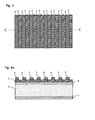
- Fig. 3 shows a further embodiment of a banknote with sections of the invention in supervision.
- the hollow bead-containing portions 2 and rutile-containing portions 3 show in plan a strip-shaped arrangement, as the sectional views in Fig. 4a and Fig. 4b show, can be realized in different ways. Both in variant Fig. 4a as well as in variant Fig. 4b it is possible to replace rutile with anatase or to use a mixture of rutile and anatase. In the variants shown, a classic 1D barcode was realized. Of course, it is also possible to realize a 2D barcode, in a multilayer structure also a 3D barcode or other machine-readable codes. The codes can occupy both the entire surface of the banknote or generally the value document or even cover only sections. It is conceivable, for example, to introduce the code only in - not shown - windows or run in edge areas. The code is only machine-readable and not visible to the naked eye. The different parts appear to the eye as a uniform surface.
- Fig. 4a shows a sectional view of the banknote in Fig. 3 along the line CC.
- the banknote substrate in this embodiment is a composite of paper and foil.
- the core of the composite consists of conventional cotton paper 5, which is coated with two very thin films 6, 7.
- the films may be extruded or laminated onto the paper.
- the partial areas according to the invention serve as ink receiving layers and cover the entire surface of the substrate.
- On a surface of a film is the entire surface of the first hollow bead-containing portion 2 printed.
- On the hollow bead-containing portion of the second rutile-containing portion 3 is strip-shaped - or according to the relevant requirements another coding - printed.
- the measurement is preferably carried out from the side facing the rutile-containing coating. Since rutile absorbs in the longer-wave UV range, the directly underlying hollow spheres are virtually invisible when measuring the rutile and thus do not interfere.
- Fig. 4b shows an alternative sectional view of the banknote in Fig. 3 along the line CC. It is the foil-paper-foil construction Fig. 4a , The hollow bead-containing portions 2 and the rutile-containing portions 3 are not superimposed in this embodiment, but printed side by side. Preferably, these are arranged in register.
- the codings can occupy only a small area on the banknote, so do not necessarily cover the entire area.
- the coding can also be integrated into a motif according to the invention.
- a small-format coding of partial areas according to the invention can be integrated into a large-area motif of partial areas according to the invention.
- Fig. 5 shows a sectional view of a bill of transparent polymer substrate 5 with the first partial areas 2 according to the invention, the second Partial regions 3 and the third partial regions 8.
- the first partial regions 2 comprise hollow beads, but no anatase and no rutile
- the second partial regions 3 comprise rutile, but no hollow beads and no anatase
- the third partial regions 8 comprise anatase, but no rutile and no hollow beads
- Fig. 6 shows the transmission spectrum of the hollow beads 9, anatase 10 and rutile 11.
- a transparent BOPP film was measured which was printed with respect to the anatase spectrum with a screen printing ink based on 15% by weight of anatase and 85% by weight of screen printing agent 3850 from Giesecke & Devrient GmbH.
- the front was printed with two and the back with a screen printing layer (each about 10 microns wet film thickness).
- a transparent BOPP film was printed with a screen printing ink based on 15% by weight of rutile and 85% by weight of screen printing agent 3850 from Giesecke & Devrient GmbH.
- the front was printed with two and the back with a screen printing layer (each about 10 microns wet film thickness).
- the measurements were carried out on the Perkin Elmer UV-VIS IR spectrometer 900 with integrating sphere.
- a white standard was attached to the outside of the specimen holder, a measuring aperture (black cardboard with a circular 5 mm opening) was fixed at the light beam entrance area of the integrating sphere and the sample to be tested was fixed.
- the measurement against air was used.
- the spectrum of the anatase coating is shifted by about 30 nm to lower wavelengths compared to the spectrum of the rutile coating.
- the spectrum of the hollow bead overprint is again shifted by about 70 nm to lower wavelengths compared to the spectrum of the anatase coating.
- the spectra are therefore easy to differentiate metrologically and easy to evaluate.
Landscapes
- Health & Medical Sciences (AREA)
- General Health & Medical Sciences (AREA)
- Toxicology (AREA)
- Physics & Mathematics (AREA)
- General Physics & Mathematics (AREA)
- Spectroscopy & Molecular Physics (AREA)
- Business, Economics & Management (AREA)
- Accounting & Taxation (AREA)
- Finance (AREA)
- Credit Cards Or The Like (AREA)
- Printing Methods (AREA)
Claims (16)
- Substrat de sécurité pour des papiers de sécurité et des documents de valeur, avec au moins une première et au moins une deuxième zones partielles (2, 3), caractérisé en ce que la première zone partielle (2) comporte des microsphères creuses dispersant la lumière sur base de matière plastique et aucun mélange de rutile et d'anatase et la deuxième zone partielle (3) comprend du rutile et/ou de l'anatase mais aucune microsphère creuse dispersant la lumière sur base de matière plastique, le rutile, l'anatase et les microsphères creuses dispersant la lumière sur base de matière plastique faisant preuve respectivement d'une transmission ou luminance de réflexion différente dans le domaine spectral des ultraviolets.
- Substrat de sécurité selon la revendication 1, caractérisé en ce qu'au moins une troisième zone partielle (8) est présente, qui comprend du rutile et/ou de l'anatase et le cas échéant des microsphères creuses et qui se distingue de la première et de la deuxième zones partielles (2, 3) en ce qui concerne la présence de rutile, d'anatase et des microsphères creuses.
- Substrat de sécurité selon la revendication 1 ou la revendication 2, caractérisé en ce que la première (2) et/ou la deuxième (3) et/ou la troisième (8) zone partielle est présente sur la surface ou dans le volume du substrat.
- Substrat de sécurité selon au moins l'une quelconque des revendications 1 à 3, caractérisé en ce que la première (2) et/ou la deuxième (3) et/ou la troisième (8) zone partielle est imprimée sur la surface du substrat.
- Substrat de sécurité selon au moins l'une quelconque des revendications 1 à 4, caractérisé en ce que le substrat comprend au moins une couche en papier, de préférence en papier pur coton.
- Substrat de sécurité selon au moins l'une quelconque des revendications 1 à 5, caractérisé en ce que le substrat comprend au moins une couche en matière plastique.
- Substrat de sécurité selon au moins l'une quelconque des revendications 1 à 6, caractérisé en ce que le substrat est conçu en forme de bande ou de patch.
- Substrat de sécurité selon au moins l'une quelconque des revendications 1 à 7, caractérisé en ce que le substrat est conçu en tant que fil de sécurité ou en tant que papier de sécurité pour des documents de valeur.
- Substrat de sécurité selon au moins l'une quelconque des revendications 1 à 8, caractérisé en ce que du rutile et/ou de l'anatase sont présents en tant que pigments.
- Document de valeur, notamment billet de banque ou pièce d'identité, caractérisé en ce que celui-ci comprend un substrat selon au moins l'une quelconque des revendications 1 à 9.
- Procédé destiné à fabriquer un substrat de sécurité selon au moins l'une quelconque des revendications 1 à 9, qui comprend les étapes suivantes : mise à disposition d'une matière de support, qui est équipée d'au moins une première et une deuxième zones partielles (2, 3), caractérisé en ce que la première zone partielle (2) comporte des microsphères creuses dispersant la lumière sur base de matière plastique et aucun mélange de rutile et d'anatase et la deuxième zone partielle (3) comprend du rutile et/ou de l'anatase mais aucune microsphère creuse dispersant la lumière sur base de matière plastique, le rutile, l'anatase et les microsphères creuses dispersant la lumière sur base de matière plastique faisant preuve respectivement d'une transmission ou luminance de réflexion différente dans le domaine spectral des ultraviolets.
- Procédé destiné à fabriquer un substrat de sécurité selon la revendication 11, qui comprend les étapes suivantes : équipement de la matière de support d'au moins une troisième zone partielle (8), caractérisé en ce que la troisième zone partielle (8) comprend du rutile et/ou de l'anatase et le cas échéant des microsphères creuses et se différencie de la première et de la deuxième zones partielles (2, 3) en ce qui concerne la présente de rutile, d'anatase et des microsphères creuses.
- Procédé destiné à fabriquer un substrat de sécurité selon la revendication 11 ou la revendication 12, caractérisé en ce que la matière de support comprend au moins une couche de papier ou au moins une couche de matière plastique ou une association de ces dernières.
- Procédé destiné à fabriquer un substrat de sécurité selon au moins l'une quelconque des revendications 11 à 13, caractérisé en ce qu'on applique ou on introduit la première (2) et/ou la deuxième (3) et/ou la troisième zone partielle (8) sur la surface et/ou dans le volume de la matière de support.
- Utilisation d'un substrat de sécurité selon au moins l'une quelconque des revendications 1 à 9 en tant qu'élément de sécurité, que papier de sécurité ou que document de valeur.
- Procédé destiné à vérifier notamment l'authenticité d'un substrat de sécurité selon au moins l'une quelconque des revendications 1 à 9, lors duquel on illumine le substrat de sécurité avec une résolution spatiale avec de la lumière ultraviolette et pour vérifier l'authenticité, on mesure et on évalue la lumière ultraviolette transmise ou réfléchie par le substrat de sécurité pour déceler si dans le domaine spectral des ultraviolets, les différents spectres des microsphères creuses dispersant la lumière sur base de matière plastique et s'ils sont présents de l'anatase et/ou du rutile sont identifiables en ce qui concerne les zones partielles (2, 3).
Applications Claiming Priority (1)
| Application Number | Priority Date | Filing Date | Title |
|---|---|---|---|
| DE102013010681.8A DE102013010681A1 (de) | 2013-06-26 | 2013-06-26 | Sicherheitssubstrat |
Publications (2)
| Publication Number | Publication Date |
|---|---|
| EP2818326A1 EP2818326A1 (fr) | 2014-12-31 |
| EP2818326B1 true EP2818326B1 (fr) | 2016-09-28 |
Family
ID=50982742
Family Applications (1)
| Application Number | Title | Priority Date | Filing Date |
|---|---|---|---|
| EP14002147.8A Not-in-force EP2818326B1 (fr) | 2013-06-26 | 2014-06-23 | Substrat de sécurité |
Country Status (2)
| Country | Link |
|---|---|
| EP (1) | EP2818326B1 (fr) |
| DE (1) | DE102013010681A1 (fr) |
Family Cites Families (6)
| Publication number | Priority date | Publication date | Assignee | Title |
|---|---|---|---|---|
| DE4344552A1 (de) | 1993-12-24 | 1995-06-29 | Giesecke & Devrient Gmbh | Verfahren und Vorrichtung zur Ausstattung von Wertpapieren mit Echtheitsmerkmalen |
| EP0942031B1 (fr) * | 1998-03-10 | 2010-06-23 | Mitsubishi Polyester Film Corporation | Film polyester blanc |
| DE10160580A1 (de) | 2001-12-10 | 2003-07-17 | Giesecke & Devrient Gmbh | Verfahren und Vorrichtung für die Überprüfung der Echtheit von Blattgut |
| DE10160578A1 (de) | 2001-12-10 | 2004-02-12 | Giesecke & Devrient Gmbh | Verfahren und Vorrichtung für die Überprüfung der Echtheit von Blattgut |
| DE102010051087A1 (de) * | 2010-11-12 | 2012-05-16 | Beb Industrie-Elektronik Ag | Verfahren und Vorrichtung zur Überprüfung der Echtheit von Banknoten mit Sicherheitsfenstern |
| US20130077169A1 (en) * | 2011-09-23 | 2013-03-28 | Ppg Industries Ohio, Inc. | Hollow particle crystalline colloidal arrays |
-
2013
- 2013-06-26 DE DE102013010681.8A patent/DE102013010681A1/de not_active Withdrawn
-
2014
- 2014-06-23 EP EP14002147.8A patent/EP2818326B1/fr not_active Not-in-force
Also Published As
| Publication number | Publication date |
|---|---|
| DE102013010681A1 (de) | 2014-12-31 |
| EP2818326A1 (fr) | 2014-12-31 |
Similar Documents
| Publication | Publication Date | Title |
|---|---|---|
| DE602004013360T2 (de) | Sicherheitsdokument, verfahren zur herstellung eines sicherheitsdokuments und verwendung eines sicherheitselements | |
| EP1156934B1 (fr) | Document de securite | |
| EP1301355B2 (fr) | Papier de securite et valeur produite a partir dudit papier | |
| EP3847038B1 (fr) | Élément de sécurité | |
| EP2084016B1 (fr) | Élément de sécurité | |
| EP1395438B1 (fr) | Document de valeur et son proc d de production | |
| EP2643162B1 (fr) | Document de valeur et/ou de sécurité, ainsi que son procédé de fabrication | |
| DE10326983A1 (de) | Wertdokument mit einem maschinenlesbaren Echtheitskennzeichen | |
| EP0435029A2 (fr) | Support d'information avec élément de sécuritÀ© à cristaux liquides | |
| WO2009100874A2 (fr) | Élément de sécurité | |
| DE102007012042A1 (de) | Sicherheitselement | |
| EP2768678A1 (fr) | Procédé de fabrication d'un élément de sécurité optiquement variable doté d'une couche d'encre à base de microcapsules et élément de sécurité ainsi obtenu | |
| WO2016155859A1 (fr) | Élément de sécurite pourvu de pigments d'effet et d'une structure de gaufrage et procédé de fabrication de ce dernier | |
| EP2560822B1 (fr) | Élément de sécurité avec zone d'image en transparence | |
| DE102006014367A1 (de) | Datenträger und Verfahren zu seiner Herstellung | |
| DE102008030182B4 (de) | Wert- oder Sicherheitsdokument und Verfahren zum Bilden mindestens eines Sicherheitsmerkmals bei der Herstellung des Wert- oder Sicherheitsdokuments sowie Verfahren und Mittel zur Verifikation | |
| EP3332982B1 (fr) | Élément de sécurité pourvu de marques luminescentes | |
| EP3047429B1 (fr) | Produit de valeur ou de sécurité protégé contre des manipulations frauduleuses et procédé pour vérifier l'authenticité de ce produit de valeur ou de sécurité protégé contre des manipulations frauduleuses | |
| EP2694297B1 (fr) | Support de données avec élément de sécurité et procédé pour fabriquer le support de données | |
| EP3580066A1 (fr) | Support de données à élément de sécurité de fenêtre | |
| EP3004459B1 (fr) | Substrat de sécurité | |
| EP2818326A1 (fr) | Substrat de sécurité | |
| DE102021210432A1 (de) | Winkelabhängiges gedrucktes verborgenes Sicherheitselement | |
| DE102016004513A1 (de) | Wert- und Sicherheitspapier mit Rückseiteninformation |
Legal Events
| Date | Code | Title | Description |
|---|---|---|---|
| PUAI | Public reference made under article 153(3) epc to a published international application that has entered the european phase |
Free format text: ORIGINAL CODE: 0009012 |
|
| 17P | Request for examination filed |
Effective date: 20140623 |
|
| AK | Designated contracting states |
Kind code of ref document: A1 Designated state(s): AL AT BE BG CH CY CZ DE DK EE ES FI FR GB GR HR HU IE IS IT LI LT LU LV MC MK MT NL NO PL PT RO RS SE SI SK SM TR |
|
| AX | Request for extension of the european patent |
Extension state: BA ME |
|
| R17P | Request for examination filed (corrected) |
Effective date: 20150630 |
|
| RBV | Designated contracting states (corrected) |
Designated state(s): AL AT BE BG CH CY CZ DE DK EE ES FI FR GB GR HR HU IE IS IT LI LT LU LV MC MK MT NL NO PL PT RO RS SE SI SK SM TR |
|
| REG | Reference to a national code |
Ref country code: DE Ref legal event code: R079 Ref document number: 502014001545 Country of ref document: DE Free format text: PREVIOUS MAIN CLASS: B41M0003140000 Ipc: B42D0025387000 |
|
| GRAP | Despatch of communication of intention to grant a patent |
Free format text: ORIGINAL CODE: EPIDOSNIGR1 |
|
| RIC1 | Information provided on ipc code assigned before grant |
Ipc: B42D 25/387 20140101AFI20160405BHEP Ipc: G07D 7/12 20160101ALI20160405BHEP Ipc: B42D 25/378 20140101ALI20160405BHEP Ipc: G07D 7/20 20160101ALI20160405BHEP Ipc: B42D 25/29 20140101ALI20160405BHEP |
|
| INTG | Intention to grant announced |
Effective date: 20160421 |
|
| GRAS | Grant fee paid |
Free format text: ORIGINAL CODE: EPIDOSNIGR3 |
|
| GRAA | (expected) grant |
Free format text: ORIGINAL CODE: 0009210 |
|
| AK | Designated contracting states |
Kind code of ref document: B1 Designated state(s): AL AT BE BG CH CY CZ DE DK EE ES FI FR GB GR HR HU IE IS IT LI LT LU LV MC MK MT NL NO PL PT RO RS SE SI SK SM TR |
|
| REG | Reference to a national code |
Ref country code: GB Ref legal event code: FG4D Free format text: NOT ENGLISH |
|
| REG | Reference to a national code |
Ref country code: CH Ref legal event code: EP |
|
| REG | Reference to a national code |
Ref country code: AT Ref legal event code: REF Ref document number: 832399 Country of ref document: AT Kind code of ref document: T Effective date: 20161015 |
|
| REG | Reference to a national code |
Ref country code: IE Ref legal event code: FG4D Free format text: LANGUAGE OF EP DOCUMENT: GERMAN |
|
| REG | Reference to a national code |
Ref country code: DE Ref legal event code: R096 Ref document number: 502014001545 Country of ref document: DE |
|
| REG | Reference to a national code |
Ref country code: LT Ref legal event code: MG4D |
|
| PG25 | Lapsed in a contracting state [announced via postgrant information from national office to epo] |
Ref country code: NO Free format text: LAPSE BECAUSE OF FAILURE TO SUBMIT A TRANSLATION OF THE DESCRIPTION OR TO PAY THE FEE WITHIN THE PRESCRIBED TIME-LIMIT Effective date: 20161228 Ref country code: FI Free format text: LAPSE BECAUSE OF FAILURE TO SUBMIT A TRANSLATION OF THE DESCRIPTION OR TO PAY THE FEE WITHIN THE PRESCRIBED TIME-LIMIT Effective date: 20160928 Ref country code: HR Free format text: LAPSE BECAUSE OF FAILURE TO SUBMIT A TRANSLATION OF THE DESCRIPTION OR TO PAY THE FEE WITHIN THE PRESCRIBED TIME-LIMIT Effective date: 20160928 Ref country code: LT Free format text: LAPSE BECAUSE OF FAILURE TO SUBMIT A TRANSLATION OF THE DESCRIPTION OR TO PAY THE FEE WITHIN THE PRESCRIBED TIME-LIMIT Effective date: 20160928 Ref country code: RS Free format text: LAPSE BECAUSE OF FAILURE TO SUBMIT A TRANSLATION OF THE DESCRIPTION OR TO PAY THE FEE WITHIN THE PRESCRIBED TIME-LIMIT Effective date: 20160928 |
|
| REG | Reference to a national code |
Ref country code: NL Ref legal event code: MP Effective date: 20160928 |
|
| PG25 | Lapsed in a contracting state [announced via postgrant information from national office to epo] |
Ref country code: SE Free format text: LAPSE BECAUSE OF FAILURE TO SUBMIT A TRANSLATION OF THE DESCRIPTION OR TO PAY THE FEE WITHIN THE PRESCRIBED TIME-LIMIT Effective date: 20160928 Ref country code: LV Free format text: LAPSE BECAUSE OF FAILURE TO SUBMIT A TRANSLATION OF THE DESCRIPTION OR TO PAY THE FEE WITHIN THE PRESCRIBED TIME-LIMIT Effective date: 20160928 Ref country code: GR Free format text: LAPSE BECAUSE OF FAILURE TO SUBMIT A TRANSLATION OF THE DESCRIPTION OR TO PAY THE FEE WITHIN THE PRESCRIBED TIME-LIMIT Effective date: 20161229 Ref country code: NL Free format text: LAPSE BECAUSE OF FAILURE TO SUBMIT A TRANSLATION OF THE DESCRIPTION OR TO PAY THE FEE WITHIN THE PRESCRIBED TIME-LIMIT Effective date: 20160928 |
|
| PG25 | Lapsed in a contracting state [announced via postgrant information from national office to epo] |
Ref country code: EE Free format text: LAPSE BECAUSE OF FAILURE TO SUBMIT A TRANSLATION OF THE DESCRIPTION OR TO PAY THE FEE WITHIN THE PRESCRIBED TIME-LIMIT Effective date: 20160928 Ref country code: RO Free format text: LAPSE BECAUSE OF FAILURE TO SUBMIT A TRANSLATION OF THE DESCRIPTION OR TO PAY THE FEE WITHIN THE PRESCRIBED TIME-LIMIT Effective date: 20160928 |
|
| PG25 | Lapsed in a contracting state [announced via postgrant information from national office to epo] |
Ref country code: BG Free format text: LAPSE BECAUSE OF FAILURE TO SUBMIT A TRANSLATION OF THE DESCRIPTION OR TO PAY THE FEE WITHIN THE PRESCRIBED TIME-LIMIT Effective date: 20161228 Ref country code: SM Free format text: LAPSE BECAUSE OF FAILURE TO SUBMIT A TRANSLATION OF THE DESCRIPTION OR TO PAY THE FEE WITHIN THE PRESCRIBED TIME-LIMIT Effective date: 20160928 Ref country code: CZ Free format text: LAPSE BECAUSE OF FAILURE TO SUBMIT A TRANSLATION OF THE DESCRIPTION OR TO PAY THE FEE WITHIN THE PRESCRIBED TIME-LIMIT Effective date: 20160928 Ref country code: PL Free format text: LAPSE BECAUSE OF FAILURE TO SUBMIT A TRANSLATION OF THE DESCRIPTION OR TO PAY THE FEE WITHIN THE PRESCRIBED TIME-LIMIT Effective date: 20160928 Ref country code: PT Free format text: LAPSE BECAUSE OF FAILURE TO SUBMIT A TRANSLATION OF THE DESCRIPTION OR TO PAY THE FEE WITHIN THE PRESCRIBED TIME-LIMIT Effective date: 20170130 Ref country code: IS Free format text: LAPSE BECAUSE OF FAILURE TO SUBMIT A TRANSLATION OF THE DESCRIPTION OR TO PAY THE FEE WITHIN THE PRESCRIBED TIME-LIMIT Effective date: 20170128 Ref country code: SK Free format text: LAPSE BECAUSE OF FAILURE TO SUBMIT A TRANSLATION OF THE DESCRIPTION OR TO PAY THE FEE WITHIN THE PRESCRIBED TIME-LIMIT Effective date: 20160928 Ref country code: ES Free format text: LAPSE BECAUSE OF FAILURE TO SUBMIT A TRANSLATION OF THE DESCRIPTION OR TO PAY THE FEE WITHIN THE PRESCRIBED TIME-LIMIT Effective date: 20160928 |
|
| REG | Reference to a national code |
Ref country code: FR Ref legal event code: PLFP Year of fee payment: 4 |
|
| REG | Reference to a national code |
Ref country code: DE Ref legal event code: R097 Ref document number: 502014001545 Country of ref document: DE |
|
| PG25 | Lapsed in a contracting state [announced via postgrant information from national office to epo] |
Ref country code: IT Free format text: LAPSE BECAUSE OF FAILURE TO SUBMIT A TRANSLATION OF THE DESCRIPTION OR TO PAY THE FEE WITHIN THE PRESCRIBED TIME-LIMIT Effective date: 20160928 |
|
| PG25 | Lapsed in a contracting state [announced via postgrant information from national office to epo] |
Ref country code: DK Free format text: LAPSE BECAUSE OF FAILURE TO SUBMIT A TRANSLATION OF THE DESCRIPTION OR TO PAY THE FEE WITHIN THE PRESCRIBED TIME-LIMIT Effective date: 20160928 |
|
| PGFP | Annual fee paid to national office [announced via postgrant information from national office to epo] |
Ref country code: FR Payment date: 20170621 Year of fee payment: 4 |
|
| PLBE | No opposition filed within time limit |
Free format text: ORIGINAL CODE: 0009261 |
|
| STAA | Information on the status of an ep patent application or granted ep patent |
Free format text: STATUS: NO OPPOSITION FILED WITHIN TIME LIMIT |
|
| 26N | No opposition filed |
Effective date: 20170629 |
|
| PG25 | Lapsed in a contracting state [announced via postgrant information from national office to epo] |
Ref country code: SI Free format text: LAPSE BECAUSE OF FAILURE TO SUBMIT A TRANSLATION OF THE DESCRIPTION OR TO PAY THE FEE WITHIN THE PRESCRIBED TIME-LIMIT Effective date: 20160928 |
|
| REG | Reference to a national code |
Ref country code: DE Ref legal event code: R119 Ref document number: 502014001545 Country of ref document: DE |
|
| PG25 | Lapsed in a contracting state [announced via postgrant information from national office to epo] |
Ref country code: MC Free format text: LAPSE BECAUSE OF FAILURE TO SUBMIT A TRANSLATION OF THE DESCRIPTION OR TO PAY THE FEE WITHIN THE PRESCRIBED TIME-LIMIT Effective date: 20160928 |
|
| REG | Reference to a national code |
Ref country code: CH Ref legal event code: PL |
|
| REG | Reference to a national code |
Ref country code: GB Ref legal event code: 732E Free format text: REGISTERED BETWEEN 20180118 AND 20180124 |
|
| REG | Reference to a national code |
Ref country code: IE Ref legal event code: MM4A |
|
| PG25 | Lapsed in a contracting state [announced via postgrant information from national office to epo] |
Ref country code: DE Free format text: LAPSE BECAUSE OF NON-PAYMENT OF DUE FEES Effective date: 20180103 Ref country code: LU Free format text: LAPSE BECAUSE OF NON-PAYMENT OF DUE FEES Effective date: 20170623 Ref country code: IE Free format text: LAPSE BECAUSE OF NON-PAYMENT OF DUE FEES Effective date: 20170623 Ref country code: CH Free format text: LAPSE BECAUSE OF NON-PAYMENT OF DUE FEES Effective date: 20170630 Ref country code: LI Free format text: LAPSE BECAUSE OF NON-PAYMENT OF DUE FEES Effective date: 20170630 |
|
| REG | Reference to a national code |
Ref country code: BE Ref legal event code: MM Effective date: 20170630 |
|
| REG | Reference to a national code |
Ref country code: FR Ref legal event code: TP Owner name: GIESECKE+DEVRIENT CURRENCY TECHNOLOGY GMBH, DE Effective date: 20180530 |
|
| PG25 | Lapsed in a contracting state [announced via postgrant information from national office to epo] |
Ref country code: BE Free format text: LAPSE BECAUSE OF NON-PAYMENT OF DUE FEES Effective date: 20170630 |
|
| PG25 | Lapsed in a contracting state [announced via postgrant information from national office to epo] |
Ref country code: MT Free format text: LAPSE BECAUSE OF FAILURE TO SUBMIT A TRANSLATION OF THE DESCRIPTION OR TO PAY THE FEE WITHIN THE PRESCRIBED TIME-LIMIT Effective date: 20160928 |
|
| PG25 | Lapsed in a contracting state [announced via postgrant information from national office to epo] |
Ref country code: AL Free format text: LAPSE BECAUSE OF FAILURE TO SUBMIT A TRANSLATION OF THE DESCRIPTION OR TO PAY THE FEE WITHIN THE PRESCRIBED TIME-LIMIT Effective date: 20160928 |
|
| GBPC | Gb: european patent ceased through non-payment of renewal fee |
Effective date: 20180623 |
|
| PG25 | Lapsed in a contracting state [announced via postgrant information from national office to epo] |
Ref country code: GB Free format text: LAPSE BECAUSE OF NON-PAYMENT OF DUE FEES Effective date: 20180623 Ref country code: FR Free format text: LAPSE BECAUSE OF NON-PAYMENT OF DUE FEES Effective date: 20180630 |
|
| PG25 | Lapsed in a contracting state [announced via postgrant information from national office to epo] |
Ref country code: HU Free format text: LAPSE BECAUSE OF FAILURE TO SUBMIT A TRANSLATION OF THE DESCRIPTION OR TO PAY THE FEE WITHIN THE PRESCRIBED TIME-LIMIT; INVALID AB INITIO Effective date: 20140623 |
|
| PG25 | Lapsed in a contracting state [announced via postgrant information from national office to epo] |
Ref country code: CY Free format text: LAPSE BECAUSE OF FAILURE TO SUBMIT A TRANSLATION OF THE DESCRIPTION OR TO PAY THE FEE WITHIN THE PRESCRIBED TIME-LIMIT Effective date: 20160928 |
|
| PG25 | Lapsed in a contracting state [announced via postgrant information from national office to epo] |
Ref country code: MK Free format text: LAPSE BECAUSE OF FAILURE TO SUBMIT A TRANSLATION OF THE DESCRIPTION OR TO PAY THE FEE WITHIN THE PRESCRIBED TIME-LIMIT Effective date: 20160928 |
|
| PG25 | Lapsed in a contracting state [announced via postgrant information from national office to epo] |
Ref country code: TR Free format text: LAPSE BECAUSE OF FAILURE TO SUBMIT A TRANSLATION OF THE DESCRIPTION OR TO PAY THE FEE WITHIN THE PRESCRIBED TIME-LIMIT Effective date: 20160928 |
|
| REG | Reference to a national code |
Ref country code: AT Ref legal event code: MM01 Ref document number: 832399 Country of ref document: AT Kind code of ref document: T Effective date: 20190623 |
|
| PG25 | Lapsed in a contracting state [announced via postgrant information from national office to epo] |
Ref country code: AT Free format text: LAPSE BECAUSE OF NON-PAYMENT OF DUE FEES Effective date: 20190623 |