EP2819951B1 - Sel conducteur pour dispositif de stockage d'énergie à base de lithium - Google Patents
Sel conducteur pour dispositif de stockage d'énergie à base de lithium Download PDFInfo
- Publication number
- EP2819951B1 EP2819951B1 EP13706047.1A EP13706047A EP2819951B1 EP 2819951 B1 EP2819951 B1 EP 2819951B1 EP 13706047 A EP13706047 A EP 13706047A EP 2819951 B1 EP2819951 B1 EP 2819951B1
- Authority
- EP
- European Patent Office
- Prior art keywords
- lithium
- trifluoromethoxy
- carbonate
- tetrafluoroethanesulfonate
- electrolyte
- Prior art date
- Legal status (The legal status is an assumption and is not a legal conclusion. Google has not performed a legal analysis and makes no representation as to the accuracy of the status listed.)
- Active
Links
Images



Classifications
-
- C—CHEMISTRY; METALLURGY
- C01—INORGANIC CHEMISTRY
- C01D—COMPOUNDS OF ALKALI METALS, i.e. LITHIUM, SODIUM, POTASSIUM, RUBIDIUM, CAESIUM, OR FRANCIUM
- C01D15/00—Lithium compounds
-
- H—ELECTRICITY
- H01—ELECTRIC ELEMENTS
- H01M—PROCESSES OR MEANS, e.g. BATTERIES, FOR THE DIRECT CONVERSION OF CHEMICAL ENERGY INTO ELECTRICAL ENERGY
- H01M10/00—Secondary cells; Manufacture thereof
- H01M10/05—Accumulators with non-aqueous electrolyte
- H01M10/056—Accumulators with non-aqueous electrolyte characterised by the materials used as electrolytes, e.g. mixed inorganic/organic electrolytes
- H01M10/0564—Accumulators with non-aqueous electrolyte characterised by the materials used as electrolytes, e.g. mixed inorganic/organic electrolytes the electrolyte being constituted of organic materials only
- H01M10/0566—Liquid materials
- H01M10/0567—Liquid materials characterised by the additives
-
- C—CHEMISTRY; METALLURGY
- C07—ORGANIC CHEMISTRY
- C07C—ACYCLIC OR CARBOCYCLIC COMPOUNDS
- C07C309/00—Sulfonic acids; Halides, esters, or anhydrides thereof
- C07C309/01—Sulfonic acids
- C07C309/02—Sulfonic acids having sulfo groups bound to acyclic carbon atoms
- C07C309/03—Sulfonic acids having sulfo groups bound to acyclic carbon atoms of an acyclic saturated carbon skeleton
- C07C309/07—Sulfonic acids having sulfo groups bound to acyclic carbon atoms of an acyclic saturated carbon skeleton containing oxygen atoms bound to the carbon skeleton
- C07C309/09—Sulfonic acids having sulfo groups bound to acyclic carbon atoms of an acyclic saturated carbon skeleton containing oxygen atoms bound to the carbon skeleton containing etherified hydroxy groups bound to the carbon skeleton
- C07C309/10—Sulfonic acids having sulfo groups bound to acyclic carbon atoms of an acyclic saturated carbon skeleton containing oxygen atoms bound to the carbon skeleton containing etherified hydroxy groups bound to the carbon skeleton with the oxygen atom of at least one of the etherified hydroxy groups further bound to an acyclic carbon atom
-
- C—CHEMISTRY; METALLURGY
- C07—ORGANIC CHEMISTRY
- C07C—ACYCLIC OR CARBOCYCLIC COMPOUNDS
- C07C309/00—Sulfonic acids; Halides, esters, or anhydrides thereof
- C07C309/63—Esters of sulfonic acids
- C07C309/64—Esters of sulfonic acids having sulfur atoms of esterified sulfo groups bound to acyclic carbon atoms
- C07C309/65—Esters of sulfonic acids having sulfur atoms of esterified sulfo groups bound to acyclic carbon atoms of a saturated carbon skeleton
-
- H—ELECTRICITY
- H01—ELECTRIC ELEMENTS
- H01G—CAPACITORS; CAPACITORS, RECTIFIERS, DETECTORS, SWITCHING DEVICES, LIGHT-SENSITIVE OR TEMPERATURE-SENSITIVE DEVICES OF THE ELECTROLYTIC TYPE
- H01G11/00—Hybrid capacitors, i.e. capacitors having different positive and negative electrodes; Electric double-layer [EDL] capacitors; Processes for the manufacture thereof or of parts thereof
- H01G11/54—Electrolytes
- H01G11/58—Liquid electrolytes
- H01G11/62—Liquid electrolytes characterised by the solute, e.g. salts, anions or cations therein
-
- H—ELECTRICITY
- H01—ELECTRIC ELEMENTS
- H01M—PROCESSES OR MEANS, e.g. BATTERIES, FOR THE DIRECT CONVERSION OF CHEMICAL ENERGY INTO ELECTRICAL ENERGY
- H01M10/00—Secondary cells; Manufacture thereof
- H01M10/05—Accumulators with non-aqueous electrolyte
- H01M10/052—Li-accumulators
-
- H—ELECTRICITY
- H01—ELECTRIC ELEMENTS
- H01M—PROCESSES OR MEANS, e.g. BATTERIES, FOR THE DIRECT CONVERSION OF CHEMICAL ENERGY INTO ELECTRICAL ENERGY
- H01M10/00—Secondary cells; Manufacture thereof
- H01M10/05—Accumulators with non-aqueous electrolyte
- H01M10/052—Li-accumulators
- H01M10/0525—Rocking-chair batteries, i.e. batteries with lithium insertion or intercalation in both electrodes; Lithium-ion batteries
-
- H—ELECTRICITY
- H01—ELECTRIC ELEMENTS
- H01M—PROCESSES OR MEANS, e.g. BATTERIES, FOR THE DIRECT CONVERSION OF CHEMICAL ENERGY INTO ELECTRICAL ENERGY
- H01M10/00—Secondary cells; Manufacture thereof
- H01M10/05—Accumulators with non-aqueous electrolyte
- H01M10/056—Accumulators with non-aqueous electrolyte characterised by the materials used as electrolytes, e.g. mixed inorganic/organic electrolytes
- H01M10/0564—Accumulators with non-aqueous electrolyte characterised by the materials used as electrolytes, e.g. mixed inorganic/organic electrolytes the electrolyte being constituted of organic materials only
- H01M10/0565—Polymeric materials, e.g. gel-type or solid-type
-
- H—ELECTRICITY
- H01—ELECTRIC ELEMENTS
- H01M—PROCESSES OR MEANS, e.g. BATTERIES, FOR THE DIRECT CONVERSION OF CHEMICAL ENERGY INTO ELECTRICAL ENERGY
- H01M10/00—Secondary cells; Manufacture thereof
- H01M10/05—Accumulators with non-aqueous electrolyte
- H01M10/056—Accumulators with non-aqueous electrolyte characterised by the materials used as electrolytes, e.g. mixed inorganic/organic electrolytes
- H01M10/0564—Accumulators with non-aqueous electrolyte characterised by the materials used as electrolytes, e.g. mixed inorganic/organic electrolytes the electrolyte being constituted of organic materials only
- H01M10/0566—Liquid materials
- H01M10/0568—Liquid materials characterised by the solutes
-
- H—ELECTRICITY
- H01—ELECTRIC ELEMENTS
- H01M—PROCESSES OR MEANS, e.g. BATTERIES, FOR THE DIRECT CONVERSION OF CHEMICAL ENERGY INTO ELECTRICAL ENERGY
- H01M10/00—Secondary cells; Manufacture thereof
- H01M10/05—Accumulators with non-aqueous electrolyte
- H01M10/056—Accumulators with non-aqueous electrolyte characterised by the materials used as electrolytes, e.g. mixed inorganic/organic electrolytes
- H01M10/0564—Accumulators with non-aqueous electrolyte characterised by the materials used as electrolytes, e.g. mixed inorganic/organic electrolytes the electrolyte being constituted of organic materials only
- H01M10/0566—Liquid materials
- H01M10/0569—Liquid materials characterised by the solvents
-
- H—ELECTRICITY
- H01—ELECTRIC ELEMENTS
- H01G—CAPACITORS; CAPACITORS, RECTIFIERS, DETECTORS, SWITCHING DEVICES, LIGHT-SENSITIVE OR TEMPERATURE-SENSITIVE DEVICES OF THE ELECTROLYTIC TYPE
- H01G11/00—Hybrid capacitors, i.e. capacitors having different positive and negative electrodes; Electric double-layer [EDL] capacitors; Processes for the manufacture thereof or of parts thereof
- H01G11/04—Hybrid capacitors
- H01G11/06—Hybrid capacitors with one of the electrodes allowing ions to be reversibly doped thereinto, e.g. lithium ion capacitors [LIC]
-
- H—ELECTRICITY
- H01—ELECTRIC ELEMENTS
- H01G—CAPACITORS; CAPACITORS, RECTIFIERS, DETECTORS, SWITCHING DEVICES, LIGHT-SENSITIVE OR TEMPERATURE-SENSITIVE DEVICES OF THE ELECTROLYTIC TYPE
- H01G11/00—Hybrid capacitors, i.e. capacitors having different positive and negative electrodes; Electric double-layer [EDL] capacitors; Processes for the manufacture thereof or of parts thereof
- H01G11/54—Electrolytes
- H01G11/58—Liquid electrolytes
- H01G11/60—Liquid electrolytes characterised by the solvent
-
- H—ELECTRICITY
- H01—ELECTRIC ELEMENTS
- H01M—PROCESSES OR MEANS, e.g. BATTERIES, FOR THE DIRECT CONVERSION OF CHEMICAL ENERGY INTO ELECTRICAL ENERGY
- H01M2300/00—Electrolytes
- H01M2300/0017—Non-aqueous electrolytes
- H01M2300/0025—Organic electrolyte
-
- H—ELECTRICITY
- H01—ELECTRIC ELEMENTS
- H01M—PROCESSES OR MEANS, e.g. BATTERIES, FOR THE DIRECT CONVERSION OF CHEMICAL ENERGY INTO ELECTRICAL ENERGY
- H01M2300/00—Electrolytes
- H01M2300/0017—Non-aqueous electrolytes
- H01M2300/0025—Organic electrolyte
- H01M2300/0028—Organic electrolyte characterised by the solvent
-
- H—ELECTRICITY
- H01—ELECTRIC ELEMENTS
- H01M—PROCESSES OR MEANS, e.g. BATTERIES, FOR THE DIRECT CONVERSION OF CHEMICAL ENERGY INTO ELECTRICAL ENERGY
- H01M2300/00—Electrolytes
- H01M2300/0017—Non-aqueous electrolytes
- H01M2300/0025—Organic electrolyte
- H01M2300/0028—Organic electrolyte characterised by the solvent
- H01M2300/0034—Fluorinated solvents
-
- H—ELECTRICITY
- H01—ELECTRIC ELEMENTS
- H01M—PROCESSES OR MEANS, e.g. BATTERIES, FOR THE DIRECT CONVERSION OF CHEMICAL ENERGY INTO ELECTRICAL ENERGY
- H01M2300/00—Electrolytes
- H01M2300/0017—Non-aqueous electrolytes
- H01M2300/0025—Organic electrolyte
- H01M2300/0028—Organic electrolyte characterised by the solvent
- H01M2300/0037—Mixture of solvents
-
- Y—GENERAL TAGGING OF NEW TECHNOLOGICAL DEVELOPMENTS; GENERAL TAGGING OF CROSS-SECTIONAL TECHNOLOGIES SPANNING OVER SEVERAL SECTIONS OF THE IPC; TECHNICAL SUBJECTS COVERED BY FORMER USPC CROSS-REFERENCE ART COLLECTIONS [XRACs] AND DIGESTS
- Y02—TECHNOLOGIES OR APPLICATIONS FOR MITIGATION OR ADAPTATION AGAINST CLIMATE CHANGE
- Y02E—REDUCTION OF GREENHOUSE GAS [GHG] EMISSIONS, RELATED TO ENERGY GENERATION, TRANSMISSION OR DISTRIBUTION
- Y02E60/00—Enabling technologies; Technologies with a potential or indirect contribution to GHG emissions mitigation
- Y02E60/10—Energy storage using batteries
-
- Y—GENERAL TAGGING OF NEW TECHNOLOGICAL DEVELOPMENTS; GENERAL TAGGING OF CROSS-SECTIONAL TECHNOLOGIES SPANNING OVER SEVERAL SECTIONS OF THE IPC; TECHNICAL SUBJECTS COVERED BY FORMER USPC CROSS-REFERENCE ART COLLECTIONS [XRACs] AND DIGESTS
- Y02—TECHNOLOGIES OR APPLICATIONS FOR MITIGATION OR ADAPTATION AGAINST CLIMATE CHANGE
- Y02E—REDUCTION OF GREENHOUSE GAS [GHG] EMISSIONS, RELATED TO ENERGY GENERATION, TRANSMISSION OR DISTRIBUTION
- Y02E60/00—Enabling technologies; Technologies with a potential or indirect contribution to GHG emissions mitigation
- Y02E60/13—Energy storage using capacitors
Definitions
- the invention relates to a conductive salt and an electrolyte for lithium-based energy storage.
- Lithium-ion technology is the leading technology in the field of rechargeable battery storage systems for portable electronics. Due to their high cell voltage, their superior energy and power density as well as their extremely low self-discharge, lithium-ion batteries have a high potential for these applications.
- lithium hexafluorophosphate LiPF 6
- Lithium hexafluorophosphate has relatively high conductivity, but has significant disadvantages due to low thermal stability and toxicity of its combustion products.
- lithium bis (oxalato) borate LiBOB
- a disadvantage is that bis (oxalato) borate has only a low solubility in the usual carbonates used as a solvent in electrolytes. Show further LiBOB-based electrolytes have lower conductivity compared to LiPF 6 , especially at low temperatures, and higher viscosity.
- US 2006/276670 A1 discloses hydrofluoroalkanesulfonates of the general formula RO-CXH-CX 2 -SO 3 M, wherein R is selected from the group consisting of alkyl groups, functionalized alkyl groups, and alkenyl groups; X is selected from the group consisting of hydrogen and fluorine, provided that at least one X is fluorine; and M is a cation.
- Z + is a cation selected from the group consisting of pyridinium, pyridazinium, pyrimidinium, pyrazinium, imidazolium, pyrazolium,
- the present invention was therefore based on the object to provide a compound which at least one of the aforementioned disadvantages of the prior Technology overcomes.
- the object of the present invention was to provide a lithium compound suitable as a conductive salt.
- Lithium 1-trifluoromethoxy-1,2,2,2-tetrafluoroethanesulfonate is also referred to as lithium 1,2,2,2-tetrafluoro-1- (trifluoromethoxy) ethanesulfonate.
- lithium 1-trifluoromethoxy-1,2,2,2-tetrafluoroethanesulfonate has good lithium-ion conductivity and high electrochemical stability.
- lithium 1-trifluoromethoxy-1,2,2,2-tetrafluoroethanesulfonate can be used in a wide temperature range as a conductive salt.
- cells in which electrolytes containing lithium 1-trifluoromethoxy-1,2,2,2-tetrafluoroethanesulfonate as the conducting salt exhibit good cycle stability and capacity retention.
- lithium 1-trifluoromethoxy-1,2,2,2-tetrafluoroethanesulfonate is good thermal stability.
- it is advantageous that lithium-1-trifluoromethoxy-1,2,2,2-tetrafluoroethanesulfonate shows no or almost no signs of decomposition even at high temperatures.
- lithium 1-trifluoromethoxy-1,2,2,2-tetrafluoroethanesulfonate exhibits lower toxicity of the combustion products than LiPF 6 .
- Lithium 1-trifluoromethoxy-1,2,2,2-tetrafluoroethanesulfonate is therefore advantageously suitable as a conductive salt for commercial lithium-ion batteries.
- Another object of the present invention relates to the use of lithium 1-trifluoromethoxy-1,2,2,2-tetrafluoro-ethanesulfonate in lithium-based energy storage, especially as conducting salt.
- lithium 1-trifluoromethoxy-1,2,2,2-tetrafluoroethanesulfonate is useful as a conductive salt in electrolytes for lithium-based energy storage.
- Primary and secondary lithium-based energy stores are preferably selected from the group comprising lithium batteries, lithium-ion batteries, lithium-ion secondary batteries, lithium-polymer batteries and / or lithium-ion capacitors.
- lithium 1-trifluoromethoxy-1,2,2,2-tetrafluoroethanesulfonate is suitable as a conductive salt for a lithium-ion battery or a lithium-ion battery.
- lithium 1-trifluoromethoxy-1,2,2,2-tetrafluoroethanesulfonate in lithium-based energy storage, a thermally stable conductive salt can be provided.
- This is a lithium-based energy storage in one wide temperature range usable.
- lithium 1-trifluoromethoxy-1,2,2,2-tetrafluoroethanesulfonate in a concentration of 1 M is usable.
- the charge transport in lithium-based electrochemical energy storage takes place via an electrolyte.
- the conductive salt of a liquid electrolyte is therefore preferably dissolved in a solvent.
- the electrolyte comprises lithium 1-trifluoromethoxy-1,2,2,2-tetrafluoroethanesulfonate preferably dissolved in an organic solvent.
- the electrolyte can be prepared, for example, by introducing and dissolving lithium 1-trifluoromethoxy-1,2,2,2-tetrafluoroethanesulfonate in a solvent or a solvent mixture.
- Another object of the invention relates to an electrolyte for a lithium-based energy storage comprising lithium-1-trifluoromethoxy-1,2,2,2-tetrafluoro-ethanesulfonate.
- Electrolytes for lithium-based energy storage devices comprising lithium 1-trifluoromethoxy-1,2,2,2-tetrafluoroethanesulfonate as conductive salt have in particular the advantage of good thermal and electrochemical stability.
- the electrolyte comprises an organic solvent, an ionic liquid and / or a polymer matrix.
- an electrolyte comprises an organic solvent and lithium 1-trifluoromethoxy-1,2,2,2-tetrafluoroethanesulfonate. It has been found that lithium-1-trifluoromethoxy-1,2,2,2-tetrafluoroethanesulfonate has good solubility in organic solvents, especially mixtures with cyclic or linear carbonates. This allows advantageously the Use of lithium 1-trifluoromethoxy-1,2,2,2-tetrafluoroethanesulfonate in the liquid electrolyte used in commercial lithium-ion batteries.
- the organic solvent is selected from the group comprising ethylene carbonate, propylene carbonate, diethyl carbonate, dimethyl carbonate, ethylmethyl carbonate, acetonitrile, glutaronitrile, adiponitrile, pimelonitrile, gamma-butyrolactone, gamma-valerolactone, dimethoxyethane, 1,3-dioxolane, methyl acetate and / or Mix of it.
- Suitable organic solvents are selected from the group comprising cyclic carbonates such as ethylene carbonate and propylene carbonate and / or linear carbonates such as diethyl carbonate, dimethyl carbonate and ethyl methyl carbonate.
- organic solvents are selected from the group comprising gamma-butyrolactone and / or gamma-valerolactone.
- the organic solvent is selected from the group comprising ethylene carbonate, diethyl carbonate, dimethyl carbonate, ethyl methyl carbonate, gamma-butyrolactone, gamma-valerolactone and / or mixtures thereof.
- a preferred solvent is ethylene carbonate.
- Ethylene carbonate is also referred to as 1,3-dioxolan-2-one according to the IUPAC nomenclature.
- Ethylene carbonate is commercially available and has a high boiling point and a high flash point. It is also advantageous that ethylene carbonate allows a high conductivity by a good Salzdissoziation.
- the organic solvent comprises a mixture of ethylene carbonate and at least one further organic solvent, preferably selected from the group comprising gamma-butyrolactone and / or diethyl carbonate.
- the organic solvent comprises a mixture of ethylene carbonate and gamma-butyrolactone.
- solvent mixtures comprising ethylene carbonate and gamma-butyrolactone could advantageously a high Conductivity in a temperature range of -20 ° C to + 60 ° C can be achieved.
- high conductivities in a temperature range from -30 ° C to + 60 ° C can be achieved in solvent mixtures comprising gamma-butyrolactone.
- binary mixtures of carbonates, in particular of ethylene carbonate with a further carbonate for example diethyl carbonate, dimethyl carbonate and / or ethylmethyl carbonate, in particular diethyl carbonate, are suitable.
- the ratio of ethylene carbonate and the at least one further organic solvent, preferably gamma-butyrolactone or diethyl carbonate, is preferably in the range from ⁇ 1:99 to ⁇ 99: 1, preferably in the range from ⁇ 1: 9 to ⁇ 9: 1, preferably. Range from ⁇ 3: 7 to ⁇ 1: 1. Unless indicated otherwise, the ratio given refers to the parts by weight of the solvents.
- ternary mixtures comprising at least one carbonate as solvent.
- Particular preference is given to mixtures of ethylene carbonate with a further solvent, for example gamma-butyrolactone or diethyl carbonate, and a compound which is suitable for forming a so-called solid electrolyte interphase (SEI), a solid-electrolyte interface.
- SEI solid electrolyte interphase
- the electrolyte may therefore further comprise additives, in particular film-forming electrolyte additives.
- the electrolyte comprises a compound selected from the group comprising chloroethylene carbonate, fluoroethylene carbonate, vinyl ethylene carbonate, ethylene sulfite, ethylene sulfate, propanesulfonates, sulfites, preferably dimethyl sulfite and propylene sulfite, sulfates, optionally F, Cl or Br substituted butyrolactones, phenylethylene carbonate, vinyl acetate and / or Trifluorpropylencarbonat.
- chloro or fluoro-substituted carbonates are preferred, especially fluoroethylene carbonate (FEC).
- FEC fluoroethylene carbonate
- the connections can be the Improve battery performance, such as the capacity or the cycle life.
- fluoroethylene carbonate can lead to improved long-term stability of a cell.
- the electrolyte contains an additive, in particular a compound selected from the group consisting of chloroethylene carbonate, fluoroethylene carbonate, vinyl ethylene carbonate, ethylene sulfite, ethylene sulfate, propanesulfonates, sulfites, preferably dimethyl sulfite and propylene sulfite, sulfates, optionally substituted by F, Cl or Br butyrolactones, phenylethylene carbonate, vinyl acetate and or trifluoropropylene carbonate, preferably fluoroethylene carbonate, in the range of ⁇ 0.1 wt .-% to ⁇ 10 wt .-%, preferably in the range of ⁇ 1 wt .-% to ⁇ 5 wt .-%, preferably in the range of ⁇ 2 Wt .-% to ⁇ 3 wt .-%, based on the total weight of the electrolyte.
- an additive in particular a compound selected from the group consisting
- the organic solvent preferably comprises a mixture of ethylene carbonate and at least one further organic solvent, preferably selected from the group comprising gamma-butyrolactone, gamma-valerolactone or diethyl carbonate and fluoroethylene carbonate.
- the ratio of ethylene carbonate and the at least one further organic solvent preferably selected from the group comprising gamma-butyrolactone, gamma-valerolactone or diethyl carbonate, and an additive, preferably fluoroethylene carbonate, in the range of ⁇ 98: 1: 1 to ⁇ 1: 1:98, preferably in the range of ⁇ 80: 15: 5 to ⁇ 15: 80: 5, preferably in the range of ⁇ 4.5: 4.5: 1 to ⁇ 1: 1: 0.01. Unless otherwise indicated, the indicated ratio refers to the parts by weight.
- the organic solvent particularly preferably comprises a mixture of ethylene carbonate, gamma-butyrolactone and fluoroethylene carbonate, in particular in a ratio of 4.5: 4.5: 1.
- a solvent mixture comprising ethylene carbonate, gamma-butyrolactone and fluoroethylene carbonate in a ratio of 4.5: 4.5: 1, a good conductivity in a temperature range of -20 ° C to + 60 ° C could be achieved in an advantageous manner.
- Preferred ionic liquids include a cation selected from the group consisting of 1-ethyl-3-methylimidazolium (EMI + ), 1,2-dimethyl-3-propylimidazolium (DMPI + ), 1,2-diethyl-3,5-dimethylimidazolium (DEDMI + ), Trimethyl- n- hexylammonium (TMHA + ), N- alkyl- N- methylpyrrolidinium (PYR 1R + ), N- alkyl- N- methylpiperidinium (PIP 1R + ) and / or N- alkyl- N- methylmorpholinium (MORP 1R + ) and an anion selected from the group comprising bis (trifluoromethanesulfonyl) imide (TFSI - ), bis (pentafluoroethanesulfonyl) imide (BETI - ), bis (fluorosulfonyl) imide (FSI
- Preferred N- alkyl- N- methylpyrrolidinium (PYR 1R + ) cations are selected from the group comprising N-butyl-N-methylpyrrolidinium (PYR 14 + ) and / or N-methyl-N-propylpyrrolidinium (PYR 13 + ).
- Preferred ionic liquids are selected from the group comprising N-butyl-N-methylpyrrolidinium bis (trifluoromethanesulfonyl) imide (PYR 14 TFSI) and / or N-methyl-N-propylpyrrolidinium bis (trifluoromethanesulfonyl) imide (PYR 13 TFSI).
- Suitable electrolyte materials are polymer electrolytes wherein the polymer electrolyte may be present as a gel polymer electrolyte or a solid polymer electrolyte.
- Solid polyelectrolytes show good properties with respect to the requirements of future accumulator generations. They enable a solvent-free structure that is easy to produce and versatile in shape. In addition, the energy density can be increased be, because it eliminates the three-layer structure of electrolyte-separator-electrolyte, so that only a thin polymer film between the electrodes is needed.
- solid electrolytes are chemically and electrochemically stable to electrode materials and furthermore do not leave the cell.
- Gel polymer electrolytes usually comprise an aprotic solvent and a polymer matrix.
- Preferred polymers for solid polymer electrolytes and gel polymer electrolytes are selected from the group comprising homo- or copolymers of polyethylene oxide (PEO), polypropylene oxide (PPO), polyvinylidene fluoride (PVdF), polyvinylidene fluoridehexafluoropropylene (PVdF-HFP), polyacrylonitrile (PAN), polymethylmethacrylate (PMMA), Polyethyl methacrylate (PEMA), polyvinyl acetate (PVAc), polyvinyl chloride (PVC), Polyphophazene, polysiloxanes, polyvinyl alcohol (PVA) and / or homo and (block) copolymers comprising functional side chains selected from the group consisting of ethylene oxide, propylene oxide, acrylonitrile and / or siloxanes.
- PEO polyethylene oxide
- PPO polypropylene oxide
- PVdF polyvinylidene fluoride
- PVdF-HFP poly
- the concentration of lithium 1-trifluoromethoxy-1,2,2,2-tetrafluoroethanesulfonate in the electrolyte is in the range of ⁇ 0.1 M to ⁇ 2 M, preferably in the range of ⁇ 0.5 M to ⁇ 1.5 M, more preferably in the range of ⁇ 0.7 M to ⁇ 1.2 M.
- the concentration of lithium 1-trifluoromethoxy-1,2,2,2-tetrafluoroethanesulfonate in the electrolyte at 1 M.
- concentrations of lithium 1-trifluoromethoxy-1,2,2,2-tetrafluoroethanesulfonate lead to good conductivity.
- Another object of the invention relates to a lithium-based energy storage, preferably a lithium battery, lithium-ion battery, lithium-ion battery, lithium-polymer battery or lithium-ion capacitor comprising lithium 2-trifluoromethoxy-1, 2,2,2-tetrafluoro-ethane sulfonate.
- a lithium-based energy storage preferably a lithium battery, Lithium-ion battery, lithium-ion battery, lithium-polymer battery or lithium-ion capacitor, comprising an electrolyte according to the invention comprising lithium-1-trifluoromethoxy-1,2,2,2-tetrafluoro-ethanesulfonate.
- the lithium-based energy storage devices are suitable for all areas of application, in particular for larger systems such as automobiles or as stationary energy storage for renewable energies.
- reaction of 1,1,2-trifluoro-2- (trifluoromethoxy) ethene, CF 3 OCF CF 2 , with sulfuryl difluoride, SO 2 F 2 , in the presence of catalytic amounts of tetramethylammonium fluoride.
- the reaction is preferably carried out with heating, in particular at a temperature in the range of 50 ° C to 60 ° C.
- the subsequent hydrolysis of 1,2,2,2-tetrafluoro-1- (trifluoromethoxy) ethanesulfonyl fluoride with lithium hydroxide is preferably carried out with ethanolic lithium hydroxide solution.
- the precursor obtained in step a) 1,2,2,2-tetrafluoro-1- (trifluoromethoxy) ethanesulfonyl fluoride.
- a larger yield can be achieved by the inventive method.
- Lithium 1-trifluoromethoxy-1,2,2,2-tetrafluoroethanesulfonate is useful as a conductive salt in an electrolyte comprising, for example, an ionic liquid in lithium-based energy storage devices.
- Ionic liquids are useful as non-aqueous electrolytes, in particular for electrochemical uses, for example in batteries or electrochemical capacitors, but also for electroplating, catalysis or chemical reactions. Accordingly, ionic liquids with preferably broad electrochemical windows and low hygroscopicity are advantageously usable not only for electrochemical applications.
- Another object of the invention relates to an ionic liquid comprising 1-trifluoromethoxy-1,2,2,2-tetrafluoro-ethanesulfonate and an organic cation selected from the group comprising alkylammonium, pyridinium, pyrazolium, pyrrolium, pyrrolinium, piperidinium -, pyrrolidinium, imidazolium and / or sulfonium compounds.
- the organic cation is preferably selected from the group comprising alkylammonium, pyridinium, pyrazolium, pyrrolium, pyrrolinium, piperidinium, pyrrolidinium and / or imidazolium compounds, in particular pyrrolidinium and / or imidazolium compounds.
- the cation is selected from the group comprising N-butyl-N-methylpyrrolidinium (PYR14), N-methyl-N-propylpyrrolidinium (PYR13), 1-ethyl-3-methylimidazolium (EMIM), 1-ethyl-2,3- dimethylimidazolium (EDiMIM) and / or 1-butyl-3-methylimidazolium (BMIM).
- PYR14 N-butyl-N-methylpyrrolidinium
- PYR13 N-methyl-N-propylpyrrolidinium
- EMIM 1-ethyl-3-methylimidazolium
- EiMIM 1-ethyl-2,3- dimethylimidazolium
- BMIM 1-butyl-3-methylimidazolium
- Ionic liquids comprising 1-trifluoromethoxy-1,2,2,2-tetrafluoroethanesulfonate as anion and an organic cation can be used advantageously for electrochemical Applications find use, for example, in combination with a lithium salt in lithium-based energy storage. Furthermore, uses in solar cells or fuel cells are advantageous.
- ionic liquids comprising fluorinated anions are also useful as hydraulic fluid or inert liquid diluents for highly reactive chemicals.
- Lithium 1-trifluoromethoxy-1,2,2,2-tetrafluoroethanesulfonate was dried at 60 ° C for 24 hours prior to use.
- the conductivity of lithium 1-trifluoromethoxy-1,2,2,2-tetrafluoroethanesulfonate was determined in different solvents in a temperature range from -40 ° C to + 60 ° C.
- ethylene carbonate (Ferro Corporation, battery grade) and 50% by weight of diethyl carbonate (DEC) (Ferro Corporation, battery grade) (EC: DEC, 1: 1), of 50% by weight of ethylene carbonate and 50% by weight of gamma-butyrolactone ( ⁇ BL) (Ferro Corporation, Battery Grade) (EC: ⁇ BL, 1: 1), and 45% by weight of ethylene carbonate, 45% by weight of gamma-butyrolactone and 10% by weight.
- % Fluoroethylene carbonate (Solvay GmbH) (EC: ⁇ BL: FEC, 4.5: 4.5: 1) were submitted.
- the conductivity of the electrolytes was determined using platinum conductivity cells (Amel Glassware, cell constant 1 cm -1 ) with a potentiostat (Solartron 1287A) in conjunction with an impedance measuring unit (Solartron 1260) in a temperature range of -40 ° C to + 60 ° C (Climatic cabinet, binder MK53) examined.
- platinum conductivity cells Al Glassware, cell constant 1 cm -1
- a potentiostat Solartron 1287A
- an impedance measuring unit Solartron 1260
- the conductivity cells were first heated to 60 ° C and then cooled at temperature intervals of 5 ° C to -40 ° C.
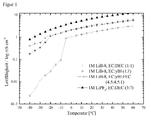
- FIG. 1 shows the course of the conductivity of the 1 M solutions of lithium 1-trifluoromethoxy-1,2,2,2-tetrafluoroethanesulfonate (LiB-8) in the various solvent mixtures in the temperature range from -40 ° C to + 60 ° C and the from LiPF 6 . How to get the FIG.
- ethylene carbonate and gamma-butyrolactone (EC: ⁇ BL, 1: 1) and ethylene carbonate, gamma-butyrolactone and fluoroethylene carbonate (EC: ⁇ BL: FEC) in the temperature range from - 40 ° C to + 0 ° C was significantly higher than the conductivity in ethylene carbonate and diethyl carbonate (EC: DEC, 1: 1) and nearly reached the conductivity of LiPF 6 in ethylene carbonate and diethyl carbonate (EC: DEC, 3: 7) over the entire temperature range.
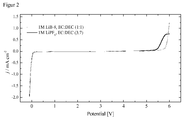
- the cathodic stability limit the potential at which reduction begins, the potential at which the current density was - 0.1 mA cm -2 was defined .
- the potential at which oxidation begins the potential at which the current density exceeded + 0.1 mA cm -2 was defined .
- the anodic stability depends crucially on the stability of the electrolyte used.
- the experiments were carried out in a 3-electrode arrangement in modified Swagelok® T-pieces (tube connectors, stainless steel body) with a platinum electrode (eDAQ, model ET075, 1 mm diameter) as a working electrode and lithium foil (12 mm or 7 mm diameter, Chemetall) as Counter and reference electrode performed.
- a platinum electrode eDAQ, model ET075, 1 mm diameter
- lithium foil (12 mm or 7 mm diameter, Chemetall
- the cell body was lined with a one-side siliconized polyester film (Mylar®, PPI-SP 914, 100 ⁇ m) and the electrodes were introduced into the cell body.
- the electrodes were separated with a nonwoven (Freudenberg®, FS2226E, 6 layers), which was impregnated with the appropriate electrolyte.
- the feed rate was 1 mV s -1 .
- lithium 1-trifluoromethoxy-1,2,2,2-tetrafluoroethanesulfonate (LiB-8) in a 1: 1 mixture of ethylene carbonate and diethyl carbonate reached the cathodic stability limit at 0.03V .
- the anodic stability of lithium 1-trifluoromethoxy-1,2,2,2-tetrafluoroethanesulfonate was 5.7 V and is complete sufficient for use of the electrolyte in combination with high-voltage cathode materials.
- the cyclization behavior of a 1 M solution of lithium 1-trifluoromethoxy-1,2,2,2-tetrafluoroethanesulfonate prepared according to Example 1 was measured in a mixture of 50% by weight of ethylene carbonate and 50% by weight of diethyl carbonate (EC: DEC, 1: 1) against the cyclization of a 1 M solution of LiPF 6 in a mixture of 30% by weight of ethylene carbonate and 70% by weight of diethyl carbonate (EC: DEC, 3: 7).
- the Zyklisier test included several phases.
- the formation of the graphite SEI formation
- C / 5 a constant current C rate of C / 5.
- Cyclic behavior checked at a charge and discharge rate of 1C.
- the cell system was kept at a voltage of 0.025 V for one hour after charging.
- the graphite was always charged at C / 2 and then held at 0.025V for one hour before the graphite was discharged at different rates.
- the applied D rates (Discharge rates) were D / 5, D / 3; D / 2, 1D, 2D, 3D, 5D and 10D.
- the D-rate test was followed by five cycles of C / 5 charge and discharge rates to verify that the graphite had been damaged by the stress test.
- the last phase included the same cycling parameters as phase 2 and was performed for 30 cycles.
- the discharge capacity of the 1 M solutions of lithium 1-trifluoromethoxy-1,2,2,2-tetrafluoroethanesulfonate and LiPF 6 are plotted against the number of cycles of the lithium ion battery half cell charged at a C rate of 1C.
- the half-cell with 1 M lithium 1-trifluoromethoxy-1,2,2,2-tetrafluoroethanesulfonate after forming the cell has an initial capacity of about 373 mAh g -1 , the number of cycles to approx 374 mAh g -1 in the 15th cycle increased. This demonstrates the excellent cycle stability of the cell, which corresponds to that of LiPF 6 .
- Example 4 The Zyklisier on NCM cathodes in a half-cell was performed as shown in Example 4 in a 3-electrode arrangement, wherein a nickel-cobalt-manganese oxide electrode (NCM electrode, Toda Kogyo Europe GmbH) as a working electrode and lithium foil (12 mm or 5 mm diameter, Chemetall) was used as a counter and reference electrode.
- NCM electrode nickel-cobalt-manganese oxide electrode
- Chemetall a 1 M solution of lithium 1-trifluoromethoxy-1,2,2,2-tetrafluoro-ethanesulfonate prepared according to Example 1 in a Mixture of 50 wt .-% of ethylene carbonate and 50 wt .-% diethyl carbonate (EC: DEC, 1: 1) used.
- the FIG. 4 shows the discharge capacity or lithium storage capacity and the efficiency of the lithium-ion half-cell.
- the load capacity and the efficiency against the number of cycles are plotted.
- lithium 1-trifluoromethoxy-1,2,2,2-tetrafluoroethanesulfonate showed an initial capacity of about 138 mAh g -1 after successfully passing the cell flow rate stress test (C-rate test) ( I).
- C-rate test C-rate test
- II cell flow rate stress test
- the capacity in the 80th cycle was still around 137 mAh g -1 .
- the efficiency of the cell after 2 standard cycles increased to over 99.6% of a maximum efficiency of 100%.
- the cell also showed excellent cycle stability with NCM cathode.
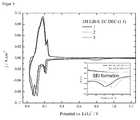
- FIG. 5 shows the results of cyclic voltammetry for three cycles (1), (2) and (3).
- the intercalation and deintercalation phases identifiable by the increased current density can be seen in the respective cycles in the range between 0 and 0.3V. This proves the reversibility of the system.
- the enlarged section of the range 0.5V to 1V shows the formation of the solid electrolyte interphase (SEI) of the lithium 1-trifluoromethoxy-1,2,2,2-tetrafluoroethanesulfonate carbonate electrolyte.
- SEI solid electrolyte interphase
- LiPF 6 Sigma-Aldrich, battery grade
- the electrolytes were stored in a climate chamber for two weeks at 95 ° C and then examined by means of gas chromatography mass spectrometry (Clarus 600 GC Perkin Elmer).
- FIG. 6 shows the decomposition products of the thermal aging at 95 ° C of a 1 M solution of lithium 1-trifluoromethoxy-1,2,2,2-tetrafluoroethanesulfonate (LiB-8) in ethylene carbonate and diethyl carbonate (EC: DEC) in the ratio 1: 1 compared to 1 M LiPF 6 in EC: DEC im Ratio 3: 7.
- LiB-8 lithium 1-trifluoromethoxy-1,2,2,2-tetrafluoroethanesulfonate
- EC ethylene carbonate and diethyl carbonate
- lithium 1-trifluoromethoxy-1,2,2,2-tetrafluoroethanesulfonate offers a possibility to replace LiPF 6 as the conducting salt in lithium-ion batteries.
Landscapes
- Chemical & Material Sciences (AREA)
- Engineering & Computer Science (AREA)
- Organic Chemistry (AREA)
- Electrochemistry (AREA)
- Chemical Kinetics & Catalysis (AREA)
- Manufacturing & Machinery (AREA)
- General Chemical & Material Sciences (AREA)
- Inorganic Chemistry (AREA)
- General Physics & Mathematics (AREA)
- Physics & Mathematics (AREA)
- Condensed Matter Physics & Semiconductors (AREA)
- Materials Engineering (AREA)
- Power Engineering (AREA)
- Microelectronics & Electronic Packaging (AREA)
- Dispersion Chemistry (AREA)
- Secondary Cells (AREA)
Claims (10)
Applications Claiming Priority (2)
| Application Number | Priority Date | Filing Date | Title |
|---|---|---|---|
| DE102012101670A DE102012101670A1 (de) | 2012-02-29 | 2012-02-29 | Leitsalz für Lithium-basierte Energiespeicher |
| PCT/EP2013/053949 WO2013127866A1 (fr) | 2012-02-29 | 2013-02-27 | Sel conducteur pour accumulateurs d'énergie au lithium |
Publications (2)
| Publication Number | Publication Date |
|---|---|
| EP2819951A1 EP2819951A1 (fr) | 2015-01-07 |
| EP2819951B1 true EP2819951B1 (fr) | 2016-08-03 |
Family
ID=47749878
Family Applications (1)
| Application Number | Title | Priority Date | Filing Date |
|---|---|---|---|
| EP13706047.1A Active EP2819951B1 (fr) | 2012-02-29 | 2013-02-27 | Sel conducteur pour dispositif de stockage d'énergie à base de lithium |
Country Status (4)
| Country | Link |
|---|---|
| US (1) | US9843074B2 (fr) |
| EP (1) | EP2819951B1 (fr) |
| DE (1) | DE102012101670A1 (fr) |
| WO (1) | WO2013127866A1 (fr) |
Families Citing this family (13)
| Publication number | Priority date | Publication date | Assignee | Title |
|---|---|---|---|---|
| EP3187487B1 (fr) * | 2014-08-29 | 2020-04-22 | National Institute of Advanced Industrial Science and Technology | Liquide ionique et cristal plastique |
| JP6018146B2 (ja) * | 2014-09-19 | 2016-11-02 | トヨタ自動車株式会社 | フッ化物イオン電池用電解液およびフッ化物イオン電池 |
| DE102014222372A1 (de) | 2014-11-03 | 2016-05-04 | Bayerische Motoren Werke Aktiengesellschaft | Elektrolyt für Lithium-basierte Energiespeicher |
| EP3353844B1 (fr) | 2015-03-27 | 2022-05-11 | Mason K. Harrup | Solvants entièrement inorganiques pour électrolytes |
| CA3019132A1 (fr) | 2016-04-01 | 2017-10-05 | NOHMs Technologies, Inc. | Liquides ioniques modifies contenant du phosphore |
| US10707531B1 (en) | 2016-09-27 | 2020-07-07 | New Dominion Enterprises Inc. | All-inorganic solvents for electrolytes |
| JP7442911B2 (ja) * | 2017-06-01 | 2024-03-05 | エルジー エナジー ソリューション リミテッド | 電解質組成物、二次電池、及び電解質シートの製造方法 |
| WO2019018432A1 (fr) | 2017-07-17 | 2019-01-24 | NOHMs Technologies, Inc. | Électrolytes contenant du phosphore |
| FR3073982B1 (fr) * | 2017-11-20 | 2019-12-13 | Blue Solutions | Utilisation d'un melange de sels a titre d'additif dans une batterie au lithium gelifiee |
| DE102018116475B4 (de) * | 2018-07-06 | 2020-11-05 | Forschungszentrum Jülich GmbH | Elektrolyt umfassend wenigstens ein Lithiumsalz sowie Lithium-Sekundärbatterie |
| CN110935286B (zh) * | 2020-01-16 | 2022-03-01 | 浙江工业大学 | 一种利用离子液体复合生物基溶剂吸收残留熏蒸剂硫酰氟的方法 |
| US20220255133A1 (en) * | 2021-02-03 | 2022-08-11 | Kabushiki Kaisha Toshiba | Nonaqueous electrolyte, secondary battery, battery pack, vehicle, and stationary power supply |
| CN119253072B (zh) * | 2024-10-11 | 2025-10-03 | 江西智科新能源科技有限公司 | 一种锂离子电池电解液及锂离子电池 |
Family Cites Families (7)
| Publication number | Priority date | Publication date | Assignee | Title |
|---|---|---|---|---|
| IT1246357B (it) * | 1990-07-12 | 1994-11-17 | Ausimont Spa | Processo per la preparazione di composti perfluoroalcossisolfonici |
| DE19619233A1 (de) * | 1996-05-13 | 1997-11-20 | Hoechst Ag | Fluorhaltige Lösungsmittel für Lithiumbatterien mit erhöhter Sicherheit |
| DE19829030C1 (de) | 1998-06-30 | 1999-10-07 | Metallgesellschaft Ag | Lithium-bisoxalatoborat, Verfahren zu dessen Herstellung und dessen Verwendung |
| JP4085481B2 (ja) * | 1998-08-31 | 2008-05-14 | ソニー株式会社 | 電池 |
| KR20030029053A (ko) * | 2001-04-05 | 2003-04-11 | 아치 스페셜티 케미칼즈, 인코포레이티드 | 포토레지스트용 퍼플루오로알킬설폰산 화합물 |
| US7834209B2 (en) | 2005-06-07 | 2010-11-16 | E.I. Du Pont De Nemours And Company | Hydrofluoroalkanesulfonic acids from fluorovinyl ethers |
| US7544813B2 (en) * | 2005-09-22 | 2009-06-09 | E.I. Du Pont De Nemours And Company | Ionic liquids |
-
2012
- 2012-02-29 DE DE102012101670A patent/DE102012101670A1/de not_active Withdrawn
-
2013
- 2013-02-27 EP EP13706047.1A patent/EP2819951B1/fr active Active
- 2013-02-27 US US14/379,524 patent/US9843074B2/en not_active Expired - Fee Related
- 2013-02-27 WO PCT/EP2013/053949 patent/WO2013127866A1/fr not_active Ceased
Also Published As
| Publication number | Publication date |
|---|---|
| US9843074B2 (en) | 2017-12-12 |
| US20150044573A1 (en) | 2015-02-12 |
| WO2013127866A1 (fr) | 2013-09-06 |
| EP2819951A1 (fr) | 2015-01-07 |
| DE102012101670A1 (de) | 2013-08-29 |
Similar Documents
| Publication | Publication Date | Title |
|---|---|---|
| EP2819951B1 (fr) | Sel conducteur pour dispositif de stockage d'énergie à base de lithium | |
| EP2737568B1 (fr) | Lithium-2-méthoxy-1,1,2,2-tétrafluoro-éthanesulfonate et son utilisation comme sel conducteur dans des accumulateurs d'énergie à base de lithium | |
| EP2274291B1 (fr) | Liquides ioniques réactifs | |
| EP2820711B1 (fr) | Sel conducteur pour dispositif de stockage d'énergie à base de lithium | |
| EP3583653B1 (fr) | Additif électrolytique pour batteries lithium-ion | |
| DE102005029124A1 (de) | Filmbildner freies Elektrolyt-Separator-System sowie dessen Verwendung in elektrochemischen Energiespeichern | |
| EP2740178B1 (fr) | Électrolyte pour accumulateurs d'énergie au lithium | |
| WO2016071205A1 (fr) | Électrolyte pour accumulateurs d'énergie au lithium | |
| EP1236732A1 (fr) | Sels de Phosphates de fluoroalkyl ET PREPARATION DE CEUX-CI | |
| DE102014108012B4 (de) | Substituierte Pyrazole und deren Verwendung als Leitsalz für Lithium-basierte Energiespeicher | |
| WO2013135824A2 (fr) | Composé polymère à conductibilité ionique pour des cellules électrochimiques | |
| EP3639317A1 (fr) | Électrolyte pour batteries lithium-ion | |
| DE102011055028A1 (de) | Elektrolyt-Zusatz für Lithium-basierte Energiespeicher | |
| DE102017107257A1 (de) | Elektrolyt-Zusatz für Lithium-Ionen-Batterien | |
| EP3560023B1 (fr) | Électrolyte pour batteries lithium-ion | |
| EP2975684B1 (fr) | Systeme d'électrolyte pour l'utilisation dans des composants électrochimiques | |
| DE102018105613A1 (de) | Elektrolyt-Zusatz für Lithium-Ionen-Batterien | |
| DE102018114146A1 (de) | Hybrider Elektrolyt für wässrige Lithium-Ionen-Batterien | |
| DE102017103334A1 (de) | Elektrolyt-Zusatz für Lithium-Ionen-Batterien | |
| DE102012104567A1 (de) | Lösungsmittel für Elektrolyte für Lithium-basierte Energiespeicher | |
| WO2017153349A1 (fr) | Utilisation de complexes métalliques à base de trialkylsiloxy en tant qu'additif dans des batteries au lithium-ion | |
| DE102016125323A1 (de) | Elektrolyt für Lithium-Ionen-Batterien | |
| DE102017012022A1 (de) | AI(TFSI)3 als Additiv und Leitsalz für elektrochemische Doppelschichtkondensatoren und Hybridspeichersysteme | |
| DE102017107253A1 (de) | Elektrolyt für Lithium-Ionen-Batterien | |
| DE102015201077A1 (de) | Elektrolyt für Lithium-basierte Energiespeicher |
Legal Events
| Date | Code | Title | Description |
|---|---|---|---|
| PUAI | Public reference made under article 153(3) epc to a published international application that has entered the european phase |
Free format text: ORIGINAL CODE: 0009012 |
|
| 17P | Request for examination filed |
Effective date: 20140827 |
|
| AK | Designated contracting states |
Kind code of ref document: A1 Designated state(s): AL AT BE BG CH CY CZ DE DK EE ES FI FR GB GR HR HU IE IS IT LI LT LU LV MC MK MT NL NO PL PT RO RS SE SI SK SM TR |
|
| AX | Request for extension of the european patent |
Extension state: BA ME |
|
| RIN1 | Information on inventor provided before grant (corrected) |
Inventor name: KALINOVICH, NATALIYA Inventor name: SCHREINER, CHRISTIAN Inventor name: MUELLER, ROMEK ANSGAR Inventor name: SCHMITZ, RENE Inventor name: LEX-BALDUCCI, ALEXANDRA Inventor name: PASSERINI, STEFANO Inventor name: WINTER, MARTIN Inventor name: SCHMITZ, RAPHAEL WILHELM Inventor name: VLASOV, KATJA Inventor name: KUNZE, MIRIAM Inventor name: ROESCHENTHALER, GERD-VOLKER Inventor name: SCHEDLBAUER, TANJA |
|
| DAX | Request for extension of the european patent (deleted) | ||
| GRAP | Despatch of communication of intention to grant a patent |
Free format text: ORIGINAL CODE: EPIDOSNIGR1 |
|
| RIC1 | Information provided on ipc code assigned before grant |
Ipc: C01D 15/00 20060101AFI20150930BHEP Ipc: H01M 10/0568 20100101ALI20150930BHEP Ipc: H01M 10/052 20100101ALI20150930BHEP Ipc: C07C 309/10 20060101ALI20150930BHEP Ipc: H01G 11/60 20130101ALN20150930BHEP Ipc: H01G 11/06 20130101ALN20150930BHEP Ipc: H01G 11/62 20130101ALI20150930BHEP |
|
| INTG | Intention to grant announced |
Effective date: 20151028 |
|
| GRAS | Grant fee paid |
Free format text: ORIGINAL CODE: EPIDOSNIGR3 |
|
| GRAP | Despatch of communication of intention to grant a patent |
Free format text: ORIGINAL CODE: EPIDOSNIGR1 |
|
| RIC1 | Information provided on ipc code assigned before grant |
Ipc: H01M 10/052 20100101ALI20160225BHEP Ipc: H01M 10/0568 20100101ALI20160225BHEP Ipc: C01D 15/00 20060101AFI20160225BHEP Ipc: H01G 11/06 20130101ALN20160225BHEP Ipc: H01G 11/62 20130101ALI20160225BHEP Ipc: C07C 309/10 20060101ALI20160225BHEP Ipc: H01G 11/60 20130101ALN20160225BHEP |
|
| INTG | Intention to grant announced |
Effective date: 20160329 |
|
| GRAA | (expected) grant |
Free format text: ORIGINAL CODE: 0009210 |
|
| AK | Designated contracting states |
Kind code of ref document: B1 Designated state(s): AL AT BE BG CH CY CZ DE DK EE ES FI FR GB GR HR HU IE IS IT LI LT LU LV MC MK MT NL NO PL PT RO RS SE SI SK SM TR |
|
| REG | Reference to a national code |
Ref country code: GB Ref legal event code: FG4D Free format text: NOT ENGLISH |
|
| REG | Reference to a national code |
Ref country code: CH Ref legal event code: EP Ref country code: AT Ref legal event code: REF Ref document number: 817208 Country of ref document: AT Kind code of ref document: T Effective date: 20160815 |
|
| REG | Reference to a national code |
Ref country code: IE Ref legal event code: FG4D Free format text: LANGUAGE OF EP DOCUMENT: GERMAN |
|
| REG | Reference to a national code |
Ref country code: DE Ref legal event code: R096 Ref document number: 502013003929 Country of ref document: DE |
|
| REG | Reference to a national code |
Ref country code: NL Ref legal event code: MP Effective date: 20160803 |
|
| REG | Reference to a national code |
Ref country code: LT Ref legal event code: MG4D |
|
| PG25 | Lapsed in a contracting state [announced via postgrant information from national office to epo] |
Ref country code: NO Free format text: LAPSE BECAUSE OF FAILURE TO SUBMIT A TRANSLATION OF THE DESCRIPTION OR TO PAY THE FEE WITHIN THE PRESCRIBED TIME-LIMIT Effective date: 20161103 Ref country code: LT Free format text: LAPSE BECAUSE OF FAILURE TO SUBMIT A TRANSLATION OF THE DESCRIPTION OR TO PAY THE FEE WITHIN THE PRESCRIBED TIME-LIMIT Effective date: 20160803 Ref country code: NL Free format text: LAPSE BECAUSE OF FAILURE TO SUBMIT A TRANSLATION OF THE DESCRIPTION OR TO PAY THE FEE WITHIN THE PRESCRIBED TIME-LIMIT Effective date: 20160803 Ref country code: RS Free format text: LAPSE BECAUSE OF FAILURE TO SUBMIT A TRANSLATION OF THE DESCRIPTION OR TO PAY THE FEE WITHIN THE PRESCRIBED TIME-LIMIT Effective date: 20160803 Ref country code: FI Free format text: LAPSE BECAUSE OF FAILURE TO SUBMIT A TRANSLATION OF THE DESCRIPTION OR TO PAY THE FEE WITHIN THE PRESCRIBED TIME-LIMIT Effective date: 20160803 Ref country code: IS Free format text: LAPSE BECAUSE OF FAILURE TO SUBMIT A TRANSLATION OF THE DESCRIPTION OR TO PAY THE FEE WITHIN THE PRESCRIBED TIME-LIMIT Effective date: 20161203 Ref country code: IT Free format text: LAPSE BECAUSE OF FAILURE TO SUBMIT A TRANSLATION OF THE DESCRIPTION OR TO PAY THE FEE WITHIN THE PRESCRIBED TIME-LIMIT Effective date: 20160803 Ref country code: HR Free format text: LAPSE BECAUSE OF FAILURE TO SUBMIT A TRANSLATION OF THE DESCRIPTION OR TO PAY THE FEE WITHIN THE PRESCRIBED TIME-LIMIT Effective date: 20160803 |
|
| PG25 | Lapsed in a contracting state [announced via postgrant information from national office to epo] |
Ref country code: SE Free format text: LAPSE BECAUSE OF FAILURE TO SUBMIT A TRANSLATION OF THE DESCRIPTION OR TO PAY THE FEE WITHIN THE PRESCRIBED TIME-LIMIT Effective date: 20160803 Ref country code: PL Free format text: LAPSE BECAUSE OF FAILURE TO SUBMIT A TRANSLATION OF THE DESCRIPTION OR TO PAY THE FEE WITHIN THE PRESCRIBED TIME-LIMIT Effective date: 20160803 Ref country code: LV Free format text: LAPSE BECAUSE OF FAILURE TO SUBMIT A TRANSLATION OF THE DESCRIPTION OR TO PAY THE FEE WITHIN THE PRESCRIBED TIME-LIMIT Effective date: 20160803 Ref country code: ES Free format text: LAPSE BECAUSE OF FAILURE TO SUBMIT A TRANSLATION OF THE DESCRIPTION OR TO PAY THE FEE WITHIN THE PRESCRIBED TIME-LIMIT Effective date: 20160803 Ref country code: GR Free format text: LAPSE BECAUSE OF FAILURE TO SUBMIT A TRANSLATION OF THE DESCRIPTION OR TO PAY THE FEE WITHIN THE PRESCRIBED TIME-LIMIT Effective date: 20161104 Ref country code: PT Free format text: LAPSE BECAUSE OF FAILURE TO SUBMIT A TRANSLATION OF THE DESCRIPTION OR TO PAY THE FEE WITHIN THE PRESCRIBED TIME-LIMIT Effective date: 20161205 |
|
| PG25 | Lapsed in a contracting state [announced via postgrant information from national office to epo] |
Ref country code: RO Free format text: LAPSE BECAUSE OF FAILURE TO SUBMIT A TRANSLATION OF THE DESCRIPTION OR TO PAY THE FEE WITHIN THE PRESCRIBED TIME-LIMIT Effective date: 20160803 Ref country code: EE Free format text: LAPSE BECAUSE OF FAILURE TO SUBMIT A TRANSLATION OF THE DESCRIPTION OR TO PAY THE FEE WITHIN THE PRESCRIBED TIME-LIMIT Effective date: 20160803 |
|
| REG | Reference to a national code |
Ref country code: DE Ref legal event code: R097 Ref document number: 502013003929 Country of ref document: DE |
|
| PG25 | Lapsed in a contracting state [announced via postgrant information from national office to epo] |
Ref country code: CZ Free format text: LAPSE BECAUSE OF FAILURE TO SUBMIT A TRANSLATION OF THE DESCRIPTION OR TO PAY THE FEE WITHIN THE PRESCRIBED TIME-LIMIT Effective date: 20160803 Ref country code: BE Free format text: LAPSE BECAUSE OF NON-PAYMENT OF DUE FEES Effective date: 20170228 Ref country code: BG Free format text: LAPSE BECAUSE OF FAILURE TO SUBMIT A TRANSLATION OF THE DESCRIPTION OR TO PAY THE FEE WITHIN THE PRESCRIBED TIME-LIMIT Effective date: 20161103 Ref country code: DK Free format text: LAPSE BECAUSE OF FAILURE TO SUBMIT A TRANSLATION OF THE DESCRIPTION OR TO PAY THE FEE WITHIN THE PRESCRIBED TIME-LIMIT Effective date: 20160803 Ref country code: SK Free format text: LAPSE BECAUSE OF FAILURE TO SUBMIT A TRANSLATION OF THE DESCRIPTION OR TO PAY THE FEE WITHIN THE PRESCRIBED TIME-LIMIT Effective date: 20160803 Ref country code: SM Free format text: LAPSE BECAUSE OF FAILURE TO SUBMIT A TRANSLATION OF THE DESCRIPTION OR TO PAY THE FEE WITHIN THE PRESCRIBED TIME-LIMIT Effective date: 20160803 |
|
| PLBE | No opposition filed within time limit |
Free format text: ORIGINAL CODE: 0009261 |
|
| STAA | Information on the status of an ep patent application or granted ep patent |
Free format text: STATUS: NO OPPOSITION FILED WITHIN TIME LIMIT |
|
| 26N | No opposition filed |
Effective date: 20170504 |
|
| PG25 | Lapsed in a contracting state [announced via postgrant information from national office to epo] |
Ref country code: SI Free format text: LAPSE BECAUSE OF FAILURE TO SUBMIT A TRANSLATION OF THE DESCRIPTION OR TO PAY THE FEE WITHIN THE PRESCRIBED TIME-LIMIT Effective date: 20160803 |
|
| PG25 | Lapsed in a contracting state [announced via postgrant information from national office to epo] |
Ref country code: MC Free format text: LAPSE BECAUSE OF FAILURE TO SUBMIT A TRANSLATION OF THE DESCRIPTION OR TO PAY THE FEE WITHIN THE PRESCRIBED TIME-LIMIT Effective date: 20160803 |
|
| REG | Reference to a national code |
Ref country code: CH Ref legal event code: PL |
|
| GBPC | Gb: european patent ceased through non-payment of renewal fee |
Effective date: 20170227 |
|
| PG25 | Lapsed in a contracting state [announced via postgrant information from national office to epo] |
Ref country code: CH Free format text: LAPSE BECAUSE OF NON-PAYMENT OF DUE FEES Effective date: 20170228 Ref country code: LI Free format text: LAPSE BECAUSE OF NON-PAYMENT OF DUE FEES Effective date: 20170228 |
|
| REG | Reference to a national code |
Ref country code: IE Ref legal event code: MM4A |
|
| REG | Reference to a national code |
Ref country code: FR Ref legal event code: ST Effective date: 20171031 |
|
| PG25 | Lapsed in a contracting state [announced via postgrant information from national office to epo] |
Ref country code: LU Free format text: LAPSE BECAUSE OF NON-PAYMENT OF DUE FEES Effective date: 20170227 |
|
| PG25 | Lapsed in a contracting state [announced via postgrant information from national office to epo] |
Ref country code: FR Free format text: LAPSE BECAUSE OF NON-PAYMENT OF DUE FEES Effective date: 20170228 |
|
| REG | Reference to a national code |
Ref country code: BE Ref legal event code: MM Effective date: 20170228 |
|
| PG25 | Lapsed in a contracting state [announced via postgrant information from national office to epo] |
Ref country code: GB Free format text: LAPSE BECAUSE OF NON-PAYMENT OF DUE FEES Effective date: 20170227 Ref country code: IE Free format text: LAPSE BECAUSE OF NON-PAYMENT OF DUE FEES Effective date: 20170227 |
|
| PG25 | Lapsed in a contracting state [announced via postgrant information from national office to epo] |
Ref country code: MT Free format text: LAPSE BECAUSE OF FAILURE TO SUBMIT A TRANSLATION OF THE DESCRIPTION OR TO PAY THE FEE WITHIN THE PRESCRIBED TIME-LIMIT Effective date: 20160803 |
|
| PG25 | Lapsed in a contracting state [announced via postgrant information from national office to epo] |
Ref country code: AL Free format text: LAPSE BECAUSE OF FAILURE TO SUBMIT A TRANSLATION OF THE DESCRIPTION OR TO PAY THE FEE WITHIN THE PRESCRIBED TIME-LIMIT Effective date: 20160803 |
|
| REG | Reference to a national code |
Ref country code: AT Ref legal event code: MM01 Ref document number: 817208 Country of ref document: AT Kind code of ref document: T Effective date: 20180227 |
|
| PG25 | Lapsed in a contracting state [announced via postgrant information from national office to epo] |
Ref country code: AT Free format text: LAPSE BECAUSE OF NON-PAYMENT OF DUE FEES Effective date: 20180227 |
|
| PG25 | Lapsed in a contracting state [announced via postgrant information from national office to epo] |
Ref country code: HU Free format text: LAPSE BECAUSE OF FAILURE TO SUBMIT A TRANSLATION OF THE DESCRIPTION OR TO PAY THE FEE WITHIN THE PRESCRIBED TIME-LIMIT; INVALID AB INITIO Effective date: 20130227 |
|
| PG25 | Lapsed in a contracting state [announced via postgrant information from national office to epo] |
Ref country code: CY Free format text: LAPSE BECAUSE OF FAILURE TO SUBMIT A TRANSLATION OF THE DESCRIPTION OR TO PAY THE FEE WITHIN THE PRESCRIBED TIME-LIMIT Effective date: 20160803 |
|
| PG25 | Lapsed in a contracting state [announced via postgrant information from national office to epo] |
Ref country code: MK Free format text: LAPSE BECAUSE OF FAILURE TO SUBMIT A TRANSLATION OF THE DESCRIPTION OR TO PAY THE FEE WITHIN THE PRESCRIBED TIME-LIMIT Effective date: 20160803 |
|
| PG25 | Lapsed in a contracting state [announced via postgrant information from national office to epo] |
Ref country code: TR Free format text: LAPSE BECAUSE OF FAILURE TO SUBMIT A TRANSLATION OF THE DESCRIPTION OR TO PAY THE FEE WITHIN THE PRESCRIBED TIME-LIMIT Effective date: 20160803 |
|
| REG | Reference to a national code |
Ref country code: DE Ref legal event code: R082 Ref document number: 502013003929 Country of ref document: DE Representative=s name: WEIDNER STERN JESCHKE PATENTANWAELTE PARTNERSC, DE |
|
| REG | Reference to a national code |
Ref country code: DE Ref legal event code: R081 Ref document number: 502013003929 Country of ref document: DE Owner name: CONSTRUCTOR UNIVERSITY BREMEN GGMBH, DE Free format text: FORMER OWNERS: JACOBS UNIVERSITY BREMEN GGMBH, 28759 BREMEN, DE; WESTFAELISCHE WILHELMS-UNIVERSITAET MUENSTER, 48149 MUENSTER, DE Ref country code: DE Ref legal event code: R081 Ref document number: 502013003929 Country of ref document: DE Owner name: JACOBS UNIVERSITY BREMEN GGMBH, DE Free format text: FORMER OWNERS: JACOBS UNIVERSITY BREMEN GGMBH, 28759 BREMEN, DE; WESTFAELISCHE WILHELMS-UNIVERSITAET MUENSTER, 48149 MUENSTER, DE |
|
| REG | Reference to a national code |
Ref country code: DE Ref legal event code: R081 Ref document number: 502013003929 Country of ref document: DE Owner name: CONSTRUCTOR UNIVERSITY BREMEN GGMBH, DE Free format text: FORMER OWNER: JACOBS UNIVERSITY BREMEN GGMBH, 28759 BREMEN, DE |
|
| P01 | Opt-out of the competence of the unified patent court (upc) registered |
Effective date: 20230601 |
|
| PGFP | Annual fee paid to national office [announced via postgrant information from national office to epo] |
Ref country code: DE Payment date: 20251124 Year of fee payment: 14 |