EP2820093B1 - Encres contenant des nanoparticules précurseurs métalliques - Google Patents
Encres contenant des nanoparticules précurseurs métalliques Download PDFInfo
- Publication number
- EP2820093B1 EP2820093B1 EP13711975.6A EP13711975A EP2820093B1 EP 2820093 B1 EP2820093 B1 EP 2820093B1 EP 13711975 A EP13711975 A EP 13711975A EP 2820093 B1 EP2820093 B1 EP 2820093B1
- Authority
- EP
- European Patent Office
- Prior art keywords
- metal
- copper
- nickel
- formulation
- printing
- Prior art date
- Legal status (The legal status is an assumption and is not a legal conclusion. Google has not performed a legal analysis and makes no representation as to the accuracy of the status listed.)
- Active
Links
Images
Classifications
-
- C—CHEMISTRY; METALLURGY
- C09—DYES; PAINTS; POLISHES; NATURAL RESINS; ADHESIVES; COMPOSITIONS NOT OTHERWISE PROVIDED FOR; APPLICATIONS OF MATERIALS NOT OTHERWISE PROVIDED FOR
- C09D—COATING COMPOSITIONS, e.g. PAINTS, VARNISHES OR LACQUERS; FILLING PASTES; CHEMICAL PAINT OR INK REMOVERS; INKS; CORRECTING FLUIDS; WOODSTAINS; PASTES OR SOLIDS FOR COLOURING OR PRINTING; USE OF MATERIALS THEREFOR
- C09D11/00—Inks
- C09D11/52—Electrically conductive inks
-
- C—CHEMISTRY; METALLURGY
- C08—ORGANIC MACROMOLECULAR COMPOUNDS; THEIR PREPARATION OR CHEMICAL WORKING-UP; COMPOSITIONS BASED THEREON
- C08K—Use of inorganic or non-macromolecular organic substances as compounding ingredients
- C08K5/00—Use of organic ingredients
- C08K5/04—Oxygen-containing compounds
- C08K5/09—Carboxylic acids; Metal salts thereof; Anhydrides thereof
- C08K5/098—Metal salts of carboxylic acids
-
- H—ELECTRICITY
- H01—ELECTRIC ELEMENTS
- H01B—CABLES; CONDUCTORS; INSULATORS; SELECTION OF MATERIALS FOR THEIR CONDUCTIVE, INSULATING OR DIELECTRIC PROPERTIES
- H01B1/00—Conductors or conductive bodies characterised by the conductive materials; Selection of materials as conductors
- H01B1/20—Conductive material dispersed in non-conductive organic material
- H01B1/22—Conductive material dispersed in non-conductive organic material the conductive material comprising metals or alloys
-
- H—ELECTRICITY
- H01—ELECTRIC ELEMENTS
- H01B—CABLES; CONDUCTORS; INSULATORS; SELECTION OF MATERIALS FOR THEIR CONDUCTIVE, INSULATING OR DIELECTRIC PROPERTIES
- H01B13/00—Apparatus or processes specially adapted for manufacturing conductors or cables
- H01B13/0016—Apparatus or processes specially adapted for manufacturing conductors or cables for heat treatment
-
- H—ELECTRICITY
- H01—ELECTRIC ELEMENTS
- H01B—CABLES; CONDUCTORS; INSULATORS; SELECTION OF MATERIALS FOR THEIR CONDUCTIVE, INSULATING OR DIELECTRIC PROPERTIES
- H01B13/00—Apparatus or processes specially adapted for manufacturing conductors or cables
- H01B13/0026—Apparatus for manufacturing conducting or semi-conducting layers, e.g. deposition of metal
-
- H—ELECTRICITY
- H01—ELECTRIC ELEMENTS
- H01B—CABLES; CONDUCTORS; INSULATORS; SELECTION OF MATERIALS FOR THEIR CONDUCTIVE, INSULATING OR DIELECTRIC PROPERTIES
- H01B13/00—Apparatus or processes specially adapted for manufacturing conductors or cables
- H01B13/003—Apparatus or processes specially adapted for manufacturing conductors or cables using irradiation
-
- H—ELECTRICITY
- H05—ELECTRIC TECHNIQUES NOT OTHERWISE PROVIDED FOR
- H05K—PRINTED CIRCUITS; CASINGS OR CONSTRUCTIONAL DETAILS OF ELECTRIC APPARATUS; MANUFACTURE OF ASSEMBLAGES OF ELECTRICAL COMPONENTS
- H05K1/00—Printed circuits
- H05K1/02—Details
- H05K1/09—Use of materials for the conductive, e.g. metallic pattern
- H05K1/092—Dispersed materials, e.g. conductive pastes or inks
- H05K1/097—Inks comprising nanoparticles and specially adapted for being sintered at low temperature
-
- H—ELECTRICITY
- H05—ELECTRIC TECHNIQUES NOT OTHERWISE PROVIDED FOR
- H05K—PRINTED CIRCUITS; CASINGS OR CONSTRUCTIONAL DETAILS OF ELECTRIC APPARATUS; MANUFACTURE OF ASSEMBLAGES OF ELECTRICAL COMPONENTS
- H05K2203/00—Indexing scheme relating to apparatus or processes for manufacturing printed circuits covered by H05K3/00
- H05K2203/11—Treatments characterised by their effect, e.g. heating, cooling, roughening
- H05K2203/1131—Sintering, i.e. fusing of metal particles to achieve or improve electrical conductivity
-
- Y—GENERAL TAGGING OF NEW TECHNOLOGICAL DEVELOPMENTS; GENERAL TAGGING OF CROSS-SECTIONAL TECHNOLOGIES SPANNING OVER SEVERAL SECTIONS OF THE IPC; TECHNICAL SUBJECTS COVERED BY FORMER USPC CROSS-REFERENCE ART COLLECTIONS [XRACs] AND DIGESTS
- Y10—TECHNICAL SUBJECTS COVERED BY FORMER USPC
- Y10T—TECHNICAL SUBJECTS COVERED BY FORMER US CLASSIFICATION
- Y10T428/00—Stock material or miscellaneous articles
- Y10T428/24—Structurally defined web or sheet [e.g., overall dimension, etc.]
- Y10T428/24802—Discontinuous or differential coating, impregnation or bond [e.g., artwork, printing, retouched photograph, etc.]
- Y10T428/24893—Discontinuous or differential coating, impregnation or bond [e.g., artwork, printing, retouched photograph, etc.] including particulate material
- Y10T428/24909—Free metal or mineral containing
Definitions
- the present invention relates to a printing formulation and a process for forming a conductive pattern on a surface region of a substrate.
- Copper NPs can be mainly used in ink formulations for printing conductive patterns. Copper NPs based inks suffer from two main disadvantages: poor resistance to oxidation and high sintering temperatures. Therefore, sintering of copper NPs is typically carried out under special conditions and atmospheres, such as N 2 , H 2 , carboxylic acid vapors and others, and heating to high temperatures which prevent the use of low cost plastic substrates which are temperature sensitive. To date, copper NPs based inks have been sintered at temperatures above 150°C.
- Kim et al. [ 5 ] reported on a copper-complex ink, formed by mixing copper formate and hexylamine while the hexylamine served both as a complexing agent and as a solvent. The obtained layer was sintered under nitrogen flow with formic acid vapors. Choi et al. [ 6 ] have further developed a composition for use as a screen-printing paste which can be sintered under similar conditions (nitrogen followed by a reducing atmosphere).
- Yabuki et al. [ 8 ] reported on a solvent ink composed of complexes of copper formate tetrahydrate and n-octyl amine dissolved in toluene.
- the copper electrodes were formed by calcining the printed inks thermally on glass substrates at a temperature range of between 110 and 140°C under nitrogen atmosphere.
- Printed electronics have become a major technology in the electronic industry, as it provides the ability to precisely write electronic components and circuits, at low cost and ease of production.
- metal-based ink formulations are prone to oxidation and are therefore relatively unstable.
- Another objective of the invention is to provide a process for producing, on a variety of substrates, particularly on heat sensitive substrates, conductive patterns utilizing metal precursors.
- a further objective is to provide a conductive pattern on heat sensitive substrates.
- a printing formulation i.e., ink formulation
- at least one metal precursor selected from:
- the medium of metal precursor ( 1 ) may or may not be identical to the medium of metal precursor ( 2 ).
- the medium of either option is a medium suitable for ink formulations, namely a printing suitable liquid carrier.
- the metal precursor is a chemical material which comprises the metal atom in a charged form and which upon treatment gives rise to the metallic form of the same metal.
- the metal precursor may be in the form of a metal salt or a metal complex, in either case the metal atom is in a non-zero oxidation state and is transferable to the zero-oxidation state by further treatment.
- a copper metal precursor may be copper formate, which upon decomposition under the process of the invention affords the metal copper (Co 0 ).
- the metal precursor is a metal cyanate, metal carbonate, metal nitrate, metal sulfate, metal phosphate, metal thiocyanate, metal chlorate, metal perchlorate, metal acetylacetonate, metal carboxylate and metal tetrafluoroborate, as further exemplified hereinbelow.
- the printing formulation (ink) of the present invention comprises, as the sole metal precursor, metal salt nanoparticles dispersed in a medium, wherein said metal salt comprises an organic anion.
- a printing formulation which comprises a printing suitable medium and a combination of:
- the printing formulation comprises as the sole metal precursor metal salt nanoparticles.
- the " metal salt” refers to the cation form of the metallic element which patterning on the surface of a substrate is intended in accordance with the invention.
- a copper salt refers to a copper cation associated with one or more organic and/or inorganic anions.
- the metal salt is typically in the form of nanoparticles, namely in the form of a particulate material having at least one dimension at the nano-scale, namely the mean particle size is less than 1,000 nm.
- the mean particle size is between 10 nm and 1,000 nm. In other embodiments, the mean particle size is between 50 nm and 1,000 nm.
- the mean particle size is less than 500 nm. In other embodiments, the mean particle size is between 50 nm and 500 nm.
- the mean particle size is less than 100 nm. In other embodiments, the mean particle size is between 10 nm and 100 nm.
- the mean particle size is less than 50 nm. In other embodiments, the mean particle size is between 10 nm and 50 nm.
- the metal salt nanoparticles may have any shape or contour, including spherical and non-spherical shapes (e.g., polyhedral or elongated shape). In some embodiments, the nanoparticles have random shapes, or are substantially spherical. In additional embodiments, the nanoparticles may be amorphous or crystalline.
- the nanoparticulate metal salt is typically obtained by milling the metal salt material to particulates of a desired size. In some embodiments, milling is achieved by bead milling.
- bead milling is performed by milling a mixture of the metal salt, a stabilizer and a solvent at the presence of beads.
- the obtained particles may be at the micron range or at the submicron range.
- the obtained particle size depends strongly on the milling parameters (bead size, duration, rpm and other parameters), the solid loading, the stabilizer and the solvent.
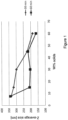
- Fig. 1 depicts the effect of the solid loading (copper formate) on the obtained particle size at a constant stabilizer to solid ratio.
- the metal salt particles may be formed by spray drying a solution (see for example Pharmaceutical Research, 2007, 25(5), 999-1022 ).
- Precipitation may also be used to produce the metal salt particles, as defined.
- a proper precipitation agent is added to a solution of the precursor material which is allowed to precipitate out.
- copper formate may be precipitated by addition of formic acid to a copper carbonate solution or dispersion.
- the copper formate particles precipitate due to their insolubility in the medium.
- the precipitation process may be performed in the presence of a stabilizer, to control the nucleation and growth of the copper formate particles and to obtain dispersed particles.
- the process can be carried out by mixing copper carbonate (or copper acetate) in a proper solvent and thereafter adding formic acid to form copper formate particles, while CO 2 (or acetic acid) is released.
- the same precipitation process can take place by contacting double jets containing the soluble or insoluble copper salt and formic acid.
- Precipitation can also take place by dissolving the copper formate or complexes thereof in a solvent, followed by adding a solvent which does not dissolve copper format.
- the metal salt is of a metallic element of Groups IIIB, IVB, VB, VIB, VIIB, VIIIB, IB, IIB, IIIA, IVA and VA of block d of the Periodic Table of the Elements.
- the metal is a transition metal of Groups IIIB, IVB, VB, VIB, VIIB, VIIIB, IB and IIB of block d the Periodic Table.
- the transition metal is a metallic element selected from Sc, Ti, V, Cr, Mn, Fe, Ni, Cu, Zn, Y, Zr, Nb, Tc, Ru, Mo, Rh, W, Au, Pt, Pd, Ag, Mn, Co, Cd, Hf, Ta, Re, Os and Ir.
- the metal is selected from Cu, Ni, Ag, Au, Pt, Pd, Al, Fe, Co, Ti, Zn, In, Sn and Ga.
- the metal is selected from Cu, Ni and Ag.
- the metal is Cu.
- the inorganic or organic anion may be any negatively charged atom or groups of atoms (e.g., in the form of ligands), which may be singly charged or multi-charged (with a charge of -2 or higher).
- Non-limiting examples of inorganic anions include HO - , F - , Cl - , Br - , I - , NO 2 - , NO 3 - , ClO 4 - , SO 4 -2 , SO 3 - , PO 4 - and CO 3 -2 .
- the metal salt comprises an organic anion.
- Non-limiting examples of organic anions include acetate (CH 3 COO - ), formate (HCOO - ), citrate (C 3 H 5 O(COO) 3 -3 ), acetylacetonate, lactate (CH 3 CH(OH)COO - ), oxalate ((COO) 2 -2 ) and any derivative of the aforementioned.
- the metal salt is not a metal oxide.
- salts are given in the following. It is, however to be understood that the metal salt in the printing formulation of the present invention comprises an organic anion.
- the metal salt is a salt of copper.
- copper metal salts include copper formate, copper citrate, copper acetate, copper nitrate, copper acetylacetonate, copper perchlorate, copper chloride, copper sulfate, copper carbonate, copper hydroxide, copper sulfide or any other copper salt and the mixtures thereof.
- the metal salt is a salt of nickel.
- nickel metal salts include nickel formate, nickel citrate, nickel acetate, nickel nitrate, nickel acetylacetonate, nickel perchlorate, nickel chloride, nickel sulfate, nickel carbonate, nickel hydroxide or any other nickel salts and the mixtures thereof.
- the metal salt is a salt of silver.
- silver metal salts include silver oxalate, silver lactate, silver formate or any other silver salt and their mixtures.
- Other metal salt are selected from indium(III) acetate, indium(III) chloride, indium(III) nitrate; iron(II) chloride, iron(III) chloride, iron(II) acetate,; gallium(III) acetylacetonate, gallium(II) chloride, gallium(III) chloride, gallium(III) nitrate; aluminum(III) chloride, aluminum(III) stearate; silver nitrate, silver chloride; dimethlyzinc, diethylzinc, zinc chloride, tin(II) chloride, tin(IV) chloride, tin(II) acetylacetonate, tin(II) acetate; lead(II) acetate, lead(II) acet
- the nanoparticulate metal salt material is formulated as a dispersion printing or ink formulation, in a liquid medium in which the material is substantially insoluble.
- the medium may be an aqueous or non-aqueous (organic) liquid medium.
- the medium is water or a water-containing liquid mixture.
- the medium is a water-containing liquid mixture, also containing an organic solvent.
- the medium may be an organic solvent or a medium containing an organic solvent.
- the organic solvent is selected from alcohols, glycols, glycol ethers, acetates, ethers, ketones, amides and hydrocarbons.
- the medium is selected from dipropyleneglycol methyl ether (DPM), 2-methoxyethyl ether (diglyme), triethyleneglycol dimethyl ether (triglyme), propylene glycol, sulfolane, polyethylene glycol and glycerol.
- DPM dipropyleneglycol methyl ether
- diglyme 2-methoxyethyl ether
- triglyme triethyleneglycol dimethyl ether
- propylene glycol sulfolane
- polyethylene glycol and glycerol polyethylene glycol and glycerol
- the organic solvent is selected amongst glycol ethers.
- the glycol ether is selected from Dowanol TM DB, Dowanol TM PM glycol ether, Dowanol TM DPM, Dowanol TM DPM glycol ether, Dowanol TM DPMA glycol ether, Dowanol TM TPM glycol ether, Dowanol TM TPM-H GE, Dowanol TM PMA, Dowanol TM DPMA, Dowanol TM PnP glycol ether, Dowanol TM DPnP glycol ether, Dowanol TM PnB glycol ether, Dowanol TM DPnB glycol ether, Dowanol TM TPnB glycol ether, Dowanol TM PPh glycol ether, Dowanol TM PGDA, Dowanol TM DMM, Dowanol TM EPh glycol ether, and any
- the solvent is an alcohol selected from methanol, ethanol, propanol, butanol and other alcohols.
- the solvent may be acetate such as ethyl acetate, ethylaceto acetate, and others.
- the solvent is selected from diethyl ether, acetone, ethyl acetate, ethanol, propanol, butanol, and any combination thereof.
- the metal salt particles may be stabilized by one or more stabilizers (dispersing agents, dispersants) to prevent aggregation and/or agglomeration of the particles and to enable a stable dispersion.
- stabilizers may be a surfactant and/or a polymer.
- the stabilizer may have ionic or non-ionic functional groups, or a block co-polymer containing both. It may also be a volatile stabilizer which evaporates during the decomposition of the metal salt; thus enabling higher conductivities after the decomposition and sintering of the pattern. That stabilizer may additionally be selected to have the ability of forming a complex with the metal.
- the stabilizing agent is the dispersion medium itself.
- the dispersing agent may be selected amongst polyelectrolytes or polymeric materials.
- Representative examples of such dispersants include without limitation polycarboxylic acid esters, unsaturated polyamides, polycarboxylic acids, polycarboxylate, alkyl amine salts of polycarboxylic acids, polyacrylate dispersants, polyethyleneimine dispersants, polyethylene oxide, and polyurethane dispersants and co-polymers of these polymers.
- the dispersant is selected without limitation from:
- the dispersant is a surfactant, which may or may not be ionic. In some embodiments, the surfactant is cationic or anionic. In further embodiments, said surfactant is non-ionic or zwitterionic.
- Non-limiting examples of such cationic surfactants include didodecyldimethylammonium bromide (DDAB), CTAB, CTAC, cetyl(hydroxyethyl)(dimethyl)ammonium bromide, N,N-dimethyl-N-cetyl-N-(2-hydroxyethyl)ammonium chloride, anionic surfactants such as sodium dodecyl sulfate (SDS) and various unsaturated long-chain carboxylates, zwitterionic phospholipids, such as 1,2-bis(10,12-tricosadiynoyl)-sn-glycero-3-phosphochline, water-soluble phosphine surfactants, such as sodium salts of sulfonated triphenylphosphine, P(m-C 6 H 4 SO 3 Na) 3 and alkyltriphenyl-methyltrisulfonate, RC(p-C 6 H 4 SO 3 Na) 3 , alkyl poly
- the stabilizing agent is a cationic polymer.
- the metal precursor is copper formate, the solvent being glycol ether and the stabilizer being a functionalized polymer.
- the stabilizing agent is a copolymer or salt of a copolymer having acidic groups.
- the printing formulation may further comprise an additive selected from humectants, binders, surfactants, fungicides, rheology modifiers, pH adjusting agents, wetting agents and mixtures thereof.
- a printing formulation i.e., ink formulation
- at least one metal precursor selected from:
- the printing formulation comprises (as the sole metal precursor) a metal precursor in the form of a metal complex, in a liquid medium in which the metal complex is soluble.
- the printing formulation of the present invention comprises metal salt nanoparticles as the sole metal precursor.
- the metal complex comprises the metal atom and one, two, three or more " complexing moieties " or chelating moieties.
- the number of complexing moieties may vary depending inter alia in the metal atom, its charge, the nature of the moiety and the stability of the metal complex.
- the moieties are organic moieties.
- the complexing moieties are amino acids.
- the complexing moieties are one or more of amine complexing group (e.g., -NH 2 , -NHR, -NRR, or an ammonium equivalent of any of the aforementioned, and others, wherein each R is independently an organic moiety) and an hydroxyl complexing group (-OH) which may or may not be an end or pendant group on an organic moiety.
- amine complexing group e.g., -NH 2 , -NHR, -NRR, or an ammonium equivalent of any of the aforementioned, and others, wherein each R is independently an organic moiety
- -OH hydroxyl complexing group
- the metal is copper and the copper complex is selected to easily decompose at a low temperature to enable sintering on a heat sensitive substrate such as a plastic substrate (around 150°C).
- the copper complex comprises amine and hydroxy complexing groups.
- the combination of these two complexing moieties enables the formation of copper complexes at a ratio of ⁇ 1, i.e., with much less organic content as compared to amine complexing moieties only, and at least 50% organic content less than the complexes cited in the aforementioned prior art.
- the complexing moieties having hydroxy amine moieties (namely: moieties having both the amine and the hydroxyl functionalities), are selected from ethanol amine, di-ethanol amine, triethanol amine, amino methyl propanol (AMP 95), 1-amino-2-propanol, 3-amino-1-propanol, di-isopropanolamine and other complexing agents containing the two functional complexing groups.
- the complexing moiety is amino methyl propanol (AMP).
- the ratio between the hydroxyl and the amine moieties is 1:1 as in AMP, 1:2 as in di-ethanol amine, 2:1 as in ethanol diamine, or any other ratio.
- the metal complex is of a metallic element of Groups IIIB, IVB, VB, VIB, VIIB, VIIIB, IB, IIB, IIIA, IVA and VA of block d of the Periodic Table of the Elements.
- the metal is a transition metal of Groups IIIB, IVB, VB, VIB, VIIB, VIIIB, IB and IIB of block d the Periodic Table.
- the transition metal is a metallic element selected from Sc, Ti, V, Cr, Mn, Fe, Ni, Cu, Zn, Y, Zr, Nb, Tc, Ru, Mo, Rh, W, Au, Pt, Pd, Ag, Mn, Co, Cd, Hf, Ta, Re, Os and Ir.
- the metal is selected from Cu, Ni, Ag, Au, Pt, Pd, Al, Fe, Co, Ti, Zn, In, Sn and Ga.
- the metal is Cu, Ni, Al, Co, Ag and Zn.
- the metal is selected from Cu, Ni and Ag.
- the metal is Cu.
- the metal in the metal complex is selected from Cu, Ni, Al, Co, Ag and Zn and the complexing moieties are selected from ethanol amine, di-ethanol amine, triethanol amine, amino methyl propanol (AMP 95), 1-amino-2-propanol, 3-amino-1-propanol, di-isopropanolamine and other complexing agents containing the two functional complexing groups.
- the metal in the metal complex is Cu and the complexing moieties are selected from ethanol amine, di-ethanol amine, triethanol amine, amino methyl propanol (AMP 95), 1-amino-2-propanol, 3-amino-1-propanol, di-isopropanolamine and other complexing agents containing the two functional complexing groups.
- the complexing moieties are selected from ethanol amine, di-ethanol amine, triethanol amine, amino methyl propanol (AMP 95), 1-amino-2-propanol, 3-amino-1-propanol, di-isopropanolamine and other complexing agents containing the two functional complexing groups.
- the medium in which the metal complexes are dissolved is water or a water-containing liquid mixture.
- the medium is a water-containing liquid mixture, also containing an organic solvent.
- the medium may be an organic solvent or a medium containing an organic solvent.
- the medium is selected from dipropyleneglycol methyl ether (DPM), 2-methoxyethyl ether (diglyme), triethyleneglycol dimethyl ether (triglyme), propylene glycol, sulfolane, polyethylene glycol and glycerol.
- DPM dipropyleneglycol methyl ether
- diglyme 2-methoxyethyl ether
- triglyme triethyleneglycol dimethyl ether
- propylene glycol sulfolane
- polyethylene glycol and glycerol polyethylene glycol and glycerol
- the medium is an organic solvent selected amongst glycol ethers.
- the glycol ether is selected from Dowanol TM DB, Dowanol TM PM glycol ether, Dowanol TM DPM, Dowanol TM DPM glycol ether, Dowanol TM DPMA glycol ether, Dowanol TM TPM glycol ether, Dowanol TM TPM-H GE, Dowanol TM PMA, Dowanol TM DPMA, Dowanol TM PnP glycol ether, Dowanol TM DPnP glycol ether, Dowanol TM PnB glycol ether, Dowanol TM DPnB glycol ether, Dowanol TM TPnB glycol ether, Dowanol TM PPh glycol ether, Dowanol TM PGDA, Dowanol TM DMM, Dowanol TM EPh glycol ether,
- the solvent is an alcohol selected from methanol, ethanol, propanol, butanol and other alcohols.
- the solvent may be acetate such as ethyl acetate, ethylaceto acetate, and others.
- the solvent is selected from terpinol, acetone, ethyl acetate, ethanol, propanol, butanol, and any combination thereof.
- the printing formulation may further comprise an additive selected from humectants, binders, surfactants, fungicides, rheology modifiers, wetting agents, pH adjusting agents, and mixtures thereof.
- the formulation comprising the metal complex is free of a dispersing or stabilizing agent.
- the combined formulation comprises at least one stabilizer or dispersing agent.
- the invention provides a method of forming the printing formulation of the invention, the method comprising:
- the dispersion of metal salts may be further treated by centrifugation, filtration or ultrafiltration.
- the decrease of the nonvolatile organic content enables to obtain a pattern with high conductivities at lower temperatures.
- the method of forming the dispersion of nanoparticles in a liquid medium may additionally comprise the step of preparing a water-in-oil type emulsion.
- the emulsion may be obtained by homogenizing an aqueous solution of the metal salt in a proper oil phase (which is a liquid that is not miscible with water) and in the presence of proper emulsifiers and or stabilizer. Subsequently, the water phase may be evaporated to obtain a dispersion of the metal salt particles in an oil phase.
- the printing formulation either in the form of a dispersion of metal salt particles or a solution of metal complexes, may be utilized in a printing method for forming a metallic conductive pattern on a surface region of a substrate.
- metal-based conductive patterns e.g., copper patterns
- the metal precursor is selected to be resistant to oxidation.
- the pattern obtained after the decomposition process, as disclosed hereinbelow, is highly stable in air. That is due to the dense packing obtained at the upper surface of the pattern.
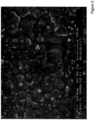
- Fig 2 presents HR-SEM images of the surface of the obtained pattern after decomposition, demonstrating the unique highly dense packing and the presence of large grains. The presence of large grains in combination with the highly dense surface increased oxidation resistance of the copper surface; even where the upper surface was slightly oxidized, the layer conductance did not change, as described in Example 1, formulation 3, below.
- the printing formulations of the invention may be used as inks.
- the ink formulation may be in a liquid medium, or may be formulated as solid inks ("toner"), e.g., such as those used in graphic toners.
- the inks are suitable for various coating and printing methods.
- the printing formulations of the invention may be used to coat a substrate surface by a method selected from spin coating, roll coating, spray coating, dip coating, flow coating, doctor blade coating, dispensing, ink-jet printing, offset printing, screen printing, pad printing, gravure printing, flexography, stencil printing, imprinting, xerography, lithography, nanoimprinting, stamping and any other deposition method known in the art.
- additives may be added to the printing formulation, depending on the final application, the method of application and other parameters, the additive may be selected from wetting agents, humactants, rheology modifiers, binders, pH adjusting agents, stabilizers, antioxidants, decomposition enhancers, antioxidants, cosolvents and others.
- the invention provides a process for forming a conductive pattern on a surface region of a substrate, the process comprising:
- the process further comprises sintering the metallic pattern; the pattern being conductive.
- a low temperature decomposition of the metal precursor is desired, to convert the precursor into a metal.
- the metal precursor is thus selected amongst such precursors which decompose at a temperature lower than the melting point of the metal.
- the metal precursor is selected to decompose at a temperature lower than 400°C, lower than 300°C, lower than 200°C, or lower than 150°C.
- the decomposition of the metal precursor may be carried out by heating or any other process which results in the metallic pattern. The heating may be carried out under nitrogen or under a reducing atmosphere. In some embodiments, decomposition is achievable by heating under air.
- the conversion from the salt or complex form to the metallic form may similarly be carried out by heating, e.g., in an oven, by laser radiation, by microwave, by electrical voltage, by exposure to light (such as IR, UV, Vis, Xenon); and similarly by photonic curing by UV or IR or by plasma treatment or any other method which enables decomposition to the metallic form.
- heating e.g., in an oven, by laser radiation, by microwave, by electrical voltage, by exposure to light (such as IR, UV, Vis, Xenon); and similarly by photonic curing by UV or IR or by plasma treatment or any other method which enables decomposition to the metallic form.
- the decomposition and conversion of the metal precursor into a metal may be carried out also by chemical methods. For example, deposition and contact (by printing or other methods) of a reducing agent or any other chemical that can lead to the formation of the metallic pattern.
- the printed layers of metal precursors may be added or combined with other layers, for example metallic particles. This can be achieved either by using an ink formulation that contains both (metallic particles and the insoluble particles or complexes, or the three components) or by printing several materials in a successive process, i.e., printing of the different layers consecutively.
- the patterns may be printed on flexible or rigid substrates, a variety of plastics such as Nylon, PET, PEN, polycarbonate, Teslin, PVC and others, paper, glass, metallic surfaces, silicon, germanium, ITO, FTO, TiO 2 and others.
- plastics such as Nylon, PET, PEN, polycarbonate, Teslin, PVC and others, paper, glass, metallic surfaces, silicon, germanium, ITO, FTO, TiO 2 and others.
- the printing formulations of the present invention may be used widely for EMI shielding materials, conductive adhesives, low-resistance metal wirings, PCBs, FPCs, antennas for RFID tags, solar cells, secondary cells or fuel cells and electrodes or wiring materials for TFT-LCDs, OLEDs, flexible displays, OTFTs, sensors and others.
- a conductive pattern is obtainable by the above method.
- an element comprising a conductive pattern having large grains and dense packing (wherein the dense packing is being substantially free of voids).
- an element comprising a conductive pattern, wherein said conductive pattern comprises a metallic material being substantially free of metal oxide at the time of manufacture.
- an element comprising a conductive pattern, wherein said conductive pattern has high oxidation resistance at ambient atmosphere.
- a printing formulation comprising at least one metal complex having metal to organic ligand ratio of 1, or above 1.
- a printing formulation comprising at least one metal complex, wherein the at least one metal atom being associated to at least two different organic ligands.
- a printing formulation comprising at least one metal complex, wherein the at least one metal atom being associate to at least one additive ligand.
- the additive ligand may be a conductor (metallic particles or nanoparticles), a metal precursor, an oxidant, an anti-oxidant, a stabilizer, a solvent, a humectant, a dispersing agent, a binder, a reducing agent, a surfactant, a wetting agent and a leveling agent.
- a similar formulation was prepared with another solvent, in which 2.5 g copper formate was dissolved in 2 g dipropylene glycol methyl ether (DPM) and 1.5 g Amino methyl propanol (AMP).
- DPM dipropylene glycol methyl ether
- AMP Amino methyl propanol
- the formulation was drawn down on a glass slide and heated to 200°C under nitrogen for 20 min. A sheet resistance of 20 mOhms per square was measured. The heating was carried out under reducing atmosphere.
- the reducing atmosphere contained hydrogen, formic acid or other carboxylic acids.
- Example 3 Copper particles obtained by bead milling with 0.1mm beads
- Example 2 The particles obtained in Example 2 were further milled using 0.1mm beads. The particle size decreased to 115nm.
- DPM Dipropylene glycol methyl ether
- Example 5 Mixture of Copper and Nickel precursor particles obtained by bead milling
- DPM Dipropylene glycol methyl ether
- Example 6 Silver Lactate particles obtained by bead milling
- Silver lactate was milled with a stabilizing polymer with and DPM (Dipropylene glycol methyl ether). The formulation was drawn down on a glass slide and heated to 170°C for 5 min in air. A sheet resistance of 6 Ohms per square was measured.
- DPM Dipropylene glycol methyl ether
- Example 7 Silver Oxalate particles obtained by bead milling
- Silver oxalate was milled with a stabilizing polymer with and DPM (Dipropylene glycol methyl ether). The formulation was drawn down on a glass slide and heated to 150°C. A sheet resistance of 0.2 Ohms per square was measured.
- DPM Dipropylene glycol methyl ether
- Example 8 Washing of copper formate particles by centrifugation
- Example 2 The particles obtained in Example 2 were washed by centrifugation at 4000 RPM for 25 min, then the supernatant was decanted and the centrifugation was repeated again.
- the obtained dispersion was drawn down on a glass slide and was heated under nitrogen to 200°C for 30 min.
- the obtained layer showed a sheet resistance of 0.5 ohms/square.
- Example 9 Copper precursor as particles obtained by precipitation
- Example 1 Copper precursor particles obtained by precipitation
- Example 2 Copper precursor particles obtained by emulsion-solvent evaporation
- An emulsion was formed by homogenizing 10.25 g cyclometicone and 2.25 g Abil EM90 with 12.5g aqueous solution of 10 wt% copper formate. After evaporation of the water from the emulsion by a rotor evaporator, a dispersion of copper formate nanoparticles with a diameter of 236 nm (according to DLS measurements) was obtained.
Landscapes
- Chemical & Material Sciences (AREA)
- Engineering & Computer Science (AREA)
- Organic Chemistry (AREA)
- Manufacturing & Machinery (AREA)
- Health & Medical Sciences (AREA)
- Life Sciences & Earth Sciences (AREA)
- Materials Engineering (AREA)
- Dispersion Chemistry (AREA)
- Wood Science & Technology (AREA)
- Physics & Mathematics (AREA)
- Medicinal Chemistry (AREA)
- Chemical Kinetics & Catalysis (AREA)
- Polymers & Plastics (AREA)
- Nanotechnology (AREA)
- Microelectronics & Electronic Packaging (AREA)
- General Health & Medical Sciences (AREA)
- Toxicology (AREA)
- Thermal Sciences (AREA)
- Spectroscopy & Molecular Physics (AREA)
- Inks, Pencil-Leads, Or Crayons (AREA)
- Conductive Materials (AREA)
Claims (13)
- Formulation (encre) d'impression comprenant, en tant que seul précurseur métallique, des nanoparticules de sel métallique dispersées dans un milieu, dans laquelle ledit sel métallique comprend un anion organique.
- Formulation d'impression selon la revendication 1, comprenant en outre au moins un véhicule liquide convenant pour une impression.
- Formulation d'impression selon la revendication 1, dans laquelle ledit précurseur métallique est en un métal des Groupes IIIB, IVB, VB, VIB, VIIB, VIIIB,IB et IIB du bloc d du Tableau périodique des Eléments.
- Formulation d'impression selon la revendication 3, dans laquelle ledit métal est choisi parmi Sc, Ti, V, Cr, Mn, Fe, Ni, Cu, Zn, Y, Zr, Nb, Tc, Ru, Mo, Rh, W, Au, Pt, Pd, Ag, Mn, Co, Cd, Hf, Ta, Re, Os, Al, Sn, In, Ga et Ir.
- Formulation d'impression selon la revendication 4, dans laquelle ledit métal est choisi parmi Cu, Ni et Ag.
- Formulation d'impression selon la revendication 5, dans laquelle ledit métal est Cu.
- Formulation d'impression selon la revendication 1, dans laquelle ledit anion organique est choisi parmi acétate (CH3COO-), formiate (HCOO-), citrate (C3H5(COO)3 -), acétylacétonate, lactate (CH3CH(OH)COO-), oxalate ((COO)2 -), et l'un quelconque de leurs dérivés.
- Formulation d'impression selon la revendication 4, dans laquelle le sel métallique de cuivre est choisi parmi le formiate de cuivre, le citrate de cuivre, l'acétate de cuivre, le nitrate de cuivre, l'acétylacétonate de cuivre, le perchlorate de cuivre, le chlorure de cuivre, le sulfate de cuivre, le carbonate de cuivre, l'hydroxyde de cuivre et leurs mélanges.
- Formulation d'impression selon la revendication 8, dans lequel le sel métallique de nickel est choisi parmi le formiate de nickel, le citrate de nickel, l'acétate de nickel, le nitrate de nickel, l'acétylacétonate de nickel, le perchlorate de nickel, le chlorure de nickel, le sulfate de nickel, le carbonate de nickel, l'hydroxyde de nickel et leurs mélanges.
- Formulation d'impression selon la revendication 1, dans laquelle le sel métallique est choisi parmi l'acétate d'indium(III), l'acétate de fer(II) ; l'acétylacétonate de gallium(III), le stéarate d'aluminium(III) ; le diméthyl-zinc, le diéthyl-zinc, le chlorure de zinc, l'acétylacétonate d'étain(II), l'acétate d'étain(II) ; l'acétate de plomb(II) et l'acétylacétonate de plomb(II).
- Formulation d'impression selon l'une quelconque des revendications 1 à 10, dans lequel le matériau sel métallique nanoparticulaire est formulé sous la forme d'une dispersion dans un milieu liquide.
- Formulation d'impression selon l'une quelconque des revendications 1 à 11, pour une utilisation dans la production de matériaux de blindage EMI, d'adhésifs conducteurs, de câblages métalliques faible résistance, de PCB, de FPC, d'antennes pour étiquettes RFID, de cellules solaires, de piles rechargeables ou de piles à combustible, d'électrodes ou de matériaux de câblage pour TFT-LCD, OLED, affichages flexibles, OTFT, et capteurs.
- Procédé pour former un motif conducteur sur une région de surface d'un substrat, le procédé comprenant :- l'obtention d'un substrat ;- sur au moins une région de surface d'un substrat, la formation d'un motif d'une formulation d'impression selon l'une quelconque des revendications 1 à 12, la formulation comprenant au moins un précurseur métallique sous la forme de nanoparticules de sel métallique dispersées dans un milieu ;- la décomposition dudit précurseur métallique dans ledit motif pour que soit obtenu un motif métallique.
Applications Claiming Priority (2)
| Application Number | Priority Date | Filing Date | Title |
|---|---|---|---|
| US201261604605P | 2012-02-29 | 2012-02-29 | |
| PCT/IL2013/050173 WO2013128449A2 (fr) | 2012-02-29 | 2013-02-28 | Encres contenant des nanoparticules précurseurs métalliques |
Publications (2)
| Publication Number | Publication Date |
|---|---|
| EP2820093A2 EP2820093A2 (fr) | 2015-01-07 |
| EP2820093B1 true EP2820093B1 (fr) | 2024-09-18 |
Family
ID=47997637
Family Applications (1)
| Application Number | Title | Priority Date | Filing Date |
|---|---|---|---|
| EP13711975.6A Active EP2820093B1 (fr) | 2012-02-29 | 2013-02-28 | Encres contenant des nanoparticules précurseurs métalliques |
Country Status (5)
| Country | Link |
|---|---|
| US (2) | US10590295B2 (fr) |
| EP (1) | EP2820093B1 (fr) |
| KR (1) | KR20150006091A (fr) |
| CN (2) | CN104284952A (fr) |
| WO (1) | WO2013128449A2 (fr) |
Families Citing this family (63)
| Publication number | Priority date | Publication date | Assignee | Title |
|---|---|---|---|---|
| WO2014179355A1 (fr) | 2013-04-29 | 2014-11-06 | Madico, Inc. | Séparateurs composites nanoporeux ayant une conductivité thermique accrue |
| CN104650652A (zh) * | 2013-11-22 | 2015-05-27 | 苏州冷石纳米材料科技有限公司 | 一种纳米银导电油墨及其制备方法 |
| KR102233293B1 (ko) * | 2014-01-15 | 2021-03-29 | (주)창성 | 구리포메이트-아민 컴플렉스를 포함하는 잉크 조성물의 제조방법 |
| US10214656B2 (en) | 2014-02-27 | 2019-02-26 | A School Corporation Kansai University | Copper nanoparticles and production method for same, copper nanoparticle fluid dispersion, copper nanoink, copper nanoparticle preservation method, and copper nanoparticle sintering method |
| SG11201609740UA (en) | 2014-05-27 | 2016-12-29 | Yissum Res Dev Co | Method of fabricating metallic patterns and objects |
| JP5926322B2 (ja) | 2014-05-30 | 2016-05-25 | 協立化学産業株式会社 | 被覆銅粒子及びその製造方法 |
| WO2016053299A1 (fr) * | 2014-09-30 | 2016-04-07 | Hewlett-Packard Development Company, L.P. | Composition d'encre aqueuse |
| JP6503219B2 (ja) * | 2014-10-30 | 2019-04-17 | 日華化学株式会社 | 導電性インク組成物及びそれにより製造された導電性部材 |
| US12040506B2 (en) | 2015-04-15 | 2024-07-16 | Lg Energy Solution, Ltd. | Nanoporous separators for batteries and related manufacturing methods |
| US10381623B2 (en) | 2015-07-09 | 2019-08-13 | Optodot Corporation | Nanoporous separators for batteries and related manufacturing methods |
| JP6843437B2 (ja) * | 2015-05-20 | 2021-03-17 | 国立大学法人山形大学 | 銀ナノ粒子分散体の製造方法及び銀ナノ粒子インクの製造方法 |
| JP2017001978A (ja) * | 2015-06-08 | 2017-01-05 | 国立大学法人北海道大学 | 銅錯体の製造方法およびこれを含有する導電膜形成用組成物 |
| CA2988797C (fr) * | 2015-06-11 | 2023-08-01 | National Research Council Of Canada | Preparation de films de cuivre a conductivite elevee |
| US9909023B2 (en) * | 2015-06-23 | 2018-03-06 | Electronics For Imaging, Inc. | Inkjet ink for ceramic tile decoration |
| WO2017094166A1 (fr) * | 2015-12-03 | 2017-06-08 | ハリマ化成株式会社 | Procédé de fabrication de pâte conductrice |
| US10578572B2 (en) | 2016-01-19 | 2020-03-03 | Invensense, Inc. | CMOS integrated microheater for a gas sensor device |
| WO2017184127A1 (fr) * | 2016-04-19 | 2017-10-26 | Hewlett-Packard Development Company, L.P. | Impression en trois dimensions (3d) |
| US10620121B2 (en) | 2016-04-19 | 2020-04-14 | Board Of Regents, The University Of Texas System | Methods and systems for optothermal particle control |
| CN105665747A (zh) * | 2016-04-22 | 2016-06-15 | 广东南海启明光大科技有限公司 | 一种油性纳米银粒子的制备方法 |
| JP6315151B1 (ja) * | 2016-07-14 | 2018-04-25 | 信越化学工業株式会社 | サスペンションプラズマ溶射用スラリー、及び希土類酸フッ化物溶射膜の形成方法 |
| WO2018017503A1 (fr) * | 2016-07-18 | 2018-01-25 | Zerovalent Nanometals, Inc. | Procédé de production de dispersions colloïdales de nanoparticules métalliques |
| KR102360657B1 (ko) * | 2016-07-28 | 2022-02-08 | 내셔날 리서치 카운실 오브 캐나다 | 구리 잉크 및 이로부터 제조되는 전도성 납땜가능한 구리 트레이스 |
| WO2018049109A1 (fr) | 2016-09-09 | 2018-03-15 | Board Of Regents, The University Of Texas System | Procédés et systèmes de commande optique de particules métalliques par thermophorèse |
| CN107866236A (zh) * | 2016-09-23 | 2018-04-03 | 丝芙芮生医科技有限公司 | 新颖催化剂、其用途及使用其处理印刷电路板废料的方法 |
| US10487221B2 (en) * | 2016-11-29 | 2019-11-26 | Eastman Kodak Company | Photosensitive compositions containing silver ion α-oxy carboxylate-oxime complexes |
| US11041078B2 (en) * | 2016-11-29 | 2021-06-22 | Eastman Kodak Company | Photosensitive compositions containing silver ion a-oxy carboxylate-oxime complexes |
| US10383967B2 (en) | 2016-11-30 | 2019-08-20 | Invensense, Inc. | Substance sensing with tracers |
| US10570301B2 (en) | 2016-12-02 | 2020-02-25 | Inner Mongolia Xianhong Science Co., Ltd. | Solvent based inkjet ink composition |
| FR3060025B1 (fr) | 2016-12-09 | 2022-06-24 | Commissariat Atomique Et Aux Energies Alternatives | Procede de metallisation d'une surface d'un support solide |
| US10308828B2 (en) | 2016-12-14 | 2019-06-04 | The Charles Stark Draper Laboratory, Inc. | Reactively assisted ink for printed electronic circuits |
| EP3574128A4 (fr) * | 2017-01-24 | 2020-12-23 | Oreltech Ltd. | Procédé de formation de couche métallique |
| TW201842087A (zh) | 2017-02-08 | 2018-12-01 | 加拿大國家研究委員會 | 具改良之熱穩定性的分子油墨 |
| TWI842668B (zh) | 2017-02-08 | 2024-05-21 | 加拿大國家研究委員會 | 具低黏度與低加工溫度之銀分子油墨 |
| TWI874294B (zh) | 2017-02-08 | 2025-03-01 | 加拿大國家研究委員會 | 可印刷分子油墨 |
| WO2018150724A1 (fr) * | 2017-02-17 | 2018-08-23 | 株式会社村田製作所 | Module de circuit et procédé de production de module de circuit |
| US10603685B2 (en) * | 2017-02-23 | 2020-03-31 | Board Of Regents, The University Of Texas System | Methods and systems for assembly of particle superstructures |
| CN109111791B (zh) * | 2017-06-22 | 2022-04-26 | 复旦大学 | 铜导电油墨、铜导电薄膜的制备方法及铜导电油墨、铜导电薄膜 |
| TWI856947B (zh) | 2017-08-01 | 2024-10-01 | 加拿大國家研究委員會 | 銅墨水 |
| JP6727174B2 (ja) * | 2017-08-31 | 2020-07-22 | 富士フイルム株式会社 | 導電膜形成用組成物、導電膜の製造方法、ギ酸銅錯体 |
| TWI656180B (zh) * | 2017-09-29 | 2019-04-11 | 台虹科技股份有限公司 | 導電油墨 |
| CN107903712A (zh) * | 2017-11-17 | 2018-04-13 | 福州大学 | 一种喷墨打印技术中的半导体金属氧化物墨水及使用方法 |
| CN108098191B (zh) * | 2017-12-17 | 2020-02-14 | 华中科技大学 | 一种铜纳米颗粒焊膏的制备方法及其产品 |
| EP3728492B1 (fr) * | 2017-12-22 | 2022-08-17 | National Research Council of Canada | Encre à base de cuivre pour une impression fine à conductivité élevée |
| CN108250845A (zh) * | 2018-01-17 | 2018-07-06 | 厦门卡拉风娱乐有限公司 | 一种纳米导电墨水及其制备方法 |
| CA3108631A1 (fr) | 2018-08-03 | 2020-02-06 | National Research Council Of Canada | Encre moleculaire frittable par uv et son traitement a l'aide d'une lumiere uv a large spectre |
| CN109401440A (zh) * | 2018-08-28 | 2019-03-01 | 上海幂方电子科技有限公司 | 一种溶剂型导电墨水、制备方法以及应用 |
| EP3648161A1 (fr) | 2018-11-05 | 2020-05-06 | Heraeus Deutschland GmbH & Co KG | Procédé de fabrication d'une couche de blindage contre les interférences électromagnétiques |
| KR102690747B1 (ko) * | 2018-11-29 | 2024-08-02 | 솔브레인 주식회사 | 적층형 세라믹 커패시터의 내부전극용 도전성 잉크 조성물의 제조방법 및 이를 이용한 적층형 세라믹 커패시터의 내부전극 제조방법 |
| JP7178919B2 (ja) | 2019-01-30 | 2022-11-28 | 理想科学工業株式会社 | 油性インクジェットインク及び分散剤の製造方法 |
| US20200295356A1 (en) * | 2019-03-11 | 2020-09-17 | Nanotek Instruments, Inc. | Process for producing semiconductor nanowires and carbon/semiconductor nanowire hybrid materials |
| CN111867264B (zh) * | 2019-04-30 | 2021-10-22 | 云谷(固安)科技有限公司 | 导电线的制造方法、可拉伸显示器件以及可拉伸显示器件的制造方法 |
| CN110358368A (zh) * | 2019-05-31 | 2019-10-22 | 南开大学 | 一种可拉伸微电子电路导电油墨及其合成方法 |
| US11643566B2 (en) * | 2019-09-09 | 2023-05-09 | Xerox Corporation | Particulate compositions comprising a metal precursor for additive manufacturing and methods associated therewith |
| CN112582487B (zh) * | 2019-09-27 | 2022-07-05 | 天津大学 | 一种硒化铟与铜离子复合技术制备致密织构化铜铟硒薄膜的方法 |
| US11492547B2 (en) | 2020-06-04 | 2022-11-08 | UbiQD, Inc. | Low-PH nanoparticles and ligands |
| KR102552064B1 (ko) * | 2020-10-16 | 2023-07-06 | 유한회사 대동 | 음각 미세패턴 충전용 도전성 수성 잉크 조성물, 이를 이용하여 제조되는 도전체 충전 미세패턴 및 이를 포함하는 도전성 디바이스 |
| JP7568891B2 (ja) * | 2020-10-28 | 2024-10-17 | 学校法人 関西大学 | 混合インク及びその製造方法、並びに、混合インクの焼結方法 |
| KR20240005710A (ko) | 2021-04-29 | 2024-01-12 | 24엠 테크놀로지즈, 인크. | 다수의 분리막을 갖는 전기화학 셀, 및 이의 생성 방법 |
| US20240322101A1 (en) * | 2021-07-15 | 2024-09-26 | Corning Incorporated | Multi-ink layered printed electrode for wrap around electrodes |
| TW202443944A (zh) | 2022-12-16 | 2024-11-01 | 美商24M科技公司 | 用於最小化及預防電化電池中形成枝晶的系統及方法 |
| JP2025141043A (ja) * | 2024-03-15 | 2025-09-29 | エレファンテック株式会社 | インク組成物、回路基板製造方法、回路基板 |
| US12431545B1 (en) | 2024-03-26 | 2025-09-30 | 24M Technologies, Inc. | Systems and methods for minimizing and preventing dendrite formation in electrochemical cells |
| CN118165579A (zh) * | 2024-04-09 | 2024-06-11 | 东南大学 | 一种可梯度烧结的多金属前驱体无颗粒导电墨水、其制法与导电薄膜 |
Citations (4)
| Publication number | Priority date | Publication date | Assignee | Title |
|---|---|---|---|---|
| US20050238804A1 (en) * | 2002-06-13 | 2005-10-27 | Arkady Garbar | Nano-powder-based coating and ink compositions |
| WO2010036113A1 (fr) * | 2008-09-29 | 2010-04-01 | Nederlandse Organisatie Voor Toegepast- Natuurwetenschappelijk Onderzoek Tno | Trousse de préparation d’un motif conducteur |
| WO2013077499A1 (fr) * | 2011-11-24 | 2013-05-30 | Industry-Academic Cooperation Foundation, Yonsei University | Encre hybride pour film de czts |
| EP2608218A1 (fr) * | 2011-12-21 | 2013-06-26 | Agfa-Gevaert | Dispersion comportant des nanoparticules métalliques, oxyde métallique ou précurseur métallique, dispersant polymère et agent clivable thermique |
Family Cites Families (32)
| Publication number | Priority date | Publication date | Assignee | Title |
|---|---|---|---|---|
| KR100229231B1 (ko) * | 1995-04-04 | 1999-11-01 | 미다라이 후지오 | 전자 방출 소자 형성용 금속 함유 조성물, 및 전자방출소자,전자원및화상형성장치의제조방법 |
| JP3229223B2 (ja) * | 1995-10-13 | 2001-11-19 | キヤノン株式会社 | 電子放出素子、電子源及び画像形成装置の製造法並びに電子放出素子製造用金属組成物 |
| JP3419244B2 (ja) * | 1996-05-24 | 2003-06-23 | 株式会社村田製作所 | 導電ペースト及びセラミック基板の製造方法 |
| AU1288900A (en) * | 1998-12-21 | 2000-07-12 | Avecia Limited | Chemical composition for ink |
| EP1441864B1 (fr) | 2000-01-21 | 2009-11-18 | Midwest Research Institute | Procede de formation de conducteurs en couches minces par decomposition de chelates metalliques en association a des particules metalliques |
| JP4672125B2 (ja) * | 2000-09-27 | 2011-04-20 | 大塚化学株式会社 | 導電性板状チタニア及び導電性組成物 |
| US7629017B2 (en) | 2001-10-05 | 2009-12-08 | Cabot Corporation | Methods for the deposition of conductive electronic features |
| JP2003118258A (ja) * | 2001-10-16 | 2003-04-23 | Fuji Photo Film Co Ltd | 平版印刷用原板 |
| US7553512B2 (en) * | 2001-11-02 | 2009-06-30 | Cabot Corporation | Method for fabricating an inorganic resistor |
| JP4868716B2 (ja) * | 2004-04-28 | 2012-02-01 | 三井金属鉱業株式会社 | フレーク銅粉及び導電性ペースト |
| JP4799881B2 (ja) * | 2004-12-27 | 2011-10-26 | 三井金属鉱業株式会社 | 導電性インク |
| JP2008527169A (ja) * | 2005-01-10 | 2008-07-24 | イシウム リサーチ デベロップメント カンパニー オブ ザ ヘブリュー ユニバーシティー オブ イエルサレム | 金属ナノ粒子の水系分散物 |
| TW200640596A (en) * | 2005-01-14 | 2006-12-01 | Cabot Corp | Production of metal nanoparticles |
| JP2006222162A (ja) * | 2005-02-08 | 2006-08-24 | Fuji Photo Film Co Ltd | プリント配線基板形成用インク、プリント配線基板の形成方法及びプリント配線基板 |
| PL1853671T3 (pl) | 2005-03-04 | 2014-01-31 | Inktec Co Ltd | Tusze przewodzące i sposób ich wytwarzania |
| CN101316902A (zh) * | 2005-11-04 | 2008-12-03 | 三井金属矿业株式会社 | 镍油墨及用该镍油墨形成的导体膜 |
| JP2007146117A (ja) | 2005-11-04 | 2007-06-14 | Mitsui Mining & Smelting Co Ltd | ニッケルインク及びそのニッケルインクで形成した導体膜 |
| US20080003364A1 (en) | 2006-06-28 | 2008-01-03 | Ginley David S | Metal Inks |
| JP5205717B2 (ja) | 2006-07-04 | 2013-06-05 | セイコーエプソン株式会社 | ギ酸銅錯体、銅粒子の製造方法および配線基板の製造方法 |
| EP2052043B1 (fr) | 2006-08-07 | 2016-10-12 | Inktec Co., Ltd. | Procédé pour la préparation de nanoparticules d'argent et compositions d'encre d'argent les contenant |
| CA2663688C (fr) * | 2006-09-22 | 2015-11-17 | Fry's Metals, Inc. | Systemes solvants pour metaux et encres |
| US20100021704A1 (en) * | 2006-09-29 | 2010-01-28 | Sung-Ho Yoon | Organic silver complex compound used in paste for conductive pattern forming |
| US20080083299A1 (en) * | 2006-10-06 | 2008-04-10 | General Electric Company | Composition and associated method |
| JP2009037757A (ja) | 2007-07-31 | 2009-02-19 | Canon Inc | 導電性薄膜、電子放出素子及び画像表示装置 |
| KR101001248B1 (ko) * | 2007-08-09 | 2010-12-17 | 주식회사 엘지화학 | 표면특성을 이용한 금속패턴 형성방법 및 이에 따라 형성된금속패턴 |
| US7977240B1 (en) * | 2008-02-13 | 2011-07-12 | Kovio, Inc. | Metal inks for improved contact resistance |
| EP2319643B1 (fr) * | 2008-08-29 | 2019-03-27 | Ishihara Sangyo Kaisha, Ltd. | Dispersion à base de cuivre métallique, procédé de production de dispersion à base de cuivre métallique, électrode, motif de câblage, et film de revêtement formé au moyen de dispersion à base de cuivre métallique, article décoratif et article antimicrobien recouvert du film de revêtement, et procédés de production de l article décoratif et de l article antimicrobien |
| DE102009004491A1 (de) * | 2009-01-09 | 2010-07-15 | Merck Patent Gmbh | Funktionelles Material für gedruckte elektronische Bauteile |
| CN102822385B (zh) * | 2009-11-09 | 2016-09-07 | 卡内基·梅隆大学 | 金属墨水组合物、导电性图案、方法和器件 |
| KR20110064153A (ko) | 2009-12-07 | 2011-06-15 | 삼성전자주식회사 | 금속 유기 전구체, 이의 제조방법, 및 이를 이용한 전도성 금속막 또는 패턴 형성방법 |
| AT509296B1 (de) * | 2009-12-16 | 2015-05-15 | Joanneum Res Forschungsgmbh | Metallisch leitfähige tinte für tintenstrahldruck sowie verfahren zur herstellung derselben |
| EP2468827B1 (fr) * | 2010-12-21 | 2014-03-12 | Agfa-Gevaert | Dispersion comportant des nanoparticules métalliques, d'oxyde métallique ou de précurseur métallique |
-
2013
- 2013-02-28 CN CN201380011891.4A patent/CN104284952A/zh active Pending
- 2013-02-28 EP EP13711975.6A patent/EP2820093B1/fr active Active
- 2013-02-28 KR KR1020147027059A patent/KR20150006091A/ko not_active Withdrawn
- 2013-02-28 US US14/382,110 patent/US10590295B2/en active Active
- 2013-02-28 CN CN201810029804.2A patent/CN108219591B/zh active Active
- 2013-02-28 WO PCT/IL2013/050173 patent/WO2013128449A2/fr not_active Ceased
-
2020
- 2020-02-03 US US16/779,847 patent/US12054626B2/en active Active
Patent Citations (4)
| Publication number | Priority date | Publication date | Assignee | Title |
|---|---|---|---|---|
| US20050238804A1 (en) * | 2002-06-13 | 2005-10-27 | Arkady Garbar | Nano-powder-based coating and ink compositions |
| WO2010036113A1 (fr) * | 2008-09-29 | 2010-04-01 | Nederlandse Organisatie Voor Toegepast- Natuurwetenschappelijk Onderzoek Tno | Trousse de préparation d’un motif conducteur |
| WO2013077499A1 (fr) * | 2011-11-24 | 2013-05-30 | Industry-Academic Cooperation Foundation, Yonsei University | Encre hybride pour film de czts |
| EP2608218A1 (fr) * | 2011-12-21 | 2013-06-26 | Agfa-Gevaert | Dispersion comportant des nanoparticules métalliques, oxyde métallique ou précurseur métallique, dispersant polymère et agent clivable thermique |
Also Published As
| Publication number | Publication date |
|---|---|
| WO2013128449A2 (fr) | 2013-09-06 |
| KR20150006091A (ko) | 2015-01-15 |
| US10590295B2 (en) | 2020-03-17 |
| CN104284952A (zh) | 2015-01-14 |
| CN108219591B (zh) | 2022-02-18 |
| CN108219591A (zh) | 2018-06-29 |
| US20150056426A1 (en) | 2015-02-26 |
| EP2820093A2 (fr) | 2015-01-07 |
| WO2013128449A3 (fr) | 2013-12-05 |
| US20200172753A1 (en) | 2020-06-04 |
| US12054626B2 (en) | 2024-08-06 |
Similar Documents
| Publication | Publication Date | Title |
|---|---|---|
| US12054626B2 (en) | Inks containing metal precursors nanoparticles | |
| CN101511952B (zh) | 银纳米颗粒的制备方法和含有银纳米颗粒的银墨组合物 | |
| US8017044B2 (en) | Bimodal metal nanoparticle ink and applications therefor | |
| EP2114114B1 (fr) | Nanoparticules bimétalliques pour les applications d'encre conductrices | |
| Kamyshny et al. | Metal-based inkjet inks for printed electronics | |
| US7963646B2 (en) | Ink-jet inks containing metal nanoparticles | |
| JP6037494B2 (ja) | 銀ナノ粒子の製造方法及び銀ナノ粒子、並びに銀塗料組成物 | |
| KR101802458B1 (ko) | 금속 나노입자 분산액 | |
| EP2123723B1 (fr) | Synthèse photochimique de nanoparticules métalliques pour des applications d'encre | |
| KR101800391B1 (ko) | 금속 나노입자 분산액 | |
| US20140346412A1 (en) | Method for producing silver nanoparticles, silver nanoparticles, and silver coating composition | |
| JP2005507452A5 (fr) | ||
| KR101777342B1 (ko) | 금속 나노입자 분산액의 제조 방법 | |
| US9683123B2 (en) | Silver ink | |
| US9283618B2 (en) | Conductive pastes containing silver carboxylates | |
| CN101678658A (zh) | 透明导电层及其制备方法 | |
| TW201315685A (zh) | 銀微粒子及含有該銀微粒子之導電膏,導電膜及電子裝置 | |
| WO2015181822A1 (fr) | Procédé de fabrication de motifs et d'objets métalliques | |
| KR20100088483A (ko) | 전도성 금속이온 잉크 조성물 및 이의 제조방법 | |
| KR20110050175A (ko) | 배선용 잉크 조성물 및 이를 이용한 구리 배선의 형성방법 |
Legal Events
| Date | Code | Title | Description |
|---|---|---|---|
| PUAI | Public reference made under article 153(3) epc to a published international application that has entered the european phase |
Free format text: ORIGINAL CODE: 0009012 |
|
| 17P | Request for examination filed |
Effective date: 20140903 |
|
| AK | Designated contracting states |
Kind code of ref document: A2 Designated state(s): AL AT BE BG CH CY CZ DE DK EE ES FI FR GB GR HR HU IE IS IT LI LT LU LV MC MK MT NL NO PL PT RO RS SE SI SK SM TR |
|
| AX | Request for extension of the european patent |
Extension state: BA ME |
|
| DAX | Request for extension of the european patent (deleted) | ||
| STAA | Information on the status of an ep patent application or granted ep patent |
Free format text: STATUS: EXAMINATION IS IN PROGRESS |
|
| 17Q | First examination report despatched |
Effective date: 20180207 |
|
| RAP1 | Party data changed (applicant data changed or rights of an application transferred) |
Owner name: SINGAPORE ASAHI CHEMICAL & SOLDER IND. PTE. LTD. |
|
| GRAP | Despatch of communication of intention to grant a patent |
Free format text: ORIGINAL CODE: EPIDOSNIGR1 |
|
| STAA | Information on the status of an ep patent application or granted ep patent |
Free format text: STATUS: GRANT OF PATENT IS INTENDED |
|
| INTG | Intention to grant announced |
Effective date: 20240618 |
|
| GRAS | Grant fee paid |
Free format text: ORIGINAL CODE: EPIDOSNIGR3 |
|
| GRAA | (expected) grant |
Free format text: ORIGINAL CODE: 0009210 |
|
| STAA | Information on the status of an ep patent application or granted ep patent |
Free format text: STATUS: THE PATENT HAS BEEN GRANTED |
|
| P01 | Opt-out of the competence of the unified patent court (upc) registered |
Free format text: CASE NUMBER: APP_45606/2024 Effective date: 20240806 |
|
| AK | Designated contracting states |
Kind code of ref document: B1 Designated state(s): AL AT BE BG CH CY CZ DE DK EE ES FI FR GB GR HR HU IE IS IT LI LT LU LV MC MK MT NL NO PL PT RO RS SE SI SK SM TR |
|
| REG | Reference to a national code |
Ref country code: GB Ref legal event code: FG4D |
|
| REG | Reference to a national code |
Ref country code: CH Ref legal event code: EP |
|
| REG | Reference to a national code |
Ref country code: IE Ref legal event code: FG4D |
|
| REG | Reference to a national code |
Ref country code: DE Ref legal event code: R096 Ref document number: 602013086097 Country of ref document: DE |
|
| REG | Reference to a national code |
Ref country code: LT Ref legal event code: MG9D |
|
| PG25 | Lapsed in a contracting state [announced via postgrant information from national office to epo] |
Ref country code: NO Free format text: LAPSE BECAUSE OF FAILURE TO SUBMIT A TRANSLATION OF THE DESCRIPTION OR TO PAY THE FEE WITHIN THE PRESCRIBED TIME-LIMIT Effective date: 20241218 |
|
| PG25 | Lapsed in a contracting state [announced via postgrant information from national office to epo] |
Ref country code: GR Free format text: LAPSE BECAUSE OF FAILURE TO SUBMIT A TRANSLATION OF THE DESCRIPTION OR TO PAY THE FEE WITHIN THE PRESCRIBED TIME-LIMIT Effective date: 20241219 Ref country code: FI Free format text: LAPSE BECAUSE OF FAILURE TO SUBMIT A TRANSLATION OF THE DESCRIPTION OR TO PAY THE FEE WITHIN THE PRESCRIBED TIME-LIMIT Effective date: 20240918 |
|
| PG25 | Lapsed in a contracting state [announced via postgrant information from national office to epo] |
Ref country code: BG Free format text: LAPSE BECAUSE OF FAILURE TO SUBMIT A TRANSLATION OF THE DESCRIPTION OR TO PAY THE FEE WITHIN THE PRESCRIBED TIME-LIMIT Effective date: 20240918 |
|
| PG25 | Lapsed in a contracting state [announced via postgrant information from national office to epo] |
Ref country code: LV Free format text: LAPSE BECAUSE OF FAILURE TO SUBMIT A TRANSLATION OF THE DESCRIPTION OR TO PAY THE FEE WITHIN THE PRESCRIBED TIME-LIMIT Effective date: 20240918 |
|
| PG25 | Lapsed in a contracting state [announced via postgrant information from national office to epo] |
Ref country code: HR Free format text: LAPSE BECAUSE OF FAILURE TO SUBMIT A TRANSLATION OF THE DESCRIPTION OR TO PAY THE FEE WITHIN THE PRESCRIBED TIME-LIMIT Effective date: 20240918 |
|
| REG | Reference to a national code |
Ref country code: NL Ref legal event code: MP Effective date: 20240918 |
|
| PG25 | Lapsed in a contracting state [announced via postgrant information from national office to epo] |
Ref country code: RS Free format text: LAPSE BECAUSE OF FAILURE TO SUBMIT A TRANSLATION OF THE DESCRIPTION OR TO PAY THE FEE WITHIN THE PRESCRIBED TIME-LIMIT Effective date: 20241218 |
|
| PG25 | Lapsed in a contracting state [announced via postgrant information from national office to epo] |
Ref country code: RS Free format text: LAPSE BECAUSE OF FAILURE TO SUBMIT A TRANSLATION OF THE DESCRIPTION OR TO PAY THE FEE WITHIN THE PRESCRIBED TIME-LIMIT Effective date: 20241218 Ref country code: NO Free format text: LAPSE BECAUSE OF FAILURE TO SUBMIT A TRANSLATION OF THE DESCRIPTION OR TO PAY THE FEE WITHIN THE PRESCRIBED TIME-LIMIT Effective date: 20241218 Ref country code: LV Free format text: LAPSE BECAUSE OF FAILURE TO SUBMIT A TRANSLATION OF THE DESCRIPTION OR TO PAY THE FEE WITHIN THE PRESCRIBED TIME-LIMIT Effective date: 20240918 Ref country code: HR Free format text: LAPSE BECAUSE OF FAILURE TO SUBMIT A TRANSLATION OF THE DESCRIPTION OR TO PAY THE FEE WITHIN THE PRESCRIBED TIME-LIMIT Effective date: 20240918 Ref country code: GR Free format text: LAPSE BECAUSE OF FAILURE TO SUBMIT A TRANSLATION OF THE DESCRIPTION OR TO PAY THE FEE WITHIN THE PRESCRIBED TIME-LIMIT Effective date: 20241219 Ref country code: FI Free format text: LAPSE BECAUSE OF FAILURE TO SUBMIT A TRANSLATION OF THE DESCRIPTION OR TO PAY THE FEE WITHIN THE PRESCRIBED TIME-LIMIT Effective date: 20240918 Ref country code: BG Free format text: LAPSE BECAUSE OF FAILURE TO SUBMIT A TRANSLATION OF THE DESCRIPTION OR TO PAY THE FEE WITHIN THE PRESCRIBED TIME-LIMIT Effective date: 20240918 |
|
| REG | Reference to a national code |
Ref country code: AT Ref legal event code: MK05 Ref document number: 1724690 Country of ref document: AT Kind code of ref document: T Effective date: 20240918 |
|
| PG25 | Lapsed in a contracting state [announced via postgrant information from national office to epo] |
Ref country code: NL Free format text: LAPSE BECAUSE OF FAILURE TO SUBMIT A TRANSLATION OF THE DESCRIPTION OR TO PAY THE FEE WITHIN THE PRESCRIBED TIME-LIMIT Effective date: 20240918 |
|
| PG25 | Lapsed in a contracting state [announced via postgrant information from national office to epo] |
Ref country code: IS Free format text: LAPSE BECAUSE OF FAILURE TO SUBMIT A TRANSLATION OF THE DESCRIPTION OR TO PAY THE FEE WITHIN THE PRESCRIBED TIME-LIMIT Effective date: 20250118 Ref country code: PT Free format text: LAPSE BECAUSE OF FAILURE TO SUBMIT A TRANSLATION OF THE DESCRIPTION OR TO PAY THE FEE WITHIN THE PRESCRIBED TIME-LIMIT Effective date: 20250120 |
|
| PG25 | Lapsed in a contracting state [announced via postgrant information from national office to epo] |
Ref country code: RO Free format text: LAPSE BECAUSE OF FAILURE TO SUBMIT A TRANSLATION OF THE DESCRIPTION OR TO PAY THE FEE WITHIN THE PRESCRIBED TIME-LIMIT Effective date: 20240918 Ref country code: SM Free format text: LAPSE BECAUSE OF FAILURE TO SUBMIT A TRANSLATION OF THE DESCRIPTION OR TO PAY THE FEE WITHIN THE PRESCRIBED TIME-LIMIT Effective date: 20240918 |
|
| PG25 | Lapsed in a contracting state [announced via postgrant information from national office to epo] |
Ref country code: ES Free format text: LAPSE BECAUSE OF FAILURE TO SUBMIT A TRANSLATION OF THE DESCRIPTION OR TO PAY THE FEE WITHIN THE PRESCRIBED TIME-LIMIT Effective date: 20240918 |
|
| PG25 | Lapsed in a contracting state [announced via postgrant information from national office to epo] |
Ref country code: EE Free format text: LAPSE BECAUSE OF FAILURE TO SUBMIT A TRANSLATION OF THE DESCRIPTION OR TO PAY THE FEE WITHIN THE PRESCRIBED TIME-LIMIT Effective date: 20240918 Ref country code: AT Free format text: LAPSE BECAUSE OF FAILURE TO SUBMIT A TRANSLATION OF THE DESCRIPTION OR TO PAY THE FEE WITHIN THE PRESCRIBED TIME-LIMIT Effective date: 20240918 |
|
| PG25 | Lapsed in a contracting state [announced via postgrant information from national office to epo] |
Ref country code: PL Free format text: LAPSE BECAUSE OF FAILURE TO SUBMIT A TRANSLATION OF THE DESCRIPTION OR TO PAY THE FEE WITHIN THE PRESCRIBED TIME-LIMIT Effective date: 20240918 Ref country code: CZ Free format text: LAPSE BECAUSE OF FAILURE TO SUBMIT A TRANSLATION OF THE DESCRIPTION OR TO PAY THE FEE WITHIN THE PRESCRIBED TIME-LIMIT Effective date: 20240918 |
|
| PG25 | Lapsed in a contracting state [announced via postgrant information from national office to epo] |
Ref country code: IT Free format text: LAPSE BECAUSE OF FAILURE TO SUBMIT A TRANSLATION OF THE DESCRIPTION OR TO PAY THE FEE WITHIN THE PRESCRIBED TIME-LIMIT Effective date: 20240918 Ref country code: SK Free format text: LAPSE BECAUSE OF FAILURE TO SUBMIT A TRANSLATION OF THE DESCRIPTION OR TO PAY THE FEE WITHIN THE PRESCRIBED TIME-LIMIT Effective date: 20240918 |
|
| REG | Reference to a national code |
Ref country code: DE Ref legal event code: R097 Ref document number: 602013086097 Country of ref document: DE |
|
| PG25 | Lapsed in a contracting state [announced via postgrant information from national office to epo] |
Ref country code: DK Free format text: LAPSE BECAUSE OF FAILURE TO SUBMIT A TRANSLATION OF THE DESCRIPTION OR TO PAY THE FEE WITHIN THE PRESCRIBED TIME-LIMIT Effective date: 20240918 |
|
| PLBE | No opposition filed within time limit |
Free format text: ORIGINAL CODE: 0009261 |
|
| STAA | Information on the status of an ep patent application or granted ep patent |
Free format text: STATUS: NO OPPOSITION FILED WITHIN TIME LIMIT |
|
| 26N | No opposition filed |
Effective date: 20250619 |
|
| PG25 | Lapsed in a contracting state [announced via postgrant information from national office to epo] |
Ref country code: SE Free format text: LAPSE BECAUSE OF FAILURE TO SUBMIT A TRANSLATION OF THE DESCRIPTION OR TO PAY THE FEE WITHIN THE PRESCRIBED TIME-LIMIT Effective date: 20240918 |
|
| PG25 | Lapsed in a contracting state [announced via postgrant information from national office to epo] |
Ref country code: MC Free format text: LAPSE BECAUSE OF FAILURE TO SUBMIT A TRANSLATION OF THE DESCRIPTION OR TO PAY THE FEE WITHIN THE PRESCRIBED TIME-LIMIT Effective date: 20240918 |
|
| REG | Reference to a national code |
Ref country code: CH Ref legal event code: PL |
|
| PG25 | Lapsed in a contracting state [announced via postgrant information from national office to epo] |
Ref country code: LU Free format text: LAPSE BECAUSE OF NON-PAYMENT OF DUE FEES Effective date: 20250228 |
|
| PG25 | Lapsed in a contracting state [announced via postgrant information from national office to epo] |
Ref country code: CH Free format text: LAPSE BECAUSE OF NON-PAYMENT OF DUE FEES Effective date: 20250228 |
|
| GBPC | Gb: european patent ceased through non-payment of renewal fee |
Effective date: 20250228 |
|
| REG | Reference to a national code |
Ref country code: BE Ref legal event code: MM Effective date: 20250228 |
|
| PG25 | Lapsed in a contracting state [announced via postgrant information from national office to epo] |
Ref country code: GB Free format text: LAPSE BECAUSE OF NON-PAYMENT OF DUE FEES Effective date: 20250228 |
|
| PG25 | Lapsed in a contracting state [announced via postgrant information from national office to epo] |
Ref country code: FR Free format text: LAPSE BECAUSE OF NON-PAYMENT OF DUE FEES Effective date: 20250228 |
|
| PG25 | Lapsed in a contracting state [announced via postgrant information from national office to epo] |
Ref country code: BE Free format text: LAPSE BECAUSE OF NON-PAYMENT OF DUE FEES Effective date: 20250228 |
|
| PG25 | Lapsed in a contracting state [announced via postgrant information from national office to epo] |
Ref country code: IE Free format text: LAPSE BECAUSE OF NON-PAYMENT OF DUE FEES Effective date: 20250228 |
|
| PGFP | Annual fee paid to national office [announced via postgrant information from national office to epo] |
Ref country code: DE Payment date: 20260218 Year of fee payment: 14 |