EP2820636B1 - Verfahren zum automatischen durchführen eines fahrmanövers - Google Patents
Verfahren zum automatischen durchführen eines fahrmanövers Download PDFInfo
- Publication number
- EP2820636B1 EP2820636B1 EP13706472.1A EP13706472A EP2820636B1 EP 2820636 B1 EP2820636 B1 EP 2820636B1 EP 13706472 A EP13706472 A EP 13706472A EP 2820636 B1 EP2820636 B1 EP 2820636B1
- Authority
- EP
- European Patent Office
- Prior art keywords
- motor vehicle
- parking
- driving
- trajectory
- driver
- Prior art date
- Legal status (The legal status is an assumption and is not a legal conclusion. Google has not performed a legal analysis and makes no representation as to the accuracy of the status listed.)
- Active
Links
Images


Classifications
-
- G—PHYSICS
- G08—SIGNALLING
- G08G—TRAFFIC CONTROL SYSTEMS
- G08G1/00—Traffic control systems for road vehicles
- G08G1/16—Anti-collision systems
- G08G1/168—Driving aids for parking, e.g. acoustic or visual feedback on parking space
-
- B—PERFORMING OPERATIONS; TRANSPORTING
- B62—LAND VEHICLES FOR TRAVELLING OTHERWISE THAN ON RAILS
- B62D—MOTOR VEHICLES; TRAILERS
- B62D15/00—Steering not otherwise provided for
- B62D15/02—Steering position indicators ; Steering position determination; Steering aids
- B62D15/027—Parking aids, e.g. instruction means
- B62D15/0285—Parking performed automatically
Definitions
- the invention relates to a method for automatically performing a driving maneuver in which in a first step, the environment of the motor vehicle is detected and in a second step based on the acquired data of the environment, a trajectory is calculated, along which the motor vehicle is moved during the driving maneuver.
- Methods for assisting a driver of a motor vehicle are, for example, methods that assist the driver when parking the motor vehicle or when driving on narrow streets.
- the present invention relates in particular to such methods that assist the driver in a parking maneuver in a parking space or maneuvering.
- semi-automatic methods In methods for assisting the driver in driving maneuvers, a distinction is made between semi-automatic methods and fully automatic methods.
- semiautomatic methods a trajectory is calculated and the driver is given instructions on how to move the motor vehicle, for example, to park along the trajectory in the parking space.
- fully automatic systems the driving maneuver completely taken over by the driver assistance system and the motor vehicle, for example, automatically parked in the parking space.
- a so-called trajectory or a so-called driving tube is calculated.
- the geometry of the parking space is detected with suitable sensors.
- an environment map of the motor vehicle can be generated and a suitable trajectory in the Calculate parking space.
- the motor vehicle is then moved along the trajectory into the parking space.
- DE 10 2007 049 709 A1 has a control device with a method for parking assistance to the object. What is described is an automatic parking method in which the distance to objects in the surroundings of the vehicle is detected by means of distance sensors. If the measured distance falls below a predetermined limit, the driving maneuver is interrupted. If after a predetermined time no object is detected, the driver is given an indication that the maneuver can be continued or the maneuver is automatically continued.
- DE 10 2008 014 969 A1 has a method for parking assistance to the object, in which during parking the respective current position of the vehicle is measured and is driven with an automatic steering intervention a previously determined parking trajectory. If the method is aborted, for example if a predefined limiting speed is reached or exceeded, there is the possibility that the method is subsequently continued again with the aid of the previously calculated trajectory. For this, however, the driver must give the instruction to continue the procedure.
- DE 103 18 389 A1 describes an electronic parking and maneuvering assistance for motor vehicles, in which a lower limit for a distance of the motor vehicle to an obstacle to an actual driving situation is customizable. As soon as the lower limit value is reached, intervention is made in the control of the vehicle and the vehicle is stopped, for example. The driver is always given the opportunity to actively intervene in the action and, for example, despite stopping due to falling below a limit value to move the vehicle further in the predetermined direction.
- the object of the invention is a method for parking a vehicle means of a parking aid system, in which, after deactivation of the parking assistance system by an action of the driver and / or the passenger, the data is stored at the time of deactivation. Subsequently, an instruction is issued as to whether the parking maneuver should be continued. If continuation is desired, the stored information is used to continue the vehicle.
- FR 2 785 383 A1 relates to a method and a device for assistance, in particular when parking a vehicle.
- a position between two obstacles which limit a space with respect to an initial position of the vehicle is detected.
- a trajectory along which the vehicle enters a position within the clearance is calculated as a function of the dimensions of the clearance, the dimensions of the vehicle and the position of the vehicle with respect to obstacles, as well as the braking characteristics of the vehicle.
- Said trajectory contains successively the path of the vehicle, wherein two successive phases represent different braking situations of the vehicle.
- the movement of the vehicle is stopped or slowed down as soon as it reaches a final position.
- EP 2 295 281 A1 describes a driver assistance device for a vehicle and a method for assisting a driver in monitoring an autonomous parking operation of a motor vehicle.
- the driver assistance device the driver of a motor vehicle recognizes a dangerous situation during an autonomous parking operation of the motor vehicle.
- a control device is designed such that control signals are output to a drive or steering device of the motor vehicle, which cause a self-running parking operation to be carried out.
- the control device is also designed to receive commands from a remote control and to interrupt an already started parking operation of the motor vehicle after receiving a predetermined interrupt command.
- At least one camera is coupled to the control device and obtains image data about a surrounding area of the motor vehicle.
- DE 10 2008 019346 A1 shows a method for automatically parking and parking a vehicle, wherein the vehicle is automatically controlled by a parking system.
- a parking operation which is automatically carried out by the parking system and may include one or more changes in direction as needed, continued only as long as an actuator by a driver of the vehicle manually, for. B. by means of a foot or by means of a finger, is held in a predetermined position. If the actuator is not held in the predetermined position, for example, because the driver takes his foot or his finger from the corresponding actuator, the vehicle is in particular placed in a safe state, for example, it is automatically braked.
- a method for automatically performing a driving maneuver with a motor vehicle, wherein the surroundings of the motor vehicle are detected by a detection system, a trajectory is calculated, along which the motor vehicle is moved during the driving maneuver on the basis of the detected environmental data, the motor vehicle along the trajectory Implementation of the driving maneuver is moved and an option for a partial release of the driving maneuver after an interruption of the driving maneuver is provided.
- the driver of the motor vehicle can specify a partial release of the driving maneuver after an interruption of the driving maneuver triggered by a driving assistance system or by the driver. After selecting the option of partial release of the maneuver, a modified maneuver is performed. Thus, the driver can lift the blockade after the interruption.
- the invention is particularly advantageous in a situation in which a parking operation is blocked while driving past a parking space by obstacles detected by a driving assistance system, for example a collision assistant or a parking assistant.
- a driving assistance system for example a collision assistant or a parking assistant.
- a full braking is carried out in the stoppage of the vehicle, d. H. the parking process is interrupted.
- the invention is also particularly advantageous in situations in which a detected parking space is dimensioned particularly small and an optimal parking position can only be achieved by optimal utilization of the available navigation space. Even in these situations, the parking process is initially blocked by the driver assistance system, d. H. a full braking carried out in the stoppage of the vehicle. Even when maneuvering in a confined space, especially in the field of public parking or narrow streets, the invention is applicable.
- the driver can select the inventive option for a partial release of the driving maneuver from a menu, wherein the menu also includes a complete release of the parking maneuver and / or a complete cancellation of the parking maneuver.
- the driver can choose between a very low-speed driving maneuver and a driving maneuver with step-by-step pre-keys.
- a single movement of the motor vehicle along the calculated trajectory by a short distance of a maximum of 5 cm to a maximum of 50 cm, preferably not more than 10 cm to a maximum of 20 cm, carried out and the motor vehicle out in the Standstill slowed down.
- This foreshortening is particularly advantageous in situations where even a driver would have difficulty maneuvering, for example, passing the vehicle very close to or approaching real obstacles.
- a movement of the motor vehicle along the trajectory at a low speed in particular between 1 km / h and 6 km / h, can be carried out.
- the process remains manageable at all times and it is possible to abort it quickly.
- the one-time movement of the motor vehicle along the trajectory about the short distance with the subsequent standstill of the motor vehicle is preferably released by a single press, a double-click or by holding a switch on a control unit.
- the movement of the motor vehicle along the trajectory at the low speed is preferably enabled by an interruption-free operation of a switch on a control unit.
- a switch on a control unit When the switch is released, the motor vehicle is braked to a standstill.
- a signal is sent to the driver assistant in the motor vehicle, which controls the driving maneuver.
- the driver assistant in the motor vehicle then actuates the brakes to stop the vehicle.
- the braking in the standstill triggers a next, second interruption of the driving maneuver, after which the driver of the motor vehicle can specify a further, not necessarily the same, partial release of the driving maneuver. It is thus possible for the driver to be able to repeat and carry out the foreparting and the movement of the motor vehicle at the low speed as appropriate, wherein the movement of the motor vehicle at the low speed is interruptible at any time.
- a pre-key can be done step by step.
- the controller is a portable controller.
- the portable control unit When using the portable control unit, it is possible to perform the driving maneuver also from outside the motor vehicle. The driver does not necessarily have to sit on the driver's seat during the maneuver.
- the data captured by the detection system are transmitted to the portable control unit, in particular during the driving maneuver. In this case, it is particularly preferred if the acquired data are displayed in the form of an environment map on a display device of the portable control device. Any display device known to those skilled in the art is suitable as the display device.
- the data to the portable control unit are preferably wirelessly, for example via radio transmitted.
- wirelessly for example, Bluetooth or WiFi are suitable.
- the driving maneuver in which the method according to the invention is carried out is in particular a parking maneuver.
- the parking maneuver can be either a parking maneuver in a transverse parking space or a parking maneuver in a L Lucassparklücke or in a garage.
- the parking maneuver is preferably controlled and executed by a parking assistant who can perform a semi-automatic or a fully automatic maneuver.
- a computer program is also proposed according to which one of the methods described herein is performed when the computer program is executed on a programmable computer device.
- the computer program can be, for example, a module for implementing a driver assistance system or a subsystem thereof in a vehicle or an application for driver assistance functions that can be executed on a smartphone.
- the computer program may be stored on a machine-readable storage medium, such as on a permanent or rewritable storage medium or in association with a computing device or on a removable CD-ROM, DVD or a USB stick. Additionally or alternatively, the computer program may be provided for download on a computing device such as a server, eg via a data network such as the Internet or a communication link such as a telephone line or a wireless link.
- An inventive driving assistance system for carrying out the method described above comprises a detection system for detecting the environment of the motor vehicle, a module for determining a trajectory along which the driving maneuver is performed, and a particularly portable control device with a switch which is actuated during the driving maneuver and via the driver can specify a partial release of the driving maneuver.
- the sensor systems can work independently of one another or a data fusion of the data of the various sensor systems can take place.
- sensors are usually used on the motor vehicle. These are generally in the front and in the rear of the vehicle. In addition, it is also possible to provide additional sensors on the sides of the motor vehicle. Sensors that can be used to detect the environment are, for example, ultrasonic sensors, infrared sensors, radar sensors or LIDAR sensors and optical sensors. In the context of the present invention, optical sensors are also referred to as cameras, the recorded images of which are evaluated by image processing software. Particularly preferred as sensors of the detection system for detecting the environment of the motor vehicle are ultrasonic sensors.
- the ultrasonic sensors for detecting the environment are usually positioned in the front and in the rear bumper of the motor vehicle. Due to the installation position, however, only an area in front of the motor vehicle and behind the motor vehicle is detected. The areas next to the motor vehicle can not be detected by the sensors due to their installation position. However, the detection range in the front and rear of the motor vehicle includes not only the area immediately before Motor vehicle is located, but also extends - depending on the range of the sensors - a little way to the left and right beyond the sides of the motor vehicle addition.
- sensors are positioned in the front bumper, which have their detection area to the left and to the right. Additionally or alternatively, sensors can also be positioned in the rear bumper in such a way that they detect an area to the left and to the right of the motor vehicle.
- optical sensors in particular cameras
- image processing software is used for the evaluation and determination of the distance.
- the optical sensors of the detection system are preferably positioned in the front area, in the rear area and laterally on the motor vehicle, for example as SVA cameras or in the area of the exterior mirrors as SVS cameras or BSD cameras.
- a video sensor in the front area preferably centrally
- a video sensor in the rear area also preferably centrally
- a respective video sensor on each side of the motor vehicle are arranged.
- the video sensors in the front area and in the rear area can be positioned, for example, in the area of the windscreen, for example in the holder of the interior mirror and in the area of the rear window.
- the video sensors are preferably arranged in the region of the bumpers. This makes it possible to capture the entire environment around the motor vehicle.
- an environment map can be created.
- the outlines of objects that, for example, define a parking space and obstacles are recorded.
- a control device of a driver assistance system for example, a parking assistant is used.
- the park assistant is given the data collected by the sensors, so that the parking assistant creates the area map.
- the sensors suitable processors it is also possible to use the sensors suitable processors to provide so that the sensors can already calculate the environment map with each other.
- the trajectory is then determined from the data of the area map with suitable software, which is stored in the parking assistant.
- the longitudinal guidance and / or the transverse guidance of the motor vehicle are controlled during the driving maneuver.
- the brakes of the motor vehicle, the accelerator pedal and the steering are controlled to accelerate the vehicle, decelerate and steer.
- a parking space 1 is usually bounded laterally by objects, such as vehicles, posts, walls or walls or even lines. In the situation shown here, the parking space 1 is bounded by a first vehicle 3 on the front and rear sides of a second vehicle 5.
- sensors 9 of a detection system When passing by with a motor vehicle 7, the environment of the motor vehicle 7 is detected with suitable sensors 9 of a detection system.
- sensors for the Detection systems are, for example, ultrasonic sensors, infrared sensors, radar sensors, LIDAR sensors or optical sensors, such as cameras.
- a suitable parking space With a sufficiently long distance between two objects, for example between the two vehicles 3, 5 is assumed that a suitable parking space. Since the distance for a transverse parking space is smaller than for a longitudinal parking space, it is for example possible for the user of the driver assistance system, in general the driver of the motor vehicle 7, to specify whether a transverse parking space or a longitudinal parking space is sought. If a suitable parking space 1 has been detected, an environmental map is created on the basis of the acquired environmental data and a trajectory 11 is calculated along which the motor vehicle 7 can park in the parking space. The trajectory 11 describes, for example, the path traveled by the center of the rear axle of the motor vehicle 7. The swept by the vehicle area 13, or the space traveled is also referred to as a driving tube and can also be used to describe the way in the parking space 1. Depending on the position of the motor vehicle 7 and the geometry of the detected parking space 1, the driving maneuver can be carried out single-handedly or more generously. In a La hereen driving maneuver usually alternate forward traction and reverse traction.
- the motor vehicle 7 After the calculation of the trajectory 11, the motor vehicle 7 is moved automatically or semiautomatically along the trajectory 11 into the parking space 1. For this purpose, for example with a control unit in the motor vehicle 7, the accelerator pedal, the brakes, the transmission, or the gear selection and the steering of the motor vehicle 7 and / or display units for the driver are controlled.
- the data acquired by the sensors 9 of the detection system are stored in the in FIG. 1 illustrated embodiment to a portable controller 21, such as a smartphone, transmitted, which is operated by an operator 23, usually the driver of the motor vehicle 7.
- the control unit can also be installed in the vehicle and there use existing head-up displays and / or head-down displays.
- the data is preferably transmitted wirelessly, so that monitoring does not have to be localized. By wireless transmission, it is possible, for example, that the driving maneuver is monitored by the driver outside of the motor vehicle 7.
- the portable control unit 21 preferably has a display device 25 on which the sensors 9 of the Detection system recorded data in the form of an environment map. About the display device 25, the driver can inform himself about the current situation.
- the environment map is calculated from the acquired data of the detection system and displayed on the display device 25 of the portable control device 21.
- the representation of the map can then take place, for example, in the form of outlines in plan view.
- a calculation of an environment map and a representation in plan view is also preferred here.
- suitable image evaluation in the case of optical sensors it is possible, for example, to classify the individual objects detected by the optical sensors and, for example, enrich them with further information. For example, different symbols can be used for different objects or a label can be created.
- the portable control unit 21 For monitoring the driving maneuver, the portable control unit 21 has a switch 27.
- the driver 23 can intentionally interrupt the driving maneuver, for example, when suddenly a dangerous situation arises, for example by a moving object entering the area to be driven, as in FIG FIG. 3 shown.
- the driver assistance system can deliberately interrupt the driving maneuver if suddenly a dangerous situation arises.
- the driver of the motor vehicle 7, which monitors the driving maneuver can be during the driving maneuver in the motor vehicle 7 or outside of the motor vehicle 7. It is also possible for the driver to interrupt the driving maneuver while the interruption leaves and the driving maneuver subsequently from outside the motor vehicle 7 further monitored. This can be useful, for example, if the parking space 1, for example, the in FIG. 5 illustrated transverse parking space or in the FIGS. 4a and 4b shown garage is so narrow that the driver after parking the motor vehicle 7 can not leave because the doors can not be opened far enough.
- the method is due to the possibility for the driver to monitor the maneuver outside the motor vehicle 7, especially for parking maneuvers.
- any other driving maneuvers can be carried out automatically or semiautomatically, for example maneuvering or driving through narrow alleys or roads and in particular also the parking out of a parking space, especially from a tight parking space.
- a trajectory is calculated in each case for the area already detected, while the journey along the trajectory further detects the environment and determines an extension of the trajectory until the driving maneuver has been completed.
- a background 29 of the parking space 1 is structured in such a way that it generates ground reflections that erroneously affect the driver assistance system recognizes as an obstacle.
- the driver assistance system interrupts the parking process and then interacts with the driver and asks him to either partially or fully release the parking maneuver or to cancel it altogether.
- a complete release by the driver could be useful.
- the driving maneuver will continue. Since the option for the partial release of the driving maneuver is provided after the interruption of the driving maneuver, the driver can also select the partial release. This may include a very low-speed driving maneuver or a driving maneuver with step-by-step pre-keys, the alternatives preferably being presented in a selection list.
- the driver selects the one-time movement of the motor vehicle along the trajectory by a short distance, this can be configured, for example, such that he once presses the switch 27 or another switch on the particularly portable control unit 21, double-clicks or holds it for a short period of time , It may be provided that the driver may self-determine the short distance or select it from a multi-distance menu including, for example, 5 cm, 10 cm, 20 cm, and 50 cm, or may provide a short distance default his. On the Movement about the short distance takes a stoppage of the motor vehicle. The driver assistance system actuates the brakes and possibly releases the gear to stop the motor vehicle. Thereafter, it is preferably provided that the driver assistance system in turn interacts with the driver and asks him to either partially or completely free or cancel the parking maneuver.
- Moving the motor vehicle along the trajectory 11 at the low speed is preferably carried out by an interruption-free operation of the switch 27 or another switch on the portable controller 21.
- the switch 27 When the switch 27 is released, the motor vehicle 7 is braked to a standstill.
- a signal is sent to the parking assistant in the motor vehicle, which controls the driving maneuver.
- the driver assistance system then actuates the brakes and optionally releases the gear to stop the vehicle. After that, it is also provided that the driver assistance system in turn interacts with the driver and asks him to either partially or completely free or cancel the parking maneuver.
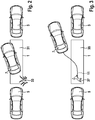
- FIG. 2 shows a parking situation with a longitudinal parking space 1, the parking area 31 is partially blocked by a soft obstacle, here shown as a plant 33, so that the driver assistance system stops the parking operation.
- the driver assistance system shows the driver, preferably via the portable control unit or cockpit devices, not shown here, the options that the driver can choose.
- the driver can initiate the complete release, ie confirm that the braking is not justified and the guidance can be continued, as if there were no object that led to the braking.
- a partial release may be made as with reference to FIG FIG. 1 be described, which may also be provided here that after finding that the plant 33 has collided with the vehicle 7 and was run over, the normal parking guidance is resumed. In this case, the driver assistance system can reliably assume that there is no longer a critical situation with the identified obstacle.
- FIG. 3 shows a situation of a parking operation in a Lssensparklücke 1, the parking area 35 is temporarily blocked by a movable obstacle, here exemplified by a dog 37.
- the moving object may in particular be a pedestrian or a cyclist, the intended way 11 of the motor vehicle 7 crosses.
- the detected obstacle interrupts the automatic or semi-automatic parking process.
- the driver may optionally select partial clearance or full clearance or cancel the maneuver.
- a release by the driving assistance system can also take place by a corresponding recognition of the movement vector and a prediction of the movement of objects crossing.
- a partial or complete release must necessarily be effected by the driver.
- only the partial release is possible and a complete release excluded.
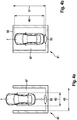
- FIGS. 4a and 4b show a parking operation in a narrow garage 41.
- a width 43 of a parking area 47 in the garage 41 is insignificantly wider than a width 45 of the vehicle 7.
- a length 51 of the parking area 47 in the garage 41 is insignificantly greater than a length 49 of the vehicle 7.
- the situation is typically in metropolitan areas when the available parking space is expensive and tight.
- the vehicle 7 abuts a padding 53 at the rear, which is arranged at the rear end of the garage 41.
- the front side closes a door or a gate 55, so that the vehicle 7 is just in the parking space 47 place.
- the area map with dimensions of the garage is calculated from the collected data of the detection system.
- the driver assistance system can recognize that a critical situation exists in which a very accurate navigation is required.
- the driver assistance system therefore suggests in such situations, the driver to release the parking maneuver only partially, as with respect to the FIGS. 1 to 3 has been described.
- the narrow garage 41 is the use of a portable controller, which with respect to the FIG. 1 described, particularly advantageous, since this allows the driver to control the process from outside the motor vehicle 7 and monitor.
- FIG. 5 shows a parking situation with a narrow transverse parking space 32, ie a parking space, in which a distance 57 between two adjacent vehicles 59, 61 is slightly greater than the width 45 of the vehicle 7.
- the situation presents the driver of the vehicle with independent maneuvering problems since he is very close to the Vehicles 59, 61 must navigate past.
- the driver assistance system may determine that a critical situation exists and suggest that the driver only partially release the maneuver, as described above.
- FIG. 6 shows a parking situation with a narrow parking space gap 1, ie a parking space 1, in which the parking area 63 is dimensioned so that the clear distance 65 between the parked in front of the vehicle 7 vehicle 3 and parked behind the vehicle 7 vehicle 5 only slightly larger than the length 49 of the vehicle 7 is formed. Also provided in this case, an option for a partial release of the driving maneuver after an interruption of the driving maneuver.
- the driver in addition to the option of partial release the option to perform the parking maneuver as if a parking space or parking area with usual dimensions vorläge.
- the driver is not necessarily bound to use slow or cautious maneuvering but, for example, when the parking maneuver has been done often, such as in the home garage, and can foresee that there is no critical situation in the actual It makes sense to perform a normal automatic or semi-automatic parking operation.
- the driver then carries the risk for his decision.
Landscapes
- Engineering & Computer Science (AREA)
- Chemical & Material Sciences (AREA)
- Combustion & Propulsion (AREA)
- Transportation (AREA)
- Mechanical Engineering (AREA)
- Physics & Mathematics (AREA)
- General Physics & Mathematics (AREA)
- Control Of Driving Devices And Active Controlling Of Vehicle (AREA)
- Traffic Control Systems (AREA)
Description
- Die Erfindung betrifft ein Verfahren zum automatischen Durchführen eines Fahrmanövers, bei dem in einem ersten Schritt die Umgebung des Kraftfahrzeugs erfasst wird und in einem zweiten Schritt anhand der erfassten Daten der Umgebung eine Trajektorie berechnet wird, entlang der das Kraftfahrzeug während des Fahrmanövers bewegt wird.
- Verfahren zur Unterstützung eines Fahrers eines Kraftfahrzeugs sind zum Beispiel Verfahren, die den Fahrer beim Einparken des Kraftfahrzeugs oder beim Befahren enger Straßen unterstützen. Die vorliegende Erfindung bezieht sich dabei insbesondere auf solche Verfahren, die den Fahrer bei einem Einparkmanöver in eine Parklücke oder bei Rangiermanövern unterstützen.
- Bei Verfahren zur Unterstützung des Fahrers bei Fahrmanövern wird unterschieden zwischen semiautomatischen Verfahren und vollautomatischen Verfahren. Bei semiautomatischen Verfahren wird eine Trajektorie berechnet und dem Fahrer werden Anweisungen gegeben, wie dieser das Kraftfahrzeug zu bewegen hat, beispielsweise um entlang der Trajektorie in die Parklücke einzuparken. Demgegenüber wird bei vollautomatischen Systemen das Fahrmanöver vollständig vom Fahrassistenzsystem übernommen und das Kraftfahrzeug beispielsweise automatisch in die Parklücke eingeparkt.
- Um das Kraftfahrzeug in die Parklücke zu bewegen, wird zunächst eine Bahn, entlang der das Kraftfahrzeug bewegt werden soll, eine so genannte Trajektorie oder ein sogenannter Fahrschlauch, berechnet. Zur Berechnung ist es notwendig, die Geometrie der Parklücke und die Position des Kraftfahrzeuges zu kennen. Die Geometrie der Parklücke wird dabei mit geeigneten Sensoren erfasst. Anhand der von den Sensoren erfassten Daten lässt sich eine Umgebungskarte des Kraftfahrzeuges erzeugen und eine geeignete Trajektorie in die Parklücke berechnen. Das Kraftfahrzeug wird dann entlang der Trajektorie in die Parklücke bewegt.
-
DE 10 2007 049 709 A1 hat eine Steuereinrichtung mit einem Verfahren zur Einparkunterstützung zum Gegenstand. Beschrieben ist ein automatisches Einparkverfahren, bei dem mit Hilfe von Abstandssensoren der Abstand zu Objekten in der Umgebung des Fahrzeugs erfasst wird. Wenn der gemessene Abstand eine vorgegebene Grenze unterschreitet, wird das durchgeführte Fahrmanöver unterbrochen. Sofern nach einer vorgegebenen Zeit kein Objekt mehr detektiert wird, wird dem Fahrer ein Hinweis gegeben, dass das Manöver fortgesetzt werden kann oder das Manöver wird automatisch fortgeführt. -
DE 10 2008 014 969 A1 hat ein Verfahren zur Einparkunterstützung zum Gegenstand, bei dem während des Einparkens jeweils die aktuelle Position des Fahrzeugs vermessen wird und mit einem automatischen Lenkeingriff eine zuvor ermittelte Einparktrajektorie abgefahren wird. Wenn das Verfahren abgebrochen wird, zum Beispiel wenn eine vorgegebene Grenzgeschwindigkeit erreicht, beziehungsweise überschritten wird, besteht die Möglichkeit, dass das Verfahren anschließend mit Hilfe der zuvor berechneten Trajektorie wieder fortgesetzt wird. Hierzu muss der Fahrer jedoch die Anweisung zum Fortführen des Verfahrens geben. -
DE 103 18 389 A1 beschreibt eine elektronische Einpark- und Rangierhilfe für Kraftfahrzeuge, bei der ein unterer Grenzwert für einen Abstand des Kraftfahrzeugs zu einem Hindernis an eine aktuelle Fahrsituation anpassbar ist. Sobald der untere Grenzwert unterschritten wird, wird in die Steuerung des Fahrzeugs eingegriffen und das Fahrzeug zum Beispiel angehalten. Dem Fahrer wird jederzeit die Möglichkeit gegeben, aktiv in das Geschehen einzugreifen und zum Beispiel trotz des Anhaltens aufgrund des Unterschreitens eines Grenzwertes das Fahrzeug weiter in die vorgegebene Richtung zu bewegen. -
DE 10 2010 037 300 A1 hat ein Verfahren zum Einparken eines Fahrzeugmittels eines Einparkhilfesystems zum Gegenstand, bei dem nach dem Deaktivieren des Einparkhilfesystems durch eine Handlung des Fahrers und/oder des Beifahrers die Daten im Zeitpunkt der Deaktivierung gespeichert werden. Im Anschluss ergeht eine Anweisung, ob das Einparkmanöver fortgesetzt werden soll. Wenn eine Fortsetzung gewünscht wird, werden die gespeicherten Informationen verwendet, um das Fahrzeug weiterzuführen. -
FR 2 785 383 A1 -
EP 2 295 281 A1 beschreibt eine Fahrassistenzeinrichtung für ein Fahrzeug und ein Verfahren zum Unterstützen eines Fahrers beim Überwachen eines autonomen Parkvorgangs eines Kraftfahrzeugs. Mit der Fahrassistenzeinrichtung erkennt der Fahrer eines Kraftfahrzeugs eine Gefahrsituation während eines autonomen Parkvorgangs des Kraftfahrzeugs. Eine Steuereinrichtung ist derart ausgelegt, dass Steuersignale an eine Antriebs- oder Lenkvorrichtung des Kraftfahrzeugs ausgegeben werden, die ein Durchführen eines autonom ablaufenden Parkvorgangs veranlassen. Die Steuereinrichtung ist auch dazu ausgelegt, Befehle von einer Fernbedienung zu empfangen und nach Empfangen eines vorbestimmten Unterbrechungsbefehles einen bereits begonnenen Parkvorgang des Kraftfahrzeugs zu unterbrechen. Zumindest eine Kamera ist mit der Steuereinrichtung gekoppelt und gewinnt Bilddaten über einen Umgebungsbereich des Kraftfahrzeugs. -
DE 10 2008 019346 A1 zeigt ein Verfahren zum automatischen Ein- und Ausparken eines Fahrzeugs, wobei das Fahrzeug von einem Parksystem automatisch gesteuert wird. Dabei wird ein Parkvorgang, welcher automatisch durch das Parksystem durchgeführt wird und auch je nach Notwendigkeit einen oder mehrere Richtungswechsel umfassen kann, nur solange fortgesetzt, solange eine Stellvorrichtung von einem Fahrer des Fahrzeugs manuell, z. B. mittels eines Fußes oder mittels eines Fingers, in einer vorbestimmten Stellung gehalten wird. Wird die Stellvorrichtung nicht in der vorbestimmten Stellung gehalten, zum Beispiel da der Fahrer seinen Fuß oder seinen Finger von der entsprechenden Stellvorrichtung nimmt, wird das Fahrzeug insbesondere in einen sicheren Zustand versetzt, indem es beispielsweise automatisch gebremst wird. - Erfindungsgemäß ist ein Verfahren zum automatischen Durchführen eines Fahrmanövers mit einem Kraftfahrzeug vorgesehen, wobei die Umgebung des Kraftfahrzeugs mit einem Erfassungssystem erfasst wird, eine Trajektorie berechnet wird, entlang der das Kraftfahrzeug während des Fahrmanövers anhand der erfassten Umgebungsdaten bewegt wird, das Kraftfahrzeug entlang der Trajektorie zur Durchführung des Fahrmanövers bewegt wird und eine Option für eine partielle Freigabe des Fahrmanövers nach einer Unterbrechung des Fahrmanövers bereit gestellt wird.
- Insbesondere ist vorgesehen, dass der Fahrer des Kraftfahrzeugs nach einer durch ein Fahrassistenzsystem oder durch den Fahrer ausgelösten Unterbrechung des Fahrmanövers eine partielle Freigabe des Fahrmanövers vorgeben kann. Nach der Wahl der Option der partiellen Freigabe des Fahrmanövers wird ein modifiziertes Fahrmanöver durchgeführt. Somit kann der Fahrer nach der Unterbrechung die Blockade aufheben.
- Die Erfindung ist besonders vorteilhaft in einer Situation, bei welcher ein Parkvorgang während der Vorbeifahrt an einer Parklücke durch Hindernisse blockiert wird, die von einem Fahrassistenzsystem, beispielsweise einem Kollisionsassistenten oder einem Parkassistenten, erkannt wurden. Für den Fall, dass der Parkvorgang aufgrund erkannter Hindernisse blockiert wird, wird eine Vollbremsung in den Stillstand des Fahrzeugs durchgeführt, d. h. der Parkvorgang unterbrochen. Die Erfindung ist auch besonders vorteilhaft in Situationen, bei welchen eine detektierte Parklücke besonders klein bemessen ist und nur durch optimale Ausnützung des verfügbaren Navigationsraums eine optimale Parkposition erreicht werden kann. Auch in diesen Situationen wird der Parkvorgang durch das Fahrassistenzsystem zunächst blockiert, d. h. eine Vollbremsung in den Stillstand des Fahrzeugs durchgeführt. Auch bei Rangieren auf engem Raum, insbesondere im Bereich öffentlicher Parkplätze oder enger Straßen ist die Erfindung anwendbar.
- Nach einer Ausführungsform der Erfindung kann der Fahrer die erfindungsgemäße Option für eine partielle Freigabe des Fahrmanövers aus einem Menü auswählen, wobei das Menü auch eine vollständige Freigabe des Einparkmanövers und/oder einen vollständigen Abbruch des Parkmanövers umfasst. Ebenso mit Hilfe von Menüoptionen kann dabei vorgesehen sein, dass der Fahrer zwischen einem Fahrmanöver mit sehr niedriger Geschwindigkeit und einem Fahrmanöver mit Schritt-für-Schritt-Vortasten auswählen kann.
- Nach einer Ausführungsform wird bei einer partiellen Freigabe des Fahrmanövers ein einmaliges Bewegen des Kraftfahrzeugs entlang der berechneten Trajektorie um eine kurze Distanz, von maximal 5 cm bis maximal 50 cm, bevorzugt maximal 10 cm bis maximal 20 cm, ausgeführt und das Kraftfahrzeug darauf hin in den Stillstand gebremst. Dieses Vortasten ist besonders vorteilhaft in Situationen, in denen auch ein Fahrer mit dem Rangieren Schwierigkeiten hätte, beispielsweise das Fahrzeug sehr nahe an realen Hindernissen vorbei oder an sie heran zu führen.
- Alternativ dazu kann bei einer partiellen Freigabe des Fahrmanövers ein Bewegen des Kraftfahrzeugs entlang der Trajektorie bei einer niedrigen Geschwindigkeit, insbesondere zwischen 1 km/h und 6 km/h, ausgeführt werden. Der Vorgang bleibt damit jederzeit überschaubar und es besteht die Möglichkeit, ihn schnell abzubrechen.
- Für die Durchführung des modifizierten Fahrmanövers sind spezielle Steuerungen vorteilhaft. Das einmalige Bewegen des Kraftfahrzeugs entlang der Trajektorie um die kurze Distanz mit dem darauf folgendem Stillstand des Kraftfahrzeugs wird bevorzugt durch ein einmaliges Drücken, einen Doppelklick oder durch ein Halten eines Schalters auf einem Steuergerät freigegeben.
- Das Bewegen des Kraftfahrzeugs entlang der Trajektorie bei der niedrigen Geschwindigkeit wird bevorzugt durch ein unterbrechungsfreies Betätigen eines Schalters auf einem Steuergerät freigegeben. Hier wird bei einem Loslassen des Schalters das Kraftfahrzeug in den Stillstand gebremst. Um das Kraftfahrzeug zum Stillstand zu bremsen, wird beim Loslassen des Schalters ein Signal an den Fahrassistenten im Kraftfahrzeug gesendet, der das Fahrmanöver steuert. Der Fahrassistent im Kraftfahrzeug betätigt dann die Bremsen, um das Kraftfahrzeug anzuhalten.
- Besonders vorteilhaft ist, wenn die Bremsung in den Stillstand eine nächste, zweite Unterbrechung des Fahrmanövers auslöst, nach welcher der Fahrer des Kraftfahrzeugs eine weitere, nicht unbedingt dieselbe, partielle Freigabe des Fahrmanövers vorgeben kann. Es ist also möglich, dass der Fahrer das Vortasten und das Bewegen des Kraftfahrzeugs bei der niedrigen Geschwindigkeit je nach Zweckmäßigkeit wieder und wieder ausführen kann, wobei das Bewegen des Kraftfahrzeugs bei der niedrigen Geschwindigkeit jederzeit unterbrechbar ist. Ein Vortasten kann so Schritt für Schritt erfolgen.
- In einer Ausführungsform der Erfindung ist das Steuergerät ein portables Steuergerät. Bei Verwendung des portablen Steuergerätes ist es möglich, das Fahrmanöver auch von außerhalb des Kraftfahrzeugs durchzuführen. Der Fahrer muss während des Fahrmanövers nicht mehr notwendigerweise auf dem Fahrersitz sitzen. Damit der Fahrer oder ein anderer Benutzer das Fahrmanöver während seiner Durchführung überwachen kann, werden insbesondere auch während des Fahrmanövers die vom Erfassungssystem erfassten Daten an das portable Steuergerät übertragen. Hierbei ist es besonders bevorzugt, wenn die erfassten Daten in Form einer Umgebungskarte auf einer Anzeigevorrichtung des portablen Steuergeräts dargestellt werden. Als Anzeigevorrichtung eignet sich dabei jeder beliebige, dem Fachmann bekannte Monitor oder Touchscreen.
- Um dem Fahrer des Kraftfahrzeugs zu ermöglichen, das Fahrmanöver auch außerhalb des Kraftfahrzeugs zu überwachen, werden die Daten an das portable Steuergerät bevorzugt drahtlos, beispielsweise über Funk, übertragen. Zur Datenübertragung eignen sich zum Beispiel Bluetooth oder WiFi.
- Das Fahrmanöver, bei dem das erfindungsgemäße Verfahren durchgeführt wird, ist insbesondere ein Einparkmanöver. Das Einparkmanöver kann dabei entweder ein Einparkmanöver in eine Querparklücke oder ein Einparkmanöver in eine Längsparklücke oder in eine Garage sein. Das Einparkmanöver wird dabei bevorzugt von einem Parkassistenten gesteuert und ausgeführt, welcher ein semiautomatisches oder ein vollautomatisches Manöver durchführen kann.
- Erfindungsgemäß wird weiterhin ein Computerprogramm vorgeschlagen, gemäß dem eines der hierin beschriebenen Verfahren durchgeführt wird, wenn das Computerprogramm auf einer programmierbaren Computereinrichtung ausgeführt wird. Bei dem Computerprogramm kann es sich beispielsweise um ein Modul zur Implementierung eines Fahrassistenzsystems oder eines Subsystems hiervon in einem Fahrzeug handeln oder um eine Applikation für Fahrassistenzfunktionen, welche auf einem Smartphone ausführbar ist. Das Computerprogramm kann auf einem maschinenlesbaren Speichermedium gespeichert werden, etwa auf einem permanenten oder wiederbeschreibbaren Speichermedium oder in Zuordnung zu einer Computereinrichtung oder auf einer entfernbaren CD-Rom, DVD oder einem USB-Stick. Zusätzlich oder alternativ kann das Computerprogramm auf einer Computereinrichtung wie etwa auf einem Server zum Herunterladen bereitgestellt werden, z.B. über ein Datennetzwerk wie das Internet oder eine Kommunikationsverbindung wie etwa eine Telefonleitung oder eine drahtlose Verbindung.
- Eine erfindungsgemäßes Fahrassistenzsystem zur Durchführung des oben beschriebenen Verfahrens umfasst ein Erfassungssystem zur Erfassung der Umgebung des Kraftfahrzeugs, ein Modul zur Bestimmung einer Trajektorie, entlang der das Fahrmanöver durchgeführt wird, und ein insbesondere portables Steuergerät mit einem Schalter, der während des Fahrmanövers betätigbar ist und über den der Fahrer eine partielle Freigabe des Fahrmanövers vorgeben kann.
- Es kann eine Überwachung mit mehreren verschiedenen Erfassungssystemen vorgesehen sein. Hierdurch wird eine zusätzliche Sicherheitsstufe eingebaut zur Überwachung der Umgebung des Kraftfahrzeugs während des Fahrmanövers. Die Sensorsysteme können unabhängig voneinander arbeiten oder es kann eine Datenfusion der Daten der verschiedenen Sensorsysteme erfolgen.
- Als Erfassungssystem zur Erfassung der Umgebung des Kraftfahrzeuges werden üblicherweise Sensoren am Kraftfahrzeug eingesetzt. Diese befinden sich im Allgemeinen im Front- und im Heckbereich des Kraftfahrzeuges. Zusätzlich ist es auch möglich, an den Seiten des Kraftfahrzeuges weitere Sensoren vorzusehen. Sensoren, die zur Erfassung der Umgebung eingesetzt werden können, sind zum Beispiel Ultraschallsensoren, Infrarotsensoren, Radarsensoren oder LIDAR-Sensoren sowie optische Sensoren. Als optische Sensoren im Rahmen der vorliegenden Erfindung werden auch Kameras bezeichnet, deren erfasste Bilder mit einer Bildverarbeitungssoftware ausgewertet werden. Besonders bevorzugt als Sensoren des Erfassungssystems zur Erfassung der Umgebung des Kraftfahrzeugs sind Ultraschallsensoren.
- Die Ultraschallsensoren zur Erfassung der Umgebung werden üblicherweise im vorderen und im hinteren Stoßfänger des Kraftfahrzeugs positioniert. Aufgrund der Einbaulage wird jedoch nur ein Bereich vor dem Kraftfahrzeug und hinter dem Kraftfahrzeug erfasst. Die Bereiche direkt neben dem Kraftfahrzeug können durch die Sensoren aufgrund ihrer Einbaulage nicht erfasst werden. Der Erfassungsbereich im Front- bzw. Heckbereich des Kraftfahrzeugs umfasst jedoch nicht nur den Bereich, der sich unmittelbar vor dem Kraftfahrzeug befindet, sondern erstreckt sich auch noch - in Abhängigkeit von der Reichweite der Sensoren - ein Stück weit nach links und rechts über die Seiten des Kraftfahrzeugs hinaus.
- Insbesondere um auch den Bereich neben dem Kraftfahrzeug zu erfassen, werden im vorderen Stoßfänger Sensoren positioniert, die nach links und nach rechts ihren Erfassungsbereich haben. Zusätzlich oder alternativ können auch im hinteren Stoßfänger Sensoren derart positioniert sein, dass diese einen Bereich links und rechts neben dem Kraftfahrzeug erfassen.
- Bei optischen Sensoren, insbesondere bei Kameras, wird zur Auswertung und zur Bestimmung des Abstandes eine Bildverarbeitungssoftware herangezogen. Die optischen Sensoren des Erfassungssystems sind dabei vorzugsweise im Frontbereich, im Heckbereich und seitlich am Kraftfahrzeug, zum Beispiel als SVA-Kameras oder im Bereich der Außenspiegel als SVS-Kameras oder BSD-Kameras, positioniert. Im Allgemeinen werden ein Videosensor im Frontbereich, vorzugsweise mittig, ein Videosensor im Heckbereich, ebenfalls vorzugsweise mittig, und jeweils ein Videosensor auf jeder Seite des Kraftfahrzeugs angeordnet. Die Videosensoren im Frontbereich und im Heckbereich können zum Beispiel im Bereich der Windschutzscheibe, beispielsweise in der Halterung des Innenspiegels und im Bereich der Heckscheibe positioniert sein. Bevorzugt werden die Videosensoren im Bereich der Stoßfänger angeordnet. Hierdurch ist es möglich, das gesamte Umfeld um das Kraftfahrzeug zu erfassen.
- Aus den mit den Sensoren erfassten Daten lässt sich eine Umgebungskarte erstellen. In der Umgebungskarte sind jeweils die Umrisse von Objekten, die zum Beispiel eine Parklücke begrenzen, und Hindernisse erfasst. Anhand der Begrenzungen, die durch die Objekte gegeben sind, lässt sich ermitteln, ob die Umgebung geeignet ist, das Kraftfahrzeug darin zu navigieren. Wenn dies der Fall ist, wird eine Trajektorie bestimmt, entlang der das Kraftfahrzeug zu bewegen ist, um das Fahrmanöver, insbesondere das Einparkmanöver, durchzuführen.
- Zur Erstellung der Umgebungskarte und zum Berechnen der Trajektorie wird üblicherweise ein Steuergerät eines Fahrassistenzsystems, beispielsweise ein Parkassistent eingesetzt. Dem Parkassistenten werden die von den Sensoren erfassten Daten übergeben, so dass der Parkassistent die Umgebungskarte erstellt. Alternativ ist es auch möglich, die Sensoren mit geeigneten Prozessoren zu versehen, so dass die Sensoren untereinander bereits die Umgebungskarte berechnen können. Aus den Daten der Umgebungskarte wird dann mit einer geeigneten Software, die im Parkassistenten hinterlegt ist, die Trajektorie bestimmt.
- Mit Hilfe des Fahrassistenzsystems werden während des Fahrmanövers die Längsführung und/oder die Querführung des Kraftfahrzeugs gesteuert. Hierzu werden zum Beispiel die Bremsen des Kraftfahrzeugs, das Fahrpedal und die Lenkung angesteuert, um das Kraftfahrzeug zu beschleunigen, abzubremsen und zu lenken.
- Es zeigen
- Figur 1
- eine Einparksituation in eine Längsparklücke,
- Figur 2
- eine weitere Einparksituation in eine Längsparklücke,
- Figur 3
- eine weitere Einparksituation in eine Längsparklücke,
- Figuren 4a und 4b
- eine Einparksituation in eine enge Garage,
- Figur 5
- eine Einparksituation in eine enge Querparklücke und
- Figur 6
- eine Einparksituation in eine enge Längsparklücke.
- Eine Parklücke 1 wird üblicherweise seitlich von Objekten, beispielsweise von Fahrzeugen, Pfosten, Wänden oder Mauern oder auch Linien begrenzt. In der hier dargestellten Lage ist die Parklücke 1 von einem ersten Fahrzeug 3 frontseitig und heckseitig von einem zweiten Fahrzeug 5 begrenzt.
- Bei einer Vorbeifahrt mit einem Kraftfahrzeug 7 wird die Umgebung des Kraftfahrzeugs 7 mit geeigneten Sensoren 9 eines Erfassungssystems erfasst. Als Sensoren für das Erfassungssystem eignen sich zum Beispiel Ultraschallsensoren, Infrarotsensoren, Radarsensoren, LIDAR-Sensoren oder optische Sensoren, beispielsweise Kameras.
- Bei einem ausreichend langen Abstand zwischen zwei Objekten, beispielsweise zwischen den zwei Fahrzeugen 3, 5 wird von einer geeigneten Parklücke ausgegangen. Da der Abstand für eine Querparklücke kleiner ist als für eine Längsparklücke, ist es zum Beispiel möglich, dass vom Benutzer des Fahrassistenzsystems, im Allgemeinem dem Fahrer des Kraftfahrzeugs 7, vorgegeben wird, ob eine Querparklücke oder eine Längsparklücke gesucht wird. Wenn eine geeignete Parklücke 1 erfasst worden ist, wird anhand der erfassten Umgebungsdaten eine Umgebungskarte erstellt und eine Trajektorie 11 berechnet, entlang der das Kraftfahrzeug 7 in die Parklücke einparken kann. Die Trajektorie 11 beschreibt zum Beispiel den Weg, den der Mittelpunkt der Hinterachse des Kraftfahrzeugs 7 zurücklegt. Der vom Fahrzeug überstrichene Bereich 13, bzw. der durchfahrene Raum wird auch als Fahrschlauch bezeichnet und kann ebenfalls zur Beschreibung des Weges in die Parklücke 1 herangezogen werden. In Abhängigkeit von der Position des Kraftfahrzeugs 7 und der Geometrie der erfassten Parklücke 1 kann das Fahrmanöver einzügig oder mehrzügig durchgeführt werden. Bei einem mehrzügigen Fahrmanöver wechseln sich üblicherweise Vorwärtsfahrzüge und Rückwärtsfahrzüge ab.
- Nach der Berechnung der Trajektorie 11 wird das Kraftfahrzeug 7 automatisch oder semiautomatisch entlang der Trajektorie 11 in die Parklücke 1 bewegt. Hierzu werden zum Beispiel mit einem Steuergerät im Kraftfahrzeug 7 das Fahrpedal, die Bremsen, das Getriebe, beziehungsweise die Gangwahl und die Lenkung des Kraftfahrzeugs 7 und/oder Anzeigeeinheiten für den Fahrer angesteuert.
- Die von den Sensoren 9 des Erfassungssystems erfassten Daten werden in der in
Figur 1 dargestellten Ausführungsform an ein portables Steuergerät 21, beispielsweise ein Smartphone, übertragen, das von einem Bediener 23, üblicherweise dem Fahrer des Kraftfahrzeugs 7, betätigt wird. Das Steuergerät kann aber auch im Fahrzeug verbaut sein und dort vorhandene Head-up-Displays und/oder Head-down-Displays nutzen. Für den Fall, dass ein portables Steuergerät 21 verwendet wird, werden die Daten vorzugsweise drahtlos übertragen, sodass eine Überwachung nicht ortsgebunden erfolgen muss. Durch die drahtlose Übertragung ist es zum Beispiel möglich, dass das Fahrmanöver vom Fahrer auch außerhalb des Kraftfahrzeugs 7 überwacht wird. Hierzu weist das portable Steuergerät 21 vorzugsweise eine Anzeigevorrichtung 25 auf, auf der die von den Sensoren 9 des Erfassungssystems erfassten Daten in Form einer Umgebungskarte dargestellt werden. Über die Anzeigevorrichtung 25 kann sich der Fahrer über die aktuelle Situation informieren. - Die Umgebungskarte wird aus den erfassten Daten des Erfassungssystems berechnet und auf der Anzeigevorrichtung 25 des portablen Steuergeräts 21 dargestellt. Die Darstellung der Karte kann dann zum Beispiel in Form von Umrisslinien in Draufsicht erfolgen. Alternativ ist es bei einer Erfassung mit optischen Sensoren auch möglich, zum Beispiel direkt das erfasste Bild der optischen Sensoren anzuzeigen. Bevorzugt ist jedoch auch hier eine Berechnung einer Umgebungskarte und eine Darstellung in Draufsicht. Durch geeignete Bildauswertung bei optischen Sensoren ist es hier zum Beispiel möglich, die einzelnen von den optischen Sensoren erfassten Objekte zu klassifizieren und beispielsweise mit weiteren Informationen angereichert darzustellen. So können zum Beispiel für unterschiedliche Objekte verschiedene Symbole eingesetzt werden oder es erfolgt eine Beschriftung.
- Zur Überwachung des Fahrmanövers weist das portable Steuergerät 21 einen Schalter 27 auf. Hierdurch kann der Fahrer 23 das Fahrmanöver gezielt unterbrechen, zum Beispiel, wenn plötzlich eine Gefahrensituation auftaucht, indem beispielsweise ein sich bewegendes Objekt in den zu befahrenden Bereich gelangt, wie in
Figur 3 dargestellt. Alternativ dazu oder zusätzlich dazu kann das Fahrerassistenzsystem das Fahrmanöver gezielt unterbrechen, wenn plötzlich eine Gefahrensituation auftaucht. - Der Fahrer des Kraftfahrzeugs 7, der das Fahrmanöver überwacht, kann während des Fahrmanövers im Kraftfahrzeug 7 sein oder außerhalb des Kraftfahrzeugs 7. Auch ist es möglich, dass der Fahrer das Fahrmanöver unterbricht, während der Unterbrechung aussteigt und das Fahrmanöver anschließend von außerhalb des Kraftfahrzeugs 7 weiter überwacht. Dies kann zum Beispiel dann sinnvoll sein, wenn die Parklücke 1, beispielsweise die in
Figur 5 dargestellte Querparklücke oder die in denFiguren 4a und 4b dargestellte Garage, so schmal ist, dass der Fahrer nach dem Einparken das Kraftfahrzeug 7 nicht mehr verlassen kann, da sich die Türen nicht mehr weit genug öffnen lassen. - Das Verfahren eignet sich aufgrund der Möglichkeit für den Fahrer, das Fahrmanöver auch außerhalb des Kraftfahrzeugs 7 zu überwachen, insbesondere für Einparkmanöver. Neben Einparkmanövern können jedoch auch beliebige andere Fahrmanöver automatisch oder semiautomatisch durchgeführt werden, zum Beispiel Rangierfahrten oder Fahrten durch enge Gassen oder Straßen und insbesondere auch das Ausparken aus einer Parklücke, insbesondere aus einer engen Parklücke. Um das Fahrmanöver automatisch oder semiautomatisch durchführen zu können ist es dabei unabhängig vom geplanten Fahrmanöver notwendig, zunächst die Umgebung zu erfassen und anhand der erfassten Umgebung eine Trajektorie zu berechnen, entlang der das Fahrmanöver durchgeführt wird. Wenn nicht der gesamte während des Fahrmanövers zu befahrende Bereich erfasst werden kann, ist auch eine Durchführung des Fahrmanövers in einzelnen Abschnitten möglich. Hierbei wird jeweils für den bereits erfassten Bereich eine Trajektorie berechnet, während der Fahrt entlang der Trajektorie die Umgebung weiter erfasst und eine Verlängerung der Trajektorie bestimmt, bis das Fahrmanöver beendet worden ist. Bevorzugt ist es jedoch, die Umgebung, in der das Fahrmanöver durchgeführt werden soll, vollständig zu erfassen und die Trajektorie bis zum Erreichen des Zielpunktes auf einmal zu berechnen, wie dies für Einparkmanöver in Parklücken möglich ist.
- Bei der in
Figur 1 dargestellten Parksituation ist der zur Verfügung stehende Abstand zwischen dem vor dem Fahrzeug 7 geparkten Fahrzeug 3 und dem hinter dem Fahrzeug 7 geparkten Fahrzeug 5 zwar ausreichend groß, jedoch ist ein Untergrund 29 der Parklücke 1 derart strukturiert, dass er Bodenreflektionen erzeugt, die das Fahrassistenzsystem fälschlicherweise als Hindernis erkennt. Das Fahrassistenzsystem unterbricht den Einparkvorgang und tritt daraufhin mit dem Fahrer in Interaktion und fordert ihn auf, das Parkmanöver entweder partiell oder vollständig freizugeben oder ganz abzubrechen. Im vorliegenden Fall, wenn das Fahrassistenzsystem die Bodenreflektion fälschlich als Hindernis erkannt hat, könnte eine vollständige Freigabe durch den Fahrer sinnvoll sein. In diesem Fall wird das Fahrmanöver fortgesetzt. Da die Option für die partielle Freigabe des Fahrmanövers nach der Unterbrechung des Fahrmanövers vorgesehen ist, kann der Fahrer auch die partielle Freigabe wählen. Diese kann ein Fahrmanöver mit sehr niedriger Geschwindigkeit oder ein Fahrmanöver mit Schritt-für-Schritt-Vortasten umfassen, wobei die Alternativen bevorzugt in einer Auswahlliste dargestellt werden. - Wählt der Fahrer das einmalige Bewegen des Kraftfahrzeugs entlang der Trajektorie um eine kurze Distanz, so kann dies beispielsweise so ausgestaltet sein, dass er den Schalter 27 oder einen weiteren Schalter auf dem insbesondere portablen Steuergerät 21 einmalig drückt, doppelt anklickt oder über einen kurzen Zeitraum hält. Es kann vorgesehen sein, dass der Fahrer die kurze Distanz selbst festlegt oder diese aus einem Menü mit mehreren Distanzen, beispielsweise umfassend 5 cm, 10 cm, 20 cm und 50 cm, auswählen kann oder es kann eine Voreinstellung für das Maß der kurzen Distanz vorgesehen sein. Auf die Bewegung um die kurze Distanz erfolgt ein Stillstand des Kraftfahrzeugs. Das Fahrerassistenzsystem betätigt die Bremsen und löst ggf. den Gang, um das Kraftfahrzeug anzuhalten. Hiernach ist bevorzugt vorgesehen, dass das Fahrerassistenzsystem wiederum mit dem Fahrer in Interaktion tritt und ihn auffordert, das Parkmanöver entweder partiell oder vollständig freizugeben oder abzubrechen.
- Das Bewegen des Kraftfahrzeugs entlang der Trajektorie 11 bei der niedrigen Geschwindigkeit erfolgt bevorzugt durch ein unterbrechungsfreies Betätigen des Schalters 27 oder eines weiteren Schalters auf dem portablen Steuergerät 21. Bei einem Loslassen des Schalters 27 wird das Kraftfahrzeug 7 in den Stillstand gebremst. Um das Kraftfahrzeug zum Stillstand zu bremsen, wird beim Loslassen des Schalters 27 ein Signal an den Parkassistenten im Kraftfahrzeug gesendet, der das Fahrmanöver steuert. Das Fahrerassistenzsystem betätigt dann die Bremsen und löst ggf. den Gang, um das Kraftfahrzeug anzuhalten. Hiernach ist ebenfalls vorgesehen, dass das Fahrerassistenzsystem wiederum mit dem Fahrer in Interaktion tritt und ihn auffordert, das Parkmanöver entweder partiell oder vollständig freizugeben oder abzubrechen.
-
Figur 2 zeigt eine Einparksituation mit einer Längsparklücke 1, deren Parkfläche 31 zum Teil von einem weichen Hindernis, hier als eine Pflanze 33 dargestellt, blockiert ist, sodass das Fahrerassistenzsystem den Einparkvorgang abbricht. Das Fahrerassistenzsystem zeigt dem Fahrer, bevorzugt über das hier nicht dargestellte portable Steuergerät oder Cockpitgeräte, die Optionen an, die der Fahrer wählen kann. In der vorliegenden Situation mit der Pflanze 33 kann der Fahrer beispielsweise die vollständige Freigabe veranlassen, d. h. rückmelden, dass die Bremsung nicht berechtigt ist und die Führung fortgesetzt werden kann, als gäbe es das Objekt nicht, das zum Einbremsen geführt hat. Alternativ dazu kann eine partielle Freigabe wie mit Bezug aufFigur 1 beschrieben ausgeführt werden, wobei hier außerdem vorgesehen sein kann, dass nach Feststellung, dass die Pflanze 33 mit dem Fahrzeug 7 kollidiert ist und überfahren wurde, die normale Einparkführung wieder aufgenommen wird. In diesem Fall kann das Fahrassistenzsystem zuverlässig davon ausgehen, dass keine kritische Situation mit dem erkannten Hindernis mehr vorliegt. -
Figur 3 zeigt eine Situation eines Einparkvorgangs in eine Längsparklücke 1, deren Parkfläche 35 durch ein bewegliches Hindernis temporär blockiert ist, hier beispielhaft dargestellt durch einen Hund 37. Das sich bewegende Objekt kann insbesondere auch ein Fußgänger oder ein Radfahrer sein, der den vorgesehenen Weg 11 des Kraftfahrzeuges 7 kreuzt. Durch das erkannte Hindernis wird der automatische oder halbautomatische Einparkvorgang unterbrochen. Der Fahrer kann optional die partielle Freigabe oder eine vollständige Freigabe auswählen oder das Fahrmanöver abzubrechen. - Bei Objekten, die nur temporär den Fahrschlauch blockieren und sich anschließend wieder entfernen, kann durch eine entsprechende Erkennung des Bewegungsvektors und eine Prädiktion der Bewegung querender Objekte auch eine Freigabe durch das Fahrassistenzsystem erfolgen. Alternativ kann aber auch vorgesehen sein, dass aus Sicherheitsgründen eine partielle oder vollständige Freigabe zwangsläufig durch den Fahrer erfolgen muss. Nach einer alternativen Ausführungsform der Erfindung ist in Situationen mit beweglichen Hindernissen aus Sicherheitsgründen nur die partielle Freigabe möglich und eine vollständige Freigabe ausgeschlossen.
-
Figuren 4a und 4b zeigen einen Einparkvorgang in eine enge Garage 41. Eine Breite 43 einer Parkfläche 47 in der Garage 41 ist unwesentlich breiter als eine Breite 45 des Fahrzeugs 7. Auch eine Länge 51 der Parkfläche 47 in der Garage 41 ist unwesentlich größer als eine Länge 49 des Fahrzeugs 7. Die Situation liegt typischerweise in Ballungsräumen vor, wenn der zur Verfügung stehende Parkplatz teuer und eng bemessen ist. In manchen Garagen 41 ist vorgesehen, dass das Fahrzeug 7 heckseitig an eine Polsterung 53 anstößt, die am hinteren Ende der Garage 41 angeordnet ist. Vorderseitig schließt eine Tür oder ein Tor 55, sodass das Fahrzeug 7 gerade noch in der Parklücke 47 Platz findet. Die Umgebungskarte mit Bemessungen der Garage wird aus den erfassten Daten des Erfassungssystems berechnet. Hieraus kann das Fahrassistenzsystem erkennen, dass eine kritische Situation vorliegt, in der ein sehr genaues Navigieren erforderlich ist. Das Fahrassistenzsystem schlägt daher auch in solchen Situationen dem Fahrer vor, das Einparkmanöver nur partiell freizugeben, wie mit Bezug auf dieFiguren 1 bis 3 beschrieben wurde. Bei der engen Garage 41 ist die Verwendung eines portablen Steuergeräts, welches mit Bezug auf dieFigur 1 beschrieben wurde, besonders vorteilhaft, da dies dem Fahrer ermöglicht, den Vorgang von außerhalb des Kraftfahrzeugs 7 zu steuern und zu überwachen. -
Figur 5 zeigt eine Parksituation mit einer engen Querparklücke 32, d.h. eine Parklücke, bei welcher ein Abstand 57 zwischen zwei nebeneinander parkenden Fahrzeugen 59, 61 geringfügig größer ist als die Breite 45 des Fahrzeugs 7. Die Situation stellt den Fahrer des Fahrzeugs beim eigenständigen Rangieren vor Probleme, da er sehr nahe an den Fahrzeugen 59, 61 vorbei navigieren muss. In diesem Fall kann das Fahrassistenzsystem feststellen, dass eine kritische Situation vorliegt und dem Fahrer vorschlagen, das Fahrmanöver nur partiell freizugeben, wie oben beschrieben. -
Figur 6 zeigt eine Parksituation mit einer engen Längsparklücke 1, d.h. eine Parklücke 1, bei welcher die Parkfläche 63 so bemessen ist, dass der lichte Abstand 65 zwischen dem vor dem Fahrzeug 7 geparkten Fahrzeug 3 und dem hinter dem Fahrzeug 7 geparkten Fahrzeug 5 nur geringfügig größer als die Länge 49 des Fahrzeugs 7 ausgebildet ist. Auch in diesem Fall eine Option für eine partielle Freigabe des Fahrmanövers nach einer Unterbrechung des Fahrmanövers vorgesehen. - In den mit Bezug auf
Figuren 4 bis 6 beschriebenen Situationen, bei welchen die Parklücke 1 bzw. die Parkfläche 47, 57, 63 für sehr oder zu eng bemessen beurteilt wurde, kann es sinnvoll sein, dem Fahrer zusätzlich zur Option der partiellen Freigabe die Option bereitzustellen, das Einparkmanöver so durchzuführen, als wenn eine Parklücke oder Parkfläche mit gewöhnlichen Maßen vorläge. Somit ist der Fahrer nicht zwangsläufig daran gebunden, eine langsame oder vorsichtige Manövrierung zu verwenden, sondern es kann beispielsweise dann, wenn das Parkmanöver schon oft, wie etwa in der Heimatgarage, erfolgreich durchgeführt wurde, und sich absehen lässt, dass keine kritische Situation im eigentlichen Sinn vorliegt, ein normaler automatischer oder semiautomatischer Parkvorgang ausgeführt werden. Ebenso kann beispielsweise bei Zeitmangel der normale Parkvorgang ausgeführt werden, wobei der Fahrer dann das Risiko für seine Entscheidung trägt. - Die Erfindung ist nicht auf die hier beschriebenen Ausführungsbeispiele und die darin hervorgehobenen Aspekte beschränkt. Vielmehr ist innerhalb des durch die Ansprüche angegebenen Bereichs eine Vielzahl von Abwandlungen möglich, die im Rahmen fachmännischen Handelns liegen.
Claims (10)
- Verfahren zum Durchführen eines Fahrmanövers mit einem Kraftfahrzeug (7), folgende Schritte umfassend:(a) Erfassen der Umgebung des Kraftfahrzeugs (7) mit einem Erfassungssystem (9),(b) Berechnen einer Trajektorie (11), entlang der das Kraftfahrzeug (7) während des Fahrmanövers bewegt wird, anhand der in Schritt (a) erfassten Umgebungsdaten,(c) Bewegen des Kraftfahrzeugs (7) entlang der Trajektorie (11) zur Durchführung des Fahrmanövers,(d) Unterbrechen des Fahrmanövers durch ein Fahrassistenzsystem, wenn eine Gefahrensituation auftaucht,(e) Bereitstellen einer Option für eine partielle Freigabe des Fahrmanövers nach der Unterbrechung des Fahrmanövers.
- Verfahren gemäß Anspruch 1, dadurch gekennzeichnet, dass bei der partiellen Freigabe des Fahrmanövers ein einmaliges Bewegen des Kraftfahrzeugs (7) entlang der Trajektorie (11) um eine kurze Distanz, von maximal zwischen 5 cm bis maximal 50 cm ausgeführt wird und das Kraftfahrzeug (7) darauf hin in den Stillstand gebremst wird.
- Verfahren gemäß Anspruch 2, dadurch gekennzeichnet, dass das einmalige Bewegen des Kraftfahrzeugs (7) entlang der Trajektorie (11) um die kurze Distanz mit dem darauf folgendem Stillstand des Kraftfahrzeugs (7) durch ein einmaliges Drücken, einen Doppelklick oder durch ein Halten eines Schalters (27) auf einem Steuergerät (21) freigegeben wird.
- Verfahren gemäß Anspruch 1, dadurch gekennzeichnet, dass bei der partiellen Freigabe des Fahrmanövers ein Bewegen des Kraftfahrzeugs (7) entlang der Trajektorie (11) bei einer niedrigen Geschwindigkeit zwischen 1 km/h und 6 km/h ausgeführt wird.
- Verfahren gemäß Anspruch 4, dadurch gekennzeichnet, dass das Bewegen des Kraftfahrzeugs (7) entlang der Trajektorie (11) bei der niedrigen Geschwindigkeit durch ein unterbrechungsfreies Betätigen eines Schalters (27) auf einem Steuergerät (21) freigegeben wird und bei einem Loslassen des Schalters (27) das Kraftfahrzeug (7) in den Stillstand gebremst wird.
- Verfahren gemäß Anspruch 3 oder 5, dadurch gekennzeichnet, dass die Bremsung des Kraftfahrzeugs (7) in den Stillstand eine nächste Unterbrechung des Fahrmanövers auslöst, nach welcher der Fahrer des Kraftfahrzeugs (7) eine weitere partielle Freigabe des Fahrmanövers vorgeben kann.
- Verfahren gemäß einem der Ansprüche 3, 5 oder 6, dadurch gekennzeichnet, dass das Steuergerät (21) ein portables Steuergerät ist.
- Verfahren gemäß einem der Ansprüche 1 bis 7, dadurch gekennzeichnet, dass das Fahrmanöver ein Einparkmanöver ist.
- Computerprogramm zur Durchführung eines der Verfahren nach einem der Ansprüche 1 bis 8, wenn das Computerprogramm auf einer programmierbaren Computereinrichtung ausgeführt wird.
- Fahrassistenzsystem zur Durchführung eines der Verfahren nach einem der Ansprüche 1 bis 8, umfassend- ein Erfassungssystem (9) zur Erfassung der Umgebung des Kraftfahrzeugs (7),- ein Modul zur Bestimmung einer Trajektorie (11), entlang der das Fahrmanöver durchgeführt wird, und- ein Steuergerät (21) mit einem Schalter (27), der während des Fahrmanövers betätigbar ist und über den der Fahrer eine partielle Freigabe des Fahrmanövers vorgeben kann.
Applications Claiming Priority (2)
| Application Number | Priority Date | Filing Date | Title |
|---|---|---|---|
| DE102012203235A DE102012203235A1 (de) | 2012-03-01 | 2012-03-01 | Verfahren zum automatischen Durchführen eines Fahrmanövers |
| PCT/EP2013/053330 WO2013127666A1 (de) | 2012-03-01 | 2013-02-20 | Verfahren zum automatischen durchführen eines fahrmanövers |
Publications (2)
| Publication Number | Publication Date |
|---|---|
| EP2820636A1 EP2820636A1 (de) | 2015-01-07 |
| EP2820636B1 true EP2820636B1 (de) | 2019-04-10 |
Family
ID=47754464
Family Applications (1)
| Application Number | Title | Priority Date | Filing Date |
|---|---|---|---|
| EP13706472.1A Active EP2820636B1 (de) | 2012-03-01 | 2013-02-20 | Verfahren zum automatischen durchführen eines fahrmanövers |
Country Status (4)
| Country | Link |
|---|---|
| EP (1) | EP2820636B1 (de) |
| CN (1) | CN104395946B (de) |
| DE (1) | DE102012203235A1 (de) |
| WO (1) | WO2013127666A1 (de) |
Cited By (2)
| Publication number | Priority date | Publication date | Assignee | Title |
|---|---|---|---|---|
| DE102020129670A1 (de) | 2020-11-11 | 2022-05-12 | Valeo Schalter Und Sensoren Gmbh | Verfahren zum betreiben eines parkassistenzsystems, computerprogrammprodukt, parkassistenzsystem und fahrzeug |
| US11938928B2 (en) | 2021-11-03 | 2024-03-26 | Honda Motor Co., Ltd. | Systems and methods for vehicular navigation of narrow gaps |
Families Citing this family (37)
| Publication number | Priority date | Publication date | Assignee | Title |
|---|---|---|---|---|
| AT515166B1 (de) * | 2013-11-27 | 2024-08-15 | Dr Kuhn Andreas | Verfahren zum motorenbetriebenen Anlegen |
| DE102014220263A1 (de) * | 2014-10-07 | 2016-04-07 | Conti Temic Microelectronic Gmbh | Verfahren und System zum Unterstützen eines Einparkvorganges eines Kraftfahrzeuges |
| DE102014221755A1 (de) * | 2014-10-27 | 2016-04-28 | Robert Bosch Gmbh | Verfahren und Vorrichtung zum Betreiben eines Fahrzeugs |
| DE102015208124A1 (de) * | 2015-04-17 | 2016-10-20 | Bayerische Motoren Werke Aktiengesellschaft | Signalisieren von Information über eine erkannte Parklücke an den Bediener einer Fernbedienung für ein per Fernbedienung kontrollierbares Parkassistenzsystem zum automatisierten Einparken eines Kraftfahrzeugs |
| DE102015216881A1 (de) | 2015-09-03 | 2017-03-09 | Robert Bosch Gmbh | Verfahren und Vorrichtung zum fahrerlosen Führen eines Kraftfahrzeugs innerhalb eines Parkplatzes |
| DE102015217390A1 (de) * | 2015-09-11 | 2017-03-16 | Robert Bosch Gmbh | Verfahren und Vorrichtung zum Betreiben eines Fahrzeugs sowie Verfahren zum Betreiben eines Parkplatzes |
| DE102015217388A1 (de) | 2015-09-11 | 2017-03-16 | Robert Bosch Gmbh | Verfahren und Vorrichtung zum Betreiben eines innerhalb eines Parkplatzes fahrerlos fahrenden Kraftfahrzeugs |
| DE102015217489B4 (de) * | 2015-09-14 | 2021-10-28 | Volkswagen Aktiengesellschaft | Eingabeverfahren und Vorrichtung in einem Kraftfahrzeug zum Auswählen eines Zieles einer automatisierten Fahrt |
| US10832426B2 (en) | 2015-09-24 | 2020-11-10 | Apple Inc. | Systems and methods for surface monitoring |
| CN108139221A (zh) * | 2015-09-24 | 2018-06-08 | 苹果公司 | 用于向车辆提供导航信息的方法和相关系统 |
| WO2017053407A1 (en) | 2015-09-24 | 2017-03-30 | Quovard Management Llc | Systems and methods for localization using surface imaging |
| CA3002638C (en) * | 2015-10-22 | 2023-06-27 | Nissan Motor Co., Ltd. | Parking support method and parking support device |
| US9827983B2 (en) * | 2015-11-24 | 2017-11-28 | Wellen Sham | Automated vehicle parking |
| US10745050B2 (en) | 2015-11-24 | 2020-08-18 | Wellen Sham | Automated vehicle parking |
| DE102015224558A1 (de) * | 2015-12-08 | 2017-06-08 | Robert Bosch Gmbh | Verfahren zum Validieren einer Fahrassistenzfunktion eines Kraftfahrzeugs |
| DE102016200792B4 (de) * | 2016-01-21 | 2022-02-24 | Robert Bosch Gmbh | Verfahren und System zum Ermitteln von Daten für eine fahrerlose Fahrt eines Kraftfahrzeugs |
| US9969386B1 (en) * | 2017-01-10 | 2018-05-15 | Mitsubishi Electric Research Laboratories, Inc. | Vehicle automated parking system and method |
| JP6915302B2 (ja) * | 2017-02-28 | 2021-08-04 | 株式会社アイシン | 駐車支援装置 |
| DE102017204319A1 (de) * | 2017-03-15 | 2018-09-20 | Robert Bosch Gmbh | Verfahren zum Ermitteln von Daten in einem Fahrzeug |
| DE102017206310B4 (de) | 2017-04-12 | 2022-03-10 | Ford Global Technologies, Llc | Fahrassistenzsystem mit Kurzdistanz-Abstandsbestimmung und Betriebsverfahren |
| WO2019069430A1 (ja) | 2017-10-05 | 2019-04-11 | 日産自動車株式会社 | 駐車制御方法及び駐車制御装置 |
| CN107776571A (zh) * | 2017-10-31 | 2018-03-09 | 重庆长安汽车股份有限公司 | 一种自动泊车系统 |
| CN108177694A (zh) * | 2017-12-28 | 2018-06-19 | 清华大学苏州汽车研究院(吴江) | 一种车载超声波传感器系统 |
| CN108238102A (zh) * | 2017-12-28 | 2018-07-03 | 清华大学苏州汽车研究院(吴江) | 一种车载超声波传感器系统 |
| CN108068827A (zh) * | 2017-12-28 | 2018-05-25 | 清华大学苏州汽车研究院(吴江) | 一种车载超声波传感器系统 |
| US11269323B2 (en) * | 2018-03-27 | 2022-03-08 | Denso International America, Inc. | Remote park assist message flow systems and methods |
| DE102018205968A1 (de) | 2018-04-19 | 2019-10-24 | Volkswagen Aktiengesellschaft | Verfahren zum Betreiben eines Parkassistenzsystems eines Kraftfahrzeugs und Parkassistenzsystem für ein Kraftfahrzeug |
| CN110126817B (zh) * | 2018-12-16 | 2023-01-06 | 魔门塔(苏州)科技有限公司 | 一种自适应任意点与固定点间泊车或召回的方法及系统 |
| DE102019220142A1 (de) * | 2019-12-19 | 2021-06-24 | Robert Bosch Gmbh | Vorrichtung und Verfahren zur Steuerung eines hochautomatisierten Fahrzeugs |
| CN110929702B (zh) * | 2020-01-22 | 2020-05-08 | 华人运通(上海)新能源驱动技术有限公司 | 一种轨迹规划方法、装置、电子设备和存储介质 |
| CN111547047B (zh) * | 2020-04-30 | 2022-07-01 | 惠州华阳通用电子有限公司 | 一种平行车位自动泊车方法及装置 |
| CN112124317B (zh) * | 2020-08-17 | 2022-02-08 | 合创汽车科技有限公司 | 泊车异常修正方法、装置、计算机设备和存储介质 |
| DE102021206708B4 (de) * | 2021-06-29 | 2023-05-11 | Continental Autonomous Mobility Germany GmbH | Verfahren zum Umplanen einer Parktrajektorie |
| WO2023039737A1 (zh) * | 2021-09-15 | 2023-03-23 | 华为技术有限公司 | 自动泊车的方法和装置 |
| DE102022111725A1 (de) | 2022-05-11 | 2023-11-16 | Valeo Schalter Und Sensoren Gmbh | Verfahren, computerprogrammprodukt, parkassistenzsystem und fahrzeug |
| DE102023204892A1 (de) | 2023-05-25 | 2024-11-28 | Robert Bosch Gesellschaft mit beschränkter Haftung | Verfahren zum Steuern eines Fahrzeuges bei einem Parkvorgang |
| DE102023004169B3 (de) | 2023-10-14 | 2025-01-16 | Mercedes-Benz Group AG | Verfahren zum Betrieb eines autonom steuerbaren Fahrzeugs und Fahrzeug |
Family Cites Families (14)
| Publication number | Priority date | Publication date | Assignee | Title |
|---|---|---|---|---|
| FR2785383B1 (fr) * | 1998-10-30 | 2000-12-15 | Renault | Procede et dispositif d'assistance au deplacement d'un vehicule en vue en particulier de la parquer |
| DE10220426A1 (de) * | 2002-05-08 | 2003-11-20 | Valeo Schalter & Sensoren Gmbh | Verfahren zum Betreiben eines Parkhilfesystems und Parkhilfesystem |
| DE10318389A1 (de) | 2003-04-23 | 2004-11-11 | Volkswagen Ag | Elektronische Einpark- und Rangierhilfe für Kraftfahrzeuge |
| DE10329016B3 (de) * | 2003-06-27 | 2004-10-21 | Daimlerchrysler Ag | Steuerungssystem für ein Kraftfahrzeug |
| DE102004027640A1 (de) * | 2004-06-05 | 2006-06-08 | Robert Bosch Gmbh | Verfahren und Vorrichtung zum unterstützten Einparken eines Kraftfahrzeuges |
| DE102005008176A1 (de) * | 2005-02-23 | 2006-08-31 | Robert Bosch Gmbh | Vorrichtung zur semiautonomen Unterstützung des Einparkvorgangs bei Fahrzeugen |
| DE102007049709A1 (de) | 2007-10-17 | 2009-04-30 | Robert Bosch Gmbh | Steuereinrichtung und Verfahren zur Einparkunterstützung |
| DE102008019346A1 (de) * | 2008-03-18 | 2009-09-24 | Volkswagen Ag | Verfahren und Vorrichtung zum automatischen Ein- und Ausparken eines Fahrzeugs |
| DE102008014969B4 (de) | 2008-03-19 | 2023-01-12 | Bayerische Motoren Werke Aktiengesellschaft | Verfahren zur Einparkunterstützung |
| DE102008064041A1 (de) * | 2008-12-19 | 2010-06-24 | Valeo Schalter Und Sensoren Gmbh | Vorrichtung und Verfahren zur Unterstützung eines Parkvorgangs eines Fahrzeugs |
| DE102009041587A1 (de) * | 2009-09-15 | 2011-03-17 | Valeo Schalter Und Sensoren Gmbh | Fahrerassistenzeinrichtung für ein Kraftfahrzeug und Verfahren zum Unterstützen eines Fahrers beim Überwachen eines autonomen Parkvorgangs eines Kraftfahrzeugs |
| US20110080304A1 (en) | 2009-10-07 | 2011-04-07 | Ford Global Technologies, Llc | Vehicle Park Assist System and Method for Parking a Vehicle Using Such System |
| DE102010030483A1 (de) * | 2010-06-24 | 2011-12-29 | Robert Bosch Gmbh | Fahrerassistenzsystem mit Ansteuerung der Bremse |
| DE102010042519A1 (de) * | 2010-10-15 | 2012-04-19 | Robert Bosch Gmbh | Verfahren zur Unterstützung eines Fahrers eines Kraftfahrzeugs |
-
2012
- 2012-03-01 DE DE102012203235A patent/DE102012203235A1/de not_active Withdrawn
-
2013
- 2013-02-20 EP EP13706472.1A patent/EP2820636B1/de active Active
- 2013-02-20 CN CN201380012120.7A patent/CN104395946B/zh active Active
- 2013-02-20 WO PCT/EP2013/053330 patent/WO2013127666A1/de not_active Ceased
Non-Patent Citations (1)
| Title |
|---|
| None * |
Cited By (2)
| Publication number | Priority date | Publication date | Assignee | Title |
|---|---|---|---|---|
| DE102020129670A1 (de) | 2020-11-11 | 2022-05-12 | Valeo Schalter Und Sensoren Gmbh | Verfahren zum betreiben eines parkassistenzsystems, computerprogrammprodukt, parkassistenzsystem und fahrzeug |
| US11938928B2 (en) | 2021-11-03 | 2024-03-26 | Honda Motor Co., Ltd. | Systems and methods for vehicular navigation of narrow gaps |
Also Published As
| Publication number | Publication date |
|---|---|
| DE102012203235A1 (de) | 2013-09-05 |
| EP2820636A1 (de) | 2015-01-07 |
| WO2013127666A1 (de) | 2013-09-06 |
| CN104395946B (zh) | 2017-05-03 |
| CN104395946A (zh) | 2015-03-04 |
Similar Documents
| Publication | Publication Date | Title |
|---|---|---|
| WO2013127666A1 (de) | Verfahren zum automatischen durchführen eines fahrmanövers | |
| EP2882632B1 (de) | Verfahren zum durchführen eines parkvorgangs eines fahrzeugs mittels eines fahrerassistenzsystems | |
| EP2620351B1 (de) | Verfahren zur Unterstützung eines Fahrers beim Vorwärtseinparken | |
| DE102015120806B4 (de) | Steuern eines Fahrzeugs zum automatischen Verlassen einer Parklücke | |
| EP2582554B1 (de) | Verfahren zur unterstützung eines fahrers eines kraftfahrzeugs | |
| EP2776304B1 (de) | Verfahren zur unterstützung eines fahrers eines kraftfahrzeugs sowie vorrichtung zur durchführung des verfahrens | |
| DE102012216753B4 (de) | Verfahren zur Unterstützung eines Fahrmanövers eines Fahrzeugs und Fahrassistenzsystem | |
| DE102013214660B4 (de) | Verfahren und Vorrichtung zur Unterstützung eines Fahrers eines Fahrzeugs bei der Beendigung eines bereits begonnenen Parkvorgangs | |
| EP3283350B1 (de) | Signalisieren von information über eine erkannte parklücke an den bediener einer fernbedienung für ein per fernbedienung kontrollierbares parkassistenzsystem zum automatisierten einparken eines kraftfahrzeugs | |
| EP3479183B2 (de) | Verfahren zum betrieb eines kraftfahrzeugs in einer navigationsumgebung und kraftfahrzeug | |
| WO2019154766A1 (de) | Verfahren zum betreiben eines fahrassistenzsystems eines kraftfahrzeugs mit ferngesteuertem manövrieren des kraftfahrzeugs in unterschiedlichen automatisierungsstufen sowie fahrassistenzsystem | |
| EP2345572B1 (de) | Verfahren zur Unterstützung eines Fahrers eines Kraftfahrzeuges | |
| DE102009047264A1 (de) | Verfahren zur Unterstützung eines Fahrers eines Fahrzeugs | |
| DE102010056064A1 (de) | Verfahren und Vorrichtung zum automatischen Bewegen eines Fahrzeugs von einer Ausgangsposition zu einer Zielposition sowie entsprechendes Fahrzeug | |
| EP2668067B1 (de) | Verfahren zum automatischen durchführen eines fahrmanövers | |
| DE102013212708B4 (de) | Verfahren und Vorrichtung zur Durchführung autonomer Fahrmanöver eines Fahrzeugs | |
| EP3368388B1 (de) | Verfahren zum manövrieren eines kraftfahrzeugs mit bewegen des kraftfahrzeugs in eine erfassungsposition, fahrerassistenzsystem sowie kraftfahrzeug | |
| WO2018086835A1 (de) | Verfahren zum manövrieren eines kraftfahrzeugs unter berücksichtigung von in einer aufzeichnungsphase bestimmten positionswerten, fahrerassistenzsystem sowie kraftfahrzeug | |
| EP2493746B1 (de) | Verfahren zur unterstützung eines fahrers beim einparken | |
| DE102017210173A1 (de) | Trajektorienbasiertes Führen eines Kraftfahrzeugs | |
| WO2013023854A1 (de) | Verfahren und vorrichtung zur unterstützung eines fahrers eines kraftfahrzeugs bei einem fahrmanöver | |
| WO2011092062A1 (de) | Verfahren zur unterstützung eines fahrers eines kraftfahrzeugs beim einparken | |
| DE102023205639A1 (de) | Sicherheitsvorrichtung für ein Fahrzeug und Verfahren | |
| WO2026027314A1 (de) | Verfahren zum zumindest temporären deaktivieren zumindest einer teilfunktion eines fahrerassistenzsystems | |
| WO2012048971A1 (de) | Verfahren zur unterstützung eines fahrers eines kraftfahrzeugs |
Legal Events
| Date | Code | Title | Description |
|---|---|---|---|
| PUAI | Public reference made under article 153(3) epc to a published international application that has entered the european phase |
Free format text: ORIGINAL CODE: 0009012 |
|
| 17P | Request for examination filed |
Effective date: 20141001 |
|
| AK | Designated contracting states |
Kind code of ref document: A1 Designated state(s): AL AT BE BG CH CY CZ DE DK EE ES FI FR GB GR HR HU IE IS IT LI LT LU LV MC MK MT NL NO PL PT RO RS SE SI SK SM TR |
|
| AX | Request for extension of the european patent |
Extension state: BA ME |
|
| DAX | Request for extension of the european patent (deleted) | ||
| STAA | Information on the status of an ep patent application or granted ep patent |
Free format text: STATUS: EXAMINATION IS IN PROGRESS |
|
| 17Q | First examination report despatched |
Effective date: 20180622 |
|
| GRAP | Despatch of communication of intention to grant a patent |
Free format text: ORIGINAL CODE: EPIDOSNIGR1 |
|
| STAA | Information on the status of an ep patent application or granted ep patent |
Free format text: STATUS: GRANT OF PATENT IS INTENDED |
|
| INTG | Intention to grant announced |
Effective date: 20181022 |
|
| GRAS | Grant fee paid |
Free format text: ORIGINAL CODE: EPIDOSNIGR3 |
|
| GRAA | (expected) grant |
Free format text: ORIGINAL CODE: 0009210 |
|
| STAA | Information on the status of an ep patent application or granted ep patent |
Free format text: STATUS: THE PATENT HAS BEEN GRANTED |
|
| AK | Designated contracting states |
Kind code of ref document: B1 Designated state(s): AL AT BE BG CH CY CZ DE DK EE ES FI FR GB GR HR HU IE IS IT LI LT LU LV MC MK MT NL NO PL PT RO RS SE SI SK SM TR |
|
| REG | Reference to a national code |
Ref country code: GB Ref legal event code: FG4D Free format text: NOT ENGLISH |
|
| REG | Reference to a national code |
Ref country code: CH Ref legal event code: EP Ref country code: AT Ref legal event code: REF Ref document number: 1119748 Country of ref document: AT Kind code of ref document: T Effective date: 20190415 |
|
| REG | Reference to a national code |
Ref country code: IE Ref legal event code: FG4D Free format text: LANGUAGE OF EP DOCUMENT: GERMAN |
|
| REG | Reference to a national code |
Ref country code: DE Ref legal event code: R096 Ref document number: 502013012600 Country of ref document: DE |
|
| REG | Reference to a national code |
Ref country code: NL Ref legal event code: MP Effective date: 20190410 |
|
| REG | Reference to a national code |
Ref country code: LT Ref legal event code: MG4D |
|
| PG25 | Lapsed in a contracting state [announced via postgrant information from national office to epo] |
Ref country code: NL Free format text: LAPSE BECAUSE OF FAILURE TO SUBMIT A TRANSLATION OF THE DESCRIPTION OR TO PAY THE FEE WITHIN THE PRESCRIBED TIME-LIMIT Effective date: 20190410 |
|
| PG25 | Lapsed in a contracting state [announced via postgrant information from national office to epo] |
Ref country code: AL Free format text: LAPSE BECAUSE OF FAILURE TO SUBMIT A TRANSLATION OF THE DESCRIPTION OR TO PAY THE FEE WITHIN THE PRESCRIBED TIME-LIMIT Effective date: 20190410 Ref country code: SE Free format text: LAPSE BECAUSE OF FAILURE TO SUBMIT A TRANSLATION OF THE DESCRIPTION OR TO PAY THE FEE WITHIN THE PRESCRIBED TIME-LIMIT Effective date: 20190410 Ref country code: FI Free format text: LAPSE BECAUSE OF FAILURE TO SUBMIT A TRANSLATION OF THE DESCRIPTION OR TO PAY THE FEE WITHIN THE PRESCRIBED TIME-LIMIT Effective date: 20190410 Ref country code: NO Free format text: LAPSE BECAUSE OF FAILURE TO SUBMIT A TRANSLATION OF THE DESCRIPTION OR TO PAY THE FEE WITHIN THE PRESCRIBED TIME-LIMIT Effective date: 20190710 Ref country code: PT Free format text: LAPSE BECAUSE OF FAILURE TO SUBMIT A TRANSLATION OF THE DESCRIPTION OR TO PAY THE FEE WITHIN THE PRESCRIBED TIME-LIMIT Effective date: 20190910 Ref country code: LT Free format text: LAPSE BECAUSE OF FAILURE TO SUBMIT A TRANSLATION OF THE DESCRIPTION OR TO PAY THE FEE WITHIN THE PRESCRIBED TIME-LIMIT Effective date: 20190410 Ref country code: HR Free format text: LAPSE BECAUSE OF FAILURE TO SUBMIT A TRANSLATION OF THE DESCRIPTION OR TO PAY THE FEE WITHIN THE PRESCRIBED TIME-LIMIT Effective date: 20190410 Ref country code: ES Free format text: LAPSE BECAUSE OF FAILURE TO SUBMIT A TRANSLATION OF THE DESCRIPTION OR TO PAY THE FEE WITHIN THE PRESCRIBED TIME-LIMIT Effective date: 20190410 |
|
| PG25 | Lapsed in a contracting state [announced via postgrant information from national office to epo] |
Ref country code: PL Free format text: LAPSE BECAUSE OF FAILURE TO SUBMIT A TRANSLATION OF THE DESCRIPTION OR TO PAY THE FEE WITHIN THE PRESCRIBED TIME-LIMIT Effective date: 20190410 Ref country code: RS Free format text: LAPSE BECAUSE OF FAILURE TO SUBMIT A TRANSLATION OF THE DESCRIPTION OR TO PAY THE FEE WITHIN THE PRESCRIBED TIME-LIMIT Effective date: 20190410 Ref country code: BG Free format text: LAPSE BECAUSE OF FAILURE TO SUBMIT A TRANSLATION OF THE DESCRIPTION OR TO PAY THE FEE WITHIN THE PRESCRIBED TIME-LIMIT Effective date: 20190710 Ref country code: GR Free format text: LAPSE BECAUSE OF FAILURE TO SUBMIT A TRANSLATION OF THE DESCRIPTION OR TO PAY THE FEE WITHIN THE PRESCRIBED TIME-LIMIT Effective date: 20190711 Ref country code: LV Free format text: LAPSE BECAUSE OF FAILURE TO SUBMIT A TRANSLATION OF THE DESCRIPTION OR TO PAY THE FEE WITHIN THE PRESCRIBED TIME-LIMIT Effective date: 20190410 |
|
| PG25 | Lapsed in a contracting state [announced via postgrant information from national office to epo] |
Ref country code: IS Free format text: LAPSE BECAUSE OF FAILURE TO SUBMIT A TRANSLATION OF THE DESCRIPTION OR TO PAY THE FEE WITHIN THE PRESCRIBED TIME-LIMIT Effective date: 20190810 |
|
| REG | Reference to a national code |
Ref country code: DE Ref legal event code: R097 Ref document number: 502013012600 Country of ref document: DE |
|
| PG25 | Lapsed in a contracting state [announced via postgrant information from national office to epo] |
Ref country code: DK Free format text: LAPSE BECAUSE OF FAILURE TO SUBMIT A TRANSLATION OF THE DESCRIPTION OR TO PAY THE FEE WITHIN THE PRESCRIBED TIME-LIMIT Effective date: 20190410 Ref country code: EE Free format text: LAPSE BECAUSE OF FAILURE TO SUBMIT A TRANSLATION OF THE DESCRIPTION OR TO PAY THE FEE WITHIN THE PRESCRIBED TIME-LIMIT Effective date: 20190410 Ref country code: RO Free format text: LAPSE BECAUSE OF FAILURE TO SUBMIT A TRANSLATION OF THE DESCRIPTION OR TO PAY THE FEE WITHIN THE PRESCRIBED TIME-LIMIT Effective date: 20190410 Ref country code: SK Free format text: LAPSE BECAUSE OF FAILURE TO SUBMIT A TRANSLATION OF THE DESCRIPTION OR TO PAY THE FEE WITHIN THE PRESCRIBED TIME-LIMIT Effective date: 20190410 Ref country code: CZ Free format text: LAPSE BECAUSE OF FAILURE TO SUBMIT A TRANSLATION OF THE DESCRIPTION OR TO PAY THE FEE WITHIN THE PRESCRIBED TIME-LIMIT Effective date: 20190410 |
|
| PLBE | No opposition filed within time limit |
Free format text: ORIGINAL CODE: 0009261 |
|
| STAA | Information on the status of an ep patent application or granted ep patent |
Free format text: STATUS: NO OPPOSITION FILED WITHIN TIME LIMIT |
|
| PG25 | Lapsed in a contracting state [announced via postgrant information from national office to epo] |
Ref country code: SM Free format text: LAPSE BECAUSE OF FAILURE TO SUBMIT A TRANSLATION OF THE DESCRIPTION OR TO PAY THE FEE WITHIN THE PRESCRIBED TIME-LIMIT Effective date: 20190410 |
|
| 26N | No opposition filed |
Effective date: 20200113 |
|
| PG25 | Lapsed in a contracting state [announced via postgrant information from national office to epo] |
Ref country code: TR Free format text: LAPSE BECAUSE OF FAILURE TO SUBMIT A TRANSLATION OF THE DESCRIPTION OR TO PAY THE FEE WITHIN THE PRESCRIBED TIME-LIMIT Effective date: 20190410 |
|
| PG25 | Lapsed in a contracting state [announced via postgrant information from national office to epo] |
Ref country code: SI Free format text: LAPSE BECAUSE OF FAILURE TO SUBMIT A TRANSLATION OF THE DESCRIPTION OR TO PAY THE FEE WITHIN THE PRESCRIBED TIME-LIMIT Effective date: 20190410 |
|
| REG | Reference to a national code |
Ref country code: CH Ref legal event code: PL |
|
| REG | Reference to a national code |
Ref country code: BE Ref legal event code: MM Effective date: 20200229 |
|
| PG25 | Lapsed in a contracting state [announced via postgrant information from national office to epo] |
Ref country code: LU Free format text: LAPSE BECAUSE OF NON-PAYMENT OF DUE FEES Effective date: 20200220 Ref country code: MC Free format text: LAPSE BECAUSE OF FAILURE TO SUBMIT A TRANSLATION OF THE DESCRIPTION OR TO PAY THE FEE WITHIN THE PRESCRIBED TIME-LIMIT Effective date: 20190410 |
|
| PG25 | Lapsed in a contracting state [announced via postgrant information from national office to epo] |
Ref country code: CH Free format text: LAPSE BECAUSE OF NON-PAYMENT OF DUE FEES Effective date: 20200229 Ref country code: LI Free format text: LAPSE BECAUSE OF NON-PAYMENT OF DUE FEES Effective date: 20200229 |
|
| PG25 | Lapsed in a contracting state [announced via postgrant information from national office to epo] |
Ref country code: IE Free format text: LAPSE BECAUSE OF NON-PAYMENT OF DUE FEES Effective date: 20200220 |
|
| PG25 | Lapsed in a contracting state [announced via postgrant information from national office to epo] |
Ref country code: BE Free format text: LAPSE BECAUSE OF NON-PAYMENT OF DUE FEES Effective date: 20200229 |
|
| REG | Reference to a national code |
Ref country code: AT Ref legal event code: MM01 Ref document number: 1119748 Country of ref document: AT Kind code of ref document: T Effective date: 20200220 |
|
| PG25 | Lapsed in a contracting state [announced via postgrant information from national office to epo] |
Ref country code: AT Free format text: LAPSE BECAUSE OF NON-PAYMENT OF DUE FEES Effective date: 20200220 |
|
| PG25 | Lapsed in a contracting state [announced via postgrant information from national office to epo] |
Ref country code: MT Free format text: LAPSE BECAUSE OF FAILURE TO SUBMIT A TRANSLATION OF THE DESCRIPTION OR TO PAY THE FEE WITHIN THE PRESCRIBED TIME-LIMIT Effective date: 20190410 Ref country code: CY Free format text: LAPSE BECAUSE OF FAILURE TO SUBMIT A TRANSLATION OF THE DESCRIPTION OR TO PAY THE FEE WITHIN THE PRESCRIBED TIME-LIMIT Effective date: 20190410 |
|
| PG25 | Lapsed in a contracting state [announced via postgrant information from national office to epo] |
Ref country code: MK Free format text: LAPSE BECAUSE OF FAILURE TO SUBMIT A TRANSLATION OF THE DESCRIPTION OR TO PAY THE FEE WITHIN THE PRESCRIBED TIME-LIMIT Effective date: 20190410 |
|
| P01 | Opt-out of the competence of the unified patent court (upc) registered |
Effective date: 20230509 |
|
| PGFP | Annual fee paid to national office [announced via postgrant information from national office to epo] |
Ref country code: DE Payment date: 20250422 Year of fee payment: 13 |
|
| PGFP | Annual fee paid to national office [announced via postgrant information from national office to epo] |
Ref country code: GB Payment date: 20260219 Year of fee payment: 14 |
|
| PGFP | Annual fee paid to national office [announced via postgrant information from national office to epo] |
Ref country code: IT Payment date: 20260227 Year of fee payment: 14 |
|
| PGFP | Annual fee paid to national office [announced via postgrant information from national office to epo] |
Ref country code: FR Payment date: 20260219 Year of fee payment: 14 |