EP2821096B1 - Verfahren zur herstellung eines nadelförmigen materials - Google Patents
Verfahren zur herstellung eines nadelförmigen materials Download PDFInfo
- Publication number
- EP2821096B1 EP2821096B1 EP13755630.4A EP13755630A EP2821096B1 EP 2821096 B1 EP2821096 B1 EP 2821096B1 EP 13755630 A EP13755630 A EP 13755630A EP 2821096 B1 EP2821096 B1 EP 2821096B1
- Authority
- EP
- European Patent Office
- Prior art keywords
- needle
- shaped structure
- acid
- chitosan
- fabricating
- Prior art date
- Legal status (The legal status is an assumption and is not a legal conclusion. Google has not performed a legal analysis and makes no representation as to the accuracy of the status listed.)
- Active
Links
Images




Classifications
-
- A—HUMAN NECESSITIES
- A61—MEDICAL OR VETERINARY SCIENCE; HYGIENE
- A61M—DEVICES FOR INTRODUCING MEDIA INTO, OR ONTO, THE BODY; DEVICES FOR TRANSDUCING BODY MEDIA OR FOR TAKING MEDIA FROM THE BODY; DEVICES FOR PRODUCING OR ENDING SLEEP OR STUPOR
- A61M37/00—Other apparatus for introducing media into the body; Percutany, i.e. introducing medicines into the body by diffusion through the skin
- A61M37/0015—Other apparatus for introducing media into the body; Percutany, i.e. introducing medicines into the body by diffusion through the skin by using microneedles
-
- A—HUMAN NECESSITIES
- A61—MEDICAL OR VETERINARY SCIENCE; HYGIENE
- A61K—PREPARATIONS FOR MEDICAL, DENTAL OR TOILETRY PURPOSES
- A61K47/00—Medicinal preparations characterised by the non-active ingredients used, e.g. carriers or inert additives; Targeting or modifying agents chemically bound to the active ingredient
- A61K47/06—Organic compounds, e.g. natural or synthetic hydrocarbons, polyolefins, mineral oil, petrolatum or ozokerite
- A61K47/08—Organic compounds, e.g. natural or synthetic hydrocarbons, polyolefins, mineral oil, petrolatum or ozokerite containing oxygen, e.g. ethers, acetals, ketones, quinones, aldehydes, peroxides
- A61K47/12—Carboxylic acids; Salts or anhydrides thereof
-
- A—HUMAN NECESSITIES
- A61—MEDICAL OR VETERINARY SCIENCE; HYGIENE
- A61K—PREPARATIONS FOR MEDICAL, DENTAL OR TOILETRY PURPOSES
- A61K47/00—Medicinal preparations characterised by the non-active ingredients used, e.g. carriers or inert additives; Targeting or modifying agents chemically bound to the active ingredient
- A61K47/30—Macromolecular organic or inorganic compounds, e.g. inorganic polyphosphates
- A61K47/36—Polysaccharides; Derivatives thereof, e.g. gums, starch, alginate, dextrin, hyaluronic acid, chitosan, inulin, agar or pectin
-
- A—HUMAN NECESSITIES
- A61—MEDICAL OR VETERINARY SCIENCE; HYGIENE
- A61K—PREPARATIONS FOR MEDICAL, DENTAL OR TOILETRY PURPOSES
- A61K9/00—Medicinal preparations characterised by special physical form
- A61K9/0012—Galenical forms characterised by the site of application
- A61K9/0019—Injectable compositions; Intramuscular, intravenous, arterial, subcutaneous administration; Compositions to be administered through the skin in an invasive manner
- A61K9/0021—Intradermal administration, e.g. through microneedle arrays or needleless injectors
-
- B—PERFORMING OPERATIONS; TRANSPORTING
- B29—WORKING OF PLASTICS; WORKING OF SUBSTANCES IN A PLASTIC STATE IN GENERAL
- B29C—SHAPING OR JOINING OF PLASTICS; SHAPING OF MATERIAL IN A PLASTIC STATE, NOT OTHERWISE PROVIDED FOR; AFTER-TREATMENT OF THE SHAPED PRODUCTS, e.g. REPAIRING
- B29C39/00—Shaping by casting, i.e. introducing the moulding material into a mould or between confining surfaces without significant moulding pressure; Apparatus therefor
- B29C39/003—Shaping by casting, i.e. introducing the moulding material into a mould or between confining surfaces without significant moulding pressure; Apparatus therefor characterised by the choice of material
-
- B—PERFORMING OPERATIONS; TRANSPORTING
- B29—WORKING OF PLASTICS; WORKING OF SUBSTANCES IN A PLASTIC STATE IN GENERAL
- B29C—SHAPING OR JOINING OF PLASTICS; SHAPING OF MATERIAL IN A PLASTIC STATE, NOT OTHERWISE PROVIDED FOR; AFTER-TREATMENT OF THE SHAPED PRODUCTS, e.g. REPAIRING
- B29C41/00—Shaping by coating a mould, core or other substrate, i.e. by depositing material and stripping-off the shaped article; Apparatus therefor
- B29C41/02—Shaping by coating a mould, core or other substrate, i.e. by depositing material and stripping-off the shaped article; Apparatus therefor for making articles of definite length, i.e. discrete articles
- B29C41/12—Spreading-out the material on a substrate, e.g. on the surface of a liquid
-
- A—HUMAN NECESSITIES
- A61—MEDICAL OR VETERINARY SCIENCE; HYGIENE
- A61M—DEVICES FOR INTRODUCING MEDIA INTO, OR ONTO, THE BODY; DEVICES FOR TRANSDUCING BODY MEDIA OR FOR TAKING MEDIA FROM THE BODY; DEVICES FOR PRODUCING OR ENDING SLEEP OR STUPOR
- A61M37/00—Other apparatus for introducing media into the body; Percutany, i.e. introducing medicines into the body by diffusion through the skin
- A61M37/0015—Other apparatus for introducing media into the body; Percutany, i.e. introducing medicines into the body by diffusion through the skin by using microneedles
- A61M2037/0046—Solid microneedles
-
- A—HUMAN NECESSITIES
- A61—MEDICAL OR VETERINARY SCIENCE; HYGIENE
- A61M—DEVICES FOR INTRODUCING MEDIA INTO, OR ONTO, THE BODY; DEVICES FOR TRANSDUCING BODY MEDIA OR FOR TAKING MEDIA FROM THE BODY; DEVICES FOR PRODUCING OR ENDING SLEEP OR STUPOR
- A61M37/00—Other apparatus for introducing media into the body; Percutany, i.e. introducing medicines into the body by diffusion through the skin
- A61M37/0015—Other apparatus for introducing media into the body; Percutany, i.e. introducing medicines into the body by diffusion through the skin by using microneedles
- A61M2037/0053—Methods for producing microneedles
-
- B—PERFORMING OPERATIONS; TRANSPORTING
- B29—WORKING OF PLASTICS; WORKING OF SUBSTANCES IN A PLASTIC STATE IN GENERAL
- B29K—INDEXING SCHEME ASSOCIATED WITH SUBCLASSES B29B, B29C OR B29D, RELATING TO MOULDING MATERIALS OR TO MATERIALS FOR MOULDS, REINFORCEMENTS, FILLERS OR PREFORMED PARTS, e.g. INSERTS
- B29K2005/00—Use of polysaccharides or derivatives as moulding material
-
- F—MECHANICAL ENGINEERING; LIGHTING; HEATING; WEAPONS; BLASTING
- F04—POSITIVE - DISPLACEMENT MACHINES FOR LIQUIDS; PUMPS FOR LIQUIDS OR ELASTIC FLUIDS
- F04C—ROTARY-PISTON, OR OSCILLATING-PISTON, POSITIVE-DISPLACEMENT MACHINES FOR LIQUIDS; ROTARY-PISTON, OR OSCILLATING-PISTON, POSITIVE-DISPLACEMENT PUMPS
- F04C2270/00—Control; Monitoring or safety arrangements
- F04C2270/04—Force
- F04C2270/041—Controlled or regulated
Definitions
- This invention relates to a method for fabricating a needle-shaped structure.
- a percutaneous absorption method wherein a delivery such as of a drug, is infiltrated from the skin for administration thereof to the body is known as a method capable of simply administering the delivery without giving a pain to the human body.
- Japanese Laid-open Patent Application S48-93192 there is disclosed a method related to the field of percutaneous administration wherein a needle-shaped structure formed thereon with needles on the order of ⁇ m is used for puncture into the skin so as to administer a drug or the like inside the skin.
- the needle-shaped structure is fabricated by making an original plate according to a machine processing, forming a transfer plate from the original plate and subjecting to transfer molding by use of the transfer plate.
- the needle-shaped structure is made by making an original plate by an etching method, forming a transfer plate from the original plate and subjecting to transfer molding by use of the transfer plate.
- the material for the needle-shaped structure should favorably be one which does not adversely influence a human body if the needle-shaped structure is broken and remains in the human body.
- bioadaptable materials such as chitin, chitosan and the like as a needle-shaped structure material.
- Chitin is a component contained in the shell of crustacean such as a crab, a shrimp or the like and chitosan is a deacetylated product thereof. Although there is no clear boundary difference between chitin and chitosan, common practice is such that those obtained by deacetylation of chitin at not less than 70% are called chitosan.
- KR20110022554 (A ) discloses a micro needle being shaped by applying a solution containing drug-containing nano particles (50) into a mold with a micro needle pattern. The mold is eliminated from the shaped micro needle.
- the mold contains a thermally melting material (10), the melting point of which is higher than room temperature.
- the melting point of the thermally melting material is between 20 and 60 °C and contains one selected from the group including polyalkylene glycol, alkyl stearate, and polydialkylsiloxane.
- WO2008130587 (A2 ) describes an array of microprotrusions being formed by providing a mold with cavities corresponding to the negative of the microprotrusions, casting atop the mold a first solution comprising a biocompatible material and a solvent, removing the solvent, casting a second solution atop the first cast solution, removing the solvent from the second solution, and demolding the resulting array from the mold.
- the first solution preferably contains an active ingredient.
- US2012027837 provides multilayer film coating compositions, coated substrates and methods thereof.
- a structure comprising a substrate and a multilayer film on the substrate, wherein the multilayer film comprises a first plurality of first units, each first unit comprising a protamine polypeptide.
- a structure comprising a microneedle substrate and a multilayer film coated on at least portion of the microneedle substrate, wherein the multilayer film comprises an agent for release and a first plurality of first unit; each first unit comprising a first layer and a second layer, wherein the first layer and the second layer are associated with one another.
- JP2009254814 (A ) describes a method for manufacturing a microneedle array original plate for manufacturing a microneedle array provided with a base member, and microneedles formed on a first surface of the base member.
- the method for manufacturing the microneedle array original plate is provided with a process of forming an exposed part by exposing photosensitive glass with energy distribution, a process of forming a reformed part by reforming the exposed part by conducting heat treatment after exposure, and a process of eliminating the reformed part by isotropic etching.
- the needle-shaped structure required is one that exhibits solubility or non-solubility inside a living body depending on its use related to a drug to be delivered and also to a prescription against symptoms.
- the structure should have high bioadaptability irrespective of whether it is soluble or non-soluble.
- the invention has for its object the provision of a method for fabricating a needle-shaped structure which is made of a chitosan possessing high bioadaptability and is low in burden on the living body.
- the invention provides a method for fabricating a needle-shaped structure which is high in water resistance and is able to keep its microscopic shape even after puncture into the skin and thus has a low body burden.
- the invention provides a method for fabricating a needle-shaped structure wherein there is shortened a time required for the step of enhancing a water resistance among the steps of fabricating the needle-shaped structure which is high in water resistance, is low in body burden and is able to keep its microscopic shape after puncture into the skin.
- a needle-shaped structure which comprises a needle-shaped projection and a support substrate supporting the projection, the projection at least containing a chitosan and citric acid.
- a method for fabricating a needle-shaped structure having a needle shaped projection and a support substrate supporting the projection comprising the steps of: (a) providing an intaglio plate provided with a needle shaped recess; (b) preparing a liquid material for needle-shaped structure containing a chitosan and an acid; (c) filling the liquid needle-shaped structure material onto the intaglio plate; (d) drying and solidifying the liquid needle-shaped structure material filled onto the intaglio plate to obtain a solidified article made of the needle shaped structure material; (e) removing the solidified article made of the needle shaped structure material from the intaglio plate; and (f) immersing the thus removed solidified article made of the needle-shaped structure material in an aqueous alcohol solution or acetylating the chitosan in the thus removed solidified article made of the needle-shaped structure material.
- a needle-shaped structure and the method for making a needle-shaped structure according to the embodiments of the invention are now described in detail.
- the needle-shaped structure related to the first example includes a needle-shaped projection and a support substrate supporting the projection, the projection, at least, containing a chitosan and citric acid.
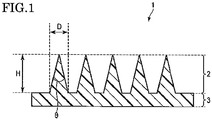
- a needle-shaped structure 1 is provided with needle-shaped projections 2 and a support substrate 3 supporting the projections 2.
- the projections 2 contain at least a chitosan and citric acid.
- the chitosan that is a main component contained in the material for the projection possesses bioadaptability, for which there can be used at least one or more selected from the group consisting of chitosan, chitin/chitosan, chitin/a chitosan derivative, glucosamine and a glucosamine derivative.
- bioadaptability for which there can be used at least one or more selected from the group consisting of chitosan, chitin/chitosan, chitin/a chitosan derivative, glucosamine and a glucosamine derivative.
- chitosan, chitin/chitosan, chitin/chitosan derivatives and glucosamine derivatives are those which are derived from crustacean such as crabs, shrimps and the like and also derived from fungus- and microorganism-producing plants and which are obtained therefrom used as a starting material.
- Chitosan, chitin/chitosan and chitin/chitosan derivatives show a beauty effect on the skin and has antiseptic and bactericidal effects, and can thus be preferably used as a material for the needle-shaped projection.
- the projection material contains citric acid aside from a chitosan.
- Citric acid is an acid that is safe to living bodies and has been widely known as a food additive. Accordingly, there is obtained such an effect as to provide a sense of safety on the part of a user.
- the needle-shaped structure containing a chitosan and citric aid according to the first example is broadly classified into type (1) which is sparingly soluble in water after having subjected to an immersion step in an aqueous alcohol solution described hereinafter and type (2) which is soluble in water without subjecting to the alcohol immersion step.
- the needle-shaped structure of the type (1) which is sparingly soluble in water is such that when punctured into the skin, the needle-shaped structure is not dissolved.
- a delivery can be administered to the skin.
- the delivery may also be administered to the skin.
- the needle-shaped structure of the type (2) which is soluble in water, is dissolved upon puncturing into the skin.
- the needle-shaped structure containing a chitosan and citric acid may further contain a delivery.
- the needle-shaped structure further containing a delivery is dissolved upon puncturing into the skin, the delivery can be administered into the skin.
- the delivery used in the practice of the invention, mention is made, for example, of physiologically active substances, cosmetic compositions and the like.
- the delivery may contain biologics.
- the biologics used herein means a classification of drugs making use of raw materials or material derived from the cells, cell tissues and the like of humans and animals.
- the first example has such an effect that there can be obtained a warpage-free needle-shaped structure. If the needle-shaped structure undergoes warpage, the performance of puncture into the skin lowers and thus, the structure is preferably free of warpage.
- the color shade of the needle-shaped structure changes depending on the amount of citric acid. This can bring about such an effect that the process control and quality control can be made according to the color shade.
- the needle-shaped structure can be rendered white for optimum use in cosmetic or medical products.
- the amount of citric acid in the projection is preferably within a range of not less than 0.5 wt% to 40 wt%.
- the amount of citric acid in the needle-shaped structure is set at not larger than 40 wt%, the resulting needle-shaped structure is prevented from being formed as a soluble needle-shaped structure that is dissolved in a living body and thus, such a microscopic configuration of the needle-shaped structure can be held after puncture.
- the amount of citric acid in the projection is more preferably within a range of not less than 0.5 wt% to not larger than 30 wt%.
- the needle-shaped structure can be kept as white. Eventually, cleanliness is obtained, so that a sense of resistance can be mitigated upon puncture into the skin of a user.
- a less amount of the citric acid contained in the needle-shaped structure is more preferred from the standpoint of preventing the needle-shaped structure from being dissolved in a living body. In this regard, however, if the amount of citric acid is less than 0.5 wt%, there is concern that productivity lowers for removal of citric acid.
- the needle-shaped structure according to the first example may further contain other type of organic acid aside from a chitosan and citric acid.
- examples of other type of organic acid to be contained in the needle-shaped structure include acetic acid, succinic acid, lactic acid, glyoxylic acid, tartaric acid, pyruvic acid, oxalosuccinic acid, oxaloacetic acid, acetoacetic acid, levulinic acid, and oxoglutaric acid.
- the content (wt%) of the organic acid in the needle-shaped structure can be determined according to ion chromatography.
- a projection 1 may have a shape suited for puncture into the skin.
- the projection 1 has a shape such as, for example, of a cone, a pyramid, a cylinder, a prism, a pencil form (wherein the body is cylindrical with its tip being conical or pyramidal) or the like.
- the projection may be either (1) in a form of standing singly on a support substrate or (2) in a form of standing plurally on a support substrate.
- arrays means a state where the respective unit needle-shaped structures are set in array. For instance, mention is made of lattice arrangement, closest packing arrangement, concentric arrangement, random arrangement and the like.
- an applicator for fixing an insertion position and direction of the needle-shaped structure may be attached.
- the needle-shaped structure of the first example may be provided with a hole at the projection thereof.
- the hole may be either a through-hole passing through to the back side of the support substrate or a non-through hole.
- the support substrate per se may be provided with a hole or holes.
- the hole may be either a through-hole passing through to the back side of the support substrate or a non-through hole.
- the projection preferably has a fineness and length suited for forming a puncture hole in the skin. More particularly, a height H of the projection 2 shown in Fig. 1 should preferably be within a range of from not less than 10 ⁇ m to not larger than 1000 ⁇ m. The height H of the projection means a distance between the support substrate and the tip end portion of the projection.
- the height H of the projection is preferably determined while taking it into account how deep the puncture hole formed at the time when the needle-shaped structure is punctured within the above range goes into the skin.
- the height of the projection of the needle-shaped structure is preferably within a range of not less than 10 ⁇ m to not larger than 300 ⁇ m, more preferably within a range of not less than 30 ⁇ m to not larger than 200 ⁇ m.
- the height H of the projection of the needle-shaped structure is preferably within a range of not less than 200 ⁇ m to not larger than 700 ⁇ m, more preferably from not less than 200 ⁇ m to not larger than 500 ⁇ m, and much more preferably from not less than 200 ⁇ m to not larger than 300 ⁇ m.
- the height H of the projection of the needle-shaped structure is preferably within a range of not less than 200 ⁇ m to not larger than 500 ⁇ m.
- the height H of the projection of the needle-shaped structure is preferably within a range of not less than 200 ⁇ m to not larger than 300 ⁇ m.
- a width D of the projection is preferably within a range of not less than 0.1 ⁇ m to not larger than 300 ⁇ m.
- the width D of the projection should preferably be determined while taking it into account how deep the puncture hole, which is formed at the time when the needle-shaped structure is punctured within the above range, goes into the skin.
- the width D of the projection means a maximum length among lengths of the projection in contact with the support substrate when the projection is projected parallel to the substrate surface. For instance, where the projection is conical in shape, the diameter of a circle formed at the contact surface between the projection and the support substrate becomes width D. Where the projection is quadrilateral in shape, the diagonal of a square formed at the contact surface between the projection and the support substrate becomes width D. Additionally, where the projection is cylindrical, the diameter of a circle formed at the contact surface between the projection and the support substrate becomes width D. Where the projection is shaped as a square prism, the diagonal of a square formed at the contact surface between the projection and the support substrate becomes width D.
- the projection is configured to have a tip angle like a cone.
- the tip angle ⁇ of the projection is preferably within a range of from not less than 5° to not larger than 30°, more preferably from not less than 10° to not larger than 20°. It will be noted that the tip angle ⁇ indicates a maximum angle chosen from angles (apex angles) created when the projection is projected parallel to the surface of the support substrate.
- the support substrate is made of the same material as the projection.
- the support substrate and the projection are made of the same material, respectively, it becomes possible to form the support substrate and the projection integrally.
- the support substrate may have a multilayered structure wherein a material different in type from the material for the projection may be laminated as a lower layer. If plural types of materials are laminated, there can be provided a support substrate making use of physical properties of plural types of materials as described below.
- An original plate which determines the shape of a needle-shaped structure is made, and an intaglio plate whose pattern is inverted relative to the shape of a desired needle-shaped structure is made out of the original plate.
- the original plate, with which the shape of needle-shaped structure is determined can be made according to known techniques although depending on the shape of needle-shaped structure.
- the original plate may be formed by use of microfabrication techniques. Examples of the microfabrication technique include a lithographic technique, a wet etching technique, a dry etching technique, a sand blasting technique, a laser processing technique, a precision machining technique and the like.
- known shape transfer methods can be used for the formation of an intaglio plate from the original plate. For instance, mention is made of (1) formation of an Ni intaglio plate by an Ni electroforming process, (2) transfer formation using a molten resin, and the like.
- Biodegradable chitosan is dissolved in an aqueous citric acid solution to prepare a liquid needle-shaped structure material containing a chitosan and citric acid.
- the liquid needle-shaped structure material should preferably have fluidity sufficient to apply it onto the intaglio plate, or may be in a gel form.
- the formulation ratio between chitosan and citric acid is such that an amount of citric acid is appropriately controlled so that there is obtained a liquid needle-shaped structure material wherein a chitosan is well dissolved. More particularly, the formulation ratio between the chitosan and citric acid is preferably at 30-50 wt% of chitosan and 50-70 wt% of citric acid.
- the liquid needle-shaped material is filled onto the intaglio plate.
- the application method can be appropriately selected from known procedures depending on the shape and size of the intaglio plate. For instance, there can be used a spin coating method, a method using a dispenser, a casting method and the like. For the filling, an ambient environment around the intaglio plate may be kept either under reduced pressure or under vacuum.
- the liquid needle-shaped structure material filled onto the intaglio plate is dried for solidification to obtain a solidified article made of the needle-shaped material.
- the solidification may be completed under drying at a normal temperature, it is preferred to use heat drying so as to shorten the production time.
- the heating temperature is preferably set at a level not permitting the aqueous solution to be boiled. In this sense, the heating temperature is preferably with a range of from 50°C to 90°C. Heating may be carried out by any of known heating means. For instance, there can be used a hot plate mounting the intaglio plate filled with a liquid needle-shaped structure material thereon.
- the solidified article made of the needle-shaped structure material is removed from the intaglio plate.
- the thus removed solidified article has a final shape of needle-shaped structure.
- the removal there can be used, for example, a method wherein the solidified material is peeled off from the intaglio plate by physical force, a method wherein the intaglio plate is chemically, selectively dissolved out, and the like.
- the removed solidified article made of the needle-shaped structure is immersed in an aqueous alcohol solution to partially remove the organic acid in the structure.
- the removed solidified article made of the needle-shaped structure material is immersed in an aqueous alcohol solution.
- the alcohol may be one which is miscible with water, for which there can be used, for example, ethanol, methanol and propanol. Of these, ethanol is preferred from the standpoint of biosafety.
- the aqueous alcohol solution preferably has an alcohol concentration of 50 - 90 wt%. If the alcohol concentration in the aqueous alcohol solution exceeds 90 wt%, a difficulty is involved in that the acid contained in the solidified article made of the needle-shaped structure material is well dissolved out, with concern that the immersion time is prolonged thereby lowering productivity. On the other hand, if the alcohol concentration in the aqueous alcohol solution is less than 50 wt%, there is concern that the resulting needle-shaped structure is swollen.
- aqueous alcohol solution may be used at room temperature, heating is preferred so as to promote the dissolution of the acid in the solidified article.
- heating is preferred so as to promote the dissolution of the acid in the solidified article.
- an aqueous ethanol solution is used as an aqueous alcohol solution, it is preferred to heat it within a range of from 40°C to 60°C.
- the time for immersing the solidified article in the aqueous alcohol solution depends on the type of alcohol, its concentration and the like and cannot be necessarily defined, it is preferred to set the time at 8 hours - 5 days.
- a multiple-step treatment is preferred using successive immersions in an aqueous alcohol solution of a high concentration and then in an aqueous alcohol solution of a lower concentration.
- a solidified article is immersed in an aqueous alcohol solution whose concentration is at not less than 70 wt% to not larger than 90 wt%, followed by transferring the solidified article for immersion in an aqueous alcohol solution with a concentration of not less than 50 wt% to not larger than 70 wt%.
- Such a multiple-step immersion treatment of the solidified article first with a highly concentrated aqueous alcohol solution and then with an aqueous alcohol solution of a lower concentration suppresses the dissolution of chitosan serving as a main component of the solidified article thereby ensuring shape stabilization. At the same time, it is enabled to promote the dissolution of the acid from the solidified article.
- the chitosan In order to make a needle-shaped structure of a chitosan by use of an intaglio plate, the chitosan needs to be dissolved in an aqueous solution of an acid to prepare a liquid needle-shaped structure material beforehand.
- a liquid needle-shaped structure material contains not only a chitosan, but also an acid.
- the solidified article having the shape of the needle-shaped structure which is obtained by drying, solidifying and removing from an intaglio plate after forming with an intaglio plate, contains not only a chitosan, but also the acid.
- the needle-shaped structure which has not been subjected to alcohol immersion, contains an acid and is thus poor in water resistance. If this structure is used as it is, dissolution occurs by contact with moisture or immersion in water. Eventually, dissolution occurs in vivo.
- a bioadaptable chitosan which has been subjected to alcohol immersion, has sparing solubility in water. Accordingly, there can be fabricated a needle-shaped structure which is sparingly soluble in water, shows a high water resistance, can be punctured without damaging the skin, and is able to keep a microscopic shape (with a fine three-dimensional structure on the order of ⁇ m) after puncture and thus has a low body burden.
- the term "sparing solubility of the needle-shaped structure in water” means that "after the needle-shaped structure has been immersed in a phosphate buffer solution (PBS) with a pH of 7.5 for 24 hours, a reduced volume of the projection of the needle-shaped structure is at not larger than 5% of the volume prior to the immersion".
- PBS phosphate buffer solution
- the case where the above conditions are not satisfied means that "the needle-shaped structure is soluble in water”.
- the needle-shaped structure has a needle-shaped projection and a support substrate supporting the projection as has been illustrated with respect to the first embodiment.
- At least the projection is formed of a material containing a chitosan. The details of the projection described herein are the same as those set out in the first embodiment.
- the present inventors have found that for the preparation of a needle-shaped structure from a liquid needle-shaped structure material containing a chitosan and an acid, when water-resistance treatment is carried out after the formation of the needle-shaped structure, there can be made a needle-shaped structure that shows a high water resistance, can be punctured into the skin without breakage, and is able to keep a microscopic shape (a fine three-dimensional structure on the order of ⁇ m) after puncture, thus resulting in a low body burden.
- the water-resistance treatment is performed by a procedure wherein a solidified article of a needle-shaped structure is formed from a liquid needle-shaped structure material containing a chitosan and an acid and this solidified article is immersed in an aqueous alcohol solution, or by a procedure wherein a solidified article of a needle-shaped structure is formed from a liquid needle-shaped structure material containing a chitosan and an acid and the solidified article is subjected to an acetylation step.
- At least a projection of the needle-shaped structure fabricated according to the second embodiment is sparingly soluble in water.
- the term "at least a projection of the needle-shaped structure is sparingly soluble in a water solvent" used herein means that "after the needle-shaped structure is immersed in a phosphate buffer solution (PBS), a reduced volume of at least a projection of the needle-shaped structure is at not larger than 5% of the volume prior to the immersion".
- PBS phosphate buffer solution
- An original plate which determines the form of a needle-shaped structure is made, and an intaglio plate whose pattern is inverted relative to the shape of a desired needle-shaped structure is made out of the original plate. This step is similar to as illustrated in the first embodiment.
- a bioadaptable chitosan is dissolved in an aqueous solution of an acid to preparing a liquid needle-shaped structure material containing a chitosan and the acid.
- the liquid needle-shaped structure material preferably has a degree of fluidity sufficient to allow it to be passed onto the intaglio plate, or may be in a gel form.
- the chitosan used may be a similar one as described in the first embodiment.
- the acid may be either an organic acid or an inorganic acid.
- organic acid include acetic acid, succinic acid, citric acid, lactic acid, tartaric acid, glyoxylic acid, pyruvic acid, oxalosuccinic acid, oxaloacetic acid, acetoacetic acid, levulinic acid and oxoglutaric acid.
- inorganic acid include hydrochloric acid and sulfuric acid.
- the formulation ratio between the chitosan and the acid can be appropriately controlled depending on the type of acid from the standpoint of obtaining a liquid needle-shaped structure material well dissolving chitosan therein.
- the liquid needle-shaped structure material is filled onto the intaglio plate. This filling procedure is similar to as described in the first embodiment.
- the liquid needle-shaped structure material filled onto the intaglio plate is dried and solidified to obtain a solidified article made of the needle-shaped structure material. This step is similar to as described in the first step.
- the solidified article made of the needle-shaped structure material is removed from the intaglio plate.
- the thus removed solidified article has a needle-shaped form that is a final one.
- the removing method may include, for example, a method of removing the solidified articles from the intaglio plate by physical force, a method of chemically, selectively dissolving the intaglio plate, and the like.
- the solidified article made of the needle-shaped structure material is subjected to water-resistance treatment.
- the water-resistance treatment can be carried out by (1) a procedure of forming a solidified article of needle-shaped structure from a liquid needle-shape structure material containing a chitosan and an acid and immersing the solidified article in an aqueous alcohol solution, or (2) a procedure of forming a solidified article of needle-shaped structure from a liquid needle-shape structure material containing a chitosan and an acid and acetylating the solidified article.
- the solidified article of needle-shaped structure formed from the liquid needle-shaped structure material containing a chitosan and the acid is immersed in an aqueous alcohol solution.
- the kind of alcohol and the concentration and temperature of the aqueous alcohol solution, in which the solidified article of needle-shaped structure is to be immersed, and the time of immersion of the solidified article in the aqueous alcohol solution are similar to as described in the first embodiment.
- the solidified article When the solidified article is immersed in an aqueous alcohol solution, it is preferred to use a plural-stage treatment wherein the article is successively immersed in an aqueous alcohol solution of high concentration and then in an aqueous alcohol solution of a lower concentration in the same way as illustrated in the first embodiment.
- the bioadaptable chitosan has such a property as to be sparingly soluble in water.
- a liquid needle-shaped structure material by dissolving a chitosan in an aqueous solution of an acid beforehand.
- Such a liquid needle-shaped structure material contains not only a chitosan, but also the acid, so that the solidified article having a needle-shaped form obtained by drying and solidifying after forming with the intaglio plate and removing from the intaglio plate also contains not only a chitosan, but also the acid.
- the resulting solidified article is poor in water resistance because the acid is contained. If this is used as a needle-shaped structure as it is, it is dissolved by contact with moisture or immersion in water. As a consequence, not only a high body load arises through dissolution inside the body, but also a microscopic form of the needle-shaped structure cannot be kept after puncture.
- the water-resistance treatment (1) when the water-resistance treatment (1) is carried out against the solidified article, there can be made a needle-shaped structure which is sparingly soluble in water, shows high water resistance, can be punctured into the skin without breakage, is able to keep a microscopic form after puncture and places a low burden on a living body.
- the solidified article of the needle-shaped structure formed out of a liquid needle-shaped structure material containing a chitosan and an acid is acetylated.
- the solidified article made of the needle-shaped structure material is immersed in a mixed solution of acetic anhydride and methanol and removed from the mixed solution, followed by immersion in methanol and dehydration to complete the acetylation.
- the mixed solution is preferably prepared, for example, by mixing 10 - 20 wt% of acetic anhydride and 80 - 90 wt% of methanol.
- the second embodiment adopting the water-resistance treatment (2) there can be fabricated a needle-shaped structure which is sparingly soluble in water, shows high water resistance, can be punctured into the skin without breakage, is able to keep a microscopic form after puncture and places a low burden on a living body.
- the solidified article which is obtained from a liquid needle-shaped structure material dissolving a bioadaptable chitosan in an aqueous solution of an acid and has a needle-shaped form
- the amino group serving as a factor for water solubility of chitosan can be reduced in amount.
- a needle-shaped structure which is sparingly soluble in water, shows high water resistance, can be punctured into the skin without breakage, is able to keep a microscopic form (a microscopic three-dimensional structure on the order of ⁇ m) after puncture and places a low burden on a living body.
- the resulting needle-shaped structure made of acetylated chitosan should preferably has a degree of acetylation of not less than 35% to not larger than 80%. If the degree of acetylation is less than 35%, there is concern that a difficulty is involved in obtaining a needle-shaped structure which is sparingly soluble in water, shows high water resistance and has at least a projection. On the other hand, when the degree of acetylation of acetylated chitosan exceeds 80%, the reaction time becomes prolong, with concern that productivity lowers. More preferably, the degree of acetylation is from not less than 40% to not larger than 70%.
- the needle-shaped structure has a needle-shaped projection and a support substrate supporting the projection as described in the forgoing first embodiment.
- the projection is formed of a material containing a chitosan. The details of the projection described herein is similar to as described in the first embodiment.
- a needle-shaped structure For the fabrication of a needle-shaped structure from a liquid needle-shaped structure material containing a chitosan and an acid, when the needle-shaped structure is subjected to water-resistance treatment after formation thereof, there can be provided a needle-shaped structure which is sparingly soluble in water, shows high water resistance, can be puncture into the skin without breakage, is able to keep a microscopic form (a fine three-dimensional structure on the order of ⁇ m) and places a low burden on a living body.
- a water-resistance treatment such that a solidified article of needle-shaped structure is formed out of a liquid needle-shape structure material containing a chitosan, a first acid and a second acid and immersed in an aqueous alcohol solution, there can be fabricated a needle-shaped structure which is sparingly soluble in water, shows high water resistance, can be punctured into the skin without breakage, is able to keep a microscopic form after puncture and places a low load on a living body.
- At least the projection of the needle-shaped structure fabricated in the third embodiment is sparingly soluble in water.
- the term " at least the projection of the needle-shaped structure is sparingly soluble in a water solvent” means that "after the needle-shaped structure is immersed in a phosphate buffer physiological saline solution (PBS) with a pH of 7.4 for 24 hours, a reduced volume of at least the projection of the needle-shaped structure is not larger than 5% of the volume prior to the immersion.
- PBS phosphate buffer physiological saline solution
- An original plate which determines the form of a needle-shaped structure is made and an intaglio plate whose pattern is inverted relative to the shape of a desired needle-shaped structure is made out of the original plate. This step is similar to as described in the first embodiment.
- a bioadaptable chitosan is dissolved in an aqueous solution of a first acid and a second acid to prepare a liquid needle-shaped structure material containing a chitosan and these acids.
- the liquid needle-shaped structure material should preferably have a degree of fluidity sufficient to allow it to flow onto the intaglio plate. In this regard, however, if the prepared needle-shaped structure material has fluidity sufficient to flow onto the intaglio plate, the material may not be liquid, but in a gel form.
- the chitosan used may be one as illustrated in the first embodiment.
- the first acid is preferably either a tri- or higher valent carboxylic acid or a dicarboxylic acid whose number average molecular weight is not less than 110.
- the second acid is preferably either a monocarboxylic acid or a dicarboxylic acid whose number average molecular weight is less than 110.
- the first and second acids are used to dissolve a chitosan in an aqueous solution thereof. Part of the acids is removed in a subsequent water-resistance step to impart a water resistance to the needle-shaped structure.
- the first acid a tri- or higher valent carboxylic acid or a dicarboxylic acid whose number average molecular weight is not less than 110 and, as the second acid, a monocarboxylic acid or a dicarboxylic acid whose number average molecular weight is less than 110.
- the first acid is selected from those acids having such a function as to permit the needle-shaped structure to be insoluble in water and impart satisfactory strength thereto when left in the material in small amounts after the water-resistance treatment.
- the first acid is preferably chosen from citric acid, tartaric acid, fumaric acid and maleic acid while taking bioadaptability into consideration. Of these, the use of citric acid as the first acid is more preferred.
- the second acid is selected from those acids having such a function that the treating time can be shortened over the case where a first acid alone is used in the material at the stage of the water-resistance treatment.
- the second acid used should preferably one that allows dissolution in an alcohol more rapidly than the first acid.
- the second acid is preferably chosen from formic acid, acetic acid, propionic acid, lactic acid, oxalic acid and malonic acid. Of these, the use of acetic acid as the second acid is more preferred.
- a needle-shaped structure is fabricated using, as an acid, a first acid alone consisting of a tri- or higher valent carboxylic acid or a dicarboxylic acid whose number average molecular weight is at not less than 110, it is possible to obtain a needle-shaped structure having needle strength sufficient to allow puncture into the skin.
- the first acid is more liable to be taken in chitosan, for which an immense amount of time is required for imparting water resistance to the needle-shaped structure in the water-resistance treatment.
- the needle-shaped structure is fabricated using, as an acid, the second acid alone consisting of a monocarboxylic acid or a dicarboxylic acid whose number average molecular weight is less than 110, a time required for imparting a water resistance to the needle-shaped structure in the subsequent water-resistance step can be shortened.
- the second acid alone consisting of a monocarboxylic acid or a dicarboxylic acid whose number average molecular weight is less than 110
- a time required for imparting a water resistance to the needle-shaped structure in the subsequent water-resistance step can be shortened.
- the resulting needle-shaped structure undergoes warpage or becomes curved.
- the present inventors have found that the combination of the first acid and second acid as an acid enables a needle-shaped structure having satisfactory needle strength to be fabricated within a short time.
- the formulation ratios of a chitosan, a first acid and a second acid are appropriately controlled depending on the types of first and second acids from the standpoints that a liquid needle-shaped structure material wherein the chitosan is well dissolved and that the second acid is dissolved out from the solidified article made of a needle-shaped structure material in an alcohol more rapidly than the first acid.
- the liquid needle-shaped structure material is filled onto the intaglio plate. This filling method is similar to as described in the first embodiment.
- the liquid needle-shaped structure material filled onto the intaglio plate is dried and solidified to obtain a solidified article made of the needle-shaped structure material. This step is similar to as described in the first embodiment.
- the solidified article made of the needle-shaped structure material is removed from the intaglio plate.
- the thus removed solidified article has a final needle-shaped form.
- the removing method used may include, for example, a method of physically removing the solidified article from the intaglio plate, a method of chemically, selectively dissolving the intaglio plate, and the like.
- the solidified article made of the needle-shaped structure material is subjected to water-resistance treatment.
- the water-resistance treatment is carried out in such a way that the solidified needle-shaped structure article made of the liquid needle-shaped structure material containing a chitosan and the first and second acids is immersed in an aqueous alcohol solution.
- the type of alcohol used for immersion of the solidified article of the needle-shaped structure, the concentration and temperature of the aqueous alcohol solution and the immersion time in the aqueous alcohol solution are, respectively, similar to as described in the first embodiment.
- a plural-stage treatment is preferably used wherein successive immersions in an aqueous alcohol solution having a high concentration and then in an aqueous alcohol solution with a lower concentration are carried out.
- the third embodiment adopting the water-resistance treatment, there can be fabricated a needle-shaped structure which is sparingly soluble in water, shows a high water resistance, has satisfactory needle strength, can be punctured into the skin without breakage, is able to keep the microscopic form after puncture and ensures a low burden on a living body.
- a bioadaptable chitosan has sparing solubility in water. This needs that for the fabrication of a chitosan needle-shaped structure by use of an intaglio plate, a chitosan be dissolved in an aqueous acid solution to prepare a liquid needle-shaped structure material beforehand.
- a liquid needle-shaped structure material contains not only a chitosan, but also an acid or acids, for which the solidified article having a needle-shaped structure and obtained by drying after formation with an intaglio plate, solidifying and removing from the intaglio plate contains not only a chitosan, but also the acid.
- the resulting solidified article is poor in water resistance because of the acid being contained.
- a chitosan is provided as an aqueous solution using an acid and the acid is removed by immersion in an alcohol after formation of a solidified article of needle-shaped structure thereby imparting a water resistance thereto.
- the acid used is a combination of a first acid for imparting strength to the needle-shaped structure and a second acid contributing to the shortage of a time for the water-resistance treatment step. This enables the short time fabrication of a needle-shaped structure wherein not only a water resistance is imparted thereto, but also the structure has needle strength sufficient for puncture into the skin and has a microscopic needle kept in its form after puncture.
- the needle-shaped structure fabricated according to the third embodiment should preferably contain the first and second acids within a range of not less than 0.5 wt% to not larger than 40 wt% of the needle-shaped structure in total.
- the total amount of the acids is set at not larger than 40 wt%, a water resistance can be imparted to the needle-shaped structure.
- the total of the acids exceeds 40 wt%, it becomes difficult to make the needle-shaped structure sparingly soluble.
- a less total amount of the acids contained in the needle-shaped structure is more preferred.
- the total content of the acids is made less than 0.5%, needle strength becomes small and the needle may be broken or bent, thereby making it difficult to puncture it into the skin.
- a silicon substrate was subjected to precision machining to make an original plate wherein projections were formed by arraying 36 square pyramids (height: 150 ⁇ m, bottom face: 60 ⁇ m x 60 ⁇ m) at intervals of 1 mm in the form of a lattice of 6 rows and 6 columns.
- the original plate made out of the silicon substrate was formed thereon with a nickel film in a thickness of 500 ⁇ m by a plating method.
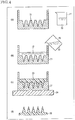
- the original plate was removed by dissolution with an aqueous potassium hydroxide solution heated to 90°C and having a concentration of 30 wt% to provide an intaglio plate 11 (as shown (a) of Fig. 2 ) made of nickel.
- chitosan was dissolved in an aqueous citric acid solution to prepare a liquid material for needle-shaped structure.
- This liquid needle-shaped structure material 12 was placed in a beaker 13 (as shown in (a) of Fig. 2 ). It will be noted that the liquid needle-shaped structure material 12 had a composition wherein the chitosan and citric acid were dissolved at 5 wt% and 10 wt% relative to water, respectively.
- the liquid needle-shaped structure material 12 was filled onto the intaglio plate 11 by use of a spin coating method (a shown in (b) of Fig. 2 ).
- the intaglio plate 11 filled with the liquid needle-shaped structure material 12 was heated to 90°C for 10 minutes by use of a heat source 14 and thus, the needle-shaped structure material 12 was dried and solidified to obtain a solidified article 15 made of the needle-shaped structure material (as shown in (c) of Fig. 2 ).
- the heat source used was a hot plate.
- the solidified article made of the needle-shaped material was peeled off (removed) from the intaglio plate 11 to obtain a solidified article 15 (as shown in (d) of Fig. 2 ) made of the needle-shaped structure material.
- an aqueous ethanol solution 17 having a concentration of 70 wt% was placed in a beaker 16, and the solidified article 15 made of the needle-shaped structure material was immersed in the aqueous ethanol solution for 18 hours (as shown in (e) of Fig. 2 ). Thereafter, the solidified article 15 was taken out from the aqueous ethanol solution 17 and naturally dried to obtain a needle-shaped structure 1 shown in (f) of Fig. 3 .
- a needle-shaped structure was made in the same manner as in Example 1 except that there was used, as a liquid needle-shaped structure material, a composition having 5 wt% of chitosan and 10 wt% of citric acid dissolved in water and an aqueous ethanol solution having a concentration of 90 wt% was used.
- a needle-shaped structure was made in the same manner as in Example 1 except that there was used, as a liquid needle-shaped structure material, a composition having 5 wt% of chitosan and 10 wt% of citric acid dissolved in water and immersion was carried out for 9 hours using an aqueous ethanol solution with a concentration of 70 wt% and then for 9 hours using an aqueous ethanol solution having a concentration of 50%.
- a needle-shaped structure was made in the same manner as in Example 1 except that there was used, as a liquid needle-shaped structure material, a composition having 5 wt% of chitosan and 10 wt% of citric acid dissolved in water, and an aqueous ethanol solution used as one having a concentration of 70 wt% and heated to 40°C and the immersion time was set at 8 hours.
- a needle-shaped structure was made in the same manner as in Example 1 except that there was used, as a liquid needle-shaped structure material, a composition having 5 wt% of chitosan and 6 wt% of citric acid dissolved in water.
- a needle-shaped structure was made in the same manner as in Example 1 using a similar liquid needle-shaped structure material (with a composition having 5 wt% of chitosan and 10 wt% of citric acid dissolved in water) as in Example 1, except that the resulting solidified article after removal from the intaglio plate was not immersed in an aqueous ethanol solution.
- a needle-shaped structure was made in the same manner as in Example 1 except that a composition having 5 wt% of chitosan and 3 wt% of acetic acid dissolved in water was used as a liquid needle-shaped structure material.
- a needle-shaped structure was made in the same manner as in Example 1 using a similar liquid needle-shaped structure material as in Example 1 (with a composition having 5 wt% of chitosan and 3 wt% of acetic acid dissolved in water), except that the solidified article obtained after removal from the intaglio plate was not immersed in an aqueous ethanol solution.
- each needle-shaped structure was punctured into an artificial skin, followed by allowing to stand for 3 hours. Subsequently, the needle-shaped structure was removed from the artificial skin and well dried, followed by confirming whether the needle-shaped structure was dissolved.
- each structure was placed on a flat surface, followed by measurement of a distance of the needle-shaped structure between the flat surface and an uplifted portion thereof by use of a non-contact profile measuring device (YP-21, made by Sony Corporation).
- the structure whose uplift length was less than 1 mm was evaluated as "not warped", a structure whose uplift length was at larger than 1 mm to less than 2 mm was as “partially warped” and a structure whose uplift length was at not less than 2 mm was as "significantly warped”.
- Those "significantly warped" structures whose uplift length was at not less than 2 mm could be judged as not used for product because of their low puncture performance.
- Example 1 Composition of liquid needle-shaped structure material (ratio by weight) Concentration of an aqueous ethanol solution and immersion time Amount of an acid in needle-shaped structure (wt%)
- Examples 1- 4 were light white - white in color tone and was thus excellent in cleanliness.
- the respective needle-shaped structures of Examples 1-5 were punctured into the artificial skin and the volumes of the structures prior to and after standing for 3 hours were measured.
- the reduced volumes of the respective needle-shaped structures obtained after the puncture and standing for 3 hours were all at not larger than 5 % of the volumes prior to the puncture and standing.
- a silicon substrate was subjected to precision machining to make an original plate wherein projections were formed by arraying 36 square pyramids (height: 150 ⁇ m, bottom face: 60 ⁇ m x 60 ⁇ m) at intervals of 1 mm in the form of a lattice of 6 rows and 6 columns.
- the original plate made out of the silicon substrate was formed thereon with a nickel film in a thickness of 500 ⁇ m by a plating method.
- the original plate was removed by dissolution with an aqueous potassium hydroxide solution heated to 90°C and having a concentration of 30 wt% to provide an intaglio plate 21 made of nickel.
- chitosan was dissolved in an aqueous citric acid solution with a concentration of 5 wt% to prepare a liquid material for needle-shaped structure.
- This liquid needle-shaped structure material 22 was placed in a beaker 23 (as shown in (b) of Fig. 4 ). It will be noted that the liquid needle-shaped structure material 22 had a composition wherein 5 wt% of chitosan and 10 wt% of citric acid relative to water were dissolved.
- the liquid needle-shaped structure material 22 was filled onto the intaglio plate 21 by use of a spin coating method (a shown in (b) of Fig. 4 ).
- the intaglio plate 21 filled with the liquid needle-shaped structure material 22 was heated to 90°C for 10 minutes by use of a heat source 24 and thus, the needle-shaped structure material 22 was dried and solidified to obtain a solidified article 25 made of the needle-shaped structure material (as shown in (c) of Fig. 4 ).
- the heat source 24 used was a hot plate.
- the solidified article 25 made of the needle-shaped material was peeled off (removed) from the intaglio plate 21 to obtain a solidified article 25 (as shown in (d) of Fig. 4 ) made of the needle-shaped structure material.
- an aqueous ethanol solution 27 having a concentration of 90 wt% was placed in a beaker 26, and the solidified article 25 made of the needle-shaped structure material was immersed in the aqueous ethanol solution 27 for 18 hours (as shown in (e) of Fig. 5 ). Thereafter, the solidified article 25 was taken out from the aqueous ethanol solution 27 and naturally dried to obtain a needle-shaped structure 1 shown in (f) of Fig. 5 .
- a needle-shaped structure was made in the same manner as in Example 7 except that in the step of immersion in the aqueous ethanol solution, the solidified article 25 made of the needle-shaped structure material was immersed in an aqueous ethanol solution with a concentration of 80 wt% for 18 hours.
- a needle-shaped structure was made in the same manner as in Example 7 except that in the step of immersion in the aqueous ethanol solution, the solidified article 25 made of the needle-shaped structure material was immersed in an aqueous ethanol solution with a concentration of 70 wt% for 16 hours.
- a needle-shaped structure was made in the same manner as in Example 7 except that in the step of immersion in the aqueous ethanol solution, the solidified article 25 made of the needle-shaped structure material was immersed in an aqueous ethanol solution with a concentration of 60 wt% for 16 hours.
- a needle-shaped structure was made in the same manner as in Example 7 except that in the step of immersion in the aqueous ethanol solution, the solidified article 25 made of the needle-shaped structure material was immersed in an aqueous ethanol solution, heated to 50°C and having a concentration of 80 wt%, for 10 hours.
- a needle-shaped structure was made in the same manner as in Example 7 except that in the step of immersion in the aqueous ethanol solution, the solidified article 25 made of the needle-shaped structure material was immersed in an aqueous ethanol solution with a concentration of 80 wt% for 5 hours and subsequently in an aqueous ethanol solution with a concentration of 60 wt% for 5 hours.
- a needle-shaped structure was made in the same manner as in Example 1 using a similar liquid needle-shaped structure material (with a composition dissolving 5 wt% of chitosan and 7 wt% of citric acid relative to water) as used in Example 7, except that a solidified article after removal from the intaglio plate was not immersed in an aqueous ethanol solution.
- a silicon substrate was subjected to precision machining to make an original plate wherein projections were formed by arraying 36 square pyramids (height: 150 ⁇ m, bottom face: 60 ⁇ m x 60 ⁇ m) at intervals of 1 mm in the form of a lattice of 6 rows and 6 columns.
- the original plate made out of the silicon substrate was formed thereon with a nickel film in a thickness of 500 ⁇ m by a plating method.
- the original plate was removed by dissolution with an aqueous potassium hydroxide solution heated to 90°C and having a concentration of 30 wt% to provide an intaglio plate made of nickel.
- chitosan was dissolved in an aqueous acetic acid solution with a concentration of 5 wt% to prepare a liquid material for needle-shaped structure.
- This liquid needle-shaped structure material was placed in a beaker. It will be noted that the liquid needle-shaped structure material had a composition wherein 5 wt% of chitosan and 2.5 wt% of citric acid relative to water were dissolved.
- the liquid needle-shaped structure material was filled onto the intaglio plate by use of a spin coating method.
- the intaglio plate filled with the liquid needle-shaped structure material was heated to 90°C for 10 minutes by use of a heat source to dry and solidify the needle-shaped structure material thereby obtaining a solidified article made of the needle-shaped structure material.
- the heat source used was a hot plate.
- the solidified article made of the needle-shaped material was peeled off (removed) from the intaglio plate to obtain the solidified article made of the needle-shaped structure material.
- a mixed solution of 5 g of acetic anhydride and 40 g of methanol was placed in a beaker, and the solidified article made of the needle-shaped structure material was immersed in the mixed solution for 2 days. Subsequently, the solidified article was taken out from the mixed solution and immersed in methanol in a beaker for 1 day. Thereafter, the solidified article removed from the methanol was naturally dried to obtain a needle-shaped structure.
- a needle-shaped structure was made in the same manner as in Example 13 except that the time for immersion in the mixed solution of 5 g of acetic anhydride and 40 g of methanol was set at one day.
- a needle-shaped structure was made in the same manner as in Example 7 except that the solidified article made of the needle-shaped structure material was not immersed in the mixed solution of 5 g of acetic anhydride and 40 g of methanol and then in methanol.
- the needle-shaped structures obtained in Examples 13, 14 and Comparative Example 4 were each subjected to measurement of a degree of acetylation according to colloidal titration.
- the colloidal titration was carried out using a toluidine blue solution as an indicator and a potassium polyvinyl sulfate solution was used for titration.
- the needle-shaped structures of Examples 13, 14, respectively, had degrees of acetylation of 38% and 78% and were found not to be dissolved in PBS in the confirmation test 1.
- the needle-shaped structure of Comparative Example 4 made without immersion in a mixed solution of acetic anhydride and methanol and then in methanol after formation by dissolution of chitosan in the aqueous acid solution had a degree of acetylation of 16% and was dissolved in PBS in the confirmation test 1 thereby not keeping the shape of the needle-shaped projections.
- a silicon substrate was subjected to precision machining to make an original plate wherein projections were formed by arraying 36 square pyramids (height: 150 ⁇ m, bottom face: 60 ⁇ m x 60 ⁇ m) at intervals of 1 mm in the form of a lattice of 6 rows and 6 columns.
- the original plate made out of the silicon substrate was formed thereon with a nickel film in a thickness of 500 ⁇ m by a plating method.
- the original plate was removed by dissolution with an aqueous potassium hydroxide solution heated to 90°C and having a concentration of 30 wt% to provide an intaglio plate 31 made of nickel (as in (a) of Fig. 6 ).
- chitosan was dissolved in an aqueous mixed solution of 2.04 wt% of citric acid and 1.27 wt% of acetic acid to prepare a liquid material for needle-shaped structure.
- This liquid needle-shaped structure material 32 was placed in a beaker 33 (as shown in (a) of Fig. 6 ). It will be noted that the liquid needle-shaped structure material had a composition of dissolving 2.48 wt% of chitosan, 1.99 wt% of citric acid and 1.24 wt% of acetic acid relative to water.
- the liquid needle-shaped structure material was filled onto the intaglio plate 31 by use of a spin coating method (as shown in (b) of Fig. 6 ). Subsequently, the intaglio plate 31 filled with the liquid needle-shaped structure material 32 was allowed to stand, for example, on a thermal conductive support plate 34 made of a metal for 48 hours, followed by natural drying and solidification of the needle-shaped structure material to obtain a solidified article 35 made of the needle-shaped structure material (as shown in (c) of Fig. 6 ).
- the solidified article 35 made of the needle-shaped material was peeled off (removed) from the intaglio plate 31 to obtain the solidified article 35 made of the needle-shaped structure material (as shown in (d) of Fig. 6 ).
- an aqueous ethanol solution 37 with a concentration of 70 wt% was placed in a beaker 36, in which the solidified article 35 made of the needle-shaped structure material was immersed for 16 hours (as shown in (e) of Fig. 7 ). Thereafter, the solidified article 35 was taken out from the aqueous ethanol solution 37 and naturally dried to obtain a needle-shaped structure 1 shown in (f) of Fig. 7 .
- a needle-shaped structure was made in the same manner as in Example 15 except that in the step of preparing a liquid needle-shaped structure material, chitosan was dissolved in an aqueous mixed acid solution of 2.05 wt% of citric acid and 0.64 wt% of acetic acid so as to provide a composition wherein 2.50 wt% of chitosan, 2.00 wt% of citric acid and 0.62 wt% of acetic acid were dissolved relative to water.
- a needle-shaped structure was made in the same manner as in Example 15 except that in the step of preparing a liquid needle-shaped structure material, chitosan was dissolved in an aqueous mixed acid solution of 2.31 wt% of citric acid and 0.26 wt% of acetic acid so as to provide a composition wherein 2.50 wt% of chitosan, 2.25 wt% of citric acid and 0.25 wt% of acetic acid were dissolved relative to water.
- a needle-shaped structure was made in the same manner as in Example 15 except that in the step of preparing a liquid needle-shaped structure material, chitosan was dissolved in an aqueous mixed acid solution of 2.05 wt% of citric acid and 0.64 wt% of formic acid so as to provide a composition wherein 2.50 wt% of chitosan, 2.00 wt% of citric acid and 0.62 wt% of formic acid were dissolved relative to water.
- a needle-shaped structure was made in the same manner as in Example 15 except that in the step of preparing a liquid needle-shaped structure material, chitosan was dissolved in an aqueous mixed acid solution of 2.31 wt% of citric acid and 0.26 wt% of formic acid so as to provide a composition wherein 2.5 wt% of chitosan, 2.25 wt% of citric acid and 0.25 wt% of formic acid were dissolved relative to water.
- a needle-shaped structure was made in the same manner as in Example 15 except that in the step of preparing a liquid needle-shaped structure material, chitosan was dissolved in an aqueous mixed acid solution of 2.05 wt% of citric acid and 0.64 wt% of acetic acid so as to provide a composition wherein 2.50 wt% of chitosan, 2.00 wt% of citric acid and 0.62 wt% of acetic acid were dissolved relative to water and that the immersion time of the solidified article 35 made of the needle-shaped structure material was set at 8 hours.
- a needle-shaped structure was made in the same manner as in Example 15 except that in the step of preparing a liquid needle-shaped structure material, chitosan was dissolved in an aqueous mixed acid solution of 2.05 wt% of citric acid and 0.64 wt% of formic acid so as to provide a composition wherein 2.50 wt% of chitosan, 2.00 wt% of citric acid and 0.62 wt% of formic acid were dissolved relative to water and that the immersion time of the solidified article 35 made of the needle-shaped structure material was set at 8 hours.
- a needle-shaped structure was made in the same manner as in Example 15 except that in the step of preparing a liquid needle-shaped structure material, chitosan was dissolved in an aqueous acid solution of 3.18 wt% of citric acid so as to provide a composition wherein 2.48 wt% of chitosan and 3.11 wt% of citric acid were dissolved relative to water.
- a needle-shaped structure was made in the same manner as in Example 15 except that in the step of preparing a liquid needle-shaped structure material, chitosan was dissolved in an aqueous acid solution of 3.18 wt% of citric acid so as to provide a composition wherein 2.48 wt% of chitosan and 3.11 wt% of citric acid were dissolved relative to water and that the immersion time of the solidified article 35 made of the needle-shaped structure material was set at 96 hours.
- a needle-shaped structure was made in the same manner as in Example 15 except that in the step of preparing a liquid needle-shaped structure material, chitosan was dissolved in an aqueous acid solution of 3.18 wt% of citric acid so as to provide a composition wherein 2.48 wt% of chitosan and 3.11 wt% of citric acid were dissolved relative to water and that the immersion time of the solidified article 35 made of the needle-shaped structure material was set at 120 hours.
- a needle-shaped structure was made in the same manner as in Example 15 except that in the step of preparing a liquid needle-shaped structure material, chitosan was dissolved in an aqueous solution of 1.30 wt% of acetic acid so as to provide a composition wherein 2.53 wt% of chitosan and 1.27 wt% of acetic acid were dissolved relative to water and that the immersion time of the solidified article 35 made of the needle-shaped structure material was set at 8 hours.
- a needle-shaped structure was made in the same manner as in Example 15 except that in the step of preparing a liquid needle-shaped structure material, chitosan was dissolved in an aqueous mixed acid solution of 2.04 wt% of citric acid and 1.27 wt% of tartaric acid so as to provide a composition wherein 2.48 wt% of chitosan, 1.99 wt% of citric acid and 1.24 wt% of tartaric acid were dissolved relative to water.
- each needle-shaped structure was observed with a microscope to confirm the presence or absence of bentness, torsion, shrinkage and breakage.
- the needles-shaped structures obtained in Examples 15-21 and Comparative Examples 5-9 were subjected to a confirmation test on discoloration and unevenness of the needles and substrate. Moe particularly, the needle-shaped structure was visually observed to confirm the presence or absence of the discoloration and unevenness of the needles and substrate thereof.
- the needle-shaped structures obtained in Examples 15-21 and Comparative Examples 5-9 were subjected to a confirmation test on needle strength. More particularly, a force was applied from a side face of a needle-shaped structure by use of a blade having a similar size as the needle-shaped structure and a breakage force was measured. One whose measurement was at not less than 7.0 gw was accepted as passed. On the other hand, one whose measurement was less than 7.0 gw was accepted as rejected.
- the needle-shaped structures obtained in Examples 15-21 and Comparative Examples 5-9 were subjected to a confirmation test on needle strength. More particularly, the needle-shaped structure was immersed in pure water for 30 minutes and removed from the pure water, and well dried, followed by confirming through a microscope whether or not the needle-shaped structure was dissolved. On this occasion, one which was not confirmed as dissolved was judged as "not dissolved", one wherein not less than 1% of the needles among plural needles was dissolved was as "partially dissolved”, and one wherein needles disappeared was as "dissolved”.
- First and second acids in a needle-shaped structure was quantitatively determined by completely dissolving the needle-shaped structure in an aqueous 0.5% HCl solution, subjecting a 1000-fold diluted solution thereof to measurement with ion chromatography, and multiply the resulting value by 1000.
- the needle-shaped structure of Example 15 was such that the content of the first acid (citric acid) relative to the needle-shaped structure was at 25 wt% and the content of the second acid was at 0.15 wt%.
- the needle-shaped structure of Example 16 was such that the content of the first acid (citric acid) relative to the needle-shaped structure was at 26 wt% and the content of the second acid was at 0.07 wt%.
- the needle-shaped structure of Example 17 was such that the content of the first acid (citric acid) relative to the needle-shaped structure was at 31 wt% and the content of the second acid was at 0.02 wt%.
- the needle-shaped structures are fairly high in water resistance, have needle strength sufficient to be punctured into the skin, and are able to keep the microscopic shape of the needle-shaped structures after puncture and that a time required for the step of enhancing the water resistance can be set at 16 hours.
- the needle-shaped structure of the embodiments is usable in various fields demanding a microscopic needle-shaped structure.
- a needle-shaped structure there can be expected applications, as a needle-shaped structure, to MEMS devices, optical members, sampling tools, drug developments, medical use, cosmetics, beauty cares and the like.
Landscapes
- Health & Medical Sciences (AREA)
- Chemical & Material Sciences (AREA)
- Life Sciences & Earth Sciences (AREA)
- Animal Behavior & Ethology (AREA)
- General Health & Medical Sciences (AREA)
- Public Health (AREA)
- Veterinary Medicine (AREA)
- Engineering & Computer Science (AREA)
- Dermatology (AREA)
- Medicinal Chemistry (AREA)
- Pharmacology & Pharmacy (AREA)
- Epidemiology (AREA)
- Heart & Thoracic Surgery (AREA)
- Hematology (AREA)
- Biomedical Technology (AREA)
- Medical Informatics (AREA)
- Anesthesiology (AREA)
- Oil, Petroleum & Natural Gas (AREA)
- Chemical Kinetics & Catalysis (AREA)
- General Chemical & Material Sciences (AREA)
- Inorganic Chemistry (AREA)
- Mechanical Engineering (AREA)
- Materials For Medical Uses (AREA)
- Medicinal Preparation (AREA)
- Cosmetics (AREA)
- Media Introduction/Drainage Providing Device (AREA)
Claims (15)
- Verfahren zum Herstellen einer nadelförmigen Struktur (1) mit einem nadelförmigen vorstehenden Teil (2) und einem den vorstehenden Teil (2) tragenden Trägersubstrat (3), das Verfahren umfassend die Schritte von:(a) Bereitstellen einer Druckplatte für Tiefdruck (11, 21, 31), die mit einer nadelförmigen Aussparung bereitgestellt ist;(b) Herstellen eines flüssigen Materials (12, 22, 32) für die nadelförmige Struktur (1) enthaltend ein Chitosan und eine Säure;(c) Füllen des flüssigen nadelförmigen Strukturmaterials (12, 22, 32) auf die Druckplatte für Tiefdruck (11, 21, 31);(d) Trocknen und Verfestigen des flüssigen nadelförmigen Strukturmaterials (12, 22, 32), das auf die Druckplatte für Tiefdruck (11, 21, 31) gefüllt ist, um einen aus dem nadelförmigen Strukturmaterial (12, 22, 32) hergestellten verfestigten Artikel (15, 25, 35) zu erhalten;(e) Entfernen des verfestigten Artikels (15, 25, 35) hergestellt aus dem nadelförmigen Strukturmaterial (12, 22, 32) von der Druckplatte für Tiefdruck (11, 21, 31); und(f) Eintauchen des so entfernten verfestigten Artikels (15, 25, 35) hergestellt aus dem nadelförmigen Strukturmaterial (12, 22, 32) in eine wässrige Alkohollösung (17, 27, 37)oder
Acetylieren des Chitosans in dem so entfernten verfestigten Artikel (15, 25, 35) hergestellt aus dem nadelförmigen Strukturmaterial (12, 22, 32). - Verfahren zum Herstellen einer nadelförmigen Struktur (1) wie in Anspruch 1 definiert, wobei das Verfahren umfasst den Schritt von (f) Eintauchen des so entfernten verfestigten Artikels (15, 25, 35) hergestellt aus dem nadelförmigen Strukturmaterial (12, 22, 32) in eine wässrige Alkohollösung (17, 27, 37), und wobei der Alkohol ausgewählt ist aus Ethanol, Methanol und Propanol.
- Verfahren zum Herstellen einer nadelförmigen Struktur (1) wie in Anspruch 2 definiert, wobei eine Konzentration der wässrigen Alkohollösung (17, 27, 37) bei 50-90 Gew.-% ist.
- Verfahren zum Herstellen einer nadelförmigen Struktur (1) wie in Anspruch 1 definiert, wobei das Verfahren umfasst den Schritt von (f) Eintauchen des so entfernten verfestigten Artikels (15, 25, 35) hergestellt aus dem nadelförmigen Strukturmaterial (12, 22, 32) in eine wässrige Alkohollösung (17, 27, 37), und wobei der Schritt (f) ein mehrstufiger Schritt von sukzessivem Eintauchen in eine wässrige Alkohollösung (17, 27, 37) einer hohen Konzentration und dann in eine wässrige Alkohollösung (17, 27, 37) einer niedrigeren Konzentration ist.
- Verfahren zum Herstellen einer nadelförmigen Struktur (1) wie in Anspruch 1 definiert, wobei die Säure zumindest eine Säure ausgewählt aus Essigsäure, Bernsteinsäure, Zitronensäure, Milchsäure, Weinsäure, Glyoxalsäure, Brenztraubensäure, Oxalbernsteinsäure, Oxalessigsäure, Acetoessigsäure, Lävulinsäure und Oxoglutarsäure, Salzsäure, Schwefelsäure und Hydrate davon ist.
- Verfahren zum Herstellen einer nadelförmigen Struktur (1) wie in Anspruch 1 definiert, wobei das Verfahren umfasst den Schritt von (f) Eintauchen des so entfernten verfestigten Artikels (15, 25, 35) hergestellt aus dem nadelförmigen Strukturmaterial (12, 22, 32) in eine wässrige Alkohollösung (17, 27, 37), wobei das flüssige Material (12, 22, 32) für die nadelförmige Struktur (1) ein Chitosan, eine erste Säure und eine zweite Säure enthält; und wobei die erste Säure eine tri- oder höher valente Carbonsäure oder eine Dicarbonsäure ist, deren zahlenmittleres Molekulargewicht bei nicht weniger als 110 ist, und die zweite Säure eine Monocarbonsäure oder Dicarbonsäure ist, deren zahlenmittleres Molekulargewicht bei weniger als 110 ist.
- Verfahren zum Herstellen einer nadelförmigen Struktur (1) wie in Anspruch 6 definiert, wobei die erste Säure ausgewählt ist aus Zitronensäure, Weinsäure, Fumarsäure und Maleinsäure, und die zweite Säure ausgewählt ist aus Methansäure, Essigsäure, Propionsäure, Milchsäure, Oxalsäure und Malonsäure.
- Verfahren zum Herstellen einer nadelförmigen Struktur (1) wie in Anspruch 6 oder 7 definiert, wobei die erste Säure Zitronensäure ist.
- Verfahren zum Herstellen einer nadelförmigen Struktur (1) wie in Anspruch 6 oder 7 definiert, wobei die zweite Säure Essigsäure ist.
- Verfahren zum Herstellen einer nadelförmigen Struktur (1) wie in Anspruch 6 definiert, wobei eine Gesamtmenge der ersten Säure und der zweiten Säure nicht weniger als 0,5 Gew.-% bis nicht mehr als 40 Gew.-% relativ zu der nadelförmigen Struktur (1) ist.
- Verfahren zum Herstellen einer nadelförmigen Struktur (1) wie in Anspruch 6 definiert, wobei der Alkohol ausgewählt ist aus Methanol, Ethanol und Propanol.
- Verfahren zum Herstellen einer nadelförmigen Struktur (1) wie in Anspruch 6 definiert, wobei eine Konzentration der wässrigen Alkohollösung (17, 27, 37) bei nicht weniger als 50 Gew.-% bis nicht mehr als 90 Gew.-% ist.
- Verfahren zum Herstellen einer nadelförmigen Struktur (1) wie in Anspruch 1 oder 6 definiert, wobei das Chitosan zumindest ein Element ausgewählt aus der Gruppe bestehend aus Chitosan, Chitin/Chitosan, Chitin/ einem Chitosanderivat, Glucosamin und einem Glucosaminderivat ist.
- Verfahren zum Herstellen einer nadelförmigen Struktur (1) wie in Anspruch 6 definiert, wobei der vorstehende Teil (2) und das Trägersubstrat (3) jeweils aus einem Material derselben Zusammensetzung hergestellt sind.
- Verfahren zum Herstellen einer nadelförmigen Struktur (1) wie in Anspruch 6 definiert, wobei der vorstehende Teil (2) eine Nadelform mit einer Höhe (H) von nicht weniger als 10 µm bis nicht mehr als 1000 µm aufweist.
Applications Claiming Priority (4)
| Application Number | Priority Date | Filing Date | Title |
|---|---|---|---|
| JP2012044485 | 2012-02-29 | ||
| JP2012053700 | 2012-03-09 | ||
| JP2012140754 | 2012-06-22 | ||
| PCT/JP2013/052409 WO2013129028A1 (ja) | 2012-02-29 | 2013-02-01 | 針状体および針状体の製造方法 |
Publications (3)
| Publication Number | Publication Date |
|---|---|
| EP2821096A1 EP2821096A1 (de) | 2015-01-07 |
| EP2821096A4 EP2821096A4 (de) | 2015-11-04 |
| EP2821096B1 true EP2821096B1 (de) | 2019-05-22 |
Family
ID=49082232
Family Applications (1)
| Application Number | Title | Priority Date | Filing Date |
|---|---|---|---|
| EP13755630.4A Active EP2821096B1 (de) | 2012-02-29 | 2013-02-01 | Verfahren zur herstellung eines nadelförmigen materials |
Country Status (5)
| Country | Link |
|---|---|
| US (1) | US9849271B2 (de) |
| EP (1) | EP2821096B1 (de) |
| JP (1) | JP6277953B2 (de) |
| KR (1) | KR102088651B1 (de) |
| WO (1) | WO2013129028A1 (de) |
Families Citing this family (6)
| Publication number | Priority date | Publication date | Assignee | Title |
|---|---|---|---|---|
| JP5892303B1 (ja) * | 2014-06-13 | 2016-03-23 | 凸版印刷株式会社 | 針状体の製造方法 |
| JP2017169608A (ja) * | 2016-03-18 | 2017-09-28 | 凸版印刷株式会社 | 穿刺デバイス |
| WO2017179615A1 (ja) * | 2016-04-15 | 2017-10-19 | 富士フイルム株式会社 | マイクロニードルアレイ及びマイクロニードルアレイの製造方法 |
| KR102372815B1 (ko) * | 2020-03-13 | 2022-03-10 | 한국기계연구원 | 피부 부착 박막의 제조를 위한 성형몰드 및 이를 이용한 피부 부착 박막 제조 방법 |
| KR102788775B1 (ko) | 2021-07-21 | 2025-04-01 | 한국기계연구원 | 피부 부착 박막의 제조를 위한 성형몰드 및 이를 이용한 피부 부착 박막 제조 방법 |
| JP7852314B2 (ja) * | 2022-03-17 | 2026-04-28 | Toppanホールディングス株式会社 | 移植器、および、移植器の製造方法 |
Family Cites Families (28)
| Publication number | Priority date | Publication date | Assignee | Title |
|---|---|---|---|---|
| BE795384A (fr) | 1972-02-14 | 1973-08-13 | Ici Ltd | Pansements |
| AU767122B2 (en) * | 1998-06-10 | 2003-10-30 | Georgia Tech Research Corporation | Microneedle devices and methods of manufacture and use thereof |
| US20020127385A1 (en) * | 2000-12-29 | 2002-09-12 | Vasily Topolkaraev | Water degradable microlayer polymer film and articles including same |
| ES2607128T3 (es) * | 2002-06-25 | 2017-03-29 | Theraject, Inc. | Microperforador de rápida disolución para administración de medicamentos y otras aplicaciones |
| US20070191761A1 (en) * | 2004-02-23 | 2007-08-16 | 3M Innovative Properties Company | Method of molding for microneedle arrays |
| US8288362B2 (en) * | 2004-05-07 | 2012-10-16 | S.K. Pharmaceuticals, Inc. | Stabilized glycosaminoglycan preparations and related methods |
| US20080262444A1 (en) * | 2005-01-31 | 2008-10-23 | Bioserentach Co., Ltd. | Percutaneously Absorbable Preparation, Percutaneously Absorbable Preparation Holding Sheet, and Percutaneously Absorbable Preparation Holding Equipment |
| WO2007081876A2 (en) * | 2006-01-04 | 2007-07-19 | Liquidia Technologies, Inc. | Nanostructured surfaces for biomedical/biomaterial applications and processes thereof |
| JP5116996B2 (ja) | 2006-06-20 | 2013-01-09 | キヤノン株式会社 | 荷電粒子線描画方法、露光装置、及びデバイス製造方法 |
| JP4999374B2 (ja) | 2006-07-03 | 2012-08-15 | アピックヤマダ株式会社 | ワークピッチ変換装置およびワーク搬送システム |
| WO2008004597A1 (en) | 2006-07-04 | 2008-01-10 | Toppan Printing Co., Ltd. | Method for manufacturing microneedle |
| JP5027458B2 (ja) | 2006-07-12 | 2012-09-19 | 太陽ホールディングス株式会社 | 光硬化性・熱硬化性の一液型ソルダーレジスト組成物及びそれを用いたプリント配線板 |
| EP2047882B1 (de) | 2006-07-27 | 2014-09-10 | Toppan Printing Co., Ltd. | Mikronadel und verfahren zur herstellung einer mikronadel |
| WO2008062832A1 (en) * | 2006-11-22 | 2008-05-29 | Toppan Printing Co., Ltd. | Microneedle array and process for production thereof |
| EP2146689B1 (de) | 2007-04-16 | 2020-08-12 | Corium, Inc. | Einen wirkstoff enthaltende lösungsmittel-gegossene mikronadelanordnungen |
| JP2008284318A (ja) | 2007-05-15 | 2008-11-27 | Kosumedei Seiyaku Kk | 生体由来物質からなる投薬用微細針 |
| KR20140143461A (ko) * | 2007-08-06 | 2014-12-16 | 알레간 인코포레이티드 | 데스모프레신 약물 전달을 위한 방법 및 장치 |
| WO2009113519A1 (ja) * | 2008-03-12 | 2009-09-17 | 富士フイルム株式会社 | 凹形アレイモールドの原版、凹形アレイモールド及び針状アレイシートの製造方法 |
| JP5717322B2 (ja) * | 2008-03-28 | 2015-05-13 | 凸版印刷株式会社 | 針状体アレイ原版の製造方法 |
| KR20100033560A (ko) * | 2008-09-22 | 2010-03-31 | 삼성전자주식회사 | 나노 임프린트용 몰드 제작방법과 나노 임프린트용 몰드를 이용한 패턴 성형방법 |
| EP2199854B1 (de) * | 2008-12-19 | 2015-12-16 | Obducat AB | Hybridpolymerform für nanoimprintverfahren und verfahren zu seiner herstellung |
| JP2010213845A (ja) * | 2009-03-16 | 2010-09-30 | Toppan Printing Co Ltd | 針状体製造方法および針状体転写版 |
| KR101171888B1 (ko) * | 2009-08-27 | 2012-08-07 | 중앙대학교 산학협력단 | 약물 함유 나노입자를 포함하는 마이크로 니들의 제조방법 및 이에 의하여 제조된 마이크로 니들 |
| US8062568B2 (en) * | 2009-08-27 | 2011-11-22 | Korea University Research And Business Foundation | Nano pattern writer |
| US20120027837A1 (en) * | 2010-07-27 | 2012-02-02 | Massachusetts Institute Of Technology | Multilayer coating compositions, coated substrates and methods thereof |
| KR20110116110A (ko) * | 2011-10-07 | 2011-10-25 | 주식회사 누리엠웰니스 | 송풍에 의한 솔리드 마이크로구조체의 제조방법 |
| KR101549086B1 (ko) * | 2014-11-10 | 2015-09-02 | 주식회사 스몰랩 | 마이크로 니들 및 마이크로 니들 패치 |
| KR101610598B1 (ko) * | 2015-09-21 | 2016-04-07 | 비엔엘바이오테크 주식회사 | 잇몸 굴곡에 맞게 유연하며 치과용 물질 전달을 위한 마이크로 니들 및 그 제작방법 |
-
2013
- 2013-02-01 EP EP13755630.4A patent/EP2821096B1/de active Active
- 2013-02-01 JP JP2014502087A patent/JP6277953B2/ja not_active Expired - Fee Related
- 2013-02-01 KR KR1020147023666A patent/KR102088651B1/ko not_active Expired - Fee Related
- 2013-02-01 WO PCT/JP2013/052409 patent/WO2013129028A1/ja not_active Ceased
-
2014
- 2014-08-27 US US14/470,078 patent/US9849271B2/en not_active Expired - Fee Related
Non-Patent Citations (1)
| Title |
|---|
| None * |
Also Published As
| Publication number | Publication date |
|---|---|
| US9849271B2 (en) | 2017-12-26 |
| WO2013129028A1 (ja) | 2013-09-06 |
| JP6277953B2 (ja) | 2018-02-14 |
| KR20140130450A (ko) | 2014-11-10 |
| CN104136067A (zh) | 2014-11-05 |
| US20140361459A1 (en) | 2014-12-11 |
| KR102088651B1 (ko) | 2020-03-16 |
| EP2821096A4 (de) | 2015-11-04 |
| EP2821096A1 (de) | 2015-01-07 |
| JPWO2013129028A1 (ja) | 2015-07-30 |
Similar Documents
| Publication | Publication Date | Title |
|---|---|---|
| US9849271B2 (en) | Needle-like material and method for manufacturing needle-like material | |
| EP2865409B1 (de) | Nadelförmiger körper und herstellungsverfahren für nadelförmigen körper | |
| JP2020203127A (ja) | 治療剤の送達のためのマイクロアレイ、使用方法および製造方法 | |
| Park et al. | Fabrication and characterization of dissolving microneedle arrays for improving skin permeability of cosmetic ingredients | |
| JP6323975B2 (ja) | 針状体の製造方法 | |
| US20120101457A1 (en) | Needle device | |
| JP5717322B2 (ja) | 針状体アレイ原版の製造方法 | |
| JP2019006798A (ja) | 針状体 | |
| JP5874303B2 (ja) | 針状体および針状体製造方法 | |
| CN104136067B (zh) | 针状体和针状体的制造方法 | |
| JP2015062518A (ja) | 針状体の製造方法 | |
| TWI688405B (zh) | 可生物降解的微針陣列 | |
| JP2014018465A (ja) | 針状体および針状体の製造方法 | |
| US12589072B2 (en) | Bioadhesive film and methods of use thereof | |
| JP6567716B1 (ja) | 生分解性マイクロニードルアレイ | |
| CN111818906A (zh) | 生物体贴附用膜、叠层体及美容方法 | |
| JP5990913B2 (ja) | 針状体の製造方法 | |
| WO2024045431A1 (zh) | 玉米醇溶蛋白原纤维粉末、玉米醇溶蛋白新凝胶及其制备方法和应用 | |
| Lu et al. | Factors affecting the penetration in microneedles and PLGA nanoparticle-assisted drug delivery: Importance of preparation and formulation |
Legal Events
| Date | Code | Title | Description |
|---|---|---|---|
| PUAI | Public reference made under article 153(3) epc to a published international application that has entered the european phase |
Free format text: ORIGINAL CODE: 0009012 |
|
| 17P | Request for examination filed |
Effective date: 20140912 |
|
| AK | Designated contracting states |
Kind code of ref document: A1 Designated state(s): AL AT BE BG CH CY CZ DE DK EE ES FI FR GB GR HR HU IE IS IT LI LT LU LV MC MK MT NL NO PL PT RO RS SE SI SK SM TR |
|
| AX | Request for extension of the european patent |
Extension state: BA ME |
|
| DAX | Request for extension of the european patent (deleted) | ||
| RA4 | Supplementary search report drawn up and despatched (corrected) |
Effective date: 20151006 |
|
| RIC1 | Information provided on ipc code assigned before grant |
Ipc: A61M 37/00 20060101AFI20150930BHEP Ipc: A61K 47/12 20060101ALI20150930BHEP Ipc: A61K 9/00 20060101ALI20150930BHEP Ipc: A61K 47/36 20060101ALI20150930BHEP |
|
| REG | Reference to a national code |
Ref country code: DE Ref legal event code: R079 Ref document number: 602013055768 Country of ref document: DE Free format text: PREVIOUS MAIN CLASS: A61M0037000000 Ipc: B29C0039000000 |
|
| GRAP | Despatch of communication of intention to grant a patent |
Free format text: ORIGINAL CODE: EPIDOSNIGR1 |
|
| STAA | Information on the status of an ep patent application or granted ep patent |
Free format text: STATUS: GRANT OF PATENT IS INTENDED |
|
| RIC1 | Information provided on ipc code assigned before grant |
Ipc: B29C 41/12 20060101ALI20181105BHEP Ipc: A61K 47/36 20060101ALI20181105BHEP Ipc: A61M 37/00 20060101ALI20181105BHEP Ipc: A61K 47/12 20060101ALI20181105BHEP Ipc: B29C 39/00 20060101AFI20181105BHEP Ipc: A61K 9/00 20060101ALI20181105BHEP |
|
| INTG | Intention to grant announced |
Effective date: 20181205 |
|
| GRAS | Grant fee paid |
Free format text: ORIGINAL CODE: EPIDOSNIGR3 |
|
| GRAA | (expected) grant |
Free format text: ORIGINAL CODE: 0009210 |
|
| STAA | Information on the status of an ep patent application or granted ep patent |
Free format text: STATUS: THE PATENT HAS BEEN GRANTED |
|
| AK | Designated contracting states |
Kind code of ref document: B1 Designated state(s): AL AT BE BG CH CY CZ DE DK EE ES FI FR GB GR HR HU IE IS IT LI LT LU LV MC MK MT NL NO PL PT RO RS SE SI SK SM TR |
|
| REG | Reference to a national code |
Ref country code: GB Ref legal event code: FG4D |
|
| REG | Reference to a national code |
Ref country code: CH Ref legal event code: EP |
|
| REG | Reference to a national code |
Ref country code: IE Ref legal event code: FG4D |
|
| REG | Reference to a national code |
Ref country code: DE Ref legal event code: R096 Ref document number: 602013055768 Country of ref document: DE |
|
| REG | Reference to a national code |
Ref country code: AT Ref legal event code: REF Ref document number: 1135550 Country of ref document: AT Kind code of ref document: T Effective date: 20190615 |
|
| REG | Reference to a national code |
Ref country code: NL Ref legal event code: MP Effective date: 20190522 |
|
| REG | Reference to a national code |
Ref country code: LT Ref legal event code: MG4D |
|
| PG25 | Lapsed in a contracting state [announced via postgrant information from national office to epo] |
Ref country code: NL Free format text: LAPSE BECAUSE OF FAILURE TO SUBMIT A TRANSLATION OF THE DESCRIPTION OR TO PAY THE FEE WITHIN THE PRESCRIBED TIME-LIMIT Effective date: 20190522 Ref country code: LT Free format text: LAPSE BECAUSE OF FAILURE TO SUBMIT A TRANSLATION OF THE DESCRIPTION OR TO PAY THE FEE WITHIN THE PRESCRIBED TIME-LIMIT Effective date: 20190522 Ref country code: HR Free format text: LAPSE BECAUSE OF FAILURE TO SUBMIT A TRANSLATION OF THE DESCRIPTION OR TO PAY THE FEE WITHIN THE PRESCRIBED TIME-LIMIT Effective date: 20190522 Ref country code: ES Free format text: LAPSE BECAUSE OF FAILURE TO SUBMIT A TRANSLATION OF THE DESCRIPTION OR TO PAY THE FEE WITHIN THE PRESCRIBED TIME-LIMIT Effective date: 20190522 Ref country code: FI Free format text: LAPSE BECAUSE OF FAILURE TO SUBMIT A TRANSLATION OF THE DESCRIPTION OR TO PAY THE FEE WITHIN THE PRESCRIBED TIME-LIMIT Effective date: 20190522 Ref country code: NO Free format text: LAPSE BECAUSE OF FAILURE TO SUBMIT A TRANSLATION OF THE DESCRIPTION OR TO PAY THE FEE WITHIN THE PRESCRIBED TIME-LIMIT Effective date: 20190822 Ref country code: SE Free format text: LAPSE BECAUSE OF FAILURE TO SUBMIT A TRANSLATION OF THE DESCRIPTION OR TO PAY THE FEE WITHIN THE PRESCRIBED TIME-LIMIT Effective date: 20190522 Ref country code: AL Free format text: LAPSE BECAUSE OF FAILURE TO SUBMIT A TRANSLATION OF THE DESCRIPTION OR TO PAY THE FEE WITHIN THE PRESCRIBED TIME-LIMIT Effective date: 20190522 Ref country code: PT Free format text: LAPSE BECAUSE OF FAILURE TO SUBMIT A TRANSLATION OF THE DESCRIPTION OR TO PAY THE FEE WITHIN THE PRESCRIBED TIME-LIMIT Effective date: 20190922 |
|
| PG25 | Lapsed in a contracting state [announced via postgrant information from national office to epo] |
Ref country code: BG Free format text: LAPSE BECAUSE OF FAILURE TO SUBMIT A TRANSLATION OF THE DESCRIPTION OR TO PAY THE FEE WITHIN THE PRESCRIBED TIME-LIMIT Effective date: 20190822 Ref country code: GR Free format text: LAPSE BECAUSE OF FAILURE TO SUBMIT A TRANSLATION OF THE DESCRIPTION OR TO PAY THE FEE WITHIN THE PRESCRIBED TIME-LIMIT Effective date: 20190823 Ref country code: LV Free format text: LAPSE BECAUSE OF FAILURE TO SUBMIT A TRANSLATION OF THE DESCRIPTION OR TO PAY THE FEE WITHIN THE PRESCRIBED TIME-LIMIT Effective date: 20190522 Ref country code: RS Free format text: LAPSE BECAUSE OF FAILURE TO SUBMIT A TRANSLATION OF THE DESCRIPTION OR TO PAY THE FEE WITHIN THE PRESCRIBED TIME-LIMIT Effective date: 20190522 |
|
| REG | Reference to a national code |
Ref country code: AT Ref legal event code: MK05 Ref document number: 1135550 Country of ref document: AT Kind code of ref document: T Effective date: 20190522 |
|
| PG25 | Lapsed in a contracting state [announced via postgrant information from national office to epo] |
Ref country code: EE Free format text: LAPSE BECAUSE OF FAILURE TO SUBMIT A TRANSLATION OF THE DESCRIPTION OR TO PAY THE FEE WITHIN THE PRESCRIBED TIME-LIMIT Effective date: 20190522 Ref country code: AT Free format text: LAPSE BECAUSE OF FAILURE TO SUBMIT A TRANSLATION OF THE DESCRIPTION OR TO PAY THE FEE WITHIN THE PRESCRIBED TIME-LIMIT Effective date: 20190522 Ref country code: RO Free format text: LAPSE BECAUSE OF FAILURE TO SUBMIT A TRANSLATION OF THE DESCRIPTION OR TO PAY THE FEE WITHIN THE PRESCRIBED TIME-LIMIT Effective date: 20190522 Ref country code: CZ Free format text: LAPSE BECAUSE OF FAILURE TO SUBMIT A TRANSLATION OF THE DESCRIPTION OR TO PAY THE FEE WITHIN THE PRESCRIBED TIME-LIMIT Effective date: 20190522 Ref country code: SK Free format text: LAPSE BECAUSE OF FAILURE TO SUBMIT A TRANSLATION OF THE DESCRIPTION OR TO PAY THE FEE WITHIN THE PRESCRIBED TIME-LIMIT Effective date: 20190522 Ref country code: DK Free format text: LAPSE BECAUSE OF FAILURE TO SUBMIT A TRANSLATION OF THE DESCRIPTION OR TO PAY THE FEE WITHIN THE PRESCRIBED TIME-LIMIT Effective date: 20190522 |
|
| REG | Reference to a national code |
Ref country code: DE Ref legal event code: R097 Ref document number: 602013055768 Country of ref document: DE |
|
| PG25 | Lapsed in a contracting state [announced via postgrant information from national office to epo] |
Ref country code: SM Free format text: LAPSE BECAUSE OF FAILURE TO SUBMIT A TRANSLATION OF THE DESCRIPTION OR TO PAY THE FEE WITHIN THE PRESCRIBED TIME-LIMIT Effective date: 20190522 Ref country code: IT Free format text: LAPSE BECAUSE OF FAILURE TO SUBMIT A TRANSLATION OF THE DESCRIPTION OR TO PAY THE FEE WITHIN THE PRESCRIBED TIME-LIMIT Effective date: 20190522 |
|
| PLBE | No opposition filed within time limit |
Free format text: ORIGINAL CODE: 0009261 |
|
| STAA | Information on the status of an ep patent application or granted ep patent |
Free format text: STATUS: NO OPPOSITION FILED WITHIN TIME LIMIT |
|
| PG25 | Lapsed in a contracting state [announced via postgrant information from national office to epo] |
Ref country code: TR Free format text: LAPSE BECAUSE OF FAILURE TO SUBMIT A TRANSLATION OF THE DESCRIPTION OR TO PAY THE FEE WITHIN THE PRESCRIBED TIME-LIMIT Effective date: 20190522 |
|
| 26N | No opposition filed |
Effective date: 20200225 |
|
| PG25 | Lapsed in a contracting state [announced via postgrant information from national office to epo] |
Ref country code: PL Free format text: LAPSE BECAUSE OF FAILURE TO SUBMIT A TRANSLATION OF THE DESCRIPTION OR TO PAY THE FEE WITHIN THE PRESCRIBED TIME-LIMIT Effective date: 20190522 |
|
| PG25 | Lapsed in a contracting state [announced via postgrant information from national office to epo] |
Ref country code: SI Free format text: LAPSE BECAUSE OF FAILURE TO SUBMIT A TRANSLATION OF THE DESCRIPTION OR TO PAY THE FEE WITHIN THE PRESCRIBED TIME-LIMIT Effective date: 20190522 |
|
| REG | Reference to a national code |
Ref country code: CH Ref legal event code: PL |
|
| GBPC | Gb: european patent ceased through non-payment of renewal fee |
Effective date: 20200201 |
|
| REG | Reference to a national code |
Ref country code: BE Ref legal event code: MM Effective date: 20200229 |
|
| PG25 | Lapsed in a contracting state [announced via postgrant information from national office to epo] |
Ref country code: LU Free format text: LAPSE BECAUSE OF NON-PAYMENT OF DUE FEES Effective date: 20200201 Ref country code: MC Free format text: LAPSE BECAUSE OF FAILURE TO SUBMIT A TRANSLATION OF THE DESCRIPTION OR TO PAY THE FEE WITHIN THE PRESCRIBED TIME-LIMIT Effective date: 20190522 |
|
| PG25 | Lapsed in a contracting state [announced via postgrant information from national office to epo] |
Ref country code: LI Free format text: LAPSE BECAUSE OF NON-PAYMENT OF DUE FEES Effective date: 20200229 Ref country code: CH Free format text: LAPSE BECAUSE OF NON-PAYMENT OF DUE FEES Effective date: 20200229 |
|
| PG25 | Lapsed in a contracting state [announced via postgrant information from national office to epo] |
Ref country code: GB Free format text: LAPSE BECAUSE OF NON-PAYMENT OF DUE FEES Effective date: 20200201 Ref country code: IE Free format text: LAPSE BECAUSE OF NON-PAYMENT OF DUE FEES Effective date: 20200201 |
|
| PG25 | Lapsed in a contracting state [announced via postgrant information from national office to epo] |
Ref country code: BE Free format text: LAPSE BECAUSE OF NON-PAYMENT OF DUE FEES Effective date: 20200229 |
|
| PG25 | Lapsed in a contracting state [announced via postgrant information from national office to epo] |
Ref country code: MT Free format text: LAPSE BECAUSE OF FAILURE TO SUBMIT A TRANSLATION OF THE DESCRIPTION OR TO PAY THE FEE WITHIN THE PRESCRIBED TIME-LIMIT Effective date: 20190522 Ref country code: CY Free format text: LAPSE BECAUSE OF FAILURE TO SUBMIT A TRANSLATION OF THE DESCRIPTION OR TO PAY THE FEE WITHIN THE PRESCRIBED TIME-LIMIT Effective date: 20190522 |
|
| PG25 | Lapsed in a contracting state [announced via postgrant information from national office to epo] |
Ref country code: MK Free format text: LAPSE BECAUSE OF FAILURE TO SUBMIT A TRANSLATION OF THE DESCRIPTION OR TO PAY THE FEE WITHIN THE PRESCRIBED TIME-LIMIT Effective date: 20190522 Ref country code: IS Free format text: LAPSE BECAUSE OF FAILURE TO SUBMIT A TRANSLATION OF THE DESCRIPTION OR TO PAY THE FEE WITHIN THE PRESCRIBED TIME-LIMIT Effective date: 20190922 |
|
| PGFP | Annual fee paid to national office [announced via postgrant information from national office to epo] |
Ref country code: FR Payment date: 20230110 Year of fee payment: 11 |
|
| PGFP | Annual fee paid to national office [announced via postgrant information from national office to epo] |
Ref country code: DE Payment date: 20221229 Year of fee payment: 11 |
|
| P01 | Opt-out of the competence of the unified patent court (upc) registered |
Effective date: 20230530 |
|
| REG | Reference to a national code |
Ref country code: DE Ref legal event code: R119 Ref document number: 602013055768 Country of ref document: DE |
|
| PG25 | Lapsed in a contracting state [announced via postgrant information from national office to epo] |
Ref country code: DE Free format text: LAPSE BECAUSE OF NON-PAYMENT OF DUE FEES Effective date: 20240903 |
|
| PG25 | Lapsed in a contracting state [announced via postgrant information from national office to epo] |
Ref country code: FR Free format text: LAPSE BECAUSE OF NON-PAYMENT OF DUE FEES Effective date: 20240229 |
|
| PG25 | Lapsed in a contracting state [announced via postgrant information from national office to epo] |
Ref country code: FR Free format text: LAPSE BECAUSE OF NON-PAYMENT OF DUE FEES Effective date: 20240229 Ref country code: DE Free format text: LAPSE BECAUSE OF NON-PAYMENT OF DUE FEES Effective date: 20240903 |