EP2821940A1 - Binäre Etikettierung - Google Patents
Binäre Etikettierung Download PDFInfo
- Publication number
- EP2821940A1 EP2821940A1 EP13174894.9A EP13174894A EP2821940A1 EP 2821940 A1 EP2821940 A1 EP 2821940A1 EP 13174894 A EP13174894 A EP 13174894A EP 2821940 A1 EP2821940 A1 EP 2821940A1
- Authority
- EP
- European Patent Office
- Prior art keywords
- compounds
- information
- binary code
- mass
- labeling
- Prior art date
- Legal status (The legal status is an assumption and is not a legal conclusion. Google has not performed a legal analysis and makes no representation as to the accuracy of the status listed.)
- Withdrawn
Links
Images



Classifications
-
- G—PHYSICS
- G06—COMPUTING OR CALCULATING; COUNTING
- G06K—GRAPHICAL DATA READING; PRESENTATION OF DATA; RECORD CARRIERS; HANDLING RECORD CARRIERS
- G06K19/00—Record carriers for use with machines and with at least a part designed to carry digital markings
- G06K19/02—Record carriers for use with machines and with at least a part designed to carry digital markings characterised by the selection of materials, e.g. to avoid wear during transport through the machine
- G06K19/022—Processes or apparatus therefor
-
- G—PHYSICS
- G06—COMPUTING OR CALCULATING; COUNTING
- G06K—GRAPHICAL DATA READING; PRESENTATION OF DATA; RECORD CARRIERS; HANDLING RECORD CARRIERS
- G06K1/00—Methods or arrangements for marking the record carrier in digital fashion
- G06K1/12—Methods or arrangements for marking the record carrier in digital fashion otherwise than by punching
-
- G—PHYSICS
- G06—COMPUTING OR CALCULATING; COUNTING
- G06K—GRAPHICAL DATA READING; PRESENTATION OF DATA; RECORD CARRIERS; HANDLING RECORD CARRIERS
- G06K19/00—Record carriers for use with machines and with at least a part designed to carry digital markings
- G06K19/02—Record carriers for use with machines and with at least a part designed to carry digital markings characterised by the selection of materials, e.g. to avoid wear during transport through the machine
-
- G—PHYSICS
- G06—COMPUTING OR CALCULATING; COUNTING
- G06K—GRAPHICAL DATA READING; PRESENTATION OF DATA; RECORD CARRIERS; HANDLING RECORD CARRIERS
- G06K19/00—Record carriers for use with machines and with at least a part designed to carry digital markings
- G06K19/06—Record carriers for use with machines and with at least a part designed to carry digital markings characterised by the kind of the digital marking, e.g. shape, nature, code
- G06K19/06009—Record carriers for use with machines and with at least a part designed to carry digital markings characterised by the kind of the digital marking, e.g. shape, nature, code with optically detectable marking
- G06K19/06046—Constructional details
- G06K19/0614—Constructional details the marking being selective to wavelength, e.g. color barcode or barcodes only visible under UV or IR
Definitions
- the present invention relates to a method for allocating information about an object. Moreover, the present invention relates to a method for labeling an object for example a method for tracking or identifying an object containing a predetermined information. In addition, a method for providing a security feature to an object is provided as well as a kit for enabling the same. That is, the present invention relates to a method wherein an information about an object is converted into a binary code and said binary code is assigned to a set of compounds having specific peaks in a mass spectrum when measured by mass spectrometry analysis of said set of compounds.
- WO 2005/031302 a method is disclosed which should allow drug authentication.
- the method described therein is based on near infrared (NIR) spectra to encode information about drug batches.
- the method relates to labeling by varying an amount of at least one of the one or more inactive ingredients present in the pharmaceutical product over time and generating a product signature of the pharmaceutical product having the right amount of the at least one of the one or more inactive ingredients whereby measurement is conducted by near infrared spectrometry.
- NIR near infrared
- Variations of the near infrared spectra have been achieved by a change in concentration of the inactive components of the drug.
- this method possesses significant limitations. Variations of concentrations of inactive components cannot be used to achieve arbitrary appearance of the spectra because each component possesses a number of broad absorption bands. Therefore, only few fragments of information can be encoded by this way.
- Another limiting issue is a need to make significant changes to drug compositions to obtain measurable variations of any absorption spectra. Obviously, this is not compatible with highly standardized manufacture of medicine and in view of the requirements of approval for marketing of medicinal products in various states.
- inorganic ions are proposed as additives to pharmaceuticals enabling detection of counterfeit items.
- cosmetic products or pharmaceutical products may be incorporated as a marketing composition using inorganic cation or anions.
- sample to be labelled can itself contain high concentrations of some of the ions used for the encoding, especially alkaline metal cations and anions like chloride and sulphate. Some other ions may be toxic to humans, like selenate or zink. Therefore, besides only about 20 bits of information can be theoretically encoded this way, not all of these bits can be useful, limiting number of variations encoded by enable to small number.
- US patent US 8,071,386 stemming from the same parent application, depletion of ions instead of the enrichment is described. Shortcomings of this method are even more pronounced because drug samples are not generally expected to contain a large number of ions which can be depleted of.
- Non-multiplex labeling of petroleum products have been demonstrated with 920 dyes, US-patent 5,156,653 , coumarin fluorophores, US-patent 5,980,593 , cyanine near infrared dyes, US-patent 5,525,516 as well as various other NIR absorbing emitting dyes exemplied in US patent 5,998,211 .
- Mass spectrometry has a great advantage in information entropy encoded in mass spectrum.
- the amount of information encoded in mass spectrum is orders of magnitude higher than for other analytical methods.
- Mass spectrometry has been long ago proposed for multiplex disease detection, e.g. Petricoin, E.F., et al., Clin. Chem., 2003, 49(4), 533-534 .
- mass tags it is referred to compounds giving characteristic peaks in a mass spectrum obtained by mass spectrometry.
- the amount of information can be encoded in mass spectrum is enormous and large compared with other physical methods because current mass spectrometers can detect peaks up to dozens of thousands of Daltons with resolution better than one ppm which theoretically corresponds to millions of bites of information.
- each bit can be encoded with particle mass tags added (or not added) to sample subject to a mass spectrometry analysis.
- particle mass tags added (or not added) to sample subject to a mass spectrometry analysis.
- most mass tags have multiple peaks because of isotopic distribution while limits high resolution offered by current mass spectrometers.
- information entropy of mass spectrometers still exceeds other physical methods by order of magnitude.
- Mass spectrometry imaging has been used for the reading of information printed with mass tags inks made of nanoparticles containing attached ionized molecules of variable mass, see Creran, B.; et al., Chem. Commun., 2012, 48(38), 4543-4545 .
- the type of detection described therein is based on macroscopic properties of the label, that is, the label shape which can be detected by mass spectrometry imaging, and, thus, can be considered similar to watermarks.
- mass spectrometry based methods have been used in other fields of security labeling, however, these methods rely on the properties of the components naturally occurring in the object to be analyzed or they did not make use of multiple mass tags allowing to allocate an information about said object.
- isotopic compositions can be used for the identification of counterfeit drugs and chemicals.
- mass spectrometry represents the most straightforward method to determine isotope ratios in a molecule, thus, is the method of choice for isotopic distribution analysis.
- Artificial addition of isotopically substituted analogues has been proposed as anti counterfeit measure for drugs, see EP 1 677 105 .
- Another approach employs monitoring of isotopic distribution at various sites of a complex molecule, US 6,815,213 . In complex molecules, isotopic distributions at various sites are dependent on method of synthesis in the starting compounds. Studies of these distributions allow for identification of counterfeit materials obtained by illicit chemical synthesis.
- the present invention aims in providing new methods for security labeling of products.
- the present inventors provides a method for allocating an information about an object whereby said information is a binary code and said binary code is present in said object based on a set of compounds having specific peaks in a mass spectrum obtained by a mass spectrometry analysis of said set of compounds.
- the present invention relates to a method for allocating an information about an object, comprising the steps of
- Another aspect of the present invention relates to a method for tracking or identifying an object containing a predetermined information comprising the steps of
- the present invention provides a method for providing a security feature to an object comprising the step of allocating a predetermined information according to the method described herein and labeling the object according to the method as described herein.
- a security feature namely, an information converted in a binary code using a set of compounds which are distinguishable in a mass spectrum due to distinct specific peaks present in the mass spectrum.
- the present invention relates to a kit for allocating an information or labeling an object for tracking or identifying an object containing information comprising a predetermined set of compounds which are distinguishable in mass spectrum due to the specific peaks present in the mass spectrum as well as for use of a set of compounds for allocating information or labeling an object of tracking or identifying an object containing information whereby said set of compounds are distinguishable in a mass spectrum and whereby the presence of absence of a compound represents a bit of a binary code.
- the present application relates to a method for allocating an information about an object, comprising the steps of
- information for the labeling is converted into a binary form.
- the binary data or binary code which is used herein interchangeably, is represented as a sequence of two-state bits whereby a bit being 0 or 1.
- the method according to the present invention includes the step of providing a set of compounds which have distinguishable peaks in a mass spectrum. Details of said compounds are given below.
- the number in compounds of said set of compounds is identical with the number of bits of the binary code containing the information about an object.
- the method according to the present invention includes the step of assigning the binary code to a set of compounds having specific peaks in a mass spectrum obtained by mass spectrometry analysis of said set of compounds. That is, the set of compounds according to the present invention represents a set of mass tags being required to create a chemical representation of the label which can be added to substance.
- mass tag refers to a compound giving rise to a detectable signal in mass spectrometry. That is, each compound of the set of compounds according to the present invention represents a single mass tag and the set of compounds represents a set of mass tags representing a set of peaks when analyzed by mass spectrometry. Each mass tag has its characteristic peak in mass spectrometry. Further, all mass tags in the set according to the present invention must be distinguishable from each other by their mass spectra. As described herein, the exemplary organic trityl derivatives bear various substituents, thus, the trityl derivatives in form of its trityl cations generated by ionizations have different m/z ratios in a mass spectra.
- the compounds present in the set of compounds representing the mass tag in the set of mass tags are selected in a way that provides a detectable signal in mass spectrometry.
- the compounds are selected in a way that each compound in the set of compounds has a distinct specific peak distinguishable from any other compound of said set of compounds and, in addition, is distinguishable from other ingredients of the object. That is, the mass tag creating the chemical representation of the label are selected to provide a detectable signal in mass spectrometry.
- compounds provides signal of high intensity and low concentrations to decrease the concentration of the mass tag to be used for providing readable signals.
- binary code refers to binary data represented by the two state bits where each bit being 0 or 1. That is, the binary code is a binary data composed of a number of bits whereby each bit is 0 or 1.
- the number of bits of the binary code or binary data is identical with the number of compounds in the set of compounds provided.
- the presence or absence of each of the compounds of the set of the compounds represents a bit whereby the presence of the compound may represent the bit being 1 while the absence of said compound represents a bit being 0.
- the absence may represent a bit being 1 while the absence of said bit being 0 depending on the assignment done before.
- each mass tag i.e. each compound of the set of compounds, represents one bit of information whereby the presence of the particular mass tag in a sample or its absence encodes one bit of information.
- the variation of mass tag signal level above or below certain threshold may be used to provide an alternative for encoding with multiple bits per mass tag.
- the mapping of mass tags onto bit sequences is arbitrary. Little-Endian (highest mass encodes most significant bit) or big-Endian (highest mass encodes at least a significant bit) can be used, as well as all other variations of mapping.
- the set of compounds is mixed. That is, in case of a binary code of 11001, the mix of the set of compounds comprises compounds 1, 2 and 5 whereby the presence of the compounds represent a bit being 1 while compounds 3 and 4 when representing a bit being 0 are absence from said mixture.
- a binary code for an information can be provided easily to a desired object.
- the information converted into the binary code may be any information about the object.
- the information may be information on the manufacture, the place of manufacture or specific ingredients etc.
- the information represents a security feature allowing to identify counterfeits.
- the binary code may be a binary code of any length, for example, the binary code is composed of at least two, three, four, five, six, seven or eight bits. In case of a binary code composed of eight bits, a set of compounds consisting of eight compounds being distinguishable in mass spectrometry, is provided.
- the binary code may not only relate to the specific information but may also contain other features, like a hash sum of the binary code, etc.
- the mass tags or compounds of the set of compounds useful for labeling comprise different kinds of compounds.
- the set of compounds are organic cations or its precursors.
- the set of compounds is selected in advance in a way that the mass of said compounds are otherwise not present in the object, thus, allow to obtain distinct peaks at low concentrations.
- the mass tag can be a trityl derivative as described above and as exemplified in the examples.
- the mass tags may be selected in a way not to be harmful or toxic and being allowable under admittance practice, for example for pharmaceuticals.
- the present invention relates to a method for labeling an object comprising the steps of
- the mixture of compounds representing the bits of a binary code assigned based on the step of allocating an information to a binary code is performed and, thereafter, the object to be labeled is labeled with said mixture of compounds representing the binary code of a converted information.
- this method allows easy labeling of an object with a security feature, like a security code against counterfeiting. Furthermore, only traces of the compounds are required for labelling due to the high sensitivity of mass spectrometry.
- object refers to any item. These item include pharmaceutical or cosmetic items as well as perfumes. Furthermore, the term object includes printed documents or banknotes as well as paper or cardboards.
- Labeling may occur within the object or on the surface of the object.
- the set of compounds may be mixed e.g. homogeneously mixed, with the pharmaceutical, cosmetic or perfume. That is, the mixture of compounds can be introduced into and or introduced onto the object.
- the labeling may occur on the surface or in surface layers of the object.
- the label may be printed or otherwise brought onto the surface of the object.
- the complete encoded information can be recovered from any small fraction of the object.
- the compounds When bringing the compounds onto the surface of the object, the compounds may be immobilized by known methods for fixed attachment to the surface avoiding washing away off surface.
- Information applied to documents can contain data rated to information otherwise readable (printed), and can be used as a covered watermark of the document. Unlike a watermark, it can be applied so that every small piece of the object contains the entire label.
- Hash sum of printable information can be used as covered, mass spectrometry detectable, digital signatory on printed document. Application of this hash sum in the form of a mass tag mixture to all pages of documents prevents third a party from all kinds of document modification including page inserts even if full set of mass tags is available to third party, provide that hashing algorithm is unknown to third party.
- the information encoded with mass tags can consist of encrypted binary data including the hash sum.
- the hash sum may be calculated from intrinsic physical or chemical properties of the object being labeled.
- the hash sum may be calculated from selected points of process NIR absorbance spectrum, refraction data, or other physical or chemical data. This provides a digital signal of the compound batch. Addition of any components to this mixture will change physical properties used for the calculation of hash sum will invalidate digital signature. If the algorithm of its calculation is only known to parties during labeling and checking, it is not possible for a third party to modify chemical composition in between and provide correct hash sum even if full set of mass tags is available to a third party.
- the present invention relates to a method for tracking or identifying an object containing a predetermined information comprising the steps of
- the method includes the step of detecting the presence or absence of the mass tags, i.e. the set of predetermined compounds in the object to be analyzed by mass spectrometry.
- the peaks of the presence or absence of the peaks corresponding to the predetermined compounds allow to assign the same to the binary code.
- the binary code may then be compared or converted into the information for tracking and identifying the product based on said predetermined information.
- the mass spectrometry allows differentiation of compounds based on single CH 2 groups.
- the set of compounds can be produced easily and in large scales.
- 6- ⁇ 3-[5-( tert -butyloxycarbonyl)penty)]-4',4",4'''-trimethoxytritylthio ⁇ hexy)-1-methanesulfonate (3) To a stirring solution of 6- ⁇ 3-[5-( tert- butyloxycarbonyl)pentyl]-4',4",4'''-trimethoxytritylthio ⁇ hexan-1-ol 2 (1.30 g; 2 mmol) and methanesulfonyl chloride (467 mg; 4 mmol) in dry DCM (20 ml) triethylamine (362 uL; 2.6 mmol) was added.
- Compound 6 (20 mg) was dissolved in acetonitrile (1 ml) in a 1.5 mL plastic vial.
- To the eight aliquots (50 uL) of obtained stock solution of compound 6 amines (2 uL each) were added: 40% solution of methylamine in water for 7a, propylamine for 7b, butylamine for 7c, amylamine for 7d, hexylamine for 7e, heptylamine for 7f, octylamine for 7g, decylamine for 7h).
- each of the solutions was diluted to 1 ml with acetonitrile.
- the obtained mixtures were vortexed for 1 h at ambient temperature using an orbital shaker. After centrifuging, supernatants were separated to give stock solutions of compounds 7a-g for mass spectrometry encoding experiments.
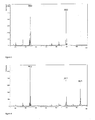
- Compounds 7a-h are ionized to form trityl cations which appear as distinct peaks in mass spectrum ( Fig. 1 , Table 1). Table 1. Distinct peaks from mass tags 7a-h. Compound Calculated cation m/z, monoisotopic peak Observed cation m/z, monoisotopic peak 7a 460.25 460.47 7b 488.28 488.55 7c 502.30 502.59 7d 516.31 516.62 7e 530.33 530.67 7f 544.34 544.69 7g 558.36 558.72 7h 586.39 586.84
- Example 3 Encoding of arbitrary ASCII bytes with mass tags 7a-h.
- Samples were prepared by mixing solutions of compounds selected from 7a-h (10 uL each) and adding acetonitrile (to 1 mL). Aliquots (0.5 uL) of obtained solutions were taken and applied to MALDI target plate, and analyzed using Bruker Ultraflex III MALDI-TOF mass spectrometer ( Fig. 2-8 ).
Landscapes
- Physics & Mathematics (AREA)
- General Physics & Mathematics (AREA)
- Engineering & Computer Science (AREA)
- Theoretical Computer Science (AREA)
- Other Investigation Or Analysis Of Materials By Electrical Means (AREA)
Priority Applications (4)
| Application Number | Priority Date | Filing Date | Title |
|---|---|---|---|
| EP13174894.9A EP2821940A1 (de) | 2013-07-03 | 2013-07-03 | Binäre Etikettierung |
| US14/901,848 US20160379100A1 (en) | 2013-07-03 | 2014-07-03 | Binary Labeling |
| EP14736739.5A EP3017401A1 (de) | 2013-07-03 | 2014-07-03 | Binäre etikettierung |
| PCT/EP2014/064132 WO2015000999A1 (en) | 2013-07-03 | 2014-07-03 | Binary labeling |
Applications Claiming Priority (1)
| Application Number | Priority Date | Filing Date | Title |
|---|---|---|---|
| EP13174894.9A EP2821940A1 (de) | 2013-07-03 | 2013-07-03 | Binäre Etikettierung |
Publications (1)
| Publication Number | Publication Date |
|---|---|
| EP2821940A1 true EP2821940A1 (de) | 2015-01-07 |
Family
ID=48740937
Family Applications (2)
| Application Number | Title | Priority Date | Filing Date |
|---|---|---|---|
| EP13174894.9A Withdrawn EP2821940A1 (de) | 2013-07-03 | 2013-07-03 | Binäre Etikettierung |
| EP14736739.5A Withdrawn EP3017401A1 (de) | 2013-07-03 | 2014-07-03 | Binäre etikettierung |
Family Applications After (1)
| Application Number | Title | Priority Date | Filing Date |
|---|---|---|---|
| EP14736739.5A Withdrawn EP3017401A1 (de) | 2013-07-03 | 2014-07-03 | Binäre etikettierung |
Country Status (3)
| Country | Link |
|---|---|
| US (1) | US20160379100A1 (de) |
| EP (2) | EP2821940A1 (de) |
| WO (1) | WO2015000999A1 (de) |
Cited By (1)
| Publication number | Priority date | Publication date | Assignee | Title |
|---|---|---|---|---|
| JP2021501884A (ja) * | 2017-11-02 | 2021-01-21 | レール・リキード−ソシエテ・アノニム・プール・レテュード・エ・レクスプロワタシオン・デ・プロセデ・ジョルジュ・クロード | 製造場所の認証を証明するための安定同位体の使用 |
Families Citing this family (2)
| Publication number | Priority date | Publication date | Assignee | Title |
|---|---|---|---|---|
| CN109964133A (zh) | 2016-10-31 | 2019-07-02 | 惠普发展公司,有限责任合伙企业 | 同位素的电参数 |
| WO2020225715A1 (en) * | 2019-05-03 | 2020-11-12 | Waters Technologies Ireland Limited | Techniques for generating encoded representations of compounds |
Citations (10)
| Publication number | Priority date | Publication date | Assignee | Title |
|---|---|---|---|---|
| US5156653A (en) | 1991-04-18 | 1992-10-20 | Morton International, Inc. | Silent markers for petroleum, method of tagging, and method of detection |
| US5525516A (en) | 1994-09-30 | 1996-06-11 | Eastman Chemical Company | Method for tagging petroleum products |
| EP0717388A1 (de) * | 1994-12-16 | 1996-06-19 | Consortium für elektrochemische Industrie GmbH | Zusammensetzung zur delokalisierten Kennzeichnung von Gegenständen, ihre Herstellung und Verwendung |
| US5980593A (en) | 1998-02-13 | 1999-11-09 | Morton International, Inc. | Silent fluorescent petroleum markers |
| US5998211A (en) | 1992-07-23 | 1999-12-07 | Basf Aktiengesellschaft | Use of compounds which absorb and/or fluoresce in the IR region as markers for liquids |
| US6815213B1 (en) | 1999-06-22 | 2004-11-09 | Eurofins Scientific | Method for analyzing a sample of a complex molecule relatively to a reference batch of the same complex molecule |
| WO2005031302A2 (en) | 2003-09-22 | 2005-04-07 | University Of Maryland, Baltimore | Drug authentication |
| EP1677105A1 (de) | 2004-08-05 | 2006-07-05 | Innovation & Chimie Fine | Verfahren zur isotopischen Markierung von Produkten und Anwendung desselben bei der Verhinderung von Fälschungen |
| EP2356636A1 (de) * | 2008-12-08 | 2011-08-17 | Polysecure GmbH | Verfahren zur authentifizierung und/oder identifizierung eines gegenstands |
| US8071386B2 (en) | 2003-07-02 | 2011-12-06 | Sicpa Holding Sa | Method of marking a product, marked product resulting thereof, and method of identifying same |
-
2013
- 2013-07-03 EP EP13174894.9A patent/EP2821940A1/de not_active Withdrawn
-
2014
- 2014-07-03 WO PCT/EP2014/064132 patent/WO2015000999A1/en not_active Ceased
- 2014-07-03 EP EP14736739.5A patent/EP3017401A1/de not_active Withdrawn
- 2014-07-03 US US14/901,848 patent/US20160379100A1/en not_active Abandoned
Patent Citations (12)
| Publication number | Priority date | Publication date | Assignee | Title |
|---|---|---|---|---|
| US5156653A (en) | 1991-04-18 | 1992-10-20 | Morton International, Inc. | Silent markers for petroleum, method of tagging, and method of detection |
| US5998211A (en) | 1992-07-23 | 1999-12-07 | Basf Aktiengesellschaft | Use of compounds which absorb and/or fluoresce in the IR region as markers for liquids |
| US5525516A (en) | 1994-09-30 | 1996-06-11 | Eastman Chemical Company | Method for tagging petroleum products |
| US5525516B1 (en) | 1994-09-30 | 1999-11-09 | Eastman Chem Co | Method for tagging petroleum products |
| EP0717388A1 (de) * | 1994-12-16 | 1996-06-19 | Consortium für elektrochemische Industrie GmbH | Zusammensetzung zur delokalisierten Kennzeichnung von Gegenständen, ihre Herstellung und Verwendung |
| US5980593A (en) | 1998-02-13 | 1999-11-09 | Morton International, Inc. | Silent fluorescent petroleum markers |
| US6815213B1 (en) | 1999-06-22 | 2004-11-09 | Eurofins Scientific | Method for analyzing a sample of a complex molecule relatively to a reference batch of the same complex molecule |
| US8071386B2 (en) | 2003-07-02 | 2011-12-06 | Sicpa Holding Sa | Method of marking a product, marked product resulting thereof, and method of identifying same |
| US8268623B2 (en) | 2003-07-02 | 2012-09-18 | Sicpa Holding Sa | Method of marking a product, marked product resulting thereof, and method of identifying same |
| WO2005031302A2 (en) | 2003-09-22 | 2005-04-07 | University Of Maryland, Baltimore | Drug authentication |
| EP1677105A1 (de) | 2004-08-05 | 2006-07-05 | Innovation & Chimie Fine | Verfahren zur isotopischen Markierung von Produkten und Anwendung desselben bei der Verhinderung von Fälschungen |
| EP2356636A1 (de) * | 2008-12-08 | 2011-08-17 | Polysecure GmbH | Verfahren zur authentifizierung und/oder identifizierung eines gegenstands |
Non-Patent Citations (7)
| Title |
|---|
| BRIESE, T. ET AL., EMERY INFECT DIS., vol. 11, no. 2, 2005, pages 310 - 313 |
| CRERAN, B. ET AL., CHEM. COMMUN, vol. 48, no. 38, 2012, pages 4543 - 4545 |
| DEGADINE, K. ET AL.: "J. Pharmaceutical and Biomed", ANALYSIS, 2013 |
| EBERLIN, L.S. ET AL., ANALYST, vol. 135, no. 10, 2010, pages 2453 - 2744 |
| PETRICOIN, E.F. ET AL., CLIN. CHEM., vol. 49, no. 4, 2003, pages 533 - 534 |
| WHITE, K.A., J. AN. CHEM. SOC., vol. 131, no. 15, 2009, pages 18069 - 18071 |
| ZHU, ZH.-J. ET AL., J. AM. CHEM. SOC, vol. 130, no. 43, 2008, pages 14139 - 14143 |
Cited By (1)
| Publication number | Priority date | Publication date | Assignee | Title |
|---|---|---|---|---|
| JP2021501884A (ja) * | 2017-11-02 | 2021-01-21 | レール・リキード−ソシエテ・アノニム・プール・レテュード・エ・レクスプロワタシオン・デ・プロセデ・ジョルジュ・クロード | 製造場所の認証を証明するための安定同位体の使用 |
Also Published As
| Publication number | Publication date |
|---|---|
| US20160379100A1 (en) | 2016-12-29 |
| EP3017401A1 (de) | 2016-05-11 |
| WO2015000999A1 (en) | 2015-01-08 |
Similar Documents
| Publication | Publication Date | Title |
|---|---|---|
| Ablajan et al. | Structural characterization of flavonol 3, 7‐di‐O‐glycosides and determination of the glycosylation position by using negative ion electrospray ionization tandem mass spectrometry | |
| Han et al. | Online counter gradient LC-FT-ICR-MS enables detection of highly polar natural organic matter fractions | |
| Al Ouahabi et al. | Mass spectrometry sequencing of long digital polymers facilitated by programmed inter-byte fragmentation | |
| da Silva Ferreira et al. | Forensic analysis of ballpoint pen inks using paper spray mass spectrometry | |
| Liu et al. | Identification and analytical characterization of nine synthetic cathinone derivatives N‐ethylhexedrone, 4‐Cl‐pentedrone, 4‐Cl‐α‐EAPP, propylone, N‐ethylnorpentylone, 6‐MeO‐bk‐MDMA, α‐PiHP, 4‐Cl‐α‐PHP, and 4‐F‐α‐PHP | |
| CN1427953B (zh) | 质量标记物 | |
| Lkhagva et al. | Comparative study of five different amine-derivatization methods for metabolite analyses by liquid chromatography-tandem mass spectrometry | |
| EP2821940A1 (de) | Binäre Etikettierung | |
| Yossa Nzeuwa et al. | Comparison of the origin and phenolic contents of Lycium ruthenicum Murr. by high‐performance liquid chromatography fingerprinting combined with quadrupole time‐of‐flight mass spectrometry and chemometrics | |
| Amalian et al. | Desorption electrospray ionization (DESI) of digital polymers: Direct tandem mass spectrometry decoding and imaging from materials surfaces | |
| EP1687638B1 (de) | Analyse von massenspektraldaten in den ruhigen gebieten | |
| Sekuła et al. | Analysis of fragmentation pathways of fentanyl derivatives by electrospray ionisation high‐resolution mass spectrometry | |
| Panighel et al. | Putative identification of new p‐coumaroyl glycoside flavonoids in grape by ultra‐high performance liquid chromatography/high‐resolution mass spectrometry | |
| Longo et al. | Relative abundances of novel cyclic prodelphinidins in wine depending on the grape variety | |
| Schuller et al. | Simultaneous multiple MS binding assays addressing D1 and D2 dopamine receptors | |
| Momcilovic et al. | Sample preparation effects in matrix‐assisted laser desorption/ionisation time‐of‐flight mass spectrometry of partially depolymerised carboxymethyl cellulose | |
| Dowling | DIGE analysis software and protein identification approaches | |
| You et al. | Determination of amines using 2-(11H-benzo [a] carbazol-11-yl) ethyl chloroformate (BCEC-Cl) as labeling reagent by HPLC with fluorescence detection and identification with APCI/MS | |
| La Clair | Encoding matter with regiospecific 12 C/13 C isotopic labels | |
| Assis et al. | Triacetone triperoxide characterization by FT-ICR mass spectrometry: Uncovering multiple forensic evidence | |
| Xu et al. | Applications and Challenges of Modern Analytical Techniques for the Identification of Plant Gum in the Polychrome Cultural Heritage. | |
| Winter et al. | Minimally permutated peptide analogs as internal standards for relative and absolute quantification of peptides and proteins | |
| Perry et al. | IDENTIFYING THE PLANT ORIGIN OF ARTISTS'YELLOW LAKE PIGMENTS BY ELECTROSPRAY MASS SPECTROMETRY | |
| Boatto et al. | Simultaneous determination of new thioamphetamine designer drugs in plasma by capillary electrophoresis coupled with mass spectrometry | |
| Morgan et al. | Resonance enhanced multiphoton ionisation (REMPI) and REMPI-photoelectron spectroscopy of carbonyl sulphide and carbon disulphide |
Legal Events
| Date | Code | Title | Description |
|---|---|---|---|
| PUAI | Public reference made under article 153(3) epc to a published international application that has entered the european phase |
Free format text: ORIGINAL CODE: 0009012 |
|
| 17P | Request for examination filed |
Effective date: 20130703 |
|
| AK | Designated contracting states |
Kind code of ref document: A1 Designated state(s): AL AT BE BG CH CY CZ DE DK EE ES FI FR GB GR HR HU IE IS IT LI LT LU LV MC MK MT NL NO PL PT RO RS SE SI SK SM TR |
|
| AX | Request for extension of the european patent |
Extension state: BA ME |
|
| STAA | Information on the status of an ep patent application or granted ep patent |
Free format text: STATUS: THE APPLICATION IS DEEMED TO BE WITHDRAWN |
|
| 18D | Application deemed to be withdrawn |
Effective date: 20150708 |