EP2824101B1 - Nouveau composé et matière de support ayant ledit nouveau composé supporté sur celle-ci - Google Patents
Nouveau composé et matière de support ayant ledit nouveau composé supporté sur celle-ci Download PDFInfo
- Publication number
- EP2824101B1 EP2824101B1 EP13758609.5A EP13758609A EP2824101B1 EP 2824101 B1 EP2824101 B1 EP 2824101B1 EP 13758609 A EP13758609 A EP 13758609A EP 2824101 B1 EP2824101 B1 EP 2824101B1
- Authority
- EP
- European Patent Office
- Prior art keywords
- group
- hydrocarbon group
- carbon atoms
- represented
- aliphatic hydrocarbon
- Prior art date
- Legal status (The legal status is an assumption and is not a legal conclusion. Google has not performed a legal analysis and makes no representation as to the accuracy of the status listed.)
- Not-in-force
Links
- 0 B*c1c(C=C(C(N(CC(O)=O)C(O)=O)=O)C#N)[s]c(-c2c(*)cc(-c3c(C)cc(C4SC(C(*5)C=CC6=C5C5C=CC=*[C@]5N6CO)=C[C@]4C)[s]3)[s]2)c1 Chemical compound B*c1c(C=C(C(N(CC(O)=O)C(O)=O)=O)C#N)[s]c(-c2c(*)cc(-c3c(C)cc(C4SC(C(*5)C=CC6=C5C5C=CC=*[C@]5N6CO)=C[C@]4C)[s]3)[s]2)c1 0.000 description 8
- YXGBVYIYQYYSOK-UTCJRWHESA-N C/C=C(/C=C(C)O1)\C1=O Chemical compound C/C=C(/C=C(C)O1)\C1=O YXGBVYIYQYYSOK-UTCJRWHESA-N 0.000 description 1
Images

Classifications
-
- C—CHEMISTRY; METALLURGY
- C07—ORGANIC CHEMISTRY
- C07D—HETEROCYCLIC COMPOUNDS
- C07D409/00—Heterocyclic compounds containing two or more hetero rings, at least one ring having sulfur atoms as the only ring hetero atoms
- C07D409/14—Heterocyclic compounds containing two or more hetero rings, at least one ring having sulfur atoms as the only ring hetero atoms containing three or more hetero rings
-
- C—CHEMISTRY; METALLURGY
- C07—ORGANIC CHEMISTRY
- C07D—HETEROCYCLIC COMPOUNDS
- C07D209/00—Heterocyclic compounds containing five-membered rings, condensed with other rings, with one nitrogen atom as the only ring hetero atom
- C07D209/56—Ring systems containing three or more rings
- C07D209/80—[b, c]- or [b, d]-condensed
- C07D209/82—Carbazoles; Hydrogenated carbazoles
- C07D209/86—Carbazoles; Hydrogenated carbazoles with only hydrogen atoms, hydrocarbon or substituted hydrocarbon radicals, directly attached to carbon atoms of the ring system
-
- C—CHEMISTRY; METALLURGY
- C07—ORGANIC CHEMISTRY
- C07D—HETEROCYCLIC COMPOUNDS
- C07D333/00—Heterocyclic compounds containing five-membered rings having one sulfur atom as the only ring hetero atom
- C07D333/02—Heterocyclic compounds containing five-membered rings having one sulfur atom as the only ring hetero atom not condensed with other rings
- C07D333/04—Heterocyclic compounds containing five-membered rings having one sulfur atom as the only ring hetero atom not condensed with other rings not substituted on the ring sulphur atom
- C07D333/06—Heterocyclic compounds containing five-membered rings having one sulfur atom as the only ring hetero atom not condensed with other rings not substituted on the ring sulphur atom with only hydrogen atoms, hydrocarbon or substituted hydrocarbon radicals, directly attached to the ring carbon atoms
- C07D333/24—Radicals substituted by carbon atoms having three bonds to hetero atoms with at the most one bond to halogen, e.g. ester or nitrile radicals
-
- C—CHEMISTRY; METALLURGY
- C07—ORGANIC CHEMISTRY
- C07D—HETEROCYCLIC COMPOUNDS
- C07D403/00—Heterocyclic compounds containing two or more hetero rings, having nitrogen atoms as the only ring hetero atoms, not provided for by group C07D401/00
- C07D403/02—Heterocyclic compounds containing two or more hetero rings, having nitrogen atoms as the only ring hetero atoms, not provided for by group C07D401/00 containing two hetero rings
- C07D403/08—Heterocyclic compounds containing two or more hetero rings, having nitrogen atoms as the only ring hetero atoms, not provided for by group C07D401/00 containing two hetero rings linked by a carbon chain containing alicyclic rings
-
- C—CHEMISTRY; METALLURGY
- C07—ORGANIC CHEMISTRY
- C07D—HETEROCYCLIC COMPOUNDS
- C07D409/00—Heterocyclic compounds containing two or more hetero rings, at least one ring having sulfur atoms as the only ring hetero atoms
- C07D409/02—Heterocyclic compounds containing two or more hetero rings, at least one ring having sulfur atoms as the only ring hetero atoms containing two hetero rings
- C07D409/04—Heterocyclic compounds containing two or more hetero rings, at least one ring having sulfur atoms as the only ring hetero atoms containing two hetero rings directly linked by a ring-member-to-ring-member bond
-
- C—CHEMISTRY; METALLURGY
- C07—ORGANIC CHEMISTRY
- C07D—HETEROCYCLIC COMPOUNDS
- C07D409/00—Heterocyclic compounds containing two or more hetero rings, at least one ring having sulfur atoms as the only ring hetero atoms
- C07D409/02—Heterocyclic compounds containing two or more hetero rings, at least one ring having sulfur atoms as the only ring hetero atoms containing two hetero rings
- C07D409/12—Heterocyclic compounds containing two or more hetero rings, at least one ring having sulfur atoms as the only ring hetero atoms containing two hetero rings linked by a chain containing hetero atoms as chain links
-
- C—CHEMISTRY; METALLURGY
- C07—ORGANIC CHEMISTRY
- C07D—HETEROCYCLIC COMPOUNDS
- C07D495/00—Heterocyclic compounds containing in the condensed system at least one hetero ring having sulfur atoms as the only ring hetero atoms
- C07D495/02—Heterocyclic compounds containing in the condensed system at least one hetero ring having sulfur atoms as the only ring hetero atoms in which the condensed system contains two hetero rings
- C07D495/04—Ortho-condensed systems
-
- C—CHEMISTRY; METALLURGY
- C07—ORGANIC CHEMISTRY
- C07F—ACYCLIC, CARBOCYCLIC OR HETEROCYCLIC COMPOUNDS CONTAINING ELEMENTS OTHER THAN CARBON, HYDROGEN, HALOGEN, OXYGEN, NITROGEN, SULFUR, SELENIUM OR TELLURIUM
- C07F7/00—Compounds containing elements of Groups 4 or 14 of the Periodic Table
- C07F7/02—Silicon compounds
- C07F7/08—Compounds having one or more C—Si linkages
- C07F7/0803—Compounds with Si-C or Si-Si linkages
- C07F7/081—Compounds with Si-C or Si-Si linkages comprising at least one atom selected from the elements N, O, halogen, S, Se or Te
- C07F7/0812—Compounds with Si-C or Si-Si linkages comprising at least one atom selected from the elements N, O, halogen, S, Se or Te comprising a heterocyclic ring
- C07F7/0816—Compounds with Si-C or Si-Si linkages comprising at least one atom selected from the elements N, O, halogen, S, Se or Te comprising a heterocyclic ring said ring comprising Si as a ring atom
-
- C—CHEMISTRY; METALLURGY
- C09—DYES; PAINTS; POLISHES; NATURAL RESINS; ADHESIVES; COMPOSITIONS NOT OTHERWISE PROVIDED FOR; APPLICATIONS OF MATERIALS NOT OTHERWISE PROVIDED FOR
- C09B—ORGANIC DYES OR CLOSELY-RELATED COMPOUNDS FOR PRODUCING DYES, e.g. PIGMENTS; MORDANTS; LAKES
- C09B23/00—Methine or polymethine dyes, e.g. cyanine dyes
- C09B23/0008—Methine or polymethine dyes, e.g. cyanine dyes substituted on the polymethine chain
- C09B23/005—Methine or polymethine dyes, e.g. cyanine dyes substituted on the polymethine chain the substituent being a COOH and/or a functional derivative thereof
-
- C—CHEMISTRY; METALLURGY
- C09—DYES; PAINTS; POLISHES; NATURAL RESINS; ADHESIVES; COMPOSITIONS NOT OTHERWISE PROVIDED FOR; APPLICATIONS OF MATERIALS NOT OTHERWISE PROVIDED FOR
- C09B—ORGANIC DYES OR CLOSELY-RELATED COMPOUNDS FOR PRODUCING DYES, e.g. PIGMENTS; MORDANTS; LAKES
- C09B23/00—Methine or polymethine dyes, e.g. cyanine dyes
- C09B23/0008—Methine or polymethine dyes, e.g. cyanine dyes substituted on the polymethine chain
- C09B23/005—Methine or polymethine dyes, e.g. cyanine dyes substituted on the polymethine chain the substituent being a COOH and/or a functional derivative thereof
- C09B23/0058—Methine or polymethine dyes, e.g. cyanine dyes substituted on the polymethine chain the substituent being a COOH and/or a functional derivative thereof the substituent being CN
-
- C—CHEMISTRY; METALLURGY
- C09—DYES; PAINTS; POLISHES; NATURAL RESINS; ADHESIVES; COMPOSITIONS NOT OTHERWISE PROVIDED FOR; APPLICATIONS OF MATERIALS NOT OTHERWISE PROVIDED FOR
- C09B—ORGANIC DYES OR CLOSELY-RELATED COMPOUNDS FOR PRODUCING DYES, e.g. PIGMENTS; MORDANTS; LAKES
- C09B23/00—Methine or polymethine dyes, e.g. cyanine dyes
- C09B23/10—The polymethine chain containing an even number of >CH- groups
- C09B23/105—The polymethine chain containing an even number of >CH- groups two >CH- groups
-
- C—CHEMISTRY; METALLURGY
- C09—DYES; PAINTS; POLISHES; NATURAL RESINS; ADHESIVES; COMPOSITIONS NOT OTHERWISE PROVIDED FOR; APPLICATIONS OF MATERIALS NOT OTHERWISE PROVIDED FOR
- C09B—ORGANIC DYES OR CLOSELY-RELATED COMPOUNDS FOR PRODUCING DYES, e.g. PIGMENTS; MORDANTS; LAKES
- C09B57/00—Other synthetic dyes of known constitution
- C09B57/008—Triarylamine dyes containing no other chromophores
-
- H—ELECTRICITY
- H01—ELECTRIC ELEMENTS
- H01G—CAPACITORS; CAPACITORS, RECTIFIERS, DETECTORS, SWITCHING DEVICES, LIGHT-SENSITIVE OR TEMPERATURE-SENSITIVE DEVICES OF THE ELECTROLYTIC TYPE
- H01G9/00—Electrolytic capacitors, rectifiers, detectors, switching devices, light-sensitive or temperature-sensitive devices; Processes of their manufacture
- H01G9/20—Light-sensitive devices
- H01G9/2059—Light-sensitive devices comprising an organic dye as the active light absorbing material, e.g. adsorbed on an electrode or dissolved in solution
-
- H—ELECTRICITY
- H10—SEMICONDUCTOR DEVICES; ELECTRIC SOLID-STATE DEVICES NOT OTHERWISE PROVIDED FOR
- H10K—ORGANIC ELECTRIC SOLID-STATE DEVICES
- H10K85/00—Organic materials used in the body or electrodes of devices covered by this subclass
- H10K85/40—Organosilicon compounds, e.g. TIPS pentacene
-
- H—ELECTRICITY
- H10—SEMICONDUCTOR DEVICES; ELECTRIC SOLID-STATE DEVICES NOT OTHERWISE PROVIDED FOR
- H10K—ORGANIC ELECTRIC SOLID-STATE DEVICES
- H10K85/00—Organic materials used in the body or electrodes of devices covered by this subclass
- H10K85/60—Organic compounds having low molecular weight
- H10K85/631—Amine compounds having at least two aryl rest on at least one amine-nitrogen atom, e.g. triphenylamine
-
- H—ELECTRICITY
- H10—SEMICONDUCTOR DEVICES; ELECTRIC SOLID-STATE DEVICES NOT OTHERWISE PROVIDED FOR
- H10K—ORGANIC ELECTRIC SOLID-STATE DEVICES
- H10K85/00—Organic materials used in the body or electrodes of devices covered by this subclass
- H10K85/60—Organic compounds having low molecular weight
- H10K85/649—Aromatic compounds comprising a hetero atom
- H10K85/655—Aromatic compounds comprising a hetero atom comprising only sulfur as heteroatom
-
- H—ELECTRICITY
- H10—SEMICONDUCTOR DEVICES; ELECTRIC SOLID-STATE DEVICES NOT OTHERWISE PROVIDED FOR
- H10K—ORGANIC ELECTRIC SOLID-STATE DEVICES
- H10K85/00—Organic materials used in the body or electrodes of devices covered by this subclass
- H10K85/60—Organic compounds having low molecular weight
- H10K85/649—Aromatic compounds comprising a hetero atom
- H10K85/657—Polycyclic condensed heteroaromatic hydrocarbons
-
- H—ELECTRICITY
- H10—SEMICONDUCTOR DEVICES; ELECTRIC SOLID-STATE DEVICES NOT OTHERWISE PROVIDED FOR
- H10K—ORGANIC ELECTRIC SOLID-STATE DEVICES
- H10K85/00—Organic materials used in the body or electrodes of devices covered by this subclass
- H10K85/60—Organic compounds having low molecular weight
- H10K85/649—Aromatic compounds comprising a hetero atom
- H10K85/657—Polycyclic condensed heteroaromatic hydrocarbons
- H10K85/6572—Polycyclic condensed heteroaromatic hydrocarbons comprising only nitrogen in the heteroaromatic polycondensed ring system, e.g. phenanthroline or carbazole
-
- H—ELECTRICITY
- H01—ELECTRIC ELEMENTS
- H01G—CAPACITORS; CAPACITORS, RECTIFIERS, DETECTORS, SWITCHING DEVICES, LIGHT-SENSITIVE OR TEMPERATURE-SENSITIVE DEVICES OF THE ELECTROLYTIC TYPE
- H01G9/00—Electrolytic capacitors, rectifiers, detectors, switching devices, light-sensitive or temperature-sensitive devices; Processes of their manufacture
- H01G9/20—Light-sensitive devices
- H01G9/2027—Light-sensitive devices comprising an oxide semiconductor electrode
- H01G9/2031—Light-sensitive devices comprising an oxide semiconductor electrode comprising titanium oxide, e.g. TiO2
-
- H—ELECTRICITY
- H10—SEMICONDUCTOR DEVICES; ELECTRIC SOLID-STATE DEVICES NOT OTHERWISE PROVIDED FOR
- H10K—ORGANIC ELECTRIC SOLID-STATE DEVICES
- H10K85/00—Organic materials used in the body or electrodes of devices covered by this subclass
- H10K85/60—Organic compounds having low molecular weight
- H10K85/649—Aromatic compounds comprising a hetero atom
- H10K85/652—Cyanine dyes
-
- H—ELECTRICITY
- H10—SEMICONDUCTOR DEVICES; ELECTRIC SOLID-STATE DEVICES NOT OTHERWISE PROVIDED FOR
- H10K—ORGANIC ELECTRIC SOLID-STATE DEVICES
- H10K85/00—Organic materials used in the body or electrodes of devices covered by this subclass
- H10K85/60—Organic compounds having low molecular weight
- H10K85/649—Aromatic compounds comprising a hetero atom
- H10K85/657—Polycyclic condensed heteroaromatic hydrocarbons
- H10K85/6576—Polycyclic condensed heteroaromatic hydrocarbons comprising only sulfur in the heteroaromatic polycondensed ring system, e.g. benzothiophene
-
- Y—GENERAL TAGGING OF NEW TECHNOLOGICAL DEVELOPMENTS; GENERAL TAGGING OF CROSS-SECTIONAL TECHNOLOGIES SPANNING OVER SEVERAL SECTIONS OF THE IPC; TECHNICAL SUBJECTS COVERED BY FORMER USPC CROSS-REFERENCE ART COLLECTIONS [XRACs] AND DIGESTS
- Y02—TECHNOLOGIES OR APPLICATIONS FOR MITIGATION OR ADAPTATION AGAINST CLIMATE CHANGE
- Y02E—REDUCTION OF GREENHOUSE GAS [GHG] EMISSIONS, RELATED TO ENERGY GENERATION, TRANSMISSION OR DISTRIBUTION
- Y02E10/00—Energy generation through renewable energy sources
- Y02E10/50—Photovoltaic [PV] energy
- Y02E10/542—Dye sensitized solar cells
Definitions
- This invention relates to a novel compound, a carrier system having the novel compound, and a photoelectric conversion device having the carrier system.
- Dyes are widely used in a variety of technical fields.
- dyes having photosensitizing properties have been used in dye-sensitized photoelectric conversion devices.
- Dye-sensitized photoelectric conversion devices are expected to theoretically achieve high efficiency and be produced at lower cost than those having a conventional silicone semiconductor.
- a dye-sensitized photoelectric conversion device has an electrode having an oxide semiconductor using a dye carrier.
- the dye is excited on absorbing light falling on the device and injects electrons into the carrier to perform photoelectric conversion.
- Garc ⁇ a-Iglesias et al., Chem. Sci. 2, 1145 (2011 ) disclose dye-sensitised solar cells comprising dyes having one or more anchoring groups.
- a solar cell one of the main applications of the dye-sensitized photoelectric conversion device, is required to have high durability by the very nature of use.
- a known dye and a photoelectric conversion device using the known dye have not yet achieved sufficient characteristics.
- An object of the invention is to provide a novel compound, particularly a novel compound functioning as a dye exhibiting high adsorbability on a carrier, a carrier having the novel compound thereon, and a photoelectric conversion device having high efficiency and high durability.
- the invention provides a novel compound represented by general formula (1) shown below, a carrier having the compound fixed thereon (hereinafter referred to as a carrier system), and a photoelectric conversion device comprising an electrode having the carrier system.
- a carrier system a carrier having the compound fixed thereon
- a photoelectric conversion device comprising an electrode having the carrier system.
- the novel compound of the invention has excellent adsorbability because of its carboxyl group and the group represented by R1, provides a highly efficient and highly durable carrier system and electrode, and is suited for use in photoelectric conversion devices such as solar cells.
- novel compound of the invention the carrier system of the invention, and the photoelectric conversion device having the carrier system will be illustrated based on their preferred embodiments.
- the conjugated group as represented by Z in general formula (1) is not particularly limited as long as it is a pi-conjugated group and may have a substituent.
- the term "pi-conjugated group” means a system in which unsaturated bonds are connected alternating with single bonds.
- the unsaturated bonds have a total of 4 to 60 carbon atoms, more preferably 4 to 40 carbon atoms.
- Z preferably represents a group composed of 1 to 7 groups selected from the groups represented by formulae (Z-1) through (Z-10) shown below, more preferably a group containing at least one group represented by formula (Z-7), even more preferably a group composed solely of at least one group represented by formula (Z-7).
- X represents S, O, NR6, or SiR6R7; the hydrogen atoms other than that directly bonded to the nitrogen atom is optionally displaced by a fluorine atom, a chlorine atom, an iodine atom, a cyano group, a nitro group, -OR6, -SR6, -NR6R7, -SiR6R7R8, or an optionally substituted aliphatic hydrocarbon group; R6, R7, and R8 each represent a hydrogen atom or an optionally substituted hydrocarbon group.
- Examples of the aliphatic hydrocarbon group which may substitute for the hydrogen atom in formulae (Z-1) through (Z-10) include alkyl groups, such as methyl, ethyl, propyl, isopropyl, cyclopropyl, butyl, sec-butyl, tert-butyl, isobutyl, amyl, isoamyl, tert-amyl, cyclopentyl, hexyl, 2-hexyl, 3-hexyl, cyclohexyl, bicyclohexyl, 1-methylcyclohexyl, heptyl, 2-heptyl, 3-heptyl, isoheptyl, tert-heptyl, n-octyl, isooctyl, tert-octyl, 2-ethylhexyl, nonyl, isononyl, and decyl; alkoxy groups, such as methoxy,
- These groups may be interrupted by -O-, -CO-, -COO-, -OCO-, -NHCO-, -NH-, NHCO- at 1 to 4 positions.
- the aliphatic hydrocarbon group may be substituted by fluorine, chlorine, iodine, cyano, nitro, hydroxyl, thiol, or amino.
- Examples of the optionally substituted hydrocarbon group as represented by R6 or R7 include an aliphatic hydrocarbon group, an alicyclic hydrocarbon group, an aromatic hydrocarbon group, or a group composed of two or more of these hydrocarbon groups.
- Examples of the aliphatic hydrocarbon group include those described above as a substituent for the hydrogen atom of the groups of formulae (Z-1) to (Z-10).
- Examples of the alicyclic hydrocarbon group include cyclopropyl, cyclopentyl, cyclohexyl, and cycloheptyl.
- Examples of the aromatic hydrocarbon group include phenyl, naphthyl, benzyl, fluorenyl, and indenyl.
- Examples of the substituent of the optionally substituted hydrocarbon groups represented by R6 and R7 include fluorine, chlorine, iodine, cyano, nitro, hydroxyl, thiol, and amino.
- Examples of the C6-C20 aromatic hydrocarbon group include phenyl, naphthyl, cyclohexylphenyl, biphenyl, terphenyl, fluorenyl, thiophenylphenyl, furanylphenyl, 2'-phenyl-propylphenyl, benzyl, and naphthylmethyl. These groups are substituted by at least one of carboxyl, cyano, amino, amide, and nitro groups.
- substituted aromatic hydrocarbon groups examples include 2-carboxyphenyl, 3-carboxylphenyl, 4-carboxylphenyl, 2-cyanophenyl, 3-cyanophenyl, 4-cyanophenyl, 2-aminophenyl, 3-aminophenyl, 4-aminophenyl, phenylamido-4'-yl, 2-nitroamide, 3-nitroamide, 4-nitroamide, 3-carboxynaphthalene, 4-carboxynaphthalene, 5-carboxynaphthalene, 6-carboxynaphthalene, 6-carboxylnaphthalen-2-yl, 3-cyanonaphthalene, 4-cyanonaphthalene, 5-cyanonaphthalene, 4-carboxylphenylmethyl, and 4-cyanophenylmethyl.
- Examples of the C1-C20 aliphatic hydrocarbon group include those described above as a substituent for the hydrogen atom of the groups of formulae (Z-1) to (Z-10). These groups are substituted by at least one of carboxyl, cyano, amino, amide, and nitro groups. Examples of such substituted groups include cyanomethyl, 2-cyanopethyl, 2-cyanopropyl, 3-cyanopropyl, carboxymethyl, 2-carboxyethyl, 2-carboxypropyl, 3-carboxymethyl, 2-carboxyethyl, 2-carboxypropyl, 3-carboxypropyl, methylamido, ethylamido, nitromethyl, 2-nitroethyl, and 3-nitropropyl.
- Examples of the C7-C20 aromatic hydrocarbon group substituted by an aliphatic hydrocarbon group include the above described aromatic hydrocarbon groups substituted by the above described aliphatic hydrocarbon group(s). These groups are further substituted by at least one of carboxyl, cyano, amino, amido, and nitro groups.
- Examples of such substituted aromatic hydrocarbon groups include 2-carboxy-5-methylphenyl, 5-carboxy-2-methylphenyl, 4-carboxy-2,5-dimethylphenyl, and 4-cyano-2,5-dimethylphenyl.
- the number of the substituents selected from carboxyl, cyano, amino, amido, and nitro groups that are essentially present in R1 is one to three, preferably one or two, more preferably one. Of these substituents preferred are carboxyl and cyano, with carboxyl being more preferred.
- Examples of the optionally substituted C1-C20 hydrocarbon group as represented by R2 in general formula (1) include those having 1 to 20 carbon atoms out of the above-described optionally substituted hydrocarbon groups represented by R6.
- Examples of the optionally substituted hydrocarbon groups as represented by R30, R31, R32, R33, R40, R41, R42, R43, and R44 are the same as those described as examples of the optionally substituted hydrocarbon groups represented by R6.
- R30 and R31, R40 and R41, R41 and R42, R42 and R43, or R33 and R44 may optionally be connected to each other to form a ring, such as a benzene ring or a dioxene ring.
- R5 is cyano
- R11 is the group represented by structural formula (11-1) wherein n is 1 or 2. More preferred are those in which R5 is cyano, and R11 is the group of structural formula (11-1) wherein n is 1 or 2.
- novel compound represented by general formula (1) include, but are not limited to, compound Nos. 1 through 42 shown below.
- Hex represents hexyl.
- the compound of general formula (1) is obtained using publicly disclosed or commonly known reactions.
- the process for synthesizing the compound of formula (1) is not particularly limited.
- a typical example of the process for the synthesis includes converting a conjugated carboxylic acid (10) having a carboxyl group to an acid chloride (11), causing a secondary amine compound (12) having a protected carboxyl group to react on the acid chloride (11) to synthesize an amide compound (13), and deprotecting the carboxyl group using trifluoroacetic acid.
- a compound of general formula (1) in which R11 is represented by structural formula (11-1), designated general formula (1') is synthesized.
- the reagents used in the reactions may be changed where necessary. wherein Z, R1, R2, R30, R31, R32, R33, R40, R41, R42, R43, R44, R5, and n are as defined above.
- the novel compound of the invention is suitably used as fixed on a carrier for application to photoelectric conversion devices.
- the novel compound of the invention also finds applications as intermediates for optical recording materials, pharmaceuticals, agricultural chemicals, aroma chemicals, and dyes; various functional materials, starting materials for various polymers; photoelectrochemical cells, nonlinear optical devices, electrochromic displays, holographic devices, organic semiconductors, organic ELs; silver halide photographic materials, photosensitizers; colorants in printing inks, inkjet inks, electrophotographic color toners, cosmetics, and plastics; stains for proteins, luminescent dyes for detection; material for making artificial quartz, paints, synthetic catalysts, catalyst carriers, surface coating thin film materials, silicone rubber crosslinking agents, binders; and so on.
- Examples of materials used as a carrier in the invention include organic resins, such as acrylic resins and fluororesins; metal oxides, such as titanium oxide, zinc oxide, and aluminum oxide; silicon oxide, zeolite, and activated carbon. Preferred are those having a porous surface.
- the carrier system of the invention is characterized in that the compound to be fixed onto the carrier is the compound represented by general formula (1).
- the compound may be fixed to the carrier by known methods including gas or liquid phase adsorption. For example, liquid phase adsorption may be carried out by dissolving the compound of the invention in a solvent and immersing the carrier in the solution.
- the form of the carrier is not particularly limited and may be chosen from, for example, thin film, powder, and granules as appropriate to the use.
- the size of the carrier and the amount of the compound of the invention to be fixed thereto are not particularly limited and may be chosen as appropriate to the use.
- the carrier system having the novel compound of the invention is suited for use in a photoelectric conversion device hereinafter described. It is also useful in catalysts, toners, and so forth.
- the photoelectric conversion device of the invention is a dye-sensitized photoelectric conversion device having the same structure as conventional dye-sensitized photoelectric conversion devices, except that the novel compound of the invention is used as a dye.
- a typical example of the configuration of the photoelectric conversion device of the invention will be described with reference to Figs. 1 and 2 .
- Fig. 1 schematically shows a cross-sectional structure of a photoelectric conversion device according to the invention
- Fig. 2 is an enlarged view of an essential part of the photoelectric conversion device of the invention shown in Fig. 1 .
- the photoelectric conversion device of Figs. 1 and 2 is a principal part of a dye-sensitized solar cell.
- the photoelectric conversion device includes a working electrode 10 and a counter electrode 20 facing each other. At least one of the working electrode 10 and the counter electrode 20 is light-transmissive.
- the working electrode 10 has, for example, an conductive substrate 11, a metal oxide semiconductor layer 12 provided on one side of the substrate 11 (on the side facing the counter electrode 20), and a dye 13 fixed to the metal oxide semiconductor layer 12.
- the dye 13 is the novel compound represented by general formula (1) according to the invention.
- the carrier system according to the invention is a composite system composed of the novel compound of the invention as a dye and the metal oxide semiconductor layer 12 as a carrier.
- the working electrode functions as a negative electrode of an outer circuit.
- the conductive substrate 11 is, for example, composed of an insulating substrate 11A and an conductive layer 11B on the surface of the insulating substrate 11A.
- Suitable materials of the substrate 11A include insulating materials, such as glass and plastics.
- Plastics are used in the form of transparent polymer film.
- the plastics include tetraacetyl cellulose (TAC), polyethylene terephthalate (PET), polyethylene naphthalate (PEN), syndiotactic polystyrene (SPS), polyphenylene sulfide (PPS), polycarbonate (PC), polyarylate (PAR), polysulfone (PSF), polyester sulfone (PES), polyetherimide (PEI), cyclic polyolefins, and brominated phenoxy resins.
- TAC tetraacetyl cellulose
- PET polyethylene terephthalate
- PEN polyethylene naphthalate
- SPS syndiotactic polystyrene
- PPS polyphenylene sulfide
- PC polycarbonate
- PAR polyarylate
- PES polysulfone
- the conductive layer 11B is exemplified by a thin film of an electroconductive metal oxide, such as indium oxide, tin oxide, indium-tin complex oxide (ITO), or fluorine-doped tin oxide (FTO or F-SnO 2 ), a thin film or mesh of a metal, such as gold (Au), silver (Ag), or platinum (Pt), or an electroconductive polymer film.
- an electroconductive metal oxide such as indium oxide, tin oxide, indium-tin complex oxide (ITO), or fluorine-doped tin oxide (FTO or F-SnO 2
- a thin film or mesh of a metal such as gold (Au), silver (Ag), or platinum (Pt)
- an electroconductive polymer film such as gold (Au), silver (Ag), or platinum (Pt)
- the conductive substrate 11 may be a monolithic structure made of an electroconductive material.
- examples of the material of the conductive substrate 11 include electroconductive metal oxides, such as indium oxide, tin oxide, indium-tin complex oxide, or fluorine-doped tin oxide, metals, such as gold, silver, or platinum, and electroconductive polymers.
- the metal oxide semiconductor layer 12 is a carrier having the dye 13 supported thereon. It has, for example, a porous structure as illustrated in Fig. 2 .
- the metal oxide semiconductor layer 12 is formed of a dense layer 12A and a porous layer 12B.
- the dense layer 12A is formed on the interface between the conductive substrate 11 and is preferably dense and less-porous, more preferably filmy.
- the porous layer 12B is formed on the surface in contact with the electrolyte-containing layer 30. It preferably has a structure with many voids and a large surface area, more preferably a structure composed of porous particles adhering to one another.
- the metal oxide semiconductor layer 12 may have a single layer structure of film form.
- the carrier system is a system in which the dye 13 is bonded or adsorbed to the porous layer 12B chemically, physically, or electrically.
- Examples of the material (metal oxide semiconductor material) contained in the metal oxide semiconductor layer 12 include titanium oxide, zinc oxide, tin oxide, niobium oxide, indium oxide, zirconium oxide, tantalum oxide, vanadium oxide, yttrium oxide, aluminum oxide, and magnesium oxide. Inter alia, titanium oxide and zinc oxide are preferred; for they provide high conversion efficiency. These metal oxide semiconductor materials may be used either individually or in combination of two or more thereof in the form, e.g., of mixture, mixed crystal, solid solution, or one on surface of another. For example, titanium oxide and zinc oxide may be used in combination.
- the metal oxide semiconductor layer 12 having a porous structure can be formed by, for example, electrodeposition, coating, or firing. Electrodeposition to form the metal oxide semiconductor layer 12 is carried out by immersing the conductive substrate 11 in an electrolytic bath containing a particulate metal oxide semiconductor material to cause the particles to adhere to and precipitate on the conductive layer 11B of the conductive substrate 11.
- a dispersion of a particulate metal oxide semiconductor material (metal oxide slurry) is applied to the conductive substrate 11 and then dried to remove the dispersing medium.
- the metal oxide slurry is applied to the conductive substrate 11 and dried in the same manner as in the coating method, followed by firing.
- the electrodeposition or coating method is advantageous in that a less heat-resistant plastic material or polymer film material is allowed to be used to form the substrate 11A thereby making it possible to provide a highly flexible electrode.
- the metal oxide semiconductor layer 12 may be treated with an organic base, a urea derivative, or a cyclic saccharide chain.
- organic base include diarylamines, triarylamines, pyridine, 4-t-butylpyridine, polyvinylpyridine, quinoline, piperidine, and amidines.
- the treatment may be effected either before or after the hereinafter described adsorption of the dye 13.
- the treatment may be carried out by immersion. In using a solid treating agent, the treating agent is dissolved in an organic solvent to prepare a solution, in which the metal oxide semiconductor layer 12 is immersed.
- the dye 13 is, for example, in a state adsorbed onto the metal oxide semiconductor layer 12.
- the dye 13 includes at least one dye (sensitizing dye) capable of being excited on absorbing incident light and injecting electrons to the metal oxide semiconductor layer 12.
- the novel compound of general formula (1) of the invention corresponds to the dye 13.
- the novel compound of the invention is used as the dye 13, the dye 13 as a whole achieves an increased rate of electron injection into the metal oxide semiconductor layer 12 per unit quantity of incident light, thereby to improve the conversion efficiency.
- the dye 13 may contain other dyes, such as organic dyes (hereinafter referred to as other organic dye(s)) and organic metal complex compounds, preferably dyes having a group capable of being adsorbed onto the metal oxide semiconductor layer 12 (i.e., the carrier).
- organic dyes hereinafter referred to as other organic dye(s)
- organic metal complex compounds preferably dyes having a group capable of being adsorbed onto the metal oxide semiconductor layer 12 (i.e., the carrier).
- Examples of the other organic dyes include eosin Y, dibromofluoroscein, fluorescein, rhodamine B, pyrrogallol, dichlorofluorescein, Erythrosine B (registered trade name), fluorescin, merbromin, cyanine dyes, merocyanine disazo dyes, trisazo dyes, anthraquinone dyes, polycyclic quinone dyes, indigo dyes, diphenylmethane dyes, trimethylmethane dyes, quinoline dyes, benzophenone dyes, naphthoquinone dyes, perylene dyes, fluorenone dyes, squarylium days, azulenium dyes, perinone dyes, quinacridone dyes, metal-free phthalocyanine dyes, metal-free porphyrine dyes, and metal-free azaporphyrin dyes.
- eosin Y dibromo
- organic metal complex compounds include those having both an ionic coordinate bond formed between a nitrogen anion of an aromatic heterocyclic ring and a metal cation and a nonionic coordinate bond formed between a nitrogen atom or a chalcogen atom and a metal cation and those having both an ionic coordinate bond formed between an oxygen or sulfur anion and a metal cation and a nonionic coordinate bond formed between a nitrogen or chalcogen atom and a metal cation.
- organic metal complex compounds include metallophthalocyanine dyes, such as copper phthalocyanine, titanyl phthalocyanine, cobalt phthalocyanine, nickel phthalocyanine, and iron phthalocyanine; metallonaphthalocyanine dyes, metalloporphyrin dyes, metalloazaporphyrin dyes; and bipyridyl, terpyridyl, phenanthroline, bicinchoninate, azo, or quinolinol metal complexes using ruthenium, iron, or osmium, and other ruthenium complexes.
- metallophthalocyanine dyes such as copper phthalocyanine, titanyl phthalocyanine, cobalt phthalocyanine, nickel phthalocyanine, and iron phthalocyanine
- metallonaphthalocyanine dyes metalloporphyrin dyes
- metalloazaporphyrin dyes metalloazaporphyrin dyes
- the dye 13 may contain, in addition to the above described dye, one or more additives, such as dye association inhibitors exemplified by cholic acid compounds represented by chemical formula (14) below. These compounds may be used either individually or as a mixture of two or more thereof.
- R91 represents an alkyl group having an acidic group or an alkoxysilyl group
- R92 represents a group bonded to any of carbon atoms constructing the steroid skeleton and selected from a hydroxyl group, a halogen atom, an alkyl group, an alkoxy group, an aryl group, a heterocyclic group, an acyl group, an acyloxy group, an oxycarbonyl group, an oxo group, an acidic group, an alkoxysilyl group, and derivatives of these groups; a plurality of R92 groups may be the same or different; t represents an integer of 1 to 5; and the carbon-to-carbon bonds constructing the steroid skeleton may be either a single bond
- the counter electrode 20 is composed, e.g., of an conductive substrate 21 and an conductive layer 22 provided thereon and functions as a positive electrode of an outer circuit.
- Materials for making the conductive substrate 21 include those described for making the substrate 11A of the conductive substrate 11 of the working electrode 10.
- the conductive layer 22 comprises, for example, at least one electroconductive material and, if necessary, a binder.
- Examples of the electroconductive material for use in the conductive layer 22 include metals, such as platinum, gold, silver, copper (Cu), rhodium (Rh), ruthenium (Ru), aluminum (Al), magnesium (Mg), and indium (In), carbon (C), and electroconductive polymers.
- binder for use in the conductive layer 22 examples include acrylic resins, polyester resins, phenol resins, epoxy resins, cellulose, melamine resins, fluoroelastomers, and polyimide resins.
- the counter electrode 20 may have a single layer structure formed of the conductive layer 22.
- the electrolyte-containing layer 30 comprises, for example, a redox electrolyte containing an oxidation-reduction couple.
- the redox electrolyte include an I - /I 3 - couple, a Br - /Br 3 - couple, a quinone/hydroquinone couple, a cobalt complex, and a nitroxyl radical compound.
- the redox electrolyte is exemplified by a halide/halogen couple, such as an iodide/iodine couple or a bromide/bromine couple.
- halide examples include a cesium halide, a quaternary alkylammonium halide, an imidazolium halide, a thiazolium halide, an oxazolium halide, a quinolinium halide, and a pyridinium halide.
- examples of the iodide include cesium iodide; quaternary alkylammonium iodides, such as tetraethylammonium iodide, tetrapropylammonium iodide, tetrabutylammonium iodide, tetrapentylammonium iodide, tetrahexylammonium iodide, tetraheptylammonium iodide, and trimethylphenylammonium iodide; imidazolium iodides, such as 3-methylimidazolium iodide and 1-propyl-2,3-dimethylimidazolium iodide; thiazolium iodides, such as 3-ethyl-2-methyl-2-thiazolium iodide, 3-ethyl-5-(2-hydroxyethyl)-4-methylthiazolium
- the redox electrolyte may be, for example, a combination of an ionic liquid and a halogen.
- the redox electrolyte may further contain the above described halide.
- the ionic liquid include those usable in electric batteries and solar cells, such as those disclosed in Inorg. Chem., 1996, 35, pp. 1168-1178 , Electrochemistry, 2002, 2, pp. 130-136 , US 5728487A , and US 5683832A .
- Preferred of them are salts whose melting point is below room temperature (25°C) or salts the melting point of which is higher than room temperature but which are liquefied at room temperature on dissolving with other fused salt.
- Specific examples of the ionic liquids are anions and cations described below.
- Examples of cations of ionic liquids are ammonium, imidazolium, oxazolium, thiazolium, oxadiazolium, triazolium, pyrrolidinium, pyridinium, piperidinium, pyrazolium, pyrimidinium, pyradinium, triazinium, phosphonium, sulfonium, carbazolium, indolium, and derivatives thereof. They may be used either individually or as a mixture of two or more thereof. Specific examples include 1-methyl-3-propylimidaqzolium, 1-butyl-3-methylimidazolium, 1,2-dimethyl-3-propylimidazolium, and 1-ethyl-3-methylimidazolium.
- anions of ionic liquids include metal chloride ions, e.g., AlCl 4 - and Al 2 Cl 7 - ; fluorine-containing anions, such as PF 6 - , BF 4 - , CF 3 SO 3 - , N(CF 3 SO 2 ) 2 - , F(HF) n - , and CF 3 COO - ; fluorine-free cations, such as NO 3 - , CH 3 COO - , C 6 H 11 COO - , CH 3 OSO 3 - , CH 3 OSO 2 - , CH 3 SO 3 - , CH 3 SO 2 - , (CH 3 O) 2 PO 2 - , N(CN) 2 - , and SCN - ; and other halide ions, such as iodide ions and bromide ions. These anions may be used either individually or as a mixture of two or more thereof. Preferred of these anions of ionic liquid
- the electrolyte-containing layer 30 may be a liquid electrolyte (electrolyte solution) prepared by dissolving the redox electrolyte in a solvent or a solid polymer electrolyte in which an electrolyte solution is held in a polymer matrix.
- the electrolyte-containing layer 30 may also be a pseudo-solid (pasty) electrolyte containing a mixture of an electrolyte solution and a particulate carbon material, such as carbon black.
- the pseudo-solid electrolyte containing a carbon material does not need to contain a halogen simple substance because the carbon material functions to catalyze an oxidation-reduction reaction.
- the redox electrolyte may contain one or more organic solvents capable of dissolving the described halide or ionic liquid.
- the solvents include electrochemically inert solvents, such as acetonitrile, tetrahydrofuran, propionitrile, butyronitrile, methoxyacetonitrile, 3-methoxypropionitrile, valeronitrile, dimethyl carbonate, ethylmethyl carbonate, ethylene carbonate, propylene carbonate, N-methylpyrrolidone, pentyl alcohol, quinoline, N,N-dimethylformamide, ⁇ -butyrolactone, dimethyl sulfoxide, and 1,4-dioxane.
- electrochemically inert solvents such as acetonitrile, tetrahydrofuran, propionitrile, butyronitrile, methoxyacetonitrile, 3-methoxypropionitrile, valeronitrile, dimethyl carbonate, ethy
- the electrolyte-containing layer 30 may contain acyclic saccharides (see JP 2005-093313A ), pyridine compounds (see JP 2003-331936A ), urea derivatives (see JP 2003-168493A ), sheet clay minerals (see US 2007/0275546A1 ), dibenzylidene D-sorbitol, cholesterol derivatives, amino acid derivatives, trans-(1R,2R)-1,2-cyclohexanediamine alkylamide derivatives, alkylurea derivatives, N-octyl-D-gluconamide benzoate, double-headed amino acid derivatives, quaternary ammonium derivatives, and so on.
- acyclic saccharides see JP 2005-093313A
- pyridine compounds see JP 2003-331936A
- urea derivatives see JP 2003-168493A
- sheet clay minerals see US 2007/0275546A1
- dibenzylidene D-sorbitol dibenzylid
- the dye 13 in the working electrode 10 absorbs the light, and the thus excited dye 13 injects electrons into the metal oxide semiconductor layer 12.
- the electrons move to the adjacent conductive layer 11B, passes through an outer circuit, and reach the counter electrode 20.
- the electrolyte in the electrolyte-containing layer 30 is oxidized to return (reduce) the dye 13 having been oxidized with the movement of electrons to the ground state.
- the thus oxidized electrolyte is reduced upon receipt of the electrons having reached the counter electrode 20. In this way, the electron movement between the working electrode 10 and the counter electrode 20 and the associated oxidation-reduction reaction in the electrolyte-containing layer 30 are repeated, whereby electrons move continuously to steadily perform photoelectric conversion.
- the photoelectric conversion device of the invention is made, for example, as follows.
- a working electrode 10 is provided.
- a metal oxide semiconductor layer 12 having a porous structure is formed on the side of the conductive layer 11B of the conductive substrate 11 by electrodeposition or firing.
- the electrodeposition is carried out by, for example, heating an electrolytic bath containing a metal salt providing a metal oxide semiconductor material to a predetermined temperature while bubbling with oxygen or air, immersing the conductive substrate 11 therein, and applying a given voltage between the substrate 11 and a counter electrode, thereby to deposit a metal oxide semiconductor material with a porous structure on the conductive layer 11B.
- the counter electrode may be moved appropriately in the electrolytic bath.
- the firing method is carried out by, for example, dispersing powder of a metal oxide semiconductor material in a medium, applying the resulting slurry to the conductive substrate 11, followed by drying, followed by firing to form a porous structure. Then a dye solution of a dye 13 containing the novel compound of the invention represented by general formula (1) in an organic solvent is prepared. The conductive substrate 11 having the metal oxide semiconductor layer 12 is immersed in the dye solution to fix the dye 13 onto the metal oxide semiconductor layer 12.
- the concentration of the novel compound of the invention in the dye solution is preferably 1.0 ⁇ 10 -5 to 1.0 ⁇ 10 -3 mol/dm 3 , more preferably 5.0 ⁇ 10 -5 to 5.0 ⁇ 10 -4 mol/dm 3 .
- the organic solvent used to prepare the dye solution is not particularly limited as long as it is capable of dissolving the novel compound of the invention.
- Useful organic solvents include hydrocarbons, such as toluene, benzene, and xylene; alcohols, such as methanol, ethanol, and t-butanol; ether alcohols, such as methyl cellosolve, ethyl cellosolve, butyl cellosolve, and butyl diglycol; ketones, such as acetone, methyl ethyl ketone, methyl isobutyl ketone, cyclohexanone, and diacetone alcohol; esters, such as ethyl acetate, butyl acetate, and methoxyethyl acetate; acrylic esters, such as ethyl acrylate and butyl acrylate; fluoroalcohols, such as 2,2,3,3-tetrafluoropropanol; chlorinated hydrocarbons, such as methylene dichloride, dichloroethane, and chloroform; acetonitrile; and t
- An conductive layer 22 is then formed on one side of an conductive substrate 21 to make a counter electrode 20.
- the conductive layer 22 can be formed by, for example, sputtering an electroconductive material.
- the working electrode 10 and the counter electrode 20 are put together with a predetermined space therebetween using a spacer (such as a sealant) such that the side of the dye 13 of the working electrode 10 and the side of the conductive layer 22 of the counter electrode 20 face each other, and the assembly is totally sealed while leaving an inlet for injecting an electrolyte. Subsequently, an electrolyte is injected through the inlet into the space between the working electrode 10 and the counter electrode 20, followed by sealing the inlet to form the electrolyte-containing layer 30. There is thus completed a photoelectric conversion device illustrated in Figs. 1 and 2 .
- a spacer such as a sealant
- the dye 13 in the photoelectric conversion device of the invention contains the compound of the invention represented by general formula (1), the dye 13 is prevented from desorbing from the carrier (the metal oxide semiconductor layer 12) into the electrolyte-containing layer 30 compared with when other dye compounds are used. Because the amount of the dye 13 supported on the metal oxide semiconductor layer 12 does not decrease, the amount of electrons injected from the dye 13 to the metal oxide semiconductor layer 12 does not decrease. Through this effect, the photoelectric conversion device of the invention exhibits improved durability.
- the electrolyte-containing layer 30 may be replaced with a solid charge transfer layer.
- the solid charge transfer layer has a solid material in which carrier transfer takes part in electric conduction.
- a material is preferably an electron transport material or a hole transport material.
- the hole transport material examples include aromatic amines and triphenylene derivatives, such as oligothiophene compounds, polypyrrole, polyacetylene or its derivatives, poly(p-phenylene) or its derivatives, poly(p-phenylenevinylene) or its derivatives, polythienylenevinylene or its derivatives, polythiophene or its derivatives, polyaniline or its derivatives, polytoluidine or its derivatives, and like organic electroconductive polymers.
- aromatic amines and triphenylene derivatives such as oligothiophene compounds, polypyrrole, polyacetylene or its derivatives, poly(p-phenylene) or its derivatives, poly(p-phenylenevinylene) or its derivatives, polythienylenevinylene or its derivatives, polythiophene or its derivatives, polyaniline or its derivatives, polytoluidine or its derivatives, and like organic electroconductive polymers.
- a p-type inorganic compound semiconductor may be used as the hole transport material.
- the p-type inorganic compound semiconductor preferably has a band gap of 2 eV or more, more preferably 2.5 eV or more.
- the ionization potential of the p-type inorganic compound semiconductor must be smaller than that of the working electrode 10 in order to secure the condition for reducing the positive holes of the dye.
- the ionization potential of the p-type inorganic compound semiconductor while varying depending on the dye used, is preferably 4.5 to 5.5 eV, more preferably 4.7 to 5.3 eV.
- Examples of the p-type inorganic compound semiconductor include compound semiconductors containing monovalent copper, such as CuI, CuSCN, CuInSe 2 , Cu(In,Ga)Se 2 , CuGaSe 2 , Cu 2 O, CuS, CuGaS 2 , CuInS 2 , and CuAlSe 2 ; GaP, NiO, CoO, FeO, Bi 2 O 3 , MoO 2 , and Cr 2 O 3 .
- monovalent copper such as CuI, CuSCN, CuInSe 2 , Cu(In,Ga)Se 2 , CuGaSe 2 , Cu 2 O, CuS, CuGaS 2 , CuInS 2 , and CuAlSe 2 ; GaP, NiO, CoO, FeO, Bi 2 O 3 , MoO 2 , and Cr 2 O 3 .
- the solid charge transfer layer may be formed directly on the working electrode 10, and then a counter electrode may be formed thereon.
- the hole transport material including the organic photoconductive polymer may be introduced into the inside of the electrode by, for example, vacuum deposition, casting, coating, spin coating, dipping, electrolytic polymerization, or photoelectric polymerization.
- the hole transport material including the inorganic solid compound may be introduced into the inside of the electrode by, for example, casting, coating, spin coating, dipping, or electroplating. It is preferred that part of the thus formed solid charge transport layer, particularly a layer containing a hole transport material, partially penetrates the voids of the porous structure of the metal oxide semiconductor layer 12 to come into direct contact with the metal oxide semiconductor material.
- the compound of the invention brings about improvement on conversion efficiency in an photoelectric conversion device having the solid charge transfer layer in place of the electrolyte-containing layer 30 similarly to the application to the photoelectric conversion device having the electrolyte-containing layer 30.
- the applications of the photoelectric conversion device of the invention are not limited to the aforementioned solar cell and include, for example, photosensors.
- Carrier systems of the invention were prepared using the compounds synthesized in accordance with the following procedure.
- An electroconductive glass substrate 11 made of F-SnO 2 measuring 2.0 cm in length, 1.5 cm in width, and 1.1 mm in thickness was prepared.
- a 70 ⁇ m thick masking tape was stuck on the substrate 11 to surround a 0.5 cm-side square.
- a metal oxide slurry prepared by suspending titanium oxide powder (Ti-Nanoxide D, TiO 2 from Solaronix) in water in a concentration of 10 wt% was applied to the square to a uniform thickness and dried. After the masking tape was removed, the conductive substrate 11 was fired in an electric oven at 450°C to form a metal oxide semiconductor layer 12 with a thickness of about 5 ⁇ m.
- the resulting working electrode 10 was immersed in a removing liquid under conditions 1 or 2 below.
- the absorptions at the ⁇ nax of the dye were obtained from the surface absorption spectra of the metal oxide semiconductor layer 12 of the working electrode 10 as determined by using a UV spectrometer (U3010 from Hitachi High-Technologies; slit width: 1 nm) in a measuring wavelength range of from 300 to 800 nm.
- a working electrode 10 was prepared in the same manner as in Example 1, except for replacing compound No. 1 with the compound shown in Tables 5 and 6.
- the resistance of the dye to desorption was determined in the same manner as in Example 1. The results obtained are shown in Tables 5 and 6.
- Table 5 ⁇ Condition 1 > Compound Resistance to desorption Example 1 No. 1 88
- Example 2 No. 2 77 Example 3 No. 22 96
- Example 5 No. 34 86
- Example 6 No. 35 90
- Example 8 No. 39 Example 9 No. 41 91 Comparative example 1 Comparative compound 1 44 Comparative example 2 Comparative compound 2 61
- ⁇ Condition 2 > Compound Resistance to desorption Example 1 No. 1 93
- Example 2 No. 2 80 Example 3 No. 22 99
- a carrier system (working electrode 10) which was prepared in the same manner as in Example 1 and a counter electrode 20 were assembled together with a 63 ⁇ m thick spacer therebetween to provide a space for an electrolyte-containing layer 30 therebetween and fixed by clips.
- the counter electrode was made by coating an ITO electrode (from Nishinoda Denko Co., Ltd.) as an conductive substrate 21 with graphite particles (conductive layer 22).
- the upper side of the cell was covered with a mask having an opening of 1 cm 2 .
- the working electrode 10 and the counter electrode 20 were connected to the working electrode side and the counter electrode side of a potentiostat, and a short circuit current density (Jsc; unit: mA/cm 2 ) and an open circuit voltage (Voc; unit: V) were determined using Hyper-Monolight System SM-250 from Bunkoukeiki Co., Ltd., from which a conversion efficiency (%) of the photoelectric conversion device was calculated. The results obtained are shown in Table 7.
- Example 21 to 25 and Comparative Example 4 a ZnO electrode was used as a working electrode 10, which was made by using a slurry of zinc oxide powder (FINEX-50 from Sakai Chemical Industry Co., Ltd.; average particle size: 20 nm) in place of the slurry of titanium oxide powder.
- a slurry of zinc oxide powder FINEX-50 from Sakai Chemical Industry Co., Ltd.; average particle size: 20 nm
- Example 13 No. 22 TiO 2 4.6
- the carrier system of the invention is useful because it is excellent in desorption resistance and light resistance and, when used in a photoelectric conversion device, achieves high conversion efficiency.
Landscapes
- Chemical & Material Sciences (AREA)
- Organic Chemistry (AREA)
- Engineering & Computer Science (AREA)
- Materials Engineering (AREA)
- Physics & Mathematics (AREA)
- Spectroscopy & Molecular Physics (AREA)
- Power Engineering (AREA)
- Microelectronics & Electronic Packaging (AREA)
- Hybrid Cells (AREA)
- Heterocyclic Compounds Containing Sulfur Atoms (AREA)
- Plural Heterocyclic Compounds (AREA)
- Photovoltaic Devices (AREA)
Claims (9)
- Composé représenté par la formule générale (1) :
 dans laquelle Z représente un groupe conjugué ayant 1 à 50 atomes de carbone, choisi parmi un groupe hydrocarboné aliphatique insaturé, un groupe hydrocarboné aromatique, un groupe hétérocyclique aromatique, et un groupe composé d'un ou plusieurs de ces groupes ;R2 représente un atome d'hydrogène ou un groupe hydrocarboné éventuellement substitué ayant 1 à 20 atomes de carbone ; chacun de R30, R31, R32, R33, R40, R41, R42, R43 et R44 représente indépendamment un atome d'hydrogène ou un groupe hydrocarboné éventuellement substitué ; R30 et R31, R40 et R41, R41 et R42, R42 et R43, ou R33 et R44, étant éventuellement raccordés l'un à l'autre pour former un cycle ;R5 représente un atome d'hydrogène ou un groupe cyano ; et R11 représente un groupe représenté par l'une des formules structurelles (11-1) ou (11-2) :
 caractérisé en ce que R1 représente un groupe hydrocarboné aromatique ayant 6 à 20 atomes de carbone, un groupe hydrocarboné aromatique ayant 7 à 20 atomes de carbone et substitué par un groupe hydrocarboné aliphatique, ou un groupe hydrocarboné aliphatique ayant 1 à 20 atomes de carbone, le groupe hydrocarboné aromatique ayant 6 à 20 atomes de carbone, le groupe hydrocarboné aromatique substitué ayant 7 à 20 atomes de carbone, et le groupe hydrocarboné aliphatique étant substitués par au moins l'un parmi un groupe carboxyle, un groupe cyano, un groupe amino, un groupe amide, et un groupe nitro, le groupe hydrocarboné aliphatique étant éventuellement interrompu par un groupe d'interruption choisi parmi -O-, -COO-, -OCO-, -NR24- -NR24COO- et -OCONR24- au niveau de jusqu' à 3 positions et, dans le cas où l'interruption a lieu en 2 ou 3 positions, les groupes d'interruption n'étant pas mutuellement adjacents ; où R24 représente un groupe hydrocarboné aromatique ayant 6 à 10 atomes de carbone, un groupe hydrocarboné aromatique ayant 7 à 15 atomes de carbone et substitué par un groupe hydrocarboné aliphatique, ou un groupe hydrocarboné aliphatique ayant 1 à 10 atomes de carbone, le groupe hydrocarboné aromatique ayant 6 à 10 atomes de carbone, le groupe hydrocarboné aromatique substitué ayant 7 à 15 atomes de carbone, et le groupe hydrocarboné aliphatique étant éventuellement substitués par un groupe carboxyle, un groupe cyano, un groupe amino, un groupe amide, ou un groupe nitro.
 - Composé selon la revendication 1, représenté par la formule générale (2) :
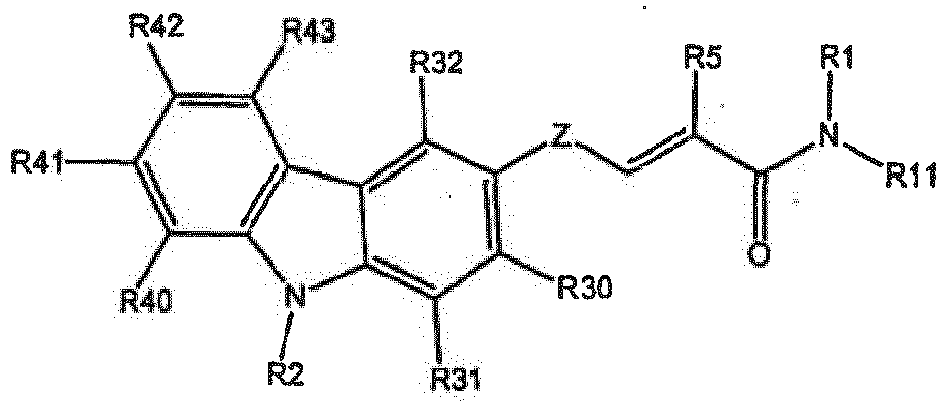

- Composé selon la revendication 1 ou 2, dans lequel le groupe conjugué tel que représenté par Z est un groupe composé de 1 à 7 groupes liés les uns aux autres, les groupes étant choisis parmi les groupes représentés par les formules (Z-1) à (Z-10) :


- Composé selon l'une quelconque des revendications 1 à 3, dans lequel le groupe conjugué tel que représenté par Z a au moins un groupe représenté par la formule (Z-7).
- Système de support comprenant un support et un composé selon la revendication 1 fixé au support.
- Système de support selon la revendication 5, dans lequel le composé représenté par la formule générale (1) est un composé représenté par la formule générale (2) :

- Système de support selon la revendication 5 ou 6, dans lequel le groupe conjugué tel que représenté par Z est un groupe composé de 1 à 7 groupes liés les uns aux autres, les groupes étant choisis parmi les groupes représentés par les formules (Z-1) à (Z-10) :

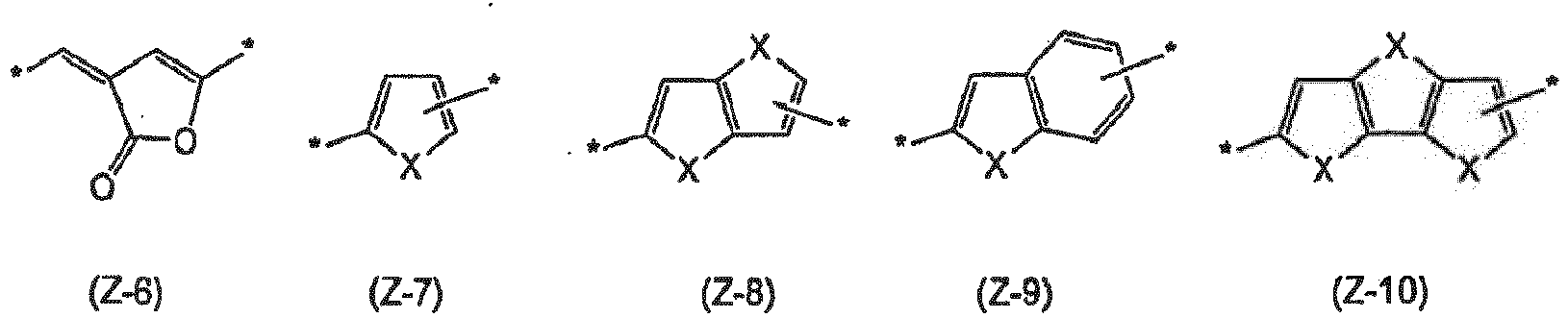
- Système de support selon l'une quelconque des revendications 5 à 7, dans lequel le groupe conjugué tel que représenté par Z a au moins un groupe représenté par la formule (Z-7).
- Dispositif de conversion photoélectrique comprenant une électrode ayant le système de support selon l'une quelconque des revendications 5 à 8.
Applications Claiming Priority (2)
| Application Number | Priority Date | Filing Date | Title |
|---|---|---|---|
| JP2012050077 | 2012-03-07 | ||
| PCT/JP2013/055042 WO2013133094A1 (fr) | 2012-03-07 | 2013-02-27 | Nouveau composé et matière de support ayant ledit nouveau composé supporté sur celle-ci |
Publications (3)
| Publication Number | Publication Date |
|---|---|
| EP2824101A1 EP2824101A1 (fr) | 2015-01-14 |
| EP2824101A4 EP2824101A4 (fr) | 2015-11-18 |
| EP2824101B1 true EP2824101B1 (fr) | 2018-05-09 |
Family
ID=49116576
Family Applications (1)
| Application Number | Title | Priority Date | Filing Date |
|---|---|---|---|
| EP13758609.5A Not-in-force EP2824101B1 (fr) | 2012-03-07 | 2013-02-27 | Nouveau composé et matière de support ayant ledit nouveau composé supporté sur celle-ci |
Country Status (7)
| Country | Link |
|---|---|
| US (1) | US9496095B2 (fr) |
| EP (1) | EP2824101B1 (fr) |
| JP (1) | JP6113713B2 (fr) |
| KR (1) | KR20140139481A (fr) |
| CN (1) | CN104053651B (fr) |
| TW (1) | TWI592410B (fr) |
| WO (1) | WO2013133094A1 (fr) |
Families Citing this family (3)
| Publication number | Priority date | Publication date | Assignee | Title |
|---|---|---|---|---|
| JPWO2016108269A1 (ja) * | 2014-12-29 | 2017-10-05 | 株式会社Adeka | 化合物、担持体及び光電変換素子 |
| CN111180793B (zh) * | 2020-02-16 | 2021-01-26 | 双登集团股份有限公司 | 一种用于锂电池的防过充安全电解液 |
| WO2021230293A1 (fr) * | 2020-05-13 | 2021-11-18 | 住友化学株式会社 | Substrat poreux inorganique, support poreux inorganique et méthode de production d'acide nucléique |
Family Cites Families (10)
| Publication number | Priority date | Publication date | Assignee | Title |
|---|---|---|---|---|
| DE1644605A1 (de) * | 1966-07-16 | 1970-12-17 | Bayer Ag | Anthrachinonfarbstoffe |
| DE1644606C3 (de) * | 1966-07-27 | 1975-01-23 | Bayer Ag, 5090 Leverkusen | Anthrachinonfarbstoffe |
| EP0737358B1 (fr) | 1993-12-29 | 1999-02-03 | Ecole Polytechnique Federale De Lausanne | Pile photo-electrochimique et electrolyte pour cette pile |
| EP0718288B8 (fr) | 1994-12-21 | 2005-10-26 | Hydro Quebec | Sels liquides hydrophobes, leur préparation et leur application en électrochimie |
| JP2000299139A (ja) | 1999-04-14 | 2000-10-24 | Fuji Photo Film Co Ltd | 光電変換素子および光電気化学電池 |
| JP4095289B2 (ja) | 2001-11-30 | 2008-06-04 | Tdk株式会社 | 色素増感型太陽電池 |
| JP4019139B2 (ja) | 2002-05-13 | 2007-12-12 | 独立行政法人産業技術総合研究所 | 2−n−プロピルピリジンを含む電解質溶液を用いた光電変換素子及びそれを用いた色素増感型太陽電池 |
| JP2005093313A (ja) | 2003-09-19 | 2005-04-07 | Toyo Ink Mfg Co Ltd | 色素増感型光電変換素子用電解質組成物、それを用いた光電変換素子。 |
| WO2005096392A2 (fr) | 2004-03-31 | 2005-10-13 | The Yokohama Rubber Co., Ltd. | Électrolyte pour dispositif photovoltaïque, dispositif photovoltaïque et pile solaire sensibilisée à la matière colorante comprenant cette électrolyte. |
| JP5458406B2 (ja) | 2009-12-11 | 2014-04-02 | 独立行政法人産業技術総合研究所 | 有機色素化合物及びそれを用いた半導体薄膜電極、光電変換素子、光電気化学太陽電池 |
-
2013
- 2013-02-27 WO PCT/JP2013/055042 patent/WO2013133094A1/fr not_active Ceased
- 2013-02-27 CN CN201380005148.8A patent/CN104053651B/zh not_active Expired - Fee Related
- 2013-02-27 EP EP13758609.5A patent/EP2824101B1/fr not_active Not-in-force
- 2013-02-27 JP JP2014503783A patent/JP6113713B2/ja active Active
- 2013-02-27 KR KR1020147019779A patent/KR20140139481A/ko not_active Ceased
- 2013-02-27 US US14/372,462 patent/US9496095B2/en not_active Expired - Fee Related
- 2013-03-05 TW TW102107702A patent/TWI592410B/zh not_active IP Right Cessation
Non-Patent Citations (1)
| Title |
|---|
| None * |
Also Published As
| Publication number | Publication date |
|---|---|
| TWI592410B (zh) | 2017-07-21 |
| CN104053651A (zh) | 2014-09-17 |
| EP2824101A4 (fr) | 2015-11-18 |
| WO2013133094A1 (fr) | 2013-09-12 |
| TW201343640A (zh) | 2013-11-01 |
| JPWO2013133094A1 (ja) | 2015-07-30 |
| US20140353553A1 (en) | 2014-12-04 |
| US9496095B2 (en) | 2016-11-15 |
| KR20140139481A (ko) | 2014-12-05 |
| CN104053651B (zh) | 2016-12-21 |
| JP6113713B2 (ja) | 2017-04-12 |
| EP2824101A1 (fr) | 2015-01-14 |
Similar Documents
| Publication | Publication Date | Title |
|---|---|---|
| JP5442625B2 (ja) | 光電変換素子用色素および光電変換素子 | |
| JP6145407B2 (ja) | 新規化合物及びこの新規化合物を担持した担持体 | |
| CN104769045B (zh) | 担载体和光电转换元件 | |
| EP2800199B1 (fr) | Cellule solaire à colorant | |
| EP2824101B1 (fr) | Nouveau composé et matière de support ayant ledit nouveau composé supporté sur celle-ci | |
| US9812263B2 (en) | Compound and photoelectric conversion device | |
| US20170140879A1 (en) | Loading method, loaded body and photoelectric conversion element | |
| JP2008247997A (ja) | 色素、それを用いた光電変換素子およびその光電変換素子の製造方法 | |
| EP3104383A1 (fr) | Support et élément de conversion photoélectrique | |
| WO2016108269A1 (fr) | Composé, vecteur et élément de conversion photoélectrique | |
| JP2016219653A (ja) | 担持体及び光電変換素子 |
Legal Events
| Date | Code | Title | Description |
|---|---|---|---|
| PUAI | Public reference made under article 153(3) epc to a published international application that has entered the european phase |
Free format text: ORIGINAL CODE: 0009012 |
|
| 17P | Request for examination filed |
Effective date: 20140707 |
|
| AK | Designated contracting states |
Kind code of ref document: A1 Designated state(s): AL AT BE BG CH CY CZ DE DK EE ES FI FR GB GR HR HU IE IS IT LI LT LU LV MC MK MT NL NO PL PT RO RS SE SI SK SM TR |
|
| AX | Request for extension of the european patent |
Extension state: BA ME |
|
| DAX | Request for extension of the european patent (deleted) | ||
| RA4 | Supplementary search report drawn up and despatched (corrected) |
Effective date: 20151016 |
|
| RIC1 | Information provided on ipc code assigned before grant |
Ipc: C07D 333/24 20060101AFI20151012BHEP Ipc: C07D 409/12 20060101ALI20151012BHEP Ipc: H01G 9/20 20060101ALI20151012BHEP Ipc: H01M 14/00 20060101ALI20151012BHEP Ipc: H01L 31/04 20140101ALI20151012BHEP Ipc: C09B 23/00 20060101ALI20151012BHEP Ipc: C07F 7/08 20060101ALI20151012BHEP Ipc: C07D 409/04 20060101ALI20151012BHEP |
|
| GRAP | Despatch of communication of intention to grant a patent |
Free format text: ORIGINAL CODE: EPIDOSNIGR1 |
|
| STAA | Information on the status of an ep patent application or granted ep patent |
Free format text: STATUS: GRANT OF PATENT IS INTENDED |
|
| INTG | Intention to grant announced |
Effective date: 20180103 |
|
| GRAS | Grant fee paid |
Free format text: ORIGINAL CODE: EPIDOSNIGR3 |
|
| GRAA | (expected) grant |
Free format text: ORIGINAL CODE: 0009210 |
|
| STAA | Information on the status of an ep patent application or granted ep patent |
Free format text: STATUS: THE PATENT HAS BEEN GRANTED |
|
| AK | Designated contracting states |
Kind code of ref document: B1 Designated state(s): AL AT BE BG CH CY CZ DE DK EE ES FI FR GB GR HR HU IE IS IT LI LT LU LV MC MK MT NL NO PL PT RO RS SE SI SK SM TR |
|
| REG | Reference to a national code |
Ref country code: GB Ref legal event code: FG4D |
|
| REG | Reference to a national code |
Ref country code: CH Ref legal event code: EP Ref country code: AT Ref legal event code: REF Ref document number: 997485 Country of ref document: AT Kind code of ref document: T Effective date: 20180515 |
|
| REG | Reference to a national code |
Ref country code: IE Ref legal event code: FG4D |
|
| REG | Reference to a national code |
Ref country code: DE Ref legal event code: R096 Ref document number: 602013037253 Country of ref document: DE |
|
| REG | Reference to a national code |
Ref country code: NL Ref legal event code: MP Effective date: 20180509 |
|
| REG | Reference to a national code |
Ref country code: LT Ref legal event code: MG4D |
|
| PG25 | Lapsed in a contracting state [announced via postgrant information from national office to epo] |
Ref country code: BG Free format text: LAPSE BECAUSE OF FAILURE TO SUBMIT A TRANSLATION OF THE DESCRIPTION OR TO PAY THE FEE WITHIN THE PRESCRIBED TIME-LIMIT Effective date: 20180809 Ref country code: NO Free format text: LAPSE BECAUSE OF FAILURE TO SUBMIT A TRANSLATION OF THE DESCRIPTION OR TO PAY THE FEE WITHIN THE PRESCRIBED TIME-LIMIT Effective date: 20180809 Ref country code: LT Free format text: LAPSE BECAUSE OF FAILURE TO SUBMIT A TRANSLATION OF THE DESCRIPTION OR TO PAY THE FEE WITHIN THE PRESCRIBED TIME-LIMIT Effective date: 20180509 Ref country code: ES Free format text: LAPSE BECAUSE OF FAILURE TO SUBMIT A TRANSLATION OF THE DESCRIPTION OR TO PAY THE FEE WITHIN THE PRESCRIBED TIME-LIMIT Effective date: 20180509 Ref country code: SE Free format text: LAPSE BECAUSE OF FAILURE TO SUBMIT A TRANSLATION OF THE DESCRIPTION OR TO PAY THE FEE WITHIN THE PRESCRIBED TIME-LIMIT Effective date: 20180509 Ref country code: FI Free format text: LAPSE BECAUSE OF FAILURE TO SUBMIT A TRANSLATION OF THE DESCRIPTION OR TO PAY THE FEE WITHIN THE PRESCRIBED TIME-LIMIT Effective date: 20180509 |
|
| PG25 | Lapsed in a contracting state [announced via postgrant information from national office to epo] |
Ref country code: LV Free format text: LAPSE BECAUSE OF FAILURE TO SUBMIT A TRANSLATION OF THE DESCRIPTION OR TO PAY THE FEE WITHIN THE PRESCRIBED TIME-LIMIT Effective date: 20180509 Ref country code: NL Free format text: LAPSE BECAUSE OF FAILURE TO SUBMIT A TRANSLATION OF THE DESCRIPTION OR TO PAY THE FEE WITHIN THE PRESCRIBED TIME-LIMIT Effective date: 20180509 Ref country code: HR Free format text: LAPSE BECAUSE OF FAILURE TO SUBMIT A TRANSLATION OF THE DESCRIPTION OR TO PAY THE FEE WITHIN THE PRESCRIBED TIME-LIMIT Effective date: 20180509 Ref country code: GR Free format text: LAPSE BECAUSE OF FAILURE TO SUBMIT A TRANSLATION OF THE DESCRIPTION OR TO PAY THE FEE WITHIN THE PRESCRIBED TIME-LIMIT Effective date: 20180810 Ref country code: RS Free format text: LAPSE BECAUSE OF FAILURE TO SUBMIT A TRANSLATION OF THE DESCRIPTION OR TO PAY THE FEE WITHIN THE PRESCRIBED TIME-LIMIT Effective date: 20180509 |
|
| REG | Reference to a national code |
Ref country code: AT Ref legal event code: MK05 Ref document number: 997485 Country of ref document: AT Kind code of ref document: T Effective date: 20180509 |
|
| PG25 | Lapsed in a contracting state [announced via postgrant information from national office to epo] |
Ref country code: EE Free format text: LAPSE BECAUSE OF FAILURE TO SUBMIT A TRANSLATION OF THE DESCRIPTION OR TO PAY THE FEE WITHIN THE PRESCRIBED TIME-LIMIT Effective date: 20180509 Ref country code: PL Free format text: LAPSE BECAUSE OF FAILURE TO SUBMIT A TRANSLATION OF THE DESCRIPTION OR TO PAY THE FEE WITHIN THE PRESCRIBED TIME-LIMIT Effective date: 20180509 Ref country code: DK Free format text: LAPSE BECAUSE OF FAILURE TO SUBMIT A TRANSLATION OF THE DESCRIPTION OR TO PAY THE FEE WITHIN THE PRESCRIBED TIME-LIMIT Effective date: 20180509 Ref country code: SK Free format text: LAPSE BECAUSE OF FAILURE TO SUBMIT A TRANSLATION OF THE DESCRIPTION OR TO PAY THE FEE WITHIN THE PRESCRIBED TIME-LIMIT Effective date: 20180509 Ref country code: CZ Free format text: LAPSE BECAUSE OF FAILURE TO SUBMIT A TRANSLATION OF THE DESCRIPTION OR TO PAY THE FEE WITHIN THE PRESCRIBED TIME-LIMIT Effective date: 20180509 Ref country code: RO Free format text: LAPSE BECAUSE OF FAILURE TO SUBMIT A TRANSLATION OF THE DESCRIPTION OR TO PAY THE FEE WITHIN THE PRESCRIBED TIME-LIMIT Effective date: 20180509 Ref country code: AT Free format text: LAPSE BECAUSE OF FAILURE TO SUBMIT A TRANSLATION OF THE DESCRIPTION OR TO PAY THE FEE WITHIN THE PRESCRIBED TIME-LIMIT Effective date: 20180509 |
|
| REG | Reference to a national code |
Ref country code: DE Ref legal event code: R097 Ref document number: 602013037253 Country of ref document: DE |
|
| PG25 | Lapsed in a contracting state [announced via postgrant information from national office to epo] |
Ref country code: SM Free format text: LAPSE BECAUSE OF FAILURE TO SUBMIT A TRANSLATION OF THE DESCRIPTION OR TO PAY THE FEE WITHIN THE PRESCRIBED TIME-LIMIT Effective date: 20180509 Ref country code: IT Free format text: LAPSE BECAUSE OF FAILURE TO SUBMIT A TRANSLATION OF THE DESCRIPTION OR TO PAY THE FEE WITHIN THE PRESCRIBED TIME-LIMIT Effective date: 20180509 |
|
| PLBE | No opposition filed within time limit |
Free format text: ORIGINAL CODE: 0009261 |
|
| STAA | Information on the status of an ep patent application or granted ep patent |
Free format text: STATUS: NO OPPOSITION FILED WITHIN TIME LIMIT |
|
| 26N | No opposition filed |
Effective date: 20190212 |
|
| PG25 | Lapsed in a contracting state [announced via postgrant information from national office to epo] |
Ref country code: SI Free format text: LAPSE BECAUSE OF FAILURE TO SUBMIT A TRANSLATION OF THE DESCRIPTION OR TO PAY THE FEE WITHIN THE PRESCRIBED TIME-LIMIT Effective date: 20180509 |
|
| REG | Reference to a national code |
Ref country code: DE Ref legal event code: R119 Ref document number: 602013037253 Country of ref document: DE |
|
| REG | Reference to a national code |
Ref country code: CH Ref legal event code: PL |
|
| GBPC | Gb: european patent ceased through non-payment of renewal fee |
Effective date: 20190227 |
|
| PG25 | Lapsed in a contracting state [announced via postgrant information from national office to epo] |
Ref country code: MC Free format text: LAPSE BECAUSE OF FAILURE TO SUBMIT A TRANSLATION OF THE DESCRIPTION OR TO PAY THE FEE WITHIN THE PRESCRIBED TIME-LIMIT Effective date: 20180509 Ref country code: LU Free format text: LAPSE BECAUSE OF NON-PAYMENT OF DUE FEES Effective date: 20190227 |
|
| REG | Reference to a national code |
Ref country code: BE Ref legal event code: MM Effective date: 20190228 |
|
| REG | Reference to a national code |
Ref country code: IE Ref legal event code: MM4A |
|
| PG25 | Lapsed in a contracting state [announced via postgrant information from national office to epo] |
Ref country code: AL Free format text: LAPSE BECAUSE OF FAILURE TO SUBMIT A TRANSLATION OF THE DESCRIPTION OR TO PAY THE FEE WITHIN THE PRESCRIBED TIME-LIMIT Effective date: 20180509 |
|
| PG25 | Lapsed in a contracting state [announced via postgrant information from national office to epo] |
Ref country code: CH Free format text: LAPSE BECAUSE OF NON-PAYMENT OF DUE FEES Effective date: 20190228 Ref country code: LI Free format text: LAPSE BECAUSE OF NON-PAYMENT OF DUE FEES Effective date: 20190228 |
|
| PG25 | Lapsed in a contracting state [announced via postgrant information from national office to epo] |
Ref country code: GB Free format text: LAPSE BECAUSE OF NON-PAYMENT OF DUE FEES Effective date: 20190227 Ref country code: IE Free format text: LAPSE BECAUSE OF NON-PAYMENT OF DUE FEES Effective date: 20190227 Ref country code: DE Free format text: LAPSE BECAUSE OF NON-PAYMENT OF DUE FEES Effective date: 20190903 |
|
| PG25 | Lapsed in a contracting state [announced via postgrant information from national office to epo] |
Ref country code: BE Free format text: LAPSE BECAUSE OF NON-PAYMENT OF DUE FEES Effective date: 20190228 |
|
| PG25 | Lapsed in a contracting state [announced via postgrant information from national office to epo] |
Ref country code: TR Free format text: LAPSE BECAUSE OF FAILURE TO SUBMIT A TRANSLATION OF THE DESCRIPTION OR TO PAY THE FEE WITHIN THE PRESCRIBED TIME-LIMIT Effective date: 20180509 |
|
| PG25 | Lapsed in a contracting state [announced via postgrant information from national office to epo] |
Ref country code: MT Free format text: LAPSE BECAUSE OF NON-PAYMENT OF DUE FEES Effective date: 20190227 Ref country code: PT Free format text: LAPSE BECAUSE OF FAILURE TO SUBMIT A TRANSLATION OF THE DESCRIPTION OR TO PAY THE FEE WITHIN THE PRESCRIBED TIME-LIMIT Effective date: 20180910 |
|
| PG25 | Lapsed in a contracting state [announced via postgrant information from national office to epo] |
Ref country code: CY Free format text: LAPSE BECAUSE OF FAILURE TO SUBMIT A TRANSLATION OF THE DESCRIPTION OR TO PAY THE FEE WITHIN THE PRESCRIBED TIME-LIMIT Effective date: 20180509 |
|
| PG25 | Lapsed in a contracting state [announced via postgrant information from national office to epo] |
Ref country code: IS Free format text: LAPSE BECAUSE OF FAILURE TO SUBMIT A TRANSLATION OF THE DESCRIPTION OR TO PAY THE FEE WITHIN THE PRESCRIBED TIME-LIMIT Effective date: 20180909 |
|
| PG25 | Lapsed in a contracting state [announced via postgrant information from national office to epo] |
Ref country code: HU Free format text: LAPSE BECAUSE OF FAILURE TO SUBMIT A TRANSLATION OF THE DESCRIPTION OR TO PAY THE FEE WITHIN THE PRESCRIBED TIME-LIMIT; INVALID AB INITIO Effective date: 20130227 |
|
| PGFP | Annual fee paid to national office [announced via postgrant information from national office to epo] |
Ref country code: FR Payment date: 20220216 Year of fee payment: 10 |
|
| PG25 | Lapsed in a contracting state [announced via postgrant information from national office to epo] |
Ref country code: MK Free format text: LAPSE BECAUSE OF FAILURE TO SUBMIT A TRANSLATION OF THE DESCRIPTION OR TO PAY THE FEE WITHIN THE PRESCRIBED TIME-LIMIT Effective date: 20180509 |
|
| PG25 | Lapsed in a contracting state [announced via postgrant information from national office to epo] |
Ref country code: FR Free format text: LAPSE BECAUSE OF NON-PAYMENT OF DUE FEES Effective date: 20230228 |