EP2824945A1 - Module mandataire sim pour itinérance dans un réseau mobile - Google Patents
Module mandataire sim pour itinérance dans un réseau mobile Download PDFInfo
- Publication number
- EP2824945A1 EP2824945A1 EP13305991.5A EP13305991A EP2824945A1 EP 2824945 A1 EP2824945 A1 EP 2824945A1 EP 13305991 A EP13305991 A EP 13305991A EP 2824945 A1 EP2824945 A1 EP 2824945A1
- Authority
- EP
- European Patent Office
- Prior art keywords
- sim
- modem
- sim card
- mobile network
- proxy module
- Prior art date
- Legal status (The legal status is an assumption and is not a legal conclusion. Google has not performed a legal analysis and makes no representation as to the accuracy of the status listed.)
- Withdrawn
Links
- 238000000034 method Methods 0.000 claims description 21
- 238000012546 transfer Methods 0.000 claims description 8
- 238000004590 computer program Methods 0.000 claims description 2
- 230000008901 benefit Effects 0.000 description 4
- 238000011161 development Methods 0.000 description 2
- 238000012986 modification Methods 0.000 description 2
- 230000004048 modification Effects 0.000 description 2
- 230000005540 biological transmission Effects 0.000 description 1
- 238000010586 diagram Methods 0.000 description 1
- 230000000694 effects Effects 0.000 description 1
- 238000010200 validation analysis Methods 0.000 description 1
- 238000012795 verification Methods 0.000 description 1
Images
Classifications
-
- H—ELECTRICITY
- H04—ELECTRIC COMMUNICATION TECHNIQUE
- H04W—WIRELESS COMMUNICATION NETWORKS
- H04W4/00—Services specially adapted for wireless communication networks; Facilities therefor
- H04W4/60—Subscription-based services using application servers or record carriers, e.g. SIM application toolkits
-
- H—ELECTRICITY
- H04—ELECTRIC COMMUNICATION TECHNIQUE
- H04W—WIRELESS COMMUNICATION NETWORKS
- H04W4/00—Services specially adapted for wireless communication networks; Facilities therefor
- H04W4/70—Services for machine-to-machine communication [M2M] or machine type communication [MTC]
-
- H—ELECTRICITY
- H04—ELECTRIC COMMUNICATION TECHNIQUE
- H04W—WIRELESS COMMUNICATION NETWORKS
- H04W8/00—Network data management
- H04W8/02—Processing of mobility data, e.g. registration information at HLR [Home Location Register] or VLR [Visitor Location Register]; Transfer of mobility data, e.g. between HLR, VLR or external networks
Definitions
- the present invention relates to the technical field of M2M (Machine-to-Machine) connectivity, and particularly to M2M SIM cards management when performing roaming.
- M2M Machine-to-Machine
- M2M means here broadly and not restrictively to include any device comprising means configured to connect to other remote connected devices (i.e. cameras, servers) through a mobile network.
- An M2M device comprises, generally, more than one Subscriber Identity Module (SIM) card that contains the credentials used to authenticate the device.
- SIM Subscriber Identity Module
- a SIM card is linked to an existing contract/subscription with a Mobile Network Operator (MNO).
- MNO Mobile Network Operator
- Global connectivity means here connectivity to MNO, which is still provided to a device even during roaming. Accordingly, high roaming charges are applied if a same SIM card is used abroad. For this reason, M2M devices are generally using multiple SIM cards in order to work in several countries or areas.
- a M2M device may be a video camera embedding multiple 3G modems.
- a M2M device may be a video camera embedding multiple 3G modems.
- Such video cameras are typically used by TV channels and, consequently, the use of 100 devices of these kinds implies to provision up to 1000 SIM cards.
- the SIM cards must be chosen by anticipating the countries where they will be connected.
- one technical problem to solve is how to provide a global mobile connectivity to a M2M device, without having to manage a set of SIM cards for each device, and without supporting roaming charges.
- eUICC embedded Universal Integrated Circuit Card
- the principle of eUICC consists in replacing a physical SIM card by a chipset soldered on the device motherboard. Such a technology provides a valid architecture to re-personalize a SIM card, and may be provisioned with one or several telecom profiles, depending on the local needs of the device owners at a given time. Nevertheless, eUICC technology will not be available before several years, and requires specific SIM cards and international agreements between operators to work correctly. Indeed, MNOs are not supporting this technology which dematerialize the SIM card, which is currently a physical link between the MNO and the user. Accordingly it is not possible to leverage eUICC technology at mid-term.
- One object of the present invention is to provide a solution to the aforementioned problems, and to offer other advantages over the prior art.
- Another object of the present invention is to provide global mobile connectivity to M2M devices, without M2M owners having to manage a set of SIM cards associated to their device.
- Another object of the present invention is to minimize the connectivity costs involved by MNOs when roaming.
- Yet another object of the present invention is to propose a remote authentication method for M2M devices.
- the first modem is further configured to release the roaming session, once the second modem establish the local session within the at least visited mobile network.
- various embodiments relate to a method for establishing a local session between a mobile device and a visited mobile network, the method comprising the following steps
- the method further comprises a releasing step of the roaming session by the first modem, once the second modem establish the local session within the at least visited mobile network.
- Various embodiments further relate to computer program products for performing the above method.
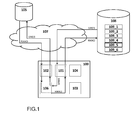
- a M2M device 100 comprising communicating means, realized with hardware (modems, SIM cards) and/or software (interfaces, drivers) means.
- the device 100 includes a first data modem 101, and a second data modem 102. Additionally, the device 100 may further comprise other modules, such as a Wife modem 103.
- the first modem 101 is associated with a valid (i.e. with required subscriptions) SIM card 104 from a reliable mobile network 107 of an MNO, provisioned with roaming agreement in all countries.
- the subscription of the SIM card 104 guarantees an initial (i.e. default) connectivity of the device 100 to any mobile network wherever, thanks to the first modem 101 associated to this SIM card.
- the second modem 102 is not associated with a SIM card so as to provide a connectivity to a subscribed MNO. Any device 100 may be manufactured using this model, with of course distinct SIM cards 104 for each device 100, ensuring a default global connectivity to MNO networks via each first modem 101.
- global connectivity is meant here connectivity to MNO, which is still provided to the device 100 even during roaming.
- SIM card stores network-specific information used to authenticate and identify subscribers on a mobile network 107 such as IMSI (International Mobile Subscriber Identity) designed in this document as "ID information”, and a security/authentication key designed as Ki.
- IMSI International Mobile Subscriber Identity
- Ki a security/authentication key designed as Ki.
- the ID information and the Ki key are stored too, in an Authentication Center (AUC), generally comprised in a Home Location Register (HLR) 105 of a mobile network 107, which uses ID and Ki information to identify the subscribers.
- HLR Home Location Register
- an attach procedure is initiated by the first modem 101 which communicates the ID of its SIM card 104 to the mobile network 107.
- the ID of the SIM card 104 designed herein as first SIM card is referred as ID1.
- the MNO HLR 105 of the mobile network 107 uses the ID1 information of the first SIM card 104 to identify a corresponding authentication key Ki, and uses the Ki on a random chain to generate an encrypted message. This message is referred herein as a "RAND" or challenge message, and is sent to the first modem 101, to authenticate the SIM card 104 using ID1.
- the first modem 101 communicates locally with the first SIM card 104 through a standardized interface.
- the first SIM card 104 (supposed herein to be valid), uses its own Ki to compute a corresponding security response "SRES" message, in response to the challenge/RAND message.
- the security response SRES message is transmitted by the first modem 101 to the mobile network 107 and verified by its HLR 105.
- the verification for instance, may be performed by comparing the security response "SRES" message computed by the SIM card 104, with another security response SRES message computed by the HLR, with the help of the same Ki used when generating the RAND challenge message.
- the security response SRES is supposed to be validated by the HLR 105 and the session is finally established.
- the device 100 is always connected as a first step to the mobile network 107 thanks to the first modem 101 via a session, presenting identification information ID1 of the first SIM card 104.
- the device 100 further comprises a SIM proxy module 106.
- the SIM proxy module 106 may be any applicative/software module, comprising an interface at least to communicate with/and use the connectivity of the first modem 101 and the second modem 102.
- the SIM proxy module 106 is configured to use the data connectivity of the device 100.
- One object of the SIM proxy module 106 is to "replace" a real SIM card.
- the SIM proxy module 106 is viewed as a real second SIM card, since this module is configured to retrieve/transfer/forward valid information of a second SIM card, such as ID information or responses computed with a Ki encryption key. From, the first modem 101 side, the SIM proxy module 106 can be perceived as an interface of any software application.
- a roaming session is established by the device 100 with the visited mobile network 107 through the first modem 101.
- the device 100 tries to connect to the visited mobile network 107 with the second modem 102 as a local device (i.e. as in a home network with a local session), local session permitting to be free from roaming charges.
- the second modem 102 needs to communicate a local MNO ID from a second valid SIM card, designed herein as ID2.
- the SIM proxy module 106 is in charge to transfer/forward this information to the second modem 102.
- information concerning the available visited mobile networks such as name, MCC (Mobile Country Code) and MNC (Mobile Network Code) of the mobile networks (including 107) are first transmitted to a remote central SIM database 108, during a request of the SIM proxy module 106 through the already established roaming session.
- Each SIM card is pre-associated to a local MNO subscription (i.e. a subscription in a home mobile network).
- the set of SIM cards may includes distinct (or not) MNOs.
- the central SIM database 108 may be managed for example, by the device 100 manufacturer and the remote SIM cards may be used by several different devices 100 (not the same SIM card at the same time). In fact, the central SIM database 108 permits to remotely provide any required information concerning a valid SIM card to the SIM proxy module 106, and more generally to remotely allocate a given authentication to a given device on demand. Information concerning the available visited mobile networks are used to choose in the SIM central database 108, a SIM card comprising a valid local subscription (SIM card 109_5 for instance in Figure 1 ) to a mobile network, here the mobile network 107. Once this SIM card has been selected, it is still further used during all the procedure.
- SIM card 109_5 for instance in Figure 1
- the selected SIM card is herein referred as the "second SIM card”.
- the ID2 of the (remote) second SIM card is returned/transmitted over the roaming session, to the SIM proxy module 106 through the first modem 101.
- the SIM proxy module 106 transfers/forwards this retrieved information to the second modem 102 to request to the mobile network 107 a local session, presenting the ID2, hence performing a request as a local mobile.
- the roaming session is still kept active.
- the MNO HLR 105 of the mobile network 107 uses the ID2 information, to authenticate the remote second SIM card using ID2, and uses its corresponding Ki key to generate a challenge/RAND message, which is transmitted to the second modem 102.
- the SIM proxy module 106 is perceived as a real second SIM card from the second modem 102 side.
- the second modem 102 transfers/forwards this message to the SIM proxy module 106, to compute a valid response, in order to validate the local session.
- the SIM proxy module 106 transmits this information to the central SIM database 108, through the first modem 101 using the roaming session.
- the second valid SIM card in the remote central SIM database 108, already selected, uses its own Ki key to compute the corresponding security response SRES message, in response to the transmitted challenge/RAND message.
- the computed security response SRES message is then returned from the central SIM database 108 to the first modem 101.
- the first modem 101 transfers/forwards the security response SRES message to the SIM proxy module 106, which uses the second modem 102 to send/transmit the retrieved security response SRES message, to the MNO HLR 105. Consequently, after the validation of the response by the HLR 105, the authentication procedure is completed and the device 100, is using a local session via a remote second SIM card with ID2, and connected as a local mobile through the second modem 102. Once the second modem 102 has established the local session with the visited mobile network 107, the roaming session established by the first modem 101 is finally released by the first modem 101 (i.e. goes to idle mode).
- the device 100 is connected to the mobile network 107 thanks to the second modem 102 and roaming charges are still not supported.
- the device 100 can use then, its connectivity to perform usual function (ex: data transfers) or stay in idle mode. In fact, the device 100 does not need to repeat this procedure unless it reboots.
- an encryption key Kc can be computed at the same time as the SRES response, by the valid second SIM card in the central SIM database 108. To do so, information may be additionally transmitted with the challenge/RAND message, to the central SIM database 108 by the SIM proxy module 106 through the roaming session initiated by the first modem 101, and used to compute the Kc key.
- such information may be a real-time parameter referring to the mobile network 107.
- the encryption key Kc can be further used, to encrypt the messages that will be exchanged between the second modem 102 and the mobile network 107, once the local authentication procedure has been performed.
- This Kc key is only known from the network and from the device 100.
- the remote second SIM card chosen in the central SIM database 108 computes the SRES response message and the Kc key, and both are returned to first modem 101.
- the first modem 101 will use the Kc key, to respectively authenticate itself (using SRES message according to the previous described embodiments) and encrypt/decrypt the data from/to the network (using the Kc key).
- the roaming session involving the first modem 101 is established within a first available visited mobile network while the local session involving the modem 102 and the SIM proxy module 106 is established within another available visited mobile network.
- the device 100 may be under the coverage of the visited mobile networks 107_1, 107_2 and 107_3, provided by distinct MNOs.
- the device 100 establishes a roaming session with the visited mobile network 107_1 and then requests a local session with any of the available mobile networks 107_1, 107_2 and 107_3.
- a SIM card of a distinct MNO from the first one providing the roaming session may be chosen.
- the remote SIM card may be associated to the mobile network 107_3.
- the device 100 would be finally connected as a local mobile to the mobile network 107_3.
- the device 100 may further comprise more than one modem with no associated SIM card: the said modems are associated to the proxy module 106. This permits to provide high data bandwidth when roaming, with establishing several local sessions (possibly with different local MNOs) with distinct SIM cards from the central SIM database 108. To establish the local sessions, the same procedure as described in the previous embodiments may successively be performed.
- the above described embodiments permit to decrease user roaming costs.
- roaming costs are only assumed during the roaming session, and ends in the end of the establishment of the local session.
- the device 100 is seen from the mobile network 107 as a local device, even when roaming.
- the HLR 105 receive the security response SRES from the SIM proxy module 106 through the second modem 102, it does not know that this response has been remotely computed by a remote SIM card, in the central SIM database 108.
- the device 100 comprising a first modem 101 for a default connectivity and a second modem 102 linked to the SIM proxy module 106 does not require any further hardware modifications. Thanks to the proxy module 106 and to the remote central SIM database 108, there is only one "real" SIM card in the device 100, and there is still no need to change of SIM cards when roaming.
- the remote SIM cards in the central SIM database 108 are correctly planned, it can be sufficient to register a couple of subscriptions for a given MNO and to allocate them on demand, whereas in the background art each device needed a subscription to the MNO even if it was not used.
- this solution provides a valid and flexible solution to M2M manufacturer that need to manage the connectivity of their devices.
- the fact to provide a remote local connectivity to a MNO network permits to optimize costs for the transmission of high volume of data.
Landscapes
- Engineering & Computer Science (AREA)
- Computer Networks & Wireless Communication (AREA)
- Signal Processing (AREA)
- Databases & Information Systems (AREA)
- Telephone Function (AREA)
- Telephonic Communication Services (AREA)
- Mobile Radio Communication Systems (AREA)
Priority Applications (1)
| Application Number | Priority Date | Filing Date | Title |
|---|---|---|---|
| EP13305991.5A EP2824945A1 (fr) | 2013-07-11 | 2013-07-11 | Module mandataire sim pour itinérance dans un réseau mobile |
Applications Claiming Priority (1)
| Application Number | Priority Date | Filing Date | Title |
|---|---|---|---|
| EP13305991.5A EP2824945A1 (fr) | 2013-07-11 | 2013-07-11 | Module mandataire sim pour itinérance dans un réseau mobile |
Publications (1)
| Publication Number | Publication Date |
|---|---|
| EP2824945A1 true EP2824945A1 (fr) | 2015-01-14 |
Family
ID=48900916
Family Applications (1)
| Application Number | Title | Priority Date | Filing Date |
|---|---|---|---|
| EP13305991.5A Withdrawn EP2824945A1 (fr) | 2013-07-11 | 2013-07-11 | Module mandataire sim pour itinérance dans un réseau mobile |
Country Status (1)
| Country | Link |
|---|---|
| EP (1) | EP2824945A1 (fr) |
Cited By (10)
| Publication number | Priority date | Publication date | Assignee | Title |
|---|---|---|---|---|
| EP2684398A4 (fr) * | 2012-05-17 | 2015-05-13 | Liveu Ltd | Communication multimodems au moyen de modules d'identités virtuelles |
| US9154247B2 (en) | 2008-01-23 | 2015-10-06 | Liveu Ltd. | Live uplink transmissions and broadcasting management system and method |
| US9338650B2 (en) | 2013-03-14 | 2016-05-10 | Liveu Ltd. | Apparatus for cooperating with a mobile device |
| US9369921B2 (en) | 2013-05-31 | 2016-06-14 | Liveu Ltd. | Network assisted bonding |
| EP3086582A1 (fr) * | 2015-04-24 | 2016-10-26 | Xiaomi Inc. | Procédé, dispositifs et système de transmission d'informations de cartes sim |
| US9980171B2 (en) | 2013-03-14 | 2018-05-22 | Liveu Ltd. | Apparatus for cooperating with a mobile device |
| CN109195139A (zh) * | 2018-09-04 | 2019-01-11 | 中国联合网络通信集团有限公司 | M2M管理平台与eSIM卡的数据传输方法、装置、平台及介质 |
| EP3429286A4 (fr) * | 2016-03-09 | 2019-01-16 | ZTE Corporation | Procédé et dispositif de vérification, et terminal |
| EP3402236A4 (fr) * | 2016-01-06 | 2019-08-21 | Shenzhen Tuge Information Co., Ltd. | Procédé d'accès, équipement utilisateur et serveur |
| WO2022083492A3 (fr) * | 2020-10-22 | 2022-06-02 | 上海途鸽数据科技有限公司 | Système de gestion distribuée et procédé de gestion pour dispositifs de gestion de carte à puce |
Citations (4)
| Publication number | Priority date | Publication date | Assignee | Title |
|---|---|---|---|---|
| WO2004082314A2 (fr) * | 2003-03-12 | 2004-09-23 | Teles Ag Informationstechnologien | Procede pour mettre a disposition des cartes a inserer dotees d'une marque d'identification, dans un terminal mobile |
| WO2006094564A1 (fr) * | 2005-03-09 | 2006-09-14 | Telecom En Consulting | Procede de reroutage de communications de telephonie mobile |
| US20100106967A1 (en) * | 2008-10-28 | 2010-04-29 | Mattias Johansson | Method and arrangement for provisioning and managing a device |
| US20120309374A1 (en) * | 2011-06-02 | 2012-12-06 | James Tagg | Identity Management for Mobile Devices |
-
2013
- 2013-07-11 EP EP13305991.5A patent/EP2824945A1/fr not_active Withdrawn
Patent Citations (4)
| Publication number | Priority date | Publication date | Assignee | Title |
|---|---|---|---|---|
| WO2004082314A2 (fr) * | 2003-03-12 | 2004-09-23 | Teles Ag Informationstechnologien | Procede pour mettre a disposition des cartes a inserer dotees d'une marque d'identification, dans un terminal mobile |
| WO2006094564A1 (fr) * | 2005-03-09 | 2006-09-14 | Telecom En Consulting | Procede de reroutage de communications de telephonie mobile |
| US20100106967A1 (en) * | 2008-10-28 | 2010-04-29 | Mattias Johansson | Method and arrangement for provisioning and managing a device |
| US20120309374A1 (en) * | 2011-06-02 | 2012-12-06 | James Tagg | Identity Management for Mobile Devices |
Cited By (19)
| Publication number | Priority date | Publication date | Assignee | Title |
|---|---|---|---|---|
| US9712267B2 (en) | 2008-01-23 | 2017-07-18 | Liveu Ltd. | Live uplink transmissions and broadcasting management system and method |
| US9154247B2 (en) | 2008-01-23 | 2015-10-06 | Liveu Ltd. | Live uplink transmissions and broadcasting management system and method |
| US10601533B2 (en) | 2008-01-23 | 2020-03-24 | Liveu Ltd. | Live uplink transmissions and broadcasting management system and method |
| US10153854B2 (en) | 2008-01-23 | 2018-12-11 | Liveu Ltd. | Live uplink transmissions and broadcasting management system and method |
| US9379756B2 (en) | 2012-05-17 | 2016-06-28 | Liveu Ltd. | Multi-modem communication using virtual identity modules |
| EP2684398A4 (fr) * | 2012-05-17 | 2015-05-13 | Liveu Ltd | Communication multimodems au moyen de modules d'identités virtuelles |
| US9338650B2 (en) | 2013-03-14 | 2016-05-10 | Liveu Ltd. | Apparatus for cooperating with a mobile device |
| US9980171B2 (en) | 2013-03-14 | 2018-05-22 | Liveu Ltd. | Apparatus for cooperating with a mobile device |
| US10667166B2 (en) | 2013-03-14 | 2020-05-26 | Liveu Ltd. | Apparatus for cooperating with a mobile device |
| US9369921B2 (en) | 2013-05-31 | 2016-06-14 | Liveu Ltd. | Network assisted bonding |
| US10206143B2 (en) | 2013-05-31 | 2019-02-12 | Liveu Ltd. | Network assisted bonding |
| EP3086582A1 (fr) * | 2015-04-24 | 2016-10-26 | Xiaomi Inc. | Procédé, dispositifs et système de transmission d'informations de cartes sim |
| EP3402236A4 (fr) * | 2016-01-06 | 2019-08-21 | Shenzhen Tuge Information Co., Ltd. | Procédé d'accès, équipement utilisateur et serveur |
| EP3429286A4 (fr) * | 2016-03-09 | 2019-01-16 | ZTE Corporation | Procédé et dispositif de vérification, et terminal |
| US10548010B2 (en) | 2016-03-09 | 2020-01-28 | Xi'an Zhongxing New Software Co., Ltd. | Verification method and apparatus, and terminal |
| CN109195139A (zh) * | 2018-09-04 | 2019-01-11 | 中国联合网络通信集团有限公司 | M2M管理平台与eSIM卡的数据传输方法、装置、平台及介质 |
| CN109195139B (zh) * | 2018-09-04 | 2021-07-27 | 中国联合网络通信集团有限公司 | M2M管理平台与eSIM卡的数据传输方法、装置、平台及介质 |
| WO2022083492A3 (fr) * | 2020-10-22 | 2022-06-02 | 上海途鸽数据科技有限公司 | Système de gestion distribuée et procédé de gestion pour dispositifs de gestion de carte à puce |
| US12563036B2 (en) | 2020-10-22 | 2026-02-24 | Shanghai Tuge Data Technology Co., Ltd. | Distributed management system and management method for smart card management apparatuses |
Similar Documents
| Publication | Publication Date | Title |
|---|---|---|
| EP2824945A1 (fr) | Module mandataire sim pour itinérance dans un réseau mobile | |
| JP6062828B2 (ja) | 加入者プロファイル転送方法、加入者プロファイル転送システム及びユーザ装置 | |
| EP3346637B1 (fr) | Procédé et dispositif de téléchargement de profil dans un système de communications | |
| EP2649826B1 (fr) | Procédé pour gérer un contenu sur un élément sécurisé connecté à un équipement | |
| EP3709691B1 (fr) | Procédé et appareil pour dispositifs de groupe de téléchargement de profil | |
| JP5392879B2 (ja) | 通信デバイスを認証するための方法および装置 | |
| EP2696612B1 (fr) | Procédé et système de fourniture d'abonnement à distance | |
| EP2835994B1 (fr) | Procédés et dispositifs pour mettre en oeuvre un commutateur de réseau mobile | |
| US20190289463A1 (en) | Method and system for dual-network authentication of a communication device communicating with a server | |
| AU2016247689A1 (en) | Technique for managing profile in communication system | |
| US10063991B2 (en) | Flexible device management bootstrap | |
| EP2785011A1 (fr) | Etablissement d'une communication vocale sécurisée utilisant une architecture GBA | |
| US10492056B2 (en) | Enhanced mobile subscriber privacy in telecommunications networks | |
| CN103107878A (zh) | 移动用户身份识别卡与机器类通信设备绑定的方法及装置 | |
| CN102209317B (zh) | 提供签约数据的方法及系统 | |
| CN109246690A (zh) | 网络接入方法、装置、存储介质及处理器 | |
| CN103973648A (zh) | 应用数据推送方法、装置及系统 | |
| EP3997897B1 (fr) | Procédés et dispositifs d'utilisation d'une fonction d'exposition d'un réseau de communication sans fil | |
| WO2012139623A1 (fr) | Enregistrement en réseau multiple de terminal mobile | |
| WO2015197631A1 (fr) | Procédé, serveur et système de télécommunication permettant d'établir, par l'intermédiaire d'un serveur ota, un canal de communication sécurisé entre un agent administratif compris dans un dispositif et un serveur de tierce partie | |
| WO2016188022A1 (fr) | Procédé d'itinérance, serveur d'itinérance, terminal mobile et système | |
| EP4002898B1 (fr) | Procédé de transmission d'informations de profil ou au moins de parties de celles-ci vers un dispositif de communication client, système, dispositif de communication client, entité serveur, programme et produit programme informatique | |
| JP2017103761A (ja) | 移転認証方法、ユーザ装置及び移転確認方法 |
Legal Events
| Date | Code | Title | Description |
|---|---|---|---|
| 17P | Request for examination filed |
Effective date: 20130711 |
|
| AK | Designated contracting states |
Kind code of ref document: A1 Designated state(s): AL AT BE BG CH CY CZ DE DK EE ES FI FR GB GR HR HU IE IS IT LI LT LU LV MC MK MT NL NO PL PT RO RS SE SI SK SM TR |
|
| AX | Request for extension of the european patent |
Extension state: BA ME |
|
| PUAI | Public reference made under article 153(3) epc to a published international application that has entered the european phase |
Free format text: ORIGINAL CODE: 0009012 |
|
| R17P | Request for examination filed (corrected) |
Effective date: 20150714 |
|
| RBV | Designated contracting states (corrected) |
Designated state(s): AL AT BE BG CH CY CZ DE DK EE ES FI FR GB GR HR HU IE IS IT LI LT LU LV MC MK MT NL NO PL PT RO RS SE SI SK SM TR |
|
| RAP1 | Party data changed (applicant data changed or rights of an application transferred) |
Owner name: ALCATEL LUCENT |
|
| GRAP | Despatch of communication of intention to grant a patent |
Free format text: ORIGINAL CODE: EPIDOSNIGR1 |
|
| STAA | Information on the status of an ep patent application or granted ep patent |
Free format text: STATUS: GRANT OF PATENT IS INTENDED |
|
| RIC1 | Information provided on ipc code assigned before grant |
Ipc: H04W 8/02 20090101ALI20180411BHEP Ipc: H04W 4/70 20180101ALI20180411BHEP Ipc: H04W 4/60 20180101AFI20180411BHEP |
|
| INTG | Intention to grant announced |
Effective date: 20180426 |
|
| TPAC | Observations filed by third parties |
Free format text: ORIGINAL CODE: EPIDOSNTIPA |
|
| STAA | Information on the status of an ep patent application or granted ep patent |
Free format text: STATUS: THE APPLICATION IS DEEMED TO BE WITHDRAWN |
|
| RIC1 | Information provided on ipc code assigned before grant |
Ipc: H04W 8/02 20090101ALI20180411BHEP Ipc: H04W 4/60 20180101AFI20180411BHEP Ipc: H04W 4/70 20180101ALI20180411BHEP |
|
| 18D | Application deemed to be withdrawn |
Effective date: 20180907 |