EP2826898B2 - Fibre bicomposants destinée à la fabrication de matières non tissées - Google Patents
Fibre bicomposants destinée à la fabrication de matières non tissées Download PDFInfo
- Publication number
- EP2826898B2 EP2826898B2 EP14002314.4A EP14002314A EP2826898B2 EP 2826898 B2 EP2826898 B2 EP 2826898B2 EP 14002314 A EP14002314 A EP 14002314A EP 2826898 B2 EP2826898 B2 EP 2826898B2
- Authority
- EP
- European Patent Office
- Prior art keywords
- component
- polymer
- core
- fibers
- fiber
- Prior art date
- Legal status (The legal status is an assumption and is not a legal conclusion. Google has not performed a legal analysis and makes no representation as to the accuracy of the status listed.)
- Active
Links
Images

Classifications
-
- D—TEXTILES; PAPER
- D01—NATURAL OR MAN-MADE THREADS OR FIBRES; SPINNING
- D01F—CHEMICAL FEATURES IN THE MANUFACTURE OF ARTIFICIAL FILAMENTS, THREADS, FIBRES, BRISTLES OR RIBBONS; APPARATUS SPECIALLY ADAPTED FOR THE MANUFACTURE OF CARBON FILAMENTS
- D01F8/00—Conjugated, i.e. bi- or multicomponent, artificial filaments or the like; Manufacture thereof
- D01F8/04—Conjugated, i.e. bi- or multicomponent, artificial filaments or the like; Manufacture thereof from synthetic polymers
- D01F8/06—Conjugated, i.e. bi- or multicomponent, artificial filaments or the like; Manufacture thereof from synthetic polymers with at least one polyolefin as constituent
-
- D—TEXTILES; PAPER
- D04—BRAIDING; LACE-MAKING; KNITTING; TRIMMINGS; NON-WOVEN FABRICS
- D04H—MAKING TEXTILE FABRICS, e.g. FROM FIBRES OR FILAMENTARY MATERIAL; FABRICS MADE BY SUCH PROCESSES OR APPARATUS, e.g. FELTS, NON-WOVEN FABRICS; COTTON-WOOL; WADDING ; NON-WOVEN FABRICS FROM STAPLE FIBRES, FILAMENTS OR YARNS, BONDED WITH AT LEAST ONE WEB-LIKE MATERIAL DURING THEIR CONSOLIDATION
- D04H3/00—Non-woven fabrics formed wholly or mainly of yarns or like filamentary material of substantial length
- D04H3/005—Synthetic yarns or filaments
- D04H3/007—Addition polymers
-
- D—TEXTILES; PAPER
- D04—BRAIDING; LACE-MAKING; KNITTING; TRIMMINGS; NON-WOVEN FABRICS
- D04H—MAKING TEXTILE FABRICS, e.g. FROM FIBRES OR FILAMENTARY MATERIAL; FABRICS MADE BY SUCH PROCESSES OR APPARATUS, e.g. FELTS, NON-WOVEN FABRICS; COTTON-WOOL; WADDING ; NON-WOVEN FABRICS FROM STAPLE FIBRES, FILAMENTS OR YARNS, BONDED WITH AT LEAST ONE WEB-LIKE MATERIAL DURING THEIR CONSOLIDATION
- D04H3/00—Non-woven fabrics formed wholly or mainly of yarns or like filamentary material of substantial length
- D04H3/08—Non-woven fabrics formed wholly or mainly of yarns or like filamentary material of substantial length characterised by the method of strengthening or consolidating
- D04H3/16—Non-woven fabrics formed wholly or mainly of yarns or like filamentary material of substantial length characterised by the method of strengthening or consolidating with bonds between thermoplastic filaments produced in association with filament formation, e.g. immediately following extrusion
-
- D—TEXTILES; PAPER
- D10—INDEXING SCHEME ASSOCIATED WITH SUBLASSES OF SECTION D, RELATING TO TEXTILES
- D10B—INDEXING SCHEME ASSOCIATED WITH SUBLASSES OF SECTION D, RELATING TO TEXTILES
- D10B2321/00—Fibres made from polymers obtained by reactions only involving carbon-to-carbon unsaturated bonds
- D10B2321/02—Fibres made from polymers obtained by reactions only involving carbon-to-carbon unsaturated bonds polyolefins
- D10B2321/022—Fibres made from polymers obtained by reactions only involving carbon-to-carbon unsaturated bonds polyolefins polypropylene
-
- Y—GENERAL TAGGING OF NEW TECHNOLOGICAL DEVELOPMENTS; GENERAL TAGGING OF CROSS-SECTIONAL TECHNOLOGIES SPANNING OVER SEVERAL SECTIONS OF THE IPC; TECHNICAL SUBJECTS COVERED BY FORMER USPC CROSS-REFERENCE ART COLLECTIONS [XRACs] AND DIGESTS
- Y10—TECHNICAL SUBJECTS COVERED BY FORMER USPC
- Y10T—TECHNICAL SUBJECTS COVERED BY FORMER US CLASSIFICATION
- Y10T442/00—Fabric [woven, knitted, or nonwoven textile or cloth, etc.]
- Y10T442/60—Nonwoven fabric [i.e., nonwoven strand or fiber material]
- Y10T442/637—Including strand or fiber material which is a monofilament composed of two or more polymeric materials in physically distinct relationship [e.g., sheath-core, side-by-side, islands-in-sea, fibrils-in-matrix, etc.] or composed of physical blend of chemically different polymeric materials or a physical blend of a polymeric material and a filler material
- Y10T442/641—Sheath-core multicomponent strand or fiber material
Definitions
- the invention relates to a bicomponent fiber in the form of a core-sheath fiber, in particular for the production of spunbonded nonwovens, with a first component and a second component, the first component having a first polymer and the second component having a second polymer as a constituent, the polymer one of the two components has been polymerized with a metallocene catalyst, the first polymer and the second polymer being a polymer of propylene, the polymer of the other component being polymerized with a brick Natta catalyst and a subsequent visbreaking Treatment has been subjected and wherein the component, the polymer of which has been polymerized with a metallocene catalyst, in the cross section of the fiber, the outer surface of the core-sheath fiber and the component, the polymer of which has been polymerized with the Ziegler-Natta catalyst , completely surrounds.
- the invention also relates to a spunbonded nonwoven with at least one bicomponent fiber of the aforementioned type.
- Bicomponent fibers usually have a first component made from a first polymer and a second component made from a second polymer. Different types of bicomponent fibers can be distinguished, each of which has different characteristic distributions of the components in the fiber cross-section. Bicomponent fibers, in which the first component surrounds the second component in the cross section of the fiber and thus encloses it, are referred to as core-sheath fibers. Bicomponent fibers, in which both the first component and the second component form part of the fiber surface in the cross section of the fiber, are referred to as side-by-side fibers.
- Fibers with structures in which several strands of one component are embedded in one strand of the other component, so that in cross-section an image that is pronounced of a plurality of islands formed from one component, are called island-in-the-sea fibers designated.
- Bicomponent fibers, in which a plurality of areas of the respective component are present in cross section and which form the outer fiber surface, are referred to as segmented pie fibers, since the areas of the individual components regularly have a pie-like division in cross section.
- Bicomponent fibers in the context of the present application are also expressly to be understood as those fibers which have more than 2 components.
- the purpose of the bicomponent fibers is to improve the properties of the fibers or the properties of the spunbonded nonwovens made from the fibers.
- the properties of a spunbonded fabric depend on a large number of influencing factors. Some of these influencing factors on the properties of a spunbond are properties of the fibers used, such as their strength.
- a far The theory that is widespread and at least fundamentally recognized is that the properties of the resulting bicomponent fiber then represent a combination of the properties of the individual components of the bicomponent fiber, in which the properties of the individual components complement each other as far as possible to the extent that the advantages of the properties of both components in the Bicomponent fiber are combined.
- a fiber that has both high strength and exhibits advantageous behavior when connecting the fibers to one another in the manufacture of the nonwoven, then it is advisable to combine a first component with high strength with a second component that has good connectivity , to combine.
- bicomponent fibers can only achieve a favorable compromise between the properties of the pure components.
- an improvement in the connectivity of the bicomponent fibers compared to monocomponent fibers means that a fleece with improved properties, in particular with improved strength values, can be produced from the fibers.
- the bicomponent fiber having a core made of a homo-polypropylene and a sheath made of a polypropylene copolymer.
- the WO 2004/067818 A2 relates to bicomponent fibers with a core made of visbroken Ziegler-Natta propylene and a sheath made of polyethylene copolymer.
- JP 2001-336033 A also applies to polyethylene-based bicomponent fibers.
- the core of the fiber comprises a propylene that has been polymerized with a metallocene catalyst.
- the sheath of the fiber consists of a thermoplastic polymer and is polymerized with a Ziegler-Natta catalyst.
- the invention is based on the object of providing a bicomponent fiber, in particular for producing a spunbonded nonwoven, and a spunbonded nonwoven with at least one bicomponent fiber with improved properties, in particular with improved mechanical properties.
- the aforementioned object is essentially achieved by a bicomponent fiber and a spunbonded nonwoven having the features of the independent claims.
- the features of the dependent claims relate to advantageous embodiments.
- the polymer of one of the two components has been polymerized with a metallocene catalyst and the polymer of the other component has been polymerized with a Ziegler-Natta catalyst and subjected to a subsequent visbreaking treatment.
- the polymer is a polyolefin, namely polypropylene.
- the other polymer is also polypropylene.
- the two polymers are built up from the same monomer.
- a copolymer of propylene is also known.
- a copolymer is to be understood as a polymer that has been produced from at least two different types of monomers, the mass fraction of the monomer, which is decisive for naming the copolymer, being at least 50%.
- the component forms the outer surface of the bicomponent fiber in the cross section of the fiber.
- the component whose polymer has been polymerized with a metallocene catalyst completely surrounds the component whose polymer has been polymerized with a Ziegler-Natta catalyst.
- Metallocene catalysts are structurally uniform catalysts that contain transition metals coordinated by cyclopentadiene ligands. Such catalysts are detailed in U.S. 5,374,696 and the U.S. 5,064,802 described. Reference is expressly made to the relevant disclosure.
- the advantage of these catalysts is that the polymers produced with these catalysts have a narrow molecular weight distribution.
- the narrow molecular weight distribution leads to nonwovens with high elongation at break.
- the elongation at break is the elongation of the fibers that results at the maximum of the tear force that is applied when a strip of nonwoven is torn. Above all, however, a narrow molecular weight distribution leads to an increase in process reliability in the manufacture of the spunbonded nonwovens.
- the frequency of spinning disorders is reduced. Furthermore, a higher drawing of the fibers is possible, higher spinning speeds can be achieved and the titers that can be achieved are lower. Lower titers mean a higher fineness of the fibers and / or the yarns obtained from the fibers.
- metallocene catalysts or the polymers produced by means of metallocene catalysts is that the residual content of the catalyst in the polymer is very low.
- the residual content of the catalyst in the polymer represents an impurity in the polymer and can lead to the properties of the polymer being changed in an undesirable manner. For example, discoloration can occur during processing of the polymer.
- metallocene catalysts are their price, which is slightly higher than that of the Ziegler-Natta catalysts. Furthermore, thermal consolidation of the fibers in the manufacture of nonwovens can be made more difficult when using metallocene catalysts. This can be the case when the possibilities opened up by the use of metallocene catalysts of increasing the crystallinity and strength of the individual fibers through their higher stretchability are used to a large extent.
- Ziegler-Natta catalysts are heterogeneous mixed catalysts that contain organometallic compounds of main group elements and transition metal compounds. In particular, elements of the first to third main groups are used as main group elements.
- the Transition metal compounds contain, in particular, metals from the titanium group. There are a large number of variants of these catalysts.
- the Ziegler-Natta catalysts are essentially defined by their differentiation from the metallocene catalysts.
- the Ziegler-Natta catalysts are more economical than the metallocene catalysts, but the polymers produced with the Ziegler-Natta catalysts have a significantly broader molecular weight distribution than polymers produced with metallocene catalysts.
- the polymers produced with Ziegler-Natta catalysts are therefore usually post-treated. This post-treatment is known as "visbreaking".
- visbreaking During the visbreaking treatment, polymer chains are split, which reduces the molecular weight of the individual molecules and increases the number of molecules. This also reduces the breadth of the molecular weight distribution.
- the cleavage of the polymer chains is brought about by heat, radiation, the addition of peroxide or similar measures. Examples of such visbreaking treatments are in the U.S. 4,282,076 and the U.S. 5,723,217 described.
- Such a visbreaking treatment can neither achieve the narrow molecular weight distribution of the polymers produced with metallocene catalysts nor the good stretchability of the fibers obtained from these polymers.
- Polymers produced with Ziegler-Natta catalysts also have a higher content of impurities than polymers produced with metallocene catalysts. This is due, on the one hand, to the fact that the production of the polymer with a Ziegler-Natta catalyst requires a comparatively higher catalyst content, which results in a comparatively higher proportion of catalyst residues in the polymer and, on the other hand, of auxiliaries added during the visbreaking treatment making them an additional source of contaminants in the final polymer.
- the mass fraction of the component, the polymer of which has been polymerized with a metallocene catalyst, in the bicomponent fiber is at most 25%, preferably at most 10%, in particular at most 5%.
- the bicomponent fiber is a core-sheath fiber, the component, the polymer of which has been polymerized with a metallocene catalyst, forming the sheath.
- the difference between the melting points of the first component and the second component is advantageously less than or equal to 8 ° C. It should be pointed out that the specified intervals contain any individual intervals or individual values and are to be regarded as being disclosed as essential to the invention, even if they are not specifically mentioned.
- the positive effects of the present invention also include the fact that the proportion of recycled material that can be added to one of the components in the production of the bicomponent fiber is greater than that of conventional fibers. It has been shown that when using components with melting points combined according to the invention, the change in the properties of a component, which is caused by the addition of recycled material, is far less than with conventional fibers.
- the component with the lower melting point in the cross section of the fiber preferably forms the outer surface of the fiber.
- the component with the lower melting point preferably surrounds the component with the higher melting point.
- the difference in the melting points of the first component and the second component is at most 6 ° C or between 1 ° C to 8 ° C, preferably between 1 ° C to 6 ° C.
- the positive effects of the present invention appear significantly more pronounced in these advantageous parameter ranges.
- the mass fraction of the component with the lower melting point in the bicomponent fiber is preferably at most 50%, more preferably at most 25%, preferably at most 10%, in particular at most 5%.
- the bicomponent fiber is particularly preferably a core-sheath fiber, the component with the lower melting point forming the sheath.
- the difference between the melt flow indices of the first component and the second component is advantageously less than or equal to 25 g / 10 min, with the melt flow indices (hereinafter MFI) of the first component and the second component each being less than or equal to 50 g / 10 min.
- MFI melt flow indices
- the difference between the melt flow indices of the first component and the second component is preferably less than or equal to 20 g / 10 min, particularly preferably 15 g / 10 min and / or the MFIs of the first component and the second component are each less than or equal 40 g / 10 min.
- the MFI is measured according to ISO 1133 with a test load of 2.16 kg and a test temperature of 230 ° C.
- the MFI is also referred to as the melt flow index or also the melt flow rate (MFR).
- the determination is carried out according to ISO 1133 by melting the material in a heatable cylinder and pressing it through a defined nozzle using the test load.
- the MFI is a measure of the viscosity of the melt of the respective polymer-containing component.
- the viscosity is related to the degree of polymerization, which corresponds to the average number of monomer units in each molecule of a polymer.
- the positive influence of the advantageous differences between the MFIs essentially relates to the specific tear force and the specific nail pull-out force.
- These two characteristic values of a spunbond fabric produced from the fibers can be improved by the advantageously chosen MFIs. It is even possible to increase both parameters at the same time, but at least one of the two parameters can be improved, without the other characteristic value deteriorating. This also has a positive effect on the haptic properties. In this way, the specific tear strength can be increased without the softness and the so-called "textile handle" being negatively affected.
- a textile handle is understood to mean a feeling of touch that is perceived as pleasant.
- the mass fraction of the component with the higher MFI in the bicomponent fiber is preferably at most 50%, more preferably at most 25%, preferably at most 10%, in particular at most 5%.
- the bicomponent fiber is particularly preferably a core-sheath fiber, the component with the higher MFI forming the sheath.
- the first component has an additive for influencing or improving properties.
- the mass fraction of the additive of the first component in the second component is at most 50%, and in particular at most 33.3% of the mass fraction of the additive in the first component. It is also possible that the additive is only present in the first component.
- the advantage of concentrating the additives in the first component is that it has been shown that the amount of additive required in the second component can be lower than with the usual uniform distribution of the additive in the two components if the same or an improved effect of the additive is to be generated.
- Additive in this sense is understood to mean additives which are added to the polymer in the respective component in order to modify and thereby improve the properties of the resulting fiber or of the spunbonded nonwoven obtained from the fiber.
- the first component and the second component are advantageously arranged in the fiber in such a way that the first component surrounds the second component in the cross section of the fiber.
- the mass fraction of the first component in the bicomponent fiber is preferably at most 50%, more preferably at most 25%, preferably at most 10%, in particular at most 5%.
- the bicomponent fiber is particularly preferably a core-sheath fiber, the first component forming the sheath.
- the additives which are added to the polymers in low concentrations, generally represent a contamination of the polymer with regard to fiber production. In the case of contamination there is always the risk that the behavior of the components during the production of the fiber will change due to this contamination. Therefore, from the point of view of the person skilled in the art, an uneven distribution of the additives in the components of the bicomponent fiber initially harbors the risk that the quality of the bicomponent fiber or the stability of the manufacturing process will deteriorate. In addition, from the point of view of the person skilled in the art, it is usually not important that an additive is concentrated in a certain zone of the fiber. This is due to the small thickness of the fibers in question.
- the bicomponent fiber is a core-sheath fiber, the mass fraction of the core being 70% to 95%, very particularly preferably 80% to 90%. It has been shown that the advantages of the bicomponent fiber according to the invention occur to a particular degree with these advantageous parts by mass of the core.
- the bicomponent fiber is a multilobal, in particular a tetralobal or trilobal fiber. Due to their cross-sectional geometry, these fibers offer a higher specific surface area than comparable fibers with circular cross-sections. In connection with these can utilize the advantages of the fibers according to the invention particularly efficiently, especially when the different properties of the components which are to be optimized by the bicomponent fiber according to the invention are properties which relate to the surface of the fiber.
- the diameter of the bicomponent fiber is advantageously between 1 ⁇ m and 50 ⁇ m, preferably between 5 ⁇ m and 30 ⁇ m, particularly preferably between 8 ⁇ m and 20 ⁇ m. It has been shown that especially with fiber diameters that lie in these advantageous ranges, the combination of two components in a bicomponent fiber leads to a particular degree of synergy effects.
- the invention also relates to a spunbonded nonwoven with bicomponent fibers according to the invention.
- Two properties that play a special role in spunbonded fabrics are the specific tear strength of the spunbonded nonwoven and the specific tear strength of the spunbonded nonwoven.
- a desirable high specific tear strength is achieved by using fibers with high strength.
- good connectivity is understood to mean that when the fibers are connected during the production of a spunbond, the mobility of the fibers in the spunbond can be set as precisely as possible.
- the targeted adjustment of the mobility of the fibers in the fleece which depends on the strength of the connection between the fibers, is the prerequisite for the production of a spunbonded fleece with a high specific tear strength and at the same time a high specific nail pull-out force.
- bicomponent fibers according to the invention are particularly suitable for enabling a high specific tear strength and a high specific nail pull-out force of a spunbonded nonwoven, since the bicomponent fibers according to the invention can be optimized with regard to a combination of good connectivity and high strength.
- Such a nonwoven fabric produced from the fibers according to the invention is suitable for numerous applications, for example in medicine, in the hygiene sector, in the automotive industry, in the clothing sector, in home and technical textiles and especially in the construction sector and agriculture. Possible applications also include the use in filters and membranes, battery separators and as a support fleece for laminates and as a carrier for coatings of all kinds.
- the weight per unit area of the spunbonded nonwoven is advantageously between 1 g / m 2 and 300 g / m 2, preferably between 5 g / m 2 and 200 g / m 2, particularly preferably between 8 g / m 2 and 200 g / m 2. It has been shown that with weights per unit area that are in these advantageous ranges, the use of a bicomponent fiber according to the invention with high strength and at the same time good connectivity leads to a particularly high combination of high specific tear strength and, at the same time, high specific nail tear strength of the fleece made from these fibers .
- the specific tensile strength of the spunbonded nonwoven is advantageously at least 1.8 N / g ⁇ 5 cm in the machine direction and / or at least 1.3 N / g ⁇ 5 cm in the transverse direction, preferably 2.0 N / g ⁇ 5 cm in the machine direction and / or at least 1.5 N / g ⁇ 5 cm in the transverse direction, preferably at least 2.2 N / g ⁇ 5 cm in the machine direction and / or at least 2.0 N / g ⁇ 5 cm in the transverse direction, particularly preferably at least 2.4 N / g x 5 cm in the machine direction and / or at least 1.9 N / g x 5 cm in the cross direction.
- the machine direction denotes the direction in which the spunbonded nonwoven was transported during its manufacture in the machine, i.e. regularly the length direction of a spunbonded web.
- the transverse direction denotes the direction at right angles to this, in which the spunbonded nonwoven expands flat, i.e. regularly the width of a spunbonded nonwoven web.
- the specific tear strength is measured in accordance with EN 12311-1.
- the specific nail pull-out force of the spunbonded nonwoven is advantageously at least 1.0 N / g in the machine direction and / or at least 1.2 N / g in the transverse direction, preferably at least 1.4 N / g in the machine direction and / or at least 1.5 N / g in Cross direction, preferably at least 1.6 N / g in the machine direction and / or at least 2.16 N / g ⁇ cm in the cross direction, particularly preferably at least 1.8 N / g in the machine direction and / or at least 2.1 N / g in the cross direction.
- the specific nail pull-out force is the maximum force that occurs when a fleece strip is torn if the fleece strip already has a given damage, namely a nail that has been pushed through the fleece material.
- the specific nail pull-out force is measured in accordance with EN 12310-1. It has been shown that the specified minimum values for the specific nail pull-out force of the spunbonded nonwoven can be aimed at without the specific teardropping force of the spunbonded nonwoven dropping disproportionately, when bicomponent fibers according to the invention are optimized accordingly with regard to their connectivity and strength. In particular, it is also possible to implement a combination of the specific, advantageous nail pull-out forces mentioned and the previously-mentioned, advantageous, specific minimum pull-out forces.
- spunbonded nonwoven which, with regard to its mechanical properties, is suitable for a large number of applications.
- a spunbonded nonwoven can be used, for example, in the construction sector, where it is often necessary to fasten the spunbonded webs by nailing, stapling or screwing.
- the spunbonded nonwoven must not tear off or tear out when it is attached to a roof, for example.
- geotextiles geotextiles must in any case have a high tolerance for punctual damage, as can be caused, for example, by sharp stones.
- the invention also extends to threads or objects made therefrom which have one or a plurality of bicomponent fibers of the aforementioned type.
- the invention also relates to a spunbond fabric made from bicomponent fibers according to the invention.
- a spunbonded nonwoven according to the invention is a structure, in particular a textile fabric, made of bicomponent fibers according to the invention, in particular continuous fibers, which have been joined together in some way to form a nonwoven and connected to one another in some way.
- the invention also relates to a method for producing the bicomponent fibers according to the invention and a method for producing a spunbonded web from the bicomponent fibers according to the invention.
- the two components of the bicomponent fiber are advantageously melted separately.
- the polymer melts produced in this way form the starting material for the fibers. It is advantageous to first combine the melt flows generated in this way in a spinning plate. In such a spinning plate, the melt streams are extruded through spinnerets to form bicomponent fibers.
- the spinnerets advantageously have a hole diameter of 0.1 mm to 10 mm, preferably a hole diameter of 0.2 mm to 5 mm, particularly preferably a hole diameter of 0.5 mm to 3 mm. Spinnerets with a hole diameter in the preferred ranges mentioned have proven particularly suitable for the production of bicomponent fibers.
- Galettes are special rollers that are used in the production of synthetic threads and fibers and are used for transporting and / or stretching and / or thermal treatment of the fibers or threads.
- the cooling rate of the fibers can advantageously be regulated by the temperature of the godets.
- the defined cooling rate in particular during the drawing of the fibers, enables their mechanical properties to be further improved.
- the fibers can also be drawn by means of an air stream guided along the fiber.
- the cooling rate of the fibers is preferably regulated by the temperature of the air flow and / or the amount of air.
- the fibers which are also referred to as filaments in this context, after they have been cooled and drawn. This gives the fibers a random arrangement. In the process, parts of the fibers are reoriented from the machine direction in the transverse direction, so that an overall more isotropic nonwoven can be obtained. The fibers can then be placed on a sieve belt.
- the layer of fibers produced in this way can then be consolidated, preferably thermally.
- the thermal consolidation can take place by flowing hot air or steam through it, in a particularly advantageous manner it is done by calendering.
- Calendering is understood to mean consolidation using hot or heated rolls.
- Calendering can advantageously be carried out with a smooth and an engraved roller.
- the engraved roller is preferably designed in such a way that a proportional pressing area of at least 5% and a maximum of 25%, preferably at least 8% and a maximum of 20%, particularly preferably at least 12% and a maximum of 20%, results from the engraving of the roller. This leaves the connection between the fibers and thus the mobility of the fibers in a targeted manner.
- the temperature of the rollers is preferably at most 70 ° C., more preferably at most 50 ° C., less than the temperature of the melting point of the component with the lower melting point. These minimum temperatures of the rollers ensure a good connection of the fibers.
- the contact pressure of the rollers in the roller gap is advantageously 10 N / mm to 250 N / mm, preferably 25 N / mm to 200 N / mm, particularly preferably 50 N / mm to 150 N / mm. In particular in combination with the aforementioned advantageous temperatures, it makes sense to set the contact pressure in the aforementioned advantageous ranges. It has been shown that the connections between the fibers resulting from the use of these parameter combinations lead to a spunbonded nonwoven with good mechanical properties when the bicomponent fibers according to the invention are used.
- the fiber layer can also be strengthened mechanically.
- the fleece can, for example, be needled or solidified by means of a water jet.
- Another possible advantageous alternative is chemical strengthening of the fiber layer.
- a binder is applied to the fiber layer, for example by soaking or spraying. This binder is hardened, as a result of which the fibers are connected to form the spunbonded nonwoven. The curing of the binder can take place, for example, by tempering, photo-induced or moisture-induced crosslinking, cooling, evaporation of a solvent or similar measures.
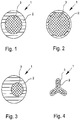
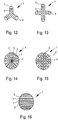
- the Figures 1 to 16 show cross-sectional views of exemplary bicomponent fibers 1 according to the invention and not according to the invention.
- the bicomponent fibers 1 shown each have a first component 2 and a second component 3.
- the core-sheath fibers according to the invention shown here surrounds the first component 2 the second component 3 and thus forms the outer surface of the fiber.
- the in the Figs. 1 to 3 shown bicomponent fibers 1 in cross section an, at least approximately, circular or - round geometry.
- the bicomponent fiber shown has a trilobal cross section.
- Such trilobal cross-sections have the consequence that the fiber has a larger outer surface in relation to its mass than is the case with fibers with a circular cross-section.
- core-sheath fibers in which the proportion of the component forming the sheath is very small, for example approx. 2%, but also in the case of "core-sheath fibers” with a higher sheath proportion, it can happen that the jacket has defects. This means that the sheath does not completely surround the core, but is perforated in some places, so that the core also forms the outer surface of the fiber at these points.
- Such fibers are also "core-sheath fibers".
- the component forming the perforated sheath forms the outer surface of the fiber for the purposes of the present invention.
- the Fig. 5, 6 , 8 and 10 to 13 show bicomponent fibers not according to the invention which are designed as side-by-side fibers. These side-by-side fibers are characterized in that both the first component 2 and the second component 3 form part of the outer surface of the bicomponent fiber 1. In the case of side-by-side fibers, too, there are circular or at least approximately circular cross-sections, as in the Figures 5, 6 and 8 are shown, also possible like multilobal cross-sections like those in the Figures 10 to 13 are shown. Depending on which fiber properties or fleece properties are to be achieved, the first component 2 and the second component 3 can be combined with one another in different proportions and in different spatial arrangements. For example, as shown in the Fig.
- a component, in the example shown the second component 3 are arranged so that it forms only a small proportion of the outer surface of the bicomponent fiber 1 relative to its mass fraction.
- a component, in the examples shown, the first component 2 can be arranged at particularly exposed points on the bicomponent fiber 1.
- the first component 2 is arranged at the tips of the multilobal cross section of the bicomponent fiber 1.
- the bicomponent fiber 1 shown, not according to the invention is designed as a segmented pie fiber.
- This fiber structure is related to the side-by-side fiber structures in that both the first component 2 and the second component 3 form part of the outer surface of the bicomponent fiber 1.
- the same applies to those in the Fig. 16 The structure shown there of the bicomponent fiber 1 not according to the invention, in which the first component 2 and the second component 3 alternate in cross section in a layer structure.
- the in the Figures 14 and 16 However, what differs from the “classic” side-by-side structures is that they each have a multiplicity of regions which are formed from the first component 2 or the second component 3.
- the bicomponent fiber 1 according to the invention shown with its islands-in-the-sea structure can be viewed as a modification of a core-sheath fiber in which a plurality of cores from the second component 3 is present.
- the individual cores from the second component 3 are surrounded by a common jacket from the first component 2.
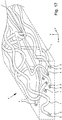
- Fig. 17 it is shown how a large number of exemplary bicomponent fibers 1 form a spunbonded nonwoven 4.
- the spunbonded web forms a web with a transverse direction X, a thickness direction Y and a length direction Z, which is also referred to as the machine direction.
- the specific tear forces of the spunbonded nonwovens 4 were measured in accordance with standard EN 12311-1, the specific nail tear-out forces in accordance with standard EN 12310-1.
- the MFIs were measured according to ISO 1133 (2.16kg at 230 ° C).
- the bicomponent fibers 1 are core-sheath fibers, with a sheath made from the first component 2 and a core made from the second component 3.
- An exemplary spunbonded nonwoven 4 was produced from bicomponent fibers 1 which were thermally consolidated by means of a calender.
- the weight per unit area of the spunbonded nonwoven 4 produced is 70 g / m 2.
- the bicomponent fibers 1 have polypropylene, which has been polymerized with a metallocene catalyst, in the sheath as the first polymer, and polypropylene, which has been polymerized with a Ziegler-Natta catalyst and then subjected to a visbreaking treatment, in the core as the second polymer.
- the mass fraction of the core in the bicomponent fiber 1 is 90%.
- the specific tear forces achieved for the spunbonded nonwoven 4 are 2.90 N / g ⁇ 5 cm in the machine direction Z and 2.25 N / g ⁇ 5 cm in the transverse direction X.
- the specific nail tear-out forces are 1.59 N / g in the machine direction Z and 1, 90 N / g in cross direction X.
- Another exemplary spunbonded nonwoven 4 was produced from bicomponent fibers 1, which were also thermally consolidated by means of a calender.
- the weight per unit area of the spunbonded nonwoven 4 produced is 70 g / m 2.
- the bicomponent fibers 1 have polypropylene, which has been polymerized with a metallocene catalyst, in the sheath as the first polymer, and polypropylene, which has been polymerized with a Ziegler-Natta catalyst and then subjected to a visbreaking treatment, in the core as the second polymer.
- the mass fraction of the core in the bicomponent fiber 1 is 70%.
- the specific tear forces achieved by the spunbonded nonwoven 4 are 2.80 N / g ⁇ 5 cm in the machine direction Z and 2.06 N / g ⁇ 5 cm in the transverse direction X.
- the specific nail tear forces are 1.52 N / g in the machine direction Z and 1, 90 N / g in cross direction X.
- Another exemplary spunbonded nonwoven 4 was produced from bicomponent fibers 1, which were also thermally consolidated by means of a calender.
- the weight per unit area of the spunbonded nonwoven 4 produced is 70 g / m 2.
- the bicomponent fibers 1 have polypropylene, which has been polymerized with a metallocene catalyst, in the sheath as the first polymer, and polypropylene, which has been polymerized with a Ziegler-Natta catalyst and then subjected to a visbreaking treatment, in the core as the second polymer.
- the mass fraction of the core in the bicomponent fiber 1 is 70%.
- the specific tear forces achieved by the spunbonded nonwoven 4 are 2.28 N / g ⁇ 5 cm in the machine direction Z and 1.71 N / g ⁇ 5 cm in the transverse direction X.
- the specific nail pull-out forces are 1.54 N / g in the machine direction Z and 1, 85 N / g in cross direction X.
- Another exemplary spunbonded nonwoven 4 was produced from bicomponent fibers 1, which were also thermally consolidated by means of a calender.
- the weight per unit area of the spunbonded nonwoven 4 produced is 70 g / m 2.
- the bicomponent fibers 1 have polypropylene, which has been polymerized with a metallocene catalyst, in the sheath as the first polymer, and polypropylene, which has been polymerized with a Ziegler-Natta catalyst and then subjected to a visbreaking treatment, in the core as the second polymer.
- the mass fraction of the core in the bicomponent fiber 1 is 85%.
- the specific tear forces achieved by the spunbonded nonwoven 4 are 2.42 N / g ⁇ 5 cm in the machine direction Z and 1.68 N / g ⁇ 5 cm in the transverse direction X.
- the specific nail pull-out forces are 1.70 N / g in the machine direction Z and 1, 99 N / g in cross direction X.
Landscapes
- Engineering & Computer Science (AREA)
- Textile Engineering (AREA)
- Chemical & Material Sciences (AREA)
- Chemical Kinetics & Catalysis (AREA)
- General Chemical & Material Sciences (AREA)
- Multicomponent Fibers (AREA)
- Nonwoven Fabrics (AREA)
Claims (9)
- Fibre à cœur/gaine (1) en particulier pour fabriquer des tissus non-tissés (4) comprenant un premier composant (2) et un second composant (3), le premier composant (2) comportant un premier polymère et le second composant (3) comportant un second polymère comme constituant, le polymère d'un des deux composants (2, 3) ayant été polymérisé à l'aide d'un catalyseur métallocène, le premier polymère et le second polymère étant chacun un polymère de propylène, le polymère de l'autre composant (2, 3) ayant été polymérisé à l'aide d'un catalyseur de type Ziegler-Natta et ayant été soumis à un traitement consécutif de viscoréduction, et le composant (2, 3) dont le polymère a été polymérisé à l'aide d'un catalyseur métallocène, formant en section transversale des fibres la surface extérieure de la fibre à cœur/gaine (1), et le composant (2, 3) dont le polymère a été polymérisé à l'aide d'un catalyseur de type Ziegler-Natta l'entourant entièrement,caractérisée en ce quele premier polymère et le second polymère sont constitués à partir du même monomère eten ce que le pourcentage en masse du composant (2, 3) dont le polymère a été polymérisé à l'aide d'un catalyseur métallocène, s'élève à 25 % au maximum par rapport à la fibre à cœur/gain (1), etle pourcentage en masse du cœur est compris entre 70 % et 95 %, eten ce que le premier composant (2) comporte un additif, le pourcentage en masse de l'additif dans le second composant (3) s'élève à 50 % au maximum du pourcentage en masse de l'additif dans le premier composant (2), etl'additif étant un antioxydant primaire ou secondaire, un absorbeur UV, un stabilisant UV, un retardateur de flamme, un antistatique, un lubrifiant, un désactivateur de métal, un agent d'hydrophilisation, un agent d'hydrophobisation, un additif antibuée et/ou un biocide.
- Fibre à cœur/gaine (1) selon la revendication 1, caractérisée en ce que la différence des points de fusion du premier composant (2) et du second composant (3) est inférieure ou égale à 8 °C.
- Fibre à cœur/gaine selon la revendication 1 ou 2, caractérisée en ce que la différence des points de fusion du premier composant (2) et du second composant (3) est de 6 °C au maximum ou entre 1 °C et 8 °C, de préférence encore entre 1 °C et 6 °C.
- Fibre à cœur/gaine selon l'une des revendications précédentes, caractérisée en ce que la différence des indices de fluidité du premier composant (2) et du second composant (3) est inférieure ou égale à 25 g/10 min, de préférence inférieure ou égale à 20 g/10 min, de préférence encore de 15 g/10 min.
- Fibre à cœur/gaine selon l'une des revendications précédentes, caractérisée en ce que les indices de fluidité du premier composant (2) et du second composant (3) sont inférieurs ou égaux à 50 g/10 min, de préférence respectivement inférieurs ou égaux à 40 g/10 min.
- Fibre à cœur/gaine selon l'une des revendications précédentes, caractérisée en ce que le premier composant (2) comporte un additif, le pourcentage en masse de l'additif dans le second composant (3) s'élève à 33,3% au maximum du pourcentage en masse de l'additif dans le premier composant (2).
- Fibre à cœur/gaine selon l'une des revendications précédentes, caractérisée en ce que l'additif est sélectionné dans le groupe constitué par :
les phénols à encombrement stérique, les amines aromatiques secondaires ou tertiaires, les aminophénols, des composés nitrosés ou nitrés aromatiques, les phosphites ou les phosphonates organiques, les thio-éthers, les thiols, les thio-esters, les sulfures et les acides organiques sulfurés, les dithiocarbamates, les thiodipropionates, les aminopyrazoles, les chélates contenant un métal, les mercaptobenzimidazoles, les hydroxybenzophénones, les cinnamates, les oxalanilides, les salicylates, les monobenzoates de résorcinol, les benzotriazoles, les triazines, les benzophénones, les dioxyde de titane, le noir de carbone, les complexes métalliques des composés organiques du soufre ou du phosphore, les amines à encombrement stérique (HALS), les hydroxydes métalliques, les borates, les composés organiques bromés ou chlorés, les composés phosphorés organiques, le trioxyde d'antimoine, la mélamine, le cyanurate de mélamine, le graphite expansé ou d'autres systèmes intumescents, les sels d'ammonium quaternaire, les alkylsulfonates, les alkylsulfates, les alkylphosphates, les dithiocarbamates, les carboxylates de métaux alcalins/alcalino-terreux, les polyéthylèneglycols ainsi que leurs esters et éthers, les éthoxylates, les mono- et diglycérides, les alcools gras, les esters d'alcools gras, les acides gras, les esters d'acides gras, les esters d'acides dicarboxyliques, les amides d'acides gras, les sels métalliques d'acides gras, les cires polyoléfiniques, les paraffines naturelles ou synthétiques et leurs dérivés, les polymères et les oligomères fluorés, les agents anti-adhérence de contact tels que les silices, les silicones, les silicates, le carbonate de calcium, les amides d'acides mono- et dicarboxyliques et leurs dérivés, les amides cycliques, les hydrazones et les bishydrazones, les hydrazides, les hydrazines, la mélamine et ses dérivés, les benzotriazoles, les aminotriazoles, les phénols à encombrement stérique en liaison avec des composés métalliques complexants, les benzylphosphonates, les pyridinethiols, les esters de thiobisphénol, les polyglycols, les éthoxylates, les polymères et oligomères fluorés, les cires de lignite, en particulier les stéarates, la 10,10'-oxybisphénoxarsine (OBPA), un N-(trihalogéno-méthylthiol)phtalimide, l'oxyde de tributylétain, le diméthyldithiocarbamate de zinc, le 2-éthylhexanoate de diphénylantimoine, le complexe 8-hydroxyquinoléine/cuivre, les isothiazolones, l'argent et les sels d'argent, en tant que biocides, ou leurs mélanges. - Fibre à cœur/gaine selon l'une quelconque des revendications précédentes, caractérisée en ce que le pourcentage en masse du composant (2, 3) dont le polymère a été polymérisé à l'aide d'un catalyseur métallocène est par rapport à la fibre à cœur/gaine (1) de 10 % au maximum, notamment de 5 % au maximum.
- Tissu non tissé (4) comportant au moins une fibre à cœur/gaine (1) selon l'une quelconque des revendications précédentes.
Priority Applications (1)
| Application Number | Priority Date | Filing Date | Title |
|---|---|---|---|
| PL14002314T PL2826898T5 (pl) | 2013-07-15 | 2014-07-07 | Włókno dwuskładnikowe do wytwarzania włóknin typu spunbond |
Applications Claiming Priority (2)
| Application Number | Priority Date | Filing Date | Title |
|---|---|---|---|
| DE102013011699 | 2013-07-15 | ||
| DE201310014919 DE102013014919A1 (de) | 2013-07-15 | 2013-09-11 | Bikomponentenfaser zur Herstellung von Spinnvliesen |
Publications (3)
| Publication Number | Publication Date |
|---|---|
| EP2826898A1 EP2826898A1 (fr) | 2015-01-21 |
| EP2826898B1 EP2826898B1 (fr) | 2019-03-13 |
| EP2826898B2 true EP2826898B2 (fr) | 2021-11-17 |
Family
ID=51176870
Family Applications (1)
| Application Number | Title | Priority Date | Filing Date |
|---|---|---|---|
| EP14002314.4A Active EP2826898B2 (fr) | 2013-07-15 | 2014-07-07 | Fibre bicomposants destinée à la fabrication de matières non tissées |
Country Status (4)
| Country | Link |
|---|---|
| US (1) | US20150017867A1 (fr) |
| EP (1) | EP2826898B2 (fr) |
| DE (1) | DE102013014919A1 (fr) |
| PL (1) | PL2826898T5 (fr) |
Families Citing this family (4)
| Publication number | Priority date | Publication date | Assignee | Title |
|---|---|---|---|---|
| DE102013014919A1 (de) | 2013-07-15 | 2015-01-15 | Ewald Dörken Ag | Bikomponentenfaser zur Herstellung von Spinnvliesen |
| JP6705379B2 (ja) * | 2014-09-25 | 2020-06-03 | 株式会社湯山製作所 | 鑑査支援システム |
| BE1023505B1 (nl) * | 2016-03-24 | 2017-04-11 | Beaulieu International Group | Non-woven-structuur met vezels die gekatalyseerd zijn door een metalloceenkatalysator |
| DE102021130932A1 (de) | 2021-11-25 | 2023-05-25 | Ewald Dörken Ag | Verbundfolie für den Baubereich |
Family Cites Families (25)
| Publication number | Priority date | Publication date | Assignee | Title |
|---|---|---|---|---|
| US4282076A (en) | 1979-09-17 | 1981-08-04 | Hercules Incorporated | Method of visbreaking polypropylene |
| US5064802A (en) | 1989-09-14 | 1991-11-12 | The Dow Chemical Company | Metal complex compounds |
| DK132191D0 (da) * | 1991-07-05 | 1991-07-05 | Danaklon As | Fibre og fremstilling deraf |
| US5374696A (en) | 1992-03-26 | 1994-12-20 | The Dow Chemical Company | Addition polymerization process using stabilized reduced metal catalysts |
| EP0700464A1 (fr) | 1993-05-25 | 1996-03-13 | Exxon Chemical Patents Inc. | Nouvelles fibres en polyolefines et tissus fabriques a l'aide desdits fibres |
| US6177190B1 (en) | 1998-05-29 | 2001-01-23 | 3M Innovative Properties Company | Radiation curable poly(1-alkene) based pressure-sensitive adhesives |
| US6454989B1 (en) * | 1998-11-12 | 2002-09-24 | Kimberly-Clark Worldwide, Inc. | Process of making a crimped multicomponent fiber web |
| EP1126054A1 (fr) | 2000-02-18 | 2001-08-22 | Atofina Research S.A. | Fibres de polypropylène |
| JP2001254256A (ja) * | 2000-03-08 | 2001-09-21 | Japan Polychem Corp | 熱接着性不織布 |
| JP4441987B2 (ja) * | 2000-05-29 | 2010-03-31 | チッソ株式会社 | ポリエチレン系複合繊維およびこれを用いた不織布 |
| EP1362937A1 (fr) | 2002-05-10 | 2003-11-19 | Redco S.A. | Procédé pour produits façonnés en fibres-ciment et fibres de renforcement pour de tels produits |
| US7736737B2 (en) * | 2003-01-30 | 2010-06-15 | Dow Global Technologies Inc. | Fibers formed from immiscible polymer blends |
| US6846561B1 (en) | 2003-08-06 | 2005-01-25 | Fina Technology, Inc. | Bicomponent fibers of isotactic and syndiotactic polypropylene |
| DE10360845A1 (de) * | 2003-12-20 | 2005-07-21 | Corovin Gmbh | Weiches Vlies auf Basis von Polyethylen |
| JP5280005B2 (ja) * | 2004-01-26 | 2013-09-04 | ザ プロクター アンド ギャンブル カンパニー | ポリエチレンブレンド及び混合物を含んでなる繊維及び不織布 |
| DE102007011365B4 (de) | 2007-03-07 | 2009-02-12 | Carl Freudenberg Kg | Lage zur Verwendung in einem HEPA-Filterelement sowie Filterelement |
| DE102007049031A1 (de) * | 2007-10-11 | 2009-04-16 | Fiberweb Corovin Gmbh | Polypropylenmischung |
| EP2154275A1 (fr) * | 2008-07-29 | 2010-02-17 | Total Petrochemicals Research Feluy | Fibres de bicomposants avec un composant extérieur comportant du polypropylène |
| US8007699B2 (en) | 2008-08-20 | 2011-08-30 | Fina Technology, Inc. | Process of making bicomponent fiber |
| US10077518B2 (en) | 2008-10-29 | 2018-09-18 | Mitsui Chemicals, Inc. | Crimped conjugated fiber and nonwoven fabric comprising the same |
| EP2382243A1 (fr) | 2009-01-29 | 2011-11-02 | ExxonMobil Chemical Patents Inc. | Fibres et tissus non tissés de polypropylène et leurs procédés de fabrication |
| US8668975B2 (en) * | 2009-11-24 | 2014-03-11 | Exxonmobil Chemical Patents Inc. | Fabric with discrete elastic and plastic regions and method for making same |
| MX2013001954A (es) * | 2010-08-19 | 2013-10-28 | Braskem America Inc | Articulos fabricados que comprenden poliolefinas. |
| JP5370390B2 (ja) * | 2011-02-14 | 2013-12-18 | Jnc株式会社 | ポリオレフィン系帯電防止繊維およびそれからなる不織布 |
| DE102013014919A1 (de) | 2013-07-15 | 2015-01-15 | Ewald Dörken Ag | Bikomponentenfaser zur Herstellung von Spinnvliesen |
-
2013
- 2013-09-11 DE DE201310014919 patent/DE102013014919A1/de not_active Ceased
-
2014
- 2014-07-07 EP EP14002314.4A patent/EP2826898B2/fr active Active
- 2014-07-07 PL PL14002314T patent/PL2826898T5/pl unknown
- 2014-07-15 US US14/331,633 patent/US20150017867A1/en not_active Abandoned
Also Published As
| Publication number | Publication date |
|---|---|
| EP2826898A1 (fr) | 2015-01-21 |
| US20150017867A1 (en) | 2015-01-15 |
| EP2826898B1 (fr) | 2019-03-13 |
| DE102013014919A1 (de) | 2015-01-15 |
| PL2826898T3 (pl) | 2019-08-30 |
| PL2826898T5 (pl) | 2022-03-07 |
Similar Documents
| Publication | Publication Date | Title |
|---|---|---|
| EP2826895B1 (fr) | Fibre bi-composants destinée à la fabrication de matières non tissées | |
| EP2826897B1 (fr) | Fibre bicomposants destinée à la fabrication de matières non tissées | |
| EP3054042B1 (fr) | Procédé de fabrication d'un laminé et laminé | |
| EP0615007B1 (fr) | Fibres d'électret avec stabilisation de la charge améliorée, procédé pour leur fabrication et matériau textile contenant ces fibres d'électret | |
| EP3521496B1 (fr) | Stratifié non-tissé et procédé de fabrication d'un stratifié non-tissé | |
| EP3676088B1 (fr) | Film composite | |
| DE10322460B4 (de) | Verfahren und Vorrichtung zur Herstellung eines Spinnvlieses aus Filamenten aus aufgeplatzten Fasern, Filamente aus aufgeplatzen Fasern und Vliesstoff | |
| DE10360845A1 (de) | Weiches Vlies auf Basis von Polyethylen | |
| EP3715517B1 (fr) | Procédé de fabrication d'un stratifié non-tissé et stratifié non-tissé | |
| DE102018008585A1 (de) | Verbundfolie | |
| EP3523472B1 (fr) | Procédé de fabrication d'une structure textile plissable dotée de fibres à charge électrostatique, et structure textile plissable | |
| EP2826898B2 (fr) | Fibre bicomposants destinée à la fabrication de matières non tissées | |
| EP3296438B1 (fr) | Non-tissé constitué de filaments continus | |
| EP2826896A1 (fr) | Fibre bicomposants destinée à la fabrication de matières non tissées | |
| DE1964060C3 (de) | Verfahren zur Herstellung von Wirrvliesen aus Hochpolymeren | |
| DE102018008584A1 (de) | Verbundfolie | |
| EP3771761B1 (fr) | Non-tissé obtenu par fusion-soufflage des filaments continus et dispositif de production de non-tissé obtenu par fusion-soufflage | |
| DE112019004567T5 (de) | Fasern für vliesstoffe mit mischungen aus polymeren mit hoher und niedriger schmelzflussrate | |
| EP3771556B1 (fr) | Stratifié non-tissé et procédé de fabrication d'un stratifié non-tissé | |
| DE2009971C3 (de) | Bikomponenten-Synthesefaden des Matrix/Fibrillen-Typs | |
| DE69209831T2 (de) | Nicht gewebter Stoff | |
| DE10084374B4 (de) | Polypropylenfaser und deren Herstellung | |
| DE20308475U1 (de) | Vorrichtung zur Herstellung von Spinnvliesen aus Filamenten | |
| DD291354A5 (de) | Verfahren zur herstellung feiner stapelfasern mit textilfasercharakter aus folien |
Legal Events
| Date | Code | Title | Description |
|---|---|---|---|
| 17P | Request for examination filed |
Effective date: 20140707 |
|
| AK | Designated contracting states |
Kind code of ref document: A1 Designated state(s): AL AT BE BG CH CY CZ DE DK EE ES FI FR GB GR HR HU IE IS IT LI LT LU LV MC MK MT NL NO PL PT RO RS SE SI SK SM TR |
|
| AX | Request for extension of the european patent |
Extension state: BA ME |
|
| PUAI | Public reference made under article 153(3) epc to a published international application that has entered the european phase |
Free format text: ORIGINAL CODE: 0009012 |
|
| R17P | Request for examination filed (corrected) |
Effective date: 20150715 |
|
| RBV | Designated contracting states (corrected) |
Designated state(s): AL AT BE BG CH CY CZ DE DK EE ES FI FR GB GR HR HU IE IS IT LI LT LU LV MC MK MT NL NO PL PT RO RS SE SI SK SM TR |
|
| STAA | Information on the status of an ep patent application or granted ep patent |
Free format text: STATUS: EXAMINATION IS IN PROGRESS |
|
| 17Q | First examination report despatched |
Effective date: 20170905 |
|
| GRAP | Despatch of communication of intention to grant a patent |
Free format text: ORIGINAL CODE: EPIDOSNIGR1 |
|
| STAA | Information on the status of an ep patent application or granted ep patent |
Free format text: STATUS: GRANT OF PATENT IS INTENDED |
|
| INTG | Intention to grant announced |
Effective date: 20181107 |
|
| GRAS | Grant fee paid |
Free format text: ORIGINAL CODE: EPIDOSNIGR3 |
|
| GRAA | (expected) grant |
Free format text: ORIGINAL CODE: 0009210 |
|
| STAA | Information on the status of an ep patent application or granted ep patent |
Free format text: STATUS: THE PATENT HAS BEEN GRANTED |
|
| AK | Designated contracting states |
Kind code of ref document: B1 Designated state(s): AL AT BE BG CH CY CZ DE DK EE ES FI FR GB GR HR HU IE IS IT LI LT LU LV MC MK MT NL NO PL PT RO RS SE SI SK SM TR |
|
| REG | Reference to a national code |
Ref country code: GB Ref legal event code: FG4D Free format text: NOT ENGLISH |
|
| REG | Reference to a national code |
Ref country code: AT Ref legal event code: REF Ref document number: 1107775 Country of ref document: AT Kind code of ref document: T Effective date: 20190315 Ref country code: CH Ref legal event code: EP |
|
| REG | Reference to a national code |
Ref country code: IE Ref legal event code: FG4D Free format text: LANGUAGE OF EP DOCUMENT: GERMAN |
|
| REG | Reference to a national code |
Ref country code: DE Ref legal event code: R096 Ref document number: 502014011070 Country of ref document: DE |
|
| REG | Reference to a national code |
Ref country code: NL Ref legal event code: FP |
|
| REG | Reference to a national code |
Ref country code: LT Ref legal event code: MG4D |
|
| PG25 | Lapsed in a contracting state [announced via postgrant information from national office to epo] |
Ref country code: FI Free format text: LAPSE BECAUSE OF FAILURE TO SUBMIT A TRANSLATION OF THE DESCRIPTION OR TO PAY THE FEE WITHIN THE PRESCRIBED TIME-LIMIT Effective date: 20190313 Ref country code: NO Free format text: LAPSE BECAUSE OF FAILURE TO SUBMIT A TRANSLATION OF THE DESCRIPTION OR TO PAY THE FEE WITHIN THE PRESCRIBED TIME-LIMIT Effective date: 20190613 Ref country code: SE Free format text: LAPSE BECAUSE OF FAILURE TO SUBMIT A TRANSLATION OF THE DESCRIPTION OR TO PAY THE FEE WITHIN THE PRESCRIBED TIME-LIMIT Effective date: 20190313 Ref country code: LT Free format text: LAPSE BECAUSE OF FAILURE TO SUBMIT A TRANSLATION OF THE DESCRIPTION OR TO PAY THE FEE WITHIN THE PRESCRIBED TIME-LIMIT Effective date: 20190313 |
|
| PG25 | Lapsed in a contracting state [announced via postgrant information from national office to epo] |
Ref country code: LV Free format text: LAPSE BECAUSE OF FAILURE TO SUBMIT A TRANSLATION OF THE DESCRIPTION OR TO PAY THE FEE WITHIN THE PRESCRIBED TIME-LIMIT Effective date: 20190313 Ref country code: BG Free format text: LAPSE BECAUSE OF FAILURE TO SUBMIT A TRANSLATION OF THE DESCRIPTION OR TO PAY THE FEE WITHIN THE PRESCRIBED TIME-LIMIT Effective date: 20190613 Ref country code: GR Free format text: LAPSE BECAUSE OF FAILURE TO SUBMIT A TRANSLATION OF THE DESCRIPTION OR TO PAY THE FEE WITHIN THE PRESCRIBED TIME-LIMIT Effective date: 20190614 Ref country code: HR Free format text: LAPSE BECAUSE OF FAILURE TO SUBMIT A TRANSLATION OF THE DESCRIPTION OR TO PAY THE FEE WITHIN THE PRESCRIBED TIME-LIMIT Effective date: 20190313 Ref country code: RS Free format text: LAPSE BECAUSE OF FAILURE TO SUBMIT A TRANSLATION OF THE DESCRIPTION OR TO PAY THE FEE WITHIN THE PRESCRIBED TIME-LIMIT Effective date: 20190313 |
|
| PG25 | Lapsed in a contracting state [announced via postgrant information from national office to epo] |
Ref country code: AL Free format text: LAPSE BECAUSE OF FAILURE TO SUBMIT A TRANSLATION OF THE DESCRIPTION OR TO PAY THE FEE WITHIN THE PRESCRIBED TIME-LIMIT Effective date: 20190313 Ref country code: RO Free format text: LAPSE BECAUSE OF FAILURE TO SUBMIT A TRANSLATION OF THE DESCRIPTION OR TO PAY THE FEE WITHIN THE PRESCRIBED TIME-LIMIT Effective date: 20190313 Ref country code: PT Free format text: LAPSE BECAUSE OF FAILURE TO SUBMIT A TRANSLATION OF THE DESCRIPTION OR TO PAY THE FEE WITHIN THE PRESCRIBED TIME-LIMIT Effective date: 20190713 Ref country code: ES Free format text: LAPSE BECAUSE OF FAILURE TO SUBMIT A TRANSLATION OF THE DESCRIPTION OR TO PAY THE FEE WITHIN THE PRESCRIBED TIME-LIMIT Effective date: 20190313 Ref country code: SK Free format text: LAPSE BECAUSE OF FAILURE TO SUBMIT A TRANSLATION OF THE DESCRIPTION OR TO PAY THE FEE WITHIN THE PRESCRIBED TIME-LIMIT Effective date: 20190313 Ref country code: EE Free format text: LAPSE BECAUSE OF FAILURE TO SUBMIT A TRANSLATION OF THE DESCRIPTION OR TO PAY THE FEE WITHIN THE PRESCRIBED TIME-LIMIT Effective date: 20190313 |
|
| PG25 | Lapsed in a contracting state [announced via postgrant information from national office to epo] |
Ref country code: SM Free format text: LAPSE BECAUSE OF FAILURE TO SUBMIT A TRANSLATION OF THE DESCRIPTION OR TO PAY THE FEE WITHIN THE PRESCRIBED TIME-LIMIT Effective date: 20190313 |
|
| REG | Reference to a national code |
Ref country code: DE Ref legal event code: R026 Ref document number: 502014011070 Country of ref document: DE |
|
| PLBI | Opposition filed |
Free format text: ORIGINAL CODE: 0009260 |
|
| PG25 | Lapsed in a contracting state [announced via postgrant information from national office to epo] |
Ref country code: IS Free format text: LAPSE BECAUSE OF FAILURE TO SUBMIT A TRANSLATION OF THE DESCRIPTION OR TO PAY THE FEE WITHIN THE PRESCRIBED TIME-LIMIT Effective date: 20190713 |
|
| PLAX | Notice of opposition and request to file observation + time limit sent |
Free format text: ORIGINAL CODE: EPIDOSNOBS2 |
|
| 26 | Opposition filed |
Opponent name: CARL FREUDENBERG KG Effective date: 20191211 |
|
| PG25 | Lapsed in a contracting state [announced via postgrant information from national office to epo] |
Ref country code: DK Free format text: LAPSE BECAUSE OF FAILURE TO SUBMIT A TRANSLATION OF THE DESCRIPTION OR TO PAY THE FEE WITHIN THE PRESCRIBED TIME-LIMIT Effective date: 20190313 |
|
| PG25 | Lapsed in a contracting state [announced via postgrant information from national office to epo] |
Ref country code: MC Free format text: LAPSE BECAUSE OF FAILURE TO SUBMIT A TRANSLATION OF THE DESCRIPTION OR TO PAY THE FEE WITHIN THE PRESCRIBED TIME-LIMIT Effective date: 20190313 Ref country code: SI Free format text: LAPSE BECAUSE OF FAILURE TO SUBMIT A TRANSLATION OF THE DESCRIPTION OR TO PAY THE FEE WITHIN THE PRESCRIBED TIME-LIMIT Effective date: 20190313 |
|
| PG25 | Lapsed in a contracting state [announced via postgrant information from national office to epo] |
Ref country code: LU Free format text: LAPSE BECAUSE OF NON-PAYMENT OF DUE FEES Effective date: 20190707 |
|
| PLBB | Reply of patent proprietor to notice(s) of opposition received |
Free format text: ORIGINAL CODE: EPIDOSNOBS3 |
|
| PG25 | Lapsed in a contracting state [announced via postgrant information from national office to epo] |
Ref country code: IE Free format text: LAPSE BECAUSE OF NON-PAYMENT OF DUE FEES Effective date: 20190707 |
|
| PLBP | Opposition withdrawn |
Free format text: ORIGINAL CODE: 0009264 |
|
| PG25 | Lapsed in a contracting state [announced via postgrant information from national office to epo] |
Ref country code: CY Free format text: LAPSE BECAUSE OF FAILURE TO SUBMIT A TRANSLATION OF THE DESCRIPTION OR TO PAY THE FEE WITHIN THE PRESCRIBED TIME-LIMIT Effective date: 20190313 |
|
| PG25 | Lapsed in a contracting state [announced via postgrant information from national office to epo] |
Ref country code: MT Free format text: LAPSE BECAUSE OF FAILURE TO SUBMIT A TRANSLATION OF THE DESCRIPTION OR TO PAY THE FEE WITHIN THE PRESCRIBED TIME-LIMIT Effective date: 20190313 Ref country code: HU Free format text: LAPSE BECAUSE OF FAILURE TO SUBMIT A TRANSLATION OF THE DESCRIPTION OR TO PAY THE FEE WITHIN THE PRESCRIBED TIME-LIMIT; INVALID AB INITIO Effective date: 20140707 |
|
| PUAH | Patent maintained in amended form |
Free format text: ORIGINAL CODE: 0009272 |
|
| STAA | Information on the status of an ep patent application or granted ep patent |
Free format text: STATUS: PATENT MAINTAINED AS AMENDED |
|
| PGFP | Annual fee paid to national office [announced via postgrant information from national office to epo] |
Ref country code: IT Payment date: 20210727 Year of fee payment: 8 |
|
| 27A | Patent maintained in amended form |
Effective date: 20211117 |
|
| AK | Designated contracting states |
Kind code of ref document: B2 Designated state(s): AL AT BE BG CH CY CZ DE DK EE ES FI FR GB GR HR HU IE IS IT LI LT LU LV MC MK MT NL NO PL PT RO RS SE SI SK SM TR |
|
| REG | Reference to a national code |
Ref country code: DE Ref legal event code: R102 Ref document number: 502014011070 Country of ref document: DE |
|
| PGFP | Annual fee paid to national office [announced via postgrant information from national office to epo] |
Ref country code: GB Payment date: 20210722 Year of fee payment: 8 Ref country code: TR Payment date: 20210706 Year of fee payment: 8 |
|
| REG | Reference to a national code |
Ref country code: NL Ref legal event code: FP |
|
| PG25 | Lapsed in a contracting state [announced via postgrant information from national office to epo] |
Ref country code: MK Free format text: LAPSE BECAUSE OF FAILURE TO SUBMIT A TRANSLATION OF THE DESCRIPTION OR TO PAY THE FEE WITHIN THE PRESCRIBED TIME-LIMIT Effective date: 20190313 |
|
| PGFP | Annual fee paid to national office [announced via postgrant information from national office to epo] |
Ref country code: NL Payment date: 20220720 Year of fee payment: 9 |
|
| PGFP | Annual fee paid to national office [announced via postgrant information from national office to epo] |
Ref country code: CZ Payment date: 20220707 Year of fee payment: 9 Ref country code: AT Payment date: 20220721 Year of fee payment: 9 |
|
| PGFP | Annual fee paid to national office [announced via postgrant information from national office to epo] |
Ref country code: BE Payment date: 20220720 Year of fee payment: 9 |
|
| PGFP | Annual fee paid to national office [announced via postgrant information from national office to epo] |
Ref country code: CH Payment date: 20220725 Year of fee payment: 9 |
|
| GBPC | Gb: european patent ceased through non-payment of renewal fee |
Effective date: 20220707 |
|
| PG25 | Lapsed in a contracting state [announced via postgrant information from national office to epo] |
Ref country code: GB Free format text: LAPSE BECAUSE OF NON-PAYMENT OF DUE FEES Effective date: 20220707 |
|
| P01 | Opt-out of the competence of the unified patent court (upc) registered |
Effective date: 20230613 |
|
| PG25 | Lapsed in a contracting state [announced via postgrant information from national office to epo] |
Ref country code: IT Free format text: LAPSE BECAUSE OF NON-PAYMENT OF DUE FEES Effective date: 20220707 |
|
| PG25 | Lapsed in a contracting state [announced via postgrant information from national office to epo] |
Ref country code: CZ Free format text: LAPSE BECAUSE OF NON-PAYMENT OF DUE FEES Effective date: 20230707 |
|
| REG | Reference to a national code |
Ref country code: CH Ref legal event code: PL |
|
| REG | Reference to a national code |
Ref country code: NL Ref legal event code: MM Effective date: 20230801 |
|
| REG | Reference to a national code |
Ref country code: AT Ref legal event code: MM01 Ref document number: 1107775 Country of ref document: AT Kind code of ref document: T Effective date: 20230707 |
|
| REG | Reference to a national code |
Ref country code: BE Ref legal event code: MM Effective date: 20230731 |
|
| PG25 | Lapsed in a contracting state [announced via postgrant information from national office to epo] |
Ref country code: NL Free format text: LAPSE BECAUSE OF NON-PAYMENT OF DUE FEES Effective date: 20230801 |
|
| PG25 | Lapsed in a contracting state [announced via postgrant information from national office to epo] |
Ref country code: AT Free format text: LAPSE BECAUSE OF NON-PAYMENT OF DUE FEES Effective date: 20230707 |
|
| PG25 | Lapsed in a contracting state [announced via postgrant information from national office to epo] |
Ref country code: NL Free format text: LAPSE BECAUSE OF NON-PAYMENT OF DUE FEES Effective date: 20230801 Ref country code: AT Free format text: LAPSE BECAUSE OF NON-PAYMENT OF DUE FEES Effective date: 20230707 Ref country code: CH Free format text: LAPSE BECAUSE OF NON-PAYMENT OF DUE FEES Effective date: 20230731 |
|
| PG25 | Lapsed in a contracting state [announced via postgrant information from national office to epo] |
Ref country code: BE Free format text: LAPSE BECAUSE OF NON-PAYMENT OF DUE FEES Effective date: 20230731 |
|
| PG25 | Lapsed in a contracting state [announced via postgrant information from national office to epo] |
Ref country code: TR Free format text: LAPSE BECAUSE OF NON-PAYMENT OF DUE FEES Effective date: 20220707 |
|
| PGFP | Annual fee paid to national office [announced via postgrant information from national office to epo] |
Ref country code: PL Payment date: 20250630 Year of fee payment: 12 |
|
| PGFP | Annual fee paid to national office [announced via postgrant information from national office to epo] |
Ref country code: DE Payment date: 20250714 Year of fee payment: 12 |
|
| PGFP | Annual fee paid to national office [announced via postgrant information from national office to epo] |
Ref country code: FR Payment date: 20250725 Year of fee payment: 12 |