EP2827397B1 - Organisches elektrolumineszenzelement - Google Patents
Organisches elektrolumineszenzelement Download PDFInfo
- Publication number
- EP2827397B1 EP2827397B1 EP13760617.4A EP13760617A EP2827397B1 EP 2827397 B1 EP2827397 B1 EP 2827397B1 EP 13760617 A EP13760617 A EP 13760617A EP 2827397 B1 EP2827397 B1 EP 2827397B1
- Authority
- EP
- European Patent Office
- Prior art keywords
- group
- carbon atoms
- formula
- organic
- layer
- Prior art date
- Legal status (The legal status is an assumption and is not a legal conclusion. Google has not performed a legal analysis and makes no representation as to the accuracy of the status listed.)
- Active
Links
- IUBQFXDMDZCIPA-IWNGFBJFSA-N C[C@@H](CCC(C)SC1)C1[C@H]1C(C)=CC(C)=[I]C1(C)C Chemical compound C[C@@H](CCC(C)SC1)C1[C@H]1C(C)=CC(C)=[I]C1(C)C IUBQFXDMDZCIPA-IWNGFBJFSA-N 0.000 description 1
Images


Classifications
-
- C—CHEMISTRY; METALLURGY
- C09—DYES; PAINTS; POLISHES; NATURAL RESINS; ADHESIVES; COMPOSITIONS NOT OTHERWISE PROVIDED FOR; APPLICATIONS OF MATERIALS NOT OTHERWISE PROVIDED FOR
- C09K—MATERIALS FOR MISCELLANEOUS APPLICATIONS, NOT PROVIDED FOR ELSEWHERE
- C09K11/00—Luminescent materials, e.g. electroluminescent or chemiluminescent
- C09K11/06—Luminescent materials, e.g. electroluminescent or chemiluminescent containing organic luminescent materials
-
- C—CHEMISTRY; METALLURGY
- C07—ORGANIC CHEMISTRY
- C07D—HETEROCYCLIC COMPOUNDS
- C07D487/00—Heterocyclic compounds containing nitrogen atoms as the only ring hetero atoms in the condensed system, not provided for by groups C07D451/00 - C07D477/00
- C07D487/02—Heterocyclic compounds containing nitrogen atoms as the only ring hetero atoms in the condensed system, not provided for by groups C07D451/00 - C07D477/00 in which the condensed system contains two hetero rings
- C07D487/04—Ortho-condensed systems
-
- H—ELECTRICITY
- H10—SEMICONDUCTOR DEVICES; ELECTRIC SOLID-STATE DEVICES NOT OTHERWISE PROVIDED FOR
- H10K—ORGANIC ELECTRIC SOLID-STATE DEVICES
- H10K50/00—Organic light-emitting devices
-
- H—ELECTRICITY
- H10—SEMICONDUCTOR DEVICES; ELECTRIC SOLID-STATE DEVICES NOT OTHERWISE PROVIDED FOR
- H10K—ORGANIC ELECTRIC SOLID-STATE DEVICES
- H10K50/00—Organic light-emitting devices
- H10K50/10—OLEDs or polymer light-emitting diodes [PLED]
- H10K50/14—Carrier transporting layers
- H10K50/15—Hole transporting layers
- H10K50/156—Hole transporting layers comprising a multilayered structure
-
- H—ELECTRICITY
- H10—SEMICONDUCTOR DEVICES; ELECTRIC SOLID-STATE DEVICES NOT OTHERWISE PROVIDED FOR
- H10K—ORGANIC ELECTRIC SOLID-STATE DEVICES
- H10K85/00—Organic materials used in the body or electrodes of devices covered by this subclass
- H10K85/60—Organic compounds having low molecular weight
- H10K85/649—Aromatic compounds comprising a hetero atom
- H10K85/654—Aromatic compounds comprising a hetero atom comprising only nitrogen as heteroatom
-
- H—ELECTRICITY
- H10—SEMICONDUCTOR DEVICES; ELECTRIC SOLID-STATE DEVICES NOT OTHERWISE PROVIDED FOR
- H10K—ORGANIC ELECTRIC SOLID-STATE DEVICES
- H10K85/00—Organic materials used in the body or electrodes of devices covered by this subclass
- H10K85/60—Organic compounds having low molecular weight
- H10K85/649—Aromatic compounds comprising a hetero atom
- H10K85/657—Polycyclic condensed heteroaromatic hydrocarbons
- H10K85/6572—Polycyclic condensed heteroaromatic hydrocarbons comprising only nitrogen in the heteroaromatic polycondensed ring system, e.g. phenanthroline or carbazole
-
- H—ELECTRICITY
- H10—SEMICONDUCTOR DEVICES; ELECTRIC SOLID-STATE DEVICES NOT OTHERWISE PROVIDED FOR
- H10K—ORGANIC ELECTRIC SOLID-STATE DEVICES
- H10K85/00—Organic materials used in the body or electrodes of devices covered by this subclass
- H10K85/60—Organic compounds having low molecular weight
- H10K85/649—Aromatic compounds comprising a hetero atom
- H10K85/657—Polycyclic condensed heteroaromatic hydrocarbons
- H10K85/6574—Polycyclic condensed heteroaromatic hydrocarbons comprising only oxygen in the heteroaromatic polycondensed ring system, e.g. cumarine dyes
-
- H—ELECTRICITY
- H10—SEMICONDUCTOR DEVICES; ELECTRIC SOLID-STATE DEVICES NOT OTHERWISE PROVIDED FOR
- H10K—ORGANIC ELECTRIC SOLID-STATE DEVICES
- H10K85/00—Organic materials used in the body or electrodes of devices covered by this subclass
- H10K85/60—Organic compounds having low molecular weight
- H10K85/649—Aromatic compounds comprising a hetero atom
- H10K85/657—Polycyclic condensed heteroaromatic hydrocarbons
- H10K85/6576—Polycyclic condensed heteroaromatic hydrocarbons comprising only sulfur in the heteroaromatic polycondensed ring system, e.g. benzothiophene
-
- C—CHEMISTRY; METALLURGY
- C09—DYES; PAINTS; POLISHES; NATURAL RESINS; ADHESIVES; COMPOSITIONS NOT OTHERWISE PROVIDED FOR; APPLICATIONS OF MATERIALS NOT OTHERWISE PROVIDED FOR
- C09K—MATERIALS FOR MISCELLANEOUS APPLICATIONS, NOT PROVIDED FOR ELSEWHERE
- C09K2211/00—Chemical nature of organic luminescent or tenebrescent compounds
- C09K2211/10—Non-macromolecular compounds
- C09K2211/1018—Heterocyclic compounds
- C09K2211/1025—Heterocyclic compounds characterised by ligands
- C09K2211/1029—Heterocyclic compounds characterised by ligands containing one nitrogen atom as the heteroatom
-
- C—CHEMISTRY; METALLURGY
- C09—DYES; PAINTS; POLISHES; NATURAL RESINS; ADHESIVES; COMPOSITIONS NOT OTHERWISE PROVIDED FOR; APPLICATIONS OF MATERIALS NOT OTHERWISE PROVIDED FOR
- C09K—MATERIALS FOR MISCELLANEOUS APPLICATIONS, NOT PROVIDED FOR ELSEWHERE
- C09K2211/00—Chemical nature of organic luminescent or tenebrescent compounds
- C09K2211/10—Non-macromolecular compounds
- C09K2211/1018—Heterocyclic compounds
- C09K2211/1025—Heterocyclic compounds characterised by ligands
- C09K2211/1044—Heterocyclic compounds characterised by ligands containing two nitrogen atoms as heteroatoms
-
- C—CHEMISTRY; METALLURGY
- C09—DYES; PAINTS; POLISHES; NATURAL RESINS; ADHESIVES; COMPOSITIONS NOT OTHERWISE PROVIDED FOR; APPLICATIONS OF MATERIALS NOT OTHERWISE PROVIDED FOR
- C09K—MATERIALS FOR MISCELLANEOUS APPLICATIONS, NOT PROVIDED FOR ELSEWHERE
- C09K2211/00—Chemical nature of organic luminescent or tenebrescent compounds
- C09K2211/10—Non-macromolecular compounds
- C09K2211/1018—Heterocyclic compounds
- C09K2211/1025—Heterocyclic compounds characterised by ligands
- C09K2211/1059—Heterocyclic compounds characterised by ligands containing three nitrogen atoms as heteroatoms
-
- C—CHEMISTRY; METALLURGY
- C09—DYES; PAINTS; POLISHES; NATURAL RESINS; ADHESIVES; COMPOSITIONS NOT OTHERWISE PROVIDED FOR; APPLICATIONS OF MATERIALS NOT OTHERWISE PROVIDED FOR
- C09K—MATERIALS FOR MISCELLANEOUS APPLICATIONS, NOT PROVIDED FOR ELSEWHERE
- C09K2211/00—Chemical nature of organic luminescent or tenebrescent compounds
- C09K2211/10—Non-macromolecular compounds
- C09K2211/1018—Heterocyclic compounds
- C09K2211/1025—Heterocyclic compounds characterised by ligands
- C09K2211/1088—Heterocyclic compounds characterised by ligands containing oxygen as the only heteroatom
-
- C—CHEMISTRY; METALLURGY
- C09—DYES; PAINTS; POLISHES; NATURAL RESINS; ADHESIVES; COMPOSITIONS NOT OTHERWISE PROVIDED FOR; APPLICATIONS OF MATERIALS NOT OTHERWISE PROVIDED FOR
- C09K—MATERIALS FOR MISCELLANEOUS APPLICATIONS, NOT PROVIDED FOR ELSEWHERE
- C09K2211/00—Chemical nature of organic luminescent or tenebrescent compounds
- C09K2211/10—Non-macromolecular compounds
- C09K2211/1018—Heterocyclic compounds
- C09K2211/1025—Heterocyclic compounds characterised by ligands
- C09K2211/1092—Heterocyclic compounds characterised by ligands containing sulfur as the only heteroatom
-
- C—CHEMISTRY; METALLURGY
- C09—DYES; PAINTS; POLISHES; NATURAL RESINS; ADHESIVES; COMPOSITIONS NOT OTHERWISE PROVIDED FOR; APPLICATIONS OF MATERIALS NOT OTHERWISE PROVIDED FOR
- C09K—MATERIALS FOR MISCELLANEOUS APPLICATIONS, NOT PROVIDED FOR ELSEWHERE
- C09K2211/00—Chemical nature of organic luminescent or tenebrescent compounds
- C09K2211/10—Non-macromolecular compounds
- C09K2211/1018—Heterocyclic compounds
- C09K2211/1025—Heterocyclic compounds characterised by ligands
- C09K2211/1096—Heterocyclic compounds characterised by ligands containing other heteroatoms
-
- H—ELECTRICITY
- H10—SEMICONDUCTOR DEVICES; ELECTRIC SOLID-STATE DEVICES NOT OTHERWISE PROVIDED FOR
- H10K—ORGANIC ELECTRIC SOLID-STATE DEVICES
- H10K2101/00—Properties of the organic materials covered by group H10K85/00
- H10K2101/10—Triplet emission
-
- H—ELECTRICITY
- H10—SEMICONDUCTOR DEVICES; ELECTRIC SOLID-STATE DEVICES NOT OTHERWISE PROVIDED FOR
- H10K—ORGANIC ELECTRIC SOLID-STATE DEVICES
- H10K50/00—Organic light-emitting devices
- H10K50/10—OLEDs or polymer light-emitting diodes [PLED]
- H10K50/11—OLEDs or polymer light-emitting diodes [PLED] characterised by the electroluminescent [EL] layers
-
- H—ELECTRICITY
- H10—SEMICONDUCTOR DEVICES; ELECTRIC SOLID-STATE DEVICES NOT OTHERWISE PROVIDED FOR
- H10K—ORGANIC ELECTRIC SOLID-STATE DEVICES
- H10K50/00—Organic light-emitting devices
- H10K50/10—OLEDs or polymer light-emitting diodes [PLED]
- H10K50/18—Carrier blocking layers
-
- H—ELECTRICITY
- H10—SEMICONDUCTOR DEVICES; ELECTRIC SOLID-STATE DEVICES NOT OTHERWISE PROVIDED FOR
- H10K—ORGANIC ELECTRIC SOLID-STATE DEVICES
- H10K50/00—Organic light-emitting devices
- H10K50/10—OLEDs or polymer light-emitting diodes [PLED]
- H10K50/18—Carrier blocking layers
- H10K50/181—Electron blocking layers
Definitions
- the present invention relates to an organic electroluminescent device containing an indolocarbazole compound, and more specifically, to a thin-film-type device that emits light when an electric field is applied to a light-emitting layer formed of an organic compound.
- an organic electroluminescent device (hereinafter referred to as organic EL device) is constructed of a light-emitting layer and a pair of counter electrodes interposing the light-emitting layer therebetween in its simplest structure. That is, the organic EL device uses the phenomenon that, when an electric field is applied between both the electrodes, electrons are injected from a cathode and holes are injected from an anode, and each electron and each hole recombine in the light-emitting layer to emit light.
- CBP 4,4'-bis(9-carbazolyl)biphenyl
- Ir(ppy) 3 a tris (2-phenylpyridine) iridium complex
- Patent Literature 3 discloses the indolocarbazole compound shown below as a hole-transporting material.
- Patent Literature 4 discloses the indolocarbazole compound shown below as a hole-transporting material.
- Patent Literature 5 and Patent Literature 6 disclose such indolocarbazole compounds as shown below as phosphorescent host materials, and disclose that organic EL devices using the compounds are improved in luminous efficiency and have high driving stability.
- Patent Literature 7 and Patent Literature 8 each disclose a compound having a nitrogen-containing six-membered ring at the N-position of indolocarbazole and having a fused heterocycle as a substituent on the nitrogen-containing six-membered ring.
- Patent Literature documents 9-12 disclose OLEDs containing indolocarbazole derivatives.
- the present invention has an object to provide, in view of the above-mentioned circumstances, an organic EL device that has high efficiency, has high driving stability, and is practically useful and a compound suitable for the organic EL device.
- the inventors of the present invention have made intensive studies and have consequently found that, when a compound having an indolocarbazole skeleton with a specific structure is used in an organic EL device, the organic EL device exhibits excellent characteristics. As a result, the present invention has been completed.
- the present invention relates to an organic electroluminescent device, including an anode, a plurality of organic layers including a phosphorescent light-emitting layer, and a cathode laminated on a substrate, in which at least one of the plurality of organic layers, which is selected from the group consisting of the phosphorescent light-emitting layer, a hole-transporting layer, an electron-transporting layer, a hole-blocking layer, and an electron-blocking layer, contains an indolocarbazole compound represented by the following general formula (1).
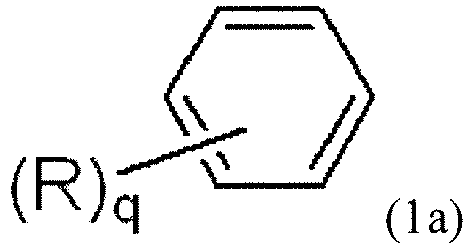
- a ring I represents an aromatic hydrocarbon ring represented by the formula (1a) to be fused to adjacent rings at arbitrary positions
- a ring II represents a heterocycle represented by the formula (1b) to be fused to adjacent rings at arbitrary positions.
- Ls each independently represent a substituted or unsubstituted aromatic hydrocarbon group having 6 to 18 carbon atoms, or a substituted or unsubstituted aromatic heterocyclic group having 3 to 17 carbon atoms, and r represents an integer of from 1 to 4; provided that at least one of Ls represents a fused heterocyclic group formed of two to four rings .
- Rs each independently represent an aliphatic hydrocarbon group having 1 to 10 carbon atoms, an aromatic hydrocarbon group having 6 to 18 carbon atoms, or an aromatic heterocyclic group having 3 to 17 carbon atoms
- ps each independently represent an integer of from 0 to 4
- q represents an integer of from 0 to 2.
- X 1 to X 4 each independently represent an aromatic hydrocarbon group having 6 to 18 carbon atoms or an aromatic heterocyclic group having 3 to 17 carbon atoms
- 1 and m each independently represent an integer of from 0 to 5
- n represents an integer from 1 to 5.
- X 2 s, X 3 s, or X 4 s may be identical to or different from each other, wherein the total number of X 1 to X 4 in the formula (1b) is from 4 to 7.
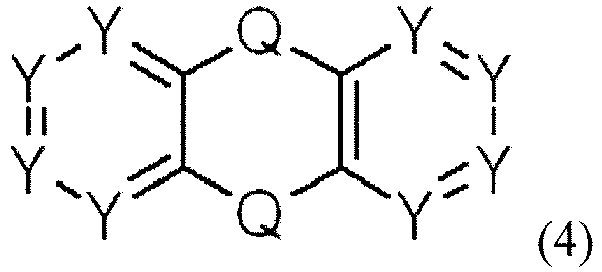
- At least one of Ls preferably represents a monovalent aromatic heterocyclic group represented by any one of the following formulae (2) and (3), and more preferably represents a monovalent aromatic heterocyclic group represented by a compound represented by the following formula (4).
- Ys each independently represent methine, substituted methine, or nitrogen, and one of Ys represents a carbon atom providing a monovalent group
- Zs each independently represent any one of a single bond, -S-, -O-, and N(Ar)-
- Qs each represent any one of a single bond, -S-, and O-.
- At least one of Ys in the formula (2), at least one of Ys and Zs in the formula (3), and at least one of Ys and Qs in the formula (4) each represent a heteroatom.
- Ar represents an aromatic hydrocarbon group having 6 to 18 carbon atoms or an aromatic heterocyclic group having 6 to 17 carbon atoms.
- one of Zs in the formula (3), or one of Qs in the formula (4) represent a single bond, and the other represent -S- or -O.
- At least one L out of Ls in the general formula (1) more preferably represents a substituted or unsubstituted dibenzofuranyl or dibenzothiophenyl group.
- the total number of X 1 to X 4 in the formula (1b) falls within the range of from 4 to 7.
- the organic layer containing the indolocarbazole compound includes a light-emitting layer containing a phosphorescent light-emitting dopant.
- An organic electroluminescent device of the present invention contains an indolocarbazole compound represented by the general formula (1) (hereinafter sometimes referred to as "compound represented by the general formula (1)” or “indolocarbazole compound”) in at least one organic layer.
- a ring I represents an aromatic hydrocarbon ring represented by the formula (1a) to be fused to adjacent rings at arbitrary positions
- a ring II represents a heterocycle represented by the formula (1b) to be fused to adjacent rings at arbitrary positions.
- the aromatic hydrocarbon ring represented by the formula (1a) may be fused with two adjacent rings at arbitrary positions, but there is a position at which the aromatic hydrocarbon ring cannot be fused with the rings from the structural viewpoint.
- the aromatic hydrocarbon ring represented by the formula (1a) has six sides, and is not fused with the two adjacent rings through two adjacent sides.
- the heterocycle represented by the formula (1b) may be fused with two adjacent rings at arbitrary positions, but there is a position at which the heterocycle cannot be fused with the rings from the structural viewpoint.
- the heterocycle represented by the formula (1b) has five sides, and is not fused with the two adjacent rings through two adjacent sides and is not fused with an adjacent ring through a side including a nitrogen atom.
- the indolocarbazole skeleton there is a limitation on the kind of the indolocarbazole skeleton.
- an indole skeleton can be fused at the 2,3-positions, 3,4-positions, or 4,5-positions of a carbazole skeleton, and hence five kinds of skeletal isomers exist.
- the indolocarbazole skeleton is preferably represented by any one of the following forms. Preferred fusion positions of the aromatic hydrocarbon ring and the heterocycle in the indolocarbazole skeleton are understood from these examples.
- As each represent C-R or N.
- at least one of As represents N.
- One to three of As each preferably represent N.
- Ls each independently represent a substituted or unsubstituted aromatic hydrocarbon group having 6 to 18 carbon atoms, or a substituted or unsubstituted aromatic heterocyclic group having 3 to 17 carbon atoms, and at least one of Ls represents a two- to four-ring fused heterocyclic group.
- L represents an unsubstituted aromatic hydrocarbon group having 6 to 18 carbon atoms or an unsubstituted aromatic heterocyclic group having 3 to 17 carbon atoms
- a specific example thereof is a group produced by removing hydrogen from an aromatic ring such as benzene, pentalene, indene, naphthalene, anthracene, phenanthrene, pyrrole, imidazole, pyrazole, thiazole, thiophene, pyridine, pyrazine, pyrimidine, pyridazine, triazine, isoindole, indazole, purine, benzimidazole, indolizine, chromene, benzoxazole, isobenzofuran, quinolizine, isoquinoline, imidazole, naphthyridine, phthalazine, quinazoline, quinoxaline, cinnoline, quinoline, pteridine, perimidine
- L represents the fused heterocyclic group formed of two to four rings
- specific examples thereof include groups produced by removing hydrogen atoms from fused heterocycles in the aromatic rings appearing in the description of L.
- the group is more preferably, for example, a monovalent aromatic heterocyclic group represented by any one of the formulae (2) to (4).
- Ys each independently represent methine, substituted methine, or nitrogen
- one of Ys represents a carbon atom (C)
- the carbon atom providing a radical enabling the group to become a monovalent group
- Zs each represent any one of a single bond, -S-, -O-, and N(Ar)-
- Qs each represent any one of a single bond, -S-, and -O-.
- the formulae (2) to (4) each represent a fused heterocyclic group containing at least one heteroatom.
- Ar represents an aromatic hydrocarbon group having 6 to 18 carbon atoms or an aromatic heterocyclic group having 6 to 17 carbon atoms.
- a substituent in the case where Y represents substituted methine is preferably an alkyl group having 1 to 10 carbon atoms, a cycloalkyl group having 3 to 11 carbon atoms, an aromatic hydrocarbon group having 6 to 18 carbon atoms, or an aromatic heterocyclic group having 3 to 17 carbon atoms, more preferably an alkyl group having 1 to 4 carbon atoms, a cycloalkyl group having 3 to 7 carbon atoms, an aromatic hydrocarbon group having 6 to 12 carbon atoms, or an aromatic heterocyclic group having 3 to 12 carbon atoms.
- Preferred specific examples thereof include: an alkyl group having 1 to 6 carbon atoms such as a methyl group, an ethyl group, or a propyl group; a cycloalkyl group having 6 to 8 carbon atoms such as a cyclohexyl group or a methylcyclohexyl group; an aromatic hydrocarbon group having 6 to 12 carbon atoms such as a phenyl group or a naphthyl group; and an aromatic heterocyclic group having 3 to 12 carbon atoms such as a pyridyl group, a pyrimidyl group, a triazyl group, a carbazolyl group, a dibenzofuranyl group, or a dibenzothiophenyl group.
- a phenyl group, a pyridyl group, a pyrimidyl group, a triazyl group, a carbazolyl group, a dibenzofuranyl group, or a dibenzothiophenyl group is more preferred.
- r represents an integer of from 1 to 4, preferably an integer of from 1 to 3, more preferably an integer of from 1 to 2.
- any one of a substituted or unsubstituted dibenzothiophenyl group, and a substituted or unsubstituted dibenzofuranyl group is particularly preferred.
- a substituent in the case where the dibenzothiophenyl group or the dibenzofuranyl group has the substituent is the same as the substituent described for the case where Y represents substituted methine.
- Rs each independently represent an alkyl group having 1 to 10 carbon atoms, a cycloalkyl group having 3 to 11 carbon atoms, an aromatic hydrocarbon group having 6 to 18 carbon atoms, or an aromatic heterocyclic group having 3 to 17 carbon atoms.
- an alkyl group having 1 to 4 carbon atoms, a cycloalkyl group having 3 to 7 carbon atoms, an aromatic hydrocarbon group having 6 to 12 carbon atoms, or an aromatic heterocyclic group having 3 to 12 carbon atoms is preferred, and preferred specific examples thereof include a methyl group, an ethyl group, a propyl group, a cyclohexyl group, a methylcyclohexyl group, a phenyl group, a naphthyl group, a pyridyl group, a pyrimidyl group, a triazyl group, and a carbazolyl group.
- R represents an aromatic hydrocarbon group or an aromatic heterocyclic group
- the group may have a substituent, and examples of the substituent include an alkyl group having 1 to 10 carbon atoms, a cycloalkyl group having 3 to 11 carbon atoms, an alkoxy group having 1 to 2 carbon atoms, an acetyl group, a secondary amino group having 6 to 18 carbon atoms, a secondary phosphanyl group having 6 to 18 carbon atoms, a silyl group having 3 to 18 carbon atoms, an aromatic hydrocarbon group having 6 to 18 carbon atoms, and an aromatic heterocyclic group having 3 to 17 carbon atoms.
- an alkyl group having 1 to 4 carbon atoms, a cycloalkyl group having 3 to 7 carbon atoms, an aromatic hydrocarbon group having 6 to 12 carbon atoms, or an aromatic heterocyclic group having 3 to 12 carbon atoms is preferred, and preferred specific examples thereof include a methyl group, an ethyl group, a propyl group, a cyclohexyl group, a methylcyclohexyl group, a phenyl group, a naphthyl group, a pyridyl group, a pyrimidyl group, a triazyl group, and a carbazolyl group.
- a methyl group, an ethyl group, a phenyl group, or a pyridyl group is more preferred.
- ps each independently represent an integer of from 0 to 4 and q represents an integer of from 0 to 2.
- ps and q each preferably represent 0 or 1, and the total number of Rs preferably falls within the range of from 0 to 3.
- X 1 to X 4 each represent an aromatic hydrocarbon group having 6 to 18 carbon atoms or an aromatic heterocyclic group having 3 to 17 carbon atoms.
- aromatic hydrocarbon group or aromatic heterocyclic group may be a single ring or a fused ring, but is not a group in which aromatic groups are linked in a chain manner.
- X 2 represents a group linked to X 1
- X 3 represents a group linked to X 2
- X 4 represents a group linked to X 3
- X 4 represents a monovalent group
- X 1 to X 3 represent groups that are monovalent or more determined by the numbers of n, m, and l.
- Specific examples of the aromatic hydrocarbon group having 6 to 18 carbon atoms or aromatic heterocyclic group having 3 to 17 carbon atoms represented by each of X 1 to X 4 include groups that are monovalent or more obtained by removing predetermined numbers of hydrogen atoms from aromatic rings given in the foregoing as the specific examples of the aromatic hydrocarbon group having 6 to 18 carbon atoms or aromatic heterocyclic group having 3 to 17 carbon atoms represented by L.
- l and m each represent an integer of from 0 to 5, preferably an integer of from 0 to 3.
- the total number of X 1 to X 4 is from 4 to 7, preferably from 5 to 7.
- X 2 s, X 3 s, or X 4 s may be identical to or different from each other.
- Examples of the formula -X 1 -[X 2 - ⁇ X 3 -(X 4 ) l ⁇ m ] n in the case where the total number of X 1 to X 4 is 2 or more include the following formulae. -X 1 -X 2 -X 3 (5)
- X 1 to X 4 each represent an aromatic hydrocarbon group or an aromatic heterocyclic group, and part or the entirety thereof may be a fused ring.
- R' represents an aromatic hydrocarbon group having 6 to 18 carbon atoms or an aromatic heterocyclic group having 3 to 17 carbon atoms.
- aromatic hydrocarbon group having 6 to 18 carbon atoms or the aromatic heterocyclic group having 3 to 17 carbon atoms include the same examples as those described for A.
- a skeleton represented by any one of the formulae (IC-1) to (IC-4) is available as a preferred skeleton of the indolocarbazole compound represented by the general formula (1).
- the general formula (1) is a concept comprehending the skeletons represented by the formulae (IC-1) to (IC-4), and these skeletons can be described by taking the compound represented by the general formula (1) as a typical example.
- Such skeletons as represented in the forms of the formulae (IC-1) to (IC-4) are each conceivable as the skeleton of the indolocarbazole compound represented by the general formula (1), and these skeletons can each be synthesized by employing a known approach from a raw material selected in accordance with the structure of a target compound.
- the indolocarbazole skeleton represented by the formula (IC-1) can be synthesized by the following reaction formula with reference to a synthesis example described in Synlett, 2005, No. 1, p42-48 .
- indolocarbazole skeleton represented by the formula (IC-3) can be synthesized by the following reaction formula with reference to a synthesis example described in Archiv der Pharmazie (Weinheim, Germany) 1987, 320(3), p280-2 .
- indolocarbazole compound represented by the general formula (1) Specific examples of the indolocarbazole compound represented by the general formula (1) are shown below. However, the material for an organic electroluminescent device of the present invention is not limited thereto.
- the indolocarbazole compound represented by the general formula (1) is contained in at least one of a plurality of organic layers of an organic EL device formed by laminating an anode, the plurality of organic layers, and a cathode on a substrate, an excellent organic electroluminescent device is provided.
- a phosphorescent light-emitting layer, a hole-transporting layer, an electron-transporting layer, a hole-blocking layer, or an electron-blocking layer is suitable as the organic layer in which the indolocarbazole compound is contained. It is more preferred that the indolocarbazole compound be contained as a host material in a light-emitting layer containing a phosphorescent light-emitting dopant.
- the organic EL device of the present invention has organic layers including at least one light-emitting layer between an anode and a cathode laminated on a substrate. In addition, at least one of the organic layers contains the indolocarbazole compound.
- the material for an organic electroluminescent device of the present invention is advantageously contained in the light-emitting layer together with a phosphorescent light-emitting dopant.
- FIG. 1 is a sectional view illustrating a structure example of a general organic EL device used in the present invention.
- Reference numeral 1 represents a substrate
- reference numeral 2 represents an anode
- reference numeral 3 represents a hole-injecting layer
- reference numeral 4 represents a hole-transporting layer
- reference numeral 5 represents a light-emitting layer
- reference numeral 6 represents an electron-transporting layer
- reference numeral 7 represents a cathode.
- the organic EL device of the present invention may have an exciton-blocking layer adjacent to the light-emitting layer, or may have an electron-blocking layer between the light-emitting layer and the hole-injecting layer.
- the exciton-blocking layer may be inserted on any of the anode side and the cathode side of the light-emitting layer, and may also be inserted simultaneously on both sides.
- the organic EL device of the present invention has the substrate, the anode, the light-emitting layer, and the cathode as its essential layers.
- the organic EL device of the present invention preferably has a hole-injecting/transporting layer and an electron-injecting/transporting layer in addition to the essential layers, and more preferably has a hole-blocking layer between the light-emitting layer and the electron-injecting/transporting layer.
- the hole-inj ecting/transporting layer means any one or both of the hole-injecting layer and the hole-transporting layer
- the electron-injecting/transporting layer means any one or both of an electron-injecting layer and the electron-transporting layer.
- the organic EL device of the present invention is preferably supported by a substrate.
- the substrate is not particularly limited, and any substrate that has long been conventionally used for an organic EL device may be used.
- a substrate made of glass, a transparent plastic, quartz, or the like may be used.
- anode in the organic EL device is an anode formed by using, as an electrode substance, any of a metal, an alloy, an electrically conductive compound, and a mixture thereof, all of which have a large work function (4 eV or more).
- electrode substance include metals such as Au and conductive transparent materials such as CuI, indium tin oxide (ITO), SnO 2 , and ZnO.
- ITO indium tin oxide
- ZnO ZnO
- IDIXO In 2 O 3 -ZnO
- any of those electrode substances into a thin film by using a method such as vapor deposition or sputtering and form a pattern having a desired shape thereon by photolithography.
- a pattern may be formed via a mask having a desired shape when any of the above-mentioned electrode substances is subjected to vapor deposition or sputtering.
- a coatable substance such as an organic conductive compound
- it is also possible to use a wet film-forming method such as a printing method or a coating method.
- the transmittance of the anode is desirably controlled to more than 10%.
- the sheet resistance as the anode is preferably several hundred ⁇ / ⁇ or less.
- the thickness of the resultant film is, depending on the material used, selected from usually the range of from 10 to 1,000 nm, preferably the range of from 10 to 200 nm.
- a cathode used as the cathode is a cathode formed by using, as an electrode substance, any of a metal (referred to as electron-injecting metal), an alloy, an electrically conductive compound, and a mixture thereof, all of which have a small work function (4 eV or less).
- a metal referred to as electron-injecting metal
- an alloy referred to as electron-injecting metal
- an electrically conductive compound referred to as electrically conductive compound
- a mixture thereof all of which have a small work function (4 eV or less.
- Specific examples of such electrode substance include sodium, a sodium-potassium alloy, magnesium, lithium, a magnesium/copper mixture, a magnesium/silver mixture, a magnesium/aluminum mixture, a magnesium/indium mixture, an aluminum/aluminum oxide (Al 2 O 3 ) mixture, indium, a lithium/aluminum mixture, and a rare earth metal.
- a mixture of an electron-injecting metal and a second metal as a stable metal having a larger work function value than the former metal such as a magnesium/silver mixture, a magnesium/aluminum mixture, a magnesium/indiummixture, an aluminum/aluminum oxide (Al 2 O 3 ) mixture, or a lithium/aluminum mixture, or aluminum is suitable from the viewpoints of electron-injecting property and durability against oxidation or the like.
- the cathode may be produced by forming any of those electrode substances into a thin film by using a method such as vapor deposition or sputtering.
- the sheet resistance as the cathode is preferably several hundred ⁇ / ⁇ or less, and the thickness of the resultant film is selected from usually the range of from 10 nm to 5 ⁇ m, preferably the range of from 50 to 200 nm. It should be noted that, in order for luminescence produced to pass through, any one of the anode and cathode of the organic EL device is preferably transparent or semi-transparent, because the light emission luminance improves.
- any of the above-mentioned metals is formed into a film having a thickness of from 1 to 20 nm as a cathode
- any of the conductive transparent materials mentioned in the description of the anode is formed into a film on the cathode, thereby being able to produce a transparent or semi-transparent cathode. Then, by applying this, it is possible to produce a device in which both the anode and cathode have transparency.
- the light-emitting layer is a phosphorescent light-emitting layer, and contains a phosphorescent light-emitting dopant and a host material. It is recommended to use, as a material for the phosphorescent light-emitting dopant, a material containing an organic metal complex including at least one metal selected from ruthenium, rhodium, palladium, silver, rhenium, osmium, iridium, platinum, and gold. Specific examples thereof include, but not limited to, the compounds disclosed in the following patent publications.
- Preferred examples of the phosphorescent light-emitting dopant include complexes such as Ir(ppy)3, complexes such as Ir(bt)2 ⁇ acac3, and complexes such as PtOEt3, the complexes each having a noble metal element such as Ir as a central metal. Specific examples of those complexes are shown below, but the complexes are not limited to the compounds described below.
- the content of the phosphorescent light-emitting dopant in the light-emitting layer be in the range of from 2 to 40 wt%, preferably from 5 to 30 wt%.
- the indolocarbazole compound represented by the general formula (1) it is preferred to use, as a host material in the light-emitting layer, the indolocarbazole compound represented by the general formula (1).
- the material to be used in the light-emitting layer may be another host material other than the indolocarbazole compound, or the indolocarbazole compound and any other host material may be used in combination.
- a plurality of kinds of known host materials may be used in combination.
- a compound that has a hole-transporting ability or an electron-transporting ability is capable of preventing luminescence from having a longer wavelength, and has a high glass transition temperature.
- Such other host materials are known because they are mentioned in many patent literatures and the like, and hence a suitable host material may be chosen from those in the patent literatures and the like.
- Specific examples of the host material include, but are not particularly limited to, an indole derivative, a carbazole derivative, a triazole derivative, an oxazole derivative, an oxadiazole derivative, an imidazole derivative, a polyarylalkane derivative, a pyrazoline derivative, a pyrazolone derivative, a phenylenediamine derivative, an arylamine derivative, an amino-substituted chalcone derivative, a styrylanthracene derivative, a fluorenone derivative, a hydrazone derivative, a stilbene derivative, a silazane derivative, an aromatic tertiary amine compound, a styrylamine compound, an aromatic dimethylidene-based compound, a porphyrin-based compound, an anthraquinod
- the injecting layer refers to a layer formed between an electrode and an organic layer for the purpose of lowering a driving voltage and improving light emission luminance, and includes a hole-injecting layer and an electron-injecting layer.
- the injecting layer may be interposed between the anode and the light-emitting layer or the hole-transporting layer, or may be interposed between the cathode and the light-emitting layer or the electron-transporting layer.
- the injecting layer may be formed as required.
- the hole-blocking layer has, in a broad sense, the function of an electron-transporting layer, and is formed of a hole-blocking material that has a remarkably small ability to transport holes while having a function of transporting electrons, and hence the hole-blocking layer is capable of improving the probability of recombining an electron and a hole by blocking holes while transporting electrons.
- the indolocarbazole compound represented by the general formula (1) for the hole-blocking layer.
- a known material for a hole-blocking layer may be used.
- the electron-blocking layer is formed of a material that has a remarkably small ability to transport electrons while having a function of transporting holes, and hence the electron-blocking layer is capable of improving the probability of recombining an electron and a hole by blocking electrons while transporting holes .
- the indolocarbazole compound represented by the general formula (1) according to the present invention can be used as a material for the electron-blocking layer, another material, i.e., any of the below-mentioned materials for the hole-transporting layer can be used as required.
- the thickness of the electron-blocking layer is preferably from 3 to 100 nm, more preferably from 5 to 30 nm.
- the exciton-blocking layer refers to a layer used for blocking excitons produced by the recombination of a hole and an electron in the light-emitting layer from diffusing into charge-transporting layers. Inserting this layer enables effective confinement of the excitons in the light-emitting layer, thereby being able to improve the luminous efficiency of the device.
- the exciton-blocking layer may be inserted on any of the anode side and the cathode side of the adjacent light-emitting layer, and may also be inserted simultaneously on both sides.
- indolocarbazole compound represented by the general formula (1) can be used as a material for the exciton-blocking layer, as other materials therefor, there are given, for example, 1,3-dicarbazolylbenzene (mCP) and bis(2-methyl-8-quinolinolato)-4-phenylphenolatoaluminum(III) (BAlq) .
- mCP 1,3-dicarbazolylbenzene
- BAlq bis(2-methyl-8-quinolinolato)-4-phenylphenolatoaluminum(III)
- the hole-transporting layer is formed of a hole-transporting material having a function of transporting holes, and a single hole-transporting layer or a plurality of hole-transporting layers may be formed.
- the hole-transporting material has hole-injecting property or hole-transporting property or has electron-blocking property, and any of an organic material and an inorganic material may be used as the hole-transporting material.
- any compound selected from conventionally known compounds may be used.
- Examples of the known hole-transporting material include a triazole derivative, an oxadiazole derivative, an imidazole derivative, a polyarylalkane derivative, a pyrazoline derivative, and a pyrazolone derivative, a phenylenediamine derivative, an arylamine derivative, an amino-substituted chalcone derivative, an oxazole derivative, a styrylanthracene derivative, a fluorenone derivative, a hydrazone derivative, a stilbene derivative, a silazane derivative, an aniline-based copolymer, and a conductive high-molecular weight oligomer, inparticular, a thiophene oligomer.
- a porphyrin compound, an aromatic tertiary amine compound, or a styrylamine compound is preferably used, and an aromatic tertiary amine compound is more preferably used.
- the electron-transporting layer is formed of a material having a function of transporting electrons, and a single electron-transporting layer or a plurality of electron-transporting layers may be formed.
- An electron-transporting material (which also serves as a hole-blocking material in some cases) has only to have a function of transferring electrons injected from the cathode into the light-emitting layer.
- any compound selected from conventionally known compounds may be used. Examples thereof include a nitro-substituted fluorene derivative, a diphenylquinone derivative, a thiopyran dioxide derivative, a carbodiimide, a fluorenylidenemethane derivative, anthraquinodimethane, an anthrone derivative, and an oxadiazole derivative.
- a thiadiazole derivative prepared by substituting an oxygen atom on an oxadiazole ring with a sulfur atom in the oxadiazole derivative and a quinoxaline derivative that has a quinoxaline ring known as an electron withdrawing group.
- a polymer material in which any of those materials is introduced in a polymer chain or is used as a polymer main chain. Examples
- the filtrate was transferred to a 2,000-ml separating funnel, and was fractionated into an organic layer and an aqueous layer.
- the organic layer was washed with 500 ml of water three times, and then the resultant organic layer was dried with magnesium sulfate . Once magnesium sulfate was separated by filtration and then the solvent was distilled off under reduced pressure. After that, the residue was purified by column chromatography to provide 13.7 g (0.041 mol, yield: 40.6%) of Intermediate A as a white solid.
- reaction solution was cooled to -40°C, a solution prepared by dissolving 37.4 g (0.17 mol) of 2,4-dichloro-6-phenyl-1,3,5-triazine in 200 ml of dry N,N-dimethylformamide was dropped to the reaction solution, and the mixture was continuously stirred at room temperature for 5 hr.
- 1,000 ml of distilled water and 200 ml of methanol were charged into the flask, and the mixture was stirred at room temperature for 1 hr. After that, the precipitated yellow solid was taken by filtration.
- FIG. 2 shows the results of its 1H-NMR measurement (measurement solvent: THF-d8).
- a nydrogen chloride gas generated by dropping 112. 0 g (1.10 mol) of concentrated hydrochloric acid to 211.7 g (2.16 mol) of concentrated sulfuric acid over 1 hr was blown into a solution of 20.0 g (0.17 mol) of indole in 300 ml of dry diethyl ether while the solution was stirred at room temperature. After the reaction solution had been stirred at room temperature for 15 hr, 121.0 g of ethyl acetate and 303.2 g of a saturated aqueous solution of sodium hydrogen carbonate were added to the solution.
- FIG. 3 shows the results of its 1H-NMR measurement (measurement solvent: THF-d8).
- Each thin film was laminated by a vacuum deposition method at a degree of vacuum of 4.0 ⁇ 10 -5 Pa on a glass substrate on which an anode formed of an ITO substrate having a thickness of 110 nm had been formed.
- CuPC copper phthalocyanine
- NPB 4,4'-bis[N-(1-naphthyl)-N-phenylamino]biphenyl
- Compound (A-81) as a host material and tris (2-phenylpyridine) iridium (III) (Ir(ppy) 3 ) as a phosphorescent light-emitting dopant were co-deposited from different deposition sources onto the hole-transporting layer to form a light-emitting layer having a thickness of 40 nm.
- the concentration of Ir(ppy) 3 in the light-emitting layer was 10.0 wt%.
- tris(8-hydroxyquinolinato)aluminum(III) (Alq3) was formed into a layer having a thickness of 20 nm to serve as an electron-transporting layer.
- lithium fluoride (LiF) was formed into a layer having a thickness of 1.0 nm to serve as an electron-injecting layer on the electron-transporting layer.
- aluminum (Al) was formed into a layer having a thickness of 70 nm to serve as an electrode on the electron-injecting layer.
- An organic EL device was produced in the same manner as in Example 1 except that CBP was used as the host material for the light-emitting layer.
- An organic EL device was produced in the same manner as in Example 1 except that the following compound Ho-1 was used as the host material for the light-emitting layer.
- An organic EL device was produced in the same manner as in Example 1 except that the follwing compound Ho-2 was used as the host material for the light-emitting layer.
- Table 1 shows a compound used as a host material and the total of X 1 to X 4 in the formula (1b) of the compound as an X number. Table 1 shows the respective light-emitting characteristics at 20 mA/cm 2 .
- the X number is the total number of X 1 to. X 4 . Only the compounds according to examples 2-5, 7, 8, 10, 12, 13 and 16 have an X number of 4 to 7 and therefore fall under the scope of claim 1.
- the organic EL device using the indolocarbazole compound represented by the general formula (1) shows good light-emitting characteristics as compared with the case where CBP generally known as a phosphorescent host is used. It is also found that the device shows good light-emitting characteristics as compared with those in the case where any one of Ho-1 and Ho-2 as compounds each having a nitrogen-containing six-membered ring on the N of indolocarbazole and having a substituent that is not a fused heterocyclic group at an end of the ring is used. The superiority of the organic EL device using the indolocarbazole compound is apparent from the foregoing.
- the indolocarbazole compound to be used in the organic electroluminescent device of the present invention has a nitrogen-containing six-membered ring group on one of the two Ns of its indolocarbazole skeleton, and has a fused heterocyclic group as a substituent on the nitrogen-containing six-membered ring. Probably because of the foregoing, the compound shows good hole- and electron-injecting/transporting characteristics, and has high durability while maintaining a high T1.
- the fused heterocyclic group is a dibenzofuranyl group or a dibenzothiophenyl group
- a LUMO orbital expands on the nitrogen-containing six-membered ring and the dibenzofuran ring or the dibenzothiophene ring, and hence the compound can be expected to show good electron-transporting property.
- changing the kinds or number of aromatic rings as substituents on the other N enables the fine adjustment of the rates at which a hole and an electron transfer, and the control of the various energy values, i.e., IP, EA, and T1.
- the organic EL device using the indolocarbazole compound can realize a carrier balance optimum for various dopants in its light-emitting layer.
- an organic EL device significantly improved in light-emitting characteristics can be provided.
- the indolocarbazole compound can be improved in stability in each of active states, i.e., oxidation, reduction, and excitation, and at the same time, has a good amorphous characteristic. Accordingly, the compound can realize an organic EL device having a long driving lifetime and high durability.
- the organic EL device according to the present invention has light-emitting characteristics, driving lifetime, and durability at practically satisfactory levels.
- the organic EL device has a large technical value in applications to flat panel displays (display devices for portable phones, in-vehicle display devices, display devices for OA computers, televisions, and the like), light sources utilizing characteristics of planar light emitters (light sources in lighting equipment and copying machines and backlight sources in liquid crystal displays and instruments), sign boards, sign lamps, and the like.
Landscapes
- Chemical & Material Sciences (AREA)
- Organic Chemistry (AREA)
- Engineering & Computer Science (AREA)
- Materials Engineering (AREA)
- Physics & Mathematics (AREA)
- Spectroscopy & Molecular Physics (AREA)
- Optics & Photonics (AREA)
- Electroluminescent Light Sources (AREA)
- Nitrogen Condensed Heterocyclic Rings (AREA)
Claims (6)
- Eine organische Elektrolumineszenzvorrichtung, umfassend eine Anode, eine Mehrzahl organischer Schichten, die eine phosphoreszierende lichtemittierende Schicht einschließen, und eine Kathode, laminiert auf ein Substrat, wobei mindestens eine der Mehrzahl organischer Schichten, die aus der Gruppe bestehend aus der phosphoreszierenden lichtemittierenden Schicht, einer lochtransportierenden Schicht, einer elektronentransportierenden Schicht und einer lochblockierenden Schicht ausgewählt ist, eine durch die allgemeine Formel (1) dargestellte Indolocarbazolverbindung enthält:

 ein Ring I einen durch die Formel (1a) dargestellten aromatischen Kohlenwasserstoffring bedeutet, der an benachbarte Ringe an beliebigen Positionen zu kondensieren ist, undein Ring II einen durch die Formel (1b) dargestellten Heterocyclus bedeutet, der an benachbarte Ringe an beliebigen Positionen zu kondensieren ist;A jeweils C-R oder N bedeutet und mindestens ein A gleich N bedeutet; undL jeweils unabhängig einen substituierten oder unsubstituierten aromatischen Kohlenwasserstoffrest mit 6 bis 18 Kohlenstoffatomen oder einen substituierten oder unsubstituierten aromatischen heterocyclischen Rest mit 3 bis 17 Kohlenstoffatomen bedeutet,r eine ganze Zahl von 1 bis 4 darstellt undmindestens ein L einen kondensierten heterocyclischen Rest, gebildet aus zwei bis vier Ringen, bedeutet;in der allgemeinen Formel (1) und der Formel (1a) R jeweils unabhängig einen aliphatischen Kohlenwasserstoffrest mit 1 bis 10 Kohlenstoffatomen, einen aromatischen Kohlenwasserstoffrest mit 6 bis 18 Kohlenstoffatomen oder einen aromatischen heterocyclischen Rest mit 3 bis 17 Kohlenstoffatomen bedeutet,p jeweils unabhängig eine ganze Zahl von 0 bis 4 darstellt undq eine ganze Zahl von 0 bis 2 darstellt;in der Formel (1b) X1 bis X4 jeweils unabhängig einen aromatischen Kohlenwasserstoffrest mit 6 bis 18 Kohlenstoffatomen oder einen aromatischen heterocyclischen Rest mit 3 bis 17 Kohlenstoffatomen bedeuten,n eine ganze Zahl von 1 bis 5 darstellt,l und m jeweils unabhängig eine ganze Zahl von 0 bis 5 darstellen, und wenn 1, m oder n 2 oder mehr darstellen, X2, X3 oder X4 gleich oder voneinander verschieden sein können, dadurch gekennzeichnet, dass die Gesamtzahl an X1 bis X4 in der Formel (1b) 4 bis 7 beträgt.
 - Eine organische Elektrolumineszenzvorrichtung nach Anspruch 1, wobei mindestens ein L in der allgemeinen Formel (1) einen einwertigen aromatischen heterocyclischen Rest, dargestellt durch eine der folgenden Formeln (2) und (3), bedeutet:

 Y jeweils unabhängig Methin, substituiertes Methin oder Stickstoff bedeutet und ein Y ein Kohlenstoffatom bedeutet, das einen einwertigen Rest bereitstellt,Z jeweils unabhängig eines aus einer Einfachbindung, -S-, -O- und N(Ar)- bedeutet, mindestens ein Y in der Formel (2) ein Heteroatom darstellt,mindestens eines von Y und Z in der Formel (3) ein Heteroatom darstellt undAr einen aromatischen Kohlenwasserstoffrest mit 6 bis 18 Kohlenstoffatomen oder einen aromatischen heterocyclischen Rest mit 6 bis 17 Kohlenstoffatomen darstellt.
 - Eine organische Elektrolumineszenzvorrichtung nach Anspruch 1, wobei mindestens ein L in der allgemeinen Formel (1) einen einwertigen aromatischen heterocyclischen Rest, dargestellt durch die folgende Formel (4), bedeutet:
 Y jeweils unabhängig Methin, substituiertes Methin oder Stickstoff bedeutet und ein Y ein Kohlenstoffatom bedeutet, das einen einwertigen Rest bereitstellt,Q jeweils unabhängig eines aus einer Einfachbindung, -S- und -O- bedeutet und mindestens eines von Y und Q ein Heteroatom darstellt.
 - Eine organische Elektrolumineszenzvorrichtung nach Anspruch 1, wobei mindestens ein L in der allgemeinen Formel (1) einen substituierten oder unsubstituierten Dibenzofuranyl- oder Dibenzothiophenylrest darstellt.
- Eine organische Elektrolumineszenzvorrichtung nach Anspruch 1, wobei eine Gesamtzahl an X1 bis X4 in der Formel (1b) 5 bis 7 beträgt.
- Eine organische Elektrolumineszenzvorrichtung nach einem der Ansprüche 1 bis 5, wobei die organische Schicht, welche die durch die allgemeine Formel (1) dargestellte Indolocarbazolverbindung enthält, eine lichtemittierende Schicht umfasst, die ein phosphoreszierendes lichtemittierendes Dotierungsmittel enthält.
Applications Claiming Priority (2)
| Application Number | Priority Date | Filing Date | Title |
|---|---|---|---|
| JP2012055107 | 2012-03-12 | ||
| PCT/JP2013/055368 WO2013137001A1 (ja) | 2012-03-12 | 2013-02-28 | 有機電界発光素子 |
Publications (3)
| Publication Number | Publication Date |
|---|---|
| EP2827397A1 EP2827397A1 (de) | 2015-01-21 |
| EP2827397A4 EP2827397A4 (de) | 2016-01-20 |
| EP2827397B1 true EP2827397B1 (de) | 2019-04-03 |
Family
ID=49160917
Family Applications (1)
| Application Number | Title | Priority Date | Filing Date |
|---|---|---|---|
| EP13760617.4A Active EP2827397B1 (de) | 2012-03-12 | 2013-02-28 | Organisches elektrolumineszenzelement |
Country Status (7)
| Country | Link |
|---|---|
| US (1) | US9985219B2 (de) |
| EP (1) | EP2827397B1 (de) |
| JP (1) | JP6140146B2 (de) |
| KR (1) | KR102005723B1 (de) |
| CN (1) | CN104160525B (de) |
| TW (1) | TWI526519B (de) |
| WO (1) | WO2013137001A1 (de) |
Families Citing this family (47)
| Publication number | Priority date | Publication date | Assignee | Title |
|---|---|---|---|---|
| EP2930762B1 (de) * | 2012-12-10 | 2020-09-16 | Konica Minolta, Inc. | Material für ein organisches elektrolumineszenzelement, organisches elektrolumineszenzelement, beleuchtungsvorrichtung und anzeigevorrichtung |
| US10985329B2 (en) * | 2013-12-17 | 2021-04-20 | Samsung Electronics Co., Ltd. | Condensed cyclic compound and organic light-emitting device including the same |
| US9812654B2 (en) * | 2014-06-18 | 2017-11-07 | E-Ray Optoelectronics Technology Co., Ltd. | Phosphorescent materials for organic electroluminescent devices |
| US10882890B2 (en) * | 2014-07-25 | 2021-01-05 | Academia Sinica | Bipartite molecules and uses thereof in treating diseases associated with abnormal protein aggregates |
| JP6383623B2 (ja) * | 2014-09-29 | 2018-08-29 | 新日鉄住金化学株式会社 | 有機電界発光素子 |
| JP6378993B2 (ja) * | 2014-09-29 | 2018-08-22 | 新日鉄住金化学株式会社 | 有機電界発光素子 |
| WO2016084962A1 (ja) * | 2014-11-28 | 2016-06-02 | 出光興産株式会社 | 化合物、有機エレクトロルミネッセンス素子用材料、有機エレクトロルミネッセンス素子および電子機器 |
| CN104538559B (zh) * | 2014-12-31 | 2017-10-10 | 北京维信诺科技有限公司 | 一种具有rgb像素区的有机电致发光显示装置 |
| JP5831654B1 (ja) * | 2015-02-13 | 2015-12-09 | コニカミノルタ株式会社 | 芳香族複素環誘導体、それを用いた有機エレクトロルミネッセンス素子、照明装置及び表示装置 |
| JPWO2016129691A1 (ja) * | 2015-02-13 | 2017-11-24 | 出光興産株式会社 | 化合物、組成物、有機エレクトロルミネッセンス素子、および電子機器 |
| US20160293855A1 (en) | 2015-04-06 | 2016-10-06 | Universal Display Corporation | Organic Electroluminescent Materials and Devices |
| US11818949B2 (en) | 2015-04-06 | 2023-11-14 | Universal Display Corporation | Organic electroluminescent materials and devices |
| US11495749B2 (en) | 2015-04-06 | 2022-11-08 | Universal Display Corporation | Organic electroluminescent materials and devices |
| KR20160136211A (ko) * | 2015-05-19 | 2016-11-29 | 롬엔드하스전자재료코리아유한회사 | 인광 호스트 재료 및 이를 포함하는 유기 전계 발광 소자 |
| JP6319230B2 (ja) * | 2015-08-24 | 2018-05-09 | コニカミノルタ株式会社 | 有機エレクトロルミネッセンス素子用の芳香族複素環誘導体、それを用いた有機エレクトロルミネッセンス素子、照明装置及び表示装置 |
| TWI562996B (en) * | 2015-10-07 | 2016-12-21 | E Ray Optoelectronics Tech Co | Organic materials for organic electroluminscent devices |
| CN106608878A (zh) * | 2015-10-26 | 2017-05-03 | 昱镭光电科技股份有限公司 | 用于有机电致发光装置的有机材料 |
| US10957861B2 (en) | 2015-12-29 | 2021-03-23 | Universal Display Corporation | Organic electroluminescent materials and devices |
| US10897016B2 (en) | 2016-11-14 | 2021-01-19 | Universal Display Corporation | Organic electroluminescent materials and devices |
| KR102498770B1 (ko) * | 2016-12-27 | 2023-02-10 | 닛테츠 케미컬 앤드 머티리얼 가부시키가이샤 | 유기 전계 발광 소자용 재료 및 유기 전계 발광 소자 |
| US11117897B2 (en) * | 2017-05-01 | 2021-09-14 | Universal Display Corporation | Organic electroluminescent materials and devices |
| KR20180137772A (ko) | 2017-06-19 | 2018-12-28 | 삼성에스디아이 주식회사 | 유기 광전자 소자 및 표시 장치 |
| US10968226B2 (en) * | 2017-06-23 | 2021-04-06 | Universal Display Corporation | Organic electroluminescent materials and devices |
| JP7551273B2 (ja) * | 2018-01-11 | 2024-09-17 | 三星電子株式会社 | 化合物、有機エレクトロルミネッセンス素子用材料、有機エレクトロルミネッセンス素子用組成物、及び有機エレクトロルミネッセンス素子 |
| US11706977B2 (en) | 2018-01-11 | 2023-07-18 | Samsung Electronics Co., Ltd. | Heterocyclic compound, composition including the same, and organic light-emitting device including the heterocyclic compound |
| US20210066613A1 (en) * | 2018-03-28 | 2021-03-04 | Kyulux, Inc. | Composition of matter for use in organic light-emitting diodes |
| KR20190121418A (ko) | 2018-04-17 | 2019-10-28 | 삼성디스플레이 주식회사 | 유기 전계 발광 소자 및 유기 전계 발광 소자용 함질소 화합물 |
| US20200020867A1 (en) * | 2018-07-13 | 2020-01-16 | Universal Display Corporation | Organic electroluminescent materials and devices |
| KR102595754B1 (ko) * | 2018-08-09 | 2023-10-30 | 덕산네오룩스 주식회사 | 이종 화합물의 혼합물을 호스트로 포함하는 유기전기소자 및 그 전자 장치 |
| US11834459B2 (en) | 2018-12-12 | 2023-12-05 | Universal Display Corporation | Host materials for electroluminescent devices |
| CN109851609A (zh) * | 2018-12-27 | 2019-06-07 | 瑞声科技(南京)有限公司 | 一种咔唑吡啶化合物及其应用 |
| KR102495274B1 (ko) * | 2019-10-01 | 2023-02-01 | 삼성에스디아이 주식회사 | 유기 광전자 소자 및 표시 장치 |
| KR102624670B1 (ko) | 2019-10-29 | 2024-01-11 | 삼성에스디아이 주식회사 | 유기 광전자 소자용 화합물, 유기 광전자 소자용 조성물, 유기 광전자 소자 및 표시 장치 |
| KR102523030B1 (ko) * | 2019-11-14 | 2023-04-18 | 주식회사 엘지화학 | 신규한 헤테로 고리 화합물 및 이를 이용한 유기발광 소자 |
| KR20220119370A (ko) | 2019-12-27 | 2022-08-29 | 닛테츠 케미컬 앤드 머티리얼 가부시키가이샤 | 유기 전계 발광 소자 및 그 제조 방법 |
| WO2021200243A1 (ja) | 2020-03-31 | 2021-10-07 | 日鉄ケミカル&マテリアル株式会社 | 有機電界発光素子 |
| EP4174062B1 (de) * | 2020-06-30 | 2026-03-18 | NIPPON STEEL Chemical & Material Co., Ltd. | Organisches elektrolumineszenzelement |
| EP4235831A4 (de) * | 2020-10-23 | 2024-08-07 | NIPPON STEEL Chemical & Material Co., Ltd. | Material für organische elektrolumineszenzelemente und organisches elektrolumineszenzelement |
| JP7821114B2 (ja) * | 2020-10-23 | 2026-02-26 | 日鉄ケミカル&マテリアル株式会社 | 有機電界発光素子用材料及び有機電界発光素子 |
| KR102669240B1 (ko) * | 2020-11-04 | 2024-05-24 | 삼성에스디아이 주식회사 | 유기 광전자 소자용 화합물, 유기 광전자 소자용 조성물, 유기 광전자 소자 및 표시 장치 |
| US12501829B2 (en) | 2020-11-04 | 2025-12-16 | Samsung Sdi Co., Ltd. | Compound for organic optoelectronic device, composition for organic optoelectronic device, organic optoelectronic device, and display device |
| CN113683628B (zh) * | 2021-02-09 | 2022-06-24 | 陕西莱特光电材料股份有限公司 | 有机电致发光材料、电子元件和电子装置 |
| EP4043453A1 (de) * | 2021-02-11 | 2022-08-17 | Idemitsu Kosan Co., Ltd. | Verbindung, material für eine organische elektrolumineszenzvorrichtung und organische elektrolumineszenzvorrichtung mit der verbindung |
| KR20220151981A (ko) * | 2021-05-07 | 2022-11-15 | 주식회사 엘지화학 | 유기 발광 소자 |
| CN114213418B (zh) * | 2021-07-30 | 2022-09-13 | 北京莱特众成光电材料科技有限公司 | 含氮化合物及包含其的有机电致发光器件和电子装置 |
| JP7784874B2 (ja) * | 2021-12-01 | 2025-12-12 | エスケーマテリアルズジェイエヌシー株式会社 | トリアジン化合物 |
| EP4450509A1 (de) * | 2023-04-20 | 2024-10-23 | Novaled GmbH | Verbindung, verfahren und vorläuferverbindung zur herstellung der verbindung, halbleitermaterial, organische elektronische vorrichtung und anzeigevorrichtung |
Family Cites Families (101)
| Publication number | Priority date | Publication date | Assignee | Title |
|---|---|---|---|---|
| US5942340A (en) | 1997-10-02 | 1999-08-24 | Xerox Corporation | Indolocarbazole electroluminescent devices |
| US5952115A (en) | 1997-10-02 | 1999-09-14 | Xerox Corporation | Electroluminescent devices |
| WO2001041512A1 (en) | 1999-12-01 | 2001-06-07 | The Trustees Of Princeton University | Complexes of form l2mx as phosphorescent dopants for organic leds |
| JP2001313178A (ja) | 2000-04-28 | 2001-11-09 | Pioneer Electronic Corp | 有機エレクトロルミネッセンス素子 |
| JP4340401B2 (ja) | 2000-07-17 | 2009-10-07 | 富士フイルム株式会社 | 発光素子及びイリジウム錯体 |
| US6939624B2 (en) | 2000-08-11 | 2005-09-06 | Universal Display Corporation | Organometallic compounds and emission-shifting organic electrophosphorescence |
| CN101924190B (zh) | 2000-08-11 | 2012-07-04 | 普林斯顿大学理事会 | 有机金属化合物和发射转换有机电致磷光 |
| JP3812730B2 (ja) | 2001-02-01 | 2006-08-23 | 富士写真フイルム株式会社 | 遷移金属錯体及び発光素子 |
| JP4285947B2 (ja) | 2001-06-15 | 2009-06-24 | 三洋電機株式会社 | 発光性有機金属化合物及び発光素子 |
| JP2003123982A (ja) | 2001-08-07 | 2003-04-25 | Fuji Photo Film Co Ltd | 発光素子及び新規イリジウム錯体 |
| JP2003073387A (ja) | 2001-09-04 | 2003-03-12 | Canon Inc | 金属配位化合物及び有機発光素子 |
| JP2003253128A (ja) | 2002-02-28 | 2003-09-10 | Jsr Corp | 発光性組成物 |
| JP2003253145A (ja) | 2002-02-28 | 2003-09-10 | Jsr Corp | 発光性組成物 |
| JP2003253129A (ja) | 2002-02-28 | 2003-09-10 | Jsr Corp | 発光性組成物 |
| JP3969132B2 (ja) | 2002-03-12 | 2007-09-05 | コニカミノルタホールディングス株式会社 | 有機エレクトロルミネッセンス素子及びそれを用いた表示装置 |
| US6916554B2 (en) | 2002-11-06 | 2005-07-12 | The University Of Southern California | Organic light emitting materials and devices |
| KR20050052473A (ko) | 2002-08-16 | 2005-06-02 | 더 유니버시티 오브 써던 캘리포니아 | 유기 발광 물질 및 장치 |
| JP2004111193A (ja) | 2002-09-18 | 2004-04-08 | Konica Minolta Holdings Inc | 有機エレクトロルミネッセンス素子及び表示装置 |
| JP4218311B2 (ja) | 2002-11-06 | 2009-02-04 | 株式会社豊田中央研究所 | 有機金属錯体化合物及びこれを用いた有機発光素子 |
| US20040086743A1 (en) | 2002-11-06 | 2004-05-06 | Brown Cory S. | Organometallic compounds for use in electroluminescent devices |
| US6858327B2 (en) | 2002-11-08 | 2005-02-22 | Universal Display Corporation | Organic light emitting materials and devices |
| JP2004319438A (ja) | 2003-03-28 | 2004-11-11 | Konica Minolta Holdings Inc | 有機エレクトロルミネッセンス素子、表示装置、照明装置及びロジウム錯体化合物 |
| KR100682858B1 (ko) | 2003-06-26 | 2007-02-15 | 삼성에스디아이 주식회사 | 유기 금속 착물 및 이를 채용한 유기 전계 발광 소자 |
| KR100718100B1 (ko) | 2003-09-06 | 2007-05-14 | 삼성에스디아이 주식회사 | 이핵 유기금속 착물 및 이를 이용한 유기 전계 발광 소자 |
| KR100773523B1 (ko) | 2003-11-06 | 2007-11-07 | 삼성에스디아이 주식회사 | 유기 금속 착물 및 이를 이용한 유기 전계 발광 소자 |
| KR100773524B1 (ko) | 2003-12-24 | 2007-11-07 | 삼성에스디아이 주식회사 | 이핵 유기 금속 착물 및 이를 이용한 유기 전계 발광 소자 |
| US7279232B2 (en) | 2004-01-26 | 2007-10-09 | Universal Display Corporation | Electroluminescent stability |
| KR100537621B1 (ko) | 2004-02-02 | 2005-12-19 | 삼성에스디아이 주식회사 | 이리듐 화합물 및 이를 이용한 유기 전계 발광 소자 |
| US7332232B2 (en) | 2004-02-03 | 2008-02-19 | Universal Display Corporation | OLEDs utilizing multidentate ligand systems |
| US7279704B2 (en) | 2004-05-18 | 2007-10-09 | The University Of Southern California | Complexes with tridentate ligands |
| US7534505B2 (en) | 2004-05-18 | 2009-05-19 | The University Of Southern California | Organometallic compounds for use in electroluminescent devices |
| WO2005113704A2 (en) | 2004-05-18 | 2005-12-01 | The University Of Southern California | Luminescent compounds with carbene ligands |
| JP4574470B2 (ja) | 2004-07-06 | 2010-11-04 | キヤノン株式会社 | データ処理装置およびディザパターン製造方法 |
| US20060008670A1 (en) | 2004-07-06 | 2006-01-12 | Chun Lin | Organic light emitting materials and devices |
| TWI479008B (zh) | 2004-07-07 | 2015-04-01 | Universal Display Corp | 穩定且有效之電致發光材料 |
| KR101030011B1 (ko) | 2004-08-28 | 2011-04-20 | 삼성모바일디스플레이주식회사 | 시클로메탈화 전이금속 착물 및 이를 이용한 유기 전계발광 소자 |
| JP4500735B2 (ja) | 2004-09-22 | 2010-07-14 | 富士フイルム株式会社 | 有機電界発光素子 |
| JP4531509B2 (ja) | 2004-09-27 | 2010-08-25 | 富士フイルム株式会社 | 発光素子 |
| KR100668305B1 (ko) | 2004-10-01 | 2007-01-12 | 삼성에스디아이 주식회사 | 시클로메탈화 전이금속 착물 및 이를 이용한 유기 전계발광 소자 |
| JP4687059B2 (ja) | 2004-10-06 | 2011-05-25 | 凸版印刷株式会社 | 有機金属錯体、および発光材料、並びに発光素子 |
| KR101015882B1 (ko) | 2004-10-11 | 2011-02-23 | 삼성모바일디스플레이주식회사 | 시클로메탈화 전이금속 착물 및 이를 이용한 유기 전계발광 소자 |
| JP5243684B2 (ja) | 2004-11-04 | 2013-07-24 | ユー・ディー・シー アイルランド リミテッド | 有機金属錯体、発光性固体、有機el素子及び有機elディスプレイ |
| JP2006131561A (ja) | 2004-11-08 | 2006-05-25 | Idemitsu Kosan Co Ltd | 金属錯体化合物 |
| KR101234226B1 (ko) | 2005-02-03 | 2013-02-18 | 삼성디스플레이 주식회사 | 유기 금속 착물 및 이를 이용한 유기 전계 발광 소자 |
| JPWO2006100888A1 (ja) | 2005-03-22 | 2008-08-28 | コニカミノルタホールディングス株式会社 | 有機el素子用材料、有機el素子、表示装置及び照明装置 |
| KR101223717B1 (ko) | 2005-04-12 | 2013-01-18 | 삼성디스플레이 주식회사 | 실릴 치환된 시클로메탈화 전이금속 착물 및 이를 이용한 유기 전계 발광 소자 |
| KR100611885B1 (ko) | 2005-04-21 | 2006-08-11 | 삼성에스디아이 주식회사 | 호스트용 화합물과 도판트용 화합물이 연결된 유기 금속화합물, 이를 이용한 유기 전계 발광 소자 및 그의제조방법 |
| KR100732823B1 (ko) | 2005-04-21 | 2007-06-27 | 삼성에스디아이 주식회사 | 호스트용 화합물과 도판트용 화합물이 연결된 유기 금속화합물, 이를 이용한 유기 전계 발광 소자 및 그의제조방법 |
| JP4801928B2 (ja) | 2005-04-25 | 2011-10-26 | 富士フイルム株式会社 | 有機電界発光素子 |
| JP2006303394A (ja) | 2005-04-25 | 2006-11-02 | Fuji Photo Film Co Ltd | 有機電界発光素子 |
| JP2006310479A (ja) | 2005-04-27 | 2006-11-09 | Fuji Photo Film Co Ltd | 有機電界発光素子 |
| US7902374B2 (en) | 2005-05-06 | 2011-03-08 | Universal Display Corporation | Stability OLED materials and devices |
| US9051344B2 (en) | 2005-05-06 | 2015-06-09 | Universal Display Corporation | Stability OLED materials and devices |
| JP4904727B2 (ja) | 2005-06-23 | 2012-03-28 | コニカミノルタホールディングス株式会社 | 有機エレクトロルミネッセンス素子材料、有機エレクトロルミネッセンス素子、表示装置及び照明装置 |
| JP4935001B2 (ja) | 2005-06-29 | 2012-05-23 | コニカミノルタホールディングス株式会社 | 有機エレクトロルミネッセンス素子材料 |
| US20090039771A1 (en) | 2005-07-01 | 2009-02-12 | Konica Minolta Holdings, Inc. | Organic electroluminescent element material, organic electroluminescent element, display device and lighting device |
| JPWO2007018067A1 (ja) | 2005-08-05 | 2009-02-19 | 出光興産株式会社 | 遷移金属錯体化合物及びそれを用いた有機エレクトロルミネッセンス素子 |
| JP5130913B2 (ja) | 2005-08-25 | 2013-01-30 | コニカミノルタホールディングス株式会社 | 有機エレクトロルミネッセンス素子材料、有機エレクトロルミネッセンス素子、表示装置及び照明装置 |
| JP2007088105A (ja) | 2005-09-20 | 2007-04-05 | Fujifilm Corp | 有機電界発光素子 |
| JPWO2007058080A1 (ja) | 2005-11-17 | 2009-04-30 | 出光興産株式会社 | 金属錯体化合物及びそれを用いた有機エレクトロルミネッセンス素子 |
| JPWO2007058104A1 (ja) | 2005-11-17 | 2009-04-30 | 出光興産株式会社 | 金属錯体化合物及びそれを用いた有機エレクトロルミネッセンス素子 |
| US8142909B2 (en) | 2006-02-10 | 2012-03-27 | Universal Display Corporation | Blue phosphorescent imidazophenanthridine materials |
| CN101415718B (zh) | 2006-02-10 | 2013-05-29 | 通用显示公司 | 环金属化的咪唑并[1,2-f]菲啶和二咪唑并[1,2-a:1',2'-c]喹唑啉配位体和其等电子和苯并环化类似物的金属络合物 |
| JP4945156B2 (ja) | 2006-03-24 | 2012-06-06 | 富士フイルム株式会社 | 有機電界発光素子 |
| EP1842854A1 (de) | 2006-04-07 | 2007-10-10 | SOLVAY (Société Anonyme) | Lichtemittierendes Material |
| US7737277B2 (en) | 2006-05-08 | 2010-06-15 | E.I. Du Pont De Nemours And Company | Electroluminescent bis-cyclometalled iridium compounds and devices made with such compounds |
| JP5144034B2 (ja) | 2006-05-31 | 2013-02-13 | 富士フイルム株式会社 | 有機電界発光素子 |
| ATE449830T1 (de) | 2006-06-26 | 2009-12-15 | Basf Se | Verwendung von pt- und pd-bis- und tetracarbenkomplexen mit verbrückten carbenliganden in oleds |
| JP2008037848A (ja) | 2006-08-10 | 2008-02-21 | Takasago Internatl Corp | 白金錯体及び発光素子 |
| JP5644050B2 (ja) | 2006-09-20 | 2014-12-24 | コニカミノルタ株式会社 | 有機エレクトロルミネッセンス素子材料 |
| WO2008050733A1 (en) | 2006-10-24 | 2008-05-02 | Ube Industries, Ltd. | Gold complex, method for production of the gold complex, and organic ultraviolet electroluminescent element using the gold complex |
| EP2080762B1 (de) * | 2006-11-09 | 2016-09-14 | Nippon Steel & Sumikin Chemical Co., Ltd. | Verbindung für organische elektrolumineszenzvorrichtung und organische elektrolumineszenzvorrichtung |
| JP5127206B2 (ja) | 2006-11-28 | 2013-01-23 | キヤノン株式会社 | 金属錯体化合物、有機発光素子及び表示装置 |
| US8778508B2 (en) | 2006-12-08 | 2014-07-15 | Universal Display Corporation | Light-emitting organometallic complexes |
| TWI510598B (zh) | 2007-03-08 | 2015-12-01 | Universal Display Corp | 磷光材料 |
| JP2008270737A (ja) | 2007-03-23 | 2008-11-06 | Fujifilm Corp | 有機電界発光素子 |
| JP2008239565A (ja) | 2007-03-28 | 2008-10-09 | Idemitsu Kosan Co Ltd | イリジウム錯体とその製造法及びそれを用いた有機エレクトロルミネッセンス |
| JP5202864B2 (ja) | 2007-03-29 | 2013-06-05 | コニカミノルタホールディングス株式会社 | 有機エレクトロルミネッセンス素子及びそれを用いた表示装置 |
| JP2008266163A (ja) | 2007-04-17 | 2008-11-06 | Idemitsu Kosan Co Ltd | 遷移金属錯体化合物及びそれを用いた有機エレクトロルミネッセンス素子 |
| US7993763B2 (en) | 2007-05-10 | 2011-08-09 | Universal Display Corporation | Organometallic compounds having host and dopant functionalities |
| JP5256485B2 (ja) | 2007-05-16 | 2013-08-07 | コニカミノルタ株式会社 | 有機エレクトロルミネッセンス素子、表示装置及び照明装置 |
| TWI468489B (zh) | 2007-05-29 | 2015-01-11 | Nippon Steel & Sumikin Chem Co | Organic electroluminescent element compounds and organic electroluminescent elements |
| JP5088025B2 (ja) | 2007-07-12 | 2012-12-05 | コニカミノルタホールディングス株式会社 | 有機エレクトロルミネッセンス材料、有機エレクトロルミネッセンス素子、表示装置及び照明装置 |
| JP2009057367A (ja) | 2007-08-03 | 2009-03-19 | Idemitsu Kosan Co Ltd | 金属錯体化合物、有機エレクトロルミネッセンス素子用材料及びそれを用いた有機エレクトロルミネッセンス素子 |
| JP5115094B2 (ja) | 2007-08-21 | 2013-01-09 | コニカミノルタホールディングス株式会社 | 有機エレクトロルミネッセンス素子材料、有機エレクトロルミネッセンス素子、表示装置及び照明装置 |
| JP2009057304A (ja) | 2007-08-30 | 2009-03-19 | Mitsubishi Chemicals Corp | 金属錯体及び有機電界発光素子 |
| JP5438941B2 (ja) | 2007-09-25 | 2014-03-12 | ユー・ディー・シー アイルランド リミテッド | 有機電界発光素子 |
| JP4816610B2 (ja) | 2007-09-26 | 2011-11-16 | コニカミノルタホールディングス株式会社 | 有機エレクトロルミネッセンス素子 |
| US8067100B2 (en) | 2007-10-04 | 2011-11-29 | Universal Display Corporation | Complexes with tridentate ligands |
| JP2009114369A (ja) | 2007-11-08 | 2009-05-28 | Konica Minolta Holdings Inc | 有機エレクトロルミネッセンス材料、有機エレクトロルミネッセンス素子、表示装置及び照明装置 |
| JP5438955B2 (ja) | 2007-12-14 | 2014-03-12 | ユー・ディー・シー アイルランド リミテッド | 白金錯体化合物及びこれを用いた有機電界発光素子 |
| JP2009286716A (ja) | 2008-05-28 | 2009-12-10 | Sumitomo Seika Chem Co Ltd | イリジウム錯体 |
| JP2010083852A (ja) | 2008-10-03 | 2010-04-15 | Wakayama Univ | 金属錯体の製造方法、金属錯体および有機電界発光素子 |
| CN102318101B (zh) * | 2009-03-31 | 2013-05-29 | 新日铁化学株式会社 | 磷光发光元件用材料及使用其的有机电致发光元件 |
| TWI471405B (zh) | 2009-03-31 | 2015-02-01 | Nippon Steel & Sumikin Chem Co | A phosphorescent element material, and an organic electroluminescent device using the same |
| KR101759966B1 (ko) * | 2009-03-31 | 2017-07-20 | 신닛테츠 수미킨 가가쿠 가부시키가이샤 | 유기 전계 발광 소자 |
| KR101801048B1 (ko) * | 2009-06-08 | 2017-11-28 | 에스에프씨 주식회사 | 인돌로카바졸 유도체 및 이를 이용한 유기전계발광소자 |
| KR101792175B1 (ko) * | 2010-04-05 | 2017-11-01 | 에스에프씨 주식회사 | 스피로 화합물 및 이를 포함하는 유기전계발광소자 |
| JP5646733B2 (ja) | 2010-04-28 | 2014-12-24 | ユニバーサル ディスプレイ コーポレイション | 予備混合した材料の堆積 |
| KR20120072785A (ko) | 2010-12-24 | 2012-07-04 | 에스에프씨 주식회사 | 스피로 화합물 및 이를 포함하는 유기전계발광소자 |
| KR20130011405A (ko) | 2011-07-21 | 2013-01-30 | 롬엔드하스전자재료코리아유한회사 | 신규한 유기 발광 화합물 및 이를 채용하고 있는 유기 전계 발광 소자 |
-
2013
- 2013-02-28 WO PCT/JP2013/055368 patent/WO2013137001A1/ja not_active Ceased
- 2013-02-28 KR KR1020147028286A patent/KR102005723B1/ko active Active
- 2013-02-28 CN CN201380014026.5A patent/CN104160525B/zh active Active
- 2013-02-28 JP JP2014504784A patent/JP6140146B2/ja active Active
- 2013-02-28 US US14/384,158 patent/US9985219B2/en active Active
- 2013-02-28 EP EP13760617.4A patent/EP2827397B1/de active Active
- 2013-03-11 TW TW102108503A patent/TWI526519B/zh not_active IP Right Cessation
Non-Patent Citations (1)
| Title |
|---|
| None * |
Also Published As
| Publication number | Publication date |
|---|---|
| KR20140143397A (ko) | 2014-12-16 |
| KR102005723B1 (ko) | 2019-07-31 |
| JP6140146B2 (ja) | 2017-05-31 |
| US9985219B2 (en) | 2018-05-29 |
| WO2013137001A1 (ja) | 2013-09-19 |
| TW201346008A (zh) | 2013-11-16 |
| JPWO2013137001A1 (ja) | 2015-08-03 |
| EP2827397A4 (de) | 2016-01-20 |
| US20150041785A1 (en) | 2015-02-12 |
| TWI526519B (zh) | 2016-03-21 |
| EP2827397A1 (de) | 2015-01-21 |
| CN104160525A (zh) | 2014-11-19 |
| CN104160525B (zh) | 2016-10-12 |
Similar Documents
| Publication | Publication Date | Title |
|---|---|---|
| EP2827397A1 (de) | Organisches elektrolumineszenzelement | |
| EP2650941B1 (de) | Organisches elektrolumineszenzelement | |
| EP2757608B1 (de) | Organisches elektrolumineszenzelement | |
| EP2903048B1 (de) | Verbindung für organische elektrolumineszenzelemente und organisches elektrolumineszenzelement | |
| EP2388842B1 (de) | Organisches elektrolumineszenzelement | |
| EP2415772B1 (de) | Material für eine phosphoreszierende vorrichtung und organische elektrolumineszierende vorrichtung damit | |
| EP2416397B1 (de) | Material für ein phosphoreszierendes lichtemittierendes element und dieses verwendendes organisches elektrolumineszenz-element | |
| EP2985802B1 (de) | Adamantanverbindung für organische elektrolumineszenzelemente und organisches elektrolumineszenzelement | |
| EP2793280B1 (de) | Material für ein organisches elektrolumineszentes element und organisches elektrolumineszentes element, das dieses verwendet | |
| EP2521196B1 (de) | Organisches elektrolumineszenzelement | |
| EP2416627B1 (de) | Organisches elektrolumineszenzelement | |
| EP2757607B1 (de) | Organisches elektrolumineszenzelement | |
| EP2541635A1 (de) | Organisches elektrolumineszenzelement | |
| EP3054496B1 (de) | Material für ein organisches elektrolumineszierendes element und organisches elektrolumineszierendes element damit | |
| EP2645444B1 (de) | Organisches elektrolumineszenzelement | |
| EP3125326B1 (de) | Material für ein organisches elektrolumineszentes element und organische elektrolumineszente elemente damit | |
| EP3089230B1 (de) | Material für organische elektrolumineszierende elemente und organisches elektrolumineszierendes element daraus | |
| EP2687530B1 (de) | Stickstoffhaltige aromatische verbindungen und organische elektrolumineszenztvorrichtung | |
| EP3054495B1 (de) | Material für organische elektrolumineszenzelemente und dieses verwendetes organisches elektrolumineszenzelement | |
| EP3279964A1 (de) | Material für ein organisches elektrolumineszenzelement und organisches elektrolumineszenzelement damit | |
| EP3125324B1 (de) | Material für ein organisches elektrolumineszentes element und organisches elektrolumineszentes element damit | |
| EP3125325B1 (de) | Material für ein organisches elektrolumineszenzelement und ein organisches elektrolumineszenzelement in dem es verwendet wird | |
| EP3089231B1 (de) | Material für organische elektrolumineszierende elemente und organisches elektrolumineszierendes element damit | |
| EP3279962B1 (de) | Material für ein organisches elektrolumineszierendes element und organisches elektrolumineszierendes element damit |
Legal Events
| Date | Code | Title | Description |
|---|---|---|---|
| PUAI | Public reference made under article 153(3) epc to a published international application that has entered the european phase |
Free format text: ORIGINAL CODE: 0009012 |
|
| 17P | Request for examination filed |
Effective date: 20141006 |
|
| AK | Designated contracting states |
Kind code of ref document: A1 Designated state(s): AL AT BE BG CH CY CZ DE DK EE ES FI FR GB GR HR HU IE IS IT LI LT LU LV MC MK MT NL NO PL PT RO RS SE SI SK SM TR |
|
| AX | Request for extension of the european patent |
Extension state: BA ME |
|
| DAX | Request for extension of the european patent (deleted) | ||
| RA4 | Supplementary search report drawn up and despatched (corrected) |
Effective date: 20151218 |
|
| RIC1 | Information provided on ipc code assigned before grant |
Ipc: C07D 487/04 20060101ALI20151214BHEP Ipc: H01L 51/54 20060101AFI20151214BHEP Ipc: C09K 11/06 20060101ALI20151214BHEP |
|
| GRAP | Despatch of communication of intention to grant a patent |
Free format text: ORIGINAL CODE: EPIDOSNIGR1 |
|
| STAA | Information on the status of an ep patent application or granted ep patent |
Free format text: STATUS: GRANT OF PATENT IS INTENDED |
|
| INTG | Intention to grant announced |
Effective date: 20180626 |
|
| GRAJ | Information related to disapproval of communication of intention to grant by the applicant or resumption of examination proceedings by the epo deleted |
Free format text: ORIGINAL CODE: EPIDOSDIGR1 |
|
| STAA | Information on the status of an ep patent application or granted ep patent |
Free format text: STATUS: REQUEST FOR EXAMINATION WAS MADE |
|
| INTC | Intention to grant announced (deleted) | ||
| GRAP | Despatch of communication of intention to grant a patent |
Free format text: ORIGINAL CODE: EPIDOSNIGR1 |
|
| STAA | Information on the status of an ep patent application or granted ep patent |
Free format text: STATUS: GRANT OF PATENT IS INTENDED |
|
| INTG | Intention to grant announced |
Effective date: 20181029 |
|
| GRAS | Grant fee paid |
Free format text: ORIGINAL CODE: EPIDOSNIGR3 |
|
| GRAA | (expected) grant |
Free format text: ORIGINAL CODE: 0009210 |
|
| STAA | Information on the status of an ep patent application or granted ep patent |
Free format text: STATUS: THE PATENT HAS BEEN GRANTED |
|
| RAP1 | Party data changed (applicant data changed or rights of an application transferred) |
Owner name: NIPPON STEEL CHEMICAL & MATERIAL CO., LTD. |
|
| RAP1 | Party data changed (applicant data changed or rights of an application transferred) |
Owner name: NIPPON STEEL CHEMICAL & MATERIAL CO., LTD. |
|
| AK | Designated contracting states |
Kind code of ref document: B1 Designated state(s): AL AT BE BG CH CY CZ DE DK EE ES FI FR GB GR HR HU IE IS IT LI LT LU LV MC MK MT NL NO PL PT RO RS SE SI SK SM TR |
|
| REG | Reference to a national code |
Ref country code: GB Ref legal event code: FG4D |
|
| REG | Reference to a national code |
Ref country code: CH Ref legal event code: EP Ref country code: AT Ref legal event code: REF Ref document number: 1116827 Country of ref document: AT Kind code of ref document: T Effective date: 20190415 |
|
| REG | Reference to a national code |
Ref country code: DE Ref legal event code: R096 Ref document number: 602013053325 Country of ref document: DE |
|
| REG | Reference to a national code |
Ref country code: IE Ref legal event code: FG4D |
|
| RAP2 | Party data changed (patent owner data changed or rights of a patent transferred) |
Owner name: NIPPON STEEL CHEMICAL & MATERIAL CO., LTD. |
|
| REG | Reference to a national code |
Ref country code: NL Ref legal event code: MP Effective date: 20190403 |
|
| REG | Reference to a national code |
Ref country code: LT Ref legal event code: MG4D |
|
| REG | Reference to a national code |
Ref country code: AT Ref legal event code: MK05 Ref document number: 1116827 Country of ref document: AT Kind code of ref document: T Effective date: 20190403 |
|
| PG25 | Lapsed in a contracting state [announced via postgrant information from national office to epo] |
Ref country code: NL Free format text: LAPSE BECAUSE OF FAILURE TO SUBMIT A TRANSLATION OF THE DESCRIPTION OR TO PAY THE FEE WITHIN THE PRESCRIBED TIME-LIMIT Effective date: 20190403 |
|
| PG25 | Lapsed in a contracting state [announced via postgrant information from national office to epo] |
Ref country code: ES Free format text: LAPSE BECAUSE OF FAILURE TO SUBMIT A TRANSLATION OF THE DESCRIPTION OR TO PAY THE FEE WITHIN THE PRESCRIBED TIME-LIMIT Effective date: 20190403 Ref country code: CZ Free format text: LAPSE BECAUSE OF FAILURE TO SUBMIT A TRANSLATION OF THE DESCRIPTION OR TO PAY THE FEE WITHIN THE PRESCRIBED TIME-LIMIT Effective date: 20190403 Ref country code: LT Free format text: LAPSE BECAUSE OF FAILURE TO SUBMIT A TRANSLATION OF THE DESCRIPTION OR TO PAY THE FEE WITHIN THE PRESCRIBED TIME-LIMIT Effective date: 20190403 Ref country code: HR Free format text: LAPSE BECAUSE OF FAILURE TO SUBMIT A TRANSLATION OF THE DESCRIPTION OR TO PAY THE FEE WITHIN THE PRESCRIBED TIME-LIMIT Effective date: 20190403 Ref country code: PT Free format text: LAPSE BECAUSE OF FAILURE TO SUBMIT A TRANSLATION OF THE DESCRIPTION OR TO PAY THE FEE WITHIN THE PRESCRIBED TIME-LIMIT Effective date: 20190803 Ref country code: NO Free format text: LAPSE BECAUSE OF FAILURE TO SUBMIT A TRANSLATION OF THE DESCRIPTION OR TO PAY THE FEE WITHIN THE PRESCRIBED TIME-LIMIT Effective date: 20190703 Ref country code: AL Free format text: LAPSE BECAUSE OF FAILURE TO SUBMIT A TRANSLATION OF THE DESCRIPTION OR TO PAY THE FEE WITHIN THE PRESCRIBED TIME-LIMIT Effective date: 20190403 Ref country code: SE Free format text: LAPSE BECAUSE OF FAILURE TO SUBMIT A TRANSLATION OF THE DESCRIPTION OR TO PAY THE FEE WITHIN THE PRESCRIBED TIME-LIMIT Effective date: 20190403 Ref country code: FI Free format text: LAPSE BECAUSE OF FAILURE TO SUBMIT A TRANSLATION OF THE DESCRIPTION OR TO PAY THE FEE WITHIN THE PRESCRIBED TIME-LIMIT Effective date: 20190403 |
|
| PG25 | Lapsed in a contracting state [announced via postgrant information from national office to epo] |
Ref country code: LV Free format text: LAPSE BECAUSE OF FAILURE TO SUBMIT A TRANSLATION OF THE DESCRIPTION OR TO PAY THE FEE WITHIN THE PRESCRIBED TIME-LIMIT Effective date: 20190403 Ref country code: RS Free format text: LAPSE BECAUSE OF FAILURE TO SUBMIT A TRANSLATION OF THE DESCRIPTION OR TO PAY THE FEE WITHIN THE PRESCRIBED TIME-LIMIT Effective date: 20190403 Ref country code: PL Free format text: LAPSE BECAUSE OF FAILURE TO SUBMIT A TRANSLATION OF THE DESCRIPTION OR TO PAY THE FEE WITHIN THE PRESCRIBED TIME-LIMIT Effective date: 20190403 Ref country code: GR Free format text: LAPSE BECAUSE OF FAILURE TO SUBMIT A TRANSLATION OF THE DESCRIPTION OR TO PAY THE FEE WITHIN THE PRESCRIBED TIME-LIMIT Effective date: 20190704 Ref country code: BG Free format text: LAPSE BECAUSE OF FAILURE TO SUBMIT A TRANSLATION OF THE DESCRIPTION OR TO PAY THE FEE WITHIN THE PRESCRIBED TIME-LIMIT Effective date: 20190703 |
|
| PG25 | Lapsed in a contracting state [announced via postgrant information from national office to epo] |
Ref country code: IS Free format text: LAPSE BECAUSE OF FAILURE TO SUBMIT A TRANSLATION OF THE DESCRIPTION OR TO PAY THE FEE WITHIN THE PRESCRIBED TIME-LIMIT Effective date: 20190803 Ref country code: AT Free format text: LAPSE BECAUSE OF FAILURE TO SUBMIT A TRANSLATION OF THE DESCRIPTION OR TO PAY THE FEE WITHIN THE PRESCRIBED TIME-LIMIT Effective date: 20190403 |
|
| REG | Reference to a national code |
Ref country code: DE Ref legal event code: R097 Ref document number: 602013053325 Country of ref document: DE |
|
| PG25 | Lapsed in a contracting state [announced via postgrant information from national office to epo] |
Ref country code: RO Free format text: LAPSE BECAUSE OF FAILURE TO SUBMIT A TRANSLATION OF THE DESCRIPTION OR TO PAY THE FEE WITHIN THE PRESCRIBED TIME-LIMIT Effective date: 20190403 Ref country code: EE Free format text: LAPSE BECAUSE OF FAILURE TO SUBMIT A TRANSLATION OF THE DESCRIPTION OR TO PAY THE FEE WITHIN THE PRESCRIBED TIME-LIMIT Effective date: 20190403 Ref country code: SK Free format text: LAPSE BECAUSE OF FAILURE TO SUBMIT A TRANSLATION OF THE DESCRIPTION OR TO PAY THE FEE WITHIN THE PRESCRIBED TIME-LIMIT Effective date: 20190403 Ref country code: DK Free format text: LAPSE BECAUSE OF FAILURE TO SUBMIT A TRANSLATION OF THE DESCRIPTION OR TO PAY THE FEE WITHIN THE PRESCRIBED TIME-LIMIT Effective date: 20190403 |
|
| PLBE | No opposition filed within time limit |
Free format text: ORIGINAL CODE: 0009261 |
|
| STAA | Information on the status of an ep patent application or granted ep patent |
Free format text: STATUS: NO OPPOSITION FILED WITHIN TIME LIMIT |
|
| PG25 | Lapsed in a contracting state [announced via postgrant information from national office to epo] |
Ref country code: SM Free format text: LAPSE BECAUSE OF FAILURE TO SUBMIT A TRANSLATION OF THE DESCRIPTION OR TO PAY THE FEE WITHIN THE PRESCRIBED TIME-LIMIT Effective date: 20190403 Ref country code: IT Free format text: LAPSE BECAUSE OF FAILURE TO SUBMIT A TRANSLATION OF THE DESCRIPTION OR TO PAY THE FEE WITHIN THE PRESCRIBED TIME-LIMIT Effective date: 20190403 |
|
| 26N | No opposition filed |
Effective date: 20200106 |
|
| PG25 | Lapsed in a contracting state [announced via postgrant information from national office to epo] |
Ref country code: TR Free format text: LAPSE BECAUSE OF FAILURE TO SUBMIT A TRANSLATION OF THE DESCRIPTION OR TO PAY THE FEE WITHIN THE PRESCRIBED TIME-LIMIT Effective date: 20190403 |
|
| PG25 | Lapsed in a contracting state [announced via postgrant information from national office to epo] |
Ref country code: SI Free format text: LAPSE BECAUSE OF FAILURE TO SUBMIT A TRANSLATION OF THE DESCRIPTION OR TO PAY THE FEE WITHIN THE PRESCRIBED TIME-LIMIT Effective date: 20190403 |
|
| REG | Reference to a national code |
Ref country code: CH Ref legal event code: PL |
|
| REG | Reference to a national code |
Ref country code: BE Ref legal event code: MM Effective date: 20200229 |
|
| PG25 | Lapsed in a contracting state [announced via postgrant information from national office to epo] |
Ref country code: LU Free format text: LAPSE BECAUSE OF NON-PAYMENT OF DUE FEES Effective date: 20200228 Ref country code: MC Free format text: LAPSE BECAUSE OF FAILURE TO SUBMIT A TRANSLATION OF THE DESCRIPTION OR TO PAY THE FEE WITHIN THE PRESCRIBED TIME-LIMIT Effective date: 20190403 |
|
| PG25 | Lapsed in a contracting state [announced via postgrant information from national office to epo] |
Ref country code: LI Free format text: LAPSE BECAUSE OF NON-PAYMENT OF DUE FEES Effective date: 20200229 Ref country code: CH Free format text: LAPSE BECAUSE OF NON-PAYMENT OF DUE FEES Effective date: 20200229 |
|
| PG25 | Lapsed in a contracting state [announced via postgrant information from national office to epo] |
Ref country code: IE Free format text: LAPSE BECAUSE OF NON-PAYMENT OF DUE FEES Effective date: 20200228 Ref country code: FR Free format text: LAPSE BECAUSE OF NON-PAYMENT OF DUE FEES Effective date: 20200229 |
|
| PG25 | Lapsed in a contracting state [announced via postgrant information from national office to epo] |
Ref country code: BE Free format text: LAPSE BECAUSE OF NON-PAYMENT OF DUE FEES Effective date: 20200229 |
|
| PGFP | Annual fee paid to national office [announced via postgrant information from national office to epo] |
Ref country code: GB Payment date: 20210217 Year of fee payment: 9 |
|
| PG25 | Lapsed in a contracting state [announced via postgrant information from national office to epo] |
Ref country code: MT Free format text: LAPSE BECAUSE OF FAILURE TO SUBMIT A TRANSLATION OF THE DESCRIPTION OR TO PAY THE FEE WITHIN THE PRESCRIBED TIME-LIMIT Effective date: 20190403 Ref country code: CY Free format text: LAPSE BECAUSE OF FAILURE TO SUBMIT A TRANSLATION OF THE DESCRIPTION OR TO PAY THE FEE WITHIN THE PRESCRIBED TIME-LIMIT Effective date: 20190403 |
|
| PG25 | Lapsed in a contracting state [announced via postgrant information from national office to epo] |
Ref country code: MK Free format text: LAPSE BECAUSE OF FAILURE TO SUBMIT A TRANSLATION OF THE DESCRIPTION OR TO PAY THE FEE WITHIN THE PRESCRIBED TIME-LIMIT Effective date: 20190403 |
|
| GBPC | Gb: european patent ceased through non-payment of renewal fee |
Effective date: 20220228 |
|
| REG | Reference to a national code |
Ref country code: DE Ref legal event code: R079 Ref document number: 602013053325 Country of ref document: DE Free format text: PREVIOUS MAIN CLASS: H01L0051540000 Ipc: H10K0085000000 |
|
| PG25 | Lapsed in a contracting state [announced via postgrant information from national office to epo] |
Ref country code: GB Free format text: LAPSE BECAUSE OF NON-PAYMENT OF DUE FEES Effective date: 20220228 |
|
| P01 | Opt-out of the competence of the unified patent court (upc) registered |
Effective date: 20230517 |
|
| PGFP | Annual fee paid to national office [announced via postgrant information from national office to epo] |
Ref country code: DE Payment date: 20231229 Year of fee payment: 12 |
|
| REG | Reference to a national code |
Ref country code: DE Ref legal event code: R119 Ref document number: 602013053325 Country of ref document: DE |
|
| PG25 | Lapsed in a contracting state [announced via postgrant information from national office to epo] |
Ref country code: DE Free format text: LAPSE BECAUSE OF NON-PAYMENT OF DUE FEES Effective date: 20250902 |