EP2829962A2 - Retrieval device for retrieving data specific information used for identifying data of data group - Google Patents
Retrieval device for retrieving data specific information used for identifying data of data group Download PDFInfo
- Publication number
- EP2829962A2 EP2829962A2 EP20140176167 EP14176167A EP2829962A2 EP 2829962 A2 EP2829962 A2 EP 2829962A2 EP 20140176167 EP20140176167 EP 20140176167 EP 14176167 A EP14176167 A EP 14176167A EP 2829962 A2 EP2829962 A2 EP 2829962A2
- Authority
- EP
- European Patent Office
- Prior art keywords
- retrieval
- characters
- touch panel
- specific information
- data specific
- Prior art date
- Legal status (The legal status is an assumption and is not a legal conclusion. Google has not performed a legal analysis and makes no representation as to the accuracy of the status listed.)
- Ceased
Links
Images













Classifications
-
- G—PHYSICS
- G06—COMPUTING OR CALCULATING; COUNTING
- G06F—ELECTRIC DIGITAL DATA PROCESSING
- G06F3/00—Input arrangements for transferring data to be processed into a form capable of being handled by the computer; Output arrangements for transferring data from processing unit to output unit, e.g. interface arrangements
- G06F3/01—Input arrangements or combined input and output arrangements for interaction between user and computer
- G06F3/048—Interaction techniques based on graphical user interfaces [GUI]
- G06F3/0487—Interaction techniques based on graphical user interfaces [GUI] using specific features provided by the input device, e.g. functions controlled by the rotation of a mouse with dual sensing arrangements, or of the nature of the input device, e.g. tap gestures based on pressure sensed by a digitiser
- G06F3/0488—Interaction techniques based on graphical user interfaces [GUI] using specific features provided by the input device, e.g. functions controlled by the rotation of a mouse with dual sensing arrangements, or of the nature of the input device, e.g. tap gestures based on pressure sensed by a digitiser using a touch-screen or digitiser, e.g. input of commands through traced gestures
- G06F3/04883—Interaction techniques based on graphical user interfaces [GUI] using specific features provided by the input device, e.g. functions controlled by the rotation of a mouse with dual sensing arrangements, or of the nature of the input device, e.g. tap gestures based on pressure sensed by a digitiser using a touch-screen or digitiser, e.g. input of commands through traced gestures for inputting data by handwriting, e.g. gesture or text
-
- G—PHYSICS
- G06—COMPUTING OR CALCULATING; COUNTING
- G06F—ELECTRIC DIGITAL DATA PROCESSING
- G06F3/00—Input arrangements for transferring data to be processed into a form capable of being handled by the computer; Output arrangements for transferring data from processing unit to output unit, e.g. interface arrangements
- G06F3/01—Input arrangements or combined input and output arrangements for interaction between user and computer
- G06F3/048—Interaction techniques based on graphical user interfaces [GUI]
- G06F3/0481—Interaction techniques based on graphical user interfaces [GUI] based on specific properties of the displayed interaction object or a metaphor-based environment, e.g. interaction with desktop elements like windows or icons, or assisted by a cursor's changing behaviour or appearance
- G06F3/0482—Interaction with lists of selectable items, e.g. menus
-
- G—PHYSICS
- G06—COMPUTING OR CALCULATING; COUNTING
- G06F—ELECTRIC DIGITAL DATA PROCESSING
- G06F3/00—Input arrangements for transferring data to be processed into a form capable of being handled by the computer; Output arrangements for transferring data from processing unit to output unit, e.g. interface arrangements
- G06F3/01—Input arrangements or combined input and output arrangements for interaction between user and computer
- G06F3/048—Interaction techniques based on graphical user interfaces [GUI]
- G06F3/0484—Interaction techniques based on graphical user interfaces [GUI] for the control of specific functions or operations, e.g. selecting or manipulating an object, an image or a displayed text element, setting a parameter value or selecting a range
- G06F3/0485—Scrolling or panning
Definitions
- the present disclosure relates to a retrieval device that retrieves data specific information used for identifying data of a data group.
- a traditional retrieval device retrieves data specific information used for identifying data of a data group by receiving a retrieval character by handwriting input and using the received retrieval character.
- the traditional retrieval device separately displays a character reception area provided for receiving a retrieval character and an area other than the retrieval character reception area.
- the traditional retrieval device displays, on a touch panel, a list in which data specific information that matches a retrieval character is arranged.
- the typical retrieval device receives a scroll operation for the displayed list on the touch panel.
- a retrieval device includes a touch panel, a retrieval character reception section, an information retrieval section, and a retrieval result display section.
- the retrieval character reception section receives one or more retrieval characters for a data specific information piece used for identifying data of a data group.
- the information retrieval section retrieves the data specific information piece with the one or more retrieval characters received by the retrieval character reception section.
- the retrieval result display section displays a retrieval result of the information retrieval section on the touch panel. In a state where a list in which the data specific information piece is arranged is displayed on the touch panel, the retrieval character reception section receives the one or more retrieval characters input to the list on the touch panel by handwriting.
- the step of receiving the one or more retrieval characters via the retrieval character reception section includes receiving, in a state where a list in which the data specific information piece is arranged is displayed on the touch panel, the one or more retrieval characters input to the list on the touch panel by handwriting.
- a non-transitory, computer-readable recording medium stores a retrieval program that is executable by a computer of an electronic device.
- the retrieval program includes first to third program codes.
- the first program code causes the computer to receive one or more retrieval characters for a data specific information piece used for identifying data of a data group.
- the second program code causes the computer to retrieve the data specific information piece with the one or more retrieval characters received by the first program code.
- the third program code causes the computer to display a retrieval result obtained by the second program code on a touch panel.
- the first program code causes the computer to receive, in a state where a list in which the data specific information piece is arranged is displayed on the touch panel, the one or more retrieval characters input to the list on the touch panel by handwriting.
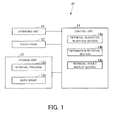
- a mobile device 10 according to the first embodiment has a configuration illustrated in Fig. 1 .
- the mobile device 10 includes an operating unit 11, a touch panel 12, a storage unit 13, and a control unit 14.
- the communication unit 11 is an input device, such as a button and the like, to which various operations are input.
- the touch panel 12 displays various types of information, and various operations are input to the touch panel 12.
- the storage unit 13 is a nonvolatile memory, such as a flash memory and the like, which stores a program and various types of data.
- the control unit 14 controls the entire mobile device 10.
- the mobile device 10 is, for example, an electronic device, such as a mobile music player, a smartphone, and the like.
- the storage unit 13 stores a retrieval program 13a that is to be executed by the control unit 14.
- the retrieval program 13a may be installed in the mobile device 10 in a production stage of the mobile device 10, and may be additionally installed in the mobile device 10 via a storage medium or a network.
- the storage unit 13 stores a data group 13b.
- the data group 13b may be installed in the mobile device 10 in a production stage of the mobile device 10, and may be additionally installed in the mobile device 10 via a storage medium or a network.
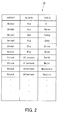
- Fig. 2 shows an example list 20 in which data specific information pieces used for identifying data of the data group 13b are arranged.
- the data specific information pieces in each row other than the heading row specify each data piece of the data group 13b.
- data is a music file.
- the data specific information pieces of each row are represented by a hierarchical structure including a plurality of attribute information pieces.
- Each of attribute information pieces of the hierarchical level "ARTIST” indicates a performer of a song corresponding to a target music file.
- Each of attribute information pieces of the hierarchical level “ALBUM” indicates the name of an album in which a song corresponding to the target music file is recorded.
- Each of attribute information pieces of the hierarchical level "SONG" indicates the name of a song corresponding to the target music file.
- data specific information pieces in the first row are represented by the attribute information piece "Animal” of the hierarchical level “ARTIST", the attribute information piece “Age” of the hierarchical level “ALBUM”, and the attribute information piece “All” of the hierarchical level “SONG”.
- the hierarchical level “ARTIST” is the highest level
- the hierarchical level “ALBUM” belongs to one level lower than the hierarchical level “ARTIST”
- the hierarchical level "SONG” belongs to one level lower than the hierarchical level “ALBUM”.
- attribute information pieces of the hierarchical level "ARTIST” are arranged based on a specific rule.
- Attribute information pieces of the hierarchical level “ALBUM” are arranged for each of attribute information pieces of the hierarchical level “ARTIST” based on the specific rule.
- Attribute information pieces of the hierarchical level “SONG” are arranged for each of attribute information pieces of the hierarchical level “ALBUM” based on the specific rule.
- specific rule herein is a rule that attribute information pieces are arranged in the alphabetical order of A, B, C, ... and Z and then in the numerical order of 0, 1, 2, ... and 9 such that the higher order the first character of the attribute information piece is, the higher the attribute information piece is ranked, and if the order of the first character of one attribute information piece is the same as the order of the first character of another attribute information piece, one of the attribute information pieces that has the second character having a higher order is ranked higher. Note that whether an alphabet is in uppercase or lowercase is not distinguished in terms of ordering.
- the control unit 14 illustrated in Fig. 1 includes, for example, a central processing unit (CPU), a read only memory (ROM) that stores a program and various types of data, and a random access memory (RAM) used as a work area of the CPU.
- the CPU executes the program stored in the ROM or the storage unit 13.
- the control unit 14 executes the retrieval program 13a stored in the storage unit 13 to function as a retrieval character reception section 14a, an information retrieval section 14b, and a retrieval result display section 14c.
- the retrieval character reception section 14a receives one or more retrieval characters for a data specific information piece.
- the information retrieval section 14b retrieves the data specific information piece with the one or more retrieval characters received by the retrieval character reception section 14a.
- the retrieval result display section 14c displays a retrieval result on the touch panel 12.
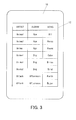
- Fig. 3 shows the mobile device 10 in a state where a part of the list 20 is displayed on the touch panel 12.
- the control unit 14 executes the operation illustrated in Fig. 4 .
- Fig. 4 shows the operation performed by the mobile device 10 when retrieving a data specific information piece.
- the retrieval character reception section 14a of the control unit 14 of the mobile device 10 starts measurement of time (S101), and then, determines whether or not a certain time has elapsed since the measurement of time was started in S101 (S102).
- the retrieval character reception section 14a determines whether or not one or more characters have been input onto the touch panel 12 by handwriting (S103). Note that, when one character deleting operation performed for deleting the last one character from a retrieval character queue is an operation of inputting a certain character onto the touch panel 12 by handwriting, the retrieval character reception section 14a does not perform the determination of S103 on the character.
- the retrieval character reception section 14a does not perform the determination of S103 on the character.
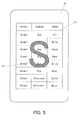
- Fig. 5 shows the mobile device 10 in a state where the character "S" is input by handwriting.
- a character 31 of hatched "S" indicates the locus of a character input onto the touch panel 12 by handwriting and is not actually displayed on the touch panel 12.
- the retrieval character reception section 14a determines in S103 that one or more characters have been input onto the touch panel 12 by handwriting, the retrieval character reception section 14a adds the character to the end of the retrieval character queue (S104).
- the retrieval character reception section 14a determines whether or not one character deleting operation is input (S105).
- the one character deleting operation herein is, for example, an operation in which a double slash "//" is input onto the touch panel 12 by handwriting.
- the retrieval character reception section 14a determines in S105 that the one character deleting operation is input, the retrieval character reception section 14a deletes one character at the end of the retrieval character queue (S106).
- the retrieval character reception section 14a determines whether or not the all characters deleting operation is input (S107).
- the all characters deleting operation herein is, for example, an operation in which a double back slash " ⁇ " or an asterisk "*" is input onto the touch panel 12 by handwriting.
- the retrieval character reception section 14a determines in S107 that the all characters deleting operation is input, the retrieval character reception section 14a deletes all characters from the retrieval character queue (S108).
- the retrieval character reception section 14a determines in S107 that the all characters deleting operation is not input, the retrieval character reception section 14a executes the process of S102.
- the control unit 14 executes, after the process of S104, the process of S106, or the process of S108, screen update processing (S109), which will be described later, to execute the process of S102.
- the retrieval character reception section 14a determines in S102 that the certain time has elapsed, the retrieval character reception section 14a ends the operation illustrated in Fig. 4 .
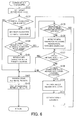
- Fig. 6 shows the operation of the mobile device 10 in the screen update processing illustrated in Fig. 4 .
- the information retrieval section 14b of the control unit 14 sets the highest hierarchical level, that is, the hierarchical level "ARTIST", among the hierarchical levels of the data specific information pieces to a target hierarchical level (S131).
- the information retrieval section 14b determines whether or not the retrieval character queue is empty (S132).
- the information retrieval section 14b determines in S132 that the retrieval character queue is not empty, the information retrieval section 14b sets the location of the first character of the retrieval character queue to a target location in the retrieval character queue (S133).
- the information retrieval section 14b determines whether or not there is a hierarchical level changing character used for changing the hierarchical level after the target location in the retrieval character queue (S134).
- the hierarchical level changing character herein is, for example, an ampersand "&".
- the information retrieval section 14b determines whether or not a character in the target location is the hierarchical level changing character (S135).
- the information retrieval section 14b determines in S135 that the character in the target location is not the hierarchical level changing character, the information retrieval section 14b executes retrieval in the target hierarchical level with a character preceding the hierarchical changing character located immediately after the target location in a part of the retrieval character queue located after the target location (S136).
- the information retrieval section 14b determines whether or not the target hierarchical level is the lowest hierarchical level (S137).
- the information retrieval section 14b determines whether or not there is a character after the hierarchical level changing character that appears first after the target location in the retrieval character queue (S138).
- the information retrieval section 14b determines in S138 that there is a character, the information retrieval section 14b sets a hierarchical level immediately lower than the target hierarchical level to a new target hierarchical level (S139).
- the information retrieval section 14b sets the location of the character immediately after the first hierarchical level changing character after the target location in the retrieval character queue to a new target location (S140) and executes the process of S134.
- the information retrieval section 14b determines in S134 that there is not the hierarchical level changing character, the information retrieval section 14b executes retrieval in the target hierarchical level with a character, among the characters of the retrieval character queue, which is located after the target location (S141).
- the information retrieval section 14b determines in S132 that the retrieval character queue is empty, if the information retrieval section 14b determines in S137 that the target hierarchical level is the lowest hierarchical level, if the information retrieval section 14b determines in S138 that there is not a character, or if the information retrieval section 14b ends the processing, the information retrieval section 14b combines retrieval results and narrows down retrieval results (S142). That is, the information retrieval section 14b executes AND retrieval. Note that, when there is a hierarchical level for which no retrieval result is obtained, the information retrieval section 14b executes, assuming that all of the data specific information pieces of the data group 13b is retrieval results for the hierarchical level, the process of S142.
- the retrieval result display section 14c of the control unit 14 displays, after the process of S142, the retrieval results narrowed down in S142 on the touch panel 12 (S143) and ends the screen update processing illustrated in Fig. 6 .
- the information retrieval section 14b determines in S132 that the retrieval character queue is empty and determines that all of the data specific information pieces of the data group 13b is the retrieval results narrowed down in S142.
- the retrieval result display section 14c sets all of the data specific information pieces of the data group 13b to display targets that are to be displayed on the touch panel 12 in S143. That is, the touch panel 12 performs display as illustrated in Fig. 3 . Note that although, in Fig. 3 , only a part of the list in which the data specific information pieces are arranged is displayed, the rest of the list can be displayed by scrolling the screen.
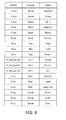
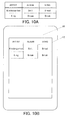
- the information retrieval section 14b executes in S136 retrieval with the characters "Kin” in the hierarchical level "ARTIST” (see Fig. 7 ), executes in S136 retrieval with the character “D” in the hierarchical level “ALBUM” (see Fig. 8 ), executes in S141 retrieval with the characters “Brea” in the hierarchical level “SONG” (see Fig. 9 ), and combines the respective retrieval results of the hierarchical levels to narrow down the retrieval results in S142 (see Fig. 10A ). Accordingly, as illustrated in Fig.
- the retrieval result display section 14c displays the data specific information pieces obtained by performing AND retrieval on the data specific information pieces of the data group 13b with the retrieval characters "Kin” for the hierarchical "ARTIST", the retrieval character “D” for the hierarchical level “ALBUM”, and the retrieval characters "Brea” for the hierarchical level “SONG” on the touch panel 12 in S143.
- a user of the mobile device 10 can execute a certain operation, such as double tapping of one of the data specific information pieces displayed on the touch panel 12, and the like, causes the mobile device 10 to reproduce a music file identified on the basis of the data specific information piece. Note that, when the number of data specific information pieces that have been finally detected is only one, the mobile device 10 can reproduce a music file identified on the basis of the data specific information piece without waiting for an instruction of reproduction to be input by the user.
- the mobile device 10 receives one or more retrieval characters input to the list on the touch panel 12 by handwriting in a state where the list in which the data specific information pieces are arranged is displayed on the touch panel 12 (YES in S103), and thus, even when one or more retrieval characters are received, the viewability of the list is hardly reduced.
- GUI graphical user interface
- the mobile device 10 does not include the GUI, such as a retrieval window, a retrieval button, and the like, a large display area in which information, such as the list 20 and the like, is displayed can be ensured on the touch panel 12.
- the touch panel 12 is small, it is effective ensuring on the touch panel 12 a large display area in which information, such as the list 20 and the like, is displayed.
- the mobile device 10 receives one or more retrieval characters input onto the touch panel 12 by handwriting regardless of information, such as the list 20, and the like, displayed on the touch panel 12, and therefore, the degree of freedom of design of the screen on the touch panel 12 at the time of executing retrieval can be increased.
- the mobile device 10 retrieves a data specific information piece (S136, S141, and S142) each time a single retrieval character is received in S103 (YES in S103), and displays a retrieval result on the touch panel 12 (S143) each time retrieval is executed. That is, the mobile device 10 can execute incremental search. Therefore, the mobile device 10 can simplify retrieval of data specific information pieces.
- the mobile device 10 can receive one or more retrieval characters for each of the hierarchical layer by a series of operations with a hierarchical level changing character used for changing the hierarchical level for which the one or more retrieval characters are input onto the touch panel 12 by handwriting.
- a plurality of retrieval operations is performed. Specifically, one or more characters are input to a retrieval window in order to retrieve a certain artist, and then, a list of albums of the artist is displayed. Next, one or more characters are input to the retrieval window for the list to retrieve a certain album, and then, a list of songs of the album is displayed. Finally, one or more characters are input to the retrieval window for the list to retrieve a certain song, and a data specific information piece corresponding to the desired song is displayed.
- the mobile device 10 can receive one or more characters for each of hierarchical levels by a series of operations, and thus, enables a user to reach the desired data specific information piece by fewer operations, as compared to the traditional retrieval method.
- the mobile device 10 can receive one or more characters for each of hierarchical levels by a series of operations, and thus, enables a user to reach the desired data specific information piece in a short time even when the number of data pieces included in the data group 13b is large.
- the mobile device 10 starts, when a certain operation is input to the operating unit 11, the operation illustrated in Fig. 4 , the mobile device 10 may be configured to start the operation illustrated in Fig. 4 under a condition other than the condition where a certain operation is input to the operating unit 11.
- the mobile device 10 may be configured to start the operation illustrated in Fig. 4 when a certain GUI displayed on the touch panel 12 is operated, and may be configured to start the operation illustrated in Fig. 4 when the touch panel 12 is pressed and held down.
- the mobile device 10 may be configured to end reception of one or more retrieval characters under a condition other than the condition where a certain time has elapsed.
- the mobile device 10 may be configured to end, when a certain operation is input to the operating unit 11, reception of one or more retrieval characters, and may be configured to end, when the touch panel 12 is pressed and held down, reception of one or more retrieval characters.
- the mobile device 10 may reproduce a music file identified on the basis of the data specific information pieces displayed in a location on the touch panel 12 where the touch panel 12 is pressed and held down.
- a mobile device 10 Similar to the first embodiment, a mobile device 10 according to the second embodiment includes an operating unit 11, a touch panel 12, a storage unit 13, and a control unit 14.
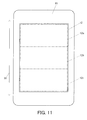
- Fig. 11 shows example areas associated with hierarchical levels of data specific information pieces on the touch panel 12.
- the retrieval character reception section 14a associates each of three areas, i.e., an artist area 12a, an album area 12b, and a song area 12c, which are arranged in a direction indicated by an arrow 30 in the screen on the touch panel 12, with the corresponding one of the hierarchical levels of data specific information pieces such that the order of the areas arranged in the direction indicated by the arrow 30 is the same as the order in terms of the hierarchical relationship between the hierarchical levels corresponding to the areas. That is, the artist area 12a, the album area 12b, and the song area 12c are associated with the hierarchical level "ARTIST", the hierarchical level “ALBUM”, and the hierarchical level "SONG", respectively.
- a figure indicated by the alternate long and two dashes line represents an area on the touch panel 12 and is not actually displayed on the touch panel 12.
- the control unit 14 executes the operations illustrated in Fig. 12 and Fig. 13 .
- Fig. 12 shows the operation performed by the mobile device 10 when retrieving a data specific information piece.
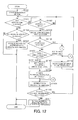
- Fig. 13 shows the subsequent operation performed by the mobile device 10 illustrated in Fig. 1 to the operation illustrated in Fig. 12 .
- the retrieval character reception section 14a of the control unit 14 of the mobile device 10 starts measurement of time (S1101), and then, determines whether or not a certain time has elapsed since the measurement of time was started in S1101 (S1102).
- the retrieval character reception section 14a determines whether or not one or more characters have been input onto the touch panel 12 by handwriting (S1103).
- the retrieval character reception section 14a determines in S1103 that one or more characters have not been input onto the touch panel 12 by handwriting, the retrieval character reception section 14a executes the process of S1102.
- the retrieval character reception section 14a determines in S1103 that one or more characters have been input onto the touch panel 12 by handwriting, the retrieval character reception section 14a obtains one of the artist area 12a, the album area 12b, and the song area 12c, which includes the input location of the one or more characters (S1104).
- Fig. 14A shows the mobile device 10 illustrated in Fig. 1 in a state where the character "A" is input by handwriting.
- Fig. 14B shows the mobile device 10 in a state where the character "d” is input by handwriting.
- a character 31 of hatched “A” indicates the locus of a character input onto the touch panel 12 by handwriting and is not actually displayed on the touch panel 12.
- a character 32 of hatched “d” indicates the locus of a character input onto the touch panel 12 by handwriting and is not actually displayed on the touch panel 12.
- a figure indicated by the alternate long and two dashes line represents an area on the touch panel 12 and is not actually displayed on the touch panel 12.
- the retrieval character reception section 14a recognizes, as the input location of one or more characters, the location of the beginning of writing the one or more characters input onto the touch panel 12 by handwriting. For example, in the example illustrated in Fig. 14A , the retrieval character reception section 14a recognizes, as the input location of the character 31, the location 31a of the beginning of writing the character 31 input onto the touch panel 12 by handwriting, and the artist area 12a is obtained as an area including the input location of the character 31 in S1104. In the example illustrated in Fig.
- the retrieval character reception section 14a recognizes, as the input location of the character 32, the location 32a of the beginning of writing the character 32 input onto the touch panel 12 by handwriting, and the album area 12b is obtained as an area including the input location of the character 32 in S1104.
- the retrieval character reception section 14a determines, after the process of S1104, whether or not one or more characters have been received (S1105).
- the retrieval character reception section 14a determines which of the artist area 12a and an area other than the artist area 12a the area obtained in S1104 performed last is (S1106).
- the retrieval character reception section 14a determines in S1106 that the obtained areas is the artist area 12a, the retrieval character reception section 14a sets the hierarchical level "ARTIST" as the current hierarchical level (S1107) and receives, as the one or more retrieval characters of the hierarchical level "ARTIST", the one or more characters determined in the S1103 performed last to have been input onto the touch panel 12 by handwriting (S1108).
- the information retrieval section 14b of the control unit 14 retrieves a data specific information piece with the one or more retrieval characters received by the retrieval character reception section 14a (S1109) and determines whether or not a data specific information piece has been detected in retrieval in S1109 (S1110).
- the retrieval character reception section 14a executes the process of S1102.
- the retrieval result display section 14c of the control unit 14 displays as a retrieval result that there is no data specific information piece (S1111), and ends the operations illustrated in Fig. 12 and Fig. 13 .
- the retrieval character reception section 14a determines in S1106 that the obtained area is an area other than the artist area 12a, the retrieval character reception section 14a notifies the user via the touch panel 12 that the input is an input to an improper area (S1112) and executes the process of S1102.
- the retrieval character reception section 14a determines which of the hierarchical level "ARTIST”, the hierarchical level “ALBUM”, and the hierarchical level “SONG" the currently set hierarchical level is (S1113).
- the retrieval character reception section 14a determines which of the artist area 12a, the album area 12b, and the song area 12c the area obtained in S1104 performed last is (S1114).
- the retrieval character reception section 14a determines in S1114 that the obtained area is the artist area 12a, the retrieval character reception section 14a receives, as an additional retrieval character, the character determined in S1103 performed last to have been input onto the touch panel 12 by handwriting in a location subsequent to the current one or more retrieval characters of the hierarchical level "ARTIST" (S1115). Subsequently, the information retrieval section 14b executes the process of S1109.
- the retrieval character reception section 14a determines in S1114 that the obtained area is the album area 12b, the retrieval character reception section 14a sets the hierarchical level "ALBUM” as the current hierarchical level (S1116) and receives, as the retrieval character of the hierarchical level "ALBUM", the character determined in S1103 performed last to have been input onto the touch panel 12 by handwriting (S1117). Subsequently, the information retrieval section 14b executes the process of S1109.
- the retrieval character reception section 14a determines in S1114 that the obtained area is the song area 12c, the retrieval character reception section 14a executes the process of S1112.
- the retrieval character reception section 14a determines in S1113 that the currently set hierarchical level is the hierarchical level "ALBUM"
- the retrieval character reception section 14a determines which of the artist area 12a, the album area 12b, and the song area 12c the area obtained in S1104 performed last is (S1118).
- the retrieval character reception section 14a determines in S1118 that the obtained area is the artist area 12a, the retrieval character reception section 14a executes the process of S1112.
- the retrieval character reception section 14a determines in S1118 that the obtained area is the album area 12b, the retrieval character reception section 14a receives, as an additional retrieval character, the one or more characters determined in S1103 performed last to have been input onto the touch panel 12 by handwriting in a location subsequent to the current one or more retrieval characters of the hierarchical level "ALBUM" (S1119). Subsequently, the information retrieval section 14b executes the process of S1109.
- the retrieval character reception section 14a determines in S1118 that the obtained area is the song area 12c, the retrieval character reception section 14a sets the hierarchical level "SONG" as the current hierarchical level (S1120), and receives, as the one or more retrieval characters of the hierarchical level "SONG", the one or more characters determined in S1103 performed last to have been input onto the touch panel 12 by handwriting (S1121). Subsequently, the information retrieval section 14b executes the process of S1109.
- the retrieval character reception section 14a determines which of an area other than the song area 12c and the song area 12c the area obtained in S1104 performed last is (S1122).
- the retrieval character reception section 14a determines in S1122 that the currently set hierarchical level is an area other than the song area 12c, the retrieval character reception section 14a executes the process of S1112.
- the retrieval character reception section 14a determines in S1122 that the currently set hierarchical level is the song area 12c, the retrieval character reception section 14a receives, as additional one or more retrieval characters, the one or more characters determined in S1103 performed last to have been input onto the touch panel 12 by handwriting in a location subsequent to the current one or more retrieval characters of the hierarchical level "SONG" (S1123). Subsequently, the information retrieval section 14b executes the process of S1109.
- the retrieval result display section 14c determines whether or not one or more retrieval characters have been received (S1124).
- the retrieval result display section 14c determines in S1124 that one or more characters have not been received, the retrieval result display section 14c ends the operations illustrated in Fig. 12 and Fig. 13 .
- the retrieval result display section 14c determines in S1124 that one or more characters have been received, the retrieval result display section 14c displays the list 20 in which a focus is placed on the data specific information pieces that have been retrieved with the one or more retrieval characters, i.e., a retrieval result of the information retrieval section 14b in S1109 performed last, on the touch panel 12 (S1125), and then, ends the operations illustrated in Fig. 12 and Fig. 13 . Note that, when a plurality of data specific information pieces have been detected by the information retrieval section 14b in S1109 performed last, the retrieval result display section 14c place a focus on, among the plurality of detected data specific information pieces, the data specific information piece located at the top of the list 20 in S1125.
- a user of the mobile device 10 can execute a certain operation, such as double tapping of one of the data specific information pieces on which a focus is placed on, and the like, to cause the mobile device 10 to reproduce a music file identified on the basis of the data specific information piece on which a focus is placed. Note that, if the number of data specific information pieces that have been finally detected is only one, the mobile device 10 can reproduce a music file identified on the basis of the data specific information piece without waiting for an instruction of reproduction to be input by the user.
- the retrieval result display section 14c displays on the touch panel 12 the list 20 where a focus is placed on the data specific information pieces retrieved with the retrieval characters, for example, as illustrated in Fig. 16 (S1125).
- Fig. 15 shows the mobile device 10 in a state where characters are input in the artist area 12a by handwriting.
- each of the character 41 of hatched “K”, the character 42 of hatched “i”, and the character 43 of hatched “n” indicates the locus of a character input onto the touch panel 12 by handwriting and is not actually displayed on the touch panel 12.
- a figure indicated by the alternate long and two dashes line represents an area on the touch panel 12 and is not actually displayed on the touch panel 12.
- the character 41, the character 42, and the character 43 illustrated in Fig. 15 are characters input onto the touch panel 12 in this order by handwriting. Therefore, the retrieval character reception section 14a receives "Kin” as the retrieval characters of the hierarchical level "ARTIST".
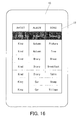
- Fig. 16 shows the mobile device 10 in a state where a retrieval result obtained when retrieval was performed with the retrieval characters "Kin" of the hierarchical level "ARTIST" is displayed.
- the data specific information pieces including "Kin” in the attribute information piece of the hierarchical level “ARTIST” there are a plurality of data specific information pieces including the attribute information piece “Kind” of the hierarchical level “ARTIST”, a plurality of data specific information pieces including the attribute information piece "King” of the hierarchical level “ARTIST”, and the like.
- the retrieval result display section 14c places a focus on, among the plurality of data specific information pieces, the data specific information pieces located at the top in the list 20.
- the retrieval result display section 14c highlights the data specific information pieces represented by the attribute information piece "King" of the hierarchical level “ARTIST", the attribute information piece “Autumn” of the hierarchical level “ALBUM”, and the attribute information piece “Orange” of the hierarchical level “SONG” to place a focus on the data specific information pieces.
- the retrieval result display section 14c displays the list 20 where a focus is placed on the data specific information pieces retrieved with the retrieval characters on the touch panel 12, for example, as illustrated in Fig. 18 (S1125).
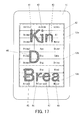
- Fig. 17 shows the mobile device 10 in a state where characters are input in the artist area 12a, the album area 12b, and the song area 12c by handwriting.
- each of the character 41 of hatched “K”, the character 42 of hatched “i”, the character 43 of hatched “n”, the character 44 of hatched “D”, the character 45 of hatched “B”, the character 46 of hatched “r”, the character 47 of hatched “e”, and the character 48 of hatched “a” indicates the locus of each character input onto the touch panel 12 by handwriting and is not actually displayed on the touch panel 12.
- a figure indicated by the alternate long and two dashes line represents an area on the touch panel 12 and is not actually displayed on the touch panel 12.
- the character 41, the character 42, the character 43, the character 44, the character 45, the character 46, the character 47, and the character 48 are characters input onto the touch panel 12 in this order by handwriting. Accordingly, the retrieval character reception section 14a receives "Kin” as the retrieval characters of the hierarchical level "ARTIST", "D” as the retrieval character of the hierarchical level "ALBUM, and "Brea” as the retrieval characters of the hierarchical level "SONG".
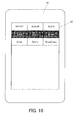
- Fig. 18 shows the mobile device 10 in a state where a retrieval result obtained when retrieval was performed with the characters "Kin” of the hierarchical level “ARTIST", the character “D” of the hierarchical level “ALBUM”, and the characters “Brea” of the hierarchical level “SONG” is displayed.
- the retrieval result display section 14c places a focus on, among the plurality of data specific information pieces, the data specific information pieces located at the top in the list 20. That is, the retrieval result display section 14c highlights the data specific information pieces represented by the attribute information piece "Kind” of the hierarchical level "ARTIST", the attribute information piece “Dairy” of the hierarchical level “ALBUM”, and the attribute information piece “Bread” of the hierarchical level “SONG" to place a focus on the data specific information pieces.
- the mobile device 10 receives one or more characters input onto the touch panel 12 by handwriting as the one or more retrieval characters of the hierarchical level corresponding to the input location of the one or more characters on the touch panel 12 (S1108, S1115, S1117, S1119, S1121, and S1123) and thus can receive one or more retrieval characters corresponding to each of the hierarchical levels by a series of operations, thereby allowing simplification of operations performed for retrieving a data specific information piece represented by a hierarchical structure including a plurality of attribute information pieces.
- a plurality of retrieval operations is performed. Specifically, one or more characters are input to retrieve a certain artist, and a list of albums of the artist is displayed. Next, one or more retrieval characters are input to the retrieval window for the list to retrieve a certain album, and a list of songs of the album is displayed. Finally, one or more retrieval characters are input to the retrieval window for the list to retrieve a certain song, and a data specific information piece corresponding to the desired song is displayed.
- the mobile device 10 can receive one or more characters for each of hierarchical levels by a series of operations, and thus, enables a user to reach the desired data specific information piece by fewer operations, as compared to the traditional retrieval method.
- the mobile device 10 can receive one or more characters for each of hierarchical levels by a series of operations, and thus, enables a user to reach the desired data specific information piece in a short time even when the number of data pieces included in the data group 13b is large.
- the mobile device 10 does not include a graphical user interface (GUI), such as a retrieval window, a retrieval button used for starting retrieval with one or more characters input in the retrieval window, and the like, and therefore, the user does not look for or operate the GUI, thus resulting in increase in usability for the user.
- GUI graphical user interface
- the mobile device 10 does not include the GUI, such as a retrieval window, a retrieval button, and the like, a large display area in which information, such as the list 20 and the like, is displayed can be ensured on the touch panel 12.
- the touch panel 12 is small, it is effective ensuring on the touch panel 12 a large display area in which information, such as the list 20 and the like, is displayed.
- the mobile device 10 receives one or more characters input onto the touch panel 12 by handwriting, regardless of information, such as the list 20 and the like, displayed on the touch panel 12, and therefore, the degree of freedom of design of the screen on the touch panel 12 at the time of executing retrieval can be increased.
- the mobile device 10 can receive one or more retrieval characters corresponding to each of hierarchical levels in a descending order from the highest hierarchical level to the lowest hierarchical level with characters sequentially input to the three areas arranged in the direction indicated by the arrow 30 in the screen on the touch panel 12 from the artist area 12a provided at one end to the song area 12c provided at the other end, and thus, an intuitive operation may be performed as an operation performed for retrieving a data specific information piece.
- the direction indicated by the arrow 30 is the vertical direction of the screen on the touch panel 12, and thus, a further more intuitive operation may be performed for retrieving a data specific information piece.
- the direction indicated by the arrow 30 may be a direction other than the vertical direction of the screen on the touch panel 12.
- the direction indicated by the arrow 30 may be the horizontal direction of the screen on the touch panel 12.
- data specific information pieces are represented by a hierarchical structure including three attribute information pieces, but may be represented by a hierarchical structure including a plurality of attribute information pieces other than three. Even when, in the mobile device 10, data specific information pieces are represented by a hierarchical structure including a plurality of attribute information pieces other than three, areas as many as the number of hierarchical levels of data specific information pieces may be provided on the touch panel 12.
- the mobile device 10 starts, when a certain operation is input to the operating unit 11, the operations illustrated in Fig. 12 and Fig. 13 , the mobile device 10 may be configured to start under a condition other than the condition where the certain operation is input to the operating unit 11.
- the mobile device 10 may be configured to start, when a certain GUI illustrated on the touch panel 12 is operated, the operations illustrated in Fig. 12 and Fig. 13 , and may be configured to start, when the touch panel 12 is pressed and held down, the operations illustrated in Fig. 12 and Fig. 13 .
- the mobile device 10 ends, when a certain time has elapsed since measurement of time was started in S1101, reception of one or more retrieval characters, the mobile device 10 may be configured to end reception of one or more retrieval characters under a condition other than the condition where a certain time has elapsed.
- the mobile device 10 may be configured to end, when a certain operation is input to the operating unit 11, reception of one or more retrieval characters, and may be configured to end, when the touch panel 12 is pressed and held down, reception of one or more retrieval characters.
- the mobile device 10 may reproduce, a music file identified on the basis of the data specific information piece displayed in a location on the touch panel 12 where the touch panel 12 is pressed and held down.
- the mobile device 10 at the time when reception of one or more retrieval characters is ended (YES in S1102), a focus is placed on the data specific information pieces retrieved with the one or more retrieval characters (S1125), but the mobile device 10 may be configured such that a retrieval result of the information retrieval section 14b in S1109 performed last is displayed on the touch panel 12 each time a data specific information piece is retrieved with the one or more retrieval characters received by the retrieval character reception section 14a (S1109). That is, the mobile device 10 may be configured to execute incremental search.
- a mobile device 10 according to the third embodiment has the configuration illustrated in Fig. 20 .
- the mobile device 10 includes an operating unit 11, a touch panel 12, a storage unit 13, and a control unit 14.
- the control unit 14 executes the retrieval program 13a stored in the storage unit 13 to function as the retrieval character reception section 14a, a list generation section 14d, a list display section 14e, a scroll operation reception section 14f.
- the retrieval character reception section 14a receives one or more retrieval characters for a data specific information piece.
- the list generation section 14d is an embodiment of the information retrieval section and is configured to retrieve a data specific information piece with the one or more retrieval characters received by the retrieval character reception section 14a and generate a retrieval result list in which the data specific information pieces are arranged on the basis of the degree of communality with the one or more retrieval characters.
- the list display section 14e is an embodiment of the retrieval result display section and is configured to display the retrieval result list generated by the list generation section 14d on the touch panel 12.
- the scroll operation reception section 14f receives on the touch panel a scroll operation for the retrieval result list displayed by the list display section 14e.
- Fig. 21 shows three areas located on the touch panel 12.
- the scroll operation reception section 14f determines in which of the three areas, that is, a left area 12d, a center area 12e, and a right area 12f, arranged in the direction indicated by an arrow 30b that intersects with the scroll direction indicated by the arrow 30a in retrieval result list on the touch panel 12 a scroll operation for the retrieval result list has been input.
- the left area 12d, the center area 12e, and the right area 12f have the same length in the direction indicated by the arrow 30b.
- a figure indicated by the alternate long and two dashes line represents an area on the touch panel 12 and is not actually displayed on the touch panel 12.
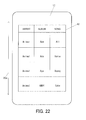
- Fig. 22 shows the mobile device 10 in a state where a part of a list 20 is displayed on the touch panel 12.
- Fig. 23 shows the operation performed by the mobile device 10 when retrieving a data specific information piece.
- the retrieval character reception section 14a of the control unit 14 of the mobile device 10 starts measurement of time (S2101), and then, determines whether or not a certain time has elapsed since the measurement of time was started in S2101 (S2102).
- the retrieval character reception section 14a determines whether or not one or more characters have been input onto the touch panel 12 by handwriting (S2103).
- Fig. 24 shows the mobile device 10 in a state where the character "S" is input by handwriting.
- a character 31 of hatched "S" indicates the locus of the character input onto the touch panel 12 by handwriting and is not actually displayed on the touch panel 12.
- the retrieval character reception section 14a determines in S2103 that one or more characters have not been input onto the touch panel 12 by handwriting, the retrieval character reception section 14a executes the process of S2102.
- the retrieval character reception section 14a determines in S2103 that one or more characters have been input onto the touch panel 12 by handwriting, the retrieval character reception section 14a determines whether or not one or more retrieval characters have been received (S2104).
- the retrieval character reception section 14a determines in S2104 that one or more characters have not been received, the retrieval character reception section 14a receives, as one or more retrieval characters, the one or more characters determined in S2103 performed last to have been input onto the touch panel 12 by handwriting (S2105).
- the list generation section 14d of the control unit 14 retrieves a data specific information piece with the one or more retrieval characters received by the retrieval character reception section 14a (S2106), and determines whether or not a data specific information piece has been detected in retrieval performed in S2106 (S2107).
- the list display section 14e of the control unit 14 displays as a retrieval result that there is no data specific information piece on the touch panel 12 (S2108), and ends the operation illustrated in Fig. 23 .
- the list generation section 14d determines in S2107 that data specific information pieces has been detected, the list generation section 14d executes retrieval result list generation processing, which will be described later (S2109).
- the list display section 14e of the control unit 14 displays on the touch panel 12 the retrieval result list generated in S2109 in a state where a focus is placed on the data specific information piece retrieved with the current one or more retrieval characters (S2110).
- the retrieval character reception section 14a executes, after the process of S2110, the process of S2102.
- the retrieval character reception section 14a determines in S2104 that one or more retrieval characters have been received, the retrieval character reception section 14a receives, as additional one or more retrieval characters, the one or more characters determined in S1103 performed last to have been input onto the touch panel 12 by handwriting in the end of the current one or more retrieval characters (S2111).
- the list generation section 14d executes, after the process of S2111, the process of S2106.
- the retrieval character reception section 14a determines in S2102 that a certain time has elapsed, the retrieval character reception section 14a ends the operation illustrated in Fig. 23 .
- Fig. 25 shows the operation performed by the mobile device 10 in retrieval result list generation processing illustrated in Fig. 23 .
- the list generation section 14d classifies data specific information pieces in the data group 13b into a candidate group that is a collection of data specific information pieces that are highly likely to be a target of retrieval performed by a user and a non-candidate group that is a collection of data specific information pieces that are not included in the candidate group (S2131).
- the list generation section 14d generates the candidate group of data specific information pieces including all of current one or more retrieval characters in the attribute information piece of the hierarchical level "ALBUM” and data specific information pieces that do not include all of the current one or more retrieval characters in the attribute information piece of the hierarchical level "ALBUM” and have first two characters of the attribute information piece of the hierarchical level "ALBUM” that are the same as the first two characters of the current retrieval characters.
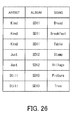
- Fig. 26 shows an example candidate group when retrieval is performed with retrieval characters "SD11".
- Data specific information pieces in the first row to the third row of the candidate group illustrated in Fig. 26 are data specific information pieces, among the data specific information pieces of the data group 13b, which include all of the current retrieval characters "SD11" in the attribute information piece of the hierarchical level "ALBUM".
- the data specific information pieces in the fourth row to the seventh row are data specific information pieces, among the data specific information pieces of the data group 13b, which have first two characters of the attribute information piece of the hierarchical level "ALBUM" that are the same as the first two characters, that is, "SD", of the current retrieval characters "SD11".
- the list generation section 14d arranges, after the process of S2131, the data specific information pieces of the candidate group generated in S2131 in a state where attribute information pieces of the hierarchical level "ALBUM” are arranged based on the certain rule described above (S2132), and arranges the data specific information pieces of the non-candidate group generated in S2131 in a state where attribute information pieces of the hierarchical level "ALBUM” are arranged based on the certain rule described above (S2133).
- Fig. 27A shows an example of the candidate group with attribute information pieces of the hierarchical level "ALBUM” arranged based on a certain rule when retrieval is performed with the retrieval characters "SD11".
- Fig. 27B shows an example non-candidate group with attribute information pieces of the hierarchical level “ALBUM” arranged based on a certain rule when retrieval is performed with the retrieval characters "SD11".
- the candidate group illustrated in Fig. 26 is arranged based on the certain rule described above. That is, in the data specific information pieces of the candidate group illustrated in Fig. 27A , the first three characters "SD1" of the attribute information piece of the hierarchical level “ALBUM” are the same, and therefore, the data specific information pieces are arranged based on the order of "0", "1", and "2", which are the fourth characters of the attribute information pieces of the hierarchical level "ALBUM". Similar to the candidate group illustrated in Fig. 27A , as for the non-candidate group illustrated in Fig. 27B , the data specific information pieces are arranged in a state where attribute information pieces of the hierarchical level "ALBUM" are arranged based on the certain rule described above.
- the list generation section 14d generates, after the process of S2133, a retrieval result list by arranging the candidate group with the data specific information pieces arranged based on a certain rule in S2132 in a certain location in the non-candidate group with the data specific information pieces arranged in a certain rule in S2133 (S2134), and ends the retrieval result list generation processing illustrated in Fig. 25 .
- the certain location is a location where the current one or more retrieval characters are to be arranged for the non-candidate group arranged based on the certain rule described above in S2132 for each of attribute information pieces of the hierarchical level "ALBUM".
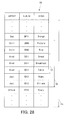
- Fig. 28 shows an example retrieval result list 50 obtained when retrieval is performed with the retrieval characters "SD11".
- the retrieval result list 50 illustrated in Fig. 28 is obtained by arranging the candidate group illustrated in Fig. 27A in the non-candidate group illustrated in Fig. 27B .
- the location where the candidate group illustrated in Fig. 27A is arranged in the non-candidate group illustrated in Fig. 27B is a location where the retrieval characters "SD11" are to be arranged based on the certain rule described above for each of attribute information pieces of the hierarchical level "ALBUM" for the non-candidate group illustrated in Fig. 27B .
- Fig. 29 shows the mobile device 10 in a state where a part of the retrieval result list 50 is displayed on the touch panel 12 when retrieval is performed with the retrieval characters "SD11".
- the list display section 14e displays on the touch panel 12 the retrieval result list 50 illustrated in Fig. 28 in a state where a focus is placed on the data specific information pieces retrieved with the retrieval characters "SD11" as illustrated in Fig. 29 , that is, the data specific information pieces including all of the retrieval characters "SD11" in the attribute information piece of the hierarchical level "ALBUM".
- the list display section 14e places a focus on the data specific information pieces arranged in the top of the retrieval result list 50, among the plurality of data specific information pieces. That is, the list display section 14e highlights the data specific information pieces represented by the attribute information piece "Kind” of the hierarchical level "ARTIST”, the attribute information piece "SD11” of the hierarchical level “ALBUM”, and the attribute information piece “Bread” of the hierarchical level “SONG” to place a focus on the data specific information pieces.
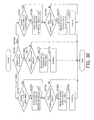
- the control unit 14 executes the operation illustrated in Fig. 30 .
- Fig. 30 shows the operation performed by the mobile device 10 when an operation is input to the touch panel 12.
- the scroll operation reception section 14f of the control unit 14 of the mobile device 10 determines which of the left area 12d, the center area 12e, and the right area 12f on the touch panel 12 is touched (S2161).
- the scroll operation reception section 14f determines whether or not the current display on the touch panel 12 is within the scroll range of the left area 12d (S2162).
- the scroll range of the left area 12d is a range of the data specific information pieces including all of one or more retrieval characters in the attribute information pieces of the hierarchical level "ALBUM".
- the list display section 14e resets the display location of the retrieval result list displayed on the touch panel 12 to an initial location (S2163).
- the initial location is a location where the retrieval result list is displayed on the touch panel 12 in a state where a focus is placed on data specific information pieces retrieved with one or more retrieval characters. For example, when the one or more retrieval characters are "SD11" and the retrieval result list is the retrieval result list 50 illustrated in Fig. 28 , the mobile device 10 in which the display location of the retrieval result list 50 displayed on the touch panel 12 is reset to the initial location is in the state illustrated in Fig. 29 .
- the scroll operation reception section 14f determines in S2162 that the display is within the scroll range of the left area 12d, or if the process of S2163 is ended, the scroll operation reception section 14f determines whether or not a scroll operation in the scroll direction indicated by the arrow 30a has been input onto the touch panel 12 (S2164).
- the scroll operation reception section 14f determines in S2164 that a scroll operation has not been input, the scroll operation reception section 14f ends the operation illustrated in Fig. 30 .
- the scroll operation reception section 14f determines in S2164 that a scroll operation has been input, the scroll operation reception section 14f receives the scroll operation within the scroll range of the left area 12d (S2165).
- the list display section 14e executes a scroll of the retrieval result list based on the operation received in S2165 (S2166), and ends the operation illustrated in Fig. 30 .
- the display location of the retrieval result list 50 displayed on the touch panel 12 is the initial location illustrated in Fig. 29
- the scroll range of the left area 12d that is, the entire range 51 (see Fig. 28 ) of the data specific information pieces including all of the retrieval characters "SD11" in the attribute information pieces of the hierarchical level “ALBUM”
- the display location of the retrieval result list 50 displayed on the touch panel 12 is the initial location illustrated in Fig.
- the list display section 14e does not scroll, even in receiving a scroll operation for the retrieval result list 50 input to the left area 12d, the retrieval result list 50 on the touch panel 12. Note that, if only a part of the range 51 is displayed on the touch panel 12, the list display section 14e scrolls the retrieval result list 50 on the touch panel 12 within the range 51 based on the scroll operation input to the left area 12d.
- the scroll operation reception section 14f determines whether or not the current display on the touch panel 12 is within the scroll range (S2167).
- the scroll range of the center area 12e is the range of the data specific information pieces that have first two characters of the attribute information piece of the hierarchical level "ALBUM" that are the same as the first two characters of the retrieval characters.
- the list display section 14e resets the display location of the retrieval result list displayed on the touch panel 12 to an initial location (S2168).
- the initial location is a location where the retrieval result list is displayed on the touch panel 12 in a state where a focus is placed on the data specific information pieces retrieved with the one or more retrieval characters. For example, when one or more retrieval characters are "SD11" and the retrieval result list is the retrieval result list 50 illustrated in Fig. 28 , the mobile device 10 in which the display location of the retrieval result list 50 displayed on the touch panel 12 is reset to the initial location is in the state illustrated in Fig. 29 .
- the scroll operation reception section 14f determines in S2167 that the current display is within the scroll range of the center area 12e, or if the process of S2168 is ended, the scroll operation reception section 14f determines whether or not a scroll operation in the scroll direction indicated by the arrow 30a has been input onto the touch panel 12 (S2169).
- the scroll operation reception section 14f determines in S2169 that the scroll operation has not been input, the scroll operation reception section 14f ends the operation illustrated in Fig. 30 .
- the scroll operation reception section 14f determines in S2169 that the scroll operation has been input, the scroll operation reception section 14f receives a scroll operation within the scroll range of the center area 12e (S2170).
- the list display section 14e executes a scroll of the retrieval result list based on the operation received in S2170 (S2171), and ends the operation illustrated in Fig. 30 .
- the display location of the retrieval result list 50 displayed on the touch panel 12 is the initial location illustrated in Fig. 29
- the list display section 14e scrolls, in receiving a scroll operation for the retrieval result list 50 input to the center area 12e, the retrieval result list 50 on the touch panel 12 from the top end of the scroll range illustrated in Fig. 31A to the bottom end of the scroll range illustrated in Fig. 31B based on the scroll operation.
- the scroll operation reception section 14f determines in S2161 that the right area 12f on the touch panel 12 is touched, the scroll operation reception section 14f determines whether or not a scroll operation in the scroll direction indicated by the arrow 30a has been input onto the touch panel (S2172).
- the scroll operation reception section 14f determines in S2172 that a scroll operation has not been input, the scroll operation reception section 14f ends the operation illustrated in Fig. 30 .
- the scroll operation reception section 14f determines in S2172 that a scroll operation has been input, the scroll operation reception section 14f receives the scroll operation within the scroll range of the right area 12f (S2173).
- the list display section 14e executes a scroll of the retrieval result list based on the operation received in S2173 (S2174), and ends the operation illustrated in Fig. 30 .
- the scroll range of the right area 12f is the entire range of the retrieval result list.
- the list display section 14e scrolls, in receiving a scroll operation for the retrieval result list 50 input the right area 12f, the retrieval result list 50 on the touch panel 12 from the top end of the retrieval result list 50 to the bottom end of the retrieval result list 50 based on the scroll operation.
- the user of the mobile device 10 can execute a certain operation, such as double tapping of one of the data specific information pieces displayed on the touch panel 12 and the like, to cause the mobile device 10 to reproduce a music file identified on the basis of the data specific information piece.
- the mobile device 10 when, after retrieving a data specific information piece with received one or more retrieval characters and displaying a retrieval result list in which data specific information pieces are arranged on the basis of the degree of communality with the one or more retrieval characters on the touch panel 12 (S2110), the mobile device 10 receives a scroll operation for the retrieval result list on the touch panel 12 (YES in S2164, YES in S2169, or YES in S2172), the mobile device 10 causes the scroll range received by a scroll operation to differ among the areas, that is, the left area 12d, the center area 12e, and the right area 12f, arranged in the direction indicated by the arrow 30b that intersects with the direction scroll direction indicated by the arrow 30a in the retrieval result list on the touch panel 12 (S2165, S2170, or S2173), and thus, even when the user does not accurately know a target data specific information piece that is to be retrieved, the mobile device 10 can enable the user to easily find the target data specific information piece that is to be
- the scroll range of each of the left area 12d, the center area 12e, and the right area 12f is set based on the degree of communality of each data specific information piece in the retrieval result list and the one or more retrieval characters (S2165, S2170, or S2173).
- the mobile device 10 enables the user to select, from the left area 12d, the center area 12e, and the right area 12f, an area where the user inputs a scroll operation based on the degree of the user's knowing the target data specific information piece that is to be retrieved, and therefore, the mobile device 10 can enable the user to easily find the target data specific information piece that is to be retrieved.
- the scroll range of the center area 12e is the range of the data specific information pieces that have first two or more characters that are the same as the first two or more characters of retrieval characters (S2170).
- the mobile device 10 enables the user to select the center area 12e the scroll range of which is the range of the data specific information pieces that do not match one or more retrieval characters but have communality with the one or more retrieval characters, and thus, enables the user to easily find the target data specific information piece that is to be retrieved even when the user does not accurately know the target data specific information piece that is to be retrieved.
- the mobile device 10 may set, as the scroll range of the center area 12e, the range of the data specific information pieces that have first two or more characters that are the same as the first two or more characters of the retrieval characters, as long as the number of characters of each of the data specific information pieces is equal to or greater than a certain number that is more than one and is less than the number of the characters of retrieval characters.
- the mobile device 10 may set, as the scroll range of the center area 12e, the range of the data specific information pieces three or more characters of which are the same as three or more characters of the retrieval characters.
- the mobile device 10 sets, as the scroll range of the center area 12e, the range of the data specific information pieces having first two or more characters that are the same as the first two or more characters of the retrieval characters, but the range of the data specific information pieces having a certain number of characters in a part other than the first part thereof are the same as those of the retrieval characters.
- the mobile device 10 may set, as a candidate group, data specific information pieces including "SD", "D1", or "11” in the attribute information piece of the hierarchical level "ALBUM" (S2131) and set, as the scroll range of the center area 12e, the range of the data specific information pieces in the candidate group.
- the order of the sizes of the scroll ranges of the left area 12d, the center area 12e, and the right area 12f arranged in the direction indicated by the arrow 30b that intersects with the scroll direction indicated by the arrow 30a in the retrieval result list on the touch panel 12 is the same as the order of the areas arranged in the direction indicated by the arrow 30b.
- the size of the scroll range of each of the left area 12d, the center area 12e, and the right area 12f, arranged in the direction indicated by the arrow 30b on the touch panel 12 from the left area 12d provided at one end to the right area 12f provided at the other end is increased, and thus, the mobile device 10 can perform an intuitive operation as a scroll operation performed for finding the target data specific information piece that is to be retrieved.
- the area in which a scroll operation for a retrieval result list is input on the touch panel 12 is divided into three areas, the number of the divided areas is not limited to three and the area may be divided into a plurality of areas.
- the area in which a scroll operation for a retrieval result list on the touch panel 12 matches the display area for the three hierarchical levels of the data specific information piece displayed on the touch panel 12 in the direction indicated by the arrow 30b.
- the mobile device 10 is not limited to the above-described configuration but may have a configuration, for example, illustrated in Fig. 32 , in which the area on the touch panel 12 in which a scroll operation for a retrieval result list is input does not match the display area on the touch panel 12 in which the hierarchical levels of the data specific information piece are displayed. Note that, in Fig. 32 , a figure indicated by the alternate long and two dashes line represents an area on the touch panel 12 and is not actually displayed on the touch panel 12.
- the mobile device 10 does not include the graphical user interface (GUI), such as a retrieval window, a retrieval button used for starting retrieval with one or more retrieval characters input to the retrieval window, and the like, and therefore, the user does not look for or operate the GUI, thus resulting in increase in usability for the user.
- GUI graphical user interface
- the mobile device 10 does not include the GUI, such as a retrieval window, a retrieval button, and the like, and thus, a large display area in which information, such as the list 20 and the like, is displayed can be ensured on the touch panel 12.
- the touch panel 12 is small, it is effective ensuring on the touch panel 12 a large display area in which information, such as the list 20 and the like, is displayed.
- the mobile device 10 receives one or more retrieval characters input onto the touch panel 12 by handwriting, regardless of information, such as the list 20 and the like, displayed on the touch panel 12, and therefore, the degree of freedom of design of the screen on the touch panel 12 at the time of executing retrieval can be increased.
- the mobile device 10 starts, when a certain operation is input to the operating unit 11, the operation illustrated in Fig. 23 , the mobile device 10 may be configured to start the operation illustrated in Fig. 23 under a condition other than the condition where a certain operation is input to the operating unit 11.
- the mobile device 10 may be configured to start, when a certain GUI displayed on the touch panel 12 is operated, the operation illustrated in Fig. 23 , and may be configured to start, when the touch panel 12 is pressed and held down, the operation illustrated in Fig. 23 .
- the mobile device 10 ends, when a certain time has elapsed since measurement of time was started in S2101, reception of one or more retrieval characters, the mobile device 10 may be configured to end reception of one or more retrieval characters under a condition other than the condition where a certain time has elapsed.
- the mobile device 10 may be configured to end, when a certain operation is input to the operating unit 11, reception of one or more retrieval characters, and may be configured to end, when the touch panel 12 is pressed and held down, reception of one or more retrieval characters.
- the mobile device 10 may reproduce a music file identified on the basis of the data specific information piece displayed in a location on the touch panel 12 where the touch panel 12 is pressed and held down.
- the retrieval device may handle data, such as, for example, a document file, an image file, and the like, other than a music file.
- the retrieval device may be an electronic device other than a mobile device, as long as the electronic device includes a touch panel.
- a retrieval device according to an embodiment of the present disclosure may be a multifunction peripheral (MFP), an imaging device of a device for exclusive use for printer, and the like.
- MFP multifunction peripheral
Landscapes
- Engineering & Computer Science (AREA)
- General Engineering & Computer Science (AREA)
- Theoretical Computer Science (AREA)
- Human Computer Interaction (AREA)
- Physics & Mathematics (AREA)
- General Physics & Mathematics (AREA)
- User Interface Of Digital Computer (AREA)
- Information Retrieval, Db Structures And Fs Structures Therefor (AREA)
Abstract
Description
- The present disclosure relates to a retrieval device that retrieves data specific information used for identifying data of a data group.
- A traditional retrieval device retrieves data specific information used for identifying data of a data group by receiving a retrieval character by handwriting input and using the received retrieval character.
- The traditional retrieval device separately displays a character reception area provided for receiving a retrieval character and an area other than the retrieval character reception area.
- The traditional retrieval device displays, on a touch panel, a list in which data specific information that matches a retrieval character is arranged. In this case, the typical retrieval device receives a scroll operation for the displayed list on the touch panel.
- A retrieval device according to an embodiment of the present disclosure includes a touch panel, a retrieval character reception section, an information retrieval section, and a retrieval result display section. The retrieval character reception section receives one or more retrieval characters for a data specific information piece used for identifying data of a data group. The information retrieval section retrieves the data specific information piece with the one or more retrieval characters received by the retrieval character reception section. The retrieval result display section displays a retrieval result of the information retrieval section on the touch panel. In a state where a list in which the data specific information piece is arranged is displayed on the touch panel, the retrieval character reception section receives the one or more retrieval characters input to the list on the touch panel by handwriting.
- A retrieval method according to an embodiment of the present disclosure includes the following steps:
- (i) one or more retrieval characters for a data specific information piece is received via a retrieval character reception section, said one or more retrieval characters for a data specific information piece being used for identifying data of a data group via a retrieval character reception section,
- (ii) the data specific information piece with the one or more retrieval characters received by the retrieval character reception section via an information retrieval section are retrieved via an information retrieval section, and
- (iii) a retrieval result of the information retrieval section on a touch panel via a retrieval result display section is displayed via a retrieval result display section.
- The step of receiving the one or more retrieval characters via the retrieval character reception section includes receiving, in a state where a list in which the data specific information piece is arranged is displayed on the touch panel, the one or more retrieval characters input to the list on the touch panel by handwriting.
- A non-transitory, computer-readable recording medium according to an embodiment of the present disclosure stores a retrieval program that is executable by a computer of an electronic device. The retrieval program includes first to third program codes. The first program code causes the computer to receive one or more retrieval characters for a data specific information piece used for identifying data of a data group. The second program code causes the computer to retrieve the data specific information piece with the one or more retrieval characters received by the first program code. The third program code causes the computer to display a retrieval result obtained by the second program code on a touch panel. The first program code causes the computer to receive, in a state where a list in which the data specific information piece is arranged is displayed on the touch panel, the one or more retrieval characters input to the list on the touch panel by handwriting.
- Additional features and advantages are described herein, and will be apparent from the following detailed description and the figures.
- All drawings are intended to illustrate some aspects and examples of the present disclosure. The drawings described are only schematic and are non-limiting, and are not necessarily drawn to scale.
- Fig. 1
- shows a configuration of a mobile device according to an embodiment of the present disclosure;
- Fig. 2
- shows an example list in which data specific information pieces used for identifying data of a data group illustrated in
Fig. 1 are arranged; - Fig. 3
- shows the mobile device illustrated in
Fig. 1 in a state where a part of the list is displayed on a touch panel; - Fig. 4
- shows the operation performed by the mobile device illustrated in
Fig. 1 when retrieving a data specific information piece; - Fig. 5
- shows the mobile device illustrated in
Fig. 1 in a state where the character "S" is input by handwriting; - Fig. 6
- shows the operation performed by the mobile device illustrated in
Fig. 1 in screen update processing illustrated inFig. 4 ; - Fig. 7
- shows an example retrieval result obtained when retrieval was performed with the characters "Kin" in the hierarchical level "ARTIST" of the list illustrated in
Fig. 2 ; - Fig. 8
- shows an example retrieval result obtained when retrieval was performed with the character "D" in the hierarchical level "ALBUM" of the list illustrated in
Fig. 2 ; - Fig. 9
- shows an example retrieval result obtained when retrieval was performed with the characters "Brea" in the hierarchical level "SONG" of the list illustrated in
Fig. 2 ; - Fig. 10A
- shows an example retrieval result obtained when retrieval was performed with the characters "Kin" in the hierarchical level "ARTIST", the character "D" in the hierarchical level "ALBUM", and the characters "Brea" in the hierarchical level "SONG" of the list illustrated in
Fig. 2 ; - Fig. 10B
- shows the mobile device illustrated in
Fig. 1 in a state where the retrieval result illustrated inFig. 10A is displayed on the touch panel; - Fig. 11
- shows example areas associated with hierarchical levels of data specific information pieces on the touch panel;
- Fig. 12
- is shows the operation performed by the mobile device illustrated in
Fig. 1 when retrieving a data specific information piece; - Fig. 13
- is shows the subsequent operation performed by the mobile device to the operation illustrated in
Fig. 12 ; - Fig. 14A
- is shows the mobile device illustrated in
Fig. 1 in a state where the character "A" is input by handwriting; - Fig. 14B
- shows the mobile device in a state where the character "d" is input by handwriting;
- Fig. 15
- shows the mobile device illustrated in
Fig. 1 in a state where characters are input in an artist area by handwriting; - Fig. 16
- shows the mobile device illustrated in
Fig. 1 in a state where a retrieval result obtained when retrieval was performed with the retrieval characters "Kin" of the hierarchical level "ARTIST" is displayed; - Fig. 17
- shows the mobile device illustrated in
Fig. 1 in a state where characters are input in the artist area, an album area, and a song area by handwriting; - Fig. 18
- shows the mobile device illustrated in
Fig. 1 in a state where a retrieval result obtained when retrieval was performed with the retrieval characters "Kin" of the hierarchical level "ARTIST", the retrieval character "D" of the hierarchical level "ALBUM", and the retrieval characters "Brea" of the hierarchical level "SONG" displayed; - Fig. 19
- shows example areas of the touch panel associated with the hierarchical levels of data specific information pieces;
- Fig. 20
- shows a configuration of a mobile device according to another embodiment of the present disclosure;
- Fig. 21
- shows three areas located on a touch panel;
- Fig. 22
- shows the mobile device illustrated in
Fig. 20 in a state where a part of a list is displayed on the touch panel; - Fig. 23
- shows the operation performed by the mobile device illustrated in
Fig. 20 when retrieving a data specific information piece; - Fig. 24
- shows the mobile device illustrated in
Fig. 20 in a state where the character "S" is input by handwriting; - Fig. 25
- shows the operation performed by the mobile device illustrated in
Fig. 20 in retrieval result list generation processing illustrated inFig. 23 ; - Fig. 26
- shows an example candidate group when retrieval is performed with the retrieval characters "SD11";
- Fig. 27A
- shows an example of the candidate group illustrated in
Fig. 26 with attribute information pieces of the hierarchical level "ALBUM" arranged based on a certain rule when retrieval is performed with the retrieval characters "SD11"; - Fig. 27B
- shows an example non-candidate group with attribute information pieces of the hierarchical level "ALBUM" arranged based on a certain rule when retrieval is performed with the retrieval characters "SD11";
- Fig. 28
- shows an example retrieval result list obtained when retrieval is performed with the retrieval characters "SD11";
- Fig. 29
- shows the mobile device illustrated in
Fig. 20 in a state where a part of the retrieval result list is displayed on the touch panel when retrieval is performed with the retrieval characters "SD11"; - Fig. 30
- shows the operation performed by the mobile device illustrated in
Fig. 20 when an operation is input to the touch panel; - Fig. 31A
- shows the mobile device illustrated in
Fig. 20 in a state where the location of the retrieval result list displayed on the touch panel is at the top end of a scroll range in a center area; - Fig. 31B
- shows the mobile device illustrated in
Fig. 20 in a state where the location of the retrieval result list displayed on the touch panel is at the bottom end of the scroll range in the center area; and - Fig. 32
- shows the mobile device illustrated in
Fig. 20 in a state where a part of the retrieval result list is displayed on the touch panel when retrieval is performed with the retrieval characters "SD11". - Various embodiments are described below with reference to the figures. It should be understood, however, that numerous variations from the depicted arrangements and functions are possible while remaining within the scope and spirit of the claims. For instance, one or more elements may be added, removed, combined, distributed, substituted, re-positioned, re-ordered, and/or otherwise changed. Further, where this description refers to one or more functions being implemented on and/or by one or more devices, one or more machines, and/or one or more networks, it should be understood that one or more of such entities could carry out one or more of such functions by themselves or in cooperation, and may do so by application of any suitable combination of hardware, firmware, and/or software. For instance, one or more processors may execute one or more sets of programming instructions as at least part of carrying out one or more of the functions described herein.
- A first embodiment of the present disclosure will be described with reference to the accompanying drawings.
- A
mobile device 10 according to the first embodiment has a configuration illustrated inFig. 1 . - As illustrated in
Fig. 1 , themobile device 10 includes an operatingunit 11, atouch panel 12, astorage unit 13, and acontrol unit 14. Thecommunication unit 11 is an input device, such as a button and the like, to which various operations are input. Thetouch panel 12 displays various types of information, and various operations are input to thetouch panel 12. Thestorage unit 13 is a nonvolatile memory, such as a flash memory and the like, which stores a program and various types of data. Thecontrol unit 14 controls the entiremobile device 10. - The
mobile device 10 is, for example, an electronic device, such as a mobile music player, a smartphone, and the like. - The
storage unit 13 stores aretrieval program 13a that is to be executed by thecontrol unit 14. Theretrieval program 13a may be installed in themobile device 10 in a production stage of themobile device 10, and may be additionally installed in themobile device 10 via a storage medium or a network. - The
storage unit 13 stores adata group 13b. Thedata group 13b may be installed in themobile device 10 in a production stage of themobile device 10, and may be additionally installed in themobile device 10 via a storage medium or a network. -
Fig. 2 shows anexample list 20 in which data specific information pieces used for identifying data of thedata group 13b are arranged. - In the
list 20 illustrated inFig. 2 , the data specific information pieces in each row other than the heading row specify each data piece of thedata group 13b. In this case, data is a music file. The data specific information pieces of each row are represented by a hierarchical structure including a plurality of attribute information pieces. Each of attribute information pieces of the hierarchical level "ARTIST" indicates a performer of a song corresponding to a target music file. Each of attribute information pieces of the hierarchical level "ALBUM" indicates the name of an album in which a song corresponding to the target music file is recorded. Each of attribute information pieces of the hierarchical level "SONG" indicates the name of a song corresponding to the target music file. - For example, data specific information pieces in the first row are represented by the attribute information piece "Animal" of the hierarchical level "ARTIST", the attribute information piece "Age" of the hierarchical level "ALBUM", and the attribute information piece "All" of the hierarchical level "SONG". In the example illustrated in
Fig. 2 , the hierarchical level "ARTIST" is the highest level, the hierarchical level "ALBUM" belongs to one level lower than the hierarchical level "ARTIST", and the hierarchical level "SONG" belongs to one level lower than the hierarchical level "ALBUM". In thelist 20, attribute information pieces of the hierarchical level "ARTIST" are arranged based on a specific rule. Attribute information pieces of the hierarchical level "ALBUM" are arranged for each of attribute information pieces of the hierarchical level "ARTIST" based on the specific rule. Attribute information pieces of the hierarchical level "SONG" are arranged for each of attribute information pieces of the hierarchical level "ALBUM" based on the specific rule. - The term "specific rule" herein is a rule that attribute information pieces are arranged in the alphabetical order of A, B, C, ... and Z and then in the numerical order of 0, 1, 2, ... and 9 such that the higher order the first character of the attribute information piece is, the higher the attribute information piece is ranked, and if the order of the first character of one attribute information piece is the same as the order of the first character of another attribute information piece, one of the attribute information pieces that has the second character having a higher order is ranked higher. Note that whether an alphabet is in uppercase or lowercase is not distinguished in terms of ordering.
- The
control unit 14 illustrated inFig. 1 includes, for example, a central processing unit (CPU), a read only memory (ROM) that stores a program and various types of data, and a random access memory (RAM) used as a work area of the CPU. The CPU executes the program stored in the ROM or thestorage unit 13. - The
control unit 14 executes theretrieval program 13a stored in thestorage unit 13 to function as a retrievalcharacter reception section 14a, aninformation retrieval section 14b, and a retrievalresult display section 14c. The retrievalcharacter reception section 14a receives one or more retrieval characters for a data specific information piece. Theinformation retrieval section 14b retrieves the data specific information piece with the one or more retrieval characters received by the retrievalcharacter reception section 14a. The retrievalresult display section 14c displays a retrieval result on thetouch panel 12. - Next, the operation of the
mobile device 10 will be described. -
Fig. 3 shows themobile device 10 in a state where a part of thelist 20 is displayed on thetouch panel 12. - In the first embodiment, when a certain operation is input to the operating
unit 11 while themobile device 10 is in the state illustrated inFig. 3 , thecontrol unit 14 executes the operation illustrated inFig. 4 . -
Fig. 4 shows the operation performed by themobile device 10 when retrieving a data specific information piece. - As illustrated in
Fig. 4 , the retrievalcharacter reception section 14a of thecontrol unit 14 of themobile device 10 starts measurement of time (S101), and then, determines whether or not a certain time has elapsed since the measurement of time was started in S101 (S102). - If the retrieval
character reception section 14a determines that a certain time has not elapsed in S102, the retrievalcharacter reception section 14a determines whether or not one or more characters have been input onto thetouch panel 12 by handwriting (S103). Note that, when one character deleting operation performed for deleting the last one character from a retrieval character queue is an operation of inputting a certain character onto thetouch panel 12 by handwriting, the retrievalcharacter reception section 14a does not perform the determination of S103 on the character. - Similarly, when all characters deleting operation performed for deleting all of characters from a retrieval character queue is an operation of inputting a certain character onto the
touch panel 12 by handwriting, the retrievalcharacter reception section 14a does not perform the determination of S103 on the character. -
Fig. 5 shows themobile device 10 in a state where the character "S" is input by handwriting. - In
Fig. 5 , acharacter 31 of hatched "S" indicates the locus of a character input onto thetouch panel 12 by handwriting and is not actually displayed on thetouch panel 12. - As illustrated in
Fig. 4 , if the retrievalcharacter reception section 14a determines in S103 that one or more characters have been input onto thetouch panel 12 by handwriting, the retrievalcharacter reception section 14a adds the character to the end of the retrieval character queue (S104). - If the retrieval
character reception section 14a determines in S103 that one or more characters have not been input onto thetouch panel 12 by handwriting, the retrievalcharacter reception section 14a determines whether or not one character deleting operation is input (S105). The one character deleting operation herein is, for example, an operation in which a double slash "//" is input onto thetouch panel 12 by handwriting. - If the retrieval
character reception section 14a determines in S105 that the one character deleting operation is input, the retrievalcharacter reception section 14a deletes one character at the end of the retrieval character queue (S106). - If the retrieval
character reception section 14a determines in S105 that the one character deleting operation is not input, the retrievalcharacter reception section 14a determines whether or not the all characters deleting operation is input (S107). The all characters deleting operation herein is, for example, an operation in which a double back slash "\\" or an asterisk "*" is input onto thetouch panel 12 by handwriting. - If the retrieval
character reception section 14a determines in S107 that the all characters deleting operation is input, the retrievalcharacter reception section 14a deletes all characters from the retrieval character queue (S108). - If the retrieval
character reception section 14a determines in S107 that the all characters deleting operation is not input, the retrievalcharacter reception section 14a executes the process of S102. - The
control unit 14 executes, after the process of S104, the process of S106, or the process of S108, screen update processing (S109), which will be described later, to execute the process of S102. - If the retrieval
character reception section 14a determines in S102 that the certain time has elapsed, the retrievalcharacter reception section 14a ends the operation illustrated inFig. 4 . -
Fig. 6 shows the operation of themobile device 10 in the screen update processing illustrated inFig. 4 . - As illustrated in
Fig. 6 , theinformation retrieval section 14b of thecontrol unit 14 sets the highest hierarchical level, that is, the hierarchical level "ARTIST", among the hierarchical levels of the data specific information pieces to a target hierarchical level (S131). - Subsequently, the
information retrieval section 14b determines whether or not the retrieval character queue is empty (S132). - If the
information retrieval section 14b determines in S132 that the retrieval character queue is not empty, theinformation retrieval section 14b sets the location of the first character of the retrieval character queue to a target location in the retrieval character queue (S133). - Subsequently, the
information retrieval section 14b determines whether or not there is a hierarchical level changing character used for changing the hierarchical level after the target location in the retrieval character queue (S134). The hierarchical level changing character herein is, for example, an ampersand "&". - If the
information retrieval section 14b determines in S134 that there is a hierarchical level changing character used for changing the hierarchical level, theinformation retrieval section 14b determines whether or not a character in the target location is the hierarchical level changing character (S135). - If the
information retrieval section 14b determines in S135 that the character in the target location is not the hierarchical level changing character, theinformation retrieval section 14b executes retrieval in the target hierarchical level with a character preceding the hierarchical changing character located immediately after the target location in a part of the retrieval character queue located after the target location (S136). - If the
information retrieval section 14b determines in S135 that the character in the target location is the hierarchical level changing character or ends the process of S136, theinformation retrieval section 14b determines whether or not the target hierarchical level is the lowest hierarchical level (S137). - If the
information retrieval section 14b determines in S137 that the target hierarchical level is not the lowest hierarchical level, theinformation retrieval section 14b determines whether or not there is a character after the hierarchical level changing character that appears first after the target location in the retrieval character queue (S138). - If the
information retrieval section 14b determines in S138 that there is a character, theinformation retrieval section 14b sets a hierarchical level immediately lower than the target hierarchical level to a new target hierarchical level (S139). - Subsequently, the
information retrieval section 14b sets the location of the character immediately after the first hierarchical level changing character after the target location in the retrieval character queue to a new target location (S140) and executes the process of S134. - If the
information retrieval section 14b determines in S134 that there is not the hierarchical level changing character, theinformation retrieval section 14b executes retrieval in the target hierarchical level with a character, among the characters of the retrieval character queue, which is located after the target location (S141). - If the
information retrieval section 14b determines in S132 that the retrieval character queue is empty, if theinformation retrieval section 14b determines in S137 that the target hierarchical level is the lowest hierarchical level, if theinformation retrieval section 14b determines in S138 that there is not a character, or if theinformation retrieval section 14b ends the processing, theinformation retrieval section 14b combines retrieval results and narrows down retrieval results (S142). That is, theinformation retrieval section 14b executes AND retrieval. Note that, when there is a hierarchical level for which no retrieval result is obtained, theinformation retrieval section 14b executes, assuming that all of the data specific information pieces of thedata group 13b is retrieval results for the hierarchical level, the process of S142. - The retrieval
result display section 14c of thecontrol unit 14 displays, after the process of S142, the retrieval results narrowed down in S142 on the touch panel 12 (S143) and ends the screen update processing illustrated inFig. 6 . - For example, when the retrieval character queue is empty, the
information retrieval section 14b determines in S132 that the retrieval character queue is empty and determines that all of the data specific information pieces of thedata group 13b is the retrieval results narrowed down in S142. - Therefore, the retrieval
result display section 14c sets all of the data specific information pieces of thedata group 13b to display targets that are to be displayed on thetouch panel 12 in S143. That is, thetouch panel 12 performs display as illustrated inFig. 3 . Note that although, inFig. 3 , only a part of the list in which the data specific information pieces are arranged is displayed, the rest of the list can be displayed by scrolling the screen. - When the characters of the retrieval character queue are "Kin&D&Brea", the
information retrieval section 14b executes in S136 retrieval with the characters "Kin" in the hierarchical level "ARTIST" (seeFig. 7 ), executes in S136 retrieval with the character "D" in the hierarchical level "ALBUM" (seeFig. 8 ), executes in S141 retrieval with the characters "Brea" in the hierarchical level "SONG" (seeFig. 9 ), and combines the respective retrieval results of the hierarchical levels to narrow down the retrieval results in S142 (seeFig. 10A ). Accordingly, as illustrated inFig. 10B , the retrievalresult display section 14c displays the data specific information pieces obtained by performing AND retrieval on the data specific information pieces of thedata group 13b with the retrieval characters "Kin" for the hierarchical "ARTIST", the retrieval character "D" for the hierarchical level "ALBUM", and the retrieval characters "Brea" for the hierarchical level "SONG" on thetouch panel 12 in S143. - A user of the
mobile device 10 can execute a certain operation, such as double tapping of one of the data specific information pieces displayed on thetouch panel 12, and the like, causes themobile device 10 to reproduce a music file identified on the basis of the data specific information piece. Note that, when the number of data specific information pieces that have been finally detected is only one, themobile device 10 can reproduce a music file identified on the basis of the data specific information piece without waiting for an instruction of reproduction to be input by the user. - As described above, as illustrated in
Fig. 5 , themobile device 10 receives one or more retrieval characters input to the list on thetouch panel 12 by handwriting in a state where the list in which the data specific information pieces are arranged is displayed on the touch panel 12 (YES in S103), and thus, even when one or more retrieval characters are received, the viewability of the list is hardly reduced. - For example, a graphical user interface (GUI), such as a retrieval window, a retrieval button used for starting retrieval with one or more retrieval characters input in the retrieval window, and the like, is not provided in the
mobile device 10, and therefore, the user does not look for or operate the GUI, thus resulting in increase in usability for the user. - In addition, since the
mobile device 10 does not include the GUI, such as a retrieval window, a retrieval button, and the like, a large display area in which information, such as thelist 20 and the like, is displayed can be ensured on thetouch panel 12. Specifically, when thetouch panel 12 is small, it is effective ensuring on thetouch panel 12 a large display area in which information, such as thelist 20 and the like, is displayed. - The
mobile device 10 receives one or more retrieval characters input onto thetouch panel 12 by handwriting regardless of information, such as thelist 20, and the like, displayed on thetouch panel 12, and therefore, the degree of freedom of design of the screen on thetouch panel 12 at the time of executing retrieval can be increased. - The
mobile device 10 retrieves a data specific information piece (S136, S141, and S142) each time a single retrieval character is received in S103 (YES in S103), and displays a retrieval result on the touch panel 12 (S143) each time retrieval is executed. That is, themobile device 10 can execute incremental search. Therefore, themobile device 10 can simplify retrieval of data specific information pieces. - Also, the
mobile device 10 can receive one or more retrieval characters for each of the hierarchical layer by a series of operations with a hierarchical level changing character used for changing the hierarchical level for which the one or more retrieval characters are input onto thetouch panel 12 by handwriting. - For example, in a traditional retrieval method, a plurality of retrieval operations is performed. Specifically, one or more characters are input to a retrieval window in order to retrieve a certain artist, and then, a list of albums of the artist is displayed. Next, one or more characters are input to the retrieval window for the list to retrieve a certain album, and then, a list of songs of the album is displayed. Finally, one or more characters are input to the retrieval window for the list to retrieve a certain song, and a data specific information piece corresponding to the desired song is displayed.
- In contrast, however, as described above, the
mobile device 10 can receive one or more characters for each of hierarchical levels by a series of operations, and thus, enables a user to reach the desired data specific information piece by fewer operations, as compared to the traditional retrieval method. - Also, the
mobile device 10 can receive one or more characters for each of hierarchical levels by a series of operations, and thus, enables a user to reach the desired data specific information piece in a short time even when the number of data pieces included in thedata group 13b is large. - Note that the
mobile device 10 starts, when a certain operation is input to the operatingunit 11, the operation illustrated inFig. 4 , themobile device 10 may be configured to start the operation illustrated inFig. 4 under a condition other than the condition where a certain operation is input to the operatingunit 11. For example, themobile device 10 may be configured to start the operation illustrated inFig. 4 when a certain GUI displayed on thetouch panel 12 is operated, and may be configured to start the operation illustrated inFig. 4 when thetouch panel 12 is pressed and held down. - Also, although, in the operation illustrated in
Fig. 4 , themobile device 10 ends, when a certain time has elapsed since measurement of time was started in S101, reception of one or more retrieval characters, themobile device 10 may be configured to end reception of one or more retrieval characters under a condition other than the condition where a certain time has elapsed. For example, themobile device 10 may be configured to end, when a certain operation is input to the operatingunit 11, reception of one or more retrieval characters, and may be configured to end, when thetouch panel 12 is pressed and held down, reception of one or more retrieval characters. When thetouch panel 12 is pressed and held down, and then, themobile device 10 ends reception of one or more retrieval characters, themobile device 10 may reproduce a music file identified on the basis of the data specific information pieces displayed in a location on thetouch panel 12 where thetouch panel 12 is pressed and held down. - Next, a second embodiment of the present disclosure will be described with reference to the accompanying drawings.
- Similar to the first embodiment, a
mobile device 10 according to the second embodiment includes an operatingunit 11, atouch panel 12, astorage unit 13, and acontrol unit 14. -
Fig. 11 shows example areas associated with hierarchical levels of data specific information pieces on thetouch panel 12. - As illustrated in
Fig. 11 , the retrievalcharacter reception section 14a associates each of three areas, i.e., anartist area 12a, analbum area 12b, and asong area 12c, which are arranged in a direction indicated by anarrow 30 in the screen on thetouch panel 12, with the corresponding one of the hierarchical levels of data specific information pieces such that the order of the areas arranged in the direction indicated by thearrow 30 is the same as the order in terms of the hierarchical relationship between the hierarchical levels corresponding to the areas. That is, theartist area 12a, thealbum area 12b, and thesong area 12c are associated with the hierarchical level "ARTIST", the hierarchical level "ALBUM", and the hierarchical level "SONG", respectively. Note that theartist area 12a, thealbum area 12b, and thesong area 12c have the same length in the direction indicated by thearrow 30. InFig. 11 , a figure indicated by the alternate long and two dashes line represents an area on thetouch panel 12 and is not actually displayed on thetouch panel 12. - Next, the operation of the
mobile device 10 will be described. - In the second embodiment, when a certain operation is input to the operating
unit 11 while themobile device 10 is in the state illustrated inFig. 13 , thecontrol unit 14 executes the operations illustrated inFig. 12 andFig. 13 . -
Fig. 12 shows the operation performed by themobile device 10 when retrieving a data specific information piece.Fig. 13 shows the subsequent operation performed by themobile device 10 illustrated inFig. 1 to the operation illustrated inFig. 12 . - As illustrated in
Fig. 12 andFig. 13 , the retrievalcharacter reception section 14a of thecontrol unit 14 of themobile device 10 starts measurement of time (S1101), and then, determines whether or not a certain time has elapsed since the measurement of time was started in S1101 (S1102). - If the retrieval
character reception section 14a determines that a certain time has not elapsed in S1102, the retrievalcharacter reception section 14a determines whether or not one or more characters have been input onto thetouch panel 12 by handwriting (S1103). - If the retrieval
character reception section 14a determines in S1103 that one or more characters have not been input onto thetouch panel 12 by handwriting, the retrievalcharacter reception section 14a executes the process of S1102. - On the other hand, if the retrieval
character reception section 14a determines in S1103 that one or more characters have been input onto thetouch panel 12 by handwriting, the retrievalcharacter reception section 14a obtains one of theartist area 12a, thealbum area 12b, and thesong area 12c, which includes the input location of the one or more characters (S1104). -
Fig. 14A shows themobile device 10 illustrated inFig. 1 in a state where the character "A" is input by handwriting.Fig. 14B shows themobile device 10 in a state where the character "d" is input by handwriting. - Note that, in
Fig. 14A , acharacter 31 of hatched "A" indicates the locus of a character input onto thetouch panel 12 by handwriting and is not actually displayed on thetouch panel 12. Similarly, inFig. 14B , acharacter 32 of hatched "d" indicates the locus of a character input onto thetouch panel 12 by handwriting and is not actually displayed on thetouch panel 12. Also, inFig. 7 , a figure indicated by the alternate long and two dashes line represents an area on thetouch panel 12 and is not actually displayed on thetouch panel 12. - The retrieval
character reception section 14a recognizes, as the input location of one or more characters, the location of the beginning of writing the one or more characters input onto thetouch panel 12 by handwriting. For example, in the example illustrated inFig. 14A , the retrievalcharacter reception section 14a recognizes, as the input location of thecharacter 31, thelocation 31a of the beginning of writing thecharacter 31 input onto thetouch panel 12 by handwriting, and theartist area 12a is obtained as an area including the input location of thecharacter 31 in S1104. In the example illustrated inFig. 14B , the retrievalcharacter reception section 14a recognizes, as the input location of thecharacter 32, thelocation 32a of the beginning of writing thecharacter 32 input onto thetouch panel 12 by handwriting, and thealbum area 12b is obtained as an area including the input location of thecharacter 32 in S1104. - As illustrated in
Fig. 12 andFig. 13 , the retrievalcharacter reception section 14a determines, after the process of S1104, whether or not one or more characters have been received (S1105). - If the retrieval
character reception section 14a determines in S1105 that one or more characters have not received, the retrievalcharacter reception section 14a determines which of theartist area 12a and an area other than theartist area 12a the area obtained in S1104 performed last is (S1106). - If the retrieval
character reception section 14a determines in S1106 that the obtained areas is theartist area 12a, the retrievalcharacter reception section 14a sets the hierarchical level "ARTIST" as the current hierarchical level (S1107) and receives, as the one or more retrieval characters of the hierarchical level "ARTIST", the one or more characters determined in the S1103 performed last to have been input onto thetouch panel 12 by handwriting (S1108). - Subsequently, the
information retrieval section 14b of thecontrol unit 14 retrieves a data specific information piece with the one or more retrieval characters received by the retrievalcharacter reception section 14a (S1109) and determines whether or not a data specific information piece has been detected in retrieval in S1109 (S1110). - If it is determined in S1110 that a data specific information piece has been detected, the retrieval
character reception section 14a executes the process of S1102. - If it is determined in S1110 that a data specific information piece has not been detected, the retrieval
result display section 14c of thecontrol unit 14 displays as a retrieval result that there is no data specific information piece (S1111), and ends the operations illustrated inFig. 12 andFig. 13 . - If the retrieval
character reception section 14a determines in S1106 that the obtained area is an area other than theartist area 12a, the retrievalcharacter reception section 14a notifies the user via thetouch panel 12 that the input is an input to an improper area (S1112) and executes the process of S1102. - If the retrieval
character reception section 14a determines in S1105 that one or more retrieval characters have been received, the retrievalcharacter reception section 14a determines which of the hierarchical level "ARTIST", the hierarchical level "ALBUM", and the hierarchical level "SONG" the currently set hierarchical level is (S1113). - If the retrieval
character reception section 14a determines in S1113 that the currently set hierarchical level is the hierarchical level "ARTIST", the retrievalcharacter reception section 14a determines which of theartist area 12a, thealbum area 12b, and thesong area 12c the area obtained in S1104 performed last is (S1114). - If the retrieval
character reception section 14a determines in S1114 that the obtained area is theartist area 12a, the retrievalcharacter reception section 14a receives, as an additional retrieval character, the character determined in S1103 performed last to have been input onto thetouch panel 12 by handwriting in a location subsequent to the current one or more retrieval characters of the hierarchical level "ARTIST" (S1115). Subsequently, theinformation retrieval section 14b executes the process of S1109. - If the retrieval
character reception section 14a determines in S1114 that the obtained area is thealbum area 12b, the retrievalcharacter reception section 14a sets the hierarchical level "ALBUM" as the current hierarchical level (S1116) and receives, as the retrieval character of the hierarchical level "ALBUM", the character determined in S1103 performed last to have been input onto thetouch panel 12 by handwriting (S1117). Subsequently, theinformation retrieval section 14b executes the process of S1109. - If the retrieval
character reception section 14a determines in S1114 that the obtained area is thesong area 12c, the retrievalcharacter reception section 14a executes the process of S1112. - If the retrieval
character reception section 14a determines in S1113 that the currently set hierarchical level is the hierarchical level "ALBUM", the retrievalcharacter reception section 14a determines which of theartist area 12a, thealbum area 12b, and thesong area 12c the area obtained in S1104 performed last is (S1118). - If the retrieval
character reception section 14a determines in S1118 that the obtained area is theartist area 12a, the retrievalcharacter reception section 14a executes the process of S1112. - If the retrieval
character reception section 14a determines in S1118 that the obtained area is thealbum area 12b, the retrievalcharacter reception section 14a receives, as an additional retrieval character, the one or more characters determined in S1103 performed last to have been input onto thetouch panel 12 by handwriting in a location subsequent to the current one or more retrieval characters of the hierarchical level "ALBUM" (S1119). Subsequently, theinformation retrieval section 14b executes the process of S1109. - If the retrieval
character reception section 14a determines in S1118 that the obtained area is thesong area 12c, the retrievalcharacter reception section 14a sets the hierarchical level "SONG" as the current hierarchical level (S1120), and receives, as the one or more retrieval characters of the hierarchical level "SONG", the one or more characters determined in S1103 performed last to have been input onto thetouch panel 12 by handwriting (S1121). Subsequently, theinformation retrieval section 14b executes the process of S1109. - If the retrieval
character reception section 14a determines in S1113 that the currently set hierarchical level is the hierarchical level "SONG", the retrievalcharacter reception section 14a determines which of an area other than thesong area 12c and thesong area 12c the area obtained in S1104 performed last is (S1122). - If the retrieval
character reception section 14a determines in S1122 that the currently set hierarchical level is an area other than thesong area 12c, the retrievalcharacter reception section 14a executes the process of S1112. - If the retrieval
character reception section 14a determines in S1122 that the currently set hierarchical level is thesong area 12c, the retrievalcharacter reception section 14a receives, as additional one or more retrieval characters, the one or more characters determined in S1103 performed last to have been input onto thetouch panel 12 by handwriting in a location subsequent to the current one or more retrieval characters of the hierarchical level "SONG" (S1123). Subsequently, theinformation retrieval section 14b executes the process of S1109. - If it is determined in S1102 that a certain time has elapsed, the retrieval
result display section 14c determines whether or not one or more retrieval characters have been received (S1124). - If the retrieval
result display section 14c determines in S1124 that one or more characters have not been received, the retrievalresult display section 14c ends the operations illustrated inFig. 12 andFig. 13 . - If the retrieval
result display section 14c determines in S1124 that one or more characters have been received, the retrievalresult display section 14c displays thelist 20 in which a focus is placed on the data specific information pieces that have been retrieved with the one or more retrieval characters, i.e., a retrieval result of theinformation retrieval section 14b in S1109 performed last, on the touch panel 12 (S1125), and then, ends the operations illustrated inFig. 12 andFig. 13 . Note that, when a plurality of data specific information pieces have been detected by theinformation retrieval section 14b in S1109 performed last, the retrievalresult display section 14c place a focus on, among the plurality of detected data specific information pieces, the data specific information piece located at the top of thelist 20 in S1125. - A user of the
mobile device 10 can execute a certain operation, such as double tapping of one of the data specific information pieces on which a focus is placed on, and the like, to cause themobile device 10 to reproduce a music file identified on the basis of the data specific information piece on which a focus is placed. Note that, if the number of data specific information pieces that have been finally detected is only one, themobile device 10 can reproduce a music file identified on the basis of the data specific information piece without waiting for an instruction of reproduction to be input by the user. - Next, a specific example of the operation of the
mobile device 10 performed when one or more characters are input only in theartist area 12a by handwriting. When, in the operations illustrated inFig. 12 andFig. 13 , for example, the characters illustrated inFig. 15 are input to thetouch panel 12 in a state where the retrievalcharacter reception section 14a waits for one or more characters to be input, the retrievalresult display section 14c displays on thetouch panel 12 thelist 20 where a focus is placed on the data specific information pieces retrieved with the retrieval characters, for example, as illustrated inFig. 16 (S1125). -
Fig. 15 shows themobile device 10 in a state where characters are input in theartist area 12a by handwriting. - Note that, in
Fig. 15 , each of thecharacter 41 of hatched "K", thecharacter 42 of hatched "i", and thecharacter 43 of hatched "n" indicates the locus of a character input onto thetouch panel 12 by handwriting and is not actually displayed on thetouch panel 12. Also, inFig. 15 , a figure indicated by the alternate long and two dashes line represents an area on thetouch panel 12 and is not actually displayed on thetouch panel 12. - The
character 41, thecharacter 42, and thecharacter 43 illustrated inFig. 15 are characters input onto thetouch panel 12 in this order by handwriting. Therefore, the retrievalcharacter reception section 14a receives "Kin" as the retrieval characters of the hierarchical level "ARTIST". -
Fig. 16 shows themobile device 10 in a state where a retrieval result obtained when retrieval was performed with the retrieval characters "Kin" of the hierarchical level "ARTIST" is displayed. - As illustrated in
Fig. 16 , as the data specific information pieces including "Kin" in the attribute information piece of the hierarchical level "ARTIST", there are a plurality of data specific information pieces including the attribute information piece "Kind" of the hierarchical level "ARTIST", a plurality of data specific information pieces including the attribute information piece "King" of the hierarchical level "ARTIST", and the like. The retrievalresult display section 14c places a focus on, among the plurality of data specific information pieces, the data specific information pieces located at the top in thelist 20. That is, the retrievalresult display section 14c highlights the data specific information pieces represented by the attribute information piece "King" of the hierarchical level "ARTIST", the attribute information piece "Autumn" of the hierarchical level "ALBUM", and the attribute information piece "Orange" of the hierarchical level "SONG" to place a focus on the data specific information pieces. - Next, a specific example of the operation of the
mobile device 10 performed when characters are input in theartist area 12a, thealbum area 12b, and thesong area 12c by handwriting will be described. - When, in the operations illustrated in
Fig. 12 andFig. 13 , for example, the characters illustrated inFig. 17 are input to thetouch panel 12 in a state where the retrievalcharacter reception section 14a waits for one or more characters to be input, the retrievalresult display section 14c displays thelist 20 where a focus is placed on the data specific information pieces retrieved with the retrieval characters on thetouch panel 12, for example, as illustrated inFig. 18 (S1125). -
Fig. 17 shows themobile device 10 in a state where characters are input in theartist area 12a, thealbum area 12b, and thesong area 12c by handwriting. - Note that, in
Fig. 17 , each of thecharacter 41 of hatched "K", thecharacter 42 of hatched "i", thecharacter 43 of hatched "n", thecharacter 44 of hatched "D", thecharacter 45 of hatched "B", thecharacter 46 of hatched "r", thecharacter 47 of hatched "e", and thecharacter 48 of hatched "a" indicates the locus of each character input onto thetouch panel 12 by handwriting and is not actually displayed on thetouch panel 12. Also, inFig. 17 , a figure indicated by the alternate long and two dashes line represents an area on thetouch panel 12 and is not actually displayed on thetouch panel 12. - The
character 41, thecharacter 42, thecharacter 43, thecharacter 44, thecharacter 45, thecharacter 46, thecharacter 47, and thecharacter 48 are characters input onto thetouch panel 12 in this order by handwriting. Accordingly, the retrievalcharacter reception section 14a receives "Kin" as the retrieval characters of the hierarchical level "ARTIST", "D" as the retrieval character of the hierarchical level "ALBUM, and "Brea" as the retrieval characters of the hierarchical level "SONG". -
Fig. 18 shows themobile device 10 in a state where a retrieval result obtained when retrieval was performed with the characters "Kin" of the hierarchical level "ARTIST", the character "D" of the hierarchical level "ALBUM", and the characters "Brea" of the hierarchical level "SONG" is displayed. - As illustrated in
Fig. 18 , as the data specific information pieces including "Kin" in the attribute information piece of the hierarchical level "ARTIST", "D" in the attribute information piece of the hierarchical level "ALBUM", and "Brea" in the attribute information piece of the hierarchical level "SONG", there are the data specific information pieces represented by the attribute information piece "Kind" of the hierarchical level "ARTIST", the attribute information piece "Diary" of the hierarchical level "ALBUM", the attribute information piece "Bread" of the hierarchical level "SONG", the data specific information pieces represented by the attribute information piece "Kind" of the hierarchical level "ARTIST", the attribute information piece "Diary" of the hierarchical level "ALBUM", the attribute information piece "Breakfast" of the hierarchical level "SONG", and the like. The retrievalresult display section 14c places a focus on, among the plurality of data specific information pieces, the data specific information pieces located at the top in thelist 20. That is, the retrievalresult display section 14c highlights the data specific information pieces represented by the attribute information piece "Kind" of the hierarchical level "ARTIST", the attribute information piece "Dairy" of the hierarchical level "ALBUM", and the attribute information piece "Bread" of the hierarchical level "SONG" to place a focus on the data specific information pieces. - As described above, the
mobile device 10 receives one or more characters input onto thetouch panel 12 by handwriting as the one or more retrieval characters of the hierarchical level corresponding to the input location of the one or more characters on the touch panel 12 (S1108, S1115, S1117, S1119, S1121, and S1123) and thus can receive one or more retrieval characters corresponding to each of the hierarchical levels by a series of operations, thereby allowing simplification of operations performed for retrieving a data specific information piece represented by a hierarchical structure including a plurality of attribute information pieces. - For example, in a traditional retrieval method, a plurality of retrieval operations is performed. Specifically, one or more characters are input to retrieve a certain artist, and a list of albums of the artist is displayed. Next, one or more retrieval characters are input to the retrieval window for the list to retrieve a certain album, and a list of songs of the album is displayed. Finally, one or more retrieval characters are input to the retrieval window for the list to retrieve a certain song, and a data specific information piece corresponding to the desired song is displayed.
- In contrast, however, as described above, the
mobile device 10 can receive one or more characters for each of hierarchical levels by a series of operations, and thus, enables a user to reach the desired data specific information piece by fewer operations, as compared to the traditional retrieval method. - Also, the
mobile device 10 can receive one or more characters for each of hierarchical levels by a series of operations, and thus, enables a user to reach the desired data specific information piece in a short time even when the number of data pieces included in thedata group 13b is large. - In addition, the
mobile device 10 does not include a graphical user interface (GUI), such as a retrieval window, a retrieval button used for starting retrieval with one or more characters input in the retrieval window, and the like, and therefore, the user does not look for or operate the GUI, thus resulting in increase in usability for the user. - Also, since the
mobile device 10 does not include the GUI, such as a retrieval window, a retrieval button, and the like, a large display area in which information, such as thelist 20 and the like, is displayed can be ensured on thetouch panel 12. Specifically, when thetouch panel 12 is small, it is effective ensuring on thetouch panel 12 a large display area in which information, such as thelist 20 and the like, is displayed. - Also, the
mobile device 10 receives one or more characters input onto thetouch panel 12 by handwriting, regardless of information, such as thelist 20 and the like, displayed on thetouch panel 12, and therefore, the degree of freedom of design of the screen on thetouch panel 12 at the time of executing retrieval can be increased. - The
mobile device 10 can receive one or more retrieval characters corresponding to each of hierarchical levels in a descending order from the highest hierarchical level to the lowest hierarchical level with characters sequentially input to the three areas arranged in the direction indicated by thearrow 30 in the screen on thetouch panel 12 from theartist area 12a provided at one end to thesong area 12c provided at the other end, and thus, an intuitive operation may be performed as an operation performed for retrieving a data specific information piece. - Specifically, in the
mobile device 10, the direction indicated by thearrow 30 is the vertical direction of the screen on thetouch panel 12, and thus, a further more intuitive operation may be performed for retrieving a data specific information piece. - Note that, in the
mobile device 10, the direction indicated by thearrow 30 may be a direction other than the vertical direction of the screen on thetouch panel 12. For example, as illustrated inFig. 19 , in themobile device 10 the direction indicated by thearrow 30 may be the horizontal direction of the screen on thetouch panel 12. - Also, in the
mobile device 10, data specific information pieces are represented by a hierarchical structure including three attribute information pieces, but may be represented by a hierarchical structure including a plurality of attribute information pieces other than three. Even when, in themobile device 10, data specific information pieces are represented by a hierarchical structure including a plurality of attribute information pieces other than three, areas as many as the number of hierarchical levels of data specific information pieces may be provided on thetouch panel 12. - Note that although the
mobile device 10 starts, when a certain operation is input to the operatingunit 11, the operations illustrated inFig. 12 andFig. 13 , themobile device 10 may be configured to start under a condition other than the condition where the certain operation is input to the operatingunit 11. For example, themobile device 10 may be configured to start, when a certain GUI illustrated on thetouch panel 12 is operated, the operations illustrated inFig. 12 andFig. 13 , and may be configured to start, when thetouch panel 12 is pressed and held down, the operations illustrated inFig. 12 andFig. 13 . - Although, in the operations illustrated in
Fig. 12 andFig. 13 , themobile device 10 ends, when a certain time has elapsed since measurement of time was started in S1101, reception of one or more retrieval characters, themobile device 10 may be configured to end reception of one or more retrieval characters under a condition other than the condition where a certain time has elapsed. For example, themobile device 10 may be configured to end, when a certain operation is input to the operatingunit 11, reception of one or more retrieval characters, and may be configured to end, when thetouch panel 12 is pressed and held down, reception of one or more retrieval characters. When thetouch panel 12 is pressed and held down, and then, themobile device 10 ends reception of one or more retrieval characters, themobile device 10 may reproduce, a music file identified on the basis of the data specific information piece displayed in a location on thetouch panel 12 where thetouch panel 12 is pressed and held down. - In the
mobile device 10, at the time when reception of one or more retrieval characters is ended (YES in S1102), a focus is placed on the data specific information pieces retrieved with the one or more retrieval characters (S1125), but themobile device 10 may be configured such that a retrieval result of theinformation retrieval section 14b in S1109 performed last is displayed on thetouch panel 12 each time a data specific information piece is retrieved with the one or more retrieval characters received by the retrievalcharacter reception section 14a (S1109). That is, themobile device 10 may be configured to execute incremental search. - Next, a third embodiment of the present disclosure will be described with reference to the accompanying drawings.
- A
mobile device 10 according to the third embodiment has the configuration illustrated inFig. 20 . - As illustrated in
Fig. 20 , similar to the first embodiment, themobile device 10 includes an operatingunit 11, atouch panel 12, astorage unit 13, and acontrol unit 14. - The
control unit 14 executes theretrieval program 13a stored in thestorage unit 13 to function as the retrievalcharacter reception section 14a, alist generation section 14d, alist display section 14e, a scrolloperation reception section 14f. The retrievalcharacter reception section 14a receives one or more retrieval characters for a data specific information piece. Thelist generation section 14d is an embodiment of the information retrieval section and is configured to retrieve a data specific information piece with the one or more retrieval characters received by the retrievalcharacter reception section 14a and generate a retrieval result list in which the data specific information pieces are arranged on the basis of the degree of communality with the one or more retrieval characters. Thelist display section 14e is an embodiment of the retrieval result display section and is configured to display the retrieval result list generated by thelist generation section 14d on thetouch panel 12. The scrolloperation reception section 14f receives on the touch panel a scroll operation for the retrieval result list displayed by thelist display section 14e. -
Fig. 21 shows three areas located on thetouch panel 12. - As illustrated in
Fig. 21 , when receiving a scroll operation for a retrieval result list, the scrolloperation reception section 14f determines in which of the three areas, that is, aleft area 12d, acenter area 12e, and aright area 12f, arranged in the direction indicated by anarrow 30b that intersects with the scroll direction indicated by thearrow 30a in retrieval result list on thetouch panel 12 a scroll operation for the retrieval result list has been input. Note that theleft area 12d, thecenter area 12e, and theright area 12f have the same length in the direction indicated by thearrow 30b. InFig. 21 , a figure indicated by the alternate long and two dashes line represents an area on thetouch panel 12 and is not actually displayed on thetouch panel 12. - Next, the operation of the
mobile device 10 will be described. - First, the operation of the
mobile device 10 performed when retrieving a data specific information piece will be described. -
Fig. 22 shows themobile device 10 in a state where a part of alist 20 is displayed on thetouch panel 12. - When a certain operation for retrieving data specific information pieces for the hierarchical level "ALBUM" is input to the operating
unit 11 while themobile device 10 is in a state illustrated inFig. 22 , thecontrol unit 14 executes the operation illustrated inFig. 23 . -
Fig. 23 shows the operation performed by themobile device 10 when retrieving a data specific information piece. - As illustrated in
Fig. 23 , the retrievalcharacter reception section 14a of thecontrol unit 14 of themobile device 10 starts measurement of time (S2101), and then, determines whether or not a certain time has elapsed since the measurement of time was started in S2101 (S2102). - If the retrieval
character reception section 14a determines in S2102 that a certain time has not elapsed, the retrievalcharacter reception section 14a determines whether or not one or more characters have been input onto thetouch panel 12 by handwriting (S2103). -
Fig. 24 shows themobile device 10 in a state where the character "S" is input by handwriting. - In
Fig. 24 , acharacter 31 of hatched "S" indicates the locus of the character input onto thetouch panel 12 by handwriting and is not actually displayed on thetouch panel 12. - As illustrated in
Fig. 23 , if the retrievalcharacter reception section 14a determines in S2103 that one or more characters have not been input onto thetouch panel 12 by handwriting, the retrievalcharacter reception section 14a executes the process of S2102. - On the other hand, if the retrieval
character reception section 14a determines in S2103 that one or more characters have been input onto thetouch panel 12 by handwriting, the retrievalcharacter reception section 14a determines whether or not one or more retrieval characters have been received (S2104). - If the retrieval
character reception section 14a determines in S2104 that one or more characters have not been received, the retrievalcharacter reception section 14a receives, as one or more retrieval characters, the one or more characters determined in S2103 performed last to have been input onto thetouch panel 12 by handwriting (S2105). - Subsequently, the
list generation section 14d of thecontrol unit 14 retrieves a data specific information piece with the one or more retrieval characters received by the retrievalcharacter reception section 14a (S2106), and determines whether or not a data specific information piece has been detected in retrieval performed in S2106 (S2107). - If it is determined in S2107 that a data specific information piece has not been detected, the
list display section 14e of thecontrol unit 14 displays as a retrieval result that there is no data specific information piece on the touch panel 12 (S2108), and ends the operation illustrated inFig. 23 . - If the
list generation section 14d determines in S2107 that data specific information pieces has been detected, thelist generation section 14d executes retrieval result list generation processing, which will be described later (S2109). - Subsequently, the
list display section 14e of thecontrol unit 14 displays on thetouch panel 12 the retrieval result list generated in S2109 in a state where a focus is placed on the data specific information piece retrieved with the current one or more retrieval characters (S2110). The retrievalcharacter reception section 14a executes, after the process of S2110, the process of S2102. - If the retrieval
character reception section 14a determines in S2104 that one or more retrieval characters have been received, the retrievalcharacter reception section 14a receives, as additional one or more retrieval characters, the one or more characters determined in S1103 performed last to have been input onto thetouch panel 12 by handwriting in the end of the current one or more retrieval characters (S2111). Thelist generation section 14d executes, after the process of S2111, the process of S2106. - If the retrieval
character reception section 14a determines in S2102 that a certain time has elapsed, the retrievalcharacter reception section 14a ends the operation illustrated inFig. 23 . -
Fig. 25 shows the operation performed by themobile device 10 in retrieval result list generation processing illustrated inFig. 23 . - As illustrated in
FIG. 25 , thelist generation section 14d classifies data specific information pieces in thedata group 13b into a candidate group that is a collection of data specific information pieces that are highly likely to be a target of retrieval performed by a user and a non-candidate group that is a collection of data specific information pieces that are not included in the candidate group (S2131). In this case, thelist generation section 14d generates the candidate group of data specific information pieces including all of current one or more retrieval characters in the attribute information piece of the hierarchical level "ALBUM" and data specific information pieces that do not include all of the current one or more retrieval characters in the attribute information piece of the hierarchical level "ALBUM" and have first two characters of the attribute information piece of the hierarchical level "ALBUM" that are the same as the first two characters of the current retrieval characters. -
Fig. 26 shows an example candidate group when retrieval is performed with retrieval characters "SD11". - Data specific information pieces in the first row to the third row of the candidate group illustrated in
Fig. 26 are data specific information pieces, among the data specific information pieces of thedata group 13b, which include all of the current retrieval characters "SD11" in the attribute information piece of the hierarchical level "ALBUM". The data specific information pieces in the fourth row to the seventh row are data specific information pieces, among the data specific information pieces of thedata group 13b, which have first two characters of the attribute information piece of the hierarchical level "ALBUM" that are the same as the first two characters, that is, "SD", of the current retrieval characters "SD11". - As illustrated in
Fig. 25 , thelist generation section 14d arranges, after the process of S2131, the data specific information pieces of the candidate group generated in S2131 in a state where attribute information pieces of the hierarchical level "ALBUM" are arranged based on the certain rule described above (S2132), and arranges the data specific information pieces of the non-candidate group generated in S2131 in a state where attribute information pieces of the hierarchical level "ALBUM" are arranged based on the certain rule described above (S2133). -
Fig. 27A shows an example of the candidate group with attribute information pieces of the hierarchical level "ALBUM" arranged based on a certain rule when retrieval is performed with the retrieval characters "SD11".Fig. 27B shows an example non-candidate group with attribute information pieces of the hierarchical level "ALBUM" arranged based on a certain rule when retrieval is performed with the retrieval characters "SD11". - In the candidate group illustrated in
Fig. 27A , the candidate group illustrated inFig. 26 is arranged based on the certain rule described above. That is, in the data specific information pieces of the candidate group illustrated inFig. 27A , the first three characters "SD1" of the attribute information piece of the hierarchical level "ALBUM" are the same, and therefore, the data specific information pieces are arranged based on the order of "0", "1", and "2", which are the fourth characters of the attribute information pieces of the hierarchical level "ALBUM". Similar to the candidate group illustrated inFig. 27A , as for the non-candidate group illustrated inFig. 27B , the data specific information pieces are arranged in a state where attribute information pieces of the hierarchical level "ALBUM" are arranged based on the certain rule described above. - As illustrated in
Fig. 25 , thelist generation section 14d generates, after the process of S2133, a retrieval result list by arranging the candidate group with the data specific information pieces arranged based on a certain rule in S2132 in a certain location in the non-candidate group with the data specific information pieces arranged in a certain rule in S2133 (S2134), and ends the retrieval result list generation processing illustrated inFig. 25 . In this case, the certain location is a location where the current one or more retrieval characters are to be arranged for the non-candidate group arranged based on the certain rule described above in S2132 for each of attribute information pieces of the hierarchical level "ALBUM". -
Fig. 28 shows an exampleretrieval result list 50 obtained when retrieval is performed with the retrieval characters "SD11". - The
retrieval result list 50 illustrated inFig. 28 is obtained by arranging the candidate group illustrated inFig. 27A in the non-candidate group illustrated inFig. 27B . In this case, the location where the candidate group illustrated inFig. 27A is arranged in the non-candidate group illustrated inFig. 27B is a location where the retrieval characters "SD11" are to be arranged based on the certain rule described above for each of attribute information pieces of the hierarchical level "ALBUM" for the non-candidate group illustrated inFig. 27B . -
Fig. 29 shows themobile device 10 in a state where a part of theretrieval result list 50 is displayed on thetouch panel 12 when retrieval is performed with the retrieval characters "SD11". - When one or more retrieval characters are "SD11", in the process of S2110, the
list display section 14e displays on thetouch panel 12 theretrieval result list 50 illustrated inFig. 28 in a state where a focus is placed on the data specific information pieces retrieved with the retrieval characters "SD11" as illustrated inFig. 29 , that is, the data specific information pieces including all of the retrieval characters "SD11" in the attribute information piece of the hierarchical level "ALBUM". Note that, when there is a plurality of data specific information pieces including all of the retrieval characters "SD11" in the attribute information piece of the hierarchical level "ALBUM" in the process of S2110, thelist display section 14e places a focus on the data specific information pieces arranged in the top of theretrieval result list 50, among the plurality of data specific information pieces. That is, thelist display section 14e highlights the data specific information pieces represented by the attribute information piece "Kind" of the hierarchical level "ARTIST", the attribute information piece "SD11" of the hierarchical level "ALBUM", and the attribute information piece "Bread" of the hierarchical level "SONG" to place a focus on the data specific information pieces. - Next, the operation of the
mobile device 10 performed when the retrieval result list displayed on thetouch panel 12 is scrolled will be described. - When the
touch panel 12 is touched while themobile device 10 displays theretrieval result list 50 on thetouch panel 12, thecontrol unit 14 executes the operation illustrated inFig. 30 . -
Fig. 30 shows the operation performed by themobile device 10 when an operation is input to thetouch panel 12. - As illustrated in
Fig. 30 , the scrolloperation reception section 14f of thecontrol unit 14 of themobile device 10 determines which of theleft area 12d, thecenter area 12e, and theright area 12f on thetouch panel 12 is touched (S2161). - If the scroll
operation reception section 14f determines in S2161 that theleft area 12d is touched, the scrolloperation reception section 14f determines whether or not the current display on thetouch panel 12 is within the scroll range of theleft area 12d (S2162). In this case, the scroll range of theleft area 12d is a range of the data specific information pieces including all of one or more retrieval characters in the attribute information pieces of the hierarchical level "ALBUM". - If it is determined in S2162 that the display is not within the scroll range of the
left area 12d, thelist display section 14e resets the display location of the retrieval result list displayed on thetouch panel 12 to an initial location (S2163). In this case, the initial location is a location where the retrieval result list is displayed on thetouch panel 12 in a state where a focus is placed on data specific information pieces retrieved with one or more retrieval characters. For example, when the one or more retrieval characters are "SD11" and the retrieval result list is theretrieval result list 50 illustrated inFig. 28 , themobile device 10 in which the display location of theretrieval result list 50 displayed on thetouch panel 12 is reset to the initial location is in the state illustrated inFig. 29 . - If the scroll
operation reception section 14f determines in S2162 that the display is within the scroll range of theleft area 12d, or if the process of S2163 is ended, the scrolloperation reception section 14f determines whether or not a scroll operation in the scroll direction indicated by thearrow 30a has been input onto the touch panel 12 (S2164). - If the scroll
operation reception section 14f determines in S2164 that a scroll operation has not been input, the scrolloperation reception section 14f ends the operation illustrated inFig. 30 . - If the scroll
operation reception section 14f determines in S2164 that a scroll operation has been input, the scrolloperation reception section 14f receives the scroll operation within the scroll range of theleft area 12d (S2165). - Subsequently, the
list display section 14e executes a scroll of the retrieval result list based on the operation received in S2165 (S2166), and ends the operation illustrated inFig. 30 . - When one or more retrieval characters are "SD11" and the retrieval result list is the
retrieval result list 50 illustrated inFig. 28 , and then, the display location of theretrieval result list 50 displayed on thetouch panel 12 is the initial location illustrated inFig. 29 , the scroll range of theleft area 12d, that is, the entire range 51 (seeFig. 28 ) of the data specific information pieces including all of the retrieval characters "SD11" in the attribute information pieces of the hierarchical level "ALBUM", is displayed on thetouch panel 12. Therefore, when one or more retrieval characters are "SD11" and the retrieval result list is theretrieval result list 50 illustrated inFig. 28 , the display location of theretrieval result list 50 displayed on thetouch panel 12 is the initial location illustrated inFig. 29 , thelist display section 14e does not scroll, even in receiving a scroll operation for theretrieval result list 50 input to theleft area 12d, theretrieval result list 50 on thetouch panel 12. Note that, if only a part of therange 51 is displayed on thetouch panel 12, thelist display section 14e scrolls theretrieval result list 50 on thetouch panel 12 within therange 51 based on the scroll operation input to theleft area 12d. - If the scroll
operation reception section 14f determines in S2161 that thecenter area 12e on thetouch panel 12 is touched, the scrolloperation reception section 14f determines whether or not the current display on thetouch panel 12 is within the scroll range (S2167). In this case, the scroll range of thecenter area 12e is the range of the data specific information pieces that have first two characters of the attribute information piece of the hierarchical level "ALBUM" that are the same as the first two characters of the retrieval characters. - If it is determined in S2167 that the current display on the
touch panel 12 is not within the scroll range of thecenter area 12e, thelist display section 14e resets the display location of the retrieval result list displayed on thetouch panel 12 to an initial location (S2168). In this case, the initial location is a location where the retrieval result list is displayed on thetouch panel 12 in a state where a focus is placed on the data specific information pieces retrieved with the one or more retrieval characters. For example, when one or more retrieval characters are "SD11" and the retrieval result list is theretrieval result list 50 illustrated inFig. 28 , themobile device 10 in which the display location of theretrieval result list 50 displayed on thetouch panel 12 is reset to the initial location is in the state illustrated inFig. 29 . - If the scroll
operation reception section 14f determines in S2167 that the current display is within the scroll range of thecenter area 12e, or if the process of S2168 is ended, the scrolloperation reception section 14f determines whether or not a scroll operation in the scroll direction indicated by thearrow 30a has been input onto the touch panel 12 (S2169). - If the scroll
operation reception section 14f determines in S2169 that the scroll operation has not been input, the scrolloperation reception section 14f ends the operation illustrated inFig. 30 . - If the scroll
operation reception section 14f determines in S2169 that the scroll operation has been input, the scrolloperation reception section 14f receives a scroll operation within the scroll range of thecenter area 12e (S2170). - Subsequently, the
list display section 14e executes a scroll of the retrieval result list based on the operation received in S2170 (S2171), and ends the operation illustrated inFig. 30 . - When one or more retrieval characters are "SD11" and the retrieval result list is the
retrieval result list 50 illustrated inFig. 28 , and then, the display location of theretrieval result list 50 displayed on thetouch panel 12 is the initial location illustrated inFig. 29 , only a part of the scroll range of thecenter area 12e, that is, the range 52 (seeFig. 28 ) of the data specific information pieces that have first two characters of the attribute information piece of the hierarchical level "ALBUM" that are the same as the first two characters, that is, "SD", of the retrieval characters "SD11" is displayed on thetouch panel 12. Therefore, when one or more retrieval characters are "SD11" and the retrieval result list is theretrieval result list 50 illustrated inFig. 28 , and then, the display location of theretrieval result list 50 displayed on thetouch panel 12 is the initial location illustrated inFig. 29 , thelist display section 14e scrolls, in receiving a scroll operation for theretrieval result list 50 input to thecenter area 12e, theretrieval result list 50 on thetouch panel 12 from the top end of the scroll range illustrated inFig. 31A to the bottom end of the scroll range illustrated inFig. 31B based on the scroll operation. - If the scroll
operation reception section 14f determines in S2161 that theright area 12f on thetouch panel 12 is touched, the scrolloperation reception section 14f determines whether or not a scroll operation in the scroll direction indicated by thearrow 30a has been input onto the touch panel (S2172). - If the scroll
operation reception section 14f determines in S2172 that a scroll operation has not been input, the scrolloperation reception section 14f ends the operation illustrated inFig. 30 . - If the scroll
operation reception section 14f determines in S2172 that a scroll operation has been input, the scrolloperation reception section 14f receives the scroll operation within the scroll range of theright area 12f (S2173). - Subsequently, the
list display section 14e executes a scroll of the retrieval result list based on the operation received in S2173 (S2174), and ends the operation illustrated inFig. 30 . In this case, the scroll range of theright area 12f is the entire range of the retrieval result list. - When one or more retrieval characters are "SD11" and the retrieval result list is the
retrieval result list 50 illustrated inFig. 28 , and then, the display location of theretrieval result list 50 displayed on thetouch panel 12 is the initial location illustrated inFig. 29 , only a part of the scroll range of theright area 12f, that is, the entire range 53 (seeFig. 28 ) of theretrieval result list 50 is displayed on thetouch panel 12. Therefore, when one or more retrieval characters are "SD11" and the retrieval result list is theretrieval result list 50 illustrated inFig. 28 , and then, the display location of theretrieval result list 50 displayed on thetouch panel 12 is the initial location illustrated inFig. 29 , thelist display section 14e scrolls, in receiving a scroll operation for theretrieval result list 50 input theright area 12f, theretrieval result list 50 on thetouch panel 12 from the top end of theretrieval result list 50 to the bottom end of theretrieval result list 50 based on the scroll operation. - Note that the user of the
mobile device 10 can execute a certain operation, such as double tapping of one of the data specific information pieces displayed on thetouch panel 12 and the like, to cause themobile device 10 to reproduce a music file identified on the basis of the data specific information piece. - As described above, when, after retrieving a data specific information piece with received one or more retrieval characters and displaying a retrieval result list in which data specific information pieces are arranged on the basis of the degree of communality with the one or more retrieval characters on the touch panel 12 (S2110), the
mobile device 10 receives a scroll operation for the retrieval result list on the touch panel 12 (YES in S2164, YES in S2169, or YES in S2172), themobile device 10 causes the scroll range received by a scroll operation to differ among the areas, that is, theleft area 12d, thecenter area 12e, and theright area 12f, arranged in the direction indicated by thearrow 30b that intersects with the direction scroll direction indicated by thearrow 30a in the retrieval result list on the touch panel 12 (S2165, S2170, or S2173), and thus, even when the user does not accurately know a target data specific information piece that is to be retrieved, themobile device 10 can enable the user to easily find the target data specific information piece that is to be retrieved. - In the
mobile device 10, the scroll range of each of theleft area 12d, thecenter area 12e, and theright area 12f is set based on the degree of communality of each data specific information piece in the retrieval result list and the one or more retrieval characters (S2165, S2170, or S2173). With this configuration, themobile device 10 enables the user to select, from theleft area 12d, thecenter area 12e, and theright area 12f, an area where the user inputs a scroll operation based on the degree of the user's knowing the target data specific information piece that is to be retrieved, and therefore, themobile device 10 can enable the user to easily find the target data specific information piece that is to be retrieved. - In the
mobile device 10, the scroll range of thecenter area 12e is the range of the data specific information pieces that have first two or more characters that are the same as the first two or more characters of retrieval characters (S2170). With this configuration, themobile device 10 enables the user to select thecenter area 12e the scroll range of which is the range of the data specific information pieces that do not match one or more retrieval characters but have communality with the one or more retrieval characters, and thus, enables the user to easily find the target data specific information piece that is to be retrieved even when the user does not accurately know the target data specific information piece that is to be retrieved. - Note that the
mobile device 10 may set, as the scroll range of thecenter area 12e, the range of the data specific information pieces that have first two or more characters that are the same as the first two or more characters of the retrieval characters, as long as the number of characters of each of the data specific information pieces is equal to or greater than a certain number that is more than one and is less than the number of the characters of retrieval characters. For example, themobile device 10 may set, as the scroll range of thecenter area 12e, the range of the data specific information pieces three or more characters of which are the same as three or more characters of the retrieval characters. - Also, in the third embodiment, the
mobile device 10 sets, as the scroll range of thecenter area 12e, the range of the data specific information pieces having first two or more characters that are the same as the first two or more characters of the retrieval characters, but the range of the data specific information pieces having a certain number of characters in a part other than the first part thereof are the same as those of the retrieval characters. For example, when one or more retrieval characters are "SD11", themobile device 10 may set, as a candidate group, data specific information pieces including "SD", "D1", or "11" in the attribute information piece of the hierarchical level "ALBUM" (S2131) and set, as the scroll range of thecenter area 12e, the range of the data specific information pieces in the candidate group. - In the
mobile device 10, the order of the sizes of the scroll ranges of theleft area 12d, thecenter area 12e, and theright area 12f arranged in the direction indicated by thearrow 30b that intersects with the scroll direction indicated by thearrow 30a in the retrieval result list on thetouch panel 12 is the same as the order of the areas arranged in the direction indicated by thearrow 30b. With this configuration, the size of the scroll range of each of theleft area 12d, thecenter area 12e, and theright area 12f, arranged in the direction indicated by thearrow 30b on thetouch panel 12 from theleft area 12d provided at one end to theright area 12f provided at the other end is increased, and thus, themobile device 10 can perform an intuitive operation as a scroll operation performed for finding the target data specific information piece that is to be retrieved. - Note that although, in the
mobile device 10, the area in which a scroll operation for a retrieval result list is input on thetouch panel 12 is divided into three areas, the number of the divided areas is not limited to three and the area may be divided into a plurality of areas. - Also, in the
mobile device 10, the area in which a scroll operation for a retrieval result list on thetouch panel 12 matches the display area for the three hierarchical levels of the data specific information piece displayed on thetouch panel 12 in the direction indicated by thearrow 30b. However, themobile device 10 is not limited to the above-described configuration but may have a configuration, for example, illustrated inFig. 32 , in which the area on thetouch panel 12 in which a scroll operation for a retrieval result list is input does not match the display area on thetouch panel 12 in which the hierarchical levels of the data specific information piece are displayed. Note that, inFig. 32 , a figure indicated by the alternate long and two dashes line represents an area on thetouch panel 12 and is not actually displayed on thetouch panel 12. - The
mobile device 10 does not include the graphical user interface (GUI), such as a retrieval window, a retrieval button used for starting retrieval with one or more retrieval characters input to the retrieval window, and the like, and therefore, the user does not look for or operate the GUI, thus resulting in increase in usability for the user. - Also, the
mobile device 10 does not include the GUI, such as a retrieval window, a retrieval button, and the like, and thus, a large display area in which information, such as thelist 20 and the like, is displayed can be ensured on thetouch panel 12. Specifically, when thetouch panel 12 is small, it is effective ensuring on thetouch panel 12 a large display area in which information, such as thelist 20 and the like, is displayed. - The
mobile device 10 receives one or more retrieval characters input onto thetouch panel 12 by handwriting, regardless of information, such as thelist 20 and the like, displayed on thetouch panel 12, and therefore, the degree of freedom of design of the screen on thetouch panel 12 at the time of executing retrieval can be increased. - Note that although the
mobile device 10 starts, when a certain operation is input to the operatingunit 11, the operation illustrated inFig. 23 , themobile device 10 may be configured to start the operation illustrated inFig. 23 under a condition other than the condition where a certain operation is input to the operatingunit 11. For example, themobile device 10 may be configured to start, when a certain GUI displayed on thetouch panel 12 is operated, the operation illustrated inFig. 23 , and may be configured to start, when thetouch panel 12 is pressed and held down, the operation illustrated inFig. 23 . - Although, in the operation illustrated in
Fig. 23 , themobile device 10 ends, when a certain time has elapsed since measurement of time was started in S2101, reception of one or more retrieval characters, themobile device 10 may be configured to end reception of one or more retrieval characters under a condition other than the condition where a certain time has elapsed. For example, themobile device 10 may be configured to end, when a certain operation is input to the operatingunit 11, reception of one or more retrieval characters, and may be configured to end, when thetouch panel 12 is pressed and held down, reception of one or more retrieval characters. When thetouch panel 12 is pressed and held down, and then, themobile device 10 ends reception of one or more retrieval characters, themobile device 10 may reproduce a music file identified on the basis of the data specific information piece displayed in a location on thetouch panel 12 where thetouch panel 12 is pressed and held down. - Note that although, in the third embodiment, an example where a data specific information piece is retrieved for the hierarchical level "ALBUM" is described, the same applies to a case where a data specific information piece is retrieved for the hierarchical level "ARTIST" and a case where a data specific information piece is retrieved for the hierarchical level "SONG".
- Although the retrieval device according to this embodiment handles a music file as data, the retrieval device may handle data, such as, for example, a document file, an image file, and the like, other than a music file.
- Also, although the retrieval device according to this embodiment is a mobile device, the retrieval device may be an electronic device other than a mobile device, as long as the electronic device includes a touch panel. For example, a retrieval device according to an embodiment of the present disclosure may be a multifunction peripheral (MFP), an imaging device of a device for exclusive use for printer, and the like.
- It should be understood that various changes and modifications to the embodiments described herein will be apparent to those skilled in the art. Such changes and modifications can be made without departing from the spirit and scope of the present subject matter and without diminishing its intended advantages. It is therefore intended that such changes and modifications be covered by the appended claims.
Claims (12)
- A retrieval device (10) comprising:- a touch panel (12);- a retrieval character reception section (14a) configured to receive one or more retrieval characters for a data specific information piece used for identifying data of a data group (13b);- an information retrieval section (14b) configured to retrieve the data specific information piece with the one or more retrieval characters received by the retrieval character reception section (14a); and- a retrieval result display section (14c) configured to display a retrieval result of the information retrieval section (14b) on the touch panel (12),wherein, in a state where a list (20) in which the data specific information piece is arranged is displayed on the touch panel (12), the retrieval character reception section (14a) receives the one or more retrieval characters input to the list (20) on the touch panel (12) by handwriting.
- The retrieval device (10) according to claim 1,
wherein the information retrieval section (14b) is configured to retrieve the data specific information piece each time a single character of the one or more retrieval characters is received by the retrieval character reception section (14a), and
wherein the retrieval result display section (14c) is configured to display a retrieval result on the touch panel (12) each time retrieval is executed by the information retrieval section (14b). - The retrieval device (10) according to claim 1 or 2,
wherein the data specific information piece is represented by a hierarchical structure including a plurality of attribute information pieces, and wherein the retrieval character reception section (14a) is configured to receive the one or more retrieval characters of each of a plurality of hierarchical levels with a hierarchical level changing character used for changing the hierarchical level for which the one or more retrieval characters are input onto the touch panel (12) by handwriting. - The retrieval device (10) according to claim 1 or 2,
wherein the data specific information piece is represented by a hierarchical structure including a plurality of attribute information pieces, and wherein the retrieval character reception section (14a) is configured- to receive one or more characters (31, 32, 42, 43) input onto the touch panel (12) by handwriting as the one or more retrieval characters of a hierarchical level corresponding to the input location of the one or more characters (31, 32, 42, 43) on the touch panel (12), and- to receive, with the one or more retrieval characters input by handwriting to the corresponding one of a plurality of input locations that corresponds to a plurality of hierarchical levels, the one or more retrieval characters for each of the plurality of hierarchical levels. - The retrieval device (10) according to claim 4,
wherein the retrieval character reception section (14a) is configured to associate each of three or more areas (12a, 12b, 12c) arranged in a certain direction (30) of a screen on the touch panel (12) with the corresponding one of the hierarchical levels in a state where the order of the areas (12a, 12b, 12c) arranged in the direction (30) is the same as the order in terms of the hierarchical relationship between the hierarchical levels corresponding to the areas (12a, 12b, 12c), and to receive the one or more characters (31, 32, 42, 43) input onto the touch panel (12) by handwriting as the one or more retrieval characters of the hierarchical level corresponding to one of the areas (12a, 12b, 12c) including the input location of the one or more characters (31, 32, 42, 43). - The retrieval device (10) according to claim 4 or 5,
wherein the direction (30) is the vertical direction, and
wherein the retrieval character reception section (14a) is configured to associate the areas (12a, 12b, 12c) with the hierarchical levels in a state wherein the order of the areas (12a, 12b, 12c) arranged in the vertical direction is the same as a hierarchical relationship between the hierarchical levels corresponding to the areas (12a, 12b, 12c). - The retrieval device (10) according to any one of claims 1 to 6, further comprising:- a scroll operation reception section configured to receive a scroll operation for a retrieval result list (20) displayed by the retrieval result display section (14c) on the touch panel (12),wherein the information retrieval section (14b) is configured to retrieve the data retrieval information piece with the one or more retrieval characters received by the retrieval character reception section (14a) and to generate the retrieval result list (20) in which the data specific information piece is arranged on the basis of the degree of communality with the one or more retrieval characters,
wherein the retrieval result display section (14c) is configured to display the retrieval result list (20) generated by the information retrieval section (14b) on the touch panel (12), and
wherein the scroll operation reception section is configured to cause a scroll range received by a scroll operation to differ among a plurality of areas (12d, 12e, 12f) arranged in the direction (30b) that intersects with a scroll direction (30a) of the retrieval result list (20) on the touch panel (12). - The retrieval device (10) according to claim 7,
wherein the scroll range is set for each of the areas (12a, 12b, 12c) based on the degree of communality of the data specific information piece in the retrieval result list (20) with the one or more retrieval characters. - The retrieval device (10) according to claim 8,
wherein the scroll range of at least one of the plurality of areas (12a, 12b, 12c) is a range of the data specific information piece in which characters (31, 32, 42, 43) of a number that is equal to or greater than a certain number that is one or more and is less than the number of characters (31, 32, 42, 43) of the one or more retrieval characters are the same as those of the one or retrieval characters. - The retrieval device (10) according to any one of claims 7 to 9,
wherein the areas (12a, 12b, 12c) are three or more areas (12a, 12b, 12c), and wherein the order of the sizes of the respective scroll ranges for the areas (12a, 12b, 12c) is the same as the order of the areas (12a, 12b, 12c) arranged in the direction (30b) that intersects with the scroll direction (30a) of the retrieval result list (20). - A retrieval method comprising the following steps:- one or more retrieval characters for a data specific information piece is received via a retrieval character reception section (14a), said one or more retrieval characters for a data specific information piece being used for identifying data of a data group (13b);- the data specific information piece with the one or more retrieval characters received by the retrieval character reception section are retrieved via an information retrieval section (14b); and- a retrieval result of the information retrieval section (14b) is displayed via a retrieval result display section (14c) on a touch panel (12),wherein the step of receiving the one or more retrieval characters via the retrieval character reception section (14a) includes receiving, in a state where a list (20) in which the data specific information piece is arranged is displayed on the touch panel (12), the one or more retrieval characters input to the list (20) on the touch panel (12) by handwriting.
- A non-transitory, computer-readable recording medium that stores a retrieval program that is executable by a computer of an electronic device, the retrieval program comprising:- a first program code for causing the computer to receive one or more retrieval characters for a data specific information piece used for identifying data of a data group (13b);- a second program code for causing the computer to retrieve the data specific information piece with the one or more retrieval characters received by the first program code; and- a third program code for causing the computer to display a retrieval result obtained by the second program code on a touch panel (12),wherein the first program code causes the computer to receive, in a state where a list (20) in which the data specific information piece is arranged is displayed on the touch panel (12), the one or more retrieval characters input to the list (20) on the touch panel (12) by handwriting.
Applications Claiming Priority (3)
| Application Number | Priority Date | Filing Date | Title |
|---|---|---|---|
| JP2013154043A JP5898141B2 (en) | 2013-07-24 | 2013-07-24 | Search program and search device |
| JP2013159115A JP5836334B2 (en) | 2013-07-31 | 2013-07-31 | Search program and search device |
| JP2013159108A JP5845217B2 (en) | 2013-07-31 | 2013-07-31 | Search program and search device |
Publications (2)
| Publication Number | Publication Date |
|---|---|
| EP2829962A2 true EP2829962A2 (en) | 2015-01-28 |
| EP2829962A3 EP2829962A3 (en) | 2015-05-27 |
Family
ID=51224698
Family Applications (1)
| Application Number | Title | Priority Date | Filing Date |
|---|---|---|---|
| EP14176167.6A Ceased EP2829962A3 (en) | 2013-07-24 | 2014-07-08 | Retrieval device for retrieving data specific information used for identifying data of data group |
Country Status (3)
| Country | Link |
|---|---|
| US (1) | US9678661B2 (en) |
| EP (1) | EP2829962A3 (en) |
| CN (1) | CN104346422B (en) |
Families Citing this family (1)
| Publication number | Priority date | Publication date | Assignee | Title |
|---|---|---|---|---|
| TWI628586B (en) * | 2014-10-30 | 2018-07-01 | 富智康(香港)有限公司 | User interface location change system and method |
Citations (2)
| Publication number | Priority date | Publication date | Assignee | Title |
|---|---|---|---|---|
| US20110016432A1 (en) * | 2009-07-15 | 2011-01-20 | Oracle International Corporation | User interface controls for specifying data hierarchies |
| US20110131530A1 (en) * | 2008-07-23 | 2011-06-02 | Koninklijke Philips Electronics N.V. | Method and apparatus for displaying a plurality of items |
Family Cites Families (15)
| Publication number | Priority date | Publication date | Assignee | Title |
|---|---|---|---|---|
| JP2000200143A (en) | 1998-12-28 | 2000-07-18 | Casio Comput Co Ltd | Handwritten character input device and its program recording medium |
| AUPQ051699A0 (en) * | 1999-05-21 | 1999-06-17 | Revelation Computing Pty Limited | Apparatus for teaching handwriting |
| JP4302568B2 (en) * | 2004-04-06 | 2009-07-29 | 本田技研工業株式会社 | Information retrieval device |
| US7873356B2 (en) * | 2005-09-16 | 2011-01-18 | Microsoft Corporation | Search interface for mobile devices |
| US7870508B1 (en) * | 2006-08-17 | 2011-01-11 | Cypress Semiconductor Corporation | Method and apparatus for controlling display of data on a display screen |
| JP5223284B2 (en) | 2006-11-10 | 2013-06-26 | 株式会社リコー | Information retrieval apparatus, method and program |
| US8296681B2 (en) | 2007-08-24 | 2012-10-23 | Nokia Corporation | Searching a list based upon user input |
| JP5077210B2 (en) * | 2008-12-04 | 2012-11-21 | 富士通モバイルコミュニケーションズ株式会社 | Portable information processing device |
| JP5531412B2 (en) * | 2009-01-14 | 2014-06-25 | シャープ株式会社 | Electronic device and information processing method |
| US20110122159A1 (en) * | 2009-11-20 | 2011-05-26 | Sony Ericsson Mobile Communications Ab | Methods, devices, and computer program products for providing multi-region touch scrolling |
| JP5348008B2 (en) | 2010-02-17 | 2013-11-20 | ソニー株式会社 | Information processing apparatus, information processing method, and program |
| DE102011110978B4 (en) * | 2011-08-18 | 2026-03-26 | Volkswagen Aktiengesellschaft | Method for operating an electronic device or application and corresponding apparatus |
| US8478777B2 (en) * | 2011-10-25 | 2013-07-02 | Google Inc. | Gesture-based search |
| US8650502B2 (en) * | 2011-11-23 | 2014-02-11 | International Business Machines Corporation | Method for precise navigation of data |
| US8554781B2 (en) * | 2011-12-27 | 2013-10-08 | Mordechai Teicher | Shorthand for data retrieval from a database |
-
2014
- 2014-07-08 EP EP14176167.6A patent/EP2829962A3/en not_active Ceased
- 2014-07-18 US US14/334,959 patent/US9678661B2/en not_active Expired - Fee Related
- 2014-07-24 CN CN201410356047.1A patent/CN104346422B/en not_active Expired - Fee Related
Patent Citations (2)
| Publication number | Priority date | Publication date | Assignee | Title |
|---|---|---|---|---|
| US20110131530A1 (en) * | 2008-07-23 | 2011-06-02 | Koninklijke Philips Electronics N.V. | Method and apparatus for displaying a plurality of items |
| US20110016432A1 (en) * | 2009-07-15 | 2011-01-20 | Oracle International Corporation | User interface controls for specifying data hierarchies |
Non-Patent Citations (1)
| Title |
|---|
| OPTIKALEFX: "Live Search with Ajax", 22 November 2009 (2009-11-22), pages 1, XP054976463, Retrieved from the Internet <URL:https://www.youtube.com/watch?v=mSAbp_4ACaw> [retrieved on 20160411] * |
Also Published As
| Publication number | Publication date |
|---|---|
| EP2829962A3 (en) | 2015-05-27 |
| CN104346422B (en) | 2018-07-06 |
| US9678661B2 (en) | 2017-06-13 |
| CN104346422A (en) | 2015-02-11 |
| US20150033186A1 (en) | 2015-01-29 |
Similar Documents
| Publication | Publication Date | Title |
|---|---|---|
| US8997018B2 (en) | Presenting a menu | |
| CN103500050B (en) | Icon moving method and apply this touch type portable terminal | |
| JP6002855B2 (en) | Display device, display control program, and display control method | |
| US20080129686A1 (en) | Gesture-based user interface method and apparatus | |
| CN107659722B (en) | An image selection method and mobile terminal | |
| US20110242137A1 (en) | Touch screen apparatus and method for processing input of touch screen apparatus | |
| KR20130071529A (en) | Category search method and portable device supporting the same | |
| US11126337B2 (en) | Picture display control device, and operating program and operating method of picture display control device | |
| JP6016641B2 (en) | Display control apparatus and display control method | |
| KR20150083651A (en) | Electronic apparatus and data displaying method thereof | |
| KR20140122662A (en) | A method for displaying history information for application usage, a computer-readable storage medium and a device | |
| CN104954610A (en) | Display input apparatus and display input method | |
| US11436776B2 (en) | Information processing apparatus and control method thereof | |
| CN103076980A (en) | Method and device for displaying search terms | |
| US20160291832A1 (en) | Method and program for displaying information | |
| JP2014182519A (en) | Information processing program, information processing device, and information processing method | |
| US9678661B2 (en) | Retrieval device for retrieving data specific information used for identifying data of a data group | |
| JP2016057928A (en) | Information display program and information display method | |
| CN104615268B (en) | A kind of loading method and device of candidate's text based on input | |
| JP2013097655A (en) | Information retrieval device, information retrieval method and information retrieval program | |
| JP5845217B2 (en) | Search program and search device | |
| CN105574180A (en) | Searching method and device | |
| JP6331864B2 (en) | Display device and display program | |
| JP5836334B2 (en) | Search program and search device | |
| JP5898141B2 (en) | Search program and search device |
Legal Events
| Date | Code | Title | Description |
|---|---|---|---|
| 17P | Request for examination filed |
Effective date: 20140708 |
|
| AK | Designated contracting states |
Kind code of ref document: A2 Designated state(s): AL AT BE BG CH CY CZ DE DK EE ES FI FR GB GR HR HU IE IS IT LI LT LU LV MC MK MT NL NO PL PT RO RS SE SI SK SM TR |
|
| AX | Request for extension of the european patent |
Extension state: BA ME |
|
| PUAI | Public reference made under article 153(3) epc to a published international application that has entered the european phase |
Free format text: ORIGINAL CODE: 0009012 |
|
| PUAL | Search report despatched |
Free format text: ORIGINAL CODE: 0009013 |
|
| AK | Designated contracting states |
Kind code of ref document: A3 Designated state(s): AL AT BE BG CH CY CZ DE DK EE ES FI FR GB GR HR HU IE IS IT LI LT LU LV MC MK MT NL NO PL PT RO RS SE SI SK SM TR |
|
| AX | Request for extension of the european patent |
Extension state: BA ME |
|
| RIC1 | Information provided on ipc code assigned before grant |
Ipc: G06F 3/0485 20130101ALI20150422BHEP Ipc: G06F 3/0482 20130101AFI20150422BHEP Ipc: G06F 3/0488 20130101ALI20150422BHEP |
|
| R17P | Request for examination filed (corrected) |
Effective date: 20150824 |
|
| RBV | Designated contracting states (corrected) |
Designated state(s): AL AT BE BG CH CY CZ DE DK EE ES FI FR GB GR HR HU IE IS IT LI LT LU LV MC MK MT NL NO PL PT RO RS SE SI SK SM TR |
|
| 17Q | First examination report despatched |
Effective date: 20160426 |
|
| STAA | Information on the status of an ep patent application or granted ep patent |
Free format text: STATUS: THE APPLICATION HAS BEEN REFUSED |
|
| 18R | Application refused |
Effective date: 20171116 |