EP2830014A1 - Système de traitement de paiement de canal sécurisé et procédé - Google Patents
Système de traitement de paiement de canal sécurisé et procédé Download PDFInfo
- Publication number
- EP2830014A1 EP2830014A1 EP13290173.7A EP13290173A EP2830014A1 EP 2830014 A1 EP2830014 A1 EP 2830014A1 EP 13290173 A EP13290173 A EP 13290173A EP 2830014 A1 EP2830014 A1 EP 2830014A1
- Authority
- EP
- European Patent Office
- Prior art keywords
- computer
- payment processing
- secure channel
- information
- payment
- Prior art date
- Legal status (The legal status is an assumption and is not a legal conclusion. Google has not performed a legal analysis and makes no representation as to the accuracy of the status listed.)
- Withdrawn
Links
Images



Classifications
-
- G—PHYSICS
- G06—COMPUTING OR CALCULATING; COUNTING
- G06Q—INFORMATION AND COMMUNICATION TECHNOLOGY [ICT] SPECIALLY ADAPTED FOR ADMINISTRATIVE, COMMERCIAL, FINANCIAL, MANAGERIAL OR SUPERVISORY PURPOSES; SYSTEMS OR METHODS SPECIALLY ADAPTED FOR ADMINISTRATIVE, COMMERCIAL, FINANCIAL, MANAGERIAL OR SUPERVISORY PURPOSES, NOT OTHERWISE PROVIDED FOR
- G06Q20/00—Payment architectures, schemes or protocols
- G06Q20/30—Payment architectures, schemes or protocols characterised by the use of specific devices or networks
- G06Q20/34—Payment architectures, schemes or protocols characterised by the use of specific devices or networks using cards, e.g. integrated circuit [IC] cards or magnetic cards
-
- G—PHYSICS
- G06—COMPUTING OR CALCULATING; COUNTING
- G06Q—INFORMATION AND COMMUNICATION TECHNOLOGY [ICT] SPECIALLY ADAPTED FOR ADMINISTRATIVE, COMMERCIAL, FINANCIAL, MANAGERIAL OR SUPERVISORY PURPOSES; SYSTEMS OR METHODS SPECIALLY ADAPTED FOR ADMINISTRATIVE, COMMERCIAL, FINANCIAL, MANAGERIAL OR SUPERVISORY PURPOSES, NOT OTHERWISE PROVIDED FOR
- G06Q20/00—Payment architectures, schemes or protocols
- G06Q20/08—Payment architectures
- G06Q20/10—Payment architectures specially adapted for electronic funds transfer [EFT] systems; specially adapted for home banking systems
- G06Q20/102—Bill distribution or payments
-
- G—PHYSICS
- G06—COMPUTING OR CALCULATING; COUNTING
- G06Q—INFORMATION AND COMMUNICATION TECHNOLOGY [ICT] SPECIALLY ADAPTED FOR ADMINISTRATIVE, COMMERCIAL, FINANCIAL, MANAGERIAL OR SUPERVISORY PURPOSES; SYSTEMS OR METHODS SPECIALLY ADAPTED FOR ADMINISTRATIVE, COMMERCIAL, FINANCIAL, MANAGERIAL OR SUPERVISORY PURPOSES, NOT OTHERWISE PROVIDED FOR
- G06Q20/00—Payment architectures, schemes or protocols
- G06Q20/08—Payment architectures
- G06Q20/12—Payment architectures specially adapted for electronic shopping systems
-
- G—PHYSICS
- G06—COMPUTING OR CALCULATING; COUNTING
- G06Q—INFORMATION AND COMMUNICATION TECHNOLOGY [ICT] SPECIALLY ADAPTED FOR ADMINISTRATIVE, COMMERCIAL, FINANCIAL, MANAGERIAL OR SUPERVISORY PURPOSES; SYSTEMS OR METHODS SPECIALLY ADAPTED FOR ADMINISTRATIVE, COMMERCIAL, FINANCIAL, MANAGERIAL OR SUPERVISORY PURPOSES, NOT OTHERWISE PROVIDED FOR
- G06Q20/00—Payment architectures, schemes or protocols
- G06Q20/08—Payment architectures
- G06Q20/20—Point-of-sale [POS] network systems
-
- G—PHYSICS
- G06—COMPUTING OR CALCULATING; COUNTING
- G06Q—INFORMATION AND COMMUNICATION TECHNOLOGY [ICT] SPECIALLY ADAPTED FOR ADMINISTRATIVE, COMMERCIAL, FINANCIAL, MANAGERIAL OR SUPERVISORY PURPOSES; SYSTEMS OR METHODS SPECIALLY ADAPTED FOR ADMINISTRATIVE, COMMERCIAL, FINANCIAL, MANAGERIAL OR SUPERVISORY PURPOSES, NOT OTHERWISE PROVIDED FOR
- G06Q20/00—Payment architectures, schemes or protocols
- G06Q20/38—Payment protocols; Details thereof
- G06Q20/40—Authorisation, e.g. identification of payer or payee, verification of customer or shop credentials; Review and approval of payers, e.g. check credit lines or negative lists
- G06Q20/401—Transaction verification
- G06Q20/4016—Transaction verification involving fraud or risk level assessment in transaction processing
-
- G—PHYSICS
- G06—COMPUTING OR CALCULATING; COUNTING
- G06Q—INFORMATION AND COMMUNICATION TECHNOLOGY [ICT] SPECIALLY ADAPTED FOR ADMINISTRATIVE, COMMERCIAL, FINANCIAL, MANAGERIAL OR SUPERVISORY PURPOSES; SYSTEMS OR METHODS SPECIALLY ADAPTED FOR ADMINISTRATIVE, COMMERCIAL, FINANCIAL, MANAGERIAL OR SUPERVISORY PURPOSES, NOT OTHERWISE PROVIDED FOR
- G06Q20/00—Payment architectures, schemes or protocols
- G06Q20/38—Payment protocols; Details thereof
- G06Q20/42—Confirmation, e.g. check or permission by the legal debtor of payment
- G06Q20/425—Confirmation, e.g. check or permission by the legal debtor of payment using two different networks, one for transaction and one for security confirmation
Definitions
- the present invention relates to a method and a system to perform fraud decision processing for call-center transaction requests.
- a payment system performs a fraud screening to reduce fraud. Based on transaction information such as the amount of the transaction, location of the sale, IP address of the requesting device, whether the credit card is on a black list and even data on repeated transactions with the same credit card number, email, or name (velocity checks), the fraud screening service provider may deny the requested transaction, allow the requested transaction, or direct the requester for manual review. For a manual review, the system waits for additional information.
- the transaction information may further include the origin, destination, and time before departure.
- fraud screening is a non-predictive fraud screening, where the system relies on rules input by the merchant to determine which result to output based on the information at its disposal.
- the response can be: "Accept”, “Deny”, “Challenge”.
- One type of fraud screening is a predictive fraud screening, where the system does not rely on rules input by the merchant to determine which result to output, but builds a predictive model for detecting fraud based on historical information. The system then determines a probability of fraud based on this predictive model and the transaction information.
- Another type of fraud-prevention measure is an authentication of the payment instrument, such as a credit card or debit card.
- 3-D Secure® authentication protocol developed by Visa® and adopted by MasterCard®.
- a password may be provided to user for authentication.
- One added feature of this type of authentication is the shift in fraud cost. When the payment instrument is enrolled in the 3-D Secure® authentication program and that authentication is performed successfully, the cost of fraud is shifted to the issuing bank of the instrument. Accordingly, merchants are willing to use the 3-D Secure® authentication. Today, this authentication method can only be used for online payments.
- EMV Europay, MasterCard® and Visa® and is a global standard for inter-operation of integrated circuit cards (IC cards or "chip cards") for authenticating credit and debit card transactions.
- IC cards or chips integrated circuit cards
- PIN Personal Identification Number
- Both the offline card present channel and the online channel possess an optimal way of processing card payments and minimizing the total cost of fraud.
- EMV authentication is ideal: fraud rates are low, fraud liability is shifted to the issuing bank of the instrument, and there are minimal lost sales.
- the "Fraud Decision Processing System and Method" presented how 3-D Secure® authentication could be combined with fraud screening to considerably improve the final acceptance or rejection decision through additional information.
- There is a need for a similar process in the case of offline card not present transactions e.g., in call-centers, where a voice transaction requested may be entered via a telephone).
- a method and system for computer-implemented secure channel payment processing system which performs fraud decision processing for offline, where the associated card is not present transaction requests.
- Such transactions may utilize a call center payment.
- the computer-implemented secure channel payment processing system may allow the requested transaction right away, deny the requested transaction right away, or require authentication which will be performed through a shift of channel to the online channel or offline card present channel.
- the choice of which channel shift to use can be based on whether the payee has an internet connection or not.
- the online channel can be used as the default choice, unless the payee has no internet connection, and in this case the offline card present channel will be used.
- the computer-implemented secure channel payment processing system may allow the requested transaction, deny the requested transaction, or request more information. In the case where more information is requested, depending on the information results, the computer-implemented secure channel payment processing system may finally allow the requested transaction or deny the requested transaction.
- the choice of which flow to follow can be based on at least one of the following factors: the probability of fraud output by the predictive fraud screening engine, a cost for processing a chargeback, a cost for gathering more information, a cost of lost sales for a false fraud detection, a probability of causing a timeout for an action performed as part of the information gathering, a false negative rate and a false positive rate of the authentication processes and the manual review process.
- the computer-implemented secure channel payment processing system may allow the requested transaction, deny the requested transaction if the fraud screening engine response is "Accept” or “Deny", or ask for authentication through a channel shift if the response is "Challenge”.
- the computer-implemented secure channel payment processing performs a second call to the fraud screening engine, which gives a response based on the authentication results.
- This response can be "Accept” or "Deny”
- the computer-implemented secure channel payment processing system may allow the requested transaction or deny the requested transaction, or it can be "Challenge”: in this case information gathering is performed.
- the computer-implemented secure channel payment processing performs a third call to the fraud screening engine, which gives a final response based on the information gathering results.
- This response can be "Accept” or "Deny”
- the computer-implemented secure channel payment processing system may finally allow the requested transaction or deny the requested transaction.
- the authentication does not have to be real-time and the booking may be guaranteed until the payment deadline.
- the authentication for the online channel may be a 3-D Secure® authentication.
- the authentication for the offline card present channel may be an EMV® authentication.
- the information gathering may be a manual review.
- a 3-D Secure® enrollment verification may be performed before the first fraud screening.
- the computer-implemented secure channel payment processing system may include a server communicating with a terminal and computer readable medium.
- the computer-implemented secure channel payment processing system may receive a transaction request which is by voice, and may perform a payment instrument authentication. Based on the payment instrument authentication, the system may perform one of the following functions: allowing the requested transaction; rejecting the requested transaction; and requesting for more information Requesting for more information may include performing a fraud screen with information from the payment instrument authentication.
- the system may reserve a purchase of the requested transaction before a payment of the requested transaction.
- the computer-implemented secure channel payment processing system may perform a fraud screen. Accordingly, the system may perform one of the following functions as a result to the fraud screen: allowing the requested transaction; rejecting the requested transaction; and requesting more information.
- the computer-implemented secure channel payment processing system may generate asynchronous payment processing in response to the result of the fraud screen.
- the system may generate asynchronous payment processing when the result of the fraud screen is requesting more information.
- the function of requesting more information may include performing a payment instrument authentication.
- the system may perform payment instrument authentication based on a value determined by the fraud screen.
- the value determined by the fraud screen may be a probability of fraud.
- the system may perform one of the following functions: allowing the requested transaction, and rejecting the requested transaction. Based on the payment instrument authentication, the system performs one of the following functions: allowing the requested transaction, and requesting for more information. Requesting more information includes performing the fraud screen with information from the payment instrument authentication.
- the computer-implemented secure channel payment processing system may include a server communicating with a terminal and a computer readable medium.
- the system may receive a voice transaction request, and may perform a payment instrument authentication of the requested transaction. Based upon the payment instrument authentication, the system may perform one of the following functions: allowing the requested transaction; and rejecting the requested transaction. Based on the payment system authentication, the system may also perform on of the following functions: allowing the requested transaction; and requesting for more information. Requesting more information may include performing the fraud screen with information from the payment instrument authentication.
- the payment processing of the requested transaction may include real-time processing of a payment.
- the voice transaction request may be made via a call center.
- the payment processing of the requested transaction may be performed electronically, and also the processing may not be performed electronically.
- the embodiments may take the form of a hardware embodiment, a software embodiment, or an embodiment combining software and hardware.
- the present invention takes the form of a computer-program product that includes computer-useable instructions embodied on one or more computer-readable media.
- the secure channel includes one channel having a transaction request inputted or received by voice or audio.
- the server 100, the client device, which may be a telephone 200, and the processor 110 may include a general-purpose computer and can have an internal or external memory for storing data and programs such as an operating system (e.g., DOS, Windows 2000TM, Windows XPTM, Windows NTTM, OS/2, UNIX or Linux) and one or more application programs.
- an operating system e.g., DOS, Windows 2000TM, Windows XPTM, Windows NTTM, OS/2, UNIX or Linux
- Examples of application programs include computer programs implementing the techniques described herein for lyric and multimedia customization, authoring applications (e.g., word processing programs, database programs, spreadsheet programs, or graphics programs) capable of generating documents or other electronic content; client applications (e.g., an Internet Service Provider (ISP) client, an e-mail client, or an instant messaging (IM) client) capable of communicating with other computer users, accessing various computer resources, and viewing, creating, or otherwise manipulating electronic content; and browser applications (e.g., Microsoft's Internet Explorer) capable of rendering standard Internet content and other content formatted according to standard protocols such as the Hypertext Transfer Protocol (HTTP).
- client applications e.g., an Internet Service Provider (ISP) client, an e-mail client, or an instant messaging (IM) client
- browser applications e.g., Microsoft's Internet Explorer
- HTMLTP Hypertext Transfer Protocol
- One or more of the application programs can be installed on the internal or external storage of the general-purpose computer.
- application programs can be externally stored in or performed by
- client device which may be a phone 200 may be or can include a landline phone, a wireless cell phone, a laptop computer or other mobile computing device, or any voice-input device.
- the general-purpose computer may include a central processing unit (CPU) for executing instructions in response to commands, and a communication device for sending and receiving data.
- a communication device for sending and receiving data.
- One example of the communication device is a modem.
- Other examples include a transceiver, a communication card, a satellite dish, an antenna, a network adapter, or some other mechanism capable of transmitting and receiving data over a communications link through a wired or wireless data pathway.
- the general-purpose computer may also include an input/output interface that enables wired or wireless connection to various peripheral devices.
- peripheral devices include, but are not limited to, a mouse, a mobile phone, a personal digital assistant (PDA), a keyboard, a display monitor with or without a touch screen input, and an audiovisual input device.
- the peripheral devices may themselves include the functionality of the general-purpose computer.
- the mobile phone or the PDA may include computing and networking capabilities and function as a general purpose computer by accessing a network and communicating with other computer systems.
- Examples of a network include the Internet, the World Wide Web, WANs, LANs, analog or digital wired and wireless telephone networks (e.g., Public Switched Telephone Network (PSTN), Integrated Services Digital Network (ISDN), and Digital Subscriber Line (xDSL)), radio, television, cable, or satellite systems, and other delivery mechanisms for carrying data.
- a communications link can include communication pathways that enable communications through one or more networks.
- a processor-based system of the general-purpose computer can include a main memory, preferably random access memory (RAM), and can also include a secondary memory, which may be a tangible computer-readable medium 120.
- the secondary memory can include, for example, a hard disk drive or a removable storage drive, representing a floppy disk drive, a magnetic tape drive, an optical disk drive (Blu-Ray, DVD, CD drive), magnetic tape, paper tape, punched cards, standalone RAM disks, Iomega Zip drive, etc.
- the removable storage drive can read from or write to a removable storage medium.
- a removable storage medium can include a floppy disk, magnetic tape, optical disk (Blu-Ray disc, DVD, CD) a memory card (CompactFlash card, Secure Digital card, Memory Stick), paper data storage (punched card, punched tape), etc., which can be removed from the storage drive used to perform read and write operations.
- the removable storage medium can include computer software or data.
- the secondary memory can include other similar means for allowing computer programs or other instructions to be loaded into a computer system.
- Such means can include, for example, a removable storage unit and an interface. Examples of such can include a program cartridge and cartridge interface (such as the found in video game devices), a removable memory chip (such as an EPROM or PROM) and associated socket, and other removable storage units and interfaces, which allow software and data to be transferred from the removable storage unit to the computer system.
- network 300 can also include a communications interface that allows software and data to be transferred between terminal 200, server 100, and the other components shown.
- the system components may also be stand-alone components that can communicate with each other, a centralized server 100, and/or the client device over network 300.
- Examples of communications interfaces can include a modem, a network interface (such as, for example, an Ethernet card), a communications port, and a PCMCIA slot and card.
- Software and data transferred via a communications interface may be in the form of signals, which can be electronic, electromagnetic, optical or other signals capable of being received by a communications interface.
- These signals may be provided to a communications interface via a channel capable of carrying signals and can be implemented using a wireless medium, wire or cable, fiber optics or other communications medium.
- a channel can include a phone line, a cellular phone link, an RF link, a network interface, and other suitable communications channels.
- computer program medium and “computer readable medium” are generally used to refer to media such as a removable storage device, a disk capable of installation in a disk drive, and signals on a channel.
- These computer program products may provide software or program instructions to a computer system.
- Computer-readable media include both volatile and nonvolatile media, removable and non-removable media, and contemplate media readable by a database, a switch, and various other network devices. Network switches, routers, and related components are conventional in nature, as are means of communicating with the same.
- computer-readable media include computer-storage media and communications media.
- Computer-storage media include media implemented in any method or technology for storing information. Examples of stored information include computer-useable instructions, data structures, program modules, and other data representations.
- Computer-storage media include, but are not limited to RAM, ROM, EEPROM, flash memory or other memory technology, CD-ROM, DVD, holographic media or other optical disc storage, magnetic cassettes, magnetic tape, magnetic disk storage, and other magnetic storage devices. These memory components can store data momentarily, temporarily, or permanently.
- Communications media typically store computer-useable instructions - including data structures and program modules - in a modulated data signal.
- modulated data signal refers to a propagated signal that has one or more of its characteristics set or changed to encode information in the signal.
- An exemplary modulated data signal includes a carrier wave or other transport mechanism.
- Communications media include any information-delivery media.
- communications media include wired media, such as a wired network or direct-wired connection, and wireless media such as acoustic, infrared, radio, microwave, spread-spectrum, and other wireless media technologies. Combinations of the above are included within the scope of computer-readable media.
- Computer programs may be associated with applications, which may be stored in the main memory or secondary memory. Such computer programs can also be received via a communications interface. Such computer programs, when executed, may enable the computer system to perform the features as discussed herein. In particular, the computer programs, when executed, may enable the processor to perform the described techniques. Accordingly, such computer programs may represent controllers of the computer system.
- the software can be stored in, or transmitted via, a computer program product and loaded into a computer system using, for example, a removable storage drive, hard drive or communications interface.
- the control logic when executed by the processor, may cause the processor to perform the functions of the techniques described herein.
- the elements may be implemented primarily in hardware using, for example, hardware components such as PAL (Programmable Array Logic) devices, application specific integrated circuits (ASICs), or other suitable hardware components.
- PAL Programmable Array Logic
- ASICs application specific integrated circuits
- elements may be implanted using a combination of both hardware and software.
- the computer-based methods can be accessed or implemented over the World Wide Web by providing access via a Web Page to the methods described herein.
- the Web Page may be identified by a Universal Resource Locator (URL).
- the URL may denote both a server and a particular file or page on the server.
- FIG. 1 illustrates a system according to one embodiment of present invention.
- a payment server 100 includes a processor 110 and a tangible computer-readable medium 120, such as a disk drive or a flash memory system.
- the tangible computer-readable medium 120 stores programming which directs the processor and the payment server 100 to perform functions discussed below.
- a telephone 200 communicates with a call center server 230 via a network 330.
- the phone 200 may be a landline telephone, cell phone, computer, or other voice-input or audio reproducing devices. Another example is a computer running a telephony app.
- a telephone 200 is a device capable of inputting a transaction request via interactive voice response (IVR) technology.
- IVR interactive voice response
- a user inputs a voice transaction request via the telephone 200.
- the network 330 may be, e.g., the internet, public telephone network, and/or a computer network.
- the network 330 may also be a proprietary or local network.
- the call center server 230 receives the voice transaction request via a telephone network (network 330), and uses interactive voice response (IVR) system to receive the voice transaction request.
- IVR interactive voice response
- the payment server 100 communicates with the call center server 230 via a network 300 and receives the transaction request and transaction information.
- the transaction information includes, inter alia, the payment instrument (e.g. a credit card), and goods and services requested, and the amount of the transaction.
- the payment server 100 communicates with a fraud screening service provider server 210 via, e.g., a network 310.
- the network 310 may be, e.g., the internet a proprietary network, or a local network.
- the payment server 100 further communicates with an authentication service provider server 220, via a network 320.
- the authentication service provider server 220 may be the issuing bank of the payment instrument (e.g. credit card), or a service provider contracted by the issuing bank.
- the networks 300, 310, and/or 320 may be, e.g., the internet.
- the networks 300, 310, and/or 320 may also be a proprietary or local network.
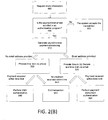
- FIGS. 2(A) and 2(B) illustrate a flow diagram in accordance with an embodiment of present invention.
- the depicted flow processing may be associated with any fraud screening engine, whether the engine be predictive or not.
- an offline user may input a voice transaction request (e.g., buying an airline ticket) using the telephone 200.
- the call center server 230 receives the voice transaction request via a telephone network (network 330) using interactive voice response (IVR) system. The call center server 230 then transmits the voice transaction request to the payment server 100 via the network 300.
- IVR interactive voice response
- the payment server 100 by the operation of the processor 110 and tangible computer-readable medium 120, receives request for a transaction (e.g., buying an airline ticket) and transaction information from the call center server 230 via the network 300.
- a transaction e.g., buying an airline ticket
- the payment server 100 verifies whether the payment instrument for the enrolled transaction is enrolled in a payment instrument authentication program such as the 3-D Secure® authentication.
- the payment server 100 transmits the transaction information (such as the credit card number) to the authentication service provider server 220, via a network 320.
- the authentication service provider server 220 responds with a result regarding whether the payment instrument is enrolled in the authentication program.
- the payment server 100 performs the fraud screening by communicating with the fraud screening service provider server 210 via the network 310.
- the payment server 100 performs the fraud screening by sending the requested transaction and transaction information to the fraud screen service provider server 210, and receives a result of the fraud screening from the fraud screening service provider server 210.
- the payment server 100 includes a fraud screening engine.
- the fraud screen engine determines the fraud screening result based on transaction information such as credit card number, amount paid, time of charge, and/or device used for the transaction (such as the IP address for the device).
- transaction information such as credit card number, amount paid, time of charge, and/or device used for the transaction (such as the IP address for the device).
- the transaction information may further include the destination, the particular flight, and the origin city.
- the fraud screening returns a result of allowing the transaction (470), rejecting the transaction (460), or requesting more information (480).
- the function of gather more information involves a request for more information. Additional information on fraud screen is provided in opening "Fraud Screen System and Method" application.
- the requesting more information function includes at least one of the features described below.
- the requesting more information function includes a payment instrument authentication such as 3D Secure TM authentication.
- the fraud screening service provider server 210 transmits a result of the fraud screening to the payment server 100, who will accept the transaction request, reject the transaction request, or gather more information.
- the payment determines the next action in requesting more information function based on whether the payment instrument is enrolled in a payment authentication program (e.g. 3D Secure TM )(see 430). In a case the payment instrument is not enrolled, the payment server 100 issues an allowance of the requested transaction (500).
- a payment authentication program e.g. 3D Secure TM
- the payment server 100 issues an allowance of the requested transaction (500).
- the payment server 100 In a case the payment instrument is enrolled in a payment instrument authentication program, the payment server 100 generates an asynchronous processing.
- One feature of asynchronous processing provides processing payment at a time later than the transaction request.
- the payment server 100 may further reserve the purchase of the requested transaction before the payment. E.g., in case of an airline ticket purchase, the flight is reserved.
- the payment server 100 provides the time limit to the user via the call center 230 and telephone 200.
- the user fails to make payment within the time limit, and the system exits the requested transaction.
- the payment server cancels all the reservations relating to the requested transaction.
- the user completes the payment before the time limit, and the requested transaction is completed.
- One example of the payment is real-time, offline card present payment using EMV verification, which may include a face to face payment.
- the user provides an email address
- the payment server 100 provides the time limit and a link to the payment instrument authentication (e.g., 3D Secure TM ).
- the payment instrument authentication e.g., 3D Secure TM
- the user fails to make payment within the time limit, and the system exits the requested transaction.
- the payment server cancels all the reservations relating to the requested transaction.
- the user enters the payment information and accesses payment instrument authentication (600).
- the user performs the payment instrument authentication without involving the payment server 100, and the payment instrument authentication server provides the results to the payment server 100.
- the payment instrument authentication was conducted via the payment server 100 and the payment instrument authentication server.
- FIG. 3 illustrates a flow diagram when performing the payment instrument authentication. Based on a result from the fraud screen and transaction information (such as the value of the transaction), the payment server or the system selects one of these three responses after the payment instrument authentication.
- transaction information such as the value of the transaction
- payment instrument authentication (such as 3D Secure TM authentication) is performed.
- the requested transaction is allowed according to the result of payment instrument authentication.
- the requested transaction is denied according to the result of payment instrument authentication.
- more information is needed (requesting more information).
- the requesting more information function includes issuing a request for manual review. More information on fraud screen and payment instrument authentication can be found in co-pending application no. 13/786,497 titled "Fraud Decision Processing System and Method,"
- the invention can be characterized by the following aspects:
Landscapes
- Business, Economics & Management (AREA)
- Accounting & Taxation (AREA)
- Engineering & Computer Science (AREA)
- Finance (AREA)
- General Physics & Mathematics (AREA)
- General Business, Economics & Management (AREA)
- Physics & Mathematics (AREA)
- Strategic Management (AREA)
- Theoretical Computer Science (AREA)
- Computer Security & Cryptography (AREA)
- Development Economics (AREA)
- Economics (AREA)
- Microelectronics & Electronic Packaging (AREA)
- Computer Networks & Wireless Communication (AREA)
- Financial Or Insurance-Related Operations Such As Payment And Settlement (AREA)
Priority Applications (4)
| Application Number | Priority Date | Filing Date | Title |
|---|---|---|---|
| EP13290173.7A EP2830014A1 (fr) | 2013-07-23 | 2013-07-23 | Système de traitement de paiement de canal sécurisé et procédé |
| KR1020140072851A KR20150011757A (ko) | 2013-07-23 | 2014-06-16 | 보안 채널 지불 처리 시스템 및 방법 |
| CA2857042A CA2857042A1 (fr) | 2013-07-23 | 2014-07-17 | Systeme de traitement de paiement par canal securise et methode associee |
| AU2014204560A AU2014204560B2 (en) | 2013-07-23 | 2014-07-22 | Secure channel payment processing system and method |
Applications Claiming Priority (1)
| Application Number | Priority Date | Filing Date | Title |
|---|---|---|---|
| EP13290173.7A EP2830014A1 (fr) | 2013-07-23 | 2013-07-23 | Système de traitement de paiement de canal sécurisé et procédé |
Publications (1)
| Publication Number | Publication Date |
|---|---|
| EP2830014A1 true EP2830014A1 (fr) | 2015-01-28 |
Family
ID=48986062
Family Applications (1)
| Application Number | Title | Priority Date | Filing Date |
|---|---|---|---|
| EP13290173.7A Withdrawn EP2830014A1 (fr) | 2013-07-23 | 2013-07-23 | Système de traitement de paiement de canal sécurisé et procédé |
Country Status (1)
| Country | Link |
|---|---|
| EP (1) | EP2830014A1 (fr) |
Cited By (3)
| Publication number | Priority date | Publication date | Assignee | Title |
|---|---|---|---|---|
| GB2551543A (en) * | 2016-06-21 | 2017-12-27 | Eckoh Uk Ltd | Methods of authenticating a user for data exchange |
| CN112231118A (zh) * | 2020-10-16 | 2021-01-15 | 蜂助手股份有限公司 | 一种聚合支付平台、系统及方法 |
| EP4152233A1 (fr) * | 2021-09-16 | 2023-03-22 | Encoded Ltd. | Sécurisation des transactions de paiement par carte effectuées par téléphone |
Citations (5)
| Publication number | Priority date | Publication date | Assignee | Title |
|---|---|---|---|---|
| WO2001082246A2 (fr) * | 2000-04-24 | 2001-11-01 | Visa International Service Association | Service d'authentification de payeur en ligne |
| WO2002003229A1 (fr) * | 2000-06-29 | 2002-01-10 | Jpmorgan Chase Bank | Systeme et procede de presentation et de paiement electroniques des factures |
| WO2003054819A2 (fr) * | 2001-12-12 | 2003-07-03 | Paradata Systems Inc. | Systeme de paiement integre mondial |
| US20040210476A1 (en) * | 2001-03-31 | 2004-10-21 | First Data Corporation | Airline ticket payment and reservation system and methods |
| WO2006126183A2 (fr) * | 2005-05-27 | 2006-11-30 | Nice Systems Ltd. | Procede et appareil de detection de fraude |
-
2013
- 2013-07-23 EP EP13290173.7A patent/EP2830014A1/fr not_active Withdrawn
Patent Citations (5)
| Publication number | Priority date | Publication date | Assignee | Title |
|---|---|---|---|---|
| WO2001082246A2 (fr) * | 2000-04-24 | 2001-11-01 | Visa International Service Association | Service d'authentification de payeur en ligne |
| WO2002003229A1 (fr) * | 2000-06-29 | 2002-01-10 | Jpmorgan Chase Bank | Systeme et procede de presentation et de paiement electroniques des factures |
| US20040210476A1 (en) * | 2001-03-31 | 2004-10-21 | First Data Corporation | Airline ticket payment and reservation system and methods |
| WO2003054819A2 (fr) * | 2001-12-12 | 2003-07-03 | Paradata Systems Inc. | Systeme de paiement integre mondial |
| WO2006126183A2 (fr) * | 2005-05-27 | 2006-11-30 | Nice Systems Ltd. | Procede et appareil de detection de fraude |
Non-Patent Citations (1)
| Title |
|---|
| VISA INTERNATIONAL SERVICE ASSOCIATION: "3-D Secure Introduction, Version 1.0.2", INTERNET CITATION, 26 September 2002 (2002-09-26), XP002475409, Retrieved from the Internet <URL:http://www.web-merchant.co.uk/optimal%20technical%20data/3D_secure_Guide.pdf> [retrieved on 20080407] * |
Cited By (7)
| Publication number | Priority date | Publication date | Assignee | Title |
|---|---|---|---|---|
| GB2551543A (en) * | 2016-06-21 | 2017-12-27 | Eckoh Uk Ltd | Methods of authenticating a user for data exchange |
| US9892409B2 (en) | 2016-06-21 | 2018-02-13 | Eckoh Uk Limited | Methods of authenticating a user for data exchange |
| US10846693B2 (en) | 2016-06-21 | 2020-11-24 | Eckoh Uk Limited | Methods of authenticating a user for data exchange |
| US11416859B2 (en) | 2016-06-21 | 2022-08-16 | Eckoh Uk Limited | Methods of authenticating a user for data exchange |
| CN112231118A (zh) * | 2020-10-16 | 2021-01-15 | 蜂助手股份有限公司 | 一种聚合支付平台、系统及方法 |
| CN112231118B (zh) * | 2020-10-16 | 2024-04-30 | 蜂助手股份有限公司 | 一种聚合支付平台、系统及方法 |
| EP4152233A1 (fr) * | 2021-09-16 | 2023-03-22 | Encoded Ltd. | Sécurisation des transactions de paiement par carte effectuées par téléphone |
Similar Documents
| Publication | Publication Date | Title |
|---|---|---|
| US11694200B2 (en) | Secure account creation | |
| US20140258119A1 (en) | Fraud Decision Processing System and Method | |
| US20230360059A1 (en) | Communication network and method for routing data messages on networks having different communication protocols | |
| US20230410119A1 (en) | System and methods for obtaining real-time cardholder authentication of a payment transaction | |
| US10223680B2 (en) | Transaction decisioning by an automated device | |
| US20240420139A1 (en) | Authentication system and method | |
| EP3129935A1 (fr) | Systèmes et procédés permettant d'effectuer des transactions au niveau d'un dab à l'aide d'un dispositif mobile | |
| US20160267438A1 (en) | Scheduling an Appointment to Complete a Transaction | |
| US20160292783A1 (en) | Online marketplace interface having a network of qualified user offers | |
| US11687934B1 (en) | Dynamic risk assessment for security features | |
| US12373887B2 (en) | Systems and methods for collateral deposit identification | |
| WO2016033513A1 (fr) | Système et procédé d'authentification électronique sur un ordinateur, initiée via un mobile | |
| US10755264B2 (en) | Methods and systems for secure online payment | |
| US20150032617A1 (en) | Secure Channel Payment Processing System and Method | |
| EP2830014A1 (fr) | Système de traitement de paiement de canal sécurisé et procédé | |
| US20160358141A1 (en) | Transaction Decisioning by an Automated Device | |
| EP2775440A1 (fr) | Système de traitement de décision de fraude et procédé | |
| AU2014203818A1 (en) | Fraud management system and method | |
| US20220012746A1 (en) | Real-time financial product selection | |
| AU2014204560B2 (en) | Secure channel payment processing system and method | |
| US11017404B1 (en) | Event based authentication | |
| RU2630166C1 (ru) | Система, способ и устройство для осуществления онлайн платежей с использованием платежных карт | |
| US20250131431A1 (en) | Advanced multi-source transaction authorization system for enhanced financial transactions | |
| AU2016201045A1 (en) | Fraud decision processing system and method |
Legal Events
| Date | Code | Title | Description |
|---|---|---|---|
| 17P | Request for examination filed |
Effective date: 20130723 |
|
| AK | Designated contracting states |
Kind code of ref document: A1 Designated state(s): AL AT BE BG CH CY CZ DE DK EE ES FI FR GB GR HR HU IE IS IT LI LT LU LV MC MK MT NL NO PL PT RO RS SE SI SK SM TR |
|
| AX | Request for extension of the european patent |
Extension state: BA ME |
|
| PUAI | Public reference made under article 153(3) epc to a published international application that has entered the european phase |
Free format text: ORIGINAL CODE: 0009012 |
|
| STAA | Information on the status of an ep patent application or granted ep patent |
Free format text: STATUS: THE APPLICATION IS DEEMED TO BE WITHDRAWN |
|
| 18D | Application deemed to be withdrawn |
Effective date: 20150729 |