EP2830190A2 - Système de conversion de puissance électrique modulaire pour un dispositif électromagnétique réversible - Google Patents
Système de conversion de puissance électrique modulaire pour un dispositif électromagnétique réversible Download PDFInfo
- Publication number
- EP2830190A2 EP2830190A2 EP20140177346 EP14177346A EP2830190A2 EP 2830190 A2 EP2830190 A2 EP 2830190A2 EP 20140177346 EP20140177346 EP 20140177346 EP 14177346 A EP14177346 A EP 14177346A EP 2830190 A2 EP2830190 A2 EP 2830190A2
- Authority
- EP
- European Patent Office
- Prior art keywords
- modules
- converters
- electric
- conversion system
- bus
- Prior art date
- Legal status (The legal status is an assumption and is not a legal conclusion. Google has not performed a legal analysis and makes no representation as to the accuracy of the status listed.)
- Granted
Links
Images




Classifications
-
- H—ELECTRICITY
- H02—GENERATION; CONVERSION OR DISTRIBUTION OF ELECTRIC POWER
- H02J—ELECTRIC POWER NETWORKS; CIRCUIT ARRANGEMENTS OR SYSTEMS FOR SUPPLYING OR DISTRIBUTING ELECTRIC POWER; SYSTEMS FOR STORING ELECTRIC ENERGY
- H02J7/00—Circuit arrangements for charging or discharging batteries or for supplying loads from batteries
- H02J7/14—Circuit arrangements for charging or discharging batteries or for supplying loads from batteries for charging batteries from dynamo-electric generators driven at varying speed, e.g. on vehicle
-
- H—ELECTRICITY
- H02—GENERATION; CONVERSION OR DISTRIBUTION OF ELECTRIC POWER
- H02K—DYNAMO-ELECTRIC MACHINES
- H02K1/00—Details of the magnetic circuit
- H02K1/06—Details of the magnetic circuit characterised by the shape, form or construction
- H02K1/12—Stationary parts of the magnetic circuit
- H02K1/14—Stator cores with salient poles
- H02K1/141—Stator cores with salient poles consisting of C-shaped cores
-
- H—ELECTRICITY
- H02—GENERATION; CONVERSION OR DISTRIBUTION OF ELECTRIC POWER
- H02K—DYNAMO-ELECTRIC MACHINES
- H02K11/00—Structural association of dynamo-electric machines with electric components or with devices for shielding, monitoring or protection
- H02K11/30—Structural association with control circuits or drive circuits
- H02K11/33—Drive circuits, e.g. power electronics
-
- H—ELECTRICITY
- H02—GENERATION; CONVERSION OR DISTRIBUTION OF ELECTRIC POWER
- H02P—CONTROL OR REGULATION OF ELECTRIC MOTORS, ELECTRIC GENERATORS OR DYNAMO-ELECTRIC CONVERTERS; CONTROLLING TRANSFORMERS, REACTORS OR CHOKE COILS
- H02P6/00—Arrangements for controlling synchronous motors or other dynamo-electric motors using electronic commutation dependent on the rotor position; Electronic commutators therefor
- H02P6/14—Electronic commutators
-
- H—ELECTRICITY
- H02—GENERATION; CONVERSION OR DISTRIBUTION OF ELECTRIC POWER
- H02K—DYNAMO-ELECTRIC MACHINES
- H02K2213/00—Specific aspects, not otherwise provided for and not covered by codes H02K2201/00 - H02K2211/00
- H02K2213/06—Machines characterised by the presence of fail safe, back up, redundant or other similar emergency arrangements
-
- H—ELECTRICITY
- H02—GENERATION; CONVERSION OR DISTRIBUTION OF ELECTRIC POWER
- H02K—DYNAMO-ELECTRIC MACHINES
- H02K2213/00—Specific aspects, not otherwise provided for and not covered by codes H02K2201/00 - H02K2211/00
- H02K2213/12—Machines characterised by the modularity of some components
Definitions
- the present invention relates to a modular electric power conversion system for a reversible electromagnetic device.
- Electromagnetic devices having reversible operation as a generator and as an electric motor, i.e. which can convert kinetic energy into electric power in a first operating mode (as a generator) and electric power into kinetic energy in a second operating mode (as a motor), are known.
- Patent Applications WO 2009/093181 and WO 2009/093183 describe an electromagnetic device with reversible operation as a generator-motor, having modular features.
- such an electromagnetic device denoted as a whole by reference numeral 1, comprises a plurality of mutually independent modules (or cells) 2, each capable of operating reversibly as a motor or, alternatively, as a generator.
- the electromagnetic device 1 comprises a disc- or ring-shaped rotor 3, either mounted to a rotation shaft 4 or integrated in a turbine impeller, as disclosed in Patent Applications WO 2009/093181 and WO 2009/093183 .
- Rotor 3 carries a plurality of permanent magnets (not shown in figure 1 ), equally spaced apart along an outer circumference of the disc or ring, and defining a sequence of alternatively opposite poles.
- Each module 2 of the electromagnetic device 1 comprises at least one magnetic yoke 5, having two polar expansions 6a, 6b, about which a respective coil is wound, arranged facing a respective pair of permanent magnets of rotor 3 ( figure 1 shows one pair of magnetic yokes 5 for each module 2, arranged on opposite sides of rotor 3, each facing the respective pair of permanent magnets).
- the magnetic yokes 5 as a whole form the stator of the electromagnetic device 1.
- Each magnetic yoke 5 (or pair of magnetic yokes) forms a magnetic circuit with the respective pair of permanent magnets, which is adapted to contribute to the operation as a generator or, alternatively, as a motor of the electromagnetic device 1.
- each magnetic yoke 5 may be individually and electrically coupled, alternatively either to an electric power source or to an electric user or load; moreover, each magnetic yoke 5 is mounted on a respective support 7 (diagrammatically shown in figure 1 ), the position of which is independently adjustable, both axially and radially, with respect to rotor 3, so as to allow a static and/or dynamic adjustment of the gap between the polar expansions 6a, 6b and the respective permanent magnets (i.e. of the gap of the respective magnetic circuit).
- the electromagnetic device 1 thus allows a reversible motor-generator operation of each module 2, and furthermore, in principle, the simultaneous operation of some of modules 2 as a motor and of other modules 2 as a generator.
- the electromagnetic device 1 further comprises a casing 8, in which the rotor 3 and the stator of the electromagnetic device 1 are assembled, and which additionally allows the rotation shaft 4 to pass through and rotate.
- Static power converters manage the extraction of electric power from the electric machine in a controlled manner to adapt it to the needs of users, which may be either isolated loads or the electric grid.
- the electromagnetic device 1 described in aforesaid Patent Applications WO 2009/093181 and WO 2009/093183 has a number of single-phase interfaces with respect to a power converter, each interface corresponding to a respective module 2; therefore, the contributions of the respective modules 2 must be combined together, by means of appropriate connections, to provide a single poly-phase interface, which is compatible with the input of the power converter.
- phase groups may be provided by connecting the modules 2 in series and/or in parallel, while the poly-phase interface may be appropriately arranged by connecting together the single phase groups.
- connection in parallel of modules 2 requires the alternating quantities (typically voltages) that are induced in the modules 2 by electromagnetic effect to be isomorphic, i.e. to have the same amplitude, frequency and phase.
- imbalances which determine a flow of noise electric current in the modules 2, are generated in the poly-phase system if the isomorphism condition is not respected.
- Such an electric current although not contributing to the useful power available for the load, clearly implies additional losses by Joule effect and, thus, an efficiency loss of the power conversion system.
- the imperfect isomorphism between electric quantities may be caused by various factors, which commonly occur during the operation of the conversion system, including for example the mechanical misalignment between the modules 2, the heterogeneity of the electromagnetic properties of the materials used for manufacturing the corresponding stator cores and the variability of the gap width due to the mechanical tolerances of the components.
- the adoption of known conversion systems thus requires manufacturing of the same electromagnetic device 1 with a high degree of accuracy and selection of the parts forming the various modules 2, in order to make the device with components as homogenous as possible from the dimensional point of view and with regards to electromagnetic properties, so as to reduce voltage asymmetries and recirculation currents accordingly.
- a further limitation associated with the power conversion systems of the known type consists in the difficulty of providing so-called "fault tolerant” systems, i.e. systems capable of operating, although at reduced performance, in the presence of one or more faults.
- one possibility may consist in using a plurality of poly-phase converters associated with the same outputs of the electromagnetic device, connected to one another in parallel.
- a solution does not allow to continue operation in case of fault of the electromagnetic device.
- possible faults to one of the converters could compromise the integrity of the entire system because the converters share the same input poly-phase interface.
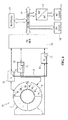
- a modular electric power conversion system indicated as a whole by reference numeral 10, for an electromagnetic device, indicated by reference numeral 1, for example of the type described in the aforesaid Patent Applications WO 2009/093181 and WO 2009/093183 , diagrammatically illustrated here (and not described again in detail), will now be described with reference to figure 2 .
- the electromagnetic device 1 thus comprises a plurality of mutually independent modules 2, herein also indicated by M 1 .. M n (with n being an integer greater than one), each capable of reversibly operating as a motor or, alternatively, as an electric generator.
- the conversion system 10 comprises a plurality of static type converters 12, also indicated by C 1 .. C n , which operate an AC/DC conversion (alternating current/direct current conversion).
- each converter 12 is of the single-phase type, and is connected to a respective module 2 of the electromagnetic device 1.
- Each converter 12 thus has a first AC input/output interface of the single-phase type connected to a respective module 2 of the electromagnetic device 1.
- Converters 12 also have a respective second DC output/input interface connected to a DC bus 14, for example of the capacitive type.
- the second output/input interfaces are connected to one another in parallel to form the same DC bus 14 (which is thus shared by all converters 12).
- the conversion system 10 further comprises a DC network 15, supplied by the DC bus 14, to which one or more DC loads 16 and/or one or more AC loads 17 are connected, the latter by interposing a respective DC/AC converter 18 (direct current/alternating current converter).
- a DC network 15 supplied by the DC bus 14, to which one or more DC loads 16 and/or one or more AC loads 17 are connected, the latter by interposing a respective DC/AC converter 18 (direct current/alternating current converter).
- An energy storage device 19 for example including a battery, is connected to the DC network 15, and is coupled to the DC bus 14.
- the conversion system 10 further comprises a central control unit 20, in particular including a microprocessor, a microcontroller, or similar processing unit, operatively coupled to the converters 12, for example in a cabled manner, i.e. by means of a communication bus, or in wireless mode, by means of appropriate communication protocol.
- a central control unit 20 in particular including a microprocessor, a microcontroller, or similar processing unit, operatively coupled to the converters 12, for example in a cabled manner, i.e. by means of a communication bus, or in wireless mode, by means of appropriate communication protocol.
- each module 2 of the electromagnetic device 1 is individually managed by the respective converter 12, under the supervision of the central control unit 20, thus forming an independent single-phase conversion system which transforms the alternating quantities (induced by electromagnetic effect) into DC quantities.
- Each module 2 may alternatively operate as an electric motor or as an electric generator, and may be additionally activated or deactivated according to the operating needs of the conversion system 10.
- the converters 12 are intelligent blocks, i.e. provided with autonomous processing capability, and are all provided with electronic components needed to perform power conversion, and with calculation and communication systems which allow to execute appropriate control algorithms and to communicate with the central control unit 20.
- each converter 12 is provided with a local control unit 21 including, for example, a microprocessor, a microcontroller, a FPGA (Field Programmable Gate Array), a DSP (Digital Signal Processor), or a similar processing and calculation unit.
- a local control unit 21 including, for example, a microprocessor, a microcontroller, a FPGA (Field Programmable Gate Array), a DSP (Digital Signal Processor), or a similar processing and calculation unit.
- the central control unit 20 may allow the synchronization of the various converters 12, in order to implement more or less sophisticated conversion algorithms (of a known type, not described here in detail), for example those based on an alternating quantity vector control.
- the presence of the energy storage device 19 allows power flux inversion in addition to providing a back-up function for supplying the DC loads 16 and/or the AC loads 17 in case of faults.
- the electromagnetic device 1 as an electric motor by means of the converters 12, thus transforming the stored electric energy into mechanical energy.
- the modularity of the conversion system 10, combined with the intrinsic modularity of the electromagnetic device 1, allows in particular the simultaneous operation as a motor/generator of the modules 2 of the electromagnetic device 1, each module 2 being indeed able to operate, in combination with the associated converter 12, either as a motor or as an electric generator, autonomously and independently from the other modules 2 (and associated converters 12).
- intelligent-type converters 12 each provided with its own local control unit 21, allows online reconfigurability (i.e. in real-time during operation) of the electromagnetic device 1, thus allowing, for example, to establish which and how many modules 2 to dedicate to operation as a motor or as an electric generator.
- the central control unit 20 may configure the type of operation of each converter 12 (and of the associated module 2) by sending appropriate control and configuration signals.
- the central control unit 20 may itself receive appropriate configuration instructions from the outside.
- the modularity of the conversion system 10 allows to manage each converter 12 and associated module 2 in an entirely autonomous manner, independently from the other components of the conversion system 10.
- modules 2 which have faults can be switched off, deactivated and disconnected from the DC bus 14, thus avoiding the propagation of the faults and damage to the conversion system 10.
- Such an automatic switch-off of modules 2 may be managed by the central control unit 20 or by the corresponding local control units 21, for example as a function of the temperatures measured by appropriate temperature sensors.
- the conversion system 10 is reconfigurable and self-adaptive, also dynamically and in real-time (in addition to during the phase of designing the system).
- a second embodiment of the present solution may include, in order to limit the number of converters 12 required in the conversion system 10, grouping two or more modules 2, so as to form a plurality of poly-phase systems with a desired number of phases ( figure 3 shows two groups of m and p phases, with m and p being integers greater than or equal to two).
- Each group which may consist of a respective number of modules 2 connected to one another in series and/or in parallel, is in this case connected to a respective converter 12 of the poly-phase type.
- the reconfigurability of the conversion system 10 may also extend, in this case, to assigning a desired variable number of modules 2 to each converter 12, for this purpose appropriate switches (not shown) being provided, which can be selectively controlled by the central control unit 20 and/or by the control units 21.
- each converter 12, and the corresponding group of modules 2 may be further configured to operate as a motor or as an electric generator by the central control unit 20 and/or control units 21, and may also be selectively deactivated.
- converters 12 may advantageously be provided aboard the electromagnetic device 1, coupled in an integrated manner to the respective modules 2, for example being made on respective printed circuit boards (PCBs) mechanically coupled to the supports 7 of the respective modules 2, within the casing 8 of the electromagnetic device 1.
- PCBs printed circuit boards
- an appropriate high temperature resistant technology may be used to manufacture such printed circuit boards and the corresponding electronic components.
- a further embodiment of the conversion system 10, shown in figure 4 is instead free from central control unit 20.
- the local control units 21 of the converters 12 are connected in reciprocal direct communication, for example by means of a communication bus 24, so as to exchange control signals and commands.
- An appropriate communication protocol may conveniently be provided on the communication bus 24 and an appropriate hierarchy relationship of the master-slave type may be provided between the local control units 21.
- a first local control unit 21, operating as a master unit, in addition to performing control functions with respect to the other local control units 21, operating as slave units, may be able to receive appropriate control signals from the outside, in order to manage appropriate conversion strategies.
- Each local control unit 21 may advantageously share the same processing resources to define the conversion strategy so as to operate as a master unit, if this is required during the step of reconfiguring (also dynamically) the conversion system; for example, in case of master fault, the immediately next slave unit will take the master unit functions itself.
- several local control units 21 may be provided, each operating as a master unit and with associated respective converters, operating as slave units.
- a possible embodiment of a converter 12 will now be described by way of example, in this case of the single-phase type, i.e. having the first input/output interface connected to a single module 2 of the electromagnetic device 1 (diagrammatically shown here with an equivalent inductance). Changes which will be apparent for a person skilled in art are to be made if a poly-phase interface is required.
- Converter 12 comprises a bridge circuit 25 of the single-phase type consisting (in a known manner, here not described in detail) of an appropriate configuration of controlled switches 26, each made with a respective semiconductor power device (e.g. a power transistor).
- a respective semiconductor power device e.g. a power transistor
- the bridge circuit 25 has: a first a pair of interface terminals Int 1 , Int 2 , between which the respective module 2 is connected and between which an alternating voltage V AC is present; and a second pair of interface terminals Int 3 , Int 4 , between which a capacitor element 27 is connected, having local energy storage function, and between which a direct voltage V DC is present.
- the second pair of interface terminals Int 3 , Int 4 and the capacitor element 27 are additionally connected to the DC bus 14.
- the local control unit 21 supplies appropriate control signals, for example PWM (Pulse Width Modulation) control signals, to the controlled switches 26, by means of the interposition of appropriate control modules (drivers) 28.
- PWM Pulse Width Modulation
- Converter 12 further comprises: appropriate AC feedback sensors 29a, and appropriate DC feedback sensors 29b, including voltage and current sensors, coupled to the first pair of interface terminals Int 1 , Int 2 and to the second pair of interface terminals Int 3 , Int 4 , respectively; converter 12 further comprises appropriate temperature sensors 29c.
- the PWM control signals and the feedback signals from the sensors are managed by the local control unit 21 and are made available to the central control unit 20 (if present) and/or to the local control unit 21 of the other converters 12 of the conversion system 10, on communication buses or by interposing a shared memory 30.
- the local control unit 21 may receive control signals from the outside according to which operating set points may be calculated and assigned, and according to which, for example, the PWM control signals may be generated.
- the bridge circuit 25 is configured to operate as a rectifier (both in active configuration and in passive configuration), if the associated modules 2 of the electromagnetic device 1 operate as an electric generator, or as an inverter, if the same modules 2 operate as an electric motor.
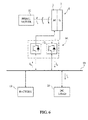
- an exemplary use of the conversion system 10 for an electromagnetic device 1 will now be described, having a first section consisting of a given number of modules 2, dedicated to the generation of electric energy, and a second section consisting of a respective number of different modules 2, dedicated to operation as an electric motor; the two sections, and the respective modules 2, operate simultaneously.
- a mechanical power source is coupled to the electromagnetic device 1 (alternatively, the mechanical power source may be the fluid which activates the impeller of a turbine, where the electromagnetic device 1 is integrated in the impeller).
- the number of modules 2 dedicated to generation of electric energy and to operation as an electric motor may be varied and configured either offline (statically) or online (dynamically) according to the operating needs of the electromagnetic device 1 and/or of the conversion system 10.
- the configuration illustrated in figure 6 may be advantageous in applications where a mechanical power boost is required; for example, in an aircraft, the main role of the electric machine is to convert part of the mechanical energy generated by the propulsion engine into electric energy for supplying the loads; a mechanical power boost may be supplied to the propulsion engine during take-off by reconfiguring part of the electromagnetic device and utilizing part of the electric machine as a motor.
- both generator and electric motor sections being contained in the electromagnetic device 1 itself allows an obvious reduction of weight, because both sections share the "heavy" parts, such as rotor 3, rotating shaft 4 and casing 8.
- such a solution allows to use the electromagnetic device 1 both as a generator and as an electric motor in an intelligent, totally configurable manner, also in real time (online) in addition to during the step of designing (offline).
- simultaneous operation as a generator/motor of first and, respectively, second modules 2 forming the electromagnetic device 1 is possible.
- the DC conversion of the single-phase (or poly-phase) electric quantities generated by the modules 2 of the electromagnetic device 1 allows to overcome the limitation related to the isomorphism of the electric quantities to be combined, because the combination of the contributions of each module 2 is no longer in AC, where it is important to ensure equality of amplitude, frequency and phase, but in DC, where adjusting the amplitude is sufficient.
- the problem of the misalignment of modules 2 and of the variability of the gap is solved electronically, and not longer by means of mechanical calibration.
- figures 7a and 7b diagrammatically show the result of a possible variability, indicated by ⁇ g 1 , ⁇ g 2 , in the gap g between rotor 3 and magnetic yoke 5 ( figure 7a shows the nominal design situation).
- Figures 8a-8d diagrammatically show the result of an imperfect alignment between the polar expansions 6a, 6b of the magnetic yoke 5, in particular, figures 8b and 8c , in the form of an angular displacement ⁇ 1 , ⁇ 2 with respect to a nominal angle ⁇ 0 ( figure 8a ) of the symmetry axis (c being the center of rotor 3); alternatively, figure 8d shows an angular displacement ⁇ of the position of the entire magnetic yoke 5.
- Figures 9a and 9b diagrammatically show the result of a radial misalignment ( figure 9a ), or on the horizontal plane ( figure 9b ), (displacement ⁇ x and ⁇ y along a first and a second horizontal axis x, y) of the polar expansions 6a and 6b with respect to the nominal arrangement.
- the aforesaid feature results in the advantage of not requiring the intervention of a specialized operator having the equipment needed for calibration and does not require machine downtime for implementing corrective actions because these are carried out electronically by automatically controlling the DC voltage, resulting from the conversion of the single/poly-phase quantities generated by the single modules/groups of modules (and by leveling the amplitudes by the capacitive contribution associated with the DC bus 14).
- the present solution generally allows to increase the efficiency of the conversion system 10 and to release the constraints and manufacturing tolerances of the modular electric machines by eliminating the phenomenon of recirculation currents caused by the lack of isomorphism of the electromagnetic quantities.
- the suggested solution allows to solve the problems related to constructive asymmetries caused by mechanical manufacturing tolerances (translation and/or rotation), which do not result, in this solution, in the generation of recirculation currents in the modules (or cells) connected in parallel to one another. Indeed, by independently DC converting the contribution of each cell, the need to connect several cells in parallel to one another no longer exists. Possible differences in amplitude, frequency and phase of the alternating quantities output by the cells liable to manufacturing tolerances are no longer present in the DC converted quantities which are sent onto the common DC bus, where it is sufficient to adjust only the amplitude of the output quantities from the AC/DC converters in order to avoid the generation of recirculation currents.
- the suggested solution also allows to increase the reliability of the energy conversion system 10 and its fault resistance; indeed, the number of independent conversion branches is equal to the number of modules 2 of the electromagnetic device 1, thus greatly increasing the number of admissible faults.
- the intrinsic modularity of the electromagnetic device 1 effectively ensures the physical and magnetic insulation of the various modules 2, and therefore the possibility of fault propagation is minimized.
- the presence of the DC network 15, onto which an appropriate energy storage device 19 is to be connected, for example in the form of one or more battery packs, further provides an emergency system for supplying the loads in case of total failure of the conversion system 10.
- the suggested solution also allows to obtain clear reductions of weight, dimensions and general complexity of the conversion system 10, and an increase of efficiency and flexibility of use of the same conversion system 10.
- circuit structure of the single converters 12 may differ from the above disclosure given by way of example.
- the conversion system 10 is advantageously applicable to an electromagnetic device 1 of the previously described type, it is apparent that the same conversion system 10 may operate with different types of electric machines; in particular, the configuration of the electric machine may differ from the above-disclosed embodiments given by way of example.
Landscapes
- Engineering & Computer Science (AREA)
- Power Engineering (AREA)
- Microelectronics & Electronic Packaging (AREA)
- Inverter Devices (AREA)
- Ac-Ac Conversion (AREA)
- Radiation-Therapy Devices (AREA)
Applications Claiming Priority (1)
| Application Number | Priority Date | Filing Date | Title |
|---|---|---|---|
| IT000599A ITTO20130599A1 (it) | 2013-07-16 | 2013-07-16 | Sistema modulare di conversione di potenza elettrica per un dispositivo elettromagnetico reversibile |
Publications (3)
| Publication Number | Publication Date |
|---|---|
| EP2830190A2 true EP2830190A2 (fr) | 2015-01-28 |
| EP2830190A3 EP2830190A3 (fr) | 2015-06-24 |
| EP2830190B1 EP2830190B1 (fr) | 2019-08-28 |
Family
ID=49182432
Family Applications (1)
| Application Number | Title | Priority Date | Filing Date |
|---|---|---|---|
| EP14177346.5A Active EP2830190B1 (fr) | 2013-07-16 | 2014-07-16 | Système de conversion de puissance électrique modulaire pour un dispositif électromagnétique réversible |
Country Status (2)
| Country | Link |
|---|---|
| EP (1) | EP2830190B1 (fr) |
| IT (1) | ITTO20130599A1 (fr) |
Cited By (1)
| Publication number | Priority date | Publication date | Assignee | Title |
|---|---|---|---|---|
| CN110945747A (zh) * | 2017-01-31 | 2020-03-31 | 雷勃澳大利亚私人有限公司 | 用于轴向通量电机的模块化定子驱动单元 |
Families Citing this family (1)
| Publication number | Priority date | Publication date | Assignee | Title |
|---|---|---|---|---|
| US12592573B2 (en) | 2021-05-24 | 2026-03-31 | Discovery Energy, Llc | Hybrid generator with detachable power unit and panel integration |
Citations (1)
| Publication number | Priority date | Publication date | Assignee | Title |
|---|---|---|---|---|
| WO2009093181A2 (fr) | 2008-01-21 | 2009-07-30 | Marco Cipriani | Dispositif électromagnétique à fonctionnement générateur-moteur réversible |
Family Cites Families (2)
| Publication number | Priority date | Publication date | Assignee | Title |
|---|---|---|---|---|
| US5514923A (en) * | 1990-05-03 | 1996-05-07 | Gossler; Scott E. | High efficiency DC motor with generator and flywheel characteristics |
| US7248006B2 (en) * | 2002-07-01 | 2007-07-24 | Xidem, Inc. | Electronically controlled electric motor |
-
2013
- 2013-07-16 IT IT000599A patent/ITTO20130599A1/it unknown
-
2014
- 2014-07-16 EP EP14177346.5A patent/EP2830190B1/fr active Active
Patent Citations (2)
| Publication number | Priority date | Publication date | Assignee | Title |
|---|---|---|---|---|
| WO2009093181A2 (fr) | 2008-01-21 | 2009-07-30 | Marco Cipriani | Dispositif électromagnétique à fonctionnement générateur-moteur réversible |
| WO2009093183A2 (fr) | 2008-01-21 | 2009-07-30 | Marco Cipriani | Dispositif électromagnétique modulaire à fonctionnement générateur-moteur réversible |
Cited By (3)
| Publication number | Priority date | Publication date | Assignee | Title |
|---|---|---|---|---|
| CN110945747A (zh) * | 2017-01-31 | 2020-03-31 | 雷勃澳大利亚私人有限公司 | 用于轴向通量电机的模块化定子驱动单元 |
| EP3574566A4 (fr) * | 2017-01-31 | 2020-11-25 | Regal Beloit Australia Pty Ltd. | Unités d'entraînement de stator modulaire pour machines électriques à flux axial |
| CN110945747B (zh) * | 2017-01-31 | 2022-03-18 | 雷勃澳大利亚私人有限公司 | 用于轴向通量电机的模块化定子驱动单元 |
Also Published As
| Publication number | Publication date |
|---|---|
| ITTO20130599A1 (it) | 2015-01-17 |
| EP2830190A3 (fr) | 2015-06-24 |
| EP2830190B1 (fr) | 2019-08-28 |
Similar Documents
| Publication | Publication Date | Title |
|---|---|---|
| CN105576921B (zh) | 可动态重构的电机、电机系统及电机动态重构方法 | |
| US9991719B2 (en) | Systems and methods for reducing circulating current and phase to phase imbalance in a parallel modular converter system | |
| EP3012704B1 (fr) | Architecture modulaire de convertisseur parallèle | |
| US10566922B2 (en) | Dynamically reconfigurable motors and generators and systems with efficiency optimization | |
| WO2021074661A1 (fr) | Convertisseur de puissance à ponts multiples à sorties multiples | |
| EP4380815A2 (fr) | Systèmes, dispositifs et procédés pour charger et décharger des systèmes d'énergie en cascade utilisant des modules | |
| US10486537B2 (en) | Power generating systems having synchronous generator multiplex windings and multilevel inverters | |
| EP3928411B1 (fr) | Chargeur intégré et système de commande de moteur isolé par moteur | |
| KR102202514B1 (ko) | Dc/ac 전압 컨버터를 제어하는 전자 아키텍처 | |
| EP1317057A2 (fr) | Ensemble générateur aérospacial | |
| CN103765756A (zh) | 用于控制旋转电机以减少直流总线上的电流纹波的系统 | |
| CN102340255A (zh) | 逆变器栅驱动信号的电源层生成 | |
| JP6844716B2 (ja) | インバータ制御基板 | |
| CN104426444A (zh) | 一种用于涡轮发动机的恒频起动器/发电机 | |
| JP2024518547A (ja) | モータシステムのための動的に構成可能なハードウェアシステムおよびその動作方法 | |
| JP2015509698A (ja) | 電気ユニットの使用方法 | |
| EP3788696A1 (fr) | Turbine à double transformateur | |
| JP2020202722A (ja) | 電力変換装置 | |
| US11539305B2 (en) | Modular arrangement of a converter and aircraft having a modular arrangement | |
| EP2830190B1 (fr) | Système de conversion de puissance électrique modulaire pour un dispositif électromagnétique réversible | |
| EP1926202B1 (fr) | Convertisseur de courant | |
| US10855214B2 (en) | Electrical powertrain for aircraft | |
| CN115362079B (zh) | 电机系统 | |
| EP2741414B1 (fr) | Système et procédé d'optimisation de générateur asynchrone à alimentation double à double pont (DFIG) | |
| CN112534131A (zh) | 风力涡轮机变桨系统 |
Legal Events
| Date | Code | Title | Description |
|---|---|---|---|
| 17P | Request for examination filed |
Effective date: 20140716 |
|
| AK | Designated contracting states |
Kind code of ref document: A2 Designated state(s): AL AT BE BG CH CY CZ DE DK EE ES FI FR GB GR HR HU IE IS IT LI LT LU LV MC MK MT NL NO PL PT RO RS SE SI SK SM TR |
|
| AX | Request for extension of the european patent |
Extension state: BA ME |
|
| PUAI | Public reference made under article 153(3) epc to a published international application that has entered the european phase |
Free format text: ORIGINAL CODE: 0009012 |
|
| PUAL | Search report despatched |
Free format text: ORIGINAL CODE: 0009013 |
|
| AK | Designated contracting states |
Kind code of ref document: A3 Designated state(s): AL AT BE BG CH CY CZ DE DK EE ES FI FR GB GR HR HU IE IS IT LI LT LU LV MC MK MT NL NO PL PT RO RS SE SI SK SM TR |
|
| AX | Request for extension of the european patent |
Extension state: BA ME |
|
| RIC1 | Information provided on ipc code assigned before grant |
Ipc: H02P 6/14 20060101ALI20150521BHEP Ipc: H02K 21/24 20060101ALI20150521BHEP Ipc: H02J 7/14 20060101AFI20150521BHEP Ipc: H02K 11/00 20060101ALN20150521BHEP Ipc: H02K 1/14 20060101ALN20150521BHEP |
|
| R17P | Request for examination filed (corrected) |
Effective date: 20151222 |
|
| RBV | Designated contracting states (corrected) |
Designated state(s): AL AT BE BG CH CY CZ DE DK EE ES FI FR GB GR HR HU IE IS IT LI LT LU LV MC MK MT NL NO PL PT RO RS SE SI SK SM TR |
|
| STAA | Information on the status of an ep patent application or granted ep patent |
Free format text: STATUS: EXAMINATION IS IN PROGRESS |
|
| 17Q | First examination report despatched |
Effective date: 20180201 |
|
| GRAP | Despatch of communication of intention to grant a patent |
Free format text: ORIGINAL CODE: EPIDOSNIGR1 |
|
| STAA | Information on the status of an ep patent application or granted ep patent |
Free format text: STATUS: GRANT OF PATENT IS INTENDED |
|
| RIC1 | Information provided on ipc code assigned before grant |
Ipc: H02P 6/14 20160101ALI20181112BHEP Ipc: H02K 1/14 20060101ALN20181112BHEP Ipc: H02J 7/14 20060101AFI20181112BHEP Ipc: H02K 11/33 20160101ALN20181112BHEP Ipc: H02K 21/24 20060101ALI20181112BHEP |
|
| INTG | Intention to grant announced |
Effective date: 20181204 |
|
| RIC1 | Information provided on ipc code assigned before grant |
Ipc: H02K 1/14 20060101ALN20181112BHEP Ipc: H02P 6/14 20160101ALI20181112BHEP Ipc: H02J 7/14 20060101AFI20181112BHEP Ipc: H02K 11/33 20160101ALN20181112BHEP Ipc: H02K 21/24 20060101ALI20181112BHEP |
|
| GRAJ | Information related to disapproval of communication of intention to grant by the applicant or resumption of examination proceedings by the epo deleted |
Free format text: ORIGINAL CODE: EPIDOSDIGR1 |
|
| STAA | Information on the status of an ep patent application or granted ep patent |
Free format text: STATUS: EXAMINATION IS IN PROGRESS |
|
| INTC | Intention to grant announced (deleted) | ||
| GRAR | Information related to intention to grant a patent recorded |
Free format text: ORIGINAL CODE: EPIDOSNIGR71 |
|
| GRAS | Grant fee paid |
Free format text: ORIGINAL CODE: EPIDOSNIGR3 |
|
| STAA | Information on the status of an ep patent application or granted ep patent |
Free format text: STATUS: GRANT OF PATENT IS INTENDED |
|
| RIC1 | Information provided on ipc code assigned before grant |
Ipc: H02P 6/14 20160101ALI20190527BHEP Ipc: H02K 1/14 20060101ALN20190527BHEP Ipc: H02K 11/33 20160101ALN20190527BHEP Ipc: H02K 21/24 20060101ALI20190527BHEP Ipc: H02J 7/14 20060101AFI20190527BHEP |
|
| INTG | Intention to grant announced |
Effective date: 20190603 |
|
| GRAA | (expected) grant |
Free format text: ORIGINAL CODE: 0009210 |
|
| STAA | Information on the status of an ep patent application or granted ep patent |
Free format text: STATUS: THE PATENT HAS BEEN GRANTED |
|
| AK | Designated contracting states |
Kind code of ref document: B1 Designated state(s): AL AT BE BG CH CY CZ DE DK EE ES FI FR GB GR HR HU IE IS IT LI LT LU LV MC MK MT NL NO PL PT RO RS SE SI SK SM TR |
|
| REG | Reference to a national code |
Ref country code: GB Ref legal event code: FG4D |
|
| REG | Reference to a national code |
Ref country code: CH Ref legal event code: EP |
|
| REG | Reference to a national code |
Ref country code: AT Ref legal event code: REF Ref document number: 1173599 Country of ref document: AT Kind code of ref document: T Effective date: 20190915 |
|
| REG | Reference to a national code |
Ref country code: IE Ref legal event code: FG4D |
|
| REG | Reference to a national code |
Ref country code: DE Ref legal event code: R096 Ref document number: 602014052420 Country of ref document: DE |
|
| REG | Reference to a national code |
Ref country code: NL Ref legal event code: MP Effective date: 20190828 |
|
| REG | Reference to a national code |
Ref country code: LT Ref legal event code: MG4D |
|
| PG25 | Lapsed in a contracting state [announced via postgrant information from national office to epo] |
Ref country code: NO Free format text: LAPSE BECAUSE OF FAILURE TO SUBMIT A TRANSLATION OF THE DESCRIPTION OR TO PAY THE FEE WITHIN THE PRESCRIBED TIME-LIMIT Effective date: 20191128 Ref country code: SE Free format text: LAPSE BECAUSE OF FAILURE TO SUBMIT A TRANSLATION OF THE DESCRIPTION OR TO PAY THE FEE WITHIN THE PRESCRIBED TIME-LIMIT Effective date: 20190828 Ref country code: HR Free format text: LAPSE BECAUSE OF FAILURE TO SUBMIT A TRANSLATION OF THE DESCRIPTION OR TO PAY THE FEE WITHIN THE PRESCRIBED TIME-LIMIT Effective date: 20190828 Ref country code: PT Free format text: LAPSE BECAUSE OF FAILURE TO SUBMIT A TRANSLATION OF THE DESCRIPTION OR TO PAY THE FEE WITHIN THE PRESCRIBED TIME-LIMIT Effective date: 20191230 Ref country code: LT Free format text: LAPSE BECAUSE OF FAILURE TO SUBMIT A TRANSLATION OF THE DESCRIPTION OR TO PAY THE FEE WITHIN THE PRESCRIBED TIME-LIMIT Effective date: 20190828 Ref country code: FI Free format text: LAPSE BECAUSE OF FAILURE TO SUBMIT A TRANSLATION OF THE DESCRIPTION OR TO PAY THE FEE WITHIN THE PRESCRIBED TIME-LIMIT Effective date: 20190828 Ref country code: BG Free format text: LAPSE BECAUSE OF FAILURE TO SUBMIT A TRANSLATION OF THE DESCRIPTION OR TO PAY THE FEE WITHIN THE PRESCRIBED TIME-LIMIT Effective date: 20191128 Ref country code: NL Free format text: LAPSE BECAUSE OF FAILURE TO SUBMIT A TRANSLATION OF THE DESCRIPTION OR TO PAY THE FEE WITHIN THE PRESCRIBED TIME-LIMIT Effective date: 20190828 |
|
| PG25 | Lapsed in a contracting state [announced via postgrant information from national office to epo] |
Ref country code: AL Free format text: LAPSE BECAUSE OF FAILURE TO SUBMIT A TRANSLATION OF THE DESCRIPTION OR TO PAY THE FEE WITHIN THE PRESCRIBED TIME-LIMIT Effective date: 20190828 Ref country code: LV Free format text: LAPSE BECAUSE OF FAILURE TO SUBMIT A TRANSLATION OF THE DESCRIPTION OR TO PAY THE FEE WITHIN THE PRESCRIBED TIME-LIMIT Effective date: 20190828 Ref country code: ES Free format text: LAPSE BECAUSE OF FAILURE TO SUBMIT A TRANSLATION OF THE DESCRIPTION OR TO PAY THE FEE WITHIN THE PRESCRIBED TIME-LIMIT Effective date: 20190828 Ref country code: GR Free format text: LAPSE BECAUSE OF FAILURE TO SUBMIT A TRANSLATION OF THE DESCRIPTION OR TO PAY THE FEE WITHIN THE PRESCRIBED TIME-LIMIT Effective date: 20191129 Ref country code: IS Free format text: LAPSE BECAUSE OF FAILURE TO SUBMIT A TRANSLATION OF THE DESCRIPTION OR TO PAY THE FEE WITHIN THE PRESCRIBED TIME-LIMIT Effective date: 20191228 Ref country code: RS Free format text: LAPSE BECAUSE OF FAILURE TO SUBMIT A TRANSLATION OF THE DESCRIPTION OR TO PAY THE FEE WITHIN THE PRESCRIBED TIME-LIMIT Effective date: 20190828 |
|
| REG | Reference to a national code |
Ref country code: AT Ref legal event code: MK05 Ref document number: 1173599 Country of ref document: AT Kind code of ref document: T Effective date: 20190828 |
|
| PG25 | Lapsed in a contracting state [announced via postgrant information from national office to epo] |
Ref country code: TR Free format text: LAPSE BECAUSE OF FAILURE TO SUBMIT A TRANSLATION OF THE DESCRIPTION OR TO PAY THE FEE WITHIN THE PRESCRIBED TIME-LIMIT Effective date: 20190828 |
|
| PG25 | Lapsed in a contracting state [announced via postgrant information from national office to epo] |
Ref country code: IT Free format text: LAPSE BECAUSE OF FAILURE TO SUBMIT A TRANSLATION OF THE DESCRIPTION OR TO PAY THE FEE WITHIN THE PRESCRIBED TIME-LIMIT Effective date: 20190828 Ref country code: RO Free format text: LAPSE BECAUSE OF FAILURE TO SUBMIT A TRANSLATION OF THE DESCRIPTION OR TO PAY THE FEE WITHIN THE PRESCRIBED TIME-LIMIT Effective date: 20190828 Ref country code: PL Free format text: LAPSE BECAUSE OF FAILURE TO SUBMIT A TRANSLATION OF THE DESCRIPTION OR TO PAY THE FEE WITHIN THE PRESCRIBED TIME-LIMIT Effective date: 20190828 Ref country code: DK Free format text: LAPSE BECAUSE OF FAILURE TO SUBMIT A TRANSLATION OF THE DESCRIPTION OR TO PAY THE FEE WITHIN THE PRESCRIBED TIME-LIMIT Effective date: 20190828 Ref country code: EE Free format text: LAPSE BECAUSE OF FAILURE TO SUBMIT A TRANSLATION OF THE DESCRIPTION OR TO PAY THE FEE WITHIN THE PRESCRIBED TIME-LIMIT Effective date: 20190828 Ref country code: AT Free format text: LAPSE BECAUSE OF FAILURE TO SUBMIT A TRANSLATION OF THE DESCRIPTION OR TO PAY THE FEE WITHIN THE PRESCRIBED TIME-LIMIT Effective date: 20190828 |
|
| PG25 | Lapsed in a contracting state [announced via postgrant information from national office to epo] |
Ref country code: IS Free format text: LAPSE BECAUSE OF FAILURE TO SUBMIT A TRANSLATION OF THE DESCRIPTION OR TO PAY THE FEE WITHIN THE PRESCRIBED TIME-LIMIT Effective date: 20200224 Ref country code: SM Free format text: LAPSE BECAUSE OF FAILURE TO SUBMIT A TRANSLATION OF THE DESCRIPTION OR TO PAY THE FEE WITHIN THE PRESCRIBED TIME-LIMIT Effective date: 20190828 Ref country code: SK Free format text: LAPSE BECAUSE OF FAILURE TO SUBMIT A TRANSLATION OF THE DESCRIPTION OR TO PAY THE FEE WITHIN THE PRESCRIBED TIME-LIMIT Effective date: 20190828 Ref country code: CZ Free format text: LAPSE BECAUSE OF FAILURE TO SUBMIT A TRANSLATION OF THE DESCRIPTION OR TO PAY THE FEE WITHIN THE PRESCRIBED TIME-LIMIT Effective date: 20190828 |
|
| REG | Reference to a national code |
Ref country code: DE Ref legal event code: R097 Ref document number: 602014052420 Country of ref document: DE |
|
| PLBE | No opposition filed within time limit |
Free format text: ORIGINAL CODE: 0009261 |
|
| STAA | Information on the status of an ep patent application or granted ep patent |
Free format text: STATUS: NO OPPOSITION FILED WITHIN TIME LIMIT |
|
| PG2D | Information on lapse in contracting state deleted |
Ref country code: IS |
|
| 26N | No opposition filed |
Effective date: 20200603 |
|
| PG25 | Lapsed in a contracting state [announced via postgrant information from national office to epo] |
Ref country code: SI Free format text: LAPSE BECAUSE OF FAILURE TO SUBMIT A TRANSLATION OF THE DESCRIPTION OR TO PAY THE FEE WITHIN THE PRESCRIBED TIME-LIMIT Effective date: 20190828 |
|
| PG25 | Lapsed in a contracting state [announced via postgrant information from national office to epo] |
Ref country code: MC Free format text: LAPSE BECAUSE OF FAILURE TO SUBMIT A TRANSLATION OF THE DESCRIPTION OR TO PAY THE FEE WITHIN THE PRESCRIBED TIME-LIMIT Effective date: 20190828 |
|
| REG | Reference to a national code |
Ref country code: CH Ref legal event code: PL |
|
| REG | Reference to a national code |
Ref country code: BE Ref legal event code: MM Effective date: 20200731 |
|
| PG25 | Lapsed in a contracting state [announced via postgrant information from national office to epo] |
Ref country code: CH Free format text: LAPSE BECAUSE OF NON-PAYMENT OF DUE FEES Effective date: 20200731 Ref country code: LI Free format text: LAPSE BECAUSE OF NON-PAYMENT OF DUE FEES Effective date: 20200731 Ref country code: LU Free format text: LAPSE BECAUSE OF NON-PAYMENT OF DUE FEES Effective date: 20200716 |
|
| PG25 | Lapsed in a contracting state [announced via postgrant information from national office to epo] |
Ref country code: BE Free format text: LAPSE BECAUSE OF NON-PAYMENT OF DUE FEES Effective date: 20200731 |
|
| PG25 | Lapsed in a contracting state [announced via postgrant information from national office to epo] |
Ref country code: IE Free format text: LAPSE BECAUSE OF NON-PAYMENT OF DUE FEES Effective date: 20200716 |
|
| PG25 | Lapsed in a contracting state [announced via postgrant information from national office to epo] |
Ref country code: MT Free format text: LAPSE BECAUSE OF FAILURE TO SUBMIT A TRANSLATION OF THE DESCRIPTION OR TO PAY THE FEE WITHIN THE PRESCRIBED TIME-LIMIT Effective date: 20190828 Ref country code: CY Free format text: LAPSE BECAUSE OF FAILURE TO SUBMIT A TRANSLATION OF THE DESCRIPTION OR TO PAY THE FEE WITHIN THE PRESCRIBED TIME-LIMIT Effective date: 20190828 |
|
| PG25 | Lapsed in a contracting state [announced via postgrant information from national office to epo] |
Ref country code: MK Free format text: LAPSE BECAUSE OF FAILURE TO SUBMIT A TRANSLATION OF THE DESCRIPTION OR TO PAY THE FEE WITHIN THE PRESCRIBED TIME-LIMIT Effective date: 20190828 |
|
| P01 | Opt-out of the competence of the unified patent court (upc) registered |
Effective date: 20230418 |
|
| PGFP | Annual fee paid to national office [announced via postgrant information from national office to epo] |
Ref country code: GB Payment date: 20250619 Year of fee payment: 12 |
|
| PGFP | Annual fee paid to national office [announced via postgrant information from national office to epo] |
Ref country code: FR Payment date: 20250620 Year of fee payment: 12 |
|
| PGFP | Annual fee paid to national office [announced via postgrant information from national office to epo] |
Ref country code: DE Payment date: 20250620 Year of fee payment: 12 |