EP2830845B1 - Rotationsformverfahren für poly(arylketone) und andere hochtemperaturpolymeren - Google Patents
Rotationsformverfahren für poly(arylketone) und andere hochtemperaturpolymeren Download PDFInfo
- Publication number
- EP2830845B1 EP2830845B1 EP13768467.6A EP13768467A EP2830845B1 EP 2830845 B1 EP2830845 B1 EP 2830845B1 EP 13768467 A EP13768467 A EP 13768467A EP 2830845 B1 EP2830845 B1 EP 2830845B1
- Authority
- EP
- European Patent Office
- Prior art keywords
- pekk
- mold
- rotomolded
- poly
- rotomolding
- Prior art date
- Legal status (The legal status is an assumption and is not a legal conclusion. Google has not performed a legal analysis and makes no representation as to the accuracy of the status listed.)
- Active
Links
Images


Classifications
-
- B—PERFORMING OPERATIONS; TRANSPORTING
- B29—WORKING OF PLASTICS; WORKING OF SUBSTANCES IN A PLASTIC STATE IN GENERAL
- B29C—SHAPING OR JOINING OF PLASTICS; SHAPING OF MATERIAL IN A PLASTIC STATE, NOT OTHERWISE PROVIDED FOR; AFTER-TREATMENT OF THE SHAPED PRODUCTS, e.g. REPAIRING
- B29C41/00—Shaping by coating a mould, core or other substrate, i.e. by depositing material and stripping-off the shaped article; Apparatus therefor
- B29C41/003—Shaping by coating a mould, core or other substrate, i.e. by depositing material and stripping-off the shaped article; Apparatus therefor characterised by the choice of material
-
- B—PERFORMING OPERATIONS; TRANSPORTING
- B29—WORKING OF PLASTICS; WORKING OF SUBSTANCES IN A PLASTIC STATE IN GENERAL
- B29C—SHAPING OR JOINING OF PLASTICS; SHAPING OF MATERIAL IN A PLASTIC STATE, NOT OTHERWISE PROVIDED FOR; AFTER-TREATMENT OF THE SHAPED PRODUCTS, e.g. REPAIRING
- B29C41/00—Shaping by coating a mould, core or other substrate, i.e. by depositing material and stripping-off the shaped article; Apparatus therefor
- B29C41/02—Shaping by coating a mould, core or other substrate, i.e. by depositing material and stripping-off the shaped article; Apparatus therefor for making articles of definite length, i.e. discrete articles
- B29C41/04—Rotational or centrifugal casting, i.e. coating the inside of a mould by rotating the mould
-
- C—CHEMISTRY; METALLURGY
- C08—ORGANIC MACROMOLECULAR COMPOUNDS; THEIR PREPARATION OR CHEMICAL WORKING-UP; COMPOSITIONS BASED THEREON
- C08G—MACROMOLECULAR COMPOUNDS OBTAINED OTHERWISE THAN BY REACTIONS ONLY INVOLVING UNSATURATED CARBON-TO-CARBON BONDS
- C08G65/00—Macromolecular compounds obtained by reactions forming an ether link in the main chain of the macromolecule
- C08G65/34—Macromolecular compounds obtained by reactions forming an ether link in the main chain of the macromolecule from hydroxy compounds or their metallic derivatives
- C08G65/38—Macromolecular compounds obtained by reactions forming an ether link in the main chain of the macromolecule from hydroxy compounds or their metallic derivatives derived from phenols
- C08G65/40—Macromolecular compounds obtained by reactions forming an ether link in the main chain of the macromolecule from hydroxy compounds or their metallic derivatives derived from phenols from phenols (I) and other compounds (II), e.g. OH-Ar-OH + X-Ar-X, where X is halogen atom, i.e. leaving group
- C08G65/4012—Other compound (II) containing a ketone group, e.g. X-Ar-C(=O)-Ar-X for polyetherketones
-
- C—CHEMISTRY; METALLURGY
- C08—ORGANIC MACROMOLECULAR COMPOUNDS; THEIR PREPARATION OR CHEMICAL WORKING-UP; COMPOSITIONS BASED THEREON
- C08L—COMPOSITIONS OF MACROMOLECULAR COMPOUNDS
- C08L71/00—Compositions of polyethers obtained by reactions forming an ether link in the main chain; Compositions of derivatives of such polymers
-
- B—PERFORMING OPERATIONS; TRANSPORTING
- B29—WORKING OF PLASTICS; WORKING OF SUBSTANCES IN A PLASTIC STATE IN GENERAL
- B29K—INDEXING SCHEME ASSOCIATED WITH SUBCLASSES B29B, B29C OR B29D, RELATING TO MOULDING MATERIALS OR TO MATERIALS FOR MOULDS, REINFORCEMENTS, FILLERS OR PREFORMED PARTS, e.g. INSERTS
- B29K2071/00—Use of polyethers, e.g. PEEK, i.e. polyether-etherketone or PEK, i.e. polyetherketone or derivatives thereof, as moulding material
-
- B—PERFORMING OPERATIONS; TRANSPORTING
- B29—WORKING OF PLASTICS; WORKING OF SUBSTANCES IN A PLASTIC STATE IN GENERAL
- B29L—INDEXING SCHEME ASSOCIATED WITH SUBCLASS B29C, RELATING TO PARTICULAR ARTICLES
- B29L2031/00—Other particular articles
- B29L2031/772—Articles characterised by their shape and not otherwise provided for
-
- C—CHEMISTRY; METALLURGY
- C08—ORGANIC MACROMOLECULAR COMPOUNDS; THEIR PREPARATION OR CHEMICAL WORKING-UP; COMPOSITIONS BASED THEREON
- C08G—MACROMOLECULAR COMPOUNDS OBTAINED OTHERWISE THAN BY REACTIONS ONLY INVOLVING UNSATURATED CARBON-TO-CARBON BONDS
- C08G2650/00—Macromolecular compounds obtained by reactions forming an ether link in the main chain of the macromolecule
- C08G2650/28—Macromolecular compounds obtained by reactions forming an ether link in the main chain of the macromolecule characterised by the polymer type
- C08G2650/38—Macromolecular compounds obtained by reactions forming an ether link in the main chain of the macromolecule characterised by the polymer type containing oxygen in addition to the ether group
- C08G2650/40—Macromolecular compounds obtained by reactions forming an ether link in the main chain of the macromolecule characterised by the polymer type containing oxygen in addition to the ether group containing ketone groups, e.g. polyarylethylketones, PEEK or PEK
Definitions
- the present invention relates to articles comprising poly(aryl ketones), such as poly(etherketoneketone) (PEKK), and methods of making them by using a rotomolding process.
- poly(aryl ketones) such as poly(etherketoneketone) (PEKK)
- PEKK poly(etherketoneketone)
- rotational molding also referred to as rotomolding or rotational cast molding
- a desirable impact value for rotomolded PEKK parts in aerospace applications has been identified to be approximately 35 in-lbs.
- Rotomolding is a fast-growing plastics processing method.
- Rotomolding provides an efficient and economical alternative to other plastics processing techniques, such as blow molding, injection molding, and thermoforming.
- Historical data have revealed unsuccessful results from rotomolding attempts with PEKK. These results have shown that the impact performance in PEKK parts produced by conventional rotomolding is insufficient, displaying brittle failure after impact, and impact resistance levels below 4 Nm (35 in-lbs) when measured in specimens with about 0,127 cm (0,050”) thickness.
- the present invention provides articles comprising a poly(aryl ketone), such as poly(etherketoneketone) (PEKK), and associated methods of making the same by using rotomolding processes, as defined by the claim.
- PEKK poly(etherketoneketone)
- a desirable minimum impact value for rotomolded PEKK parts in applications such as aerospace has been identified to be approximately 4 Nm.
- a method of manufacturing an article comprises rotomolding at least one polymer comprising a poly(aryl ketone), such as PEKK, under conditions effective to produce a rotomolded article having an impact value of at least 4 Nm.
- a rotomolding method of the present invention comprises heating the mold for a period of time after the internal air temperature of the mold reaches the highest melting point of the at least one polymer.
- the internal air temperature of the mold is maintained above about 550° F (288 °C) for at least about 10 minutes.
- the polymer powder has a bulk density of at least about 400 g/L (e.g., between about 400 g/L to about 700 g/L).
- one or more flow agents and/or one or more mold release agents may be added to the mold.
- a rotomolded article comprising at least one polymer comprising a poly(aryl ketone) has an impact value of between about 4,5 Nm (40 in-lbs) to about 11 Nm (95 in-lbs).
- Rotomolded articles having impact values above 11 Nm are also contemplated by the present invention.
- Articles produced via rotomolding methods of the present invention would find wide application in aerospace and aircraft, as well as oil and gas exploration, especially in ducting and fabrication of parts with complex geometries.
- Another embodiment of the present invention is directed to rotomolded articles having a thickness and impact value and comprising, consisting essentially of, or consisting of poly aryl ketones (e.g., PEKK, PEEK, PEK, and PEKEKK).
- Another embodiment of the present invention is directed to the rotomolded poly aryl ketone article, wherein the ratio of impact value in Nm (in lbs) to thickness in m (inches) ("R") of the rotomolded article is at least about 2224 (500), preferably at least about 2669 (600), more preferably at least about 3114 (700), more preferably at least about 3558 (800), even more preferably at least about 4003 (900), even more preferably at least about 4448 (1000), even more preferably at least about 6672 (1500), or greater.
- the rotomolded article comprises, consists essentially of, or consists of PEKK, has an impact value of 4 Nm (35 in lbs), a thickness of 0,00127 m (0,05 inches) and an R value of 3114 (700) (35 divided by 0.05).
- Rotomolding represents an alternative to melt processing techniques for high temperature polymers and high performance engineering thermoplastics. These include poly(aryl ketones) (such as PEKK, PEEK, PEK, and PEKEKK), in addition to other high temperature polymers such as polyimides, PPS, and high temperature polyamides.
- poly(aryl ketones) such as PEKK, PEEK, PEK, and PEKEKK
- PEKK, PEEK, PEK, and PEKEKK poly(aryl ketones)
- other high temperature polymers such as polyimides, PPS, and high temperature polyamides.
- the limited processability of these polymers in addition to their high temperature requirements during processing, make rotomolding an important alternative for the fabrication of materials used in a variety of high-end applications.
- the applicants have developed novel methods for the rotomolding of poly(aryl ketones), such as poly(etherketoneketone) (PEKK), which produce parts with increased aesthetics and improved impact resistance.
- Methods of the present invention include using particular temperature profiles and additional processing conditions that favor the development of enhanced properties in the final rotomolded parts.
- a desirable minimum impact value for rotomolded PEKK parts in applications such as aerospace has been identified to be approximately 4 Nm
- the impact performance in PEKK parts produced by conventional rotomolding has been insufficient, displaying brittle failure after impact, and impact resistance levels below 4 Nm when measured in specimens with about 0,127 cm thickness.
- parts produced using rotomolding methods of the present invention reveal impact values at least twice that value; for example, at about 8,5 Nm (75 in-lbs) when measured in specimens with about 0,127 cm thickness.
- the present invention contemplates rotomolded articles having impact values greater than 8,5 Nm (e.g., between about 8,5 Nm to about 11 Nm (95 lbs-in)), as well as rotomolded articles having impact values greater than 11 Nm.
- parts produced by methods of the present invention reveal a ductile failure, as opposed to a traditional brittle failure commonly observed in rotomolded parts produced from PEKK, other poly(aryl ether ketones), and similar high temperature polymers (PPS, PEI, etc). This behavior is highly desirable in high end applications such as aerospace.
- Articles of the present invention may comprise, for example, air ducts or other specialized parts of intricate geometry, with potential applications including but not limited to aerospace, aircraft, oil and gas, electronics, building and construction, ducting, and high temperature containers, among others.
- Rotomolding (also referred to as rotational molding or rotational cast molding), as used herein and in the art, comprises placing a quantity of a powder, which comprises at least one polymer and other optional components, into a mold having the desired geometry of the final article.
- the mold is then closed and rotated, preferably around two primary axes, while being heated to distribute the polymer powder over the inside surface of the mold as it goes through its melting process.
- the peak or maximum internal air temperature of the mold is controlled by adjusting the oven temperature and mold residence time in the oven.
- An inert gas could also be introduced into the mold before or during the molding cycle.
- the heating of the mold and polymer powder is also referred to as a "heating cycle.” The heating cycle may begin before or after the rotating of the mold is initiated.
- the "cooling cycle” comprises applying a water spray and/or an air flow to cool down the mold and solidify the polymer(s) and other optional components into the final rotomolded article.
- the rotomolded article is recovered during a discharging step, where the rotation is stopped, the mold is opened, and the article is removed.
- Rotomolding differs in many respects from melt molding techniques, such as blow and injection molding, in which one or more polymers are forced under pressure into molds in a molten state.
- the "powder” that is rotomolded refers to any type of solid particles, including but not limited to granules, chips, pellets, or flakes.
- the form of the powder is not particularly limited and may be selected by one of ordinary skill in the art.
- each compound may be discussed interchangeably with respect to its chemical formula, chemical name, abbreviation, etc.
- PEKK may be used interchangeably with poly(etherketoneketone).
- each compound described herein, unless designated otherwise, includes homopolymers and copolymers.
- copolymers is meant to include polymers containing two or more different monomers and can include, for example, polymers containing two, three or four different repeating monomer units.
- a method of manufacturing an article comprises rotomolding at least one polymer comprising a poly(aryl ketone) under conditions effective to produce a rotomolded article having an impact value of at least 4 Nm.
- the "conditions effective" to produce a rotomolded article of the present invention include the use of particular temperature profiles during rotomolding, and may optionally include particular bulk densities of the parent powder, and the addition of one or more flow agents and/or mold release agents.
- the impact value of a rotomolded article of the present invention is measured on a rotomolded article having a thickness of 0,127 cm according to ASTM D5420 ("Standard Test Method for Impact Resistance of Flat, Rigid Plastic Specimen by Means of a Striker Impacted by a Falling Weight (Gardner Impact) using a BYK Gardner Heavy Duty Impact Tester, Model No. 1120.
- Impact value is determined using ASTM D5420, Geometry GE with the following exception: in section 7.1.2, the geometry of the striker is stated to be a round nose striker with a diameter of 0.5 inches. Instead of a round nose striker, a BYK Gardner 3 sided punch, part no. 1227, is used (referred to as the striker in ASTM D5420).
- the "at least one polymer” that is rotomolded comprises, consists essentially of, or consists of at least one poly(aryl ketone), preferably PEKK.
- Poly(aryl ketones) are intended to encompass all homopolymers and copolymers (including e.g., terpolymers) and the like.
- the poly(aryl ketone) is selected from the group consisting of polyetherketoneketone (PEKK), polyetheretherketone (PEEK), polyetherketone (PEK), polyetherketoneetherketoneketone (PEKEKK), and mixtures thereof.
- the parent powder may optionally include more than one poly(aryl ether ketone).
- the poly(aryl ketone) comprises, consists essentially of, or consists of polyetherketoneketone (PEKK).
- PEKK polyetherketoneketone
- the Formula I : Formula II (T:I) isomer ratio in the polyetherketoneketone can range from 100:0 to 0:100.
- the isomer ratio may be easily varied as may be desired to achieve a certain set of properties, e.g., by varying the relative amounts of the different monomers used to prepare the polyetherketoneketone.
- a polyetherketoneketone having a relatively high Formula I : Formula II ratio will be more crystalline than a polyetherketoneketone having a lower Formula I : Formula II ratio.
- the T:I ratio may be adjusted so as to provide an amorphous (non-crystalline) polyetherketoneketone or a more crystalline polyetherketoneketone, as desired.
- a polyetherketoneketone having a T:I isomer ratio of from about 50:50 to about 90:10 may be employed.
- the chemical structure for a polyetherketoneketone with all para- phenylene linkages [PEKK(T)] may be represented by the following formula III:
- the chemical structure for a polyetherketoneketone with one meta -phenylene linkage in the backbone [PEKK(I)] may be represented by the following formula IV:
- the chemical structure for a polyetherketoneketone with perfectly alternating T and I isomers, e.g., a homopolymer having 50% chemical compositions of both T and I [PEKK(T/I)] may be represented by the following formula V:
- the poly(aryl ketones) may be prepared by any suitable method, which is well known in the art.
- a poly(aryl ketone) may be formed by heating a substantially equimolar mixture of at least one bisphenol and at least one dihalobenzoid compound or at least one halophenol compound.
- the polymer may be amorphous or crystallized, which can be controlled through synthesis of the polymer.
- the polymer(s) may also be of any suitable molecular weight and may be functionalized or sulfonated, if desired. In one embodiment, the polymer(s) undergo sulfonation or any example of surface modification known to one skilled in the art.
- polyetherketoneketones are available from several commercial sources under various brand names.
- polyetherketoneketones are sold under the brand name OXPEKKTM polymers by Oxford Performance Materials, Enfield, Connecticut, including OXPEKKTM-C, OXPEKKTM-CE, OXPEKKTM-D and OXPEKKTM-SP polymers.
- Polyetherketoneketone polymers are also manufactured and supplied by Arkema.
- the parent powder may include other polymers, in addition to the poly(aryl ketone).
- the other polymers share similar melting points, melt stabilities, etc. and are compatible by exhibiting complete or partial miscibility with one another.
- other polymers exhibiting mechanical compatibility with the poly(aryl ketone) may be added to the composition. It is also envisioned, however, that the polymers need not be compatible with the poly(aryl ketone).
- the other polymers may include, for example, polyamides (such as polyamide 11 and polyamide 12 commercially available from Arkema under the name Rilsan, poly(hexamethylene adipamide) or poly( ⁇ -caproamide)); fluorinated polymers (such as PVDF, PTFE and FEP); polyimides (such as polyetherimide (PEI), thermoplastic polyimide (TPI), and polybenzimidazole (PBI)); polysulfones/sulfides (such as polyphenylene sulfide (PPS), polyphenylene sulfone (PPSO 2 ), polyethersulfone (PES), and polyphenylsulfone (PPSU)); poly(aryl ethers); and polyacrylonitrile (PAN).
- polyamides such as polyamide 11 and polyamide 12 commercially available from Arkema under the name Rilsan, poly(hexamethylene adipamide) or poly( ⁇ -caproamide)
- fluorinated polymers
- the other polymers include polyamide polymers and copolymers, polyimide polymers and copolymers, etc.
- Polyamide polymers may be particularly suitable in high temperature applications.
- the additional polymers may be blended with the poly(aryl ketone) by conventional methods.
- the parent powder may also include additional component(s), such as filler(s) or additive(s), to achieve specific properties desirable in a particular application, such as core-shell impact modifiers; fillers or reinforcing agents, such as glass fibers; carbon fibers; plasticizers; pigments or dyes; thermal stabilizers; ultraviolet light stabilizers or absorbers; antioxidants; processing aids or lubricants; flame retardant synergists, such as Sb 2 O 3 , zinc borate, and the like; or mixtures thereof.
- these components may optionally be present, for example, in an amount of about 0.1 weight percent to about 70 weight percent based on the total weight of the powder composition.
- the powder may include additional polymers.
- Suitable fillers that may be added to the mold include fibers, powders, flakes, etc.
- fillers may include at least one of carbon nanotubes, carbon fibers, glass fibers, polyamide fibers, hydroxyapatite, aluminum oxides, titanium oxides, aluminum nitride, silica, alumina, barium sulfates, graphene, graphite, etc.
- the size and shape of the fillers are also not particularly limited.
- Such fillers may be optionally present in an amount of from about 0.1 weight percent to about 70 weight percent.
- Rotomolding methods of the present invention are based, in part, on the manipulation of the temperature profile to maximize the exposure of the poly(aryl ketone) to high temperature.
- a conventional temperature profile in rotomolding begins with a heating cycle, during which time the polymer is gradually heated. The air temperature inside the mold is increased gradually, and during the rotation and heating cycle the temperature of the polymer increases above its glass transition (Tg) and melting point (Tm) for the case of semi-crystalline materials. Almost immediately after the internal air temperature of the mold reaches the melting point of the polymer(s), the heating cycle is stopped and the cooling cycle is initiated, causing the internal air temperature of the mold to drop substantially.
- Tg glass transition
- Tm melting point
- temperature profiles e.g., heating and cooling cycles
- a powder comprising a poly(aryl ketone), particularly a PEKK powder can be controlled and tuned to enhance the impact properties and appearance of a rotomolded part.
- Maximizing the exposure of a powder comprising a poly(aryl ketone), particularly a PEKK powder, to high temperatures during rotomolding promotes increases in the final impact properties and in the overall appearance.
- a rotomolding method of the present invention comprises heating the mold for a period of time after the internal air temperature of the mold reaches the highest melting point of the at least one polymer. Instead of stopping the heating cycle and initiating the cooling cycle immediately (or almost immediately) after the internal air temperature of the mold reaches the melting point of the polymer(s), the heating cycle is maintained for an additional period of time prior to initiating the cooling cycle. In the event that more than one polymer is included in the parent powder, the heating cycle is preferably maintained after the internal air temperature of the mold reaches the melting point of the polymer that has the highest melting point (i.e., the highest melting point of the at least one polymer).
- the mold is heated for a period of time after the internal air temperature of the mold reaches the melting point of the one polymer. Examples of temperature profiles according to methods of the present invention using PEKK, compared to a melt molding process, are provided in Figure 6 .
- the mold is heated for at least about 5 minutes, at least about 10 minutes, at least about 20 minutes, or at least about 30 minutes after the internal air temperature of the mold reaches the highest melting point of the at least one polymer, prior to initiating the cooling cycle.
- the heating cycle is maintained for between about 5 minutes to about 45 minutes, between about 10 minutes to about 40 minutes, or preferably for between about 20 minutes to about 30 minutes after the internal air temperature of the mold rises above the highest melting point of the polymer(s), prior to initiating the cooling cycle.
- PEKK polymers and copolymers display melting points below 400° C (752° F), ranging from around 300° C (572° F) to around 380° C (716° F).
- a method of the present invention comprises maintaining the internal air temperature of the mold within about 75° F (42 °C) of the highest melting point of the polymer(s) (i.e., within about 75° F, 42 °C above and/or below the highest melting point) for a period of time after the internal air temperature of the mold reaches the highest melting point of the at least one polymer.
- the internal air temperature of the mold is maintained within about 60° F (33 °C), about 50° F (28 °C), about 40° F (22 °C), about 30 ° F (17 °C), about 20° F (11 °C), or about 10° F (6 °C) of the highest melting point of the polymer(s) for a period of time after the internal air temperature of the mold reaches the highest melting point of the at least one polymer.
- a method of the present invention comprises maintaining the internal air temperature of the mold at above 550° F (288 °C) for at least about 10 minutes, at least about 15 minutes, or at least about 20 minutes.
- the internal air temperature of the mold is maintained at above 550° F (288 °C) for between about 15 minutes to about 45 minutes, or between about 20 minutes to about 40 minutes.
- Other embodiments of the present invention comprise maintaining the internal air temperature of the mold at above 600° F (315 °C) for at least about 10 minutes, at least about 15 minutes, or at least about 20 minutes, or between about 20 minutes to about 30 minutes.
- the internal air temperature of the mold is maintained between about 620° F (327 °C) to about 660° F (349 °C) for between about 10 minutes to about 20 minutes.
- the internal air temperature is preferably maintained below temperatures at which the polymer(s) being rotomolded begin to experience significant degradation; for example, for PEKK this is generally 752° F (400° C).
- a method of manufacturing an article comprises rotomolding a powder comprising ground pellets of a poly (aryl ketone) (preferably PEKK) that have a bulk density greater than about 250 g/L.
- a poly (aryl ketone) preferably PEKK
- the powder comprising ground pellets of a poly (aryl ketone) have a bulk density greater than about 300 g/L, greater than about 350 g/L, greater than about 400 g/L, greater than about 450 g/L, greater than about 500 g/L, greater than about 550 g/L, greater than about 600 g/L, or greater than about 650 g/L.
- the powder comprises ground pellets of a poly (aryl ketone) (preferably PEKK) that have a bulk density of between about 250 g/L to about 700 g/L, between about 400 g/L to about 700 g/L, or between about 400 g/L to about 600 g/L.
- the powder comprises ground pellets of a poly (aryl ketone) (preferably PEKK) that have a bulk density of at least about 400 g/L, between about 400 g/L to about 500 g/L, between about 400 g/L to about 450 g/L, or between about 400 g/L to about 410 g/L.
- a poly (aryl ketone) preferably PEKK
- one or more flow agents and/or one or more mold release agents can be applied to the mold surface prior to rotomolding.
- preferred mold release agents include Chemtrend® E-331 and Freekote® 770-NC.
- An embodiment of the present invention provides a rotomolded article comprising at least one polymer comprising or consisting of a poly(aryl ketone) (preferably PEKK), wherein the rotomolded article has an impact value of greater than 4 Nm.
- the rotomolded article has an impact value of between about 4,5 Nm (40 in-lbs) to about 11 Nm (95 in-lbs) (e.g., between about 4,5 Nm to about 8,5 Nm and a thickness of about 0,127 cm to about 0,152 cm.
- the present invention contemplates rotomolded articles having impact values greater than 8,5 Nm (e.g., between about 8,5 Nm to about 11 Nm, as well as rotomolded articles having impact values greater than 11 Nm.
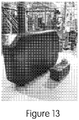
- FIG. 13 Examples of rotomolded articles of the present invention are shown in Figure 13 , in which a smaller rotomolded article has dimensions of about 20 cm x 8,9 cm x 8,9 cm and a larger rotomolded article has dimensions of about 61 cm x 38 cm x 10 cm.
- PEKK powders are in general highly viscous.
- the use of a mold release agent is a common practice when dealing with high viscosity resins. However, care must be taken since excessive amounts of mold release might result in parts with poor or insufficient impact performance.
- Some examples of the commercial mold release agents used in this study include Chemtrend® E-331 and Freekote® 770-NC.
- Rotomolding processes of the present invention preferably include the use of a powder with appropriate bulk density, particle shape, and particle size distribution. High impact results have been obtained with rotomolded parts obtained from parent powders with a bulk density above approximately 400 g/L.
- rotomolding processes described in this invention are based, in part, on manipulation of the temperature profile to maximize the exposure of the poly(aryl ketone) powder to high temperature.
- a traditional temperature profile in rotomolding includes a gradual heating of the part, in which the heating rate is dictated by the selected oven temperature. The air temperature inside the mold is increased gradually, and during the rotation and heating process the temperature of the polymer increases above its glass transition (Tg) and melting points (Tm) for the case of semi-crystalline materials.
- Tg glass transition
- Tm melting points
- the "Platen Cooled” process includes immediate transfer of the molded piece from a hot press or heated metal platens to a cold press or unheated platens after a certain fusion time (in this case 30 minutes).
- the "Air Cooled” process includes removing the molded piece from the hot press and allowing it to cool down simply by exposure to ambient conditions. As seen in Figure 5 , the heating and cooling rates are dramatically different among these processes.
- PEKK samples produced by all these fabrications processes display clear differences in their impact properties.
- PEKK parts produced with a traditional rotomolding process show an impact value within 0,57-2,8 Nm (5-25 in-lbs).
- values of around 80 in-lbs are observed in melt molded samples using the "Platen Cooled” process, while values within 11,3-13,6 Nm (100-120 in-lbs) have been observed in "Air cooled” melt molded PEKK parts.
- Temperature profiles can be specifically controlled and tuned to enhance the impact properties and appearance of a rotomolded part. Maximizing the exposure of the PEKK powder to high temperatures during rotomolding promotes increases in the final impact properties and in the overall appearance. Examples of temperature profiles used to produce PEKK rotomolded parts according to the present invention, compared to a melt molding process, are shown in Figure 6 .
- the rotomolding processes of the present invention have been successfully implemented for the production of large scale parts.
- Experiments to produce large scale PEKK parts with a 0,127-0,152 cm thickness were conducted using a modified rotomolding mold with dimensions of 61 cm x 38 cm x 10 cm. The mold was sanded prior to use to insure good surface finish.
- the resulting part shown in Figure 13 displayed a very homogeneous wall thickness. Precise thickness control over the entire dimensions of the part has been obtained through the manipulation of rotational speeds in the rotomolding machine.
Landscapes
- Chemical & Material Sciences (AREA)
- Engineering & Computer Science (AREA)
- Mechanical Engineering (AREA)
- Health & Medical Sciences (AREA)
- Chemical Kinetics & Catalysis (AREA)
- Medicinal Chemistry (AREA)
- Polymers & Plastics (AREA)
- Organic Chemistry (AREA)
- Moulding By Coating Moulds (AREA)
Claims (11)
- Verfahren zum Herstellen eines Gegenstands, umfassend:Rotationsformen wenigstens eines Polymers, das ein Poly(arylketon) umfasst, unter Bedingungen, die wirkungsvoll sind, um einen rotationsgeformten Gegenstand mit einer Schlagzähigkeit von wenigstens 4 Nm (35 in-lbs) gemäß ASTM D5420 zu erzeugen, wobei das Rotationsformen Anordnen eines Pulvers, das eine Schüttdichte von höher als 250 g/l aufweist und das wenigstens eine Polymer umfasst, in einem Formwerkzeug und Heizen des Formwerkzeugs, während das Formwerkzeug wenigstens etwa 10 Minuten lang gedreht wird, nachdem die Innenlufttemperatur des Formwerkzeugs den höchsten Schmelzpunkt des wenigstens einen Polymers erreicht hat, und Halten der Innenlufttemperatur des Formwerkzeugs bei innerhalb von 24 °C (75 °F) des höchsten Schmelzpunkts des wenigstens einen Polymers für wenigstens etwa 10 Minuten umfasst.
- Verfahren zum Herstellen eines Gegenstands gemäß Anspruch 1, wobei das wenigstens eine Polymer ausgewählt ist aus der Gruppe bestehend aus Polyetherketonketon (PEKK), Polyetheretherketon (PEEK), Polyetherketon (PEK), Polyetherketonetherketonketon (PEKEKK) und Gemischen davon.
- Verfahren zum Herstellen eines Gegenstands gemäß Anspruch 2, wobei das Poly(arylketon) PEKK umfasst.
- Verfahren zum Herstellen eines Gegenstands gemäß Anspruch 1, ferner umfassend Zugeben eines oder mehrerer Fließmittel zu dem Formwerkzeug.
- Verfahren zum Herstellen eines Gegenstands gemäß Anspruch 1, ferner umfassend Zugeben eines oder mehrerer Formtrennmittel zu dem Formwerkzeug.
- Rotationsgeformter Gegenstand, umfassend wenigstens ein Polymer, das ein Poly(arylketon) umfasst, wobei der rotationsgeformte Gegenstand eine Schlagzähigkeit von höher als 4 Nm (35 in-lbs) gemäß ASTM D5420 aufweist.
- Rotationsgeformter Gegenstand gemäß Anspruch 6, wobei das wenigstens eine Polymer ein oder mehrere Poly(arylketone) ausgewählt aus Polyetherketonketonen (PEKK), Polyetheretherketonen (PEEK), Polyetherketonen (PEK), Polyetherketonetherketonketonen (PEKEKK) und Gemischen davon umfasst.
- Rotationsgeformter Gegenstand gemäß Anspruch 7, wobei das Poly(arylketon) PEKK umfasst.
- Rotationsgeformter Gegenstand gemäß Anspruch 8, wobei der rotationsgeformte Gegenstand eine Schlagzähigkeit von zwischen etwa 4,5 Nm (40 in-lbs) und etwa 11 Nm (95 in-lbs) gemäß ASTM D5420 aufweist.
- Rotationsgeformter Gegenstand gemäß Anspruch 8, wobei der rotationsgeformte Gegenstand eine Dicke von etwa 1,3 mm (0,05") bis etwa 1,5 mm (0,06") aufweist.
- Rotationsgeformter Gegenstand gemäß Anspruch 8, wobei der rotationsgeformte Gegenstand eine Schlagzähigkeit (a) in Nm (in-lbs), bestimmt gemäß ASTM D5420, und eine Dicke (b) in m (Inch) aufweist und wobei das Verhältnis (R) von Schlagzähigkeit zu Dicke des rotationsgeformten Gegenstands wenigstens 2669 (600) beträgt.
Applications Claiming Priority (2)
| Application Number | Priority Date | Filing Date | Title |
|---|---|---|---|
| US201261615468P | 2012-03-26 | 2012-03-26 | |
| PCT/US2013/029015 WO2013148081A1 (en) | 2012-03-26 | 2013-03-05 | Rotomolding processes for poly(aryl ketones) and other high temperature polymers |
Publications (3)
| Publication Number | Publication Date |
|---|---|
| EP2830845A1 EP2830845A1 (de) | 2015-02-04 |
| EP2830845A4 EP2830845A4 (de) | 2015-08-05 |
| EP2830845B1 true EP2830845B1 (de) | 2018-04-25 |
Family
ID=49260996
Family Applications (1)
| Application Number | Title | Priority Date | Filing Date |
|---|---|---|---|
| EP13768467.6A Active EP2830845B1 (de) | 2012-03-26 | 2013-03-05 | Rotationsformverfahren für poly(arylketone) und andere hochtemperaturpolymeren |
Country Status (7)
| Country | Link |
|---|---|
| US (1) | US10899047B2 (de) |
| EP (1) | EP2830845B1 (de) |
| CA (1) | CA2868460A1 (de) |
| DK (1) | DK2830845T3 (de) |
| ES (1) | ES2671500T3 (de) |
| PT (1) | PT2830845T (de) |
| WO (1) | WO2013148081A1 (de) |
Families Citing this family (10)
| Publication number | Priority date | Publication date | Assignee | Title |
|---|---|---|---|---|
| JP2016514752A (ja) * | 2013-04-04 | 2016-05-23 | ビーエーエスエフ ソシエタス・ヨーロピアBasf Se | スルホン化ポリアリールスルホンを含有する重合性ラクタム組成物 |
| JP2017535643A (ja) * | 2014-11-03 | 2017-11-30 | アーケマ・インコーポレイテッド | ポリマーフレーク及び粉体の密度を高めるためのプロセス |
| FR3027834B1 (fr) * | 2014-11-03 | 2017-11-10 | Arkema France | Procede de densification de poudres de polyarylene-ether-cetone |
| CN104526945B (zh) * | 2015-01-05 | 2017-02-22 | 江苏大学 | 复杂滚塑模具内部空气流场温度的控制装置和方法 |
| WO2017116885A1 (en) * | 2015-12-28 | 2017-07-06 | Arkema Inc. | Processes for producing polymer powders |
| US11224998B2 (en) * | 2016-01-14 | 2022-01-18 | Tennant Company | Thread forming apparatus and method for rotationally molded product |
| EP3339386B1 (de) * | 2016-12-22 | 2019-11-13 | Arkema France | Verwendung von einem polymermaterial auf basis von polyetherketonketonen für die verschleissminderung |
| CN110753728B (zh) * | 2017-06-15 | 2023-05-09 | 阿科玛股份有限公司 | 由伪无定形聚合物生产半结晶部件 |
| CN108568926B (zh) * | 2017-11-21 | 2020-05-15 | 中国科学院金属研究所 | 一种高效制备高定向、高致密二维材料薄膜的方法 |
| CN117532790A (zh) * | 2023-12-01 | 2024-02-09 | 北京化工大学 | 一种储氢瓶塑料内胆滚-吹成型装备及工艺 |
Family Cites Families (10)
| Publication number | Priority date | Publication date | Assignee | Title |
|---|---|---|---|---|
| WO2002078946A1 (en) * | 2001-03-29 | 2002-10-10 | Greene, Tweed Of Delaware, Inc. | Electrical connectors for use in downhole tools |
| US20050051926A1 (en) * | 2003-06-27 | 2005-03-10 | Gerard Guillot | Production of articles by rotomolding |
| EP1721739A1 (de) * | 2005-05-09 | 2006-11-15 | Total Petrochemicals Research Feluy | Doppelschichtige rotationsgeformte Anwendungen |
| DE102007016656B4 (de) | 2007-04-05 | 2018-10-11 | Eos Gmbh Electro Optical Systems | PAEK-Pulver, insbesondere zur Verwendung in einem Verfahren zum schichtweisen Herstellen eines dreidimensionalen Objektes, sowie Verfahren zu dessen Herstellung |
| EP2142600B1 (de) | 2007-04-23 | 2014-07-23 | Solvay Specialty Polymers USA, LLC. | Thermoplastische polymer-zusammensetzungen und deren anwendungen |
| US20080274360A1 (en) | 2007-05-04 | 2008-11-06 | General Electric Company | Polyaryl ether ketone - polycarbonate copolymer blends |
| IN2007CH02892A (de) | 2007-12-04 | 2009-09-11 | Solvay | |
| US8013076B2 (en) | 2008-03-17 | 2011-09-06 | Sabic Innovative Plastics Ip B.V. | Aromatic polyketone and polysiloxane/polyimide block copolymer composition |
| JP2012507596A (ja) | 2008-10-31 | 2012-03-29 | ポリミックス,リミテッド | (4−ヒドロキシフェニル)フタラジン−1(2h)−オンコモノマー単位を含む高温溶融加工可能な半結晶性ポリ(アリールエーテルケトン) |
| GB0911905D0 (en) | 2009-07-09 | 2009-08-19 | Ketonex Ltd | Method |
-
2013
- 2013-03-05 WO PCT/US2013/029015 patent/WO2013148081A1/en not_active Ceased
- 2013-03-05 PT PT137684676T patent/PT2830845T/pt unknown
- 2013-03-05 US US14/387,569 patent/US10899047B2/en active Active
- 2013-03-05 CA CA 2868460 patent/CA2868460A1/en not_active Abandoned
- 2013-03-05 ES ES13768467.6T patent/ES2671500T3/es active Active
- 2013-03-05 EP EP13768467.6A patent/EP2830845B1/de active Active
- 2013-03-05 DK DK13768467.6T patent/DK2830845T3/en active
Non-Patent Citations (1)
| Title |
|---|
| None * |
Also Published As
| Publication number | Publication date |
|---|---|
| PT2830845T (pt) | 2018-06-07 |
| DK2830845T3 (en) | 2018-07-30 |
| CA2868460A1 (en) | 2013-10-03 |
| WO2013148081A1 (en) | 2013-10-03 |
| ES2671500T3 (es) | 2018-06-06 |
| US10899047B2 (en) | 2021-01-26 |
| US20150079378A1 (en) | 2015-03-19 |
| EP2830845A1 (de) | 2015-02-04 |
| EP2830845A4 (de) | 2015-08-05 |
Similar Documents
| Publication | Publication Date | Title |
|---|---|---|
| US10899047B2 (en) | Rotomolding processes for poly(aryl ketones) and other high temperature polymers | |
| CN111479850B (zh) | 包含与金属基底接触的PEEK-PEmEK共聚物组合物的聚合物-金属接合件 | |
| US11845832B2 (en) | Method of making a PEEK-PEoEK copolymer and copolymer obtained from the method | |
| JP2020523223A (ja) | 疑似非晶質ポリマーからの半晶質の部品の製造 | |
| KR20230118600A (ko) | Paek(들)에 기반한 분말상 조성물, 소결 시공 공정및 이로부터 유래된 물체 | |
| JP4599793B2 (ja) | Tab生産工程用スペーステープ | |
| JP7709430B2 (ja) | 擬似非晶質ポリアリールエーテルケトンをベースにした熱成形可能なポリマーシート | |
| US12378405B2 (en) | Resin composition, film, composite material, moving body, and three-dimensional printing material | |
| US20240384095A1 (en) | Powder based on polyaryletherketone(s) for the manufacture of ductile objects | |
| EP3783047A1 (de) | Peek-peodek-copolymer und verfahren zur herstellung des copolymers | |
| JP2004123852A (ja) | 芳香族樹脂組成物並びにフィルム及びシート | |
| US12521918B2 (en) | Method for manufacturing a product made from polyaryletherketone and corresponding product | |
| US20240076475A1 (en) | Composite article made of composition(s) based on PAEK(s) | |
| JPH0129379B2 (de) | ||
| CN115698130A (zh) | 聚(醚酮酮)聚合物的共混物 | |
| KR20250160179A (ko) | 폴리아릴에테르케톤-기반 조성물 | |
| WO2020254096A1 (en) | Peek-peodek copolymer and method of making the copolymer |
Legal Events
| Date | Code | Title | Description |
|---|---|---|---|
| PUAI | Public reference made under article 153(3) epc to a published international application that has entered the european phase |
Free format text: ORIGINAL CODE: 0009012 |
|
| 17P | Request for examination filed |
Effective date: 20140919 |
|
| AK | Designated contracting states |
Kind code of ref document: A1 Designated state(s): AL AT BE BG CH CY CZ DE DK EE ES FI FR GB GR HR HU IE IS IT LI LT LU LV MC MK MT NL NO PL PT RO RS SE SI SK SM TR |
|
| AX | Request for extension of the european patent |
Extension state: BA ME |
|
| DAX | Request for extension of the european patent (deleted) | ||
| RA4 | Supplementary search report drawn up and despatched (corrected) |
Effective date: 20150703 |
|
| RIC1 | Information provided on ipc code assigned before grant |
Ipc: B29C 70/00 20060101ALI20150629BHEP Ipc: B29C 41/04 20060101AFI20150629BHEP Ipc: C08G 14/00 20060101ALI20150629BHEP |
|
| 17Q | First examination report despatched |
Effective date: 20160504 |
|
| GRAP | Despatch of communication of intention to grant a patent |
Free format text: ORIGINAL CODE: EPIDOSNIGR1 |
|
| STAA | Information on the status of an ep patent application or granted ep patent |
Free format text: STATUS: GRANT OF PATENT IS INTENDED |
|
| INTG | Intention to grant announced |
Effective date: 20170317 |
|
| GRAJ | Information related to disapproval of communication of intention to grant by the applicant or resumption of examination proceedings by the epo deleted |
Free format text: ORIGINAL CODE: EPIDOSDIGR1 |
|
| STAA | Information on the status of an ep patent application or granted ep patent |
Free format text: STATUS: EXAMINATION IS IN PROGRESS |
|
| GRAP | Despatch of communication of intention to grant a patent |
Free format text: ORIGINAL CODE: EPIDOSNIGR1 |
|
| STAA | Information on the status of an ep patent application or granted ep patent |
Free format text: STATUS: GRANT OF PATENT IS INTENDED |
|
| INTC | Intention to grant announced (deleted) | ||
| INTG | Intention to grant announced |
Effective date: 20170711 |
|
| GRAJ | Information related to disapproval of communication of intention to grant by the applicant or resumption of examination proceedings by the epo deleted |
Free format text: ORIGINAL CODE: EPIDOSDIGR1 |
|
| STAA | Information on the status of an ep patent application or granted ep patent |
Free format text: STATUS: EXAMINATION IS IN PROGRESS |
|
| INTC | Intention to grant announced (deleted) | ||
| GRAP | Despatch of communication of intention to grant a patent |
Free format text: ORIGINAL CODE: EPIDOSNIGR1 |
|
| STAA | Information on the status of an ep patent application or granted ep patent |
Free format text: STATUS: GRANT OF PATENT IS INTENDED |
|
| INTG | Intention to grant announced |
Effective date: 20171013 |
|
| GRAS | Grant fee paid |
Free format text: ORIGINAL CODE: EPIDOSNIGR3 |
|
| GRAA | (expected) grant |
Free format text: ORIGINAL CODE: 0009210 |
|
| STAA | Information on the status of an ep patent application or granted ep patent |
Free format text: STATUS: THE PATENT HAS BEEN GRANTED |
|
| AK | Designated contracting states |
Kind code of ref document: B1 Designated state(s): AL AT BE BG CH CY CZ DE DK EE ES FI FR GB GR HR HU IE IS IT LI LT LU LV MC MK MT NL NO PL PT RO RS SE SI SK SM TR |
|
| REG | Reference to a national code |
Ref country code: GB Ref legal event code: FG4D |
|
| REG | Reference to a national code |
Ref country code: CH Ref legal event code: EP |
|
| REG | Reference to a national code |
Ref country code: AT Ref legal event code: REF Ref document number: 992394 Country of ref document: AT Kind code of ref document: T Effective date: 20180515 |
|
| REG | Reference to a national code |
Ref country code: IE Ref legal event code: FG4D |
|
| REG | Reference to a national code |
Ref country code: DE Ref legal event code: R096 Ref document number: 602013036539 Country of ref document: DE |
|
| REG | Reference to a national code |
Ref country code: ES Ref legal event code: FG2A Ref document number: 2671500 Country of ref document: ES Kind code of ref document: T3 Effective date: 20180606 |
|
| REG | Reference to a national code |
Ref country code: PT Ref legal event code: SC4A Ref document number: 2830845 Country of ref document: PT Date of ref document: 20180607 Kind code of ref document: T Free format text: AVAILABILITY OF NATIONAL TRANSLATION Effective date: 20180530 |
|
| REG | Reference to a national code |
Ref country code: SE Ref legal event code: TRGR |
|
| REG | Reference to a national code |
Ref country code: NL Ref legal event code: FP |
|
| REG | Reference to a national code |
Ref country code: DK Ref legal event code: T3 Effective date: 20180719 |
|
| REG | Reference to a national code |
Ref country code: LT Ref legal event code: MG4D |
|
| PG25 | Lapsed in a contracting state [announced via postgrant information from national office to epo] |
Ref country code: BG Free format text: LAPSE BECAUSE OF FAILURE TO SUBMIT A TRANSLATION OF THE DESCRIPTION OR TO PAY THE FEE WITHIN THE PRESCRIBED TIME-LIMIT Effective date: 20180725 Ref country code: NO Free format text: LAPSE BECAUSE OF FAILURE TO SUBMIT A TRANSLATION OF THE DESCRIPTION OR TO PAY THE FEE WITHIN THE PRESCRIBED TIME-LIMIT Effective date: 20180725 Ref country code: PL Free format text: LAPSE BECAUSE OF FAILURE TO SUBMIT A TRANSLATION OF THE DESCRIPTION OR TO PAY THE FEE WITHIN THE PRESCRIBED TIME-LIMIT Effective date: 20180425 Ref country code: LT Free format text: LAPSE BECAUSE OF FAILURE TO SUBMIT A TRANSLATION OF THE DESCRIPTION OR TO PAY THE FEE WITHIN THE PRESCRIBED TIME-LIMIT Effective date: 20180425 |
|
| PG25 | Lapsed in a contracting state [announced via postgrant information from national office to epo] |
Ref country code: GR Free format text: LAPSE BECAUSE OF FAILURE TO SUBMIT A TRANSLATION OF THE DESCRIPTION OR TO PAY THE FEE WITHIN THE PRESCRIBED TIME-LIMIT Effective date: 20180726 Ref country code: HR Free format text: LAPSE BECAUSE OF FAILURE TO SUBMIT A TRANSLATION OF THE DESCRIPTION OR TO PAY THE FEE WITHIN THE PRESCRIBED TIME-LIMIT Effective date: 20180425 Ref country code: LV Free format text: LAPSE BECAUSE OF FAILURE TO SUBMIT A TRANSLATION OF THE DESCRIPTION OR TO PAY THE FEE WITHIN THE PRESCRIBED TIME-LIMIT Effective date: 20180425 Ref country code: RS Free format text: LAPSE BECAUSE OF FAILURE TO SUBMIT A TRANSLATION OF THE DESCRIPTION OR TO PAY THE FEE WITHIN THE PRESCRIBED TIME-LIMIT Effective date: 20180425 |
|
| REG | Reference to a national code |
Ref country code: DE Ref legal event code: R097 Ref document number: 602013036539 Country of ref document: DE |
|
| PG25 | Lapsed in a contracting state [announced via postgrant information from national office to epo] |
Ref country code: CZ Free format text: LAPSE BECAUSE OF FAILURE TO SUBMIT A TRANSLATION OF THE DESCRIPTION OR TO PAY THE FEE WITHIN THE PRESCRIBED TIME-LIMIT Effective date: 20180425 Ref country code: RO Free format text: LAPSE BECAUSE OF FAILURE TO SUBMIT A TRANSLATION OF THE DESCRIPTION OR TO PAY THE FEE WITHIN THE PRESCRIBED TIME-LIMIT Effective date: 20180425 Ref country code: EE Free format text: LAPSE BECAUSE OF FAILURE TO SUBMIT A TRANSLATION OF THE DESCRIPTION OR TO PAY THE FEE WITHIN THE PRESCRIBED TIME-LIMIT Effective date: 20180425 Ref country code: SK Free format text: LAPSE BECAUSE OF FAILURE TO SUBMIT A TRANSLATION OF THE DESCRIPTION OR TO PAY THE FEE WITHIN THE PRESCRIBED TIME-LIMIT Effective date: 20180425 |
|
| PG25 | Lapsed in a contracting state [announced via postgrant information from national office to epo] |
Ref country code: SM Free format text: LAPSE BECAUSE OF FAILURE TO SUBMIT A TRANSLATION OF THE DESCRIPTION OR TO PAY THE FEE WITHIN THE PRESCRIBED TIME-LIMIT Effective date: 20180425 |
|
| PLBE | No opposition filed within time limit |
Free format text: ORIGINAL CODE: 0009261 |
|
| STAA | Information on the status of an ep patent application or granted ep patent |
Free format text: STATUS: NO OPPOSITION FILED WITHIN TIME LIMIT |
|
| 26N | No opposition filed |
Effective date: 20190128 |
|
| PG25 | Lapsed in a contracting state [announced via postgrant information from national office to epo] |
Ref country code: SI Free format text: LAPSE BECAUSE OF FAILURE TO SUBMIT A TRANSLATION OF THE DESCRIPTION OR TO PAY THE FEE WITHIN THE PRESCRIBED TIME-LIMIT Effective date: 20180425 |
|
| PG25 | Lapsed in a contracting state [announced via postgrant information from national office to epo] |
Ref country code: MC Free format text: LAPSE BECAUSE OF FAILURE TO SUBMIT A TRANSLATION OF THE DESCRIPTION OR TO PAY THE FEE WITHIN THE PRESCRIBED TIME-LIMIT Effective date: 20180425 |
|
| PG25 | Lapsed in a contracting state [announced via postgrant information from national office to epo] |
Ref country code: AL Free format text: LAPSE BECAUSE OF FAILURE TO SUBMIT A TRANSLATION OF THE DESCRIPTION OR TO PAY THE FEE WITHIN THE PRESCRIBED TIME-LIMIT Effective date: 20180425 Ref country code: LU Free format text: LAPSE BECAUSE OF NON-PAYMENT OF DUE FEES Effective date: 20190305 |
|
| PG25 | Lapsed in a contracting state [announced via postgrant information from national office to epo] |
Ref country code: TR Free format text: LAPSE BECAUSE OF FAILURE TO SUBMIT A TRANSLATION OF THE DESCRIPTION OR TO PAY THE FEE WITHIN THE PRESCRIBED TIME-LIMIT Effective date: 20180425 |
|
| PGFP | Annual fee paid to national office [announced via postgrant information from national office to epo] |
Ref country code: IE Payment date: 20200309 Year of fee payment: 8 Ref country code: SE Payment date: 20200310 Year of fee payment: 8 Ref country code: FI Payment date: 20200309 Year of fee payment: 8 Ref country code: DK Payment date: 20200310 Year of fee payment: 8 |
|
| PGFP | Annual fee paid to national office [announced via postgrant information from national office to epo] |
Ref country code: CH Payment date: 20200313 Year of fee payment: 8 |
|
| PG25 | Lapsed in a contracting state [announced via postgrant information from national office to epo] |
Ref country code: MT Free format text: LAPSE BECAUSE OF NON-PAYMENT OF DUE FEES Effective date: 20190305 |
|
| PGFP | Annual fee paid to national office [announced via postgrant information from national office to epo] |
Ref country code: ES Payment date: 20200401 Year of fee payment: 8 |
|
| REG | Reference to a national code |
Ref country code: AT Ref legal event code: UEP Ref document number: 992394 Country of ref document: AT Kind code of ref document: T Effective date: 20180425 |
|
| PG25 | Lapsed in a contracting state [announced via postgrant information from national office to epo] |
Ref country code: CY Free format text: LAPSE BECAUSE OF FAILURE TO SUBMIT A TRANSLATION OF THE DESCRIPTION OR TO PAY THE FEE WITHIN THE PRESCRIBED TIME-LIMIT Effective date: 20180425 |
|
| PG25 | Lapsed in a contracting state [announced via postgrant information from national office to epo] |
Ref country code: IS Free format text: LAPSE BECAUSE OF FAILURE TO SUBMIT A TRANSLATION OF THE DESCRIPTION OR TO PAY THE FEE WITHIN THE PRESCRIBED TIME-LIMIT Effective date: 20180825 |
|
| PG25 | Lapsed in a contracting state [announced via postgrant information from national office to epo] |
Ref country code: HU Free format text: LAPSE BECAUSE OF FAILURE TO SUBMIT A TRANSLATION OF THE DESCRIPTION OR TO PAY THE FEE WITHIN THE PRESCRIBED TIME-LIMIT; INVALID AB INITIO Effective date: 20130305 |
|
| REG | Reference to a national code |
Ref country code: FI Ref legal event code: MAE |
|
| PG25 | Lapsed in a contracting state [announced via postgrant information from national office to epo] |
Ref country code: FI Free format text: LAPSE BECAUSE OF NON-PAYMENT OF DUE FEES Effective date: 20210305 |
|
| REG | Reference to a national code |
Ref country code: CH Ref legal event code: PL |
|
| REG | Reference to a national code |
Ref country code: DK Ref legal event code: EBP Effective date: 20210331 |
|
| PG25 | Lapsed in a contracting state [announced via postgrant information from national office to epo] |
Ref country code: SE Free format text: LAPSE BECAUSE OF NON-PAYMENT OF DUE FEES Effective date: 20210306 Ref country code: IE Free format text: LAPSE BECAUSE OF NON-PAYMENT OF DUE FEES Effective date: 20210305 Ref country code: CH Free format text: LAPSE BECAUSE OF NON-PAYMENT OF DUE FEES Effective date: 20210331 Ref country code: LI Free format text: LAPSE BECAUSE OF NON-PAYMENT OF DUE FEES Effective date: 20210331 |
|
| PG25 | Lapsed in a contracting state [announced via postgrant information from national office to epo] |
Ref country code: DK Free format text: LAPSE BECAUSE OF NON-PAYMENT OF DUE FEES Effective date: 20210331 |
|
| REG | Reference to a national code |
Ref country code: ES Ref legal event code: FD2A Effective date: 20220523 |
|
| PG25 | Lapsed in a contracting state [announced via postgrant information from national office to epo] |
Ref country code: MK Free format text: LAPSE BECAUSE OF FAILURE TO SUBMIT A TRANSLATION OF THE DESCRIPTION OR TO PAY THE FEE WITHIN THE PRESCRIBED TIME-LIMIT Effective date: 20180425 |
|
| PG25 | Lapsed in a contracting state [announced via postgrant information from national office to epo] |
Ref country code: ES Free format text: LAPSE BECAUSE OF NON-PAYMENT OF DUE FEES Effective date: 20210306 |
|
| REG | Reference to a national code |
Ref country code: DE Ref legal event code: R081 Ref document number: 602013036539 Country of ref document: DE Owner name: ARKEMA FRANCE, FR Free format text: FORMER OWNER: ARKEMA INC., KING OF PRUSSIA, PA., US |
|
| REG | Reference to a national code |
Ref country code: BE Ref legal event code: PD Owner name: ARKEMA FRANCE; FR Free format text: DETAILS ASSIGNMENT: CHANGE OF OWNER(S), ASSIGNMENT; FORMER OWNER NAME: ARKEMA INC. Effective date: 20231101 |
|
| REG | Reference to a national code |
Ref country code: GB Ref legal event code: 732E Free format text: REGISTERED BETWEEN 20240111 AND 20240117 |
|
| REG | Reference to a national code |
Ref country code: AT Ref legal event code: PC Ref document number: 992394 Country of ref document: AT Kind code of ref document: T Owner name: ARKEMA FRANCE, FR Effective date: 20240318 |
|
| REG | Reference to a national code |
Ref country code: NL Ref legal event code: PD Owner name: ARKEMA FRANCE; FR Free format text: DETAILS ASSIGNMENT: CHANGE OF OWNER(S), ASSIGNMENT; FORMER OWNER NAME: ARKEMA INC. Effective date: 20250224 |
|
| PGFP | Annual fee paid to national office [announced via postgrant information from national office to epo] |
Ref country code: NL Payment date: 20250217 Year of fee payment: 13 |
|
| PGFP | Annual fee paid to national office [announced via postgrant information from national office to epo] |
Ref country code: BE Payment date: 20250214 Year of fee payment: 13 Ref country code: AT Payment date: 20250225 Year of fee payment: 13 |
|
| PGFP | Annual fee paid to national office [announced via postgrant information from national office to epo] |
Ref country code: IT Payment date: 20250211 Year of fee payment: 13 |
|
| P01 | Opt-out of the competence of the unified patent court (upc) registered |
Free format text: CASE NUMBER: APP_17040/2025 Effective date: 20250408 |
|
| REG | Reference to a national code |
Ref country code: DE Ref legal event code: R081 Ref document number: 602013036539 Country of ref document: DE Owner name: ARKEMA FRANCE, FR Free format text: FORMER OWNER: ARKEMA FRANCE, COLOMBES, FR |
|
| REG | Reference to a national code |
Ref country code: BE Ref legal event code: PD Owner name: ARKEMA FRANCE; FR Free format text: DETAILS ASSIGNMENT: CHANGE OF OWNER(S), OTHER; FORMER OWNER NAME: ARKEMA INC. Effective date: 20250919 |
|
| PGFP | Annual fee paid to national office [announced via postgrant information from national office to epo] |
Ref country code: GB Payment date: 20260202 Year of fee payment: 14 |
|
| PGFP | Annual fee paid to national office [announced via postgrant information from national office to epo] |
Ref country code: DE Payment date: 20260204 Year of fee payment: 14 |
|
| PGFP | Annual fee paid to national office [announced via postgrant information from national office to epo] |
Ref country code: FR Payment date: 20260209 Year of fee payment: 14 |
|
| PGFP | Annual fee paid to national office [announced via postgrant information from national office to epo] |
Ref country code: PT Payment date: 20260302 Year of fee payment: 14 |