EP2832811B1 - Masse adhésive - Google Patents
Masse adhésive Download PDFInfo
- Publication number
- EP2832811B1 EP2832811B1 EP14179533.6A EP14179533A EP2832811B1 EP 2832811 B1 EP2832811 B1 EP 2832811B1 EP 14179533 A EP14179533 A EP 14179533A EP 2832811 B1 EP2832811 B1 EP 2832811B1
- Authority
- EP
- European Patent Office
- Prior art keywords
- meth
- poly
- acrylate
- pressure
- sensitive adhesive
- Prior art date
- Legal status (The legal status is an assumption and is not a legal conclusion. Google has not performed a legal analysis and makes no representation as to the accuracy of the status listed.)
- Active
Links
Images
Classifications
-
- C—CHEMISTRY; METALLURGY
- C09—DYES; PAINTS; POLISHES; NATURAL RESINS; ADHESIVES; COMPOSITIONS NOT OTHERWISE PROVIDED FOR; APPLICATIONS OF MATERIALS NOT OTHERWISE PROVIDED FOR
- C09J—ADHESIVES; NON-MECHANICAL ASPECTS OF ADHESIVE PROCESSES IN GENERAL; ADHESIVE PROCESSES NOT PROVIDED FOR ELSEWHERE; USE OF MATERIALS AS ADHESIVES
- C09J133/00—Adhesives based on homopolymers or copolymers of compounds having one or more unsaturated aliphatic radicals, each having only one carbon-to-carbon double bond, and at least one being terminated by only one carboxyl radical, or of salts, anhydrides, esters, amides, imides, or nitriles thereof; Adhesives based on derivatives of such polymers
- C09J133/04—Homopolymers or copolymers of esters
- C09J133/06—Homopolymers or copolymers of esters of esters containing only carbon, hydrogen and oxygen, the oxygen atom being present only as part of the carboxyl radical
-
- C—CHEMISTRY; METALLURGY
- C09—DYES; PAINTS; POLISHES; NATURAL RESINS; ADHESIVES; COMPOSITIONS NOT OTHERWISE PROVIDED FOR; APPLICATIONS OF MATERIALS NOT OTHERWISE PROVIDED FOR
- C09J—ADHESIVES; NON-MECHANICAL ASPECTS OF ADHESIVE PROCESSES IN GENERAL; ADHESIVE PROCESSES NOT PROVIDED FOR ELSEWHERE; USE OF MATERIALS AS ADHESIVES
- C09J133/00—Adhesives based on homopolymers or copolymers of compounds having one or more unsaturated aliphatic radicals, each having only one carbon-to-carbon double bond, and at least one being terminated by only one carboxyl radical, or of salts, anhydrides, esters, amides, imides, or nitriles thereof; Adhesives based on derivatives of such polymers
- C09J133/04—Homopolymers or copolymers of esters
- C09J133/06—Homopolymers or copolymers of esters of esters containing only carbon, hydrogen and oxygen, the oxygen atom being present only as part of the carboxyl radical
- C09J133/08—Homopolymers or copolymers of acrylic acid esters
-
- C—CHEMISTRY; METALLURGY
- C08—ORGANIC MACROMOLECULAR COMPOUNDS; THEIR PREPARATION OR CHEMICAL WORKING-UP; COMPOSITIONS BASED THEREON
- C08L—COMPOSITIONS OF MACROMOLECULAR COMPOUNDS
- C08L53/00—Compositions of block copolymers containing at least one sequence of a polymer obtained by reactions only involving carbon-to-carbon unsaturated bonds; Compositions of derivatives of such polymers
- C08L53/02—Compositions of block copolymers containing at least one sequence of a polymer obtained by reactions only involving carbon-to-carbon unsaturated bonds; Compositions of derivatives of such polymers of vinyl-aromatic monomers and conjugated dienes
-
- C—CHEMISTRY; METALLURGY
- C09—DYES; PAINTS; POLISHES; NATURAL RESINS; ADHESIVES; COMPOSITIONS NOT OTHERWISE PROVIDED FOR; APPLICATIONS OF MATERIALS NOT OTHERWISE PROVIDED FOR
- C09J—ADHESIVES; NON-MECHANICAL ASPECTS OF ADHESIVE PROCESSES IN GENERAL; ADHESIVE PROCESSES NOT PROVIDED FOR ELSEWHERE; USE OF MATERIALS AS ADHESIVES
- C09J121/00—Adhesives based on unspecified rubbers
-
- C—CHEMISTRY; METALLURGY
- C09—DYES; PAINTS; POLISHES; NATURAL RESINS; ADHESIVES; COMPOSITIONS NOT OTHERWISE PROVIDED FOR; APPLICATIONS OF MATERIALS NOT OTHERWISE PROVIDED FOR
- C09J—ADHESIVES; NON-MECHANICAL ASPECTS OF ADHESIVE PROCESSES IN GENERAL; ADHESIVE PROCESSES NOT PROVIDED FOR ELSEWHERE; USE OF MATERIALS AS ADHESIVES
- C09J133/00—Adhesives based on homopolymers or copolymers of compounds having one or more unsaturated aliphatic radicals, each having only one carbon-to-carbon double bond, and at least one being terminated by only one carboxyl radical, or of salts, anhydrides, esters, amides, imides, or nitriles thereof; Adhesives based on derivatives of such polymers
- C09J133/04—Homopolymers or copolymers of esters
- C09J133/06—Homopolymers or copolymers of esters of esters containing only carbon, hydrogen and oxygen, the oxygen atom being present only as part of the carboxyl radical
- C09J133/062—Copolymers with monomers not covered by C09J133/06
Definitions
- the invention relates to the technical field of pressure-sensitive adhesives, as used in adhesive tapes.
- the invention proposes a pressure-sensitive adhesive based on polyacrylate and synthetic rubber and a specific tackifier.
- adhesive tapes are increasingly being used to connect components. It is often important that the material composites created in this way maintain consistent quality even when they are exposed to more extreme temperatures.
- the temperature influences include both heat and cold. It is conceivable that adhesives applied to the surfaces of cars, for example trim strips or brand symbols, have to withstand winter frost temperatures as well as summer heat.
- US 4,107,233 A describes an improvement in adhesion and printability to or from styrene-butadiene copolymers (SBC) by adding polyacrylate.
- EP 0 349 216 A1 discloses an improvement in the cold impact resistance of polyacrylate PSAs through the addition of SBC, with 95 to 65 parts of polyacrylate being mixed with 5 to 35 parts of SBC.
- EP 0 352 901 A1 relates to pressure-sensitive adhesives that contain 60 to 95 parts of a UV-polymerized polyacrylate and 35 to 5 parts of a synthetic rubber. This formulation improves cold impact resistance and adhesion to paint.
- EP 0 437 068 A2 discloses cellular pressure-sensitive adhesive membranes based on polyacrylate/SBC blends with improved cold impact resistance.
- WO 95/19393 A1 describes a blend of a styrene block copolymer modified with a carboxyl group and a polyacrylate containing at least one type of nitrogen-containing monomer.
- One goal of this technology is to improve the adhesive properties on low-energy substrates.
- WO 2008/070386 A1 describes polymer blends that contain at least 92 parts of an SBC-based adhesive and up to 10 parts of a polyacrylate component.
- WO 2000/006637 A1 discloses blends of polyacrylates and SBC as the basis for foamed adhesive layers.
- the DE 10 2008 062368 A1 discloses pressure-sensitive adhesives based on natural rubber and polyacrylates.
- the WO 97/23249 A1 discloses pressure-sensitive adhesives for medical applications, which are a mixture of an acrylate adhesive with an elastomer and a tackifier.
- the US 4243500 A discloses the production of adhesives by radical polymerization of acrylate monomers in the presence of tackifiers and elastomers dissolved in the monomer. Further state of the art is in the WO 01/59024 A1 and the WO 2014/026668 A1 disclosed.
- the object of the invention is therefore to provide a pressure-sensitive adhesive with good bonding performance in a temperature range from -30 ° C to 70 ° C and in particular also at room temperature.
- Such a pressure-sensitive adhesive shows very good adhesion both at room temperature and at -30 ° C and at 70 ° C, as could be shown by static and dynamic tests.
- a “pressure-sensitive adhesive” is understood to mean a viscoelastic adhesive whose set is dry Film is permanently sticky at room temperature and remains adhesive and can be bonded to a variety of substrates by applying light pressure.
- a “poly(meth)acrylate” is understood to mean a polymer whose monomer base consists of at least 60% by weight of acrylic acid, methacrylic acid, acrylic acid esters and/or methacrylic acid esters, with acrylic acid esters and/or methacrylic acid esters at least partially, preferably at least 50% by weight. -%, based on the total monomer base of the polymer in question, are included.
- a “poly(meth)acrylate” is understood to mean a polymer which is obtainable by radical polymerization of acrylic and/or methacrylic monomers and, if appropriate, other copolymerizable monomers.
- the poly(meth)acrylate or poly(meth)acrylates are contained in 40 to 70% by weight, based on the total weight of the PSA.
- the PSA according to the invention preferably contains 45 to 60% by weight, based on the total weight of the PSA, of at least one poly(meth)acrylate.
- the glass transition temperature of the poly(meth)acrylates that can be used according to the invention is ⁇ 0 °C, namely between -20 and -50 °C.
- the glass transition temperature of polymers or of polymer blocks in block copolymers is determined using dynamic scanning calorimetry (DSC). To do this, approximately 5 mg of an untreated polymer sample is weighed into an aluminum crucible (volume 25 ⁇ L) and closed with a perforated lid. A DSC 204 F1 from Netzsch is used for the measurement. The work is carried out under nitrogen for the purpose of inerting.
- the sample is first cooled to -150 °C, then heated to +150 °C at a heating rate of 10 K/min and cooled again to -150 °C.
- the subsequent second heating curve is run again at 10 K/min and the change in heat capacity is recorded. Glass transitions are recognized as steps in the thermogram.
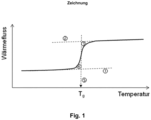
- the glass transition temperature is obtained as follows (see Figure 1 ): The linear area of the measurement curve before and after the step is extended in the direction of rising (area before the step) or falling (area after the step) temperatures. In the area of the step, a compensation line 5 is placed parallel to the ordinate so that it intersects the two extension lines, in such a way that two surfaces 3 and 4 (between each one extension line, the Equilibrium straight line and the measurement curve) of the same content arise. The intersection of the best-fit line positioned in this way with the measurement curve gives the glass transition temperature.
- the poly(meth)acrylates of the PSA according to the invention are obtainable by at least partially polymerizing in functional monomers that can be crosslinked with epoxy groups.
- functional monomers that can be crosslinked with epoxy groups.
- These are particularly preferably monomers with acid groups (particularly carboxylic acid, sulfonic acid or phosphonic acid groups) and/or hydroxy groups and/or acid anhydride groups and/or epoxy groups and/or amine groups; Monomers containing carboxylic acid groups are particularly preferred.
- the polyacrylate contains polymerized acrylic acid and/or methacrylic acid. All of these groups have the ability to crosslink with epoxy groups, which makes the polyacrylate advantageously accessible to thermal crosslinking with introduced epoxides.
- monomers that can be used as comonomers for the poly(meth)acrylates are, in addition to acrylic acid and/or methacrylic acid esters with up to 30 carbon atoms per molecule, for example vinyl esters of carboxylic acids containing up to 20 carbon atoms, vinyl aromatics with up to 20 carbon atoms, ethylenically unsaturated nitriles, vinyl halides, vinyl ethers of alcohols containing 1 to 10 carbon atoms, aliphatic hydrocarbons with 2 to 8 carbon atoms and one or two double bonds or mixtures of these monomers.
- the proportions of the corresponding components (a), (b), and (c) are selected such that the polymerization product has a glass transition temperature between -20 and -50 ° C (DSC). It is particularly advantageous to use the monomers of component (a) in a proportion of 45 to 99% by weight, the monomers of component (b) in a proportion of 1 to 15% by weight and the monomers of component (c). with a proportion of 0 to 40% by weight (the information is based on the monomer mixture for the “base polymer”, i.e. without the addition of any additives to the finished polymer, such as resins, etc.).
- the monomers of component (a) are in particular plasticizing and/or non-polar monomers.
- the monomers (a) used are acrylic and methacrylic acid esters with alkyl groups consisting of 4 to 14 carbon atoms, particularly preferably 4 to 9 carbon atoms.
- Examples of such monomers are n-butyl acrylate, n-butyl methacrylate, n-pentyl acrylate, n-pentyl methacrylate, n-amyl acrylate, n-hexyl acrylate, n-hexyl methacrylate, n-heptyl acrylate, n-octyl acrylate, n-octyl methacrylate, n-nonyl acrylate and the like branched isomers, such as isobutyl acrylate, isooctyl acrylate, isooctyl methacrylate, 2-ethylhexyl acrylate or 2-ethylhexyl methacrylate.
- the monomers of component (b) are olefinically unsaturated monomers with functional groups that can react with epoxide groups.
- component (b) preference is given to using monomers with functional groups which are selected from the group comprising: hydroxy, carboxy, sulfonic acid or phosphonic acid groups, acid anhydrides, epoxides, amines.
- monomers of component (b) are acrylic acid, methacrylic acid, itaconic acid, maleic acid, fumaric acid, crotonic acid, aconitic acid, dimethylacrylic acid, ⁇ -acryloyloxypropionic acid, trichloroacrylic acid, vinylacetic acid, vinylphosphonic acid, maleic anhydride, hydroxyethyl acrylate, in particular 2-hydroxyethyl acrylate, hydroxypropyl acrylate, in particular 3 -Hydroxypropyl acrylate, Hydroxybutyl acrylate, especially 4-hydroxybutyl acrylate, hydroxyhexyl acrylate, especially 6-hydroxyhexyl acrylate, hydroxyethyl methacrylate, especially 2-hydroxyethyl methacrylate, hydroxypropyl methacrylate, especially 3-hydroxypropyl methacrylate, hydroxybutyl methacrylate, especially 4-hydroxybutyl methacrylate, hydroxyhexyl methacrylate,
- component (c) all vinyl functionalized compounds that can be copolymerized with component (a) and/or component (b) can be used as component (c).
- the monomers of component (c) can be used to adjust the properties of the resulting PSA.
- Examples of monomers of component (c) are: Methyl acrylate, ethyl acrylate, propyl acrylate, methyl methacrylate, ethyl methacrylate, benzyl acrylate, benzyl methacrylate, sec -butyl acrylate, tert -butyl acrylate, phenyl acrylate, phenyl methacrylate, isobornyl acrylate, isobornyl methacrylate, tert -butylphenyl acrylate, tert -butylaphenyl methacrylate, dodecyl methacrylate, isodecyl acrylate, Lauryl acrylate, n-undecyl acrylate, stearyl acrylate, Tridecyl acrylate, behenyl acrylate, cyclohexyl methacrylate, cyclopentyl methacrylate, phenoxyethyl acrylate
- Macromonomers such as 2-polystyrene ethyl methacrylate (weight average molecular weight Mw, determined by GPC, from 4000 to 13000 g/mol), poly(methyl methacrylate)ethyl methacrylate (Mw from 2000 to 8000 g/mol).
- Monomers of component (c) can also advantageously be chosen such that they contain functional groups that support subsequent radiation-chemical crosslinking (for example by electron beams, UV).
- Suitable copolymerizable photoinitiators are, for example, benzoin acrylate and acrylate-functionalized benzophenone derivatives.
- Monomers that support crosslinking by electron irradiation include tetrahydrofurfuryl acrylate, N -tert- butyl acrylamide and allyl acrylate.
- polyacrylates are understood in the context of the invention as synonymous with “poly(meth)acrylates"
- poly(meth)acrylates can be carried out using methods familiar to those skilled in the art, particularly advantageously by conventional free-radical polymerizations or controlled free-radical polymerizations.
- the polyacrylates can be produced by copolymerizing the monomeric components using the usual polymerization initiators and, if necessary, regulators, polymerizing at the usual temperatures in bulk, in emulsion, for example in water or liquid hydrocarbons, or in solution.
- the polyacrylates are preferably prepared by polymerizing the monomers in solvents, in particular in solvents with a boiling range of 50 to 150 ° C, preferably 60 to 120 ° C, using the usual amounts of polymerization initiators, which are generally 0.01 to 5, in particular are 0.1 to 2% by weight (based on the total weight of the monomers).
- radical sources are peroxides, hydroperoxides and azo compounds, for example dibenzoyl peroxide, cumene hydroperoxide, cyclohexanone peroxide, di -t- butyl peroxide, cyclohexylsulfonylacetyl peroxide, diisopropyl percarbonate, t- butyl peroctoate, benzpinacol.
- the radical initiator used is 2,2'-azobis(2-methylbutyronitrile) ( Vazo® 67 TM from DuPont) or 2,2'-azobis(2-methylpropionitrile) (2,2'-azobisisobutyronitrile;AIBN; Vazo ® 64 TM from DuPont).
- Alcohols such as methanol, ethanol, n- and iso-propanol, n- and iso-butanol, preferably isopropanol and/or isobutanol, as well as hydrocarbons such as toluene and in particular gasolines with a boiling range of 60 are used as solvents for the production of the poly(meth)acrylates up to 120 °C in question.
- ketones such as preferably acetone, methyl ethyl ketone, methyl isobutyl ketone and esters such as ethyl acetate as well as mixtures of solvents of the type mentioned can be used, mixtures containing isopropanol, in particular in amounts of 2 to 15% by weight, preferably 3 to 10% by weight. , based on the solvent mixture used, are preferred.
- concentration is preferably carried out and the further processing of the polyacrylates takes place essentially solvent-free.
- the polymer can be concentrated in the absence of crosslinking and accelerator substances. However, it is also possible to add one of these classes of compounds to the polymer before concentration, so that the concentration then takes place in the presence of these substance(s).
- the polymers can be transferred to a compounder. If necessary, the concentration and the compounding can also take place in the same reactor.
- the weight-average molecular weights M W of the polyacrylates are preferably in a range from 20,000 to 2,000,000 g/mol; very preferably in a range of 100,000 to 1,500,000 g/mol, most preferably in a range of 150,000 to 1,000,000 g/mol.
- the details of the average molecular weight M W and the polydispersity PD in this document refer to the determination using gel permeation chromatography.
- suitable polymerization regulators such as Thiols, halogen compounds and/or alcohols are carried out in order to set the desired average molecular weight.
- the information about the number-average molar mass Mn and the weight-average molar mass Mw in this document refers to the determination using gel permeation chromatography (GPC). The determination is carried out on 100 ⁇ l of clear-filtered sample (sample concentration 4 g/l). Tetrahydrofuran with 0.1% by volume of trifluoroacetic acid is used as the eluent. The measurement is carried out at 25 °C.
- a combination of columns of the type PSS-SDV, 5 ⁇ m, 10 3 ⁇ as well as 10 5 ⁇ and 10 6 ⁇ , each measuring 8.0 mm * 300 mm, is used for the separation (columns from Polymer Standards Service; detection using a Shodex RI71 differential refractometer ).
- the flow rate is 1.0 ml per minute.
- the calibration is carried out against PMMA standards (polymethyl methacrylate calibration) and otherwise (resins, elastomers) against PS standards (polystyrene calibration).
- the polyacrylates preferably have a K value of 30 to 90, particularly preferably 40 to 70, measured in toluene (1% solution, 21 ° C).
- the Fikentscher K value is a measure of the molecular weight and viscosity of the polymer.
- the principle of the method is based on the capillary viscometric determination of the relative solution viscosity.
- the test substance is dissolved in toluene by shaking for thirty minutes so that a 1% solution is obtained.
- the flow time is measured in a Vogel-Ossag viscometer at 25 °C and the relative viscosity of the sample solution is determined from this in relation to the viscosity of the pure solvent.
- polyacrylates that have a narrow molecular weight distribution (polydispersity PD ⁇ 4). Despite a relatively low molecular weight, these masses have particularly good shear strength after crosslinking. In addition, the lower polydispersity enables easier processing from the melt, as the flow viscosity is compared to a more widely distributed polyacrylate largely the same application properties are lower.
- Narrowly distributed poly(meth)acrylates can advantageously be prepared by anionic polymerization or by controlled radical polymerization methods, the latter being particularly suitable.
- Corresponding polyacrylates can also be produced using N -oxyls.
- Atom Transfer Radical Polymerization can be used advantageously for the synthesis of narrowly distributed polyacrylates, with monofunctional or difunctional secondary or tertiary halides being the preferred initiator and for the abstraction of the halide(s) Cu, Ni, Fe -, Pd, Pt, Ru, Os, Rh, Co, Ir, Ag or Au complexes can be used.
- the monomers for producing the poly(meth)acrylates contain a proportion of functional groups that are suitable for entering into linking reactions with epoxide groups. This advantageously enables thermal crosslinking of the polyacrylates by reaction with epoxides.
- Linking reactions are understood to mean, in particular, addition and substitution reactions.
- the building blocks carrying the functional groups are therefore linked to building blocks carrying epoxy groups in the sense of a crosslinking of the polymer building blocks carrying the functional groups via crosslinking molecules carrying epoxy groups as linking bridges.
- the substances containing epoxide groups are preferably multifunctional epoxides, i.e. those with at least two epoxy groups; accordingly, there is preferably an overall indirect connection of the building blocks carrying the functional groups.
- the poly(meth)acrylate PSA can be crosslinked with thermal crosslinkers by linking reactions - in particular in the sense of addition or substitution reactions - of functional groups contained in them with thermal crosslinkers, and according to the invention the poly(methyl) acrylates of the PSA are by means of one or more substance(s) containing epoxy groups ) networked.
- Thermal crosslinkers are preferably used at 0.1 to 5% by weight, in particular at 0.2 to 1% by weight, based on the total amount of polymer to be crosslinked.
- the poly(meth)acrylates of the PSA according to the invention are crosslinked by means of one or more substance(s) containing epoxide groups.
- the substances containing epoxide groups are, in particular, multifunctional epoxides, i.e. those with at least two epoxide groups; Accordingly, there is an overall indirect connection between the building blocks of the poly(meth)acrylates that carry the functional groups.
- the substances containing epoxide groups can be both aromatic and aliphatic compounds.
- Extremely suitable multifunctional epoxides are oligomers of epichlorohydrin, epoxy ethers of polyhydric alcohols (in particular ethylene, propylene and butylene glycols, polyglycols, thiodiglycols, glycerol, pentaerythritol, sorbitol, polyvinyl alcohol, polyallyl alcohol and the like), epoxy ethers of polyhydric phenols [in particular resorcinol, hydroquinone, bis -(4-hydroxyphenyl)methane, bis(4-hydroxy-3-methylphenyl)methane, bis(4-hydroxy-3,5-dibromophenyl)methane, bis(4-hydroxy-3,5-) difluorophenyl)methane, 1,1-bis-(4-hydroxyphenyl)ethane, 2,2-bis-(4-hydroxyphenyl)propane, 2,2-bis-(4-hydroxy-3-methylphenyl)propane
- Very suitable ethers are, for example, 1,4-butanediol diglycid ether, polyglycerol-3-glycide ether, cyclohexanedimethanol diglycid ether, glycerol triglycide ether, neopentyl glycol diglycid ether, pentaerythritol tetraglycid ether, 1,6-hexanediol diglycid ether, polypropylene glycol diglycid ether, trimethylolpropane triglycide ether, pentaerythritol tetraglycid ether, bisphenol A diglycide ether and bisphenol F diglycid ether.
- crosslinking system comprises at least one substance containing epoxy groups as a crosslinker and at least one substance which has an accelerating effect as an accelerator at a temperature below the melting temperature of the polymer to be crosslinked for crosslinking reactions using compounds containing epoxy groups.
- Amines are particularly preferred as accelerators according to the invention (formally to be understood as substitution products of ammonia; these are in the following formulas Substituents represented by "R” and include in particular alkyl and/or aryl radicals and/or other organic radicals), particularly preferably those amines which undergo no or only minor reactions with the building blocks of the polymers to be crosslinked.
- both primary (NRH 2 ), secondary (NR 2 H) and tertiary amines (NR 3 ) can be chosen as accelerators, of course also those that have several primary and/or secondary and/or tertiary amine groups.
- particularly preferred accelerators are tertiary amines such as triethylamine, triethylenediamine, benzyldimethylamine, dimethylaminomethylphenol, 2,4,6-tris-(N,N-dimethylaminomethyl)phenol, N,N'-bis(3-(dimethylamino )propyl)urea.
- Multifunctional amines such as diamines, triamines and/or tetramines can also advantageously be used as accelerators. Diethylenetriamine, triethylenetetramine, trimethylhexamethylenediamine, for example, are particularly suitable.
- Amino alcohols are also preferably used as accelerators. Particular preference is given to using secondary and/or tertiary amino alcohols, whereby in the case of several amine functionalities per molecule, at least one, preferably all, amine functionalities are secondary and/or tertiary.
- amino alcohol accelerators triethanolamine, N,N-bis(2-hydroxypropyl)ethanolamine, N-methyldiethanolamine, N-ethyldiethanolamine, 2-aminocyclohexanol, bis(2-hydroxycyclohexyl)methylamine, 2-(diisopropylamino)ethanol, 2-( Dibutylamino)ethanol, N-butyldiethanolamine, N-butylethanolamine, 2-[bis(2-hydroxyethyl)amino]-2-(hydroxymethyl)-1,3-propanediol, 1-[bis(2-hydroxyethyl)amino]-2- propanol, triisopropanolamine, 2-(dimethylamino)ethanol, 2-(diethylamino)ethanol, 2-(2-dimethylaminoethoxy)ethanol, N,N,N'-trimethyl-N'-hydroxyethylbisaminoethyl ether, N,N,N'-trimethylamin
- accelerators are pyridine, imidazoles (such as 2-methylimidazole) and 1,8-diazabicyclo[5.4.0]undec-7-ene. Cycloaliphatic polyamines can also be used as accelerators. Phosphate-based accelerators such as phosphines and/or phosphonium compounds, such as triphenylphosphine or tetraphenylphosphonium tetraphenyl borate, are also suitable.
- the PSA according to the invention further contains at least one synthetic rubber.
- the synthetic rubber or synthetic rubbers are contained in the PSA at 15 to 50% by weight, based on the total weight of the PSA.
- the PSA preferably contains 20 to 40% by weight, based on the total weight of the PSA, of at least one synthetic rubber.
- Suitable block copolymers therefore include one or more rubber-like blocks B (soft blocks) and one or more glass-like blocks A (hard blocks).
- at least one synthetic rubber of the PSA according to the invention is a block copolymer with a structure AB, ABA, (AB) 3 X or (AB) 4 X, where the above meanings apply to A, B and X.
- all synthetic rubbers of the PSA according to the invention are block copolymers with a structure AB, ABA, (AB) 3 X or (AB) 4 X, where the above meanings apply to A, B and X.
- the synthetic rubber of the PSA according to the invention is a mixture of block copolymers with a structure AB, ABA, (AB) 3 X or (AB) 4 X, which preferably contains at least diblock copolymers AB and/or triblock copolymers ABA.
- Block A is generally a glassy block with a glass transition temperature (Tg, DSC) that is above room temperature.
- Tg glass transition temperature
- the Tg of the glass-like block is at least 80 ° C and preferably at least 100 ° C.
- the proportion of vinyl aromatic blocks A in the total block copolymers is preferably 10 to 40% by weight, particularly preferably 20 to 33% by weight.
- Vinyl aromatics for constructing block A preferably include styrene, ⁇ -methylstyrene and/or other styrene derivatives.
- the block A can therefore be present as a homopolymer or copolymer.
- Block A is particularly preferably a polystyrene.
- the vinyl aromatic block copolymer also generally has a rubbery block B or soft block with a preferred Tg of less than room temperature.
- the Tg of the soft block is particularly preferably less than 0°C, in particular less than -10°C, for example less than -40°C and most preferably less than -60°C.
- Preferred conjugated dienes as monomers for the soft block B are in particular selected from the group consisting of butadiene, isoprene, ethylbutadiene, phenylbutadiene, piperylene, pentadiene, hexadiene, ethylhexadiene, dimethylbutadiene and the farnesene isomers as well as any mixtures of these monomers.
- Block B can also be present as a homopolymer or as a copolymer.
- the conjugated dienes as monomers for the soft block B selected from butadiene and isoprene.
- the soft block B is a polyisoprene, a polybutadiene or a partially or fully hydrogenated derivative of one of these two polymers, in particular polybutylene butadiene; or a polymer made from a mixture of butadiene and isoprene.
- Block B is very particularly preferably a polybutadiene.
- the PSA according to the invention also contains at least one tackifier that is compatible with the poly(meth)acrylates and can also be referred to as an adhesive strength enhancer or adhesive resin.
- a “tackifier” is understood to mean an oligomeric or polymeric resin that increases the autohesion (the tack, the inherent stickiness) of the PSA compared to the PSA that does not contain a tackifier but is otherwise identical.
- a “tackifier compatible with the poly(meth)acrylates” is understood to mean a tackifier which has the glass transition temperature of the system obtained after thorough mixing of the poly(meth)acrylate and tackifier compared to the pure one Poly(meth)acrylate changed, although only one Tg can be assigned to the mixture of poly(meth)acrylate and tackifier.
- a tackifier that is incompatible with the poly(meth)acrylate(s) would result in two Tg in the system obtained after thorough mixing of the poly(meth)acrylate and tackifier, one of which corresponds to the poly(meth)acrylate and the other to the Resin domains would be assigned.
- the Tg is determined calorimetrically using DSC (differential scanning calorimetry).
- the poly(meth)acrylate-compatible resins of the composition according to the invention preferably have a DACP value of less than 0 ° C, very preferably of at most -20 ° C, and / or preferably an MMAP value of less than 40 ° C, very preferably at most 20 °C.
- DACP and MMAP values refer to C. Donker, PSTC Annual Technical Seminar, Proceedings, pp. 149-164, May 2001 referred.
- the tackifier compatible with the poly(meth)acrylates is preferably a terpene phenolic resin or a rosin derivative, particularly preferably a terpene phenolic resin.
- the PSA according to the invention can also contain mixtures of several tackifiers.
- rosin derivatives rosin esters are preferred.
- the PSA according to the invention preferably contains 7 to 25% by weight, based on the total weight of the PSA, of at least one tackifier compatible with the poly(meth)acrylates. Particular preference is given to containing 12 to 20% by weight of the tackifier compatible with the poly(meth)acrylates or tackifiers compatible with the poly(meth)acrylates, based on the total weight of the PSA.
- the tackifier(s) of the PSA according to the invention that are compatible with the poly(meth)acrylates is/are preferably also compatible or at least partially compatible with the synthetic rubber, in particular with its soft block B, whereby the above definition of the term “compatible” applies accordingly .
- Polymer/resin compatibility depends, among other things, on the molecular weight of the polymers or resins. Tolerability is better when the molecular weight(s) are lower. For a given polymer, it may be possible that the low molecular weight components of the resin molecular weight distribution are compatible with the polymer, but the higher molecular weight components are not. This is an example of partial compatibility.
- the weight ratio of poly(meth)acrylates to synthetic rubbers in the PSA according to the invention is preferably from 1:1 to 3:1, in particular from 1.8:1 to 2.2:1.
- the weight ratio of tackifiers compatible with the poly(meth)acrylates to synthetic rubbers in the PSA according to the invention is preferably a maximum of 2:1, in particular a maximum of 1:1. This weight ratio is preferably at least 1:4.
- the synthetic rubber is preferably present dispersed in the poly(meth)acrylate in the PSA according to the invention.
- Poly(meth)acrylate and synthetic rubber are therefore preferably homogeneous phases.
- the poly(meth)acrylates and synthetic rubbers contained in the PSA are preferably chosen so that they cannot be mixed with one another to the point of homogeneity at 23 °C.
- the PSA according to the invention is therefore present, at least microscopically and at least at room temperature, preferably in at least two-phase morphology.
- Poly(meth)acrylate(s) and synthetic rubber(s) are particularly preferably not homogeneously miscible with one another in a temperature range from 0 ° C to 50 ° C, in particular from -30 ° C to 80 ° C, so that the PSA in these temperature ranges at least microscopically present at least in two phases.
- components are defined as "not homogeneously miscible with one another" if, even after intimate mixing, the formation of at least two stable phases can be physically and/or chemically demonstrated at least microscopically, one phase being rich in one component and the second Phase is rich in the other component.
- Small amounts of synthetic rubber and/or small amounts of poly(meth)acrylate component can be present in the poly(meth)acrylate phase and/or small amounts of poly(meth)acrylate component in the synthetic rubber phase, provided that these are not significant amounts that influence the phase separation.
- phase separation can in particular be realized in such a way that discrete areas ("domains") that are rich in synthetic rubber - i.e. essentially formed from synthetic rubber - are in a continuous matrix that is rich in poly(meth)acrylate - i.e. essentially is formed from poly(meth)acrylate - is present.
- a suitable analysis system for phase separation is, for example, scanning electron microscopy.
- phase separation can also be recognized, for example, by the fact that the different phases have two independent glass transition temperatures in dynamic differential calorimetry (DDK, DSC). According to the invention, phase separation occurs when it can be clearly demonstrated by at least one of the analysis methods.
- additional multiphaseness can also be present as a fine structure, with the A blocks forming one phase and the B blocks forming a second phase.
- the PSA according to the invention may contain one or more hydrocarbon resin(s) which are not compatible with the poly(meth)acrylate.
- hydrocarbon resins which are also tackifiers, preferably include hydrogenated polymers of dicyclopentadiene; non, partially, selectively or completely hydrogenated hydrocarbon resins based on C5, C5/C9 or C9 monomer streams and polyterpene resins based on ⁇ -pinene and/or on ß -pinene and/or on ⁇ -limonene.
- the hydrocarbon resins preferably have a DACP value of at least 0°C, very preferably at least 20°C, and/or preferably an MMAP value of at least 40°C, very preferably at least 60°C.
- DACP and MMAP values refer to C. Donker, PSTC Annual Technical Seminar, Proceedings, pp. 149-164, May 2001 referred.
- the aforementioned hydrocarbon resins can be contained in the PSA either individually or as a mixture.
- Particularly preferred hydrocarbon resins are polyterpene resins based on ⁇ -pinene and/or ⁇ -pinene and/or ⁇ -limonene.
- the PSA according to the invention is foamed.
- the foaming can be carried out using any chemical and/or physical methods.
- a foamed PSA according to the invention is preferably obtained by introducing and subsequently expanding microballoons.
- Microballoons are elastic hollow microspheres that can be expanded in their basic state and have a thermoplastic polymer shell. These balls are filled with low-boiling liquids or liquefied gas.
- Polyacrylonitrile, PVDC, PVC or polyacrylates are used in particular as shell material.
- Particularly suitable low-boiling liquids are lower alkane hydrocarbons, for example isobutane or isopentane, which are enclosed as a liquefied gas under pressure in the polymer shell.
- the outer polymer shell softens.
- the liquid propellant gas in the casing changes to its gaseous state.
- the microballoons expand irreversibly and expand three-dimensionally. The expansion is complete when the internal and external pressures equalize. Since the polymeric shell is retained, a closed-cell foam is achieved.
- the microballoons can be added to the formulation as a batch, paste or as uncut or blended powder. Dosing points are conceivable, for example, before or after the addition point of the poly(meth)acrylate, for example together as a powder with the synthetic rubber or as a paste at a later point in time.
- microballoon types are commercially available, which essentially differ in their size (6 to 45 ⁇ m diameter in the unexpanded state) and the starting temperatures required for expansion (75 to 220 ° C).
- Unexpanded microballoon types are also available as an aqueous dispersion with a solids or microballoon content of approximately 40 to 45% by weight, and also as polymer-bound microballoons (masterbatches), for example in ethyl vinyl acetate with a microballoon concentration of approximately 65% by weight. Both the microballoon dispersions and the masterbatches are like that DU types are suitable for producing a foamed pressure-sensitive adhesive according to the invention.
- a foamed PSA according to the invention can also be produced using so-called pre-expanded microballoons.
- pre-expanded microballoons are commercially available, for example, under the name Dualite® or with the type designation DE (Dry Expanded).
- the density of a foamed PSA according to the invention is preferably 200 to 1000 kg/m 3 , more preferably 300 to 900 kg/m 3 , in particular 400 to 800 kg/m 3 .
- the PSA according to the invention can contain powder and granular, in particular abrasive and reinforcing, fillers, dyes and pigments such as. B. chalks (CaCOs), titanium dioxide, zinc oxides and / or carbon black.
- the PSA preferably contains one or more forms of chalk as a filler, particularly preferably Mikrosöhl chalk (Söhlde). With preferred proportions of up to 20% by weight, the adhesive properties (shear strength at room temperature, instant adhesion to steel and PE) practically do not change due to the addition of filler.
- various organic fillers can be included.
- Suitable additives for the PSA according to the invention are also - independently selected from other additives - non-expandable hollow polymer spheres, solid polymer spheres, hollow glass spheres, solid glass spheres, hollow ceramic spheres, solid ceramic spheres and/or solid carbon spheres ("Carbon Micro Balloons").
- the PSA according to the invention can contain flame-retardant fillers, for example ammonium polyphosphate; electrically conductive fillers, for example conductive carbon black, carbon fibers and/or silver-coated balls; thermally conductive materials such as boron nitride, aluminum oxide, silicon carbide; ferromagnetic Additives, for example iron (III) oxides; organic, renewable raw materials such as wood flour, organic and/or inorganic nanoparticles, fibers; Contain compounding agents, anti-aging agents, light stabilizers and/or ozone inhibitors.
- flame-retardant fillers for example ammonium polyphosphate
- electrically conductive fillers for example conductive carbon black, carbon fibers and/or silver-coated balls
- thermally conductive materials such as boron nitride, aluminum oxide, silicon carbide
- ferromagnetic Additives for example iron (III) oxides
- organic, renewable raw materials such as wood flour, organic and/or inorganic nanoparticles,
- Plasticizers can optionally be included.
- plasticizers that can be added are (meth)acrylate oligomers, phthalates, cyclohexanedicarboxylic acid esters, water-soluble plasticizers, soft resins, phosphates or polyphosphates.
- silicas advantageously precipitated silica surface-modified with dimethyldichlorosilane, can be used to adjust the thermal shear strength of the PSA.
- a process for producing a pressure-sensitive adhesive according to the invention can first comprise concentrating the polyacrylate solution or dispersion resulting from the polymer production.
- the polymer can be concentrated in the absence of crosslinking and accelerator substances. However, it is also possible to add a maximum of one of these substances to the polymer before concentration, so that the concentration then takes place in the presence of these substance(s).
- the synthetic rubber can be fed into a compounder together with the poly(meth)acrylate-compatible resin via a solids feeder.
- the concentrated and possibly already melted poly(meth)acrylate can be introduced into the compounder via a side feeder.
- concentration and compounding it is also possible for concentration and compounding to take place in the same reactor.
- the poly(meth)acrylate-compatible resins can also be used via a resin melt and another side feeder at another process position, e.g. B. after inputting synthetic rubber and poly (meth) acrylate.
- additives and/or plasticizers can also be supplied as solids or melts or as a batch in combination with another formulation component.
- an extruder can be used as a compounder.
- the polymers are preferably present in the compounder in the melt, either because they are already introduced in the melt state or because they are heated to the melt in the compounder.
- the polymers are kept in the melt in the compounder by heating.
- accelerator substances are used for the crosslinking of the poly(meth)acrylate, they are preferably only added to the polymers shortly before further processing, in particular a coating or other shaping.
- the time window for addition before coating depends in particular on the available pot life, i.e. the processing time in the melt, without adversely changing the properties of the resulting product.
- crosslinkers, epoxides according to the invention, and the accelerators can both be added to the composition shortly before further processing, i.e. advantageously in the phase as shown above for the accelerators.
- crosslinkers and accelerators are introduced into the process at the same point, if necessary as an epoxy-accelerator mixture.
- the mass After the mass has been compounded, it can be further processed, in particular coated onto a permanent or temporary carrier.
- a permanent carrier remains connected to the adhesive layer during use, while the temporary carrier is removed from the adhesive layer in the further processing process, for example the assembly of the adhesive tape, or during use.
- the self-adhesive compositions can be coated using hot melt coating nozzles known to those skilled in the art or preferably using roller applicators, also known as coating calenders.
- the coating calenders can advantageously consist of two, three, four or more rollers.
- At least one of the rollers is preferably provided with an anti-adhesive roller surface. All rollers of the calender that come into contact with the PSA are preferably equipped with anti-adhesive properties.
- a steel-ceramic-silicone composite material is preferably used as the anti-adhesive roller surface. Such roller surfaces are resistant to thermal and mechanical stress.
- roller surfaces are used that have a surface structure, in particular in such a way that the surface does not make complete contact with the mass layer to be processed, but rather that the contact area - compared to a smooth roller - is smaller.
- Structured rollers such as metal anilox rollers, for example steel anilox rollers, are particularly cheap.
- Another subject of the invention is an adhesive tape which contains at least one layer of a PSA according to the invention.
- the PSAs according to the invention are particularly suitable for forming high layer thicknesses.
- the thickness of the above layer of a PSA according to the invention is therefore preferably 100 ⁇ m to 5000 ⁇ m, particularly preferably 150 ⁇ m to 3000 ⁇ m, in particular 200 ⁇ m to 2500 ⁇ m, for example 500 ⁇ m to 2000 ⁇ m.
- the adhesive tape according to the invention preferably consists of a layer of a pressure-sensitive adhesive according to the invention.
- the pressure-sensitive adhesive can also be present as a carrier layer of a single- or double-sided adhesive tape or can form at least one of the pressure-sensitive outer layers of a carrier-containing single- or double-sided adhesive tape.
- a release liner as is usually applied to pressure-sensitive adhesives for (temporary) protection, is not considered in the present case to be a component of an adhesive tape. Accordingly, the adhesive tape according to the invention can consist of only one layer of a pressure-sensitive adhesive according to the invention, even if this is covered with a release liner.
- the determination of the adhesive strength on steel was carried out in a test climate of 23 °C +/- 1 °C temperature and 50% +/- 5% rel. humidity.
- the samples were cut to 20 mm width and glued to a steel plate.
- the test plate was cleaned and conditioned before the measurement. To do this, the steel plate was first wiped with acetone and then left in the air for 5 minutes so that the solvent could evaporate.
- the side of the single-layer adhesive tape facing away from the test substrate was then covered with 36 ⁇ m etched PET film, preventing the sample from stretching during measurement.
- the test sample was then rolled onto the steel base. For this purpose, the tape was rolled back and forth five times with a 4 kg roll at a rolling speed of 10 m/min.
- the steel plate was pushed into a special holder that allows the sample to be pulled vertically upwards at an angle of 90 °.
- the adhesive strength was measured using a Zwick tensile testing machine. The measurement results are given in N/cm and are averaged from three individual measurements.
- Adhesive strengths from 15 N/cm are considered good values; values from 20 N/cm are preferred. Values from 25 N/cm are considered very good.
- Test 2 static shear test at 70°C
- a transfer adhesive tape measuring 13 x 20 mm was glued between two cleaned steel plates. The bond was pressed with 0.260 kN for one minute. After storage for 3 days, the composite was hung on a shear test measuring station combined with a heating cabinet. The load was 5 N. The test was considered completed when the bond failed or the specified test time had expired. The result is given in minutes and is the average of 3 individual measurements.
- Times from 200 min are considered good values, values from 1000 min are preferred. Values from 5000 min are considered very good.
- Test 3 dynamic L-jig at room temperature and -30 °C
- the following method was used to determine the release force of double-sided adhesive tapes with one-sided edge loading.
- An L-shaped steel sheet angle (L-jig) was placed with a square-cut test sample (25 mm edge length) on a cleaned and conditioned ABS plate glued. The composite was pressed with 60 N for 5 seconds. After a raising time of 24 hours at 23 °C and 50% relative. Humidity was removed from the L-jig using a tensile testing machine at a speed of 300 mm/min. For the test temperature of -30 °C, the tensile testing machine was enclosed in a suitable climate chamber. The test specimens were tempered at -30 °C for at least 30 minutes before the measurement was carried out.
- the result is the average of 3 individual measurements.
- a reactor conventional for radical polymerizations was filled with 72.0 kg of 2-ethylhexyl acrylate, 20.0 kg of methyl acrylate, 8.0 kg of acrylic acid and 66.6 kg of acetone/isopropanol (94:6). After passing through nitrogen gas for 45 minutes while stirring, the reactor was heated to 58 ° C and 50 g of AIBN, dissolved in 500 g of acetone, were added. The external heating bath was then heated to 75 °C and the reaction was carried out constantly at this external temperature. After 1 h, 50 g of AIBN, dissolved in 500 g of acetone, were added again, and after 4 h it was diluted with 10 kg of acetone/isopropanol mixture (94:6).
- the synthetic rubber Kraton D1118 was melted as granules in a planetary roller extruder using a solids feeder. This was followed by the addition of a microballoon paste (50% Expancel 051DU40 in Ethomeen C25). This was done via a side feeder Polyacrylate base polymer was added, which was pre-melted in a single-screw extruder, and a terpene phenolic resin (Dertophen DT105) was added. Crosslinker (Polypox R16 15% in Rheofos RDP) and accelerator (15% Epicure 925 in Rheofos RDP) solution were added to the mixture.
- the melt was mixed and coated between two release films (siliconized PET film) using a two-roll calender.
- the result was a single-layer adhesive tape with a layer thickness of 1000 ⁇ m and a density of 550 kg/m 3 .
- the synthetic rubber Kraton D1118 was melted as granules in a planetary roller extruder using a solids feeder.
- the polyacrylate base polymer was fed in via a side feeder and was pre-melted in a single-screw extruder.
- a terpene phenolic resin (Dertophen DT105) was then added.
- the mixture was transferred to a twin-screw extruder where a crosslinker (Polypox R16 30% in Rheofos RDP) and accelerator (30% Epicure 925 in Rheofos RDP) solution was added. This was followed by the addition of a microballoon paste (50% Expancel 051DU40 in Ethomeen C25).
- the melt was mixed and coated between two release films (siliconized PET film) using a two-roll calender.
- the result was a single-layer adhesive tape with a layer thickness of 1200 ⁇ m and a density of 730 kg/m 3 .
- the procedure was analogous to example 1.
- the result was a single-layer adhesive tape with a layer thickness of 1000 ⁇ m and a density of 540 kg/m 3 .
- the procedure was analogous to example 1.
- the result was a single-layer adhesive tape with a layer thickness of 1000 ⁇ m and a density of 570 kg/m 3 .
- the procedure was analogous to example 1.
- the result was a single-layer adhesive tape with a layer thickness of 1000 ⁇ m and a density of 570 kg/m 3 .
- Example 2 The procedure was analogous to Example 2. The result was a single-layer adhesive tape with a layer thickness of 1000 ⁇ m and a density of 750 kg/m 3 .
- the procedure was analogous to example 1.
- the result was a single-layer adhesive tape with a layer thickness of 1000 ⁇ m and a density of 570 kg/m 3 .
- the polyacrylate base polymer which was pre-melted in a single-screw extruder, was fed into a planetary roller extruder via a side feeder. Afterward A terpene phenolic resin (Dertophen DT110) was added. The mixture was transferred to a twin-screw extruder where crosslinker and accelerator components (Polypox R16/Epicure 925) were added. This was followed by the addition of a microballoon paste (50% Expancel 051DU40 in Ethomeen C25). The melt was coated between two release films (siliconized PET film) using a two-roll calender.
- the result was a single-layer adhesive tape with a layer thickness of 1200 ⁇ m and a density of 870 kg/m 3 .
- the composition was 71% polyacrylate, 29% Dertophen DT110, 0.3% crosslinker/accelerator, 2% microballoon paste (data in wt.%).
- the procedure was analogous to example 1.
- the result was a single-layer adhesive tape with a layer thickness of 1000 ⁇ m and a density of 600 kg/m 3 .
- Example 2 The procedure was analogous to Example 1. The result was a single-layer adhesive tape with a layer thickness of 1000 ⁇ m and a density of 650 kg/m 3 .
Landscapes
- Chemical & Material Sciences (AREA)
- Organic Chemistry (AREA)
- Health & Medical Sciences (AREA)
- Chemical Kinetics & Catalysis (AREA)
- Medicinal Chemistry (AREA)
- Polymers & Plastics (AREA)
- Adhesives Or Adhesive Processes (AREA)
- Laminated Bodies (AREA)
- Adhesive Tapes (AREA)
- Addition Polymer Or Copolymer, Post-Treatments, Or Chemical Modifications (AREA)
Claims (9)
- Masse autoadhésive contenant :a) 40 à 70 % en poids, par rapport au poids total de la masse autoadhésive, d'au moins un poly(méth)acrylate ;b) 15 à 50 % en poids, par rapport au poids total de la masse autoadhésive, d'au moins un caoutchouc synthétique ; etc) au moins un agent tackifiant compatible avec le(s) poly(méth)acrylate(s) ;caractérisé en ce que la masse autoadhésive est moussée, en ce que l'au moins un poly(méth)acrylate présente une température de transition vitreuse (DSC) entre -20 et -50 °C, la température de transition vitreuse du poly(méth)acrylate étant déterminée selon la description, en ce que le caoutchouc synthétique est un copolymère séquencé de structure A-B, A-B-A, (A-B)n, (A-B)nX ou (A-B-A)nX, dans laquelle- les blocs A, indépendamment les uns des autres, représentent un polymère formé par polymérisation d'au moins un composé vinylaromatique ;- les blocs B, indépendamment les uns des autres, représentent un polymère formé par polymérisation de diènes conjugués comportant 4 à 18 atomes de C et/ou d'isobutylène, ou un dérivé partiellement ou entièrement hydrogéné d'un tel polymère ;- X représente le radical d'un réactif de couplage ou d'un initiateur et- n représente un nombre entier ≥ 2, eten ce que les blocs A sont des blocs vitreux présentant une température de transition vitreuse (DSC) d'au moins 80 °C ;en ce que les monomères pour la préparation du poly(méth)acrylate contiennent en partie des groupes fonctionnels qui sont aptes à réagir avec des groupes époxyde pour former des liaisons etle poly(méth)acrylate est réticulé au moyen d'une ou plusieurs substances contenant des groupes époxyde.
- Masse autoadhésive selon la revendication 1, caractérisé en ce que le rapport pondéral entre les poly(méth)acrylates sur les caoutchoucs synthétiques est de 1 : 1 à 3 : 1.
- Masse autoadhésive selon l'une quelconque des revendications précédentes, caractérisé en ce que le rapport pondéral entre les agents tackifiants compatibles avec les poly(méth)acrylates sur les caoutchoucs synthétiques est de 2 : 1 au maximum.
- Masse autoadhésive selon au moins l'une quelconque des revendications précédentes, caractérisé en ce que le rapport pondéral entre les agents tackifiants compatibles avec les poly(méth)acrylates sur les caoutchoucs synthétiques est d'au moins 1 : 4.
- Masse autoadhésive selon au moins l'une quelconque des revendications précédentes, caractérisé en ce que le rapport pondéral des blocs A, par rapport à l'ensemble des copolymères séquencés contenus dans la masse autoadhésive, est de 10 à 40 % en poids.
- Masse autoadhésive selon au moins l'une quelconque des revendications précédentes, caractérisé en ce que l'agent tackifiant compatible avec les poly(méth)acrylates est une résine terpènephénolique ou un dérivé de colophane.
- Ruban adhésif contenant au moins une couche d'une masse autoadhésive selon au moins l'une quelconque des revendications précédentes.
- Ruban adhésif selon la revendication 7, caractérisé en ce que l'épaisseur de la couche est de 100 µm à 5 000 µm.
- Ruban adhésif selon au moins l'une des revendications 7 et 8, caractérisé en ce que le ruban adhésif est constitué d'une couche d'une masse autoadhésive selon au moins l'une quelconque des revendications 1 à 6.
Applications Claiming Priority (1)
| Application Number | Priority Date | Filing Date | Title |
|---|---|---|---|
| DE102013215297.3A DE102013215297A1 (de) | 2013-08-02 | 2013-08-02 | Haftklebemasse |
Publications (3)
| Publication Number | Publication Date |
|---|---|
| EP2832811A1 EP2832811A1 (fr) | 2015-02-04 |
| EP2832811B1 true EP2832811B1 (fr) | 2024-03-20 |
| EP2832811C0 EP2832811C0 (fr) | 2024-03-20 |
Family
ID=51260725
Family Applications (1)
| Application Number | Title | Priority Date | Filing Date |
|---|---|---|---|
| EP14179533.6A Active EP2832811B1 (fr) | 2013-08-02 | 2014-08-01 | Masse adhésive |
Country Status (9)
| Country | Link |
|---|---|
| US (1) | US20150037560A1 (fr) |
| EP (1) | EP2832811B1 (fr) |
| JP (1) | JP6530895B2 (fr) |
| KR (1) | KR102230249B1 (fr) |
| CN (1) | CN104371609A (fr) |
| CA (1) | CA2858029A1 (fr) |
| DE (1) | DE102013215297A1 (fr) |
| MX (1) | MX2014009229A (fr) |
| TW (1) | TW201510141A (fr) |
Families Citing this family (24)
| Publication number | Priority date | Publication date | Assignee | Title |
|---|---|---|---|---|
| EP3581630B1 (fr) | 2015-04-02 | 2021-07-14 | tesa SE | Bande adhésive pouvant être fixée de manière démontable |
| EP3091059B1 (fr) * | 2015-05-05 | 2020-09-09 | tesa SE | Bande collante et masse collante a phase polymere continue |
| DE102015217860A1 (de) | 2015-05-05 | 2016-11-10 | Tesa Se | Klebeband mit Klebemasse mit kontinuierlicher Polymerphase |
| DE102016223550A1 (de) * | 2016-03-10 | 2017-09-14 | Tesa Se | Verbundsystem mit schwach klebendem Abdeckmaterial |
| DE102016209707A1 (de) * | 2016-06-02 | 2017-12-07 | Tesa Se | Haftklebestreifen |
| DE102016224684A1 (de) * | 2016-12-12 | 2018-06-14 | Tesa Se | Verfahren zur Herstellung einer Klebverbindung zwischen einer Klebmasseschicht und einer LSE-Substratoberfläche |
| DE102017200471A1 (de) * | 2017-01-12 | 2018-07-12 | Tesa Se | Verfahren zur Verklebung von Profilen auf Substratoberflächen |
| DE102017212854A1 (de) | 2017-07-26 | 2019-01-31 | Tesa Se | Bahnförmige, mit Mikroballons geschäumte Haftklebmasse |
| SG11202003310XA (en) * | 2017-10-12 | 2020-05-28 | Avery Dennison Corp | Low outgassing clean adhesive |
| DE102017218519A1 (de) * | 2017-10-17 | 2019-04-18 | Tesa Se | Härtbarer Haftklebestreifen auf Basis von Vinylaromatenblockcopolymer |
| US20190161653A1 (en) * | 2017-11-28 | 2019-05-30 | Tesa Se | Sealing tape and methods of making the same |
| DE102018218283A1 (de) | 2018-09-11 | 2020-03-12 | Tesa Se | Verfahren zum Aufbringen von Stanzteilen auf Oberflächen sowie Testverfahren dafür |
| KR102853200B1 (ko) * | 2019-06-25 | 2025-08-29 | 주식회사 두산 | 접착 조성물 및 이를 포함하는 커버레이 필름 및 인쇄회로기판 |
| CN110307929B (zh) * | 2019-07-08 | 2020-08-25 | 上海交通大学 | 一种基于压力敏感薄膜的流体压力测量系统及方法 |
| CN110791205A (zh) * | 2019-11-25 | 2020-02-14 | 新纶科技(常州)有限公司 | 胶黏剂、uv固化一体成型的自粘性泡棉胶带及制备方法 |
| DE102020207783A1 (de) | 2020-06-23 | 2021-12-23 | Tesa Se | Leitfähiger doppelseitiger Haftklebestreifen |
| CN113401520B (zh) * | 2021-04-06 | 2022-07-26 | 巢进化学(上海)有限公司 | 一种psa在冷藏集装箱的应用 |
| DE102021206697A1 (de) * | 2021-06-28 | 2022-12-29 | Tesa Se | Schockresistente Haftklebmasse |
| DE102021208045A1 (de) * | 2021-07-26 | 2023-01-26 | Tesa Se | Bahnförmige, Polyurethan und/oder Silikon basierten Füllstoff enthaltende Haftklebmasse |
| DE102022105738A1 (de) | 2022-03-11 | 2023-09-14 | Tesa Se | Aushärtbare Klebemasse mit verbesserter Stanzbarkeit |
| DE102022105737A1 (de) | 2022-03-11 | 2023-09-14 | Tesa Se | Aushärtbare Klebemasse mit verbesserter Stanzbarkeit und verbesserten Schockeigenschaften |
| DE102023135599A1 (de) | 2023-12-18 | 2025-06-18 | Tesa Se | Aushärtbare Haftklebemasse mit hoher Verklebungsfestigkeit und guter Klebkraft im ausgehärteten Zustand |
| DE102024107751A1 (de) | 2024-03-19 | 2025-09-25 | Tesa Se | Chemikalienbeständige, reaktiv aushärtbare Klebemasse und Klebeband |
| DE102024121360A1 (de) | 2024-07-26 | 2026-01-29 | Tesa Se | Haftklebmasse |
Citations (5)
| Publication number | Priority date | Publication date | Assignee | Title |
|---|---|---|---|---|
| US4243500A (en) * | 1978-12-04 | 1981-01-06 | International Coatings, Co., Inc. | Pressure sensitive adhesives |
| WO1997023249A1 (fr) * | 1995-12-22 | 1997-07-03 | Minnesota Mining And Manufacturing Company | Autoadhesif convenant pour la peau et procede de preparation |
| US6503621B1 (en) * | 2000-02-08 | 2003-01-07 | 3M Innovative Properties Company | Pressure sensitive adhesives and articles including radial block and acrylic polymers |
| DE102008062368A1 (de) * | 2008-12-17 | 2010-06-24 | Tesa Se | Haftklebemassen auf Basis von Naturkautschuk und Polyacrylaten |
| WO2014026668A1 (fr) * | 2012-08-16 | 2014-02-20 | Lohmann Gmbh & Co. Kg | Colle dotée d'un mélange adhésif constitué d'acrylate et d'un copolymère séquencé de styrène |
Family Cites Families (23)
| Publication number | Priority date | Publication date | Assignee | Title |
|---|---|---|---|---|
| US4107233A (en) | 1976-08-30 | 1978-08-15 | Shell Oil Company | Block copolymer blend with certain acrylics |
| CA1340130C (fr) | 1988-06-28 | 1998-11-17 | Mark D. Purgett | Rubans adhesifs auto-collants |
| CA1341126C (fr) | 1988-06-28 | 2000-10-24 | Albert I. Everaerts | Adhesif autocollant |
| US5024880A (en) | 1990-01-03 | 1991-06-18 | Minnesota Mining And Manufacturing Company | Cellular pressure-sensitive adhesive membrane |
| EP0739383B1 (fr) | 1994-01-14 | 1998-04-08 | Minnesota Mining And Manufacturing Company | Melanges polymeres contenant de l'acrylate |
| DE19820858A1 (de) * | 1998-05-09 | 1999-11-18 | Beiersdorf Ag | Klebeband |
| US6103152A (en) * | 1998-07-31 | 2000-08-15 | 3M Innovative Properties Co. | Articles that include a polymer foam and method for preparing same |
| US6379791B1 (en) * | 2000-02-08 | 2002-04-30 | 3M Innovative Properties Company | Compatibilized pressure-sensitive adhesives |
| US6497949B1 (en) * | 2000-08-11 | 2002-12-24 | 3M Innovative Properties Company | Adhesive blends comprising hydrophilic and hydrophobic pressure sensitive adhesives |
| DE10221092A1 (de) * | 2002-05-11 | 2003-12-11 | Tesa Ag | Geschäumte Haftklebemassen |
| DE102005054032A1 (de) * | 2005-11-10 | 2007-05-16 | Tesa Ag | Verfahren zur Herstellung von Haftklebemassen hoher Anisotropie |
| KR101605906B1 (ko) | 2006-12-07 | 2016-03-23 | 쓰리엠 이노베이티브 프로퍼티즈 컴파니 | 블록 공중합체와 아크릴 접착제의 블렌드 |
| JP5386780B2 (ja) * | 2006-12-27 | 2014-01-15 | Dic株式会社 | エマルジョン型粘着剤および粘着シート |
| AU2008228842B2 (en) * | 2007-03-21 | 2014-01-16 | Avery Dennison Corporation | Pressure sensitive adhesives |
| DE102007016950A1 (de) | 2007-04-05 | 2008-10-09 | Tesa Ag | Thermisch vernetzende Polyacrylate und Verfahren zu deren Herstellung |
| DE102008037845A1 (de) * | 2008-08-15 | 2010-02-18 | Tesa Se | Haftklebemasse |
| CN102471656A (zh) * | 2009-08-04 | 2012-05-23 | 3M创新有限公司 | 非卤化聚异丁烯热塑性弹性体共混物压敏粘合剂 |
| DE102009048036A1 (de) * | 2009-10-02 | 2011-04-07 | Tesa Se | Montageklebebänder |
| KR20120089343A (ko) * | 2009-11-19 | 2012-08-09 | 쓰리엠 이노베이티브 프로퍼티즈 컴파니 | 아크릴 중합체에 결합된 작용화 합성 고무와 합성 고무의 블렌드를 포함하는 감압 접착제 |
| KR101293785B1 (ko) * | 2009-12-29 | 2013-08-06 | 제일모직주식회사 | 열가소성 고무 조성물 및 이를 이용한 성형품 |
| JP5896636B2 (ja) * | 2011-07-22 | 2016-03-30 | 日東電工株式会社 | 水分散型粘着剤組成物、粘着剤および粘着シート |
| JP5964073B2 (ja) * | 2011-05-26 | 2016-08-03 | 日東電工株式会社 | 水分散型粘着剤組成物、粘着剤および粘着シート |
| JP2013253136A (ja) * | 2012-06-05 | 2013-12-19 | Nitto Denko Corp | 粘着剤層、及び粘着シート |
-
2013
- 2013-08-02 DE DE102013215297.3A patent/DE102013215297A1/de not_active Withdrawn
-
2014
- 2014-07-30 MX MX2014009229A patent/MX2014009229A/es unknown
- 2014-07-31 TW TW103126201A patent/TW201510141A/zh unknown
- 2014-07-31 JP JP2014156065A patent/JP6530895B2/ja not_active Expired - Fee Related
- 2014-07-31 CA CA2858029A patent/CA2858029A1/fr not_active Abandoned
- 2014-08-01 US US14/449,660 patent/US20150037560A1/en not_active Abandoned
- 2014-08-01 KR KR1020140099090A patent/KR102230249B1/ko active Active
- 2014-08-01 CN CN201410539643.3A patent/CN104371609A/zh active Pending
- 2014-08-01 EP EP14179533.6A patent/EP2832811B1/fr active Active
Patent Citations (5)
| Publication number | Priority date | Publication date | Assignee | Title |
|---|---|---|---|---|
| US4243500A (en) * | 1978-12-04 | 1981-01-06 | International Coatings, Co., Inc. | Pressure sensitive adhesives |
| WO1997023249A1 (fr) * | 1995-12-22 | 1997-07-03 | Minnesota Mining And Manufacturing Company | Autoadhesif convenant pour la peau et procede de preparation |
| US6503621B1 (en) * | 2000-02-08 | 2003-01-07 | 3M Innovative Properties Company | Pressure sensitive adhesives and articles including radial block and acrylic polymers |
| DE102008062368A1 (de) * | 2008-12-17 | 2010-06-24 | Tesa Se | Haftklebemassen auf Basis von Naturkautschuk und Polyacrylaten |
| WO2014026668A1 (fr) * | 2012-08-16 | 2014-02-20 | Lohmann Gmbh & Co. Kg | Colle dotée d'un mélange adhésif constitué d'acrylate et d'un copolymère séquencé de styrène |
Non-Patent Citations (1)
| Title |
|---|
| TONG J D ET AL: "Morphology and rheology of poly(methyl methacrylate)-block-poly(isooctyl acrylate)-blockpoly(methyl methacrylate) triblock copolymers, and potential as thermoplastic elastomers", MACROMOL. CHEM. PHYS., vol. 201, 10 August 2000 (2000-08-10), pages 1250 - 1258, XP093040962 * |
Also Published As
| Publication number | Publication date |
|---|---|
| KR102230249B1 (ko) | 2021-03-18 |
| CA2858029A1 (fr) | 2015-02-02 |
| US20150037560A1 (en) | 2015-02-05 |
| JP2015042741A (ja) | 2015-03-05 |
| EP2832811A1 (fr) | 2015-02-04 |
| CN104371609A (zh) | 2015-02-25 |
| TW201510141A (zh) | 2015-03-16 |
| MX2014009229A (es) | 2015-05-27 |
| DE102013215297A1 (de) | 2015-02-05 |
| KR20150016160A (ko) | 2015-02-11 |
| JP6530895B2 (ja) | 2019-06-12 |
| EP2832811C0 (fr) | 2024-03-20 |
Similar Documents
| Publication | Publication Date | Title |
|---|---|---|
| EP2883926B1 (fr) | Masse adhésive | |
| EP2832811A1 (fr) | Masse adhésive | |
| EP2617789B1 (fr) | Système d'accélérateur de mise en réseau pour polyacrylate | |
| WO2008122489A1 (fr) | Polyacrylates à réticulation thermique et procédé de fabrication | |
| EP2690147A2 (fr) | Bande adhésive expansée pour le collage sur des surfaces non polaires | |
| EP3633002A2 (fr) | Procédé d'application de pièces estampées sur des surfaces ainsi que procédé d'essai correspondant | |
| EP3093322A1 (fr) | Masse adhesive pour bandes contenant un polymère acrylique, des microsphères inorganiques et des microsphères expansées | |
| EP2677012A2 (fr) | Bande adhésive résistante à la chaleur | |
| WO2019229150A1 (fr) | Bande adhésive multicouche dotée d'un adhésif sensible à la pression modifié par une résine | |
| EP4253493A1 (fr) | Bande adhésive destinée à être collée sur des laques | |
| EP3568446A1 (fr) | Procédé pour coller des profilés sur des surfaces de substrat | |
| WO2019020363A1 (fr) | Masse autoadhésive en forme de ruban, moussée avec des microballons | |
| DE102022100562A1 (de) | Poly(meth)acrylat-basierte Haftklebemassen enthaltend mindestens einen Acrylnitril-Butadien-Kautschuk | |
| EP3636720A1 (fr) | Utilisation d'une composition alcoolisée épaissie destinée à l'adhésion verticale sans bulle d'air des substrats ainsi que procédé de jointure verticale de deux substrats | |
| DE102022131231B4 (de) | Wiederablösbares Haftklebeband und Verwendung | |
| EP3694945B1 (fr) | Masse adhésive chargée | |
| DE102020205793B4 (de) | Harzseife-modifizierte Haftklebmasse | |
| DE102020215674B4 (de) | Verfahren zur Herstellung eines wiederablösbaren Klebebands mit geschäumter Haftklebemasseschicht und Strukturierung auf der Oberfläche | |
| WO2023006629A1 (fr) | Matière auto-adhésive en forme de bande contenant du polyuréthane et/ou du silicone | |
| WO2026022391A1 (fr) | Composé adhésif sensible à la pression |
Legal Events
| Date | Code | Title | Description |
|---|---|---|---|
| 17P | Request for examination filed |
Effective date: 20140801 |
|
| AK | Designated contracting states |
Kind code of ref document: A1 Designated state(s): AL AT BE BG CH CY CZ DE DK EE ES FI FR GB GR HR HU IE IS IT LI LT LU LV MC MK MT NL NO PL PT RO RS SE SI SK SM TR |
|
| AX | Request for extension of the european patent |
Extension state: BA ME |
|
| PUAI | Public reference made under article 153(3) epc to a published international application that has entered the european phase |
Free format text: ORIGINAL CODE: 0009012 |
|
| R17P | Request for examination filed (corrected) |
Effective date: 20150804 |
|
| RBV | Designated contracting states (corrected) |
Designated state(s): AL AT BE BG CH CY CZ DE DK EE ES FI FR GB GR HR HU IE IS IT LI LT LU LV MC MK MT NL NO PL PT RO RS SE SI SK SM TR |
|
| RAP1 | Party data changed (applicant data changed or rights of an application transferred) |
Owner name: TESA SE |
|
| STAA | Information on the status of an ep patent application or granted ep patent |
Free format text: STATUS: EXAMINATION IS IN PROGRESS |
|
| 17Q | First examination report despatched |
Effective date: 20180323 |
|
| GRAP | Despatch of communication of intention to grant a patent |
Free format text: ORIGINAL CODE: EPIDOSNIGR1 |
|
| STAA | Information on the status of an ep patent application or granted ep patent |
Free format text: STATUS: GRANT OF PATENT IS INTENDED |
|
| INTG | Intention to grant announced |
Effective date: 20231002 |
|
| GRAS | Grant fee paid |
Free format text: ORIGINAL CODE: EPIDOSNIGR3 |
|
| GRAA | (expected) grant |
Free format text: ORIGINAL CODE: 0009210 |
|
| STAA | Information on the status of an ep patent application or granted ep patent |
Free format text: STATUS: THE PATENT HAS BEEN GRANTED |
|
| AK | Designated contracting states |
Kind code of ref document: B1 Designated state(s): AL AT BE BG CH CY CZ DE DK EE ES FI FR GB GR HR HU IE IS IT LI LT LU LV MC MK MT NL NO PL PT RO RS SE SI SK SM TR |
|
| REG | Reference to a national code |
Ref country code: GB Ref legal event code: FG4D Free format text: NOT ENGLISH |
|
| REG | Reference to a national code |
Ref country code: CH Ref legal event code: EP |
|
| REG | Reference to a national code |
Ref country code: IE Ref legal event code: FG4D Free format text: LANGUAGE OF EP DOCUMENT: GERMAN |
|
| REG | Reference to a national code |
Ref country code: DE Ref legal event code: R096 Ref document number: 502014016784 Country of ref document: DE |
|
| U01 | Request for unitary effect filed |
Effective date: 20240419 |
|
| U07 | Unitary effect registered |
Designated state(s): AT BE BG DE DK EE FI FR IT LT LU LV MT NL PT SE SI Effective date: 20240425 |
|
| PG25 | Lapsed in a contracting state [announced via postgrant information from national office to epo] |
Ref country code: GR Free format text: LAPSE BECAUSE OF FAILURE TO SUBMIT A TRANSLATION OF THE DESCRIPTION OR TO PAY THE FEE WITHIN THE PRESCRIBED TIME-LIMIT Effective date: 20240621 |
|
| PG25 | Lapsed in a contracting state [announced via postgrant information from national office to epo] |
Ref country code: RS Free format text: LAPSE BECAUSE OF FAILURE TO SUBMIT A TRANSLATION OF THE DESCRIPTION OR TO PAY THE FEE WITHIN THE PRESCRIBED TIME-LIMIT Effective date: 20240620 Ref country code: HR Free format text: LAPSE BECAUSE OF FAILURE TO SUBMIT A TRANSLATION OF THE DESCRIPTION OR TO PAY THE FEE WITHIN THE PRESCRIBED TIME-LIMIT Effective date: 20240320 |
|
| PG25 | Lapsed in a contracting state [announced via postgrant information from national office to epo] |
Ref country code: RS Free format text: LAPSE BECAUSE OF FAILURE TO SUBMIT A TRANSLATION OF THE DESCRIPTION OR TO PAY THE FEE WITHIN THE PRESCRIBED TIME-LIMIT Effective date: 20240620 Ref country code: NO Free format text: LAPSE BECAUSE OF FAILURE TO SUBMIT A TRANSLATION OF THE DESCRIPTION OR TO PAY THE FEE WITHIN THE PRESCRIBED TIME-LIMIT Effective date: 20240620 Ref country code: HR Free format text: LAPSE BECAUSE OF FAILURE TO SUBMIT A TRANSLATION OF THE DESCRIPTION OR TO PAY THE FEE WITHIN THE PRESCRIBED TIME-LIMIT Effective date: 20240320 Ref country code: GR Free format text: LAPSE BECAUSE OF FAILURE TO SUBMIT A TRANSLATION OF THE DESCRIPTION OR TO PAY THE FEE WITHIN THE PRESCRIBED TIME-LIMIT Effective date: 20240621 |
|
| U20 | Renewal fee for the european patent with unitary effect paid |
Year of fee payment: 11 Effective date: 20240827 |
|
| PG25 | Lapsed in a contracting state [announced via postgrant information from national office to epo] |
Ref country code: IS Free format text: LAPSE BECAUSE OF FAILURE TO SUBMIT A TRANSLATION OF THE DESCRIPTION OR TO PAY THE FEE WITHIN THE PRESCRIBED TIME-LIMIT Effective date: 20240720 |
|
| PG25 | Lapsed in a contracting state [announced via postgrant information from national office to epo] |
Ref country code: SM Free format text: LAPSE BECAUSE OF FAILURE TO SUBMIT A TRANSLATION OF THE DESCRIPTION OR TO PAY THE FEE WITHIN THE PRESCRIBED TIME-LIMIT Effective date: 20240320 |
|
| PG25 | Lapsed in a contracting state [announced via postgrant information from national office to epo] |
Ref country code: ES Free format text: LAPSE BECAUSE OF FAILURE TO SUBMIT A TRANSLATION OF THE DESCRIPTION OR TO PAY THE FEE WITHIN THE PRESCRIBED TIME-LIMIT Effective date: 20240320 |
|
| PG25 | Lapsed in a contracting state [announced via postgrant information from national office to epo] |
Ref country code: CZ Free format text: LAPSE BECAUSE OF FAILURE TO SUBMIT A TRANSLATION OF THE DESCRIPTION OR TO PAY THE FEE WITHIN THE PRESCRIBED TIME-LIMIT Effective date: 20240320 |
|
| PG25 | Lapsed in a contracting state [announced via postgrant information from national office to epo] |
Ref country code: PL Free format text: LAPSE BECAUSE OF FAILURE TO SUBMIT A TRANSLATION OF THE DESCRIPTION OR TO PAY THE FEE WITHIN THE PRESCRIBED TIME-LIMIT Effective date: 20240320 |
|
| PG25 | Lapsed in a contracting state [announced via postgrant information from national office to epo] |
Ref country code: SK Free format text: LAPSE BECAUSE OF FAILURE TO SUBMIT A TRANSLATION OF THE DESCRIPTION OR TO PAY THE FEE WITHIN THE PRESCRIBED TIME-LIMIT Effective date: 20240320 |
|
| PG25 | Lapsed in a contracting state [announced via postgrant information from national office to epo] |
Ref country code: SM Free format text: LAPSE BECAUSE OF FAILURE TO SUBMIT A TRANSLATION OF THE DESCRIPTION OR TO PAY THE FEE WITHIN THE PRESCRIBED TIME-LIMIT Effective date: 20240320 Ref country code: SK Free format text: LAPSE BECAUSE OF FAILURE TO SUBMIT A TRANSLATION OF THE DESCRIPTION OR TO PAY THE FEE WITHIN THE PRESCRIBED TIME-LIMIT Effective date: 20240320 Ref country code: RO Free format text: LAPSE BECAUSE OF FAILURE TO SUBMIT A TRANSLATION OF THE DESCRIPTION OR TO PAY THE FEE WITHIN THE PRESCRIBED TIME-LIMIT Effective date: 20240320 Ref country code: PL Free format text: LAPSE BECAUSE OF FAILURE TO SUBMIT A TRANSLATION OF THE DESCRIPTION OR TO PAY THE FEE WITHIN THE PRESCRIBED TIME-LIMIT Effective date: 20240320 Ref country code: IS Free format text: LAPSE BECAUSE OF FAILURE TO SUBMIT A TRANSLATION OF THE DESCRIPTION OR TO PAY THE FEE WITHIN THE PRESCRIBED TIME-LIMIT Effective date: 20240720 Ref country code: ES Free format text: LAPSE BECAUSE OF FAILURE TO SUBMIT A TRANSLATION OF THE DESCRIPTION OR TO PAY THE FEE WITHIN THE PRESCRIBED TIME-LIMIT Effective date: 20240320 Ref country code: CZ Free format text: LAPSE BECAUSE OF FAILURE TO SUBMIT A TRANSLATION OF THE DESCRIPTION OR TO PAY THE FEE WITHIN THE PRESCRIBED TIME-LIMIT Effective date: 20240320 |
|
| REG | Reference to a national code |
Ref country code: DE Ref legal event code: R097 Ref document number: 502014016784 Country of ref document: DE |
|
| PLBE | No opposition filed within time limit |
Free format text: ORIGINAL CODE: 0009261 |
|
| STAA | Information on the status of an ep patent application or granted ep patent |
Free format text: STATUS: NO OPPOSITION FILED WITHIN TIME LIMIT |
|
| 26N | No opposition filed |
Effective date: 20241223 |
|
| REG | Reference to a national code |
Ref country code: CH Ref legal event code: PL |
|
| PG25 | Lapsed in a contracting state [announced via postgrant information from national office to epo] |
Ref country code: MC Free format text: LAPSE BECAUSE OF FAILURE TO SUBMIT A TRANSLATION OF THE DESCRIPTION OR TO PAY THE FEE WITHIN THE PRESCRIBED TIME-LIMIT Effective date: 20240320 Ref country code: CH Free format text: LAPSE BECAUSE OF NON-PAYMENT OF DUE FEES Effective date: 20240831 |
|
| PG25 | Lapsed in a contracting state [announced via postgrant information from national office to epo] |
Ref country code: IE Free format text: LAPSE BECAUSE OF NON-PAYMENT OF DUE FEES Effective date: 20240801 |
|
| U20 | Renewal fee for the european patent with unitary effect paid |
Year of fee payment: 12 Effective date: 20250827 |
|
| PGFP | Annual fee paid to national office [announced via postgrant information from national office to epo] |
Ref country code: GB Payment date: 20250820 Year of fee payment: 12 |
|
| PG25 | Lapsed in a contracting state [announced via postgrant information from national office to epo] |
Ref country code: CY Free format text: LAPSE BECAUSE OF FAILURE TO SUBMIT A TRANSLATION OF THE DESCRIPTION OR TO PAY THE FEE WITHIN THE PRESCRIBED TIME-LIMIT; INVALID AB INITIO Effective date: 20140801 |
|
| PG25 | Lapsed in a contracting state [announced via postgrant information from national office to epo] |
Ref country code: HU Free format text: LAPSE BECAUSE OF FAILURE TO SUBMIT A TRANSLATION OF THE DESCRIPTION OR TO PAY THE FEE WITHIN THE PRESCRIBED TIME-LIMIT; INVALID AB INITIO Effective date: 20140801 |