EP2832964B1 - Procédé de chauffage d'une structure en nid d'abeilles - Google Patents
Procédé de chauffage d'une structure en nid d'abeilles Download PDFInfo
- Publication number
- EP2832964B1 EP2832964B1 EP13770336.9A EP13770336A EP2832964B1 EP 2832964 B1 EP2832964 B1 EP 2832964B1 EP 13770336 A EP13770336 A EP 13770336A EP 2832964 B1 EP2832964 B1 EP 2832964B1
- Authority
- EP
- European Patent Office
- Prior art keywords
- honeycomb structure
- structure body
- heating
- temperature
- power
- Prior art date
- Legal status (The legal status is an assumption and is not a legal conclusion. Google has not performed a legal analysis and makes no representation as to the accuracy of the status listed.)
- Not-in-force
Links
Images



Classifications
-
- H—ELECTRICITY
- H05—ELECTRIC TECHNIQUES NOT OTHERWISE PROVIDED FOR
- H05B—ELECTRIC HEATING; ELECTRIC LIGHT SOURCES NOT OTHERWISE PROVIDED FOR; CIRCUIT ARRANGEMENTS FOR ELECTRIC LIGHT SOURCES, IN GENERAL
- H05B3/00—Ohmic-resistance heating
- H05B3/0004—Devices wherein the heating current flows through the material to be heated
-
- F—MECHANICAL ENGINEERING; LIGHTING; HEATING; WEAPONS; BLASTING
- F01—MACHINES OR ENGINES IN GENERAL; ENGINE PLANTS IN GENERAL; STEAM ENGINES
- F01N—GAS-FLOW SILENCERS OR EXHAUST APPARATUS FOR MACHINES OR ENGINES IN GENERAL; GAS-FLOW SILENCERS OR EXHAUST APPARATUS FOR INTERNAL-COMBUSTION ENGINES
- F01N9/00—Electrical control of exhaust gas treating apparatus
-
- F—MECHANICAL ENGINEERING; LIGHTING; HEATING; WEAPONS; BLASTING
- F01—MACHINES OR ENGINES IN GENERAL; ENGINE PLANTS IN GENERAL; STEAM ENGINES
- F01N—GAS-FLOW SILENCERS OR EXHAUST APPARATUS FOR MACHINES OR ENGINES IN GENERAL; GAS-FLOW SILENCERS OR EXHAUST APPARATUS FOR INTERNAL-COMBUSTION ENGINES
- F01N3/00—Exhaust or silencing apparatus having means for purifying, rendering innocuous, or otherwise treating exhaust
- F01N3/08—Exhaust or silencing apparatus having means for purifying, rendering innocuous, or otherwise treating exhaust for rendering innocuous
- F01N3/10—Exhaust or silencing apparatus having means for purifying, rendering innocuous, or otherwise treating exhaust for rendering innocuous by thermal or catalytic conversion of noxious components of exhaust
- F01N3/18—Exhaust or silencing apparatus having means for purifying, rendering innocuous, or otherwise treating exhaust for rendering innocuous by thermal or catalytic conversion of noxious components of exhaust characterised by methods of operation; Control
- F01N3/20—Exhaust or silencing apparatus having means for purifying, rendering innocuous, or otherwise treating exhaust for rendering innocuous by thermal or catalytic conversion of noxious components of exhaust characterised by methods of operation; Control specially adapted for catalytic conversion
- F01N3/2006—Periodically heating or cooling catalytic reactors, e.g. at cold starting or overheating
- F01N3/2013—Periodically heating or cooling catalytic reactors, e.g. at cold starting or overheating using electric or magnetic heating means
- F01N3/2026—Periodically heating or cooling catalytic reactors, e.g. at cold starting or overheating using electric or magnetic heating means directly electrifying the catalyst substrate, i.e. heating the electrically conductive catalyst substrate by joule effect
-
- B—PERFORMING OPERATIONS; TRANSPORTING
- B29—WORKING OF PLASTICS; WORKING OF SUBSTANCES IN A PLASTIC STATE IN GENERAL
- B29D—PRODUCING PARTICULAR ARTICLES FROM PLASTICS OR FROM SUBSTANCES IN A PLASTIC STATE
- B29D99/00—Subject matter not provided for in other groups of this subclass
- B29D99/0089—Producing honeycomb structures
-
- B—PERFORMING OPERATIONS; TRANSPORTING
- B29—WORKING OF PLASTICS; WORKING OF SUBSTANCES IN A PLASTIC STATE IN GENERAL
- B29L—INDEXING SCHEME ASSOCIATED WITH SUBCLASS B29C, RELATING TO PARTICULAR ARTICLES
- B29L2022/00—Hollow articles
- B29L2022/005—Hollow articles having dividing walls, e.g. additional elements placed between object parts
- B29L2022/007—Hollow articles having dividing walls, e.g. additional elements placed between object parts integrally moulded or formed
-
- Y—GENERAL TAGGING OF NEW TECHNOLOGICAL DEVELOPMENTS; GENERAL TAGGING OF CROSS-SECTIONAL TECHNOLOGIES SPANNING OVER SEVERAL SECTIONS OF THE IPC; TECHNICAL SUBJECTS COVERED BY FORMER USPC CROSS-REFERENCE ART COLLECTIONS [XRACs] AND DIGESTS
- Y02—TECHNOLOGIES OR APPLICATIONS FOR MITIGATION OR ADAPTATION AGAINST CLIMATE CHANGE
- Y02T—CLIMATE CHANGE MITIGATION TECHNOLOGIES RELATED TO TRANSPORTATION
- Y02T10/00—Road transport of goods or passengers
- Y02T10/10—Internal combustion engine [ICE] based vehicles
- Y02T10/12—Improving ICE efficiencies
-
- Y—GENERAL TAGGING OF NEW TECHNOLOGICAL DEVELOPMENTS; GENERAL TAGGING OF CROSS-SECTIONAL TECHNOLOGIES SPANNING OVER SEVERAL SECTIONS OF THE IPC; TECHNICAL SUBJECTS COVERED BY FORMER USPC CROSS-REFERENCE ART COLLECTIONS [XRACs] AND DIGESTS
- Y02—TECHNOLOGIES OR APPLICATIONS FOR MITIGATION OR ADAPTATION AGAINST CLIMATE CHANGE
- Y02T—CLIMATE CHANGE MITIGATION TECHNOLOGIES RELATED TO TRANSPORTATION
- Y02T10/00—Road transport of goods or passengers
- Y02T10/10—Internal combustion engine [ICE] based vehicles
- Y02T10/40—Engine management systems
Definitions
- the present invention relates to a heating method of honeycomb structure. More particularly, it relates to a heating method of honeycomb structure in which it is possible to suitably heat the honeycomb structure with less temperature unevenness during the heating and with less power consumption.
- honeycomb structures made of cordierite and onto which catalyst is loaded have been used in treatment of harmful substance in exhaust gas discharged from car engines. Furthermore, it is also known that honeycomb structures formed by silicon carbide sintered body are for use in purification of exhaust gas (e.g., see Patent Document 1).
- the harmful substance included in the exhaust gas is to be treated by the catalyst, it is necessary to raise a temperature of the catalyst up to a predetermined temperature. That is, for effectively developing a catalytic function of the catalyst, it is necessary to raise the temperature of the catalyst up to such a temperature as to activate the catalyst or more.
- the temperature of the catalyst is low, and hence there has been the problem that the exhaust gas is not sufficiently purified.
- a honeycomb structure which is made of a conductive ceramic material and in which electrodes are disposed in both end portions is used as a catalyst carrier with a heater (e.g., see Patent Document 3).
- a honeycomb structure including a tubular honeycomb structure body having porous partition walls and a circumferential wall positioned at an outermost circumference, and a pair of electrode members disposed on a side surface of the honeycomb structure body (e.g., Patent Document 4).
- an electrical resistivity of the honeycomb structure body is from 1 to 200 ⁇ cm.
- a voltage is applied between the pair of electrode members of this honeycomb structure to supply honeycomb structure is a catalyst carrier which also functions as a heater, when the voltage is applied.
- EP0763650A1 describes an apparatus for controlling the supply of electric power to an electrically heated catalyst in which an initial predetermined period of time for supplying electric power to the electrically heated catalyst mounted on the vehicle, a maximum of electric power is supplied from the power source to simplify the complex heat control operation. Simultaneously with starting of the engine, a maximum electric power permitted by the power source is supplied for a first predetermined period of time after which the electrically heated catalyst is just about to be activated. After the first predetermined period of time has passed, the electric resistance of the electrically heated catalyst is measured until a second predetermined period of time elapses. Depending on the measured electric resistance, the amount of electric power supplied from the power source to the electrically heated catalyst is controlled by feedback so that the electric resistance of the electrically heated catalyst is maintained at a predetermined target electric resistance.
- US 2011/268613 describes an apparatus used for diagnosing the temperature state of a catalyst converter.
- the catalyst converter includes a catalyst for cleaning an emission and a conductive carrier for carrying the catalyst.
- the conductive carrier is energized for temperature rise of the catalyst, and has a characteristic in which resistance drops with temperature increase.
- a first obtaining unit obtains a first parameter having a first correlation with supply power to the conductive carrier for energization of the conductive carrier.
- a second obtaining unit obtains a second parameter having a second correlation with a temperature of the conductive carrier.
- a diagnosing unit diagnoses the temperature state of the conductive carrier based on a comparison between the first parameter and the second parameter.
- US 5,444,978 describes a catalyst warming up device of an internal combustion engine which includes an electrically heated type catalyst in an exhaust gas passage of the engine and a unit for supplying secondary air into the exhaust gas passage at an upstream of the catalyst.
- the secondary air supply and the catalyst energisation are controlled so that, during an engine warming condition, in which an air-fuel ratio of the mixture introduces into the engine cylinders is controlled to be rich, if the air- fuel ratio of the exhaust gas is detected as lean or the same as a theoretical air-fuel ratio due to the secondary air, the secondary air is supplied to the exhaust passage after the catalyst is energized, and if the air fuel ratio of the exhaust gas cannot be controlled to lean or the same as theoretical air-fuel ratio, an operation of the catalyst energisation is stopped.
- a honeycomb structure body When a catalyst is loaded onto such a honeycomb structure as described in Patent Document 4 to treat an exhaust gas, a honeycomb structure body has to be rapidly heated in time for the start of an engine of a car. Particularly in a hybrid car having a power source other than the engine, start and stop of the engine are frequently performed, and hence it is necessary to rapidly heat the honeycomb structure body in accordance with the start of the engine. Furthermore, also in a usual gasoline engine car or the like, it is necessary to rapidly heat the honeycomb structure body in accordance with the start of the engine in a running state where the start and stop of the engine are frequently performed.
- a method of supplying a constant power to the honeycomb structure body for a predetermined time has heretofore been employed as the method of heating the honeycomb structure body of the honeycomb structure described in Patent Document 4.
- a heating method of honeycomb structure a comparatively large power is supplied to the honeycomb structure body for the predetermined time to heat the honeycomb structure body at a breath until the lowest temperature in a heating portion of the honeycomb structure body reaches a catalyst activating temperature or more.
- the method of heating the honeycomb structure in this manner will be referred to as "conventional heating method of honeycomb structure". It is to be noted that the reason why the honeycomb structure body is heated by using the lowest temperature in the heating portion as a reference is that a suitable purification capability (in other words, a catalytic function) is developed in the whole honeycomb structure body.
- the purification capability is sufficiently developed when the catalyst has reached a desirable temperature or more.
- An example of the abovementioned desirable temperature is the catalyst activating temperature.
- the honeycomb structure body is excessively heated in excess of the catalyst activating temperature, which is unfavorable from the viewpoint of power consumption.
- the power is disadvantageously and wastefully consumed for the heating of the honeycomb structure body.
- the heating of the honeycomb structure body is performed by using a power source such as a battery, and hence it is important to suitably heat the honeycomb structure body by effectively using a limited power.
- the present invention has been developed in view of the abovementioned problems, and there is provided a heating method of honeycomb structure in which it is possible to suitably heat the honeycomb structure with less temperature unevenness during the heating and with less power consumption.
- a heating method of a honeycomb structure in the following.
- the abovementioned supply power decrease section is provided at least once before the lowest temperature in a heating region of a honeycomb structure body reaches a target temperature. According to such a heating method of honeycomb structure of the present invention, it is possible to decrease a difference between the highest temperature and the lowest temperature of the honeycomb structure at a heating step end time point when the honeycomb structure body is heated up to the target temperature. In consequence, as compared with a case where the honeycomb structure is heated by a conventional method, there is produced an effect that a partial temperature difference of the honeycomb structure can be decreased (i.e., the lowest temperature can further be raised close to the highest temperature) at the point of time when the heating step is ended.
- the temperature difference at the point of time when the heating step is ended can be decreased, and hence there is also produced an effect that less power is required for the heating as compared with a case where the honeycomb structure is heated by the conventional method so that the lowest temperature reaches the same temperature. Furthermore, as compared with the case where the honeycomb structure is heated by the conventional method so that the lowest temperature reaches the same temperature, the highest temperature becomes lower, and hence eventually, the temperature difference of the honeycomb structure can further be decreased.
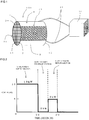
- a heating method of honeycomb structure of the present invention is a heating method of honeycomb structure which is to be performed by using such a honeycomb structure 100 as shown in Fig. 1 .
- the honeycomb structure 100 shown in Fig. 1 includes a tubular honeycomb structure body 4 which is heated by electricity conduction, and a catalyst 7 loaded onto partition walls 1 of the honeycomb structure body 4.
- the honeycomb structure body 4 has the porous partition walls 1 and a circumferential wall 3 positioned at an outermost circumference.
- the porous partition walls 1 define and form a plurality of cells 2 which become through channels for a fluid and extend from a first end face 11 which is one end face to a second end face 12 which is the other end face.
- Fig. 1 is a schematic view to explain a heating step of the one embodiment of the heating method of honeycomb structure of the present invention.
- Fig. 2 is a graph showing one example of relation between power (kW) to be supplied to the honeycomb structure body and elapsed time (seconds) of the heating step, in the heating step of the one embodiment of the heating method of honeycomb structure of the present invention.
- the abscissa indicates the elapsed time (seconds) of the heating step
- the ordinate indicates the power (kW) to be supplied to the honeycomb structure body.
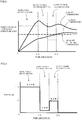
- FIG. 3 is a graph showing one example of relation between temperature of the honeycomb structure body and elapsed time (seconds) of the heating step, in the heating step of the one embodiment of the heating method of honeycomb structure of the present invention.
- the abscissa indicates the elapsed time (seconds) of the heating step
- the ordinate indicates the temperature of the honeycomb structure body.
- the temperature of the honeycomb structure body rises upwardly along the ordinate.
- the graph shown in Fig. 3 is a graph showing the temperature change of the honeycomb structure body, when the power is supplied to the honeycomb structure body as in the graph shown in Fig. 2 .
- FIG. 3 shows two temperature changes of the highest temperature and the lowest temperature in a heating portion of the honeycomb structure body.
- Numeric values of the power (kW) and the time (seconds) shown in Fig. 2 indicate one example of the heating step, and the numeric values of each power (kW) and time (seconds) do not limit the heating step of the heating method of honeycomb structure of the present embodiment.
- the heating method of honeycomb structure of the present embodiment includes the heating step of supplying power to the honeycomb structure body 4 of the honeycomb structure 100 to heat the honeycomb structure body 4 up to a target temperature as shown in Fig. 1 .
- the honeycomb structure 100 shown in Fig. 1 further includes two electrode members 21, 21 disposed on a side surface 5 of the honeycomb structure body 4.
- these two electrode members 21, 21 are connected to wiring lines 31, 31, respectively.
- the wiring lines 31, 31 are electrically connected to a power source 30 to supply the power to the honeycomb structure body 4.
- the electrode member 21 disposed on the side surface 5 of the honeycomb structure body 4 is not limited to such a constitution as shown in Fig. 1 .
- the number of the electrode members 21 to be disposed on the side surface 5 of the honeycomb structure body 4 is not limited to two. There is not any special restriction on the electrode member 21 as long as it is possible to heat the honeycomb structure body 4 by supplying power to the honeycomb structure body 4.
- the heating method of honeycomb structure of the present embodiment in the abovementioned heating step, such a "supply power decrease section" as described in the following is provided at least once before the lowest temperature in a heating region of the honeycomb structure body 4 reaches the abovementioned target temperature.
- the "supply power decrease section” is a section where the supply of the power to the honeycomb structure body 4 is stopped or the power to be supplied to the honeycomb structure body 4 is decreased. More specifically, in the heating method of honeycomb structure of the present embodiment, first, the power is supplied from the power source 30 to the honeycomb structure body 4 to heat the honeycomb structure body 4. An “initial power supply period" in Fig. 2 corresponds to this supply of the power.
- the honeycomb structure body is heated, and the temperature of the honeycomb structure body thereby rises.
- the supply of the power to the honeycomb structure body is stopped for a predetermined period or the power to be supplied to the honeycomb structure body is decreased for a predetermined period before the lowest temperature in the heating region of the honeycomb structure body reaches the target temperature (the supply power decrease section).
- this supply power decrease section is provided between ten seconds and 15 seconds of the elapsed time of the heating step.
- the supply of the power to the honeycomb structure body is stopped for the predetermined period. That is, in Fig. 2 , the power in the supply power decrease section is 0 kW.
- the “target temperature” in the heating method of honeycomb structure of the present embodiment is a temperature to be reached by the honeycomb structure body 4, when the power is supplied to the honeycomb structure body 4 to heat the honeycomb structure body as shown in Fig. 1 . Therefore, in the heating method of honeycomb structure of the present embodiment, the heating is performed so that the whole range of the heating region of the honeycomb structure body 4 finally becomes the abovementioned target temperature or more.
- Such “target temperature” can suitably be set in accordance with a use purpose of the honeycomb structure 100. Therefore, there is not any special restriction on a specific value of the target temperature.
- the target temperature is preferably, for example, from 100 to 300°C.
- Fig. 4 is a graph showing another example of relation between power (kW) to be supplied to the honeycomb structure body and elapsed time (seconds) of the heating step, in the heating step of the one embodiment of the heating method of honeycomb structure of the present invention.
- Fig. 4 shows the example where the same power as in the heating step shown in Fig. 2 is supplied to the honeycomb structure body, except that the power in the supply power decrease section is changed to 1 kW.
- the honeycomb structure (more specifically, the honeycomb structure body) can suitably be heated with less temperature unevenness during the heating and with less power consumption. That is, in the heating method of honeycomb structure of the present embodiment, the abovementioned supply power decrease section is provided at least once before the lowest temperature in the heating region of the honeycomb structure body reaches the target temperature. Therefore, in the supply power decrease section, heat conduction is performed from a portion of the honeycomb structure body in which the temperature is high to a portion of the honeycomb structure body in which the temperature is low, and the temperature unevenness in the heating (in other words, a temperature difference) becomes smaller. For example, as shown in Fig.
- the highest temperature of the honeycomb structure body lowers with an elapse of time, but the lowest temperature of the honeycomb structure body rises with the elapse of time. In consequence, the temperature difference of the honeycomb structure body can be decreased in the subsequent heating step.
- the difference between the highest temperature and the lowest temperature in the heating region of the honeycomb structure body preferably becomes smaller in the supply power decrease section.
- the difference between the highest temperature and the lowest temperature of the honeycomb structure can be decreased at the end time point of the heating step wherein the honeycomb structure body is heated up to the target temperature.
- a partial temperature difference of the honeycomb structure can be decreased (i.e., the lowest temperature is further raised close to the highest temperature) at a point of time when the heating step is ended, as compared with a case where the honeycomb structure is heated by the conventional method.
- the temperature difference at the point of time when the heating step is ended can be decreased, and hence an effect that less power is required for the heating is also produced, as compared with a case where the heating is performed by the conventional method so that the lowest temperature reaches the same temperature. Furthermore, as compared with the case where the heating is performed by the conventional method so that the lowest temperature reaches the same temperature, the highest temperature becomes lower, and hence eventually, the temperature difference of the honeycomb structure can further be decreased.
- the supply power decrease section it is possible to decrease a maximum temperature difference between the highest temperature and the lowest temperature not only at the heating step end time point but also during the heating step including the supply power decrease section. That is, also when the temperature difference of the heating region of the honeycomb structure temporarily spreads, the supply power decrease section is provided so that it is possible to inhibit the spread of the temperature difference during the heating step, as compared with the case where the honeycomb structure is heated by the conventional method. Therefore, it is possible to decrease the maximum temperature difference between the highest temperature and the lowest temperature during the heating step including the supply power decrease section.
- the maximum temperature difference in the heating step is decreased in this manner, so that heat stress due to the temperature difference is not easily generated in the honeycomb structure, and it is possible to inhibit damages such as cracks from being generated in the honeycomb structure body.
- the stop of the supply of the power and the decrease of the power in the supply power decrease section are preferably quickly (e.g., momentarily) performed.
- the supply power decrease section is preferably provided in a state where the highest temperature in the heating region of the honeycomb structure body becomes a temperature which is not less than the target temperature.
- the heat conduction is suitably performed from the portion of the honeycomb structure body in which the temperature is high to the portion of the honeycomb structure body in which the temperature is low.
- portion of the honeycomb structure body in which the temperature is high may be referred to as "high temperature portion”.
- portion of the honeycomb structure body in which the temperature is low may be referred to as "low temperature portion”.
- the supply power decrease section is provided for the purpose of raising the temperature of the low temperature portion of the honeycomb structure body by the heat conduction from the high temperature portion of the honeycomb structure body. Therefore, in the supply power decrease section, it is preferable that the lowest temperature in the heating region of the honeycomb structure body does not lower. In the supply power decrease section, when the lowest temperature in the heating region of the honeycomb structure body does not reach the target temperature, the after-mentioned supply power return section is preferably provided before the lowest temperature lowers.
- the continuation time of the supply power decrease section is short, the heat conduction from the high temperature portion to the low temperature portion cannot sufficiently be performed sometimes.
- the continuation time of the supply power decrease section is excessively long, an excessively long time is required sometimes until the whole honeycomb structure body becomes the target temperature or more.
- a time required until the lowest temperature in the heating region of the honeycomb structure body reaches the target temperature is preferably shorter.
- the "time required until the lowest temperature in the heating region of the honeycomb structure body reaches the target temperature” means the total elapsed time from the start of the heating step. Therefore, the abovementioned continuation time of the "supply power decrease section" is also included in the "time required until the lowest temperature in the heating region of the honeycomb structure body reaches the target temperature".
- the temperature which is not less than the target temperature is set as a heating end temperature and that the supply of the power is stopped at a point of time when the lowest temperature in the heating portion of the honeycomb structure body exceeds the above heating end temperature. That is, it is preferable to end the heating step at the point of time when the lowest temperature in the heating portion of the honeycomb structure body exceeds the above heating end temperature.
- the heating end temperature is more preferably the target temperature.
- a supply power return section where the supply of the power to the honeycomb structure body is restarted or the power to be supplied to the honeycomb structure body is increased from a decreased state. That is, in the heating method of honeycomb structure of the present embodiment, the heating of the honeycomb structure body may be restarted again after the temperature difference in the heating portion of the honeycomb structure body is once decreased by the abovementioned supply power decrease section. Furthermore, when the power is decreased in the supply power decrease section, the power to be supplied to the honeycomb structure body may be increased from the decreased state. Furthermore, when the above heating end temperature is exceeded in the first supply power decrease section, the above supply power return section does not have to be provided.
- the value may be the same as the value of the power in the initial power supply period or may be smaller than the value of the power in the initial power supply period.
- the power after the supply power return section is 5 kW.
- the lowest temperature and the highest temperature in the heating region of the honeycomb structure body rise again.
- the lowest temperature in the heating region of the honeycomb structure body reaches the target temperature at a point of time when the elapsed time from the start of the heating step is 20 seconds, and hence the heating step is ended. That is, at the point of time when the abovementioned elapsed time becomes 20 seconds, the supply of the power to the honeycomb structure body is stopped.
- a second supply power decrease section may be provided after the supply power return section. Furthermore, a second supply power return section may be provided after the second supply power decrease section. Consequently, in the heating method of honeycomb structure of the present embodiment, the supply power decrease section and the supply power return section may alternately and repeatedly be provided a plurality of times. It is to be noted that the values of the powers of the second and subsequent supply power decrease sections and the second and subsequent supply power return sections may be the same as or different from the values of the powers of the first supply power decrease section and the first supply power return section. For example, as shown in Fig. 5 , the second supply power decrease section may be provided after the first supply power return section, and afterward, the second supply power return section may further be provided.
- Fig. 5 is a graph showing still another example of the relation between power (kW) to be supplied to the honeycomb structure body and elapsed time (seconds) of the heating step, in the heating step of the one embodiment of the heating method of honeycomb structure of the present invention.
- the power in the second supply power return section is 2 kW.
- Fig. 2 the power is momentarily increased up to 5 kW in the supply power return section, but the power may gradually be increased in the supply power return section as shown in, for example, Fig. 6 .
- Fig. 6 is a graph showing a further example of the relation between power (kW) to be supplied to the honeycomb structure body and elapsed time (seconds) of the heating step, in the heating step of the one embodiment of the heating method of honeycomb structure of the present invention.
- Fig. 6 shows the example where the same power as in the heating step shown in Fig. 2 is supplied to the honeycomb structure body, except that the power is gradually increased in the supply power return section.
- the catalyst is a heretofore known catalyst for use in purification of a harmful component in an exhaust gas.
- the catalyst include an oxidation catalyst, a NOx absorber catalyst, and a ternary catalyst.
- an auxiliary catalyst represented by an oxide of cerium (Ce) or zirconium (Zr), an HC (hydrocarbon) adsorption material or the like may be loaded onto the partition walls.
- a suitable example of a catalyst activating component is a noble metal such as platinum (Pt), palladium (Pd) or rhodium (Rh).
- the catalyst may include cerium, and at least one selected from the group consisting of a rare earth metal except cerium, an alkaline earth metal and a transition metal.
- examples of the rare earth metal include samarium (Sm), gadolinium (Gd), neodymium (Nd), yttrium (Y), scandium (Sc), cerium (Ce), lanthanum (La), and praseodymium (Pr).
- examples of the alkaline earth metal to be included in the catalyst include magnesium (Mg), calcium (Ca), strontium (Sr), and barium (Ba).
- transition metal to be included in the catalyst examples include manganese (Mn), iron (Fe), cobalt (Co), nickel (Ni), copper (Cu), zinc (Zn), titanium (Ti), zirconium (Zr), vanadium (V), and chromium (Cr).
- the power in the initial power supply period of the heating step can suitably be determined in consideration of a size or a material of the honeycomb structure body.
- the power per gram of the honeycomb structure body in the initial power supply period is preferably from 3.3 to 33.3 W/g.
- the power per gram of the honeycomb structure body in the initial power supply period is smaller than 3.3 W/g, it is difficult sometimes to rapidly heat the honeycomb structure body.
- the power per gram of the honeycomb structure body in the initial power supply period is in excess of 33.3 W/g, heating unevenness in a carrier increases.
- the power per gram of the honeycomb structure body in the initial power supply period is preferably from 3.3 W/g to 33.3 W/g as described above and further preferably from 10 to 23.1 W/g.
- the power in the supply power decrease section of the heating step is preferably such a power as to lower the highest temperature in the heating portion of the honeycomb structure body in this supply power decrease section.
- the power in the supply power decrease section is more preferably 50% or less of the power in the initial power supply period. It is to be noted that in the supply power decrease section, the supply of the power may be stopped. When the supply of the power is stopped, the power in the supply power decrease section is zero (0).
- the power in the supply power decrease section is preferably 50% or less and further preferably 30% or less of the power in the initial power supply period.
- the power in the supply power return section of the heating step is preferably suitably determined in consideration of a difference between the "lowest temperature in the heating portion" when the supply power return section is started and the "heating end temperature", the elapsed time from the start of the heating step, and the like.
- the honeycomb structure body in the heating step, is preferably heated until the lowest temperature in the heating region of the honeycomb structure body becomes 100°C or more. That is, in the heating method of honeycomb structure of the present embodiment, the heating end temperature is preferably set to 100°C or more. According to such a constitution, for example, a capability of the catalyst loaded onto the partition walls can sufficiently be exerted.
- the honeycomb structure body in the heating step, is preferably heated so that the highest temperature in the heating region of the honeycomb structure body does not exceed 1000°C. That is, the supply power decrease section is preferably suitably provided before the highest temperature in the heating region of the honeycomb structure body exceeds 1000°C in the initial power supply period and the supply power return section. According to such a constitution, damages such as the cracks can effectively be prevented from being generated in the honeycomb structure body.
- the difference between the highest temperature and the lowest temperature in the heating region of the honeycomb structure body during the heating step is preferably 900°C or less.
- the honeycomb structure body can be inhibited from locally having an excessively high temperature. In consequence, waste of power to be consumed in the heating can further be reduced, and the honeycomb structure can suitably be heated with less power consumption.
- the difference between the highest temperature and the lowest temperature in the heating region of the honeycomb structure body is further preferably 600°C or less. There is not any special restriction on a lower limit value of the difference between the highest temperature and the lowest temperature. Ideally, the difference between the highest temperature and the lowest temperature is zero (0).
- the power is preferably supplied in such a method as to more uniformly heat the tubular honeycomb structure body which heats by the electricity conduction.
- the power source which supplies the power to the honeycomb structure body for example, an inverter power source (DC-AC) in which it is easy to control the power or a power converter such as a DC-DC converter or an AC-DC converter may be used.
- DC-AC inverter power source
- a power converter such as a DC-DC converter or an AC-DC converter
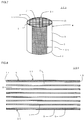
- FIG. 7 is a perspective view schematically showing the honeycomb structure for use in the heating method of honeycomb structure of the present invention.
- Fig. 8 is a schematic view showing a cross section of the honeycomb structure shown in Fig. 7 which is parallel to a cell extending direction.
- Fig. 9 is a schematic view showing a cross section of the honeycomb structure shown in Fig. 7 which is perpendicular to the cell extending direction.
- a honeycomb structure 100 shown in Fig. 7 to Fig. 9 includes a tubular honeycomb structure body 4 having porous partition walls 1 and a circumferential wall 3 positioned at an outermost circumference, and which is heated by electricity conduction, and a catalyst 7 loaded onto the partition walls of the honeycomb structure body 4.
- the partition walls 1 define and form a plurality of cells 2 which become through channels for a fluid and extend from a first end face 11 to a second end face 12.
- the honeycomb structure 100 further includes two electrode members 21, 21 disposed on a side surface 5 of the honeycomb structure body 4.
- an electrical resistivity of the honeycomb structure body 4 is preferably from 1 to 200 ⁇ cm and further preferably from 40 to 100 ⁇ cm. In a case where the electrical resistivity of the honeycomb structure body 4 is from 1 to 200 ⁇ cm, even when a current is allowed to flow by using a power source having a high voltage, the current does not excessively flow, so that the honeycomb structure is suitably usable as a heater.
- the electrical resistivity of the partition walls is a value measured by a four-terminal method.
- the electrical resistivity of the honeycomb structure body 4 is a value at 400°C.
- a porosity of the partition walls is preferably from 30 to 60% and further preferably from 30 to 50%.
- the porosity of the partition walls is smaller than 30%, the partition walls are disadvantageously deformed sometimes during preparation of the honeycomb structure body.
- the porosity is in excess of 60%, strength of the honeycomb structure deteriorates sometimes.
- the porosity is a value measured by a mercury porosimeter.
- an average pore diameter of the partition walls is preferably from 2 to 15 ⁇ m and further preferably from 4 to 8 ⁇ m.
- the average pore diameter is a value measured by the mercury porosimeter.
- a thickness of the partition walls is preferably from 50 to 260 ⁇ m and further preferably from 70 to 180 ⁇ m.
- the thickness of the partition walls is smaller than 50 ⁇ m, the strength of the honeycomb structure deteriorates sometimes.
- the thickness of the partition walls is larger than 260 ⁇ m, a pressure loss during passing of an exhaust gas through the honeycomb structure enlarges sometimes.
- a cell density of the honeycomb structure is preferably from 40 to 150 cells/cm 2 and further preferably from 70 to 100 cells/cm 2 .
- a purification performance of a catalyst can be heightened in a state where the pressure loss during the passing of the exhaust gas is reduced.
- the cell density is lower than 40 cells/cm 2 , a catalyst loading area is reduced sometimes.
- the cell density is higher than 150 cells/cm 2 , the pressure loss during the passing of the exhaust gas through the honeycomb structure enlarges sometimes.
- a material of the partition walls 1 and the circumferential wall 3 preferably includes a silicon-silicon carbide composite material or a silicon carbide material as a main component, and is further preferably the silicon-silicon carbide composite material or the silicon carbide material.
- the material of the partition walls 1 and the circumferential wall 3 includes the silicon-silicon carbide composite material or the silicon carbide material as the main component
- the partition walls 1 and the circumferential wall 3 contain 90 mass% or more of the silicon-silicon carbide composite material or the silicon carbide material in the whole material.
- the electrical resistivity of the honeycomb structure body can be from 1 to 200 ⁇ cm.
- the silicon-silicon carbide composite material contains silicon carbide particles as aggregates, and silicon as a bonding material which bonds the silicon carbide particles, and the plurality of silicon carbide particles are preferably bonded by silicon so that pores are formed among the silicon carbide particles. Furthermore, in the silicon carbide material, the silicon carbide particles are mutually sintered.
- a "mass of the silicon carbide particles” and a “mass of silicon” are preferably in the following relation. That is, a ratio of the "mass of silicon” to a total of the “mass of the silicon carbide particles” and the “mass of silicon” is preferably from 10 to 40 mass% and further preferably from 15 to 35 mass%.
- the ratio of the mass of silicon to the total of the mass of the silicon carbide particles and the mass of silicon may be referred to as "mass ratio of silicon”.
- the above “mass of the silicon carbide particles” is the “mass of the silicon carbide particles as the aggregates” to be contained in the partition walls.
- the above “mass of silicon” is the “mass of silicon as the bonding material” to be contained in the partition walls.
- a shape of the cells in the cross section perpendicular to the cell extending direction of the honeycomb structure is preferably a quadrangular shape, a hexagonal shape, an octagonal shape, or any combination of these shapes.
- the cell shape is such a shape, the pressure loss during the passing of the exhaust gas through the honeycomb structure is reduced, and the purification performance of the catalyst becomes excellent.
- the thickness of the circumferential wall constituting the outermost circumference of the honeycomb structure body.
- the thickness of the circumferential wall is preferably from 0.1 to 1 mm, further preferably from 0.2 to 0.8 mm, and especially preferably from 0.2 to 0.5 mm.
- the thickness of the circumferential wall is smaller than 0.1 mm, the strength of the honeycomb structure deteriorates sometimes.
- the thickness of the circumferential wall is larger than 1 mm, an area of each partition wall onto which the catalyst is loaded is reduced sometimes.
- a porosity of the circumferential wall of the honeycomb structure body is preferably from 35 to 60%, further preferably from 35 to 55%, and especially preferably from 35 to 50%.
- a thermal shock resistance of the honeycomb structure can be improved.
- the porosity of the circumferential wall of the honeycomb structure body is smaller than 35%, the effect of improving the thermal shock resistance of the honeycomb structure deteriorates sometimes.
- the porosity of the circumferential wall of the honeycomb structure body is larger than 60%, a mechanical strength of the honeycomb structure deteriorates sometimes.
- a shape of the honeycomb structure body There is not any special restriction on a shape of the honeycomb structure body.
- the shape of the honeycomb structure body include a tubular shape in which a bottom surface has a circular shape (a cylindrical shape), a tubular shape in which the bottom surface has an oval shape, and a tubular shape in which the bottom surface has a polygonal shape.
- Examples of the above polygonal shape include a quadrangular shape, a pentangular shape, a hexagonal shape, a heptagonal shape, and an octagonal shape.
- an area of the bottom surface is preferably from 2000 to 20000 mm 2 and further preferably from 4000 to 10000 mm 2 .
- a length of a central axis direction of the honeycomb structure is preferably from 50 to 200 mm and further preferably from 75 to 150 mm.
- the honeycomb structure 100 may further include the two electrode members 21, 21 disposed on the side surface 5 of the honeycomb structure body 4.
- each of the two electrode members 21, 21 is preferably formed into a band shape extending in the extending direction of the cells 2 of the honeycomb structure body 4.
- one electrode member 21 in the two electrode members 21, 21 is preferably disposed on a side opposite to the other electrode member 21 in the two electrode members 21, 21 via a center O of the honeycomb structure body 4. According to such a constitution as described above, the power can more evenly be supplied to the honeycomb structure body 4.
- a deviation of the honeycomb structure body 4 can be inhibited to a certain degree.
- the deviation occurs in a temperature distribution due to a length of a distance between the two electrode members 21, 21, when the power is actually supplied to the honeycomb structure body 4.
- the heating method of honeycomb structure of the present embodiment is used, the deviation of the temperature distribution of a heating portion can further be inhibited.
- the number of the electrode members to be disposed on the honeycomb structure body or a shape of each electrode member is not limited to such a configuration as shown in Fig. 7 to Fig. 9 .
- a constitution where "in the cross section perpendicular to the extending direction of the cells 2, the one electrode member 21 is disposed on the side opposite to the other electrode member 21 via the center O of the honeycomb structure body 4" will hereinafter be described in detail.
- a line segment connecting a center point of the one electrode member 21 to the center O of the honeycomb structure body 4 in the cross section perpendicular to the cell extending direction is to be “line segment P”.
- a line segment connecting a center point of the other electrode member 21 to the center O of the honeycomb structure body 4 in the cross section perpendicular to the extending direction of the cells 2 is to be "line segment Q".
- the center points of the one electrode member 21 and the other electrode member 21 are points of centers in a circumferential direction of the honeycomb structure body 4. Furthermore, the "opposite side via the center O of the honeycomb structure body 4" means such a positional relation that an angle P formed by the line segment P and the line segment Q is in a range of 170° to 190°. Therefore, in the abovementioned constitution, the two electrode members 21, 21 are disposed in such a positional relation as to satisfy the above range of the angle ⁇ . In Fig. 9 , the angle ⁇ formed by the line segment P and the line segment Q is 180°.
- a central angle ⁇ of each of the electrode members 21, 21 is preferably from 15 to 65° and further preferably from 30 to 60°.
- the honeycomb structure 100 having this constitution is heated by the heating method of honeycomb structure of the present embodiment, so that the temperature unevenness during the heating can further be decreased.
- the "angle ⁇ of 0.5 time the central angle ⁇ " of the one electrode member 21 preferably has a size of 0.8 to 1.2 times and further preferably has a size of 1.0 time (the same size) to the "angle ⁇ of 0.5 time the central angle ⁇ " of the other electrode member 21.
- the honeycomb structure 100 having such a constitution is heated by the heating method of honeycomb structure of the present embodiment, so that the temperature unevenness during the heating can further be decreased.
- the electrode member 21 of the honeycomb structure 100 has such a shape as obtained by bending a planar rectangular member along a circumference of a cylindrical shape.
- a shape obtained when the bent electrode member 21 is deformed into a planar member which is not bent is referred to as "planar shape" of the electrode member 21.
- the "planar shape" of the electrode member 21 shown in Fig. 7 to Fig. 9 is a rectangular shape.
- the "circumferential shape of the electrode member” means “circumferential shape in the planar shape of the electrode member”.
- the circumferential shape of the band-like electrode member 21 may be a shape in which a corner portion of the rectangular shape is formed in a curved manner. Furthermore, the circumferential shape of the band-like electrode member 21 may be a shape in which the corner portion of the rectangular shape is linearly chamfered. The abovementioned curved manner and chamfered manner in the circumferential shape of the band-like electrode member 21 may be used compositely in the one electrode member.
- the electrical resistivity of the electrode member 21 is preferably from 0.1 to 100 ⁇ cm and further preferably from 0.1 to 50 ⁇ cm.
- each of the two electrode members 21, 21 effectively performs a function of an electrode in a piping line through which a high-temperature exhaust gas passes.
- the electrical resistivity of the electrode member 21 is smaller than 0.1 ⁇ cm, a temperature of the honeycomb structure body in the vicinity of each of both ends of the electrode member 21 easily rises sometimes in the cross section perpendicular to the cell extending direction.
- the electrical resistivity of the electrode member 21 is larger than 100 ⁇ cm, the current does not easily flow, and hence the electrode member does not easily perform the function of the electrode.
- the electrical resistivity of the electrode member is a value at 400°C.
- the electrode member 21 preferably includes a silicon-silicon carbide composite material or a silicon carbide material as a main component, and is further preferably the silicon-silicon carbide composite material or the silicon carbide material.
- the electrode member 21 is especially preferably formed by using silicon carbide particles and silicon as raw materials, except usually contained impurities. In this way, the electrode member 21 includes the "silicon-silicon carbide composite material or the silicon carbide material" as the main component, and a component of the electrode member 21 and a component of the honeycomb structure body 4 thereby become the same component or close components. In consequence, thermal expansion coefficients of the electrode member 21 and the honeycomb structure body 4 have the same value or close values.
- the material of the electrode member 21 and the material of the honeycomb structure body 4 become the same material or close materials, and hence a bonding strength between the electrode member 21 and the honeycomb structure body 4 also heightens. Therefore, even when the heat stress is applied to the honeycomb structure, the electrode member 21 can be prevented from being peeled from the honeycomb structure body 4, and a bonding portion between the electrode member 21 and the honeycomb structure body 4 can be prevented from being damaged.
- An average pore diameter of the electrode member 21 is preferably from 5 to 45 ⁇ m and further preferably from 7 to 40 ⁇ m.
- a suitable electrical resistivity can be obtained.
- the average pore diameter of the electrode member 21 is smaller than 5 ⁇ m, the electrical resistivity excessively heightens sometimes.
- the average pore diameter of the electrode member 21 is larger than 45 ⁇ m, the strength of the electrode member 21 weakens, and the electrode member is easily damaged sometimes.
- the average pore diameter is a value measured by the mercury porosimeter.
- the electrical resistivity of the electrode member 21 is preferably lower than the electrical resistivity of the honeycomb structure body 4. Furthermore, the electrical resistivity of the electrode member 21 is further preferably 20% or less and especially preferably from 1 to 10% of the electrical resistivity of the honeycomb structure body 4. The electrical resistivity of the electrode member 21 is 20% or less of the electrical resistivity of the honeycomb structure body 4, and the electrode member 21 thereby more effectively functions as the electrode.
- a connecting portion to connect a wiring line from a power source may further be disposed in each electrode member. According to this constitution, a power is more easily supplied to the honeycomb structure body.
- An isostatic strength of the honeycomb structure 100 is preferably 1 MPa or more and further preferably 3 MPa or more.
- an upper limit of the strength is about 6 MPa.
- the isostatic strength is a value measured under a hydrostatic pressure in water.
- a type of catalyst loaded onto the partition walls of the honeycomb structure body There is not any special restriction on a type of catalyst loaded onto the partition walls of the honeycomb structure body.
- An example of the catalyst is a heretofore known catalyst for use in purification of a harmful component in an exhaust gas.
- the catalyst include an oxidation catalyst, an NOx absorber catalyst, and a ternary catalyst.
- an auxiliary catalyst represented by an oxide of cerium (Ce) or zirconium (Zr), an HC (hydrocarbon) adsorption material or the like may be loaded onto the partition walls.
- an amount of the catalyst to be loaded onto the partition walls there is not any special restriction on an amount of the catalyst to be loaded onto the partition walls.
- a mass (g) of the catalyst to be loaded per L (liter) of a volume of the honeycomb structure body may be referred to as "loading amount (g/L)".
- the loading amount of the catalyst can suitably be set in accordance with the type of catalyst or an amount of the harmful component of the exhaust gas which becomes a purification object.
- honeycomb structure including a tubular honeycomb structure body which has porous partition walls to define and form a plurality of cells and a circumferential wall positioned at an outermost circumference, and which is heated by electricity conduction; and a catalyst loaded onto the partition walls of the honeycomb structure body.
- a power was supplied to the honeycomb structure body of this honeycomb structure, to heat the honeycomb structure.
- the honeycomb structure had such a constitution as in the following.
- a thickness of the partition walls was about 100 ⁇ m and a cell density was 600 cells/cm 2 .
- a bottom surface of the honeycomb structure had a circular shape with a diameter of 93 mm, and a length of the honeycomb structure in a cell extending direction was 100 mm.
- a porosity of the honeycomb structure was 48%.
- the porosity is a value measured by a mercury porosimeter (AutoPore IV9505 manufactured by Micromeritics Co.).
- a material of the partition walls and the circumferential wall included a silicon-silicon carbide composite material as a main component.
- An electrical resistivity of the honeycomb structure body was 30 ⁇ cm.
- the electrode members were disposed on a side surface of the honeycomb structure body.
- the electrode members were prepared by using a raw material including silicon carbide particles and silicon as main components.
- the above electrode member forming raw material was applied in the form of a band onto the side surface of the honeycomb structure body so that a thickness (the thickness after drying and firing) was 1.0 mm.
- the electrode member forming raw material was applied to two portions of the side surface of the honeycomb structure body. Then, in a cross section perpendicular to the cell extending direction, one of the two portions to which the electrode member forming raw material was applied was disposed on a side opposite to the other portion via a center of the honeycomb structure body.
- a shape (a circumferential shape) of the electrode member forming raw material applied to the side surface of the honeycomb structure body was rectangular.
- the electrode member forming raw material was applied to the side surface of the honeycomb structure body so that a coating film by the electrode member forming raw material extended between both end portions of the honeycomb structure body.
- the electrode member forming raw material applied to the honeycomb structure body was dried and fired to prepare the electrode members.
- An electrical resistivity of each electrode member was 1 ⁇ cm.
- a ternary catalyst was loaded onto the partition walls of the honeycomb structure.
- a loading amount of the catalyst was 150 g/L.
- a catalyst activating temperature of this catalyst was 300°C. Therefore, in Example 1, the target temperature during the heating of the honeycomb structure body was set to 300°C.
- Such two electrode members of the honeycomb structure were electrically connected to a DC power source by wiring lines, and the power was supplied to the honeycomb structure body, to heat the honeycomb structure by Joule heat.
- a temperature of the honeycomb structure body constituting the honeycomb structure was measured at 31 measurement points.
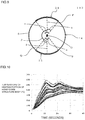
- Fig. 16A and Fig. 16B show the measurement points (N1 to N31) at which the temperature of a honeycomb structure body 204 of a honeycomb structure 200 was measured.
- Fig. 16A is an explanatory view to explain the measurement points of the honeycomb structure body in the Examples, and is a plan view of a first end face side of the honeycomb structure.
- Fig. 16B is a sectional view showing a cross section cut along the A-A line of Fig. 16A .
- the measurement points N1 to N31 to measure the temperature of the honeycomb structure body 204 of the honeycomb structure 200 will be described with reference to Fig. 16A and Fig. 16B .
- a measurement point on a broken line indicating 0° on a first end face 211 side of the honeycomb structure body 204 was the measurement point N1
- a measurement point at a position moved counterclockwise as much as 45° was the measurement point N2
- a measurement point at a position further moved counterclockwise as much as 45° was the measurement point N3.
- the measurement points were disposed in a counterclockwise manner every 45°.
- Fig. 16A and Fig. 16B reference numeral 221 denotes an electrode member.
- the power was supplied while confirming the lowest temperature and the highest temperature in a heating portion of the measured honeycomb structure body.
- Fig. 10 is a graph showing the relation between temperature (°C) of the honeycomb structure body and elapsed time (seconds) of the heating step, in the heating step of the heating method of honeycomb structure of Example 1.
- Fig. 11 is a graph showing the relation between power (kW) to be supplied to the honeycomb structure body and elapsed time (seconds) of the heating step, in the heating step of the heating method of honeycomb structure of Example 1.
- the power to be supplied to the honeycomb structure body for ten seconds from the start of the supply of the power was 10 kW.
- a period of ten seconds from the start of the supply of the power is an "initial power supply period".
- a time to start the supply of the power is the start time of the heating step.
- the lowest temperature in the heating portion of the honeycomb structure body at a point of time when ten seconds elapsed from the start time of the heating step was about 180°C.
- the highest temperature in the heating portion of the honeycomb structure body at the point of time when ten seconds elapsed from the start time of the heating step was about 580°C.
- a "supply power decrease section” was provided for five seconds after this "initial power supply period”. Specifically, the supply of the power to the honeycomb structure body was stopped between ten seconds and 15 seconds counted from the start time of the heating step. In the “supply power decrease section”, the highest temperature in the heating portion of the honeycomb structure body lowered. Furthermore, in the “supply power decrease section”, the lowest temperature in the heating portion of the honeycomb structure body rose. The rise of the lowest temperature in the heating portion of the honeycomb structure body took place because the "supply power decrease section" was provided to allow the temperature to become uniform by heat conduction from a high temperature portion.
- the lowest temperature in the heating portion of the honeycomb structure body at a point of time when 15 seconds elapsed from the start time of the heating step was about 260°C. Furthermore, the highest temperature in the heating portion of the honeycomb structure body at the point of time when 15 seconds elapsed from the start time of the heating step was about 525°C.
- a “supply power return section” was provided for five seconds after the "supply power decrease section”. Specifically, the supply of the power to the honeycomb structure body was restarted between 15 seconds and 20 seconds counted from the start time of the heating step. In the "supply power return section", a power of 5 kW was supplied to the honeycomb structure body. The lowest temperature in the heating portion of the honeycomb structure body exceeded 300°C at a point of time when 20 seconds elapsed from the start time of the heating step, and hence the supply of the power to the honeycomb structure body was stopped. This "point of time when the supply of the power to the honeycomb structure body is stopped" is an "end time of the heating step".
- heating step continuation section also includes the above "supply power return section".
- the lowest temperature at the end time of the heating step in the heating portion of the honeycomb structure body was 302°C.
- the electric energy supplied to the honeycomb structure body in the heating step continuation section was 125 kWs.
- a maximum difference (hereinafter referred to as "maximum temperature difference") between the highest temperature and the lowest temperature in the heating portion of the honeycomb structure body in the heating step continuation section was 381°C.
- the highest temperature in the heating portion of the honeycomb structure body in the heating step continuation section was 596°C.
- Table 1 shows a total time (seconds) of the heating step, the electric energy (kWs) supplied to the honeycomb structure body, the highest temperature (°C), the maximum temperature difference (°C), and the lowest temperature (°C) at the end time of the heating step in the heating method of honeycomb structure of Example 1.
- the lowest temperature in the heating portion of the honeycomb structure body was higher than the target temperature (i.e., 300°C).
- a column of "target temperature” in Table 1 shows the evaluation result.
- the lowest temperature in the heating portion of the honeycomb structure body in 20 seconds after the start time of the heating step (i.e., at the end time of the heating step) is the target temperature or more is evaluated as "pass".
- Example 1 With supply power decrease section 20 125 596 381 302 Pass Pass Example 2 With supply power decrease section 20 137 627 377 317 Pass Pass Comparative Example 1 Without supply power decrease section (constant power) 20 125 629 348 281 Failure Pass Comparative Example 2 Without supply power decrease section (constant power) 20 137 702 402 310 Pass Failure
- Example 2 As shown in Fig. 12 and Fig. 13 , a power to be supplied to a honeycomb structure body for ten seconds from the start of the supply of the power was 10 kW. Afterward, the power for three seconds was 0.5 kW, and then the power was increased to 5 kW for seven seconds.
- Fig. 12 is a graph showing the relation between temperature (°C) of the honeycomb structure body and elapsed time (seconds) of the heating step, in the heating step of the heating method of honeycomb structure of Example 2.
- Fig. 13 is a graph showing the relation between power (kW) to be supplied to the honeycomb structure body and elapsed time (seconds) of the heating step, in the heating step of the heating method of honeycomb structure of Example 2.
- Table 1 shows a total time (seconds) of the heating step, the electric energy (kWs) supplied to the honeycomb structure body, the highest temperature (°C), a maximum temperature difference (°C), and the lowest temperature (°C) at an end time of the heating step in the heating method of honeycomb structure of Example 2.
- Example 2 for the honeycomb structure at the end time of the heating step, it was evaluated whether the lowest temperature in a heating portion of the honeycomb structure body was higher than a target temperature. Furthermore, presence/absence of generation of cracks was also evaluated by a method similar to that of Example 1. Table 1 shows the evaluation results.
- a power of 6.25 kW was supplied to a honeycomb structure body for 20 seconds, to heat the honeycomb structure body.
- the honeycomb structure used was similar to the honeycomb structure used in Example 1.
- Fig. 14 is a graph showing the relation between temperature (°C) of the honeycomb structure body and elapsed time (seconds) of the heating step, in the heating step of the heating method of honeycomb structure of Comparative Example 1.
- Fig. 15 is a graph showing the relation between power (kW) to be supplied to the honeycomb structure body and elapsed time (seconds) of the heating step, in the heating step of the heating method of honeycomb structure of Comparative Example 1.
- Comparative Example 2 a power of 6.85 kW was supplied to a honeycomb structure body for 20 seconds, to heat the honeycomb structure body.
- the honeycomb structure used was similar to the honeycomb structure used in Example 1.
- Table 1 shows a total time (seconds) of the heating step, the electric energy (kWs) supplied to the honeycomb structure body, the highest temperature (°C), the maximum temperature difference (°C), and the lowest temperature (°C) at the end time of the heating step in the heating method of honeycomb structure of each of Comparative Examples 1 and 2. Furthermore, also in Comparative Examples 1 and 2, for the honeycomb structure at the end time of the heating step, it was evaluated whether the lowest temperature in a heating portion of the honeycomb structure body was higher than a target temperature. Furthermore, for the honeycomb structure, presence/absence of generation of cracks was also evaluated by a method similar to that of Example 1. Table 1 shows the evaluation results.
- the electric energy (kWs) supplied to the honeycomb structure body for 20 seconds from the start time of the heating step was the same.
- the maximum temperature difference of the heating step continuation section was larger as compared with the case of Comparative Example 1, but it was possible to heat the honeycomb structure up to the target temperature in a state where no crack was generated.
- the total time of the heating step and the electric energy were the same as in Example 1, but the lowest temperature at the end time of the heating step did not reach the target temperature.
- the electric energy (kWs) supplied to the honeycomb structure body for 20 seconds from the start time of the heating step was the same.
- the electric energy supplied to the honeycomb structure body was larger than the electric energy in Comparative Example 1, and hence the lowest temperature at the end time of the heating step reached the target temperature.
- the maximum temperature difference in the heating step continuation section became very large, and cracks were disadvantageously generated in the honeycomb structure body.
- the heating method of honeycomb structure of Example 2 similarly to Example 1, the supply power decrease section was provided in ten seconds after the start time of the heating step, and hence it was possible to reduce the maximum temperature difference in the heating step continuation section. Therefore, in the heating method of honeycomb structure of Example 2, it was possible to heat the honeycomb structure up to the target temperature in a state where no crack was generated.
- the heating method of honeycomb structure of the present invention can be utilized as a method of heating, up to a predetermined temperature, the honeycomb structure for use in an exhaust gas purification device or the like to purify exhaust gas of a car.
Landscapes
- Engineering & Computer Science (AREA)
- Chemical & Material Sciences (AREA)
- Combustion & Propulsion (AREA)
- Mechanical Engineering (AREA)
- General Engineering & Computer Science (AREA)
- Chemical Kinetics & Catalysis (AREA)
- Health & Medical Sciences (AREA)
- Toxicology (AREA)
- Exhaust Gas After Treatment (AREA)
- Catalysts (AREA)
- Exhaust Gas Treatment By Means Of Catalyst (AREA)
Claims (8)
- Procédé de chauffage d'une structure en nid d'abeilles (100) dont la valeur de résistance diminue avec l'élévation de la température, la structure en nid d'abeilles (100) comprenant un corps de structure en nid d'abeilles (4) tubulaire qui comporte des parois de séparation poreuses (1) pour définir et former une pluralité de cellules (2) qui deviennent des canaux traversants pour un fluide et qui s'étendent d'une première face d'extrémité (11) à une deuxième face d'extrémité (12) et une paroi circonférentielle (3) positionnée au niveau d'une circonférence la plus à l'extérieur, et qui est chauffé par une conduction d'électricité, et un catalyseur (7) chargé sur les parois de séparation (1) du corps de structure en nid d'abeilles (4), le procédé comprenant :une étape de chauffage pour fournir une puissance au corps de structure en nid d'abeilles (4) de la structure en nid d'abeilles (100) pour chauffer le corps de structure en nid d'abeilles (4) jusqu'à une température cible,dans lequel, à l'étape de chauffage, il est prévu, au moins une fois, une section de diminution d'alimentation où la fourniture de la puissance au corps de structure en nid d'abeilles (4) est arrêtée ou la puissance à fournir au corps de structure en nid d'abeilles (4) est diminuée avant que la température la plus faible dans une région de chauffage du corps de structure en nid d'abeilles (4) n'atteigne la température cible.
- Procédé de chauffage de la structure en nid d'abeilles (100) selon la revendication 1,
dans lequel, à l'étape de chauffage, après la section de diminution d'alimentation, il est prévu une section de reprise d'alimentation où la fourniture de la puissance au corps de structure en nid d'abeilles (4) est redémarrée ou la puissance à fournir au corps de structure en nid d'abeilles (4) est augmentée à partir d'un état diminué. - Procédé de chauffage de la structure en nid d'abeilles (100) selon la revendication 1 ou 2,
dans lequel, à l'étape de chauffage, le corps de structure en nid d'abeilles (4) est chauffé jusqu'à ce que la température la plus faible dans la région de chauffage du corps de structure en nid d'abeilles (4) devienne égale à 100 °C ou plus. - Procédé de chauffage de la structure en nid d'abeilles (100) selon l'une quelconque des revendications 1 à 3,
dans lequel, à l'étape de chauffage, le corps de structure en nid d'abeilles (4) est chauffé de sorte que la température la plus élevée dans la région de chauffage du corps de structure en nid d'abeilles (4) ne dépasse pas 1000 °C. - Procédé de chauffage de la structure en nid d'abeilles (100) selon l'une quelconque des revendications 1 à 4,
dans lequel, à l'étape de chauffage, une différence entre la température la plus élevée et la température la plus faible dans la région de chauffage du corps de structure en nid d'abeilles (4) est égale à 900 °C ou moins. - Procédé de chauffage de la structure en nid d'abeilles (100) selon l'une quelconque des revendications 1 à 5,
dans lequel la structure en nid d'abeilles (100) comprend en outre deux éléments d'électrode (21, 21) ou plus disposés sur une surface latérale (5) du corps de structure en nid d'abeilles (4). - Procédé de chauffage de la structure en nid d'abeilles (100) selon l'une quelconque des revendications 1 à 6,
dans lequel, à l'étape de chauffage, la section de diminution d'alimentation est prévue dans un état dans lequel au moins la température la plus élevée dans la région de chauffage du corps de structure en nid d'abeilles (4) est une température qui est supérieure ou égale à la température cible. - Procédé de chauffage de la structure en nid d'abeilles (100) selon l'une quelconque des revendications 1 à 7,
dans lequel, dans la section de diminution d'alimentation, la température la plus élevée dans la région de chauffage du corps de structure en nid d'abeilles (4) diminue avec le temps.
Applications Claiming Priority (2)
| Application Number | Priority Date | Filing Date | Title |
|---|---|---|---|
| JP2012083099 | 2012-03-30 | ||
| PCT/JP2013/059774 WO2013147273A1 (fr) | 2012-03-30 | 2013-03-29 | Procédé de chauffage d'une structure en nid d'abeilles |
Publications (3)
| Publication Number | Publication Date |
|---|---|
| EP2832964A1 EP2832964A1 (fr) | 2015-02-04 |
| EP2832964A4 EP2832964A4 (fr) | 2015-08-19 |
| EP2832964B1 true EP2832964B1 (fr) | 2017-07-19 |
Family
ID=49260511
Family Applications (1)
| Application Number | Title | Priority Date | Filing Date |
|---|---|---|---|
| EP13770336.9A Not-in-force EP2832964B1 (fr) | 2012-03-30 | 2013-03-29 | Procédé de chauffage d'une structure en nid d'abeilles |
Country Status (5)
| Country | Link |
|---|---|
| US (1) | US9820337B2 (fr) |
| EP (1) | EP2832964B1 (fr) |
| JP (1) | JP6101249B2 (fr) |
| CN (1) | CN104395576B (fr) |
| WO (1) | WO2013147273A1 (fr) |
Families Citing this family (9)
| Publication number | Priority date | Publication date | Assignee | Title |
|---|---|---|---|---|
| JP2015183587A (ja) * | 2014-03-24 | 2015-10-22 | 日立建機株式会社 | 熱機関の排ガス浄化装置、排ガス浄化方法及び排ガス浄化触媒 |
| JP6581926B2 (ja) * | 2016-03-07 | 2019-09-25 | 日本碍子株式会社 | ハニカム構造体 |
| JP6626377B2 (ja) * | 2016-03-14 | 2019-12-25 | 日本碍子株式会社 | ハニカム型加熱装置並びにその使用方法及び製造方法 |
| CN110100080B (zh) * | 2016-10-24 | 2022-05-24 | 巴斯夫公司 | 用于减少NOx的集成SCR催化剂和LNT |
| JP6569652B2 (ja) * | 2016-12-08 | 2019-09-04 | トヨタ自動車株式会社 | 内燃機関の排気浄化装置 |
| JP7038585B2 (ja) * | 2018-03-30 | 2022-03-18 | 日本碍子株式会社 | セラミックス多孔体及び集塵用フィルタ |
| JP2020081922A (ja) * | 2018-11-16 | 2020-06-04 | 日本碍子株式会社 | 電気加熱型触媒用担体及び排ガス浄化装置 |
| DE102022206430A1 (de) * | 2021-06-29 | 2022-12-29 | Cummins Emission Solutions Inc. | Systeme und Verfahren zur Reduzierung der NOx-Emissionen von Nachbehandlungssystemen |
| CN117999401A (zh) * | 2021-10-13 | 2024-05-07 | 株式会社自动网络技术研究所 | 车载用控制装置 |
Family Cites Families (20)
| Publication number | Priority date | Publication date | Assignee | Title |
|---|---|---|---|---|
| US4415800A (en) * | 1981-08-24 | 1983-11-15 | International Business Machines Corporation | Method and apparatus for monitoring and controlling heated fusers for copiers |
| JP2931362B2 (ja) | 1990-04-12 | 1999-08-09 | 日本碍子株式会社 | 抵抗調節型ヒーター及び触媒コンバーター |
| JPH04235583A (ja) * | 1991-01-11 | 1992-08-24 | Toshiba Corp | 温度制御装置 |
| US5288975A (en) | 1991-01-30 | 1994-02-22 | Ngk Insulators, Ltd. | Resistance adjusting type heater |
| US5444978A (en) * | 1993-03-15 | 1995-08-29 | Toyota Jidosha Kabushiki Kaisha | Catalyst warming up device of an internal combustion engine |
| JPH08141408A (ja) | 1994-11-24 | 1996-06-04 | Nippon Soken Inc | 排ガス浄化用抵抗調整型ヒータ付触媒担体およびその製造方法 |
| DE69620290T2 (de) * | 1995-05-19 | 2002-11-28 | Sharp K.K., Osaka | Tonerbildfixiervorrichtung für Bilderzeugungsgerät |
| JP3158988B2 (ja) * | 1995-09-13 | 2001-04-23 | トヨタ自動車株式会社 | 電気加熱式触媒の制御装置 |
| US5845492A (en) * | 1995-09-18 | 1998-12-08 | Nippondenso Co., Ltd. | Internal combustion engine control with fast exhaust catalyst warm-up |
| JP3322098B2 (ja) * | 1995-11-06 | 2002-09-09 | トヨタ自動車株式会社 | 内燃機関の排気浄化装置 |
| JPH09228868A (ja) * | 1996-02-22 | 1997-09-02 | Honda Motor Co Ltd | 内燃エンジンの吸入空気量制御装置 |
| SE516288C2 (sv) * | 1996-07-09 | 2001-12-10 | Kongsberg Automotive Ab | Förfarande vid uppvärmning av ett säte |
| US6114671A (en) * | 1999-07-22 | 2000-09-05 | Trw Inc. | System for and method of controlling the temperature of an object using temperature control elements spaced from the object |
| JP4136319B2 (ja) | 2000-04-14 | 2008-08-20 | 日本碍子株式会社 | ハニカム構造体及びその製造方法 |
| JP3800118B2 (ja) * | 2002-03-27 | 2006-07-26 | ブラザー工業株式会社 | 熱定着装置および画像形成装置 |
| CN1680689A (zh) * | 2004-04-08 | 2005-10-12 | 中国环境科学研究院 | 用于内燃机排气净化装置的电加热器 |
| JP5261257B2 (ja) * | 2009-03-30 | 2013-08-14 | 日本碍子株式会社 | 通電加熱型ハニカム体の制御システム |
| EP2554265B1 (fr) | 2010-03-31 | 2017-07-26 | NGK Insulators, Ltd. | Structure de nid d'abeilles |
| JP5310644B2 (ja) * | 2010-04-28 | 2013-10-09 | 株式会社デンソー | 触媒温度状態診断装置 |
| JP5659836B2 (ja) * | 2011-02-08 | 2015-01-28 | トヨタ自動車株式会社 | 触媒コンバータ装置及び触媒担体通電方法 |
-
2013
- 2013-03-29 EP EP13770336.9A patent/EP2832964B1/fr not_active Not-in-force
- 2013-03-29 CN CN201380028389.4A patent/CN104395576B/zh active Active
- 2013-03-29 JP JP2014508241A patent/JP6101249B2/ja not_active Expired - Fee Related
- 2013-03-29 WO PCT/JP2013/059774 patent/WO2013147273A1/fr not_active Ceased
-
2014
- 2014-09-25 US US14/496,618 patent/US9820337B2/en not_active Expired - Fee Related
Non-Patent Citations (1)
| Title |
|---|
| None * |
Also Published As
| Publication number | Publication date |
|---|---|
| JPWO2013147273A1 (ja) | 2015-12-14 |
| CN104395576B (zh) | 2017-07-18 |
| EP2832964A1 (fr) | 2015-02-04 |
| EP2832964A4 (fr) | 2015-08-19 |
| WO2013147273A1 (fr) | 2013-10-03 |
| US20150014292A1 (en) | 2015-01-15 |
| CN104395576A (zh) | 2015-03-04 |
| JP6101249B2 (ja) | 2017-03-22 |
| US9820337B2 (en) | 2017-11-14 |
Similar Documents
| Publication | Publication Date | Title |
|---|---|---|
| EP2832964B1 (fr) | Procédé de chauffage d'une structure en nid d'abeilles | |
| JP5261256B2 (ja) | 通電発熱用ハニカム体及びその製造方法 | |
| EP3127611B1 (fr) | Structure en nid-d'abeilles | |
| EP2181755A2 (fr) | Structure en nid d'abeille et réacteur l'utilisant | |
| EP2656902B1 (fr) | Structure en nid d'abeilles | |
| US4976929A (en) | Electrically heated catalytic converter | |
| EP2364764B1 (fr) | Dispositif de purification de gaz d'échappement et procédé de purification de gaz d'échappement | |
| EP0735797A1 (fr) | Corps à structure en nid d'abeilles chauffé électriquement | |
| JP5027732B2 (ja) | プラズマ処理装置 | |
| US9782753B2 (en) | Catalytic converter | |
| JPH06285337A (ja) | ハニカムヒーター | |
| JP2010229978A (ja) | 通電加熱型ハニカム体の制御システム | |
| US10100694B2 (en) | Reducing agent injection device and exhaust gas treatment device | |
| CN112627944B (zh) | 电加热式载体及废气净化装置 | |
| US10301992B2 (en) | Heater and honeycomb structure including heater | |
| JP2009275559A (ja) | 電気加熱式触媒装置 | |
| CN108661762B (zh) | 可用于电加热的金属载体及其制作方法 | |
| JP5193922B2 (ja) | 排ガス浄化処理装置 | |
| US20240167411A1 (en) | Electrically heating catalytic converter | |
| JPH0650136A (ja) | 多段ハニカムヒーター | |
| JP7320154B1 (ja) | ハニカム構造体、電気加熱型担体及び排ガス浄化装置 | |
| US12577898B2 (en) | Honeycomb structure, electrically heated carrier, and exhaust gas purification device | |
| JP2024161995A (ja) | 電気加熱式触媒装置 | |
| JP2024162318A (ja) | 電気加熱式触媒装置 | |
| JP2021130101A (ja) | Scr用電気加熱式触媒装置およびこれを用いた排ガス浄化方法 |
Legal Events
| Date | Code | Title | Description |
|---|---|---|---|
| PUAI | Public reference made under article 153(3) epc to a published international application that has entered the european phase |
Free format text: ORIGINAL CODE: 0009012 |
|
| 17P | Request for examination filed |
Effective date: 20141015 |
|
| AK | Designated contracting states |
Kind code of ref document: A1 Designated state(s): AL AT BE BG CH CY CZ DE DK EE ES FI FR GB GR HR HU IE IS IT LI LT LU LV MC MK MT NL NO PL PT RO RS SE SI SK SM TR |
|
| AX | Request for extension of the european patent |
Extension state: BA ME |
|
| DAX | Request for extension of the european patent (deleted) | ||
| RA4 | Supplementary search report drawn up and despatched (corrected) |
Effective date: 20150720 |
|
| RIC1 | Information provided on ipc code assigned before grant |
Ipc: B01J 35/02 20060101ALI20150714BHEP Ipc: F01N 9/00 20060101ALI20150714BHEP Ipc: F01N 3/20 20060101AFI20150714BHEP |
|
| 17Q | First examination report despatched |
Effective date: 20160318 |
|
| REG | Reference to a national code |
Ref country code: DE Ref legal event code: R079 Ref document number: 602013023791 Country of ref document: DE Free format text: PREVIOUS MAIN CLASS: F01N0003200000 Ipc: B01J0035040000 |
|
| GRAP | Despatch of communication of intention to grant a patent |
Free format text: ORIGINAL CODE: EPIDOSNIGR1 |
|
| RIC1 | Information provided on ipc code assigned before grant |
Ipc: B29L 22/00 20060101ALI20170126BHEP Ipc: B29D 99/00 20100101ALI20170126BHEP Ipc: H05B 3/00 20060101ALI20170126BHEP Ipc: F01N 3/20 20060101ALI20170126BHEP Ipc: B01J 35/04 20060101AFI20170126BHEP Ipc: F01N 9/00 20060101ALI20170126BHEP |
|
| INTG | Intention to grant announced |
Effective date: 20170217 |
|
| GRAS | Grant fee paid |
Free format text: ORIGINAL CODE: EPIDOSNIGR3 |
|
| GRAA | (expected) grant |
Free format text: ORIGINAL CODE: 0009210 |
|
| AK | Designated contracting states |
Kind code of ref document: B1 Designated state(s): AL AT BE BG CH CY CZ DE DK EE ES FI FR GB GR HR HU IE IS IT LI LT LU LV MC MK MT NL NO PL PT RO RS SE SI SK SM TR |
|
| REG | Reference to a national code |
Ref country code: GB Ref legal event code: FG4D |
|
| REG | Reference to a national code |
Ref country code: CH Ref legal event code: EP |
|
| REG | Reference to a national code |
Ref country code: IE Ref legal event code: FG4D |
|
| REG | Reference to a national code |
Ref country code: AT Ref legal event code: REF Ref document number: 909858 Country of ref document: AT Kind code of ref document: T Effective date: 20170815 |
|
| REG | Reference to a national code |
Ref country code: DE Ref legal event code: R096 Ref document number: 602013023791 Country of ref document: DE |
|
| REG | Reference to a national code |
Ref country code: NL Ref legal event code: MP Effective date: 20170719 |
|
| REG | Reference to a national code |
Ref country code: LT Ref legal event code: MG4D |
|
| REG | Reference to a national code |
Ref country code: AT Ref legal event code: MK05 Ref document number: 909858 Country of ref document: AT Kind code of ref document: T Effective date: 20170719 |
|
| PG25 | Lapsed in a contracting state [announced via postgrant information from national office to epo] |
Ref country code: SE Free format text: LAPSE BECAUSE OF FAILURE TO SUBMIT A TRANSLATION OF THE DESCRIPTION OR TO PAY THE FEE WITHIN THE PRESCRIBED TIME-LIMIT Effective date: 20170719 Ref country code: HR Free format text: LAPSE BECAUSE OF FAILURE TO SUBMIT A TRANSLATION OF THE DESCRIPTION OR TO PAY THE FEE WITHIN THE PRESCRIBED TIME-LIMIT Effective date: 20170719 Ref country code: FI Free format text: LAPSE BECAUSE OF FAILURE TO SUBMIT A TRANSLATION OF THE DESCRIPTION OR TO PAY THE FEE WITHIN THE PRESCRIBED TIME-LIMIT Effective date: 20170719 Ref country code: NO Free format text: LAPSE BECAUSE OF FAILURE TO SUBMIT A TRANSLATION OF THE DESCRIPTION OR TO PAY THE FEE WITHIN THE PRESCRIBED TIME-LIMIT Effective date: 20171019 Ref country code: LT Free format text: LAPSE BECAUSE OF FAILURE TO SUBMIT A TRANSLATION OF THE DESCRIPTION OR TO PAY THE FEE WITHIN THE PRESCRIBED TIME-LIMIT Effective date: 20170719 Ref country code: AT Free format text: LAPSE BECAUSE OF FAILURE TO SUBMIT A TRANSLATION OF THE DESCRIPTION OR TO PAY THE FEE WITHIN THE PRESCRIBED TIME-LIMIT Effective date: 20170719 Ref country code: NL Free format text: LAPSE BECAUSE OF FAILURE TO SUBMIT A TRANSLATION OF THE DESCRIPTION OR TO PAY THE FEE WITHIN THE PRESCRIBED TIME-LIMIT Effective date: 20170719 |
|
| PG25 | Lapsed in a contracting state [announced via postgrant information from national office to epo] |
Ref country code: IS Free format text: LAPSE BECAUSE OF FAILURE TO SUBMIT A TRANSLATION OF THE DESCRIPTION OR TO PAY THE FEE WITHIN THE PRESCRIBED TIME-LIMIT Effective date: 20171119 Ref country code: GR Free format text: LAPSE BECAUSE OF FAILURE TO SUBMIT A TRANSLATION OF THE DESCRIPTION OR TO PAY THE FEE WITHIN THE PRESCRIBED TIME-LIMIT Effective date: 20171020 Ref country code: ES Free format text: LAPSE BECAUSE OF FAILURE TO SUBMIT A TRANSLATION OF THE DESCRIPTION OR TO PAY THE FEE WITHIN THE PRESCRIBED TIME-LIMIT Effective date: 20170719 Ref country code: LV Free format text: LAPSE BECAUSE OF FAILURE TO SUBMIT A TRANSLATION OF THE DESCRIPTION OR TO PAY THE FEE WITHIN THE PRESCRIBED TIME-LIMIT Effective date: 20170719 Ref country code: PL Free format text: LAPSE BECAUSE OF FAILURE TO SUBMIT A TRANSLATION OF THE DESCRIPTION OR TO PAY THE FEE WITHIN THE PRESCRIBED TIME-LIMIT Effective date: 20170719 Ref country code: BG Free format text: LAPSE BECAUSE OF FAILURE TO SUBMIT A TRANSLATION OF THE DESCRIPTION OR TO PAY THE FEE WITHIN THE PRESCRIBED TIME-LIMIT Effective date: 20171019 Ref country code: RS Free format text: LAPSE BECAUSE OF FAILURE TO SUBMIT A TRANSLATION OF THE DESCRIPTION OR TO PAY THE FEE WITHIN THE PRESCRIBED TIME-LIMIT Effective date: 20170719 |
|
| REG | Reference to a national code |
Ref country code: DE Ref legal event code: R097 Ref document number: 602013023791 Country of ref document: DE |
|
| PG25 | Lapsed in a contracting state [announced via postgrant information from national office to epo] |
Ref country code: DK Free format text: LAPSE BECAUSE OF FAILURE TO SUBMIT A TRANSLATION OF THE DESCRIPTION OR TO PAY THE FEE WITHIN THE PRESCRIBED TIME-LIMIT Effective date: 20170719 Ref country code: RO Free format text: LAPSE BECAUSE OF FAILURE TO SUBMIT A TRANSLATION OF THE DESCRIPTION OR TO PAY THE FEE WITHIN THE PRESCRIBED TIME-LIMIT Effective date: 20170719 Ref country code: CZ Free format text: LAPSE BECAUSE OF FAILURE TO SUBMIT A TRANSLATION OF THE DESCRIPTION OR TO PAY THE FEE WITHIN THE PRESCRIBED TIME-LIMIT Effective date: 20170719 |
|
| PLBE | No opposition filed within time limit |
Free format text: ORIGINAL CODE: 0009261 |
|
| STAA | Information on the status of an ep patent application or granted ep patent |
Free format text: STATUS: NO OPPOSITION FILED WITHIN TIME LIMIT |
|
| PG25 | Lapsed in a contracting state [announced via postgrant information from national office to epo] |
Ref country code: IT Free format text: LAPSE BECAUSE OF FAILURE TO SUBMIT A TRANSLATION OF THE DESCRIPTION OR TO PAY THE FEE WITHIN THE PRESCRIBED TIME-LIMIT Effective date: 20170719 Ref country code: EE Free format text: LAPSE BECAUSE OF FAILURE TO SUBMIT A TRANSLATION OF THE DESCRIPTION OR TO PAY THE FEE WITHIN THE PRESCRIBED TIME-LIMIT Effective date: 20170719 Ref country code: SM Free format text: LAPSE BECAUSE OF FAILURE TO SUBMIT A TRANSLATION OF THE DESCRIPTION OR TO PAY THE FEE WITHIN THE PRESCRIBED TIME-LIMIT Effective date: 20170719 Ref country code: SK Free format text: LAPSE BECAUSE OF FAILURE TO SUBMIT A TRANSLATION OF THE DESCRIPTION OR TO PAY THE FEE WITHIN THE PRESCRIBED TIME-LIMIT Effective date: 20170719 |
|
| 26N | No opposition filed |
Effective date: 20180420 |
|
| PG25 | Lapsed in a contracting state [announced via postgrant information from national office to epo] |
Ref country code: SI Free format text: LAPSE BECAUSE OF FAILURE TO SUBMIT A TRANSLATION OF THE DESCRIPTION OR TO PAY THE FEE WITHIN THE PRESCRIBED TIME-LIMIT Effective date: 20170719 |
|
| REG | Reference to a national code |
Ref country code: CH Ref legal event code: PL |
|
| GBPC | Gb: european patent ceased through non-payment of renewal fee |
Effective date: 20180329 |
|
| PG25 | Lapsed in a contracting state [announced via postgrant information from national office to epo] |
Ref country code: MC Free format text: LAPSE BECAUSE OF FAILURE TO SUBMIT A TRANSLATION OF THE DESCRIPTION OR TO PAY THE FEE WITHIN THE PRESCRIBED TIME-LIMIT Effective date: 20170719 |
|
| REG | Reference to a national code |
Ref country code: BE Ref legal event code: MM Effective date: 20180331 |
|
| REG | Reference to a national code |
Ref country code: IE Ref legal event code: MM4A |
|
| PG25 | Lapsed in a contracting state [announced via postgrant information from national office to epo] |
Ref country code: LU Free format text: LAPSE BECAUSE OF NON-PAYMENT OF DUE FEES Effective date: 20180329 |
|
| PG25 | Lapsed in a contracting state [announced via postgrant information from national office to epo] |
Ref country code: IE Free format text: LAPSE BECAUSE OF NON-PAYMENT OF DUE FEES Effective date: 20180329 |
|
| PG25 | Lapsed in a contracting state [announced via postgrant information from national office to epo] |
Ref country code: LI Free format text: LAPSE BECAUSE OF NON-PAYMENT OF DUE FEES Effective date: 20180331 Ref country code: GB Free format text: LAPSE BECAUSE OF NON-PAYMENT OF DUE FEES Effective date: 20180329 Ref country code: BE Free format text: LAPSE BECAUSE OF NON-PAYMENT OF DUE FEES Effective date: 20180331 Ref country code: CH Free format text: LAPSE BECAUSE OF NON-PAYMENT OF DUE FEES Effective date: 20180331 |
|
| PG25 | Lapsed in a contracting state [announced via postgrant information from national office to epo] |
Ref country code: FR Free format text: LAPSE BECAUSE OF NON-PAYMENT OF DUE FEES Effective date: 20180331 |
|
| PG25 | Lapsed in a contracting state [announced via postgrant information from national office to epo] |
Ref country code: MT Free format text: LAPSE BECAUSE OF NON-PAYMENT OF DUE FEES Effective date: 20180329 |
|
| PG25 | Lapsed in a contracting state [announced via postgrant information from national office to epo] |
Ref country code: TR Free format text: LAPSE BECAUSE OF FAILURE TO SUBMIT A TRANSLATION OF THE DESCRIPTION OR TO PAY THE FEE WITHIN THE PRESCRIBED TIME-LIMIT Effective date: 20170719 |
|
| PG25 | Lapsed in a contracting state [announced via postgrant information from national office to epo] |
Ref country code: PT Free format text: LAPSE BECAUSE OF FAILURE TO SUBMIT A TRANSLATION OF THE DESCRIPTION OR TO PAY THE FEE WITHIN THE PRESCRIBED TIME-LIMIT Effective date: 20170719 |
|
| PG25 | Lapsed in a contracting state [announced via postgrant information from national office to epo] |
Ref country code: MK Free format text: LAPSE BECAUSE OF NON-PAYMENT OF DUE FEES Effective date: 20170719 Ref country code: CY Free format text: LAPSE BECAUSE OF FAILURE TO SUBMIT A TRANSLATION OF THE DESCRIPTION OR TO PAY THE FEE WITHIN THE PRESCRIBED TIME-LIMIT Effective date: 20170719 Ref country code: HU Free format text: LAPSE BECAUSE OF FAILURE TO SUBMIT A TRANSLATION OF THE DESCRIPTION OR TO PAY THE FEE WITHIN THE PRESCRIBED TIME-LIMIT; INVALID AB INITIO Effective date: 20130329 |
|
| PG25 | Lapsed in a contracting state [announced via postgrant information from national office to epo] |
Ref country code: AL Free format text: LAPSE BECAUSE OF FAILURE TO SUBMIT A TRANSLATION OF THE DESCRIPTION OR TO PAY THE FEE WITHIN THE PRESCRIBED TIME-LIMIT Effective date: 20170719 |
|
| REG | Reference to a national code |
Ref country code: DE Ref legal event code: R079 Ref document number: 602013023791 Country of ref document: DE Free format text: PREVIOUS MAIN CLASS: B01J0035040000 Ipc: B01J0035560000 |
|
| PGFP | Annual fee paid to national office [announced via postgrant information from national office to epo] |
Ref country code: DE Payment date: 20240130 Year of fee payment: 12 |
|
| REG | Reference to a national code |
Ref country code: DE Ref legal event code: R119 Ref document number: 602013023791 Country of ref document: DE |
|
| PG25 | Lapsed in a contracting state [announced via postgrant information from national office to epo] |
Ref country code: DE Free format text: LAPSE BECAUSE OF NON-PAYMENT OF DUE FEES Effective date: 20251001 |