EP2833128A1 - Integrierter chemischer Metalloxidsensor - Google Patents
Integrierter chemischer Metalloxidsensor Download PDFInfo
- Publication number
- EP2833128A1 EP2833128A1 EP13003798.9A EP13003798A EP2833128A1 EP 2833128 A1 EP2833128 A1 EP 2833128A1 EP 13003798 A EP13003798 A EP 13003798A EP 2833128 A1 EP2833128 A1 EP 2833128A1
- Authority
- EP
- European Patent Office
- Prior art keywords
- electrodes
- current
- metal oxide
- layer
- chemical sensor
- Prior art date
- Legal status (The legal status is an assumption and is not a legal conclusion. Google has not performed a legal analysis and makes no representation as to the accuracy of the status listed.)
- Withdrawn
Links
- 150000004706 metal oxides Chemical class 0.000 title claims abstract description 53
- 229910044991 metal oxide Inorganic materials 0.000 title claims abstract description 45
- 239000000126 substance Substances 0.000 title claims abstract description 28
- 238000005259 measurement Methods 0.000 claims abstract description 17
- 239000000463 material Substances 0.000 claims abstract description 14
- 238000000034 method Methods 0.000 claims description 15
- 238000010438 heat treatment Methods 0.000 claims description 5
- 239000000758 substrate Substances 0.000 claims description 5
- 230000002093 peripheral effect Effects 0.000 claims description 2
- 210000000707 wrist Anatomy 0.000 claims description 2
- 239000007789 gas Substances 0.000 description 19
- 239000012491 analyte Substances 0.000 description 5
- 238000010586 diagram Methods 0.000 description 5
- 239000000203 mixture Substances 0.000 description 5
- XLOMVQKBTHCTTD-UHFFFAOYSA-N Zinc monoxide Chemical compound [Zn]=O XLOMVQKBTHCTTD-UHFFFAOYSA-N 0.000 description 4
- 229910052751 metal Inorganic materials 0.000 description 4
- 239000002184 metal Substances 0.000 description 4
- 239000010408 film Substances 0.000 description 3
- 238000002347 injection Methods 0.000 description 3
- 239000007924 injection Substances 0.000 description 3
- 239000012528 membrane Substances 0.000 description 3
- 239000000523 sample Substances 0.000 description 3
- 238000004891 communication Methods 0.000 description 2
- 238000005137 deposition process Methods 0.000 description 2
- AJNVQOSZGJRYEI-UHFFFAOYSA-N digallium;oxygen(2-) Chemical compound [O-2].[O-2].[O-2].[Ga+3].[Ga+3] AJNVQOSZGJRYEI-UHFFFAOYSA-N 0.000 description 2
- 230000000694 effects Effects 0.000 description 2
- 238000000605 extraction Methods 0.000 description 2
- 239000012530 fluid Substances 0.000 description 2
- 229910001195 gallium oxide Inorganic materials 0.000 description 2
- 229910003437 indium oxide Inorganic materials 0.000 description 2
- PJXISJQVUVHSOJ-UHFFFAOYSA-N indium(iii) oxide Chemical compound [O-2].[O-2].[O-2].[In+3].[In+3] PJXISJQVUVHSOJ-UHFFFAOYSA-N 0.000 description 2
- QGLKJKCYBOYXKC-UHFFFAOYSA-N nonaoxidotritungsten Chemical compound O=[W]1(=O)O[W](=O)(=O)O[W](=O)(=O)O1 QGLKJKCYBOYXKC-UHFFFAOYSA-N 0.000 description 2
- XOLBLPGZBRYERU-UHFFFAOYSA-N tin dioxide Chemical compound O=[Sn]=O XOLBLPGZBRYERU-UHFFFAOYSA-N 0.000 description 2
- 229910001887 tin oxide Inorganic materials 0.000 description 2
- 229910001930 tungsten oxide Inorganic materials 0.000 description 2
- 239000011787 zinc oxide Substances 0.000 description 2
- 239000000956 alloy Substances 0.000 description 1
- 229910045601 alloy Inorganic materials 0.000 description 1
- 229910052782 aluminium Inorganic materials 0.000 description 1
- 230000004888 barrier function Effects 0.000 description 1
- 230000000903 blocking effect Effects 0.000 description 1
- 238000005266 casting Methods 0.000 description 1
- 239000002800 charge carrier Substances 0.000 description 1
- 238000005234 chemical deposition Methods 0.000 description 1
- 230000003247 decreasing effect Effects 0.000 description 1
- 238000001312 dry etching Methods 0.000 description 1
- 238000001035 drying Methods 0.000 description 1
- 239000007772 electrode material Substances 0.000 description 1
- 239000011521 glass Substances 0.000 description 1
- 229910052737 gold Inorganic materials 0.000 description 1
- 231100001261 hazardous Toxicity 0.000 description 1
- 238000007641 inkjet printing Methods 0.000 description 1
- 238000009413 insulation Methods 0.000 description 1
- 230000007774 longterm Effects 0.000 description 1
- 239000002245 particle Substances 0.000 description 1
- 238000005289 physical deposition Methods 0.000 description 1
- 239000004033 plastic Substances 0.000 description 1
- 229910052697 platinum Inorganic materials 0.000 description 1
- 238000007639 printing Methods 0.000 description 1
- 238000012545 processing Methods 0.000 description 1
- 238000000926 separation method Methods 0.000 description 1
- 238000004544 sputter deposition Methods 0.000 description 1
- 238000012360 testing method Methods 0.000 description 1
- 239000010409 thin film Substances 0.000 description 1
- 229910052721 tungsten Inorganic materials 0.000 description 1
- 239000012808 vapor phase Substances 0.000 description 1
- XLYOFNOQVPJJNP-UHFFFAOYSA-N water Substances O XLYOFNOQVPJJNP-UHFFFAOYSA-N 0.000 description 1
- 238000001039 wet etching Methods 0.000 description 1
Images


Classifications
-
- G—PHYSICS
- G01—MEASURING; TESTING
- G01N—INVESTIGATING OR ANALYSING MATERIALS BY DETERMINING THEIR CHEMICAL OR PHYSICAL PROPERTIES
- G01N33/00—Investigating or analysing materials by specific methods not covered by groups G01N1/00 - G01N31/00
- G01N33/0004—Gaseous mixtures, e.g. polluted air
- G01N33/0009—General constructional details of gas analysers, e.g. portable test equipment
- G01N33/0027—General constructional details of gas analysers, e.g. portable test equipment concerning the detector
-
- G—PHYSICS
- G01—MEASURING; TESTING
- G01N—INVESTIGATING OR ANALYSING MATERIALS BY DETERMINING THEIR CHEMICAL OR PHYSICAL PROPERTIES
- G01N27/00—Investigating or analysing materials by the use of electric, electrochemical, or magnetic means
- G01N27/02—Investigating or analysing materials by the use of electric, electrochemical, or magnetic means by investigating impedance
- G01N27/04—Investigating or analysing materials by the use of electric, electrochemical, or magnetic means by investigating impedance by investigating resistance
-
- G—PHYSICS
- G01—MEASURING; TESTING
- G01N—INVESTIGATING OR ANALYSING MATERIALS BY DETERMINING THEIR CHEMICAL OR PHYSICAL PROPERTIES
- G01N27/00—Investigating or analysing materials by the use of electric, electrochemical, or magnetic means
- G01N27/02—Investigating or analysing materials by the use of electric, electrochemical, or magnetic means by investigating impedance
- G01N27/04—Investigating or analysing materials by the use of electric, electrochemical, or magnetic means by investigating impedance by investigating resistance
- G01N27/12—Investigating or analysing materials by the use of electric, electrochemical, or magnetic means by investigating impedance by investigating resistance of a solid body in dependence upon absorption of a fluid; of a solid body in dependence upon reaction with a fluid, for detecting components in the fluid
- G01N27/122—Circuits particularly adapted therefor, e.g. linearising circuits
-
- G—PHYSICS
- G01—MEASURING; TESTING
- G01N—INVESTIGATING OR ANALYSING MATERIALS BY DETERMINING THEIR CHEMICAL OR PHYSICAL PROPERTIES
- G01N27/00—Investigating or analysing materials by the use of electric, electrochemical, or magnetic means
- G01N27/02—Investigating or analysing materials by the use of electric, electrochemical, or magnetic means by investigating impedance
- G01N27/04—Investigating or analysing materials by the use of electric, electrochemical, or magnetic means by investigating impedance by investigating resistance
- G01N27/12—Investigating or analysing materials by the use of electric, electrochemical, or magnetic means by investigating impedance by investigating resistance of a solid body in dependence upon absorption of a fluid; of a solid body in dependence upon reaction with a fluid, for detecting components in the fluid
- G01N27/128—Microapparatus
Definitions
- the present invention relates to an integrated chemical sensor, particularly a gas sensor, using metal oxide.
- the sensor is sufficiently small to be located within the exterior shell or housing of a portable electronic device such as a mobile phone, tablet and the like.
- Portable or mobile devices originally introduced as mobile phones or electronic agendas become more and more ubiquitous. As the processing power of their internal processors grows and equally the bandwidth for communication with stationary processors, such portable devices take on more and more the role of multi-purpose tools available to consumers and specialist users alike.
- portable devices can benefit from the presence of sensors capable of providing a chemical analysis of materials brought into contact or the vicinity of the device. Whilst there are many possible applications for such sensors, it suffices to consider for example the analysis of air surrounding the portable device. Such an analysis can be useful for multiple purposes such as testing for hazardous gases, breath analysis for general medical purposes or driving fitness, and the like.
- Known sensors for use as chemical sensor are metal oxide type sensors.
- a metal oxide or MOX sensor a sensitive layer of a metal oxide is exposed to a fluid including the analyte. As the analyte is absorbed, the resistance across the layer changes. The change in resistance can be measured and converted into a concentration of the analyte in the fluid.
- a sensor with these outer dimensions can only be manufactured, if the active structures, i.e. the size of the metal oxide film between electrodes, are reduced in length to below 50 microns or even less.
- the contact resistance caused by interface effects between the (metallic) contact electrodes and the metal oxide film contributes in ever larger proportion to the measurement, thus making it more difficult to measure actual changes in gas concentrations.
- the contact resistance may also be less stable over the life time of the sensors and, if not compensated for, increase the error in the measurement of the chemical sensor.
- the four-terminal (4T sensing), 4-wire sensing, or 4-point probes method is a known electrical impedance measuring technique that uses separate pairs of current-carrying and voltage-sensing electrodes to make more accurate measurements than traditional two-terminal (2T) sensing.
- 4T sensing is used in some ohmmeters and impedance analyzers and in precision wiring configurations for strain gauges and resistance thermometers.
- 4-point probes are also used to measure the sheet resistance of thin films.
- the four-terminal method is sometimes replaced by a three-terminal method, where one of each pair of electrodes is combined.
- German patent DE 10147107 C1 describes a four electrode structure within a gas sensitive layer. The resistance change in the layer between the outer electrodes is compared to the potential difference between the inner electrodes to detect the presence of a mixture of different gases.
- a chemical sensor comprising at least one layer of a metal oxide arranged between two current injecting electrodes with the length of the layer of a metal oxide between the current injecting electrodes being less than 50 microns and one or a pair of voltage sensing electrodes located at a current path between current injecting electrodes with the electrodes forming a 3- or 4-terminal arrangement for determining the resistance changes of layer material between the pair of voltage sensing electrodes by excluding series resistances in the current carrying path such as lead resistance and - particularly - the contact resistance at the interface between metal electrode and metal oxide sensing layer, which can occur at or close to at least one of the current injecting electrodes from the resistance measurement.
- the pair of voltage sensing electrodes is located in-between the location of the current injecting electrodes, and the voltage sensing electrodes are hence also referred to herein as inner electrodes and the current injecting electrodes as outer electrodes.
- the term "electrodes” as used herein is often limited to the terminals of the full electrodes within the area of the sensing layer or, in other words, the part of the electrodes which contribute to the measurement.
- the senor comprises a voltmeter connected to the inner electrodes and arranged to determine a potential or voltage difference between the inner electrodes and a current meter within a circuit including the outer electrodes and arranged to measure the current flowing between the outer electrodes or a constant current source thereby forming a resistance meter for determining the resistance changes of layer material between the pair of inner electrodes excluding the zone of layer material in the vicinity of the outer electrodes (and hence the lead resistance and - particularly - the contact resistance at the interface between metal electrode and metal oxide sensing layer) using the measured potential or voltage difference and current values.
- Reference to a measurement herein is seen as equivalent to the use of a voltage or currents source providing a known voltage or current. Changes in resistances are equivalent to changes in voltage or current as per Ohm's law.
- the distance or length between the current injecting electrodes can be with the novel arrangement in the range of 1 to 50 ⁇ m, preferred in the range of 5 to 15 ⁇ m.
- the distance or length between the voltage sensing electrodes can be between 1 and 45 ⁇ m, preferably between 3 and 10 ⁇ m.
- the vicinity of the current injecting electrodes is best defined using the distance between the inner and outer electrodes, which can be in the range of 1 to 5 ⁇ m, preferably in the range of 1 to 3 ⁇ m.
- the width of an electrode itself can be in the range of 1 and 10 ⁇ m, preferably in the range of 1 to 3 ⁇ m.
- a sensor in accordance with this invention is integrated as component within a portable electronic device having further uses other than chemical sensing.
- the portable device can be a smart phone, a handheld computer, a laptop, an electronic reader, a tablet computer, a game controller, a pointing device, a photo or a video camera, a digital music player, a wrist watch, a key fob, a head set or a computer peripheral.
- Its housing is typically a shell of metal, glass, or plastic material and can be assembled as a unibody or from several parts. Enclosed in the housing are typically processors, drivers for parts such as screens, antennae, cameras, microphones and speakers as well as batteries to provide power to the device and its parts.
- a screen is typically arranged as a part of the housing or mounted behind a transparent window of the housing.
- a sensor in accordance with this invention is behind an opening with an area of less than 3 square millimeters providing a gas permeable access to a small duct within the housing.
- the duct acts as confinement for the air inside the housing and can take the shape of a tube or channel formed as part of the housing or as a separate part connected to an opening in the housing. It can be a single straight or curved duct.
- the opening itself can be a dedicated opening thus exclusively connecting the chemical sensor to the outside.
- the opening is shared with at least one further component of the portable device requiring a similar connection to the exterior, such as a loudspeaker, a microphone or a camera.
- the opening can further be protected by a grill or a membrane to prevent bigger particles or unwanted components of the air from entering or blocking the duct.
- the chemical sensor may be understood as a sensor device for detecting one or even more properties of one or more analytes. It is preferably based on one of the following measurement principles:
- the sensor is best integrated with CMOS circuitry for control and read-out onto a common substrate.
- the sensor has preferably heating elements in the vicinity of the layer of metal oxide. Even more preferably, the heating elements are embedded within or deposited on a common substrate used to integrate CMOS circuitry for control and read-out of the sensor, which the can also be used to operate the heating elements.
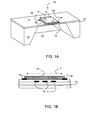
- FIGs. 1A and 1B A gas sensor 10 with a sensing layer 11 of metal oxide is shown in FIGs. 1A and 1B .
- the sensor is integrated with a CMOS circuitry (not shown) on a single chip. Parts of the CMOS layers 13 and handle layer 14 required for the CMOS circuit are etched away to form a MEMS device with a cavity 12 at the location of the sensor. The remaining layers 13 above the cavity 12 form a thin membrane to support the actual sensor 10.
- a heater 15 Embedded within the layers 13 are conducting elements forming a heater 15 to provide a local source of heat to heat the metal oxide 11 during operation of the sensor.
- the membrane structure above the cavity 12 provides an inherent thermal insulation for the rest of the substrate with the CMOS circuit. Also, the temperature can rise rapidly around the metal oxide layer 11, while the thicker part of chip reacts due to its thermal inertia with a slower rise of temperature. By controlling the heater accordingly, the metal oxide can be heated to its operating temperature of 250 to 600 degrees Celsius while the temperature of the CMOS layer remains below the critical limit for operation, typically about 80 degrees Celsius.
- the metal oxide layer 11 is contacted by two conductive electrodes 16 and hence acts as a resistor. In the presence of an analyte this resistance changes thereby providing a measure of the concentration of the analyte in the immediate vicinity of the metal oxide layer.
- the resistance R(tot) measured across the pair of electrodes 16 and the layer of metal oxide can be represented as the sum of three resistors in series as shown in the equivalent circuit diagram of FIG. 2 .
- the gas sensitive area is represented by the dashed box 20.
- the current flowing through the electrodes 16 and the layer 11 is a) either given by a constant current source or b) measured by a current meter I as shown.
- the voltage drop across the outer electrodes 16 is a) either measured by a voltmeter ⁇ Vo as shown or b) given by a voltage source.
- the total resistance R(tot) of the gas sensitive area is determined by combining the voltage and current values using Ohm's law.
- This equivalent circuit diagram emphasizes the contribution to the total resistance R(tot) of the resistors R(c1) and R(c2) representing the contact resistance at the interfaces between the metal oxide layer 11 and the two electrodes 16.
- the size or dimension which is of importance for this aspect is the space between the electrodes 16, i.e. the inter-electrode distance, as bridged by the layer 11 of metal oxide and also referred to in this specification as the length L of the sensor.
- the resistances R(c1) and R(c2) are proportional to 1/W
- the resistance R(mo) is proportional to the ratio L/W.
- the proportion R(c)/R(mo) between both types of resistances varies hence with 1/L, i.e. the relative importance of interface effects increases with decreasing electrode separation L.
- the length L is understood to be the minimal distance between the two electrodes.
- this characteristic dimension or width is assumed to be at least less than 50 microns or even less than 15 microns.
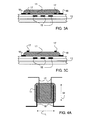
- the electrodes 16 are now the outer electrodes used for current injection into the sensing layer 11.
- An additional pair of electrodes 17 has been introduced within the space defined by the outer electrodes 16.
- the additional pair of electrodes 17 is used to measure the voltage drop in the parts of the MOX layer 11 which are between the inner electrodes. Using circuitry with very high input impedance to measure said voltage drop a vanishingly small current is flowing through the interfaces between the inner electrodes and the MOX layer and thus the voltage drop measurement is not affected by the contact resistance.
- this electrode and measurement arrangement avoids the contributions of the interface resistances R(c1) and R(c2).
- the resistance measured by combining the measurement of voltage drop across the inner electrodes 17 measured using the voltmeter ⁇ Vi and the current through the circuit including the outer electrodes 16 as measured by the current meter I or determined by a constant current source is closer to the resistance change R(mo) within the sensing layer 11 itself and not influenced by the interface resistances R(c1) and R(c2).
- this method of measurement confined the sensing area 30 to a smaller region compared to the sensing area 20 of FIG. 2 above.
- the smaller sensing area 30 excludes the vicinity of the outer electrodes.
- a measure can be gained representative of the contact resistance R(c1) + R(c2).
- the contact resistance or changes of the contact resistance over time can be indicative of either the presence of a mixture of gases as described for example in DE 10147107 , or of long-term drifts in the material properties and hence be compensated for.
- the inner and outer electrodes 16, 17 are deposited onto the same level of the substrate.
- one set of the electrodes here: the inner electrodes 17
- the sensing layer 11 the distance between the inner electrodes 17 can be near, or almost equal to the same distance between the outer electrodes 16.
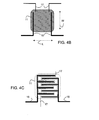
- FIGs. 4A to 4C show possible arrangements of the inner and outer electrodes 16, 17 in a horizontal view thus providing an illustration of the possible lateral extensions of the electrodes 16, 17 as embedded within or deposited below or above the sensing layer 11.
- the inner electrodes 17 run to a large extent in parallel to the outer electrodes 16, i.e., have essentially the same width W.
- the inner electrodes 17 are designed for an essentially current-free measurement their dimensions can be chosen differently.
- the inner electrodes 17 provide essentially short contact points to sense or sample the potential of the sensing layer 11 at those points.
- FIG. 4C An electrode arrangement with fingering outer electrodes 16 and meandering inner electrodes 17 located in the space between the outer electrodes is shown in FIG. 4C .
- the electrode arrangement can also be configured to generate a radial current.
- one of the outer electrodes 17 is located at a central position with respect to the lateral dimensions of the sensing layer 11.
- the other outer electrode 17 is located at the circumference of the sensing layer 11.
- the inner electrodes 17 are located in the space between the outer electrodes 16.
- one of each pair of electrodes can be combined resulting in a three-terminal measurement of the resistance.
- Such an electrode arrangement is shown in FIG. 4E .
- one of the inner electrodes 17 is replaced or merged with one of the outer electrodes 16 and the voltage drop across the sensing layer 11 is measured between the remaining electrode 17 and the merged outer electrode 16'.
- This alternative can be advantageous, in case the processes of charge carrier injection into and extraction out of the MOX layer are asymmetric, e.g., if an energy barrier exists for injection but none for extraction.
- the contact resistance can be highly asymmetric and can possibly be neglected at one electrode, i.e. the one where the outer electrode is also used as inner electrode for the method as described above.
- the electrodes and MOX layer can be manufactured using methods known per se such as physical or chemical deposition from a vapor phase, sputtering, and casting. Alternatively a contact-free printing method can be used, e.g. an inkjet printing method, with several layers deposited onto each other (after a suitable drying period). In order to create larger areas, dots of one material, e.g. of electrode material or MOX material, can be deposited next to each other in an overlapping manner.
- any structures in the electrodes can be generated using for example a wet or dry etching process, by performing the deposition process through a mask or by using a deposition process capable of writing lines with the required resolution.
- the material of the electrodes is typically a metal, for example Pt, Au, Al or W and their alloys.
- the metal-oxide used can be tin oxide, tungsten oxide, gallium oxide, indium oxide, or zinc oxide or mixtures thereof in either not-intentionally doped or doped form.
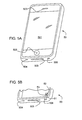
- a chemical sensor in accordance with above can be for example part of a portable electronic device such as a mobile phone as shown in FIG. 5A and 5B .
- the chemical sensor needs to be of a (sufficiently small) size to fit within the limited volume available.
- the housing 50 of the mobile phone includes a front side with a screen 501 and elements like buttons 502 to let a user interact with the phone. Also shown on the front side is an opening 503 for a loudspeaker. Further openings 504,505 are located at a lower side wall of the housing 50. It is well known to mount components like microphones and loudspeakers behind such openings.
- Another opening 506 is located at the lower side wall. As shown in FIG. 5B the opening 506 is linked to a tubular duct 51 passing through the interior of the housing. A chemical sensor 52 and a humidity sensor 53 are both mounted along the duct 51 such that the sensitive areas of both sensors are essentially exposed air of the same composition entering the duct through the opening 506.
- the actual size and shape of the duct 51 depends on the volume available and the nature of the chemical sensor 52 and the humidity sensor 53, but given the physical constraints of portable mobile devices the diameter of the opening is typically in the range of less than 2mm and in the present example actually about 1mm.
- the chemical sensor 52 is a sensor in accordance with the examples described above and both it and the humidity sensor 53 can be manufactured as described for example in the cited application WO 2012/100362 or in WO 95/19563 .
- the humidity sensor is best combined with a temperature sensor.
- Such sensors are commercially available, e.g. from SensirionTM under the trade name SHTC1.
- SHTC1 sensor measures 2 mm x 2 mm x 0.8 mm. Both sensors are mounted adjacent to each other in the duct 51.
Landscapes
- Chemical & Material Sciences (AREA)
- Health & Medical Sciences (AREA)
- Life Sciences & Earth Sciences (AREA)
- General Health & Medical Sciences (AREA)
- Immunology (AREA)
- Pathology (AREA)
- Analytical Chemistry (AREA)
- Biochemistry (AREA)
- Physics & Mathematics (AREA)
- General Physics & Mathematics (AREA)
- Chemical Kinetics & Catalysis (AREA)
- Electrochemistry (AREA)
- Engineering & Computer Science (AREA)
- Combustion & Propulsion (AREA)
- Food Science & Technology (AREA)
- Medicinal Chemistry (AREA)
- Investigating Or Analyzing Materials By The Use Of Electric Means (AREA)
- Investigating Or Analyzing Materials By The Use Of Fluid Adsorption Or Reactions (AREA)
Priority Applications (2)
| Application Number | Priority Date | Filing Date | Title |
|---|---|---|---|
| EP13003798.9A EP2833128A1 (de) | 2013-07-30 | 2013-07-30 | Integrierter chemischer Metalloxidsensor |
| US14/338,572 US9772319B2 (en) | 2013-07-30 | 2014-07-23 | Integrated metal oxide chemical sensor |
Applications Claiming Priority (1)
| Application Number | Priority Date | Filing Date | Title |
|---|---|---|---|
| EP13003798.9A EP2833128A1 (de) | 2013-07-30 | 2013-07-30 | Integrierter chemischer Metalloxidsensor |
Publications (1)
| Publication Number | Publication Date |
|---|---|
| EP2833128A1 true EP2833128A1 (de) | 2015-02-04 |
Family
ID=48900743
Family Applications (1)
| Application Number | Title | Priority Date | Filing Date |
|---|---|---|---|
| EP13003798.9A Withdrawn EP2833128A1 (de) | 2013-07-30 | 2013-07-30 | Integrierter chemischer Metalloxidsensor |
Country Status (2)
| Country | Link |
|---|---|
| US (1) | US9772319B2 (de) |
| EP (1) | EP2833128A1 (de) |
Cited By (5)
| Publication number | Priority date | Publication date | Assignee | Title |
|---|---|---|---|---|
| EP3159684A1 (de) * | 2015-10-23 | 2017-04-26 | Sensirion AG | Verfahren zur herstellung eines gassensors |
| CN110178022A (zh) * | 2017-01-12 | 2019-08-27 | 费加罗技研株式会社 | 气体检测装置和气体检测方法 |
| GB2575803A (en) * | 2018-07-23 | 2020-01-29 | Sumitomo Chemical Co | Semiconductor gas sensor |
| EP3608660A4 (de) * | 2017-04-05 | 2020-06-10 | Panasonic Corporation | Gassensor |
| EP3881062A1 (de) * | 2018-11-12 | 2021-09-22 | Sciosense B.V. | Gassensor |
Families Citing this family (5)
| Publication number | Priority date | Publication date | Assignee | Title |
|---|---|---|---|---|
| WO2017088071A1 (en) * | 2015-11-26 | 2017-06-01 | Sensirion Ag | Infrared device |
| US10215658B2 (en) * | 2016-10-12 | 2019-02-26 | Walmart Apollo, Llc | Systems, devices, and methods for detecting spills |
| CN109211983B (zh) * | 2017-07-07 | 2021-03-23 | 台湾奈米碳素股份有限公司 | 利用微机电工艺制造气体检测器的方法 |
| EP3462149B1 (de) | 2017-09-28 | 2023-10-25 | Sensirion AG | Infrarotvorrichtung |
| CN111103346B (zh) * | 2019-11-18 | 2021-07-23 | 浙江大学 | 一种场效应传感器及其检测方法和检测系统 |
Citations (7)
| Publication number | Priority date | Publication date | Assignee | Title |
|---|---|---|---|---|
| WO1995019563A1 (en) | 1994-01-14 | 1995-07-20 | Neotronics Limited | Gas sensor |
| DE10147107C1 (de) | 2001-09-25 | 2003-06-05 | Siemens Ag | Verfahren und Vorrichtung zur simultanen Detektion von unterschiedlichen Gasen |
| DE10315190A1 (de) * | 2003-04-03 | 2004-10-21 | Robert Bosch Gmbh | Gassensor |
| US20050199041A1 (en) * | 2002-05-11 | 2005-09-15 | Paragon Ag | Sensor assembly for measuring a gas concentration |
| WO2007122287A1 (en) * | 2006-04-21 | 2007-11-01 | Environics Oy | Micro hotplate semiconductive gas sensor |
| US20120186987A1 (en) * | 2009-07-13 | 2012-07-26 | Hochschule Lausitz | Multi-electrode chemiresistor |
| WO2012100362A1 (en) | 2011-01-27 | 2012-08-02 | Sensirion Ag | Method for manufacturing a sensor chip |
Family Cites Families (11)
| Publication number | Priority date | Publication date | Assignee | Title |
|---|---|---|---|---|
| US5821402A (en) * | 1996-03-11 | 1998-10-13 | Tokyo Gas Co., Ltd. | Thin film deposition method and gas sensor made by the method |
| WO2001063771A1 (de) * | 2000-02-25 | 2001-08-30 | Sensirion Ag | Sensor und sigma-delta-konverter |
| CH695166A5 (de) * | 2000-04-25 | 2005-12-30 | Sensirion Ag | Verfahren und Vorrichtung zum Messen des Flusses einer Flüssigkeit. |
| KR20040043132A (ko) * | 2001-11-14 | 2004-05-22 | 마츠시타 덴끼 산교 가부시키가이샤 | 가스센서 및 가스센서의 제조방법 |
| DE102007013522A1 (de) * | 2007-03-21 | 2008-09-25 | Robert Bosch Gmbh | Sensorelement eines Gassensors |
| JP5204160B2 (ja) * | 2009-09-03 | 2013-06-05 | 日本特殊陶業株式会社 | マルチガスセンサの制御方法及びマルチガスセンサの制御装置 |
| EP2365411A1 (de) * | 2010-03-10 | 2011-09-14 | Sensirion AG | Durchflusskontrollanordnung |
| US20130192338A1 (en) * | 2012-01-26 | 2013-08-01 | Felix Mayer | Portable electronic device |
| EP2642289A1 (de) * | 2012-03-20 | 2013-09-25 | Sensirion AG | Tragbare elektronische Vorrichtung |
| US20130344609A1 (en) * | 2012-06-21 | 2013-12-26 | Felix Mayer | Chemical sensor in a portable electronic device |
| US9772317B2 (en) * | 2012-07-26 | 2017-09-26 | Sensirion Ag | Method for operating a portable electronic device |
-
2013
- 2013-07-30 EP EP13003798.9A patent/EP2833128A1/de not_active Withdrawn
-
2014
- 2014-07-23 US US14/338,572 patent/US9772319B2/en active Active
Patent Citations (7)
| Publication number | Priority date | Publication date | Assignee | Title |
|---|---|---|---|---|
| WO1995019563A1 (en) | 1994-01-14 | 1995-07-20 | Neotronics Limited | Gas sensor |
| DE10147107C1 (de) | 2001-09-25 | 2003-06-05 | Siemens Ag | Verfahren und Vorrichtung zur simultanen Detektion von unterschiedlichen Gasen |
| US20050199041A1 (en) * | 2002-05-11 | 2005-09-15 | Paragon Ag | Sensor assembly for measuring a gas concentration |
| DE10315190A1 (de) * | 2003-04-03 | 2004-10-21 | Robert Bosch Gmbh | Gassensor |
| WO2007122287A1 (en) * | 2006-04-21 | 2007-11-01 | Environics Oy | Micro hotplate semiconductive gas sensor |
| US20120186987A1 (en) * | 2009-07-13 | 2012-07-26 | Hochschule Lausitz | Multi-electrode chemiresistor |
| WO2012100362A1 (en) | 2011-01-27 | 2012-08-02 | Sensirion Ag | Method for manufacturing a sensor chip |
Non-Patent Citations (3)
| Title |
|---|
| BARSAN ET AL: "Metal oxide-based gas sensor research: How to?", SENSORS AND ACTUATORS B: CHEMICAL: INTERNATIONAL JOURNAL DEVOTED TO RESEARCH AND DEVELOPMENT OF PHYSICAL AND CHEMICAL TRANSDUCERS, ELSEVIER S.A, SWITZERLAND, vol. 121, no. 1, 23 January 2007 (2007-01-23), pages 18 - 35, XP005856163, ISSN: 0925-4005, DOI: 10.1016/J.SNB.2006.09.047 * |
| GERLICH M ET AL: "Selectivity enhancement of a WO3/TiO2 gas sensor by the use of a four-point electrode structure", SENSORS AND ACTUATORS B: CHEMICAL: INTERNATIONAL JOURNAL DEVOTED TO RESEARCH AND DEVELOPMENT OF PHYSICAL AND CHEMICAL TRANSDUCERS, ELSEVIER S.A, SWITZERLAND, vol. 93, no. 1-3, 1 August 2003 (2003-08-01), pages 503 - 508, XP004437144, ISSN: 0925-4005, DOI: 10.1016/S0925-4005(03)00187-4 * |
| MICHAEL KARST ET AL: "Humidity & Temperature Sensors in Mobile Phones", WIRELESS COMMUNICATION ALLIANCE EVENT, 18 April 2012 (2012-04-18), pages 1 - 18, XP055069470, Retrieved from the Internet <URL:http://www.wca.org/event_archives/2012/Sensirion_WCA_April2012_Mobile_Sensors.pdf> [retrieved on 20130703] * |
Cited By (11)
| Publication number | Priority date | Publication date | Assignee | Title |
|---|---|---|---|---|
| EP3159684A1 (de) * | 2015-10-23 | 2017-04-26 | Sensirion AG | Verfahren zur herstellung eines gassensors |
| CN110178022A (zh) * | 2017-01-12 | 2019-08-27 | 费加罗技研株式会社 | 气体检测装置和气体检测方法 |
| EP3570018A4 (de) * | 2017-01-12 | 2020-10-28 | Figaro Engineering Inc. | Gasdetektor und gasdetektionsverfahren |
| CN110178022B (zh) * | 2017-01-12 | 2022-05-17 | 费加罗技研株式会社 | 气体检测装置和气体检测方法 |
| EP3608660A4 (de) * | 2017-04-05 | 2020-06-10 | Panasonic Corporation | Gassensor |
| US11262324B2 (en) | 2017-04-05 | 2022-03-01 | Panasonic Corporation | Gas sensor |
| US11740197B2 (en) | 2017-04-05 | 2023-08-29 | Panasonic Holdings Corporation | Gas sensor |
| US12140555B2 (en) | 2017-04-05 | 2024-11-12 | Panasonic Holdings Corporation | Gas sensor |
| GB2575803A (en) * | 2018-07-23 | 2020-01-29 | Sumitomo Chemical Co | Semiconductor gas sensor |
| US12163915B2 (en) | 2018-07-23 | 2024-12-10 | Sumitomo Chemical Company Limited | Semiconductor gas sensor and method for sensing two or more gases using contact resistance and sheet resistance |
| EP3881062A1 (de) * | 2018-11-12 | 2021-09-22 | Sciosense B.V. | Gassensor |
Also Published As
| Publication number | Publication date |
|---|---|
| US20150033827A1 (en) | 2015-02-05 |
| US9772319B2 (en) | 2017-09-26 |
Similar Documents
| Publication | Publication Date | Title |
|---|---|---|
| US9772319B2 (en) | Integrated metal oxide chemical sensor | |
| EP2762882B1 (de) | Tragbare elektronische Vorrichtung mit Keton-Sensor | |
| EP2762867B1 (de) | Gassensor mit temperatursteuerung | |
| US9562915B2 (en) | Portable electronic device with breath analyzer | |
| EP2762869B1 (de) | Integrierter chemischer Metalloxidsensor | |
| US20160187279A1 (en) | Metal oxide gas sensor array devices, systems, and associated methods | |
| EP2808675A1 (de) | Integrierter chemischer Metalloxidsensor | |
| KR20190072607A (ko) | 디바이스들 및 시스템들 뿐만 아니라, 바이오센서들의 전도성 엘리먼트들에서 보상되지 않은 저항들을 보정하기 위한 방법들 | |
| EP2808650B1 (de) | Tragbare elektronische Vorrichtung | |
| US20150107994A1 (en) | Biosensor | |
| CN106959330A (zh) | 集成离子感测装置和方法 | |
| EP2833129B1 (de) | Verfahren und Vorrichtung zur Analyse von Gasen durch einen auf Leitfähigkeit basierenden Partikulat-Metalloxid-Gassensor | |
| CN107543853B (zh) | 电化学检测器 | |
| CN110261458A (zh) | 一种电化学气体传感器 | |
| EP2995938A1 (de) | Integrierter chemischer Metalloxidsensor | |
| EP2833127A1 (de) | Integrierte resistive Sensorarrayanordnung, wobei jeder Sensor eine sensitive Metalloxidschicht mit jeweils verschiedenen Längen zwischen den Elektroden enthält | |
| CN104115288A (zh) | 具有高测量准确度的红外光传感器芯片与用于制造红外光传感器芯片的方法 | |
| CN107748185A (zh) | 一种原子氧积分通量测量方法及原子氧传感器 | |
| CN115015321A (zh) | 气体传感器及气体检测系统 | |
| CN100392389C (zh) | 一种电化感测试片 | |
| US20150001071A1 (en) | Absolute temperature method for disposable glucose strip | |
| CN105784786A (zh) | 用于检测气态分析物的方法和传感器设备及其制造方法 | |
| Zuo et al. | Design and fabrication of a differential scanning nanocalorimeter | |
| CN115349088B (zh) | 电化学分析芯片 | |
| JP2015224904A (ja) | イオンセンサ |
Legal Events
| Date | Code | Title | Description |
|---|---|---|---|
| 17P | Request for examination filed |
Effective date: 20130730 |
|
| AK | Designated contracting states |
Kind code of ref document: A1 Designated state(s): AL AT BE BG CH CY CZ DE DK EE ES FI FR GB GR HR HU IE IS IT LI LT LU LV MC MK MT NL NO PL PT RO RS SE SI SK SM TR |
|
| AX | Request for extension of the european patent |
Extension state: BA ME |
|
| PUAI | Public reference made under article 153(3) epc to a published international application that has entered the european phase |
Free format text: ORIGINAL CODE: 0009012 |
|
| R17P | Request for examination filed (corrected) |
Effective date: 20150804 |
|
| RBV | Designated contracting states (corrected) |
Designated state(s): AL AT BE BG CH CY CZ DE DK EE ES FI FR GB GR HR HU IE IS IT LI LT LU LV MC MK MT NL NO PL PT RO RS SE SI SK SM TR |
|
| 17Q | First examination report despatched |
Effective date: 20190408 |
|
| STAA | Information on the status of an ep patent application or granted ep patent |
Free format text: STATUS: THE APPLICATION IS DEEMED TO BE WITHDRAWN |
|
| 18D | Application deemed to be withdrawn |
Effective date: 20191019 |