EP2833232A2 - Low drop-out voltage regulator - Google Patents
Low drop-out voltage regulator Download PDFInfo
- Publication number
- EP2833232A2 EP2833232A2 EP14176108.0A EP14176108A EP2833232A2 EP 2833232 A2 EP2833232 A2 EP 2833232A2 EP 14176108 A EP14176108 A EP 14176108A EP 2833232 A2 EP2833232 A2 EP 2833232A2
- Authority
- EP
- European Patent Office
- Prior art keywords
- transistor
- node
- source
- mos
- voltage regulator
- Prior art date
- Legal status (The legal status is an assumption and is not a legal conclusion. Google has not performed a legal analysis and makes no representation as to the accuracy of the status listed.)
- Granted
Links
Images



Classifications
-
- G—PHYSICS
- G05—CONTROLLING; REGULATING
- G05F—SYSTEMS FOR REGULATING ELECTRIC OR MAGNETIC VARIABLES
- G05F1/00—Automatic systems in which deviations of an electric quantity from one or more predetermined values are detected at the output of the system and fed back to a device within the system to restore the detected quantity to its predetermined value or values, i.e. retroactive systems
- G05F1/10—Regulating voltage or current
- G05F1/46—Regulating voltage or current wherein the variable actually regulated by the final control device is DC
- G05F1/56—Regulating voltage or current wherein the variable actually regulated by the final control device is DC using semiconductor devices in series with the load as final control devices
- G05F1/59—Regulating voltage or current wherein the variable actually regulated by the final control device is DC using semiconductor devices in series with the load as final control devices including plural semiconductor devices as final control devices for a single load
- G05F1/595—Regulating voltage or current wherein the variable actually regulated by the final control device is DC using semiconductor devices in series with the load as final control devices including plural semiconductor devices as final control devices for a single load semiconductor devices connected in series
-
- G—PHYSICS
- G05—CONTROLLING; REGULATING
- G05F—SYSTEMS FOR REGULATING ELECTRIC OR MAGNETIC VARIABLES
- G05F1/00—Automatic systems in which deviations of an electric quantity from one or more predetermined values are detected at the output of the system and fed back to a device within the system to restore the detected quantity to its predetermined value or values, i.e. retroactive systems
- G05F1/10—Regulating voltage or current
- G05F1/46—Regulating voltage or current wherein the variable actually regulated by the final control device is DC
- G05F1/56—Regulating voltage or current wherein the variable actually regulated by the final control device is DC using semiconductor devices in series with the load as final control devices
Definitions
- the present invention relates to the field of voltage regulators and in particular to low dropout (LDO) regulators.
- LDO low dropout
- a low dropout or LDO regulator is a DC linear voltage regulator which can operate with a comparatively small input-output differential voltage.
- such regulators feature a comparatively low dropout voltage and a comparatively low minimum operating voltage, further having a high efficiency operation and comparatively low heat dissipation.
- such regulators comprise at least one field effect transistor (FET) which is typically implemented by a metal oxide semiconductor component.
- FET field effect transistor
- Low dropout regulators are of particular interest when it comes to efficient power management in battery operated portable consumer products.
- the fundamental design challenge in an LDO is to stabilize it over a zero load current (no load) to a maximum load current (full load) that is required for a particular application.
- LDO regulators should exhibit a stable and fast transient response to load modifications. More specifically, a transient voltage peak in a controlled output of the LDO should not exceed a maximum voltage range both during dynamic load current steps and large current spikes inherent to digital load circuitry.
- LDO regulators also comprise at least one capacitor, e.g. for a dominant pole frequency compensation at the output of the regulator.
- a non-ideal behavior of such a capacitor can be modeled with an equivalent resistance which typically generates a zero in the loop transfer function of the LDO regulator.
- Crucial drawbacks of prior art solutions arise from the fact that the LDO stability critically depends on the value of the equivalent resistance, which does not only depend on the manufacturer of the capacitor but also varies with an operating frequency and temperature. The equivalent resistance of such LDO regulators therefore imposes a stability problem.
- the voltage regulator should provide a stable output for a variable load as well as for varying external conditions such as varying temperatures. Additionally, the regulator should exhibit a stable transient behavior in response to load modifications.
- the invention relates to a voltage regulator, typically to a low dropout regulator.
- the voltage regulator comprises a regulation loop comprising at least a pass transistor, a source transistor, a sensing transistor and a retention transistor. These transistors are typically implemented as MOS transistors of either PMOS or NMOS-type.
- the mentioned transistors may be alternatively denoted as first, second, third and fourth transistors establishing the regulation loop. However, for reasons of a functional description, the four transistors are denoted according to their generic function and behavior in the regulation loop.
- the pass transistor is actually coupled to the output of the voltage regulator and is therefore adapted to provide a regulated output voltage.
- the source transistor is typically part of a current mirror and is adapted to couple a driving current to the regulation loop.
- the sensing transistor is typically coupled to a reference voltage and serves to define the output voltage of the regulator.
- the retention transistor is actually operable to keep and to maintain a particular voltage in and/or across the regulation loop.
- the regulation loop is particularly adapted to provide a rather constant regulated output voltage Vreg at an output, hence at the drain of the pass transistor. In a steady state, hence after a transient switching on or switching off or after transient load variations the regulation loop is adapted to autonomously stabilize and to provide the predefined output voltage at the output.
- the voltage regulator comprises a stability compensation circuit.
- Said stability compensation circuit comprises a first MOS resistor and a second MOS resistor coupled with the first MOS resistor.
- the first MOS resistor is a rather stable MOS resistor and exhibits no variations of its resistivity or of its equivalent resistivity even at varying load conditions.
- the second MOS resistor is however coupled to the gate of the pass transistor.
- the gate of the second MOS resistor is coupled to the gate of the pass transistor.
- the second MOS resistor is a variable resistor that changes its resistivity or equivalent resistivity depending on varying load conditions of the regulation loop or of the voltage regulator.
- the voltage applied to the gate of the pass transistor may be adapted to varying loads of the regulation loop.
- a variable zero can be inserted in the loop transfer function to enhance the actual operating conditions of the voltage regulator.
- the stability compensation circuit comprises a first node or an input node coupled with the source transistor's source and being further coupled with the pass transistor's source.
- an input of the stability compensation circuit is parallel to the sources of the source transistor and the pass transistor.
- the first node may also be denoted as a control node which is also coupled with the source transistor's gate and with the pass transistor's gate. In this way the resistance of the MOS resistors can be controlled and/or modified.
- the compensation network Since the input or control node of the compensation network is connected to the pass transistor's source and hence to the input voltage V DD , the compensation network is effectively placed between the gate and source of said pass transistor. This will allow improved PSR (power supply rejection) due to the effective capacitance transferring noise from the source to the gate of the pass transistor thus keeping the voltage between the source and gate more constant which then rejects some of the noise. This is a particular benefit over embodiments wherein the compensation network is connecting between the drain and gate of the pass transistor.
- the compensation circuit comprises a second node coupled with the drain of the retention transistor and being further coupled with the drain of the source transistor.
- the second or output node of the compensation circuit is coupled parallel to the drains of the retention transistor and the source transistor.
- the compensation circuit comprises at least one capacitor coupled with a drain of at least one of the first MOS resistor and of the second MOS resistor.
- this varying resistance serves to move the zero frequency or the zero location towards a frequency band which substantially enhances the actual operating condition of the voltage regulator. In this way, the stability of the voltage regulator in response to varying external conditions such as temperature but as well as to varying load conditions can be improved.
- the second node of the stability compensation circuit is coupled to the gate of the second MOS resistor as well as to the gate of the pass transistor.
- the second node may be also connected to the capacitor.
- the second node is connected to a first terminal of the capacitor while an opposite, hence a second terminal of the capacitor is connected with the drain of at least one of the first or second MOS resistors.
- the drain of at least one of the first and second MOS resistors, the capacitor and the second node are arranged in series. Hence, the drain of at least one of the first and second MOS resistors is connected to the second node via the at least one capacitor.
- the capacitor serves to modify the transient behavior of both, the compensation circuit as well as of the regulation loop.
- the capacitor is effectively located between an input port of the voltage regulator and the gate of the pass transistor.
- the ramp up or ramp down velocity of the regulation behavior of the voltage regulator can be modified and adapted to predefined conditions.
- the capacitor serves to control or to modify the dynamic behavior of at least the pass transistor.
- first MOS resistor and the second MOS resistor are arranged in parallel with their sources connected to the first node of the stability compensation circuit. Moreover and according to a further embodiment the first MOS resistor and the second MOS resistor are also arranged in parallel with their drains connected to the second node. Hence, the source of the first MOS resistor is connected to the source of the second MOS resistor. Additionally, also the drain of the first MOS resistor may be connected to the drain of the second MOS resistor.
- first and second MOS resistors may be connected to the first node whereas connected drains of the first node or control node and the second MOS resistors may be connected to the second node.
- the drain of the first MOS resistor may be connected to an input port via a further transistor, e.g. via a transistor of an input current mirror. In this way, the first MOS resistor is driven by a constant voltage and therefore exhibits a rather constant resistance.
- the stability compensation circuit comprises a third resistor between the drains of the first and the second MOS resistors and the second node.
- the third resistor may either be implemented as a conventional resistor or as well as a MOS resistor. Implementation of a MOS resistor as the third resistor provides a tunability of the resistance of the third resistor if required. In this way, the behavior of the stability compensation circuit may be arbitrarily modified.
- the third resistor is connected to both drains of first and second resistors.
- the third resistor is in parallel to first and second MOS resistors while an opposite terminal of the third resistor is connected to the second node or is further in line or in series with the capacitor connected to the second node.
- first and second MOS resistors are arranged in series, wherein the first MOS resistor's drain is connected to the second MOS resistor's source.
- the first MOS resistor's source is connected to the first node whereas the second MOS resistor's drain is connected to the second node.
- any one of the above described varying topologies and architectures of the arrangement and connection of first and second MOS resistors, in combination with a third resistor and/or in combination with at least one capacitor provides different modifications of the zero frequency of the equivalent resistance of the stability compensation circuit and hence of the entire regulation loop.
- the loop transfer function of the voltage regulator may be varied in different ways as to compensate any influence of varying load conditions.
- the pass transistor, the source transistor and the sensing transistor are designed as PMOS transistors.
- said transistors comprise NMOS transistors.
- the retention transistor comprises or is an NMOS transistor.
- the retention transistor acts as a cascode transistor and serves to stabilize and to keep a predefined voltage of the regulation loop.
- the invention also relates to an electronic device comprising at least one voltage regulator as described above.
- the electronic device is a battery-driven electronic device, in particular a consumer electronic device, such like a camera, a mobile phone, a display application, a computing device or a computer periphery device.
- the voltage regulator 1 as it is schematically illustrated in Figure 1 comprises a regulation loop 2 featuring a pass transistor 18, a sensing transistor 22, a retention transistor 24 as well as a source transistor 28.
- the source transistor 28 together with a further transistor 32 sets up a current mirror 3.
- the source of the source transistor 28 and the source of the transistor 32 are connected to an input port 21, where an input voltage V DD is supplied.
- the transistor's 32 and the source transistor's 28 gates are mutually connected.
- a node 31 between the gates of the source transistor 28 and transistor 32 is connected with a drain of transistor 32. This particular node 31 is further connected with the gate of a first MOS resistor 12 as will be further explained below.
- the drain of the transistor 32 is connected with a first current source 38 connected to ground.
- the drain of the source transistor 28 is connected with a node 25, which is in series with the retention transistor 24.
- the retention transistor 24, typically acting as a cascode features a drain connected with the node 25 and hence with the drain of the source transistor 28.
- the source of the retention transistor 24 is connected with a node 23. Said node 23 is connected with a second current source 40, which in turn is coupled to ground.
- the node 23 is furthermore connected to the drain of the sensing transistor 22.
- the source of said sensing transistor 22 is connected to an output node 20 of the voltage regulator 1, where a regulated output voltage Vreg will be provided.
- the gate of the sensing transistor 22 is connected to a reference voltage Vref.
- the output node 20 is furthermore connected with a drain of the pass transistor 18.
- the source of the pass transistor 18 is connected to a first node 30 of a stability compensation circuit 10.
- Said first node 30 is furthermore connected to the source of the source transistor 28.
- the first node 30 effectively acts as a control node 30, which is also connected to the input port 21.
- the stability compensation circuit 10 comprises a first MOS resistor 12, typically in form of a MOSFET.
- the stability compensation circuit furthermore comprises a second MOS resistor 14, which is also typically implemented as a MOSFET.
- the sources of the first and the second MOS resistors 12, 14 are interconnected and are further coupled to the first node 30 of the stability compensation circuit 10.
- the respective drains of the first and the second MOS resistors 12, 14 are mutually connected. Said drains are furthermore connected to a capacitor 16 featuring a capacity Cc.
- One terminal of the capacitor 16 is connected to both drains of the first and second MOS resistors 12, 14.
- An opposite terminal of the capacitor 16 is however connected to a second node 25.
- the second node 25 is also the direct connection between the gate of the second MOS resistor 14 and the gate of the pass transistor 18 as illustrated in Figure 1 .
- the two MOS resistors 12, 14 are in series with the capacitor 16 to provide a sufficient phase margin to maintain stability of the regulation loop.
- the equivalent resistance of MOS resistors 12 and 14 is proportional to the inverse of a difference between a voltage Vgs and a threshold voltage Vth, wherein Vgs represents the difference between the gate voltage of first and second MOS resistors 12, 14 and the input voltage V DD and wherein Vth is the device threshold voltage or turn on voltage. Therefore, the first MOS resistor 12 provides a fixed resistance, whereas the resistance of the second MOS resistor 14 varies with Vgs, since the voltage Vgs changes with the load current on the output node 20.
- the voltage of the second node 25 connected to the gate of the pass transistor 18 is assumed to be zero. Since the pass transistor 18 is typically implemented as a PMOS device, a zero voltage at its gate will turn the pass transistor 18 on and will start to pull up the output voltage Vreg at the output node 20. The regulated output voltage Vreg will continue to rise until an equilibrium is reached. The steady state condition or equilibrium will be reached when the current through the retention transistor 24 equals the current through the source transistor 28. The equilibrium will be reached because a current from the sensing transistor 22 siphons off current from the second current source 40. As a consequence there will be less current through the retention transistor 24.
- a third resistor 34 in form of another MOS resistor is connected by its source to the drains of first and second MOS resistors 12, 14.
- the MOS resistor 34 is exchanged by a conventional resistor 36.
- the resistor 36 is connected to the drains of the first and of the second MOS resistors 12, 14, which are also interconnected. An opposite terminal of the resistor 36 is thus connected to the capacitor 16.
- the two MOS resistors 12, 14 are arranged in series.
- the drain of the first MOS resistor 12 is connected to the source of the second MOS resistor 14.
- the source of the first MOS resistor 12 will then be connected to the first node 30, whereas the drain of the second MOS resistor 14 will be connected to the capacitor 16 and/or to the second node 25.
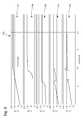
- a transient behavior upon switching on of the voltage regulator 1 is illustrated for a comparatively low load of about 10 ⁇ A.
- the transient behavior is illustrated over time in milliseconds.
- the input voltage V DD is shown in the graph 101
- a respective output voltage Vreg is shown in the graph 102.
- the graph 103 represents the voltage Vnc, which is present at the gate of the retention transistor 24.
- the gate voltage of the first MOS resistor 12 is represented in graph 104
- the gate voltage of the pass transistor 18 is shown in graph 105 over time.
- the regulated output voltage almost abruptly rises from a zero voltage level to a rather stable output voltage level of 1.5 V, within a time interval of approximately 1 ms.
- a comparison with the respective graphs 201, 202, 203, 204, 205 of the diagram 200 according to Figure 6 also shows a rather constant regulated output voltage Vreg of approximately 1.5 V after about 1 ms.
- the various graphs 201, 202, 203, 204, 205 directly correspond to respective graphs 101, 102, 103, 104, 105 as already described in connection with the diagram 100 of Figure 5 .
- the diagram according to Figure 6 represents a load of 1 mA, which is a factor 100 larger compared to the load of the diagram according to Figure 5 .
Landscapes
- Engineering & Computer Science (AREA)
- Physics & Mathematics (AREA)
- Electromagnetism (AREA)
- General Physics & Mathematics (AREA)
- Radar, Positioning & Navigation (AREA)
- Automation & Control Theory (AREA)
- Continuous-Control Power Sources That Use Transistors (AREA)
Abstract
Description
- The present invention relates to the field of voltage regulators and in particular to low dropout (LDO) regulators.
- A low dropout or LDO regulator is a DC linear voltage regulator which can operate with a comparatively small input-output differential voltage. In general, such regulators feature a comparatively low dropout voltage and a comparatively low minimum operating voltage, further having a high efficiency operation and comparatively low heat dissipation. Typically, such regulators comprise at least one field effect transistor (FET) which is typically implemented by a metal oxide semiconductor component.
- Low dropout regulators are of particular interest when it comes to efficient power management in battery operated portable consumer products. The fundamental design challenge in an LDO is to stabilize it over a zero load current (no load) to a maximum load current (full load) that is required for a particular application. Moreover, LDO regulators should exhibit a stable and fast transient response to load modifications. More specifically, a transient voltage peak in a controlled output of the LDO should not exceed a maximum voltage range both during dynamic load current steps and large current spikes inherent to digital load circuitry.
- Typically, LDO regulators also comprise at least one capacitor, e.g. for a dominant pole frequency compensation at the output of the regulator. A non-ideal behavior of such a capacitor can be modeled with an equivalent resistance which typically generates a zero in the loop transfer function of the LDO regulator. Crucial drawbacks of prior art solutions arise from the fact that the LDO stability critically depends on the value of the equivalent resistance, which does not only depend on the manufacturer of the capacitor but also varies with an operating frequency and temperature. The equivalent resistance of such LDO regulators therefore imposes a stability problem.
- It is therefore an objective of the present invention to provide an improved voltage regulator, in particular an LDO regulator which is operable to compensate a zero frequency with respect to a variable load at the output of the regulator. Moreover, the voltage regulator should provide a stable output for a variable load as well as for varying external conditions such as varying temperatures. Additionally, the regulator should exhibit a stable transient behavior in response to load modifications.
- In a first aspect the invention relates to a voltage regulator, typically to a low dropout regulator. The voltage regulator comprises a regulation loop comprising at least a pass transistor, a source transistor, a sensing transistor and a retention transistor. These transistors are typically implemented as MOS transistors of either PMOS or NMOS-type. The mentioned transistors may be alternatively denoted as first, second, third and fourth transistors establishing the regulation loop. However, for reasons of a functional description, the four transistors are denoted according to their generic function and behavior in the regulation loop.
- The pass transistor is actually coupled to the output of the voltage regulator and is therefore adapted to provide a regulated output voltage. The source transistor is typically part of a current mirror and is adapted to couple a driving current to the regulation loop. The sensing transistor is typically coupled to a reference voltage and serves to define the output voltage of the regulator. The retention transistor is actually operable to keep and to maintain a particular voltage in and/or across the regulation loop.
- The regulation loop is particularly adapted to provide a rather constant regulated output voltage Vreg at an output, hence at the drain of the pass transistor. In a steady state, hence after a transient switching on or switching off or after transient load variations the regulation loop is adapted to autonomously stabilize and to provide the predefined output voltage at the output.
- Additionally and in order to compensate a negative impact of varying load, varying temperature or other varying external conditions, the voltage regulator comprises a stability compensation circuit. Said stability compensation circuit comprises a first MOS resistor and a second MOS resistor coupled with the first MOS resistor. Here, the first MOS resistor is a rather stable MOS resistor and exhibits no variations of its resistivity or of its equivalent resistivity even at varying load conditions.
- The second MOS resistor is however coupled to the gate of the pass transistor. In particular, the gate of the second MOS resistor is coupled to the gate of the pass transistor. In this way, the second MOS resistor is a variable resistor that changes its resistivity or equivalent resistivity depending on varying load conditions of the regulation loop or of the voltage regulator. In this way, the voltage applied to the gate of the pass transistor may be adapted to varying loads of the regulation loop. In this way, a variable zero can be inserted in the loop transfer function to enhance the actual operating conditions of the voltage regulator.
- According to a further embodiment the stability compensation circuit comprises a first node or an input node coupled with the source transistor's source and being further coupled with the pass transistor's source. Hence, an input of the stability compensation circuit is parallel to the sources of the source transistor and the pass transistor.
- The first node may also be denoted as a control node which is also coupled with the source transistor's gate and with the pass transistor's gate. In this way the resistance of the MOS resistors can be controlled and/or modified.
- Since the input or control node of the compensation network is connected to the pass transistor's source and hence to the input voltage VDD, the compensation network is effectively placed between the gate and source of said pass transistor. This will allow improved PSR (power supply rejection) due to the effective capacitance transferring noise from the source to the gate of the pass transistor thus keeping the voltage between the source and gate more constant which then rejects some of the noise. This is a particular benefit over embodiments wherein the compensation network is connecting between the drain and gate of the pass transistor.
- According to another embodiment the compensation circuit comprises a second node coupled with the drain of the retention transistor and being further coupled with the drain of the source transistor. Hence, the second or output node of the compensation circuit is coupled parallel to the drains of the retention transistor and the source transistor.
- Moreover, and according to another embodiment the compensation circuit comprises at least one capacitor coupled with a drain of at least one of the first MOS resistor and of the second MOS resistor. By means of the capacitor the compensation circuit and hence the regulation loop exhibits a particular equivalent resistance that changes with the load current on the output of the voltage regulator. This allows that the total resistance of the stability compensation circuit varies with the load of the voltage regulator.
- Consequently, this varying resistance serves to move the zero frequency or the zero location towards a frequency band which substantially enhances the actual operating condition of the voltage regulator. In this way, the stability of the voltage regulator in response to varying external conditions such as temperature but as well as to varying load conditions can be improved.
- According to another embodiment the second node of the stability compensation circuit is coupled to the gate of the second MOS resistor as well as to the gate of the pass transistor.
- Additionally or optionally the second node may be also connected to the capacitor. Typically, the second node is connected to a first terminal of the capacitor while an opposite, hence a second terminal of the capacitor is connected with the drain of at least one of the first or second MOS resistors. Typically, the drain of at least one of the first and second MOS resistors, the capacitor and the second node are arranged in series. Hence, the drain of at least one of the first and second MOS resistors is connected to the second node via the at least one capacitor.
- The capacitor serves to modify the transient behavior of both, the compensation circuit as well as of the regulation loop. The capacitor is effectively located between an input port of the voltage regulator and the gate of the pass transistor. By way of the capacitor the ramp up or ramp down velocity of the regulation behavior of the voltage regulator can be modified and adapted to predefined conditions. Hence, the capacitor serves to control or to modify the dynamic behavior of at least the pass transistor.
- According to another embodiment the first MOS resistor and the second MOS resistor are arranged in parallel with their sources connected to the first node of the stability compensation circuit. Moreover and according to a further embodiment the first MOS resistor and the second MOS resistor are also arranged in parallel with their drains connected to the second node. Hence, the source of the first MOS resistor is connected to the source of the second MOS resistor. Additionally, also the drain of the first MOS resistor may be connected to the drain of the second MOS resistor.
- Mutually connected sources of first and second MOS resistors may be connected to the first node whereas connected drains of the first node or control node and the second MOS resistors may be connected to the second node. The drain of the first MOS resistor may be connected to an input port via a further transistor, e.g. via a transistor of an input current mirror. In this way, the first MOS resistor is driven by a constant voltage and therefore exhibits a rather constant resistance.
- In a further embodiment the stability compensation circuit comprises a third resistor between the drains of the first and the second MOS resistors and the second node. The third resistor may either be implemented as a conventional resistor or as well as a MOS resistor. Implementation of a MOS resistor as the third resistor provides a tunability of the resistance of the third resistor if required. In this way, the behavior of the stability compensation circuit may be arbitrarily modified.
- Typically, the third resistor is connected to both drains of first and second resistors. Hence, the third resistor is in parallel to first and second MOS resistors while an opposite terminal of the third resistor is connected to the second node or is further in line or in series with the capacitor connected to the second node.
- According to another and alternative embodiment the first and second MOS resistors are arranged in series, wherein the first MOS resistor's drain is connected to the second MOS resistor's source.
- Following another embodiment the first MOS resistor's source is connected to the first node whereas the second MOS resistor's drain is connected to the second node.
- Any one of the above described varying topologies and architectures of the arrangement and connection of first and second MOS resistors, in combination with a third resistor and/or in combination with at least one capacitor provides different modifications of the zero frequency of the equivalent resistance of the stability compensation circuit and hence of the entire regulation loop. With varying arrangements of first and second MOS resistors the loop transfer function of the voltage regulator may be varied in different ways as to compensate any influence of varying load conditions. These variations on the MOS resistor connections and additionally with their relative sizes allows changing the ratio of the fixed resistance of the first MOS resistor and the variable resistance of the second MOS resistor and thus changing how the zero location moves with the load current of the regulator.
- According to another embodiment, the pass transistor, the source transistor and the sensing transistor are designed as PMOS transistors. In alternative embodiments it is also conceivable, that said transistors comprise NMOS transistors.
- Moreover and according to another embodiment, the retention transistor comprises or is an NMOS transistor. Typically, the retention transistor acts as a cascode transistor and serves to stabilize and to keep a predefined voltage of the regulation loop.
- In another aspect the invention also relates to an electronic device comprising at least one voltage regulator as described above. Typically, the electronic device is a battery-driven electronic device, in particular a consumer electronic device, such like a camera, a mobile phone, a display application, a computing device or a computer periphery device.
- It will be contemplated to those having ordinary skills in the art, that various modifications of the voltage regulator and of the electronic device may be made without departing from the general concept and scope of the present invention as it is defined in the appended claims.
- In the following, various embodiments of the invention will be described by making reference to the drawings, in which:
-
Figure 1 schematically illustrates a circuit diagram of the voltage regulator according to a first embodiment, -
Figure 2 shows a second embodiment of the MOS resistor arrangement of the stability compensation circuit, -
Figure 3 shows a third embodiment of the MOS resistor arrangement of the stability compensation circuit, -
Figure 4 shows a fourth embodiment of the MOS resistor arrangement of the stability compensation circuit, -
Figure 5 shows the transient behavior of the voltage regulator at a comparatively low load, and -
Figure 6 shows the transient behavior of the voltage regulator at a comparatively large load. - The
voltage regulator 1 as it is schematically illustrated inFigure 1 comprises aregulation loop 2 featuring apass transistor 18, asensing transistor 22, aretention transistor 24 as well as asource transistor 28. Thesource transistor 28 together with afurther transistor 32 sets up acurrent mirror 3. Hence, the source of thesource transistor 28 and the source of thetransistor 32 are connected to aninput port 21, where an input voltage VDD is supplied. The transistor's 32 and the source transistor's 28 gates are mutually connected. Anode 31 between the gates of thesource transistor 28 andtransistor 32 is connected with a drain oftransistor 32. Thisparticular node 31 is further connected with the gate of afirst MOS resistor 12 as will be further explained below. The drain of thetransistor 32 is connected with a firstcurrent source 38 connected to ground. - Moreover, the drain of the
source transistor 28 is connected with anode 25, which is in series with theretention transistor 24. Theretention transistor 24, typically acting as a cascode features a drain connected with thenode 25 and hence with the drain of thesource transistor 28. The source of theretention transistor 24 is connected with anode 23. Saidnode 23 is connected with a secondcurrent source 40, which in turn is coupled to ground. - The
node 23 is furthermore connected to the drain of thesensing transistor 22. The source of saidsensing transistor 22 is connected to anoutput node 20 of thevoltage regulator 1, where a regulated output voltage Vreg will be provided. The gate of thesensing transistor 22 is connected to a reference voltage Vref. Theoutput node 20 is furthermore connected with a drain of thepass transistor 18. The source of thepass transistor 18 is connected to afirst node 30 of astability compensation circuit 10. Saidfirst node 30 is furthermore connected to the source of thesource transistor 28. Hence, thefirst node 30 effectively acts as acontrol node 30, which is also connected to theinput port 21. - The
stability compensation circuit 10 comprises afirst MOS resistor 12, typically in form of a MOSFET. The stability compensation circuit furthermore comprises asecond MOS resistor 14, which is also typically implemented as a MOSFET. As illustrated inFigure 1 , the sources of the first and thesecond MOS resistors first node 30 of thestability compensation circuit 10. In the embodiment according toFigure 1 , the respective drains of the first and thesecond MOS resistors capacitor 16 featuring a capacity Cc. - One terminal of the
capacitor 16 is connected to both drains of the first andsecond MOS resistors capacitor 16 is however connected to asecond node 25. Thesecond node 25 is also the direct connection between the gate of thesecond MOS resistor 14 and the gate of thepass transistor 18 as illustrated inFigure 1 . - The two
MOS resistors capacitor 16 to provide a sufficient phase margin to maintain stability of the regulation loop. The equivalent resistance ofMOS resistors second MOS resistors first MOS resistor 12 provides a fixed resistance, whereas the resistance of thesecond MOS resistor 14 varies with Vgs, since the voltage Vgs changes with the load current on theoutput node 20. - Upon startup and when assuming, that a current pulling down on the
retention transistor 24 is larger than the current pulling up through thesource transistor 28, the voltage of thesecond node 25 connected to the gate of thepass transistor 18 is assumed to be zero. Since thepass transistor 18 is typically implemented as a PMOS device, a zero voltage at its gate will turn thepass transistor 18 on and will start to pull up the output voltage Vreg at theoutput node 20. The regulated output voltage Vreg will continue to rise until an equilibrium is reached. The steady state condition or equilibrium will be reached when the current through theretention transistor 24 equals the current through thesource transistor 28. The equilibrium will be reached because a current from thesensing transistor 22 siphons off current from the secondcurrent source 40. As a consequence there will be less current through theretention transistor 24. - This regulation will continue until the current through the
retention transistor 24 equals the current through thesource transistor 28. Then, theregulation loop 2 will be in a steady state condition, wherein the output voltage Vreg is approximately the sum of the reference voltage Vref and the threshold voltage of thesensing transistor 22. - The various alternative embodiments as illustrated in
Figures 2, 3 and 4 show different configurations of a mutual coupling of first andsecond MOS resistors capacitor 16 can be attained, in order to move the zero frequency of the loop transfer function of thevoltage regulator 1. - As illustrated in
Figure 2 , athird resistor 34, in form of another MOS resistor is connected by its source to the drains of first andsecond MOS resistors Figure 3 , theMOS resistor 34 is exchanged by aconventional resistor 36. Here, theresistor 36 is connected to the drains of the first and of thesecond MOS resistors resistor 36 is thus connected to thecapacitor 16. - Moreover, in the embodiment according to
Figure 4 , the twoMOS resistors first MOS resistor 12 is connected to the source of thesecond MOS resistor 14. The source of thefirst MOS resistor 12 will then be connected to thefirst node 30, whereas the drain of thesecond MOS resistor 14 will be connected to thecapacitor 16 and/or to thesecond node 25. - In the diagram according to
Figure 5 , a transient behavior upon switching on of thevoltage regulator 1 is illustrated for a comparatively low load of about 10 µA. Here, the transient behavior is illustrated over time in milliseconds. In the diagram 100 the input voltage VDD is shown in thegraph 101, a respective output voltage Vreg is shown in thegraph 102. Thegraph 103 represents the voltage Vnc, which is present at the gate of theretention transistor 24. The gate voltage of thefirst MOS resistor 12 is represented ingraph 104, whereas the gate voltage of thepass transistor 18 is shown ingraph 105 over time. As can be seen in thegraph 102, the regulated output voltage almost abruptly rises from a zero voltage level to a rather stable output voltage level of 1.5 V, within a time interval of approximately 1 ms. - A comparison with the
respective graphs Figure 6 also shows a rather constant regulated output voltage Vreg of approximately 1.5 V after about 1 ms. Thevarious graphs respective graphs Figure 5 . In contrast to the situation ofFigure 5 , the diagram according toFigure 6 represents a load of 1 mA, which is afactor 100 larger compared to the load of the diagram according toFigure 5 . - The comparison of the diagrams 100, 200 of
Figures 5 and6 reveals, that thevoltage regulator 1 exhibits a rather stable and constant output voltage Vreg even at different load conditions.
Claims (13)
- Voltage regulator (1) comprising :- a regulation loop (2) comprising at least a pass transistor (18), a source transistor (28), a sensing transistor (22) and a retention transistor (24),- a stability compensation circuit (10) comprising a first MOS resistor (12) and a second MOS resistor (14), coupled with the first MOS resistor (12), wherein the gate of the second MOS resistor (14) is coupled to the gate of the pass transistor (18).
- Voltage regulator (1) according to claim 1, wherein the stability compensation circuit (10) comprises a first node coupled with a source transistor's source and with a pass transistor's source.
- Voltage regulator (1) according to claim 1, wherein the compensation circuit (10) comprises a second node coupled with a drain of the retention transistor (24) and with a drain of the source transistor (28).
- Voltage regulator (1) according to claim 1, wherein the compensation circuit (10) comprises at least one capacitor (16) coupled by a first terminal with a drain of at least one of the first MOS resistor (12) and the second MOS resistor (14), and wherein a second terminal of the capacitor is connected to a second node coupled with a drain of the retention transistor (24) and with a drain of the source transistor (28).
- Voltage regulator (1) according to any one of the preceding claims 3 and 4, wherein the second node is coupled to a gate of the second MOS resistor (14) and to a gate of the pass transistor (18).
- Voltage regulator (1) according to claim 2, wherein the first MOS resistor (12) and the second MOS resistor (14) are arranged in parallel with their sources connected to the first node.
- Voltage regulator (1) according to claim 3, wherein the first MOS resistor (12) and the second MOS resistor (14) are arranged in parallel with their drains connected to the second node.
- Voltage regulator (1) according to claim 7, wherein the stability compensation circuit (10) comprises a third resistor (36) between the drains of the first and second MOS resistors (12, 14) and the second node.
- Voltage regulator (1) according to claim 1, wherein the first and second MOS resistors (12, 14) are arranged in series, wherein a first MOS resistor's drain is connected to a second MOS resistor's source.
- Voltage regulator (1) according to claim 9, wherein the compensation circuit (10) comprises a first node coupled with a source transistor's source and with a pass transistor's source, wherein the compensation circuit comprises a second node coupled with a drain of the retention transistor (24) and with a drain of the source transistor (28), wherein a first MOS resistor's source is connected to the first node, whereas a second MOS resistor's drain is connected to the second node.
- Voltage regulator (1) according to claim 1, wherein the pass transistor (18), the source transistor (28) and the sensing transistor (22) are PMOS transistors.
- Voltage regulator (1) according to claim 1, wherein the retention transistor (24) is an NMOS transistor.
- Electronic device comprising at least one voltage regulator (1) according to claim 1.
Applications Claiming Priority (1)
| Application Number | Priority Date | Filing Date | Title |
|---|---|---|---|
| US13/955,380 US9229464B2 (en) | 2013-07-31 | 2013-07-31 | Low drop-out voltage regulator |
Publications (3)
| Publication Number | Publication Date |
|---|---|
| EP2833232A2 true EP2833232A2 (en) | 2015-02-04 |
| EP2833232A3 EP2833232A3 (en) | 2015-04-01 |
| EP2833232B1 EP2833232B1 (en) | 2020-09-02 |
Family
ID=51063358
Family Applications (1)
| Application Number | Title | Priority Date | Filing Date |
|---|---|---|---|
| EP14176108.0A Active EP2833232B1 (en) | 2013-07-31 | 2014-07-08 | Low drop-out voltage regulator |
Country Status (6)
| Country | Link |
|---|---|
| US (1) | US9229464B2 (en) |
| EP (1) | EP2833232B1 (en) |
| KR (1) | KR101649033B1 (en) |
| CN (1) | CN104345763B (en) |
| SG (1) | SG10201404268XA (en) |
| TW (1) | TWI646416B (en) |
Families Citing this family (15)
| Publication number | Priority date | Publication date | Assignee | Title |
|---|---|---|---|---|
| WO2015047276A1 (en) * | 2013-09-26 | 2015-04-02 | Intel Corporation | Low dropout voltage regulator integrated with digital power gate driver |
| CN104734498B (en) * | 2015-04-13 | 2017-03-29 | 无锡新硅微电子有限公司 | DC DC boost modules |
| US10133287B2 (en) * | 2015-12-07 | 2018-11-20 | Macronix International Co., Ltd. | Semiconductor device having output compensation |
| EP3309646B1 (en) * | 2016-08-16 | 2022-05-25 | Shenzhen Goodix Technology Co., Ltd. | Linear regulator |
| US10591938B1 (en) | 2018-10-16 | 2020-03-17 | Qualcomm Incorporated | PMOS-output LDO with full spectrum PSR |
| US10545523B1 (en) * | 2018-10-25 | 2020-01-28 | Qualcomm Incorporated | Adaptive gate-biased field effect transistor for low-dropout regulator |
| CN111124022A (en) * | 2018-10-31 | 2020-05-08 | 财团法人成大研究发展基金会 | Digital Linear Regulators and Power Metal Oxide Semiconductor Arrays |
| US11372436B2 (en) | 2019-10-14 | 2022-06-28 | Qualcomm Incorporated | Simultaneous low quiescent current and high performance LDO using single input stage and multiple output stages |
| US11567557B2 (en) * | 2019-12-30 | 2023-01-31 | Advanced Micro Devices, Inc. | Electrical power operating states for core logic in a memory physical layer |
| CN111796619B (en) * | 2020-06-28 | 2021-08-24 | 同济大学 | A circuit for preventing output voltage overshoot of low dropout linear regulator |
| PH12022553246A1 (en) | 2020-07-24 | 2024-02-12 | Qualcomm Inc | Charge pump based low dropout regulator |
| GB2601331B (en) * | 2020-11-26 | 2023-02-15 | Agile Analog Ltd | Low dropout regulator |
| CN114356016B (en) * | 2021-12-28 | 2024-02-09 | 上海兴赛电子科技有限公司 | Low-power consumption CMOS ultra-wide temperature range transient enhanced LDO circuit |
| DE102022101930A1 (en) | 2022-01-27 | 2023-07-27 | Knorr-Bremse Systeme für Nutzfahrzeuge GmbH | Control circuit for an active speed sensor |
| US12547197B2 (en) * | 2023-01-20 | 2026-02-10 | Apple Inc. | Low dropout regulator with hybrid voltage regulation circuit |
Family Cites Families (16)
| Publication number | Priority date | Publication date | Assignee | Title |
|---|---|---|---|---|
| US6842068B2 (en) * | 2003-02-27 | 2005-01-11 | Semiconductor Components Industries, L.L.C. | Power management method and structure |
| US6765374B1 (en) * | 2003-07-10 | 2004-07-20 | System General Corp. | Low drop-out regulator and an pole-zero cancellation method for the same |
| US7285942B2 (en) | 2005-03-07 | 2007-10-23 | Tsz Yin Man | Single-transistor-control low-dropout regulator |
| US7589507B2 (en) | 2005-12-30 | 2009-09-15 | St-Ericsson Sa | Low dropout regulator with stability compensation |
| TWI332134B (en) | 2006-12-28 | 2010-10-21 | Ind Tech Res Inst | Adaptive pole and zero & pole zero cancellation control low drop-out voltage regulator |
| TW200903988A (en) * | 2007-07-03 | 2009-01-16 | Holtek Semiconductor Inc | Low drop-out voltage regulator with high-performance linear and load regulation |
| KR101514459B1 (en) * | 2007-11-09 | 2015-04-22 | 세이코 인스트루 가부시키가이샤 | Voltage Regulator |
| US20110101936A1 (en) * | 2008-06-26 | 2011-05-05 | Nxp B.V. | Low dropout voltage regulator and method of stabilising a linear regulator |
| US8115463B2 (en) * | 2008-08-26 | 2012-02-14 | Texas Instruments Incorporated | Compensation of LDO regulator using parallel signal path with fractional frequency response |
| US8143868B2 (en) * | 2008-09-15 | 2012-03-27 | Mediatek Singapore Pte. Ltd. | Integrated LDO with variable resistive load |
| CN201616035U (en) * | 2009-04-28 | 2010-10-27 | Bcd半导体制造有限公司 | Enhanced miller compensation low dropout linear regulator |
| US8018209B2 (en) * | 2009-09-24 | 2011-09-13 | Anpec Electronics Corporation | Switching regulator for fixing frequency |
| CN102073332B (en) * | 2010-12-28 | 2012-07-04 | 华东师范大学 | Low temperature coefficient complementary metal oxide semiconductor (CMOS) band-gap reference circuit of output belt low drop-out linear voltage regulator |
| CN102063146A (en) * | 2011-01-21 | 2011-05-18 | 东南大学 | Adaptive frequency-compensation linear voltage stabilizer with low voltage difference |
| JP6038516B2 (en) * | 2011-09-15 | 2016-12-07 | エスアイアイ・セミコンダクタ株式会社 | Voltage regulator |
| US20130159977A1 (en) * | 2011-12-14 | 2013-06-20 | Microsoft Corporation | Open kernel trace aggregation |
-
2013
- 2013-07-31 US US13/955,380 patent/US9229464B2/en active Active
-
2014
- 2014-07-08 EP EP14176108.0A patent/EP2833232B1/en active Active
- 2014-07-16 TW TW103124391A patent/TWI646416B/en active
- 2014-07-21 SG SG10201404268XA patent/SG10201404268XA/en unknown
- 2014-07-30 KR KR1020140097478A patent/KR101649033B1/en active Active
- 2014-07-30 CN CN201410371057.2A patent/CN104345763B/en active Active
Non-Patent Citations (1)
| Title |
|---|
| None |
Also Published As
| Publication number | Publication date |
|---|---|
| EP2833232A3 (en) | 2015-04-01 |
| KR101649033B1 (en) | 2016-08-17 |
| US9229464B2 (en) | 2016-01-05 |
| TW201516610A (en) | 2015-05-01 |
| CN104345763B (en) | 2016-12-07 |
| EP2833232B1 (en) | 2020-09-02 |
| CN104345763A (en) | 2015-02-11 |
| KR20150015411A (en) | 2015-02-10 |
| SG10201404268XA (en) | 2015-02-27 |
| TWI646416B (en) | 2019-01-01 |
| US20150035506A1 (en) | 2015-02-05 |
Similar Documents
| Publication | Publication Date | Title |
|---|---|---|
| US9229464B2 (en) | Low drop-out voltage regulator | |
| US9811101B2 (en) | Power converter and method for regulating line transient response of the power converter | |
| US9651966B2 (en) | Compensation network for a regulator circuit | |
| EP2849020A1 (en) | A dual mode low dropout voltage regulator | |
| US10128821B2 (en) | Low output impedance, high speed and high voltage generator for use in driving a capacitive load | |
| US8933682B2 (en) | Bandgap voltage reference circuit | |
| US9195244B2 (en) | Voltage regulating apparatus with enhancement functions for transient response | |
| US20140167714A1 (en) | Soft-start circuits and power suppliers using the same | |
| US7928708B2 (en) | Constant-voltage power circuit | |
| US9397653B2 (en) | Semiconductor device | |
| US9817427B2 (en) | Static offset reduction in a current conveyor | |
| US10379564B2 (en) | Constant voltage generating circuit | |
| US9323265B2 (en) | Voltage regulator output overvoltage compensation | |
| CN103631298B (en) | Linear stable | |
| Huang et al. | Low-ripple and dual-phase charge pump circuit regulated by switched-capacitor-based bandgap reference | |
| US8872490B2 (en) | Voltage regulator | |
| EP2806329A2 (en) | Circuit for voltage regulation | |
| WO2025063991A1 (en) | Control circuitry for parallel-operating voltage regulators | |
| US9098104B2 (en) | Low drop out voltage regulator | |
| JP6577080B2 (en) | Constant voltage generator | |
| Zhen et al. | A load-transient-enhanced output-capacitor-free low-dropout regulator based on an ultra-fast push-pull amplifier | |
| Chauhan | AN OUTPUT-CAPACITOR-LESS LOW DROPOUT (LDO) VOLTAGE REGULATOR WITH SUPERIOR TRANSIENT RESPONSE |
Legal Events
| Date | Code | Title | Description |
|---|---|---|---|
| 17P | Request for examination filed |
Effective date: 20140708 |
|
| AK | Designated contracting states |
Kind code of ref document: A2 Designated state(s): AL AT BE BG CH CY CZ DE DK EE ES FI FR GB GR HR HU IE IS IT LI LT LU LV MC MK MT NL NO PL PT RO RS SE SI SK SM TR |
|
| AX | Request for extension of the european patent |
Extension state: BA ME |
|
| PUAI | Public reference made under article 153(3) epc to a published international application that has entered the european phase |
Free format text: ORIGINAL CODE: 0009012 |
|
| PUAL | Search report despatched |
Free format text: ORIGINAL CODE: 0009013 |
|
| AK | Designated contracting states |
Kind code of ref document: A3 Designated state(s): AL AT BE BG CH CY CZ DE DK EE ES FI FR GB GR HR HU IE IS IT LI LT LU LV MC MK MT NL NO PL PT RO RS SE SI SK SM TR |
|
| AX | Request for extension of the european patent |
Extension state: BA ME |
|
| RIC1 | Information provided on ipc code assigned before grant |
Ipc: G05F 1/56 20060101AFI20150225BHEP |
|
| R17P | Request for examination filed (corrected) |
Effective date: 20151001 |
|
| RBV | Designated contracting states (corrected) |
Designated state(s): AL AT BE BG CH CY CZ DE DK EE ES FI FR GB GR HR HU IE IS IT LI LT LU LV MC MK MT NL NO PL PT RO RS SE SI SK SM TR |
|
| STAA | Information on the status of an ep patent application or granted ep patent |
Free format text: STATUS: EXAMINATION IS IN PROGRESS |
|
| 17Q | First examination report despatched |
Effective date: 20191029 |
|
| GRAP | Despatch of communication of intention to grant a patent |
Free format text: ORIGINAL CODE: EPIDOSNIGR1 |
|
| STAA | Information on the status of an ep patent application or granted ep patent |
Free format text: STATUS: GRANT OF PATENT IS INTENDED |
|
| INTG | Intention to grant announced |
Effective date: 20200504 |
|
| GRAS | Grant fee paid |
Free format text: ORIGINAL CODE: EPIDOSNIGR3 |
|
| GRAA | (expected) grant |
Free format text: ORIGINAL CODE: 0009210 |
|
| STAA | Information on the status of an ep patent application or granted ep patent |
Free format text: STATUS: THE PATENT HAS BEEN GRANTED |
|
| AK | Designated contracting states |
Kind code of ref document: B1 Designated state(s): AL AT BE BG CH CY CZ DE DK EE ES FI FR GB GR HR HU IE IS IT LI LT LU LV MC MK MT NL NO PL PT RO RS SE SI SK SM TR |
|
| REG | Reference to a national code |
Ref country code: GB Ref legal event code: FG4D |
|
| REG | Reference to a national code |
Ref country code: AT Ref legal event code: REF Ref document number: 1309579 Country of ref document: AT Kind code of ref document: T Effective date: 20200915 Ref country code: CH Ref legal event code: NV Representative=s name: ICB INGENIEURS CONSEILS EN BREVETS SA, CH Ref country code: CH Ref legal event code: EP |
|
| REG | Reference to a national code |
Ref country code: DE Ref legal event code: R096 Ref document number: 602014069610 Country of ref document: DE |
|
| REG | Reference to a national code |
Ref country code: IE Ref legal event code: FG4D |
|
| REG | Reference to a national code |
Ref country code: LT Ref legal event code: MG4D |
|
| PG25 | Lapsed in a contracting state [announced via postgrant information from national office to epo] |
Ref country code: LT Free format text: LAPSE BECAUSE OF FAILURE TO SUBMIT A TRANSLATION OF THE DESCRIPTION OR TO PAY THE FEE WITHIN THE PRESCRIBED TIME-LIMIT Effective date: 20200902 Ref country code: BG Free format text: LAPSE BECAUSE OF FAILURE TO SUBMIT A TRANSLATION OF THE DESCRIPTION OR TO PAY THE FEE WITHIN THE PRESCRIBED TIME-LIMIT Effective date: 20201202 Ref country code: HR Free format text: LAPSE BECAUSE OF FAILURE TO SUBMIT A TRANSLATION OF THE DESCRIPTION OR TO PAY THE FEE WITHIN THE PRESCRIBED TIME-LIMIT Effective date: 20200902 Ref country code: SE Free format text: LAPSE BECAUSE OF FAILURE TO SUBMIT A TRANSLATION OF THE DESCRIPTION OR TO PAY THE FEE WITHIN THE PRESCRIBED TIME-LIMIT Effective date: 20200902 Ref country code: FI Free format text: LAPSE BECAUSE OF FAILURE TO SUBMIT A TRANSLATION OF THE DESCRIPTION OR TO PAY THE FEE WITHIN THE PRESCRIBED TIME-LIMIT Effective date: 20200902 Ref country code: GR Free format text: LAPSE BECAUSE OF FAILURE TO SUBMIT A TRANSLATION OF THE DESCRIPTION OR TO PAY THE FEE WITHIN THE PRESCRIBED TIME-LIMIT Effective date: 20201203 Ref country code: NO Free format text: LAPSE BECAUSE OF FAILURE TO SUBMIT A TRANSLATION OF THE DESCRIPTION OR TO PAY THE FEE WITHIN THE PRESCRIBED TIME-LIMIT Effective date: 20201202 |
|
| REG | Reference to a national code |
Ref country code: NL Ref legal event code: MP Effective date: 20200902 |
|
| REG | Reference to a national code |
Ref country code: AT Ref legal event code: MK05 Ref document number: 1309579 Country of ref document: AT Kind code of ref document: T Effective date: 20200902 |
|
| PG25 | Lapsed in a contracting state [announced via postgrant information from national office to epo] |
Ref country code: RS Free format text: LAPSE BECAUSE OF FAILURE TO SUBMIT A TRANSLATION OF THE DESCRIPTION OR TO PAY THE FEE WITHIN THE PRESCRIBED TIME-LIMIT Effective date: 20200902 Ref country code: LV Free format text: LAPSE BECAUSE OF FAILURE TO SUBMIT A TRANSLATION OF THE DESCRIPTION OR TO PAY THE FEE WITHIN THE PRESCRIBED TIME-LIMIT Effective date: 20200902 Ref country code: PL Free format text: LAPSE BECAUSE OF FAILURE TO SUBMIT A TRANSLATION OF THE DESCRIPTION OR TO PAY THE FEE WITHIN THE PRESCRIBED TIME-LIMIT Effective date: 20200902 |
|
| PG25 | Lapsed in a contracting state [announced via postgrant information from national office to epo] |
Ref country code: SM Free format text: LAPSE BECAUSE OF FAILURE TO SUBMIT A TRANSLATION OF THE DESCRIPTION OR TO PAY THE FEE WITHIN THE PRESCRIBED TIME-LIMIT Effective date: 20200902 Ref country code: RO Free format text: LAPSE BECAUSE OF FAILURE TO SUBMIT A TRANSLATION OF THE DESCRIPTION OR TO PAY THE FEE WITHIN THE PRESCRIBED TIME-LIMIT Effective date: 20200902 Ref country code: NL Free format text: LAPSE BECAUSE OF FAILURE TO SUBMIT A TRANSLATION OF THE DESCRIPTION OR TO PAY THE FEE WITHIN THE PRESCRIBED TIME-LIMIT Effective date: 20200902 Ref country code: PT Free format text: LAPSE BECAUSE OF FAILURE TO SUBMIT A TRANSLATION OF THE DESCRIPTION OR TO PAY THE FEE WITHIN THE PRESCRIBED TIME-LIMIT Effective date: 20210104 Ref country code: EE Free format text: LAPSE BECAUSE OF FAILURE TO SUBMIT A TRANSLATION OF THE DESCRIPTION OR TO PAY THE FEE WITHIN THE PRESCRIBED TIME-LIMIT Effective date: 20200902 Ref country code: CZ Free format text: LAPSE BECAUSE OF FAILURE TO SUBMIT A TRANSLATION OF THE DESCRIPTION OR TO PAY THE FEE WITHIN THE PRESCRIBED TIME-LIMIT Effective date: 20200902 |
|
| PG25 | Lapsed in a contracting state [announced via postgrant information from national office to epo] |
Ref country code: IS Free format text: LAPSE BECAUSE OF FAILURE TO SUBMIT A TRANSLATION OF THE DESCRIPTION OR TO PAY THE FEE WITHIN THE PRESCRIBED TIME-LIMIT Effective date: 20210102 Ref country code: ES Free format text: LAPSE BECAUSE OF FAILURE TO SUBMIT A TRANSLATION OF THE DESCRIPTION OR TO PAY THE FEE WITHIN THE PRESCRIBED TIME-LIMIT Effective date: 20200902 Ref country code: AL Free format text: LAPSE BECAUSE OF FAILURE TO SUBMIT A TRANSLATION OF THE DESCRIPTION OR TO PAY THE FEE WITHIN THE PRESCRIBED TIME-LIMIT Effective date: 20200902 Ref country code: AT Free format text: LAPSE BECAUSE OF FAILURE TO SUBMIT A TRANSLATION OF THE DESCRIPTION OR TO PAY THE FEE WITHIN THE PRESCRIBED TIME-LIMIT Effective date: 20200902 |
|
| REG | Reference to a national code |
Ref country code: DE Ref legal event code: R097 Ref document number: 602014069610 Country of ref document: DE |
|
| PG25 | Lapsed in a contracting state [announced via postgrant information from national office to epo] |
Ref country code: SK Free format text: LAPSE BECAUSE OF FAILURE TO SUBMIT A TRANSLATION OF THE DESCRIPTION OR TO PAY THE FEE WITHIN THE PRESCRIBED TIME-LIMIT Effective date: 20200902 |
|
| PLBE | No opposition filed within time limit |
Free format text: ORIGINAL CODE: 0009261 |
|
| STAA | Information on the status of an ep patent application or granted ep patent |
Free format text: STATUS: NO OPPOSITION FILED WITHIN TIME LIMIT |
|
| 26N | No opposition filed |
Effective date: 20210603 |
|
| PG25 | Lapsed in a contracting state [announced via postgrant information from national office to epo] |
Ref country code: SI Free format text: LAPSE BECAUSE OF FAILURE TO SUBMIT A TRANSLATION OF THE DESCRIPTION OR TO PAY THE FEE WITHIN THE PRESCRIBED TIME-LIMIT Effective date: 20200902 Ref country code: DK Free format text: LAPSE BECAUSE OF FAILURE TO SUBMIT A TRANSLATION OF THE DESCRIPTION OR TO PAY THE FEE WITHIN THE PRESCRIBED TIME-LIMIT Effective date: 20200902 |
|
| PG25 | Lapsed in a contracting state [announced via postgrant information from national office to epo] |
Ref country code: IT Free format text: LAPSE BECAUSE OF FAILURE TO SUBMIT A TRANSLATION OF THE DESCRIPTION OR TO PAY THE FEE WITHIN THE PRESCRIBED TIME-LIMIT Effective date: 20200902 |
|
| GBPC | Gb: european patent ceased through non-payment of renewal fee |
Effective date: 20210708 |
|
| PG25 | Lapsed in a contracting state [announced via postgrant information from national office to epo] |
Ref country code: MC Free format text: LAPSE BECAUSE OF FAILURE TO SUBMIT A TRANSLATION OF THE DESCRIPTION OR TO PAY THE FEE WITHIN THE PRESCRIBED TIME-LIMIT Effective date: 20200902 |
|
| REG | Reference to a national code |
Ref country code: BE Ref legal event code: MM Effective date: 20210731 |
|
| PG25 | Lapsed in a contracting state [announced via postgrant information from national office to epo] |
Ref country code: GB Free format text: LAPSE BECAUSE OF NON-PAYMENT OF DUE FEES Effective date: 20210708 |
|
| PG25 | Lapsed in a contracting state [announced via postgrant information from national office to epo] |
Ref country code: LU Free format text: LAPSE BECAUSE OF NON-PAYMENT OF DUE FEES Effective date: 20210708 |
|
| PG25 | Lapsed in a contracting state [announced via postgrant information from national office to epo] |
Ref country code: IE Free format text: LAPSE BECAUSE OF NON-PAYMENT OF DUE FEES Effective date: 20210708 Ref country code: BE Free format text: LAPSE BECAUSE OF NON-PAYMENT OF DUE FEES Effective date: 20210731 |
|
| PG25 | Lapsed in a contracting state [announced via postgrant information from national office to epo] |
Ref country code: HU Free format text: LAPSE BECAUSE OF FAILURE TO SUBMIT A TRANSLATION OF THE DESCRIPTION OR TO PAY THE FEE WITHIN THE PRESCRIBED TIME-LIMIT; INVALID AB INITIO Effective date: 20140708 |
|
| PG25 | Lapsed in a contracting state [announced via postgrant information from national office to epo] |
Ref country code: CY Free format text: LAPSE BECAUSE OF FAILURE TO SUBMIT A TRANSLATION OF THE DESCRIPTION OR TO PAY THE FEE WITHIN THE PRESCRIBED TIME-LIMIT Effective date: 20200902 |
|
| P01 | Opt-out of the competence of the unified patent court (upc) registered |
Effective date: 20230611 |
|
| PG25 | Lapsed in a contracting state [announced via postgrant information from national office to epo] |
Ref country code: MK Free format text: LAPSE BECAUSE OF FAILURE TO SUBMIT A TRANSLATION OF THE DESCRIPTION OR TO PAY THE FEE WITHIN THE PRESCRIBED TIME-LIMIT Effective date: 20200902 |
|
| PG25 | Lapsed in a contracting state [announced via postgrant information from national office to epo] |
Ref country code: TR Free format text: LAPSE BECAUSE OF FAILURE TO SUBMIT A TRANSLATION OF THE DESCRIPTION OR TO PAY THE FEE WITHIN THE PRESCRIBED TIME-LIMIT Effective date: 20200902 |
|
| PG25 | Lapsed in a contracting state [announced via postgrant information from national office to epo] |
Ref country code: MT Free format text: LAPSE BECAUSE OF FAILURE TO SUBMIT A TRANSLATION OF THE DESCRIPTION OR TO PAY THE FEE WITHIN THE PRESCRIBED TIME-LIMIT Effective date: 20200902 |
|
| PGFP | Annual fee paid to national office [announced via postgrant information from national office to epo] |
Ref country code: FR Payment date: 20250620 Year of fee payment: 12 |
|
| PGFP | Annual fee paid to national office [announced via postgrant information from national office to epo] |
Ref country code: DE Payment date: 20250620 Year of fee payment: 12 |
|
| PGFP | Annual fee paid to national office [announced via postgrant information from national office to epo] |
Ref country code: CH Payment date: 20250801 Year of fee payment: 12 |